Long-Term Straw Return Combined with Chemical Fertilizer Enhances Crop Yields in Wheat-Maize Rotation Systems by Improving Soil Nutrients Stoichiometry and Aggregate Stability in the Shajiang Black Soil (Vertisol) Region of North China Plain
Abstract
1. Introduction
2. Materials and Methods
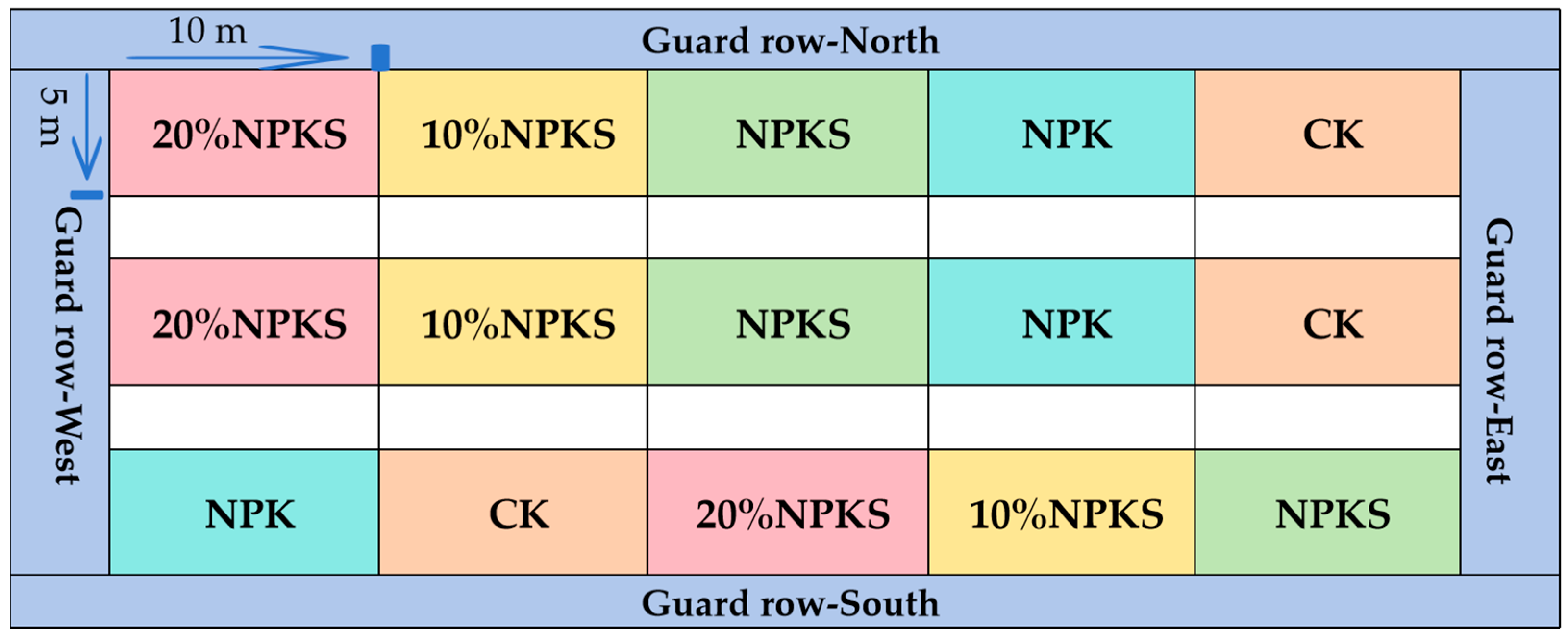
2.1. Long-Term Experimental Site and Design
2.2. Soil Sampling and Chemical Analysis
2.3. Soil Aggregate Stability Analysis
2.4. Statistical Analyses
3. Results
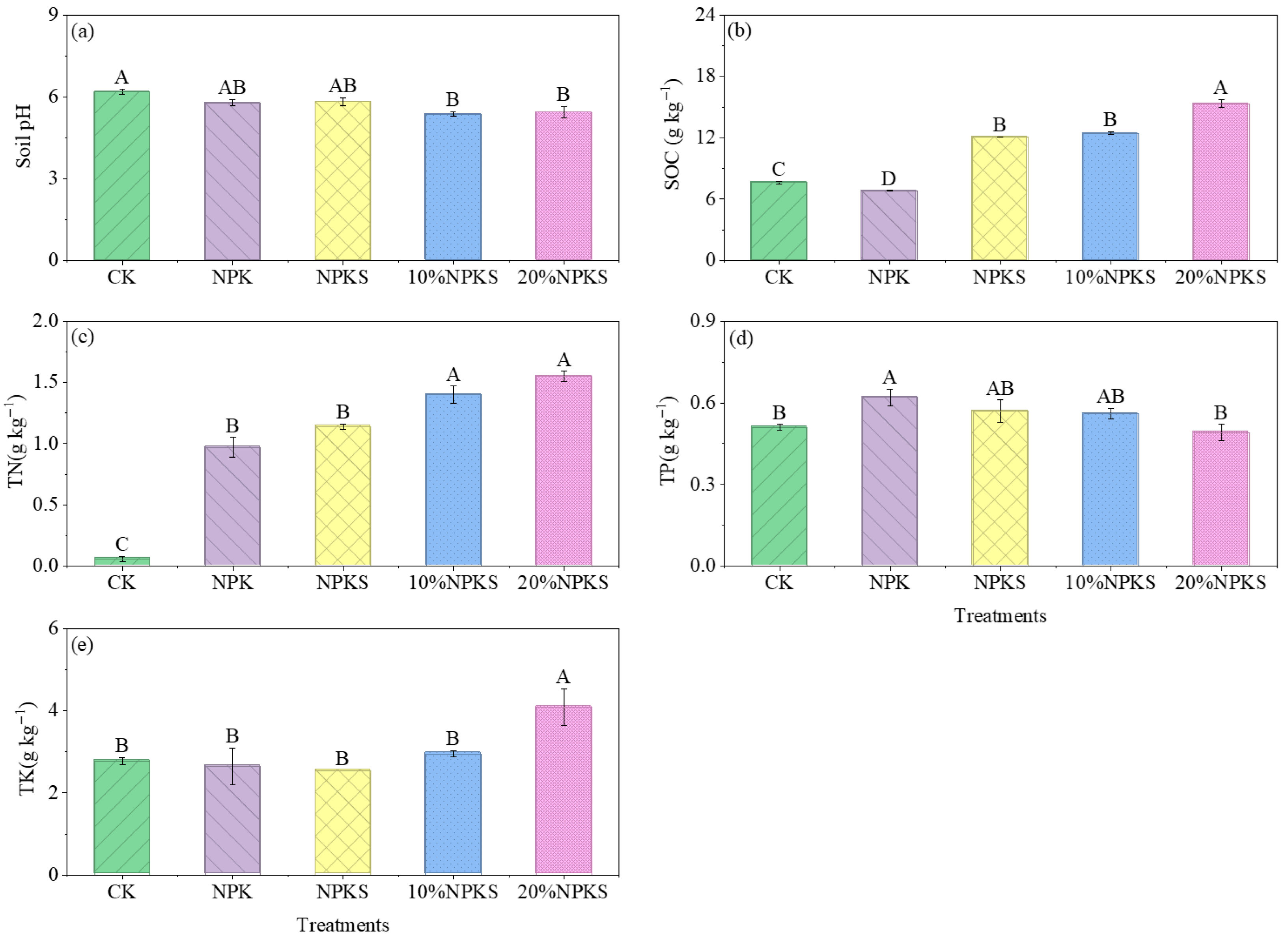
3.1. Soil Basic Chemical Properties Under Long-Term Different Straw Return Treatments
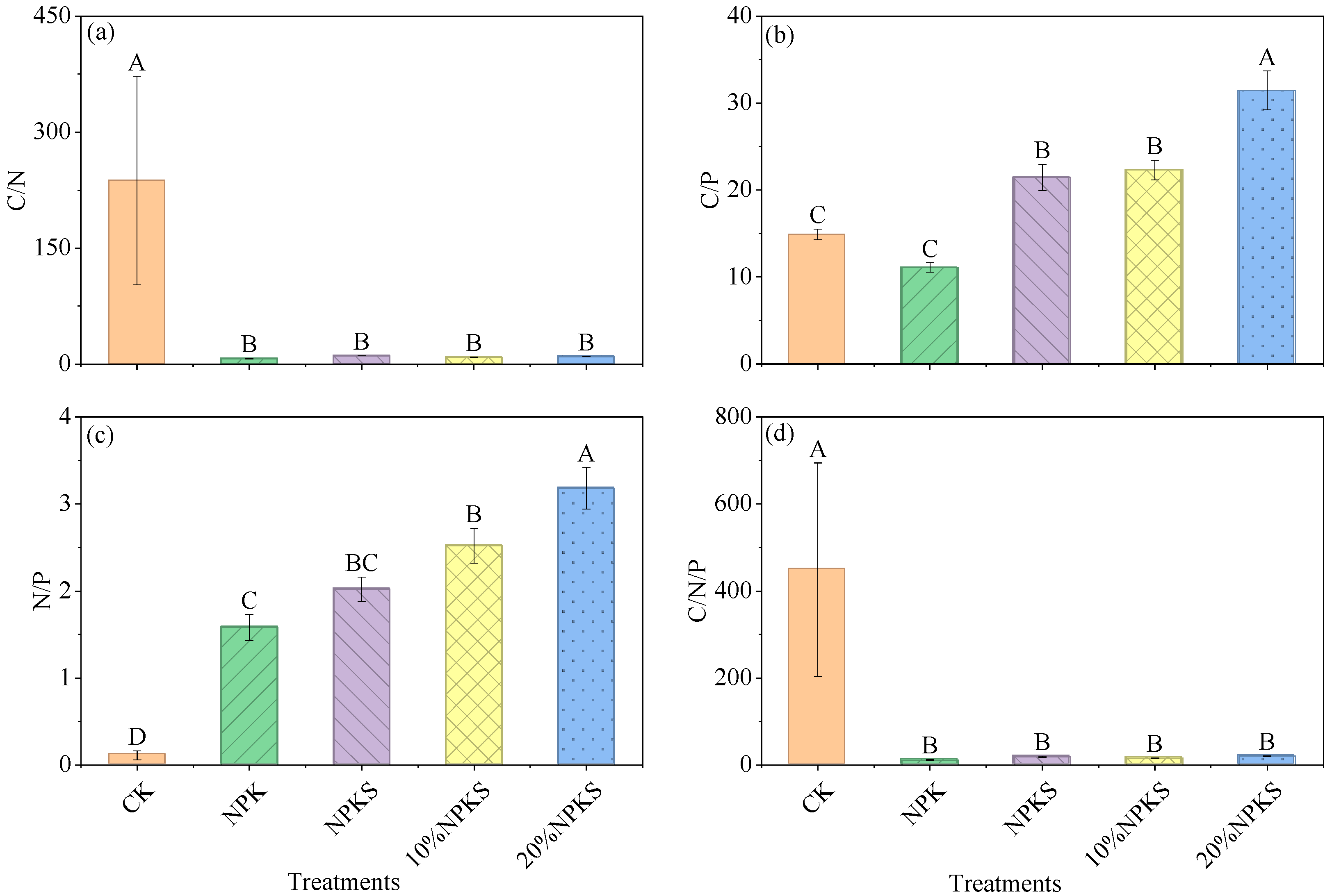
3.2. Characteristic of Soil C:N:P Stoichiometry Under Long-Term Different Straw Return Treatments
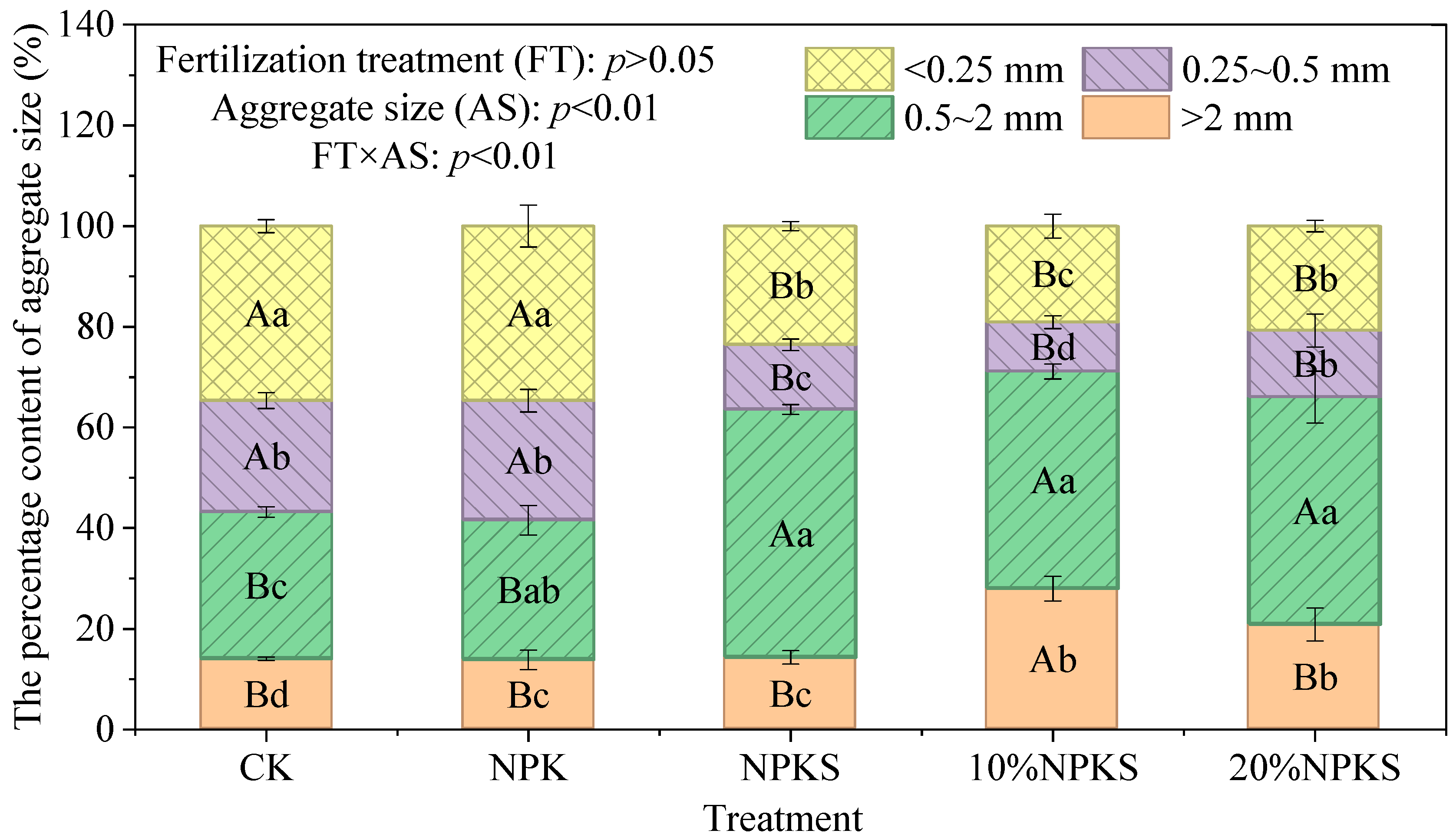
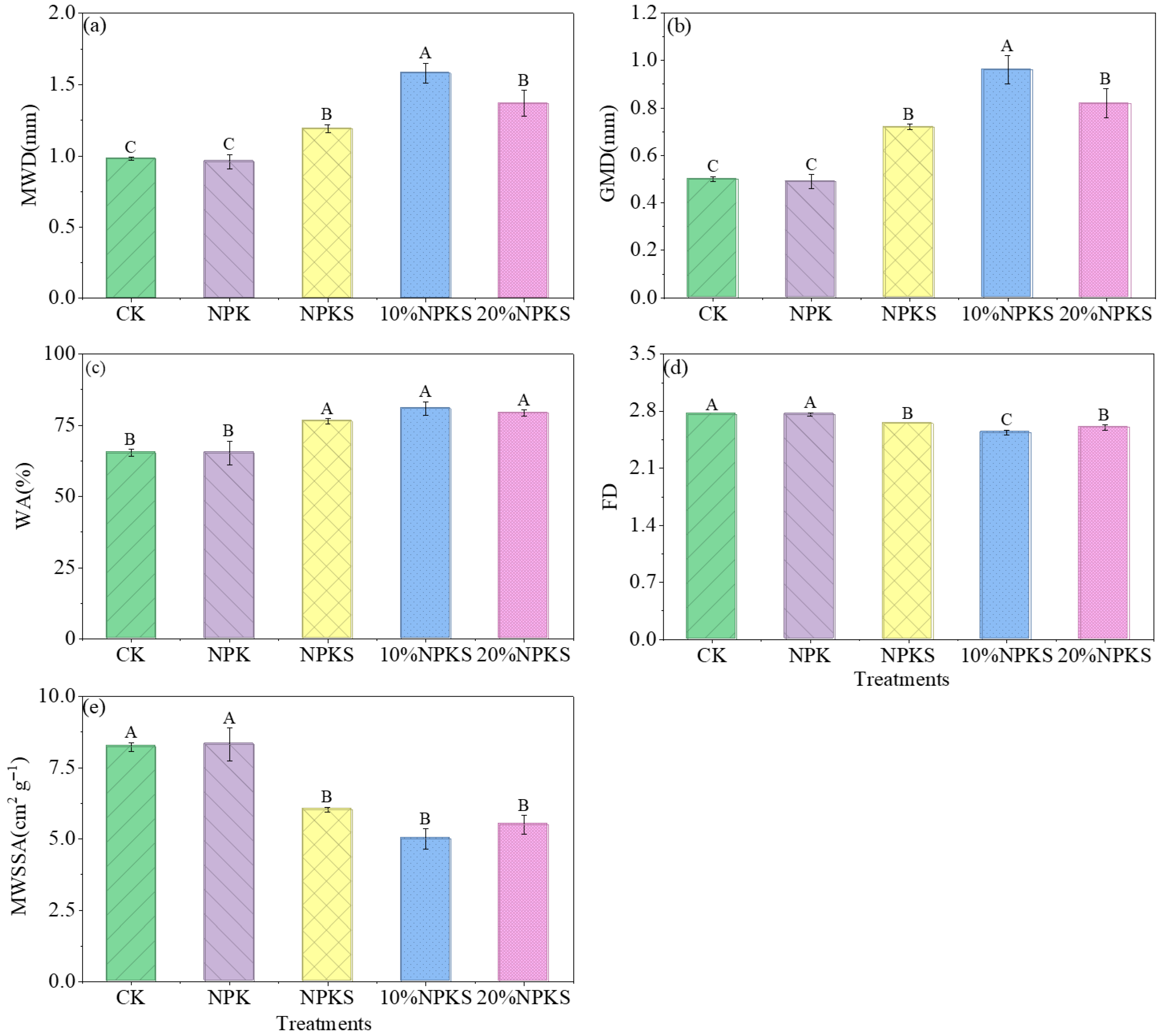
3.3. Distributions of Soil Aggregate Contents and Stability Under Long-Term Different Straw Return Treatments
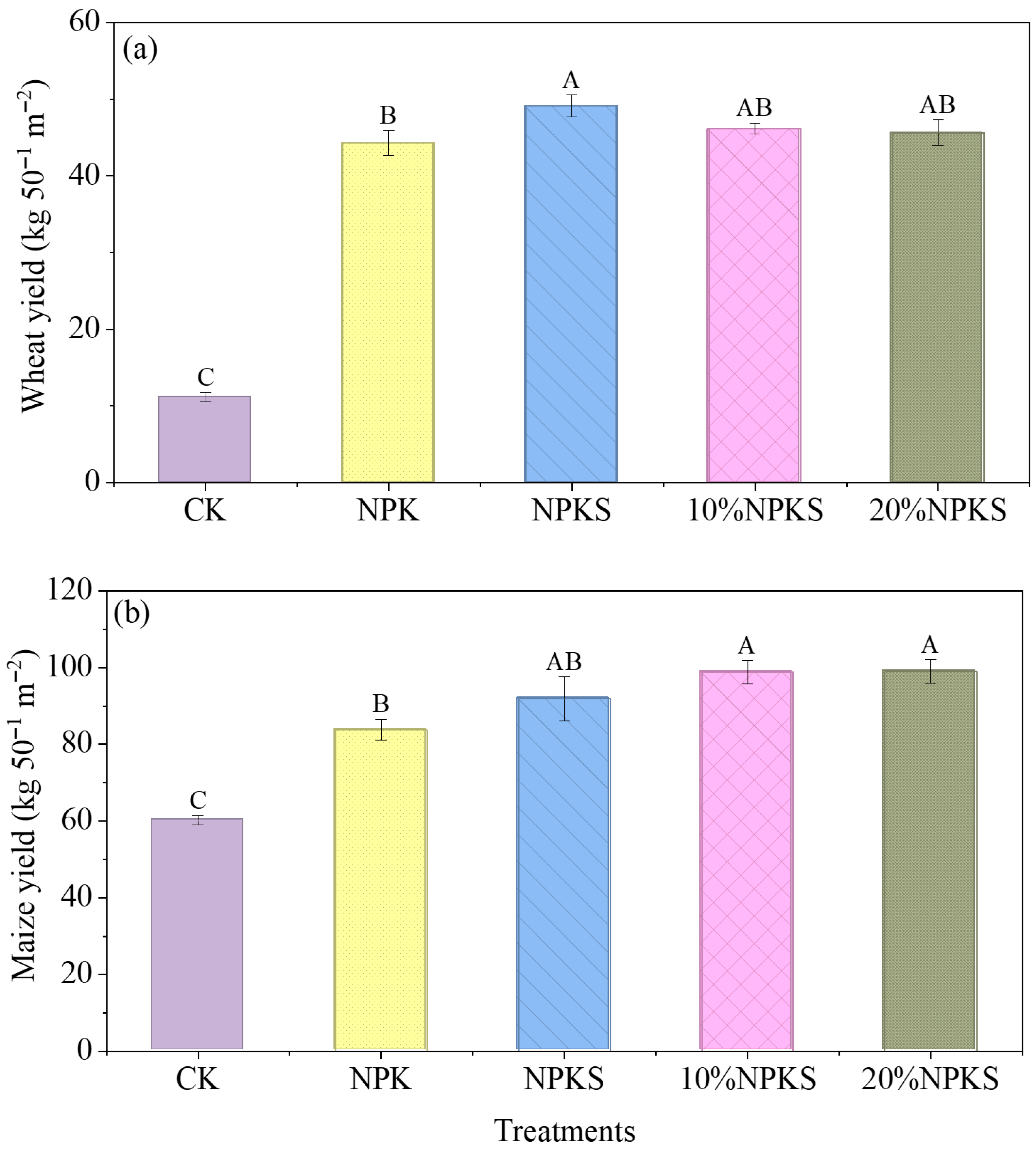
3.4. Yields of Wheat and Maize Under Long-Term Different Straw Return Treatments
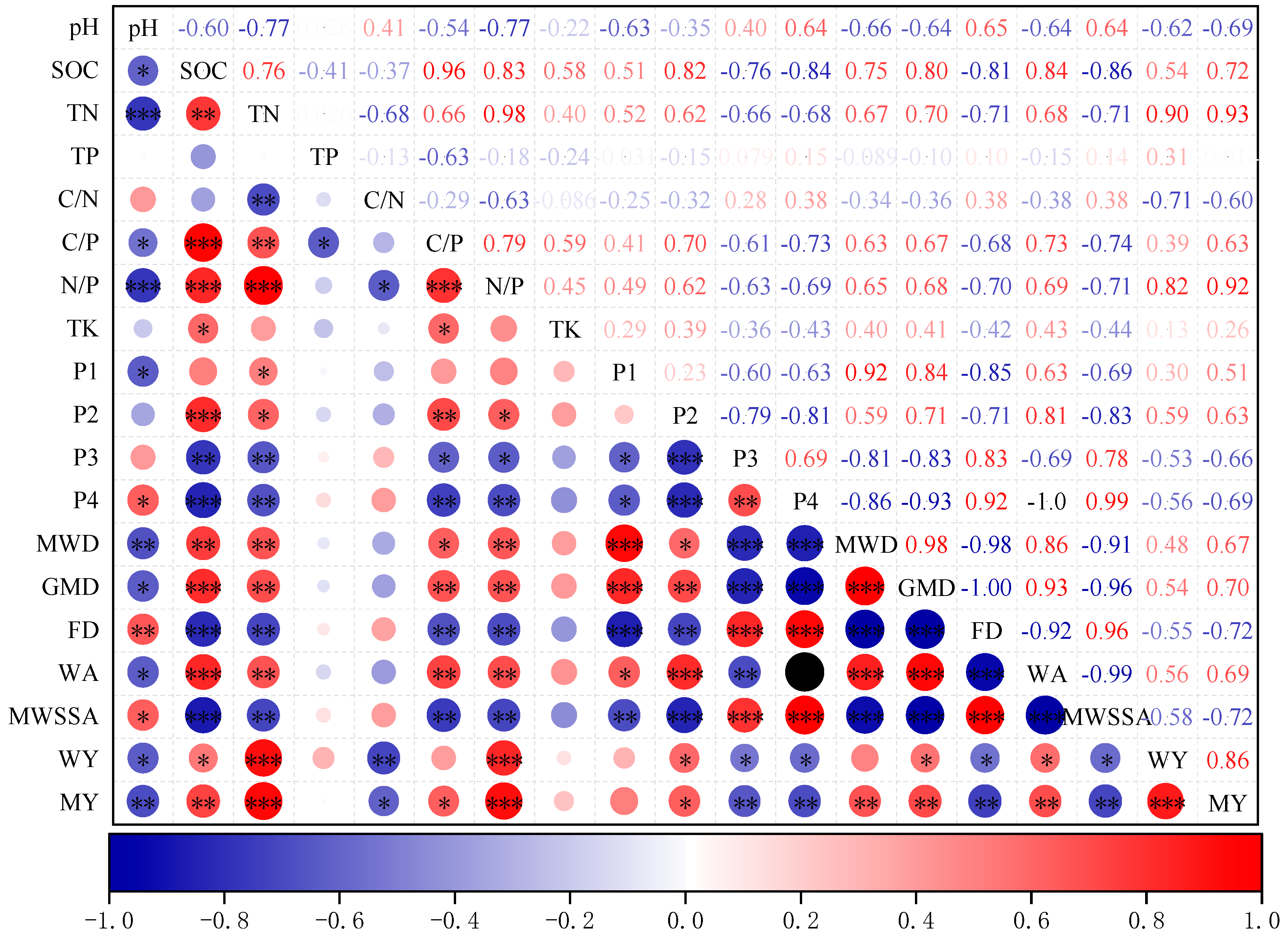
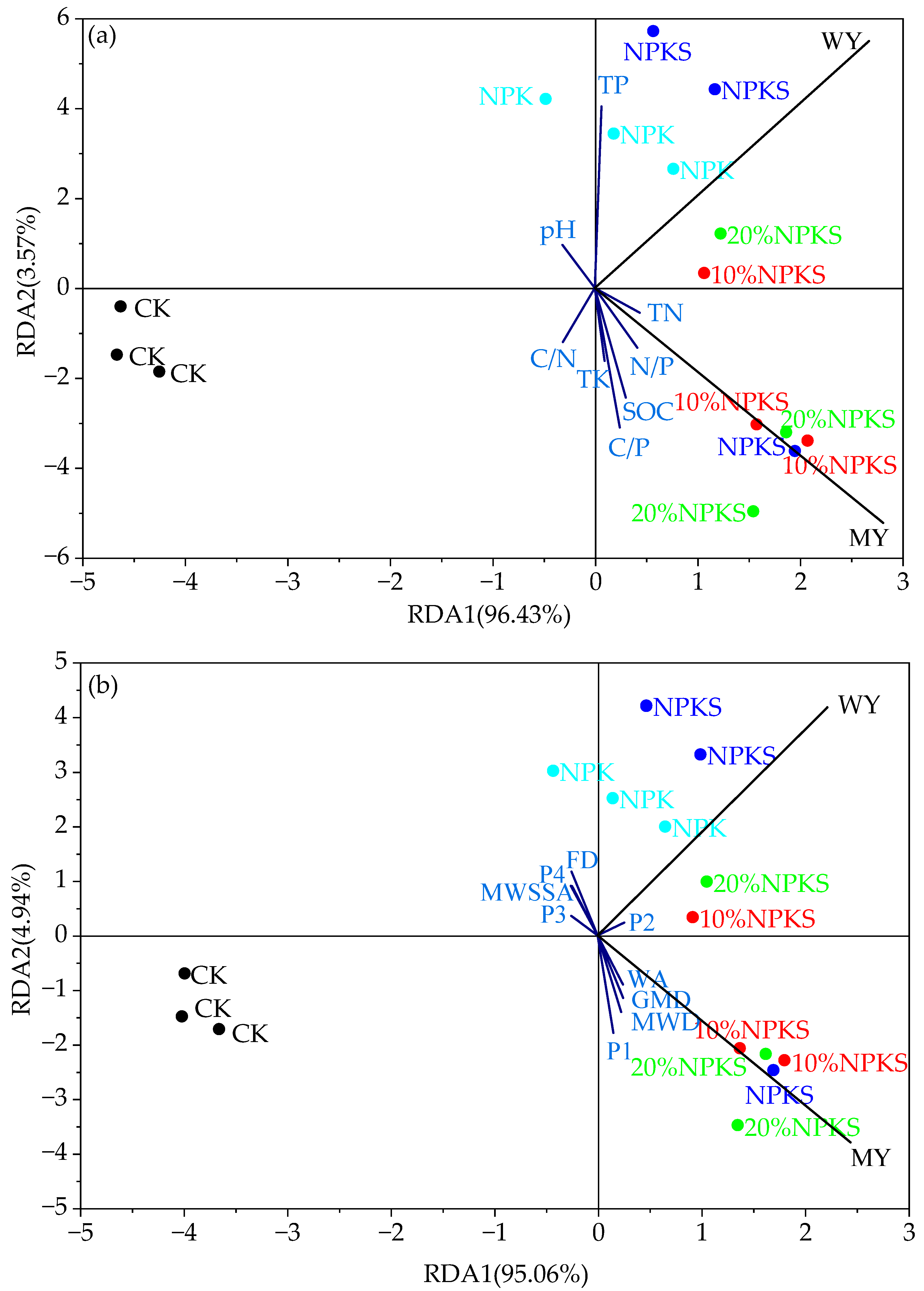
3.5. Relationship Between Soil Nutrient Stoichiometric Ratio, Aggregate Stability and Crop Yield
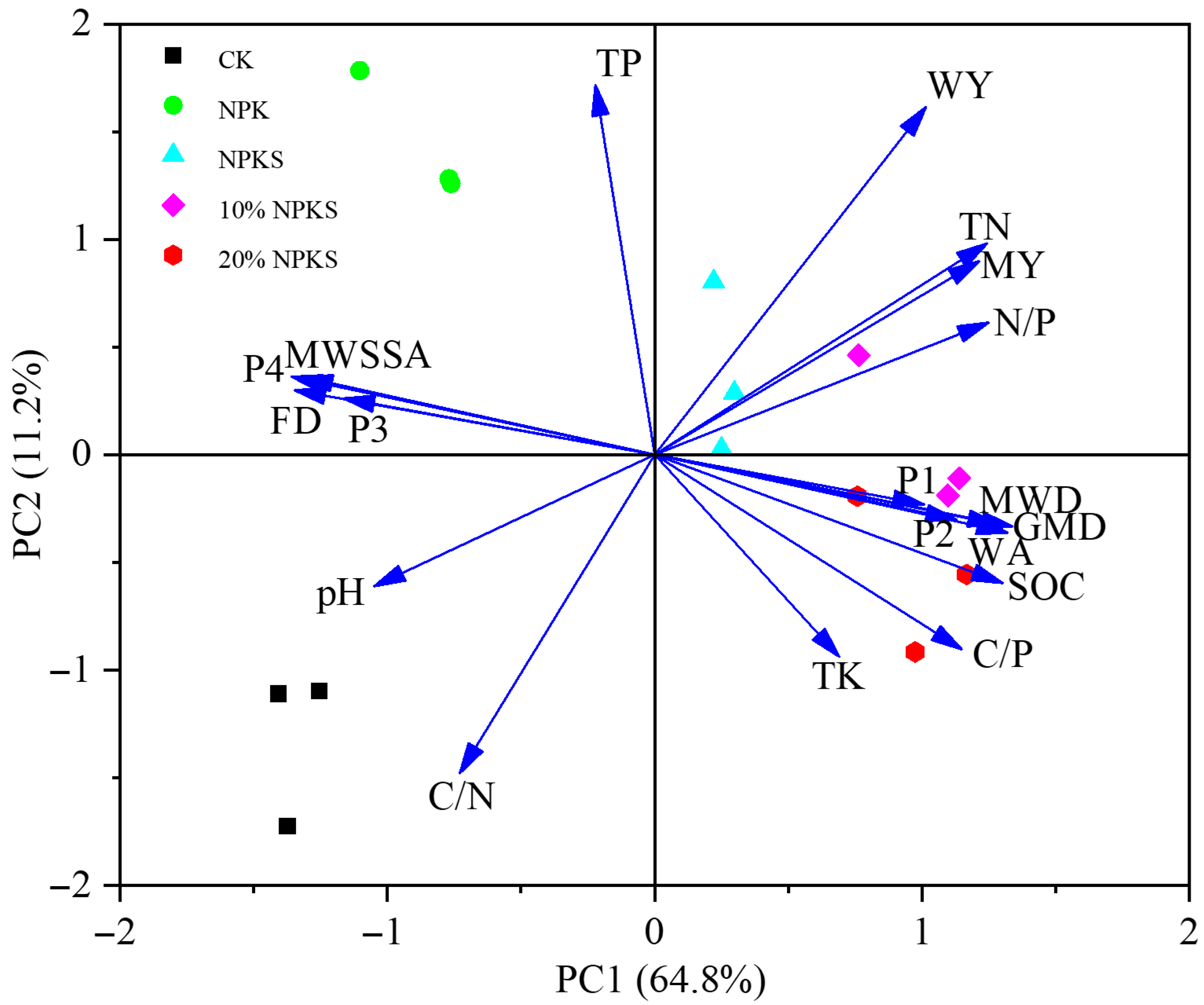
3.6. Contribution of Soil Nutrient Stoichiometric Ratio, Aggregate Stability to Crop Yield Under Long-Term Diferent Straw Return Treatments
4. Discussion
4.1. Effects of Long-Term Straw Return on Soil Basic Chemical Properties and C:N:P Stoichiometry
4.2. Enhancement of Soil Aggregate Content and Stability
4.3. Synergistic Effects on Crop Yield
4.4. Contributions of Soil C:N:P Stoichiometric Ratio and Aggregate Stability to Crop Yield
5. Conclusions
Author Contributions
Funding
Institutional Review Board Statement
Data Availability Statement
Acknowledgments
Conflicts of Interest
References
- Wang, N.; Qiao, Y.F.; Zhang, Q.Y.; Leng, P.F.; Li, Z.; Chen, G.; Li, F.D. Interactive effects of tillage and straw return on crop productivity and soil carbon sequestration in a wheat-maize rotation. Eur. J. Agron. 2026, 172, 127879. [Google Scholar] [CrossRef]
- Li, Y.Z.; Vazquez, C.; Jia, J.Y.; Zhang, J.Z.; Goede, R.D.; Debeljak, M.; Zhang, F.S.; Zhang, J.L.; Creamer, R. Developing a multi-criteria assessment model for soil primary productivity in double cropping systems: Insights from the North China Plain. Geoderma 2025, 459, 117346. [Google Scholar] [CrossRef]
- Chen, Y.M.; Zhang, Z.B.; Gao, L.; Guo, Z.C.; Xiong, P.; Jiang, F.H.; Peng, X.H. Pore shrinkage capacity of Shajiang black soils (Vertisols) on the North China Plain and its influencing factors. Pedosphere 2024, 34, 620–630. [Google Scholar] [CrossRef]
- Ding, T.Y.; Guo, Z.C.; Li, W.; Peng, X.H. Long-term straw return with nitrogen fertilization enhances soil pore structure, POM accumulation, and their positive feedback in a Vertisol. Soil Tillage Res. 2025, 252, 106602. [Google Scholar] [CrossRef]
- Yin, A.J.; Zhang, S.W.; Chen, F.K.; Zhou, S.Y.; Hu, R.X. Effects of modified coal gangue addition on CO2 release and organic carbon sequestration in Shajiang black soil. Environ. Technol. Innov. 2024, 36, 103872. [Google Scholar] [CrossRef]
- Cao, M.H.; Duan, Y.; Li, M.H.; Tang, C.G.; Kan, W.J.; Li, J.Y.; Zhang, H.L.; Zhong, W.L.; Wu, L.F. Manure substitution improves maize yield by promoting soil fertility and mediating the microbial community in lime concretion black soil. J. Integr. Agric. 2024, 23, 698–710. [Google Scholar] [CrossRef]
- Chen, L.; Li, F.; Li, W.; Ning, Q.; Li, W.J.; Zhang, J.B.; Ma, D.H.; Zhang, C.Z. Organic amendment mitigates the negative impacts of mineral fertilization on bacterial communities in Shajiang black soil. Appl. Soil Ecol. 2020, 150, 103457. [Google Scholar] [CrossRef]
- Fang, Y.T.; Zhu, B.; Wang, H.Y.; Peng, C.; Chen, X.; Lu, C.Y.; Chi, G.Y. Partial substitution of chemical nitrogen fertilizer with organic manure is more feasible than full substitution for soil phosphorus risk management. Soil Tillage Res. 2026, 256, 106847. [Google Scholar] [CrossRef]
- Ghosh, T.; Sharma, S.; Walia, S.S. Soil enzymes stoichiometry and microbial metabolic limitation under diverse nutrient management practices in rice-wheat cropping system: Insight from a 40-year long-term field experiment. Total Environ. Microbiol. 2025, 1, 100030. [Google Scholar] [CrossRef]
- Bhople, P.; Wall, D.; Richards, K.; Clough, T.; Brennan, F.; Lanigan, G.; Ros, M.; Herrmann, A.M.; Pedersen, I.F.; Elsgaard, L.; et al. Soil nutrient stoichiometry impacts on soil organic carbon stocks in long-term phosphorus fertilisation experiments. Geoderma 2025, 463, 117538. [Google Scholar] [CrossRef]
- Chen, S.M.; Fan, W.; Wu, H.Y.; Cheng, S.; Liu, J.Z.; Fan, Z.W.; Liang, Y.; Cai, H.G. Deep tillage with straw retention increased organic carbon sequestration and enhanced homogenization of microbial communities and functions across soil depths. Agric. Ecosyst. Environ. 2026, 395, 109949. [Google Scholar] [CrossRef]
- Wu, L.G.; Wang, Q.; Su, Y.X.; Zheng, Y.T.; Lu, Y.L.; Zheng, S.C.; Akhtar, M.; Deng, A.X.; Zhang, X.; Song, Z.W.; et al. Optimizing maize straw return enhances wheat yield and nitrogen use efficiency while reducing N2O emissions. Soil Tillage Res. 2026, 256, 106866. [Google Scholar] [CrossRef]
- Liu, C.Z.; Si, B.C.; Zhao, Y.; Wu, Z.M.; Lu, X.C.; Chen, X.; Han, X.Z.; Zhu, Y.C.; Zou, W.X. Drivers of soil quality and maize yield under long-term tillage and straw incorporation in Mollisols. Soil Tillage Res. 2026, 246, 106360. [Google Scholar] [CrossRef]
- Li, S.P.; Liu, M.L.; Huang, H.Y.; Zhao, L.; Zhuang, M.H.; Wang, C. Effects of long-term straw return on grain yield stability in China: A meta-analysis. Field Crops Res. 2026, 335, 110175. [Google Scholar] [CrossRef]
- Li, X.; Yang, X.N.; Li, J.Y.; Wang, J.; Fu, X.; Peng, Z.P.; Dang, H.K. Inefficient C sequestration with long term high-level straw return as linked to protected C pools saturation on the North China Plain. Soil Tillage Res. 2026, 255, 106766. [Google Scholar] [CrossRef]
- Yang, Y.; Long, Y.; Li, S.; Liu, X. Straw return decomposition characteristics and effects on soil nutrients and maize yield. Agriculture 2023, 13, 1570. [Google Scholar] [CrossRef]
- Tong, X.Y.; Liu, X.F.; Wu, P.T.; Hang, Y.Q.; Zhang, L.; Jia, B.K.; Zhang, J.S.; Cai, P.S. More frequent precipitation during the maize growth period offsets the yield increasing effect of straw mulching in China: A meta-analysis. Soil Tillage Res. 2026, 256, 106870. [Google Scholar] [CrossRef]
- Han, H.; Fan, D.J.; Liu, S.X.; Jiang, R.; Song, D.P.; Zou, G.Y.; He, P.; Wang, M.Y.; He, W.T. Integrating straw return and tillage practices to enhance soil organic carbon sequestration in wheat–maize rotation systems in the North China Plain. Agric. Ecosyst. Environ. 2025, 384, 109555. [Google Scholar] [CrossRef]
- Sun, A.B.; Yu, N.; Han, Y.Y.; An, J.; Zou, H.T. Tillage and straw return alleviate soil compaction in Northeast China: From pore structure to root development and crop productivity. Soil Tillage Res. 2026, 256, 106917. [Google Scholar] [CrossRef]
- Xin, J.J.; Yan, L.; Cai, H.G. Response of soil organic carbon to straw return in farmland soil in China: A meta-analysis. J. Environ. Manag. 2024, 359, 121051. [Google Scholar] [CrossRef]
- Wang, X.D.; Lei, W.; Ren, J.P.; Wang, L.; Tao, Y.; Zhang, Y. Nitrogen availability regulates the effects of straw incorporation on soil organic carbon functional pools. Soil Biol. Biochem. 2026, 212, 110017. [Google Scholar] [CrossRef]
- Ding, T.Y.; Guo, Z.C.; Li, W.; Fang, H.; Gao, L.; Peng, X.H. Long-term nitrogen fertilization promotes fresh particulate organic matter accumulation within macroaggregates under straw return by increasing pore connectivity. Soil Tillage Res. 2026, 256, 106906. [Google Scholar] [CrossRef]
- Liang, Y.Q.; Cao, D.; Ma, Z.; Wu, R.Q.; Zhang, H.R.; Fang, Y.Y.; Shahbaz, M.; Liu, X.J.A.; Kuzyakov, Y.; Chen, J.P.; et al. Stoichiometry regulates rice straw-induced priming effect: The microbial life strategies. Soil Biol. Biochem. 2024, 196, 109514. [Google Scholar] [CrossRef]
- He, K.X.; Ma, B.L.; Wei, X.F.; Guo, S.; Feng, C.C.; Liu, C.Y.; Ma, Y.Q.; Li, P.F. Straw return impacts on crop yield and yield variability: A meta-analysis. Soil Tillage Res. 2025, 254, 106712. [Google Scholar] [CrossRef]
- Wang, X.Y.; Li, Z.X.; Li, H.; Shen, T.T.; Luo, Y.X.; Zhang, F.L.; Wang, X.Z.; Zhang, X.Y. Maize straw application shows regional-scale improvements to soil fertility and crop yields in Chinese croplands: A meta-analysis. Field Crops Res. 2025, 333, 109908. [Google Scholar] [CrossRef]
- Zhang, M.M.; Yang, N.; Han, X.Q.; Lal, R.; Huang, T.T.; Dang, P.F.; Xue, J.Q.; Qin, X.L.; Siddique, K.H.M. Effects of straw returning depth on soil organic carbon sequestration and crop yield in China: A meta-analysis. Agric. Ecosyst. Environ. 2025, 393, 109799. [Google Scholar] [CrossRef]
- Wang, G.C.; Li, H.T.; Hu, F.L.; Yin, W.; Fan, Z.L.; Fan, H.; Sun, Y.L.; He, W.; Chai, Q. Application of green manure combined with synthetic nitrogen fertilizer enhances soil aggregate stability in an arid wheat cropping system. Appl. Soil Ecol. 2025, 206, 105849. [Google Scholar] [CrossRef]
- Zhu, Y.C.; Zhang, M.; Han, X.Z.; Lu, X.C.; Chen, X.; Feng, H.L.; Wu, Z.M.; Liu, C.Z.; Yan, J.; Zou, W.X. Evaluation of the soil aggregate stability under long term manure and chemical fertilizer applications: Insights from organic carbon and humic acid structure in aggregates. Agric. Ecosyst. Environ. 2024, 376, 109217. [Google Scholar] [CrossRef]
- Meng, X.T.; Zhang, X.C.; Li, Y.N.; Jiao, Y.P.; Fan, L.C.; Jiang, Y.J.; Qu, C.Y.; Filimonenko, E.; Jiang, Y.H.; Tian, X.H.; et al. Nitrogen fertilizer builds soil organic carbon under straw return mainly via microbial necromass formation. Soil Biol. Biochem. 2024, 188, 109223. [Google Scholar] [CrossRef]
- Zhang, Y.J.; Osborne, B.; Dang, S.N.; Zou, J.L. The effects of straw return and tillage depth on soil respiration and soil organic carbon: Implications for improving the sustainability of agro-ecosystems in China. Eur. J. Agron. 2025, 168, 127630. [Google Scholar] [CrossRef]
- Xu, L.; Zhou, Y.; Miao, C.R.; Chen, H.; Zhang, J.W.; Qian, H.Y.; Hou, P.F.; Ding, Y.F.; Liu, Z.H.; Li, W.W.; et al. Long-term straw return increases fungal residual contribution to soil microaggregate nitrogen pool: An eco-enzymatic stoichiometric study. Soil Tillage Res. 2024, 244, 106278. [Google Scholar] [CrossRef]
- Mehran, M.; Huang, L.; Geng, M.J.; Gan, Y.F.; Cheng, J.Y.; Zhu, Q.; Ahmad, I.A.; Haider, S.; Mustafa, A. Co-utilization of green manure with straw return enhances the stability of soil organic carbon by regulating iron-mediated stabilization of aggregate-associated organic carbon in paddy soil. Soil Tillage Res. 2025, 252, 106624. [Google Scholar] [CrossRef]
- Liu, J.R.; Wang, X.H.; Zhang, H.; Lu, Y.F.; Kalkhajeh, Y.K.; Hu, H.X.; Huang, J.Y. Long-term in situ straw returning increased soil aggregation and aggregate associated organic carbon fractions in a paddy soil. Heliyon 2024, 10, e32392. [Google Scholar] [CrossRef] [PubMed]
- Zan, Z.; Ma, R.; Wang, J.; Liu, L.; Ning, T.; Jiao, N. Co-Ridge planting enhances yield advantages of maize intercropping with peanut by improving soil aggregate stability and the ecological stoichiometric characteristics of carbon, nitrogen, and phosphorus. Agronomy 2025, 15, 2227. [Google Scholar] [CrossRef]
- Zhang, J.; Zhang, F.H.; Yang, L. Continuous straw returning enhances the carbon sequestration potential of soil aggregates by altering the quality and stability of organic carbon. J. Environ. Manag. 2024, 358, 120903. [Google Scholar] [CrossRef]
- Zhang, W.Z.; Chen, X.Q.; Wang, H.Y.; Wei, W.X.; Zhou, J.M. Long-term straw return influenced ammonium ion retention at the soil aggregate scale in an Anthrosol with rice-wheat rotations in China. J. Integr. Agric. 2022, 21, 521–531. [Google Scholar] [CrossRef]
- Zhao, Y.; Han, X.Z.; Qiu, C.; Zou, W.X.; Lu, X.C.; Yan, J.; Chen, X. The enhancements of pore morphology and size distribution by straw return are mediated by increases in aggregate-associated carbon and nitrogen. J. Integr. Agric. 2025, 24, 1562–1576. [Google Scholar] [CrossRef]
- Zhang, N.W.; Zheng, G.R.; Han, X.Z.; Chen, X.; Lu, X.C.; Yan, J.; Zou, W.X. Microbial resource limitation in soil aggregates effects soil organic carbon storage under straw incorporation. Soil Tillage Res. 2026, 256, 106874. [Google Scholar] [CrossRef]
- Li, X.; Huang, R.; Wang, Y.; Jiang, H.; Luo, Y.; Wang, C.; Li, B. Straw application promotes soil carbon storage by affecting aggregate-associated bacterial community structure and RuBisCO activity: A 35-year field experiment. Microbiol. Spectr. 2025, 13, e00088-25. [Google Scholar] [CrossRef] [PubMed]
- Yang, S.Q.; Chen, L.M.; Tang, Y.F.; Tan, X.M.; Zeng, Y.J.; Pan, X.H.; Zeng, Y.H. Quantitative assessment of the transport and distribution of photosynthetic carbon and exogenous nitrogen in a rice–soil system under long-term straw return: An isotope trial using 13C and 15N labelling. J. Integr. Agric. 2025, 24, 4063–4077. [Google Scholar] [CrossRef]
- Guo, Z.C.; Ding, T.Y.; Wang, Y.K.; Zhang, P.; Gao, L.; Peng, X.H. Quantifying and visualizing soil macroaggregate pore structure and particulate organic matter in a Vertisol under various straw return practices using X-ray computed tomography. Geoderma 2024, 452, 117105. [Google Scholar] [CrossRef]
- Li, Y.; Abalos, D.; Arthur, E.; Feng, H.; Siddique, K.H.M.; Chen, J. Different straw return methods have divergent effects on winter wheat yield, yield stability, and soil structural properties. Soil Tillage Res. 2024, 238, 105992. [Google Scholar] [CrossRef]
- Li, M.; Wang, K.; Ma, X.; Fan, M.; Li, B.; Song, Y. Relationship between soil aggregate stability and associated carbon and nitrogen changes under different ecological construction measures in the Karst Region of Southwest China. Agriculture 2025, 15, 207. [Google Scholar] [CrossRef]
- Yang, C.Q.; Wang, X.J.; Li, J.A.; Zhang, G.W.; Shu, H.M.; Hu, W.; Han, H.Y.; Liu, R.X.; Guo, Z.C. Straw return increases crop production by improving soil organic carbon sequestration and soil aggregation in a long-term wheat–cotton cropping system. J. Integr. Agric. 2024, 23, 669–679. [Google Scholar] [CrossRef]
- Zhang, Y.; Liu, M.; Han, L.; Yang, J.; Zhao, X.; Qu, J.; Li, L.; Bai, Y.; Yan, D.; Hou, G. Spatial distribution characteristics of soil C:N:P:K eco-stoichiometry of farmland and grassland in the agro-pastoral ecotone in Inner Mongolia, China. Agronomy 2024, 14, 346. [Google Scholar] [CrossRef]
- Zhao, Y.Q.; Yang, W.F.; Liu, Y.R.; Zhang, X.M.; Li, Y.L.; Qi, G.H.; Huang, S.H.; Luan, H.A. Linking soil organic carbon characteristics, nutrient stoichiometry, and microbial community to eco-enzymatic stoichiometry within aggregates in different aged walnut plantations. Eur. J. Soil Biol. 2024, 121, 103627. [Google Scholar] [CrossRef]
- Jing, Z.; Zhang, S.; Sun, Z.; Liu, Z.; Liu, S.; Ding, X. Straw incorporation and nitrogen fertilization enhance soil organic carbon sequestration by promoting aggregate stability and iron oxide transformation. Agronomy 2025, 15, 871. [Google Scholar] [CrossRef]
- Gao, Y.X.; Feng, H.J.; Zhang, M.; Shao, Y.Q.; Wang, J.Q.; Liu, Y.L.; Li, C.L. Straw returning combined with controlled-release nitrogen fertilizer affected organic carbon storage and crop yield by changing humic acid composition and aggregate distribution. J. Clean. Prod. 2023, 415, 137783. [Google Scholar] [CrossRef]
- Zhang, G.L.; Gong, Z.T. Soil Survey Laboratory Methods; Science Press: Beijing, China, 2012; pp. 92–103. [Google Scholar]
- Tang, X.; Hamoud, Y.A.; Shaghaleh, H.; Zhao, J.; Wang, H.; Wang, J.; Zhao, T.; Li, B.; Lu, Y. Responses of soil labile organic carbon on aggregate stability across different collapsing-gully erosion positions from Acric Ferralsols of South China. Agronomy 2023, 13, 1869. [Google Scholar] [CrossRef]
- Elliott, E.T. Aggregate structure and carbon, nitrogen, and phosphorus in native and cultivated soils. Soil Sci. Soc. Am. J. 1986, 50, 627–633. [Google Scholar] [CrossRef]
- Tang, X.; Qiu, J.C.; Xu, Y.Q.; Li, J.H.; Chen, J.H.; Li, B.; Lu, Y. Responses of soil aggregate stability to organic C and total N as controlled by land-use type in a region of south China affected by sheet erosion. CATENA 2022, 218, 106543. [Google Scholar] [CrossRef]
- Zheng, J.Y.; Zhao, J.S.; Shi, Z.H.; Wang, L. Soil aggregates are key factors that regulate erosion-related carbon loss in citrus orchards of southern China: Bare land vs. grass-covered land. Agric. Ecosyst. Environ. 2021, 309, 107254. [Google Scholar] [CrossRef]
- Tagar, A.A.; Adamowski, J.; Memon, M.S.; Do, M.C.; Mashori, A.S.; Soomro, A.S.; Bhayo, W.A. Soil fragmentation and aggregate stability as affected by conventional tillage implements and relations with fractal dimensions. Soil Tillage Res. 2020, 197, 104494. [Google Scholar] [CrossRef]
- Wang, Q.; Shao, X.; Wu, Z.; Li, W. Effects of different organic amendments on aggregate associated humus carbons and nutrients in a paddy soil. Agronomy 2025, 15, 2302. [Google Scholar] [CrossRef]
- Jia, R.H.; Shi, D.R.; Ye, J.G.; Wang, X.X.; Sun, M.J.; Wang, X.X.; Yang, S.Y.; Li, C.Z.; Li, C.J. Ditch-buried straw return coupled with ridge-furrow plastic mulching enhances pineapple straw decomposition and soil quality in tropics. J. Agric. Food Res. 2025, 23, 102263. [Google Scholar] [CrossRef]
- Kan, Z.R.; Liu, W.X.; Liu, W.S.; Lal, R.; Dang, Y.P.; Zhao, X.; Zhang, H.L. Mechanisms of soil organic carbon stability and its response to no-till: A global synthesis and perspective. Glob. Change Biol. 2022, 28, 693–710. [Google Scholar] [CrossRef]
- Shao, J.; Gao, C.; Afi Seglah, P.; Xie, J.; Zhao, L.; Bi, Y.; Wang, Y. Analysis of the available straw nutrient resources and substitution of chemical fertilizers with straw returned directly to the field in China. Agriculture 2023, 13, 1187. [Google Scholar] [CrossRef]
- Yang, J.; Zhang, S.J.; Zhang, J.H.; Zhao, S.; Lu, H.T.; Li, L.W.; Liu, L.T.; Wang, G.Y. Incorporating crop rotation into the winter wheat-summer maize system to enhance soil multifunctionality and sustainable grain production in the North China Plain. Field Crops Res. 2025, 325, 109834. [Google Scholar] [CrossRef]
- Song, J.J.; Song, J.H.; Haider, S.; Bai, J.Z.; Yang, G.H.; Ren, G.X.; Wang, X.; Feng, Y.Z. Straw return and nitrogen-phosphorus fertilization coordinates crop yields, soil nutrient function and carbon emissions. J. Environ. Manag. 2025, 393, 126950. [Google Scholar] [CrossRef] [PubMed]
- Li, X.Y.; Long, A.R.; Ji, X.J.; Wang, X.L.; Wang, Z.Y.; Gong, X.W.; Zhang, W.; Qi, H.; Jiang, Y.; Sun, Z.X.; et al. Straw return and nitrogen fertilizer application regulate the efficient use of radiation, water, nitrogen and maize productivity in Northeast China. Agric. Water Manag. 2024, 301, 108973. [Google Scholar] [CrossRef]
- Liu, N.; Li, Y.Y.; Cong, P.; Wang, J.; Guo, W.; Pang, H.C.; Zhang, L. Depth of straw incorporation significantly alters crop yield, soil organic carbon and total nitrogen in the North China Plain. Soil Tillage Res. 2021, 205, 104772. [Google Scholar] [CrossRef]
- Zhou, T.Y.; Zang, Y.G.; Li, Z.K.; Zhang, Y.J.; Zhu, K.Y.; Zhang, W.Y.; Zhang, H.; Liu, L.J.; Wang, Z.Q.; Gu, J.F.; et al. Controlled-release nitrogen fertilizer and long-term straw return synergistically improve wheat yield and reduced the nitrogen losses by regulating soil microbial communities and soil organic nitrogen components. Field Crops Res. 2025, 334, 110148. [Google Scholar] [CrossRef]
- Wu, G.; Ling, J.; Zhao, D.Q.; Xu, Y.P.; Liu, Z.X.; Wen, Y.; Zhou, S.L. Deep-injected straw incorporation improves subsoil fertility and crop productivity in a wheat-maize rotation system in the North China Plain. Field Crops Res. 2022, 286, 108612. [Google Scholar] [CrossRef]
- Zhang, J.; Li, P.K.; Li, L.; Zhao, M.N.; Yan, P.S.; Liu, Y.; Li, W.; Ding, S.Y.; Zhao, Q.H. Soil respiration and carbon sequestration response to short-term fertilization in wheat-maize cropping system in the North China Plain. Soil Tillage Res. 2025, 251, 106536. [Google Scholar] [CrossRef]
- Wang, H.; Wu, Y.Y.; Yao, L.; Wang, L.; Liu, H.T.; Zhai, L.M.; Lin, C.W.; Wei, K.; Chen, H.L.; Liu, H.; et al. Interactive effects of tillage and straw mulching on surface runoff, nutrient loss, and maize yield on sloping farmland with purple soil in China. Agric. Water Manag. 2025, 320, 109860. [Google Scholar] [CrossRef]
- Zhang, Y.T.; Zhang, G.H.; Zhang, N.; Xing, S.K.; Zhang, Y. Response of soil erosion resistance to incorporated straw affected by different microbial inoculants in the black soil region of Northeast China. Agric. Ecosyst. Environ. 2025, 392, 109765. [Google Scholar] [CrossRef]
- Tian, L.; Wang, X.J.; Yan, Z.Q.; Liu, E.K. Effects of soil mechanical stability aggregates on maize grain amylose content under equivalent application of straw nitrogen instead of chemical fertilizers. Int. J. Biol. Macromol. 2025, 311, 143726. [Google Scholar] [CrossRef] [PubMed]
- Kan, Z.R.; Li, Z.Z.; Amelung, W.; Zhang, H.L.; Lal, R.; Bian, X.X.; Liu, J.; Xue, Y.G.; Li, F.M.; Yang, H.S. Soil carbon accrual and crop production enhanced by sustainable subsoil management. Nat. Geosci. 2025, 18, 631–638. [Google Scholar] [CrossRef]
- Ji, X.F.; Jiang, J.; Wang, Y.G.; Colinet, G.; Feng, W.T. Small straw addition enhances straw decomposition and carbon stabilized in soil aggregates over time. Soil Tillage Res. 2024, 238, 106022. [Google Scholar] [CrossRef]
- Ma, C.; He, Z.F.; Xiang, J.; Ding, K.X.; Zhang, Z.; Ye, C.L.; Wang, J.F.; Kalkhajeh, Y.K. A meta-analysis to explore the impact of straw decomposing microorganism inoculant-amended straw on soil organic carbon stocks. J. Integr. Agric. 2025, 24, 1577–1587. [Google Scholar] [CrossRef]
- Kalkhajeh, Y.K.; He, Z.F.; Yang, X.R.; Lu, Y.; Zhou, J.; Gao, H.J.; Ma, C. Co-application of nitrogen and straw-decomposing microbial inoculant enhanced wheat straw decomposition and rice yield in a paddy soil. J. Agric. Food Res. 2021, 4, 100134. [Google Scholar] [CrossRef]



| Treatment 1 | N (kg ha−1) | P2O5 (kg ha−1) | K2O (kg ha−1) | Amounts of Straw-Decomposing Microbial Inoculant (kg ha−1) | Rates of Straw Return (t ha−1) |
|---|---|---|---|---|---|
| CK | 0/0 | 0/0 | 0/0 | 0/0 | 0/0 |
| NPK | 300/250 | 120/45 | 100/45 | 0/0 | 0/0 |
| NPKS | 300/250 | 120/45 | 100/45 | 0/0 | 6/15 |
| 10%NPKS | 300/250 | 120/45 | 100/45 | 150/150 | 6/15 |
| 20%NPKS | 300/250 | 120/45 | 100/45 | 300/300 | 6/15 |
Disclaimer/Publisher’s Note: The statements, opinions and data contained in all publications are solely those of the individual author(s) and contributor(s) and not of MDPI and/or the editor(s). MDPI and/or the editor(s) disclaim responsibility for any injury to people or property resulting from any ideas, methods, instructions or products referred to in the content. |
© 2025 by the authors. Licensee MDPI, Basel, Switzerland. This article is an open access article distributed under the terms and conditions of the Creative Commons Attribution (CC BY) license (https://creativecommons.org/licenses/by/4.0/).
Share and Cite
Tang, X.; Qu, Y.; Wu, Y.; Li, S.; Wang, F.; Li, D.; Li, X.; Wang, J.; Zhao, J. Long-Term Straw Return Combined with Chemical Fertilizer Enhances Crop Yields in Wheat-Maize Rotation Systems by Improving Soil Nutrients Stoichiometry and Aggregate Stability in the Shajiang Black Soil (Vertisol) Region of North China Plain. Agronomy 2025, 15, 2861. https://doi.org/10.3390/agronomy15122861
Tang X, Qu Y, Wu Y, Li S, Wang F, Li D, Li X, Wang J, Zhao J. Long-Term Straw Return Combined with Chemical Fertilizer Enhances Crop Yields in Wheat-Maize Rotation Systems by Improving Soil Nutrients Stoichiometry and Aggregate Stability in the Shajiang Black Soil (Vertisol) Region of North China Plain. Agronomy. 2025; 15(12):2861. https://doi.org/10.3390/agronomy15122861
Chicago/Turabian StyleTang, Xian, Yangfan Qu, Yu Wu, Shasha Li, Fuwei Wang, Dongxue Li, Xiaoliang Li, Jianfei Wang, and Jianrong Zhao. 2025. "Long-Term Straw Return Combined with Chemical Fertilizer Enhances Crop Yields in Wheat-Maize Rotation Systems by Improving Soil Nutrients Stoichiometry and Aggregate Stability in the Shajiang Black Soil (Vertisol) Region of North China Plain" Agronomy 15, no. 12: 2861. https://doi.org/10.3390/agronomy15122861
APA StyleTang, X., Qu, Y., Wu, Y., Li, S., Wang, F., Li, D., Li, X., Wang, J., & Zhao, J. (2025). Long-Term Straw Return Combined with Chemical Fertilizer Enhances Crop Yields in Wheat-Maize Rotation Systems by Improving Soil Nutrients Stoichiometry and Aggregate Stability in the Shajiang Black Soil (Vertisol) Region of North China Plain. Agronomy, 15(12), 2861. https://doi.org/10.3390/agronomy15122861