1. Introduction
There is no doubt about the potential of smart agriculture concepts and systems, both in scientific research and industrial practice. Research and technological innovations have led to smart systems that increasingly enhance efficiency, productivity, and sustainability in agriculture. Smart systems are primarily able to optimize vigorous plant growth with reduced production risk, controllable and predictable crop yield. They are the basis for global food security and food safety. Based on plant requirements and cultivation goals, the key factors include light environment, temperature control, humidity regulation, nutrient supplementation, water management, growing medium and plant pathology, air flow and quality, economic value, etc. These factors are integrated into a multi-criteria smart system decision-making procedure [
1,
2,
3].
In practice, there are many ways to measure light falling on plants, but they have different advantages and disadvantages. In the past, measurements, in practice, were mainly determined by tradition and the quality of the available measuring instruments. Measurements can be divided into two main groups, depending on whether they relate to the quantitative or qualitative characteristics of light [
4]. The light environment is defined by qualitative and quantitative parameters. Due to technical and technological advances, these can be measured, monitored, and controlled. The qualitative measures are characterized by photosynthetically active radiation (PAR 400–700 nm), extended photosynthetically active radiation (ePAR 400–750 nm), and photobiologically active radiation (PBAR 280–800 nm), while the quantity of horticulturally relevant light is determined by the number of wavelength-dependent photons provided to the plants and their distribution across the growing area. Typical quantitative lighting parameters of plants are Photosynthetic Active Radiation (PAR) and the Daily Light Integral (DLI). Photosynthetically active radiation (PAR 400–700 nm) refers to the range of light wavelengths from 400 to 700 nanometers (nm) that plants can use for photosynthesis, including the specific wavelengths that chlorophyll and other pigments absorb to regulate the photosynthetic process; the units are usually in µmol·m
−2·s
−1. The most accurate PAR values (400–700 nm) integrate wavelength-based light intensities and are measured using spectroradiometers, which detect the light spectrum and provide detailed information about the specific wavelengths of the available light. Depending on data acquisition techniques, radiance-based and photon- or quantum-based measures are used, expressing radiance in Wm
−2 nm
−1 or photon flux units in µmol·m
−2·s
−1 nm
−1. The wavelength dependency (nm
−1) parts are often neglected and not presented in practice. In the literature, other PAR ranges such as extended photosynthetically active radiation (ePAR 400–750 nm) and photobiologically active radiation (PBAR 280–800 nm) are a focus of research. Using spectroradiometers, arbitrary spectral ranges and spectral sampling methods are applicable. There are approximation techniques based on global radiation or pyranometer measurements, which convert broad-band (400–700 nm) W·m
−2 records into PAR values [
5,
6,
7].
The Daily Light Integral (DLI) is an accumulation or integration of quantum flux measurements per second over 1 day (24 h), traditionally in the photosynthetically active radiation (PAR) spectrum, normally located in the 400 to 700 nm wavelength range. The units are in mol·m
−2·d
−1. Traditionally, DLI (photosynthetically active radiation-based DLI) is limited to PAR (400–700 nm), but current trends toward ePAR (400–750 nm) and PBAR (280–800 nm) suggest calculating eDLI (extended photosynthetically active radiation-based DLI) and PB-DLI (photobiologically active radiation-based DLI). DLI values can be calculated from spectroradiometer or pyranometer measurements, but the better the spectral resolution, the higher the DLI value’s accuracy [
8,
9]. A characteristic DLI pattern is also observable on seasonal scales and over other time intervals. Additionally, the quality of the diurnal solar spectrum changes due to atmospheric conditions. Recent studies have found that approximately 45% of total solar radiation falls within the PAR range, and a conversion factor of 4.484 μmol·m
−2·s
−1 has been introduced [
10].
Light intensity measures the illumination (brightness) of light falling on a surface. This is expressed in lux (lx), which represents the amount of light (lumens) per square meter. The units are in lm·m
−2 or lx [
11]. Lux-based light measurements have been widely used due to their low cost and availability, but several limitations in this method have been observed over the years. Luxmeters do not provide any spectral distribution information; therefore, they are not suitable for plant illumination characterization. Luxmeters were optimized to human vision (380–780 nm) to measure light intensity in lm·m
−2, while plants have other preferences and light perception patterns. These devices do not resolve the light spectrum and produce aggregated values with limited usability. In field conditions, light varies over time on daily and seasonal scales, both in quantity and quality. In a controlled environment, agricultural light can be optionally selected and set up. This aspect of light duration can include timing, illumination intervals (from milliseconds to hours), spectral compositions, and time-driven light recipes. In traditional greenhouse production, solutions to this problem have already been used in the past, including shading to reduce excess heat, reflective coating materials to protect plants from sunburn, and the use of colored soil-covering materials with spectral filtering to regulate harvesting and suppress weeds. Photoreceptors and pigments in plant organisms sense light and dark cycles, such as photoperiodism for short- and long-day plants, or trigger the plant’s biological responses based on phototropism [
12].
DLI
PAR(400–700nm) maps are visual representations that show the daily amount of PAR available to plants across different scales (locations, regions, countries, or continents). DLI
PAR(400–700nm) maps also serve as a foundation for the creation and development of smart systems, as they provide insights into the spatial availability of natural light sources accessible to plants to optimize energy consumption utilizing the solar spectrum. DLI mapping addresses several challenges in present agriculture, including meeting the demands of year-round production, coping with changing climatic conditions and extreme events, improving energy consumption resilience in a competitive economic landscape, maintaining quality and health expectations in plants’ nutritional parameters, supporting crop tolerance and resistance breeding, and unlocking the genetic potential and monitoring the adaptation of species and varieties. Production regions are increasingly adopting DLI mapping to enhance their agricultural lighting designs and support sustainable farming practices [
13,
14,
15,
16]. Countries with low solar radiation levels (Norway, Sweden, Finland, the United Kingdom, Denmark, Germany) face increased demand for supplementary lighting, whereas those with high solar radiation (Spain, Portugal, Italy, Greece, Malta, Cyprus, France) must prioritize effective shading strategies to optimize biomass accumulation and ensure sustainability [
17,
18,
19].
Existing continental or regional DLI maps have been produced for countries such as the USA [
20], China [
21], Hungary [
9], Spain [
13], and Slovakia [
14]. Methodologically, most DLI maps follow the approach by Faust and Logan, which has been widely adopted in the scientific literature [
20]. Industry-related DLI maps use the concepts introduced by Faust and Logan at continental scales (5 mol·m
−2·d
−1), such as in the Environmental Systems Research Institute (ESRI) DLI Maps for Europe [
22]. This map does not contain some European countries (Norway, Finland, Sweden, and Russia) but does contain Turkey. DLI maps with 5 mol·m
−2·d
−1 are best suited for continental comparisons but are very limited in their details regarding regional variances. At the country level, 2 mol·m
−2·d
−1 is advisable to use. However, the same scale values are assigned to two different DLI color names. For DLI calculations, World Meteorological Organisation (WMO) stations are used to provide long-term climate data, especially field radiation measurements. In another continental example, the USA DLI map allows users to interact with locations to open a table with annual and monthly values [
23]. DLI maps with 5 mol·m
−2·d
−1 are used, but they are limited for state-level comparisons. Unfortunately, the same scale values are assigned to two different DLI color codes. For the DLI calculations, a set of monthly DLI maps based on solar radiation data from 1998 to 2012 was applied. In addition, other industrial initiatives have resulted in informative annual DLI maps for Australia, Canada, China, Colombia, Ecuador, Europe, Mexico, New Zealand, Russia, the Scandinavian Peninsula, South Africa, and the USA [
24]. These maps are produced in different resolutions, even within a single map, with different DLI ranges (4–5 mol·m
−2·d
−1) and different color codes assigned to the same DLI value. Some maps have a DLI resolution of 4 (mol·m
−2·d
−1), which does not follow either the commonly used 5 mol·m
−2·d
−1 or the smaller scale 2 mol·m
−2·d
−1 DLI maps. This makes it very difficult to compare these maps with other maps, and their applicability is limited. Industrial DLI maps and visualizations are available; however, they often lack scientific publications, documentation, database references, and accurate descriptions of methodology, as these DLI maps are used as product promotion tools. The comparability, exact labeling, scientific precision, and knowledge transfers of these maps are often limited.
The present applied research aims to accomplish the following:
- (i)
to demonstrate the technical and technological developments in DLI mapping;
- (ii)
to create customized high-resolution (2 mol·m−2·d−1) and moderate resolution (5 mol·m−2·d−1) DLI map visualizations for Portugal;
- (iii)
to summarize and compare the temporal (monthly and seasonal) and spatial (regional) patterns with characteristic DLI values (minimum, maximum, average, range).
Our work is important from a theoretical point of view because these maps have not been created for Portugal, and they provide a scientific basis for the practical implementation of crop production, efficiency, and sustainability.
2. Materials and Methods
Portugal, as a Mediterranean country, is situated in Southwestern Europe on the Iberian Peninsula, with an area of 92,090 km
2 (mainland Portugal: Lat. 36–42° N, Lon. 6–31° W). It has a coastline of approximately 800 km along the Atlantic Ocean. The geographical distribution of Portugal’s altitudes and surface areas is as follows: 0–200 m (coastal plains and river valleys, 40–45%), 200–600 m (rolling hills and lower mountain ranges, 25–30%), 600–1200 m (mountainous regions 15–20%), 1200–2000 m (high mountain peaks 5–7%), and above 2000 m (very high mountains) < 1% [
25].
Portugal is characterized by the following general climate parameters. Sunshine is the governing factor for DLI calculations. The annual sunny hours and sunny days gradually decrease from north to south in Portugal. The northern regions receive around 1600–2000 h of sunshine annually, while the southern regions receive 2800–3000 h per year. The number of sunny days is approximately 230–250 in the north, 275 in the central regions, and around 300 in the south. Coastal Portugal has milder temperatures year-round, with the influence of the Atlantic Ocean keeping the winters warmer and summers cooler. These coastal areas have an average temperature of 16–18 °C, 25–30 °C in the summer, and 10–15 °C in the winter. Inland areas have an annual average temperature of 12–16 °C, 30–40 °C in the summer, and 0–5 °C in the winter. The mountain areas are characterized by an 8–10 °C annual average temperature, −5 °C or lower in the winter, and 15–25 °C in the summer. The northern regions receive significant rainfall, while the southern region is drier. Coastal areas have an annual rainfall of 700–1200 mm. Most rainy months occur from November to March, with peaks in December and January, while the dry months are from June to August, when rainfall is less than 20 mm per month. Inland areas receive an annual rainfall of 400–600 mm, with under 10 mm in the summer, from July to August. In mountain areas, annual rainfall is 1500 mm and is concentrated in the winter months. The influence of the Atlantic Ocean makes Portugal more humid, particularly along the coastline. Summer humidity is also divided into coastal areas, with an average relative humidity of 60–70%, and inland areas, with an average relative humidity of 40–50% [
26,
27].
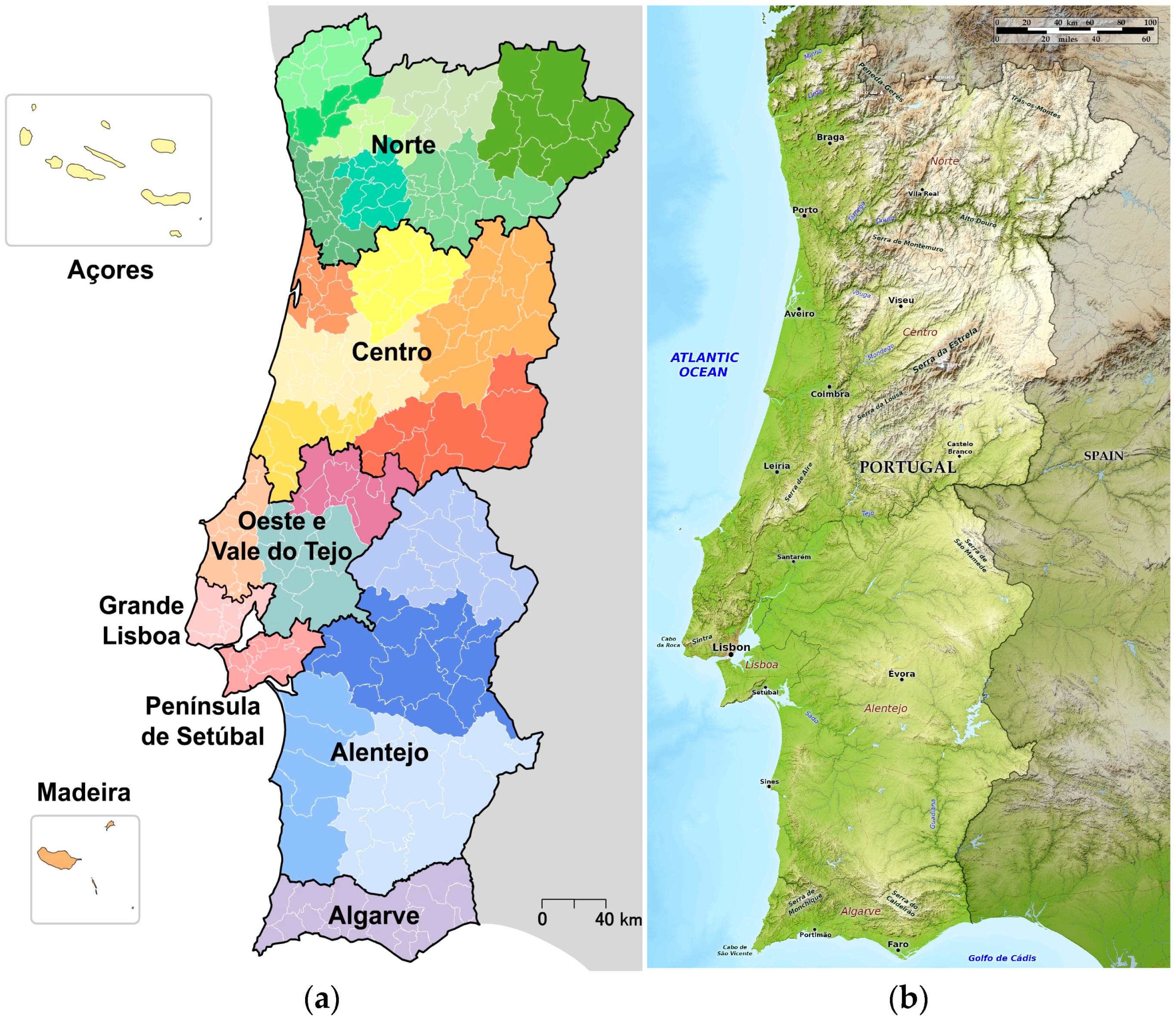
Portugal has several distinct agricultural regions with rich diversity, each characterized by unique climates, soils, terrains, and types of crops. The mainland shares its agricultural regions between the coastal (Co) and inland (In) areas according to a North (N)—Entre Douro e Minho (Co–N), Trás os Montes (In–N)—to Central (C)—Beira Litoral (In–C), Beira Alta (In–C), Beira Interior (Co–C), Beira Baixa (In–C), Ribatejo e Oeste (Co–C)—to South (S)—Alentejo (Co–S and In–S), Algarve (Co–S)—pattern [
28,
29] (
Figure 1).
In the northern regions, the climate is cooler and wetter, making it suitable for vineyards, particularly in the Douro Valley, where Port wine is produced. The fertile river valleys in the north also support the cultivation of cereals like wheat and maize, as well as fruit such as apples, pears, and chestnuts. In the northeastern part of the country, in Trás os Montes, agricultural activities are influenced by a continental climate, with harsh winters and hot, dry summers. Olive groves are common, and the region also produces cereals and fruit such as apples and grapes.
The central part of the country, which includes the Beira Alta and Beira Baixa areas, is known for its mix of mountainous areas and plains, where olives, cereals, and vegetables are grown. The Ribatejo region, centered around the Tagus river valley, is relevant for rice production, supported by the fertile floodplains. The region also produces cereals and fruit.
The Alentejo region is in the south, characterized by hot, dry summers and mild winters, which are ideal for large-scale agriculture. This region is a major producer of olives, particularly for olive oil, as well as cereals like wheat and barley. This is also an important region for the cultivation of cork oak (
Quercus suber L.). The region is well known for its vineyards, producing high-quality red wines. The southernmost area is the Algarve region, whose climate is even more arid, and this region is well known for its citrus fruits, as well as vegetables like tomatoes and paprika. The Azores and Madeira regions have specialized agricultural practices due to their unique climates, which are especially suitable for pineapples, tea, sugarcane, bananas, and vegetables. Their distinct areas and sizes compared to the mainland are unfortunately suboptimal to represent on the DLI map [
30].
Key quantitative metrics are photosynthetic photon flux (PPF) [µmol·s
−1], photosynthetic photon flux density (PPFD) [µmol·m
−2·s
−1], and the daily light integral (DLI) [mol·m
−2·d
−1]. The DLI represents the total amount of photosynthetically active radiation (PAR) received by plants over the course of a total day [mol·m
−2·d
−1]. Because of the spectral domain application of the DLI term, the following DLI indexing method will be used. The DLI
PAR(400–700nm) is unique among other plant metrics because it provides a clear daily measurement of the photosynthetically active radiation available to plants, and its spatial distribution can be well visualized through maps or charts. The Daily Light Integral (DLI) is defined as the total quantum flux of photosynthetically active radiation (PAR) accumulated over a 24 h period. PAR refers to the radiation within the wavelength range of 400 to 700 nm. The standard unit for DLI is expressed in mol·m
−2·d
−1, and it is calculated using the following formula: DLI = photosynthetic photon flux density (μmol·m
−2·s
−1) × photoperiod (h·d
−1) × 3600 (s·h
−1) × 10
−6 [
31,
32].
In our spatially distributed DLI calculations and the seasonal DLI maps, we considered the principles introduced by Faust and Logan [
20] and focused on the following sun-induced DLI production and visualization concept. DLI data collection was based on the DLI data collection method used by Jung et al. [
9,
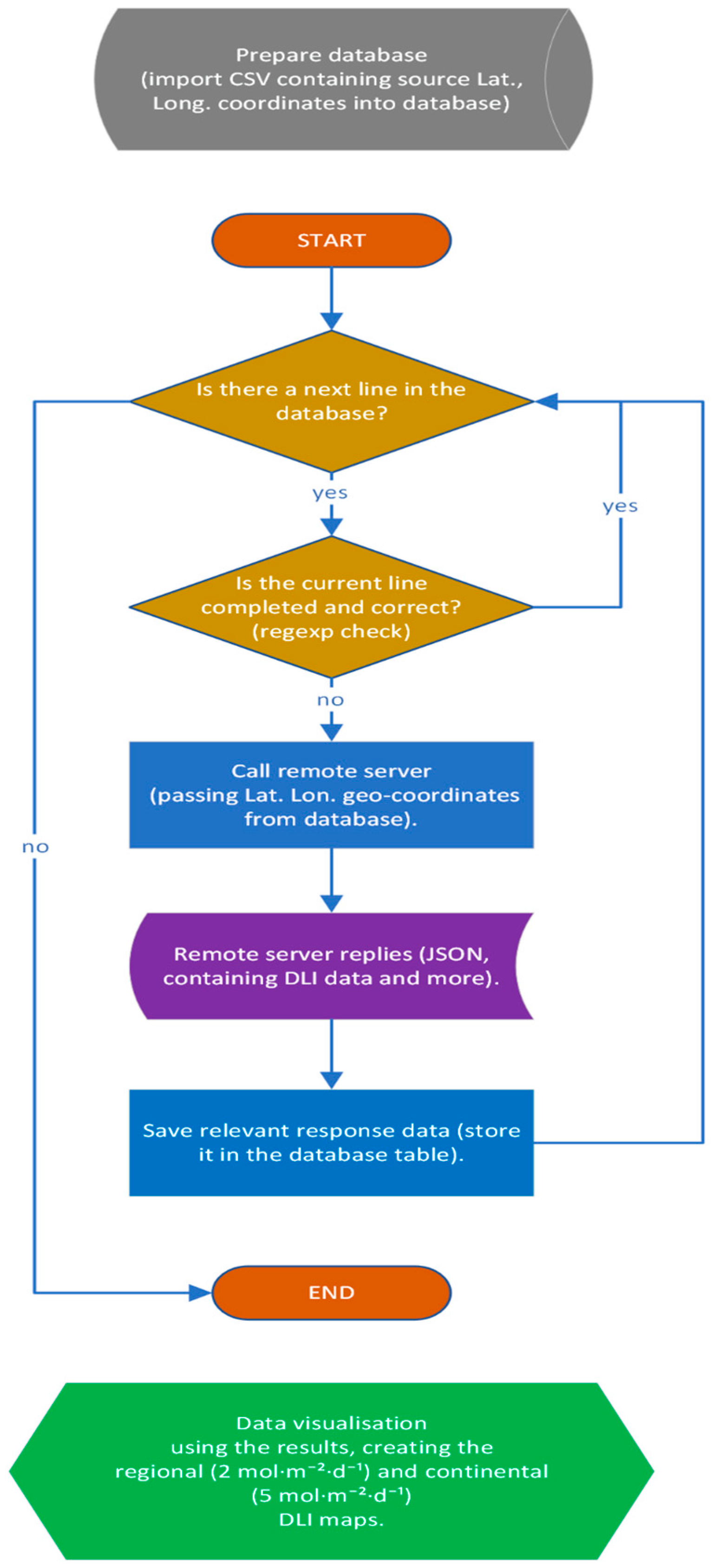
13], modified to increase speed and avoid overloading the remote server. The process was performed as follows:
For creating the source geo-coordinate pairs (Lat., Lon.) for the given geographical area (Portugal mainland), a 30 m resolution grid was utilized, derived from the 1-arc second global digital elevation models (DEM) provided by the Shuttle Radar Topography Mission (SRTM) of the National Aeronautics and Space Administration (NASA). This grid, with coordinates serving as DLI sampling points, employs the Geographic Coordinate System (GCS) projection, World Geodetic System 1984 (WGS84) horizontal datum, and Earth Gravitational Model 1996 (EGM96) vertical datum.
Each pair of geo-coordinates was given an identification number, and the twelve months of the year were added as blank fields, so that a total of fifteen fields per point formed a row in the resulting CSV file. This CSV file was the source for the SQL database import (MariaDB, version: 11.6.1).
The script took the source coordinates from the database and passed them to the remote server (property of SunTracker Technologies Ltd., Victoria, BC, Canada). The latitude and longitude values were sent by the script as the GET parameters of the call to the remote server. The remote server’s response contained the calculated DLI data for each month for the given geo-coordinate pair (Lat., Lon.). The remote server can be reached at the following URL:
https://dli.suntrackertech.com [
33]. The response is formatted as JavaScript Object Notation (JSON).
The script stored the fetched values in the corresponding row of the database table. The script was written in the PHP language (version 8.3.14) and runs on computers with Linux or Windows operating systems. The queries were made with the permission of SunTracker Technologies Ltd. The solar spectrum was cropped to PAR (Photosynthetically Active Radiation, 400–700 nm) and prepared for the following DLI formula: DLI (photosynthetic photon flux density) = (μmol·m
−2·s
−1) × photoperiod (h·d
−1) × 3600 (s·h
−1) × 10
−6 [
33]. Seasonal (monthly) and spatial (Portugal) DLI (Daily Light Integral) calculations were completed.
Spatial data was visualized in DLI maps with two different scales, 2 (regional) and 5 (continental) mol·m
−2·d
−1 (
Figure 2).
For our DLI calculations, World Meteorological Organisation (WMO) stations were used to provide long-term climate data, especially field radiation measurements. The DLI calculation is basically defined by spatio-temporal (geolocation of Earth: longitude, latitude) and seasonal changes (Earth–Sun geometry), but they are also influenced by weather conditions (cloud cover, quantity and quality of atmospheric aerosol, precipitation forms, albedo) and topographic and horizontal effects (altitude, slope of the terrain, aspect of a surface, topographic shadows, valleys and lowlands, vegetation and canopy cover, geological formations) [
34,
35].
3. Results
Portugal is situated in Southwestern Europe with an area of 92,090 km
2 (mainland Portugal: Lat. 36–42° N, Lon. 6–31° W). Portugal exhibits distinct regional variations and significant seasonal changes in photon flux values, strongly influenced by the country’s northeast orientation, with year-round effects (
Figure 3 and
Figure 4). DLI calculations are affected by various factors, including regional differences and seasonal variations.
3.1. Regional Variations
Generally, the DLI values increase from north to south; this is mainly because the distance to the equator gradually decreases. The mountains in the northern part of the country also cause significant orographic rainfall (increasing cloud cover) as moist air from the Atlantic is lifted over the peaks (Northern region). Topographic mountainous conditions can change and typically decrease the DLI value, regardless of north–south zonality. This intensity is modified by the coastal and continental positions. The coastal effect (Serra do Marão) reduces this intensity more strongly than in continental regions (Serra da Estrela). However, the Serra da Estrela is the highest mountain range in mainland Portugal; therefore, the prevailing winds from the Atlantic Ocean bring moisture to this area when the air rises over the mountains.
Northern regions (Entre Douro e Minho (Co–N), Trás os Montes (In–N)): Areas like Entre Douro e Minho receive lower DLI values due to more frequent cloud cover and higher precipitation. DLI values in these regions can be significantly lower, especially in winter (December–January–February), ranging between 7 and 19 mol·m−2·d−1. Trás os Montes (In–N). In the Northern region, the eastern part has tendentially higher DLI values compared to the western part of the region, resulting in a 4–6 mol·m−2·d−1 DLI deviation.
Central regions (Beira Litoral (In–C), Beira Alta (In–C), Beira Interior (Co–C), Beira Baixa (In–C), Ribatejo e Oeste (Co–C)): The northern parts of the Central regions (Beira Litorial and Beira Alta) are divided into two DLI areas for topographic reasons. The western part of the mountains shows lower DLI characteristics, while the eastern areas receive more solar illumination and higher DLI values. In July, the DLI values are 47–55 mol·m−2·d−1, following a west–east gradient. The eastern parts of the Central region consist of coastal (Ribatejo e Oeste (Co–C)) and inland (Beira Baixa (In–C)) areas. Ribatejo e Oeste (Co–C) is closer to the Atlantic Ocean and has a more moderate climate, with mild winters and warm summers. DLI values range, in winter (December–January–February), from about 11–19 mol·m−2·d−1, while in summer (June–July–August), they have an average of 45–55 mol·m−2·d−1. Beira Baixa (In–C) experiences a more continental climate, with hot summers and cold winters. This region tends to have lower DLI values compared to Ribatejo e Oeste (Co–C), typically 2–3 mol·m−2·d−1, both in winter and summer.
South regions (Baixo Alentejo (Co–S), Alto Alentejo (In–S), Algarve (Co–S)). The Baixo Alentejo (Co–S) Alto Alentejo (In–S)) are relatively homogeneous in climate conditions. These regions are characterized by sloping hills and large plains, with the highest points being in the more mountainous northern parts (Alto Alentejo). Their DLI values are 15–17 mol·m−2·d−1 in winter (January) and 53–55 mol·m−2·d−1 in summer (July). The Algarve (Co–S) region’s DLI characteristics are mainly determined by its location, being the southernmost region, closest to the equator, with the south and west coasts surrounded by ocean. It also has expansive plain areas, particularly in the central and eastern parts, where agriculture is dominant. Its topography is shaped by its closeness to the ocean, as well as its mountainous inland regions, resulting in a diverse range of landscapes. The Algarve region leads the country’s DLI values regardless of the season. Algarve exceeds the northern regions, with a DLI value of 8–16 mol·m−2·d−1, and the central regions, with 6–10 mol·m−2·d−1 on average. Summer DLI values (July) can exceed 56 mol·m−2·d−1, because of the intense sunlight and minimal cloud cover, and in winter (January), the DLI is never less than 17 mol·m−2·d−1.
3.2. Seasonal Variations
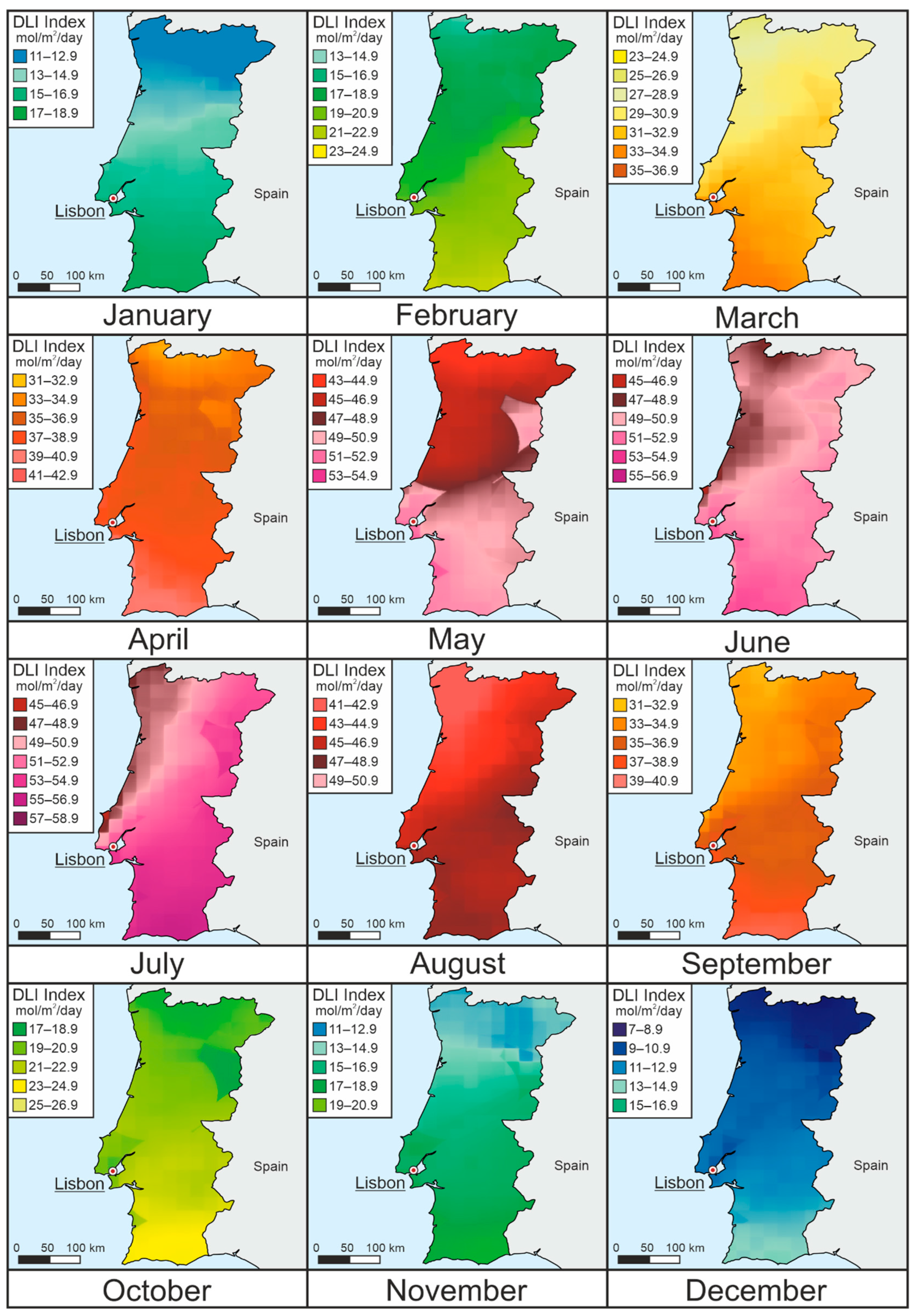
Spring (March, April, and May) DLI values in Portugal show the most intensive growth compared to other seasons, starting with 23–37 mol·m−2·d−1 in March, 37–43 mol·m−2·d−1 in April, and 43–55 mol·m−2·d−1 in May. The seasonal range, between the minimum and maximum values, is 32 mol· mol·m−2·d−1 in the mainland regions of Portugal. Interestingly, the geographical conditions, meaning the north–east gradient, globally influence the DLI development. Local conditions have partial effects, including cloud coverage and topography. In Summer (June, July, and August), the highest DLI values are experienced in the summer months: in June with 45–57 mol·m−2·d−1, in July with 45–59 mol·m−2·d−1, and in August with 41–51 mol·m−2·d−1. The DLI values peak in July (45–59 mol·m2·d−1). June and July are very similar, but July slightly exceeds June by 1–2 mol·m−2·d−1 in DLI values. Even though the summer months have the highest DLI values, August shows an average decrease of 5–6 mol·m−2·d−1 in its DLI values in all areas compared to July. In Autumn (September, October, and November), the DLI incrementally decreases month to month. The DLI values are 31–41 mol·m−2·d−1 in September, 17–27 mol·m−2·d−1 in October, and 11–21 mol· mol·m−2·d−1 in November. This tendency is explained by the fact that shortened daylight hours and more rainy days with higher cloud cover are observed. In Winter (December, January, and February), the DLI values are the lowest. December sets the minimum values with 7–17 mol· mol·m−2·d−1, due to its shorter days and higher cloud cover. In December, the northern and mainland regions can have DLI values as low as 7–9 mol· mol·m−2·d−1, while southern and coastal regions may still receive around 23–25 mol·m−2·d−1 in February.
In summary, it can be concluded that the DLI values show a characteristic pattern as each month passes. The lowest values are recorded in the winter months (December–January–February), and the spring months (March–April–May) show a dynamic increase, with the highest values in the summer months (June–July–August). The highest DLI values are in July (45–59 mol·m−2·d−1). During autumn (September–October–November), the DLI values decrease dynamically, until they reach their lowest DLI values in December (7–17 mol·m−2·d−1).
The DLI ranges can be considered as well, because the monthly DLI ranges (differences between the minimum and maximum values in a particular month) are relatively similar, but there are obviously smaller seasonal differences. These ranges are typically narrower in the winter months (December 10 mol·m−2·d−1, January 8 mol·m−2·d−1, February 12 mol·m−2·d−1), broader in the spring and summer months (March 14 mol·m−2·d−1, April 13 mol·m−2·d−1, May 12 mol·m−2·d−1, June 13 mol·m−2·d−1, July 14 mol·m−2·d−1, August 11 mol·m−2·d−1), and decrease towards the end of the autumn months (September 13 mol·m−2·d−1, October 11 mol·m−2·d−1, November 11 mol·m−2·d−1), with the range of DLI values being narrowest in December (10 mol·m−2·d−1).
The spatio-temporal patterns of DLI variability are presented below. Using a scaling resolution of 2 mol·m
−2·d
−1, spatial differences can be better observed, particularly during the spring and summer seasons of the given region. The highest month-to-month variation in DLI values occurs in June, July, and August. Interestingly, the DLI range of August is equal to the ranges of all autumn months (10 mol·m
−2·d
−1) (
Figure 3).
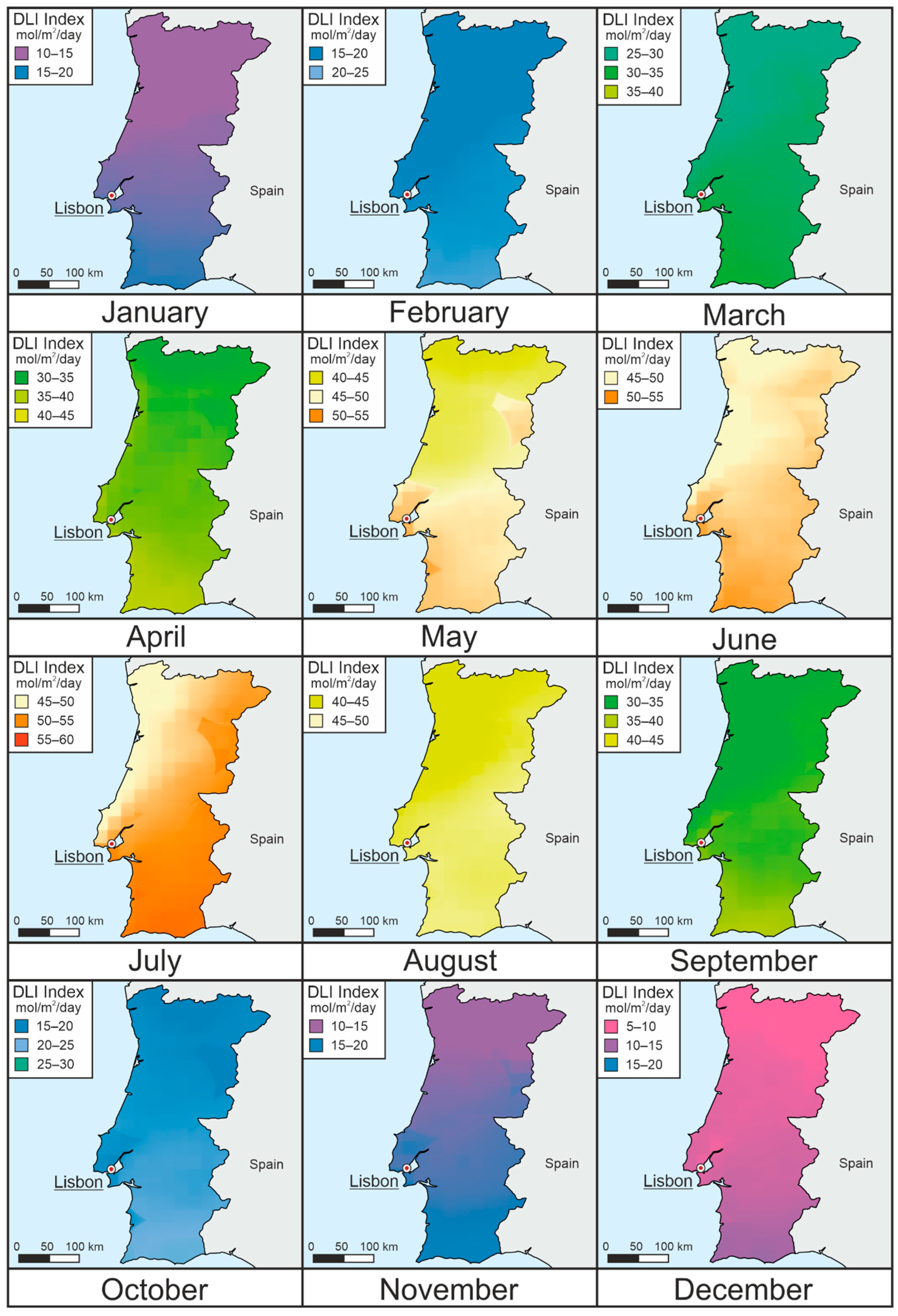
Portugal has a characteristic north–south geographic zonality, the consequence of which is a clearly recognizable DLI gradient with topographic modification factors. The topography affects the cloud coverage, precipitation, and sunny hours. The DLI values reflect the north–south DLI gradient, coastal and inland effects, and orographic specificity. Apart from the topography-related conditions, the Mediterranean seasonal DLI patterns are characterized by their values, ranges, and distributions. Countries with moderate spatial dimensions benefit from more accurately resolved DLI maps. In the case of Portugal, the north–south DLI gradient is very dominant, although other factors should not be ignored when highlighting local effects. A 2 mol·m
−2·d
−1 DLI value map has been found to be suitable for describing such differences. Because of the regional scale, it is also appropriate to create maps with a resolution of 5 mol·m
−2·d
−1 DLI, as they compare well with previous DLI maps of continents and countries with larger areas, such as those of the USA [
20] (
Figure 4).
4. Discussion
The DLI maps of Portugal serve as a decision-support tool, providing an objective information base for real-life situation assessment. With their use, it becomes possible to analyze the distribution patterns of light usable by plants through the DLI
PAR(400–700nm) at both local and regional scales. These assessments include analyses of seasonal and regional DLI value patterns, considering modifying factors (cloud cover, quantity and quality of atmospheric aerosol, topography, precipitation, elevation, air humidity, temperature, soil, water, biotic factors, plant species, albedo, etc.), while also providing the opportunity to estimate the potential yields and risks of crop production. Similar DLI modifying factors in other countries have also been identified by researchers [
36,
37,
38].
The EU Commission has addressed the benefits and challenges of digital and data technologies in agriculture. Some of the benefits are production optimization, enhanced animal welfare, improved working conditions, increased transparency, increased competitiveness, while the challenges include lack of awareness and skills, digital divides, lack of cost-effectiveness, need for data sharing, and shortcomings in interoperability [
39]. A horticultural lighting strategy based on these DLI maps might serve as a basis for the development of an agricultural strategy in Portugal. Portugal’s DLI maps can support digital agriculture and agricultural lighting strategies in Portugal, assisting in making better recommendations and decisions. Portugal’s lighting strategy will likely include the DLI maps, crop-specific recommendations (currently grown or future potential cultivars), shading management (regional, temporary, and crop-specific), local conditions (topography, climate), market demands (seasonality, earliness, organic farming, extended productivity, and optimization of conditions for multiple harvests), urban horticulture, and urban design of green areas [
40].
In our approach, there are two levels of future agricultural lighting strategies. Community- or country-level DLI maps with 2 mol·m2·d−1 are better for showing observable spatial differences, particularly over seasons and months. Continental- or regional-level DLI maps with 5 mol·m2·d−1 are recommended for the EU and global agriculture policies to compare large-scale areas (continents). It is technologically possible to fulfill individual DLI queries based on geo-coordinates to generate location-based monthly DLI values without maps.
The Iberian Peninsula includes peninsular Spain and continental Portugal. They share similar Mediterranean climatic conditions in a north–south extension. The northern parts of both Portugal and Spain (cities like Porto and Santiago de Compostela) have Atlantic influences, characterized by cool, wet winters and mild, temperate summers. In central regions (cities like Coimbra and Madrid), the climate becomes more continental, with hotter, drier summers and colder winters. The southern parts of both countries, especially Algarve and Andalusia, have a hot-summer Mediterranean climate, characterized by mild, wet winters.
Comparing the DLI maps of Portugal and Spain, they provide specialized regional–seasonal DLI patterns. The north–south DLI gradient is very dominant, but DLI-influencing factors affect DLI maps in different ways. The static and dynamic factors have different effects across the seasonal–regional distribution. The static factors (altitude, slope of the terrain, aspect of a surface, topographic shadows, valleys and lowlands, geological formations) induce changes at a measurable scale, but dynamic factors (cloud cover, quantity and quality of atmospheric aerosol, precipitation forms, vegetation and canopy cover) provide short-term changes. One of the most dynamic modifiers is the oceanic effect, which produces intensive cloud development. The Atlantic Ocean’s influence is a major dynamic factor in the DLI differences between the coastlines of western Portugal and northwestern Spain. The DLI values increase from north to south, which is mainly because the distance to the equator gradually decreases. The mountains in the northern part of the country contribute significantly to orographic cloud development, leading to increased moist air from the Atlantic over the peaks, especially in the northern regions of Portugal and Western Spain. Comparing two cities (Porto and Salamanca) at similar latitudes (~41° N), significant differences can be observed over the annual DLI values, resulting in a difference of −9617 mol·m
2·d
−1 due to orographic and Atlantic effects in Portugal. The lowest DLI values are similar (Porto 13.4 mol·m
2·d
−1 vs. Salamanca 13.9 mol·m
2·d
−1), but the highest values are different (Porto 50.1 mol·m
2·d
−1 vs. Salamanca 53.7 mol·m
2·d
−1). Because the ocean-induced orographic cloud development is characteristic of Atlantic regions, a narrower DLI value range is experienced in Porto, resulting in a DLI deficit of 4.3 mol·m
2·d
−1 in both July and August, in contrast to Salamanca [
13].
Portugal’s geographic and climatic conditions are well known and well documented, but the country faces persistent challenges in energy efficiency and sustainability, particularly regarding climate adaptation to support climate-resilient agriculture. Key challenges related to global warming and solar radiation on the Earth’s surface are extreme weather events, such as heatwaves or intense sunlight, crop growth anomalies, flower abortion, fertility problems, fruit deformation, genetic degradation, seed germination capacity, low resistance, and biotic and abiotic malfunctioning. In addition to the increase in the positive heat balance, the effect is further enhanced by water scarcity, atmospheric drought, and unpredictable heat shocks [
41].
Cultivated plants are vulnerable to increased radiation. Geographical and territorial conditions are non-movable—soil, slope, orientation, altitude, topography, exposure—and physically delimited by geocoordinates and administrative borders; however, the spatial and temporal variability of the meteorological elements—temperature, precipitation, humidity, air pressure, cloud cover, wind, sunshine—limits the adaptive possibilities of plants. Lighting and shading management for plants causes deficits and surpluses over the seasons, but DLI maps are evidence-based tools to support decisions at a farm scale. In agricultural practice, several technologies are used to provide supplementary light (LED, HPS, etc.) [
42].
However, in Portugal, especially in the summer months, the intensity of the excess light needs to be limited or modified by shading management, for which several methods are used (whitewashing of greenhouses, use of special light nets, installation of shading devices, integration of areas with western exposure, naturalization of areas with eastern exposure). It is expected that dual-use good practices will be adopted and widely implemented in areas exposed to high solar radiation. Examples include the cultivation of lightly shaded areas with woodland groves, the use of renewable energy sources such as solar panels installed in partially shaded areas, agroforestry methods, and agro-voltaic technologies that combine citrus, olive, apple, or grape production with solar panel installation. Solar panels and shading solutions can help regulate the microclimate, reduce water stress, and protect plants from heat stress [
43,
44,
45,
46].
In summary, shading has additional synergic effects on local biotic and abiotic agro-ecological systems. Shading management can be supported by in situ DLI measurements or customized DLI maps. Planning on a continental scale would require a DLI map of more European countries. To our knowledge, the DLI maps of Spain [
13], Hungary [
9], and Slovakia [
14] have been completed so far in Europe; further maps are expected to be published soon.
The accuracy of country-level DLI maps depends on their spatial resolution and the density of their data acquisition. DLI-measuring handheld devices detect instantaneous DLI values, which are valid only for the specific location and time at which they are measured. This type of data acquisition cannot be directly generalized to larger areas. Large-scale DLI data are typically provided by meteorological stations and satellite measurements. However, the spatial distribution of weather stations is not always homogeneous or sufficiently dense, meaning that interpolation or data replacement techniques are often required. These methods can influence the overall accuracy and reliability of DLI maps. Therefore, all DLI maps should be considered with these conditions in mind. Current DLI maps do not typically incorporate all topographic details. When DLI maps with higher spatial resolution are required, digital elevation models (DEMs) are often integrated into the calculations to account for topographic effects. The widely used DLIPAR(400–700nm) maps are meant to be in the PAR range (400–700 nm). Future modifications, assuming further technical developments, will be able to produce ePAR (extended photosynthetically active radiation: 400–750 nm)- and PBAR (photobiologically active radiation (PBAR 280–800 nm)-based DLIePAR(400–750nm) and DLIPBAR(280–800nm) maps.
Plant- and light-specific controlled environments and local decisions are assisted and supported by predictive models and machine learning techniques. Lee and co-workers proposed a daily light integral prediction to forecast daily light integrals from photosynthetic photon flux density using the Recursive Least Squares (RLS) algorithm. The data-driven daily light integral prediction provides superior predictive performance compared to human observation. Data-driven machine learning does not guarantee systemic stability. However, a data-driven, model-based DLI application necessarily considers seasonal and seasonal factor changes [
47].
5. Conclusions
DLI maps provide orientation, but they do not replace local measurements. In this research, we used the network of meteorological stations to create maps, but more realistic maps could be produced if greenhouse farming facilities built their own networks and provided more specific data. This network could be weighted according to farmers’ needs to produce higher data density. At present, spectral instruments (spectroradiometers), expertise, established routines, and guided or supported networks are limited or unavailable. Through incorporating these elements, local conditions, small-scale variations, and microclimatic effects could be identified and characterized more accurately.
The present study demonstrates DLI maps. The studied Portugal DLI values reflect a clear spatial gradient from north to south, with significant seasonal variations driven by geographic location, topography, and climate. In our research, we created 2 mol·m−2·d−1 and 5 mol·m−2·d−1 DLI maps and analyzed them from both regional (Northern regions, Central regions, Southern regions) and seasonal (Spring, Summer, Autumn, Winter) perspectives. However, the following static—altitude, slope of the terrain, aspect of a surface, topographic shadows, valleys and lowlands, geological formations—and dynamic factors—cloud cover, quantity and quality of atmospheric aerosol, precipitation forms, vegetation and canopy cover—affect the seasonal–regional DLI distribution. Among the regional variations, the mountains in the northern part of the country also cause significant orographic rainfall, with increasing cloud cover as moist air comes from the Atlantic Ocean. Topographic mountainous conditions are influenced by both coastal and continental positions, with the coastal effect having a stronger moderating influence than the continental. The DLI values and ranges in Portugal follow a clear seasonal pattern. The lowest values occur in the winter months (December–February), with values ranging from 7 to 17 mol·m−2·d−1. During the spring (March–May), DLI increases, reaching its highest levels in the summer (June–August), peaking in July (45–59 mol·m−2·d−1). In autumn (September–November), DLI values gradually decrease, with the lowest range observed in December. The range is narrower in winter (8–12 mol·m−2·d−1) and broader in spring and summer (11–14 mol·m−2·d−1). The range narrows again in autumn (11–13 mol·m−2·d−1).
Portugal’s greenhouse lighting strategy could integrate DLI maps to support crop-specific recommendations, shading management, local conditions, market demands, seasonality, organic farming, extended productivity, agriculture, and horticulture.



 ,
,