Effects of High Nitrogen and Biochar Addition on the Stability of Soil Organic Carbon Pools in Restored Grassland on the Chinese Loess Plateau

Abstract
1. Introduction
2. Materials and Methods
2.1. Study Area
2.2. Experimental Design
2.3. Sample Collection
2.4. Indicator Measurement
2.5. Analysis of Soil Stoichiometric Imbalances, Microbial Metabolic Limitations, and C Utilization Efficiency
2.6. Soil Microbial Communities
2.7. Statistical Analysis
3. Results
3.1. Characterization of Changes in the SOC Pool
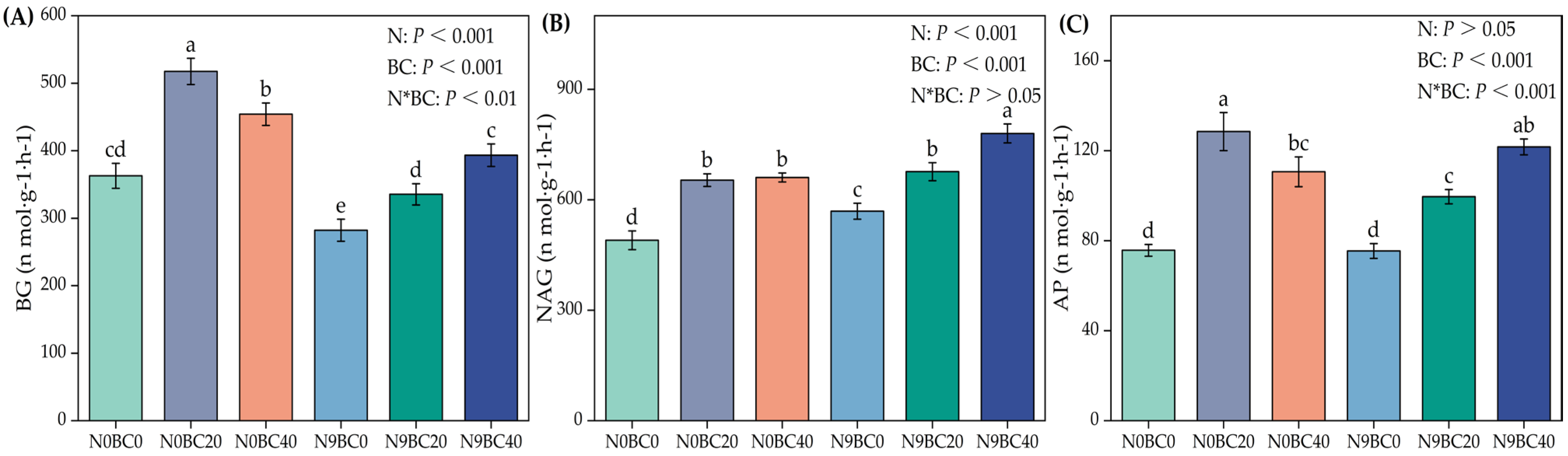
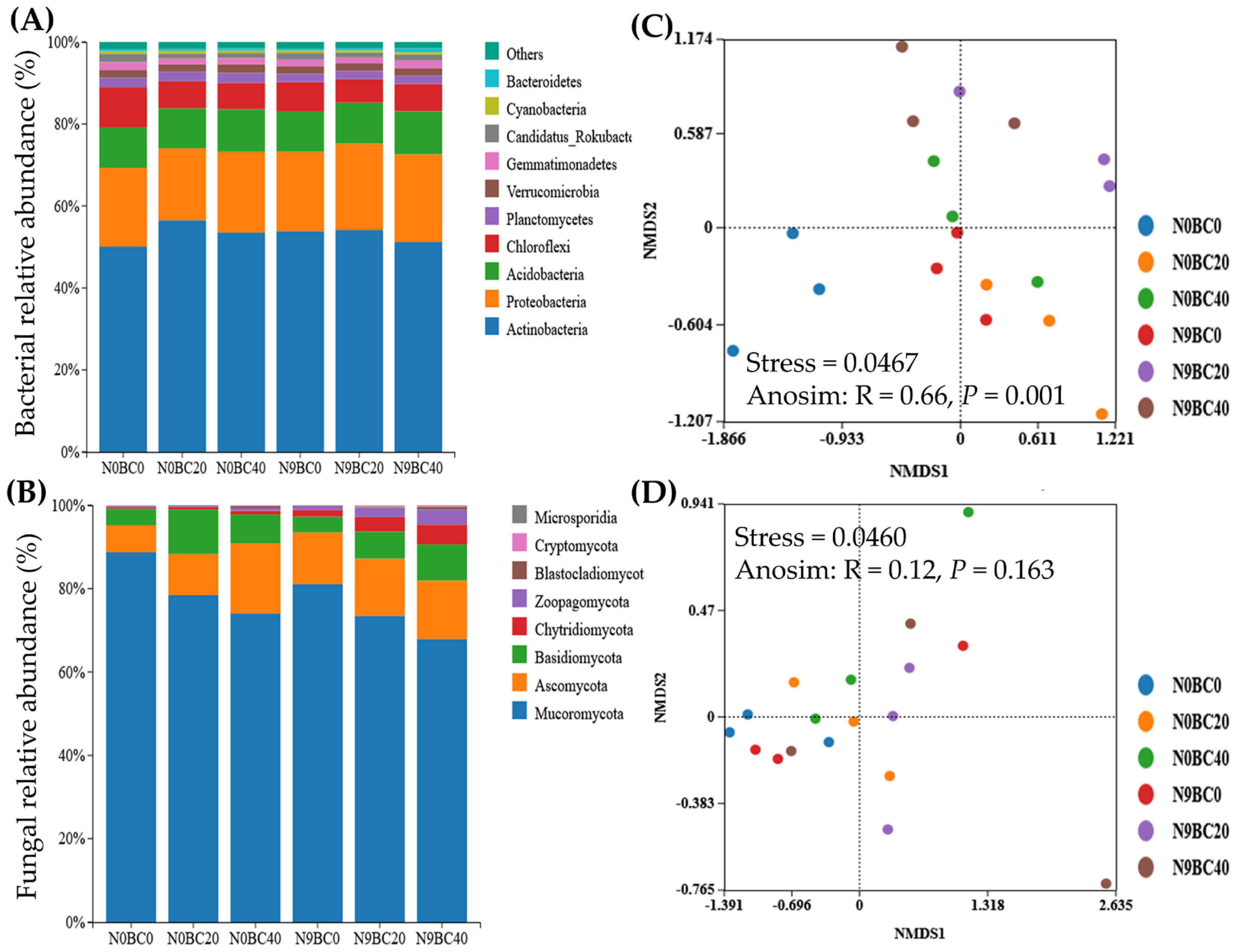
3.2. Soil Enzyme Activity and Microbial Community Composition
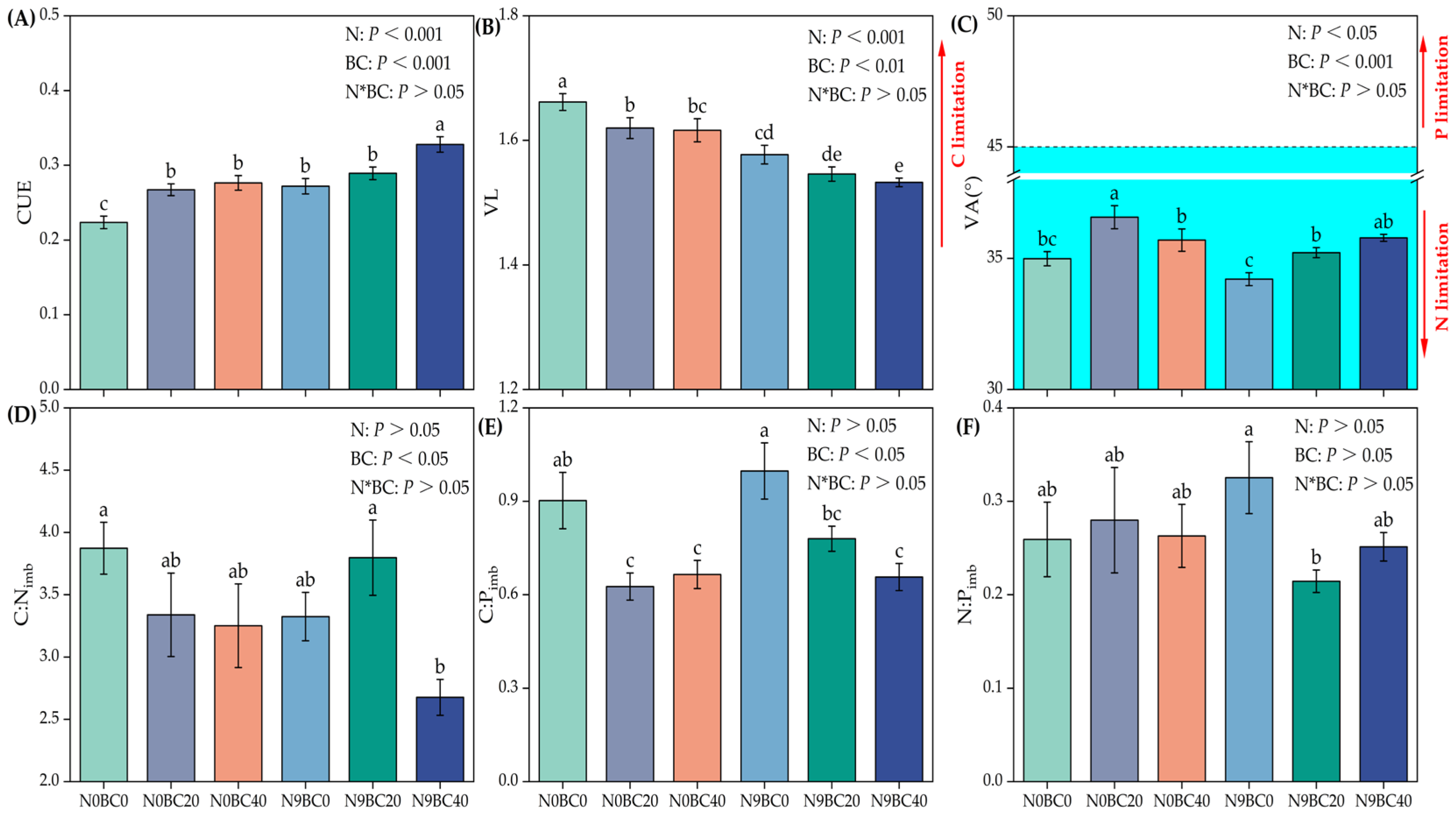
3.3. Soil Microbial C Utilization Efficiency and Metabolic Limitation Status
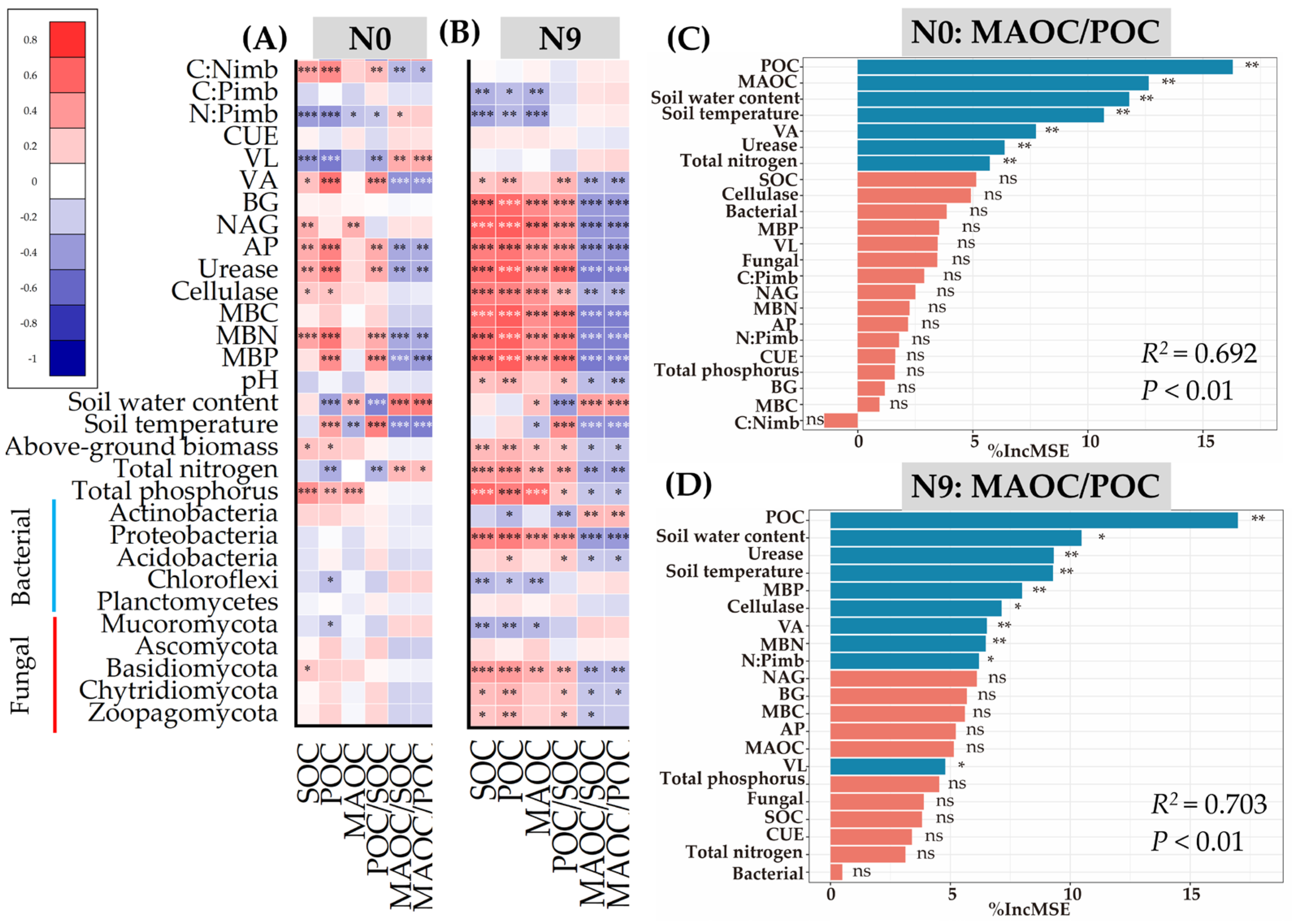
3.4. Relationship Between Soil Properties and SOC Stability
4. Discussion
4.1. Effects of High N and BC Additions on SOC
4.2. Effects of High N and BC Additions on POC and MAOC
4.2.1. Effect of High N Addition on POC and MAOC
4.2.2. Effect of BC Addition on POC and MAOC
4.2.3. Effect of Mixed High N and BC Additions on POC and MAOC
4.3. Effect of High N and BC Addition on SOC Stability
4.4. Limitations
5. Conclusions
Supplementary Materials
Author Contributions
Funding
Data Availability Statement
Conflicts of Interest
References
- Wang, X.; Li, Y.; Gong, X.; Niu, Y.; Chen, Y.; Shi, X.; Li, W. Storage, pattern and driving factors of soil organic carbon in an ecologically fragile zone of northern China. Geoderma 2019, 343, 155–165. [Google Scholar] [CrossRef]
- Li, Y.; Wang, X.; Niu, Y.; Lian, J.; Luo, Y.; Chen, Y.; Gong, X.; Yang, H.; Yu, P. Spatial distribution of soil organic carbon in the ecologically fragile Horqin Grassland of northeastern China. Geoderma 2018, 325, 102–109. [Google Scholar] [CrossRef]
- Wu, M.; Chen, L.; Chen, S.; Chen, Y.; Ma, J.; Zhang, Y.; Pang, D.; Li, X. Soil microbial carbon and nitrogen limitation constraints soil organic carbon stability in arid and semi-arid grasslands. J. Environ. Manag. 2025, 373, 123675. [Google Scholar] [CrossRef]
- Liu, L.; Yang, J.; Wang, J.; Yu, Q.; Wei, C.; Jiang, L.; Huang, J.; Zhang, Y.; Jiang, Y.; Zhang, H.; et al. Increase in mineral-associated organic carbon does not offset the decrease in particulate organic carbon under long-term nitrogen enrichment in a steppe ecosystem. Soil Biol. Biochem. 2025, 202, 109695. [Google Scholar] [CrossRef]
- Wang, K.; Ma, Z.; Qin, W.; Li, X.; Shi, H.; Hasi, B.; Liu, X. Soil nutrients and pH modulate carbon dynamics in particulate and mineral-associated organic matter during restoration of a Tibetan alpine grassland. Ecol. Eng. 2025, 212, 107522. [Google Scholar] [CrossRef]
- Duan, P.; Wang, K.; Li, D. Nitrogen addition effects on soil mineral-associated carbon differ between the valley and slope in a subtropical karst forest. Geoderma 2023, 430, 116357. [Google Scholar] [CrossRef]
- Sun, T.; Mao, X.; Han, K.; Wang, X.; Cheng, Q.; Liu, X.; Zhou, J.; Ma, Q.; Ni, Z.; Wu, L. Nitrogen addition increased soil particulate organic carbon via plant carbon input whereas reduced mineral−associated organic carbon through attenuating mineral protection in agroecosystem. Sci. Total Environ. 2023, 899, 165705. [Google Scholar] [CrossRef]
- Jia, B.; Liang, Y.; Mou, X.; Mao, H.; Jia, L.; Chen, J.; Yakov, K.; Li, X.G. Soil mineral–associated organic carbon fraction maintains quantitatively but not biochemically after cropland abandonment. Soil Tillage Res. 2025, 246, 106355. [Google Scholar] [CrossRef]
- Luo, T.; He, Z.; Xia, D.; Xu, Y.; Xia, L.; Guo, T.; Xu, W.; Fang, J. Relationship between soil organic carbon fractions and microbial nutrient limitations among different woodlands in the western karst region of Hubei. Environ. Technol. Innov. 2025, 38, 104074. [Google Scholar] [CrossRef]
- Mao, X.; Sun, T.; Zhu, L.; Wanek, W.; Cheng, Q.; Wang, X.; Zhou, J.; Liu, X.; Ma, Q.; Wu, L.; et al. Microbial adaption to stoichiometric imbalances regulated the size of soil mineral-associated organic carbon pool under continuous organic amendments. Geoderma 2024, 445, 116883. [Google Scholar] [CrossRef]
- Li, Q.; Song, X.; Yrjälä, K.; Lv, J.; Li, Y.; Wu, J.; Qin, H. Biochar mitigates the effect of nitrogen deposition on soil bacterial community composition and enzyme activities in a Torreya grandis orchard. For. Ecol. Manag. 2020, 457, 117717. [Google Scholar] [CrossRef]
- Wang, X.; Chen, F.; Liu, J.; Wang, Z.; Zhang, Z.; Li, X.; Zhang, Q.; Liu, W.; Liu, H.; Zeng, J.; et al. Linking the soil carbon pool management index to ecoenzymatic stoichiometry and organic carbon functional groups in abandoned land under climate change. Catena 2024, 235, 107676. [Google Scholar] [CrossRef]
- Zhong, Z.; Li, W.; Lu, X.; Gu, Y.; Wu, S.; Shen, Z.; Han, X.; Yang, G.; Ren, C. Adaptive pathways of soil microorganisms to stoichiometric imbalances regulate microbial respiration following afforestation in the Loess Plateau, China. Soil Biol. Biochem. 2020, 151, 108048. [Google Scholar] [CrossRef]
- Lavallee, J.M.; Soong, J.L.; Cotrufo, M.F. Conceptualizing soil organic matter into particulate and mineral-associated forms to address global change in the 21st century. Glob. Change Biol. 2019, 26, 261–273. [Google Scholar] [CrossRef] [PubMed]
- Yang, F.; Wang, W.; Wu, Z.; Peng, J.; Xu, H.; Ge, M.; Lin, S.; Zeng, Y.; Sardans, J.; Wang, C.; et al. Fertilizer reduction and biochar amendment promote soil mineral-associated organic carbon, bacterial activity, and enzyme activity in a jasmine garden in southeast China. Sci. Total Environ. 2024, 954, 176300. [Google Scholar] [CrossRef]
- Duan, P.; Fu, R.; Nottingham, A.T.; Domeignoz-Horta, L.A.; Yang, X.; Du, H.; Wang, K.; Li, D. Tree species diversity increases soil microbial carbon use efficiency in a subtropical forest. Glob. Change Biol. 2023, 29, 7131–7144. [Google Scholar] [CrossRef]
- Hu, Y.; Chen, J.; Olesen, J.E.; van Groenigen, K.J.; Hui, D.; He, X.; Chen, G.; Deng, Q. Mycorrhizal association controls soil carbon-degrading enzyme activities and soil carbon dynamics under nitrogen addition: A systematic review. Sci. Total Environ. 2024, 948, 175008. [Google Scholar] [CrossRef]
- Yuan, X.; Qi, Y.; Guo, Y.; Dong, Y.; Peng, Q.; Yan, Z.; Li, Z.; Dong, R.; Zheng, Y. Effect of 9-year water and nitrogen additions on microbial necromass carbon content at different soil depths and its main influencing factors. Sci. Total Environ. 2024, 954, 176825. [Google Scholar] [CrossRef]
- Zhang, Y.; Niu, D.; Li, Q.; Liu, H.; Wang, Y.; Xu, J.; Du, B.; Guo, D.; Liu, Y.; Fu, H.; et al. Nonlinear response of soil microbial network complexity to long-term nitrogen addition in a semiarid grassland: Implications for soil carbon processes. Agric. Ecosyst. Environ. 2025, 380, 109407. [Google Scholar] [CrossRef]
- Tang, B.; Rocci, K.S.; Lehmann, A.; Rillig, M.C. Nitrogen increases soil organic carbon accrual and alters its functionality. Glob. Change Biol. 2023, 29, 1971–1983. [Google Scholar] [CrossRef]
- Zhang, Y.; Wang, T.; Yan, C.; Li, Y.; Mo, F.; Han, J. Microbial life-history strategies and particulate organic carbon mediate formation of microbial necromass carbon and stabilization in response to biochar addition. Sci. Total Environ. 2024, 950, 175041. [Google Scholar] [CrossRef]
- Huang, M.; Hu, T.; Wang, J.; Ding, Y.; Köster, K.; Sun, L. Effects of biochar on soil carbon pool stability in the Dahurian larch (Larix gmelinii) forest are regulated by the dominant soil microbial ecological strategy. Sci. Total Environ. 2024, 951, 175725. [Google Scholar] [CrossRef]
- Ji, H.; Yuan, G.; Liu, Y.; Yu, J.; Li, S.; Wu, Q.; Qin, H.; Chen, J. Short-Term Effects of Bamboo Biochar and Oyster Shell Powder on Soil Organic Carbon Fraction, Microbial Respiration, and Enzymatic Stoichiometry in a Lei Bamboo Plantation. Forests 2023, 14, 853. [Google Scholar] [CrossRef]
- Lu, T.; Wang, X.; Du, Z.; Wu, L. Impacts of continuous biochar application on major carbon fractions in soil profile of North China Plain’s cropland: In comparison with straw incorporation. Agric. Ecosyst. Environ. 2021, 315, 107445. [Google Scholar] [CrossRef]
- Sandhu, S.; Sekaran, U.; Ozlu, E.; Hoilett, N.O.; Kumar, S. Short-term impacts of biochar and manure application on soil labile carbon fractions, enzyme activity, and microbial community structure. Biochar 2019, 1, 271–282. [Google Scholar] [CrossRef]
- Bekchanova, M.; Kuppens, T.; Cuypers, A.; Jozefczak, M.; Malina, R. Biochar’s effect on the soil carbon cycle: A rapid review and meta-analysis. Biochar 2024, 6, 88. [Google Scholar] [CrossRef]
- Qiu, H.; Hu, Z.; Liu, J.; Zhang, H.; Shen, W. Effect of Biochar on Labile Organic Carbon Fractions and Soil Carbon Pool Management Index. Agronomy 2023, 13, 1385. [Google Scholar] [CrossRef]
- Wu, H.; Zeng, G.; Liang, J.; Chen, J.; Xu, J.; Dai, J.; Li, X.; Chen, M.; Xu, P.; Zhou, Y.; et al. Responses of bacterial community and functional marker genes of nitrogen cycling to biochar, compost and combined amendments in soil. Appl. Microbiol. Biotechnol. 2016, 100, 8583–8591. [Google Scholar] [CrossRef]
- Sarauer, J.L.; Coleman, M.D. Microbial communities of biochar amended forest soils in northwestern USA. Appl. Soil Ecol. 2023, 188, 104875. [Google Scholar] [CrossRef]
- Hu, Y.; Cong, M.; Yan, H.; Sun, X.; Yang, Z.; Tang, G.; Xu, W.; Zhu, X.; Jia, H. Effects of biochar addition on aeolian soil microbial community assembly and structure. Appl. Microbiol. Biotechnol. 2023, 107, 3829–3845. [Google Scholar] [CrossRef]
- Zhao, X.; Lu, X.; Yang, J.; Zhang, D.; Ren, C.; Wang, X.; Zhang, X.; Deng, J. Effects of Nitrogen Addition on Microbial Carbon Use Efficiency of Soil Aggregates in Abandoned Grassland on the Loess Plateau of China. Forests 2022, 13, 276. [Google Scholar] [CrossRef]
- Gong, S.; Zhang, X.; Zhang, H.; Gao, L.; Zha, T. Nitrogen addition promotes the coupling of deep soil carbon and nitrogen under different vegetation restoration types in the Chinese Loess Plateau. Geoderma 2025, 455, 117236. [Google Scholar] [CrossRef]
- Tian, X.; Zhang, Y.; Liang, Y.; Fu, R.; Sun, L.; Yu, Z.; Shi, J.; Sailike, A.; Hao, H.; Zhang, W. Differential response of soil bacteria and fungi to carbon and respiration components in abandoned grasslands on the Loess Plateau, China. Plant Soil 2024, 504, 347–365. [Google Scholar] [CrossRef]
- Yang, Y.; Li, T.; Wang, Y.; Dou, Y.; Cheng, H.; Liu, L.; An, S. Linkage between soil ectoenzyme stoichiometry ratios and microbial diversity following the conversion of cropland into grassland. Agric. Ecosyst. Environ. 2021, 314, 107418. [Google Scholar] [CrossRef]
- Pan, Z.; Cai, X.; Bo, Y.; Guan, C.; Cai, L.; Haider, F.U.; Li, X.; Yu, H. Response of soil organic carbon and soil aggregate stability to changes in land use patterns on the Loess Plateau. Sci. Rep. 2024, 14, 31775. [Google Scholar] [CrossRef]
- Zhao, Y.; Zhao, H.; Kang, L.; Li, M.; Zhang, G.; Cao, Y. Beyond monocultures: Optimizing soil carbon sequestration with diverse planting strategies on the Loess Plateau. Catena 2024, 246, 108447. [Google Scholar] [CrossRef]
- Yang, C.; Zhang, N.; Zhao, F.; Wang, J. Mulching practices decreased soil microbial carbon degradation potential under spring maize in the Loess Plateau of China. Agric. Ecosyst. Environ. 2025, 381, 109465. [Google Scholar] [CrossRef]
- Ruan, R.; Zhang, P.; Lambers, H.; Xie, W.; Zhang, Z.; Xie, S.; Wang, Y.; Wang, Y. Biochar application improves maize yield on the Loess Plateau of China by changing soil pore structure and enhancing root growth. Sci. Total Environ. 2024, 956, 177379. [Google Scholar] [CrossRef]
- Luo, C.; Yang, J.; Chen, W.; Han, F. Effect of biochar on soil properties on the Loess Plateau: Results from field experiments. Geoderma 2020, 369, 114323. [Google Scholar] [CrossRef]
- Yan, M.; Li, X.; Liu, Y.; Li, Y.; He, L.; Zhang, J. Biochar enhanced soil aggregation and C-related enzyme activity in post-mining land on the Loess Plateau, China. Land Degrad. Dev. 2022, 33, 1054–1061. [Google Scholar] [CrossRef]
- Han, J.; Zhang, A.; Kang, Y.; Han, J.; Yang, B.; Hussain, Q.; Wang, X.; Zhang, M.; Khan, M.A. Biochar promotes soil organic carbon sequestration and reduces net global warming potential in apple orchard: A two-year study in the Loess Plateau of China. Sci. Total Environ. 2022, 803, 150035. [Google Scholar] [CrossRef]
- Liu, S.; Xie, M.; Lu, W.; Zhang, X.; Du, M.; Yao, Y.; Yuan, J.; Li, G. Biochar Addition Reduces the Effect of High Nitrogen on Soil–Microbial Stoichiometric Imbalance in Abandoned Grassland on the Loess Plateau of China. Ecol. Evol. 2025, 15, e70875. [Google Scholar] [CrossRef] [PubMed]
- Zhang, J.; Ai, Z.; Liang, C.; Wang, G.; Xue, S. Response of soil microbial communities and nitrogen thresholds of Bothriochloa ischaemum to short-term nitrogen addition on the Loess Plateau. Geoderma 2017, 308, 112–119. [Google Scholar] [CrossRef]
- Li, P.-p.; Wang, B.; Yang, Y.-f.; Liu, G.-b. Effects of nitrogen addition on the soil detachment in the typical grasslands of the Loess Plateau. J. Mt. Sci. 2022, 19, 3503–3516. [Google Scholar] [CrossRef]
- Zhu, T.; Xia, G.; Yuan, Y.; Lu, Q.; Jiang, X.; Huang, C.; Zhou, W. Nitrogen Addition Promotes Soil Carbon Sequestration and Alters Carbon Pool Stability by Affecting Particulate Organic Carbon in a Karst Plantation. Forests 2025, 16, 730. [Google Scholar] [CrossRef]
- Li, W.; Hou, Y.; Long, M.; Wen, X.; Han, J.; Liao, Y. Long-term effects of biochar application on rhizobacteria community and winter wheat growth on the Loess Plateau in China. Geoderma 2023, 429, 116250. [Google Scholar] [CrossRef]
- Pan, Z.; Haider, F.U.; Hussain, S.; Farooq, M.; Cai, X.; Cai, L. Biochar amendment enhanced soil nitrogen fractions and wheat yield after four to five years of aging in Loess Plateau, China. Arab. J. Geosci. 2022, 15, 523. [Google Scholar] [CrossRef]
- Kelleher, L.A.; Anderson, Z.; Stratford, J.A.; Fortunato, C.S. Deciphering Soil Microbial Dynamics in Northeastern American Grasslands with Goldenrods (Solidago sp.). Microb. Ecol. 2025, 88, 53. [Google Scholar] [CrossRef]
- Lattacher, A.; Le Gall, S.; Rothfuss, Y.; Gao, C.; Harings, M.; Pagel, H.; Giraud, M.; Alahmad, S.; Hickey, L.T.; Kandeler, E.; et al. Rooting for microbes: Impact of root architecture on the microbial community and function in top- and subsoil. Plant Soil 2025, 513, 333–351. [Google Scholar] [CrossRef]
- Medeiros, E.V.d.; Oliveira Silva, É.d.; Duda, G.P.; Andrade Lira Junior, M.; dos Santos, U.J.; Hammecker, C.; da Costa, D.P.; Araujo, F.F.; de Araujo Pereira, A.P.; Mendes, L.W.; et al. Microbial enzymatic stoichiometry and the acquisition of C, N, and P in soils under different land-use types in Brazilian semiarid. Soil Ecol. Lett. 2023, 5, 220159. [Google Scholar] [CrossRef]
- Sinsabaugh, R.L.; Manzoni, S.; Moorhead, D.L.; Richter, A.; Elser, J. Carbon use efficiency of microbial communities: Stoichiometry, methodology and modelling. Ecol. Lett. 2013, 16, 930–939. [Google Scholar] [CrossRef]
- Sun, L.; Wanek, W.; Moorhead, D.L.; Yang, X.; Gao, W.; Domeignoz-Horta, L.A. Interpreting differences in microbial carbon and nitrogen use efficiencies estimated by isotope methods and the ecoenzyme stoichiometry model. Soil Biol. Biochem. 2025, 209, 109914. [Google Scholar] [CrossRef]
- Wu, J.; Lu, Y.; Wang, H.; Li, G. Effects of nitrogen and phosphorus additions on CH4 flux in wet meadow of Qinghai-Tibet Plateau. Sci. Total Environ. 2023, 887, 163448. [Google Scholar] [CrossRef]
- Zeng, C.; He, S.; Long, B.; Zhou, Z.; Hong, J.; Cao, H.; Yang, Z.; Tang, X. Minor Effects of Canopy and Understory Nitrogen Addition on Soil Organic Carbon Turnover Time in Moso Bamboo Forests. Forests 2024, 15, 1144. [Google Scholar] [CrossRef]
- Chen, J.; Zhang, Q.; Dai, H.; Feng, J.; Zeng, Q.; Sun, X.; Peng, Y.; Chen, W.; Zhu, B.; Chen, Y. Nitrogen Addition Promotes the Accumulation of Soil Particulate Organic Carbon in a Subtropical Forest. Forests 2024, 15, 619. [Google Scholar] [CrossRef]
- Wang, M.; Li, F.; Dong, L.; Wang, X.; Han, L.; Olesen, J.E. Effects of exogenous organic/inorganic nitrogen addition on carbon pool distribution and transformation in grassland soil. Sci. Total Environ. 2023, 858, 159919. [Google Scholar] [CrossRef]
- Gaudel, G.; Xing, L.; Shrestha, S.; Poudel, M.; Sherpa, P.; Raseduzzaman, M.; Zhang, X. Microbial mechanisms regulate soil organic carbon mineralization under carbon with varying levels of nitrogen addition in the above-treeline ecosystem. Sci. Total Environ. 2024, 917, 170497. [Google Scholar] [CrossRef]
- Liu, T.; Zhang, X.; Dong, X.; Guo, K.; Singh, B.P.; Wang, J.; Liu, X.; Sun, H. Biochar promoted halophyte growth and enhanced soil carbon stock in a coastal salt-affected soil. J. Soils Sediments 2024, 24, 2012–2022. [Google Scholar] [CrossRef]
- Zhou, X.; Feng, Z.; Yao, Y.; Liu, R.; Shao, J.; Jia, S.; Gao, Y.; Xue, K.; Chen, H.; Fu, Y.; et al. Nitrogen input alleviates the priming effects of biochar addition on soil organic carbon decomposition. Soil Biol. Biochem. 2025, 202, 109689. [Google Scholar] [CrossRef]
- Wang, X.; Zhu, Z.; Huang, N.; Wu, L.; Lu, T.; Hu, Z. Impacts of biochar amendment and straw incorporation on soil heterotrophic respiration and desorption of soil organic carbon. Geosci. Lett. 2023, 10, 38. [Google Scholar] [CrossRef]
- Shi, J.; Deng, L.; Wu, J.; Bai, E.; Chen, J.; Shangguan, Z.; Kuzyakov, Y. Soil Organic Carbon Increases With Decreasing Microbial Carbon Use Efficiency During Vegetation Restoration. Glob. Change Biol. 2024, 30, e17616. [Google Scholar] [CrossRef]
- Li, Z.; Duan, X.; Guo, X.; Gao, W.; Li, Y.; Zhou, P.; Zhu, Q.; O’Donnell, A.G.; Dai, K.; Wu, J. Microbial metabolic capacity regulates the accrual of mineral-associated organic carbon in subtropical paddy soils. Soil Biol. Biochem. 2024, 195, 109457. [Google Scholar] [CrossRef]
- Chen, J.; Xiao, W.; Zheng, C.; Zhu, B. Nitrogen addition has contrasting effects on particulate and mineral-associated soil organic carbon in a subtropical forest. Soil Biol. Biochem. 2020, 142, 107708. [Google Scholar] [CrossRef]
- Qi, P.; Chen, J.; Wang, X.; Zhang, R.; Cai, L.; Jiao, Y.; Li, Z.; Han, G. Changes in soil particulate and mineral-associated organic carbon concentrations under nitrogen addition in China—A meta-analysis. Plant Soil 2023, 489, 439–452. [Google Scholar] [CrossRef]
- Wang, M.; Frey, B.; Li, D.; Liu, X.; Chen, C.; Liu, Y.; Zhang, R.; Sui, X.; Li, M.-H. Effects of organic nitrogen addition on soil microbial community assembly patterns in the Sanjiang Plain wetlands, northeastern China. Appl. Soil Ecol. 2024, 204, 105685. [Google Scholar] [CrossRef]
- Lu, X.; Yu, H.; Gilliam, F.S.; Yue, X.; Huang, J.; Tang, S.; Kuang, Y. Contrasting responses of soil organic carbon dynamics to long-term canopy and understory nitrogen addition in a subtropical forest. Catena 2024, 247, 108536. [Google Scholar] [CrossRef]
- Feng, X.; Qin, S.; Zhang, D.; Chen, P.; Hu, J.; Wang, G.; Liu, Y.; Wei, B.; Li, Q.; Yang, Y.; et al. Nitrogen input enhances microbial carbon use efficiency by altering plant–microbe–mineral interactions. Glob. Change Biol. 2022, 28, 4845–4860. [Google Scholar] [CrossRef]
- Wang, W.; Li, M.-Y.; Wang, Y.; Li, J.-M.; Zhang, W.; Wen, Q.-H.; Huang, S.-J.; Chen, G.-R.; Zhu, S.-G.; Wang, J.; et al. Legume intercropping improves soil organic carbon stability in drylands: A 7-year experimental validation. Agric. Ecosyst. Environ. 2025, 381, 109456. [Google Scholar] [CrossRef]
- Tiwari, R.; Kumar, K.; Singh, S.; Nain, L.; Shukla, P. Molecular Detection and Environment-Specific Diversity of Glycosyl Hydrolase Family 1 β-Glucosidase in Different Habitats. Front. Microbiol. 2016, 7, e01597. [Google Scholar] [CrossRef]
- El-Desouki, Z.; Li, Y.; Abd-Elkader, A.M.; Riaz, M.; Wang, J.; Babar, S.; Wang, X.; Xia, X.; Jiang, C. Alterations of bacterial community related C cycle by affecting soil carbon fractions under aged biochar application. Soil Use Manag. 2024, 40, e13075. [Google Scholar] [CrossRef]
- Oladele, S.; Adeyemo, A.; Adegaiye, A.; Awodun, M. Effects of biochar amendment and nitrogen fertilization on soil microbial biomass pools in an Alfisol under rain-fed rice cultivation. Biochar 2019, 1, 163–176. [Google Scholar] [CrossRef]




Disclaimer/Publisher’s Note: The statements, opinions and data contained in all publications are solely those of the individual author(s) and contributor(s) and not of MDPI and/or the editor(s). MDPI and/or the editor(s) disclaim responsibility for any injury to people or property resulting from any ideas, methods, instructions or products referred to in the content. |
© 2025 by the authors. Licensee MDPI, Basel, Switzerland. This article is an open access article distributed under the terms and conditions of the Creative Commons Attribution (CC BY) license (https://creativecommons.org/licenses/by/4.0/).
Share and Cite
Liu, S.; Xie, M.; Yan, L.; Li, G. Effects of High Nitrogen and Biochar Addition on the Stability of Soil Organic Carbon Pools in Restored Grassland on the Chinese Loess Plateau. Agronomy 2025, 15, 2800. https://doi.org/10.3390/agronomy15122800
Liu S, Xie M, Yan L, Li G. Effects of High Nitrogen and Biochar Addition on the Stability of Soil Organic Carbon Pools in Restored Grassland on the Chinese Loess Plateau. Agronomy. 2025; 15(12):2800. https://doi.org/10.3390/agronomy15122800
Chicago/Turabian StyleLiu, Shuainan, Mingjun Xie, Lijuan Yan, and Guang Li. 2025. "Effects of High Nitrogen and Biochar Addition on the Stability of Soil Organic Carbon Pools in Restored Grassland on the Chinese Loess Plateau" Agronomy 15, no. 12: 2800. https://doi.org/10.3390/agronomy15122800
APA StyleLiu, S., Xie, M., Yan, L., & Li, G. (2025). Effects of High Nitrogen and Biochar Addition on the Stability of Soil Organic Carbon Pools in Restored Grassland on the Chinese Loess Plateau. Agronomy, 15(12), 2800. https://doi.org/10.3390/agronomy15122800