Synergistic Regulation of Water–Land–Energy–Food–Carbon Nexus in Large Agricultural Irrigation Areas

 , ,
, ,
Abstract
1. Introduction
2. Materials and Methods
2.1. Model Framework
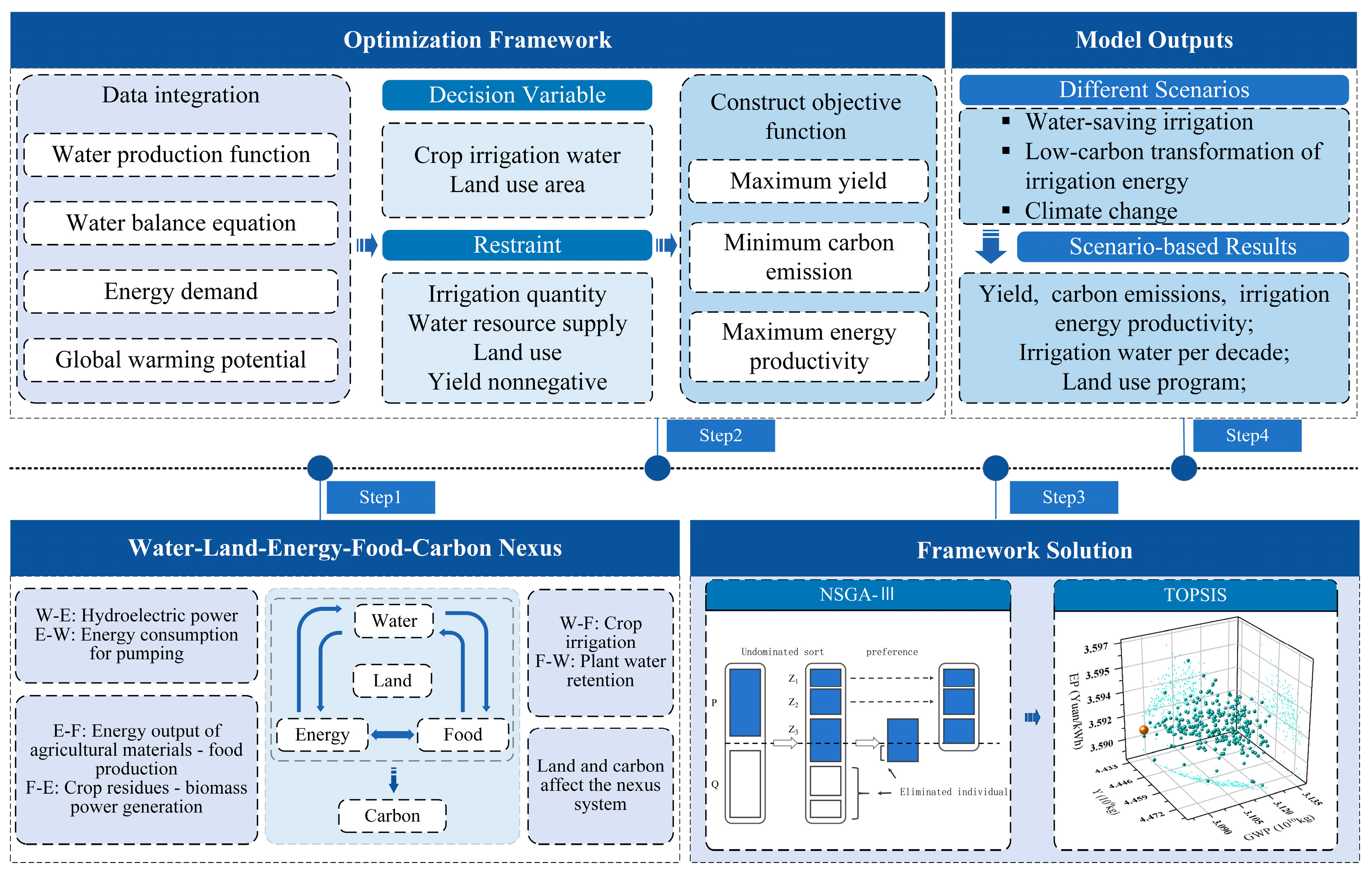
- Data preprocessing: Integrate multi-source data, including crop coefficients, meteorological data, energy structure data, etc., and standardize the spatiotemporal units (temporal scale: ten days; spatial scale: irrigation district unit).
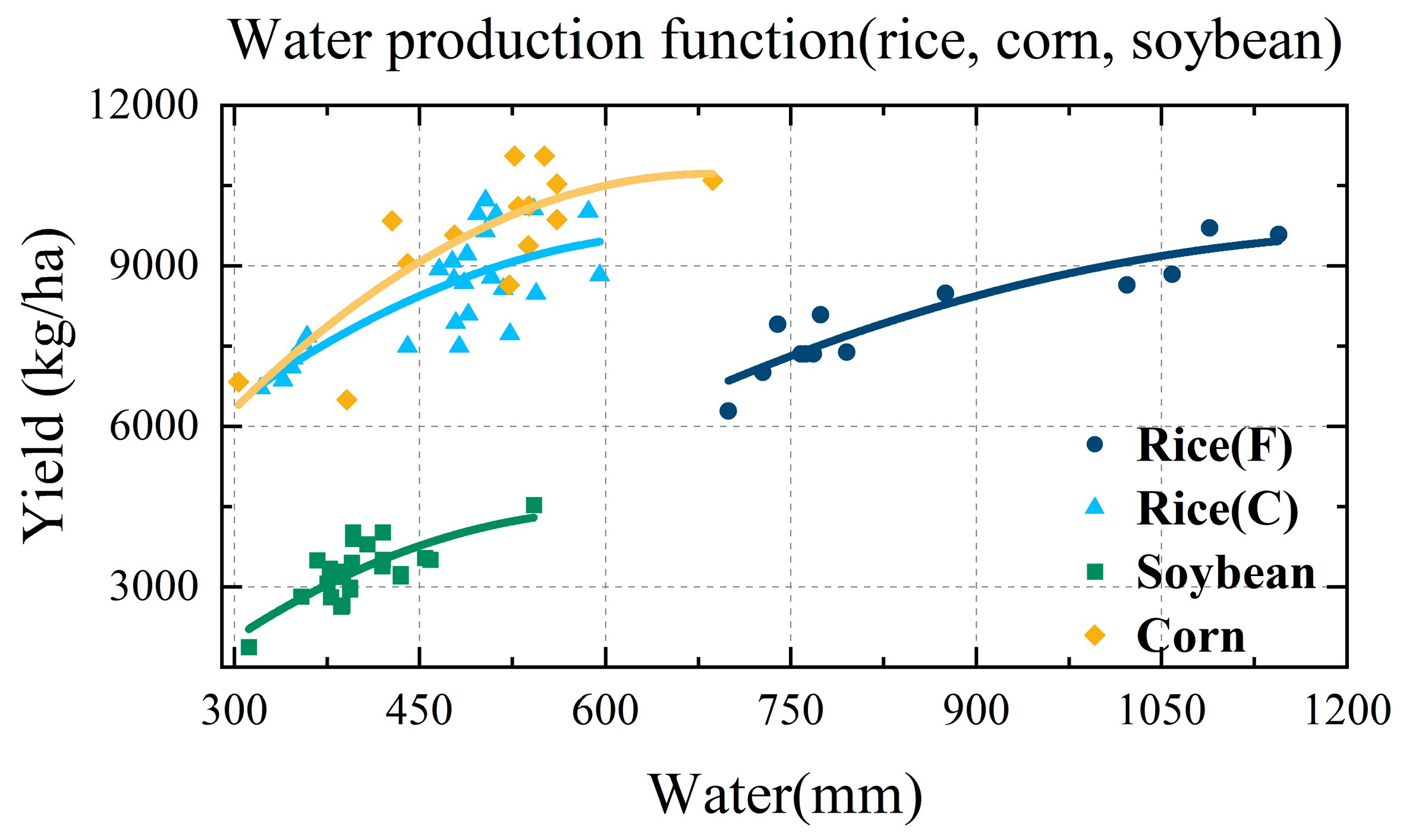
- Correlation function construction: Fit correlation functions between water–energy (pumping energy consumption), water–grain (water productivity), soil–carbon (total carbon emissions), and energy–carbon (carbon emissions per unit energy input) using least squares methods.
- Model Development: Establish decision variables (irrigated area, surface/groundwater irrigation volume per unit area) and constraints (upper/lower limits of irrigation water per unit area, land area variation range, water resource supply) to align model objectives with core research goals: reducing carbon emissions, enhancing irrigation energy productivity, and increasing crop yields.
- Model Solution: Employ the NSGA-III algorithm for multi-objective optimization, generating a Pareto solution set. Subsequently, rank the solutions using the Entropy-Weighted TOPSIS method (where weights are determined by objective data entropy values) to identify optimal configuration schemes.
- Result Output: Based on different scenario settings, output core indicators such as yield, carbon emissions, and irrigation energy productivity, along with corresponding ten-day irrigation plans and crop planting structure schemes. The specific framework of the model is shown in Figure 1.
2.1.1. Objective Function
- (1)
- Maximum crop production
- (2)
- Maximum irrigation energy productivity
- (3)
- Minimum carbon emissions
2.1.2. Model Constraint
- (1)
- Irrigation water per unit area
- (2)
- Changes in land area
- (3)
- Regional water availability
2.1.3. Parameter Meaning
2.1.4. Model Solution
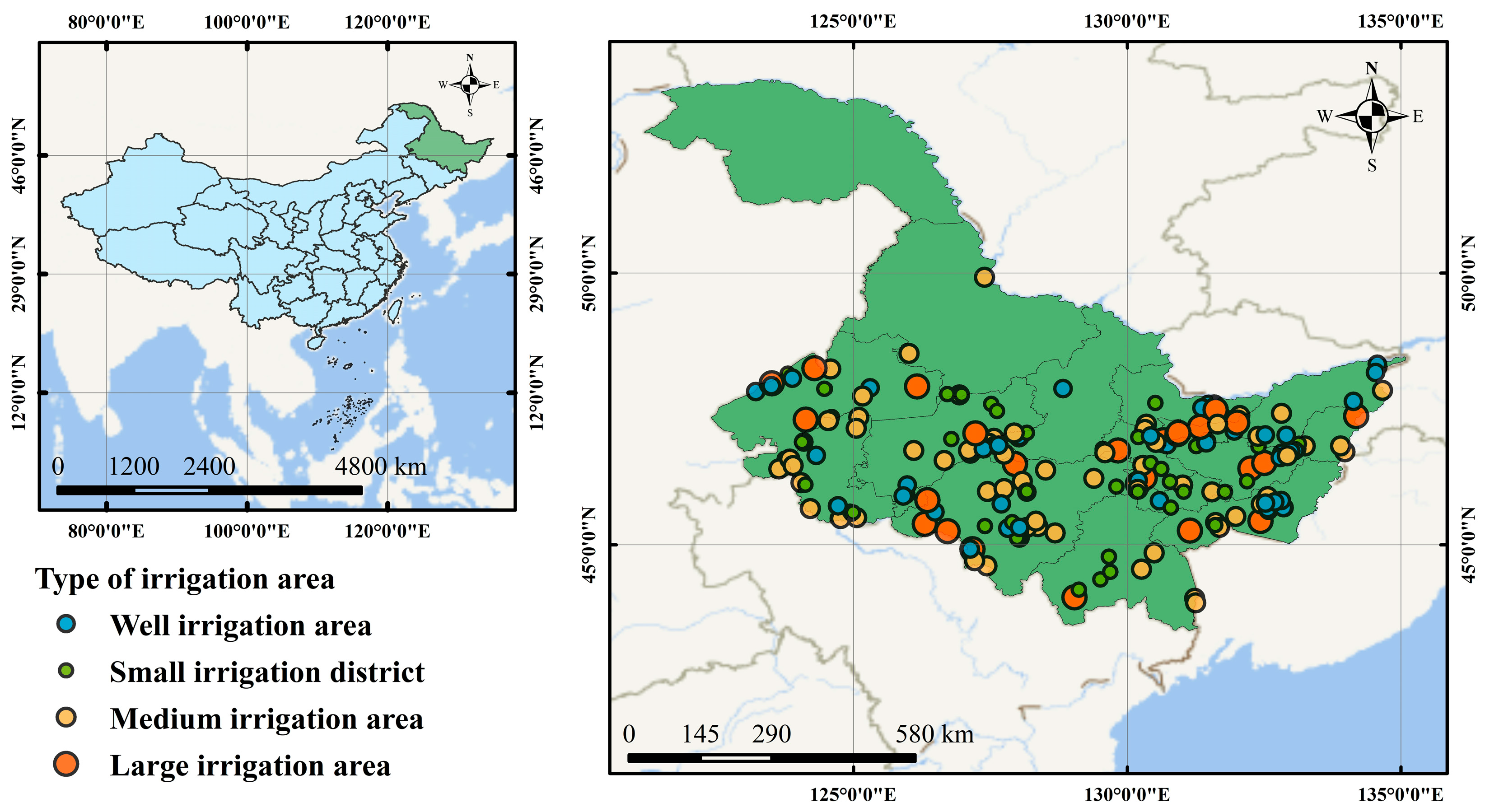
2.2. Study Area
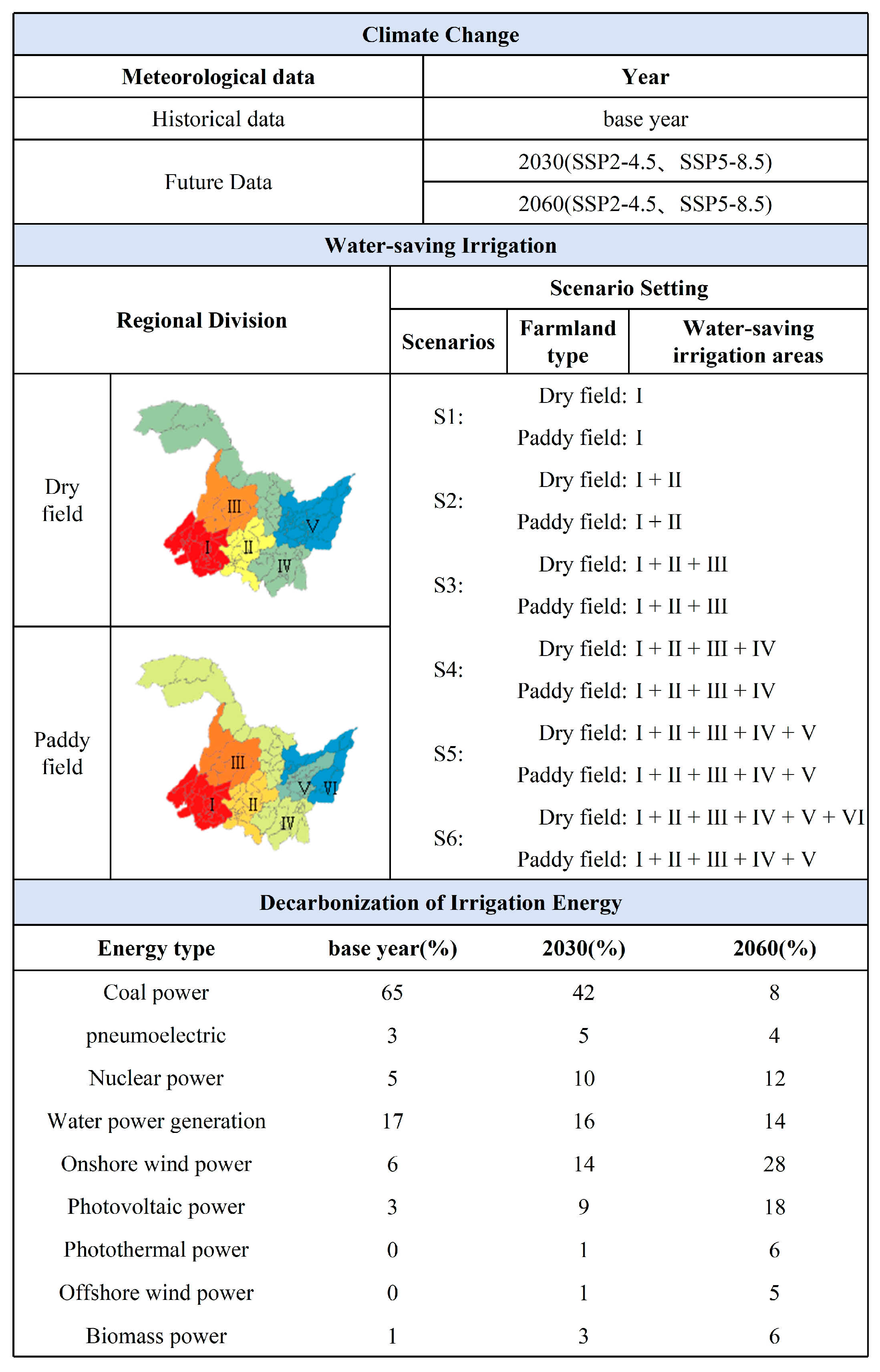
2.3. Scenario Setting
- (1)
- Climate change scenarios
- (2)
- Water-saving irrigation scenarios
- (3)
- Low-carbon transformation of irrigation energy structure scenarios
2.4. Data Acquisition
2.5. Calculation of the Construction Payback Period
3. Results
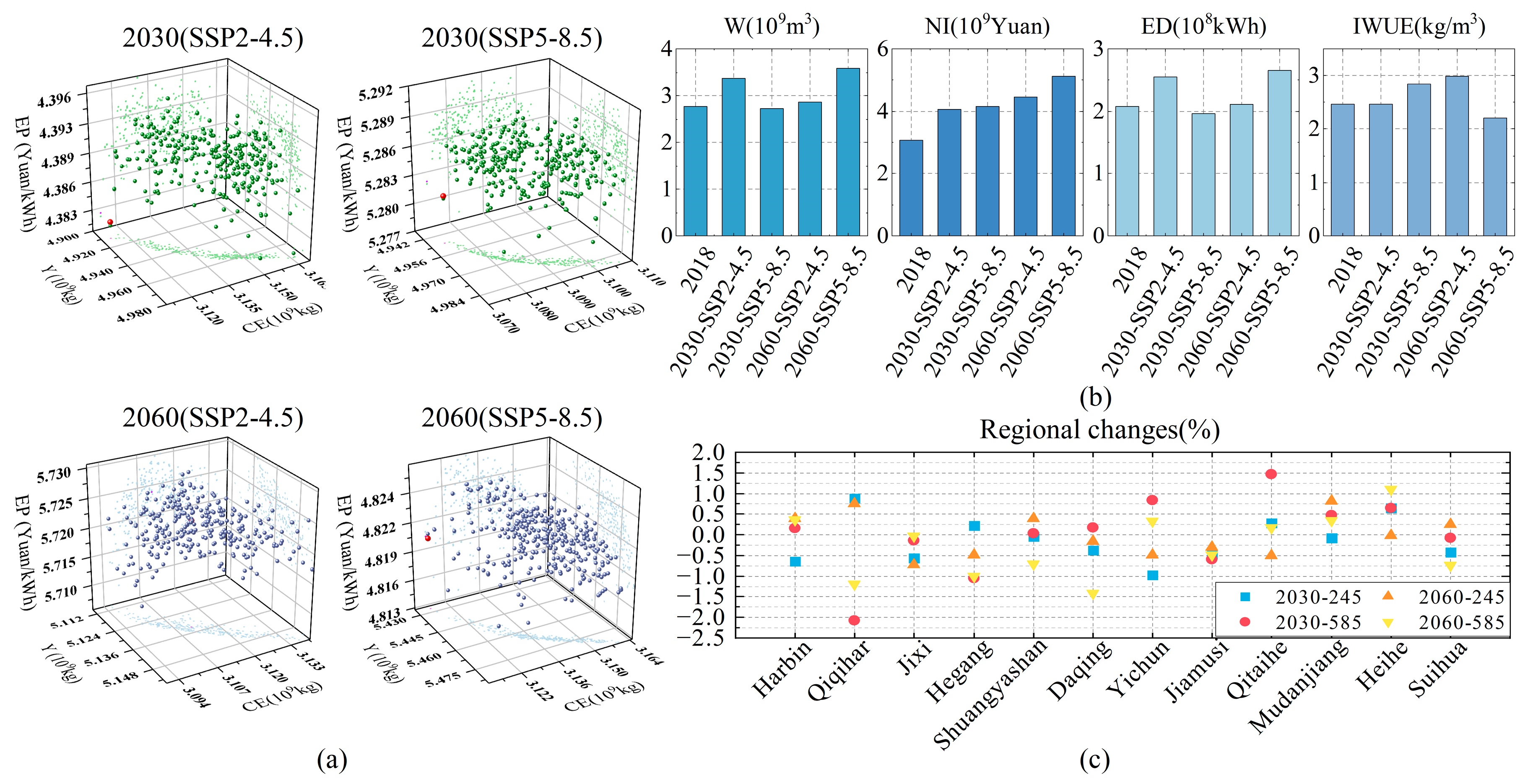
3.1. Coordinated Optimization of the Water–Land–Energy–Food–Carbon Nexus in Irrigation Districts Under Climate Change
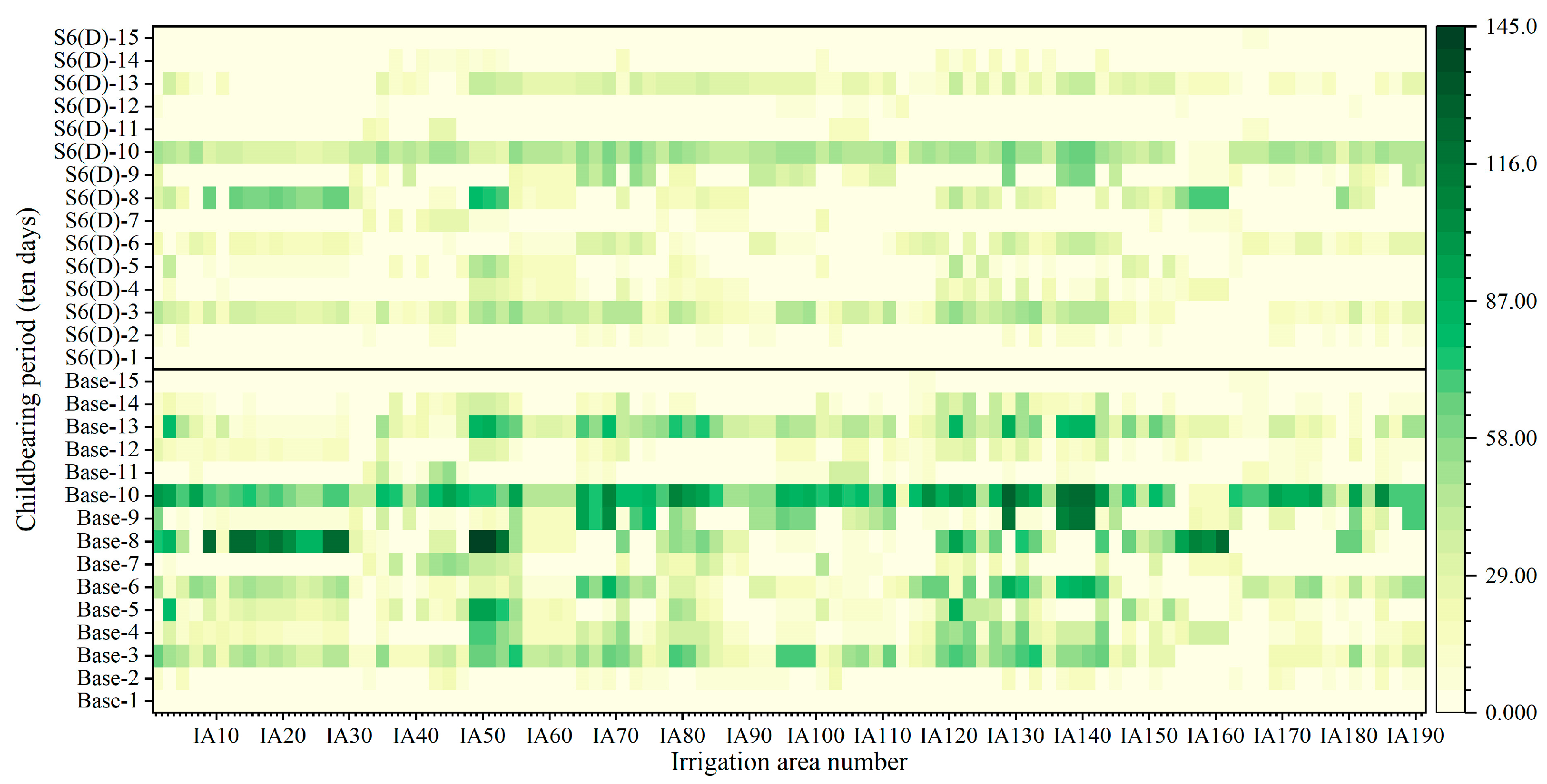
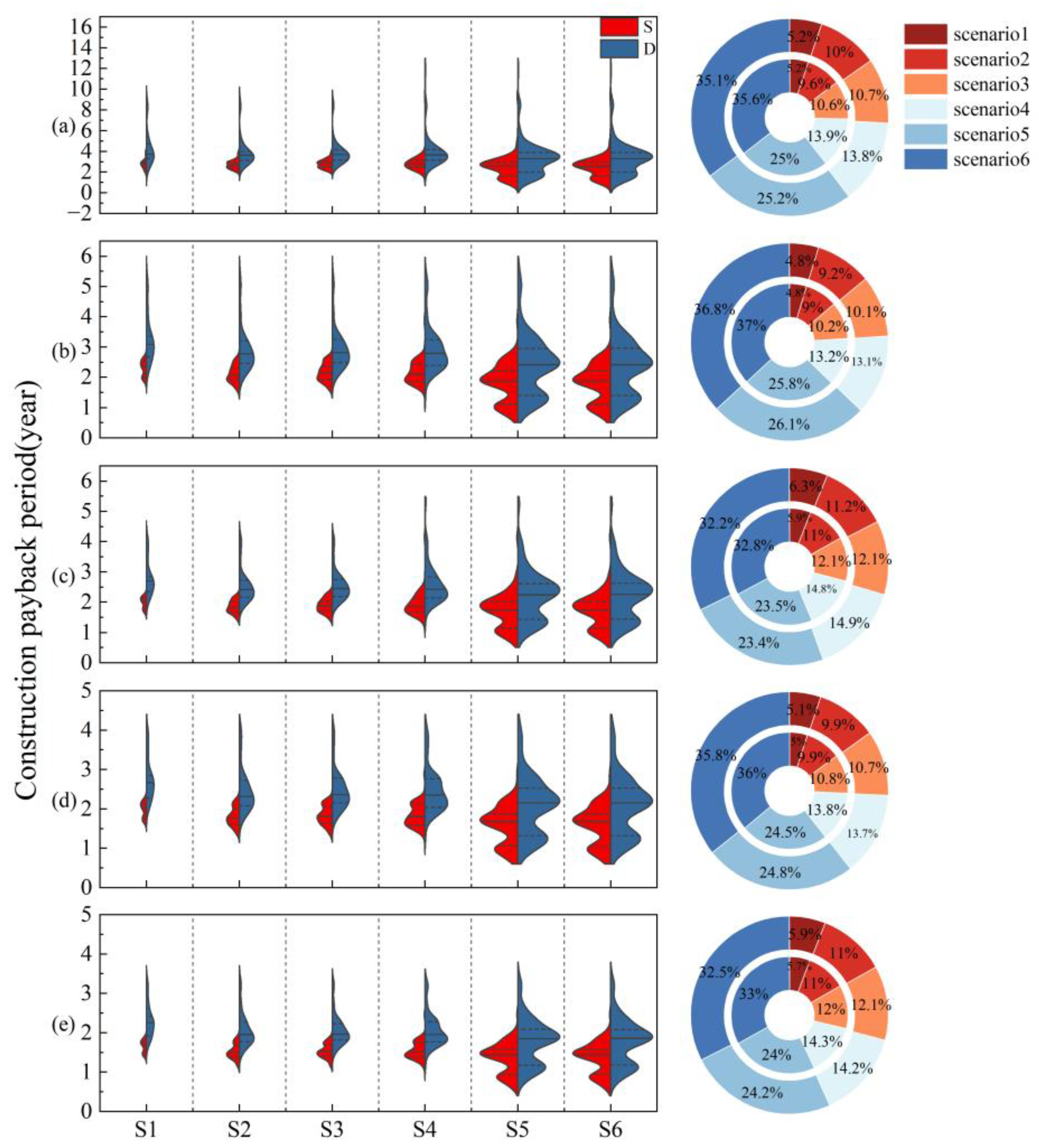
3.2. Water Consumption and Investment Payback Period for Irrigation Districts Under Climate Change and Water-Saving Scenarios
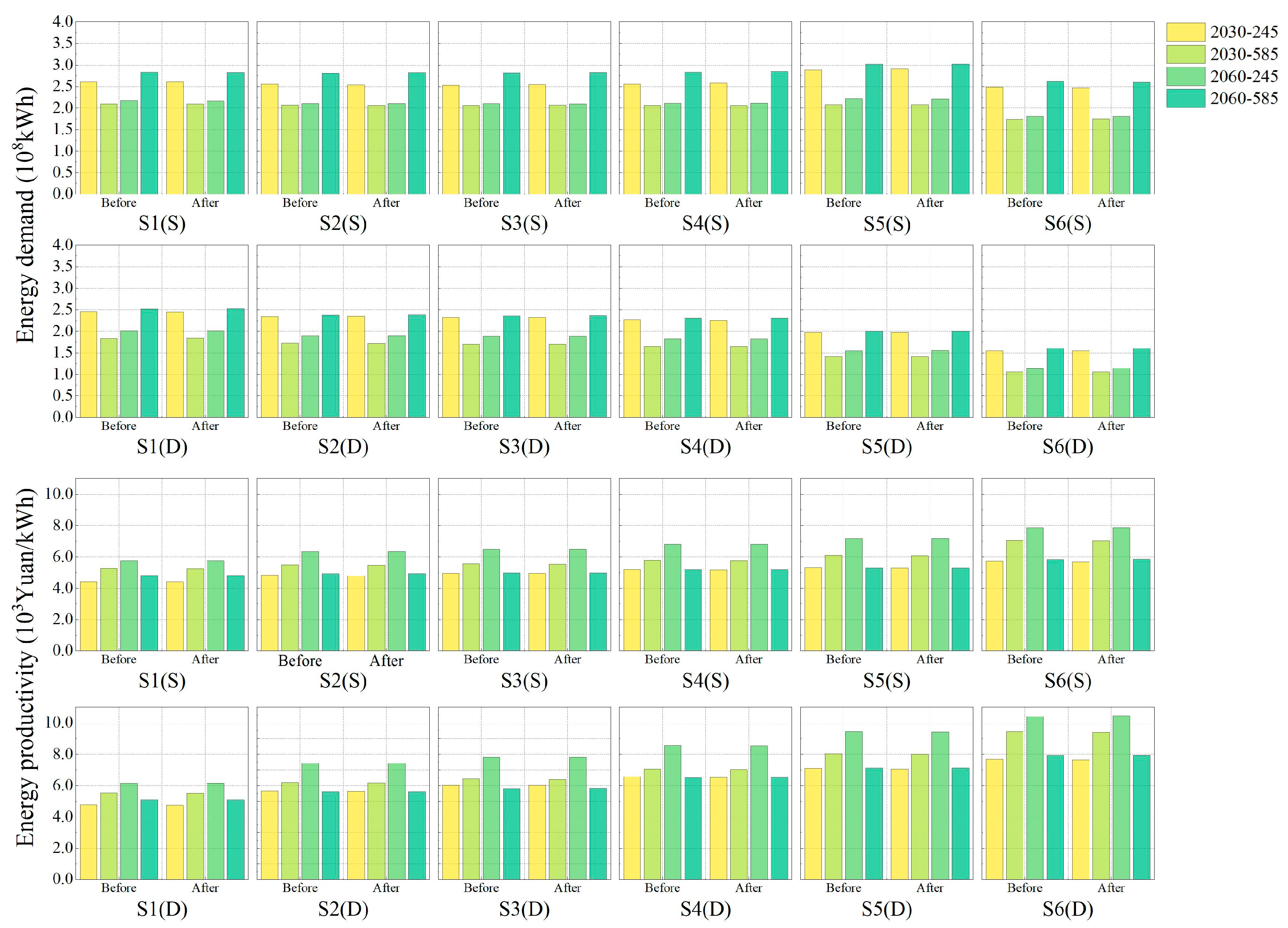
3.3. Energy Consumption Analysis Under Climate Change, Water-Saving Irrigation, and Low-Carbon Transformation of Irrigation Energy Structure Scenarios
3.4. Carbon Emissions Under Climate Change, Water-Saving Irrigation, and Low-Carbon Irrigation Energy Scenarios
4. Discussion
5. Conclusions
- (1)
- The model can quantify the interactions among water, land, energy, crop yield, and carbon emissions, providing a scientific basis for achieving the synergistic goals of yield enhancement, emission reduction, and improved energy efficiency.
- (2)
- While water-saving measures optimize water use, they may alter energy demand; therefore, irrigation planning must integrate considerations of energy structure and carbon emissions to achieve overall system optimality.
- (3)
- The model reveals spatial differences and optimization potential in intra- and inter-district water and land allocation, offering a quantitative framework for regional water resource management and sustainable agricultural development.
- (4)
- Beyond guiding high-standard farmland construction and fine-scale water resource management, the proposed approach provides a transferable analytical tool for exploring agricultural adaptation to climate change, energy transitions, and low-carbon development.
Supplementary Materials
Author Contributions
Funding
Data Availability Statement
Acknowledgments
Conflicts of Interest
References
- Godfray, H.C.J.; Beddington, J.R.; Crute, I.R.; Haddad, L.; Lawrence, D.; Muir, J.F.; Pretty, J.; Robinson, S.; Thomas, S.M.; Toulmin, C. Food Security: The Challenge of Feeding 9 Billion People. Science 2010, 327, 812–818. [Google Scholar] [CrossRef] [PubMed]
- Yue, Z.; Zhuo, L.; Ji, X.; Tian, P.; Gao, J.; Wang, W.; Sun, F.; Duan, Y.; Wu, P. Water-Saving Irrigated Area Expansion Hardly Enhances Crop Yield While Saving Water under Climate Scenarios in China. Commun. Earth Environ. 2025, 6, 295. [Google Scholar] [CrossRef]
- McDermid, S.; Nocco, M.; Lawston-Parker, P.; Keune, J.; Pokhrel, Y.; Jain, M.; Jägermeyr, J.; Brocca, L.; Massari, C.; Jones, A.D.; et al. Irrigation in the Earth System. Nat. Rev. Earth Environ. 2023, 4, 435–453. [Google Scholar] [CrossRef]
- Driscoll, A.W.; Conant, R.T.; Marston, L.T.; Choi, E.; Mueller, N.D. Greenhouse Gas Emissions from US Irrigation Pumping and Implications for Climate-Smart Irrigation Policy. Nat. Commun. 2024, 15, 675. [Google Scholar] [CrossRef]
- Costa, C.; Wollenberg, E.; Benitez, M.; Newman, R.; Gardner, N.; Bellone, F. Roadmap for Achieving Net-Zero Emissions in Global Food Systems by 2050. Sci. Rep. 2022, 12, 15064. [Google Scholar] [CrossRef]
- Hoff, H. Understanding the Nexus. In Proceedings of the Bonn2011 Conference: The Water, Energy and Food Security Nexus, Bonn, Germany, 16–18 November 2011. [Google Scholar]
- Hao, L.; Yu, J.; Wang, P.; Han, C.; Gojenko, B.; Qu, B.; Jiang, E.; Muminov, S. A Comprehensive Assessment Indicator of the Water-Energy-Food Nexus System Based on the Material Consumption Relationship. J. Hydrol. 2024, 633, 130997. [Google Scholar] [CrossRef]
- Rodríguez-Gutiérrez, J.E.; Castillo-Molar, A.; Fuentes-Cortés, L.F. A Multi-Objective Assessment for the Water-Energy-Food Nexus for Rural Distributed Energy Systems. Sustain. Energy Technol. Assess. 2022, 51, 101956. [Google Scholar] [CrossRef]
- Hou, J.; Jiang, Y.; Wei, T.; Wang, Z.; Wang, X. A Multi-Objective Simulation-Optimization Framework for Water Resources Management in Canal-Well Conjunctive Irrigation Area Based on Nexus Perspective. J. Hydrol. 2025, 646, 132308. [Google Scholar] [CrossRef]
- Yang, G.; Xia, S.; Huo, L.; Li, M.; Zhang, C.; Su, Y.; Guo, D. Two-Stage Multiobjective Decision-Making Method Based on Agricultural Water-Energy-Food Nexus: Case Study in Hetao Irrigation District, China. J. Water Resour. Plan. Manag. 2023, 149, 05023006. [Google Scholar] [CrossRef]
- Yuan, Y.; Wang, J.; Gao, X.; Huang, K.; Zhao, X. Optimizing Planting Management Practices Considering a Suite of Crop Water Footprint Indicators—A Case-Study of the Fengjiashan Irrigation District. Agric. Water Manag. 2025, 307, 109261. [Google Scholar] [CrossRef]
- Dehghanipour, A.H.; Schoups, G.; Zahabiyoun, B.; Babazadeh, H. Meeting Agricultural and Environmental Water Demand in Endorheic Irrigated River Basins: A Simulation-Optimization Approach Applied to the Urmia Lake Basin in Iran. Agric. Water Manag. 2020, 241, 106353. [Google Scholar] [CrossRef]
- Rosa, L.; Gabrielli, P. Achieving Net-Zero Emissions in Agriculture: A Review. Environ. Res. Lett. 2023, 18, 063002. [Google Scholar] [CrossRef]
- Qin, J.; Duan, W.; Zou, S.; Chen, Y.; Huang, W.; Rosa, L. Global Energy Use and Carbon Emissions from Irrigated Agriculture. Nat. Commun. 2024, 15, 3084. [Google Scholar] [CrossRef]
- Maraseni, T.N.; Mushtaq, S.; Hafeez, M.; Maroulis, J. Greenhouse Gas Implications of Water Reuse in the Upper Pumpanga River Integrated Irrigation System, Philippines. Agric. Water Manag. 2010, 97, 382–388. [Google Scholar] [CrossRef]
- Liu, S.; Wu, F.; Li, P.; Wang, D.; Feng, X.; Wang, Z.; Yan, L.; Zhang, Z.; Li, Y.; Ji, M.; et al. An Evaluation on the Effect of Water-Saving Renovation on a Large-Scale Irrigation District: A Case Study in the North China Plain. Agronomy 2024, 14, 1434. [Google Scholar] [CrossRef]
- Xu, Z.; Chen, X.; Liu, J.; Zhang, Y.; Chau, S.; Bhattarai, N.; Wang, Y.; Li, Y.; Connor, T.; Li, Y. Impacts of Irrigated Agriculture on Food–Energy–Water–CO2 Nexus across Metacoupled Systems. Nat. Commun. 2020, 11, 5837. [Google Scholar] [CrossRef] [PubMed]
- Yang, Y.; Tilman, D.; Jin, Z.; Smith, P.; Barrett, C.B.; Zhu, Y.-G.; Burney, J.; D’Odorico, P.; Fantke, P.; Fargione, J.; et al. Climate Change Exacerbates the Environmental Impacts of Agriculture. Science 2024, 385, eadn3747. [Google Scholar] [CrossRef]
- Cui, Q.; Zhang, X.; Yang, L.; Ali, T.; Yang, Y.; Wang, H.; Liu, R. Assessing Decarbonization Pathways by Weighing Carbon Mitigation Efficiency and Risks in China’s Energy System. Environ. Impact Assess. Rev. 2025, 114, 107935. [Google Scholar] [CrossRef]
- Pandey, G.; Lyden, S.; Franklin, E.; Harrison, M.T. Agrivoltaics as an SDG Enabler: Trade-Offs and Co-Benefits for Food Security, Energy Generation and Emissions Mitigation. Resour. Environ. Sustain. 2025, 19, 100186. [Google Scholar] [CrossRef]
- Zhuo, Z.; Du, E.; Zhang, N.; Nielsen, C.P.; Lu, X.; Xiao, J.; Wu, J.; Kang, C. Cost Increase in the Electricity Supply to Achieve Carbon Neutrality in China. Nat. Commun. 2022, 13, 3172. [Google Scholar] [CrossRef]
- Deb, K.; Jain, H. An Evolutionary Many-Objective Optimization Algorithm Using Reference-Point-Based Nondominated Sorting Approach, Part I: Solving Problems With Box Constraints. IEEE Trans. Evol. Comput. 2013, 18, 577–601. [Google Scholar] [CrossRef]
- Li, Z.; Luo, Z.; Wang, Y.; Fan, G.; Zhang, J. Suitability Evaluation System for the Shallow Geothermal Energy Implementation in Region by Entropy Weight Method and TOPSIS Method. Renew. Energy 2022, 184, 564–576. [Google Scholar] [CrossRef]
- Li, M.; Fu, Q.; Singh, V.P.; Liu, D.; Li, T. Stochastic Multi-Objective Modeling for Optimization of Water-Food-Energy Nexus of Irrigated Agriculture. Adv. Water Resour. 2019, 127, 209–224. [Google Scholar] [CrossRef]
- Correa-Cano, M.E.; Salmoral, G.; Rey, D.; Knox, J.W.; Graves, A.; Melo, O.; Foster, W.; Naranjo, L.; Zegarra, E.; Johnson, C.; et al. A Novel Modelling Toolkit for Unpacking the Water-Energy-Food-Environment (WEFE) Nexus of Agricultural Development. Renew. Sustain. Energy Rev. 2022, 159, 112182. [Google Scholar] [CrossRef]
- Li, M.; Peng, J.; Lu, Z.; Zhu, P. Research Progress on Carbon Sources and Sinks of Farmland Ecosystems. Resour. Environ. Sustain. 2023, 11, 100099. [Google Scholar] [CrossRef]
- Liang, D.; Lu, X.; Zhuang, M.; Shi, G.; Hu, C.; Wang, S.; Hao, J. China’s Greenhouse Gas Emissions for Cropping Systems from 1978–2016. Sci Data 2021, 8, 171. [Google Scholar] [CrossRef]
- Liu, G.; Zhang, F.; Deng, X. Half of the Greenhouse Gas Emissions from China’s Food System Occur during Food Production. Commun. Earth Environ. 2023, 4, 161. [Google Scholar] [CrossRef]
- Contribution of Working Groups I, II and III to the Fifth Assessment Report of the Intergovernmental Panel on Climate Change [Core Writing Team, R.K. Pachauri and L.A. Meyer (eds.)]. Climate Change 2014: Synthesis Report; IPCC: Geneva, Switzerland, 2014.
- Jing, B.; Shi, W.; Chen, T.; Zhai, Z.; Song, J. Optimizing Root Distribution and Water Use Efficiency in Maize/Soybean Intercropping under Different Irrigation Levels: The Role of Underground Interactions. Soil Tillage Res. 2025, 249, 106490. [Google Scholar] [CrossRef]
- Muratoglu, A.; Bilgen, G.K.; Angin, I.; Kodal, S. Performance Analyses of Effective Rainfall Estimation Methods for Accurate Quantification of Agricultural Water Footprint. Water Res. 2023, 238, 120011. [Google Scholar] [CrossRef]
- Nelson, A.; Wassmann, R.; Sander, B.O.; Palao, L.K. Climate-Determined Suitability of the Water Saving Technology “Alternate Wetting and Drying” in Rice Systems: A Scalable Methodology Demonstrated for a Province in the Philippines. PLoS ONE 2015, 10, e0145268. [Google Scholar] [CrossRef]
- Li, H.; Li, M.; Fu, Q.; Cao, K.; Liu, D.; Li, T. Optimization of Biochar Systems in the Water-Food-Energy-Carbon Nexus for Sustainable Circular Agriculture. J. Clean. Prod. 2022, 355, 131791. [Google Scholar] [CrossRef]
- Fan, Z.; Qi, X.; Zeng, L.; Wu, F. Accounting of greenhouse gas emissions in the Chinese agricultural system from 1980 to 2020. Acta Ecol. Sin. 2022, 42, 9470–9482, (In Chinese with English abstract). [Google Scholar] [CrossRef]
- Shang, J.; Yang, G.; Yu, F. Agricultural greenhouse gases emissions and influencing factors in China. Chin. J. Eco-Agric. 2015, 23, 354–364, (In Chinese with English abstract). [Google Scholar]
- Wang, G.; Liu, W.; Lei, B.; Du, L.; Xu, Z. Evaluation of Water Saving and Emission Reduction Potential of Rice in Heilongjiang Province Under Different Water-saving Irrigation Methods. Water Sav. Irrig. 2023, 11, 34–38, (In Chinese with English abstract). [Google Scholar] [CrossRef]
- National Greenhouse Gas Inventories Programme; Eggleston, H.S.; Buendia, L.; Miwa, K.; Ngara, T.; Tanabe, K. IPCC Guidelines for National Greenhouse Gas Inventories; IGES: Hayama, Japan, 2006. [Google Scholar]
- Wang, J.; Rothausen, S.G.S.A.; Conway, D.; Zhang, L.; Xiong, W.; Holman, I.P.; Li, Y. China’s Water–Energy Nexus: Greenhouse-Gas Emissions from Groundwater Use for Agriculture. Environ. Res. Lett. 2012, 7, 014035. [Google Scholar] [CrossRef]
- Zhang, Y.; Ge, M.; Zhang, Q.; Xue, S.; Wei, F.; Sun, H. What Did Irrigation Modernization in China Bring to the Evolution of Water-Energy-Greenhouse Gas Emissions? Agric. Water Manag. 2023, 282, 108283. [Google Scholar] [CrossRef]
- Zou, X.; Li, Y.; Cremades, R.; Gao, Q.; Wan, Y.; Qin, X. Cost-Effectiveness Analysis of Water-Saving Irrigation Technologies Based on Climate Change Response: A Case Study of China. Agric. Water Manag. 2013, 129, 9–20. [Google Scholar] [CrossRef]
- Wu, H.; Li, Z.; Deng, X.; Zhao, Z. Enhancing Agricultural Sustainability: Optimizing Crop Planting Structures and Spatial Layouts within the Water-Land-Energy-Economy-Environment-Food Nexus. Geogr. Sustain. 2025, 6, 100258. [Google Scholar] [CrossRef]
- Ziarh, G.F.; Chung, E.S.; Hamed, M.M.; Hassan, M.S.; Shahid, S. Changes in Aridity and Its Impact on Agricultural Lands in East Asia for 1.5 and 2.0 °C Temperature Rise Scenarios. Atmos. Res. 2023, 293, 106920. [Google Scholar] [CrossRef]
- Mishra, A.K.; Sudarsan, J.S.; Suribabu, C.R.; Murali, G. Cost-Benefit Analysis of Implementing a Solar Powered Water Pumping System—A Case Study. Energy Nexus 2024, 16, 100323. [Google Scholar] [CrossRef]
- Cai, Y. Effect of Different Irrigation Patterns on Forming of Carbohydrate of Japonica Rice in Cold Region. Master’s Thesis, Northeast Agricultural University, Harbin, China, 2013. (In Chinese with English Abstract). [Google Scholar]
- Chen, P.; Zhang, Z.; Chen, S.; Nie, T.; Zhao, J. Uptake of Basal Application Nitrogen by Rice from Black Soil under Water-saving Irrigation in Temperate Region. J. Irrig. Drain. 2019, 38, 36–43, (In Chinese with English Abstract). [Google Scholar]
- Gai, Z.; Du, J.; Fu, J.; Zhang, J.; Zhao, H.; Ma, R.; Cai, L.; Liu, W.; Liu, J.; Huang, C.; et al. The Impact of Irrigation Methods on Grain Yield and Water Use Efficiency of the New Japonica Rice Variety Fuhe 3. China Seed Ind. 2019, 1, 67–70. (In Chinese) [Google Scholar]
- Hou, J. Experiment Study of Water-Saving Irrigation Model of Rice Introduced in Hongqiling farm of Heilongjiang Province. Master’s Thesis, Chinese Academy of Agricultural Sciences, Beijing, China, 2015. (In Chinese with English Abstract). [Google Scholar]
- Jiang, H.; Chen, P.; Shehakk; Zhang, Z. Use Efficiency of Water and Nitrogen of Soybean with Water Stress by Stable Carbon Isotope Discrimination. Soybean Sci. 2018, 37, 906–914, (In Chinese with English Abstract). [Google Scholar]
- Li, T. Experimental Study on Effects of Different Water and Fertilizer Managements on Water Use and Carbon Balance of Paddy Fields in Black Soil Region under Straw Returning. Master’s Thesis, Northeast Agricultural University, Harbin, China, 2021. (In Chinese with English Abstract). [Google Scholar]
- Liang, Q.; Zhang, Y.; Jin, Z. Experimental Study on Economic Benefits, Quality, and Water Productivity of Rice Cultivation in Cold Black Soil under Different Water and Nitrogen Coupling Modes. Water Sav. Irrig. 2016, 3, 35–37. (In Chinese) [Google Scholar]
- Liu, S.; Zhang, X. Effects of tillage management on soil water dynamics, yield and water use efficiency in arable black soil cropping system in Northeast China. Agric. Res. Arid. Areas 2012, 30, 126–131, (In Chinese with English Abstract). [Google Scholar]
- Liu, Y.; Li, Y.; Li, J.; Yan, H. Effects of Mulched Drip Irrigation on Water and Heat Conditions in Field and Maize Yield in Sub humid Region of Northeast China. Trans. Chin. Soc. Agric. Mach. 2015, 46, 93–104+135, (In Chinese with English Abstract). [Google Scholar]
- Liu, Y.; Yang, H.; Li, Y.; Yan, H.; Li, J. Modeling the Effects of Plastic Film Mulching on Irrigated Maize Yield and Water Use Efficiency in Sub-Humid Northeast China. Int. J. Agric. Biol. Eng. 2017, 10, 69–84. [Google Scholar] [CrossRef][Green Version]
- Liu, Y.; Yang, H.; Wang, Y.; Xu, Y.; Gao, P.; Zheng, X.; Yu, H.; Wang, J. Effects and Benefit Analysis of Maize Straw Mulching No-tillage Drenching Technology on Drought Resistance and Seedling Preservation in Semi-arid Area. Heilongjiang Agric. Sci. 2021, 1, 11–13, (In Chinese with English Abstract). [Google Scholar]
- Ren, H.; Zhang, F.; Zhu, X.; Lamlom, S.F.; Liu, X.; Wang, X.; Zhao, K.; Wang, J.; Sun, M.; Yuan, M.; et al. Cultivation Model and Deficit Irrigation Strategy for Reducing Leakage of Bundle Sheath Cells to CO2, Improve 13C Carbon Isotope, Photosynthesis and Soybean Yield in Semi-Arid Areas. J. Plant Physiol. 2023, 285, 153979. [Google Scholar] [CrossRef]
- Sun, D.; Zhang, Z. Study on soybean yield and water use efficiency in different drip irrigation amount. J. Northeast Agric. Univ. 2012, 43, 100–104, (In Chinese with English Abstract). [Google Scholar]
- Sun, Y. Research on High-Yield Cultivation Techniques for Rice under Controlled Irrigation Conditions. Master’s Thesis, Heilongjiang University, Harbin, China, 2014. (In Chinese with English Abstract). [Google Scholar]
- Tian, Y.; Shao, D.; Li, S.; Wang, B. Response of Rice Water Requirement to Groundwater Depths and Irrigations Simulation in Cold Region of Northeast China. J. Irrig. Drain. 2020, 38, 68–77, (In Chinese with English Abstract). [Google Scholar]
- Wang, K.; Fu, Q.; Jiang, X.; Zhang, X. Effect of Straw Mulching Mode on Maize Physiological Index and Water Use Efficiency. Trans. Chin. Soc. Agric. Mach. 2014, 45, 181–186, (In Chinese with English Abstract). [Google Scholar]
- Wei, X. Study on the Technology of Water-Saving and Yield-Increasing of Rice in Cold Field. Master’s Thesis, Northeast Agricultural University, Harbin, China, 2010. (In Chinese with English Abstract). [Google Scholar]
- Xu, D.; Zhang, Z.; Lin, Y.; Nie, T. Study on water- saving high yield and high efficiency of rice in cold region by orthogonal design. J. Northeast Agric. Univ. 2015, 46, 22–27+46, (In Chinese with English Abstract). [Google Scholar]
- Xu, Y.; Liu, Y.; Wang, Y.; Gao, P.; Yang, H.; Wang, J.; Yu, H. Study on Comprehensive Water Saving Technology of Rice in Western Heilongjiang Province. Heilongjiang Agric. Sci. 2019, 4, 1–5, (In Chinese with English Abstract). [Google Scholar]
- Xu, Y.; Wang, J.; Liu, Y.; Gao, P.; Wang, Y.; Yang, H.; Yu, K.; Ge, X.; Chi, L.; Fan, J. Effects of Different Returning Methods of Straw on Soil Physical Property, Yield of Corn. J. Maize Sci. 2018, 26, 78–84, (In Chinese with English Abstract). [Google Scholar]
- Yuan, W.; Liu, Q. Study on corn laminating spray irrigation experiment in western sandy soil region of Heilongjiang. J. Northeast Agric. Univ. 2010, 41, 57–60, (In Chinese with English Abstract). [Google Scholar]
- Zhang, Z.; Wang, Z.; Zhang, Z.; Wang, X. Effects of Different Irrigations on Carbon Emission, Water Consumption and Yield of Paddy Field in Cold Regions. J. Irrig. Drain. 2018, 37, 1–7, (In Chinese with English Abstract). [Google Scholar]
- Zhang, Z.; Zhang, Y.; Wang, M. Experimental study on coupling effect of water and nitrogen of rice in cold black soil region. J. Northeast Agric. Univ. 2015, 46, 49–55, (In Chinese with English Abstract). [Google Scholar]
- Zhang, Z.; Li, T.; Zhang, Z.; Li, K.; Li, H.; Kong, F. Relationship between Trace Greenhouse Gas Emission and Water and Nitrogen Utilization under Water Biochar Management in Paddy Fields. Trans. Chin. Soc. Agric. Mach. 2022, 53, 379–387, (In Chinese with English Abstract). [Google Scholar]
- Zhao, Y. The Experimental Study on Furrow Irrigation Pattern of Corn in Semi-Arid Region of Western Heilongjiang Province. Master’s Thesis, Northeast Agricultural University, Harbin, China, 2011. (In Chinese with English Abstract). [Google Scholar]
- Zhu, S.; Sun, A.; Zhang, Z.; Wang, Z.; Du, P. Effects of Different Water-saving Irrigation Modes on Rice Tillering, Height and Yield in Cold Area. Water Sav. Irrig. 2013, 12, 16–19, (In Chinese with English Abstract). [Google Scholar]
- Zhu, S.; Wang, Z.; Zhang, Z.; Du, P. Experiment on Regulation of Water Consumption and Water Use Efficiency of Film lrrigation Rice in Cold Region. J. Irrig. Drain. 2011, 30, 97–99, (In Chinese with English Abstract). [Google Scholar]





| Index | Definition | Index | Definition |
|---|---|---|---|
| Area, d = 1, ……, D | Agricultural film prices, Yuan/kg | ||
| Crop, c = 1, ……, C | Seed price, Yuan/kg | ||
| Ten days, p = 1, ……, P | Price per unit area for labor, Yuan/ha | ||
| Irrigation method m = 1,2, …, M | Agricultural machinery price per unit area, Yuan/ha | ||
| Energy type w = 1,2, …, W | Net calorific value of energy, TJ/kg | ||
| Irrigated area (decision variable), ha | Energy oxidation rate, % | ||
| Surface water crop irrigation per unit area (decision variable), mm | Price of energy, Yuan/TJ | ||
| Groundwater crop irrigation per unit area (decision variable), mm | Proportion of different energy sources, % | ||
| Yield per unit area, kg/ha | Electro-thermal conversion ratio, % | ||
| Crop sale prices, Yuan/kg | CO2 emission factor for agricultural film, kgCO2/kg | ||
| Amount of fertilizer per unit area, kg/ha | CO2 emission factor for fertilizers, kgCO2/kg | ||
| Pesticide use per unit area, kg/ha | CO2 emission factor for pesticides, kgCO2/kg | ||
| Agricultural film usage per unit area, kg/ha | Fertilizer N2O emission factor, kgN2O/kg | ||
| Seed use per unit area, kg/ha | CO2 emission factor per unit area of agricultural machinery, kgCO2/ha | ||
| Surface water prices, Yuan/m3 | CH4 emission factor per unit area of rice field, kgCH4/ha | ||
| Groundwater prices, Yuan/m3 | N2O emission factor per unit area of dryland, kgN2O/ha | ||
| Irrigation water use efficiency of different irrigation methods, % | Energy CO2 emission factor, kgCO2/TJ | ||
| Surface water head, m | Energy CH4 emission factor, kgCH4/TJ | ||
| Surface water pumping efficiency, % | Energy N2O emission factor, kgN2O/TJ | ||
| Underground pump head, m | Minimum allowable irrigation per unit area, mm | ||
| Working pressure head, m | Maximum permissible irrigation volume per unit area, mm | ||
| Pipe head loss, m | Minimum allowable irrigated area of crop, ha | ||
| Pump efficiency, % | Maximum allowable irrigated area of crop, ha | ||
| Engine efficiency, % | Allowable supply of surface water resources, m3 | ||
| Fertilizer prices, Yuan/kg | Allowable supply of groundwater resources, m3 | ||
| Pesticide prices, Yuan/kg |
| Crop | ||||
|---|---|---|---|---|
| Rice (flood irrigation) | −0.0084 | 21.334 | 3963.4 | 0.8576 |
| Rice (controlled irrigation) | −0.0217 | 29.619 | 498.24 | 0.5624 |
| Corn | −0.0295 | 40.449 | 3155.7 | 0.6633 |
| Soybeans | −0.0241 | 29.597 | 4668.4 | 0.5275 |
Disclaimer/Publisher’s Note: The statements, opinions and data contained in all publications are solely those of the individual author(s) and contributor(s) and not of MDPI and/or the editor(s). MDPI and/or the editor(s) disclaim responsibility for any injury to people or property resulting from any ideas, methods, instructions or products referred to in the content. |
© 2025 by the authors. Licensee MDPI, Basel, Switzerland. This article is an open access article distributed under the terms and conditions of the Creative Commons Attribution (CC BY) license (https://creativecommons.org/licenses/by/4.0/).
Share and Cite
Wan, Z.; Li, H.; Liu, X.; Huo, L.; Chen, Y.; Wang, L.; Li, M. Synergistic Regulation of Water–Land–Energy–Food–Carbon Nexus in Large Agricultural Irrigation Areas. Agronomy 2025, 15, 2776. https://doi.org/10.3390/agronomy15122776
Wan Z, Li H, Liu X, Huo L, Chen Y, Wang L, Li M. Synergistic Regulation of Water–Land–Energy–Food–Carbon Nexus in Large Agricultural Irrigation Areas. Agronomy. 2025; 15(12):2776. https://doi.org/10.3390/agronomy15122776
Chicago/Turabian StyleWan, Zhenxiong, Haiyan Li, Xiao Liu, Lijuan Huo, Yingshan Chen, Luchen Wang, and Mo Li. 2025. "Synergistic Regulation of Water–Land–Energy–Food–Carbon Nexus in Large Agricultural Irrigation Areas" Agronomy 15, no. 12: 2776. https://doi.org/10.3390/agronomy15122776
APA StyleWan, Z., Li, H., Liu, X., Huo, L., Chen, Y., Wang, L., & Li, M. (2025). Synergistic Regulation of Water–Land–Energy–Food–Carbon Nexus in Large Agricultural Irrigation Areas. Agronomy, 15(12), 2776. https://doi.org/10.3390/agronomy15122776