Article

Optimal Planting Areas of Sea Buckthorn (Hippophae rhamnoides) Under the Influences of Climate Change and Pests Using the MaxEnt Model


Xinjiang Key Laboratory of Biological Resources and Genetic Engineering, College of Life Science and Technology, Xinjiang University, Urumqi 830046, China
*
Author to whom correspondence should be addressed.
Agronomy 2025, 15(12), 2777; https://doi.org/10.3390/agronomy15122777
Submission received: 28 August 2025 / Revised: 22 November 2025 / Accepted: 27 November 2025 / Published: 30 November 2025
(This article belongs to the Special Issue Sustainable Pest Management under Climate Change)

Abstract

As a versatile shrub, sea buckthorn (Hippophae rhamnoides L.) plays a significant role in restoring degraded ecosystems and supporting regional economies. However, its cultivation faces increasing risks from climate change and pest infestations, particularly from Rhagoletis batava and Cossus cossus. This study aimed to evaluate potential suitable planting areas for H. rhamnoides under current and future climate conditions while accounting for pest risks. The MaxEnt model was employed to predict species distributions and their overlap with pest habitats across multiple climate scenarios (SSP126, SSP245, and SSP585) for the periods 2041–2060 and 2081–2100. The results indicate that currently, 61.95% of the suitable areas for H. rhamnoides face threats from pests. Under future scenarios, the total suitable area showed an increasing trend under SSP126 and SSP245, but a significant decrease under SSP585 by the 2090s. Notably, the area severely threatened by both pests was projected to reduce dramatically, by up to 85.40% under the high-emission scenario (SSP585–2090s), suggesting a potential ecological window for cultivation expansion in certain regions. The study introduces a dual-constraint model incorporating both climate and pest variables, providing a more accurate assessment of optimal planting areas. These findings offer critical insights for the sustainable management of H. rhamnoides cultivation by highlighting regions where pest control strategies should be prioritized and informing future policy and management decisions.

1. Introduction

Sea buckthorn (Hippophae rhamnoides L.) is a shrub in the family of Elaeagnaceae and has attracted worldwide attention because of its significant ecological benefits and economic value [1]. H. rhamnoides has strong adaptability and can grow on dry and barren land. Its large and dense root system and root nodule nitrogen fixation can significantly improve soil structure and fertility. Furthermore, through its canopy and leaf litter, H. rhamnoides regulates surface hydrological processes and reduces soil erosion, thereby playing a vital role in soil stabilization and water conservation in arid and semiarid areas [2]. The fruit is rich in vitamin C (up to 1300 mg/100 g), flavonoids, and omega-7 unsaturated fatty acids (with levels higher than 40%) and is widely used in functional foods, pharmaceuticals, and cosmetics [3]. The statistical report of the National Forestry and Grassland Administration of China shows that as of 2021, the total area of H. rhamnoides in China already exceeded 1,273,600 ha, of which artificial planting accounted for 55%, the output value exceeded RMB 24 billion/year [4], and the average direct fruit income per hectare exceeded 3100 RMB/year (approximately $431 USD) [5]. H. rhamnoides has thus become a pillar industry for rural development in northern and southwestern China.
With the expansion of planting, pest problems—particularly those caused by Rhagoletis batava and Cossus cossus—have become the primary factors limiting the sustainable management of H. rhamnoides forests [6,7], resulting in significant annual economic losses [4]. R. batava is a univoltine fruit fly whose larval development is synchronized with the fruit maturation period of H. rhamnoides. The adults are highly adept at locating host plants for oviposition, causing direct damage to the economically valuable fruit [8]. In contrast, C. cossus is a wood-boring moth with a longer life cycle. Its larvae infest the vascular tissues of stems and roots, impairing nutrient and water transport and often leading to secondary infections, which compromise the long-term health and stability of the entire plant [9]. The population dynamics of both pests are influenced not only by climatic conditions but also by host plant vitality and the presence of natural enemies, forming a complex trophic interaction. Furthermore, the increasing resistance of these pests to chemical pesticides challenges traditional control methods [10], underscoring the need for ecological strategies. Therefore, predicting their distribution requires moving beyond a simple climate-matching approach to incorporate these fundamental biological relationships.
Species distribution models (SDMs), based on the principle of niche conservatism, use known species occurrence records combined with environmental variables to predict areas of potential habitat suitability [11]. Over the past two decades, significant advancements in SDM methodologies have improved their predictive accuracy [12]. The MaxEnt model, as a representative model, has the outstanding characteristics of a small sample size and high prediction accuracy [13]. It has been applied in the study and selection of planting areas of important economic crops, such as Astragalus flavone, Larix gmelinii, and Theobroma cacao [14,15,16]. However, most existing studies have focused on a single species against the background of climate change, and the spatial coupling mechanisms of commercial crops and their biotic limitation factors have been insufficiently studied, which reduces the application value of the research findings.
Taking the research object of this study as an example, Li et al. [17] used the default parameters of the MaxEnt model to carry out a study on the core distribution area of H. rhamnoides in China. On this basis, Huang et al. [18] further analyzed the impact of climate change on the potential distribution area of H. rhamnoides, and He et al. [5] explored the main factors that limit the distribution areas of different subspecies. Gan et al. [19] applied the integrated niche model to integrate the above studies. However, the above studies were all conducted under idealized assumptions in which H. rhamnoides was not influenced by pests and thus failed to incorporate critical pest survival constraints. This finding strongly contradicts the current reality in which H. rhamnoides is severely harmed by R. batava and C. cossus. Consequently, existing ecological suitability assessments have fallen short of effectively guiding economic loss mitigation strategies. There is an urgent need to construct a “host-pest” dual-object collaborative assessment framework to achieve the ultimate goal of service production application.
We hypothesized that integrating pest distribution constraints with climate suitability modeling would reveal optimal planting areas for H. rhamnoides that are not apparent when considering climate alone. Therefore, the overarching objective of this study was to identify the optimal planting areas for H. rhamnoides in China that concurrently satisfy ecological suitability and possess a low potential risk from two major pests under current and future climate scenarios. This was achieved by: (1) analyzing the niche overlap between H. rhamnoides and the pests; (2) quantifying the current extent of pest-threatened suitable areas; and (3) projecting the spatiotemporal shifts in these optimal areas under multiple climate change scenarios.

2. Materials and Methods

2.1. Collection of Species Geographic Distribution Data

The species distribution point data were obtained through a combination of field surveys and retrieval from various databases. The distribution point data for H. rhamnoides were obtained from the Chinese Virtual Herbarium (https://www.cvh.ac.cn/) (accessed on 2 July 2025) and the Global Biodiversity Information Facility (https://www.gbif.org/) (accessed on 2 July 2025) [20]. The data for R. batava and C. cossus were collected through field surveys and reports from local forestry and grassland management departments in China. Since some distribution points were reported only as place names and lacked latitude and longitude information, they were converted to latitude and longitude information using the Baidu Maps Coordinate Picker (https://lbs.baidu.com/maptool/getpoint) (accessed on 2 July 2025). On this basis, duplicated and distribution points with obvious errors were excluded. To mitigate the error arising from the clustering effect, a single distribution point was retained within each grid cell, based on a 5 km × 5 km grid division criterion [21]. The effective numbers of H. rhamnoides, R. batava and C. cossus were 385, 118 and 109, respectively (Figure 1, Tables S1 and S2).

2.2. Selection and Processing of Environmental Variables

A total of 35 environmental variables were included in this study, including 19 bioclimatic factors, 14 soil factors and 2 topographic factors. The bioclimatic factor data were obtained from WorldClim (http://www.worldclim.org) (accessed on 8 March 2025), which provides global climate data. The spatial resolution of the data is 2.5 arc-minutes (5 km). The climate data for the next two periods were selected for the sixth period. Three socioeconomic pathways (SSPs) were shared by BCC-CSM2-MR in the coupled model comparison project (CMIP6), including model data for three scenarios: sustainable development (SSP126), intermediate development (SSP245) and rapid development (SSP585) [22]. The data on soil factors and topographic factors were obtained from the Harmonized World Soil Database (http://www.fao.org/faostat/en/#data) (accessed on 8 March 2025). The map data were from the Ministry of Natural Resources of China (http://bzdt.ch.mnr.gov.cn) (accessed on 8 March 2025). The spatial resolution of each factor was set to 2.5 m″ (approximately 20 km2).
To mitigate model overfitting caused by predictor collinearity, we implemented a two-step variable selection process in R software (version 4.1.2). First, variables with a Variance Inflation Factor (VIF) of 5 or greater were excluded. Next, among pairs of variables with a Spearman correlation coefficient exceeding 0.7, only the variable considered more ecologically relevant to the species was retained. The factors with VIF values less than 5 and correlation coefficients less than 0.7 were retained following the Spearman correlation test, and among the factors with correlation coefficients greater than 0.7, only those with greater ecological significance were retained [23]. Finally, 15 environmental variables were selected (Table 1, Figures S1 and S2).

2.3. Model Construction, Optimization and Evaluation

MaxEnt version 3.4.4 was employed to forecast the potential suitable habitats for H. rhamnoides, R. batava and C. cossus. Species occurrence records are often subject to spatial sampling bias, which, if not corrected, can lead to biased model predictions [24]. To address this, we created a spatial bias file based on the density of all sampling records. This bias file was used to guide the selection of background points during modeling, giving more weight to areas with lower sampling effort, thereby mitigating the spatial sampling bias [25]. To avoid overfitting in MaxEnt, the regularization multiplier was set to the range from 0.5 to 4 [26], with an increment of 0.5 between test values. The five features provided by the MaxEnt model were linear features (L), quadratic features (Q), fragmentation features (hinge features, H), product features (P) and threshold features (T). This study used six feature combination multipliers (FCs), namely, “L”, “H”, “LQ”, “LQH”, “LQHP” and “LQHPT”.
The ENMeval data package was used to test the above 48 parameter combinations. Model accuracy was tested by the area under the ROC curve (AUC) [27], and the degree of fit of the model to the species distribution points was based on the delta AICc, which refers to the difference between the training AUC and the tested AUC values (avg.diff. AUC) and the 10% test miss rate (avg.test or10pct). The AICc is the standard for measuring model accuracy, and models with delta AICc values less than 2 are considered reliable. The model exhibiting a delta AICc value of 0 was identified as the optimal model.
In terms of data processing, 75% of the sampling points were randomly selected as the training dataset for modeling, and the remaining 25% of the distributed sampling points were used as the testing dataset to validate the model [28]. Ten replications were set up. The bootstrap method was selected as the replication type, and the distribution values were output in logistic form.
In the prediction of suitable areas, the continuous Boyce index (CBI) was used to evaluate the prediction performance of the MaxEnt model. This index was evaluated by quantifying the consistency between the model prediction probability and the actual observation data, and the value range was −1 (completely wrong prediction) to 1 (perfect prediction), with 0 indicating random prediction. In this study, the CBI value predicted for the suitable growth area of H. rhamnoides was 0.996, indicating that the model prediction results had high reliability.

2.4. Changes in the Spatial Patterns of Suitable Species Distribution Areas

The niche overlap of the three species was analyzed via EMNtools, and the niche overlap Levins index (D) and Pianka index (I) were calculated, with values ranging from 0 to 1. Larger values of D and I indicate greater niche overlap and similarity among species [29]. The suitable habitat areas for species were determined on the basis of the maximum test sensitivity plus specificity. The (0, 1) matrix was further analyzed, and the spatial pattern change types of potential disaster-stricken areas for species under future climate change were defined such that 0 → 1 represents the new area and 1 → 0 represents the loss area, where 1→1 is the reserved area and 0 → 0 is the unsuitable area [30]. The pest infestation status of H. rhamnoides suitable areas under the current and four future climate scenarios was calculated using the SDMtoolbox and visualized in ArcGIS (version 10.4.1).

2.5. Analysis of the Similarity Surface and the Least Similar Variable in the Multivariate Environment

Using the environmental variables of the study area as the reference layer, the multivariate environmental similarity surface analysis and the least similar variable analysis were employed to identify regions exhibiting climatic anomalies and to determine the principal factors driving potential changes in geographic distribution under future scenarios [31]. Let mini and maxi be the maximum and minimum values, respectively, of the environmental variable Vi in the reference layer, pi is the value of the environmental variable Vi at a point P in the study area in a certain situation, and fi is the percentage of points in the reference layer where the environmental variable Vi is less than pi. If fi = 0, then the similarity is 100(pi − mini)/(maxi − mini); if 0 < fi ≤ 50, the similarity is 2 fi; if 50 < fi < 100, the similarity is 2(100 − fi); and if fi = 100, the similarity is 100(maxi − 100)/(maxi − mini). The final multivariate similarity for point P is determined to be the minimum value among all individual environmental variable similarity scores, with this corresponding variable identified as the most dissimilar factor. A negative multivariate similarity value indicates the presence of at least one environmental variable value that falls outside the range observed in the reference layer; such points are classified as climatic anomalies and are visually represented in red. Conversely, positive values are displayed in blue, where a maximum score of 100 indicates that the point exhibits completely normal climatic conditions relative to the reference baseline [32]. This analytical procedure was implemented by executing the Novel tool (density.tools.Novel) within the maxent.jar command-line interface.

3. Results

3.1. Model Parameter Adjustment and Accuracy Evaluation

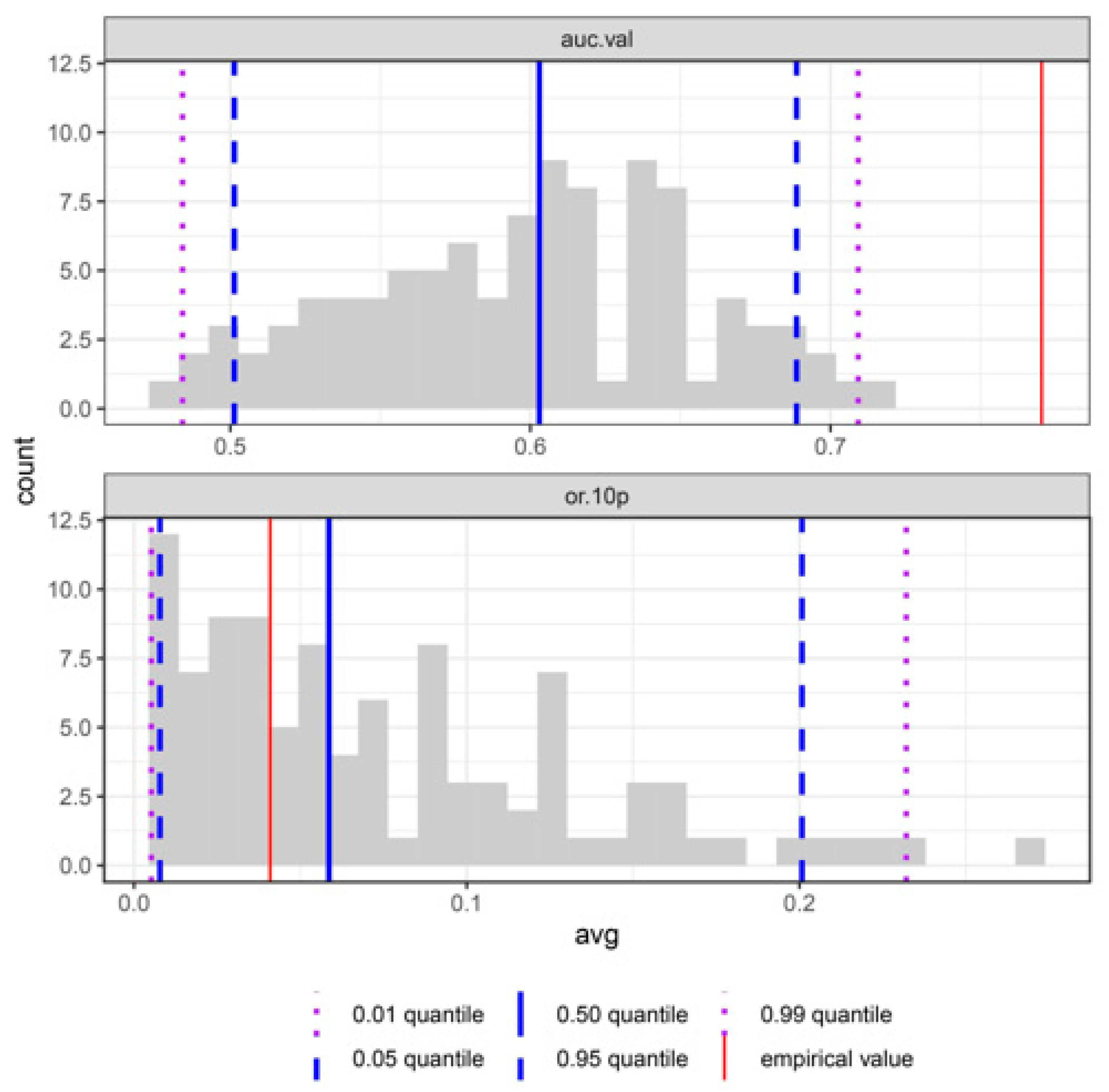
Based on the AIC information criterion (Table 2), delta AICc = 0, the feature combination FC = LQHPT, and the regulation multiplier RM = 1.5 constituted the optimal parameter combination in the simulation in this study. Under this parameter configuration, both the average difference in AUC (the disparity between training and test AUC values) and the average test omission rate at 10% training presence (avg.test.or10pct) were lower compared to the model employing default parameters, suggesting enhanced model performance. This conclusion was further substantiated through a comparative analysis between the species model and the null model (Figure 2): the species model exhibited a significantly higher AUC on the validation dataset (AUC.val) and a notably lower 10% training omission rate (OR.10p) relative to the null model. Collectively, these findings demonstrate that the developed species model outperforms the null model and is suitable for predictive analyses of the distribution of H. rhamnoides.

3.2. Potentially Hazardous Area During the Current Period

The D value of the niche overlap index between H. rhamnoides and the two pests ranged from 0.49 to 0.50, and the I value ranged from 0.62 to 0.63, indicating a significant degree of overlap between the two pests (Table 3). Moreover, the rank values were both greater than 0.40, indicating that H. rhamnoides was related to these two pests.
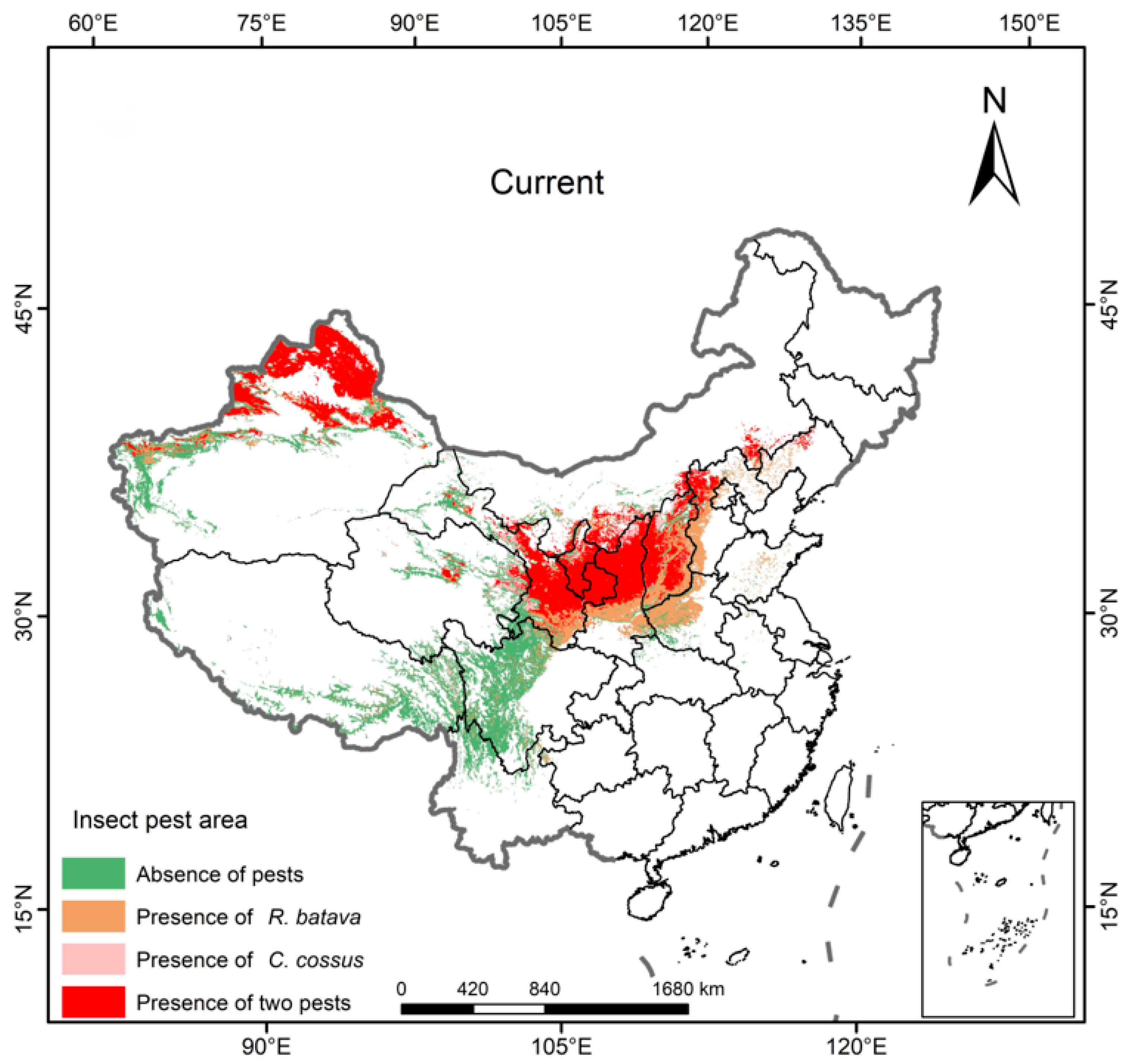
Our simulations for the current period identified a total area of 176.64 × 10⁴ km2 as suitable for H. rhamnoides (Figure 3). Within this area, a substantial portion (109.42 × 10⁴ km2, equivalent to 61.95%) was found to be susceptible to infestation by at least one of the two pests. The area that was not infested by pests was 67.22 × 10⁴ km2 and was mainly distributed in western and central Xinjiang, northern Gansu, western Sichuan, eastern Tibet, and northern Yunnan. The area that was likely to suffer severe pest infestation was 66.74 × 10⁴ km2 and was concentrated in northern Xinjiang, central and southern Gansu, Ningxia, northern Shaanxi, and western Shanxi. The area that was affected by only one type of pest was 42.69 × 10⁴ km2 and was located mainly in southern Gansu, Ningxia, southern Shaanxi, eastern Shanxi on the Loess Plateau, and western Hebei.

3.3. Changes in the Potential Geographic Distribution Pattern of H. rhamnoides Under Future Climate Change Scenarios

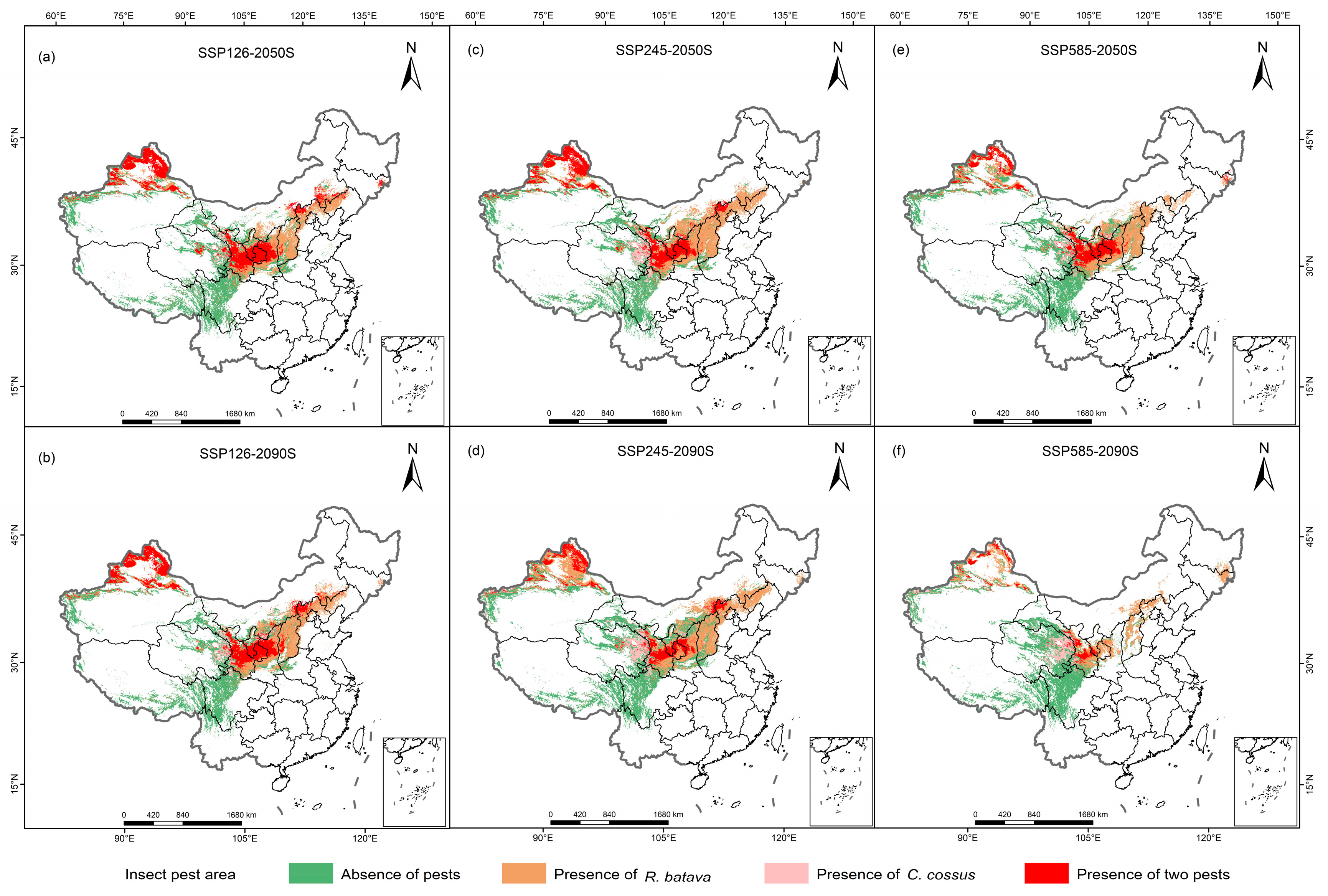
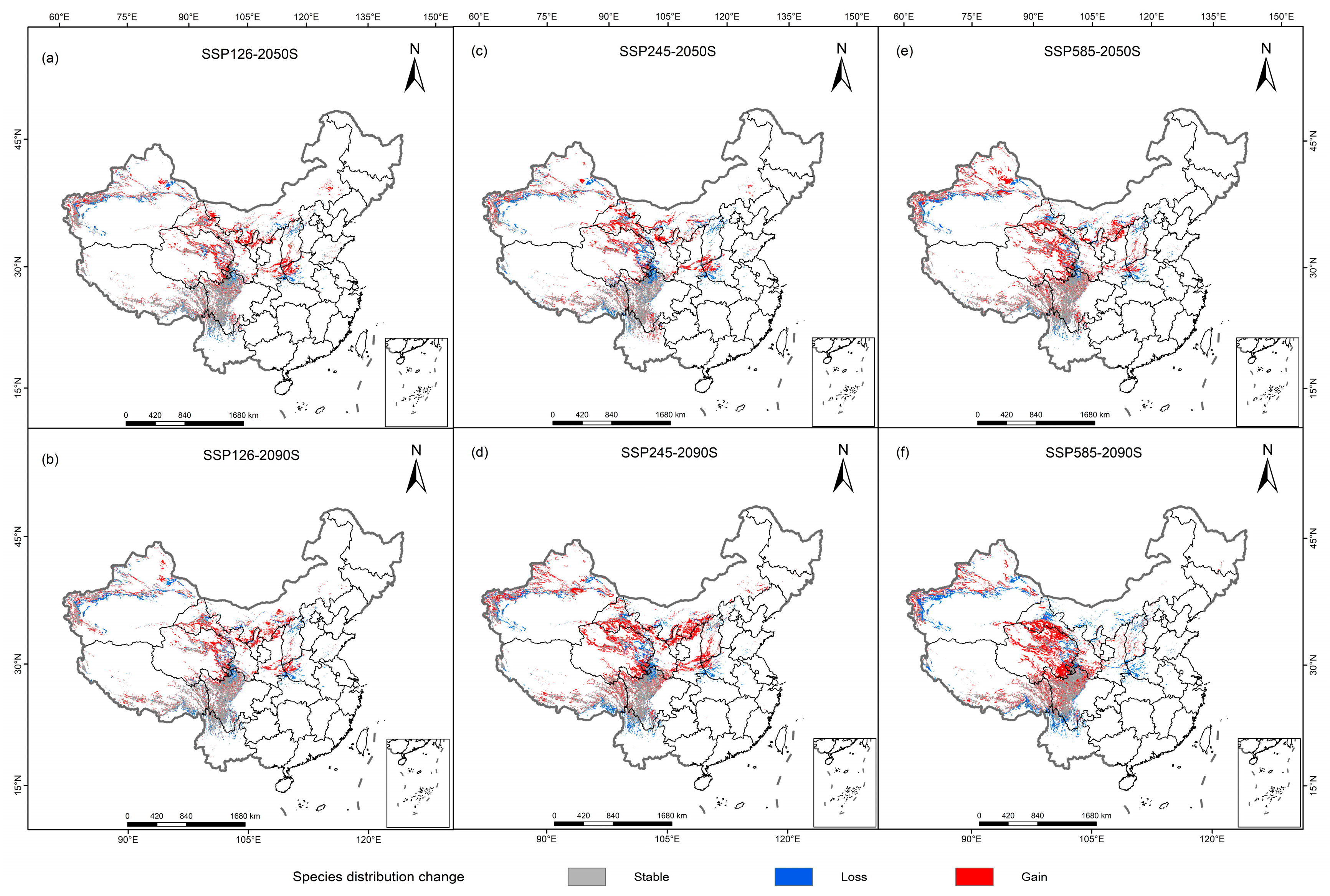
The results in Figure 4 show that, compared with the current period, the total suitable area of H. rhamnoides shows an increasing trend under all the climate scenarios, except the SSP585 climate scenario, which presents a decreasing trend in the 2090s. Specifically, under the SSP126 climate scenario, the total suitable area of H. rhamnoides increases slightly in the 2150s, reaching 197.24 × 10⁴ km2; and by the 2090s, the total suitable area decreases by 4.98 × 10⁴ km2 compared with that in the 2050s. Under the SSP245 climate scenario, the total suitable area in the 2050s and 2090s shows significant increasing trends, with increases of 28.6 × 10⁴ km2 and 42.79 × 10⁴ km2, respectively. Under the SSP585 climate scenario, the total suitable area of H. rhamnoides in the 2050s is 189.47 × 10⁴ km2, whereas the total suitable area in the 2090s is the smallest, at 151.43 × 10⁴ km2 (Table 4).
The analysis of the potential geographic distribution patterns of H. rhamnoides distribution areas under different climate change scenarios reveals a gradual increasing trend in areas unaffected by pests over time. Among them, under the SSP2-4.5 medium-concentration emission scenario in the 2090s, the expansion trend of the distribution area unaffected by insects is more significant than that under the other scenarios. Under each climate scenario, with increasing greenhouse gas emission concentration, the distribution area of the H. rhamnoides population that is unaffected by pests shows an expanding trend, with the newly added areas being mainly concentrated in central and western Xinjiang, Qinghai, Gansu, northern Shaanxi, Inner Mongolia, and Shanxi. However, in northern Yunnan, the low-latitude regions of Xinjiang, and the junction of Sichuan, Qinghai and Shaanxi, the distribution area unaffected by the two pests shrinks. In terms of the rate of increase, the rate of increase in areas unaffected by the two pests is the highest under the SSP2-4.5–2090s scenario, accounting for 76.31%, and the increased area is 51.29 × 10⁴ km2, whereas the rate of increase under the SSP1-2.6–2090s scenario is the lowest, at 46.36%, and the newly increased area is 31.16 × 10⁴ km2 (Table 5). The newly added areas are mainly concentrated in mid-latitude regions, such as Gansu, Shaanxi, and Inner Mongolia (Figure 5). In terms of the retained area, under the SSP1-2.6–2050s scenario, the retention rate of H. rhamnoides in the area unaffected by pests is the highest at 78.47%, and the reserved area is 52.75 × 10⁴ km2; the retention rate is the lowest under the SSP5-8.5–2090s scenario, at 9.59%. with a reserved area of 43.54 × 10⁴ km2. The reserved areas are distributed mainly in western and central Xinjiang, western Sichuan, northern Yunnan and eastern Tibet.
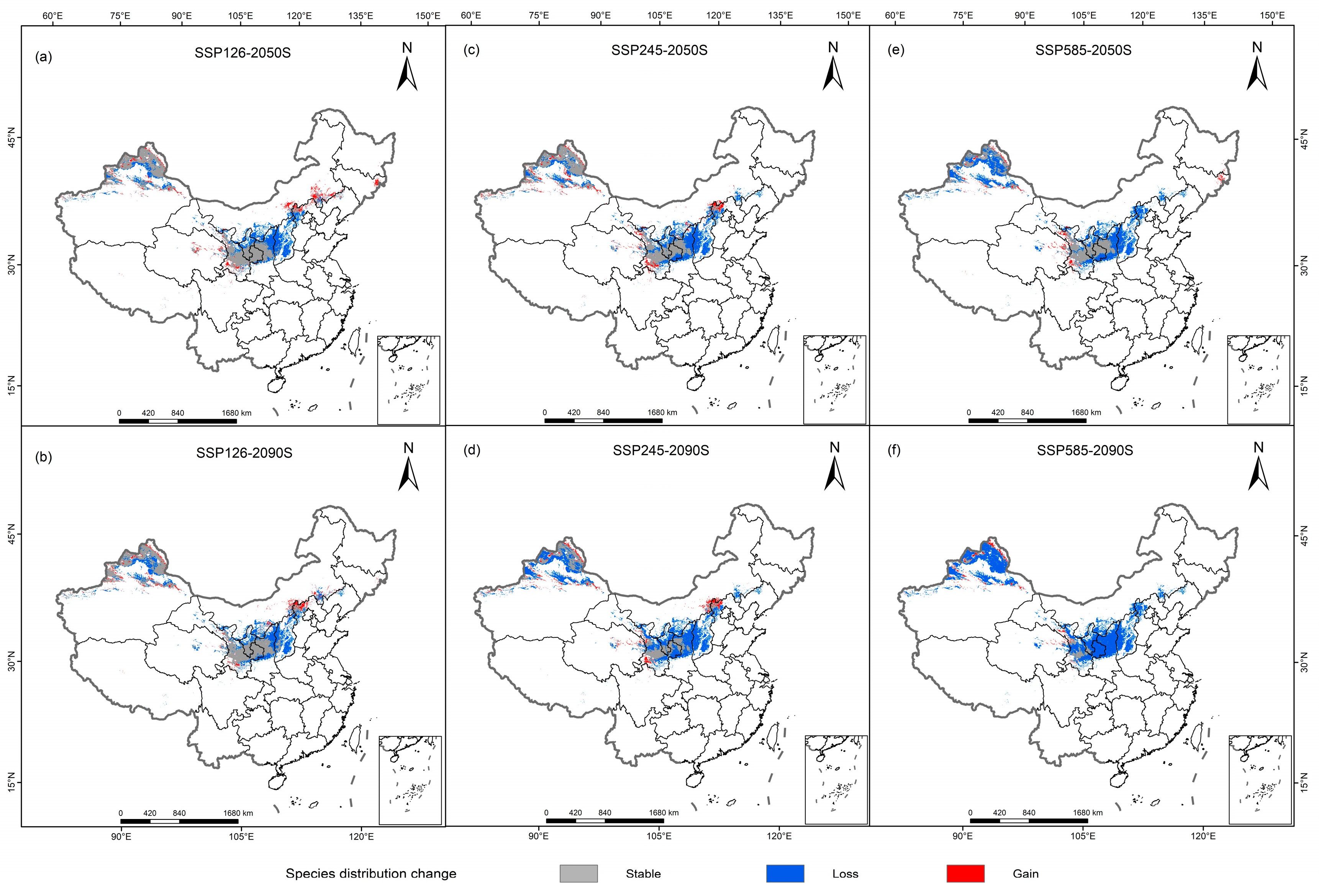
Based on the analysis of the potential geographic distribution patterns of H. rhamnoides with consideration of severe pest infestations under different future climate change scenarios, the area of severely infested H. rhamnoides gradually decreases over time. The decreasing trend in the distribution area of severe insect infestations is more significant under the high-concentration SSP5-8.5 emission scenario in the 2090s than under the other scenarios. Notably, in each climate scenario, with the increase in the concentration of greenhouse gas emissions, the loss area of the distribution area of H. rhamnoides suffering severe pest infestation expands, and the area is mainly concentrated on the Loess Plateau in southern Gansu, northern Shaanxi, Inner Mongolia, and southern Shanxi (Figure 6).
The retention rate of areas with severe pest infestations was highest under the SSP1-2.6-2050s scenario (60.89%), and the retention area is 40.636 × 10⁴ km2, whereas the retention rate under the SSP5-8.5–2090s scenario is the lowest at 9.59%. The reserved area is 6.402 × 10⁴ km2. The reserved areas are distributed mainly in northern Xinjiang and the central areas of Gansu, Shaanxi and Ningxia (Table 6).

3.4. Multivariate Similarity Surface and Least Similar Variable Analysis

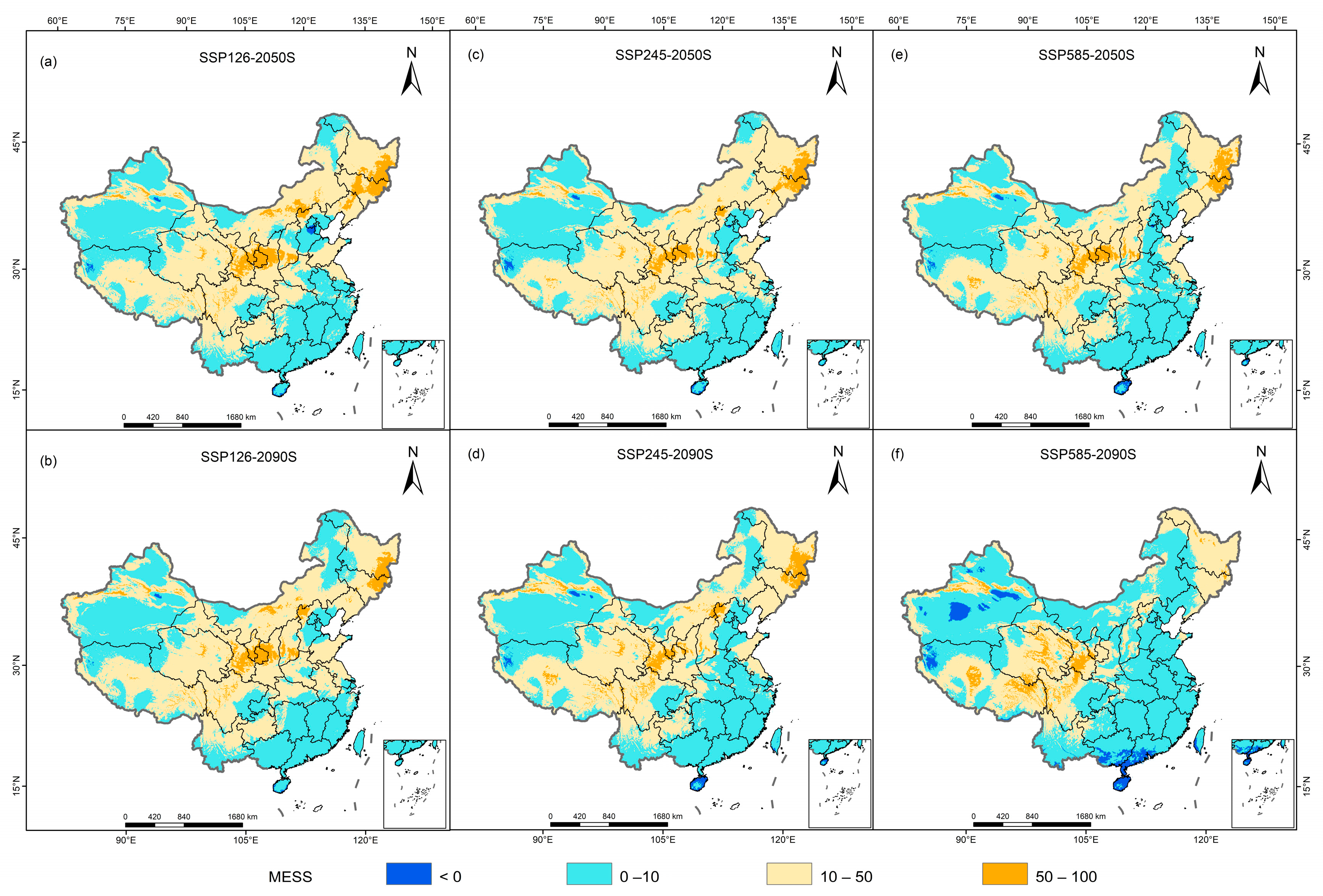
Based on the multivariate similarity surface analysis under different climate change scenarios in the future (Figure 7), within the suitable areas for H. rhamnoides, the areas with a high degree of climatic anomalies are mainly concentrated in northern Xinjiang and the North China Plain, and the multivariate similarity value is between 0 and 10; the multivariate similarity value of the parasitic area at the junction of southern Beijing and Hebei is <0, indicating that it is the area with the highest degree of climate anomalies. The areas with a low degree of climatic anomalies are distributed mainly in the western and central regions of Xinjiang and the Loess Plateau, with multivariate similarity values > 50; the remaining suitable areas are distributed in a fragmented manner, with multivariate similarity values between 10 and 50, with a low degree of climate anomalies.
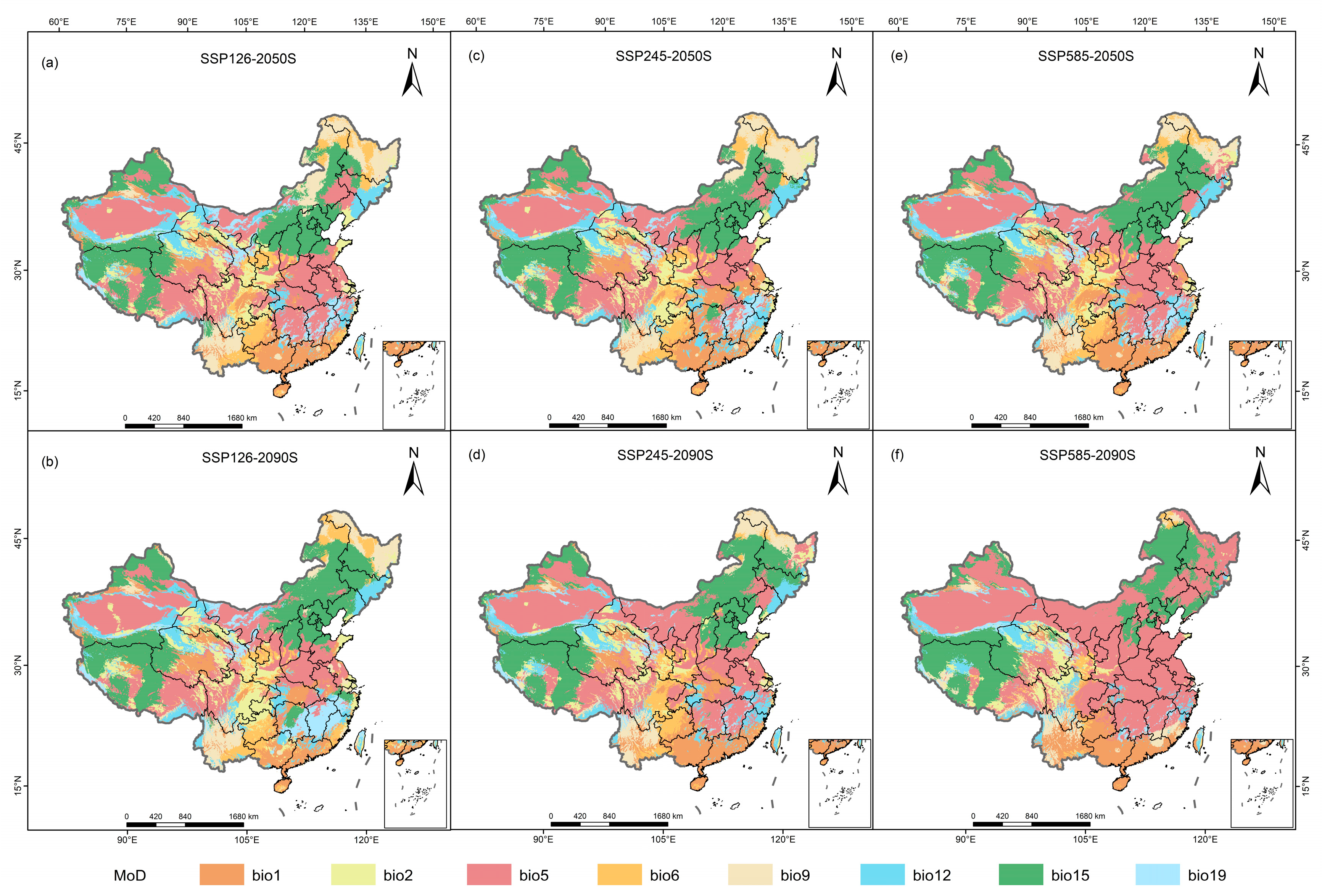
The results of the least similar variable analysis on the multivariate similarity surface (Figure 8) reveal that bio5, bio6, bio12 and bio15 are the key variables causing the highest degree of climatic anomalies in the suitable areas for H. rhamnoides and the core factors affecting the geographic distribution of H. rhamnoides. Under different future climate change scenarios, among the most dissimilar variables of the parasitic zones in each period, temperature and precipitation factors dominate. These two factors present the highest degree of anomalies and the widest anomaly range in future climate change, and they jointly drive the H. rhamnoides geographic distribution.

4. Discussion

To address both climate change and frequent pests, this study constructed a multispecies niche model that integrated host plants and key pests and evaluated the suitable planting areas and pest risk spatial pattern of H. rhamnoides under various future climate scenarios. Through MaxEnt modeling and niche overlap analysis, the central part of Xinjiang, the northern part of Gansu and the northern margin of Shaanxi were effectively identified as the priority areas for sea buckthorn planting in the future; these areas have the advantages of strong ecological suitability and low pest pressure and are selected as the preferred areas for sea buckthorn cultivation in China. Forward-looking guidance regarding the future layout of the industry is provided.
The model results revealed that, under the current scenario, approximately 62% of the potentially suitable areas for sea buckthorn are affected by pests. This indicates that the traditional “ideal climate assumption” entails a significant risk deviation in planting regionalization. This highly overlapping distribution may originate from the similarity in the responses of the three niche structures to similar temperature and precipitation variables, especially Bio5 (highest temperature in the warmest month), Bio12 (annual precipitation) and Bio15 (seasonality of precipitation). Their variable contribution rates were all among the highest, significantly affecting their distribution range. This phenomenon supports the role of the “environmental filtering” mechanism in niche overlap theory, indicating that symbiont species have a distribution and co-occurrence trend along similar ecological gradients [33].
However, the simulation results also revealed an important trend of ecological niche dislocation: as climate warming gradually increases (e.g., SSP585–2090s), the distribution area of pests decreases faster than the area of the host plants, and the area with severe damage decreases by more than 85%. The suitable area for sea buckthorn only slightly decreases. This “asymmetric host–pest response” indicates that future climate change may provide a short ecological buffer window for the expansion of sea buckthorn [34]. This ‘asymmetric host-pest response’ to climate change aligns with observations in other agricultural systems. For instance, experimental warming on the tomato-Helicoverpa zea system revealed that the insect’s growth rate increased with temperature, whereas the host plant’s growth and stress tolerance were compromised at higher temperatures, and the efficacy of the herbivore’s salivary defense elicitor was also temperature-dependent [35]. Similarly, research on spider mites indicates that elevated temperatures can exacerbate pest damage by simultaneously increasing herbivore growth rate and reducing the plant’s ability to establish defenses [36]. These findings, along with our result that extreme minimum temperature (Bio6) is a more critical limiting factor for the pests, suggest a generalizable vulnerability of pest populations to extreme climatic events.
Previous modeling efforts have effectively mapped the climatic suitability of sea buckthorn [17,18]. However, our study advances the field by integrating the distributional constraints imposed by its major pests. This ‘host-pest’ dual-constraint framework offers a more realistic assessment of planting suitability, supporting the spatial alignment of habitat suitability with production risk mitigation [37]. In addition, the modeling parameters strictly followed the ENMeval evaluation. We systematically compared 48 sets of parameter combinations and finally identified the optimal model with a CBI of 0.996, which is significantly better than the value of the traditional default model and effectively prevents the overfitting problem that is common in the small-sample MaxEnt model [38]. Compared with the strategy of using integrated modeling to predict the climatic suitability of sea buckthorn [19], the method adopted in this study provides more practical information regarding “climate–biological dual constraints” and offers greater decision weight to support actual planting.
In addition, the analysis of the MESS and the least similar variables revealed that the leading variables of the climate anomaly in the future suitable areas are still extreme temperature (Bio5) and precipitation variability (Bio15), which are highly consistent with the current dominating factors, suggesting that the climate driving mechanism is stable in the temporal dimension [39]. This result is highly consistent with the theory of Guisan et al. [40], according to which “climate gradient controls the stability of species distribution”, and indicates that the current modeling logic has good potential for time extrapolation. At the theoretical level, this study deepens the application of the niche coupling modeling framework and expands the joint modeling of crop suitability and pest risk from “potential distribution” to “risk-adaptive suitability evaluation”. This approach establishes a paradigmatic reference for dual-biome-driven ecosystem modeling [41]. This method is also applicable to other important commercial crops that are facing the threat of pests, such as wolfberry, grape and citrus fruit trees, and is highly expandable.
In terms of practical application, we clearly identified key layout areas of “low pests and high suitability for growth” for sea buckthorn planting, which provides a reference for the formulation of sea buckthorn planting and protection policies. On the other hand, the newly added areas for future planting and the areas lost by severe pest infestation showed a significant spatial shift, which also provides important support for the formation of an ecosystem-based and adaptation-based smart sea buckthorn industrial chain [19]. In addition, this method can be combined with the suitability data of germplasm resources to form a three-dimensional adaptation map of “variety-plot-pest”, which can help promote the long-term development of the berry industry [42].
Although this study is highly rigorous in terms of model structure and parameter optimization, the following limitations still exist. First, the collection of pest distribution data depends mainly on domestic reports and field surveys, which may affect the model fitting accuracy [24]. Second, the current model is a static spatial prediction and fails to reflect the dynamic processes of multigenerational pest reproduction, biotic interaction or human intervention. This model can be expanded by integrating the insect pest life cycle model and vegetation succession simulation [43]. Future research can (1) introduce multisource remote sensing data to improve the quality of distribution points and real-time update ability; (2) capture the eco-climate-biotic interaction mechanism in combination with ecological process modeling (e.g., the DLEM model); and (3) explore multispecies ecological network coupling modeling with the incorporation of natural enemy populations into the risk prediction framework [44]. Moreover, the “model–field–policy” triangle linkage mechanism should be strengthened to achieve rapid transformation and practical ecological modeling results [45].
This study developed a dual-constraint model that integrates climate suitability and pest risk to identify optimal planting areas for H. rhamnoides. Our findings reveal that over 60% of the current climatically suitable areas are threatened by pests, a risk largely overlooked in previous studies. More importantly, we project a significant spatial decoupling of host suitability and pest risk under future climate change, particularly under high-emission scenarios, which opens up new opportunities for climate-adaptive cultivation planning. The methodology presented here can be extended to other cash crops facing similar biotic threats. Future research should focus on incorporating dynamic population models of pests and their natural enemies to enhance the temporal accuracy of risk predictions and on validating these projections through field trials.

Supplementary Materials

The following supporting information can be downloaded at: https://www.mdpi.com/article/10.3390/agronomy15122777/s1. The distribution data of Hippophae rhamnoides were obtained from the Global Biodiversity Information Facility (GBIF; https://www.gbif.org/, accessed on 2 July 2025), retrieved in CSV format on 2 July 2025. In Supplementary Material S1, Figure S1: Jackknife test of environmental variables for Rhagoletis batava; Figure S2: Jackknife test of environmental variables for Cossus cossus; Table S1: Geographic location details of Rhagoletis batava collected from sites in China; Table S2: Geographic location details of Cossus cossus collected from sites in China.

Author Contributions

Conceptualization, Y.N. and H.H.; methodology, Y.N.; software, Y.N.; validation, Y.N., G.Y. and H.H.; formal analysis, Y.N.; investigation, G.Y.; resources, H.H.; data curation, Y.N.; writing—original draft preparation, Y.N.; writing—review and editing, H.H.; visualization, G.Y.; supervision, H.H.; project administration, H.H.; funding acquisition, H.H. All authors have read and agreed to the published version of the manuscript.

Funding

Xinjiang Uygur Autonomous Region Major Science and Technology Special Project (2023A02006).

Data Availability Statement

The data will be made available upon request.

Conflicts of Interest

The authors declare no conflicts of interest.

Correction Statement

This article has been republished with a minor correction to the Funding statement. This change does not affect the scientific content of the article.

References

  1. Wang, Z.; Zhao, F.; Wei, P.; Chai, X.; Hou, G.; Meng, Q. Phytochemistry, health benefits, and food applications of sea buckthorn (Hippophae rhamnoides L.): A comprehensive review. Front. Nutr. 2022, 9, 1036295. [Google Scholar] [CrossRef]
  2. He, N.; Wang, Q.; Huang, H.; Chen, J.; Wu, G.; Zhu, M.; Shao, F.; Yan, Z.; Sang, Z.; Cao, L.; et al. A comprehensive review on extraction, structure, detection, bioactivity, and metabolism of flavonoids from sea buckthorn (Hippophae rhamnoides L.). J. Food Biochem. 2023, 2023, 4839124. [Google Scholar] [CrossRef]
  3. Dong, K.; Fernando, W.M.A.D.B.; Durham, R.; Stockmann, R.; Jayasena, V. Nutritional value, health-promoting benefits and food application of sea buckthorn. Food Rev. Int. 2023, 39, 2122–2137. [Google Scholar] [CrossRef]
  4. National Sea buckthorn Resources Background Survey Report. Available online: https://www.forestry.gov.cn/c/www/scyfz/92454.jhtml (accessed on 2 June 2025).
  5. He, M.; Ma, F.; Ding, J.; Niu, P.; Luo, C.; Wang, M.; Jiang, P. Analysis of spatial suitable habitats of four subspecies of Hippophae rhamnoides in China based on the MaxEnt model. Plants 2025, 14, 1682. [Google Scholar] [CrossRef]
  6. Mei, D.; Ma, X.; Fu, F.; Cao, F. Research status and development prospects of sea buckthorn (Hippophae rhamnoides L.) resources in China. Forests 2023, 14, 2461. [Google Scholar] [CrossRef]
  7. Nybom, H.; Ruan, C.; Rumpunen, K. The systematics, reproductive biology, biochemistry, and breeding of sea buckthorn—A review. Genes 2023, 14, 2120. [Google Scholar] [CrossRef] [PubMed]
  8. Mozūraitis, R.; Aleknavičius, D.; Vepštaitė-Monstavičė, I.; Stanevičienė, R.; Emami, S.N.; Apšegaitė, V.; Radžiutė, S.; Blažytė-Čereškienė, L.; Servienė, E.; Būda, V. Hippophae rhamnoides berry related Pichia kudriavzevii yeast volatiles modify behaviour of Rhagoletis batava flies. J. Adv. Res. 2020, 21, 71–77. [Google Scholar] [CrossRef] [PubMed]
  9. Yakovlev, R.V. Systematic review of Goat moth—Cossus cossus (Linnaeus, 1758) (Lepidoptera, Cossidae). Amurian Zool. J. 2009, 1, 58–71. [Google Scholar] [CrossRef]
  10. Rizvi, S.A.H.; George, J.; Reddy, G.V.P.; Zeng, X.; Guerrero, A. Latest developments in insect sex pheromone research and its application in agricultural pest management. Insects 2021, 12, 484. [Google Scholar] [CrossRef]
  11. Leonardi, M.; Boschin, F.; Boscato, P.; Manica, A. Following the niche: The differential impact of the last glacial maximum on four European ungulates. Commun. Biol. 2022, 5, 1038. [Google Scholar] [CrossRef]
  12. Wang, X.; Wang, X.; Li, Y.; Wu, C.; Zhao, B.; Peng, M.; Chen, W.; Wang, C. Response of Extremely Small Populations to Climate Change—A Case of Trachycarpus nanus in Yunnan, China. Biology 2024, 13, 240. [Google Scholar] [CrossRef] [PubMed]
  13. Zhao, G.; Cui, X.; Sun, J.; Li, T.; Wang, Q.; Ye, X.; Fan, B. Analysis of the Distribution Pattern of Chinese Ziziphus jujuba under Climate Change Based on Optimized Biomod2 and MaxEnt Models. Ecol. Indic. 2021, 132, 108256. [Google Scholar] [CrossRef]
  14. Aghasi, M.J.; Tarkesh, M.; Mousavi, S.A.; Koupaei, S.S. Resilience of cushion Astragalus to climate change in the Zagros biodiversity hotspot: A species distribution modeling approach. Theor. Appl. Climatol. 2024, 155, 9871–9884. [Google Scholar] [CrossRef]
  15. Gao, M.; Zhao, G.; Zhang, S.; Wang, Z.; Wen, X.; Liu, L.; Zhang, C.; Tie, N.; Sa, R. Priority conservation area of Larix gmelinii under climate change: Application of an ensemble modeling. Front. Plant Sci. 2023, 14, 1177307. [Google Scholar] [CrossRef] [PubMed]
  16. Rojas-Briceño, N.B.; García, L.; Cotrina-Sánchez, A.; Goñas, M.; Salas López, R.; Silva López, J.O.; Oliva-Cruz, M. Land suitability for cocoa cultivation in Peru: AHP and MaxEnt modeling in a GIS environment. Agronomy 2022, 12, 2930. [Google Scholar] [CrossRef]
  17. Li, G.; Du, S.; Guo, K. Evaluation of limiting climatic factors and simulation of a climatically suitable habitat for Chinese sea buckthorn. PLoS ONE 2015, 10, e0131659. [Google Scholar] [CrossRef]
  18. Huang, J.; Li, G.; Li, J.; Zhang, X.; Yan, M.; Du, S. Projecting the range shifts in climatically suitable habitat for Chinese sea buckthorn under climate change scenarios. Forests 2018, 9, 9. [Google Scholar] [CrossRef]
  19. Gan, T.; He, Z.; Xu, D.; Chen, J.; Zhang, H.; Wei, X.; Zhuo, Z. Modeling the potential distribution of Hippophae rhamnoides in China under current and future climate scenarios using the biomod2 model. Front. Plant Sci. 2025, 16, 1533251. [Google Scholar] [CrossRef]
  20. GBIF.org. GBIF Occurrence Download. Available online: https://doi.org/10.15468/dl.kzpaem (accessed on 2 July 2025).
  21. Wen, X.; Yang, D.; You, F.; Li, X.; Tang, B.; He, C.; Wang, R.; Wang, B.; Li, T.; Chai, S. Risk zoning of Gynaephora alpherakii (Lepidoptera: Lymantriidae) on the Qinghai–Tibetan Plateau. J. Econ. Entomol. 2024, 117, 2433–2439. [Google Scholar] [CrossRef]
  22. Cheng, X.; Han, Y.; Lin, J.; Jiang, F.; Cai, Q.; Shi, Y.; Cui, D.; Wen, X. Time to step up conservation: Climate change will further reduce the suitable habitats for the vulnerable species marbled polecat (Vormela peregusna). Animals 2023, 13, 2341. [Google Scholar] [CrossRef]
  23. Mu, T.; He, D.; Zhu, R.; Sui, X.; Chen, Y. Changes in the Suitable Habitats of Three Endemic Fishes to Climate Change in Tibet. Biology 2022, 11, 1808. [Google Scholar] [CrossRef]
  24. Phillips, S.J.; Dudík, M.; Elith, J.; Graham, C.H.; Lehmann, A.; Leathwick, J.; Ferrier, S. Sample selection bias and presence-only distribution models: Implications for background and pseudo-absence data. Ecol. Appl. 2009, 19, 181–197. [Google Scholar] [CrossRef] [PubMed]
  25. van Beest, F.M.; Dietz, R.; Galatius, A.; Kyhn, L.A.; Sveegaard, S.; Teilmann, J. Forecasting shifts in habitat suitability of three marine predators suggests a rapid decline in inter-specific overlap under future climate change. Ecol. Evol. 2022, 12, e9083. [Google Scholar] [CrossRef] [PubMed]
  26. Wen, X.; Zhao, G.; Cheng, X.; Chang, G.; Dong, X.; Lin, X. Prediction of the potential distribution pattern of the great gerbil (Rhombomys opimus) under climate change based on ensemble modelling. Pest Manag. Sci. 2022, 78, 3128–3134. [Google Scholar] [CrossRef] [PubMed]
  27. Boussouf, S.; Fernández, T.; Hart, A.B. Landslide susceptibility mapping using maximum entropy (MaxEnt) and geographically weighted logistic regression (GWLR) models in the Río Aguas catchment (Almería, SE Spain). Nat. Hazards 2023, 117, 207–235. [Google Scholar] [CrossRef]
  28. Fu, C.; Wen, X.; Shi, Z.; Rui, L.; Jiang, N.; Zhao, G.; Wang, R.; Zhao, J.; Yang, Y. Potential distribution prediction of Ceracris kiangsu Tsai in China. Sci. Rep. 2024, 14, 13375. [Google Scholar] [CrossRef]
  29. Julián-Caballero, C.C.; Martínez-Ramírez, E.; Gómez-Ugalde, R.M.; Cruz-Arenas, E. Trophic ecology and niche overlap of two sympatric species of Rhamdia (Siluriformes, Heptapteridae) from Northeast Oaxaca, Mexico. Neotrop. Biol. Conserv. 2024, 19, 117–136. [Google Scholar] [CrossRef]
  30. Wen, X.; Fang, G.; Chai, S.; He, C.; Sun, S.; Zhao, G.; Lin, X. Can ecological niche models be used to accurately predict the distribution of invasive insects? A case study of Hyphantria cunea in China. Ecol. Evol. 2024, 14, e11159. [Google Scholar] [CrossRef]
  31. Elith, J.; Kearney, M.; Phillips, S. The art of modelling range-shifting species. Methods Ecol. Evol. 2010, 1, 330–342. [Google Scholar] [CrossRef]
  32. Penk, M.; Donohue, I.; Récoules, V.; Irvine, K. Elevated temperatures interact with habitat quality to undermine survival of ectotherms in climatic refugia. Divers. Distrib. 2015, 21, 200–210. [Google Scholar] [CrossRef]
  33. Zurell, D.; Franklin, J.; König, C.; Bouchet, P.J.; Dormann, C.F.; Elith, J.; Fandos, G.; Feng, X.; Guillera-Arroita, G.; Guisan, A.; et al. A standard protocol for reporting species distribution models. Ecography 2020, 43, 1261–1277. [Google Scholar] [CrossRef]
  34. Launay, M.; Caubel, J.; Bourgeois, G.; Huard, F.; Cortazar-Atauri, I.; Bancal, M.; Brisson, N. Climatic indicators for crop infection risk: Application to climate change impacts on five major foliar fungal diseases in Northern France. Agric. Ecosyst. Environ. 2014, 197, 147–158. [Google Scholar] [CrossRef]
  35. Paudel, S.; Lin, P.; Hoover, K.; Felton, G.; Rajotte, E. Asymmetric Responses to Climate Change: Temperature Differentially Alters Herbivore Salivary Elicitor and Host Plant Responses to Herbivory. J. Chem. Ecol. 2014, 46, 891–905. [Google Scholar] [CrossRef]
  36. Teodoro-Paulo, J.; Deere, J.A.; Valeriano-Santos, J.; Charlesworth, S.; Duncan, A.B.; Kant, M.R.; Alba, J.M. Rising temperatures favour defence-suppressing herbivores. J. Pest Sci. 2025, 98, 535–548. [Google Scholar] [CrossRef]
  37. El-Gabbas, A.; Dormann, C.F. Wrong, but useful: Regional species distribution models may not be improved by range-wide data under biased sampling. Ecol. Evol. 2018, 8, 2196–2206. [Google Scholar] [CrossRef]
  38. Sillero, N.; Barbosa, A.M. Common mistakes in ecological niche models. Int. J. Geogr. Inf. Sci. 2021, 35, 213–226. [Google Scholar] [CrossRef]
  39. Marín, V.H.; Rodríguez, L.C.; Niemeyer, H.M. A socio-ecological model of the Opuntia scrublands in the Peruvian Andes. Ecol. Model. 2012, 227, 136–146. [Google Scholar] [CrossRef]
  40. Guisan, A.; Thuiller, W.; Zimmermann, N.E. Habitat Suitability and Distribution Models: With Applications in R; Cambridge University Press: Cambridge, UK, 2017. [Google Scholar]
  41. Xiao, K.; Ling, L.; Deng, R.; Huang, B.; Cao, Y.; Wu, Q.; Ning, H.; Chen, H. Projecting the Potential Global Distribution of Sweetgum Inscriber, Acanthotomicus suncei (Coleoptera: Curculionidae: Scolytinae) Concerning the Host Liquidambar styraciflua Under Climate Change Scenarios. Insects 2024, 15, 897. [Google Scholar] [CrossRef]
  42. Li, X.; Ge, X.; Chen, L.; Zhang, L.; Wang, T.; Zong, S. Climate change impacts on the potential distribution of Eogystia hippophaecolus in China. Pest Manag. Sci. 2019, 75, 215–223. [Google Scholar] [CrossRef] [PubMed]
  43. Whish, J.P.M.; Herrmann, N.I.; White, N.A.; Moore, A.D.; Kriticos, D.J. Integrating pest population models with biophysical crop models to better represent the farming system. Environ. Model. Softw. 2015, 72, 418–425. [Google Scholar] [CrossRef]
  44. Zheng, Q.; Huang, W.; Xia, Q.; Dong, Y.; Ye, H.; Jiang, H.; Chen, S.; Huang, S. Remote sensing monitoring of rice diseases and pests from different data sources: A review. Agronomy 2023, 13, 1851. [Google Scholar] [CrossRef]
  45. Enquist, C.A.F.; Jackson, S.T.; Garfin, G.M.; Davis, F.W.; Gerber, L.R.; Littell, J.A.; Tank, J.L.; Terando, A.J.; Wall, T.U.; Halpern, B.; et al. Foundations of translational ecology. Front. Ecol. Environ. 2017, 15, 541–550. [Google Scholar] [CrossRef]
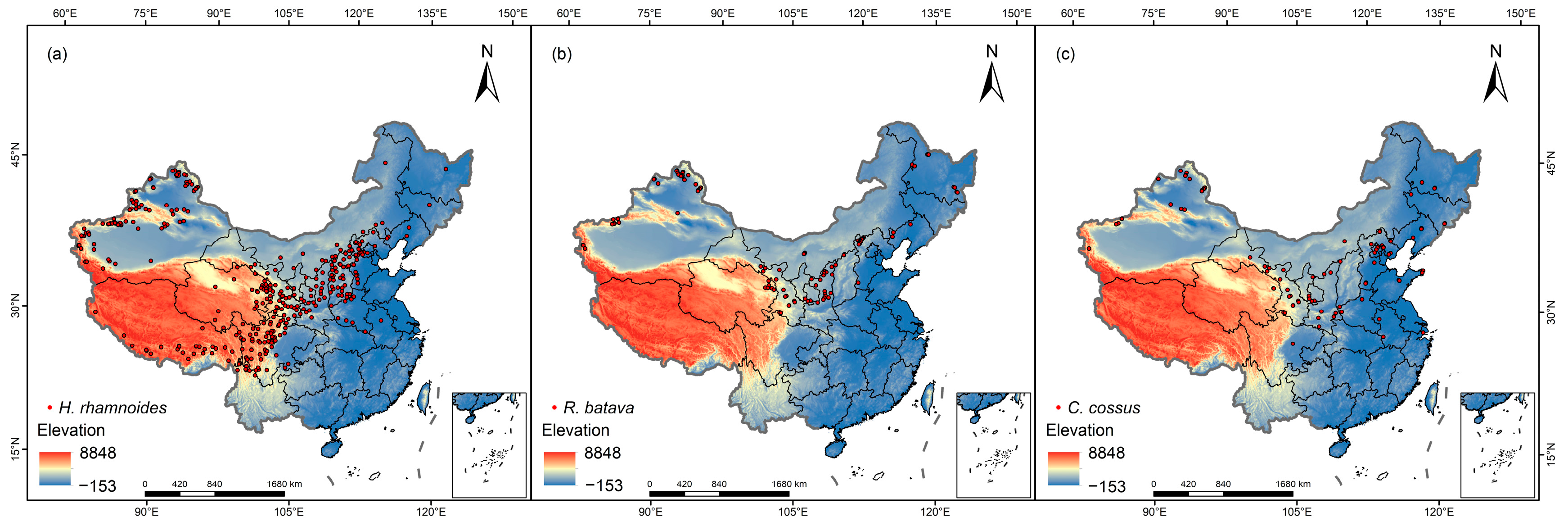
Figure 1. Species distribution points. (a) Hippophae rhamnoides L.; (b) Rhagoletis batava; and (c) Cossus cossus.
Agronomy 15 02777 g001
Figure 2. The comparative performance outcomes of the species model and the null model are presented, with metrics including the area under the curve for validation occurrences (AUC.val) and the 10% training omission rate (OR.10p).
Agronomy 15 02777 g002
Figure 3. Potential geographic distribution of H. rhamnoides in the current period. The green color on the map indicates where the potential distribution of H. rhamnoides does not overlap with the pest distribution. Yellow indicates overlap with R. batava; pink indicates overlap with C. cossus. Red indicates overlap with both R. batava and C. cossus. The cutoff value for H. rhamnoides was 0.350, for R. batava it was 0.318, and for C. cossus it was 0.349.
Agronomy 15 02777 g003
Figure 4. Potential future geographic distribution of H. rhamnoides. (a,c,e) depict the potential distribution of H. rhamnoides under low, medium, and high carbon emission intensity scenarios for the 2050s, respectively; (b,d,f) illustrate the potential distribution of H. rhamnoides under the same scenarios for the 2090s, respectively.
Agronomy 15 02777 g004
Figure 5. Future changes in the spatial pattern of H. rhamnoides in areas unaffected by pests. (a,c,e) represent the low, medium, and high carbon emission scenarios for the 2050s, respectively; (b,d,f) represent the low, medium, and high carbon emission scenarios for the 2090s, respectively.
Agronomy 15 02777 g005
Figure 6. Future changes in the regional spatial patterns of H. rhamnoides affected by the two pests. (a,c,e) represent the low, medium, and high carbon emission scenarios for the 2050s, respectively; (b,d,f) represent the low, medium, and high carbon emission scenarios for the 2090s, respectively.
Agronomy 15 02777 g006
Figure 7. Multivariate similarity surface (MESS) of suitable H. rhamnoides areas. (a,c,e) represent the low, medium, and high carbon emission scenarios for the 2050s, respectively; (b,d,f) represent the low, medium, and high carbon emission scenarios for the 2090s, respectively.
Agronomy 15 02777 g007
Figure 8. Most dissimilar variable (MoD) of the suitable areas for H. rhamnoides. (a,c,e) represent the low, medium, and high carbon emission scenarios for the 2050s, respectively; (b,d,f) represent the low, medium, and high carbon emission scenarios for the 2090s, respectively.
Agronomy 15 02777 g008
Table 1. Environmental variables, their respective contributions, and appropriate value ranges.
CodeEnvironmental VariableContribution (%)
H. rhamnoidesR. batavaC. cossus
Bio1Annual Mean Temperature4.715.810.4
Bio2Mean Diurnal Range7.50.77.1
Bio5Max Temperature of Warmest Month4.77.74.4
Bio6Min Temperature of Coldest Month17.88.67.1
Bio9Mean Temperature of Driest Quarter7.217.013
Bio12Annual Precipitation8.213.08.5
Bio15Precipitation Seasonality8.115.26.9
Bio19Precipitation of Coldest Quarter4.20.66.5
t_bsTopsoil Base Saturation1.30.52.1
t_ph_h2oPH Topsoil pH (H2O)9.45.311
t_cec_clayTopsoil CEC (clay)3.02.65.8
t_cec_soilTopsoil CEC (soil)3.80.61.7
t_caco3Topsoil Caco32.02.30.9
slopeSlope6.54.16.6
elevElevation11.86.07.9
Table 2. Evaluation metrics of the MaxEnt model generated by ENMeval.
TypeFCRMdelta. AICccbi.trainavg.diff.AUCavg.test.or10pct
defaultQHPT15.2870.9950.0650.256
optimizedQHPT1.500.9960.0530.201
Table 3. Assessment of niche overlap between H. rhamnoides and two pests.
SpeciesDIRank.cor
R. batava0.49318640.62314820.4796587
C. cossus0.50655140.63443110.4529718
Table 4. Changes in the distribution area of H. rhamnoides in different periods under different scenarios.
PeriodClimate
Scenario
Absence of Pest
(×104 km2)
Presence of R. batava
(×104 km 2)
Presence of C. cossus
(×104 km2)
Presence of Both Pest
(×104 km 2)
Total
(×104 km2)
Current 67.2233.579.1266.74176.64
2041–2060SSP12688.5653.926.1448.61197.24
SSP24583.2568.1610.8342.99205.24
SSP58594.7956.847.0530.79189.47
2081–2100SSP12683.9153.309.3745.67192.26
SSP245101.2674.8013.7929.57219.43
SSP58588.2140.6512.839.74151.43
Table 5. Changes in the potential geographic distribution pattern of H. rhamnoides unaffected by pests under different future climate change scenarios.
PeriodClimate
Scenario
Habitat Area
(×104 km2)
Loss
(×104 km2)
Stable
(×104 km2)
Gain
(×104 km2)
Species Range
Change (%)
Percentage
Loss (%)
Percentage
Gain (%)
Current 67.22
2041–2060SSP12688.5611.5355.6932.8831.7617.1548.91
SSP24583.2517.5149.7133.5523.8626.0549.91
SSP58594.7914.9152.3142.4841.0222.1863.20
2081–2100SSP12683.9114.4652.7531.1624.8421.5246.36
SSP245101.2617.2449.9751.2950.6625.6576.31
SSP58588.2123.6843.5444.6631.2335.2266.45
Table 6. Changes in the potential geographic distribution patterns of H. rhamnoides suffering severe pest infestation under different future climate change scenarios.
PeriodClimate
Scenario
Habitat Area
(×104 km2)
Loss
(×104 km2)
Stable
(×104 km2)
Gain
(×104 km2)
Species Range
Change (%)
Percentage
Loss (%)
Percentage
Gain (%)
Current 66.74
2041–2060SSP12648.6126.10040.6367.974−27.1639.1111.95
SSP24542.9930.86435.8727.122−35.5846.2510.67
SSP58530.7939.90526.8313.957−53.8759.805.93
2081–2100SSP12645.6727.26839.4686.206−31.5640.869.30
SSP24529.5743.44323.2936.280−55.6965.109.41
SSP5859.7460.3346.4023.343−85.4090.415.01
Disclaimer/Publisher’s Note: The statements, opinions and data contained in all publications are solely those of the individual author(s) and contributor(s) and not of MDPI and/or the editor(s). MDPI and/or the editor(s) disclaim responsibility for any injury to people or property resulting from any ideas, methods, instructions or products referred to in the content.