


Abstract
This study addresses the uncertainty regarding the potential of a one-time basal application of mixed nitrogen (N) fertilizer to optimize both yield and eating quality of late-maturing medium japonica rice Nangeng 9108 and Fenggeng 1606 in the Yangtze River Delta. Six distinct combinations of blended N fertilizers were evaluated, with conventional split fertilization serving as the control. The blended formulations combined controlled-release N fertilizer (CRNF) and quick-acting N fertilizer (CNF) at a 1:1 ratio. Furthermore, the CRNF component was a combination of two CRNF types with varied N-release durations at a 4:1 ratio, leading to treatments labeled A1, A2, B1, B2, C1, and C2. Over a 2-year study, treatments B1, B2, C1, and C2 matched or surpassed the control in grain yield, with C1 and C2 yielding 2.83–4.85% more. Among the above high-yield treatments, C1 showcased the best rice eating quality, which exhibited increased peak viscosity, hot viscosity, cool viscosity, breakdown, and taste value of milled rice, and a decrease in rice protein content (PC). This enhancement in quality correlated with N accumulation patterns and their interplay with sink capacity. Specifically, a higher N accumulation resulted in a robust sink capacity under the C1 treatment, thus reducing N availability per unit sink capacity (NAV) and rice PC, ultimately enhancing the overall palatability of milled rice. Conclusively, the C1 fertilizer blend demonstrates potential in concurrently boosting yield and eating quality of late-maturing medium japonica rice in the region.
1. Introduction
Effective nitrogen (N) fertilizer management is pivotal for optimal rice production. Traditional split application methods, including basal, tillering, flower-promoting, and flower-preserving fertilization, have been advocated for superior grain yield and rice quality in China [1]. However, economic growth and urbanization have led to a decline in agricultural labor and a rise in labor costs [2]. This traditional approach, consequently, means increased labor and associated costs. Furthermore, challenges in determining accurate fertilization rates and timing often result in diminished N-use efficiency and potential yield deficits [3,4]. Given these concerns, researchers have introduced the one-time application method. This strategy involves a one-time simultaneous fertilizer application designed to satisfy rice’s N needs throughout its growth cycle [5].
Controlled-release N fertilizer (CRNF) serves as a critical tool for one-time-application fertilization in crops, notably rice, due to its sustained and consistent nutrient release [6,7]. The nutrient release duration of CRNF can range from 28 d to 200 d, contingent on the coating material and its thickness [8]. Typically, this release follows a J-type or S-type curve, characterized by a single N release peak in paddy fields. However, rice has a growth cycle of 90 d to 180 d and displays two main N uptake peaks: during the tillering and panicle differentiation stages [1,9]. Consequently, using a single CRNF in rice cultivation presents challenges. Past research indicates that many CRNFs may under-deliver nutrients in the tillering phase, impacting tiller occurrence and effective panicle count [10,11]. Furthermore, certain CRNFs might offer insufficient nutrients during spikelet differentiation, causing a drop in spikelet numbers [11]. Conversely, an overabundance of N around the heading phase can disrupt rice metabolism, leading to incomplete grain filling and a decrease in 1000-grain weight [12].
To optimize the synchronization between N supply from fertilizers and N uptake by rice, researchers [13,14,15] have integrated CRNF with quick-acting N fertilizer (CNF). Two primary fertilization strategies have emerged: 1. co-application of CRNF and CNF as basal fertilizers, and 2. using CRNF as basal fertilizer with CNF as top dressing, either at the tillering or panicle stage. Additionally, some efforts have been made to blend diverse CRNF types for a single basal application [1,16]. While these studies, spanning various rice ecosystems in China, multiple types of rice and diverse fertilization techniques, have shown potential in bolstering rice yield, there remains a knowledge gap regarding the one-time application of CRNF on late-maturing medium japonica rice with superior palatability, especially in the Yangtze River Delta. Moreover, the influence of CRNF on rice quality is underexplored. This region has a wide area of japonica rice planting with rich yield and good quality, which makes it one of the main areas of japonica rice production and consumption in China and even in the world. This region also has a strong preference for varieties combining high yield and excellent palatability [17], such as the predominant late-maturing medium japonica rice, Nangeng 9108 [18]. Despite economic advancements in the area, agricultural labor shortages persist. Consequently, there’s an urgent need for efficient one-time fertilization techniques in rice cultivation that can simultaneously enhance yield, ensure quality, and minimize labor demands.
Building on prior studies and current agricultural needs, this research crafted six N fertilizer blends for a one-time basal application, merging different CRNFs with CNFs. These combinations aim to establish multiple nutrient release peaks to aptly serve rice’s nutrient requirements. The study delves into how these N fertilizer combinations influence grain yield, N dynamics, and rice quality. The goal is to discern a formula enhancing both yield and palatability of the late-maturing medium japonica rice in the Yangtze River Delta, while shedding light on the underlying mechanisms that drive this dual benefit. The study’s findings may be used to guide the high-yield and good-quality production of japonica rice and promote sustainable development of rice production in the region.
2. Materials and Methods
2.1. Experimental Conditions and Materials
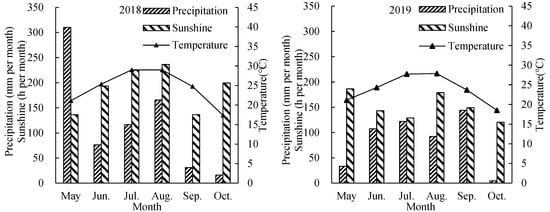
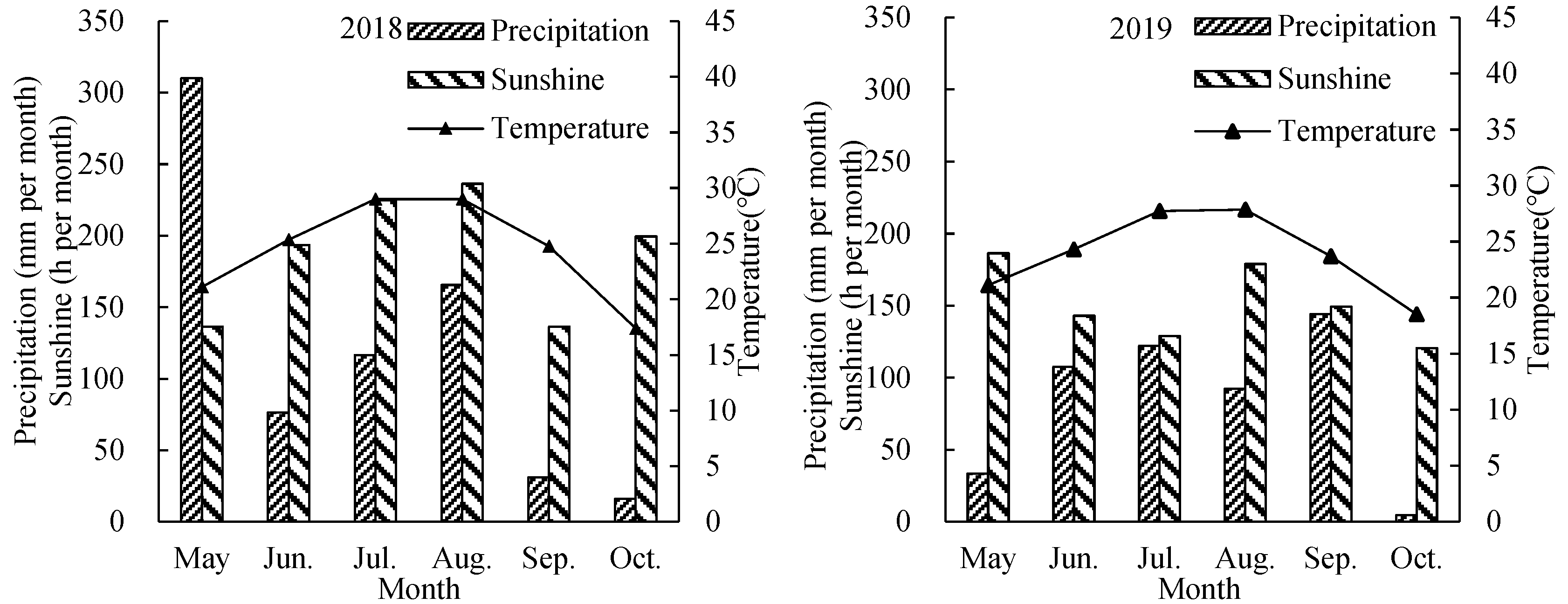
The study was conducted in Yazhou Town, Hai’an City, Jiangsu Province (32°43′ N, 120°32′ E, 5 m altitude) over the rice seasons of 2018 and 2019. The site featured sandy loam soil of medium fertility. Analysis of the top 0.20 m of soil revealed 28.2 g kg−1 organic matter, 1.63 g kg−1 total N, 33.9 mg kg−1 available phosphorus, and 84.7 mg kg−1 available potassium. The analyses were carried out according to the methodology of Zhao et al. [19]. Meteorological data for both years are detailed in Figure 1. There were more sunshine hours at the middle and late growth stages in 2018 than in 2019.
Figure 1.
Daily climate averages (temperature, sunshine duration, and precipitation) for rice growth seasons of 2018 and 2019 in Hai’an City, Jiangsu Province, China.
Rice cultivars Nangeng 9108 and Fenggeng 1606, both late-maturing medium japonica varieties with notable palatability, were selected for the study. Their complete growth cycle spanned 150–155 days, with an in-field duration of 122–127 days and approximately 70–75 days from transplanting to heading. The chosen CRNF was resin-coated urea (PCU, N43.5%), sourced from Shandong Maoshi Fertilizer Company. CRNF utilized exhibited five release durations: 40, 60, 80, 100, and 120 days.
2.2. Experimental Design and Treatments
Using a split-plot design, the main plots featured different rice cultivars while subplots varied in N fertilizer treatments. N fertilizers blended for this study were based on distinct nutrient release durations, with the mix incorporating CRNF and CNF at a 1:1 ratio. CRNF component was a 4:1 combination of two CRNF types with varying N-release durations. Treatments included: A1: 40% CRNF (60-d release) + 10% CRNF (40-d release) + 50% CNF; A2: 40% CRNF (60-d release) + 10% CRNF (80-d release) + 50% CNF; B1: 40% CRNF (80-d release) + 10% CRNF (60-d release) + 50% CNF; B2: 40% CRNF (80-d release) + 10% CRNF (100-d release) + 50% CNF; C1: 40% CRNF (100-d release) + 10% CRNF (80-d release) + 50% CNF; C2: 40% CRNF (100-d release) + 10% CRNF (120-d release) + 50% CNF. A conventional CNF split application (CK) served as a control: 35% basal (1 d pre-transplanting), 35% tiller (7 d post-transplanting), and 30% at panicle branch and spikelet differentiation stages. All treatments had an N rate of 270 kg ha−1, and all N fertilizers under CRNF treatments were applied a day before transplanting. Detailed N fertilizer specifications are in Table 1. P2O5 (as superphosphate) and K2O (as potassium chloride) were applied at 135 kg ha−1 and 216 kg ha−1, respectively. Each treatment was replicated thrice over 18 m2 plots (4 m × 4.5 m). There were three replicates for each treatment, making a total of 21 plots.
Table 1.
Nitrogen fertilizer types, pure N dosages, and application time of each treatment (kg ha−1).
In this study, a mechanized pot-seedling transplanting approach was utilized. Rice seeds were sown using an LSPE-40AM seeder (AMEC Corporation, Changzhou, Jiangsu, China) into D448P plastic nursery trays (448 holes), averaging 5–6 seeds per hole, on 15 May 2018, and 16 May 2019. Transplantation occurred on June 18 in both years, facilitated by an RXA-60TK machine transplanter (AMEC Corporation, Changzhou, Jiangsu, China). Plantings followed a mixed row spacing of 0.33 m (wide) and 0.23 m (narrow), averaging 0.28 m, with a hill spacing of 0.124 m. This resulted in a density of 28.8 × 10⁴ hills ha−1, containing four seedlings per hill, equivalent to 1.152 × 10⁸ seedlings ha−1. The previous crop at the experimental field was wheat. Other practices implemented in the experiment such as water management and control of disease, insects, and weeds were the same and conformed to local recommendations from government agencies.
2.3. Determination Procedures
2.3.1. Rice Yield Components and Grain Yield
The number of panicles per m2 was determined from three representatives square meter regions that were randomly sampled from each plot. The number of spikelets per panicle and filled grain weight were determined from plants of five representative hills. 1000-grain samples (dry seeds) were weighed and repeated 3 times (error less than 0.05 g) to obtain 1000-grain weight.
From each plot, rice from 100 holes was harvested upon maturity. After threshing and air-drying to a moisture content of approximately 14.5%, the grain yield was recorded. This yield was then adjusted to reflect a standard moisture content of 14.5%.
2.3.2. N Content
At jointing, heading, and maturity, three typical hills of rice were selected from each plot based on the average stem and tiller count per hill. In the laboratory, these were segmented into stems, leaves, and panicles (only stems and leaves at the jointing stage). Samples underwent enzyme inactivation at 105 °C for 30 min and were dried at 80 °C until reaching a constant weight. Post-weighing, samples were digested using H2SO4-H2O2, and the N content was ascertained through the semimicro Kjeldahl method [20]. This method has the advantages of high sensitivity, high accuracy, wide application range and simple operation.
2.3.3. Rice Quality
Various quality metrics, such as brown rice rate (BRR), milled rice rate (MRR), head milled rice rate (HMRR), and amylose content (AC), were performed according to the national standard [21]. Milled rice’s chalkiness metrics were determined using appearance quality detection (Wan Shen SC-E, Wanshen testing Technology Co., LTD, Hangzhou, China). Protein content (PC) was gauged with an Infratec TM 1241 grain analyzer (Foss Company, Hilleroed, Denmark). Additional rice quality attributes, including appearance, hardness, and viscosity, were evaluated using a rice taste meter (STA1A, Sasaki Company, Towada-shi, Japan), and rice paste properties with a rapid visco analyzer (RVA, Super3, Newport Scientific, Warriewood, Australia). Measurement of these indicators was performed according to the industry standard [22].
Computational formulas
Sink capacity (t ha−1) = the number of spikelets × 1000-grain weight
N availability per unit sink capacity (NAV) (mg g−1) = (Leaf and stem sheath N translocation + post-heading N absorption) ÷ sink capacity
N translocation amount (NTA) from leaves and stem sheaths (kg ha−1) = N accumulation in the leaves and stem sheaths at the heading stage − N accumulation in the leaves and stem sheaths at maturity
N translocation efficiency (NTE) of stems-sheathes and leaves (%) = NTA ÷ N accumulation in the leaves and stem sheaths at the heading stage
N translocation contribution rate to panicle (NCTR) (%) = NTA ÷ N accumulation in the panicle at maturity
2.4. Statistical Analysis
Data were analyzed using SPSS 23.0 for Windows. Considering the simplicity, intuition, and ease of interpretation, as well as the ability to compare across multiple treatments or conditions, mean comparisons employed the least significant difference test at p = 0.05 (SSR0.05), which is generally considered an acceptable level of risk to incorrectly reject the null hypothesis. The Pearson correlation analysis method was used for correlation analysis among indicators. Graphical representations were designed in MS Excel 2016 for Windows with error bars indicating standard deviation.
3. Results
3.1. Grain Yield and Sink Capacity
3.1.1. Yield Dynamics
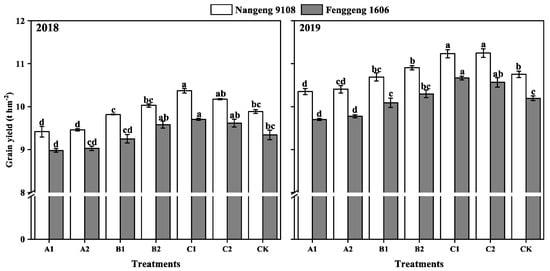
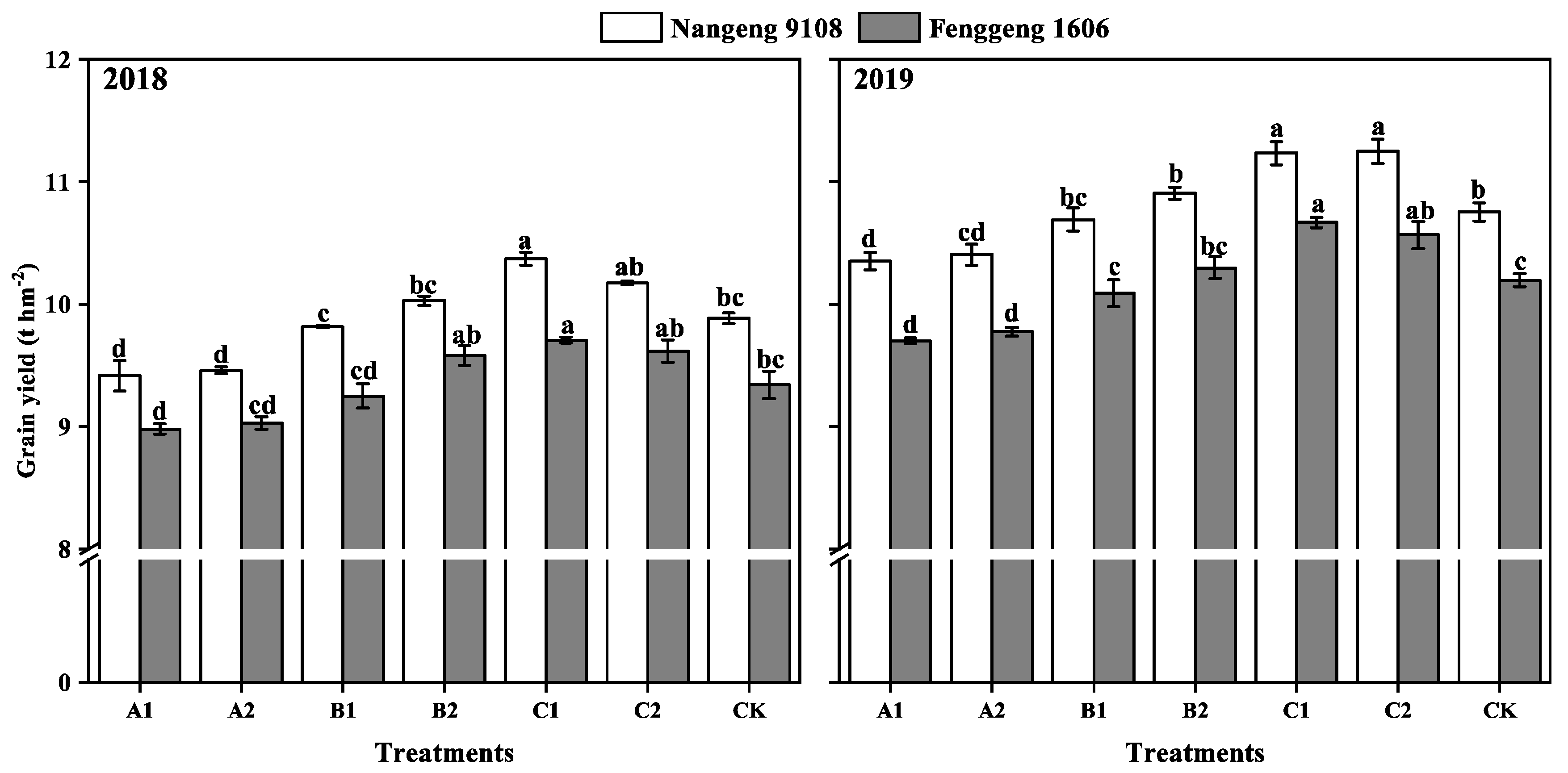
In 2018 and 2019, the yield variations for both rice varieties under diverse treatments displayed consistency, as depicted in Figure 2. Compared to CK, C1 and C2 treatments elevated grain yields significantly by 3.96–4.85% and 2.83–4.65%, respectively. Yields from B1 and B2 treatments closely paralleled the CK’s output. Conversely, A1 and A2 treatments exhibited a significant decline in grain yield, ranging between 3.26–4.90% below CK.
Figure 2.
Rice yield under different treatments in 2018 and 2019. Different letters indicate statistical significance at the 0.05 probability level. Error bars indicate standard error. The standard error is the ratio of the standard deviation to the square root of the sample size.
3.1.2. Sink Capacity
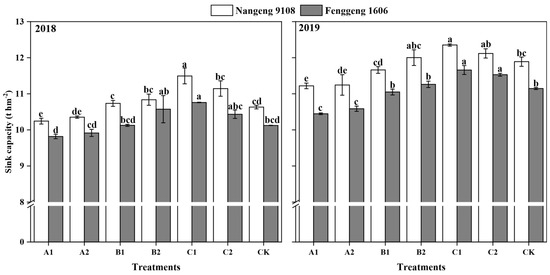
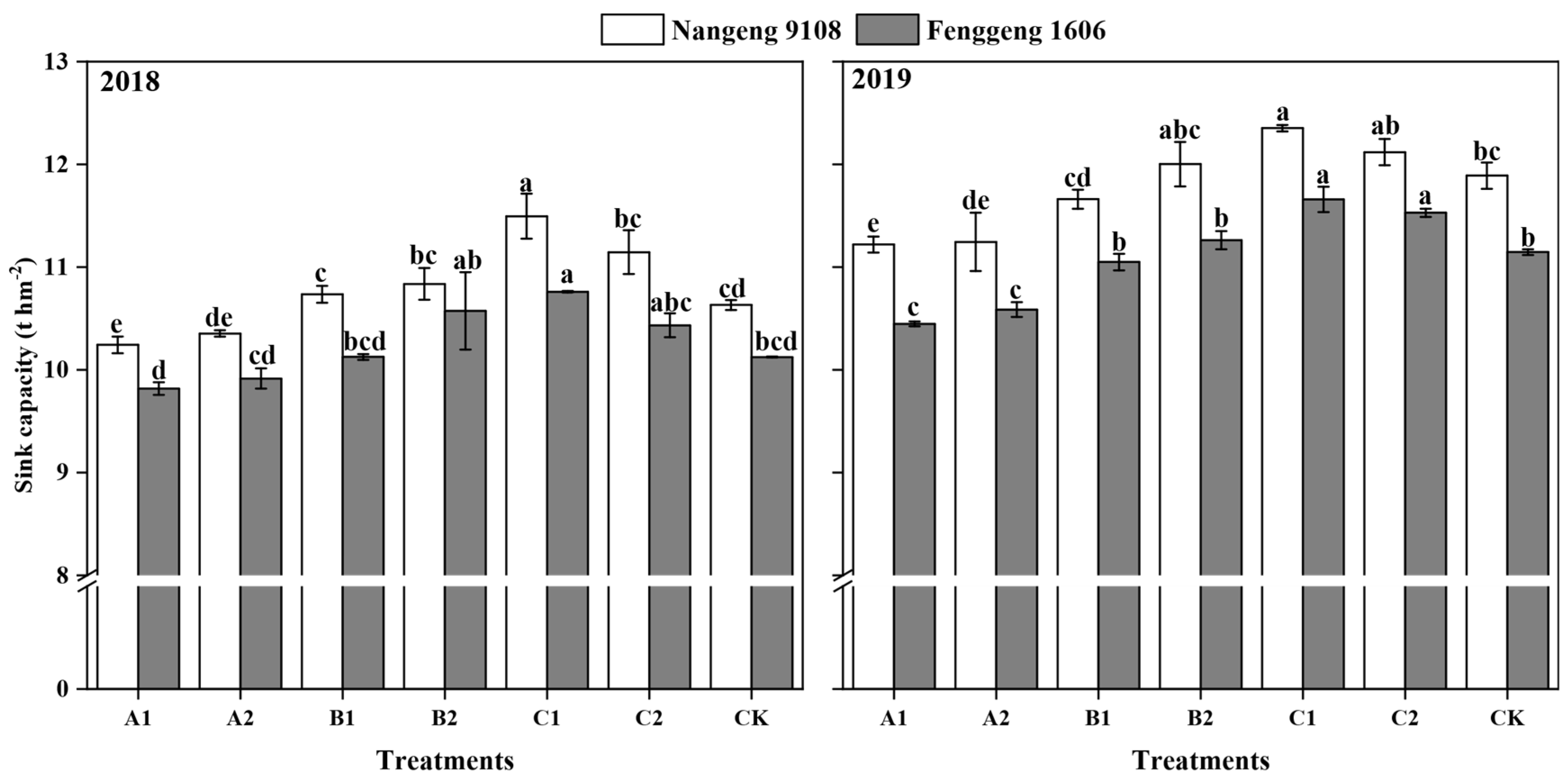
As illustrated in Figure 3, both varieties exhibited consistent sink capacity and grain yield trends over the 2 years, with differences between treatments. Relative to CK, treatments B2, C1, and C2 showcased enhanced sink capacities. Notably, C1 treatment displayed the most pronounced increase, reaching statistical significance. Under the same fertilizer treatment, Nangeng 9108 showed a larger sink capacity than Fenggeng 1606 in the same year. In addition, the sink capacity of each treatment of both varieties in 2019 is higher than that in 2018.
Figure 3.
Sink capacity under different treatments in 2018 and 2019. Different letters indicate statistical significance at the 0.05 probability level. Error bars indicate standard error. The standard error is the ratio of the standard deviation to the square root of the sample size.
3.2. N Uptake and Utilization
3.2.1. N Content in the Shoot (NCS) at the Main Growth Stage
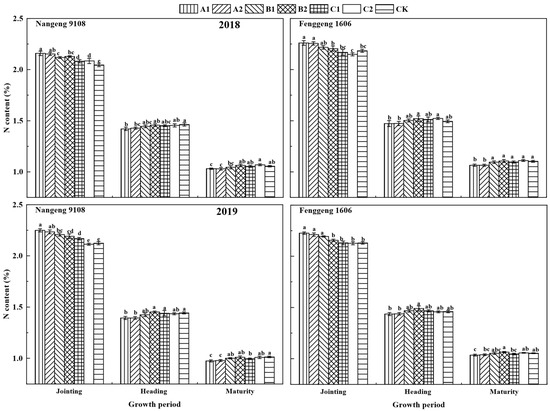
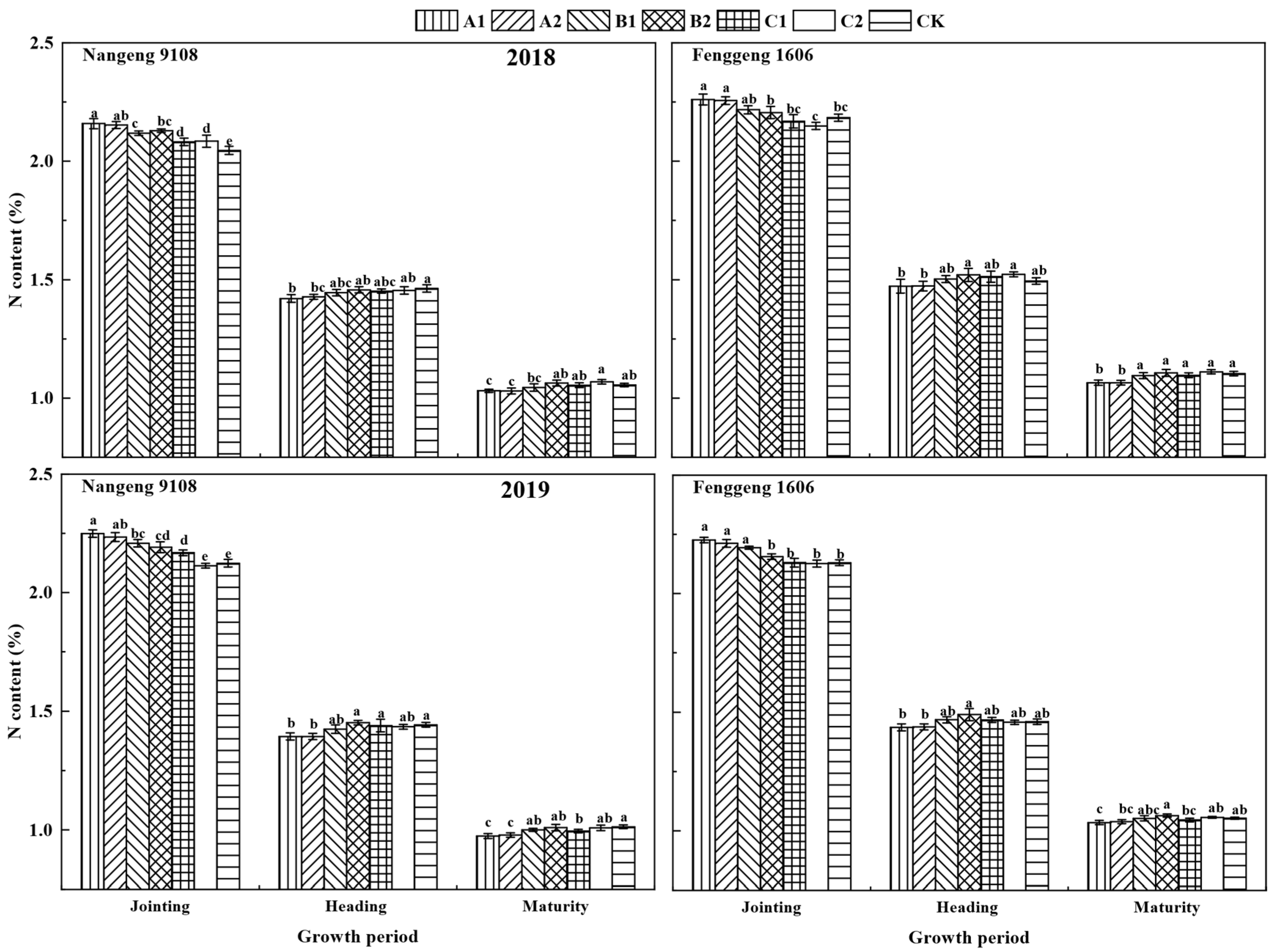
Across 2 years and for both rice varieties, the NCS trend remained basically consistent across treatments during the primary growth phases (Figure 4). Notably, by maturity, NCS in C1 treatment exhibited a downward trend relative to B2, C2, and CK treatments but increased compared to the A1 and A2 treatments with Nangeng 9108 over two years and Fenggeng 1606 in 2018, reaching a significant upward trend. Specifically, in 2019, NCS for C1 treatment in NG9108 was significantly below that of CK, while NCS for the C1 treatment in FG1606 markedly followed the B2 treatment. Conversely, there were no significant discrepancies in NCS between the C2 and CK treatments at maturity.
Figure 4.
NCS during the main growth period under different treatments in 2018 and 2019. Different letters indicate statistical significance at the 0.05 probability level. Error bars indicate standard error. The standard error is the ratio of the standard deviation to the square root of the sample size.
3.2.2. N Accumulation at Maturity
Analyzing data from both years and rice varieties (Table 2), treatments A1 and A2 recorded the lowest values for N accumulation in panicle (NAP) and N accumulation in shoot (NAS), registering 8.11–10.12% and 4.20–8.09% significant decreases, respectively, compared to CK. NAP values for B2, C1, C2, and CK treatments were statistically similar. In contrast, NAS values for B2, C1, and C2 were significantly 2.95–5.64% higher than CK. NAV for the C1 treatment trended downward compared to the C2, B2, B1, and CK treatments. The highest NAV was observed in CK, showing a 3.77–7.17% increment over the C1 treatment. Significant NAV variations between the C1 and CK treatments were noted for both cultivars across the 2 years, excluding NG9108 in 2018.
Table 2.
N accumulation at maturity and the average amount of N per grain under different treatments in 2018 and 2019 (1).
3.2.3. N Translocation Characteristics
Collating data across 2 years and across rice varieties, NTA for A1, A2, and C2 treatments was notably diminished, showing decreases of 6.01–6.84%, 4.51–8.62%, and 4.46–8.73%, respectively, compared to CK (Table 3). NTE and NCTR for the C2 treatment were significantly less than CK, recording declines of 8.00–13.70% and 6.35–9.45%, respectively. Furthermore, while B2 and C1 treatments showcased NTA values comparable to CK, with an exception for NG9108 in 2018, NTE for all CRNF treatments generally trended below that of CK.
Table 3.
N translocation traits of the rice population under different treatments in 2018 and 2019 (1).
3.3. Rice Quality
3.3.1. Processing and Appearance Characteristics
For both years (2018 and 2019) and across the two rice cultivars, there were no significant variations in processing attributes like BRR, MRR, and HMRR across all treatments (Table 4). Regarding appearance qualities, milled rice from B1 and C2 treatments, among CRNF treatments, demonstrated relatively lower CR and CD compared to other treatments. Notably, CD of milled rice for C2 in 2018 and B1 in 2019 recorded the least values among all treatments, presenting a 19.16–38.32% significant reduction from the highest recorded treatment. For B2, C1, and CK treatments, their CD values were similar.
Table 4.
Differences in processing quality and appearance quality under different treatments (1).
3.3.2. Cooking/Eating and Nutrition Quality
Regarding the eating quality benchmarks for milled rice (Table 5), the appearance, viscosity, and balance of the cooked rice were notably better for treatments A1, A2, and C1 compared to B1, B2, C2, and CK. However, rice hardness from these treatments was reduced. The taste metrics for A1, A2, and C1 were superior, registering a significant increase of 2.57–7.47% compared to CK. Meanwhile, there were no significant taste variations observed among the B1, B2, C2, and CK treatment.
Table 5.
Differences in the reference value of eating and cooking quality under different combinations of CRNFs with different release periods (1).
Nutritionally, PC in milled rice from A1, A2, and C1 treatments declined by 2.52–4.97%, 2.83–5.63%, and 2.87–3.64%, respectively, compared to CK. Conversely, AC in the milled rice from A1, A2, and C1 treatments witnessed an increase, ranging between 2.63 and 10.14% higher than CK’s values (Table 5). Except for the AC of NG9108 in 2018, the B1, B2, and C2 treatments showcased no significant disparities in their PC and AC levels.
3.3.3. Rice Viscosity Characteristics
From the aggregate data spanning 2 years and two rice cultivars, the peak, hot, cool viscosity, and breakdown values of A1, A2, and C1 milled rice treatments were elevated by 2.63–9.88%, 2.11–7.37%, 2.82–12.3%, and 2.82%–15.08% in comparison to CK, respectively. Among them, the difference between A1 and C1 treatment and CK reached a significant level. Conversely, the setback values for A1, A2, and C1 treatments were reduced by 4.27–25.30% relative to CK. The values for B1, B2, and C2 treatments paralleled those of CK.
3.4. Correlation Analysis among Indices
3.4.1. Correlation Analysis among Rice Yield and NAS, NAP, NTA; Taste Quality and NAV, PC, AC
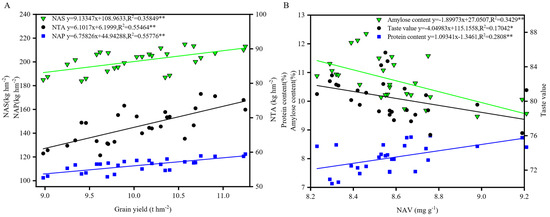
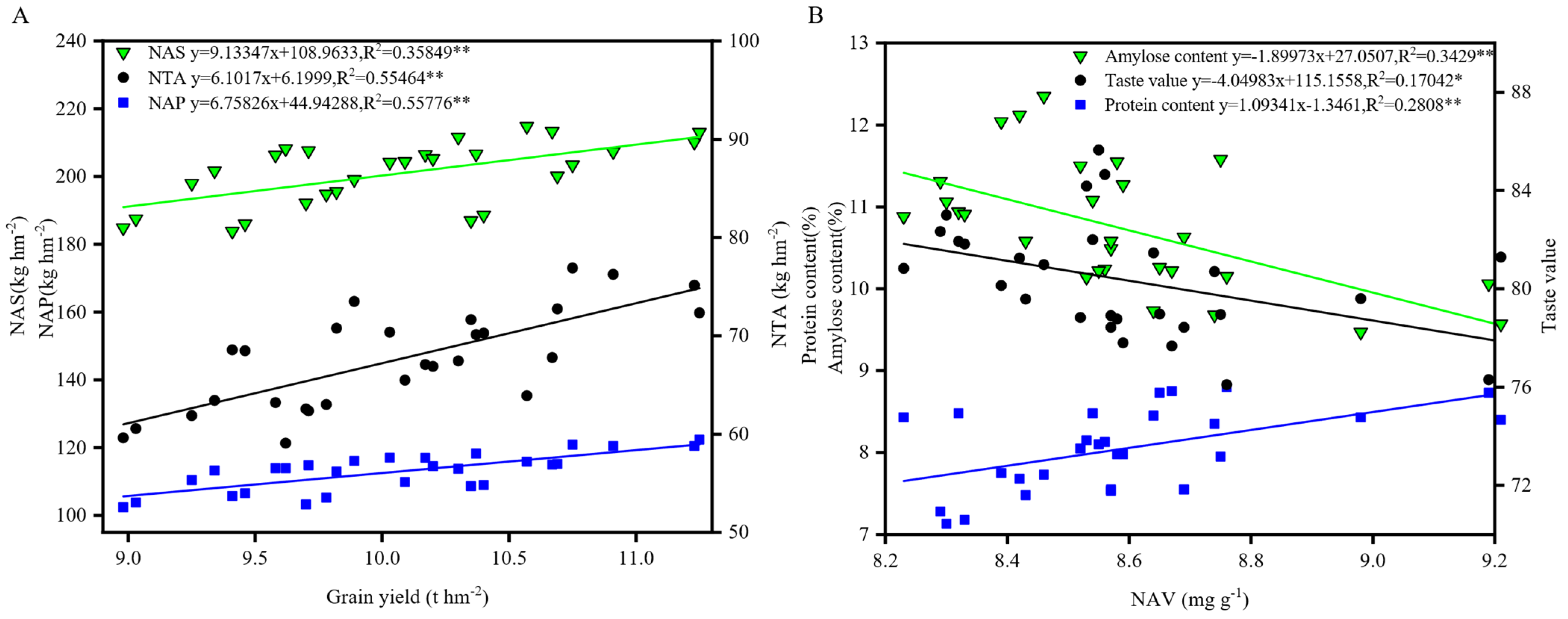
Figure 5A,B illustrate the relationships among various indices. The grain yield exhibited strong positive correlations with NAS, NTA, and NAP. Moreover, PC in milled rice shared a pronounced positive correlation with NAV. Conversely, AC had a negative relationship with NAV. Additionally, the taste value of the rice showed a significant positive association with NAV.
Figure 5.
Pearson correlation between different indices under 2 years of data from 2 cultivars. (A) Pearson correlation of rice yield and NAS, NTA, and NAP. (B) Pearson correlation of NAV and PC, AC, and taste quality. NAP: N accumulation in panicles at maturity; NAS: N accumulation in the shoot at maturity; NAV: N availability per unit sink capacity. * and ** indicate significant differences at the p < 0.05 and p < 0.01 levels, respectively.
3.4.2. Correlation Analysis among NAV, Taste Quality, PC, AC, and Peak Viscosity
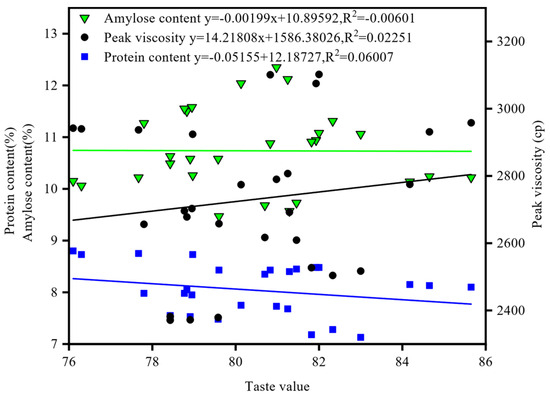
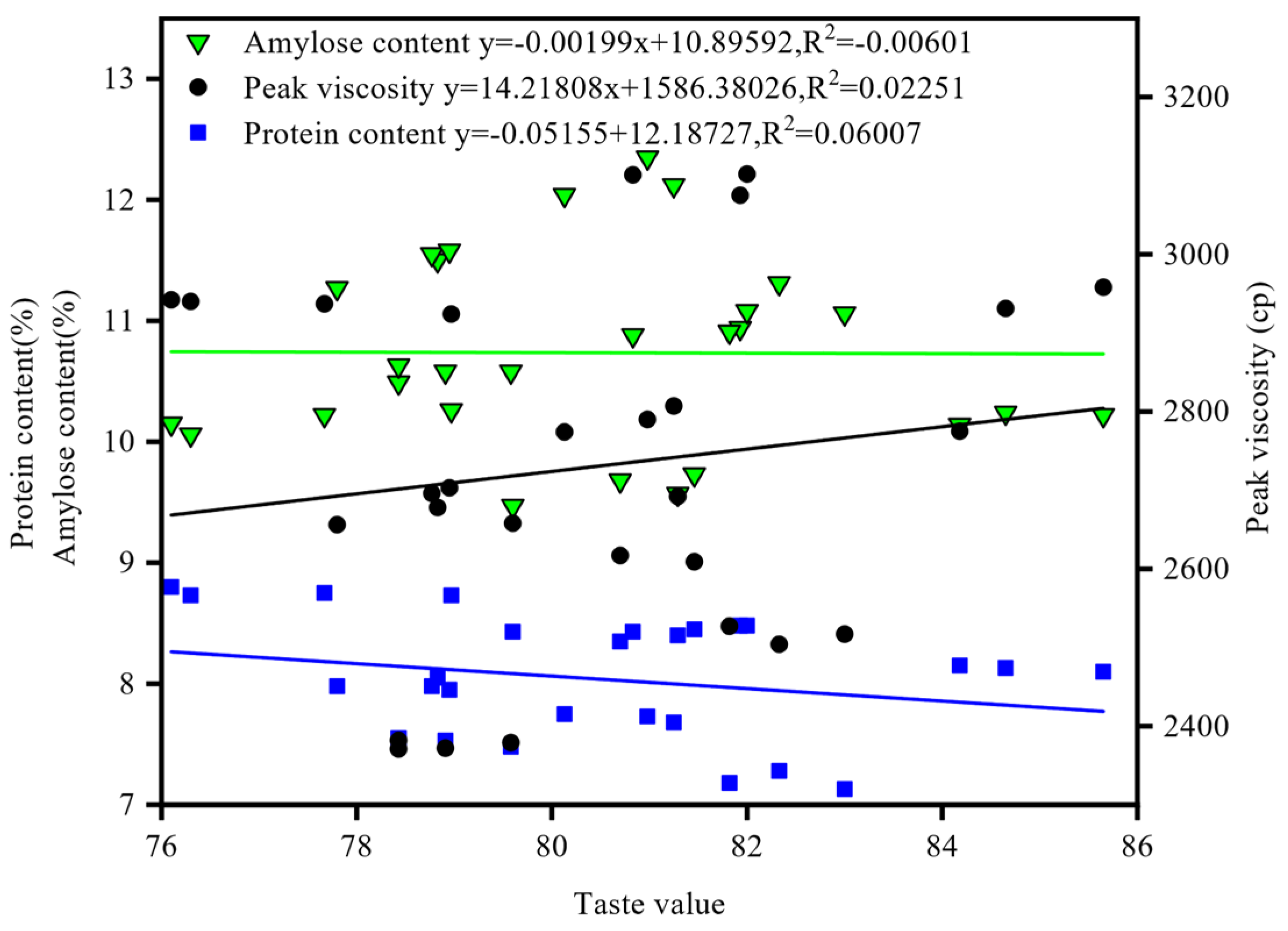
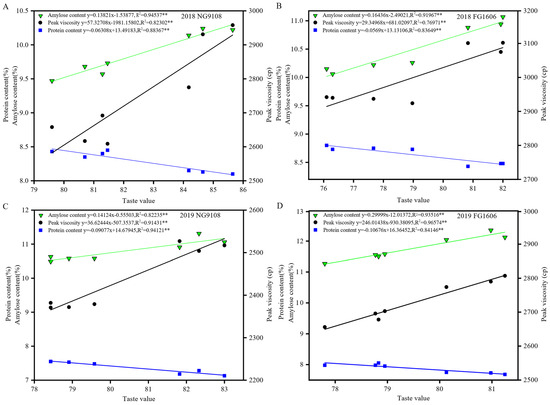
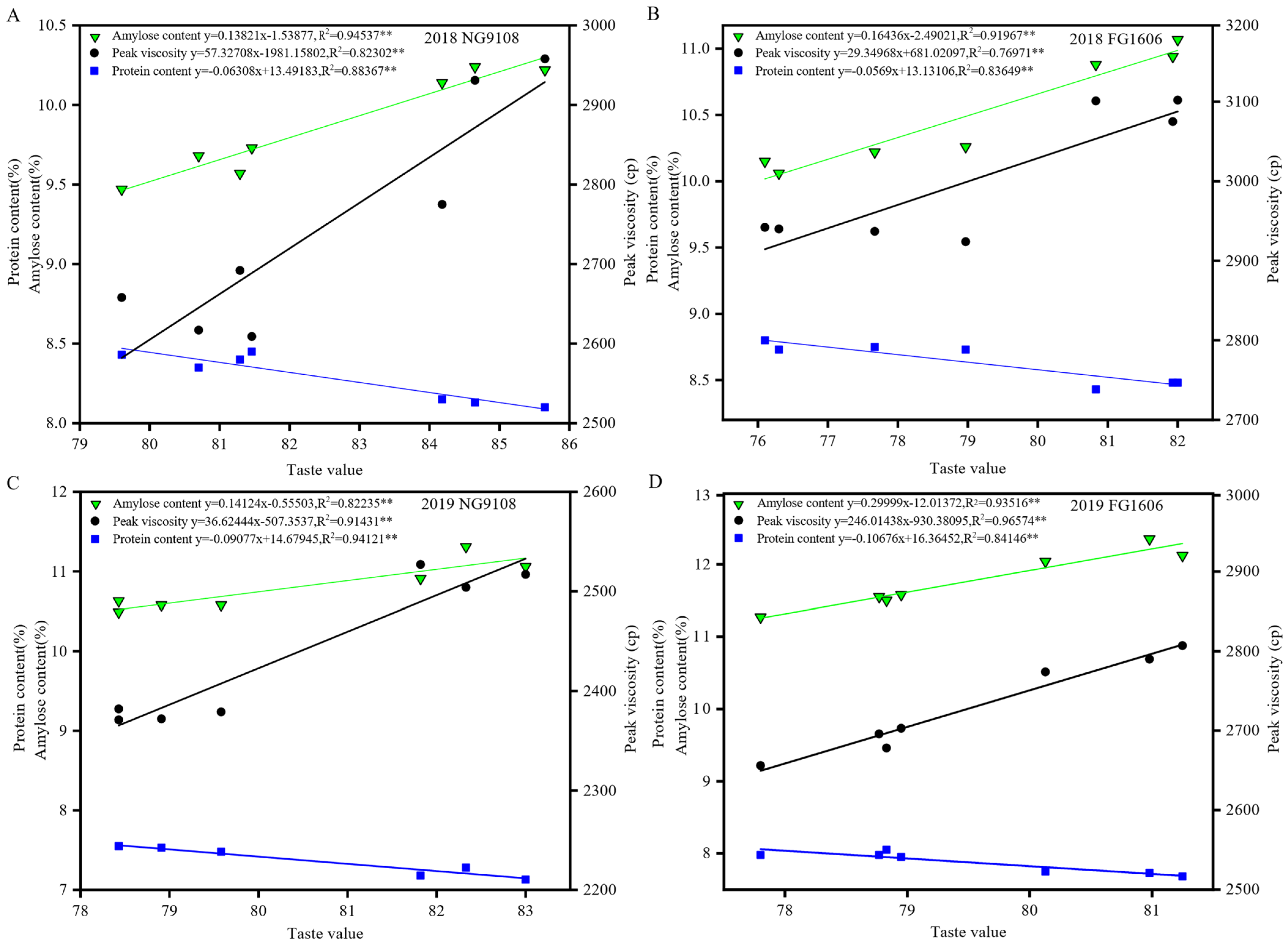
From the 2-year data spanning two cultivars, Figure 6 suggests that PC, AC, and peak viscosity of milled rice lacked significant correlations with taste value. However, when delving into the data for individual years and cultivars, as presented in Figure 7A–D, there emerged a strong negative correlation between milled rice’s PC and its taste value. Conversely, both AC and peak viscosity in milled rice demonstrated a marked positive correlation with taste value. This suggests that while eating quality is multifaceted, within consistent varietal and cultivation contexts, shifts in amylose or PC are pivotal determinants of eating quality.
Figure 6.
Pearson correlation between taste quality and PC, AC, and peak viscosity under 2 years of data from 2 cultivars.
Figure 7.
Pearson correlation between taste value and protein content, amylose content, and peak viscosity at different years and verities. (A) Pearson correlation between taste quality and PC, AC, and peak viscosity of NG 9108 in 2018. (B) Pearson correlation between taste quality and PC, AC, and peak viscosity of FG 1606 in 2018. (C) Pearson correlation between taste quality and PC, AC, and peak viscosity of NG 9108 in 2019. (D) Pearson correlation between taste quality and PC, AC, and peak viscosity of FG 1606 in 2019; ** indicates significant differences at the p < 0.05 levels.
4. Discussion
4.1. Influence of CRNF Treatments on Rice Yield, Sink Capacity, and N Dynamics
This study revealed that C1 and C2 treatments significantly outperformed CK in terms of grain yield, sink capacity, NAS, and NAP, as illustrated in Figure 2 and Figure 3 and Table 2. These findings resonate with prior studies on high-yield rice populations [23,24,25]. However, there was an observed discrepancy wherein NTA, NTE and NCTR of C2 treatment significantly trailed those of C1 treatment, registering the lowest values among all treatments (Table 3).
N accumulation in the rice panicle at maturity is attributed partly to N translocated from vegetative organs post-heading, and partly to the N absorbed post-heading by the plants [26,27]. Extant research underscores that adequate post-heading N supply bolsters prolonged photosynthetic productivity during grain filling, extends leaf functionality, and amplifies assimilate storage in the panicle [9]. However, over-absorption of N at this phase—beyond what rice plants reasonably demand—can cause a retention of more N in vegetative organs, effectively diminishing N-translocation efficiency. This could stagnate grain yield enhancements [26,28] and in extreme scenarios, result in underdeveloped and late ripening [25]. In line with this, the authors’ prior work detected elevated post-heading N uptake in the C2 treatment relative to others [29], without a corresponding grain yield increase compared to C1 treatment (Figure 2). This suggests C2 treatment’s post-heading N absorption might have been excessive, compensating for suboptimal N translocation. In field conditions, C1 manifested regular ripening patterns with relatively greener leaves at harvest.
Additionally, grain yield, NAP, NAS, and NTA were markedly diminished in the A1 and A2 treatments relative to CK (Figure 2 and Table 2). These treatments dispensed excess N prior jointing, resulting in deficient N release during pre- and post-heading phases, subsequently curtailing the “source” and “sink” and leading to diminished post-heading assimilate production [29]. The metrics for B1 and B2 treatments were comparable to CK or slightly lesser. To summarize, C1 treatment’s N release pattern aligns more adeptly with the nutrient absorption tendencies of late-maturing medium japonica rice. The proposed one-time fertilization method can effectively deal with the challenges brought by urbanization and labor shortage in the current situation of Chinese agriculture. Simultaneously, the use of appropriate combination of N fertilizers can not only reduce labor input, but also enhance the absorption and utilization rate of N in rice, increase grain production and planting benefit.
4.2. Influence of CRNF Treatments on Rice Quality
AC is traditionally perceived as having a greater influence on the eating quality of rice than PC, and rice varieties with reduced AC are generally associated with improved palatability [18,30,31]. Notwithstanding, Huang et al. [32] reported minimal variation in AC under different N fertilizer regimes and no obvious change detected in the eating quality of rice after removing protein from rice flour, suggesting that PC might play a pivotal role in determining rice’s eating quality in the context of N fertilizer adjustments. In this research, AC fluctuations across treatments were minimal (≤1%) for both rice cultivars (Table 5), contrasting with other comparative studies where variations spanned from 0–35% [18,33]. Notably, a strong positive correlation was observed between AC and taste value (Figure 7), which counters conventional wisdom. Conversely, PC and taste value exhibited a significant inverse correlation (Figure 7), aligning with prior findings [34,35]. Elevated PC diminishes the water uptake during rice cooking, leading to reduced viscosity and palatability [36,37]. This was evident in the heightened viscosity and taste values of milled rice from A1, A2, and C1 treatments, which had reduced PC, as compared to other treatments (Table 5 and Table 6). Thus, the results underscore that PC variations substantially influence rice’s culinary attributes.
Table 6.
Differences in the RVA profile characteristics of japonica rice under different combinations of CRNFs with different release periods.
While enhancing rice PC within certain limits can mitigate grain chalkiness [38] and bolster grain resilience [39], it is posited that assimilate accumulation traits in the grain predominantly shape rice’s processing and appearance quality [40]. Rice derived from the C1 treatment demonstrated comparable processing and appearance qualities to CK (Table 4), potentially attributed to uniform assimilate accumulation during the grain-filling phase.
4.3. Relationship between N-Related Characteristics and Rice Quality
Previous studies suggested that while sink capacity positively influences grain yield, it adversely affects rice’s NAV, and certain agronomic interventions could diminish rice’s PC by tempering its NVA [41,42]. Consistent with this, a biennial study on two rice cultivars found a strong positive correlation between rice PC and NAV (Figure 5). The modulations in rice PC can be contextualized by examining population dynamics and assimilate synthesis.
This study determined that the PC and NVA for low-yield A1 and A2 treatments, as well as the high-yield C1 treatment, were comparably minimal. Notably, relative to other high-yield treatments (B1, B2, C2) and the control (CK), the C1 treatment’s aforementioned metrics significantly decreased, resulting in enhanced rice palatability (Table 2 and Table 5). Contrarily, achieving concurrent advancements in grain yield and rice palatability proves elusive under traditional N fractionation. Prior research attests that the best yield was generally achieved when using medium levels of total N and fertilizing optimal N at panicle branch and spikelet differentiation stages, while escalating total N or adjusting panicle fertilizer regimes can augment rice PC, detrimentally affecting palatability [3,34,43]. This dynamic can be elucidated by the shifts in Carbon (C) and N metabolism in rice from jointing to maturity. Panicle fertilizer applications can invigorate both C and N metabolic pathways, fostering more abundant spikelets and augmented photosynthetic output [9,28,44]. However, a diminished C/N ratio during grain filling can restrain carbon dioxide (CO2) uptake or divert more C to amino acid synthesis, resulting in enhanced structural carbohydrates and heightened plant respiration [45,46,47]. Alterations in panicle fertilizer routines, such as delaying fertilization or increasing the amount of N fertilizer, can further suppress C metabolism during grain filling [47], thus diminishing the efficiency of N use for biomass synthesis [48]. This culminates in a relative upsurge in plant N content and grain protein.
Interestingly, the C1 treatment showed a slight decline in shoot N content at maturity compared to treatments B2, C2, and CK (Figure 3). Furthermore, efficiencies of N utilization for biomass and grain production trended upwards [29]. This suggests that the N-release profile of this specific fertilizer combination potentially allows the rice population to optimally generate C assimilates, channeling them towards grain filling. Consequently, this engenders a robust sink capacity under a more populous spikelet, thereby reducing NAV and rice PC, enhancing overall palatability of milled rice. However, this work lacked direct physiological data evidence, such as enzyme activity re-lated to C and N metabolism and non-structural carbohydrate content in rice plants, and further research is needed to enrich the content of this mechanism.
5. Conclusions
For late-maturing medium japonica rice, the N release pattern of C1 treatment (40% 100 d CRNF + 10% 80 d CRNF + 50% CNF) outperformed other treatments in fostering a high-yield population, which were repeatable over two years. This treatment optimized N supply, facilitating the development of an enhanced sink capacity and ensuring robust N accumulation in both shoots and panicles. It also provided effective N translocation dynamics from vegetative structures. Notably, C1 treatment modified the interplay between grain N accumulation and sink capacity. A marked inverse correlation emerged between NAV, PC, and rice palatability. C1 treatment also exhibited improved rheological properties such as peak, hot, and cool viscosity, as well as a higher taste value for milled rice, contrasting favorably with the control. Two varieties reacted the same to fertilization. Consequently, for the Yangtze River Delta region, C1 treatment presents a promising strategy to concurrently elevate both yield and eating quality of late-maturing medium japonica rice. Meanwhile, we are convinced that this strategy can guide the high-yield and good-quality production of japonica rice and promote sustainable development of rice production in the region.
Author Contributions
Conceptualization, H.W.; validation, Q.H. and H.W.; formal analysis, Q.H.; W.J.; Z.M.; investigation, Q.H. and W.J.; resources, H.W.; data curation, Q.H.; W.J.; Z.M.; S.C.; writing—original draft preparation, Q.H. and W.J.; writing—review and editing, Q.H. and G.L.; supervision, D.G. and H.W.; project administration, H.W.; funding acquisition, H.W. and H.Z. All authors have read and agreed to the published version of the manuscript.
Funding
The research was funded by Jiangsu Key Research Program, China (grant number BE2022338); the Natural Science Foundation of the Jiangsu Higher Education Institutions of China (grant number 22KJB210004); Jiangsu Agricultural Science and Technology Innovation Fund, China (grant number CX(23)3107); Research initiation project for high-level talents of Yangzhou University (grant number 137012081); the National Rice Industry Technology System (grant number CARS-01). The work was also funded by the Priority Academic Program Development of Jiangsu Higher Education Institutions, China.
Data Availability Statement
The data are contained within the article.
Acknowledgments
We fully appreciate the editors and all anonymous reviewers for their constructive comments on this manuscript.
Conflicts of Interest
The authors declare no conflict of interest. The funders had no role in the design of the study; in the collection, analyses, or interpretation of data; in the writing of the manuscript; or in the decision to publish the results.
References
- Ke, J.; Sun, J.; Chen, T.T.; Tao, S.B.; Zhu, T.Z.; Yin, C.J.; He, H.B.; You, C.C.; Wu, L.Q.; Guo, S.S. Effects of mixed fertilizers formed by the compounding of two targeted controlled-release nitrogen fertilizers on yield, nitrogen use efficiency, and ammonia volatilization in double-cropping rice. Crop J. 2023, 11, 628–637. [Google Scholar] [CrossRef] [Scilit]
- Zhu, C.H.; Ouyang, Y.Y.; Diao, Y.; Yu, J.Q.; Luo, X.; Zheng, J.G.; Li, X.Y. Effects of mechanized deep placement of nitrogen fertilizer rate and type on rice yield and nitrogen use efficiency in Chuanxi Plain, China. J. Integr. Agric. 2021, 20, 581–592. [Google Scholar] [CrossRef] [Scilit]
- Chen, Y.T.; Peng, J.; Wang, J.; Fu, P.H.; Hou, Y.; Zhang, C.D.; Fahad, S.; Peng, S.B.; Cui, K.H.; Nie, L.X.; et al. Crop management based on multi-split topdressing enhances grain yield and nitrogen use efficiency in irrigated rice in China. Field Crops Res. 2015, 184, 50–57. [Google Scholar] [CrossRef] [Scilit]
- Cheng, B.; Jiang, Y.; Cao, C.G. Balance rice yield and eating quality by changing the traditional nitrogen management for sustainable production in China. J. Clean. Prod. 2021, 312, 127793. [Google Scholar] [CrossRef] [Scilit]
- Tan, D.; Liu, Z. One-off fertilization technology realized light-simplified and green production for the three major grain crops. Sci. Agric. Sin. 2018, 51, 3823–3826. [Google Scholar] [CrossRef]
- Naz, M.Y.; Sulaiman, S.A. Slow release coating remedy for nitrogen loss from conventional urea: A review. J. Control. Release 2016, 225, 109–120. [Google Scholar] [CrossRef] [Scilit] [PubMed]
- Liu, Z.H.; Wu, X.B.; Tan, D.S.; Li, Y.; Jiang, L.H. Application and environmental effects of one-off fertilization technique in major cereal crops in China. Sci. Agric. Sin. 2018, 51, 3827–3839. [Google Scholar] [CrossRef]
- Lu, H.; Dun, C.P.; Jariwala, H.; Wang, R.; Cui, P.Y.; Zhang, H.P.; Dai, Q.G.; Yang, S.; Zhang, H.C. Improvement of bio-based polyurethane and its optimal application in controlled release fertilizer. J. Control. Release 2022, 350, 748–760. [Google Scholar] [CrossRef] [Scilit]
- Zhang, Z.J.; Chu, G.; Liu, L.J.; Wang, Z.Q.; Wang, X.M.; Zhang, H.; Yang, J.C.; Zhang, J.H. Mid-season nitrogen application strategies for rice varieties differing in panicle size. Field Crops Res. 2013, 150, 9–18. [Google Scholar] [CrossRef] [Scilit]
- Ke, J.; Xing, X.M.; Li, G.H.; Ding, Y.F.; Dou, F.G.; Wang, S.H.; Liu, Z.H.; Tang, S.; Ding, C.Q.; Chen, L. Effects of different controlled-release nitrogen fertilisers on ammonia volatilisation, nitrogen use efficiency and yield of blanket-seedling machine-transplanted rice. Field Crops Res. 2017, 205, 147–156. [Google Scholar] [CrossRef] [Scilit]
- Wu, Q.; Wang, Y.H.; Ding, Y.F.; Tao, W.K.; Gao, S.; Li, Q.X.; Li, W.W.; Liu, Z.H.; Li, G.H. Effects of different types of slow- and controlled-release fertilizers on rice yield. J. Integr. Agric. 2021, 20, 1503–1514. [Google Scholar] [CrossRef] [Scilit]
- Zhang, M.; Tang, S.H.; Zhang, F.B.; Huang, Q.Y.; Huang, X. Slow-release urea of 60-day-release period is suitable for one basal application in early and late rice. J. Plant Nutr. Fertil. 2017, 23, 119–127. [Google Scholar] [CrossRef]
- Ye, Y.S.; Liang, X.Q.; Chen, Y.X.; Liu, J.; Gu, J.T.; Guo, R.; Li, L. Alternate wetting and drying irrigation and controlled-release nitrogen fertilizer in late-season rice. Effects on dry matter accumulation, yield, water and nitrogen use. Field Crops Res. 2013, 144, 212–224. [Google Scholar] [CrossRef] [Scilit]
- Liu, Y.D.; Ma, C.; Li, G.H.; Jiang, Y.; Hou, P.F.; Xue, L.H.; Yang, L.Z.; Ding, Y.F. Lower dose of controlled/slow release fertilizer with higher rice yield and N utilization in paddies: Evidence from a meta-analysis. Field Crops Res. 2023, 294, 108879. [Google Scholar] [CrossRef] [Scilit]
- Hou, P.F.; Xue, L.X.; Zhou, Y.L.; Li, G.H.; Yang, L.Z.; Xue, L.H. Yield and N Utilization of Transplanted and Direct-Seeded Rice with Controlled or Slow-Release Fertilizer. Agron. J. 2019, 111, 1208–1217. [Google Scholar] [CrossRef] [Scilit]
- Geng, J.B.; Sun, Y.B.; Zhang, M.; Li, C.L.; Yang, Y.C.; Liu, Z.G.; Li, S.L. Long-term effects of controlled release urea application on crop yields and soil fertility under rice-oilseed rape rotation system. Field Crops Res. 2015, 184, 65–73. [Google Scholar] [CrossRef] [Scilit]
- Zhu, Y.; Xu, D.; Ma, Z.T.; Chen, X.Y.; Zhang, M.Y.; Zhang, C.; Liu, G.D.; Wei, H.Y.; Zhang, H.C. Differences in Eating Quality Attributes between Japonica Rice from the Northeast Region and Semiglutinous Japonica Rice from the Yangtze River Delta of China. Foods 2021, 10, 2770. [Google Scholar] [CrossRef] [Scilit]
- Wang, C.L.; Zhang, Y.D.; Zhu, Z.; Chen, T.; Zhao, Q.Y.; Zhong, W.G.; Yang, J.; Yao, S.; Zhou, L.H.; Zhao, L.; et al. Research progress on the breeding of japonica super rice varieties in Jiangsu Province, China. J. Integr. Agric. 2017, 16, 992–999. [Google Scholar] [CrossRef] [Scilit]
- Zhao, H.T.; Li, T.P.; Zhang, Y.; Hu, J.; Bai, Y.C.; Shan, Y.H.; Ke, F. Effects of vermicompost amendment as a basal fertilizer on soil properties and cucumber yield and quality under continuous cropping conditions in a greenhouse. J. Soils Sediments 2017, 17, 2718–2730. [Google Scholar] [CrossRef] [Scilit]
- Jiang, B.; Tsao, R.; Li, T.; Miao, M. Food safety: Food Analysis Technologies/Techniques. In Encyclopedia of Agriculture and Food Systems; Van Alfen, N.K., Ed.; Academic Press: New York, NY, USA, 2014; pp. 273–288. [Google Scholar] [CrossRef] [Scilit]
- GB/T17891-2017; High Quality Paddy. General Administration of Quality Supervision, Inspection and Quarantine of the People’s Republic of China. Standardization Administration of the People’s Republic of China: Beijing, China, 2017.
- NYT83-2017; Determination of Rice Quality. Ministry of Agriculture and Rural Affairs of the People’s Republic of China: Beijing, China, 2017.
- Zhang, Y.H.; Fan, J.B.; Zhang, Y.L.; Wang, D.S.; Huang, Q.W.; Shen, Q.R. N Accumulation and Translocation in Four Japonica Rice Cultivars at Different N Rates. Pedosphere 2007, 17, 792–800. [Google Scholar] [CrossRef] [Scilit]
- Ida, M.; Ohsugi, R.; Sasaki, H.; Aoki, N.; Yamagishi, T. Contribution of Nitrogen Absorbed during Ripening Period to Grain Filling in a High-Yielding Rice Variety, Takanari. Plant Prod. Sci. 2009, 12, 176–184. [Google Scholar] [CrossRef] [Scilit]
- Mi, W.H.; Zheng, S.Y.; Yang, X.; Wu, L.H.; Liu, Y.L.; Chen, J.Q. Comparison of yield and nitrogen use efficiency of different types of nitrogen fertilizers for different rice cropping systems under subtropical monsoon climate in China. Eur. J. Agron. 2017, 90, 78–86. [Google Scholar] [CrossRef] [Scilit]
- Wada, S.; Hayashida, Y.; Izumi, M.; Kurusu, T.; Hanamata, S.; Kanno, K.; Kojima, S.; Yamaya, T.; Kuchitsu, K.; Makino, A.; et al. Autophagy Supports Biomass Production and Nitrogen Use Efficiency at the Vegetative Stage in Rice. Plant Physiol. 2015, 168, 60–73. [Google Scholar] [CrossRef] [Scilit] [PubMed]
- Xing, Y.Y.; Jiang, W.T.; He, X.L.; Fiaz, S.; Ahmad, S.; Lei, X.; Wang, W.Q.; Wang, Y.F.; Wang, X.K. A review of nitrogen translocation and nitrogen-use efficiency. J. Plant Nutr. 2019, 42, 2624–2641. [Google Scholar] [CrossRef] [Scilit]
- Sun, Y.J.; Sun, Y.Y.; Yan, F.J.; Yang, Z.Y.; Xu, H.; Li, Y.; Wang, H.Y.; Ma, J. Effects of postponing nitrogen topdressing on post-anthesis carbon and nitrogen metabolism in rice cultivars with different nitrogen use efficiencies. Acta Agron. Sin. 2017, 43, 407–419. [Google Scholar] [CrossRef] [Scilit]
- Jiang, W.Q.; Hu, Q.; Yu, H.; Ma, H.Z.; Ren, G.L.; Ma, Z.T.; Zhu, Y.; Wei, H.Y.; Zhang, H.C.; Liu, G.D.; et al. Effect of one-time basal application of the mixed controlled-release nitrogen fertilizer in Japonica rice with good taste quality. Sci. Agric. Sin. 2021, 54, 1382–1396. [Google Scholar] [CrossRef]
- Mestres, C.; Ribeyre, F.; Pons, B.; Fallet, V.; Matencio, F. Sensory texture of cooked rice is rather linked to chemical than to physical characteristics of raw grain. J. Cereal Sci. 2011, 53, 81–89. [Google Scholar] [CrossRef] [Scilit]
- Li, H.Y.; Prakash, S.; Nicholson, T.M.; Fitzgerald, M.A.; Gilbert, R.G. Instrumental measurement of cooked rice texture by dynamic rheological testing and its relation to the fine structure of rice starch. Carbohydr. Polym. 2016, 146, 253–263. [Google Scholar] [CrossRef] [Scilit]
- Huang, S.J.; Zhao, C.F.; Zhu, Z.; Zhou, L.H.; Zheng, Q.H.; Wang, C.L. Characterization of eating quality and starch properties of two Wx alleles japonica rice cultivars under different nitrogen treatments. J. Integr. Agric. 2020, 19, 988–998. [Google Scholar] [CrossRef] [Scilit]
- Zeng, Y.H.; Tan, X.M.; Zeng, Y.J.; Xie, X.B.; Pan, X.H.; Shi, Q.H.; Zhang, J. Changes in the rice grain quality of different high-quality rice varieties released in southern China from 2007 to 2017. J. Cereal Sci. 2019, 87, 111–116. [Google Scholar] [CrossRef] [Scilit]
- Zhang, L.X.; Zhang, C.Q.; Yan, Y.; Hu, Z.J.; Wang, K.; Zhou, J.H.; Zhou, Y.; Cao, L.M.; Wu, S.J. Influence of starch fine structure and storage proteins on the eating quality of rice varieties with similar amylose contents. J. Sci. Food Agric. 2021, 101, 3811–3818. [Google Scholar] [CrossRef] [Scilit] [PubMed]
- Zhang, J.; Zhang, Y.Y.; Song, N.Y.; Chen, Q.L.; Sun, H.Z.; Peng, T.; Huang, S.; Zhao, Q.Z. Response of grain-filling rate and grain quality of mid-season indica rice to nitrogen application. J. Integr. Agric. 2021, 20, 1465–1473. [Google Scholar] [CrossRef] [Scilit]
- Martin, M.; Fitzgerald, M.A. Proteins in Rice Grains Influence Cooking Properties! J. Cereal Sci. 2002, 36, 285–294. [Google Scholar] [CrossRef] [Scilit]
- Derycke, V.; Veraverbeke, W.S.; Vandeputte, G.E.; De Man, W.; Hoseney, R.C.; Delcour, J.A. Impact of Proteins on Pasting and Cooking Properties of Nonparboiled and Parboiled Rice. Cereal Chem. 2005, 82, 468–474. [Google Scholar] [CrossRef] [Scilit]
- Qiao, J.F.; Liu, Z.H.; Deng, S.Y.; Ning, H.F.; Yang, X.Y.; Lin, Z.M.; Li, G.H.; Wang, Q.S.; Wang, S.H.; Ding, Y.F. Occurrence of perfect and imperfect grains of six japonica rice cultivars as affected by nitrogen fertilization. Plant Soil 2011, 349, 191–202. [Google Scholar] [CrossRef] [Scilit]
- Bao, J.S. Rice Milling Quality. In Rice, 4th ed.; Woodhead Publishing: Hangzhou, China, 2019; pp. 339–369. [Google Scholar] [CrossRef] [Scilit]
- Bian, J.L.; Xu, F.F.; Han, C.; Qiu, S.; Ge, J.L.; Xu, J.; Zhang, H.C.; Wei, H.Y. Effects of planting methods on yield and quality of different types of japonica rice in northern Jiangsu plain, China. J. Integr. Agric. 2018, 17, 2624–2635. [Google Scholar] [CrossRef] [Scilit]
- Simmonds, N.W. The relation between yield and protein in cereal grain. J. Sci. Food Agric. 1995, 67, 309–315. [Google Scholar] [CrossRef] [Scilit]
- Tsukaguchi, T.; Nitta, S.; Matsuno, Y. Cultivar differences in the grain protein accumulation ability in rice (Oryza sativa L.). Field Crops Res. 2016, 192, 110–117. [Google Scholar] [CrossRef] [Scilit]
- Cao, X.M.; Sun, H.Y.; Wang, C.G.; Ren, X.J.; Liu, H.F.; Zhang, Z.J. Effects of late-stage nitrogen fertilizer application on the starch structure and cooking quality of rice. J. Sci. Food Agric. 2018, 98, 2332–2340. [Google Scholar] [CrossRef] [Scilit]
- Kamiji, Y.; Yoshida, H.; Palta, J.A.; Sakuratani, T.; Shiraiwa, T. N applications that increase plant N during panicle development are highly effective in increasing spikelet number in rice. Field Crops Res. 2011, 122, 242–247. [Google Scholar] [CrossRef] [Scilit]
- Song, J.M.; Tian, J.C.; Zhao, S.J. Relationship between photosynthetic carbon and nitrogen metabolism in plants and its regulation. Plant Physiol. J. 1998, 34, 230–238. [Google Scholar] [CrossRef]
- Foyer, C.H.; Ferrario-Méry, S.; Noctor, G. Interactions between Carbon and Nitrogen Metabolism. In Plant Nitrogen; Lea, P., Morot-Gaudry, J., Eds.; Springer: Berlin/Heidelberg, Germany, 2001; pp. 237–254. [Google Scholar] [CrossRef] [Scilit]
- Zhao, Y.L. Effect of Nitrogen on Rice Yield and Quality and Its Physiological Mechanism. Ph.D. Thesis, Nanjing Agricultural University, Nanjing, China, 2014. [Google Scholar]
- Song, Z.; Lv, K.; Luo, F.; Lian, X.M. Effect of nitrogen application on nitrogen uptaking and utilization in ten different rice varieties. J. Huazhong Agric. Univ. 2012, 31, 165–170. [Google Scholar]

Disclaimer/Publisher’s Note: The statements, opinions and data contained in all publications are solely those of the individual author(s) and contributor(s) and not of MDPI and/or the editor(s). MDPI and/or the editor(s) disclaim responsibility for any injury to people or property resulting from any ideas, methods, instructions or products referred to in the content. |
© 2023 by the authors. Licensee MDPI, Basel, Switzerland. This article is an open access article distributed under the terms and conditions of the Creative Commons Attribution (CC BY) license (https://creativecommons.org/licenses/by/4.0/).