Review

Polymer-Based Flame-Retardant Asphalt: A Comprehensive Review of Materials, Performance, and Evaluation Methods

School of Mechanical and Manufacturing Engineering, University of New South Wales, Sydney, NSW 2052, Australia
*
Author to whom correspondence should be addressed.
Polymers 2025, 17(24), 3272; https://doi.org/10.3390/polym17243272
Submission received: 31 October 2025 / Revised: 1 December 2025 / Accepted: 4 December 2025 / Published: 9 December 2025
(This article belongs to the Special Issue Flame-Retardant Polymer Composites, 3rd Edition)

Abstract

The growing demand for durable, fire-resistant, and sustainable pavements has intensified research on asphalt as a polymeric composite system. This review provides a comprehensive analysis of asphalt from the perspective of polymer science, focusing on (1) material composition: asphalt chemistry and polymer–binder interaction, and the introduction of polymer modifiers; (2) material properties: rheology, thermal stability, mechanical properties and flame retardancy; and (3) evaluation methods: derivative thermogravimetric analysis, cone calorimeter, scanning electron microscope and computer simulation. Applications in road infrastructure, industrial surfaces, and high-temperature environments are discussed, emphasizing how polymer modifications enhance performance under operational stresses. Evaluation methodologies, including wheel-tracking tests and thermogravimetric and derivative thermogravimetric analysis, are critically reviewed to quantify deformation, thermal degradation, and fire-resistance mechanisms at both microstructural and molecular levels. Several key challenges remain, including understanding the long-term interaction between polymers and asphalt, optimizing the dispersion of reinforcing materials, and maximizing the performance of recycled polymers. This review aims to guide future research on polymer-modified asphalt systems to achieve safer, more durable, and more sustainable pavement solutions.

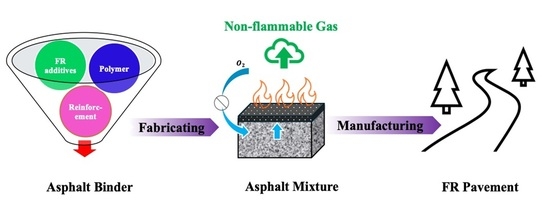
Graphical Abstract

1. Introduction

Asphalt is one of the most basic components of modern infrastructure and, like concrete and steel, is an indispensable element in building global transportation networks. It has facilitated the rapid development of highways, airports and urban roads, while supporting economic growth and social mobility [1]. With the acceleration of urbanization, the demand for high-performance pavement systems continues to grow. Modern roads not only have to withstand increasing traffic loads but also environmental pressures such as temperature fluctuations, humidity, and oxidative aging. With increasing urbanization, pavements must endure heavier traffic and environmental stresses, including temperature changes, humidity, and aging. Beyond structural demands, asphalt flammability presents a serious safety concern. Derived from hydrocarbons, asphalt poses fire risks in enclosed spaces such as tunnels and bridge decks, where limited ventilation and high traffic can accelerate fire spread. Past incidents demonstrate that uncontrolled asphalt fires can cause casualties, structural damage, and long-term disruption of transportation networks [1,2].
Accordingly, research efforts have increasingly focused on developing fire retardant asphalt formulations capable of reducing fire hazards while maintaining essential mechanical properties. Literature in this field has been identified through systematic searches in databases including Web of Science, Scopus and Engineering Village. Keywords such as ‘Asphalt’, ‘Polymer modification’, ‘Fire retardancy’, ‘Thermal stability’, ‘Mechanical performance’ and ‘Sustainable materials’ guided the review. Studies published mainly between 2020 and 2025 were prioritised, with earlier foundational work included where necessary.
A major strategy for improving fire resistance involves incorporating flame retardant additives into asphalt binders or mixtures. The chemical composition of asphalt, which includes saturates, aromatics, resins and asphaltenes (SARA), makes it particularly susceptible to ignition and thermal decomposition. At elevated temperatures, asphalt emits volatile compounds that intensify combustion [3]. Numerous studies have shown that mineral-based and polymer-modified additives can enhance thermal stability and reduce flammability. Common mineral flame retardants, including aluminium hydroxide (ATH), magnesium hydroxide (MH), and layered double hydroxides (LDHs), decompose and release water vapor under heating conditions, thereby cooling the material, diluting flammable gases, and forming a protective residue that acts as insulation [4]. Intumescent flame retardants (IFRs) have also attracted attention for their ability to form an expanding, thermally stable char layer during heating. These components work synergistically to inhibit combustion and limit oxygen diffusion [5]. Expandable graphite (EG) is another widely studied additive that is characterized by rapid expansion at high temperatures to form an insulating layer. Ammonium polyphosphate (APP) is often used in combination with EG as an acid source to promote char formation [6,7]. Recent studies have also explored bio-based flame retardants, such as chitosan, alginate, and natural biopolymers, which provide fire resistance while also improving sustainability [8].
Achieving fire resistance without affecting mechanical properties has always been a challenge for asphalt mixtures. Excessive additives can reduce the workability of asphalt mixtures, increase brittleness, alter rheological properties, and reduce the cohesion between aggregates [6]. Fire performance assessment requires specialized testing methods, including cone calorimetry, thermogravimetric analysis (TGA), and smoke density measurement [3,6]. These tests can provide key indicators such as ignition time, heat release rate, mass loss, and smoke toxicity. Advanced simulation methods can further supplement experimental results. Molecular dynamics (MD) models can study the composition, aging, and interactions between additives in asphalt [9,10]. Finite element modelling (FEM) helps analyse heat transfer and material response [11,12]. Computational fluid dynamics (CFD) uses tools such as fire dynamics simulators and ANSYS 2025 R1 to simulate flame propagation and smoke movement in tunnel environments [13,14,15,16], providing insights into fire dynamics and emergency planning [17,18].
Overall, this review synthesises current knowledge on FR asphalt, highlighting the relationships among chemical composition, additive modification, mechanical behaviour, and fire performance. The aim is to clarify critical factors influencing flame retardancy and provide direction for designing high-performance, safe, and sustainable asphalt materials.

2. Background

Asphalt binder is a colloidal system composed of SARA. During fire exposure, lighter saturates and aromatics volatilise rapidly and ignite, while the heavier asphaltene fraction contributes to limited char formation [19]. The volatile components produce high HRR and dense smoke, making asphalt inherently flammable. These risks are intensified in enclosed settings such as tunnels, where restricted ventilation accelerates smoke accumulation and reduces visibility [20].
Recent studies have advanced the understanding of asphalt’s thermal decomposition behaviour. Techniques such as TGA coupled with mass spectrometry reveal that asphalt undergoes staged thermal degradation, with the early release of combustible volatile organic compounds (VOCs) responsible for rapid flame spread and high flammability [21]. Although asphaltene-derived char forms a partial thermal barrier, its protective effect is inadequate under severe fire conditions, allowing continued ignition and heat penetration [1,22].
Aggregate type further influences fire performance. Limestone aggregates exhibit mild fire-retardant behaviour because their endothermic decomposition releases water vapour, which cools the mixture and dilutes flammable gases [23]. By contrast, siliceous aggregates provide minimal thermal protection [24]. Combustion of asphalt can release hazardous substances including carbon monoxide (CO), carbon dioxide (CO2), polycyclic aromatic hydrocarbons (PAHs), and soot, creating additional health concerns during fire incidents [4,19].
Fire performance assessments rely on regulatory standards such as EN 13501 and ASTM E1354 to determine whether materials meet fire safety standards or can be considered non-combustible [25,26]. These standards provide a framework for testing novel flame-retardant asphalt formulations. Studies on the fire behaviour of asphalt pavements using cone calorimetry [27,28] and TGA offer further insights into the thermal stability and decomposition pathways of binders and flame-retardant additives [19,29]. Complementary techniques such as differential scanning calorimetry (DSC) and escape gas analysis (EGA) provide more details on heat flow, chemical transformations, and toxic gas emissions during combustion [29,30].
CFD simulations have become essential for understanding fire development in confined environments. Tools such as FDS enable simulation of heat release, flame spread, smoke transport, and toxic gas dispersion in tunnel geometries, offering detailed insights into the dynamic progression of fires under restricted ventilation [17,31]. Recent advances in multiphase CFD modelling allow improved prediction of soot formation and gas–particle interactions, strengthening tunnel fire risk assessments [32]. These modelling approaches complement laboratory data and support fire-safety engineering and emergency response planning [26].
Despite notable progress in experimental and computational methods, challenges remain in linking laboratory tests to full-scale fire behaviour. Zhang et al. [31] observed that small-scale tests capture relative trends in combustibility and additive effectiveness but do not reproduce transient fire phenomena such as flame spread dynamics, ventilation interactions, or smoke stratification. Lannon et al. [33] similarly reported significant differences between bench-scale and full-scale fire results, underscoring the limitations of current testing approaches and the need for more representative protocols. Consequently, effective fire risk assessment requires a multi-scale methodology that integrates standardised testing, high-fidelity computational modelling, and validation using real fire case studies [1,17,31]. This combined approach enhances the reliability of FR asphalt formulation and supports the development of safer, more fire-resilient pavement systems.

3. Materials

The fire performance of asphalt mixtures depends significantly on the type and concentration of additives incorporated into the binder–aggregate matrix. FR additives function by altering thermal decomposition pathways, promoting char formation, releasing non-flammable gases such as water vapor, and creating physical barriers that limit heat and mass transfer during combustion.

3.1. Matrix

The asphalt matrix comprises bituminous binder and mineral aggregates, providing mechanical integrity and load distribution [34]. The binder, primarily composed of SARA, has asphaltenes that impart stiffness and thermal stability, promoting char formation during combustion, while maltenes govern flow and adhesion [35,36]. SARA distribution also affects viscoelasticity, oxidative aging, and long-term pavement durability [37,38,39,40].
Table 1 summarizes the main components of asphalt and their effects on mechanical and fire performance. Bituminous binders provide cohesion, flexibility, and viscoelasticity, with thermal stability influenced by SARA distribution [19,41]. Saturates and aromatics affect binder flow, adhesion, and volatile emissions [42], while resins stabilize asphaltenes, enhancing stiffness and char formation [43,44]. Asphaltenes improve stiffness and refractoriness [45,46]. Mineral aggregates form the structural skeleton, and certain types, such as limestone, offer additional flame retardancy via endothermic decomposition [47,48,49]. Polymer modifiers, including SBS and rubber powder, enhance elasticity, fatigue resistance, and thermal stability but may increase VOC emissions [50,51,52,53]. Optimizing these interactions is key to achieving both mechanical durability and fire safety.

3.2. Additives

Incorporating FRs into asphalt enhances pavement safety and sustainability. Conventional asphalt is highly flammable, especially in enclosed spaces such as tunnels and airports [60,61]. FR additives reduce fire risk while improving mixture stability [62,63]. Polymer-modified, eco-friendly additives enhance flame resistance [64]. Xu et al. [6] reported that mixtures containing ATH, MH, expanded graphite, and coated red phosphorus reduced smoke and peak heat release while increasing residual mass by 20%, and Sheng et al. [8] confirmed the effectiveness of halogen-free FR systems in tunnels.
FR additives also enable reduced reliance on hydrocarbon binders and support bio-based or nanoscale materials for sustainability [65,66]. Nano clay, graphene derivatives, and nano silica reduce flammability and enhance stiffness and fatigue resistance [66,67], while bio-phosphates improve viscosity and anti-aging properties [65]. Synergistic systems, including ATH, MH, and LDHs, are highly effective [68,69,70]. Polymer and intumescent systems, including nano-enabled FRs, form insulating foamed char layers [71], and chitosan, alginate, and lignin-based nanomaterials reduce flammability while improving stiffness and durability [72].
  • Expandable Graphite
EG is a highly efficient halogen-free flame retardant suitable for asphalt binders, primarily due to its excellent expansion properties [73]. When heated, EG expands to form a protective char layer, limiting oxygen diffusion, reducing heat transfer, and slowing the decomposition of the binder, thereby inhibiting flame spread in high-risk environments such as tunnels [74]. Compared to halogenated flame retardants, EG produces less toxic fumes and offers better environmental and safety performance [75]. It is compatible with most asphalt binders and can be used in combination with additives such as APP to enhance char formation and thermal stability [76,77]. Synergistic effects with mineral hydroxides or nano clays can result in endothermic, gas dilution, and barrier layer formation [67]. Studies of nano-expanded graphite (nano-EG) and surface-modified expanded graphite have shown improved dispersibility, specific surface area, and char formation efficiency, while having a smaller impact on the rheological properties of binders [71,78]. Overall, expanded graphite is a highly efficient and environmentally friendly material for preparing refractory asphalt, particularly suitable for closed structures with high requirements for fire safety and structural stability.
  • Ammonium Polyphosphate
APP primarily functions as an acid source within intumescent FR systems for asphalt binders. Lim et al. [79] showed that APP promotes the dehydration of organic components in the binder and catalyses the formation of a dense, phosphorus-rich char layer. This char acts as an effective protective barrier, shielding the underlying asphalt from heat and oxygen exposure. At the microstructural level, Liang et al. [80] demonstrate that APP facilitates crosslinking of binder constituents during thermal exposure, resulting in a cohesive char layer that resists erosion and thermal degradation. Such characteristics make APP a critical component in formulations aimed at enhancing the thermal stability and fire resistance of asphalt composites. Additionally, APP’s interaction with other flame retardants improves char quality and thermal shielding, which further supports its use in multi-additive asphalt systems [81].
  • Aluminium Hydroxide
ATH is one of the most commonly used mineral-based FR additives in asphalt due to its excellent thermal stability and multiple flame suppression mechanisms. Yang et al. [82] showed that ATH undergoes endothermic decomposition, absorbing significant heat from the asphalt matrix, which lowers the temperature and delays ignition. During decomposition, Li et al. [3] demonstrate that ATH releases water vapor, which dilutes flammable pyrolysis gases and reduces oxygen concentration in the combustion zone, effectively limiting fire spread. Wei et al. [7] showed that the residual aluminium oxide forms a ceramic-like protective layer on the asphalt surface, acting as both a thermal and physical barrier that reduces heat penetration and volatile release. Studies by Zhu et al. [83] confirmed that ATH-modified asphalt mixtures exhibit lower flame spread rates and peak heat release rates, as well as reduced smoke density and toxic emissions, improving fire safety. However, Zhang et al. [84] noted that dosage control is essential since excessive ATH can compromise the mechanical flexibility and toughness of asphalt. Research by Bonati et al. [85] and Iskender et al. [86] emphasized the need to optimize particle sizes of additives and synergistic combinations with polymers or nano clays to balance fire resistance and mechanical integrity in asphalt pavement applications.
  • Magnesium Hydroxide
MH is recognized for its multifunctional FR properties in asphalt binders, offering both enhanced fire resistance and thermal stability. Xu et al. [87] investigated that MH decomposes endothermically, absorbing heat and lowering the surface temperature of asphalt, which delays ignition. It is demonstrated that MH releases water vapor during decomposition, diluting pyrolysis gases and lowering oxygen concentration, thereby reducing fire intensity [88]. At the microstructural level, the magnesium oxide residue forms a thermally stable, ceramic-like protective layer on the asphalt surface, acting as a barrier to heat and oxygen penetration [89]. This layer improves cohesion within the asphalt–binder matrix and strengthens char integrity, slowing fire spread and maintaining pavement stability under high temperatures. Tang et al. [90] also report that MH has minimal adverse effects on the binder’s rheological and viscoelastic properties at optimized dosages. Recent studies by Knight et al. [91] highlighted synergistic effects when MH is combined with advanced nanomaterials like carbon nanotubes (CNTs), reinforcing the char layer and enhancing thermal shielding. This multi-layered FR mechanism combining heat absorption, gas dilution, barrier formation, and microstructure enhancement provides comprehensive fire protection for asphalt pavements in high-risk environments such as tunnels.
  • Calcium Hydroxide
Calcium hydroxide acts as an effective flame retardant in asphalt by releasing water during thermal decomposition, which cools the material and dilutes combustible gases. Danny et al. [92] showed that calcium hydroxide reacts with acidic species generated during binder combustion, promoting the formation of a more stable and cohesive char structure. The alkaline nature of calcium hydroxide neutralizes bituminous acids produced under high-temperature conditions, thereby improving the binder’s aging resistance and overall durability [93]. These combined mechanisms not only enhance fire retardancy but also contribute to the longevity and performance stability of asphalt pavements subjected to thermal stress, making calcium hydroxide a valuable additive in FR asphalt formulations.
  • Polymer Modifiers
Polymeric modifiers are widely used to enhance both the mechanical and fire-resistant properties of asphalt binders [66]. By increasing elasticity and high-temperature stiffness, polymers improve durability and pavement performance. For instance, SBS-modified asphalt exhibits higher softening points, increased complex modulus, and superior rutting resistance, making it suitable for high-temperature applications [53]. From a fire-safety perspective, improved rheology helps maintain binder cohesion at elevated temperatures, reducing mass loss, flame spread, and delaying ignition [51,94]. Certain polymers also promote char formation during pyrolysis, which acts as a thermal shield, slowing heat transfer, suppressing volatile release, and lowering heat release rates [44,95]. Polymer networks can additionally trap volatile organic compounds, reducing smoke generation during combustion [52].
Synergistic effects are observed when polymers are combined with mineral flame retardants. Elastomer phases enhance toughness, while mineral FRs improve thermal stability and flame retardancy [96,97]. APP and Mg(OH)2 together form insulating layers that significantly reduce heat release rates and provide thermal shielding [77]. Key factors influencing performance include polymer type (e.g., SBS, F-EPR, polyethylene), dosage, molecular weight, and compatibility with the binder, affecting softening point, complex modulus, and tensile recovery [52,66,98]. Fire-safety evaluations consider char yield, HRR, ignition delay, and smoke production, with uniform dispersion of polymer and FR phases maximizing both mechanical and fire-retardant performance [68].
  • Bio-Based Additives
Bio-based additives have emerged as sustainable FR modifiers for asphalt, providing environmental benefits alongside improved fire performance [99,100]. Natural materials such as lignin, chitosan, alginates, and tannins can partially replace petroleum-derived components while enhancing thermal stability [101]. Their FR mechanism primarily relies on char promotion, as oxygenated functional groups dehydrate upon heating to form stable carbonaceous layers. These layers act as thermal barriers, reducing heat penetration and slowing volatilization of light hydrocarbons, which improves ignition resistance [100,102]. Bio-additives also enhance binder–aggregate adhesion, strengthening cohesion under thermal stress and reducing the risk of spalling or delamination [103].
Beyond thermal protection, bio-based additives moderate combustion, reducing toxic gas and smoke emissions by promoting more complete oxidation of volatiles [104,105]. Lignin-modified asphalt, for example, can increase char yield by up to 20% and delay ignition in cone calorimeter tests [106]. Chitosan and alginate additives improve binder cohesion, moisture stability, and fatigue resistance, contributing to durability under wet and high-temperature conditions [107,108]. These additives align with circular economy principles by valorising agricultural and forestry by-products, reducing waste and the carbon footprint of asphalt production [109].
When combined with mineral fillers such as ATH or MH, bio-based additives form hybrid systems that synergistically enhance fire resistance and mechanical performance [61,68,105,109]. Key factors affecting their effectiveness include chemical composition, thermal decomposition temperature, char yield, and binder compatibility [110,111]. The quality of additive dispersion, particle size, and surface functionalization critically influences char cohesion and binder–aggregate adhesion, essential for mitigating rutting and delamination in fire-prone environments [66,112,113].
  • Fibres and Nanoparticles Reinforcement
Advanced reinforcing materials, including fibres and nanoparticles, offer innovative solutions for improving the fire safety and mechanical durability of asphalt pavements [114,115]. Fibres can enhance tensile strength, heat resistance, and structural stability. Basalt fibres exhibit excellent thermal stability and mechanical strength [116,117]. Carbon fibres can improve moisture resistance and cohesion [118]. Cellulose fibres can stabilize binders while reducing bleeding and porosity [119,120]. Functionalized fibres, such as polypropylene grafted fibres, can improve compatibility with binders, ensure uniform dispersion, and enhance mechanical and flame-retardant properties [121,122,123].
Nanoparticles act at the molecular scale, altering the microstructure of binders. Nano clay forms tortuous pathways, slowing the diffusion of oxygen and heat [85]. Nano silica fills micropores, promoting the formation of cohesive char layers [124]. Carbon nanotubes (CNTs) form networks, enhancing char layer structure and limiting cracking during combustion [125,126]. Magnesium hydroxide nanoparticles act as an endothermic flame retardant, releasing water vapor to dilute combustible gases and forming a protective magnesium oxide layer [91].

3.3. FR Mechanism

Mineral additives such as EG, APP, and hydroxides (ATH, MH, CaOH2) primarily function through mechanisms including endothermic decomposition, water vapor release, and intumescent char formation, which collectively provide thermal stability, heat absorption, and smoke suppression. Bio-based additives leverage natural polymers like cellulose and lignin to increase char yield and fire resistance while promoting environmental sustainability. However, their compatibility with asphalt binders requires careful management.
Polymer modifiers contribute to improved fire resistance and mechanical durability by modifying binder properties and fostering cohesive char layers, though they can introduce risks related to thermal degradation. Polymer modifiers, such as SBS, EVA, and EVA-grafted polymers, play a crucial role in improving the fire resistance of asphalt by altering its physical structure and thermal behaviour. These polymers typically have decomposition temperatures above 300 °C, which allows them to remain stable in the early stages of asphalt heating, thus contributing to improved fire resistance. Mechanistically, polymer modification primarily enhances flame retardancy through rheological properties, char layer cohesion, and heat resistance. Polymers improve the high-temperature rheological properties of asphalt, increasing its softening point and thus reducing its heat flux under heat exposure. This stability delays deformation and slows the early stages of thermal degradation. Many polymer systems promote the formation of a more cohesive and mechanically stable char layer that blocks the intrusion of combustible gases and heat transfer. The addition of reinforcing polymers enhances the overall mechanical durability of asphalt, helping to better maintain structural integrity at high temperatures. This indirectly improves flame retardancy and reduces crack formation. Despite these advantages, polymer modifiers may experience thermal degradation at high temperatures, increase material costs, and complicate processing. These factors must be considered when selecting polymers for practical flame-retardant asphalt formulations.
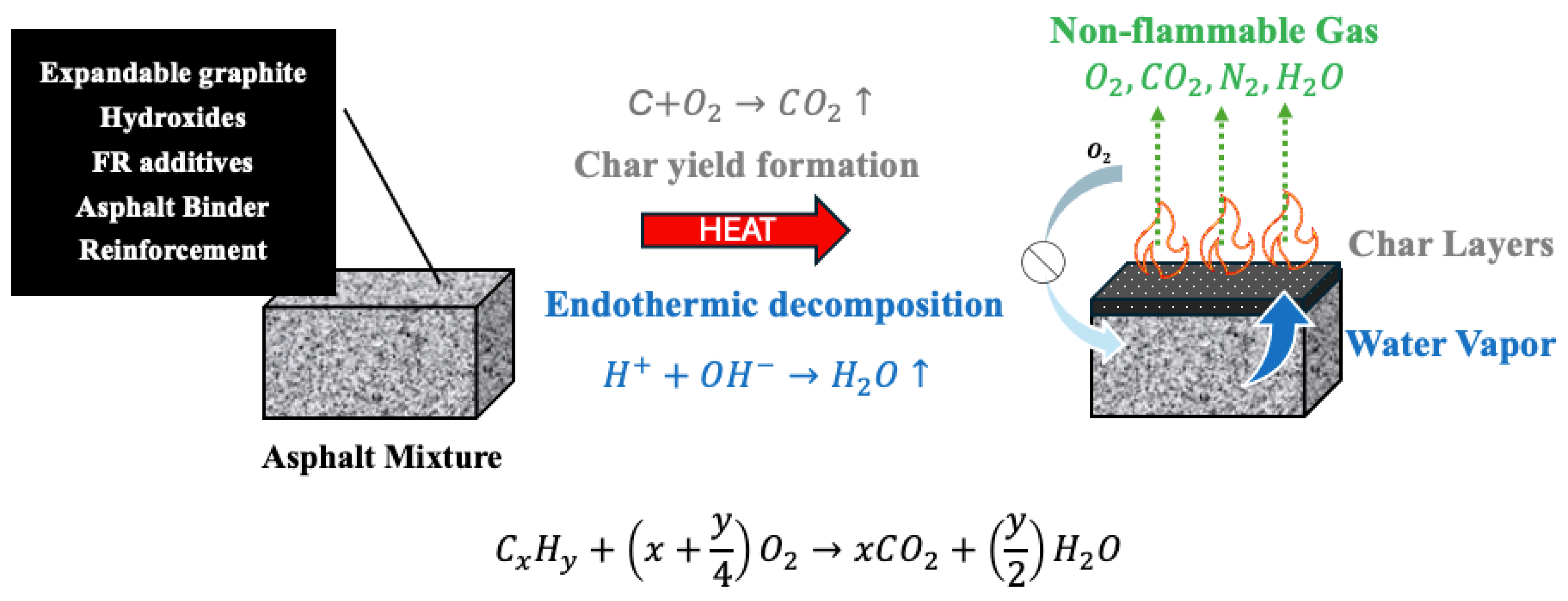
Fibres such as basalt and glass offer physical reinforcement that stabilizes char layers and enhances mechanical strength, thereby slowing fire propagation. Nanoparticles, including carbon nanotubes and nano-clays, deliver advanced barrier effects and radical scavenging capabilities that significantly bolster char integrity and reduce smoke emissions, albeit with challenges related to higher costs and dispersion. Synergistic combinations, such as MH with LDH, enable multi-stage FR mechanisms that optimize fire protection while maintaining pavement performance as shown in Figure 1. Ultimately, balancing fire safety, mechanical properties, and economic feasibility remains essential for developing next-generation asphalt composites tailored for high-risk infrastructure applications such as tunnels and enclosed roadways.
At elevated temperatures, asphalt binder components undergo thermal decomposition, producing volatile gases such as CO, CO2, and water vapor, alongside residual char layers. Flame retardants promote endothermic reactions that release water vapor, which absorbs heat and dilutes flammable gases, while simultaneously facilitating the formation of stable char layers that act as physical barriers, limiting oxygen diffusion and heat transfer to the underlying asphalt mixture. These combined chemical and physical effects slow combustion and enhance fire resistance. The schematic in Figure 1, drawn based on literature reports, highlights these processes and the role of flame retardants in modifying decomposition reactions and reinforcing protective char formation.
The combined use of fibres and nanoparticles produces synergistic effects, enhancing asphalt performance at both macro and micro scales [66,127,128]. Fibres provide structural reinforcement to inhibit crack propagation, while nanoparticles block heat transfer, oxygen ingress, and volatile emissions. Hybrid systems, such as basalt fibres with nano-clays or CNTs, have been shown to significantly reduce HRR, smoke density, and improve mechanical strength [129,130]. Key factors influencing performance include additive type, dosage, dispersion quality, particle size, and compatibility with base bitumen [66,131].
Table 2 provides a consolidated comparison of the major FR additives used in asphalt systems, including mineral compounds, bio-based materials, polymer modifiers, fibres, and nanoparticles. As shown in the table, each category exhibits distinct advantages and limitations depending on the intended application, dosage, and compatibility with asphalt binders. Collectively, the literature indicates a clear trend toward more sustainable and multifunctional FR strategies. Rather than treating FR asphalt as a single-purpose FR material, recent studies increasingly frame it as an integrated engineering solution that balances fire performance, mechanical durability, and environmental considerations. This shift reflects growing industry interest in adopting advanced FR systems that not only enhance fire safety but also contribute to the resilience and sustainability of modern road infrastructure.

3.4. Asphalt Properties and Their Role in Flame Retardancy

3.4.1. Mechanical Performance and Flame-Retardant Effects

Conventional asphalt mixtures, such as asphalt concrete and mastic asphalt, derive their strength primarily from the binder and aggregate interaction, which governs shear resistance and durability under service loads. Classical mechanical tests such as penetration, softening point, and ductility remain essential for evaluating binder consistency, thermal susceptibility, and fracture tolerance [148,149]. For instance, paving grade binders typically exhibit penetration values of 40 to 100 dmm at 25 °C, softening points around 45 to 55 °C, and ductility greater than 100 cm [150,151]. These parameters indicate that while conventional asphalt offers flexibility and strength, it is vulnerable to rutting at high temperatures and cracking under cold conditions. Flame retardant additives alter these mechanical responses in several ways. Acting as viscosity modifiers or surfactants, they enhance binder and aggregate adhesion and coating uniformity, which not only strengthens rutting resistance but also improves long term structural stability [152]. However, excessive stiffening can reduce ductility, making pavements more susceptible to brittle fracture, an effect particularly critical in cold climates where oxidative hardening already limits flexibility [153,154]. Thus, mechanical tests provide the baseline against which the performance trade-offs of FR modification can be judged.

3.4.2. Rheological Behaviour in Modified Asphalt Systems

Asphalt exhibits viscoelasticity, with elastic (solid like) and viscous (liquid like) behaviour depending on temperature and loading rate [155]. This duality dictates pavement performance: rutting predominates under slow, high temperature loading, while fatigue and cracking emerge under rapid, low temperature stress [156]. Rheological tests such as Dynamic Shear Rheometry (DSR), which measure the complex modulus (|G*|) and phase angle (δ), quantify this balance. A lower δ reflects more elastic recovery, while a higher δ indicates viscous flow [157]. FR systems including intumescent formulations modify these rheological properties by introducing polymeric or resinous additives that interact with asphaltenes and maltenes [158]. These typically enhance rutting resistance by increasing high temperature stiffness but may reduce fatigue life at intermediate temperatures. Nanomaterials such as graphene oxide, carbon nanotubes, or LDHs provide multifunctional benefits, simultaneously improving elasticity, storage modulus, and barrier effects while also delaying ignition [159]. Importantly, FR additives that excessively increase viscosity may hinder mix workability during construction, whereas softening may compromise rutting resistance. Thus, rheological characterization is crucial for optimizing FR formulations without sacrificing structural performance.

3.4.3. Thermal Characteristics and Combustion Resistance

The chemical composition of asphalt, primarily SARA, determines its thermal and flammability [35,48,160]. The binder content varies depending on the petroleum source and refining process, with higher levels of asphaltenes and saturated hydrocarbons, and lower levels of resins and aromatics. Polarity distribution affects colloidal stability, mechanical integrity, and fire sensitivity. Asphaltenes form a dispersed phase in maltene media, increasing stiffness and influencing flame spread [161,162].
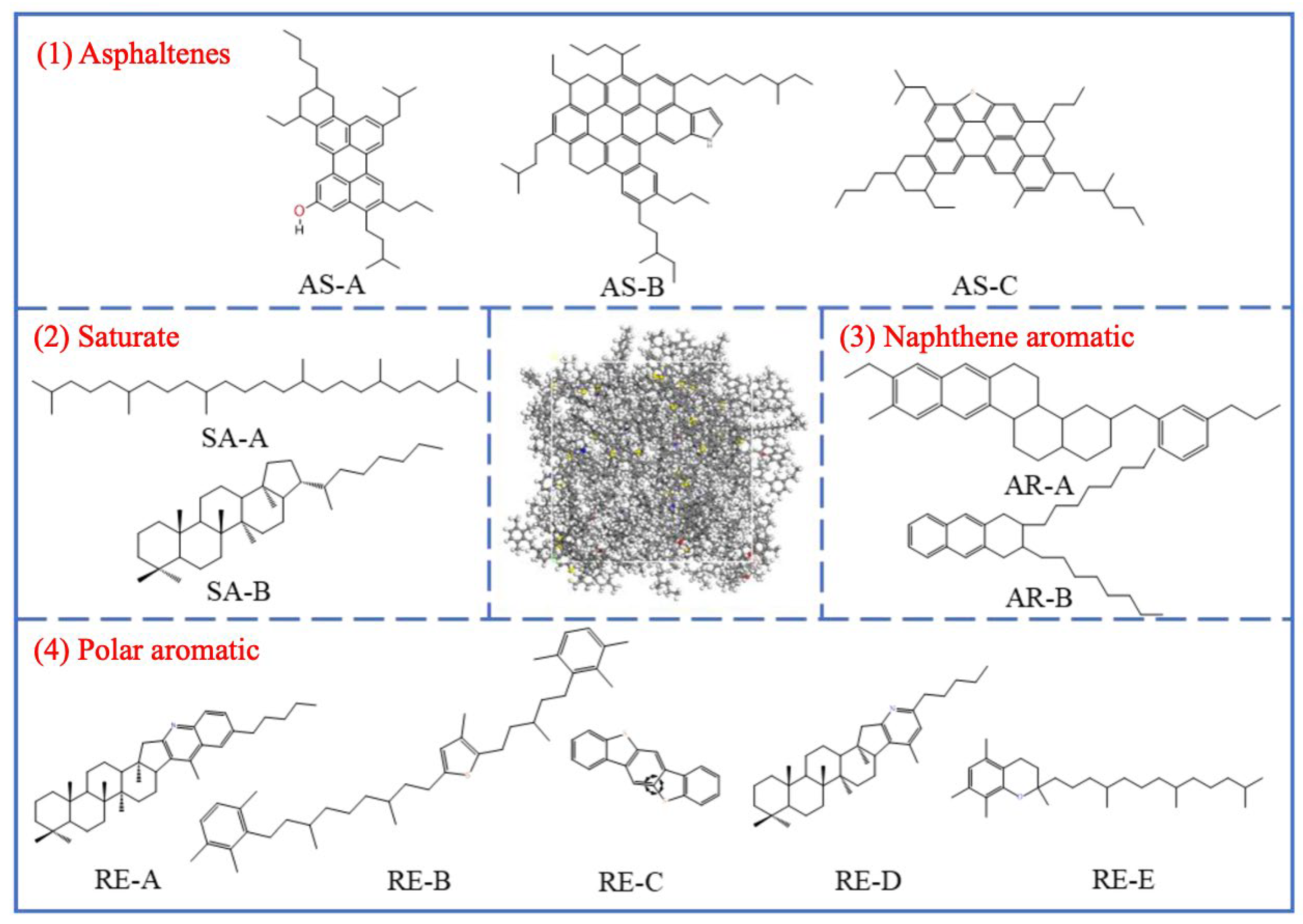
Figure 2 shows a typical molecular structure of asphalt. The most significant chemical characteristic of asphalt is its heterogeneity; therefore, all molecules must be considered for a true chemical description of asphalt [162]. The polarity balance within the colloidal system determines the stability of the binder: asphaltenes form a dispersed phase in maltene media, imparting stiffness to the binder and influencing flame spread. Asphalt itself is flammable because it is primarily composed of hydrocarbons (90% to 95%) and contains heteroatoms such as sulfur, nitrogen, and oxygen, as well as trace amounts of metals (nickel, vanadium, iron) [163].
Table 3 briefly summarizes how each property affects the performance of the pavement under fire conditions and illustrates the benefits and potential drawbacks of adding flame retardants. The presence of heteroatoms accelerates oxidative crosslinking during aging, leading to increased stiffness and brittleness of asphalt. Ultraviolet radiation and high temperatures exacerbate this oxidation reaction, generating carbonyl and sulfoxide groups, thereby reducing the flexibility of asphalt and promoting cracking [164]. Intumescent flame retardant systems slow down the decomposition of hydrocarbon-rich SARA components when heated [165]. By linking molecular structure and polarity distribution to flame retardancy, the inherent thermal vulnerability of asphalt stems from its chemical composition, and effective flame-retardant strategies must address both oxidative aging and hydrocarbon flammability.

4. Application of Asphalt

4.1. Overview

Based on the material properties discussed in the previous section, the practical value of asphalt is most evident in its wide range of engineering applications. As one of the most commonly used building materials in modern infrastructure, asphalt is widely used in civil, industrial, and emerging sustainable development projects due to its durability, cost-effectiveness, and ability to meet various performance requirements [166]. The primary use of asphalt remains in transportation infrastructure [167]. Each application places different mechanical and environmental requirements on asphalt mixtures; therefore, the selection of binder type, modifier content, and mixture design is crucial for achieving long-term performance. Accordingly, recent research has highlighted the importance of designing asphalt systems specifically tailored to local traffic conditions, climate change, and sustainable development goals [168,169]. These application-driven demands also underscore the importance of reliable evaluation methods, as the suitability of specific asphalt formulations (especially those modified with polymers or flame retardants) must be verified through standardized mechanical, thermal, and fire-resistant performance tests.
  • Building and Protective Applications
Beyond road infrastructure, asphalt plays a critical role in building construction as a waterproof and protective material. Asphalt is used in roofing shingles, roll roofing, built-up roofing membranes, and waterproof coatings, offering durable and cost-effective protection against water penetration [170]. Pasetto et al. demonstrated that recycled asphalt shingles for transport infrastructure promote economic sustainability in variable climates [171]. This expands the functional value of asphalt beyond infrastructure into durable building protection.
  • Recycling and Sustainability
Asphalt’s recyclability is a core strength in sustainable construction. Reclaimed asphalt pavement (RAP) can be incorporated into new mixtures without significant compromise to performance [172]. Bressi et al. quantified that containing RAP reduces the primary energy demand and the CO2-eq. emissions per ton of material in relation to those associated with the reference solution [173]. Recycling asphalt reduces landfill waste and construction costs, contributing significantly to environmental sustainability and circular economy principles [174,175]. Alizadeh et al. [176] confirmed the economic benefits of RAP integration, while Boaventura et al. [177] showed that RAP use does not negatively affect drainage or soil stability.
  • Industrial Applications
In industry, asphalt is applied for damp-proofing, protective pipe coatings, soundproofing, and railway track beds [178]. Setiawan et al. found that asphalt track beds enhance vibration isolation, improve drainage, and reduce noise transmission, thereby improving long-term track performance [179]. This demonstrates asphalt’s multifunctional nature in specialised industrial environments.
Performance modifiers significantly expand asphalt’s adaptability. Polymer-modified asphalt (PMA), nano-modified asphalt, bio-asphalt, and rubberized asphalt enhance mechanical durability, thermal stability, and fire resistance [180,181]. Nanomaterials such as nano-clay and nano-silica improve ignition resistance, making asphalt suitable for tunnels and wildfire-prone areas [182,183]. These modifiers ensure asphalt remains competitive in performance-intensive applications [184].

4.2. Circular Economy Contributions

Bio-based flame retardants can improve fire resistance and reduce emissions of toxic substances [185]. For example, natural polymers such as lignin, chitosan, and alginate can promote char formation and slow the release of volatile substances [186,187,188,189,190]. Flame-retardant polymers (FRPCs) can also enhance the cohesion, insulation, and mechanical strength of binders [191]. The combination of hydroxyapatite-polydopamine with SBS-modified bitumen can improve interfacial adhesion and fire resistance [192]. Despite these advantages, large-scale application of biomass-derived materials still faces challenges in terms of fire resistance after aging [193,194,195,196].
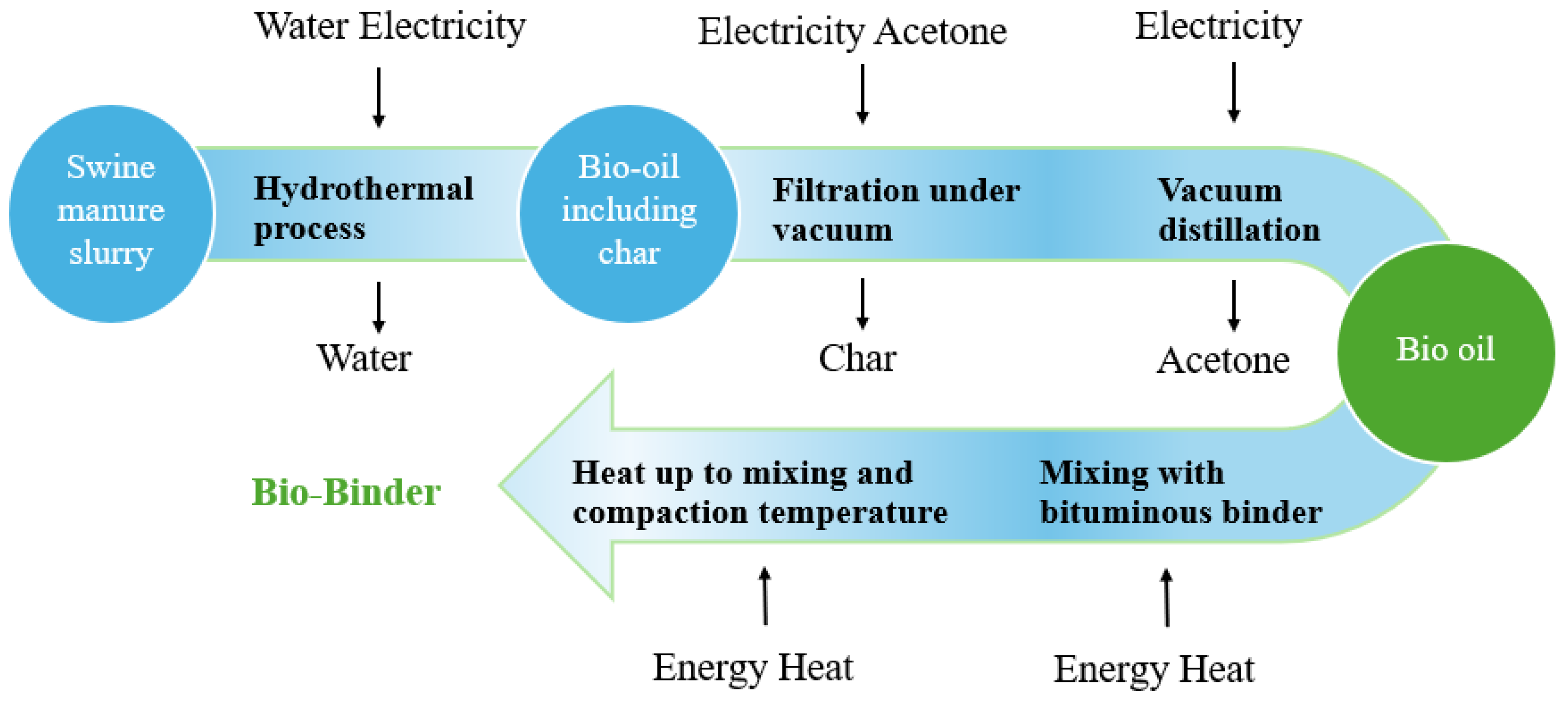
In addition to bio-based binders, industrial byproducts are also sustainable aggregate alternatives. Residues from the palm oil industry, including palm oil clinker, fibre, palm kernel shells, and fuel ash, have been successfully incorporated into bitumen mixtures [197,198,199,200]. This dual benefit aligns with circular economy principles, reduces dependence on virgin aggregates and bitumen, lowers greenhouse gas emissions, and improves environmental performance [201,202,203,204]. Figure 3 shows the production process of bio-adhesives, illustrating how biomass feedstocks are converted into bio-oils. In summary, the combination of bio-based adhesives and industrial by-products provides a pathway for developing sustainable refractory bitumen mixtures that balance environmental objectives and economic feasibility [205].
Asphalt has also gained increasing attention for its potential in waste utilization and environmental protection. While its largest application remains in road and highway construction, significant use is also found in building projects, industrial applications, recycling initiatives, and sustainability-oriented retrofits [206]. This distribution reflects both the traditional dominance of asphalt in transportation infra-structure and the growing importance of sustainable, high-performance, and circular economy solutions [207]. In essence, asphalt has evolved from a conventional paving material into a versatile engineering resource capable of meeting diverse mechanical, environmental, and economic demands [208]. These broad and evolving applications further underscore the need for reliable and standardized evaluation methods to ensure that both conventional and modified asphalt, particularly formulations incorporating polymers or flame retardants which can achieve the required performance in varied service environments.

5. Evaluation Methodology

The combination of precision manufacturing processes, comprehensive experimental testing, and advanced computational modelling provides a comprehensive framework for developing flame-retardant asphalt mixtures that meet the safety and durability standards for practical infrastructure applications [209]. Post-fire assessments, including residual stiffness and crack resistance, validate that flame-retardant modification does not affect the long-term durability of pavements. Computational simulations such as FEA and thermodynamic models can predict thermal gradients, stress distributions, and degradation kinetics, and capture the interactions between binders, aggregates, and additives. These tools can improve the accuracy of performance predictions by simulating emissions and potential toxic byproducts, guide mixture optimization, and support life cycle and environmental impact assessments [210].

5.1. Fire-Performance Assessment Techniques

When evaluating the fire resistance of asphalt, the cone calorimeter method conforming to ASTM E1354 is recommended as the primary evaluation method [26]. This technique reliably and repeatably measures ignition behaviour, exothermic rates, and combustion characteristics under controlled, application-relevant conditions. For a deeper understanding of thermal decomposition mechanisms, microscale techniques such as microscale combustion calorimetry (MCC) and TGA can be used as supplementary methods.
Table 4 summarises the key experimental techniques used to evaluate FR asphalt, each offering different scales, parameters, and insights. No single method can capture the full thermal and fire behaviour of FR asphalt. Cone calorimetry remains the benchmark for ignition and heat release analysis but is often supplemented by micro-scale methods such as MCC and TGA, which provide detailed decomposition information but lack real-world combustion conditions. Coupled tools like FTIR-TGA reveal gas-evolution pathways, though they require specialised interpretation. Rheological tests (e.g., DSR) offer valuable post-fire mechanical data but do not measure combustion directly. Therefore, combining thermal, mechanical, and chemical techniques is essential for a comprehensive assessment of FR asphalt performance.

5.2. Fabrication

As agencies shift towards performance-based design approaches, the importance of understanding the fabrication methods of asphalt mixtures has increased significantly. Specimen preparation, including material handling, mixing temperatures, equipment, and compaction techniques, can critically influence the measured performance characteristics of the resulting asphalt mix. In the context of rubberised asphalt, three main fabrication processes are commonly employed to incorporate Crumb Rubber Modifier (CRM) into the asphalt system: the Wet Process, the Dry Process, and the Semi-Wet Process. Each process follows a unique method of integrating rubber into the mix, which significantly affects the resulting material performance [217].

5.2.1. Dry Process (DP)

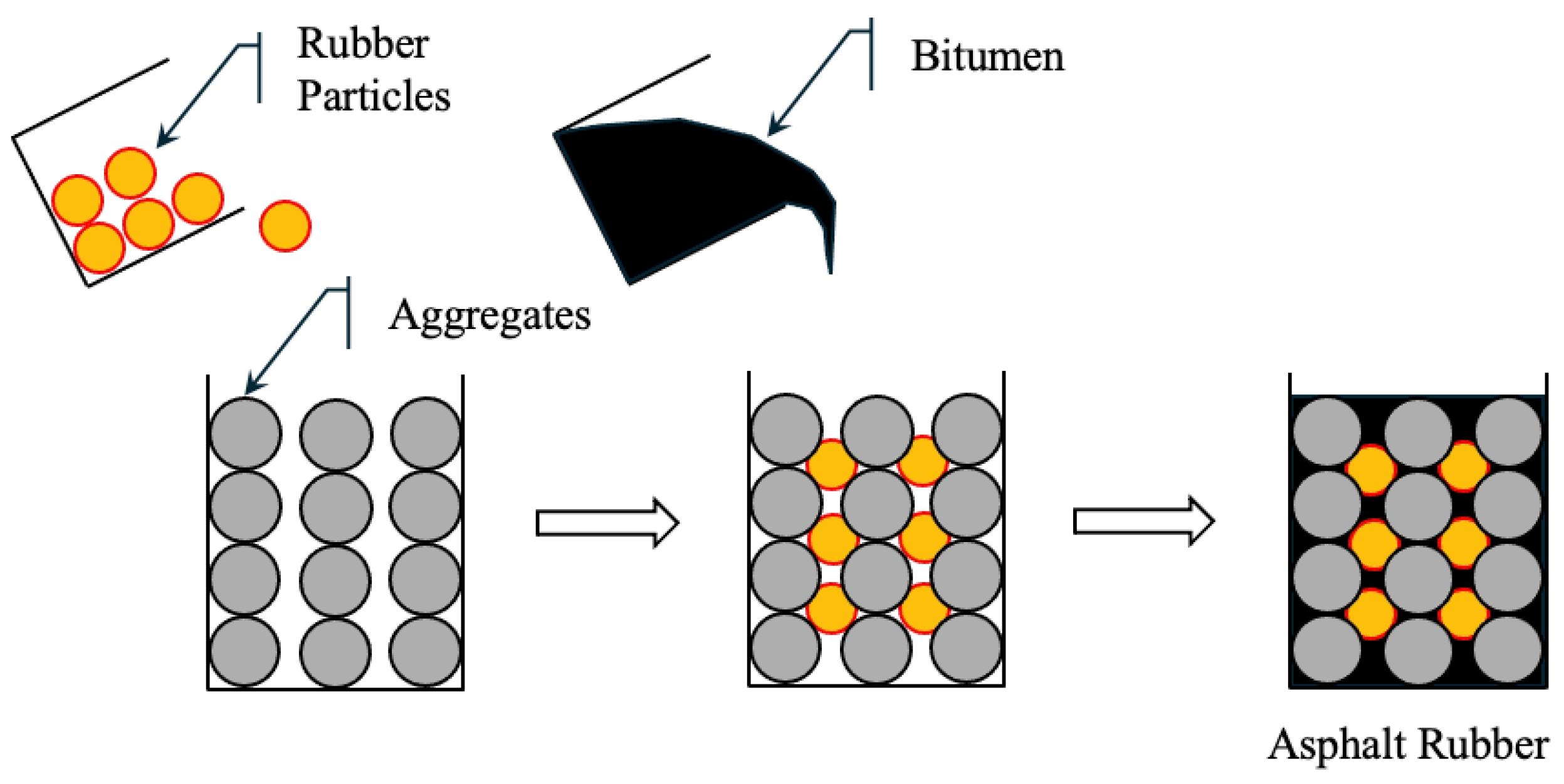
In DP, CRM is incorporated directly into pre-heated aggregates prior to the addition of hot binder. Unlike the wet process, the rubber is not pre-reacted with bitumen but is instead dispersed during the final mixing and compaction stages. CRM in this case acts more as a filler or elastic aggregate component than a binder modifier. CRM is first blended with aggregates and then mixed with binder. This method is also illustrated schematically in Figure 4, showing the sequential addition of rubber, aggregates, and bitumen [218]. This approach offers several advantages, including lower equipment requirements and simpler production. It is a cost-effective alternative for incorporating recycled rubber into asphalt mixtures. A notable commercial application of this method is the PlusRide™ system [219]. However, the performance of DP mixes can be inconsistent due to limited interaction between the rubber and binder, potentially affecting long-term durability, fatigue resistance, and overall mechanical performance.

5.2.2. Wet Process (WP)

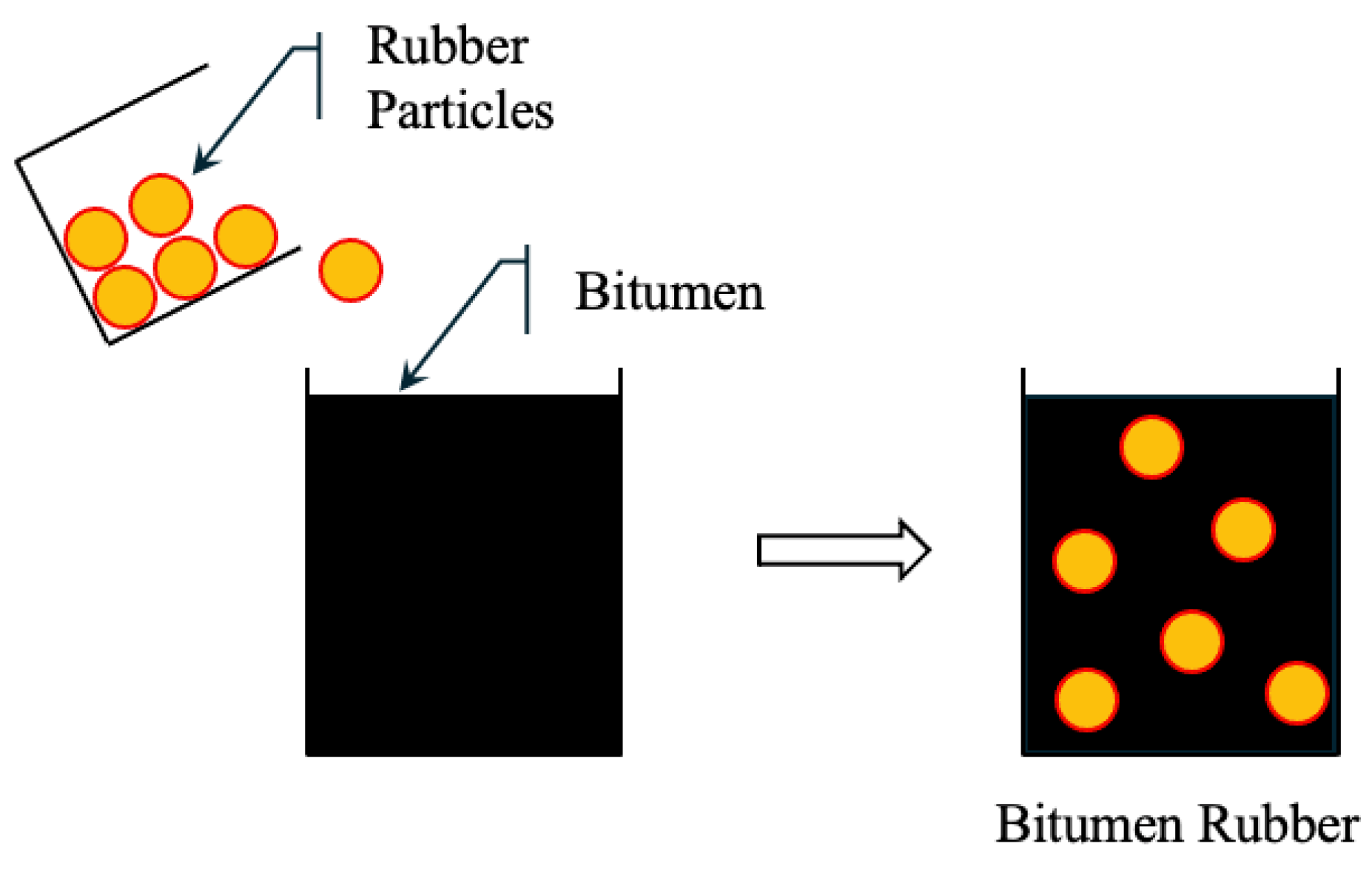
In the wet process (WP), finely ground CRM is mixed with hot bitumen binder (typically with a penetration of 60/70) in a high-shear mixer. The rubber undergoes partial digestion and expansion, and sometimes partial depolymerization, resulting in an asphalt–rubber (AR) binder with enhanced mechanical and rheological properties. The AR binder is then mixed with aggregates to form rubberized bitumen. Figure 5 shows rubber particles uniformly dispersed in the binder [218]. WP mixtures offer higher elasticity, rutting resistance, and crack resistance, making them suitable for high-stress applications. However, the process requires specialized equipment and strict temperature and time control, which increases cost and operational complexity.

5.2.3. Semi-Wet Process (SWP)

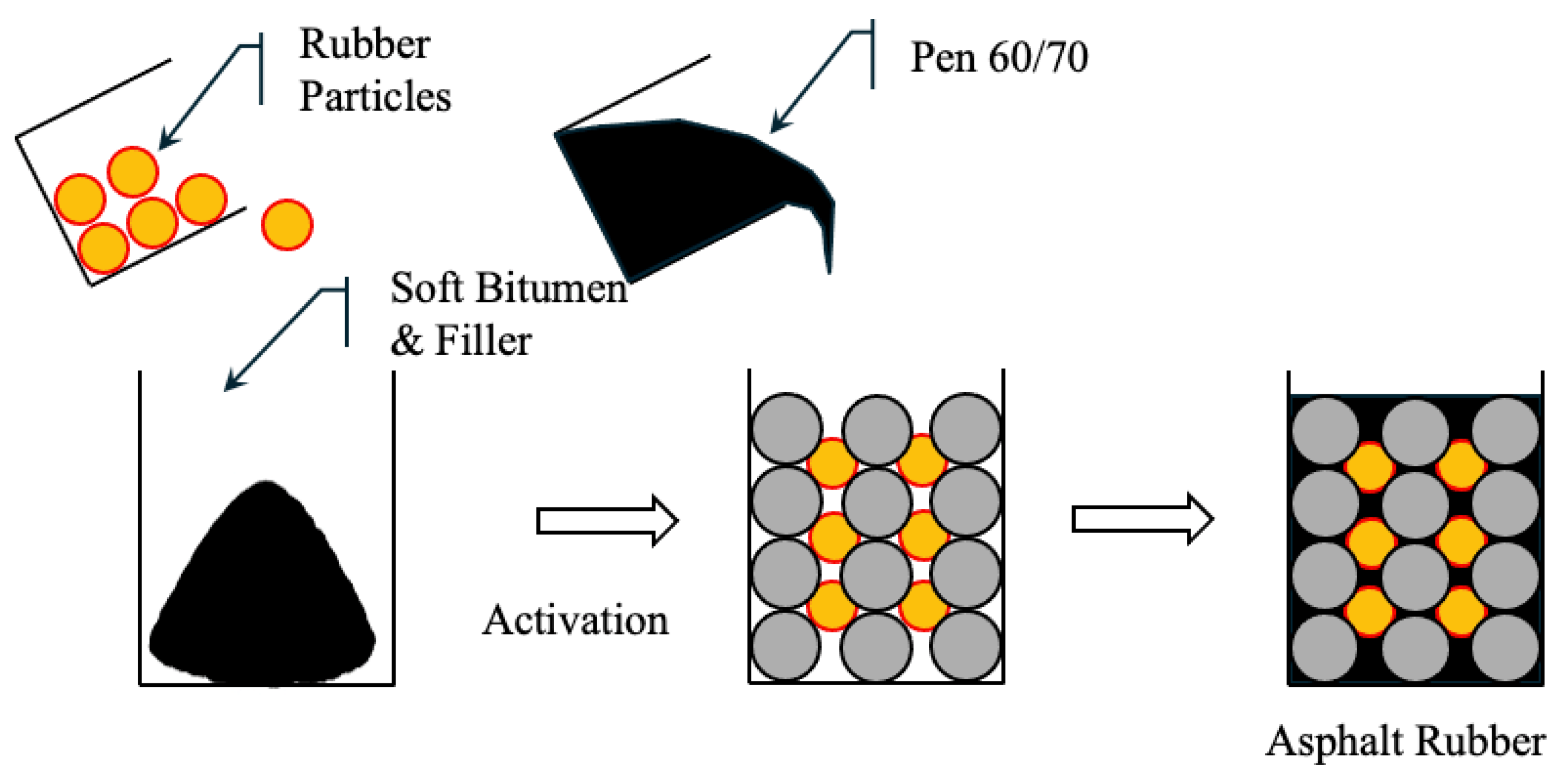
The semi-wet process is a hybrid technique that combines the advantages of wet and dry processes while reducing their limitations. As shown in Figure 6, this method is well-suited for RAP) where mixing efficiency and binder compatibility are critical. In this method, CRM is first mixed with soft asphalt and mineral fillers to produce active rubber particles (ARP). These particles are partially digested and pre-expanded to improve their compatibility and dispersibility in asphalt mixtures. The active rubber particles are mixed with aggregates and then a conventional 60/70 penetration grade binder is added to form a homogeneous rubber-modified asphalt mixture. The production process of active rubber particles involves mixing 60/70 penetration grade asphalt with 20 wt% of aromatic extract (viscosity of 25 mm2/s at 100 °C) in a high-speed shear mixer at 1000 rpm for 10 min [217] to produce a soft binder (penetration 115) that enhances the absorption and expansion of the rubber. This creates an oil-free particle surface, thereby improving its interaction with aged and new asphalt. In addition, lime filler (<75 μm) is used to enhance the particle structure. The process requires only some basic equipment, such as a temperature-controlled heating vessel and a standard mixer, so it can be adopted by small asphalt producers [220].
Table 5 summarises the advantages and limitations of each rubber modification process used in asphalt. The WP provides high performance but involves greater cost and operational complexity. The DP is more economical and straightforward, though it may result in inconsistent performance due to limited binder–rubber interaction. The SWP offers a balanced solution, combining good performance with moderate equipment and processing requirements.
SWP produces a dense and cohesive structure, ensuring that the rubber is uniformly dispersed in the asphalt matrix. This structural consistency significantly improves properties such as elasticity, temperature resistance, and crack resistance. It has better compatibility in RAP applications and does not require expensive specialized equipment [219]. Therefore, it is a balanced and efficient solution for producing rubber-modified asphalt.

5.3. Characterisation

Understanding the mechanical properties of asphalt mixtures is crucial for evaluating the effectiveness and practical application of flame-retardant materials. While flame-retardant additives primarily improve combustion performance, they also significantly alter the stiffness, tensile strength, resistance to deformation, and high-temperature structural stability of asphalt. These mechanical responses determine the performance of asphalt under thermal stress during fire exposure and influence crack propagation, fatigue resistance, and permanent deformation after heating. Therefore, this section introduces mechanical tests, including tensile testing, fatigue testing, rutting testing, thermal characterization, combustion assessment, and microstructure analysis. These provide key information for a deeper understanding of the interaction between flame-retardant mechanisms and material durability. Integrating these methods allows for a more comprehensive understanding of the performance of asphalt under coupled mechanical and thermodynamic conditions, thereby supporting the design and optimization of next-generation flame-retardant asphalt systems.

5.3.1. Tensile and Compressive Testing

Tensile and compression tests are important methods for evaluating the mechanical properties of asphalt binders and mixtures under stress. They are particularly suitable for studying the performance of materials in application environments where degradation is likely to occur [221,222,223]. By measuring properties such as strength, stiffness, and fracture strain, these tests help determine the conditions under which flame-retardant asphalt begins to fail or lose its functional capacity.
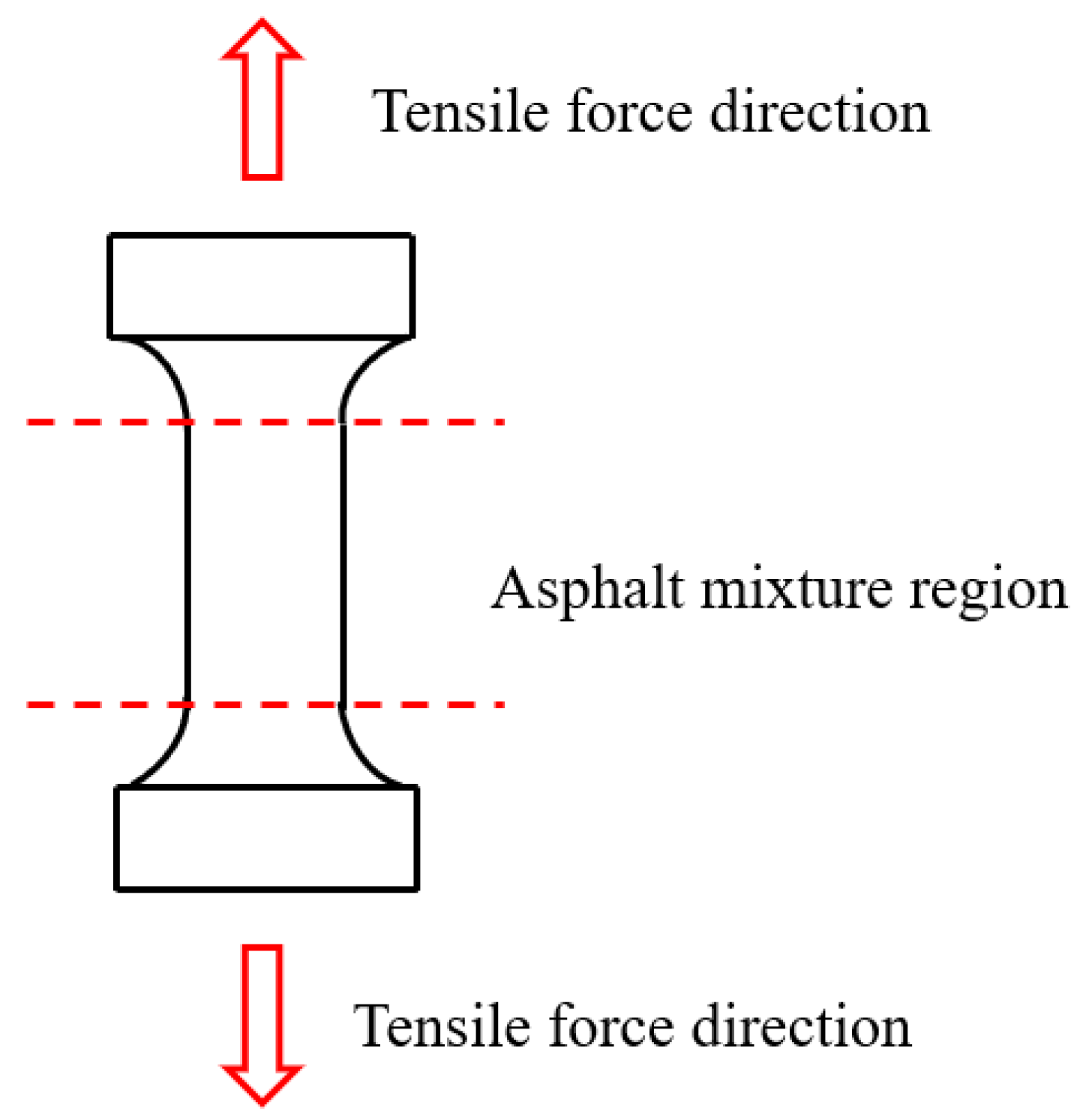
Figure 7 presents the tensile testing apparatus for asphalt mortar specimens. Dog-bone shaped specimens are cast in multiple molds to ensure consistent geometry and uniform stress distribution. After curing, the specimens are demolded, trimmed, and their mass and dimensions are checked for uniformity to ensure the repeatability of the test results. During the test, a controlled uniaxial load is applied along the longitudinal axis until fracture, allowing for a quantitative assessment of tensile properties and failure mechanisms [224].
Temperature control during testing ensures consistency with curing conditions, enabling reliable assessment of mechanical behaviour under simulated thermal environments. Tensile testing is particularly important for evaluating cracking resistance and flexibility, as asphalt mixtures generally become more brittle under thermal stress [225].
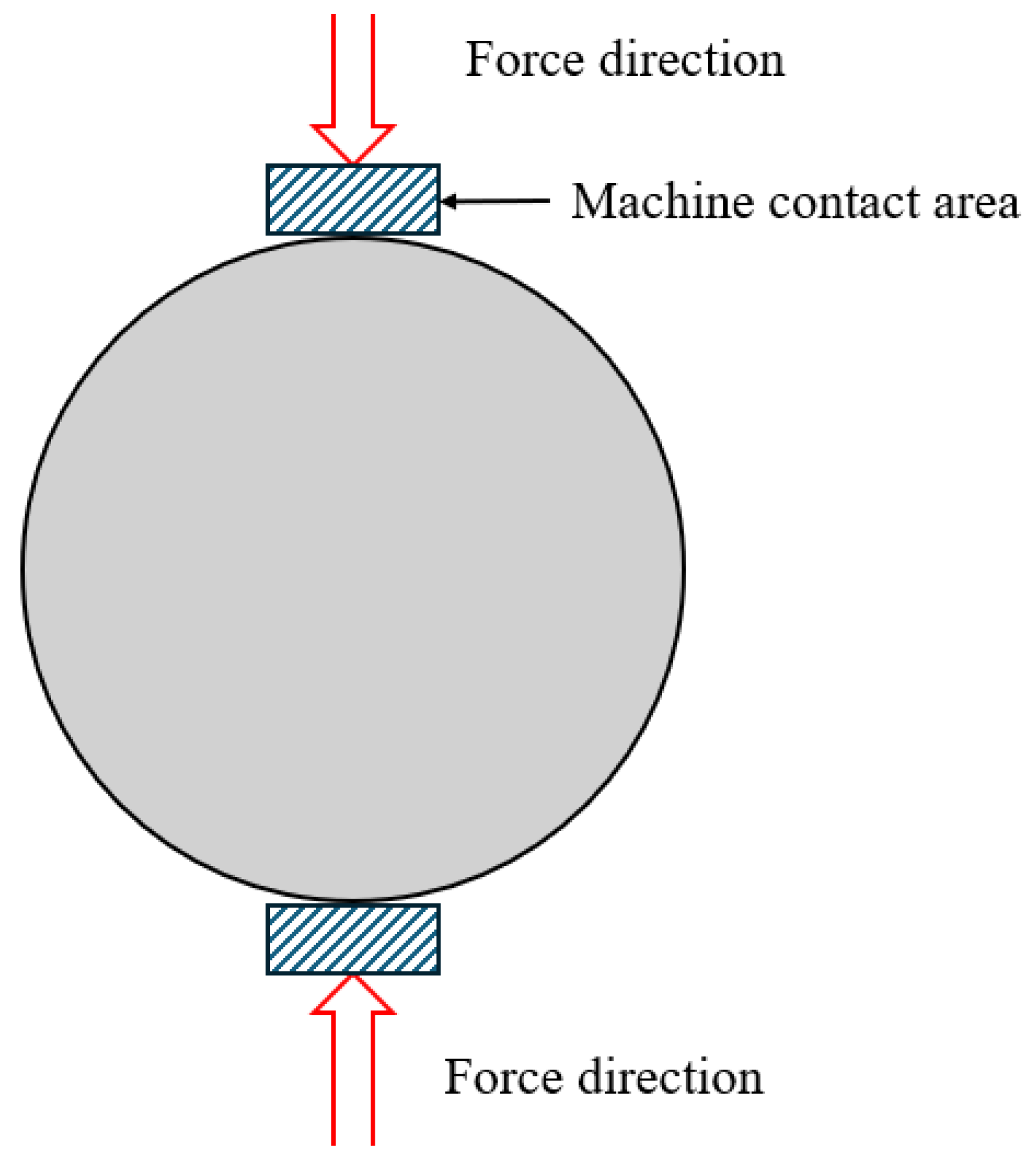
Indirect tensile strength (ITS) testing provides a complementary method for assessing tensile properties under compressive loading. As shown in Figure 8, a compressive load is applied along the diameter of a cylindrical specimen, producing tensile stress perpendicular to the load direction. This test is performed according to EN 12697-23. It assesses the tensile properties induced by compressive loads, providing in-depth insights into crack resistance and structural temperature. Its principle is to assess crack resistance through vertical tensile cracking, thereby indirectly determining tensile strength. The ITS test is simple, reproducible, and suitable for both laboratory and field testing, making it a widely used testing method. In addition to assessing combustion kinetics and thermal decomposition, ITS and compression tests provide a comprehensive evaluation of the fire resistance of bitumen, enabling researchers and engineers to select the most appropriate testing method.
The tensile strength is calculated based on the peak applied load and the specimen’s geometric parameters using Equation (1).
σ = 2 P π d t
where
  • σ = horizontal tensile strength (GPa);
  • P = applied load at failure (kN);
  • d = specimen diameter (mm);
  • t = specimen thickness (mm).
The main advantages of the ITS method include simple specimen preparation, short testing time, low equipment requirements, and low result variability. It can provide in-depth analysis of the bond strength, crack resistance, and fracture behaviour of asphalt mortar under stress. Based on elasticity theory, although the stress distribution is inherently three-dimensional, two-dimensional analysis can effectively simulate the tensile response under specific loads and geometries. Therefore, the comprehensive application of direct tensile strength, indirect tensile strength, and compressive strength tests is the foundation of the performance design method for flame-retardant asphalt systems. This comprehensive testing strategy is particularly important for infrastructure in high-risk environments such as tunnels, airports, and bridge decks [226,227,228].

5.3.2. Fatigue Testing

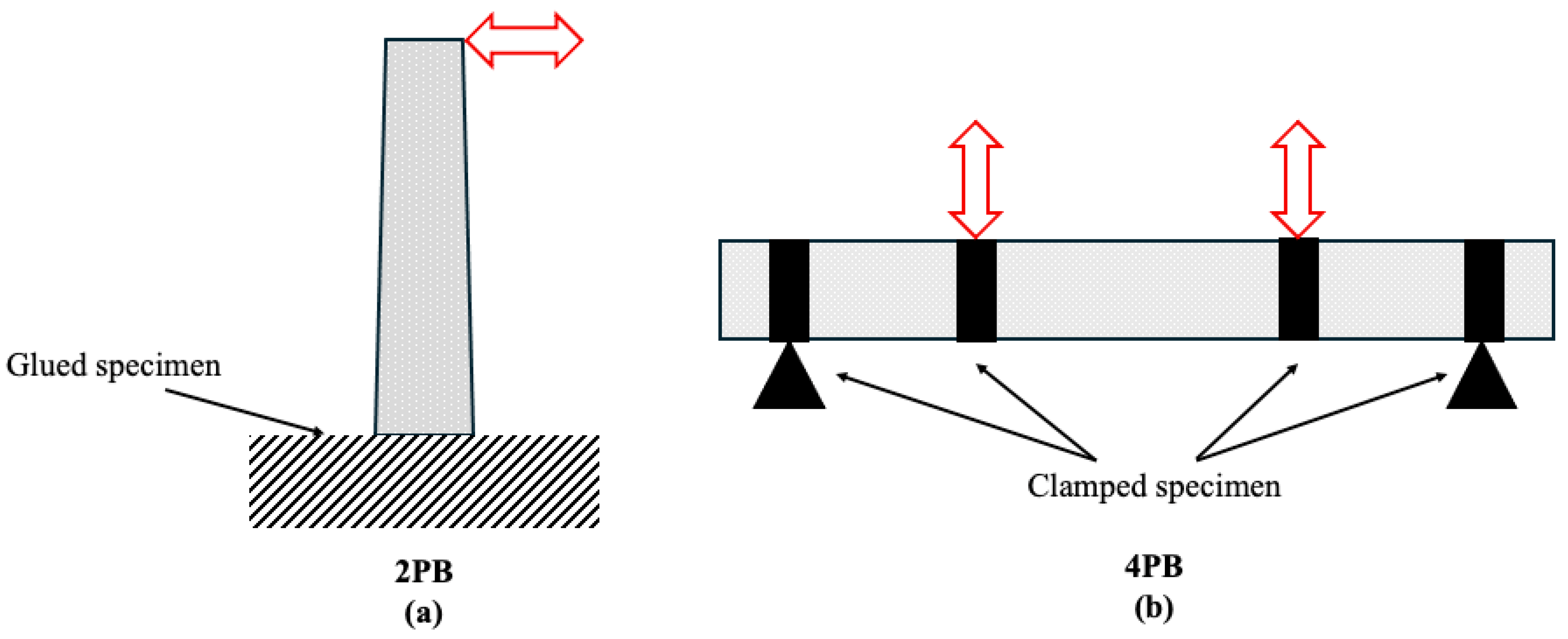
In addition to tensile and compressive strength assessments, fatigue testing is crucial for evaluating the long-term mechanical durability of asphalt mixtures under cyclic loading. Commonly used fatigue testing methods include uniaxial and triaxial compression fatigue tests, as well as the four-point bending beam (4PB) test, the latter being particularly suitable for applications requiring enhanced mechanical toughness [229]. To more realistically capture the conditions of flammable environments, thermomechanical fatigue testing combines high temperatures and cyclic loading. Figure 9 shows the loading configurations and geometric dimensions for both tests, with (Figure 9a) two-point bending (2PB) test and (Figure 9b) four-point bending (4PB) test. These methods reflect the synergistic effect between thermal and mechanical stresses, providing a more comprehensive understanding of how these conditions degrade pavement performance over time [230]. European standards evaluate fatigue using 2PB on trapezoidal and 4PB on prismatic specimens.
Fatigue tests were conducted at various strain amplitudes to obtain a series of fatigue lives (N). Damage curves were generated by plotting the relationship between secant pseudo stiffness (C) and damage parameters for each cycle [231]. During a typical fatigue test on asphalt materials, three distinct phases of stiffness degradation can be observed [229]:
  • The rate of stiffness reduction decelerates.
  • Stiffness decreases in a nearly linear fashion.
  • Stiffness reduction accelerates rapidly.

5.3.3. Wheel-Tracking Test (Pavement Evaluation)

Rutting, or permanent deformation, is a critical performance indicator for asphalt mixtures. Among the available laboratory methods, the wheel-tracking (WT) test is considered one of the most reliable because it closely replicates real traffic conditions. Rutting develops through two primary mechanisms: shear deformation (lateral material movement) and compaction (volume reduction). Shear failure typically occurs within the upper 100 mm of the pavement, especially in hot mix asphalt (HMA) layers, but can penetrate deeper when material support is insufficient. Under repeated loading, rutting forms as a longitudinal depression in the wheel path, often accompanied by lateral heaving [220].
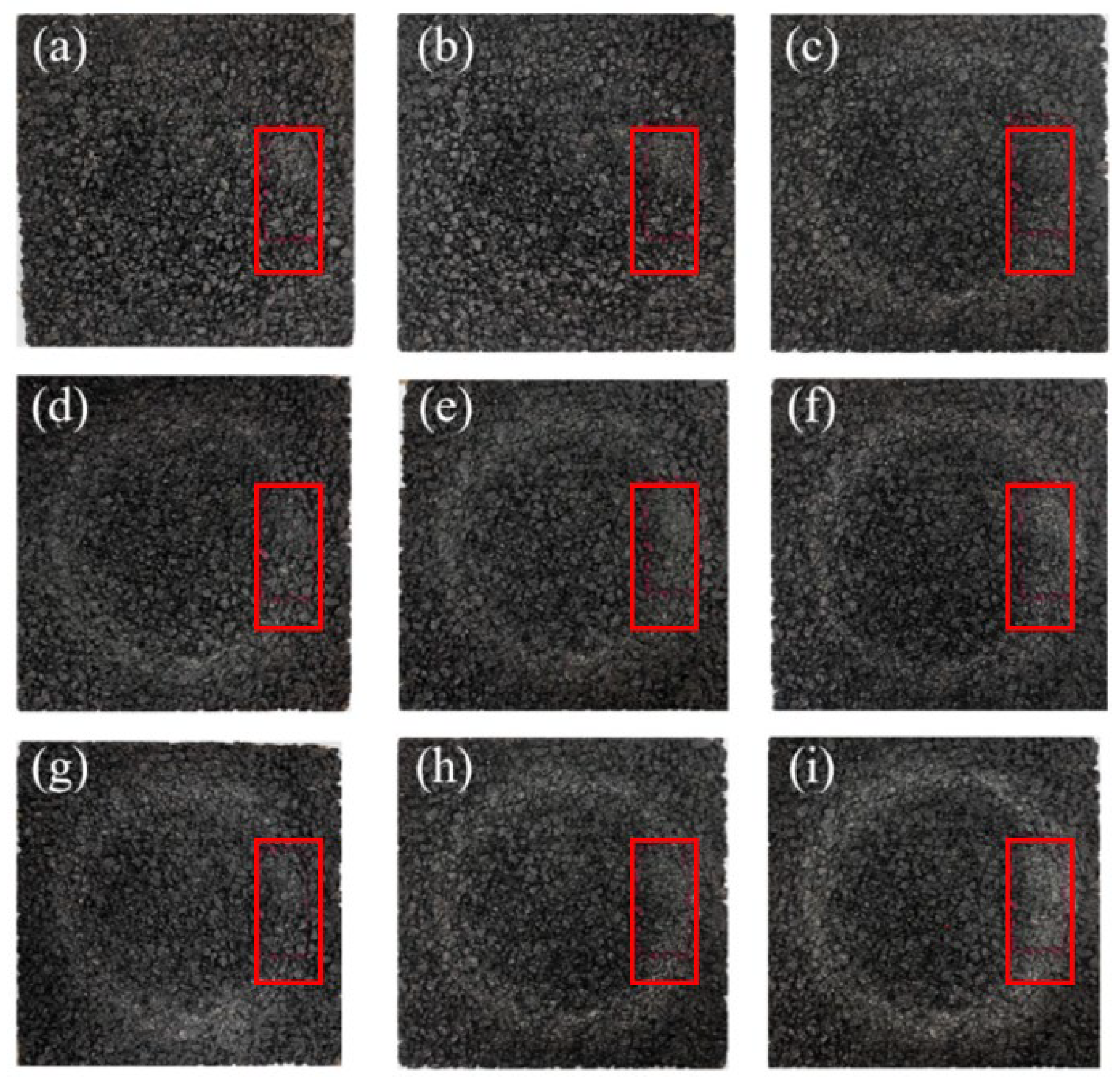
Laser texture scanners were used to measure the macrotexture of the road surface before and after different wear levels, quantifying the texture changes caused by friction tests. Multiple wear cycle stages were scanned within the 80 mm × 40 mm rectangular area shown in the red box in Figure 10, corresponding to the intervals of friction test cycles from 0 to 220k cycles. The mean profile depth (MPD) of the road surface macrotexture is a standard parameter for quantifying the texture related to skid resistance and drainage, where the initial MPD (MPD0) is taken from the unworn area, and the mean profile depth (MPDa) after gradual wear is taken from the scan results of the rut area. The road wear index (PWI) represents the degree of texture degradation, as shown in Equation (2), by converting the ratio of the current MPD to the initial MPD of each surface into a percentage [232]. Higher PWI values indicate better pavement texture retention.
P W I = M P D a M P D 0 × 100 %

5.3.4. Combustion Behaviour

Cone calorimeter testing is a commonly used standard method for evaluating the flammability and combustion behaviour of materials, including asphalt mixtures. By measuring key parameters such as ignition time, HRR, total heat release (THR), smoke production, and mass loss, this test provides a comprehensive understanding of the combustion performance of asphalt under controlled heat flux conditions (ISO 5660-1) [27,212,233].
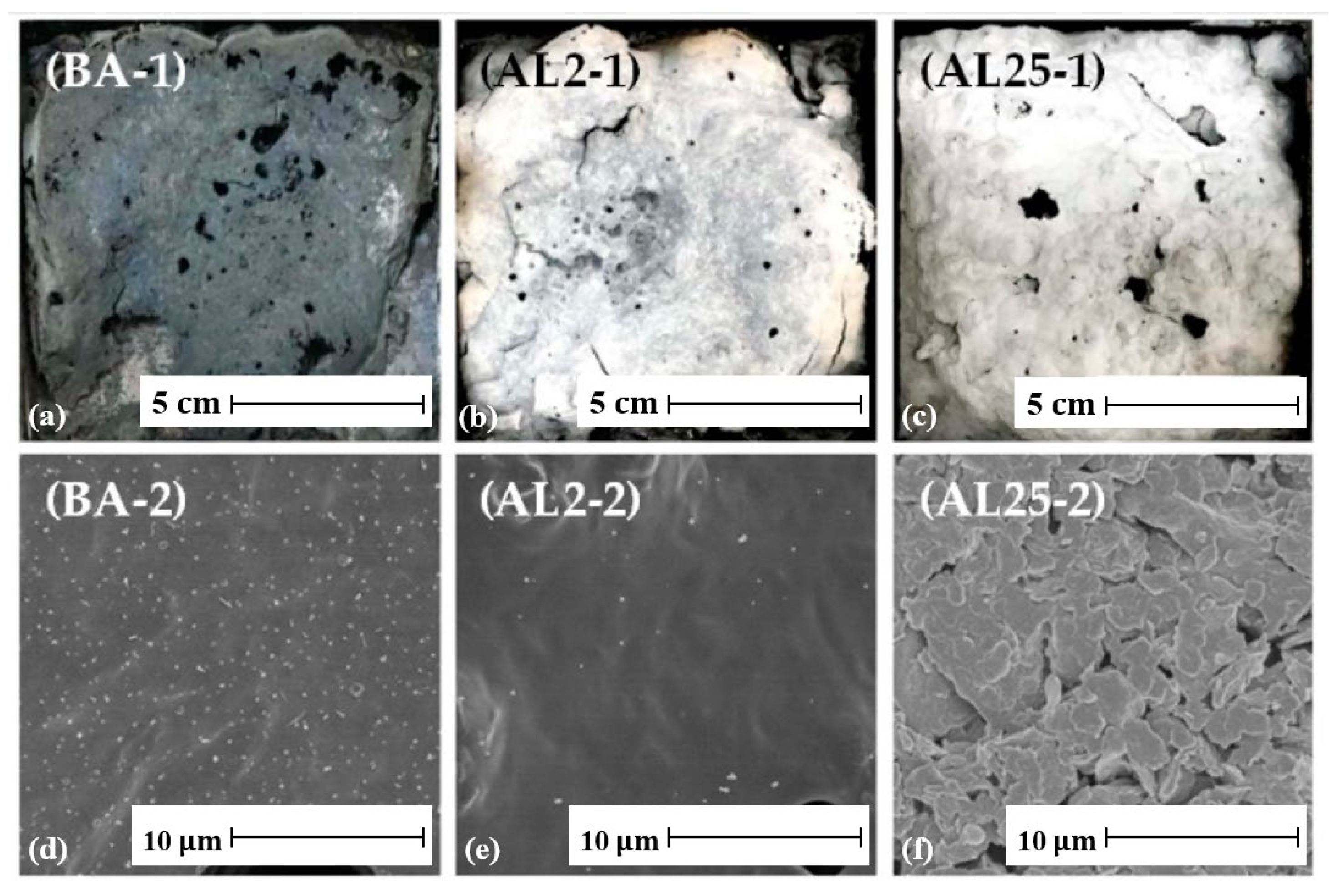
This test can also reveal the formation of the barrier layer. Figure 11 shows digital photographs and scanning electron microscope (SEM) images of the residues after the test. The digital photographs (Figure 11a–c) show that AL2 (2 wt.% LDHs) and AL5 (5 wt.% LDHs) retained more structural residues than the base asphalt (BA), indicating better flame retardant properties and a denser, more continuous char layer with fewer surface pores. Scanning electron microscopy results (Figure 11d–f) show that BA forms porous residues due to the release of volatile gases during pyrolysis, while AL2 forms a smoother, crack-free surface, effectively limiting the escape of combustible gases and restricting the transfer of heat and oxygen. The uniform dispersion of LDH also stabilizes the carbon layer. When the LDH content is high, AL25 exhibits a sintered layered morphology, which is due to the structural collapse after LDH decomposition, indicating that the dispersion problem hinders the formation of an effective barrier layer [234].
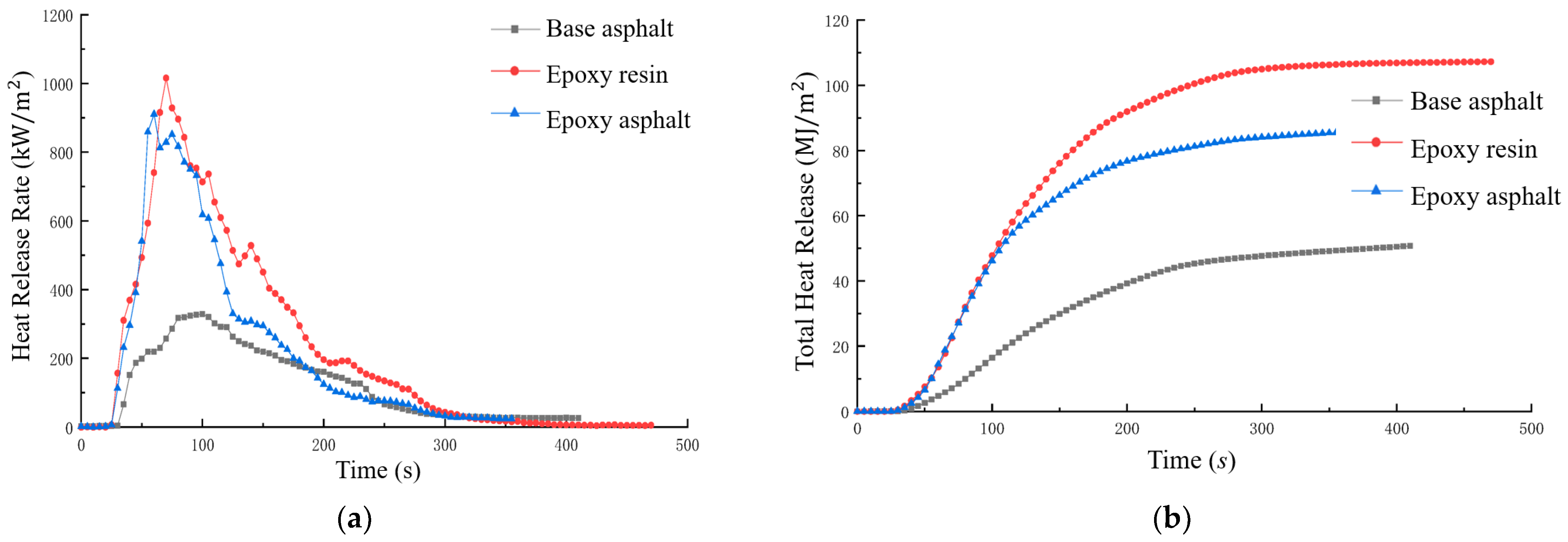
The ignition temperature of bitumen is typically between 420 and 450 °C, as determined by cone calorimeter testing [235]. This threshold is influenced by factors such as binder content, aggregate gradation, and flame retardant additives. Additives such as APP and EG have been shown to improve fire resistance by reducing peak HRR and slowing degradation [70,77,79,81]. Figure 12 shows the (Figure 12a) HRR and (Figure 12b) THR of different bituminous epoxy resin samples, highlighting the role of additives in reducing HRR and THR by more than 50% [236].

5.3.5. Thermal Behaviour

Thermal properties are crucial for evaluating the performance and durability of asphalt binders. Thermogravimetric analysis (TGA) is widely used to assess thermal stability and decomposition by tracking mass loss under controlled heating conditions. TGA typically involves heating a small sample (5–10 mg) in a nitrogen atmosphere at a heating rate of 10–20 °C/min to prevent oxidation, followed by heating in an oxygen–nitrogen mixture above 550 °C to analyse combustion. This method allows for a detailed assessment of thermal degradation and oxidative stability [29].
The thermal degradation behavior of CRM particles under a nitrogen atmosphere can be described based on the characteristic patterns observed in TGA and derivative thermogravimetric (DTG) analyses. The mass-loss profile shows three distinct decomposition stages corresponding to the breakdown of different rubber components. The initial decomposition stage occurs at the onset of heating, where a small mass loss is detected as the least stable components begin to volatilize. This is followed by the primary decomposition stage, which represents the most significant mass-loss event. Natural rubber typically undergoes rapid degradation between 300–400 °C, while synthetic rubber decomposes mainly between 400–500 °C [224], producing the main DTG peak associated with the highest rate of mass loss. After this major event, a secondary and slower degradation stage is observed at higher temperatures. This stage reflects the decomposition of carbon-rich residues, fillers, and stabilizers, resulting in a gradual decline in mass until a stable char portion remains.
These characteristic temperature intervals and decomposition features provide valuable indicators of the aging behavior of recycled rubber asphalt. Furthermore, the degradation index estimated from the TGA curve offers a quantitative measure of polymer deterioration within recycled RAP materials [237].
To further characterise thermal degradation mechanisms, TG and DTG curves for epoxy asphalt, revealing three primary degradation stages: (1) resin and hydrocarbon decomposition below 387 °C, (2) cracking and gas evolution from 387–467 °C (peak ≈ 440.8 °C), and (3) combustion of residuals and semi-coke between 467–580 °C (peak ≈ 510.9 °C) [236]. These results indicate that the degradation mechanism of epoxy asphalt is gradual, involving polymer decomposition, volatile release, carbonization, and oxidation. These findings are crucial for the development of flame-retardant asphalt mixtures, enabling targeted use of additives and design adjustments based on thermal properties. However, generalizing laboratory results to real-world fire scenarios and understanding the long-term effects such as additive synergy and material aging remain challenges [238].

5.3.6. Microstructure

Microstructural characterisation of asphalt binders and mixtures is vital for understanding their performance and durability. SEM provides high-resolution imaging of asphalt’s surface morphology, fracture patterns, phase distribution, and adhesion mechanisms at micro- to nanoscale. SEM uses a focused electron beam to generate signals such as secondary electrons and backscattered electrons revealing topographical and compositional details. Modern SEM systems include multiple detectors and often Energy Dispersive X-ray Spectroscopy (EDS) for elemental analysis, though EDS is less effective for volatile organic asphalt components due to beam-induced volatilisation [239].
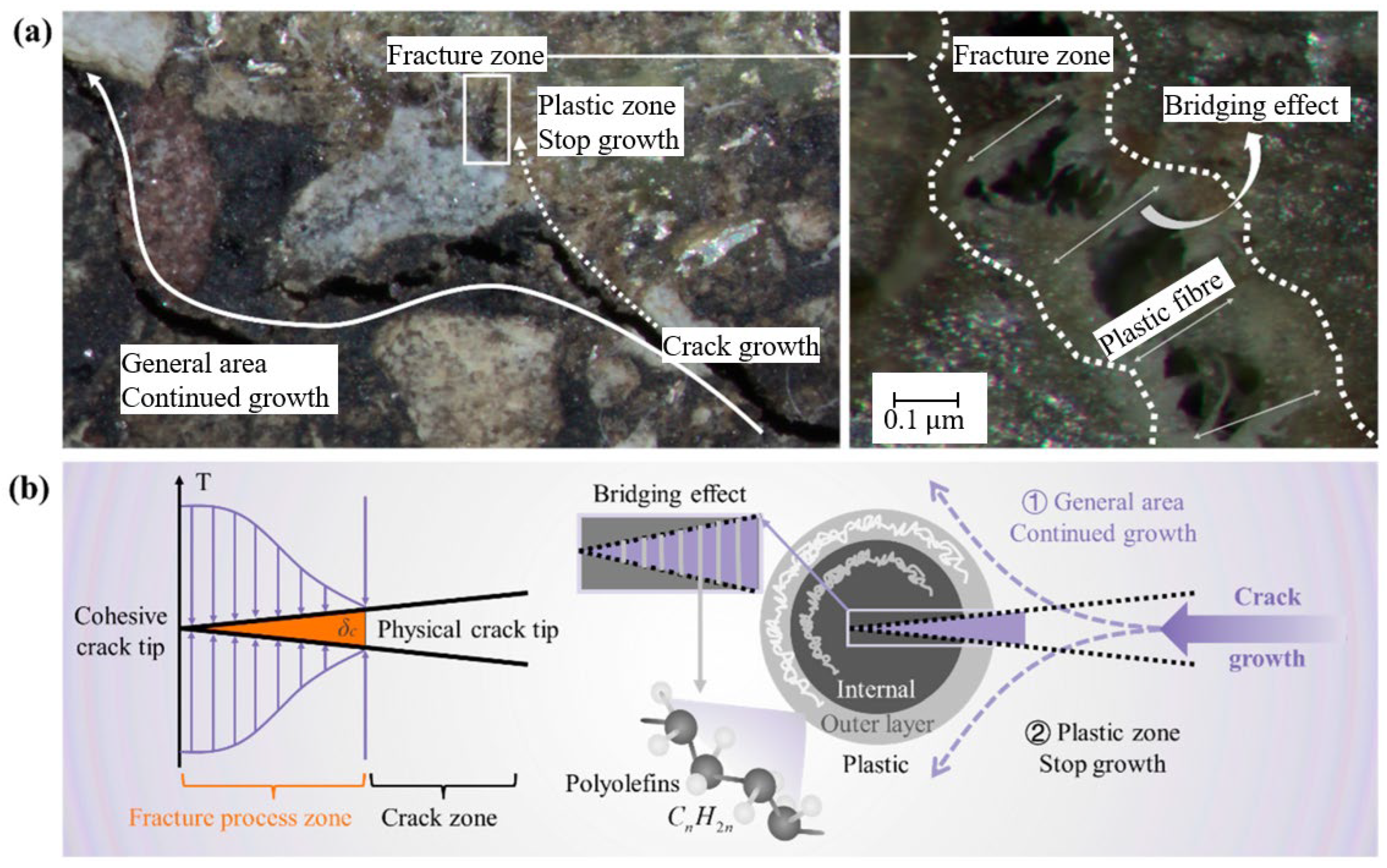
The nonlinear fracture process can be described by a cohesive zone model, which includes four distinct stages: (1) the undamaged stage, (2) the crack initiation stage, (3) the material softening stage, and (4) the critical crack formation stage [240]. Scanning electron microscopy revealed the trend of crack propagation, with cracks mainly occurring in the matrix and the plastic zone. The microstructure in Figure 13a shows that the crack propagates along the path of local lowest energy, bypassing the hard second-phase particles. Theoretically, when a crack passes through the plastic zone, the polyolefin molecular chains rearrange and slip, forming plastic fibres that hinder crack propagation. The thermal effects during manufacturing lead to the formation of a bilayer structure in the plastic material, as shown in Figure 13b. Therefore, the presence of the plastic phase in the asphalt mixture effectively reduces crack initiation and alters the crack propagation path, resulting in a reduction in the number of cracks compared to the matrix region [240].
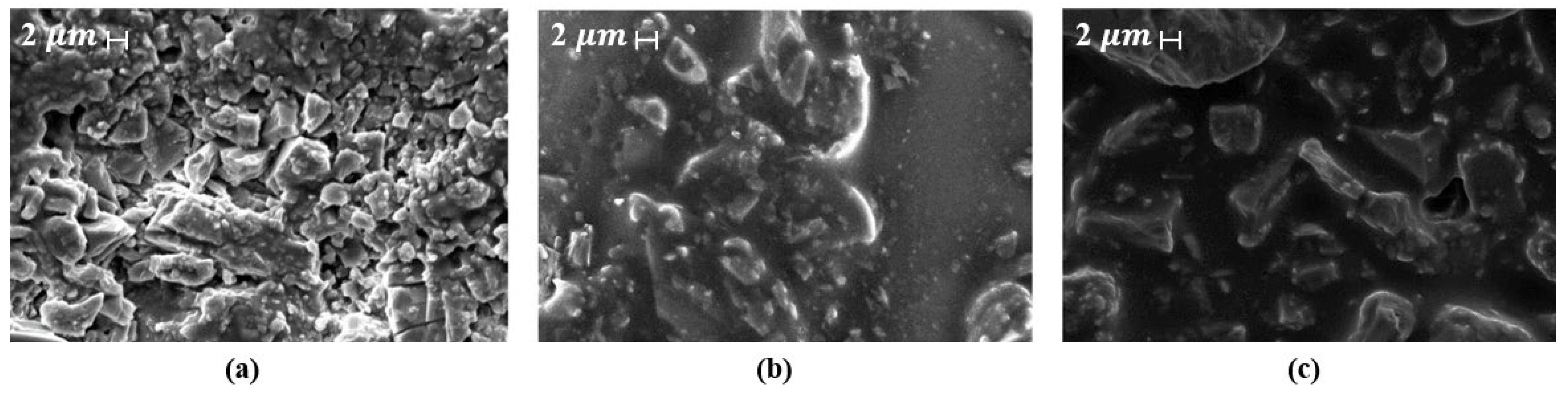
Figure 14 shows SEM micrographs of asphalt samples prepared by different mixing methods: (Figure 14a) conventional asphalt with 5.1% bitumen, and (Figure 14b,c) wet and dry mixes with identical proportions of asphalt, aggregate, and pyrolysis carbon black, revealing differences in volumetric properties [240]. In FR asphalt, SEM analysis before and after fire exposure highlights changes in surface roughness, char formation, and binder degradation, providing insight into thermal protection and FR performance [239,240]. SEM is also essential for examining binder interfaces and microcracks, which influence mechanical stability and aging resistance [241,242].
The synergistic effect of SEM and EDS lies in the elemental mapping of charred residues and binder components, enabling the detection of elements such as phosphorus, magnesium, and silicon originating from flame retardants (e.g., APP, MH, or nano-silica). The microstructure arrangement of polymers affects elasticity, adhesion, and overall fire resistance [58,60,159]. Furthermore, SEM helps assess moisture sensitivity by observing peeling and binder–aggregate debonding after curing treatments such as wet–dry cycles and freeze–thaw cycles. Microstructural evidence provided by SEM helps assess whether additives can improve the adhesion and durability of binders under combined thermal and wet stress. Key SEM parameters for assessing the microstructure of asphalt include surface morphology, char layer thickness, binder coverage uniformity, and the presence of microcracks or voids before and after fire exposure.

5.4. Computational Analysis

Computational analysis is increasingly essential for understanding combustion in asphalt mixtures, particularly with FR additives. While conventional tests like cone calorimetry provide valuable data, they are time-consuming and costly. CFD, FEA, and MD simulations offer detailed studies of flame propagation, heat transfer, and thermal decomposition, providing key parameters such as burning velocity, ignition delay, and toxic emissions [32,243].
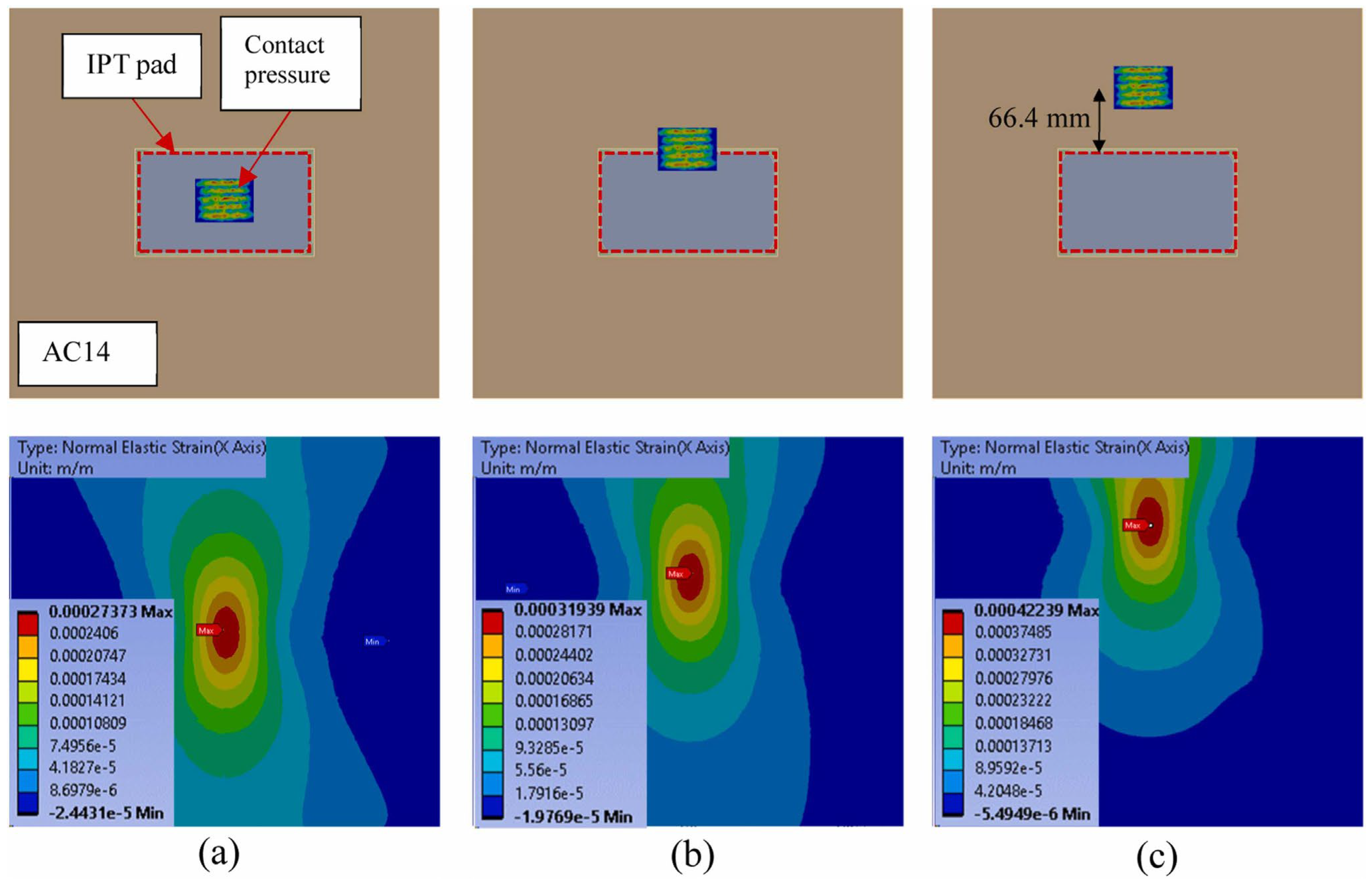
These models have successfully replicated real-world fire scenarios, including tunnel fires, airport pavements, and bridge decks. FDS simulates smoke and flame spread, evaluating how additives like expandable graphite and ATH delay ignition [6]. ANSYS thermal–structural simulations predict strain gradients in asphalt layers, demonstrating mechanical benefits of LDH [244]. MD simulations reveal molecular-level degradation pathways in binders modified with nano-silica or magnesium hydroxide, showing suppression of volatile release, reduced peak heat release, and potential self-healing effects [245]. Together, these techniques bridge lab experiments and full-scale fire scenarios.
Each method contributes uniquely, FDS captures large-scale fire dynamics, ANSYS models heat transfer and structural response, and MD provides nanoscale insights into additive interactions. However, FDS often oversimplifies asphalt as homogeneous, neglecting multiphase effects, while MD findings are underutilized in macro-scale models, leaving a gap between molecular and system-level predictions [244,245,246].

5.4.1. Fire Dynamic Simulator

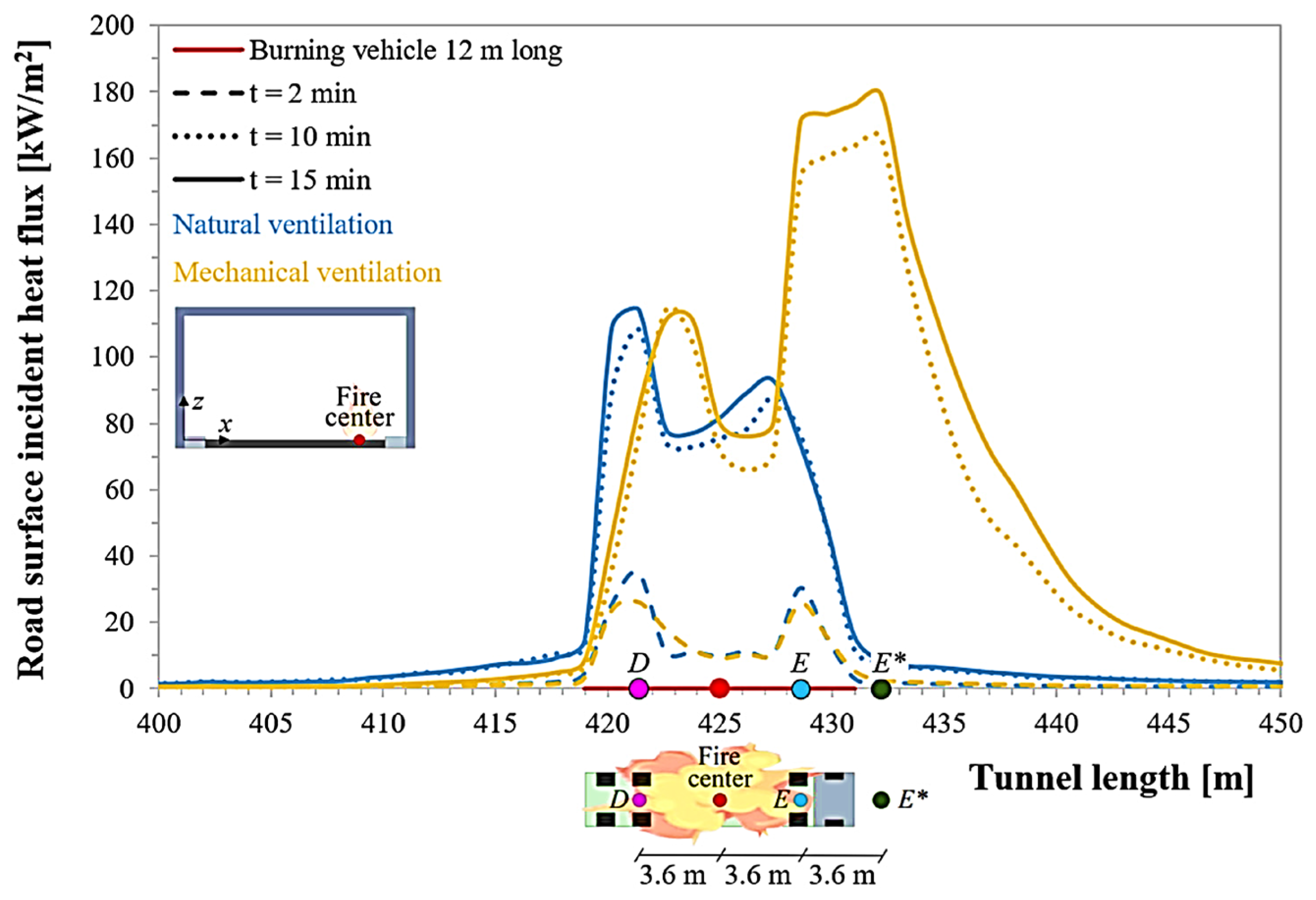
FDS is a powerful CFD-based tool widely used to simulate various fire scenarios, from material-scale combustion to complex tunnel fires. By integrating combustion chemistry, fluid dynamics, and heat transfer, FDS can predict heat flux, smoke movement, and pyrolysis-related phenomena in asphalt systems in detail [27]. In tunnel fire studies, FDS can effectively simulate heat release, smoke stratification, and air velocity to gain insights into the performance of fire-retardant pavements [32]. Figure 15 shows the evolution of heat flux stratification in a tunnel fire scenario. The heat flux increases significantly over time, indicating that smoke accumulates rapidly along the tunnel roof [6]. In the future, developing coupled models that integrate material decomposition and gas-phase combustion remains a key direction. Accurate tunnel geometry, ventilation settings, and vehicle load inputs are also crucial for generating realistic simulation results [17].

5.4.2. ANSYS Modelling

ANSYS analysis is widely used to simulate transient heat transfer and thermodynamic response of asphalt pavements under fire conditions. These models capture temperature distributions between layers and assess the interaction between surface and bulk combustion [82,147]. Advanced combustion models, such as the combustion rate model and the extended coherent flame model, can simulate flame propagation, binder pyrolysis, and gas emissions, while representative volume elements can provide detailed predictions of thermal shielding effects and mechanical behaviour [247,248].
Figure 16 shows that the location of wheel loads significantly affects the strain distribution at the bottom of the asphalt layer. The figure shows that moving the static wheel load from the centre of the pavement to the edge (66.4 mm from the centre) increases the maximum tensile strain by 16%, while moving the load to 66.4 mm from the edge increases the maximum tensile strain by 54%. This is mainly attributed to two reasons: (1) the difference in stiffness (and mass) between the IPT subbase and the surrounding asphalt pavement; and (2) the different distances of the load location from the boundary under different conditions [244].

5.4.3. Molecular Dynamic

Molecular dynamics (MD) simulations provide insights into the thermal and chemical behaviour of asphalt binders at the atomic level, particularly the interactions between SARAs under fire conditions [249]. Lighter components rapidly volatilize and support combustion, while heavier asphaltenes decompose slowly. This phased decomposition forms the basis of asphalt combustion behaviour, where volatile components sustain the flame, while asphaltenes enhance fire resistance by forming a char layer [250,251]. Reactive molecular dynamics (rNEMD) can further predict key properties such as glass transition temperature, diffusion coefficient, and thermal conductivity [252]. MD has been applied to systems with modifiers such as graphene, nano clay, and layered hydroxides, demonstrating that enhanced molecular packing and interfacial adhesion can improve thermal conductivity, oxidation resistance, and flame retardancy [251,252,253].
While molecular dynamics (MD) can link molecular mechanisms to macroscopic fire behaviour, several challenges remain [254]. Many force fields derived from general hydrocarbons may not fully characterize the complex heteroatom and polar chemistry of asphalt. Furthermore, the limited spatial and temporal scales of molecular transformation (MD) restrict its ability to predict long-term changes such as aging, additive migration, and cracking. It needs to be combined with larger-scale models such as computational flow CFD and flame diffusion simulation (FDS) to link molecular transformations with tunnel-scale fire simulations and improve the accuracy of predictions for ignition threshold, char yield, and mechanical stability [255].

6. Conclusions and Outlook

This review presents a comprehensive overview of asphalt as a polymer-modified material, highlighting its chemical composition, structural characteristics, performance-enhancing modifications, applications, and evaluation methodologies. The complex molecular architecture of asphalt, combined with its inherent heterogeneity, underpins its unique viscoelastic and mechanical properties. FR additives such as APP, EG, and ATH consistently enhance fire resistance by promoting char formation, endothermic decomposition, and gas dilution, although the exact magnitude of improvement depends on the type of additive, dosage, asphalt composition, and testing conditions. Lignin-modified asphalt, for example, has been shown to increase char yield and delay ignition, illustrating the potential for improved thermal stability and fire performance. Advanced formulations, such as polymer–nanomaterial hybrids and crosslinked systems, further enhance binder stability, adhesion, and durability under extreme environmental and loading conditions. Evaluation techniques, including rheology, thermal analysis, microscopic characterization, and mechanical testing, have elucidated the structure–property relationships essential for performance optimization. Collectively, these insights position polymer-modified asphalt as a high-performance, adaptable, and environmentally conscious material, suitable for modern infrastructure applications.
Future research should prioritize the development of multifunctional and sustainable asphalt formulations. Incorporating bio-based, recycled, and hybrid polymers can reduce environmental impacts while maintaining or enhancing mechanical and thermal performance. Also, further research is needed to optimize polymer–bitumen interactions and improve the dispersion of nanomaterials, as these are key factors affecting long-term durability, thermal stability, and refractoriness. Combining experimental research with computational modelling, molecular simulations, and data-driven methods can accelerate the rational design of asphalt formulations tailored to different climates and traffic conditions. Standardization of evaluation protocols, alongside in situ monitoring, will facilitate the translation of laboratory innovations to large-scale applications. Key challenges remain, including understanding long-term polymer–asphalt interactions, optimizing nanomaterial dispersion, and maximizing the performance of recycled polymers. Addressing these gaps will support the development of next-generation asphalt technologies that balance mechanical resilience, sustainability, and cost-effectiveness, providing a foundation for durable and high-performance infrastructure.

Author Contributions

Supervision, I.I.K.; resources, I.I.K.; writing—original draft, M.J.; writing—review and editing J.Z. and I.I.K.; data curation, M.J., J.Z. and I.I.K.; formal analysis, M.J., J.Z. and I.I.K. All authors have read and agreed to the published version of the manuscript.

Funding

This research received no external funding.

Data Availability Statement

The original contributions presented in the study are included in the article, further inquiries can be directed to the corresponding author.

Acknowledgments

The authors thank all collaborators for their constructive discussions and contributions to the preparation of this review. Special thanks to Imrana Kabir for research support.

Conflicts of Interest

The authors declare no conflicts of interest.

Abbreviations

The following abbreviations are used in this manuscript:
ARPActivated Rubber Pellets
ATHAluminium Hydroxide
APPAmmonium Polyphosphate
ARAsphalt Rubber
BABase Asphalt
CO2Carbon Dioxide
COCarbon Monoxide
CNTsCarbon Nanotubes
CFDComputational Fluid Dynamics
CRMCrumb Rubber Modifier
DTGDerivative Thermogravimetric
DPDey Process
DSCDifferential Scanning Calorimetry
DSRDynamic Shear Rheometry
EDSEnergy Dispersive X-ray Spectroscopy
EGAEvolved Gas Analysis
EGExpandable Graphite
FRPCsFibre-Reinforced Polymer Composites
FEAFinite Element Analysis
FDSFire Dynamics Simulator
FRFire Retardant
FTIRFourier Transform Infrared
HRRHeat Release Rates
HMAHot Mix Asphalt
IFSIndirect Tensile Strength
IFRsIntumescent Flame Retardants
LDHLayered Double Hydroxides
LCALife Cycle Assessment
MHMagnesium Hydroxide
MCCMicro-scale Combustion Calorimeter
MDMolecular Dynamics
MPDMean Profile Depth
PAHPolycyclic Aromatic Hydrocarbons
PAVPressure Aging Vessel
PMAPolymer-Modified Asphalt
PWIPavement Wear Index
RAPReclaimed Asphalt Pavement
SARASaturates, Aromatics, Resins, and Asphaltenes
SEMScanning Electron Microscopy
SWPSemi-Wet Process
SBSStyrene–Butadiene–Styrene
TGAThermogravimetric Analysis
THRTotal Heat Release
UTWUltra-Thin White
VOCsVolatile Organic Compounds
WMAWarm-Mix Asphalt
WPWet Process
WTWheel-Tracking

References

  1. Jiang, X.; Zhu, H.; Yan, Z.; Zhang, F.; Huang, X.; Leng, Z.; Yan, C.; Hua, N.; Lu, D.; Zhang, X.; et al. Fire-retarding asphalt pavement for urban road tunnels: A state-of-the-art review and beyond. Fire Technol. 2025, 61, 2737–2777. [Google Scholar] [CrossRef]
  2. He, L.; Cao, Y.; Qu, H.-M.; Zhang, Y.-K.; Bi, Q.-Q.; Wang, D.-Y. Advances in flame retardancy of asphalt pavement: A review. Adv. Ind. Eng. Polym. Res. 2024, 7, 273–294. [Google Scholar] [CrossRef]
  3. Li, M.; Pang, L.; Chen, M.; Xie, J.; Liu, Q. Effects of aluminum hydroxide and layered double hydroxide on asphalt fire resistance. Materials 2018, 11, 1939. [Google Scholar] [CrossRef] [PubMed]
  4. Liu, H.; Zhang, Z.; Wang, Z.; Sun, J.; Wei, Y.; Zhang, D. Preparation and properties of flame-retardant asphalt containing polyurethane and eco-friendly flame retardants. Constr. Build. Mater. 2023, 375, 130996. [Google Scholar] [CrossRef]
  5. Tan, Y.; Xie, J.; Wang, Z.; Li, X.; He, Z. Preparation, properties, and mechanism of warm mix flame retardant modified asphalt based on surface activity principle. J. Build. Eng. 2023, 76, 107117. [Google Scholar] [CrossRef]
  6. Xu, G.; Chen, X.; Zhu, S.; Kong, L.; Huang, X.; Zhao, J.; Ma, T. Evaluation of asphalt with different combinations of fire retardants. Materials 2019, 12, 1283. [Google Scholar] [CrossRef]
  7. Wei, H.; Lu, R.; Li, J.; Yao, Z.; Zheng, J. Investigation on synergistic flame retardancy of modified asphalt using tungsten mine tailings and aluminum trihydrate. Constr. Build. Mater. 2024, 451, 138891. [Google Scholar] [CrossRef]
  8. Sheng, Y.; Wu, Y.; Yan, Y.; Jia, H.; Qiao, Y.; Underwood, B.S.; Niu, D.; Kim, Y.R. Development of environmentally friendly flame retardant to achieve low flammability for asphalt binder used in tunnel pavements. J. Clean. Prod. 2020, 257, 120487. [Google Scholar] [CrossRef]
  9. Luo, D.; Guo, M.; Tan, Y. Molecular simulation of minerals-asphalt interfacial interaction. Minerals 2018, 8, 176. [Google Scholar] [CrossRef]
  10. Xing, C.; Xiong, Z.; Lu, T.; Li, H.; Zhou, W.; Li, C. Performance of Asphalt Materials Based on Molecular Dynamics Simulation: A Review. Polymers 2025, 17, 2051. [Google Scholar] [CrossRef]
  11. Kamilaris, A.; Filippi, J.; Padubidri, C.; Koole, R.; Karatsiolis, S. Examining the potential of mobile applications to assist people to escape wildfires in real-time. Fire Saf. J. 2023, 136, 103747. [Google Scholar] [CrossRef]
  12. Cardil, A.; Monedero, S.; Schag, G.; de-Miguel, S.; Tapia, M.; Stoof, C.R.; Silva, C.A.; Mohan, M.; Cardil, A.; Ramirez, J. Fire behavior modeling for operational decision-making. Curr. Opin. Environ. Sci. Health 2021, 23, 100291. [Google Scholar] [CrossRef]
  13. Wang, B.; Peng, W.; Zhong, W.; Liang, T. Investigation on smoke propagation behavior and smoke back-layering length of fires in an inclined tunnel under natural ventilation. Tunn. Undergr. Space Technol. 2024, 150, 105823. [Google Scholar] [CrossRef]
  14. Weng, M.C.; Yu, L.X.; Liu, F.; Nielsen, P.V. Full-scale experiment and CFD simulation on smoke movement and smoke control in a metro tunnel with one opening portal. Tunn. Undergr. Space Technol. 2014, 42, 96–104. [Google Scholar] [CrossRef]
  15. Cui, Y.; Liu, Z. Study on Fire Smoke Movement Characteristics and Their Impact on Personal Evacuation in Curved Highway Tunnels. Appl. Sci. 2024, 14, 6339. [Google Scholar] [CrossRef]
  16. Mejias Tuni, J.A. Multiscale Approach Applied to Fires in Tunnels, Model Optimization and Development. Ph.D. Thesis, Politecnico di Torino, Torino, Italy, 2022. [Google Scholar]
  17. Galuppi, M.; Berardi, D.; Lombardi, M. The contribution from asphalt pavement to road tunnel fire risk. Case Stud. Constr. Mater. 2025, 23, e05029. [Google Scholar] [CrossRef]
  18. Li, W.; Zheng, M.; Zhang, L.; Peng, P.; Yang, J. Development and performance evaluation of composite flame retardant based on the thermodynamic properties of asphalt components. Constr. Build. Mater. 2024, 455, 139152. [Google Scholar] [CrossRef]
  19. Shi, H.; Xu, T.; Zhou, P.; Jiang, R. Combustion properties of saturates, aromatics, resins, and asphaltenes in asphalt binder. Constr. Build. Mater. 2017, 136, 515–523. [Google Scholar] [CrossRef]
  20. Puente, E.; Lázaro, D.; Alvear, D. Study of tunnel pavements behaviour in fire by using coupled cone calorimeter–FTIR analysis. Fire Saf. J. 2016, 81, 1–7. [Google Scholar] [CrossRef]
  21. Chang, X.; Xiao, Y.; Long, Y.; Wang, F.; You, Z. Temperature dependency of VOCs release characteristics of asphalt materials under varying test conditions. J. Traffic Transp. Eng. (Engl. Ed.) 2022, 9, 280–292. [Google Scholar] [CrossRef]
  22. Xu, T.; Wang, Y.; Xia, W.; Hu, Z. Effects of flame retardants on thermal decomposition of SARA fractions separated from asphalt binder. Constr. Build. Mater. 2018, 173, 209–219. [Google Scholar] [CrossRef]
  23. Campbell-Allen, D.; Desai, P. The influence of aggregate on the behaviour of concrete at elevated temperatures. Nucl. Eng. Des. 1967, 6, 65–77. [Google Scholar] [CrossRef]
  24. Cuadri, A.; Partal, P.; Ahmad, N.; Grenfell, J.; Airey, G. Chemically modified bitumens with enhanced rheology and adhesion properties to siliceous aggregates. Constr. Build. Mater. 2015, 93, 766–774. [Google Scholar] [CrossRef]
  25. EN 13501-1; Fire Classification of Construction Products and Building Elements—Part 1: Classification Using Data from Reaction-to-Fire Tests. European Committee for Standardization: Brussels, Belgium, 2018.
  26. ASTM E1354; Standard Test Method for Heat and Visible Smoke Release Rates for Materials and Products Using an Oxygen Consumption Calorimeter. ASTM International: West Conshohocken, PA, USA, 2022.
  27. Bonati, A.; Rainieri, S.; Bochicchio, G.; Tessadri, B.; Giuliani, F. Characterization of thermal properties and combustion behaviour of asphalt mixtures in the cone calorimeter. Fire Saf. J. 2015, 74, 25–31. [Google Scholar] [CrossRef]
  28. Wang, W.; Shen, A.; Wang, L.; Liu, H. Measurements, emission characteristics, and control methods of fire effluents generated from tunnel asphalt pavement during fire: A review. Environ. Sci. Pollut. Res. 2022, 29, 64267–64297. [Google Scholar] [CrossRef]
  29. Elkashef, M.; Williams, R.C.; Cochran, E. Thermal stability and evolved gas analysis of rejuvenated reclaimed asphalt pavement (RAP) bitumen using thermogravimetric analysis–Fourier transform infrared (TG–FTIR). J. Therm. Anal. Calorim. 2018, 131, 865–871. [Google Scholar] [CrossRef]
  30. Materazzi, S.; Vecchio, S. Recent applications of evolved gas analysis by infrared spectroscopy (IR-EGA). Appl. Spectrosc. Rev. 2013, 48, 654–689. [Google Scholar] [CrossRef]
  31. Zhang, Z.; Lu, D.X.; Qiao, Y.; Giustozzi, F. Modelling the hydraulic performance of open graded asphalt using the discrete element method and computational fluid dynamics. J. Hydrol. 2023, 621, 129612. [Google Scholar] [CrossRef]
  32. Caliendo, C.; Russo, I. CFD simulation to assess the effects of asphalt pavement combustion on user safety in the event of a fire in road tunnels. Fire 2024, 7, 195. [Google Scholar] [CrossRef]
  33. Lannon, C.M.; Stoliarov, S.I.; Lord, J.M.; Leventon, I.T. A methodology for predicting and comparing the full-scale fire performance of similar materials based on small-scale testing. Fire Mater. 2018, 42, 710–724. [Google Scholar] [CrossRef]
  34. Yang, K.; Li, R. Characterization of bonding property in asphalt pavement interlayer: A review. J. Traffic Transp. Eng. (Engl. Ed.) 2021, 8, 374–387./. [Google Scholar] [CrossRef]
  35. Hu, Z.; Zhang, H.; Wang, S.; Xu, T. Thermal-oxidative aging mechanism of asphalt binder based on isothermal thermal analysis at the SARA level. Constr. Build. Mater. 2020, 255, 119349. [Google Scholar] [CrossRef]
  36. Firoozifar, S.H.; Foroutan, S.; Foroutan, S. The effect of asphaltene on thermal properties of bitumen. Chem. Eng. Res. Des. 2011, 89, 2044–2048. [Google Scholar] [CrossRef]
  37. Gao, Y.; Geng, D.; Huang, X.; Li, G. Degradation evaluation index of asphalt pavement based on mechanical performance of asphalt mixture. Constr. Build. Mater. 2017, 140, 75–81. [Google Scholar] [CrossRef]
  38. Assogba, O.C.; Tan, Y.; Sun, Z.; Lushinga, N.; Bin, Z. Effect of vehicle speed and overload on dynamic response of semi-rigid base asphalt pavement. Road Mater. Pavement Des. 2021, 22, 572–602. [Google Scholar]
  39. Jiang, J.; Guo, X.; Hao, P.; Guo, X.; Huang, S.; Chen, K. Effects of SARA fractions on the rheological properties and microscopic behavior of hard asphalt. Constr. Build. Mater. 2024, 438, 137055. [Google Scholar] [CrossRef]
  40. Rajib, A.I.; Pahlavan, F.; Fini, E.H. Investigating molecular-level factors that affect the durability of restored aged asphalt binder. J. Clean. Prod. 2020, 270, 122501. [Google Scholar] [CrossRef]
  41. Abouelsaad, A.; White, G.; Jamshidi, A. State of the art review of ageing of bituminous binders and asphalt mixtures: Ageing simulation techniques, ageing inhibitors and the relationship between simulated ageing and field ageing. Infrastructures 2024, 9, 8. [Google Scholar] [CrossRef]
  42. Bruneau, L.; Tisse, S.; Michon, L.; Cardinael, P. Evaluation of asphalt aging using multivariate analysis applied to saturates, aromatics, resins, and asphaltene determinator data. ACS Omega 2023, 8, 24773–24785. [Google Scholar] [CrossRef]
  43. Zhang, Z.; Liu, H.; Ban, X.; Liu, X.; Guo, Y.; Sun, J.; Liu, Y.; Zhang, S.; Lei, J. Thermosetting resin modified asphalt: A comprehensive review. J. Traffic Transp. Eng. (Engl. Ed.) 2023, 10, 1001–1036. [Google Scholar]
  44. Li, Y.; Lv, C.; Cheng, P.; Chen, Y.; Zhang, Z. Application of bio-resin in road materials: Rheological and chemical properties of asphalt binder modified by lignin-phenolic resin. Case Stud. Constr. Mater. 2023, 18, e01989. [Google Scholar] [CrossRef]
  45. Wang, Y.; Zhao, K.; Li, F.; Gao, Q.; Lai, K.W.C. Asphaltenes in asphalt: Direct observation and evaluation of their impacts on asphalt properties. Constr. Build. Mater. 2021, 271, 121862. [Google Scholar] [CrossRef]
  46. Ghasemirad, A.; Bala, N.; Hashemian, L. High-temperature performance evaluation of asphaltenes-modified asphalt binders. Molecules 2020, 25, 3326. [Google Scholar] [CrossRef] [PubMed]
  47. Zhao, L.; Chen, J.; Wang, S. Using mineral fibers to improve asphalt and asphalt mixture behavior. In Traffic and Transportation Studies 2010; American Society of Civil Engineers: Reston, VA, USA, 2010; pp. 1352–1360. [Google Scholar]
  48. Vigroux, M.; Sciarretta, F.; Eslami, J.; Beaucour, A.-L.; Bourgès, A.; Noumowé, A. High temperature effects on the properties of limestones: Post-fire diagnostics and material’s durability. Mater. Struct. 2022, 55, 253. [Google Scholar] [CrossRef]
  49. Hasita, S.; Suddeepong, A.; Horpibulsuk, S.; Samingthong, W.; Arulrajah, A.; Chinkulkijniwat, A. Properties of asphalt concrete using aggregates composed of limestone and steel slag blends. J. Mater. Civ. Eng. 2020, 32, 06020007. [Google Scholar] [CrossRef]
  50. Airey, G.D. Fundamental binder and practical mixture evaluation of polymer modified bituminous materials. Int. J. Pavement Eng. 2004, 5, 137–151. [Google Scholar] [CrossRef]
  51. Chen, X.; Ma, Z.; Zhou, J.; Wang, J.; Zhang, X.; Zhao, R.; Tong, J. Thermal degradation characteristics of styrene-butadiene-styrene copolymer asphalt binder filled with an inorganic flame-retarding agent. Polymers 2022, 14, 3761. [Google Scholar] [CrossRef]
  52. Bansal, S.; Gupta, V.; Chopra, T.; Mehta, R. Styrene-Butadiene-Styrene polymer modified bitumen: A review on compatibility and physico-chemical properties. Phys. Scr. 2024, 99, 122001. [Google Scholar] [CrossRef]
  53. Khan, A.A.R.; Tabassum, N. Enhancing Pavement Performance and Economy through Crumb Rubber Modified Bitumen: A Sustainable Engineering Approach. Smart Green Mater. 2025, 2, 47–61. [Google Scholar] [CrossRef]
  54. Wang, P.; Dong, Z.-J.; Tan, Y.-Q.; Liu, Z.-Y. Investigating the interactions of the saturate, aromatic, resin, and asphaltene four fractions in asphalt binders by molecular simulations. Energy Fuels 2015, 29, 112–121. [Google Scholar] [CrossRef]
  55. Aske, N.; Kallevik, H.; Sjöblom, J. Determination of saturate, aromatic, resin, and asphaltenic (SARA) components in crude oils by means of infrared and near-infrared spectroscopy. Energy Fuels 2001, 15, 1304–1312. [Google Scholar] [CrossRef]
  56. Xiu, M.; Wang, X.; Morawska, L.; Pass, D.; Beecroft, A.; Mueller, J.F.; Thai, P. Emissions of particulate matters, volatile organic compounds and polycyclic aromatic hydrocarbons from warm and hot asphalt mixes. J. Clean. Prod. 2020, 275, 123094. [Google Scholar] [CrossRef]
  57. Brandt, H.; De Groot, P. Aqueous leaching of polycyclic aromatic hydrocarbons from bitumen and asphalt. Water Res. 2001, 35, 4200–4207. [Google Scholar] [CrossRef] [PubMed]
  58. Cong, P.; Tian, Y.; Liu, N.; Xu, P. Investigation of epoxy-resin-modified asphalt binder. J. Appl. Polym. Sci. 2016, 133. [Google Scholar] [CrossRef]
  59. Mazalan, N.A.A.; Satar, M.K.I.M.; Mohamed, A.; Warid, M.N.M. Rheological properties of asphaltene-modified asphalt binder and mastic. Phys. Chem. Earth Parts A/B/C 2023, 131, 103422. [Google Scholar] [CrossRef]
  60. Hull, T.R.; Witkowski, A.; Hollingbery, L. Fire retardant action of mineral fillers. Polym. Degrad. Stab. 2011, 96, 1462–1469. [Google Scholar] [CrossRef]
  61. Busang, S. Optimisation of Microstructural Properties and Mechanical Performance of Asphalt Mixtures. Ph.D. Thesis, University of Pretoria, Pretoria, South Africa, 2021. [Google Scholar]
  62. Li, J.; Qin, Y.; Zhang, X.; Shan, B.; Liu, C. Emission characteristics, environmental impacts, and health risks of volatile organic compounds from asphalt materials: A state-of-the-art review. Energy Fuels 2024, 38, 4787–4802. [Google Scholar] [CrossRef]
  63. Li, Y.; Hao, P.; Zhang, M. Fabrication, characterization and assessment of the capsules containing rejuvenator for improving the self-healing performance of asphalt materials: A review. J. Clean. Prod. 2021, 287, 125079. [Google Scholar] [CrossRef]
  64. Hasan, J.N.; Alzeebaree, R.; Hussein, N.A. Using polymers to improve asphalt pavement performance: A review. AIP Conf. Proc. 2024, 2944, 020021. [Google Scholar] [CrossRef]
  65. Cavalli, M.C.; Wu, W.; Poulikakos, L. Bio-based rejuvenators in asphalt pavements: A comprehensive review and analytical study. J. Road Eng. 2024, 4, 282–291. [Google Scholar] [CrossRef]
  66. Korniejenko, K.; Nykiel, M.; Choinska, M.; Jexembayeva, A.; Konkanov, M.; Aruova, L. An overview of micro-and nano-dispersion additives for asphalt and bitumen for road construction. Buildings 2023, 13, 2948. [Google Scholar] [CrossRef]
  67. Qadir, F.; Hafeez, I. Effect of impregnated organophilic (hydrophobic) nano clay on asphalt binder properties and performance. Constr. Build. Mater. 2024, 419, 135577. [Google Scholar] [CrossRef]
  68. Chen, R.; Zhao, R.; Liu, Y.; Xi, Z.; Cai, J.; Zhang, J.; Wang, Q.; Xie, H. Development of eco-friendly fire-retarded warm-mix epoxy asphalt binders using reactive polymeric flame retardants for road tunnel pavements. Constr. Build. Mater. 2021, 284, 122752. [Google Scholar] [CrossRef]
  69. Xia, W.; Fan, S.; Xu, T. Inhibitory action of halogen-free fire retardants on combustion and volatile emission of bituminous components. Sci. Prog. 2021. [Google Scholar] [CrossRef]
  70. He, C.; Ji, Y.; Gao, M.; Wang, W.; Pei, D.; Chen, C.; Qu, M.; Sun, G. Synergistic flame retardant effect of ammonium polyphosphate/melamine cyanurate/aluminum hypophosphite in natural rubber. J. Therm. Anal. Calorim. 2025, 150, 9121–9131. [Google Scholar] [CrossRef]
  71. Albayati, A.H.; Latief, R.H.; Al-Mosawe, H.; Wang, Y. Nano-additives in asphalt binder: Bridging the gap between traditional materials and modern requirements. Appl. Sci. 2024, 14, 3998. [Google Scholar] [CrossRef]
  72. Li, R.; Xiao, F.; Amirkhanian, S.; You, Z.; Huang, J. Developments of nano materials and technologies on asphalt materials—A review. Constr. Build. Mater. 2017, 143, 633–648. [Google Scholar]
  73. Kabir, I.I.; Carlos Baena, J.; Wang, W.; Wang, C.; Oliver, S.; Nazir, M.T.; Khalid, A.; Fu, Y.; Yuen, A.C.Y.; Yeoh, G.H. Optimisation of additives to maximise performance of expandable graphite-based intumescent-flame-retardant polyurethane composites. Molecules 2023, 28, 5100. [Google Scholar] [CrossRef]
  74. Huang, G.; He, Z.; Huang, Y.; Zhou, C.; Yuan, X. Mechanism of fume suppression and performance on asphalt of expanded graphite for pavement under high temperature condition. J. Wuhan Univ. Technol.-Mater. Sci. Ed. 2014, 29, 1229–1236. [Google Scholar]
  75. Zhang, J.; Yeoh, G.H.; Kabir, I.I. Polyurethane materials for fire retardancy: Synthesis, structure, properties, and applications. Fire 2025, 8, 64. [Google Scholar] [CrossRef]
  76. Zhang, D.; Chen, M.; Chen, Z.; Li, P.; Shao, Z.; Liu, X.; Liu, P. Hydrogen-bonded PEG/functionalized expanded graphite composite phase change material (PEG/FEG CPCM) for pavement thermal regulation: Fabrication and performance. Constr. Build. Mater. 2025, 491, 142695. [Google Scholar] [CrossRef]
  77. Ullah, S.; Ahmad, F.; Al-Sehemi, A.G.; Assiri, M.A.; Raza, M.R.; Irfan, A. Effect of expandable graphite and ammonium polyphosphate on the thermal degradation and weathering of intumescent fire-retardant coating. J. Appl. Polym. Sci. 2021, 138, 50310. [Google Scholar] [CrossRef]
  78. Zhang, D.; Chen, M.; Wu, S.; Riara, M.; Wan, J.; Li, Y. Thermal and rheological performance of asphalt binders modified with expanded graphite/polyethylene glycol composite phase change material (EP-CPCM). Constr. Build. Mater. 2019, 194, 83–91. [Google Scholar] [CrossRef]
  79. Lim, K.-S.; Bee, S.-T.; Sin, L.T.; Tee, T.-T.; Ratnam, C.; Hui, D.; Rahmat, A. A review of application of ammonium polyphosphate as intumescent flame retardant in thermoplastic composites. Compos. Part B Eng. 2016, 84, 155–174. [Google Scholar] [CrossRef]
  80. Liang, X.; Wang, X.; Li, G.; Xiang, Q.; Zhou, C.; Chen, A.; Li, X.; Zhang, S.; Cao, Y.; Han, M.; et al. Unlocking the side reaction mechanism of phosphorus anode with binder and the development of a multifunctional binder for enhancing the performance. J. Power Sources 2022, 541, 231686. [Google Scholar] [CrossRef]
  81. Wang, H.; Liu, S.; Lei, C.; Qiu, H.; Jiang, W.; Sun, X.; Zhang, Y.; He, W. Ammonium polyphosphate assisted thermal polymerization of pre-oxidized asphalt to prepare N/P double-doped hard carbon for improved sodium ion storage. J. Energy Storage 2024, 85, 111045. [Google Scholar] [CrossRef]
  82. Yang, X.; Wang, G.; Liang, M.; Yuan, T.; Rong, H. Effect of aluminum hydroxide (ATH) on flame retardancy and smoke suppression properties of SBS-modified asphalt. Road Mater. Pavement Des. 2023, 24, 173–190. [Google Scholar] [CrossRef]
  83. Zhu, K.; Yang, Y.; Lin, C.; Wang, Q.; Ye, D.; Jiang, H.; Wu, K. Effect of compounded aluminum hydroxide flame retardants on the flammability and smoke suppression performance of asphalt binders. ACS Omega 2024, 9, 2803–2814. [Google Scholar] [CrossRef]
  84. Gu, L.; Zhang, T.; Zhu, K.; Tang, D.; Wu, K. Effect of various metal hydroxide flame retardants on the rheological properties of asphalt binder. Mater. Sci. 2019, 25, 348–355. [Google Scholar] [CrossRef]
  85. Bonati, A.; Merusi, F.; Bochicchio, G.; Tessadri, B.; Polacco, G.; Filippi, S.; Giuliani, F. Effect of nanoclay and conventional flame retardants on asphalt mixtures fire reaction. Constr. Build. Mater. 2013, 47, 990–1000. [Google Scholar] [CrossRef]
  86. Iskender, E. Evaluation of mechanical properties of nano-clay modified asphalt mixtures. Measurement 2016, 93, 359–371. [Google Scholar] [CrossRef]
  87. Xu, T.; Huang, X.; Zhao, Y. Investigation into the properties of asphalt mixtures containing magnesium hydroxide flame retardant. Fire Saf. J. 2011, 46, 330–334. [Google Scholar] [CrossRef]
  88. Xu, T.; Huang, X. A TG-FTIR investigation into smoke suppression mechanism of magnesium hydroxide in asphalt combustion process. J. Anal. Appl. Pyrolysis 2010, 87, 217–223. [Google Scholar] [CrossRef]
  89. Çalışıcı, M.; Gürü, M.; Çubuk, M.K. Improving Asphalt Binder and Hot Mix Asphalt Aging Properties by Adding Synthetic Polyboron and Organic Magnesium Oxide. Arab. J. Sci. Eng. 2023, 48, 4711–4718. [Google Scholar] [CrossRef]
  90. Tang, N.; Yu, H.; Ren, B.; Li, R.; Yi, X.; Zhu, H. Effect of lanthanum oxide and magnesium hydroxide on flame retardancy, rheological properties, and aging resistance of SBS modified asphalt. Constr. Build. Mater. 2025, 490, 142544. [Google Scholar] [CrossRef]
  91. Knight, C.C.; Ip, F.; Zeng, C.; Zhang, C.; Wang, B. A highly efficient fire-retardant nanomaterial based on carbon nanotubes and magnesium hydroxide. Fire Mater. 2013, 37, 91–99. [Google Scholar] [CrossRef]
  92. Danny, G.; Nasus, K.; Napitupulu, J.P.; Makmur, A. The Influence of Limestone and Calcium Hydroxide Addition in Asphalt Concrete Mixture. ComTech Comput. Math. Eng. Appl. 2016, 7, 83–90. [Google Scholar] [CrossRef]
  93. Grajales, J.A.; Perez, L.M.; Schwab, A.P.; Little, D.N. Quantum chemical modeling of the effects of hydrated lime (calcium hydroxide) as a filler in bituminous materials. ACS Omega 2021, 6, 3130–3139. [Google Scholar] [CrossRef]
  94. Wu, W.; Jiang, W.; Falchetto, A.C.; Yuan, D.; Xiao, J.; Wang, D. Prediction of rheological properties of high polymer-modified asphalt binders based on BAS-BP neural network and functional groups. Fuel 2025, 379, 132989. [Google Scholar] [CrossRef]
  95. Hong, Z.; Yan, K.; Ge, D.; Wang, M.; Li, G.; Li, H. Effect of styrene-butadiene-styrene (SBS) on laboratory properties of low-density polyethylene (LDPE)/ethylene-vinyl acetate (EVA) compound modified asphalt. J. Clean. Prod. 2022, 338, 130677. [Google Scholar] [CrossRef]
  96. Liu, S.; Tan, Y. Mechanical properties and water resistance study of basic magnesium sulfate cement-emulsified asphalt composite materials. Constr. Build. Mater. 2024, 426, 136196. [Google Scholar] [CrossRef]
  97. Shimpi, N.G.; Sonawane, H.A.; Mali, A.D.; Mishra, S. Effect of Mg(OH)2 nanoparticles on thermal, mechanical and morphological properties of millable polyurethane elastomer. J. Reinf. Plast. Compos. 2013, 32, 935–946. [Google Scholar] [CrossRef]
  98. Barczewski, M.; Hejna, A.; Sałasińska, K.; Aniśko, J.; Piasecki, A.; Skórczewska, K.; Andrzejewski, J. Thermomechanical and fire properties of polyethylene-composite-filled ammonium polyphosphate and inorganic fillers: An evaluation of their modification efficiency. Polymers 2022, 14, 2501. [Google Scholar] [CrossRef]
  99. Yang, Y.; Haurie, L.; Wang, D.-Y. Bio-based materials for fire-retardant application in construction products: A review. J. Therm. Anal. Calorim. 2022, 147, 6563–6582. [Google Scholar]
  100. Dong, M.; Xia, W.; Xu, T. Development of a sustainable biobased flame-retardant microcapsule and its flame-retarding mechanism on asphalt combustion. Langmuir 2024, 40, 1425–1438. [Google Scholar] [CrossRef] [PubMed]
  101. Hobbs, C.E. Recent advances in bio-based flame retardant additives for synthetic polymeric materials. Polymers 2019, 11, 224. [Google Scholar] [CrossRef] [PubMed]
  102. He, L.; Bi, Q.-Q.; Ma, Y.; Wang, D.-Y. Effects of flame-retardant nanocomposite combined with warm mix asphalt techniques on molecular conversion and fire safety. React. Funct. Polym. 2025, 215, 106353. [Google Scholar] [CrossRef]
  103. Leng, C.; Lu, G.; Gao, J.; Liu, P.; Xie, X.; Wang, D. Sustainable green pavement using bio-based polyurethane binder in tunnel. Materials 2019, 12, 1990. [Google Scholar] [CrossRef]
  104. Zhong, Q.; Wang, C.; Ye, G.; Guo, Z.; Sai, T.; Hong, M.; Song, P.; Wang, H.; Huo, S.; Liu, Z. Bio-based, selenium/Schiff base-containing co-curing agent enables flame-retardant, smoke-suppressive and mechanically-strong epoxy resins. Chem. Eng. J. 2025, 523, 168756. [Google Scholar] [CrossRef]
  105. Kolya, H.; Kang, C.-W. Eco-friendly polymer nanocomposite coatings for next-generation fire retardants for building materials. Polymers 2024, 16, 2045. [Google Scholar]
  106. Sharma, S.; Narnaure, T.K. Behavior of Asphalt Using Lignin-Modified Binder—A Review. In International Conference on Transportation System Engineering and Management; Springer Nature: Singapore, 2024; pp. 143–161. [Google Scholar]
  107. Kabir, I.I.; Sorrell, C.C.; Mofarah, S.S.; Yang, W.; Yuen, A.C.Y.; Nazir, M.T.; Yeoh, G.H. Alginate/Polymer-Based Materials for Fire Retardancy: Synthesis, Structure, Properties, and Applications. Polym. Rev. 2020, 61, 357–414. [Google Scholar] [CrossRef]
  108. Arab, M.G.; Mousa, R.; Gabr, A.; Azam, A.; El-Badawy, S.; Hassan, A. Resilient behavior of sodium alginate–treated cohesive soils for pavement applications. J. Mater. Civ. Eng. 2019, 31, 04018361. [Google Scholar] [CrossRef]
  109. Caputo, P.; Oliviero Rossi, C.; Calandra, P.; Policastro, D.; Giorno, E.; Godbert, N.; Aiello, I. Improving bitumen properties with chitosan: A sustainable approach to road construction. Molecules 2025, 30, 1170. [Google Scholar] [CrossRef] [PubMed]
  110. Cao, Z.; Hao, Q.; Xu, S.; Han, X.; Yi, J.; Sun, G. Preparation and performance evaluation of bio–based polyurethane modified asphalt binders: Towards greener and more sustainable asphalt modifier. Constr. Build. Mater. 2025, 476, 141209. [Google Scholar] [CrossRef]
  111. Quan, X.; Liu, X.; Chen, C.; Ma, T.; Wang, X.; Zhang, Y. Improving thermal cracking and fatigue cracking performance of hard asphalt binders with bio-renewable additives. Constr. Build. Mater. 2024, 456, 139305. [Google Scholar] [CrossRef]
  112. Ni, H.; Ma, J.; Sun, D.; Xu, L.; Ling, S.; Hu, M. Application of differential scanning calorimetry as advanced asphalt testing technology: A comprehensive review. J. Traffic Transp. Eng. (Engl. Ed.) 2025, 12, 1174–1209. [Google Scholar] [CrossRef]
  113. Calandra, P.; Caputo, P.; De Santo, M.P.; Todaro, L.; Liveri, V.T.; Rossi, C.O. Effect of additives on the structural organization of asphaltene aggregates in bitumen. Constr. Build. Mater. 2019, 199, 288–297. [Google Scholar] [CrossRef]
  114. Shafabakhsh, G.; Jafari Ani, O.; Mirabdolazimi, S.M. Rehabilitation of asphalt pavement to improvement the mechanical and environmental properties of asphalt concrete by using of nano particles. J. Rehabil. Civ. Eng. 2021, 9, 1–20. [Google Scholar]
  115. Wu, S.; Haji, A.; Adkins, I. State of art review on the incorporation of fibres in asphalt pavements. Road Mater. Pavement Des. 2023, 24, 1559–1594. [Google Scholar] [CrossRef]
  116. Adepu, R.; Ramayya, V.V.; Mamatha, A.; Ram, V.V. Fracture studies on basalt fiber reinforced asphalt mixtures with reclaimed asphalt pavement derived aggregates and warm mix additives. Constr. Build. Mater. 2023, 386, 131548. [Google Scholar] [CrossRef]
  117. Hui, Y.; Men, G.; Xiao, P.; Tang, Q.; Han, F.; Kang, A.; Wu, Z. Recent advances in basalt fiber reinforced asphalt mixture for pavement applications. Materials 2022, 15, 6826. [Google Scholar] [CrossRef] [PubMed]
  118. Geckil, T.; Ahmedzade, P. Effects of carbon fibre on performance properties of asphalt mixtures. Balt. J. Road Bridge Eng. 2020, 15, 49–65. [Google Scholar] [CrossRef]
  119. Li, N.; Zhan, H.; Yu, X.; Tang, W.; Xue, Q. Investigation of the aging behavior of cellulose fiber in reclaimed asphalt pavement. Constr. Build. Mater. 2021, 271, 121559. [Google Scholar] [CrossRef]
  120. Mashaan, N.; Karim, M.; Khodary, F.; Saboo, N.; Milad, A. Bituminous pavement reinforcement with fiber: A Review. CivilEng 2021, 2, 599–611. [Google Scholar] [CrossRef]
  121. Zhang, W.; Hao, X.; Fan, C.; Zhang, S.; Ma, D.; Yu, X.; Fu, Z.; Feng, G. Effect of polypropylene grafted maleic anhydride (PP-G-MAH) on the properties of asphalt and its mixture modified with recycled polyethylene/recycled polypropylene (RPE/RPP) blends. Front. Mater. 2022, 9, 814551. [Google Scholar] [CrossRef]
  122. Rosli, M.S.B. Multiple Response Taguchi Optimisation for Injected Moulded Polypropylene Nanoclay Gigantochloa scortechinii Processing and Fibre Content, for Building Appliances. Doctoral Dissertation, Universiti Tun Hussein Onn Malaysia, Batu Pahat, Malaysia, 2023. [Google Scholar]
  123. Sundarakannan, R.; Balamurugan, K.; Jyothi, Y.; Arumugaprabu, V.; Sathish, T.; Mahmoud, Z.; Yousef, E.S.; Basheer, D.; Shaik, S. Importance of Fiber-/Nanofiller-Based Polymer Composites in Mechanical and Erosion Performance: A Review. J. Nanomater. 2023, 2023, 3528977. [Google Scholar] [CrossRef]
  124. Long, Z.; You, L.; Tang, X.; Ma, W.; Ding, Y.; Xu, F. Analysis of interfacial adhesion properties of nano-silica modified asphalt mixtures using molecular dynamics simulation. Constr. Build. Mater. 2020, 255, 119354. [Google Scholar] [CrossRef]
  125. Faramarzi, M.; Arabani, M.; Haghi, A.; Mottaghitalab, V. Carbon nanotubes-modified asphalt binder: Preparation and characterization. Int. J. Pavement Res. Technol. 2015, 8, 29–37. [Google Scholar]
  126. Tan, Y.; Xie, J.; Wu, Y.; Wang, Z.; He, Z. Performance and microstructure characterizations of halloysite nanotubes composite flame retardant–modified asphalt. J. Mater. Civ. Eng. 2023, 35, 04022448. [Google Scholar] [CrossRef]
  127. Ren, D.; Fan, S.; Liu, Y.; Mao, C.; Zhao, Z.; Pei, R.; Li, J. Improving flame retardancy, fume suppression and mechanical properties of SBS modified binder using nano-porous fibers prepared by electrospinning. Constr. Build. Mater. 2023, 404, 133326. [Google Scholar] [CrossRef]
  128. Tan, Y.; He, Z.; Li, X.; Jiang, B.; Li, J.; Zhang, Y. Research on the flame retardancy properties and mechanism of modified asphalt with halloysite nanotubes and conventional flame retardant. Materials 2020, 13, 4509. [Google Scholar] [CrossRef]
  129. Martinho, F.C.; Farinha, J.P.S. An overview of the use of nanoclay modified bitumen in asphalt mixtures for enhanced flexible pavement performances. Road Mater. Pavement Des. 2019, 20, 671–701. [Google Scholar] [CrossRef]
  130. Xiang, D.; Shui, T.; Qiao, H.; Tan, W.; Harkin-Jones, E.; Zhang, J.; Ji, P.; Wang, P.; Wang, B.; Zhao, C.; et al. Enhanced interfacial interaction, mechanical properties and thermal stability of basalt fiber/epoxy composites with multi-scale reinforcements. Compos. Interfaces 2023, 30, 1387–1409. [Google Scholar] [CrossRef]
  131. Xia, W.; Wang, S.; Xu, T.; Jin, G. Flame retarding and smoke suppressing mechanisms of nano composite flame retardants on bitumen and bituminous mixture. Constr. Build. Mater. 2021, 266, 121203. [Google Scholar] [CrossRef]
  132. Zhang, D.; Chen, M.; Wu, S.; Liu, P. Effect of expanded graphite/polyethylene glycol composite phase change material (EP-CPCM) on thermal and pavement performance of asphalt mixture. Constr. Build. Mater. 2021, 277, 122270. [Google Scholar] [CrossRef]
  133. Shi, L.; Chen, Y.; Gong, X.; Yu, X. Synthesis and characterization of quaternary ammonium salt tertiary amide type sodium hydroxypropyl phosphate asphalt emulsifier. Res. Chem. Intermed. 2019, 45, 5183–5201. [Google Scholar] [CrossRef]
  134. Barros, A.D.; Lucena, L.C.d.F.L.; Costa, D.B. Rheological properties of hydroxide and calcium oxide nanoparticles in asphalt binder. Pet. Sci. Technol. 2017, 35, 738–745. [Google Scholar] [CrossRef]
  135. Zhang, C.; Dong, H.; Wang, T.; Li, Y.; Xu, S.; Que, Y.; Chen, Y. Synthesis of organic layered double hydroxide from waste bischofite and its application on ageing resistance of asphalt. Fuel 2024, 359, 130395. [Google Scholar] [CrossRef]
  136. Zhou, L.-h.; Zhu, K.; Sun, Y.-h.; Wang, Q.; Lin, H.-d.; Ye, D.; Wu, K. Application of layered double hydroxides in asphalt. J. Mater. Sci. 2025, 60, 15462–15491. [Google Scholar] [CrossRef]
  137. Xu, S.; Liu, L.; Jia, X.; Tighe, S.; Zhang, C.; Ma, H.; Zhou, X. Investigation of aging resistance of organic layered double hydroxide/antioxidant composite-modified asphalt. ACS Sustain. Chem. Eng. 2022, 11, 267–277. [Google Scholar] [CrossRef]
  138. Yao, H.; Wang, Y.; Liu, J.; Xu, M.; Ma, P.; Ji, J.; You, Z. Review on applications of lignin in pavement engineering: A recent survey. Front. Mater. 2022, 8, 803524. [Google Scholar] [CrossRef]
  139. Fini, E.H.; Ayat, S.; Pahlavan, F. Phenolic Compounds in the Built Environment. In Phenolic Compounds: Chemistry, Synthesis, Diversity, Non-Conventional Industrial, Pharmaceutical and Therapeutic Applications; IntechOpen Limited: London, UK, 2022; pp. 163–184. [Google Scholar]
  140. Chen, M.; Geng, J.; Xia, C.; He, L.; Liu, Z. A review of phase structure of SBS modified asphalt: Affecting factors, analytical methods, phase models and improvements. Constr. Build. Mater. 2021, 294, 123610. [Google Scholar] [CrossRef]
  141. Yan, K.; Chen, J.; You, L.; Tian, S. Characteristics of compound asphalt modified by waste tire rubber (WTR) and ethylene vinyl acetate (EVA): Conventional, rheological, and microstructural properties. J. Clean. Prod. 2020, 258, 120732. [Google Scholar] [CrossRef]
  142. Yan, K.; Tian, S.; Chen, J.; Liu, J. High temperature rheological properties of APAO and EVA compound modified asphalt. Constr. Build. Mater. 2020, 233, 117246. [Google Scholar] [CrossRef]
  143. Wu, B.; Pei, Z.; Luo, C.; Xia, J.; Chen, C.; Kang, A. Effect of different basalt fibers on the rheological behavior of asphalt mastic. Constr. Build. Mater. 2022, 318, 125718. [Google Scholar] [CrossRef]
  144. Arabani, M. Effect of glass cullet on the improvement of the dynamic behaviour of asphalt concrete. Constr. Build. Mater. 2011, 25, 1181–1185. [Google Scholar] [CrossRef]
  145. Luo, D.; Khater, A.; Yue, Y.; Abdelsalam, M.; Zhang, Z.; Li, Y.; Li, J.; Iseley, D.T. The performance of asphalt mixtures modified with lignin fiber and glass fiber: A review. Constr. Build. Mater. 2019, 209, 377–387. [Google Scholar] [CrossRef]
  146. Kazim, H.A.; Naser, A.F.; Jawad, Z.F.; Al-Hadbi, A. Development of new mixtures asphalt by using additive materials: Review study. AIP Conf. Proc. 2024, 3092, 090008. [Google Scholar] [CrossRef]
  147. Ding, Y.; Xu, L.; Hu, G. Performance of halogen-free flame retardant EVA/MH/LDH composites with nano-LDHs and MH. Chin. Sci. Bull. 2011, 56, 3878–3883. [Google Scholar] [CrossRef]
  148. Habib, A.; Houri, A.A.; Al-Toubat, S.; Junaid, M.T. Experimental Techniques for Testing the Properties of Construction Materials. Preprints 2024. [Google Scholar] [CrossRef]
  149. Mathias, L. Material Characterization with Digital Image Correlation: Understanding the properties and behavior of materials through various testing methods, such as tensile, hardness, and impact testing, to determine their mechanical, thermal, and chemical characteristics. Multidiscip. J. Instr. 2023, 5, 39–63. [Google Scholar]
  150. Junaid, M.; Irfan, M.; Ahmed, S.; Ali, Y. Effect of binder grade on performance parameters of asphaltic concrete paving mixtures. Int. J. Pavement Res. Technol. 2018, 11, 435–444. [Google Scholar] [CrossRef]
  151. Dissanayaka, T.K. Evaluation of Novel Asphalt Binder Modifiers and Additives to Improve Extreme Temperature Rheological Properties for Enhanced Pavement Performance. Doctoral Dissertation, Texas Tech University, Lubbock, TX, USA, 2019. [Google Scholar]
  152. Kong, P.; Xu, G.; Chen, X.; Shi, X.; Zhou, J. Effect of different high viscosity modifiers on rheological properties of high viscosity asphalt. Front. Struct. Civ. Eng. 2021, 15, 1390–1399. [Google Scholar] [CrossRef]
  153. Kim, M.; Buttlar, W.G. Stiffening mechanisms of asphalt–aggregate mixtures: From binder to mixture. Transp. Res. Rec. 2010, 2181, 98–108. [Google Scholar] [CrossRef]
  154. Carvajal-Muñoz, J.S.; Airey, G. A micromechanics-rheological approach to study the stiffening mechanism of hydrated lime in asphalt mastics. Road Mater. Pavement Des. 2025, 1–32. [Google Scholar] [CrossRef]
  155. Luo, R.; Liu, H.; Zhang, Y. Characterization of linear viscoelastic, nonlinear viscoelastic and damage stages of asphalt mixtures. Constr. Build. Mater. 2016, 125, 72–80. [Google Scholar] [CrossRef]
  156. Li, P.; Jiang, X.; Guo, K.; Xue, Y.; Dong, H. Analysis of viscoelastic response and creep deformation mechanism of asphalt mixture. Constr. Build. Mater. 2018, 171, 22–32. [Google Scholar] [CrossRef]
  157. Wang, J.; Zhang, R.; Wang, R.; Bahia, H.; Huang, W.; Wang, D.; Cai, W. Prediction of the fundamental viscoelasticity of asphalt mixtures using ML algorithms. Constr. Build. Mater. 2024, 442, 137573. [Google Scholar] [CrossRef]
  158. Mendes, M.T.; Dos Santos, A.O.; Perez, R.F.; Karnitz Junior, O.; Mansur, C.R. Assessment of Asphaltene and Maltene Interfacial Interactions with Antifoam Additives: A Rheological Approach. ACS Omega 2025, 10, 20515–20523. [Google Scholar] [CrossRef]
  159. Idumah, C.I.; Ogbu, J.E. Flame retardant mechanisms of Montmorillonites, layered double hydroxides and molybdenum disulfide polymeric nanoarchitectures for safety in extreme environments. Polym.-Plast. Technol. Mater. 2024, 63, 639–666. [Google Scholar] [CrossRef]
  160. Xia, W.; Wang, S.; Wang, H.; Xu, T. Thermal effects of asphalt SARA fractions, kinetic parameter calculation using isoconversional method and distribution models. J. Therm. Anal. Calorim. 2021, 146, 1577–1592. [Google Scholar] [CrossRef]
  161. Wang, J.; Wang, T.; Hou, X.; Xiao, F. Modelling of rheological and chemical properties of asphalt binder considering SARA fraction. Fuel 2019, 238, 320–330. [Google Scholar] [CrossRef]
  162. Pan, F.; Fan, Z.; Rochlani, M.; Falla, G.C.; Leischner, S.; Oeser, M.; Yu, H.; Liu, P. Evaluation of Adhesive Properties of Different Mineral Compositions in Asphalt Mixtures with Experimental and Molecular Dynamics Analyses. Buildings 2023, 13, 1207. [Google Scholar] [CrossRef]
  163. Xia, W.; Xu, T.; Wang, H. Thermal behaviors and harmful volatile constituents released from asphalt components at high temperature. J. Hazard. Mater. 2019, 373, 741–752. [Google Scholar] [CrossRef]
  164. Zheng, Q.; He, P.; Zhang, D.; Weng, Y.; Lu, J.; Wang, T. A holistic view of asphalt binder aging under ultraviolet conditions: Chemical, structural, and rheological characterization. Buildings 2024, 14, 3276. [Google Scholar] [CrossRef]
  165. Robertson, R.E.; Branthaver, J.F.; Harnsberger, P.M.; Peterson, J.C.; Dorrence, S.M.; McKay, J.F.; Turner, F.; Pauli, T.; Huang, S.-C.; Huh, J.-D.; et al. Fundamental Properties of Asphalts and Modified Asphalts, Volume 1; Interpretive Report; No. FHWA-RD-99-212; Federal Highway Administration: Washington, DC, USA, 2001.
  166. Goodrich, J.; Goodrich, J.; Kari, W. Asphalt composition tests: Their application and relation to field performance. Transp. Res. Rec. 1986, 146–167. [Google Scholar]
  167. Milad, A.; Babalghaith, A.M.; Al-Sabaeei, A.M.; Dulaimi, A.; Ali, A.; Reddy, S.S.; Bilema, M.; Yusoff, N.I.M. A comparative review of hot and warm mix asphalt technologies from environmental and economic perspectives: Towards a sustainable asphalt pavement. Int. J. Environ. Res. Public Health 2022, 19, 14863. [Google Scholar] [CrossRef]
  168. Zhang, K.; Luo, Y.; Wang, Y.; Li, W.; Yu, G. Material optimization and optimum asphalt content design of asphalt mixture in salty and humid environment. Constr. Build. Mater. 2019, 196, 703–713. [Google Scholar] [CrossRef]
  169. Kumar, A.; Gupta, A.; Anupam, K.; Premarathna, W. Analysis of nonlinear responses of asphalt pavements under overloading and tropical climate temperature conditions. Case Stud. Constr. Mater. 2025, 22, e04760. [Google Scholar] [CrossRef]
  170. Wess, J.; Olsen, L.D.; Sweeney, M.H. Asphalt (Bitumen); World Health Organization: Geneva, Switzerland, 2004. [Google Scholar]
  171. Pasetto, M.; Haider, S.; Pasquini, E. Circular economy for transport infrastructure: An overview of the sustainable use of recycled asphalt shingles in asphalt mixtures. Appl. Sci. 2024, 14, 10145. [Google Scholar] [CrossRef]
  172. Mariyappan, R.; Palammal, J.S.; Balu, S. Sustainable use of reclaimed asphalt pavement (RAP) in pavement applications—A review. Environ. Sci. Pollut. Res. 2023, 30, 45587–45606. [Google Scholar] [CrossRef] [PubMed]
  173. Bressi, S.; Santos, J.; Orešković, M.; Losa, M. A comparative environmental impact analysis of asphalt mixtures containing crumb rubber and reclaimed asphalt pavement using life cycle assessment. Int. J. Pavement Eng. 2021, 22, 524–538. [Google Scholar]
  174. Rahman, M.T.; Mohajerani, A.; Giustozzi, F. Recycling of waste materials for asphalt concrete and bitumen: A review. Materials 2020, 13, 1495. [Google Scholar] [CrossRef] [PubMed]
  175. Abuaddous, M.; Dahim, M.; Ismail, R.; Taamneh, M.; Alomari, A.H.; Darwish, W.; Al-Mattarneh, H. Sustainable asphalt concrete for road construction and building material. IOP Conf. Ser. Earth Environ. Sci. 2021, 801, 012023. [Google Scholar]
  176. Alizadeh, M.; Hajikarimi, P.; Nejad, F.M. Advancing asphalt mixture sustainability: A review of WMA-RAP integration. Results Eng. 2025, 25, 103678. [Google Scholar]
  177. Boaventura, A.C.C.; Almeida, M.S.d.S.; Costa, W.G.S.; Pereira, Í.M.M.; São Mateus, M.d.S.C.; Brito, J.A.; Fiuza, R.A., Jr. The influence of residual asphalt material in the mechanical behaviour of soil-RAP mixtures for use in paving. Int. J. Pavement Eng. 2024, 25, 2407901. [Google Scholar] [CrossRef]
  178. Jadidi, K.; Esmaeili, M.; Kalantari, M.; Khalili, M.; Karakouzian, M. A review of different aspects of applying asphalt and bituminous mixes under a railway track. Materials 2020, 14, 169. [Google Scholar] [CrossRef]
  179. Setiawan, D.M. Advancing asphaltic rail tracks: Bridging knowledge gaps and challenges for sustainable railway infrastructure. J. Mech. Behav. Mater. 2025, 34, 20250043. [Google Scholar] [CrossRef]
  180. Behnood, A.; Gharehveran, M.M. Morphology, rheology, and physical properties of polymer-modified asphalt binders. Eur. Polym. J. 2019, 112, 766–791. [Google Scholar] [CrossRef]
  181. Habbouche, J.; Hajj, E.Y.; Sebaaly, P.E.; Piratheepan, M. A critical review of high polymer-modified asphalt binders and mixtures. Int. J. Pavement Eng. 2020, 21, 686–702. [Google Scholar]
  182. Ram, P.V.; Lopez, S.; Stempihar, J.; Smith, K.D.; Golalipour, A. Impact of wildfires on pavement systems. Transp. Res. Rec. 2025, 2679, 686–698. [Google Scholar] [CrossRef]
  183. Razavi, S.-H.; Kavussi, A. The role of nanomaterials in reducing moisture damage of asphalt mixes. Constr. Build. Mater. 2020, 239, 117827. [Google Scholar] [CrossRef]
  184. Xin, J.; Frangopol, D.M.; Akiyama, M.; Zhang, L.; Pei, J. Life-cycle performance, design, maintenance, optimization, and decision-making of asphalt pavement under uncertainty: A review. Struct. Infrastruct. Eng. 2025, 1–29. [Google Scholar] [CrossRef]
  185. Yao, H.; Zeng, J.; Wang, Y.; You, Z. Review of Nanomaterials in Pavement Engineering. ACS Appl. Nano Mater. 2025, 8, 5254–5274. [Google Scholar] [CrossRef]
  186. Pouranian, M.R.; Shishehbor, M. Sustainability assessment of green asphalt mixtures: A review. Environments 2019, 6, 73. [Google Scholar] [CrossRef]
  187. Ren, D.; Jiang, H.; Fan, S.; Song, L.; Luo, Y.; Lai, F.; Pei, R.; Yang, Q.; Li, J. Polydopamine-modified black phosphorus/microcapsule composite material used to enhance the solar thermal conversion and self-healing performance of SBS modified asphalt. J. Appl. Polym. Sci. 2025, 142, e56316. [Google Scholar] [CrossRef]
  188. Musco, A.; Tarsi, G.; Tataranni, P.; Salzano, E.; Sangiorgi, C. Use of bio-based products towards more sustainable road paving binders: A state-of-the-art review. J. Road Eng. 2024, 4, 151–162. [Google Scholar] [CrossRef]
  189. Quan, X.; Lin, Z.; Chen, C.; Ma, T.; Zhang, Y. A sustainable rapeseed oil-based bio-additive designed for hard asphalt binders: Performance, environmental, and economic assessment. Fuel 2024, 372, 132191. [Google Scholar] [CrossRef]
  190. Morsy, A.; Kandil, S.; Ewais, H.A.; Abdel-Salam, A.H.; Mohamed, A. Eco-conscious flame retardants for enhanced fire resistance in natural fiber reinforced polymers composite: A review bio-based, and industry implications. Chemosphere 2025, 377, 144360. [Google Scholar] [CrossRef]
  191. Mbamalu, E.E.; Chioma, U.E.; Epere, A. Applications of fire retardant polymer composites for improved safety in the industry: A review. Proc. Indian Natl. Sci. Acad. 2025, 91, 415–433. [Google Scholar] [CrossRef]
  192. Li, J.; Wang, S.; Muhammad, Y.; Zhang, H.; Qiao, Q. Synthesis of Hydroxyapatite-Polydopamine-Rubber powder modifier via in-situ growth strategy for the designing of HAP-PDA-RP/SBS modified asphalt. Constr. Build. Mater. 2022, 345, 128361. [Google Scholar] [CrossRef]
  193. Jefferson Andrew, J.; Sain, M.; Ramakrishna, S.; Jawaid, M.; Dhakal, H.N. Environmentally friendly fire retardant natural fibre composites: A review. Int. Mater. Rev. 2024, 69, 267–308. [Google Scholar] [CrossRef]
  194. Mousavi, M.; Akbarzadeh, V.; Kazemi, M.; Deng, S.; Fini, E.H. Perspective on Sustainable Solutions for Mitigating Off-Gassing of Volatile Organic Compounds in Asphalt Composites. J. Compos. Sci. 2025, 9, 353. [Google Scholar] [CrossRef]
  195. Yang, X.; Shen, A.; Jiang, Y.; Meng, Y.; Wu, H. Properties and mechanism of flame retardance and smoke suppression in asphalt binder containing organic montmorillonite. Constr. Build. Mater. 2021, 302, 124148. [Google Scholar] [CrossRef]
  196. Wu, Q.; Hou, G. The impact of bio-oil on the structure, rheology, and adhesion properties of lignin-modified asphalt. Mater. Res. Express 2024, 11, 065101. [Google Scholar] [CrossRef]
  197. Thomas, B.S.; Kumar, S.; Arel, H.S. Sustainable concrete containing palm oil fuel ash as a supplementary cementitious material—A review. Renew. Sustain. Energy Rev. 2017, 80, 550–561. [Google Scholar] [CrossRef]
  198. Rafiq, W.; Napiah, M.; Habib, N.Z.; Sutanto, M.H.; Alaloul, W.S.; Khan, M.I.; Musarat, M.A.; Memon, A.M. Modeling and design optimization of reclaimed asphalt pavement containing crude palm oil using response surface methodology. Constr. Build. Mater. 2021, 291, 123288. [Google Scholar] [CrossRef]
  199. Al-Sabaeei, A.M.; Al-Fakih, A.; Noura, S.; Yaghoubi, E.; Alaloul, W.; Al-Mansob, R.A.; Khan, M.I.; Yaro, N.S.A. Utilization of palm oil and its by-products in bio-asphalt and bio-concrete mixtures: A review. Constr. Build. Mater. 2022, 337, 127552. [Google Scholar] [CrossRef]
  200. Yaro, N.S.A.; Sutanto, M.H.; Habib, N.Z.; Napiah, M.; Usman, A.; Jagaba, A.H.; Al-Sabaeei, A.M. Application and circular economy prospects of palm oil waste for eco-friendly asphalt pavement industry: A review. J. Road Eng. 2022, 2, 309–331. [Google Scholar] [CrossRef]
  201. Samieadel, A.; Schimmel, K.; Fini, E.H. Comparative life cycle assessment (LCA) of bio-modified binder and conventional asphalt binder. Clean Technol. Environ. Policy 2018, 20, 191–200. [Google Scholar] [CrossRef]
  202. Mashaan, N.S.; Oguntayo, D.O.; Dassanayake, C. Waste By-Products in Asphalt Concrete Pavement Construction: A Review. Materials 2025, 18, 4092. [Google Scholar] [CrossRef] [PubMed]
  203. Purohit, S.; Panda, M.; Chattaraj, U. Use of reclaimed asphalt pavement and recycled concrete aggregate for bituminous paving mixes: A simple approach. J. Mater. Civ. Eng. 2021, 33, 04020395. [Google Scholar] [CrossRef]
  204. Nizamuddin, S.; Boom, Y.J.; Giustozzi, F. Sustainable polymers from recycled waste plastics and their virgin counterparts as bitumen modifiers: A comprehensive review. Polymers 2021, 13, 3242. [Google Scholar] [CrossRef] [PubMed]
  205. Fini, E.H.; Hajikarimi, P. Bio-Based and Bio-Inspired Pavement Construction Materials; Elsevier: Amsterdam, The Netherlands, 2024. [Google Scholar]
  206. Andrén, S.; Hedin, M. Business Model Innovation for Asphalt with Rubber Content: The Road Towards a Circular Economy and a Sustainable Society. Master’s Thesis, Karlstad University, Karlstad, Sweden, 2018. [Google Scholar]
  207. Ruiz, A.; Vinke-de Kruijf, J.; Santos, J.; Volker, L.; Dorée, A. Sustainability transitions in infrastructure: Understanding causal dynamics in the Dutch asphalt paving sector. Constr. Manag. Econ. 2025, 43, 794–822. [Google Scholar] [CrossRef]
  208. Ali, S. Functional and Durability Properties of Open-Graded Asphalt Mixtures: A Review. Al-Rafidain J. Eng. Sci. 2025, 3, 228–242. [Google Scholar]
  209. Hoegh, K.; Dai, S. Asphalt pavement compaction assessment using ground penetrating radar-arrays. In Congress on Technical Advancement 2017; American Society of Civil Engineers: Reston, VA, USA, 2017; pp. 118–126. [Google Scholar]
  210. Wang, J.; Zhang, R.; Zhou, H.; Huang, W.; Feng, D.; Li, X. Optimization of asphalt mix design considering mixture performance, environmental impact, and life cycle cost. J. Clean. Prod. 2025, 512, 145618. [Google Scholar] [CrossRef]
  211. Roy, A.; Chen, J.; Braham, A.; Casillas, S. Characterising Asphalt emulsion: A study of thermal and chemical properties via Thermogravimetric Analysis (TGA) and Fourier Transform Infrared (FTIR) spectroscopy. Int. J. Pavement Eng. 2025, 26, 2538778. [Google Scholar] [CrossRef]
  212. Marut, K.; Bieliński, D.M.; Rybiński, P.; Dębski, D. Cone calorimetry and smoke chamber in the assessment of fire properties of selected systems based on anionic bitumen emulsion. Mater. Bud. 2025, 7, 175–184. [Google Scholar]
  213. Ogundipe, O.M. Marshall stability and flow of lime-modified asphalt concrete. Transp. Res. Procedia 2016, 14, 685–693. [Google Scholar] [CrossRef]
  214. Parveen, S.; Rana, S.; Vanderlei, R.; Fangueiro, R. Mechanical and micro-structural investigation of multi-scale cementitious composites developed using sisal fibres and microcrystalline cellulose. Ind. Crops Prod. 2020, 158, 112912. [Google Scholar]
  215. Zhu, K.; Qin, X.; Wang, Y.; Lin, C.; Wang, Q.; Wu, K. Effect of the oxygen concentration on the combustion of asphalt binder. J. Anal. Appl. Pyrolysis 2021, 160, 105370. [Google Scholar] [CrossRef]
  216. Zeiada, W.; Liu, H.; Alani, M.W.; Ezzat, H.; Al-Khateeb, G.G. An efficient and robust method for evaluating the low-temperature performance of asphalt binder based on DSR testing. Constr. Build. Mater. 2024, 448, 138196. [Google Scholar] [CrossRef]
  217. Li, D.; Shen, M.; Chen, Z.; Zhang, S.; Yin, B.; Leng, Z. Feasibility and performance of recycling reclaimed asphalt pavement using activated rubber pellets through semi-wet process. Constr. Build. Mater. 2025, 467, 140367. [Google Scholar] [CrossRef]
  218. da Silva, L.; Benta, A.; Picado-Santos, L. Asphalt rubber concrete fabricated by the dry process: Laboratory assessment of resistance against reflection cracking. Constr. Build. Mater. 2018, 160, 539–550. [Google Scholar] [CrossRef]
  219. Way, G.B.; Kaloush, K.; Biligiri, K.P. Asphalt-rubber standard practice guide–An overview. Proc. Asph. Rubber 2012, 23–40. [Google Scholar]
  220. Chavez, F.; Marcobal, J.; Gallego, J. Laboratory evaluation of the mechanical properties of asphalt mixtures with rubber incorporated by the wet, dry, and semi-wet process. Constr. Build. Mater. 2019, 205, 164–174. [Google Scholar] [CrossRef]
  221. Forough, S.A.; Moghadas Nejad, F.; Khodaii, A. Comparison of tensile and compressive relaxation modulus of asphalt mixes under various testing conditions. Mater. Struct. 2016, 49, 207–223. [Google Scholar] [CrossRef]
  222. Chen, H.; Alamnie, M.M.; Barbieri, D.M.; Zhang, X.; Liu, G.; Hoff, I. Comparative study of indirect tensile test and uniaxial compression test on asphalt mixtures: Dynamic modulus and stress-strain state. Constr. Build. Mater. 2023, 366, 130187. [Google Scholar] [CrossRef]
  223. Gu, X.; Dong, Q.; Yuan, Q. Development of an innovative uniaxial compression test to evaluate permanent deformation of asphalt mixtures. J. Mater. Civ. Eng. 2015, 27, 04014104. [Google Scholar] [CrossRef]
  224. Li, D.; Leng, Z.; Tan, Z.; Yang, B.; Chen, Z.; Wang, H.; Lu, G. Investigation of rejuvenation mechanisms of reclaimed asphalt rubber pavement through mortar tests. Int. J. Pavement Eng. 2023, 24, 2235631. [Google Scholar] [CrossRef]
  225. Al-Taher, M.G.; Sawan, A.M.; Solyman, M.E.-S.A.; El-Sharkawi Attia, M.I.; Ibrahim, M.F. Evaluating the durability of asphalt mixtures for flexible pavement using different techniques: A review. Int. J. Pavement Res. Technol. 2024, 1–27. [Google Scholar] [CrossRef]
  226. Meqtoof, F.H.; Aodah, H.H.; Naser, I.H.; Ali, A.H. Evaluation of Compressive Strength of Asphalt Mixture from Marshall Stability and Indirect Tensile Strength. Math. Model. Eng. Probl. 2024, 11, 1473–1480. [Google Scholar] [CrossRef]
  227. Loprencipe, G.; Moretti, L.; Saltaren Daniel, M. Fatigue Resistance of RAP-Modified Asphalt Mixes Versus Conventional Mixes Using the Indirect Tensile Test: A Systematic Review. Designs 2025, 9, 104. [Google Scholar] [CrossRef]
  228. Peng, Y.; Gao, H. Comparative modelling of indirect tensile strength of asphalt mixtures with and without considering air void characteristics. Int. J. Pavement Eng. 2021, 22, 1601–1610. [Google Scholar] [CrossRef]
  229. Wang, W.; Zhang, Y.; Höeg, K.; Zhu, Y. Investigation of the use of strip-prone aggregates in hydraulic asphalt concrete. Constr. Build. Mater. 2010, 24, 2157–2163. [Google Scholar] [CrossRef]
  230. Luo, Y.; Wu, H.; Song, W.; Yin, J.; Zhan, Y.; Yu, J.; Wada, S.A. Thermal fatigue and cracking behaviors of asphalt mixtures under different temperature variations. Constr. Build. Mater. 2023, 369, 130623. [Google Scholar] [CrossRef]
  231. Zhu, Y.; Wang, X.; Qiao, Y.; Shu, J. Thermal cracking and fatigue analysis of recycled asphalt mixture using DCT test and S-VECD model. In Proceedings of the GeoShanghai 2018 International Conference, Shanghai, China, 27–30 May 2018. [Google Scholar]
  232. Kong, F.; Li, Y.; Wang, R.; Hu, X.; Yu, M.; Jin, D. Road Performance Evaluation of Preventive Maintenance Techniques for Asphalt Pavements. Lubricants 2025, 13, 410. [Google Scholar] [CrossRef]
  233. ISO 5660-1; Reaction-to-Fire Tests, Heat Release, Smoke Production and Mass Loss Rate-Part 1: Heat Release Rate (Cone Calorimeter Method) and Smoke Production Rate (Dynamic Measurement). International Organization for Standardization (ISO): Geneva, Switzerland, 2015.
  234. Zhu, K.; Wang, Y.; Tang, D.; Wang, Q.; Li, H.; Huang, Y.; Huang, Z.; Wu, K. Flame-Retardant Mechanism of Layered Double Hydroxides in Asphalt Binder. Materials 2019, 12, 801. [Google Scholar] [CrossRef]
  235. Iwata, Y.; Koseki, H. Combustion characteristics of asphalt and sodium compounds. J. Loss Prev. Process Ind. 2001, 14, 539–545. [Google Scholar] [CrossRef]
  236. Li, X.; Shen, J.; Ling, T.; Mei, Q. Pyrolysis combustion characteristics of epoxy asphalt based on TG-MS and cone calorimeter test. Materials 2022, 15, 4973. [Google Scholar] [CrossRef]
  237. Ma, Y.; Wang, S.; Zhou, H.; Hu, W.; Polaczyk, P.; Huang, B. Recycled polyethylene and crumb rubber composites modified asphalt with improved aging resistance and thermal stability. J. Clean. Prod. 2022, 334, 130102. [Google Scholar] [CrossRef]
  238. Colwell, S.; Rock, C. Reaction to fire behaviour of pavement surfaces. In Proceedings of the 2007 11th International Fire Science & Engineering Conference, London, UK, 3–5 September 2017. [Google Scholar]
  239. Mazumder, M.; Ahmed, R.; Wajahat Ali, A.; Lee, S.-J. SEM and ESEM techniques used for analysis of asphalt binder and mixture: A state of the art review. Constr. Build. Mater. 2018, 186, 313–329. [Google Scholar] [CrossRef]
  240. Jing, H.; Monticelli, R.; Graiff, C.; Bergamonti, L.; Romeo, E.; Tebaldi, G. Evaluation of Workability and Crack Resistance of Recycled Plastic Asphalt Mixtures. Polymers 2025, 17, 2840. [Google Scholar] [CrossRef] [PubMed]
  241. Silva, L.S.V.d. Influence of Moisture Damage on Fatigue Cracking of Asphalt Binders, Aggregate-Binder Interface, and Mixtures. Master’s Thesis, Universidade Federal do Ceará, Fortaleza, Brazil, 2023. [Google Scholar]
  242. Hu, K.; Fan, C.; Chen, Y.; Li, J.; Lv, Y.; Qiao, P.; Zhang, T. Moisture-induced interfacial weakening in asphalt mixtures with recycled concrete aggregate: Coupled experimental and molecular insights. Compos. Interfaces 2025, 1–19. [Google Scholar] [CrossRef]
  243. Krishna, U.S.R.; Ch, N.S.K. Analytical modelling of ultra-thin white topping cement concrete overlay on bituminous concrete pavement using ANSYS. World J. Eng. 2022, 20, 690–703. [Google Scholar] [CrossRef]
  244. Aghcheghloo, P.D.; Larkin, T.; Wilson, D.; Kim, S.; Amirpour, M.; Wijaya, W.; Allen, T.; Covic, G. Thermal and structural evaluation of an asphalt pavement with an embedded inductive power transfer pad for stationary charging of EVs. Constr. Build. Mater. 2024, 438, 137014. [Google Scholar] [CrossRef]
  245. Chen, Z.; Pei, J.; Li, R.; Xiao, F. Performance characteristics of asphalt materials based on molecular dynamics simulation—A review. Constr. Build. Mater. 2018, 189, 695–710. [Google Scholar] [CrossRef]
  246. Ameri, M.; Mansourian, A.; Heidary Khavas, M.; Aliha, M.R.M.; Ayatollahi, M.R. Cracked asphalt pavement under traffic loading—A 3D finite element analysis. Eng. Fract. Mech. 2011, 78, 1817–1826. [Google Scholar] [CrossRef]
  247. Colin, O.; Benkenida, A. The 3-zones extended coherent flame model (ECFM3Z) for computing premixed/diffusion combustion. Oil Gas Sci. Technol. 2004, 59, 593–609. [Google Scholar] [CrossRef]
  248. Jurić, F.; Stipić, M.; Samec, N.; Hriberšek, M.; Honus, S.; Vujanović, M. Numerical investigation of multiphase reactive processes using flamelet generated manifold approach and extended coherent flame combustion model. Energy Convers. Manag. 2021, 240, 114261. [Google Scholar] [CrossRef]
  249. da Fonseca, A.M.; Caluaco, B.J.; Madureira, J.M.C.; Cabongo, S.Q.; Gaieta, E.M.; Djata, F.; Colares, R.P.; Neto, M.M.; Fernandes, C.F.C.; Marinho, G.S.; et al. Screening of potential inhibitors targeting the main protease structure of SARS-CoV-2 via molecular docking, and approach with molecular dynamics, RMSD, RMSF, H-bond, SASA and MMGBSA. Mol. Biotechnol. 2024, 66, 1919–1933. [Google Scholar] [CrossRef]
  250. You, L.; Spyriouni, T.; Dai, Q.; You, Z.; Khanal, A. Experimental and molecular dynamics simulation study on thermal, transport, and rheological properties of asphalt. Constr. Build. Mater. 2020, 265, 120358. [Google Scholar] [CrossRef]
  251. Luo, L.; Liu, P.; Oeser, M. A molecular dynamics simulation study on enhancement of thermal conductivity of bitumen by introduction of carbon nanotubes. Constr. Build. Mater. 2022, 353, 129166. [Google Scholar] [CrossRef]
  252. Guo, M.; Chen, J.; Yao, H.; Wang, Y.; Zeng, J.; Han, J. Thermal transport and mechanical performance of composite phase change materials’ modified asphalt using the molecular dynamics method. Mol. Simul. 2025, 51, 716–734. [Google Scholar] [CrossRef]
  253. Hu, X.; Huang, X.; Zhou, Y.; Zhang, J.; Lu, H. Viscosity of asphalt binder through equilibrium and non-equilibrium molecular dynamics simulations. Buildings 2024, 14, 2827. [Google Scholar] [CrossRef]
  254. Hu, D.; Gu, X.; Cui, B.; Pei, J.; Zhang, Q. Modeling the oxidative aging kinetics and pathways of asphalt: A ReaxFF molecular dynamics study. Energy Fuels 2020, 34, 3601–3613. [Google Scholar] [CrossRef]
  255. Yao, H.; Zeng, J.; Liu, J.; Wang, Y.; Li, X.; Dai, Q.; You, Z. Perspectives on the application of waste materials in asphalt based on molecular dynamics simulations: A review. Energy Fuels 2024, 38, 14839–14865. [Google Scholar] [CrossRef]
Figure 1. FR mechanism to protect asphalt mixture.
Polymers 17 03272 g001
Figure 2. The 12-component model of virgin bitumen. Adapted from [162], MDPI, 2023.
Polymers 17 03272 g002
Figure 3. Bio-binder production process chain overview.
Polymers 17 03272 g003
Figure 4. Dry process of asphalt.
Polymers 17 03272 g004
Figure 5. Wet process of asphalt.
Polymers 17 03272 g005
Figure 6. Semi-Wet process of asphalt.
Polymers 17 03272 g006
Figure 7. Drectice tensile testing schematic diagram of cylindrical specimen.
Polymers 17 03272 g007
Figure 8. Drectice tensile testing schematic diagram of cylindrical specimen in cross section.
Polymers 17 03272 g008
Figure 9. Loading configuration of (a) 2PB test and (b) 4PB right.
Polymers 17 03272 g009
Figure 10. Scanning examples under different abrasion cycles ((ai) represent abrasion cycles of 0; 4000; 8000; 12,000; 16,000; 40,000; 80,000; 200,000; and 220,000, respectively). Adapted from [232], MDPI, 2025.
Polymers 17 03272 g010
Figure 11. (ac) Digital and (df) SEM images of the residues after cone calorimeter tests. Adapted from [234], MDPI, 2019.
Polymers 17 03272 g011
Figure 12. (a) HRR and (b) THR for comparing asphalt–epoxy samples. Adapted from [236], MDPI, 2022.
Polymers 17 03272 g012
Figure 13. Fracture of asphalt mixture containing plastic: (a) fracture diagram; (b) fracture theory. Adapted from [240], MDPI, 2025.
Polymers 17 03272 g013
Figure 14. SEM images: (a) conventional asphalt mixture with 5.1% bitumen, (b) wet mixing asphalt sample with 3.6% bitumen and 1.5% pyrolysis carbon black, (c) dry mixing asphalt sample with 3.6% bitumen and 1.5% pyrolysis carbon black. Adapted from [240], ScienceDirect, 2025.
Polymers 17 03272 g014
Figure 15. Longitudinal profiles of the incident heat flux on the road surface, with reference to the axis passing through the centre of the burning heavy goods vehicle, after different time (t) from the fire start, considering both the cases of natural and longitudinal mechanical ventilation. In a naturally ventilated tunnel, the peak surface temperature occurs at point D; in a longitudinally ventilated tunnel, the peak surface temperature occurs at point E (or point D). Within 10 min of the fire, when the tunnel is mechanically ventilated, the peak surface temperature occurs at point E* (in other words, due to the activation of the longitudinal mechanical ventilation system, the peak location moves from point E to point E* over time); however, for a naturally ventilated tunnel, the peak surface temperature still occurs at point D. Adapted from [32], MDPI, 2024.
Polymers 17 03272 g015
Figure 16. The strain distributions at the bottom of asphalt for the wheel located (a) at the centre, (b) at the edge of the IPT pad, and (c) 66.4 mm from the edge of the pad. Reproduced from [244], ScienceDirect, 2024.
Polymers 17 03272 g016
Table 1. Components of the asphalt matrix and their impact on mechanical and fire performances.
Matrix
Component
Role in Asphalt MatrixImpact on Mechanical
Properties
Impact on Fire PerformanceRef.
Bituminous BinderContinuous phase binding aggregatesProvides cohesion, flexibility, viscoelastic behaviourThermal stability influenced by SARA fractions; char formation[19,41]
SaturatesPart of maltene fraction; governs binder flowAffects viscosity and low-temperature flexibilityVolatile and combustible; contribute to ignition[19,54,55]
AromaticsMaltene component; adhesion and flow propertiesImproves binder ductility and adhesionVolatile; affects smoke and emissions[42,56,57]
ResinsIntermediate polarity; stabilize asphaltenesEnhances binder adhesion and stiffnessInfluence char and residue formation[42,43,44,58]
AsphaltenesDispersed phase providing stiffnessIncreases binder stiffness and high-temperature performancePromote char formation; improve fire resistance[19,45,47,59]
Mineral
Aggregates
Load-bearing skeletonProvides strength and stabilityCertain aggregates (e.g., limestone) release water vapor via endothermic decomposition, aiding fire retardancy[47,60]
LimestoneSpecific aggregate typeEnhances mechanical stabilityReleases water vapor; cools and dilutes combustible gases[48,49]
Polymer
Modifiers
Improve mechanical and thermal propertiesEnhances elasticity, fatigue resistance, and rutting resistanceIncrease thermal stability; may delay ignition but can increase VOC emissions[50]
SBSStyrene–butadiene–styrene block copolymerImproves elasticity and resistance to deformationEnhances thermal stability; potential VOC emission[51,52]
Crumb
Rubber
Recycled rubber particlesIncreases flexibility and fatigue lifeImproves fire resistance; potential environmental concerns[53]
Table 2. Comparison of mineral flame retardants for asphalt additives.
AdditivesDecomposition TemperatureMechanismFire BenefitsDrawbacksRef.
EG~200–300 °C (expansion)Rapid expansion forming insulating char layerForms physical barrier, reduces heat transfer & smoke, stabilizes binder surfaceRequires good dispersion,
cost considerations
[76,132]
APP~250–300 °CIntumescent char formation; acid source for char promotionExcellent PHRR reduction; promotes insulating, phosphorus-rich charMoisture sensitivity,
binder compatibility issues
[81,98,133]
ATH200–300 °CEndothermic decomposition, water releaseReduces PHRR, delays ignition, lowers smoke/toxicityHigh loading reduces flexibility and toughness[3,82]
MH~340 °CEndothermic decomposition, water vapor release, MgO residueEffective heat absorption; smoke suppression; stable ceramic-like barrierBrittleness at high loading, dispersion challenges[87,88,90]
Calcium Hydroxide~400 °CWater release cooling; neutralizes acidic degradation productsEnhances fire retardancy and aging resistanceLimited data on long-term effects[92,93,134]
Layered Double Hydroxides>300 °CWater release + acid gas scavengingBarrier effect; stable char formationDispersion difficulties,
higher cost
[135,136,137]
Bio-based Additives
(e.g., lignin, cellulose, tannins)
200–350 °CPromote char formation, thermal stability via natural polymersImprove char yield, reduce flammability and smoke, eco-friendlyCompatibility and dispersion challenges[65,107,138,139]
Polymer Modifiers
(e.g., SBS, EVA, EVA-grafted polymers)
>300 °C (polymer dependent)Modify binder rheology, promote char cohesion, and thermal resistanceEnhance mechanical durability and fire resistancePotential thermal degradation, cost, processing complexity[66,140,141,142]
Fibres
(e.g., basalt, glass)
>400 °CPhysical reinforcement; char layer stabilizationIncreases mechanical strength, slows fire spread, enhances char cohesionPotential dispersion issues, cost[117,143,144,145]
Nanoparticles Reinforcement
(CNTs, nano-clays)
>300 °C–400 °CBarrier formation, radical scavenging, char reinforcementSignificantly reduces HRR, smoke; improves char strength and thermal stabilityHigh cost, dispersion and processing challenges[66,67,146]
MH + Synergy LDH~340 °C &
>300 °C
Dual endothermic decomposition + barrier effectMulti-stage heat absorption; enhanced HRR controlIncreased stiffness,
dispersion complexity
[136,137,147]
Table 3. Summary of key asphalt properties, their measurement methods, and the implications of FR modification.
PropertyStandard Test/MeasurementRelevance to Asphalt PerformanceEffect of FR AdditivesImplications
PenetrationNeedle penetration at 25 °CIndicates binder softness and consistencyCan reduce penetration (increasing stiffness)Improved rutting resistance but risk of brittleness in cold climates
Softening PointRing & Ball testRepresents temperature where binder softensOften increased by additivesHigher thermal stability, delayed softening under fire exposure
DuctilityDuctility test (elongation before fracture)Shows flexibility and crack resistanceMay decrease due to stiffening effectPotential loss of flexibility and higher cracking risk
ViscoelasticityDynamic Shear Rheometer (|G*|, δ)Balance of elastic vs. viscous behaviourNanofillers and IFRS increase elasticity and stiffnessEnhanced rutting resistance, possible reduction in fatigue life
Thermal StabilityThermogravimetric & oxidative aging testsDetermines resistance to thermal degradation and agingChar-forming additives delay ignition and oxidationImproved flame resistance and extended service life
Table 4. Comparative overview of fire-performance evaluation methods in asphalt research.
MethodMeasured ParametersAdvantagesLimitationsRef.
Cone Calorimeter TestIgnition time, PHRR, THR, smoke productionComprehensive fire behaviour data; standardized benchmarkLimited to bench-scale; may not represent full-scale fire events[27]
TGAMass loss vs. temperature, decomposition onset, char yieldHigh precision; ideal for screening additives; minimal sample sizeDoes not replicate flaming combustion; pyrolysis only[211]
Smoke Density Chamber TestOptical density, smoke growth rate, light transmission lossAssesses smoke toxicity and visibility, vital for tunnels/confined spacesLacks heat release data; limited real fire scenario representation[212]
Marshall Stability TestFlow value, binder stiffness post-exposureQuick, simple; widely used mechanical screening methodNot a fire test; indirect evaluation of thermal effects[213]
MCCHeat Release Capacity (HRC), combustion energy per mass unitHighly sensitive; minimal sample requirement; ideal for researchNot representative of large-scale fire behaviour[214]
FTIR + TGA
Coupled Analysis
CO2, CO, H2O, VOCs evolved during decompositionEnables decomposition pathway mapping; real-time gas trackingComplex setup; data requires expert analysis[29,211]
Cone Calorimetry + Oxygen
Consumption
HRR and oxygen demand integrated with ignition metricsCombined oxygen and heat data provide enhanced fire risk profilingTechnically complex; requires integrated interpretation[215]
DSR TestingComplex modulus (G*), phase angle (δ), stiffness recovery post-fireAssesses rheological performance after fire exposurePost-event analysis only; not a fire test[216]
Table 5. Summary of asphalt fabrication methods.
ProcessRubber InteractionEquipment NeededMixing
Complexity
PerformanceCost
WPHigh
(binder is chemically modified)
High-shear mixersComplexExcellentHigh
DPLow
(rubber used as filler)
Standard mixersSimpleModerateLow
SWPMedium
(pre-activated rubber)
Basic heating and mixingModerateHighMedium
Disclaimer/Publisher’s Note: The statements, opinions and data contained in all publications are solely those of the individual author(s) and contributor(s) and not of MDPI and/or the editor(s). MDPI and/or the editor(s) disclaim responsibility for any injury to people or property resulting from any ideas, methods, instructions or products referred to in the content.