


Abstract
An unexpected trinuclear Co(II) complex, [Co3(L2)2(μ-OAc)2(CH3OH)2]·2CH3OH (H2L2 = 4,4′-dibromo-2,2′-[ethylenedioxybis(nitrilomethylidyne)]diphenol) constructed from a half-Salamo-based ligand (HL1 = 2-[O-(1-ethyloxyamide)]oxime-4-bromophenol) and Co(OAc)2·4H2O, has been synthesized and characterized by elemental analyses, infrared spectra (IR), UV-Vis spectra, X-ray crystallography and Hirshfeld surface analysis. The Co(II) complex contains three Co(II) atoms, two completely deprotonated (L2)2− units, two bridged acetate molecules, two coordinated methanol molecules and two crystalline methanol molecules, and finally, a three-dimensional supramolecular structure with infinite extension was formed. Interestingly, during the formation of the Co(II) complex, the ligand changed from half-Salamo-like to a symmetrical single Salamo-like ligand due to the bonding interactions of the molecules. In addition, the antimicrobial activities of HL1 and its Co(II) complex were also investigated.
1. Introduction
The Salen compound is a multifunctional tetradentate N2O2 chelating ligand in modern coordination chemistry and it is the most popular class of Schiff base ligands in this research field. Such ligands have multiple coordination sites and multiple selectivities to react with metal ions such as transition metal ions and rare earth metal ions [1,2]. Thus, a variety of complexes or polymers ranging from zero-dimensional to one-dimensional chain, two-dimensional and three-dimensional networks are obtained. As chemists continue to delve into the structures and properties of Salen-like metal complexes, the study of Salamo-like ligands and their complexes are also hot progress [3,4,5,6,7,8,9,10]. Therefore, such ligands and complexes have been successfully applied to functional materials [11,12,13], catalysts [14], biological fields [15,16,17,18,19], electrochemical research [20,21,22,23], magnetic materials [24,25,26,27,28], luminescences [29,30,31,32,33,34,35,36,37,38], ion recognitions [39,40,41], supramolecular buildings [42,43,44,45,46] and other fields, and have great prospects for their research.
A new trinuclear Co(II) complex based on a half-Salamo-like ligand was synthesized and characterized structurally by single crystal X-ray diffraction. Herein, during the reaction of the ligand HL1 with the Co(II) ions to form an unexpected complex, the Co(II) ions does not bind to the half-Salamo-like ligand HL1 that is intended to be designed. Instead, it combined with a newly formed symmetric Salamo-like ligand H2L2 during the reaction to form an unexpected trinuclear Co(II) complex. It is worth mentioning that while studying the Hirshfeld surface analysis, the antibacterial activities were also studied.
2. Experimental
2.1. Materials and Measurements
5-Bromo-2-hydroxybenzaldehyde (≥97.0%) was purchased from Meryer Chemical Technology Co., Ltd. (Shanghai, China). The other reagents and solvents were analytical grade reagents from Tianjin Chemical Reagent Factory and used as received. Melting points were measured by the use of a microscopic melting point apparatus made by the Beijing Taike Instrument Limited Company (Beijing, China) and the thermometer was uncorrected. Elemental analyses of metal element (Co) and non-metallic elements (C, H, and N) were measured by an atomic emission spectrometer (IRIS ER/S·WP-1 ICP) and automatic elemental detection analyzer (GmbH VariuoEL V3.00) from Berlin, Germany, respectively. Fourier transform infrared (FT-IR) spectra were recorded on a VERTEX 70 FT-IR spectrophotometer with samples prepared as KBr (500–4000 cm−1) from Bruker, Germany. UV-vis absorption spectra were measured on a UV-3900 spectrophotometer from Hitachi, Tokyo, Japan. Fluorescence spectra were recorded on a F-7000 FL 220-240V spectrophotometer from Hitachi, Tokyo, Japan. Hirshfeld surface analysis of the Co(II) complex was performed using the Crystal Explorer program [47]. X-ray single-crystal diffraction data was collected by a Bruker APEX-II CCD surface detecting diffractometer (Bruker, Germany), and Mo-Kα (λ = 0.71073 Å) ray radiation was monochromated with graphite.
2.2. Synthesis of HL1
2-[O-(1-ethyloxyamide)]oxime-4-bromophenol (HL1) was synthesized according to an analogous method reported earlier [48]. m.p.: 60−61 °C. 1H NMR (400 MHz, CDCl3) δ 3.95 (t, J = 4.5 Hz, 2H), 4.36 (t, J = 4.5 Hz, 2H), 5.50 (brs, 2H), 6.87 (d, J = 9.0 Hz, 1H), 7.25 (d, J = 2.5 Hz, 1H), 7.37 (dd, J = 9.0, 2.5 Hz, 1H), 8.14 (s, 1H), 9.88 (s, 1H). IR (KBr, cm−1): 3443 (s), 2993 (m), 2907 (m), 2815 (m), 1611 (s), 1492 (m), 1439 (s), 1393 (s), 1360 (s), 1320 (m), 1181 (m), 1036 (s), 950 (s), 897 (w), 778 (m), 706 (m), 665 (w). UV-Vis (CH3CH2OH), λmax (nm) (εmax): 265 and 322 nm (5.0 × 10⁻⁵ M). Anal. Calcd for C9H11BrN2O3 (%): C 39.29; H 4.03; N 10.18. Found: C 39.58; H 4.00; N 10.01.
2.3. Synthesis of the Co(II) Complex
An anhydrous methanol solution (2 mL) of cobalt(II) acetate tetrahydrate (4.98 mg, 0.020 mmol) was added dropwise to a solution of HL1 (5.50 mg, 0.020 mmol) in dichloromethane solution (3 mL), the mixed solution color changed to reddish brown instantly, and stirred for about 10–15 min, then filtered and sealed with foil paper. As the mixture solution gradually diffused, several brown bulk crystals were obtained after two weeks in open atmosphere. The main reaction process of the Co(II) complex is given in Scheme 1. IR (KBr, cm−1): 3435 (s), 1605 (s), 1572 (m), 1468 (s), 1433 (m), 1403 (m), 1290 (m), 1178 (m), 1088 (w), 1042 (w), 951 (w), 930 (w), 828 (w), 789 (w), 704 (m), 646 (w), 531 (w). UV-Vis (CH3CH2OH), λmax (nm) (εmax): 372 nm (5.0 × 10⁻⁵ M). Anal. Calcd for [Co3(L2)2(μ-OAc)2(CH3OH)2]·2CH3OH (C40H46Br4Co3N4O16) (%): C 35.98; H 3.47; N 4.20; Co 13.24. Found: C 36.12; H 3.31; N 4.11; Co 13.08.
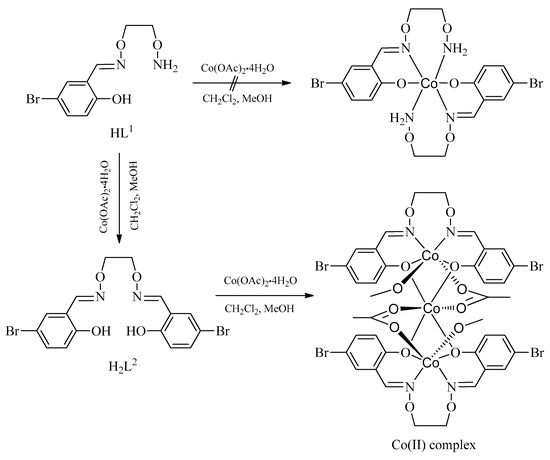
Scheme 1.
Synthesis of the Co(II) complex.
2.4. Crystal Structure of the Co(II) Complex
X-ray single crystal diffraction data of the Co(II) complex was collected by a Bruker APEX-II CCD surface-detecting diffractometer, and monochromatic Mo-Kα radiation (λ = 0.71073 Å) was carried out with a graphite monochromator. The data was corrected with Lp factor and empirical absorption correction. The crystal structure was analyzed by the SHELXTL program, and all non-hydrogen atoms were found by direct-distribution and Fourier difference analysis. The structure was subjected to full matrix minimum multiplication correction through all non-hydrogen atoms. Table 1 summarizes the details of data collection and refinements of the Co(II) complex. The Crystallography Data Center in Cambridge collected crystallographic data as supplemental publications, No. CCDC 1939557 for the Co(II) complex. The data can be obtained free of charge from the Cambridge Crystallographic Data Centre and www.ccdc.cam.ac.uk/conts/retrieving.html.

Table 1.
Crystal data for the Co(II) complex.
3. Results and Discussion
3.1. IR Spectra
In Figure 1, infrared spectra show different bands of HL1 and the Co(II) complex in the range of 500–4000 cm−1. The O–H stretching frequency of HL1 appears at 3443 cm−1, and the peak of the Co(II) complex moves to lower frequency, which occurs at about 3435 cm−1. The O–H stretching vibration is caused by the presence of crystalline methanol molecules in the Co(II) complex. The ligand HL1 shows a characteristic C=N stretching band at 1611 cm−1, while the C=N stretching band of the Co(II) complex appears at 1605 cm−1. At the same time, the free ligand HL1 exhibits an Ar–O stretching frequency at 1181 cm−1, and that of the Co(II) complex appears at 1178 cm−1, and the Ar–O stretching frequency moving to low frequencies, indicating the formations of Co(II)–O bonds.
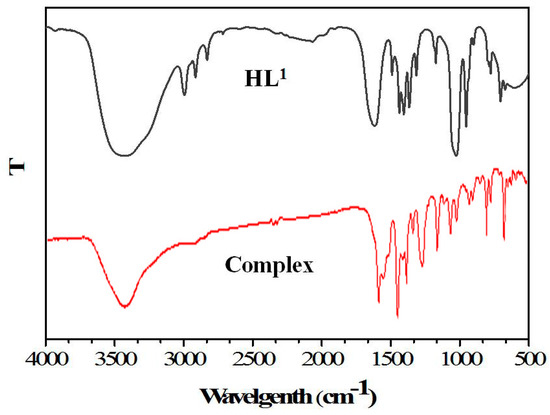
Figure 1.
IR spectra of HL1 and the Co(II) complex.
3.2. UV-Vis Spectra
The UV-visible absorption spectra of HL1 and the Co(II) complex (5.0 × 10⁻⁵ M, ethanol solution) were determined by UV-VIS spectrophotometer, as shown in Figure 2. It is obvious that the absorption peak of the Co(II) complex is significantly different from that of HL1. We can easily find out that the free ligand HL1 exhibits two characteristic absorption peaks at 265 and 322 nm, which can be attributed to the π–π* transitions [49]. The corresponding absorption peak of the Co(II) complex appear at 372 nm compared to the absorption peaks of the free ligand HL1. The absorption at 372 nm can be attributed to the n–π* charge transfer transition from the filled p–π orbital of the phenolic oxygen to the empty d orbital of the Co(II) ions, and indicates that the Co(II) ions and the ligand are successfully coordinated. In the UV-Vis titration experiment of the Co(II) complex, the absorbance at 265 and 322 nm gradually decreased and disappeared with the increase of Co2+ concentration (1.0 × 10⁻⁴ M, aqueous solution), while at 372 nm, a new absorption peak appears. This is a characteristic of Salamo-like complexes. When Co2+ was added to 1.5 equivalents, the absorption peak reaches the highest value. Spectral titration indicates that the ratio of displacement reaction was 1:1.5 ((L1)−:Co2+) (Figure 3).
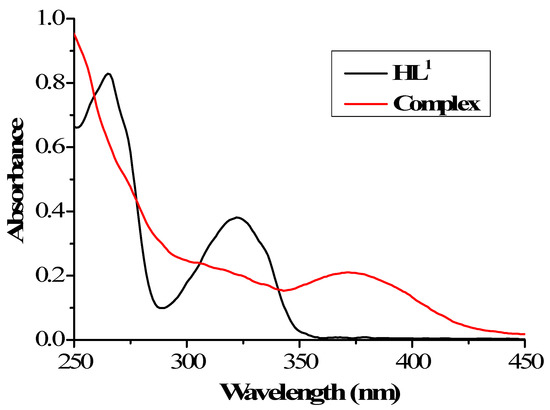
Figure 2.
The UV-Vis spectra of HL1 and the Co(II) complex.
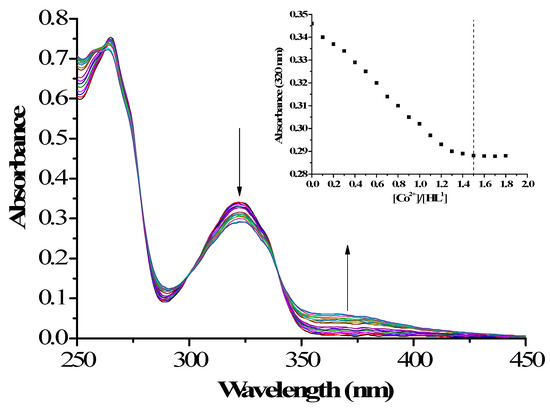
Figure 3.
Ultra violet (UV)-Vis spectra of the changes in HL1 upon addition of Co(OAc)2·4H2O (Inset: the absorbance at 320 nm varies with the interaction of [Co2+]/[HL1]).
3.3. Description of the Crystal Structure
The crystal structure of the Co(II) complex and coordination polyhedral map of Co(II) atoms of the Co(II) complex are shown in Figure 4, and the selected bond lengths and angles are given in Table 2. The X-ray crystal structure of the Co(II) complex shows that it crystallizes in the P-1 space group of the triclinic system, in which the Co(II) atoms are all in a twisted octahedral geometry. It is worth noting that a new symmetrical Salamo-like-based Co(II) complex [Co3(L2)2(μ-OAc)2(CH3OH)2]·2CH3OH was obtained instead of the half-Salamo-like Co(II) complex expected in advance. The results show that due to the catalysis of Co(II) ions [50,51], complexation leads to a N–O bond cleavage in HL1 (make the N–O–N cavity disappear), resulting in a new symmetric N2O2 tetradentate ligand H2L2, which coordinates with Co(II) ions and forms a homo-trinuclear Co(II) complex. So actually, the unexpected trinuclear Co(II) complex [Co3(L2)2(μ-OAc)2(CH3OH)2]·2CH3OH was formed by coordination of H2L2 with Co(OAc)2·4H2O, the molecular structure of the Co(II) complex consists of three Co(II) atoms and two completely deprotonated ligand (L2)2− units.
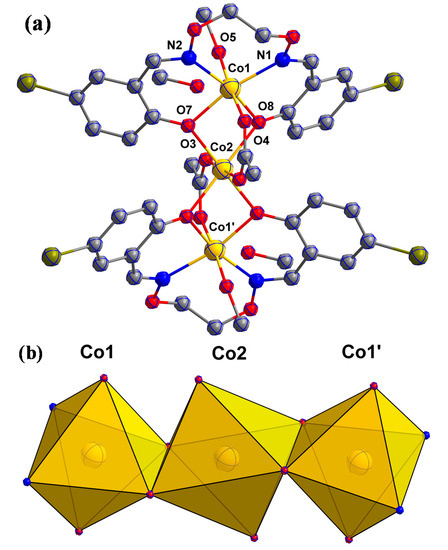
Figure 4.
(a) The crystal structure of the Co(II) complex (hydrogen atoms are omitted for clarity, and the atomic symbol only marked the symmetrical part); (b) Coordination polyhedral map of Co(II) atoms.
Table 2.
Bond lengths (Å) and angles (°) of the Co(II) complex.
The corresponding hydrogen bonds of the Co(II) complex are summarized in Table 3. As illustrated in Figure 5a, there is one pair of intra-molecular hydrogen bonding interactions (C8–H8···O4) in the Co(II) complex [52], In addition, inter-molecular hydrogen bonding interactions are shown in Figure 5b, and three pairs of intermolecular hydrogen bond interactions were formed in the Co(II) complex, which was O5–H5F···O6, O6–H6···O3 and C14–H14···O1, respectively. Hydrogen bonding interactions play a significant role in the construction of the Co(II) complex. Therefore, an infinite 3-D supramolecular structure is finally formed (Figure 5c).
Table 3.
Hydrogen bonding interactions (Å, °) of the Co(II) complex.
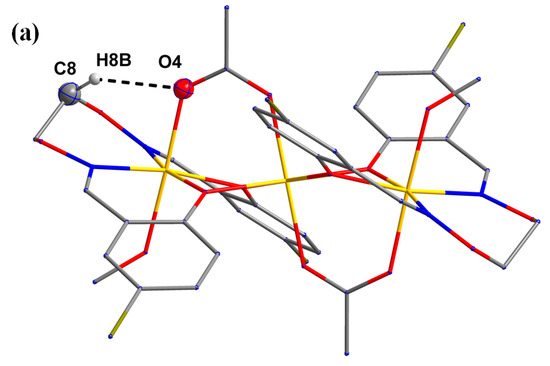
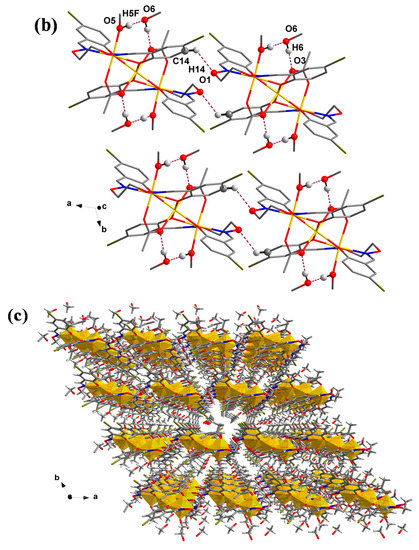
Figure 5.
View of the hydrogen bonding interactions of the Co(II) complex (hydrogen atoms are omitted for clarity, except those forming hydrogen bondings): (a) Intra-molecular hydrogen bonding interaction; (b) Inter-molecular hydrogen bonding interactions; (c) 3-D supra-molecular structure.
3.4. Fluorescence Spectra
The fluorescent properties of the ligand HL1 and the Co(II) complex in ethanol solvent are shown in Figure 6. The concentration of the ligand HL1 and the Co(II) complex was 5.0 × 10⁻⁵ M. At room temperature, at 320 nm excitation, the free ligand HL1 shows a relatively strong emission peak at 367 nm and should be assigned to the ligand π–π* transition. Compared with the free ligand HL1, a weak fluorescence intensity at 360 nm was observed in the Co(II) complex, indicating that the fluorescence characteristics were affected by the introduction of Co(II) ions, as a result, the fluorescence intensity gradually weakens during the process from the ligand HL1 to the Co(II) complex. These transitions may be related to the coordination of the ligand HL1 and the Co(II) ions, which allows the ligand to develop towards a more stable complex.
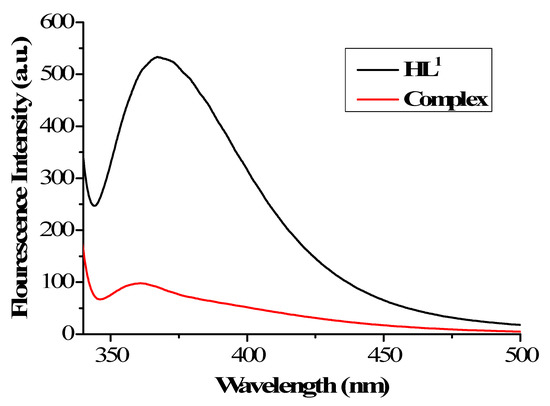
Figure 6.
Fluorescence spectra of HL1 and the Co(II) complex upon excitation at 320 nm (ethanol, 5.0 × 10⁻⁵ M).
3.5. Hirshfeld Surface Analysis
Hirshfeld surface analysis and 2D finger-printing of the Co(II) complex were performed using the Crystal Explorer program [47]. This figure can visually show the weak interactions in the molecular crystal. The electron density of the red region is relatively high because of the formation of hydrogen bonds, and the electron density of the blue region is small and there is no obvious interaction. As shown in Figure 7, the Hirshfeld surface distribution was performed on the Co(II) complex by Curvedness, Shape-Index, dnorm, de and di mapping.
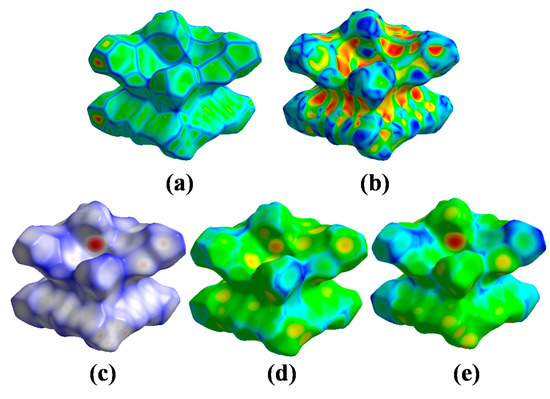
Figure 7.
Hirshfeld surface analysis of the Co(II) complex: (a) Curvedness; (b) Shape-Index; (c) dnorm; (d) de; (e) di.
The short-range interaction distribution inside the Co(II) complex was calculated by Hirshfeld fingerprint plot to quantify the intermolecular interaction. The 2-D fingerprint is summarized in Figure 8. As shown in the figure, for each molecule of the Co(II) complex, the proportion of C–H/H–C, O–H/H–O, H–H/H–H and Br–H/H–Br interactions was 9.8%, 5.7%, 40.7% and 13.6% of the total Hirshfeld surface, respectively. It is apparent that the intermolecular interactions of the total surface of Hirshfeld are mainly derived from the H–H/H–H interaction.
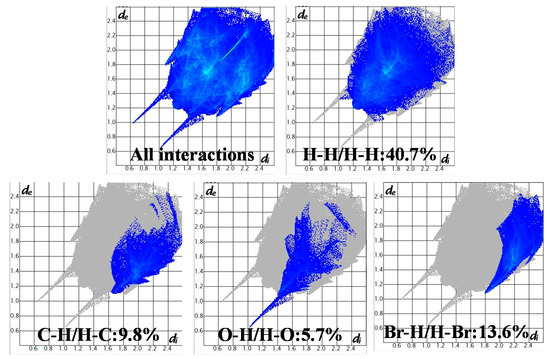
Figure 8.
Finger-print plot of percentages of contacts on the Hirshfeld surface in the Co(II) complex.
3.6. Antibacterial Activities
The antibacterial activities of HL1, cobalt(II) acetate tetrahydrates and the Co(II) complex were tested by perforation method, and Gram-negative Escherichia coli was selected as the research object. First, the Co(II) complex is formulated into a solution of the same concentration using different solvents (DMF, DMSO, TCM, DCM, MeOH, EtOH, PA, ACN), and secondly, when culturing E. coli to OD600 ≈ 1.0 using LB liquid medium (2% agar), add 25 μL to LB solid medium at about 50 °C, pour the plate to solidify, and punch with a puncher. A sample of 200 μL of different solvent was added to each well and placed in an LRH-250-G light incubator at 37 °C for 12 h to observe the size of the zone of inhibition. As shown in Figure 9a, only the DMF has a larger diameter of the inhibition ring than other solvents, indicating that the complex has relatively strong antibacterial activity in the presence of DMF.
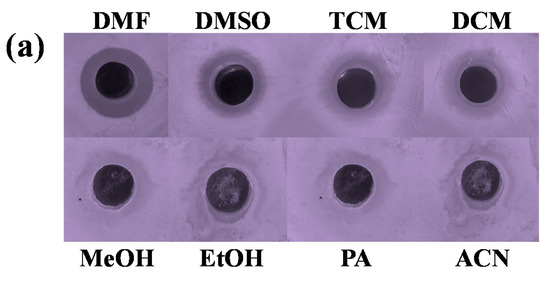
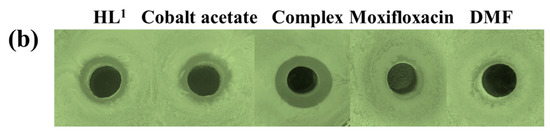
Figure 9.
(a) The diameter of the inhibition zone of Escherichia coli in different solvents of the Co(II) complex; (b) The diameter of the inhibition zone of Escherichia coli in different samples at a concentration of 3.2 mg/mL.
Four groups of solutions were prepared by DMF solution at concentrations of 0.4 mg/mL, 0.8 mg/mL, 1.6 mg/mL, and 3.2 mg/mL, respectively. Under the same conditions, using moxifloxacin as a positive control experiment, 200 μL of the sample was added to the LB solid medium, and all the samples were incubated at a constant temperature of 32 °C for 12 h, and Figure 9b is a zone of inhibition of a different sample at a concentration of 3.2 mg/mL, we can clearly see that the diameter of the inhibition zone of HL1, cobalt acetate, the Co(II) complex and moxifloxacin increased sequentially. From the results of Figure 10, it can be shown that the Co(II) complex has stronger antibacterial activity than the ligand, and the antibacterial activity increases as the concentration increases.
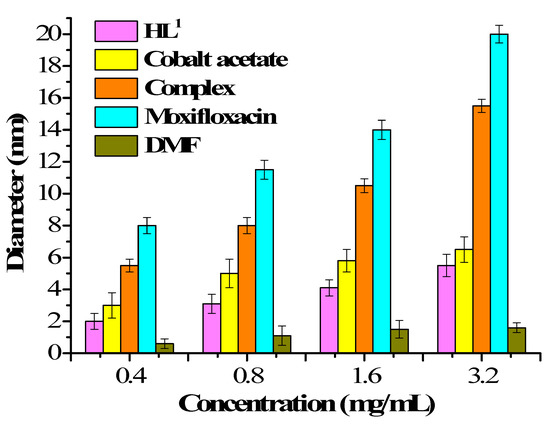
Figure 10.
A histogram of the inhibition zone diameter of Escherichia coli at different concentrations of different samples.
4. Conclusions
An unexpected supramolecular Co(II) complex [Co3(L2)2(μ-OAc)2(CH3OH)2]·2CH3OH was synthesized and characterized by physicochemical methods and single crystal X-ray diffraction. The results show that each Co(II) atoms is hexa-coordinated, and it forms three structurally stable octahedrons with O and N atoms of coordinated methanol molecules, bridged acetate molecules and the completely deprotonated (L2)2− moities. Each molecule of the Co(II) complex is linked to each other to form a three-dimensional supra-molecular network. This kind of complex has potential applications and deserves further study and can be used to develop novel transition metal complexes.
Author Contributions
W.-K.D. conceived and designed the experiments, and contributed reagents/materials/analysis tools; X.-X.A., R.-Y.L. and J.-L.W. performed the experiments; Y.-P.Z. analyzed the data; R.-Y.L. and X.-X.A. wrote the paper.
Funding
This work was supported by the National Natural Science Foundation of China(Grant No. 21761018), and the Program for Excellent Team of Scientific Research in Lanzhou Jiaotong University(Grant No. 201706).
Conflicts of Interest
The authors declare no competing financial interests.
References
- Liu, X.; Manzurc, C.; Novoa, N.; Celedónc, S.; Carrilloc, D.; Hamon, J.R. Multidentate unsymmetrically-substituted Schiff bases and their metal complexes: Synthesis, functional materials properties, and applications to catalysis. Coord. Chem. Rev. 2018, 357, 144–172. [Google Scholar] [CrossRef]
- Liu, X. Recent developments in penta-, hexa- and heptadentate Schiff base ligands and their metal complexes. Coord. Chem. Rev. 2019, 389, 94–118. [Google Scholar] [CrossRef]
- Li, X.Y.; Kang, Q.P.; Liu, L.Z.; Ma, J.C.; Dong, W.K. Trinuclear Co(II) and mononuclear Ni(II) salamo-type bisoxime coordination compounds. Crystals 2018, 8, 43. [Google Scholar] [CrossRef]
- Zhang, L.W.; Liu, L.Z.; Wang, F.; Dong, W.K. Unprecedented fluorescent dinuclear CoII and ZnII coordination compounds with a symmetric bis(salamo)-like tetraoxime. Molecules 2018, 23, 1141. [Google Scholar] [CrossRef]
- Akine, S.; Sairenji, S.; Taniguchi, T.; Nabeshima, T. Stepwise helicity inversions by multisequential metal Exchange. J. Am. Chem. Soc. 2013, 135, 12948–12951. [Google Scholar] [CrossRef]
- Wang, P.; Zhao, L. Synthesis, structure and spectroscopic properties of the trinuclear cobalt(II) and nickel(II) complexes based on 2-hydroxynaphthaldehyde and bis(aminooxy)alkane. Spectrochim. Acta A 2015, 135, 342–350. [Google Scholar] [CrossRef]
- Akine, S.; Tadokoro, T.; Nabeshima, T. Oligometallic template strategy for synthesis of a macrocyclic dimer-type octaoxime ligand for its cooperative complexation. Inorg. Chem. 2012, 51, 11478–11486. [Google Scholar] [CrossRef]
- Akine, S.; Varadi, Z.; Nabeshima, T. Synthesis of planar metal complexes and the stacking abilities of naphthalenediol-based acyclic and macrocyclic salen-type ligands. Eur. J. Inorg. Chem. 2013, 2013, 5987–5998. [Google Scholar] [CrossRef]
- Akine, S.; Kagiyama, S.; Nabeshima, T. Modulation of multimetal complexation behavior of tetraoxime ligand by covalent transformation of olefinic functionalities. Inorg. Chem. 2010, 49, 2141–2152. [Google Scholar] [CrossRef]
- Wang, F.; Liu, L.Z.; Gao, L.; Dong, W.K. Unusual constructions of two salamo-based copper(II) complexes. Spectrochim. Acta A 2018, 203, 56–64. [Google Scholar] [CrossRef]
- Hao, J.; Li, X.Y.; Zhang, Y.; Dong, W.K. A reversible bis(salamo)-based fluorescence sensor for selective detection of Cd2+ in water-containing systems and food samples. Materials 2018, 11, 523. [Google Scholar] [CrossRef]
- Akine, S.; Hotate, S.; Nabeshima, T. A molecular leverage for helicity control and helix inversion. J. Am. Chem. Soc. 2011, 133, 13868–13871. [Google Scholar] [CrossRef]
- Akine, S.; Matsumoto, T.; Sairenji, S.; Nabeshima, T. Synthesis of acyclic tetrakis- and pentakis(N2O2) ligands for single-helical heterometallic complexes with a greater number of winding turns. Supramol. Chem. 2011, 23, 106–112. [Google Scholar] [CrossRef]
- Chin, T.K.; Endud, S.; Jamil, S.; Budagumpi, S.; Lintang, H.O. Oxidative dimerization of o-aminophenol by heterogeneous mesoporous material modified with biomimetic salen-type copper(II) complex. Catal. Lett. 2013, 143, 282–288. [Google Scholar] [CrossRef]
- Chen, C.Y.; Zhang, J.W.; Zhang, Y.H.; Yang, Z.H.; Wu, H.L.; Pan, G.L.; Bai, Y.C. Gadolinium(III) and dysprosium(III) complexes with a Schiff base bis(N-salicylidene)-3-oxapentane-1,5-diamine: Synthesis, characterization, antioxidation, and DNA-binding studies. J. Coord. Chem. 2015, 68, 1054–1071. [Google Scholar] [CrossRef]
- Wu, H.L.; Wang, H.; Wang, X.L.; Pan, G.L.; Shi, F.R.; Zhang, Y.H.; Bai, Y.C.; Kong, J. V-shaped ligand bis(2-benzimidazolylmethyl)amine containing three copper(II) ternary complexes: Synthesis, structure, DNA binding properties and antioxidant activity. New J. Chem. 2014, 38, 1052–1061. [Google Scholar] [CrossRef]
- Zhang, H.; Xu, Y.L.; Wu, H.L.; Aderinto, S.O.; Fan, X.Y. Mono-, bi- and multi-nuclear silver complexes constructed from bis(benzimidazole)-2-oxapropane ligands and methacrylate: Syntheses, crystal structures, DNA-binding properties and antioxidant activities. RSC Adv. 2016, 6, 83697–83708. [Google Scholar] [CrossRef]
- Zhang, Y.; Liu, L.Z.; Pan, Y.Q.; Dong, W.K. Structural characterized homotrinuclear ZnII bis(salamo)-based coordination compound: Hirshfeld surfaces, fluorescent and antimicrobial properties. Crystals 2018, 8, 259. [Google Scholar] [CrossRef]
- Gao, L.; Liu, C.; Wang, F.; Dong, W.K. Tetra-, penta- and hexa-coordinated transition metal complexes constructedfrom coumarin-containing N2O2 ligand. Crystals 2018, 8, 77. [Google Scholar] [CrossRef]
- Chai, L.Q.; Li, Y.X.; Chen, L.C.; Zhang, J.Y.; Huang, J.J. Synthesis, X-ray structure, spectroscopic, electrochemical properties and DFT calculation of a bridged dinuclear copper(II) complex. Inorg. Chim. Acta 2016, 444, 193–201. [Google Scholar] [CrossRef]
- Dong, W.K.; Ma, J.C.; Zhu, L.C.; Zhang, Y.; Li, X.L. Four new nickel(II) complexes based on an asymmetric salamo-type ligand: Synthesis, structure, solvent effect and electrochemical property. Inorg. Chim. Acta 2016, 445, 140–148. [Google Scholar] [CrossRef]
- Ren, Z.L.; Hao, J.; Hao, P.; Dong, X.Y.; Bai, Y.; Dong, W.K. Synthesis, crystal structure, luminescence and electrochemical properties of a salamo-type trinuclear cobalt(II) complex. Z. Naturforschung B 2018, 73, 203–210. [Google Scholar] [CrossRef]
- Chai, L.Q.; Tang, L.J.; Chen, L.C.; Huang, J.J. Structural, spectral, electrochemical and DFT studies of two mononuclear manganese(II) and zinc(II) complexes. Polyhedron 2017, 122, 228–240. [Google Scholar] [CrossRef]
- Song, X.Q.; Liu, P.P.; Liu, Y.A.; Zhou, J.J.; Wang, X.L. Two dodecanuclear heterometallic [Zn6Ln6] clusters constructed by a multidentate salicylamide salen-like ligand: Synthesis, structure, luminescence and magnetic properties. Dalton Trans. 2016, 45, 8154–8163. [Google Scholar] [CrossRef]
- Zhang, L.W.; Li, X.Y.; Kang, Q.P.; Liu, L.Z.; Ma, J.C.; Dong, W.K. Structures and fluorescent and magnetic behaviors of newly synthesized NiII and CuII coordination compounds. Crystals 2018, 8, 173. [Google Scholar] [CrossRef]
- Yamashita, A.; Watanabe, A.; Akine, S.; Nabeshima, T.; Nakano, M.; Yamamura, T.; Kajiwara, T. Wheel-shaped ErIIIZnII3 single-molecule magnet: A macrocyclic approach to designing magnetic anisotropy. Angew. Chem. Int. Ed. 2011, 50, 4016–4019. [Google Scholar] [CrossRef]
- Song, X.Q.; Liu, P.P.; Wang, C.Y.; Liu, Y.A.; Liu, W.S.; Zhang, M. Three sandwich-type zinc(II)-lanthanide(III) clusters: Structures, luminescence and magnetic properties. RSC Adv. 2017, 7, 22692–22698. [Google Scholar] [CrossRef]
- Zheng, S.S.; Dong, W.K.; Zhang, Y.; Chen, L.; Ding, Y.J. Four salamo-type 3d-4f hetero-bimetallic [ZnIILnIII] complexes: Syntheses, crystal structures, and luminescent and magnetic properties. New J. Chem. 2017, 41, 4966–4973. [Google Scholar] [CrossRef]
- Zhao, Q.; An, X.X.; Liu, L.Z.; Dong, W.K. Syntheses, luminescences and Hirshfeld surfaces analyses of structurally characterized homo-trinuclear ZnII and hetero-pentanuclear ZnII-LnIII (Ln=Eu, Nd) bis(salamo)-like complexes. Inorg. Chim. Acta 2019, 490, 6–15. [Google Scholar] [CrossRef]
- Wang, L.; Kang, Q.P.; Hao, J.; Dong, W.K. Two trinuclear cobalt(II) salamo-type complexes: Syntheses, crystal structures, solvent effect and fluorescent properties. Chin. J. Inorg. Chem. 2018, 34, 525–533. [Google Scholar]
- Yamamura, M.; Takizawa, H.; Sakamoto, N.; Nabeshima, T. Monomeric and dimeric red/NIR-fluorescent dipyrrin-germanium complexes: Facile monomer-dimer interconversion driven by acid/base additions. Tetrahedron Lett. 2013, 54, 7049–7052. [Google Scholar] [CrossRef]
- Peng, Y.D.; Li, X.Y.; Kang, Q.P.; An, G.X.; Zhang, Y.; Dong, W.K. Synthesis and fluorescence properties of asymmetrical salamo-type tetranuclear zinc(II) complex. Crystals 2018, 8, 107. [Google Scholar] [CrossRef]
- Dong, X.Y.; Zhao, Q.; Wei, Z.L.; Mu, H.R.; Zhang, H.; Dong, W.K. Synthesis and fluorescence properties of structurally characterized heterobimetalic Cu(II)-Na(I) bis(salamo)-based complex bearing square planar, square pyramid and triangular prism geometries of metal centers. Molecules 2018, 23, 1006. [Google Scholar] [CrossRef]
- Kang, Q.P.; Li, X.Y.; Zhao, Q.; Ma, J.C.; Dong, W.K. Structurally characterized homotrinuclear salamo-type nickel(II) complexes: Synthesis, solvent effect and fluorescence properties. Appl. Organomet. Chem. 2018, 32, e4379. [Google Scholar] [CrossRef]
- Sakamoto, N.; Ikeda, C.; Yamamura, M.; Nabeshima, T. Structural interconversion and regulation of optical properties of stable hypercoordinate dipyrrin-silicon complexes. J. Am. Chem. Soc. 2011, 133, 4726–4729. [Google Scholar] [CrossRef]
- Ikeda, C.; Ueda, S.; Nabeshima, T. Aluminium complexes of N2O2-type dipyrrins: The first hetero-multinuclear complexes of metallo-dipyrrins with high fluorescence quantum yields. Chem. Commun. 2009, 2544–2546. [Google Scholar] [CrossRef]
- Dong, X.Y.; Zhao, Q.; Kang, Q.P.; Mu, H.R.; Zhang, H.; Dong, W.K. Self-assembly of 3d-4f ZnII-LnIII(Ln=Ho and Er) bis(salamo)-based complexes: Controlled syntheses, structures and fluorescence properties. Crystals 2018, 8, 230. [Google Scholar] [CrossRef]
- Yang, Y.H.; Hao, J.; Dong, Y.J.; Wang, G.; Dong, W.K. Two Znic(II) complexes constructed from a bis(salamo)-type tetraoxime ligand: Syntheses, crystal structures and luminescence properties. Chin. J. Inorg. Chem. 2017, 33, 1280–1292. [Google Scholar]
- Hu, J.H.; Sun, Y.; Qi, J.; Li, Q.; Wei, T.B. A new unsymmetrical azine derivative based on coumarin group as dual-modal sensor for CN− and fluorescent “OFF-ON” for Zn2+. Spectrochim. Acta A 2017, 175, 125–133. [Google Scholar] [CrossRef]
- Sun, Y.; Hu, J.H.; Qi, J.; Li, J.B. A highly selective colorimetric and “turn-on” fluorimetric chemosensor for detecting CN− based on unsymmetrical azine derivatives in aqueous media. Spectrochim. Acta A 2016, 167, 101–105. [Google Scholar] [CrossRef]
- Akine, S.; Piao, S.J.; Miyashita, M.; Nabeshima, T. Cage-like tris(salen)-type metallocryptand for cooperative guest recognition. Tetrahedron Lett. 2013, 54, 6541–6544. [Google Scholar] [CrossRef]
- Nabeshima, T.; Yamamura, M. Cooperative formation and functions of multimetal supramolecular systems. Pure Appl. Chem. 2013, 85, 763–776. [Google Scholar] [CrossRef]
- Zhang, H.J.; Chang, J.; Jia, H.R.; Sun, Y.X. Syntheses, supramolecular structures and spectroscopic properties of Cu(II) and Ni(II) complexes with Schiff base containing oxime group. Chin. J. Inorg. Chem. 2018, 34, 2261–2270. [Google Scholar]
- Jia, H.R.; Li, J.; Sun, Y.X.; Guo, J.Q.; Yu, B.; Wen, N.; Xu, L. Two supramolecular cobalt(II) complexes: Syntheses, crystal structures, spectroscopic behaviors, and counter anion effects. Crystals 2017, 7, 247. [Google Scholar]
- Zhou, L.; Hu, Q.; Chai, L.Q.; Mao, K.H.; Zhang, H.S. X-ray characterization, spectroscopic, DFT calculations and Hirshfeld surface analysis of two 3-D supramolecular mononuclear zinc(II) and trinuclear copper(II) complexes. Polyhedron 2019, 158, 102–116. [Google Scholar] [CrossRef]
- Chang, J.; Zhang, H.J.; Jia, H.R.; Sun, Y.X. Binuclear nickel(II) and zinc(II) complexes based on 2-amino-3-hydroxy-pyridine Schiff base: Syntheses, supramolecular structures and spectral properties. Chin. J. Inorg. Chem. 2018, 34, 2097–2107. [Google Scholar]
- Spackman, M.A.; McKinnon, J.J.; Jayatilaka, D. Electrostatic potentials mapped on Hirshfeld surfaces provide direct insight into intermolecular interactions in crystals. Cryst. Eng. Commun 2008, 10, 377–388. [Google Scholar] [CrossRef]
- An, X.X.; Zhao, Q.; Mu, H.R.; Dong, W.K. A new half-salamo-based homo-trinuclear nickel(II) complex: Crystal structure, Hirshfeld surface analysis, and fluorescence properties. Crystals 2019, 9, 101. [Google Scholar] [CrossRef]
- Dong, X.Y.; Kang, Q.P.; Li, X.Y.; Ma, J.C.; Dong, W.K. Structurally characterized solvent-induced homotrinuclear cobalt(II) N2O2-donor bisoxime-type complexes. Crystals 2018, 8, 139. [Google Scholar] [CrossRef]
- Dong, W.K.; Lan, P.F.; Zhou, W.M.; Zhang, Y. Salamo-type trinuclear and tetranuclear cobalt(II) complexes based on a new asymmetry salamo-type ligand: Syntheses, crystal structures and fluorescence properties. J. Coord. Chem. 2016, 65, 1272–1283. [Google Scholar] [CrossRef]
- Dong, W.K.; Zhang, J.T.; Dong, Y.J.; Zhang, Y.; Wang, Z.K. Construction of mononuclear copper(II) and trinuclear cobalt(II) complexes based on asymmetric salamo-type ligands. Z. Anorg. Allg. Chem. 2016, 642, 189–196. [Google Scholar] [CrossRef]
- Dong, W.K.; Zheng, S.S.; Zhang, J.T.; Zhang, Y.; Sun, Y.X. Luminescent properties of heterotrinuclear 3d–4f complexes constructed from a naphthalenediol-based acyclic bis(salamo)-type ligand. Spectrochim. Acta A 2017, 184, 141–150. [Google Scholar] [CrossRef]
© 2019 by the authors. Licensee MDPI, Basel, Switzerland. This article is an open access article distributed under the terms and conditions of the Creative Commons Attribution (CC BY) license (http://creativecommons.org/licenses/by/4.0/).