3.1. Synthesis and Crystallizations
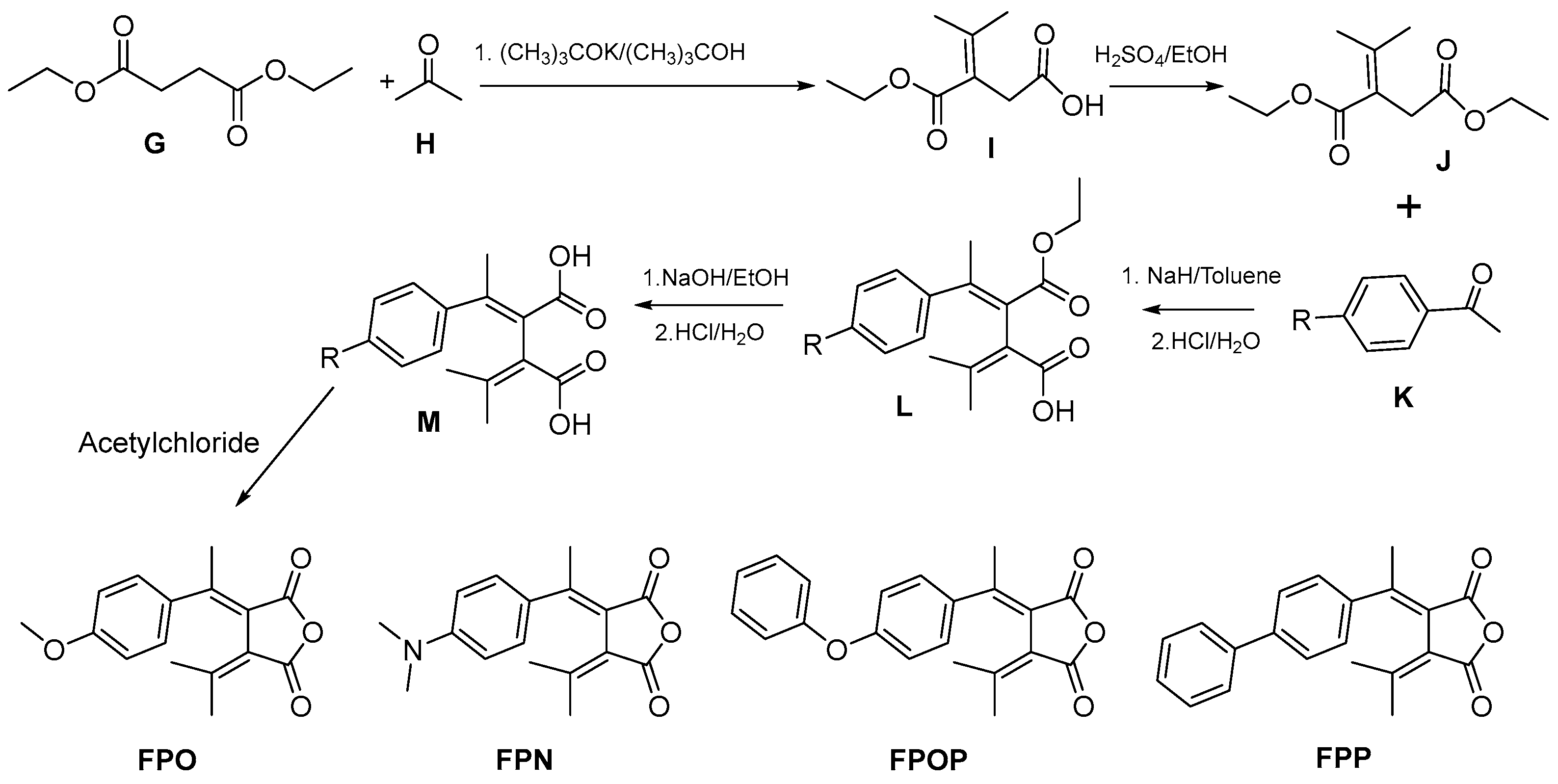
The synthesis of the fulgides was carried out following the slightly modified pathway illustrated in
Scheme 1, which was reported previously.
Diethyl succinate G was reacted with one equivalent acetone H and one equivalent potassium tert-butoxide in tert-butanol under reflux for 8 h. After removal of solvent tert-butanol with a rotavapor under vacuum, the residue was poured into ice water. The water solution was washed with diethyl ether and then acidified to a pH of around 2 and transferred into a separatory funnel. The top layer was collected, and the aqueous phase was washed with ethyl acetate three times. The resulting ethyl acetate solution was combined with the top layer and dried with granular anhydrous sodium sulfate. 3-(ethoxycarbonyl)-4-methylpent-3-enoic acid I yielded when the ethyl acetate solution was condensed to dryness by a rotavapor under vacuum. The carboxylic acid I, without further purification, was esterified in refluxing ethanol using sulfuric acid as catalyst for 10 h to prepare crude diethyl 2-(propan-2-ylidene) succinate J after removal of solvent from the reaction mixture. The crude product was transferred to a flask and vacuum distilled to remove components of boiling point lower than 60 °C under a vacuum of 80 millitorr. The material left in the flask was distilled close to dryness to yield product J with a purity of approximately 85% based on estimation from the 1H NMR spectrum.
Each of the four
para-substituted acetophenone
K reacted with compound
J to produce the corresponding
F as detailed in the following. Sodium hydride (1.2 equivalents) was added to the solution of K in toluene, and the suspension was stirred for 24 h. The reaction mixture was poured into ice water to form a suspension, which was transferred into a separatory funnel and the top layer was removed. The aqueous solution was washed with toluene three times and then acidified to a pH of around 2 to yield compound
L as precipitate. The precipitate was collected by filtration and dried by a rotavapor and then transferred into a flask. To the flask containing compound
L was added ethanol and sodium hydroxide (10 equivalents to
L). The mixture was refluxed for 12 h, cooled down to room temperature, and then the sodium salt of
M yielded as precipitate. The precipitate was collected by filtration, washed with chilled ethanol, dried by a rotavapor, and transferred into a beaker. Water was added to the beaker until the precipitate dissolved. The resulting solution was acidified with concentrated hydrochloric acid to a pH of around 2 to yield compound
M as precipitate. The precipitate
M was collected by filtration, washed with chilled water, transferred to a round-bottomed flask, and dried with a rotavapor. Acetyl chloride was added to the flask containing
M (50 mL acetyl chloride per gram of
M), and the resulting solution was stirred for 24 h at room temperature. The acetyl chloride was then removed by a rotavapor. The resulting solid in the flask was subjected to silica gel chromatography, and the fractions that exhibited red color on the wet TLC plate under UV detector were collected and condensed to yield the corresponding
F, which was confirmed to be of
E-F:
FPO,
FPN,
FPOP, and
FPP.
FPO was synthesized previously [
13], while its crystal structure has not been reported. The products of
Z-F were not our primary focus and were therefore not isolated from the reaction mixture. All
E-
F were characterized by
1H NMR,
13C NMR and Mass Spectroscopy and the corresponding spectra are provided in
Supplementary Materials.
3.1.1. (E)-3-(1-(4-Methoxyphenyl) Ethylidene)-4-(Propan-2-ylidene) Dihydrofuran-2,5-dione (FPO)
FPO yielded as yellow plate-shaped crystals with a yield of 13% based on the amount of 4-methoxyacetophenone used.
1H NMR in CDCl3 (chemical shift in ppm): 1.07, singlet, 3 H; 2.11, singlet, 3H, 2.57, singlet, 3 H; 3.70, singlet 3 H; 6.78–6.80, doublet, 2 H; 7.16–7.18, doublet, 2H.
13C NMR in CDCl3 (chemical shift in ppm): 22.64, 22.17, 55.48, 114.55, 119.66, 120.10, 129.37, 134.80, 154.12, 154.57, 160.27, 154.57, 160.27, 163.59, 164.13.
ESI-MS, C16H16O4, [M + H+]: 273.1115, expected: 273.1121.
3.1.2. (E)-3-(1-(4-(Dimethylamino) Phenyl) Ethylidene)-4-(Propan-2-ylidene) Dihydrofuran-2,5-dione (FPN)
FPN yielded as orange plate-shaped crystals with a yield of 14% based on the amount of 4-dimethylaminoacetophenone used.
1H NMR in CDCl3 (chemical shift in ppm): 1.25, singlet, 3 H; 2.23, singlet, 3H, 2.67, singlet, 3 H; 3.01, singlet 3 H; 6.62–6.65, doublet, 2 H; 7.24–7.26, doublet, 2H.
13C NMR in CDCl3 (chemical shift in ppm): 22.42, 22.63, 26.27, 40.21, 111.87, 117.64, 120.83, 129.43, 150.86, 153.23, 155.35, 164.11, 164.45.
ESI-MS, C17H19NO3, [M + H+]: 286.1430, expected: 286.1438.
3.1.3. (E)-3-(1-(4-Phenoxyphenyl) Ethylidene)-4-(Propan-2-ylidene) Dihydrofuran-2,5-dione (FPOP)
FPOP yielded as yellow block-shaped crystals with a yield of 18% based on the amount of 4-phynoxyacetophenone used.
1H NMR in CDCl3 (chemical shift in ppm): 1.14, singlet, 3 H; 2.13, singlet, 3H, 2.57, singlet, 3 H; 2.61, singlet 3 H; 6.89–7.30, multiple peaks, 9H.
13C NMR in CDCl3 (chemical shift in ppm):22.57, 22.60, 26.18, 118.59, 119.61, 119.88, 120.18, 124.27, 129.41, 130.02, 136.93, 153.41, 154.82, 158.31, 16.31, 163.93.
ESI-MS, C21H18O4, [M + H+]: 335.1269, expected: 335.1278.
3.1.4. (E)-3-(1-([1,1′-Biphenyl]-4-yl) Ethylidene)-4-(Propan-2-ylidene) Dihydrofuran-2,5-dione (FPP)
FPP yielded as yellow plate-shaped crystals with a yield of 12% based on the amount of 4-acetylbiphenyl used.
1H NMR in CDCl3 (chemical shift in ppm): 1.08, singlet, 3 H; 2.12, singlet, 3H, 2.64, singlet, 3 H; 7.26–7.30, multiple peak 3 H; 7.34–7.38, multiple peaks, 2 H; 7.51–7.54. multiple peaks, 4 H.
13C NMR in CDCl3 (chemical shift in ppm): 22.52, 22.64, 26.28, 119.82, 120.64, 126.98, 127.62, 128.05, 128.20, 129.02, 139.68, 141.50, 141.74, 153.64, 155.32, 163.33, 163.95.
ESI-MS, C21H18O3, [M + H+]: 319.1322, expected: 319.1329.
3.2. Crystal Structure and Discussion
A single crystal was picked from the crystals of each fulgide:
FPO,
FPN,
FPOP, and
FPP, and was subjected to X-ray crystallographic analysis. The major parameters and results are summarized in
Table 1.
To determine the crystal structure of
FPO, a suitable single yellow plate-shaped crystal with dimensions 0.20 × 0.20 × 0.10 mm
3 was selected and mounted on a XtaLAB Synergy, single source at home/near, Eiger2 1M diffractometer. Data was measured using
ω scans with Ag K
α radiation. The crystal was kept at a steady
T = 110.00 K during data collection. The structure was solved with the ShelXT 2018/2 solution program using dual methods and Olex2 1.5 [
14] as the graphical interface. The model was refined with ShelXL 2019/2 [
15,
16] using full matrix least squares minimization on
F2. The final
wR2 was 0.1426 (all data), and
R1 was 0.0473 (I ≥ 2
σ(I)). Major parameters and results are listed in
Table 1. The structure was determined to be monoclinic with a space group of
P2
1/
n (No. 14). The molecular packing of
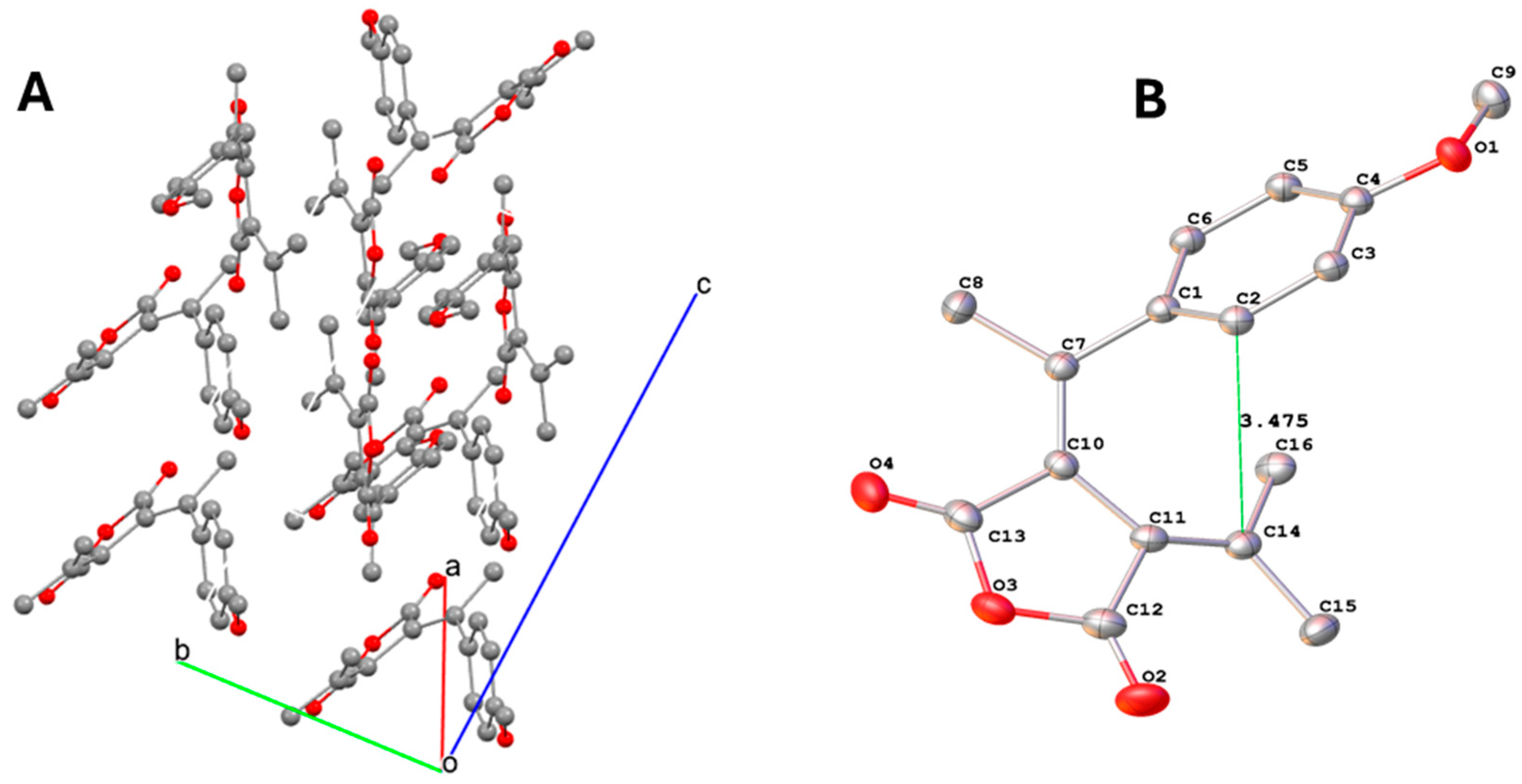
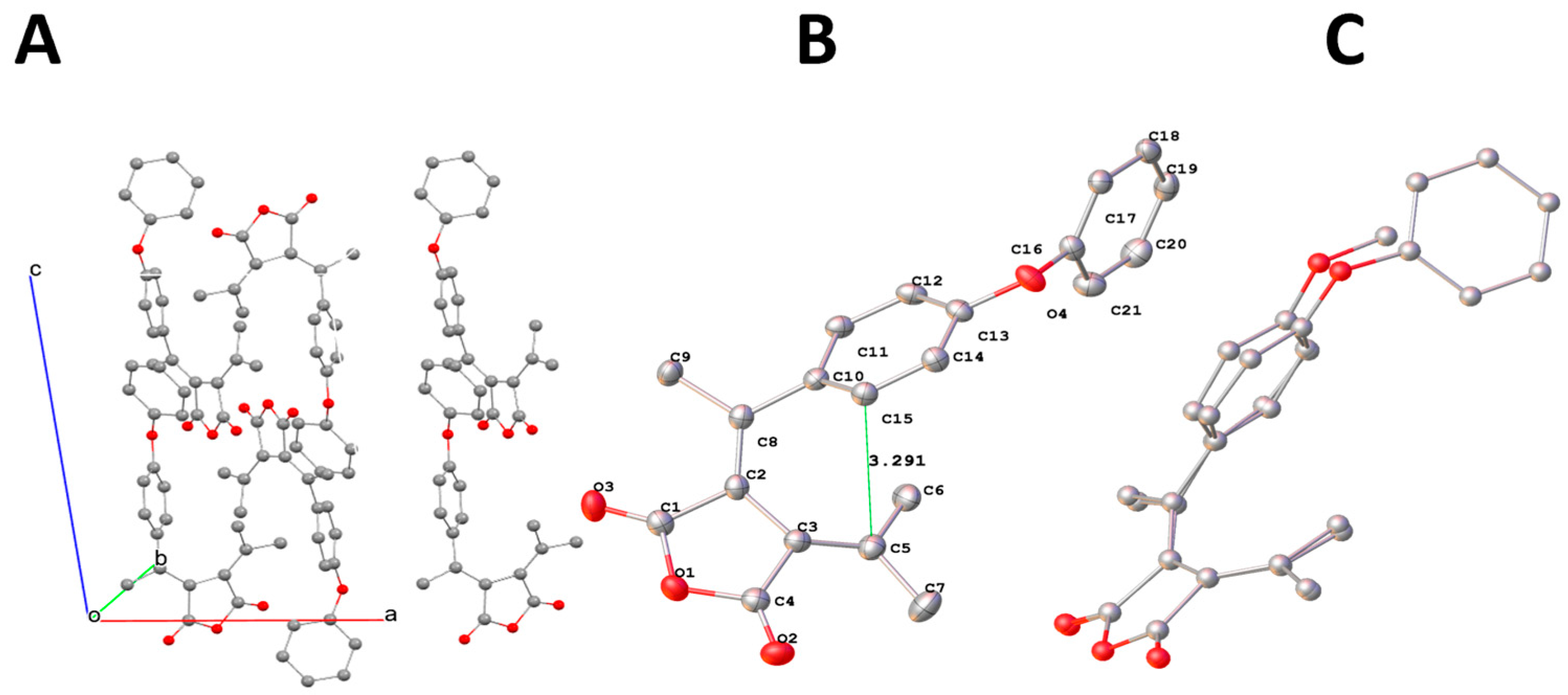
FPO in the crystal is illustrated in
Figure 3A. The structure of
FPO is illustrated in
Figure 3B.
The bond distances of nonhydrogen atoms, selected bond angles, and torsion angles were measured and are presented in
Table 2,
Table 3 and
Table 4.
The structure of fulgides can be viewed as comprising three moieties: the succinic anhydride, the phenyl group, and the conjugated system of C7=C10–C11=C14. The bond lengths among carbons C1-6 in the phenyl group fall into the range 1.385–1.402 Å, which is consistent with those in a substituted benzene. The two C=C double bonds C7=C10 and C13=C14 are 1.3662 Å and 1.3578 Å, respectively, which are slightly longer than the average C=C length of 1.34 Å due to distorted conjugation. Single C–C bonds, as exemplified by C14–C15 and C14–C16, with lengths of 1.5022 Å and 1.4932 Å, are slightly shorter than the average of 1.54 Å due to being adjacent to a double bond. The torsion of C7–C10–C11–C14 is −35.8°, which shows the great distortion of the C7=C10–C11=C14 conjugated system. The torsion of C2–C1–C7–C10 is −50.76°, showing that the C11=C14 double bond is far from a perfect conjugation of 0° torsion. The torsion angles C1–C7–C10–C11 and C13–C10–C11–C12 indicate that the double bond of C7=C10 and C11=C14 are distorted by a similar extent of −11.18° and 10.42°. The significant distortions of the conjugated system and the double bonds are caused by the stereo repulsion between the methyl group of C14 and the phenyl group. The stereo strain energy drives the molecule to undergo intramolecular cyclization. The distance between the C14 and C2 was measured to be 3.475 Å.
Intermolecular interactions were examined using Hirshfeld surface (HS) analysis. The molecular surface of
FPO is shown in
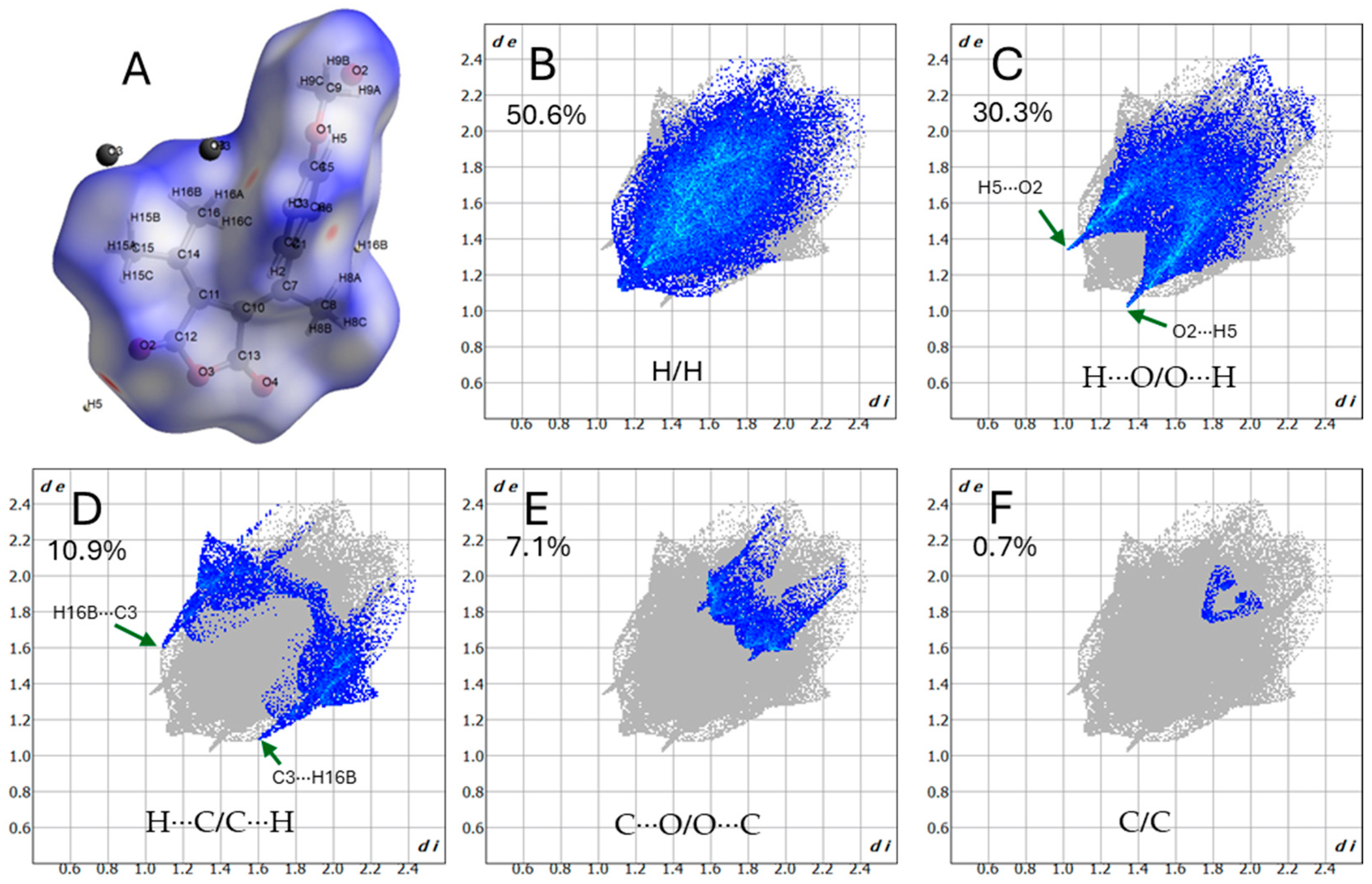
Figure 4A. Atoms outside the surface exhibit close contacts with their counterparts within the van der Waals repulsion range. The surface is dominated by H···H and H···O contacts, which contribute 50.6% and 30.3% of the total area, respectively, together accounting for 90.9% of the Hirshfeld surface as shown in
Figure 4B–F. The H···C and C···O contacts contribute an additional 10.9% and 7.1%, while C···C and O···O contacts together account for the remaining ~1%, indicating negligible contributions from these interactions. A substantial number of H···H contacts fall within the 2.2–3.5 Å range associated with strong to weak van der Waals attraction, making them the largest contributors to crystal stabilization. Numerous H···O and H···C contacts, occurring in the 2.5–2.8 Å and 2.6–3.0 Å ranges, respectively, also provide meaningful stabilizing contributions. Approximately 7.1% of the Hirshfeld surface arises from antiparallel approaches of the anhydride C=O bonds at distances around 4.0 Å, close to the neutral van der Waals separation for C···O. These contacts therefore generate only negligible—if any—repulsion between the succinic moieties in the crystal. All remaining contacts are too few in number or too long in distance to exert measurable intermolecular effects.
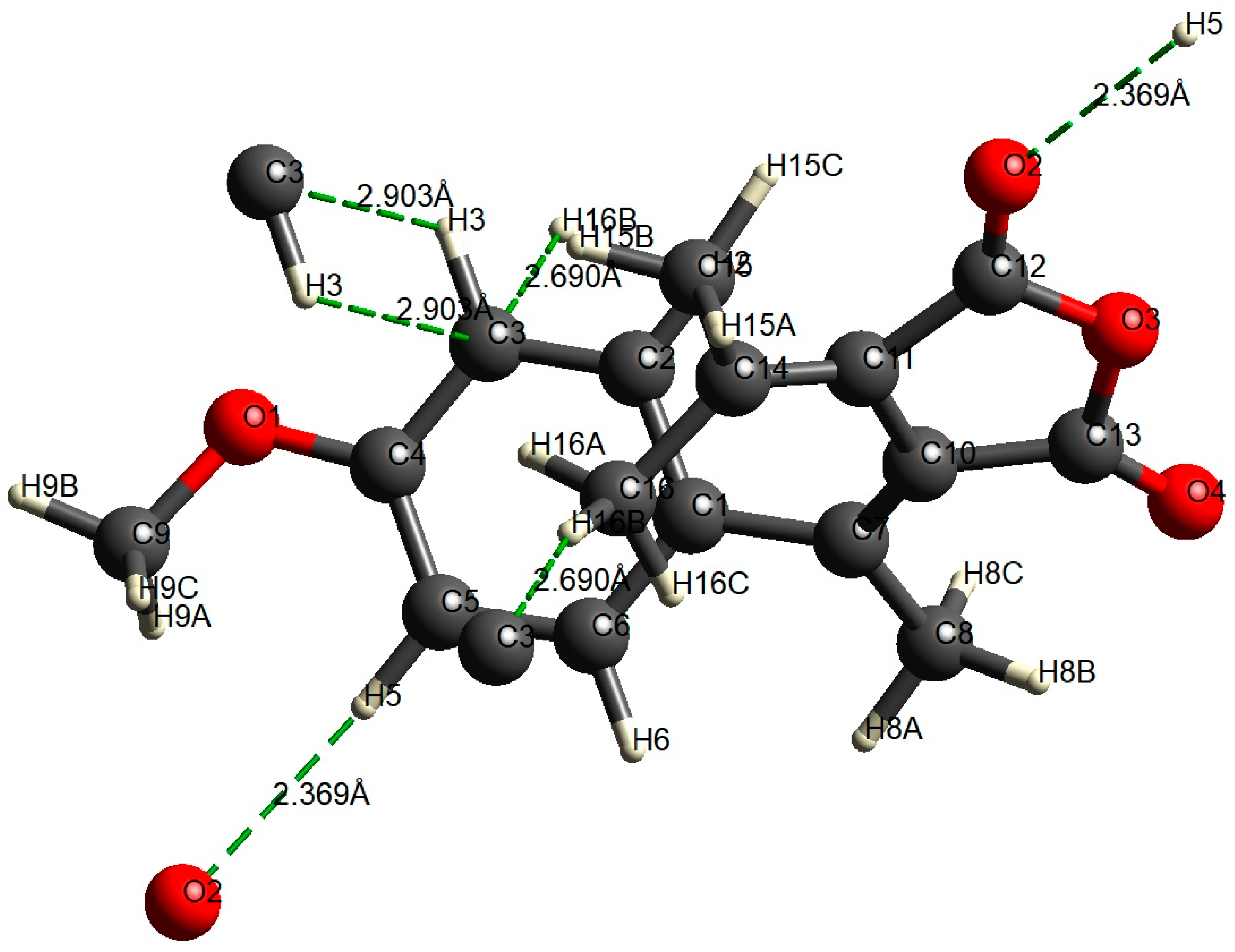
Three pairs of reciprocal contacts are identified on the Hirshfeld surface as red spots, partially shown in
Figure 4A, and their corresponding distances are summarized in
Figure 5.
Among the close-contact red spots on the Hirshfeld surface, the two darkest ones are identified as the reciprocal H5···O2 contacts, which give rise to sharp spikes in the fingerprint plot (
Figure 4C). The measured distance of 2.369 Å is substantially shorter than the neutral van der Waals separation of approximately 2.72 Å for H···O contacts, indicating strong steric repulsion. This repulsive interaction forces the phenyl moiety to tilt, thereby increasing the distance between C2 and C14 in
FPO.
The two pale red spots correspond to reciprocal H16···C3 contacts, which produce curved spikes in the H···C fingerprint plot (
Figure 4D). The distance of 2.690 Å lies near the transition region between weak repulsion and weak attraction and therefore does not represent a significant stabilizing or destabilizing interaction. Another pale red spot corresponds to an antiparallel overlap between two H3–C3 groups, with a separation of 2.903 Å. This value is extremely close to the neutral van der Waals distance of approximately 2.92 Å, indicating a negligible effect on crystal packing. No π–π overlap or other interactions were found to notably influence the crystal packing of
FPO.
To see the effect of electron-donating groups on the structure of the fulgide, we prepared the
FPO’s analogue,
FPN, which has a stronger electron-donating dimethyl amino group than the methoxy group at the
para position of the phenyl group in
FPO. To determine the crystal structure of
FPN, a suitable single orange plate-shaped crystal of dimensions 0.20 × 0.10 × 0.02 mm
3 was selected from the crystalized product and mounted on a XtaLAB Synergy, Dualflex, HyPix diffractometer. Data was measured using
ω scans with Cu K
a radiation. The crystal was kept at a steady
T = 100.00(10) K during data collection. The structure was solved and refined as that of
FPO. The parameters of determination and crystal structures are listed in
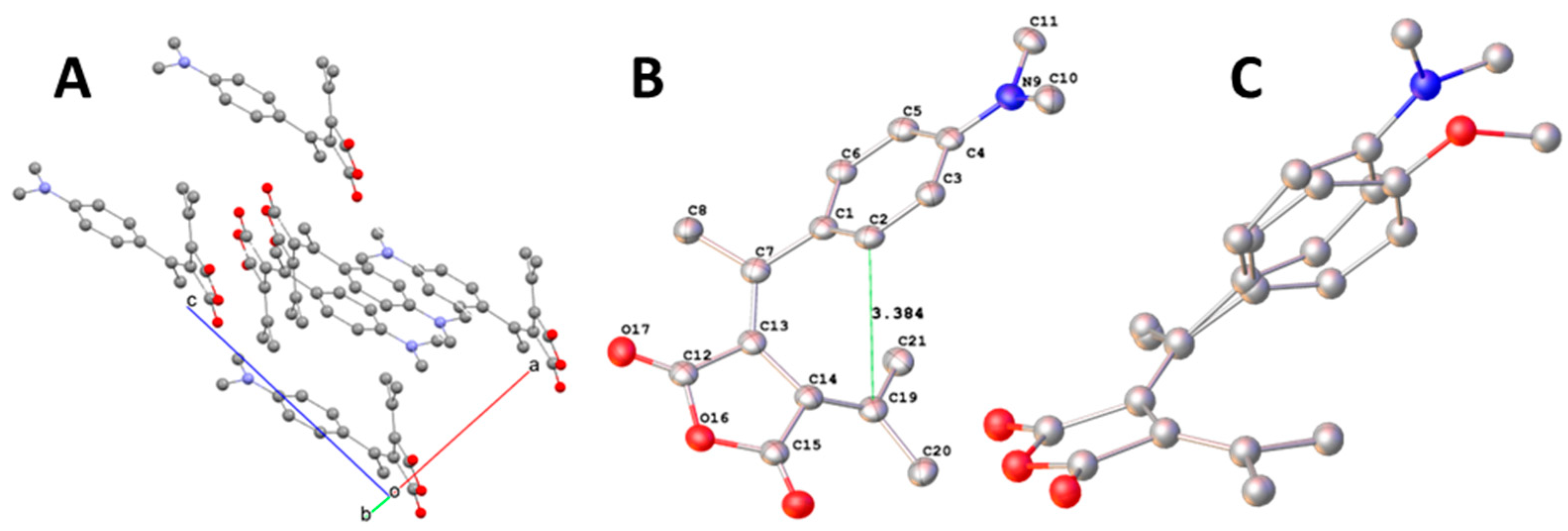
Table 1. The molecular packing of
FPN in the crystal is illustrated in
Figure 6A. The structure of
FPN is illustrated in
Figure 6B. The selected bond lengths, bond angles, and torsion angles of
FPN are listed with those of
FPOP and FPP for comparison in
Table 5,
Table 6 and
Table 7 (Numbers are rounded to discard uncertainty).
The crystallographic results show that the selected bond lengths in
FPN exhibit no significant changes compared with those in
FPO. In contrast, notable differences are observed in the bond angles: the C12–C11–C10 angle increases by 16.9°, from 105.6° in
FPO to 122.5° in
FPN. The torsion angles C2–C1–C7–C10, C1–C7–C10–C11, and C8–C7–C10–C13 also change substantially, shifting from −50.8°, −11.2°, and −17.4° in
FPO to −38.2°, −17.6°, and −25.0° in
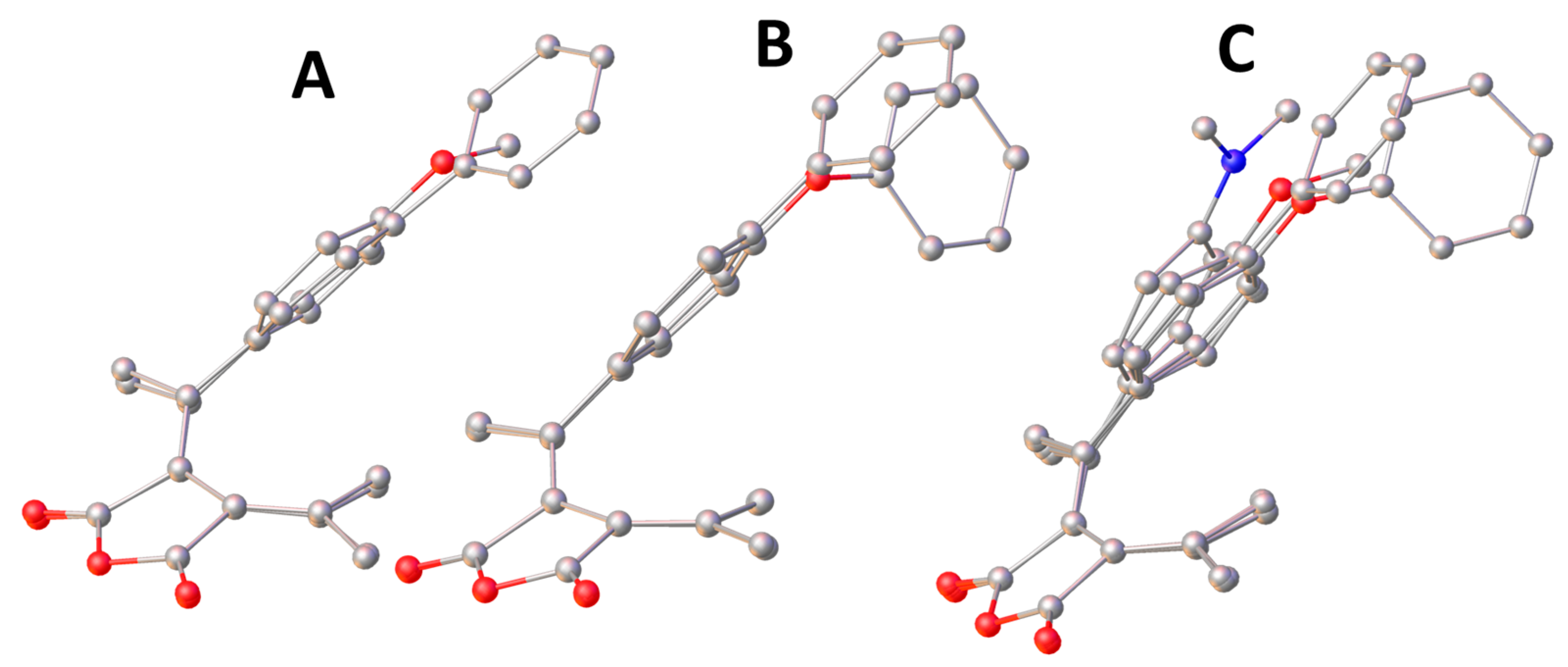
FPN, respectively. Structural overlay of
FPO and
FPN, aligned by matching atoms C12, C11, C10, and C13, clearly indicates that these torsional differences arise from rotation about the C1–C7 single bond (
Figure 6C). This rotation slightly decreases the distance between atoms C2 and C14—which form the C–C bond during the cyclization reaction—from 3.475 Å to 3.384 Å. Considering that the dimethylamino group is similar in steric size to the methoxy group, the significant differences in crystal packing are more likely to arise from electronic perturbations or intermolecular interactions.
Hirshfeld surface analysis was performed to evaluate the role of intermolecular interactions in the crystal packing of
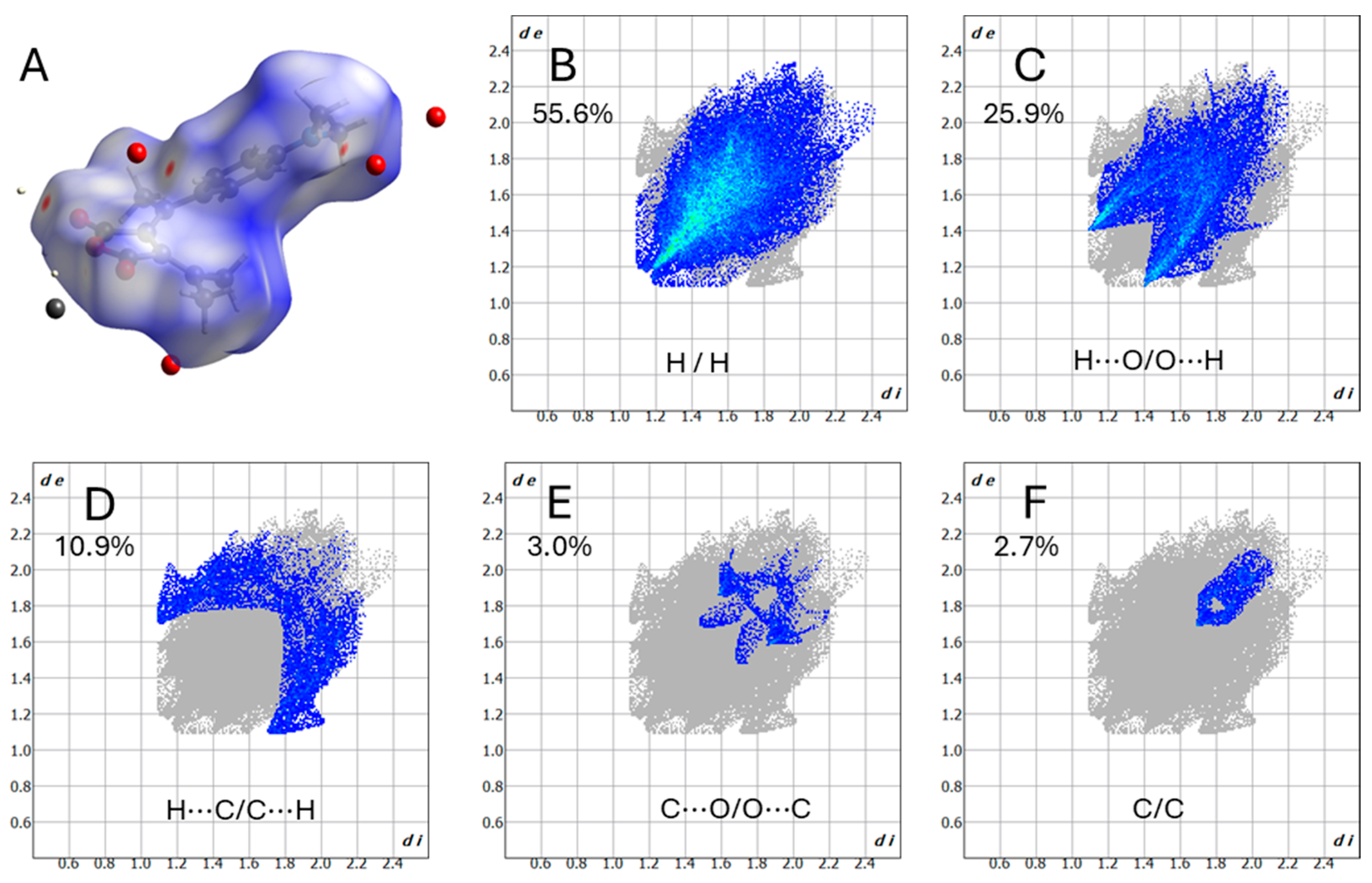
FPN. The molecular surface and fingerprint plots of the major contacts are shown in
Figure 7A–F. Atoms outside the surface exhibit close contacts with their counterparts. The contributions of H···H, H···O, H···C, C···O, and C···C contacts to the surface area are 55.6%, 25.9%, 10.9%, 3.0%, and 2.7%, respectively, together accounting for 98.1% of the total area.
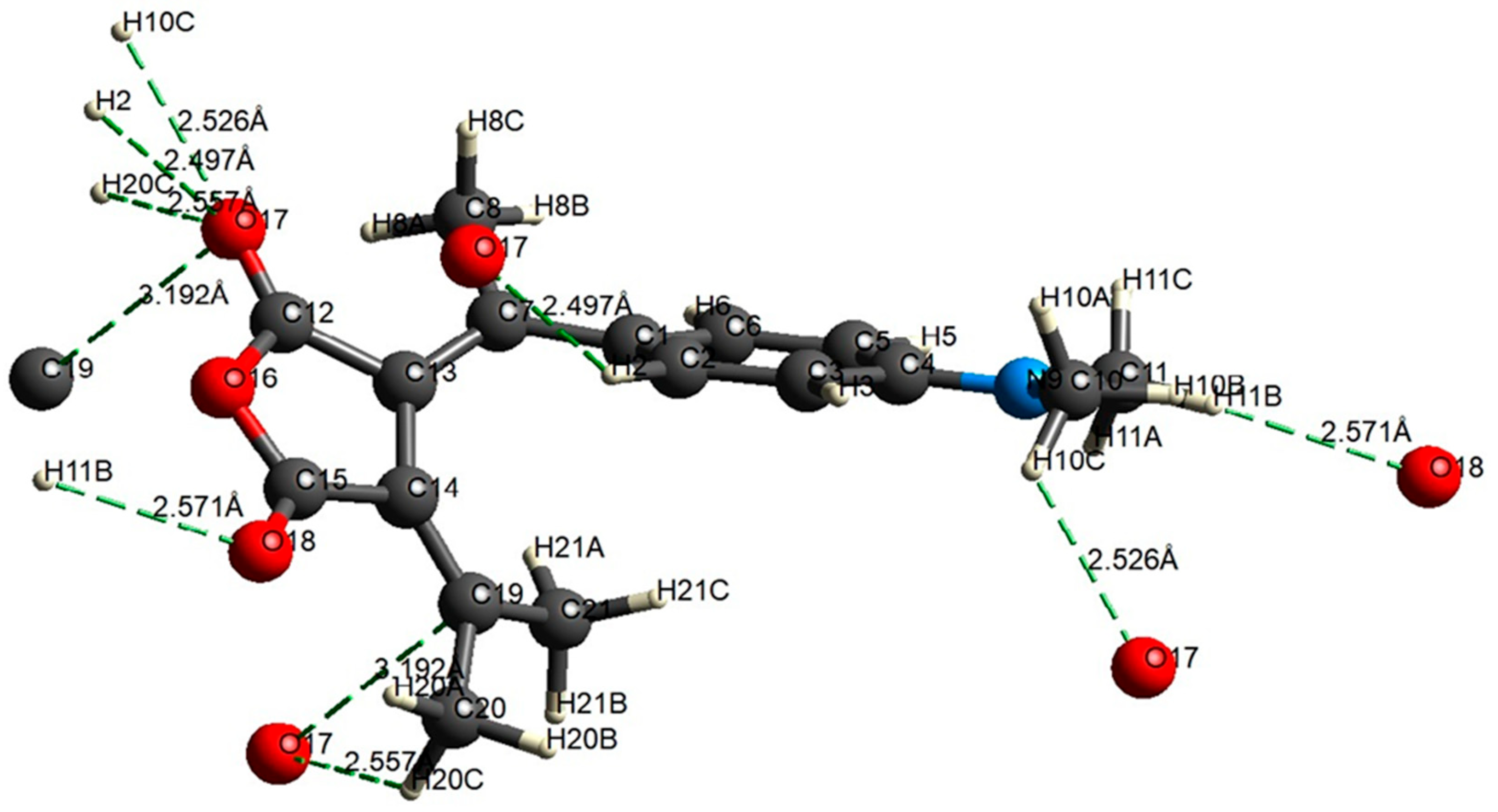
The H···H contacts contribute more to the total surface area than all other contacts combined. No close H···H contacts in the repulsion range were observed; instead, a considerable number fall within the van der Waals attraction range, playing a dominant role in crystal stabilization. H···O contacts account for slightly more than one quarter of the surface area, with many lying in attraction range and contributing significantly to stabilization. Five pairs of reciprocal close contacts were identified as ten red spots on the Hirsfeld surface that are partially shown in
Figure 7A and totally in
Figure 8 with measured distance.
Among the five pairs of reciprocal close contacts, four are H···O interactions: H2···O17, H10C···O17, H11B···O18, and H20C···O17, with distances of 2.497, 2.526, 2.571, and 2.577 Å, respectively. All are shorter than the neutral van der Waals separation of approximately 2.72 Å for H···O contacts. This indicates that the H2···O17 contact is strongly repulsive, whereas the remaining three are only weakly repulsive. The distance of C19···O17 contact is 3.129 A within the 3.0–3.2 A range of weak attraction. The H11B···O18 contact corresponds to the close repulsive H5···O2 contact in FPO. The pronounced separation of the dimethylamino phenyl moiety from the methoxy phenyl moiety in FPO can be attributed to repulsion between H11B···O18 and H10C···O17. The unusually large dihedral angle C1–C1–C7–C13 of –38.2°, compared with –50.8°, 46.5°, and –46.0° in FPO, FPOP, and FPP, respectively, may result from repulsion between O17···H2. The reciprocal C19···O17 contacts appear as two spots of very weak repulsion and have no observable structural effect. No H···C contacts exhibit repulsion, though several fall within the van der Waals attraction region and contribute slightly to stabilization. No close C···C contacts were observed. Overall, C···C and H···C interactions contribute little to stabilization due to their small surface area contributions and limited number of contacts in the attraction range.
To investigate the size effect of the
para-substituent, a phenyl group—larger than the methyl group in
FPO—was introduced into the fulgide
FPOP. X-ray crystallographic analysis was then performed to elucidate its structure. A single yellow block-shaped crystal of
FPOP was subjected to X-ray crystallographic analysis. A suitable crystal with dimensions 0.34 × 0.23 × 0.18 mm
3 was selected and analyzed using the same diffractometer, parameters, and conditions. The structure was solved and refined as
FPO. The parameters of determination and crystal structures are listed in
Table 1. The molecular packing of
FPOP in the crystal is illustrated in
Figure 9A. The structure of
FPOP is illustrated in
Figure 9B.
To highlight the structural differences caused by the size increase, selected bond lengths, bond angles, and torsion angles in
FPOP are listed in
Table 5,
Table 6 and
Table 7 for comparison. Bond lengths within the conjugated system show no difference between
FPO and
FPOP. Among the selected bond angles, the C12–C11–C10 angle increases to 121.8° in
FPOP from 105.6° in
FPO, like the change observed in
FPN. For torsion angles, the most pronounced change occurs in C1–C7–C10–C11, shifting from –11.18° in FPO to –4.3° in
FPOP, while C8–C7–C10–C13 changes from –17.4° in
FPO to –14.3° in
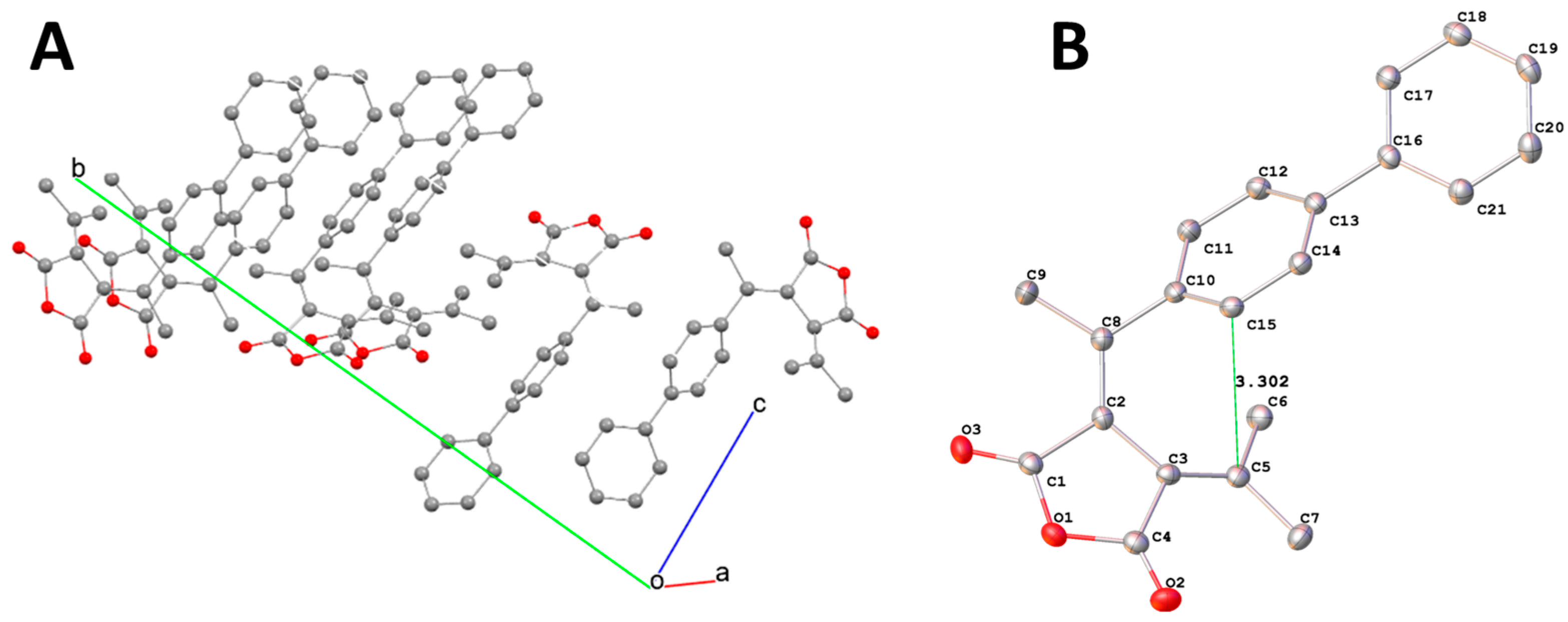
FPOP. These variations arise from distortion around the double bonds C7=C10 and C11–C14, as well as slight rotation about C1–C7. As a result, the interatomic distance decreases from 3.475 Å in
FPO to 3.302 Å in
FPOP.
The structures of
FPOP and
FPO were overlaid by aligning the carbon atoms of the succinic moiety, as illustrated in
Figure 9C. In comparison with the overlay of
FPN and
FPO, it is evident that
FPOP more closely resembles
FPO than
FPN. The phenyl moiety in
FPOP slants away from that in
FPO to a much smaller extent than in
FPN, and in the opposite direction. Since intermolecular forces were found to play a major role in the structural differences between
FPO and
FPN, Hirshfeld surface analysis was also performed for
FPOP, with the results shown in
Figure 10.
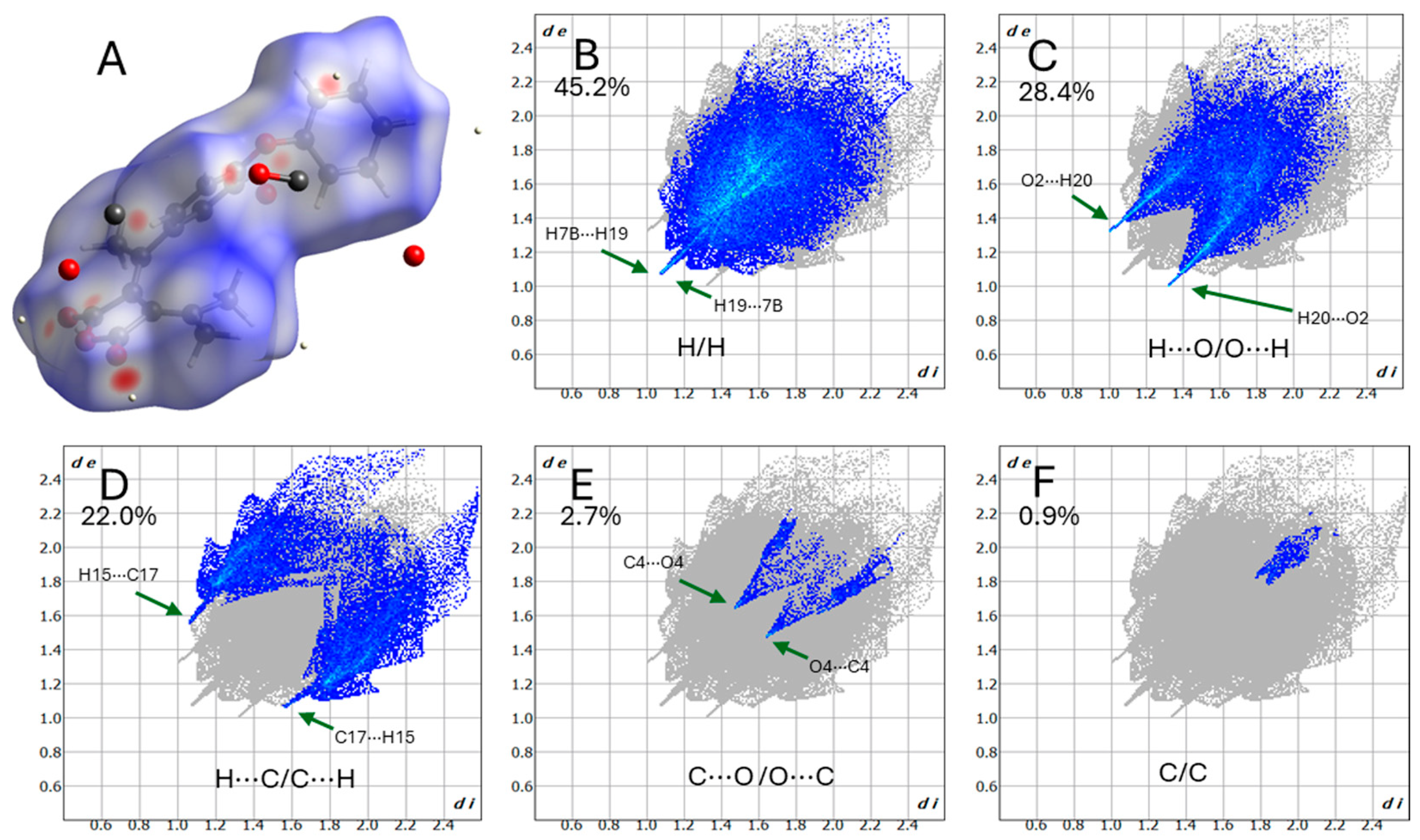
The molecular surface of
FPOP is illustrated in
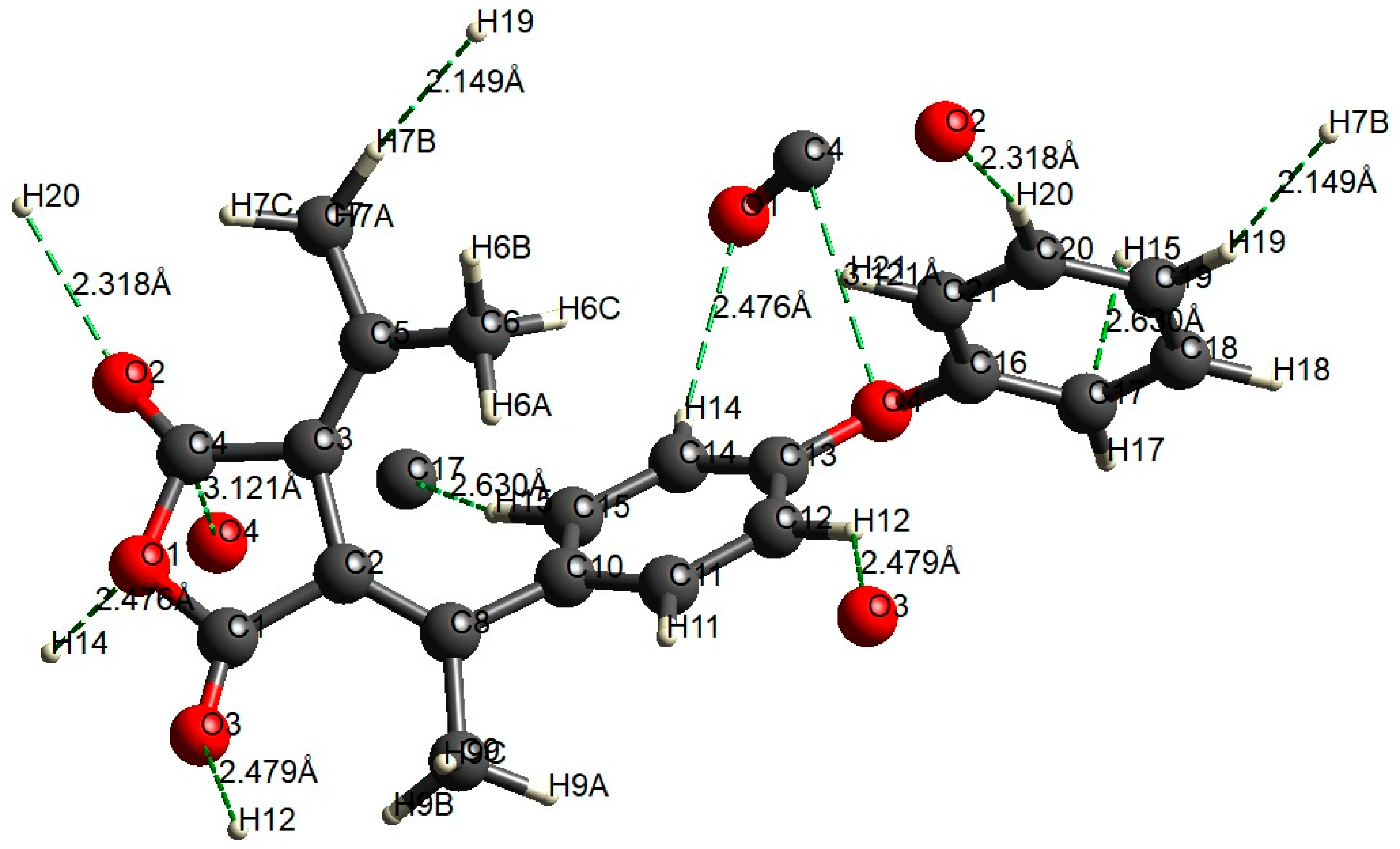
Figure 10A. Atoms and fragments outside the surface exhibit close contact with their corresponding counterparts inside the molecule. The total surface area is dominated by H···H, H···O, and H···C interactions, contributing 45.2%, 28.4%, and 22.0%, respectively, for a combined total of 95.6%. In contrast, C···O and C···C and O···O interactions contribute 2.7%, 0.9%, and 0.8%, respectively, accounting for the remainder of the surface area. Six pairs of reciprocal close contacts are identified as red spots on the surface, partially shown in
Figure 10A. All the contacts, along with their corresponding distances, are presented in
Figure 11.
A substantial number of H···H contacts fall within distances of van der Waals attraction range, contributing appreciably to the stabilization of the crystal. Numerous H···O and notable H···C contacts also lie within the attractive van der Waals regime and further support crystal stabilization. The close contact between H7B and H19 appears as a red spot on the Hirshfeld surface and as a distinct spike in the H···H fingerprint plot. The H···H distance of 2.149 Å is profoundly shorter than the van der Waals limit of 2.20 Å for two hydrogen atoms. This indicates a strongly repulsive contact. Three H···O close contacts—H20···O2, H14···O1, and H12···O3—with distances of 2.318, 2.476, and 2.479 Å, respectively, appear as red spots on the Hirshfeld surface. The reciprocal H20···O2 contact is markedly shorter than the neutral van der Waals separation of approximately 2.7 Å and produces a distinct spike in the H···O region of the fingerprint plot, indicating a strongly repulsive contact. In contrast, the distance H14···O1 and H12···O3 contacts deviate only slightly from the neutral distance and therefore represent weakly repulsive close contacts. The H15···C17 contact is the only H···C close contact that appears as a red spot on the Hirshfeld surface. Its measured distance of 2.630 Å within the weakly attractive range 2.6–2.9 A of H···C contact. A pale red spot is also observed for the C4···O4 contact, with a distance of 3.121Å, slightly shorter than the neutral value of 3.22 Å. This contact likely reflects a weak repulsive interaction. The combined influence of the H14···O1, H12···O3, H15···C17, and C4···O4 contacts may contribute to the slight positional difference observed for the phenyl moiety of FPOP relative to FPO and FPN in the molecular overlay. Among these, the strongly repulsive H20···O2 contact together with the H15···C17 repulsion appears to play a dominant role in determining the orientation of the phenoxy group.
The fulgide
FPP contains a phenyl substituent with negligible electron-donating ability, in contrast to its analogue
FPO, which bears a small methoxy group of moderate electron-donating character. Comparison of the crystal structures of
FPP and
FPO is therefore expected to provide insight into both electronic and steric substituent effects on crystal-packing patterns. Accordingly,
FPP was synthesized, crystallized, and subjected to X-ray crystallographic analysis. A yellow block-shaped single crystal of
FPP (0.62 × 0.50 × 0.32 mm
3) was selected and analyzed using the same diffractometer. The structure was solved and refined in an analogous manner to
FPOP. The crystallographic parameters and structural details are summarized in
Table 1. The molecular packing of
FPP is shown in
Figure 12A, and the molecular structure is depicted in
Figure 12B.
For convenient comparison of the structures, the selected bond lengths, bond angles, and torsion angles are summarized in
Table 5,
Table 6 and
Table 7. The bond lengths associated with the conjugated system show no discernible differences among the analyzed structures. The C12–C11–C10 bond angle in
FPP increases to 122.9°, similar to the values observed in
FPN and
FPOP, compared with 105.6° in
FPO. The selected torsion angles in
FPP closely resemble those in
FPOP but differ significantly from those in
FPO and
FPN.
The distance between C15 and C5 was measured to be 3.302 Å in comparison to those of 3.475 Å, 3.384 Å, and 3.291 Å in
FPO,
FPN, and
FPOP, respectively. The changes can be easily observed in the overlay of structures of
FPO to
FPP and
FPOP to
FPP, as shown in
Figure 13A,B. The phenyl group in
FPP tilted a little closer to the carbon involved in cyclization than in
FPO, as shown in
Figure 13A. Phenyl and phenoxy groups of similar size as substituents led to almost the exact overlap of the phenyl moieties, although the substituents oriented quite differently in the crystal. This result suggests that the substituent size plays a role in crystal packing.
The intermolecular interaction environment of
FPP was examined using Hirshfeld surface analysis, and the results are presented in
Figure 14. The molecular surface of
FPOP, highlighting surrounding atoms in repulsive contact, is shown in
Figure 14A. The corresponding contact fingerprint plots for H···H, H···O, H···C, C···O, and C···C interactions are displayed in
Figure 14B–F, with the total fingerprint shown in gray as the background.
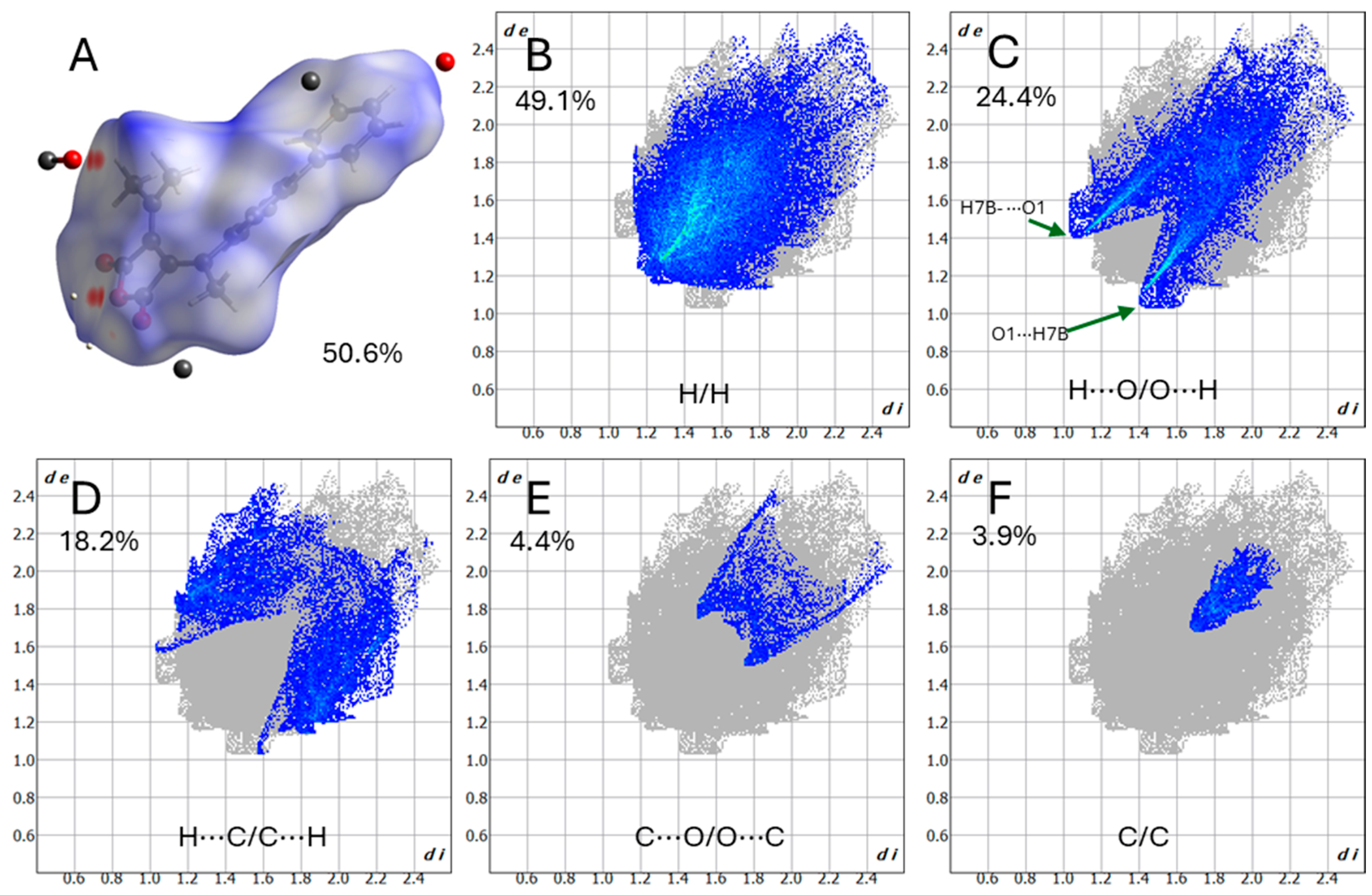
The analysis shows that H···H, H···O, and H···C contacts contribute 49.1%, 24.4%, and 18.2% of the total Hirshfeld surface area, respectively, together accounting for 91.7% of the surface. A measurable number of C···O and C···C contacts contribute an additional 4.4% and 3.9%, respectively, while the remaining fraction arises from other minor interactions. Crystal stabilization is dominated by the large number of H···H contacts within the van der Waals attraction range, with smaller but notable contributions from C···O and C···C contacts. Five reciprocal close contacts are indicated by red spots on the Hirshfeld surface, shown partially in
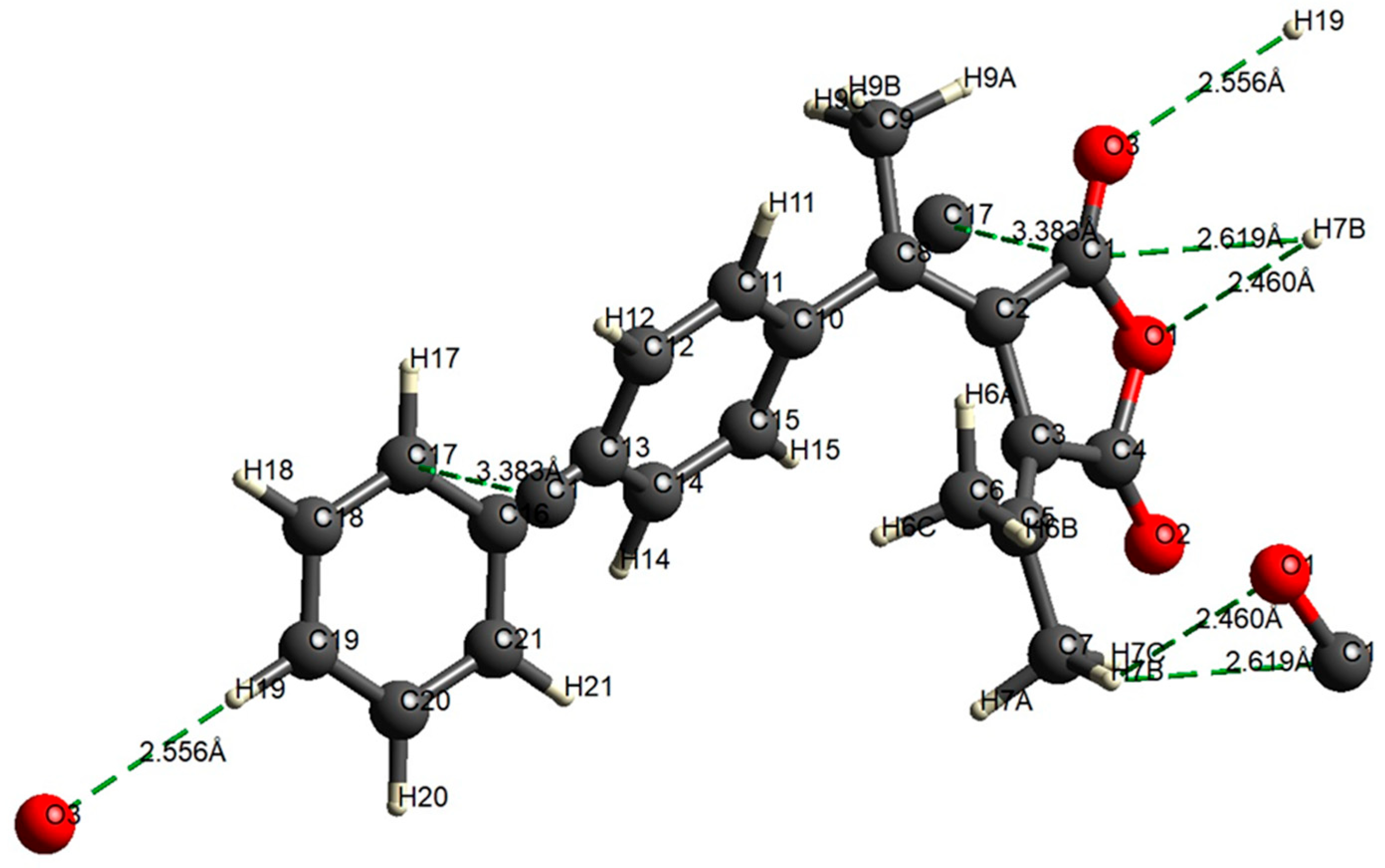
Figure 14A and fully in
Figure 15, together with their measured distances.
No repulsive H···H close contacts were observed. The reciprocal H19···O3 contacts have a distance of 2.556 Å, which is significantly shorter than the van der Waals limit of 2.8 Å. Together with the nearly linear C19–H19···O3 angle of 156°, these contacts are therefore best interpreted as weakly attractive. Four prominent red spots correspond to close approaches between H17B and the adjacent O1 and C1 atoms, which are directly bonded within the succinic moiety. The H17B···O1 and H17B···C1 contact distances are 2.460 and 2.619 Å, respectively, compared with neutral van der Waals separations of 2.72 and 2.80 Å. This suggests the contacts are strongly repulsive. Consequently, these interactions represent significant repulsion between the C17 methyl group and its intermolecularly adjacent succinic fragment.
All four crystal structures were overlaid by matching the positions of the four carbon atoms in the succinic moiety, as shown in
Figure 13C. The succinic fragment exhibits excellent overlap across all structures. The C2···C14 distances are 3.475, 3.384, 3.291, and 3.302 Å in
FPO,
FPN,
FPOP, and
FPP, respectively, and these variations correlate well with rotation around the C10=C11 double bond, accompanied by the corresponding displacement of the C8 methyl group and the phenyl moiety. The abnormal separation of the dimethylamino group from the other three substituents is attributed to intermolecular repulsive close contacts between two hydrogen atoms of the corresponding methyl groups and the two oxygen atoms of the adjacent anhydride fragment, as revealed by the Hirshfeld surface analysis. The long distance between C2 and C14 in
FPO is attributed to strong repulsive interactions between H2 and an oxygen atom of the adjacent anhydride fragment, as revealed by the Hirshfeld surface analysis. In
FPN, the increase in the distance expected from the slanting of the phenyl moiety is counteracted by a similarly strong H2 and O repulsion, resulting in a shorter separation than that observed in
FPO. No conclusive evidence was found to indicate that electronic effects influence the molecular structures of the fulgides in the crystals examined. The phenyl moieties in
FPOP and
FPP overlap almost perfectly, whereas those in
FPO and
FPN deviate from this alignment in different ways. These observations suggest that the size and configuration of the substituents influence the crystal structures of the fulgides, although in a manner that is not straightforward to predict.
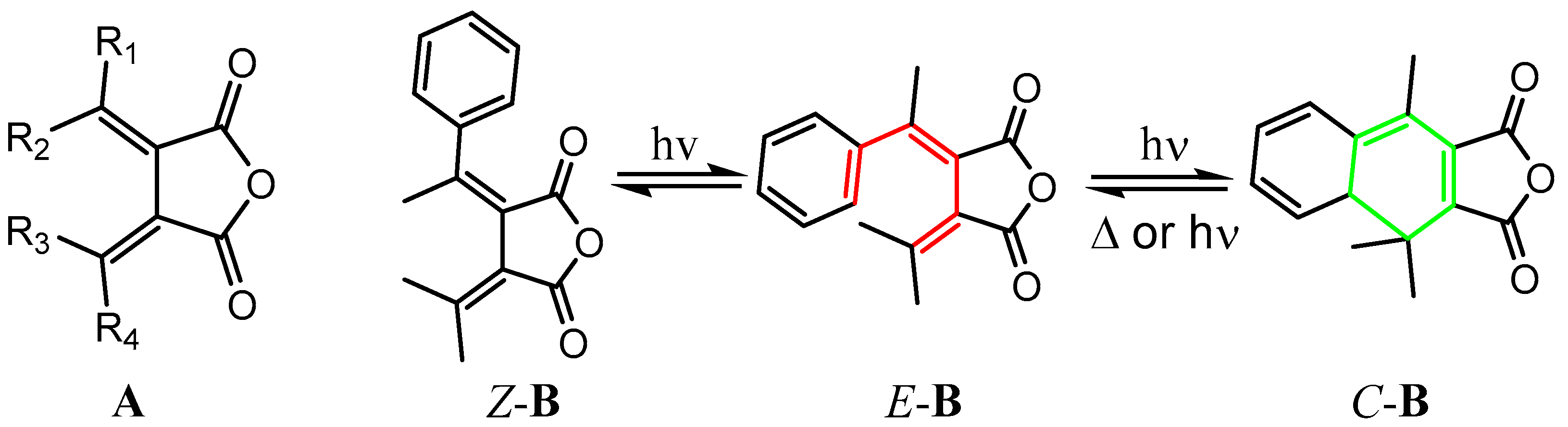
All four fulgides exhibited photochromic properties in the purification process of each compound. All the fulgides were isolated in pure form by column chromatography. Fractions that contain the
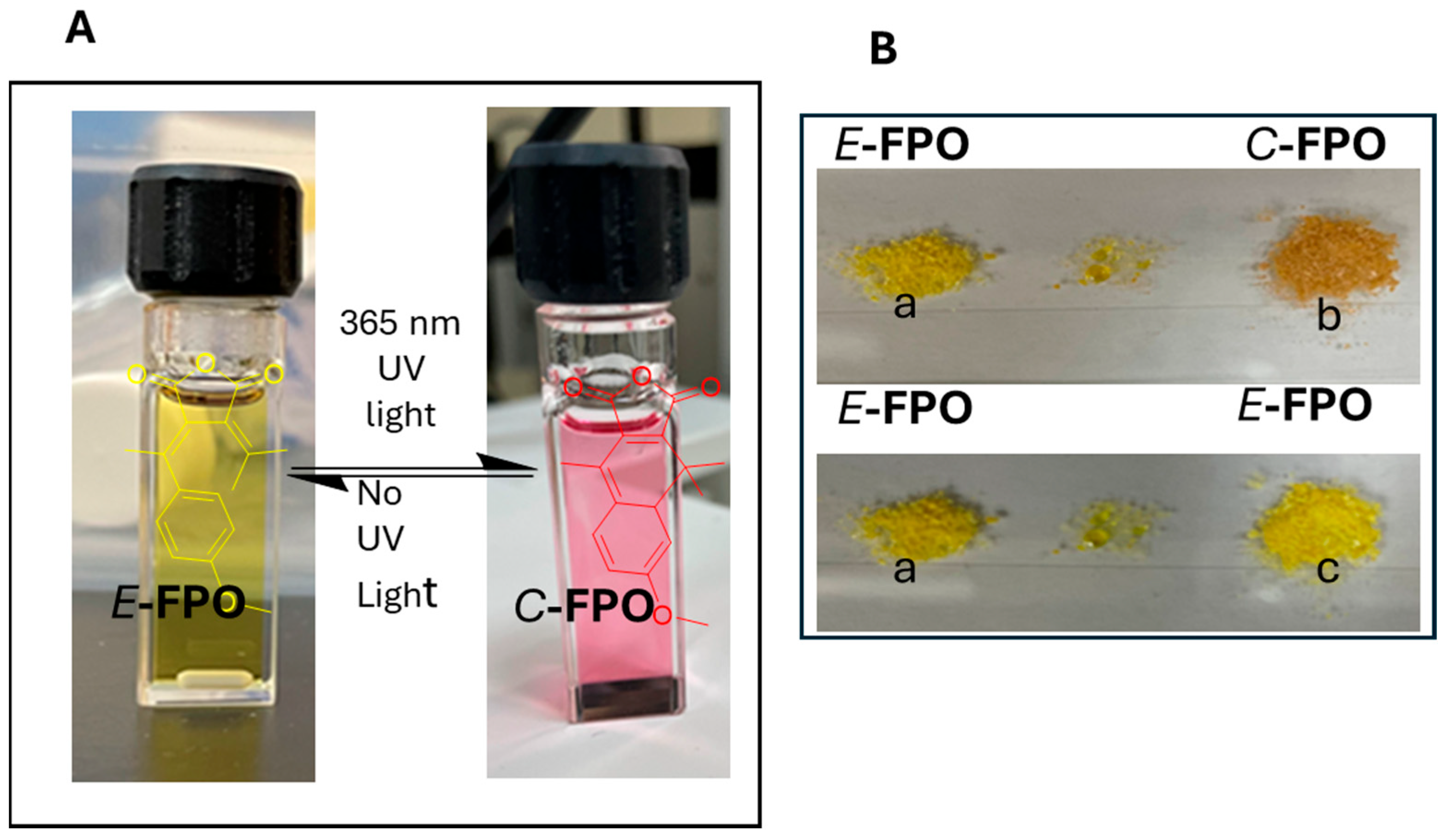
E form of fulgides exhibited a color change on wet thin-layer chromatography plates under a UV (365 nm) detector. The results of our early-stage study on photochromism are shown in
Figure 16 using
E-
FPO as an example. The color of
E-
FPO in methylene dichloride changed from yellow to red upon UV irradiation and recovered to its original state within 5 min after the irradiation was stopped (see
Figure 16A). This phenomenon is attributed to the formation of
C-
FPO under UV irradiation, which subsequently converted back to
E-
FPO once the irradiation ceased. Photochromism of fulgides in the solid state was also observed, as illustrated in
Figure 16B. In this figure, piles
a and
b consist of small amounts of
E-
FPO (the material between them is a minor spill). Pile
a was not exposed to UV light, whereas pile
b was irradiated with 365 nm UV light for 2 min, resulting in a color change from yellow to brown. Pile
c represents pile
b five minutes after cessation of UV irradiation. The reversible color change observed in pile
b provides clear evidence of photochromism in the solid state of
E-
FPO.
The crystallographic results showed that all four fulgides
F—
FPO,
FPN,
FPOP, and
FPP—packed into centrosymmetric space groups of
P2
1/
n,
P-1,
P2
1/
c, and
P2
1/
c, respectively, in contrast to structural analogue
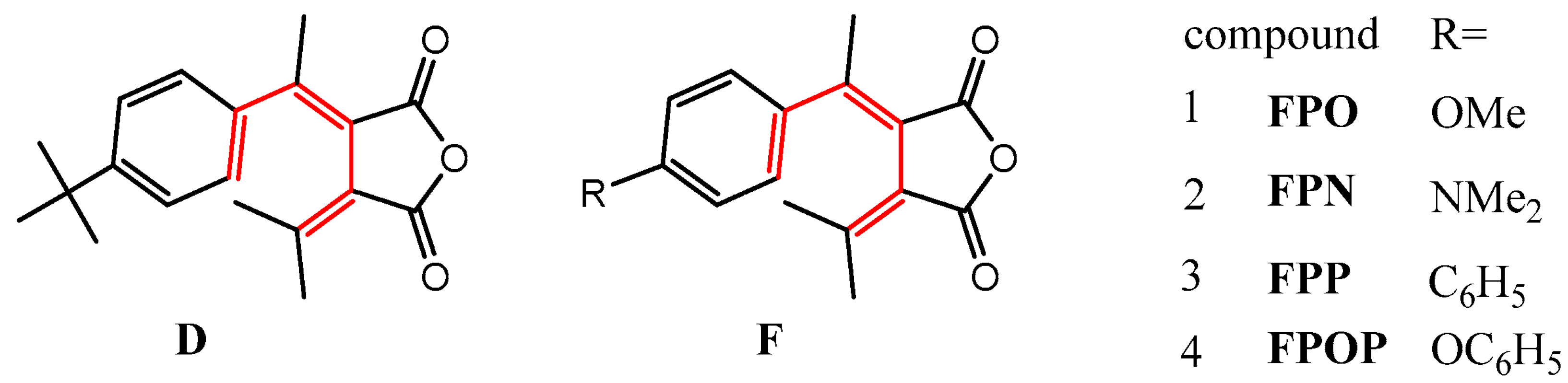
D, which crystallized in a non-centrosymmetric space group
Pc and exhibited ferroelectricity [
8]. Such a crystal packing difference among fulgides of very similar molecular structures was beyond our expectation and needs to be understood. The results suggest that the new crystalized fulgides should not be spontaneously ferroelectric, which requires crystals of a non-centrosymmetric space group.




 ,
,