


Abstract
Photocatalysis provides an attractive strategy for synthesizing H2O2 at ambient condition. However, the photocatalytic synthesis of H2O2 is still limited due to the inefficiency of photocatalysts and decomposition of H2O2 during formation. Here, we report SnO2-TiO2 heterojunction photocatalysts for synthesizing H2O2 directly in aqueous solution. The SnO2 passivation suppresses the complexation and decomposition of H2O2 on TiO2. In addition, loading of Au cocatalyst on SnO2-TiO2 heterojunction further improves the production of H2O2. The in situ electron spin resonance study revealed that the formation of H2O2 is a stepwise single electron oxygen reduction reaction (ORR) for Au and SnO2 modified TiO2 photocatalysts. We demonstrate that it is feasible to enhance H2O2 formation and suppress H2O2 decomposition by surface passivation of the H2O2-decomposition-sensitive photocatalysts.
1. Introduction
Hydrogen peroxide (H2O2) is a clean oxidant [1] that has wide applications in environmental purification and organic synthesis [2]. At present, H2O2 is industrially produced by the multi-step anthraquinone method, which consumes a lot of energy and organic solvent [3]. As an alternative to the anthraquinone method, direct photocatalytic synthesis of H2O2 has attracted widespread attention due to its mild reaction conditions, such as normal temperature and pressure under light irradiation. Many representative UV-light and visible-light active semiconductors (e.g., ZnO [4,5], C3N4 [6,7,8,9], BiVO4 [10], etc.) have been verified as active materials for H2O2 production, particularly when proper cocatalysts are loaded on these semiconductors. An important feature of photocatalytic H2O2 formation is that it is accompanied by a decomposition process. TiO2 is a widely used photocatalyst for synthesizing H2O2 directly from O2 reduction in liquid phase under the irradiation of ultraviolet (UV) light [3,11,12,13,14,15,16,17], without using hydrogen. However, photocatalytic H2O2 synthesis with TiO2 has a low formation reaction rate due to the catalytic decomposition [17,18]. Some studies have revealed the decomposition mechanism of H2O2 in aqueous TiO2 suspension under UV irradiation [18,19,20]. Zhao et al. [18] reported that adsorption of H2O2 on TiO2 will readily form surface peroxide complexes, which can be easily photodegraded with a zero-order kinetic process over TiO2 even with the irradiation of visible light, thus leading to the decrease of H2O2 production. Therefore, in order to produce concentrated H2O2, on one hand, the formation rate of H2O2 should be increased, and on the other hand, the decomposition of H2O2 should be controlled.
Au is an active cocatalyst and has shown great potential in improving the performance of photocatalytic H2O2 production [15,16]. Tada et al. [15] reported enhancement of the photocatalytic activity of TiO2 in producing H2O2 by Au cocatalyst loading. They also found that the formation of H2O2 was generally accompanied by decomposition. The concentration of H2O2 produced from the photocatalytic reduction of O2 can also be increased by restricting its thermocatalytic decomposition through controlling the temperature and pH of the reaction solution [16]. Indeed, these studies improved H2O2 formation activity by suppressing the decomposition process by controlling the reaction condition. However, there is still no effective means of enhancing the intrinsic activity of photocatalysts for H2O2 production. It is well known that both the structures and band gaps of TiO2 and SnO2 are similar. They all consist of MO6 octahedrons as the structural unit. The conduction band (CB) of SnO2 (0 V vs. SHE) is more positive than that of the TiO2 (−0.3 V vs. SHE) and it is possible to improve charge separation in a photocatalytic reaction when heterojunctions are formed by both oxides [21,22,23]. In this study, we prepared SnO2-modified anatase TiO2 (SnO2-TiO2) heterojunction using the molten salt method [24]. SnO2 passivation suppressed H2O2 complexation and decomposition on the surface of TiO2. Loading of Au nanococatalysts further remarkably enhanced the H2O2 formation rate.
2. Results and Discussion
2.1. Characterization of the Photocatalysts
Figure 1a shows the XRD patterns of 0.1% Au loaded SnO2-TiO2 obtained at different sintering temperatures. When the sintering temperature is 300 °C, almost no SnO2 can be detected. It has been well documented that the melting point of LiCl-KCl eutectic of composition 61:39 is 352 °C [24]. Hence, the Sn precursor is impossible to dissolve by molten salt and SnO2 cannot be formed on the TiO2 at this temperature. The presence of SnO2 can be identified when the sintering temperature reaches 400 °C. At a sintering temperature of 500 °C, the peak of SnO2 becomes more obvious, implying higher modification of SnO2. At the sintering temperature of 600 °C, anatase was partially transformed into a less active rutile phase [25]. The diffraction peaks of SnO2 can be clearly identified with the increase in the Sn/Ti ratio (Figure 1b). The presence of SnO2 and Au are certified by the EDX (Figure S1). STEM mapping images (Figure 1c–f) display that SnO2 and Au are finely dispersed on the surface of TiO2. Formation of such a SnO2-TiO2 heterojunction structure will improve the charge separation and photocatalytic activity [21,22,23].
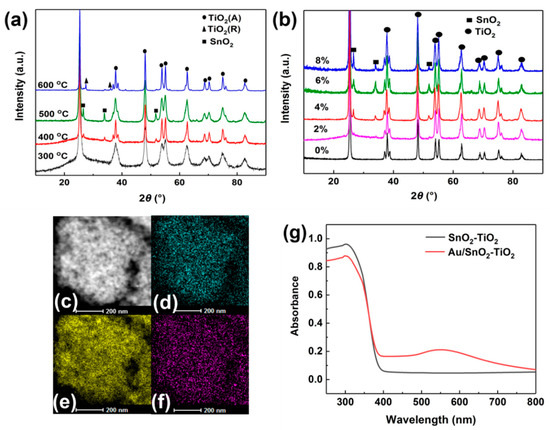
Figure 1.
(a) XRD patterns of 0.1% Au loaded SnO2-TiO2 (4% SnO2 modified anatase TiO2) obtained at different sintering temperatures. (b) XRD patterns of 0.1% Au loaded SnO2-TiO2 with different Sn/Ti ratios. (c) HAADF-STEM images of 0.1% Au loaded SnO2-TiO2 (Sn/Ti is 4%). (d–f) Mapping images of (d) Sn, (e) Ti and (f) Au elements. (g) UV-vis spectra of SnO2-TiO2 with and without 0.1% Au.
As shown in Figure 1g, there are two prominent absorption bands in the UV-Vis spectra of Au/SnO2-TiO2. Besides the characteristic absorption bands of TiO2 at 370 nm, the broad absorption bands in the visible region between 500 nm and 650 nm is due to the excitation of gold surface plasmon. In addition, the nanometal cocatalyst exhibit lattice fringes of 0.235 nm, which matches the interplanar spacing of Au (1 1 1) plane (Figure S2) [26]. The actual content of Au in 0.1% Au/SnO2-TiO2 was 0.106% by inductively coupled plasma mass spectrometry (ICP-MS).
2.2. Catalytic Activity of the Photocatalysts
The photocatalytic activity of H2O2 synthesis on Au/SnO2-TiO2 hybrids was tested under UV light and the concentration of H2O2 was quantified by spectrophotometry with copper ions and 2,9-dimethyl-1,10-phenanthroline (DMP) [27]. The standard curve indicates that the absorbance and concentration of H2O2 exhibits a good linear relationship with R square of 0.9996 (Figure S3). Figure 2a shows time courses for the H2O2 generation of photocatalysts obtained at different sintering temperatures. Noticeably, 0.1% Au loaded SnO2-TiO2 obtained at 500 °C exhibits the highest photocatalytic activity compared to that obtained at the other sintering temperatures. In combination with XRD data, when the sintering temperature is 300 °C, the content of SnO2 in the samples is minimal, and the activity is not obviously improved. The photocatalytic activity of the samples obtained at 600 °C is the lowest, possibly because of the formation of a less active rutile phase.
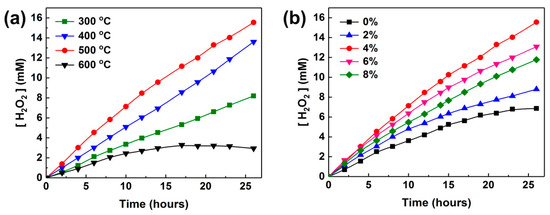
Figure 2.
(a) Plots of [H2O2] under UV-irradiation in the presence of 0.1% Au loaded SnO2-TiO2 (4% SnO2 modified anatase TiO2) obtained at different sintering temperatures. (b) Plots of [H2O2] under UV-irradiation in the presence of 0.1% Au loaded SnO2-TiO2 with different Sn/Ti ratios.
Compared with pristine Au/TiO2, Au/SnO2-TiO2 hybrids exhibited enhanced photocatalytic activity (Figure 2b). The highest photocatalytic activity was obtained over the sample with a Sn/Ti ratio of 4%, which also showed stable H2O2 production rate. The improved activity is mainly due to the suppression of H2O2 decomposition by SnO2 passivation as discussed below. The excessive SnO2 modification will possibly shield the photo absorption of TiO2, and thus reduce the photocatalytic activity. It should be noted that we also did a control experiment, which is shown in Figure S4. It was found that there is a synergistic effect between Au and SnO2 in H2O2 synthesis over TiO2.
2.3. ESR Analysis
In general, H2O2 from 2e– ORR by CB electrons can be produced through stepwise coupled electron and proton transfers (Equations (1)–(3)) [28,29]. In order to further study the formation mechanism of H2O2, in situ ESR measurements were carried out using DMPO as the trapper of radical species. The radical signals of DMPO-•OOH consisting of six characteristic peaks were detected for all of Au and/or SnO2 modified TiO2, while there is no obvious signals for pure TiO2 (Figure 3a,b), showing that H2O2 formation over Au loaded and/or SnO2 modified TiO2 photocatalysts is indeed a stepwise single electron reduction process, and both Au and SnO2 could promote the formation of HO2• via Equation (2).
TiO2 → e− + h+
e− + O2 + H+ → HO2•
HO2• + H+ + e− → H2O2
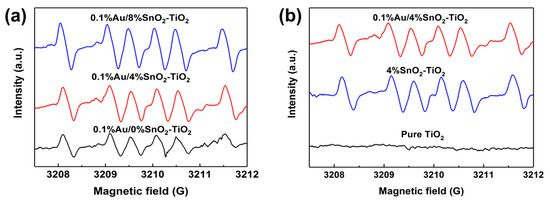
Figure 3.
(a) In situ ESR spectra of the 0.1% Au/SnO2-TiO2 samples with different Sn/Ti ratios under UV light irradiation. (b) In situ ESR spectra of the samples (4% SnO2 modified anatase TiO2) with and without Au cocatalyst under UV light irradiation.
2.4. The Photodecomposition of H2O2
Figure 4 shows the decomposition of H2O2 under different conditions. Pure H2O2 remains stable under dark conditions in the presence of 0.1% Au/SnO2-TiO2 (4% Sn/Ti ratio) (Figure 4a). Under UV irradiation without catalyst, the decomposition of H2O2 has a linear relationship with time. In the presence of TiO2, 0.1% Au/TiO2 or 0.1% Au/SnO2-TiO2, the H2O2 decomposition was accelerated by UV light, but the decomposition rate of H2O2 over 0.1% Au/SnO2-TiO2 is lower than TiO2 and 0.1% Au/TiO2. The relationship between hydrogen peroxide decomposition and time is nonlinear under UV irradiation, and the decomposition of H2O2 is similar to a one-order kinetics [30]. In order to investigate the decomposition solely induced by peroxide complexes, we tested the decomposition of H2O2 in an aqueous photocatalyst suspension with similar initial H2O2 concentrations under visible light irradiation (Figure 4b). H2O2 barely decomposed under dark conditions in an aqueous SnO2-TiO2 suspension or under visible light irradiation without any photocatalysts. In the presence of photocatalysts, the H2O2 decomposition was accelerated, but again, SnO2 passivated TiO2 had the lowest decomposition activity. All the decomposition processes under visible light irradiation can be roughly fitted with a near zero-order equation (linear relationship) [18]. It can be inferred that there is a synergistic effect between the photocatalysts and light irradiation in catalyzing H2O2 decomposition. However, SnO2 passivated TiO2 consistently showed suppressed decomposition activity in any condition (UV and visible light). It is important for SnO2-TiO2 heterojunction photocatalyst to maintain high and stable H2O2 production rate during the photocatalytic reaction. The generation and decomposition mechanism of H2O2 is shown in Figure 5. The electrons excited by UV light are transferred to the Au and SnO2 to promote reduction of O2 for H2O2 formation. Compared with easy H2O2 decomposition on pure TiO2 via forming peroxide complexes, SnO2 passivated TiO2 suppressed H2O2 decomposition. Hence, this study provides a useful method for promoting H2O2 production over TiO2 photocatalysts.
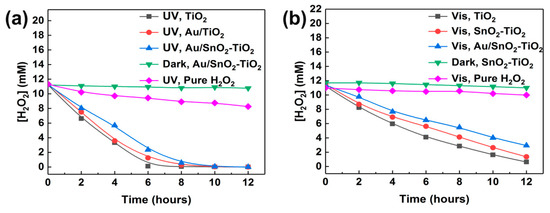
Figure 4.
H2O2 photodecomposition under UV light (a) and visible light (b) conditions.
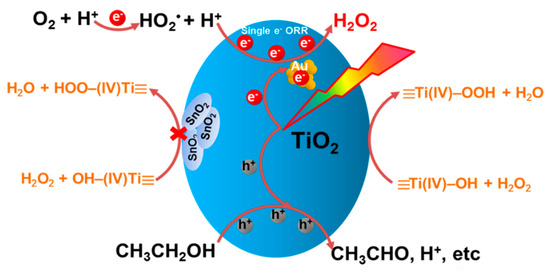
Figure 5.
Schematic illustration of H2O2 synthesis and decomposition over Au/SnO2-TiO2.
3. Materials and Methods
3.1. Materials Preparation
To produce a SnO2-TiO2 heterojunction structure, anatase TiO2 powder (with a grain size of 5 nm and a specific surface area of 280 m2/g, Yifu Industrial Co., Ltd, Shanghai, China) was used as a photocatalyst. SnCl4•4H2O (Sinopharm Chemical Reagent Co., Ltd, Shanghai, China) was used to modify TiO2 by a molten salt method. In general, 3.4 g anatase TiO2 and 0.6 g SnCl4•4H2O (4% molar ratio of Sn:Ti) were mixed with 3.77 g LiCl (Yongda Chemical Reagent Co., Ltd, Tianjin, China) and 4.23 g KCl (Yongda Chemical Reagent Co., Ltd, Tianjin, China) in an alumina crucible. The powder mixtures were calcined at 500 °C, then the mixtures were transferred into the deionized water for grinding, centrifuged, washed and dried. The Au with 0.1 wt % was loaded on photocatalysts by the deposition-precipitation method reported previously [31]. The decomposition of H2O2 can be suppressed to a certain extent by sodium fluoride. SnO2-TiO2 can produce valence band electrons and holes by UV irradiation.
3.2. Material Characterization
The powder X-ray diffraction (XRD) data were collected on an X-ray diffractometer (D/Ma-2500, Rigaku, Tokyo, Japan) operating with Cu Kα radiation (λ = 0.15406 nm). UV-VIS spectra were recorded with a Spectrum Lambda 750 S (Perkin-Elmer, Waltham, MA, USA). High-resolution transmission electron microscopy (TEM) characterization was performed with 8000EX microscope (JEOL, Tokyo, Japan) operating at 200 kV.
3.3. Photocatalytic Reactivity Test
A photocatalytic reaction kettle (200 mL) was used as a photocatalytic reaction device. NaF (0.1 M, Shentai Chemical Reagent Co., Ltd, Tianjin, China) was added as part of reaction medium together with 0.2 g Au/SnO2-TiO2 into the reaction solution of alcohol (4 wt %) and deionized water. The suspension solution was under ultrasonic treatment for 2 to 3 min. Then the mixed solution was poured into the reaction kettle and the oxygen was passed for 30 min. Then, a 300 W Xe arc lamp (PLS-SXE300, Bofeilai Technology Co., Ltd, Beijing, China) was used as a light source and was turned on the solution. The light was emitted by the xenon lamp and reflected by the UV light reflector. Magnetic stirring of the suspension was maintained throughout the reaction. The condensate water continued to pass the reaction kettle. Then, the concentrations of H2O2 generated were determined by using the DMP (2,9-dimethyl-1,10-phenanthroline, Wengjiang Chemical Reagent Co., Ltd, Guangdong, China) method [27].
3.4. Quantification of H2O2 (DMP Method)
One mL of DMP (0.1 g/L), 1 mL of cupper (II) sulfate (0.1 M), and 1 mL of phosphate buffer (pH 7.0) solution, and 1 mL of reaction solution were added to a 10 mL volumetric flask and was mixed, and then deionized water was added to the volumetric flask to the tick mark. After mixing, the absorbance of the sample at 454 nm was measured. The blank solution was prepared in the same manner but without H2O2.
The concentrations of H2O2 were calculated by the following formula:
where A454 is the difference of the absorbance between sample and blank solutions at 454 nm, ζ is the slope of the calibration curve, and [H2O2] is the H2O2 concentration (μM).
A454 = ζ [H2O2] × 1/10
3.5. Photocatalytic H2O2 Decomposition
Basically, photocatalytic H2O2 decomposition was carried out in the same reaction medium for photocatalytic H2O2 synthesis. Photocatalyst (0.2 g) was dispersed in water (200 mL) containing NaF (0.1 M), 4% C2H5OH (99.7%, Yongda Chemical Reagent Co., Ltd, Tianjin, China) and H2O2 (30%, Yongda Chemical Reagent Co., Ltd, Tianjin, China) with a fixed concentration. The suspension was stirred in the dark conditions for 30 min under constant N2 bubbling to remove the air before light irradiation.
3.6. In Situ ESR Test
In situ electron spin resonance (ESR) analysis was performed to confirm the reduction pathway of O2 over different catalysts, which uses 5,5-dimethyl-1-pyrroline N-oxide (DMPO) as a spin-trapping reagent. ESR signals of radicals trapped by DMPO were detected with a ESP 300E spectrometer (Brucker, Switzerland). Typically, catalyst (1 mg) was added to a mixture containing 1 mL alcohol/water (4 wt %) and 0.125 mmol DMPO. After passing the O2 for 3 min, the sample was irradiated under UV light for 5 min before testing.
4. Conclusions
Au-modified SnO2-TiO2 was successfully prepared for enhanced photocatalytic activity for H2O2 production. The SnO2-TiO2 (4% SnO2 modified anatase TiO2) heterojunction prepared at 500 °C showed the best performance. H2O2 formed through a stepwise single electron reduction process over Au and/or SnO2 modified TiO2 via the formation of HO2• intermediate. Under the band-gap excitation with UV light, decomposition of H2O2 seems to conform to a one-order kinetics process. SnO2 passivation suppressed the decomposition of H2O2 over TiO2 under both UV and visible light. This study provides a useful strategy to improve the performance of TiO2 by modifying H2O2-inert oxide to decrease the decomposition of H2O2 during its photocatalytic synthesis.
Supplementary Materials
The following are available online at https://www.mdpi.com/2073-4344/9/7/623/s1, Figure S1: (TEM images of Au/SnO2 TiO2 and (b) EDX result of the square area in (a), Figure S2: (a) TEM images of Au/SnO2 TiO2 and (b) the measured interplanar spacing (0.235 nm) of Au (1 1 1) plane, Figure S3: Standard curve: a linear relationship for the optical absorbance at 454 nm as a function of H2O2 concentration, Figure S4: Plots of [H2O2] under UV-irradiation in the presence of different photocatalysts.
Author Contributions
G.Z., B.L. and Z.G. carried out the experimental work and prepared the manuscript. L.W., Y.D., and S.Z. tested the STEM of samples and provided useful suggestions to this work. The corresponding author X.M. directed the experimental work and paper writing. T.W. and V.A.L.R. were involved in the discussion and provided useful suggestions to this work. W.H. and F.Y. provided assistance in the test of in situ ESR and ICP-MS at Tianjin University. P.Z. and S.L. from the North China University of Science and Technology provided assistance with the experimental work.
Funding
This work was supported by the National Natural Science Foundation of China (51872091, 51502075, 21703065, and 51602153), “Hundred Talents Program” of Hebei Province (E2018050013), Natural Science Foundation of Hebei Province (B2018209267), Outstanding Youth Funds of North China University of Science and Technology (JP201604 and JQ201706), and the Hong Kong Scholars Program. Guifu Zuo, Bingdong Li, and Zhaoliang Guo contributed equally to this work.
Conflicts of Interest
There are no conflict to declare.
References
- Sato, K.; Aoki, M.; Noyori, R. A “Green” Route to Adipic Acid: Direct Oxidation of Cyclohexenes with 30 Percent Hydrogen Peroxide. Science 1998, 281, 1646–1647. [Google Scholar] [CrossRef] [PubMed]
- Samanta, C. Direct synthesis of hydrogen peroxide from hydrogen and oxygen: An overview of recent developments in the process. Appl. Catal. A Gen. 2008, 350, 133–149. [Google Scholar] [CrossRef]
- Moon, G.H.; Kim, W.; Bokare, A.D.; Sung, N.E.; Choi, W. Solar production of H2O2 on reduced graphene oxide-TiO2 hybrid photocatalysts consisting of earth-abundant elements only. Energy Environ. Sci. 2014, 7, 4023–4028. [Google Scholar] [CrossRef]
- Domènech, X.; Ayllón, J.A.; Peral, J. H2O2 Formation from photocatalytic processes at the ZnO/water interface. Environ. Sci. Pollut. Res. 2001, 8, 285–287. [Google Scholar] [CrossRef]
- Kormann, C.; Bahnemann, D.W.; Hoffmann, M.R. Environmental photochemistry: Is iron oxide (hematite) an active photocatalyst? A comparative study: α-Fe2O3, ZnO, TiO2. J. Photochem. Photobiol. A Chem. 1989, 48, 161–169. [Google Scholar] [CrossRef]
- Shi, L.; Yang, L.; Zhou, W.; Liu, Y.; Yin, L.; Hai, X.; Song, H.; Ye, J. Photoassisted Construction of Holey Defective g-C3N4 Photocatalysts for Efficient Visible-Light-Driven H2O2 Production. Small 2018, 14, 1703142. [Google Scholar] [CrossRef] [PubMed]
- Shiraishi, Y.; Kanazawa, S.; Sugano, Y.; Tsukamoto, D.; Sakamoto, H.; Ichikawa, S.; Hirai, T. Highly Selective Production of Hydrogen Peroxide on Graphitic Carbon Nitride (g-C3N4) Photocatalyst Activated by Visible Light. ACS Catal 2016, 4, 774–780. [Google Scholar] [CrossRef]
- Zhu, Z.; Pan, H.; Murugananthan, M.; Gong, J.; Zhang, Y. Visible light-driven photocatalytically active g-C3N4 material for enhanced generation of H2O2. Appl. Catal. B Environ. 2018, 232, 19–25. [Google Scholar] [CrossRef]
- Zuo, G.; Liu, S.; Wang, L.; Song, H.; Zong, P.; Hou, W.; Li, B.; Guo, Z.; Meng, X.; Du, Y.; et al. Finely dispersed Au nanoparticles on graphitic carbon nitride as highly active photocatalyst for hydrogen peroxide production. Catal. Commun. 2019, 123, 69–72. [Google Scholar] [CrossRef]
- Hirakawa, H.; Shiota, S.; Shiraishi, Y.; Sakamoto, H.; Hirai, T. Au Nanoparticles Supported on BiVO4: Effective Inorganic Photocatalysts for H2O2 Production from Water and O2 under Visible Light. ACS Catal 2016, 6, 4976–4982. [Google Scholar] [CrossRef]
- Cai, R.; Kubota, Y.; Fujishima, A. Effect of copper ions on the formation of hydrogen peroxide from photocatalytic titanium dioxide particles. J. Catal. 2003, 219, 214–218. [Google Scholar] [CrossRef]
- Daimon, T.; Hirakawa, T.; Kitazawa, M.; Suetake, J.; Nosaka, Y. Formation of singlet molecular oxygen associated with the formation of superoxide radicals in aqueous suspensions of TiO2 photocatalysts. Appl. Catal. A Gen. 2008, 340, 169–175. [Google Scholar] [CrossRef]
- Goto, H.; Hanada, Y.; Ohno, T.; Matsumura, M. Quantitative analysis of superoxide ion and hydrogen peroxide produced from molecular oxygen on photoirradiated TiO2 particles. J. Catal. 2004, 225, 223–229. [Google Scholar] [CrossRef]
- Zheng, L.; Su, H.; Zhang, J.; Walekar, L.S.; Vafaei, M.H.; Zhou, B.; Long, M.; Hu, Y.H. Highly selective photocatalytic production of H2O2 on sulfur and nitrogen co-doped graphene quantum dots tuned TiO2. Appl. Catal. B 2018, 475–484. [Google Scholar] [CrossRef]
- Teranishi, M.; Naya, S.I.; Tada, H. In situ liquid phase synthesis of hydrogen peroxide from molecular oxygen using gold nanoparticle-loaded titanium(IV) dioxide photocatalyst. J. Am. Chem. Soc. 2010, 132, 7850–7851. [Google Scholar] [CrossRef]
- Teranishi, M.; Naya, S.I.; Tada, H. Temperature-And pH-Dependences of In Situ Liquid-Phase Hydrogen Peroxide Formation from Molecular Oxygen by Gold Nanoparticle-Loaded Titanium (IV) Oxide Photocatalyst. J. Phys. Chem. C 2016, 120, 1083–1088. [Google Scholar] [CrossRef]
- Tsukamoto, D.; Shiro, A.; Shiraishi, Y.; Sugano, Y.; Ichikawa, S.; Tanaka, S.; Hirai, T. Photocatalytic H2O2 Production from Ethanol/O2 System Using TiO2 Loaded with Au-Ag Bimetallic Alloy Nanoparticles. ACS Catal. 2012, 2, 599–603. [Google Scholar] [CrossRef]
- Li, X.; Chen, C.; Zhao, J. Mechanism of Photodecomposition of H2O2 on TiO2 Surfaces under Visible Light Irradiation. Langmuir 2001, 17, 4118–4122. [Google Scholar] [CrossRef]
- Harbour, J.R.; Tromp, J.; Hair, M.L. Photogeneration of hydrogen peroxide in aqueous TiO2 dispersions. Can. J. Chem. 1985, 63, 204–208. [Google Scholar] [CrossRef]
- Kormann, C.; Bahnemann, D.W.; Hoffmann, M.R. Photocatalytic production of hydrogen peroxides and organic peroxides in aqueous suspensions of titanium dioxide, zinc oxide, and desert sand. Environ. Sci. Technol. 1988, 22, 798–806. [Google Scholar] [CrossRef]
- Mendonça, V.R.D.; Avansi, W., Jr.; Arenal, R.; Ribeiro, C. A building blocks strategy for preparing photocatalytically active anatase TiO2 /rutile SnO2 heterostructures by hydrothermal annealing. J. Colloid. Interface Sci. 2018, 505, 454–459. [Google Scholar] [CrossRef]
- Ohsaki, H.; Kanai, N.; Fukunaga, Y.; Suzuki, M.; Watanabe, T.; Hashimoto, K. Photocatalytic properties of SnO2/TiO2 multilayers. Thin Solid Film. 2006, 502, 138–142. [Google Scholar] [CrossRef]
- Yuan, J.; Zhang, X.; Li, H.; Kai, W.; Gao, S.; Zhen, Y.; Yu, H.; Zhu, X.; Xiong, Z.; Xie, Y. TiO2 /SnO2 double-shelled hollow spheres-highly efficient photocatalyst for the degradation of rhodamine B. Catal. Commun. 2015, 60, 129–133. [Google Scholar] [CrossRef]
- Naidu, H.P.; Virkar, A.V. Low-Temperature TiO2-SnO2 Phase Diagram Using the Molten-Salt Method. J. Am. Ceram. Soc. 2010, 81, 2176–2180. [Google Scholar] [CrossRef]
- Jung, H.S.; Kim, H. Origin of low photocatalytic activity of rutile TiO2. Electron. Mater. Lett. 2009, 5, 73–76. [Google Scholar] [CrossRef]
- Alshammari, A.; Bagabas, A.; Assulami, M. Photodegradation of rhodamine B over semiconductor supported gold nanoparticles: The effect of semiconductor support identity. Arab. J. Chem. 2015, 29, 1–20. [Google Scholar] [CrossRef]
- Kosaka, K.; Yamada, H.; Matsui, S.; Echigo, S.; Shishida, K. Comparison among the Methods for Hydrogen Peroxide Measurements To Evaluate Advanced Oxidation Processes: Application of a Spectrophotometric Method Using Copper(II) Ion and 2, 9-Dimethyl-1, 10-phenanthroline. Environ. Sci. Technol. 1998, 32, 3821–3824. [Google Scholar] [CrossRef]
- Samira, S.; Arnau, V.C.; Mohammadreza, K.; Davide, D.; Paolo, M.; Björn, W.; María, E.E.; Paoli, E.A.; Rasmus, F.; Hansen, T.W. Enabling direct H2O2 production through rational electrocatalyst design. Nat. Mater. 2013, 12, 1137–1143. [Google Scholar]
- Viswanathan, V.; Hansen, H.A.; Rossmeisl, J.; Nã¸Rskov, J.K. Unifying the 2e(-) and 4e(-) Reduction of Oxygen on Metal Surfaces. J. Phys. Chem. Lett. 2012, 3, 2948–2951. [Google Scholar] [CrossRef]
- Maurino, V.; Minero, C.; Mariella, G.; Pelizzetti, E. Sustained production of H2O2 on irradiated TiO2-fluoride systems. Chem. Commun. 2005, 36, 2627–2629. [Google Scholar] [CrossRef]
- Liu, L.; Li, P.; Adisak, B.; Ouyang, S.; Umezawa, N.; Ye, J.; Kodiyath, R.; Tanabe, T.; Ramesh, G.V.; Ueda, S. Gold photosensitized SrTiO3 for visible-light water oxidation induced by Au interband transitions. J. Mater. Chem. A 2014, 2, 9875–9882. [Google Scholar] [CrossRef]
© 2019 by the authors. Licensee MDPI, Basel, Switzerland. This article is an open access article distributed under the terms and conditions of the Creative Commons Attribution (CC BY) license (http://creativecommons.org/licenses/by/4.0/).