


Molecular Features Associated with a High-Risk Clinical Course in Neuroblastomas Initially Diagnosed as Non-High-Risk
 , , , , , , , , , ,
  and
and
Simple Summary
Abstract
1. Introduction
2. Materials and Methods
2.1. Study Population and Clinicopathological Data
2.2. Molecular Data
2.2.1. Segmental Chromosomal Aberrations
2.2.2. Gene Mutations and Amplifications
2.2.3. Telomere Maintenance Mechanisms
2.3. Statistical Analysis
3. Results
3.1. Segmental Chromosomal Aberrations

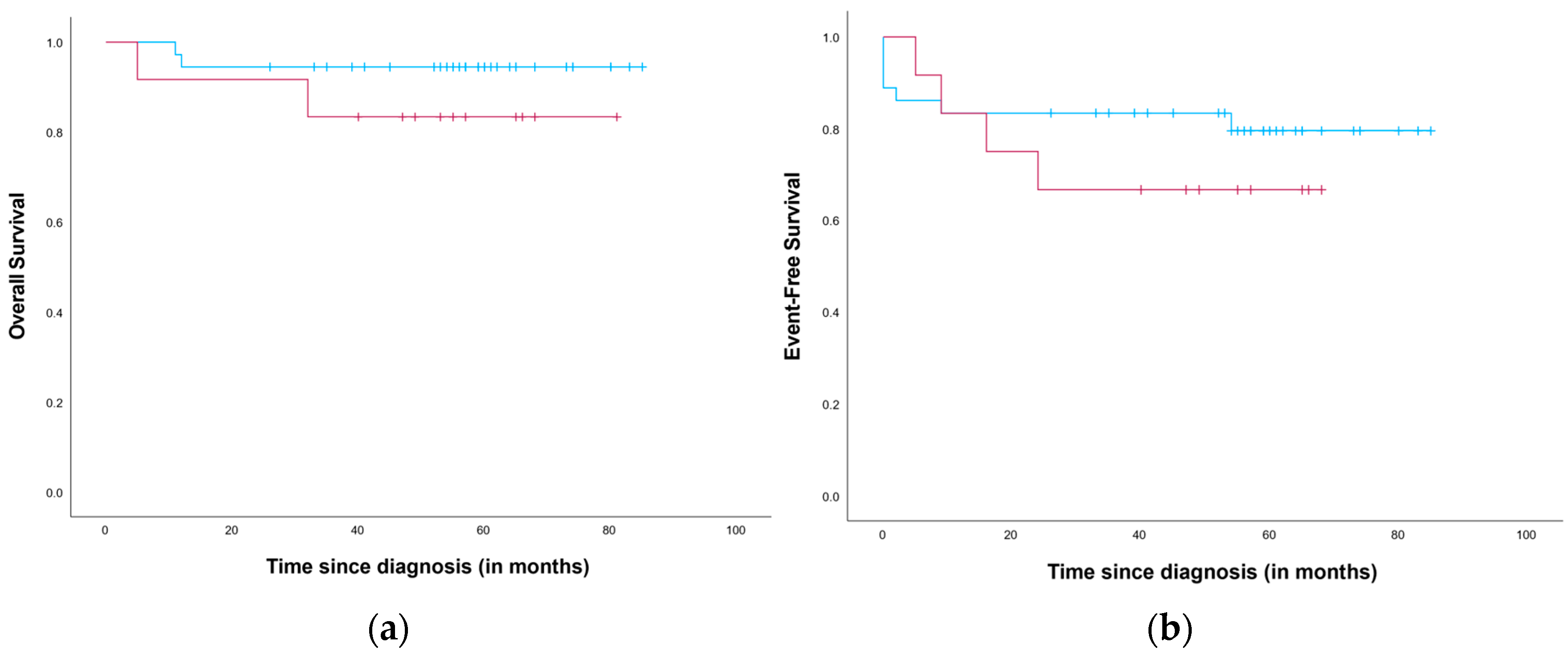
| Case | Age at Diagnosis | Sex | Stage | Risk Group | Mutation * | Amplification * | SCA Profile | ALT Activation ** | TERT Rearrangement *** | TERT mRNA Expression (CPM) | Observed ET (m) | Type Event | Status | Observed OST (m) |
|---|---|---|---|---|---|---|---|---|---|---|---|---|---|---|
| 1 | 0 | F | 2 | LR | No | No | - | - | - | 10 | Progression | Alive | 90 | |
| 2 | 0 | M | 4S | MR | No | No | - | Yes | - | 5 | Progression | Deceased | 23 | |
| 3 | 0 | M | 4S | MR | No | No | Yes | - | No | 0.0112 | 16 | Metastases | Alive | 81 |
| 4 | 0 | M | 4S | MR | No | No | Yes | No | No | 68 | Refractory | Alive | 68 | |
| 5 | 0 | F | 4S | MR | No | No | Yes | No | No | 66 | Refractory | Alive | 66 | |
| 6 | 5 | F | 2 | LR | No | MDM2 and CDK4 | Yes | Yes | No | 0 | 9 | Relapse | Deceased | 32 |
| 7 | 3 | M | 2 | LR | No | MDM2 and CDK4 | Yes | Yes * | - | 24 | Relapse | Alive | 53 | |
| 8 | 0 | F | 4S | MR | No | No | No | - | No | 0 | Progression | Deceased | 11 | |
| 9 | 6 | F | 3 | MR | ALK | No | - | - | No | 1.3176 | 5 | Progression | Deceased | 20 |
| 10 | 0 | M | 4S | MR | No | No | Yes | No | No | 0.0061 | 5 | Refractory | Deceased | 5 |
| 11 | 0 | M | 2 | LR | No | No | No | Yes | No | 0 | 2 | Metastases | Deceased | 12 |
| 12 | 8 | F | 2 | LR | No | No | No | - | No | 0.0020 | 54 | Relapse | Alive | 57 |
| 13 | 0 | M | 3 | MR | No | No | - | - | - | 22 | Relapse | Deceased | 26 |
| Group A N (%) | Group B N (%) | p-Value | |
|---|---|---|---|
| 1p deletion (n = 69) | 0.034 | ||
| Yes | 3 (25) | 2 (4) | |
| No | 9 (75) | 55 (96) | |
| 1q gain (n = 48) | 0.343 | ||
| Yes | 1 (13) | 1 (3) | |
| No | 8 (87) | 38 (97) | |
| 2p gain (n = 48) | 0.086 | ||
| Yes | 2 (22) | 1 (3) | |
| No | 7 (78) | 38 (97) | |
| 3p deletion (n = 48) | NA | ||
| Yes | 0 (0) | 1 (3) | |
| No | 9 (100) | 38 (97) | |
| 4p deletion (n = 48) | 0.343 | ||
| Yes | 1 (13) | 1 (3) | |
| No | 8 (87) | 38 (97) | |
| 11q deletion (n = 48) | 0.159 | ||
| Yes | 3 (33) | 5 (13) | |
| No | 6 (67) | 34 (87) | |
| 17q gain (n = 69) | 0.309 | ||
| Yes | 5 (42) | 15 (26) | |
| No | 7 (58) | 42 (74) | |
| SCA profile (n = 48) | 0.004 | ||
| Yes | 6 (67) | 6 (15) | |
| No | 3 (33) | 33 (85) |
3.2. Gene Amplifications and Mutations
3.3. Telomere Maintenance Mechanisms
4. Discussion
5. Conclusions
Supplementary Materials
Author Contributions
Funding
Institutional Review Board Statement
Informed Consent Statement
Data Availability Statement
Acknowledgments
Conflicts of Interest
Abbreviations
| ALT | Alternative lengthening of telomeres |
| APBs | ALT-associated PML bodies |
| CI | Confidence interval |
| CNVs | Copy number variations |
| EFS | Event-free survival |
| FISH | Fluorescent in situ hybridization |
| GPOH | Gesellschaft für Pädiatrische Onkologie und Hämatologie |
| INPC | International Neuroblastoma Pathology Classification |
| INRG | International Neuroblastoma Risk Group |
| MLPA | Multiplex Ligation-dependent Probe Amplification |
| NCA | Numerical chromosomal aberration |
| OR | Odds ratio |
| OS | Overall survival |
| SCA | Segmental chromosomal aberration |
| S.E. | Standard error |
| SNP | Single-nucleotide polymorphism |
| TMM | Telomere maintenance mechanism |
| tNGS | Targeted next-generation sequencing |
| WGS | Whole genome sequencing |
References
- Sokol, E.; Desai, A.V. The Evolution of Risk Classification for Neuroblastoma. Children 2019, 6, 27. [Google Scholar] [CrossRef]
- Gomez, R.L.; Ibragimova, S.; Ramachandran, R.; Philpott, A.; Ali, F.R. Tumoral heterogeneity in neuroblastoma. Biochim. Biophys. Acta (BBA)—Rev. Cancer 2022, 1877, 188805. [Google Scholar] [CrossRef]
- Cohn, S.L.; Pearson, A.D.; London, W.B.; Monclair, T.; Ambros, P.F.; Brodeur, G.M.; Faldum, A.; Hero, B.; Iehara, T.; Machin, D.; et al. The International Neuroblastoma Risk Group (INRG) classification system: An INRG Task Force report. J. Clin. Oncol. 2009, 27, 289–297. [Google Scholar] [CrossRef] [PubMed]
- Irwin, M.S.; Naranjo, A.; Zhang, F.F.; Cohn, S.L.; London, W.B.; Gastier-Foster, J.M.; Ramirez, N.C.; Pfau, R.; Reshmi, S.; Wagner, E.; et al. Revised Neuroblastoma Risk Classification System: A Report from the Children’s Oncology Group. J. Clin. Oncol. 2021, 39, 3229–3241. [Google Scholar] [CrossRef]
- London, W.B.; Castel, V.; Monclair, T.; Ambros, P.F.; Pearson, A.D.; Cohn, S.L.; Berthold, F.; Nakagawara, A.; Ladenstein, R.L.; Iehara, T.; et al. Clinical and biologic features predictive of survival after relapse of neuroblastoma: A report from the International Neuroblastoma Risk Group project. J. Clin. Oncol. 2011, 29, 3286–3292. [Google Scholar] [CrossRef] [PubMed]
- Bruinsma, R.S.; Lekkerkerker, C.W.M.; Fiocco, M.; Dierselhuis, M.P.; Langenberg, K.P.S.; Tytgat, G.A.M.; van Noesel, M.M.; Wijnen, M.; van der Steeg, A.F.W.; de Krijger, R.R. Prognostic Value of Molecular Aberrations in Low- or Intermediate-Risk Neuroblastomas: A Systematic Review. Cancers 2024, 17, 13. [Google Scholar] [CrossRef]
- Schleiermacher, G.; Janoueix-Lerosey, I.; Ribeiro, A.; Klijanienko, J.; Couturier, J.; Pierron, G.; Mosseri, V.; Valent, A.; Auger, N.; Plantaz, D.; et al. Accumulation of segmental alterations determines progression in neuroblastoma. J. Clin. Oncol. 2010, 28, 3122–3130. [Google Scholar] [CrossRef]
- Lerone, M.; Ognibene, M.; Pezzolo, A.; Martucciello, G.; Zara, F.; Morini, M.; Mazzocco, K. Molecular Genetics in Neuroblastoma Prognosis. Children 2021, 8, 456. [Google Scholar] [CrossRef]
- Werr, L.; Rosswog, C.; Bartenhagen, C.; George, S.L.; Fischer, M. Telomere maintenance mechanisms in neuroblastoma: New insights and translational implications. EJC Paediatr. Oncol. 2024, 3, 100156. [Google Scholar] [CrossRef]
- Takita, J. Molecular Basis and Clinical Features of Neuroblastoma. JMA J. 2021, 4, 321–331. [Google Scholar] [CrossRef]
- Koneru, B.; Lopez, G.; Farooqi, A.; Conkrite, K.L.; Nguyen, T.H.; Macha, S.J.; Modi, A.; Rokita, J.L.; Urias, E.; Hindle, A.; et al. Telomere Maintenance Mechanisms Define Clinical Outcome in High-Risk Neuroblastoma. Cancer Res. 2020, 80, 2663–2675. [Google Scholar] [CrossRef]
- Roderwieser, A.; Sand, F.; Walter, E.; Fischer, J.; Gecht, J.; Bartenhagen, C.; Ackermann, S.; Otte, F.; Welte, A.; Kahlert, Y.; et al. Telomerase Is a Prognostic Marker of Poor Outcome and a Therapeutic Target in Neuroblastoma. JCO Precis. Oncol. 2019, 3, 1–20. [Google Scholar] [CrossRef] [PubMed]
- Hartlieb, S.A.; Sieverling, L.; Nadler-Holly, M.; Ziehm, M.; Toprak, U.H.; Herrmann, C.; Ishaque, N.; Okonechnikov, K.; Gartlgruber, M.; Park, Y.G.; et al. Alternative lengthening of telomeres in childhood neuroblastoma from genome to proteome. Nat. Commun. 2021, 12, 1269. [Google Scholar] [CrossRef] [PubMed]
- Dutch Childhood Oncology Group (DCOG). DCOG NBL 2009 TREATMENT PROTOCOL for Risk Adapted Treatment of Children with Neuroblastoma. Available online: https://www.skion.nl/richtlijn/dcog-nbl-2009/ (accessed on 5 December 2025).
- Simon, T.; Hero, B.; Schulte, J.H.; Deubzer, H.; Hundsdoerfer, P.; von Schweinitz, D.; Fuchs, J.; Schmidt, M.; Prasad, V.; Krug, B.; et al. 2017 GPOH Guidelines for Diagnosis and Treatment of Patients with Neuroblastic Tumors. Klin. Padiatr. 2017, 229, 147–167. [Google Scholar] [CrossRef]
- Jiménez, I.; Segura, V.; Attignon, V.; Auger, N.; Beiske, K.; Mora, J.F.d.; Jeison, M.; Martinsson, T.; Masliah-Planchon, J.; Mazzocco, K.; et al. Genomic Profiling in Low and Intermediate-Risk Neuroblastoma to Refine Treatment Stratification and Improve Patient Outcome. LINES: A SIOPEN Trial. Advances in Neuroblastoma Research Meeting; Washington D.C. 2025. Available online: https://www.clinicaltrials.gov/study/NCT01728155 (accessed on 5 December 2025).
- de Leng, W.W.J.; Gadellaa-van Hooijdonk, C.G.; Barendregt-Smouter, F.A.S.; Koudijs, M.J.; Nijman, I.; Hinrichs, J.W.J.; Cuppen, E.; van Lieshout, S.; Loberg, R.D.; de Jonge, M.; et al. Targeted Next Generation Sequencing as a Reliable Diagnostic Assay for the Detection of Somatic Mutations in Tumours Using Minimal DNA Amounts from Formalin Fixed Paraffin Embedded Material. PLoS ONE 2016, 11, e0149405. [Google Scholar] [CrossRef]
- Richards, S.; Aziz, N.; Bale, S.; Bick, D.; Das, S.; Gastier-Foster, J.; Grody, W.W.; Hegde, M.; Lyon, E.; Spector, E.; et al. Standards and guidelines for the interpretation of sequence variants: A joint consensus recommendation of the American College of Medical Genetics and Genomics and the Association for Molecular Pathology. Genet Med. 2015, 17, 405–424. [Google Scholar] [CrossRef]
- van Belzen, I.; van Tuil, M.; Badloe, S.; Janse, A.; Verwiel, E.T.P.; Santoso, M.; de Vos, S.; Baker-Hernandez, J.; Kerstens, H.H.D.; Solleveld-Westerink, N.; et al. Complex structural variation is prevalent and highly pathogenic in pediatric solid tumors. Cell Genom. 2024, 4, 100675. [Google Scholar] [CrossRef]
- Bruinsma, R.S.; Fiocco, M.F.; de Leng, W.W.J.; Kester, L.A.; Langenberg, K.P.S.; Tytgat, G.A.M.; van Noesel, M.M.; Wijnen, M.H.W.A.; van der Steeg, A.F.W.; de Krijger, R.R. mRNA Expression Level of ALK in Neuroblastoma Is Associated with Histological Subtype, ALK Mutations and ALK Immunohistochemical Protein Expression. J. Mol. Pathol. 2024, 5, 304–318. [Google Scholar] [CrossRef]
- Cesare, A.J.; Heaphy, C.M.; O’Sullivan, R.J. Visualization of Telomere Integrity and Function In Vitro and In Vivo Using Immunofluorescence Techniques. Curr. Protoc. Cytom. 2015, 73, 12.40.1–12.40.31. [Google Scholar] [CrossRef]
- Schemper, M.; Smith, T.L. A note on quantifying follow-up in studies of failure time. Control Clin. Trials 1996, 17, 343–346. [Google Scholar] [CrossRef]
- Rubin, D.B. Multiple imputation after 18+ Years. J. Am. Stat. Assoc. 1996, 91, 473–489. [Google Scholar] [CrossRef]
- Junaid, K.P.; Kiran, T.; Gupta, M.; Kishore, K.; Siwatch, S. How much missing data is too much to impute for longitudinal health indicators? A preliminary guideline for the choice of the extent of missing proportion to impute with multiple imputation by chained equations. Popul. Health Metr. 2025, 23, 2. [Google Scholar] [CrossRef]
- Tas, M.L.; Nagtegaal, M.; Kraal, K.; Tytgat, G.A.M.; Abeling, N.; Koster, J.; Pluijm, S.M.F.; Zwaan, C.M.; de Keizer, B.; Molenaar, J.J.; et al. Neuroblastoma stage 4S: Tumor regression rate and risk factors of progressive disease. Pediatr. Blood Cancer 2020, 67, e28061. [Google Scholar] [CrossRef] [PubMed]
- Martinez-Monleon, A.; Kryh Öberg, H.; Gaarder, J.; Berbegall, A.P.; Javanmardi, N.; Djos, A.; Ussowicz, M.; Taschner-Mandl, S.; Ambros, I.M.; Øra, I.; et al. Amplification of CDK4 and MDM2: A detailed study of a high-risk neuroblastoma subgroup. Sci. Rep. 2022, 12, 12420. [Google Scholar] [CrossRef] [PubMed]
- Amoroso, L.; Ognibene, M.; Morini, M.; Conte, M.; Di Cataldo, A.; Tondo, A.; D’Angelo, P.; Castellano, A.; Garaventa, A.; Lasorsa, V.A.; et al. Genomic coamplification of CDK4/MDM2/FRS2 is associated with very poor prognosis and atypical clinical features in neuroblastoma patients. Genes Chromosomes Cancer 2020, 59, 277–285. [Google Scholar] [CrossRef]
- Gundem, G.; Levine, M.F.; Roberts, S.S.; Cheung, I.Y.; Medina-Martínez, J.S.; Feng, Y.; Arango-Ossa, J.E.; Chadoutaud, L.; Rita, M.; Asimomitis, G.; et al. Clonal evolution during metastatic spread in high-risk neuroblastoma. Nat. Genet. 2023, 55, 1022–1033. [Google Scholar] [CrossRef]
- Inomistova, M.V.; Svergun, N.M.; Khranovska, N.M.; Skachkova, O.V.; Gorbach, O.I.; Klymnyuk, G.I. Prognostic significance of MDM2 gene expression in childhood neuroblastoma. Exp. Oncol. 2015, 37, 111–115. [Google Scholar] [CrossRef] [PubMed]
- Carr, J.; Bell, E.; Pearson, A.D.; Kees, U.R.; Beris, H.; Lunec, J.; Tweddle, D.A. Increased frequency of aberrations in the p53/MDM2/p14(ARF) pathway in neuroblastoma cell lines established at relapse. Cancer Res. 2006, 66, 2138–2145. [Google Scholar] [CrossRef]
- Carr-Wilkinson, J.; O’Toole, K.; Wood, K.M.; Challen, C.C.; Baker, A.G.; Board, J.R.; Evans, L.; Cole, M.; Cheung, N.K.; Boos, J.; et al. High Frequency of p53/MDM2/p14ARF Pathway Abnormalities in Relapsed Neuroblastoma. Clin. Cancer Res. 2010, 16, 1108–1118. [Google Scholar] [CrossRef]
- He, J.; Gu, L.; Zhang, H.; Zhou, M. Crosstalk between MYCN and MDM2-p53 signal pathways regulates tumor cell growth and apoptosis in neuroblastoma. Cell Cycle 2011, 10, 2994–3002. [Google Scholar] [CrossRef]
- Rader, J.; Russell, M.R.; Hart, L.S.; Nakazawa, M.S.; Belcastro, L.T.; Martinez, D.; Li, Y.; Carpenter, E.L.; Attiyeh, E.F.; Diskin, S.J.; et al. Dual CDK4/CDK6 inhibition induces cell-cycle arrest and senescence in neuroblastoma. Clin. Cancer Res. 2013, 19, 6173–6182. [Google Scholar] [CrossRef]
- Bellini, A.; Pötschger, U.; Bernard, V.; Lapouble, E.; Baulande, S.; Ambros, P.F.; Auger, N.; Beiske, K.; Bernkopf, M.; Betts, D.R.; et al. Frequency and Prognostic Impact of ALK Amplifications and Mutations in the European Neuroblastoma Study Group (SIOPEN) High-Risk Neuroblastoma Trial (HR-NBL1). J. Clin. Oncol. 2021, 39, 3377–3390. [Google Scholar] [CrossRef]
- Bresler, S.C.; Weiser, D.A.; Huwe, P.J.; Park, J.H.; Krytska, K.; Ryles, H.; Laudenslager, M.; Rappaport, E.F.; Wood, A.C.; McGrady, P.W.; et al. ALK mutations confer differential oncogenic activation and sensitivity to ALK inhibition therapy in neuroblastoma. Cancer Cell 2014, 26, 682–694. [Google Scholar] [CrossRef] [PubMed]
- Schulte, J.H.; Bachmann, H.S.; Brockmeyer, B.; Depreter, K.; Oberthür, A.; Ackermann, S.; Kahlert, Y.; Pajtler, K.; Theissen, J.; Westermann, F.; et al. High ALK receptor tyrosine kinase expression supersedes ALK mutation as a determining factor of an unfavorable phenotype in primary neuroblastoma. Clin. Cancer Res. 2011, 17, 5082–5092. [Google Scholar] [CrossRef] [PubMed]
- Rosswog, C.; Fassunke, J.; Ernst, A.; Schömig-Markiefka, B.; Merkelbach-Bruse, S.; Bartenhagen, C.; Cartolano, M.; Ackermann, S.; Theissen, J.; Blattner-Johnson, M.; et al. Genomic ALK alterations in primary and relapsed neuroblastoma. Br. J. Cancer 2023, 128, 1559–1571. [Google Scholar] [CrossRef]
- Liu, M.; Zhang, Y.; Jian, Y.; Gu, L.; Zhang, D.; Zhou, H.; Wang, Y.; Xu, Z.-X. The regulations of telomerase reverse transcriptase (TERT) in cancer. Cell Death Dis. 2024, 15, 90. [Google Scholar] [CrossRef]
- Stainczyk, S.A.; Westermann, F. Neuroblastoma-Telomere maintenance, deregulated signaling transduction and beyond. Int. J. Cancer 2022, 150, 903–915. [Google Scholar] [CrossRef] [PubMed]
| Group A (n = 13) (%) | Group B (n = 76) (%) | |
|---|---|---|
| Gender | ||
| Female | 6 (46) | 40 (53) |
| Male | 7 (54) | 36 (47) |
| Age group | ||
| Infant (<1 year) | 8 (62) | 32 (42) |
| Child (1–18 years) | 5 (38) | 44 (58) |
| Primary tumor location | ||
| Adrenal gland | 6 (46) | 29 (38) |
| Paravertebral ganglia | 3 (23) | 39 (51) |
| Other/unknown | 4 (31) | 8 (11) |
| Survival | ||
| No | 6 (46) | 0 (0) |
| Yes | 7 (54) | 76 (100) |
| Event | ||
| Yes | 11 (85) | 9 (12) |
| No | 2 (15) | 66 (88) |
| SCA profile | ||
| Yes | 6 (67) | 6 (15) |
| No | 3 (33) | 33 (85) |
| Missing | 4 | 37 |
| MDM2-CDK4 co-amplification | ||
| Yes | 2 (17) | 0 (0) |
| No | 10 (83) | 57 (100) |
| Missing | 1 | 19 |
| ALK mutation | ||
| Yes | 1 (8) | 6 (11) |
| No | 11 (92) | 51 (89) |
| Missing | 1 | 19 |
| ALT activation | ||
| Yes | 4 * (57) | - |
| No | 3 (43) | - |
| Missing | 6 | 76 |
| TERT-rearrangement | ||
| Yes | 0 (0) | 0 (0) |
| No | 9 ** (100) | 18 (100) |
| Missing | 4 | 58 |
Disclaimer/Publisher’s Note: The statements, opinions and data contained in all publications are solely those of the individual author(s) and contributor(s) and not of MDPI and/or the editor(s). MDPI and/or the editor(s) disclaim responsibility for any injury to people or property resulting from any ideas, methods, instructions or products referred to in the content. |
© 2026 by the authors. Licensee MDPI, Basel, Switzerland. This article is an open access article distributed under the terms and conditions of the Creative Commons Attribution (CC BY) license.
Share and Cite
Bruinsma, R.S.; de Leng, W.W.J.; Fiocco, M.F.; Dierselhuis, M.P.; Langenberg, K.P.; Molenaar, J.J.; Kester, L.A.; van Noesel, M.M.; Tytgat, G.A.M.; van de Ven, C.P.; et al. Molecular Features Associated with a High-Risk Clinical Course in Neuroblastomas Initially Diagnosed as Non-High-Risk. Cancers 2026, 18, 235. https://doi.org/10.3390/cancers18020235
Bruinsma RS, de Leng WWJ, Fiocco MF, Dierselhuis MP, Langenberg KP, Molenaar JJ, Kester LA, van Noesel MM, Tytgat GAM, van de Ven CP, et al. Molecular Features Associated with a High-Risk Clinical Course in Neuroblastomas Initially Diagnosed as Non-High-Risk. Cancers. 2026; 18(2):235. https://doi.org/10.3390/cancers18020235
Chicago/Turabian StyleBruinsma, Rixt S., Wendy W. J. de Leng, Marta F. Fiocco, Miranda P. Dierselhuis, Karin P. Langenberg, Jan J. Molenaar, Lennart A. Kester, Max M. van Noesel, Godelieve A. M. Tytgat, Cornelis P. van de Ven, and et al. 2026. "Molecular Features Associated with a High-Risk Clinical Course in Neuroblastomas Initially Diagnosed as Non-High-Risk" Cancers 18, no. 2: 235. https://doi.org/10.3390/cancers18020235
APA StyleBruinsma, R. S., de Leng, W. W. J., Fiocco, M. F., Dierselhuis, M. P., Langenberg, K. P., Molenaar, J. J., Kester, L. A., van Noesel, M. M., Tytgat, G. A. M., van de Ven, C. P., Wijnen, M. H. W. A., de Krijger, R. R., & Steeg, A. F. W. v. d. (2026). Molecular Features Associated with a High-Risk Clinical Course in Neuroblastomas Initially Diagnosed as Non-High-Risk. Cancers, 18(2), 235. https://doi.org/10.3390/cancers18020235

