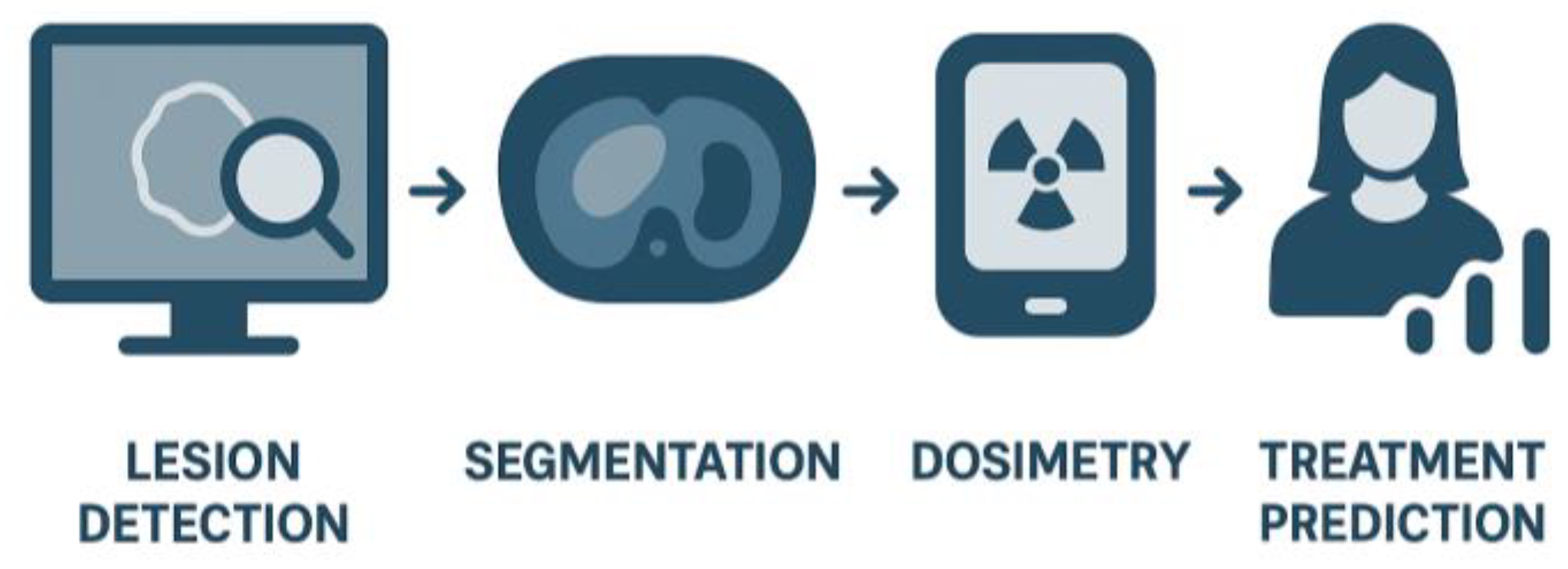
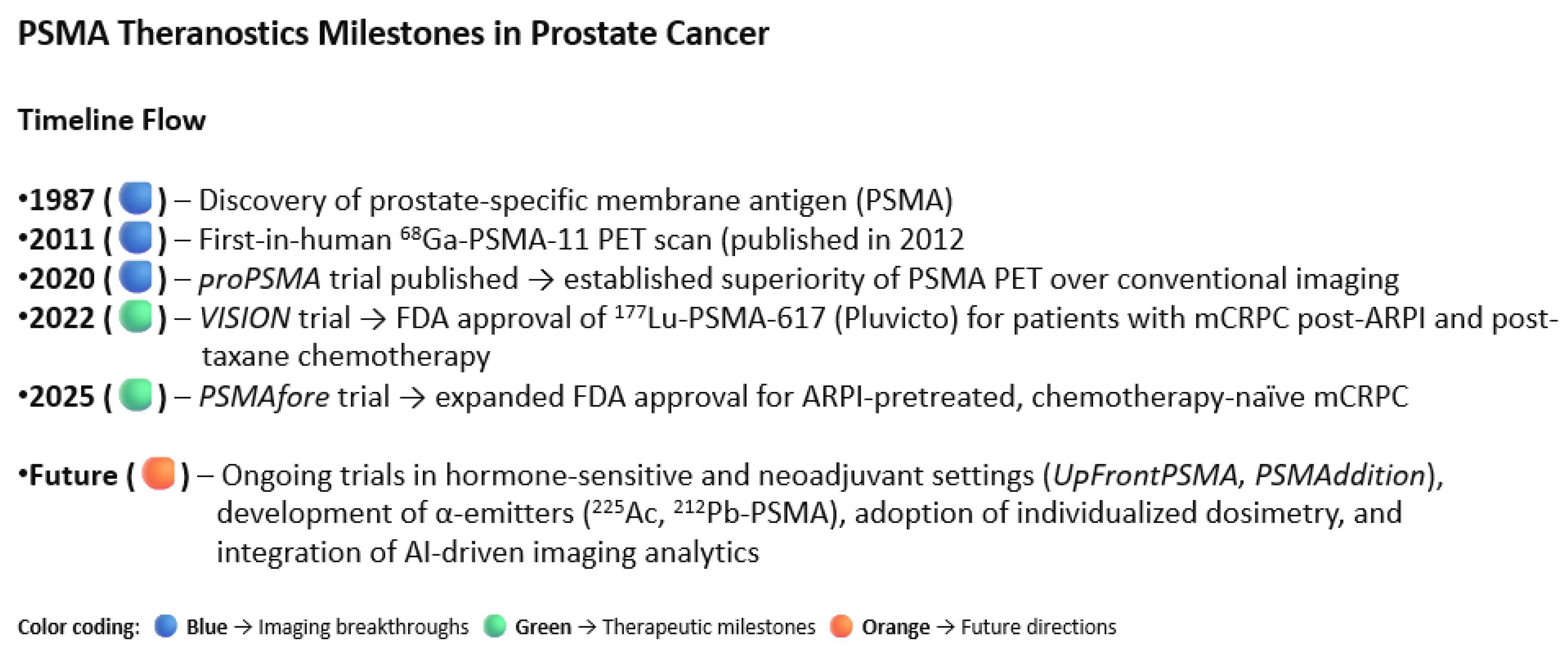
PSMA-Based Radiopharmaceuticals in Prostate Cancer Theranostics: Imaging, Clinical Advances, and Future Directions

Simple Summary
Abstract
1. Introduction
1.1. Advances in Imaging
1.1.1. The Transformative Impact of Advancements in Hardware Technology
1.1.2. PET/MR
1.1.3. Advancements in Image Reconstruction Algorithms
1.2. Theranostic Concepts
2. Emerging Radioligand Therapies
3. Integration with Imaging Advances and Artificial Intelligence
3.1. Radiomics
3.2. Future Directions of Radiomics in PCa
4. Clinical Challenges and Future Directions
4.1. Global Disparities in Clinical Practice Patterns
4.2. Key Factors for Maintaining Variables Influencing SUV Measurements to Ensure Result Reproducibility
4.3. Expanded Approved Indication for [177Lu]Lu-PSMA-617 (Pluvicto®) in the Management of Metastatic Castration-Resistant Prostate Cancer (mCRPC)
4.4. Mechanisms of Resistance to PSMA-Targeted Radioligand Therapy
5. Future Directions
6. Conclusions
Supplementary Materials
Funding
Data Availability Statement
Acknowledgments
Conflicts of Interest
References
- Artibani, W.; Porcaro, A.B.; De Marco, V.; Cerruto, M.A.; Siracusano, S. Management of Biochemical Recurrence after Primary Curative Treatment for Prostate Cancer: A Review. Urol. Int. 2018, 100, 251–262. [Google Scholar] [CrossRef] [PubMed]
- Mohler, J.L.; Halabi, S.; Ryan, S.T.; Al-Daghmin, A.; Sokoloff, M.H.; Steinberg, G.D.; Sanford, B.L.; Eastham, J.A.; Walther, P.J.; Morris, M.J.; et al. Management of recurrent prostate cancer after radiotherapy: Long-term results from CALGB 9687 (Alliance), a prospective multi-institutional salvage prostatectomy series. Prostate Cancer Prostatic Dis. 2019, 22, 309–316. [Google Scholar] [CrossRef] [PubMed] [PubMed Central]
- Subramanian, G.; McAfee, J.G. A new complex of 99mTc for skeletal imaging. Radiology 1971, 99, 192–196. [Google Scholar] [CrossRef] [PubMed]
- Afshar-Oromieh, A.; Haberkorn, U.; Eder, M.; Eisenhut, M.; Zechmann, C.M. [68Ga]-Gallium-labelled PSMA ligand as superior PET tracer for the diagnosis of prostate cancer: Comparison with [18F]fluoroethylcholine-PET/CT. Eur. J. Nucl. Med. Mol. Imaging 2012, 39, 1085–1086. [Google Scholar] [CrossRef] [PubMed]
- Fendler, W.P.; Calais, J.; Eiber, M.; Flavell, R.R.; Mishoe, A.; Feng, F.Y.; Nguyen, H.G.; Reiter, R.E.; Rettig, M.B.; Okamoto, S.; et al. Assessment of 68Ga-PSMA-11 PET Accuracy in Localizing Recurrent Prostate Cancer: A Prospective Single-Arm Clinical Trial. JAMA Oncol. 2019, 5, 856–863. [Google Scholar] [CrossRef] [PubMed] [PubMed Central]
- Hennrich, U.; Eder, M. [177Lu]Lu-PSMA-617 (PluvictoTM): The First FDA-Approved Radio therapeutical for Treatment of Prostate Cancer. Pharmaceuticals 2022, 15, 1292. [Google Scholar] [CrossRef] [PubMed] [PubMed Central]
- Miyahira, A.K.; Soule, H.R. The History of Prostate-Specific Membrane Antigen as a Theranostic Target in Prostate Cancer: The Cornerstone Role of the Prostate Cancer Foundation. J. Nucl. Med. 2022, 63, 331–338. [Google Scholar] [CrossRef]
- Hofman, M.S.; Lawrentschuk, N.; Francis, R.J.; Tang, C.; Vela, I.; Thomas, P.; Rutherford, N.; Martin, J.M.; Frydenberg, M.; Shakher, R.; et al. Prostate-specific membrane antigen PET-CT in patients with high-risk prostate cancer before curative-intent surgery or radiotherapy (proPSMA): A prospective, randomized, multicenter study. Lancet 2020, 395, 1208–1216. [Google Scholar] [CrossRef]
- Eiber, M.; Maurer, T.; Souvatzoglou, M.; Beer, A.J.; Ruffani, A.; Haller, B.; Graner, F.P.; Kübler, H.; Haberkorn, U.; Eisenhut, M.; et al. Evaluation of Hybrid 68Ga-PSMA Ligand PET/CT in 248 Patients with Biochemical Recurrence After Radical Prostatectomy. J. Nucl. Med. 2015, 56, 668–674, Erratum in J. Nucl. Med. 2016, 57, 1325. [Google Scholar] [CrossRef]
- Szabo, Z.; Mena, E.; Rowe, S.P.; Plyku, D.; Nidal, R.; Eisenberger, M.A.; Antonarakis, E.S.; Fan, H.; Dannals, R.F.; Chen, Y.; et al. Initial Evaluation of [18F]DCFPyL for Prostate-Specific Membrane Antigen (PSMA)-Targeted PET Imaging of Prostate Cancer. Mol. Imaging Biol. 2015, 17, 565–574. [Google Scholar] [CrossRef] [PubMed] [PubMed Central]
- Jani, A.B.; Ravizzini, G.C.; Gartrell, B.A.; Siegel, B.A.; Twardowski, P.; Saltzstein, D.; Fleming, M.T.; Chau, A.; Davis, P.; Chapin, B.F.; et al. Diagnostic Performance and Safety of 18F-rhPSMA-7.3 Positron Emission Tomography in Men with Suspected Prostate Cancer Recurrence: Results From a Phase 3, Prospective, Multicenter Study (SPOTLIGHT). J. Urol. 2023, 210, 299–311. [Google Scholar] [CrossRef] [PubMed] [PubMed Central]
- Giesel, F.L.; Hadaschik, B.; Cardinale, J.; Radtke, J.; Vinsensia, M.; Lehnert, W.; Kesch, C.; Tolstov, Y.; Singer, S.; Grabe, N.; et al. F-18 labelled PSMA-1007: Biodistribution, radiation dosimetry and histopathological validation of tumor lesions in prostate cancer patients. Eur. J. Nucl. Med. Mol. Imaging 2017, 44, 678–688. [Google Scholar] [CrossRef] [PubMed]
- Grubmüller, B.; Baum, R.P.; Capasso, E.; Singh, A.; Ahmadi, Y.; Knoll, P.; Floth, A.; Righi, S.; Zandieh, S.; Meleddu, C.; et al. 64Cu-PSMA-617 PET/CT Imaging of Prostate Adenocarcinoma: First In-Human Studies. Cancer Biother. Radiopharm. 2016, 31, 277–286. [Google Scholar] [CrossRef] [PubMed]
- Wang, Y.; Chen, Z.; Zhu, Y.; Zhao, H.; Li, L.; Huang, G.; Xue, W.; Chen, R.; Liu, J. Total-body [(68)Ga]Ga-PSMA-11 PET/CT improves the detection rate compared with conventional [(68)Ga]Ga-PSMA-11 PET/CT in patients with biochemical recurrent prostate cancer. Eur. J. Nucl. Med. Mol. Imaging 2023, 50, 4096–4106. [Google Scholar] [CrossRef]
- Wang, Y.; Dong, L.; Zhao, H.; Li, L.; Huang, G.; Xue, W.; Liu, J.; Chen, R. The superior detection rate of total-body [(68)Ga]Ga-PSMA-11 PET/CT compared to short axial field-of-view [(68)Ga]Ga-PSMA-11 PET/CT for early recurrent prostate cancer patients with PSA <0.2 ng/mL after radical prostatectomy. Eur. J. Nucl. Med. Mol. Imaging 2024, 51, 2484–2494. [Google Scholar] [PubMed]
- Uribe, C.; Iravani, A.; Savir-Baruch, B.; Jacene, H.; Graves, S.A.; Yuni, K. Dewaraja, Courtney Lawhn Heath, and Thomas A. Hope. J. Nucl. Med. Technol. 2025, 66, 1528–1537. [Google Scholar] [CrossRef]
- Alberts, I.; Hünermund, J.N.; Prenosil, G.; Mingels, C.; Bohn, K.P.; Viscione, M.; Sari, H.; Vollnberg, B.; Shi, K.; Afshar-Oromieh, A.; et al. Clinical performance of long axial field of view PET/CT: A head-to-head intra-individual comparison of the Biograph Vision Quadra with the Biograph Vision PET/CT. Eur. J. Nucl. Med. Mol. Imaging 2021, 48, 2395–2404. [Google Scholar] [CrossRef] [PubMed] [PubMed Central]
- Civelek, A.C.; Niglio, S.A.; Malayeri, A.A.; Lin, J.; Gurram, S.; Chalfin, H.J.; Turkbey, B.; Valera, V.; Steinberg, S.M.; Apolo, A.B. Clinical value of 18FDG PET/MRI in muscle-invasive, locally advanced, and metastatic bladder cancer. Urol. Oncol. Semin. Orig. Investig. 2021, 39, 787.e17–787.e21. [Google Scholar] [CrossRef]
- Konopnicki, A.; Zaliznyak, M.; Roy, M.; Jana, B. The therapeutic use of 177Lu-PSMA-617 radioligand therapy in prostate cancer treatment: A review of literature and ongoing trials. Discov. Oncol. 2024, 15, 791. [Google Scholar] [CrossRef] [PubMed]
- Civelek, A.C. 68Ga-PSMA-11 PET: Better at Detecting Prostate Cancer than Multiparametric MRI? Radiology 2018, 289, 738–739. [Google Scholar] [CrossRef]
- Martin, L.; Boellaard, R. Noise and bias characteristics of standardized uptake value (SUV) derived with point spread function (PSF) image reconstruction: Should PSF be used for PET tumor uptake quantification? J. Nucl. Med. 2017, 58, 614. [Google Scholar]
- Wen, X.; Xu, P.; Zeng, X.; Liu, J.; Du, C.; Zeng, X.; Cheng, X.; Wang, X.; Liang, Y.; Zhao, T.; et al. Development of 177Lu-LNC1003 for radioligand therapy of prostate cancer with moderate PSMA expression. Theranostics 2022, 12, 422–433. [Google Scholar] [CrossRef]
- Sartor, O.; de Bono, J.; Chi, K.N.; Fizazi, K.; Herrmann, K.; Rahbar, K.; Tagawa, S.T.; Nordquist, L.T.; Vaishampayan, N.; El-Haddad, G.; et al. Lutetium-177–PSMA-617 for Metastatic Castration-Resistant Prostate Cancer. N. Engl. J. Med. 2021, 385, 1091–1103. [Google Scholar] [CrossRef] [PubMed]
- Kratochwil, C.; Fendler, W.P.; Eiber, M.; Hofman, M.S.; Emmett, L.; Calais, J.; Osborne, J.R.; Iravani, A.; Koo, P.; Lindenberg, L.; et al. Joint EANM/SNMMI procedure guideline for the use of 177Lu-labeled PSMA-targeted radioligand-therapy (177Lu-PSMA-RLT). Eur. J. Nucl. Med. Mol. Imaging 2023, 50, 2830–2845. [Google Scholar] [CrossRef] [PubMed] [PubMed Central]
- Kwon, W.A.; Joung, J.Y. Neoadjuvant 177Lutetium-PSMA-617 Radioligand Therapy for High-Risk Localized Prostate Cancer: Rationale, Early Clinical Evidence, and Future Directions. Cancers 2025, 17, 3330. [Google Scholar] [CrossRef] [PubMed] [PubMed Central]
- Holzgreve, A.; Armstrong, W.R.; Clark, K.J.; Benz, M.R.; Smith, C.P.; Djaileb, L.; Gafita, A.; Thin, P.; Nickols, N.G.; Kishan, A.U.; et al. PSMA-PET/CT Findings in Patients with High-Risk Biochemically Recurrent Prostate Cancer with No Metastatic Disease by Conventional Imaging. JAMA Netw. Open 2025, 8, e2452971. [Google Scholar] [CrossRef] [PubMed] [PubMed Central]
- Karimzadeh, A.; Heck, M.; Tauber, R.; Solaris, E.; Nekolla, S.; Knorr, K.; Haller, B.; D’alessandria, C.; Weber, W.A.; Eiber, M.; et al. The Impact of PSMA PET–Based Eligibility Criteria Used in the Prospective Phase II TheraP Trial in Metastatic Castration-Resistant Prostate Cancer Patients Undergoing Prostate-Specific Membrane Antigen–Targeted Radioligand Therapy. J. Nucl. Med. 2023, 64, 1252–1258. [Google Scholar] [CrossRef]
- Hope, T.A.; Antonarakis, E.S.; Bodei, L.; Calais, J.; Iravani, A.; Jacene, H.; Koo, P.J.; Morgans, A.K.; Osborne, J.R.; Tagawa, S.T.; et al. SNMMI Consensus Statement on Patient Selection and Appropriate Use of 177Lu-PSMA-617 Radionuclide Therapy. J. Nucl. Med. 2023, 64, 1417–1423. [Google Scholar] [CrossRef]
- National Cancer Institute. Re-Treatment with 177Lu-PSMA-617 for the Treatment of Metastatic Castration-Resistant Prostate Cancer, RE-LuPSMA Trial. 2025. Available online: https://www.clinicaltrials.gov/study/NCT06288113 (accessed on 12 December 2025).
- Yusufi, N.; Wurzer, A.; Herz, M.; D’Alessandria, C.; Feuerecker, B.; Weber, W.; Wester, H.J.; Nekolla, S.; Eiber, M. Comparative Preclinical Biodistribution, Dosimetry, and Endoradiotherapy in Metastatic Castration-Resistant Prostate Cancer Using 19F/177Lu-rhPSMA-7.3 and 177Lu-PSMA I&T. J. Nucl. Med. 2021, 62, 1106–1111. [Google Scholar] [CrossRef] [PubMed]
- Schuchardt, C.; Zhang, J.; Kulkarni, H.R.; Chen, X.; Mueller, D.; Baum, R.P. Prostate-Specific Membrane Antigen Radioligand Therapy Using 177Lu-PSMA I&T and 177Lu-PSMA-617 in Patients with Metastatic Castration-Resistant Prostate Cancer: Comparison of Safety, Biodistribution, and Dosimetry. J. Nucl. Med. 2022, 63, 1199–1207. [Google Scholar] [CrossRef] [PubMed]
- Wurzer, A.; De Rose, F.; Fischer, S.; Schwaiger, M.; Weber, W.; Nekolla, S.; Wester, H.J.; Eiber, M. Preclinical comparison of [177Lu]Lu-rhPSMA-10.1 and [177Lu]Lu-rhPSMA-10.2 for endoradiotherapy of prostate cancer: Biodistribution and dosimetry studies. EJNMMI Radiopharm. Chem. 2024, 9, 18. [Google Scholar] [CrossRef]
- Hofman, M.S.; Emmett, L.; Sandhu, S.; Iravani, A.; Joshua, A.M.; Goh, J.C.; Pattison, D.A.; Tan, T.H.; Kirkwood, I.D.; Ng, S.; et al. [177Lu]Lu-PSMA-617 versus cabazitaxel in patients with metastatic castration-resistant prostate cancer (TheraP): A randomized, open-label, phase 2 trial. Lancet 2021, 397, 794–804. [Google Scholar] [CrossRef]
- Morris, M.J.; Castellano, D.; Herrmann, K.; de Bono, J.S.; Shore, N.D.; Chi, K.N.; Crosby, M.; Piulats, J.M.; Fléchon, A.; Wei, X.X.; et al. PSMAfore Investigators. 177Lu-PSMA-617 versus a change of androgen receptor pathway inhibitor therapy for taxane-naive patients with progressive metastatic castration-resistant prostate cancer (PSMAfore): A phase 3, randomized, controlled trial. Lancet 2024, 404, 1227–1239. [Google Scholar] [CrossRef]
- Hansen, A.R.; Probst, S.; Beauregard, J.-M.; Viglianti, B.L.; Michalski, J.M.; Tagawa, S.T.; Sartor, O.; Tutrone, R.F.; Oz, O.K.; Courtney, K.D.; et al. Initial clinical experience with [177Lu]Lu-PNT2002 radioligand therapy in metastatic castration-resistant prostate cancer: Dosimetry, safety, and efficacy from the lead-in cohort of the SPLASH trial. Front. Oncol. 2024, 14, 1483953. [Google Scholar] [CrossRef] [PubMed]
- ECLIPSE. Trial 2023: A Multi-Center, Open-Label, Randomized Phase 3 Study Comparing 177Lu-PSMA-I&T Versus Hormone Therapy in Patients with Metastatic Castration-Resistant Prostate Cancer. Available online: https://clinicaltrials.gov/study/NCT05204927 (accessed on 12 December 2025).
- ACTINIUM. Study of [225Ac]Ac-PSMA-617 in Metastatic Castration-Resistant Prostate Cancer. Available online: https://clinicaltrials.gov/study/NCT04597411 (accessed on 26 December 2025).
- Phillips, R.; Shi, W.Y.; Deek, M.; Radwan, N.; Lim, S.J.; Antonarakis, E.S.; Rowe, S.P.; Ross, A.E.; Gorin, M.A.; Deville, C.; et al. Outcomes of Observation vs. Stereotactic Ablative Radiation for Oligometastatic Prostate Cancer: The ORIOLE Phase 2 Randomized Clinical Trial. JAMA Oncol. 2020, 6, 650–659. [Google Scholar] [CrossRef] [PubMed] [PubMed Central]
- Nordquist, L.; Lengyelova, E.; Saltzstein, D.; Josephson, D.; Franklin, G.E.; Morrish, G.; Gervasio, O.; Parker, M.; Miller, R.M.; Shore, N.D. Assessment of safety and efficacy of 64Cu-SAR-bisPSMA in patients with biochemical recurrence of prostate cancer following definitive therapy. J. Clin. Oncol. 2024, 42, 5100. [Google Scholar] [CrossRef]
- Kelly, J.M.; Amor-Coarasa, A.; Ponnala, S.; Nikolopoulou, A.; Williams, C., Jr.; DiMagno, S.G.; Babich, J.W. Albumin-Binding PSMA Ligands: Implications for Expanding the Therapeutic Window. J. Nucl. Med. 2019, 60, 656–663. [Google Scholar] [CrossRef] [PubMed]
- Freedland, S.J.; de Almeida Luz, M.; De Giorgi, U.; Gleave, M.; Gotto, G.T.; Pieczonka, C.M.; Haas, G.P.; Kim, C.S.; Ramirez-Backhaus, M.; Rannikko, A.; et al. Improved Outcomes with Enzalutamide in Biochemically Recurrent Prostate Cancer. N. Engl. J. Med. 2025, 393, 832. [Google Scholar] [CrossRef]
- Zang, S.; Meng, Q.; Li, X.; Guo, T.; Zhang, L.; Zhao, Z.; Yu, F.; Zhang, P.; Wu, W.; Ni, Y.; et al. Fully Automated Volumetric Assessment of Tumor Burden using Artificial Intelligence on 68Ga-PSMA-11 PET Imaging Predicts Survival After 177Lu-PSMA therapy in Metastatic Castration-resistant Prostate Cancer. Eur. J. Nucl. Med. 2025. [Google Scholar] [CrossRef]
- Li, X.; Song, J.; Yao, X.; Zhao, Z.; Zhang, Q.; Li, R.; Zhang, P.; Wu, W.; Sun, H.; Ai, S.; et al. Introduction of prostate-specific membrane antigen adjusted prostate imaging reporting and data system: A new approach to enhancing the accuracy of diagnosing naïve-primary prostate cancer. Asian J. Urol. 2025. [Google Scholar] [CrossRef]
- Lambin, P.; Rios-Velazquez, E.; Leijenaar, R.; Carvalho, S.; van Stiphout, R.G.; Granton, P.; Zegers, C.M.; Gillies, R.; Boellard, R.; Dekker, A.; et al. Radiomics: Extracting more information from medical images using advanced feature analysis. Eur. J. Cancer 2012, 48, 441–446. [Google Scholar] [CrossRef] [PubMed] [PubMed Central]
- Lafata, K.J.; Wang, Y.; Konkel, B.; Yin, F.F.; Bashir, M.R. Radiomics: A primer on high-throughput image phenotyping. Abdom Radiol. 2022, 47, 2986–3002. [Google Scholar] [CrossRef] [PubMed]
- Liu, Z.; Duan, T.; Zhang, Y.; Weng, S.; Xu, H.; Ren, Y.; Zhang, Z.; Han, X. Radiogenomics: A key component of precision cancer medicine. Br. J. Cancer 2023, 129, 741–753. [Google Scholar] [CrossRef] [PubMed] [PubMed Central]
- Rahbar, K.; Essler, M.; Pabst, K.M.; Eiber, M.; la Fougère, C.; Prasad, V.; Rassek, P.; Hasa, E.; Dittmann, H.; Bundschuh, R.A.; et al. Safety and Survival Outcomes of 177Lu-Prostate-Specific Membrane Antigen Therapy in Patients with Metastatic Castration-Resistant Prostate Cancer with Prior 223Ra treatment: The RALU Study. J. Nucl. Med. 2023, 64, 574–578. [Google Scholar] [CrossRef] [PubMed] [PubMed Central]
- Gillies, R.J.; Kinahan, P.E.; Hricak, H. Radiomics: Images Are More than Pictures, They Are Data. Radiology 2016, 278, 563–577. [Google Scholar] [CrossRef] [PubMed] [PubMed Central]
- Ferro, M.; de Cobelli, O.; Musi, G.; del Giudice, F.; Carrieri, G.; Busetto, G.M.; Falagario, U.G.; Sciarra, A.; Maggi, M.; Crocetto, F.; et al. Radiomics in prostate cancer: An up-to-date review. Ther. Adv. Urol. 2022, 14, 17562872221109020. [Google Scholar] [CrossRef] [PubMed] [PubMed Central]
- Eiber, M.; Herrmann, K.; Calais, J.; Hadaschik, B.; Giesel, F.L.; Hartenbach, M.; Hope, T.A.; Reiter, R.; Maurer, T.; Weber, W.A.; et al. Prostate Cancer Molecular Imaging Standardized Evaluation (PROMISE): Proposed miTNM Classification for the Interpretation of PSMA-Ligand PET/CT. J. Nucl. Med. 2018, 59, 469–478, Erratum in J. Nucl. Med. 2018, 59, 992.. [Google Scholar] [CrossRef] [PubMed]
- Hu, J.; Seifert, R.; Karkampouna, S.; Gomes, C.V.; Xue, S.; Afshar-Ormieh, A.; Rominger, A.; Shi, K. Influence of dosimetry accuracy on the correlation with treatment outcome in a preliminary PSMA radiopharmaceutical therapy study. Eur. J. Nucl. Med. Mol. Imaging 2025, 52, 1649–1657. [Google Scholar] [CrossRef] [PubMed] [PubMed Central]
- Sollini, M.; Antunovic, L.; Chiti, A.; Kirienko, M. Towards clinical application of image mining: A systematic review on artificial intelligence and radiomics. Eur. J. Nucl. Med. Mol. Imaging 2019, 46, 2656–2672. [Google Scholar] [CrossRef] [PubMed] [PubMed Central]
- Yazdani, E.; Geramifar, P.; Karamzade-Ziarati, N.; Sadeghi, M.; Amini, P.; Rahmim, A. Radiomics and Artificial Intelligence in Radiotheranostics: A Review of Applications for Radioligands Targeting Somatostatin Receptors and Prostate-Specific Membrane Antigens. Diagnostics 2024, 14, 181. [Google Scholar] [CrossRef] [PubMed]
- IAEA. AI-PET Initiative, 2024. Artificial Intelligence. Available online: https://www.iaea.org/interactive/annual-report/2024/in-focus/artificial-intelligence.html (accessed on 12 December 2025).
- Herrmann, K.; Giovanella, L.; Santos, A.; Gear, J.; Kiratli, P.O.; Kurth, J.; Denis-Bacelar, A.M.; Hustinx, R.; Patt, M.; Wahl, R.L.; et al. Joint EANM, SNMMI and IAEA enabling guide: How to set up a theranostics centre. Eur. J. Nucl. Med. Mol. Imaging 2022, 49, 2300–2309. [Google Scholar] [CrossRef] [PubMed] [PubMed Central]
- Yadav, M.P.; Ballal, S.; Sahoo, R.K.; Tripathi, M.; Seth, A.; Bal, C. Efficacy and safety of 225Ac-PSMA-617 targeted alpha therapy in metastatic castration-resistant Prostate Cancer patients. Theranostics 2020, 10, 9364–9377. [Google Scholar] [CrossRef] [PubMed] [PubMed Central]
- Ma, J.; Li, L.; Liao, T.; Gong, W.; Zhang, C. Efficacy and Safety of 225Ac-PSMA-617-Targeted Alpha Therapy in Metastatic Castration-Resistant Prostate Cancer: A Systematic Review and Meta-Analysis. Front. Oncol. 2022, 12, 796657. [Google Scholar] [CrossRef]
- Kratochwil, C.; Bruchertseifer, F.; Rathke, H.; Bronzel, M.; Apostolidis, C.; Weichert, W.; Haberkorn, U.; Giesel, F.L.; Morgenstern, A. Targeted α-Therapy of Metastatic Castration-Resistant Prostate Cancer with 225Ac-PSMA-617: Dosimetry Estimate and Empiric Dose Finding. J. Nucl. Med. 2017, 58, 1624–1631. [Google Scholar] [CrossRef]
- Muniz, M.; Loprinzi, C.L.; Orme, J.J.; Koch, R.M.; Mahmoud, A.M.; Kase, A.M.; Riaz, I.B.; Andrews, J.R.; Thorpe, M.P.; Johnson, G.B.; et al. Salivary toxicity from PSMA-targeted radiopharmaceuticals: What we have learned and where we are going. Cancer Treat. Rev. 2024, 127, 102748. [Google Scholar] [CrossRef] [PubMed] [PubMed Central]
- Stenberg, V.Y.; Larsen, R.H.; Ma, L.-W.; Peng, Q.; Juzenas, P.; Bruland, Ø.S.; Juzeniene, A. Evaluation of the PSMA-Binding Ligand 212Pb-NG001 in Multicellular Tumour Spheroid and Mouse Models of Prostate Cancer. Int. J. Mol. Sci. 2021, 22, 4815. [Google Scholar] [CrossRef] [PubMed]
- Kratochwil, C.; Bruchertseifer, F.; Giesel, F.L.; Weis, M.; Verburg, F.A.; Mottaghy, F.; Kopka, K.; Apostolidis, C.; Haberkorn, U.; Morgenstern, A. 225Ac-PSMA-617 for PSMA-Targeted α-Radiation Therapy of Metastatic Castration-Resistant Prostate Cancer. J. Nucl. Med. 2016, 57, 1941–1944. [Google Scholar] [CrossRef]
- Sathekge, M.; Bruchertseifer, F.; Knoesen, O.; Reyneke, F.; Lawal, I.; Lengana, T.; Davis, C.; Mahapane, J.; Corbett, C.; Vorster, M.; et al. 225Ac-PSMA-617 in chemotherapy-naive patients with advanced prostate cancer: A pilot study. Eur. J. Nucl. Med. Mol. Imaging 2019, 46, 129–138, Erratum in Eur. J. Nucl. Med. Mol. Imaging 2019, 46, 1988. https://doi.org/10.1007/s00259-019-04401-9. PMID: 30232539; PMCID: PMC6267694. [Google Scholar] [CrossRef]
- Ongoing, NCT05219500. Targeted Alpha Therapy with 225Actinium-Prostate Specific Membrane Antigen (PSMA)-I&T of Castration-Resistant Prostate Cancer (TATCIST). Available online: https://clinicaltrials.gov/study/NCT05219500 (accessed on 26 December 2025).
- Tagawa, S.T.; Thomas, C.; Sartor, A.O.; Sun, M.; Stangl-Kremser, J.; Bissassar, M.; Vallabhajosula, S.; Castellanos, S.H.; Nauseef, J.T.; Sternberg, C.N.; et al. Prostate-Specific Membrane Antigen-Targeting Alpha Emitter via Antibody Delivery for Metastatic Castration-Resistant Prostate Cancer: A Phase I Dose-Escalation Study of 225Ac-J591. J. Clin. Oncol. 2024, 42, 842–851. [Google Scholar] [CrossRef] [PubMed] [PubMed Central]
- Study to Evaluate the Safety, Tolerability, Pharmacokinetics, and Antitumor Activity of a Thorium-227-Labeled Antibody-Chelator Conjugate Alone and in Combination with Darolutamide in Patients with Metastatic Castration-Resistant Prostate Cancer. Available online: https://clinicaltrials.gov/study/NCT03724747 (accessed on 26 December 2025).
- Farolfi, A.; Armstrong, W.R.; Djaileb, L.; Gafita, A.; Hotta, M.; Allen-Auerbach, M.; Unterrainer, L.M.; Fendler, W.P.; Rettig, M.; Eiber, M.; et al. Differences and Common Ground in 177Lu-PSMA Radioligand Therapy Practice Patterns: International Survey of 95 Theranostic Centers. J. Nucl. Med. 2024, 65, 438–445. [Google Scholar] [CrossRef] [PubMed]
- Civelek, A.C. Management of Metastatic Prostate Cancer Biochemical Recurrence with Use of 18F-DCFPyL PET/CT. Radiology 2022, 303, 423–424. [Google Scholar] [CrossRef] [PubMed]
- Civelek, A.C. PSMA PET Parameters for Predicting Outcomes in Patients with Prostate Cancer. Radiology 2023, 309, e233023. [Google Scholar] [CrossRef]
- Civelek, A.C. Prostate Cancer: Improved Patient Care in the Age of Advancing Theranostics. Radiology 2024, 312, e241564. [Google Scholar] [CrossRef] [PubMed]
- Civelek, A.; Rana, A.; Malayeri, A.; Rodante, J.; Dey, A.; Jha, A.; Mehta, N.; Bluemke, D. Intra and inter test reproducibility and comparison of PET-MRI and PET-CT derived 18F-FDG metric measurements. J. Nucl. Med. 2017, 58, 1343. [Google Scholar]
- Stuparu, A.D.; Capri, J.R.; Meyer, C.A.; Le, T.M.; Evans-Axelsson, S.L.; Current, K.; Lennox, M.; Mona, C.E.; Fendler, W.P.; Calais, J.; et al. Mechanisms of Resistance to Prostate-Specific Membrane Antigen-Targeted Radioligand Therapy in a Mouse Model of Prostate Cancer. J. Nucl. Med. 2021, 62, 989–995. [Google Scholar] [CrossRef] [PubMed] [PubMed Central]
- Thomas Hope. Mechanisms of Resistance to PSMA Radioligand Therapy-Study Prostate Cancer. 2025. Available online: https://clinicaltrials.gov/study/NCT05435495 (accessed on 12 December 2025).
- Handy, C.E.; Antonarakis, E.S. Sipuleucel-T for the treatment of prostate cancer: Novel insights and future directions. Futur. Oncol. 2018, 14, 907–917. [Google Scholar] [CrossRef] [PubMed] [PubMed Central]
- Sengupta, S.; Kasireddy, S.R.; Mukkamala, R.; Srinivasarao, M.; Low, P.S. Prostate specific membrane antigen targeted PRMT5 inhibition re-sensitizes cancer cells to radiation therapies. Cancer Res. 2025, 85, 590. [Google Scholar] [CrossRef]
- Dorff, T.B.; Blanchard, M.S.; Adkins, L.N.; Luebbert, L.; Leggett, N.; Shishido, S.N.; Macias, A.; Del Real, M.M.; Dhapola, G.; Egelston, C.; et al. PSCA-CAR T cell therapy in metastatic castration-resistant prostate cancer: A phase 1 trial. Nat. Med. 2024, 30, 1636–1644. [Google Scholar] [CrossRef]
- Liu, S.; Alabi, B.R.; Yin, Q.; Stoyanova, T. Molecular mechanisms underlying the development of neuroendocrine prostate cancer. Semin. Cancer Biol. 2022, 86, 57–68. [Google Scholar] [CrossRef]
- DeLucia, D.C.; Cardillo, T.M.; Ang, L.; Labrecque, M.P.; Zhang, A.; Hopkins, J.E.; De Sarkar, N.; Coleman, I.; Gil da Costa, R.M.; Corey, E.; et al. Regulation of CEACAM5 and therapeutic efficacy of an anti-CEACAM5-SN38 antibody-drug conjugate in neuroendocrine prostate cancer. Clin. Cancer Res. 2021, 27, 759–774. [Google Scholar] [CrossRef] [PubMed]
- Adusumilli, P.S.; Zauderer, M.G.; Rivière, I.; Solomon, S.B.; Rusch, V.W.; O’’CEarbhaill, R.E.; Zhu, A.; Cheema, W.; Chintala, N.K.; Halton, E.; et al. A phase I trial of regional mesothelin-targeted CAR T-cell therapy in patients with malignant pleural disease, in combination with the anti-PD-1 antibody agent pembrolizumab. Cancer Discov. 2021, 11, 2748–2763. [Google Scholar] [CrossRef] [PubMed]
- Palma, D.A.; Olson, R.; Harrow, S.; Gaede, S.; Louie, A.V.; Haasbeek, C.; Mulroy, L.; Lock, M.; Rodrigues, G.B.; Yaremko, B.P.; et al. Stereotactic Ablative Radiotherapy for the Comprehensive Treatment of Oligometastatic Cancers: Long-Term Results of the SABR-COMET Phase II Randomized Trial. J. Clin. Oncol. 2020, 38, 2830–2838. [Google Scholar] [CrossRef] [PubMed]
- Ost, P.; Reynders, D.; Decaestecker, K.; Fonteyne, V.; Lumen, N.; De Bruycker, A.; Lambert, B.; Delrue, L.; Bultijnck, R.; Goetghebeur, E.; et al. Surveillance or metastasis-directed therapy for oligometastatic prostate cancer recurrence (STOMP): Five-year results of a randomized phase II trial. J. Clin. Oncol. 2020, 38, 10. [Google Scholar] [CrossRef]
- Tang, C.; Sherry, A.D.; Haymaker, C.; Bathala, T.; Liu, S.; Fellman, B.; Cohen, L.; Aparicio, A.; Zurita, A.J.; Reuben, A.; et al. Addition of Metastasis-Directed Therapy to Intermittent Hormone Therapy for Oligometastatic Prostate Cancer: The EXTEND Phase 2 Randomized Clinical Trial. JAMA Oncol. 2023, 9, 825–834. [Google Scholar] [CrossRef] [PubMed]




| Imaging Modality | Mechanism/Tracer | Sensitivity (%) | Specificity (%) | Advantages | Limitations | Common Clinical Applications |
|---|---|---|---|---|---|---|
| Bone Scan (99mTc-MDP) | Detects osteoblastic activity | 65–80 | 60–75 | Widely available; inexpensive | Low specificity; limited soft-tissue detection | Detection of bone metastases (advanced disease) |
| CT | Anatomical imaging; density-based | 40–60 | 70–85 | Rapid, widely used | Poor soft-tissue contrast; limited for early recurrence | Staging, structural assessment, response follow-up |
| MRI (with DWI) | Proton-based tissue contrast | 75–85 | 80–90 | Excellent pelvic imaging; multiparametric capability | Limited whole-body coverage | Local staging, detection of recurrence in prostate bed |
| Choline PET/CT | Radiolabeled choline metabolism | 55–70 | 75–85 | Detects biochemical recurrence | Reduced sensitivity at PSA < 1 ng/mL | Restaging after biochemical recurrence |
| PSMA PET/CT (e.g., 68Ga-PSMA-11, 18F-DCFPyL) | Targets PSMA expression | 85–97 | 90–98 | High lesion contrast; whole-body detection | PSMA-negative variants; access/cost | Primary staging, recurrence localization, therapy guidance |
| PSMA PET/MRI | Combines PSMA PET and MRI | 90–98 | 90–98 | High-resolution functional-anatomical data | Expensive; limited availability | Comprehensive staging, treatment planning |
| Tracer | Radionuclide | Main Advantages | Regulatory Status | Key References | ||
|---|---|---|---|---|---|---|
| [68Ga]Ga-PSMA-11 | β+ (68 min) | Rapid synthesis, high tumor-to-background ratio. Urinary clearance | FDA/EMA approved 2020 | Eiber et al., 2015 [9] | ||
| [18F]DCFPyL | β+ (110 min) | High yield, lower urinary excretion Higher resolution, | FDA approved—2021 | Szabo et al., 2015 [10] | ||
| [18F]rhPSMA-7.3 * | β+ | Dual-labelling option (18F/177Lu); low renal uptake | FDA approved 2023 | Jani AB et al., 2023 [11] | ||
| [18F]PSMA-1007 | β+ | Hepatic clearance; low bladder interference Less urinary activity, pelvic clarity | EU-approved Not FDA approved | Giesel et al., 2017 [12] | ||
| [64Cu]Cu-PSMA-617 | β+ (12.7 h) | Delayed imaging, logistical flexibility | Investigational | Grubmüller B. et al., 2016 [13] | ||
| Toxicity | Typical Incidence/ Severity (CTCAE Grade) | Mechanism & Risk Factors | Management Strategies |
|---|---|---|---|
| Xerostomia (dry mouth) | ~30–60% Grade 1–2 | Off-target uptake in salivary glands | Hydration; oral lubricants; sialogogues (pilocarpine, lemon drops); cooling packs during infusion; consider dose reduction for severe cases. |
| Fatigue | ~30–50% Grade 1–2 | Multifactorial (radiation effect, anemia, disease burden) | Energy conservation, rest scheduling, supportive care. |
| Nausea/vomiting | ~20–40% (mild, transient) Grade 1–2 | Short-term radiation-induced GI irritation | Antiemetics (ondansetron pre-/post-infusion); maintain hydration. |
| Hematologic toxicity (anemia, thrombocytopenia, leukopenia) | ~10–20% Grade 2–≥3; higher with prior chemotherapy or marrow metastases | Marrow radiation exposure | CBC monitoring every 2–3 weeks; hold or reduce dose for grade ≥ 3; consider G-CSF support; transfusions as indicated. |
| Renal toxicity | 5% (mild) Grade 1–2, rarely grade ≥ 3 | Radiometal clearance via kidneys; cumulative dose | Monitor creatinine before each cycle; maintain hydration; dosimetry in high-risk; avoid nephrotoxic drugs. |
| Hepatic enzyme elevation | ~10–15% (mostly grade 1–2) | Hepatic metastases or radiometal accumulation | Monitor LFTs; usually self-limited; hold therapy if >3× ULN. |
| Lacrimal gland irritation/epiphora | ~5–10% Grade 1 | PSMA uptake in lacrimal glands | Lubricating eye drops; cold compresses. |
| Pain flare (post-treatment) | <10% | Transient inflammatory response in bone lesions | Short-course corticosteroids or NSAIDs; self-resolves within days. |
| Long-term or rare effects | <1–2% | Possible cumulative marrow or renal dose | Periodic dosimetry and late toxicity follow-up. |
| Various—Severe toxicity (rare) | <5% | Grade 3–4 | Usually after α-emitter therapy (225Ac-PSMA) |
| Trial (Year) | Agent | Phase | Population | Primary Endpoint | Key Efficacy Results | Safety Outcomes |
|---|---|---|---|---|---|---|
| VISION (2021) [23] | [177Lu]Lu-PSMA-617 | III | mCRPC post-ARPI & chemo | OS, rPFS | OS + 4.0 mo; HR 0.62 | 53% Grade 3–4 AEs (anemia, thrombocytopenia, fatigue) |
| TheraP (2021) [27,33] | [177Lu]Lu-PSMA-617 vs. cabazitaxel | II | mCRPC | PSA50 response | 66% vs. 37% | Less Grade 3–4 neutropenia vs. cabazitaxel |
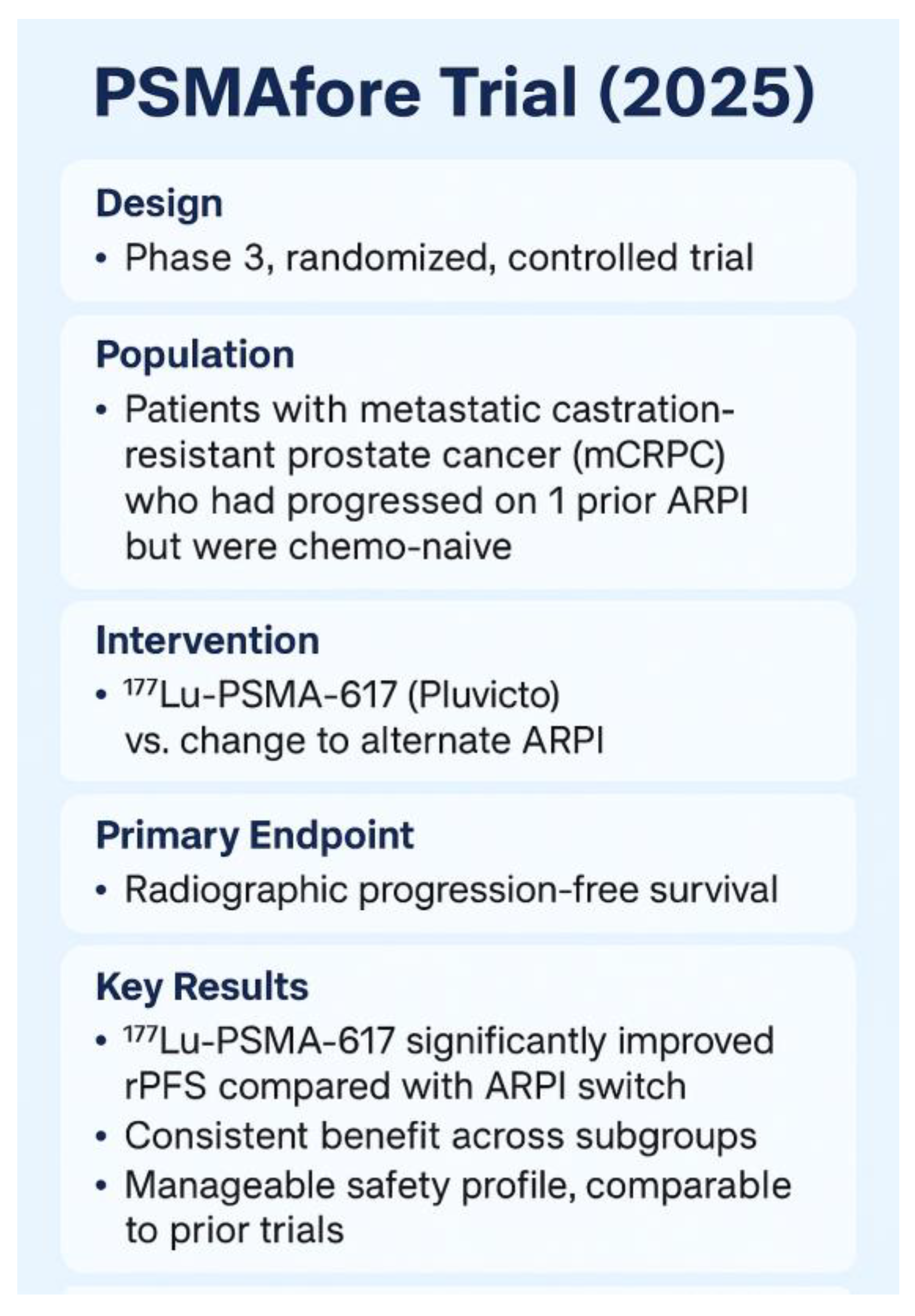
| PSMAfore (2024) [34] | [177Lu]Lu-PSMA-617 | III | mCRPC, ARPI-pretreated | rPFS | Median rPFS 12.0 vs. 5.6 mo | AE profile similar to VISION |
| SPLASH (2023) [35] | [177Lu]Lu-PSMA-I&T | III | mCRPC | rPFS | HR 0.71 vs. SOC | Mild-moderate hematologic AEs |
| ECLIPSE (2023) [36] | [177Lu]Lu-PSMA-I&T | III | mCRPC | PSA response | PSA50: 48% | Comparable safety to VISION |
| ACTINIUM (ongoing) [37] | [225Ac]Ac-PSMA-617 | II | mCRPC (post-Lu) | PSA decline ≥ 50% | ~65% PSA50 | Xerostomia Grade 2 (65%), rare nephrotoxicity |
| SABR-PSMA (2023) [38] | [177Lu]Lu-PSMA-617 + SBRT | II | Oligometastatic PCa | PFS | Preliminary benefit | No unexpected toxicity |
| SAR-bisPSMA (2024) [39] | [177Lu]Lu-SAR-bisPSMA | I/II | mCRPC | Safety, efficacy | Ongoing | Favorable early safety |
| RPS-072 (2019) [40] | [177Lu]Lu-RPS-071 | I/II | Advanced PCa | Safety, PSA50 | Efficacy | Low-grade xerostomia, cytopenia |
| Trial | Year | Population | Intervention | Key Finding |
|---|---|---|---|---|
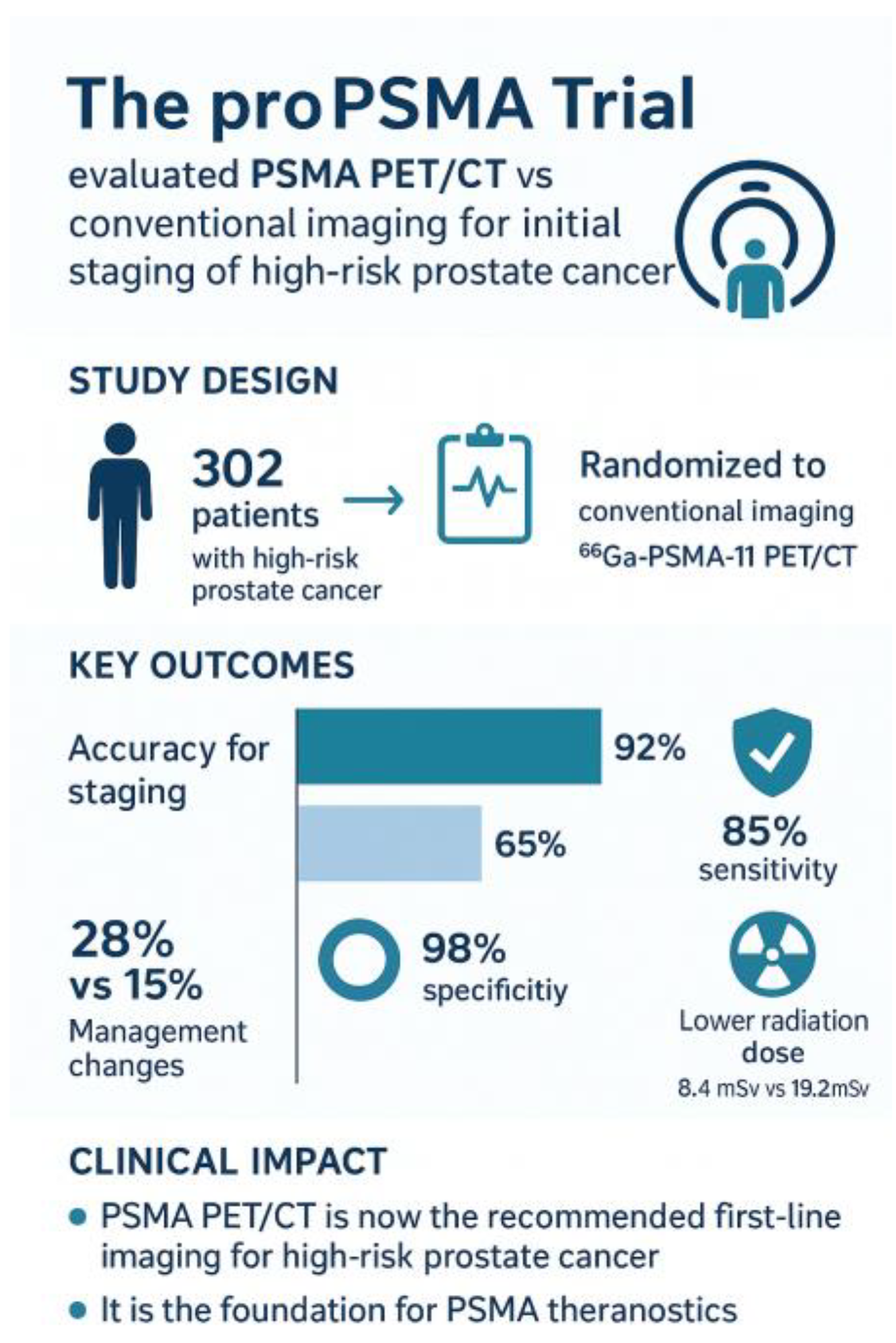
| proPSMA [8] | 2020 | High-risk PCa before curative Rx | PSMA PET vs. CT + bone scan | Higher accuracy, changed management |
| VISION [23] | 2021 | mCRPC, heavily pretreated | [177Lu]Lu-PSMA-617 + standard care | Improved OS and PFS |
| EMBARK [41] | 2025 | High-risk nmHSPC, rising PSA | Enzalutamide ± ADT | PSMA PET upstaged ~46% of patients |
| Theme | Current Challenges | Emerging Solutions/AI Role | Key References |
|---|---|---|---|
| Quantification & Dosimetry | Variability in SUV/PSMA quantitation | AI-driven dosimetry and lesion segmentation | Hu J et al., [51] |
| Therapy Resistance | PSMA downregulation, neuroendocrine shift | Combination therapies (ARPI, PARP, immuno-, αβ-radiotherapy) | Rahbar et al., [47] |
| AI & Radiomics | Limited data standardization, overfitting risk | Multicenter AI models, federated learning | Sollini et al., 2019 [52] |
| Clinical Workflow Integration | Manual lesion annotation | Automated detection & reporting | Yazdani E et al., 2024 [53] |
| Ethics/Validation | Lack of regulatory framework | Transparent algorithms, reproducible datasets | IAEA AI-PET initiative, 2024- Artificial Intelligence [54] |
| Isotope/Agent | Study/Year | Design/Cohort | Median No. of Cycles (Dose) | PSA Response (≥50% Decline) | Median PFS/OS | Major Toxicities | Comments |
|---|---|---|---|---|---|---|---|
| 225Ac-PSMA-617 | Kratochwil et al., 2016 (JNM) [61] | First-in-human, single-center (n = 14) | 3 cycles, ~100 kBq/kg every 8 weeks | 70% | PFS ≈ 8 mo | Xerostomia (>80%), mild anemia | Proof-of-concept; high efficacy but dose-limiting salivary toxicity |
| 225Ac-PSMA-617 | Sathekge et al., 2019 (Eur J Nucl Med Mol Imaging) [62] | Prospective, post-Lu-PSMA cohort (n = 73) | Median 3 cycles, 100 kBq/kg | 63% | PFS 9 mo; OS 15 mo | Xerostomia (78%), grade 3 anemia (12%) | Demonstrated efficacy in Lu-resistant disease |
| 225Ac-PSMA-617 (TATCIST) | Ongoing, NCT05219500 [63] | Phase I/II multicenter dose-escalation | Up to 4 cycles | Pending | — | — | Evaluating optimal activity, dosimetry, and safety |
| 212Pb-TCMC-PSMA | Stenberg et al., 2022 (Clin Cancer Res) [60] | First-in-human (n = 10) | 2–4 cycles, 2.3–2.5 MBq/kg | 60% | PFS ≈ 9 mo | Xerostomia (50%), mild cytopenias | Feasible with manageable toxicity |
| 212Pb-J591 | Tagawa et al., 2024 (JCO) [64] | Phase I, dose-escalation (n = 27) | Single or repeated cycles | 41% | PFS ≈ 7 mo | Xerostomia, fatigue | Encouraging safety; planning phase II |
| 227Th-PSMA-TTC | Morris et al., ClinicalTrials.gov [65] | Phase I, multicenter, dose-escalation (n = 65) | 4 cycles, 10–20 kBq/kg | 47% | PFS ≈ 8 mo | Fatigue (35%), anemia (20%), xerostomia (30%) | Promising antitumor activity; well-tolerated profile |
| Mechanism | Description/Evidence | Implications for Therapy |
|---|---|---|
| Antigen loss or downregulation/heterogeneity | Some tumor clones lose or reduce PSMA expression (via transcriptional silencing, epigenetic changes, or clonal selection), making them invisible to the targeting ligand. | Leads to “cold” lesions not targeted by RLT. Suggests the need for dual antigen targeting, upregulation of PSMA (e.g., epigenetic agents), or combining with non-PSMA modalities. |
| Intratumoral heterogeneity & spatial/temporal discordance | Within a patient, lesions can differ in PSMA uptake, perfusion, or vascular delivery. Some metastases may be PSMA-negative or low expression (“mismatch lesions”). | Patients with discordant lesions are at higher risk of incomplete response; such heterogeneity limits uniform delivery of cytotoxic doses. |
| Radiation resistance/DNA repair upregulation | Surviving tumor cells may upregulate DNA damage repair pathways (e.g., nonhomologous end joining, homologous recombination) or adapt expression of repair proteins to survive sublethal radiation damage. | May require dose intensification, radiosensitizers, or combination with DNA damage response inhibitors (e.g., PARP, ATR, ATM inhibitors). |
| Hypoxia, poor vascular delivery, and microenvironmental protection | Hypoxic tumor regions are more radioresistant; poor perfusion limits radiopharmaceutical access; extracellular matrix, stromal cells, and immunosuppressive TME may shield tumor cells. | May benefit from modifying TME, using vascular normalization strategies, or combination with therapies that overcome hypoxia. |
| Efflux/pharmacokinetic barriers | Enhanced efflux of radionuclide-labeled ligand (via multidrug resistance transporters), increased ligand catabolism, or rapid clearance may reduce effective delivered dose. | Optimizing ligand chemistry, using alternate radionuclides or chelators, or combining with inhibitors of efflux (if safe) may help. |
| Clonal evolution & selection pressure | Therapy may select for resistant clones that pre-exist or evolve during treatment; these clones may have altered survival pathways, alternative antigen expression, or metabolic shifts. | Monitoring via sequencing, liquid biopsy, or repeat imaging can detect emerging clones and prompt early switch to alternate treatments. |
| Immune escape and tumor microenvironment suppression | The tumor may adopt immunosuppressive changes post-therapy, upregulate immune checkpoints (e.g., PD-L1) or recruit regulatory cells, which blunt potential bystander immune effects of radiation. | Suggests synergy with immunotherapy (checkpoint inhibitors, vaccines) to unmask immunogenic cell death. |
| Combination/Approach | Rationale & Preclinical/Clinical Evidence | Challenges & Considerations |
|---|---|---|
| PARP inhibitors/DDR inhibitors (e.g., PARP, ATR, ATM inhibitors) | Radioligand therapy induces DNA damage. Inhibiting repair pathways can potentiate lethal damage in tumor cells. Some preclinical and early clinical work supports synergy. | Risk of additive hematologic toxicity; optimal scheduling (concurrent vs. sequential) needs careful testing; patient selection (HRD mutation status) may modulate benefit. |
| Androgen receptor (AR) pathway inhibitors | AR inhibition may increase PSMA expression (PSMA is an AR-repressed gene) and sensitize to radiation. Some small trials and retrospective data have been explored by combining enzalutamide + 177Lu-PSMA. | Timing and sequencing are crucial; overlapping toxicities; risk of underdosing one modality. |
| Immune checkpoint inhibitors/immunotherapy | Radiation can induce immunogenic cell death and release neoantigens; combining with anti-PD-1/PD-L1 or anti-CTLA4 may enhance systemic anti-tumor immunity. The PORTER trial (Clinical and Translational Results) explores radiation + immune-activating agents. | Prostate cancer tends to be immunologically “cold”; risk of additive toxicity; selecting patients most likely to respond is key. |
| Dual radionuclide/tandem therapy (alpha + beta emitter combinations) | Combining a beta emitter (e.g., 177Lu) for broader coverage + alpha emitter (e.g., 225Ac) for high-LET cytotoxicity may overcome partial resistance and target differing tumor burdens. Anecdotal/early reports suggest similar PSA responses but improved PFS/OS. | Balancing toxicity (especially to salivary glands [59], bone marrow) is tricky; dose optimization and sequencing are still empirical; limited data so far. |
| Bispecific/multi-target agents/dual antigen targeting | Use of ligands or CARs or antibody–drug conjugates targeting PSMA plus alternate antigens mitigates antigen escape (loss of PSMA) by offering redundant targeting. | Complexity of engineering, safety, off-target toxicity; need of strong alternate antigen expression in tumor. |
| Epigenetic modulators/agents inducing PSMA re-expression | Drugs like HDAC inhibitors, DNMT inhibitors, or modulators of chromatin may upregulate PSMA expression in low-PSMA clones or reverse silencing. This can resensitize lesions to PSMA-RLT. | Timing and dose are critical; off-target effects on normal tissues; in vivo evidence is still emerging. |
| Vascular normalization/radiosensitizers/hypoxia-modifying agents | Agents like bevacizumab, anti–angiogenic, or hypoxia-targeting drugs (e.g., HIF inhibitors) can improve delivery or reduce hypoxia-induced radio resistance. | May alter tumor perfusion dynamics; risk of tissue injury; needs careful scheduling relative to radionuclide administration. |
| Sequential adaptive therapy/dose escalation based on dosimetry | Use of early imaging/dosimetry to identify underdosed lesions and adaptively boost or re-treat resistant foci. | Requires robust imaging infrastructure, dosimetry workflows, and regulatory flexibility; risk of cumulative toxicity. |
| AI-guided adoptive dosing | Personalized dosimetry and lesion-level response | Infrastructure, validation, cost |
Disclaimer/Publisher’s Note: The statements, opinions and data contained in all publications are solely those of the individual author(s) and contributor(s) and not of MDPI and/or the editor(s). MDPI and/or the editor(s) disclaim responsibility for any injury to people or property resulting from any ideas, methods, instructions or products referred to in the content. |
© 2026 by the author. Licensee MDPI, Basel, Switzerland. This article is an open access article distributed under the terms and conditions of the Creative Commons Attribution (CC BY) license.
Share and Cite
Civelek, A.C. PSMA-Based Radiopharmaceuticals in Prostate Cancer Theranostics: Imaging, Clinical Advances, and Future Directions. Cancers 2026, 18, 234. https://doi.org/10.3390/cancers18020234
Civelek AC. PSMA-Based Radiopharmaceuticals in Prostate Cancer Theranostics: Imaging, Clinical Advances, and Future Directions. Cancers. 2026; 18(2):234. https://doi.org/10.3390/cancers18020234
Chicago/Turabian StyleCivelek, Ali Cahid. 2026. "PSMA-Based Radiopharmaceuticals in Prostate Cancer Theranostics: Imaging, Clinical Advances, and Future Directions" Cancers 18, no. 2: 234. https://doi.org/10.3390/cancers18020234
APA StyleCivelek, A. C. (2026). PSMA-Based Radiopharmaceuticals in Prostate Cancer Theranostics: Imaging, Clinical Advances, and Future Directions. Cancers, 18(2), 234. https://doi.org/10.3390/cancers18020234