Prognostic Impact of Pulmonary Metastasectomy for Uterine Malignancies: A Retrospective Analysis of 38 Cases

 , , , ,
Simple Summary
Abstract
1. Introduction
2. Materials and Methods
2.1. Patients
2.2. Outcome Measures
2.3. Statistical Analysis
3. Results
4. Discussion
5. Conclusions
Supplementary Materials
Author Contributions
Funding
Institutional Review Board Statement
Informed Consent Statement
Data Availability Statement
Acknowledgments
Conflicts of Interest
Abbreviations
| CI | confidence interval |
| DFI | disease-free interval |
| HR | hazard ratio |
| N/A | not available |
| OS | overall survival |
| PD-L1 | programmed death-ligand 1 |
| PET | positron-emission tomography |
| PM | pulmonary metastasectomy |
| RFS | recurrence-free survival |
| SBRT | stereotactic body radiotherapy |
References
- Hara, T.; Oka, S.; Ito, S.; Yamaguchi, T.; Hayashida, M.; Sakaguchi, K.; Urakami, S. Metastatic Patterns: Insights from Japanese Pathological Autopsy Registry Analysis. Oncology 2024, 103, 655–666. [Google Scholar] [CrossRef] [Scilit]
- Zhang, M.; Deng, H.; Hu, R.; Chen, F.; Dong, S.; Zhang, S.; Guo, W.; Yang, W.; Chen, W. Patterns and prognostic implications of distant metastasis in breast Cancer based on SEER population data. Sci. Rep. 2025, 15, 26717. [Google Scholar] [CrossRef] [Scilit]
- Rehman, M.E.U.; Fazal, F.; Khokhar, A.A.; Tahir, S.; Tanveer, U.; Yunus, H.; Iftikhar, A.; Sabir, B.; Abid, A.; Faraz, F.; et al. Patterns of Distant Organ Metastasis and Risk Factors in Rectal Adenocarcinoma Patients: A Retrospective Cohort Analysis. Cureus 2025, 17, e90095. [Google Scholar] [CrossRef] [Scilit] [PubMed]
- Graus, M.U.; van Diepen, A.E.; Josemanders, K.; Besselink, M.G.; Bouwense, S.A.; Daamen, L.A.; de Hingh, I.H.; de Jong, E.J.; van Laarhoven, H.W.; de Meijer, V.E.; et al. Patterns of disease dissemination and survival in patients with synchronous and metachronous metastatic pancreatic adenocarcinoma: Nationwide population-based study. Eur. J. Cancer 2025, 220, 115385. [Google Scholar] [CrossRef] [Scilit] [PubMed]
- Huang, X.; Li, Z.; Weng, Q. Clinicopathological features and prognostic significance of site-specific metastasis in gastric cancer: A population-based, propensity score-matched analysis. Discov. Oncol. 2025, 16, 1164. [Google Scholar] [CrossRef] [Scilit] [PubMed]
- Hellman, S.; Weichselbaum, R.R. Oligometastases. J. Clin. Oncol. 1995, 13, 8–10. [Google Scholar] [CrossRef] [Scilit]
- Niibe, Y.; Kuranami, M.; Matsunaga, K.; Takaya, M.; Kakita, S.; Hara, T.; Sekiguchi, K.; Watanabe, M.; Hayakawa, K. Value of high-dose radiation therapy for isolated osseous metastasis in breast cancer in terms of oligo-recurrence. Anticancer Res. 2008, 28, 3929–3931. [Google Scholar]
- Niibe, Y.; Hayakawa, K. Oligometastases and Oligo-recurrence: The New Era of Cancer Therapy. Ultrasound Med. Biol. 2010, 40, 107–111. [Google Scholar] [CrossRef] [Scilit]
- Miller, E.D.; Hitchcock, K.E.; Romesser, P.B. Oligometastatic Colorectal Cancer: A Review of Definitions and Patient Selection for Local Therapies. J. Gastrointest. Cancer 2023, 54, 1116–1127. [Google Scholar] [CrossRef] [Scilit]
- Anderson, A.C.; Ho, J.; Hall, E.T.; Hannan, R.; Liao, J.J.; Louie, A.V.; Ma, T.M.; Psutka, S.P.; Rengan, R.; Siva, S.; et al. Focal therapy for oligometastatic and oligoprogressive renal cell carcinoma: A narrative review. Future Oncol. 2024, 20, 2573–2588. [Google Scholar] [CrossRef] [Scilit]
- Shimada, Y. Oligo-Recurrence in Lung Cancer; The Most Curable State Among Advanced Disease? Cancers 2024, 16, 4086. [Google Scholar] [CrossRef] [Scilit]
- Kinugasa, Y.; Uehara, K.; Yamaguchi, K.; Saito, Y.; Murofushi, K.; Sugai, T.; Ishiguro, M.; Ishihara, S.; Ueno, H.; Oka, S.; et al. Japanese Society for Cancer of the Colon and Rectum (JSCCR) guidelines 2024 for the treatment of colorectal cancer. Int. J. Clin. Oncol. 2025, 30, 2410–2463. [Google Scholar] [CrossRef] [Scilit]
- Rathmell, W.K.; Rumble, R.B.; Van Veldhuizen, P.J.; Al-Ahmadie, H.; Emamekhoo, H.; Hauke, R.J.; Louie, A.V.; Milowsky, M.I.; Molina, A.M.; Rose, T.L.; et al. Management of Metastatic Clear Cell Renal Cell Carcinoma: ASCO Guideline. J. Clin. Oncol. 2022, 40, 2957–2995. [Google Scholar] [CrossRef] [Scilit]
- Li, S.; Pan, W.; Song, J.; Zhen, L.; Chen, Y.; Liu, W.; Zhang, Y.; Chen, L.; Huang, Q.; Zheng, S.; et al. Distant organ metastasis patterns and prognosis of cervical adenocarcinoma: A population-based retrospective study. Front. Med. 2024, 11, 1401700. [Google Scholar] [CrossRef] [Scilit]
- Mao, W.; Wei, S.; Yang, H.; Yu, Q.; Xu, M.; Guo, J.; Gao, L. Clinicopathological study of organ metastasis in endometrial cancer. Future Oncol. 2020, 16, 525–540. [Google Scholar] [CrossRef] [Scilit]
- Gardner, A.B.; Charo, L.M.; Mann, A.K.; Kapp, D.S.; Eskander, R.N.; Chan, J.K. Ovarian, uterine, and cervical cancer patients with distant metastases at diagnosis: Most common locations and outcomes. Clin. Exp. Metastasis 2019, 37, 107–113. [Google Scholar] [CrossRef] [Scilit] [PubMed]
- Yan, G.; Li, Y.; Du, Y.; Ma, X.; Xie, Y.; Zeng, X. Survival nomogram for endometrial cancer with lung metastasis: A SEER database analysis. Front. Oncol. 2022, 12, 978140. [Google Scholar] [CrossRef] [Scilit] [PubMed]
- Pecorelli, S. Revised FIGO staging for carcinoma of the vulva, cervix, and endometrium. Int. J. Gynecol. Obstet. 2009, 105, 103–104, Erratum in: Int. J. Gynecol. Obstet. 2010, 108, 176. [Google Scholar] [CrossRef] [Scilit] [PubMed]
- Ouldamer, L.; Bendifallah, S.; Body, G.; Touboul, C.; Graesslin, O.; Raimond, E.; Collinet, P.; Coutant, C.; Bricou, A.; Lavoué, V.; et al. Incidence, patterns and prognosis of first distant recurrence after surgically treated early stage endometrial cancer: Results from the multicentre FRANCOGYN study group. Eur. J. Surg. Oncol. (EJSO) 2019, 45, 672–678. [Google Scholar] [CrossRef] [Scilit]
- Ki, E.Y.; Lee, K.H.; Park, J.S.; Hur, S.Y. A Clinicopathological Review of Pulmonary Metastasis from Uterine Cervical Cancer. Cancer Res. Treat. 2016, 48, 266–272. [Google Scholar] [CrossRef] [Scilit]
- Makker, V.; Colombo, N.; Herráez, A.C.; Monk, B.J.; Mackay, H.; Santin, A.D.; Miller, D.S.; Moore, R.G.; Baron-Hay, S.; Ray-Coquard, I.; et al. Lenvatinib Plus Pembrolizumab in Previously Treated Advanced Endometrial Cancer: Updated Efficacy and Safety From the Randomized Phase III Study 309/KEYNOTE-775. J. Clin. Oncol. 2023, 41, 2904–2910. [Google Scholar] [CrossRef] [Scilit]
- O’Malley, D.M.; Bariani, G.M.; Cassier, P.A.; Marabelle, A.; Hansen, A.R.; Acosta, A.D.J.; Miller, W.H.; Safra, T.; Italiano, A.; Mileshkin, L.; et al. Pembrolizumab in Patients with Microsatellite Instability–High Advanced Endometrial Cancer: Results From the KEYNOTE-158 Study. J. Clin. Oncol. 2022, 40, 752–761. [Google Scholar] [CrossRef] [Scilit] [PubMed]
- Monk, B.J.; Colombo, N.; Tewari, K.S.; Dubot, C.; Caceres, M.V.; Hasegawa, K.; Shapira-Frommer, R.; Salman, P.; Yañez, E.; Gümüş, M.; et al. First-Line Pembrolizumab + Chemotherapy Versus Placebo + Chemotherapy for Persistent, Recurrent, or Metastatic Cervical Cancer: Final Overall Survival Results of KEYNOTE-826. J. Clin. Oncol. 2023, 41, 5505–5511. [Google Scholar] [CrossRef] [Scilit] [PubMed]
- Gibson, A.J.; Li, H.; D’Silva, A.; Tudor, R.A.; Elegbede, A.A.; Otsuka, S.; Bebb, D.G.; Cheung, W.Y. Comparison of Clinical Characteristics and Outcomes in Relapsed Versus De Novo Metastatic Non–Small Cell Lung Cancer. Am. J. Clin. Oncol. 2019, 42, 75–81. [Google Scholar] [CrossRef] [Scilit] [PubMed]
- Lord, S.; Bahlmann, K.; O’COnnell, D.; Kiely, B.; Daniels, B.; Pearson, S.; Beith, J.; Bulsara, M.; Houssami, N. De novo and recurrent metastatic breast cancer—A systematic review of population-level changes in survival since 1995. EClinicalMedicine 2022, 44, 101282. [Google Scholar] [CrossRef] [Scilit]
- Kanzaki, R.; for the Thoracic Surgery Study Group of Osaka University (TSSGO); Susaki, Y.; Takami, K.; Funakoshi, Y.; Sakamaki, Y.; Kodama, K.; Yokouchi, H.; Ikeda, N.; Kadota, Y.; et al. Long-Term Outcomes of Pulmonary Metastasectomy for Uterine Malignancies: A Multi-institutional Study in the Current Era. Ann. Surg. Oncol. 2020, 27, 3821–3828. [Google Scholar] [CrossRef] [Scilit]
- Nobori, Y.; Anraku, M.; Yamauchi, Y.; Mun, M.; Yoshino, I.; Nakajima, J.; Ikeda, N.; Matsuguma, H.; Iwata, T.; Shintani, Y.; et al. Risk-adjusted hazard analysis of survival after pulmonary metastasectomy for uterine malignancies in 319 cases. JTCVS Open 2023, 13, 411–422. [Google Scholar] [CrossRef] [Scilit]
- Paramanathan, A.; Wright, G. Pulmonary Metastasectomy for Sarcoma of Gynaecologic Origin. Heart Lung Circ. 2013, 22, 270–275. [Google Scholar] [CrossRef] [Scilit]
- Adachi, M.; Mizuno, M.; Mitsui, H.; Kajiyama, H.; Suzuki, S.; Sekiya, R.; Utsumi, F.; Shibata, K.; Taniguchi, T.; Kawaguchi, K.; et al. The prognostic impact of pulmonary metastasectomy in recurrent gynecologic cancers: A retrospective single-institution study. Nagoya J. Med. Sci. 2015, 77, 363–372. [Google Scholar]
- Paik, E.S.; Yoon, A.; Lee, Y.-Y.; Kim, T.-J.; Lee, J.-W.; Bae, D.-S.; Kim, B.-G. Pulmonary metastasectomy in uterine malignancy: Outcomes and prognostic factors. J. Gynecol. Oncol. 2015, 26, 270–276. [Google Scholar] [CrossRef] [Scilit]
- Anile, M.; Mantovani, S.; Pecoraro, Y.; Carillo, C.; Gherzi, L.; Pagini, A.; Rendina, E.A.; Venuta, F.; Diso, D. Pulmonary metastasectomy in uterine malignancies: Outcome and prognostic factors. J. Thorac. Dis. 2017, 9, S1273–S1277. [Google Scholar] [CrossRef] [Scilit] [PubMed]
- Londero, F.; Grossi, W.; Morelli, A.; Parise, O.; Masullo, G.; Tetta, C.; Livi, U.; Maessen, J.G.; Gelsomino, S. Surgery versus stereotactic radiotherapy for treatment of pulmonary metastases. A systematic review of literature. Future Sci. OA 2020, 6, FSO471. [Google Scholar] [CrossRef] [Scilit] [PubMed]



| Variables | |
|---|---|
| Age (years) | 63 (34–84) |
| Body mass index (kg/m2) | |
| <18.5 | 5 (13.2) |
| 18.5–24.9 | 25 (65.8) |
| ≥25.0 | 8 (21.1) |
| Comorbidities | |
| None | 30 (78.9) |
| Present | 8 (21.1) |
| Origin of primary site | |
| Cervix | 22 (57.9) |
| Uterine body | 16 (42.1) |
| Histological type (1) | |
| Carcinoma | 34 (89.5) |
| Sarcoma | 4 (10.5) |
| Histological type (2) | |
| Typical 1 | 22 (57.9) |
| Atypical | 16 (42.1) |
| Primary stage (FIGO) | |
| I | 20 (52.7) |
| II | 7 (18.4) |
| III | 9 (23.7) |
| IV | 1 (2.6) |
| Unknown | 1 (2.6) |
| Local therapy for primary tumor | |
| Surgery | 25 (65.8) |
| Radiotherapy | 13 (34.2) |
| DFI2 (months) | 26.5 (1–163) |
| Laterality of lung metastases | |
| Right | 19 (50.0) |
| Left | 18 (47.4) |
| Bilateral | 1 (2.6) |
| Maximum diameter of the lung metastases (cm) | 1.4 (0.5–7.0) |
| Number of lung metastatic lesions | |
| 1 | 32 (84.2) |
| 2 | 5 (13.2) |
| ≥3 | 1 (2.6) |
| First recurrent site after primary treatment | |
| Lung | 33 (86.8) |
| Others | 4 (10.5) |
| Unknown | 1 (2.6) |
| Synchronous extrapulmonary recurrence | |
| None | 35 (92.1) |
| Present | 3 (7.9) |
| PET before pulmonary metastasectomy | |
| None | 2 (5.3) |
| Performed | 36 (94.7) |
| Systemic therapy for recurrent lesions before pulmonary metastasectomy | |
| None | 31 (81.6) |
| Performed | 6 (15.8) |
| Unknown | 1 (2.6) |
| Extent of lung resection | |
| Wedge resection | 15 (39.5) |
| Segmentectomy | 8 (21.0) |
| Lobectomy | 15 (39.5) |
| Complete resection | |
| R0 | 36 (94.7) |
| R1 | 2 (5.3) |
| Follow-up period after pulmonary metastasectomy (months) | 57 (1–134) |
| Adjuvant chemotherapy after pulmonary metastasectomy | |
| None | 23 (60.6) |
| Performed | 14 (36.8) |
| Unknown | 1 (2.6) |
| Recurrence after pulmonary metastasectomy | |
| None | 22 (57.9) |
| Present | 16 (42.1) |
| Outcome after pulmonary metastasectomy | |
| Alive | 32 (84.2) |
| Death of other disease | 1 (2.6) |
| Cancer death | 5 (13.2) |
| Univariate | ||||
|---|---|---|---|---|
| Variable | HR | 95% CI | p-Value | |
| Age (years) | <60 | 1 | 0.520 | |
| ≥60 | 1.415 | 0.491–4.078 | ||
| Body mass index (kg/m2) | <18.5 | 1 | 0.451 | |
| ≥18.5 | 0.451 | 0.127–1.594 | ||
| Origin of primary site | Cervix | 1 | 0.911 | |
| Uterine body | 0.945 | 0.352–2.538 | ||
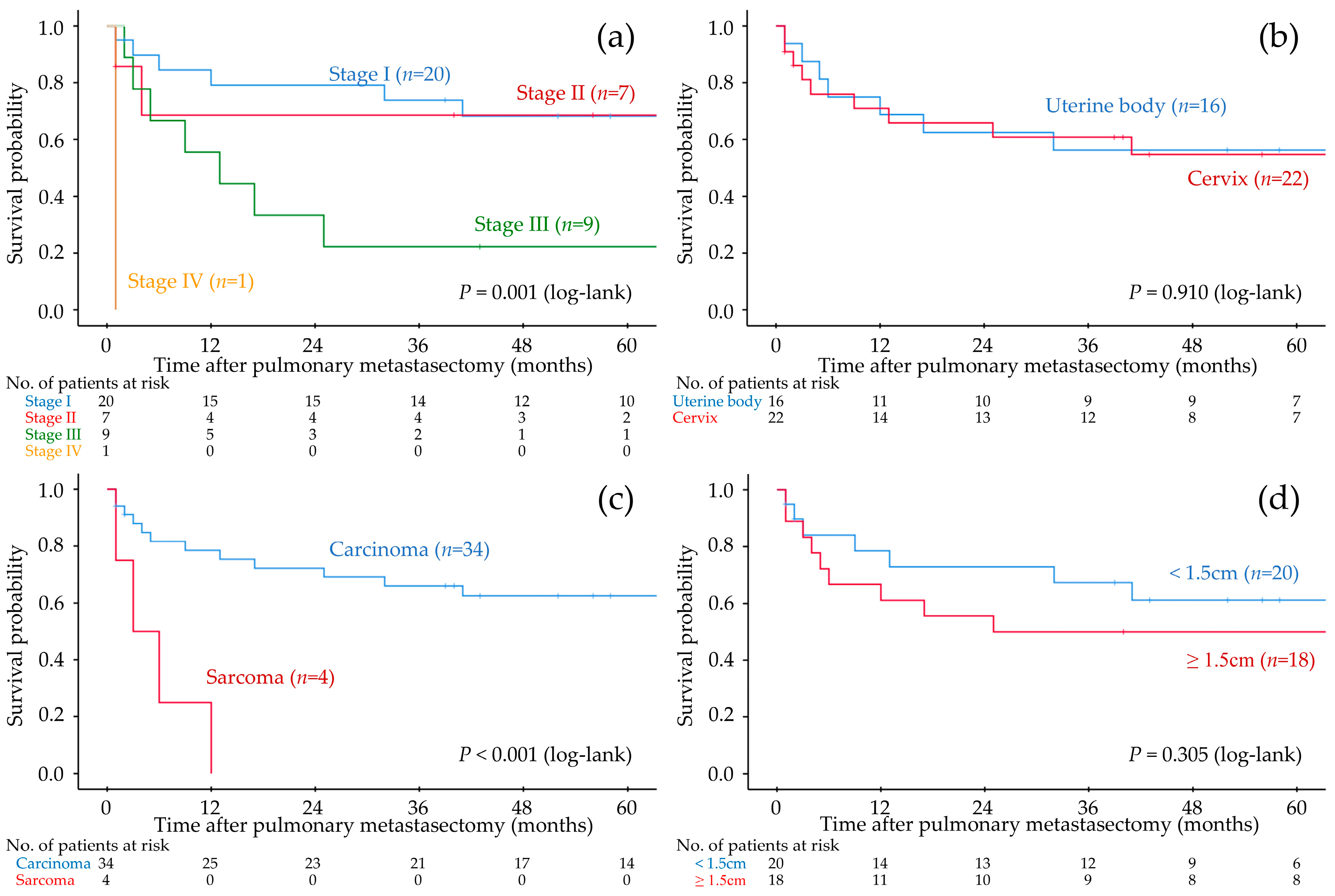
| Histological type (1) | Carcinoma | 1 | 0.002 * | |
| Sarcoma | 6.848 | 1.968–23.832 | ||
| Histological type (2) | Typical | 1 | 0.718 | |
| Atypical | 1.200 | 0.446–3.228 | ||
| Primary stage (FIGO) | I, II | 1 | 0.009 * | |
| III, IV | 3.747 | 1.382–10.164 | ||
| DFI (1) | <12 months | 1 | 0.010 * | |
| ≥12 months | 0.259 | 0.093–0.724 | ||
| DFI (2) | <24 months | 1 | 0.716 | |
| ≥24 months | 0.833 | 0.312–2.224 | ||
| Maximum diameter of the lung metastases | <1.5 cm | 1 | 0.313 | |
| ≥1.5 cm | 1.645 | 0.625–4.327 | ||
| Number of lung metastatic lesions | Single | 1 | 0.799 | |
| Multiple | 1.177 | 0.335–4.134 | ||
| First recurrent site after primary treatment | Lung | 1 | 0.931 | |
| Others | 0.955 | 0.334–2.726 | ||
| Synchronous extrapulmonary recurrence | None | 1 | 0.002 * | |
| Present | 8.554 | 2.156–33.942 | ||
| Systemic therapy for recurrent lesions before pulmonary metastasectomy | None/unknown | 1 | 0.788 | |
| Performed | 1.136 | 0.448–2.883 | ||
| Extent of lung resection | Lobectomy | 1 | 0.065 | |
| Wedge/segmentectomy | 3.271 | 0.929–11.510 | ||
| Adjuvant chemotherapy after pulmonary metastasectomy | None | 1 | 0.085 | |
| Performed | 0.383 | 0.128–1.141 | ||
| Author | Year | Study Period | N | 5 Y RFS | 5 Y OS | Factors Associated with Worse Prognosis [For OS/RFS] | |
|---|---|---|---|---|---|---|---|
| Univariate | Multivariate | ||||||
| Paramanathan [14] | 2013 | 2001–2011 | 13 (Sarcoma) | N/A | 66.0% | N/A | N/A |
| Adachi [29] | 2015 | 1985–2013 | 23 | 44.7% | 81.7% | DFI < 24 months [OS] | N/A |
| Paik [30] | 2015 | 1995–2011 | 29 | N/A | 48.2% | Presence of symptoms related to lung metastasis [OS] Number of lung metastasis > 3 [OS] | Presence of symptoms related to lung metastasis [OS] Number of lung metastasis > 3 [OS] |
| Anile [31] | 2017 | 1997–2010 | 19 | 12.8% | 40.9% | DFI < 24 months [OS] Recurrence after pulmonary metastasectomy [OS] Introduction of adjuvant therapy after initial treatment [OS] | DFI < 24 months [OS] Recurrence after pulmonary metastasectomy [OS] |
| Kanzaki [26] | 2020 | 2006–2015 | 57 | 40.7% | 68.8% | Location of the primary tumor (uterine body) [RFS] Size of metastatic tumor (>2 cm) [RFS] DFI ≤ 24 months [OS] | N/A |
| Nobori [27] | 2023 | 1984–2016 | 319 | N/A | 66.5% | Primary site (cervix) [OS] Surgical approach (thoracotomy) [OS] Date of metastasectomy (1984–2000) [OS] DFI < 12 months [OS] Number of metastatic tumors ≥4 [OS] | Primary site (cervix) [OS] Number of metastatic tumors ≥ 4 [OS] |
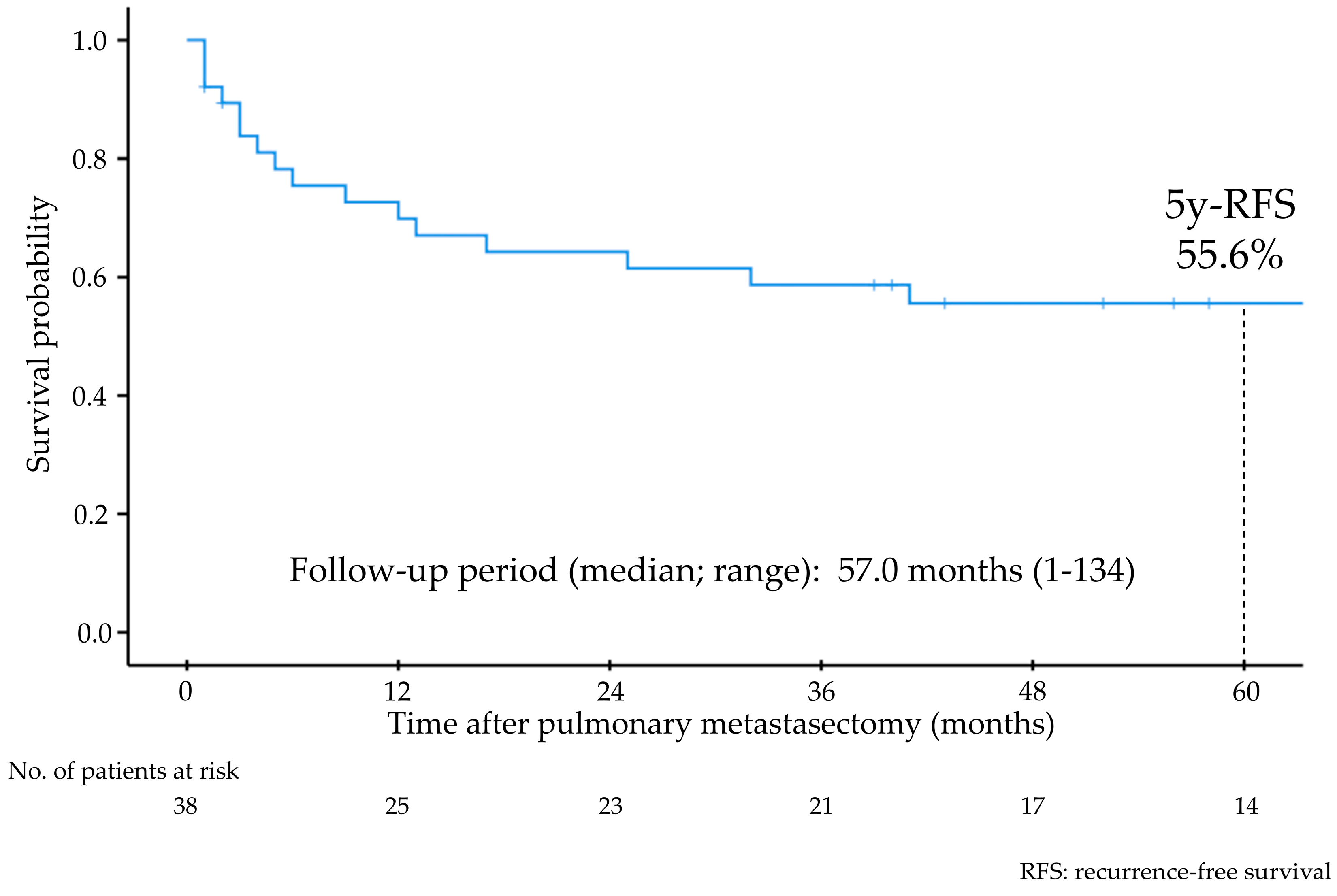
| Present study | 2025 | 2010–2020 | 38 | 55.6% | 86.1% | Primary stage (III–IV) [RFS] Histological type (sarcoma) [RFS] DFI < 12 months [RFS] Synchronous extrapulmonary metastases (present) [RFS] | N/A |
Disclaimer/Publisher’s Note: The statements, opinions and data contained in all publications are solely those of the individual author(s) and contributor(s) and not of MDPI and/or the editor(s). MDPI and/or the editor(s) disclaim responsibility for any injury to people or property resulting from any ideas, methods, instructions or products referred to in the content. |
© 2025 by the authors. Licensee MDPI, Basel, Switzerland. This article is an open access article distributed under the terms and conditions of the Creative Commons Attribution (CC BY) license.
Share and Cite
Adachi, H.; Ito, H.; Nagashima, T.; Isaka, T.; Murakami, K.; Kikunishi, N.; Shigeta, N.; Saito, A. Prognostic Impact of Pulmonary Metastasectomy for Uterine Malignancies: A Retrospective Analysis of 38 Cases. Cancers 2026, 18, 13. https://doi.org/10.3390/cancers18010013
Adachi H, Ito H, Nagashima T, Isaka T, Murakami K, Kikunishi N, Shigeta N, Saito A. Prognostic Impact of Pulmonary Metastasectomy for Uterine Malignancies: A Retrospective Analysis of 38 Cases. Cancers. 2026; 18(1):13. https://doi.org/10.3390/cancers18010013
Chicago/Turabian StyleAdachi, Hiroyuki, Hiroyuki Ito, Takuya Nagashima, Tetsuya Isaka, Kotaro Murakami, Noritake Kikunishi, Naoko Shigeta, and Aya Saito. 2026. "Prognostic Impact of Pulmonary Metastasectomy for Uterine Malignancies: A Retrospective Analysis of 38 Cases" Cancers 18, no. 1: 13. https://doi.org/10.3390/cancers18010013
APA StyleAdachi, H., Ito, H., Nagashima, T., Isaka, T., Murakami, K., Kikunishi, N., Shigeta, N., & Saito, A. (2026). Prognostic Impact of Pulmonary Metastasectomy for Uterine Malignancies: A Retrospective Analysis of 38 Cases. Cancers, 18(1), 13. https://doi.org/10.3390/cancers18010013