


Describing the Core Attributes and Impact of Comprehensive Cancer Centers Internationally: A Chronological Scoping Review

 , , , ,
  , and
, and
Simple Summary
Abstract
1. Introduction
2. Materials and Methods
2.1. Search Strategy
2.2. Eligibility
2.3. Article Selection
2.4. Data Extraction and Synthesis
3. Results
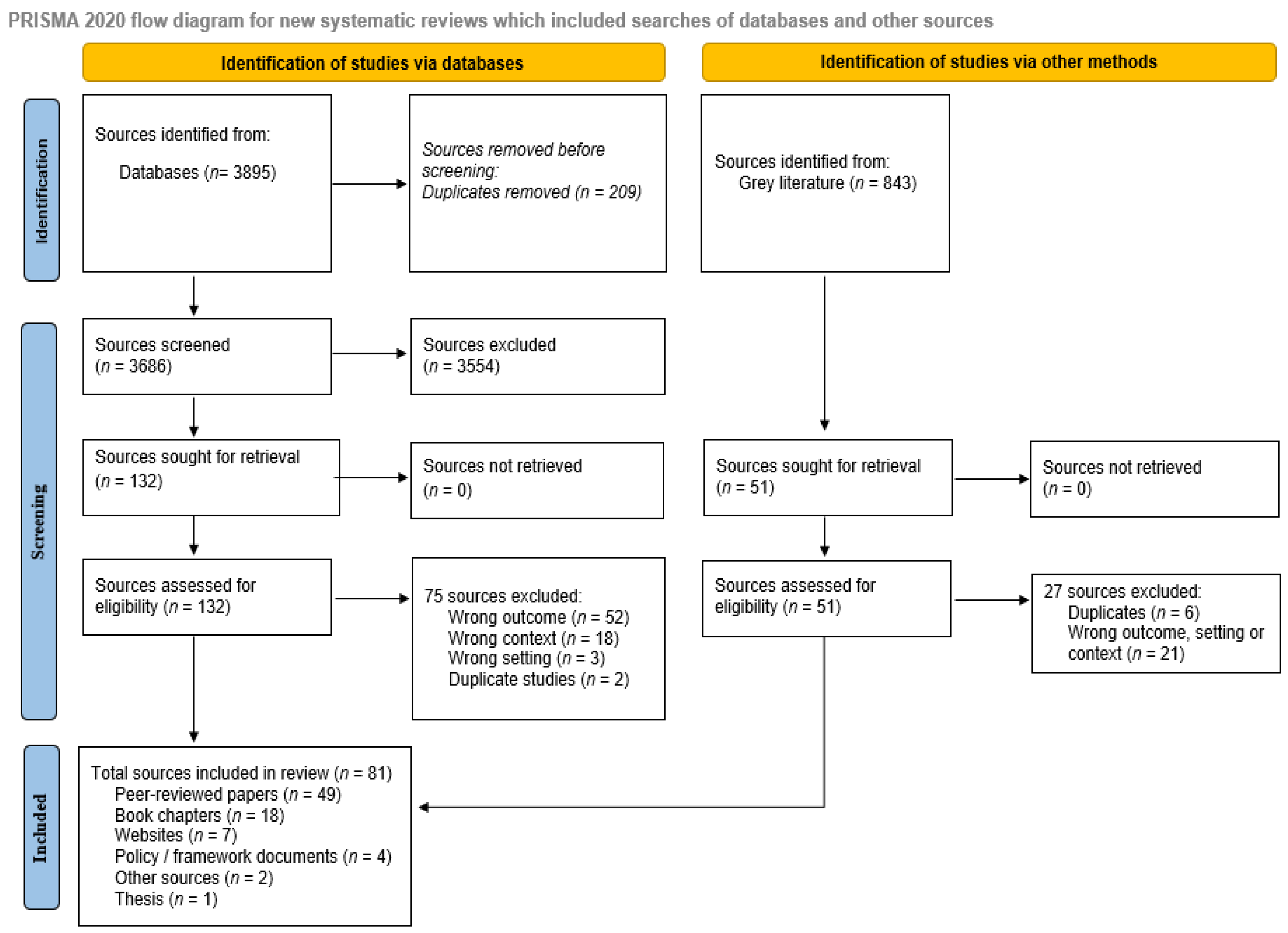
3.1. Included Sources
3.2. Attributes and Impacts of CCCs
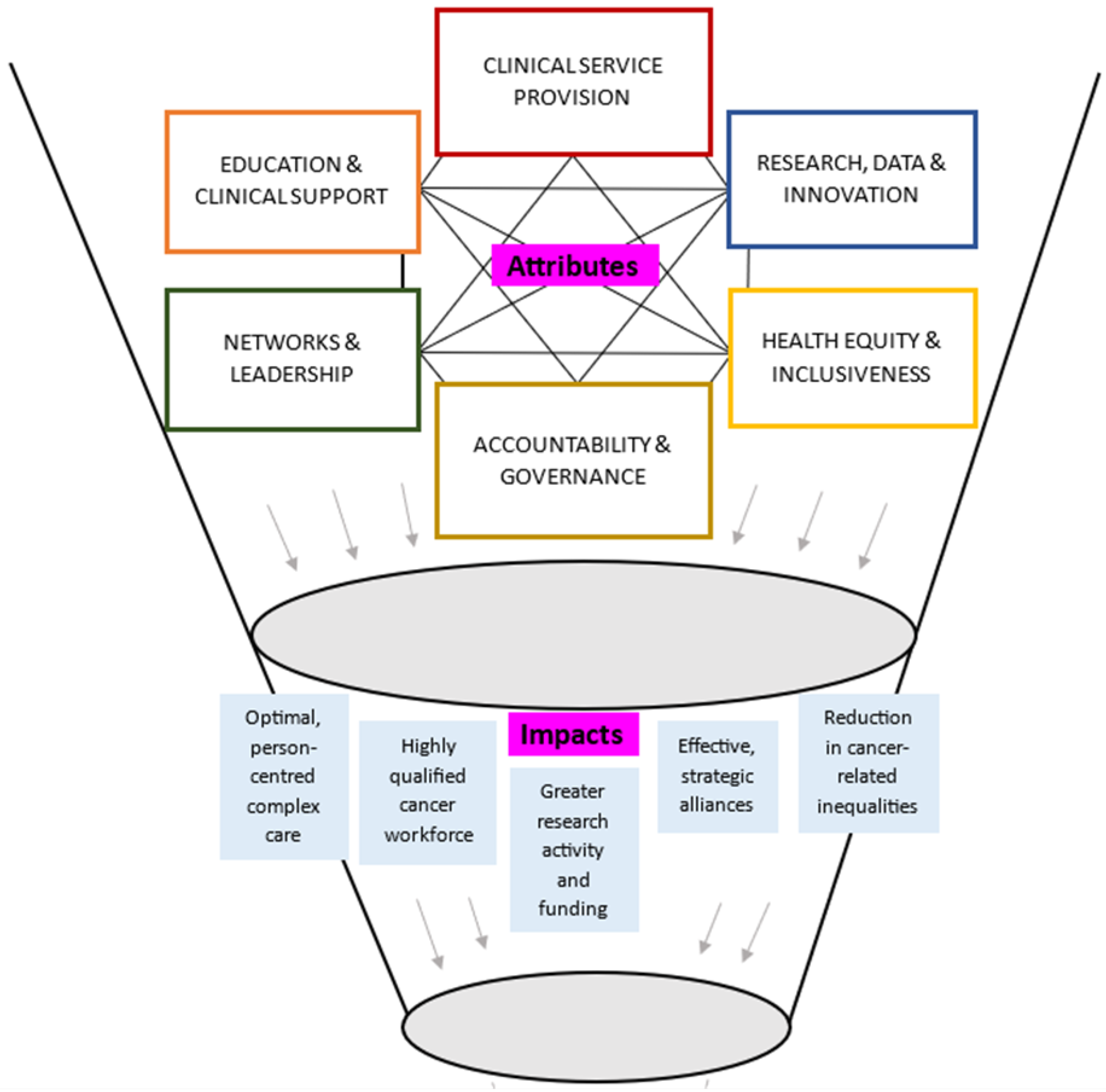
3.3. Synthesis of Attributes and Impacts of CCCs
3.4. Primary Research
3.5. Changes in the CCC Literature over Time
4. Discussion
4.1. Attributes and Impacts
4.2. Opportunities and Drivers for Change
4.3. Key Recommendations
4.4. Strengths and Limitations
5. Conclusions
Supplementary Materials
Author Contributions
Funding
Institutional Review Board Statement
Informed Consent Statement
Data Availability Statement
Acknowledgments
Conflicts of Interest
Abbreviations
| CCC | Comprehensive cancer center |
| NCI | National Cancer Institute |
| OECI | Organization for European Cancer Institutes |
| WHO | World Health Organization |
References
- National Institute of Health. National Institute of Health (NCI) Mission. Available online: https://www.nih.gov/about-nih/what-we-do/nih-almanac/national-cancer-institute-nci (accessed on 30 January 2024).
- World Health Organisation. National Cancer Control Programmes: Policy and Managerial Guidelines; World Health Organisation: Geneva, Switzerland, 2002. [Google Scholar]
- Ringborg, U.; Berns, A.; Celis, J.E.; Heitor, M.; Tabernero, J.; Schüz, J.; Baumann, M.; Henrique, R.; Aapro, M.; Basu, P.; et al. The Porto European Cancer Research Summit 2021. Mol. Oncol. 2021, 15, 2507–2543. [Google Scholar] [CrossRef] [PubMed]
- Ringborg, U.; Pierotti, M.; Storme, G.; Tursz, T. Managing cancer in the EU: The Organisation of European Cancer Institutes (OECI). Eur. J. Cancer 2008, 44, 772–773. [Google Scholar] [CrossRef]
- Saghatchian, M.; Thonon, F.; Boomsma, F.; Hummel, H.; Koot, B.; Harrison, C.; Rajan, A.; de Valeriola, D.; Otter, R.; Laranja Pontes, J.; et al. Pioneering quality assessment in European cancer centers: A data analysis of the organization for European cancer institutes accreditation and designation program. J. Oncol. Pract. 2014, 10, e342–e349. [Google Scholar] [CrossRef]
- Sirohi, B.; Chalkidou, K.; Pramesh, C.; Anderson, B.O.; Loeher, P.; El Dewachi, O.; Shamieh, O.; Shrikhande, S.V.; Venkataramanan, R.; Parham, G. Developing institutions for cancer care in low-income and middle-income countries: From cancer units to comprehensive cancer centres. Lancet Oncol. 2018, 19, e395–e406. [Google Scholar] [CrossRef]
- National Cancer Institute. NCI-Designated Cancer Centers. Available online: https://www.cancer.gov/research/infrastructure/cancer-centers (accessed on 1 February 2024).
- EU Health Support. Mapping of Comprehensive Cancer Infrastructures. Available online: https://health.ec.europa.eu/document/download/6bbdb89a-1766-4c29-bc8e-3ad663bdefdc_en (accessed on 10 October 2024).
- Sullivan, R. Has the US Cancer Centre model been ‘successful’? Lessons for the European cancer community. Mol. Oncol. 2009, 3, 192–203. [Google Scholar] [CrossRef] [PubMed]
- Kehrloesser, S.; Oberst, S.; Westerhuis, W.; Wendler, A.; Wind, A.; Blaauwgeers, H.; Burrion, J.B.; Nagy, P.; Saeter, G.; Gustafsson, E.; et al. Analysing the attributes of comprehensive cancer centres and cancer centres across Europe to identify key hallmarks. Mol. Oncol. 2021, 15, 1277–1288. [Google Scholar] [CrossRef]
- CraNE. European Network of Comprehensive Cancer Centres. Available online: https://crane4health.eu/ (accessed on 15 November 2023).
- National Cancer Institute. Elimiate inequiteies—National Cancer Plan. Available online: https://nationalcancerplan.cancer.gov/goals/eliminate-inequities (accessed on 2 October 2024).
- Ringborg, U.; von Braun, J.; Celis, J.; Baumann, M.; Berns, A.; Eggermont, A.; Heard, E.; Heitor, M.; Chandy, M.; Chen, C.J. Strategies to decrease inequalities in cancer therapeutics, care and prevention: Proceedings on a conference organized by the Pontifical Academy of Sciences and the European Academy of Cancer Sciences, Vatican City, February 23–24, 2023. Mol. Oncol. 2024, 18, 245. [Google Scholar] [CrossRef] [PubMed]
- Peters, M.D.; Marnie, C.; Tricco, A.C.; Pollock, D.; Munn, Z.; Alexander, L.; McInerney, P.; Godfrey, C.M.; Khalil, H. Updated methodological guidance for the conduct of scoping reviews. JBI Evid. Synth. 2020, 18, 2119–2126. [Google Scholar] [CrossRef]
- Tricco, A.C.; Lillie, E.; Zarin, W.; O’Brien, K.K.; Colquhoun, H.; Levac, D.; Moher, D.; Peters, M.D.J.; Horsley, T.; Weeks, L.; et al. PRISMA Extension for Scoping Reviews (PRISMA-ScR): Checklist and Explanation. Ann. Intern. Med. 2018, 169, 467–473. [Google Scholar] [CrossRef]
- Thamm, C.; Button, E.; Johal, J.; Knowles, R.; Gulyani, A.; Paterson, C.; Halpern, M.T.; Charalambous, A.; Chan, A.; Aranda, S.; et al. A systematic review and meta-analysis of patient-relevant outcomes in comprehensive cancer centers versus noncomprehensive cancer centers. Cancer 2025, 131, e35646. [Google Scholar] [CrossRef]
- Sukhera, J. Narrative reviews: Flexible, rigorous, and practical. J. Grad. Med. Educ. 2022, 14, 414–417. [Google Scholar] [CrossRef]
- Thomas, D.R. A general inductive approach for analyzing qualitative evaluation data. Am. J. Eval. 2006, 27, 237–246. [Google Scholar] [CrossRef]
- Ali, R.; Finlayson, A.; Indox Cancer Research Network. Building capacity for clinical research in developing countries: The INDOX Cancer Research Network experience. Glob. Health Action. 2012, 5, 17288. [Google Scholar] [CrossRef] [PubMed]
- Clayman, M.L.; Harper, M.M.; Quinn, G.P.; Reinecke, J.; Shah, S. Oncofertility resources at NCI-designated comprehensive cancer centers. J. Natl. Compr. Cancer Netw. 2013, 11, 1504–1509. [Google Scholar] [CrossRef]
- Deriu, P.L.; La Pietra, L.; Pierotti, M.; Collazzo, R.; Paradiso, A.; Belardelli, F.; De Paoli, P.; Nigro, A.; Lacalamita, R.; Ferrarini, M.; et al. Accreditation for excellence of cancer research institutes: Recommendations from the Italian Network of comprehensive cancer centers. Tumori 2013, 99, 293e–298e. [Google Scholar] [CrossRef]
- Eggermont, A.M.; Caldas, C.; Ringborg, U.; Medema, R.; Tabernero, J.; Wiestler, O. Cancer Core Europe: A consortium to address the cancer care-cancer research continuum challenge. Eur. J. Cancer 2014, 50, 2745–2746. [Google Scholar] [CrossRef] [PubMed]
- Eggermont, A.M.M.; Apolone, G.; Baumann, M.; Caldas, C.; Celis, J.E.; de Lorenzo, F.; Ernberg, I.; Ringborg, U.; Rowell, J.; Tabernero, J.; et al. Cancer Core Europe: A translational research infrastructure for a European mission on cancer. Mol. Oncol. 2019, 13, 521–527. [Google Scholar] [CrossRef]
- Ford, J.L. Mind, body and spirit: Comprehensive cancer centers emphasize treating the whole person. ASRT (Am. Soc. Radiol. Technol.) Scanner 2004, 36, 8–11. [Google Scholar]
- Pelagio, G.; Pistillo, D.; Mottolese, M. Minimum biobanking requirements: Issues in a comprehensive cancer center biobank. Biopreserv. Biobank. 2011, 9, 141–148. [Google Scholar] [CrossRef]
- Soo, K.C. Role of comprehensive cancer centres during economic and disease transition: National Cancer Centre, Singapore—A case study. Lancet Oncol. 2008, 9, 796–802. [Google Scholar] [CrossRef]
- Van Harten, W.H.; Paradiso, A.; Le Beau, M.M. The role of comprehensive cancer centers in survivorship care. Cancer 2013, 119, 2200–2201. [Google Scholar] [CrossRef]
- Adami, H.O.; Berns, A.; Celis, J.E.; de Vries, E.; Eggermont, A.; Harris, A.; Zur Hausen, H.; Pelicci, P.G.; Ringborg, U. European Academy of Cancer Sciences: Position paper. Mol. Oncol. 2018, 12, 1829–1837. [Google Scholar] [CrossRef] [PubMed]
- Ancarani, V.; Bernabini, M.; Zani, C.; Altini, M.; Amadori, D. The Comprehensive Cancer Care Network of Romagna: The opportunities generated by the OECI accreditation program. Tumori 2015, 101 (Suppl. S1), S55–S59. [Google Scholar] [CrossRef] [PubMed]
- Berendt, J.; Stiel, S.; Simon, S.T.; Schmitz, A.; van Oorschot, B.; Stachura, P.; Ostgathe, C. Integrating palliative care into comprehensive cancer centers: Consensus-based development of best practice recommendations. Oncologist 2016, 21, 1241–1249. [Google Scholar] [CrossRef]
- Canitano, S.; Di Turi, A.; Caolo, G.; Pignatelli, A.C.; Papa, E.; Branca, M.; Cerimele, M.; De Maria, R. The Regina Elena National Cancer Institute process of accreditation according to the standards of the Organisation of European Cancer Institutes. Tumori 2015, 101 (Suppl. S1), S51–S54. [Google Scholar] [CrossRef] [PubMed]
- Da Pieve, L.; Collazzo, R.; Masutti, M.; De Paoli, P. The OECI model: The CRO Aviano experience. Tumori 2015, 101 (Suppl. S1), S10–S13. [Google Scholar] [CrossRef]
- De Paoli, P.; Ciliberto, G.; Ferrarini, M.; Pelicci, P.; Dellabona, P.; De Lorenzo, F.; Mantovani, A.; Musto, P.; Opocher, G.; Picci, P.; et al. Alliance Against Cancer, the network of Italian cancer centers bridging research and care. J. Transl. Med. 2015, 13, 360. [Google Scholar] [CrossRef]
- Hammer, S.L.; Clark, K.; Grant, M.; Loscalzo, M.J. Seventeen years of progress for supportive care services: A resurvey of National Cancer Institute-designated comprehensive cancer centers. Palliat. Support. Care 2015, 13, 917–925. [Google Scholar] [CrossRef]
- Platek, M.E.; Johnson, J.; Woolf, K.; Makarem, N.; Ompad, D.C. Availability of outpatient clinical nutrition services for patients with cancer undergoing treatment at comprehensive cancer centers. J. Oncol. Pract. 2015, 11, 1–5. [Google Scholar] [CrossRef]
- Rajan, A.; Berns, A.; Ringborg, U.; Celis, J.; Ponder, B.; Caldas, C.; Livingston, D.; Bristow, R.G.; Hecht, T.T.; Tursz, T.; et al. Excellent translational research in oncology: A journey towards novel and more effective anti-cancer therapies. Mol. Oncol. 2016, 10, 645–651. [Google Scholar] [CrossRef]
- Ricciardi, W. Health systems, quality of health care, and translational cancer research: The role of the Istituto Superiore Sanità—Rome. Tumori 2015, 101 (Suppl. S1), S67–S68. [Google Scholar] [CrossRef] [PubMed]
- Rolland, B.; Eschler, J. Searching for survivor-specific services at NCI-designated comprehensive cancer centers: A qualitative assessment. J. Natl. Compr. Cancer Netw. 2018, 16, 839–844. [Google Scholar] [CrossRef] [PubMed]
- Yun, H.; Sun, L.; Mao, J.J. Growth of integrative medicine at leading cancer centers between 2009 and 2016: A systematic analysis of NCI-designated comprehensive Cancer Center Websites. J. Natl. Cancer Inst. Monogr. 2017, 2017, lgx004. [Google Scholar] [CrossRef]
- Berns, A.; Ringborg, U.; Celis, J.E.; Heitor, M.; Aaronson, N.K.; Abou-Zeid, N.; Adami, H.O.; Apostolidis, K.; Baumann, M.; Bardelli, A.; et al. Towards a cancer mission in Horizon Europe: Recommendations. Mol. Oncol. 2020, 14, 1589–1615. [Google Scholar] [CrossRef] [PubMed]
- Brandts, C.H. Innovating the outreach of comprehensive cancer centers. Mol. Oncol. 2019, 13, 619–623. [Google Scholar] [CrossRef]
- Desai, K.; Liou, K.; Liang, K.; Seluzicki, C.; Mao, J.J. Availability of integrative medicine therapies at National Cancer Institute-designated comprehensive cancer centers and community hospitals. J. Altern. Complement. Med. 2021, 27, 1011–1013. [Google Scholar] [CrossRef]
- Doykos, P.M.; Chen, M.S., Jr.; Watson, K.; Henderson, V.; Baskin, M.L.; Downer, S.; Smith, L.A.; Bhavaraju, N.; Dina, S.; Lathan, C.S. Special convening and listening session on health equity and community outreach and engagement at National Cancer Institute-designated comprehensive cancer centers. Health Equity 2021, 5, 84–90. [Google Scholar] [CrossRef]
- Doykos, P.M.; Chen, M.S., Jr.; Watson, K.; Henderson, V.; Baskin, M.L.; Downer, S.; Smith, L.A.; Bhavaraju, N.; Dina, S.; Lathan, C.S. Recommendations from a dialogue on evolving National Cancer Institute-designated comprehensive cancer center community outreach and engagement requirements: A path forward. Health Equity 2021, 5, 76–83. [Google Scholar] [CrossRef]
- Gahr, S.; Lödel, S.; Berendt, J.; Thomas, M.; Ostgathe, C. Implementation of best practice recommendations for palliative care in German comprehensive cancer centers. Oncologist 2020, 25, e259–e265. [Google Scholar] [CrossRef]
- Joos, S.; Nettelbeck, D.M.; Reil-Held, A.; Engelmann, K.; Moosmann, A.; Eggert, A.; Hiddemann, W.; Krause, M.; Peters, C.; Schuler, M.; et al. German Cancer Consortium (DKTK): A national consortium for translational cancer research. Mol. Oncol. 2019, 13, 535–542. [Google Scholar] [CrossRef]
- Kalra, M.; Henry, E.; McCann, K.; Karuturi, M.S.; Bustamante Alvarez, J.G.; Parkes, A.; Wesolowski, R.; Wei, M.; Mougalian, S.S.; Durm, G.; et al. Making national cancer institute-designated comprehensive cancer center knowledge accessible to community oncologists via an online tumor board: Longitudinal observational study. JMIR Cancer 2022, 8, e33859. [Google Scholar] [CrossRef] [PubMed]
- Kim, B.J.; Misra, S.; Chen, H.; Bell, T.M.; Koniaris, L.G.; Valsangkar, N.P. National Cancer Institute centers and Society of Surgical Oncology Cancer Research synergy. J. Surg. Res. 2019, 236, 92–100. [Google Scholar] [CrossRef]
- Lawler, M.; Davies, L.; Oberst, S.; Oliver, K.; Eggermont, A.; Schmutz, A.; La Vecchia, C.; Allemani, C.; Lievens, Y.; Naredi, P.; et al. European Groundshot-addressing Europe’s cancer research challenges: A Lancet Oncology Commission. Lancet Oncol. 2023, 24, e11–e56. [Google Scholar] [CrossRef] [PubMed]
- Mueller, N.M.; Hsieh, A.; Ramanadhan, S.; Lee, R.M.; Emmons, K.M. The prevalence of dissemination and implementation research and training grants at National Cancer Institute-designated cancer centers. JNCI Cancer Spectr. 2022, 6, pkab092. [Google Scholar] [CrossRef] [PubMed]
- Oberst, S. Bridging research and clinical care: The comprehensive cancer centre. Mol. Oncol. 2019, 13, 614–618. [Google Scholar] [CrossRef]
- Pasick, R.J.; Campbell, B.; Rugo, H.S.; Dillard, C.; Harris, M.; Joseph, G. Unlocking the vault: Can 2nd opinions by comprehensive cancer center breast oncologistsimprove treatment quality for African Americans? Cancer Epidemiol. Biomark. Prev. 2020, 29, d078. [Google Scholar] [CrossRef]
- Majumdar, D.; Reynolds Kueny, C.; Anderson, M. Impact of merging into a comprehensive cancer center on health care teams and subsequent team-member and patient experiences. JCO Oncol. Pract. 2022, 19, e78–e91. [Google Scholar] [CrossRef]
- Alaniz, M.; Rebbeck, T.R. The role of community outreach and engagement in evaluation of NCI Cancer Center Support Grants. Cancer Causes Control 2023, 35, 73–75. [Google Scholar] [CrossRef]
- Hamlyn, G.S.; Hutchins, K.E.; Johnston, A.L.; Thomas, R.T.; Tian, J.; Kamal, A.H. Accessibility and barriers to oncology appointments at 40 National Cancer Institute–designated comprehensive cancer centers: Results of a mystery shopper project. J. Oncol. Pract. 2016, 12, e884–e900. [Google Scholar] [CrossRef]
- Kirtane, K.; Zhao, Y.; Amorrortu, R.P.; Fuzzell, L.N.; Vadaparampil, S.T.; Rollison, D.E. Demographic disparities in receipt of care at a comprehensive cancer center. Cancer Med. 2023, 12, 13687–13700. [Google Scholar] [CrossRef]
- Alcantara, G.; Chao, N.J. Administrative support. In The Comprehensive Cancer Center: Development, Integration and Implementation; Aljurf, M., Majhail, N.S., Koh, M.B.C., Kharfran-Dabaja, M.A., Chao, N.J., Eds.; Springer: Cham, Switzerland, 2022; pp. 85–91. [Google Scholar]
- Aldehaim, M.; Phan, J. Proposal for establishing a new radiotherapy facility. In The Comprehensive Cancer Center: Development, Integration and Implementation; Aljurf, M., Majhail, N.S., Koh, M.B.C., Kharfran-Dabaja, M.A., Chao, N.J., Eds.; Springer: Cham, Switzerland, 2022; pp. 41–55. [Google Scholar]
- Babar, A.; Montero, A.J. Building quality from the ground up in a cancer center. In The Comprehensive Cancer Center: Development, Integration and Implementation; Aljurf, M., Majhail, N.S., Koh, M.B.C., Kharfran-Dabaja, M.A., Chao, N.J., Eds.; Springer: Cham, Switzerland, 2022; pp. 3–13. [Google Scholar]
- Chakraborty, R.; Majhail, N.S.; Abraham, J. Psychosocial and patient support services in comprehensive cancer centers. In The Comprehensive Cancer Center: Development, Integration and Implementation; Aljurf, M., Majhail, N.S., Koh, M.B.C., Kharfran-Dabaja, M.A., Chao, N.J., Eds.; Springer: Cham, Switzerland, 2022; pp. 93–106. [Google Scholar]
- Chew, L.; Thum, M.C.M. Pharmacy requirements for a comprehensive cancer center. In The Comprehensive Cancer Center: Development, Integration and Implementation; Aljurf, M., Majhail, N.S., Koh, M.B.C., Kharfran-Dabaja, M.A., Chao, N.J., Eds.; Springer: Cham, Switzerland, 2022; pp. 75–83. [Google Scholar]
- Fleming, K.M.; Klammer, M.; Koh, M.B.C. Laboratory/pathology services and blood bank. In The Comprehensive Cancer Center: Development, Integration and Implementation; Aljurf, M., Majhail, N.S., Koh, M.B.C., Kharfran-Dabaja, M.A., Chao, N.J., Eds.; Springer: Cham, Switzerland, 2022; pp. 63–74. [Google Scholar]
- Frith, J.; Chao, N.J. Oncology nursing care. In The Comprehensive Cancer Center: Development, Integration and Implementation; Aljurf, M., Majhail, N.S., Koh, M.B.C., Kharfran-Dabaja, M.A., Chao, N.J., Eds.; Springer: Cham, Switzerland, 2022; pp. 57–62. [Google Scholar]
- Grosso, D.; Aljurf, M.; Gergis, U. Building a comprehensive cancer center: Overall structure. In The Comprehensive Cancer Center: Development, Integration and Implementation; Aljurf, M., Majhail, N.S., Koh, M.B.C., Kharfran-Dabaja, M.A., Chao, N.J., Eds.; Springer: Cham, Switzerland, 2022; pp. 3–13. [Google Scholar]
- Hashmi, S.K.; Geara, F.; Mansour, A.; Aljurf, M. Cancer management at sites with limited resources: Challenges and potential solutions. In The Comprehensive Cancer Center: Development, Integration and Implementation; Aljurf, M., Majhail, N.S., Koh, M.B.C., Kharfran-Dabaja, M.A., Chao, N.J., Eds.; Springer: Cham, Switzerland, 2022; pp. 173–185. [Google Scholar]
- Hussain, F.; Alhayli, S.; Aljurf, M. Data unit, translational reserach, and registries. In The Comprehensive Cancer Center: Development, Integration and Implementation; Aljurf, M., Majhail, N.S., Koh, M.B.C., Kharfran-Dabaja, M.A., Chao, N.J., Eds.; Springer: Cham, Switzerland, 2022; pp. 157–165. [Google Scholar]
- Kharfan-Dabaja, M.A. The infusion center. In The Comprehensive Cancer Center: Development, Integration and Implementation; Aljurf, M., Majhail, N.S., Koh, M.B.C., Kharfran-Dabaja, M.A., Chao, N.J., Eds.; Springer: Cham, Switzerland, 2022; pp. 35–40. [Google Scholar]
- Kharfan-Dabaja, M.A. The inpatient unit in a cancer center. In The Comprehensive Cancer Center: Development, Integration and Implementation; Aljurf, M., Majhail, N.S., Koh, M.B.C., Kharfran-Dabaja, M.A., Chao, N.J., Eds.; Springer: Cham, Switzerland, 2022; pp. 15–20. [Google Scholar]
- Majhail, N.S.; De Lima, M. Transplantation and cellular therapy. In The Comprehensive Cancer Center: Development, Integration and Implementation; Aljurf, M., Majhail, N.S., Koh, M.B.C., Kharfran-Dabaja, M.A., Chao, N.J., Eds.; Springer: Cham, Switzerland, 2022; pp. 121–133. [Google Scholar]
- Murthy, H.S.; Manochakian, R.; Kharfan-Dabaja, M.A. Education and training. In The Comprehensive Cancer Center: Development, Integration and Implementation; Aljurf, M., Majhail, N.S., Koh, M.B.C., Kharfran-Dabaja, M.A., Chao, N.J., Eds.; Springer: Cham, Switzerland, 2022; pp. 167–172. [Google Scholar]
- Shoemaker, L.; McInnes, S. Starting a palliative care program at a cancer center. In The Comprehensive Cancer Center: Development, Integration and Implementation; Aljurf, M., Majhail, N.S., Koh, M.B.C., Kharfran-Dabaja, M.A., Chao, N.J., Eds.; Springer: Cham, Switzerland, 2022; pp. 107–120. [Google Scholar]
- Wu, I.Q.; Lim, F.L.W.I.; Koh, L.P. Outpatient care. In The Comprehensive Cancer Center: Development, Integration and Implementation; Aljurf, M., Majhail, N.S., Koh, M.B.C., Kharfran-Dabaja, M.A., Chao, N.J., Eds.; Springer: Cham, Switzerland, 2022; pp. 21–33. [Google Scholar]
- Yassine, F.; Kharfan-Dabaja, M.A. Patient resources in a cancer centre. In The Comprehensive Cancer Center: Development, Integration and Implementation; Aljurf, M., Majhail, N.S., Koh, M.B.C., Kharfran-Dabaja, M.A., Chao, N.J., Eds.; Springer: Cham, Switzerland, 2022; pp. 145–155. [Google Scholar]
- Gospodarowicz, M.; Trypuc, J.; D’Cruz, A.; Khader, J.; Omar, S.; Knaul, F. Cancer services and the comprehensive cancer center. In Disease Control Priorities, 3rd ed.; Gelband, H., Jha, P., Sankaranarayanan, R., Horton, S., Eds.; The International Bank for Reconstruction and Development/The World Bank: Washington, DC, USA, 2015; pp. 195–210. [Google Scholar]
- NCI, Toocca. NIH National Cancer Institute: Office of Cancer Centers. Available online: https://cancercenters.cancer.gov/ (accessed on 18 September 2023).
- Organisation European Cancer Institute. OECI. Available online: https://www.oeci.eu/ (accessed on 18 September 2023).
- Czech Cancer Centre Network. Criteria Defining the Status of Comprehensive Cancer Centre. Available online: https://www.linkos.cz/english-summary/national-cancer-control-programme/czech-cancer-centre-network/criteria-defining-the-status-of-comprehensive-cancer-centre/ (accessed on 18 September 2023).
- National Comprehensive Cancer Network. National Comprehensive Cancer Network. Available online: https://www.nccn.org/ (accessed on 18 September 2023).
- World Health Organization. Towards a Strategy for Cancer Control in the Eastern Mediterrean Region; Regional Office for Eastern Mediteranean: Cairo, Egypt, 2009. [Google Scholar]
- Bell, R.; Khalfan, A.; Abdelmutti, N.; Chudak, A.; Trypuc, J.; Gospodarowicz, M. Cancerpedia; Princess Margaret Cancer Center: Toronto, ON, Canada, 2018. [Google Scholar]
- Oberst, S.; Poortmans, P.; Aapro, M.; Philip, T. Comprehensive Cancer Care Across the EU: Advancing the Vision; European Cancer Organisation: Brussels, Belgium, 2021. [Google Scholar]
- German Cancer Aid. Program for the Development of Interdisciplinary Oncology Centres of Excellence in Germany: 10th Call for Applications; Deutsche Krebshilfe: Berlin, Germany, 2023. [Google Scholar]
- McArthur, G. VCCC Alliance submission to the Australian Government Department of the Treasury; Victorian Comprehensive Cancer Centre Alliance: Melbourne, Australia, 2022. [Google Scholar]
- Rajan, A. Assessing Translational Research Excellence in European Comprehensive Cancer Centre; University of Twente: Enschede, The Netherlands, 2015. [Google Scholar]
- Schulmeyer, C.E.; Beckmann, M.W.; Fasching, P.A.; Häberle, L.; Golcher, H.; Kunath, F.; Wullich, B.; Emons, J. Improving the Quality of Care for Cancer Patients through Oncological Second Opinions in a Comprehensive Cancer Center: Feasibility of Patient-Initiated Second Opinions through a Health-Insurance Service Point. Diagnostics 2023, 13, 3300. [Google Scholar] [CrossRef] [PubMed]
- VCCC Alliance. Annual Reports. Available online: https://vcccalliance.org.au/about-us/governance-and-management/annual-reports/ (accessed on 19 September 2023).
- Berns, A. Academia and society should join forces to make anti-cancer treatments more affordable. Mol. Oncol. 2024, 18, 1351–1354. [Google Scholar] [CrossRef] [PubMed]
- Fervers, B.; Pérol, O.; Lasset, C.; Moumjid, N.; Vidican, P.; Saintigny, P.; Tardy, J.; Biaudet, J.; Bonadona, V.; Triviaux, D. An Integrated Cancer Prevention Strategy: The Viewpoint of the Leon Berard Comprehensive Cancer Center Lyon, France. Cancer Prev. Res. 2024, 17, 133–140. [Google Scholar] [CrossRef]
- Odedina, F.T.; Salinas, M.; Albertie, M.; Murrell, D.; Munoz, K. Operational strategies for achieving comprehensive cancer center community outreach and engagement objectives: Impact and logic models. Arch. Public. Health 2024, 82, 35. [Google Scholar] [CrossRef]
- Trapl, E.S.; Koopman Gonzalez, S.; Austin, K. A framework for building comprehensive cancer center’s capacity for bidirectional engagement. Cancer Causes Control 2024, 35, 963–971. [Google Scholar] [CrossRef]
- Unger, J.M.; Shulman, L.N.; Facktor, M.A.; Nelson, H.; Fleury, M.E. National estimates of the participation of patients with cancer in clinical research studies based on Commission on cancer accreditation data. J. Clin. Oncol. 2024, 42, 2139–2148. [Google Scholar] [CrossRef]
- Cancer Australia. Australian Comprehensive Cancer Network. Available online: https://www.canceraustralia.gov.au/key-initiatives/accn (accessed on 27 June 2024).
- National Comprehensive Cancer Network. Global Program. Available online: https://www.nccn.org/global/global-program (accessed on 2 July 2024).
- Jatho, A.; Kibudde, S.; Orem, J. An Approach to Comprehensive Cancer Control in low- and Middle-Income Countires: The Ugandan Model. Available online: https://connection.asco.org/magazine/asco-international/approach-comprehensive-cancer-control-low-and-middle-income-countries (accessed on 2 July 2024).
- Aljurf, M.; Majhail, N.S.; Koh, L.P.; Kharfan-Dabaja, M.A.; Chao, N.J.e. The Comprehensive Cancer Center: Development, Integration and Implementation; Springer: Cham, Switzerland, 2022. [Google Scholar]
- World Health Organisation. Setting Up a Cancer Centre: A WHO–IAEA Framework; World Health Organisation: Vienna, Austria, 2022. [Google Scholar]
- Griesshammer, E.; Wesselmann, S. European Cancer Centre Certification Programme: A European way to quality of cancer care. Der Gynäkol. 2019, 52, 380–385. [Google Scholar] [CrossRef]
- iPAAC. Patient Pathways for Comprehensive Cancer Networks. Available online: https://www.ipaac.eu/news-detail/en/59-patient-pathways-for-comprehensive-cancer-care-networks/ (accessed on 26 March 2024).
- Riegman, P.H.; Morente, M.M.; Betsou, F.; De Blasio, P.; Geary, P.; Marble Arch International Working Group on Biobanking for Biomedical Research. Biobanking for better healthcare. Mol. Oncol. 2008, 2, 213–222. [Google Scholar] [CrossRef]
- Cancer Australia. Australian Cancer Plan; Cancer Australia: Surry Hills, NSW, Australia, 2023. [Google Scholar]
- Sultan, D.H.; Gishe, J.; Hanciles, A.; Comins, M.M.; Norris, C.M. Minority use of a National Cancer Institute-Designated Comprehensive Cancer Center and non-specialty hospitals in two Florida regions. J. Racial Ethn. Health Disparities 2015, 2, 373–384. [Google Scholar] [CrossRef]
- Norden, A. Why cancer centres of excllence may not be right for every patient. MedCity News, 14 December 2023. [Google Scholar]
- Expert Advisory Group on Cancer; Calman, K.C.; Hine, D. A Policy Framework for Commissioning Cancer Services: A Report by the Expert Advisory Group on Cancer to the Chief Medical Officers of England and Wales: Guidance for Purchasers and Providers of Cancer Services; Department of Health: Hong Kong, China, 1995.
- University of Cambridge. Cambridge First UK Centre to Be Given ‘Comprehensive Cancer Centre of Excellence’. Available online: https://www.cam.ac.uk/news/cambridge-first-uk-centre-to-be-given-comprehensive-cancer-center-of-excellence (accessed on 21 March 2024).

| Inclusion Criteria | Exclusion Criteria |
|---|---|
|
|
| N | % | Sources | ||
|---|---|---|---|---|
| Total number of sources | 81 | 100 | ||
| Source type | Peer-reviewed publications
| 49 | 61 | [3,4,5,10,13,19,20,21,22,23,24,25,26,27,28,29,30,31,32,33,34,35,36,37,38,39,40,41,42,43,44,45,46,47,48,49,50,51,52,53,54,55,56,85,87,88,89,90,91] |
| Book chapters * | 18 | 22 | [57,58,59,60,61,62,63,64,65,66,67,68,69,70,71,72,73,74] | |
| Websites | 7 | 9 | [11,75,76,77,78,92,93] | |
| Policy/framework documents | 4 | 5 | [79,80,81] | |
| White papers | 2 | 2 | [82,83] | |
| Thesis | 1 | 1 | [84] | |
| Publication date + | Period I: 2002–2009 | 4 | 5 | [2,4,24,26] |
| Period II: 2010–2019 | 28 | 37 | [5,19,20,21,22,23,25,26,27,28,29,30,31,32,33,34,35,36,37,38,39,41,46,48,55,74,80,84] | |
| Period III: 2020–2024 | 42 | 56 | [3,10,13,40,42,43,44,45,47,49,50,52,53,54,56,57,58,59,60,61,62,63,64,65,66,67,68,69,70,71,72,73,81,82,85,86,87,88,89,90,91] | |
| Country/ region of focus | Europe
| 34 | 42 | [3,4,5,10,11,13,21,22,23,25,27,28,29,30,31,32,33,36,37,40,41,45,46,49,51,76,77,79,81,82,84,85,87,88] |
| United States of America | 23 | 28 | [20,24,34,35,38,39,42,43,44,47,48,50,52,53,54,55,56,75,78,89,90,91,93] | |
| International focus * (any country) | 19 | 24 | [57,58,59,60,61,62,63,64,65,66,67,68,69,70,71,72,73,74,80] | |
| Australia | 2 | 3 | [83,92] | |
| Singapore | 1 | 1 | [26] | |
| India (and United Kingdom) | 1 | 1 | [19] | |
| Africa | 1 | 1 | [94] | |
| Setting | No specific setting—discussion on CCCs | 37 | 46 | [3,4,22,24,25,27,28,32,40,43,44,49,51,57,58,59,60,61,62,63,64,65,66,67,69,70,71,72,73,74,75,76,77,78,79,80,81] |
Focused on CCCs
| 36 | 45 | [5,10,11,13,19,20,21,23,29,30,33,34,35,36,37,38,39,41,42,45,46,47,48,50,52,55,82,84,85,87,88,91,92,93,94] | |
| Focused on a single CCC | 8 | 10 | [26,31,32,53,56,85,89,90] | |
| Population data derived from | Nonspecific | 43 | 53 | [3,4,11,24,25,27,28,29,40,41,49,51,57,58,59,60,61,62,63,64,65,66,67,68,69,70,71,72,73,74,75,76,77,78,79,80,81,82,84,87,88] |
| CCCs (multiple or single) | 26 | 32 | [5,10,19,20,21,22,23,30,33,34,35,36,37,38,39,42,46,47,50,54,55,92,94] | |
| Staff within CCCs | 5 | 6 | [45,48,53,89,90] | |
| Patients within CCCs | 4 | 5 | [52,56,85,91] | |
| Attendees at strategic meetings | 3 | 4 | [13,43,44] | |
| Cancer type of focus | Cancer in general or various types of cancer | 80 | 99 | [3,4,5,10,11,13,19,20,21,22,23,24,25,26,27,28,29,30,31,32,33,34,35,36,37,38,39,40,41,42,43,44,45,46,47,48,49,50,51,53,54,55,56,57,58,59,60,61,62,63,64,65,66,67,68,69,70,71,72,73,74,75,76,77,78,79,80,81,82,83,84,85,87,88,89,90,91,92,93,94] |
| Breast cancer | 1 | 1 | [52] | |
| Purpose of sources | Provided practical guidance on developing CCCs * | 21 | 17 | [25,49,56,88,95] |
| Described characteristics, services, or practices of CCCs | 17 | 14 | [10,24,26,27,30,39,43,44,50,51,53,74,80,89,90,91,94] | |
| Described clinical service provision in CCCs (including access to care) | 10 | 8 | [20,34,35,38,39,42,45,47,55,85] | |
| Reported vision and role of CCCs | 9 | 7 | [3,4,23,28,41,46,79,81,87] | |
| Described vision and establishment of networks of CCCs | 8 | 10 | [5,19,29,31,32,37,92,93] | |
| Described rationale, aim, development, implementation and experience of accreditation and designation in CCCs | 7 | 6 | [5,21,22,33,36,78,84] | |
| Described accreditation and designation programs and criteria | 6 | 5 | [11,54,75,76,77,82] | |
| Measured patient or provider impacts associated with CCCs | 2 | 2 | [48,52] | |
| Budget submission | 1 | 1 | [83] | |
| Attributes | Setting | Impacts | Setting |
|---|---|---|---|
| Clinical service provision | |||
| Europe, Singapore, International International International Europe, Singapore, Australia Europe, Singapore, International, France USA, Europe, International Europe, Singapore, USA, International USA, Europe Europe, Australia Europe USA, Europe USA USA Europe, Australia |
| Europe Europe USA Europe USA Europe Europe USA Australia France |
| Research, data, and innovation | |||
| Europe, Singapore, USA Europe Europe, UK Europe Europe Europe Europe, UK Europe, International India, UK Europe Europe Europ Europe, UK India, UK, Europe Europe Europe USA USA |
| Europe, UK, USA Europe Europe Europe USA, Europe Europe Europe Europe Europe Europe Europe India, UK Europe Europe Europe Europe Europe Europe USA USA USA Europe USA |
| Education and clinical support | |||
| Europe, USA, UK/India, International, Europe Europe Europe, USA, Australia Singapore |
| USA USA Europe Europe Europe Australia | |
| Leadership and networks | |||
| International, USA, Europe USA, Germany Europe, USA, International Europe International Europe, USA International India, UK Europe, USA, International Europe Africa, Australia | Networks of CCCs: | USA, Europe USA, Europe India, UK, Europe Europe Europe Australia Europe International USA USA Europe, UK |
| Health equity and inclusiveness | |||
| International Europe USA, Europe Europe, USA, International USA USA USA Europe USA |
| USA Europe, Australia, USA USA Europe Europe Europe USA USA | |
| Accountability and governance | |||
| Europe, USA Europe, USA, International, UK Europe, International Europe, USA |
| Europe/USA Europe Europe Europe Europe Europe Europe Europe | |
| National Cancer Institute (NCI) Accreditation and Designation Program—USA (est. 1973) | German Cancer Society (Deutsche Krebsgesellescaft) Cancer Center Certification Program—Germany (est. 2007) | Organization of Europe Cancer Institute (OECI) Accreditation and Designation Program—Europe (est. 2008) |
|---|---|---|
| Summary: Accredited cancer centers that “meet rigorous standards for transdisciplinary, state-of-the-art research focused on developing new and better approaches to preventing, diagnosing, and treating cancer”. Three types of designation: (1) comprehensive cancer center; (2) clinical cancer center; and (3) basic laboratory cancer center. CCCs network across USA in National Comprehensive Cancer Network. Criteria: Core features of NCI-CC: (1) policy of inclusion; (2) excellence in cancer research; and (3) education and dissemination. Essential characteristics of an NCI-CC:
| Summary: Cancer centers which form a network of qualified and jointly certified multi- and interdisciplinary, cross-sectoral, and where applicable cross-regional sites, which provide the complete care for people with cancer. Three tier model of designation: (1) comprehensive cancer center (oncology center of excellence); (2) oncology center; and (3) organ cancer center. Criteria: Oncology centers are certified to provide multi-disciplinary, state-of-the-art treatment for a range of specific cancer types. CCCs must be a certified oncology center and must fulfill additional requirements for research and education. CCC is a leading oncology center with major research aims and specifically care for rare cancer diseases and special issues. In addition, CCC must:
| Summary: International accreditation program based upon standards for high-quality cancer care, research, education, and patient centeredness, with the aim of enhancing collaboration in European cancer centers. Three types of designation: (1) comprehensive cancer center; (2) cancer center; and (3) comprehensive cancer network. Cancer Core Europe—research network of leading European CCCs. Criteria: All OECI designated centers must have:
|
| Author | Study Design/Aim | Sample | Key Findings |
|---|---|---|---|
| Quantitative studies n = 13 | |||
| Hammer 2015, USA [34] | Survey—to provide an updated assessment regarding supportive care services and subjective effectiveness of such services (comparing changes that have occurred over a 17-year period). | NCI-CCCs and NCI-CCs (n = 31/41, 76% response rate). |
|
| Platek 2015, USA [35] | Survey—to determine the prevalence and types of outpatient clinical nutrition services available at NCI-CCCs. | Telephone survey at NCI-CCCs n = 32/40 (80% response rate) with registered dieticians. |
|
| Yun 2017, USA [39] | Website review—to determine the growth of integrative medicine in leading academic cancer centers in the USA as reflected by their public-facing websites. | NCI-CCCs (n = 45) |
|
| Rolland 2018, USA [38] | Website analysis—to understand the types of posttreatment survivor-specific resources available on CCCs’ websites. | Websites of NCI-CCCs (n = 47). |
|
| Kim 2019, USA [48] | Analysis of academic output—to examine the influence of Surgical Society Oncology membership with NCI status on the academic output of surgical faculty at NCI-CCCs and NCI-CCs. | Surgeons (n = 4015) at top 50-ranked university based and top 5-ranked hospital-based NIH funded departments for surgery (n = 29 NCI-CCCs, n = 12 NCI-CCs, n = 13 non-NCI centers). |
|
| Gahr 2020, Germany [45] | Survey—to evaluate the implementation of best-practice recommendations for the integration of palliative care in CCCs. | Director of OECI-CCCs (n = 15/15, 100% response rate) in Germany. |
|
| Desai 2021, USA [42] | Systematic review of websites—to compare the availability of integrative medicine therapies in NCI-designated CCCs, and community hospitals. | NCI-CCCs (n = 51) and community hospitals (n = 100). |
|
| Kehrloesser 2021 Europe [10] | Secondary analysis—to identify the hallmarks common to all cancer centers and the distinctive features of CCCs using OECI accreditation data. | OECI-CCCs and CCs (n = 40) in 18 European countries. | Compared to CCs, CCCs:
|
| Mueller 2021, USA [50] | Review of NCI administrative data—to summarize the characteristics of NCI-funded dissemination and implementation grants in CCCs and CCs to understand the nature, extent, and opportunity for this type of translational work. | NCI-CCCs (n = 51), NCI-CCs (n = 13), and active affiliates. |
|
| Kalra 2022, USA [47] | Case study—to describe an oncologist-only question and answer (Q&A) website (Mednet) that aimed to document insights from Tumor Boards to provide educational benefits to the oncology community. | Website hosted by 16 NCI-CCCs. |
|
| Kirtane 2022, USA [56] | Retrospective chart review—to examine the timing of patients’ presentation at an NCI-CCC relative to their diagnosis and demographic characteristics. | Patients with breast, colon, lung, melanoma, and prostate cancer who presented to a single NCI-CCC between 2008–2020 |
|
| Alaniz 2023, USA [54] | Online survey exploring the impact of Community Outreach and Engagement component has on the overall Cancer Center Support Grant merit descriptors and score for NCI-CCCs and clinical centers. | NCI-CCCs and clinical centers across USA N = 48/62 (77% response rates). |
|
| Schulmeyer 2024, Europe [85] | Review of medical records—to determine if first opinions at non-CCCs were guideline concordant, in a cohort of people with cancer seeking second opinions at a CCC in Germany | People with urological, gynecologically, gastroenterological cancers, and sarcomas (2014–2020) who were seeking a second opinion regarding cancer therapy at a CCC (N = 584) |
|
| Unger 2024, USA [91] | Secondary analysis of accreditation data—to identify a contemporary estimate of enrolment to cancer treatment trials across a diverse set of clinical care facilities in the USA. | Accreditation data from 1200 Commission on Cancer programs (2016–2018), representing 70% of all cancer cases diagnosed in USA each year. |
|
| Qualitative or mixed-methods studies n = 8 * | |||
| Saghatchian 2014, Europe [5] | Secondary analysis of accreditation data—to describe the landscape of the first 10 participating cancer centers in the OECI accreditation and designation program, and describe their compliance with the standards of the OECI program. | First 10 European cancer centers (n = 10) participating in OECI accreditation and designation program (2 academic institutions, 7 public/non-profit, and 1 private). |
|
| Berendt 2016, Germany [30] | Delphi—to develop consensus-based best-practice recommendations for the integration of palliative care in German CCCs. | Experts (n = 55) from CCCs designated by German Cancer Aid (n = 15). |
|
| Rajan 2016, Europe [36] | Pilot—to test a newly developed Excellence Designation System in translational research in CCCs. | Three OECI-CCCs. |
|
| Clayman 2013, USA [20] | Semi-structured interviews—to determine what fertility preservation resources are available in CCCs and how well those are integrated into patient care. | NCI-CCCs (n = 30/39, 77% response rate). |
|
| Hamlyn 2016, USA [55] | Mystery shopper method—to quantify and qualitatively explore variation in accessibility of services and the quality of information provided at NCI-CCCs | NCI-CCCs (n = 40/40, 100% response rate). |
|
| Pasick 2020, USA [52] | Ethnographic method—to explore the feasibility and benefit of second opinions from breast oncologists within NCI-CCCs for African Americans treated at community hospitals. | African American women with breast cancer (n = 14). |
|
| Majumdar 2022, USA [53] | Semi-structured interviews and survey—to identify a possible model to explain how merging teams and professions into a unified NCI-CCC might influence healthcare team processes and experience, and patient experience. | Survey: health care professionals employed at CCC (n = 20/42, 48% response rate) including medical, nursing, allied health, and administrative staff. Semi-structured interviews: patients receiving outpatient cancer treatment in the hospital (n = 50/50, 100% response rate), n = 26, 52% male participants). |
|
| Odedina 2024, USA [89] | Impact and logic models—to describe the development of two guide models that address health disparities and reduce cancer burden in local catchment area | Community Advisory Board—3 sites (8–10 members at each site) comprising of survivors, lay caregivers, local cancer advocates, national/regional representatives. |
|
| Trapl 2024, USA [90] | Semi-structured interviews, national survey, and development and utilization of framework—to examine the experiences and perspectives of community engagement by members of a CCC and create and implement a framework to meet the needs of the entire CCC. | Semi-structured interviews: researchers in the CCC (n = 12 interviews) Survey: members of the CCC members (n = 86) |
|
| Theme | Period I: 2002–2009 (n = 4) | Period II: 2010–2019 (n = 28) | Period III: 2020–2024 (n = 42) |
|---|---|---|---|
| Clinical service provision |
| ||
| Research, data, and innovation |
| ||
| Education and clinical support |
|
| |
| Networks and leadership |
| ||
| Health equity and inclusiveness |
|
|
|
| Accountability and governance |
|
|
| 1. Focus on all interconnected attributes of CCCs |
|
| 2. Systems of accountability and governance for CCCs |
|
| 3. Robust evidence needed on impact of CCCs |
|
| 4. Emphasis on networks and networking of CCCs |
|
| 5. Continued and increased focus on health equity |
|
Disclaimer/Publisher’s Note: The statements, opinions and data contained in all publications are solely those of the individual author(s) and contributor(s) and not of MDPI and/or the editor(s). MDPI and/or the editor(s) disclaim responsibility for any injury to people or property resulting from any ideas, methods, instructions or products referred to in the content. |
© 2025 by the authors. Licensee MDPI, Basel, Switzerland. This article is an open access article distributed under the terms and conditions of the Creative Commons Attribution (CC BY) license (https://creativecommons.org/licenses/by/4.0/).
Share and Cite
Thamm, C.; Button, E.; Johal, J.; Knowles, R.; Paterson, C.; Halpern, M.T.; Charalambous, A.; Chan, A.; Aranda, S.; Taylor, C.; et al. Describing the Core Attributes and Impact of Comprehensive Cancer Centers Internationally: A Chronological Scoping Review. Cancers 2025, 17, 1023. https://doi.org/10.3390/cancers17061023
Thamm C, Button E, Johal J, Knowles R, Paterson C, Halpern MT, Charalambous A, Chan A, Aranda S, Taylor C, et al. Describing the Core Attributes and Impact of Comprehensive Cancer Centers Internationally: A Chronological Scoping Review. Cancers. 2025; 17(6):1023. https://doi.org/10.3390/cancers17061023
Chicago/Turabian StyleThamm, Carla, Elise Button, Jolyn Johal, Reegan Knowles, Catherine Paterson, Michael T. Halpern, Andreas Charalambous, Alexandre Chan, Sanchia Aranda, Carolyn Taylor, and et al. 2025. "Describing the Core Attributes and Impact of Comprehensive Cancer Centers Internationally: A Chronological Scoping Review" Cancers 17, no. 6: 1023. https://doi.org/10.3390/cancers17061023
APA StyleThamm, C., Button, E., Johal, J., Knowles, R., Paterson, C., Halpern, M. T., Charalambous, A., Chan, A., Aranda, S., Taylor, C., & Chan, R. J. (2025). Describing the Core Attributes and Impact of Comprehensive Cancer Centers Internationally: A Chronological Scoping Review. Cancers, 17(6), 1023. https://doi.org/10.3390/cancers17061023

