Epigenetic and Transcriptional Reprogramming in 3D Culture Models in Breast Cancer
 ,
,  , ,
, ,  , and
, and 
Simple Summary
Abstract
1. Introduction
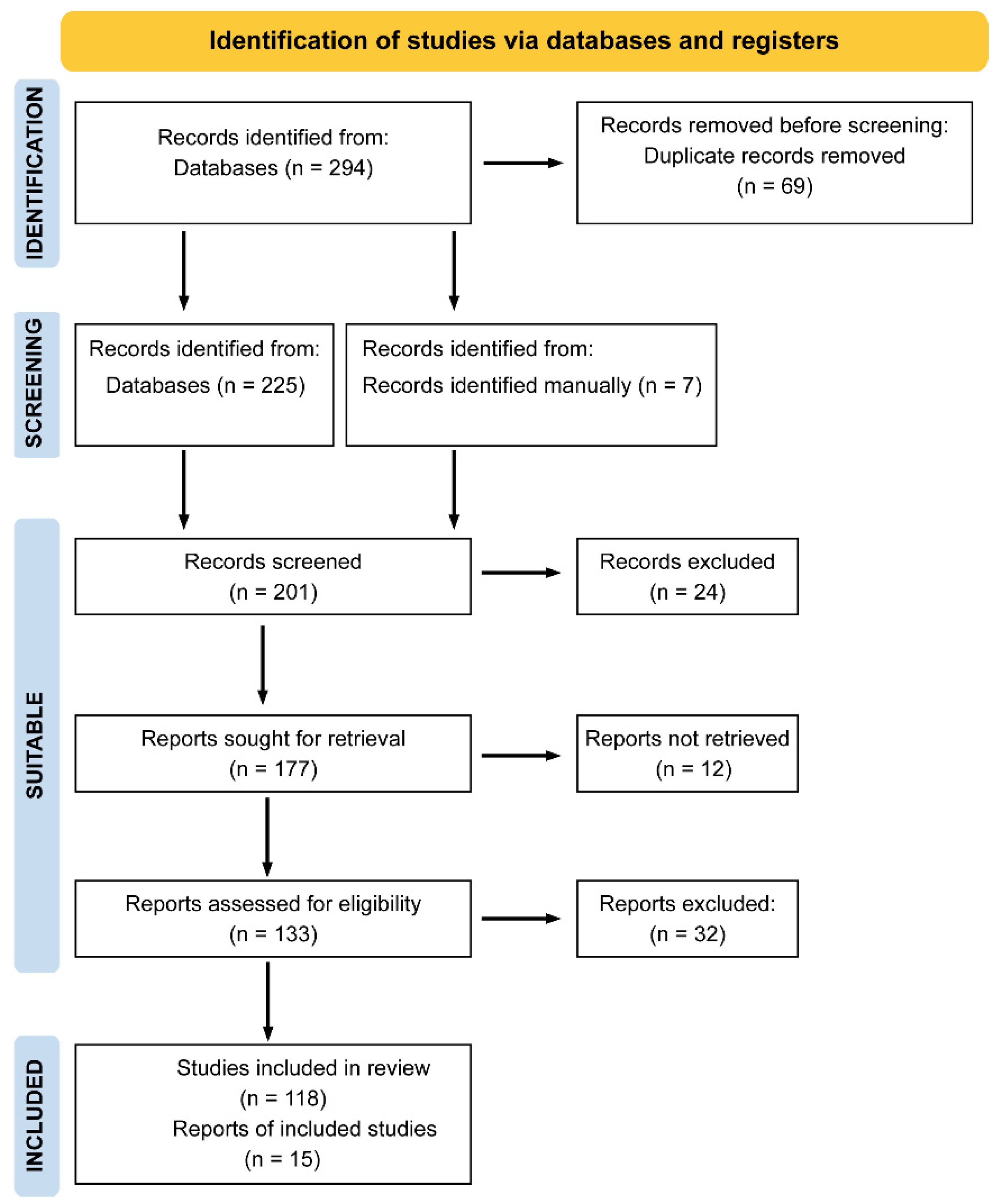
2. Systematic Search
- Inclusion Criteria
- Articles that meet at least two of the breast cancer and 3D culture search criteria.
- Experimental studies comparing epigenetic changes between 3D and 2D cultures.
- Experimental studies comparing epigenetic changes between different 3D culture methodologies.
- Studies assessing DNA methylation patterns, histone modifications, or the expression of miRNAs, lncRNAs, or circRNAs.
- Experimental or review articles describing 3D culture methods.
- Publications were released between 2015 and 2025.
- Exclusion Criteria
- Articles fulfilling only one of the search criteria.
- Studies evaluating epigenetic changes solely in the context of invasion or migration assays comparing 2D vs. 3D cultures.
- Studies using breast cancer cell lines only in preliminary experiments, but not in epigenetic analyses.
3. Types of Breast Cancer Cell Morphology in 3D Cultures
4. Types of 3D Culture Systems in Cancer
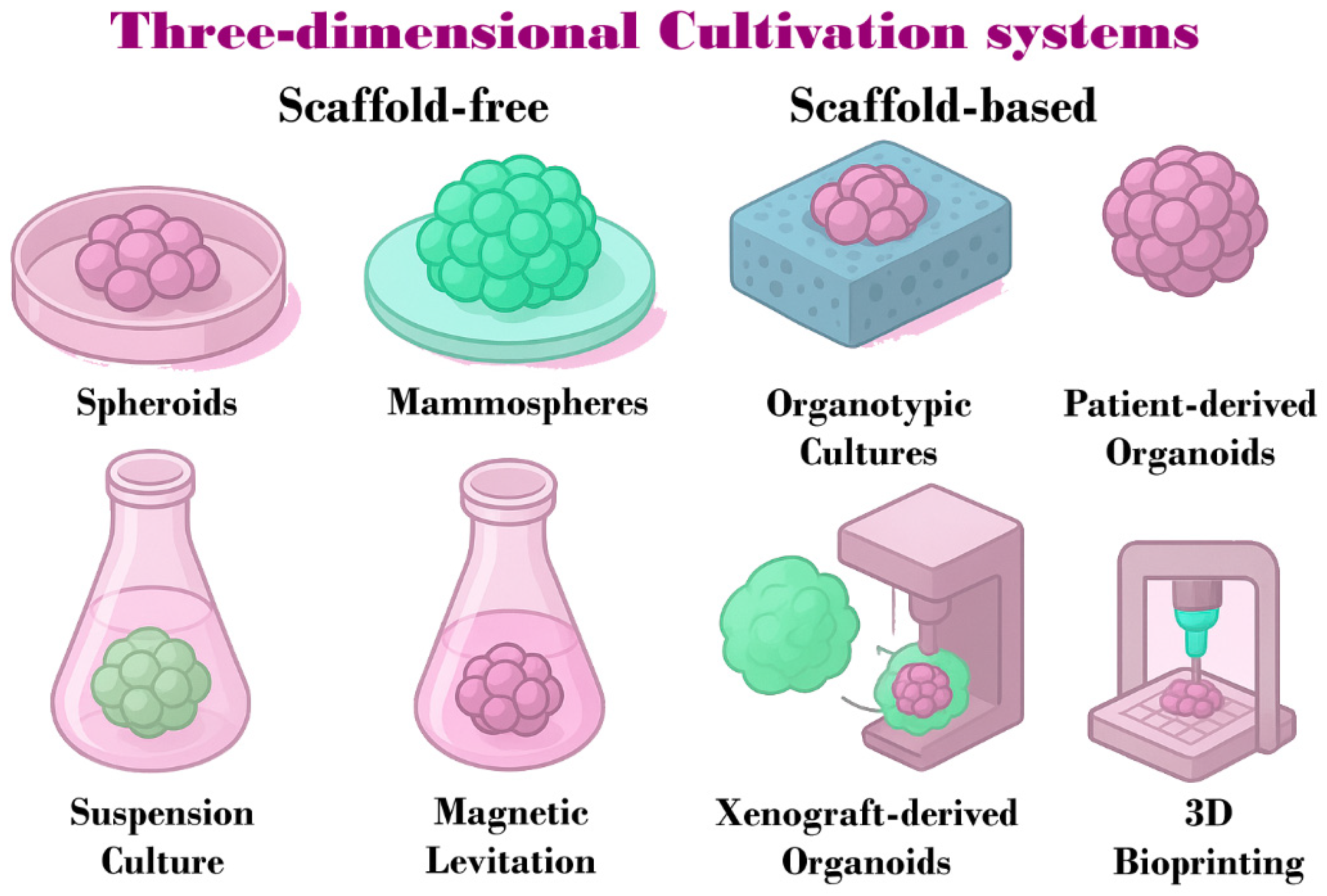
4.1. Scaffold-Free 3D Culture Types
- -
- Low-adherence systems:
- ○
- Spheroids: These were the first 3D cultures and rely on low-adhesion plates that allow colony formation through self-assembly. They can be monocultures or co-cultures with stromal cells and can replicate hypoxia in the nucleus of the aggregate [6,33,34]. This system typically uses ultra-low adhesion (ULA) plates and poly-2 hydroxyethyl methacrylate (PolyHEMA)-coated plates [26].
- ○
- -
- -
- Magnetic Levitation: Spheroids are formed by adding nanoparticles to a cell suspension and exposing them to a magnetic field, enabling the formation of aggregates capable of synthesizing their own extracellular matrix (ECM). These nanoparticles are composed of biocompatible materials such as iron oxide [20,26,37].
- -
- -
4.2. Scaffold-Based Models
- -
- Organotypic Cultures: Originally emerging as homo-cellular aggregates composed of stem cells that self-assemble when introduced into a scaffold, facilitating cell attachment and organization, these cultures were later developed using other types of matrices, as well as hetero-cellular cultures that can exhibit cystic or solid phenotypes [6,7,26,27,41]. Although this is currently the most widely used system and the one in which the most cancer studies are conducted, it presents low reproducibility and high heterogeneity due to the use of diverse scaffolds, making the identification of therapeutic targets challenging.
- -
- Patient-derived tumor organoids (PDTOs): 3D cellular structures obtained from tumor samples and incorporated into an extracellular matrix, which preserve primary tumor characteristics such as cellular and genetic heterogeneity, and histomorphology [34,42,43,44]. Furthermore, they can be employed as micro-physiological models that enable the identification of different cell populations, including tumor cells, myoepithelial cells, fibroblasts, and adipocytes, as well as the study of migration patterns [45].
- -
- -
- Organ-on-a-Chip (OoC) Systems: Using microfluidic systems that allow continuous media perfusion, patient explants are embedded to recreate vascular flow, chemical gradients, and dynamic co-cultures [47,49]. These systems offer precise control over the microenvironment, enabling studies of metastasis and interactions between tissue types [50].
- -
- 3D Bioprinting: A technology that applies 3D printing to generate functional biological tissues and models using bioinks containing living cells, growth factors, and biomatrices such as gelatin, hyaluronic acid, elastin, or spider silk proteins. This approach allows the fabrication of specific geometries and the production of vascularized mammary organoids [6,16,41]. Bioprinting methods, including inkjet, extrusion, and laser-assisted printing, enable the spatial and temporal control of chemical signals within 3D matrices [51].
5. Types of Scaffolds or Matrices Used in 3D Culture
- -
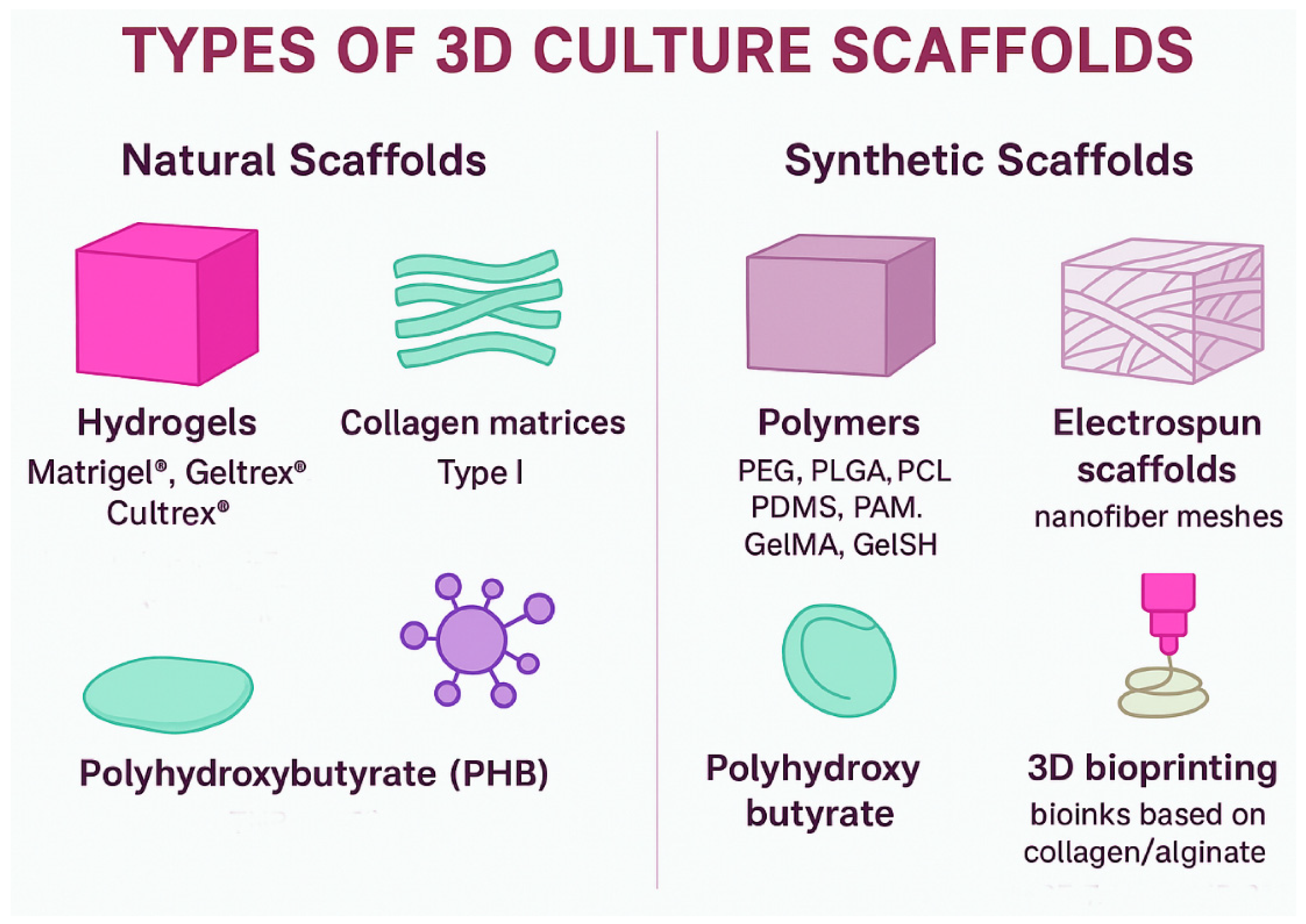
- Hydrogels: Solid scaffolds of natural or synthetic origin, such as those derived from Engelbreth-Holm-Swarm (EHS) tumor extracts. These scaffolds have a high laminin content and form the extracellular matrix (lrECM) gels commercially available as Matrigel® (Corning Incorporated, Tewksbury, MA, USA), Geltrex® (Thermo Fisher Scientific, Waltham, MA USA), and Cultrex® (R&D Systems, Minneapolis, MN, USA) [18,27,79]. Among the main disadvantages of natural hydrogels, reproducibility remains a major concern. Due to their tumor-derived origin, batch-to-batch variability arises from differences in the proportions of collagen IV, laminin, entactin, and perlecan [18,27,79]. For instance, variations in collagen I and fibrinogen content alter the biomechanical strength of the scaffold, which in turn regulates the capacity for self-renewal and quiescence in MCF-7 cells. A mechanical force of approximately 45 Pa activates Integrin β1/3 receptors, triggering stem cell signaling through the cytoskeleton/AIR axis, whereas a higher force (~450 Pa) induces quiescence by arresting cell cycle signaling through receptor 2 containing the discoidin domain/signal transducer and activator of transcription 1/cyclin-dependent kinase inhibitor 1B (DDR2/STAT1/P27) [80]. Additionally, 3D breast cancer cell cultures may fail due to antigenic reactions associated with the murine origin of the matrix [18,26,27]. Beyond these intrinsic limitations of natural hydrogels, compositional variability must also be considered. For example, the commercial variant of Matrigel® with reduced growth factor content (GFRM) was developed to minimize inconsistencies in growth factor composition; however, this alteration affects proliferation rates as result of changes in gene expression [81]. Similarly, combining type I collagen with Matrigel® or Cultrex® modifies the biomechanical properties of the scaffold [72,82].
- -
- Collagen matrices: These scaffolds can be composed of type I or type IV collagen, each generating distinct structural networks. Type I collagen forms thick, rigid fibers that create high stiffness gradients (~1–10 kPa), making it suitable for evaluating invasion and EMT. In contrast, type IV collagen polymerizes into a branched network with lower stiffness (~100–300 Pa), facilitating the study of cell polarity and differentiation [83,84]. Moreover, polymerization conditions can be modulated by adjusting ionic strength, pH, and temperature [6]. One of the main advantages of collagen matrices is that cells can degrade collagen through the secretion of proteolytic enzymes, allowing dynamic matrix remodeling during proliferation, migration, and infiltration [85]. However, the use of these scaffolds may be influenced by cell subtype, as HER-2+ tumors have been associated with higher levels of collagen deposition [41]. Most studies employ collagen matrices as a support for heterotypic co-cultures; for example, Blyth et al. (2023) [34] used collagen to co-culture luminal cells (MCF-7 and T47D) with myoepithelial cells and stromal fibroblasts. Similarly, Singh et al. (2020) [86] co-cultured fibroblasts with TNBC spheroids, demonstrating increased Extracellular signal-regulated kinase 1/2 (ERK1/2) phosphorylation dependent on the stiffness of the collagen matrix. Therefore, the use of collagen-based scaffolds remains undercharacterized in terms of gene expression profiling in breast cancer cell cultures.
- -
- Other Biomaterials: Natural proteins and polysaccharides, such as fibrin, alginate, hyaluronic acid, elastin, amyloid fibers, recombinant spider silk, proteoglycans, and glycosaminoglycans, are important in various applications [6,32,41]. For instance, fibrin has a short polymerization time, which facilitates a homogeneous distribution of cells and makes it less vulnerable to degradation by proteases [87]. Alginate, in contrast, can adjust its crosslinking, thereby altering the mechanical properties of the scaffold [41]. Hydrogels based on hyaluronic acid can simulate the slow and controlled release of growth factors [88]. These compounds are frequently utilized to create bioinks for 3D bioprinting or in combination with other types of matrices [41].
- -
- Polyhydroxybutyrate (PHB): PHB is a natural polymer belonging to the polyhydroxyalkanoate family, characterized by its high flexibility, biocompatibility, and biodegradability [18]. Its flexibility arises from the presence of pores ranging from approximately 30 to 400 µm. However, this type of scaffold is seldom used in breast cancer cell culture studies.
- -
- Decellularized extracellular matrix (dECM): This scaffold is generated by removing cellular components from tissues while preserving the structural and architectural integrity of the matrix, including the 3D fibrillar network of collagens, laminins, proteoglycans, and growth factors [6,26]. Quality criteria for dECM require a DNA content of less than 50 ng of double-stranded DNA per mg of dry weight, fragment lengths under 200 bp, and the absence of nuclear material as confirmed by DAPI staining [89]. However, the decellularization method can alter ECM composition, leading to variability that hampers reproducibility. Although approximately 200 proteins are shared among patient-derived dECM, Matrigel®, and xenografts, each matrix also contains unique proteins [90]. In addition, dECM may trigger immunogenicity due to residual antigenic motifs and protein fragments [41].
6. Mechanotransduction as a Scaffold-Type Sensor
7. Impact of 3D Culture on Tumor Cell Epigenetics
7.1. Changes in DNA Methylation in 3D Culture
7.2. Modification of the Histone Code in 3D Culture
8. Modification in the Expression of Non-Coding RNAs in 3D Cultures
8.1. Alterations in circRNAs Programs
8.2. Modification in microRNA Expression Profiles
8.3. Deregulation of LncRNAs Landscapes
9. Limitations and Perspectives
10. Conclusions
Author Contributions
Funding
Acknowledgments
Conflicts of Interest
Abbreviations
| ER+ | Estrogen Receptor positive |
| PR+ | Progesterone Receptor positive |
| HER-2+ | Human Epidermal Growth Factor Receptor 2 HER2 |
| TNBC | Triple-negative |
| 2D | Two-dimensional |
| EMT | Epithelial–mesenchymal transition |
| 3D | Three-dimensional |
| miRNAs | MicroRNAs |
| lncRNAs | Long non-coding RNAs |
| circRNAs | Circular RNAs |
| ROS | Oxidative stress |
| KRT15 | Keratin 15 |
| FABP5 | Fatty acid-binding protein 5 |
| AGR2 | Anterior gradient protein 2 homolog |
| ERBB2 | Erythroblastic Oncogene B2 |
| PPARG | Peroxisome Proliferator-activated Receptor Gamma |
| FADS1 | Fatty Acid Desaturase 1 |
| PTGER4 | Prostaglandin E Receptor 4 |
| PARG | Poly(ADP-ribose) Glycohydrolase |
| PALM2 | Paralemmin |
| ULA | Ultra-low adhesion |
| PolyHEMA | Poly-2 hydroxyethyl methacrylate |
| CSC | Cancer stem cell |
| ECM | Extracellular matrix |
| PDTOs | Patient-derived tumor organoids |
| PDX | Xenograft-Derived Organoids |
| OoC | Organ-on-a-Chip |
| EHS | Engelbreth-Holm-Swarm |
| lrECM | High laminin content and form the extracellular matrix |
| DDR2 | Receptor 2 containing the discoidin domain |
| STAT1 | Signal transducer and activator of transcription 1 |
| P27 | Cyclin-dependent kinase inhibitor 1B |
| GFRM | Reduced growth factor content |
| ERK1/2 | Extracellular signal-regulated kinase 1/2 |
| PHB | Polyhydroxybutyrate |
| dECM | Decellularized extracellular matrix |
| PEG | Polyethylene glycol |
| PLG | Poly(lactide-co-glycolide) |
| PCL | Poly(ε-caprolactone) |
| PAM | Polyacrylamide |
| GelMA | Methacryloyl gelatin |
| GelSH | Thiolated gelatin crosslinked with PEG-4MAL |
| PLGA | Poly(lactic-co-glycolic acid) |
| PDMS | Polydimethylsiloxane |
| FA | Focal adhesions |
| WNT | Wingless-related integration site |
| ILK | Integrin-linked kinase |
| MYPT1 | Myosin phosphatase subunit 1 |
| MST1/2 | Mammalian sterile 20-like kinase 1/2 |
| LATS1 | Large tumor suppressor kinase 1 |
| FAK | Focal adhesion kinase 1 |
| SRC | Pro-oncogenic tyrosine-protein kinase SRC |
| TRPV4 | Transient receptor potential cation channel subfamily V member 4 |
| YAP | Yes-associated protein |
| DNMT3B | DNA (cytosine-5)-methyltransferase 3B |
| HOX | Homeobox |
| BRD4 | Bromodomain-containing protein 4 |
| RBL1 | Retinoblastoma-like protein 1 |
| MAPK | Mitogen-Activated Protein Kinase |
| NOTCH | Neurogenic locus notch homolog |
| SBDS | SBDS ribosome maturation factor |
| TMPRSS2 | Transmembrane serine protease 2 |
| PAX5 | Paired box 5 |
| CREBBP | Histone acetyltransferase CREB-binding protein |
| PI3K | Phosphatidylinositol 3-kinase |
| PTEN | Phosphatase and tensin homolog |
| HDAC | Histone deacetylases |
| HAT | Histone acetyltransferases |
| TADs | Tumor-associated domains |
| DDX21 | DExD-box helicase 21 |
| CTCF | CCCTC-binding factor |
| TEAD | Transcriptional Enhanced Associate Domain |
| FOXA1 | Forkhead box A1 |
| EZH2 | Enhancer of Zeste Homolog 2 |
| HMGB1 | High Mobility Group Box 1 |
| RBPs | RNA-binding proteins |
| Cx43 | Connexin 43 |
| FOXO1 | Forkhead box protein O1 |
| TP73 | Tumor protein p73 |
| TP63 | Tumor protein p63 |
| TP53 | Tumor protein p53 |
| AGO2 | Argonaute RISC catalytic component 2 |
| BRAF | B-Raf proto-oncogene, serine/threonine kinase |
| HIF1A | Hypoxia-inducible factor 1-alpha |
| MYC | MYC proto-oncogene |
| E2F | E2F transcription factor |
| FOXO3 | Forkhead box O 3 |
| BVES | Blood vessel epicardial substance |
| ARHGAP17 | Rho GTPase activating protein 17 |
| OXPHOS | Oxidative phosphorylation |
| PDCD4 | Promoting programmed cell death protein 4 |
| ZEB1 | Zinc Finger E-Box Binding Homeobox 1 |
| BCL2 | BCL2 apoptosis regulator |
| GLI3 | GLI family zinc finger 3 |
| KLF4 | Kruppel-like factor 4 |
| SMAD2 | Mothers against decapentaplegic homolog 2 |
| SOX4 | SRY-box transcription factor 4 |
| SP1 | Sp1 transcription factor or Specificity Protein 1 |
| BMP2 | Bone Morphogenetic Protein 2 |
| TGFBR1 | Transforming growth factor beta receptor 1 |
| KRAS | Kirsten rat sarcoma viral oncogene homolog |
| ERBB4 | Receptor tyrosine-protein kinase erbB-4 |
| VEGFA | Vascular Endothelial Growth Factor A |
| KLF5 | Kruppel-like factor 5 |
| RASA1 | RAS p21 protein activator 1 |
| CDH2 | Cadherin-2 |
| FGF1 | Fibroblast growth factor 1 |
| MAP3K7 | Mitogen-activated protein kinase kinase kinase 7 |
| VEZF1 | Vascular endothelial zinc finger 1 |
| ZFP36L1 | ZFP36 ring finger protein like 1 |
| BTRC | Ubiquitin protein ligase E3 containing beta-transducin repeats |
| TGF-β2 | Transforming growth factor beta 2 |
| AKT2 | AKT serine/threonine kinase 2 |
| TIMP3 | Tissue inhibitor of metalloproteinase 3 |
| ACLY | ATP citrate lyase |
| RACGAP1 | Rac GTPase-activating protein 1 |
| AK4 | Adenylate kinase 4 |
| MRPL51 | Mitochondrial ribosomal protein L51 |
| CYB5B | Cytochrome b5 type B |
| MKRN1 | Makorin ring finger protein 1 |
| TMEM230 | Transmembrane protein 230 |
| NUP54 | Nucleoporin 54 |
| ANAPC13 | Anaphase-promoting complex subunit 13 |
| PGAM1 | Phosphoglycerate Mutase 1 |
| SOD1 | Superoxide dismutase 1 |
| AGE | Advanced glycation end-product |
| RAGE | Receptor for advanced glycation end-product |
| NF-κB | Nuclear Factor kappa-light-chain-enhancer of activated B cells |
| TGF-β3 | Transforming Growth Factor Beta 3 |
| SOX9 | SRY-Box Transcription Factor 9 |
| FZD4 | Frizzled Class Receptor 4 |
| WNT4 | Wnt Family Member 4 |
| SOX12 | SRY-Box Transcription Factor 12 |
| PPP2R2B | Protein Phosphatase 2 Regulatory Subunit Bβ |
| CCNDBP1 | Cyclin-D1 Binding Protein 1 |
| MVD | Mevalonate Diphosphate Decarboxylase |
| HMGCS2 | 3-Hydroxy-3-Methylglutaryl-CoA Synthase 2 |
| ACAT | Acetyl-CoA Acetyltransferase |
| TANK | TRAF Family Member-Associated NF-κB Activator |
| PARP9 | Poly(ADP-ribose) Polymerase Family Member 9 |
| FOXC2 | Forkhead Box C2 |
| SLC2A9 | Solute Carrier Family 2 Member 9 |
| CCNDBP1 | Cyclin D1 Binding Protein 1 |
| ICAM | Intercellular Adhesion Molecule |
| C-MET | MET Proto-Oncogene, Receptor Tyrosine Kinase |
| EGFR | Epidermal Growth Factor Receptor |
References
- Ferlay, J.; Laversanne, M.; Ervik, M.; Lam, F.; Colombet, M.; Mery, L.; Piñeros, M.; Znaor, A.; Soerjomataram, I.; Bray, F. Global Cancer Observatory: Cancer Tomorrow (Version 1.1); International Agency for Research on Cancer: Lyon, France, 2024. [Google Scholar]
- Gastélum-López, M.L.Á.; Aguilar-Medina, M.; García Mata, C.; López-Gutiérrez, J.; Romero-Quintana, G.; Bermúdez, M.; Avendaño-Felix, M.; López-Camarillo, C.; Pérez-Plascencia, C.; Beltrán, A.S.; et al. Organotypic 3D Cell-Architecture Impacts the Expression Pattern of miRNAs-mRNAs Network in Breast Cancer SKBR3 Cells. Noncoding RNA 2023, 9, 66. [Google Scholar] [CrossRef] [PubMed] [PubMed Central]
- Meng, Y.; Zhou, D.; Luo, Y.; Chen, J.; Li, H. An estrogen-regulated long non-coding RNA NCALD promotes luminal breast cancer proliferation by activating GRHL2. Cancer Cell Int. 2024, 24, 49. [Google Scholar] [CrossRef] [PubMed] [PubMed Central]
- Fu, J.; Fernandez, D.; Ferrer, M.; Titus, S.A.; Buehler, E.; Lal-Nag, M.A. RNAi High-Throughput Screening of Single- and Multi-Cell-Type Tumor Spheroids: A Comprehensive Analysis in Two and Three Dimensions. SLAS Discov. 2017, 22, 525–536. [Google Scholar] [CrossRef] [PubMed][Green Version]
- Şükrüoğlu Erdoğan, Ö.; Kılıç Erciyas, S.; Bilir, A.; Buğra Tunçer, Ş.; Akdeniz Ödemiş, D.; Kurul, S.; Karanlık, H.; Cabıoğlu, N.; Yazıcı, H. Methylation Changes of Primary Tumors, Monolayer, and Spheroid Tissue Culture Environments in Malignant Melanoma and Breast Carcinoma. Biomed. Res. Int. 2019, 2019, 1407167. [Google Scholar] [CrossRef] [PubMed] [PubMed Central]
- Redmond, J.; McCarthy, H.; Buchanan, P.; Levingstone, T.J.; Dunne, N.J. Advances in biofabrication techniques for collagen-based 3D in vitro culture models for breast cancer research. Mater. Sci. Eng. C Mater. Biol. Appl. 2021, 122, 111944. [Google Scholar] [CrossRef] [PubMed]
- Salinas-Vera, Y.M.; Valdés, J.; Pérez-Navarro, Y.; Mandujano-Lazaro, G.; Marchat, L.A.; Ramos-Payán, R.; Nuñez-Olvera, S.I.; Pérez-Plascencia, C.; López-Camarillo, C. Three-Dimensional 3D Culture Models in Gynecological and Breast Cancer Research. Front. Oncol. 2022, 12, 826113. [Google Scholar] [CrossRef] [PubMed] [PubMed Central]
- Özkan, H.; Öztürk, D.G.; Korkmaz, G. Transcriptional Factor Repertoire of Breast Cancer in 3D Cell Culture Models. Cancers 2022, 14, 1023. [Google Scholar] [CrossRef] [PubMed] [PubMed Central]
- Ramírez-Cuéllar, J.; Ferrari, R.; Sanz, R.T.; Valverde-Santiago, M.; García-García, J.; Nacht, A.S.; Castillo, D.; Le Dily, F.; Neguembor, M.V.; Malatesta, M.; et al. LATS1 controls CTCF chromatin occupancy and hormonal response of 3D-grown breast cancer cells. EMBO J. 2024, 43, 1770–1798. [Google Scholar] [CrossRef] [PubMed] [PubMed Central]
- Balachander, G.M.; Rajashekar, B.; MSarashetti, P.; Rangarajan, A.; Chatterjee, K. MiRNomics Reveals Breast Cancer Cells Cultured on 3D Scaffolds Better Mimic Tumors in Vivo than Conventional 2D Culture. ACS Biomater. Sci. Eng. 2018, 4, 116–127. [Google Scholar] [CrossRef] [PubMed]
- Park, C.H.; Park, J.H.; Suh, Y.J. Perspective of 3D culture in medicine: Transforming disease research and therapeutic applications. Front. Bioeng. Biotechnol. 2024, 12, 1491669. [Google Scholar] [CrossRef] [PubMed] [PubMed Central]
- Olvera-Valencia, M.; Garcia-Castillo, V.; Ramos-Payan, R.; Aguilar-Medina, M.; Trujano-Camacho, S.; López-Saavedra, A.; Marchat, L.A.; López-Camarillo, C.; Sumagin, R.; Pérez-Yepez, E.; et al. Development of a reliable method for human triple-negative breast cancer organotypic culture: Improving imaging and genomic studies in 3D cultures. J. Tissue Eng. 2025, 16, 20417314251326668. [Google Scholar] [CrossRef] [PubMed] [PubMed Central]
- Bilgin, C.C.; Kim, S.; Leung, E.; Chang, H.; Parvin, B. Integrated profiling of three dimensional cell culture models and 3D microscopy. Bioinformatics 2013, 29, 3087–3093. [Google Scholar] [CrossRef] [PubMed] [PubMed Central]
- Koedoot, E.; Wolters, L.; Smid, M.; Stoilov, P.; Burger, G.A.; Herpers, B.; Yan, K.; Price, L.S.; Martens, J.W.M.; Le Dévédec, S.E.; et al. Differential reprogramming of breast cancer subtypes in 3D cultures and implications for sensitivity to targeted therapy. Sci. Rep. 2021, 11, 7259. [Google Scholar] [CrossRef] [PubMed] [PubMed Central]
- Dankó, T.; Petővári, G.; Raffay, R.; Sztankovics, D.; Moldvai, D.; Vetlényi, E.; Krencz, I.; Rókusz, A.; Sipos, K.; Visnovitz, T.; et al. Characterisation of 3D Bioprinted Human Breast Cancer Model for In Vitro Drug and Metabolic Targeting. Int. J. Mol. Sci. 2022, 23, 7444. [Google Scholar] [CrossRef] [PubMed] [PubMed Central]
- Koskinen, L.M.; Nieminen, L.; Arjonen, A.; Guzmán, C.; Peurla, M.; Peuhu, E. Spatial Engineering of Mammary Epithelial Cell Cultures with 3D Bioprinting Reveals Growth Control by Branch Point Proximity. J. Mammary Gland Biol. Neoplasia 2024, 29, 5. [Google Scholar] [CrossRef] [PubMed] [PubMed Central]
- Muñoz-Galindo, L.; Melendez-Zajgla, J.; Pacheco-Fernández, T.; Rodriguez-Sosa, M.; Mandujano-Tinoco, E.A.; Vazquez-Santillan, K.; Castro-Oropeza, R.; Lizarraga, F.; Sanchez-Lopez, J.M.; Maldonado, V. Changes in the transcriptome profile of breast cancer cells grown as spheroids. Biochem. Biophys. Res. Commun. 2019, 516, 1258–1264. [Google Scholar] [CrossRef] [PubMed]
- Fontoura, J.C.; Viezzer, C.; Dos Santos, F.G.; Ligabue, R.A.; Weinlich, R.; Puga, R.D.; Antonow, D.; Severino, P.; Bonorino, C. Comparison of 2D and 3D cell culture models for cell growth, gene expression and drug resistance. Mater. Sci. Eng. C Mater. Biol. Appl. 2020, 107, 110264. [Google Scholar] [CrossRef] [PubMed]
- Mangani, S.; Kremmydas, S.; Karamanos, N.K. Mimicking the Complexity of Solid Tumors: How Spheroids Could Advance Cancer Preclinical Transformative Approaches. Cancers 2025, 17, 1161. [Google Scholar] [CrossRef] [PubMed] [PubMed Central]
- Lonkwic, K.M.; Zajdel, R.; Kaczka, K. Unlocking the Potential of Spheroids in Personalized Medicine: A Systematic Review of Seeding Methodologies. Int. J. Mol. Sci. 2025, 26, 6478. [Google Scholar] [CrossRef] [PubMed] [PubMed Central]
- Tucker, L.H.; Hamm, G.R.; Sargeant, R.J.E.; Goodwin, R.J.A.; Mackay, C.L.; Campbell, C.J.; Clarke, D.J. Untargeted Metabolite Mapping in 3D Cell Culture Models Using High Spectral Resolution FT-ICR Mass Spectrometry Imaging. Anal. Chem. 2019, 91, 9522–9529. [Google Scholar] [CrossRef] [PubMed]
- Tirier, S.M.; Park, J.; Preußer, F.; Amrhein, L.; Gu, Z.; Steiger, S.; Mallm, J.P.; Krieger, T.; Waschow, M.; Eismann, B.; et al. Pheno-seq—Linking visual features and gene expression in 3D cell culture systems. Sci. Rep. 2019, 9, 12367. [Google Scholar] [CrossRef] [PubMed] [PubMed Central]
- Nuñez-Olvera, S.I.; Aguilar-Arnal, L.; Cisneros-Villanueva, M.; Hidalgo-Miranda, A.; Marchat, L.A.; Salinas-Vera, Y.M.; Ramos-Payán, R.; Pérez-Plasencia, C.; Carlos-Reyes, Á.; Puente-Rivera, J.; et al. Breast Cancer Cells Reprogram the Oncogenic lncRNAs/mRNAs Coexpression Networks in Three-Dimensional Microenvironment. Cells 2022, 11, 3458. [Google Scholar] [CrossRef] [PubMed] [PubMed Central]
- Smolinska, V.; Harsanyi, S.; Bohac, M.; Danisovic, L. Exploring the Three-Dimensional Frontier: Advancements in MSC Spheroids and Their Implications for Breast Cancer and Personalized Regenerative Therapies. Biomedicines 2023, 12, 52. [Google Scholar] [CrossRef] [PubMed] [PubMed Central]
- Tovar-Hernández, K.; Salinas-Vera, Y.M.; Carlos-Reyes, Á.; García-Hernández, A.P.; Marchat, L.A.; Mandujano-Lázaro, G.; Ríos-Castro, E.; Velasco-Suárez, A.; Mendez-Gómez, I.; Tecalco-Cruz, Á.C.; et al. Adipocytes reprogram the proteome of breast cancer cells in organotypic three-dimensional cell cultures. Sci. Rep. 2024, 14, 27029. [Google Scholar] [CrossRef] [PubMed] [PubMed Central]
- Bittman-Soto, X.S.; Thomas, E.S.; Ganshert, M.E.; Mendez-Santacruz, L.L.; Harrell, J.C. The Transformative Role of 3D Culture Models in Triple-Negative Breast Cancer Research. Cancers 2024, 16, 1859. [Google Scholar] [CrossRef] [PubMed] [PubMed Central]
- Lingard, E.; Dong, S.; Hoyle, A.; Appleton, E.; Hales, A.; Skaria, E.; Lawless, C.; Taylor-Hearn, I.; Saadati, S.; Chu, Q.; et al. Optimising a self-assembling peptide hydrogel as a Matrigel alternative for 3-dimensional mammary epithelial cell culture. Biomater. Adv. 2024, 160, 213847, Erratum in Biomater Adv. 2025, 167, 214111. https://doi.org/10.1016/j.bioadv.2024.214111. [Google Scholar] [CrossRef] [PubMed]
- Smolina, M.; Goormaghtigh, E. Infrared imaging of MDA-MB-231 breast cancer cell line phenotypes in 2D and 3D cultures. Analyst 2015, 140, 2336–2343. [Google Scholar] [CrossRef] [PubMed]
- Kenny, P.A.; Lee, G.Y.; Myers, C.A.; Neve, R.M.; Semeiks, J.R.; Spellman, P.T.; Lorenz, K.; Lee, E.H.; Barcellos-Hoff, M.H.; Petersen, O.W.; et al. The morphologies of breast cancer cell lines in three-dimensional assays correlate with their profiles of gene expression. Mol. Oncol. 2007, 1, 84–96. [Google Scholar] [CrossRef] [PubMed] [PubMed Central]
- Han, J.; Chang, H.; Giricz, O.; Lee, G.Y.; Baehner, F.L.; Gray, J.W.; Bissell, M.J.; Kenny, P.A.; Parvin, B. Molecular predictors of 3D morphogenesis by breast cancer cell lines in 3D culture. PLoS Comput. Biol. 2010, 6, e1000684. [Google Scholar] [CrossRef] [PubMed] [PubMed Central]
- Blyth, R.R.R.; Laversin, S.A.; Foxall, R.B.; Savva, C.; Copson, E.; Cutress, R.I.; Birts, C.N.; Beers, S.A. Development and characterisation of a novel 3D in vitro model of obesity-associated breast cancer as a tool for drug testing. NPJ Breast Cancer 2025, 11, 50. [Google Scholar] [CrossRef] [PubMed] [PubMed Central]
- Collodet, C.; Blust, K.; Gkouma, S.; Ståhl, E.; Chen, X.; Hartman, J.; Hedhammar, M. Development and characterization of a recombinant silk network for 3D culture of immortalized and fresh tumor-derived breast cancer cells. Bioeng. Transl. Med. 2023, 8, e10537. [Google Scholar] [CrossRef] [PubMed] [PubMed Central]
- Rodríguez, C.E.; Berardi, D.E.; Abrigo, M.; Todaro, L.B.; Bal de Kier Joffé, E.D.; Fiszman, G.L. Breast cancer stem cells are involved in Trastuzumab resistance through the HER2 modulation in 3D culture. J. Cell Biochem. 2018, 119, 1381–1391. [Google Scholar] [CrossRef] [PubMed]
- Blyth, R.R.R.; Birts, C.N.; Beers, S.A. The role of three-dimensional in vitro models in modelling the inflammatory microenvironment associated with obesity in breast cancer. Breast Cancer Res. 2023, 25, 104. [Google Scholar] [CrossRef] [PubMed] [PubMed Central]
- Ortiz, M.M.O.; Andrechek, E.R. Molecular Characterization and Landscape of Breast cancer Models from a multi-omics Perspective. J. Mammary Gland Biol. Neoplasia 2023, 28, 12. [Google Scholar] [CrossRef] [PubMed] [PubMed Central]
- Piwocka, O.; Sterzyńska, K.; Malińska, A.; Suchorska, W.M.; Kulcenty, K. Development of tetraculture spheroids as a versatile 3D model for personalized breast cancer research. Sci. Rep. 2025, 15, 27449. [Google Scholar] [CrossRef] [PubMed] [PubMed Central]
- Habra, K.; Pearson, J.R.D.; McArdle, S.E.B. Robust formation of optimal single spheroids towards cost-effective in vitro three-dimensional tumor models. FEBS Open Bio 2023, 13, 1266–1277. [Google Scholar] [CrossRef] [PubMed] [PubMed Central]
- Paul, C.D.; Yankaskas, C.; Shahi Thakuri, P.; Balhouse, B.; Salen, S.; Bullock, A.; Beam, S.; Chatman, A.; Djikeng, S.; Yang, X.J.; et al. Long-term maintenance of patient-specific characteristics in tumoroids from six cancer indications. Sci. Rep. 2025, 15, 3933. [Google Scholar] [CrossRef] [PubMed] [PubMed Central]
- Balalaeva, I.V.; Sokolova, E.A.; Puzhikhina, A.D.; Brilkina, A.A.; Deyev, S.M. Spheroids of HER2-Positive Breast Adenocarcinoma for Studying Anticancer Immunotoxins In Vitro. Acta Naturae 2017, 9, 38–43. [Google Scholar] [CrossRef] [PubMed] [PubMed Central]
- Khan, A.H.; Zhou, S.P.; Moe, M.; Ortega Quesada, B.A.; Bajgiran, K.R.; Lassiter, H.R.; Dorman, J.A.; Martin, E.C.; Pojman, J.A.; Melvin, A.T. Generation of 3D Spheroids Using a Thiol-Acrylate Hydrogel Scaffold to Study Endocrine Response in ER+ Breast Cancer. ACS Biomater. Sci. Eng. 2022, 8, 3977–3985. [Google Scholar] [CrossRef] [PubMed] [PubMed Central]
- Bhattacharya, A.; Alam, K.; Roy, N.S.; Kaur, K.; Kaity, S.; Ravichandiran, V.; Roy, S. Exploring the interaction between extracellular matrix components in a 3D organoid disease model to replicate the pathophysiology of breast cancer. J. Exp. Clin. Cancer Res. 2023, 42, 343. [Google Scholar] [CrossRef] [PubMed] [PubMed Central]
- Divoux, J.; Florent, R.; Jacobs, M.; Lequesne, J.; Grellard, J.M.; San, C.; Grossi, S.; Kerdja, K.; Clarisse, B.; Boudier, G.; et al. The TRIPLEX study: Use of patient-derived tumor organoids as an innovative tool for precision medicine in triple-negative breast cancer. BMC Cancer 2023, 23, 883. [Google Scholar] [CrossRef] [PubMed] [PubMed Central]
- Sari, A.I.P.; Roytrakul, S.; Chittavanich, P.; Saengwimol, D.; Laosillapacharoen, N.; Khamjerm, J.; Borwornpinyo, S.; Jinawath, A.; Suvikapakornkul, R.; Lertsithichai, P.; et al. Drug repurposing identifies proteasome inhibitors as antiproliferative agents counteracting inflammation-driven chemoresistance in triple-negative breast cancer organoids. Biomed. Pharmacother. 2025, 190, 118359. [Google Scholar] [CrossRef] [PubMed]
- Zhang, Q.; Wang, M.; You, L.; Chen, C.; Feng, J.; Song, M.; Yang, K.; Liu, X.; Li, G.; Liu, J. Research progress and application status of organoid in breast cancer subtypes. Biomol. Biomed. 2025, 25, 976–985. [Google Scholar] [CrossRef] [PubMed] [PubMed Central]
- Kumari, M.; Alam, K.; Bhattacharya, A.; Roy, N.S.; Madhasu, V.; Guchhait, B.; Dan, S.; Sett, S.; Chakrabarti, J.; Mandal, C.; et al. Mechanically induced development and maturation of 3D in-vitro organoid platform: An organotypic heterogeneous microphysiological model of patient-derived organoids with ER/PR/HER2+ breast cancer. Front. Immunol. 2025, 16, 1594405. [Google Scholar] [CrossRef] [PubMed] [PubMed Central]
- Li, J.; Fang, K.; Choppavarapu, L.; Yang, K.; Yang, Y.; Wang, J.; Cao, R.; Jatoi, I.; Jin, V.X. Hi-C profiling of cancer spheroids identifies 3D-growth-specific chromatin interactions in breast cancer endocrine resistance. Clin. Epigenetics 2021, 13, 175. [Google Scholar] [CrossRef] [PubMed] [PubMed Central]
- Chakrabarty, S.; Quiros-Solano, W.F.; Kuijten, M.M.P.; Haspels, B.; Mallya, S.; Lo, C.S.Y.; Othman, A.; Silvestri, C.; van de Stolpe, A.; Gaio, N.; et al. A Microfluidic Cancer-on-Chip Platform Predicts Drug Response Using Organotypic Tumor Slice Culture. Cancer Res. 2022, 82, 510–520. [Google Scholar] [CrossRef] [PubMed] [PubMed Central]
- Rao, X.; Qiao, Z.; Yang, Y.; Deng, Y.; Zhang, Z.; Yu, X.; Guo, X. Unveiling Epigenetic Vulnerabilities in Triple-Negative Breast Cancer through 3D Organoid Drug Screening. Pharmaceuticals 2024, 17, 225. [Google Scholar] [CrossRef] [PubMed] [PubMed Central]
- Fröhlich, E. The Variety of 3D Breast Cancer Models for the Study of Tumor Physiology and Drug Screening. Int. J. Mol. Sci. 2023, 24, 7116. [Google Scholar] [CrossRef] [PubMed] [PubMed Central]
- Matei, M.B.; Marinescu, C.L.; Matei, C.O.; Pînzariu, A.S.; Zăgrean, L.; Moisescu, M.G. Cost-effective optimized method to process 3D tumoral spheroids in microwell arrays for immunohistochemistry analysis. J. Med. Life 2024, 17, 601–609. [Google Scholar] [CrossRef] [PubMed] [PubMed Central]
- Moghimi, N.; Hosseini, S.A.; Dalan, A.B.; Mohammadrezaei, D.; Goldman, A.; Kohandel, M. Controlled tumor heterogeneity in a co-culture system by 3D bio-printed tumor-on-chip model. Sci. Rep. 2023, 13, 13648. [Google Scholar] [CrossRef] [PubMed] [PubMed Central]
- Malhão, F.; Macedo, A.C.; Ramos, A.A.; Rocha, E. Morphometrical, Morphological, and Immunocytochemical Characterization of a Tool for Cytotoxicity Research: 3D Cultures of Breast Cell Lines Grown in Ultra-Low Attachment Plates. Toxics 2022, 10, 415. [Google Scholar] [CrossRef] [PubMed] [PubMed Central]
- Imamura, Y.; Mukohara, T.; Shimono, Y.; Funakoshi, Y.; Chayahara, N.; Toyoda, M.; Kiyota, N.; Takao, S.; Kono, S.; Nakatsura, T.; et al. Comparison of 2D- and 3D-culture models as drug-testing platforms in breast cancer. Oncol. Rep. 2015, 33, 1837–1843. [Google Scholar] [CrossRef] [PubMed]
- Zhou, Y.; Arai, T.; Horiguchi, Y.; Ino, K.; Matsue, T.; Shiku, H. Multiparameter analyses of three-dimensionally cultured tumor spheroids based on respiratory activity and comprehensive gene expression profiles. Anal. Biochem. 2013, 439, 187–193. [Google Scholar] [CrossRef] [PubMed]
- Bossart, E.A.; Tasdemir, N.; Sikora, M.J.; Bahreini, A.; Levine, K.M.; Chen, J.; Basudan, A.; Jacobsen, B.M.; Burns, T.F.; Oesterreich, S. SNAIL is induced by tamoxifen and leads to growth inhibition in invasive lobular breast carcinoma. Breast Cancer Res. Treat. 2019, 175, 327–337. [Google Scholar] [CrossRef] [PubMed] [PubMed Central]
- Ali, R.; Huwaizi, S.; Alhallaj, A.; Al Subait, A.; Barhoumi, T.; Al Zahrani, H.; Al Anazi, A.; Latif Khan, A.; Boudjelal, M. New Born Calf Serum Can Induce Spheroid Formation in Breast Cancer KAIMRC1 Cell Line. Front. Mol. Biosci. 2021, 8, 769030. [Google Scholar] [CrossRef] [PubMed] [PubMed Central]
- Leonteva, A.; Abdurakhmanova, M.; Bogachek, M.; Belovezhets, T.; Yurina, A.; Troitskaya, O.; Kulemzin, S.; Richter, V.; Kuligina, E.; Nushtaeva, A. The Activity of Human NK Cells Towards 3D Heterotypic Cellular Tumor Model of Breast Cancer. Cells 2025, 14, 1039. [Google Scholar] [CrossRef] [PubMed] [PubMed Central]
- Hongisto, V.; Jernström, S.; Fey, V.; Mpindi, J.P.; Kleivi Sahlberg, K.; Kallioniemi, O.; Perälä, M. High-throughput 3D screening reveals differences in drug sensitivities between culture models of JIMT1 breast cancer cells. PLoS ONE 2013, 8, e77232. [Google Scholar] [CrossRef] [PubMed] [PubMed Central]
- Mandujano-Tinoco, E.A.; Garcia-Venzor, A.; Muñoz-Galindo, L.; Lizarraga-Sanchez, F.; Favela-Orozco, A.; Chavez-Gutierrez, E.; Krötzsch, E.; Salgado, R.M.; Melendez-Zajgla, J.; Maldonado, V. miRNA expression profile in multicellular breast cancer spheroids. Biochim. Biophys. Acta Mol. Cell Res. 2017, 1864, 1642–1655. [Google Scholar] [CrossRef] [PubMed]
- Peck, B.; Bland, P.; Mavrommati, I.; Muirhead, G.; Cottom, H.; Wai, P.T.; Maguire, S.L.; Barker, H.E.; Morrison, E.; Kriplani, D.; et al. 3D Functional Genomics Screens Identify CREBBP as a Targetable Driver in Aggressive Triple-Negative Breast Cancer. Cancer Res. 2021, 81, 847–859. [Google Scholar] [CrossRef] [PubMed] [PubMed Central]
- Dubois, C.; Daumar, P.; Aubel, C.; Gauthier, J.; Vidalinc, B.; Mounetou, E.; Penault-Llorca, F.; Bamdad, M. The New Synthetic Serum-Free Medium OptiPASS Promotes High Proliferation and Drug Efficacy Prediction on Spheroids from MDA-MB-231 and SUM1315 Triple-Negative Breast Cancer Cell Lines. J. Clin. Med. 2019, 8, 397. [Google Scholar] [CrossRef] [PubMed] [PubMed Central]
- Matossian, M.D.; Burks, H.E.; Elliott, S.; Hoang, V.T.; Bowles, A.C.; Sabol, R.A.; Wahba, B.; Anbalagan, M.; Rowan, B.; Abazeed, M.E.; et al. Drug resistance profiling of a new triple negative breast cancer patient-derived xenograft model. BMC Cancer 2019, 19, 205. [Google Scholar] [CrossRef] [PubMed] [PubMed Central]
- Le Beyec, J.; Xu, R.; Lee, S.Y.; Nelson, C.M.; Rizki, A.; Alcaraz, J.; Bissell, M.J. Cell shape regulates global histone acetylation in human mammary epithelial cells. Exp. Cell Res. 2007, 313, 3066–3075. [Google Scholar] [CrossRef] [PubMed] [PubMed Central]
- Stiff, T.; Bayraktar, S.; Dama, P.; Stebbing, J.; Castellano, L. CRISPR screens in 3D tumourspheres identified miR-4787-3p as a transcriptional start site miRNA essential for breast tumour-initiating cell growth. Commun. Biol. 2024, 7, 859. [Google Scholar] [CrossRef] [PubMed] [PubMed Central]
- Naimo, G.D.; Forestiero, M.; Paolì, A.; Malivindi, R.; Gelsomino, L.; Győrffy, B.; Leonetti, A.E.; Giordano, F.; Panza, S.; Conforti, F.L.; et al. ERα/LKB1 complex upregulates E-cadherin expression and stimulates breast cancer growth and progression upon adiponectin exposure. Int. J. Cancer 2023, 153, 1257–1272. [Google Scholar] [CrossRef] [PubMed]
- Fostok, S.; El-Sibai, M.; Bazzoun, D.; Lelièvre, S.; Talhouk, R. Connexin 43 Loss Triggers Cell Cycle Entry and Invasion in Non-Neoplastic Breast Epithelium: A Role for Noncanonical Wnt Signaling. Cancers 2019, 11, 339. [Google Scholar] [CrossRef] [PubMed] [PubMed Central]
- Feifei, N.; Mingzhi, Z.; Yanyun, Z.; Huanle, Z.; Fang, R.; Mingzhu, H.; Mingzhi, C.; Yafei, S.; Fengchun, Z. MicroRNA expression analysis of mammospheres cultured from human breast cancers. J. Cancer Res. Clin. Oncol. 2012, 138, 1937–1944. [Google Scholar] [CrossRef] [PubMed] [PubMed Central]
- Maryam, A.; Chin, Y.R. ANLN Enhances Triple-Negative Breast Cancer Stemness Through TWIST1 and BMP2 and Promotes its Spheroid Growth. Front. Mol. Biosci. 2021, 8, 700973. [Google Scholar] [CrossRef] [PubMed] [PubMed Central]
- Jaganathan, H.; Gage, J.; Leonard, F.; Srinivasan, S.; Souza, G.R.; Dave, B.; Godin, B. Three-dimensional in vitro co-culture model of breast tumor using magnetic levitation. Sci. Rep. 2014, 4, 6468. [Google Scholar] [CrossRef] [PubMed] [PubMed Central]
- Liverani, C.; De Vita, A.; Spadazzi, C.; Miserocchi, G.; Cocchi, C.; Bongiovanni, A.; De Lucia, A.; La Manna, F.; Fabbri, F.; Tebaldi, M.; et al. Lineage-specific mechanisms and drivers of breast cancer chemoresistance revealed by 3D biomimetic culture. Mol. Oncol. 2022, 16, 921–939. [Google Scholar] [CrossRef] [PubMed] [PubMed Central]
- Huang, Y.L.; Shiau, C.; Wu, C.; Segall, J.E.; Wu, M. The architecture of co-culture spheroids regulates tumor invasion within a 3D extracellular matrix. Biophys. Rev. Lett. 2020, 15, 131–141. [Google Scholar] [CrossRef] [PubMed] [PubMed Central]
- Pincini, A.; Tornillo, G.; Orso, F.; Sciortino, M.; Bisaro, B.; Leal Mdel, P.; Lembo, A.; Brizzi, M.F.; Turco, E.; De Pittà, C.; et al. Identification of p130Cas/ErbB2-dependent invasive signatures in transformed mammary epithelial cells. Cell Cycle 2013, 12, 2409–2422. [Google Scholar] [CrossRef] [PubMed] [PubMed Central]
- Yotsumoto, F.; Tokunaga, E.; Oki, E.; Maehara, Y.; Yamada, H.; Nakajima, K.; Nam, S.O.; Miyata, K.; Koyanagi, M.; Doi, K.; et al. Molecular hierarchy of heparin-binding EGF-like growth factor-regulated angiogenesis in triple-negative breast cancer. Mol. Cancer Res. 2013, 11, 506–517. [Google Scholar] [CrossRef] [PubMed]
- Konstantinovsky, S.; Davidson, B.; Reich, R. Ezrin and BCAR1/p130Cas mediate breast cancer growth as 3-D spheroids. Clin. Exp. Metastasis 2012, 29, 527–540. [Google Scholar] [CrossRef] [PubMed]
- Heilala, M.; Lehtonen, A.; Arasalo, O.; Peura, A.; Pokki, J.; Ikkala, O.; Nonappa, N.; Klefström, J.; Munne, P.M. Fibrin Stiffness Regulates Phenotypic Plasticity of Metastatic Breast Cancer Cells. Adv. Healthc. Mater. 2023, 12, e2301137. [Google Scholar] [CrossRef] [PubMed] [PubMed Central]
- Jeibouei, S.; Monfared, A.K.; Hojat, A.; Aref, A.R.; Shams, F.; Dolati, M.; Moradi, A.; Hosseini, M.; Javadi, S.M.; Ajoudanian, M.; et al. Human-derived Tumor-On-Chip model to study the heterogeneity of breast cancer tissue. Biomater. Adv. 2024, 162, 213915. [Google Scholar] [CrossRef] [PubMed]
- Diermeier, S.D.; Chang, K.C.; Freier, S.M.; Song, J.; El Demerdash, O.; Krasnitz, A.; Rigo, F.; Bennett, C.F.; Spector, D.L. Mammary Tumor-Associated RNAs Impact Tumor Cell Proliferation, Invasion, and Migration. Cell Rep. 2016, 17, 261–274. [Google Scholar] [CrossRef] [PubMed] [PubMed Central]
- Redmond, J.; McCarthy, H.O.; Buchanan, P.; Levingstone, T.J.; Dunne, N.J. Development and characterisation of 3D collagen-gelatin based scaffolds for breast cancer research. Biomater. Adv. 2022, 142, 213157. [Google Scholar] [CrossRef] [PubMed]
- Weigelt, B.; Ghajar, C.M.; Bissell, M.J. The need for complex 3D culture models to unravel novel pathways and identify accurate biomarkers in breast cancer. Adv. Drug Deliv. Rev. 2014, 69–70, 42–51. [Google Scholar] [CrossRef] [PubMed] [PubMed Central]
- Li, C.; Qiu, S.; Liu, X.; Guo, F.; Zhai, J.; Li, Z.; Deng, L.; Ge, L.; Qian, H.; Yang, L.; et al. Extracellular matrix-derived mechanical force governs breast cancer cell stemness and quiescence transition through integrin-DDR signaling. Signal Transduct. Target. Ther. 2023, 8, 247. [Google Scholar] [CrossRef] [PubMed] [PubMed Central]
- Augustine, T.N.; Duarte, R.; Candy, G.P. Breast Cancer Cells Induce a Pro-inflammatory Response to Mitigate Immune Mediation in a 3D Culture Model. Anticancer Res. 2020, 40, 6179–6193. [Google Scholar] [CrossRef] [PubMed]
- Taylor, M.A.; Sossey-Alaoui, K.; Thompson, C.L.; Danielpour, D.; Schiemann, W.P. TGF-β upregulates miR-181a expression to promote breast cancer metastasis. J. Clin. Investig. 2013, 123, 150–163. [Google Scholar] [CrossRef] [PubMed] [PubMed Central]
- Yurchenco, P.D. Basement membranes: Cell scaffoldings and signaling platforms. Cold Spring Harb. Perspect. Biol. 2011, 3, a004911. [Google Scholar] [CrossRef] [PubMed] [PubMed Central]
- Bonnans, C.; Chou, J.; Werb, Z. Remodelling the extracellular matrix in development and disease. Nat. Rev. Mol. Cell Biol. 2014, 15, 786–801. [Google Scholar] [CrossRef] [PubMed] [PubMed Central]
- Szot, C.S.; Buchanan, C.F.; Freeman, J.W.; Rylander, M.N. 3D in vitro bioengineered tumors based on collagen I hydrogels. Biomaterials 2011, 32, 7905–7912. [Google Scholar] [CrossRef] [PubMed] [PubMed Central]
- Singh, S.; Ray, L.A.; Shahi Thakuri, P.; Tran, S.; Konopka, M.C.; Luker, G.D.; Tavana, H. Organotypic breast tumor model elucidates dynamic remodeling of tumor microenvironment. Biomaterials 2020, 238, 119853. [Google Scholar] [CrossRef] [PubMed] [PubMed Central]
- Rebeaud, M.; Bouche, C.; Dauvillier, S.; Attané, C.; Arellano, C.; Vaysse, C.; Fallone, F.; Muller, C. A novel 3D culture model for human primary mammary adipocytes to study their metabolic crosstalk with breast cancer in lean and obese conditions. Sci. Rep. 2023, 13, 4707. [Google Scholar] [CrossRef] [PubMed] [PubMed Central]
- Menon, N.; Dang, H.X.; Datla, U.S.; Moarefian, M.; Lawrence, C.B.; Maher, C.A.; Jones, C.N. Heparin-based hydrogel scaffolding alters the transcriptomic profile and increases the chemoresistance of MDA-MB-231 triple-negative breast cancer cells. Biomater. Sci. 2020, 8, 2786–2796. [Google Scholar] [CrossRef] [PubMed] [PubMed Central]
- Mollica, P.A.; Booth-Creech, E.N.; Reid, J.A.; Zamponi, M.; Sullivan, S.M.; Palmer, X.L.; Sachs, P.C.; Bruno, R.D. 3D bioprinted mammary organoids and tumoroids in human mammary derived ECM hydrogels. Acta Biomater. 2019, 95, 201–213. [Google Scholar] [CrossRef] [PubMed] [PubMed Central]
- Iazzolino, G.; Mendibil, U.; Arnaiz, B.; Ruiz-de-Angulo, A.; Azkargorta, M.; Uribe, K.B.; Khatami, N.; Elortza, F.; Olalde, B.; Gomez-Vallejo, V.; et al. Decellularization of xenografted tumors provides cell-specific in vitro 3D environment. Front. Oncol. 2022, 12, 956940. [Google Scholar] [CrossRef] [PubMed] [PubMed Central]
- Hayn, A.; Fischer, T.; Mierke, C.T. The role of ADAM8 in the mechanophenotype of MDA-MB-231 breast cancer cells in 3D extracellular matrices. Front. Cell Dev. Biol. 2023, 11, 1148162. [Google Scholar] [CrossRef] [PubMed] [PubMed Central]
- Buonvino, S.; Arciero, I.; Martinelli, E.; Seliktar, D.; Melino, S. Modelling the disease: H2S-sensitivity and drug-resistance of triple negative breast cancer cells can be modulated by embedding in isotropic micro-environment. Mater. Today Bio 2023, 23, 100862. [Google Scholar] [CrossRef] [PubMed] [PubMed Central]
- Pfister, N.T.; Fomin, V.; Regunath, K.; Zhou, J.Y.; Zhou, W.; Silwal-Pandit, L.; Freed-Pastor, W.A.; Laptenko, O.; Neo, S.P.; Bargonetti, J.; et al. Mutant p53 cooperates with the SWI/SNF chromatin remodeling complex to regulate VEGFR2 in breast cancer cells. Genes Dev. 2015, 29, 1298–1315. [Google Scholar] [CrossRef] [PubMed] [PubMed Central]
- Manda, K.; Juerß, D.; Fischer, P.; Schröder, A.; Koenen, A.; Hildebrandt, G. Simvastatin treatment varies the radiation response of human breast cells in 2D or 3D culture. Investig. New Drugs 2021, 39, 658–669. [Google Scholar] [CrossRef] [PubMed] [PubMed Central]
- Pereira, E.J.; Burns, J.S.; Lee, C.Y.; Marohl, T.; Calderon, D.; Wang, L.; Atkins, K.A.; Wang, C.C.; Janes, K.A. Sporadic activation of an oxidative stress-dependent NRF2-p53 signaling network in breast epithelial spheroids and premalignancies. Sci. Signal. 2020, 13, eaba4200. [Google Scholar] [CrossRef] [PubMed] [PubMed Central]
- Basak, P.; Chatterjee, S.; Bhat, V.; Su, A.; Jin, H.; Lee-Wing, V.; Liu, Q.; Hu, P.; Murphy, L.C.; Raouf, A. Long Non-Coding RNA H19 Acts as an Estrogen Receptor Modulator that is Required for Endocrine Therapy Resistance in ER+ Breast Cancer Cells. Cell Physiol. Biochem. 2018, 51, 1518–1532. [Google Scholar] [CrossRef] [PubMed]
- García-Hernández, A.P.; Corona, D.N.; Carlos-Reyes, Á.; Sierra-Martínez, M.; Acosta-Altamirano, G.; Cisneros-Villanueva, M.; Pérez-Navarro, Y.; Ibarra-Sierra, E.; Marchat, L.A.; López-Camarillo, C. The lncRNA AFAP1-AS1 is upregulated in metastatic triple-negative breast tumors and controls hypoxia-activated vasculogenic mimicry and angiogenesis. BMC Cancer 2024, 24, 1332. [Google Scholar] [CrossRef] [PubMed] [PubMed Central]
- Nerger, B.A.; Brun, P.T.; Nelson, C.M. Microextrusion printing cell-laden networks of type I collagen with patterned fiber alignment and geometry. Soft Matter 2019, 15, 5728–5738. [Google Scholar] [CrossRef] [PubMed] [PubMed Central]
- Campbell, J.J.; Husmann, A.; Hume, R.D.; Watson, C.J.; Cameron, R.E. Development of three-dimensional collagen scaffolds with controlled architecture for cell migration studies using breast cancer cell lines. Biomaterials 2017, 114, 34–43. [Google Scholar] [CrossRef] [PubMed]
- Rabionet, M.; Yeste, M.; Puig, T.; Ciurana, J. Electrospinning PCL Scaffolds Manufacture for Three-Dimensional Breast Cancer Cell Culture. Polymers 2017, 9, 328. [Google Scholar] [CrossRef] [PubMed] [PubMed Central]
- Svanström, A.; Rosendahl, J.; Salerno, S.; Leiva, M.C.; Gregersson, P.; Berglin, M.; Bogestål, Y.; Lausmaa, J.; Oko, A.; Chinga-Carrasco, G.; et al. Optimized alginate-based 3D printed scaffolds as a model of patient derived breast cancer microenvironments in drug discovery. Biomed. Mater. 2021, 16, 045010. [Google Scholar] [CrossRef] [PubMed]
- Bock, N.; Forouz, F.; Hipwood, L.; Clegg, J.; Jeffery, P.; Gough, M.; van Wyngaard, T.; Pyke, C.; Adams, M.N.; Bray, L.J.; et al. GelMA, Click-Chemistry Gelatin and Bioprinted Polyethylene Glycol-Based Hydrogels as 3D Ex Vivo Drug Testing Platforms for Patient-Derived Breast Cancer Organoids. Pharmaceutics 2023, 15, 261. [Google Scholar] [CrossRef] [PubMed] [PubMed Central]
- Vahala, D.; Amos, S.E.; Sacchi, M.; Soliman, B.G.; Hepburn, M.S.; Mowla, A.; Li, J.; Jeong, J.H.; Astell, C.; Hwang, Y.; et al. 3D Volumetric Mechanosensation of MCF7 Breast Cancer Spheroids in a Linear Stiffness Gradient GelAGE. Adv. Healthc. Mater. 2023, 12, 2301506. [Google Scholar] [CrossRef] [PubMed] [PubMed Central]
- Dubois, C.; Dufour, R.; Daumar, P.; Aubel, C.; Szczepaniak, C.; Blavignac, C.; Mounetou, E.; Penault-Llorca, F.; Bamdad, M. Development and cytotoxic response of two proliferative MDA-MB-231 and non-proliferative SUM1315 three-dimensional cell culture models of triple-negative basal-like breast cancer cell lines. Oncotarget 2017, 8, 95316–95331. [Google Scholar] [CrossRef] [PubMed] [PubMed Central]
- Jung, M.; Skhinas, J.N.; Du, E.Y.; Tolentino, M.A.K.; Utama, R.H.; Engel, M.; Volkerling, A.; Sexton, A.; O’Mahony, A.P.; Ribeiro, J.C.C.; et al. A high-throughput 3D bioprinted cancer cell migration and invasion model with versatile and broad biological applicability. Biomater. Sci. 2022, 10, 5876–5887. [Google Scholar] [CrossRef] [PubMed]
- Benton, G.; George, J.; Kleinman, H.K.; Arnaoutova, I.P. Advancing science and technology via 3D culture on basement membrane matrix. J. Cell Physiol. 2009, 221, 18–25. [Google Scholar] [CrossRef] [PubMed]
- Hughes, C.S.; Postovit, L.M.; Lajoie, G.A. Matrigel: A complex protein mixture required for optimal growth of cell culture. Proteomics 2010, 10, 1886–1890. [Google Scholar] [CrossRef] [PubMed]
- Fridman, R.; Benton, G.; Arnaoutova, I.; Kleinman, H.K.; Bonfil, R.D. Increased initiation and growth of tumor cell lines, cancer stem cells and biopsy material in mice using basement membrane matrix protein (Cultrex or Matrigel) co-injection. Nat. Protoc. 2012, 7, 1138–1144. [Google Scholar] [CrossRef] [PubMed]
- Lim, J.J.; Vining, K.H.; Mooney, D.J.; Blencowe, B.J. Matrix stiffness-dependent regulation of immunomodulatory genes in human MSCs is associated with the lncRNA CYTOR. Proc. Natl. Acad. Sci. USA 2024, 121, e2404146121. [Google Scholar] [CrossRef] [PubMed]
- Greuter, T.; Yaqoob, U.; Gan, C.; Jalan-Sakrikar, N.; Kostallari, E.; Lu, J.; Gao, J.; Sun, L.; Liu, M.; Sehrawat, T.S.; et al. Mechanotransduction-induced glycolysis epigenetically regulates a CXCL1-dominant angiocrine signaling program in liver sinusoidal endothelial cells in vitro and in vivo. J. Hepatol. 2022, 77, 723–734. [Google Scholar] [CrossRef] [PubMed] [PubMed Central]
- Hilai, K.; Grubich, D.; Akrawi, M.; Zhu, H.; Zaghloul, R.; Shi, C.; Do, M.; Zhu, D.; Zhang, J. Mechanical Evolution of Metastatic Cancer Cells in 3D Microenvironment. Small 2025, 21, e2403242. [Google Scholar] [CrossRef] [PubMed] [PubMed Central]
- Provenzano, P.P.; Inman, D.R.; Eliceiri, K.W.; Keely, P.J. Matrix density-induced mechanoregulation of breast cell phenotype, signaling and gene expression through a FAK-ERK linkage. Oncogene 2009, 28, 4326–4343. [Google Scholar] [CrossRef] [PubMed] [PubMed Central]
- Taubenberger, A.V.; Girardo, S.; Träber, N.; Fischer-Friedrich, E.; Kräter, M.; Wagner, K.; Kurth, T.; Richter, I.; Haller, B.; Binner, M.; et al. 3D Microenvironment Stiffness Regulates Tumor Spheroid Growth and Mechanics via p21 and ROCK. Adv. Biosyst. 2019, 3, e1900128. [Google Scholar] [CrossRef] [PubMed]
- Plodinec, M.; Loparic, M.; Monnier, C.A.; Obermann, E.C.; Zanetti-Dallenbach, R.; Oertle, P.; Hyotyla, J.T.; Aebi, U.; Bentires-Alj, M.; Lim, R.Y.; et al. The nanomechanical signature of breast cancer. Nat. Nanotechnol. 2012, 7, 757–765. [Google Scholar] [CrossRef] [PubMed]
- Acerbi, I.; Cassereau, L.; Dean, I.; Shi, Q.; Au, A.; Park, C.; Chen, Y.Y.; Liphardt, J.; Hwang, E.S.; Weaver, V.M. Human breast cancer invasion and aggression correlates with ECM stiffening and immune cell infiltration. Integr. Biol. 2015, 7, 1120–1134. [Google Scholar] [CrossRef] [PubMed] [PubMed Central]
- Bordeleau, F.; Mason, B.N.; Lollis, E.M.; Mazzola, M.; Zanotelli, M.R.; Somasegar, S.; Califano, J.P.; Montague, C.; LaValley, D.J.; Huynh, J.; et al. Matrix stiffening promotes a tumor vasculature phenotype. Proc. Natl. Acad. Sci. USA 2017, 114, 492–497. [Google Scholar] [CrossRef] [PubMed] [PubMed Central]
- Levental, K.R.; Yu, H.; Kass, L.; Lakins, J.N.; Egeblad, M.; Erler, J.T.; Fong, S.F.; Csiszar, K.; Giaccia, A.; Weninger, W.; et al. Matrix crosslinking forces tumor progression by enhancing integrin signaling. Cell 2009, 139, 891–906. [Google Scholar] [CrossRef] [PubMed] [PubMed Central]
- Parsons, J.; Francavilla, C. ‘Omics Approaches to Explore the Breast Cancer Landscape. Front. Cell Dev. Biol. 2019, 7, 395. [Google Scholar] [CrossRef] [PubMed] [PubMed Central]
- Li, W.; Yi, J.; Zheng, X.; Liu, S.; Fu, W.; Ren, L.; Li, L.; Hoon, D.S.B.; Wang, J.; Du, G. miR-29c plays a suppressive role in breast cancer by targeting the TIMP3/STAT1/FOXO1 pathway. Clin. Epigenetics 2018, 10, 64, Erratum in Clin. Epigenetics 2022, 14, 97. https://doi.org/10.1186/s13148-022-01317-4. Erratum in Clin Epigenetics 2024, 16, 191. https://doi.org/10.1186/s13148-024-01797-6. [Google Scholar] [CrossRef] [PubMed] [PubMed Central]
- Jose, A.; Kulkarni, P.; Kumar, N.A.; Usman, N.; Rodrigues, G.S.; Shenoy, G.G.; Damerla, R.R.; Munisamy, M.; Bisht, B.; Varambally, S.; et al. Abacavir enhances the efficacy of doxorubicin via inhibition of histone demethylase KDM5B in breast cancer. Sci. Rep. 2025, 15, 28531. [Google Scholar] [CrossRef] [PubMed] [PubMed Central]
- Wang, S.; Huang, Y.; Mu, X.; Qi, T.; Qiao, S.; Lu, Z.; Li, H. DNA methylation is related to the occurrence of breast cancer and is not affected by culture conditions. Mol. Med. Rep. 2018, 17, 7365–7371. [Google Scholar] [CrossRef] [PubMed]
- Li, M.; Li, X.; Zhuang, Y.; Wang, Y.; Burow, M.E.; Collins-Burow, B.; Xue, M.; Song, C.; Shan, B. Induction of HOXA9 expression in three-dimensional organotypic culture of the Claudin-low breast cancer cells. Oncotarget 2016, 7, 51503–51514. [Google Scholar] [CrossRef] [PubMed] [PubMed Central]
- Pan, D.; Du, Y.; Li, R.; Shen, A.; Liu, X.; Li, C.; Hu, B. miR-29b-3p Increases Radiosensitivity in Stemness Cancer Cells via Modulating Oncogenes Axis. Front. Cell Dev. Biol. 2021, 9, 741074. [Google Scholar] [CrossRef] [PubMed] [PubMed Central]
- Hayat, A.; Carter, E.P.; King, H.W.; Ors, A.; Doe, A.; Teijeiro, S.A.; Charrot, S.; Godinho, S.; Cutillas, P.; Mohammed, H.; et al. Low HER2 expression in normal breast epithelium enables dedifferentiation and malignant transformation via chromatin opening. Dis. Model Mech. 2023, 16, dmm049894. [Google Scholar] [CrossRef] [PubMed] [PubMed Central]
- Choppavarapu, L.; Fang, K.; Liu, T.; Ohihoin, A.G.; Jin, V.X. Hi-C profiling in tissues reveals 3D chromatin-regulated breast tumor heterogeneity informing a looping-mediated therapeutic avenue. Cell Rep. 2025, 44, 115450, Erratum in Cell Rep. 2025, 44, 115585. https://doi.org/10.1016/j.celrep.2025.115585. [Google Scholar] [CrossRef] [PubMed] [PubMed Central]
- Chanda, A.; Sarkar, A.; Deng, L.; Bonni, A.; Bonni, S. Sumoylated SnoN interacts with HDAC1 and p300/CBP to regulate EMT-associated phenotypes in mammary organoids. Cell Death Dis. 2023, 14, 405. [Google Scholar] [CrossRef] [PubMed] [PubMed Central]
- Cougnoux, A.; Mahmoud, L.; Johnsson, P.A.; Eroglu, A.; Gsell, L.; Rosenbauer, J.; Sandberg, R.; Hausser, J. Diffusion Smart-seq3 of breast cancer spheroids to explore spatial tumor biology and test evolutionary principles of tumor heterogeneity. Sci. Rep. 2025, 15, 3811. [Google Scholar] [CrossRef] [PubMed] [PubMed Central]
- Katsianou, M.A.; Andreou, D.; Korkolopoulou, P.; Vetsika, E.K.; Piperi, C. Epigenetic Modifications in Osteosarcoma: Mechanisms and Therapeutic Strategies. Life 2025, 15, 1202. [Google Scholar] [CrossRef] [PubMed] [PubMed Central]
- Jadaliha, M.; Gholamalamdari, O.; Tang, W.; Zhang, Y.; Petracovici, A.; Hao, Q.; Tariq, A.; Kim, T.G.; Holton, S.E.; Singh, D.K.; et al. A natural antisense lncRNA controls breast cancer progression by promoting tumor suppressor gene mRNA stability. PLoS Genet. 2018, 14, e1007802. [Google Scholar] [CrossRef] [PubMed] [PubMed Central]
- Naser Al Deen, N.; Atallah Lanman, N.; Chittiboyina, S.; Fostok, S.; Nasr, R.; Lelièvre, S.; Talhouk, R. Over-expression of miR-183-5p or miR-492 triggers invasion and proliferation and loss of polarity in non-neoplastic breast epithelium. Sci. Rep. 2022, 12, 21974. [Google Scholar] [CrossRef] [PubMed] [PubMed Central]
- El-Sabban, M.E.; Sfeir, A.J.; Daher, M.H.; Kalaany, N.Y.; Bassam, R.A.; Talhouk, R.S. ECM-induced gap junctional communication enhances mammary epithelial cell differentiation. J. Cell Sci. 2003, 116 Pt 17, 3531–3541. [Google Scholar] [CrossRef] [PubMed]
- Naser Al Deen, N.; Atallah Lanman, N.; Chittiboyina, S.; Lelièvre, S.; Nasr, R.; Nassar, F.; Zu Dohna, H.; AbouHaidar, M.; Talhouk, R. A risk progression breast epithelial 3D culture model reveals Cx43/hsa_circ_0077755/miR-182 as a biomarker axis for heightened risk of breast cancer initiation. Sci. Rep. 2021, 11, 2626. [Google Scholar] [CrossRef] [PubMed] [PubMed Central]
- Vesuna, F.; Lisok, A.; van Diest, P.; Raman, V. Twist activates miR-22 to suppress estrogen receptor alpha in breast cancer. Mol. Cell Biochem. 2021, 476, 2295–2306. [Google Scholar] [CrossRef] [PubMed] [PubMed Central]
- Boo, L.; Ho, W.Y.; Ali, N.M.; Yeap, S.K.; Ky, H.; Chan, K.G.; Yin, W.F.; Satharasinghe, D.A.; Liew, W.C.; Tan, S.W.; et al. MiRNA Transcriptome Profiling of Spheroid-Enriched Cells with Cancer Stem Cell Properties in Human Breast MCF-7 Cell Line. Int. J. Biol. Sci. 2016, 12, 427–445. [Google Scholar] [CrossRef] [PubMed] [PubMed Central]
- Azzarito, G.; Kurmann, L.; Leeners, B.; Dubey, R.K. Micro-RNA193a-3p Inhibits Breast Cancer Cell Driven Growth of Vascular Endothelial Cells by Altering Secretome and Inhibiting Mitogenesis: Transcriptomic and Functional Evidence. Cells 2022, 11, 2967. [Google Scholar] [CrossRef] [PubMed] [PubMed Central]
- Naso, F.D.; Bruqi, K.; Manzini, V.; Chiurchiù, V.; D’Onofrio, M.; Arisi, I.; Strappazzon, F. miR-218-5p and doxorubicin combination enhances anticancer activity in breast cancer cells through Parkin-dependent mitophagy inhibition. Cell Death Discov. 2024, 10, 149. [Google Scholar] [CrossRef] [PubMed] [PubMed Central]
- Aguado, T.; Romero-Revilla, J.A.; Granados, R.; Campuzano, S.; Torrente-Rodríguez, R.M.; Cuesta, Á.M.; Albiñana, V.; Botella, L.M.; Santamaría, S.; Garcia-Sanz, J.A.; et al. 11PS04 is a new chemical entity identified by microRNA-based biosensing with promising therapeutic potential against cancer stem cells. Sci. Rep. 2019, 9, 11916. [Google Scholar] [CrossRef] [PubMed] [PubMed Central]
- Abohalawa, B.Y.; Shaath, H.; Elango, R.; Vishnubalaji, R.; Rashid, S.; Al-Sarraf, R.; Akhtar, M.; Alajez, N.M. MicroRNAome profiling of breast cancer unveils hsa-miR-5683 as a tumor suppressor microRNA predicting favorable clinical outcome. Cancer Cell Int. 2024, 24, 377. [Google Scholar] [CrossRef] [PubMed] [PubMed Central]
- Nguyen, H.T.; Li, C.; Lin, Z.; Zhuang, Y.; Flemington, E.K.; Burow, M.E.; Lin, Y.I.; Shan, B. The microRNA expression associated with morphogenesis of breast cancer cells in three-dimensional organotypic culture. Oncol. Rep. 2012, 28, 117–126. [Google Scholar] [CrossRef] [PubMed] [PubMed Central]
- Fournier, M.V.; Martin, K.J. Transcriptome profiling in clinical breast cancer: From 3D culture models to prognostic signatures. J. Cell Physiol. 2006, 209, 625–630. [Google Scholar] [CrossRef] [PubMed]
- Furuta, S.; Ren, G.; Mao, J.H.; Bissell, M.J. Laminin signals initiate the reciprocal loop that informs breast-specific gene expression and homeostasis by activating NO, p53 and microRNAs. elife 2018, 7, e26148. [Google Scholar] [CrossRef] [PubMed] [PubMed Central]
- Samimi, H.; Haghpanah, V.; Irani, S.; Arefian, E.; Sohi, A.N.; Fallah, P.; Soleimani, M. Transcript-level regulation of MALAT1-mediated cell cycle and apoptosis genes using dual MEK/Aurora kinase inhibitor “BI-847325” on anaplastic thyroid carcinoma. DARU J. Pharm. Sci. 2019, 27, 1–7. [Google Scholar] [CrossRef] [PubMed] [PubMed Central]
- Pacheco-Marín, R.; Melendez-Zajgla, J.; Castillo-Rojas, G.; Mandujano-Tinoco, E.; Garcia-Venzor, A.; Uribe-Carvajal, S.; Cabrera-Orefice, A.; Gonzalez-Torres, C.; Gaytan-Cervantes, J.; Mitre-Aguilar, I.B.; et al. Transcriptome profile of the early stages of breast cancer tumoral spheroids. Sci. Rep. 2016, 6, 23373. [Google Scholar] [CrossRef] [PubMed] [PubMed Central]
- Li, M.; Li, X.; Zhuang, Y.; Flemington, E.K.; Lin, Z.; Shan, B. Induction of a novel isoform of the lncRNA HOTAIR in Claudin-low breast cancer cells attached to extracellular matrix. Mol. Oncol. 2017, 11, 1698–1710. [Google Scholar] [CrossRef] [PubMed] [PubMed Central]
- Capatina, A.L.; Malcolm, J.R.; Stenning, J.; Moore, R.L.; Bridge, K.S.; Brackenbury, W.J.; Holding, A.N. Hypoxia-induced epigenetic regulation of breast cancer progression and the tumour microenvironment. Front. Cell Dev. Biol. 2024, 12, 1421629. [Google Scholar] [CrossRef] [PubMed] [PubMed Central]
- Liu, K.; Newbury, P.A.; Glicksberg, B.S.; Zeng, W.Z.D.; Paithankar, S.; Andrechek, E.R.; Chen, B. Evaluating cell lines as models for metastatic breast cancer through integrative analysis of genomic data. Nat. Commun. 2019, 10, 2138. [Google Scholar] [CrossRef] [PubMed] [PubMed Central]



| Type of Morphology | Molecular Subtype | Cell Line | Gene Signature | Reference |
|---|---|---|---|---|
Mass | Pre-invasive | T4-2 | ↑ ERBB2 | [29] |
| Luminal A | MCF-7 | [31] | ||
| T47D | ||||
| Luminal B | BT-483 | [29] | ||
| Her-2+ | BT-474 | |||
| TNBC | BT-20 | [12] | ||
| HCC70 | [29] | |||
Round | Non-tumorigenic | MCF-12A | — | [29] |
| Pre-invasive | S1 | |||
| Luminal A | MDA-MB-415 | |||
| MPE-600 | ||||
| TNBC | HCC1500 | |||
Grape-like | Luminal A | ZR-75-B | ↑ ERBB2 | [29] |
| Luminal B | CAMA-1 | |||
| MDA-MB-361 | ||||
| ZR-75-1 | ||||
| Her-2+ | AU565 | |||
| SK-BR-3 | ||||
| UACC-812 | ||||
| SK-BR-3 | ||||
| TNBC | MDA-MB-453 | |||
| MDA-MB-468 | ||||
Star-like | TNBC | BT-549 | ↑ PPARG ↑ FADS1 ↑ PTGER4 ↑ PARG/↑ PALM2 | [29] |
| HS-578T | ||||
| MDA-MB-231 | ||||
| MDA-MB-436 |
| Methodology | 3D Culture Type | Support | Molecular Subtype | Cell Line | Reference |
|---|---|---|---|---|---|
| Scaffold-free | Spheroids | ULA plates | Non-tumorigenic | MCF-12A | [52] |
| Luminal A | MCF-7, T47D, MDA-MB-134-VI, MDA-MB-330, Sum44PE | [33,34,53,54,55] | |||
| Luminal B | ZR-75-1, KAIMRC1 | [9,29,56] | |||
| Her-2+ | SK-BR-3, BT-474, JIMT1 | [29,53,57,58] | |||
| TNBC | MDA-MB-231, MDA-MB-468, BT-20, BT-549, HS-578T, CAL-51, HCC70, HCC1937, HCC1806, MDA-MB-157, SUM1315 | [33,34,53,59,60,61] | |||
| PDTO | TU-BcX-2 K1 | [62] | |||
| PoliHEMA | Pre-invasive | T4-2 | [63] | ||
| Luminal A | MCF-7 | [64] | |||
| Luminal B | ZR-75-1 | [65] | |||
| Her-2+ | BT-474, JIMT1 | [58] | |||
| TNBC | HMT-3522 S1, HCC1395, BT-20 | [64,65,66] | |||
| Mammospheres | ULA plates | Luminal A | MCF-7, T47D | [33,35,36] | |
| Luminal B | BT-474, SK-BR-3 | [8,67] | |||
| TNBC | HS-578T, SUM149, MDA-MB-468, BT-549, MDA-MB-231 | [8,33,35,36,67,68] | |||
| Magnetic levitation | Magnetic nanoparticles | Luminal A | MCF-7 | [26,37] | |
| TNBC | MDA-MB-231, SUM159, HS-578T | [26,37,69] | |||
| Hanging drop | Hanging drop plates | Luminal A | MCF-7, T47D | [26,40,70] | |
| Her-2+ | SK-BR-3, BT-474 | [71] | |||
| TNBC | MDA-MB-231, BT-20 | [12,70] | |||
| Scaffold-based | Organotypic cultures | Matrigel®/ Collagen | Progression model | MCF-10a.B2, MCF-10A.B2Cas | [72] |
| Luminal A | MCF-7, T47D, CAMA-1 | [6,7,30,41] | |||
| Luminal B | ZR-75-1 | [9] | |||
| Her-2+ | SK-BR-3, BT-474, MDA-MB-361, AU565, BT-483, HCC1954 | [6,7,9,14,30,36,41] | |||
| TNBC | MDA-MB-231, MDA-MB-436, MDA-MB-453, MDA-MB-468, BT-549, HCC70, HS-578T, HCC1143, SUM149PT, HCC1806, DU4475 | [14,30,73,74,75] | |||
| PDTO | Matrigel®/ ECM | TNBC | HS-578T, TNBC patient-derived | [31,42,43,76] | |
| Geltrex™ | Luminal A | Luminal patient-derived | [45,76] | ||
| Type I collagen | Her-2+ | Her-2+ patient-derived | [76] | ||
| PDX | Matrigel® | Luminal B | MMTV-PyMT, | [77] | |
| Her-2+ | BT-474, MMTV-Neu-NDL | [46,47,48,77] | |||
| TNBC | MDA-MB-231 | [46,47,48] | |||
| OoC | Microfluidic chip | Luminal A | MCF-7 | [47,49,50] | |
| TNBC | MDA-MB-231 | ||||
| 3D Bioprinting | Bioink/ Hydrogel | Luminal A | MCF-7, T47D | [6,16,41] | |
| Luminal B | ZR-75-1 | [15] | |||
| TNBC | MDA-MB-231 | [6,16,41] |
| Scaffold | Molecular Subtype | Cell Line | References |
|---|---|---|---|
| Matrigel® | Non Tumoral | MCF-10A | [93,94] |
| Progression model | MCF-10A-Ras | [95] | |
| Luminal A | MCF-7, CAMA-1, T47D, MCF7/LCC2, MCF7/LCC9, MDA-MB-134-VI, MDA-MB-330, Sum44PE | [28,30,55,95,96] | |
| Luminal B | ZR-75-1 | [30] | |
| Her-2+ | MDA-MB-361, SK-BR-3, AU565, BT-474, BT-483 | ||
| TNBC | MDA-MB-231, MDA-MB-436, MDA-MB-453, MDA-MB-468, BT-549, HCC70, HS-578T | [6,18,30,96,97] | |
| PDTO | TU-BcX-2 K1 | [62] | |
| Geltrex® | Non Tumoral | MCF-10A | [18] |
| Her-2+ | SK-BR-3, BT-474 | [23] | |
| TNBC | HS-578T, SUM1315 | [25,82] | |
| Cultrex® | Luminal A | MCF-7 | [18] |
| TNBC | MDA-MB-231 | [82] | |
| Type I collagen | Luminal A | MCF-7, MDA-MB-134-VI, MDA-MB-330, Sum44PE | [55,75,98] |
| TNBC | MDA-MB-231, DU4475 | [98] | |
| dECM | Luminal A | MCF-7 | [89] |
| TNBC | MDA-MB-231, HCC1806, 4T1 | [97] | |
| Freeze-dried collagen | Luminal A | MCF-7 | [99] |
| TNBC | MDA-MB-231, MDA-MB-468 | ||
| Fibrin Gels | TNBC | MDA-MB-231, DU4475 | [75,100] |
| Alginate | Luminal A | MCF-7 | [101] |
| TNBC | MDA-MB-231 | ||
| PHB | TNBC | 4T1 | [18] |
| PCL | TNBC | MDA-MB-231 | [100] |
| SCPL | TNBC | 4T1 | [18] |
| PEG | Luminal A | PDTO | [102] |
| Her-2+ | PDTO | ||
| TNBC | MDA-MB-231, PDTO | [100,102] | |
| Red FN-silk | Luminal A | MCF-7 | [27,32] |
| Her-2+ | SK-BR-3 | [32] | |
| TNBC | MDA-MB-231 | ||
| PHA polymers | Luminal A | MCF-7 | [18] |
| TNBC | MDA-MB-231 | ||
| GelMA | Luminal A | MCF-7, PDTO | [102,103] |
| Her-2+ | PDTO | [104] | |
| TNBC | |||
| GelAGE | Luminal A | MCF-7 | [103] |
| GelSH | Luminal A | PDTO | [102] |
| Her-2+ | |||
| TNBC | |||
| 3D bioprinting | Luminal A | MCF-7 | [105] |
| TNBC | MDA-MB-231 |
| Characteristic | Matrigel® | Geltrex® | Cultrex® |
|---|---|---|---|
| Manufacturer | Corning (formerly BD Biosciences) | Thermo Fisher Scientific (Invitrogen) | R&D Systems/Bio-Techne |
| Biological origin | Extract from EHS | Extract from EHS | Extract from EHS |
| Main composition | Laminin (~60%), Collagen IV (~30%), Entactin (~8%), Heparan sulfate proteoglycans | Similar composition; more purified and with lower batch variability | Laminin, Collagen IV, Nidogen, Proteoglycans and tumor-free formulations |
| Total protein concentration | 8–12 mg/mL (batch dependent) | 8–12 mg/mL | 3–18 mg/mL, depending on formulation |
| Elastic Modulus G′ | 150–450 Pa (batch and temperature dependent) | Similar (150–400 Pa), better consistency | Controlled: “soft” (~100–200 Pa), “standard” (~300–500 Pa), “stiff” (>1000 Pa) |
| Endotoxin content | Variable; typically < 5 EU/mL | Low; <2 EU/mL | Controlled (<1 EU/mL) |
| Batch-to-batch reproducibility | Moderate; batch validation required | Improved reproducibility | High reproducibility (lot-specific certification) |
| Limitations | Batch variability, tumor-derived origin | Lower variability but still animal-derived | Higher cost; less representation in historical literature |
| Culture Method | Molecular Subtype | Cell Line | Platform | No. Cultured Cells | Type Regulation | Target Genes/ Pathways | Functional Effects | Reference |
|---|---|---|---|---|---|---|---|---|
| Spheroids | Non-tumor | MCF-10A | Mass spectrometry | 27,000 cells/mL | Decrease in HDAC and HAT | CREBBP, PI3K and PTEN | Hypoxia | [60] |
| Luminal A | MCF-7 | Hi-C profiling | 25,000 cells/mL | TADs increase | Hippo pathway | Endocrine therapy resistance | [46,125] | |
| T47D | ||||||||
| TNBC | BT20, CAL-51, HCC70, HCC1937, HCC1806, Hs578T and MDA-MB-157 | Mass spectrometry | 27,000 cells/mL | Decrease in HDAC and HAT | CREBBP, PI3K and PTEN | Hypoxia | [60] | |
| HMT-3522-S1 | ChIP assays | 4000 cells/cm2 | Decreased histone deacetylation | -- | Actin microfilament polymerization | [8,63] | ||
| T4-2 | ||||||||
| Matrigel® | Non-tumor/ Progression | MCF-10AHER2 | ATAC-seq | 25,000 cells/mL | Increased histone methylation Decreased histone acetylation | FAK and DDX21 | Cell adhesion, proliferation, and morphogenesis | [124] |
| Luminal A | T47D | ChIP assays | Not specified | Increased H3K27ac and H3K18ac | LATS1 and FOXA1 | Hormone Response | [9] | |
| TNBC | MDA-MB231 | Western Blot | 6000 cells/mL | Decreased histone deacetylation | SnoN, histone acetylase p300 and HDAC | EMT | [126] | |
| Smart-seq3D | 5000 cells/well | Chromatin remodeling | -- | Invasion and metastasis | [127] | |||
| HMT-3522-S1 | ChIP assays | 4000 cells/cm2 | Decreased histone deacetylation | -- | Actin microfilament polymerization | [8,63] | ||
| T4-2 | ||||||||
| DU4475 | Western Blot | 200,000 cells/mL | Decreased H3K27me3 | EZH2 and HMGB1 | DNA repair | [75] | ||
| PDO | Drug Screening | Not specified | Decreased histone deacetylation | HDAC | Antiproliferative | [48] | ||
| PEG-fibrinogen PEG-silk | TNBC | MDA-MB231 | Western Blot | 65,000 cells/cm2 | Decreased histone deacetylation | Cyclin D | Proliferation | [92] |
| Fibrin Gels | TNBC | DU4475 | Western Blot | 200,000 cells/mL | Decreased H3K27me3 | EZH2 and HMGB1 | Genome repair | [75] |
| Culture Method | Molecular Subtype | Cell Line | Platform | No. Cultured Cells | Increased miRNAs | Decreased miRNAs | Target Genes/ Pathways | Functional Effects | Reference |
|---|---|---|---|---|---|---|---|---|---|
| Spheroids | Luminal A | MCF-7 | RT-qPCR (n = 3) | Not specified | miR-22 | --- | FOXO1 and PTEN | Proliferation, EMT and anti-apoptosis | [133] |
| Microarrays (n = 3) | 160,000 cells/cm2 | miR-1290, miR-22-5p, miR-184, miR-487b-3p, miR-148a-3p, miR-127-3p, miR-187-3p, miR-379-5p, miR-616-3p, miR-10a-5p | miR-31-5p, miR-221-3p, miR-19b-3p, miR-130a-3p, miR-297-5p, miR-181a-2-3p, miR-18a-5p, miR-18a-3p, miR-1306-3p, miR-1244 | TP73, TP63, TP53, AGO2, BRAF and HIF1A | Cell Development, Proliferation, Cell Signaling, Morphology and Cell Maintenance | [59] | |||
| RNA-seq (n = 3) | 5000 cells/cm2 | miR-323a, miR-369, miR-30e, miR-483, miR-6501-5p, miR-627-5p | miR-4787, miR-1468, miR-130a, miR-4446, miR-1250, miR-127, miR-301a, miR-301a-3p, miR-483-3p, miR-1468-5p, miR-4787-3p | MYC, E2F, FOXO3, BVES and ARHGAP17 | Proliferation and OXPHOS | [64] | |||
| RNA-seq (n = 3) | 150,000 cells/cm2 | miR-4492, miR-410, miR-4532, miR-381, miR-127, miR-411, miR-1246, miR-409, miR-493, miR-4508, miR-143, miR-126, miR-1291, miR-370, miR-136, miR-145, miR-211, miR-378h, miR-369, miR-99a, miR-4485, miR-654, miR-499a, miR-7641-1, miR-7641-2, miR-153-2 | miR-4448, miR-221, miR-27b, miR-125b-1, miR-760, miR-1296, miR-301a, miR-365a, miR-30c-1, miR-let-7f-1, miR-4286, miR-671, miR-26b, miR-181a-2, miR-615, miR-4454, miR-130b, miR-193b, miR-let-7b, miR-26a-2, miR-155, miR-454, miR-423, miR-16-2, miR-191, miR-92b, miR-628, miR-424, miR-3074, miR-30b, miR-744, miR-100, miR-92b, miR-99b, miR-7977 | WNT and MAPK | Drug resistance, Actin Cytoskeleton and Metabolic process | [134] | |||
| RNA-seq (n = 3) | Not specified | --- | miR-193a-3p | RE | Proliferation | [135] | |||
| TNBC | MDA-MB-231 | RT-qPCR (n = 3) | Not specified | miR-22 | --- | FOXO1 and PTEN | Proliferation, EMT and apoptosis resistance | [133] | |
| HCC1395 | RNA-seq (n = 3) | 7500 cells/cm2 | miR-323a, miR-369, miR-30e, miR-483, miR-4446-3p | miR-301a-3p, miR-483-3p, miR-1468-5p, miR-4787-3p | MYC, E2F, FOXO3, BVES and ARHGAP17 | Proliferation and OXPHOS | [64] | ||
| Mammospheres | Luminal A | MCF-7 | Microarrays (n = 3) | 410,000 cells/cm2 | miR-940, miR-612, miR-22, miR-124-2 | miR-218-5p, miR-503, miR-99a-let-7c | PINK1/Parkin | Mitophagy | [136] |
| RT-qPCR (n = 3) | 1000 cells/mL | miR-21 | miR-205 | PDCD4 and ZEB1 | Apoptosis, EMT, Cell Differentiation and Vascularization | [137] | |||
| PDTO | Microarrays (n = 3) | 300 cells/cm2 | miR-671-5p, miR-663, miR-146a, miR-1224-5p, miR-630 | miR-335, miR-143, miR-140-5p, miR-140-3p, miR-145, miR-181a-2, miR-1, miR-543, miR-24-1 | BCL2, GLI3, KLF4, NOTCH, SMAD2, SOX4, SP1, BMP2, TGFBR1, KRAS, ERBB4, VEGFA, KLF5, RASA1, CDH2, FGF1, MAP3K7, VEZF1 and ZFP36L1 | Apoptosis, EMT, Cell differentiation and Vascularization | [67] | ||
| Luminal B | PDTO | Microarrays (n = 3) | 300 cells/cm2 | miR-671-5p, miR-663, miR-146a, miR-1224-5p, miR-630 | miR-335, miR-143, miR-140-5p, miR-140-3p, miR-145, miR-181a-2, miR-1, miR-543, miR-24-1 | BCL2, GLI3, KLF4, NOTCH, SMAD2, SOX4, SP1, BMP2, TGFBR1, KRAS, ERBB4, VEGFA, KLF5, RASA1, CDH2, FGF1, MAP3K7, VEZF1 and ZFP36L1 | Cell differentiation and Vascularization | [67] | |
| TNCB | MDA-MB-436 | RT-qPCR (n = 3) | 1000 cells/mL | miR-21 | miR-205 | PDCD4 and ZEB1 | Apoptosis and EMT | [137] | |
| Matrigel® | Non- tumor/ Progression | MCF-10A.B2 | Microarrays (n = 5) | Not specified | miR-200b, miR-222, miR-424, miR-193a-3p, miR-361-3p, miR-193a-5p, miR-125b, miR-210, miR-100, miR-99a, miR-29b, miR-132, miR-31, miR-let-7i, miR-200c, miR-365, miR-425, miR-let-7b, miR-17 | miR-221, miR-27a, miR-34b, miR-33b, miR-16, miR-15a, miR-1308, miR-224, miR-181a, miR-30e, miR-509-3p, miR-1295, miR-27b, miR-23b, miR-513b, miR-1290, miR-149, miR-378, miR-34c-5p, miR-455-3p | AKT, ERK 1/2 | Invasion | [72] |
| HMT-3522 S1 | RNA-seq (n = 3) | 420,000 cells/cm2 | miR-99a-3p, miR-99a-5p, miR-8072, miR-203a-3p, miR-183-5p, miR-520g-5p, miR-182-5p, miR-511-5p, miR-653-5p, miR-600 | miR-362-5p, miR-22-3p, miR-532-3p, miR-520g-3p, miR-520h, miR-3960, miR-874-3p | PRKCA, GPR50, SNAI2, IGF1R, RAC1, ABL1, VEGFA, SMAD6, PDPK, JAK2 and YAP1 | Loss of Cx43, regulation by circRNAs, Migration, Proliferation and FA | [132] | ||
| miRNA-seq (n = 3) | 420,000 cells/cm2 | miR-99a-5p, miR-130a, miR-183-5p, miR-182-5p, miR-663a | miR-139-5p, miR-145-5p, miR-100-5p, miR-125b-5p, miR-200c-3p, miR-3960 | ERK/MAPK, Rho GTPases, PDCD4, FOXO1, BTRC, MMP9, NF-κB, PTEN, SMAD4, TCF4, WNT2B, WNT5A and ZEB1 | Invasion, Proliferation and epithelial polarity | [130] | |||
| Luminal A | MCF-7 | Microarrays (n = 3) | 22,000 cells/cm2 | miR-149, miR-210, miR-762, miR-548q, miR-141, miR-1469, miR-331-3p, miR-1260, miR-200a, miR-1915, miR-429, miR-365, miR-1908, miR-663, miR-342-3p, miR-150, miR-1975, miR-132, miR-425, miR-222, miR-193a-3p, miR-193b, miR-1280, miR-22 | miR-605, miR-let-7c, miR-7, miR-1308, miR-let-7g, miR-let-7b, miR-let-7e, miR-181b, miR-let-7p, miR-let-7a, miR-1246, miR-let-7i, miR-1977, miR-629, miR-1228, miR-203, miR-let-7d, miR-877, miR-342-5p, miR-1978, miR-1275, miR-27b, miR-940, miR-21 | --- | Morphogenesis and invasiveness | [138] | |
| miRNA-seq (n = 3) | 400,000 cells/cm2 | miR-30b, miR-1260b, miR-210, miR-1246, miR-1260, miR-34a, miR-720, miR-1274b, miR-4286, miR-1290 | miR-29b-3p, miR-17, miR-29a, miR-1228, miR-197, miR-940, miR-572, miR-1234, miR-H1, miR-766, miR-494, miR-1973 | AKT2, PI3K, BCL-2, DNMT3B and MYC | Radioresistance and angiogenesis | [109] | |||
| RT-qPCR (n = 3) | 3000 cells/cm2 | --- | miR-29c | DNMT3B, FOXO1, TIMP3, STAT1 and MYC | Proliferation, Invasion and Migration | [119] | |||
| TNBC | MDA-MB-231 | Microarrays (n = 3) | 22,000 cells/cm2 | miR-1246, miR-654-5p, miR-663, miR-1469, miR-1915, miR-762, miR-149, miR-1826, miR-1908, miR-575, miR-1231, miR-1975, miR-1977, miR-1978, miR-638, miR-1275, miR-150, miR-1974, miR-128-1, miR-193a-5p, miR-let-7g, miR-27b | miR-1308, miR-301a, miR-381, miR-140-3p, miR-1280, miR-18a | ---- | Morphogenesis and Invasion | [139] | |
| RT-qPCR (n = 3) | 3000 cells/cm2 | --- | miR-29c | DNMT3B, FOXO1, TIMP3 and STAT1 | Proliferation, Invasion and Migration | [124] | |||
| RT-qPCR (n = 3) | 400,000 cells/mL | --- | miR-5683 | ACLY, RACGAP1, AK4, MRPL51, CYB5B, MKRN1, TMEM230, NUP54, ANAPC13, PGAM1 and SOD1 | Metabolism | [140] | |||
| MDA-MB-436 | RT-qPCR (n = 3) | 3000 cells/cm2 | --- | miR-29c | DNMT3B, FOXO1, TIMP3, STAT1 | Proliferation, invasion, migration | [119] | ||
| BT-549 | RT-qPCR (n = 3) | 400,000 cells/mL | --- | miR-5683 | ACLY, RACGAP1, AK4, MRPL51, CYB5B, MKRN1, TMEM230, NUP54, ANAPC13, PGAM1 and SOD1 | Metabolism | [140] | ||
| Geltrex® | HER-2+ | SK-BR-3 | Microarrays (n = 3) | 21,000 cells/cm2 | miR-6529-5p, miR-122-5p, miR-410-3p, miR-409-3p, miR-369-3p | miR-449c-3p, miR-449b-3p, miR-3689a-3p, miR-449a, miR-1247-5p | WNT, MAPK and AGE-RAGE | Morphogenesis Proliferation and Signaling | [2] |
| BT-474 | Microarrays (n = 3) | 15,000 cells/cm2 | PIP4K2B, FAM3B, TMSB4XP1, CST1, TMSB4X, RAD51C, AFF3, UPK1A, ACSF2, TMEM150C | TMSB4XP6, PCGF2, ZNF254, MDK, PRPS2, CST4, LRRN1, TFF3, VN1R53P, NPY1R | Diverse gene regulation | Expression Regulation and proliferation | [23] | ||
| Cultrex® | TNBC | 4T1 (murine) | RT-qPCR (n = 3) | 500,000 cells/mL | miR-181a | — | TGF-β, SRC, AKT and ERK 1/2 | Tumor invasion and matrix remodeling | [92] |
| MDA-MB-231 | |||||||||
| PCL | TNBC | MDA-MB-231 | RNA-seq (n = 3) | Not specified | miR-210, miR-27a, miR-146a, miR-619-5p, miR-1260, miR-1237f, miR-1538 | miR-1908, miR-7974, miR-671-5p, miR-769-3p, miR-4750-5p, miR-5587-3p, miR-0386-3p, miR-0415-3p, miR-1268b, miR-877-3p, miR-139-3p, miR-4758-3p, miR-1915-5p, miR-3940-5p | HIF1A, NF-κB and EMT genes | Stemness and metastasis | [10] |
| miRNA | Type Regulation | Culture Method | Cell Line | Molecular Subtype | Platform | Reference |
|---|---|---|---|---|---|---|
| miR-22 | Up | Spheroids | MCF-7 | Luminal A | RT-qPCR | [134] |
| Microarrays | [59] | |||||
| MDA-MB-231 | TNBC | RT-qPCR | [133] | |||
| Mammospheres | PDTO | Luminal A | Microarrays | [67] | ||
| Matrigel® | MCF-7 | Luminal A | Microarrays | [139] | ||
| Down | HMT-3522 S1 | Non-tumor/ Progression | RNA-seq | [132] | ||
| miR-210 | Up | Matrigel® | MCF-10A.B2 | Non-tumor/ Progression | Microarrays | [72] |
| MCF-7 | Luminal A | Microarrays | [139] | |||
| miRNA-seq | [124] | |||||
| PCL | MDA-MB-231 | TNBC | RNA-seq | [10] | ||
| miR-301a | Down | Spheroids | MCF-7 | Luminal A | RNA-seq | [64] |
| [134] | ||||||
| HCC1395 | TNBC | RNA-seq | [64] | |||
| Matrigel® | HMT-3522 S1 | Non-tumor/ Progression | RNA-seq | [132] | ||
| Microarrays | [141] | |||||
| MDA-MB-231 | TNBC | Microarrays | [139] | |||
| miR-369 | Up | Spheroids | MCF-7 | Luminal A | RNA-seq | [64] |
| [134] | ||||||
| HCC1395 | TNBC | RNA-seq | [64] | |||
| Matrigel® | HMT-3522 S1 | Non-tumor/ Progression | Microarrays | [141] | ||
| Geltrex® | SK-BR-3 | HER-2+ | Microarrays | [2] | ||
| miR-143 | Up | Spheroids | MCF-7 | Luminal A | RNA-seq | [134] |
| Down | Mammospheres | PDTO | Luminal A | Microarrays | [67] | |
| Luminal B | ||||||
| Matrigel® | HMT-3522 S1 | Non-tumor/ Progression | RNA-seq | [132] | ||
| miR-145 | Up | Spheroids | MCF-7 | Luminal A | RNA-seq | [134] |
| Down | Mammospheres | PDTO | Luminal A | Microarrays | [67] | |
| Luminal B | ||||||
| Matrigel® | HMT-3522 S1 | Non-tumor/ Progression | miRNA-seq | [130] | ||
| miR-181a | Down | Spheroids | MCF-7 | Luminal A | Microarrays | [59] |
| RNA-seq | [134] | |||||
| Mammospheres | PDTO | Luminal A | Microarrays | [67] | ||
| Luminal B | ||||||
| Matrigel® | MCF-10A.B2 | Non-tumor/ Progression | Microarrays | [72] | ||
| Cultrex® | MDA-MB-231 | TNBC | RT-qPCR | [82] | ||
| miR-221 | Down | Spheroids | MCF-7 | Luminal A | Microarrays | [59] |
| RNA-seq | [134] | |||||
| Matrigel® | MCF-10A.B2 | Non-tumor/ Progression | Microarrays | [72] | ||
| miR-27b | Down | Spheroids | MCF-7 | Luminal A | RNA-seq | [135] |
| Matrigel® | MCF-10A.B2 | Non-tumor/ Progression | Microarrays | [72] | ||
| MCF-7 | Luminal A | [139] | ||||
| Up | MDA-MB-231 | TNBC | ||||
| miR-1246 | Up | Spheroids | MCF-7 | Luminal A | RNA-seq | [134] |
| miRNA-seq | [124] | |||||
| Matrigel® | MDA-MB-231 | TNBC | Microarrays | [139] | ||
| Down | MCF-7 | Luminal A | ||||
| miR-99a | Up | Spheroids | MCF-7 | Luminal A | RNA-seq | [14] |
| Matrigel® | MCF-10A.B2 | Non-tumor/ Progression | Microarrays | [72] | ||
| HMT-3522 S1 | RNA-seq | [132] | ||||
| miRNA-seq | [130] | |||||
| miR-100 | Down | Spheroids | MCF-7 | Luminal A | RNA-seq | [134] |
| Matrigel® | HMT-3522 S1 | Non-tumor/ Progression | miRNA-seq | [130] | ||
| Up | MCF-10A.B2 | Non-tumor/ Progression | Microarrays | [72] | ||
| miR-663 | Up | Mammospheres | PDTO | Luminal A | Microarrays | [67] |
| Luminal B | ||||||
| Matrigel® | HMT-3522 S1 | Non-tumor/ Progression | miRNA-seq | [130] | ||
| MCF-7 | Luminal A | Microarrays | [139] | |||
| MDA-MB-231 | TNBC |
| Culture Method | Molecular Subtype | Cell Line | Platform | No. Cultured Cells | Increased lncRNAs | Decreased lncRNAs | Target Genes/ Pathways | Functional Effects | Reference |
|---|---|---|---|---|---|---|---|---|---|
| Spheroids | Luminal A | MCF-7 | Microarrays (n = 3) | 80,000 cells/cm2 | LINC01790, LINC00362, LINC01213, LINC00996, LINC02380, LINC01983, LINC01310, LINC00299, LINC01794, LINC01258 | LINC00052, LINC01235, PURPL, LINC02233, LINC00869, LINC00623, LINC01239, LINC00492, LINC02067, LINC02367 | TGFB3, SOX9, FZD4, WNT4, SOX12, TGFB2, PPP2R2B, CCNDBP1, TGFB1, MVD, HMGCS2, ACAT, TANK and PARP9 | Mevalonate pathway and Cholesterol and stearate synthesis | [17] |
| RNA-seq (n = 3) | 80,000 cells/cm2 | LINC00467, MCM3AP-AS1, PVT1, H19, MALAT1, GAS5-AS1, TP53TG1, MEG3, TUG1, ZFAS1, CAPN7-1:2, CPEB4-6:1, OSBPL6-2:6, IGSF5-1:1, MLN-1:2, RIMKLB-1:1, LGALS14-1:2, TRIM43-1:1, SCYL1-1:4, TCL1B-1:1 | FCGR1B-1:1, AC006372.1-2:1, CAMK1G-1:2, TMEM51-AS2, RP11-1070N10.3.1, PLGLB2-1:7, DUOXA1-1:1, DBN1-2:4, WRNP1-2:16, LMNTD2 | MYC, P53, mTOR and HIF1A | Ubiquitination, cell survival and adhesion | [143] | |||
| Matrigel® | Tumor progression model | MCF-10A-HRAS subclones | RNA-seq (n = 2) | 8000 cells/mL | LINC00973, AC019172.2, LINC02154, LINC00431, RP11-24N18.1, RP11-217E22.5, RP11-879F14.2, RP11-3L8.3, RP11-626H12.2, LINC01705 | AC009299.3, RP11-463O9.5, RP3-460G2.2, RP1-124C6.1, RP11-74E22.3, LINC00640, RP11-326C3.7, RP11-1000B6.5, AC098617.1, RP4-737E23.2 | PDCD4, FOXC2, SLC2A9, CCNDBP1 and ICAM | Tumor progression, Invasion and metastasis | [129] |
| Luminal A | MCF-7/LCC2 MCF-7/LCC9 | RT-qPCR (n = 3) | 600,000 cells/mL | H19 | --- | NOTCH and C-MET | Resistance to endocrine therapy | [96] | |
| TNBC | MDA-MB-231 | RT-qPCR (n = 3) | 22,000 cells/cm2 | HOTAIR-N | --- | integrin α2 and SRC | cell growth and invasion | [144] | |
| HS-578T | RT-qPCR (n = 3) | 22,000 cells/cm2 | HOTAIR-N | --- | integrin α2 and SRC | cell growth and invasion | [144] | ||
| RT-qPCR (n = 3) | 10,000 cells/well | AFAP1-AS1 | --- | --- | Hypoxia | [97] | |||
| PDX | MMTV-PyMT, MMTV-Neu-NDL | RNA-seq (n = 3) | Not specified | Rik-203, Gm16025, A330074K22Rik, Gm13387, RP23-437C24.2, RP23-327I19.1 | --- | Androgen receptor and P63 | Proliferation and Invasiveness | [77] | |
| Geltrex® | Luminal B | BT-474 | Microarrays (n = 3) | 15,500 cells/cm2 | RP11-20F24.2, UCA1, LASP1NB, CTD-2566J3.1, LINC00847 | XIST, CYTOR, LINC00857, MIR4435-2HG | EGFR, TGFβ, FOXA1 and GINS2 | Proliferation, migration, invasion, metastasis, drug resistance, glycolysis and OXPHOS | [23] |
Disclaimer/Publisher’s Note: The statements, opinions and data contained in all publications are solely those of the individual author(s) and contributor(s) and not of MDPI and/or the editor(s). MDPI and/or the editor(s) disclaim responsibility for any injury to people or property resulting from any ideas, methods, instructions or products referred to in the content. |
© 2025 by the authors. Licensee MDPI, Basel, Switzerland. This article is an open access article distributed under the terms and conditions of the Creative Commons Attribution (CC BY) license (https://creativecommons.org/licenses/by/4.0/).
Share and Cite
Flores-García, L.C.; Rubio, K.; Ibarra-Sierra, E.; Silva-Cázares, M.B.; Palma-Flores, C.; López-Camarillo, C. Epigenetic and Transcriptional Reprogramming in 3D Culture Models in Breast Cancer. Cancers 2025, 17, 3830. https://doi.org/10.3390/cancers17233830
Flores-García LC, Rubio K, Ibarra-Sierra E, Silva-Cázares MB, Palma-Flores C, López-Camarillo C. Epigenetic and Transcriptional Reprogramming in 3D Culture Models in Breast Cancer. Cancers. 2025; 17(23):3830. https://doi.org/10.3390/cancers17233830
Chicago/Turabian StyleFlores-García, Laura Cecilia, Karla Rubio, Eloisa Ibarra-Sierra, Macrina B. Silva-Cázares, Carlos Palma-Flores, and César López-Camarillo. 2025. "Epigenetic and Transcriptional Reprogramming in 3D Culture Models in Breast Cancer" Cancers 17, no. 23: 3830. https://doi.org/10.3390/cancers17233830
APA StyleFlores-García, L. C., Rubio, K., Ibarra-Sierra, E., Silva-Cázares, M. B., Palma-Flores, C., & López-Camarillo, C. (2025). Epigenetic and Transcriptional Reprogramming in 3D Culture Models in Breast Cancer. Cancers, 17(23), 3830. https://doi.org/10.3390/cancers17233830