


Management of Musculoskeletal Oligometastatic Disease in Breast Cancer

 , , , and
Simple Summary
Abstract
1. Introduction
2. Overview of Treatment Options
3. Surgery
3.1. Surgical Treatment Options
3.2. Outcomes of Surgery in Oligometastatic Bone Disease in Breast Cancer
3.3. Prognostic Factors Related to Surgery
4. Radiotherapy
4.1. Ongoing Clinical Trials
4.2. Prognostic Factors Related to Radiotherapy
5. Interventional Radiology
6. Systemic Treatment
6.1. Systemic Treatment Selection by Biological Status
6.2. Bone-Modifying Agents
7. Future Perspectives: Liquid Biopsies
8. Conclusions
Author Contributions
Funding
Conflicts of Interest
References
- Bray, F.; Laversanne, M.; Sung, H.; Ferlay, J.; Siegel, R.L.; Soerjomataram, I.; Jemal, A. Global Cancer Statistics 2022: GLOBOCAN Estimates of Incidence and Mortality Worldwide for 36 Cancers in 185 Countries. CA Cancer J. Clin. 2024, 74, 229–263. [Google Scholar] [CrossRef] [PubMed]
- Giaquinto, A.N.; Sung, H.; Newman, L.A.; Freedman, R.A.; Smith, R.A.; Star, J.; Jemal, A.; Siegel, R.L. Breast Cancer Statistics 2024. CA Cancer J. Clin. 2024, 74, 477–495. [Google Scholar] [CrossRef] [PubMed]
- Shao, H.; Varamini, P. Breast Cancer Bone Metastasis: A Narrative Review of Emerging Targeted Drug Delivery Systems. Cells 2022, 11, 388. [Google Scholar] [CrossRef]
- Zoni, E.; van der Pluijm, G. The Role of microRNAs in Bone Metastasis. J. Bone Oncol. 2016, 5, 104–108. [Google Scholar] [CrossRef]
- Pretell-Mazzini, J.; Younis, M.H.; Subhawong, T. Skeletal Muscle Metastases from Carcinomas: A Review of the Literature. JBJS Rev. 2020, 8, e19.00114-8. [Google Scholar] [CrossRef]
- Guo, Y.; Arciero, C.; Jiang, R.; Behera, M.; Peng, L.; Li, X. Different Breast Cancer Subtypes Show Different Metastatic Patterns: A Study from A Large Public Database. Asian Pac. J. Cancer Prev. 2020, 21, 3587–3593. [Google Scholar] [CrossRef] [PubMed]
- Chikarmane, S.A.; Tirumani, S.H.; Howard, S.A.; Jagannathan, J.P.; DiPiro, P.J. Metastatic Patterns of Breast Cancer Subtypes: What Radiologists Should Know in the Era of Personalized Cancer Medicine. Clin. Radiol. 2015, 70, 1–10. [Google Scholar] [CrossRef]
- Hellman, S.; Weichselbaum, R.R. Oligometastases. J. Clin. Oncol. 1995, 13, 8–10. [Google Scholar] [CrossRef]
- Guckenberger, M.; Lievens, Y.; Bouma, A.B.; Collette, L.; Dekker, A.; de Souza, N.M.; Dingemans, A.-M.C.; Fournier, B.; Hurkmans, C.; Lecouvet, F.E.; et al. Characterisation and Classification of Oligometastatic Disease: A European Society for Radiotherapy and Oncology and European Organisation for Research and Treatment of Cancer Consensus Recommendation. Lancet Oncol. 2020, 21, e18–e28. [Google Scholar] [CrossRef]
- Jain, S.; Dorn, P.; Chmura, S.; Weichselbaum, R.; Hasan, Y. Incidence and Implications of Oligometastatic Breast Cancer. J. Clin. Oncol. 2012, 30, e11512. [Google Scholar] [CrossRef]
- Kobayashi, T.; Ichiba, T.; Sakuyama, T.; Arakawa, Y.; Nagasaki, E.; Aiba, K.; Nogi, H.; Kawase, K.; Takeyama, H.; Toriumi, Y.; et al. Possible Clinical Cure of Metastatic Breast Cancer: Lessons from Our 30-Year Experience with Oligometastatic Breast Cancer Patients and Literature Review. Breast Cancer 2012, 19, 218–237. [Google Scholar] [CrossRef]
- Milano, M.T.; Katz, A.W.; Zhang, H.; Okunieff, P. Oligometastases Treated with Stereotactic Body Radiotherapy: Long-Term Follow-Up of Prospective Study. Int. J. Radiat. Oncol. Biol. Phys. 2012, 83, 878–886. [Google Scholar] [CrossRef]
- Lievens, Y.; Guckenberger, M.; Gomez, D.; Hoyer, M.; Iyengar, P.; Kindts, I.; Romero, A.M.; Nevens, D.; Palma, D.; Park, C.; et al. Defining Oligometastatic Disease from a Radiation Oncology Perspective: An ESTRO-ASTRO Consensus Document. Radiother. Oncol. 2020, 148, 157–166. [Google Scholar] [CrossRef]
- Pujari, L.; Suresh, A.; Chowdhury, Z.; Pradhan, S.; Tripathi, M.; Gupta, A.; Singh, P.; Giridhar, P.; Kapoor, A.R.; Shinghal, A.; et al. Outcomes of De Novo Oligometastatic Breast Cancer Treated with Surgery of Primary and Metastasis Directed Radiotherapy. Am. J. Clin. Oncol. 2024, 47, 566–573. [Google Scholar] [CrossRef]
- Wijetunga, N.A.; Dos Anjos, C.H.; Zhi, W.I.; Robson, M.; Tsai, C.J.; Yamada, Y.; Dover, L.; Gillespie, E.F.; Xu, A.J.; Yang, J.T. Long-term Disease Control and Survival Observed after Stereotactic Ablative Body Radiotherapy for Oligometastatic Breast Cancer. Cancer Med. 2021, 10, 5163–5174. [Google Scholar] [CrossRef]
- Milano, M.T.; Katz, A.W.; Zhang, H.; Huggins, C.F.; Aujla, K.S.; Okunieff, P. Oligometastatic Breast Cancer Treated with Hypofractionated Stereotactic Radiotherapy: Some Patients Survive Longer than a Decade. Radiother. Oncol. 2019, 131, 45–51. [Google Scholar] [CrossRef]
- Selvarajan, G.; Dhanushkodi, M.; Radhakrishnan, V.; Murali, C.S.; Ananthi, B.; Iyer, P.; Krishnamurthy, A.; Velusamy, S.; Ganesarajah, S.; Sagar, T.G. The Continuing Conundrum in Oligometastatic Breast Carcinoma: A Real-World Data. Breast 2022, 63, 140–148. [Google Scholar] [CrossRef] [PubMed]
- Yoon, S.M.; Bazan, J.G. Navigating Breast Cancer Oligometastasis and Oligoprogression: Current Landscape and Future Directions. Curr. Oncol. Rep. 2024, 26, 647–664. [Google Scholar] [CrossRef] [PubMed]
- Marazzi, F.; Masiello, V.; Orlandi, A.; Moschella, F.; Chiesa, S.; Di Leone, A.; Garufi, G.; Mazzarella, C.; Sanchez, A.M.; Casa, C.; et al. Outcomes of Radiotherapy in Oligoprogressive Breast Cancer. J. Pers. Med. 2024, 14, 805. [Google Scholar] [CrossRef] [PubMed]
- Zengel, B.; Kilic, M.; Tasli, F.; Simsek, C.; Karatas, M.; Ozdemir, O.; Cavdar, D.; Durusoy, R.; Bas, K.K.; Uslu, A. Breast Cancer Patients with Isolated Bone Metastases and Oligometastatic Bone Disease Show Different Survival Outcomes. Sci. Rep. 2021, 11, 20175. [Google Scholar] [CrossRef]
- van Ommen–Nijhof, A.; Steenbruggen, T.G.; Schats, W.; Wiersma, T.; Horlings, H.M.; Mann, R.; Koppert, L.; van Werkhoven, E.; Sonke, G.S.; Jager, A. Prognostic Factors in Patients with Oligometastatic Breast Cancer—A Systematic Review. Cancer Treat. Rev. 2020, 91, 102114. [Google Scholar] [CrossRef]
- Makhlin, I.; Fox, K. Oligometastatic Breast Cancer. Curr. Oncol. Rep. 2020, 22, 15. [Google Scholar] [CrossRef]
- Trovo, M.; Furlan, C.; Polesel, J.; Fiorica, F.; Arcangeli, S.; Giaj-Levra, N.; Alongi, F.; Del Conte, A.; Militello, L.; Muraro, E.; et al. Radical Radiation Therapy for Oligometastatic Breast Cancer: Results of a Prospective Phase II Trial. Radiother. Oncol. 2018, 126, 177–180. [Google Scholar] [CrossRef]
- Onal, C.; Guler, O.C.; Yildirim, B.A. Treatment Outcomes of Breast Cancer Liver Metastasis Treated with Stereotactic Body Radiotherapy. Breast 2018, 42, 150–156. [Google Scholar] [CrossRef]
- Rades, D.; Panzner, A.; Janssen, S.; Dunst, J.; Veninga, T.; Holländer, N.H.; Schild, S.E. Outcomes After Radiotherapy Alone for Metastatic Spinal Cord Compression in Patients with Oligo-Metastatic Breast Cancer. Anticancer. Res. 2018, 38, 6897–6903. [Google Scholar] [CrossRef]
- Nesbit, E.G.; Donnelly, E.D.; Strauss, J.B. Treatment Strategies for Oligometastatic Breast Cancer. Curr. Treat. Options Oncol. 2021, 22, 94. [Google Scholar] [CrossRef]
- Barberi, V.; Pietragalla, A.; Franceschini, G.; Marazzi, F.; Paris, I.; Cognetti, F.; Masetti, R.; Scambia, G.; Fabi, A. Oligometastatic Breast Cancer: How to Manage It? J. Pers. Med. 2021, 11, 532. [Google Scholar] [CrossRef]
- Kent, C.L.; McDuff, S.G.R.; Salama, J.K. Oligometastatic Breast Cancer: Where Are We Now and Where Are We Headed?—A Narrative Review. Ann. Palliat. Med. 2021, 10, 5954968–5955968. [Google Scholar] [CrossRef] [PubMed]
- Merloni, F.; Palleschi, M.; Casadei, C.; Romeo, A.; Curcio, A.; Casadei, R.; Stella, F.; Ercolani, G.; Gianni, C.; Sirico, M.; et al. Oligometastatic Breast Cancer and Metastasis-Directed Treatment: An Aggressive Multimodal Approach to Reach the Cure. Ther. Adv. Med. Oncol. 2023, 15, 175883592311614. [Google Scholar] [CrossRef] [PubMed]
- Saeed, H.; Kirby, A.M. Local Therapies for Managing Oligometastatic Breast Cancer: A Review. Ann. Breast Surg. 2022, 6, 4. [Google Scholar] [CrossRef]
- Katayama, N.; Katsui, K.; Watanabe, K.; Nagao, R.; Otsuki, K.; Hiraki, T.; Kanazawa, S. Radiation Therapy for Oligometastatic Bone Disease in Breast Cancer. Transl. Cancer Res. 2020, 9, 5096–5101. [Google Scholar] [CrossRef]
- Westphal, T.; Gampenrieder, S.P.; Rinnerthaler, G.; Greil, R. Cure in Metastatic Breast Cancer. Memo Mag. Eur. Med. Oncol. 2018, 11, 172–179. [Google Scholar] [CrossRef] [PubMed]
- Marazzi, F.; Orlandi, A.; Manfrida, S.; Masiello, V.; Di Leone, A.; Massaccesi, M.; Moschella, F.; Franceschini, G.; Bria, E.; Gambacorta, M.A.; et al. Diagnosis and Treatment of Bone Metastases in Breast Cancer: Radiotherapy, Local Approach and Systemic Therapy in a Guide for Clinicians. Cancers 2020, 12, 2390. [Google Scholar] [CrossRef] [PubMed]
- Ehne, J.; Tsagozis, P. Current Concepts in the Surgical Treatment of Skeletal Metastases. World J. Orthop. 2020, 11, 319–327. [Google Scholar] [CrossRef]
- Bickels, J.; Dadia, S.; Lidar, Z. Surgical Management of Metastatic Bone Disease. J. Bone Jt. Surg. 2009, 91, 1503–1516. [Google Scholar] [CrossRef] [PubMed]
- Westermann, L.; Olivier, A.C.; Samel, C.; Eysel, P.; Herren, C.; Sircar, K.; Zarghooni, K. Analysis of Seven Prognostic Scores in Patients with Surgically Treated Epidural Metastatic Spine Disease. Acta Neurochir. 2020, 162, 109–119. [Google Scholar] [CrossRef]
- Mirels, H. The Classic: Metastatic Disease in Long Bones A Proposed Scoring System for Diagnosing Impending Pathologic Fractures. Clin. Orthop. Relat. Res. 2003, 415, S4–S13. [Google Scholar] [CrossRef]
- Willeumier, J.J.; Van Der Linden, Y.M.; Van Der Wal, C.W.P.G.; Jutte, P.C.; Van Der Velden, J.M.; Smolle, M.A.; Van Der Zwaal, P.; Koper, P.; Bakri, L.; De Pree, I.; et al. An Easy-to-Use Prognostic Model for Survival Estimation for Patients with Symptomatic Long Bone Metastases. J. Bone Jt. Surg. 2018, 100, 196–204. [Google Scholar] [CrossRef]
- Forsberg, J.A.; Eberhardt, J.; Boland, P.J.; Wedin, R.; Healey, J.H. Estimating Survival in Patients with Operable Skeletal Metastases: An Application of a Bayesian Belief Network. PLoS ONE 2011, 6, e19956. [Google Scholar] [CrossRef]
- Kafchinski, L.A. Metastasectomy for Oligometastatic Bone Disease of the Appendicular Skeleton: A Concise Review. J. Surg. Oncol. 2023, 128, 438–444. [Google Scholar] [CrossRef]
- Nie, H.; Yuan, Y.; Li, J.; Xu, F.; Wang, T.; Bian, L.; Jiang, Z.; Zhang, S. Occurrence and Distribution of Bone Metastases in 984 Metastatic Breast Cancer Patients. Transl. Breast Cancer Res. 2021, 2, 4. [Google Scholar] [CrossRef]
- Briasoulis, E.; Karavasilis, V.; Kostadima, L.; Ignatiadis, M.; Fountzilas, G.; Pavlidis, N. Metastatic Breast Carcinoma Confined to Bone: Portrait of a Clinical Entity. Cancer 2004, 101, 1524–1528. [Google Scholar] [CrossRef] [PubMed]
- Dürr, H.R.; Müller, P.E.; Lenz, T.; Baur, A.; Jansson, V.; Refior, H.J. Surgical Treatment of Bone Metastases in Patients with Breast Cancer. Clin. Orthop. Relat. Res. 2002, 396, 191–196. [Google Scholar] [CrossRef]
- Cirstoiu, C.; Cretu, B.; Iordache, S.; Popa, M.; Serban, B.; Cursaru, A. Surgical Management Options for Long-Bone Metastasis. EFORT Open Rev. 2022, 7, 206–213. [Google Scholar] [CrossRef]
- Krishnan, C.K.; Kim, H.-S.; Yun, J.Y.; Cho, H.S.; Park, J.W.; Han, I. Factors Associated with Local Recurrence after Surgery for Bone Metastasis to the Extremities. J. Surg. Oncol. 2018, 117, 797–804. [Google Scholar] [CrossRef]
- Ju, D.G. Diagnosis and Surgical Management of Breast Cancer Metastatic to the Spine. World J. Clin. Oncol. 2014, 5, 263. [Google Scholar] [CrossRef]
- Patchell, R.A.; Tibbs, P.A.; Regine, W.F.; Payne, R.; Saris, S.; Kryscio, R.J.; Mohiuddin, M.; Young, B. Direct Decompressive Surgical Resection in the Treatment of Spinal Cord Compression Caused by Metastatic Cancer: A Randomised Trial. Lancet 2005, 366, 643–648. [Google Scholar] [CrossRef]
- Wegener, B.; Schlemmer, M.; Stemmler, J.; Jansson, V.; Dürr, H.R.; Pietschmann, M.F. Analysis of Orthopedic Surgery of Bone Metastases in Breast Cancer Patients. BMC Musculoskelet. Disord. 2012, 13, 232. [Google Scholar] [CrossRef]
- Soeharno, H.; Povegliano, L.; Choong, P.F. Multimodal Treatment of Bone Metastasis—A Surgical Perspective. Front. Endocrinol. 2018, 9, 518. [Google Scholar] [CrossRef] [PubMed]
- Marulanda, G.A.; Mont, M.A.; Lucci, A.; Letson, G.D.; Khakpour, N. Orthopedic Surgery Implications of Breast Cancer. Expert Rev. Anticancer. Ther. 2008, 8, 949–956. [Google Scholar] [CrossRef]
- Weiss, R.J.; Tullberg, E.; Forsberg, J.A.; Bauer, H.C.; Wedin, R. Skeletal Metastases in 301 Breast Cancer Patients. Breast 2014, 23, 286–290. [Google Scholar] [CrossRef]
- Axelrod, D.; Gazendam, A.M.; Ghert, M. The Surgical Management of Proximal Femoral Metastases: A Narrative Review. Curr. Oncol. 2021, 28, 3748–3757. [Google Scholar] [CrossRef]
- Wedin, R.; Bauer, H.C.F.; Rutqvist, L.-E. Surgical Treatment for Skeletal Breast Cancer Metastases: A Population-Based Study of 641 Patients. Cancer 2001, 92, 257–262. [Google Scholar] [CrossRef]
- Harvey, N.; Ahlmann, E.R.; Allison, D.C.; Wang, L.; Menendez, L.R. Endoprostheses Last Longer Than Intramedullary Devices in Proximal Femur Metastases. Clin. Orthop. Relat. Res. 2012, 470, 684–691. [Google Scholar] [CrossRef]
- Philipp, T.C.; Lam, P.W.; Gundle, K.R.; Putnam, D.S. Treatment Modalities for Pathologic Fractures of the Proximal Femur Pertrochanteric Region: A Systematic Review and Meta-Analysis of Reoperation Rates. J. Arthroplast. 2018, 33, 3354–3361. [Google Scholar] [CrossRef] [PubMed]
- De Geyer, A.; Bourgoin, A.; Rousseau, C.; Ropars, M.; Bonnevialle, N.; Bouthors, C.; Descamps, J.; Niglis, L.; Sailhan, F.; Bonnevialle, P. Retrospective, Multicenter, Observational Study of 112 Surgically Treated Cases of Humerus Metastasis. Orthop. Traumatol. Surg. Res. 2020, 106, 1047–1057. [Google Scholar] [CrossRef] [PubMed]
- Redmond, B.J.; Biermann, J.S.; Blasier, R.B. Interlocking Intramedullary Nailing of Pathological Fractures of the Shaft of the Humerus. J. Bone Jt. Surg. 1996, 78, 891–896. [Google Scholar] [CrossRef]
- Bickels, J.; Kollender, Y.; Wittig, J.C.; Meller, I.; Malawer, M.M. Function after Resection of Humeral Metastases: Analysis of 59 Consecutive Patients. Clin. Orthop. Relat. Res. 2005, 437, 201–208. [Google Scholar] [CrossRef] [PubMed]
- Thai, D.M.; Kitagawa, Y.; Choong, P.F. Outcome of Surgical Management of Bony Metastases to the Humerus and Shoulder Girdle: A Retrospective Analysis of 93 Patients. Int. Semin. Surg. Oncol. 2006, 3, 5. [Google Scholar] [CrossRef]
- Sarahrudi, K.; Wolf, H.; Funovics, P.; Pajenda, G.; Hausmann, J.T.; Vécsei, V. Surgical Treatment of Pathological Fractures of the Shaft of the Humerus. J. Trauma Inj. Infect. Crit. Care 2009, 66, 789–794. [Google Scholar] [CrossRef]
- Piccioli, A.; Maccauro, G.; Rossi, B.; Scaramuzzo, L.; Frenos, F.; Capanna, R. Surgical Treatment of Pathologic Fractures of Humerus. Injury 2010, 41, 1112–1116. [Google Scholar] [CrossRef]
- Wedin, R.; Hansen, B.H.; Laitinen, M.; Trovik, C.; Zaikova, O.; Bergh, P.; Kalén, A.; Schwarz-Lausten, G.; Vult Von Steyern, F.; Walloe, A.; et al. Complications and Survival after Surgical Treatment of 214 Metastatic Lesions of the Humerus. J. Shoulder Elb. Surg. 2012, 21, 1049–1055. [Google Scholar] [CrossRef] [PubMed]
- Athwal, G.S.; Chin, P.Y.; Adams, R.A.; Morrey, B.F. Coonrad-Morrey Total Elbow Arthroplasty for Tumours of the Distal Humerus and Elbow. J. Bone Jt. Surg. 2005, 87, 1369–1374. [Google Scholar] [CrossRef] [PubMed]
- Gonzalez, M.R.; Okay, E.; Sodhi, A.S.; Lozano-Calderon, S.A. Reconstruction of the Elbow with Distal Humerus Endoprosthetic Replacement after Tumor Resection: A Systematic Review of the Literature and Institutional Case Series. J. Shoulder Elb. Surg. 2024, 33, 1104–1115. [Google Scholar] [CrossRef]
- Guzik, G. Results of the Treatment of Bone Metastases with Modular Prosthetic Replacement—Analysis of 67 Patients. J. Orthop. Surg. Res. 2016, 11, 20. [Google Scholar] [CrossRef] [PubMed]
- Greco, T.; Fulchignoni, C.; Cianni, L.; Maccauro, G.; Perisano, C. Surgical Management of Tibial Metastases: A Systematic Review. Acta Biomed. Atenei Parm. 2022, 92, e2021552. [Google Scholar] [CrossRef]
- Kelly, C.M.; Wilkins, R.M.; Eckardt, J.J.; Ward, W.G. Treatment of Metastatic Disease of the Tibia. Clin. Orthop. Relat. Res. 2003, 415, S219–S229. [Google Scholar] [CrossRef]
- Piccioli, A.; Maccauro, G.; Scaramuzzo, L.; Graci, C.; Spinelli, M.S. Surgical Treatment of Impending and Pathological Fractures of Tibia. Injury 2013, 44, 1092–1096. [Google Scholar] [CrossRef]
- Scolaro, J.A.; Lackman, R.D. Surgical Management of Metastatic Long Bone Fractures: Principles and Techniques. J. Am. Acad. Orthop. Surg. 2014, 22, 90–100. [Google Scholar]
- Fourney, D.R.; Gokaslan, Z.L. Use of “MAPS” for Determining the Optimal Surgical Approach to Metastatic Disease of the Thoracolumbar Spine: Anterior, Posterior, or Combined: Invited Submission from the Joint Section Meeting on Disorders of the Spine and Peripheral Nerves, March 2004. J. Neurosurg. Spine 2005, 2, 40–49. [Google Scholar] [CrossRef]
- Laufer, I.; Sciubba, D.M.; Madera, M.; Bydon, A.; Witham, T.J.; Gokaslan, Z.L.; Wolinsky, J.-P. Surgical Management of Metastatic Spinal Tumors. Cancer Control 2012, 19, 122–128. [Google Scholar] [CrossRef]
- Fourney, D.R.; Gokaslan, Z.L. Anterior Approaches for Thoracolumbar Metastatic Spine Tumors. Neurosurg. Clin. N. Am. 2004, 15, 443–451. [Google Scholar] [CrossRef]
- Wang, J.C.; Boland, P.; Mitra, N.; Yamada, Y.; Lis, E.; Stubblefield, M.; Bilsky, M.H. Single-Stage Posterolateral Transpedicular Approach for Resection of Epidural Metastatic Spine Tumors Involving the Vertebral Body with Circumferential Reconstruction: Results in 140 Patients: Invited Submission from the Joint Section Meeting on Disorders of the Spine and Peripheral Nerves, March 2004. J. Neurosurg. Spine 2004, 1, 287–298. [Google Scholar] [CrossRef]
- Cahill, D.W.; Kumar, R. Palliative Subtotal Vertebrectomy with Anterior and Posterior Reconstruction via a Single Posterior Approach. J. Neurosurg. Spine 1999, 90, 42–47. [Google Scholar] [CrossRef] [PubMed]
- Bilsky, M.H.; Boland, P.; Lis, E.; Raizer, J.J.; Healey, J.H. Single-Stage Posterolateral Transpedicle Approach for Spondylectomy, Epidural Decompression, and Circumferential Fusion of Spinal Metastases. Spine 2000, 25, 2240–2250. [Google Scholar] [CrossRef]
- Durán, H.J.; Bellón, J.M. Papel de la cirugía en las metástasis del cancer de mama. Cirugía Española 2007, 82, 3–10. [Google Scholar] [CrossRef]
- Incarbone, M.; Nava, M.; Lequaglie, C.; Ravasi, G.; Pastorino, U. Sternal Resection for Primary or Secondary Tumors. J. Thorac. Cardiovasc. Surg. 1997, 114, 93–99. [Google Scholar] [CrossRef] [PubMed]
- Noguchi, S.; Miyauchi, K.; Nishizawa, Y.; Imaoka, S.; Koyama, H.; Iwanaga, T. Results of Surgical Treatment for Sternal Metastasis of Breast Cancer. Cancer 1988, 62, 1397–1401. [Google Scholar] [CrossRef]
- Müller, D.A.; Capanna, R. The Surgical Treatment of Pelvic Bone Metastases. Adv. Orthop. 2015, 2015, 525363. [Google Scholar] [CrossRef] [PubMed]
- Al-Hardan, W.; Garbrecht, E.; Huntley, K.; Pretell-Mazzini, J. Surgical Management Update in Metastatic Disease of the Pelvis Operative Techniques in Orthopaedics. Oper. Tech. Orthop. 2021, 31, 100897. [Google Scholar] [CrossRef]
- Lavignac, P.; Prieur, J.; Fabre, T.; Descamps, J.; Niglis, L.; Carlier, C.; Bouthors, C.; Baron-Trocellier, T.; Sailhan, F.; Bonnevialle, P. Surgical Treatment of Peri-Acetabular Metastatic Disease: Retrospective, Multicentre Study of 91 THA Cases. Orthop. Traumatol. Surg. Res. 2020, 106, 1025–1032. [Google Scholar] [CrossRef] [PubMed]
- Lozano-Calderon, S.A.; Clunk, M.J.; Gonzalez, M.R.; Sodhi, A.; Krueger, R.K.; Gruender, A.C.; Greenberg, D.D. Assessing Pain and Functional Outcomes of Percutaneous Stabilization of Metastatic Pelvic Lesions via Photodynamic Nails. JBJS Open Access 2024, 9, e23.00148. [Google Scholar] [CrossRef]
- Surov, A.; Hainz, M.; Holzhausen, H.-J.; Arnold, D.; Katzer, M.; Schmidt, J.; Spielmann, R.P.; Behrmann, C. Skeletal Muscle Metastases: Primary Tumours, Prevalence, and Radiological Features. Eur. Radiol. 2010, 20, 649–658. [Google Scholar] [CrossRef]
- Ogiya, A.; Takahashi, K.; Sato, M.; Kubo, Y.; Nishikawa, N.; Kikutani, M.; Tadokoro, Y.; Tanaka, K.; Uematsu, T.; Watanabe, J.; et al. Metastatic Breast Carcinoma of the Abdominal Wall Muscle: A Case Report. Breast Cancer 2012, 22, 206–209. [Google Scholar] [CrossRef]
- Herring, C.L.; Harrelson, J.M.; Scully, S.P. Metastatic Carcinoma to Skeletal Muscle: A Report of 15 Patients. Clin. Orthop. Relat. Res. 1998, 355, 272–281. [Google Scholar] [CrossRef]
- Molina-Garrido, M.J.; Guillén-Ponce, C. Muscle Metastasis of Carcinoma. Clin. Transl. Oncol. 2011, 13, 98–101. [Google Scholar] [CrossRef]
- Salemis, N.S. Skeletal Muscle Metastasis from Breast Cancer: Management and Literature Review. Breast Dis. 2015, 35, 37–40. [Google Scholar] [CrossRef]
- Pretell-Mazzini, J.; De Neyra, J.Z.S.; Luengo-Alonso, G.; Shemesh, S. Skeletal Muscle Metastasis from the Most Common Carcinomas Orthopedic Surgeons Deal with. A Systematic Review of the Literature. Arch. Orthop. Trauma Surg. 2017, 137, 1477–1489. [Google Scholar] [CrossRef]
- Ren, J.-X.; Gong, Y.; Ling, H.; Hu, X.; Shao, Z.-M. Racial/Ethnic Differences in the Outcomes of Patients with Metastatic Breast Cancer: Contributions of Demographic, Socioeconomic, Tumor and Metastatic Characteristics. Breast Cancer Res. Treat. 2019, 173, 225–237. [Google Scholar] [CrossRef] [PubMed]
- Francies, F.Z.; Hull, R.; Khanyile, R.; Dlamini, Z. Breast Cancer in Low-Middle Income Countries: Abnormality in Splicing and Lack of Targeted Treatment Options. Am. J. Cancer Res. 2020, 10, 1568–1591. [Google Scholar] [PubMed]
- Hankins, M.L.; Smith, C.N.; Hersh, B.; Heim, T.; Belayneh, R.; Dooley, S.; Lee, A.V.; Oesterreich, S.; Lucas, P.C.; Puhalla, S.L.; et al. Prognostic Factors and Survival of Patients Undergoing Surgical Intervention for Breast Cancer Bone Metastases. J. Bone Oncol. 2021, 29, 100363. [Google Scholar] [CrossRef]
- Mouraria, G.G.; Matte, S.R.F.; Hanasilo, C.H.; Carvalho, M.J.R.D.; Etchebehere, M. Prognostic Factors in Patients with Breast Cancer Metastasis in the Femur Treated Surgically. Med. Express 2014, 1, 221–226. [Google Scholar] [CrossRef][Green Version]
- Nathan, S.S.; Healey, J.H.; Mellano, D.; Hoang, B.; Lewis, I.; Morris, C.D.; Athanasian, E.A.; Boland, P.J. Survival in Patients Operated on for Pathologic Fracture: Implications for End-of-Life Orthopedic Care. J. Clin. Oncol. 2005, 23, 6072–6082. [Google Scholar] [CrossRef] [PubMed]
- Ratasvuori, M.; Wedin, R.; Keller, J.; Nottrott, M.; Zaikova, O.; Bergh, P.; Kalen, A.; Nilsson, J.; Jonsson, H.; Laitinen, M. Insight Opinion to Surgically Treated Metastatic Bone Disease: Scandinavian Sarcoma Group Skeletal Metastasis Registry Report of 1195 Operated Skeletal Metastasis. Surg. Oncol. 2013, 22, 132–138. [Google Scholar] [CrossRef]
- Ratasvuori, M.; Wedin, R.; Hansen, B.H.; Keller, J.; Trovik, C.; Zaikova, O.; Bergh, P.; Kalen, A.; Laitinen, M. Prognostic Role of En-Bloc Resection and Late Onset of Bone Metastasis in Patients with Bone-Seeking Carcinomas of the Kidney, Breast, Lung, and Prostate: SSG Study on 672 Operated Skeletal Metastases. J. Surg. Oncol. 2014, 110, 360–365. [Google Scholar] [CrossRef]
- Coleman, R.; Smith, P.; Rubens, R. Clinical Course and Prognostic Factors Following Bone Recurrence from Breast Cancer. Br. J. Cancer 1998, 77, 336–340. [Google Scholar] [CrossRef]
- Sciubba, D.M.; Gokaslan, Z.L.; Suk, I.; Suki, D.; Maldaun, M.V.C.; McCutcheon, I.E.; Nader, R.; Theriault, R.; Rhines, L.D.; Shehadi, J.A. Positive and Negative Prognostic Variables for Patients Undergoing Spine Surgery for Metastatic Breast Disease. Eur. Spine J. 2007, 16, 1659–1667. [Google Scholar] [CrossRef]
- Shehadi, J.A.; Sciubba, D.M.; Suk, I.; Suki, D.; Maldaun, M.V.C.; McCutcheon, I.E.; Nader, R.; Theriault, R.; Rhines, L.D.; Gokaslan, Z.L. Surgical Treatment Strategies and Outcome in Patients with Breast Cancer Metastatic to the Spine: A Review of 87 Patients. Eur. Spine J. 2007, 16, 1179–1192. [Google Scholar] [CrossRef] [PubMed]
- Yao, W.; Li, Z.; Guo, L.; Niu, L.; Yan, M.; Niu, X. Surgical Efficacy and Prognosis of 54 Cases of Spinal Metastases from Breast Cancer. World Neurosurg. 2022, 165, e373–e379. [Google Scholar] [CrossRef] [PubMed]
- David, S.; Tan, J.; Savas, P.; Bressel, M.; Kelly, D.; Foroudi, F.; Loi, S.; Siva, S. Stereotactic Ablative Body Radiotherapy (SABR) for Bone Only Oligometastatic Breast Cancer: A Prospective Clinical Trial. Breast 2020, 49, 55–62. [Google Scholar] [CrossRef]
- Palma, D.A.; Olson, R.; Harrow, S.; Gaede, S.; Louie, A.V.; Haasbeek, C.; Mulroy, L.; Lock, M.; Rodrigues, G.B.; Yaremko, B.P.; et al. Stereotactic Ablative Radiotherapy for the Comprehensive Treatment of Oligometastatic Cancers: Long-Term Results of the SABR-COMET Phase II Randomized Trial. J. Clin. Oncol. 2020, 38, 2830–2838. [Google Scholar] [CrossRef]
- Franceschini, D.; Franzese, C.; Comito, T.; Ilieva, M.B.; Spoto, R.; Marzo, A.M.; Dominici, L.; Massaro, M.; Bellu, L.; Badalamenti, M.; et al. Definitive Results of a Prospective Non-Randomized Phase 2 Study on Stereotactic Body Radiation Therapy (Sbrt) for Medically Inoperable Lung and Liver Oligometastases from Breast Cancer. Radiother. Oncol. 2024, 195, 110240. [Google Scholar] [CrossRef]
- Olson, R.; Mathews, L.; Liu, M.; Schellenberg, D.; Mou, B.; Berrang, T.; Harrow, S.; Correa, R.J.M.; Bhat, V.; Pai, H.; et al. Stereotactic Ablative Radiotherapy for the Comprehensive Treatment of 1-3 Oligometastatic Tumors (SABR-COMET-3): Study Protocol for a Randomized Phase III Trial. BMC Cancer 2020, 20, 380. [Google Scholar] [CrossRef]
- Palma, D.A.; Olson, R.; Harrow, S.; Correa, R.J.M.; Schneiders, F.; Haasbeek, C.J.A.; Rodrigues, G.B.; Lock, M.; Yaremko, B.P.; Bauman, G.S.; et al. Stereotactic Ablative Radiotherapy for the Comprehensive Treatment of 4–10 Oligometastatic Tumors (SABR-COMET-10): Study Protocol for a Randomized Phase III Trial. BMC Cancer 2019, 19, 816. [Google Scholar] [CrossRef]
- Krug, D.; Vonthein, R.; Illen, A.; Olbrich, D.; Barkhausen, J.; Richter, J.; Klapper, W.; Schmalz, C.; Rody, A.; Maass, N.; et al. Metastases-Directed Radiotherapy in Addition to Standard Systemic Therapy in Patients with Oligometastatic Breast Cancer: Study Protocol for a Randomized Controlled Multi-National and Multi-Center Clinical Trial (OLIGOMA). Clin. Transl. Radiat. Oncol. 2021, 28, 90–96. [Google Scholar] [CrossRef] [PubMed]
- Chmura, S.; Winter, K.; Al-Hallaq, H.; Borges, V.; Jaskowiak, N.; Matuszak, M.; Milano, M. NRG-BR002: A Phase IIR/III Trial of Standard of Care Therapy with or without Stereotactic Body Radiotherapy (SBRT) and/or Surgical Ablation for Newly Oligometastatic Breast Cancer (NCT02364557). J. Clin. Oncol. 2019, 37, TPS1117. [Google Scholar] [CrossRef]
- Memorial Sloan Kettering Cancer Center. Investigating the Effectiveness of Stereotactic Body Radiotherapy (SBRT) in Addition to Standard of Care Treatment for Cancer That Has Spread Beyond the Original Site of Disease. Available online: https://clinicaltrials.gov/study/NCT03808337?cond=NCT03808337&rank=1 (accessed on 13 September 2025).
- Gangnam Severance Hospital. Local Treatment in ER-Positive/HER2-Negative Oligo-Metastatic Breast Cancer. Available online: https://clinicaltrials.gov/study/NCT03750396?cond=NCT03750396&rank=1 (accessed on 13 September 2025).
- Instituto do Cancer do Estado de São Paulo. Local Therapy for ER/PR-Positive Oligometastatic Breast Cancer (LARA). Available online: https://clinicaltrials.gov/study/NCT04698252 (accessed on 13 September 2025).
- King Hussein Cancer Center. SBRT for Breast Cancer Oligometastases. Available online: https://clinicaltrials.gov/study/NCT04424732?cond=NCT04424732&rank=1 (accessed on 13 September 2025).
- Gustave Roussy, Cancer Campus, Grand Paris. Trial of Superiority of Stereotactic Body Radiation Therapy in Patients with Breast Cancer. Available online: https://clinicaltrials.gov/study/NCT02089100?cond=NCT02089100&rank=1 (accessed on 13 September 2025).
- National Cancer Institute. Metastases Directed Therapy for Oligometastatic Breast Cancer. Available online: https://clinicaltrials.gov/study/NCT06144346 (accessed on 13 September 2025).
- Chinese Academy of Medical Sciences. Radiotherapy for Extracranial Oligometastatic Breast Cancer. Available online: https://clinicaltrials.gov/study/NCT04646564 (accessed on 13 September 2025).
- Tokyo Medical and Dental University. Metastasis-Directed Therapy for Oligometastases of Breast Cancer. Available online: https://clinicaltrials.gov/study/NCT06135714 (accessed on 13 September 2025).
- Royal Marsden NHS Foundation Trust. Conventional Care Versus Radioablation (Stereotactic Body Radiotherapy) for Extracranial Oligometastases. Available online: https://clinicaltrials.gov/study/NCT02759783?cond=NCT02759783&rank=1 (accessed on 13 September 2025).
- Linderholm, B.K.; Valachis, A.; Flote, V.G.; Poortmans, P.; Person, O.K.; Niligal-Yam, E.; O’Reilly, S.; Duane, F.; Marinko, T.; Ekholm, M.; et al. Treatment of Oligometastatic Breast Cancer (OMBC): A Randomised Phase III Trial Comparing Stereotactic Ablative Radiotherapy (SABR) and Systemic Treatment with Systemic Treatment Alone as First-Line Treatment—TAORMINA. ESMO Open 2023, 8, 101447. [Google Scholar] [CrossRef]
- Thureau, S.; Marchesi, V.; Vieillard, M.-H.; Perrier, L.; Lisbona, A.; Leheurteur, M.; Tredaniel, J.; Culine, S.; Dubray, B.; Bonnet, N.; et al. Efficacy of Extracranial Stereotactic Body Radiation Therapy (SBRT) Added to Standard Treatment in Patients with Solid Tumors (Breast, Prostate and Non-Small Cell Lung Cancer) with up to 3 Bone-Only Metastases: Study Protocol for a Randomised Phase III Trial (STEREO-OS). BMC Cancer 2021, 21, 117. [Google Scholar] [CrossRef]
- Steenbruggen, T.G.; Schaapveld, M.; Horlings, H.M.; Sanders, J.; Hogewoning, S.J.; Lips, E.H.; Vrancken Peeters, M.-J.T.; Kok, N.F.; Wiersma, T.; Esserman, L.; et al. Characterization of Oligometastatic Disease in a Real-World Nationwide Cohort of 3447 Patients with de Novo Metastatic Breast Cancer. JNCI Cancer Spectr. 2021, 5, pkab010. [Google Scholar] [CrossRef]
- Piroth, M.D.; Krug, D.; Feyer, P.; Baumann, R.; Combs, S.; Duma, M.-N.; Dunst, J.; Fastner, G.; Fietkau, R.; Guckenberger, M.; et al. Oligometastasis in Breast Cancer—Current Status and Treatment Options from a Radiation Oncology Perspective. Strahlenther. Onkol. 2022, 198, 601–611. [Google Scholar] [CrossRef]
- Kwapisz, D. Oligometastatic Breast Cancer. Breast Cancer 2019, 26, 138–146. [Google Scholar] [CrossRef]
- Deschamps, F.; Farouil, G.; Ternes, N.; Gaudin, A.; Hakime, A.; Tselikas, L.; Teriitehau, C.; Baudin, E.; Auperin, A.; De Baere, T. Thermal Ablation Techniques: A Curative Treatment of Bone Metastases in Selected Patients? Eur. Radiol. 2014, 24, 1971–1980. [Google Scholar] [CrossRef]
- Ridouani, F.; Solomon, S.B.; Bryce, Y.; Bromberg, J.F.; Sofocleous, C.T.; Deipolyi, A.R. Predictors of Progression-Free Survival and Local Tumor Control after Percutaneous Thermal Ablation of Oligometastatic Breast Cancer: Retrospective Study. J. Vasc. Interv. Radiol. 2020, 31, 1201–1209. [Google Scholar] [CrossRef]
- Barral, M.; Auperin, A.; Hakime, A.; Cartier, V.; Tacher, V.; Otmezguine, Y.; Tselikas, L.; De Baere, T.; Deschamps, F. Percutaneous Thermal Ablation of Breast Cancer Metastases in Oligometastatic Patients. Cardiovasc. Interv. Radiol. 2016, 39, 885–893. [Google Scholar] [CrossRef]
- National Comprehensive Cancer Network NCCN Guidelines for Patients: Metastatic Breast Cancer. 2024. Available online: https://www.nccn.org/patients/guidelines/content/PDF/stage_iv_breast-patient.pdf (accessed on 9 November 2024).
- Glemarec, G.; Lacaze, J.-L.; Cabarrou, B.; Aziza, R.; Jouve, E.; Zerdoud, S.; Maio, E.D.; Massabeau, C.; Loo, M.; Esteyrie, V.; et al. Systemic Treatment with or without Ablative Therapies in Oligometastatic Breast Cancer: A Single Institution Analysis of Patient Outcomes. Breast 2023, 67, 102–109, Erratum in Breast 2023, 69, 424–427. https://doi.org/10.1016/j.breast.2023.03.011. [Google Scholar] [CrossRef]
- Gogia, A.; S Deo, S.; Sharma, D.; Mathur, S. Oligometastatic Breast Cancer: An Institutional Analysis. Indian J. Cancer 2022, 59, 257. [Google Scholar] [CrossRef] [PubMed]
- Chmura, S.J.; Winter, K.A.; Woodward, W.A.; Borges, V.F.; Salama, J.K.; Al-Hallaq, H.A.; Matuszak, M.; Milano, M.T.; Jaskowiak, N.T.; Bandos, H.; et al. NRG-BR002: A Phase IIR/III Trial of Standard of Care Systemic Therapy with or without Stereotactic Body Radiotherapy (SBRT) and/or Surgical Resection (SR) for Newly Oligometastatic Breast Cancer (NCT02364557). J. Clin. Oncol. 2022, 40, 1007. [Google Scholar] [CrossRef]
- Miglietta, F.; Visani, L.; Marini, S.; Griguolo, G.; Vernaci, G.M.; Bottosso, M.; Dieci, M.V.; Meattini, I.; Guarneri, V. Oligometastatic Breast Cancer: Dissecting the Clinical and Biological Uniqueness of This Emerging Entity. Can We Pursue Curability? Cancer Treat. Rev. 2022, 110, 102462. [Google Scholar] [CrossRef]
- Koh, S.; Pereira, A.; de Paula, B.; Millen, E.; McAdam, K. Locoregional Treatment in Oligometastatic Breast Cancer: A Case Report and Review of Treatment Approaches in the Era of Cyclin Inhibitors. Curr. Probl. Cancer Case Rep. 2022, 5, 100140. [Google Scholar] [CrossRef]
- Visani, L.; Livi, L.; Ratosa, I.; Orazem, M.; Ribnikar, D.; Saieva, C.; Becherini, C.; Salvestrini, V.; Scoccimarro, E.; Valzano, M.; et al. Safety of CDK4/6 Inhibitors and Concomitant Radiation Therapy in Patients Affected by Metastatic Breast Cancer. Radiother. Oncol. 2022, 177, 40–45. [Google Scholar] [CrossRef] [PubMed]
- Hamilton, B.K.; Rybicki, L.; Abounader, D.; Andresen, S.; Kalaycio, M.; Sobecks, R.; Pohlman, B.; Hanna, R.; Dean, R.; Liu, H.; et al. Long-Term Survival after High-Dose Chemotherapy with Autologous Hematopoietic Cell Transplantation in Metastatic Breast Cancer. Hematol. Oncol. Stem Cell Ther. 2015, 8, 115–124. [Google Scholar] [CrossRef] [PubMed]
- Tutt, A.; Tovey, H.; Cheang, M.C.U.; Kernaghan, S.; Kilburn, L.; Gazinska, P.; Owen, J.; Abraham, J.; Barrett, S.; Barrett-Lee, P.; et al. A Randomised Phase III Trial of Carboplatin Compared with Docetaxel in BRCA1/2 Mutated and Pre-Specified Triple Negative Breast Cancer “BRCAness” Subgroups: The TNT Trial. Nat. Med. 2018, 24, 628–637. [Google Scholar] [CrossRef]
- Robson, M.; Im, S.-A.; Senkus, E.; Xu, B.; Domchek, S.M.; Masuda, N.; Delaloge, S.; Li, W.; Tung, N.; Armstrong, A.; et al. Olaparib for Metastatic Breast Cancer in Patients with a Germline BRCA Mutation. N. Engl. J. Med. 2017, 377, 523–533. [Google Scholar] [CrossRef]
- André, F.; Ciruelos, E.; Rubovszky, G.; Campone, M.; Loibl, S.; Rugo, H.S.; Iwata, H.; Conte, P.; Mayer, I.A.; Kaufman, B.; et al. Alpelisib for PIK3CA-Mutated, Hormone Receptor–Positive Advanced Breast Cancer. N. Engl. J. Med. 2019, 380, 1929–1940. [Google Scholar] [CrossRef]
- Chan, A.; Delaloge, S.; Holmes, F.A.; Moy, B.; Iwata, H.; Harvey, V.J.; Robert, N.J.; Silovski, T.; Gokmen, E.; von Minckwitz, G.; et al. Neratinib after Trastuzumab-Based Adjuvant Therapy in Patients with HER2-Positive Breast Cancer (ExteNET): A Multicentre, Randomised, Double-Blind, Placebo-Controlled, Phase 3 Trial. Lancet Oncol. 2016, 17, 367–377. [Google Scholar] [CrossRef]
- Cassier, P.A.; Chabaud, S.; Trillet-Lenoir, V.; Peaud, P.-Y.; Tigaud, J.-D.; Cure, H.; Orfeuvre, H.; Salles, B.; Martin, C.; Jacquin, J.-P.; et al. A Phase-III Trial of Doxorubicin and Docetaxel versus Doxorubicin and Paclitaxel in Metastatic Breast Cancer: Results of the ERASME 3 Study. Breast Cancer Res. Treat. 2008, 109, 343–350. [Google Scholar] [CrossRef] [PubMed]
- Sledge, G.W.; Neuberg, D.; Bernardo, P.; Ingle, J.N.; Martino, S.; Rowinsky, E.K.; Wood, W.C. Phase III Trial of Doxorubicin, Paclitaxel, and the Combination of Doxorubicin and Paclitaxel as Front-Line Chemotherapy for Metastatic Breast Cancer: An Intergroup Trial (E1193). J. Clin. Oncol. 2003, 21, 588–592. [Google Scholar] [CrossRef]
- Schmid, P.; Adams, S.; Rugo, H.S.; Schneeweiss, A.; Barrios, C.H.; Iwata, H.; Diéras, V.; Hegg, R.; Im, S.-A.; Shaw Wright, G.; et al. Atezolizumab and Nab-Paclitaxel in Advanced Triple-Negative Breast Cancer. N. Engl. J. Med. 2018, 379, 2108–2121. [Google Scholar] [CrossRef]
- Finn, R.S.; Martin, M.; Rugo, H.S.; Jones, S.; Im, S.-A.; Gelmon, K.; Harbeck, N.; Lipatov, O.N.; Walshe, J.M.; Moulder, S.; et al. Palbociclib and Letrozole in Advanced Breast Cancer. N. Engl. J. Med. 2016, 375, 1925–1936. [Google Scholar] [CrossRef]
- Hortobagyi, G.N.; Stemmer, S.M.; Burris, H.A.; Yap, Y.S.; Sonke, G.S.; Paluch-Shimon, S.; Campone, M.; Petrakova, K.; Blackwell, K.L.; Winer, E.P.; et al. Updated Results from MONALEESA-2, a Phase III Trial of First-Line Ribociclib plus Letrozole versus Placebo plus Letrozole in Hormone Receptor-Positive, HER2-Negative Advanced Breast Cancer. Ann. Oncol. 2018, 29, 1541–1547. [Google Scholar] [CrossRef]
- Swain, S.M.; Baselga, J.; Kim, S.-B.; Ro, J.; Semiglazov, V.; Campone, M.; Ciruelos, E.; Ferrero, J.-M.; Schneeweiss, A.; Heeson, S.; et al. Pertuzumab, Trastuzumab, and Docetaxel in HER2-Positive Metastatic Breast Cancer. N. Engl. J. Med. 2015, 372, 724–734. [Google Scholar] [CrossRef]
- Cortes, J.; Rugo, H.S.; Cescon, D.W.; Im, S.-A.; Yusof, M.M.; Gallardo, C.; Lipatov, O.; Barrios, C.H.; Perez-Garcia, J.; Iwata, H.; et al. Pembrolizumab plus Chemotherapy in Advanced Triple-Negative Breast Cancer. N. Engl. J. Med. 2022, 387, 217–226. [Google Scholar] [CrossRef]
- Diéras, V.; Miles, D.; Verma, S.; Pegram, M.; Welslau, M.; Baselga, J.; Krop, I.E.; Blackwell, K.; Hoersch, S.; Xu, J.; et al. Trastuzumab Emtansine versus Capecitabine plus Lapatinib in Patients with Previously Treated HER2-Positive Advanced Breast Cancer (EMILIA): A Descriptive Analysis of Final Overall Survival Results from a Randomised, Open-Label, Phase 3 Trial. Lancet Oncol. 2017, 18, 732–742. [Google Scholar] [CrossRef] [PubMed]
- Arpino, G.; de la Haba Rodríguez, J.; Ferrero, J.-M.; De Placido, S.; Osborne, C.K.; Klingbiel, D.; Revelant, V.; Wohlfarth, C.; Poppe, R.; Rimawi, M.F. Pertuzumab, Trastuzumab, and an Aromatase Inhibitor for HER2-Positive and Hormone Receptor–Positive Metastatic or Locally Advanced Breast Cancer: PERTAIN Final Analysis. Clin. Cancer Res. 2023, 29, 1468–1476. [Google Scholar] [CrossRef]
- Huober, J.; Fasching, P.A.; Barsoum, M.; Petruzelka, L.; Wallwiener, D.; Thomssen, C.; Reimer, T.; Paepke, S.; Azim, H.A.; Ragosch, V.; et al. Higher Efficacy of Letrozole in Combination with Trastuzumab Compared to Letrozole Monotherapy as First-Line Treatment in Patients with HER2-Positive, Hormone-Receptor-Positive Metastatic Breast Cancer—Results of the eLEcTRA Trial. Breast 2012, 21, 27–33. [Google Scholar] [CrossRef]
- Johnston, S.R.D.; Hegg, R.; Im, S.-A.; Park, I.H.; Burdaeva, O.; Kurteva, G.; Press, M.F.; Tjulandin, S.; Iwata, H.; Simon, S.D.; et al. Phase III, Randomized Study of Dual Human Epidermal Growth Factor Receptor 2 (HER2) Blockade with Lapatinib Plus Trastuzumab in Combination with an Aromatase Inhibitor in Postmenopausal Women with HER2-Positive, Hormone Receptor–Positive Metastatic Breast Cancer: Updated Results of ALTERNATIVE. J. Clin. Oncol. 2021, 39, 79–89. [Google Scholar] [CrossRef] [PubMed]
- Wesolowski, R.; Rugo, H.S.; Specht, J.M.; Han, H.S.; Kabos, P.; Vaishampayan, U.; Wander, S.A.; Gogineni, K.; Spira, A.; Schott, A.F.; et al. Gedatolisib Combined with Palbociclib and Letrozole in Patients with No Prior Systemic Therapy for Hormone Receptor–Positive, HER2-Negative Advanced Breast Cancer. Clin. Cancer Res. 2025, 31, 4040–4048. [Google Scholar] [CrossRef] [PubMed]
- Bardia, A.; Hurvitz, S.A.; Tolaney, S.M.; Loirat, D.; Punie, K.; Oliveira, M.; Brufsky, A.; Sardesai, S.D.; Kalinsky, K.; Zelnak, A.B.; et al. Sacituzumab Govitecan in Metastatic Triple-Negative Breast Cancer. N. Engl. J. Med. 2021, 384, 1529–1541. [Google Scholar] [CrossRef]
- Alzahrani, M.; Clemons, M.; Sienkiewicz, M.; Shrem, N.S.; McGee, S.F.; Vandermeer, L.; Sehdev, S.; Savard, M.F.; Awan, A.; Canil, C.; et al. Perceptions around Bone-Modifying Agent Use in Patients with Bone Metastases from Breast and Castration Resistant Prostate Cancer: A Patient Survey. Support. Care Cancer 2021, 29, 6903–6912. [Google Scholar] [CrossRef]
- Eisen, A.; Somerfield, M.R.; Accordino, M.K.; Blanchette, P.S.; Clemons, M.J.; Dhesy-Thind, S.; Dillmon, M.S.; D’Oronzo, S.; Fletcher, G.G.; Frank, E.S.; et al. Use of Adjuvant Bisphosphonates and Other Bone-Modifying Agents in Breast Cancer: ASCO-OH (CCO) Guideline Update. J. Clin. Oncol. 2022, 40, 787–800. [Google Scholar] [CrossRef]
- Clemons, M.; Rea, D. Perspectives on the Future of Bisphosphonate Use in Breast Cancer Patients. Semin. Oncol. 2004, 31, 87–91. [Google Scholar] [CrossRef] [PubMed]
- Raghu Subramanian, C.; Talluri, S.; Mullangi, S.; Lekkala, M.R.; Moftakhar, B. Review of Bone Modifying Agents in Metastatic Breast Cancer. Cureus 2021, 13, e13332. [Google Scholar] [CrossRef]
- Heeke, A.; Nunes, M.R.; Lynce, F. Bone-Modifying Agents in Early-Stage and Advanced Breast Cancer. Curr. Breast Cancer Rep. 2018, 10, 241–250. [Google Scholar] [CrossRef]
- Tanaka, H.; Makita, C.; Manabe, Y.; Kajima, M.; Matsuyama, K.; Matsuo, M. Radiation Therapy Combined with Bone-Modifying Agents Ameliorates Local Control of Osteolytic Bone Metastases in Breast Cancer. J. Radiat. Res. 2020, 61, 494–498. [Google Scholar] [CrossRef]
- Alimirzaie, S.; Bagherzadeh, M.; Akbari, M.R. Liquid Biopsy in Breast Cancer: A Comprehensive Review. Clin. Genet. 2019, 95, 643–660. [Google Scholar] [CrossRef]
- Mesquita, A.; Costa, J.L.; Schmitt, F. Utility of Circulating Tumor DNA in Different Clinical Scenarios of Breast Cancer. Cancers 2020, 12, 3797. [Google Scholar] [CrossRef] [PubMed]
- Garcia-Murillas, I.; Chopra, N.; Comino-Méndez, I.; Beaney, M.; Tovey, H.; Cutts, R.J.; Swift, C.; Kriplani, D.; Afentakis, M.; Hrebien, S.; et al. Assessment of Molecular Relapse Detection in Early-Stage Breast Cancer. JAMA Oncol. 2019, 5, 1473–1478. [Google Scholar] [CrossRef]
- Sant, M.; Bernat-Peguera, A.; Felip, E.; Margelí, M. Role of ctDNA in Breast Cancer. Cancers 2022, 14, 310. [Google Scholar] [CrossRef] [PubMed]
- Rossi, G.; Mu, Z.; Rademaker, A.W.; Austin, L.K.; Strickland, K.S.; Costa, R.L.B.; Nagy, R.J.; Zagonel, V.; Taxter, T.J.; Behdad, A.; et al. Cell-Free DNA and Circulating Tumor Cells: Comprehensive Liquid Biopsy Analysis in Advanced Breast Cancer. Clin. Cancer Res. 2018, 24, 560–568. [Google Scholar] [CrossRef]
- Dickinson, K.; Sharma, A.; Agnihotram, R.-K.V.; Altuntur, S.; Park, M.; Meterissian, S.; Burnier, J.V. Circulating Tumor DNA and Survival in Metastatic Breast Cancer: A Systematic Review and Meta-Analysis. JAMA Netw. Open 2024, 7, e2431722. [Google Scholar] [CrossRef] [PubMed]
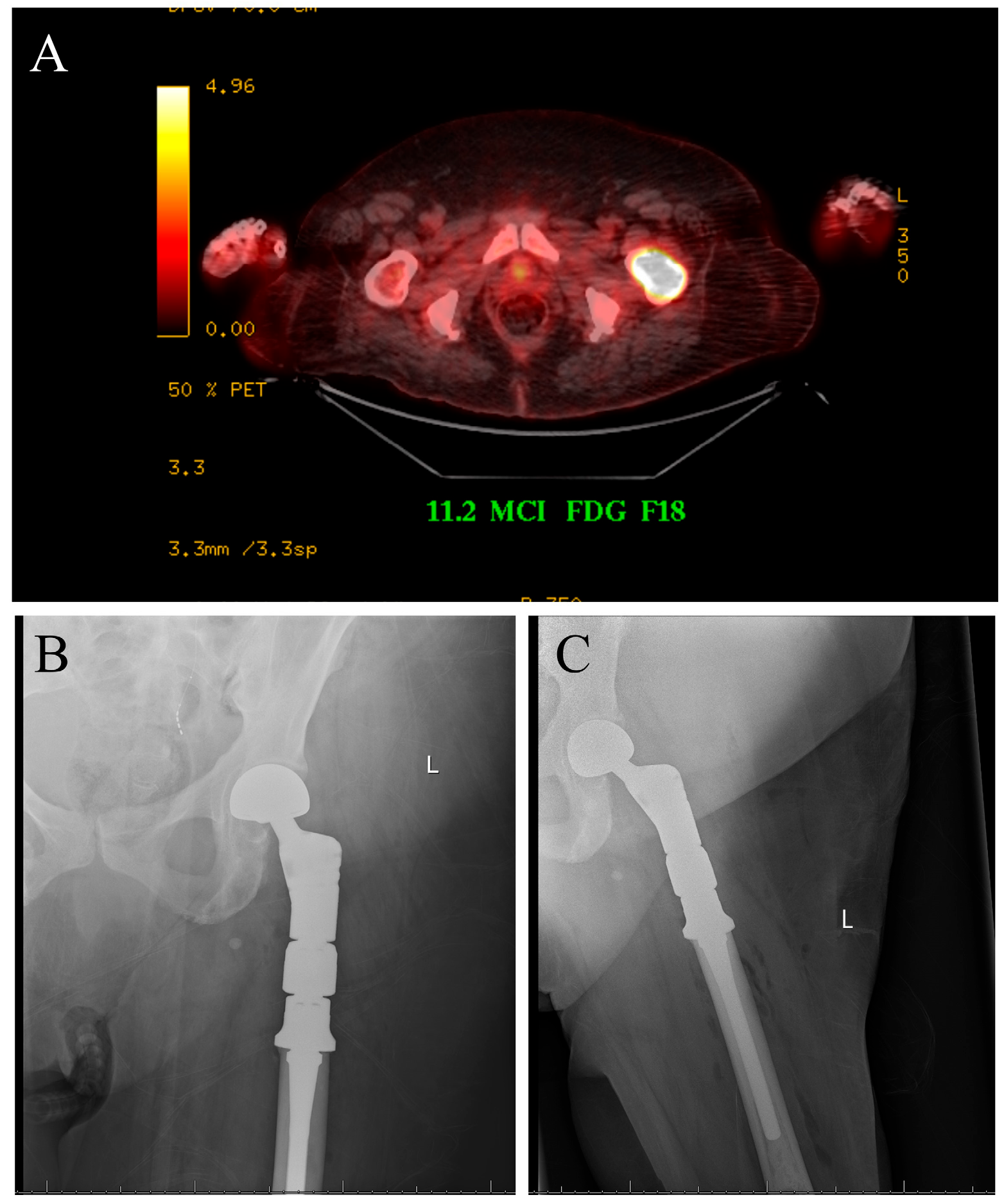
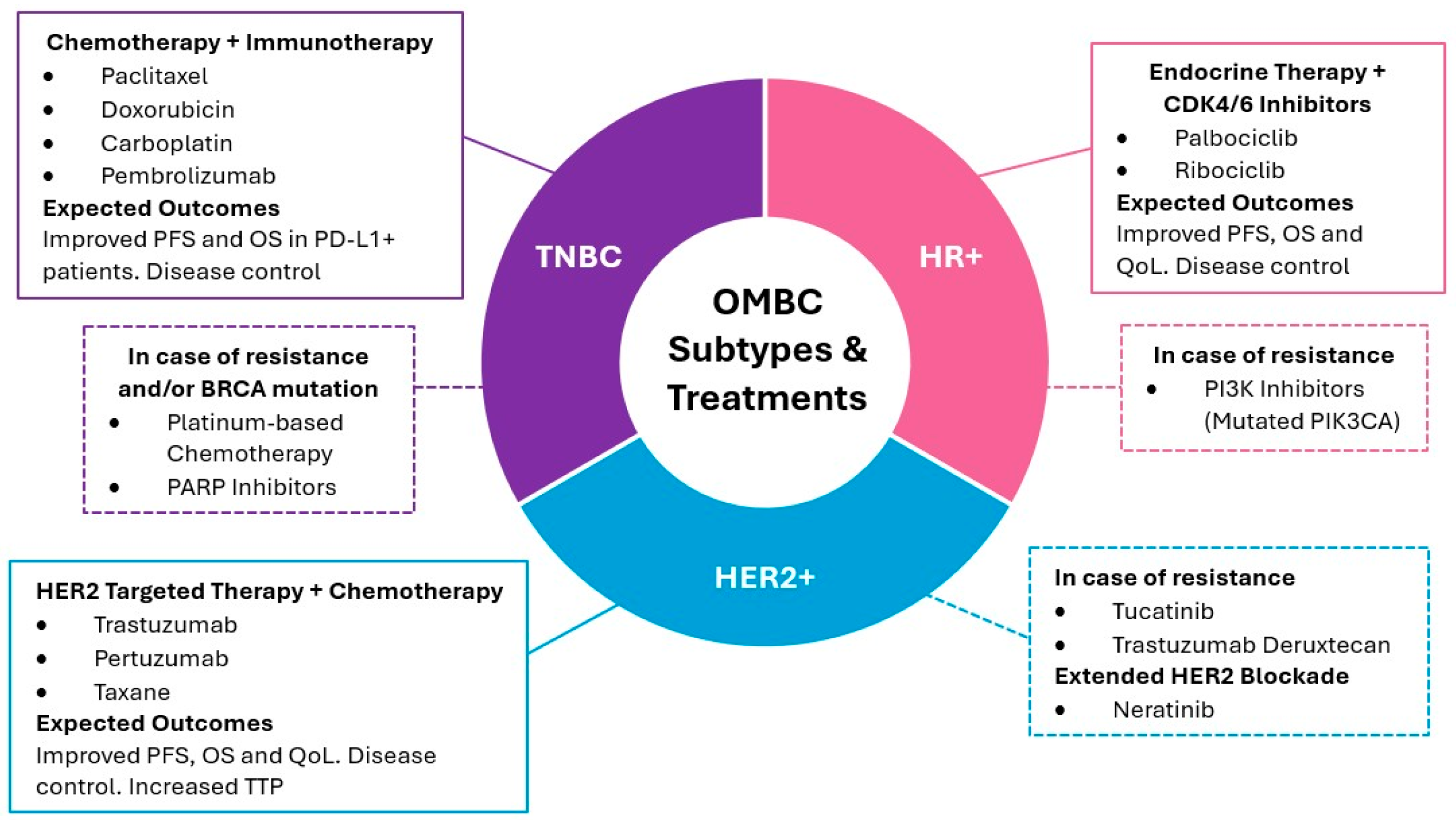

| Author | Patient (n) | Metastatic Site | Surgical Intervention | Outcomes Measures | Results |
|---|---|---|---|---|---|
| Wegener et al. [48] | 115 | Axial & Appendicular | vertebroplasty, decompression, endoprosthesis | complication rate mOS (single bone) | 13% 65 months |
| Wedin et al. [53] | 107 | Axial & Appendicular | ostheosynthetic devices, endoprothesis | mOS reoperation rate | 22 months 11% |
| Durr et al. [43] | 70 | Axial & Appendicular | endoprosthesis, spinal decompression, hip arthroplasty | 1-year OS 2-year OS 5-year OS 10-year OS 5-year OS (single bone) local recurrence | 59% 36% 13% 7% 39% 0% |
| Weiss et al. [51] | 301 | Axial & Appendicular | endoprosthesis, open reduction, internal fixation, spinal decompression | 1-year OS 2-year OS 5-year OS complication rate reoperation rate | 45% 27% 8% 25% 14% |
| Noguchi et al. [78] | 9 | Axial (sternum) | partial & total resection of sternum, lymph node dissection | mOS | 30 months |
| Incarbone et al. [77] | 19 | Axial (sternum) | partial, subtotal & total resection of sternum | 5-year OS (direct extension) 5-year OS (distant bone) local recurrence | 48% 60% 0% |
| Hankins et al. [91] | 76 | Axial & Appendicular | NA | mOS | 88.9 months |
| Mouraria et al. [92] | 41 | Appendicular (femur) | femoral prosthetic replacement, intramedullary nails and plates | mOS mortality | 8.1 months 70% |
| Nathan et al. [93] | 37 | Axial & Appendicular | joint replacement, extremity fracture stabilization, spine decompression, amputation | mOS | 13.5 months |
| Ratasvuori et al. [94] | 364 | Appendicular | endoprosthesis, nailing and plating procedures | mOS reoperation rate | 12 months 5.9% |
| Author | Patient (n) | Metastatic Site | Risk Factors | Results |
|---|---|---|---|---|
| Durr et al. [43] | 70 | Axial & Appendicular | Tumor spread α | RR 2.41 + |
| Duration of symptoms β | RR 0.5 + | |||
| Weiss et al. [51] | 301 | Axial & Appendicular | Age > 60 years | HR 1.9 + |
| Hemoglobin < 110 g/L | HR 2.0 + | |||
| Hankins et al. [91] | 76 | Axial & Appendicular | Synchronous metastases | HR 2.27 + |
| Increased age at diagnosis | HR 1.03 + | |||
| Mouraria et al. [92] | 41 | Appendicular (femur) | Proximal femur lesion | HR 2.97 +Φ |
| Diaphysis femur lesion | HR 3.32 +Φ | |||
| Drop 1 mg/dL hemoglobin | HR 1.26 + | |||
| Increase 1 mg/dL creatinine | HR 3.65 + | |||
| Presence of fracture | HR 3.13 + | |||
| Sciubba et al. [97] | 87 | Axial (spine) | Cervical lesion | RR 2.1 ++ |
| Negative estrogen receptor | RR 3.7 + | |||
| Shehadi et al. [98] | 87 | Axial (spine) | Instrumentation of ≥5 spinal levels | OR 7.2 + |
| Yao et al. [99] | 54 | Axial (spine) | Hormone therapy insensitivity | HR 1.68 + |
| Brain metastases | HR 3.55 + |
| Identifier | Primary Tumor | Design | Patient (n) | No. of Metastases | Metastatic Site | Intervention | Outcomes Measure | Results |
|---|---|---|---|---|---|---|---|---|
| CRO 2012-47 [23] | Breast | Prospective Phase II Trial | 54 | 1–5 | Mixed (60 bone) | SABR or IMRT | 1-year PFS 2-year PFS 2-year LC 2-year OS | 75% 53% 97% 95% |
| U1111-1154-1830 [100] | Breast | Prospective Clinical Trial | 15 | 1–3 | Bone | SABR | 2-year LPFS 2-year DPFS | 100% 67% |
| NCT01446744 [101] | Mixed | Phase II Randomized Trial | 99 (18 breast) | 1–5 | Mixed (65 bone) | arm 1: SOC arm 2: SOC + SABR | 5-year OS | 17.7% (arm 1) vs. 42.3% (arm 2) |
| 5-year PFS | not reached (arm 1) vs. 17.3% (arm 2) | |||||||
| NCT02581670 [102] | Breast | Phase II Non-randomized Prospective Trial | 64 | 1–4 | Lung, Liver | SBRT | 3-year LC mOS 3-year OS mDMFS 3-year DMFS | 91% 16.5 mo 51.9% 8.3 mo 16% |
| NCT03862911 [103] | Mixed | Phase III Randomized Trial | 330 | 1–3 | NA | SABR vs. SOC | OS | pending (recruiting) |
| NCT03721341 [104] | Mixed | Phase III Randomized Trial | 204 | 4–10 | NA | SABR + SOC vs. SOC | OS | pending (active, not recruiting) |
| NCT04495309 [105] | Breast | Randomized Controlled Trial | 564 | 1–5 | NA | RT + SOC vs. SOC | PFS QoL | pending (unknown status) |
| NCT02364557 [106] | Breast | Phase II/III Randomized Trial | 129 | 1–4 | Mixed | arm 1: SOC arm 2: SOC + RT/Surgery | PFS | 23 mo (arm 1) vs. 19.5 mo (arm 2) |
| OS | 36-mo OS: 71.8% (arm 1) vs. 68.9% (arm 2) | |||||||
| NCT03808337 [107] | Breast, Lung | Phase II Randomized Trial | 145 | 1–5 | NA | SABR + SOC vs. SOC | PFS | pending (recruiting) |
| NCT03750396 [108] | Breast | Phase II Single Arm | 110 | 1–2 | Mixed | RT/RFA/Surgery + SOC | PFS | pending (unknown status) |
| NCT04698252 [109] | Breast | Phase II Randomized Trial | 74 | 1–4 | Mixed | RT/RFA/Surgery + SOC vs. SOC | PFS | pending (recruiting) |
| NCT04424732 [110] | Breast | Prospective Single Arm | 50 | 1–3 | Bone | SBRT | PFS OS | pending (recruiting) |
| NCT02089100 [111] | Breast | Phase III Randomized Trial | 280 | 1–5 | Mixed | SABR + SOC vs. SOC | PFS | pending (recruiting) |
| NCT06144346 [112] | Breast | Phase III Randomized Trial | 150 | 1–5 | NA | SBRT + SOC vs. SOC | PFS OS | pending (recruiting) |
| NCT04646564 [113] | Breast | Phase III Randomized Trial | 170 | 1–5 | NA | RT + SOC vs. SOC | PFS | pending (recruiting) |
| NCT06135714 [114] | Breast | Phase III Randomized Trial | 340 | 1–3 | NA | RT/Surgery + SOC vs. SOC | OS | pending (recruiting) |
| NCT02759783 [115] | Breast, Lung, Prostate | Phase II/III Randomized Trial | 245 | 1–3 | Mixed | SABR + SOC vs. SOC | PFS | pending (unknown status) |
| NCT05377047 [116] | Breast | Phase III Randomized Trial | 345 | 1–5 | Mixed | SABR + SOC vs. SOC | PFS OS | pending (recruiting) |
| NCT03143322 [117] | Breast, Prostate, NSCLC | Phase III Randomized Trial | 196 | 1–5 | Bone | SABR + SOC vs. SOC | PFS | pending (active, not recruiting) |
| Author | Study Type | Patient (n) | Biological Status | Metastatic Site | Systemic Treatment | Outcomes Measure | Results |
|---|---|---|---|---|---|---|---|
| Cassier et al. [136] | Phase III Randomized Trial | 210 | 74% were HR+ | Mixed (20 bone) | Doxorubicin + Docetaxel (arm D) vs. Doxorubicin + Paclitaxel (arm P) | PFS mOS | 8.7 (arm D) vs. 8.0 mo (arm P) 21.4 (arm D) vs. 27.3 mo (arm P) |
| Sledge et al. [137] | Phase III Randomized Trial | 739 | 45% were ER+ | Mixed (130 bone) | Doxorubicin (arm D) vs. Paclitaxel (arm P) vs. Doxorubicin + Paclitaxel (arm AT) | Response rate | 36% (arm D) vs. 34% (arm P) vs. 47% (arm AT) 5.8 (arm D) vs. 6.0 (arm P) vs. 8.0 mo (arm AT) |
| TTF | |||||||
| Schmid et al. [138] | Phase III Randomized Trial | 902 | TNBC | Mixed (286 bone) | Atezolizumab + Nab-paclitaxel (arm A) vs. Placebo + Nab-paclitaxel arm B) | PFS | 7.2 (arm A) vs. 5.5 mo (arm B) |
| Finn et al. [139] | Phase III Randomized Trial | 666 | HR+/HER2- | Mixed (151 bone) | Palbociclib + Letrozole (arm A) vs. Placebo + Letrozole (arm B) | PFS | 24.8 (arm A) vs. 14.5 mo (arm B) |
| Hortobagyi et al. [140] | Phase III Randomized Trial | 668 | HR+/HER2- | Mixed (147 bone) | Ribociclib + Letrozole (arm A) vs. Placebo + Letrozole (arm B) | PFS | 25.3 (arm A) vs. 16.0 mo (arm B) |
| André et al. [134] | Phase III Randomized Trial | 341 | HR+/HER2- with PIK3CA mutation | Mixed (77 bone) | Alpelisib + Fulvestrant (arm A) vs. Placebo + Fulvestrant (arm B) | PFS | 11.0 (arm A) s 5.7 mo (arm B) |
| Swain et al. [141] | Phase III Randomized Trial | 808 | HER2+ | Mixed | Pertuzumab + Trastuzumab + Docetaxel (arm A) vs. Placebo + Trastuzumab + Docetaxel | PFS mOS | 18.7 (arm A) vs. 12.4 mo (arm B) 56.5 (arm A) vs. 40.8 mo (arm B) |
| Cortes et al. [142] | Phase III Randomized Trial | 847 | TNBC | Mixed (255 bone) | Pembrolizumab + Chemotherapy (arm A) vs. Placebo + Chemotherapy (arm B) | PFS mOS | 7.5 (arm A) vs. 5.6 mo (arm B) 17.2 (arm A) vs. 15.5 mo (arm B) + |
| Diéras et al. [143] | Phase III Randomized Trial | 991 | HER2+ | Mixed | Trastuzumab emtansine (arm A) vs. Capecitabine + Lapatinib (arm B) | PFS mOS | 9.6 (arm A) vs. 6.4 mo (arm B) 29.9 (arm A) vs. 25.9 mo (arm B) |
| Arpino et al. [144] | Phase II Randomized Trial | 258 | HR+/HER2+ | Mixed | Pertuzumab + Trastuzumab + Aromatase inhibitor (arm A) vs. Trastuzumab + Aromatase inhibitor (arm B) | PFS mOS | 20.6 (arm A) vs. 15.8 mo (arm B) 60.2 (arm A) vs. 57.2 mo (arm B) |
| Huober et al. [145] | Phase III Randomized Trial | 57 | HR+/HER2+ | Mixed (34 bone) | Letrozole alone (arm A) vs. Letrozole + Trastuzumab (arm B) | TTP CBR | 3.3 (arm A) vs. 14.1 mo (arm B) 39% (arm A) vs. 65% (arm B) |
| Johnston et al. [146] | Phase III Randomized Trial | 355 | HR+/HER2+ | Mixed (172 bone) | Lapatinib + Trastuzumab + Aromatase inhibitor (arm A) vs. Trastuzumab + Aromatase inhibitor (arm B) vs. Lapatinib + Aromatase inhibitor (arm C) | PFS | 11.0 (arm A) vs. 5.7 (arb B) vs. 8.3 mo (arm C) |
| Wesolowski et al. [147] | Phase Ib Non-randomized Trial | 41 | HR+/HER2- | Mixed (26 bone) | Gedatolisib + Palbociclib + Letrozole | PFS mOS | 48.4 months 77.3 months |
| Bardia et al. [148] | Phase III Randomized Trial | 468 | TNBC | Mixed (103 bone) | Sacituzumab govitecan (arm A) vs. Single-agent chemotherapy (arm B) | PFS mOS | 5.6 (arm A) vs. 1.7 mo (arm B) 12.1 (arm A) vs. 6.7 mo (arm B) |
Disclaimer/Publisher’s Note: The statements, opinions and data contained in all publications are solely those of the individual author(s) and contributor(s) and not of MDPI and/or the editor(s). MDPI and/or the editor(s) disclaim responsibility for any injury to people or property resulting from any ideas, methods, instructions or products referred to in the content. |
© 2025 by the authors. Licensee MDPI, Basel, Switzerland. This article is an open access article distributed under the terms and conditions of the Creative Commons Attribution (CC BY) license (https://creativecommons.org/licenses/by/4.0/).
Share and Cite
Kon-Liao, K.; Layme, J.; Otero López-Lavalle, A.; Gonzalez, M.R.; Pretell-Mazzini, J. Management of Musculoskeletal Oligometastatic Disease in Breast Cancer. Cancers 2025, 17, 3578. https://doi.org/10.3390/cancers17213578
Kon-Liao K, Layme J, Otero López-Lavalle A, Gonzalez MR, Pretell-Mazzini J. Management of Musculoskeletal Oligometastatic Disease in Breast Cancer. Cancers. 2025; 17(21):3578. https://doi.org/10.3390/cancers17213578
Chicago/Turabian StyleKon-Liao, Kelly, Josue Layme, Andrea Otero López-Lavalle, Marcos R. Gonzalez, and Juan Pretell-Mazzini. 2025. "Management of Musculoskeletal Oligometastatic Disease in Breast Cancer" Cancers 17, no. 21: 3578. https://doi.org/10.3390/cancers17213578
APA StyleKon-Liao, K., Layme, J., Otero López-Lavalle, A., Gonzalez, M. R., & Pretell-Mazzini, J. (2025). Management of Musculoskeletal Oligometastatic Disease in Breast Cancer. Cancers, 17(21), 3578. https://doi.org/10.3390/cancers17213578

