Abstract
Gallium nitride (GaN) has emerged as one of the most promising wide-bandgap semiconductors for next-generation space photovoltaics. In contrast to conventional III–V compounds such as GaAs and InP, which are highly efficient under terrestrial conditions but suffer from radiation-induced degradation and thermal instability, GaN offers an exceptional combination of intrinsic material properties ideally suited for harsh orbital environments. Its wide bandgap, high thermal conductivity, and strong chemical stability contribute to superior resistance against high-energy protons, electrons, and atomic oxygen, while minimizing thermal fatigue under repeated cycling between extreme temperatures. Recent progress in epitaxial growth—spanning metal–organic chemical vapor deposition, molecular beam epitaxy, hydride vapor phase epitaxy, and atomic layer deposition—has enabled unprecedented control over film quality, defect densities, and heterointerface sharpness. At the device level, InGaN/GaN heterostructures, multiple quantum wells, and tandem architectures demonstrate outstanding potential for spectrum-tailored solar energy conversion, with modeling studies predicting efficiencies exceeding 40% under AM0 illumination. In this review article, the current state of knowledge on GaN materials and device architectures for space photovoltaics has been summarized, with emphasis placed on recent progress and persisting challenges. Particular focus has been given to defect management, doping strategies, and bandgap engineering approaches, which define the roadmap toward scalable and radiation-hardened GaN-based solar cells. With sustained interdisciplinary advances, GaN is anticipated to complement or even supersede traditional III–V photovoltaics in space, enabling lighter, more durable, and radiation-hard power systems for long-duration missions beyond Earth’s magnetosphere.
1. Introduction
With the rapid expansion of satellite constellations, lunar missions, Mars exploration and development of orbital infrastructure, the demand for lightweight, efficient, and durable power generation systems has become increasingly critical. Among the available technologies, photovoltaic (PV) devices converting solar radiation into electricity remain the primary solution for space-based power supply, owing to their modularity, long operational lifetimes, and continuous availability of solar irradiance in orbit [1,2].
However, unlike terrestrial environments, space imposes extreme and multifactorial challenges on photovoltaic materials. These include:
- Intense ionizing radiation from high-energy protons, electrons, and heavy ions, particularly in low Earth orbit (LEO), medium Earth orbit (MEO), and geostationary Earth orbit (GEO);
- Elevated ultraviolet (UV) and X-ray fluxes;
- Wide thermal cycles, with temperature variations ranging from approximately −170 °C to +120 °C within a single orbit;
- Vacuum-induced degradation and outgassing, especially under the influence of atomic oxygen (AO);
- Mechanical stress arising from launch vibrations and orbital thermal fatigue;
- Long mission durations requiring PV systems to operate reliably for 10–20 years without maintenance.
In addition to environmental robustness, next-generation PV materials must satisfy strict mass, volume, and efficiency constraints, particularly for interplanetary probes, small satellites, and large-scale satellite constellations. Achieving high power-to-weight ratios and compact architectures is essential for reducing launch costs and increasing mission flexibility [3,4,5]. Furthermore, with rising interest in megaconstellations and space-based solar power, scalability and cost-effective manufacturability of PV materials have become central concerns, as thousands of deployable solar units will be required to meet future energy and communication demands [6].
Over the past decades, III–V compound semiconductors including gallium arsenide (GaAs) and indium phosphide (InP) have dominated the landscape of space photovoltaics. Their high energy conversion efficiencies as well as compatibility with multi-junction devices make them appropriate for space missions, especially when combined with lattice-matched layers and spectrum-optimized designs [7,8,9].
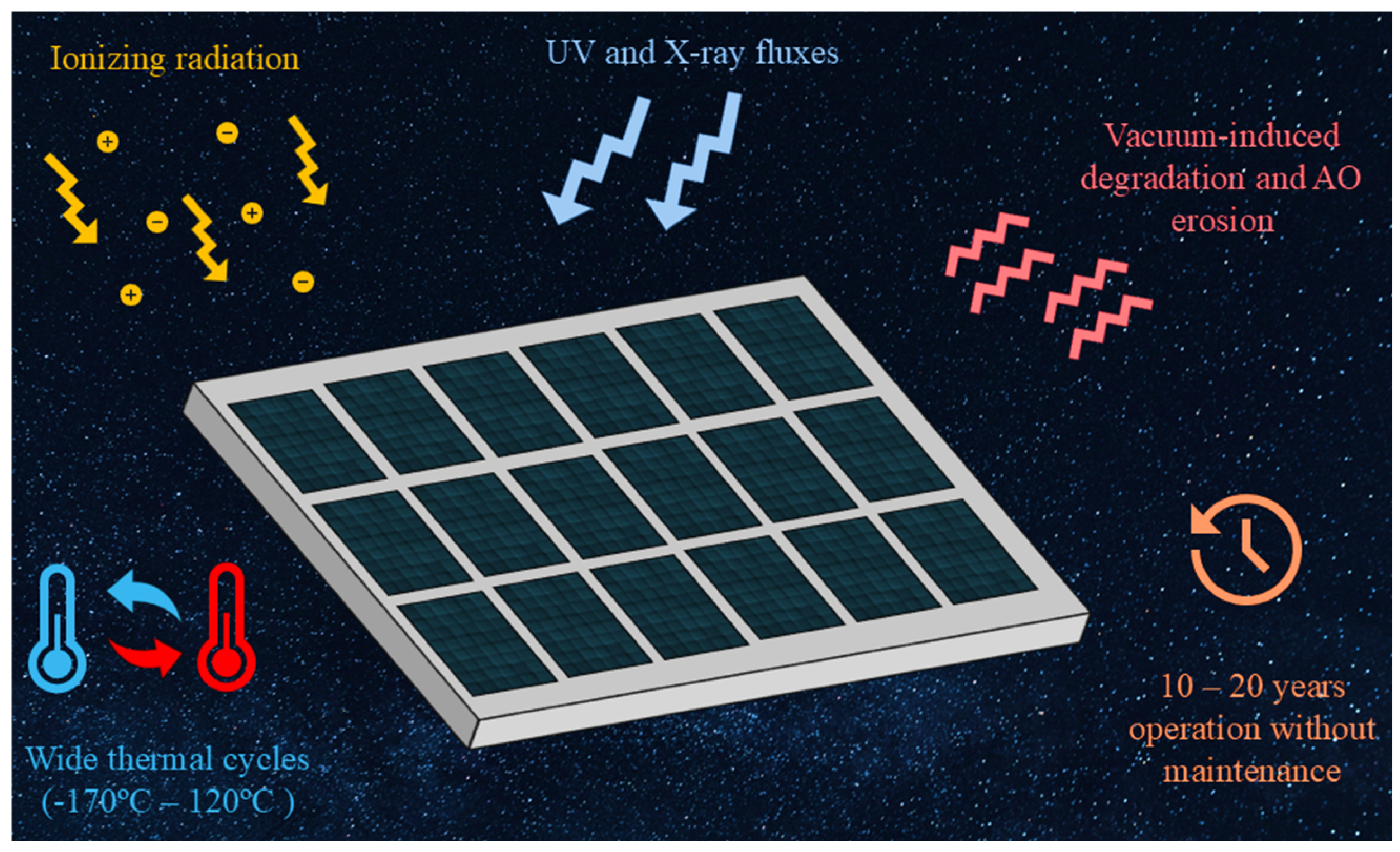
Although more radiation-tolerant than silicon, GaAs and InP still undergo significant performance degradation when exposed to prolonged bombardment by protons and electrons, which constitutes a critical challenge for long-duration missions beyond Earth’s protective magnetosphere. Moreover, their performance declines at elevated operating temperatures while their structural stability under repeated thermal cycling remains limited. The main environmental stress factors leading to the degradation of III–V photovoltaic devices in space environments are illustrated in Figure 1.
Figure 1.
Schematic representation of critical stressors affecting III–V photovoltaic devices in space applications.
These factors collectively contribute to performance degradation and reduced structural stability of III–V semiconductors under extreme space conditions. Another serious concern is the toxicity and limited availability of key elements such as arsenic, cadmium and indium, which not only introduce environmental and safety risks but also complicate large-scale supply chains due to geopolitical and resource limitations [10,11,12]. Furthermore, the fabrication of high-quality III–V structures typically relies on epitaxial growth methods. They, in turn, require expensive vacuum equipment, rigorous process control and are often restricted to small-scale batch production. These factors collectively hinder the scalability and cost-effectiveness of these technologies, particularly in the context of mass deployment for satellite constellations and long-range space missions. These obstacles have catalyzed a growing interest in alternative PV materials capable of maintaining the performance advantages of III–V semiconductors while overcoming their inherent limitations—especially under the extreme conditions characteristic for space environments [13,14,15,16].
GaN, a wide-bandgap III-nitride semiconductor, has emerged as a highly promising material for space photovoltaics. Originally developed for light-emitting diodes (LEDs) and high-frequency electronics, GaN is now gaining attention for its exceptional combination of radiation resistance, thermal and chemical stability and interesting electronic properties. Its wide bandgap (~3.4 eV) allows for efficient operation under intense solar radiation, while its robustness against proton and electron irradiation makes it appropriate for long-duration missions in difficult and demanding orbital environments [17,18,19]. In addition to its inherent material advantages, GaN supports a range of advanced photovoltaic devices including such architectures as InGaN/GaN heterojunctions, compositionally graded structures and quantum wells [20,21].
From a technological viewpoint, recent progress in metal–organic chemical vapor deposition (MOCVD), molecular beam epitaxy (MBE), ALD, and hydride vapor phase epitaxy (HVPE) allows precise GaN film deposition on various substrates, including silicon, sapphire and native GaN—expanding the design space for integration and deployment [22].
Taken together, these features make GaN not merely a substitute for existing photovoltaic materials but a transformative and scalable platform for the next generation of solar energy harvesting systems designed specifically for the demands of space. The following sections of this review explore in detail the material properties, synthesis strategies and cell architecture that form the basis for the development of GaN-based space photovoltaics.
2. Key Properties of GaN Relevant to Space Applications
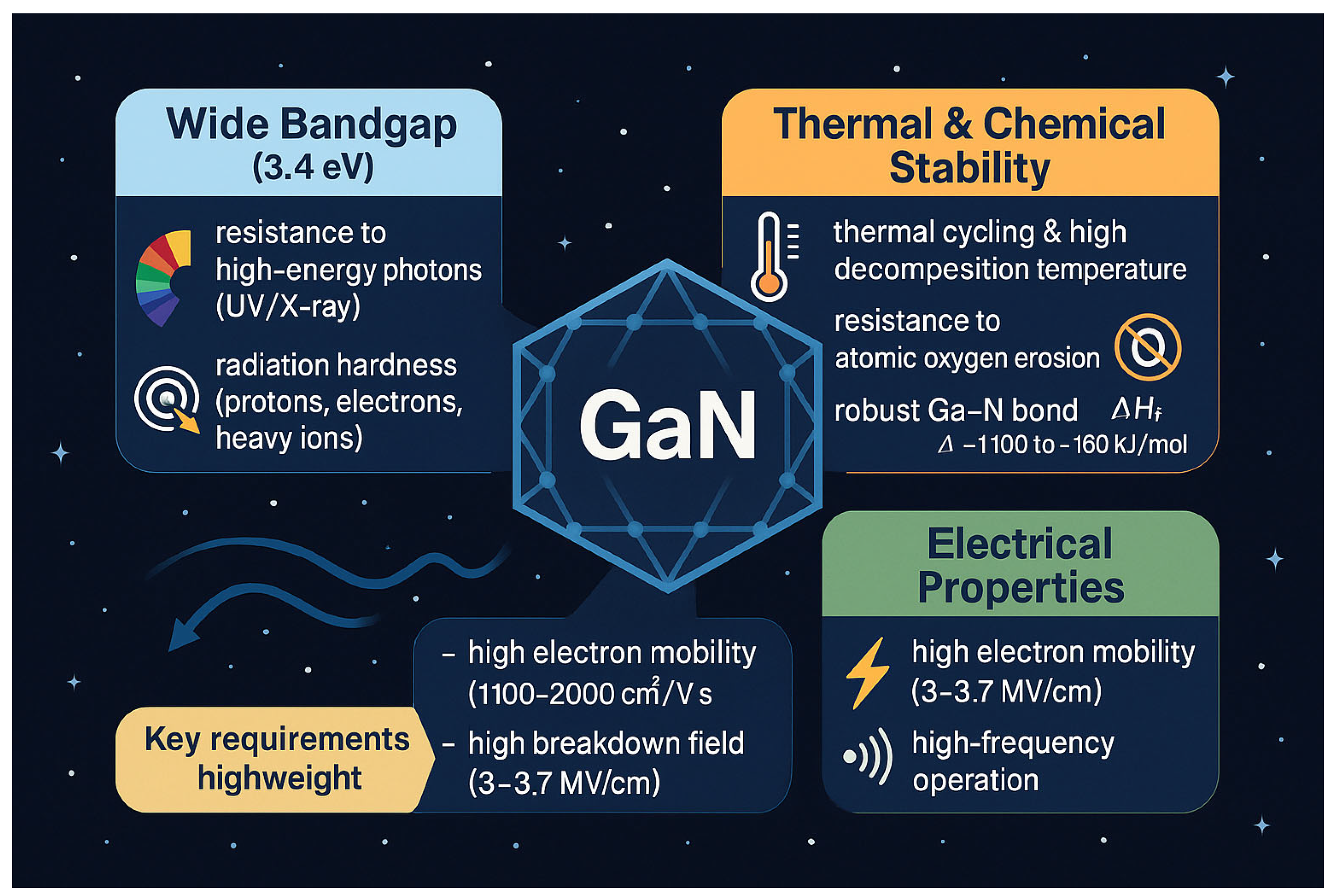
GaN has emerged as one of the most promising semiconductor materials for next-generation space technologies. Its intrinsic properties combine a wide bandgap with remarkable thermal, chemical, and electrical stability, enabling reliable operation under extreme conditions such as intense radiation, high vacuum, and severe thermal cycling. Unlike conventional III–V semiconductors, GaN provides a unique balance of robustness and efficiency, which makes it highly relevant for both photovoltaic and electronic applications in space. The key properties of GaN relevant to space applications are summarized in Figure 2.
Figure 2.
Overview of the fundamental material properties of GaN relevant to space environments.
These attributes collectively explain the growing interest in GaN as an enabling material for space systems. They not only address the inherent limitations of traditional III–V semiconductors but also open new opportunities for designing devices with enhanced durability and performance. In the following subsections, each of these key properties is discussed in detail, with a focus on their implications for space photovoltaics and electronics.
2.1. Wide Bandgap and Resistance to Radiation-Induced Damage
A significant characteristic making GaN exceptionally promising for space photovoltaics is its wide direct bandgap of approximately 3.4 eV. This property plays an important role in determining thermal, electronic and optical stability of the material under harsh orbital conditions. In contrast to narrow-bandgap semiconductors such as Si (1.1 eV) or GaAs (1.4 eV), GaN maintains low intrinsic carrier concentrations and is significantly less susceptible to thermally induced carrier excitation [23,24]. As a result, GaN-based devices show reduced leakage currents and superior operation in high-temperature and high-irradiance environments such as low Earth orbit (LEO), geostationary orbit (GEO) and interplanetary space [25]. The wide bandgap also enables an exceptional resistance of GaN to radiation-induced damage. In space, semiconductors are permanently exposed to high-energy particles which can displace atoms in the crystal lattice and generate defects acting as recombination centers. GaN, however, benefits from strong covalent bonding, low atomic number and high cohesive energy, which contribute to its resistance to displacement damage. Reported displacement threshold energies typically exceed 10 eV (around 12 eV for N and over 20 eV for Ga), significantly higher than in many III–V semiconductors such as GaAs or InP [26,27].
Numerous irradiation studies have demonstrated that GaN retains its optoelectronic properties under extreme conditions. GaN-based heterostructures and quantum wells show minimal degradation in carrier mobility, photoluminescence intensity and junction integrity even after proton fluences exceeding 1014 cm−2—levels at which GaAs or InP devices experience severe performance loss [28,29]. GaN also exhibits robustness against both ionizing and non-ionizing radiation effects, as confirmed by flight-demonstrated devices in geostationary orbit [30,31]. Power-electronics-grade GaN shows high tolerance in harsh space radiation environments, outperforming Si-based MOSFETs and eliminating the need for extensive shielding [32,33]. This radiation hardness provides system-level advantages: GaN-based devices can maintain functionality with minimal shielding, reducing both mass and volume—two critical constraints in aerospace design. Enhanced durability also lowers the risk of system failure and enables more aggressive mission trajectories, including operation in radiation-intensive environments such as lunar or Martian orbits [34].
2.2. High Thermal and Chemical Stability
GaN demonstrates notable thermal and chemical stability, important for reliable operation in extreme space conditions. Because of its wide bandgap and strong bonding, GaN shows good tolerance to temperature fluctuations and limited chemical degradation under vacuum and elevated temperatures. In situ decomposition studies indicate that GaN begins to decompose in vacuum only at high temperatures, while nitrogen-rich environments significantly suppress this effect [35]. Surface studies of GaN(0001) reveal that Ga-terminated surfaces resist many chemical reactions, supporting overall environmental robustness [36]. Device-level tests also confirm high thermal durability: GaN HEMTs with improved heat-dissipation structures show reduced performance degradation at elevated junction temperatures [37], and studies of deep-level traps in MOCVD-grown GaN suggest that many defect states remain stable under moderate annealing [38]. GaN exhibits high thermal stability due to its wide bandgap and strong covalent bonding in the wurtzite structure. The material maintains structural integrity at temperatures far exceeding those tolerated by GaAs or InP, which often experience lattice degradation or defect activation at much lower temperatures. The high thermal conductivity of GaN, typically 130–230 W·m−1·K−1 (with record values near 300 W·m−1·K−1), further improves heat dissipation and reduces thermally induced degradation in spaceborne devices [39,40,41].
Recent studies provide quantitative insight into the relationship between temperature cycling behavior and device performance in GaN-based electronics. In particular, experimental investigations reported in [42] directly analyze the impact of repeated thermal cycling on the electrical stability of GaN devices, showing that cyclic heating and cooling can induce gradual changes in series resistance and leakage current due to thermally induced stress at heterointerfaces. These effects are closely related to thermal-expansion mismatch and stress accumulation during repeated temperature excursions, which are especially relevant for space environments characterized by frequent day–night transitions. Complementary evidence is provided by high-temperature power-cycling studies of p-GaN HEMTs reported by Hein et al. [43]. Devices were subjected to repetitive power and temperature cycling with virtual junction temperatures reaching 175 °C and endured more than 40 million cycles without irreversible degradation of key electrical parameters. Although the on-state resistance increased with temperature—reaching approximately 2.5× its room-temperature value at 200 °C—this behavior was reversible and attributed to phonon-limited transport rather than permanent structural damage. Importantly, leakage currents at 600 V remained below 100 µA at elevated temperature, and no significant drift in threshold voltage or gate characteristics was observed. Thermal runaway occurred only under current-saturation conditions, linking performance degradation to electrothermal operating regimes rather than intrinsic material failure. These results demonstrate the inherent thermal robustness of GaN-based devices and their strong tolerance to repeated temperature cycling, which is a key advantage for space applications.
GaN’s hybrid ionic–covalent bonding contributes to its strong Ga–N bonds (bond length ~1.95 Å) and relatively high formation enthalpy (−110 to −160 kJ/mol), both indicators of thermodynamic stability [44,45,46]. Its low thermal expansion coefficients—~5.6 × 10⁻⁶ K−1 along the a-axis and ~3.2 × 10⁻⁶ K−1 along the c-axis—help minimize thermal-mismatch stress during heating–cooling cycles, reducing risks of delamination or cracking in GaN-based devices [47]. Thermodynamic studies also show that GaN resists oxidation under low oxygen chemical potential, and full oxidation becomes favorable only under harsher conditions [48]. Experimental and modeling studies further indicate that GaN layers maintain structural coherence under repeated thermal cycles up to several hundred degrees Celsius, with manageable strain relative to substrates such as sapphire or SiC [49,50,51,52].
2.3. Electrical Transport Properties and Breakdown Field Strength
GaN is widely recognized for its excellent electrical transport properties, which make it a leading material for high-power and high-frequency applications. Its wide bandgap and strong polar bonding give rise to high electron mobility, high saturation velocity, and an exceptionally high breakdown field. Electron mobility in GaN is governed by several scattering mechanisms, including ionized impurities, polar optical phonons, piezoelectric scattering, and acoustic phonons. At low temperatures (<100 K), acoustic phonons dominate, while at higher temperatures, polar optical phonon scattering becomes the primary limitation [53,54]. Typical room-temperature mobility values for bulk GaN lie between 1100 and 2000 cm2/V·s [55]. Mobility decreases with temperature due to enhanced phonon scattering, consistent with Monte Carlo and Hall measurements. GaN also exhibits a high saturation electron velocity of about 2–3 × 107 cm/s at room temperature, enabling fast switching performance in electronic devices [56]. A defining property of GaN is its very high breakdown electric field, substantially exceeding that of Si or GaAs. Critical field strengths for wurtzite GaN are typically 3.0–3.75 MV/cm [55], allowing GaN devices to sustain large voltage biases. Simulations show that the fields required for drift-velocity saturation or significant electron heating increase with temperature, reaching >100 kV/cm at elevated conditions. Experimental studies confirm that GaN tolerates extreme electric fields because of its wide bandgap and low intrinsic carrier concentration. Temperature strongly affects electron transport: as the lattice heats, phonon populations rise, reducing mobility and saturation velocity. This is particularly relevant for power electronics, where self-heating is significant. Simulations show stable mobility in the low-field region, saturation at moderate fields due to polar optical phonons, and intervalley scattering at very high fields (>200 kV/cm), which alters drift velocity and energy relaxation [53,56,57].
The combination of high breakdown field, high mobility, and high saturation velocity makes GaN highly suitable for power electronics, RF amplifiers, and high-frequency systems. Its ability to function under high electric fields and elevated temperatures, together with low intrinsic carrier concentration and good thermal conductivity (~1.6 W/cm·K), enhances device reliability in demanding environments [58,59]. Table 1 summarizes key properties of GaN relative to other III–V materials, highlighting its superior bandgap, thermal conductivity, radiation tolerance, and reduced toxicity—factors contributing to its growing relevance for next-generation space photovoltaics.
Table 1.
Comparison of selected material properties of GaN, GaAs, and InP relevant to space photovoltaic applications. Values are given for room temperature (300 K) unless otherwise noted. Radiation tolerance values are indicative and depend on particle energy, device architecture, and test conditions.
The data clearly underline that GaN offers a unique balance of wide bandgap, high thermal conductivity, and superior resistance to radiation damage compared to GaAs and InP. At the same time, challenges related to substrate cost and defect management remain critical barriers for its broader deployment. These considerations set the stage for the following section, which focuses on epitaxial growth techniques and defect-reduction strategies essential for advancing GaN-based space photovoltaics.
GaN is not only relevant as a photovoltaic absorber but also as a key material for high-efficiency power-conversion circuits in space systems. Its wide bandgap, high breakdown field, and high electron mobility enable the fabrication of GaN HEMTs and Schottky diodes that operate at high frequencies with low switching and conduction losses. Such devices are central to power-management units, DC–DC converters, and MPPT circuits in satellites, where thermal constraints and radiation exposure are critical challenges. Owing to its strong resistance to displacement damage and ionizing radiation, GaN allows compact, efficient, and robust power-conditioning electronics that complement GaN-based photovoltaic absorbers.
Beyond these transport parameters, the above-described material characteristics—wide bandgap, strong bonding, high thermal stability, and excellent radiation resistance—directly reinforce GaN’s electrical performance in space environments. They allow GaN devices to maintain stable mobility, low leakage, and predictable switching behavior even under high fields, strong irradiation, and large temperature swings characteristic of orbital operation. As a result, GaN circuits used in power management, signal conditioning, and high-frequency communication systems benefit from reduced degradation and increased operational lifetime compared to conventional III–V technologies. This link between intrinsic material robustness and reliable charge transport is one of the main reasons why GaN is considered a key platform not only for photovoltaic absorbers but also for the accompanying high-efficiency electronics required in modern space missions [63,64,65].
3. Synthesis Techniques for GaN-Based Photovoltaic Structures
For space photovoltaics, GaN growth methods should be discussed beyond basic deposition aspects. Key factors include crystalline quality, defect density, scalability, and stability under radiation and temperature cycling. Space applications require low dislocation densities, good structural uniformity, and mechanical stability during repeated thermal changes. These requirements strongly influence which growth techniques are practically suitable. Therefore, ALD, MOCVD, MBE, and HVPE are discussed below with a focus on their relevance and limitations for GaN-based space photovoltaic devices.
3.1. Atomic Layer Deposition (ALD)
Atomic Layer Deposition (ALD), including plasma-enhanced variants, is characterized by excellent conformality and precise thickness control at the atomic scale. However, its inherently low deposition rates make ALD unsuitable for the growth of micron-thick photovoltaic layers. In the context of space photovoltaics, ALD is therefore best positioned as a complementary technique for ultrathin passivation layers, tunneling junctions, or interface engineering, rather than as a primary method for layer growth [66].
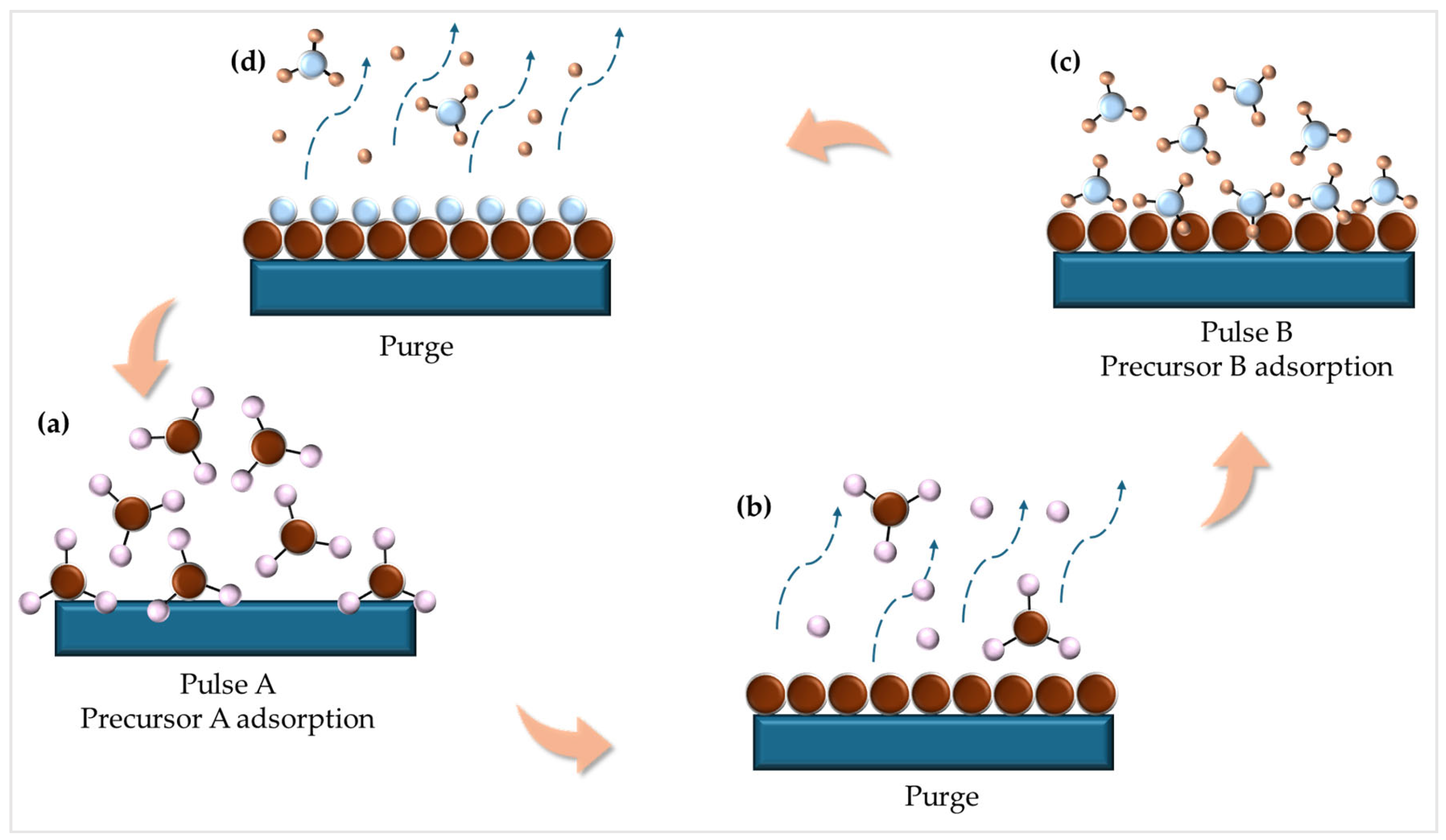
ALD is a vapor-phase technique based on self-limiting surface reactions, offering atomic-scale thickness control, excellent conformality, and uniform coverage over complex three-dimensional topographies [67,68,69]. These advantages make ALD particularly attractive for the deposition of GaN thin films, especially in applications requiring ultrathin, uniform layers—such as nanoscale electronics, optoelectronics, and photovoltaics for space technologies [70,71]. In Figure 3, the ALD process is schematically presented, illustrating the sequential, self-limiting surface reactions that enable layer-by-layer growth with sub-nanometer precision.
Figure 3.
Schematic illustration of the ALD cycle. The process consists of alternating precursor pulses separated by purge steps: (a) precursor A adsorption on the activated substrate surface, (b) purge to remove unreacted molecules and by-products, (c) precursor B adsorption and surface reaction, followed by (d) a second purge. Each cycle deposits a controlled sub-monolayer, enabling atomic-scale thickness control and conformal film growth.
In ALD of GaN, a typical cycle consists of alternate exposure to a gallium precursor and a nitrogen source, separated by inert gas purges to prevent gas-phase reactions. This cyclic approach allows for layer-by-layer growth, yielding stoichiometric GaN films with precise thickness control. One of the challenges in ALD of GaN is the relatively low reactivity of common nitrogen precursors (e.g., NH3) at low temperatures. Therefore, plasma-enhanced ALD (PEALD) is often used, where nitrogen is activated via radio frequency (RF) or microwave plasma, significantly enhancing surface reactivity and film quality at temperatures as low as 200–300 °C [72].
Various gallium precursors have been investigated in the literature for GaN ALD, including:
- Trimethylgallium (TMGa): A widely used precursor; allows for good control over film composition but may result in carbon contamination due to methyl ligands [73];
- Tris(dimethylamido)gallium (III) (Ga2(NMe2)6: This non-halide precursor has demonstrated promise for low-temperature processes with reduced carbon incorporation [74];
- Gallium trichloride (GaCl3): Although corrosive and requiring higher temperatures, it offers better control over film purity in some configurations [75];
For nitrogen sources, NH3 plasma and N2/H2 plasma [76] are most commonly used, enabling efficient nitridation at reduced thermal budgets—critical for temperature-sensitive substrates or multilayer structures.
An illustrative example is provided by Rouf et al. [77], who demonstrated plasma-enhanced ALD of GaN using tris(dimethylamido)gallium(III) [Ga(NMe2)3] as the gallium precursor and NH3 plasma as the nitrogen source. Self-limiting growth was observed in the temperature range of 130–250 °C, with a growth per cycle of approximately 1.4 Å. The resulting films exhibited crystallinity on Si(100) substrates with nearly stoichiometric Ga/N ratios and very low carbon and oxygen contamination. Notably, epitaxial GaN was achieved on 4H-SiC without the need for an AlN buffer layer—a result not previously reported for ALD GaN. The films showed an optical bandgap of ~3.42 eV and unintentional n-type conductivity. Kim et al. [78] reported thermal ALD of GaN on Si(100) substrates using GaCl3 and NH3, achieving a growth per cycle of approximately 2.0 Å/cycle. However, the thermal approach required temperatures above 400 °C and presented risks of Cl incorporation. Austin et al. [71] demonstrated high-temperature ALD of GaN on silica nanosprings using TMGa and NH3 at 800 °C, obtaining conformal amorphous coatings that became nanocrystalline (with an average crystallite size of 11.5 ± 0.5 nm) upon introducing Al2O3 or AlN buffer layers. Hafdi et al. [79] examined the surface chemistry of GaN ALD using TEG and NH3, showing via in situ mass spectrometry that ethyl ligands are removed during the TEG pulse, followed by ligand-exchange reactions during NH3 exposure. Banerjee et al. [70] reported a purely thermal ALD route for polycrystalline GaN using TMGa and NH3 at 400 °C, achieving a growth per cycle of ~0.1 nm without plasma activation and maintaining excellent conformality in high-aspect-ratio structures. The ALD window was narrow (375–425 °C), with decomposition of TMGa above 425 °C leading to contamination. Growth behavior strongly depended on NH3 partial pressure and pulse duration. Recent studies have expanded ALD GaN methodology. Cong et al. [80] investigated PEALD with TMGa/NH3 plasma over 250–350 °C, observing a transition from amorphous to oriented films. Wang et al. [81] achieved low-resistance N-polar GaN at 300 °C.
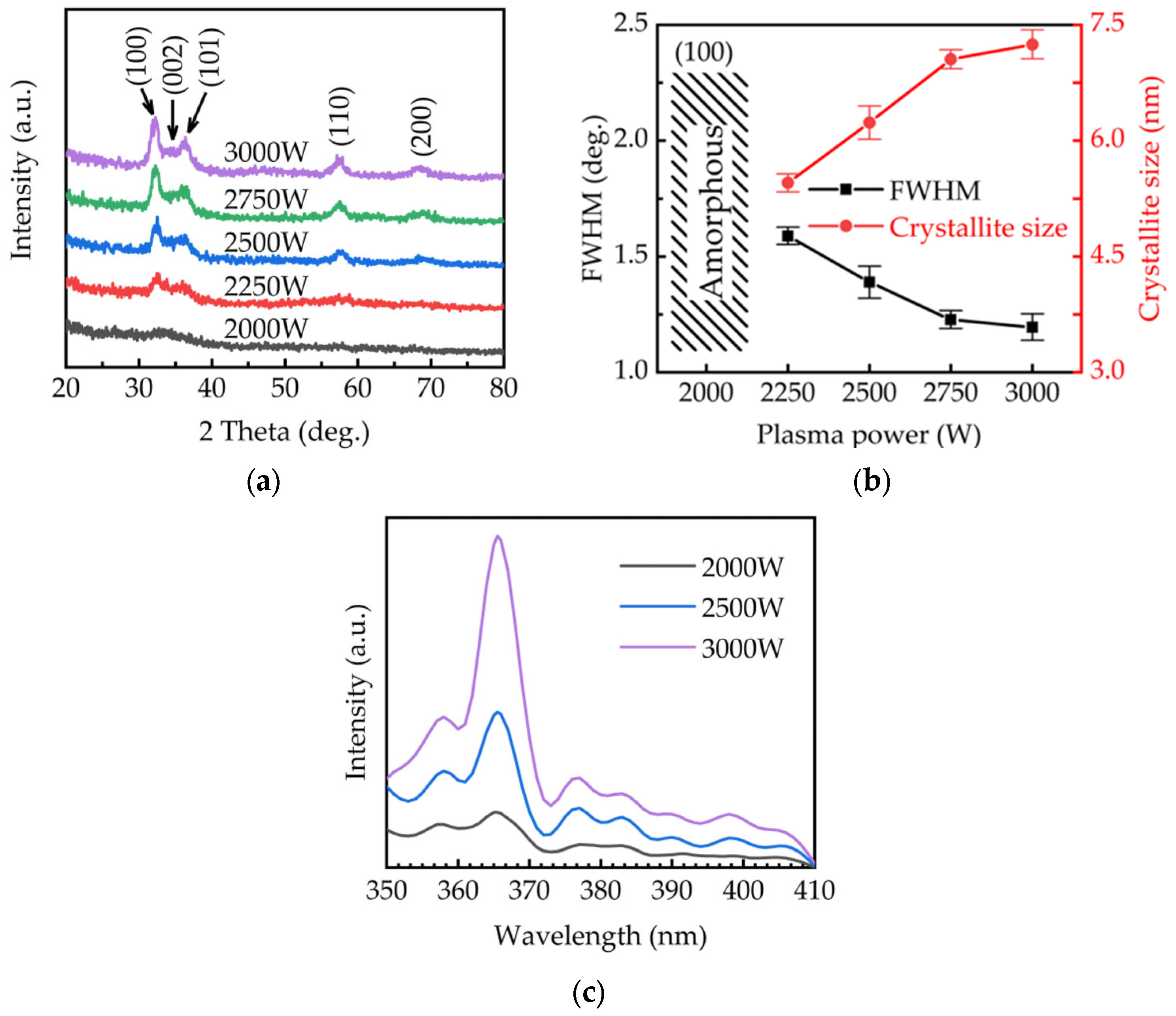
Jiang et al. [82] demonstrated effective oxygen reduction in PEALD-grown GaN using NH3-derived plasma radicals. In Figure 4, representative XRD and photoluminescence data illustrate the direct impact of plasma power on film quality.
Figure 4.
(a) XRD patterns of PEALD-GaN films deposited at different plasma powers, (b) corresponding FWHM values and crystallite sizes, and (c) room-temperature photoluminescence spectra showing enhanced near-band-edge emission at higher plasma power. Adapted from Ref. [82] under the CC BY 4.0 license.
At low plasma power, GaN films show weak and broadened XRD peaks, indicating poor crystallinity. Increasing the plasma power leads to well-defined GaN diffraction peaks, reduced FWHM values, and increased crystallite size. Correspondingly, PL spectra reveal a strong enhancement of near-band-edge emission at ~365 nm and a reduction in defect-related luminescence, confirming improved crystalline quality and lower oxygen-related defect density. Complementary process strategies were reported by Deminskyi et al. [76], who introduced an additional B-pulse to enhance ethyl-ligand removal and increase the growth-per-cycle, and by Yun et al. [83], who demonstrated polarity control through the incorporation of an Ar-plasma buffer layer.
The reviewed studies indicate that GaN ALD/PEALD commonly relies on metal–organic precursors such as TMG, TEG, Ga(NMe2)3, and GaCl3, with NH3 as the dominant nitrogen source. PEALD enhances nitridation efficiency, reduces contamination, and enables deposition at moderate temperatures (250–350 °C), while thermal ALD typically requires ≥400 °C and may suffer impurity incorporation. Substrates include Si(100), semi-insulating GaN, 4H-SiC, and 1D architectures. Process-dependent film characteristics range from amorphous to nanocrystalline to well-oriented. Modifications such as additional reactive pulses or Ar-plasma buffers enable improved growth rates and polarity control. Overall, PEALD is emerging as the preferred approach for crystalline GaN at moderate temperatures, while thermal ALD remains advantageous for extreme conformality. Ongoing research focuses on lowering deposition temperatures, improving crystallinity without post-annealing, and minimizing impurities. Plasma diagnostics, in situ ellipsometry, and advanced characterization (XPS, TEM, XRR) are being used to better understand growth mechanisms. Emerging directions include area-selective ALD [84,85,86], hybrid ALD–CVD/MBE processes [87,88], and low-temperature ALD on flexible substrates [89], supporting future lightweight and conformable photovoltaic architectures.
3.2. Metal–Organic Chemical Vapor Deposition (MOCVD)
Metal–Organic Chemical Vapor Deposition (MOCVD) is the dominant and industrially established technique for the growth of GaN layers used in photovoltaic devices, particularly for the relatively thick active layers required for efficient light harvesting. Its high deposition rates (typically several µm/h), excellent thickness and composition uniformity on large-diameter wafers, and compatibility with established III–V manufacturing processes make it well suited for practical device fabrication. From the perspective of space photovoltaics, these advantages are especially important. MOCVD enables reliable growth of GaN and InGaN layers with controlled composition, sharp interfaces, and relatively low defect densities, which are key requirements for multi-junction and tandem solar-cell concepts. In addition, the method supports scalable wafer-level processing and reproducibility, both critical for space-grade devices. In contrast, techniques such as ALD, while valuable for ultrathin passivation or tunneling layers, are inherently unsuitable for micron-scale layer growth due to their very low deposition rates [90,91].
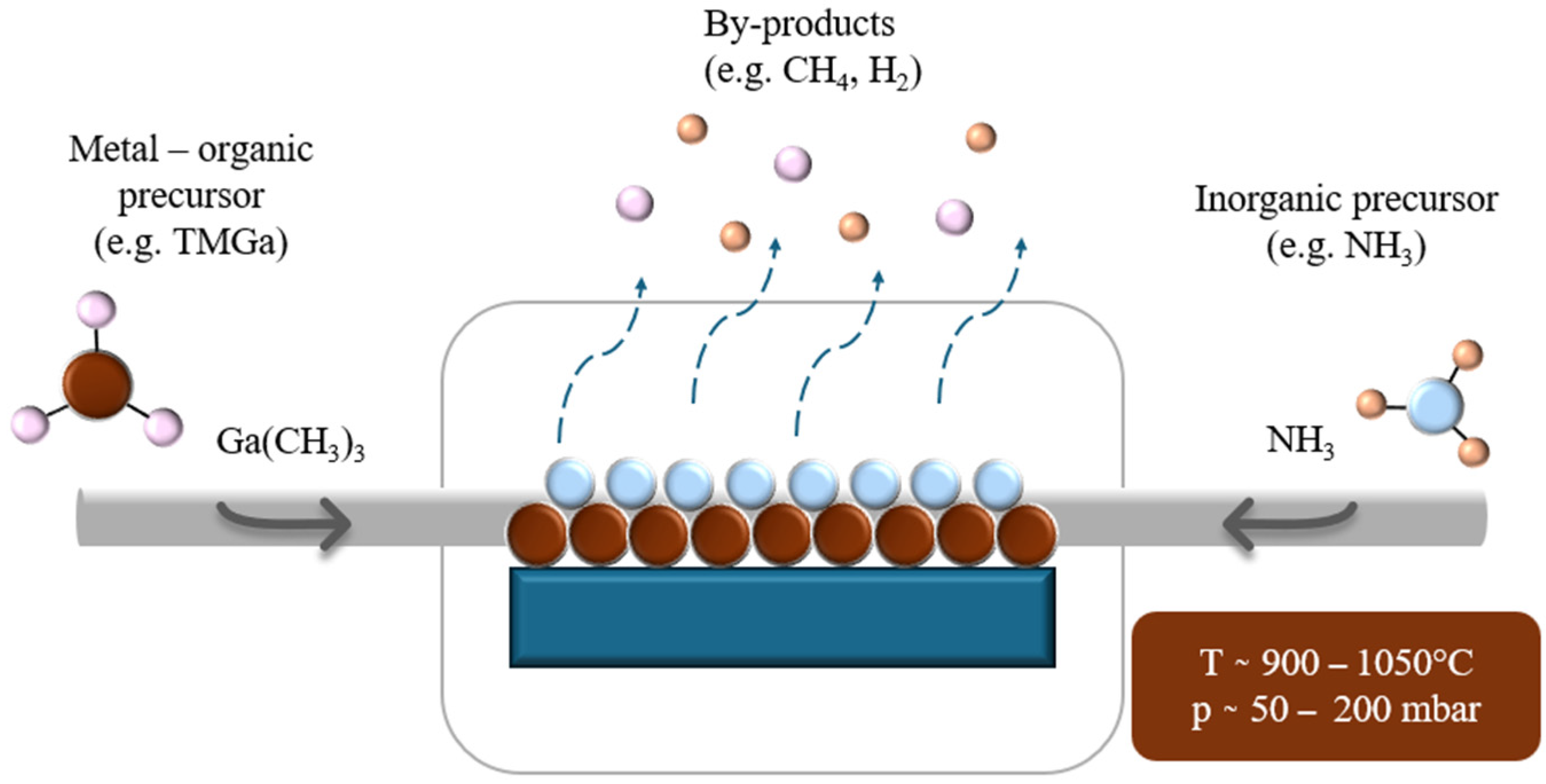
Unlike ALD, MOCVD operates under continuous gas flow rather than self-limiting surface reactions, enabling higher growth rates and the deposition of high-quality single-crystalline layers over large areas. In this process, volatile metal–organic precursors (such as TMGa and nitrogen sources (typically ammonia, NH3)) are introduced into a heated reactor, where they undergo thermal decomposition at the substrate surface to form the desired compound. Key process parameters—including growth temperature, V/III ratio, reactor pressure, and precursor flow rates—have a direct influence on film crystallinity, defect density, surface morphology, and polarity. In Figure 5, the principle of the MOCVD process is schematically presented, showing the continuous supply of metal–organic and nitrogen precursors and their thermal decomposition on the heated substrate surface.
Figure 5.
Schematic representation of the metal–organic chemical vapor deposition (MOCVD) process.
MOCVD is the dominant method for GaN growth in optoelectronic and high-power electronic devices due to its scalability, ability to achieve epitaxial growth on lattice-matched and lattice-mismatched substrates, and compatibility with in situ monitoring techniques (e.g., reflectometry, mass spectrometry). Advanced variations, such as low-pressure MOCVD (LP-MOCVD), pulsed MOCVD, and selective-area growth, further expand the flexibility of this technique for both planar and nanostructured architectures.
Research on MOCVD of GaN has increasingly focused on overcoming the limitations of precursor decomposition efficiency, impurity incorporation, and surface morphology control. Various approaches have been proposed to enhance growth rates and film quality while reducing process temperatures and contamination. One such approach was presented by Zhang et al. [92], who developed and applied a laser-assisted MOCVD (LA-MOCVD) method for GaN growth. In their work, a CO2 laser (λ ≈ 9.219 µm) was used to resonantly excite NH3 molecules, significantly improving their dissociation in the reaction zone. This strategy enabled GaN growth rates of up to 10 µm/h, with smooth, pit-free surfaces even at 8.5 µm/h. The films showed a markedly reduced carbon content (~5.5 × 1015 cm−3) and high crystalline quality, with electron mobilities exceeding 1000 cm2/V·s at room temperature. These results demonstrated that laser-assisted NH3 activation can substantially enhance growth efficiency, purity, and electrical performance compared to conventional MOCVD.
Another noteworthy example is provided by Hu et al. [93], who designed and demonstrated a novel Buffered Distributed Spray MOCVD reactor intended for high-quality GaN growth for LED structures. The reactor incorporates vertically distributed gas injection and horizontal gas inlets, enabling precise and uniform precursor delivery to the reaction zone. This configuration improves gas flow control, reduces parasitic reactions, and enhances the uniformity of epitaxial layers across large wafer batches. Experimental growths performed in a 36 × 2″ wafer configuration showed that the reactor architecture supports efficient GaN and InGaN/GaN multiple quantum well (MQW) deposition with excellent thickness uniformity. Structural and optical characterization, including TEM and photoluminescence, confirmed that the BDS design yields epitaxial films of high crystalline quality, making it particularly well-suited for large-scale LED manufacturing.
Swain et al. [94] addressed the sustainability aspect of MOCVD-based GaN production by investigating the recovery of gallium from waste dust generated during the epitaxial growth process. Detailed chemical analysis of the collected reactor dust revealed a high gallium content in forms suitable for extraction. The authors developed a chemical recovery protocol involving dissolution, selective precipitation, and separation steps, ultimately obtaining gallium compounds of high purity that could be reused as precursors in subsequent growth cycles. This approach not only reduces the consumption of raw gallium but also minimizes waste generation, thereby lowering both the economic and environmental footprint of GaN manufacturing.
Delgado Carrascon et al. [95] explored a hot-wall MOCVD configuration for the homoepitaxial growth of GaN. In this reactor design, the entire chamber wall is uniformly heated rather than relying solely on localized substrate heating. This approach minimizes thermal gradients, stabilizes the reaction environment, and enhances precursor utilization efficiency. The method enabled the deposition of high-purity, defect-reduced GaN layers directly on GaN substrates, yielding atomically smooth surfaces and narrow X-ray rocking curve widths indicative of excellent crystalline quality. Such improvements are particularly advantageous for advanced optoelectronic devices, where lattice perfection and surface uniformity critically affect performance.
Collectively, these studies highlight the remarkable versatility of MOCVD as a GaN growth technique, enabling not only the fabrication of high-quality epitaxial layers for a broad range of applications but also innovations that address efficiency, scalability, and environmental sustainability. Advances in reactor design, precursor activation methods, and resource recovery strategies demonstrate that both fundamental process optimization and system-level engineering can significantly improve film quality, reduce defect densities, and lower operational costs. As such, MOCVD remains a cornerstone technology for GaN production, with ongoing research continuing to expand its capabilities for next-generation optoelectronic and power electronic devices.
3.3. Molecular Beam Epitaxy (MBE)
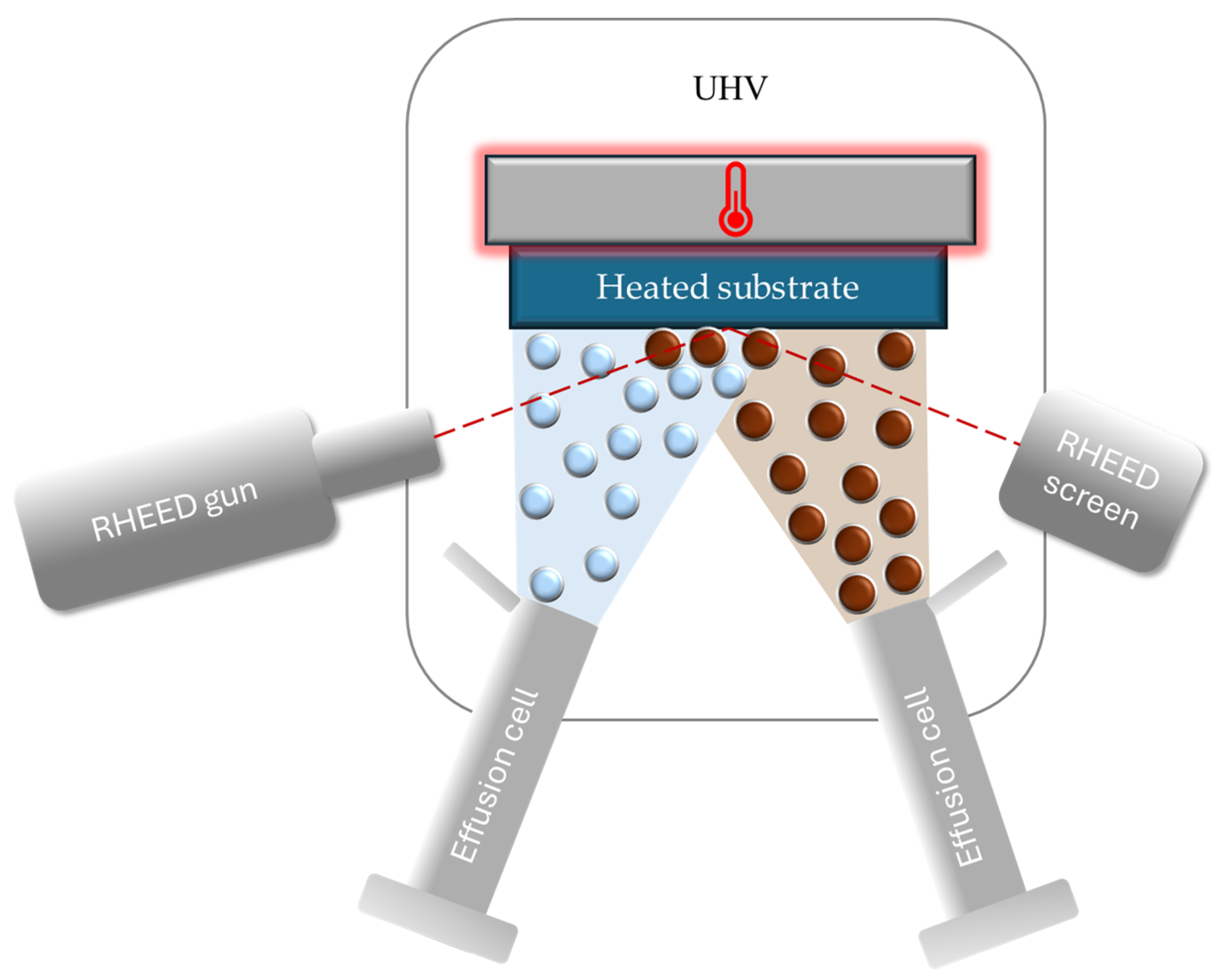
Molecular Beam Epitaxy (MBE) is a highly controlled epitaxial growth technique widely used for the fabrication of III–V compound semiconductors, including GaN. In MBE, ultra-pure elemental or compound sources are thermally evaporated or sublimated in ultra-high vacuum (UHV) conditions, producing molecular or atomic beams that impinge directly on a heated substrate. MBE offers unparalleled control over interfaces, doping profiles, and low-dimensional structures, making it highly valuable for fundamental studies and high-performance electronic devices. However, its intrinsically low growth rates and limited scalability restrict its applicability for thick photovoltaic layers required in space solar cells. As such, MBE is better suited for specialized device layers or model structures rather than large-scale photovoltaic absorbers [96].
In Figure 6, the molecular beam epitaxy (MBE) process is schematically illustrated, highlighting the use of ultra-high vacuum, effusion cells, and molecular or atomic beams for epitaxial film growth with atomic-layer precision.
Figure 6.
Schematic representation of the molecular beam epitaxy (MBE) process.
Unlike chemical vapor deposition methods, MBE relies on physical evaporation rather than chemical precursor decomposition, which allows precise control of deposition rates at the monolayer scale. The extremely low background pressure (typically below 10−9 Torr) minimizes impurity incorporation, enabling the synthesis of high-purity, defect-controlled films [97,98,99].
Key growth parameters—such as substrate temperature, beam flux ratios (e.g., Ga/N), and growth rate—strongly influence crystal quality, surface morphology, and defect density. The inherently slow growth rates of MBE (commonly below 2 µm/h) are offset by the unparalleled precision in controlling composition, doping profiles, and interface sharpness, making the technique particularly valuable for advanced heterostructures, quantum wells, and low-dimensional architectures. Additionally, in situ diagnostics such as Reflection High-Energy Electron Diffraction (RHEED) provide real-time feedback on surface reconstruction and growth kinetics, enabling dynamic process optimization [100,101].
A distinctive advantage of MBE lies In Its flexibility: by modifying the growth environment, energy supply, or flux modulation, researchers can directly tailor film properties, morphology, and defect density. For instance, Aggarwal et al. [102] employed laser-assisted MBE (laser-MBE) to overcome the inherent low growth rate and to stimulate enhanced reactivity of nitrogen. By optimizing the buffer layer design and pre-nitridation conditions on nonpolar r-plane (11–20) sapphire substrates, they achieved a spectrum of GaN nanostructures ranging from granular thin films (~160 nm) to vertically aligned nanocolumns (~370 nm) and nanoporous GaN films (~560 nm, pore diameters 70–110 nm). Detailed structural characterization using RHEED, high-resolution X-ray diffraction, and Raman spectroscopy confirmed the epitaxial wurtzite phase with remarkably low residual strain (0.03–0.23 Gpa). Importantly, when integrated into metal–semiconductor–metal (MSM) ultraviolet photodetectors, nanoporous GaN exhibited outstanding responsivity up to 358 mA/W at 1 V, representing a breakthrough in device performance for this morphology. This study demonstrated that MBE, when combined with laser assistance, can broaden the accessible morphological space of GaN while simultaneously enhancing optoelectronic functionality.
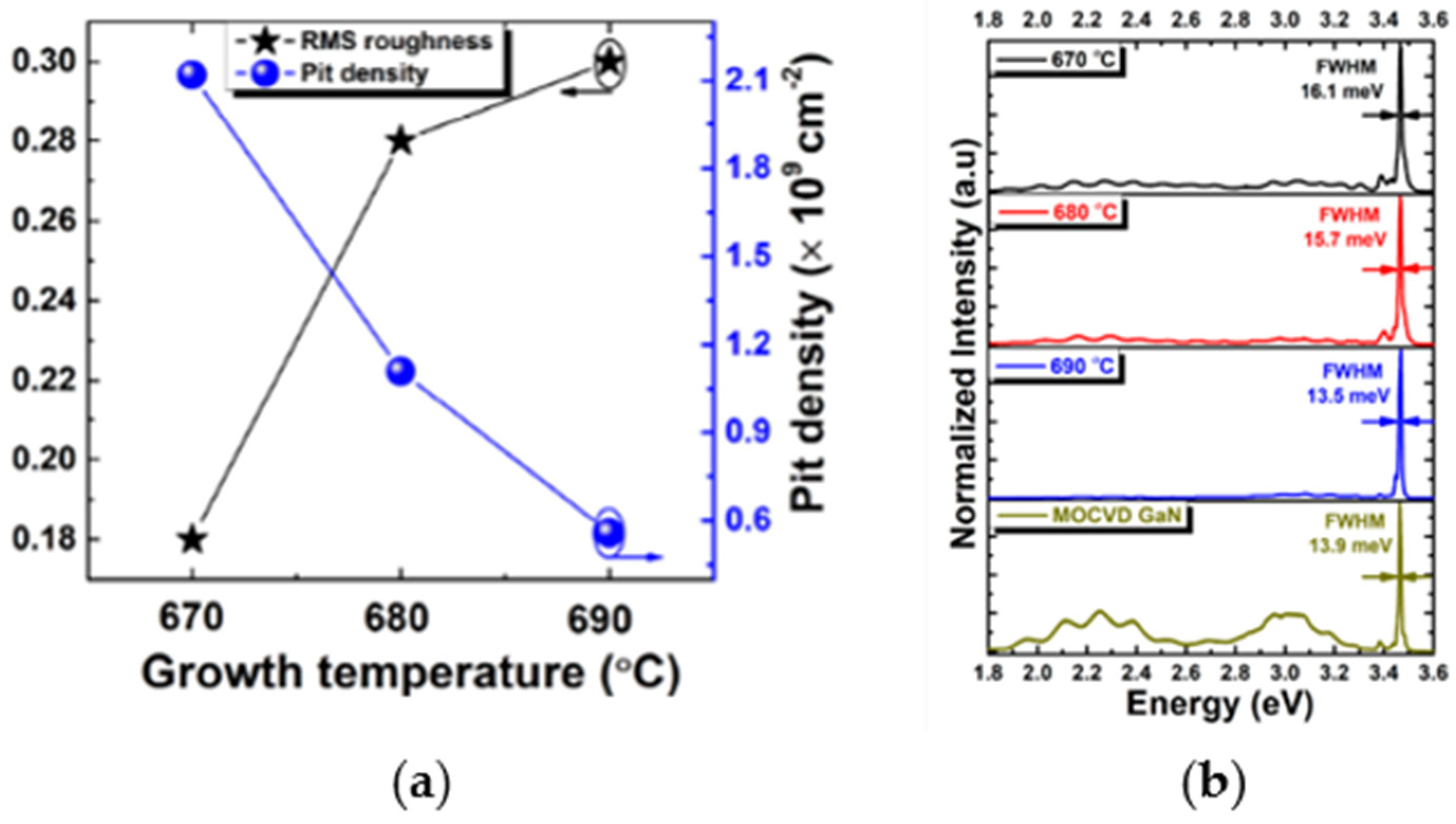
The ability of MBE to control morp”olog’cal transitions was further highlighted by Mai et al. [103], who systematically investigated the effect of substrate temperature on GaN films. Their work directly addressed the needs of HEMT structures, in which crystalline quality and defect suppression are paramount. By carefully increasing substrate temperature, they triggered a transition from three-dimensional island growth to a two-dimensional layer-by-layer growth regime. In Figure 7, the influence of growth temperature on surface morphology and defect-related optical properties is presented.
Figure 7.
(a) Surface roughness and pit density of MBE-grown GaN films as a function of growth temperature, and (b) normalized near-band-edge photoluminescence spectra showing FWHM narrowing with increasing temperature. Adapted from Ref. [103] under the CC BY 4.0 license.
Figure 7a shows that increasing the growth temperature from 670 to 690 °C leads to a clear reduction in pit density and the formation of atomically smooth surfaces, with RMS roughness decreasing to approximately 0.3 nm at 690 °C. At the same time, Figure 7b demonstrates a progressive narrowing of the near-band-edge photoluminescence peak, with the FWHM decreasing from 16.1 meV to 13.5 meV, indicating reduced defect density and improved crystalline quality. At the optimal temperature of 690 °C, GaN films exhibited atomically smooth surfaces (RMS roughness of 0.3 nm), significant relaxation of residual strain, and strong suppression of defect-related yellow luminescence, which is commonly associated with deep-level states. Electrical characterization revealed that these high-quality MBE-grown GaN channel layers achieved breakdown voltages of ~1450 V, markedly surpassing the ~1180 V typically reported for MOCVD-grown counterparts. This result underscores the potential of MBE to engineer ultra-low-defect GaN for next-generation power electronics, where breakdown strength and reliability are critical.
Beyond temperature and morphology, alternative growth strategies within the MBE framework have been developed to further suppress defects. Yang et al. [104] introduced metal-modulated epitaxy (MME), in which the gallium flux is periodically modulated to deliberately alter surface stoichiometry and adatom kinetics. This modulation effectively regulates the competition between gallium-rich and nitrogen-rich conditions, leading to reduced incorporation of extended defects and improved uniformity across the film. By fine-tuning the modulation parameters, the authors achieved GaN layers with excellent crystalline order and reduced impurity levels. Their work demonstrated that MME can be seen as a powerful refinement of conventional MBE, capable of producing high-performance GaN films that meet the stringent requirements of optoelectronic and high-frequency devices. In turn, Suzuki et al. [105] investigated the deposition of GaN films on unconventional MgO substrates in (111) and (001) orientations using radio-frequency plasma-assisted MBE (RF-MBE). Despite the considerable lattice mismatch between GaN and MgO, the authors showed that epitaxial GaN layers with acceptable structural quality could be grown. This work highlighted the adaptability of MBE to diverse substrate platforms, expanding its potential for integration into non-standard device architectures.
In addition to morphological and structural optimization, MBE has proven highly effective for controlled doping of GaN [106]. A notable example is the introduction of magnesium acceptors during plasma-assisted MBE under shutter-controlled growth conditions, which enabled the achievement of p-type carrier concentrations as high as 3.12 × 1018 cm−3. The presence of Mg not only promoted conformal layer growth but also improved carrier mobility and overall structural quality, particularly under nitrogen-rich conditions. Such advances highlight the ability of MBE to finely tune electrical properties while maintaining excellent crystalline integrity, making it a key enabler for the development of high-performance GaN-based electronic and optoelectronic devices.
3.4. Hydride Vapor Phase Epitaxy (HVPE) and Ammonothermal Growth
Hydride Vapor Phase Epitaxy (HVPE) plays a crucial role in the fabrication of bulk GaN substrates due to its very high growth rates and ability to produce thick, low-defect crystals. While HVPE is generally not used for active photovoltaic layer deposition, it provides high-quality GaN substrates that significantly reduce threading dislocation densities in subsequent epitaxial layers grown by MOCVD, thereby indirectly enhancing device performance and reliability in space environments [107].
Hydride Vapor Phase Epitaxy (HVPE) and ammonothermal growth represent two of the most advanced techniques for producing bulk GaN crystals of high structural quality. HVPE, based on the chemical reaction between GaCl3 (generated in situ by flowing HCl over molten gallium) and NH3, is particularly attractive due to its exceptionally high growth rates, often exceeding 100 µm/h, and its capability to produce thick GaN layers with dislocation densities below 106 cm−2 [108]. Optimized HVPE processes have enabled the fabrication of freestanding GaN substrates up to several millimeters in thickness, with controlled wafer curvature and reduced stress. Importantly, recent studies demonstrated that careful reactor design and gas flow engineering can yield growth uniformity variations as low as 1% across wafers up to 50 mm in diameter [109]. Moreover, laser lift-off techniques applied to thick HVPE films grown on sapphire substrates have yielded freestanding GaN with dislocation densities in the range of 2–5 × 106 cm−2, marking a significant step toward industrial scalability [110].
In contrast, ammonothermal growth employs a solution-based approach, in which GaN is dissolved in supercritical ammonia in the presence of mineralizers (basic or acidic ammonium salts) and recrystallized onto a seed crystal under controlled thermal gradients [111]. This method is analogous to hydrothermal growth of quartz and is valued for its ability to produce crystals with extremely low dislocation densities—down to the order of 104 cm−2—alongside narrow X-ray rocking curves (31–38 arcsec) and low optical absorption coefficients (~4 cm−1 at 450 nm) [112]. Detailed studies of GaN solubility and dissolution kinetics in supercritical ammonia have further clarified the role of mineralizers in enhancing mass transport and stabilizing crystal growth [108,113,114]. More recently, computational fluid dynamics (CFD) modeling has been applied to ammonothermal autoclaves, demonstrating the critical influence of convection patterns, thermal gradients, and supersaturation control on crystal size, morphology, and uniformity [115].
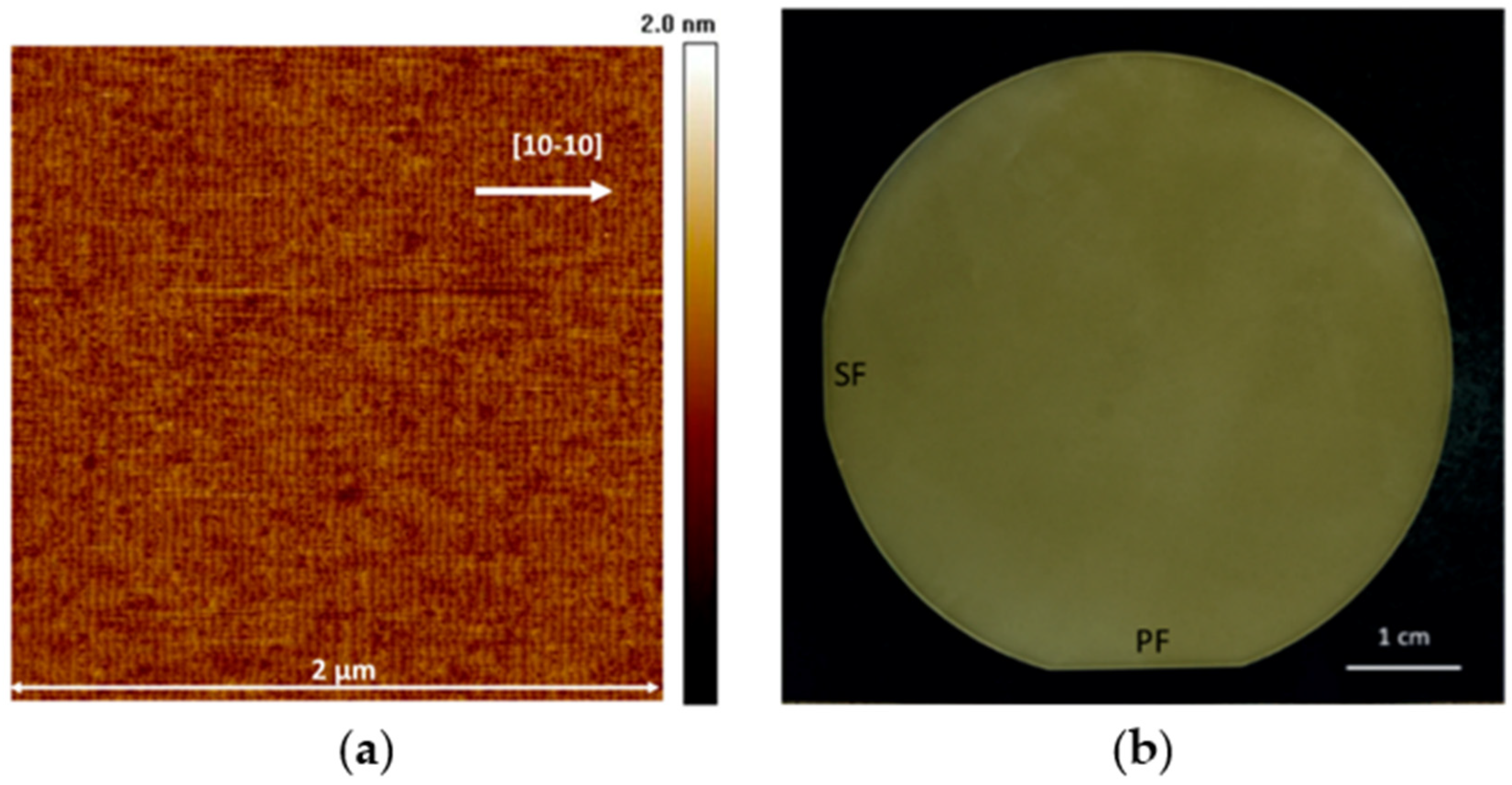
Together, HVPE and ammonothermal growth offer complementary strengths: HVPE provides unmatched deposition rates and scalability for thick wafer production, while ammonothermal growth excels in defect reduction and crystalline perfection. Their continued development remains central to overcoming substrate-related challenges in GaN-based optoelectronic and power device technologies. A representative comparison of these two approaches was provided by Grabińska et al. [111], who analyzed GaN substrates obtained via HVPE and ammonothermal growth in terms of their structural, optical, and electrical properties. The authors emphasized that HVPE remains highly attractive for commercial applications, owing to its ability to deliver thick, large-diameter substrates suitable for laser diodes and power devices. At the same time, ammonothermal GaN demonstrated markedly superior structural quality, with threading dislocation densities typically in the range of 104–105 cm−2 and X-ray rocking curve widths of 31–38 arcsec, values that approach those of native GaN single crystals. In Figure 8, representative experimental images of ammonothermal GaN substrates are presented.
Figure 8.
(a) AFM image of an as-grown ammonothermal GaN surface, demonstrating high surface uniformity and low defect density, and (b) photograph of a 2-inch ammonothermal GaN substrate with primary flat (PF) and secondary flat (SF) marked, illustrating wafer-scale quality and crystallographic orientation. Adapted from Ref. [111] under the CC BY 4.0 license.
Figure 8a shows an AFM image of the as-grown ammonothermal GaN surface, confirming its high surface uniformity and low defect density. Figure 8b displays a photograph of a 2-inch ammonothermal GaN substrate with marked primary and secondary flats, illustrating the high macroscopic quality, wafer-scale uniformity, and technological maturity of this growth method. In addition, ammonothermal-grown crystals exhibit low optical absorption coefficients (~4 cm−1 at 450 nm) and high resistivity, making them particularly suitable for optoelectronic applications requiring minimal defect-related losses. Together, these results highlight the complementary nature of HVPE and ammonothermal growth: HVPE offers scalability and cost efficiency, while ammonothermal GaN provides unmatched crystalline perfection.
Building on the previously discussed bulk growth methods, Hsiang et al. [116] examined the influence of hydrogen incorporation during Molecular Beam Epitaxy (MBE) of GaN. Their study revealed that the controlled presence of hydrogen can act as a surfactant, enhancing adatom mobility, improving surface smoothness, and reducing the density of extended defects. As a result, the GaN layers exhibited superior crystalline integrity and improved morphological quality, underlining the potential of hydrogen-assisted MBE for fabricating high-performance GaN films.
One notable advancement was introduced by Saredin et al. [117] provided an in-depth analysis of ammonothermal GaN growth, with a particular focus on the mechanisms of defect formation and their mitigation. By systematically studying the influence of process parameters such as mineralizer concentration, temperature gradients, and pressure conditions, the authors demonstrated pathways to control both point defects and extended dislocations. Their work highlighted that careful optimization of supersaturation levels and solubility kinetics is critical for suppressing defect generation during recrystallization. Importantly, the ammonothermal crystals grown under optimized conditions exhibited full widths at half maximum of X-ray rocking curves as low as 20–30 arcsec and dislocation densities approaching 104 cm−2, values that surpass those typically achievable in HVPE-grown GaN. These results confirm the capability of ammonothermal techniques to deliver substrates of exceptional crystalline perfection, reinforcing their role as a cornerstone for next-generation GaN optoelectronic and power devices.
Sochacki et al. [118] demonstrated a refined HVPE growth strategy that effectively limited unwanted lateral spreading of GaN during crystallization. By promoting preferential extension along the [0001] c-axis, the process yielded vertically elongated GaN structures with superior morphological stability and reduced defect formation. Crucially, this optimization maintained the inherently high deposition rates of HVPE, highlighting its potential for the scalable fabrication of thick, high-quality GaN substrates suitable for advanced device applications
A variety of epitaxial techniques have been developed for GaN growth, each characterized by distinct growth rates, defect densities, and scalability. To highlight the comparative advantages and limitations of these approaches, a summary is provided in Table 2.
Table 2.
Comparison of epitaxial growth techniques for GaN, including typical growth rates, dislocation densities, scalability, and common substrates.
As seen in Table 2, no single technique satisfies all requirements simultaneously: MOCVD remains the industrial standard, MBE provides unmatched interface control, HVPE and ammonothermal offer pathways to bulk GaN substrates, while ALD excels in conformality and precise thickness control. Ongoing research into hybrid and modified approaches (e.g., REMOCVD, MME) aims to combine these advantages and further reduce defect densities, which is critical for scaling GaN to large-area space photovoltaic applications.
4. Key Aspects in GaN Formation
4.1. Influence of Substrate Type and Quality
The substrate type and surface characteristics play a crucial role in determining the nucleation behavior, microstructural evolution, defect formation, and ultimately the functional performance of GaN layers. A notable example is provided by Santis et al. [119], who investigated the growth of cubic GaN on GaP and GaAs substrates under low-pressure MOCVD. XRD analysis revealed compressive stress in both cases, with higher structural quality achieved on GaP, as further confirmed by Raman spectra and surface morphology. The band gap of c-GaN was estimated at approximately 380 nm for both substrates, consistent with known values for the cubic phase. Extending this approach to nanoscale patterning, Li et al. [120] employed molecular dynamics simulations to evaluate GaN growth on nanopatterned AlN substrates. Introducing nanopillars significantly enhanced crystallinity by increasing the proportion of wurtzite structures and reducing dislocation density, with pillar geometry and substrate temperature identified as critical control parameters. These results demonstrate the potential of nanoscale pattern engineering to mitigate defect formation. Li et al. [121] further examined the effect of incident particle energies on crystalline quality during epitaxy. Higher energies improved surface smoothness and atomic packing but simultaneously increased dislocation nucleation height, highlighting the delicate balance between growth kinetics and internal stress. A related experimental study [122] focused on GaN growth on amorphous glass using pulsed-DC magnetron sputtering and a ZnO buffer layer. Structural analysis confirmed c-axis-oriented growth and strong near-band-edge emission, although the polycrystalline morphology and domain structure reflected inherent limitations of amorphous substrates. Dhasiyan et al. [123] employed radical-enhanced MOCVD (REMOCVD) to grow GaN on bulk GaN and GaN/Si templates. Optimizing plasma activation and minimizing radical deactivation yielded high-quality layers with XRD FWHM values as low as 72 arcsec, illustrating the strong substrate dependence of crystalline quality and the potential of low-temperature REMOCVD for GaN device structures. The influence of substrate type was also evident in the work of Kizir et al. [124], who used hollow-cathode plasma-assisted ALD to grow GaN on Si (100), Si (111), and sapphire. Although all samples exhibited wurtzite GaN, grain size, roughness, and preferred orientation varied significantly with substrate, with smoother films obtained on Si and higher growth-per-cycle values on sapphire due to enhanced nucleation behavior. Substrate surface morphology was shown to be equally critical in [125], where adjusting sapphire miscut angles enabled smooth epitaxial GaN growth under low-temperature ECR sputtering. Increasing the misorientation activated a step-flow growth mechanism, reducing surface roughness while preserving excellent crystalline quality.
Among the conventional substrates used for GaN heteroepitaxy, silicon and sapphire remain the most widely employed, but both introduce important limitations due to lattice and thermal-expansion mismatch with GaN. Sapphire offers good chemical stability and high-temperature robustness; however, the large lattice mismatch (~13–16%) and the difference in thermal-expansion coefficients generate significant tensile stress during cooldown from MOCVD growth temperatures. As the substrate and GaN layer contract at different rates, this stress promotes threading dislocations, wafer bowing, and cracking, which degrade minority-carrier lifetimes and optical performance [126]. Silicon is attractive because of its low cost, availability of large wafer diameters, and compatibility with microelectronics processing. However, the GaN/Si system suffers from an even stronger thermal-expansion mismatch. GaN expands more during growth and contracts more rapidly during cooling, leading to high tensile stress that can cause catastrophic cracking unless complex AlN/AlGaN buffer stacks are used. In addition, the large lattice mismatch (~17%) increases the density of misfit and threading dislocations, which propagate toward the surface and act as non-radiative recombination centers [127].
These mismatch-related defects have direct consequences for photovoltaic performance. They reduce carrier diffusion lengths, lower internal quantum efficiency, and accelerate degradation under thermal cycling conditions typical of space environments. Repeated temperature swings between sunlight and eclipse further increase interfacial stress, raising the risk of fatigue-related cracking and long-term device degradation. Strain accumulation also modifies polarization fields in InGaN layers, which affects carrier confinement and extraction Despite advances in GaN and InGaN growth techniques, several practical barriers remain for photovoltaic applications. A major limitation is strain accumulation caused by lattice and thermal-expansion mismatch between the epitaxial layer and the substrate. As the layer thickness increases, strain is gradually released through the formation of threading dislocations or, in extreme cases, by crack formation, especially in thick absorber layers required for efficient light absorption [128,129]. The problem becomes more pronounced for InGaN alloys with higher indium content. Increasing the In fraction lowers the bandgap and enables absorption of longer wavelengths, but it also increases lattice mismatch and internal strain. This often leads to compositional inhomogeneity, phase separation, and higher defect densities, which reduce carrier lifetime and device efficiency. As a result, there are practical limits on both the achievable indium composition and the thickness of InGaN absorber layers. Effective strain management and defect reduction therefore remain key challenges in the development of high-performance GaN-based photovoltaic devices [129,130,131].
4.2. GaN Doping and Challenges in p-Type Layer Formation
Doping plays a central role in tailoring the electrical properties of GaN and enabling its application in electronic and optoelectronic devices. In its undoped state, GaN is a wide-bandgap semiconductor with high resistivity, which makes the introduction of dopants essential for achieving controlled conductivity. N-type doping is comparatively well understood and widely implemented, with donors such as silicon (Si), oxygen (O), or germanium (Ge) providing high electron concentrations and stable electrical performance. These approaches have enabled the reliable fabrication of n-type GaN layers with low resistivity and excellent reproducibility. In contrast, the realization of efficient p-type doping remains highly problematic. The high ionization energy of typical acceptors (e.g., Mg), low solubility limits, and strong compensation effects from native defects or hydrogen incorporation make it difficult to achieve high hole concentrations and stable p-type conductivity. As a result, while n-type doping can be considered mature and technologically straightforward, the formation of p-type GaN layers continues to represent one of the most critical challenges in III-nitride semiconductor technology [132,133,134,135].
While Mg remains the most widely used acceptor for p-type GaN, its high activation energy, low solubility, and strong compensation by native defects severely limit hole concentrations. Recent studies have explored alternative dopants such as Zn and Be, but their incorporation often leads to poor thermal stability or self-compensation effects. To address these barriers, novel approaches are being developed, including co-doping strategies that combine different acceptors or donor–acceptor pairs to enhance activation, as well as polarization-assisted doping methods that exploit the strong internal electric fields in III-nitrides to lower ionization barriers. Modulation doping, in which carriers are supplied from adjacent layers rather than directly from the GaN matrix, has also been investigated as a way to bypass the inherent limitations of Mg. Although these techniques remain in the research stage, they represent promising directions for overcoming the long-standing challenge of achieving efficient and stable p-type conductivity in GaN [136,137,138,139,140].
These difficulties have direct implications for device performance, particularly in p–n junctions, LEDs, and other optoelectronic applications. In addition to the fundamental limitations of acceptor activation, the formation of high-quality p-type layers is further hindered by issues such as dopant activation, thermal stability, and interface degradation. Addressing these barriers requires advanced doping strategies, careful optimization of growth conditions, and effective post-deposition treatments, including thermal annealing or hydrogen passivation removal [141,142,143,144].
In photovoltaic applications, the challenges of p-type doping in GaN impact not only carrier concentration but also the ability to form low-resistance Ohmic contacts. Because of the wide bandgap and deep acceptor levels, Mg-doped GaN typically exhibits low hole mobility and limited activation, making it difficult to achieve sufficiently high conductivity in the p-layer [145]. This directly influences the contact resistance at the metal/semiconductor interface, as forming low-barrier Ohmic contacts on p-GaN is inherently challenging. As a result, the p-type contact often becomes a major contributor to the device’s series resistance. Increased series resistance reduces the Fill Factor (FF) and leads to power losses, ultimately limiting the achievable efficiency of GaN and InGaN-based solar cells. Therefore, the difficulty of creating both conductive and low-contact-resistance p-type GaN represents one of the most significant challenges for high-performance III-nitride photovoltaics [146,147].
A comprehensive analysis of these limitations was presented by Cheng [148], who focused on the activation issues associated with Mg doping with a focus on the limitations of magnesium as the primary acceptor species. Although Mg is widely used due to its compatibility with Ga in terms of electronic structure, its activation is significantly suppressed by the formation of Mg–H complexes, especially during MOCVD growth processes. As presented in the article, the presence of atomic hydrogen not only passivates Mg dopants but also leads to extremely high resistivity in the resulting layers, limiting their applicability in optoelectronic devices such as LEDs and LDs. The authors emphasized that the large covalent radius of Mg contributes to compensation effects, further reducing hole concentrations. Consequently, the formation of efficient p-type layers remains a key bottleneck, demanding the development of improved doping mechanisms and post-growth activation strategies to meet the performance requirements of advanced GaN-based devices.
Further technological challenges were discussed in [141], with particular emphasis on the fabrication of p-type regions in vertical GaN power devices, highlighting key technological and material challenges. In particular, the authors emphasized the importance of precisely controlling the effective acceptor concentration, which is the difference between the Mg dopant level and compensating donor species, including unintentional carbon (CN) and hydrogen (Hi). It was shown that hydrogen removal is critical for Mg activation, but prolonged annealing can lead to the formation of deep traps. As presented, the introduction of a p+ capping layer significantly enhances hydrogen out-diffusion due to the internal electric field across the p+/p− junction, reducing required annealing time and trap formation. Furthermore, the use of selective-area Mg ion implantation and subsequent ultrahigh-pressure annealing up to 1753 K under 1 GPa nitrogen atmosphere enabled high Mg activation without GaN decomposition. The study demonstrated that Mg and H diffusion is strongly influenced by UHPA parameters and vacancy dynamics, underlining the need for precise control over annealing temperature and ambient composition.
From a structural standpoint, further insight into the nature of defects in Mg-doped GaN was offered in the work by Liliental-Weber et al. [149], who employed transmission electron microscopy to compare bulk crystals grown under high-pressure and high-temperature conditions with MOCVD-grown epitaxial layers using either continuous or δ-doping methods. The results revealed that spontaneous ordering in the form of Mg-rich planar defects appeared exclusively in N-polar bulk crystals, forming stacking-fault-like structures separated by ~10.4 nm. These defects, while resembling basal stacking faults, also exhibited features consistent with inversion domains. In contrast, growth on the Ga-polar face—characterized by a significantly faster rate—resulted in three-dimensional pyramidal and rectangular void-like defects with Mg accumulation at internal surfaces. Interestingly, similar types of polarity-dependent defects were also observed in MOCVD-grown samples with δ-doping, while continuous doping appeared to suppress their formation.
An alternative approach to achieving high-conductivity p-type GaN layers was presented in the work [150], where zinc was introduced as a transition metal dopant using the thermionic vacuum arc (TVA) technique. The resulting film exhibited a polycrystalline zincblende–wurtzite structure with promising electrical properties, including low resistivity and high hole mobility. Structural and morphological characterization confirmed uniform grain distribution (200–250 nm) and high crystalline quality. The direct bandgap was red-shifted to approximately 2.9 eV, supporting effective p-type behavior. These findings suggest that Zn-doping via TVA may serve as a viable alternative to conventional Mg-based doping for the fabrication of GaN layers in nanotechnology-driven power electronics.
4.3. Crystalline Defects in GaN and Strategies for Their Reduction
Defects are deviations from the ideal periodicity of a crystal lattice and are inherently present in all semiconductors. They occur in different forms: point defects (vacancies, interstitials, etc.), line defects (dislocations), planar defects (stacking faults, twins, grain boundaries), and extended defects such as cracks or voids. From a functional perspective, defects are not merely structural irregularities—they strongly influence the electrical, optical, and mechanical properties of a material. Defect-related states inside the bandgap can act as charge carrier traps or recombination centers, thereby reducing carrier lifetime, mobility, and overall device performance. In optoelectronic devices, this manifests as reduced luminescence efficiency, while in power and photovoltaic devices, it leads to higher leakage currents, increased noise, and premature degradation under stress conditions [151,152,153].
For GaN, defects represent one of the most persistent challenges despite the outstanding intrinsic properties of this wide-bandgap (3.4 eV) semiconductor. High-quality GaN substrates are still limited and expensive, which necessitates heteroepitaxial growth on foreign substrates such as sapphire, silicon carbide or silicon. The large lattice mismatch (≈16% with sapphire, ≈17% with Si, ≈3.5% with SiC) and thermal expansion coefficient differences generate high densities of threading dislocations (TDs), typically in the range of 108–1010 cm−2 in heteroepitaxial GaN layers [154]. These dislocations propagate vertically through the active region and can act as non-radiative recombination centers in LEDs [155] or leakage paths in HEMTs [156]. Point defects such as nitrogen vacancies are known to create deep donor states close to the conduction band, reducing radiation hardness and long-term reliability of GaN-based devices [157].
The quality of GaN growth directly affects the performance of GaN power devices used in space energy-conversion circuits. Low dislocation density, controlled impurity incorporation, and smooth morphology are important in terms of achieving high breakdown voltages, low leakage currents as well as stable 2DEG characteristics in GaN HEMTs and Schottky diodes. Growth techniques such as MOCVD, HVPE, ELO, and pendeo-epitaxy improve uniformity and interface quality which translates into higher switching efficiency and thermal reliability. These methods support both high-quality InGaN absorbers and reliable GaN power electronics for space energy-conversion systems.
To address these issues, multiple defect-reduction strategies have been developed. A foundational approach involves the use of buffer layers, for instance, low-temperature GaN nucleation layers or AlN interlayers, which help accommodate strain and reduce dislocation density during subsequent growth. More advanced methods such as epitaxial lateral overgrowth [158,159,160] and pendeo-epitaxy redirect dislocations laterally or terminate them at mask edges, enabling a significant reduction in TD densities down to 106–107 cm−2 [161,162,163].
Epitaxial growth techniques themselves are also subject to extensive optimization for defect reduction. In metal–organic chemical vapor deposition (MOCVD), parameters such as growth temperature, V/III precursor ratio, and reactor pressure strongly influence the incorporation of point defects and the evolution of surface morphology. For example, optimized V/III ratios can suppress nitrogen vacancies and improve film stoichiometry, while higher growth temperatures generally reduce impurity incorporation, although excessively high temperatures may induce nitrogen desorption and surface roughening. Molecular beam epitaxy (MBE), although inherently slower (typically <1–2 µm/h), offers unmatched precision in controlling composition and doping profiles, which helps in engineering sharp heterointerfaces and minimizing interface-related defects. Post-growth treatments provide an additional pathway for defect management. Thermal annealing can promote defect annihilation or passivation, while chemical treatments (e.g., surface oxidation, hydrogen or plasma passivation) can neutralize electrically active defect states. Moreover, the deposition of dielectric passivation layers such as SiNX or Al2O3 is often employed to suppress surface states and improve carrier lifetimes in GaN devices. Advances in defect characterization have played a crucial role in guiding these strategies. High-resolution transmission electron microscopy (HRTEM) enables direct imaging of dislocations and stacking faults, while XRD and reciprocal space mapping (RSM) provide statistical measures of dislocation densities and strain. Techniques such as cathodoluminescence (CL) and photoluminescence (PL) spectroscopy can spatially map non-radiative centers, and deep-level transient spectroscopy (DLTS) allows the identification of electrically active traps [164,165,166,167,168].
Collectively, these mitigation strategies have significantly improved GaN material quality, supporting its evolution from a laboratory curiosity to a pillar of the LED lighting revolution and a core technology in high-power RF transistors. More recently, work has begun on developing GaN components and devices with enhanced radiation tolerance, particularly for space or near-space applications. While fully mature radiation-hardened GaN photovoltaics remain at an earlier stage, the advances in defect reduction, passivation, and processing lay a solid foundation for their eventual realization. Nonetheless, defect reduction remains a central research frontier—especially for large-area, low-cost GaN substrates necessary for mass deployment in power electronics and space solar cell arrays [169,170,171].
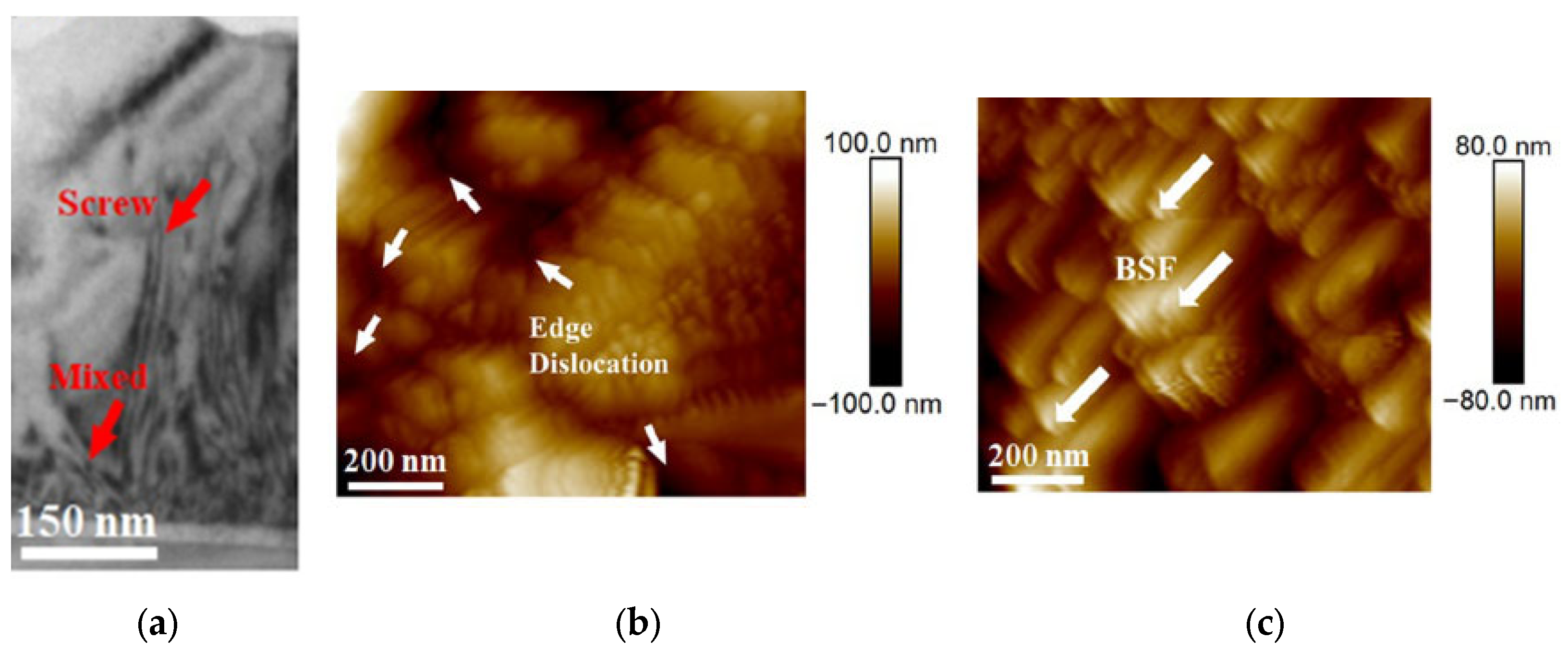
Quantitative correlations between crystalline defect density and device performance have been clearly demonstrated in GaN-based heterostructures grown on different substrates. For example, Pharkphoumy et al. [172] compared AlGaN/GaN HEMTs fabricated on silicon and sapphire substrates and directly linked structural quality to electrical characteristics. High-resolution X-ray diffraction revealed significantly narrower rocking-curve full width at half maximum (FWHM) values for GaN grown on sapphire (368 arcsec) compared with silicon (703 arcsec), indicating a substantially lower threading dislocation density in the sapphire-based structures. This improvement in crystalline quality translated directly into enhanced device performance. AlGaN/GaN HEMTs on sapphire exhibited higher drain current densities (155 mA/mm vs. 150 mA/mm at VGS = 0 V without passivation) and superior breakdown voltages (415 V on sapphire compared with 245 V on silicon). After SiO2 passivation, which suppresses surface trap-assisted leakage, the breakdown voltage increased to 425 V on sapphire and 400 V on silicon, further highlighting the combined influence of defect density and interface quality on high-field operation. The same study also demonstrated that higher defect densities induce self-heating effects and limit transconductance at elevated bias. Devices grown on silicon showed a more rapid degradation of transconductance at higher gate voltages, consistent with increased defect-assisted scattering and inferior thermal dissipation. Atomic force microscopy confirmed a much smoother GaN surface on sapphire (RMS roughness ≈ 0.88 nm) compared with silicon (≈2.96 nm), reinforcing the link between microstructural quality and carrier transport. Complementary evidence is provided by Yang et al. [173], who analyzed the influence of dislocation density on GaN-based device reliability and performance under electrically and thermally demanding conditions. Using X-ray rocking curves (XRC), cross-sectional TEM, and AFM after selective etching, the authors quantified screw and mixed dislocation densities. In Figure 9, representative XRC, cross-sectional TEM, and AFM images illustrate the direct relationship between defect type, defect density, and GaN device performance.
Figure 9.
Representative experimental characterization of nonpolar GaN: (a) cross-sectional TEM image showing screw and mixed dislocations; (b) AFM image after selective etching revealing edge dislocations; (c) AFM image highlighting basal stacking faults (BSFs). The data demonstrate the correlation between defect density and GaN device performance. Reproduced from Ref. [173], with the permission of AIP Publishing.
Clear correlations between crystalline defects and device metrics were demonstrated. Higher screw and mixed dislocation densities led to increased leakage current due to barrier-height lowering and current paths along dislocation cores, while edge dislocations and BSFs primarily reduced responsivity through enhanced carrier scattering and non-radiative recombination. Devices fabricated on GaN layers with lower overall defect densities exhibited improved electrical stability, lower dark current, and higher responsivity under high electric fields and thermal stress.
4.4. Substrate Reuse and Recycling Strategies for Scalable Low-Defect GaN Epitaxy
Owing to the high production cost and limited availability of freestanding GaN substrates, as well as the growing strategic importance of GaN wafer supply for next-generation electronics, several recycling and substrate-reclaim pathways have recently attracted specific attention as a strategy to reduce material scarcity risks. Although large-scale end-of-life recycling of GaN devices remains at an early stage of development, multiple substrate-reclaim approaches are relatively advanced. For instance, laser lift-off (LLO), already established in the LED industry, enables the separation of GaN epilayers from sapphire while preserving the underlying substrate for subsequent re-polishing and reuse [174]. Complementary approaches—including chemical and electrochemical lift-off, sacrificial interlayers, and selective etching processes—have been developed to detach epitaxial GaN from native GaN, SiC or sapphire while maintaining surface planarity and low defect density. Additional methods such as hydride-vapor-phase and plasma etching to remove residual GaN, together with emerging schemes aimed at regrowth on recovered templates, further demonstrate the feasibility of reducing raw-wafer consumption [175,176,177,178,179].
Beyond reclaim, several chemical recycling approaches have also been investigated to recover GaN from waste LED, RF and power-electronics devices. These methods typically involve selective leaching using acidic, alkaline, or complexing solutions that remove surface metallization and packaging residues while leaving the GaN material largely intact. Such chemical purification enables the isolation of clean GaN fragments suitable for further processing or reuse and represents a promising complementary pathway for reducing material consumption within the GaN value chain [180,181].
Importantly, these cost- and material-saving strategies interface directly with established defect-reduction techniques in GaN epitaxy—most notably epitaxial lateral overgrowth (ELO) and pendeo-epitaxy. Both methods rely on selective-area or sidewall-initiated growth to bend, block, and annihilate threading dislocations, thus lowering dislocation densities by one to two orders of magnitude compared to planar heteroepitaxy. By enabling the fabrication of low-defect-density GaN and InGaN templates on large-area, relatively low-cost substrates such as sapphire or SiC, ELO and pendeo-epitaxy significantly improve scalability for space photovoltaics [182,183,184,185,186].
When combined with substrate lift-off and reuse, these approaches offer a synergistic path toward lowering the effective cost per wafer while maintaining the high crystalline quality required for radiation-hardened, long-lifetime space-PV absorber structures. Together, defect-reduction epitaxy and substrate recycling constitute a critical technological foundation for advancing GaN-based space photovoltaics from laboratory-scale demonstrations toward economically viable multi-wafer manufacturing.
4.5. Semi-Polar and Non-Polar GaN Orientations
Semi-polar and non-polar GaN orientations have become increasingly important for high-In-content InGaN absorbers, as they significantly reduce or eliminate the polarization fields present in conventional c-plane (0001) GaN. Orientations such as semi-polar
and
, as well as non-polar
and
, suppress the quantum-confined Stark effect (QCSE), leading to improved electron–hole wavefunction overlap, enhanced radiative efficiency, and more efficient carrier extraction. This reduction in internal fields allows the incorporation of higher indium fractions without severe strain-driven defect formation, enabling InGaN bandgaps below ~1.5 eV required for the low-energy junctions in multi-junction solar cells [187,188,189,190,191].
Semi-polar GaN has already demonstrated improved crystalline quality in high-In InGaN layers compared with c-plane growth, including narrower photoluminescence linewidths, reduced compositional non-uniformity, and lower defect densities. Recent studies also show that semi-polar orientations can sustain thicker InGaN layers without phase separation and exhibit higher critical thicknesses before relaxation occurs, further underscoring their relevance for high-performance InGaN photovoltaic absorbers [192,193,194].
4.6. Growth-Related Limitations and Their Impact on GaN Photovoltaic Device Architectures
The feasibility of advanced GaN-based photovoltaic concepts, such as tandem architectures and InGaN multi-quantum-well (MQW) active layers, is strongly constrained by material and growth limitations. Precise control of indium composition is required to achieve the desired bandgap sequence in tandem cells; however, increasing indium content leads to higher strain, compositional fluctuations, and defect formation, which limit both layer thickness and crystalline quality [195,196].
Similarly, high defect densities reduce carrier lifetimes and diffusion lengths, directly affecting current collection in thick InGaN layers and MQW solar cells. Challenges in achieving highly conductive p-type GaN with low contact resistance further increase series resistance, which is particularly detrimental for multi-junction devices requiring efficient current matching. As a result, growth-related constraints play a decisive role in determining which GaN-based device architectures are practically achievable for space photovoltaics.
Beyond structural and compositional constraints, growth-related defects also strongly influence the electrical transport and dynamic behavior of GaN-based devices. Quantitative data reported for commercial and near-commercial GaN devices clearly demonstrate that electrical transport and dynamic behavior are strongly governed by material quality, defect density, and heterointerface engineering. GaN-based devices typically exhibit critical electric fields in the range of ~3.0–3.5 MV cm−1; however, studies consistently show that increased threading dislocation density (TDD ≥ 108–109 cm−2) results in leakage currents that are 2–3 orders of magnitude higher and in premature electrical breakdown compared with low-defect GaN structures (TDD ~ 106 cm−2) [197,198]. Dynamic effects are similarly sensitive to defects and interface traps. Reported increases in dynamic on-resistance remain below ~10–15% for low-defect GaN devices, but can reach 30–100% in structures with high trap densities, particularly under high electric fields and elevated operating temperatures [199,200]. These effects are strongly linked to charge trapping at GaN/AlGaN heterointerfaces and at p-GaN/metal contacts, which directly affect switching behavior and energy losses. Junction temperature further modulates carrier transport and device stability. Experimental data show that GaN devices can maintain stable operation up to ~150–200 °C; however, higher temperatures significantly exacerbate trapping, current collapse, and long-term degradation mechanisms, especially in defect-rich structures [201,202]. Recent reports also indicate that optimized heterostructure design—such as controlled AlGaN thickness (≈8–15 nm), Al composition (x ≈ 0.2–0.3), and Mg-doped p-GaN layers (~1019 cm−3)—is essential to balance electric field distribution, leakage suppression, and dynamic stability [203,204]. Collectively, these studies demonstrate that breakdown strength, defect density, heterointerface quality, and thermal stability jointly define both the current limitations and the performance potential of GaN-based devices. These parameters are therefore critical for the design of reliable, low-loss power-conditioning and energy-harvesting systems intended for space photovoltaic applications.
5. GaN-Based Solar Cell Architectures for Space Applications
The unique physical properties of GaN and its ternary alloys, particularly InGaN, have stimulated intensive research into advanced solar cell architectures for space environments. Among these, InGaN/GaN heterojunctions are especially promising because the bandgap of InGaN can be tuned across a wide spectral range (0.7–3.4 eV) simply by varying the indium concentration. This bandgap flexibility makes it theoretically possible to absorb nearly the entire solar spectrum within a single material system. Laboratory studies of InGaN/GaN single-junction devices have reported respectable conversion efficiencies under AM0 conditions, while also highlighting their superior resistance to displacement damage by protons and electrons. Compared to GaAs and InP cells, which degrade significantly under comparable fluences, InGaN/GaN devices retain a higher fraction of their initial performance, suggesting a distinct advantage for long-duration missions in harsh radiation environments [203,204,205].
To place GaN-based photovoltaic devices in the broader context of space-relevant energy harvesting technologies, a comparative overview of representative electrical performance metrics is provided in Table 3. The table summarizes key parameters reported for different energy harvesting approaches, including maximum current and voltage, power density, charge density, and typical operating frequencies. Such a comparison highlights the distinct operational regimes and application niches of photovoltaic, piezoelectric, triboelectric, and thermoelectric systems.
Table 3.
Comparison of representative electrical performance parameters reported for selected energy harvesting technologies, including piezoelectric (PENG), thermoelectric (TEG), triboelectric (TENG), conventional photovoltaic (PV), and GaN-based photovoltaic devices.
The data indicate that different energy harvesting technologies operate in fundamentally distinct regimes, with piezoelectric and triboelectric devices favoring high-voltage or dynamic excitation scenarios, while photovoltaic systems provide continuous power under steady illumination. GaN-based photovoltaics combine the intrinsic advantages of photovoltaic operation with high radiation tolerance and thermal stability, making them particularly attractive for space environments. This positions GaN photovoltaics as a complementary solution to other harvesting approaches rather than a direct replacement.
Quantum well (QW) structures further extend the design potential of GaN-based photovoltaics. By embedding thin layers of InGaN within wider-bandgap GaN barriers, multi-quantum-well (MQW) devices can confine carriers and enhance the probability of radiative recombination while allowing precise tailoring of absorption and emission wavelengths. These structures have been explored both for improved current generation in solar cells and for hybrid optoelectronic applications such as luminescent down-shifting layers. Importantly, MQW solar cells have demonstrated strong tolerance to ionizing radiation, showing minimal losses in photoluminescence and carrier mobility even after proton fluences exceeding 1014 cm−2. This resilience highlights the potential of QW engineering not only for enhancing efficiency but also for ensuring long-term stability in orbit [212,213,214,215,216].
The development of multijunction GaN-based solar cells represents another major avenue of research. Multijunction devices stack layers of varying composition to capture different portions of the solar spectrum, thereby surpassing the Shockley–Queisser limit of single-junction cells. Wide-bandgap GaN or InGaN top cells can serve as radiation-hard, high-energy absorbers, while narrower-bandgap InGaN layers or hybrid III–V junctions can capture longer-wavelength photons. Recent modeling studies suggest that InGaN-based tandem cells could, in principle, achieve efficiencies exceeding 40% under AM0 illumination, rivaling state-of-the-art III–V triple-junction devices but with potentially higher radiation hardness and thermal stability. Although experimental demonstrations remain limited by growth challenges, progress in epitaxy and compositional control continues to close this gap [203,217,218].
The tunability of the InGaN bandgap from 0.7 eV to 3.4 eV enables absorption across nearly the entire solar spectrum under AM0 conditions. This remarkable flexibility makes InGaN/GaN alloys ideally suited for designing multi-junction architectures, where current matching and spectral utilization are essential for maximizing efficiency. Figure 10 schematically illustrates the AM0 solar spectrum together with the absorption ranges corresponding to different InGaN compositions.
Figure 10.
Schematic illustration of the AM0 solar spectrum (black curve) compared with the absorption ranges of InGaN alloys at different indium contents.
As shown in Figure 6, the compositional tuning of InGaN enables nearly complete spectral coverage, a feature that is unmatched among conventional III–V semiconductors. This property represents a cornerstone of GaN-based tandem design strategies. By tuning the indium fraction, the bandgap can be engineered from 3.4 eV (GaN) to 0.7 eV (InN), thereby enabling nearly full coverage of the solar spectrum. This bandgap flexibility underpins the design of InGaN/GaN multi-junction and tandem solar cells for space applications.
Bandgap engineering through compositional grading provides another critical design strategy. By gradually varying the indium composition across InGaN/GaN interfaces, strain relaxation can be controlled, which reduces threading dislocation densities and improves crystal quality. Such graded layers also enable smoother energy band transitions, which facilitate carrier transport and improve current matching in tandem architectures. In addition, compositional grading has been shown to enhance absorption in targeted spectral ranges, helping to optimize device performance without sacrificing structural integrity. These methods, combined with advanced epitaxial growth approaches such as plasma-assisted MBE and metal–organic CVD, are essential for scaling GaN-based solar cells to wafer-level production suitable for space applications [219,220,221].
Overall, while GaN-based photovoltaics are less mature than the commercial III–V multijunction cells currently deployed on satellites, they provide a unique combination of tunable bandgap, exceptional radiation hardness, and high thermal stability. These features make them highly attractive candidates for next-generation solar power systems in low Earth orbit, geostationary orbit, and deep-space missions. Continued advances in heterostructure engineering, defect reduction, and large-area substrate development will be decisive in transitioning GaN-based photovoltaic devices from laboratory prototypes to operational space-qualified solar arrays.
Recent studies show that GaN and other wide-bandgap materials such as AlGaN/GaN, AlScN/GaN, and Ga2O3 are becoming important also for advanced optoelectronic and neuromorphic devices. For example, AlGaN/GaN synaptic transistors can be tuned by light and are able to reproduce key biological synaptic behaviors, enabling neuromorphic vision processing with high accuracy [222]. Ga2O3-based solar-blind ultraviolet photodetectors can also function as artificial synapses, offering tunable conductance, very low energy consumption, and strong recognition capability for neuromorphic computing tasks [223]. Further developments include solar-blind photodetectors based on SrTiO3/AlGaN heterostructures, which demonstrate low dark current and high responsivity while accurately performing neural-network recognition tasks [224]. In addition, CuOx/AlGaN nanowire photoelectrochemical devices can achieve external quantum efficiencies above 100% through multiple exciton generation, making them promising for self-powered UV imaging and weak-light detection in space applications [225].
Bias-reconfigurable AlScN/GaN photodetectors can switch between fast UV detection, synaptic behavior, and encrypted optical imaging within a single device, showing how wide-bandgap heterostructures can support multifunctional, intelligent hardware for future aerospace and autonomous systems [226].
Despite highly optimistic theoretical predictions indicating that InGaN-based tandem solar cells could achieve efficiencies exceeding 40%, experimental realizations remain at an early stage of development. To date, laboratory-scale InGaN/GaN solar cells have demonstrated maximum power conversion efficiencies in the range of approximately 3–5%, with the highest reported values obtained for optimized multiple-quantum-well (MQW) architectures with relatively low indium content. Most experimentally reported devices exhibit efficiencies between 1% and 3%, limited primarily by insufficient absorption in thin InGaN layers, high defect densities, and polarization-induced carrier separation. Recent experimental studies employing advanced device designs, including MQW absorbers, polarization engineering, and improved carrier extraction schemes, have reported efficiencies approaching ~4–5% under laboratory conditions; however, these values remain far below both theoretical limits and the performance of established space-qualified III–V photovoltaic technologies [227,228,229,230,231].
Experimentally reported InGaN/GaN solar cells exhibit a relatively wide spread of photovoltaic parameters, reflecting strong sensitivity to indium composition, layer thickness, defect density, and device architecture. In laboratory-scale single-junction and MQW-based InGaN/GaN devices, typical open-circuit voltages (Voc) range from approximately 1.5 to 2.6 V, benefiting from the wide bandgap of III-nitrides. Short-circuit current densities (Jsc) are generally limited to ~1–5 mA·cm−2, primarily due to incomplete absorption in thin InGaN layers and polarization-induced carrier separation. Fill factors (FF) reported for experimentally realized devices typically fall in the range of 40–65%, with reductions attributed to series resistance, limited p-type conductivity, and non-radiative recombination at defects and interfaces [232,233,234]. In contrast to laboratory-scale InGaN/GaN photovoltaic devices, GaInP/GaAs-based multi-junction solar cells represent a technologically mature and space-qualified solution. Experimental studies report power conversion efficiencies exceeding 30%, with demonstrated values reaching ~31–32% for GaInP/GaAs/Ge triple-junction architectures under space-relevant or near-space illumination conditions. The reported current–voltage characteristics correspond to cumulative open-circuit voltages on the order of ~2.5–2.7 V, short-circuit current densities in the range of ~14–17 mA·cm−2, and fill factors typically exceeding ~75%, reflecting optimized current matching and low resistive losses in mature III–V multi-junction architectures. These experimentally demonstrated photovoltaic parameters underline a substantial performance gap between current InGaN/GaN solar cells and incumbent GaInP/GaAs-based technologies employed in space power systems [235,236].
The experimentally observed limitations in open-circuit voltage, short-circuit current density, and fill factor of InGaN/GaN solar cells are primarily attributed to two fundamental material-related bottlenecks. The first is phase separation and compositional inhomogeneity in high-indium-content InGaN layers, which leads to indium clustering, localized bandgap fluctuations, and enhanced non-radiative recombination, ultimately reducing carrier collection efficiency and fill factor [237,238]. The second major limitation arises from strong spontaneous and piezoelectric polarization fields inherent to the wurtzite III-nitride system. These internal electric fields induce spatial separation of electrons and holes along the growth direction, reducing wavefunction overlap and carrier extraction efficiency, particularly in quantum-well-based absorber structures [239,240,241]. Together, phase separation and polarization-induced field effects constitute the dominant obstacles preventing InGaN/GaN solar cells from simultaneously achieving high Voc, high Jsc, and high fill factor, thereby explaining the persistent gap between experimental performance and theoretical efficiency limits [242,243].
For clarity, a quantitative comparison of experimentally reported photovoltaic parameters for InGaN/GaN solar cells and incumbent space-qualified GaInP/GaAs-based technologies is summarized in Table 4.
Table 4.
Experimentally reported photovoltaic parameters of InGaN/GaN solar cells compared with incumbent space-qualified III–V multi-junction technologies.
As summarized in Table 4, experimentally demonstrated InGaN/GaN solar cells currently operate far below their theoretical efficiency limits, with substantially reduced short-circuit current densities and fill factors compared to incumbent GaInP/GaAs-based multi-junction technologies. This quantitative comparison highlights the pronounced performance gap between emerging nitride-based photovoltaic concepts and mature space-qualified III–V solar cells. Consequently, further progress in InGaN/GaN photovoltaics critically depends on overcoming fundamental material limitations related to indium incorporation, defect density, and polarization effects.
6. GaN Wafers in Space Applications: Market Context, Radiation Environment, and System-Level Implications
6.1. GaN Wafers in Space
The GaN wafers market by itself has been recording a strong momentum in the recent years, caused by increasing demand in such industries as automotive (inc. EV), telecommunications (5G, 6G), LED (microLED) and optoelectronics. According to the Future Market Report, the GaN wafers market value was estimated at USD 850 million in 2024 and is believed to reach USD 2250 million by 2032 (CAGR 13.4%). Similarly, the GaN wafer foundry market covering semiconductors and related services is expected to surge from USD 1.78 billion in 2024 to USD 3.12 billion by 2032 (CAGR 8.2%). As far as market segments are concerned, a freestanding GaN (GaN-on-GaN) wafer market—a premium one due to its lowest defect densities and higher performance (RF, advanced optoelectronics, vertical GaN devices)—is forecasted to grow from USD 1.0~1.5 billion in 2024 to USD 3.0~3.5 by 2032/2033. Despite the fact that freestanding GaN wafers are expected to reflect a minor fraction of the total global wafer production, they are believed to deliver disproportionately higher strategic and technological value in performance-sensitive device architectures.
GaN wafers are becoming increasingly important in the space sector, especially for space applications that require outstanding performance under extreme conditions, as this technology combines high energy efficiency, resistance to harsh conditions and the potential for system miniaturization. Its material properties such as
- high breakdown voltage,
- thermal stability, and
- electron mobility
make GaN a perfect material for space applications where extreme environment conditions impose rigorous performance demands.
GaN devices enable next-generation space missions by delivering superior power efficiency, radiation hardness and operational reliability that exceed the capabilities of conventional semiconductor materials like Si. GaN with its core properties seems to be exceptionally well-suited for the hard conditions encountered in space environments. Boasting a wide bandgap of approximately 3.4 eV, GaN devices remain reliable at high temperatures and sustain high power densities without electrical breakdown. This capability is crucial for space systems, which must constantly perform in extreme thermal fluctuations, i.e., from the deep cold of outer space to the intense heat induced by direct solar irradiation.
As mentioned above, GaN in contrast to silicon-based devices can operate at high temperatures thanks to its wide bandgap. Its thermal robustness can be enhanced by GaN’s high electron mobility, enabling rapid electron transport within the crystal lattice. Therefore GaN devices in space may secure superior high-speed and high-frequency performance, making them ideal for advanced communication and radar systems essential to modern space industry [244].
What is more, GaN’s high breakdown voltage provides a huge advantage in space-grade power electronics. Components based on GaN can sustain substantially higher voltages than silicon devices, making them highly suitable for applications demanding precise voltage regulation and enhanced power efficiency. During space missions, where power consumption is critically constrained and battery longevity is crucial, this efficiency edge is critical for ensuring mission reliability and success.
There is one factor characteristic for GaN that might be the most important for space applications—exceptional tolerance to ionizing radiation. The space environment is saturated by high-energy particles originating from cosmic rays and solar events, which can cause degradation or catastrophic failure in conventional semiconductor devices. GaN’s intrinsic radiation hardness affords substantial mitigation against these effects, markedly lowering the likelihood of radiation-induced malfunction. This resistance makes GaN a highly suitable material for long-duration and deep-space missions, where sustained electronic reliability is a top priority [245].
GaN technology distinguishes itself from other materials such as Si through a vast range of advantages and tangible benefits in spacecraft design and operation. High efficiency is the most important advantage, as GaN-based power amplifiers and transistors can achieve efficiency levels that minimize power consumption while maximizing battery life. In energy-constrained space environments, where solar panels and batteries are significant factors in weight and cost, this efficiency improvement could enable longer missions.
The compact and lightweight design of GaN devices resolves key problems and challenges in space systems, where every kg sent into orbit increases launch costs. Because GaN components are much lighter and smaller than silicon-based ones, spacecraft engineers can reduce the overall mass without making compromises, and they can even enhance system performance. GaN capability for high-frequency operation is especially valuable for communication systems, radar and sensing instruments used in space missions. With satellite communications shifting to higher-frequency bands to achieve greater bandwidth, GaN’s efficient performance at these elevated frequencies becomes increasingly necessary. The integration of GaN technology into space systems may face some technical challenges, such as thermal management, which seems to be critical due to GaN’s capability for high power density. Despite the fact that GaN devices may tolerate higher temperatures, effective thermal design is essential to maximize device performance and lifespan. This is especially challenging in space, where (within a vacuum) some innovative approaches need to be implemented in order to dissipate heat.
What really needs to be emphasized is the fact that due to GaN’s high switching frequency capability, it is possible to reduce the passive component sizes of power management architectures, and it may bring consequent savings in their mass and volume. That is why system engineers must resolve electronic interference (EMI) issues to stay compatible and functionally integrated with other onboard systems. Moreover, application of GaN material and devices into spacecraft missions and satellites may cause significant and complex challenges and problems, because, despite having superior electrical characteristics, GaN components require perfect integration with existing spacecraft architectures and ground support infrastructure. In order to achieve smooth operation and integration, a specialized knowledge in high-frequency circuit design is necessary, and advanced thermal management strategies and comprehensive system-level optimization are required [246].
6.2. The Space Radiation Environment
The space radiation environment is known for setting hard challenges for all materials; however, GaN technology overcomes them better and more effectively than conventional materials used in semiconductors. Long exposure to cosmic rays, solar particle events and trapped radiation within planetary magnetospheres causes various degradation mechanisms in electronic components, including:
- (a)
- Single-event effects (SEE);
- (b)
- Total ionizing dose (TID) damage;
- (c)
- Displacement damage.
GaN power device technology enables a new generation of power converters for operation in harsh radiation conditions of space. GaN devices operate at higher frequencies, higher efficiencies, and greater power densities than ever achievable before. These power devices can exhibit superior radiation tolerance compared with silicon MOSFETs depending upon specific device design [34].
Moreover, GaN wide bandgap and resilient crystal lattice secure internal resistance to these radiation effects, and thanks to its wide bandgap reduces susceptibility to ionizing radiation, while the material’s robust atomic structure mitigates displacement damage caused by high-energy particles. This inherent radiation resistance decreases reliance on heavy shielding, enabling weight reduction and streamlined spacecraft architecture [247].
The global radiation-hardened electronics market size accounted for USD 1.85 billion in 2024 and is predicted to increase from USD 1.96 billion in 2025 to approximately USD 3.24 billion by 2034, expanding at a CAGR of 5.76% from 2025 to 2034. The market extends to chip designers, fabrication facilities, and radiation testing labs. Radiation-hardened electronics include electronic components and systems designed or processed to tolerate ionizing radiation and operate reliably in high-radiation environments using hardened process technologies, design mitigation, shielding, and fault-tolerant architectures. Growth in the radiation-hardened electronics market is driven by the inexorable need to safeguard critical systems against the pernicious effects of cosmic rays, solar flares, and nuclear radiation [248].
Radiation-hardened electronics constitute components and systems engineered to withstand:
- (a)
- Ionizing radiation through hardened semiconductor processes;
- (b)
- Radiation-tolerant circuit design techniques;
- (c)
- Shielding strategies;
- (d)
- Fault-tolerant system architectures.
The market growth is enhanced by high industry pressure and demand for solutions protecting important hardware from cosmic radiation, solar flares and nuclear radiation. Space exploration and military upgrades are speeding up, and therefore, the demand for the mentioned technologies surges. Radiation-hardened systems have evolved from specialized resilience solutions into essential enablers of national security capabilities and scientific missions. Their applications include orbital platforms and terrestrial command-and-control systems, where operational failure is unacceptable. Accordingly, the market is underlined by the core requirements of durability, functional integrity and defense-grade reliability.
GaN has become the fastest-growing material in the industry, providing greater performance and reliability for power electronics applications. Owing to its wide bandgap property, GaN can realize high-voltage, high-temperature and high-frequency operation with low performance degradation. GaN devices possess intrinsic radiation hardness, placing the technology as one of the top candidates for upcoming aerospace and defense applications. Key applications are satellite power-conditioning units, advanced radar modules and electric propulsion subsystems demonstrating its functional benefits as well as the disruptive nature of the technology [249].
However, radiation effects are not entirely eliminated in GaN devices and still require precise device design and selection tailored to the mission-specific radiation environment. Choosing GaN components with validated radiation tolerance is critical for ensuring mission reliability. Continued research aims to enhance GaN radiation hardness further and produce specialized radiation-hardened variants for the most extreme space environments.
7. Conclusions and Perspectives
GaN has established itself as a highly promising material platform for space photovoltaics due to its wide bandgap, strong radiation hardness, and superior thermal and chemical stability. These intrinsic properties address the key limitations of conventional III–V compounds such as GaAs and InP, which exhibit significant degradation under proton and electron irradiation and limited robustness during thermal cycling. Through advances in epitaxial growth techniques including MOCVD, MBE, HVPE, and ALD, substantial progress has been achieved in reducing defect densities, controlling composition, and engineering sharp heterointerfaces. The tunability of InGaN alloys across nearly the full solar spectrum further enhances the versatility of GaN-based devices, opening pathways toward high-efficiency heterostructures tailored for space environments.
Nevertheless, several challenges remain unresolved. Persistent difficulties in realizing efficient and stable p-type doping, the high threading dislocation densities associated with heteroepitaxial growth, and the scalability of cost-effective large-area substrates continue to limit practical deployment. Multijunction GaN-based solar cells and InGaN/GaN quantum well structures have been shown to offer theoretical efficiencies above 40% under AM0 illumination, yet experimental demonstrations are still constrained by epitaxial and compositional complexities.
Looking ahead, the integration of defect-reduction methods, compositional grading strategies, and novel passivation schemes is expected to play a decisive role in bridging the gap between laboratory prototypes and flight-ready modules. With sustained progress in materials science, device engineering, and space-relevant testing, GaN is positioned to evolve from a complementary technology into a cornerstone of future space photovoltaic power systems.
In addition, recent market analyses indicate that the technological momentum of GaN extends far beyond photovoltaics, with rapidly expanding opportunities driven by the growth of electric vehicles, renewable energy systems, 5G communications, IoT electronics, and aerospace applications. Continued advances in wafer scaling, cost reduction, and GaN–Si integration are expected to further broaden the application landscape, reinforcing the long-term strategic importance of GaN-based materials across both terrestrial and space technologies.
Author Contributions
Conceptualization, A.D., R.P.S. and G.P.; methodology, A.D., R.P.S., G.P. and P.U.; formal analysis, A.D., P.U., K.B., W.B., P.K., P.M., E.B. and M.M.; investigation, A.D. and P.U.; resources, G.P., R.P.S., E.B. and M.M.; data curation, P.U., K.B., W.B., P.K., P.M., E.B., M.M. and G.P.; writing—original draft preparation, A.D. and P.U.; writing—review and editing, R.P.S., G.P. and P.K.; visualization, A.D., W.B. and K.B.; supervision, R.P.S., A.D. and P.K.; funding acquisition, G.P. All authors have read and agreed to the published version of the manuscript.
Funding
This research received no external funding.
Data Availability Statement
No new data were created or analyzed in this study.
Conflicts of Interest
The authors declare no conflicts of interest.
Abbreviations
The following abbreviations are used in this manuscript:
| AFM | Atomic Force Microscopy |
| ALD | Atomic Layer Deposition |
| AO | Atomic oxygen |
| AR | Augmented Reality |
| BSF | Basal stacking fault |
| CAGR | Compound Annual Growth Rate |
| CRM | Critical raw material |
| CL | Cathodoluminescence |
| CTE | Coefficient of thermal expansion |
| DC-DC | Direct Current to Direct Current |
| DLTS | Deep-level transient spectroscopy |
| ECR | Electron cyclotron resonance |
| EHS | Environment, Health and Safety |
| ELO | Epitaxial lateral overgrowth |
| ESS | Energy storage system |
| EV | Electric vehicle |
| EW | Electronic warfare |
| FF | Fill Factor |
| FWHM | Full width at half maximum |
| GEO | Geostationary Earth orbit |
| GSMA | Global System for Mobile Communications |
| GPC | Growth per cycle |
| HEMTs | High-electron-mobility transistors |
| HCPA-ALD | Hollow-cathode plasma-assisted atomic layer deposition |
| HRTEM | High-resolution transmission electron microscopy |
| HVPE | Hydride vapor phase epitaxy |
| IEA | International Energy Agency |
| IEL | Ionizing energy loss |
| LA-MOCVD | Laser-assisted MOCVD |
| LD | Laser Diode |
| LED | Light-Emitting Diode |
| LLO | Laser lift-off |
| LP-MOCVD | Low-pressure MOCVD |
| MBE | Molecular beam epitaxy |
| MEO | Medium Earth orbit |
| MIMO | Multiple-Input Multiple-Output |
| MME | Metal-modulated epitaxy |
| MOSFET(s) | Metal–oxide–semiconductor field-effect transistor(s) |
| MOCVD | Metal–organic chemical vapor deposition |
| MQW | Multiple quantum well |
| NIEL | Non-ionizing energy loss |
| OBC | On-board charger |
| PD | Power Delivery |
| PEALD | Plasma-enhanced ALD |
| PENG | Piezoelectric Nanogenerator |
| PL | Photoluminescence |
| PSU | Power Supply Unit |
| QCSE | Quantum-confined Stark effect |
| REMOCVD | Radical-enhanced metalorganic chemical vapor deposition |
| RF | Radio-Frequency |
| RHEED | Reflection High-Energy Electron Diffraction |
| RSM | Reciprocal space mapping |
| SAED | Selected area electron diffraction |
| TD | Threading dislocation |
| TEG | Thermoelectric Generator |
| TEM | Transmission electron microscopy |
| TENG | Triboelectric Nanogenerator |
| TWh | Terawatt-hours |
| TVA | Thermionic vacuum arc technique |
| UHV | Ultra-high vacuum |
| USB-C | Universal Serial Bus Type-C |
| UV | Ultraviolet |
| VR | Virtual Reality |
| XPS | X-ray Photoelectron Spectroscopy |
| XRC | X-ray rocking curves |
| XRD | X-ray diffraction |
| XRR | X-ray Reflectivity |
References
- Ayling, A.; Fikes, A.; Mizrahi, O.S.; Wu, A.; Riazati, R.; Brunet, J.; Abiri, B.; Bohn, F.; Gal-Katziri, M.; Hashemi, M.R.M.; et al. Wireless Power Transfer in Space Using Flexible, Lightweight, Coherent Arrays. Acta Astronaut. 2024, 224, 226–243. [Google Scholar] [CrossRef]
- Gosavi, S.S.; Mane, H.G.; Pendhari, A.S.; Magdum, A.P.; Deshpande, S.; Baraskar, A.; Jadhav, M.; Husainy, A. A Review on Space Based Solar Power. JoTES 2021, 6, 16–24. [Google Scholar] [CrossRef]
- Bassey, K.E.; Rajput, S.A.; Oladepo, O.O. Space-Based Solar Power: Unlocking Continuous, Renewable Energy through Wireless Transmission from Space. World J. Adv. Res. Rev. 2024, 2024, 160–171. [Google Scholar] [CrossRef]
- Yang, Y.; Fan, G.; Ji, X.; Pei, M. Modular Line-Focused Space Solar Power Satellite. Aerospace 2021, 8, 82. [Google Scholar] [CrossRef]
- Bouich, A.; Pradas, I.G.; Khan, M.A.; Khattak, Y.H. Opportunities, Challenges, and Future Prospects of the Solar Cell Market. Sustainability 2023, 15, 15445. [Google Scholar] [CrossRef]
- Alam, K.S.; Kaif, A.M.A.D.; Das, S.K.; Abhi, S.H.; Muyeen, S.M.; Ali, M.F.; Tasneem, Z.; Islam, M.M.; Islam, M.R.; Badal, M.F.R.; et al. Towards Net Zero: A Technological Review on the Potential of Space-Based Solar Power and Wireless Power Transmission. Heliyon 2024, 10, e29996. [Google Scholar] [CrossRef]
- Tanabe, K. A Review of Ultrahigh Efficiency III-V Semiconductor Compound Solar Cells: Multijunction Tandem, Lower Dimensional, Photonic Up/Down Conversion and Plasmonic Nanometallic Structures. Energies 2009, 2, 504–530. [Google Scholar] [CrossRef]
- Tomasulo, S.; Lee, M.L. Advances in Wide-Bandgap III–V Solar Cells. Appl. Phys. Rev. 2025, 12, 031309. [Google Scholar] [CrossRef]
- Raisa, A.T.; Sakib, S.N.; Hossain, M.J.; Rocky, K.A.; Kowsar, A. Advances in Multijunction Solar Cells: An Overview. Sol. Energy Adv. 2025, 5, 100105. [Google Scholar] [CrossRef]
- Liu, X.-Y.; Singh, C.N.; Kennedy, E.R.; Huang, S.; Fluckey, S.P.; Matthews, C.; Uberuaga, B.P.; Singh, C.N.; Kennedy, E.R.; Huang, S.; et al. Review of Radiation-Induced Defects in GaAs. J. Appl. Phys. 2025, 138, 70701. [Google Scholar] [CrossRef]
- Barthel, A.; Sayre, L.; Kusch, G.; Oliver, R.A.; Hirst, L.C. Radiation Effects in Ultra-Thin GaAs Solar Cells. J. Appl. Phys. 2022, 132, 184501. [Google Scholar] [CrossRef]
- Xu, J.; Guo, M.; Lu, M.; He, H.; Yang, G.; Xu, J. Effect of Alpha-Particle Irradiation on InGaP/GaAs/Ge Triple-Junction Solar Cells. Materials 2018, 11, 944. [Google Scholar] [CrossRef] [PubMed]
- Horowitz, K.A.W.; Remo, T.; Smith, B.; Ptak, A. A Techno-Economic Analysis and Cost Reduction Roadmap for III–V Solar Cells; National Renewable Energy Lab: Golden, CO, USA, 2018. [Google Scholar]
- Zheng, M.; Horowitz, K.; Woodhouse, M.; Battaglia, C.; Kapadia, R.; Javey, A. III-Vs at Scale: A PV Manufacturing Cost Analysis of the Thin Film Vapor–Liquid–Solid Growth Mode. Prog. Photovolt. Res. Appl. 2016, 24, 871–878. [Google Scholar] [CrossRef]
- Simon, J.; Schulte, K.L.; Horowitz, K.A.W.; Remo, T.; Young, D.L.; Ptak, A.J. III-V-Based Optoelectronics with Low-Cost Dynamic Hydride Vapor Phase Epitaxy. Crystals 2018, 9, 3. [Google Scholar] [CrossRef]
- Haggren, T.; Tan, H.H.; Jagadish, C. III–V Thin Films for Flexible, Cost-Effective, and Emerging Applications in Optoelectronics and Photonics. Acc. Mater. Res. 2023, 4, 1046–1056. [Google Scholar] [CrossRef]
- Abdul Amir, H.A.A.; Fakhri, M.A.; Abdulkhaleq Alwahib, A. Review of GaN Optical Device Characteristics, Applications, and Optical Analysis Technology. Mater. Today Proc. 2021, 42, 2815–2821. [Google Scholar] [CrossRef]
- Luna, E.L.; Vidal, M.Á. Review of the Properties of GaN, InN, and Their Alloys Obtained in Cubic Phase on MgO Substrates by Plasma-Enhanced Molecular Beam Epitaxy. Crystals 2024, 14, 801. [Google Scholar] [CrossRef]
- Ueda, D. Properties and Advantages of Gallium Nitride. In Power GaN Devices. Power Electronics and Power Systems; Meneghini, M., Meneghesso, G., Zanoni, E., Eds.; Springer: Berlin/Heidelberg, Germany, 2017. [Google Scholar] [CrossRef]
- Lien, D.H.; Hsiao, Y.H.; Yang, S.G.; Tsai, M.L.; Wei, T.C.; Lee, S.C.; He, J.H. Harsh Photovoltaics Using InGaN/GaN Multiple Quantum Well Schemes. Nano Energy 2015, 11, 104–109. [Google Scholar] [CrossRef]
- Hestroffer, K.; Lund, C.; Koksaldi, O.; Li, H.; Schmidt, G.; Trippel, M.; Veit, P.; Bertram, F.; Lu, N.; Wang, Q.; et al. Compositionally Graded InGaN Layers Grown on Vicinal N-Face GaN Substrates by Plasma-Assisted Molecular Beam Epitaxy. J. Cryst. Growth 2017, 465, 55–59. [Google Scholar] [CrossRef]
- Sankaranarayanan, S.; Kandasamy, P.; Raju, R.; Krishnan, B. Fabrication of Gallium Nitride and Nitrogen Doped Single Layer Graphene Hybrid Heterostructures for High Performance Photodetectors. Sci. Rep. 2020, 10, 14507. [Google Scholar] [CrossRef]
- Flack, T.J.; Pushpakaran, B.N.; Bayne, S.B. GaN Technology for Power Electronic Applications: A Review. J. Electron. Mater. 2016, 45, 2673–2682. [Google Scholar] [CrossRef]
- Hassan, A.; Savaria, Y.; Sawan, M. GaN Integration Technology, an Ideal Candidate for High-Temperature Applications: A Review. IEEE Access 2018, 6, 78790–78802. [Google Scholar] [CrossRef]
- Emon, A.I.; Mustafeez-Ul-Hassan; Mirza, A.B.; Kaplun, J.; Vala, S.S.; Luo, F. A Review of High-Speed GaN Power Modules: State of the Art, Challenges, and Solutions. IEEE J. Emerg. Sel. Top. Power Electron. 2023, 11, 2707–2729. [Google Scholar] [CrossRef]
- Hauck, A.S.; Jin, M.; Tuttle, B.R. Atomic Displacement Threshold Energies and Defect Generation in GaN, AlN, and AlGaN: A High-Throughput Molecular Dynamics Investigation. Appl. Phys. Lett. 2024, 124, 152107. [Google Scholar] [CrossRef]
- Sandeep, V.; Pravin, J.C.; Kumar, S.A. Ionizing Radiation Defects and Reliability of Gallium Nitride-Based III-V Semiconductor Devices: A Comprehensive Review. Microelectron. Reliab. 2024, 159, 115445. [Google Scholar] [CrossRef]
- Weaver, B.D.; Anderson, T.J.; Koehler, A.D.; Greenlee, J.D.; Hite, J.K.; Shahin, D.I.; Kub, F.J.; Hobart, K.D. On the Radiation Tolerance of AlGaN/GaN HEMTs. ECS J. Solid. State Sci. Technol. 2016, 5, Q208. [Google Scholar] [CrossRef]
- Greenlee, J.D.; Specht, P.; Anderson, T.J.; Koehler, A.D.; Weaver, B.D.; Luysberg, M.; Dubon, O.D.; Kub, F.J.; Weatherford, T.R.; Hobart, K.D. Degradation Mechanisms of 2 MeV Proton Irradiated AlGaN/GaN HEMTs. Appl. Phys. Lett. 2015, 107, 083504. [Google Scholar] [CrossRef]
- Sequeira, M.C.; Mattei, J.G.; Vazquez, H.; Djurabekova, F.; Nordlund, K.; Monnet, I.; Mota-Santiago, P.; Kluth, P.; Grygiel, C.; Zhang, S.; et al. Unravelling the Secrets of the Resistance of GaN to Strongly Ionising Radiation. Commun. Phys. 2021, 4, 51. [Google Scholar] [CrossRef]
- Mostardinha, H.; Matos, D.; Carvalho, N.B.; Sampaio, J.; Pinto, M.; Gonçalves, P.; Sousa, T.; Kurpas, P.; Wuerfl, J.; Barnes, A.; et al. Pioneering Evaluation of GaN Transistors in Geostationary Satellites. Sci. Rep. 2022, 12, 12886. [Google Scholar] [CrossRef]
- Osheroff, J.M.; Lauenstein, J.M.; Ladbury, R.L. LET and Range Characteristics of Proton Recoil Ions in Gallium Nitride (GaN). IEEE Trans. Nucl. Sci. 2021, 68, 597–602. [Google Scholar] [CrossRef]
- Rijin, N.T.; Sharma, D.K.; Musthafa, M.M.; Midhun, C.V. Novel Insights into GaN-HEMT Behaviour under Multi-Particle Irradiation. Appl. Radiat. Isot. 2025, 225, 111971. [Google Scholar] [CrossRef]
- Lidow, A.; Marini, T.; Michelis, S.; Reusch, D.; Strittmatter, R.; Zafrani, M. GaN in Space, 1st ed.; Power Conversion Publications: El Segundo, CA, USA, 2022. [Google Scholar]
- Fernández-Garrido, S.; Koblmüller, G.; Calleja, E.; Speck, J.S. In Situ GaN Decomposition Analysis by Quadrupole Mass Spectrometry and Reflection High-Energy Electron Diffraction. J. Appl. Phys. 2024, 104, 033541. [Google Scholar] [CrossRef]
- Kempisty, P.; Strak, P.; Sakowski, K.; Krukowski, S. Chemical Inactivity of GaN(0001) Surface—The Role of Oxygen Adsorption—Ab Initio Picture. Mater. Sci. Semicond. Process 2019, 91, 252–259. [Google Scholar] [CrossRef]
- Mohanty, S.K.; Chen, Y.Y.; Yeh, P.H.; Horng, R.H. Thermal Management of GaN-on-Si High Electron Mobility Transistor by Copper Filled Micro-Trench Structure. Sci. Rep. 2019, 9, 19691. [Google Scholar] [CrossRef]
- Johnstone, D.; Doǧan, S.; Leach, J.; Moon, Y.T.; Fu, Y.; Hu, Y.; Morkoç, H. Thermal Stability of Electron Traps in GaN Grown by Metalorganic Chemical Vapor Deposition. Appl. Phys. Lett. 2004, 85, 4058–4060. [Google Scholar] [CrossRef]
- Huang, S.Y.; Lin, J.C.; Ou, S.L. Study of GaN-Based Thermal Decomposition in Hydrogen Atmospheres for Substrate-Reclamation Processing. Materials 2018, 11, 2082. [Google Scholar] [CrossRef]
- Davydov, A.V.; Boettinger, W.J.; Kattner, U.R.; Anderson, T.J. Thermodynamic Assessment of the Gallium-Nitrogen System. Phys. Status Solidi A 2001, 1, 407–410. [Google Scholar] [CrossRef]
- Zheng, Q.; Li, C.; Rai, A.; Leach, J.H.; Broido, D.A.; Cahill, D.G. Thermal Conductivity of 71GaN, and SiC from 150 K to 850 K. Phys. Rev. Mater. 2019, 3, 014601. [Google Scholar] [CrossRef]
- Han, G.; Kim, J.; Park, S.; Bae, W. Thermal Management of Wide-Bandgap Power Semiconductors: Strategies and Challenges in SiC and GaN Power Devices. Electronics 2025, 14, 4193. [Google Scholar] [CrossRef]
- Xiao, D.; Schreurs, D.; Raedt, W.D.; Derluyn, J.; Germain, M.; Nauwelaers, B.; Borghs, G. Detailed analysis of parasitic loading effects on power performance of GaN-on-silicon HEMTs. Solid State Electron. 2009, 53, 185–189. [Google Scholar] [CrossRef]
- Lavarda, F.C.; de Souza Schiaber, Z.; de Conti Dias Aguiar, L.; Oliveira, E.F.; Gonçalves Leite, D.M.; Camilo, A.; Dias da Silva, J.H. Electronic Structure of a Hydrogenated Gallium Nitride Nanoparticle. Phys. Status Solidi B 2015, 252, 2317–2322. [Google Scholar] [CrossRef]
- Peshek, T.J.; Angus, J.C.; Kash, K. Thermodynamic Properties of Gallium Nitride. J. Cryst. Growth 2011, 322, 114–116. [Google Scholar] [CrossRef]
- Ranade, M.R.; Tessier, F.; Navrotsky, A.; Leppert, V.J.; Risbud, S.H.; DiSalvo, F.J.; Balkas, C.M. Enthalpy of Formation of Gallium Nitride. J. Phys. Chem. B 2000, 104, 4060–4063. [Google Scholar] [CrossRef]
- Qian, W.; Skowronski, M.; Rohrer, G.S. Structural Defects and Their Relationship to Nucleation of GaN Thin Films. MRS Online Proc. Libr. 1996, 423, 475–486. [Google Scholar] [CrossRef]
- Jackson, A.J.; Walsh, A. Oxidation of GaN: An Ab Initio Thermodynamic Approach. Phys. Rev. B 2013, 88, 165201. [Google Scholar] [CrossRef]
- Roder, C.; Einfeldt, S.; Figge, S.; Hommel, D. Temperature Dependence of the Thermal Expansion of GaN. Phys. Rev. B 2005, 72, 085218. [Google Scholar] [CrossRef]
- Cuenca, J.A.; Smith, M.D.; Field, D.E.; Massabuau, F.C.; Mandal, S.; Pomeroy, J.; Wallis, D.J.; Oliver, R.A.; Thayne, I.; Kuball, M.; et al. Thermal Stress Modelling of Diamond on GaN/III-Nitride Membranes. Carbon 2021, 174, 647–661. [Google Scholar] [CrossRef]
- Wang, Q.; Wang, Q.; Liang, Z.; Wang, Q.; Zhang, G.; Zhang, G. Fabrication of a Thermostable Ga-Face GaN Template on a Molybdenum Substrate via Layer Transfer. Opt. Mater. Express 2020, 10, 2447–2455. [Google Scholar] [CrossRef]
- Archive NSM. Gallium Nitride (GaN)—Thermal Properties. Available online: https://www.ioffe.ru/SVA/NSM/Semicond/GaN/thermal.html (accessed on 21 September 2025).
- Ari, M.; Ari, M.; Metin, H.; Dagdemir, Y. Electrical Transport Properties of N-Type GaN. Optoelectron. Adv. Mater. Rapid Commun. 2009, 3, 763–770. [Google Scholar]
- Liu, C.; Chen, Y.; Xie, Y.; Liu, H.; Cai, Z. Electrical Properties and Reliability of AlGaN/GaN High Electron Mobility Transistor under RF Overdrive Stress at High Temperature. Micromachines 2024, 15, 1100. [Google Scholar] [CrossRef]
- Roccaforte, F.; Leszczynski, M. Introduction to Gallium Nitride Properties and Applications. In Nitride Semiconductor Technology: Power Electronics and Optoelectronic Devices; Roccaforte, F., Leszczynski, M., Eds.; John Wiley and Sons: Hoboken, NJ, USA, 2020; pp. 1–40. [Google Scholar] [CrossRef]
- Benbakhti, B.; Rousseau, M.; Soltani, A.; De Jaeger, J.-C. Electron Transport Properties of Gallium Nitride for Microscopic Power Device Modelling. J. Phys. Conf. Ser. 2009, 193, 012005. [Google Scholar] [CrossRef]
- Chen, Y.; Liu, J.; Liu, K.; Si, J.; Ding, Y.; Li, L.; Lv, T.; Liu, J.; Fu, L. GaN in Different Dimensionalities: Properties, Synthesis, and Applications. Mater. Sci. Eng. Rep. 2019, 138, 60–84. [Google Scholar] [CrossRef]
- Meneghini, M.; De Santi, C.; Abid, I.; Buffolo, M.; Cioni, M.; Khadar, R.A.; Nela, L.; Zagni, N.; Chini, A.; Medjdoub, F.; et al. GaN-Based Power Devices: Physics, Reliability, and Perspectives. J. Appl. Phys. 2021, 130, 181101. [Google Scholar] [CrossRef]
- Yuvaraja, S.; Khandelwal, V.; Tang, X.; Li, X. Wide Bandgap Semiconductor-Based Integrated Circuits. Chip 2023, 2, 100072. [Google Scholar] [CrossRef]
- Shan, H.; Lv, L.; Li, X.; Ma, S.; Xu, B.; Zhang, J.; Xu, S.; Liu, C.; Ren, X.; Guo, L. Proton Radiation Effect on InGaN/GaN Multiple Quantum Wells Solar Cell. ECS J. Solid State Sci. Technol. 2018, 7, P740. [Google Scholar] [CrossRef]
- Rybicki, G.; Weinberg, I.; Scheiman, D.; Vargas-Aburto, C.; Uribe, R. High and Low Energy Proton Radiation Damage in p/n InP MOCVD Solar Cells. Prog. Photovolt. 1996, 4, 101–110. [Google Scholar] [CrossRef]
- Grohol, M.; Veeh, C. European Commission: Directorate-General for Internal Market, Industry, Entrepreneurship and SMEs, Study on the Critical Raw Materials for the EU 2023—Final Report; Publications Office of the European Union: Luxembourg, 2023. [Google Scholar]
- Musumeci, S.; Barba, V. Gallium Nitride Power Devices in Power Electronics Applications: State of Art and Perspectives. Energies 2023, 16, 3894. [Google Scholar] [CrossRef]
- Mistri, S.; Langpoklakpam, C.; Elangovan, S.; Kuo, H.-C. A Comprehensive Study on GaN Power Devices: Reliability, Performance, and Application Perspectives. Electronics 2025, 14, 4430. [Google Scholar] [CrossRef]
- Islam, N.; Mohamed, M.F.P.; Khan, M.F.A.J.; Falina, S.; Kawarada, H.; Syamsul, M. Reliability, Applications and Challenges of GaN HEMT Technology for Modern Power Devices: A Review. Crystals 2022, 12, 1581. [Google Scholar] [CrossRef]
- Zhang, J.; Li, Y.; Cao, K.; Chen, R. Advances in Atomic Layer Deposition. Nanomanuf. Metrol. 2022, 5, 191–208. [Google Scholar] [CrossRef]
- George, S.M. Atomic Layer Deposition: An Overview. Chem. Rev. 2010, 110, 111–131. [Google Scholar] [CrossRef] [PubMed]
- Saleh, R.; Memarzadeh, A.; Hurdoganoglu, D.; Sahmani, S.; Jen, T.C.; Safaei, B. A Comprehensive Review on Atomic Layer Deposition on Key Components in Fuel Cells. Fuel 2025, 395, 135172. [Google Scholar] [CrossRef]
- Skoog, S.A.; Elam, J.W.; Narayan, R.J. Atomic Layer Deposition: Medical and Biological Applications. Int. Mater. Rev. 2013, 58, 113–129. [Google Scholar] [CrossRef]
- Banerjee, S.; Aarnink, A.A.I.; Gravesteijn, D.J.; Kovalgin, A.Y. Thermal Atomic Layer Deposition of Polycrystalline Gallium Nitride. J. Phys. Chem. C 2019, 123, 23214–23225. [Google Scholar] [CrossRef]
- Austin, A.J.; Echeverria, E.; Wagle, P.; Mainali, P.; Meyers, D.; Gupta, A.K.; Sachan, R.; Prassana, S.; McIlroy, D.N. High-Temperature Atomic Layer Deposition of GaN on 1D Nanostructures. Nanomaterials 2020, 10, 2434. [Google Scholar] [CrossRef]
- Qiu, P.; Wei, H.; Huang, Q.; Yu, M.; Hu, Y.; Zhu, X.; Liu, H.; Zheng, X. The Ultrathin PEALD-GaN Surface/Interface Layer-Modulated Charge Dynamics in Quantum Dot-Sensitized Solar Cells. Ceram. Int. 2023, 49, 22030–22037. [Google Scholar] [CrossRef]
- Pansila, P.; Kanomata, K.; Miura, M.; Ahmmad, B.; Kubota, S.; Hirose, F. Growth Kinetics for Temperature-Controlled Atomic Layer Deposition of GaN Using Trimethylgallium and Remote-Plasma-Excited NH3. Appl. Surf. Sci. 2015, 357, 1920–1927. [Google Scholar] [CrossRef]
- Choi, Y.; Kim, O.; Heo, J.; Kim, H.-L.; Lee, W.-J. Thermal Atomic Layer Deposition of Gallium Nitride Films Using Tris(Dimethylamido)Gallium and Ammonia. ECS Meet. Abstr. 2023, MA2023-02, 3418. [Google Scholar] [CrossRef]
- Varadarajan, E.; Puviarasu, P.; Kumar, J.; Dhanasekaran, R. On the chloride vapor-phase epitaxy growth of GaN and its characterization. J. Cryst. Growth 2004, 260(1-2), 43–49. [Google Scholar] [CrossRef]
- Deminskyi, P.; Hsu, C.-W.; Bakhit, B.; Rouf, P.; Pedersen, H. Surface Ligand Removal in Atomic Layer Deposition of GaN Using Triethylgallium. J. Vac. Sci. Technol. A 2021, 39, 012411. [Google Scholar] [CrossRef]
- Rouf, P.; O’Brien, N.J.; Buttera, S.C.; Martinovic, I.; Bakhit, B.; Martinsson, E.; Palisaitis, J.; Hsu, C.W.; Pedersen, H. Epitaxial GaN Using Ga(NMe2)3 and NH3 Plasma by Atomic Layer Deposition. J. Mater. Chem. C Mater. 2020, 8, 8457–8465. [Google Scholar] [CrossRef]
- Kim, O.H.; Kim, D.; Anderson, T. Atomic Layer Deposition of GaN Using GaCl3 and NH3. J. Vac. Sci. Technol. A 2009, 27, 923–928. [Google Scholar] [CrossRef]
- Hafdi, H.; Mpofu, P.; Byam, A.M.; Pedersen, H. Surface Chemistry in Atomic Layer Deposition of Gallium Nitride from Triethylgallium and Ammonia Studied by Mass Spectroscopy. Phys. Chem 2024. [Google Scholar] [CrossRef]
- Cong, L.; Jing, Y.; Li, H.; Li, W.; Yan, J.; Yang, J.; Li, X. Mechanistic Insights into the Atomic Layer Deposition of GaN Using TMG and NH3. J. Mater. Sci. 2025, 60, 12504–12518. [Google Scholar] [CrossRef]
- Wang, B.; Mitchell, W.J.; Wang, C.; Hamwey, R.; Khan, K.; Keller, S.; Mishra, U.K. N-Polar Gallium Nitride Doping by Atomic Layer Deposition for Improved Electrical Performance. Appl. Phys. Lett. 2025, 126, 222101. [Google Scholar] [CrossRef]
- Jiang, S.; Wu, W.Y.; Ren, F.; Hsu, C.H.; Zhang, X.; Gao, P.; Wuu, D.S.; Huang, C.J.; Lien, S.Y.; Zhu, W. Growth of GaN Thin Films Using Plasma Enhanced Atomic Layer Deposition: Effect of Ammonia-Containing Plasma Power on Residual Oxygen Capture. Int. J. Mol. Sci. 2022, 23, 16204. [Google Scholar] [CrossRef]
- Yun, S.U.; Lee, P.C.; Spiegelman, J.; Kummel, A.C. Control Polarity of Gallium Nitride on Si (1 1 1) Using Atomic Layer Annealing and Thermal Atomic Layer Deposition. Appl. Surf. Sci. 2024, 676, 161024. [Google Scholar] [CrossRef]
- van der Wel, B.Y.; van der Zouw, K.; Aarnink, A.A.I.; Kovalgin, A.Y. Area-Selective Low-Pressure Thermal Atomic Layer Deposition of Aluminum Nitride. J. Phys. Chem. C 2023, 127, 17134–17145. [Google Scholar] [CrossRef]
- Liu, T.L.; Bent, S.F. Nanostructure Fabrication by Area Selective Deposition: A Brief Review. Mater. Horiz. 2025, 12, 1711–1725. [Google Scholar] [CrossRef]
- Pieck, F.; Tonner-Zech, R. Computational Ab Initio Approaches for Area-Selective Atomic Layer Deposition: Methods, Status, and Perspectives. Chem. Mater. 2025, 37, 2979–3021. [Google Scholar] [CrossRef]
- Kajdos, A.P.; Combs, N.G.; Stemmer, S. Hybrid Oxide Molecular Beam Epitaxy. In Epitaxial Growth of Complex Metal Oxides. Woodhead Publishing Series in Electronic and Optical Materials; Koster, G., Huijben, M., Rijnders, G., Eds.; Woodhead Publishing: Sawston, UK, 2022; pp. 53–74. [Google Scholar] [CrossRef]
- Tran, V.H.A.; Lims, S.C.; Anwar, N.; Ahmed, M.; Iram, N.; Ponnusamy, V.K.; Pham, P.V. Atomic Layer Deposition of Metal and Metal Oxides: Mechanisms, Challenges, and Future Prospects. J. Alloys Compd. 2025, 1041, 183864. [Google Scholar] [CrossRef]
- He, Y.; Li, M.; Wei, H.; Song, Y.; Qiu, P.; Peng, M.; Zheng, X. The Insertion of the ALD Diffusion Barriers: An Approach to Improve the Quality of the GaN Deposited on Kapton by PEALD. Appl. Surf. Sci. 2021, 566, 150684. [Google Scholar] [CrossRef]
- Jafar, N.; Jiang, J.; Lu, H.; Qasim, M.; Zhang, H. Recent Research on Indium-Gallium-Nitride-Based Light-Emitting Diodes: Growth Conditions and External Quantum Efficiency. Crystals 2023, 13, 1623. [Google Scholar] [CrossRef]
- Benzarti, Z.; Sekrafi, T.; Bougrioua, Z.; Khalfallah, A.; El Jani, B. Effect of SiN Treatment on Optical Properties of In x Ga1−x N/GaN MQW Blue LEDs. J. Electron. Mater. 2017, 46, 4312–4320. [Google Scholar] [CrossRef]
- Zhang, Z.; Liu, Z.; Fang, H. Influences of Growth Parameters on the Reaction Pathway during GaN Synthesis. J. Cryst. Growth 2018, 482, 44–55. [Google Scholar] [CrossRef]
- Hu, S.; Liu, S.; Zhang, Z.; Yan, H.; Gan, Z.; Fang, H. A Novel MOCVD Reactor for Growth of High-Quality GaN-Related LED Layers. J. Cryst. Growth 2015, 415, 72–77. [Google Scholar] [CrossRef]
- Swain, B.; Mishra, C.; Lee, C.G.; Park, K.S.; Lee, K.J. Valorization of GaN Based Metal-Organic Chemical Vapor Deposition Dust a Semiconductor Power Device Industry Waste through Mechanochemical Oxidation and Leaching: A Sustainable Green Process. Environ. Res. 2015, 140, 704–713. [Google Scholar] [CrossRef]
- Delgado Carrascon, R.; Richter, S.; Nawaz, M.; Paskov, P.P.; Darakchieva, V. Hot-Wall MOCVD for High-Quality Homoepitaxy of GaN: Understanding Nucleation and Design of Growth Strategies. Cryst. Growth Des. 2022, 22, 7021–7030. [Google Scholar] [CrossRef]
- Arthur, J.R. Molecular Beam Epitaxy. Surf. Sci. 2002, 500, 189–217. [Google Scholar] [CrossRef]
- Prajapat, P.; Singh, D.K.; Gupta, G. Growth of III-Nitrides by Molecular Beam Epitaxy: Unconventional Substrates for Conventional Semiconductors. Mat. Sci. Eng. B 2023, 295, 116574. [Google Scholar] [CrossRef]
- Ignatiev, A.; Freundlich, A.; Pchelyakov, O.; Nikiforov, A.; Sokolov, L.; Pridachin, D.; Blinov, V. Molecular Beam Epitaxy in the Ultravacuum of Space: Present and Near Future. In Molecular Beam Epitaxy: From Research to Mass Production; Henini, M., Ed.; Elsevier: Amsterdam, The Netherlands, 2018; pp. 741–749. [Google Scholar] [CrossRef]
- Cheng, P.; Zhang, W.; Zhang, L.; Gou, J.; Wong, P.K.J.; Chen, L. Molecular Beam Epitaxy Fabrication of Two-Dimensional Materials. In Semiconductor Materials and Devices; Chi, D., Goh, K.E.J., Wee, A.T.S., Eds.; Elsevier: Amsterdam, The Netherlands, 2020; pp. 103–134. [Google Scholar] [CrossRef]
- Zhuang, Q. Molecular Beam Epitaxy (MBE) Growth of Nitride Semiconductors. In Nitride Semiconductor Light-Emitting Diodes (LEDs): Materials, Technologies, and Applications, 2nd ed.; Huang, J., Kuo, H., Shen, S., Eds.; Woodhead Publishing: Sawston, UK, 2014; pp. 3–26. [Google Scholar] [CrossRef]
- Sen, S.; Paul, S.; Singha, C.; Saha, A.; Das, A.; Guha Roy, P.; Pramanik, P.; Bhattacharyya, A. Monitoring the Growth of III-Nitride Materials by Plasma Assisted Molecular Beam Epitaxy Employing Diffuse Scattering of RHEED. J. Vac. Sci. Technol. B 2020, 38, 014007. [Google Scholar] [CrossRef]
- Aggarwal, V.; Ramesh, C.; Tyagi, P.; Gautam, S.; Sharma, A.; Husale, S.; Kumar, M.S.; Kushvaha, S.S. Controlled Epitaxial Growth of GaN Nanostructures on Sapphire (11–20) Using Laser Molecular Beam Epitaxy for Photodetector Applications. Mater. Sci. Semicond. Process. 2021, 125, 105631. [Google Scholar] [CrossRef]
- Mai, T.T.; Dai, J.J.; Chou, W.C.; Wen, H.C.; Hieu, L.T.; Luc, H.H. Improving Optical and Electrical Characteristics of GaN Films via 3D Island to 2D Growth Mode Transition Using Molecular Beam Epitaxy. Coatings 2024, 14, 191. [Google Scholar] [CrossRef]
- Yang, Z.; Li, L.K.; Wang, W.I. GaN Grown by Molecular Beam Epitaxy at High Growth Rates Using Ammonia as the Nitrogen Source. Appl. Phys. Lett. 1995, 67, 1686–1688. [Google Scholar] [CrossRef]
- Suzuki, R.; Kawaharazuka, A.; Horikoshi, Y. MBE Growth of GaN on MgO Substrate. J. Cryst. Growth 2007, 301–302, 478–481. [Google Scholar] [CrossRef]
- Wang, Y.C.; Lo, I.; Lin, Y.C.; Tsai, C.D.; Chang, T.C. Improvement of Mg-Doped GaN with Shutter-Controlled Process in Plasma-Assisted Molecular Beam Epitaxy. Crystals 2023, 13, 907. [Google Scholar] [CrossRef]
- Lee, M.; Mikulik, D.; Yang, M.; Park, S. The investigation of stress in freestanding GaN crystals grown from Si substrates by HVPE. Sci. Rep. 2017, 7, 8587. [Google Scholar] [CrossRef]
- Stoddard, N.; Pimputkar, S. Progress in Ammonothermal Crystal Growth of Gallium Nitride from 2017–2023: Process, Defects and Devices. Crystals 2023, 13, 1004. [Google Scholar] [CrossRef]
- Leach, J.H. Use of HVPE for Growth of Bulk GaN Wafers and GaN Epilayers for Power Electronics Applications. In Gallium Nitride and Related Materials. The Materials Research Society Series; Kizilyalli, I.C., Han, J., Speck, J.S., Carlson, E.P., Eds.; Springer: Berlin/Heidelberg, Germany, 2025. [Google Scholar] [CrossRef]
- Lee, K.; Auh, K. Dislocation Density of GaN Grown by Hydride Vapor Phase Epitaxy. MRS Internet J. Nitride Semicond. Res. 2001, 6, e9. [Google Scholar] [CrossRef]
- Grabianska, K.; Jaroszynska, A.; Sidor, A.; Bockowski, M.; Iwinska, M. GaN Single Crystalline Substrates by Ammonothermal and HVPE Methods for Electronic Devices. Electronics 2020, 9, 1342. [Google Scholar] [CrossRef]
- Hashimoto, T.; Letts, E.; Key, D.; Male, K.; Michaels, M.; Hoff, S. Ammonothermal Bulk GaN Growth and Its Processing. Sens. Mater. 2014, 26, 385–392. [Google Scholar]
- Schimmel, S.; Koch, M.; Macher, P.; Kimmel, A.C.L.; Steigerwald, T.G.; Alt, N.S.A.; Schlücker, E.; Wellmann, P. Solubility and Dissolution Kinetics of GaN in Supercritical Ammonia in Presence of Ammonoacidic and Ammonobasic Mineralizers. J. Cryst. Growth 2017, 479, 59–66. [Google Scholar] [CrossRef]
- Schwieger, W.; Baser, H. Determination of Solubility of GaN in Ammonobasic Systems. In Ammonothermal Synthesis and Crystal Growth of Nitrides. Springer Series in Materials Science; Springer: Berlin/Heidelberg, Germany, 2021; Volume 304, pp. 155–170. [Google Scholar] [CrossRef]
- Zak, M.; Kempisty, P.; Lucznik, B.; Kucharski, R.; Bockowski, M. The Impact of GaN Crystal Growth on Ammonia Flow Dynamics in Ammonothermal Processes. Crystals 2025, 15, 261. [Google Scholar] [CrossRef]
- Hsiang, C.C.; Wang, Y.H.; Lin, W.T.; Huang, C.H.; Wu, C.Y.; Chou, Y.C. Exploring the Effects of Hydrogen on the Growth and Properties of GaN Nanowires Using VLS-HVPE. ACS Appl. Electron. Mater. 2025, 7, 1783–1791. [Google Scholar] [CrossRef]
- Seredin, P.V.; Goloshchapov, D.L.; Arsentyev, I.N.; Sharofidinov, S.S.; Kasatkin, I.A.; Prutskij, T. HVPE Fabrication of GaN Sub-Micro Pillars on Preliminarily Treated Si(001) Substrate. Opt. Mater. 2021, 117, 111130. [Google Scholar] [CrossRef]
- Sochacki, T.; Sakowski, S.; Kempisty, P.; Amilusik, M.; Jaroszynska, A.; Iwinska, M.; Bockowski, M. Suppressing the Lateral Growth during HVPE-GaN Crystallization in the c-Direction. J. Cryst. Growth 2021, 556, 125986. [Google Scholar] [CrossRef]
- Santis, J.A.; Marín-García, C.A.; Sánchez-R., V.M. Effect of Different Substrates on Material Properties of Cubic GaN Thin Films Grown by LP-MOCVD Method. J. Cryst. Growth 2023, 601, 126944. [Google Scholar] [CrossRef]
- Li, L.; Gao, T.; Chen, Q.; Huang, J. Study on Growth Quality of GaN Deposition on Nanopillar-Patterned Substrates: Microstructure Characterization and Crystalline Quality Optimization. Cryst. Growth Des. 2024, 24, 8020–8030. [Google Scholar] [CrossRef]
- Li, R.; Wu, G.; Liang, K.; Xue, L.; Wang, S.; Liu, S. Influence of Atomic Incident Kinetic Energy on Crystalline Quality of Epitaxial GaN Thin Films: A Molecular Dynamics Study. Mater. Sci. Semicond. Process. 2022, 150, 106979. [Google Scholar] [CrossRef]
- Liu, W.S.; Chang, Y.L.; Chen, H.Y. Growth of GaN Thin Film on Amorphous Glass Substrate by Direct-Current Pulse Sputtering Deposition Technique. Coatings 2019, 9, 419. [Google Scholar] [CrossRef]
- Dhasiyan, A.K.; Amalraj, F.W.; Jayaprasad, S.; Shimizu, N.; Oda, O.; Ishikawa, K.; Hori, M. Epitaxial Growth of High-Quality GaN with a High Growth Rate at Low Temperatures by Radical-Enhanced Metalorganic Chemical Vapor Deposition. Sci. Rep. 2024, 14, 10861. [Google Scholar] [CrossRef]
- Kizir, S.; Haider, A.; Biyikli, N. Substrate Impact on the Low-Temperature Growth of GaN Thin Films by Plasma-Assisted Atomic Layer Deposition. J. Vac. Sci. Technol. A 2016, 34, 041511. [Google Scholar] [CrossRef]
- Torii, H.; Matsui, S. High-Quality GaN Thin Film Deposition at Low Temperature by ECR Plasma-Assisted Sputter Deposition Method and Its Dependence of Sapphire Substrate Misorientation Angle. J. Vac. Sci. Technol. A 2024, 42, 062701. [Google Scholar] [CrossRef]
- Laifi, J.; Hasaneen, M.F.; Bouazizi, H.; Alsahli, F.H.; Lafford, T.A.; Bchetnia, A. Mosaic Structure of GaN Film Grown on Sapphire Substrate by AP-MOCVD: Impact of Thermal Annealing on the Tilt and Twist Angles. Crystals 2025, 15, 97. [Google Scholar] [CrossRef]
- Song, C.; Yang, X.; Ji, P.; Tang, J.; Wu, S.; Xu, Y.; Imran, A.; Wang, M.; Yang, Z.; Xu, F.; et al. Impact of Silicon Substrate with Low Resistivity on Vertical Leakage Current in AlGaN/GaN HEMTs. Appl. Sci. 2019, 9, 2373. [Google Scholar] [CrossRef]
- Chu, Y.; Sang, Y.; Liu, Y.; Liu, Y.; Xu, Z.; Chen, J.; Liu, F.; Li, S.; Sun, B.; Wang, X. Reduced thermal conductivity of epitaxial GaAsSb on InP due to lattice mismatch induced biaxial strain. J. Appl. Phys. 2021, 130, 015106. [Google Scholar] [CrossRef]
- Yam, F.K.; Hassan, Z. InGaN: An overview of the growth kinetics, physical properties and emission mechanisms. Superlattices Microstruct. 2008, 43, 1–23. [Google Scholar] [CrossRef]
- Fabien, C.A.M.; Doolittle, W.A. Guidelines and limitations for the design of high-efficiency InGaN single-junction solar cells. Sol. Energy Mater. Sol. Cells 2014, 130, 354–363. [Google Scholar] [CrossRef]
- Wuu, D.S.; Wu, H.S.; Chen, S.T.; Yen, T.T.; Zheng, X.; Horng, R.H. Defect reduction of laterally regrown GaN on GaN/patterned sapphire substrates. J. Cryst. Growth 2009, 311, 3063–3066. [Google Scholar] [CrossRef]
- Fritze, S.; Dadgar, A.; Witte, H.; Bügler, M.; Rohrbeck, A.; Bläsing, J.; Hoffmann, A.; Krost, A. High Si and Ge N-Type Doping of GaN Doping—Limits and Impact on Stress. Appl. Phys. Lett. 2012, 100, 122104. [Google Scholar] [CrossRef]
- Ueno, K.; Taiga, F.; Kobayashi, A.; Fujioka, H. Optical Characteristics of Highly Conductive N-Type GaN Prepared by Pulsed Sputtering Deposition. Sci. Rep. 2019, 9, 20242. [Google Scholar] [CrossRef] [PubMed]
- Lyons, J.L.; Wickramaratne, D.; Janotti, A. Dopants and Defects in Ultra-Wide Bandgap Semiconductors. Curr. Opin. Solid. State Mater. Sci. 2024, 30, 101148. [Google Scholar] [CrossRef]
- Van De Walle, C.G.; Stampfl, C.; Neugebauer, J. Theory of Doping and Defects in III-V Nitrides. J. Cryst. Growth 1998, 189–190, 505–510. [Google Scholar] [CrossRef]
- Jacobs, A.G.; Spencer, J.A.; Hite, J.K.; Hobart, K.D.; Anderson, T.J.; Feigelson, B.N. Novel Codoping Moiety to Achieve Enhanced P-Type Doping in GaN by Ion Implantation. Phys. Status Solidi A 2023, 220, 2200848. [Google Scholar] [CrossRef]
- Kawaharazuka, A.; Tanimoto, T.; Nagai, K.; Tanaka, Y.; Horikoshi, Y. Be and Mg Co-Doping in GaN. J. Cryst. Growth 2007, 301–302, 414–416. [Google Scholar] [CrossRef]
- Kumar, S.P.; Agrawal, A.; Kabra, S.; Gupta, M.; Gupta, R.S. An Analysis for AlGaN/GaN Modulation Doped Field Effect Transistor Using Accurate Velocity-Field Dependence for High Power Microwave Frequency Applications. Microelectron. J. 2006, 37, 1339–1346. [Google Scholar] [CrossRef]
- Jena, D.; Simon, J.; Wang, A.; Cao, Y.; Goodman, K.; Verma, J.; Ganguly, S.; Li, G.; Karda, K.; Protasenko, V.; et al. Polarization-Engineering in Group III-Nitride Heterostructures: New Opportunities for Device Design. Phys. Status Solidi A 2011, 208, 1511–1516. [Google Scholar] [CrossRef]
- Gastellóu, E.; Morales, C.; García, G.; García, R.; Hirata, G.A.; Herrera, A.M.; Galeazzi, R.; Rosendo, E.; Díaz, T. Zinc Doping of Ga-Rich GaN Powders Obtained by Nitridation of the Ga-Zn Liquid Metallic Solution. J. Alloys Compd. 2019, 783, 927–934. [Google Scholar] [CrossRef]
- Narita, T.; Yoshida, H.; Tomita, K.; Kataoka, K.; Sakurai, H.; Horita, M.; Bockowski, M.; Ikarashi, N.; Suda, J.; Kachi, T.; et al. Progress on and Challenges of P-Type Formation for GaN Power Devices. J. Appl. Phys. 2020, 128, 90901. [Google Scholar] [CrossRef]
- Xie, Z.; Buckeridge, J.; Catlow, C.R.A.; Zhang, A.; Keal, T.W.; Sherwood, P.; Lu, Y.; Woodley, S.M.; Sokol, A.A. Overcoming the Compensation of Acceptors in GaN:Mg by Defect Complex Formation. APL Mater. 2023, 11, 80701. [Google Scholar] [CrossRef]
- Kakanakova-Georgieva, A.; Papamichail, A.; Stanishev, V.; Darakchieva, V. Incorporation of Magnesium into GaN Regulated by Intentionally Large Amounts of Hydrogen during Growth by MOCVD. Phys. Status Solidi B 2022, 259, 2200137. [Google Scholar] [CrossRef]
- Hernández-Gutiérrez, C.A.; Casallas-Moreno, Y.L.; Rangel-Kuoppa, V.T.; Cardona, D.; Hu, Y.; Kudriatsev, Y.; Zambrano-Serrano, M.A.; Gallardo-Hernandez, S.; Lopez-Lopez, M. Study of the Heavily P-Type Doping of Cubic GaN with Mg. Sci. Rep. 2020, 10, 16858. [Google Scholar] [CrossRef] [PubMed]
- Svensk, O.; Suihkonen, S.; Lang, T.; Lipsanen, H.; Sopanen, M.; Odnoblyudov, M.A.; Bougrov, V.E. Effect of growth conditions on electrical properties of Mg-doped p-GaN. J. Cryst. Growth 2007, 298, 811–814. [Google Scholar] [CrossRef]
- Zajac, M.; Reschikov, M.A.; McEwen, B.; Shahendipour-Sandvik, F. P-type conductivity in GaN:Be epitaxial layers. J. Appl. Phys. 2025, 138, 095795. [Google Scholar] [CrossRef]
- Chen, C.-C.; Lin, Y.-R.; Lin, Y.-W.; Su, Y.-C.; Chen, C.-C.; Huang, T.-C.; Wu, P.-H.; Yang, C.C.; Mou, S.; Averett, K.L. Improvement of p-Type AlGaN Conductivity with an Alternating Mg-Doped/Un-Doped AlGaN Layer Structure. Micromachines 2021, 12, 835. [Google Scholar] [CrossRef] [PubMed]
- Cheng, G. The Difficulty and Solution of Mg-Doped in GaN. IOP Conf. Ser. Mater. Sci. Eng. 2020, 729, 012002. [Google Scholar] [CrossRef]
- Liliental-Weber, Z.; Benamara, M.; Swider, W.; Washburn, J.; Grzegory, I.; Porowski, S.; Dupuis, R.D.; Eiting, C.J. Mg Segregation, Difficulties of p-Doping in GaN. MRS Internet J. Nitride Semicond. Res. 2000, 5, 500–506. [Google Scholar] [CrossRef]
- Özen, S.; Pat, S.; Korkmaz, Ş. The Alternative P-Type GaN Film with Polycrystalline Structure by Zn Transition Metal Doping. J. Mater. Sci. 2025, 36, 956. [Google Scholar] [CrossRef]
- Dropka, N.; Gradwohl, K.P. Crystal Growth, Bulk: Theory and Models. In Encyclopedia of Condensed Matter Physics, 2nd ed.; Chakraborty, T., Ed.; Academic Press: Cambridge, MA, USA, 2023; Volume 5, pp. 231–247. ISBN 978-0-323-91408-6. [Google Scholar] [CrossRef]
- Barbour, L.J. Single-Crystal X-Ray Diffraction. In Comprehensive Supramolecular Chemistry II; Atwood, J.L., Gokel, G.W., Barbour, L., Eds.; Elsevier: Amsterdam, The Netherlands, 2017; pp. 23–43. [Google Scholar] [CrossRef]
- Kharouji, H.; Dezerald, L.; Hirel, P.; Carrez, P.; Cordier, P.; Taupin, V.; Guénolé, J. Atomistic to Continuum Mechanics Description of Crystal Defects with Dislocation Density Fields: Application to Dislocations and Grain Boundaries. Int. J. Plast. 2024, 177, 103990. [Google Scholar] [CrossRef]
- Ng, T.K.; Holguin-Lerma, J.A.; Kang, C.H.; Ashry, I.; Zhang, H.; Bucci, G.; Ooi, B.S. Group-III-Nitride and Halide-Perovskite Semiconductor Gain Media for Amplified Spontaneous Emission and Lasing Applications. J. Phys. D. Appl. Phys. 2021, 54, 143001. [Google Scholar] [CrossRef]
- Yi, W.; Kumar, A.; Uzuhashi, J.; Kimura, T.; Tanaka, R.; Takashima, S.; Edo, M.; Yao, Y.; Ishikawa, Y.; Chen, J.; et al. Mg Diffusion and Activation along Threading Dislocations in GaN. Appl. Phys. Lett. 2020, 116, 242103. [Google Scholar] [CrossRef]
- Chen, L.; Ma, X.; Zhu, J.; Hou, B.; Zhu, Q.; Zhang, M.; Yang, L.; Yin, J.; Wu, J.; Hao, Y. Direct Observation of Gate Leakage Paths in AlGaN/GaN High Electron Mobility Transistors by Electron Beam-Induced Current. IEEE Trans. Device Mater. Rel 2018, 18, 359–363. [Google Scholar] [CrossRef]
- Zhang, A.P.; Rowland, L.B.; Kaminsky, E.B.; Tilak, V.; Grande, J.C.; Teetsov, J.; Vertiatchikh, A.; Eastman, L.F. Correlation of Device Performance and Defects in AlGaN/GaN High-Electron Mobility Transistors. J. Electron. Mater. 2003, 32, 388–394. [Google Scholar] [CrossRef]
- Gibart, P. Metal Organic Vapour Phase Epitaxy of GaN and Lateral Overgrowth. Rep. Prog. Phys. 2004, 67, 667. [Google Scholar] [CrossRef]
- Ahmed, R.; Siddique, A.; Anderson, J.; Gautam, C.; Holtz, M.; Piner, E. Integration of GaN and Diamond Using Epitaxial Lateral Overgrowth. ACS Appl. Mater. Interfaces 2020, 12, 39397–39404. [Google Scholar] [CrossRef]
- Xiao, M.; Zhang, J.; Duan, X.; Shan, H.; Yu, T.; Ning, J.; Hao, Y. A Partly-Contacted Epitaxial Lateral Overgrowth Method Applied to GaN Material. Sci. Rep. 2016, 6, 23842. [Google Scholar] [CrossRef]
- Zheleva, T.S.; Smith, S.A.; Thomson, D.B.; Gehrke, T.; Linthicum, K.J.; Rajagopal, P.; Carlson, E.; Ashmawi, W.M.; Davis, R.F. Pendeo-Epitaxy—A New Approach for Lateral Growth of Gallium Nitride Structures. MRS Internet J. Nitride Semicond. Res. 1999, 4, 275–280. [Google Scholar] [CrossRef]
- Dagher, R.; de Mierry, P.; Alloing, B.; Brändli, V.; Portail, M.; Damilano, B.; Mante, N.; Bernier, N.; Gergaud, P.; Cottat, M.; et al. Pendeo-Epitaxy of GaN on SOI Nano-Pillars: Freestanding and Relaxed GaN Platelets on Silicon with a Reduced Dislocation Density. J. Cryst. Growth 2019, 526, 125235. [Google Scholar] [CrossRef]
- Davis, R.F.; Gehrke, T.; Linthicum, K.J.; Rajagopal, P.; Roskowski, A.M.; Zheleva, T.; Preble, E.A.; Zorman, C.A.; Mehregany, M.; Schwarz, U.; et al. Review of Pendeo-Epitaxial Growth and Characterization of Thin Films of GaN and AlGaN Alloys on 6H-SiC(0001) and Si(111) Substrates. MRS Internet J. Nitride Semicond. Res. 2001, 6, 14. [Google Scholar] [CrossRef]
- Polyakov, A.Y.; Lee, I.H. Deep Traps in GaN-Based Structures as Affecting the Performance of GaN Devices. Mater. Sci. Eng. R: Rep. 2015, 94, 1–56. [Google Scholar] [CrossRef]
- Reshchikov, M.A.; Morko̧, H. Luminescence Properties of Defects in GaN. J. Appl. Phys. 2005, 97, 061301. [Google Scholar] [CrossRef]
- Yao, Y.; Ishikawa, Y.; Sudo, M.; Sugawara, Y.; Yokoe, D. Characterization of Threading Dislocations in GaN (0001) Substrates by Photoluminescence Imaging, Cathodoluminescence Mapping and Etch Pits. J. Cryst. Growth 2017, 468, 484–488. [Google Scholar] [CrossRef]
- Hino, T.; Tomiya, S.; Miyajima, T.; Yanashima, K.; Hashimoto, S.; Ikeda, M. Characterization of Threading Dislocations in GaN Epitaxial Layers. Appl. Phys. Lett. 2000, 76, 3421–3423. [Google Scholar] [CrossRef]
- Amano, H.; Baines, Y.; Beam, E.; Borga, M.; Bouchet, T.; Chalker, P.R.; Charles, M.; Chen, K.J.; Chowdhury, N.; Chu, R.; et al. The 2018 GaN Power Electronics Roadmap. J. Phys. D. Appl. Phys. 2018, 51, 163001. [Google Scholar] [CrossRef]
- Alhasani, R.; Hussain, H.; Alkhamisah, M.A.; Hiazaa, A.; Alharbi, A. Advances in High-Voltage Power Electronics Using Ga2O3-Based HEMT: Modeling. Materials 2025, 18, 4770. [Google Scholar] [CrossRef]
- Wu, H.; Lin, X.; Shuai, Q.; Zhu, Y.; Fu, Y.; Liao, X.; Wang, Y.; Wang, Y.; Cheng, C.; Liu, Y.; et al. Ultra-High Brightness Micro-LEDs with Wafer-Scale Uniform GaN-on-Silicon Epilayers. Light. Sci. Appl. 2024, 13, 284. [Google Scholar] [CrossRef]
- Luo, X.; Wu, Y.; Zuo, Y.; Gao, S. Single-Event Burnout Hardening in p-GaN HEMTs: An Embedded Polarization-Modulated Composite Barrier Layer Approach. Microelectron. J. 2025, 165, 106842. [Google Scholar] [CrossRef]
- Pharkphoumy, S.; Janardhanam, V.; Jang, T.-H.; Shim, K.-H.; Choi, C.-J. Correlation of Crystal Defects with Device Performance of AlGaN/GaN High-Electron-Mobility Transistors Fabricated on Silicon and Sapphire Substrates. Electronics 2023, 12, 1049. [Google Scholar] [CrossRef]
- Yang, Y.; Wang, W.; Zheng, Y.; You, J.; Huang, S.; Wu, K.; Kong, D.; Luo, Z.; Chen, H.; Li, G. Defect effect on the performance of nonpolar GaN-based ultraviolet photodetector. Appl. Phys. Lett. 2021, 118, 053501. [Google Scholar] [CrossRef]
- Voronenkov, V.; Bochkareva, N.; Gorbunov, R.; Zubrilov, A.; Kogotkov, V.; Latyshev, P.; Lelikov, Y.; Leonidov, A.; Shreter, Y. Laser slicing: A thin film lift-off method for GaN-on-GaN technology. Res. Phys. 2019, 13, 102233. [Google Scholar] [CrossRef]
- Ahn, M.-j.; Shim, K.-y.; Jeong, W.-s.; Kang, S.; Kim, H.; Cho, S.; Byun, D. Effective Chemical Lift-Off for Air-Tunnel GaN on a Trapezoid-Patterned Sapphire Substrate. Micromachines 2023, 14, 753. [Google Scholar] [CrossRef]
- Goto, H.; Lee, S.W.; Lee, H.J.; Lee, H.-J.; Ha, J.S.; Cho, M.W.; Yao, T. Chemical lift-off of GaN epitaxial films grown on c-sapphire substrates with CrN buffer layers. Phys. Status Solidi C 2008, 5, 1659–1661. [Google Scholar] [CrossRef]
- Liu, Y.; Feng, M.; Yang, S.; Li, C.; Dai, Y.; Zhang, S.; Liu, J.; Jin, J.; Sun, Q.; Yang, H. Electrochemical lift-off of GaN films for GaN-on-GaN technology. J. Phys. D Appl. Phys. 2024, 57, 105105. [Google Scholar] [CrossRef]
- Kim, D.U.; Chang, H.; Cha, H.; Jeon, H.; Jeon, S.R. Selective lateral electrochemical etching of a GaN-based superlattice layer for thin film device application. Appl. Phys. Lett. 2013, 102, 152112. [Google Scholar] [CrossRef]
- Yen, T.T.; Horng, R.H.; Wuu, D.S.; Ou, S.L.; Hung, M.T.; Hsueh, H.H. GaN Epilayer Grown on Ga2O3 Sacrificial Layer for Chemical Lift-Off Application. Electrochem. Solid State Lett. 2011, 14, H434. [Google Scholar] [CrossRef]
- Chen, W.-S.; Hsu, L.-L.; Wang, L.-P. Recycling the GaN Waste from LED Industry by Pressurized Leaching Method. Metals 2018, 8, 861. [Google Scholar] [CrossRef]
- Swain, B.; Mishra, C.; Kang, L.; Park, K.S.; Lee, C.G.; Hongm, H.S.; Park, J.J. Recycling of metal-organic chemical vapor deposition waste of GaN based power device and LED industry by acidic leaching: Process optimization and kinetics study. J. Power Sources 2015, 281, 265–271. [Google Scholar] [CrossRef]
- Wehbe, M.; Charles, M.; Munoz, D.P.; Baril, K.; Labchir, N.; Labau, S.; Gourgon, C.; Alloing, B.; Coulon, P.M.; Zuniga-Perez, J.; et al. Demonstration of grain reorientation during GaN early stage coalescence grown by novel pendeo-epitaxy approach. J. Appl. Phys. 2024, 136, 224302. [Google Scholar] [CrossRef]
- Zheleva, T.S.; Smith, S.A.; Thomson, D.B.; Linthicum, K.J.; Rajagopal, P.; Davis, R.F. Pendeo-epitaxy: A new approach for lateral growth of gallium nitride films. J. Electron. Mater. 1999, 28, L5–L8. [Google Scholar] [CrossRef]
- Hiramatsu, K.; Nishiyama, K.; Onishi, M.; Mizutani, H.; Narukawa, M.; Motogaito, A.; Miyake, H.; Iyechika, Y.; Maeda, T. Fabrication and characterization of low defect density GaN using facet-controlled epitaxial lateral overgrowth (FACELO). J. Cryst. Growth 2000, 221, 316–326. [Google Scholar] [CrossRef]
- Kadys, A.; Mickevičius, J.; Badokas, K.; Strumskis, S.; Vanagas, E.; Podlipskas, Ž.; Ignatjev, I.; Malinauskas, T. Epitaxial Lateral Overgrowth of GaN on a Laser-Patterned Graphene Mask. Nanomaterials 2023, 13, 784. [Google Scholar] [CrossRef] [PubMed]
- Tao, J.; Xu, Y.; Li, J.; Cai, X.; Wang, Y.; Wang, Y. Epitaxial lateral overgrowth of GaN using hexagonal patterned PECVD and wet transferred graphene masks by MOCVD. In Proceedings of the 2022 19th China International Forum on Solid State Lighting & 2022 8th International Forum on Wide Bandgap Semiconductors (SSLCHINA: IFWS), Suzhou, China, 7–10 February 2023; pp. 151–154. [Google Scholar] [CrossRef]
- Haggar, J.I.H.; Cai, Y.; Ghataora, S.S.; Smith, R.M.; Bai, J.; Wang, T. High Modulation Bandwidth of Semipolar (11–22) InGaN/GaN LEDs with Long Wavelength Emission. ACS Appl. Electron. Mater. 2020, 2, 2363–2368. [Google Scholar] [CrossRef] [PubMed]
- Yin, R.; Jia, W.; Dong, H.; Jia, Z.; Li, T.; Yu, C.; Zhang, Z.; Xu, B. Numerical study on photoelectric properties of semi-polar (1011) green InGaN light-emitting diodes with quaternary AlInGaN quantum barriers. AIP Adv. 2022, 12, 025308. [Google Scholar] [CrossRef]
- Bai, J.; Jiu, L.; Gong, Y.; Wang, T. Non-polar (11–20) GaN grown on sapphire with double overgrowth on micro-rod/stripe templates. Semicond. Sci. Technol. 2018, 33, 125023. [Google Scholar] [CrossRef]
- Song, J.; Han, J. Nitrogen-Polar (000 1−) GaN Grown on c-Plane Sapphire with a High-Temperature AlN Buffer. Materials 2017, 10, 252. [Google Scholar] [CrossRef]
- Pieniak, K.; Chlipala, M.; Turski, H.; Trzeciakowski, W.; Muziol, G.; Staszczak, G.; Kafar, A.; Makarowa, I.; Grzanka, E.; Grzanka, S.; et al. Quantum-confined Stark effect and mechanisms of its screening in InGaN/GaN light-emitting diodes with a tunnel junction. Optics Exp. 2021, 29, 1824–1837. [Google Scholar] [CrossRef]
- Speck, J.S. Progress in nonpolar and semipolar GaN materials and devices. In Proceedings of the 2011 International Semiconductor Device Research Symposium (ISDRS), College Park, MD, USA, 7–9 December 2011; p. 1. [Google Scholar] [CrossRef]
- Monavarian, M.; Rashidi, A.; Feezell, D. A Decade of Nonpolar and Semipolar III-Nitrides: A Review of Successes and Challenges. Phys. Status Solidi A 2018, 216, 1800628. [Google Scholar] [CrossRef]
- Bai, J.; Gong, Y.P.; Li, Z.; Zhang, Y.; Wang, T. Semi-polar InGaN/GaN multiple quantum well solar cells with spectral response at up to 560 nm. Sol. Energy Mater. Sol. Cells 2018, 175, 47–51. [Google Scholar] [CrossRef]
- Melton, A.G.; Kucukgok, B.; Wang, B.Z.; Dietz, N.; Lu, N.; Ferguson, I.T. Development of indium-rich InGaN epilayers for integrated tandem solar cells. MRS Online Proc. Libr. 2012, 1493, 202–207. [Google Scholar] [CrossRef]
- Omar, M.K.; Rashid, M.; Pakhuruddin, M.Z. Investigation on indium concentration in two-terminal tandem indium gallium nitride solar cells by SCAPS-1D. Phys. Scr. 2024, 99, 115531. [Google Scholar] [CrossRef]
- Wuerfl, J.; Bahat-Treidel, E.; Brunner, F.; Cho, E.; Hilt, O.; Knauer, A.; Kotara, P.; Krueger, O.; Weyers, M.; Zhytnytska, R. Device Breakdown and Dynamic effects in GaN Power Switching Devices: Dependencies on Material Properties and Device Design. ECS Trans. 2013, 50, 211–222. [Google Scholar] [CrossRef]
- Tian, Z.; Ji, X.; Yang, D.; Liu, P. Research Progress in Breakdown Enhancement for GaN-Based High-Electron-Mobility Transistors. Electronics 2023, 12, 4435. [Google Scholar] [CrossRef]
- Huang, Z.H.; Tang, S.W.; Fan, C.T.; Lin, M.C.; Wu, T.L. Dynamic on-resistance stability of SiC and GaN power devices during high-frequency (100–300 kHz) hard switching and zero voltage switching operations. Microelectron. Reliab. 2023, 145, 114983. [Google Scholar] [CrossRef]
- Lu, H.; Hao, X.; Zhang, Y.; Yang, L.; Hou, B.; Zhang, M.; Wu, M.; Ma, X.; Hao, Y. Recent Progress of Ion Implantation Technique in GaN-Based Electronic Devices. Micromachines 2025, 14, 999. [Google Scholar] [CrossRef]
- Baca-Arroyo, R. Effects of Switching on the 2-DEG Channel in Commercial E-Mode GaN-on-Si HEMT. Micromachines 2025, 16, 1173. [Google Scholar] [CrossRef]
- Talukder, A.; Ifty, M.R.; Al Fahad, A. Comprehensive review of GaN HEMTs: Architectures, recent developments, reliability concerns, challenges, and multifaceted applications. E Prime Adv. Electr. Eng. Electron. Energy 2025, 13, 101059. [Google Scholar] [CrossRef]
- Zhao, Y.; Xu, M.; Huang, X.; Lebeau, J.; Li, T.; Wang, D.; Fu, H.; Fu, K.; Wang, X.; Lin, J.; et al. Toward High Efficiency at High Temperatures: Recent Progress and Prospects on InGaN-Based Solar Cells. Mater. Today Energy 2023, 31, 101229. [Google Scholar] [CrossRef]
- Devitsky, O.V.; Pashchenko, A.S.; Lunin, L.S.; Sysoev, I.A.; Nikulin, D.A. Advances and Perspectives in the Growth of III-N Heterostructures for Solar Cells: An Overview. Sol. Energy Mater. Sol. Cells 2025, 292, 113818. [Google Scholar] [CrossRef]
- Hubbard, S.M.; Sacchitella, E.; Mazur, A.; Stasavage, R.; Polly, S. Effect of Quantum Well Design Parameters on Radiation Tolerance of InGaAs Quantum Well Solar Cells. In Proceedings Volume PC13361, Physics, Simulation, and Photonic Engineering of Photovoltaic Devices XIV; SPIE: Bellingham, WA, USA, 2025; p. PC133610G. [Google Scholar] [CrossRef]
- Wang, S.; Wang, C.; Yuan, H.; Ji, X.; Yu, G.; Jia, X. Size effect of piezoelectric energy harvester for road with high efficiency electrical properties. Appl. Energy 2023, 330, 120379. [Google Scholar] [CrossRef]
- Masoumi, S.; O’Shaughnessy, S.; Pakdel, A. Organic-based flexible thermoelectric generators: From materials to devices. Nano Energy 2022, 92, 106774. [Google Scholar] [CrossRef]
- Ochieng, A.O.; Megahed, T.F.; Ookawara, S.; Hassan, H. Comprehensive review in waste heat recovery in different thermal energy-consuming processes using thermoelectric generators for electrical power generation. Process Saf. Environ. Prot. 2022, 162, 134–154. [Google Scholar] [CrossRef]
- Walden, R.; Kumar, C.; Mulvihill, D.M.; Pillai, S.C. Opportunities and Challenges in Triboelectric Nanogenerator (TENG) based Sustainable Energy Generation Technologies: A Mini-Review. Chem. Eng. J. Adv. 2022, 9, 100237. [Google Scholar] [CrossRef]
- France, R.M.; Geisz, J.F.; Song, T.; Olavarria, W.; Young, M.; Kibbler, A.; Steiner, M.A. Triple-junction solar cells with 39.5% terrestrial and 34.2% space efficiency enabled by thick quantum well superlattices. Joule 2022, 6, 1121–1135. [Google Scholar] [CrossRef]
- Park, J.H.; Nandi, R.; Sim, J.K.; Um, D.Y.; Kang, S.; Kim, J.S.; Lee, C.R. A III-nitride nanowire solar cell fabricated using a hybrid coaxial and uniaxial InGaN/GaN multi quantum well nanostructure. RSC Adv. 2018, 8, 20585. [Google Scholar] [CrossRef] [PubMed]
- Hu, N.; Fujisawa, T.; Kojima, T.; Egawa, T.; Miyoshi, M. Improved Performance of InGaN/GaN Multiple-Quantum-Wells Photovoltaic Devices on Free-Standing GaN Substrates with TMAH Treatment. Sol. Energy Mater. Sol. Cells 2024, 275, 113025. [Google Scholar] [CrossRef]
- Abboudi, H.; En-nadir, R.; Mohamed, M.A.; El Baraka, A.; Belaid, W.; Ez-zejjari, I.; El Ghazi, H.; Jorio, A.; Zorkani, I. Enhancing the Photovoltaic Efficiency of In0.2Ga0.8N/GaN Quantum Well Intermediate Band Solar Cells Using Combined Electric and Magnetic Fields. Materials 2024, 17, 5219. [Google Scholar] [CrossRef] [PubMed]
- Zscherp, M.F.; Jentsch, S.A.; Lider, V.; Chia, M.; Beyer, A.; Henss, A.; As, D.J.; Volz, K.; Chatterjee, S.; Schörmann, J. Mechanism of Self-Assembled Cubic InGaN/GaN Quantum Well Formation in Metal-Modulated Molecular Beam Epitaxy. Cryst. Growth Des. 2025, 25, 3799. [Google Scholar] [CrossRef]
- Binks, D.J.; Dawson, P.; Oliver, R.A.; Wallis, D.J. Cubic GaN and InGaN/GaN Quantum Wells. Appl. Phys. Rev. 2022, 9, 41309. [Google Scholar] [CrossRef]
- Caria, A.; Nicoletto, M.; De Santi, C.; Buffolo, M.; Huang, X.; Fu, H.; Chen, H.; Zhao, Y.; Meneghesso, G.; Zanoni, E.; et al. Quantum Efficiency of InGaN–GaN Multi-Quantum Well Solar Cells: Experimental Characterization and Modeling. J. Appl. Phys. 2022, 131, 224501. [Google Scholar] [CrossRef]
- Wei, Z.; Al-Nuaimi, N.; Gemming, S. Optimization of InGaN-Based Solar Cells by Numerical Simulation: Enhanced Efficiency and Performance Analysis. Next Mater. 2025, 6, 100325. [Google Scholar] [CrossRef]
- Sayad, Y. Photovoltaic Potential of III-Nitride Based Tandem Solar Cells. J. Sci. Adv. Mater. Devices 2016, 1, 379–381. [Google Scholar] [CrossRef]
- Kim, J.; Yeo, J.; Park, B.; Jeong, J.; Ryu, S.; Oh, S.H. Elastic Relaxation of Coherent InGaN/GaN Interfaces at the Microwire LED Sidewall. Adv. Sci. 2025, 12, 2408736. [Google Scholar] [CrossRef] [PubMed]
- Sarollahi, M.; Zamani-Alavijeh, M.; Allaparthi, R.; Aldawsari, M.A.; Refaei, M.; Alhelais, R.; Maruf, M.H.U.; Mazur, Y.I.; Ware, M.E. Study of Simulations of Double Graded InGaN Solar Cell Structures. J. Vac. Sci. Technol. B 2022, 40, 042203. [Google Scholar] [CrossRef]
- Wurm, C.; Collins, H.; Hatui, N.; Li, W.; Pasayat, S.; Hamwey, R.; Sun, K.; Sayed, I.; Khan, K.; Ahmadi, E.; et al. Demonstration of Device-Quality 60% Relaxed In0.2Ga0.8N on Porous GaN Pseudo-Substrates Grown by PAMBE. J. Appl. Phys. 2022, 131, 15701. [Google Scholar] [CrossRef]
- Li, X.; Sun, H.; Ge, M.; Qian, L.; Ge, X.; Hong, X.; Qian, W.; Zhang, X.; Liang, J.G.; Shan, X.; et al. Optically tunable synaptic transistors based on AlGaN/GaN heterostructure for neuromorphic vision processing. Appl. Phys. Lett. 2025, 127, 213301. [Google Scholar] [CrossRef]
- Sun, H.; Ye, B.; Ge, M.; Gong, B.; Qian, L.; Parkhomenko, I.N.; Komarov, F.F.; Liu, Y.; Yang, G. Artificial optoelectronic synapses based on Ga2O3 metal–semiconductor–metal solar-blind ultraviolet photodetectors with asymmetric electrodes for neuromorphic computing. Res. Mater. 2025, 3, e20240038. [Google Scholar] [CrossRef]
- Qi, X.; Dai, S.; Chu, C.; Yu, S.; Wang, X.; Yang, S.; Ling, F.C.; Yang, G. Synaptic solar-blind UV PD based on STO/AlXGa1−XN heterostructure for neuromorphic computing. Appl. Phys. Lett. 2025, 126, 142105. [Google Scholar] [CrossRef]
- Xue, J.; Wang, X.; Xu, G.; Tao, X.; Pan, T.; Chen, Z.; Cai, Q.; Shao, P.; Yang, G.; Huang, Z.; et al. Multiple exciton generation boosting over 100% quantum efficiency photoelectrochemical photodetection. Nature Comm. 2025, 16, 5275. [Google Scholar] [CrossRef]
- Sun, H.; Qian, L.; Hong, X.; Ye, B.; Qiang, A.; Liu, Y.; Parkhomenko, I.N.; Komarov, F.; Wang, J.; Xue, J.; et al. Hardware-intrinsic encrypted imaging and neuromorphic computing enabled by bias-reconfigurable AlScN/GaN heterojunction ultraviolet photodetector. Adv. Photonics 2025, 7, 066008. [Google Scholar] [CrossRef]
- Cheriton, R.; Sadaf, S.M.; Robichaud, L.; Krich, J.J.; Mi, Z.; Hinzer, K. Two-photon photocurrent in InGaN/GaN nanowire intermediate band solar cells. Commun. Mater. 2020, 1, 63. [Google Scholar] [CrossRef]
- Shan, H.S.; Li, M.H.; Li, X.Y.; Li, C.K.; Liu, S.W.; Song, Y.F.; Mei, Y.J.; Hao, X.D.; Ma, S.F.; Xu, B.S. Evaluation of Photoconversion Efficiency in InGaN/GaN MQW Solar Cells at High Temperatures. ACS Appl. Energy Mater. 2023, 6, 8503–8510. [Google Scholar] [CrossRef]
- Abboudi, H.; EL Ghazi, H.; En-nadir, R.; Basyooni-M. Kabatas, M.A.; Jorio, A.; Zorkani, I. Efficiency of InN/InGaN/GaN Intermediate-Band Solar Cell under the Effects of Hydrostatic Pressure, In-Compositions, Built-in-Electric Field, Confinement, and Thickness. Nanomaterials 2024, 14, 104. [Google Scholar] [CrossRef] [PubMed]
- Soopy, A.K.K.; Li, Z.; Tang, T.; Sun, J.; Xu, B.; Zhao, C.; Najar, A. In(Ga)N Nanostructures and Devices Grown by Molecular Beam Epitaxy and Metal-Assisted Photochemical Etching. Nanomaterials 2021, 11, 126. [Google Scholar] [CrossRef]
- Tsai, Y.L.; Wang, S.W.; Huang, J.K.; Hsu, L.H.; Chiu, C.H.; Lee, P.T.; Yu, P.; Lin, C.C.; Kuo, H.C. Enhanced power conversion efficiency in InGaN-based solar cells via graded composition multiple quantum wells. Opt. Express 2015, 23, A1434–A1441. [Google Scholar] [CrossRef]
- Dahal, R.; Pantha, B.; Li, J.; Lin, J.Y.; Jiang, H.X. InGaN/GaN multiple quantum well solar cells with long operating wavelengths. Appl. Phys. Lett. 2009, 94, 063505. [Google Scholar] [CrossRef]
- Neufeld, C.J.; Cruz, S.C.; Farrell, R.M.; Iza, M.; Keller, S.; Nakamura, S.; DenBaars, S.P.; Speck, J.S.; Mishra, U.K. Observation of positive thermal power coefficient in InGaN/GaN quantum well solar cells. Appl. Phys. Lett. 2011, 99, 071104. [Google Scholar] [CrossRef]
- Li, Z.D.; Xiao, H.L.; Wang, X.L.; Wang, C.M.; Deng, Q.W.; Jing, L.; Ding, J.Q.; Wang, Z.G.; Hou, X. The Growth and Fabrication of InGaN/GaN Multi-Quantum Well Solar Cells on Si(111) Substrates. Chinese Phys. Lett. 2013, 30, 068402. [Google Scholar] [CrossRef]
- Lin, T.N.; Santiago, S.R.M.S.; Zheng, J.A.; Chao, Y.C.; Yuan, C.T.; Shen, J.L.; Wu, C.H.; Lin, C.A.J.; Liu, W.R.; Cheng, M.C.; et al. Enhanced Conversion Efficiency of III–V Triple-junction Solar Cells with Graphene Quantum Dots. Sci. Rep. 2016, 6, 39163. [Google Scholar] [CrossRef]
- Noor, Z.; Usman, M.; Islam, M.J.; Bashir, J.; Shakir, S.W.; Naveed, A. Intrinsic layer-enhanced InGaP/GaAs solar cell: A path to higher efficiency. J. Renew. Sust. Energy 2025, 17, 033701. [Google Scholar] [CrossRef]
- Muller, M.; Smith, G.D.W.; Grovenor, C.R.M. Phase separation in thick InGaN layers—A quantitative, nanoscale study by pulsed laser atom probe tomography. Acta Mater. 2012, 60, 4277–4285. [Google Scholar] [CrossRef]
- Rao, M.; Kim, D.; Mahajan, S. Compositional dependence of phase separation in InGaN layers. Appl. Phys. Lett. 2004, 85, 1961–1963. [Google Scholar] [CrossRef]
- Han, J.; Kneissl, M. Non-polar and semipolar nitride semiconductors. Semicond. Sci. Technol. 2012, 27, 020301. [Google Scholar] [CrossRef]
- Waltereit, P.; Brandt, O.; Trampert, A.; Grahn, H.T.; Menniger, J.; Ramsteiner, M.; Reiche, M.; Ploog, K.H. Nitride semiconductors free of electrostatic fields for efficient white light-emitting diodes. Nature 2000, 406, 865–868. [Google Scholar] [CrossRef]
- Yu, E.T.; Dang, X.Z.; Asbeck, P.M.; Lau, S.S.; Sullivan, G.J. Spontaneous and piezoelectric polarization effects in III–V nitride heterostructures. J. Vac. Sci. Technol. B 1999, 17, 1742–1749. [Google Scholar] [CrossRef]
- Gerthsen, D.; Hahn, E.; Neubauer, B.; Rosenauer, A.; Schon, O.; Heuken, M.; Rizzi, A. Composition Fluctuations in InGaN Analyzed by Transmission Electron Microscopy. Phys. Status Solidi A 2000, 177, 145–155. [Google Scholar] [CrossRef]
- Hangleiter, A.; Hitzel, F.; Netzel, C.; Fuhrmann, D.; Rossow, U.; Ade, G.; Hinze, P. Suppression of Nonradiative Recombination by V-Shaped Pits in GaInN/GaN Quantum Wells Produces a Large Increase in the Light Emission Efficiency. Phys. Rev. Lett. 2005, 95, 127402. [Google Scholar] [CrossRef]
- EPC: Gallium Nitride (GaN) FET & IC Manufacturer. Available online: https://epc-co.com/epc/ (accessed on 11 December 2025).
- Di Paolo Emilio, M. GaN in Space Review—Part 1: GaN Technology Fundamentals and Space Applications. Available online: https://www.powerelectronicsnews.com/gan-space-review-part-1-gan-technology-fundamentals-and-space-applications/ (accessed on 11 December 2025).
- Di Paolo Emilio, M. GaN in Space: Unlocking Efficiency and Performance in Satellite Systems. Available online: https://www.eetimes.com/gan-in-space-unlocking-efficiency-and-performance-in-satellite-systems/ (accessed on 11 December 2025).
- Zafrani, M. Radiation Resilient and Robust: GaN Tech Propels Next-Gen Power Electronics to New Frontiers—Technical Articles. Available online: https://eepower.com/technical-articles/gan-technology-exhibits-extreme-robustness-for-space-missions/# (accessed on 11 December 2025).
- Radiation-Hardened Electronics Market Size to Hit USD 3.24 Billion by 2034. Available online: https://www.precedenceresearch.com/radiation-hardened-electronics-market (accessed on 11 December 2025).
- Bi, J.; Shen, L.; Mei, B.; Cao, S.; Sun, Y.; Yu, Q. GaN power devices and their radiation effects for space applications. JNUDT 2024, 46, 149–159. [Google Scholar] [CrossRef]
Disclaimer/Publisher’s Note: The statements, opinions and data contained in all publications are solely those of the individual author(s) and contributor(s) and not of MDPI and/or the editor(s). MDPI and/or the editor(s) disclaim responsibility for any injury to people or property resulting from any ideas, methods, instructions or products referred to in the content. |
© 2025 by the authors. Licensee MDPI, Basel, Switzerland. This article is an open access article distributed under the terms and conditions of the Creative Commons Attribution (CC BY) license (https://creativecommons.org/licenses/by/4.0/).