Associations Between Coffee Consumption and the Prevalence of Metabolic Syndrome: A Nationwide Cross-Sectional Survey of Taiwanese Adults

 , and
, and
Abstract
1. Introduction
2. Materials and Methods
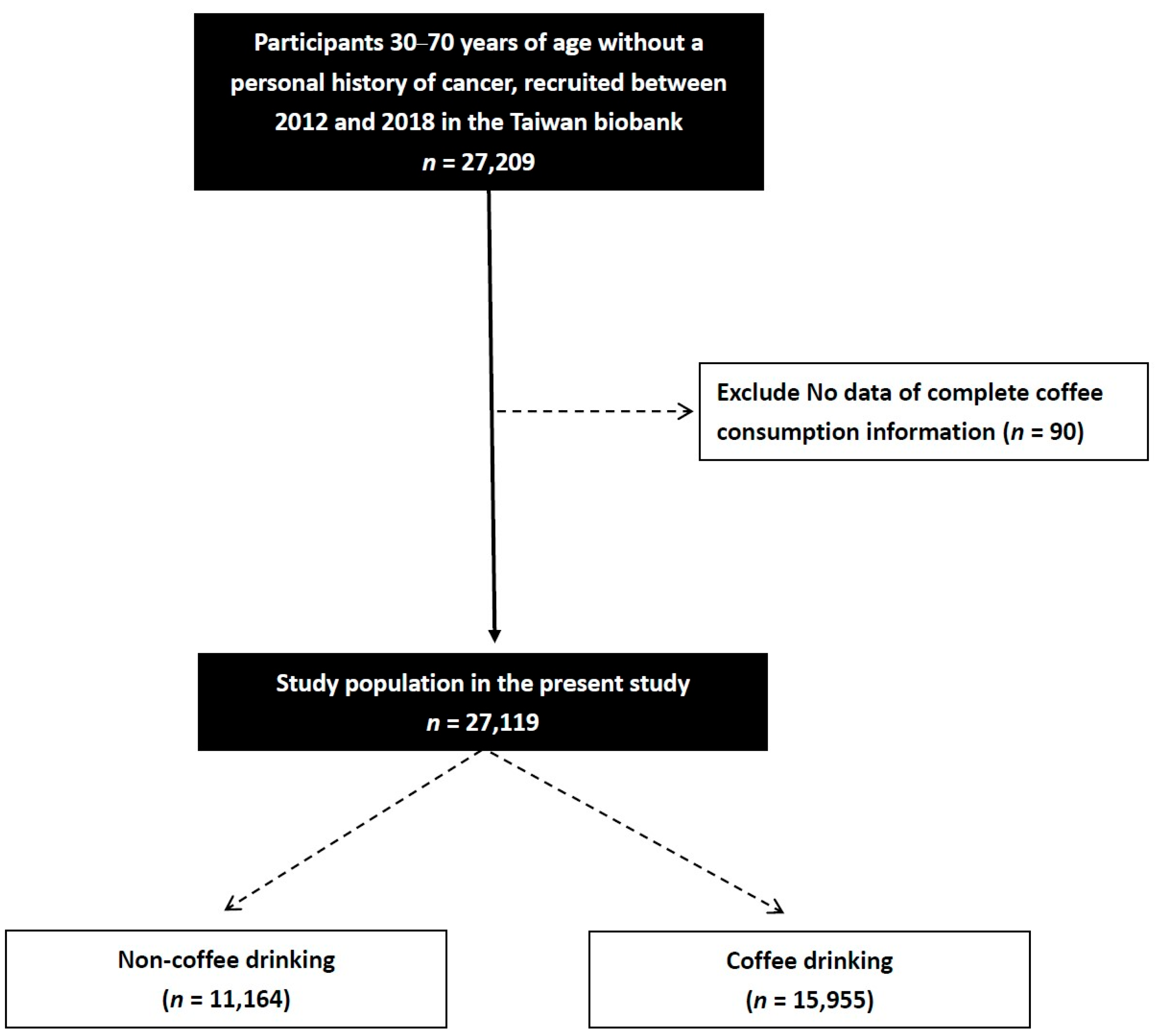
2.1. Study Participants
2.2. Definition of DM and Hypertension
2.3. Assessment of Alcohol Drinking and Cigarette Smoking History
2.4. Assessment of Coffee Consumption
- 1.
- “What type of coffee do you usually drink?” The participants were then classified into the following groups accordingly: “black coffee”, “coffee with creamer” or “coffee with milk”.
- 2.
- “How many cups of coffee (one cup = 237 mL) do you typically consume daily?” The participants were then classified into “none”, “one cup per day”, “two cups per day” or “three cups or more per day” groups.
- 3.
- “How often do you drink coffee?” The participants were then classified into “never”, “every day”, “weekly” (frequency less than every day), and “monthly” (frequency less than weekly) groups.
2.5. Definition of MetS
2.6. Statistical Analysis
3. Results
3.1. Clinical Characteristics of the Participants with and Without MetS
3.2. Associations Between Coffee Consumption and MetS
3.3. Associations Among the Type, Intake and Frequency of Coffee Consumption with MetS
3.4. Associations Between Coffee Consumption and Individual Components of MetS
4. Discussion
5. Conclusions
Author Contributions
Funding
Institutional Review Board Statement
Informed Consent Statement
Data Availability Statement
Conflicts of Interest
References
- Huang, P.L. A comprehensive definition for metabolic syndrome. Dis. Models Mech. 2009, 2, 231–237. [Google Scholar] [CrossRef]
- Group IETFC. International Diabetes Federation: The IDF Consensus Worldwide Definition of the Metabolic Syndrome. 2005. Available online: https://idf.org/media/uploads/2023/05/attachments-30.pdf (accessed on 28 January 2026).
- Fahed, G.; Aoun, L.; Bou Zerdan, M.; Allam, S.; Bou Zerdan, M.; Bouferraa, Y.; Assi, H.I. Metabolic Syndrome: Updates on Pathophysiology and Management in 2021. Int. J. Mol. Sci. 2022, 23, 786. [Google Scholar] [CrossRef] [PubMed]
- Butt, M.S.; Sultan, M.T. Coffee and its consumption: Benefits and risks. Crit. Rev. Food Sci. Nutr. 2011, 51, 363–373. [Google Scholar] [CrossRef] [PubMed]
- Hotamisligil, G.S.; Arner, P.; Caro, J.F.; Atkinson, R.L.; Spiegelman, B.M. Increased adipose tissue expression of tumor necrosis factor-alpha in human obesity and insulin resistance. J. Clin. Investig. 1995, 95, 2409–2415. [Google Scholar] [CrossRef] [PubMed]
- Silveira Rossi, J.L.; Barbalho, S.M.; Reverete de Araujo, R.; Bechara, M.D.; Sloan, K.P.; Sloan, L.A. Metabolic syndrome and cardiovascular diseases: Going beyond traditional risk factors. Diabetes Metab. Res. Rev. 2022, 38, e3502. [Google Scholar] [CrossRef]
- Adiels, M.; Olofsson, S.O.; Taskinen, M.R.; Borén, J. Overproduction of very low-density lipoproteins is the hallmark of the dyslipidemia in the metabolic syndrome. Arterioscler. Thromb. Vasc. Biol. 2008, 28, 1225–1236. [Google Scholar] [CrossRef]
- Cooper, S.A.; Whaley-Connell, A.; Habibi, J.; Wei, Y.; Lastra, G.; Manrique, C.; Stas, S.; Sowers, J.R. Renin-angiotensin-aldosterone system and oxidative stress in cardiovascular insulin resistance. Am. J. Physiol. Heart Circ. Physiol. 2007, 293, H2009–H2023. [Google Scholar] [CrossRef]
- Moura, A.; Paz, S.; Frota, K.M.G.; Carvalho, C. Lifestyle associated with risk of metabolic syndrome in adults and the elderly. Nutrition 2022, 111647. [Google Scholar] [CrossRef]
- Prone-Olazabal, D.; Davies, I.; González-Galarza, F.F. Metabolic Syndrome: An Overview on Its Genetic Associations and Gene-Diet Interactions. Metab. Syndr. Relat. Disord. 2023, 21, 545–560. [Google Scholar] [CrossRef]
- Cornier, M.A.; Dabelea, D.; Hernandez, T.L.; Lindstrom, R.C.; Steig, A.J.; Stob, N.R.; Van Pelt, R.E.; Wang, H.; Eckel, R.H. The metabolic syndrome. Endocr. Rev. 2008, 29, 777–822. [Google Scholar] [CrossRef]
- Nehlig, A. Effects of Coffee on the Gastro-Intestinal Tract: A Narrative Review and Literature Update. Nutrients 2022, 14, 399. [Google Scholar] [CrossRef]
- Mesas, A.E.; Leon-Muñoz, L.M.; Rodriguez-Artalejo, F.; Lopez-Garcia, E. The effect of coffee on blood pressure and cardiovascular disease in hypertensive individuals: A systematic review and meta-analysis. Am. J. Clin. Nutr. 2011, 94, 1113–1126. [Google Scholar] [CrossRef] [PubMed]
- Zhang, H.; Speakman, J.R. The complexity of coffee and its impact on metabolism. J. Endocrinol. 2024, 262, e240075. [Google Scholar] [CrossRef] [PubMed]
- Kempf, K.; Martin, S. Coffee and diabetes. Med. Klin. 2010, 105, 910–915. [Google Scholar] [CrossRef] [PubMed]
- Nina, R.; Lingling, H.; Qiushuang, L.; Honglin, G.; Liyuan, S.; Yuting, Z. Association of coffee consumption pattern and metabolic syndrome among middle-aged and older adults: A cross-sectional study. Front. Public Health 2023, 11, 1022616. [Google Scholar] [CrossRef]
- Shang, F.; Li, X.; Jiang, X. Coffee consumption and risk of the metabolic syndrome: A meta-analysis. Diabetes Metab. 2016, 42, 80–87. [Google Scholar] [CrossRef]
- Wong, T.H.T.; Wong, C.H.; Zhang, X.; Zhou, Y.; Xu, J.; Yuen, K.C.; Wan, J.M.F.; Louie, J.C.Y. The Association Between Coffee Consumption and Metabolic Syndrome in Adults: A Systematic Review and Meta-Analysis. Adv. Nutr. 2021, 12, 708–721. [Google Scholar] [CrossRef]
- Chen, C.H.; Yang, J.H.; Chiang, C.W.K.; Hsiung, C.N.; Wu, P.E.; Chang, L.C.; Chu, H.W.; Chang, J.; Song, I.W.; Yang, S.L.; et al. Population structure of Han Chinese in the modern Taiwanese population based on 10,000 participants in the Taiwan Biobank project. Hum. Mol. Genet. 2016, 25, 5321–5331. [Google Scholar] [CrossRef]
- Baspinar, B.; Eskici, G.; Ozcelik, A.O. How coffee affects metabolic syndrome and its components. Food Funct. 2017, 8, 2089–2101. [Google Scholar] [CrossRef]
- Sirotkin, A.V.; Kolesárová, A. The anti-obesity and health-promoting effects of tea and coffee. Physiol. Res. 2021, 70, 161–168. [Google Scholar] [CrossRef]
- Barcelos, R.P.; Lima, F.D.; Carvalho, N.R.; Bresciani, G.; Royes, L.F. Caffeine effects on systemic metabolism, oxidative-inflammatory pathways, and exercise performance. Nutr. Res. 2020, 80, 1–17. [Google Scholar] [CrossRef] [PubMed]
- Henry-Vitrac, C.; Ibarra, A.; Roller, M.; Mérillon, J.M.; Vitrac, X. Contribution of chlorogenic acids to the inhibition of human hepatic glucose-6-phosphatase activity in vitro by Svetol, a standardized decaffeinated green coffee extract. J. Agric. Food Chem. 2010, 58, 4141–4144. [Google Scholar] [CrossRef] [PubMed]
- Rodriguez-Ramiro, I.; Vauzour, D.; Minihane, A.M. Polyphenols and non-alcoholic fatty liver disease: Impact and mechanisms. Proc. Nutr. Soc. 2016, 75, 47–60. [Google Scholar] [CrossRef] [PubMed]
- Williams, C.J.; Fargnoli, J.L.; Hwang, J.J.; van Dam, R.M.; Blackburn, G.L.; Hu, F.B.; Mantzoros, C.S. Coffee consumption is associated with higher plasma adiponectin concentrations in women with or without type 2 diabetes: A prospective cohort study. Diabetes Care 2008, 31, 504–507. [Google Scholar] [CrossRef]
- Corbi-Cobo-Losey, M.J.; Martinez-Gonzalez, M.A.; Gribble, A.K.; Fernandez-Montero, A.; Navarro, A.M.; Dominguez, L.J.; Bes-Rastrollo, M.; Toledo, E. Coffee Consumption and the Risk of Metabolic Syndrome in the ‘Seguimiento Universidad de Navarra’ Project. Antioxidants 2023, 12, 686. [Google Scholar] [CrossRef]
- Fan, C.T.; Hung, T.H.; Yeh, C.K. Taiwan Regulation of Biobanks. J. Law. Med. Ethics 2015, 43, 816–826. [Google Scholar] [CrossRef]
- Inker, L.A.; Eneanya, N.D.; Coresh, J.; Tighiouart, H.; Wang, D.; Sang, Y.; Crews, D.C.; Doria, A.; Estrella, M.M.; Froissart, M.; et al. New Creatinine- and Cystatin C-Based Equations to Estimate GFR without Race. N. Engl. J. Med. 2021, 385, 1737–1749. [Google Scholar] [CrossRef]
- American College of Sports Medicine. ACSM’s Guidelines for Exercise Testing and Prescription; Lippincott Williams & Wilkins: Philadelphia, PA, USA, 2013. [Google Scholar]
- Tan, C.E.; Ma, S.; Wai, D.; Chew, S.K.; Tai, E.S. Can we apply the National Cholesterol Education Program Adult Treatment Panel definition of the metabolic syndrome to Asians? Diabetes Care 2004, 27, 1182–1186. [Google Scholar] [CrossRef]
- Choi, S.; Je, Y. Association between coffee consumption and metabolic syndrome in Korean adults. Eur. J. Clin. Nutr. 2024, 78, 905–915. [Google Scholar] [CrossRef]
- Lu, M.Y.; Cheng, H.Y.; Lai, J.C.; Chen, S.J. The Relationship between Habitual Coffee Drinking and the Prevalence of Metabolic Syndrome in Taiwanese Adults: Evidence from the Taiwan Biobank Database. Nutrients 2022, 14, 1867. [Google Scholar] [CrossRef]
- Bhandarkar, N.S.; Brown, L.; Panchal, S.K. Chlorogenic acid attenuates high-carbohydrate, high-fat diet-induced cardiovascular, liver, and metabolic changes in rats. Nutr. Res. 2019, 62, 78–88. [Google Scholar] [CrossRef]
- Román, G.C.; Jackson, R.E.; Gadhia, R.; Román, A.N.; Reis, J. Mediterranean diet: The role of long-chain ω-3 fatty acids in fish; polyphenols in fruits, vegetables, cereals, coffee, tea, cacao and wine; probiotics and vitamins in prevention of stroke, age-related cognitive decline, and Alzheimer disease. Rev. Neurol. 2019, 175, 724–741. [Google Scholar] [CrossRef] [PubMed]
- Starling-Soares, B.; Pereira, M.; Renke, G. Extrapolating the Coffee and Caffeine (1,3,7-Trimethylxanthine) Effects on Exercise and Metabolism-A Concise Review. Nutrients 2023, 15, 5031. [Google Scholar] [CrossRef] [PubMed]
- Ma, Y.; Gao, M.; Liu, D. Chlorogenic acid improves high fat diet-induced hepatic steatosis and insulin resistance in mice. Pharm. Res. 2015, 32, 1200–1209. [Google Scholar] [CrossRef]
- Johnston, K.L.; Clifford, M.N.; Morgan, L.M. Coffee acutely modifies gastrointestinal hormone secretion and glucose tolerance in humans: Glycemic effects of chlorogenic acid and caffeine. Am. J. Clin. Nutr. 2003, 78, 728–733. [Google Scholar] [CrossRef] [PubMed]
- Bhandarkar, N.S.; Mouatt, P.; Majzoub, M.E.; Thomas, T.; Brown, L.; Panchal, S.K. Coffee Pulp, a By-Product of Coffee Production, Modulates Gut Microbiota and Improves Metabolic Syndrome in High-Carbohydrate, High-Fat Diet-Fed Rats. Pathogens 2021, 10, 1369. [Google Scholar] [CrossRef]
- Miao, M.; Xiang, L. Pharmacological action and potential targets of chlorogenic acid. Adv. Pharmacol. 2020, 87, 71–88. [Google Scholar] [CrossRef]
- Yamagata, K. Do Coffee Polyphenols Have a Preventive Action on Metabolic Syndrome Associated Endothelial Dysfunctions? An Assessment of the Current Evidence. Antioxidants 2018, 7, 26. [Google Scholar] [CrossRef]
- Renouf, M.; Marmet, C.; Guy, P.; Fraering, A.L.; Longet, K.; Moulin, J.; Enslen, M.; Barron, D.; Cavin, C.; Dionisi, F.; et al. Nondairy creamer, but not milk, delays the appearance of coffee phenolic acid equivalents in human plasma. J. Nutr. 2010, 140, 259–263. [Google Scholar] [CrossRef]
- Malik, V.S.; Popkin, B.M.; Bray, G.A.; Després, J.P.; Willett, W.C.; Hu, F.B. Sugar-sweetened beverages and risk of metabolic syndrome and type 2 diabetes: A meta-analysis. Diabetes Care 2010, 33, 2477–2483. [Google Scholar] [CrossRef]
- Zhou, A.; Hyppönen, E. Habitual coffee intake and plasma lipid profile: Evidence from UK Biobank. Clin. Nutr. 2021, 40, 4404–4413. [Google Scholar] [CrossRef]
- O’Keefe, J.H.; Bhatti, S.K.; Patil, H.R.; DiNicolantonio, J.J.; Lucan, S.C.; Lavie, C.J. Effects of habitual coffee consumption on cardiometabolic disease, cardiovascular health, and all-cause mortality. J. Am. Coll. Cardiol. 2013, 62, 1043–1051. [Google Scholar] [CrossRef]
- Lang, R.; Dieminger, N.; Beusch, A.; Lee, Y.M.; Dunkel, A.; Suess, B.; Skurk, T.; Wahl, A.; Hauner, H.; Hofmann, T. Bioappearance and pharmacokinetics of bioactives upon coffee consumption. Anal. Bioanal. Chem. 2013, 405, 8487–8503. [Google Scholar] [CrossRef]
- Tan, L.J.; Jeon, H.J.; Park, S.; Kim, S.A.; Lim, K.; Chung, S.; Chang, P.S.; Lee, J.K.; Kang, D.; Shin, S. Association of Coffee Consumption and Its Types According to Addition of Sugar and Creamer with Metabolic Syndrome Incidence in a Korean Population from the Health Examinees (HEXA) Study. Nutrients 2021, 13, 920. [Google Scholar] [CrossRef]
- Kim, J.; Hoang, T.; Bu, S.Y.; Kim, J.M.; Choi, J.H.; Park, E.; Lee, S.M.; Park, E.; Min, J.Y.; Lee, I.S.; et al. Associations of Dietary Intake with Cardiovascular Disease, Blood Pressure, and Lipid Profile in the Korean Population: A Systematic Review and Meta-Analysis. J. Lipid Atheroscler. 2020, 9, 205–229. [Google Scholar] [CrossRef]
- Bouchard, D.R.; Ross, R.; Janssen, I. Coffee, tea and their additives: Association with BMI and waist circumference. Obes. Facts 2010, 3, 345–352. [Google Scholar] [CrossRef]
- Han, M.; Oh, Y.; Myung, S.K. Coffee Intake and Risk of Hypertension: A Meta-Analysis of Cohort Studies. J. Korean Med. Sci. 2022, 37, e332. [Google Scholar] [CrossRef]


| Characteristics | MetS (−) (n = 19,948) | MetS (+) (n = 7171) | p |
|---|---|---|---|
| Age (year) | 54.0 ± 10.4 | 57.8 ± 9.6 | <0.001 |
| Male sex (%) | 33.8 | 39.6 | <0.001 |
| DM (%) | 4.0 | 18.1 | <0.001 |
| Hypertension (%) | 10.7 | 37.9 | <0.001 |
| Smoking history (%) | 23.9 | 30.2 | <0.001 |
| Alcohol history (%) | 9.6 | 13.5 | <0.001 |
| Coffee consumption (%) | 42.1 | 28.4 | <0.001 |
| Regular exercise habits (%) | 48.5 | 47.7 | 0.278 |
| Systolic BP (mmHg) | 120.8 ± 18.3 | 136.0 ± 18.2 | <0.001 |
| Diastolic BP (mmHg) | 72.2 ± 10.8 | 79.8 ± 11.2 | <0.001 |
| Body height (cm) | 160.7 ± 8.0 | 160.9 ± 8.5 | 0.143 |
| Body weight (kg) | 60.6 ± 10.7 | 70.1 ± 12.7 | <0.001 |
| Waist circumference (cm) | 81.3 ± 8.8 | 91.4 ± 8.9 | <0.001 |
| Hip circumference (cm) | 94.4 ± 6.3 | 99.1 ± 7.4 | <0.001 |
| Laboratory parameters | |||
| Fasting glucose (mg/dL) | 92.9 ± 14.4 | 109.8 ± 31.6 | <0.001 |
| Hemoglobin (g/dL) | 13.6 ± 1.5 | 14.1 ± 1.5 | <0.001 |
| Triglyceride (mg/dL) | 94.7 ± 51.5 | 190.8 ± 146.2 | <0.001 |
| Total cholesterol (mg/dL) | 196.5 ± 35.2 | 195.3 ± 38.9 | 0.023 |
| HDL-C (mg/dL) | 58.1 ± 12.9 | 44.6 ± 9.6 | <0.001 |
| LDL-C (mg/dL) | 120.4 ± 31.0 | 119.4 ± 34.1 | <0.001 |
| eGFR (mL/min/1.73 m2) | 99.5 ± 14.2 | 93.9 ± 16.7 | 0.030 |
| Uric acid (mg/dL) | 5.2 ± 1.3 | 6.0 ± 1.4 | <0.001 |
| MetS component | |||
| Abdominal obesity (%) | 36.9 | 87.3 | <0.001 |
| Hypertriglyceridemia (%) | 8.5 | 61.9 | <0.001 |
| Low HDL cholesterol (%) | 12.4 | 65.3 | <0.001 |
| Hyperglycemia (%) | 12.2 | 58.1 | <0.001 |
| High BP (%) | 31.6 | 79.5 | <0.001 |
| Variables | Multivariable (MetS) | |
|---|---|---|
| OR (95% CI) | p | |
| Age (per 1 year) | 1.037 (1.033–1.040) | <0.001 |
| Male sex (vs. female) | 0.370 (0.337–0.406) | <0.001 |
| Smoking history | 1.286 (1.186–1.395) | <0.001 |
| Alcohol history | 1.118 (1.015–1.232) | 0.024 |
| Coffee consumption | 0.875 (0.825–0.928) | <0.001 |
| Laboratory parameters | ||
| Hemoglobin (per 1 g/dL) | 1.278 (1.246–1.312) | <0.001 |
| Total cholesterol (per 1 mg/dL) | 0.997 (0.996–0.999) | 0.002 |
| LDL-C (per 1 mg/dL) | 0.998 (0.997–1.000) | 0.124 |
| eGFR (per 1 mL/min/1.73 m2) | 1.001 (0.998–1.004) | 0.484 |
| Uric acid (per 1 mg/dL) | 1.589 (1.549–1.630) | <0.001 |
| Coffee Consumption | Multivariable (MetS) | |
|---|---|---|
| OR (95% CI) | p | |
| Coffee content | ||
| Non-coffee | Reference | |
| Black coffee | 0.848 (0.791–0.910) | <0.001 |
| Coffee with creamer | 1.035 (0.919–1.166) | 0.567 |
| Coffee with milk | 0.848 (0.766–0.938) | 0.001 |
| Daily cups | ||
| None | Reference | |
| 1 cup ∗ per day | 0.805 (0.734–0.883) | <0.001 |
| 2 cups ∗ per day | 0.887 (0.827–0.951) | 0.001 |
| ≥3 cups ∗ per day | 1.049 (0.907–1.214) | 0.520 |
| Frequency | ||
| None | Reference | |
| Per day | 0.811 (0.756–0.870) | <0.001 |
| Per week | 0.975 (0.900–1.056) | 0.532 |
| Per month | 1.459 (0.473–4.498) | 0.511 |
| Variables | Abdominal Obesity | Hypertriglyceridemia | Low HDL Cholesterol | Hyperglycemia | High BP | |||||
|---|---|---|---|---|---|---|---|---|---|---|
| OR (95% CI) | p | OR (95% CI) | p | OR (95% CI) | p | OR (95% CI) | p | OR (95% CI) | p | |
| Coffee consumption | 1.012 (0.961–1.066) | 0.647 | 0.844 (0.792–0.899) | <0.001 | 0.836 (0.788–0.887) | <0.001 | 1.030 (0.970–1.093) | 0.337 | 0.980 (0.928–1.034) | 0.464 |
Disclaimer/Publisher’s Note: The statements, opinions and data contained in all publications are solely those of the individual author(s) and contributor(s) and not of MDPI and/or the editor(s). MDPI and/or the editor(s) disclaim responsibility for any injury to people or property resulting from any ideas, methods, instructions or products referred to in the content. |
© 2026 by the authors. Licensee MDPI, Basel, Switzerland. This article is an open access article distributed under the terms and conditions of the Creative Commons Attribution (CC BY) license.
Share and Cite
Kuo, P.-Y.; Geng, J.-H.; Wu, P.-Y.; Huang, J.-C.; Chen, S.-C. Associations Between Coffee Consumption and the Prevalence of Metabolic Syndrome: A Nationwide Cross-Sectional Survey of Taiwanese Adults. Nutrients 2026, 18, 463. https://doi.org/10.3390/nu18030463
Kuo P-Y, Geng J-H, Wu P-Y, Huang J-C, Chen S-C. Associations Between Coffee Consumption and the Prevalence of Metabolic Syndrome: A Nationwide Cross-Sectional Survey of Taiwanese Adults. Nutrients. 2026; 18(3):463. https://doi.org/10.3390/nu18030463
Chicago/Turabian StyleKuo, Ping-Yi, Jiun-Hung Geng, Pei-Yu Wu, Jiun-Chi Huang, and Szu-Chia Chen. 2026. "Associations Between Coffee Consumption and the Prevalence of Metabolic Syndrome: A Nationwide Cross-Sectional Survey of Taiwanese Adults" Nutrients 18, no. 3: 463. https://doi.org/10.3390/nu18030463
APA StyleKuo, P.-Y., Geng, J.-H., Wu, P.-Y., Huang, J.-C., & Chen, S.-C. (2026). Associations Between Coffee Consumption and the Prevalence of Metabolic Syndrome: A Nationwide Cross-Sectional Survey of Taiwanese Adults. Nutrients, 18(3), 463. https://doi.org/10.3390/nu18030463