Malnutrition Among Children Under Five in Djibouti: A Composite Index of Anthropometric Failure Analysis from the 2023 Multisectoral Survey



Abstract
1. Introduction
2. Materials and Methods
2.1. Study Area
2.2. Study Design and Sampling
- First stage: The country was divided into enumeration areas (EAs), geographical units averaging 90 households, based on census maps. EAs were randomly selected using probability proportional to population size within each stratum (region or sector), using ENA Software for SMART (Version 2011, 31 July 2012).
- Second stage: Within each selected EA, a fixed number of households was randomly chosen using a systematic random sampling approach.
2.3. Data Collection
- Household component: demographic characteristics, housing and living conditions, access to water, hygiene and sanitation, sources of income and livelihoods, and household food security.
- Child component: breastfeeding and complementary feeding practices, morbidity and healthcare access, and anthropometric measurements.
- Field teams were trained and supervised to ensure consistency and data quality throughout the survey.
2.4. Anthropometric Measurements
2.4.1. Weight-for-Age
2.4.2. Length/Height-for-Age
2.4.3. Weight-for-Height/Length
2.5. Outcome Variable
2.6. Independent Variables
- Child-level: gender (boy, girl) and age group (6–23, 24–47, 48–59 months).
- Household-level: area of residence (urban, rural), household type (sedentary, nomadic), and region (Djibouti-City, Balbala, Ali-Sabieh, Dikhil, Tadjourah, Obock, Arta).
- Socioeconomic characteristics: education level of household head (none/primary, secondary, higher), occupation (unemployed/dependent on aid, worker/employee, mid- or senior-level employee, small or large trader). Household economic status was assessed using two complementary indices: a wealth index and an income index. The wealth index was derived using principal component analysis (PCA) of housing characteristics (type of dwelling, persons per room, drinking water, lighting, cooking fuel) and household asset ownership. The first principal component was retained, and households were classified into low, middle, and high wealth groups based on tertiles [31,32,33]. The income index was based on total household income self-reported for the month preceding the survey and similarly categorized into tertiles.
- Household food security: assessed using the Consolidated Approach for Reporting Indicators of Food Security (CARI) and categorized as food secure, marginally food secure, moderately food insecure, or severely food insecure [34].
2.7. Statistical Analysis
3. Results
3.1. Subjects
3.2. Prevalence of Malnutrition in Children Under Five Years
3.2.1. Prevalence of Malnutrition According to Conventional Indices and the CIAF Approach
3.2.2. Gender Differences in Malnutrition
3.3. Factors Associated with Wasting
3.3.1. Crude Analysis
3.3.2. Adjusted Analysis
3.4. Factors Associated with Stunting
3.4.1. Crude Analysis
3.4.2. Adjusted Analysis
3.5. Factors Associated with Underweight
3.5.1. Crude Analysis
3.5.2. Adjusted Analysis
3.6. Factors Associated with Any Anthropometric Failure
3.6.1. Crude Analysis
3.6.2. Adjusted Analysis
4. Discussion
4.1. Added Value of the CIAF Approach
4.2. Gender and Age Patterns of Undernutrition
4.3. Household Mobility and Regional Disparities
4.4. Socioeconomic Factors and Food Security
4.5. Implications for Policy and Programming
4.6. Strengths and Limitations
5. Conclusions
Author Contributions
Funding
Institutional Review Board Statement
Informed Consent Statement
Data Availability Statement
Acknowledgments
Conflicts of Interest
Abbreviations
| CARI | Consolidated Approach to Reporting Indicators |
| CIAF | Composite Index of Anthropometric Failure |
| EA | Enumeration Areas |
| GDP | Gross Domestic Product |
| NFHS-5 | National Family Health Survey-5, 2019-21 |
| PCA | Principal Component Analysis |
| VIFs | Variance Inflation Factors |
| WASH | Water, sanitation and hygiene |
References
- The Global Health Observatory. Explore a World of Health Data. World Health Statistics 2025: Monitoring Health for the SDGs, Sustainable Development Goals. Available online: https://www.who.int/publications/i/item/9789240110496 (accessed on 15 November 2025).
- Development Initiatives. Global Nutrition Report 2022: Stronger Commitments for Greater Action; Development Initiatives: Bristol, UK, 2022. [Google Scholar]
- Gashe, A.D.; Woldemichael, D.Z.; Worku, F.A.; Mahmud, K.A.; Endries, A.Y. Investigating a severe acute malnutrition outbreak in Dubti District, Awsiresu Zone, Afar Region, Northeast Ethiopia (2022). Front. Public Health 2024, 12, 1475104. [Google Scholar] [CrossRef]
- United Nations Children’s Fund (UNICEF); World Health Organization; International Bank for Reconstruction and Development/The World Bank. Levels and Trends in Child Malnutrition: UNICEF/WHO/World Bank Group Joint Child Malnutrition Estimates: Key Findings of the 2025 Edition; World Health Organization: Geneva, Switzerland, 2025. [Google Scholar]
- Alflah, Y.M.; Alrashidi, M.A. Risk factors of acute malnutrition among children under five years of age. Asian J. Med. Health 2023, 21, 12–18. [Google Scholar] [CrossRef]
- United Nations Children’s Fund (UNICEF); World Health Organization (WHO); International Bank for Reconstruction and Development/The World Bank. Levels and Trends in Child Malnutrition: UNICEF/WHO/World Bank Group Joint Child Malnutrition Estimates: Key Findings of the 2023 Edition; UNICEF: New York, NY, USA; WHO: New York, NY, USA, 2023. [Google Scholar]
- Dassie, G.A.; Chala Fantaye, T.; Charkos, T.G.; Sento Erba, M.; Balcha Tolosa, F. Factors influencing concurrent wasting, stunting, and underweight among children under five who suffered from severe acute malnutrition in low-and middle-income countries: A systematic review. Front. Nutr. 2024, 11, 1452963. [Google Scholar] [CrossRef] [PubMed]
- Ewune, H.A.; Abebe, R.K.; Sisay, D.; Tesfa, G.A. Prevalence of wasting and associated factors among children aged 2–5 years, southern Ethiopia: A community-based cross-sectional study. BMC Nutr. 2022, 8, 160. [Google Scholar] [CrossRef] [PubMed]
- Akombi, B.J.; Agho, K.E.; Hall, J.J.; Wali, N.; Renzaho, A.M.; Merom, D. Stunting, wasting and underweight in sub-Saharan Africa: A systematic review. Int. J. Environ. Res. Public Health 2017, 14, 863. [Google Scholar] [CrossRef]
- de Amorim, A.L.B.; Rodrigues, E.F.; Sussi, E.L.; Neri, L.D.C.L. Carbohydrate restriction during lactation: A systematic review. Nutr. Res. 2024, 125, 91–100. [Google Scholar] [CrossRef]
- Rytter, M.J.H.; Kolte, L.; Briend, A.; Friis, H.; Christensen, V.B. The immune system in children with malnutrition—A systematic review. PLoS ONE 2014, 9, e105017. [Google Scholar] [CrossRef]
- Fatima, S.; Manzoor, I.; Joya, A.M.; Arif, S.; Qayyum, S. Stunting and associated factors in children of less than five years: A hospital-based study. Pak. J. Med. Sci. 2020, 36, 581. [Google Scholar] [CrossRef]
- Worldometer. Djibouti Population 2025. Available online: https://www.worldometers.info/world-population/djibouti-population (accessed on 15 November 2025).
- African Development Bank Group. Djibouti—Rapport de la Revue à mi-Parcours du Document de Stratégie Pays 2023–2027. Available online: https://www.afdb.org/fr/documents/djibouti-rapport-de-la-revue-mi-parcours-du-document-de-strategie-pays-2023-2027 (accessed on 17 December 2024).
- Global Nutrition Report. Country Nutrition Profiles. Djibouti: The Burden of Malnutrition at a Glance. Available online: https://globalnutritionreport.org/resources/nutrition-profiles/africa/eastern-africa/djibouti/ (accessed on 25 December 2025).
- Svedberg, P. Poverty and Undernutrition: Theory, Measurement, and Policy; Clarendon Press: Oxford, UK, 2000; pp. 1–350. [Google Scholar]
- Nandy, S.; Svedberg, P. The Composite Index of Anthropometric Failure (CIAF): An Alternative Indicator for Malnutrition in Young Children. In Handbook of Anthropometry: Physical Measures of Human Form in Health and Disease; Preedy, V.R., Ed.; Springer: New York, NY, USA, 2012; pp. 127–137. [Google Scholar]
- Vandelaer, J.; Bilous, J.; Nshimirimana, D. Reaching Every District (RED) approach: A way to improve immunization performance. Bull. World Health Organ. 2008, 86, A–B. [Google Scholar] [CrossRef]
- Mandal, G.C.; Bose, K. Composite index of anthropometric failure (CIAF): A better indicator of overall burden of undernutrition among primary school children. Sri Lanka J. Child Health 2021, 50, 194–199. [Google Scholar] [CrossRef]
- Dassie, G.A. Composite Index of Anthropometric Failure to assess malnutrition in low-and middle-income countries across Africa, Asia, and Europe: A state-of-the-art review. Front. Nutr. 2025, 12, 1558381. [Google Scholar] [CrossRef] [PubMed]
- Sahiledengle, B.; Mwanri, L.; Kumie, A.; Beressa, G.; Atlaw, D.; Tekalegn, Y.; Zenbaba, D.; Desta, F.; Kene, C.; Seyoum, K.; et al. The coexistence of stunting and overweight or obesity in Ethiopian children: Prevalence, trends and associated factors. BMC Pediatr. 2023, 23, 218. [Google Scholar] [CrossRef] [PubMed]
- Kitaw, T.A.; Zemariam, A.B.; Azmeraw, M.; Haile, R.N. Geo-spatial pattern and determinants of composite index of anthropometric failure among children under five in Ethiopia. Sci. Rep. 2025, 15, 11903. [Google Scholar] [CrossRef] [PubMed]
- Dhakal, R.P.; Aryal, V.; Acharya, P. Factors influencing undernutrition among children in Nepal: A comparative study of Composite Index of Anthropometric Failure (CIAF) using 2016 and 2022 demographic and health survey data. J. Health Popul. Nutr. 2025, 44, 311. [Google Scholar] [CrossRef]
- Balogun, O.S.; Asif, A.M.; Akbar, M.; Chesneau, C.; Jamal, F. Prevalence and potential determinants of aggregate anthropometric failure among Pakistani children: Findings from a community health survey. Children 2021, 8, 1010. [Google Scholar] [CrossRef]
- Abbink, J. Leenco Lata. The Horn of Africa as Common Homeland: The State and Self-Determination in the Era of Heightened Globalization. Afr. Stud. Rev. 2005, 48, 222–224. [Google Scholar] [CrossRef]
- World Food Programme (WFP). Plan Stratégique de Pays—Djibouti (2020–2024). 2020. Available online: https://www.wfp.org/operations/dj02-djibouti-country-strategic-plan-2020-2024 (accessed on 17 December 2022).
- Worku, M.G.; Mohanty, I.; Mengesha, Z.; Niyonsenga, T. Magnitudes of Various Forms of Undernutrition Among Children from the Composite Index of Anthropometric Failure in Sub-Saharan Africa: A Systematic Review and Meta-Analysis. Nutrients 2025, 17, 1818. [Google Scholar] [CrossRef]
- World Health Organization. WHO Child Growth Standards: Length/Height-for-Age, Weight-for-Age, Weight-for-Length, Weight-for-Height and Body Mass Index-for-Age: Methods and Development; World Health Organization: Geneva, Switzerland, 2006. [Google Scholar]
- World Health Organization. Training Course on Child Growth Assessment; WHO: Geneva, Switzerland, 2008. [Google Scholar]
- Kuiti, B.K.; Acharya, S.; Satapathy, K.C.; Barik, D.K.; Patra, P.K. Composite Index of Anthropometric Failure (CIAF) among Juang children and adolescents of Keonjhar district in Odisha, India. Man Environ. Soc. 2022, 3, 133–154. [Google Scholar] [CrossRef]
- Traissac, P.; Martin-Prevel, Y. Alternatives to principal components analysis to derive asset-based indices to measure socio-economic position in low- and middle-income countries: The case for multiple correspondence analysis. Int. J. Epidemiol. 2012, 41, 1207–1208. [Google Scholar] [CrossRef]
- Gartner, A.; El Ati, J.; Traissac, P.; Bour, A.; Berger, J.; Landais, E.; El Hsaïni, H.; Ben Rayana, C.; Delpeuch, F. A double burden of overall or central adiposity and anemia or iron deficiency is prevalent but with little socioeconomic patterning among Moroccan and Tunisian urban women. J. Nutr. 2014, 144, 87–97. [Google Scholar] [CrossRef]
- Traissac, P.; El Ati, J.; Gartner, A.; Ben Gharbia, H.; Delpeuch, F. Gender inequalities in excess adiposity and anaemia combine in a large double burden of malnutrition gap detrimental to women in an urban area in North Africa. Public Health Nutr. 2016, 19, 1428–1437. [Google Scholar] [CrossRef]
- World Food Programme (WFP). Technical Guidance for WFP’s Consolidated Approach for Reporting Indicators of Food Security (CARI). United Nations World Food Programme, 3rd ed.; Food Security Analysis (VAM): Rome, Italy, 2021. [Google Scholar]
- Hassan, R.; Hossain, S.; Alam, M.M.; Saha, S.; Akter, T.; Ali, M.; Amin, M.R. Prevalence and Determinants of the Composite Index of Anthropometric Failure in Children Under Five Years in Bangladesh: Insights from a National Survey. Food Sci. Nutr. 2025, 13, e70499. [Google Scholar] [CrossRef]
- Hussain, D.; Sharma, S. Flood exposure and childhood malnutrition in India using composite index of anthropometric failure (CIAF). Environ. Res. 2025, 276, 121527. [Google Scholar] [CrossRef] [PubMed]
- Nandy, S.; Miranda, J.J. Overlooking undernutrition? Using a composite index of anthropometric failure to assess how underweight misses and misleads the assessment of undernutrition in young children. Soc. Sci. Med. 2008, 66, 1963–1966. [Google Scholar] [CrossRef] [PubMed]
- Gausman, J.; Kim, R.; Li, Z.; Tu, L.; Rajpal, S.; Joe, W.; Subramanian, S.V. Comparison of child undernutrition anthropometric indicators across 56 low-and middle-income countries. JAMA Netw. Open 2022, 5, e221223. [Google Scholar] [CrossRef] [PubMed]
- Amusa, L.B.; Yahya, W.B.; Bengesai, A.V. Spatial variations and determinants of malnutrition among under-five children in Nigeria: A population-based cross-sectional study. PLoS ONE 2023, 18, e0284270. [Google Scholar] [CrossRef]
- Pallangyo, E.E.; Kimaro, O.J.; Mwalupani, N.R.; George, G.S.; Katana, D.; Msengwa, A.S. Cross-sectional analysis of risk factors associated with the coexistence of three undernutrition indicators among children aged 0–23 months in Tanzania. BMC Nutr. 2025, 11, 4. [Google Scholar] [CrossRef]
- Shah, G.; Siddiqa, M.; Shankar, P.; Karibayeva, I.; Zubair, A.; Shah, B. Decoding India’s child malnutrition puzzle: A multivariable analysis using a composite index. Children 2024, 11, 902. [Google Scholar] [CrossRef]
- Nandeep, E.R.; Jaleel, A.; Reddy, P.B.; Geddam, J.B.; Reddy, S.N.; Hemalatha, R. Developing and demonstrating an atomistic and holistic model of anthropometric failure among children under five years of age using the National Family Health Survey (NFHS)-5 data from India. Front. Nutr. 2024, 10, 1280219. [Google Scholar] [CrossRef]
- De Onis, M.; Branca, F. Childhood stunting: A global perspective. Matern. Child Nutr. 2016, 12, 12–26. [Google Scholar] [CrossRef]
- Victora, C.G.; De Onis, M.; Hallal, P.C.; Blössner, M.; Shrimpton, R. Worldwide timing of growth faltering: Revisiting implications for interventions. Pediatrics 2010, 125, e473–e480. [Google Scholar] [CrossRef]
- Mertens, A.; Benjamin-Chung, J.; Colford, J.M., Jr.; Hubbard, A.E.; van der Laan, M.J.; Coyle, J.; Sofrygin, O.; Cai, W.; Jilek, W.; Rosete, S.; et al. Child wasting and concurrent stunting in low- and middle-income countries. Nature 2023, 621, 558–567. [Google Scholar] [CrossRef]
- Aguayo, V.M. Complementary feeding practices for infants and young children in South Asia. A review of evidence for action post-2015. Matern. Child Nutr. 2017, 13, e12439. [Google Scholar] [CrossRef] [PubMed]
- Torlesse, H.; Raju, D. Feeding of Infants and Young Children in South Asia; World Bank Working Paper No. 8655; The World Bank: Washington, DC, USA, 2018. [Google Scholar]
- Gizaw, Z.; Worku, A. Effects of single and combined water, sanitation and hygiene (WASH) interventions on nutritional status of children: A systematic review and meta-analysis. Ital. J. Pediatr. 2019, 45, 77. [Google Scholar] [CrossRef] [PubMed]
- Permatasari, T.A.E.; Chadirin, Y. Assessment of undernutrition using the composite index of anthropometric failure (CIAF) and its determinants: A cross-sectional study in the rural area of the Bogor District in Indonesia. BMC Nutr. 2022, 8, 133. [Google Scholar] [CrossRef] [PubMed]
- Al-Sadeeq, A.H.; Bukair, A.Z.; Al-Saqladi, A.W.M. Assessment of undernutrition using Composite Index of Anthropometric Failure among children aged <5 years in rural Yemen. East. Mediterr. Health J. 2018, 24, 1119–1126. [Google Scholar] [CrossRef]
- Khamis, A.G.; Mwanri, A.W.; Kreppel, K.; Kwesigabo, G. The burden and correlates of childhood undernutrition in Tanzania according to composite index of anthropometric failure. BMC Nutr. 2020, 6, 39. [Google Scholar] [CrossRef]
- Ayres, A.; Tsega, Y.; Endawkie, A.; Kebede, S.D.; Abeje, E.T.; Enyew, E.B.; Teshome, M.; Abate, A.; Alemayehu, T.; Gebeyehu, E.M. Residence-based disparities of composite index of anthropometric failures in East African under five children; multivariate decomposition analysis. BMC Public Health 2025, 25, 430. [Google Scholar] [CrossRef]
- Sen, J.; Mondal, N. Socio-economic and demographic factors affecting the Composite Index of Anthropometric Failure (CIAF). Ann. Hum. Biol. 2012, 39, 129–136. [Google Scholar] [CrossRef]
- De Onis, M.; Borghi, E.; Arimond, M.; Webb, P.; Croft, T.; Saha, K.; Flores-Ayala, R. Prevalence thresholds for wasting, overweight and stunting in children under 5 years. Public Health Nutr. 2019, 22, 175–179. [Google Scholar] [CrossRef]
- Saif, S.; Anwar, S. Unraveling the South Asian enigma: Concurrent manifestations of child anthropometric failures and their determinants in selected South Asian countries. BMC Nutr. 2023, 9, 120. [Google Scholar] [CrossRef]


| Group | CIAD-Categories | Description of the Level |
|---|---|---|
| A | No failure | Normal WHZ, WAZ and HAZ |
| B | Stunting only | HAZ <−2 SD, but normal WAZ and WHZ |
| C | Wasting only | WHZ <−2 SD, but normal WAZ and HAZ |
| D | Underweight only | WAZ <−2 SD, but normal WHZ and HAZ |
| E | Stunting and underweight | HAZ and WAZ <−2 SD, but normal WHZ |
| F | Wasting and underweight | WHZ and WAZ <−2 SD, but normal HAZ |
| Y | Wasting, underweight and stunting | WHZ, WAZ and HAZ <−2 SD |
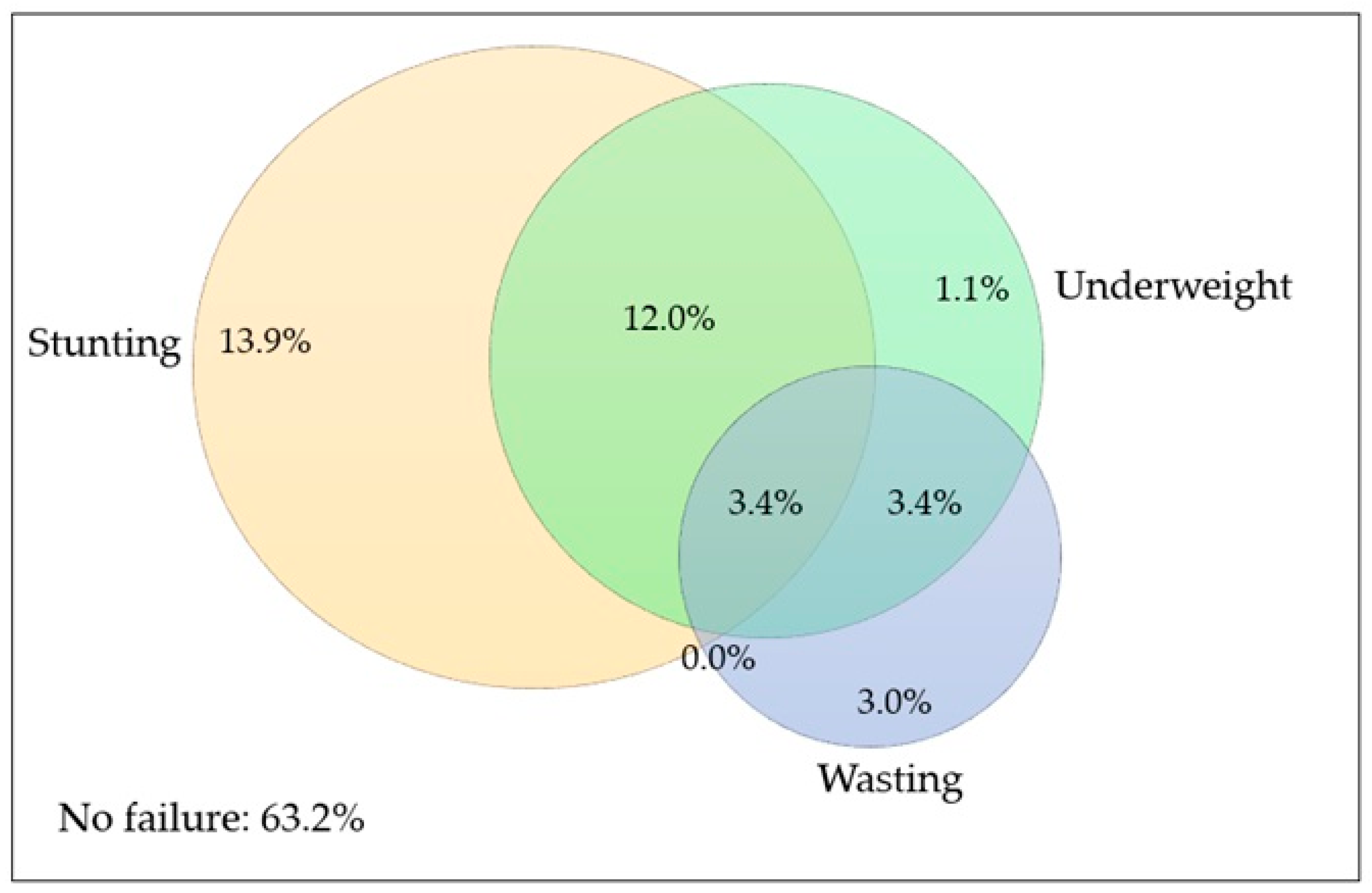
| Both Genders (n = 2067) 1 % 2 (95% CI) 3 | Girls (n = 1004) 1 % 2 (95% CI) 3 | Boys (n = 1063) 1 % 2 (95% CI) 3 | p-Value Girls vs. Boys 4 | |
|---|---|---|---|---|
| Wasting | 9.8 (8.5–11.1) | 8.0 (6.3–9.7) | 11.6 (9.6–13.5) | 0.006 |
| Stunting | 29.2 (27.3–31.2) | 27.8 (25.0–30.6) | 30.6 (27.8–33.3) | 0.16 |
| Underweight | 19.9 (18.2–21.7) | 19.0 (16.6–215) | 20.8 (18.3–23.2) | 0.31 |
| A: No failure | 63.2 (61.1–65.2) | 66.0 (63–68.9) | 60.5 (57.6–63.4) | 0.06 |
| B: Stunting only | 13.9 (12.3–15.3) | 13.0 (10.9–15) | 14.6 (12.5–16.7) | |
| C: Wasting only | 3.0 (2.3–3.8) | 2.2 (1.3–3.2) | 3.8 (2.7–4.9) | |
| D: Underweight only | 1.1 (0.7–1.6) | 1.4 (0.7–2.1) | 0.9 (0.4–1.5) | |
| E: Stunting and underweight | 12.0 (10.6–13.4) | 11.7 (9.7–13.7) | 12.3 (10.4–14.3) | |
| F: Wasting and underweight | 3.4 (2.6–4.2) | 2.7 (1.7–3.7) | 4.1 (2.9–5.3) | |
| Y: Wasting, underweight and stunting | 3.4 (2.6–4.2) | 3.0 (2–4.1) | 3.8 (2.7–4.9) | |
| Any anthropometric failure | 36.8 (34.7–38.9) | 34.2 (31.2–37.1) | 39.3 (36.4–42.3) | 0.02 |
| Variable | n 1 | Prevalence | Crude Analysis | Adjusted Analysis | |||||
|---|---|---|---|---|---|---|---|---|---|
| % 2 | RRR 3 | 95% CI 4 | p-Value 5 | Overall p-Value 6 | RRR 3 | 95% CI 4 | p-Value 5 | ||
| Gender | |||||||||
| Boys | 1063 | 11.6 | 1 | 0.006 | 1 | ||||
| Girls | 1004 | 8.0 | 0.7 | 0.49–0.88 | 0.006 | 0.6 | 0.44–0.82 | 0.001 | |
| Age (months) | |||||||||
| 6–23 | 664 | 13.3 | 0.9 | 0.56–1.30 | 0.47 | 0.001 | 0.8 | 0.54–1.28 | 0.42 |
| 24–47 | 1028 | 7.9 | 1.5 | 1.00–2.32 | 0.04 | 1.5 | 1.01–2.38 | 0.044 | |
| 48–59 | 375 | 9.1 | 1 | 1 | |||||
| Area of residence | |||||||||
| Rural | 995 | 11.2 | 1 | 0.05 | 1 | ||||
| Urban | 1072 | 8.6 | 0.7 | 0.55–1.00 | 0.05 | 1.3 | 0.86–2.12 | 0.19 | |
| Household type | |||||||||
| Sedentary | 1107 | 7.9 | 0.6 | 0.46–0.83 | 0.001 | 0.001 | 0.3 | 0.20–0.58 | <0.0001 |
| nomadic | 960 | 12.1 | 1 | 1 | |||||
| Region | |||||||||
| Dikhil | 241 | 7.9 | 1 | 0.03 | 1 | ||||
| Djibouti-city | 147 | 5.4 | 1.5 | 0.80–2.70 | 0.20 | 1.6 | 0.87–3.10 | 0.12 | |
| Balbala | 358 | 9.5 | 1.0 | 0.56–1.93 | 0.88 | 1.1 | 0.59–2.15 | 0.72 | |
| Ali-Sabieh | 367 | 11.2 | 1.2 | 0.68–2.20 | 0.49 | 2.2 | 1.11–4.49 | 0.02 | |
| Tadjourah | 500 | 10.0 | 0.7 | 0.28–1.57 | 0.36 | 1.0 | 0.42–2.79 | 0.85 | |
| Obock | 226 | 15.5 | 2.1 | 1.18–3.86 | 0.01 | 3.1 | 1.64–5.98 | 0.0005 | |
| Arta | 328 | 8.2 | 1.3 | 0.74–2.25 | 0.35 | 1.2 | 0.71–2.28 | 0.40 | |
| Education level of household head | |||||||||
| Low | 1199 | 10.9 | 1 | 0.12 | 1 | ||||
| Middle | 239 | 7.5 | 0.7 | 0.39–1.11 | 0.11 | 0.4 | 0.17–1.42 | 0.19 | |
| High | 629 | 8.6 | 0.8 | 0.54–1.06 | 0.11 | 0.5 | 0.16–1.95 | 0.37 | |
| Occupation of household head | |||||||||
| Large-scale trader | 178 | 10.7 | 1 | 0.21 | 1 | ||||
| Worker and employee | 482 | 8.9 | 0.8 | 0.46–1.44 | 0.49 | 0.8 | 0.47–1.55 | 0.61 | |
| Senior middle manager | 805 | 8.4 | 0.8 | 0.45–1.32 | 0.34 | 1.5 | 0.42–5.61 | 0.50 | |
| Unemployed/dependent aid | 251 | 12.4 | 1.2 | 0.64–2.16 | 0.59 | 1.3 | 0.68–2.46 | 0.42 | |
| Small-scale trader | 351 | 12.0 | 1.1 | 0.64–2.02 | 0.66 | 1.0 | 0.56–1.85 | 0.94 | |
| Household wealth index | |||||||||
| Low | 688 | 10.6 | 1.3 | 0.90–1.86 | 0.15 | 0.28 | 0.7 | 0.41–1.18 | 0.18 |
| Middle | 685 | 10.5 | 1.3 | 0.89–1.85 | 0.17 | 1.0 | 0.67–1.55 | 0.91 | |
| High | 694 | 8.4 | 1 | 1 | |||||
| Household income index | |||||||||
| Low | 555 | 11.4 | 1.5 | 1.03–2.22 | 0.03 | 0.06 | 1.3 | 0.85–2.21 | 0.18 |
| Middle | 804 | 10.6 | 1.4 | 0.98–2.00 | 0.06 | 1.3 | 0.86–2.01 | 0.19 | |
| High | 708 | 7.8 | 1 | 1 | |||||
| Food security index CARI | |||||||||
| Food secure | 152 | 8.6 | 0.4 | 0.11–1.35 | 0.14 | 0.42 | 0.5 | 0.14–1.93 | 0.33 |
| Marginally food secure | 1415 | 10.1 | 0.5 | 0.15–1.43 | 0.18 | 0.7 | 0.22–2.30 | 0.58 | |
| Moderately food insecure | 479 | 9.0 | 0.4 | 0.13–1.30 | 0.13 | 0.5 | 0.16–1.72 | 0.29 | |
| Severely food insecure | 21 | 19.0 | 1 | 1 | |||||
| Variable | n 1 | Prevalence | Crude Analysis | Adjusted Analysis | |||||
|---|---|---|---|---|---|---|---|---|---|
| % 2 | RRR 3 | 95% CI 4 | p-Value 5 | Overall p-Value 6 | RRR 3 | 95% CI 4 | p-Value 5 | ||
| Gender | |||||||||
| Boys | 1063 | 30.6 | 1 | 1 | |||||
| Girls | 1004 | 27.8 | 0.9 | 0.72–1.05 | 0.16 | 0.16 | 0.8 | 0.67–1.00 | 0.056 |
| Age (months) | - | ||||||||
| 6–23 | 664 | 27.7 | 1.7 | 1.27–2.21 | 0.0001 | 1.7 | 1.26–2.22 | 0.0001 | |
| 24–47 | 1028 | 32.7 | 1.3 | 0.98–1.78 | 0.06 | 0.0005 | 1.4 | 1.00–1.85 | 0.04 |
| 48–59 | 375 | 22.4 | 1 | 1 | |||||
| Area of residence | |||||||||
| Rural | 995 | 34.1 | 1 | 1 | |||||
| Urban | 1072 | 24.7 | 0.6 | 0.52–0.76 | <0.0001 | <0.0001 | 1.0 | 0.72–1.30 | 0.86 |
| Household type | 24.4 | ||||||||
| Sedentary | 1107 | 34.8 | 0.6 | 0.50–0.73 | <0.0001 | <0.0001 | 0.7 | 0.47–0.93 | 0.01 |
| nomadic | 960 | 24.4 | 1 | 1 | |||||
| Region | |||||||||
| Dikhil | 241 | 20.4 | 1 | 0.0004 | 1 | ||||
| Djibouti-city | 147 | 26.3 | 0.7 | 0.46–1.03 | 0.07 | 0.8 | 0.50–1.15 | 0.20 | |
| Balbala | 358 | 23.2 | 0.9 | 0.60–1.25 | 0.45 | 0.9 | 0.64–1.38 | 0.76 | |
| Ali-Sabieh | 267 | 30.3 | 0.8 | 0.57–1.17 | 0.28 | 1.2 | 0.76–1.80 | 0.45 | |
| Tadjourah | 500 | 34.6 | 0.6 | 0.36–0.96 | 0.03 | 0.9 | 0.51–1.52 | 0.67 | |
| Obock | 226 | 36.3 | 1.3 | 0.89–1.92 | 0.17 | 1.6 | 1.03–2.41 | 0.03 | |
| Arta | 328 | 27.4 | 1.2 | 0.87–1.69 | 0.24 | 1.2 | 0.86–1.73 | 0.25 | |
| Education level of household head | |||||||||
| Low | 1199 | 31.3 | 1 | 1 | |||||
| Middle | 239 | 28.0 | 0.9 | 0.62–1.16 | 0.32 | 0.04 | 1.3 | 0.71–2.19 | 0.42 |
| High | 629 | 25.8 | 0.8 | 0.61–0.94 | 0.01 | 1.3 | 0.65–2.55 | 0.45 | |
| Occupation of household head | |||||||||
| Large-scale trader | 178 | 30.3 | 1 | 0.03 | 1.1 | 0.71–1.58 | 0.74 | ||
| Worker and employee | 482 | 25.6 | 1.1 | 0.72–1.53 | 0.78 | 0.8 | 0.36–1.52 | 0.44 | |
| Senior middle manager | 805 | 34.7 | 0.8 | 0.58–1.19 | 0.32 | 1 | 0.66–1.59 | 0.89 | |
| Unemployed/dependent aid | 251 | 29.2 | 1.3 | 0.84–1.94 | 0.23 | 1 | 0.67–1.53 | 0.92 | |
| Small-scale trader | 351 | 32.2 | 1.2 | 0.77–1.70 | 0.48 | 1.3 | 0.71–2.19 | 0.42 | |
| Household wealth index | |||||||||
| Low | 688 | 35.5 | 1.9 | 1.48–2.38 | <0.0001 | <0.0001 | 1.3 | 0.92–1.80 | 0.13 |
| Middle | 685 | 29.6 | 1.4 | 1.13–1.83 | 0.003 | 1.3 | 0.97–1.68 | 0.08 | |
| High | 694 | 22.6 | 1 | 1 | |||||
| Household income index | |||||||||
| Low | 555 | 34.1 | 1.6 | 1.24–2.02 | 0.0001 | <0.0001 | 1.1 | 0.81–1.52 | 0.48 |
| Middle | 804 | 30.0 | 1.3 | 1.04–1.65 | 0.01 | 1 | 0.78–1.33 | 0.87 | |
| High | 708 | 24.6 | 1 | 1 | |||||
| Food security index CARI | |||||||||
| Food secure | 152 | 28.9 | 0.7 | 0.25–1.70 | 0.39 | 0.41 | 1 | 0.39–2.76 | 0.93 |
| Marginally food secure | 1415 | 28.3 | 0.6 | 0.26–1.55 | 0.32 | 0.9 | 0.36–2.27 | 0.84 | |
| Moderately food insecure | 479 | 31.7 | 0.8 | 0.30–1.86 | 0.54 | 0.9 | 0.36–2.33 | 0.87 | |
| Severely food insecure | 21 | 38.1 | 1 | 1 | |||||
| Variable | n 1 | Prevalence | Crude Analysis | Adjusted Analysis | |||||
|---|---|---|---|---|---|---|---|---|---|
| % 2 | RRR 3 | 95% CI 4 | p-Value 5 | Overall p-Value 6 | RRR 3 | 95% CI 4 | p-Value 5 | ||
| Gender | |||||||||
| Boys | 1063 | 20.8 | 1 | 0.31 | 1 | ||||
| Girls | 1004 | 19.0 | 0.9 | 0.72–1.11 | 0.31 | 0.8 | 0.65–1.02 | 0.08 | |
| Age (months) | |||||||||
| 6–23 | 664 | 19.6 | 1.2 | 0.85–1.56 | 0.33 | 0.61 | 1.2 | 0.84–1.57 | 0.35 |
| 24–47 | 1028 | 20.7 | 1.1 | 0.78–1.49 | 0.64 | 1.1 | 0.79–1.54 | 0.54 | |
| 48–59 | 375 | 18.4 | 1 | 1 | |||||
| Area of residence | |||||||||
| Rural | 995 | 24.0 | 1 | <0.0001 | 1 | ||||
| Urban | 1072 | 16.1 | 0.6 | 0.48–0.75 | <0.0001 | 1.0 | 0.72–1.38 | 0.98 | |
| Household type | |||||||||
| Sedentary | 1107 | 15.9 | 0.6 | 0.46–0.72 | <0.0001 | <0.0001 | 0.7 | 0.45–0.96 | 0.03 |
| nomadic | 960 | 24.6 | 1 | 1 | |||||
| Region | |||||||||
| Dikhil | 241 | 6.8 | 1 | <0.0001 | 1 | ||||
| Djibouti-city | 147 | 16.8 | 0.8 | 0.49–1.17 | 0.21 | 0.7 | 0.45–0.96 | 0.03 | |
| Balbala | 358 | 18.4 | 0.7 | 0.49–1.12 | 0.15 | 0.9 | 0.54–1.35 | 0.51 | |
| Ali-Sabieh | 267 | 22.8 | 0.7 | 0.45–1.02 | 0.06 | 0.8 | 0.51–1.23 | 0.31 | |
| Tadjourah | 500 | 22.2 | 0.2 | 0.12–0.50 | 0.0001 | 1.0 | 0.58–1.53 | 0.83 | |
| Obock | 226 | 30.1 | 1.5 | 0.96–2.20 | 0.07 | 0.4 | 0.16–0.75 | 0.007 | |
| Arta | 328 | 18.0 | 1.0 | 0.66–1.39 | 0.84 | 1.7 | 1.07–2.65 | 0.02 | |
| Education level of household head | |||||||||
| Low | 1199 | 22.0 | 1 | 0.02 | 1 | ||||
| Middle | 239 | 16.7 | 0.7 | 0.49–1.02 | 0.06 | 0.8 | 0.40–1.57 | 0.51 | |
| High | 629 | 17.2 | 0.7 | 0.57–0.94 | 0.01 | 0.8 | 0.37–1.92 | 0.69 | |
| Occupation of household head | |||||||||
| Large-scale trader | 178 | 19.3 | 1 | 0.01 | 1 | ||||
| Worker and employee | 482 | 16.9 | 0.9 | 0.55–1.29 | 0.45 | 0.9 | 0.59–1.41 | 0.68 | |
| Senior middle manager | 805 | 26.3 | 0.7 | 0.48–1.08 | 0.11 | 1.1 | 0.44–2.51 | 0.90 | |
| Unemployed/dependent aid | 251 | 21.9 | 1.3 | 0.80–2.00 | 0.29 | 1.2 | 0.73–1.90 | 0.49 | |
| Small-scale trader | 351 | 22.2 | 1.0 | 0.65–1.57 | 0.93 | 1.0 | 0.62–1.54 | 0.95 | |
| Household wealth index | |||||||||
| Low | 688 | 25.0 | 1.9 | 1.47–2.53 | <0.0001 | <0.0001 | 1.2 | 0.80–1.72 | 0.40 |
| Middle | 685 | 20.1 | 1.5 | 1.10–1.93 | 0.008 | 1.3 | 0.91–1.73 | 0.16 | |
| High | 694 | 14.7 | 1 | 1 | |||||
| Household income index | |||||||||
| Low | 555 | 24.5 | 1.7 | 1.26–2.21 | 0.0003 | 0.001 | 1.2 | 0.87–1.77 | 0.22 |
| Middle | 804 | 20.0 | 1.3 | 0.99–1.68 | 0.05 | 1.1 | 0.77–1.44 | 0.72 | |
| High | 708 | 16.2 | 1 | 1 | |||||
| Food security index CARI | |||||||||
| Food secure | 152 | 16.4 | 0.8 | 0.26–2.69 | 0.76 | 0.63 | 1.2 | 0.36–3.94 | 0.77 |
| Marginally food secure | 1415 | 19.9 | 1.1 | 0.35–3.15 | 0.92 | 1.5 | 0.48–4.53 | 0.48 | |
| Moderately food insecure | 479 | 21.3 | 1.2 | 0.37–3.49 | 0.80 | 1.3 | 0.42–4.06 | 0.63 | |
| Severely food insecure | 21 | 19.0 | 1 | 1 | |||||
| Variable | n 1 | Prevalence | Crude Analysis | Adjusted Analysis | |||||
|---|---|---|---|---|---|---|---|---|---|
| % 2 | RRR 3 | 95% CI 4 | p-Value 5 | Overall p-Value 6 | RRR 3 | 95% CI 4 | p-Value 5 | ||
| Gender | |||||||||
| Boys | 1063 | 20.8 | 1 | 0.015 | 1 | ||||
| Girls | 1004 | 19.0 | 0.8 | 0.66–0.95 | 0.015 | 0.7 | 0.61–0.89 | 0.001 | |
| Age (months) | |||||||||
| 6–23 | 664 | 19.6 | 1.4 | 1.10–1.82 | 0.007 | 0.02 | 1.4 | 1.08–1.82 | 0.009 |
| 24–47 | 1028 | 20.7 | 1.4 | 1.04–1.78 | 0.02 | 1.4 | 1.06–1.85 | 0.01 | |
| 48–59 | 375 | 18.4 | 1 | 1 | |||||
| Area of residence | |||||||||
| Rural | 995 | 24.0 | 1 | <0.0001 | 1 | ||||
| Urban | 1072 | 16.1 | 0.6 | 0.51–0.73 | <0.0001 | 1.0 | 0.72–1.2 | 0.75 | |
| Household type | |||||||||
| Sedentary | 1107 | 15.9 | 1.7 | 1.41–2.02 | <0.0001 | <0.0001 | 0.6 | 0.45–0.85 | 0.003 |
| nomadic | 960 | 24.6 | 1 | 1 | |||||
| Region | |||||||||
| Dikhil | 7.9 | 6.8 | 1 | <0.0001 | 1 | ||||
| Djibouti-city | 5.4 | 16.8 | 0.7 | 0.48–1.08 | 0.04 | 0.7 | 0.50–1.09 | 0.13 | |
| Balbala | 9.5 | 18.4 | 0.8 | 0.54–1.08 | 0.12 | 0.8 | 0.55–1.15 | 0.23 | |
| Ali-Sabieh | 11.2 | 22.8 | 0.8 | 0.55–1.08 | 0.14 | 1.1 | 0.75–1.6 | 0.55 | |
| Tadjourah | 10.0 | 22.2 | 0.5 | 0.34–0.84 | 0.006 | 0.8 | 0.48–1.32 | 0.38 | |
| Obock | 15.5 | 30.1 | 1.3 | 0.92–1.92 | 0.12 | 1.6 | 1.08–2.42 | 0.01 | |
| Arta | 8.2 | 18.0 | 1.1 | 0.82–1.53 | 0.47 | 1.1 | 0.77–1.49 | 0.68 | |
| Education level of household head | |||||||||
| Low | 1199 | 22.0 | 1 | 0.01 | 1 | ||||
| Middle | 239 | 16.7 | 0.8 | 0.59–1.07 | 0.13 | 1.1 | 0.64–1.92 | 0.69 | |
| High | 629 | 17.2 | 0.7 | 0.61–0.91 | 0.005 | 1.2 | 0.63–2.32 | 0.56 | |
| Occupation of household head | |||||||||
| Large-scale trader | 178 | 19.3 | 1 | 0.006 | 1 | ||||
| Worker and employee | 482 | 16.9 | 1.0 | 0.67–1.36 | 0.80 | 0.9 | 0.68–1.43 | 0.96 | |
| Senior middle manager | 805 | 26.3 | 0.8 | 0.55–1.08 | 0.13 | 0.7 | 0.38–1.55 | 0.47 | |
| Unemployed/dependent aid | 251 | 21.9 | 1.3 | 0.85–1.86 | 0.24 | 1.0 | 0.70–1.61 | 0.74 | |
| Small-scale trader | 351 | 22.2 | 1.1 | 0.76–1.61 | 0.57 | 1.0 | 0.68–1.47 | 0.99 | |
| Household wealth index | |||||||||
| Low | 688 | 25.0 | 1.9 | 1.48–2.31 | <0.0001 | <0.0001 | 1.2 | 0.87–1.63 | 0.27 |
| Middle | 685 | 20.1 | 1.4 | 1.15–1.80 | 0.001 | 1.3 | 0.97–1.62 | 0.08 | |
| High | 694 | 14.7 | 1 | 1 | |||||
| Household income index | |||||||||
| Low | 555 | 24.5 | 1.6 | 1.28–2.03 | <0.0001 | 0.0002 | 1.1 | 0.85–1.42 | 0.44 |
| Middle | 804 | 20.0 | 1.4 | 1.10–1.69 | 0.003 | 1.2 | 0.87–1.63 | 0.27 | |
| High | 708 | 16.2 | 1 | 1 | |||||
| Food security index CARI | |||||||||
| Food secure | 152 | 16.4 | 0.6 | 0.23–1.47 | 0.25 | 0.57 | 0.9 | 0.35–2.39 | 0.87 |
| Marginally food secure | 1415 | 19.9 | 0.6 | 0.26–1.48 | 0.29 | 0.9 | 0.38–2.25 | 0.86 | |
| Moderately food insecure | 479 | 21.3 | 0.7 | 0.28–1.64 | 0.39 | 0.9 | 0.34–2.09 | 0.72 | |
| Severely food insecure | 21 | 19.0 | 1 | 1 | |||||
| Predictor | Wasting | Stunting | Underweight | CIAF |
|---|---|---|---|---|
| Gender (boys vs. girls) | ↑ | — | — | ↑ |
| Age (6–23 months vs. 48–59 months as reference) | — | ↑ | — | ↑ |
| Age (24–47 months vs. 48–59 months as reference) | ↑ | ↑ | — | ↑ |
| Area of residence (rural vs. urban) | ± | ± | ± | ± |
| Household type (nomadic vs. sedentary) | ↑ | ↑ | ↑ | ↑ |
| Region (Djibouti city vs. Dikhil as reference) | — | — | ↑ | ± |
| Region (Ali Sabieh vs. Dikhil as reference) | ↑ | — | — | — |
| Region (Obock vs. Dikhil as reference) | ↑ | ↑ | ↑ | ↑ |
| Region (Arta vs. Dikhil as reference) | — | — | ↑ | — |
| Region (other regions vs. Dikhil as reference) | — | — | — | ± |
| Education level of household head (lowest vs. highest) | — | ± | ± | ± |
| Occupation of household head (large scale traders vs. others) | — | — | — | — |
| Household wealth index (highest vs. lowest) | — | ± | ± | ± |
| Household income index (highest vs. lowest) | — | ± | ± | ± |
| Food security status (CARI) (severely food insecure vs. others) | — | — | — | — |
Disclaimer/Publisher’s Note: The statements, opinions and data contained in all publications are solely those of the individual author(s) and contributor(s) and not of MDPI and/or the editor(s). MDPI and/or the editor(s) disclaim responsibility for any injury to people or property resulting from any ideas, methods, instructions or products referred to in the content. |
© 2026 by the authors. Licensee MDPI, Basel, Switzerland. This article is an open access article distributed under the terms and conditions of the Creative Commons Attribution (CC BY) license.
Share and Cite
Awaleh, H.A.; Byamungu, T.; Hsairi, M.; El Ati, J. Malnutrition Among Children Under Five in Djibouti: A Composite Index of Anthropometric Failure Analysis from the 2023 Multisectoral Survey. Nutrients 2026, 18, 306. https://doi.org/10.3390/nu18020306
Awaleh HA, Byamungu T, Hsairi M, El Ati J. Malnutrition Among Children Under Five in Djibouti: A Composite Index of Anthropometric Failure Analysis from the 2023 Multisectoral Survey. Nutrients. 2026; 18(2):306. https://doi.org/10.3390/nu18020306
Chicago/Turabian StyleAwaleh, Hassan Abdourahman, Tony Byamungu, Mohamed Hsairi, and Jalila El Ati. 2026. "Malnutrition Among Children Under Five in Djibouti: A Composite Index of Anthropometric Failure Analysis from the 2023 Multisectoral Survey" Nutrients 18, no. 2: 306. https://doi.org/10.3390/nu18020306
APA StyleAwaleh, H. A., Byamungu, T., Hsairi, M., & El Ati, J. (2026). Malnutrition Among Children Under Five in Djibouti: A Composite Index of Anthropometric Failure Analysis from the 2023 Multisectoral Survey. Nutrients, 18(2), 306. https://doi.org/10.3390/nu18020306