Vitamin D Deficiency and Replacement Challenges in Type 1 Gastric Neuroendocrine Tumors: A Comparative Study

 , , , , , ,
  and
and
Abstract
1. Introduction
2. Materials and Methods
2.1. Study Population
2.2. Inclusion and Exclusion Criteria
2.3. Data Collection
2.4. Dietary Assessment
2.5. Statistical Analysis
3. Results
4. Discussion
Study Limitations and Strengths
5. Conclusions
Author Contributions
Funding
Institutional Review Board Statement
Informed Consent Statement
Data Availability Statement
Conflicts of Interest
Abbreviations
| BMI | Body mass index |
| CI | Confidence interval |
| CLIA | Chemiluminescent immunoassay |
| DXA | Dual-energy X-ray absorptiometry |
| eGFR | Estimated glomerular filtration rate |
| ENETS | European Neuroendocrine Tumor Society |
| EP-NET | Entero-pancreatic NET |
| GEP-NET | Gastroenteropancreatic neuroendocrine tumor |
| gNET | Gastric neuroendocrine tumor |
| MD | Mediterranean diet |
| mTOR | Mammalian target of rapamycin |
| NET | Neuroendocrine tumor |
| OR | Odds ratio |
| PREDIMED | Prevention with Mediterranean diet |
| PTH | Parathyroid hormone |
| VDD | Vitamin D deficiency |
References
- Panzuto, F.; Ramage, J.; Pritchard, D.M.; van Velthuysen, M.F.; Schrader, J.; Begum, N.; Sundin, A.; Falconi, M.; O’Toole, D. European Neuroendocrine Tumor Society (ENETS) 2023 guidance paper for gastroduodenal neuroendocrine tumours (NETs) G1–G3. J. Neuroendocrinol. 2023, 35, e13306. [Google Scholar] [CrossRef] [Scilit] [PubMed]
- Modica, R.; Liccardi, A.; Minotta, R.; Cannavale, G.; Benevento, E.; Colao, A. Current understanding of pathogenetic mechanisms in neuroendocrine neoplasms. Expert Rev. Endocrinol. Metab. 2024, 19, 49–61. [Google Scholar] [CrossRef] [Scilit] [PubMed]
- Asa, S.L.; La Rosa, S.; Basturk, O.; Adsay, V.; Minnetti, M.; Grossman, A.B. Molecular Pathology of Well-Differentiated Gastro-entero-pancreatic Neuroendocrine Tumors. Endocr. Pathol. 2021, 32, 169–191. [Google Scholar] [CrossRef] [Scilit] [PubMed]
- Altieri, B.; Cavalier, E.; Bhattoa, H.P.; Pérez-López, F.R.; López-Baena, M.T.; Pérez-Roncero, G.R.; Chedraui, P.; Annweiler, C.; Della Casa, S.; Zelzer, S.; et al. Vitamin D testing: Advantages and limits of the current assays. Eur. J. Clin. Nutr. 2020, 74, 231–247. [Google Scholar] [CrossRef] [Scilit]
- Altieri, B.; Barrea, L.; Modica, R.; Bottiglieri, F.; de Cicco, F.; Muscogiuri, G.; Circelli, L.; Savarese, G.; Di Somma, C.; Savastano, S.; et al. Vitamin D deficiency and tumor aggressiveness in gastroenteropancreatic neuroendocrine tumors. Endocrine 2022, 75, 623–634. [Google Scholar] [CrossRef] [Scilit]
- Modica, R.; Benevento, E.; Altieri, B.; Minotta, R.; Liccardi, A.; Cannavale, G.; Di Iasi, G.; Colao, A. Role of Bone Metastases in Lung Neuroendocrine Neoplasms: Clinical Presentation, Treatment and Impact on Prognosis. Int. J. Mol. Sci. 2024, 25, 8957. [Google Scholar] [CrossRef] [Scilit]
- Bertoldo, F.; Cianferotti, L.; Di Monaco, M.; Falchetti, A.; Fassio, A.; Gatti, D.; Gennari, L.; Giannini, S.; Girasole, G.; Gonnelli, S.; et al. Definition, Assessment, and Management of Vitamin D Inadequacy: Suggestions, Recommendations, and Warnings from the Italian Society for Osteoporosis, Mineral Metabolism and Bone Diseases (SIOMMMS). Nutrients 2022, 14, 4148. [Google Scholar] [CrossRef] [Scilit]
- Demay, M.B.; Pittas, A.G.; Bikle, D.D.; Diab, D.L.; Kiely, M.E.; Lazaretti-Castro, M.; Lips, P.; Mitchell, D.M.; Murad, M.H.; Powers, S.; et al. Vitamin D for the Prevention of Disease: An Endocrine Society Clinical Practice Guideline. J. Clin. Endocrinol. Metab. 2024, 109, 1907–1947. [Google Scholar] [CrossRef] [Scilit]
- Subarajan, P.; Arceo-Mendoza, R.M.; Camacho, P.M. Postmenopausal Osteoporosis: A Review of Latest Guidelines. Endocrinol. Metab. Clin. North Am. 2024, 53, 497–512. [Google Scholar] [CrossRef] [Scilit]
- Rindi, G.; Mete, O.; Uccella, S.; Basturk, O.; La Rosa, S.; Brosens, L.A.A.; Ezzat, S.; de Herder, W.W.; Klimstra, D.S.; Papotti, M.; et al. Overview of the 2022 WHO Classification of Neuroendocrine Neoplasms. Endocr. Pathol. 2022, 33, 115–154. [Google Scholar] [CrossRef] [Scilit]
- Martínez-González, M.A.; García-Arellano, A.; Toledo, E.; Salas-Salvadó, J.; Buil-Cosiales, P.; Corella, D.; Covas, M.I.; Schröder, H.; Arós, F.; Gómez-Gracia, E.; et al. A 14-item mediterranean diet assessment tool and obesity indexes among high-risk subjects: The PREDIMED trial. PLoS ONE 2012, 7, e43134. [Google Scholar] [CrossRef] [Scilit]
- Barrea, L.; Muscogiuri, G.; Laudisio, D.; Pugliese, G.; de Alteriis, G.; Colao, A.; Savastano, S. Influence of the mediterranean diet on 25-hydroxyvitamin D levels in adults. Nutrients 2020, 12, 1439. [Google Scholar] [CrossRef] [Scilit] [PubMed]
- Dalamaga, M.; Muscogiuri, G.; Paganitsa, G.; Parvouleskou, G.; Syriou, V.; Karagkoynis, P.; Stratigou, T.; Vallianou, N.; Christodoulatos, G.S.; Karampela, I.; et al. Adherence to the Mediterranean diet is an independent predictor of circulating vitamin D levels in normal weight and non-smoker adults: An observational cross-sectional study. Int. J. Food Sci. Nutr. 2021, 72, 848–860. [Google Scholar] [CrossRef] [Scilit] [PubMed]
- La Rosa, S.; Vanoli, A. Gastric neuroendocrine neoplasms and related precursor lesions. Postgrad. Med. J. 2015, 91, 163–173. [Google Scholar] [CrossRef] [Scilit] [PubMed]
- Giustina, A.; di Filippo, L.; Allora, A.; Bikle, D.D.; Cavestro, G.M.; Feldman, D.; Latella, G.; Minisola, S.; Napoli, N.; Trasciatti, S.; et al. Vitamin D and malabsorptive gastrointestinal conditions: A bidirectional relationship? Rev. Endocr. Metab. Disord. 2023, 24, 121–138. [Google Scholar] [CrossRef] [Scilit]
- Massironi, S.; Zilli, A.; Bernasconi, S.; Fanetti, I.; Cavalcoli, F.; Ciafardini, C.; Felicetta, I.; Conte, D. Impact of Vitamin D on the Clinical Outcome of Gastro-Entero-Pancreatic Neuroendocrine Neoplasms: Report on a Series from a Single Institute. Neuroendocrinology 2017, 105, 403–411. [Google Scholar] [CrossRef] [Scilit]
- Grant, W.B.; Wimalawansa, S.J.; Pludowski, P.; Cheng, R.Z. Vitamin D: Evidence-Based Health Benefits and Recommendations for Population Guidelines. Nutrients 2025, 17, 277. [Google Scholar] [CrossRef] [Scilit]
- Satia, M.; Mukim, A.; Tibrewala, K.; Bhavsar, M. A randomized two way cross over study for comparison of absorption of vitamin D3 buccal spray and soft gelatin capsule formulation in healthy subjects and in patients with intestinal malabsorption. Nutr. J. 2015, 14, 114. [Google Scholar] [CrossRef] [Scilit]
- Albertelli, M.; Petolicchio, C.; Brasili, S.; Pogna, A.; Boschetti, M.; Luciano, G.; Campana, D.; Gay, S.; Veresani, A.; Ferone, D.; et al. Impact of Vitamin D Deficiency on Tumor Aggressiveness in Neuroendocrine Neoplasms. Nutrients 2023, 15, 3771. [Google Scholar] [CrossRef] [Scilit]
- McCullough, P.; Heaney, R. Correction of vitamin D deficiency using sublingually administered vitamin D2 in a Crohn’s disease patient with mal-absorption and a new ileostomy. J. Steroid Biochem. Mol. Biol. 2017, 173, 211–214. [Google Scholar] [CrossRef] [Scilit]
- Wang, Y.; He, Q.; Rong, K.; Zhu, M.; Zhao, X.; Zheng, P.; Mi, Y. Vitamin D3 promotes gastric cancer cell autophagy by mediating p53/AMPK/mTOR signaling. Front. Pharmacol. 2023, 14, 1338260. [Google Scholar] [CrossRef] [Scilit]
- Negri, M.; Gentile, A.; de Angelis, C.; Montò, T.; Patalano, R.; Colao, A.; Pivonello, R.; Pivonello, C. Vitamin D-induced molecular mechanisms to potentiate cancer therapy and to reverse drug-resistance in cancer cells. Nutrients 2020, 12, 1798. [Google Scholar] [CrossRef] [Scilit]
- Kim, H.W.; Kim, Y.H.; Han, K.; Nam, G.E.; Kim, G.S.; Han, B.D.; Lee, A.; Ahn, J.Y.; Ko, B.J. Atrophic gastritis: A related factor for osteoporosis in elderly women. PLoS ONE 2014, 9, e101852. [Google Scholar] [CrossRef] [Scilit]



| Variable | Gastric NET | EP-NET | Effect Size (95% CI) | p-Value (Test) |
|---|---|---|---|---|
| Population characteristics | ||||
| Number of patients | 13 | 13 | - | 1.00 (Fisher) |
| Sex distribution (M:F) | 4:9 | 4:9 | - | 1.00 (Fisher) |
| Age (years; mean ± SD) | 59.76 ± 7.6 | 58.4 ± 8.3 | - | 1.00 (t-test) |
| Follow-up (months; mean ± SD) | 89.00 ± 52.53 | 71.23 ± 62.80 | - | 0.42 (t-test) |
| BMI (kg/m2; mean ± SD) | 30.85 ± 4.22 | 28.21 ± 3.03 | - | 0.08 (t-test) |
| Diagnosis of obesity | 8/13 (61.5%) | 6/13 (46.1%) | - | 0.70 (Fisher) |
| eGFR (mL/min/1.73 m2) | 78.4 ± 10.1 | 76.8 ± 8.9 | - | 0.90 (t-test) |
| PTH (pg/mL) | 81.5 ± 12.6 | 78.8 ± 14.0 | - | 0.61 (t-test) |
| Calcium blood level corrected for albumin (mg/dL) | 9.2 ± 0.4 | 9.1 ± 0.2 | - | 0.48 (t-test) |
| Grading G1 | 11/13 (84.6%) | 9/13 (69.2%) | - | 0.65 (Fisher) |
| Grading G2 | 2/13 (15.4%) | 4/13 (30.8%) | - | 0.65 (Fisher) |
| Autoimmune disease different from chronic atrophic gastritis | 6/13 (46.2%) | 4/13 (30.8%) | - | 0.69 (Fisher) |
| Vitamin D status | ||||
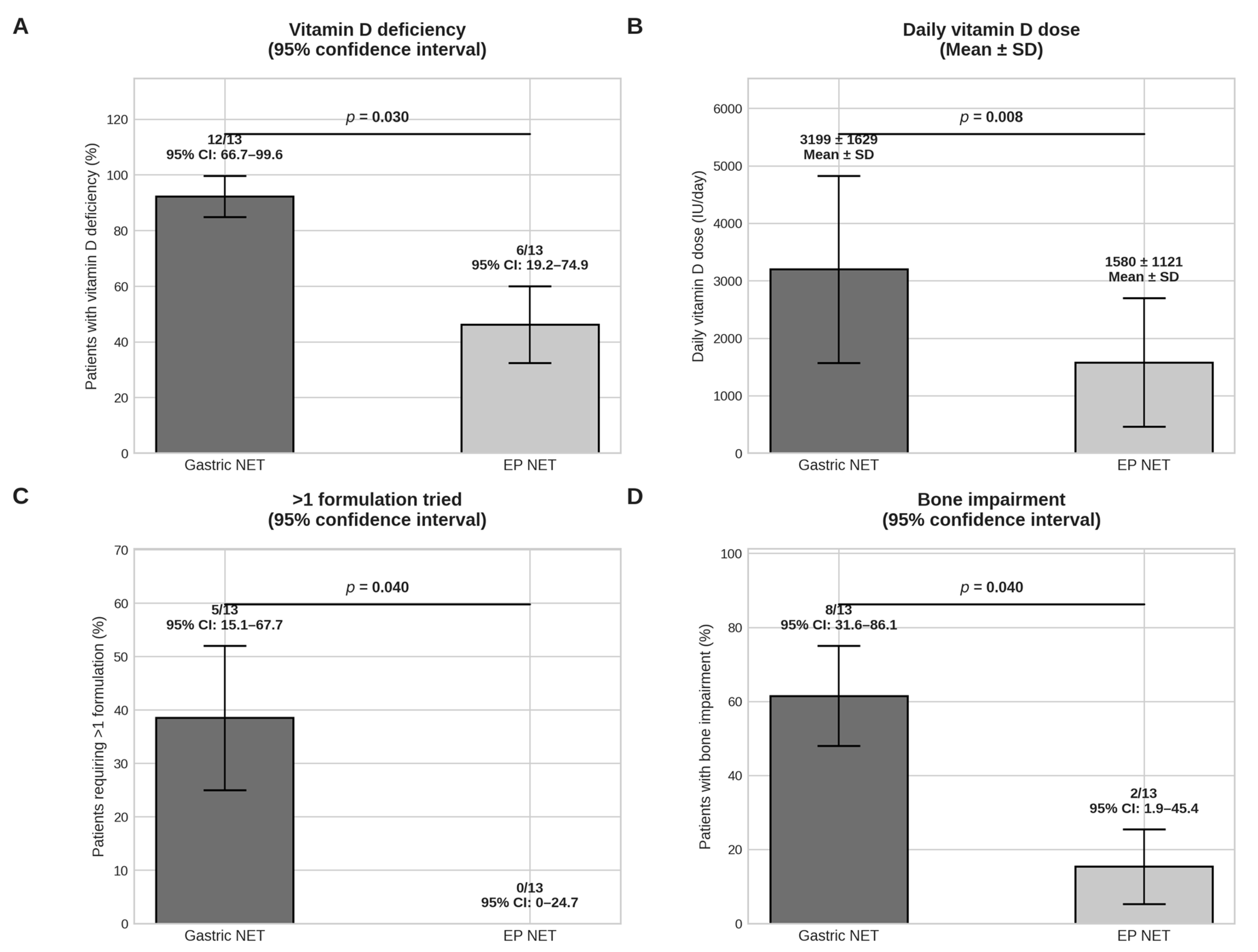
| Diagnosis of VDD | 12/13 (92.3%) | 6/13 (46.2%) | OR: 14.0 (1.4–141) | 0.03 (Fisher) |
| Diagnosis of severe VDD | 3/13 (23.1%) | 2/13 (15.4%) | OR: 1.65 (0.21–12.9) | 1.00 (Fisher) |
| 25OH-vitamin D blood levels at VDD diagnosis (ng/mL) | 14.04 ± 3.30 | 13.32 ± 3.80 | - | 0.60 (t-test) |
| Treatment | ||||
| Months to 25OH-vitamin D normalization (mean ± SD) | 27.7 ± 20.54 | 14.6 ± 18.4 | - | 0.12 (t-test) |
| Daily cholecalciferol dose (IU/day) | 3198.9 ± 1629.1 | 1580 ± 1120.8 | β: +1463 (100–2826) | 0.008 (t-test) |
| >1 formulation tried | 5/13 (38.5%) | 0/13 (0%) | OR: 17.9 (0.9–∞) * | 0.04 (Fisher) |
| 25-OH-vitamin D normalization with orodispersible films | 3/13 (23.1%) | 0/13 (0%) | OR: 8.0 (0.4–∞) * | 0.22 (Fisher) |
| Bone outcomes | ||||
| Osteoporosis | 4/13 (30.8%) | 2/13 (15.4%) | OR: 2.44 (0.35–17.0) | 0.64 (Fisher) |
| Osteopenia | 4/13 (30.8%) | 0/13 (0%) | OR: 12.0 (0.6–∞) * | 0.09 (Fisher) |
| Bone impairment (osteoporosis + osteopenia) | 8/13 (61.5%) | 2/13 (15.4%) | OR: 8.8 (1.35–57.43) | 0.04 (Fisher) |
| Diet | ||||
| Score to PREDIMED test (mean ± SD) | 9.25 ± 0.87 | 8.85 ± 1.21 | - | 0.33 (t-test) |
| Good adherence to MD | 5/13 (38.5%) | 4/13 (30.8%) | OR: 1.41 (0.28–7.04) | 1.00 (Fisher) |
| Medium adherence to MD | 8/13 (61.5%) | 9/13 (69.2%) | - | 1.00 (Fisher) |
| Low adherence to MD | 0/13 | 0/13 | - | 1.00 (Fisher) |
Disclaimer/Publisher’s Note: The statements, opinions and data contained in all publications are solely those of the individual author(s) and contributor(s) and not of MDPI and/or the editor(s). MDPI and/or the editor(s) disclaim responsibility for any injury to people or property resulting from any ideas, methods, instructions or products referred to in the content. |
© 2026 by the authors. Licensee MDPI, Basel, Switzerland. This article is an open access article distributed under the terms and conditions of the Creative Commons Attribution (CC BY) license.
Share and Cite
Benevento, E.; Coletta, M.; Liccardi, A.; Minotta, R.; Di Iasi, G.; Di Nola, M.; Colao, A.; Modica, R. Vitamin D Deficiency and Replacement Challenges in Type 1 Gastric Neuroendocrine Tumors: A Comparative Study. Nutrients 2026, 18, 281. https://doi.org/10.3390/nu18020281
Benevento E, Coletta M, Liccardi A, Minotta R, Di Iasi G, Di Nola M, Colao A, Modica R. Vitamin D Deficiency and Replacement Challenges in Type 1 Gastric Neuroendocrine Tumors: A Comparative Study. Nutrients. 2026; 18(2):281. https://doi.org/10.3390/nu18020281
Chicago/Turabian StyleBenevento, Elio, Michele Coletta, Alessia Liccardi, Roberto Minotta, Gianfranco Di Iasi, Massimo Di Nola, Annamaria Colao, and Roberta Modica. 2026. "Vitamin D Deficiency and Replacement Challenges in Type 1 Gastric Neuroendocrine Tumors: A Comparative Study" Nutrients 18, no. 2: 281. https://doi.org/10.3390/nu18020281
APA StyleBenevento, E., Coletta, M., Liccardi, A., Minotta, R., Di Iasi, G., Di Nola, M., Colao, A., & Modica, R. (2026). Vitamin D Deficiency and Replacement Challenges in Type 1 Gastric Neuroendocrine Tumors: A Comparative Study. Nutrients, 18(2), 281. https://doi.org/10.3390/nu18020281