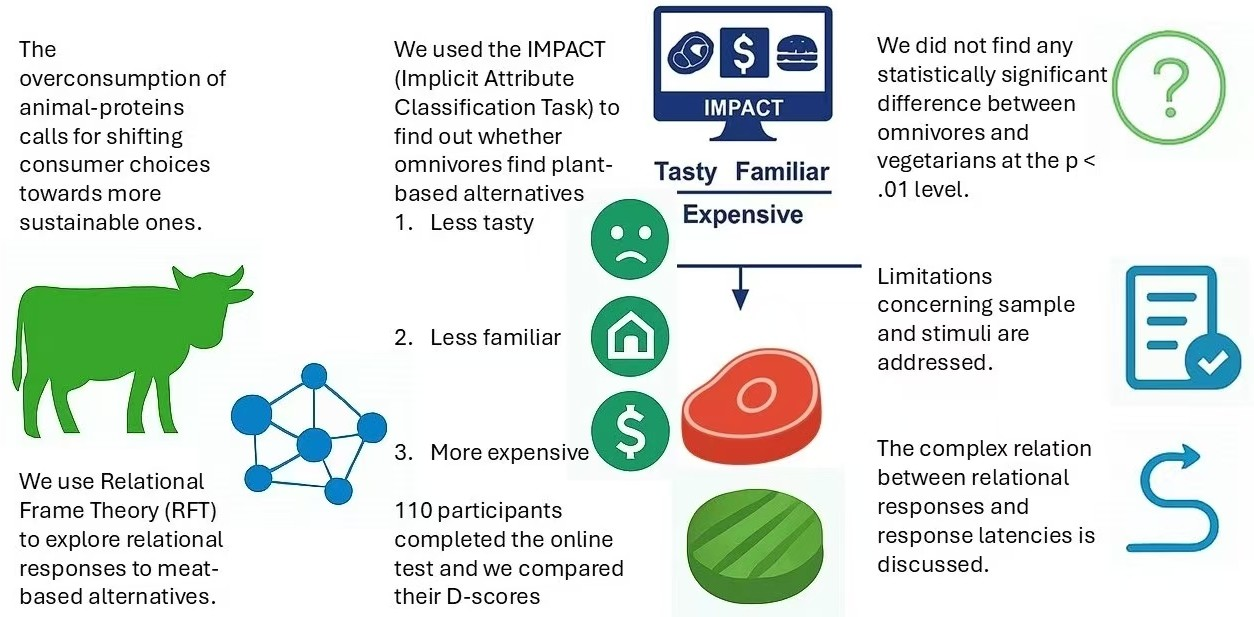
Omnivores and Vegetarians Think Alike About Taste, Familiarity, and Price of Meat and Meat Analogs


Abstract
1. Introduction
1.1. Relational Responding Measurements of Meat Alternatives
1.2. Aims and Hypotheses
2. Materials and Methods
2.1. Participants
2.2. Materials and Procedure
2.3. Data Preparation
3. Results
3.1. Attribute Testing
3.2. Hypothesis Testing
4. Discussion
4.1. Replication and Stimuli Validation
4.2. Limitations
5. Conclusions
Author Contributions
Funding
Institutional Review Board Statement
Informed Consent Statement
Data Availability Statement
Acknowledgments
Conflicts of Interest
Abbreviations
| BIRRs | Brief and immediate relational responses |
| EERRs | Extended and elaborated relational responses |
| IAT | Implicit association test |
| IMPACT | Implicit attribute classification task |
| IRAP | Implicit relational assessment procedure |
| RFT | Relational frame theory |
References
- Buchholz, K. Eating Meat Is the Norm Almost Everywhere. Available online: https://www.statista.com/chart/24899/meat-consumption-by-country/?srsltid=AfmBOoovYcCr7_yFAk92dRmJSz9BcUbeQTsqCJFkrgYMYbcDh4V4yeaz (accessed on 12 December 2025).
- Buchholz, K. The Rise (or Fall?) of Vegetarianism. Available online: https://www.statista.com/chart/28584/gcs-vegetarianism-countries-timeline/?srsltid=AfmBOooekoSOOJZ6_q0BGmaPXed0qSxLw2iIckMyUycAQUAlVIJqG8CA (accessed on 13 December 2025).
- Notarnicola, B.; Tassielli, G.; Renzulli, P.A.; Castellani, V.; Sala, S. Environmental impacts of food consumption in Europe. J. Clean. Prod. 2017, 140, 753–765. [Google Scholar] [CrossRef]
- Szejda, K.; Bushnell, C.; Asher, K. Alternative Proteins: 2020 Consumer Research Priorities; The Good Food Institute: Washington, DC, USA, 2020. [Google Scholar]
- Gil, M.; Rudy, M.; Duma-Kocan, P.; Stanisławczyk, R.; Krajewska, A.; Dziki, D.; Hassoon, W.H. Sustainability of Alternatives to Animal Protein Sources, a Comprehensive Review. Sustainability 2024, 16, 7701. [Google Scholar] [CrossRef]
- Pakseresht, A.; Ahmadi Kaliji, S.; Canavari, M. Review of factors affecting consumer acceptance of cultured meat. Appetite 2022, 170, 105829. [Google Scholar] [CrossRef] [PubMed]
- Rosenfeld, D.L.; Tomiyama, A.J. Taste and health concerns trump anticipated stigma as barriers to vegetarianism. Appetite 2020, 144, 104469. [Google Scholar] [CrossRef] [PubMed]
- Stewart, I.; McElwee, J. Relational responding and conditional discrimination procedures: An apparent inconsistency and clarification. Behav. Anal. 2009, 32, 309–317. [Google Scholar] [CrossRef] [PubMed]
- Stewart, I.; Roche, B. Relational frame theory: An overview. In Advances in Relational Frame Theory: Research and Application; Dymond, S., Roche, B., Eds.; New Harbinger Publications, Inc.: Oakland, CA, USA, 2013; pp. 51–71. [Google Scholar]
- Barnes-Holmes, D.; Hayes, S.C.; Dymond, S.; O’Hora, D. Multiple Stimulus Relations and the Transformation of Stimulus Functions. In Relational Frame Theory: A Post-Skinnerian Account of Human Language and Cognition; Hayes, S.C., Barnes-Holmes, D., Roche, B., Eds.; Springer: Boston, MA, USA, 2001; pp. 51–71. [Google Scholar] [CrossRef]
- Hughes, S.; Barnes-Holmes, D. A functional approach to the study of implicit cognition: The Implicit Relational Assessment Procedure (IRAP) and the Relational Elaboration and Coherence (REC) model. In Advances in Relational Frame Theory: Research and Application; New Harbinger Publications, Inc.: Oakland, CA, USA, 2013; pp. 97–125. [Google Scholar]
- Barnes-Holmes, D.; Barnes-Holmes, Y.; Stewart, I.; Boles, S. A Sketch of the Implicit Relational Assessment Procedure (IRAP) and the Relational Elaboration and Coherence (REC) Model. Psychol. Rec. 2010, 60, 527–542. [Google Scholar] [CrossRef]
- Hussey, I.; Barnes-Holmes, D.; Barnes-Holmes, Y. From Relational Frame Theory to implicit attitudes and back again: Clarifying the link between RFT and IRAP research. Curr. Opin. Psychol. 2015, 2, 11–15. [Google Scholar] [CrossRef]
- Altenburg, D.; Spruyt, A. Predicting meat consumption from concurrent, automatic appraisals: Introducing nuance to product appraisals. Appetite 2022, 170, 105847. [Google Scholar] [CrossRef]
- Barnes-Holmes, D.; Murtagh, L.; Barnes-Holmes, Y.; Stewart, I. Using the Implicit Association Test and the Implicit Relational Assessment Procedure to Measure Attitudes Toward Meat and Vegetables in Vegetarians and Meat-Eaters. Psychol. Rec. 2010, 60, 287–306. [Google Scholar] [CrossRef]
- Trendel, O.; Werle, C.O.C. Distinguishing the affective and cognitive bases of implicit attitudes to improve prediction of food choices. Appetite 2016, 104, 33–43. [Google Scholar] [CrossRef]
- Parry, J.; Szejda, K. How to Drive Plant-Based Food Purchasing: Key Findings from a Mindlab Study into Implicit Perceptions of the Plant-Based Category; The Good Food Institute: Washington, DC, USA, 2019. [Google Scholar]
- Hussey, I.; Cummins, J.; Drake, C. A critique of IRAP research. In Proceedings of the ACBS 2019, Dublin, Ireland, 25–30 June 2019. [Google Scholar]
- Hussey, I. A systematic review of null hypothesis significance testing, sample sizes, and statistical power in research using the Implicit Relational Assessment Procedure. J. Context. Behav. Sci. 2023, 29, 86–97. [Google Scholar] [CrossRef]
- Faul, F.; Erdfelder, E.; Lang, A.-G.; Buchner, A. G*Power 3: A flexible statistical power analysis program for the social, behavioral, and biomedical sciences. Behav. Res. Methods 2007, 39, 175–191. [Google Scholar] [CrossRef] [PubMed]
- Cohen, J. Statistical Power Analysis for the Behavioral Sciences; Routledge: Oxfordshire, UK, 2013. [Google Scholar]
- Palan, S.; Schitter, C. Prolific.ac—A subject pool for online experiments. J. Behav. Exp. Financ. 2018, 17, 22–27. [Google Scholar] [CrossRef]
- Prolific. What Are the Advantages and Limitations of an Online Sample? Available online: https://researcher-help.prolific.com/en/articles/445274-what-are-the-advantages-and-limitations-of-an-online-sample (accessed on 23 December 2025).
- Peirce, J.; Gray, J.R.; Simpson, S.; MacAskill, M.; Höchenberger, R.; Sogo, H.; Kastman, E.; Lindeløv, J.K. PsychoPy2: Experiments in behavior made easy. Behav. Res. Methods 2019, 51, 195–203. [Google Scholar] [CrossRef]
- Statista. U.S. Population: Which Brands of Bacon Do You Eat Most Often? Available online: https://www.statista.com/statistics/279775/us-households-most-eaten-brands-of-bacon/ (accessed on 13 December 2025).
- Michel, F.; Knaapila, A.; Hartmann, C.; Siegrist, M. A multi-national comparison of meat eaters’ attitudes and expectations for burgers containing beef, pea or algae protein. Food Qual. Prefer. 2021, 91, 104195. [Google Scholar] [CrossRef]
- Team, R. RStudio: Integrated Development for R; RStudio Inc.: Boston, MA, USA, 2019. [Google Scholar]
- Greenwald, A.G.; Nosek, B.A.; Banaji, M.R. Understanding and using the Implicit Association Test: An improved scoring algorithm. J. Personal. Soc. Psychol. 2003, 85, 197–216. [Google Scholar] [CrossRef]
- Cooper, J.O. Applied Behavior Analysis, 3rd ed.; Pearson Education: Harlow, UK, 2020; p. 952. [Google Scholar]
- Grootswagers, T. A primer on running human behavioural experiments online. Behav. Res. Methods 2020, 52, 2283–2286. [Google Scholar] [CrossRef]
- Skinner, B.F. The phylogeny and ontogeny of behavior. Science 1966, 153, 1205–1213. [Google Scholar] [CrossRef]
- Hayes, S.C.; Hayes, L.J. The Verbal Action of the Listener as a Basis for Rule-Governance. In Rule-Governed Behavior; Hayes, S.C., Ed.; Springer: Berlin/Heidelberg, Germany, 1989; pp. 153–190. [Google Scholar] [CrossRef]
- Safdar, B.; Zhou, H.; Li, H.; Cao, J.; Zhang, T.; Ying, Z.; Liu, X. Prospects for Plant-Based Meat: Current Standing, Consumer Perceptions, and Shifting Trends. Foods 2022, 11, 3770. [Google Scholar] [CrossRef]
- de Koning, W.; Dean, D.; Vriesekoop, F.; Aguiar, L.; Anderson, M.; Mongondry, P.; Oppong-Gyamfi, M.; Urbano, B.; Gómez-Luciano, C.A.; Jiang, B.; et al. Drivers and Inhibitors in the Acceptance of Meat Alternatives: The Case of Plant and Insect-Based Proteins. Foods 2020, 9, 1292. [Google Scholar] [CrossRef]
- Jayasinghe, S.; Byrne, N.M.; Hills, A.P. Cultural influences on dietary choices. Prog. Cardiovasc. Dis. 2025, 90, 22–26. [Google Scholar] [CrossRef]
- Ruby, M.B.; Heine, S.J.; Kamble, S.; Cheng, T.K.; Waddar, M. Compassion and contamination. Cultural differences in vegetarianism. Appetite 2013, 71, 340–348. [Google Scholar] [CrossRef] [PubMed]
- Khoury, C.K.; Bjorkman, A.D.; Dempewolf, H.; Ramirez-Villegas, J.; Guarino, L.; Jarvis, A.; Rieseberg, L.H.; Struik, P.C. Increasing homogeneity in global food supplies and the implications for food security. Proc. Natl. Acad. Sci. USA 2014, 111, 4001–4006. [Google Scholar] [CrossRef] [PubMed]
- Sun, J.; Caputo, V.; Taylor, H. What Explains the Recent Slowing Growth of the Plant-Based Meat Alternatives Market? Choices 2025. Available online: https://www.choicesmagazine.org/choices-magazine/submitted-articles/what-explains-the-recent-slowing-growth-of-the-plant-based-meat-alternatives-market (accessed on 20 December 2025).
- Szenderák, J.; Fróna, D.; Rákos, M. Consumer Acceptance of Plant-Based Meat Substitutes: A Narrative Review. Foods 2022, 11, 1274. [Google Scholar] [CrossRef] [PubMed]
- Weng, V. Evaluating Beyond Meat’s Success in the Consumer Market for Plant-Based Meat. Int. J. High Sch. Res. 2023, 5, 152–160. [Google Scholar] [CrossRef]
- Statista. Beyond Meat Brand Profile in the U.S. Available online: https://www.statista.com/insights/consumer/brand-profiles/3/2/beyond-meat/united-states/ (accessed on 20 December 2025).
- The Good Food Institute. Americans Understand What Plant-Based Meatis, What It’s Made from, and How It’s Labeled; The Good Food Institute: Washington, DC, USA, 2025. [Google Scholar]
- Xavier, J.R.; Shashikumar, S.H.; Vats, D.; Chauhan, O.P. Future trends in plant-based meat: Consumer perception, market growth and health benefits. Future Foods 2025, 11, 100551. [Google Scholar] [CrossRef]
- Naughton, P.; Schramm, J.B.; Lichters, M. The eyes eat first: Improving consumer acceptance of plant-based meat alternatives by adjusting front-of-pack labeling. Food Qual. Prefer. 2025, 131, 105567. [Google Scholar] [CrossRef]
- Moors, A.; De Houwer, J. Automaticity: A Theoretical and Conceptual Analysis. Psychol. Bull. 2006, 132, 297–326. [Google Scholar] [CrossRef]
- Prestwich, A.; Hurling, R.; Baker, S. Implicit shopping: Attitudinal determinants of the purchasing of healthy and unhealthy foods. Psychol. Health 2011, 26, 875–885. [Google Scholar] [CrossRef]
- Vermeir, I.; Weijters, B.; De Houwer, J.; Geuens, M.; Slabbinck, H.; Spruyt, A.; Van Kerckhove, A.; Van Lippevelde, W.; De Steur, H.; Verbeke, W. Environmentally Sustainable Food Consumption: A Review and Research Agenda From a Goal-Directed Perspective. Front. Psychol. 2020, 11, 1603. [Google Scholar] [CrossRef]
- Chambers, C.D.; Tzavella, L. The past, present and future of Registered Reports. Nat. Hum. Behav. 2022, 6, 29–42. [Google Scholar] [CrossRef]
- Sidman, M. Tactics of Scientific Research: Evaluating Experimental Data in Psychology; Basic Books: Oxford, UK, 1960. [Google Scholar]
- Panzone, L.; Hilton, D.; Sale, L.; Cohen, D. Socio-demographics, implicit attitudes, explicit attitudes, and sustainable consumption in supermarket shopping. J. Econ. Psychol. 2016, 55, 77–95. [Google Scholar] [CrossRef]
- Crump, M.J.C.; McDonnell, J.V.; Gureckis, T.M. Evaluating Amazon’s Mechanical Turk as a Tool for Experimental Behavioral Research. PLoS ONE 2013, 8, e57410. [Google Scholar] [CrossRef] [PubMed]
- Vahey, N.A.; Nicholson, E.; Barnes-Holmes, D. A meta-analysis of criterion effects for the Implicit Relational Assessment Procedure (IRAP) in the clinical domain. J. Behav. Ther. Exp. Psychiatry 2015, 48, 59–65. [Google Scholar] [CrossRef] [PubMed]
- Hayes, S.C.; Brownstein, A.J. Mentalism, behavior-behavior relations, and a behavior-analytic view of the purposes of science. Behav. Anal. 1986, 9, 175–190. [Google Scholar] [CrossRef]
- Tonheim, L.E.; Groufh-Jacobsen, S.; Stea, T.H.; Henjum, S. Consumption of meat and dairy substitute products amongst vegans, vegetarians and pescatarians. Food Nutr. Res. 2023, 67, 9081. [Google Scholar] [CrossRef]
- Barnes-Holmes, D.; Harte, C. Relational frame theory 20 years on: The Odysseus voyage and beyond. J. Exp. Anal. Behav. 2022, 117, 240–266. [Google Scholar] [CrossRef]
- Martinko, M.J. An O.B. Mod. Analysis of Consumer Behavior. J. Organ. Behav. Manag. 1987, 8, 19–44. [Google Scholar] [CrossRef]
- Sigurdsson, V.; Engilbertsson, H.; Foxall, G. The Effects of a Point-of-Purchase Display on Relative Sales: An In-Store Experimental Evaluation. J. Organ. Behav. Manag. 2010, 30, 222–233. [Google Scholar] [CrossRef]
- Foxall, G.R. Invitation to Consumer Behavior Analysis. J. Organ. Behav. Manag. 2010, 30, 92–109. [Google Scholar] [CrossRef]

| D_Taste | D_Familiarity | D_Price | ||
|---|---|---|---|---|
| D_taste | Pearson Correlation | 1 | 0.069 | 0.064 |
| Sig. (2-tailed) | 0.319 | 0.360 | ||
| Sum of Squares and Cross-products | 76.593 | 4.777 | 4.419 | |
| Covariance | 0.370 | 0.023 | 0.021 | |
| N | 208 | 208 | 208 | |
| D_familiarity | Pearson Correlation | 0.069 | 1 | 0.072 |
| Sig. (2-tailed) | 0.319 | 0.304 | ||
| Sum of Squares and Cross-products | 4.777 | 61.804 | 4.457 | |
| Covariance | 0.023 | 0.299 | 0.022 | |
| N | 208 | 208 | 208 | |
| D_price | Pearson Correlation | 0.064 | 0.072 | 1 |
| Sig. (2-tailed) | 0.360 | 0.304 | ||
| Sum of Squares and Cross-products | 4.419 | 4.457 | 62.620 | |
| Covariance | 0.021 | 0.022 | 0.303 | |
| N | 208 | 208 | 208 | |
| t-Test for Equality of Means | |||||||||
|---|---|---|---|---|---|---|---|---|---|
| t | df | Significance | Mean Difference | Std. Error Difference | 99% Confidence Interval of the Difference | ||||
| One-Sided p | Two-Sided p | Lower | Upper | ||||||
| D_taste_veg | Equal variances assumed | −0.898 | 102 | 0.186 | 0.372 | −0.110476 | 0.123080 | −0.433548 | 0.212595 |
| Equal variances not assumed | −0.894 | 97.116 | 0.187 | 0.373 | −0.110476 | 0.123525 | −0.435028 | 0.214075 | |
| D_familiarity_veg | Equal variances assumed | 0.129 | 102 | 0.449 | 0.897 | 0.014636 | 0.113208 | −0.282524 | 0.311795 |
| Equal variances not assumed | 0.129 | 101.637 | 0.449 | 0.897 | 0.014636 | 0.113254 | −0.282665 | 0.311936 | |
| D_price_veg | Equal variances assumed | −1.238 | 102 | 0.109 | 0.219 | −0.132065 | 0.106681 | −0.412090 | 0.147960 |
| Equal variances not assumed | −1.237 | 101.638 | 0.109 | 0.219 | −0.132065 | 0.106724 | −0.412222 | 0.148092 | |
Disclaimer/Publisher’s Note: The statements, opinions and data contained in all publications are solely those of the individual author(s) and contributor(s) and not of MDPI and/or the editor(s). MDPI and/or the editor(s) disclaim responsibility for any injury to people or property resulting from any ideas, methods, instructions or products referred to in the content. |
© 2026 by the authors. Licensee MDPI, Basel, Switzerland. This article is an open access article distributed under the terms and conditions of the Creative Commons Attribution (CC BY) license.
Share and Cite
Querini, T.; Tagliabue, M. Omnivores and Vegetarians Think Alike About Taste, Familiarity, and Price of Meat and Meat Analogs. Nutrients 2026, 18, 264. https://doi.org/10.3390/nu18020264
Querini T, Tagliabue M. Omnivores and Vegetarians Think Alike About Taste, Familiarity, and Price of Meat and Meat Analogs. Nutrients. 2026; 18(2):264. https://doi.org/10.3390/nu18020264
Chicago/Turabian StyleQuerini, Tommaso, and Marco Tagliabue. 2026. "Omnivores and Vegetarians Think Alike About Taste, Familiarity, and Price of Meat and Meat Analogs" Nutrients 18, no. 2: 264. https://doi.org/10.3390/nu18020264
APA StyleQuerini, T., & Tagliabue, M. (2026). Omnivores and Vegetarians Think Alike About Taste, Familiarity, and Price of Meat and Meat Analogs. Nutrients, 18(2), 264. https://doi.org/10.3390/nu18020264