AI-Enabled Precision Nutrition in the ICU: A Narrative Review and Implementation Roadmap

Abstract
1. Introduction
2. Materials and Methods
2.1. Data Sources and Search Strategy
2.2. Eligibility Criteria
2.3. Selection and Data Charting
2.4. Synthesis and Appraisal
3. The Role of Nutritional Therapy in Intensive Care Units
3.1. Nutritional Support in ICUs: Challenges in Delivery and Monitoring
3.1.1. Early Enteral Nutrition and Individualized Advancement
3.1.2. Clinical Consequences of Underfeeding and Overfeeding
3.2. Individualizing Route and Timing: Emerging Evidence for EN vs. PN
3.3. Estimating Nutritional Requirements: Limitations of Traditional Methods
4. Artificial Intelligence: Basic Concepts and Technologies
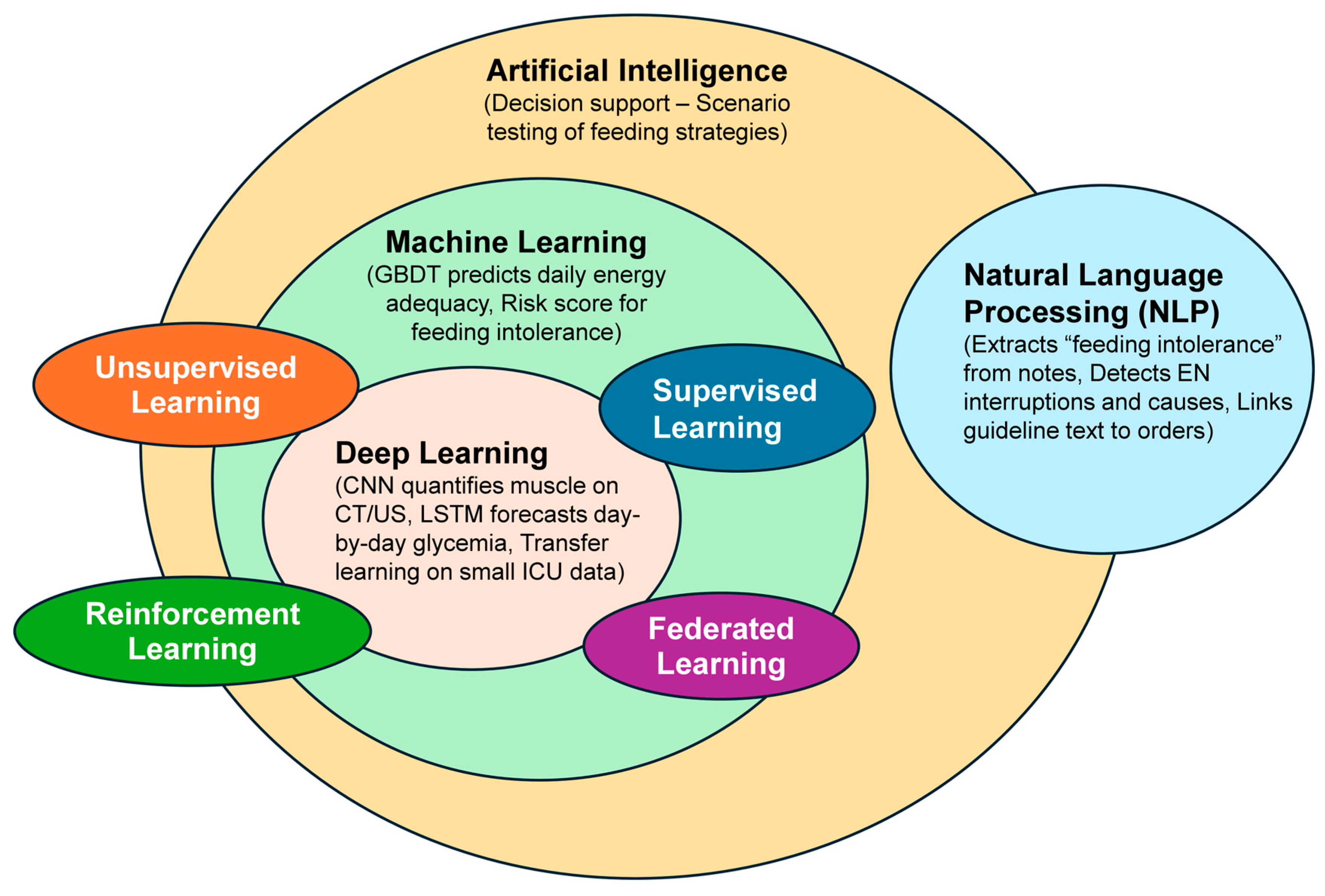
4.1. Categories and Techniques of AI
- Machine Learning (ML):
- Supervised Learning:
- Unsupervised Learning:
- Reinforcement Learning (RL):
4.2. Neural Networks and Deep Learning (DL)
4.3. Natural Language Processing (NLP)
5. Applications of AI in Nutritional Therapy in the ICU
5.1. Assessment of Nutritional Requirements and Predictive Modeling
5.2. Implementation and Monitoring of Nutritional Support
- Clinical Decision-Support Systems (CDSS):
- Real-time adaptive feeding:
- Internet of Things (IoT) and wearable sensors:
- Smart infusion pumps with embedded AI:
5.3. Prediction of Nutrition-Related Complications
- Enteral feeding intolerance:
- Refeeding-syndrome hypophosphatemia:
- Aspiration, hypernatremia, and gastrointestinal intolerance:
6. Precision Nutrition Enabled by Artificial Intelligence
6.1. The Role of Reinforcement Learning (RL)
- Adapt caloric and protein dosing according to a patient’s evolving metabolic condition.
- Analyze dynamic changes in health status and feeding tolerance to fine-tune the nutrition plan in real time.
6.2. Insights from Genomics and Metabolomics
6.3. Identification of Nutritional Sub-Phenotypes in Critical Illness
- Detect subgroups of patients characterized by distinct nutritional responses—such as high-inflammation or metabolic-suppression phenotypes.
- Guide the choice between enteral and parenteral nutrition, as well as the optimal formulation of energy, protein, fiber, and electrolyte content [49].
- Support selection of safer, more effective nutrition strategies for high-risk patients [50].
7. Prevention of Medical Errors and Improvement of Patient Safety
7.1. Prevention of Medication-Related Errors
7.2. Reduction of Alarm Fatigue
- Filter and prioritize alerts according to clinical significance, reducing non-critical alarm repetition and system “noise.”
7.3. Workflow Optimization and Process Automation
- Recording and monitoring nutrient intake and fluid balance.
- Automatically recalculating caloric and protein targets based on updated metabolic data.
- Synchronizing with EHR systems to update feeding plans and compliance reports.
8. Challenges to the Implementation of AI in Nutritional Therapy
8.1. Data Availability and Quality
8.2. Economic and Infrastructural Challenges
8.3. Ethical and Legal Considerations
9. Education of Healthcare Professionals and Organizational Culture
9.1. Need for AI Literacy Among Healthcare Professionals
- Technical skills for effective use of AI-based software and digital tools.
9.2. Managing Change and Promoting Acceptance Among Staff
- Fear that AI may replace human clinical judgment.
- Difficulty adapting to new digital workflows.
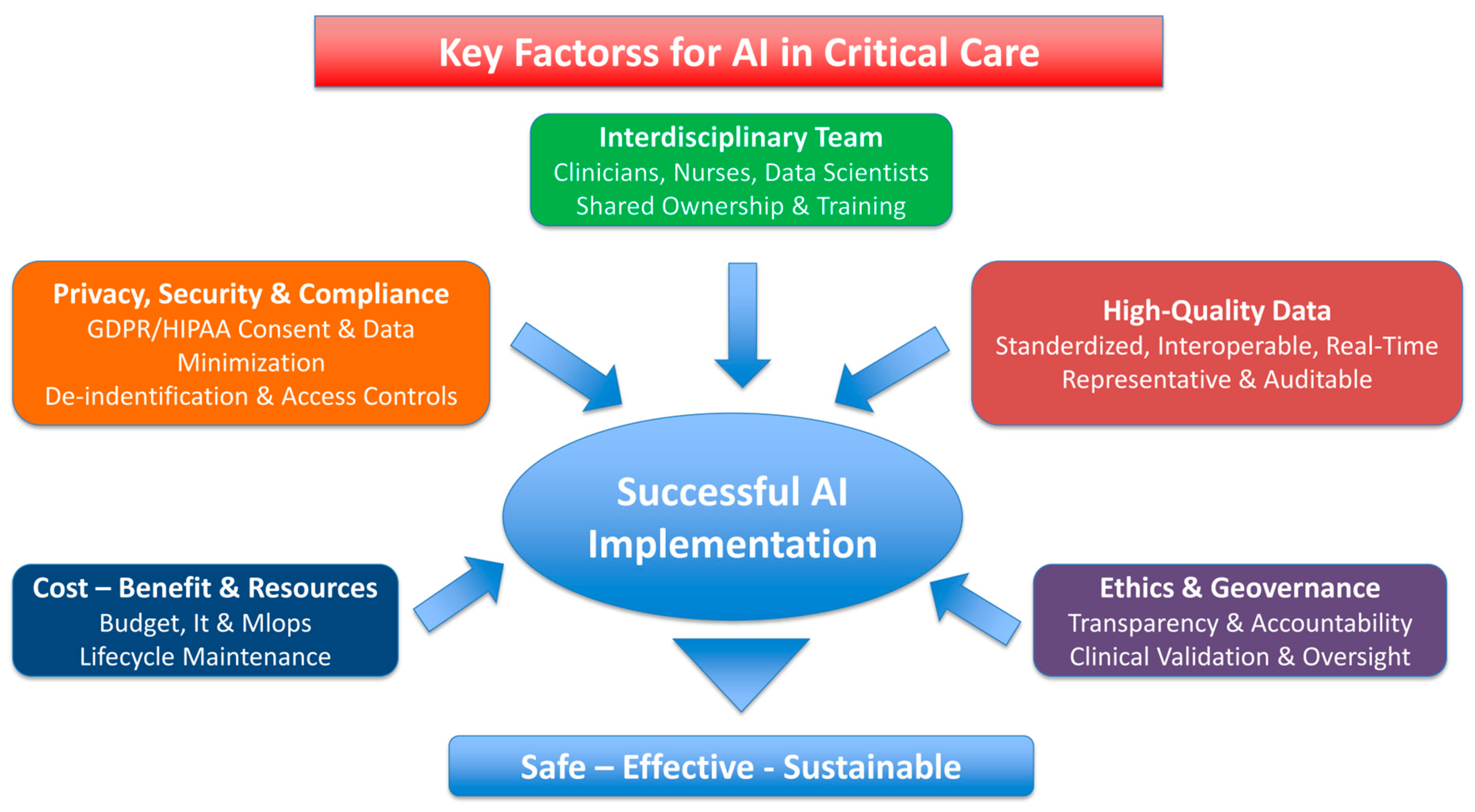
9.3. Fostering Interdisciplinary Collaboration and Integration into Clinical Practice
- Physicians and intensivists;
- Clinical dietitians and nutrition scientists;
- Nurses and pharmacists;
- Computer scientists and data engineers;
10. Future Directions and Research Perspectives
10.1. Timing and Composition of Nutritional Intervention
10.2. Selection and Formulation of Nutritional Products
10.3. Prediction and Prevention of Complications
10.4. Dynamic Personalization Through Reinforcement Learning
10.5. Integration of Novel Biomarkers and Multi-Omics Data
- enable more targeted, molecular-level nutrition strategies,
- identify distinct nutritional phenotypes, and
- support personalized pharmaco-nutrition approaches [83].
10.6. Current Outlook
- Optimize estimation of caloric and protein needs;
- Enhance individualization of nutrition therapy;
- Predict complications early;
- Recommend appropriate interventions in real time [2].
- Access to high-quality, standardized datasets;
- Improved interoperability among EHR systems;
- Dedicated training of healthcare professionals;
- A robust ethical and regulatory framework safeguarding patient autonomy and data privacy.
10.7. Future Research Priorities
- Comparative evaluation of AI-based versus traditional nutrition-assessment methods;
- Multicenter validation and standardization of predictive models;
- Ethical and regulatory integration of AI systems into clinical practice frameworks.
11. Conclusions
Supplementary Materials
Author Contributions
Funding
Institutional Review Board Statement
Informed Consent Statement
Data Availability Statement
Conflicts of Interest
Abbreviations
| AI | Artificial Intelligence |
| ICU | Intensive Care Unit |
| EN | Enteral Nutrition |
| PN | Parenteral Nutrition |
| REE | Resting Energy Expenditure |
| IC | Indirect Calorimetry |
| ML | Machine Learning |
| DL | Deep Learning |
| RL | Reinforcement Learning |
| NLP | Natural Language Processing |
| XAI | Explainable AI |
| EHR | Electronic Health Record |
| GLIM | Global Leadership Initiative on Malnutrition |
| SGA | Subjective Global Assessment |
| NRS-2002 | Nutritional Risk Screening 2002 |
| SOFA | Sequential Organ Failure Assessment |
| GDPR | General Data Protection Regulation |
| HIPAA | Health Insurance Portability and Accountability Act |
References
- Ayanian, J.Z.; Song, Z. Prospects for Artificial Intelligence in Health Policy and Practice. JAMA Health Forum 2025, 6, e250080. [Google Scholar] [CrossRef]
- Gonzalez, F.A.; Santonocito, C.; Lamas, T.; Costa, P.; Vieira, S.M.; Ferreira, H.A.; Sanfilippo, F. Is Artificial Intelligence Prepared for the 24-h Shifts in the ICU? Anaesth. Crit. Care Pain Med. 2024, 43, 101431. [Google Scholar] [CrossRef]
- Cogle, S.V.; Hallum, M.; Mulherin, D.W. Applying the 2022 ASPEN Adult Nutrition Support Guidelines in a 2024 ICU. Nutr. Clin. Pract. 2024, 39, 1055–1068. [Google Scholar] [CrossRef]
- Cecconi, M.; Greco, M.; Shickel, B.; Angus, D.C.; Bailey, H.; Bignami, E.; Calandra, T.; Celi, L.A.; Einav, S.; Elbers, P.; et al. Implementing Artificial Intelligence in Critical Care Medicine: A Consensus of 22. Crit. Care 2025, 29, 290. [Google Scholar] [CrossRef]
- Baethge, C.; Goldbeck-Wood, S.; Mertens, S. SANRA-a Scale for the Quality Assessment of Narrative Review Articles. Res. Integr. Peer Rev. 2019, 4, 5. [Google Scholar] [CrossRef] [PubMed]
- McClave, S.A.; Taylor, B.E.; Martindale, R.G.; Warren, M.M.; Johnson, D.R.; Braunschweig, C.; McCarthy, M.S.; Davanos, E.; Rice, T.W.; Cresci, G.A.; et al. Guidelines for the Provision and Assessment of Nutrition Support Therapy in the Adult Critically Ill Patient: Society of Critical Care Medicine (SCCM) and American Society for Parenteral and Enteral Nutrition (A.S.P.E.N.). JPEN J. Parenter. Enteral. Nutr. 2016, 40, 159–211. [Google Scholar] [CrossRef] [PubMed]
- Singer, P.; Blaser, A.R.; Berger, M.M.; Alhazzani, W.; Calder, P.C.; Casaer, M.P.; Hiesmayr, M.; Mayer, K.; Montejo, J.C.; Pichard, C.; et al. ESPEN Guideline on Clinical Nutrition in the Intensive Care Unit. Clin. Nutr. 2019, 38, 48–79. [Google Scholar] [CrossRef] [PubMed]
- Briassoulis, G.; Ilia, S.; Briassouli, E. Personalized Nutrition in the Pediatric ICU: Steering the Shift from Acute Stress to Metabolic Recovery and Rehabilitation. Nutrients 2024, 16, 3523. [Google Scholar] [CrossRef]
- Briassoulis, G.; Ilia, S.; Briassoulis, P. Editorial of Special Issue “Nutrition and Critical Illness”. Nutrients 2024, 16, 3640. [Google Scholar] [CrossRef]
- Dorken Gallastegi, A.; Gebran, A.; Gaitanidis, A.; Naar, L.; Hwabejire, J.O.; Parks, J.; Lee, J.; Kaafarani, H.M.A.; Velmahos, G.C.; Mendoza, A.E. Early versus Late Enteral Nutrition in Critically Ill Patients Receiving Vasopressor Support. JPEN J. Parenter Enteral. Nutr. 2022, 46, 130–140. [Google Scholar] [CrossRef]
- Stoppe, C.; Hill, A.; Christopher, K.B.; Kristof, A.S. Toward Precision in Nutrition Therapy. Crit. Care Med. 2025, 53, e429–e440. [Google Scholar] [CrossRef] [PubMed]
- Kirk, D.; Catal, C.; Tekinerdogan, B. Precision Nutrition: A Systematic Literature Review. Comput. Biol. Med. 2021, 133, 104365. [Google Scholar] [CrossRef]
- Hoffmann, M.; Schwarz, C.M.; Fürst, S.; Starchl, C.; Lobmeyr, E.; Sendlhofer, G.; Jeitziner, M.-M. Risks in Management of Enteral Nutrition in Intensive Care Units: A Literature Review and Narrative Synthesis. Nutrients 2020, 13, 82. [Google Scholar] [CrossRef] [PubMed]
- Kasti, A.N.; Theodorakopoulou, M.; Katsas, K.; Synodinou, K.D.; Nikolaki, M.D.; Zouridaki, A.E.; Fotiou, S.; Kapetani, A.; Armaganidis, A. Factors Associated with Interruptions of Enteral Nutrition and the Impact on Macro- and Micronutrient Deficits in ICU Patients. Nutrients 2023, 15, 917. [Google Scholar] [CrossRef]
- Reignier, J.; Gaillard-Le Roux, B.; Dequin, P.F.; Bertoni Maluf, V.A.; Bohe, J.; Casaer, M.P.; Delbove, A.; Dupuis, C.; Fontaine, E.; Gamon, P.; et al. Expert Consensus-based Clinical Practice Guidelines for Nutritional Support in the Intensive Care Unit: The French Intensive Care Society (SRLF) and the French-Speaking Group of Pediatric Emergency Physicians and Intensivists (GFRUP). Ann. Intensive Care 2025, 15, 99. [Google Scholar] [CrossRef]
- Wischmeyer, P.E.; Bear, D.E.; Berger, M.M.; De Waele, E.; Gunst, J.; McClave, S.A.; Prado, C.M.; Puthucheary, Z.; Ridley, E.J.; Van den Berghe, G.; et al. Personalized Nutrition Therapy in Critical Care: 10 Expert Recommendations. Crit. Care 2023, 27, 261. [Google Scholar] [CrossRef]
- Briassoulis, G.; Briassouli, E.; Ilia, S.; Briassoulis, P. External Validation of Equations to Estimate Resting Energy Expenditure in Critically Ill Children and Adolescents with and without Malnutrition: A Cross-Sectional Study. Nutrients 2022, 14, 4149. [Google Scholar] [CrossRef]
- Briassoulis, P.; Ilia, S.; Briassouli, E.; Briassoulis, G. External Validation with Accuracy Confounders of VCO2-Derived Predicted Energy Expenditure Compared to Resting Energy Expenditure Measured by Indirect Calorimetry in Mechanically Ventilated Children. Nutrients 2022, 14, 4211. [Google Scholar] [CrossRef]
- Lambell, K.J.; Tatucu-Babet, O.A.; Chapple, L.-A.; Gantner, D.; Ridley, E.J. Nutrition Therapy in Critical Illness: A Review of the Literature for Clinicians. Crit. Care 2020, 24, 35. [Google Scholar] [CrossRef] [PubMed]
- Janssen, S.M.; Bouzembrak, Y.; Tekinerdogan, B. Artificial Intelligence in Malnutrition: A Systematic Literature Review. Adv. Nutr. 2024, 15, 100264. [Google Scholar] [CrossRef]
- Jin, B.T.; Choi, M.H.; Moyer, M.F.; Kim, D.A. Predicting Malnutrition from Longitudinal Patient Trajectories with Deep Learning. PLoS ONE 2022, 17, e0271487. [Google Scholar] [CrossRef]
- Skipper, A.; Ferguson, M.; Thompson, K.; Castellanos, V.H.; Porcari, J. Nutrition Screening Tools: An Analysis of the Evidence. JPEN J. Parenter. Enteral. Nutr. 2012, 36, 292–298. [Google Scholar] [CrossRef]
- Jiang, L.; Wu, Z.; Xu, X.; Zhan, Y.; Jin, X.; Wang, L.; Qiu, Y. Opportunities and Challenges of Artificial Intelligence in the Medical Field: Current Application, Emerging Problems, and Problem-Solving Strategies. J. Int. Med. Res. 2021, 49, 3000605211000157. [Google Scholar] [CrossRef] [PubMed]
- Char, D.S.; Shah, N.H.; Magnus, D. Implementing Machine Learning in Health Care-Addressing Ethical Challenges. N. Engl. J. Med. 2018, 378, 981–983. [Google Scholar] [CrossRef] [PubMed]
- Henry, K.; Deng, S.; Chen, X.; Zhang, T.; Devlin, J.W.; Murphy, D.J.; Smith, S.E.; Murray, B.; Kamaleswaran, R.; Most, A.; et al. Unsupervised Machine Learning Analysis to Identify Patterns of ICU Medication Use for Fluid Overload Prediction. Pharmacotherapy 2025, 45, 76–86. [Google Scholar] [CrossRef]
- Drudi, C.; Mollura, M.; Lehman, L.-W.H.; Barbieri, R. A Reinforcement Learning Model for Optimal Treatment Strategies in Intensive Care: Assessment of the Role of Cardiorespiratory Features. IEEE Open J. Eng. Med. Biol. 2024, 5, 806–815. [Google Scholar] [CrossRef]
- Bocci, M.G.; Barbaro, R.; Bellini, V.; Napoli, C.; Darhour, L.J.; Bignami, E. BART, the New Robotic Assistant: Big Data, Artificial Intelligence, Robotics, and Telemedicine Integration for an ICU 4.0. J. Anesth. Analg. Crit. Care 2024, 4, 44. [Google Scholar] [CrossRef]
- Ang, C.Y.S.; Nor, M.B.M.; Nordin, N.S.; Kyi, T.Z.; Razali, A.; Chiew, Y.S. Methods for Estimating Resting Energy Expenditure in Intensive Care Patients: A Comparative Study of Predictive Equations with Machine Learning and Deep Learning Approaches. Comput. Methods Programs Biomed. 2025, 262, 108657. [Google Scholar] [CrossRef]
- Hu, J.; Wang, X.; Yao, K.; Zhang, X.; Zhao, W.; Fu, J.; Lou, P.; Chen, W.; Fang, A. FANS: A Framework for Automatic Assessment of Nutritional Status Based on Free-Text Clinical Notes. Int. J. Med. Inform. 2025, 206, 106168. [Google Scholar] [CrossRef] [PubMed]
- Gandomi, A.; Wu, P.; Clement, D.R.; Xing, J.; Aviv, R.; Federbush, M.; Yuan, Z.; Jing, Y.; Wei, G.; Hajizadeh, N. ARDSFlag: An NLP/Machine Learning Algorithm to Visualize and Detect High-Probability ARDS Admissions Independent of Provider Recognition and Billing Codes. BMC Med. Inform. Decis. Mak. 2024, 24, 195. [Google Scholar] [CrossRef]
- Pinsky, M.R.; Bedoya, A.; Bihorac, A.; Celi, L.; Churpek, M.; Economou-Zavlanos, N.J.; Elbers, P.; Saria, S.; Liu, V.; Lyons, P.G.; et al. Use of Artificial Intelligence in Critical Care: Opportunities and Obstacles. Crit. Care 2024, 28, 113. [Google Scholar] [CrossRef]
- Luongo, G.; Mah, C.L.; Cahill, L.E.; Hajizadeh, M.; Kennedy, L.J.; Wong, H.; Yi, Y.; Tarasuk, V. The Relationship between Diet Costs and Dietary Adequacy: A Scoping Review of Measures and Methods with a Focus on Cost Estimation Using Food Supply Data. J. Nutr. 2025, 155, 788–803. [Google Scholar] [CrossRef]
- Phalle, A.; Gokhale, D. Navigating Next-Gen Nutrition Care Using Artificial Intelligence-Assisted Dietary Assessment Tools-a Scoping Review of Potential Applications. Front. Nutr. 2025, 12, 1518466. [Google Scholar] [CrossRef] [PubMed]
- Joseph, R.; Lee, S.W.; Anderson, S.V.; Morrisette, M.J. Impact of Interoperability of Smart Infusion Pumps and an Electronic Medical Record in Critical Care. Am. J. Health Syst. Pharm. 2020, 77, 1231–1236. [Google Scholar] [CrossRef]
- De Cosmi, V.; Mazzocchi, A.; Milani, G.P.; Calderini, E.; Scaglioni, S.; Bettocchi, S.; D’Oria, V.; Langer, T.; Spolidoro, G.C.I.; Leone, L.; et al. Prediction of Resting Energy Expenditure in Children: May Artificial Neural Networks Improve Our Accuracy? J. Clin. Med. 2020, 9, 1026. [Google Scholar] [CrossRef]
- Maleki Varnosfaderani, S.; Forouzanfar, M. The Role of AI in Hospitals and Clinics: Transforming Healthcare in the 21st Century. Bioengineering 2024, 11, 337. [Google Scholar] [CrossRef]
- Wang, W.-H.; Hsu, W.-S. Integrating Artificial Intelligence and Wearable IoT System in Long-Term Care Environments. Sensors 2023, 23, 5913. [Google Scholar] [CrossRef]
- Klarich, A.; Noonan, T.Z.; Reichlen, C.; Barbara, S.M.J.; Cullen, L.; Pennathur, P.R. Usability of Smart Infusion Pumps: A Heuristic Evaluation. Appl. Ergon. 2022, 98, 103584. [Google Scholar] [CrossRef] [PubMed]
- Chen, H.; Han, J.; Li, J.; Xiong, J.; Wang, D.; Han, M.; Shen, Y.; Lu, W. Risk Prediction Models for Feeding Intolerance in Patients with Enteral Nutrition: A Systematic Review and Meta-Analysis. Front. Nutr. 2024, 11, 1522911. [Google Scholar] [CrossRef] [PubMed]
- Kittrell, H.D.; Shaikh, A.; Adintori, P.A.; McCarthy, P.; Kohli-Seth, R.; Nadkarni, G.N.; Sakhuja, A. Role of Artificial Intelligence in Critical Care Nutrition Support and Research. Nutr. Clin. Pract. 2024, 39, 1069–1080. [Google Scholar] [CrossRef]
- Singer, P.; Robinson, E.; Raphaeli, O. Gastrointestinal Failure, Big Data and Intensive Care. Curr. Opin. Clin. Nutr. Metab. Care 2023, 26, 476–481. [Google Scholar] [CrossRef]
- Liu, Y.; Xu, Y.; Guo, L.; Chen, Z.; Xia, X.; Chen, F.; Tang, L.; Jiang, H.; Xie, C. Development and External Validation of Machine Learning Models for the Early Prediction of Malnutrition in Critically Ill Patients: A Prospective Observational Study. BMC Med. Inform. Decis Mak. 2025, 25, 248. [Google Scholar] [CrossRef]
- Gomes, J.; Romão, M. Evaluating Maturity Models in Healthcare Information Systems: A Comprehensive Review. Healthcare 2025, 13, 1847. [Google Scholar] [CrossRef] [PubMed]
- Eghbali, N.; Alhanai, T.; Ghassemi, M.M. Patient-Specific Sedation Management via Deep Reinforcement Learning. Front. Digit. Health 2021, 3, 608893. [Google Scholar] [CrossRef]
- Zhu, R.; Dong, Y.; Guo, J.; He, J.; Chen, H.; Wang, R.; Ren, F.; Raben, A.; Martinez, J.A. From Prediction of Personalized Metabolic Responses to Foods to Computational Nutrition: Concepts of an Emerging Interdisciplinary Field. Clin. Nutr. 2025, 55, 11–23. [Google Scholar] [CrossRef]
- Rouskas, K.; Guela, M.; Pantoura, M.; Pagkalos, I.; Hassapidou, M.; Lalama, E.; Pfeiffer, A.F.H.; Decorte, E.; Cornelissen, V.; Wilson-Barnes, S.; et al. The Influence of an AI-Driven Personalized Nutrition Program on the Human Gut Microbiome and Its Health Implications. Nutrients 2025, 17, 1260. [Google Scholar] [CrossRef]
- Park, D.J.; Baik, S.M.; Lee, H.; Park, H.; Lee, J.-M. Impact of Nutrition-Related Laboratory Tests on Mortality of Patients Who Are Critically Ill Using Artificial Intelligence: A Focus on Trace Elements, Vitamins, and Cholesterol. Nutr. Clin. Pract. 2025, 40, 723–732. [Google Scholar] [CrossRef]
- Mundt, C.; Yusufoğlu, B.; Kudenko, D.; Mertoğlu, K.; Esatbeyoglu, T. AI-Driven Personalized Nutrition: Integrating Omics, Ethics, and Digital Health. Mol. Nutr. Food Res. 2025, 69, e70293. [Google Scholar] [CrossRef] [PubMed]
- Yoon, J.H.; Pinsky, M.R.; Clermont, G. Artificial Intelligence in Critical Care Medicine. Crit. Care 2022, 26, 75. [Google Scholar] [CrossRef] [PubMed]
- Kassem, H.; Beevi, A.A.; Basheer, S.; Lutfi, G.; Cheikh Ismail, L.; Papandreou, D. Investigation and Assessment of AI’s Role in Nutrition-An Updated Narrative Review of the Evidence. Nutrients 2025, 17, 190. [Google Scholar] [CrossRef]
- Simpson, M.D.; Qasim, H.S. Clinical and Operational Applications of Artificial Intelligence and Machine Learning in Pharmacy: A Narrative Review of Real-World Applications. Pharmacy 2025, 13, 41. [Google Scholar] [CrossRef]
- Li, B.; Yue, L.; Nie, H.; Cao, Z.; Chai, X.; Peng, B.; Zhang, T.; Huang, W. The Effect of Intelligent Management Interventions in Intensive Care Units to Reduce False Alarms: An Integrative Review. Int. J. Nurs. Sci. 2024, 11, 133–142. [Google Scholar] [CrossRef] [PubMed]
- Chromik, J.; Klopfenstein, S.A.I.; Pfitzner, B.; Sinno, Z.-C.; Arnrich, B.; Balzer, F.; Poncette, A.-S. Computational Approaches to Alleviate Alarm Fatigue in Intensive Care Medicine: A Systematic Literature Review. Front. Digit. Health 2022, 4, 843747. [Google Scholar] [CrossRef]
- Balagopalan, A.; Baldini, I.; Celi, L.A.; Gichoya, J.; McCoy, L.G.; Naumann, T.; Shalit, U.; van der Schaar, M.; Wagstaff, K.L. Machine Learning for Healthcare That Matters: Reorienting from Technical Novelty to Equitable Impact. PLoS Digit. Health 2024, 3, e0000474. [Google Scholar] [CrossRef] [PubMed]
- Mittermaier, M.; Raza, M.M.; Kvedar, J.C. Bias in AI-Based Models for Medical Applications: Challenges and Mitigation Strategies. NPJ Digit. Med. 2023, 6, 113. [Google Scholar] [CrossRef]
- Johnson, A.E.W.; Pollard, T.J.; Shen, L.; Lehman, L.-W.H.; Feng, M.; Ghassemi, M.; Moody, B.; Szolovits, P.; Celi, L.A.; Mark, R.G. MIMIC-III, a Freely Accessible Critical Care Database. Sci. Data 2016, 3, 160035. [Google Scholar] [CrossRef] [PubMed]
- Obermeyer, Z.; Powers, B.; Vogeli, C.; Mullainathan, S. Dissecting Racial Bias in an Algorithm Used to Manage the Health of Populations. Science 2019, 366, 447–453. [Google Scholar] [CrossRef]
- Obermeyer, Z.; Emanuel, E.J. Predicting the Future-Big Data, Machine Learning, and Clinical Medicine. N. Engl. J. Med. 2016, 375, 1216–1219. [Google Scholar] [CrossRef]
- Floridi, L.; Cowls, J.; King, T.C.; Taddeo, M. How to Design AI for Social Good: Seven Essential Factors. Sci. Eng. Ethics 2020, 26, 1771–1796. [Google Scholar] [CrossRef]
- Bai, R.; Wang, H.; Sun, W.; He, L.; Shi, Y.; Xu, Q.; Wang, Y.; Chen, X. Intelligent Diagnosis of Gearbox in Data Heterogeneous Environments Based on Federated Supervised Contrastive Learning Framework. Sci. Rep. 2025, 15, 14596. [Google Scholar] [CrossRef]
- CMS Collaboration; Hayrapetyan, A.; Tumasyan, A.; Adam, W.; Andrejkovic, J.W.; Bergauer, T.; Chatterjee, S.; Damanakis, K.; Dragicevic, M.; Hussain, P.S.; et al. Portable Acceleration of CMS Computing Workflows with Coprocessors as a Service. Comput. Softw. Big Sci. 2024, 8, 17. [Google Scholar] [CrossRef] [PubMed]
- Lin, Z.; Zou, J.; Liu, S.; Peng, C.; Li, Z.; Wan, X.; Fang, D.; Yin, J.; Gobbo, G.; Chen, Y.; et al. A Cloud Computing Platform for Scalable Relative and Absolute Binding Free Energy Predictions: New Opportunities and Challenges for Drug Discovery. J. Chem. Inf. Model. 2021, 61, 2720–2732. [Google Scholar] [CrossRef]
- Noteboom, S.H.; Kho, E.; Galanty, M.; Sánchez, C.I.; Ten Bookum, F.C.P.; Veelo, D.P.; Vlaar, A.P.J.; van der Ster, B.J.P. From Intensive Care Monitors to Cloud Environments: A Structured Data Pipeline for Advanced Clinical Decision Support. EBioMedicine 2025, 111, 105529. [Google Scholar] [CrossRef]
- MacIntyre, M.R.; Cockerill, R.G.; Mirza, O.F.; Appel, J.M. Ethical Considerations for the Use of Artificial Intelligence in Medical Decision-Making Capacity Assessments. Psychiatry Res. 2023, 328, 115466. [Google Scholar] [CrossRef] [PubMed]
- Thomas, D.M.; Kleinberg, S.; Brown, A.W.; Crow, M.; Bastian, N.D.; Reisweber, N.; Lasater, R.; Kendall, T.; Shafto, P.; Blaine, R.; et al. Machine Learning Modeling Practices to Support the Principles of AI and Ethics in Nutrition Research. Nutr. Diabetes 2022, 12, 48. [Google Scholar] [CrossRef] [PubMed]
- Topol, E.J. High-Performance Medicine: The Convergence of Human and Artificial Intelligence. Nat. Med. 2019, 25, 44–56. [Google Scholar] [CrossRef]
- Kirk, D.; Kok, E.; Tufano, M.; Tekinerdogan, B.; Feskens, E.J.M.; Camps, G. Machine Learning in Nutrition Research. Adv. Nutr. 2022, 13, 2573–2589. [Google Scholar] [CrossRef]
- van Kolfschooten, H.; Gonçalves, J.; Orchard, N.; Figueroa, C. AI Chatbots for Promoting Healthy Habits: Legal, Ethical, and Societal Considerations. Digit. Health 2025, 11, 20552076251390004. [Google Scholar] [CrossRef]
- European Society of Radiology (ESR). What the Radiologist Should Know about Artificial Intelligence—An ESR White Paper. Insights Imaging 2019, 10, 44. [Google Scholar] [CrossRef]
- Kolachalama, V.B.; Garg, P.S. Machine Learning and Medical Education. NPJ Digit. Med. 2018, 1, 54. [Google Scholar] [CrossRef]
- Wartman, S.A.; Combs, C.D. Medical Education Must Move from the Information Age to the Age of Artificial Intelligence. Acad. Med. 2018, 93, 1107–1109. [Google Scholar] [CrossRef]
- Kelly, C.J.; Karthikesalingam, A.; Suleyman, M.; Corrado, G.; King, D. Key Challenges for Delivering Clinical Impact with Artificial Intelligence. BMC Med. 2019, 17, 195. [Google Scholar] [CrossRef] [PubMed]
- Jassar, S.; Adams, S.J.; Zarzeczny, A.; Burbridge, B.E. The Future of Artificial Intelligence in Medicine: Medical-Legal Considerations for Health Leaders. Healthc. Manag. Forum 2022, 35, 185–189. [Google Scholar] [CrossRef] [PubMed]
- Lee, D.; Yoon, S.N. Application of Artificial Intelligence-Based Technologies in the Healthcare Industry: Opportunities and Challenges. Int. J. Environ. Res. Public Health 2021, 18, 271. [Google Scholar] [CrossRef]
- Petersson, L.; Larsson, I.; Nygren, J.M.; Nilsen, P.; Neher, M.; Reed, J.E.; Tyskbo, D.; Svedberg, P. Challenges to Implementing Artificial Intelligence in Healthcare: A Qualitative Interview Study with Healthcare Leaders in Sweden. BMC Health Serv. Res. 2022, 22, 850. [Google Scholar] [CrossRef]
- Mair, J.L.; Hashim, J.; Thai, L.; Tai, E.S.; Ryan, J.C.; Kowatsch, T.; Müller-Riemenschneider, F.; Edney, S.M. Understanding and Overcoming Barriers to Digital Health Adoption: A Patient and Public Involvement Study. Transl. Behav. Med. 2025, 15, ibaf010. [Google Scholar] [CrossRef]
- Wang, Y.-X.; Li, X.-L.; Zhang, L.-H.; Li, H.-N.; Liu, X.-M.; Song, W.; Pang, X.-F. Machine Learning Algorithms Assist Early Evaluation of Enteral Nutrition in ICU Patients. Front. Nutr. 2023, 10, 1060398. [Google Scholar] [CrossRef]
- Rupert, A.A.; Seres, D.S.; Li, J.; Faye, A.S.; Jin, Z.; Freedberg, D.E. Factors Associated with Delayed Enteral Nutrition in the Intensive Care Unit: A Propensity Score-Matched Retrospective Cohort Study. Am. J. Clin. Nutr. 2021, 114, 295–302. [Google Scholar] [CrossRef]
- Singer, P.; Robinson, E.; Raphaeli, O. The Future of Artificial Intelligence in Clinical Nutrition. Curr. Opin. Clin. Nutr. Metab. Care 2024, 27, 200–206. [Google Scholar] [CrossRef]
- Eggmann, S.; Parry, S.M.; Broadley, T.; Lynch, G.S.; Bongetti, A.J.; Ridley, E.J.; Ayre, E.; Bailey, M.; Bellomo, R.; Berney, S.; et al. The Intensive Care Medicine Research Agenda for the Management of ICU Acquired Weakness: A Multinational, Interprofessional Perspective. Intensive Care Med. 2025, 51, 2199–2212. [Google Scholar] [CrossRef]
- Hegazi, R.A.; Wischmeyer, P.E. Clinical Review: Optimizing Enteral Nutrition for Critically Ill Patients--a Simple Data-Driven Formula. Crit. Care 2011, 15, 234. [Google Scholar] [CrossRef]
- Oh, W.; Veshtaj, M.; Sakhuja, A. Enriching Patient Populations in ICU Trials: Reducing Heterogeneity through Machine Learning. Curr. Opin. Crit. Care 2025, 31, 410–416. [Google Scholar] [CrossRef] [PubMed]
- Yamamoto, A.; Eguchi, A.; Oami, T.; Ishida, S.; Kondo, K.; Hata, N.; Sakurai, K.; Nakada, T.-A.; Oshima, T. Analysis of the Time-Course Change of Acute-Phase Energy Metabolism in Critically Ill Patients Using Untargeted Metabolomics. Clin. Nutr. 2025, 55, 3–10. [Google Scholar] [CrossRef] [PubMed]
- Jaiswal, N.; Samsel, K.; Celi, L.A. Regulation of Artificial Intelligence in Health Care and Biomedicine. JAMA 2025, 333, 1003. [Google Scholar] [CrossRef] [PubMed]



| Developing | Individualized predictive models using ML and DL techniques that combine data from vital signs, laboratory results, inflammatory biomarkers, and indicators of physical activity [31,33]. |
| Improving | The prediction of nutritional requirements when integrated with indirect calorimetry, surpassing static equations such as Harris–Benedict [34,35]. |
| Utilizing | AI-supported screening tools, such as MUST-Plus, which draw upon EHR data and machine learning classifiers to identify patients at risk of malnutrition with greater accuracy and sensitivity compared with traditional scores (e.g., MUST, NRS-2002) [20]. |
| Generating | Algorithms to predict complications—such as enteral feeding intolerance or hypophosphatemia—by analyzing large, continuously updated datasets collected during ICU stay [36]. |
| Error detection | Detect, in real time, errors in drug or nutrient solution administration (incorrect dosage, infusion rate, or incompatibility). |
| Cross-verification | Utilize computer vision and barcode-based verification to identify and cross-check infusion components before delivery. |
| Incompatibility alerts | Flag potential drug–nutrition incompatibilities, thereby improving pharmaco-nutritional safety [51]. |
| Nutritional databases | Specialized, high-resolution databases focused on ICU nutritional variables remain scarce [55]. |
| Existing datasets | Resources such as MIMIC provide value but are often heterogeneous, have substantial missingness, and lack nutrition-specific annotation/labels for modeling [56]. |
| Bias in data | Gender-related biases, and under-representation of older adults, patients with obesity, and rare-disease populations can introduce bias, reducing prediction accuracy and equity across subgroups [24,54,55,57,58,59]. |
| Infrastructure | High-performance computing infrastructure, ongoing software maintenance/updates, and specialized technical expertise are required [61]. |
| Cost | Despite falling prices for cloud services and GPU processing, total costs remain prohibitive for many healthcare institutions [62]. |
| Funding | Most hospitals lack sustainable, long-term funding mechanisms to maintain, monitor, and update AI-based decision-support systems [63]. |
| Privacy and GDPR compliance | Health data are highly sensitive and require robust de-identification/anonymization, role-based access controls, consent management, and auditable logs [23,64]. |
| Transparency and explainability | Many high-performing models operate as “black boxes”; limited interpretability can undermine clinician and patient trust and uptake [12,64,65]. |
| Responsibility and accountability | When AI-influenced decisions lead to adverse outcomes, delineation of professional liability and system accountability remains unclear; clear governance and documentation are needed [58,66,67]. |
Disclaimer/Publisher’s Note: The statements, opinions and data contained in all publications are solely those of the individual author(s) and contributor(s) and not of MDPI and/or the editor(s). MDPI and/or the editor(s) disclaim responsibility for any injury to people or property resulting from any ideas, methods, instructions or products referred to in the content. |
© 2025 by the authors. Licensee MDPI, Basel, Switzerland. This article is an open access article distributed under the terms and conditions of the Creative Commons Attribution (CC BY) license.
Share and Cite
Briassoulis, G.; Briassouli, E. AI-Enabled Precision Nutrition in the ICU: A Narrative Review and Implementation Roadmap. Nutrients 2026, 18, 110. https://doi.org/10.3390/nu18010110
Briassoulis G, Briassouli E. AI-Enabled Precision Nutrition in the ICU: A Narrative Review and Implementation Roadmap. Nutrients. 2026; 18(1):110. https://doi.org/10.3390/nu18010110
Chicago/Turabian StyleBriassoulis, George, and Efrossini Briassouli. 2026. "AI-Enabled Precision Nutrition in the ICU: A Narrative Review and Implementation Roadmap" Nutrients 18, no. 1: 110. https://doi.org/10.3390/nu18010110
APA StyleBriassoulis, G., & Briassouli, E. (2026). AI-Enabled Precision Nutrition in the ICU: A Narrative Review and Implementation Roadmap. Nutrients, 18(1), 110. https://doi.org/10.3390/nu18010110