Abstract
Compared to the general population, people with severe mental illness (SMI) have an increased risk of weight gain and metabolic syndrome, but also of malnutrition, in part due to unhealthy lifestyle behaviours. The aim of this cross-sectional study was to identify barriers to healthy eating, including nutrition knowledge and skills in people with SMI. For this purpose, we compared the means of anthropometric data such as body mass index, waist-to-hip ratio, and interview data on nutrition knowledge and skills, health-related variables, eating behaviours, personality, motivation, and attitudes in 65 inpatients and 67 outpatients of the Psychiatric Hospital of the University of Zurich and 64 healthy adults using ANOVA and chi-squared tests. The results showed that patients with SMI had worse nutritional status and lifestyle compared to the healthy controls, including disordered (e.g., night eating) and unhealthy (e.g., high intake of sugary foods) eating habits. However, levels of nutrition knowledge, cooking and food skills, and motivation to eat healthily were not significantly lower in the psychiatric patients than in the healthy adults and were not associated with weight change. Based on our findings, nutritional support for people with SMI is urgently needed and should include not only educational but also behavioural and long-term approaches.
1. Introduction
Compared with the general population, people with severe mental illness (SMI), including schizophrenia, major depression, and bipolar disorder [1], often have poorer physical health. They are at higher risk of weight gain and metabolic syndrome, which is associated with an increased risk of diabetes, cancer, and coronary heart disease, as well as a reduced life expectancy [2,3,4,5]. In addition to the side effects of psychiatric medications, such as increased appetite [6,7,8,9], lifestyle factors such as physical inactivity and dietary habits play a crucial role in the pathogenesis of metabolic syndrome in people with SMI [10,11,12]. In general, people with SMI have a poorer diet (higher calorie intake; more processed foods with higher salt and sugar content; less fruit, vegetables, and fibre) compared to the general population [12,13,14,15]. They also have a higher risk of malnutrition with deficiencies in vitamins, minerals, and micronutrients due to inadequate diet [16,17].
People with SMI face several barriers that can lead to unfavourable eating habits and a reduced diet quality [14]. Some of these barriers, such as daily habits, financial constraints, reduced motivation to eat healthily, price, taste, low social support, and the unavailability of healthy foods, have been reported by many people in the general population [18]. Other barriers are more specifically related to psychiatric symptoms and the side effects of psychotropic medication, such as impaired cognition (e.g., problems with planning, memory, and performing nutrition-related tasks), increased appetite and cravings for sweet and fatty foods, lack of daily structure (e.g., unemployment, precarious living conditions), and sedentariness [14,16]. It has also been suggested that people with SMI may have lower levels of nutrition knowledge as well as cooking and food skills. However, research on this topic is limited [14,19,20,21,22]. In people with SMI, such barriers can lead to disordered eating habits, such as eating only one meal per day, night eating, binge eating, fast eating, emotional eating, and continuous snacking, and reduced activities related to planning, shopping, cooking, and eating healthy foods [14,23,24]. In addition, people with SMI often feel bad about their eating behaviours and body weight [25], which may hinder recovery from their mental illness.
The various nutritional challenges and eating problems faced by people with SMI, and the fact that the prevalence of overweight and obesity is two-to-three times higher in this group than in the general population [26], indicate the importance of nutritional support for people with SMI to improve their physical health by reducing the risk of metabolic complications. Indeed, international guidelines strongly recommend the provision of lifestyle interventions in mental health care [27]. However, according to a recent meta-analysis, the effects of dietary interventions on body weight in people with SMI are minimal to moderate [23]. In practice, nutritional support for psychiatric patients is not yet widely available in German-speaking countries [25], although most psychiatric patients believe that nutritional support should be included in standard psychiatric treatment [17]. One reason for this mismatch may be that little is known regarding the important “ingredients” that make a nutritional intervention effective and successful [28].
The present study is a part of a Swiss project to identify and investigate the nutritional needs and challenges of psychiatric inpatients and outpatients with SMI [29]. In a recent publication, the authors showed that most psychiatric patients had experienced weight changes prior to admission (weight gain or loss), and a significant proportion of them were overweight and/or at risk of malnutrition. In addition, one-third of the patients were affected by nutrition-related diseases (e.g., diabetes) or food intolerances, indicating a diversity of nutritional problems in people with SMI [17]. The primary aim of the present study was to examine levels of nutrition knowledge and skills as potential barriers to healthy eating in people with SMI which are often addressed in nutrition counselling and dietary interventions. For this purpose, levels of nutrition knowledge, cooking skills, and food skills, measured by reliable and valid scales, were compared among a group of inpatients, a group of outpatients, and a group of healthy controls. As a secondary objective, several variables related to eating behaviours, such as anthropometric measures, health behaviours, personality, dietary habits, and feelings towards and motivation for healthy eating, were also compared among the groups.
2. Materials and Methods
This prospective, cross-sectional study was based on semi-structured interview data and anthropometric measurements from people with SMI treated at the Psychiatric Hospital of the University of Zurich (Psychiatrische Universitaetsklinik Zuerich [PUK]) in Switzerland, including both inpatient (acute wards) and outpatient (day clinic) settings. A control group of healthy adults from the general population of Zurich was also surveyed. The full study is described in a previously published study protocol [29]. Sample 1 included 65 inpatients, Sample 2 included 67 outpatients, and Sample 3 included 64 healthy controls.
2.1. Participants and Procedure
Participants were enrolled between September 2021 and August 2022 if they were between 18 and 65 years old, lived in or around the city of Zurich, had sufficient German language skills, were willing to participate in the study, and did not have a diagnosed eating disorder. In addition, the healthy controls were required to have no mental disorders. For the psychiatric samples, clinical staff screened all eligible individuals with psychotic or depressive disorders (classified as F2 or F3 according to the ICD-10 diagnostic tool) upon admission to one of the acute wards of the PUK. At the beginning of their treatment, n = 161 inpatients (response rate = 40.4%) and n = 94 outpatients (response rate = 71.3%) were consecutively asked to participate in the study. In the case of agreement and the provision of written informed consent, the participant’s contact details were given to the research team. The recruitment process of the psychiatric patients was based on stratified sampling to minimise selection bias and has been fully described and illustrated in a recent publication [17]. For the group of healthy controls, a convenient sample was recruited through various information channels in Zurich, such as flyers in family practice centres, shops, and city swimming pools; university mailing lists; and word-of-mouth advertising among mental health professionals and acquaintances. We used stratified sampling for age and gender for all groups [29,30]. Each interview lasted an average of one hour and was conducted by a specially trained research assistant with background in psychology or medicine. The psychiatric patients were interviewed an average of 14 days after admission. Participants were offered a drink and they were allowed to take breaks according to their needs, but they received no financial compensation. All data were entered into the LimeSurvey tool [31] using case identification codes.
2.2. Measures
In addition to nutrition knowledge and skills, a selection of socio-demographic variables, health-related variables, and variables related to the participants’ eating behaviours were included in this study. An overview of all study variables can be found in reference [29].
2.2.1. Personal Variables
The participants’ gender, age, education, nationality, living situation, source of income, and financial situation for food were assessed (see Table 1). Education (high school diploma and above = 1, other = 0) and financial situation ([much] too little = 0, rest = 1) were dichotomised as control variables.
Table 1.
Characteristics of participants.
2.2.2. Health Status and Behaviours
Mental health was assessed using the nine-item Symptom Checklist (SCL-K-9) and the nine-item Patient Health Questionnaire (PHQ-9).
The SCL-K-9 is a reliable, efficient, and validated scale for assessing psychopathological symptomatology which asks participants to rate their mental and physical health problems of the past seven days on a five-point Likert-type scale [32]. Higher scores indicate more severe symptoms. The Cronbach’s alpha in the present study was 0.88 (n = 196).
The PHQ-9 is a validated and reliable screening tool for assessing the severity of depression in the preceding two weeks [33,34]. Higher scores indicate more depressive symptoms (10–14 = mild depression, 15–19 = moderate depression, 20–27 = severe depression). The Cronbach’s alpha in the present study was 0.89 (n = 196).
To quantify the relevance of psychiatric medication on potential weight gain, a sum score of the prescribed psychiatric medications was calculated, with each individual score derived from the clinical information system (higher scores = negative effect on weight gain). Details of the score calculation procedure have been described elsewhere [17].
Participants were asked whether they had received any inpatient or outpatient treatment because of poor physical or mental health in the previous three to six months. Participants were also asked about their smoking status and to report the number of physically active days in a typical week (at least 30 min of moderate-to-vigorous physical activity).
To assess body mass index (BMI; kg/m2) and waist-to-hip ratio (WHR; abdominal girth/hip girth), weight (kg), height (m), abdominal girth (cm), and hip girth (cm) were measured using a digital scale (Soehnle 63850 PWD Style Sense Compact 100) and a SECA measuring tape. Each measurement was repeated twice, and the mean was calculated. Participants wore light clothes and no shoes. In addition, participants were asked whether they had lost or gained weight (kg) in the last three to six months and to subjectively rate their nutritional status (supply of energy and nutrients) on a scale ranging from 1 = very poor to 10 = very good. Furthermore, participants were also asked whether they suffered from nutrition-related diseases such as obesity, diabetes, coeliac disease, food allergies, and (subjective) food intolerances, as well as whether they had ever received nutrition counselling.
The validated short form of the Big Five Inventory (BFI-K) was used to assess five personality factors of the participants by rating 21 statements on a Likert-type scale from 1 = strongly disagree to 5 = strongly agree [35]. The Cronbach’s alphas (n = 196) were as follows: 0.82 for Extraversion, 0.56 for Agreeableness, 0.70 for Conscientiousness, 0.81 for Neuroticism, and 0.74 for Openness to experience.
2.2.3. Dietary Behaviours and Attitudes
As there are currently no specific dietary assessment tools available for mental health settings [15], we used a selection of simple food frequency questions that have been validated for the general Swiss population and have been shown to be indicators of healthy or unhealthy eating behaviours [36,37]. Participants were asked how often they eat/drink vegetables and salad, fruit, juice, sweets, and sugary drinks (daily, 4–6 times/week, 1–3 times/week, 1–3 times/month, or rarely) and how many portions they usually eat (1–6 handfuls). To compare the intake of sugary foods among the groups, we added up the portions of juice, sweets, and sugary drinks consumed per week.
Participants were also asked to report their usual types of daily meals (e.g., breakfast, morning snack, lunch, afternoon snack, dinner, other snacks between meals), whether they followed a special diet (e.g., gluten-free, lactose-free, low in sugar, high in protein), and whether they intentionally restricted their food intake to regulate weight or health.
Selected items from the Social Functioning Scale [38], specifically developed and validated for use in people with SMI, were used to assess participants’ eating habits. Thereby, participants were asked to indicate, on a scale from 1 = never to 4 = often, how often they performed a particular activity, such as planning or buying food, storing food, preparing meals (food-related activities), eating a healthy and balanced diet, eating prepared meals (healthy eating), eating too little, eating too much (overeating), cooking together with friends, and eating together with friends (social eating).
Participants’ feelings about nutrition were assessed using the technique of spontaneous associations with the words “nutrition” and “diet” [39,40]. In the first step, the participants were asked to name the first words or images that came to mind when they thought of the word “nutrition” or “diet”. In the second step, the participants rated their associations on a scale ranging from 1 (very negative) to 7 (very positive). We then calculated the mean of the ratings. In addition, the participants rated the importance of a healthy and balanced diet to them on a scale from 1 to 10, with higher scores indicating greater importance.
2.2.4. Nutrition Knowledge and Skills
Levels of nutrition knowledge (objective measure) as well as cooking and food skills (subjective measures) were assessed using the sum scores of two different questionnaires.
Nutrition knowledge was assessed using the “practical nutrition knowledge about balanced meals scale” (PKB-7 scale) which has been validated for the Swiss population and used in several countries [37,41,42]. The scale consists of seven multiple-choice items (with only one correct answer) of different levels of difficulty. It aims to measure knowledge relevant to making healthy food choices.
Cooking and food skills were assessed using the Cooking and Food Skills questionnaire [43], previously validated for the Swiss population [44]. The questionnaire includes ratings of confidence in 14 cooking tasks, such as “preparing and cooking vegetables”, and confidence in 19 food tasks, such as “planning how much food to buy”. Confidence ratings were made on a scale from 1 = very poor to 7 = very good and 0 = never/rarely done. The Cronbach’s alpha was 0.89 for the cooking scale and 0.86 for the food scale (n = 196).
2.3. Statistical Analyses
A sample size calculation suggested the inclusion of at least 192 participants (n = 64 per group); for details, see the previously published study protocol [29]. Sociodemographic variables are presented as frequencies by group in Table 1. Chi-squared tests or ANOVA were performed for the variables of participants’ health status and behaviours, dietary behaviours, attitudes, and nutrition knowledge and skills among the inpatients, outpatients, and healthy adults. Where appropriate, post-hoc tests were performed using the Bonferroni correction. In addition, differences in participants’ dietary behaviours, attitudes, and nutrition knowledge and skills were controlled for using ANCOVA with education and financial situation as control variables. Relationships between variables were assessed using Spearman correlation coefficients. In addition, an exploratory extreme-group analysis was performed between psychiatric patients who had experienced weight gain and those who had experienced weight loss using independent samples t-tests. The significance level was set at 0.05 for all analyses.
3. Results
3.1. Characteristics of Participants
A total of 196 individuals took part in the interviews. Table 1 shows the sociodemographic characteristics of the participants, differentiated according to the study groups. The mean age of the study participants was 38.7 (SD = 11.9) years. The group of healthy adults were more highly educated and had better financial situations than the groups of psychiatric patients.
3.2. Health Status and Behaviours
The participants’ health status and behaviours differed significantly between psychiatric patients and healthy controls (see Table 2 and Table 3). By definition, the patients had more psychiatric symptoms, had used more medications, and had used medical treatments more frequently in the past few months. There were also significant differences in four of the five personality factors. The psychiatric patients had a higher BMI and WHR and suffered more from nutrition-related diseases and food intolerances compared to the healthy controls. In addition, most patients with SMI had experienced weight changes in the previous three to six months, whereas the healthy controls had more stable weights. In addition to poorer nutritional status, psychiatric patients were less likely to engage in healthy behaviours such as physical activity and not smoking.
Table 2.
Participants’ health status and behaviours (continuous variables).
Table 3.
Participants’ health status and behaviours (binary variables).
3.3. Dietary Behaviours, Attitudes, and Nutrition Knowledge and Skills
Table 4 shows the differences in dietary behaviours, attitudes, and nutrition knowledge and skills among the three groups. The psychiatric patients ate more sugary foods and tended to skip main meals when eating late snacks or at night. Higher intake of sugary foods was positively associated with unhealthy behaviours such as late snacking (rs = 0.24, p = 0.006, n = 132), night eating (rs = 0.17, p = 0.046, n = 132), and overeating (rs = 0.19, p = 0.033, n = 132); moreover, this behaviour was negatively associated with healthy behaviours such as eating an individualised diet (rs = −0.23, p = 0.008, n = 132) and a healthy diet (rs = −0.18, p = 0.038, n = 132).
Table 4.
Participants’ dietary behaviours, attitudes, and nutrition knowledge and skills.
The psychiatric patients also performed fewer nutrition-related activities and ate with others less often than the healthy controls. They also had more negative feelings about nutrition, which correlated with the SCL-K-9 scores (rs = −0.32, p < 0.001, n = 132), the PHQ-9 scores (rs = −0.34, p < 0.001, n = 132), and social eating (rs = 0.20, p = 0.020, n = 132).
Although the psychiatric patients had a higher BMI and more nutrition-related diseases and food intolerances (especially outpatients), the proportion of people who ate an individualised diet based on their needs or restricted calories did not differ among the three groups. In contrast to the unhealthier eating behaviours, motivation for a healthy and balanced diet as well as nutrition knowledge and skills were not significantly lower in the psychiatric patients compared to the healthy controls. More precisely, levels of nutrition knowledge and skills were highest in the outpatient group. In addition, participants living in institutions or who were homeless (n = 7) reported lower levels of cooking skills (Md = 29.0) and food skills (Md = 54) than those living independently; however, they had similar levels of nutrition knowledge (Md = 5.0).
3.4. Differences between Psychiatric Patients with Weight Gain and Loss
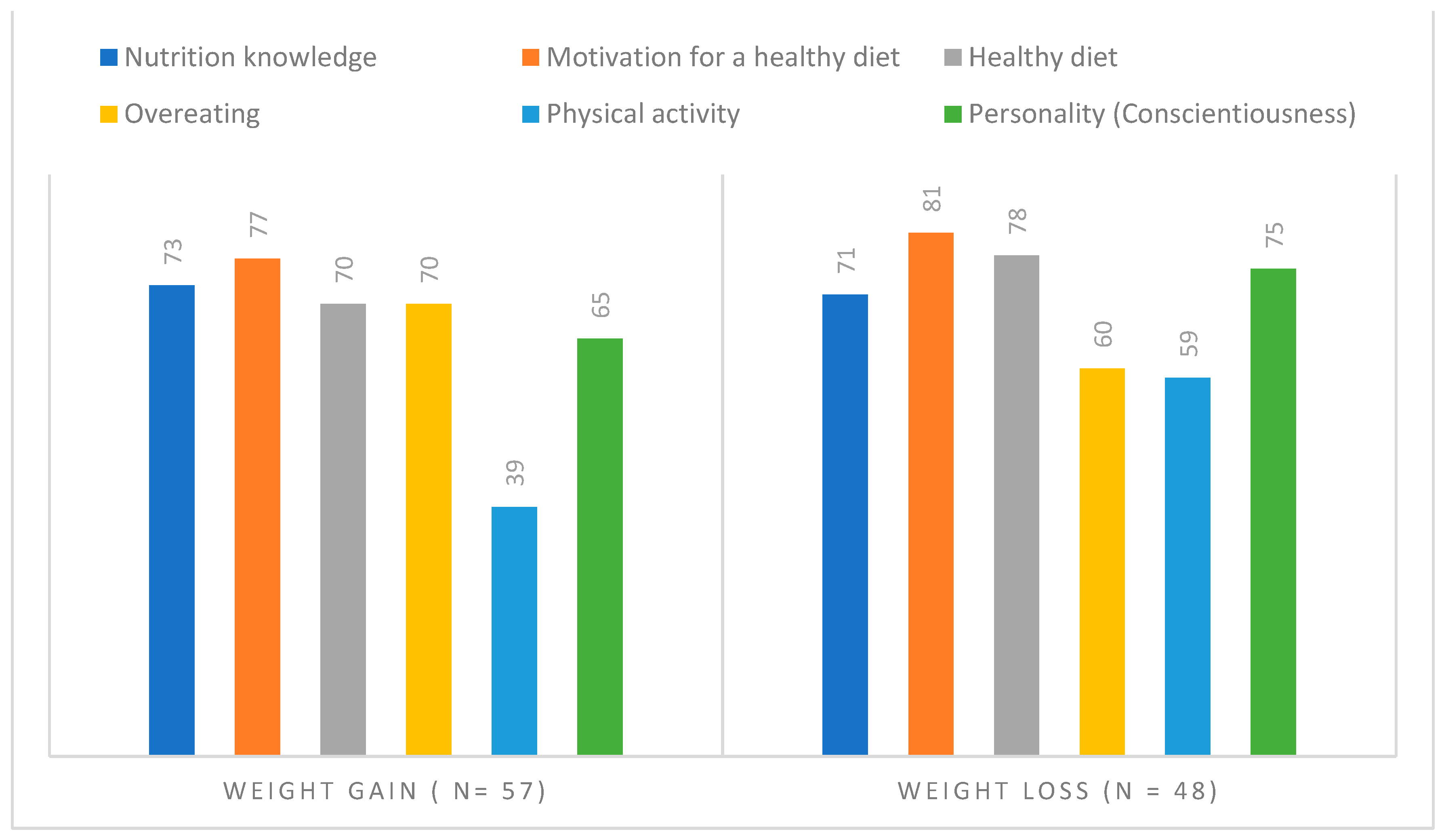
In an exploratory extreme-group analysis, we compared study variables between psychiatric patients who had experienced weight gain (n = 57) in the previous three to six months and those who had experienced weight loss (n = 48) during this time to explore differences in health behaviours and attitudes. Sociodemographic variables (e.g., gender, age, education), illness-related variables (e.g., diagnosis, mental state, medication), motivation for healthy eating, and nutrition knowledge and skills were not associated with weight gain or loss. Participants with weight gain had a BMI = 28.7, and those with weight loss had a BMI = 24.7 (t [103] = 4.18, p < 0.001), while there was no significant difference in WHR. Weight gain was associated with less physical activity (2.7 vs. 4.1 physically active days per week, t [103] = 3.06, p = 0.003), less healthy eating (2.4 vs. 2.8 scale scores, t [103] = 2.40, p = 0.018), more overeating (2.8 vs. 2.4, t [103] = 2.48, p = 0.015), higher consumption of sweets (11.6 vs. 7.1 servings per week t [103] = 2.14, p = 0.035), and lower consumption of vegetables and fruits (25.3 vs. 31.1 servings per week, t [103] = 1.86, p = 0.066). In addition, 60% of the participants with weight loss reported eating an individualised diet according to their needs, compared to 33% of those with weight gain (X [1] = 7.70, p = 0.006). Weight loss was also associated with higher levels of the following items: Extraversion (2.9 vs. 3.3, t [103] = 1.88, p = 0.063), Conscientiousness (3.2. vs. 3.8, t [103] = 3.18, p = 0.002), and Openness (3.8 vs. 4.2, t [97.5] = 2.79, p = 0.006). Differences in selected variables are presented in Figure 1 as percentages of the scale scores (100% = highest possible scale score).
Figure 1.
Differences (% of scale scores) in psychiatric patients with weight gain or weight loss.
4. Discussion
Patients with SMI are known to be at risk for nutritional problems, mostly associated with increased weight but also malnutrition, leading to reduced life expectancy and quality of life [2,3,4,5,14,16,17]. In the present study, the levels of nutrition knowledge and skills for healthy eating were investigated in individuals with SMI compared to healthy controls, along with the participants’ physical and mental health status and eating behaviours. The results showed that patients with SMI had poorer nutritional status and lifestyle compared to healthy adults. In particular, a substantial proportion of the patients reported disordered and unhealthy eating habits, reduced activities related to food preparation and eating, and negative feelings about nutrition. Despite various nutritional problems, less than half of the participants with SMI followed an individualised diet. However, levels of nutrition knowledge and skills and motivation to eat healthily were not lower in the psychiatric patients than in the healthy controls.
Some previous studies have discussed a lack of nutrition knowledge, cooking and food skills, and motivation to follow a healthy diet as possible causes of unhealthy eating behaviours in people with SMI [14,19,20,21,22]. However, to the best of our knowledge, our study is the first to systematically investigate levels of nutrition knowledge and skills in people with SMI. Contrary to previous assumptions, and despite the higher levels of education of the healthy controls (and likely greater interest in nutrition due to convenience sampling), nutrition knowledge was not higher in the healthy controls. In addition to objectively assessed practical nutrition knowledge, subjective levels of cooking and food skills were not lower in the psychiatric patients than in the healthy controls. More specifically, the inpatients had similar scores to the healthy controls, while the outpatients had the highest scores. One reason for this may be that half of the psychiatric patients (49%) had already received dietary advice. There may be two reasons for the differences between the inpatients and outpatients. First, because of their higher BMI and poorer nutritional status, the outpatients may have been more interested in gaining knowledge about a healthy diet. Second, some of the inpatients who lived in residential care homes (including one homeless person) were unable to prepare food by themselves and therefore had very low cooking and food skills. In addition to nutrition knowledge and skills, motivation to eat healthily was not significantly lower in the psychiatric patients than in the healthy controls. Moreover, levels of knowledge, skills, and motivation were not related to weight gain or weight loss in the psychiatric patients.
Nevertheless, the psychiatric patients seemed to have difficulty translating their knowledge into action. In line with previous findings [10,11,12,24], they had overall unhealthier lifestyles compared to the healthy controls, such as higher smoking rates, lower physical activity levels, and unhealthy and disordered eating habits, such as higher consumption of sugary foods, skipping main meals, night eating, less social eating, and generally less nutrition-related activities such as planning meals or shopping for food. Patients with SMI often have disturbed circadian rhythms and a lack of daily structure (e.g., unemployment). Both diagnoses included in the study (psychosis and depression) can be associated with disordered sleep patterns [45]. The combination of SMI, sleeplessness, and social deprivation may lead to night eating and reduced social eating and activities during the day [46]. This is associated with higher calorie intake, problematic aspects of body metabolism, and a higher risk of metabolic syndrome [47]. Furthermore, social aspects of eating are associated with feelings of inclusion and psychological well-being and may lead to preferable food choices and healthier eating patterns [48,49]. Indeed, in an implicit association task, the patients expressed more negative feelings towards nutrition than the healthy controls.
Aside from lifestyle factors, increased appetite and weight gain in patients with SMI are often discussed as being caused by side effects of psychiatric medication [23]. For instance, second-generation antipsychotics and some antidepressants are known to lead to increased appetite. In our study, most patients had medications with a known risk of metabolic side effects. The inpatients with 62% affective diagnoses (F3) had a higher sum score, which entails a higher risk for weight gain than outpatients with 87% affective diagnoses [17]. However, despite a higher medication-induced risk for weight gain in the inpatients and the need to prevent metabolic side effects of psychiatric medication [6,7,9], BMI was significantly higher in the outpatients, which indicates the importance of lifestyle factors. Similarly, the results of the exploratory extreme-group analysis showed positive associations between an unhealthy lifestyle including low physical activity, unhealthy eating patterns (high sugar as well as low vegetable and fruit consumption), and weight gain. In contrast, patients who reported weight loss during the past three to six months were more physically active, followed a healthy and individualised diet, and were characterised by more conscientiousness, extraversion, and openness. Some personality traits seem to facilitate or hinder the adoption of a healthy lifestyle in patients with SMI, and strategies to increase levels of conscientiousness have been discussed to achieve desirable behaviours and outcomes in psychotherapy [50]. However, their specific role in eating behaviours must be explored in future studies.
A strength of this study is the use of a broad range of different objective (e.g., BMI, nutrition knowledge) and subjective measures (e.g., weight change, cooking and food skills) related to nutrition being applied in patients with SMI. Thus, we can assume that biases based on subjective assessments and social desirability were not substantial. As well, we used a complete stratified sampling frame for the recruitment of the patients, meaning that each patient meeting the inclusion criteria had the chance to participate during the recruitment period, thus minimising selection biases. However, this was not the case for the convenience sample of the healthy controls. The patient groups and healthy controls differed in terms of their education and socioeconomic status. Nevertheless, these gaps have been frequently described [51] and might also represent the naturalistic setting. Another limitation of this study is the use of a cross-sectional design, which was appropriate for our research aims but did not allow us to examine changes and causal relationships.
5. Conclusions
In summary, the results of this study showed that the participants with SMI had worse mental and physical health conditions compared to the healthy adults. The patients with SMI were frequently affected by nutrition-related diseases such as overweight and diabetes and more often had disordered eating habits (e.g., night eating) and unhealthy lifestyle and eating patterns (e.g., low physical activity, smoking, high intake of sugary foods). Thereby, nutrition knowledge, cooking and food skills, as well as motivation for a healthy diet did not seem to be relevant barriers for these behaviours, although they might be important prerequisites for healthy eating. Rather, the results indicated that people with SMI would benefit from nutritional support that aims at improving their daily structure and social inclusion, for instance via behavioural approaches related to meal planning and social eating. Therefore, the development of low-threshold, long-term support services are needed in addition to individual nutrition counselling. Based on the study’s results, there might also be different needs for support services in inpatient and outpatient settings as well as in terms of living situation (e.g., living alone or in a residential care home). In addition, the results indicate a need for more knowledge about how food intolerances and personality factors affect the eating behaviours of people with SMI.
Author Contributions
Conceptualisation, F.H. and S.M.; methodology and formal analysis, F.H. and S.M.; data collection, F.H., S.M. and B.P.; resources, S.V. and M.J.; writing of first draft, F.H. and S.M.; review and editing, B.P., S.V., M.J. and E.S.; project administration, F.H. and S.M.; funding acquisition, F.H. and S.M. All authors have read and agreed to the published version of the manuscript.
Funding
This research was partially funded by the Foundation for the Encouragement of Nutrition Research in Switzerland (SFEFS; grant number: 551_Rev). The SFEFS was not involved in the chosen study design, data collection, analysis, or interpretation of the data, nor in the preparation, review, and approval of the manuscript.
Institutional Review Board Statement
The study was conducted in accordance with the Declaration of Helsinki and approved by the Swiss Ethics Committee, Switzerland (2019-01485).
Informed Consent Statement
Informed consent was obtained from all subjects involved in the study.
Data Availability Statement
The dataset generated for the current study is available from the first author (S.M.) upon written request.
Acknowledgments
We thank Sascha Hiller, Kathrin Wallimann, Ladina Risch, Simone Rössler, Iryna Prysada, and Patrizia Skraban for their valuable help in recruiting study participants.
Conflicts of Interest
The authors declare no conflict of interest.
References
- Schinnar, A.P.; Rothbard, A.B.; Kanter, R.; Jung, Y.S. An empirical literature review of definitions of severe and persistent mental illness. Am. J. Psychiatry 1990, 147, 1602–1608. [Google Scholar] [CrossRef]
- Thornicroft, G. Premature death among people with mental illness. BMJ 2013, 346, f2969. [Google Scholar] [CrossRef]
- Walker, E.R.; McGee, R.E.; Druss, B.G. Mortality in mental disorders and global disease burden implications: A systematic review and meta-analysis. JAMA Psychiatry 2015, 72, 334–341. [Google Scholar] [CrossRef]
- Bhaskaran, K.; Douglas, I.; Forbes, H.; dos-Santos-Silva, I.; Leon, D.A.; Smeeth, L. Body-mass index and risk of 22 specific cancers: A population-based cohort study of 524 million UK adults. Lancet 2014, 384, 755–765. [Google Scholar] [CrossRef]
- Vancampfort, D.; Stubbs, B.; Mitchell, A.J.; De Hert, M.; Wampers, M.; Ward, P.B.; Rosenbaum, S.; Correll, C.U. Risk of metabolic syndrome and its components in people with schizophrenia and related psychotic disorders, bipolar disorder and major depressive disorder: A systematic review and meta-analysis. World Psychiatry 2015, 14, 339–347. [Google Scholar] [CrossRef]
- Bak, M.; Fransen, A.; Janssen, J.; van Os, J.; Drukker, M. Almost all antipsychotics result in weight gain: A meta-analysis. PLoS ONE 2014, 9, e94112. [Google Scholar] [CrossRef]
- Zimmermann, U.; Kraus, T.; Himmerich, H.; Schuld, A.; Pollmächer, T. Epidemiology, implications and mechanisms underlying drug-induced weight gain in psychiatric patients. J. Psychiatr. Res. 2003, 37, 193–220. [Google Scholar] [CrossRef]
- De Hert, M.; Detraux, J.; Van Winkel, R.; Yu, W.; Correll, C.U. Metabolic and cardiovascular adverse effects associated with antipsychotic drugs. Nat. Rev. Endocrinol. 2012, 8, 114–126. [Google Scholar] [CrossRef]
- Serretti, A.; Mandelli, L.; Laura, M. Antidepressants and body weight: A comprehensive review and meta-analysis. J. Clin. Psychiatry 2010, 71, 979. [Google Scholar] [CrossRef]
- Bonfioli, E.; Berti, L.; Goss, C.; Muraro, F.; Burti, L. Health promotion lifestyle interventions for weight management in psychosis: A systematic review and meta-analysis of randomised controlled trials. BMC Psychiatry 2012, 12, 78. [Google Scholar] [CrossRef]
- Jerome, G.J.; Young, D.R.; Dalcin, A.; Charleston, J.; Anthony, C.; Hayes, J.; Daumit, G.L. Physical activity levels of persons with mental illness attending psychiatric rehabilitation programs. Schizophr. Res. 2009, 108, 252–257. [Google Scholar] [CrossRef]
- Dipasquale, S.; Pariante, C.M.; Dazzan, P.; Aguglia, E.; McGuire, P.; Mondelli, V. The dietary pattern of patients with schizophrenia: A systematic review. J. Psychiatr. Res. 2013, 47, 197–207. [Google Scholar] [CrossRef]
- Firth, J.; Stubbs, B.; Teasdale, S.B.; Ward, P.B.; Veronese, N.; Shivappa, N.; Hebert, J.R.; Berk, M.; Yung, A.R.; Sarris, J. Diet as a hot topic in psychiatry: A population-scale study of nutritional intake and inflammatory potential in severe mental illness. World Psychiatry 2018, 17, 365–367. [Google Scholar] [CrossRef]
- Teasdale, S.B.; Samaras, K.; Wade, T.; Jarman, R.; Ward, P.B. A review of the nutritional challenges experienced by people living with severe mental illness: A role for dietitians in addressing physical health gaps. J. Hum. Nutr. Diet. 2017, 30, 545–553. [Google Scholar] [CrossRef]
- Teasdale, S.B.; Ward, P.B.; Samaras, K.; Firth, J.; Stubbs, B.; Tripodi, E.; Burrows, T.L. Dietary intake of people with severe mental illness: Systematic review and meta-analysis. Br. J. Psychiatry 2019, 214, 251–259. [Google Scholar] [CrossRef]
- Abayomi, J.; Hackett, A. Assessment of malnutrition in mental health clients: Nurses’ judgement vs. a nutrition risk tool. J. Adv. Nurs. 2004, 45, 430–437. [Google Scholar] [CrossRef]
- Risch, L.; Hotzy, F.; Vetter, S.; Hiller, S.; Wallimann, K.; Seifritz, E.; Motteli, S. Assessment of Nutritional Status and Risk of Malnutrition Using Adapted Standard Tools in Patients with Mental Illness and in Need of Intensive Psychiatric Treatment. Int. J. Environ. Res. Public Health 2022, 20, 109. [Google Scholar] [CrossRef]
- de Mestral, C.; Khalatbari-Soltani, S.; Stringhini, S.; Marques-Vidal, P. Perceived barriers to healthy eating and adherence to dietary guidelines: Nationwide study. Clin. Nutr. 2020, 39, 2580–2585. [Google Scholar] [CrossRef]
- Carson, N.E.; Blake, C.E.; Saunders, R.P.; O’Brien, J.C. Influences on the Food Choice Behaviors of Adults With Severe Mental Illness. Occup. Ther. Ment. Health 2013, 29, 361–384. [Google Scholar] [CrossRef]
- Çelik Ince, S.; Partlak Günüşen, N. The views and habits of the individuals with mental illness about physical activity and nutrition. Perspect. Psychiatr. Care 2018, 54, 586–595. [Google Scholar] [CrossRef] [PubMed]
- Barre, L.K.; Ferron, J.C.; Davis, K.E.; Whitley, R. Healthy eating in persons with serious mental illnesses: Understanding and barriers. Psychiatr. Rehabil. J. 2011, 34, 304. [Google Scholar] [CrossRef]
- Teasdale, S.B.; Burrows, T.L.; Hayes, T.; Hsia, C.Y.; Watkins, A.; Curtis, J.; Ward, P.B. Dietary intake, food addiction and nutrition knowledge in young people with mental illness. Nutr. Diet. 2020, 77, 315–322. [Google Scholar] [CrossRef]
- Teasdale, S.B.; Ward, P.B.; Rosenbaum, S.; Samaras, K.; Stubbs, B. Solving a weighty problem: Systematic review and meta-analysis of nutrition interventions in severe mental illness. Br. J. Psychiatry 2017, 210, 110–118. [Google Scholar] [CrossRef] [PubMed]
- Mueller-Stierlin, A.S.; Peisser, A.; Cornet, S.; Jaeckle, S.; Lehle, J.; Moerkl, S.; Teasdale, S.B. Exploration of Perceived Determinants of Disordered Eating Behaviors in People with Mental Illness-A Qualitative Study. Int. J. Environ. Res. Public Health 2022, 20, 442. [Google Scholar] [CrossRef]
- Mueller-Stierlin, A.S.; Cornet, S.; Peisser, A.; Jaeckle, S.; Lehle, J.; Moerkl, S.; Teasdale, S.B. Implications of Dietary Intake and Eating Behaviors for People with Serious Mental Illness: A Qualitative Study. Nutrients 2022, 14, 2616. [Google Scholar] [CrossRef] [PubMed]
- Afzal, M.; Siddiqi, N.; Ahmad, B.; Afsheen, N.; Aslam, F.; Ali, A.; Ayesha, R.; Bryant, M.; Holt, R.; Khalid, H.; et al. Prevalence of Overweight and Obesity in People With Severe Mental Illness: Systematic Review and Meta-Analysis. Front. Endocrinol. Lausanne 2021, 12, 769309. [Google Scholar] [CrossRef]
- NICE. National Collaborating Center for Mental Heatlh, Psychosis and Schizophrenia in Adults: Treatment and Management; NICE: London, UK, 2014. [Google Scholar]
- Holt, R.I.G. The Management of Obesity in People with Severe Mental Illness: An Unresolved Conundrum. Psychother Psychosom 2019, 88, 327–332. [Google Scholar] [CrossRef]
- Hotzy, F.; Risch, L.; Motteli, S. Nutritional Needs in Mental Healthcare: Study Protocol of a Prospective Analytic Observational Study Assessing Nutritional Status, Eating Behavior and Barriers to Healthy Eating in Psychiatric Inpatients and Outpatients Compared to Healthy Adults. Front. Psychiatry 2022, 13, 906234. [Google Scholar] [CrossRef]
- Sharma, G. Pros and cons of different sampling techniques. Int. J. Appl. Res. 2017, 3, 749–752. [Google Scholar]
- Limesurvey GmbH. LimeSurvey [Open Source Survey Tool]. Hamburg, Germany. Available online: http://www.limesurvey.org (accessed on 1 January 2023).
- Prinz, U.; Nutzinger, D.O.; Schulz, H.; Petermann, F.; Braukhaus, C.; Andreas, S. Comparative psychometric analyses of the SCL-90-R and its short versions in patients with affective disorders. BMC Psychiatry 2013, 13, 104. [Google Scholar] [CrossRef]
- Kroenke, K.; Spitzer, R.L.; Williams, J.B.W. The PHQ-9: Validity of a brief depression severity measure. J. Gen. Intern. Med. 2001, 16, 606–613. [Google Scholar] [CrossRef] [PubMed]
- Löwe, B.; Kroenke, K.; Herzog, W.; Gräfe, K. Measuring depression outcome with a brief self-report instrument: Sensitivity to change of the Patient Health Questionnaire (PHQ-9). J. Affect. Disord. 2004, 81, 61–66. [Google Scholar] [CrossRef] [PubMed]
- Rammstedt, B.; John, O.P. Kurzversion des big five inventory (BFI-K). Diagnostica 2005, 51, 195–206. [Google Scholar] [CrossRef]
- Mötteli, S.; Siegrist, M.; Keller, C. Women’s social eating environment and its associations with dietary behavior and weight management. Appetite 2017, 110, 86–93. [Google Scholar] [CrossRef]
- Mötteli, S.; Barbey, J.; Keller, C.; Bucher, T.; Siegrist, M. Measuring practical knowledge about balanced meals: Development and validation of the brief PKB-7 scale. Eur. J. Clin. Nutr. 2016, 70, 505–510. [Google Scholar] [CrossRef]
- Birchwood, M.; Smith, J.O.; Cochrane, R.; Wetton, S.; Copestake, S. The social functioning scale the development and validation of a new scale of social adjustment for use in family intervention programmes with schizophrenic patients. Br. J. Psychiatry 1990, 157, 853–859. [Google Scholar] [CrossRef]
- Szalay, L.B.; Deese, J. Subjective Meaning and Culture: An Assessment through word Associations; Lawrence Erlbaum Associates: Mahwah, NJ, USA, 1978. [Google Scholar]
- Keller, C.; van der Horst, K. Dietary restraint, ambivalence toward eating, and the valence and content of spontaneous associations with eating. Appetite 2013, 62, 150–159. [Google Scholar] [CrossRef] [PubMed]
- Bucher, T.; Hartmann, C.; Rollo, M.E.; Collins, C.E. What is nutritious snack food? A comparison of expert and layperson assessments. Nutrients 2017, 9, 874. [Google Scholar] [CrossRef]
- Deroover, K.; Bucher, T.; Vandelanotte, C.; de Vries, H.; Duncan, M.J. Practical nutrition knowledge mediates the relationship between sociodemographic characteristics and diet quality in adults: A cross-sectional analysis. Am. J. Health Promot. 2020, 34, 59–62. [Google Scholar] [CrossRef]
- Lavelle, F.; McGowan, L.; Hollywood, L.; Surgenor, D.; McCloat, A.; Mooney, E.; Caraher, M.; Raats, M.; Dean, M. The development and validation of measures to assess cooking skills and food skills. Int. J. Behav. Nutr. Phys. Act. 2017, 14, 118. [Google Scholar] [CrossRef]
- Motteli, S.; Hotzy, F. The Assessment of Cooking Skills and Food Skills and Their Relationship with Nutrition Knowledge, Attitude toward a Healthy Diet and Food Intake: Results of a German Validation Study. Nutrients 2022, 14, 3157. [Google Scholar] [CrossRef]
- Freeman, D.; Sheaves, B.; Waite, F.; Harvey, A.G.; Harrison, P.J. Sleep disturbance and psychiatric disorders. Lancet Psychiatry 2020, 7, 628–637. [Google Scholar] [CrossRef] [PubMed]
- Lundgren, J.D.; Rempfer, M.V.; Brown, C.E.; Goetz, J.; Hamera, E. The prevalence of night eating syndrome and binge eating disorder among overweight and obese individuals with serious mental illness. Psychiatry Res. 2010, 175, 233–236. [Google Scholar] [CrossRef]
- Lundgren, J.D.; Allison, K.C.; O’Reardon, J.P.; Stunkard, A.J. A descriptive study of non-obese persons with night eating syndrome and a weight-matched comparison group. Eat. Behav. 2008, 9, 343–351. [Google Scholar] [CrossRef] [PubMed]
- Delormier, T.; Frohlich, K.L.; Potvin, L. Food and eating as social practice—Understanding eating patterns as social phenomena and implications for public health. Sociol. Health Ill. 2009, 31, 215–228. [Google Scholar] [CrossRef] [PubMed]
- Ruddock, H.K.; Brunstrom, J.M.; Vartanian, L.R.; Higgs, S. A systematic review and meta-analysis of the social facilitation of eating. Am. J. Clin. Nutr. 2019, 110, 842–861. [Google Scholar] [CrossRef] [PubMed]
- Javaras, K.N.; Williams, M.; Baskin-Sommers, A.R. Psychological Interventions Potentially Useful for Increasing Conscientiousness. Personal. Disord. 2019, 10, 13–24. [Google Scholar] [CrossRef]
- Fryers, T.; Melzer, D.; Jenkins, R. Social inequalities and the common mental disorders: A systematic review of the evidence. Soc. Psychiatry Psychiatr. Epidemiol. 2003, 38, 229–237. [Google Scholar] [CrossRef]
Disclaimer/Publisher’s Note: The statements, opinions and data contained in all publications are solely those of the individual author(s) and contributor(s) and not of MDPI and/or the editor(s). MDPI and/or the editor(s) disclaim responsibility for any injury to people or property resulting from any ideas, methods, instructions or products referred to in the content. |
© 2023 by the authors. Licensee MDPI, Basel, Switzerland. This article is an open access article distributed under the terms and conditions of the Creative Commons Attribution (CC BY) license (https://creativecommons.org/licenses/by/4.0/).