Ergogenic Aids to Improve Physical Performance in Female Athletes: A Systematic Review with Meta-Analysis
 ,
, 
Abstract
1. Introduction
2. Materials and Methods
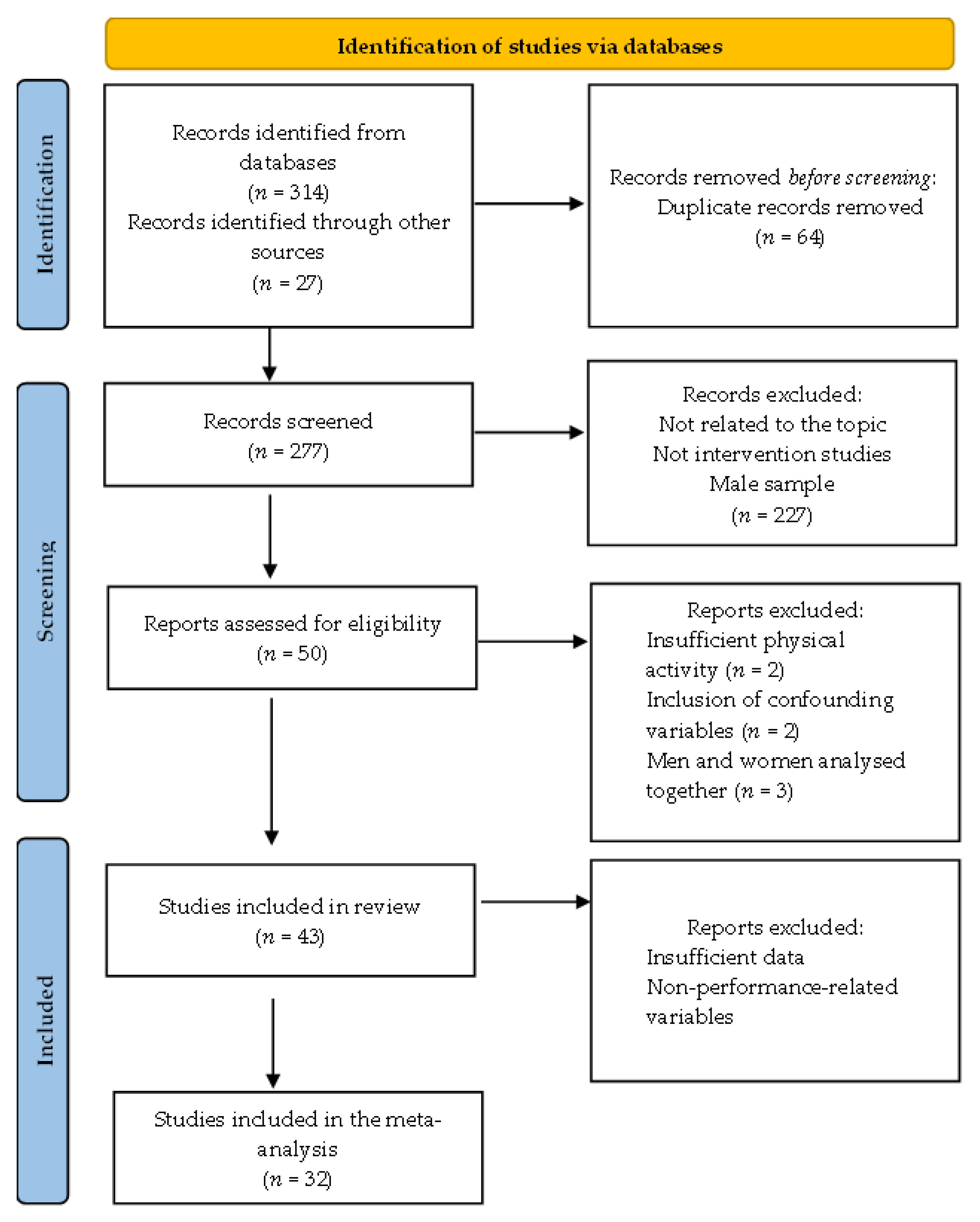
2.1. Search Strategy and Study Selection
2.2. Data Extraction
2.3. Risk of Bias
2.4. Statistical Analysis
3. Results
3.1. Quantitative Analysis
3.1.1. Strength
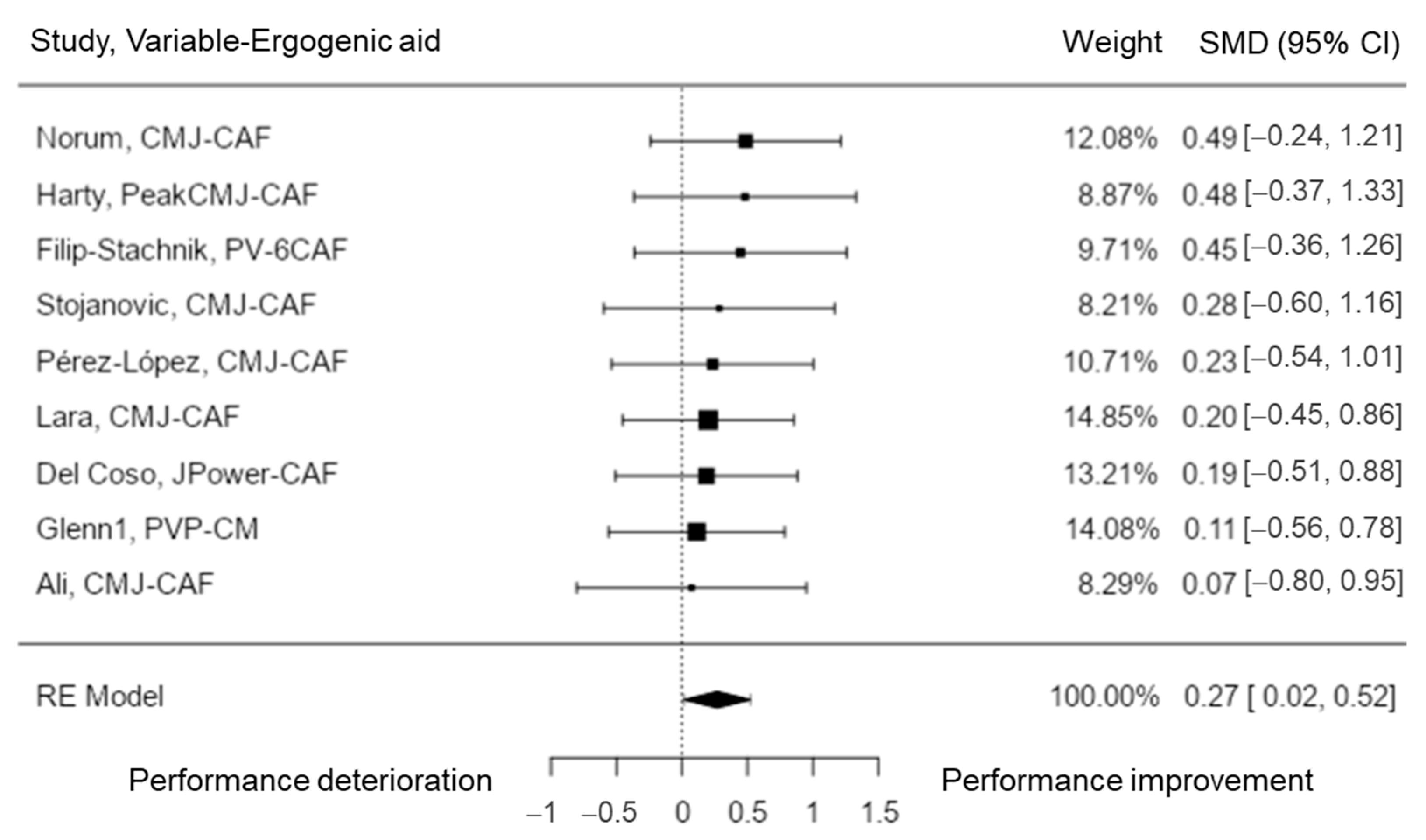
- Power and jumping performance
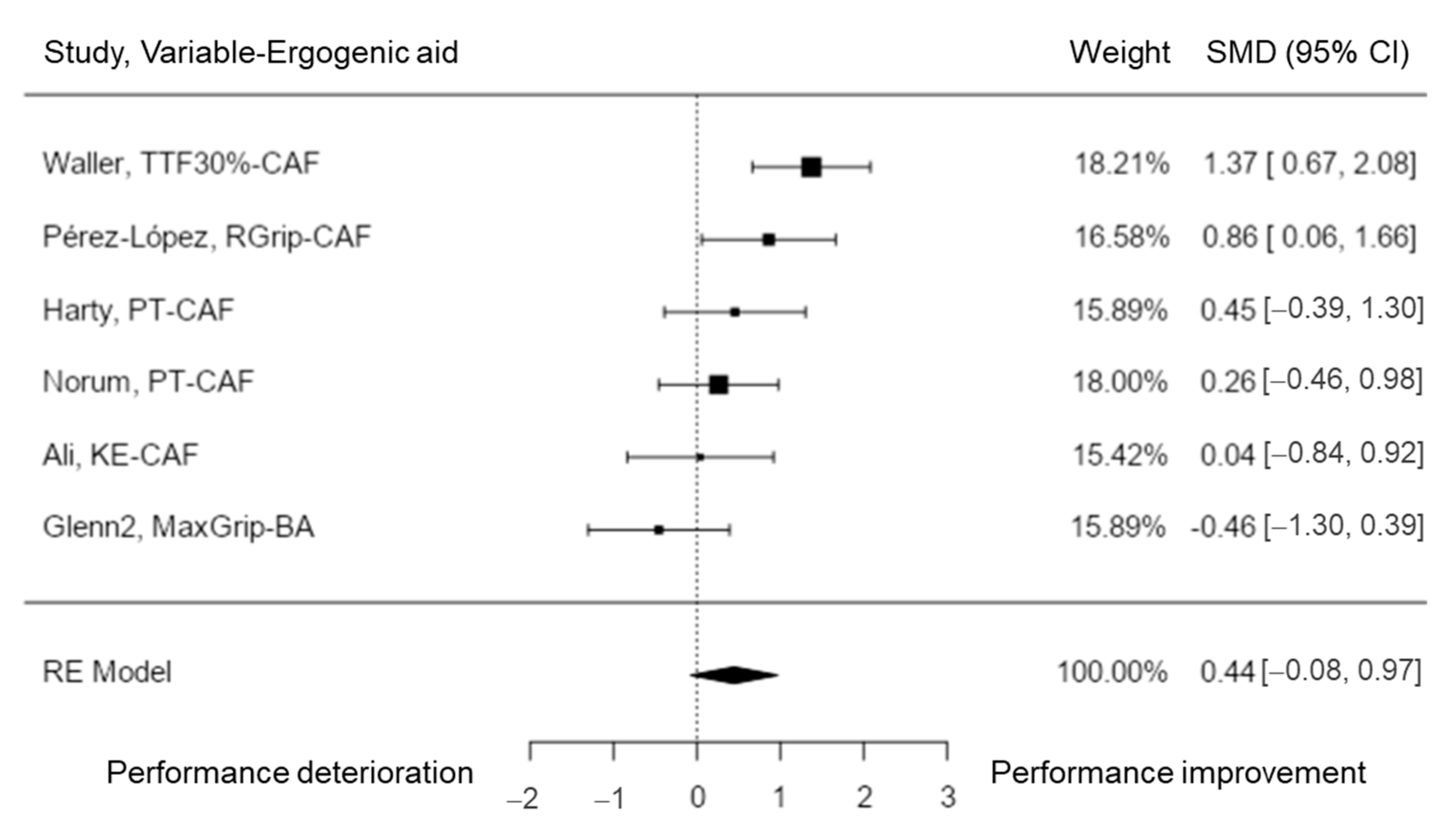
- Isometric strength
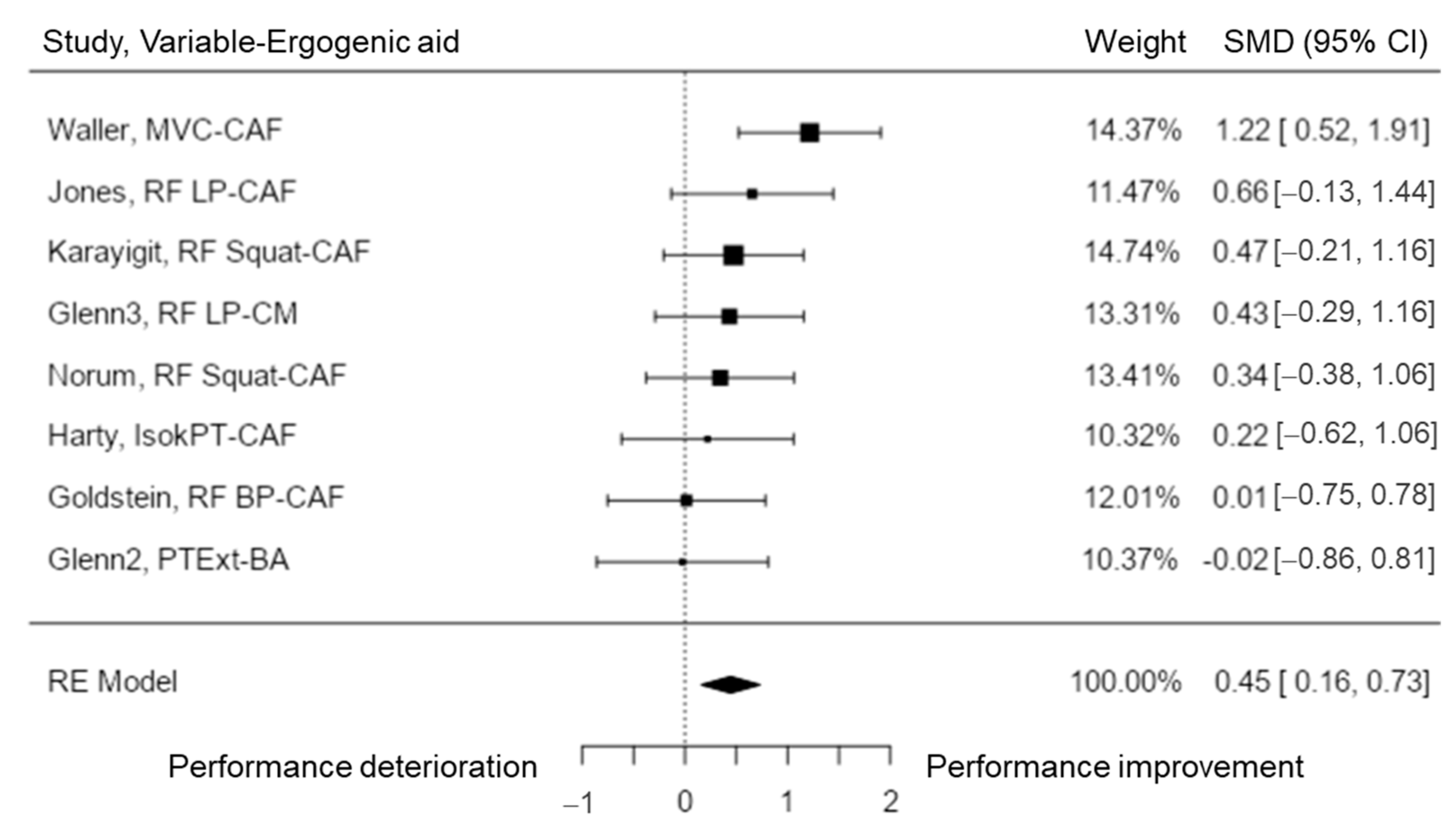
- Resistance strength
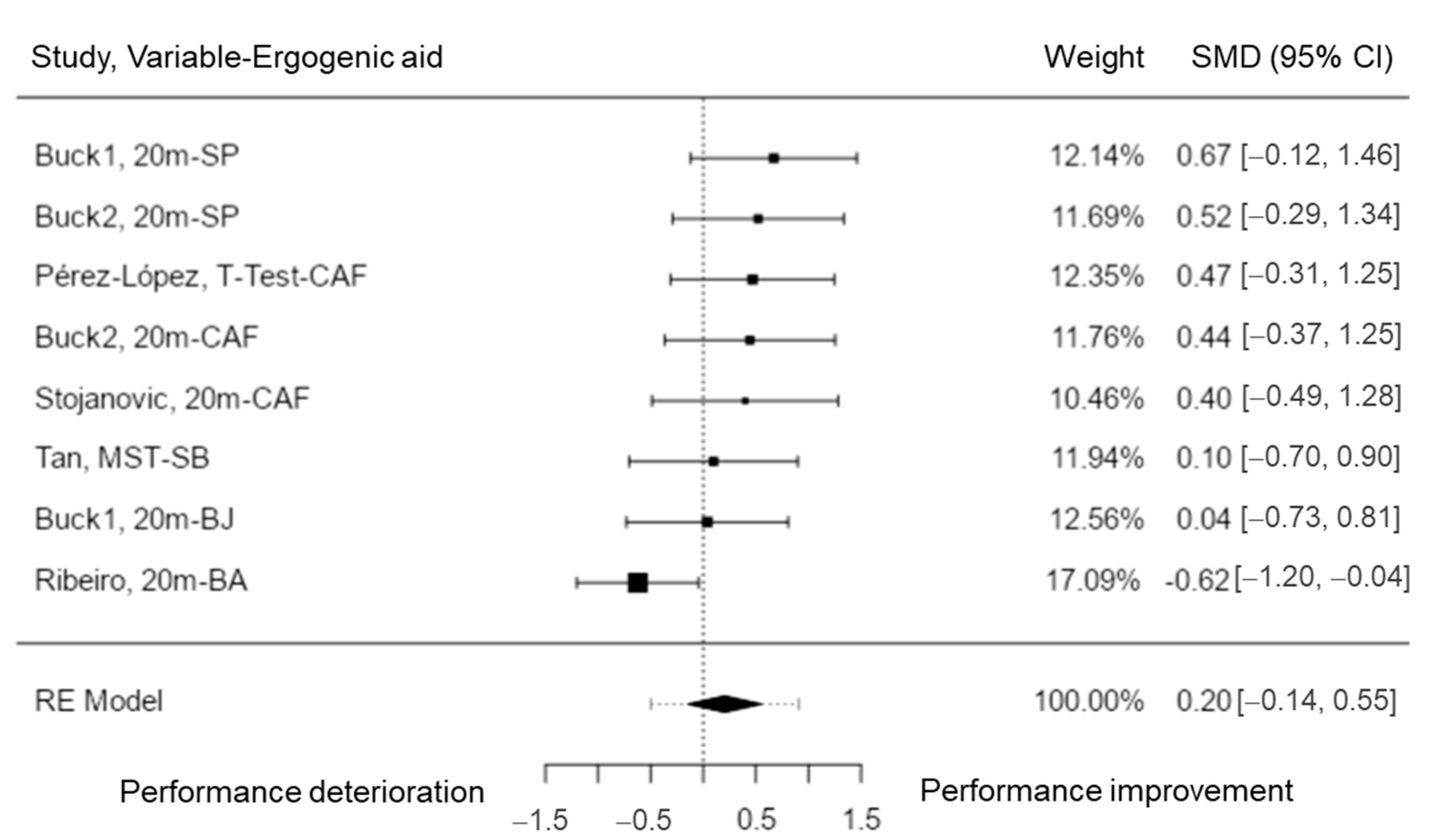
3.1.2. Sprint
3.1.3. Cardiorespiratory Fitness
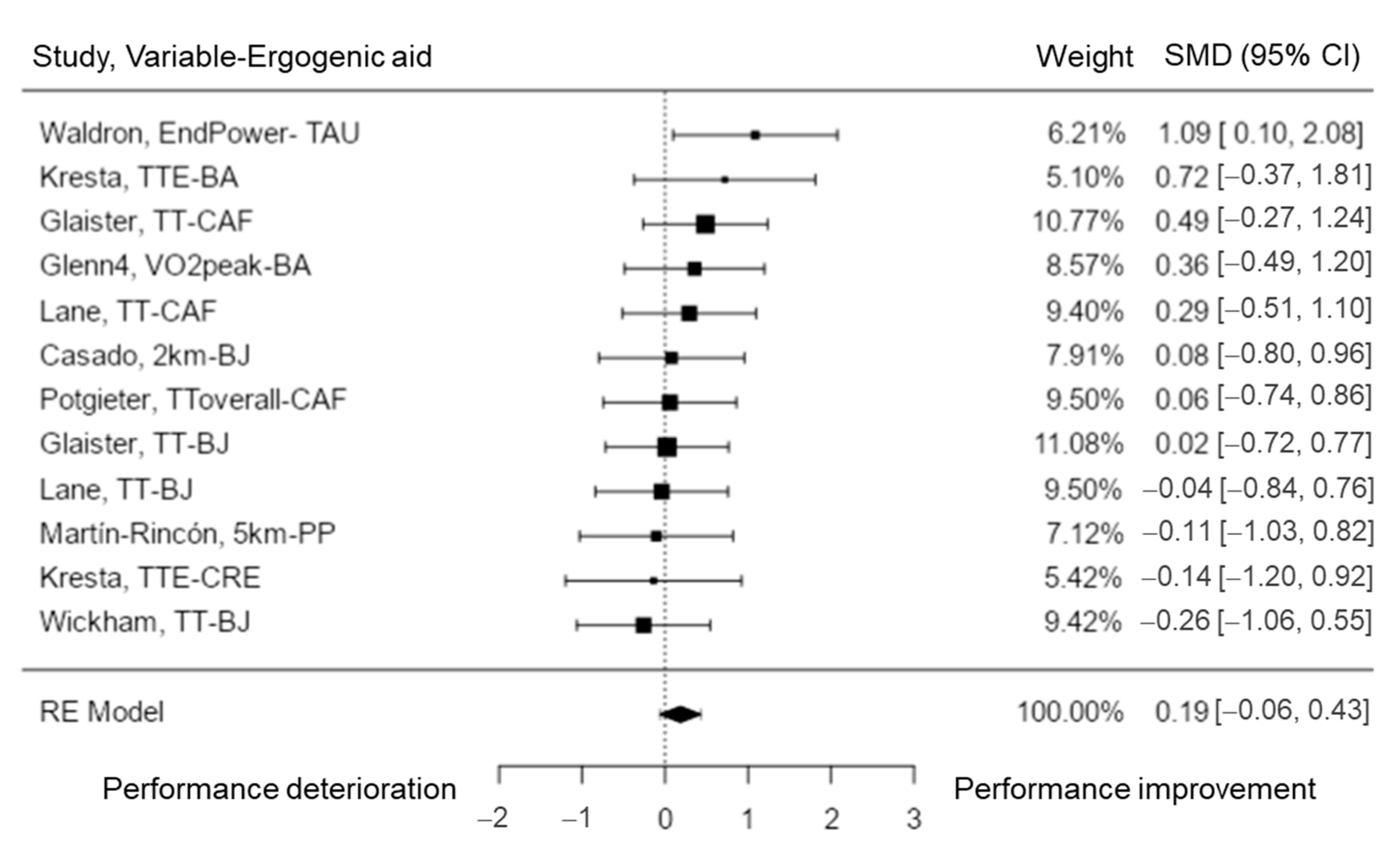
- Aerobic Capacity
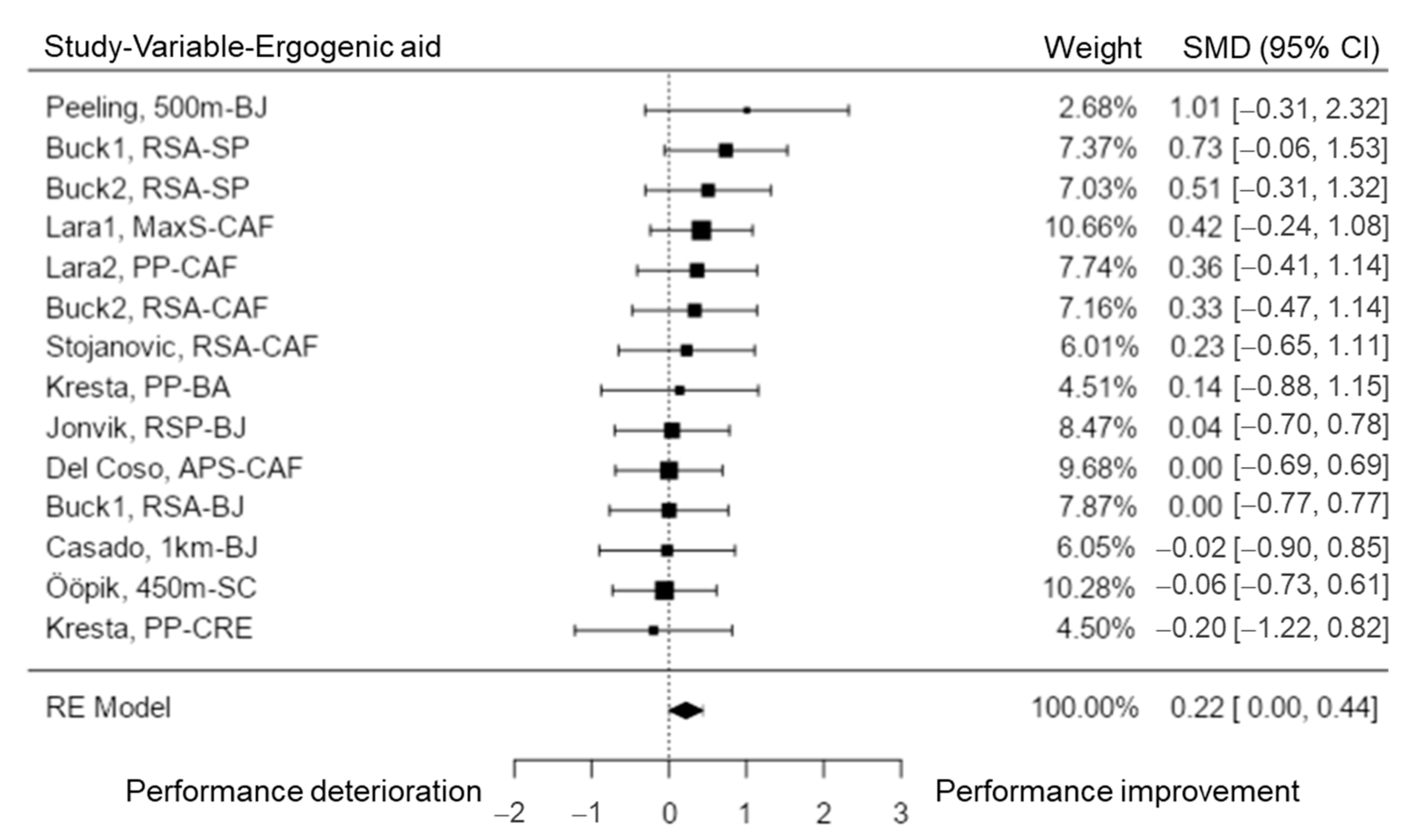
- Anaerobic capacity
3.2. Risk of Bias Assessment
4. Discussion
5. Conclusions
Author Contributions
Funding
Institutional Review Board Statement
Informed Consent Statement
Data Availability Statement
Conflicts of Interest
References
- Garthe, I.; Maughan, R.J. Athletes and Supplements: Prevalence and Perspectives. Int. J. Sport Nutr. Exerc. Metab. 2018, 28, 126–138. [Google Scholar] [CrossRef] [PubMed]
- Piccardi, N.; Manissier, P. Nutrition and nutritional supplementation. Impact on skin health and beauty. Derm. Endocrinol. 2009, 1, 271–274. [Google Scholar] [CrossRef]
- Porrini, M.; del Bo, C. Ergogenic Aids and Supplements. Front. Horm. Res. 2016, 47, 128–152. [Google Scholar]
- Gepner, Y.; Varanoske, A.N.; Boffey, D.; Hoffman, J.R. Benefits of β-hydroxy-β-methylbutyrate supplementation in trained and untrained individuals. Res. Sports Med. 2019, 27, 204–218. [Google Scholar] [CrossRef] [PubMed]
- Salehi, M.; Mashhadi, N.S.; Esfahani, P.S.; Feizi, A.; Hadi, A.; Askari, G. The Effects of Curcumin Supplementation on Muscle Damage, Oxidative Stress, and Inflammatory Markers in Healthy Females with Moderate Physical Activity: A Randomized, Double Blind, Placebo Controlled Clinical Trial. Int. J. Prev. Med. 2021, 12, 94. [Google Scholar] [CrossRef]
- Barry, D.W.; Hansen, K.C.; Van Pelt, R.; Witten, M.; Wolfe, P.; Kohrt, W.M. Acute Calcium Ingestion Attenuates Exercise-Induced Disruption of Calcium Homeostasis. Med. Sci. Sports Exerc. 2011, 43, 617–623. [Google Scholar] [CrossRef] [PubMed]
- Close, G.; Hamilton, D.; Philp, A.; Burke, L.; Morton, J. New strategies in sport nutrition to increase exercise performance. Free Radic. Biol. Med. 2016, 98, 144–158. [Google Scholar] [CrossRef]
- Stout, J.R.; Cramer, J.T.; Zoeller, R.F.; Torok, D.; Costa, P.; Hoffman, J.R.; Harris, R.C.; O’kroy, J. Effects of b-alanine supplementation on the onset of neuromuscular fatigue and ventilatory threshold in women. Amino Acids 2007, 32, 381–386. [Google Scholar] [CrossRef]
- McMahon, N.F.; Leveritt, M.D.; Pavey, T.G. The Effect of Dietary Nitrate Supplementation on Endurance Exercise Performance in Healthy Adults: A Systematic Review and Meta-Analysis. Sports Med. 2017, 47, 735–756. [Google Scholar] [CrossRef]
- Lara, B.; Hellín, J.G.; Ruiz, C.; Romero-Moraleda, B.; Del Coso, J. Acute caffeine intake increases performance in the 15-s Wingate test during the menstrual cycle. Br. J. Clin. Pharmacol. 2020, 86, 745–752. [Google Scholar] [CrossRef]
- Burke, L.M. Supplements for Optimal Sports Performance. Curr. Opin. Physiol. 2019, 10, 156–165. [Google Scholar] [CrossRef]
- Peeling, P.; Binnie, M.J.; Goods, P.S.; Sim, M.; Burke, L.M. Evidence-Based Supplements for the Enhancement of Athletic Performance. Int. J. Sport Nutr. Exerc. Metab. 2018, 28, 178–187. [Google Scholar] [CrossRef] [PubMed]
- Glenn, J.M.; Gray, M.; Gualano, B.; Roschel, H. The Ergogenic Effects of Supplemental Nutritional Aids on Anaerobic Performance in Female Athletes. Strength Cond. J. 2016, 38, 105–120. [Google Scholar] [CrossRef]
- Grgic, J.; Mikulic, P.; Schoenfeld, B.J.; Bishop, D.J.; Pedišić, Ž. The Influence of Caffeine Supplementation on Resistance Exercise: A Review. Sports Med. 2019, 49, 17–30. [Google Scholar] [CrossRef] [PubMed]
- Eckerson, J.M. Creatine as an Ergogenic Aid for Female Athletes. Strength Cond. J. 2016, 38, 14–23. [Google Scholar] [CrossRef]
- Sawicka, A.K.; Renzi, G.; Olek, R.A. The bright and the dark sides of L-carnitine supplementation: A systematic review. J. Int. Soc. Sports Nutr. 2020, 17, 49. [Google Scholar] [CrossRef]
- Somerville, V.; Bringans, C.; Braakhuis, A. Polyphenols and Performance: A Systematic Review and Meta-Analysis. Sports Med. 2017, 47, 1589–1599. [Google Scholar] [CrossRef]
- Díaz, M.S.; Martín-Castellanos, A.; Fernández-Elías, V.E.; Torres, O.L.; Calvo, J.L. Effects of Polyphenol Consumption on Recovery in Team Sport Athletes of Both Sexes: A Systematic Review. Nutrients 2022, 14, 4085. [Google Scholar] [CrossRef]
- Khan, N.; Mukhtar, H. Tea Polyphenols in Promotion of Human Health. Nutrients 2019, 11, 39. [Google Scholar] [CrossRef]
- Luca, S.V.; Macovei, I.; Bujor, A.; Miron, A.; Skalicka-Woźniak, K.; Aprotosoaie, A.C.; Trifan, A. Bioactivity of dietary polyphenols: The role of metabolites. Crit. Rev. Food Sci. Nutr. 2020, 60, 626–659. [Google Scholar] [CrossRef]
- Pechanova, O.; Dayar, E.; Cebova, M. Therapeutic Potential of Polyphenols-Loaded Polymeric Nanoparticles in Cardiovascular System. Molecules 2020, 25, 3322. [Google Scholar] [CrossRef] [PubMed]
- Moreno, B.; Veiga, S.; Sánchez-Oliver, A.J.; Domínguez, R.; Morencos, E. Analysis of Sport Supplement Consumption by Competitive Swimmers According to Sex and Competitive Level. Nutrients 2022, 14, 3218. [Google Scholar] [CrossRef] [PubMed]
- Sánchez-Oliver, A.J.; Domínguez, R.; López-Tapia, P.; Tobal, F.M.; Jodra, P.; Montoya, J.J.; Guerra-Hernández, E.J.; Ramos-Álvarez, J.J. A Survey on Dietary Supplement Consumption in Amateur and Professional Rugby Players. Foods 2021, 10, 7. [Google Scholar] [CrossRef] [PubMed]
- Muñoz, A.; López-Samanes, Á.; Domínguez, R.; Moreno-Pérez, V.; Sánchez-Oliver, A.J.; Del Coso, J. Use of Sports Supplements in Competitive Handball Players: Sex and Competitive Level Differences. Nutrients 2020, 12, 3357. [Google Scholar] [CrossRef] [PubMed]
- Domínguez, R.; López-Domínguez, R.; López-Samanes, Á.; Gené, P.; González-Jurado, J.A.; Sánchez-Oliver, A.J. Analysis of Sport Supplement Consumption and Body Composition in Spanish Elite Rowers. Nutrients 2020, 12, 3871. [Google Scholar] [CrossRef] [PubMed]
- Mata, F.; Domínguez, R.; López-Samanes, Á.; Sánchez-Gómez, Á.; Jodra, P.; Sánchez-Oliver, A.J. Analysis of the consumption of sports supplements in elite fencers according to sex and competitive level. BMC Sports Sci. Med. Rehabil. 2021, 13, 50. [Google Scholar] [CrossRef]
- Knapik, J.J.; Steelman, R.A.; Hoedebecke, S.S.; Austin, K.G.; Farina, E.K.; Lieberman, H.R. Prevalence of Dietary Supplement Use by Athletes: Systematic Review and Meta-Analysis. Sports Med. 2016, 46, 103–123. [Google Scholar] [CrossRef]
- Casado, A.; Domínguez, R.; Fernandes Da Silva, S.; Bailey, S.J. Influence of Sex and Acute Beetroot Juice Supplementation on 2 KM Running Performance. Appl. Sci. 2021, 11, 977. [Google Scholar] [CrossRef]
- Stojanović, E.; Stojiljković, N.; Scanlan, A.T.; Dalbo, V.J.; Stanković, R.; Antić, V.; Milanović, Z. Acute caffeine supplementation promotes small to moderate improvements in performance tests indicative of in-game success in professional female basketball players. Appl. Physiol. Nutr. Metab. 2019, 44, 849–856. [Google Scholar] [CrossRef]
- Soldin, O.P.; Mattison, D. Sex Differences in Pharmacokinetics and Pharmacodynamics. Clin. Pharmacokinet. 2009, 48, 143–157. [Google Scholar] [CrossRef]
- Gandhi, M.; Aweeka, F.; Greenblatt, R.M.; Blaschke, T.F. Sex Differences in Pharmacokinetics and Pharmacodynamics. Annu. Rev. Pharmacol. Toxicol. 2004, 44, 499–523. [Google Scholar] [CrossRef] [PubMed]
- Temple, J.L.; Ziegler, A.M. Gender Differences in Subjective and Physiological Responses to Caffeine and the Role of Steroid Hormones. J. Caffeine Res. 2011, 1, 41–48. [Google Scholar] [CrossRef] [PubMed]
- Branch, J.D. Effect of Creatine Supplementation on Body Composition and Performance: A Meta-analysis. Int. J. Sport Nutr. Exerc. Metab. 2003, 13, 198–226. [Google Scholar] [CrossRef] [PubMed]
- Stegen, S.; Bex, T.; Vervaet, C.; Vanhee, L.; Achten, E.; Derave, W. β-Alanine Dose for Maintaining Moderately Elevated Muscle Carnosine Levels. Med. Sci. Sports Exerc. 2014, 46, 1426–1432. [Google Scholar] [CrossRef] [PubMed]
- Cashin, A.G.; McAuley, J.H. Clinimetrics: Physiotherapy Evidence Database (PEDro) Scale. J. Physiother. 2020, 66, 59. [Google Scholar] [CrossRef]
- Viechtbauer, W. Conducting Meta-Analyses in R with the metafor Package. JSS J. Stat. Softw. 2010, 36, 1–48. [Google Scholar]
- Cochran, W.G. The Combination of Estimates from Different Experiments. Biometrics 1954, 10, 101–129. [Google Scholar] [CrossRef]
- The Jamovi Project [Computer Software]. Available online: http://www.jamovi.org (accessed on 1 January 2020).
- Filip-Stachnik, A.; Krzysztofik, M.; Del Coso, J.; Wilk, M. Acute effects of two caffeine doses on bar velocity during the bench press exercise among women habituated to caffeine: A randomized, crossover, double-blind study involving control and placebo conditions. Eur. J. Nutr. 2022, 61, 947–955. [Google Scholar] [CrossRef]
- Harty, P.S.; Zabriskie, H.A.; Stecker, R.A.; Currier, B.S.; Tinsley, G.M.; Surowiec, K.; Jagim, A.R.; Richmond, S.R.; Kerksick, C.M. Caffeine Timing Improves Lower-Body Muscular Performance: A Randomized Trial. Front. Nutr. 2020, 7, 585900. [Google Scholar] [CrossRef]
- Romero-Moraleda, B.; Del Coso, J.; Gutiérrez-Hellín, J.; Lara, B. The Effect of Caffeine on the Velocity of Half-Squat Exercise during the Menstrual Cycle: A Randomized Controlled Trial. Nutrients 2019, 11, 2662. [Google Scholar] [CrossRef]
- Ali, A.; O’Donnell, J.; Von Hurst, P.; Foskett, A.; Holland, S.; Starck, C.; Rutherfurd-Markwick, K. Caffeine ingestion enhances perceptual responses during intermittent exercise in female team-game players. J. Sports Sci. 2016, 34, 330–341. [Google Scholar] [CrossRef]
- Ali, A.; O’Donnell, J.; Foskett, A.; Rutherfurd-Markwick, K. The influence of caffeine ingestion on strength and power performance in female team-sport players. J. Int. Soc. Sports Nutr. 2016, 13, 46. [Google Scholar] [CrossRef] [PubMed]
- Karayigit, R.; Naderi, A.; Akca, F.; Da Cruz, C.J.G.; Sarshin, A.; Yasli, B.C.; Ersoz, G.; Kaviani, M. Effects of Different Doses of Caffeinated Coffee on Muscular Endurance, Cognitive Performance, and Cardiac Autonomic Modulation in Caffeine Naive Female Athletes. Nutrients 2020, 13, 2. [Google Scholar] [CrossRef]
- Jones, L.; Johnstone, I.; Day, C.; Le Marquer, S.; Hulton, A.T. The Dose-Effects of Caffeine on Lower Body Maximal Strength, Muscular Endurance, and Rating of Perceived Exertion in Strength-Trained Females. Nutrients 2021, 13, 3342. [Google Scholar] [CrossRef] [PubMed]
- Lara, B.; González-Millán, C.; Salinero, J.J.; Abián-Vicén, J.; Areces, F.; Barbero-Alvarez, J.C.; Muñoz, V.; Portillo, L.J.; Rave, J.M.G.; Del Coso, J. Caffeine-containing energy drink improves physical performance in female soccer players. Amino Acids 2014, 46, 1385–1392. [Google Scholar] [CrossRef]
- Waller, G.; Dolby, M.; Steele, J.; Fisher, J.P. A low caffeine dose improves maximal strength, but not relative muscular endurance in either heavier-or lighter-loads, or perceptions of effort or discomfort at task failure in females. PeerJ 2020, 8, e9144. [Google Scholar] [CrossRef]
- Portillo, J.; Del Coso, J.; Abián-Vicén, J. Effects of Caffeine Ingestion on Skill Performance During an International Female Rugby Sevens Competition. J. Strength Cond. Res. 2017, 31, 3351–3357. [Google Scholar] [CrossRef]
- Muñoz, A.; López-Samanes, A.; Pérez-López, A.; Aguilar-Navarro, M.; Moreno-Heredero, B.; Rivilla-García, J.; González-Frutos, P.; Pino-Ortega, J.; Morencos, E.; Del Coso, J. Effects of Caffeine Ingestion on Physical Performance in Elite Women Handball Players: A Randomized, Controlled Study. Int. J. Sports Physiol. Perform. 2020, 15, 1406–1413. [Google Scholar] [CrossRef]
- Goldstein, E.; Jacobs, P.L.; Whitehurst, M.; Penhollow, T.; Antonio, J. Caffeine enhances upper body strength in resistance-trained women. J. Int. Soc. Sports Nutr. 2010, 7, 18. [Google Scholar] [CrossRef]
- Norum, M.; Risvang, L.C.; Bjørnsen, T.; Dimitriou, L.; Rønning, P.O.; Bjørgen, M.; Raastad, T. Caffeine increases strength and power performance in resistance-trained females during early follicular phase. Scand. J. Med. Sci. Sports 2020, 30, 2116–2129. [Google Scholar] [CrossRef]
- Pérez-López, A.; Salinero, J.J.; Abián-Vicén, J.; Valadés, D.; Lara, B.; Hernandez, C.; Areces, F.; González, C.; Del Coso, J. Caffeinated Energy Drinks Improve Volleyball Performance in Elite Female Players. Med. Sci. Sports Exerc. 2015, 47, 850–856. [Google Scholar] [CrossRef] [PubMed]
- Del Coso, J.; Portillo, J.; Muñoz, G.; Abián-Vicén, J.; Gonzalez-Millán, C.; Muñ oz-Guerra, J. Caffeine-containing energy drink improves sprint performance during an international rugby sevens competition. Amino Acids 2013, 44, 1511–1519. [Google Scholar] [CrossRef] [PubMed]
- Potgieter, S.; Wright, H.H.; Smith, C. Caffeine Improves Triathlon Performance: A Field Study in Males and Females. Int. J. Sport Nutr. Exerc. Metab. 2018, 28, 228–237. [Google Scholar] [CrossRef] [PubMed]
- Glaister, M.; Pattison, J.R.; Muniz-Pumares, D.; Patterson, S.; Foley, P. Effects of Dietary Nitrate, Caffeine, and Their Combination on 20-km Cycling Time Trial Performance. J. Strength Cond. Res. 2015, 29, 165–174. [Google Scholar] [CrossRef]
- Lane, S.C.; Hawley, J.A.; Desbrow, B.; Jones, A.M.; Blackwell, J.R.; Ross, M.L.; Zemski, A.J.; Burke, L.M. Single and combined effects of beetroot juice and caffeine supplementation on cycling time trial performance. Appl. Physiol. Nutr. Metab. 2014, 39, 1050–1057. [Google Scholar] [CrossRef]
- Karayigit, R.; Naderi, A.; Saunders, B.; Forbes, S.C.; Del Coso, J.; Berjisian, E.; Yildirim, U.C.; Suzuki, K. Combined but Not Isolated Ingestion of Caffeine and Taurine Improves Wingate Sprint Performance in Female Team-Sport Athletes Habituated to Caffeine. Sports 2021, 9, 162. [Google Scholar] [CrossRef]
- Buck, C.; Guelfi, K.; Dawson, B.; McNaughton, L.; Wallman, K. Effects of sodium phosphate and caffeine loading on repeated-sprint ability. J. Sports Sci. 2015, 33, 1971–1979. [Google Scholar] [CrossRef]
- Glenn, J.M.; Gray, M.; Stewart, R.; Moyen, N.E.; Kavouras, S.A.; DiBrezzo, R.; Turner, R.; Baum, J. Incremental effects of 28 days of beta-alanine supplementation on high-intensity cycling performance and blood lactate in masters female cyclists. Amino Acids 2015, 47, 2593–2600. [Google Scholar] [CrossRef]
- Glenn, J.M.; Gray, M.; Stewart, R.W., Jr.; Moyen, N.E.; Kavouras, S.A.; Dibrezzo, R.O.; Turner, R.; Baum, J.I.; Stone, M.S. Effects of 28-Day Beta-Alanine Supplementation on Isokinetic Exercise Performance and Body Composition in Female Masters Athletes. J. Strength Cond. Res. 2016, 30, 200–207. [Google Scholar] [CrossRef]
- Smith, A.E.; Stout, J.R.; Kendall, K.L.; Fukuda, D.H.; Cramer, J.T. Exercise-induced oxidative stress: The effects of b-alanine supplementation in women. Amino Acids 2012, 43, 77–90. [Google Scholar] [CrossRef]
- Rosas, F.; Ramírez-Campillo, R.; Martínez, C.; Caniuqueo, A.; Cañas-Jamet, R.; McCrudden, E.; Meylan, C.; Moran, J.; Nakamura, F.Y.; Pereira, L.A.; et al. Effects of Plyometric Training and Beta-Alanine Supplementation on Maximal-Intensity Exercise and Endurance in Female Soccer Players. J. Hum. Kinet. 2017, 58, 99–109. [Google Scholar] [CrossRef] [PubMed]
- Ribeiro, R.; Duarte, B.; Da Silva, A.G.; Ramos, G.P.; Picanço, A.R.; Penna, E.M.; Coswig, V.; Barbalho, M.; Gentil, P.; Gualano, B.; et al. Short-Duration Beta-Alanine Supplementation Did Not Prevent the Detrimental Effects of an Intense Preparatory Period on Exercise Capacity in Top-Level Female Footballers. Front. Nutr. 2020, 7, 43. [Google Scholar] [CrossRef] [PubMed]
- Kresta, J.Y.; Oliver, J.M.; Jagim, A.R.; Fluckey, J.; Riechman, S.; Kelly, K.; Meininger, C.; Mertens-Talcott, S.U.; Rasmussen, C.; Kreider, R.B. Effects of 28 days of beta-alanine and creatine supplementation on muscle carnosine, body composition and exercise performance in recreationally active females. J. Int. Soc. Sports Nutr. 2014, 11, 55. [Google Scholar] [CrossRef] [PubMed]
- Ramírez-Campillo, R.; González-Jurado, J.A.; Martínez, C.; Nakamura, F.Y.; Peñailillo, L.; Meylan, C.M.; Caniuqueo, A.; Cañas-Jamet, R.; Moran, J.; Alonso-Martínez, A.M.; et al. Effects of plyometric training and creatine supplementation on maximal-intensity exercise and endurance in female soccer players. J. Sci. Med. Sport 2016, 19, 682–687. [Google Scholar] [CrossRef] [PubMed]
- Atakan, M.M.; Karavelioğlu, M.B.; Harmancı, H.; Cook, M.; Bulut, S. Short term creatine loading without weight gain improves sprint, agility and leg strength performance in female futsal players. Sci. Sports 2019, 34, 321–327. [Google Scholar] [CrossRef]
- Harmancı, H.; Kalkavan, A.; Karavelioğlu, M.B.; Şentürk, A. Effects of Creatine Supplementation on Motor Performance in Female Futsal Players. Online J. Recreat. Sport 2013, 2, 14–20. [Google Scholar]
- Wickham, K.A.; McCarthy, D.G.; Pereira, J.M.; Cervone, D.T.; Verdijk, L.; van Loon, L.J.; Power, G.A.; Spriet, L.L. No effect of beetroot juice supplementation on exercise economy and performance in recreationally active females despite increased torque production. Physiol. Rep. 2019, 7, e13982. [Google Scholar] [CrossRef]
- Peeling, P.; Cox, G.; Bullock, N.; Burke, L.M. Beetroot Juice Improves On-Water 500 M Time-Trial Performance, and Laboratory-Based Paddling Economy in National and International-Level Kayak Athletes. Int. J. Sport Nutr. Exerc. Metab. 2015, 25, 278–284. [Google Scholar] [CrossRef]
- Jonvik, K.L.; van Dijk, J.-W.; Senden, J.M.; van Loon, L.J.; Verdijk, L.B. The Effect of Beetroot Juice Supplementation on Dynamic Apnea and Intermittent Sprint Performance in Elite Female Water Polo Players. Int. J. Sport Nutr. Exerc. Metab. 2018, 28, 468–473. [Google Scholar] [CrossRef]
- Glenn, J.M.; Gray, M.; Jensen, A.; Stone, M.S.; Vincenzo, J.L. Acute citrulline-malate supplementation improves maximal strength and anaerobic power in female, masters athletes tennis players. Eur. J. Sport Sci. 2016, 16, 1095–1103. [Google Scholar] [CrossRef]
- Glenn, J.M.; Gray, M.; Wethington, L.N.; Stone, M.S.; Stewart, R.W.; Moyen, N.E. Acute citrulline malate supplementation improves upper- and lower-body submaximal weightlifting exercise performance in resistance-trained females. Eur. J. Nutr. 2017, 56, 775–784. [Google Scholar] [CrossRef] [PubMed]
- Buck, C.L.; Henry, T.; Guelfi, K.; Dawson, B.; Mc Naughton, L.R.; Wallman, K. Effects of sodium phosphate and beetroot juice supplementation on repeated-sprint ability in females. Eur. J. Appl. Physiol. 2015, 115, 2205–2213. [Google Scholar] [CrossRef]
- Waldron, M.; Knight, F.; Tallent, J.; Patterson, S.; Jeffries, O. The effects of taurine on repeat sprint cycling after low or high cadence exhaustive exercise in females. Amino Acids 2018, 50, 663–669. [Google Scholar] [CrossRef] [PubMed]
- Tan, F.; Polglaze, T.; Cox, G.; Dawson, B.; Mujika, I.; Clark, S. Effects of induced alkalosis on simulated match performance in elite female water polo players. Int. J. Sport Nutr. Exerc. Metab. 2010, 20, 198–205. [Google Scholar] [CrossRef]
- Oöpik, V.; Timpmann, S.; Kadak, K.; Medijainen, L.; Karelson, K. The Effects of Sodium Citrate Ingestion on Metabolism and 1500-m Racing Time in Trained Female Runners. J. Sports Sci. Med. 2008, 7, 125–131. [Google Scholar]
- Martin-Rincon, M.; Gelabert-Rebato, M.; Galvan-Alvarez, V.; Gallego-Selles, A.; Martinez-Canton, M.; Lopez-Rios, L.; Wiebe, J.C.; Martin-Rodriguez, S.; Arteaga-Ortiz, R.; Dorado, C.; et al. Supplementation with a Mango Leaf Extract (Zynamite®) in Combination with Quercetin Attenuates Muscle Damage and Pain and Accelerates Recovery after Strenuous Damaging Exercise. Nutrients 2020, 12, 614. [Google Scholar] [CrossRef]
- Abad, A.C.S.; Gram, A.; Soori, R.; Akbarnejad, A.; Ghuchan, F.A.; Zare, M.M.; Hackney, A.C. Purslane supplementation lowers oxidative stress, inflammatory and muscle damage biomarkers after high-intensity intermittent exercise in female runners. Balt. J. Health Phys. Act. 2021, 13, 17–27. [Google Scholar] [CrossRef]
- Raya-González, J.; Rendo-Urteaga, T.; Domínguez, R.; Castillo, D.; Rodríguez-Fernández, A.; Grgic, J. Acute Effects of Caffeine Supplementation on Movement Velocity in Resistance Exercise: A Systematic Review and Meta-analysis. Sports Med. 2020, 50, 717–729. [Google Scholar] [CrossRef] [PubMed]
- Ouergui, I.; Mahdi, N.; Delleli, S.; Messaoudi, H.; Chtourou, H.; Sahnoun, Z.; Bouassida, A.; Bouhlel, E.; Nobari, H.; Ardigò, L.P.; et al. Acute Effects of Low Dose of Caffeine Ingestion Combined with Conditioning Activity on Psychological and Physical Performances of Male and Female Taekwondo Athletes. Nutrients 2022, 14, 571. [Google Scholar] [CrossRef]
- Chen, H.-Y.; Wang, H.-S.; Tung, K.; Chao, H.-H. Effects of Gender Difference and Caffeine Supplementation on Anaerobic Muscle Performance. Endoscopy 2015, 36, 974–978. [Google Scholar] [CrossRef]
- López-Samanes, Á.; Moreno-Pérez, V.; Travassos, B.; Del Coso, J. Effects of acute caffeine ingestion on futsal performance in sub-elite players. Eur. J. Nutr. 2021, 60, 4531–4540. [Google Scholar] [CrossRef] [PubMed]
- Grgic, J. Exploring the minimum ergogenic dose of caffeine on resistance exercise performance: A meta-analytic approach. Nutrition 2022, 97, 111604. [Google Scholar] [CrossRef] [PubMed]
- Venier, S.; Grgic, J.; Mikulic, P. Caffeinated Gel Ingestion Enhances Jump Performance, Muscle Strength, and Power in Trained Men. Nutrients 2019, 11, 937. [Google Scholar] [CrossRef] [PubMed]
- Grgic, J. Effects of caffeine on isometric handgrip strength: A meta-analysis. Clin. Nutr. ESPEN 2022, 47, 89–95. [Google Scholar] [CrossRef]
- Davis, J.-K.; Green, M.; Laurent, M. Effects of Caffeine on Resistance Training Performance on Repetitions to Failure. Med. Sci. Sports Exerc. 2011, 43, 641. [Google Scholar] [CrossRef]
- Duncan, M.J.; Oxford, S. The Effect of Caffeine Ingestion on Mood State and Bench Press Performance to Failure. J. Strength Cond. Res. 2011, 25, 178–185. [Google Scholar] [CrossRef]
- Karayigit, R.; Koz, M.; Sánchez-Gómez, A.; Naderi, A.; Yildirim, U.C.; Domínguez, R.; Gur, F. High Dose of Caffeine Mouth Rinse Increases Resistance Training Performance in Men. Nutrients 2021, 13, 3800. [Google Scholar] [CrossRef]
- Murphy, M.J.; Rushing, B.R.; Sumner, S.J.; Hackney, A.C. Dietary Supplements for Athletic Performance in Women: Beta-Alanine, Caffeine, and Nitrate. Int. J. Sport Nutr. Exerc. Metab. 2022, 32, 311–323. [Google Scholar] [CrossRef]
- Roveratti, M.C.; Jacinto, J.L.; Oliveira, D.B.; da Silva, R.A.; Andraus, R.A.C.; de Oliveira, E.P.; Ribeiro, A.S.; Aguiar, A.F. Effects of beta-alanine supplementation on muscle function during recovery from resistance exercise in young adults. Amino Acids 2019, 51, 589–597. [Google Scholar] [CrossRef]
- Maté-Muñoz, J.L.; Lougedo, J.H.; Garnacho-Castaño, M.V.; Veiga-Herreros, P.; Lozano-Estevan, M.D.C.; García-Fernández, P.; de Jesús, F.; Guodemar-Pérez, J.; Juan, A.F.S.; Domínguez, R. Effects of β-alanine supplementation during a 5-week strength training program: A randomized, controlled study. J. Int. Soc. Sports Nutr. 2018, 15, 19. [Google Scholar] [CrossRef]
- Outlaw, J.J.; Smith-Ryan, A.E.; Buckley, A.L.; Urbina, S.L.; Hayward, S.; Wingfield, H.L.; Campbell, B.; Foster, C.; Taylor, L.W.; Wilborn, C.D. Effects of β-Alanine on Body Composition and Performance Measures in Collegiate Women. J. Strength Cond. Res. 2016, 30, 2627–2637. Available online: http://www.nsca.com (accessed on 1 January 2020). [CrossRef] [PubMed]
- Raya-González, J.; Scanlan, A.T.; Soto-Célix, M.; Rodríguez-Fernández, A.; Castillo, D. Caffeine Ingestion Improves Performance During Fitness Tests but Does Not Alter Activity During Simulated Games in Professional Basketball Players. Int. J. Sports Physiol. Perform. 2021, 16, 387–394. [Google Scholar] [CrossRef] [PubMed]
- Buck, C.L.; Wallman, K.E.; Dawson, B.; Guelfi, K.J. Sodium Phosphate as an Ergogenic Aid. Sports Med. 2013, 43, 425–435. [Google Scholar] [CrossRef]
- Stein, J.A.; Gasier, H.G.; Goodman, B.D.; Ramirez, M.R.; Delatorre, B.P.; Beattie, C.M.; Barstow, T.J.; Heinrich, K.M. Effects of Caffeine on Exercise Duration, Critical Velocity, and Ratings of Perceived Exertion During Repeated-Sprint Exercise in Physically Active Men. Int. J. Exerc. Sci. 2021, 14, 435–445. [Google Scholar]
- Glaister, M.; Howatson, G.; Abraham, C.S.; Lockey, R.A.; Goodwin, J.E.; Foley, P.; Mcinnes, G. Caffeine Supplementation and Multiple Sprint Running Performance. Med. Sci. Sports Exerc. 2008, 40, 1835–1840. [Google Scholar] [CrossRef]
- Schneiker, K.T.; Bishop, D.; Dawson, B.; Hackett, L.P. Effects of Caffeine on Prolonged Intermittent-Sprint Ability in Team-Sport Athletes. Med. Sci. Sports Exerc. 2006, 38, 578–585. [Google Scholar] [CrossRef]
- Peyrebrune, M.C.; Nevill, M.E.; Donaldson, F.J.; Cosford, D.J. The effects of oral creatine supplementation on performance in single and repeated sprint swimming. J. Sports Sci. 2011, 16, 271–279. [Google Scholar] [CrossRef]
- Skare, O.-C.; Skadberg, Ø.; Wisnes, A.R. Creatine supplementation improves sprint performance in male sprinters. Scand. J. Med. Sci. Sports 2001, 11, 96–102. [Google Scholar] [CrossRef] [PubMed]
- Vandebuerie, F.; Eynde, B.V.; Vandenberghe, K.; Hespel, P. Effect of Creatine Loading on Endurance Capacity and Sprint Power in Cyclists. Endoscopy 1998, 19, 490–495. [Google Scholar] [CrossRef]
- Aaserud, R.; Gramvik, P.; Olsen, S.R.; Jensen, J. Creatine supplementation delays onset of fatigue during repeated bouts of sprint running. Scand. J. Med. Sci. Sports 1998, 8, 247–251. [Google Scholar] [CrossRef]
- Izquierdo, M.; Ibañez, J.; González-Badillo, J.J.; Gorostiaga, E.M. Effects of creatine supplementation on muscle power, endurance, and sprint performance. Med. Sci. Sports Exerc. 2002, 34, 332–343. [Google Scholar] [CrossRef] [PubMed]


| [Author, Journal—Year] | Title | Aim | Sample (n), age, BMI | EA-Dosis | Effects on | Conclusions |
|---|---|---|---|---|---|---|
| [Martín-Rincón, Nutrients—2020] | Supplementation with a Mango Leaf Extract (Zynamite®) in Combination with Quercetin Attenuates Muscle Damage and Pain and Accelerates Recovery after Strenuous Damaging Exercise | To examinate if Zynamite administered in combination with quercetin, interfere or not with muscle performance and promotes recovery after repeated damaging exercise | Students of sports sciences (48), 23.3, 22.2 | PP 140 mg of Zynamite + 140 mg of quercetin (1 h before and every 8 h thereafter for 24 h) | 5 km running 10 km race followed by 100 drop jumps | 140 mg Zynamite + 140 mg consumption might be effective to decrease muscle pain and damage, and to boost muscle performance recovery |
| [Waldron, Amino Acids—2018] | The effects of taurine on repeat sprint cycling after low or high cadence exhaustive exercise in females | To investigate the effects of TAU vs. PLA on RSA, performed after fixed incremental ramp exercise to exhaustion in women | University lacrosse players (9), 22, 24.5 | TAU Acute 50 mg/kg | 6 × 10 s sprint in cycle ergometer (90 r/min or 30 r/min) Heart rate (HR) Blood lactate | TAU decreased HR before exercise and enhanced end-test power output, detrimentally affecting sprint performance, regardless of cadence. Short endurance performance may improve acutely following TAU intake, but this effect may not be sustained over longer exercise periods or urge the need for longer recovery periods. |
| [Wickham, Physiol. Rep.—2019] | No effect of beetroot juice supplementation on exercise economy and performance in recreationally active females despite increased torque production | To explore if acute and chronic BJ ingestion reduced de O2 cost of submaximal exercise, improved aerobic TT performance and improved skeletal muscle torque production in recreationally active females. | Recreationally active (12; 12); 23; 22; 22.8; 23 | BJ 6.5 mmol nitrate 2 times/day (8 days) | Study 1: VO2 at 50/70 VO2peak Study 2: MVC plantar flexors | BJ did not decrease submaximal exercise VO2 nor increase aerobic TT performance in recreationally active women. |
| [Waller, PeerJ—2020] | A low caffeine dose improves maximal strength, but not relative muscular endurance in either heavier-or lighter-loads, or perceptions of effort or discomfort at task failure in females | To determine the effects of a 100 mg CAF dose on maximal voluntary contraction (MVC) and time to task failure (TTF) at different loads in active women | Active (19), 21.6, 24.2 | CAF Acute 100 mg | MVC knee extensors 70% MVC and 30% MVC load isometric knee extension TTF RPE RPD | A 100 mg dose of CAF showed positive effects in knee extension MVC, although the significance of this performance improvement is less clear. Statistically significant effects of 100 mg dose of CAF on TTF, RPD and RPE were not found. |
| [Kresta, JISSN—2012] | Effects of 28 days of beta-alanine and creatine monohydrate supplementation on muscle carnosine, body composition and exercise performance in recreationally active females | To determine the acute and long-term effects of BA, alone or combined with CRE, on muscle carnosine and phosphagen levels, aerobic and anaerobic exercise performance and body composition in recreationally active women | Recreationally active (32) | BA: 0.1 g/kg/day CR: 0.3 g/kg/day week 1, 0.1 g/kg/day week 2–4 (28 days) | Aerobic exercise capacity: VO2peak, TTE, METS, Ventilatory threshold WANT Blood lactate Body composition Muscle carnosine and phospagen levels | The combination of BA and CRE ingestion did not produce any consistent additive benefits in recreationally active females. |
| [Smith, Amino Acids—2012] | Exercise-induced oxidative stress: the effects of b-alanine supplementation in women | To evaluate the effects of BA supplementation on markers of oxidative stress | Moderate active (24), 21.7, 22.7 | BA 800 mg/tablet, 2 tablets 3 times/day (28 days) | VO2max 40-min treadmill run at baseline 70% PV | The long-term effects of BA ingestion indicated little benefits on aerobic performance variables and little antioxidant potential in active females. |
| [Ramírez-Campillo, JSAMS—2015] | Effects of plyometric training and creatine supplementation on maximal-intensity exercise and endurance in female soccer players | To explore the effects of a 6-week intervention program of plyometric training and CRE ingestion on maximal intensity and endurance performance in female soccer players. | Amateur soccer players (30), 22.9, 22.6 | CRE 20 g/d 1 week 5 g/d 5 week (6 weeks) | Jumping performance Reactive strength index RAST 20 m sprint 20 m multi stage shuttle run test | Adaptations to plyometric training may be enhanced with CRE supplementation |
| [Buck1, Eur. J. Appl. Physiol.—2015] | Effects of sodium phosphate and beetroot juice supplementation on repeated-sprint ability in females | To investigate the effects of SP and BJ (alone and combined) on repeated-sprint ability (RSA) in female team sport players | Amateur team sport players (netball, basketball, soccer) (13), 25.5, 22.2 | SP: 50 mg/kg 4 times/day (6 days) BJ: 6 mmol nitrate | Team-game circuit 4 × 15 min 6 × 20 m RSA | SP ingestion enhanced RSA in team sport women athletes before, midway and after of a STGC. |
| [Buck2, J. Sports Sci.—2015] | Effects of sodium phosphate and caffeine loading on repeated-sprint ability | To explore the effect of CAF and SP ingestion (alone or in combination) on RSA performance in women | Amateur team sport players (netball, basketball, soccer) (12), 25.5, 22.2 | SP: 550 mg/kg 4 times/day (6 days) CAF: 6 mg/kg | Team-game circuit 4 × 15 min 6 × 20 m RSA | SP and SP and CAF enhanced RSA in fresh and fatiguing conditions (Set 1, 2 and 3) |
| [Casado, Appl. Sciences—2021] | Influence of Sex and Acute Beetroot Juice Supplementation on 2 km Running Performance | To address the effect of acute nitrate-rich BJ ingestion on 2 km running performance in amateur long distance runners and to investigate possible different responses according to sex | Amateur long distance runners (10), 36.6, 21.2 | BJ Acute 12.8 mmol nitrate | 2 km time trial (TT) | Acute BJ intake enhances the second half of a 2 km running TT and decreases RPE in men and women athletes. |
| [Filip-Stachnik, Eur. J. Nutr.—2022] | Acute effects of two caffeine doses on bar velocity during the bench press exercise among women habituated to caffeine: a randomized, crossover, double-blind study involving control and placebo conditions | To determine the efficacy of two different doses of CAF to improve bar velocity during the bench press exercise in women habituated to CAF | Recreational resistance trained athletes (12), 23.3, 24.1 | CAF Acute 6 mg/kg 3 mg/kg | 3 × 3 reps of bench press 50% 1RM | 6 mg/kg of CAF may be an effective ergogenic dose to enhance power-training outcomes in women used to CAF consumption. However, the effects of this CAF dose was only superior to the control condition, not to the PLA. This may indicate that the effects may be produced by performance expectation and biological parameters. |
| [Ali1, J. Sports Sci.—2015] | Caffeine ingestion enhances perceptual responses during intermittent exercise in female team-game players | To investigate the effect of CAF ingestion in female team sport athletes using OCS during and following an intermittent exercise protocol on cognitive performance, perceptual responses and mood state | Recreational to international team sport athletes (soccer, hockey, netball) (10), 24, 22.7 | CAF Acute 6 mg/kg | Cognitive performance POMS RPE, FAS, FS Blood measures | CAF intake enhanced vigour and showed a tendency to reduce fatigue on perceptual parameters during an intermittent running exercise. |
| [Ali2, JISSN—2016] | The influence of caffeine ingestion on strength and power performance in female team-sport players | To determine the influence of acute evening CAF ingestion during and following intermittent exercise on knee extensor and flexor strength and power in female team-sport athletes | Recreational to international team sport athletes (soccer, hockey, netball) (10), 24 | CAF Acute 6 mg/kg | Blood measures Muscle torque and power CMJ | The ingestion of CAF improved power and eccentric strength in team sport athletes during intermittent running protocol as well as during the following morning. |
| [Lara1, Amino Acids—2014] | Caffeine-containing energy drink improves physical performance in female soccer players | To examinate the effects of an energy drink containing CAF to enhance physical performance during a simulated game in female soccer players | Soccer players (18), 21, 22.3 | CAF Acute 3 mg/kg | CMJ 7 × 30 m sprint Soccer match 2 × 40 min | The intake of a 3 mg/ kg CAF energy drink improved CMJ hight, RSA, total running distance, the distance covered and sprint velocity during a simulated game. Therefore, energy drinks containing CAF could be useful to raise physical performance in female football players |
| [Glenn3, Eur. J. Nutr.—2017] | Acute citrulline malate supplementation improves upper- and lower-body submaximal weightlifting exercise performance in resistance-trained females | To explore effects of acute CM ingestion on upper and lower body weightlifting performance in resistance-trained athletes. | Resistance trained athletes (15), 23, 25.4 | CM Acute 8 g | 1 RM for the bench press and leg press. 6 sets to failure (80% 1 RM) | Acute CM ingestion in resistance trained athletes improved bench press and leg press exercise performance and decreased RPE during bench press exercise. The acute intake of CM may potentially enhance performance in muscular endurance-based sports. |
| [Harty, Front. Nutr.—2020] | Caffeine Timing Improves Lower-Body Muscular Performance: A Randomized Trial | To discover the optimal pre-exercise time to ingest CAF to enhance lower-body muscular performance and to identify the presence of any possible sex differences in responses to pre-exercise time CAF ingestion. | Resistance trained athletes (11), 20.1, 24.2 | CAF Acute 6 mg/kg | Isometric mid-thigh pull test, CMJ Isometric knee extension test Isokinetic knee extensor fatigue protocol | 1 h pre-exercise CAF intake presented the most significant ergogenic effects comparing to other time points. Thus, 1 h is the recommended time point to consume CAF when peak muscular performance is wanted. |
| [Lara2, BJCP—2019] | Acute caffeine intake increases performance in the 15-s Wingate test during the menstrual cycle | To determine the effects of CAF ingestion on Wingate anaerobic test (WANT) performance along 3 phases of de menstrual cycle | Eumenorrhoeic triathletes (13), 31, 21.3 | CAF Acute 3 mg/kg | 15 s WANT | A similar effect of CAF on WANT peak power was found in the follicular, preovulatory and midluteal phases. Therefore, CAF might be an effective ergogenic aid by enhancing anaerobic performance during the different phases of the menstrual cycle in eumenorrhoeic athletes. |
| [Sahl Abad, BJHPA—2021] | Purslane supplementation lowers oxidative stress, inflammatory and muscle damage biomarkers after high-intensity intermittent exercise in female runners | To assess the effect of 10-day PUR ingestion on oxidative stress inflammation and muscle damage biomarkers after completing HIIE | Runners (9), 23, 19 | PUR 1000 mg (500 mg/2 times/day) (10 days) | Blood measures | 10 days of PUR suplementation decreased the biomarkers perturbation of muscle damage, oxidative stress and inflammation. |
| [Romero-Moraleda, Nutrients—2019] | The Effect of Caffeine on the Velocity of Half-Squat Exercise during the Menstrual Cycle: A Randomized Controlled Trial | To assess the effect of acute CAF intake on mean and peak velocity of half-squat exercise during three different phases of the menstrual cycle | Eumenorrhoeic trained athletes (running, cycling, swimming) (13), 31, 21.3 | CAF Acute 3 mg/kg | Half-squat maximal velocity (20%, 40% 60% and 80% of 1 RM) | During the 3 phases of the menstrual cycle, the positive ergogenic effects of CAF were similar. |
| [Karayigit, Sports—2021] | Combined but Not Isolated Ingestion of Caffeine and Taurine Improves Wingate Sprint Performance in Female Team-Sport Athletes Habituated to Caffeine | To examine the effect of CAF + TAU ingestion during WANT exercise | Team sport athletes (rugby, football, basketball) (17), 23.4, 21.1 | CAF: 6 mg/kg TAU 1 g | WANT | The combined ingestion of CAF and TAU enhanced both PP and MP in team sport athletes used to CAF consumption. CAF and TAU alone did not improve WANT performance. |
| [Jones, Nutrients—2021] | The Dose-Effects of Caffeine on Lower Body Maximal Strength, Muscular Endurance, and Rating of Perceived Exertion in Strength-Trained Females | To determine the effect that CAF ingestion has on strength performance and RF on resistance trained athletes | Resistance trained athletes (14), 23, 23.6 | CAF Acute 6 mg/kg 3 mg/kg | 1 RM leg press Repetitions to failure (RF) 60% 1 RM Total weigth lifted (TV) RPE | Doses of 3 mg/kg and 6 mg/kg of CAF increased muscular endurance in resistance trained women. Higher doses of CAF did not cause further statistical significance in muscular endurance. |
| [Rosas, J. Hum. Kinet.—2017] | Effects of Plyometric Training and Beta-Alanine Supplementation on Maximal Intensity Exercise and Endurance in Female Soccer Players | To examine the effects of a 6-week plyometric training program and its combination with BA supplementation, on endurance and maximal intensity performance in soccer players | Soccer players (25), 23.7, 22.2 | BA 4.8 g/day (6 weeks) | Single and repeated jumps and sprints, endurance, and change-of-direction speed performance | Implementation of a 6-week plyometric training protocol enhanced jumping, sprinting and endurance performance in female soccer players. The consumption of BA improved the effects of plyometric training on the endurance running outcomes, jumping abilities and repeated sprinting. |
| [Ööpik, JSSM—2008] | The effects of sodium citrate ingestion on metabolism and 1500-m racing time in trained female runners | To explore the effects of SC ingestion in a 1500-m run competition in middle-distance runners | Middle-distance runners (17), 18.6, 19.9 | SC Acute 0.4 g/kg | 1500 m Body mass Blood measurements | SC intake produces an increase in water retention, plasma volume and body mass, as well as moderates a rise in blood glucose concentration during exercise. It does not enhance 1500-m running performance in middle-distance women runners. |
| [Glaister, JSCR—2015] | Effects of dietary nitrate, caffeine, and their combination on 20 km cycling time-trial performance | To investigate the effects of acute BJ and CAF (alone or combined) on 20 km cycling time-trial performance | Cyclists and triathletes (14), 31, 21.6 | BJ: 0.45 g nitrate CAF: 5 mg/kg | Power output Distance completed Cadence VO2 max RER (respiratory exchange ratio) RPE HR Blood measurements | CAF ingestion demonstrates the beneficial effects on endurance performance. Acute ingestion of CAF combined with BJ adds nothing to the benefits given by CAF consumption. |
| [Harmancı, TOJRAS—2013] | Effects of Creatine Supplementation on Motor Performance in Female Futsal Players | To determine the effects of 15-day CRE ingestion on motor performance of female futsal players | Futsal players (28), 21.2, 20.7 | CRE 4 × 5 g 5 days 5 g 10 days (15 days) | Grip strength Back Strength 20 m sprint Jumping measurements WANT | The CRE ingestion protocol presented enhanced speed, agility and explosive strength outcomes in female futsal players. |
| [Goldstein, JISSN—2010] | Caffeine enhances upper body strength in resistance-trained women | To examine the impact of CAF intake on strength and muscular endurance in resistance trained athletes | Resistance trained athletes (15), 24.6, 23 | CAF Acute 6 mg/kg | 1RM bench press RF 60% 1 RM | CAF ingestion in a moderate dose may be effective for improving muscular performance in resistance trained athletes. |
| [Norum, Scand. J. Med. Sci. Sports—2019] | Caffeine increases strength and power performance in resistance-trained females during early follicular phase | To investigate, the effects of 4 mg/kg CAF consumed during the early follicular phase on strength and power variables in resistance trained athletes | Resistance trained athletes (15), 29.8, 23.2 | CAF Acute 4 mg/kg | CMJ MVC (right knee extensor muscles) 1 RM squat and bench press RF 60% 1 RM RPE Plasma analysis | The 4 mg/kg intake of CAF improved muscular endurance, power and maximal strength in resistance trained women used to CAF consumption, during the early follicular phase. Few adverse effects were found. |
| [Potgieter, IJSNEM—2017] | Caffeine improves triathlon performance:a field studyin males and females | To elucidate the effect of CAF on triathlon event performance using a field study design, while allowing investigation into potential mechanisms at play | Triathlon athletes (12), 37.2, 21.3 | CAF Acute 6 mg/kg | TT RPE POMS Blood lactate | The ingestion 6 mg/kg of CAF, 45–60 minutes before the beginning of a Olympic-distance triathlon is recommended to enhance performance. |
| [Lane, Appl. Physiol. Nutr. Metab.—2014] | Single and combined effects of beetroot juice and caffeine supplementation on cycling time trial performance | To determine the combined effects of BJ and CAF ingestion on a cycling time trial (TT) simulating the 2012 London Olympic Games course | Cyclists and triathletes (12), 28, 21.7 | CAF: 3 mg/kg BJ: 8.4 mmol nitrate | 29.35 km course on a cycle ergometer | A 3 mg/kg dose CAF administered in a gum improved cycling TT performance. BJ ingestion did not produce any ergogenic effect in this study. |
| [Stojanovic, Appl. Physiol. Nutr. Metab.—2018] | Acute caffeine supplementation promotes small to moderate improvements in performance tests indicative of in-game success in professional female basketball players | To assess the effect of acute CAF ingestion on anaerobic performance in elite female basketball players | Elite basketball players (10), 20.2, 22.6 | CAF Acute 3 mg/kg | CMJ CMJ with arm swing Squat jump Lane Agility Drill, 20 m sprints 20 m sprints dribbling a ball Suicide Run. | Acute intake of CAF could produce small to moderate enhancements in basketball performance variables as well as reducing RPE. |
| [Karayigit, Nutrients—2021] | Effects of Different Doses of Caffeinated Coffee on Muscular Endurance, Cognitive Performance, and Cardiac Autonomic Modulation in Caffeine Naive Female Athletes | To assess the effect of CAF ingestion on lower-upper body muscular endurance, cognitive performance, and heart rate variability (HRV) in female team sport athletes | Elite resistance trained team sport athletes (rugby, handball, soccer) (17), 23, 22.7 | CAF Acute 6 mg/kg 3 mg/kg | Heart rate variability RF 40% 1 RM squat and bench press Cognitive performance | The ingestion of both 3 mg/kg and 6 mg/kg of CAF improved lower body muscular endurance and cognitive performance without generating an extra cardiovascular load. |
| [Atakan, Sci. Sports—2019] | Short term creatine loading without weight gain improves sprint, agility and leg strength performance in female futsal players | To assess the effects of 7-day CRE ingestion on lower-body strength, agility and velocity in elite futsal players | Elite futsal players (30), 19.8, 20.8 | CRE 0.25 g/kg/day (7 days) | Velocity (10, 20, 30 m sprints) Leg strength Illinois agility test Body weight (BW) | 0.25 gr/kg/d of CRE consumption during 7 days is helpful for enhancing performance in elite female futsal players with no additional effects in BW. |
| [Tan, Int. J. Sport Nutr. Exerc. Metab.—2010] | Effects of Induced Alkalosis on Simulated Match Performance in Elite Female Water Polo Players | To determine the effects of acute SB (NaHCO3) ingestion on simulated water polo match performance | Elite waterpolo players (12), 23.7, 25.3 | SB Acute 0.3 g/kg | 56 × 10 maximal sprint swims | SB ingestion did not produce substantial improvement on intermittent-sprint performance in waterpolo players |
| [Portillo, JSCR—2017] | Effects of caffeine ingestion on skill performance during an international female rugby sevens competition | To assess the effects of an energy drink containing CAF on technical performance in elite rugby players | Elite rugby players (16), 23, 24 | CAF Acute 3 mg/kg | Body impacts Technical actions: tackle, ruck, pass, pass receive, ball carry | A dose of 3 mg/kg of CAF contained in an energy drink, may produce a higher engagement of the rugby players during a game due to and increment of the number of body impacts. The CAF intake did not influence the quality nor the frequency of any specific technical actions during the game. |
| [Muñoz, IJSPP—2020] | Effects of Caffeine Ingestion on Physical Performance in Elite Women Handball Players: A Randomized, Controlled Study | To assess the effects of acute CAF consumption on exercise performance in elite handball players | Elite handball players (15), 22.6, 24 | CAF Acute 3 mg/kg | CMJ Ball throws Isometric handgrip strength Agility T test Sprint 30 m 2 × 20 min handball match | 3 mg/kg of CAF intake increased sprint and jump performance, ball-throwing velocity, and in-game frequency accelerations and decelerations in elite female handball players. |
| [Peeling, IJSNEM—2015] | Beetroot Juice Improves On-Water 500 m Time-Trial Performance, and Laboratory-Based Paddling Economy in National and International-Level Kayak Athletes | To explore the effects of BJ intake in kayak athletes in field-based settings | Elite kayak athletes (5), 25, 23.7 | BJ Acute 9.6 mmol nitrate | 500 m on-water kayak time trial RPE Blood lactate | The ingestion of BJ produced a significant enhancement on TT during a field-based 500 m kayak trial. |
| [Pérez-López, MSSE—2015] | Caffeinated Energy Drinks Improve Volleyball Performance in Elite Female Players | To assess the impact of a CAF-containing energy drink on exercise performance in volleyball players | Elite volleyball players (13), 25.2, 21.3 | CAF Acute 3 mg/kg | Jumping parameters Manual dynamometry Agility T-test | Energy drinks containing CAF may enhance physical performance in female volleyball players and thus the accuracy during an actual volleyball match. |
| [Del Coso, Amino Acids—2013] | Caffeine-containing energy drink improves sprint performance during an international rugby sevens competition | To examine the effects of a CAF-containing energy drink on exercise performance during a rugby sevens game | Elite rugby players (16), 23, 24 | CAF Acute 3 mg/kg | 15-s maximal jump test 6 × 30 m RSA Rugby games: running pace, instantaneous speed RPE | Women’s rugby players enhanced their physical performance during a game due to the intake of 3 mg/kg of CAF contained in an energy drink. |
| [Ribeiro, Front. Nutr.—2020] | Short-duration beta-alanine supplementation did no tprevent the detrimental effects of an intense preparatory period on exercise capacity in top-level female footballers | To determine the impact of 3-week BA supplementation during a football-specific training period on high-intensity running performance variables | Elite football players (24), 18, 22.5 | BA 6.4 g/day (3 weeks) | YoYo Intermittent Recovery Test Level 1 (YoYo IR1) RAST 20 m sprint | Elite female football players participating in a 3-week intense training period worsened their high-intensity intermittent exercise capacity. BA ingestion during the same period did not attenuated this negative result. |
| [Jonvik, IJSNEM—2018] | The Effect of Beetroot Juice Supplementationon Dynamic Apnea and Intermittent Sprint Performance in Elite Female Water Polo Players | To investigate the effects of BJ supplementation on dynamic apnea and RSA in elite water polo players | Elite waterpolo players (14), 22, 23 | BJ 800 mg/day nitrate (6 days) | Dynamic apnea test 16 × 15 m RSA (4 × 4 block) | BJ consumption does not enhance intermittent performance in elite female water polo players, but may produce a potential ergogenic effect during dynamic apnea. |
| [Glenn1, EJSS—2016] | Acute citrulline-malate supplementation improves maximal strength and anaerobic power in female, masters athletes tennis players | To investigate the effects of acute CM ingestion on vertical power, grip strength, and anaerobic cycling performance in female, master tennis players | Masters athletes tennis players (17), 51, 23.7 | CM Acute 8 g | Grip strength, Vertical power WANT | Maximal grip strength and anaerobic cycling power could be enhanced by a 8 g consumption of CM in female MA. The intake of CM before competition might improve tennis performance in this population. |
| [Glenn2, JSCR—2016] | Effects of 28-day beta-alanine supplementation in isokinetic exercise performance and body composition in female masters athletes | To determine the effects of a 28-day BA supplementation on ISO, handgrip strength (HG), and body composition in female master cyclists | Master cyclists (22), 53, 25.1 | BA 800 mg 4 times/day (28 days) | Isometric grip Isokinetic strenght analysis Body composition | 28-days of BA consumption improved peak torque values and work completed. Thus, BA enhances lower-body exercise performance in MA women. |
| [Glenn4, Amino Acids—2015] | Incremental effects of 28 days of beta-alanine supplementation on high-intensity cycling performance and blood lactate in masters female cyclists | To investigate the effects of a 28-day ingestion of BA on lactate clearance, total work completed and time to exhaustion in master cyclists women | Master cyclists (22), 53.3, 25 | BA 800 mg 4 times/day (28 days) | Time to exhaustion (TTE) at 120% VO2max Total work completed (TWC) Blood lactate | The BA ingestion during 28 days improved TTE and TWC on cycling with additional lactate clearance during passive rest in mater cyclists women |
| Study | Items | Total Score | |||||||||
|---|---|---|---|---|---|---|---|---|---|---|---|
| 1 | 2 | 3 | 4 | 5 | 6 | 7 | 8 | 9 | 10 | ||
| Casado | * | * | * | * | * | * | * | * | * | * | 7/10 |
| Kresta | * | * | * | * | * | * | * | * | * | * | 8/10 |
| Martín-Rincón | * | * | * | * | * | * | * | * | * | * | 7/10 |
| Wickham | * | * | * | * | * | * | * | * | * | * | 7/10 |
| Jones | * | * | * | * | * | * | * | * | * | * | 8/10 |
| Glaister | * | * | * | * | * | * | * | * | * | * | 7/10 |
| Ööpik | * | * | * | * | * | * | * | * | * | * | 7/10 |
| Tan | * | * | * | * | * | * | * | * | * | * | 8/10 |
| Waller | * | * | * | * | * | * | * | * | * | * | 8/10 |
| Karayigit | * | * | * | * | * | * | * | * | * | * | 8/10 |
| Ali | * | * | * | * | * | * | * | * | * | * | 8/10 |
| Harty | * | * | * | * | * | * | * | * | * | * | 8/10 |
| Filip-Stachnik | * | * | * | * | * | * | * | * | * | * | 8/10 |
| Stojanovic | * | * | * | * | * | * | * | * | * | * | 8/10 |
| Waldron | * | * | * | * | * | * | * | * | * | * | 8/10 |
| Buck1 | * | * | * | * | * | * | * | * | * | * | 8/10 |
| Buck2 | * | * | * | * | * | * | * | * | * | * | 8/10 |
| Lara1 | * | * | * | * | * | * | * | * | * | * | 7/10 |
| Lara2 | * | * | * | * | * | * | * | * | * | * | 8/10 |
| Glenn1 | * | * | * | * | * | * | * | * | * | * | 7/10 |
| Glenn2 | * | * | * | * | * | * | * | * | * | * | 7/10 |
| Glenn3 | * | * | * | * | * | * | * | * | * | * | 7/10 |
| Glenn4 | * | * | * | * | * | * | * | * | * | * | 8/10 |
| Jonvik | * | * | * | * | * | * | * | * | * | * | 8/10 |
| Lane | * | * | * | * | * | * | * | * | * | * | 7/10 |
| Potgietier | * | * | * | * | * | * | * | * | * | * | 7/10 |
| Ribeiro | * | * | * | * | * | * | * | * | * | * | 7/10 |
| Del Coso | * | * | * | * | * | * | * | * | * | * | 7/10 |
| Pérez-López | * | * | * | * | * | * | * | * | * | * | 8/10 |
| Peeling | * | * | * | * | * | * | * | * | * | * | 4/10 |
| Norum | * | * | * | * | * | * | * | * | * | * | 8/10 |
| Goldstein | * | * | * | * | * | * | * | * | * | * | 7/10 |
Disclaimer/Publisher’s Note: The statements, opinions and data contained in all publications are solely those of the individual author(s) and contributor(s) and not of MDPI and/or the editor(s). MDPI and/or the editor(s) disclaim responsibility for any injury to people or property resulting from any ideas, methods, instructions or products referred to in the content. |
© 2022 by the authors. Licensee MDPI, Basel, Switzerland. This article is an open access article distributed under the terms and conditions of the Creative Commons Attribution (CC BY) license (https://creativecommons.org/licenses/by/4.0/).
Share and Cite
López-Torres, O.; Rodríguez-Longobardo, C.; Capel-Escoriza, R.; Fernández-Elías, V.E. Ergogenic Aids to Improve Physical Performance in Female Athletes: A Systematic Review with Meta-Analysis. Nutrients 2023, 15, 81. https://doi.org/10.3390/nu15010081
López-Torres O, Rodríguez-Longobardo C, Capel-Escoriza R, Fernández-Elías VE. Ergogenic Aids to Improve Physical Performance in Female Athletes: A Systematic Review with Meta-Analysis. Nutrients. 2023; 15(1):81. https://doi.org/10.3390/nu15010081
Chicago/Turabian StyleLópez-Torres, Olga, Celia Rodríguez-Longobardo, Raquel Capel-Escoriza, and Valentín E. Fernández-Elías. 2023. "Ergogenic Aids to Improve Physical Performance in Female Athletes: A Systematic Review with Meta-Analysis" Nutrients 15, no. 1: 81. https://doi.org/10.3390/nu15010081
APA StyleLópez-Torres, O., Rodríguez-Longobardo, C., Capel-Escoriza, R., & Fernández-Elías, V. E. (2023). Ergogenic Aids to Improve Physical Performance in Female Athletes: A Systematic Review with Meta-Analysis. Nutrients, 15(1), 81. https://doi.org/10.3390/nu15010081