Generative Algorithms for Wildfire Progression Reconstruction from Multi-Modal Satellite Active Fire Measurements and Terrain Height

 , , , , , , and
Highlights
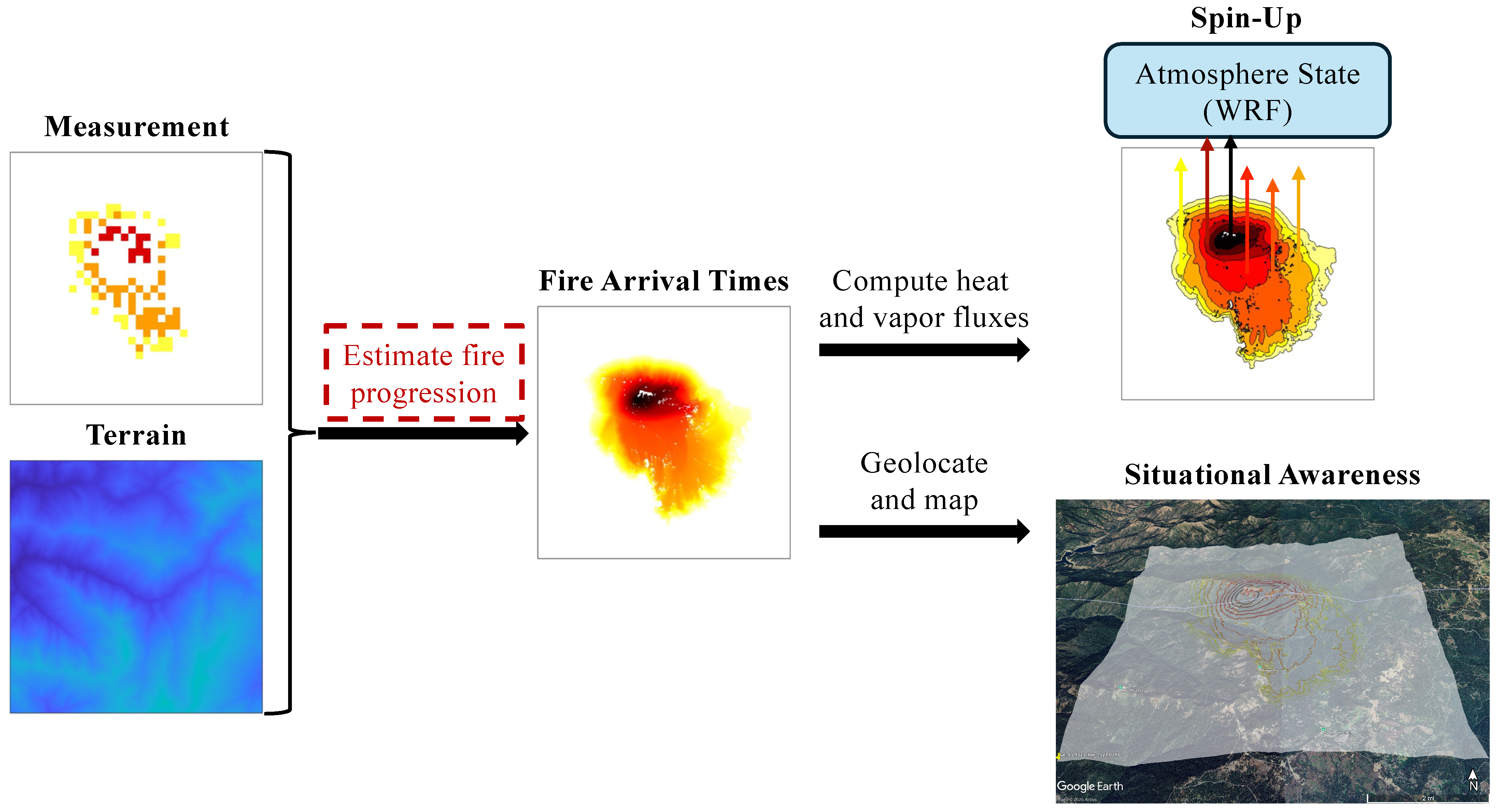
- Conditional generative algorithms trained on simulations of historic wildfires may be used to effectively reconstruct the early-time progression of wildfires given satellite active fire measurements and terrain height data.
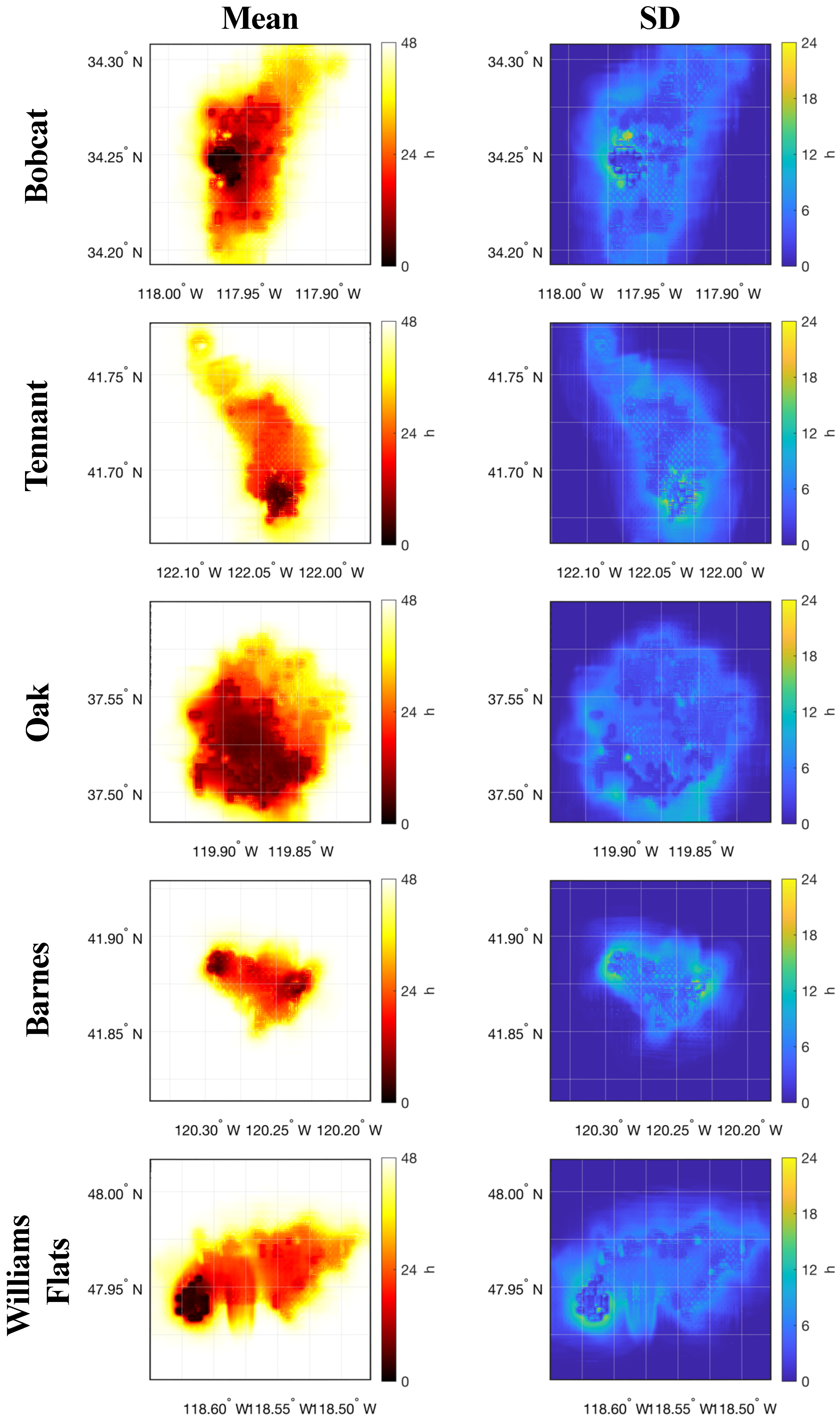
- When applied to real wildfires, generated fire progression estimates compare favorably to ground-truth high resolution infrared perimeters measured via aircraft, with the ability to gather additional information about model uncertainty from generated samples.
- Once obtained, fire progression estimates may be used to perform data assimilation, wherein the estimated fire state is used to initialize subsequent wildfire spread forecasts. Fire progression estimates are additionally useful for providing situational awareness to wildfire stakeholders.
- The work developed here additionally demonstrates a framework for how critical characteristics affecting wildfire spread, such as terrain, may be used to improve estimates of a wildfire’s state.
Abstract
1. Introduction
1.1. State Estimation for Wildfires
1.2. The Role of Fire Arrival Time
1.3. Prior Work and Proposed Developments
- A novel terrain-conditioned fire arrival time inference framework is developed.
- Multi-modal satellite observations from VIIRS and GOES, combined with terrain data, are used as the basis for fire arrival time estimates.
- A training paradigm grounded in WRF-SFIRE simulations of historical wildfires is utilized to incorporate realistic physics into arrival time estimates.
- Probabilistic estimates are used to quantify uncertainty.
2. Materials and Methods
2.1. Problem Formulation
2.2. Training Data
2.2.1. WRF-SFIRE Simulations
2.2.2. Construction of Training Data
2.3. Conditional Wasserstein Generative Adversarial Network (cWGAN)
Training cWGAN
2.4. Estimating Ignition Times from GOES
- GOES fire mask data from the Fire/Hot Spot Characterization product is collected for a time period of +/− 1 h around the approximate fire start time.
- A domain of size 12.8 km × 12.8 km is centered around the fire of interest.
- The portion of the collected fire masks intersecting the chosen domain is identified based on latitude and longitude coordinates of fire mask pixels.
- Fire masks containing an active fire pixel (excluding low or nominal confidence pixels) in the selected domain are determined.
- The time of the earliest detection in the domain of interest is taken as the estimated ignition time.
- In the case that no GOES fire detection is found, additional data is collected for a larger time period around the approximate start time and the above steps are repeated until a detection is found.
2.5. Constructing Measurements from VIIRS Active Fire Data
3. Results
3.1. Wildfire Incidents
3.2. Fire Arrival Time Predictions
3.3. Prediction Validation
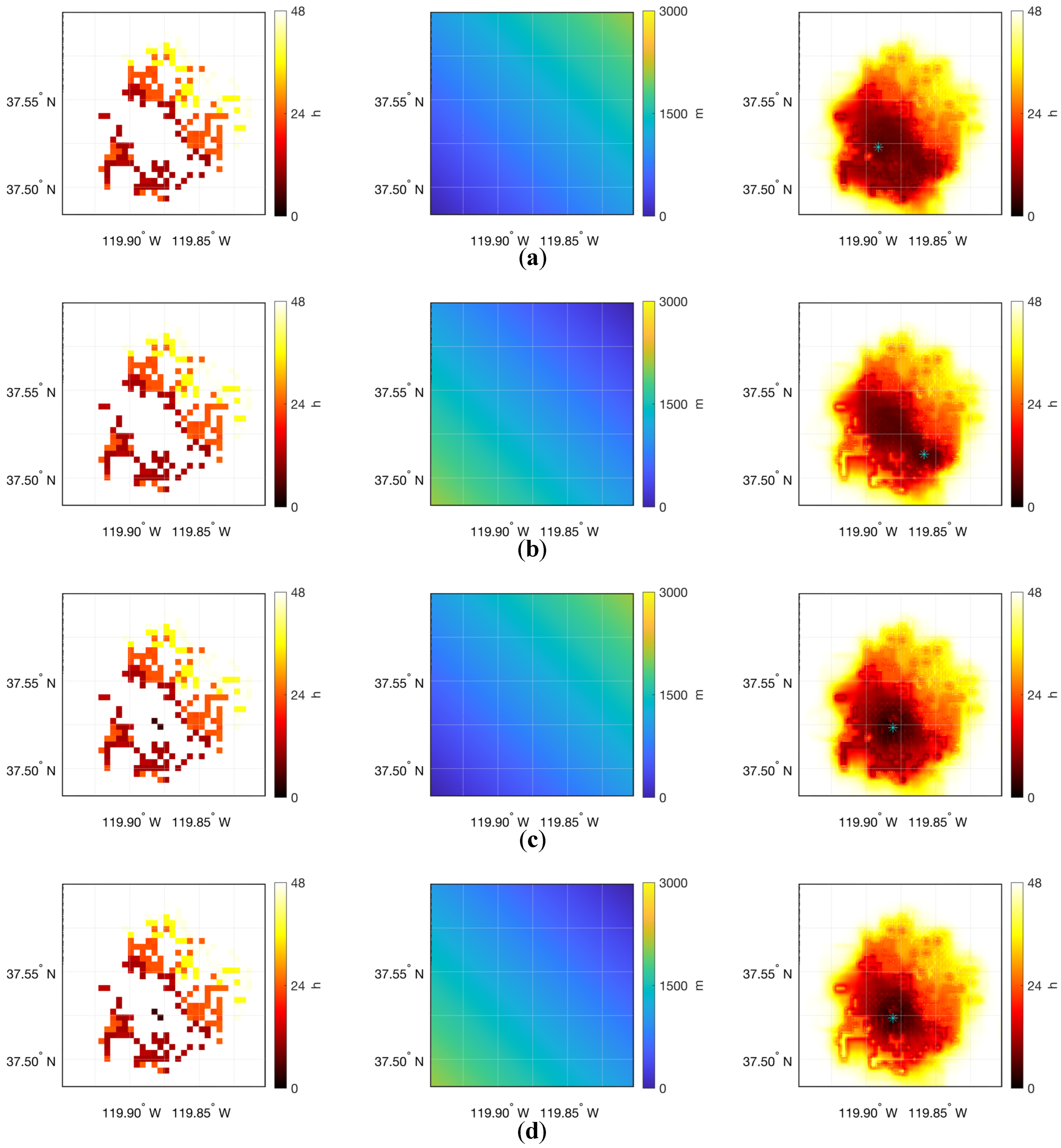
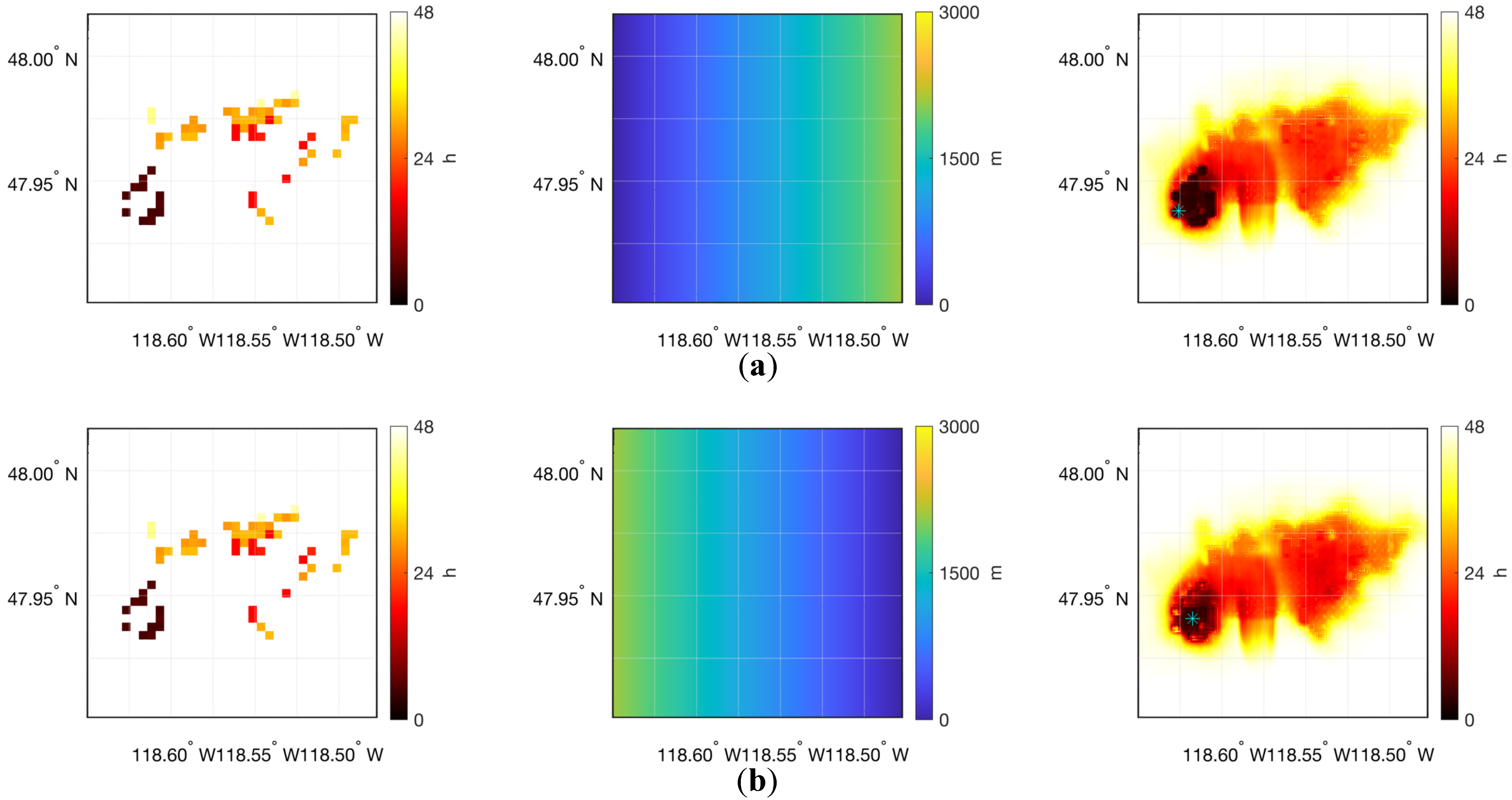
3.4. Evaluation of Terrain Influence on Arrival Time Reconstruction
4. Discussion
5. Conclusions
Author Contributions
Funding
Data Availability Statement
Acknowledgments
Conflicts of Interest
Appendix A. Measurement Operator
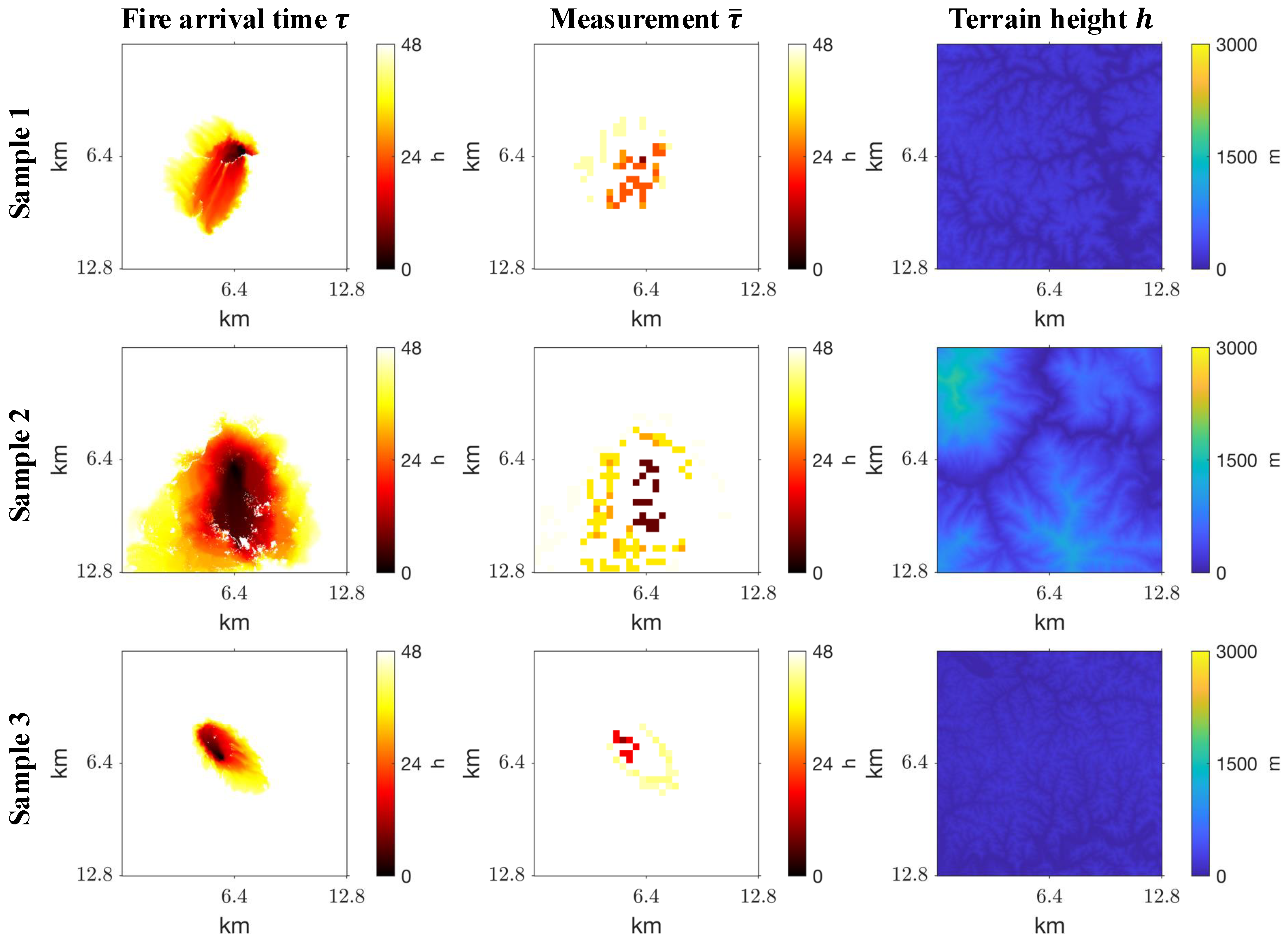
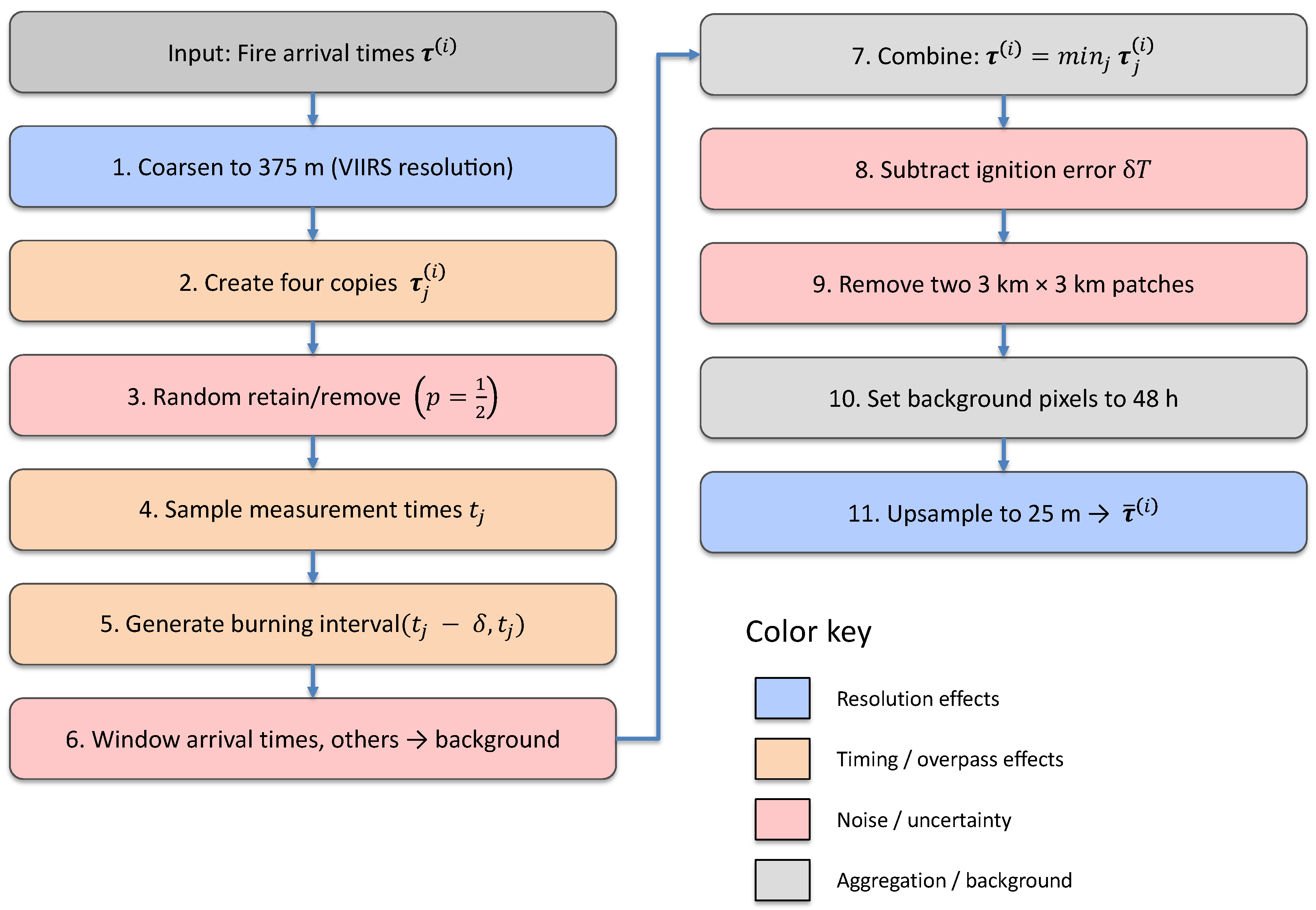
- is coarsened to a resolution of 375 m using a box kernel. This accounts for the coarser resolution of VIIRS data.
- Four copies of the coarsened are created and denoted as . This accounts for the availability of new VIIRS measurements approximately two times per day, resulting in four distinct sets of measurements during the initial 48 h of a fire.
- Components of are eliminated or retained with a probability of . This accounts for independent noise between individual VIIRS measurements.
- Four measurement times are sampled from a uniform probability distribution and sorted in ascending order. This enforces randomness in the measurement collection time, increasing the variety in the resulting measurements.
- For each measurement time a time interval is generated, where is sampled from , and negative values of are set to 0. This prescribes a random residence time for burning pixels, with the minimum selected to ensure a sufficient number of detections are captured [43].
- For fire arrival time values in falling within the associated interval are set to . Fire arrival time values outside of this interval are set to a background value. This allows pixels ignited prior to a VIIRS measurement which may still be burning (dictated by the prescribed residence time) to be captured.
- Measurements are combined into a single measurements by taking at each pixel. This ensures that the time when a burning pixel is first observed is assigned as the approximate fire arrival time.
- An ignition time error is sampled from and subtracted from arrival time values in . The choice of this distribution was based on the difference between the reported ignition time and the first GOES measurement observed across 17 fires.
- Two 3 km x 3 km patches are randomly eliminated from and eliminated pixels are set to a background value. This accounts for persistent obstructions occurring across all VIIRS measurements.
- All background pixel values are set to 48 h.
- is upsampled to the original resolution of 25 m and the resulting measurement is denoted by .

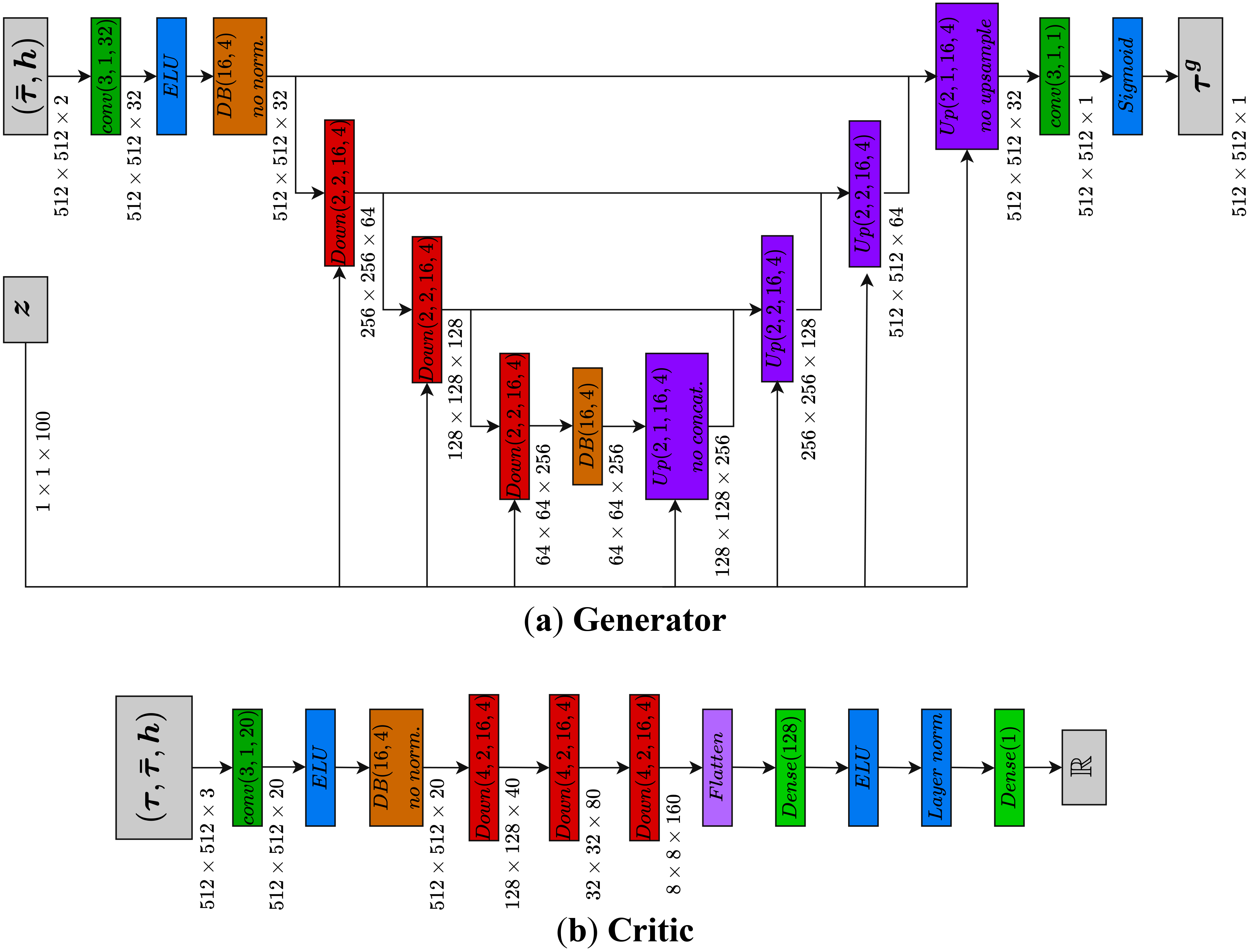
Appendix B. cWGAN Architecture

References
- Dennison, P.E.; Brewer, S.C.; Arnold, J.D.; Moritz, M.A. Large wildfire trends in the western United States, 1984–2011. Geophys. Res. Lett. 2014, 41, 2928–2933. [Google Scholar] [CrossRef]
- Juang, C.S.; Williams, A.P.; Abatzoglou, J.; Balch, J.; Hurteau, M.; Moritz, M. Rapid growth of large forest fires drives the exponential response of annual forest-fire area to aridity in the western United States. Geophys. Res. Lett. 2022, 49, e2021GL097131. [Google Scholar] [CrossRef] [PubMed]
- Westerling, A.L.; Hidalgo, H.G.; Cayan, D.R.; Swetnam, T.W. Warming and earlier spring increase western US forest wildfire activity. Science 2006, 313, 940–943. [Google Scholar] [CrossRef] [PubMed]
- Flannigan, M.; Cantin, A.S.; De Groot, W.J.; Wotton, M.; Newbery, A.; Gowman, L.M. Global wildland fire season severity in the 21st century. For. Ecol. Manag. 2013, 294, 54–61. [Google Scholar] [CrossRef]
- Burke, M.; Driscoll, A.; Heft-Neal, S.; Xue, J.; Burney, J.; Wara, M. The changing risk and burden of wildfire in the United States. Proc. Natl. Acad. Sci. USA 2021, 118, e2011048118. [Google Scholar] [CrossRef]
- Wang, D.; Guan, D.; Zhu, S.; Kinnon, M.M.; Geng, G.; Zhang, Q.; Zheng, H.; Lei, T.; Shao, S.; Gong, P.; et al. Economic footprint of California wildfires in 2018. Nat. Sustain. 2021, 4, 252–260. [Google Scholar] [CrossRef]
- Danielle, M. AccuWeather Estimates More than $250 Billion in Damages and Economic Loss from La Wildfires. 2025. Available online: https://www.accuweather.com/en/weather-news/accuweather-estimates-more-than-250-billion-in-damages-and-economic-loss-from-la-wildfires/1733821 (accessed on 15 January 2025).
- Lareau, N.P.; Clements, C.B. Environmental controls on pyrocumulus and pyrocumulonimbus initiation and development. Atmos. Chem. Phys. 2016, 16, 4005–4022. [Google Scholar] [CrossRef]
- Lareau, N.P.; Clements, C.B. The mean and turbulent properties of a wildfire convective plume. J. Appl. Meteor. Climatol. 2017, 56, 2289–2299. [Google Scholar] [CrossRef]
- Pastor, E.; Zárate, L.; Planas, E.; Arnaldos, J. Mathematical models and calculation systems for the study of wildland fire behaviour. Prog. Energy Combust. Sci. 2003, 29, 139–153. [Google Scholar] [CrossRef]
- Ehrke, C.; Farguell, A.; Kochanski, A.K. Interactions Between a High-Intensity Wildfire and an Atmospheric Hydraulic Jump in the Case of the 2023 Lahaina Fire. Atmosphere 2024, 15, 1424. [Google Scholar] [CrossRef]
- Benik, J.T.; Farguell, A.; Mirocha, J.D.; Clements, C.B.; Kochanski, A.K. Analysis of fire-induced circulations during the FireFlux2 experiment. Fire 2023, 6, 332. [Google Scholar] [CrossRef]
- Bakhshaii, A.; Johnson, E.A. A review of a new generation of wildfire–atmosphere modeling. Can. J. For. Res. 2019, 49, 565–574. [Google Scholar] [CrossRef]
- Mandel, J.; Beezley, J.; Kochanski, A. Coupled atmosphere-wildland fire modeling with WRF-Fire version 3.3. Geosci. Model Dev. Discuss. 2011, 4, 497–545. [Google Scholar]
- Coen, J.L.; Schroeder, W. Use of spatially refined satellite remote sensing fire detection data to initialize and evaluate coupled weather-wildfire growth model simulations. Geophys. Res. Lett. 2013, 40, 5536–5541. [Google Scholar] [CrossRef]
- Noonan-Wright, E.K.; Opperman, T.S.; Finney, M.A.; Zimmerman, G.T.; Seli, R.C.; Elenz, L.M.; Calkin, D.E.; Fiedler, J.R. Developing the US wildland fire decision support system. J. Combust. 2011, 2011, 168473. [Google Scholar] [CrossRef]
- O’Connor, C.D.; Thompson, M.P.; Rodríguez y Silva, F. Getting ahead of the wildfire problem: Quantifying and mapping management challenges and opportunities. Geosciences 2016, 6, 35. [Google Scholar] [CrossRef]
- Dunn, C.J.; Thompson, M.P.; Calkin, D.E. A framework for developing safe and effective large-fire response in a new fire management paradigm. For. Ecol. Manag. 2017, 404, 184–196. [Google Scholar] [CrossRef]
- Thompson, M.P.; Wei, Y.; Calkin, D.E.; O’Connor, C.D.; Dunn, C.J.; Anderson, N.M.; Hogland, J.S. Risk management and analytics in wildfire response. Curr. For. Rep. 2019, 5, 226–239. [Google Scholar] [CrossRef]
- Cao, Y.; Boruff, B.J.; McNeill, I.M. Is a picture worth a thousand words? Evaluating the effectiveness of maps for delivering wildfire warning information. Int. J. Disaster Risk Reduct. 2016, 19, 179–196. [Google Scholar] [CrossRef]
- Schroeder, W.; Giglio, L.; Hall, J. Collection 2 Visible Infrared Imaging Radiometer Suite (VIIRS) 375-m Active Fire Product User’s Guide Version 1.0; National Aeronautics and Space Administration (NASA): Washington, DC, USA, 2024. [Google Scholar]
- Schmidt, C.; Hoffman, J.; Prins, E.; Lindstrom, S. GOES-R Advanced Baseline Imager (ABI) Algorithm Theoretical Basis Document for Fire/Hot Spot Characterization, Version 2.0; NOAA NESDIS Center for Satellite Applications and Research (STAR): Silver Spring, MD, USA, 2010. [Google Scholar]
- Kondratenko, V.Y.; Beezley, J.D.; Kochanski, A.K.; Mandel, J. Ignition from a fire perimeter in a WRF wildland fire model. arXiv 2011, arXiv:1107.2675. [Google Scholar] [CrossRef]
- Mandel, J.; Beezley, J.D.; Kochanski, A.K.; Kondratenko, V.Y.; Kim, M. Assimilation of perimeter data and coupling with fuel moisture in a wildland fire–atmosphere DDDAS. Procedia Comput. Sci. 2012, 9, 1100–1109. [Google Scholar] [CrossRef]
- Mandel, J.; Kochanski, A.K.; Vejmelka, M.; Beezley, J.D. Data assimilation of satellite fire detection in coupled atmosphere-fire simulation by WRF-SFIRE. arXiv 2014, arXiv:1410.6948. [Google Scholar] [CrossRef]
- Kochanski, A.K.; Clough, K.; Farguell, A.; Mallia, D.V.; Mandel, J.; Hilburn, K. Analysis of methods for assimilating fire perimeters into a coupled fire-atmosphere model. Front. For. Glob. Change 2023, 6, 1203578. [Google Scholar] [CrossRef]
- Mandel, J.; Amram, S.; Beezley, J.; Kelman, G.; Kochanski, A.; Kondratenko, V.; Lynn, B.; Regev, B.; Vejmelka, M. Recent advances and applications of WRF–SFIRE. Nat. Hazards Earth Syst. Sci. 2014, 14, 2829–2845. [Google Scholar] [CrossRef]
- Farguell, A.; Mandel, J.; Haley, J.; Mallia, D.V.; Kochanski, A.; Hilburn, K. Machine Learning Estimation of Fire Arrival Time from Level-2 Active Fires Satellite Data. Remote Sens. 2021, 13, 2203. [Google Scholar] [CrossRef]
- Shaddy, B.; Ray, D.; Farguell, A.; Calaza, V.; Mandel, J.; Haley, J.; Hilburn, K.; Mallia, D.V.; Kochanski, A.; Oberai, A. Generative Algorithms for Fusion of Physics-Based Wildfire Spread Models with Satellite Data for Initializing Wildfire Forecasts. Artif. Intell. Earth Syst. 2024, 3, e230087. [Google Scholar] [CrossRef]
- Veraverbeke, S.; Sedano, F.; Hook, S.J.; Randerson, J.T.; Jin, Y.; Rogers, B.M. Mapping the daily progression of large wildland fires using MODIS active fire data. Int. J. Wildland Fire 2014, 23, 655–667. [Google Scholar] [CrossRef]
- Scaduto, E.; Chen, B.; Jin, Y. Satellite-based fire progression mapping: A comprehensive assessment for large fires in Northern California. IEEE J. Sel. Top. Appl. Earth Obs. Remote Sens. 2020, 13, 5102–5114. [Google Scholar] [CrossRef]
- Parks, S.A. Mapping day-of-burning with coarse-resolution satellite fire-detection data. Int. J. Wildland Fire 2014, 23, 215–223. [Google Scholar] [CrossRef]
- Chen, Y.; Hantson, S.; Andela, N.; Coffield, S.R.; Graff, C.A.; Morton, D.C.; Ott, L.E.; Foufoula-Georgiou, E.; Smyth, P.; Goulden, M.L.; et al. California wildfire spread derived using VIIRS satellite observations and an object-based tracking system. Sci. Data 2022, 9, 249. [Google Scholar] [CrossRef]
- Clough, K.; Farguell, A.; Mandel, J.; Hilburn, K.; Kochanski, A. Enhancing wildfire and smoke forecasting by integrating fire observations: A comparative analysis of methods for integrating infrared and satellite data into a coupled fire-atmosphere model. J. Geophys. Res. Atmos. 2025, 130, e2024JD042561. [Google Scholar] [CrossRef]
- McCarthy, N.F.; Tohidi, A.; Aziz, Y.; Dennie, M.; Valero, M.M.; Hu, N. A deep learning approach to downscale geostationary satellite imagery for decision support in high impact wildfires. Forests 2021, 12, 294. [Google Scholar] [CrossRef]
- Lai, C.H.; Song, Y.; Kim, D.; Mitsufuji, Y.; Ermon, S. The principles of diffusion models. arXiv 2025, arXiv:2510.21890. [Google Scholar] [CrossRef]
- Lu, C.; Zhou, Y.; Bao, F.; Chen, J.; Li, C.; Zhu, J. Dpm-solver: A fast ode solver for diffusion probabilistic model sampling in around 10 steps. Adv. Neural Inf. Process. Syst. 2022, 35, 5775–5787. [Google Scholar]
- Zhou, Z.; Chen, D.; Wang, C.; Chen, C. Fast ode-based sampling for diffusion models in around 5 steps. In Proceedings of the IEEE/CVF Conference on Computer Vision and Pattern Recognition, Seattle, WA, USA, 16–22 June 2024; pp. 7777–7786. [Google Scholar]
- Shih, A.; Belkhale, S.; Ermon, S.; Sadigh, D.; Anari, N. Parallel sampling of diffusion models. Adv. Neural Inf. Process. Syst. 2023, 36, 4263–4276. [Google Scholar]
- Zheng, H.; Nie, W.; Vahdat, A.; Azizzadenesheli, K.; Anandkumar, A. Fast sampling of diffusion models via operator learning. In Proceedings of the International Conference on Machine Learning, Honolulu, HI, USA, 15–19 June 2023; pp. 42390–42402. [Google Scholar]
- Rothermel, R.C. A Mathematical Model for Predicting Fire Spread in Wildland Fuels; Research Paper, INT-115; US Department of Agriculture, Intermountain Forest and Range Experiment Station: Ogden, UT, USA, 1972. [Google Scholar]
- Mandel, J.; Vejmelka, M.; Kochanski, A.; Farguell, A.; Haley, J.; Mallia, D.; Hilburn, K. An interactive data-driven HPC system for forecasting weather, wildland fire, and smoke. In Proceedings of the 2019 IEEE/ACM HPC for Urgent Decision Making (UrgentHPC), Denver, CO, USA, 17 November 2019; IEEE: Piscataway, NJ, USA, 2019; pp. 35–44. [Google Scholar]
- Mandel, J.; Fournier, A.; Jenkins, M.A.; Kochanski, A.K.; Schranz, S.; Vejmelka, M. Assimilation of satellite active fires detection into a coupled weather-fire model. In Proceedings of the 5th International Fire Behavior and Fuels Conference, Portland, OR, USA, 11–15 April 2016; International Association of Wildland Fire: Missoula, MT, USA, 2016; pp. 17–22. [Google Scholar]
- Ray, D.; Murgoitio-Esandi, J.; Dasgupta, A.; Oberai, A.A. Solution of physics-based inverse problems using conditional generative adversarial networks with full gradient penalty. arXiv 2023, arXiv:2306.04895. [Google Scholar] [CrossRef]
- Adler, J.; Öktem, O. Deep bayesian inversion. arXiv 2018, arXiv:1811.05910. [Google Scholar] [CrossRef]
- Ray, D.; Ramaswamy, H.; Patel, D.V.; Oberai, A.A. The efficacy and generalizability of conditional GANs for posterior inference in physics-based inverse problems. arXiv 2022, arXiv:2202.07773. [Google Scholar] [CrossRef]
- Johnson, J.; Finco, M.; Quayle, B. Wide area imager fire mapping evaluation mission. In Proceedings of the RSAC-10097-RPT1; U.S. Department of Agriculture, Forest Service, Remote Sensing Applications Center: Salt Lake City, UT, USA, 2014. [Google Scholar]
- Greenfield, P.H.; Smith, W.; Chamberlain, D.C. Phoenix-the new forest service airborne infrared fire detection and mapping system. In Proceedings of the 2nd International Wildland Fire Ecology and Fire Management Congress and the 5th Symposium on Fire and Forest Meteorology, Orlando, FL, USA, 16–20 November 2003. [Google Scholar]
- Song, Y.; Sohl-Dickstein, J.; Kingma, D.P.; Kumar, A.; Ermon, S.; Poole, B. Score-based generative modeling through stochastic differential equations. arXiv 2020, arXiv:2011.13456. [Google Scholar]
- Dasgupta, A.; da Cunha, A.M.; Fardisi, A.; Aminy, M.; Binder, B.; Shaddy, B.; Oberai, A.A. Unifying and extending diffusion models through pdes for solving inverse problems. arXiv 2025, arXiv:2504.07437. [Google Scholar] [CrossRef]
- Dumoulin, V.; Shlens, J.; Kudlur, M. A learned representation for artistic style. arXiv 2016, arXiv:1610.07629. [Google Scholar] [CrossRef]
- Huang, G.; Liu, Z.; Van Der Maaten, L.; Weinberger, K.Q. Densely connected convolutional networks. In Proceedings of the IEEE Conference on Computer Vision and Pattern Recognition, Honolulu, HI, USA, 21–26 July 2017; pp. 4700–4708. [Google Scholar] [CrossRef]



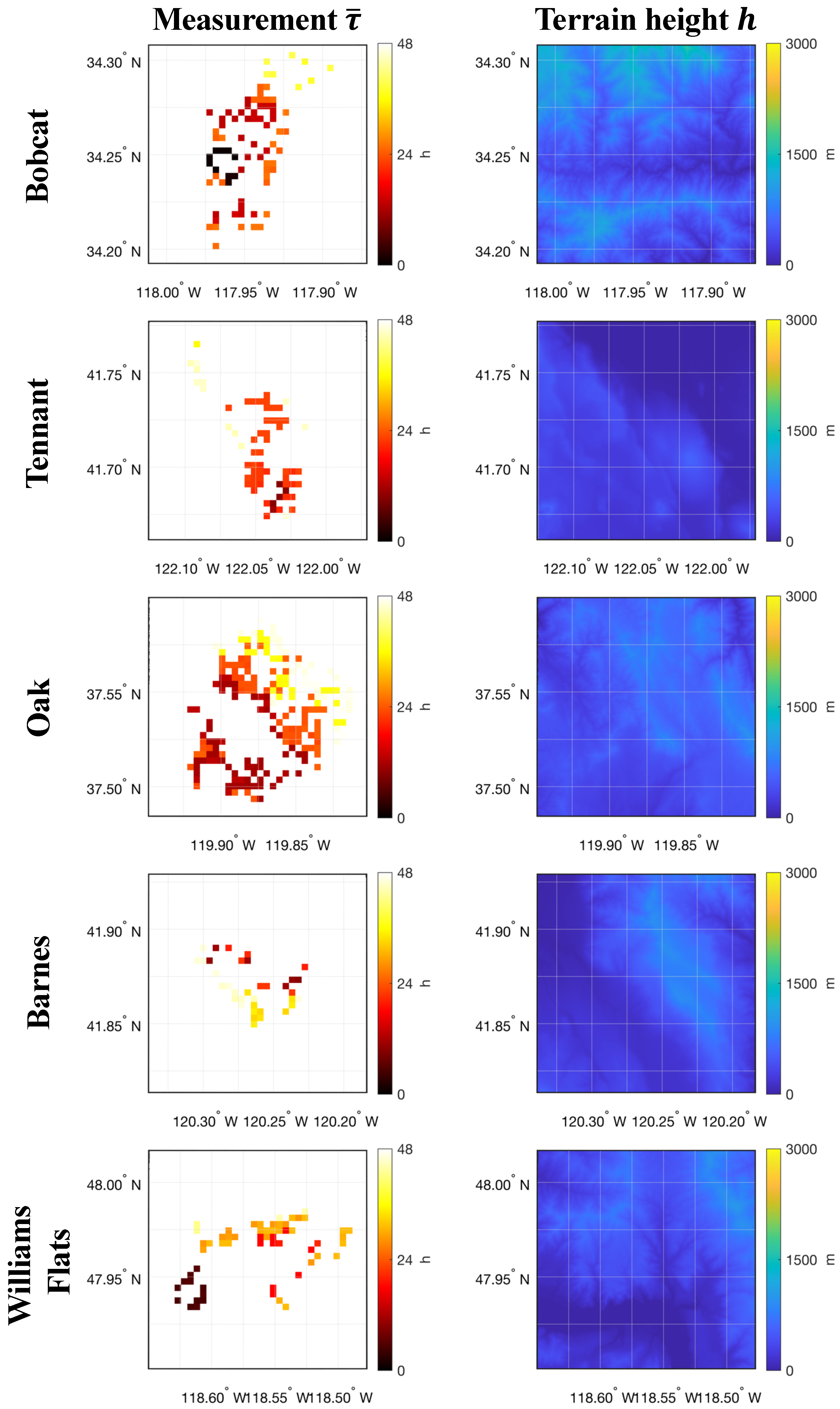
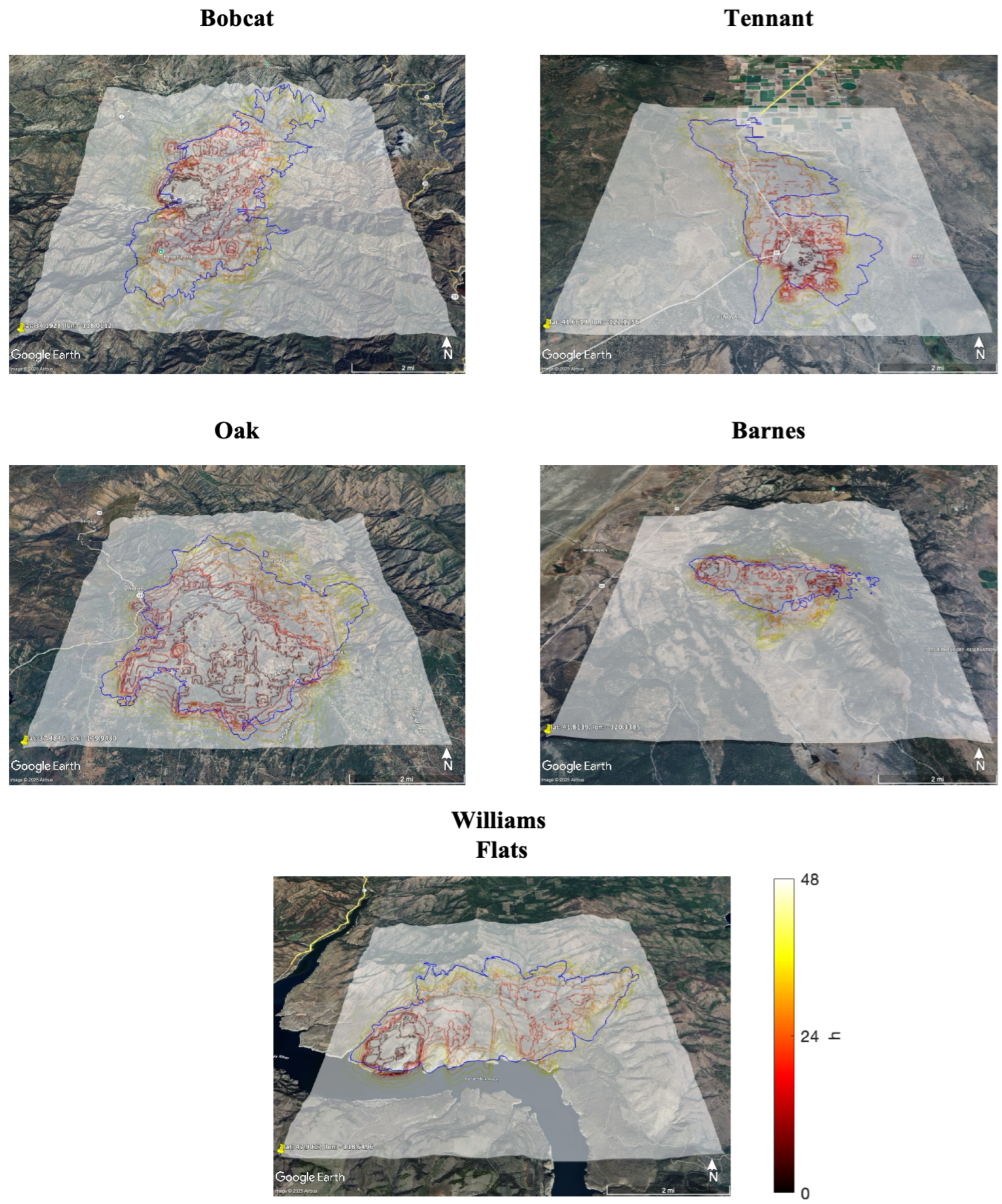
| Fire | Ignition Date | GOES Ignition Time | IR Measurement Date | IR N-S Extent | IR E-W Extent |
|---|---|---|---|---|---|
| Bobcat | 6 September 2020 | 19:16 | 8 September 2020 | 11.9 km | 7.8 km |
| Tennant | 28 June 2021 | 23:21 | 30 June 2021 | 11.4 km | 7.7 km |
| Oak | 22 July 2022 | 21:26 | 24 July 2022 | 10.2 km | 9.7 km |
| Barnes | 7 September 2022 | 23:51 | 9 September 2022 | 3.6 km | 7.9 km |
| Williams Flats | 2 August 2019 | 14:46 | 4 August 2019 | 6.5 km | 11.2 km |
| New Method | Shaddy et al. [29] | |||||
|---|---|---|---|---|---|---|
| Fires | SC | POD | FAR | SC | POD | FAR |
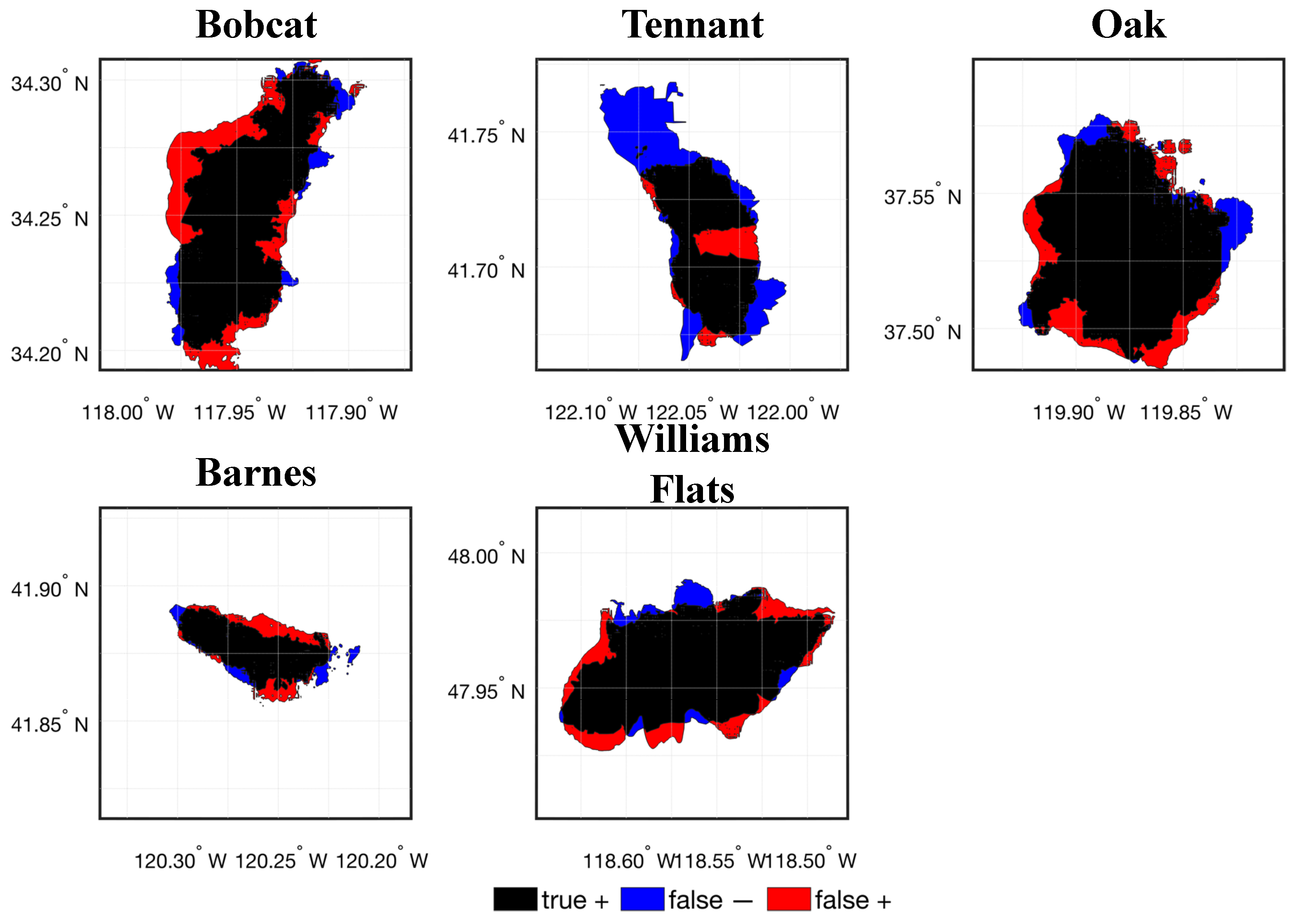
| Bobcat | 0.82 | 0.91 | 0.26 | 0.80 | 0.97 | 0.32 |
| Tennant | 0.67 | 0.57 | 0.17 | 0.78 | 0.78 | 0.21 |
| Oak | 0.87 | 0.90 | 0.16 | 0.84 | 0.97 | 0.26 |
| Barnes | 0.81 | 0.87 | 0.25 | - | - | - |
| Williams Flats | 0.88 | 0.92 | 0.16 | - | - | - |
Disclaimer/Publisher’s Note: The statements, opinions and data contained in all publications are solely those of the individual author(s) and contributor(s) and not of MDPI and/or the editor(s). MDPI and/or the editor(s) disclaim responsibility for any injury to people or property resulting from any ideas, methods, instructions or products referred to in the content. |
© 2026 by the authors. Licensee MDPI, Basel, Switzerland. This article is an open access article distributed under the terms and conditions of the Creative Commons Attribution (CC BY) license.
Share and Cite
Shaddy, B.; Binder, B.; Dasgupta, A.; Qin, H.; Haley, J.; Farguell, A.; Hilburn, K.; Mallia, D.V.; Kochanski, A.; Mandel, J.; et al. Generative Algorithms for Wildfire Progression Reconstruction from Multi-Modal Satellite Active Fire Measurements and Terrain Height. Remote Sens. 2026, 18, 227. https://doi.org/10.3390/rs18020227
Shaddy B, Binder B, Dasgupta A, Qin H, Haley J, Farguell A, Hilburn K, Mallia DV, Kochanski A, Mandel J, et al. Generative Algorithms for Wildfire Progression Reconstruction from Multi-Modal Satellite Active Fire Measurements and Terrain Height. Remote Sensing. 2026; 18(2):227. https://doi.org/10.3390/rs18020227
Chicago/Turabian StyleShaddy, Bryan, Brianna Binder, Agnimitra Dasgupta, Haitong Qin, James Haley, Angel Farguell, Kyle Hilburn, Derek V. Mallia, Adam Kochanski, Jan Mandel, and et al. 2026. "Generative Algorithms for Wildfire Progression Reconstruction from Multi-Modal Satellite Active Fire Measurements and Terrain Height" Remote Sensing 18, no. 2: 227. https://doi.org/10.3390/rs18020227
APA StyleShaddy, B., Binder, B., Dasgupta, A., Qin, H., Haley, J., Farguell, A., Hilburn, K., Mallia, D. V., Kochanski, A., Mandel, J., & Oberai, A. A. (2026). Generative Algorithms for Wildfire Progression Reconstruction from Multi-Modal Satellite Active Fire Measurements and Terrain Height. Remote Sensing, 18(2), 227. https://doi.org/10.3390/rs18020227