Highlights
What are the main findings?
- A branch CNN–Transformer framework that fuses ERA5, CCMP and auxiliary meteorological variables achieves the most accurate and stable 10 m wind reconstruction across years and random seeds.
- A 20-year daily wind energy dataset (2005–2024) is produced, correcting systematic biases in existing reanalysis and satellite-fusion products.
What are the implications of the main findings?
- The branch CNN–Transformer provides a practical and robust approach for high-resolution 10 m wind database construction in data-sparse ocean regions.
- Supports precise offshore wind farm site selection and coastal engineering risk assessment in the tropical Indian Ocean, bridging the gap between remote sensing applications and renewable energy development.
Abstract
This study addresses the issues of sparse observations from buoys in the tropical Indian Ocean and systematic biases in reanalysis products by proposing a daily-mean wind speed reconstruction framework that integrates multi-source meteorological fields. This study also considers the impact of different source domains on model pre-training, with the goal of providing reliable data support for wind energy assessment. The model was pre-trained using data from the Americas and tropical Pacific buoys as the source domain and then fine-tuned on Indian Ocean buoys as the target domain. Using annual leave-one-out cross-validation, we evaluated the model’s performance against uncorrected ERA5 and CCMP data while comparing three deep reconstruction models. The results demonstrate that deep models significantly reduce reanalysis bias: the RMSE decreases from approximately 1.00 m/s to 0.88 m/s, while R2 improves by approximately 8.9% and 7.1% compared to ERA5/CCMP, respectively. The Branch CNN–Transformer outperforms standalone LSTM or CNN models in overall accuracy and interpretability, with transfer learning yielding directional gains for specific wind conditions in complex topography and monsoon zones. The 20-year wind energy data reconstructed using this model indicates wind energy densities 60–150 W/m2 higher than in the reanalysis data in open high-wind zones such as the southern Arabian Sea and the Somali coast. This study not only provides a pathway for constructing high-precision wind speed databases for tropical Indian Ocean wind resource assessment but also offers precise quantitative support for delineating priority development zones for offshore wind farms and mitigating near-shore engineering risks.
1. Introduction
With the intensification of global climate change and the acceleration of the energy transition process, wind energy—as a core component of clean renewable energy—has received significant attention in the form of development potential assessment and regional climate response studies [1,2]. Sea surface wind fields provide foundational data for wind energy resource assessment and climate modeling, with their accuracy directly determining the reliability of wind farm economic analyses and monsoon system evolution characterizations. However, significant disparities exist between land and ocean observation networks: land-based observation points are dense and continuous, whereas ocean observations largely depend on sparse buoys—a challenge that is particularly pronounced in the tropical Indian Ocean. This region lies at the heart of the Indian monsoon, serving as a critical area for wind energy development and studies of air-sea interactions. Yet, with buoy spacing reaching hundreds of kilometers, capturing local wind field details proves challenging [3], compelling researchers in related fields to rely on reanalysis or multi-source fusion data.
Current mainstream sea surface wind speed data are represented by the ERA5 reanalysis and CCMP multi-source fusion products. ERA5 provides 0.25° × 0.25° high-resolution data through its 4D-Var assimilation system, while CCMP fuses multi-satellite observations with model background fields via variational methods. Although both ERA5 and CCMP achieve global coverage, they exhibit significant systematic biases. ERA5 is constrained by model physical parameterization, and wind field smoothing effects cause it to underestimate high wind speeds in strong monsoon regions. CCMP, by contrast, is affected by the high-wind saturation characteristics of satellite scatterometers, with biases ranging from 0 to 4 m/s for wind speeds between 10 and 18 m/s. Both systems fail to fully account for the coupling effects between meteorological variables (e.g., air temperature, air pressure) and wind speed [4,5,6,7]. Although limited in magnitude, such biases significantly impact assessments at the tail end of wind power curves, potentially leading to underestimation of wind energy potential and increased engineering design risks. Traditional bias correction methods like the Global Wind Atlas exhibit unstable performance at regional scales and may even amplify errors in complex topography, proving ill-suited for the monsoon dynamics of the tropical Indian Ocean [8]. Gruber et al. (2022) further demonstrated that GWA2/3 corrections applied to ERA5 data across multiple climate zones can substantially amplify errors, highlighting the inadequacy of traditional methods for adapting to the complex wind fields of the tropical Indian Ocean [9].
Deep learning techniques offer new pathways for high-precision reconstruction of wind fields. Houndekindo et al. (2024) demonstrated that a model combining ERA5 with lightweight gradient boosters significantly outperforms traditional methods in fitting the probability distribution of wind speed predictions in sparsely observed regions [10]. Houndekindo et al. (2025) further proposed an LSTM-Transformer framework that effectively corrects hourly wind speed biases in ERA5, with particularly notable improvements in regions with complex coastal topography [11]. Zhang et al. (2025) employed a multi-scale fusion retrieval model integrating local self-attention (cloud-to-wind Transformer) with a multi-encoder U-Net to achieve real-time generation of wind velocity fields from geostationary cloud imagery, surpassing the accuracy of existing satellite wind field products [12].The Windformer system developed by He et al. (2024) achieves high-resolution multi-step wind vector forecasting by integrating CNNs with spatio-temporal self-attention Transformers, outperforming multiple baseline models [13]. However, existing deep learning studies often rely on ample observations in the target domain, limiting their generalization capabilities in sparsely observed regions like the tropical Indian Ocean.
Transfer learning offers a key strategy for addressing the scarcity of observations. By learning general physical patterns in data-rich source domains and then transferring them to target domains to adapt to local features, model stability can be significantly enhanced. Liu et al. (2022) applied a transfer learning framework to migrate a precipitation fusion model from eastern China to the Tibetan Plateau, substantially improving quantitative precipitation estimation accuracy in sparsely observed regions [14]. Yang et al. (2024) proposed a climate-adaptive transfer learning framework that leveraged pretraining on similar source domains to enhance soil moisture estimation accuracy over the Tibetan Plateau [15]. Lentz et al. (2025) employed transfer learning to correct temperature inversion errors during the sparsely observed period in the North Atlantic, thereby reproducing the physical structure of ocean heat content [16]. These studies demonstrate that cross-regional transfer learning can effectively reuse commonalities in wind field evolution across different regions, providing methodological support for reconstructing wind speeds in the tropical Indian Ocean [17].
Given this context, this study addresses the issues of sparse observations from buoys in the tropical Indian Ocean and biases in reanalysis products by proposing a multi-source data-driven hybrid model framework combining branch CNNs and Transformers. This framework integrates wind speed, air temperature, sea-level pressure, and boundary layer height data from ERA5 with wind speed data from CCMP. It employs branch CNNs to concurrently extract local spatial features of multiple meteorological variables while utilizing Transformers to capture long-range temporal dependencies across variables [18]. It employs a cross-oceanic transfer learning strategy, pre-training on observation-rich regions (North American NDBC buoys and tropical Pacific TAO buoys) before fine-tuning with tropical Indian Ocean RAMA buoy data, ultimately achieving high-precision wind speed reconstruction in this region. This study aims to provide a reliable wind speed database for tropical Indian Ocean wind energy resource assessment while offering technical guidance for wind field reconstruction in observation-sparse areas.
2. Research Area and Data Collection
2.1. Research Area
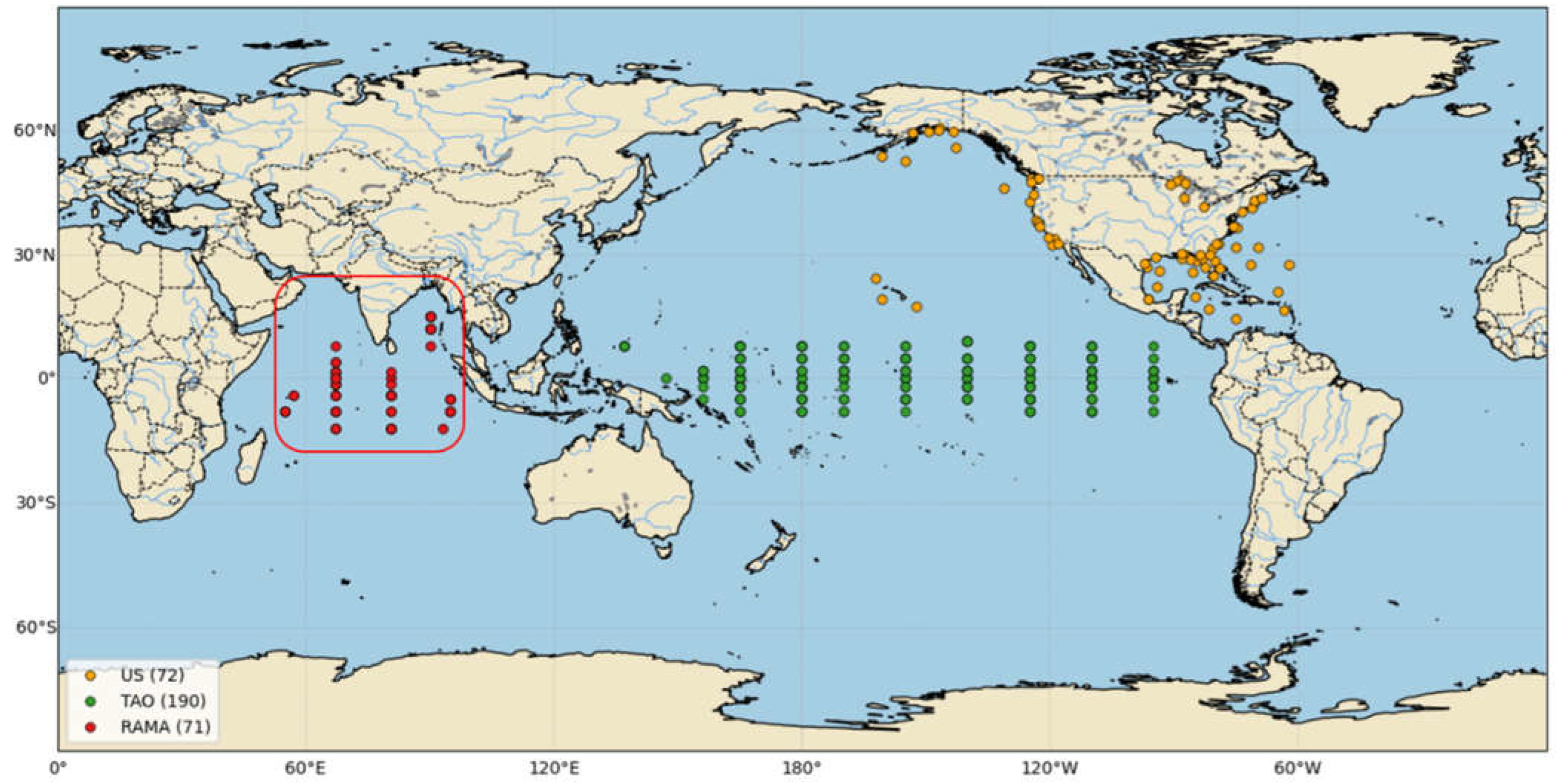
This study focuses on the Tropical Indian Ocean (TIO) as its primary research area, spanning the geographical coordinates 23°N–14°S and 53°E–97°E. This region encompasses the Arabian Sea, the Bay of Bengal, the Laccadive Sea, the Andaman Sea, and portions of the equatorial waters south of the equator (as outlined in the red box in Figure 1) [19]. This region falls within the tropical monsoon zone and is strongly influenced by the Indian monsoon system, exhibiting pronounced seasonal variations in wind fields. The summer southwest monsoon significantly increases wind speeds along the Somali coast and in the Arabian Sea, with wind energy densities reaching 350–650 W/m2. The winter northeast monsoon primarily affects the eastern Bay of Bengal, leading to moderate wind speed variations in this region [20,21].
Figure 1.
Distribution of global observation stations. The red box indicates the study area: the tropical Indian Ocean (23°N–14°S, 53°E–97°E). The red dots represent RAMA tropical Indian Ocean buoys. The green dots represent TAO tropical Pacific equatorial buoys. The orange dots represent NDBC American coastal buoys.
To enhance the model’s representation of tropical wind fields, this study selects the North American buoy network (NDBC) and the Tropical Pacific Ocean buoy array (TAO) as source domains. It learns wind field characteristics from each domain and transfers them to the Tropical Indian Ocean (TIO). Subsequently, RAMA buoys in the TIO are employed for secondary training and local fine-tuning. The North American domain features densely distributed stations spanning tropical to mid-latitudes. Its 72 stations provide extensive, high-quality data conducive to training and generalization. The TAO, primarily located in the equatorial belt, exhibits spatiotemporal evolution consistent with tropical monsoon regions. Its high observation frequency and excellent continuity facilitate the provision of tropical prior knowledge.
Figure 1 shows the study area (red box) and the distribution of global observation stations: orange indicates stations in the Americas region, while green and red represent stations in the tropical Pacific and tropical Indian Ocean regions, respectively. The figure clearly reveals that stations in the Americas region are densely distributed with a balanced structure; TAO region (green dots) buoys uniformly cover the equatorial belt, whereas the TIO region exhibits sparse station distribution predominantly in deep-sea areas. Based on the data characteristics of these three domains, this study constructs three models: a baseline model trained directly on the TIO domain, and two transfer learning models pre-trained on NDBC and TAO buoys respectively before being transferred to the TIO domain. Their performance in reconstructing tropical Indian Ocean wind speeds is compared to evaluate how different pre-training strategies affect model generalization capability and reconstruction accuracy.
2.2. Data Acquisition
This study utilizes four variables from ERA5, NOAA/TAO/RAMA buoy observations, and CCMP grid data. Table 1 summarizes the basic information of these datasets. Due to the scarcity of buoy data, to ensure sufficient training and testing samples, the buoy data were split into independent training sample points based on buoy years (Table 2).
Table 1.
The dataset used in this study.
Table 2.
Information on the buoy stations used in this study.
2.2.1. In-Situ Buoy Observations
In-situ observations rely on three sets of high-precision buoy arrays, which serve as the true value benchmark for model training (source domain) and evaluation (target domain). The North American NDBC buoys, operated by the U.S. National Data Buoy Center, are distributed in coastal waters of 30°N–60°N, 60°W–140°W, providing 1 h resolution 10 m wind speed data from 2014 to 2020 [22]. Strict quality control procedures have been applied to exclude abnormal records caused by instrument failures or extreme weather events [23,24]. The tropical Pacific TAO buoys, deployed under the Tropical Atmosphere Ocean Project, are located in the region of 10°N–10°S, 120°E–80°W, offering 1 h resolution 10 m wind speed observations over the same period [25]. These data have been widely validated and applied in tropical ocean-atmosphere interaction research and numerical model calibration. The tropical Indian Ocean RAMA buoys, part of the Research Moored Array for African-Asian-Australian Monsoon Analysis and Prediction, are deployed within 23°N–14°S, 53°E–97°E, providing high-quality 1 h resolution 10 m wind speed data from 2014 to 2020. As the core target domain dataset, it supports model fine-tuning and independent testing to ensure the generalization ability of the model in the study area.
2.2.2. Meteorological Reanalysis Products
Meteorological reanalysis products provide continuous gridded meteorological variables, serving as auxiliary input features for the hybrid model to compensate for the sparse spatial coverage of buoy observations. The ERA5 reanalysis dataset, released by the European Centre for Medium-Range Weather Forecasts, has a spatial resolution of 0.25° × 0.25° and a temporal resolution of 6 h [6]. Key variables used in this study include 10 m wind speed, 2 m air temperature, sea level pressure, and boundary layer height, which are characterized by high accuracy in global ocean wind field simulation due to the integration of multi-source observations and advanced data assimilation systems.
The CCMP reanalysis product, developed by Remote Sensing Systems, is a satellite-derived wind dataset with a spatial resolution of 0.25° × 0.25° and a temporal resolution of 6 h. It integrates observations from multiple satellite scatterometers to generate 10 m wind speed data, which is widely used in ocean wind energy resource assessment due to its reliable performance in capturing mesoscale wind field variations. All reanalysis products and buoy observations were subjected to spatio-temporal matching to unify the temporal resolution to daily averages and match buoy locations to corresponding grid cells, ensuring consistency in model input [5,26].
3. Method
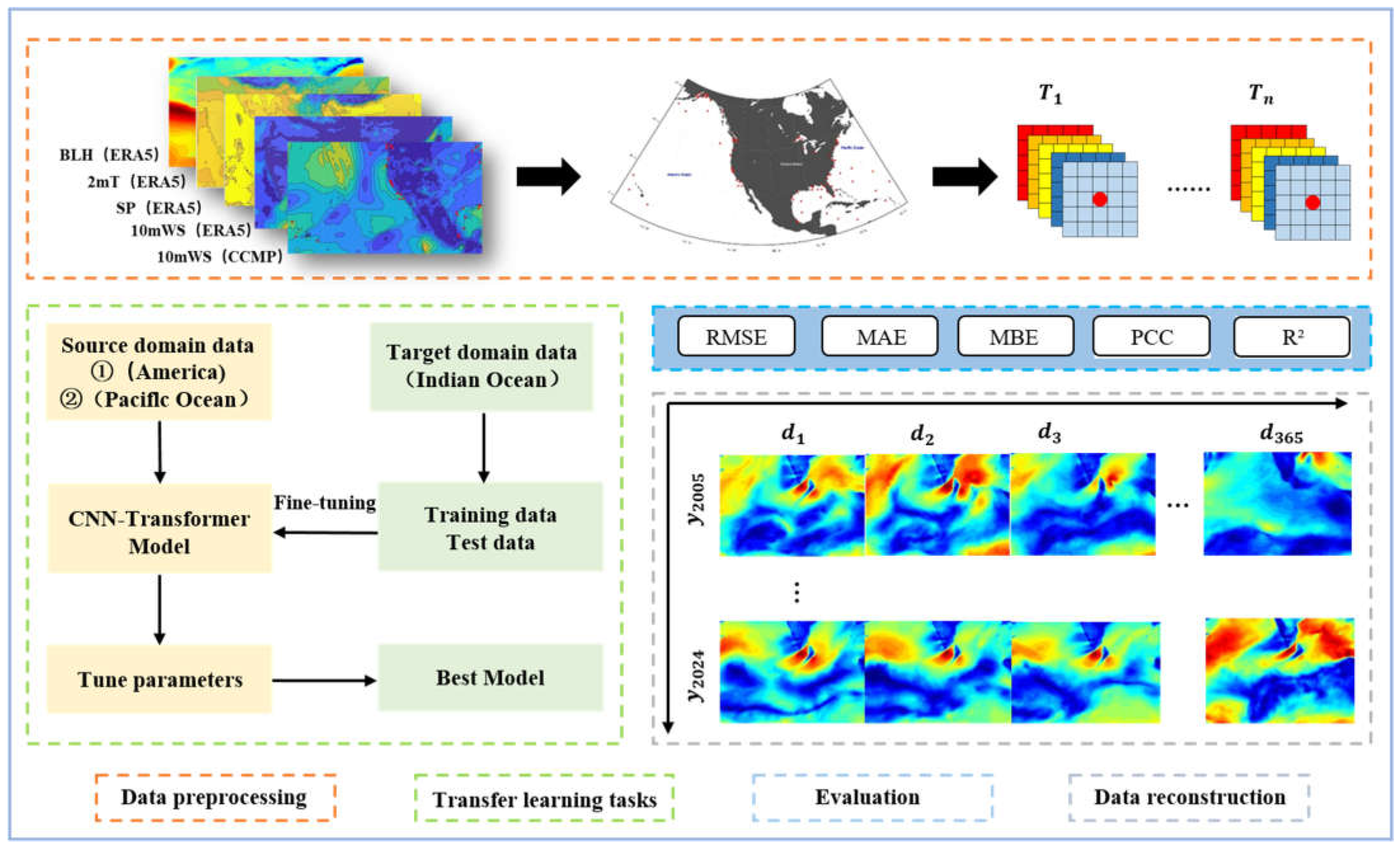
The workflow framework is illustrated in Figure 2. The entire process comprises four main components: (1) data preprocessing, including site selection, data clipping, and spatiotemporal matching; (2) building a deep neural network model integrating CNN and Transformer architectures, and training the model with source domain data followed by fine-tuning on target domain data; (3) evaluating the fine-tuned model using multiple metrics (e.g., RMSE, MAE, R2) to identify the optimal model; and (4) applying the optimal trained model to reconstruct nearly two decades of wind speed data for the tropical Indian Ocean region (23°N–14°S, 53°E–97°E), and comparing wind energy distribution differences with two reanalysis products: ERA5 and CCMP.
Figure 2.
Workflow diagram of the tropical Indian Ocean wind speed reconstruction. The red dots represent the locations of buoy stations along the coast of the Americas. The framework includes four key steps. (1) Data preprocessing: Integrate multi-source meteorological data and match with buoy observations spatio-temporally; (2) model construction: Establish a Branch CNN–Transformer hybrid model, pre-train with source domain data (NDBC/TAO buoys) and fine-tune with target domain (RAMA buoys) data; (3) model evaluation: Select the optimal model via five metrics (RMSE, MAE, MBE, PCC, R2); (4) data reconstruction: Reconstruct the 20-year wind speed field and compare with ERA5/CCMP products.
3.1. Data Preprocessing
Prior to conducting wind field reconstruction using deep learning and transfer learning, systematic preprocessing was performed on observational and grid data from the source domain (72 NDBC stations in the Americas and 71 TAO stations in the tropical Pacific) and the target domain (22 RAMA stations in the tropical Indian Ocean). This ensured that the input samples were continuous, reliable, and highly consistent. First, the observation completeness rate of each buoy station was calculated, and stations with a missing rate exceeding 20% were removed by region. After removal, the coverage rate of the remaining stations in each region exceeded 80%, providing sufficient samples for subsequent training. Next, daily average observed wind speeds at each station were compared against corresponding ERA5 and CCMP grid-based daily averages. Mean Absolute Error (MAE) and Pearson Correlation Coefficient (PCC) were calculated, and stations with MAE > 2 m/s and PCC < 0.5 were excluded to filter out anomalous samples caused by sensor malfunction or poor grid representativeness. For buoy time series passing the above screening, hourly anomaly detection was performed: if the instantaneous wind speed exceeded 3σ of the site’s full-period standard deviation or adjacent observations at the same time showed a sudden change >10 m/s, it was deemed an anomaly and removed. To maximize temporal continuity, all removed points and original missing data points were interpolated using linear interpolation between the preceding and succeeding points. Final daily averages were uniformly generated to align with daily-scale grid data.
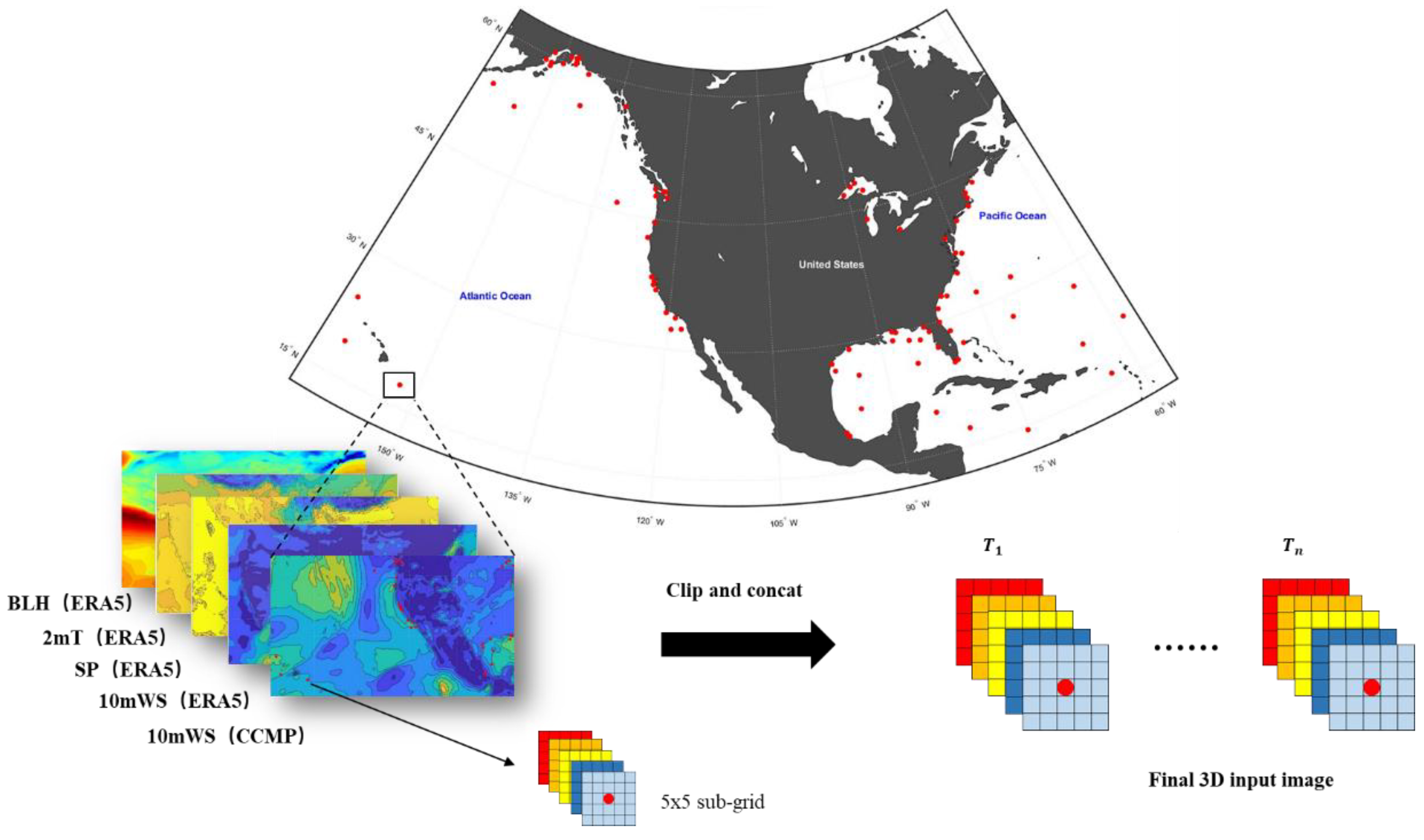
Subsequently, for grid data processing, ERA5 (10 m wind speed, 2 m air temperature, sea level pressure, boundary layer height) and CCMP (10 m wind speed) were aggregated daily: We averaged ERA5’s 1-h-resolution data and CCMP’s 6-hour-resolution data on a daily basis, then resampled them onto a 0.25° × 0.25° uniform grid to ensure alignment with the latitudes and longitudes of the buoys. Each buoy is then mapped to its nearest grid cell using nearest-neighbor interpolation (Figure 3). A 5 × 5 subgrid centered on this cell is cropped to capture local field characteristics. Finally, multiple grid variables are concatenated along the channel to form a multi-channel 3D spatiotemporal sample, serving as input for the deep neural network.
Figure 3.
Data preprocessing diagram. The red dots represent the locations of buoy stations along the coast of the Americas. Multi-source grid data are aggregated into daily averages, matched to buoys via nearest-neighbor interpolation, and cropped into 5 × 5 sub-grids. Multi-variable features are concatenated to form 3D spatiotemporal samples for model input.
3.2. Deep Neural Network Model
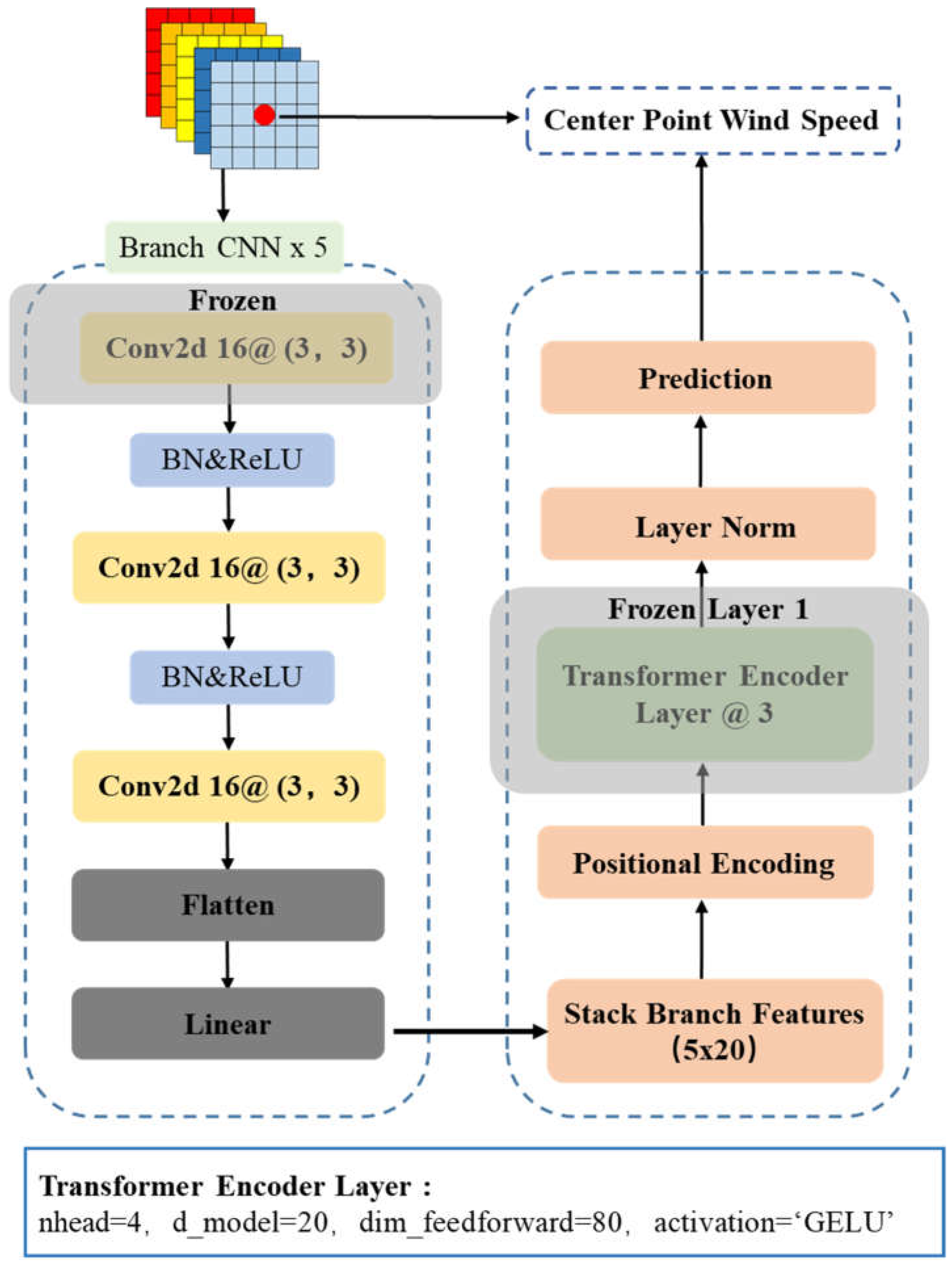
This study proposes a “BranchCNN + Transformer” architecture (Figure 4) for high-precision reconstruction of offshore wind speed fields. For each meteorological variable at the input stage, spatial features are extracted using independent convolutional network branches (BranchCNN): Each branch first undergoes three layers of 2D convolutions with batch normalization and ReLU activation, progressively capturing local texture and numerical distribution characteristics. The convolutional outputs are then unfolded and mapped into feature vectors of length 20, unifying the output dimensions across branches to provide a standardized interface for subsequent temporal fusion.
Figure 4.
Schematic diagram of the CNN–Transformer model. The gray blocks represent the frozen layers (i.e., the front-end convolutional layers of Branch-CNN and the first layer of the Transformer). During model fine-tuning, the weight parameters of these frozen layers remain unchanged; the frozen layers serve to preserve universal low-order spatial features across ocean domains, avoid overfitting, and save computational resources.
Temporal information fusion relies on the Transformer encoder module: feature vectors from five BranchCNNs are stacked channel-wise into a temporal sequence, with cosine position encoding injected to preserve the relative order of each branch’s “time window.” The encoder consists of alternating stacks of multi-head attention layers and feedforward layers, enabling parallel modeling of global dependencies among different physical variables. Layer normalization and residual connections maintain network stability. Compared to traditional recurrent structures, this self-attention mechanism demonstrates significant advantages in capturing long-range correlations and parallel computational efficiency. It empowers the model to extract key patterns supporting wind speed reconstruction from multi-source, multi-temporal data fusion. The output vector from the encoder’s final layer is mapped through a fully connected layer into a single scalar—the estimated daily average wind speed at the target buoy location. The network employs end-to-end training without requiring manually designed features or fixed time lags. This approach preserves CNN’s sensitivity to spatial local patterns while leveraging the Transformer’s robust capabilities in dynamic temporal modeling. To prevent overfitting and accelerate convergence, training utilizes the Adam optimizer, MSE loss function, and early stopping based on validation set RMSE. All input features undergo mean-variance normalization solely on the training set.
The deep learning model was implemented using Python (v3.8.18) and PyTorch (v2.4.1). All numerical computations and data preprocessing were supported by the NumPy and SciPy libraries.
3.3. Transfer Learning
The core idea of transfer learning is to transfer the representations or parameters learned in one domain with sufficient data to another domain with scarce data but related tasks, thereby improving the generalization ability and sample utilization efficiency of the target domain model. Formally, a domain can be represented as D = {X, P(X)} and a task can be represented as T = {Y, f(⋅)}. When the source domain D_S and target domain D_T differ in feature space or data distribution (D_S ≠ D_T), directly training a model on the target domain with limited samples often fails to yield a stable model with high precision. Transfer learning addresses this issue by reusing the “general” knowledge learned from the source domain. In the context of spatio-temporal environmental field reconstruction, the differences between the source domain and target domain include both climatic backgrounds (such as monsoon modulation and latitudinal differences) and local field distribution differences around the site. Therefore, the appropriate selection of transfer content and strategies determines whether transfer can yield net benefits.
This study employs a fine-tuning strategy in parameter transfer: first, pre-training the network in a source domain with abundant observations enables the model to learn universal spatial patterns and preliminary temporal relationships across multi-source grid variables. Subsequently, the pre-trained weights are used to initialize the target domain model, achieving adaptation through training with a small learning rate based on limited observations from the tropical Indian Ocean (RAMA). Fine-tuning is effective for phenological and ocean-atmosphere field applications because convolutional network layers capture universal local spatial structures such as wind speed gradients and wind shear textures as “generic features,” while higher-order spatiotemporal patterns exhibit regional specificity [27]. This approach preserves universal representations while selectively adjusting target-domain-relevant components, thus enabling robust generalization under limited sample conditions.
To adapt to the unique dynamics of the tropical Indian Ocean while balancing efficiency and generalization, this study employs a “layered freezing and directional fine-tuning” strategy: pre-training on source domains in the Americas (NDBC) and tropical Pacific (TAO), the parameters of the Branch-CNN front-end convolutional layer (the first Conv2d 16@(3, 3) layer labeled in gray in Figure 4) are frozen when loading the target model. For the Transformer encoder, the first layer is frozen, while the subsequent two layers and the fully connected regression layer are fine-tuned with a small learning rate. Simultaneously, early stopping and annual leave-one-out cross-validation are introduced to mitigate overfitting and evaluate generalization. This strategy prevents overfitting by preserving universal local structures and fundamental global patterns through fixed front-end convolutional layers and the first Transformer layer. The two open layers and regression layer adapt to the tropical Indian Ocean’s unique dynamics (e.g., monsoon modulation, local circulation variations), balancing generalization and adaptability at low computational cost.
The study defines three experimental settings: NoTL (baseline, direct training on target domain), NDBC-TL (transfer fine-tuning after pre-training on the North American NDBC), and TAO-TL (transfer fine-tuning after pre-training on the tropical Pacific TAO). Partial freezing enables the Branch-CNN frontend to extract transoceanic shared low-order features, conserving samples and computational resources while reducing overfitting risk. The Transformer and regression head handle global coupling and domain-specific mapping, requiring adaptation in the target domain to correct distribution shifts caused by monsoon effects, seasonal transitions, and boundary layer differences. Note that transfer may introduce errors when source and target domain dynamics differ significantly. Thus, Section 4 systematically compares the three settings to evaluate the benefits and limitations of different source domain priors.
3.4. Evaluation Indicators and Strategies
Since there are only 22 RAMA buoy stations in the tropical Indian Ocean region, it is not possible to divide the data into a sufficient number of independent sites for the test set. To comprehensively evaluate the performance of the three proposed models in the task of reconstructing wind speeds in the tropical Indian Ocean, leave-one-out K-fold cross-validation (K = 7) was employed from 2014 to 2020. The specific procedure is as follows: the seven years of data are divided into seven subsets by year. Each time, six years of data are used as the training set, and the remaining one year of data is used as the test set. This process is repeated across the seven folds, ensuring that each year is independently evaluated once. In addition to validating the three transfer learning models (baseline CNN–Transformer, NDBC pre-trained transfer model, and TAO pre-trained transfer model), the unprocessed ERA5 and CCMP original wind speed fields were also used as references, all subjected to the same leave-one-out strategy for fair comparison.
For each retained year, three aspects of wind reconstruction were evaluated: (1) median wind speed accuracy; (2) daily wind speed time series reproduction capability; (3) seasonal mean deviation. For each aspect and each model—raw ERA5, raw CCMP, baseline CNN–Transformer, NDBC pre-trained transfer model, and TAO pre-trained transfer model—five metrics were calculated: root mean square error (RMSE), mean absolute error (MAE), mean bias error (MBE), Pearson correlation coefficient (PCC), and coefficient of determination (R2).
The definitions are as follows: let and denote the reconstructed wind speed and observed wind speed for sample i, respectively; let and denote the corresponding sample means; and let N denote the total number of daily samples in the held-out years or seasons.
4. Result
4.1. Comparison of Different Models and Variable Combinations
To validate the suitability of different network architectures for reconstructing wind speeds in the tropical Indian Ocean, Table 3 presents four deep learning models: LSTM, CNN, 3D-CNN, and a branch-based CNN–Transformer. Multiple variable input schemes were designed for comparative experiments. To ensure objectivity and fairness in performance comparisons, all models underwent training and evaluation using identical data preprocessing workflows and training frameworks. The Adam optimizer was uniformly employed during training, with an initial learning rate of 1 × 10⁻⁴, a fixed batch size of 32, and a maximum of 50 training epochs. A validation set early stopping strategy was implemented to prevent overfitting, and the mean squared error was selected as the loss function for model parameter optimization.
Table 3.
This table lists the key structural features and parameter scales of the four deep learning models used for comparison.
Table 4 presents the aggregated performance of each model on the test dataset. From the variable combination experiments, we find that when a single wind speed data source is used as input, the RMSE of all four models ranges from 0.92 to 0.97 m/s, while the PCC consistently remains above 0.93. This indicates that a single wind speed dataset can meet basic reconstruction requirements, though accuracy is subject to an upper limit. When employing a dual wind speed data fusion approach, the error metrics of all models generally decreased while correlation significantly improved, indicating that the two data types are complementary in terms of spatio-temporal coverage and response to extreme events. Further incorporation of meteorological background variables such as barometric pressure and air temperature reduced model RMSE by an additional 0.01–0.03 m/s while continuously improving PCC. This demonstrates a strong coupling between atmospheric boundary layer state parameters and wind speed variations. Introducing these variables provides additional physical constraints for wind speed reconstruction, enabling models to more accurately capture wind field evolution patterns.
Table 4.
Summary table of model and variable combinations. Comparison of the performance of LSTM, CNN, 3D-CNN and CNN–Transformer models and different variable combinations.
From the perspective of model architecture comparison, 3D-CNN effectively utilizes spatio-temporal information by extracting spatiotemporal joint features through 3D convolutions, resulting in superior reconstruction accuracy compared to traditional LSTM and single 2D CNN in scenarios with full variable inputs. The Branch CNN–Transformer achieves the most outstanding performance, demonstrating optimal results when integrating all five variables. Compared to the 3D-CNN, it reduces the error by 0.047 m/s and improves accuracy by 0.01, while outperforming the LSTM by reducing the error by 0.069 m/s and enhancing accuracy by 0.016. This advantage stems from its unique design: the branch CNN provides independent spatial feature extraction channels for each meteorological variable, avoiding cross-variable interference; the Transformer encoder captures long-range dependencies among multiple variables through self-attention mechanisms, fully leveraging spatio-temporal correlation information.
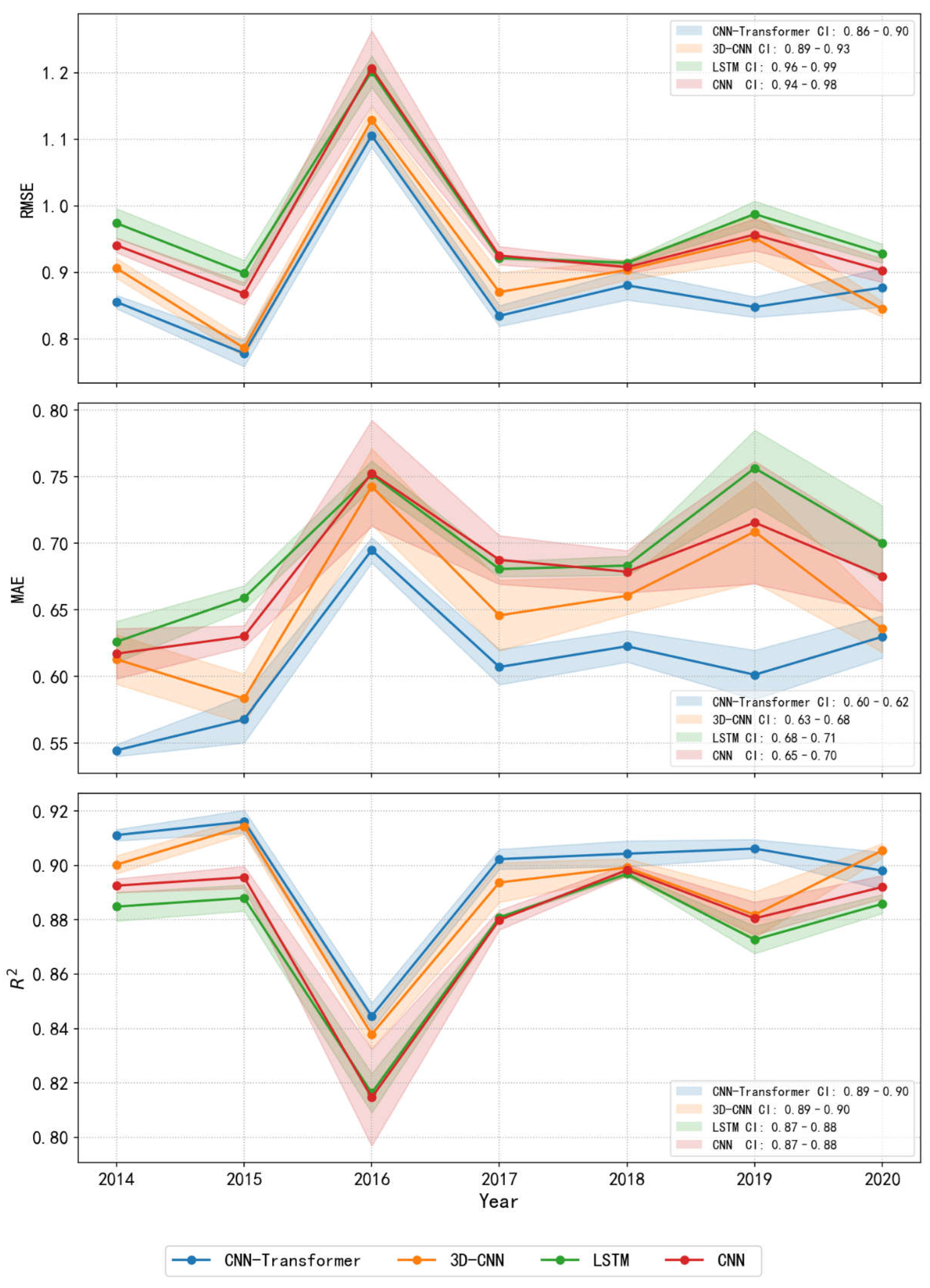
Figure 5 visually illustrates the model’s performance fluctuations and stability over time using annual mean curves and confidence intervals calculated from five sets of random seeds. Overall, the CNN–Transformer exhibits the smallest RMSE fluctuation amplitude and narrowest shaded interval, maintaining consistently low levels throughout 2014–2020, indicating greater stability under varying random initial conditions. The 3D-CNN’s confidence intervals maintained moderate width in most years, reflecting consistent fidelity in reconstructing local spatio-temporal features. The LSTM and some 2D CNNs exhibited wider confidence intervals in certain years, suggesting higher sensitivity to initial conditions or training samples. The figure also reveals a key characteristic of multivariate inputs: while incorporating more physical quantities generally reduces mean error and improves correlation in most years, it can introduce greater variability in a minority of years, widening confidence intervals. In other words, the benefits of multivariate fusion depend on the complementary information among input variables and the specific characteristics of the annual sample.
Figure 5.
Annual Performance Comparison Across Models (Mean ± 95% Confidence Interval). Note: To assess the impact of training randomness on results, each model employed a leave-one-out cross-validation scheme. Training was repeated using five distinct random seeds (42, 7, 123, 2023, 999), after which the annual metric means and confidence intervals were aggregated.
4.2. Comparison of Median Wind Speeds
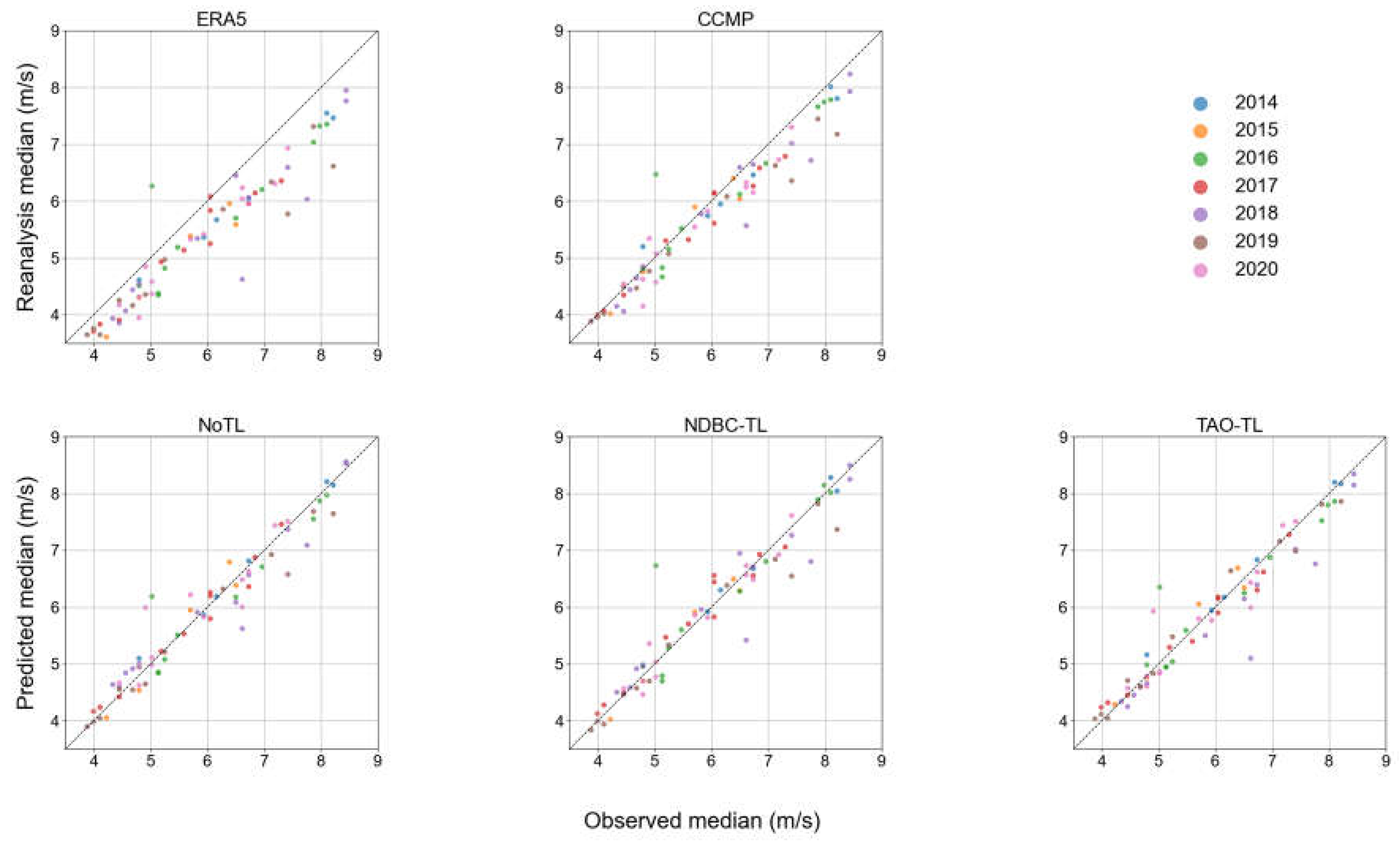
This study employs the median wind speed as the central tendency indicator for typical wind conditions. Through scatter plots (Figure 6) and multi-indicator summaries (Supplementary Materials Table S1), it compares the performance of reanalysis/fusion products (ERA5, CCMP) with three deep learning models(NoTL, NDBC-TL, TAO-TL) at the median level. Figure 6 shows that ERA5’s point cloud deviates systematically downward from the 1:1 line, indicating a general underestimation of typical wind speeds in the TIO region, particularly pronounced in the medium-to-high wind speed range. CCMP partially corrects this bias at low-to-medium speeds but retains a slight negative deviation at high speeds. The point clouds from the three deep learning models show significant convergence and are closer to the diagonal line, indicating that deep learning models reduce both systematic bias and inter-point dispersion. Microscopically: NDBC-TL exhibits slightly tighter median scatter with reduced bias in the mid-to-high wind speed range; TAO-TL shows more outliers at extreme high or low observations; NoTL (directly trained on the target domain) aligns with NDBC-TL in the low-to-mid wind speed range but occasionally exhibits slight rebound at high speeds, suggesting that climate similarity between the pre-training source domain and target domain affects the stability of median estimation.
Figure 6.
Wind speed median comparison chart. The first row shows scatter plots of reanalysis products (ERA5, CCMP) versus buoy observations; the second row shows scatter plots of model predictions (NoTL, NDBC-TL, TAO-TL) versus buoy observations. The x-axis represents the median wind speed observed by RAMA buoys (ground truth), and the diagonal black line denotes the 1:1 ideal match. Each point corresponds to the comparison between the median wind speed of a reanalysis product/model prediction at a RAMA buoy station and the corresponding median wind speed observed by that RAMA buoy.
4.3. Comparison of Wind Speed Time Series
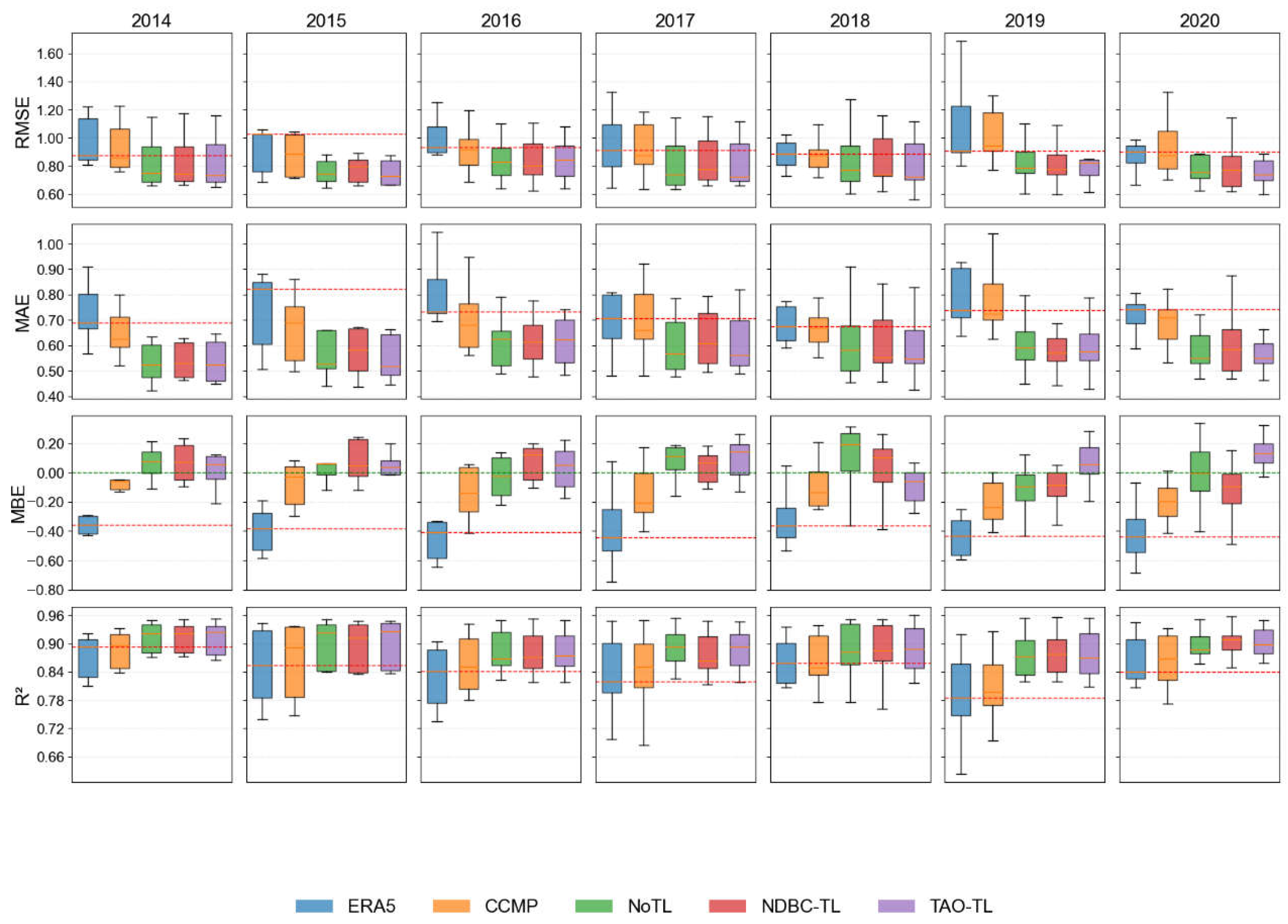
To evaluate the model’s ability to reproduce diurnal wind speed variations, Figure 7 presents time-series box plots for each dataset from 2014 to 2020, while Table S2 in the Supplementary Materials shows multi-year average metrics. Uncorrected reanalysis shows wider boxes and longer whiskers than the deep models, indicating larger interquartile variability and more extreme deviations. The median lines for ERA5 are systematically offset from buoy observations, while CCMP reduces that offset at moderate speeds but still underrepresents high values. In contrast, the three deep models produce notably narrower boxes and shorter whiskers, and their medians lie closer to the observed medians. These changes imply that the deep reconstructions suppress short-term noise and reduce systematic bias in day-to-day wind variability.
Figure 7.
Wind speed time series comparison box plot. Box plot of time series indicators. Different colored boxes represent indicators of different datasets. Box plots are displayed separately for different types of environments and models. Boxes represent the quartiles of the distribution, and whiskers indicate the 10–90% range. The horizontal red dotted line indicates the median value of the ERA5 indicator for reference, and the horizontal green dotted line indicates the MBE threshold value of zero.
Comparing the deep models, TAO-TL shows a tendency to restore upper-end peaks; its upper whiskers and upper quartile align more closely with observed extremes, suggesting greater sensitivity to short high-wind events. NDBC-TL yields the most compact distributions at low-to-medium speeds, with tighter lower quartiles and reduced spread, indicating conservative corrections that suppress random fluctuations. NoTL achieves the best overall balance between spread and central tendency, with medians and interquartile ranges closely matching observations and with fewer extreme outliers across years.
4.4. Seasonal Comparison of Wind Speed
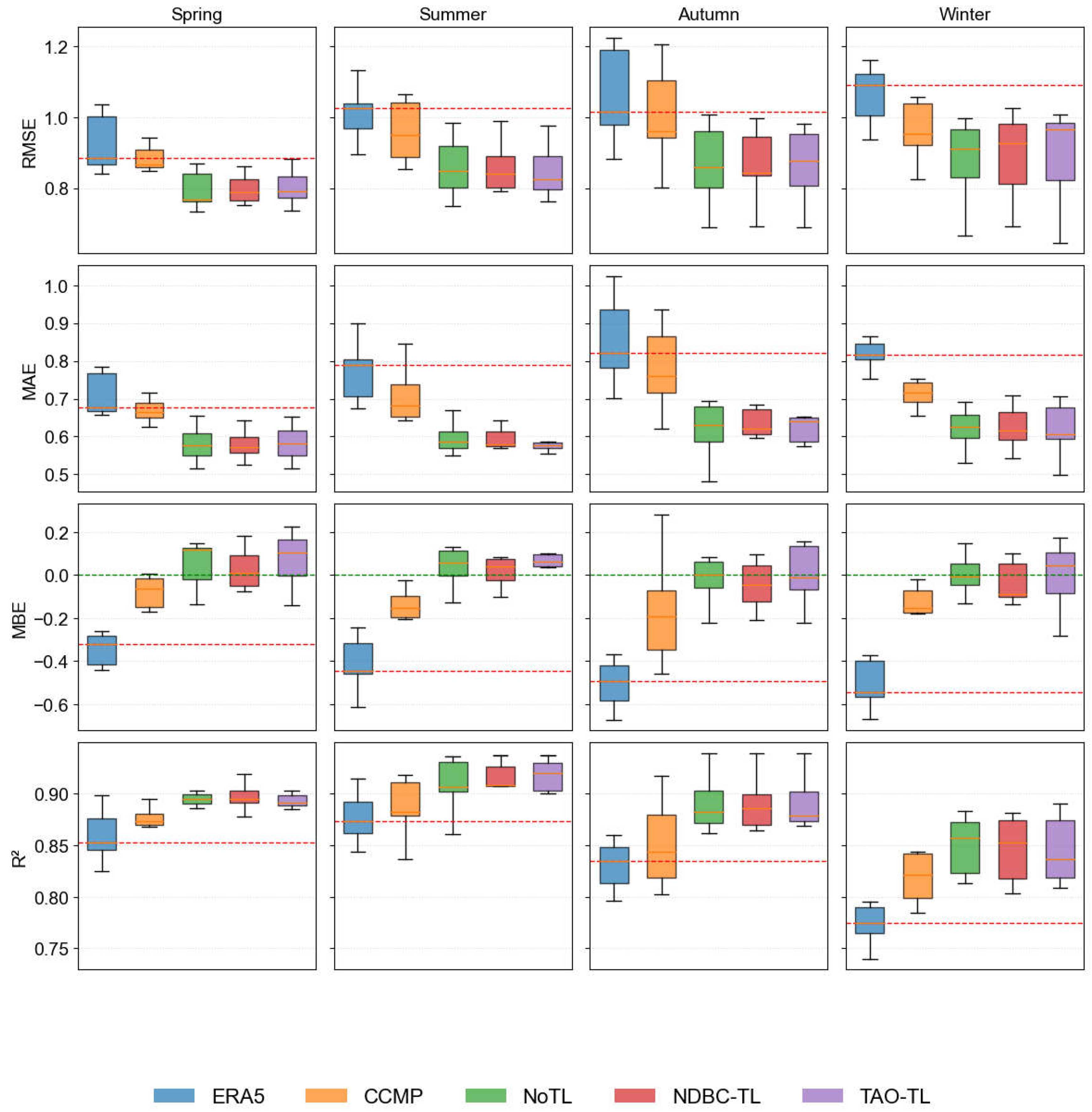
Figure 8 shows seasonal box plots for the study period, and Supplementary Table S3 provides the complete seasonal metrics and numerical comparisons. The uncorrected reanalysis products exhibit larger boxes and longer whiskers in autumn and winter, reflecting greater variability and more extreme deviations during seasonal transitions. CCMP lowers the baseline variability in most seasons but still struggles with peak-season extremes and transition-period spread. Deep reconstructions consistently narrow interquartile ranges and shorten whiskers across seasons, and their medians are generally closer to the observed medians.
Figure 8.
Wind speed distribution chart by season. Box plot of seasonal distribution indicators. The plotting conventions and interpretation are the same as explained for Figure 7.
Among the deep models, TAO-TL stands out in summer with upper quartiles and whiskers that better align with observed high-wind variability, indicating improved recovery of strong seasonal events. NDBC-TL shows the tightest distributions in spring and low-amplitude seasons, reducing random fluctuations and providing conservative corrections. NoTL delivers the most balanced seasonal fit, with medians and spreads matching observations in multiple seasons and fewer extreme outliers.
5. Comparison of Wind Energy Assessment
In evaluating wind field reconstruction, this study reconstructed the tropical Indian Ocean wind field from 2005 to 2024. Three models demonstrated distinct and complementary characteristics: NoTL, trained directly on the target domain, produced the most unbiased and interpretable results, yielding the lowest errors and highest R2 for long-term means and seasonal statistics. NDBC-TL showed greater robustness at low to medium wind speeds, with tighter medians and lower quartiles that helped suppress random fluctuations during calm periods. TAO-TL was best at recovering high-wind events, with upper quartiles and whiskers that align more closely with observations. Because our goal is a stable 20-year climatology that emphasizes long-term averages and seasonal consistency, we adopt NoTL as the primary reconstruction model.
5.1. Wind Energy Assessment Indicators
This study also adopted the evaluation methods described by Zheng et al. (2018) and selected three key indicators: wind energy density, Effective Wind Speed Occurrence, and Available Level Occurrence [28]. A 20-year average distribution comparison was conducted between the reconstructed wind speed and reanalysis data. The indicators were calculated as described below.
5.1.1. Wind Power Density (WPD)
Wind Power Density, defined as the power of wind on a unit cross-section perpendicular to the airflow, was calculated as follows:
V is wind speed (m/s); ρ is sea surface air density (kg/m3). When the altitude is below 500 m, the air density under standard atmospheric pressure (1013.2 mb) and normal temperature (15 °C) is adopted, which is 1.225 kg/m3. This value is specified in the U.S. Standard Atmosphere, 1976 and is a widely recognized standard parameter in wind energy assessment and oceanographic research [29].
5.1.2. Effective Wind Speed Occurrence (EWSO)
Wind energy availability was defined as the frequency of occurrence of effective wind speeds for wind energy resource development:
is the number of times the effective wind speed occurs; T is the total number of times. In wind energy development, it is generally believed that wind speeds between 5 and 25 m/s are conducive to the collection and conversion of wind energy resources, and wind speeds within this range are defined as effective wind speeds.
5.1.3. Available Level Occurrence (ALO)
Available Level Occurrence: Used to describe the availability of wind energy, which divides wind energy into five levels: ALO (Available Level Occurrence), MLO (Moderate Level Occurrence), RLO (Rich Level Occurrence), ELO (Excellent Level Occurrence), and SLO (Superb Level Occurrence). The calculation method for ALO is as follows:
is the number of times wind power density exceeds 100 W/m2, and T is the total number of times.
5.2. Multi-Year Average Distribution of Wind Energy
Recent studies and standard practices support reconstructing wind speed at 10 m as a primary target. Wind speed at 10 m is a conventional reference height in observational networks and reanalysis products, and it provides a direct, widely available benchmark for model validation and intercomparison of models. Moreover, many wind resource and climate datasets are reported at or converted to this height, so reconstructing 10 m wind facilitates comparison with existing measurements and with commonly used datasets.
Modern utility-scale wind turbines typically operate with hub heights in the range of about 80–120 m, so users sometimes require hub-height estimates rather than 10 m values. When conversion is needed the vertical wind profile can be extrapolated with a power-law relation:
where is the wind speed at height z, is the reference wind speed (for example at 10 m), and is the Hellmann or power-law exponent. Typical values of depend on surface roughness and atmospheric stability; a commonly used neutral-stability approximation is the 1/7 power law ( ≈ 0.143), while site-specific estimates derived from concurrent measurements or from stability-aware profile methods are preferable when accuracy is required [30].
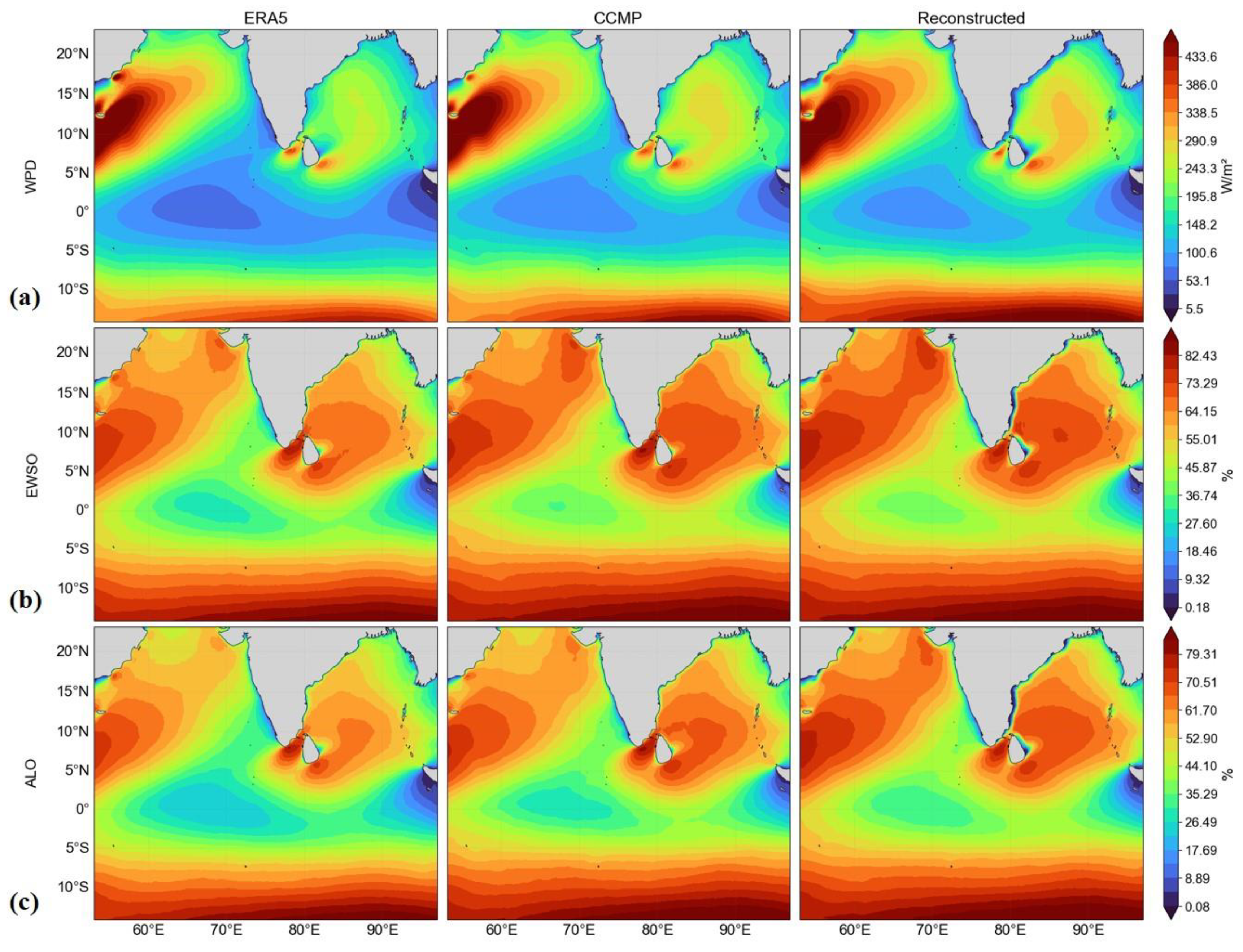
Figure 9 shows the 20-year mean spatial patterns of wind power density, effective wind speed occurrence, and energy level occurrence for ERA5, CCMP and the NoTL reconstruction. High wind energy is concentrated in the southern Arabian Sea, along the Somali coast, and in central Bay of Bengal. These areas commonly register mean wind power density above 300 W per square metre, with local maxima along the Somali coast reaching 350 to 400 W per square metre, reflecting strong summer southwest monsoon winds. Effective wind speed occurrence is also high in these zones, typically between 65 and 75 percent, indicating that more than half of the year these areas experience wind speeds in the useful range for power generation. Energy level occurrence mirrors this pattern, with open-ocean values generally between 55 and 65 percent. By contrast, the equatorial central region toward Indonesia shows lower wind energy, with mean wind power density mostly between 50 and 150 W per square metre. Nearshore areas such as the east coast of India, east of Sri Lanka and parts of the Andaman coast show intermediate values around 200 to 250 W per square metre and lower occurrence metrics.
Figure 9.
Comparison of 20-year average wind speeds in the tropical Indian Ocean region between ERA5 wind speeds, CCMP wind speeds, and wind speeds reconstructed using the NoTL model. (a) WPD; (b) EWSO; (c) ALO.
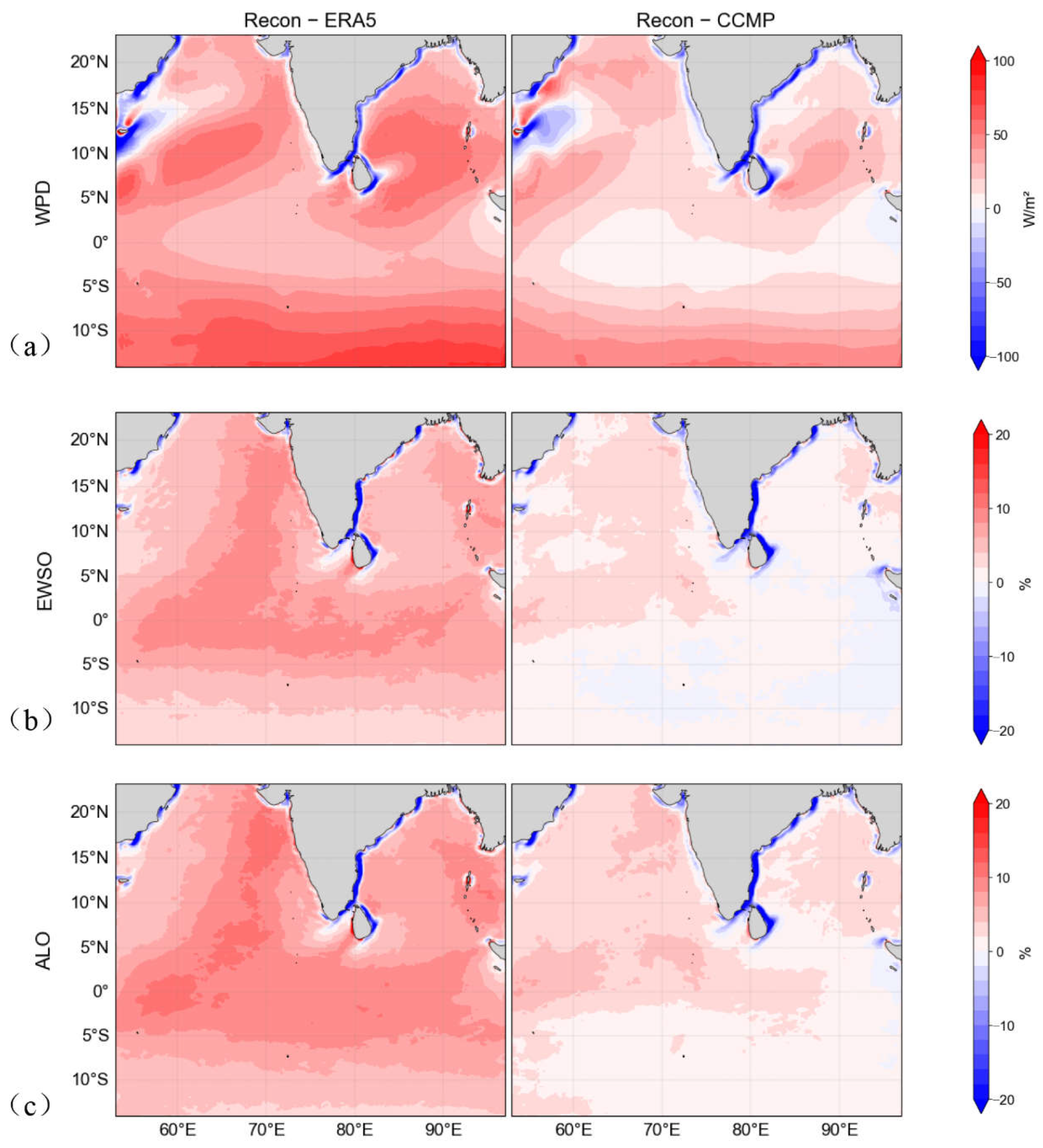
Across these regions, NoTL consistently reports higher wind energy than ERA5 and CCMP in open sea monsoon belts. For example, ERA5 values in the Arabian Sea typically fall in the range 250 to 300 W per square metre, CCMP in the range 280 to 320, while NoTL indicates values nearer 320 to 380. Effective wind speed occurrence and energy level occurrence follow a similar pattern, with NoTL showing higher frequencies in the main wind corridors. The difference maps in Figure 10 quantify these adjustments and reveal strong positive corrections centered on the Somali coast, extending 200 to 300 km offshore, as well as in parts of the Arabian Sea and central Bay of Bengal. In the Somali core area NoTL increases wind power density by amounts on the order of tens of watts per square metre and raises effective occurrence and energy level occurrence by several percentage points. These positive adjustments align with the known summer monsoon wind belt and the action of the Somali Jet and related vortices, where reanalysis and satellite products tend to be overly smooth or biased low.
Figure 10.
Reconstructed wind speed and reanalysis data difference distribution map. (a) WPD; (b) EWSO; (c) ALO.
By contrast, many nearshore regions with complex coastlines exhibit negative corrections after reconstruction. For example, the east coast of India (between 10°N and 15°N) and nearshore waters east of Sri Lanka typically show decreases in wind power density and wind energy occurrence metrics. This likely reflects two factors. First, nearshore winds are strongly shaped by local topography, coastal gradients and channeling effects that gridded products may not represent well. Second, satellite scatterometer retrievals are affected by land contamination and mixed pixels close to shore, which can produce systematic biases in the baseline fields. NoTL relies on buoy observations when available to re-evaluate local grid cell representativeness, and this process can reduce apparent high biases in the baseline fields near coasts. Whether to accept such corrections ultimately requires validation through additional independent observations, such as coastal fixed stations or high-frequency ship measurements.
The overall pattern of the difference maps between NoTL and ERA5/CCMP shows high consistency: positive anomalies occur in the open monsoon belt, while negative anomalies appear in narrow coastal channels. However, the magnitude and details of corrections differ across benchmarks. Typically, the positive bias correction for ERA5 is stronger than that for CCMP, while certain narrow coastal bands exhibit deeper negative biases relative to CCMP. This reflects inherent differences in the biases of the two reference datasets under conditions of strong winds and near-shore environments. When applying the reconstruction results, it is essential to clearly identify the source of the reference dataset and be mindful of these variations.
Overall, NoTL’s pattern of corrections is consistent: positive adjustments in open monsoon-driven wind corridors and negative adjustments in constrained nearshore channels. The magnitude and spatial detail of corrections differ when comparing ERA5 and CCMP, which reflect their different error structures. ERA5 tends to be smoother and requires larger upward adjustments in some open-ocean strong-wind areas, while CCMP, having assimilated satellite retrievals, shows different nearshore biases. These results imply that reconstructed fields should be applied with attention to the chosen baseline and to local verification. From an application perspective, the NoTL-corrected fields highlight the Somali coast, the southern Arabian Sea, and central Bay of Bengal as priority regions for offshore wind resource assessment, whereas nearshore zones require targeted local measurements before committing to development.
6. Conclusions and Prospects
The branch CNN–Transformer and transfer learning framework proposed and validated in this paper can effectively correct several systematic issues in ERA5 and CCMP to achieve long-term distributions closer to buoy observations in regions like the tropical Indian Ocean, where observations are sparse and dominated by monsoons. Taking wind speed medians as an example, this study finds that deep learning models significantly reduce systematic biases compared to traditional reanalysis products. The median wind speeds from uncorrected ERA5 frequently exhibit significant overestimation or underestimation relative to buoy observations. While CCMP shows improvement under high-wind conditions, its overall median error remains above 0.4 m/s. After the deep network end-to-end learns multi-source features, the median RMSE is consistently improved to around 0.30 m/s, with R2 exceeding 0.91, fully demonstrating the model’s advantage in correcting mean-field biases. Transfer learning is not a tool for uniformly enhancing overall averages but delivers distinct “scenario-specific benefits” across different source domains: TAO-TL excels in recovering high wind peaks, NDBC-TL demonstrates robustness in low-to-medium values, and the three approaches serve as complementary sensitivity comparisons. After reconstructing 20 years of wind speeds in the tropical Indian Ocean, the NoTL model’s spatial correction exhibits two key patterns. Over the open ocean, the correction primarily offsets positive biases in reanalysis data. Along the coast, however, it shows distinct opposite-direction correction patterns. These adjustments directly alter the Wind Power Density (WPD), Effective Wind Speed Occurrence (EWSO), and Available Level Occurrence (ALO) of key coastal energy belts, with significant impacts on wind energy resource classification, capacity factor estimation, and offshore wind farm site selection decisions.
Despite significant achievements, this study still has several areas requiring further refinement. First, the NoTL model exhibits strong spatial heterogeneity in correction effects: in regions with complex terrain or frequent cloud cover near the eastern equator, the reconstructed wind speeds show limited improvement over reanalysis or fusion products. This suggests that incorporating finer-scale terrain, cloud parameters, or sea surface flux variables is necessary to enhance local representativeness. Second, there is room for improvement in reproducing transient extremes (short-duration high winds). Although TAO-TL performs well in peak recovery, its overall capture of abrupt or extremely short-duration events has not yet achieved full consistency with observations, posing challenges for extreme load and structural safety assessments. Third, more systematic guidelines are needed for source domain selection and fine-tuning strategies in transfer learning. While current variations in source domain representativeness demonstrate transfer learning yields “directional gains,” quantifying the dynamic and statistical similarity between source and target domains to guide source domain selection remains an engineering/methodological challenge requiring future resolution. Finally, although spatial interpolation fields are presented in Figure 10, subsequent research can be expanded in two key directions: first, incorporating more comprehensive uncertainty quantification—such as multi-model ensemble evaluation—to provide resource estimates with confidence intervals for wind energy engineering; second, exploring the use of electromagnetic simulation to expand the training dataset. This simulation method can generate large-scale sea surface wind field data (including scenarios with and without seabed topographic effects), which helps supplement the scarcity of in-situ observations in complex nearshore or equatorial regions, further enhancing the model’s generalization ability and reconstruction accuracy for special wind conditions.
Overall, the NoTL reconstruction product developed in this study provides more realistic wind energy estimates for the tropical Indian Ocean while ensuring long-term unbiasedness and overall stability. Simultaneously, the scenario-specific differences between NDBC-TL and TAO-TL offer valuable complementary perspectives for specialized project assessments (e.g., robustness for medium-to-low values or sensitivity to high-value peaks). Future work will focus on reducing residual biases in complex nearshore and eastern equatorial regions, enhancing resilience to extreme events, and quantifying migration source domain selection. This will transform the high-precision, multi-purpose tropical Indian Ocean wind database into a reliable data product directly supporting wind energy resource assessment and engineering design.
Supplementary Materials
The following supporting information can be downloaded at: https://www.mdpi.com/article/10.3390/rs18020226/s1, Table S1: Evaluation metrics for median wind speed; Table S2: Summary of the time series evaluation metrics; Table S3: Summary of the wind speed seasonal indicator.
Author Contributions
Conceptualization, J.X., Y.L. and G.W.; Methodology, J.X. and Y.L.; Software, J.X.; Validation, J.X. and Y.L.; Formal analysis, Z.Z.; Investigation, J.X. and A.K.; Resources, J.X., W.W. and A.K.; Data curation, J.X., Y.L. and W.W.; Writing—original draft, J.X.; Writing—review & editing, J.X., Y.L., G.W., W.W., Z.Z. and A.K.; Visualization, J.X.; Supervision, Y.L., G.W., W.W., Z.Z. and A.K.; Project administration, Y.L., G.W., W.W. and Z.Z.; Funding acquisition, Y.L. and G.W. All authors have read and agreed to the published version of the manuscript.
Funding
This study was financially supported by the Chinese Academy of Sciences (CAS) Key Technology Talent Program of 2024, National Key R&D Program of China (2022YFE0203500) and Science and Technology Planning Project of Guangdong Province, China (2022B1212050003).
Data Availability Statement
The original ERA5 and CCMP datasets are publicly available from the Copernicus Climate Data Store and CCMP (https://doi.org/10.5067/CCMP-MW10M-L4V31). Buoy data were obtained from NOAA/NDBC and PMEL (TAO/RAMA) archives. Processed training datasets and analysis code have been deposited in the public GitHub repository: https://github.com/sam9-tech/tio-wind-training-data, accessed on 26 December 2025. Further inquiries can be directed to the corresponding author.
Acknowledgments
The authors would also like to thank the China-Sri Lanka Joint Centre for Education and Research for its support and assistance. We acknowledge the use of ERA5 reanalysis dataset from the Copernicus Climate Change Service, CCMP wind field product from NASA’s Jet Propulsion Laboratory, and buoy data from NOAA NDBC, TAO/TRITON and RAMA networks.
Conflicts of Interest
The authors declare no conflict of interest.
References
- Dean, N. Collaborating on Clean Energy Action. Nat. Energy 2022, 7, 785–787. [Google Scholar] [CrossRef]
- Reichstein, M.; Camps-Valls, G.; Stevens, B.; Jung, M.; Denzler, J.; Carvalhais, N.; Prabhat, F. Deep learning and process understanding for data-driven Earth system science. Nature 2019, 566, 195–204. [Google Scholar] [CrossRef] [PubMed]
- Rong, P.; Su, H. Assessment of CCMP in Capturing High Winds with Respect to Individual Satellite Datasets. Remote Sens. 2024, 16, 4215. [Google Scholar] [CrossRef]
- Xiang, K.; Zhou, W.; Bao, Q. Sea Surface Wind Speed Estimation from the Combination of Satellite Scatterometer and Radiometer Parameters. J. Geophys. Res. Mach. Learn. Comput. 2024, 1, e2024JH000165. [Google Scholar] [CrossRef]
- Wang, X.; Lee, T.; Mears, C. Evaluation of Blended Wind Products and Their Implications for Offshore Wind Power Estimation. Remote Sens. 2023, 15, 2620. [Google Scholar] [CrossRef]
- Hersbach, H.; Bell, B.; Berrisford, P.; Biavati, G.; Horányi, A.; Muñoz Sabater, J.; Nicolas, J.; Peubey, C.; Radu, R.; Rozum, I.; et al. ERA5 hourly data on single levels from 1940 to present. Copernic. Clim. Change Serv. (C3S) Clim. Data Store (CDS) 2023, 10. [Google Scholar] [CrossRef]
- Kerns, B.W.; Chen, S.S. Evaluation of Satellite Surface Winds in Relation to Weather Regimes Over the Indian Ocean Using DYNAMO Observations. J. Geophys. Res. Atmos. 2018, 123, 8561–8580. [Google Scholar] [CrossRef]
- Gruber, K.; Klöckl, C.; Regner, P.; Baumgartner, J.; Schmidt, J. Assessing the Global Wind Atlas and local measurements for bias correction of wind power generation simulated from MERRA-2 in Brazil. Energy 2019, 189, 116212. [Google Scholar] [CrossRef]
- Gruber, K.; Regner, P.; Wehrle, S.; Zeyringer, M.; Schmidt, J. Towards global validation of wind power simulations: A multi-country assessment of wind power simulation from MERRA-2 and ERA-5 reanalyses bias-corrected with the global wind atlas. Energy 2022, 238, 121520. [Google Scholar] [CrossRef]
- Houndekindo, F.; Ouarda, T.B.M.J. Prediction of hourly wind speed time series at unsampled locations using machine learning. Energy 2024, 299, 131518. [Google Scholar] [CrossRef]
- Houndekindo, F.; Ouarda, T.B.M.J. LSTM and Transformer-based framework for bias correction of ERA5 hourly wind speeds. Energy 2025, 328, 136498. [Google Scholar] [CrossRef]
- Zhang, W.; Wu, Y.; Fan, K.; Song, X.; Pang, R.; Guoan, B. A Multi-Scale Fusion Deep Learning Approach for Wind Field Retrieval Based on Geostationary Satellite Imagery. Remote Sens. 2025, 17, 610. [Google Scholar] [CrossRef]
- He, J.; Hu, Z.; Wang, S.; Mujeeb, A.; Yang, P. Windformer: A novel 4D high-resolution system for multi-step wind speed vector forecasting based on temporal shifted window multi-head self-attention. Energy 2024, 310, 133206. [Google Scholar] [CrossRef]
- Liu, Z.; Yang, Q.; Shao, J.; Wang, G.; Liu, H.; Tang, X.; Xue, Y.; Bai, L. Improving daily precipitation estimation in the data scarce area by merging rain gauge and TRMM data with a transfer learning framework. J. Hydrol. 2022, 613, 128455. [Google Scholar] [CrossRef]
- Yang, J.; Yang, Q.; Hu, F.; Shao, J.; Wang, G. A climate-adaptive transfer learning framework for improving soil moisture estimation in the Qinghai-Tibet Plateau. J. Hydrol. 2024, 630, 130717. [Google Scholar] [CrossRef]
- Lentz, S.; Brune, S.; Kadow, C.; Baehr, J. Improving ocean reanalyses of observationally sparse regions with transfer learning. Sci. Rep. 2025, 15, 2640. [Google Scholar] [CrossRef]
- Guo, C.; Ai, W.; Hu, S.; Du, X.; Chen, N. Sea Surface Wind Direction Retrieval Based on Convolution Neural Network and Wavelet Analysis. IEEE J. Sel. Top. Appl. Earth Obs. Remote Sens. 2022, 15, 3868–3876. [Google Scholar] [CrossRef]
- Vaswani, A.; Shazeer, N.; Parmar, N.; Uszkoreit, J.; Jones, L.; Gomez, A.N.; Kaiser, Ł.; Polosukhin, I. Attention Is All You Need. Adv. Neural Inf. Process. Syst. 2017, 30, 5998–6008. [Google Scholar] [CrossRef]
- Shankar, D.; Vinayachandran, P.N.; Unnikrishnan, A.S. The monsoon currents in the north Indian Ocean. Prog. Oceanogr. 2002, 52, 63–120. [Google Scholar] [CrossRef]
- Du, Y.; Xie, S.-P.; Huang, G.; Hu, K. Role of Air–Sea Interaction in the Long Persistence of El Niño–Induced North Indian Ocean Warming. J. Clim. 2009, 22, 2023–2038. [Google Scholar] [CrossRef]
- Patel, R.P.; Nagababu, G.; Kachhwaha, S.S.; Kumar, S.V.A. Combined wind and wave resource assessment and energy extraction along the Indian coast. Renew. Energy 2022, 195, 931–945. [Google Scholar] [CrossRef]
- Center, N.N.D.B. Meteorological and Oceanographic Data Collected from the National Data Buoy Center Coastal-Marine Automated Network (C-MAN) and Moored (Weather) Buoys. NOAA National Centers for Environmental Information. 1971. Available online: https://www.ncei.noaa.gov/archive/accession/NDBC-CMANWx (accessed on 26 December 2025).
- Zhang, Y.; Xu, N.; Zhai, X.; Zhao, K.; Dou, F.; Liu, X.; Chen, L.; Zhang, P. A Lightweight Deep Neural Network for Sea Surface Wind Speed Retrievals From the FY-3D/MWRI. IEEE Trans. Geosci. Remote Sens. 2025, 63, 1–15. [Google Scholar] [CrossRef]
- Liu, Y.; Song, X.; Xu, C.; Ning, C.; Duan, Y.; Tang, S.; Lin, M.; Jiang, X. Examining the quality of CFOSAT-based surface winds over global oceans with respect to 111 buoys2021. Authorea Prepr 2022. [Google Scholar] [CrossRef]
- Bu, J.; Yu, K.; Zuo, X.; Ni, J.; Li, Y.; Huang, W. GloWS-Net: A Deep Learning Framework for Retrieving Global Sea Surface Wind Speed Using Spaceborne GNSS-R Data. Remote Sens. 2023, 15, 590. [Google Scholar] [CrossRef]
- Rss. RSS CCMP Monthly 10 Meter Surface Winds Level 4, Version 3.1. 2024. Available online: https://podaac.jpl.nasa.gov/dataset/CCMP_WINDS_10MMONTHLY_L4_V3.1 (accessed on 26 December 2025).
- Yosinski, J.; Clune, J.; Bengio, Y.; Lipson, H. How transferable are features in deep neural networks? arXiv 2014, arXiv:1411.1792. [Google Scholar] [CrossRef]
- Zheng, C.-W.; Xiao, Z.-N.; Peng, Y.-H.; Li, C.-Y.; Du, Z.-B. Rezoning global offshore wind energy resources. Renew. Energy 2018, 129, 1–11. [Google Scholar] [CrossRef]
- NOAA-S/T-76-1562; U.S. Standard Atmosphere. Government Printing Office: Washington, DC, USA, 1976. Available online: https://ntrs.nasa.gov/citations/19770009539 (accessed on 26 December 2025).
- Emeis, S. Wind Energy Meteorolog, 2nd ed.; Springer: Cham, Switzerland, 2018; pp. 1–328. [Google Scholar] [CrossRef]
Disclaimer/Publisher’s Note: The statements, opinions and data contained in all publications are solely those of the individual author(s) and contributor(s) and not of MDPI and/or the editor(s). MDPI and/or the editor(s) disclaim responsibility for any injury to people or property resulting from any ideas, methods, instructions or products referred to in the content. |
© 2026 by the authors. Licensee MDPI, Basel, Switzerland. This article is an open access article distributed under the terms and conditions of the Creative Commons Attribution (CC BY) license.