1. Introduction
The terahertz (THz) band (0.1–10 THz) bridges the gap between microwaves and infrared waves in the electromagnetic spectrum. Compared to low-frequency microwaves, THz waves have shorter wavelengths and broader bandwidths, which can provide higher imaging resolution down to submillimeter scales. Also, they can penetrate common dielectric materials, e.g., plastics and fabrics, with much lower signal losses than optical or infrared waves [
1]. These attractive properties make THz radar suitable for diverse applications, including missile defense [
2], security screening [
3], automotive anti-collision, and biomedical sensing [
4].
Terahertz synthetic aperture radar (THz-SAR) with conventional SAR principles achieves superior spatial imaging resolution due to its wide bandwidth and high Doppler resolution. It has an electrically large antenna aperture with miniaturized components, providing high antenna gain and a narrow beamwidth, thereby achieving strong anti-jamming capability and adaptability across various platforms. Consequently, THz-SAR is ideal for drone and satellite platforms and shows significant potential for anti-stealth detection and electronic warfare [
5,
6,
7]. To improve radar survivability, low-probability-of-intercept (LPI) waveforms have become a research priority [
8,
9,
10,
11,
12,
13,
14]. Composite modulated waveforms that combine multiple modulation techniques broaden the signal spectrum and reduce the power spectral density, thereby improving stealth performance. In this regard, THz-SAR with composite modulated waveforms is promising for both low LPI and high detection capability in next-generation radar systems.
In drone and satellite platforms, SAR imaging is affected by low-frequency motion discrepancies and high-frequency vibrations. The former comes from atmospheric turbulence, which is the main constraint in microwave SAR. The latter is due to the aeroengine of the platform, which is typically neglected at microwave frequencies and should be carefully considered at THz frequencies. In THz-SAR, both low-frequency and high-frequency errors may add together, leading to hybrid phase errors that further degrade image quality [
15,
16]. However, the reported motion compensation methods for THz-SAR have primarily addressed low-frequency and high-frequency phase errors individually. For low-frequency errors, parametric approaches with high motion modeling efficiency, such as sparsity-driven parameter estimation [
17], acceleration-based position/orientation correction [
18], and sub-aperture minimum entropy optimization [
19], struggle with increased errors and are highly dependent on accurate Inertial Measurement Unit (IMU) initializations. Non-parametric techniques that estimate phase error curves directly, such as enhanced Phase Gradient Autofocus (PGA) and two-dimensional motion compensation [
20,
21], suffer from high computational cost and limited accuracy. For high-frequency vibration suppression, transform-based methods, such as the discrete fractional Fourier transform (DFrFT) [
22,
23,
24], Linear Canonical Transform (LCT) combined with Empirical Mode Decomposition (EMD) [
25], and Inverse Radon Transform (IRT) [
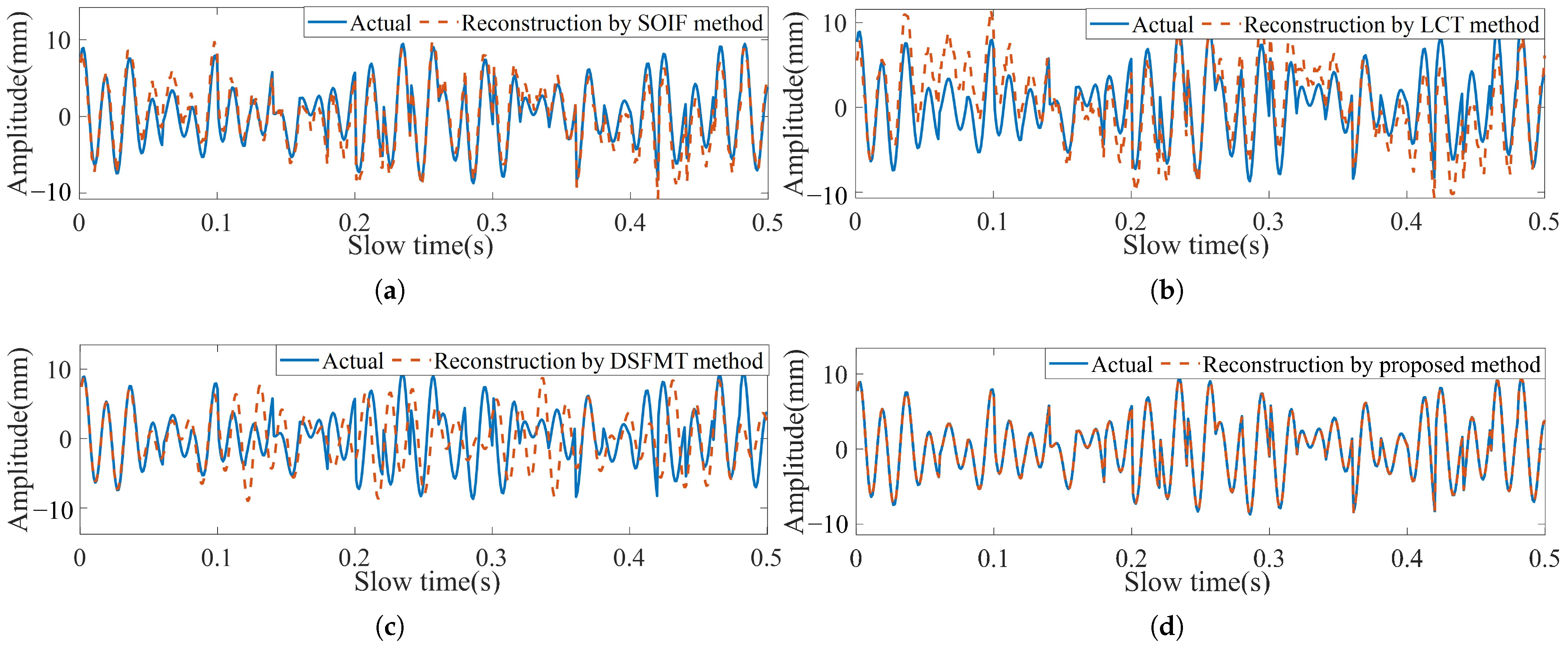
26], have been widely adopted. However, they generally assume pre-compensated low-frequency errors and are mostly effective only for stationary single- or multi-frequency vibrations. Although methods like the discrete sinusoidal frequency modulation transform (DSFMT) with simulated annealing offer broader applicability [
27], their performance remains constrained under multi-frequency vibrations due to computational complexity and stability issues. Additionally, data-driven methods represent a promising new direction for detection enhancement by using the Frequency-spatial Contextual Awareness Network (AIS-FCANet), Multi-kernel-size Feature Fusion CNN (MKSFF-CNN), Multiscale Dilated Fusion Attention All-Convolution Network (MDFA-AconvNet) methods, and the Multiscale Rotation-Invariant Haar-Like Feature Integrated CNN (MSRIHL-CNN) [
28,
29,
30,
31].
It should be noted that few studies have investigated the hybrid compensation of both low- and high-frequency phase errors simultaneously. Existing approaches, such as polynomial-sinusoidal fitting and non-parametric joint compensation [
32,
33,
34,
35], face fundamental challenges of severe phase wrapping induced by submillimeter-scale vibrations and orientation inaccuracies from low-precision IMUs. Moreover, the reported harmonic vibration models with constant amplitudes and frequencies exhibit significant limitations in capturing the complex dynamics of real-world Unmanned Aerial Vehicle (UAV) platforms or airborne platforms [
36,
37,
38,
39,
40]. These non-stationary, multi-component, and time-varying dynamics arise from practical factors of propeller-wing interaction [
41], spanwise flow turbulence [
42], coupled attitude motion [
43], aeroelastic instability from flutter [
44], and unsteady aerodynamic loads [
45,
46], etc., which have been observed in practical THz-SAR systems [
47]. Accordingly, establishing a comprehensive scheme to handle such hybrid non-stationary motion errors remains an open challenge in THz-SAR imaging—particularly in hybrid error mechanisms, resolving severe phase wrapping effects, extracting non-stationary vibration components, and achieving computationally efficient parameter estimation.
To address these issues, a hybrid motion compensation (MOCO) scheme is proposed in this paper for THz-SAR echo with LPI. The main contributions of this work are summarized as follows:
A novel hybrid non-stationary error model is established to better represent the actual motion of radar platforms. Unlike idealized, stationary models that overlook critical vibrational modes, the proposed model explicitly captures non-stationary, time-varying components, thereby providing a more realistic foundation for THz-SAR motion compensation.
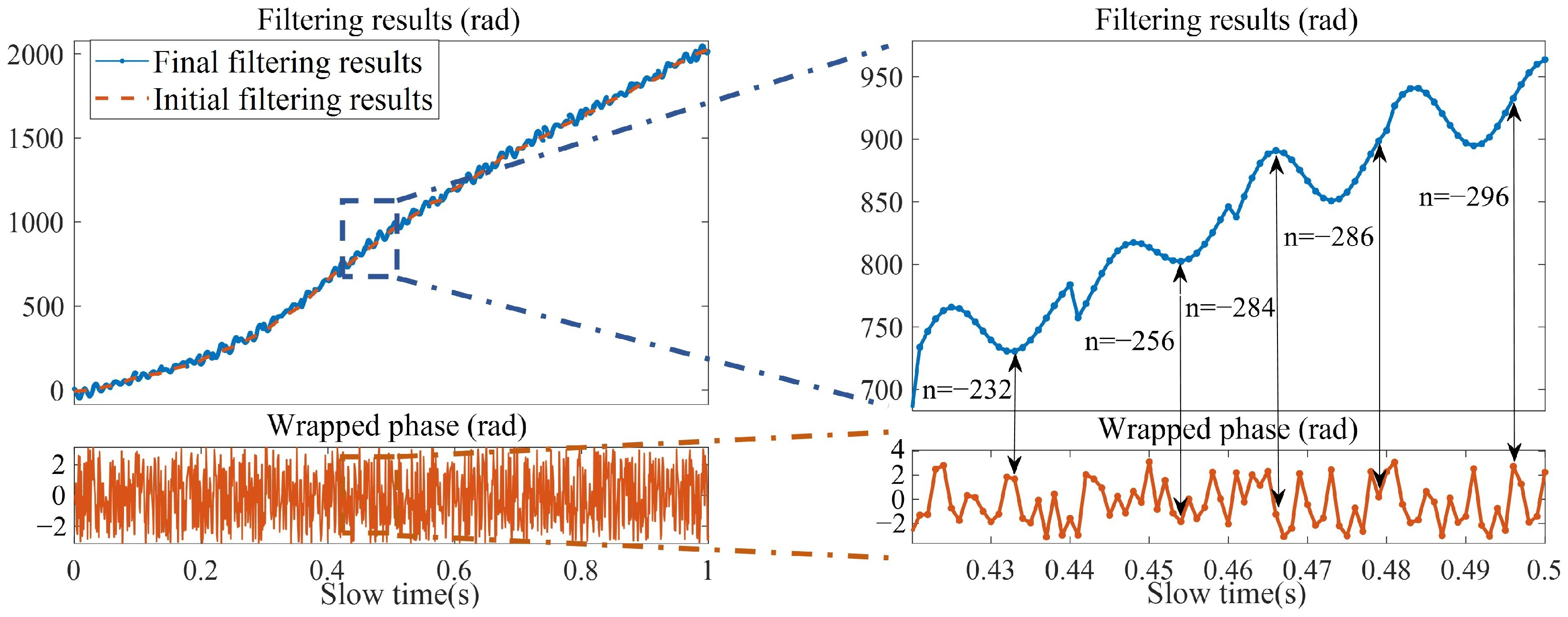
A robust time-domain vibration extraction method is introduced. It effectively resolves severe phase wrapping via a self-adaptive quadratic Kalman filter. It enables high-fidelity isolation of non-stationary vibrations through an enhanced signal decomposition strategy with dynamic adaptive noise generation, overcoming the limitations of conventional transform-domain and time-domain approaches under hybrid errors.
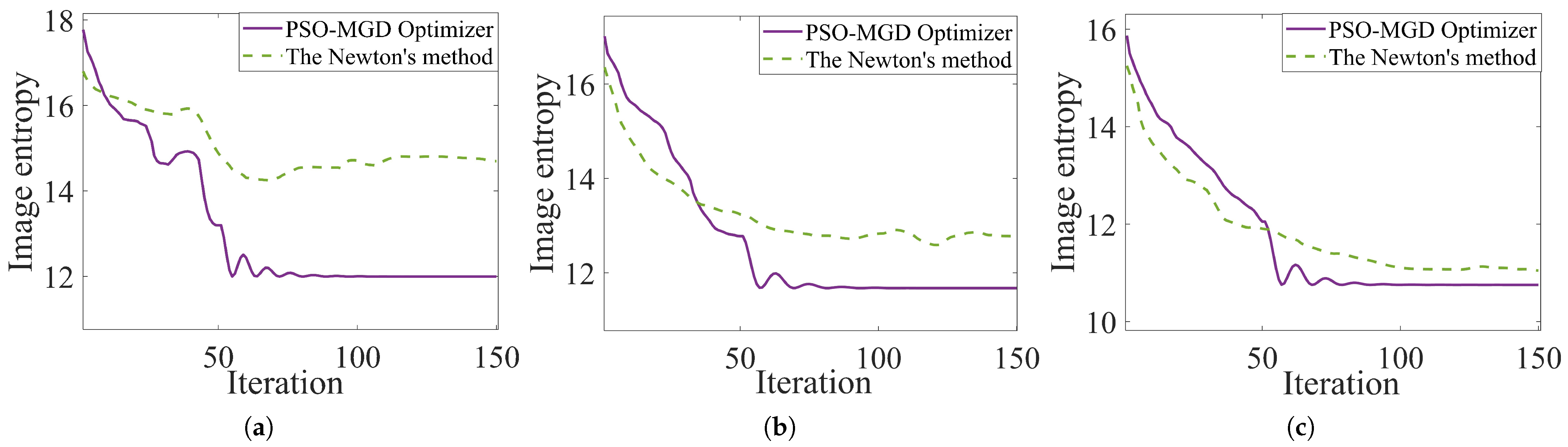
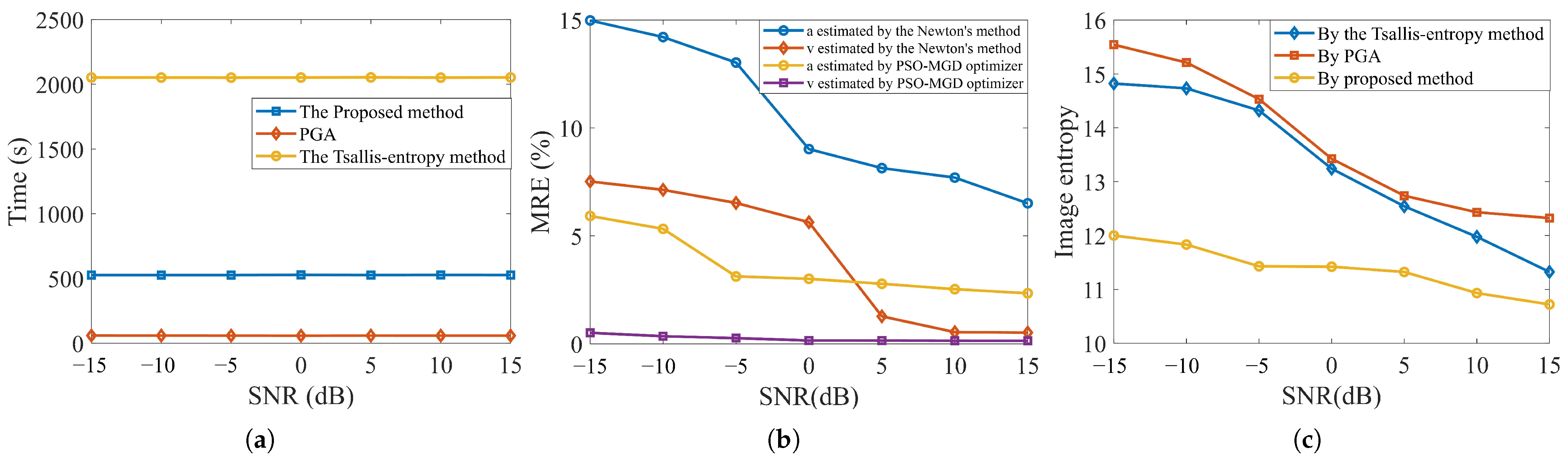
A highly efficient hybrid optimizer integrating particle swarm and gradient descent is developed for sub-aperture parameter estimation, achieving markedly superior convergence speed and accuracy compared to existing optimization methods.
This paper is organized as follows:
Section 2 demonstrates the geometric and signal models for full motion errors and composite modulated waveforms in THz-SAR.
Section 3 elaborates on the proposed methods for phase extraction and unwrapping, high-frequency vibration estimation, and sub-aperture parameter optimization.
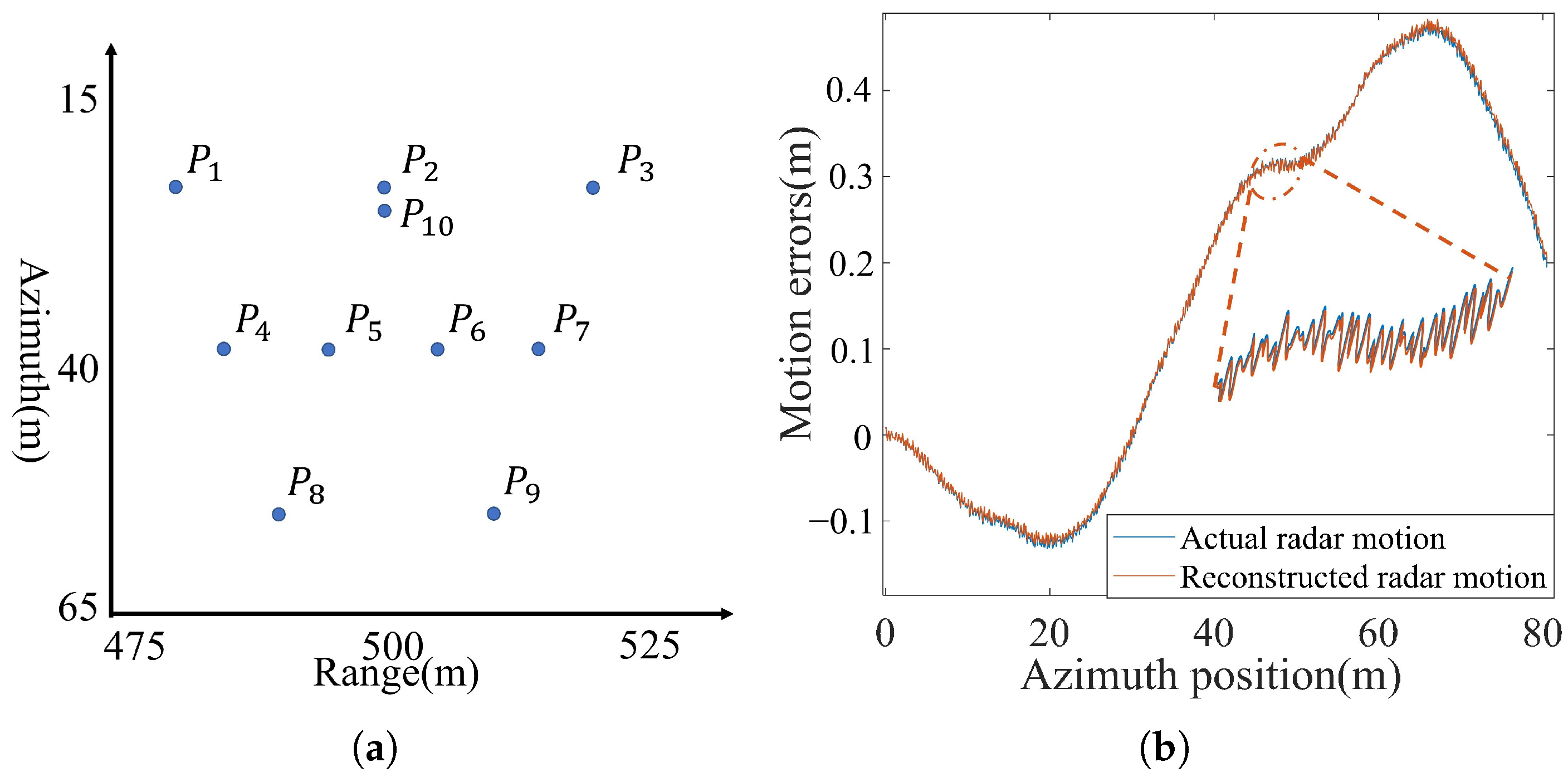
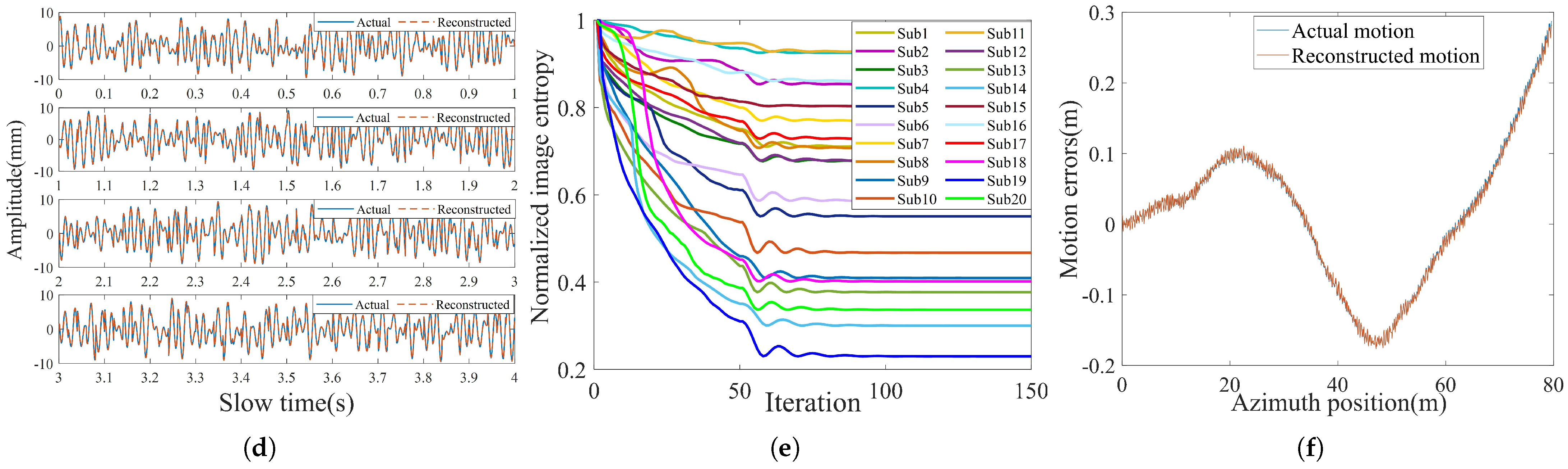
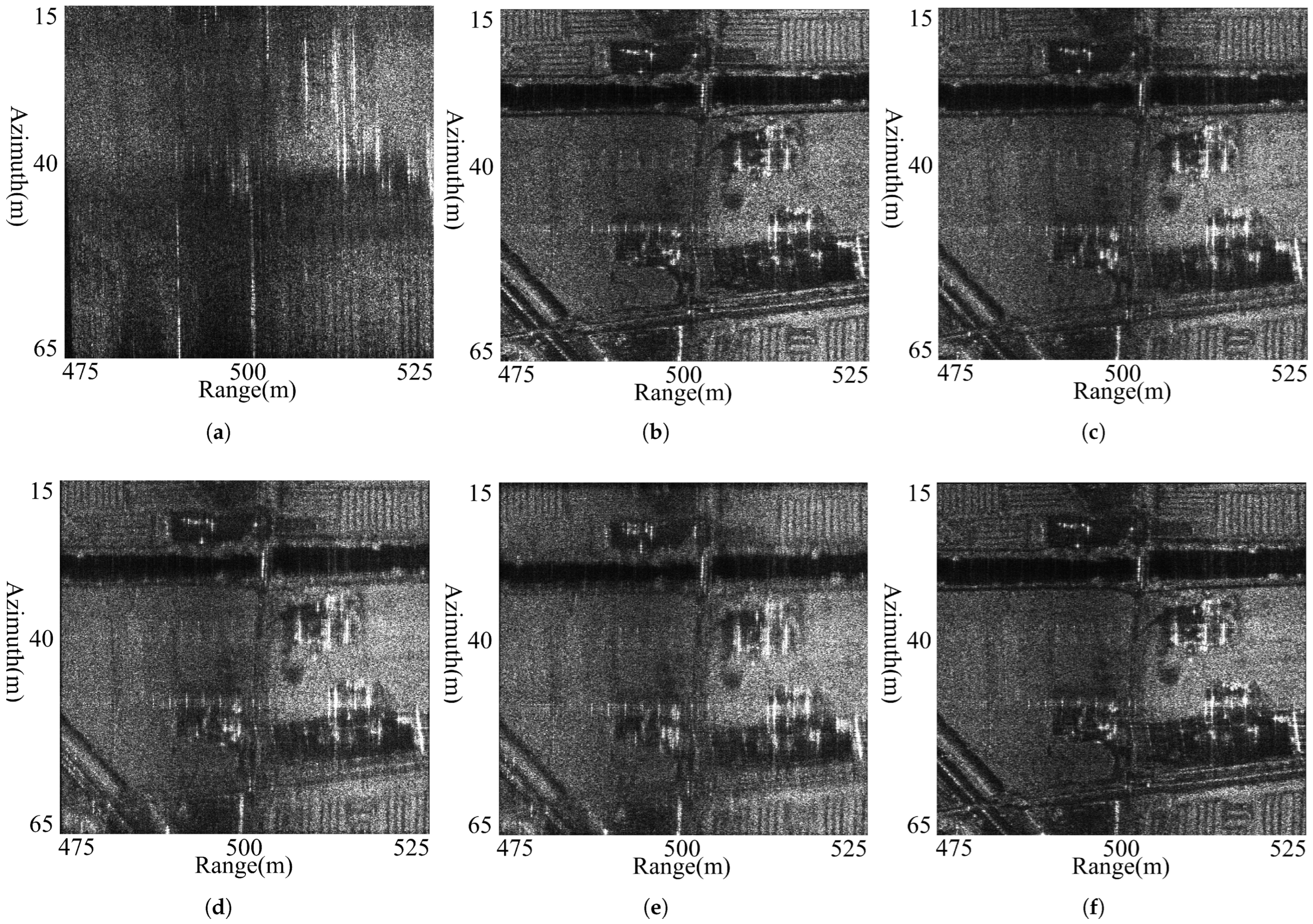
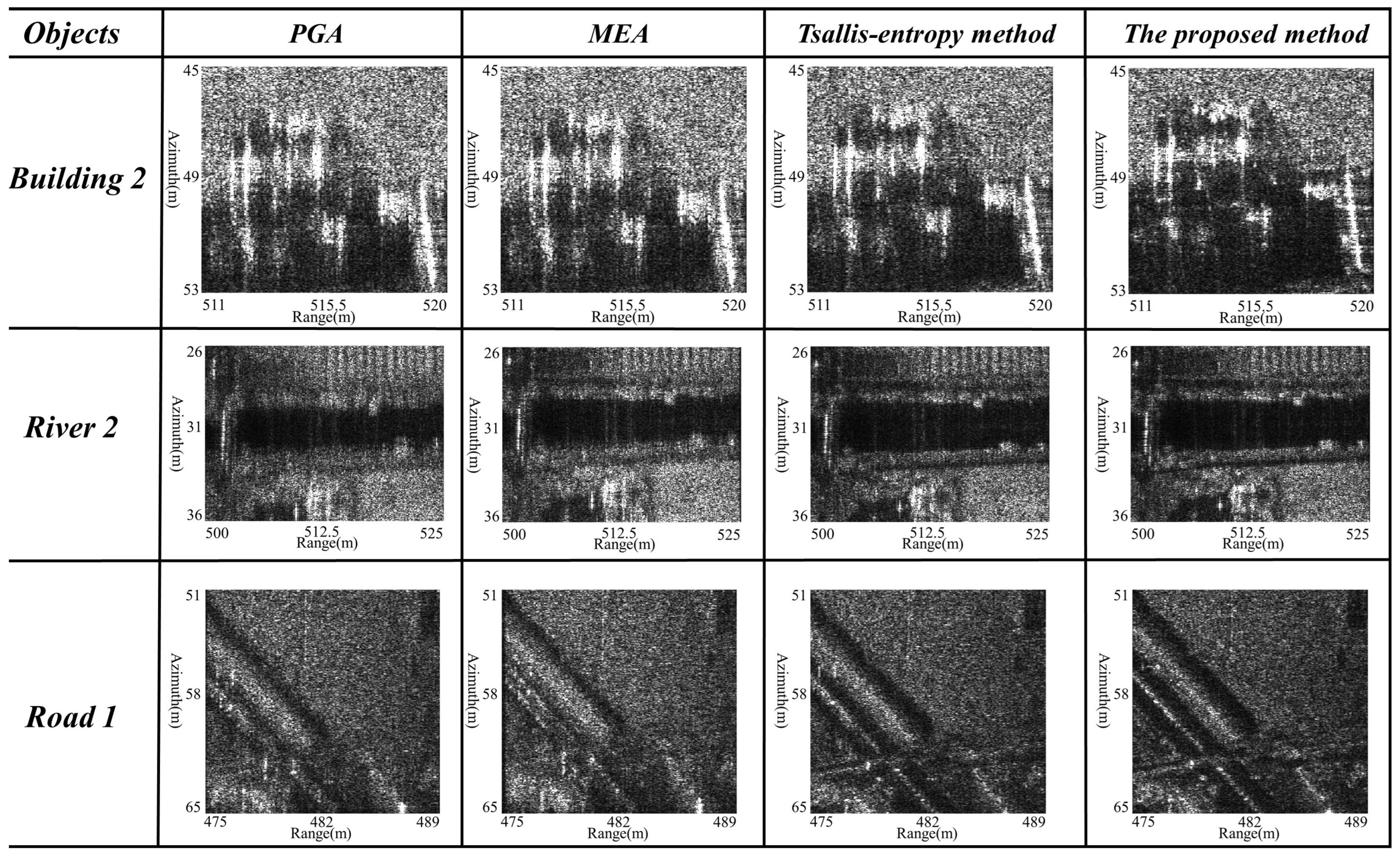
Section 4 presents simulations and analyses based on 0.1 THz UAV-borne SAR data and compares the proposed scheme with existing methods. Finally,
Section 5 concludes this paper.
2. Signal and Geometric Motion Model
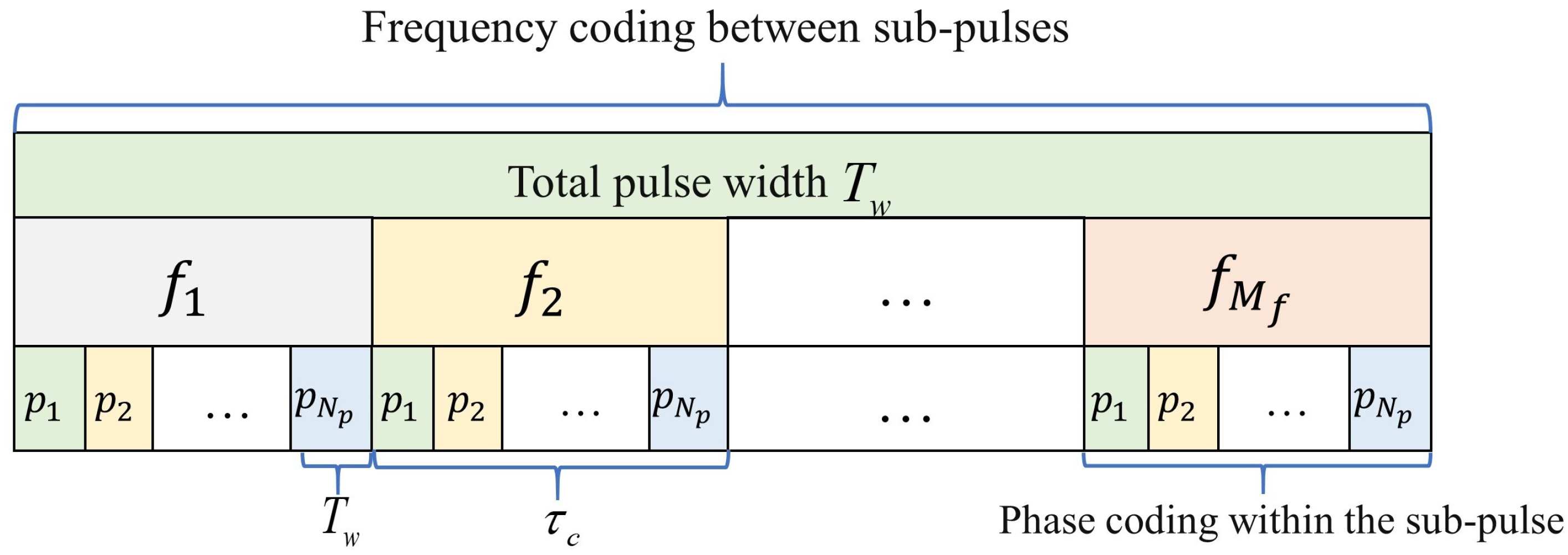
The radar signal adopts a "first-level frequency coding + second-level phase coding (FC-PC)" structure, as shown in
Figure 1. Here,
is the total pulse width,
is the number of frequency codes, and
is the number of phase codes. The specific coding is set as follows: the first-stage frequency coding utilizes a 16-bit Costas code, while the second-stage phase coding employs a 15-bit P4 code. The time-domain expression of this pulse signal is:
In the formula, and are the frequency and phase encoding sequences, respectively; is the length of a single frequency-coded pulse; is the length of a single phase-coded pulse; and is the rectangle function. The FC-PC composite waveform enhances signal survivability in secure THz-SAR applications through spectral spreading and low sidelobe characteristics.
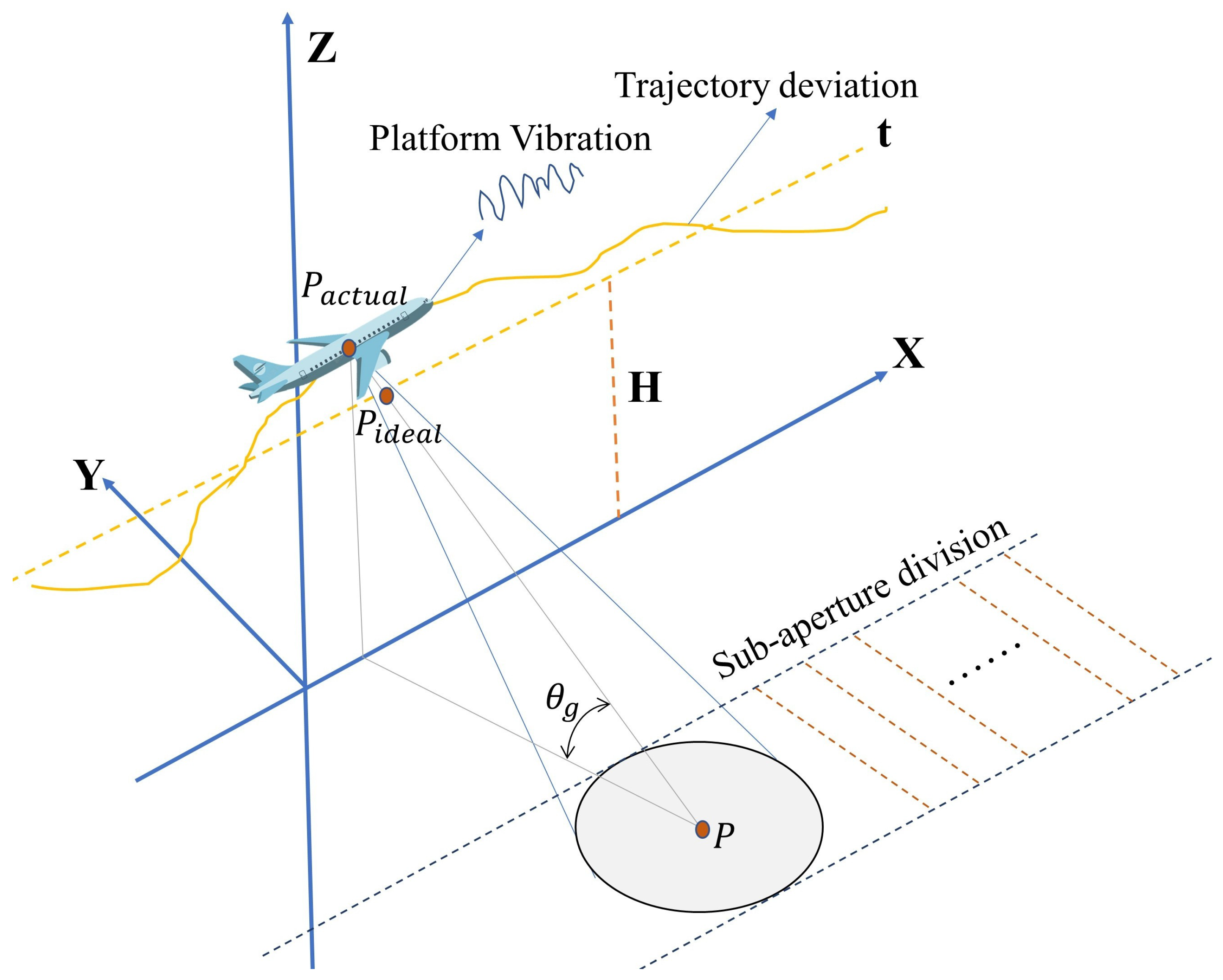
The motion geometry of a THz-SAR system operating in side-looking mode is illustrated in
Figure 2. Ideally, the radar platform should follow a straight path (dashed yellow line) at a constant height
H and grazing angle
. However, in practice, atmospheric turbulence induces motion errors that displace the Antenna Phase Center (APC) from its nominal position, as is shown by the solid yellow line.
At an arbitrary azimuth time
t, the ideal APC location is given by
, where
is the nominal platform velocity along the x-axis. The actual position is denoted as
. The instantaneous slant range between the APC and a target point
can thus be expanded into a Taylor series at the azimuth time
, yielding the approximation:
Therefore, the instantaneous slant range
in the THz band can be divided into several parts:
where the first part
is the minimum distance to the target point, the second part
is the azimuth motion of the radar’s platform, and the third part
is the error caused by the radar’s position offset in the line-of-sight direction.
For the term, is the number of vibration components; , , and are the time-varying frequency, amplitude of the m-th vibration component, and the initial phase of the i-th (i = 1, 2, …, ) vibration component, respectively.
Notably, the proposed non-stationary vibration model exhibits strong generality. By setting the time-varying parameters
and
to constants, it reduces seamlessly to the conventional stationary vibration model widely used in the reported literature [
22,
23,
24,
25,
26,
27,
32,
33,
34,
35,
36,
37,
38,
39,
40]. Such flexibility allows the model to cover a broader spectrum of vibration scenarios, from ideal stationary cases to complex non-stationary dynamics, thereby providing broader applicability for practical THz-SAR motion compensation.
In general, considering the transmission of a composite modulation signal transmitted by the SAR system, the compressed echo received at azimuth time
t is represented as follows:
In the formula,
is the signal wavelength;
represents the narrow time-width signal after range compression;
is the target scattering coefficient; and
is the time delay. Substitute the slant distance expression from Equation (
3) to obtain:
where the second exponential term reflects the low-frequency phase error caused by trajectory drift and the third exponential term reflects the phase error introduced by high-frequency vibration.
3. THz-SAR Motion Compensation Method
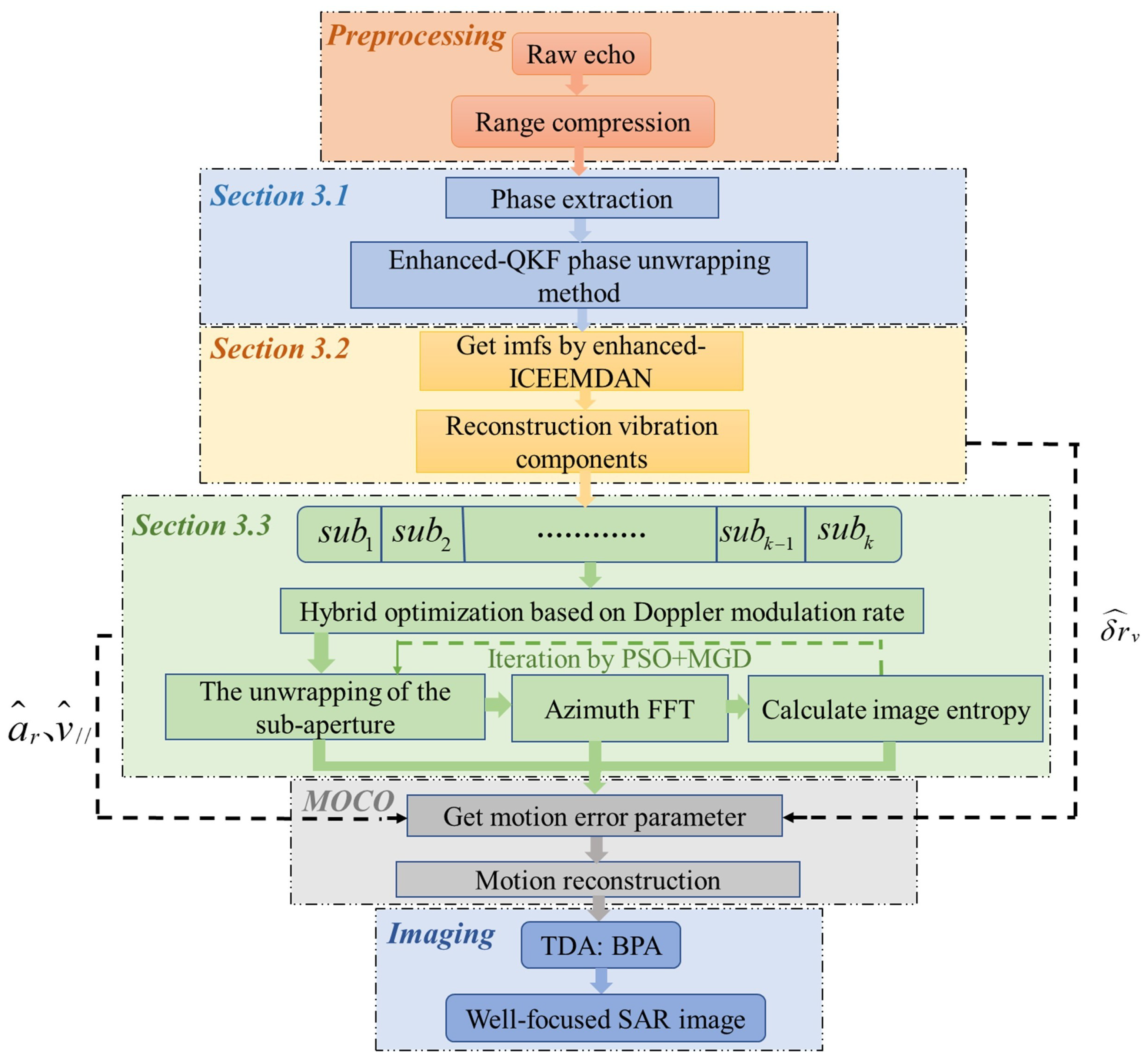
This section introduces a hybrid motion compensation scheme for THz-SAR, tightly integrated with the subsequent Back-Projection (BP) imaging process, as illustrated in
Figure 3. The core of our approach is a synergistic processing chain designed to estimate and correct motion errors for high-fidelity BP reconstruction precisely. It begins with a self-adaptive quadratic Kalman filter (QKF) for robust phase unwrapping. Subsequently, non-stationary vibration components are accurately extracted using the Improved Complete Ensemble Empirical Mode Decomposition with Adaptive Noise (ICEEMDAN), enhanced by a dynamic noise adjustment mechanism. Finally, a hybrid optimizer combining Particle Swarm Optimization and Momentum Gradient Descent (PSO-MGD) performs efficient sub-image reconstruction and motion parameter estimation. The estimated parameters directly feed into a motion error reconstruction module to compensate for the raw data, providing a refined and reliable input for the final BP imaging. This integrated workflow ensures the motion compensation is inherently optimized for BP-based reconstruction, enhancing overall imaging accuracy.
Moreover, the proposed motion compensation framework is applicable to any radar waveform. In this study, it is synergistically paired with the FC-PC composite waveform, selected for its excellent LPI performance. This combination ensures that signal survivability and high imaging precision are maintained simultaneously under complex motion conditions, resulting in a secure, high-resolution THz-SAR system.
3.1. Phase Unwrapping via Enhanced QKF Algorithm with Adaptive Parameter Adjustment
The original phase is extracted from the compressed echo following the procedure for Signal of Interest (SoI) phase extraction outlined in [
33]. This phase curve then serves as the input to the phase recovery algorithm. The conventional phase unwrapping function is defined as follows:
where
(
) refers to the
m-th azimuth sampling time,
M refers to the total number of azimuth sampling points.
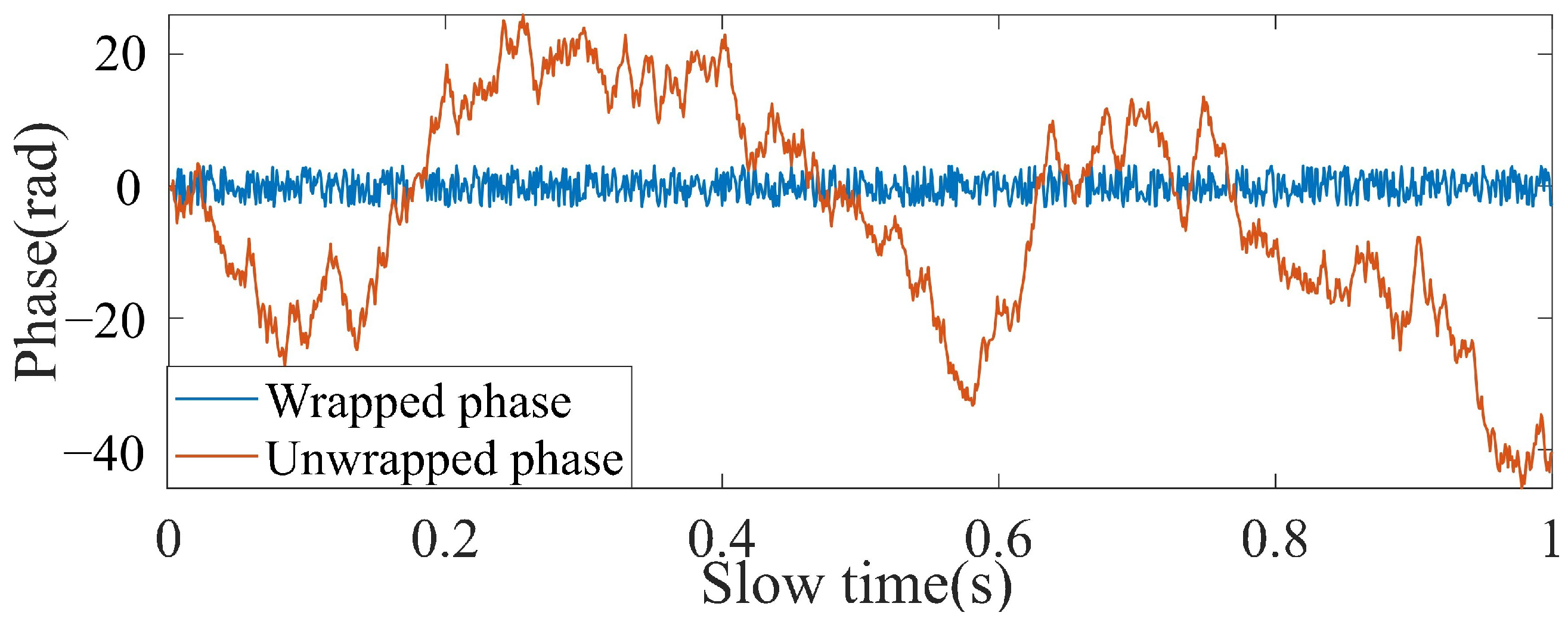
However, in the THz band, millimeter-level variations in slant range induce severe phase wrapping, where the phase spans multiple
cycles. Traditional unwrapping, which only adjusts by a single
increment, often results in discontinuous or drifted outcomes, failing to provide a reliable input for subsequent error inversion.
This paper employs a Quadratic Kalman Filter (QKF) for phase unwrapping, which constructs a 3D state-space model with the state vector
, incorporating the structural prior of THz-SAR phase as shown in Equation (
7). Through the prediction-update mechanism of Kalman filtering [
48], the QKF enables the unwrapping of phases with multi-cycle jumps. Below are the core prediction and state update equations of the QKF algorithm.
where H =
is the phase observation matrix,
refers to the state transition matrix,
,
refers to the process noise covariance matrix,
,
R refers to scalar observation noise covariance, and
refers to wrapped phase value (
, wrapping integer).
However, the filtering output of the standard QKF heavily depends on the elements
of the process noise covariance matrix
Q, causing unstable unwrapping. To address this limitation, we propose an enhanced QKF algorithm that incorporates two key innovations: an adaptive covariance matrix strategy (Equation (
9)) and a reliability detection mechanism (Equation (
10)). The adaptive covariance matrix strategy dynamically adjusts
Q based on the statistical properties of phase residuals to enhance reconstruction robustness and accuracy, while the reliability detection mechanism ensures unwrapping quality. The complete unwrapping procedure is executed as follows:
Phase Unwrapping Procedure:
Input: wrapped phase , sampling interval
- Step 1
Initial Quadratic Model Fitting: Initialize the filter with a minimal covariance matrix to force prioritization of the quadratic phase model, obtaining an initial estimate .
- Step 2
Residual Fluctuation Extraction: Calculate the wrapped difference and perform quadratic fitting to separate the pure fluctuation term .
- Step 3
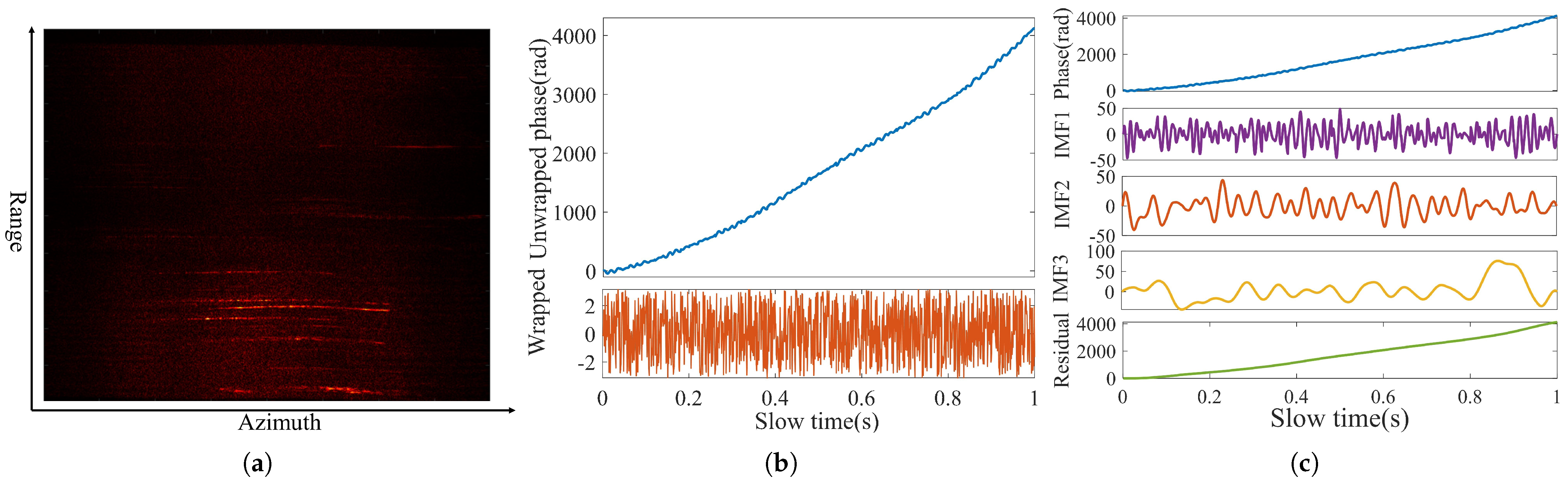
Adaptive Covariance Matrix Reconstruction: Reconstruct the process noise covariance matrix using the statistical properties of the residual signal.
where
and
denote variance and n-th order difference respectively. This innovation dynamically adapts to the phase/frequency/frequency-rate uncertainties of non-stationary vibrations.
- Step 4
Robust Phase Unwrapping: Rerun the QKF with the adapted covariance matrix to obtain the final unwrapped phase estimate .
- Step 5
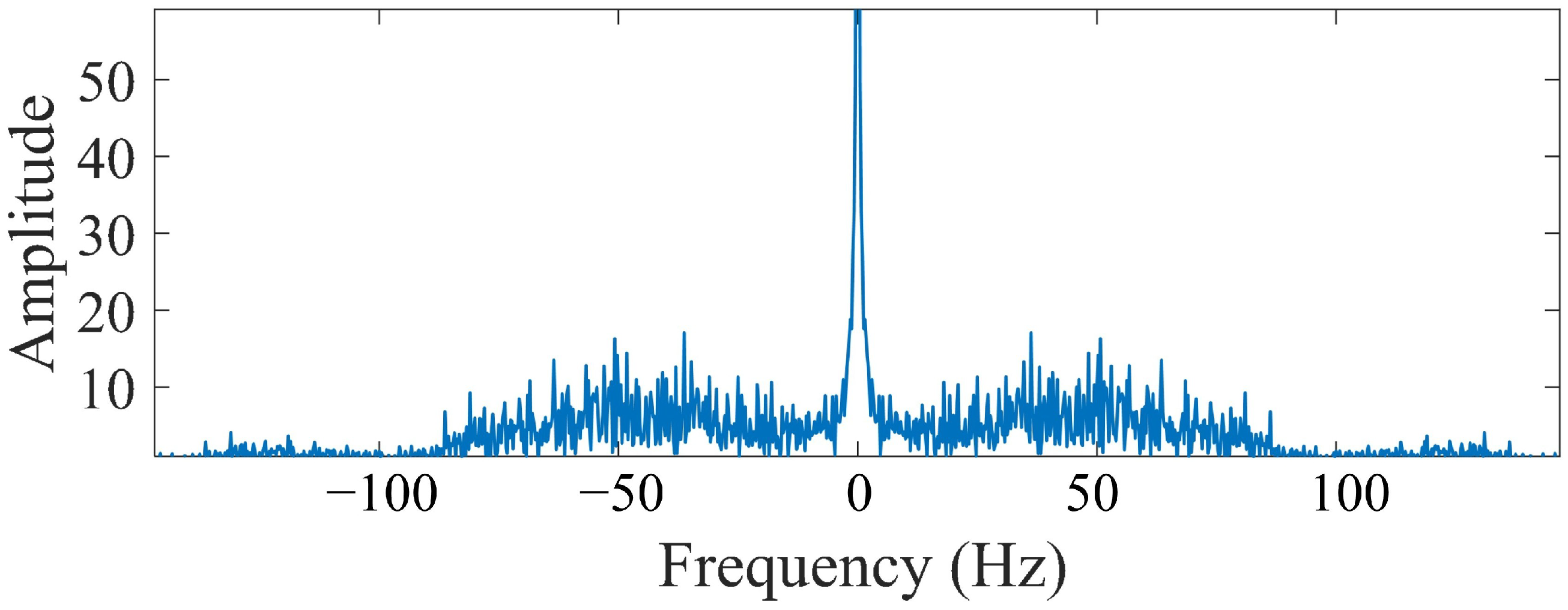
Reliability Validation via Power Spectrum Flatness: Evaluate unwrapping quality using the proposed power spectrum flatness metric.
where
is computed via Welch’s method over
. The Power Spectral Density (PSD) estimation provides a frequency-domain representation of the signal’s power distribution. Small
values indicate successful unwrapping (flat PSD, characteristic of random noise), while large values suggest insufficient unwrapping (peaked PSD, indicative of residual vibrations).
- Step 6
Iterative Refinement: If , reduce and repeat steps 1–5 until reliable unwrapping is achieved.
Output: unwrapped phase , wrapping integer
After being processed by the adaptive QKF, the output reconstructed phase curve will serve as a reliable input for the extraction of vibration errors.
3.2. Platform Vibration Estimation Based on Enhanced ICEEMDAN Algorithm
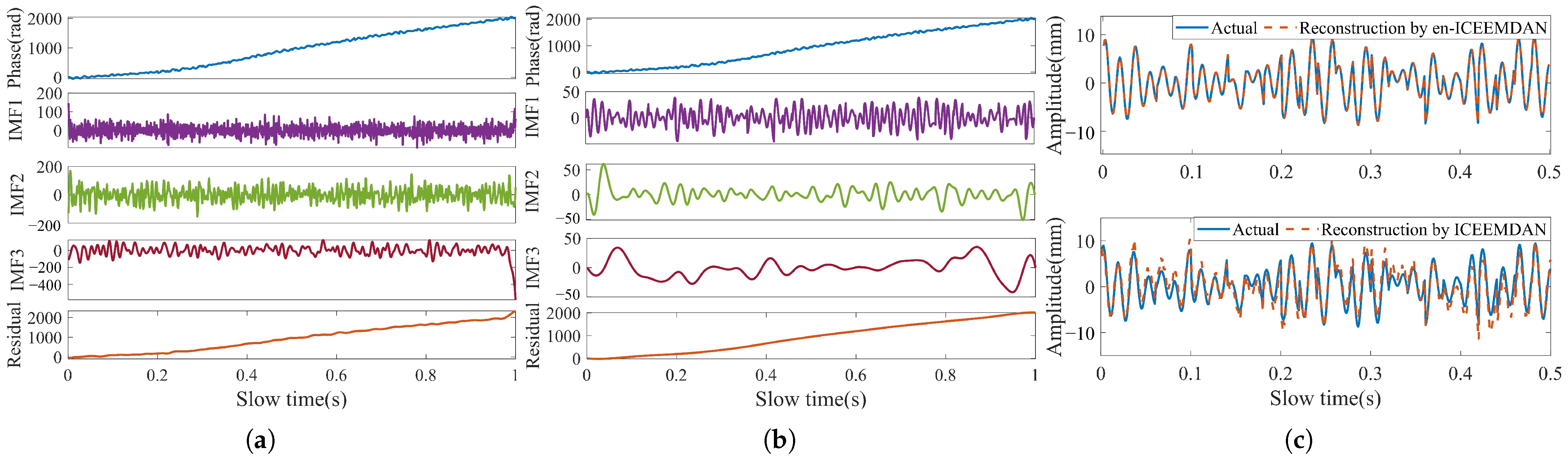
The non-stationary time-varying vibrations of radar platforms make it impossible to directly extract vibration frequency, amplitude, and phase as fixed components using frequency-domain analysis while also complicating error modeling in time-domain curve fitting and conventional optimization algorithms.
To address these challenges, this paper introduces a vibration error extraction method based on enhanced ICEEMDAN, which decomposes the phase signal into several intrinsic mode functions (IMFs) and directly separates vibrational error components from the phase curve. Building on the standard ICEEMDAN framework [
49], the proposed algorithm incorporates three key enhancements: adaptive band-pass noise generation (Equation (
11)), noise mode reuse (Equation (
12)), and quadratic termination criterion (Equation (
13)). These improvements are tailored explicitly to phase signals characterized by quasi-quadratic trends combined with non-stationary vibrations. The complete vibration extraction procedure is executed as follows:
Vibration Extraction Procedure:
Input: , ensemble number , noise intensity coefficient , frequency fluctuation coefficient , trend fitting error threshold , maximum number of IMFs
- Step 1
Initialization: Initialize residue and noise strength for ensemble .
- Step 2
Ensemble Decomposition Processing: For each q-th IMF () in each ensemble:
- 2.1
Adaptive Band-pass Noise Generation: Generate adaptive noise with band-pass characteristics and dynamically adjusted intensity.
where
is the coefficient of variation of the
-th IMF’s instantaneous frequency (Hilbert-transformed), adapting to non-stationary frequency fluctuations, and
is band-pass noise filtered to
based on the phase curve Fourier transform.
- 2.2
Noise Mode Reuse: Perform EMD on the generated noise
to extract its
q-th IMF
. Then generate the noise-added signal.
This innovation improves mode matching with the current residue, reducing mode mixing in IMF separation.
- 2.3
IMF Extraction: Perform EMD on the noise-added signal to obtain the q-th IMF .
- 2.4
Residue Update: Update the residue as .
- 2.5
Quadratic Termination Criterion: Calculate the normalized quadratic fitting error.
where
is the Euclidean norm. Repeat steps 2.1–2.4 while
to prevent trend leakage into IMFs and enhance extraction accuracy.
- Step 3
Ensemble Averaging: Average the results from all ensembles to obtain the final and the average residue .
Output: Sifting result and vibration extraction
After the estimation is completed, a filter
is designed to compensate for the vibration errors. If the estimation is complete, the azimuth modulation term caused by vibration errors will be removed:
3.3. Platform Trajectory Deviation Estimation
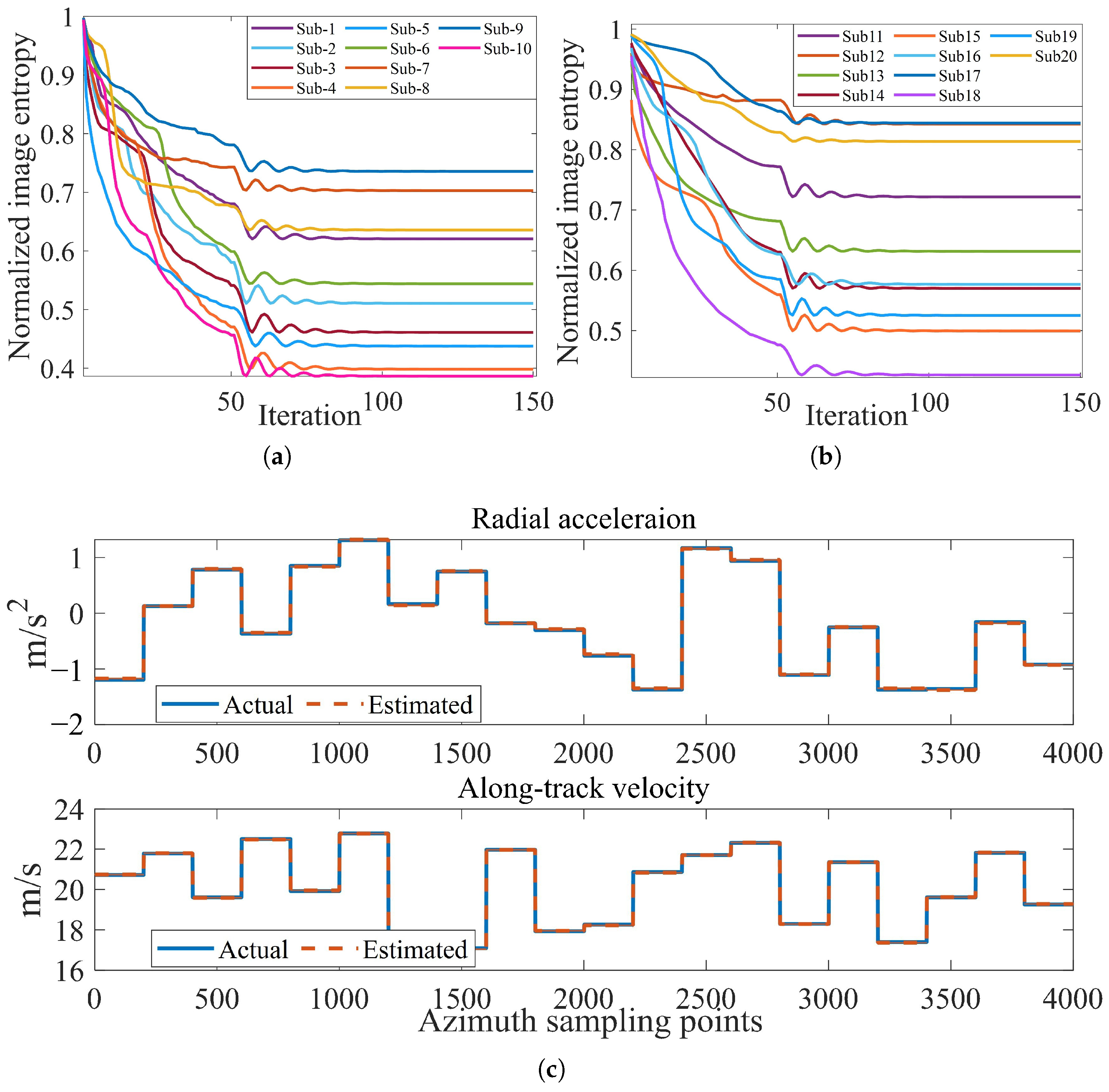
To address the low-frequency trajectory deviations in THz-SAR imaging, this section presents a comprehensive parameter estimation framework that operates in conjunction with the previously described vibration compensation. The overall approach comprises two synergistic components: sub-aperture trajectory parameterization based on Doppler characteristics, followed by a PSO-MGD hybrid optimization for precise motion parameter estimation.
3.3.1. Sub-Aperture Trajectory Deviation Parameterization Based on Doppler Rate
The Doppler modulation rate
can be obtained by taking the second derivative of the compensated phase expression
:
Here,
is defined as the radial acceleration;
describes the along-track velocity. When the sub-aperture length satisfies Equation (
17),
and
can be regarded as constants, and thus the Doppler rate within a single sub-aperture is treated as constant [
19]:
where
is the max pulse number within one subaperture,
is the range resolution, and
is the azimuth velocity within
k-th subaperture. Therefore, a matching filter
is designed for the
k-th sub-aperture based on the Doppler rate
:
where
,
, and
refer to the along-track velocity, radial acceleration, and azimuth time within the
k-th sub-aperture, respectively. Perform the azimuth Fourier transform on the subaperture signal.
If
and
are accurately estimated,
will be a focused signal for a point target:
Therefore, the degree of the k-th sub-image focusing can be used as a standard for evaluating the estimation accuracy of the motion parameter .
3.3.2. Parametric Optimization Algorithm with a Hybrid Optimizer
For the estimation of motion parameters
and
, the optimization objective function is constructed based on image entropy:
Here, z and denote the total number of scatters and the amplitude of the i-th scatter in the k-th sub-image, respectively; is the total image energy.
The optimization problem for estimating motion parameters
is modeled as follows:
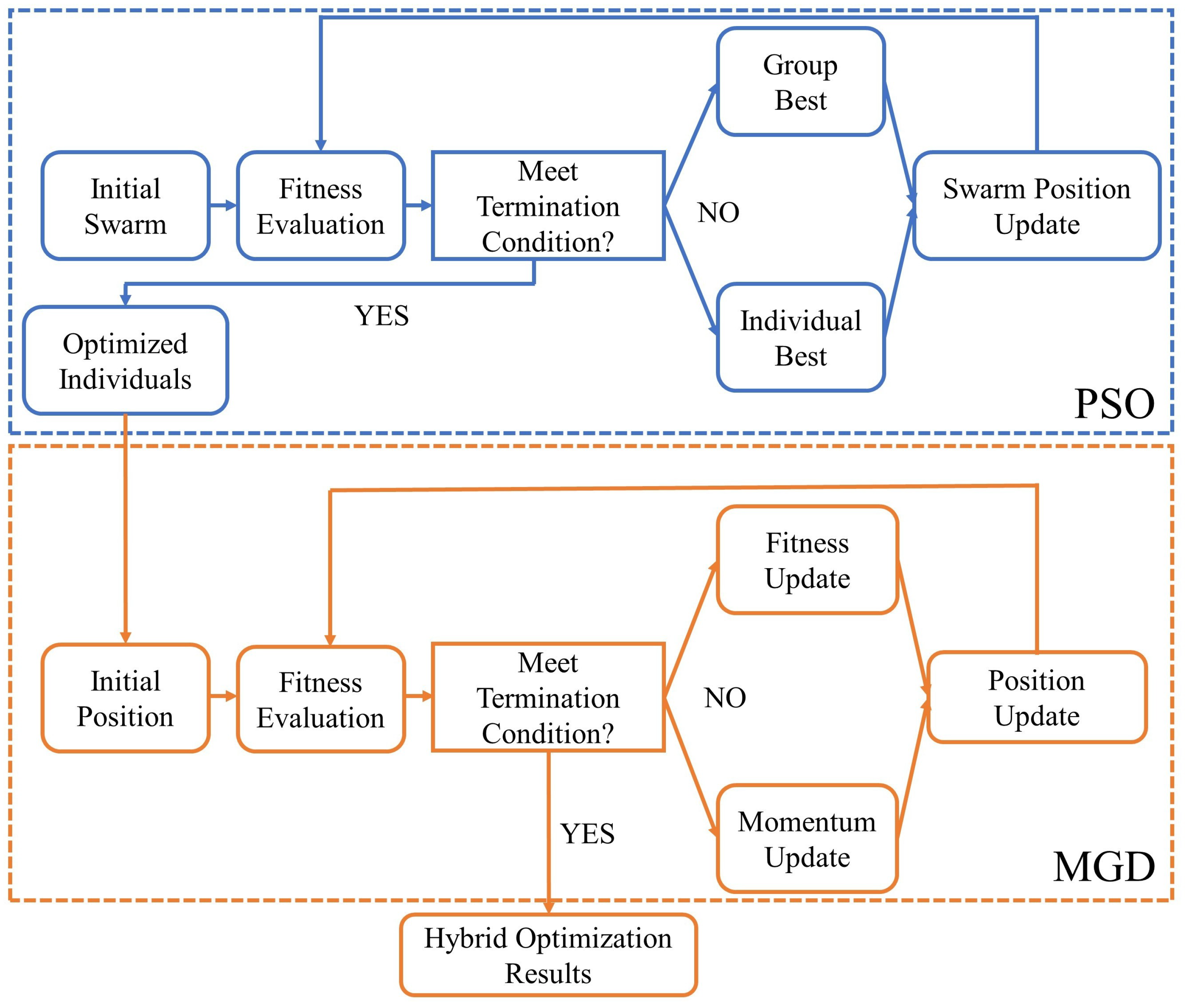
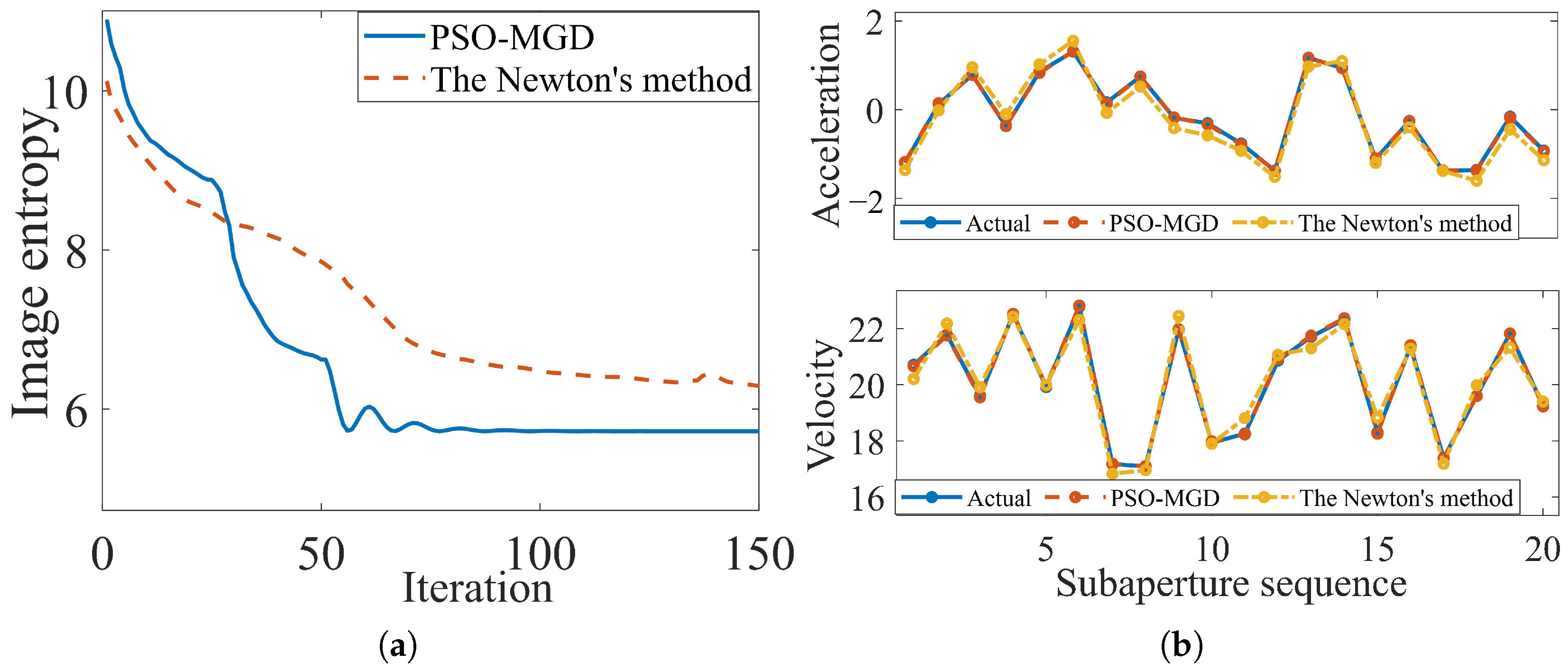
The PSO is a heuristic algorithm that utilizes swarm intelligence to provide a global search capability by sharing historical and group optimum information [
50]. The MGD enhances conventional gradient descent with an inertia term, offering accelerated convergence and stable first-order optimization without Hessian computation [
51]. As illustrated in
Figure 4, the hybrid PSO-MGD optimizer combines the global guidance of PSO with the rapid convergence of MGD for efficient and robust optimization.
Firstly, the initial positions of the particles are uniformly generated within the
motion parameter grid. The motion parameters are preliminary optimized by the PSO algorithm, with the following updates:
where
h,
,
,
, and
refer to the number of iterations, inertia weight, personal learning factor (weighting the cognitive component
), global learning factor (weighting the social component
), and balanced factor, respectively.
Moreover, to prevent premature convergence in PSO, we employ a dynamic inertia weight strategy where
decreases linearly from 0.9 to 0.4 during iterations, and implement a diversity preservation mechanism that applies random position perturbations to 85% of the particles while preserving the top 15% when population diversity falls below a threshold
.
where
is the position vector of the
i-th particle,
is the current global best position, and
and
define the dynamic range of the swarm’s positions at the current state.
The switching from PSO to MGD occurs when either of the following criteria is met: (1) the maximum PSO iteration count
is reached, or (2) the relative improvement in the global best fitness falls below
for ten consecutive iterations, indicating convergence stagnation. The output from the PSO optimizer is fed into the MGD as its initial state to refine the solution further.
where
l,
, and
refer to the number of MGD iterations, momentum coefficient, and learning rate, respectively. The final estimated motion parameter
is determined by the population position with the minimum value of the fitness function.
After traversing all subapertures, the radar platform’s motion is reconstructed using estimated motion parameters and extracted vibration components.
Using the reconstructed slant range with the compressed echo in the Back-Projection Algorithm (BPA) produces a well-focused SAR image.
where
M is the total number of sampling points,
is the pixel intensity at target position
,
is
m-th the azimuth sampling points,
represents the
m-th compressed signal sampled at
,
is the distance between the target
and radar at the
m-th pulse, and
is an optional beam mask that retains only contributions within the radar beam.