Semi-Supervised Black-Soil Area Detection on the Qinghai–Tibetan Plateau


Highlights
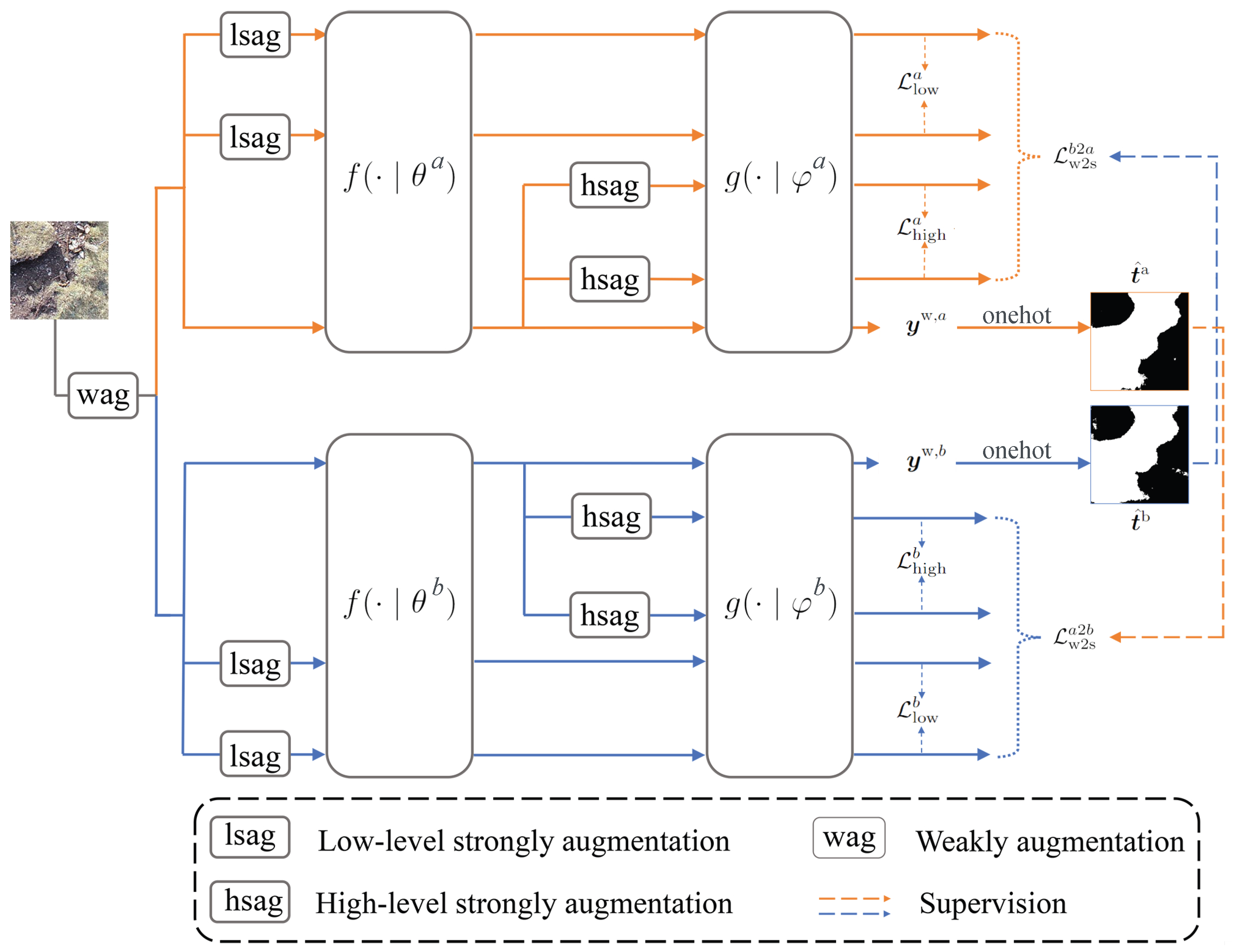
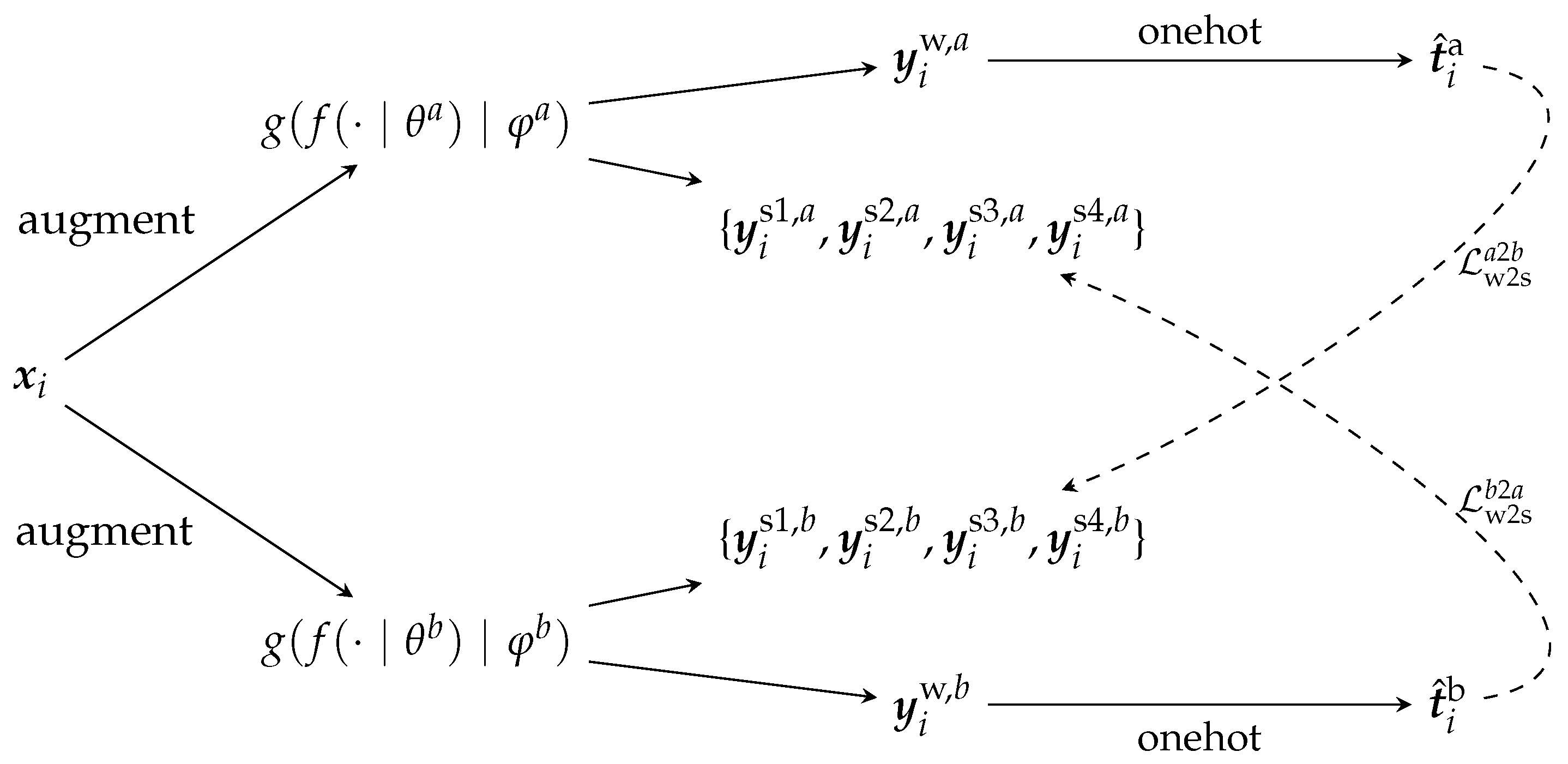
- We propose a novel semi-supervised framework (SBLS) for black-soil area detection, which employs two non-shared dual branches with identical architectures. These branches perform mutual learning through cross-branch weak-to-strong pseudo supervision, effectively improving pseudolabel reliability and model generalization.
- We introduce a cross-branch weak-to-strong pseudo-supervision strategy, where pseudolabels generated from weakly augmented views guide the training of multiple strongly augmented counterparts. This strategy, coupled with high-confidence filtering, enhances training stability and robustness.
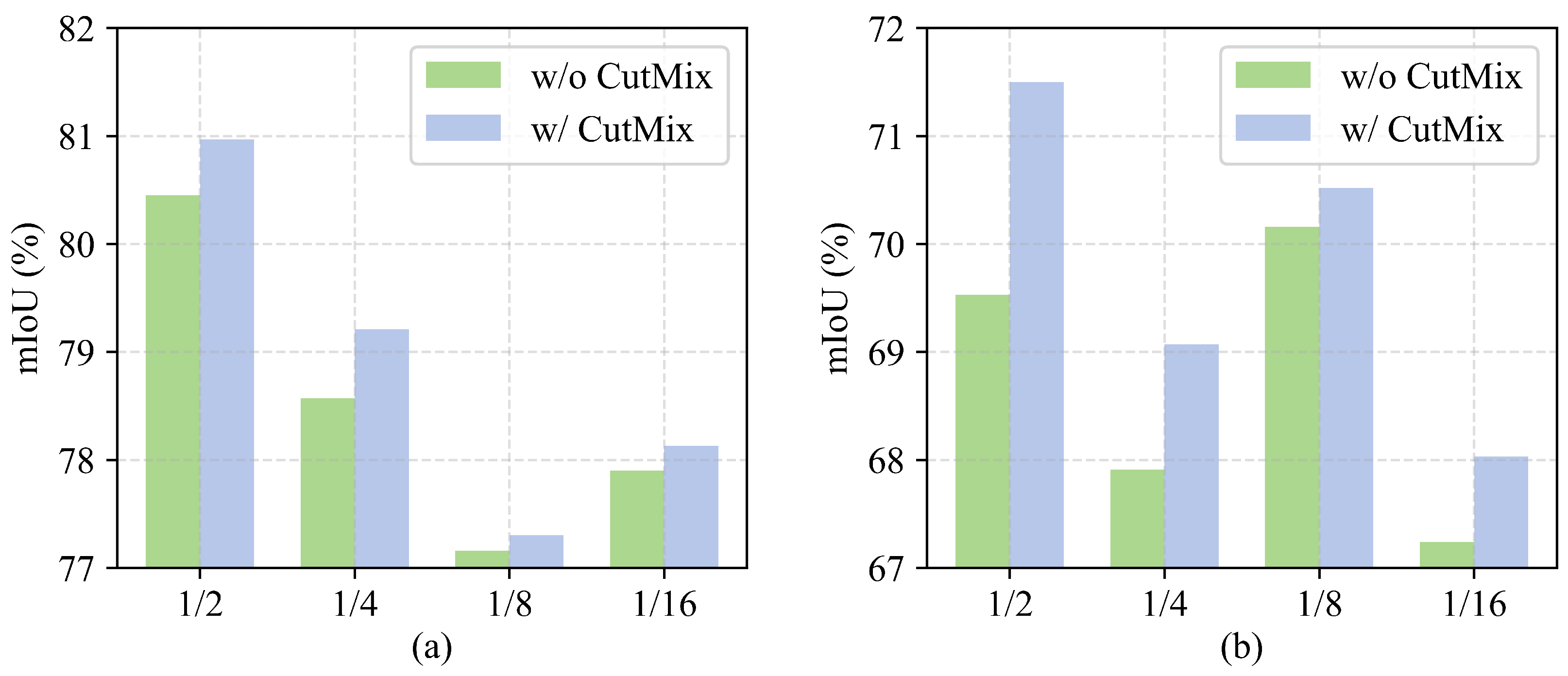
- We design a dual-level contrastive learning mechanism that integrates different contrastive objectives across two feature levels. To further encourage complementary representation learning between branches, we apply two distinct block-wise mixing augmentations to each pair of strongly augmented images. This design increases feature diversity and enables each branch to provide richer supervision for the other.
Abstract
1. Introduction
- We propose a novel semi-supervised framework (SBLS) for black-soil area detection, which employs two non-shared sub-nets with identical architectures. These networks perform mutual learning through cross-branch weak-to-strong pseudo supervision, effectively enhancing pseudolabel reliability and model generalization.
- We introduce a cross-branch weak-to-strong pseudo supervision strategy, where pseudolabels from weakly augmented views supervise multiple strongly augmented counterparts. A weak-to-strong pseudo supervision strategy, guided by high-confidence filtering, improves training stability and robustness.
- We develop a dual-level contrastive learning mechanism that combines different contrastive loss in dual-level feature spaces. To further encourage complementary representation learning between views, we apply two distinct block-wise mixing augmentations to each pair of strongly augmented images. This design increases feature diversity across views, helping each sub-net provide more informative supervision for the other.
2. Related Work
3. Method
3.1. Cross-Branch Weak-to-Strong Pseudo Supervision
3.2. Dual-Level Constrative Learning
3.3. Overall Supervision for SBLS
| Algorithm 1 The SBLS Algorithm. | |
| |
| |
| |
| |
| |
| |
| ▹ Weak augmentation for both branches |
| |
| |
| |
| |
| ▹ Generate pseudolabels ; |
| |
| ▹ Strong augmentations (low-level) |
| |
| |
| |
| ▹ Strong augmentations (high-level) |
| |
| |
| |
| ▹ Confidence masking |
| |
| |
| ▹ on labeled data |
| ▹ cross-branch pseudo supervision |
| ▹ dual-level contrastive |
| |
| |
| |
| |
4. Experiments
4.1. Experimental Setting
4.2. Experimental Results
4.3. Ablation Study
5. Discussion
6. Conclusions
Author Contributions
Funding
Data Availability Statement
Conflicts of Interest
References
- Cao, J.; Adamowski, J.F.; Deo, R.C.; Xu, X.; Gong, Y.; Feng, Q. Grassland Degradation on the Qinghai-Tibetan Plateau: Reevaluation of Causative Factors. Rangel. Ecol. Manag. 2019, 72, 988–995. [Google Scholar] [CrossRef]
- Shang, Z.; Dong, Q.; Shi, J.; Zhou, H.; Dong, S.; Shao, X.; Li, S.; Wang, Y.; Ma, Y.; Ding, L.; et al. Research progress in recent ten years of ecological restoration for ‘Black Soil Land’ degraded grassland on Tibetan Plateau: Concurrently discuss of ecological restoration in Sangjiangyuan region. Acta Agrestia Sin. 2018, 26, 1. [Google Scholar]
- Daily, G.C. Restoring value to the world’s degraded lands. Science 1995, 269, 350–354. [Google Scholar] [CrossRef]
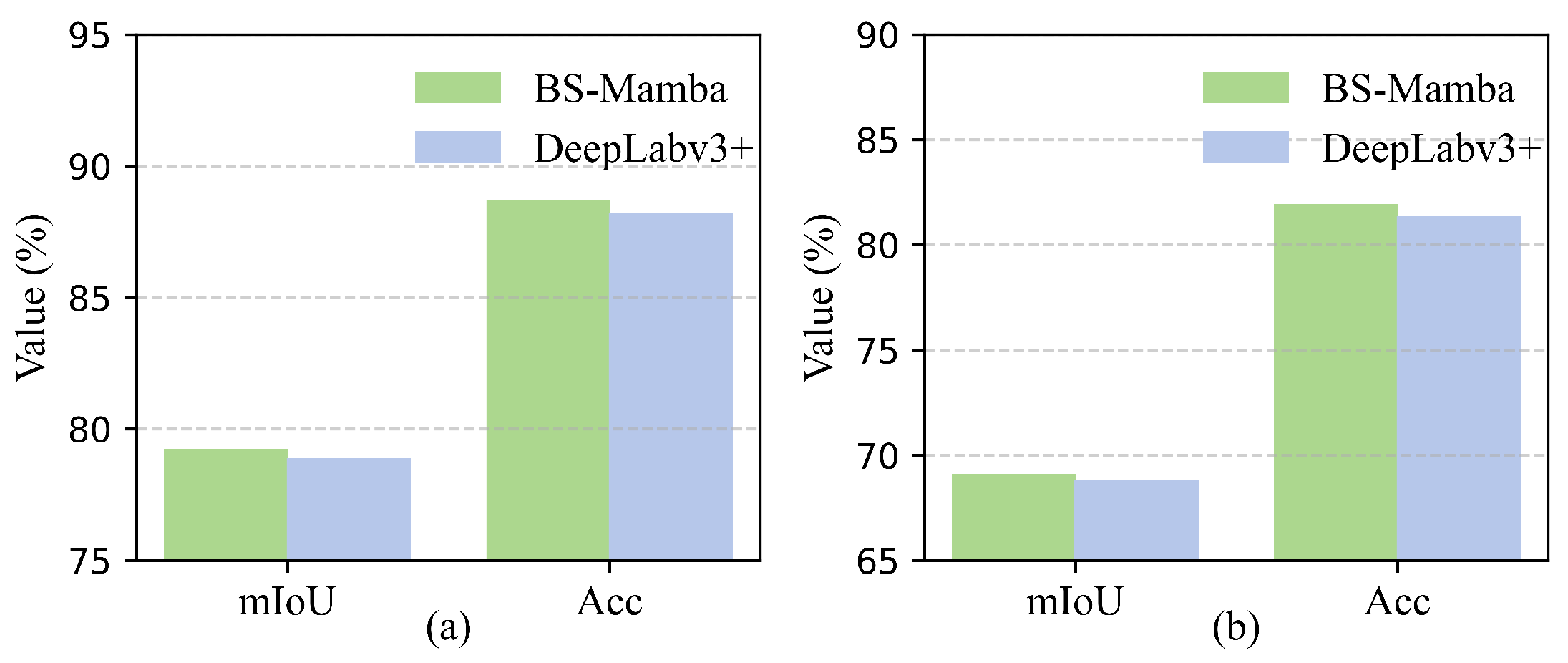
- Ma, X.; Lv, Z.; Ma, C.; Zhang, T.; Xin, Y.; Zhan, K. BS-Mamba for black-soil area detection on the Qinghai-Tibetan plateau. J. Appl. Remote Sens. 2025, 19, 028502. [Google Scholar] [CrossRef]
- Sohn, K.; Berthelot, D.; Carlini, N.; Zhang, Z.; Zhang, H.; Raffel, C.A.; Cubuk, E.D.; Kurakin, A.; Li, C.L. FixMatch: Simplifying semi-supervised learning with consistency and confidence. In Proceedings of the 34th Conference on Neural Information Processing Systems (NeurIPS 2020), Virtual, 6–12 December 2020; Volume 33, pp. 596–608. [Google Scholar]
- Yang, L.; Qi, L.; Feng, L.; Zhang, W.; Shi, Y. Revisiting weak-to-strong consistency in semi-supervised semantic segmentation. In Proceedings of the IEEE/CVF Conference on Computer Vision and Pattern Recognition (CVPR), Vancouver, Canada, 18–22 June 2023; pp. 7236–7246. [Google Scholar]
- Lu, X.; Jiao, L.; Li, L.; Liu, F.; Liu, X.; Yang, S.; Feng, Z.; Chen, P. Weak-to-strong consistency learning for semisupervised image segmentation. IEEE Trans. Geosci. Remote Sens. 2023, 61, 3272552. [Google Scholar] [CrossRef]
- Huang, W.; Shi, Y.; Xiong, Z.; Zhu, X.X. AdaptMatch: Adaptive matching for semisupervised binary segmentation of remote sensing images. IEEE Trans. Geosci. Remote Sens. 2023, 61, 3332490. [Google Scholar] [CrossRef]
- Sun, B.; Yang, Y.; Zhang, L.; Cheng, M.M.; Hou, Q. CorrMatch: Label Propagation via Correlation Matching for Semi-Supervised Semantic Segmentation. In Proceedings of the IEEE/CVF Conference on Computer Vision and Pattern Recognition (CVPR), Seattle, WA, USA, 16–22 June 2024; pp. 3097–3107. [Google Scholar]
- Yun, S.; Han, D.; Oh, S.J.; Chun, S.; Choe, J.; Yoo, Y. CutMix: Regularization strategy to train strong classifiers with localizable features. In Proceedings of the IEEE/CVF International Conference on Computer Vision (ICCV), Seoul, Republic of Korea, 27 October–2 November 2019; pp. 6023–6032. [Google Scholar]
- Shang, Z.; Ma, Y.; Long, R.; Ding, L. Effect of fencing, artificial seeding and abandonment on vegetation composition and dynamics of ‘black soil land’ in the headwaters of the Yangtze and the Yellow rivers of the Qinghai-Tibetan plateau. Land Degrad. Dev. 2008, 19, 554–563. [Google Scholar] [CrossRef]
- Peláez-Vegas, A.; Mesejo, P.; Luengo, J. A survey on semi-supervised semantic segmentation. arXiv 2023, arXiv:2302.09899. [Google Scholar] [CrossRef]
- Lee, D.H. Pseudo-label: The simple and efficient semi-supervised learning method for deep neural networks. In Proceedings of the ICML 2013 Workshop: Challenges in Representation Learning (WREPL), Atlanta, GA, USA, 21 June 2013; Volume 3, p. 896. [Google Scholar]
- Cascante-Bonilla, P.; Tan, F.; Qi, Y.; Ordonez, V. Curriculum labeling: Revisiting pseudo-labeling for semi-supervised learning. In Proceedings of the AAAI Conference on Artificial Intelligence, Virtual, 2–9 February 2021; Volume 35, pp. 6912–6920. [Google Scholar]
- Xie, Q.; Luong, M.T.; Hovy, E.; Le, Q.V. Self-training with noisy student improves imagenet classification. In Proceedings of the IEEE/CVF Conference on Computer Vision and Pattern Recognition (CVPR), Seattle, WA, USA, 14–19 June 2020; pp. 10687–10698. [Google Scholar]
- Sajjadi, M.; Javanmardi, M.; Tasdizen, T. Regularization with stochastic transformations and perturbations for deep semi-supervised learning. In Proceedings of the 29th Neural Information Processing Systems (NIPS), Barcelona, Spain, 5–11 December 2016; Volume 29, pp. 1171–1179. [Google Scholar]
- Miyato, T.; Maeda, S.I.; Koyama, M.; Ishii, S. Virtual adversarial training: A regularization method for supervised and semi-supervised learning. IEEE Trans. Pattern Anal. Mach. Intell. 2019, 41, 2858821. [Google Scholar] [CrossRef]
- Tarvainen, A.; Valpola, H. Mean teachers are better role models: Weight-averaged consistency targets improve semi-supervised deep learning results. In Proceedings of the Advances in Neural Information Processing Systems 30 (NIPS 2017), Long Beach, CA, USA, 4–9 December 2017; Volume 30, pp. 1195–1204. [Google Scholar]
- Chen, X.; Yuan, Y.; Zeng, G.; Wang, J. Semi-supervised semantic segmentation with cross pseudo supervision. In Proceedings of the 2021 IEEE/CVF Conference on Computer Vision and Pattern Recognition (CVPR), Nashville, TN, USA, 20–25 June 2021; pp. 2613–2622. [Google Scholar]
- Wang, Z.; Zhao, Z.; Xing, X.; Xu, D.; Kong, X.; Zhou, L. Conflict-based cross-view consistency for semi-supervised semantic segmentation. In Proceedings of the 2023 IEEE/CVF Conference on Computer Vision and Pattern Recognition (CVPR), Vancouver, BC, Canada, 17–24 June 2023; pp. 19585–19595. [Google Scholar]
- Liu, R.; Luo, T.; Huang, S.; Wu, Y.; Jiang, Z.; Zhang, H. CrossMatch: Cross-view matching for semi-supervised remote sensing image segmentation. IEEE Trans. Geosci. Remote Sens. 2024, 62, 3507050. [Google Scholar] [CrossRef]
- Tian, Z.; Zhang, X.; Zhang, P.; Zhan, K. Improving semi-supervised semantic segmentation with dual-level Siamese structure network. In Proceedings of the 31st ACM International Conference on Multimedia, Ottawa, ON, Canada, 29 October–3 November 2023; 2023; pp. 4200–4208. [Google Scholar]
- Guo, R.; Liu, J.; Li, N.; Liu, S.; Chen, F.; Cheng, B.; Duan, J.; Li, X.; Ma, C. Pixel-wise classification method for high resolution remote sensing imagery using deep neural networks. ISPRS Int. J. Geo-Inf. 2018, 7, 110. [Google Scholar] [CrossRef]
- Hossain, M.D.; Chen, D. Segmentation for Object-Based Image Analysis (OBIA): A review of algorithms and challenges from remote sensing perspective. ISPRS J. Photogramm. Remote Sens. 2019, 150, 115–134. [Google Scholar] [CrossRef]
- Zhang, S.; Li, C.; Qiu, S.; Gao, C.; Zhang, F.; Du, Z.; Liu, R. EMMCNN: An ETPS-based multi-scale and multi-feature method using CNN for high spatial resolution image land-cover classification. Remote Sens. 2019, 12, 66. [Google Scholar] [CrossRef]
- Temenos, A.; Temenos, N.; Kaselimi, M.; Doulamis, A.; Doulamis, N. Interpretable deep learning framework for land use and land cover classification in remote sensing using SHAP. IEEE Geosci. Remote Sens. Lett. 2023, 20, 8500105. [Google Scholar] [CrossRef]
- Pei, H.; Owari, T.; Tsuyuki, S.; Zhong, Y. Application of a novel multiscale global graph convolutional neural network to improve the accuracy of forest type classification using aerial photographs. Remote Sens. 2023, 15, 1001. [Google Scholar] [CrossRef]
- Ma, X.; Man, Q.; Yang, X.; Dong, P.; Yang, Z.; Wu, J.; Liu, C. Urban feature extraction within a complex urban area with an improved 3D-CNN using airborne hyperspectral data. Remote Sens. 2023, 15, 992. [Google Scholar] [CrossRef]
- Khan, S.D.; Basalamah, S. Multi-branch deep learning framework for land scene classification in satellite imagery. Remote Sens. 2023, 15, 3408. [Google Scholar] [CrossRef]
- Ansith, S.; Bini, A. Land use classification of high resolution remote sensing images using an encoder based modified GAN architecture. Displays 2022, 74, 102229. [Google Scholar] [CrossRef]
- Ma, A.; Yu, N.; Zheng, Z.; Zhong, Y.; Zhang, L. A supervised progressive growing generative adversarial network for remote sensing image scene classification. IEEE Trans. Geosci. Remote Sens. 2022, 60, 5618818. [Google Scholar] [CrossRef]
- Xu, C.; Shu, J.; Zhu, G. Adversarial remote sensing scene classification based on lie group feature learning. Remote Sens. 2023, 15, 914. [Google Scholar] [CrossRef]
- Wang, J.; Liu, B.; Zhou, Y.; Zhao, J.; Xia, S.; Yang, Y.; Zhang, M.; Ming, L.M. Semisupervised multiscale generative adversarial network for semantic segmentation of remote sensing image. IEEE Geosci. Remote Sens. Lett. 2020, 19, 8003805. [Google Scholar] [CrossRef]
- Ma, A.; Filippi, A.M.; Wang, Z.; Yin, Z. Hyperspectral image classification using similarity measurements-based deep recurrent neural networks. Remote Sens. 2019, 11, 194. [Google Scholar] [CrossRef]
- Tang, Y.; Qiu, F.; Wang, B.; Wu, D.; Jing, L.; Sun, Z. A deep relearning method based on the recurrent neural network for land cover classification. GISci. Remote Sens. 2022, 59, 1344–1366. [Google Scholar] [CrossRef]
- Sohail, M.; Chen, Z.; Yang, B.; Liu, G. Multiscale spectral-spatial feature learning for hyperspectral image classification. Displays 2022, 74, 102278. [Google Scholar] [CrossRef]
- Ibanez, D.; Fernandez-Beltran, R.; Pla, F.; Yokoya, N. Masked auto-encoding spectral–spatial transformer for hyperspectral image classification. IEEE Trans. Geosci. Remote Sens. 2022, 60, 5542614. [Google Scholar] [CrossRef]
- Chen, Y.; Jiao, L.; Li, Y.; Zhao, J. Multilayer projective dictionary pair learning and sparse autoencoder for PolSAR image classification. IEEE Trans. Geosci. Remote Sens. 2017, 55, 6683–6694. [Google Scholar] [CrossRef]
- Hjelm, R.D.; Fedorov, A.; Lavoie-Marchildon, S.; Grewal, K.; Bachman, P.; Trischler, A.; Bengio, Y. Learning deep representations by mutual information estimation and maximization. In Proceedings of the 7th International Conference on Learning Representations (ICLR 2019), New Orleans, LA, USA, 6–9 May 2019. [Google Scholar]
- Grill, J.B.; Strub, F.; Altché, F.; Tallec, C.; Richemond, P.; Buchatskaya, E.; Doersch, C.; Avila Pires, B.; Guo, Z.; Gheshlaghi Azar, M.; et al. Bootstrap your own latent-a new approach to self-supervised learning. NeurIPS 2020, 33, 21271–21284. [Google Scholar]
- Zhang, Y.; Wu, X.; Li, X.; Zhang, F.; Dong, X.; Wang, Y.; Zhang, H. Identification of Degraded Grassland in Qinghai Area of Yellow River Source Based on High-resolution Images. Acta Agric. Boreali-Occident. Sin. 2023, 32, 198–211. [Google Scholar]
- Shang, Z.; Long, R.; Ma, Y.; Ding, L. Spatial Heterogeneity and Similarity of Adult Plants and Seedlings in ‘Black Soil Land’ Secondary Weed Community, Qinghai-Tibetan Plateau. J. Plant Ecol. 2008, 32, 1157–1165. [Google Scholar]
- Guo, Z.G.; Zhou, X.R.; Hou, Y. Effect of available burrow densities of plateau pika (Ochotona curzoniae) on soil physicochemical property of the bare land and vegetation land in the Qinghai-Tibetan Plateau. Acta Ecol. Sin. 2012, 32, 104–110. [Google Scholar] [CrossRef]





| Methods | 1/2 | 1/4 | 1/8 | 1/16 | ||||
|---|---|---|---|---|---|---|---|---|
| mIoU | Acc | mIoU | Acc | mIoU | Acc | mIoU | Acc | |
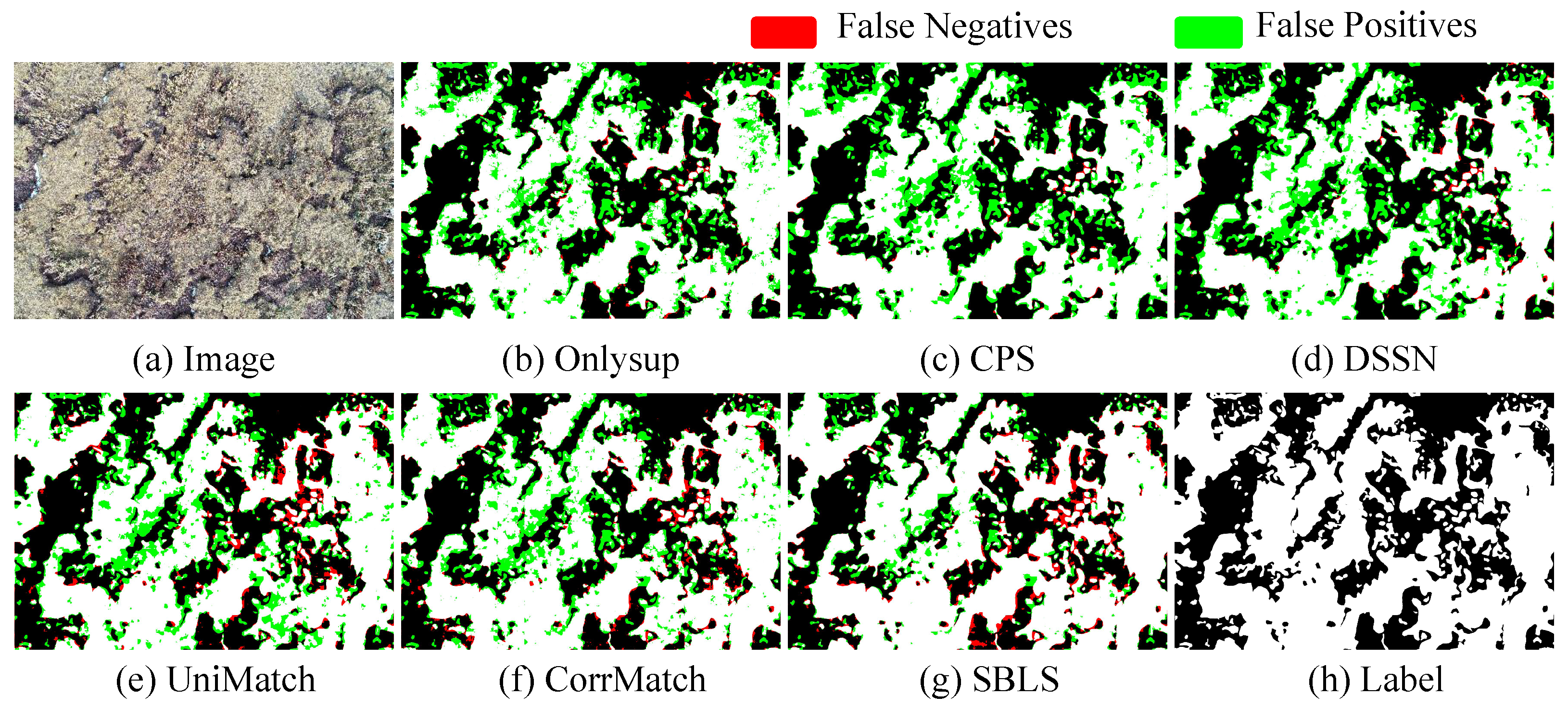
| Onlysup | 80.61 | 89.66 | 77.50 | 88.42 | 75.82 | 87.71 | 75.78 | 87.37 |
| CPS [19] | 73.17 | 86.57 | 71.92 | 85.84 | 71.34 | 85.36 | 67.07 | 83.17 |
| CCVC [20] | 76.13 | 87.37 | 73.85 | 86.54 | 75.60 | 87.83 | 74.65 | 86.06 |
| DSSN [22] | 79.17 | 88.76 | 77.30 | 87.74 | 74.22 | 86.95 | 74.68 | 86.58 |
| UniMatch [6] | 80.16 | 89.48 | 77.46 | 87.90 | 76.38 | 87.96 | 76.85 | 87.77 |
| CorrMatch [9] | 79.98 | 88.99 | 77.38 | 88.32 | 74.48 | 87.18 | 76.99 | 88.23 |
| SBLS (ours) | 80.97 | 89.73 | 79.21 | 88.66 | 77.30 | 87.32 | 78.13 | 87.92 |
| Methods | 1/2 | 1/4 | 1/8 | 1/16 | ||||
|---|---|---|---|---|---|---|---|---|
| mIoU | Acc | mIoU | Acc | mIoU | Acc | mIoU | Acc | |
| Onlysup | 64.25 | 77.85 | 63.89 | 77.66 | 63.03 | 76.50 | 58.74 | 74.67 |
| CPS [19] | 64.70 | 77.55 | 67.29 | 79.60 | 59.33 | 73.63 | 61.37 | 75.11 |
| CCVC [20] | 65.92 | 78.74 | 66.83 | 80.96 | 65.32 | 78.28 | 64.16 | 78.68 |
| DSSN [22] | 68.19 | 81.60 | 64.93 | 79.86 | 69.93 | 82.16 | 59.39 | 75.85 |
| UniMatch [6] | 70.87 | 83.23 | 65.31 | 80.23 | 65.50 | 78.39 | 67.32 | 80.62 |
| CorrMatch [9] | 70.25 | 82.16 | 66.38 | 78.92 | 63.40 | 76.65 | 67.07 | 79.47 |
| SBLS (ours) | 71.50 | 83.98 | 69.07 | 81.90 | 70.52 | 83.13 | 68.03 | 81.55 |
| (a) The first test set | ||
|---|---|---|
| mIoU | ||
| ✗ | ✗ | 77.75 |
| ✗ | ✓ | 79.13 |
| ✓ | ✗ | 78.80 |
| ✓ | ✓ | 79.21 |
| (b) The secondary test set | ||
| mIoU | ||
| ✗ | ✗ | 67.43 |
| ✗ | ✓ | 67.98 |
| ✓ | ✗ | 68.82 |
| ✓ | ✓ | 69.07 |
Disclaimer/Publisher’s Note: The statements, opinions and data contained in all publications are solely those of the individual author(s) and contributor(s) and not of MDPI and/or the editor(s). MDPI and/or the editor(s) disclaim responsibility for any injury to people or property resulting from any ideas, methods, instructions or products referred to in the content. |
© 2025 by the authors. Licensee MDPI, Basel, Switzerland. This article is an open access article distributed under the terms and conditions of the Creative Commons Attribution (CC BY) license (https://creativecommons.org/licenses/by/4.0/).
Share and Cite
Min, Y.; Ma, C.; Ma, X.; Lv, Z. Semi-Supervised Black-Soil Area Detection on the Qinghai–Tibetan Plateau. Remote Sens. 2025, 17, 3977. https://doi.org/10.3390/rs17243977
Min Y, Ma C, Ma X, Lv Z. Semi-Supervised Black-Soil Area Detection on the Qinghai–Tibetan Plateau. Remote Sensing. 2025; 17(24):3977. https://doi.org/10.3390/rs17243977
Chicago/Turabian StyleMin, Yufang, Chengcai Ma, Xuan Ma, and Zewen Lv. 2025. "Semi-Supervised Black-Soil Area Detection on the Qinghai–Tibetan Plateau" Remote Sensing 17, no. 24: 3977. https://doi.org/10.3390/rs17243977
APA StyleMin, Y., Ma, C., Ma, X., & Lv, Z. (2025). Semi-Supervised Black-Soil Area Detection on the Qinghai–Tibetan Plateau. Remote Sensing, 17(24), 3977. https://doi.org/10.3390/rs17243977