MAF-GAN: A Multi-Attention Fusion Generative Adversarial Network for Remote Sensing Image Super-Resolution



Highlights
- We propose a novel Multi-Attention Fusion Generative Adversarial Network (MAF-GAN) that integrates oriented convolution, multi-dimensional attention mechanisms, and dynamic feature fusion to significantly enhance the reconstruction of directional structures and fine textures in remote sensing imagery.
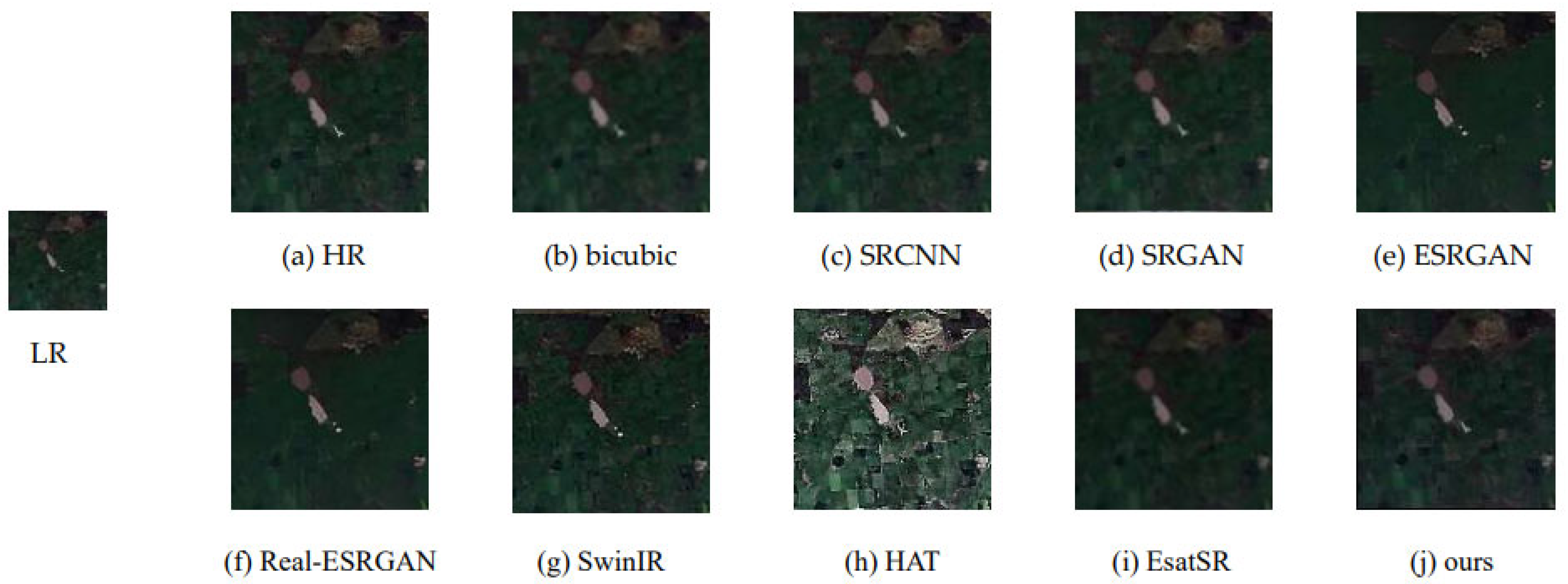
- Extensive experiments demonstrate that MAF-GAN achieves state-of-the-art performance on the GF7-SR4×-MSD dataset, with a PSNR of 27.14 dB and SSIM of 0.7206, outperforming existing mainstream models while maintaining a favorable balance between reconstruction quality and inference efficiency.
- The proposed model provides a reliable and efficient technical pathway for generating high-resolution remote sensing images with clearer spatial structures and more natural spectral characteristics, supporting high-precision applications such as urban planning and environmental monitoring.
- The introduced modular design, including oriented convolution, multi-attention fusion, and a composite loss function, offers a flexible and extensible framework that can inspire future research in specialized super-resolution tasks for remote sensing and other geospatial image processing domains.
Abstract
1. Introduction
2. Methods
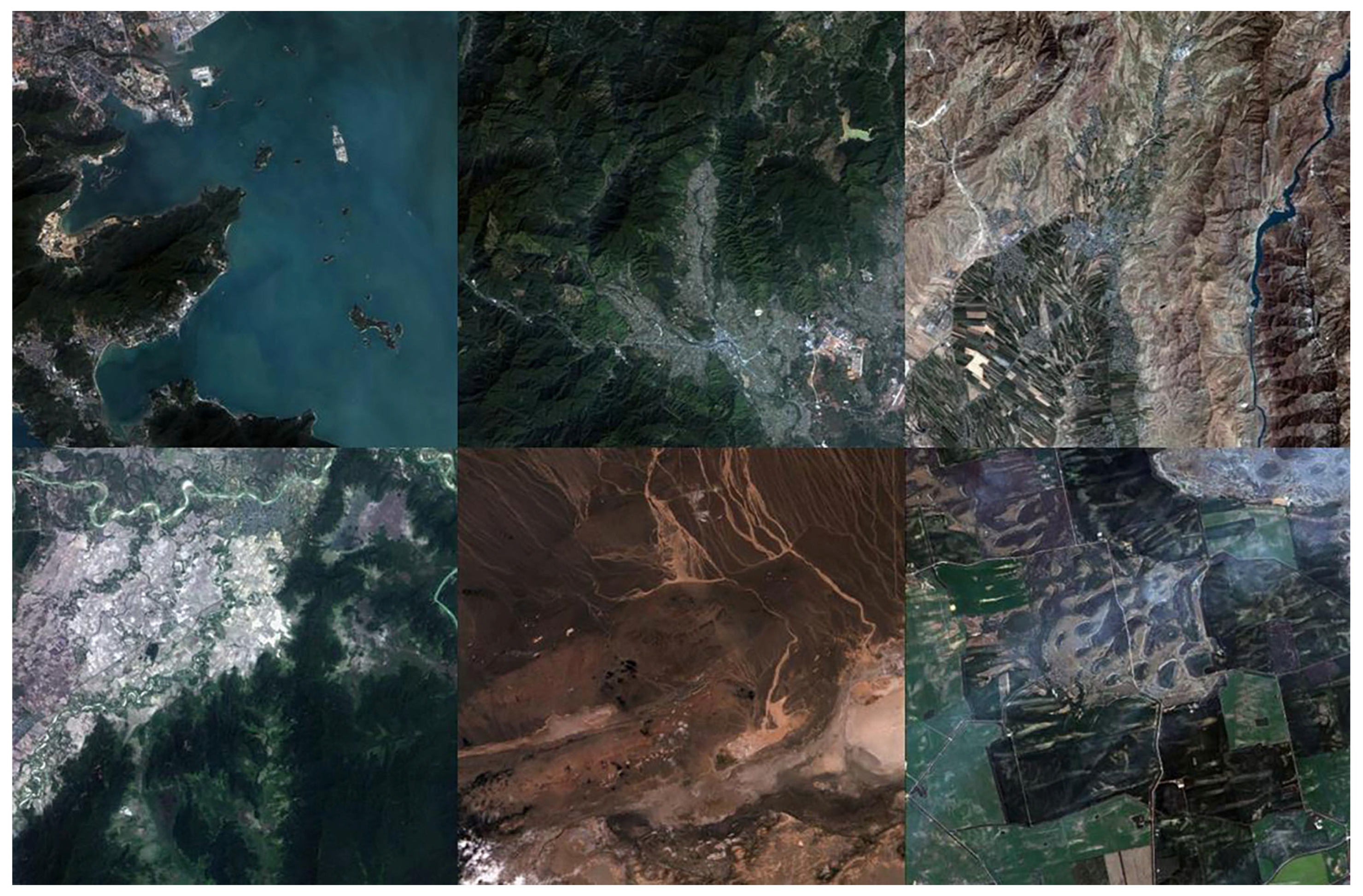
2.1. Dataset
- Training Set: 5832 pairs (80% of the total data) for model parameter learning.
- Validation Set: 1096 pairs (15%) for hyperparameter tuning and model selection.
- Test Set: 368 pairs (5%) for the final, impartial assessment of model performance.
2.2. MAF-GAN Network Architecture
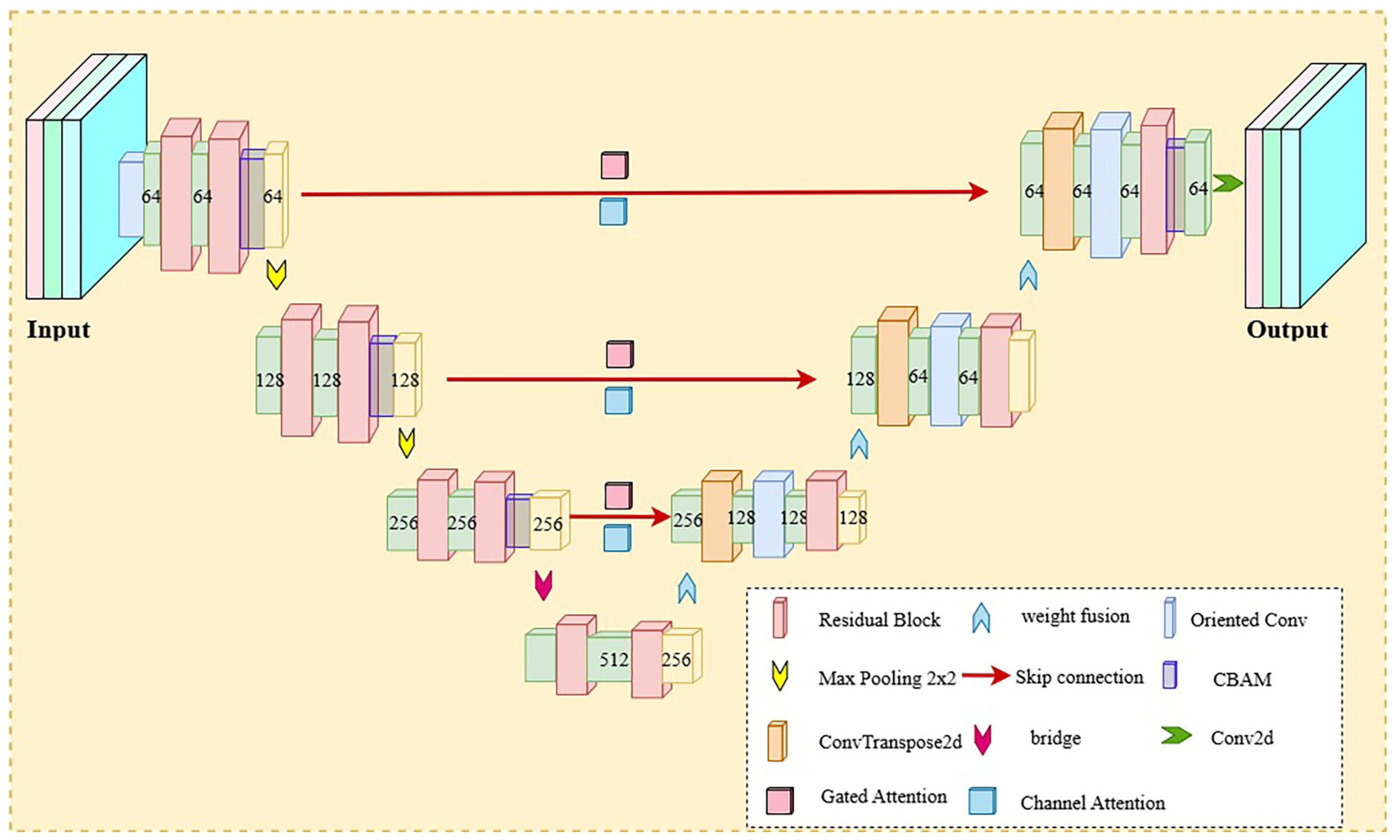
2.2.1. Generator: Enhanced U-Net Design
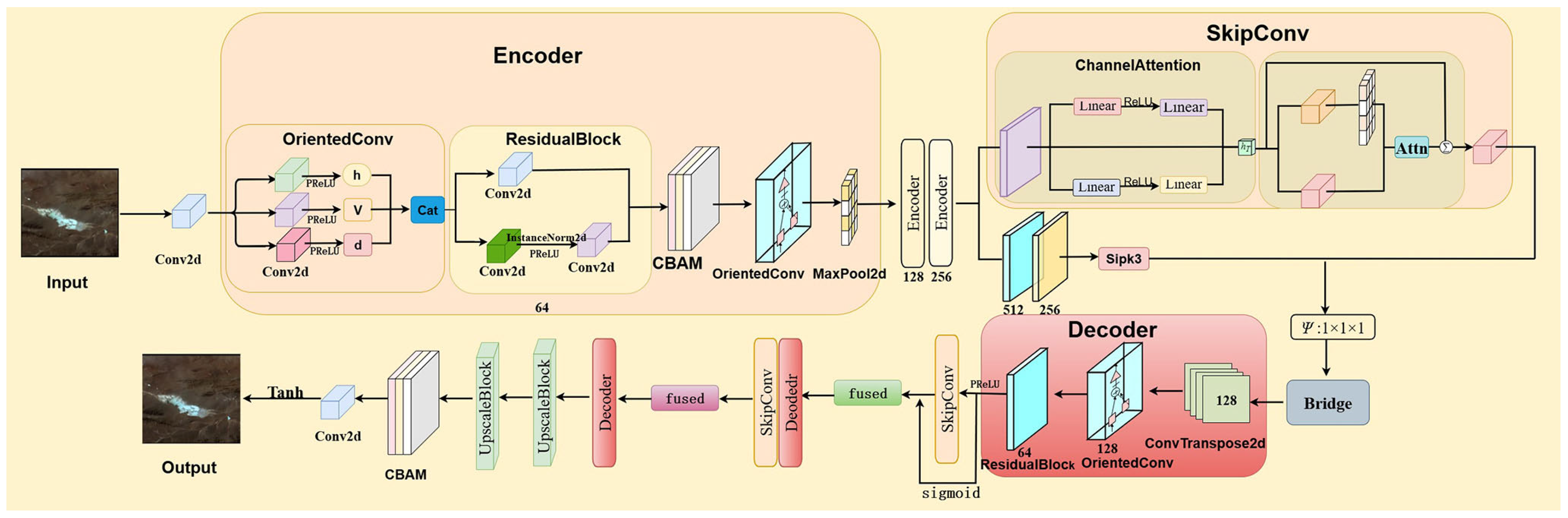
- Oriented Convolution Module: To directly enhance the model’s capability for reconstructing anisotropic features, we introduce the Oriented Convolution Module. This module moves beyond the isotropic filtering of standard convolutions by decomposing the feature extraction process into three orientation-specific pathways: horizontal (3 × 1 kernel), vertical (1 × 3 kernel), and diagonal (3 × 3 kernel). This targeted approach ensures that fine linear structures are amplified and preserved without being diluted by responses from irrelevant directions. A key innovation is our adaptive channel allocation strategy, which dynamically configures the network’s representational resources. Recognizing that horizontal and vertical edges are predominant in man-made and natural landscapes, we prioritize them by allocating max(1, out_channels//4) channels to each, granting them sufficient capacity. The diagonal branch, serving as a complementary capture for complex contours, utilizes the remainder. Learnable non-linearity via PReLU is incorporated per branch for refined feature transformation. The concatenation of these specialized outputs yields a powerful, direction-enriched feature set that is critical for high-fidelity reconstruction of geometric details.
- Multi-Attention Mechanism: A coordinated attention system refines features through the following components:Channel Attention: An enhanced variant of the Squeeze-and-Excitation network combines global average and max pooling. The resulting features are processed by a two-layer MLP with a reduction ratio of 8, generating channel-wise weights that emphasize semantically important features.Gated Attention: This module enables cross-scale feature interaction via theta (feature transformation) and phi (context extraction) branches. A sigmoid gating mechanism dynamically calibrates spatial relevance, while residual connections help maintain gradient stability.Spectral Attention: Designed specifically for multispectral data, this module captures inter-band correlations essential for color fidelity. Dimensional stability is ensured by setting the internal reduction channel to max(1, channels//reduction).
- Residual Block with Instance Normalization: Each block contains two convolutional layers, each followed by Instance Normalization and PReLU activation. Adaptive shortcut connections (using 1 × 1 convolution when channel dimensions differ, otherwise identity) enable complex transformations while preserving gradient flow.
- Convolutional Block Attention Module (CBAM): This hybrid attention mechanism sequentially applies channel and spatial attention. The channel sub-module processes both average- and max-pooled features through a shared MLP. The spatial sub-module applies a 7 × 7 convolution to concatenated spatial features.
- Upscale Block with Pixel Shuffle: This block efficiently increases resolution through channel expansion (by 4×) followed by the PixelShuffle operation for 2× upsampling. Subsequent OrientedConv and Residual Block layers refine the upscaled features, preserving directional sensitivity.
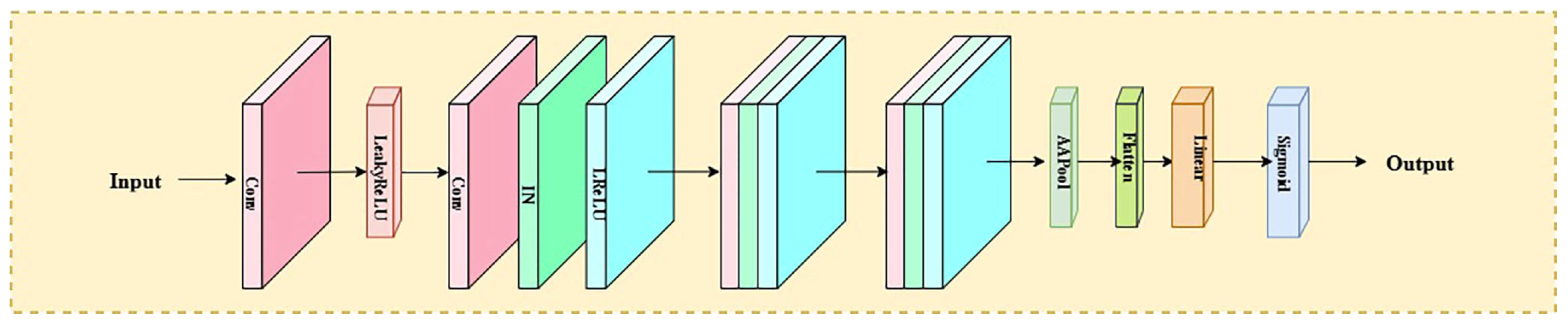
2.2.2. Discriminator: Multi-Scale PatchGAN Design
2.3. Composite Loss Function
- Adversarial Loss [37]: This loss term leverages a relativistic discriminator [37] to narrow the distribution gap between super-resolved images and real high-resolution (HR) images. By guiding the generator to produce outputs that are perceptually indistinguishable from genuine remote sensing data, it effectively addresses the over-smoothing issue common in pixel-wise optimization methods. The core goal is to enhance the visual authenticity of textures and details in reconstructed images, making them more consistent with the natural characteristics of remote sensing scenes. Its mathematical expression is:
- Perceptual Loss [38]: Calculated in the feature space of a pre-trained VGG-19 network [38], this loss term focuses on maintaining semantic consistency between generated images and reference HR images. It does not directly compare pixel-level differences but instead aligns high-level feature representations, which is critical for preserving the ecological and geometric characteristics unique to remote sensing imagery (e.g., land cover patterns, terrain structures). The formula is defined as:
- Pixel Loss [39]: As the foundation for ensuring reconstruction accuracy, this loss term combines L1 loss and Mean Squared Error (MSE) loss to enforce pixel-level fidelity between reconstructed and reference images. The L1 component ensures stable gradient propagation during training, while the MSE component emphasizes penalizing large pixel errors, jointly guaranteeing that the reconstructed images closely match the ground truth at the intensity level. Its expression is:
- Total Variation Loss (TVL) [40]: Introduced as a regularization term [40], this loss imposes spatial smoothness constraints on the generated images. It suppresses unrealistic high-frequency artifacts and noise by penalizing sudden intensity transitions between adjacent pixels, which is particularly important for remote sensing applications—unnatural pixel transitions can severely compromise the interpretability of fine-scale features such as road edges and field boundaries. The formula is:
- Feature Consistency Loss [41]: As a pivotal innovation in this work, we propose a novel Feature Consistency Loss to tackle feature degradation in deep super-resolution networks. Conventional loss functions typically neglect the integrity of intermediate feature representations during reconstruction, leading to structural incoherence for geometrically complex elements (e.g., building contours, transportation networks) that are crucial for remote sensing analysis. To address this, Lfeat preserves the stability and discriminative capability of intermediate features through a holistic dual-path alignment strategy.
2.4. Implementation Details
2.4.1. Experimental Setup
2.4.2. Evaluation Protocol
3. Results
3.1. Comparative Experiments
- The PSNR is defined as:
- The MSE is defined as:
- The formula for SSIM is:
- The LPIPS metric is designed to quantify the perceptual similarity between two images. Unlike PSNR and SSIM, LPIPS utilizes a pre-trained deep neural network to extract features and compute the distance in that high-level feature space, which has been shown to align better with human visual perception. A lower LPIPS value indicates higher perceptual similarity to the reference image.
- The SAM is a crucial metric in remote sensing that measures the spectral fidelity of the reconstructed image. It calculates the angle between the spectral vectors of the reconstructed and real HR images in the multispectral space. A smaller SAM value (in radians) signifies better preservation of the original spectral information, which is paramount for subsequent remote sensing applications like classification and material identification.
3.1.1. Objective Metrics and Computational Performance
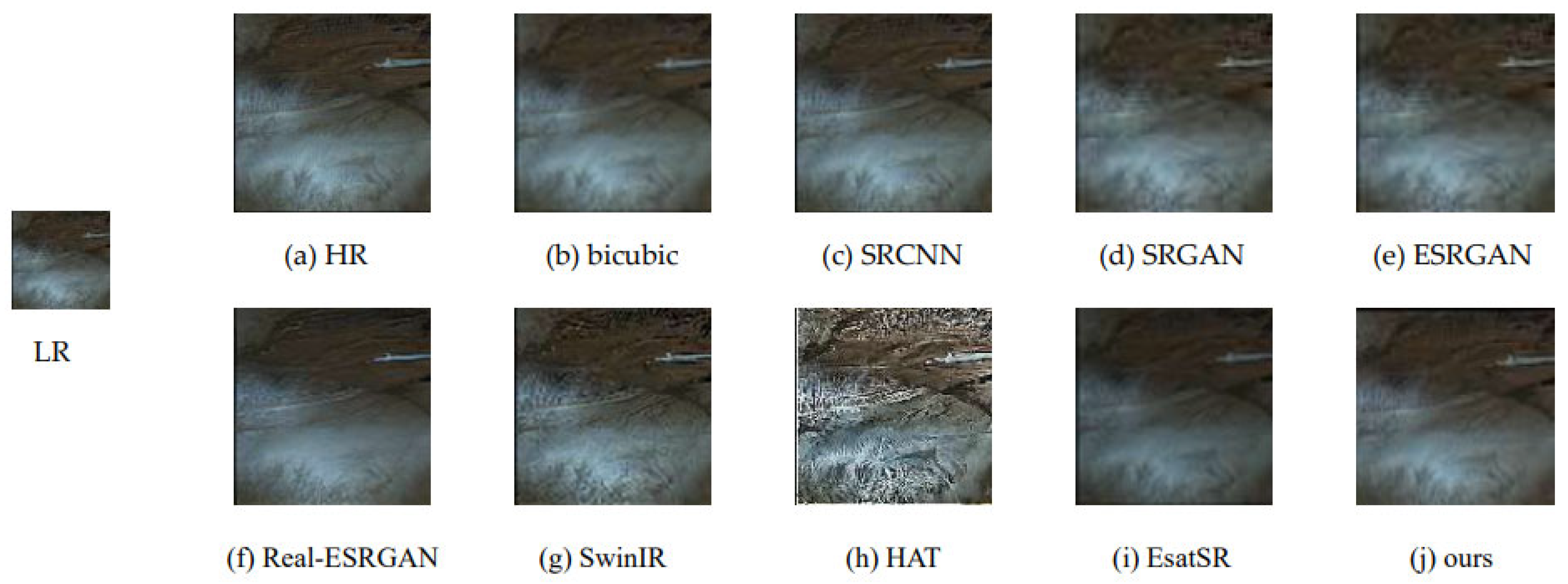
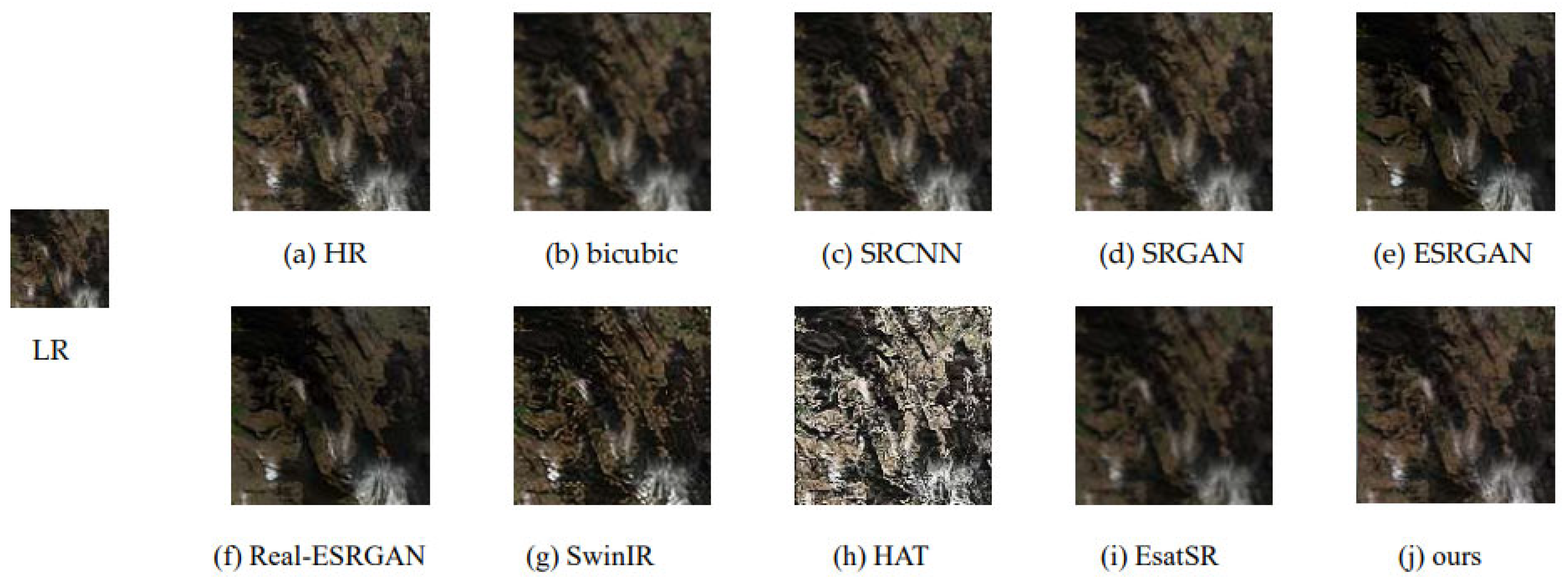
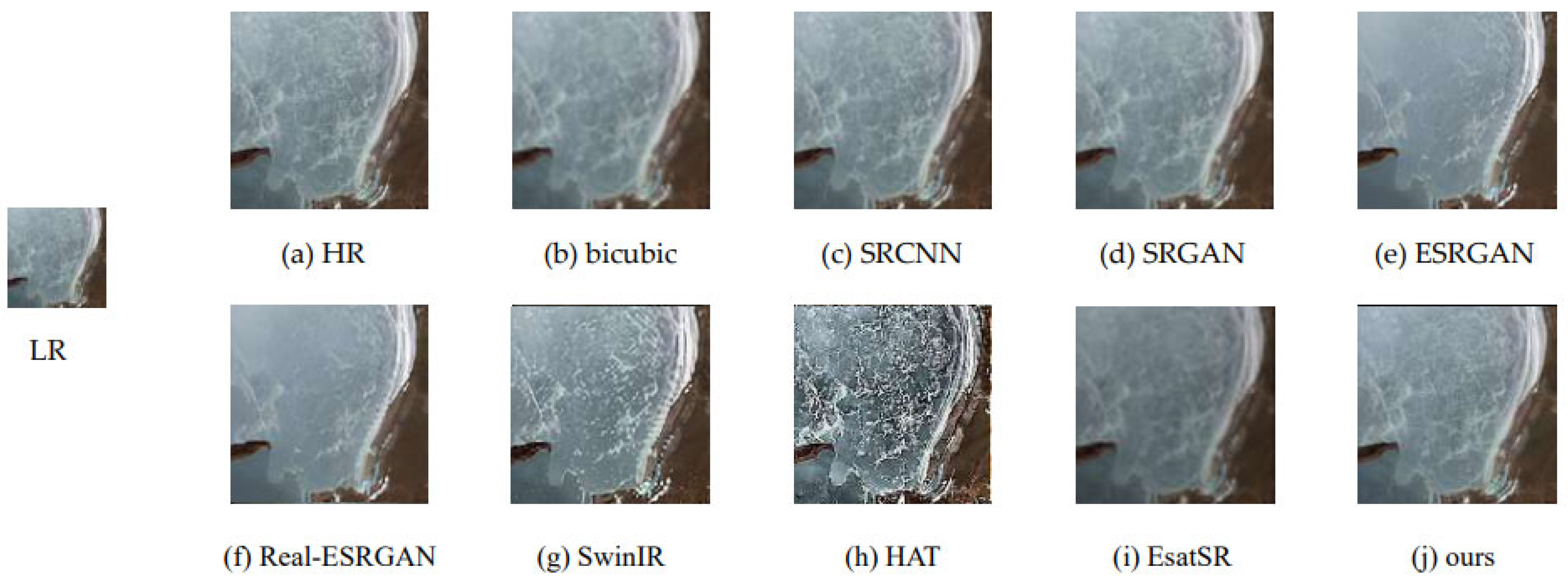
3.1.2. Subjective Perception and Visual Assessment
3.2. Ablation Experiments
3.2.1. Model Experiments
3.2.2. Loss Function Experiments
4. Discussion
4.1. Overall Superiority of MAF-GAN
4.2. Model Component Analysis
4.2.1. Loss Function Experiments
4.2.2. Loss Function Analysis
5. Conclusions
Author Contributions
Funding
Data Availability Statement
Acknowledgments
Conflicts of Interest
Abbreviations
| GAN | Generative Adversarial Network |
| MAF-GAN | Multi-Attention Fusion Generative Adversarial Network |
| SR | Super-Resolution |
| HR | High-Resolution |
| LR | Low-Resolution |
| PSNR | Peak Signal-to-Noise Ratio |
| SSIM | Structural Similarity Index |
| MSE | Mean Squared Error |
| CBAM | Convolutional Block Attention Module |
| CA | Channel Attention |
| GA | Gated Attention |
| SA | Spectral Attention |
| TV Loss | Total Variation Loss |
| FLOPs | Floating Point Operations |
References
- Liang, W.; Liu, Y. CSAN: A Channel–Spatial Attention-Based Network for Meteorological Satellite Image Super-Resolution. Remote Sens. 2025, 17, 2513. [Google Scholar] [CrossRef]
- Zhang, Q.; Zhu, F.; Zhu, B.; Li, P.; Han, Y. A Lightweight Hybrid Neural Network for Remote Sensing Image Super-Resolution Reconstruction. Eng. Appl. Artif. Intell. 2025, 157, 111438. [Google Scholar] [CrossRef]
- Zhan, C.; Wang, C.; Lu, B.; Yang, W.; Zhang, X.; Wang, G. NGSTGAN: N-Gram Swin Transformer and Multi-Attention U-Net Discriminator for Efficient Multi-Spectral Remote Sensing Image Super-Resolution. Remote Sens. 2025, 17, 2079. [Google Scholar] [CrossRef]
- Lu, C.; Su, C. Super Resolution Reconstruction of Mars Thermal Infrared Remote Sensing Images Integrating Multi-Source Data. Remote Sens. 2025, 17, 2115. [Google Scholar] [CrossRef]
- Muhammad, U.; Hoque, M.Z.; Wang, W.; Oussalah, M. Patch-Based Discriminative Learning for Remote Sensing Scene Classification. Remote Sens. 2022, 14, 5913. [Google Scholar] [CrossRef]
- Yan, Z.; Fan, J.; Li, Z.; Xie, Y. Elevating Detection Performance in Optical Remote Sensing Image Object Detection: A Dual Strategy with Spatially Adaptive Angle-Aware Networks and Edge-Aware Skewed Bounding Box Loss Function. Sensors 2024, 24, 5342. [Google Scholar] [CrossRef] [PubMed]
- Zhang, W.; Lu, X. The Spectral-Spatial Joint Learning for Change Detection in Multispectral Imagery. Remote Sens. 2019, 11, 240. [Google Scholar] [CrossRef]
- Wang, X.; Sun, L.; Chehri, A.; Song, Y. A Review of GAN-Based Super-Resolution Reconstruction for Optical Remote Sensing Images. Remote Sens. 2023, 15, 5062. [Google Scholar] [CrossRef]
- Shi, M.; Gao, Y.; Chen, L.; Liu, X. Dual-Resolution Local Attention Unfolding Network for Optical Remote Sensing Image Super-Resolution. IEEE Geosci. Remote Sens. Lett. 2022, 19, 1–5. [Google Scholar] [CrossRef]
- Dong, C.; Loy, C.C.; He, K.; Tang, X. Image Super-Resolution Using Deep Convolutional Networks. IEEE Trans. Pattern Anal. Mach. Intell. 2016, 38, 295–307. [Google Scholar] [CrossRef]
- Kim, J.; Lee, J.K.; Lee, K.M. Accurate Image Super-Resolution Using Very Deep Convolutional Networks. In Proceedings of the 2016 IEEE Conference on Computer Vision and Pattern Recognition (CVPR), Las Vegas, NV, USA, 27–30 June 2016; pp. 1646–1654. [Google Scholar] [CrossRef]
- Lim, B.; Son, S.; Kim, H.; Nah, S.; Lee, K.M. Enhanced Deep Residual Networks for Single Image Super-Resolution. In Proceedings of the 2017 IEEE Conference on Computer Vision and Pattern Recognition Workshops (CVPRW), Honolulu, HI, USA, 21–26 July 2017; pp. 1132–1140. [Google Scholar] [CrossRef]
- Huynh-Thu, Q.; Ghanbari, M. Scope of Validity of PSNR in Image/Video Quality Assessment. Electron. Lett. 2008, 44, 800–801. [Google Scholar] [CrossRef]
- Blau, Y.; Michaeli, T. The Perception-Distortion Tradeoff. In Proceedings of the 2018 IEEE/CVF Conference on Computer Vision and Pattern Recognition, Salt Lake City, UT, USA, 18–23 June 2018; pp. 6228–6237. [Google Scholar] [CrossRef]
- Renuka, P.; Fahimuddin, S.; Shaik, S.A.; Fareed, S.M.; Reddy, C.O.T.K.; Reddy, R.V.V. Advanced Image Generation using Generative Adversarial Networks (GANs): Innovations in Creating High-Quality Synthetic Images with AI. In Proceedings of the 2025 International Conference on Intelligent Computing and Control Systems (ICICCS), Erode, India, 19–21 March 2025; pp. 1414–1418. [Google Scholar] [CrossRef]
- Ledig, C.; Theis, L.; Huszár, F.; Caballero, J.; Cunningham, A.; Acosta, A.; Aitken, A.; Tejani, A.; Totz, J.; Wang, Z.; et al. Photo-Realistic Single Image Super-Resolution Using a Generative Adversarial Network. In Proceedings of the 2017 IEEE Conference on Computer Vision and Pattern Recognition (CVPR), Honolulu, HI, USA, 21–26 July 2017; pp. 105–114. [Google Scholar] [CrossRef]
- Russakovsky, O.; Deng, J.; Su, H.; Krause, J.; Satheesh, S.; Ma, S.; Huang, Z.; Karpathy, A.; Khosla, A.; Bernstein, M.; et al. ImageNet Large Scale Visual Recognition Challenge. Int. J. Comput. Vis. 2015, 115, 211–252. [Google Scholar] [CrossRef]
- Wang, X.; Yu, K.; Wu, S.; Gu, J.; Liu, Y.; Dong, C.; Qiao, Y.; Loy, C.C. ESRGAN: Enhanced Super-Resolution Generative Adversarial Networks. In Computer Vision—ECCV 2018 Workshops; Lecture Notes in Computer Science; Leal-Taixé, L., Roth, S., Eds.; Springer: Cham, Switzerland, 2019; Volume 11133, pp. 63–79. [Google Scholar] [CrossRef]
- Wang, X.; Xie, L.; Dong, C.; Shan, Y. Real-ESRGAN: Training Real-World Blind Super-Resolution with Pure Synthetic Data. In Proceedings of the 2021 IEEE/CVF International Conference on Computer Vision Workshops (ICCVW), Montreal, BC, Canada, 11–17 October 2021; pp. 1905–1914. [Google Scholar] [CrossRef]
- Yang, Y.; Zhao, H.; Huangfu, X.; Li, Z.; Wang, P. ViT-ISRGAN: A High-Quality Super-Resolution Reconstruction Method for Multispectral Remote Sensing Images. IEEE J. Sel. Top. Appl. Earth Obs. Remote Sens. 2025, 18, 3973–3988. [Google Scholar] [CrossRef]
- Liu, H.; Qian, Y.; Zhong, X.; Chen, L.; Yang, G. Research on super-resolution reconstruction of remote sensing images: A comprehensive review. Opt. Eng. 2021, 60, 100901. [Google Scholar] [CrossRef]
- Jia, S.; Wang, Z.; Li, Q.; Jia, X.; Xu, M. Multiattention Generative Adversarial Network for Remote Sensing Image Super-Resolution. IEEE Trans. Geosci. Remote Sens. 2022, 60, 1–15. [Google Scholar] [CrossRef]
- Liang, J.; Cao, J.; Sun, G.; Zhang, K.; Van Gool, L.; Timofte, R. SwinIR: Image Restoration Using Swin Transformer. In Proceedings of the 2021 IEEE/CVF International Conference on Computer Vision Workshops (ICCVW), Montreal, BC, Canada, 11–17 October 2021; pp. 1833–1844. [Google Scholar] [CrossRef]
- Chen, X.; Wang, X.; Zhou, J.; Qiao, Y.; Dong, C. HAT: Hybrid Attention Transformer for Image Restoration. IEEE Trans. Pattern Anal. Mach. Intell. 2025, 1–18. [Google Scholar] [CrossRef] [PubMed]
- Wang, Y.; Yuan, W.; Xie, F.; Lin, B. ESatSR: Enhancing Super-Resolution for Satellite Remote Sensing Images with State Space Model and Spatial Context. Remote Sens. 2024, 16, 1956. [Google Scholar] [CrossRef]
- Li, Z.; Lu, W.; Wang, Z.; Hu, J.; Zhang, Z.; He, L. Multi-Window Fusion Spatial-Frequency Joint Self-Attention for Remote-Sensing Image Super-Resolution. Remote Sens. 2024, 16, 3695. [Google Scholar] [CrossRef]
- Ronneberger, O.; Fischer, P.; Brox, T. U-Net: Convolutional Networks for Biomedical Image Segmentation. In Proceedings of the Medical Image Computing and Computer-Assisted Intervention—MICCAI 2015, Munich, Germany, 5–9 October 2015; Navab, N., Hornegger, J., Wells, W.M., Frangi, A.F., Eds.; Springer International Publishing: Cham, Switzerland, 2015; pp. 234–241. [Google Scholar] [CrossRef]
- Wang, Y.; Shao, Z.; Lu, T.; Wu, C.; Wang, J. Remote Sensing Image Super-Resolution via Multiscale Enhancement Network. IEEE Geosci. Remote Sens. Lett. 2023, 20, 1–5. [Google Scholar] [CrossRef]
- He, K.; Zhang, X.; Ren, S.; Sun, J. Deep Residual Learning for Image Recognition. In Proceedings of the 2016 IEEE Conference on Computer Vision and Pattern Recognition (CVPR), Las Vegas, NV, USA, 27–30 June 2016; pp. 770–778. [Google Scholar] [CrossRef]
- Hu, J.; Shen, L.; Sun, G. Squeeze-and-Excitation Networks. In Proceedings of the 2018 IEEE/CVF Conference on Computer Vision and Pattern Recognition, Salt Lake City, UT, USA, 18–23 June 2018; pp. 7132–7141. [Google Scholar] [CrossRef]
- Oktay, O.; Schlemper, J.; Folgoc, L.L.; Lee, M.; Heinrich, M.; Misawa, K.; Mori, K.; McDonagh, S.; Hammerla, N.Y.; Kainz, B.; et al. Attention U-Net: Learning Where to Look for the Pancreas. arXiv 2018, arXiv:1804.03999. [Google Scholar] [CrossRef]
- Roy, S.K.; Krishna, G.; Dubey, S.R.; Chaudhuri, B.B. HybridSN: Exploring 3-D–2-D CNN Feature Hierarchy for Hyperspectral Image Classification. IEEE Geosci. Remote Sens. Lett. 2020, 17, 277–281. [Google Scholar] [CrossRef]
- Wang, J.; Xu, J. A Spectral-Spatial Attention Autoencoder Network for Hyperspectral Unmixing. In Proceedings of the IGARSS 2023—2023 IEEE International Geoscience and Remote Sensing Symposium, Pasadena, CA, USA, 16–21 July 2023; pp. 7519–7522. [Google Scholar] [CrossRef]
- Song, T.; Meng, F.; Rodríguez-Patón, A.; Li, P.; Zheng, P.; Wang, X. U-Next: A Novel Convolution Neural Network With an Aggregation U-Net Architecture for Gallstone Segmentation in CT Images. IEEE Access 2019, 7, 166823–166832. [Google Scholar] [CrossRef]
- Zheng, X.; Xu, Z.; Yin, Q.; Bao, Z.; Chen, Z.; Wang, S. A Transformer-Unet Generative Adversarial Network for the Super-Resolution Reconstruction of DEMs. Remote Sens. 2024, 16, 3676. [Google Scholar] [CrossRef]
- Isola, P.; Zhu, J.-Y.; Zhou, T.; Efros, A.A. Image-to-Image Translation with Conditional Adversarial Networks. In Proceedings of the 2017 IEEE Conference on Computer Vision and Pattern Recognition (CVPR), Honolulu, HI, USA, 21–26 July 2017; pp. 5967–5976. [Google Scholar] [CrossRef]
- Goodfellow, I.J.; Pouget-Abadie, J.; Mirza, M.; Xu, B.; Warde-Farley, D.; Ozair, S.; Courville, A.; Bengio, Y. Generative Adversarial Nets. In Proceedings of the 27th International Conference on Neural Information Processing Systems (NeurIPS), Montreal, QC, Canada, 8–13 December 2014; Volume 2, pp. 2672–2680. Available online: https://dl.acm.org/doi/10.5555/2969033.2969125 (accessed on 14 July 2025).
- Johnson, J.; Alahi, A.; Li, F. Perceptual Losses for Real-Time Style Transfer and Super-Resolution. In Proceedings of the Computer Vision—ECCV 2016, Amsterdam, The Netherlands, 11–14 October 2016; Lecture Notes in Computer Science. Leibe, B., Matas, J., Sebe, N., Welling, M., Eds.; Springer: Cham, Switzerland; Volume 9906. [Google Scholar] [CrossRef]
- Kim, J.; Lee, J.; Kim, H.; Song, W.; Kim, J. Rethinking Pixel-Wise Loss for Face Super-Resolution. In Proceedings of the 2021 International Conference on Electronics, Information, and Communication (ICEIC), Jeju, Republic of Korea, 31 January–3 February 2021; pp. 1–4. [Google Scholar] [CrossRef]
- Mahendran, A.; Vedaldi, A. Understanding Deep Image Representations by Inverting Them. In Proceedings of the 2015 IEEE Conference on Computer Vision and Pattern Recognition (CVPR), Boston, MA, USA, 7–12 June 2015; pp. 5188–5196. [Google Scholar] [CrossRef]
- Yu, T.; Yan, J.; Zhao, J.; Li, B. Joint Cuts and Matching of Partitions in One Graph. In Proceedings of the 2018 IEEE/CVF Conference on Computer Vision and Pattern Recognition, Salt Lake City, UT, USA, 18–23 June 2018; pp. 705–713. [Google Scholar] [CrossRef]
- Bergstra, J.; Bengio, Y. Random Search for Hyper-Parameter Optimization. J. Mach. Learn. Res. 2012, 13, 281–305. Available online: http://jmlr.org/papers/v13/bergstra12a.html (accessed on 6 August 2025).







| Type | Optimizer/Learning Rate | Batch Size | Epochs | Loss Function | |
|---|---|---|---|---|---|
| Bicubic | Interpolation | Non-trainable | - | - | - |
| SRCNN | CNN-based | SGD/1 × 10−4 | 64 | 150 | MSE |
| SRGAN | GAN-based | Adam/1 × 10−4 | 16 | 300 | Perceptual + Adversarial |
| ESRGAN | GAN-based | Adam/1 × 10−4 | 16 | 300 | Perceptual + Adversarial |
| Real-ESRGAN | GAN-based | Adam/1 × 10−4 | 8 | 300 | L1 + Perceptual + Adversarial |
| SwinIR | Transformer-based | Adam/2 × 10−4 | 16 | 500 | L1 |
| HAT | Transformer-based | Adam/2 × 10−4 | 16 | 500 | L1 |
| ESatSR | CNN-based | Adam/2 × 10−4 | 16 | 500 | L1 + Perceptual |
| Ours | GAN-based | Adam/1 × 10−4 | 8 | 300 | Composite (Equation (1)) |
| Parameters | PSNR (dB) | SSIM | LPIPS | SAM | Inference Time (ms) | |
|---|---|---|---|---|---|---|
| Bicubic | 0 | 25.34 | 0.7029 | 0.3504 | 1.6184 | 0.30 |
| SRCNN | 57 K | 25.55 | 0.5296 | 0.2549 | 1.2852 | 3.20 |
| SRGAN | 16.70 M | 26.05 | 0.6953 | 0.2346 | 1.0983 | 36.10 |
| ESRGAN | 48.60 M | 25.58 | 0.7014 | 0.1283 | 1.0837 | 23.54 |
| Real-ESRGAN | 16.70 M | 24.27 | 0.6178 | 0.1451 | 1.0512 | 46.62 |
| SwinIR | 11.80 M | 24.70 | 0.6741 | 0.1353 | 1.0273 | 42.30 |
| HAT | 13.94 M | 27.05 | 0.6818 | 0.1264 | 0.9824 | 86.04 |
| ESatSR | 23.76 M | 26.95 | 0.7115 | 0.1147 | 1.0535 | 22.65 |
| Ours | 16.93 M | 27.14 | 0.7206 | 0.1017 | 1.0871 | 24.51 |
| Parameters | PSNR (dB) | SSIM | Inference Time (ms) | |
|---|---|---|---|---|
| Base | 0.92 M | 26.25 | 0.6810 | 1.90 |
| +OrientedConv | 0.94 M | 26.44 | 0.6895 | 2.69 |
| +Attention | 0.93 M | 26.71 | 0.6957 | 3.29 |
| +Fusion | 0.98 M | 26.67 | 0.6921 | 2.53 |
| FullModel | 2.98 M | 26.83 | 0.6988 | 12.05 |
| EnhancedGenerator | 12.7 M | 27.14 | 0.7206 | 23.50 |
| Experiment Group | Loss Function Setup | PSNR (dB) | SSIM |
|---|---|---|---|
| 1 | Pixel Loss | 26.82 | 0.6950 |
| 2 | +Adversarial Loss | 26.15 | 0.7080 |
| 3 | +Perceptual Loss | 26.58 | 0.7150 |
| 4 | +Total Variation Loss | 26.55 | 0.7165 |
| 5 | Full Loss Combination | 27.14 | 0.7206 |
Disclaimer/Publisher’s Note: The statements, opinions and data contained in all publications are solely those of the individual author(s) and contributor(s) and not of MDPI and/or the editor(s). MDPI and/or the editor(s) disclaim responsibility for any injury to people or property resulting from any ideas, methods, instructions or products referred to in the content. |
© 2025 by the authors. Licensee MDPI, Basel, Switzerland. This article is an open access article distributed under the terms and conditions of the Creative Commons Attribution (CC BY) license (https://creativecommons.org/licenses/by/4.0/).
Share and Cite
Wang, Z.; Tan, H.; Wang, Z.; Ci, J.; Zhai, H. MAF-GAN: A Multi-Attention Fusion Generative Adversarial Network for Remote Sensing Image Super-Resolution. Remote Sens. 2025, 17, 3959. https://doi.org/10.3390/rs17243959
Wang Z, Tan H, Wang Z, Ci J, Zhai H. MAF-GAN: A Multi-Attention Fusion Generative Adversarial Network for Remote Sensing Image Super-Resolution. Remote Sensing. 2025; 17(24):3959. https://doi.org/10.3390/rs17243959
Chicago/Turabian StyleWang, Zhaohe, Hai Tan, Zhongwu Wang, Jinlong Ci, and Haoran Zhai. 2025. "MAF-GAN: A Multi-Attention Fusion Generative Adversarial Network for Remote Sensing Image Super-Resolution" Remote Sensing 17, no. 24: 3959. https://doi.org/10.3390/rs17243959
APA StyleWang, Z., Tan, H., Wang, Z., Ci, J., & Zhai, H. (2025). MAF-GAN: A Multi-Attention Fusion Generative Adversarial Network for Remote Sensing Image Super-Resolution. Remote Sensing, 17(24), 3959. https://doi.org/10.3390/rs17243959