


Highlights
What are the main findings?
- Crop hyperspectral data can be utilized to retrieve topsoil nitrate nitrogen content.
- Hyperspectral retrieval of soil nitrogen serves as an indirect indicator of nitrogen leaching.
What is the implication of the main finding?
- In long-term stable farmland systems, we can utilize crop canopy spectral infor-mation as a proxy to achieve temporally and spatially continuous monitoring of soil nitrogen through the development of retrieval models.
- In long-term stable wheat-maize rotation systems, the remote sensing retrieval results of soil nitrate nitrogen during the maize jointing stage can be used to estimate the leaching of nitrate nitrogen to deep soil layers during the period from the rainy sea-son to the filling stage.
Abstract
Spatiotemporally continuous monitoring of soil nitrogen is essential for rational farmland nitrogen management and non-point source pollution control. This study focused on a typical wheat-maize rotation system in the North China Plain under four nitrogen fertilizer application levels (N0: 0 kg/ha; N200: 200 kg/ha; N400: 400 kg/ha; N600: 600 kg/ha). By integrating soil profile sampling with UAV-based hyperspectral remote sensing, we identified soil nitrogen distribution characteristics and established a retrieval relationship between hyperspectral data and seasonal soil nitrogen dynamics. Results showed that higher nitrogen fertilizer levels significantly increased soil nitrogen content, with N400 and N600 causing nitrate nitrogen (NO3−-N) peaks in both surface and deep layers indicating leaching risk. Hyperspectral imagery at the jointing stage, combined with PLSR and XGBoost-SHAP models, effectively retrieved NO3−-N at 0–50 cm depths. Canopy spectral traits correlated with nitrogen leaching and deep accumulation, suggesting they can serve as early indicators of leaching risk. The “sky-ground” collaborative approach provides conceptual and technical support for precise nitrogen management and pollution control.
1. Introduction
Nitrogen is an essential nutrient for plant growth and development, and nitrogen fertilizer application serves as a cornerstone of modern agricultural production, playing a crucial role in ensuring food security [1,2]. However, long-term excessive fertilizer application and improper field management practices have led to a mismatch between soil nutrient supply and crop demand, making excessive nutrient input a prominent issue [3]. Concurrently, flood irrigation and seasonal heavy rainfall event contribute to increased soil nitrogen legacy and leaching [4], resulting in widespread non-point source pollution [5]. Therefore, the accurate characterization of soil nitrogen dynamics and processes is essential for rational farmland nitrogen management and non-point source pollution control.
Conventional monitoring of farmland soil nitrogen primarily relies on field sampling. This method not only requires substantial investment of human and material resources for extensive fieldwork [6] but also suffers from issues of spatial fragmentation and temporal discontinuity. Although sensors for soil NO3−-N and ammonium-nitrogen have been increasingly deployed for continuous nitrogen monitoring, their high cost largely restricts their application to point-scale monitoring [7,8]. In recent years, with the continuous advancement of geographic information science and remote sensing technology, hyperspectral remote sensing has been increasingly applied in dynamic monitoring of crop nutrients and soil nitrogen [9]. Hyperspectral data, characterized by numerous contiguous narrow bands, enables the construction of complete spectral curves of surface features, demonstrating immense potential for detecting and analyzing various target parameters in agricultural applications [10]. In early research, investigators primarily utilized handheld spectrometers, employing vegetation as a proxy to inform soil nutrient management strategies [11]. In recent years, alongside the proliferation of machine learning in interdisciplinary applications, methods for retrieving soil nitrogen and contents of other substances via hyperspectral remote sensing have matured significantly. In principle, these approaches can be categorized into two main types: direct retrieval using soil spectral signatures, and indirect retrieval that utilizes vegetation spectral data as an intermediary [12,13,14,15]. This approach enables non-destructive, real-time, and spatially continuous monitoring of soil nitrogen content in farmland.
The North China Plain serves as a vital grain production base in China, predominantly characterized by an annual wheat-maize rotation system. Long-term agricultural activities have led to sustained fertilizer inputs, resulting in low nutrient use efficiency by crops [16]. Of particular note, the nitrogen use efficiency (NUE) in the local wheat-maize rotation system was measured to be as low as 16–18% [17]. Under the influence of irrigation and precipitation, a portion of nitrogen leaches below the root zone where it becomes unavailable for plant uptake, leading to substantial nitrogen accumulation within the vadose zone and creating a legacy nitrogen problem in agricultural fields [4,18,19]. The region’s groundwater over-exploitation has created deep vadose zone, resulting in the migration of excess nitrogen by vertical leaching and posing a significant threat to groundwater quality [20]. Influenced by the monsoon climate, the rainy season (July–September) constitutes a critical period for soil nitrogen leaching in the North China Plain [21,22]. This period coincides with the maize growing season, representing a crucial phase for crop development [23]. Consequently, the system exhibits a dual character: rapid crop nutrient utilization alongside accelerated nutrient leaching. Since soil nitrogen conditions in the root zone significantly influence maize growth and development, and different nutrient conditions produce distinct canopy spectral characteristics, these spectral features can be leveraged to indirectly monitor soil nitrogen status. By integrating initial fertilization conditions with supporting data such as soil profiles from representative sampling points, we can analyze the distribution characteristics of nitrogen within the soil profile alongside hyperspectral imagery data of both crops and soil. This enables the establishment of correlations between soil nitrogen distribution and hyperspectral data during key growth stages, ultimately achieving spatially continuous monitoring of soil nitrogen levels in farmland.
Developing a UAV-hyperspectral monitoring framework to link surface nitrogen retrieval with deep leaching dynamics in agroecosystems is important. Therefore, this study selected four farmland plots with varying fertilization gradients at the Luancheng Agro-Ecosystem Experimental Station of the Chinese Academy of Sciences for comparison. This setup enables more effective extraction of hyperspectral information from both soil and crops. The typical research period was selected from the maize jointing to filling stages during the rainy season (July–August 2023). By integrating UAV-based hyperspectral remote sensing with soil profile data, and utilizing vegetation hyperspectral information and vegetation indices, retrieval models were established between UAV hyperspectral data and soil nitrogen content. This approach successfully identified the spatial distribution characteristics of soil nitrogen, providing a scientific basis for precise nutrient management and non-point source pollution prevention in farmland.
2. Materials and Methods
2.1. Study Area
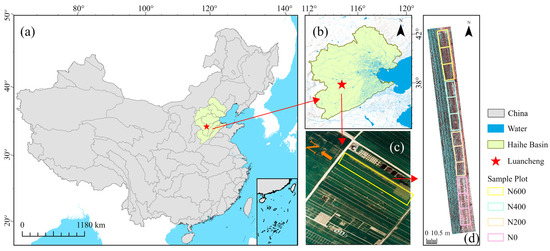
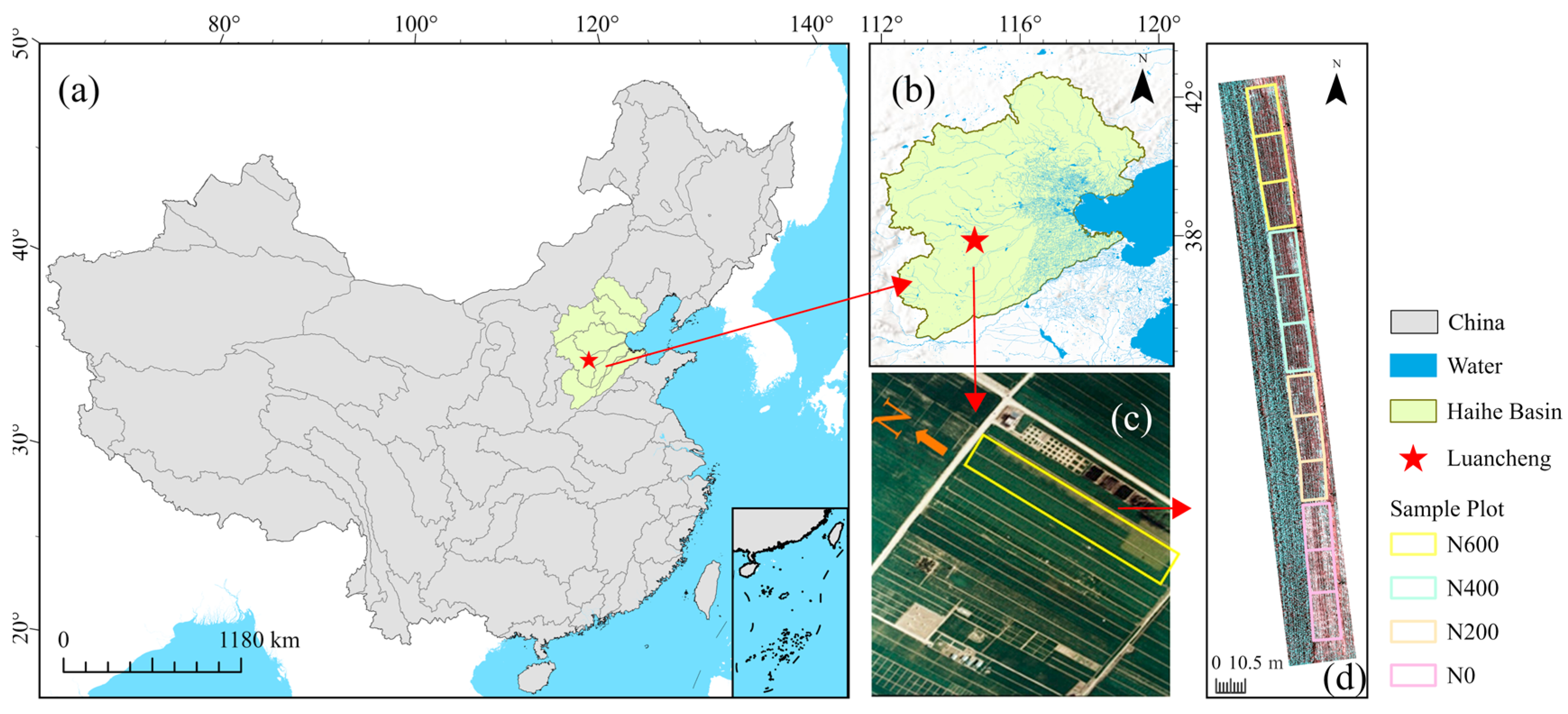
This research was conducted at the Chinese Academy of Sciences’ Hebei Luancheng Agro-Ecosystem National Field Scientific Observation and Research Station (Figure 1), located in Luancheng District, Shijiazhuang City, Hebei Province (37°53′N, 114°41′E). The station is situated in the western part of the North China Plain. It is located within the depositional zone of the alluvial-proluvial fan at the piedmont of the Taihang Mountains. with an elevation of 50.1 m. The primary cropping system is a wheat-maize rotation, with an average annual fertilizer application rate of 408 kg N/ha, which exceeds the national average nitrogen application rate [24]. The predominant soil type is Fluvo-aquic soil (known as Aquic Cinnamon Soil in the Chinese classification system, or Calcaric Fluviso in WRB). This soil is developed from river alluvial deposits, resulting in a non-uniform soil profile characterized by alternating layers of varying textures. The soil profile contains a dense textural black clay layer consistently present at the 300–350 cm depth across the experimental site. The texture of the soil in the upper layers (0–300 cm) is primarily silt loam, which acts as a barrier to water and solute movement. The local topography is flat, and active surface water erosion is considered negligible.
Figure 1.
Location of the Study Area and Sampling Plot Layout. (a) Geographic location of the study area in China; (b) regional map showing the Haihe Basin and Luancheng station; (c) aerial photograph of the experimental field in Luancheng station; (d) layout of the sampling plots along the transect, indicating different nitrogen fertilizer treatments (N0, N200, N400, N600).
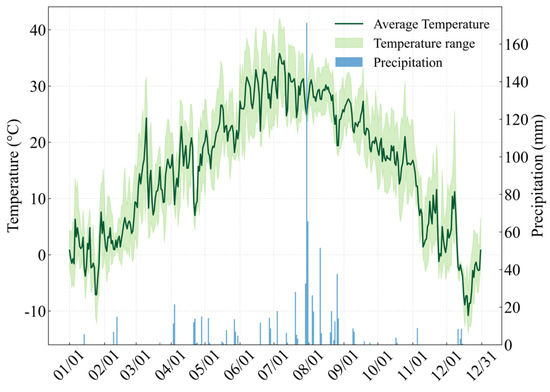
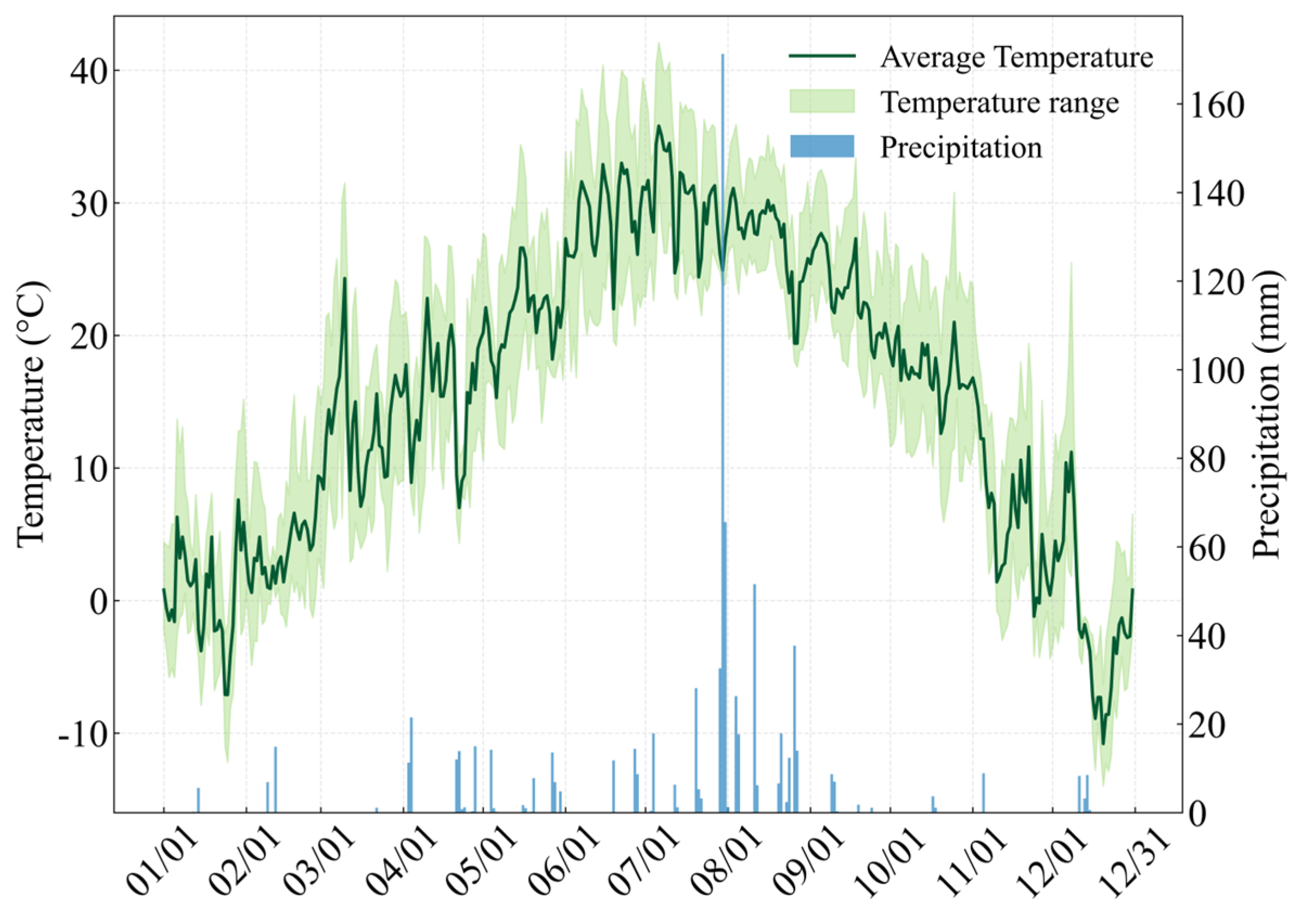
The study area experiences a warm temperate continental monsoon climate. The mean annual temperature is 12.2 °C, and the multi-year average precipitation is approximately 536.8 mm, with the majority of precipitation occurring between July and September. During the study period in 2023, the total precipitation was 770.4 mm and the average temperature was 10.71 °C (Figure 2). Notably, the precipitation from the maize jointing stage (13 July) to the filling stage (30 August) amounted to 507.6 mm, accounting for 66% of the total annual precipitation in 2023.
Figure 2.
Daily Precipitation and Temperature in Shijiazhuang during 2023 (Data from the National Meteorological Station).
2.2. Experimental Design and Sampling Methodology
2.2.1. Experimental Design
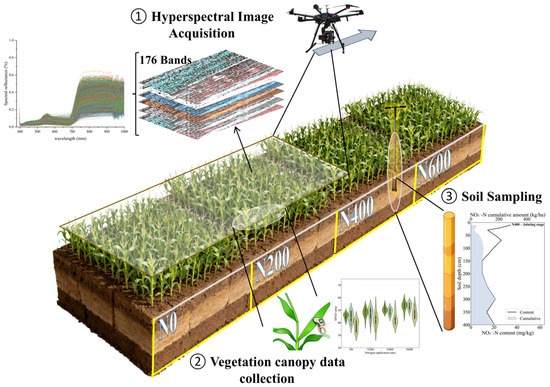
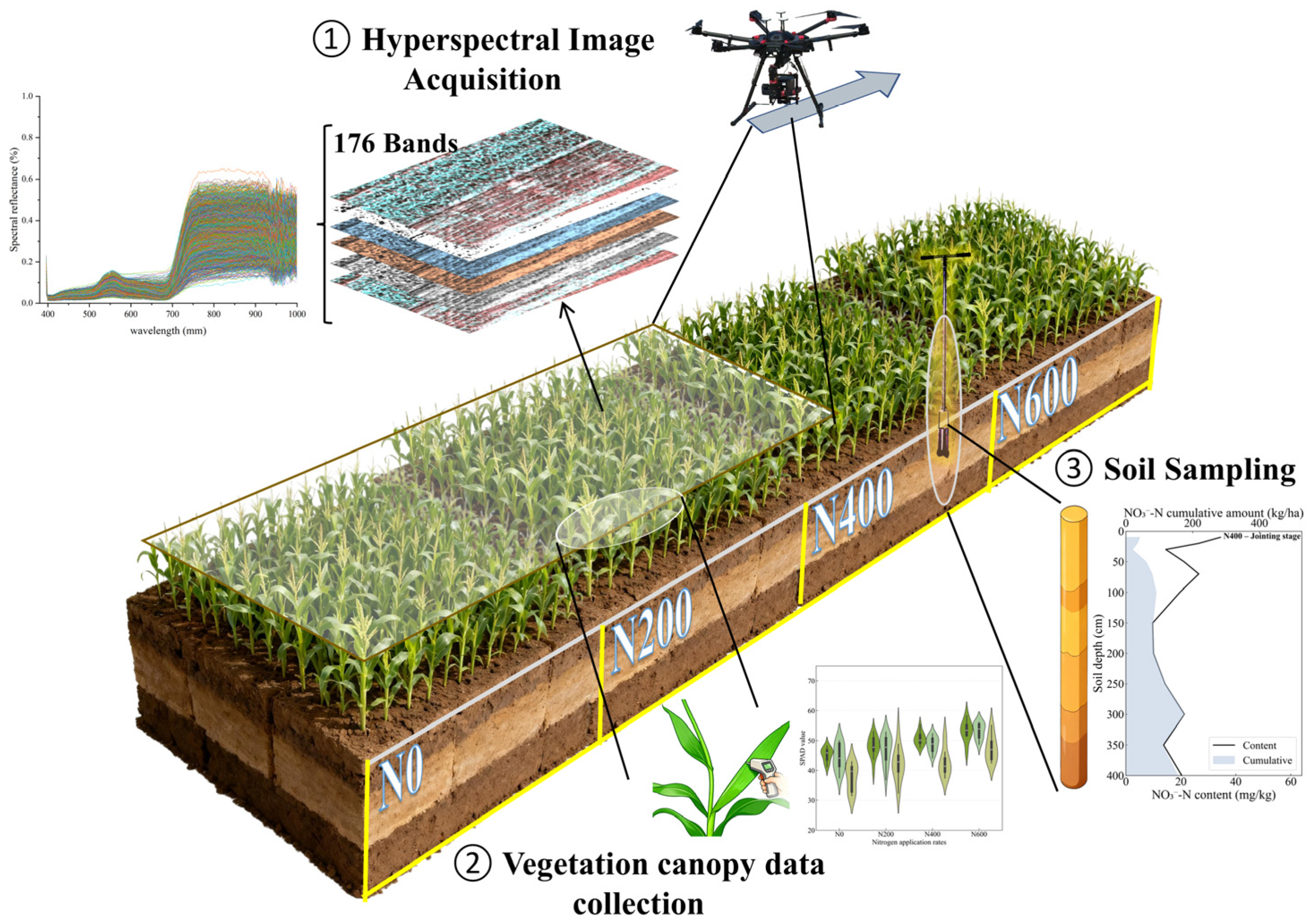
The experimental plots were established in 1997 and received nitrogen fertilizer at four application rates: 0, 200, 400, and 600 kg N ha−1 yr−1. (All application rates are expressed on an elemental nitrogen basis.) These treatments are designated as N0, N200, N400, and N600, respectively. The N400 treatment represents the standard fertilization practice for the majority of wheat-maize rotation fields in the North China Plain. Each treatment is replicated three times, resulting in a total of twelve experimental plots, each measuring 7 m × 10 m. The cropping system within the experimental site is an annual wheat-maize rotation, consistent with the predominant farming system in the central North China Plain. Fertilizer was applied three times within the annual cropping cycle: as a basal application at wheat planting, a topdressing at the wheat green-up stage, and a basal application at maize planting on 10 June 2023. The study period covered the maize growth stages from jointing to filling (13 July to 30 August 2023), during which soil profile sampling was conducted on 13 July (jointing stage) and 30 August (filling stage) to analyze soil nitrogen distribution characteristics under different nitrogen application levels. The maize jointing stage was selected for UAV-based hyperspectral data collection because it enables simultaneous monitoring of both soil and crop, and the soil nitrogen status at this stage serves as an indicator for later nitrogen levels, making the acquired hyperspectral imagery suitable for soil nitrogen retrieval. The entire process is shown in Figure 3.
Figure 3.
Experimental Design and Field Work Process.
2.2.2. Hyperspectral Data Acquisition and Processing
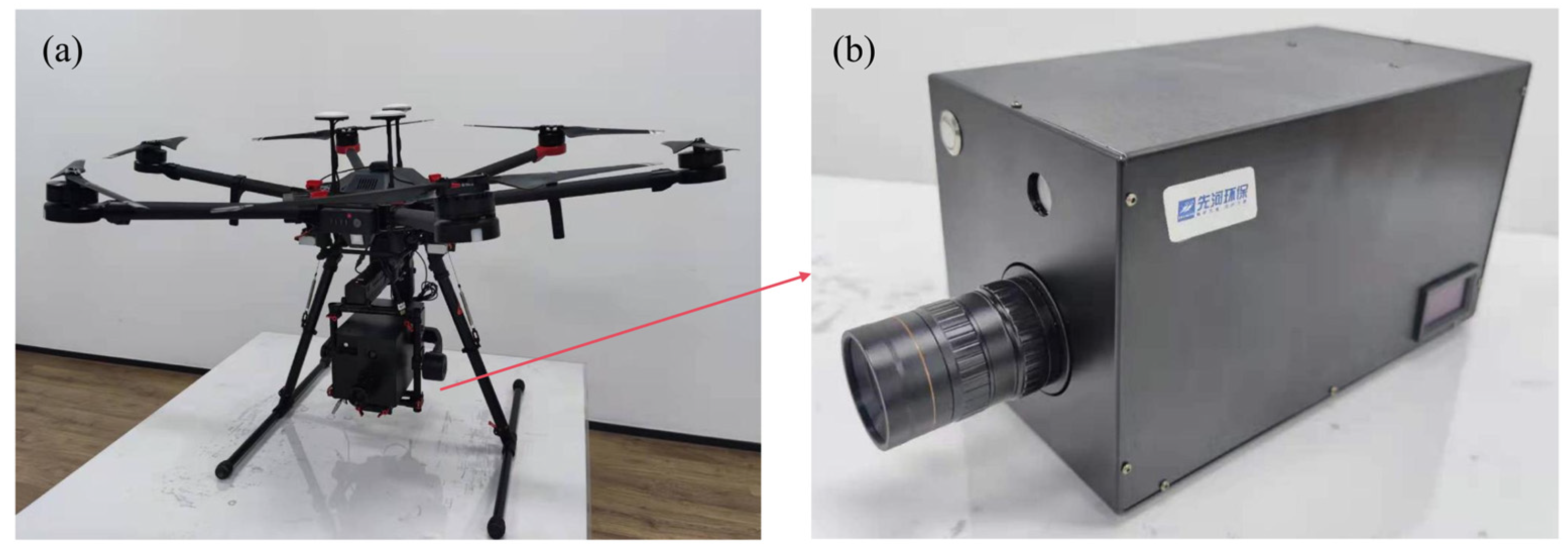
Hyperspectral data acquisition was conducted on 18 July 2023, at the study site during the maize jointing stage. A DJI Matrice 600 PRO UAV (SZ DJI Technology Co., Shenzhen, China) equipped with the XHGGP-mini-2 hyperspectral sensor (Hebei Sailhero Environmental Protection High-Tech Co., Ltd., Shijiazhang, China) (Figure 4) was deployed for data collection. The camera’s spectral data typically achieve a signal-to-noise ratio (SNR) > 500:1. The hyperspectral camera covered a spectral range of 400–1000 nm with a spectral resolution of ≤5 nm. All data acquisition campaigns were conducted under clear, cloud-free conditions with minimal wind. A white reference panel was used for radiometric calibration before each flight. The UAV was operated at 50 m above ground level, with a field of view (FOV) is 24.52°, acquiring imagery with an average ground sampling distance (GSD) of 0.02 m (2 cm/pixel). The flight speed was maintained between 5 and 15 m/s during data collection. The GNSS coordinates of the panel were recorded for precise geometric calibration. Following data acquisition, hyperspectral image mosaicking and processing were performed using the specialized software XHHSIDAS V1.0 (Hebei Sailhero Environmental Protection High-Tech Co., Ltd., Shijiazhuang, China) [25].
Figure 4.
(a) Platform (DJ M600 Pro) and (b) Hyperspectral sensor (XHGGP-90A).
2.2.3. Plant Characterization and Soil Profile Sampling
On the day of UAV hyperspectral data acquisition, leaf SPAD values were measured using the SPAD-502 (Konica Minolta Sensing, Inc., Tokyo, Japan). For each plot, measurements were taken from five plants, targeting the upper, middle, and lower canopy layers. Five SPAD readings were collected from each leaf to minimize heterogeneity effects. Concurrently, soil samples were collected from each replicated plot using a soil auger at twelve depth intervals: 0–10 cm, 10–20 cm, 20–30 cm, 30–50 cm, 50–70 cm, 70–100 cm, 100–150 cm, 150–200 cm, 200–250 cm, 250–300 cm, 300–350 cm, and 350–400 cm. The samples were analyzed for NO3−-N, soil water content, and other relevant parameters. Additional sampling campaigns were conducted on 30 August 2023 (maize filling stage) and 6 April 2024 (wheat jointing stage), during which the same protocols for measuring leaf SPAD values and collecting soil profile data were implemented.
2.3. Analytical Items and Methods
2.3.1. Soil Water Content and NO3−-N Content
The collected soil samples were analyzed at the Center for Agricultural Resources Research, IGDB, CAS, for soil water content, NO3−-N. Specifically, soil water content was determined using the oven-drying method. For the analysis of NO3−-N, a pre-treatment procedure was followed: 10 g of fresh soil sample was weighed and extracted with 50 mL of 2 mol/L KCl solution. The mixture was shaken for 30 min, and the extract was then filtered. The NO3−-N content in the filtered extract was determined using the hydrazine sulfate reduction method. These samples were analyzed using the SmartChem 200 (AMS Alliance, Frépillon, France).
2.3.2. Soil NO3−-N Accumulation and Leaching
The calculation formula for soil NO3−-N accumulation is as follows:
The estimation formula for soil NO3−-N leaching is as follows:
where L is the amount of NO3−-N leaching in the soil during the growth period, kg/ha; I is the total nitrogen input during the growth period, kg/ha; U is the nitrogen uptake of the aboveground part of the crop (wheat or corn), kg/ha; ΔN: Change in soil NO3−-N accumulation in 0–400 cm soil layer during the growth period, kg/ha; D is the amount of nitrogen lost by denitrification during the growth period, kg/ha; B is the dry matter mass of the aboveground part of the crop, in kg/ha; N_prop_crop: the proportion of nitrogen content in the aboveground part of crops; k is the denitrification loss coefficient with a value of 0.2 [26]. This coefficient was specifically determined based on long-term in situ measured nitrogen balance data collected from this specific experimental site, reflecting the actual N loss characteristics of the regional wheat-maize rotation system.
L = I − U − ΔN − D
ΔN = TSNRend − TSNRstart
U = B × N_prop_crop
D = I × k
2.4. Data Processing and Analytical Methods
2.4.1. Fundamental Data Processing and Visualization
Hyperspectral imagery preprocessing and information extraction were performed using ENVI 5.6 (L3Harris Geospatial, Boulder, CO, USA) and ArcGIS 10.6 (ESRI, Redlands, CA, USA). Modeling of the relationships between hyperspectral data and soil nitrogen, as well as specific data visualizations, was implemented in Python 3.12 (Python Software Foundation, Wilmington, DE, USA; https://www.python.org/, accessed on 4 December 2025) using PyCharm Community Edition 2025.1 (JetBrains, Prague, Czech Republic). Statistical analyses and chart generation were conducted with OriginPro 2024 (OriginLab Corporation, Northampton, MA, USA), R 4.4.1 (The R Foundation for Statistical Computing, Vienna, Austria; https://www.R-project.org/, accessed on 4 December 2025), executed via RStudio 2024.12.0 (Posit PBC, Boston, MA, USA), and Microsoft Excel 2021 (Microsoft Corporation, Redmond, WA, USA).
2.4.2. Hyperspectral Data Extraction, Preprocessing, and Feature Engineering
Based on the high-resolution imagery (GSD = 0.02 m), a rigorous sampling strategy was implemented to extract high-quality canopy spectral data. A regular grid of 0.35 m × 0.35 m spacing was first generated across the study area. These grid points were then spatially screened using a Normalized Difference Vegetation Index (NDVI) threshold mask (NDVI > 0.55), which ensured that all extracted spectral information originated exclusively from the healthy and active maize canopy, minimizing noise from soil or shadow. This extraction process yielded a total of 1998 individual high-resolution hyperspectral pixel samples (N = 1998), each spatially matched to the nearest soil sampling location to form the comprehensive dataset. The subsequent preprocessing steps were then applied to this extracted N = 1998 sample set. The imagery, covering a spectral range of 400–1000 nm across 176 bands, encompasses essential regions for vegetation research (R, G, B, NIR). The original hyperspectral reflectance (R) was first transformed into absorbance form as log(1/R) to enhance linear relationships with physicochemical properties. Standard Normal Variate (SNV) transformation was applied to eliminate particle size and scattering effects. A Savitzky–Golay filter (window length: 11, polynomial order: 2), which ensure the elimination of noise [27], was employed to compute first-order derivatives, further reducing baseline drift and emphasizing spectral absorption features. Furthermore, five vegetation indices (VIs) in Table 1 were subsequently developed and combined with other preprocessed spectral data to support the soil nitrogen retrieval modeling. The five VIs were selected to ensure spectral diversity across key physiological regions namely the green, red-edge, and near-infrared (NIR) plateau—and to represent different mathematical formulations, including both ratio-based and normalized difference types, thereby allowing comparison of their effectiveness in mitigating noise. All selected VIs are well-established in the literature for nitrogen status assessment, follows the standardized definitions from the source literature to ensure reproducibility (Source in Table 1). All VIs were combined with the preprocessed spectral data to form the initial feature set. The entire feature matrix was standardized using StandardScaler from the scikit-learn package (version 1.7.2) to normalize scale differences. For both PLSR and XGBoost modeling implemented using scikit-learn v1.7.2 and XGBoost v3.0.5, we developed two distinct feature sets to evaluate the impact of incorporating experimental prior knowledge: Model Mode 1 (Remote Sensing Only): This set utilized 181 explanatory variables, consisting of the 176 spectral bands (after S-G filtering and 1st-derivative transformation) and the 5 selected vegetation indices listed in Table 1. Model Mode 2 (With Fertilization Gradient Labels): This set utilized 185 explanatory variables, which included the 181 remote sensing features plus 4 one-hot encoded categorical variables representing the nitrogen treatments (N0, N200, N400, N600). The inclusion of these categorical variables was designed to explicitly account for the primary control of the experimental treatment on the nitrogen cycling system.
Table 1.
Vegetation Indices Used for Modeling.
2.4.3. Partial Least Squares Regression Model
Partial Least Squares Regression (PLSR) is a regression technique designed to handle multicollinear data. It effectively processes high-dimensional, collinear spectral data by performing dimensionality reduction while simultaneously conducting regression prediction, thereby enabling effective modeling and dimension reduction [33]. PLSR is widely used in the field of hyperspectral remote sensing. For each target variable (soil NO3−-N content at 10 cm, 20 cm, 30 cm, and 50 cm depths), samples with missing values were first removed. The dataset was partitioned into a training set (80%) and an independent testing set (20%) using a stratified random sampling method based on processing types. The training set was utilized for model calibration and hyperparameter optimization, while the testing set was strictly reserved for the final independent evaluation of model performance. To determine the optimal number of latent variables (LVs)- the key hyperparameter in PLSR- we employed a 5-fold cross-validation (5-fold CV) technique within the training set. In each iteration, the training data were randomly divided into five subsets; four were used to train the model, and one was used for validation. This process was repeated five times to ensure every subset served as validation data once. The number of LVs corresponding to the highest coefficient of determination R2 was selected as the optimal model structure to minimize the risk of overfitting. This optimized model was then retrained on the entire training set and applied to the independent testing set to evaluate its generalization ability. Given a dataset where X ∈ Rnp represents the independent variable matrix and X ∈ Rnm represents the dependent variable matrix-where n is the number of samples, p is the number of independent variables, and m is the number of dependent variable PLSR aims to find two sets of weight vectors w and c, and score vectors t and u, satisfying the following relationships:
where T ∈ Rnh is the score matrix of X, W is the weight matrix of X, and P is the loading matrix of X; U ∈ Rnh is the score matrix of Y, C is the weight matrix of Y, and Q is the loading matrix of Y. All PLSR modeling, 5-fold CV and visualization were implemented in Python 3.12 using PyCharm Community Edition 2025, primarily leveraging open-source libraries including scikit-learn, scipy, and matplotlib.
T = XW(PTW)−1
U = YC(QTC)−1
2.4.4. XGBoost and Model Interpretation with SHAP
To capture the potential non-linear relationships between hyperspectral bands and soil NO3−-N content, this study employed the eXtreme Gradient Boosting (XGBoost) algorithm. XGBoost is a scalable implementation of Gradient Boosted Decision Trees (GBDT) that iteratively constructs an ensemble of weak learners (decision trees) to minimize a regularized objective function. Compared to traditional GBDT, XGBoost utilizes a second-order Taylor expansion for the loss function and incorporates regularization terms to penalize model complexity, thereby enhancing training efficiency and preventing overfitting [34]. The objective function is defined as:
Consistent with the data partitioning strategy used in the PLSR modeling, the dataset was first divided into a training set (80%) and an independent testing set (20%) using stratified random sampling based on processing types. To further optimize the XGBoost model and prevent overfitting, a hold-out validation strategy was implemented within the training phase. Specifically, the training set was further randomly partitioned into a sub-training set (80%) and an internal validation set (20%). An early stopping mechanism was applied, where the training process (adding new trees) was terminated if the Root Mean Squared Error (RMSE) on the internal validation set did not improve for 50 consecutive rounds.
To deconstruct the “black box” nature of the XGBoost model, we utilized the SHapley Additive exPlanations (SHAP) framework [35] values were introduced for explainable analysis. Based on the Shapley value from cooperative game theory, SHAP assigns a marginal contribution value to each input feature, satisfying axioms including consistency, local accuracy, and missingness. Its calculation formula is given by:
3. Results
3.1. Characteristics of Soil NO3−-N Content, Accumulation, and Leaching During the Critical Rainy Season
3.1.1. Profile Dynamics of Soil NO3−–N Content and Accumulation
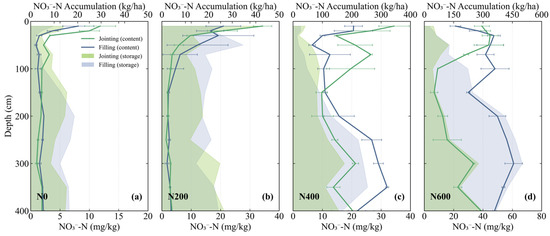
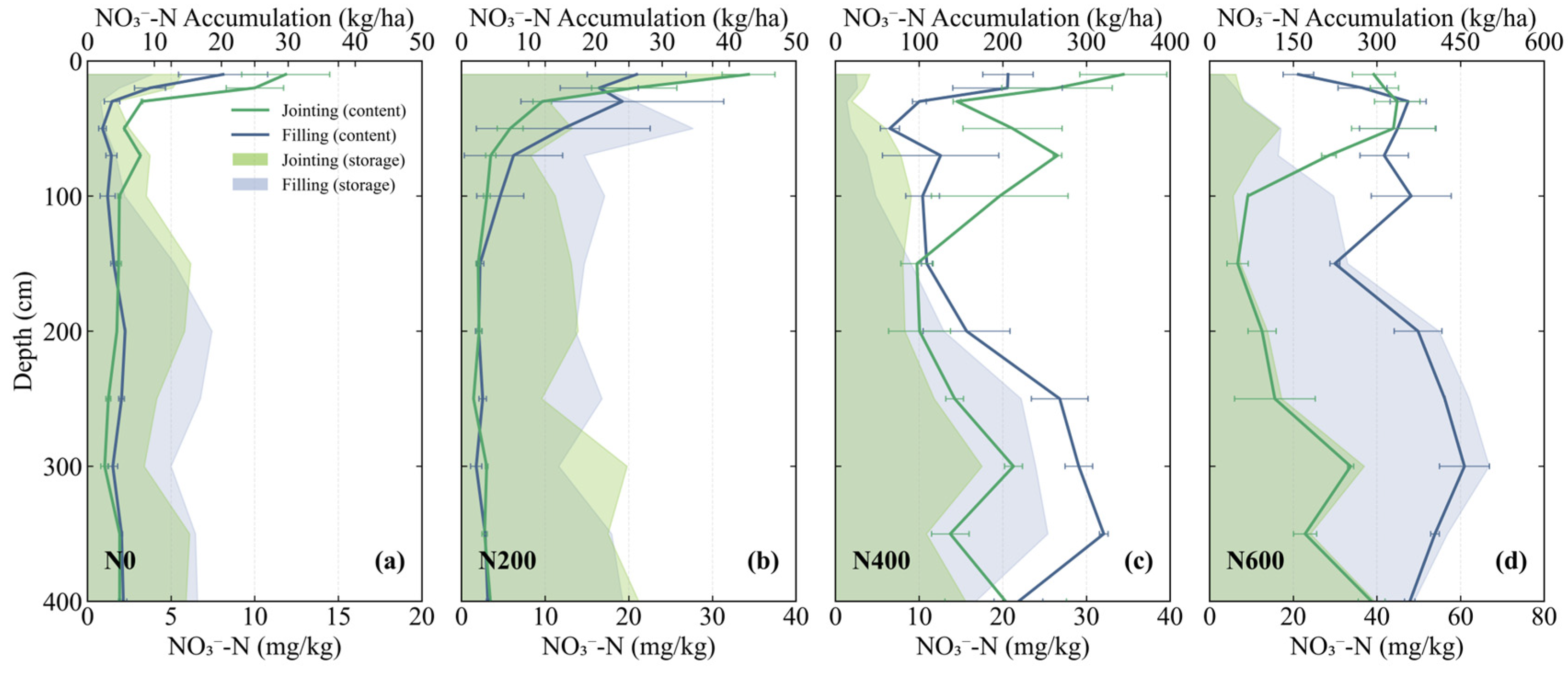
The distribution of soil NO3−–N content and accumulation within the soil profile differed markedly between the maize jointing and filling stages (Figure 5). Overall, both the content and accumulation of soil NO3−-N increased with higher nitrogen fertilizer application level during both stages. At the jointing stage, the peak NO3−-N content in the surface layer (above 100 cm) was higher than that in the deeper layers (below 100 cm). For instance, in the N600 (Figure 5d) plot at the jointing stage, the peak surface content of 41.8 mg/kg occurred at 20 cm depth, which was higher than the deep-layer peak of 33.71 mg/kg observed at 300 cm depth. Furthermore, at the jointing stage, the soil NO3−-N content under high nitrogen fertilizer application level (N600) was 57.8%, 102.5%, and 317.7% higher than that in the N400 (Figure 5c), N200 (Figure 5b), and N0 (Figure 5a) plots, respectively, at the same depths. Conversely, during the filling stage, except for the N0 and N200 treatments, the peak NO3−-N content in the deeper layers exceeded that in the shallow layers for the high nitrogen application plots (N400 and N600). Their peak values were 32.07 mg/kg and 60.9 mg/kg, respectively, primarily located at 300–350 cm depth. This shift is attributed to the physical barrier effect of a dense, low-permeability black clay layer at 300–350 cm depth, which significantly retards water and nitrogen transport [26,36].
Figure 5.
Distribution of Soil NO3−-N Content and Accumulation at the Jointing and Filling Stages by the (a–d) Distribution of soil NO3−-N content and accumulation in the soil profile for N0, N200, N400, and N600 plots during the jointing and filling stages.
The distribution characteristics of soil NO3−-N accumulation further elucidate the impact of nitrogen fertilizer application levels on the soil nitrogen leaching process. During the jointing stage, plots with high nitrogen fertilizer application level (N400 and N600) exhibited two distinct accumulation peaks: one in the surface layer (0–50 cm) and another in the deep layer (around 300 cm). The combined effects of substantial rainfall (507.6 mm) and crop nitrogen uptake (primarily from 0 to 40 cm [37]) leached the surface accumulation peak, transforming the profile pattern from bimodal to unimodal and increasing deep-layer NO3−–N accumulation, particularly under high nitrogen input.
The redistribution of soil NO3−–N across the profile provided clear evidence of leaching, which varied with nitrogen application rates. In the high-input N600 plot, accumulation in the 250–300 cm layer nearly doubled, from 277.31 kg·ha−1 to 501.2 kg·ha−1, accompanied decline in the surface 0–10 cm layer from 46.96 kg·ha−1 to 25.4 kg·ha−1, indicating profound nitrate leaching. The N400 plot exhibited a similar trend, accumulation decreased in the 0–100 cm layer and increased below 100 cm. In stark contrast, the N200 plot showed minimal deep-layer accumulation only 20.98 kg/ha at 250–300 cm, confining most nitrogen within the effective root zone 0–100 cm. Though reduced leaching indicates higher nutrient use efficiency (NUE), the insufficient nitrogen supply ultimately results in yield loss. These distinct, quantifiable profile responses to fertilization gradients are crucial, as they underpin the relationship between retrievable surface conditions (via crop canopy) and the underlying leaching processes.
3.1.2. Nitrogen Budget and Leaching
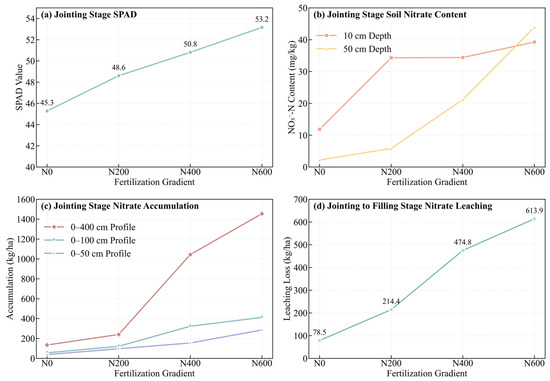
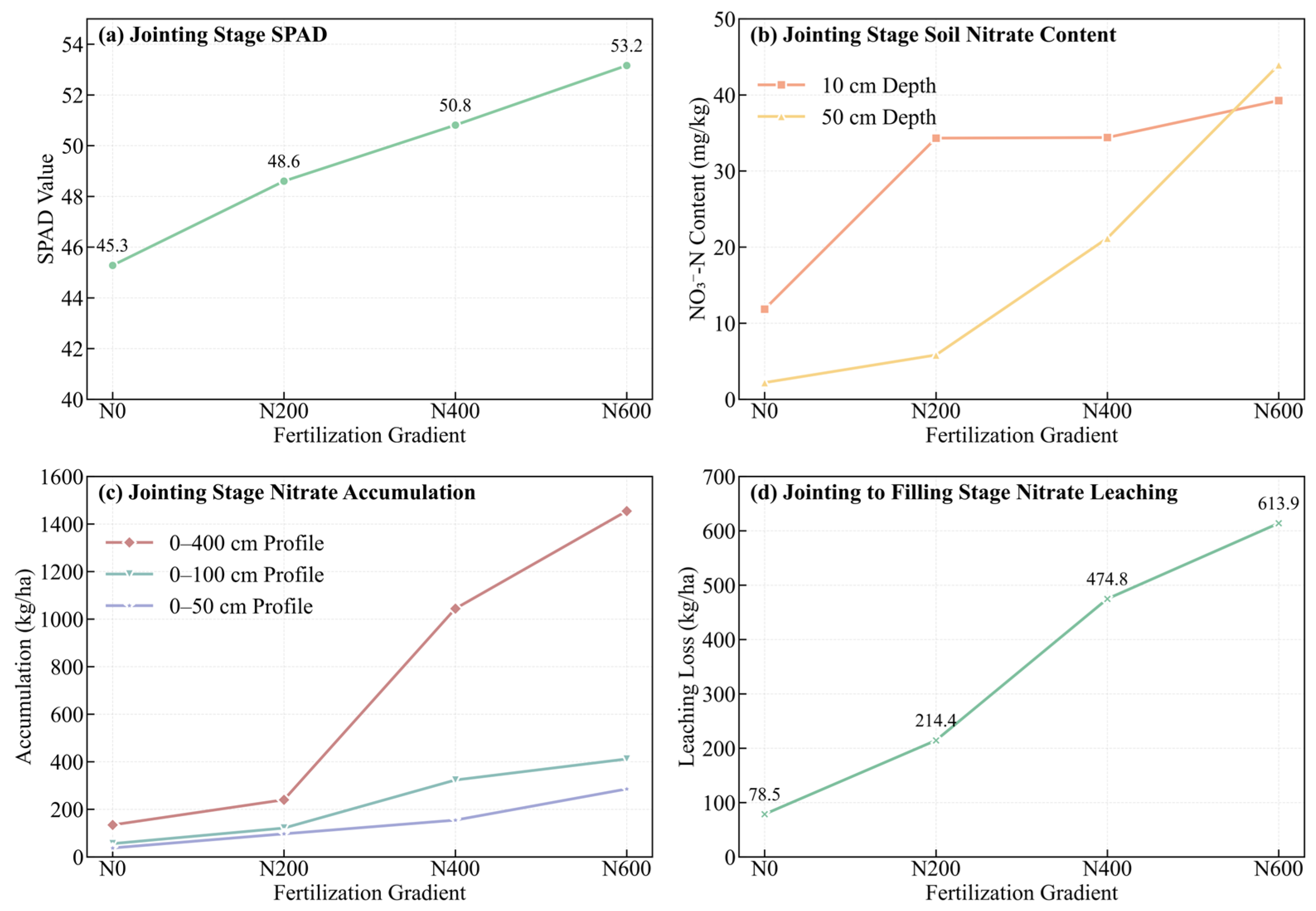
The nitrogen system surplus (Input + Deposition−Uptake) for the N200, N400, and N600 treatments reached 125, 228, and 416 kg/ha, respectively (Table 2). This surplus nitrogen constitutes the source term for changes in soil nitrogen storage and leaching. The spatiotemporal variations in soil profile NO3−-N storage reveal significant vertical transport characteristics. Farmland nitrogen loss during the concentrated precipitation period was dominated by nitrate leaching [38]. The substantial surplus under high nitrogen applications drove significant leaching fluxes, with the estimated NO3−–N leaching at 50 cm depth dramatically increasing from 78.6 kg/ha (N0) to 613.9 kg/ha (N600). A key finding was the consistent attenuation of leaching flux with depth, for instance, in the N400 treatment, the estimated leaching at 50 cm depth (474.8 kg/ha) exceeded that at 100 cm depth (391.1 kg/ha) by 83.7 kg/ha. This attenuation may be attributed to nitrogen removal processes within the 50–100 cm soil layer, such as denitrification or residual root uptake [39]. The results demonstrate that excessive nitrogen application (≥400 kg/ha) leads to substantial nitrate leaching, with the significant transport into the subsoil under N600 indicating a persistent risk of deep leaching.
Table 2.
Farmland Nitrogen Budget Calculation and Estimation of NO3−-N Leaching.
3.2. Soil NO3−-N Retrieval Model Development and Validation
3.2.1. Spectral Data Processing
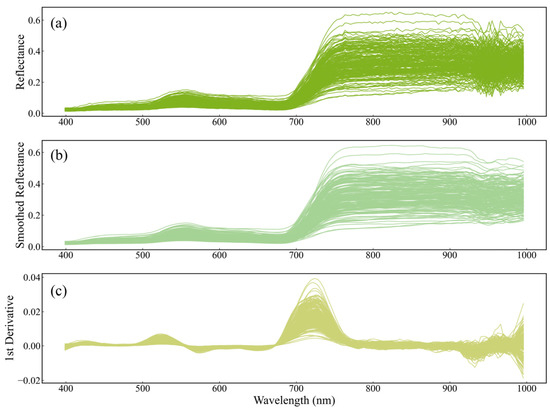
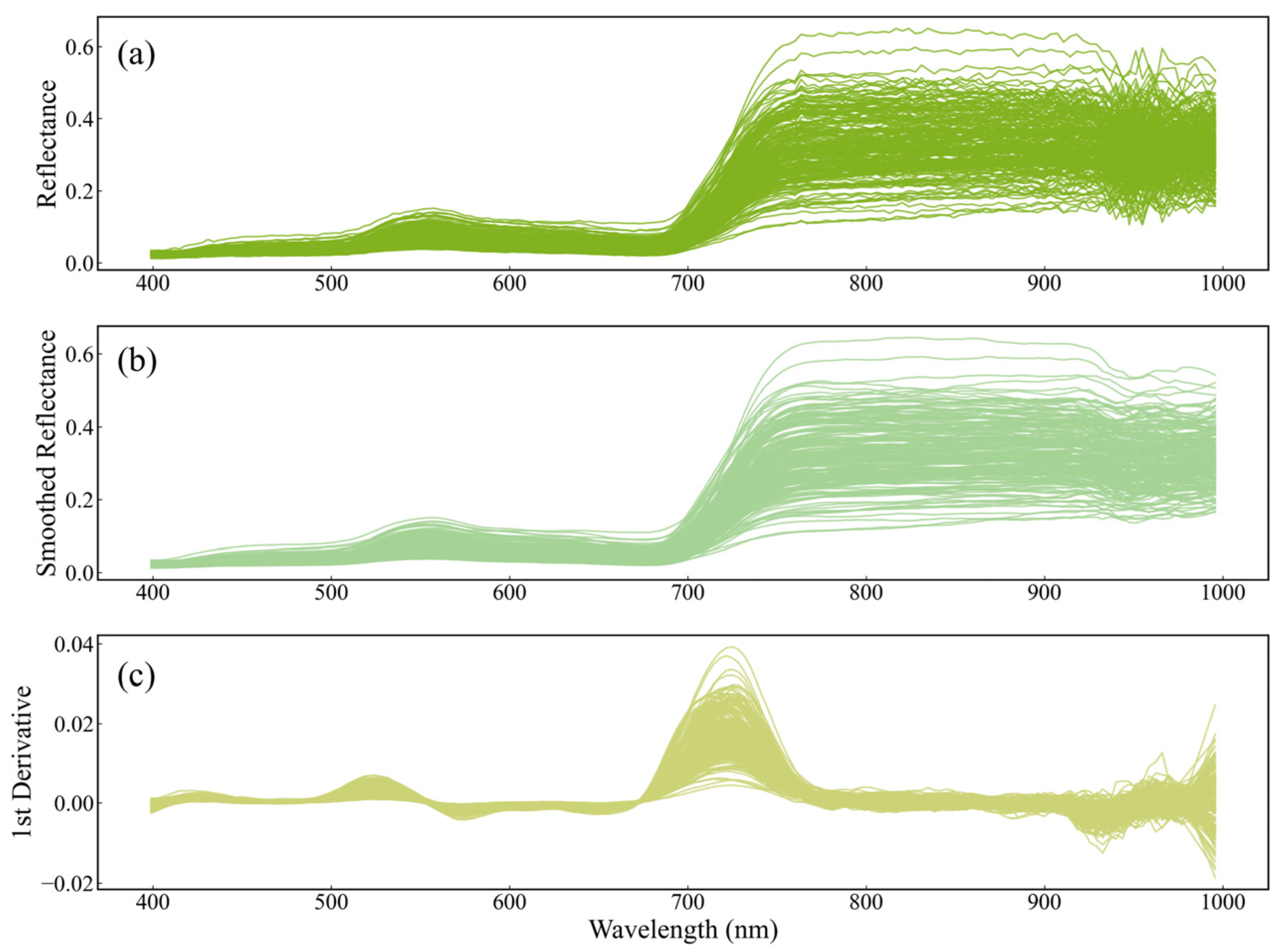
The Savitzky–Golay filter effectively smooths spectral data and reduces noise, thereby enhancing the model’s capability to identify and predict soil characteristics while preserving essential spectral features without significant alteration [40]. As demonstrated by Jiao et al. [14], the first derivative of spectral data combined with PLSR modeling yields superior performance in retrieving soil nitrogen conten. Consequently, this study applied both Savitzky–Golay filtering and first-derivative transformation to all collected hyperspectral data to improve modeling accuracy. Figure 6 illustrates the effect of this preprocessing workflow on 200 randomly selected hyperspectral pixel samples, which represent the full range of spectral variability across all nitrogen treatments.
Figure 6.
Original and Processed Spectral Profiles. (a) Original spectral information; (b) Spectral information after Savitzky–Golay filtering; (c) Spectral information after first-derivative transformation.
3.2.2. Crop Canopy Dynamics in Response to Soil NO3−-N
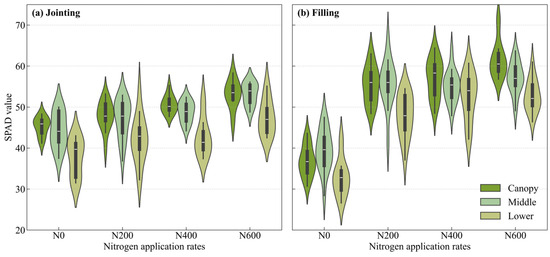
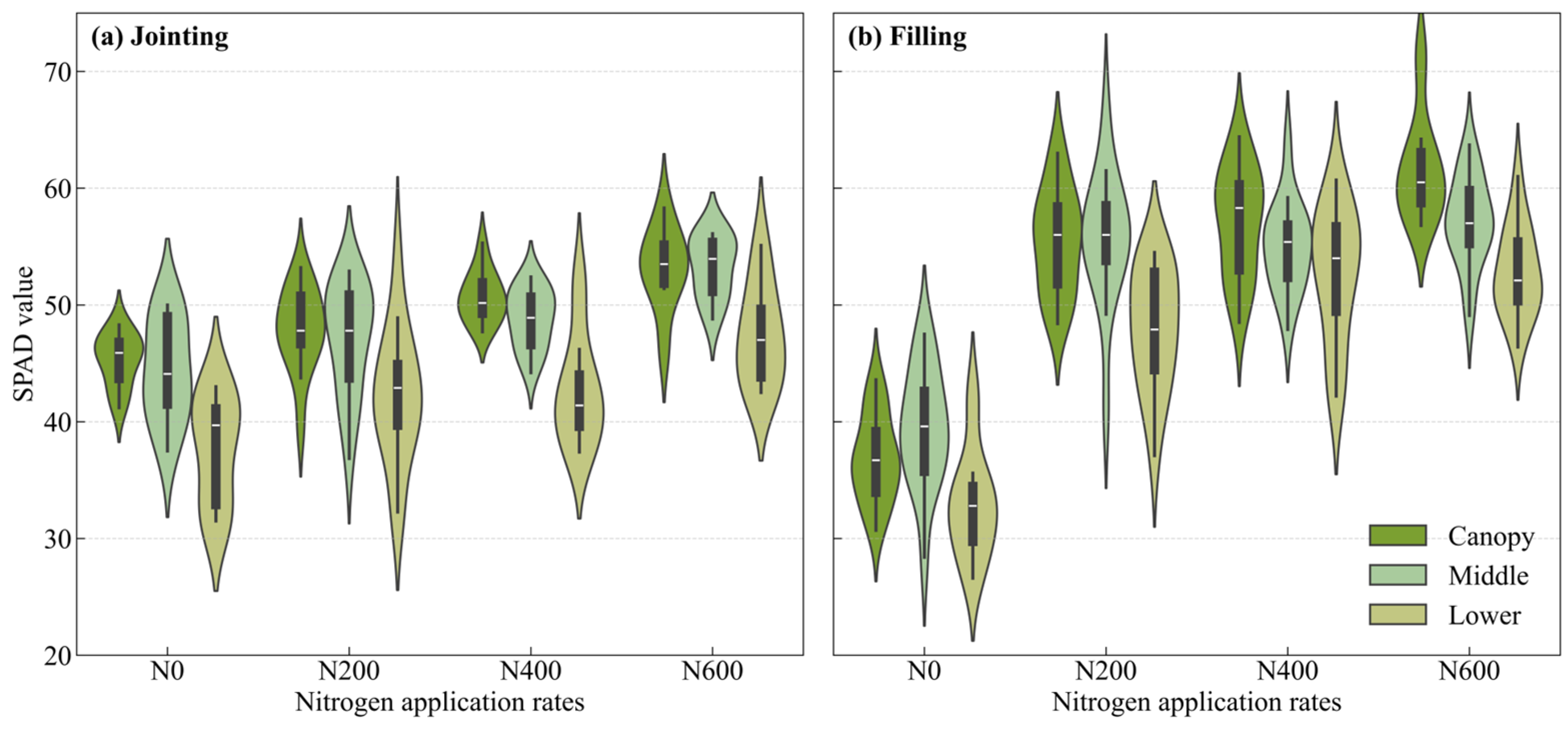
To validate the use of vegetation spectral information as a proxy for retrieving soil NO3−-N, this study measured the SPAD values-a chlorophyll indicator—in leaves from different canopy positions during both the maize jointing and filling stages (Figure 7). The results revealed that SPAD values were influenced by nitrogen treatment, canopy position, and growth stage, with nitrogen application level having the most significant effect. Specifically, SPAD values decreased during the filling stage in the N0 plots due to insufficient nutrient supply later in the growth cycle. In contrast, the N200, N400, and N600 plots all exhibited lower SPAD values at the jointing stage compared to the filling stage.
Figure 7.
SPAD Values of Maize Leaves at Different Growth Stages. (a) SPAD values at the maize jointing stage; (b) SPAD values at the maize filling stage.
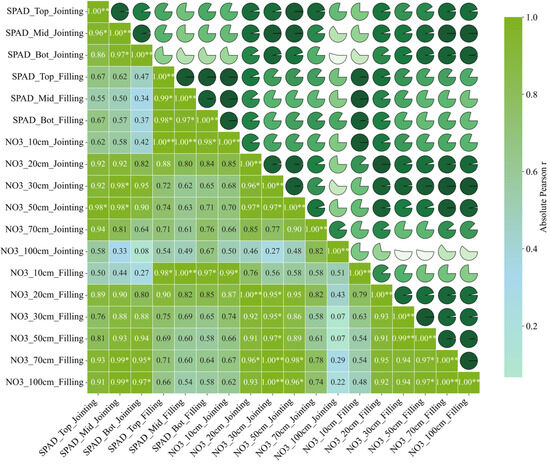
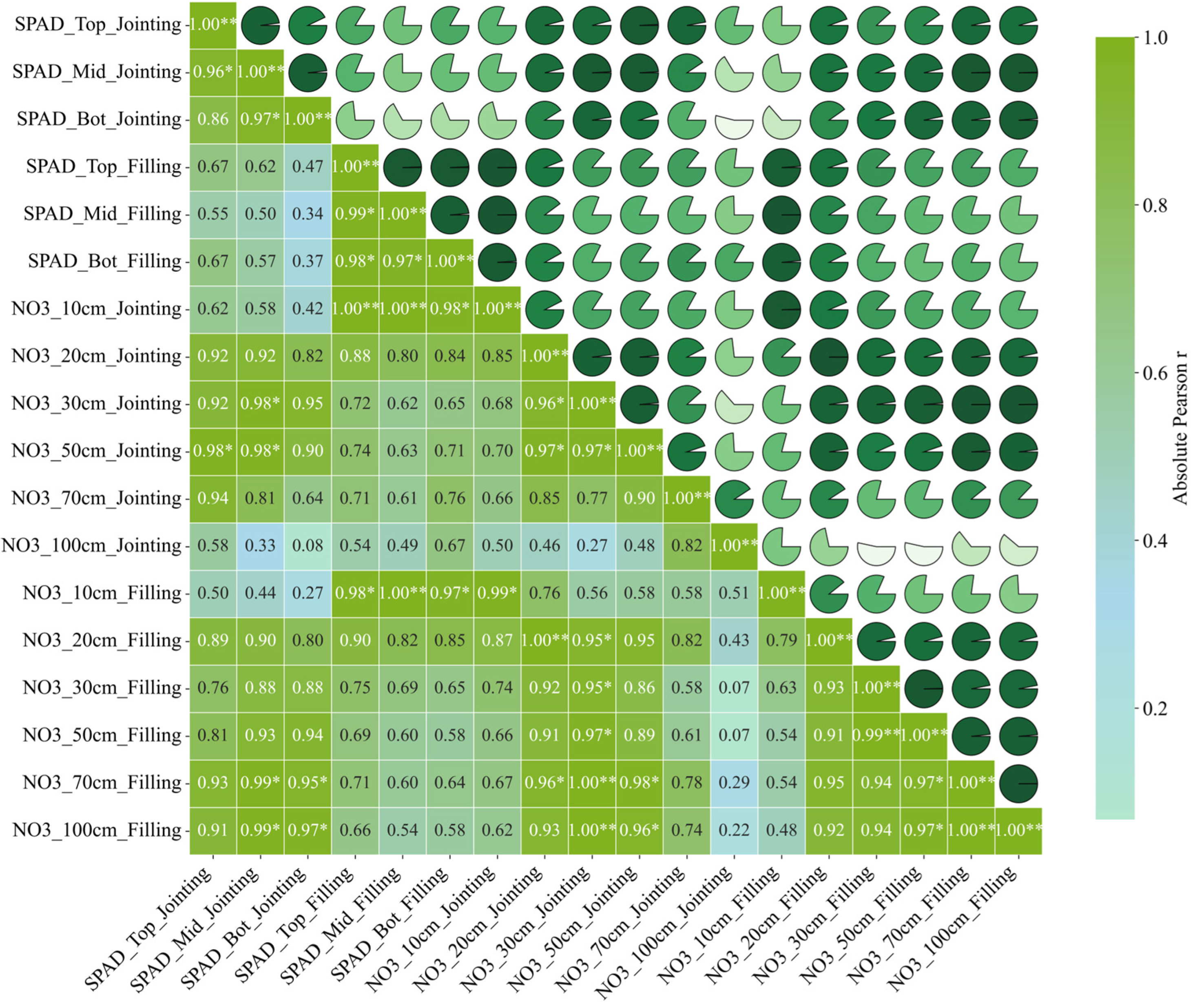
NO3−-N in the surface soil serves as the primary source of plant nitrogen nutrition, indicating its significant role in plant growth and development. The distribution of surface soil nitrogen can be effectively characterized by leaf chlorophyll content, a viewpoint supported by previous studies on crops like maize and soil nutrients [41,42]. Furthermore, UAV imagery has demonstrated a strong capability to represent surface soil NO3−-N status. Analysis based on the Pearson correlation matrix (Figure 8) revealed the relationship between SPAD values and soil NO3−-N concentration during the jointing and filling stages. SPAD values at both stages showed strong correlations with NO3−-N content in the 10–50 cm soil layer. During the jointing stage, the strongest correlations were observed at the 20–50 cm depths, with the 30 cm and 50 cm layers having the greatest impact on leaf SPAD values. Notably, canopy leaf SPAD values exhibited the highest correlation with NO3−-N content at the 50 cm depth (r = 0.98, p < 0.01), indicating a highly significant relationship. This demonstrates that soil nitrogen status can be effectively represented by leaf chlorophyll characteristics. Since chlorophyll content significantly influences vegetation spectral features [28,43], vegetation spectral information can consequently serve as a reliable indicator for retrieving soil nitrogen status through hyperspectral remote sensing.
Figure 8.
Relationship between canopy characteristics (leaf SPAD) and soil NO3−-N content. Symbols * and ** denote statistical significance levels of p < 0.05 and p < 0.01.
3.2.3. Development of Retrieval Models Based on Spectral Information
PLSR was utilized as a classic benchmark to efficiently handle the high-dimensional, collinear nature of hyperspectral data. XGBoost-SHAP was chosen as a state-of-the-art non-linear alternative due to its superior predictive accuracy and its capacity to provide critical feature importance analysis (via SHAP values), which is essential for mechanistically interpreting the spectral driving mechanisms at different depths. In the scenario utilizing only remote sensing information (Model Mode 1), our predictor variables consisted of 176 spectral bands and 5 vegetation indices, retrieval models for soil NO3−-N at four depths (10 cm, 20 cm, 30 cm, and 50 cm) were developed using both PLSR and XGBoost-SHAP algorithms.
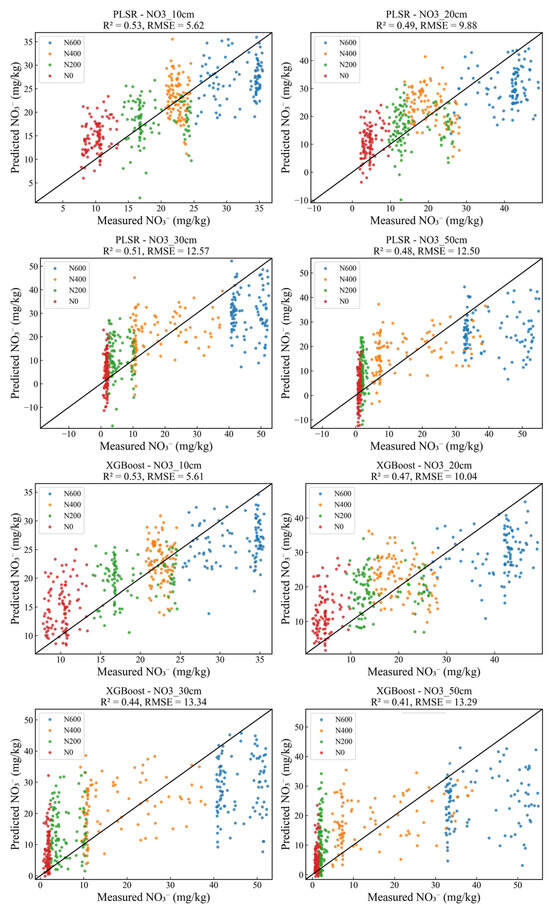
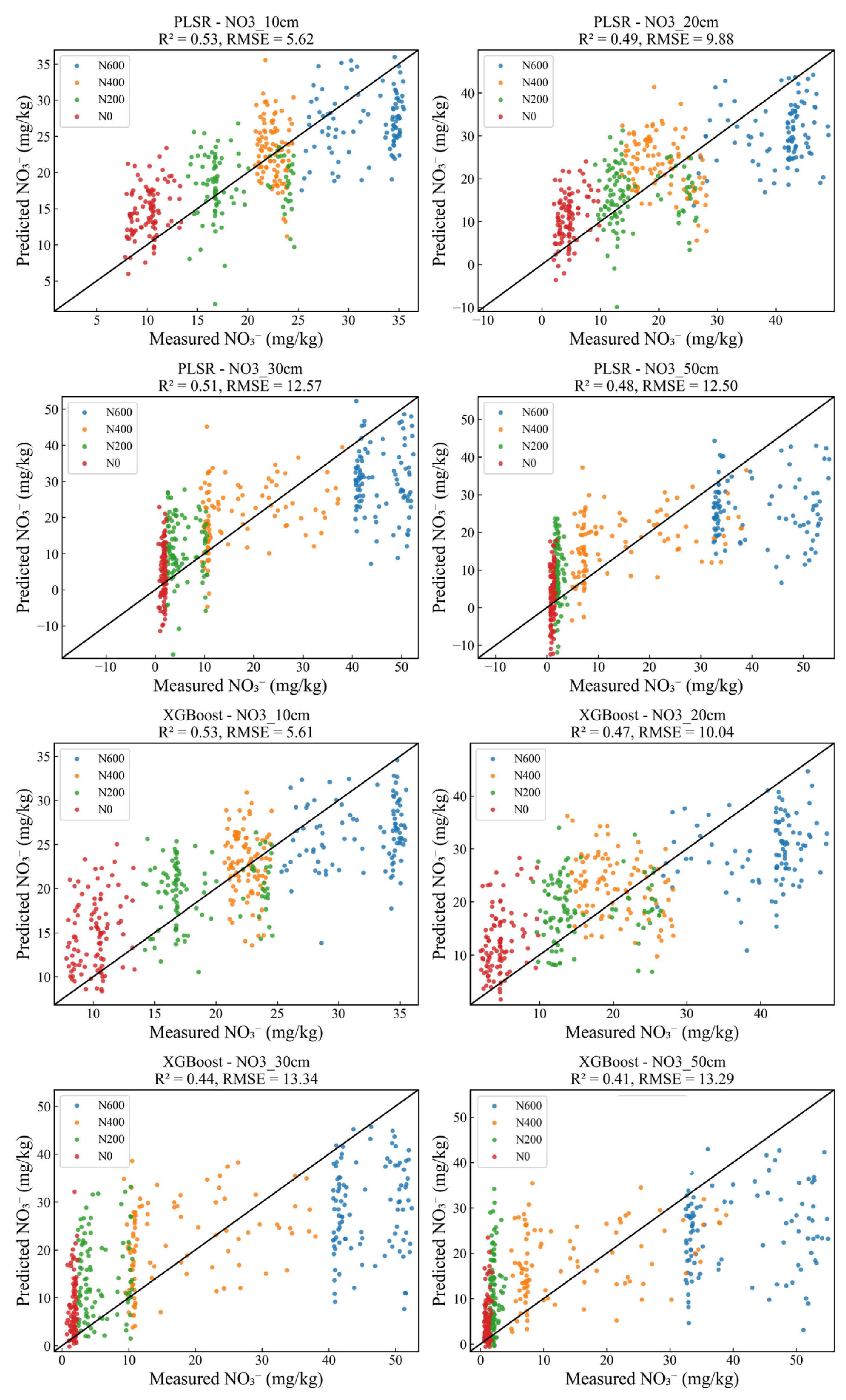
The hyperspectral retrieval models for soil NO3−-N, developed based on PLSR and XGBoost algorithms, demonstrated a slight decrease in retrieval accuracy with increasing soil depth (Figure 9). The models performed best at the 10 cm depth, where both achieved a coefficient of determination (R2) of 0.53. The XGBoost model yielded a relatively lower Root Mean Square Error (RMSE) of 5.61 mg/kg at this depth. This indicates that UAV hyperspectral data, utilizing spectral information from vegetation as a medium, can effectively reflect the characteristics of topsoil nitrogen–which is directly influenced by agricultural practices like fertilization and tillage–and is thus suitable for preliminary assessment of topsoil nitrogen status. Model performance declined with increasing depth. This is primarily because the actual NO3−-N content below 20 cm began to diverge more significantly between the N200 and N0 plots. Crops in plots with higher nitrogen application levels often exhibit lower nutrient use efficiency [44], consequently leading to a greater leaching of NO3−-N to deeper layers. This resulted in a phenomenon where the deeper NO3−-N content did not closely correspond to the surface application gradient, ultimately causing the reduced model performance at greater depths. Specifically, the near-vertical alignment of predicted versus observed values for the N0 and N200 treatments indicates a key limitation. In these treatments, the actual soil NO3−-N content was highly uniform, contrasting sharply with the considerable spectral variability observed in the overlying plant canopy. This discrepancy between consistent soil N and divergent spectral signatures led to the model generating a range of scattered predicted values where the actual measured values were tightly clustered, thus contributing significantly to the decline in overall retrieval accuracy. This issue highlights a key area for future investigation: achieving accurate nitrogen retrieval within plots subjected to the same fertilization rate.
Figure 9.
Observed vs. Predicted Results from Modeling Based on Hyperspectral Data using PLSR and XGBoost.
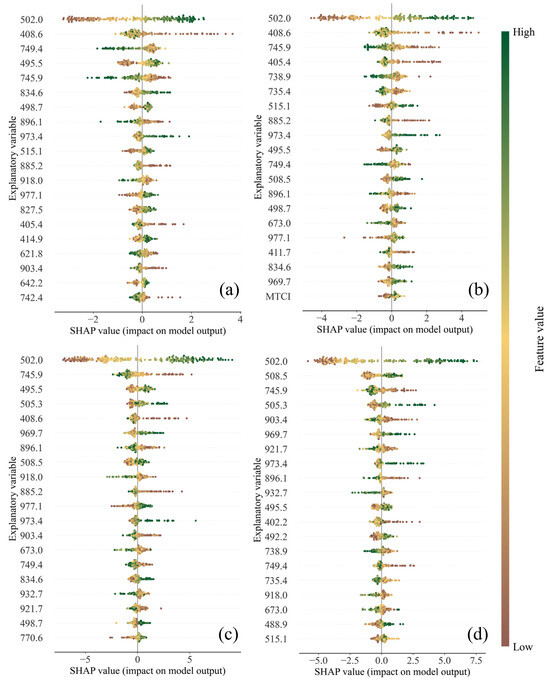
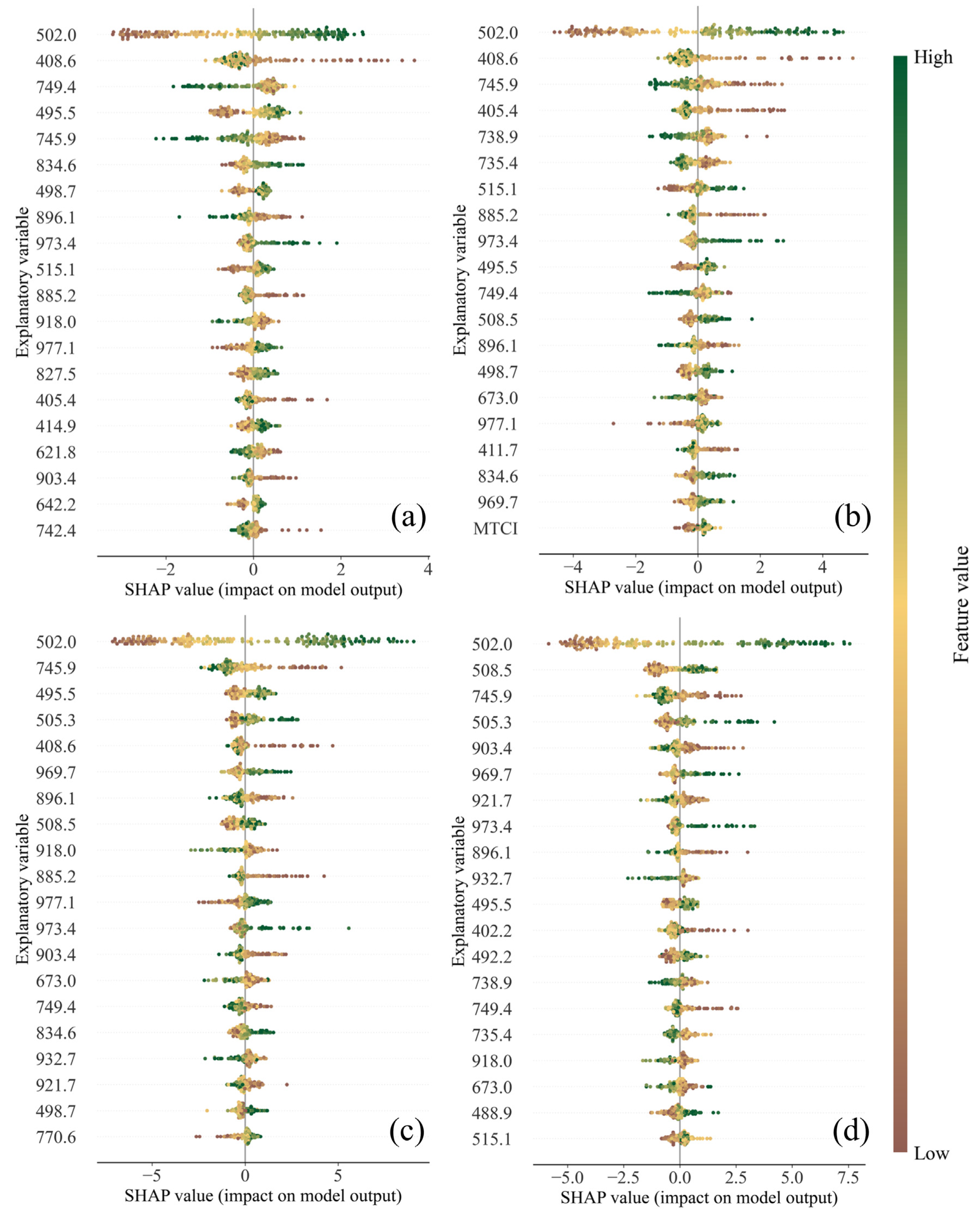
SHAP plots (Figure 10) illustrate the spectral driving mechanisms for retrieving soil NO3−-N at different depths (10–50 cm) based on plant pixels: shallow layers (10–20 cm) are primarily influenced by green and red-edge bands, reflecting the close association between vegetation physiological status and topsoil nutrient availability; as depth increases, the contribution of near-infrared bands becomes more prominent, indicating that deeper NO3−-N is increasingly governed by soil physicochemical properties, while the vegetation signal progressively weakens. The most important spectral features for the model vary dynamically across soil depths. At shallow depths (10 and 20 cm), the dominant features are concentrated in the green spectral region and the red-edge region, which directly reflect plant nitrogen status. In contrast, at greater depths (30 and 50 cm), the importance of near-infrared bands increases significantly. The absence of a consistent optimal feature set across all depths-demonstrates that the coupling relationship between canopy spectra and soil NO3−–N is indirect and unstable. It also supports the rationale for developing separate models for each of the four depths.
Figure 10.
SHAP Contribution Map at Different Depths: (a) 10 cm, (b) 20 cm, (c) 30 cm, (d) 50 cm.
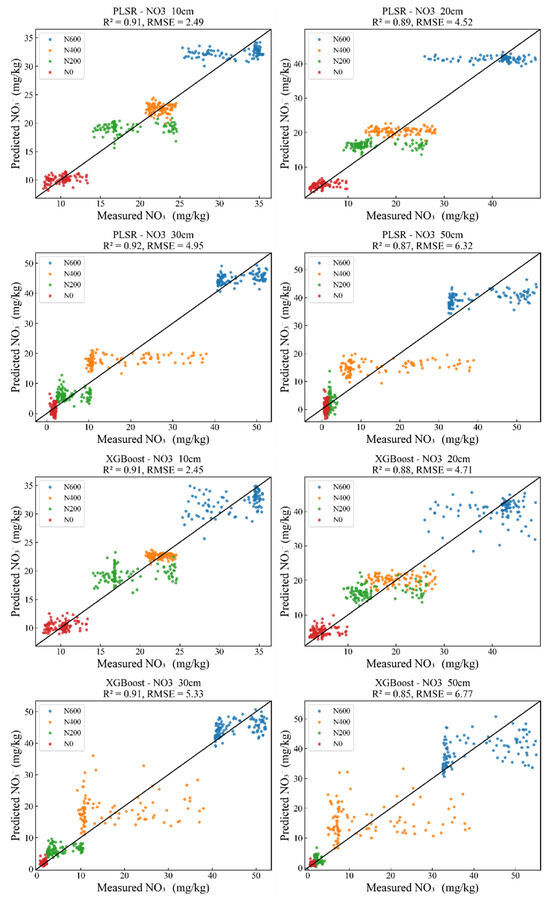
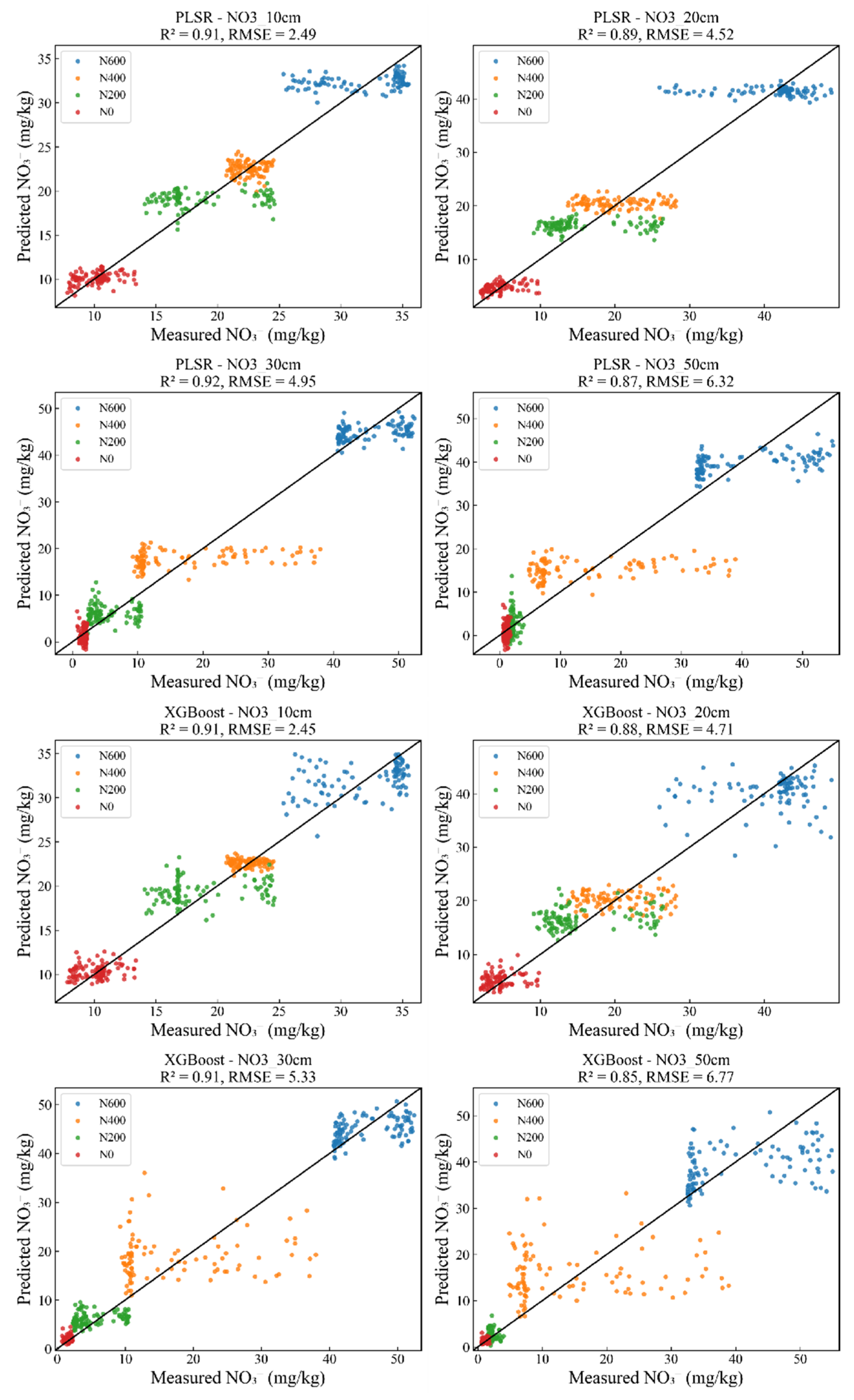
To improve the soil nitrogen retrieval, additional known information was incorporated into the models. The fertilization gradient labels (Model Mode 2) for each plot were added to the predictor variables as a grouping label. The results (Figure 11) showed that including this grouping information significantly enhanced the model fitting. The different nitrogen application groups became distinctly separated during the modeling process based on spectral information.
Figure 11.
Observed vs. Predicted Results from Modeling Based on Hyperspectral Data using PLSR and XGBoost with the Incorporation of Nitrogen Application Gradient Labels.
After incorporating the nitrogen application gradient labels, the model fitting performance was significantly enhanced. In the 0–20 cm depth range, the four plots with different nitrogen treatments showed high distinguishability and effective separation, with the coefficients of determination (R2) for the models all exceeding 0.88 (Table 3). In the 30–50 cm depth range, the separation between the N0 and N200 plots was less distinct due to the lack of substantial nitrogen accumulation in the deeper layers. Overall, the retrieval accuracy of the PLSR model was slightly superior to that of the XGBoost model. PLSR demonstrates greater advantages over XGBoost when handling feature sets composed of hyperspectral narrow bands with multicollinearity issues [45,46]. Furthermore, in hyperspectral monitoring of vegetation and soil properties, the PLSR model exhibits superior performance compared to other multivariate regression methods [47,48,49]. The marginal superiority of the linear PLSR model over the non-linear XGBoost model in Model Mode 2 (With Fertilization Gradient Labels) provides key insight into the data structure. When the N Labels are introduced, the model’s high overall performance is primarily driven by its ability to separate the large, systematic, and approximately linear differences between the N treatments (N0 to N600). The PLSR algorithm efficiently captures this linear main effect with minimal model complexity, leading to robust results in the validation set. In contrast, the XGBoost model’s attempt to identify subtle, complex non-linear relationships in the remaining residual variance did not yield significant additional predictive gains, suggesting that the primary signal governing the overall NO3−-N distribution in this labeled dataset is predominantly linear or quasi-linear.
Table 3.
Hyperspectral Nitrogen Retrieval Results by Depth and Model.
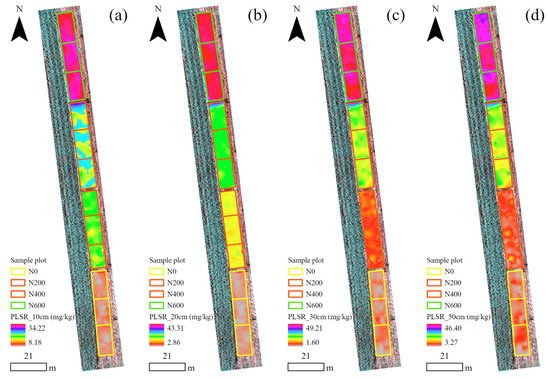
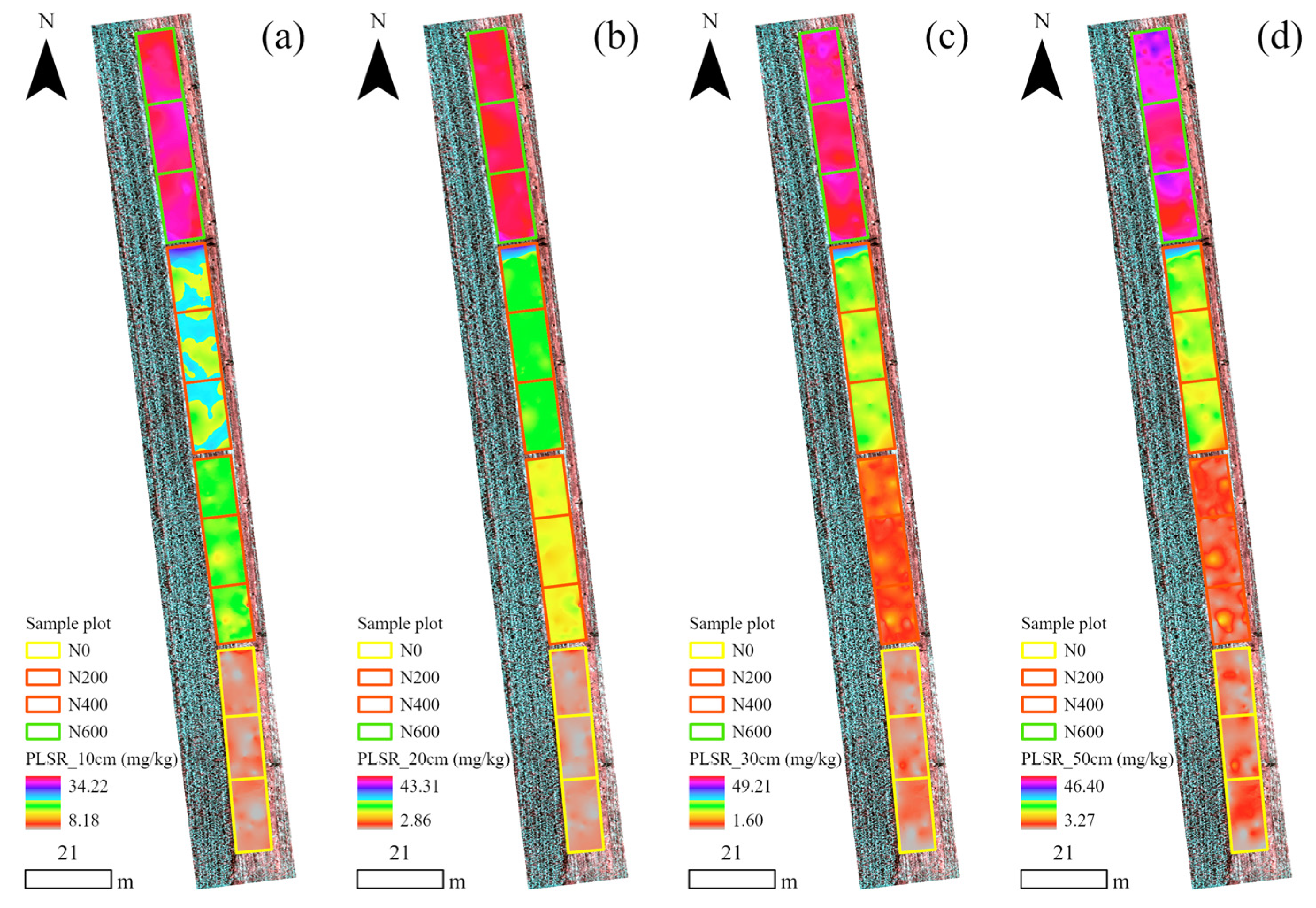
The retrieval results (Figure 12) show a strong agreement with the actual soil sampling data. Although there remains some limitation in identifying finer-scale nutrient patches, the methodology successfully captures the overall soil NO3−-N status across different nitrogen application gradients. This capability can support agricultural nutrient management and non-point source pollution control. Analysis of the spatial distribution patterns in the retrieval results indicates that, influenced by variations in maize growth during the jointing stage, certain plots (e.g., the N400 plot at 10 cm depth) exhibit relatively high heterogeneity in soil NO3−-N content.
Figure 12.
Soil NO3−-N Retrieval Results Using PLSR at Different Depths: (a) 10 cm, (b) 20 cm, (c) 30 cm, (d) 50 cm.
4. Discussion
4.1. Hyperspectral Soil Nitrogen Inversion Mediated by Vegetation
A substantial body of remote sensing research on soil nitrogen relies on soil spectral information. However, this approach is limited by the availability of bare soil windows, making temporally continuous monitoring challenging. While some researchers have employed handheld spectrometers for soil nitrogen monitoring [50], this method sacrifices the advantage of spatial continuity inherent to remote sensing. Therefore, soil nitrogen retrieval using vegetation as a proxy is necessary. Supporting this approach, Zhang et al. [51] found that incorporating vegetation information improved the accuracy of soil nitrogen retrieval compared to using bare soil imagery alone. This is particularly critical for farmland with permanent vegetation cover, as it enables the use of remote sensing with plants as proxies to study soil nutrient dynamics throughout the growth period. Building on this foundation, the present study further reveals that: without incorporating fertilization gradient labels, the models exhibit limited interpretability, a constraint shared by all current studies utilizing vegetation for soil nitrogen retrieval [12,52]. However, the inclusion of the fertilization gradient labels (Model Mode 2) significantly boosted the overall prediction accuracy (R2) by enabling the model to capture the major systematic variance that exists between different N treatments. While this method demonstrates the high value of experimental prior knowledge for achieving high overall performance, this high overall R2 often masks the model’s limited capability to predict subtle spatial heterogeneity within a single treatment area. This trade-off suggests that the inherent challenge of retrieving N variability solely through the vegetation proxy persists in areas lacking strong systematic differences.
We observed that soil depth presents another significant challenge. The observed decline in retrieval accuracy with increasing depth is attributed to the decoupling of the spectral signal from deep-layer NO3−-N content. This is driven by the canopy spectral signal primarily reflects N availability in the shallow, effective root zone (0–40 cm) [37], leading to a physiological constraint below this depth. The NO3−-N content in the deep layers (>50 cm) is mainly governed by physical processes leaching and the retardation effect of the 300–350 cm clay layer, which are largely independent of the plant’s instantaneous physiological status. This suggests that the model is inherently limited in predicting N below the active root zone. Therefore, investigating deep-layer nitrogen processes necessitates the use of indirectly correlated methods to establish relationships between surface and deep-layer nitrogen dynamics.
4.2. Feasibility Assessment: Nutrient Management and Nitrogen Leaching Estimation via Hyperspectral Soil Nitrogen Retrieval
The application of soil nitrogen remote sensing is predominantly utilized for guiding variable-rate fertilization to meet crop nutrient requirements, as exemplified by the study of Stamatiadis et al. [53]. In contrast, environmental remote sensing research focused on controlling agricultural non-point source pollution is predominantly conducted at regional scales. These studies not only employ remote sensing data but also extensively integrate other geographical and environmental datasets to assess non-point source pollution risks [54]. Research on remote identification of nitrogen leaching at the field scale has developed relatively later. For instance, Zhao et al. [55] utilized autumn vegetation indices to estimate winter nitrate leaching in a winter-rainfall climate region. This approach of conducting research across precipitation-active periods aligns with the methodology of our study.
A prominent issue in current research is the linear relationship between nitrogen input and its accumulation/leaching. Studies have found that the response of crop nitrogen uptake to nitrogen application follows the law of diminishing returns [56,57], which is consistent with our findings. In this study, the total nitrogen uptake across two growing seasons for the N200, N400, and N600 treatments was 305, 352, and 364 kg/ha, respectively, showing an increase compared to the N0 treatment (240 kg/ha). However, the partial factor productivity of applied nitrogen significantly decreased with increasing application rates, with no substantial difference observed between N400 and N600 treatments. Through long-term positioning experiments, Qu Wenkai et al. [58] revealed that crop nutrient resource use efficiency remains relatively higher when nitrogen application is maintained at approximately 435 kg/ha, beyond which leaching risk increases substantially. Collectively, the crop canopy characteristics, crop nitrogen uptake, and leaching processes all demonstrated strong correlations with the nitrogen application gradient. From N0 to N600, the canopy characteristics, surface leaching, topsoil nitrogen content, and deep-layer accumulation consistently increased with the fertilization rate (Figure 13), all Parameters show clear responses to increasing nitrogen fertilizer application level (N0–N600) underscoring the critical importance of the nitrogen application gradient as label data. Hyperspectral remote sensing shows significant potential for inferring both surface leaching and deep-layer accumulation. This potential is based on initially retrieved surface nitrogen content, combined with key factors such as farmland crop characteristics, fertilization practices, and crop growth stages. This integrated approach represents a promising and valuable direction for future research.
Figure 13.
Relationships among canopy characteristics, topsoil leaching, topsoil nitrogen content, and deep-layer accumulation (a) SPAD values at the jointing stage; (b) SPAD values at the filling stage; (c) NO3−-N accumulation in soil profiles; (d) Soil NO3−-N content at different depths.
4.3. Limitations and Uncertainties
This study provides valuable insights for soil nutrient management and indicates nitrogen leaching risks, though several uncertainties remain. Firstly, regarding the accuracy of soil nitrogen retrieval, the incorporation of fertilization gradients significantly improves model performance, However, within individual field plots where such gradients are absent, the model exhibits limited discriminative capability. Addressing this challenge constitutes a key direction for future research. Furthermore, the biogeochemical processes of soil nitrogen are highly complex. The findings presented here only offer a general estimation, and precise quantification of soil nitrogen leaching requires further support from field experiments.
5. Conclusions
The retrieval of soil nitrogen using vegetation hyperspectral characteristics is feasible in long-term stable cropping systems. This study developed PLSR and XGBoost models to retrieve soil NO3−-N content at four different depths (0–50 cm), with the PLSR model demonstrating slightly better performance than XGBoost, making it suitable for field-scale nitrogen mapping and precision agricultural management. Furthermore, we identified a consistent co-variation pattern among canopy characteristics, surface leaching, topsoil nitrogen content at the maize jointing stage, and deep-layer nitrogen accumulation at the filling stage across different fertilization gradients. The UAV-based hyperspectral imagery exhibited certain retrieval capability for NO3−-N in the 0–20 cm surface soil during the maize jointing stage. Moreover, the spatial distribution of surface nitrogen showed significant correlation with deep-layer NO3−-N enrichment areas during the filling stage, indicating that early-stage spectral information can serve as a precursor indicator for later leaching risks.
Author Contributions
Z.Z. (Zilong Zhang): Conceptualization, Methodology, Software, Formal analysis, Investigation, Data Curation, Writing—Original Draft, Visualization; S.W.: Conceptualization, Resources, Writing—Review and Editing, Supervision, Project administration, Funding acquisition; J.M.: Resources, Investigation; C.W.: Resources, Investigation; Z.Z. (Zhixiong Zhang): Methodology, Investigation. X.L.: Validation, Data Curation; W.Z.: Methodology, Supervision; C.H.: Validation, Data Curation. All authors have read and agreed to the published version of the manuscript.
Funding
This work was supported by the National Key R&D Program of China (2021YFD1700500), the National Natural Science Foundation of China (No. 42377080), and the Foundation for Innovative Research Groups of the Natural Science Foundation of Hebei Province (D2021503001).
Data Availability Statement
The raw data supporting the conclusions of this article will be made available by the authors upon request.
Conflicts of Interest
Author Jingjin Ma was employed by the company Hebei Sailhero Environmental Protection High-Tech Co., Ltd. The remaining authors declare that the research was conducted in the absence of any commercial or financial relationships that could be construed as a potential conflict of interest.
References
- Robertson, G.P.; Vitousek, P.M. Nitrogen in Agriculture: Balancing the Cost of an Essential Resource. Annu. Rev. Environ. Resour. 2009, 34, 97–125. [Google Scholar] [CrossRef] [Scilit]
- Masclaux-Daubresse, C.; Daniel-Vedele, F.; Dechorgnat, J.; Chardon, F.; Gaufichon, L.; Suzuki, A. Nitrogen Uptake, Assimilation and Remobilization in Plants: Challenges for Sustainable and Productive Agriculture. Ann. Bot. 2010, 105, 1141–1157. [Google Scholar] [CrossRef] [Scilit] [PubMed]
- Van Meter, K.J.; Basu, N.B.; Veenstra, J.J.; Burras, C.L. The Nitrogen Legacy: Emerging Evidence of Nitrogen Accumulation in Anthropogenic Landscapes. Environ. Res. Lett. 2016, 11, 035014. [Google Scholar] [CrossRef] [Scilit]
- Poffenbarger, H.J.; Sawyer, J.E.; Barker, D.W.; Olk, D.C.; Six, J.; Castellano, M.J. Legacy Effects of Long-Term Nitrogen Fertilizer Application on the Fate of Nitrogen Fertilizer Inputs in Continuous Maize. Agric. Ecosyst. Environ. 2018, 265, 544–555. [Google Scholar] [CrossRef] [Scilit]
- Sun, H.; Zheng, W.; Wang, S.; Ma, L.; Min, L.; Shen, Y. Variation of Nitrate Sources Affected by Precipitation with Different Intensities in Groundwater in the Piedmont Plain Area of Alluvial-Pluvial Fan. J. Environ. Manage. 2024, 367, 121885. [Google Scholar] [CrossRef] [Scilit]
- Zhu, Z. Research on Soil Nitrogen in China. Acta Pedol. Sin. 2008, 45, 778–783. [Google Scholar]
- Li, Y.; Yang, Q.; Chen, M.; Wang, M.; Zhang, M. An ISE-Based on-Site Soil Nitrate Nitrogen Detection System. SENSORS 2019, 19, 4669. [Google Scholar] [CrossRef] [Scilit]
- Sinfield, J.V.; Fagerman, D.; Colic, O. Evaluation of Sensing Technologies for On-the-Go Detection of Macro-Nutrients in Cultivated Soils. Comput. Electron. Agric. 2010, 70, 1–18. [Google Scholar] [CrossRef] [Scilit]
- Berger, K.; Verrelst, J.; Féret, J.-B.; Hank, T.; Wocher, M.; Mauser, W.; Camps-Valls, G. Retrieval of Aboveground Crop Nitrogen Content with a Hybrid Machine Learning Method. Int. J. Appl. Earth Obs. Geoinformation 2020, 92, 102174. [Google Scholar] [CrossRef] [Scilit] [PubMed]
- Yu, H.; Kong, B.; Wang, Q.; Liu, X.; Liu, X. Hyperspectral Remote Sensing Applications in Soil: A Review. In Hyperspectral Remote Sensing; Elsevier: Amsterdam, The Netherlands, 2020; pp. 269–291. ISBN 978-0-08-102894-0. [Google Scholar]
- Boggs, J.L.; Tsegaye, T.D.; Coleman, T.L.; Reddy, K.C.; Fahsi, A. Relationship between Hyperspectral Reflectance, Soil Nitrate-Nitrogen, Cotton Leaf Chlorophyll, and Cotton Yield: A Step toward Precision Agriculture. J. Sustain. Agric. 2003, 22, 5–16. [Google Scholar] [CrossRef] [Scilit]
- Wang, J.; Meyer, S.T.; Xu, X.; Weisser, W.W.; Yu, K. Drone Multispectral Imaging Captures the Effects of Soil Mineral Nitrogen on Canopy Structure and Nitrogen Use Efficiency in Wheat. Comput. Electron. Agric. 2025, 235, 110342. [Google Scholar] [CrossRef] [Scilit]
- Shokirov, S.; Abdurahmanov, I.; Mamatkulov, Z.; Abdurahmanov, Z.; Zarifboev, D.; Oymatov, R.; Kovács, Z.; Csabai, J.; Shiping, Y.; Khakberdiev, O. Leveraging Vegetation Indices and Random Forest for Soil Nutrient Monitoring in Winter Wheat. J. Indian Soc. Remote Sens. 2025, 53, 3711–3721. [Google Scholar] [CrossRef] [Scilit]
- Jiao, X.; Liu, H.; Wang, W.; Zhu, J.; Wang, H. Estimation of Surface Soil Nutrient Content in Mountainous Citrus Orchards Based on Hyperspectral Data. Agriculture 2024, 14, 873. [Google Scholar] [CrossRef] [Scilit]
- Yan, Y.; Yang, J.; Li, B.; Qin, C.; Ji, W.; Xu, Y.; Huang, Y. High-Resolution Mapping of Soil Organic Matter at the Field Scale Using UAV Hyperspectral Images with a Small Calibration Dataset. Remote Sens. 2023, 15, 1433. [Google Scholar] [CrossRef] [Scilit]
- Zhang, F.; Cui, Z.; Wang, J.; Li, C.; Chen, X. Current Status of Soil and Plant Nutrient Management in China and Improvement Strategies. Chin. Bull. Bot. 2007, 24, 687–694. Available online: https://www.chinbullbotany.com/CN/Y2007/V24/I06/687 (accessed on 4 December 2025).
- Cui, Z.; Chen, X.; Zhang, F. Current Nitrogen Management Status and Measures to Improve the Intensive Wheat–Maize System in China. AMBIO 2010, 39, 376–384. [Google Scholar] [CrossRef] [Scilit] [PubMed]
- Chen, D.; Shen, H.; Hu, M.; Wang, J.; Zhang, Y.; Dahlgren, R.A. Legacy Nutrient Dynamics at the Watershed Scale: Principles, Modeling, and Implications. In Advances in Agronomy; Elsevier: Amsterdam, The Netherlands, 2018; Volume 149, pp. 237–313. ISBN 978-0-12-815177-8. [Google Scholar]
- Van Meter, K.J.; Van Cappellen, P.; Basu, N.B. Legacy Nitrogen May Prevent Achievement of Water Quality Goals in the Gulf of Mexico. Science 2018, 360, 427–430. [Google Scholar] [CrossRef] [Scilit]
- Zhang, Z.; Fei, Y.; Guo, C.; Qian, Y.; Li, Y. Regional Groundwater Contamination Assessment in the North China Plain. J. Jilin Univ. Earth Sci. Ed. 2012, 42, 1456–1461. [Google Scholar]
- Wang, S.; Tang, C.; Song, X.; Yuan, R.; Han, Z.; Pan, Y. Factors Contributing to Nitrate Contamination in a Groundwater Recharge Area of the North China Plain. Hydrol. Process. 2016, 30, 2271–2285. [Google Scholar] [CrossRef] [Scilit]
- Zheng, W.; Wang, S.; Tan, K.; Shen, Y.; Yang, L. Rainfall Intensity Affects the Recharge Mechanisms of Groundwater in a Headwater Basin of the North China Plain. Appl. Geochem. 2023, 155, 105742. [Google Scholar] [CrossRef] [Scilit]
- Ciampitti, I.A.; Vyn, T.J. Physiological Perspectives of Changes over Time in Maize Yield Dependency on Nitrogen Uptake and Associated Nitrogen Efficiencies: A Review. Field Crops Res. 2012, 133, 48–67. [Google Scholar] [CrossRef] [Scilit]
- Xiao, G.; Ru, S.; Sun, S.; Zhao, O.; Hou, L.; Wang, C.; Wang, L.; Liu, L.; Zhang, G. Impact of Nitrogen Application on Nitrate Nitrogen Leaching in Winter Wheat and Summer Maize Rotation System Based on a Literature Analysis. Chin. J. Eco-Agric. 2022, 30, 116–125. [Google Scholar]
- XHHSIDAS, V1.0; Hebei Sailhero Environmental Protection High-Tech Co., Ltd.: Shijiazhuang, China, 2023.
- Wang, S.; Wei, S.; Liang, H.; Zheng, W.; Li, X.; Hu, C.; Currell, M.J.; Zhou, F.; Min, L. Nitrogen Stock and Leaching Rates in a Thick Vadose Zone below Areas of Long-Term Nitrogen Fertilizer Application in the North China Plain: A Future Groundwater Quality Threat. J. Hydrol. 2019, 576, 28–40. [Google Scholar] [CrossRef] [Scilit]
- Chen, J.; Jönsson, P.; Tamura, M.; Gu, Z.; Matsushita, B.; Eklundh, L. A Simple Method for Reconstructing a High-Quality NDVI Time-Series Data Set Based on the Savitzky–Golay Filter. Remote Sens. Environ. 2004, 91, 332–344. [Google Scholar] [CrossRef] [Scilit]
- Fitzgerald, G.; Rodriguez, D.; O’Leary, G. Measuring and Predicting Canopy Nitrogen Nutrition in Wheat Using a Spectral Index-the Canopy Chlorophyll Content Index (CCCI). FIELD CROPS Res. 2010, 116, 318–324. [Google Scholar] [CrossRef] [Scilit]
- Rondeaux, G.; Steven, M.; Baret, F. Optimization of Soil-Adjusted Vegetation Indices. Remote Sens. Environ. 1996, 55, 95–107. [Google Scholar] [CrossRef] [Scilit]
- Barnes, J.D.; Balaguer, L.; Manrique, E.; Elvira, S.; Davison, A.W. A Reappraisal of the Use of DMSO for the Extraction and Determination of Chlorophylls a and b in Lichens and Higher Plants. Environ. Exp. Bot. 1992, 32, 85–100. [Google Scholar] [CrossRef] [Scilit]
- Dash, J.; Curran, P.J. The MERIS Terrestrial Chlorophyll Index. Int. J. Remote Sens. 2004, 25, 5403–5413. [Google Scholar] [CrossRef] [Scilit]
- Haboudane, D. Hyperspectral Vegetation Indices and Novel Algorithms for Predicting Green LAI of Crop Canopies: Modeling and Validation in the Context of Precision Agriculture. Remote Sens. Environ. 2004, 90, 337–352. [Google Scholar] [CrossRef] [Scilit]
- Geladi, P.; Kowalski, B.R. Partial Least-Squares Regression: A Tutorial. Anal. Chim. Acta 1986, 185, 1–17. [Google Scholar] [CrossRef] [Scilit]
- Chen, T.; Guestrin, C. XGBoost: A Scalable Tree Boosting System.; ACM: San Francisco, CA, USA, 2016; pp. 785–794. [Google Scholar]
- Lundberg, S.M.; Lee, S.-I. A Unified Approach to Interpreting Model Predictions. Adv. Neural Inf. Process. Syst. 2017, 30, 4768–4777. Available online: https://dl.acm.org/doi/10.5555/3295222.3295230 (accessed on 4 December 2025).
- Tan, K.; Wang, S.; Zheng, W.; Zhang, Z.; Liu, B. Geomorphologic and Sedimentary Features Dominate the Nitrogen Accumulation and Leaching in the Deep Vadose Zone from a Catchment Viewpoint. J. Hydrol. 2025, 652, 132682. [Google Scholar] [CrossRef] [Scilit]
- Li, Y.; Wang, Q.; Gao, S.; Wang, X.; He, A.; He, P. Effects of Water–Nitrogen Coupling on Root Distribution and Yield of Summer Maize at Different Growth Stages. Plants 2025, 14, 1278. [Google Scholar] [CrossRef] [Scilit]
- Zhan, X.; Zhang, Q.; Li, M.; Hou, X.; Shang, Z.; Liu, Z.; He, Y. The Shape of Reactive Nitrogen Losses from Intensive Farmland in China. Sci. Total Environ. 2024, 915, 170014. [Google Scholar] [CrossRef] [Scilit] [PubMed]
- Shi, Z.; She, D.; Pan, Y.; Abulaiti, A.; Hu, L.; Sun, X. Nitrogen Loss Due to Nitrate Reduction in the Soil Profile Depends on the Type of Cropland. GEODERMA Reg. 2025, 42, e00977. [Google Scholar] [CrossRef] [Scilit]
- Tsai, F.; Philpot, W. Derivative Analysis of Hyperspectral Data. Remote Sens. Environ. 1997, 66, 41–51. [Google Scholar] [CrossRef] [Scilit]
- Bausch, W.; Duke, H. Remote Sensing of Plant Nitrogen Status in Corn. Trans. ASAE 1996, 39, 1869–1875. [Google Scholar] [CrossRef] [Scilit]
- Deng, L.; Mao, Z.; Li, X.; Hu, Z.; Duan, F.; Yan, Y. UAV-Based Multispectral Remote Sensing for Precision Agriculture: A Comparison between Different Cameras. ISPRS J. Photogramm. REMOTE Sens. 2018, 146, 124–136. [Google Scholar] [CrossRef] [Scilit]
- Gitelson, A.; Merzlyak, M. Remote Sensing of Chlorophyll Concentration in Higher Plant Leaves. Adv. Space Res. 1998, 22, 689–692. [Google Scholar] [CrossRef] [Scilit]
- Fageria, N.K.; Baligar, V.C. Enhancing Nitrogen Use Efficiency in Crop Plants. Adv. Agron. 2005, 88, 97–185. [Google Scholar] [CrossRef] [Scilit]
- Zhu, G.; Wang, Q.; Zhang, S.; Guo, T.; Liu, S.; Lu, J. A Meta-Analysis of Crop Leaf Nitrogen, Phosphorus and Potassium Content Estimation Based on Hyperspectral and Multispectral Remote Sensing Techniques. Field Crops Res. 2025, 329, 109961. [Google Scholar] [CrossRef] [Scilit]
- Feilhauer, H.; Asner, G.P.; Martin, R.E.; Schmidtlein, S. Brightness-Normalized Partial Least Squares Regression for Hyperspectral Data. J. Quant. Spectrosc. Radiat. Transf. 2010, 111, 1947–1957. [Google Scholar] [CrossRef] [Scilit]
- Yang, C.; Feng, M.; Song, L.; Jing, B.; Xie, Y.; Wang, C.; Yang, W.; Xiao, L.; Zhang, M.; Song, X. Study on Hyperspectral Monitoring Model of Soil Total Nitrogen Content Based on Fractional-Order Derivative. Comput. Electron. Agric. 2022, 201, 107307. [Google Scholar] [CrossRef] [Scilit]
- Sun, W.; Liu, S.; Zhang, X.; Li, Y. Estimation of Soil Organic Matter Content Using Selected Spectral Subset of Hyperspectral Data. Geoderma 2022, 409, 115653. [Google Scholar] [CrossRef] [Scilit]
- Zhang, J.; Fu, Z.; Zhang, K.; Li, J.; Cao, Q.; Tian, Y.; Zhu, Y.; Cao, W.; Liu, X. Optimizing Rice In-Season Nitrogen Topdressing by Coupling Experimental and Modeling Data with Machine Learning Algorithms. Comput. Electron. Agric. 2023, 209, 107858. [Google Scholar] [CrossRef] [Scilit]
- Wu, J.; Liu, Y.; Chen, D.; Wang, J.; Chai, X. Quantitative Mapping of Soil Nitrogen Content Using Field Spectrometer and Hyperspectral Remote Sensing. In Proceedings of the 2009 International Conference on Environmental Science and Information Application Technology, Wuhan, China, 4–5 July 2009; Volume 2, pp. 379–382. [Google Scholar]
- Zhang, X.; Ma, Y.; Ma, S.; Qin, C.; Wang, Y.; Liu, H.; Chen, L.; Zhu, X. Mapping Soil Available Nitrogen Using Crop-Specific Growth Information and Remote Sensing. Agriculture 2025, 15, 1531. [Google Scholar] [CrossRef] [Scilit]
- Zhang, W.; Zhu, L.; Zhuang, Q.; Chen, D.; Sun, T. Mapping Cropland Soil Nutrients Contents Based on Multi-Spectral Remote Sensing and Machine Learning. Agriculture 2023, 13, 1592. [Google Scholar] [CrossRef] [Scilit]
- Stamatiadis, S.; Schepers, J.S.; Evangelou, E.; Glampedakis, A.; Glampedakis, M.; Dercas, N.; Tsadilas, C.; Tserlikakis, N.; Tsadila, E. Variable-Rate Application of High Spatial Resolution Can Improve Cotton N-Use Efficiency and Profitability. Precis. Agric. 2020, 21, 695–712. [Google Scholar] [CrossRef] [Scilit]
- Chhabra, A.; Manjunath, K.R.; Panigrahy, S. Non-Point Source Pollution in Indian Agriculture: Estimation of Nitrogen Losses from Rice Crop Using Remote Sensing and GIS. Int. J. Appl. Earth Obs. Geoinformation 2010, 12, 190–200. [Google Scholar] [CrossRef] [Scilit]
- Zhao, J.; De Notaris, C.; Olesen, J.E. Autumn-Based Vegetation Indices for Estimating Nitrate Leaching during Autumn and Winter in Arable Cropping Systems. Agric. Ecosyst. Environ. 2020, 290, 106786. [Google Scholar] [CrossRef] [Scilit]
- Dewit, C. Resource Use Efficiency in Agriculture. Agric. Syst. 1992, 40, 125–151. [Google Scholar] [CrossRef] [Scilit]
- Kho, R. On Crop Production and the Balance of Available Resources. Agric. Ecosyst. Environ. 2000, 80, 71–85. [Google Scholar] [CrossRef] [Scilit]
- Qu, W.; Xu, X.; Hao, T.; Liu, S.; Meng, F.; Zhao, C. Effects of Nitrogen Application Rate on Annual Yield and N-Use Efficiency of Winter Wheat-Summer Maize Rotation under Drip Irrigation. J. Plant Nutr. Fertil. 2022, 28, 1271–1282. [Google Scholar]

Disclaimer/Publisher’s Note: The statements, opinions and data contained in all publications are solely those of the individual author(s) and contributor(s) and not of MDPI and/or the editor(s). MDPI and/or the editor(s) disclaim responsibility for any injury to people or property resulting from any ideas, methods, instructions or products referred to in the content. |
© 2025 by the authors. Licensee MDPI, Basel, Switzerland. This article is an open access article distributed under the terms and conditions of the Creative Commons Attribution (CC BY) license (https://creativecommons.org/licenses/by/4.0/).