A Review of Remote Sensing on Spartina alterniflora: Status, Challenge, and Direction

 ,
,  ,
, 
Highlights
- Remote sensing monitoring of S. alterniflora has evolved from static mapping to dynamic process monitoring and functional ecosystem assessment.
- Large-scale S. alterniflora mapping is effective, but mixed pixels and spectral confusion remain challenges, requiring stronger integration of AI methods.
- Future work should integrate multi-source data, improve sample systems, and enhance short- and long-term dynamic monitoring of S. alterniflora.
- The study provides a framework and insights to support effective S. alterniflora control and coastal wetland management.
Abstract
1. Introduction
2. Materials and Methods
3. Results
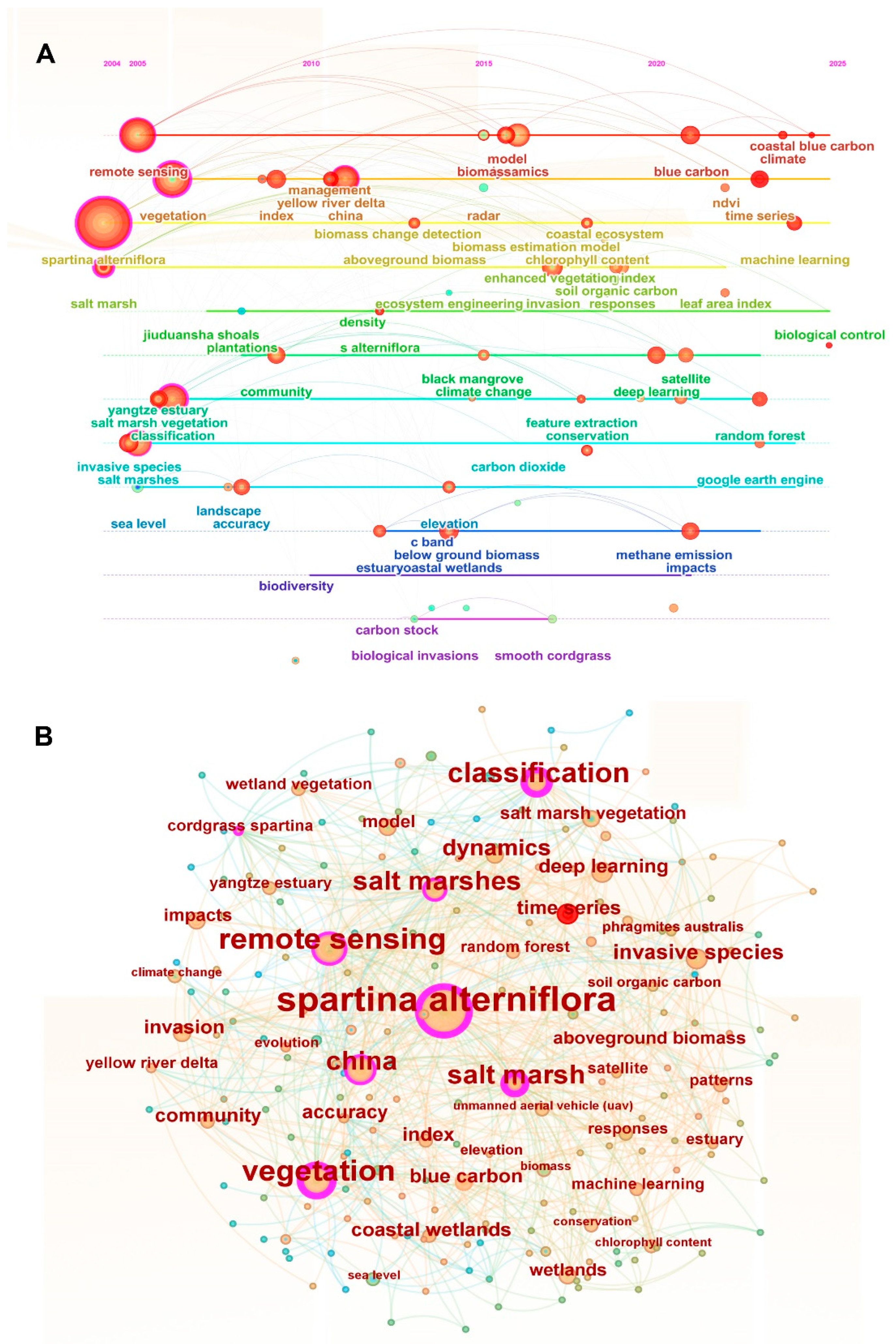
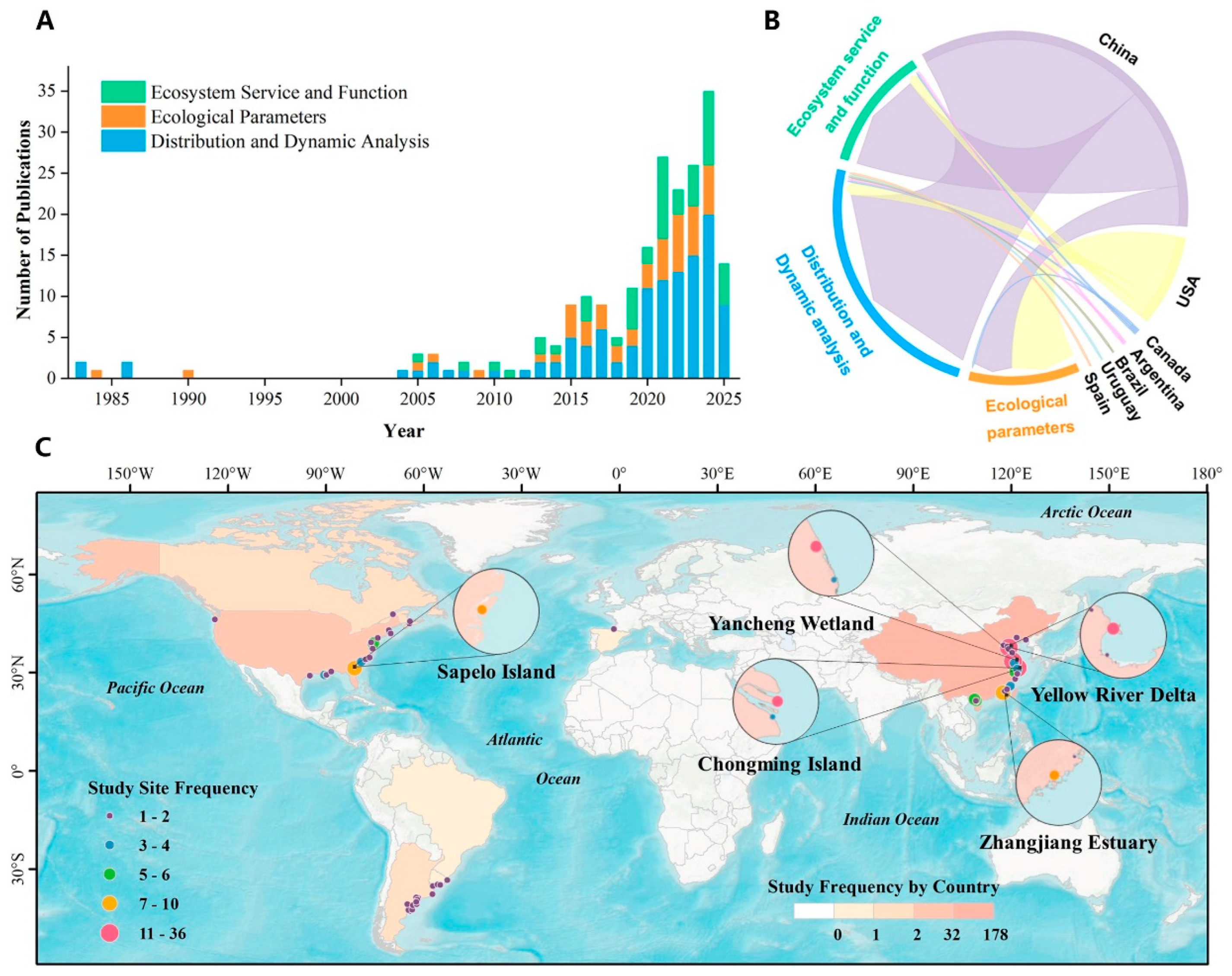
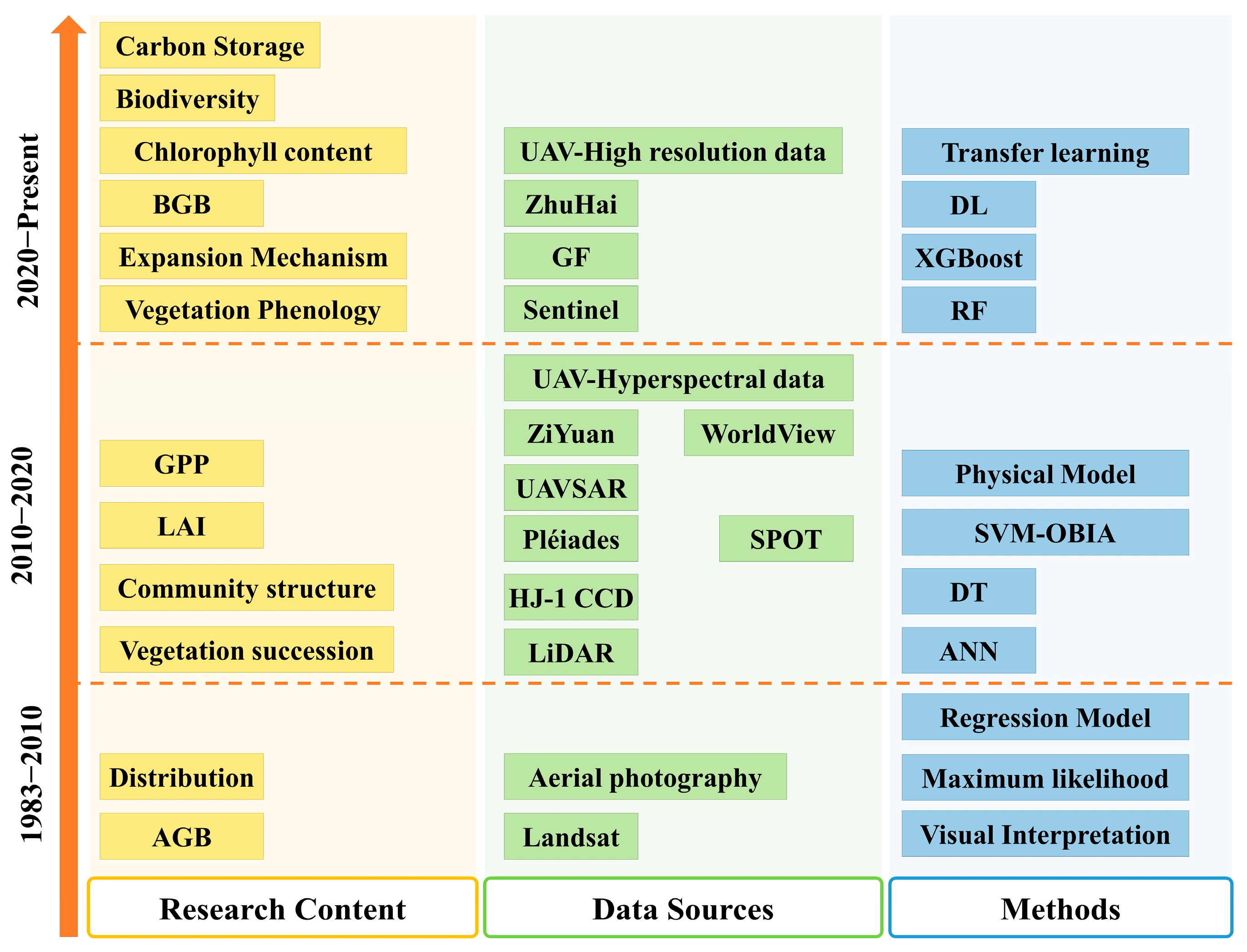
3.1. Research Hotspots and Global Distribution
3.2. Methodologies for Mapping Spatial Distribution and Temporal Changes
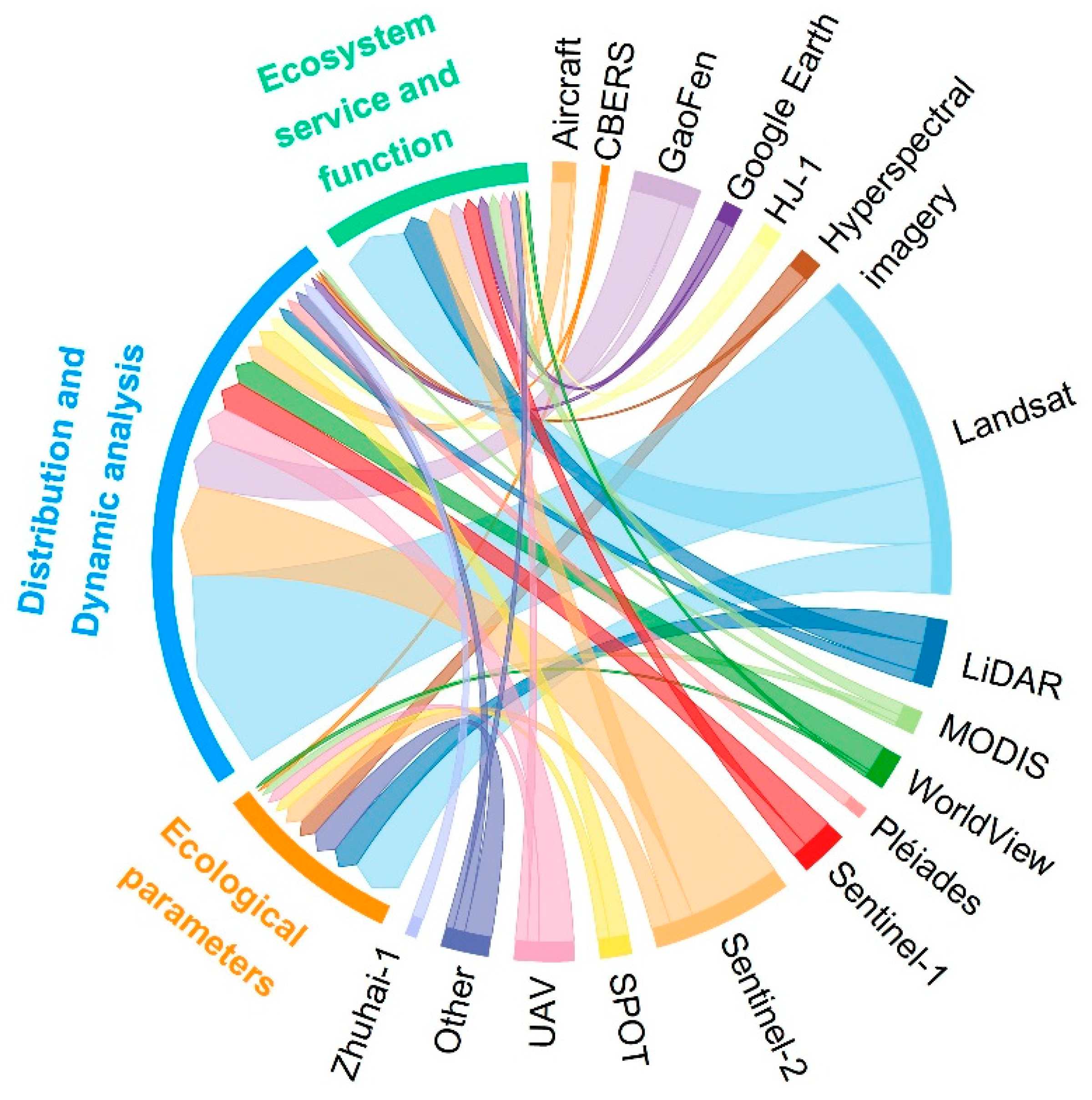
3.2.1. Diversification of Remote Sensing Data
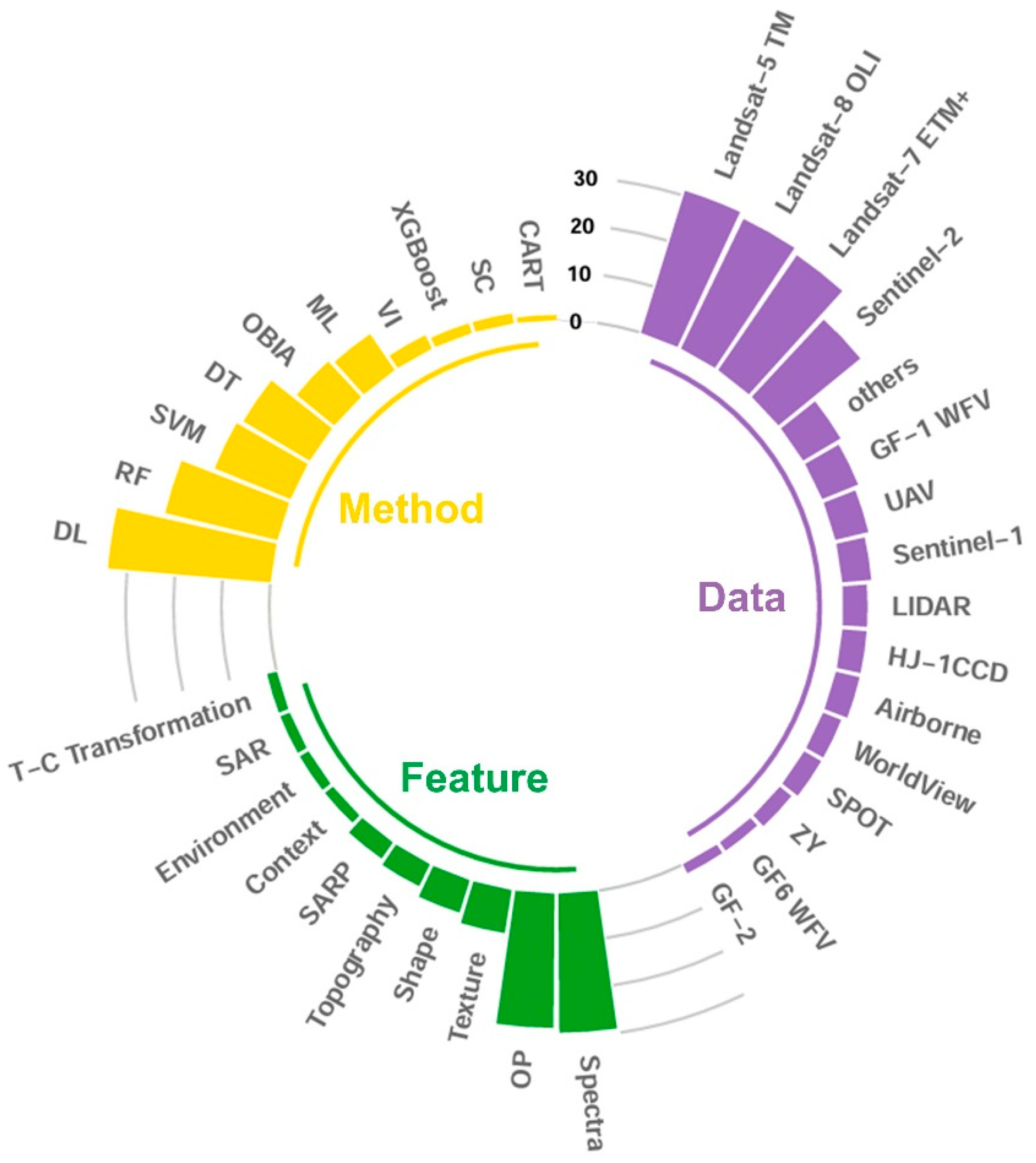
3.2.2. Synergistic Use of Multidimensional Features
3.2.3. Optimization of Classification Algorithms
3.3. Ecological Parameter Retrieval
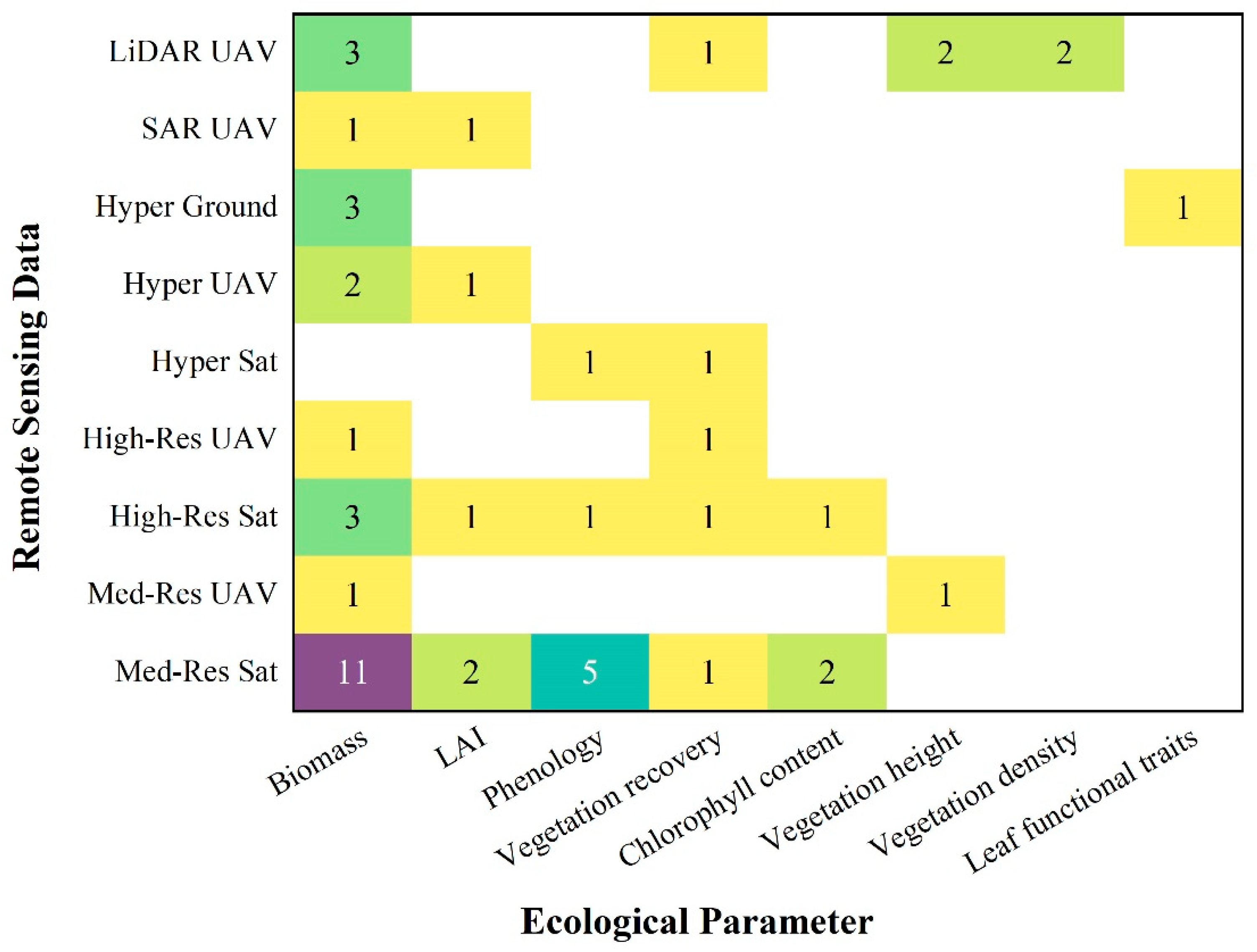
3.3.1. Key Ecological Parameters for Quantitative Retrieval of S. alterniflora
3.3.2. Remote Sensing Data Sources for Ecological Parameter Retrieval
3.3.3. Models and Approaches
3.4. Ecosystem Function and Service
3.4.1. Productivity and Carbon Storage Monitoring
3.4.2. Coastal Protection and Hydrological Regulation
3.4.3. Biodiversity and Habitat Provision
4. Discussion
4.1. Driving Forces of S. alterniflora Remote Sensing Applications
4.2. Challenges and Prospects of Spatial and Dynamic Monitoring
4.3. Challenges and Prospects of Structural and Functional Monitoring
4.4. Governance Framework Based on Remote Sensing
5. Conclusions
Author Contributions
Funding
Data Availability Statement
Conflicts of Interest
References
- Kirwan, M.L.; Megonigal, J.P. Tidal wetland stability in the face of human impacts and sea-level rise. Nature 2013, 504, 53–60. [Google Scholar] [CrossRef]
- Crooks, J.A. Characterizing ecosystem-level consequences of biological invasions: The role of ecosystem engineers. Oikos 2002, 97, 153–166. [Google Scholar] [CrossRef]
- Didham, R.K.; Tylianakis, J.M.; Gemmell, N.J.; Rand, T.A.; Ewers, R.M. Interactive effects of habitat modification and species invasion on native species decline. Trends Ecol. Evol. 2007, 22, 489–496. [Google Scholar] [CrossRef]
- Roberts, P.D.; Pullin, A.S. The effectiveness of management interventions for the control of Spartina species: A systematic review and meta-analysis. Aquat. Conserv.-Mar. Freshw. Ecosyst. 2008, 18, 592–618. [Google Scholar] [CrossRef]
- Chung, C.H. 30 years of ecological engineering with spartina plantations in China. Ecol. Eng. 1993, 2, 261–289. [Google Scholar] [CrossRef]
- Chen, Z.Y.; Li, B.; Zhong, Y.; Chen, J.K. Local competitive effects of introduced Spartina alterniflora on Scirpus mariqueter at Dongtan of Chongming Island, the Yangtze River estuary and their potential ecological consequences. Hydrobiologia 2004, 528, 99–106. [Google Scholar] [CrossRef]
- Li, H.Y.; Mao, D.H.; Wang, Z.M.; Huang, X.; Li, L.; Jia, M.M. Invasion of Spartina alternilora in the coastal zone of mainland China: Control achievements from 2015 to 2020 towards the Sustainable Development Goals. J. Environ. Manag. 2022, 323, 116242. [Google Scholar] [CrossRef] [PubMed]
- Qi, G.P.; Li, L.X.; Li, H.Y.; Liu, Y.; Xie, T.W.; Guo, H.Q.; Ma, Z.J.; Wu, J.H.; Li, B.; Ma, J. Ecological Effects of the Huge Invasive Species Removal Project in Coastal China. Environ. Sci. Technol. 2024, 58, 21229–21241. [Google Scholar] [CrossRef]
- Tian, J.; Wang, L.; Yin, D.; Li, X.; Diao, C.; Gong, H.; Shi, C.; Menenti, M.; Ge, Y.; Nie, S.; et al. Development of spectral-phenological features for deep learning to understand Spartina alterniflora invasion. Remote Sens. Environ. 2020, 242, 111745. [Google Scholar] [CrossRef]
- Yan, D.D.; Li, J.T.; Yao, X.Y.; Luan, Z.Q. Quantifying the Long-Term Expansion and Dieback of Spartina Alterniflora Using Google Earth Engine and Object-Based Hierarchical Random Forest Classification. IEEE J. Sel. Top. Appl. Earth Obs. Remote Sens. 2021, 14, 9781–9793. [Google Scholar] [CrossRef]
- Ai, J.Q.; Chen, L.J.; He, H.Q.; Han, X.X. Revealing the long-term impacts of plant invasion and reclamation on native saltmarsh vegetation in the Yangtze River estuary using multi-source time series remote sensing data. Ecol. Eng. 2024, 208, 107362. [Google Scholar] [CrossRef]
- Li, Z.J.; Wang, Z.Y.; Liu, X.T.; Zhu, Y.D.; Wang, K.; Zhang, T.E. Classification and Evolutionary Analysis of Yellow River Delta Wetlands Using Decision Tree Based on Time Series SAR Backscattering Coefficient and Coherence. Front. Mar. Sci. 2022, 9, 940342. [Google Scholar] [CrossRef]
- Zhang, M.; Schwarz, C.; Lin, W.P.; Naing, H.; Cai, H.Y.; Zhu, Z.C. A new perspective on the impacts of Spartina alterniflora invasion on Chinese wetlands in the context of climate change: A case study of the Jiuduansha Shoals, Yangtze Estuary. Sci. Total Environ. 2023, 868, 161477. [Google Scholar] [CrossRef]
- Chen, M.M.; Ke, Y.H.; Bai, J.H.; Li, P.; Lyu, M.Y.; Gong, Z.N.; Zhou, D.M. Monitoring early stage invasion of exotic Spartina alterniflora using deep-learning super-resolution techniques based on multisource high-resolution satellite imagery: A case study in the Yellow River Delta, China. Int. J. Appl. Earth Obs. Geoinf. 2020, 92, 102180. [Google Scholar] [CrossRef]
- Pinton, D.; Canestrelli, A.; Wilkinson, B.; Ifju, P.; Ortega, A. Estimating Ground Elevation and Vegetation Characteristics in Coastal Salt Marshes Using UAV-Based LiDAR and Digital Aerial Photogrammetry. Remote Sens. 2021, 13, 4506. [Google Scholar] [CrossRef]
- Zhu, X.D.; Meng, L.X.; Zhang, Y.H.; Weng, Q.H.; Morris, J. Tidal and Meteorological Influences on the Growth of Invasive Spartina alterniflora: Evidence from UAV Remote Sensing. Remote Sens. 2019, 11, 1208. [Google Scholar] [CrossRef]
- Chen, W.J.; Shi, C. Fine-scale mapping of Spartina alterniflora-invaded mangrove forests with multi-temporal WorldView-Sentinel-2 data fusion. Remote Sens. Environ. 2023, 295, 113690. [Google Scholar] [CrossRef]
- Kan, Z.Y.; Chen, B.; Yu, W.W.; Chen, S.Y.; Chen, G.C. Risk identification of mangroves facing Spartina alterniflora invasion using data-driven approaches with UAV and machine learning models. Remote Sens. Environ. 2025, 319, 114613. [Google Scholar] [CrossRef]
- Huang, C.Y.; Asner, G.P. Applications of Remote Sensing to Alien Invasive Plant Studies. Sensors 2009, 9, 4869–4889. [Google Scholar] [CrossRef]
- Meng, W.Q.; Feagin, R.A.; Innocenti, R.A.; Hu, B.B.; He, M.X.; Li, H.Y. Invasion and ecological effects of exotic smooth cordgrass Spartina alterniflora in China. Ecol. Eng. 2020, 143, 105670. [Google Scholar] [CrossRef]
- Wails, C.N.; Baker, K.; Blackburn, R.; Del Vallé, A.; Heise, J.; Herakovich, H.; Holthuijzen, W.A.; Nissenbaum, M.P.; Rankin, L.; Savage, K.; et al. Assessing changes to ecosystem structure and function following invasion by Spartina alterniflora and Phragmites australis: A meta-analysis. Biol. Invasions 2021, 23, 2695–2709. [Google Scholar] [CrossRef]
- Zheng, X.J.; Javed, Z.; Liu, B.; Zhong, S.; Cheng, Z.; Rehman, A.; Du, D.L.; Li, J. Impact of Spartina alterniflora Invasion in Coastal Wetlands of China: Boon or Bane? Biology 2023, 12, 1057. [Google Scholar] [CrossRef]
- Zhang, Z.Y.; Xia, X.M.; Chen, L.Z.; Liang, H.D.; Zhao, X.; Liu, B.; Cai, T.L.; Wang, X.K.; Chen, Y.N. Geomorphological changes and sediment carbon accumulation at the bare mudflat-saltmarsh interface: The role of typhoons. Geomorphology 2024, 454, 109151. [Google Scholar] [CrossRef]
- Civco, D.L.; Kennard, W.C.; Lefor, M.W. Changes in connecticut salt-marsh vegetation as revealed by historical aerial photographs and computer-assisted cartographics. Environ. Manag. 1986, 10, 229–239. [Google Scholar] [CrossRef]
- Mao, D.H.; Liu, M.Y.; Wang, Z.M.; Li, L.; Man, W.D.; Jia, M.M.; Zhang, Y.Z. Rapid Invasion of Spartina Alterniflora in the Coastal Zone of Mainland China: Spatiotemporal Patterns and Human Prevention. Sensors 2019, 19, 2308. [Google Scholar] [CrossRef]
- Lin, W.P.; Chen, G.S.; Guo, P.P.; Zhu, W.Q.; Zhang, D.H. Remote-Sensed Monitoring of Dominant Plant Species Distribution and Dynamics at Jiuduansha Wetland in Shanghai, China. Remote Sens. 2015, 7, 10227–10241. [Google Scholar] [CrossRef]
- Liu, X.; Liu, H.Y.; Datta, P.; Frey, J.; Koch, B. Mapping an Invasive Plant Spartina alterniflora by Combining an Ensemble One-Class Classification Algorithm with a Phenological NDVI Time-Series Analysis Approach in Middle Coast of Jiangsu, China. Remote Sens. 2020, 12, 4010. [Google Scholar] [CrossRef]
- Ren, G.B.; Hu, Y.B.; Lu, F.; Zhou, Y.F.; Wang, J.B.; Wu, P.Q.; Ma, Y. Early Invasion Process Monitoring of Spartina Alterniflora Using Long Time Series High-Resolution Satellite Remote Sensing Imagery. IEEE J. Sel. Top. Appl. Earth Obs. Remote Sens. 2025, 18, 1317–1328. [Google Scholar] [CrossRef]
- Hladik, C.; Schalles, J.; Alber, M. Salt marsh elevation and habitat mapping using hyperspectral and LIDAR data. Remote Sens. Environ. 2013, 139, 318–330. [Google Scholar] [CrossRef]
- Judd, C.; Steinberg, S.; Shaughnessy, F.; Crawford, G. Mapping salt marsh vegetation using aerial hyperspectral imagery and linear unmixing in Humboldt bay, California. Wetlands 2007, 27, 1144–1152. [Google Scholar] [CrossRef]
- Chust, G.; Galparsoro, I.; Borja, A.; Franco, J.; Uriarte, A. Coastal and estuarine habitat mapping, using LIDAR height and intensity and multi-spectral imagery. Estuar. Coast. Shelf Sci. 2008, 78, 633–643. [Google Scholar] [CrossRef]
- Hu, Y.K.; Tian, B.; Yuan, L.; Li, X.Z.; Huang, Y.; Shi, R.H.; Jiang, X.Y.; Wang, L.H.; Sun, C. Mapping coastal salt marshes in China using time series of Sentinel-1 SAR. ISPRS J. Photogramm. Remote Sens. 2021, 173, 122–134. [Google Scholar] [CrossRef]
- Xue, Q.; Gao, X.; Lu, F.; Ma, J.; Song, J.; Xu, J. Development and Application of Unmanned Aerial High-Resolution Convex Grating Dispersion Hyperspectral Imager. Sensors 2024, 24, 5812. [Google Scholar] [CrossRef] [PubMed]
- Ramsey, E., III; Rangoonwala, A.; Jones, C.E. Structural Classification of Marshes with Polarimetric SAR Highlighting the Temporal Mapping of Marshes Exposed to Oil. Remote Sens. 2015, 7, 11295–11321. [Google Scholar] [CrossRef]
- Ramsey, E.; Rangoonwala, A.; Chi, Z.H.; Jones, C.E.; Bannister, T. Marsh Dieback, loss, and recovery mapped with satellite optical, airborne polarimetric radar, and field data. Remote Sens. Environ. 2014, 152, 364–374. [Google Scholar] [CrossRef]
- Zhou, Y.; Qiu, C.Q.; Li, Y.F.; Wang, C.; Zhang, Y.L.; Huang, W.C.; Li, L.; Liu, H.Y.; Zhang, D. Integrating UAV data to explore the relationship between microtopographic variation and Spartina alterniflora expansion during its early invasion. Ecol. Indic. 2023, 154, 110633. [Google Scholar] [CrossRef]
- Min, Y.K.; Cui, L.Y.; Li, J.Y.; Han, Y.; Zhuo, Z.J.; Yin, X.L.; Zhou, D.M.; Ke, Y.H. Detection of large-scale Spartina alterniflora removal in coastal wetlands based on Sentinel-2 and Landsat 8 imagery on Google Earth Engine. Int. J. Appl. Earth Obs. Geoinf. 2023, 125, 103567. [Google Scholar] [CrossRef]
- Hardisky, M.A.; Smart, R.M.; Klemas, V. Growth-response and spectral characteristics of a short spartina-alterniflora salt-marsh irrigated with fresh-water and sewage effluent. Remote Sens. Environ. 1983, 13, 57–67. [Google Scholar] [CrossRef]
- Goldsmith, S.B.; Eon, R.S.; Lapszynski, C.S.; Badura, G.P.; Osgood, D.T.; Bachmann, C.M.; Tyler, A.C. Assessing Salt Marsh Vulnerability Using High-Resolution Hyperspectral Imagery. Remote Sens. 2020, 12, 2938. [Google Scholar] [CrossRef]
- Zhu, Y.; Myint, S.W.; Cao, J.; Liu, K.; Zeng, M.; Diao, C. Evaluating multitemporal vegetation indices from Zhuhai-1 hyperspectral images for detecting a rapidly spreading invasive species-Spartina alterniflora. Ecol. Inform. 2025, 90, 103208. [Google Scholar] [CrossRef]
- Tian, Y.L.; Jia, M.M.; Wang, Z.M.; Mao, D.H.; Du, B.J.; Wang, C. Monitoring Invasion Process of Spartina alterniflora by Seasonal Sentinel-2 Imagery and an Object-Based Random Forest Classification. Remote Sens. 2020, 12, 1383. [Google Scholar] [CrossRef]
- Zuo, Y.; Yang, G.; Sun, W.; Huang, K.; Yang, S.; Chen, B.; Wang, L.; Meng, X.; Wang, Y.; Li, J.; et al. SAI: A Spartina alterniflora Index Based on Sentinel-2 Multispectral Imagery for Spartina alterniflora Mapping. J. Remote Sens. 2025, 5, 0510. [Google Scholar] [CrossRef]
- Wan, H.W.; Wang, Q.; Jiang, D.; Fu, J.Y.; Yang, Y.P.; Liu, X.M. Monitoring the Invasion of Spartina alterniflora Using Very High Resolution Unmanned Aerial Vehicle Imagery in Beihai, Guangxi (China). Sci. World J. 2014, 2014, 638296. [Google Scholar] [CrossRef]
- Wang, M.Y.; Fei, X.Y.; Zhang, Y.Z.; Chen, Z.; Wang, X.X.; Tsou, J.Y.; Liu, D.W.; Lu, X. Assessing Texture Features to Classify Coastal Wetland Vegetation from High Spatial Resolution Imagery Using Completed Local Binary Patterns (CLBP). Remote Sens. 2018, 10, 778. [Google Scholar] [CrossRef]
- Alsdorf, D.; Birkett, C.; Dunne, T.; Melack, J.; Hess, L. Water level changes in a large Amazon lake measured with spaceborne radar interferometry and altimetry. Geophys. Res. Lett. 2001, 28, 2671–2674. [Google Scholar] [CrossRef]
- Wu, N.; Shi, R.H.; Zhuo, W.; Zhang, C.; Tao, Z. Identification of Native and Invasive Vegetation Communities in a Tidal Flat Wetland Using Gaofen-1 Imagery. Wetlands 2021, 41, 46. [Google Scholar] [CrossRef]
- Li, Y.Y.; Fu, B.L.; Sun, X.D.; Fan, D.L.; Wang, Y.Q.; He, H.C.; Gao, E.T.; He, W.; Yao, Y.F. Comparison of Different Transfer Learning Methods for Classification of Mangrove Communities Using MCCUNet and UAV Multispectral Images. Remote Sens. 2022, 14, 5533. [Google Scholar] [CrossRef]
- Li, Z.; Wang, Z.; Pan, J.; Jiao, X.; Fan, Y.; Gao, Z.; Si, Y.; Cheng, S.; Song, H. Exploring the potential of time series InSAR for coastal wetland fine mapping using auto-weighted ensemble machine learning. Int. J. Digit. Earth 2025, 18, 2528619. [Google Scholar] [CrossRef]
- Fernandes, M.R.; Aguiar, F.C.; Silva, J.M.N.; Ferreira, M.T.; Pereira, J.M.C. Spectral discrimination of giant reed (Arundo donax L.): A seasonal study in riparian areas. ISPRS J. Photogramm. Remote Sens. 2013, 80, 80–90. [Google Scholar] [CrossRef]
- Sun, C.; Liu, Y.X.; Zhao, S.S.; Zhou, M.X.; Yang, Y.H.; Li, F.X. Classification mapping and species identification of salt marshes based on a short-time interval NDVI time-series from HJ-1 optical imagery. Int. J. Appl. Earth Obs. Geoinf. 2016, 45, 27–41. [Google Scholar] [CrossRef]
- Sun, C.; Li, J.L.; Liu, Y.C.; Zhao, S.S.; Zheng, J.H.; Zhang, S. Tracking annual changes in the distribution and composition of saltmarsh vegetation on the Jiangsu coast of China using Landsat time series-based phenological parameters. Remote Sens. Environ. 2023, 284, 113370. [Google Scholar] [CrossRef]
- Xu, R.L.; Zhao, S.Q.; Ke, Y.H. A Simple Phenology-Based Vegetation Index for Mapping Invasive Spartina Alterniflora Using Google Earth Engine. IEEE J. Sel. Top. Appl. Earth Obs. Remote Sens. 2021, 14, 190–201. [Google Scholar] [CrossRef]
- Sun, C.; Li, J.L.; Liu, Y.X.; Liu, Y.C.; Liu, R.Q. Plant species classification in salt marshes using phenological parameters derived from Sentinel-2 pixel-differential time-series. Remote Sens. Environ. 2021, 256, 112320. [Google Scholar] [CrossRef]
- Zhang, X.; Xiao, X.M.; Qiu, S.Y.; Xu, X.; Wang, X.X.; Chang, Q.; Wu, J.H.; Li, B. Quantifying latitudinal variation in land surface phenology of Spartina alterniflora saltmarshes across coastal wetlands in China by Landsat 7/8 and Sentinel-2 images. Remote Sens. Environ. 2022, 269, 112810. [Google Scholar] [CrossRef]
- Qiu, Z.Q.; Mao, D.H.; Feng, K.D.; Wang, M.; Xiang, H.X.; Wang, Z.M. High-Resolution Mapping Changes in the Invasion of Spartina Alterniflora in the Yellow River Delta. IEEE J. Sel. Top. Appl. Earth Obs. Remote Sens. 2022, 15, 6445–6455. [Google Scholar] [CrossRef]
- Zhang, C.; Gong, Z.N.; Qiu, H.C.; Zhang, Y.; Zhou, D.M. Mapping typical salt-marsh species in the Yellow River Delta wetland supported by temporal-spatial-spectral multidimensional features. Sci. Total Environ. 2021, 783, 147061. [Google Scholar] [CrossRef]
- Liu, M.Y.; Li, H.Y.; Li, L.; Man, W.D.; Jia, M.M.; Wang, Z.M.; Lu, C.Y. Monitoring the Invasion of Spartina alterniflora Using Multi-source High-resolution Imagery in the Zhangjiang Estuary, China. Remote Sens. 2017, 9, 539. [Google Scholar] [CrossRef]
- Liu, X.T.; Zheng, X.W.; Wang, Z.Y.; Li, Z.J.; Wang, K.; Zhang, H.Y.; Duan, J.C. Monitoring Wetland Changes and Analyzing the Spartina alterniflora Invasion in the Yellow River Delta Over the Past 30 Years Based on Google Earth Engine. IEEE Geosci. Remote Sens. Lett. 2024, 21, 3400027. [Google Scholar] [CrossRef]
- Huang, H.; Zhang, L. A study of the population dynamics of Spartina alterniflora at Jiuduansha shoals, Shanghai, China. Ecol. Eng. 2007, 29, 164–172. [Google Scholar] [CrossRef]
- Zhang, X.; Xiao, X.M.; Wang, X.X.; Xu, X.; Qiu, S.Y.; Pan, L.H.; Ma, J.; Ju, R.T.; Wu, J.H.; Li, B. Continual expansion of Spartina alterniflora in the temperate and subtropical coastal zones of China during 1985–2020. Int. J. Appl. Earth Obs. Geoinf. 2023, 117, 103192. [Google Scholar] [CrossRef]
- Wang, X.A.; Wang, L.; Tian, J.Y.; Shi, C. Object-based spectral-phenological features for mapping invasive Spartina alterniflora. Int. J. Appl. Earth Obs. Geoinf. 2021, 101, 102349. [Google Scholar] [CrossRef]
- Yi, W.B.; Wang, N.; Yu, H.Y.; Jiang, Y.H.; Zhang, D.; Li, X.Y.; Lv, L.; Xie, Z.L. An enhanced monitoring method for spatio-temporal dynamics of salt marsh vegetation using google earth engine. Estuar. Coast. Shelf Sci. 2024, 298, 108658. [Google Scholar] [CrossRef]
- Ma, Y.W.; Zhuo, L.; Cao, J.J. Mapping Invasive Spartina alterniflora Using Phenological Information and Red-Edge Bands of Sentinel-2 Time-Series Data. IEEE J. Sel. Top. Appl. Earth Obs. Remote Sens. 2025, 18, 13–24. [Google Scholar] [CrossRef]
- Yang, D.; Zhou, N.; Zhu, Z.; Ge, H.; Wang, W.; Xu, C.; Zhang, J. Coastal wetland classification method based on UAV imagery: Integrating hierarchical sample enhancement and multiscale sample selection techniques. Geomat. Nat. Hazards Risk 2025, 16, 2585167. [Google Scholar] [CrossRef]
- Cui, B.G.; Li, X.H.; Wu, J.; Ren, G.B.; Lu, Y. Tiny-Scene Embedding Network for Coastal Wetland Mapping Using Zhuhai-1 Hyperspectral Images. IEEE Geosci. Remote Sens. Lett. 2022, 19, 3157707. [Google Scholar] [CrossRef]
- Zhu, W.Q.; Ren, G.B.; Wang, J.P.; Wang, J.B.; Hu, Y.B.; Lin, Z.Y.; Li, W.; Zhao, Y.J.; Li, S.B.; Wang, N. Monitoring the Invasive Plant Spartina alterniflora in Jiangsu Coastal Wetland Using MRCNN and Long-Time Series Landsat Data. Remote Sens. 2022, 14, 2630. [Google Scholar] [CrossRef]
- Zhao, B.Y.; Zhang, M.M.; Li, W.; Song, X.K.; Gao, Y.H.; Zhang, Y.X.; Wang, J.J. Intermediate Domain Prototype Contrastive Adaptation for Spartina alterniflora Segmentation Using Multitemporal Remote Sensing Images. IEEE Trans. Geosci. Remote Sens. 2024, 62, 3350691. [Google Scholar] [CrossRef]
- Zhou, X.S.; Zuo, Y.Y.; Zheng, K.; Shao, C.C.; Shao, S.Y.; Sun, W.W.; Yang, S.S.; Ge, W.T.; Wang, Y.H.; Yang, G. Monitoring the Invasion of S. alterniflora on the Yangtze River Delta, China, Using Time Series Landsat Images during 1990-2022. Remote Sens. 2024, 16, 1377. [Google Scholar] [CrossRef]
- Hardisky, M.A.; Daiber, F.C.; Roman, C.T.; Klemas, V. Remote-sensing of biomass and annual net aerial primary productivity of a salt-marsh. Remote Sens. Environ. 1984, 16, 91–106. [Google Scholar] [CrossRef]
- O’Donnell, J.P.R.; Schalles, J.F. Examination of Abiotic Drivers and Their Influence on Spartina alterniflora Biomass over a Twenty-Eight Year Period Using Landsat 5 TM Satellite Imagery of the Central Georgia Coast. Remote Sens. 2016, 8, 477. [Google Scholar] [CrossRef]
- Wang, J.; Liu, Z.J.; Yu, H.Y.; Li, F.F. Mapping Spartina alterniflora Biomass Using LiDAR and Hyperspectral Data. Remote Sens. 2017, 9, 589. [Google Scholar] [CrossRef]
- Hang, J.C.; Gong, Z.; Jin, C.; Li, H. Biomass distribution patterns of salt marshes: A detailed spatial analysis in central China’s coastal wetlands. Ocean Coast. Manag. 2024, 254, 107212. [Google Scholar] [CrossRef]
- Rakotoarivony, M.N.A.; Gholizadeh, H.; Hassani, K.; McMahan, S.; Struble, E.; Fuhlendorf, S.; Hamilton, R.; Bachelot, B. Using imaging spectroscopy to assess the impacts of invasive plants on aboveground and belowground characteristics. Giscience Remote Sens. 2024, 61, 2399388. [Google Scholar] [CrossRef]
- Hawman, P.A.; Mishra, D.R.; O’Connell, J.L. Dynamic emergent leaf area in tidal wetlands: Implications for satellite-derived regional and global blue carbon estimates. Remote Sens. Environ. 2023, 290, 113553. [Google Scholar] [CrossRef]
- Kulawardhana, R.W.; Feagin, R.A.; Popescu, S.C.; Boutton, T.W.; Yeager, K.M.; Bianchi, T.S. The role of elevation, relative sea-level history and vegetation transition in determining carbon distribution in Spartina alterniflora dominated salt marshes. Estuar. Coast. Shelf Sci. 2015, 154, 48–57. [Google Scholar] [CrossRef]
- Zhou, Z.M.; Yang, Y.M.; Chen, B.Q. Estimating Spartina alterniflora fractional vegetation cover and aboveground biomass in a coastal wetland using SPOT6 satellite and UAV data. Aquat. Bot. 2018, 144, 38–45. [Google Scholar] [CrossRef]
- Zhuo, W.; Shi, R.; Zhang, C.; Gao, W.; Liu, P.; Wu, N.; Tao, Z. A novel method for leaf chlorophyll retrieval based on harmonic analysis: A case study on Spartina alterniflora. Earth Sci. Inform. 2020, 13, 747–762. [Google Scholar] [CrossRef]
- Li, W.; Zuo, X.Y.; Liu, Z.J.; Nie, L.C.; Li, H.Z.; Wang, J.J.; Dou, Z.G.; Cai, Y.; Zhai, X.J.; Cui, L.J. Predictions of Spartina alterniflora leaf functional traits based on hyperspectral data and machine learning models. Eur. J. Remote Sens. 2024, 57, 2294951. [Google Scholar] [CrossRef]
- Jankowska, E.; Wlodarska-Kowalczuk, M. Habitat-builders complexity boosts associated fauna functional trait richness (Zostera marina meadows, Baltic Sea). Ecol. Indic. 2022, 144, 109512. [Google Scholar] [CrossRef]
- Marsh, A.; Blum, L.K.; Christian, R.R.; Ramsey, E.; Rangoonwala, A. Response and resilience of Spartina alterniflora to sudden dieback. J. Coast. Conserv. 2016, 20, 335–350. [Google Scholar] [CrossRef]
- Wu, W.; Bethel, M.; Mishra, D.R.; Hardy, T. Model selection in Bayesian framework to identify the best WorldView-2 based vegetation index in predicting green biomass of salt marshes in the northern Gulf of Mexico. Giscience Remote Sens. 2018, 55, 880–904. [Google Scholar] [CrossRef]
- Liu, P.D.; Shi, R.H.; Meng, F.; Liu, J.T.; Yao, G.B.; Fu, P.J. Combining Multi-Indices by Neural Network Model for Estimating Canopy Chlorophyll Content: A Case Study of Interspecies Competition between Spartina alternflora and Phragmites australis. Pol. J. Environ. Stud. 2022, 31, 199–217. [Google Scholar] [CrossRef]
- Liu, P.D.; Shi, R.H.; Zhang, C.; Zeng, Y.Y.; Wang, J.P.; Tao, Z.; Gao, W. Integrating multiple vegetation indices via an artificial neural network model for estimating the leaf chlorophyll content of Spartina alterniflora under interspecies competition. Environ. Monit. Assess. 2017, 189, 596. [Google Scholar] [CrossRef]
- Fang, H.; Man, W.D.; Liu, M.Y.; Zhang, Y.B.; Chen, X.T.; Li, X.; He, J.N.; Tian, D. Leaf Area Index Inversion of Spartina alterniflora Using UAV Hyperspectral Data Based on Multiple Optimized Machine Learning Algorithms. Remote Sens. 2023, 15, 4465. [Google Scholar] [CrossRef]
- Zhuo, W.; Wu, N.; Shi, R.H.; Liu, P.D.; Zhang, C.; Fu, X.; Cui, Y.L. Aboveground biomass retrieval of wetland vegetation at the species level using UAV hyperspectral imagery and machine learning. Ecol. Indic. 2024, 166, 112365. [Google Scholar] [CrossRef]
- Morgan, G.R.; Wang, C.Z.; Morris, J.T. RGB Indices and Canopy Height Modelling for Mapping Tidal Marsh Biomass from a Small Unmanned Aerial System. Remote Sens. 2021, 13, 3406. [Google Scholar] [CrossRef]
- Rogers, J.N.; Parrish, C.E.; Ward, L.G.; Burdick, D.M. Evaluation of field-measured vertical obscuration and full waveform lidar to assess salt marsh vegetation biophysical parameters. Remote Sens. Environ. 2015, 156, 264–275. [Google Scholar] [CrossRef]
- Chen, C.; Ma, Y.; Ren, G.B.; Wang, J.B. Aboveground biomass of salt-marsh vegetation in coastal wetlands: Sample expansion of in situ hyperspectral and Sentinel-2 data using a generative adversarial network. Remote Sens. Environ. 2022, 270, 112885. [Google Scholar] [CrossRef]
- Eon, R.S.; Goldsmith, S.; Bachmann, C.M.; Tyler, A.C.; Lapszynski, C.S.; Badura, G.P.; Osgood, D.T.; Brett, R. Retrieval of Salt Marsh Above-Ground Biomass from High-Spatial Resolution Hyperspectral Imagery Using PROSAIL. Remote Sens. 2019, 11, 1385. [Google Scholar] [CrossRef]
- Meng, L.; Huang, Y.; Zhu, N.; Chen, Z.H.; Li, X.Z. Mapping properties of vegetation in a tidal salt marsh from multi-spectral satellite imagery using the SCOPE model. Int. J. Remote Sens. 2021, 42, 422–444. [Google Scholar] [CrossRef]
- Campbell, A.D.; Wang, Y. Salt marsh monitoring along the mid-Atlantic coast by Google Earth Engine enabled time series. PLoS ONE 2020, 15, e0229605. [Google Scholar] [CrossRef]
- O’Connell, J.L.; Mishra, D.R.; Alber, M.; Byrd, K.B. BERM: A Belowground Ecosystem Resiliency Model for estimating Spartina alterniflora belowground biomass. New Phytol. 2021, 232, 425–439. [Google Scholar] [CrossRef]
- Wang, Z.P.; Ke, Y.H.; Lu, D.; Zhuo, Z.J.; Zhou, Q.Q.; Han, Y.; Sun, P.Y.; Gong, Z.N.; Zhou, D.M. Estimating fractional cover of saltmarsh vegetation species in coastal wetlands in the Yellow River Delta, China using ensemble learning model. Front. Mar. Sci. 2022, 9, 1077907. [Google Scholar] [CrossRef]
- Zhao, W.Z.; Li, X.Z.; Costa, M.D.P.; Wartman, M.; Lin, S.W.; Wang, J.J.; Yuan, L.; Wang, T.; Yang, H.L.; Qin, Y.T.; et al. Modelling the spatiotemporal dynamics of blue carbon stocks in tidal marsh under Spartina alterniflora invasion. Ecol. Indic. 2024, 166, 112426. [Google Scholar] [CrossRef]
- He, J.; Zhang, Y.; Liu, M.; Chen, L.; Man, W.; Fang, H.; Li, X.; Yin, X.; Liang, J.; Bai, W.; et al. Prediction of Soil Organic Carbon Content in Spartina alterniflora by Using UAV Multispectral and LiDAR Data. IEEE J. Sel. Top. Appl. Earth Obs. Remote Sens. 2025, 18, 4895–4906. [Google Scholar] [CrossRef]
- O’Connell, J.L.; Mishra, D.R.; Cotten, D.L.; Wang, L.; Alber, M. The Tidal Marsh Inundation Index (TMII): An inundation filter to flag flooded pixels and improve MODIS tidal marsh vegetation time-series analysis. Remote Sens. Environ. 2017, 201, 34–46. [Google Scholar] [CrossRef]
- Zhang, X.; Jia, M.; Yan, F.; Zhang, Y.; Man, W.; Li, F.; Liu, M.; Wu, F.; Yin, X.; Duan, J. Advancing coastal wetland management: A combined UAV-satellite approach for Spartina alterniflora aboveground biomass estimation using interpretable machine learning. Int. J. Digit. Earth 2025, 18, 2525383. [Google Scholar] [CrossRef]
- Zhuo, W.; Shi, R.H.; Wu, N.; Zhang, C.; Tian, B. Spectral response and the retrieval of canopy chlorophyll content under interspecific competition in wetlands—Case study of wetlands in the Yangtze River Estuary. Earth Sci. Inform. 2021, 14, 1467–1486. [Google Scholar] [CrossRef]
- Tao, Z.; Shi, R.H.; Gastellu-Etchegorry, J.P.; Shi, J.Y.; Wu, N.; Tian, B.; Gao, W. Effects of Plant and Scene Modeling on Canopy NDVI Simulation: A Case Study on Phragmites Australis and Spartina Alterniflora. IEEE J. Sel. Top. Appl. Earth Obs. Remote Sens. 2021, 14, 6451–6466. [Google Scholar] [CrossRef]
- Wei, S.J.; Zhu, Z.H.; Wang, S.B. Spatio-temporal dynamics of net primary productivity and the economic value of Spartina alterniflora in the coastal regions of China. Sci. Total Environ. 2024, 953, 176099. [Google Scholar] [CrossRef]
- Zang, Z. Conceptual Model of Ecosystem Service Flows from Carbon Dioxide to Blue Carbon in Coastal Wetlands: An Empirical Study Based on Yancheng, China. Sustainability 2021, 13, 4630. [Google Scholar] [CrossRef]
- Lu, J.B.; Zhang, Y. Spatial distribution of an invasive plant Spartina alterniflora and its potential as biofuels in China. Ecol. Eng. 2013, 52, 175–181. [Google Scholar] [CrossRef]
- Leonard, L.A.; Croft, A.L. The effect of standing biomass on flow velocity and turbulence in Spartina alterniflora canopies. Estuar. Coast. Shelf Sci. 2006, 69, 325–336. [Google Scholar] [CrossRef]
- Shi, Z.; Hamilton, L.J.; Wolanski, E. Near-bed currents and suspended sediment transport in saltmarsh canopies. J. Coast. Res. 2000, 16, 909–914. [Google Scholar]
- Ge, Z.M.; Guo, H.Q.; Zhao, B.; Zhang, C.; Peltola, H.L.; Zhang, L.Q. Spatiotemporal patterns of the gross primary production in the salt marshes with rapid community change: A coupled modeling approach. Ecol. Model. 2016, 321, 110–120. [Google Scholar] [CrossRef]
- Tao, J.B.; Mishra, D.R.; Cotten, D.L.; O’Connell, J.; Leclerc, M.; Nahrawi, H.B.; Zhang, G.S.; Pahari, R. A Comparison between the MODIS Product (MOD17A2) and a Tide-Robust Empirical GPP Model Evaluated in a Georgia Wetland. Remote Sens. 2018, 10, 1831. [Google Scholar] [CrossRef]
- Chen, C.; Ma, Y.; Yu, D.F.; Hu, Y.B.; Ren, L.R. Tracking annual dynamics of carbon storage of salt marsh plants in the Yellow River Delta national nature reserve of china based on sentinel-2 imagery during 2017–2022. Int. J. Appl. Earth Obs. Geoinf. 2024, 130, 103880. [Google Scholar] [CrossRef]
- Kang, B.Y.; Chen, X.Q.; Du, Z.B.; Meng, W.Q.; Li, H.Y. Species-based Mapping of Carbon Stocks in Salt Marsh: Tianjin Coastal Zone as a Case Study. Ecosyst. Health Sustain. 2023, 9, 0052. [Google Scholar] [CrossRef]
- Yang, R.M.; Guo, W.W. Using Sentinel-1 Imagery for Soil Salinity Prediction Under the Condition of Coastal Restoration. IEEE J. Sel. Top. Appl. Earth Obs. Remote Sens. 2019, 12, 1482–1488. [Google Scholar] [CrossRef]
- Wang, R.; Lin, Z.; Chen, C.; Wu, W. The dual role of human activities: How reclamation and biological invasion reshaped blue carbon dynamics in an Urbanized Estuary. Ocean Coast. Manag. 2026, 271, 107982. [Google Scholar] [CrossRef]
- Liang, W.Z.; Chen, X.G.; Chen, Z.L.; Zhu, P.Y.; Huang, Z.Y.; Li, J.S.; Wang, Y.T.; Li, L.; He, D. Unraveling the impact of Spartina alterniflora invasion on greenhouse gas production and emissions in coastal saltmarshes: New insights from dissolved organic matter characteristics and surface-porewater interactions. Water Res. 2024, 262, 122120. [Google Scholar] [CrossRef]
- Cui, B.S.; He, Q.; An, Y. Spartina alterniflora invasions and effects on crab communities in a western Pacific estuary. Ecol. Eng. 2011, 37, 1920–1924. [Google Scholar] [CrossRef]
- Shen, Y.M.; Yang, J.S.; Wang, Y.H.; Feng, N.H.; Zhou, Q.; Zeng, H. Impact of sediment supply on Spartina salt marshes. Pedosphere 2008, 18, 593–598. [Google Scholar] [CrossRef]
- Ren, G.B.; Zhao, Y.J.; Wang, J.B.; Wu, P.Q.; Ma, Y. Ecological effects analysis of Spartina alterniflora invasion within Yellow River delta using long time series remote sensing imagery. Estuar. Coast. Shelf Sci. 2021, 249, 107111. [Google Scholar] [CrossRef]
- Dai, L.J.; Liu, H.Y.; Li, Y.F. Temporal and Spatial Changes in the Material Exchange Function of Coastal Intertidal Wetland-A Case Study of Yancheng Intertidal Wetland. Int. J. Environ. Res. Public Health 2022, 19, 9419. [Google Scholar] [CrossRef] [PubMed]
- Xie, R.R.; Zhu, Y.C.; Li, J.B.; Liang, Q.Q. Changes in sediment nutrients following Spartina alterniflora invasion in a subtropical estuarine wetland, China. Catena 2019, 180, 16–23. [Google Scholar] [CrossRef]
- Ning, Z.H.; Li, D.X.; Chen, C.; Xie, C.J.; Chen, G.G.; Xie, T.; Wang, Q.; Bai, J.H.; Cui, B.S. The importance of structural and functional characteristics of tidal channels to smooth cordgrass invasion in the Yellow River Delta, China: Implications for coastal wetland management. J. Environ. Manag. 2023, 342, 118297. [Google Scholar] [CrossRef]
- Zheng, S.Y.; Shao, D.D.; Gao, W.L.; Nardin, W.; Ning, Z.H.; Liu, Z.Z.; Cui, B.S.; Sun, T. Drainage Efficiency and Geometric Nuances of Tidal Channel Network Mediate Spartina alterniflora Landward Invasion in Marsh-Channel System. Front. Mar. Sci. 2022, 9, 888597. [Google Scholar] [CrossRef]
- Ashall, L.M.; Mulligan, R.P.; van Proosdij, D.; Poirier, E. Application and validation of a three-dimensional hydrodynamic model of a macrotidal salt marsh. Coast. Eng. 2016, 114, 35–46. [Google Scholar] [CrossRef]
- Wu, T.; Pang, W.; Wang, R.; Huang, H.; Shen, S.; Huang, C.; Hu, B. Detecting dynamic changes in mangrove forests in the Dandou Sea, Beibu Gulf. Front. Earth Sci. 2025, 19, 213–231. [Google Scholar] [CrossRef]
- Zhang, Z.; Li, J.; Li, Y.; Liu, W.; Chen, Y.; Zhang, Y.; Li, Y. Spatially discontinuous relationships between salt marsh invasion and mangrove forest fragmentation. For. Ecol. Manag. 2021, 499, 119611. [Google Scholar] [CrossRef]
- Huang, Y.T.; Liu, Z.; Zheng, G.H.; Zhao, C.Y. Identification of Spartina alterniflora habitat expansion in a Suaeda salsa dominated coastal wetlands. Ecol. Indic. 2022, 145, 109704. [Google Scholar] [CrossRef]
- Chen, T.Y.; Chen, P.; Liu, B.; Wu, D.W.; Lu, C.H. Effects of Invasive Smooth Cordgrass Degradation on Avian Species Diversity in the Dafeng Milu National Nature Reserve, a Ramsar Wetland on the Eastern Coast of China. Diversity 2024, 16, 176. [Google Scholar] [CrossRef]
- Isacch, J.P.; Costa, C.S.B.; Rodríguez-Gallego, L.; Conde, D.; Escapa, M.; Gagliardini, D.A.; Iribarne, O.O. Distribution of saltmarsh plant communities associated with environmental factors along a latitudinal gradient on the south-west Atlantic coast. J. Biogeogr. 2006, 33, 888–900. [Google Scholar] [CrossRef]
- Civille, J.C.; Sayce, K.; Smith, S.D.; Strong, D.R. Reconstructing a century of Spartina alterniflora invasion with historical records and contemporary remote sensing. Ecoscience 2005, 12, 330–338. [Google Scholar] [CrossRef]
- Wang, A.Q.; Chen, J.D.; Jing, C.W.; Ye, G.Q.; Wu, J.P.; Huang, Z.X.; Zhou, C.S. Monitoring the Invasion of Spartina alterniflora from 1993 to 2014 with Landsat TM and SPOT 6 Satellite Data in Yueqing Bay, China. PLoS ONE 2015, 10, 0135538. [Google Scholar] [CrossRef] [PubMed]
- Ramsey, E.; Rangoonwala, A.; Jones, C.E.; Bannister, T. Maresh Canopy Leaf Area and Orientation Calculated for Improved Marsh Structure Mapping. Photogramm. Eng. Remote Sens. 2015, 81, 807–816. [Google Scholar] [CrossRef]
- Dong, D.; Wang, C.; Yan, J.H.; He, Q.Y.; Zeng, J.S.; Wei, Z. Combing Sentinel-1 and Sentinel-2 image time series for invasive Spartina alterniflora mapping on Google Earth Engine: A case study in Zhangjiang Estuary. J. Appl. Remote Sens. 2020, 14, 044504. [Google Scholar] [CrossRef]
- Li, Y.Z.; Qin, F.; He, Y.Z.; Liu, B.; Liu, C.H.; Pu, X.J.; Wan, F.H.; Qiao, X.; Qian, W.Q. The effect of season on Spartina alterniflora identification and monitoring. Front. Environ. Sci. 2022, 10, 1044839. [Google Scholar] [CrossRef]
- Li, Y.Y.; Yuan, L.N.; Song, Z.J.; Yu, S.S.; Zhang, X.W.; Tian, B.; Liu, M. Salt marsh carbon stock estimation using deep learning with Sentinel-1 SAR of the Yangtze River estuary, China. Int. J. Appl. Earth Obs. Geoinf. 2024, 133, 104138. [Google Scholar] [CrossRef]
- Qiu, M.Q.; Liu, Y.X.; Chen, P.; He, N.J.; Wang, S.; Huang, X.Z.; Fu, B.J. Spatio-temporal changes and hydrological forces of wetland landscape pattern in the Yellow River Delta during 1986-2022. Landsc. Ecol. 2024, 39, 51. [Google Scholar] [CrossRef]
- Gao, Y.; Yan, W.-L.; Li, B.; Zhao, B.; Li, P.; Li, Z.-B.; Tang, L. The substantial influences of non-resource conditions on recovery of plants: A case study of clipped Spartina alterniflora asphyxiated by submergence. Ecol. Eng. 2014, 73, 345–352. [Google Scholar] [CrossRef]
- Huang, Y.; Peng, J.; Chen, N.; Sun, W.; Du, Q.; Ren, K.; Huang, K. Cross-scene wetland mapping on hyperspectral remote sensing images using adversarial domain adaptation network. ISPRS J. Photogramm. Remote Sens. 2023, 203, 37–54. [Google Scholar] [CrossRef]
- Li, X.R.; Tian, J.Y.; Li, X.J.; Yu, Y.X.; Ou, Y.; Zhu, L.; Zhu, X.M.; Zhou, B.F.; Gong, H.L. Annual mapping of Spartina alterniflora with deep learning and spectral-phenological features from 2017 to 2021 in the mainland of China. Int. J. Remote Sens. 2024, 45, 3172–3199. [Google Scholar] [CrossRef]
- Min, Y.; Ke, Y.; Zhuo, Z.; Qi, W.; Li, J.; Li, P.; Zhao, N. Monitoring Spartina Alterniflora removal dynamics across coastal China using time series Sentinel-1 imagery. Remote Sens. Environ. 2025, 326, 114813. [Google Scholar] [CrossRef]



| Typical Data Source/Classifier | Feature Extraction | Advantages | Limitations | Application Scenarios | Cost Demands | |
|---|---|---|---|---|---|---|
| Medium-resolution satellite | Sentinel-2, Landsat | Spectral, spatial and phenological features | Data is readily accessible, with broad coverage and extensive temporal scope. | Affected by cloud cover and mixed pixels | Large-scale, long-term continuous change monitoring | COC (**) CAC (*) |
| High-resolution satellite | GaoFen, WorldView, SPOT-6 | Spectral and spatial features | Achieve sub-meter spatial distribution identification. | Difficult to conduct large-scale monitoring | Early-stage patch identification in the initial invasion phase | COC (***) CAC (***) |
| Hyperspectral data | Zhuhai-1 | Spectral and red-edge features | Spectral resolution can reach the nanometer level. | Large data volume with redundant information | S. alterniflora detailed mapping | COC (***) CAC (***) |
| SAR data | Sentinel-1, GF-3 | Polarization, texture and phenological features | All-weather, day-and-night observation; strong penetration capability | Complex explanation; noise interference | Dynamic change monitoring; adaptable to environments with frequent cloud cover and tidal fluctuations | COC (***) CAC (**) |
| LiDAR | Elevation information | Acquire high-precision 3D data | Limited temporal and spatial coverage | Habitat classification; auxiliary data | COC (***) CAC (***) | |
| UAV | Multispectral, Hyperspectral | Spectral, spatial and phenological features | High spatial resolution and strong flexibility | Limited temporal and spatial coverage | Small-scale high-precision mapping | COC (***) CAC (***) |
| Traditional statistical methods | MLC | Theoretically mature and computationally straightforward | Assume normal distribution; limited precision | Low-dimensional feature classification for early mapping of S. alterniflora distribution | COC (*) SAC (**) | |
| Shallow machine learning | DT | Highly interpretable and easy to implement | Prone to overfitting; poor generalization capabilities | Low-dimensional feature classification | COC (*) SAC (**) | |
| SVM | Suitable for high-dimensional features, with high accuracy | Parameter tuning is complex, and computation slows down as the sample size increases. | Spectral + texture features, Object-based image analysis | COC (*) SAC (*) | ||
| RF | Highly robust, capable of handling high-dimensional/ multi-source features, and highly accurate. | Black box problem | Large-scale distribution mapping, multi-source feature fusion | COC (**) SAC (**) | ||
| XGBoost | Highly efficient, suitable for large-scale data, and capable of handling strong nonlinear relationships. | Numerous parameters; complex parameter tuning | Precision mapping | COC (***) SAC (***) | ||
| Deep learning | CNN, Transformer | Automatic feature extraction, suitable for high-dimensional complex data, with high accuracy. | Black box problem; difficult to run on cloud platforms | High-resolution image classification for complex tidal flat environment monitoring | COC (***) SAC (***) | |
| Transfer learning | Mitigate the issue of insufficient samples, enabling cross-regional and cross-temporal transferability. | Limited model generalization | Long-term monitoring of time series data; cross-regional mapping | COC (***) SAC (*) |
| Type | Model | Data | Object | Reference |
|---|---|---|---|---|
| E | Linear regression | Landsat-4 | Live and dead biomass | [69] |
| Simple and multiple linear regression | LiDAR | Vegetation height Planimetric obscuration Stem density Biomass density | [87] | |
| Mixed-effects models | WorldView-2 | Peak green biomass | [81] | |
| Multiple linear regression models | Sentinel-2 | AGB | [88] | |
| Linear regression | Sentinel-2 | ELAI; eddy covariance carbon fluxes | [74] | |
| P | PROSAIL | High-spatial resolution hyperspectral imagery | AGB | [89] |
| Soil-Canopy-Observation of Photochemicals and Energy fluxes (SCOPE) | Landsat-8, Sentinel-2, and RapidEye | LAI, leaf chlorophyll content (C (ab)), and fraction of absorbed photosynthetically active radiation (fPAR) | [90] | |
| ML | RF | Landsat-7 and Landsat-8 | AGB | [91] |
| BERM (Belowground Ecosystem Resiliency Model) | Landsat-8 | BGB | [92] | |
| Ensemble learning model (ELM) | Landsat-8 | Fractional cover | [93] | |
| Optimized support vector regression (OSVR); optimized random forest regression (ORFR); optimized extreme gradient boosting regression (OXGBoostR) | UAV hyperspectral imagery | LAI | [84] | |
| Multivariate stepwise regression (MSR), BP neural network (BP), RFR models | UAV hyperspectral imagery | AGB | [85] | |
| RF, SVM, XGBoost, and back propagation neural network (BPNN) | Hyperspectral data and FS4 portable ground object spectrometer | Leaf functional traits: Moisture content (MC), Soil plant analysis development (SPAD), Specific leaf area (SLA), Total nitrogen (TN), Total phosphorus (TP), Total carbon (TC) | [78] | |
| RF, SVM, XGBoost | Sentinel 2 and Landsat-5 | Soil organic carbon (SOC) | [94] | |
| RF, SVM, XGBoost | Multispectral imagery and LiDAR data | SOC | [95] |
| Method Type | Estimation Model | Features |
|---|---|---|
| Empirical model | Regression models | Wide applicability, simple operation, and easy to implement. |
| Mixed-effects models | Consider the spatial dependence and hierarchical data structure of samples. | |
| Machine learning | Strong nonlinear fitting ability and relatively high accuracy, but prone to overfitting. | |
| Physical model | Radiative transfer model | Parameters have a clear physical meaning. |
| PROSAIL model | Model has practical significance, includes many parameters, theoretical explanation is difficult. | |
| CASA model | Strong applicability, fewer parameters, with practical ecological meaning. |
| Function Assessed | RS Input/Application | Critical Integration Required |
|---|---|---|
| GPP Estimation | Direct use of MODIS GPP products. | Integration with process/ecosystem models for simulation. |
| Carbon Storage | Generation of precise distribution maps. | Essential integration of field soil data and deep learning models/ process models. |
| Tidal Channel Impact | RS mapping of S. alterniflora/channel distribution. | Quantification via structural relationship models using extracted morphological parameters. |
| Biodiversity Impact | RS mapping of S. alterniflora/native vegetation. | Quantification of spatial structure to assess impact. |
| Bird Habitat Impact | RS mapping of S. alterniflora/native vegetation. | Integration with field bird observation data (richness/abundance). |
Disclaimer/Publisher’s Note: The statements, opinions and data contained in all publications are solely those of the individual author(s) and contributor(s) and not of MDPI and/or the editor(s). MDPI and/or the editor(s) disclaim responsibility for any injury to people or property resulting from any ideas, methods, instructions or products referred to in the content. |
© 2025 by the authors. Licensee MDPI, Basel, Switzerland. This article is an open access article distributed under the terms and conditions of the Creative Commons Attribution (CC BY) license (https://creativecommons.org/licenses/by/4.0/).
Share and Cite
Zhang, N.; Luo, L.; Xiang, H.; Zhen, J.; Li, A.; Wang, Z.; Mao, D. A Review of Remote Sensing on Spartina alterniflora: Status, Challenge, and Direction. Remote Sens. 2025, 17, 3951. https://doi.org/10.3390/rs17243951
Zhang N, Luo L, Xiang H, Zhen J, Li A, Wang Z, Mao D. A Review of Remote Sensing on Spartina alterniflora: Status, Challenge, and Direction. Remote Sensing. 2025; 17(24):3951. https://doi.org/10.3390/rs17243951
Chicago/Turabian StyleZhang, Nianqiu, Ling Luo, Hengxing Xiang, Jianing Zhen, Anzhen Li, Zongming Wang, and Dehua Mao. 2025. "A Review of Remote Sensing on Spartina alterniflora: Status, Challenge, and Direction" Remote Sensing 17, no. 24: 3951. https://doi.org/10.3390/rs17243951
APA StyleZhang, N., Luo, L., Xiang, H., Zhen, J., Li, A., Wang, Z., & Mao, D. (2025). A Review of Remote Sensing on Spartina alterniflora: Status, Challenge, and Direction. Remote Sensing, 17(24), 3951. https://doi.org/10.3390/rs17243951