Predictability of Landfalling Typhoon Tracks in East China Based on Ensemble Sensitivity Analysis



Highlights
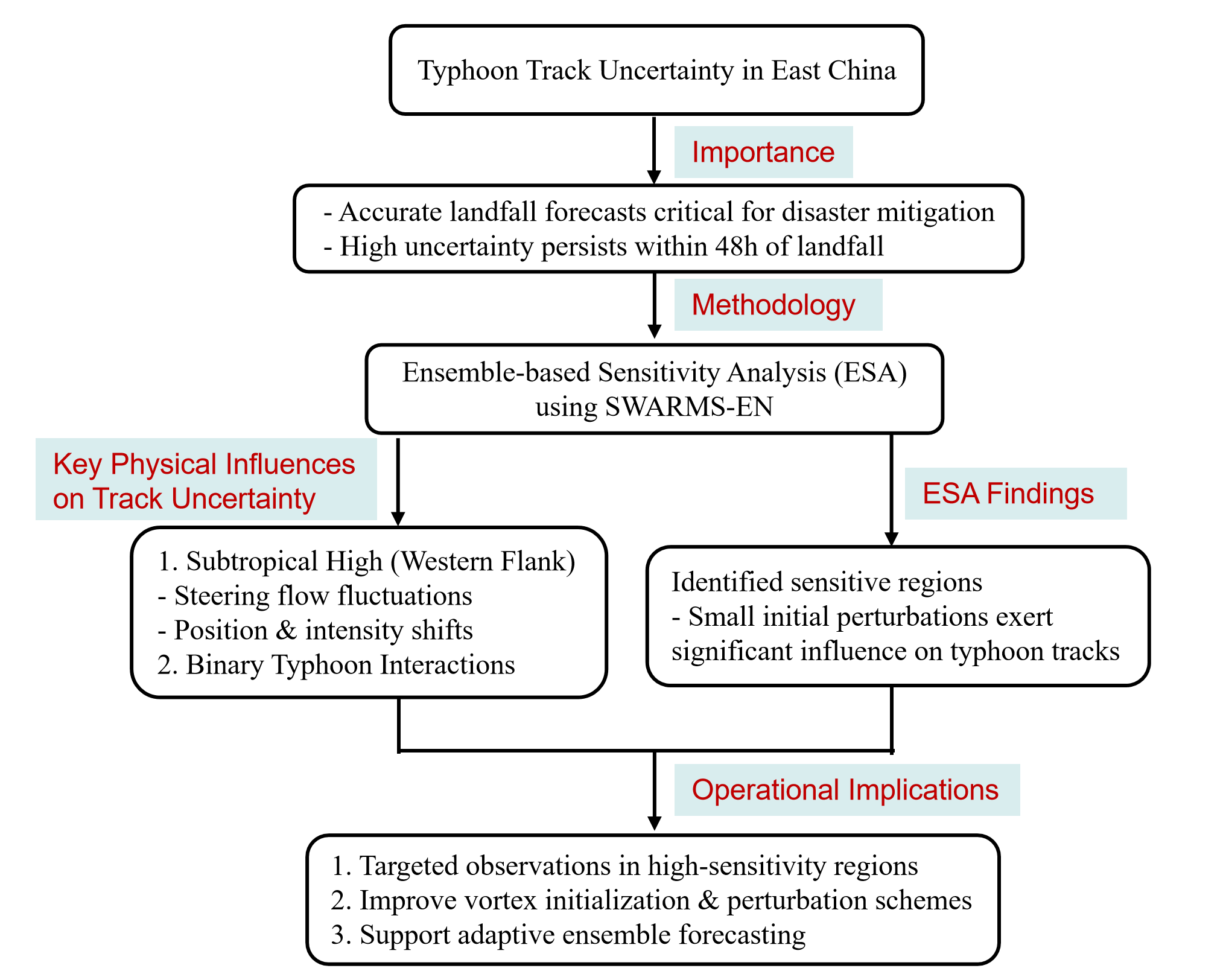
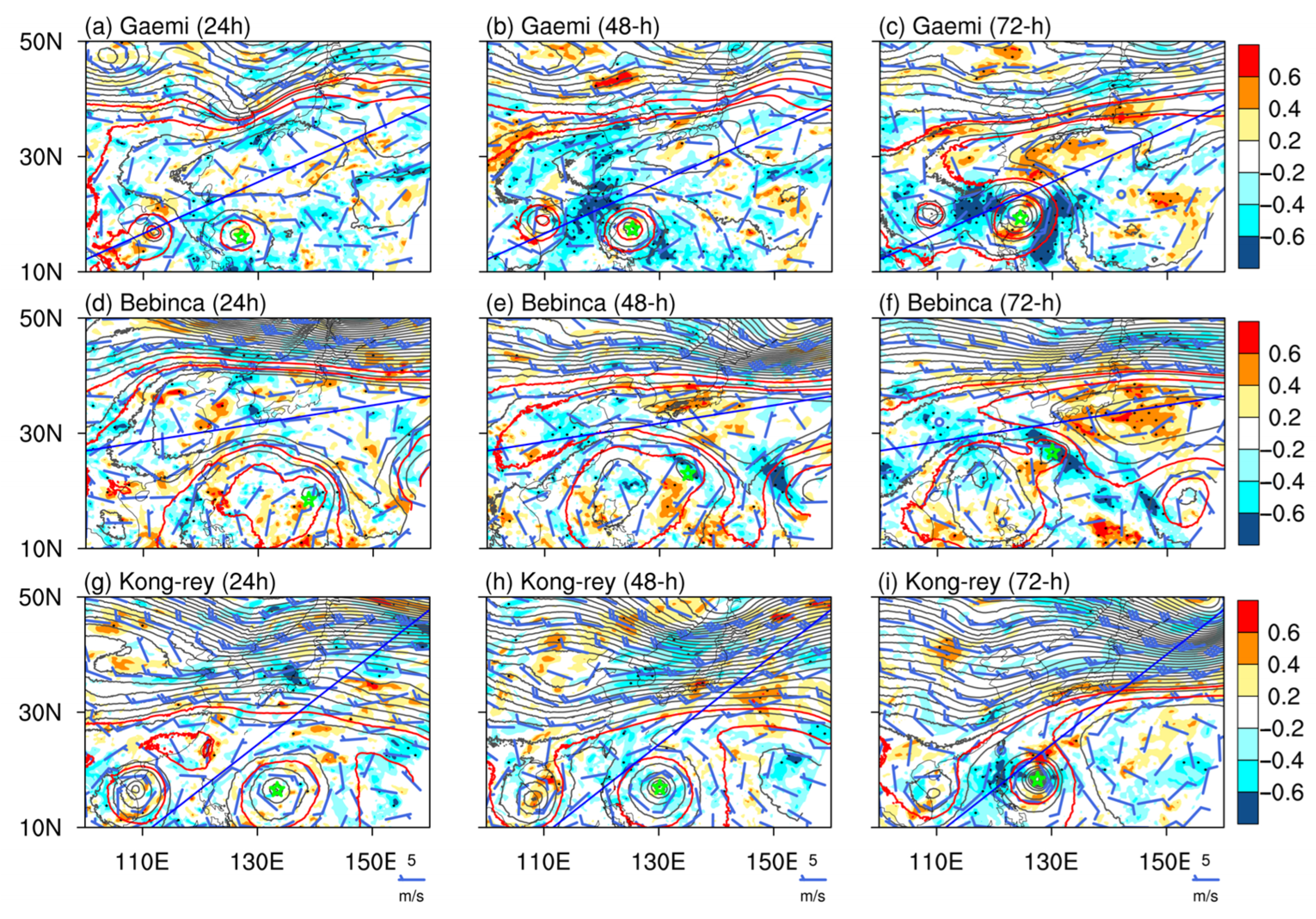
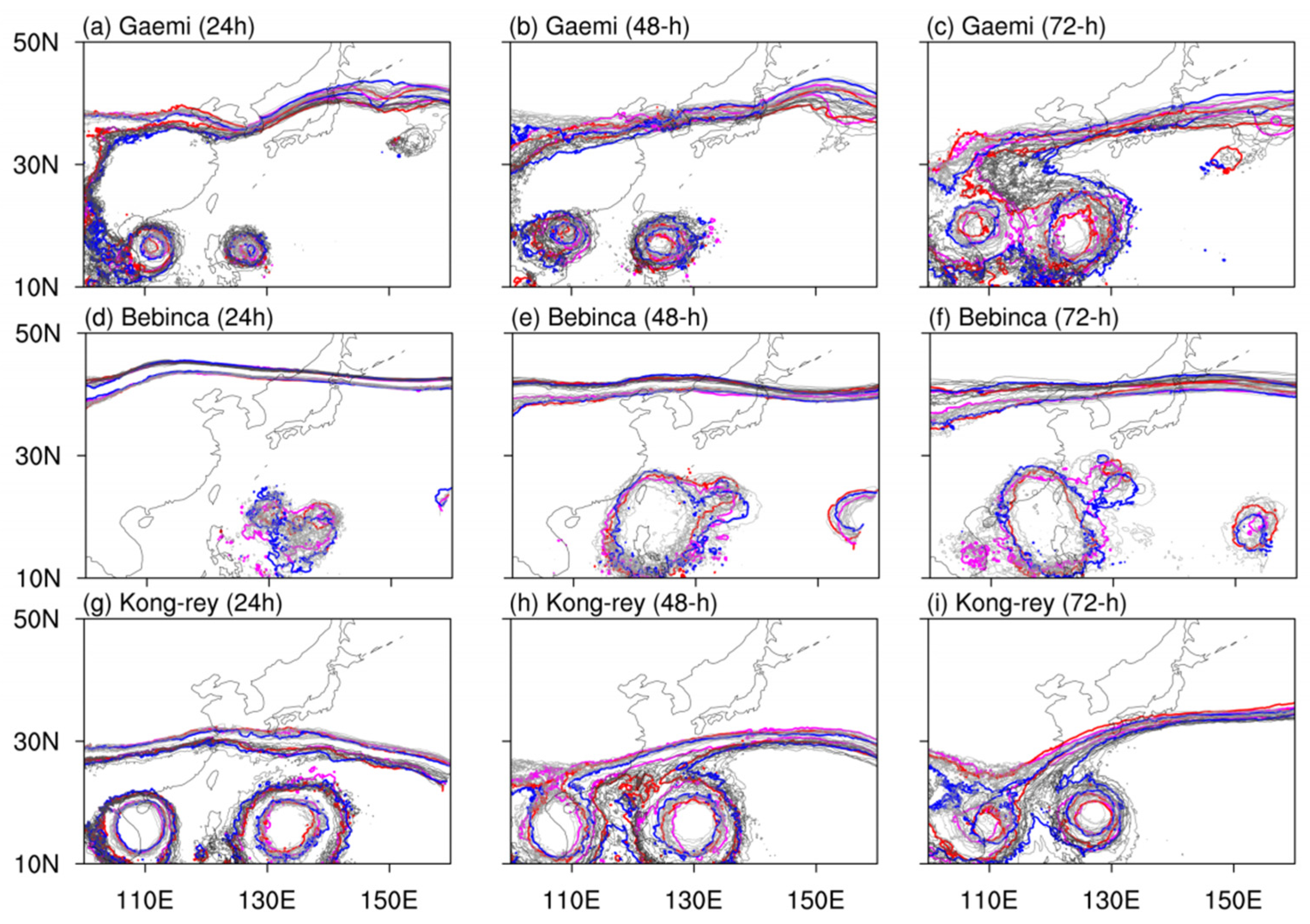
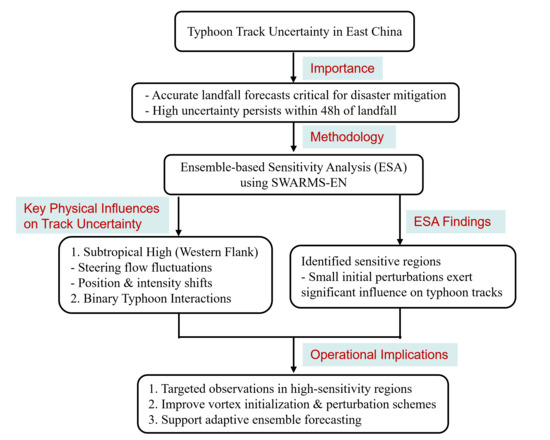
- Ensemble-based Sensitivity Analysis (ESA) consistently identifies the western flank of the subtropical high and nearby low-pressure systems as key regions governing typhoon track uncertainty in the Western North Pacific, primarily through fluctuations in the zonal steering flow.
- Binary interactions between typhoons and adjacent cyclonic systems are critical dynamic mechanisms that introduce significant forecast divergences.
- The study validates ESA as a practical operational tool for diagnosing sources of forecast error and for guiding targeted observations to improve forecast accuracy.
- By linking forecast uncertainty to specific physical mechanisms, ESA enhances the interpretability of ensemble forecasts and supports the development of more adaptive regional forecasting systems.
Abstract
1. Introduction
2. Model and Methodology
2.1. East China Regional Operational Ensemble Forecasting System
2.2. ESA Method
3. Selection of Representative Typhoon Cases
4. Case Studies
5. Results
5.1. Ensemble Forecasts of Typhoon Tracks
5.2. ESA Findings
6. Conclusions and Discussion
- (1)
- Consistent Sensitivity Patterns across Diverse Typhoon Cases
- (2)
- The Role of the Subtropical High and Binary Interactions
- (3)
- Operational Value of ESA in Regional Forecasting Systems
Author Contributions
Funding
Data Availability Statement
Conflicts of Interest
References
- Wu, L.; Liang, J.; Wu, C.-C. Monsoonal Influence on Typhoon Morakot (2009). Part I: Observational Analysis. J. Atmos. Sci. 2011, 68, 2208–2221. [Google Scholar] [CrossRef]
- Wu, L.; Wen, Z.; Huang, R.; Wu, R. Possible Linkage between the Monsoon Trough Variability and the Tropical Cyclone Activity over the Western North Pacific. Mon. Weather Rev. 2012, 140, 140–150. [Google Scholar] [CrossRef]
- Wang, B.; Xiang, B.; Lee, J.-Y. Subtropical High predictability establishes a promising way for monsoon and tropical storm predictions. Proc. Natl. Acad. Sci. USA 2013, 110, 2718–2722. [Google Scholar] [CrossRef] [PubMed]
- Li, R.C.Y.; Zhou, W. Modulation of Western North Pacific Tropical Cyclone Activity by the ISO. Part I: Genesis and Intensity. J. Clim. 2013, 26, 2904–2918. [Google Scholar] [CrossRef]
- Song, J.; Wu, R.; Quan, W.; Yang, C. Impact of the subtropical high on the extratropical transition of tropical cyclones over the western North Pacific. Acta Meteorol. Sin. 2013, 27, 476–485. [Google Scholar] [CrossRef]
- Yang, M.-J.; Braun, S.A.; Chen, D.-S. Water Budget of Typhoon Nari (2001). Mon. Weather Rev. 2011, 139, 3809–3828. [Google Scholar] [CrossRef]
- Tan, Z.-M.; Lei, L.; Wang, Y.; Xu, Y.; Zhang, Y. Typhoon Track, Intensity, and Structure: From Theory to Prediction. Adv. Atmos. Sci. 2022, 39, 1789–1799. [Google Scholar] [CrossRef]
- Yamaguchi, M.; Nakazawa, T.; Hoshino, S. On the relative benefits of a multi-centre grand ensemble for tropical cyclone track prediction in the western North Pacific. Q. J. R. Meteorol. Soc. 2012, 138, 2019–2029. [Google Scholar] [CrossRef]
- Feng, J.; Zhang, J.; Toth, Z.; Peña, M.; Ravela, S. A New Measure of Ensemble Central Tendency. Weather Forecast. 2020, 35, 879–889. [Google Scholar] [CrossRef]
- Zhang, J.; Feng, J.; Li, H.; Zhu, Y.; Zhi, X.; Zhang, F. Unified Ensemble Mean Forecasting of Tropical Cyclones Based on the Feature-Oriented Mean Method. Weather Forecast. 2021, 36, 1945–1959. [Google Scholar] [CrossRef]
- Zhang, X.; Yu, H. A Probabilistic Tropical Cyclone Track Forecast Scheme Based on the Selective Consensus of Ensemble Prediction Systems. Weather Forecast. 2017, 32, 2143–2157. [Google Scholar] [CrossRef]
- Feng, J.; Judt, F.; Zhang, J.; Wang, X. Influence of region-dependent error growth on the predictability of track and intensity of Typhoon Chan-hom (2020) in high-resolution HWRF ensembles. Atmos. Res. 2024, 308, 107536. [Google Scholar] [CrossRef]
- Torn, R.D.; Elless, T.J.; Papin, P.P.; Davis, C.A. Tropical Cyclone Track Sensitivity in Deformation Steering Flow. Mon. Weather Rev. 2018, 146, 3183–3201. [Google Scholar] [CrossRef]
- Nakano, M.; Chen, Y.-W.; Satoh, M. Analysis of the Factors that Led to Uncertainty of Track Forecast of Typhoon Krosa (2019) by 101-Member Ensemble Forecast Experiments Using NICAM. J. Meteorol. Soc. Jpn. Ser. II 2023, 101, 191–207. [Google Scholar] [CrossRef]
- Torn, R.D.; Hakim, G.J. Ensemble-Based Sensitivity Analysis. Mon. Weather Rev. 2008, 136, 663–677. [Google Scholar] [CrossRef]
- Ashcroft, J.; Schwendike, J.; Griffiths, S.D.; Ross, A.N.; Short, C.J. The impact of weak environmental steering flow on tropical cyclone track predictability. Q. J. R. Meteorol. Soc. 2021, 147, 4122–4142. [Google Scholar] [CrossRef]
- Hazelton, A.; Alaka, G.J.; Fischer, M.S.; Torn, R.; Gopalakrishnan, S. Factors Influencing the Track of Hurricane Dorian (2019) in the West Atlantic: Analysis of a HAFS Ensemble. Mon. Weather Rev. 2023, 151, 175–192. [Google Scholar] [CrossRef]
- Ito, K.; Wu, C.-C. Typhoon-Position-Oriented Sensitivity Analysis. Part I: Theory and Verification. J. Atmos. Sci. 2013, 70, 2525–2546. [Google Scholar] [CrossRef]
- Ren, Y.; Lei, L.; Gu, J.-F.; Tan, Z.-M.; Zhang, Y. Understanding the initial conditions contributing to the rapid intensification of typhoons through ensemble sensitivity analysis. Atmos. Ocean. Sci. Lett. 2025, 18, 100552. [Google Scholar] [CrossRef]
- Hakim, G.J.; Torn, R.D. Ensemble Synoptic Analysis. Meteorol. Monogr. 2008, 33, 147–162. [Google Scholar] [CrossRef]
- Feng, J.; Qin, X.; Wu, C.; Zhang, P.; Yang, L.; Shen, X.; Han, W.; Liu, Y. Improving typhoon predictions by assimilating the retrieval of atmospheric temperature profiles from the FengYun-4A’s Geostationary Interferometric Infrared Sounder (GIIRS). Atmos. Res. 2022, 280, 106391. [Google Scholar] [CrossRef]
- Qin, X.; Duan, W.; Chan, P.-W.; Chen, B.; Huang, K.-N. Effects of Dropsonde Data in Field Campaigns on Forecasts of Tropical Cyclones over the Western North Pacific in 2020 and the Role of CNOP Sensitivity. Adv. Atmos. Sci. 2023, 40, 791–803. [Google Scholar] [CrossRef]
- Liu, L.; Feng, J.; Ma, L.; Yang, Y.; Wu, X.; Wang, C. Ensemble-based sensitivity analysis of track forecasts of typhoon In-fa (2021) without and with model errors in the ECMWF, NCEP, and CMA ensemble prediction systems. Atmos. Res. 2024, 309, 107596. [Google Scholar] [CrossRef]
- Tan, Y.; Huang, W.; Zhang, X. Assessment and Ensemble-Based Analysis of the Landfalling Typhoon Muifa (2022). Atmosphere 2024, 15, 343. [Google Scholar] [CrossRef]
- Zhan, R.; Feng, J. Causes and predictability of the “explosive” intensification of Super Typhoon Yagi after entering the South China Sea in 2024. Sci. China Earth Sci. 2025, 68, 1298–1302. [Google Scholar] [CrossRef]
- Buckingham, C.; Marchok, T.; Ginis, I.; Rothstein, L.; Rowe, D. Short- and Medium-Range Prediction of Tropical and Transitioning Cyclone Tracks within the NCEP Global Ensemble Forecasting System. Weather Forecast. 2010, 25, 1736–1754. [Google Scholar] [CrossRef]
- Buizza, R.; Milleer, M.; Palmer, T.N. Stochastic representation of model uncertainties in the ECMWF ensemble prediction system. Q. J. R. Meteorol. Soc. 1999, 125, 2887–2908. [Google Scholar] [CrossRef]
- Zheng, M.; Chang, E.K.M.; Colle, B.A. Ensemble Sensitivity Tools for Assessing Extratropical Cyclone Intensity and Track Predictability. Weather Forecast. 2013, 28, 1133–1156. [Google Scholar] [CrossRef]
- Chang, E.K.M.; Zheng, M.; Raeder, K. Medium-Range Ensemble Sensitivity Analysis of Two Extreme Pacific Extratropical Cyclones. Mon. Weather Rev. 2013, 141, 211–231. [Google Scholar] [CrossRef]
- Ancell, B.C.; Coleman, A.A. New Perspectives on Ensemble Sensitivity Analysis with Applications to a Climatology of Severe Convection. Bull. Am. Meteorol. Soc. 2022, 103, E511–E530. [Google Scholar] [CrossRef]
- Hamill, T.M.; Whitaker, J.S.; Fiorino, M.; Benjamin, S.G. Global Ensemble Predictions of 2009’s Tropical Cyclones Initialized with an Ensemble Kalman Filter. Mon. Weather Rev. 2011, 139, 668–688. [Google Scholar] [CrossRef]
- Feng, J.; Wang, X. Impact of Increasing Horizontal and Vertical Resolution during the HWRF Hybrid EnVar Data Assimilation on the Analysis and Prediction of Hurricane Patricia (2015). Mon. Weather Rev. 2021, 149, 419–441. [Google Scholar] [CrossRef]
- Chan, J.C.L.; Gray, W.M. Tropical Cyclone Movement and Surrounding Flow Relationships. Mon. Weather Rev. 1982, 110, 1354–1374. [Google Scholar] [CrossRef]
- Akter, N.; Tsuboki, K. Recurvature and movement processes of tropical cyclones over the Bay of Bengal. Q. J. R. Meteorol. Soc. 2021, 147, 3681–3702. [Google Scholar] [CrossRef]
- Harr, P.A.; Elsberry, R.L. Large-scale circulation variability over the tropical western North Pacific. Part I: Spatial patterns and tropical cyclone characteristics. Mon. Weather Rev. 1995, 123, 1225–1246. [Google Scholar] [CrossRef]
- Hirano, S.; Ito, K.; Yamada, H. Tropical Cyclone Track Modified by a Front Located to the Northeast. SOLA 2023, 19, 109–115. [Google Scholar] [CrossRef]





| International No. | Name | Date (MM.DD) | Intensity | Landfall in China | Time | Max Wind Force (Scale) | Wind Speed (m/s) | Central Pressure (hPa) |
|---|---|---|---|---|---|---|---|---|
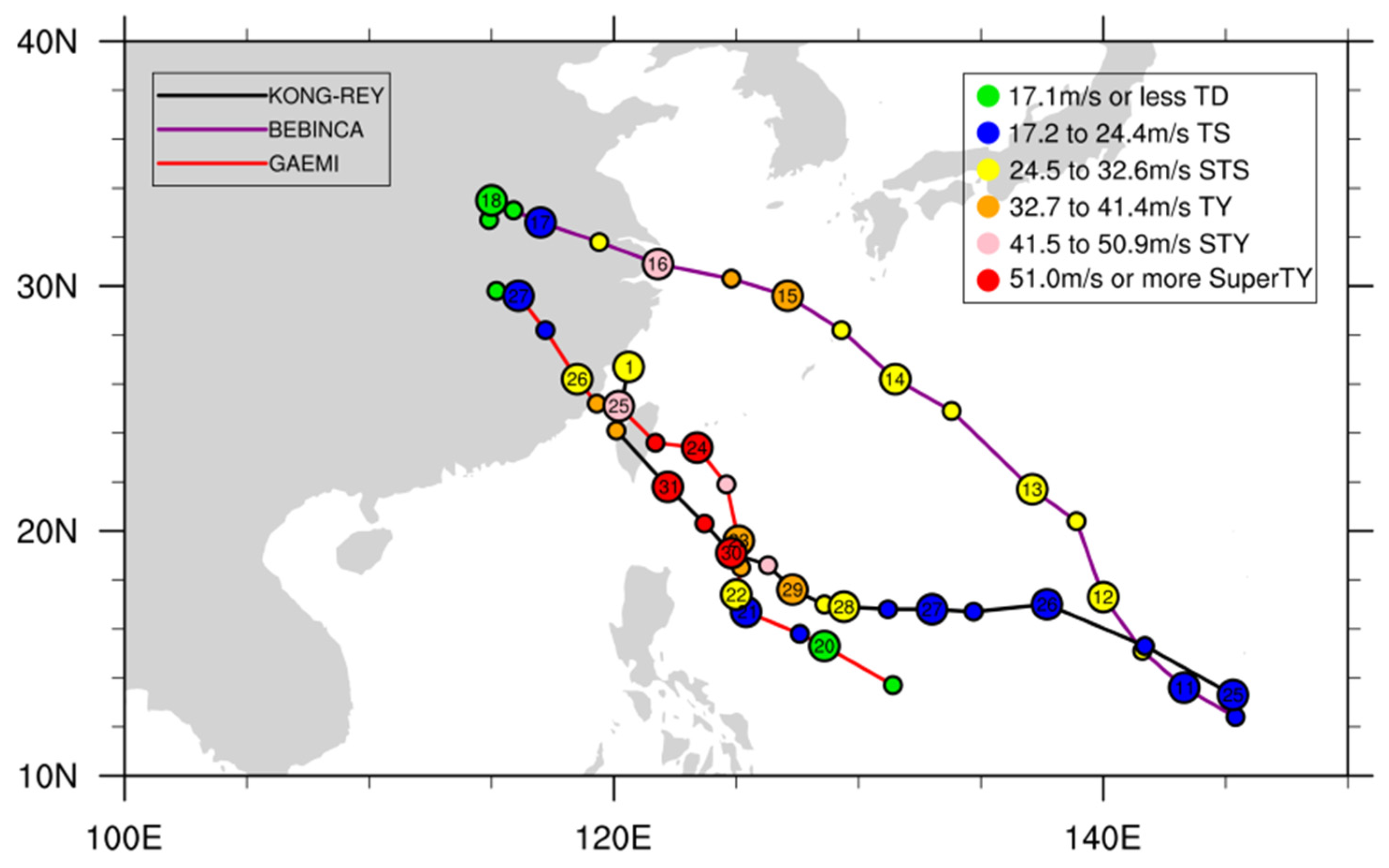
| 2403 | GAEMI | 7.19–7.28 | Super Typhoon | Yilan, Taiwan | 25 July, 00:00 | 15 | 48 | 945 |
| Xiuyu, Fujian | 25 July, 18:40 | 12 | 33 | 972 | ||||
| 2413 | BEBINCA | 9.9–9.18 | Super Typhoon | Pudong, Shanghai | 16 September, 07:50 | 14 | 42 | 965 |
| 2421 | KONG-REY | 10.25–11.2 | Super Typhoon | Taitung, Taiwan | 31 October, 14:00 | 15 | 48 | 945 |
Disclaimer/Publisher’s Note: The statements, opinions and data contained in all publications are solely those of the individual author(s) and contributor(s) and not of MDPI and/or the editor(s). MDPI and/or the editor(s) disclaim responsibility for any injury to people or property resulting from any ideas, methods, instructions or products referred to in the content. |
© 2025 by the authors. Licensee MDPI, Basel, Switzerland. This article is an open access article distributed under the terms and conditions of the Creative Commons Attribution (CC BY) license (https://creativecommons.org/licenses/by/4.0/).
Share and Cite
Zhang, J.; Zhu, S.; Tan, Y.; Chen, C. Predictability of Landfalling Typhoon Tracks in East China Based on Ensemble Sensitivity Analysis. Remote Sens. 2025, 17, 3944. https://doi.org/10.3390/rs17243944
Zhang J, Zhu S, Tan Y, Chen C. Predictability of Landfalling Typhoon Tracks in East China Based on Ensemble Sensitivity Analysis. Remote Sensing. 2025; 17(24):3944. https://doi.org/10.3390/rs17243944
Chicago/Turabian StyleZhang, Jing, Shoupeng Zhu, Yan Tan, and Chen Chen. 2025. "Predictability of Landfalling Typhoon Tracks in East China Based on Ensemble Sensitivity Analysis" Remote Sensing 17, no. 24: 3944. https://doi.org/10.3390/rs17243944
APA StyleZhang, J., Zhu, S., Tan, Y., & Chen, C. (2025). Predictability of Landfalling Typhoon Tracks in East China Based on Ensemble Sensitivity Analysis. Remote Sensing, 17(24), 3944. https://doi.org/10.3390/rs17243944