A Deep Learning Approach to Downscaling Microwave Land Surface Temperatures for a Clear-Sky Merged Infrared-Microwave Product

 , ,
, ,  ,
,
Highlights
- A new clear-sky merged LST dataset for the USA (2004–2021, 5 km resolution) was successfully produced by fusing downscaled AMSR-E/2 generated from a U-Net deep learning model with MODIS observations.
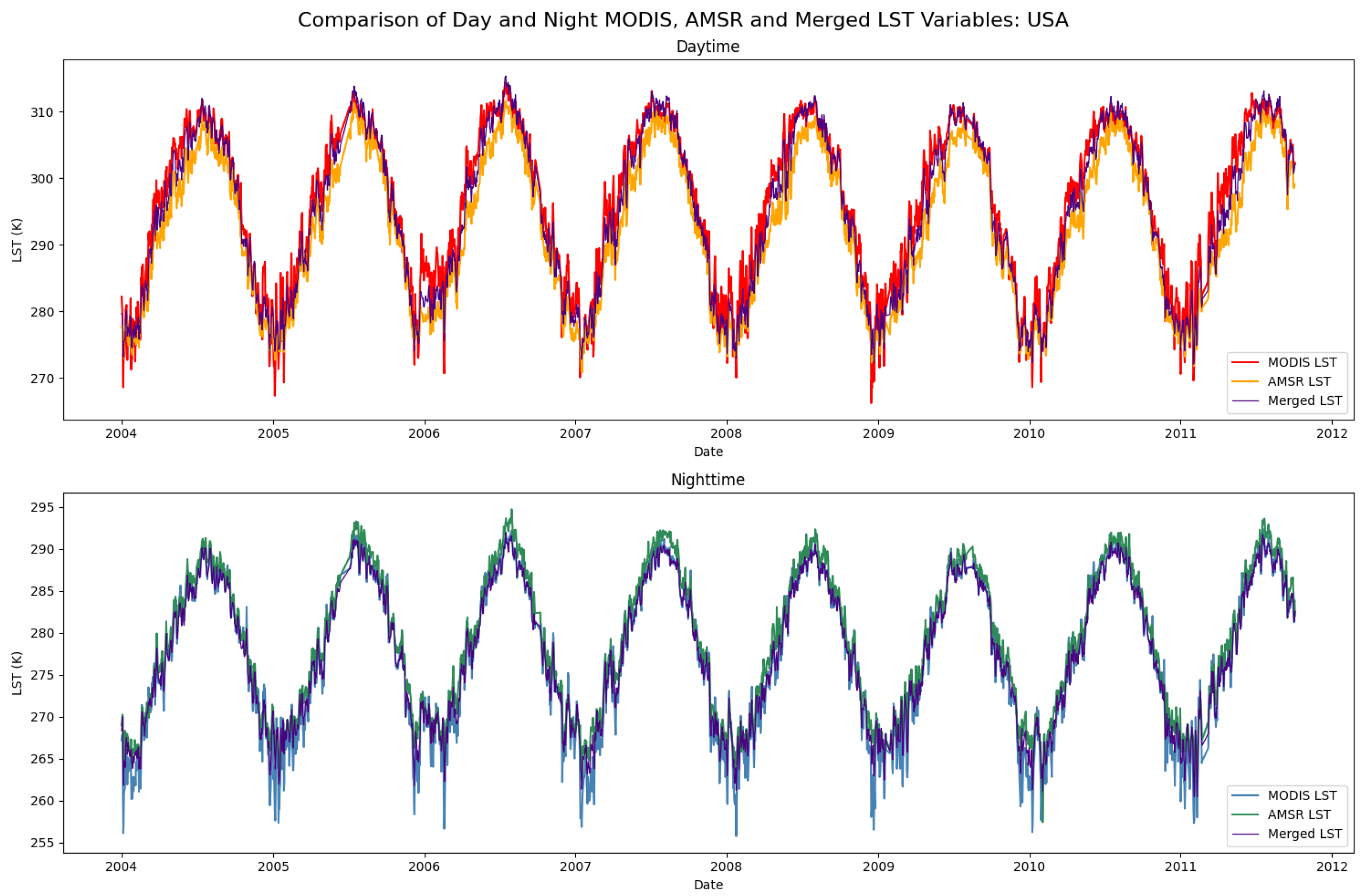
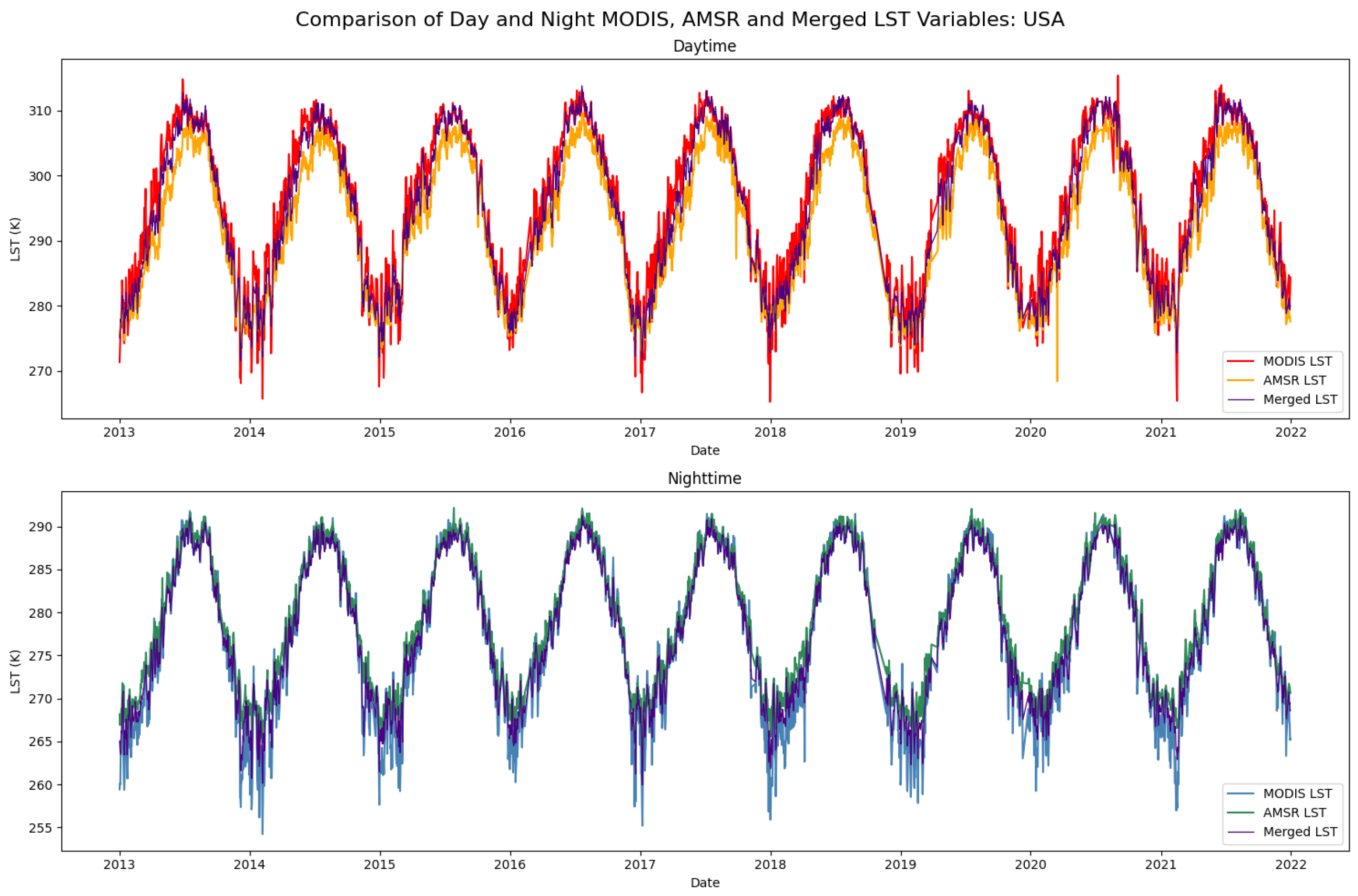
- The merged dataset reduces cloud-induced gaps and noise compared to MODIS, improves spatial detail compared to AMSR alone and shows strong agreement with ground validation.
- The dataset provides a harmonised and spatially consistent LST record, overcoming limitations of single-sensor products.
- It demonstrates the potential value of sensor fusion for improving climate data records for long-term studies.
Abstract
1. Introduction
1.1. Prior LST Merging Research
1.2. Research Objective
2. Materials and Methods
2.1. Dataset Description
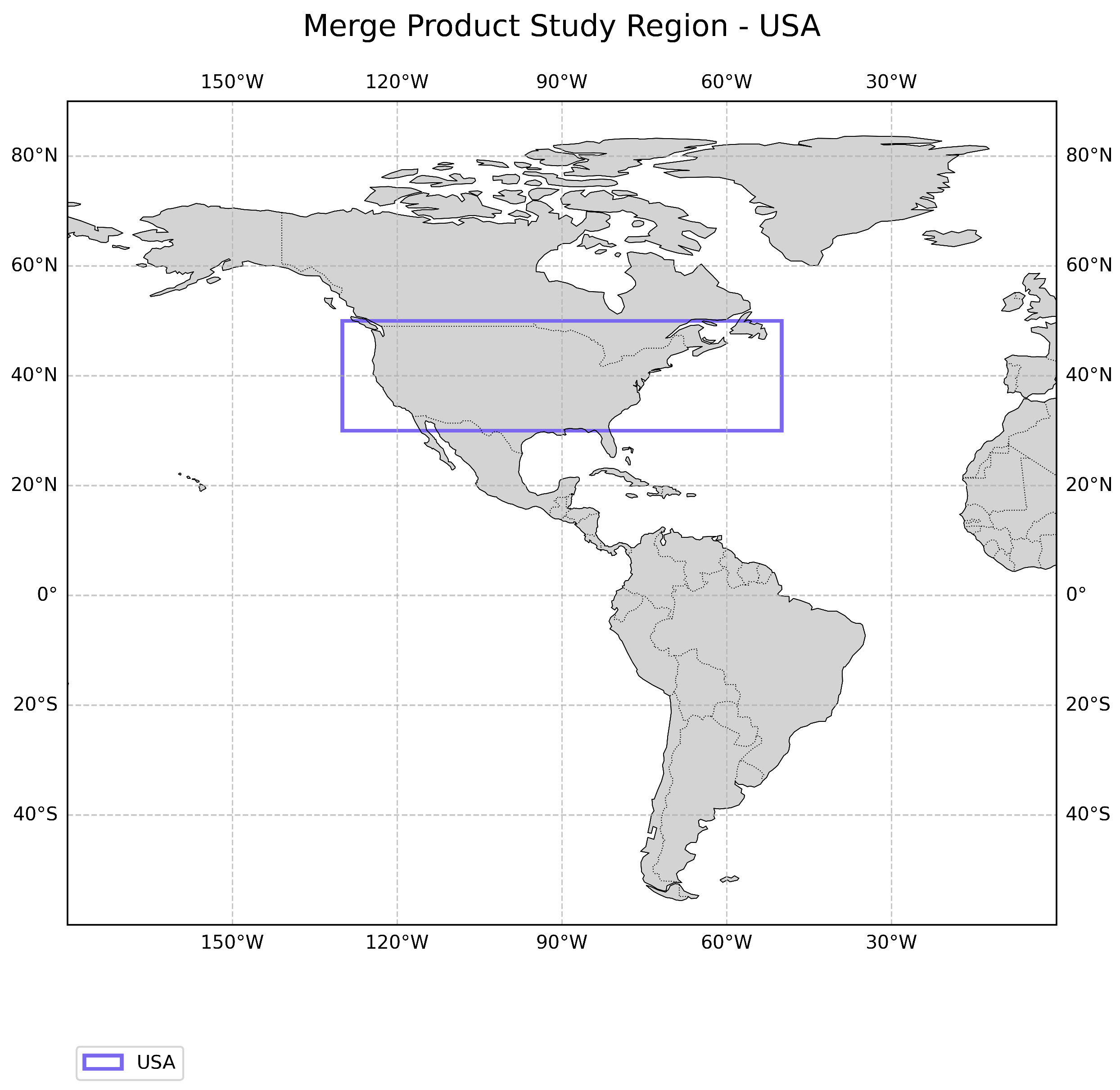
2.2. Study Region
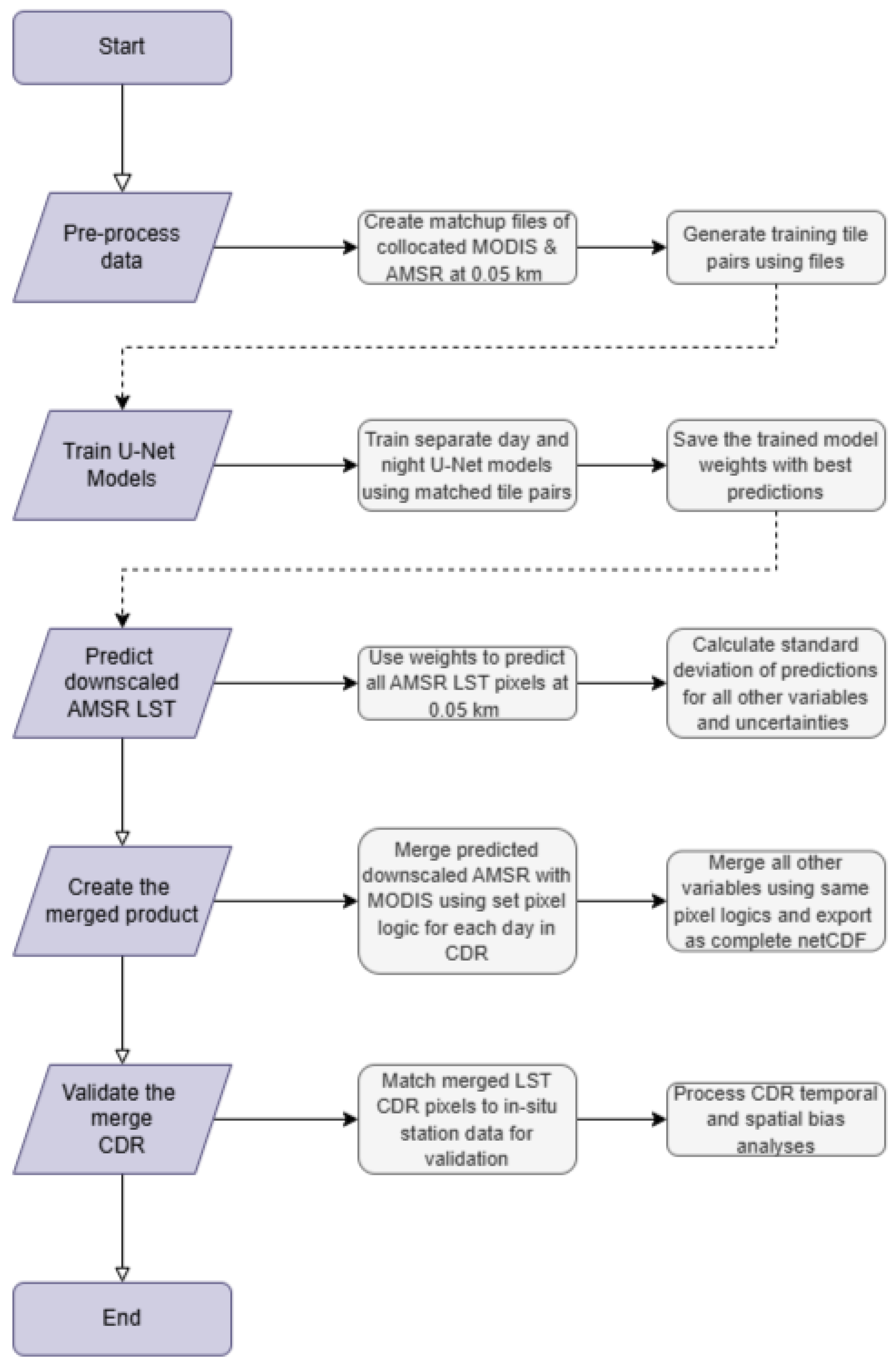
2.3. Method
2.3.1. Pre-Processing: Generating LST Data
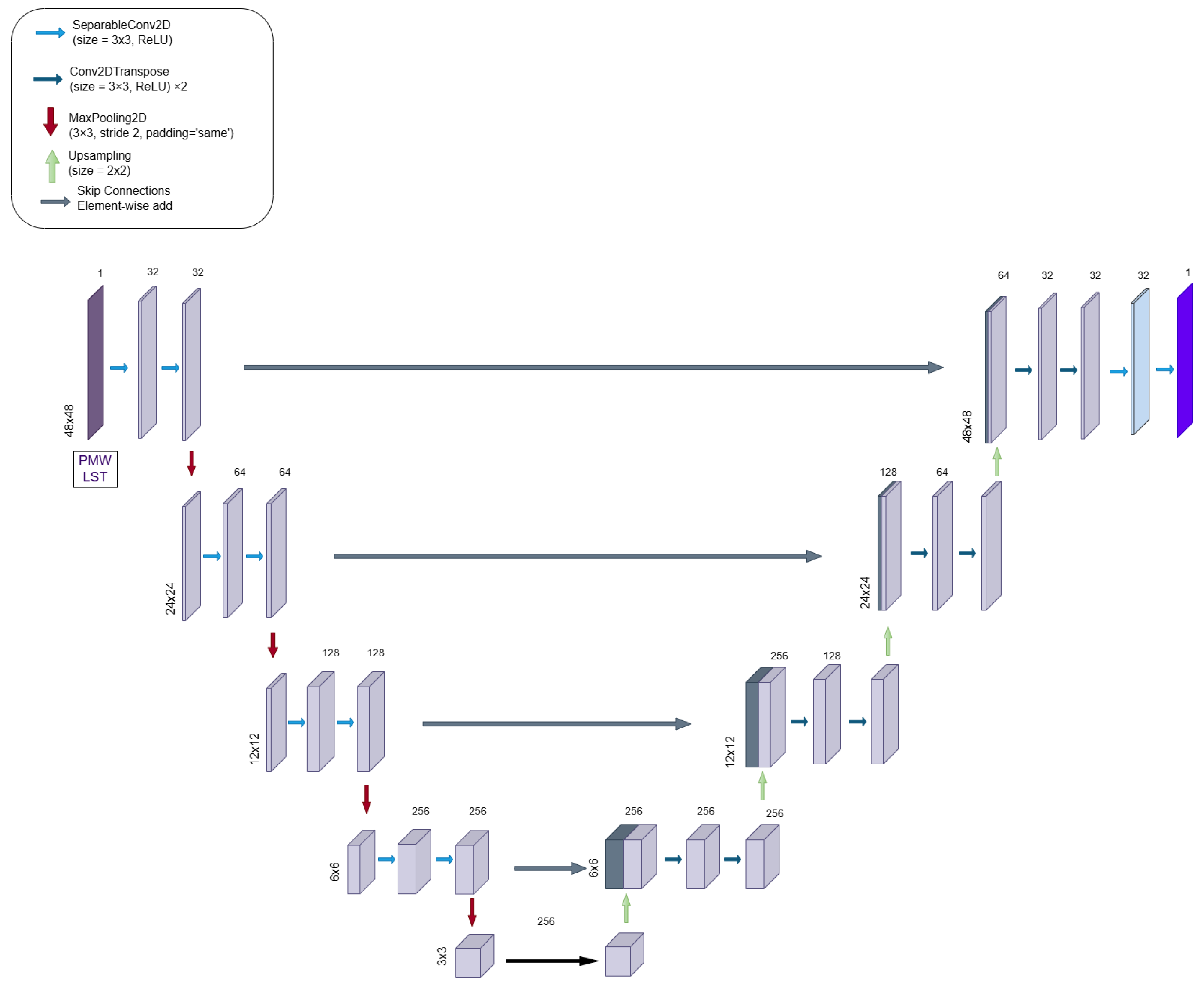
2.3.2. Building the U-Net Architecture
2.3.3. Training Setup & Implementation
- is the i-th true value (ground truth),
- is the i-th predicted value,
- N is the total number of elements in the input vector.
2.3.4. Post-Processing: LST Prediction and Merge
2.3.5. Validating the Merged Product
3. Results
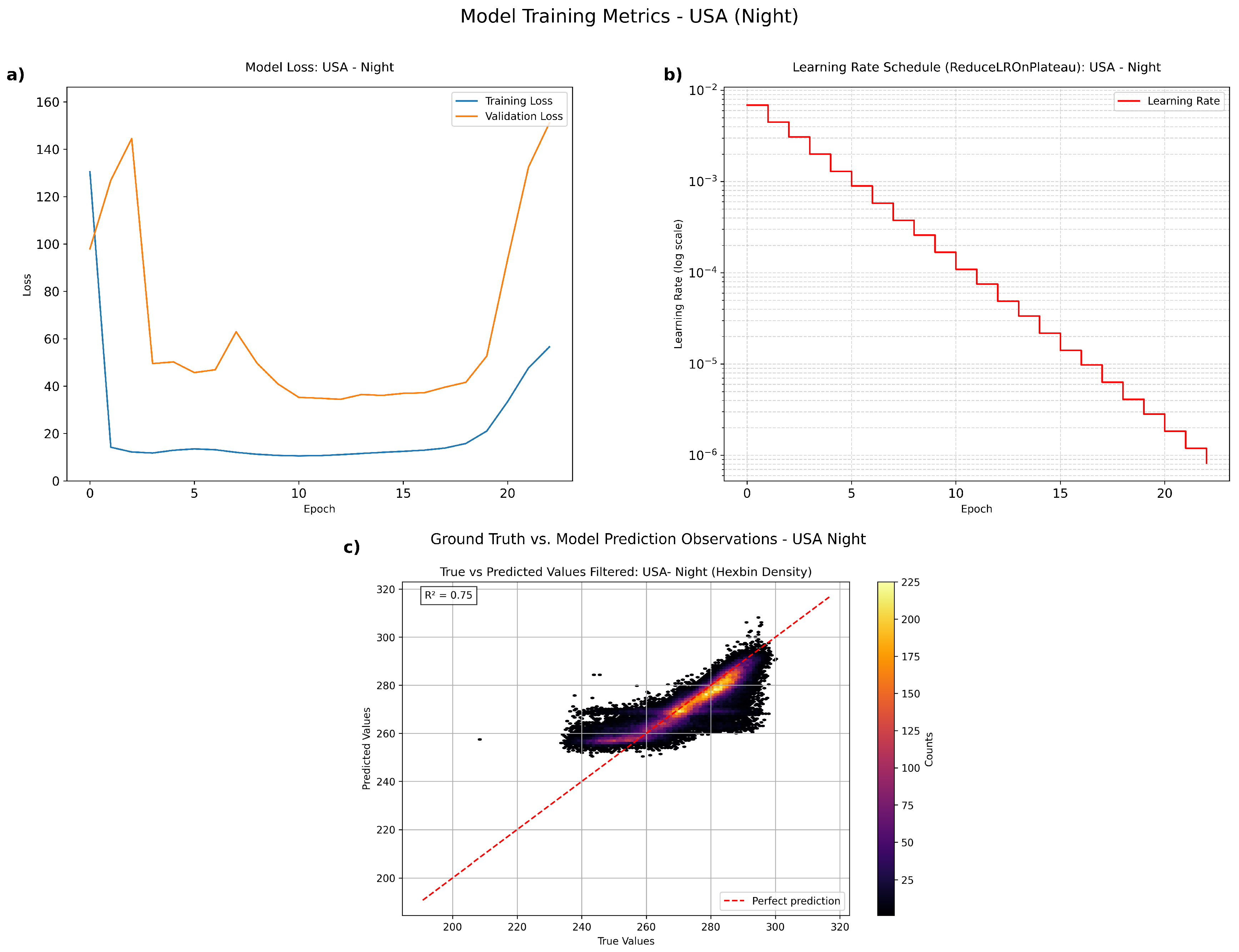
3.1. Model Loss and Validation Metrics
3.2. Merged LST Product
Spatial Maps
3.3. Dataset Validation
3.4. Temporal and Seasonal Bias Patterns
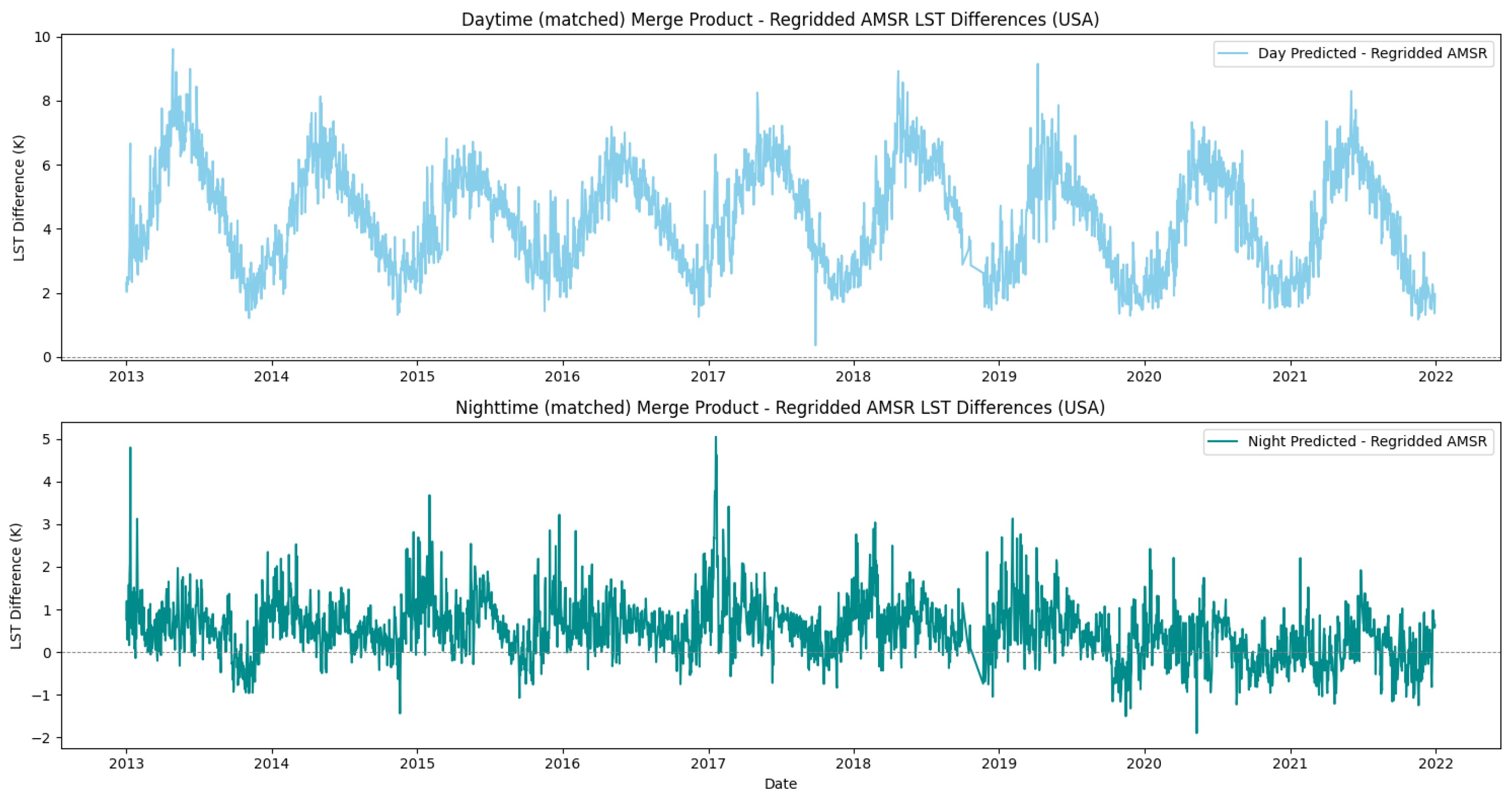
3.4.1. Time Series for the Merged Product and Reference AMSR
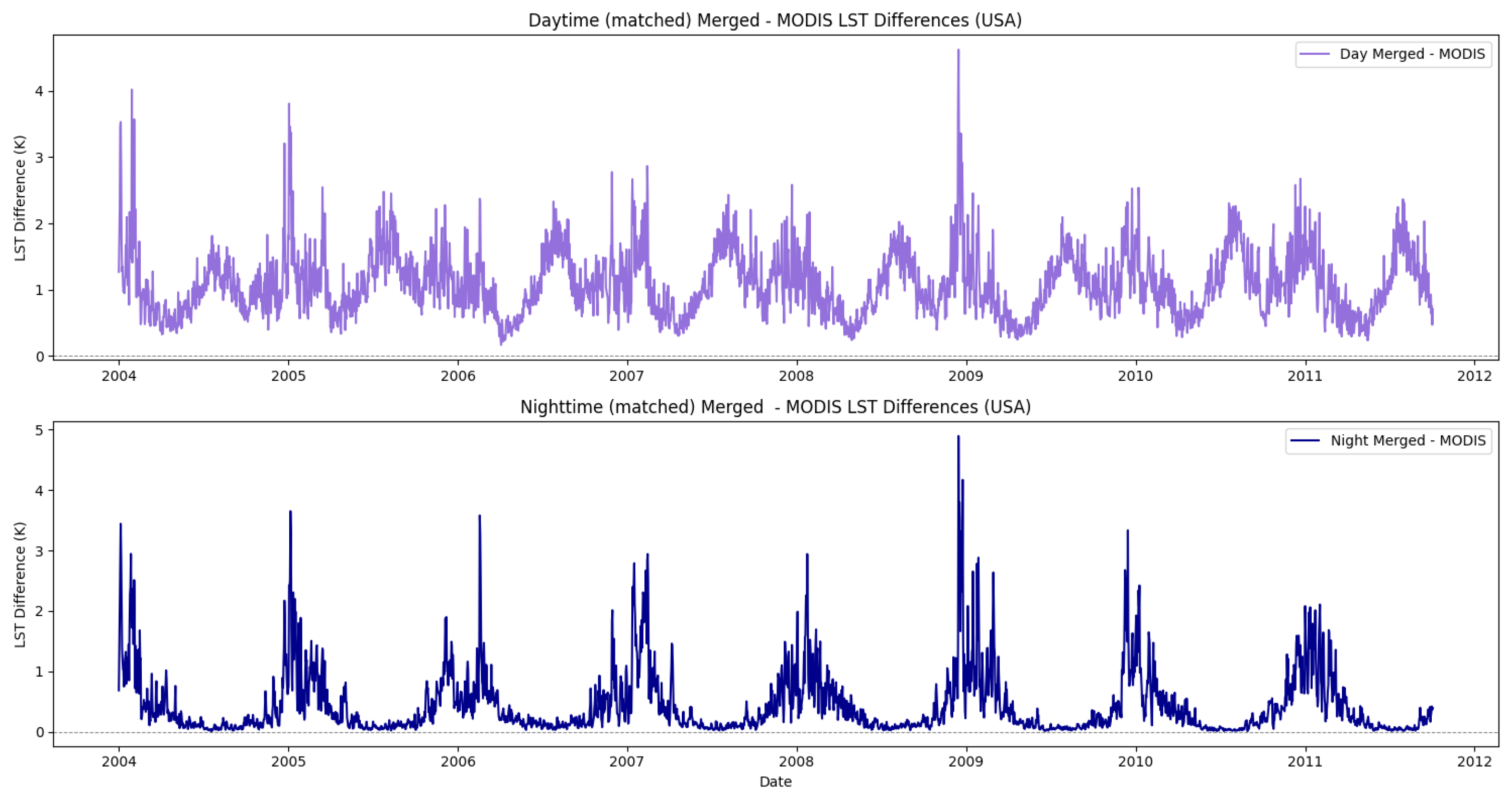
3.4.2. Time Series for the Merged Product and MODIS
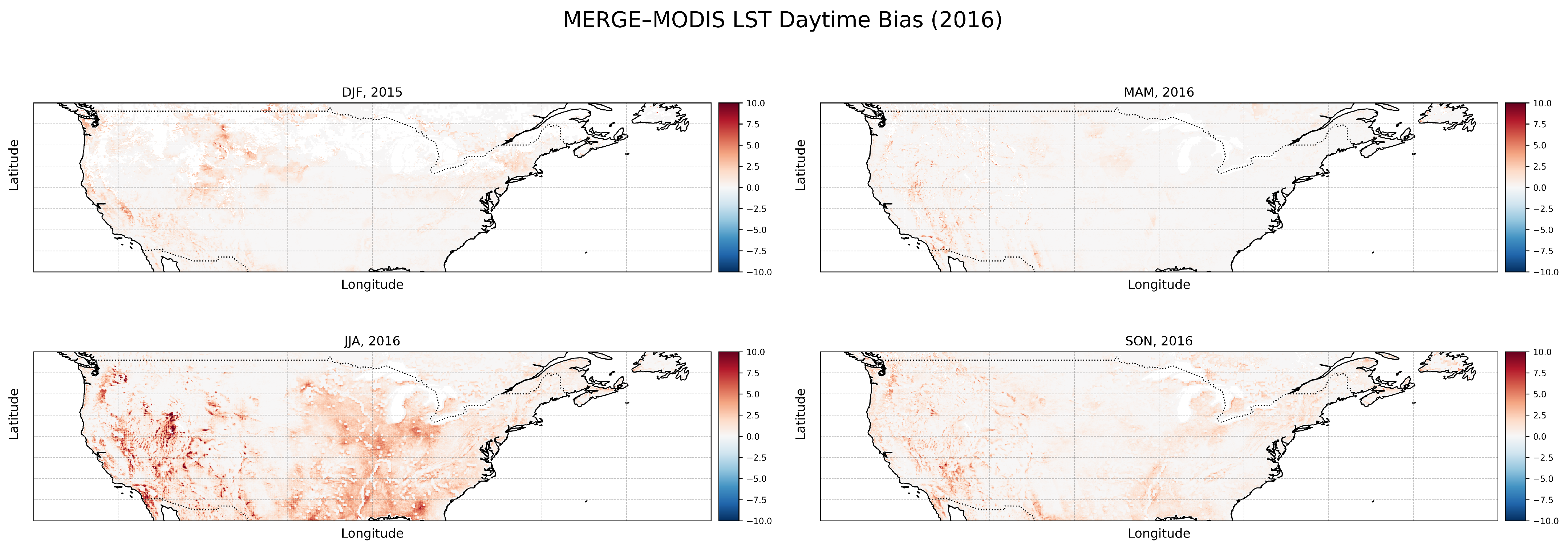
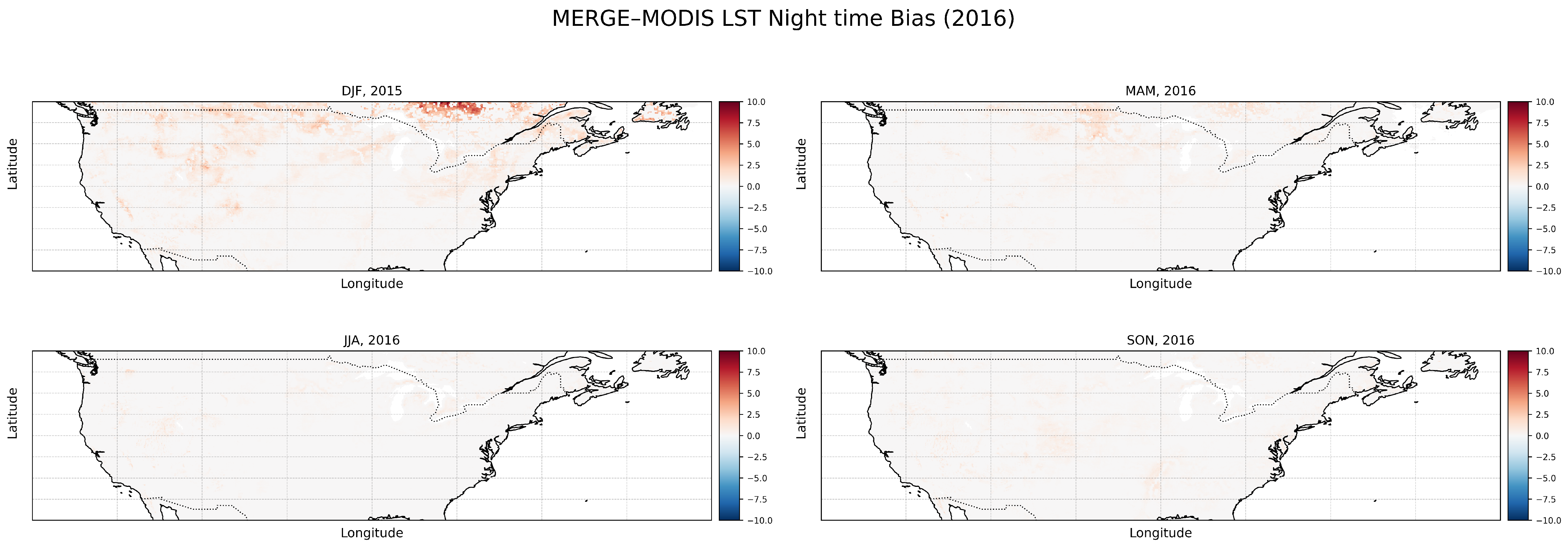
3.4.3. Seasonal Maps for the Merged Product and MODIS
4. Discussion
4.1. Model Training Performance and Predictive Accuracy
4.2. Merged LST Spatial and Temporal Analysis
4.3. Verification of the Merged Dataset
4.4. Assessment of Model Value Through Bias and Seasonality
4.4.1. Merge Product Bias
4.4.2. Seasonal Trends
4.5. Limitations and Future Work
5. Conclusions
Author Contributions
Funding
Institutional Review Board Statement
Informed Consent Statement
Data Availability Statement
Acknowledgments
Conflicts of Interest
Appendix A
- U-Net Model Supplementary Information


| Stage | Layer Type | Filters | Kernel/Pool | Output Size |
|---|---|---|---|---|
| Input | Input tile | – | – | 48 × 48 × 1 |
| Initial Block | Conv2D ×2 | 32 | 3 × 3 | 48 × 48 × 32 |
| Encoder Block 1 | SepConv2D ×2 + BN | 32 | 3 × 3 | 48 × 48 × 32 |
| MaxPooling2D | – | 3 × 3, stride 2 | 24 × 24 × 32 | |
| Encoder Block 2 | SepConv2D ×2 + BN | 64 | 3 × 3 | 24 × 24 × 64 |
| MaxPooling2D | – | 3 × 3, stride 2 | 12 × 12 × 64 | |
| Encoder Block 3 | SepConv2D ×2 + BN | 128 | 3 × 3 | 12 × 12 × 128 |
| MaxPooling2D | – | 3 × 3, stride 2 | 6 × 6 × 128 | |
| Encoder Block 4 | SepConv2D ×2 + BN | 256 | 3 × 3 | 6 × 6 × 256 |
| MaxPooling2D | – | 3 × 3, stride 2 | 3 × 3 × 256 | |
| Decoder Block 1 | Conv2DTranspose ×2 + BN | 256 | 3 × 3 | 3 × 3× 256 |
| UpSampling2D | – | factor 2 | 6 × 6 × 256 | |
| Skip connection | – | add | 6 × 6 × 256 | |
| Decoder Block 2 | Conv2DTranspose ×2 + BN | 128 | 3 × 3 | 6 × 6 × 128 |
| UpSampling2D | – | factor 2 | 12 × 12 × 128 | |
| Skip connection | – | add | 12 × 12 × 128 | |
| Decoder Block 3 | Conv2DTranspose ×2 + BN | 64 | 3 × 3 | 12 × 12 × 64 |
| UpSampling2D | – | factor 2 | 24 × 24 × 64 | |
| Skip connection | – | add | 24 × 24 × 64 | |
| Decoder Block 4 | Conv2DTranspose ×2 + BN | 32 | 3 × 3 | 24 × 24 × 32 |
| UpSampling2D | – | factor 2 | 48 × 48 × 32 | |
| Skip connection | – | add | 48 × 48 × 32 | |
| Refinement | Conv2D ×3 + BN (first 2) | 32 | 3 × 3 | 48 × 48 × 32 |
| Output Layer | Conv2D | 1 | 3 × 3 | 48 × 48 × 1 |

Appendix A.1. Merge Product Results Supplementary Information



References
- Li, Z.L.; Wu, H.; Duan, S.B.; Zhao, W.; Ren, H.; Liu, X.; Leng, P.; Tang, R.; Ye, X.; Zhu, J.; et al. Satellite remote sensing of global land surface temperature: Definition, methods, products, and applications. Rev. Geophys. 2023, 61, e2022RG000777. [Google Scholar] [CrossRef] [Scilit]
- Hollmann, R.; Merchant, C.J.; Saunders, R.; Downy, C.; Buchwitz, M.; Cazenave, A.; Chuvieco, E.; Defourny, P.; de Leeuw, G.; Forsberg, R.; et al. The ESA climate change initiative: Satellite data records for essential climate variables. Bull. Am. Meteorol. Soc. 2013, 94, 1541–1552. [Google Scholar] [CrossRef] [Scilit]
- Bechtel, B. A new global climatology of annual land surface temperature. Remote Sens. 2015, 7, 2850–2870. [Google Scholar] [CrossRef] [Scilit]
- Wang, Y.R.; Hessen, D.O.; Samset, B.H.; Stordal, F. Evaluating global and regional land warming trends in the past decades with both MODIS and ERA5-Land land surface temperature data. Remote Sens. Environ. 2022, 280, 113181. [Google Scholar] [CrossRef] [Scilit]
- Waring, A.M.; Ghent, D.; Perry, M.; Anand, J.S.; Veal, K.L.; Remedios, J. Regional climate trend analyses for Aqua MODIS land surface temperatures. Int. J. Remote Sens. 2023, 44, 4989–5032. [Google Scholar] [CrossRef] [Scilit]
- Tajfar, E.; Bateni, S.; Lakshmi, V.; Ek, M. Estimation of surface heat fluxes via variational assimilation of land surface temperature, air temperature and specific humidity into a coupled land surface-atmospheric boundary layer model. J. Hydrol. 2020, 583, 124577. [Google Scholar] [CrossRef] [Scilit]
- Alexander, C. Normalised difference spectral indices and urban land cover as indicators of land surface temperature (LST). Int. J. Appl. Earth Obs. Geoinf. 2020, 86, 102013. [Google Scholar] [CrossRef] [Scilit]
- Karnieli, A.; Agam, N.; Pinker, R.T.; Anderson, M.; Imhoff, M.L.; Gutman, G.G.; Panov, N.; Goldberg, A. Use of NDVI and land surface temperature for drought assessment: Merits and limitations. J. Clim. 2010, 23, 618–633. [Google Scholar] [CrossRef] [Scilit]
- Hall, D.K.; Comiso, J.C.; DiGirolamo, N.E.; Shuman, C.A.; Key, J.R.; Koenig, L.S. A satellite-derived climate-quality data record of the clear-sky surface temperature of the Greenland ice sheet. J. Clim. 2012, 25, 4785–4798. [Google Scholar] [CrossRef] [Scilit]
- Dupuis, S.; Göttsche, F.M.; Wunderle, S. Temporal stability of a new 40-year daily AVHRR land surface temperature dataset for the pan-Arctic region. Cryosphere 2024, 18, 6027–6059. [Google Scholar] [CrossRef] [Scilit]
- Prata, A.; Caselles, V.; Coll, C.; Sobrino, J.; Ottle, C. Thermal remote sensing of land surface temperature from satellites: Current status and future prospects. Remote Sens. Rev. 1995, 12, 175–224. [Google Scholar] [CrossRef] [Scilit]
- Neteler, M. Estimating daily land surface temperatures in mountainous environments by reconstructed MODIS LST data. Remote Sens. 2010, 2, 333–351. [Google Scholar] [CrossRef] [Scilit]
- Mao, Q.; Peng, J.; Wang, Y. Resolution enhancement of remotely sensed land surface temperature: Current status and perspectives. Remote Sens. 2021, 13, 1306. [Google Scholar] [CrossRef] [Scilit]
- Reiners, P.; Sobrino, J.; Kuenzer, C. Satellite-derived land surface temperature dynamics in the context of global change—A review. Remote Sens. 2023, 15, 1857. [Google Scholar] [CrossRef] [Scilit]
- Holmes, T.; Crow, W.; Hain, C.; Anderson, M.; Kustas, W. Diurnal temperature cycle as observed by thermal infrared and microwave radiometers. Remote Sens. Environ. 2015, 158, 110–125. [Google Scholar] [CrossRef] [Scilit]
- Ghent, D.; Veal, K.; Trent, T.; Dodd, E.; Sembhi, H.; Remedios, J. A new approach to defining uncertainties for MODIS land surface temperature. Remote Sens. 2019, 11, 1021. [Google Scholar] [CrossRef] [Scilit]
- Fisher, J.B.; Lee, B.; Purdy, A.J.; Halverson, G.H.; Dohlen, M.B.; Cawse-Nicholson, K.; Wang, A.; Anderson, R.G.; Aragon, B.; Arain, M.A.; et al. ECOSTRESS: NASA’s next generation mission to measure evapotranspiration from the international space station. Water Resour. Res. 2020, 56, e2019WR026058. [Google Scholar] [CrossRef] [Scilit]
- Jia, A.; Liang, S.; Wang, D.; Mallick, K.; Zhou, S.; Hu, T.; Xu, S. Advances in methodology and generation of all-weather land surface temperature products from polar-orbiting and geostationary satellites: A comprehensive review. IEEE Geosci. Remote Sens. Mag. 2024, 12, 218–260. [Google Scholar] [CrossRef] [Scilit]
- Ermida, S.L.; Trigo, I.F.; DaCamara, C.C.; Jiménez, C.; Prigent, C. Quantifying the clear-sky bias of satellite land surface temperature using microwave-based estimates. J. Geophys. Res. Atmos. 2019, 124, 844–857. [Google Scholar] [CrossRef] [Scilit]
- Jiménez, C.; Prigent, C.; Ermida, S.; Moncet, J.L. Inversion of AMSR-E observations for land surface temperature estimation: 1. Methodology and evaluation with station temperature. J. Geophys. Res. Atmos. 2017, 122, 3330–3347. [Google Scholar] [CrossRef] [Scilit]
- Prigent, C.; Aires, F.; Rossow, W.B. Land surface microwave emissivities over the globe for a decade. Bull. Am. Meteorol. Soc. 2006, 87, 1573–1584. [Google Scholar] [CrossRef] [Scilit]
- Duan, S.B.; Han, X.J.; Huang, C.; Li, Z.L.; Wu, H.; Qian, Y.; Gao, M.; Leng, P. Land surface temperature retrieval from passive microwave satellite observations: State-of-the-art and future directions. Remote Sens. 2020, 12, 2573. [Google Scholar] [CrossRef] [Scilit]
- Aires, F.; Prigent, C. Toward a new generation of satellite surface products? J. Geophys. Res. Atmos. 2006, 111. [Google Scholar] [CrossRef] [Scilit]
- Parinussa, R.M.; de Jeu, R.A.; Holmes, T.R.; Walker, J.P. Comparison of microwave and infrared land surface temperature products over the NAFE’06 research sites. IEEE Geosci. Remote Sens. Lett. 2008, 5, 783–787. [Google Scholar] [CrossRef] [Scilit]
- Sun, L.; Chen, Z.; Gao, F.; Anderson, M.; Song, L.; Wang, L.; Hu, B.; Yang, Y. Reconstructing daily clear-sky land surface temperature for cloudy regions from MODIS data. Comput. Geosci. 2017, 105, 10–20. [Google Scholar] [CrossRef] [Scilit]
- Dowling, T.P.; Song, P.; Jong, M.C.D.; Merbold, L.; Wooster, M.J.; Huang, J.; Zhang, Y. An improved cloud gap-filling method for longwave infrared land surface temperatures through introducing passive microwave techniques. Remote Sens. 2021, 13, 3522. [Google Scholar] [CrossRef] [Scilit]
- Kou, X.; Jiang, L.; Bo, Y.; Yan, S.; Chai, L. Estimation of land surface temperature through blending MODIS and AMSR-E data with the Bayesian maximum entropy method. Remote Sens. 2016, 8, 105. [Google Scholar] [CrossRef] [Scilit]
- Zhang, X.; Zhou, J.; Liang, S.; Wang, D. A practical reanalysis data and thermal infrared remote sensing data merging (RTM) method for reconstruction of a 1-km all-weather land surface temperature. Remote Sens. Environ. 2021, 260, 112437. [Google Scholar] [CrossRef] [Scilit]
- Zhang, X.; Zhou, J.; Liang, S.; Chai, L.; Wang, D.; Liu, J. Estimation of 1-km all-weather remotely sensed land surface temperature based on reconstructed spatial-seamless satellite passive microwave brightness temperature and thermal infrared data. ISPRS J. Photogramm. Remote Sens. 2020, 167, 321–344. [Google Scholar] [CrossRef] [Scilit]
- Xu, S.; Cheng, J. A new land surface temperature fusion strategy based on cumulative distribution function matching and multiresolution Kalman filtering. Remote Sens. Environ. 2021, 254, 112256. [Google Scholar] [CrossRef] [Scilit]
- Wu, P.; Su, Y.; Duan, S.b.; Li, X.; Yang, H.; Zeng, C.; Ma, X.; Wu, Y.; Shen, H. A two-step deep learning framework for mapping gapless all-weather land surface temperature using thermal infrared and passive microwave data. Remote Sens. Environ. 2022, 277, 113070. [Google Scholar] [CrossRef] [Scilit]
- Tang, W.; Xue, D.; Long, Z.; Zhang, X.; Zhou, J. Near-real-time estimation of 1-km all-weather land surface temperature by integrating satellite passive microwave and thermal infrared observations. IEEE Geosci. Remote Sens. Lett. 2021, 19, 1–5. [Google Scholar] [CrossRef] [Scilit]
- Afshari, A.; Vogel, J.; Chockalingam, G. Statistical downscaling of SEVIRI land surface temperature to WRF near-surface air temperature using a deep learning model. Remote Sens. 2023, 15, 4447. [Google Scholar] [CrossRef] [Scilit]
- Wang, L.; Li, Q.; Peng, X.; Lv, Q. A temporal downscaling model for gridded geophysical data with enhanced residual U-Net. Remote Sens. 2024, 16, 442. [Google Scholar] [CrossRef] [Scilit]
- Ren, J.; Wang, C.; Sun, L.; Huang, B.; Zhang, D.; Mu, J.; Wu, J. Prediction of sea surface temperature using U-Net based model. Remote Sens. 2024, 16, 1205. [Google Scholar] [CrossRef] [Scilit]
- Zhao, E.; Goh, E.; Yepremyan, A.; Wang, J.; Wilson, B. Multi-satellite U-Net for high-resolution sea surface temperature reconstruction. EGUsphere 2025, 2025, 1–25. [Google Scholar]
- Mukherjee, R.; Liu, D. Downscaling MODIS spectral bands using deep learning. GISci. Remote Sens. 2021, 58, 1300–1315. [Google Scholar] [CrossRef] [Scilit]
- Nguyen, B.M.; Tian, G.; Vo, M.T.; Michel, A.; Corpetti, T.; Granero-Belinchon, C. Convolutional neural network modelling for modis land surface temperature super-resolution. In Proceedings of the 2022 30th European Signal Processing Conference (EUSIPCO), Belgrade, Serbia, 29 August–2 September 2022; pp. 1806–1810. [Google Scholar]
- Xue, C.; Wu, T.; Huang, X. Missing data reconstruction in land surface temperature based on the improved U-Net framework. In Proceedings of the 2021 International Conference of Social Computing and Digital Economy (ICSCDE), Chongqing, China, 28–29 August 2021; pp. 205–210. [Google Scholar]
- Han, J.; Fang, S.; Mi, Q.; Wang, X.; Yu, Y.; Zhuo, W.; Peng, X. A time-continuous land surface temperature (LST) data fusion approach based on deep learning with microwave remote sensing and high-density ground truth observations. Sci. Total Environ. 2024, 914, 169992. [Google Scholar] [CrossRef] [Scilit]
- Ronneberger, O.; Fischer, P.; Brox, T. U-net: Convolutional networks for biomedical image segmentation. In Proceedings of the Medical Image Computing and Computer-Assisted Intervention–MICCAI 2015: 18th International Conference, Munich, Germany, 5–9 October 2015; Springer: Berlin/Heidelberg, Germany, 2015; pp. 234–241. [Google Scholar]
- Kugelman, J.; Allman, J.; Read, S.A.; Vincent, S.J.; Tong, J.; Kalloniatis, M.; Chen, F.K.; Collins, M.J.; Alonso-Caneiro, D. A comparison of deep learning U-Net architectures for posterior segment OCT retinal layer segmentation. Sci. Rep. 2022, 12, 14888. [Google Scholar] [CrossRef] [Scilit]
- Wilm, F.; Ammeling, J.; Öttl, M.; Fick, R.H.; Aubreville, M.; Breininger, K. Rethinking u-net skip connections for biomedical image segmentation. arXiv 2024, arXiv:2402.08276. [Google Scholar] [CrossRef] [Scilit]
- Li, J.; Madry, A.; Peebles, J.; Schmidt, L. On the limitations of first-order approximation in GAN dynamics. In Proceedings of the International Conference on Machine Learning, Stockholm, Sweden, 10–15 July 2018; pp. 3005–3013. [Google Scholar]
- Saxena, D.; Cao, J. Generative adversarial networks (GANs) challenges, solutions, and future directions. ACM Comput. Surv. (CSUR) 2021, 54, 1–42. [Google Scholar] [CrossRef] [Scilit]
- Wang, X.; Sun, L.; Chehri, A.; Song, Y. A review of GAN-based super-resolution reconstruction for optical remote sensing images. Remote Sens. 2023, 15, 5062. [Google Scholar] [CrossRef] [Scilit]
- Jozdani, S.; Chen, D.; Pouliot, D.; Johnson, B.A. A review and meta-analysis of generative adversarial networks and their applications in remote sensing. Int. J. Appl. Earth Obs. Geoinf. 2022, 108, 102734. [Google Scholar] [CrossRef] [Scilit]
- Wan, Z.; Dozier, J. A generalized split-window algorithm for retrieving land-surface temperature from space. IEEE Trans. Geosci. Remote Sens. 1996, 34, 892–905. [Google Scholar]
- Becker, F.; Li, Z.L. Towards a local split window method over land surfaces. Remote Sens. 1990, 11, 369–393. [Google Scholar] [CrossRef] [Scilit]
- ESA. Land Surface Temperature CCI Algorithm Theoretical Basis Document; Report; LST-CCI-D2.2-ATBD; ESA: Paris, France, 2019. [Google Scholar]
- Hook, S. Combined ASTER and MODIS Emissivity Database over Land (CAMEL) Emissivity Monthly Global 0.05Deg V002; NASA Land Processes Distributed Active Archive Center: Sioux Falls, SD, USA, 2017. [CrossRef]
- Perry, M.; Ghent, D.J.; Jiménez, C.; Dodd, E.M.; Ermida, S.L.; Trigo, I.F.; Veal, K.L. Multisensor thermal infrared and microwave land surface temperature algorithm intercomparison. Remote Sens. 2020, 12, 4164. [Google Scholar] [CrossRef] [Scilit]
- Good, E.; Aldred, F.; Ghent, D.; Veal, K.; Jimenez, C. An analysis of the stability and trends in the LST_cci land surface temperature datasets over Europe. Earth Space Sci. 2022, 9, e2022EA002317. [Google Scholar] [CrossRef] [Scilit]
- ESA. Land Surface Temperature CCI Product User Guide; LST-CCI-WP4A – DEL-D4.3; Report; ESA: Paris, France, 2024. [Google Scholar]
- Kawanishi, T.; Sezai, T.; Ito, Y.; Imaoka, K.; Takeshima, T.; Ishido, Y.; Shibata, A.; Miura, M.; Inahata, H.; Spencer, R.W. The Advanced Microwave Scanning Radiometer for the Earth Observing System (AMSR-E), NASDA’s contribution to the EOS for global energy and water cycle studies. IEEE Trans. Geosci. Remote Sens. 2003, 41, 184–194. [Google Scholar] [CrossRef] [Scilit]
- Prigent, C.; Jimenez, C.; Aires, F. Toward “all weather,” long record, and real-time land surface temperature retrievals from microwave satellite observations. J. Geophys. Res. Atmos. 2016, 121, 5699–5717. [Google Scholar] [CrossRef] [Scilit]
- Bulgin, C.E.; Merchant, C.J.; Ghent, D.; Klüser, L.; Popp, T.; Poulsen, C.; Sogacheva, L. Quantifying uncertainty in satellite-retrieved land surface temperature from cloud detection errors. Remote Sens. 2018, 10, 616. [Google Scholar] [CrossRef] [Scilit]
- Bulgin, C.; Sembhi, H.; Ghent, D.; Remedios, J.; Merchant, C. Cloud-clearing techniques over land for land-surface temperature retrieval from the Advanced Along-Track Scanning Radiometer. Int. J. Remote Sens. 2014, 35, 3594–3615. [Google Scholar] [CrossRef] [Scilit]
- Ghent, D.; Corlett, G.; Göttsche, F.M.; Remedios, J. Global land surface temperature from the along-track scanning radiometers. J. Geophys. Res. Atmos. 2017, 122, 12–167. [Google Scholar] [CrossRef] [Scilit]
- Ghent, D.; Anand, J.S.; Veal, K.; Remedios, J. The Operational and Climate Land Surface Temperature Products from the Sea and Land Surface Temperature Radiometers on Sentinel-3A and 3B. Remote Sens. 2024, 16, 3403. [Google Scholar] [CrossRef] [Scilit]
- Li, K.; Chen, Y.; Xia, H.; Gong, A.; Guo, Z. Adjustment from temperature annual dynamics for reconstructing land surface temperature based on downscaled microwave observations. IEEE J. Sel. Top. Appl. Earth Obs. Remote Sens. 2020, 13, 5272–5283. [Google Scholar] [CrossRef] [Scilit]
- ESA. ESA LST_cci Re-gridding and Sub-Setting Tool; ESA: Paris, France, 2022. [Google Scholar]
- Omernik, J.M. Ecoregions of the conterminous United States. Ann. Assoc. Am. Geogr. 1987, 77, 118–125. [Google Scholar] [CrossRef] [Scilit]
- Omernik, J.M.; Griffith, G.E. Ecoregions of the conterminous United States: Evolution of a hierarchical spatial framework. Environ. Manag. 2014, 54, 1249–1266. [Google Scholar] [CrossRef] [Scilit]
- Beck, H.E.; Zimmermann, N.E.; McVicar, T.R.; Vergopolan, N.; Berg, A.; Wood, E.F. Present and future Köppen-Geiger climate classification maps at 1-km resolution. Sci. Data 2018, 5, 1–12. [Google Scholar] [CrossRef] [Scilit]
- Beck, H.E.; McVicar, T.R.; Vergopolan, N.; Berg, A.; Lutsko, N.J.; Dufour, A.; Zeng, Z.; Jiang, X.; van Dijk, A.I.; Miralles, D.G. High-resolution (1 km) Köppen-Geiger maps for 1901–2099 based on constrained CMIP6 projections. Sci. Data 2023, 10, 724. [Google Scholar] [CrossRef] [Scilit]
- Peel, M.C.; Finlayson, B.L.; McMahon, T.A. Updated world map of the Köppen-Geiger climate classification. Hydrol. Earth Syst. Sci. 2007, 11, 1633–1644. [Google Scholar] [CrossRef] [Scilit]
- Yang, L.; Jin, S.; Danielson, P.; Homer, C.; Gass, L.; Bender, S.M.; Case, A.; Costello, C.; Dewitz, J.; Fry, J.; et al. A new generation of the United States National Land Cover Database: Requirements, research priorities, design, and implementation strategies. ISPRS J. Photogramm. Remote Sens. 2018, 146, 108–123. [Google Scholar] [CrossRef] [Scilit]
- Wickham, J.; Stehman, S.V.; Sorenson, D.G.; Gass, L.; Dewitz, J.A. Thematic accuracy assessment of the NLCD 2019 land cover for the conterminous United States. GISci. Remote Sens. 2023, 60, 2181143. [Google Scholar] [CrossRef] [Scilit]
- Siddique, N.; Paheding, S.; Elkin, C.P.; Devabhaktuni, V. U-net and its variants for medical image segmentation: A review of theory and applications. IEEE Access 2021, 9, 82031–82057. [Google Scholar] [CrossRef] [Scilit]
- Alom, M.Z.; Yakopcic, C.; Hasan, M.; Taha, T.M.; Asari, V.K. Recurrent residual U-Net for medical image segmentation. J. Med. Imaging 2019, 6, 014006. [Google Scholar] [CrossRef] [Scilit]
- Gupta, S.; Gupta, A. Dealing with noise problem in machine learning data-sets: A systematic review. Procedia Comput. Sci. 2019, 161, 466–474. [Google Scholar] [CrossRef] [Scilit]
- Camino, R.D.; Hammerschmidt, C.A.; State, R. Improving missing data imputation with deep generative models. arXiv 2019, arXiv:1902.10666. [Google Scholar] [CrossRef] [Scilit]
- Huang, B.; Reichman, D.; Collins, L.M.; Bradbury, K.; Malof, J.M. Tiling and stitching segmentation output for remote sensing: Basic challenges and recommendations. arXiv 2018, arXiv:1805.12219. [Google Scholar]
- Wei, X.; Liang, Y.; Li, X.; Yu, C.H.; Zhang, P.; Cong, J. TGPA: Tile-grained pipeline architecture for low latency CNN inference. In Proceedings of the 2018 IEEE/ACM International Conference on Computer-Aided Design (ICCAD), San Diego, CA, USA, 5–8 November 2018; pp. 1–8. [Google Scholar]
- Reina, G.A.; Panchumarthy, R.; Thakur, S.P.; Bastidas, A.; Bakas, S. Systematic evaluation of image tiling adverse effects on deep learning semantic segmentation. Front. Neurosci. 2020, 14, 65. [Google Scholar] [CrossRef] [Scilit]
- Reina, G.A.; Panchumarthy, R. Adverse effects of image tiling on convolutional neural networks. In International MICCAI Brainlesion Workshop; Springer: Berlin/Heidelberg, Germany, 2018; pp. 25–36. [Google Scholar]
- Abrahams, E.; Snow, T.; Siegfried, M.R.; Pérez, F. A Concise Tiling Strategy for Preserving Spatial Context in Earth Observation Imagery. arXiv 2024, arXiv:2404.10927. [Google Scholar] [CrossRef] [Scilit]
- Lee, A.L.S.; To, C.C.K.; Lee, A.L.H.; Li, J.J.X.; Chan, R.C.K. Model architecture and tile size selection for convolutional neural network training for non-small cell lung cancer detection on whole slide images. Inform. Med. Unlocked 2022, 28, 100850. [Google Scholar] [CrossRef] [Scilit]
- Banerjee, C.; Mukherjee, T.; Pasiliao, E., Jr. An empirical study on generalizations of the ReLU activation function. In Proceedings of the 2019 ACM Southeast Conference, Kennesaw, GA, USA, 18–20 April 2019; pp. 164–167. [Google Scholar]
- Nair, V.; Hinton, G.E. Rectified linear units improve restricted boltzmann machines. In Proceedings of the 27th International Conference on Machine Learning (ICML-10), Haifa, Israel, 21–24 June 2010; pp. 807–814. [Google Scholar]
- Xu, B.; Wang, N.; Chen, T.; Li, M. Empirical evaluation of rectified activations in convolutional network. arXiv 2015, arXiv:1505.00853. [Google Scholar] [CrossRef] [Scilit]
- Kingma, D.P. Adam: A method for stochastic optimization. arXiv 2014, arXiv:1412.6980. [Google Scholar]
- You, K.; Long, M.; Wang, J.; Jordan, M.I. How does learning rate decay help modern neural networks? arXiv 2019, arXiv:1908.01878. [Google Scholar] [CrossRef] [Scilit]
- Lewkowycz, A. How to decay your learning rate. arXiv 2021, arXiv:2103.12682. [Google Scholar] [CrossRef] [Scilit]
- Li, Z.; Arora, S. An exponential learning rate schedule for deep learning. arXiv 2019, arXiv:1910.07454. [Google Scholar] [CrossRef] [Scilit]
- Abadi, M.; Agarwal, A.; Barham, P.; Brevdo, E.; Chen, Z.; Citro, C.; Corrado, G.S.; Davis, A.; Dean, J.; Devin, M.; et al. Tensorflow: Large-scale machine learning on heterogeneous distributed systems. arXiv 2016, arXiv:1603.04467. [Google Scholar]
- Afaq, S.; Rao, S. Significance of epochs on training a neural network. Int. J. Sci. Technol. Res 2020, 9, 485–488. [Google Scholar]
- ESA. Land Surface Temperature CCI Product User Guide Version 2.0; Report, CCI, ESA Land Cover, LST-CCI-D4.3-PU; ESA: Paris, France, 2017. [Google Scholar]
- Guillevic, P.C.; Biard, J.C.; Hulley, G.C.; Privette, J.L.; Hook, S.J.; Olioso, A.; Göttsche, F.M.; Radocinski, R.; Román, M.O.; Yu, Y.; et al. Validation of Land Surface Temperature products derived from the Visible Infrared Imaging Radiometer Suite (VIIRS) using ground-based and heritage satellite measurements. Remote Sens. Environ. 2014, 154, 19–37. [Google Scholar] [CrossRef] [Scilit]
- Augustine, J.A.; DeLuisi, J.J.; Long, C.N. SURFRAD—A national surface radiation budget network for atmospheric research. Bull. Am. Meteorol. Soc. 2000, 81, 2341–2358. [Google Scholar] [CrossRef] [Scilit]
- Morris, V.R. Infrared Thermometer (IRT) Instrument Handbook; Technical Report; DOE Office of Science Atmospheric Radiation Measurement (ARM) Program: Washington, DC, USA, 2018.
- JCGM 100:2008; Evaluation of Measurement Data—Guide to the Expression of Uncertainty in Measurement. Working Group 1 of the Joint Committee for Guides in Metrology. 2008. Available online: https://www.bipm.org/documents/20126/2071204/JCGM_100_2008_E.pdf (accessed on 28 October 2025).
- Montazerolghaem, M.; Sun, Y.; Sasso, G.; Haworth, A. U-Net architecture for prostate segmentation: The impact of loss function on system performance. Bioengineering 2023, 10, 412. [Google Scholar] [CrossRef] [Scilit]
- Terven, J.; Cordova-Esparza, D.M.; Ramirez-Pedraza, A.; Chavez-Urbiola, E.A.; Romero-Gonzalez, J.A. Loss functions and metrics in deep learning. arXiv 2023, arXiv:2307.02694. [Google Scholar] [CrossRef] [Scilit]
- Khalifa, N.E.; Loey, M.; Mirjalili, S. A comprehensive survey of recent trends in deep learning for digital images augmentation. Artif. Intell. Rev. 2022, 55, 2351–2377. [Google Scholar] [CrossRef] [Scilit] [PubMed]
- McGovern, A.; Bostrom, A.; McGraw, M.; Chase, R.J.; Gagne, D.J.; Ebert-Uphoff, I.; Musgrave, K.D.; Schumacher, A. Identifying and categorizing bias in AI/ML for earth sciences. Bull. Am. Meteorol. Soc. 2024, 105, E567–E583. [Google Scholar] [CrossRef] [Scilit]
- Aburass, S.; Rumman, M.A. Quantifying overfitting: Introducing the overfitting index. In Proceedings of the 2024 International Conference on Electrical, Computer and Energy Technologies (ICECET), Sydney, Australia, 25–27 July 2024; pp. 1–7. [Google Scholar]
- Srivastava, N.; Hinton, G.; Krizhevsky, A.; Sutskever, I.; Salakhutdinov, R. Dropout: A simple way to prevent neural networks from overfitting. J. Mach. Learn. Res. 2014, 15, 1929–1958. [Google Scholar]
- Zhang, G.; Wang, C.; Xu, B.; Grosse, R. Three mechanisms of weight decay regularization. arXiv 2018, arXiv:1810.12281. [Google Scholar] [CrossRef] [Scilit]
- Zhu, X.X.; Tuia, D.; Mou, L.; Xia, G.S.; Zhang, L.; Xu, F.; Fraundorfer, F. Deep learning in remote sensing: A comprehensive review and list of resources. IEEE Geosci. Remote Sens. Mag. 2017, 5, 8–36. [Google Scholar] [CrossRef] [Scilit]
- Li, Z.L.; Liu, X.; Zhao, E.; Si, M.; Gao, C.; Wu, H.; Ren, H.; Duan, S.B.; Tang, R.; Tang, B.H.; et al. Reflections on developments and opportunities of thermal infrared remote sensing. Innov. Geosci. 2024, 2, 100104. [Google Scholar] [CrossRef] [Scilit]
- Martin, M.A.; Ghent, D.; Pires, A.C.; Göttsche, F.M.; Cermak, J.; Remedios, J.J. Comprehensive in situ validation of five satellite land surface temperature data sets over multiple stations and years. Remote Sens. 2019, 11, 479. [Google Scholar] [CrossRef] [Scilit]
- Li, S.; Yu, Y.; Sun, D.; Tarpley, D.; Zhan, X.; Chiu, L. Evaluation of 10 year AQUA/MODIS land surface temperature with SURFRAD observations. Int. J. Remote Sens. 2014, 35, 830–856. [Google Scholar] [CrossRef] [Scilit]
- ESA. Land Surface Temperature Product CCI Validation and Intercomparison Report (PVIR); Report, LST-CCI-WP4 – DEL4.1; ESA: Paris, France, 2023. [Google Scholar]
- Muñoz-Sabater, J.; Dutra, E.; Agustí-Panareda, A.; Albergel, C.; Arduini, G.; Balsamo, G.; Boussetta, S.; Choulga, M.; Harrigan, S.; Hersbach, H.; et al. ERA5-Land: A state-of-the-art global reanalysis dataset for land applications. Earth Syst. Sci. Data 2021, 13, 4349–4383. [Google Scholar] [CrossRef] [Scilit]
- Johannsen, F.; Ermida, S.; Martins, J.P.; Trigo, I.F.; Nogueira, M.; Dutra, E. Cold bias of ERA5 summertime daily maximum land surface temperature over Iberian Peninsula. Remote Sens. 2019, 11, 2570. [Google Scholar] [CrossRef] [Scilit]
- Cao, B.; Gruber, S.; Zheng, D.; Li, X. The ERA5-Land soil-temperature bias in permafrost regions. Cryosphere Discuss. 2020, 2020, 1–22. [Google Scholar] [CrossRef] [Scilit]
- Cui, X.; Xu, G.; He, X.; Luo, D. Influences of seasonal soil moisture and temperature on vegetation phenology in the Qilian Mountains. Remote Sens. 2022, 14, 3645. [Google Scholar] [CrossRef] [Scilit]
- Zhang, Q.; Cheng, J.; Wang, N. Fusion of all-weather land surface temperature from AMSR-E and MODIS data using random forest regression. IEEE Geosci. Remote Sens. Lett. 2021, 19, 1–5. [Google Scholar] [CrossRef] [Scilit]
- Kalnay, E.; Cai, M.; Li, H.; Tobin, J. Estimation of the impact of land-surface forcings on temperature trends in eastern United States. J. Geophys. Res. Atmos. 2006, 111. [Google Scholar] [CrossRef] [Scilit]
- Norouzi, H.; Temimi, M.; AghaKouchak, A.; Azarderakhsh, M.; Khanbilvardi, R.; Shields, G.; Tesfagiorgis, K. Inferring land surface parameters from the diurnal variability of microwave and infrared temperatures. Phys. Chem. Earth Parts A/B/C 2015, 83, 28–35. [Google Scholar] [CrossRef] [Scilit]
- Bradley, B.A.; Mustard, J.F. Comparison of phenology trends by land cover class: A case study in the Great Basin, USA. Glob. Change Biol. 2008, 14, 334–346. [Google Scholar] [CrossRef] [Scilit]
- Fall, S.; Niyogi, D.; Gluhovsky, A.; Pielke Sr, R.A.; Kalnay, E.; Rochon, G. Impacts of land use land cover on temperature trends over the continental United States: Assessment using the North American Regional Reanalysis. Int. J. Climatol. 2010, 30, 1980–1993. [Google Scholar] [CrossRef] [Scilit]
- Moncet, J.L.; Liang, P.; Galantowicz, J.F.; Lipton, A.E.; Uymin, G.; Prigent, C.; Grassotti, C. Land surface microwave emissivities derived from AMSR-E and MODIS measurements with advanced quality control. J. Geophys. Res. Atmos. 2011, 116, 16104. [Google Scholar] [CrossRef] [Scilit]
- Du, J.; Kimball, J.S.; Jones, L.A.; Kim, Y.; Glassy, J.; Watts, J.D. A global satellite environmental data record derived from AMSR-E and AMSR2 microwave Earth observations. Earth Syst. Sci. Data 2017, 9, 791–808. [Google Scholar] [CrossRef] [Scilit]
- Seager, R.; Vecchi, G.A. Greenhouse warming and the 21st century hydroclimate of southwestern North America. Proc. Natl. Acad. Sci. USA 2010, 107, 21277–21282. [Google Scholar] [CrossRef] [Scilit] [PubMed]
- Jones, L.A.; Kimball, J.S.; McDonald, K.C.; Chan, S.T.K.; Njoku, E.G.; Oechel, W.C. Satellite microwave remote sensing of boreal and arctic soil temperatures from AMSR-E. IEEE Trans. Geosci. Remote Sens. 2007, 45, 2004–2018. [Google Scholar] [CrossRef]
- L’Heureux, M.L.; Takahashi, K.; Watkins, A.B.; Barnston, A.G.; Becker, E.J.; Di Liberto, T.E.; Gamble, F.; Gottschalck, J.; Halpert, M.S.; Huang, B.; et al. Observing and predicting the 2015/16 El Niño. Bull. Am. Meteorol. Soc. 2017, 98, 1363–1382. [Google Scholar] [CrossRef] [Scilit]
- Yan, Y.; Mao, K.; Shi, J.; Piao, S.; Shen, X.; Dozier, J.; Liu, Y.; Ren, H.l.; Bao, Q. Driving forces of land surface temperature anomalous changes in North America in 2002–2018. Sci. Rep. 2020, 10, 6931. [Google Scholar] [CrossRef] [Scilit] [PubMed]
- Zhang, T.; Hoerling, M.P.; Perlwitz, J.; Sun, D.Z.; Murray, D. Physics of US surface temperature response to ENSO. J. Clim. 2011, 24, 4874–4887. [Google Scholar] [CrossRef] [Scilit]
- Minnett, P.J. Satellite remote sensing of sea surface temperatures. In Encyclopedia of Ocean Sciences; Elsevier: Amsterdam, The Netherlands, 2019; pp. 415–428. [Google Scholar]





| Dataset | Platform | Coverage | Resolution | Characteristics |
|---|---|---|---|---|
| AQUA_MODIS_L3C (v4.00) | Aqua (MODIS) | 2003–2021 | 0.01° (upscaled 0.05°) | TIR (Bands 31–32, 11–12 µm), GSW algorithm, emissivity from CAMEL, semi-Bayesian cloud-clearing using ERA5 profiles, high accuracy, clear-sky only. |
| AMSRE_AMSR2_L3C (v5.11) | AMSR-E (Aqua) AMSR2 (GCOM-W) | 2003–2021 | 0.125° (downscaled 0.05°) | PMW (6.9–89 GHz), NNEA algorithm, convective cloud filtering, all-weather except deep convection, long-term continuity. |
| Parameter | Description |
|---|---|
| Input files | Daily MODIS–AMSR-E matchup NetCDF files (daytime only) |
| Spatial domain | Latitude: 30–50 °N, Longitude: 130–50 °W |
| Tile size | 48 × 48 pixels |
| Tile step size | 10 pixels (overlapping tiles) |
| TIR channel shape | (48, 48, 1) |
| PMW channel shape | (48, 48, 1) |
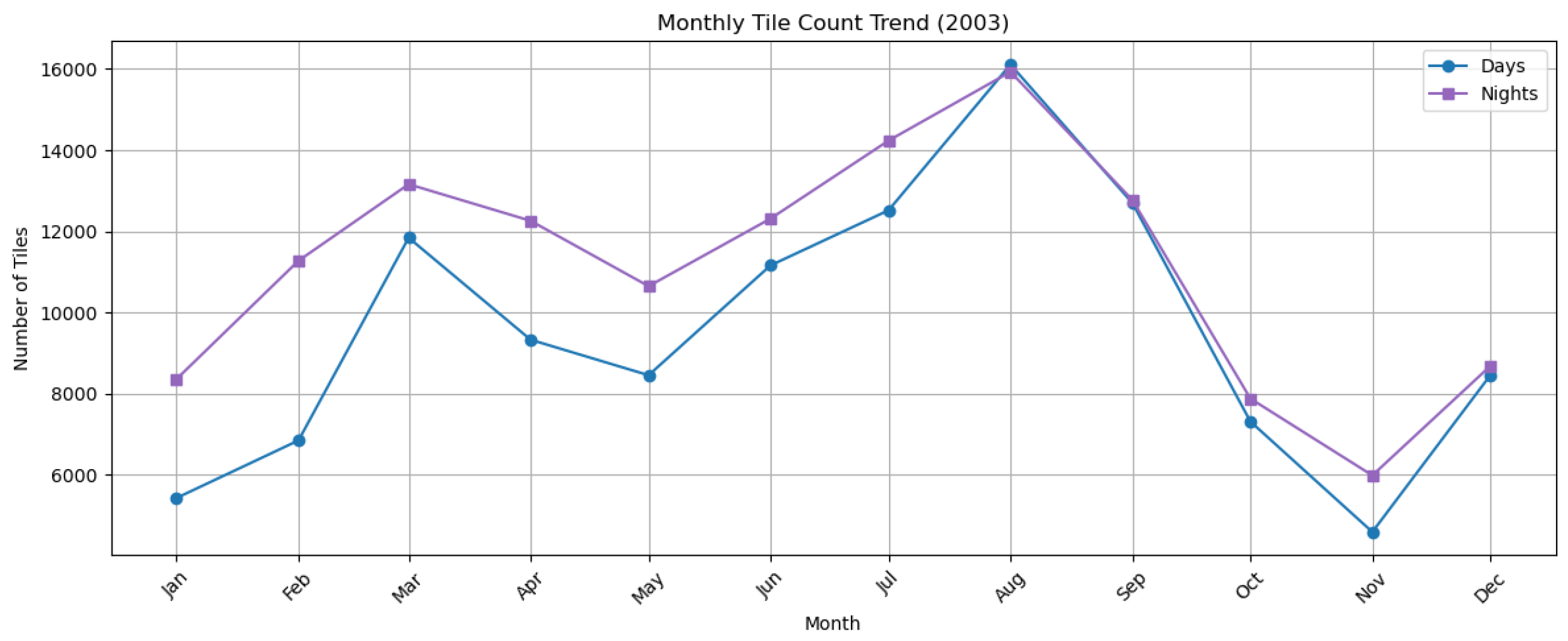
| NaN threshold | Minimum 70% valid pixels required per tile |
| Validation split | 20% of tiles reserved for validation |
| Augmentation | 90° rotation, horizontal and vertical flips |
| Augmentation mode | Applied synchronously to IR and PMW tiles |
| Augmented output | Both original and augmented tiles included |
| Station Name | Network | Latitude | Longitude | Surface Type |
|---|---|---|---|---|
| Bondville | SURFRAD | 40.05 | −88.37 | Grassland |
| Desert Rock | SURFRAD | 36.62 | −116.01 | Aric shrubland |
| Fort Peck | SURFRAD | 48.30 | −105.10 | Grassland |
| Penn State University | SURFRAD | 40.72 | −77.93 | Cropland |
| Southern Great Plains | ARM | 36.60 | 97.48 | Rural |
| Sioux Falls | SURFRAD | 43.73 | −96.62 | Grassland |
| Table Mountain | SURFRAD | 40.12 | −105.23 | Spare Grassland |
| Station | MODIS | AMSR | Merged | ||||||
|---|---|---|---|---|---|---|---|---|---|
| p | RMSE | p | RMSE | p | RMSE | ||||
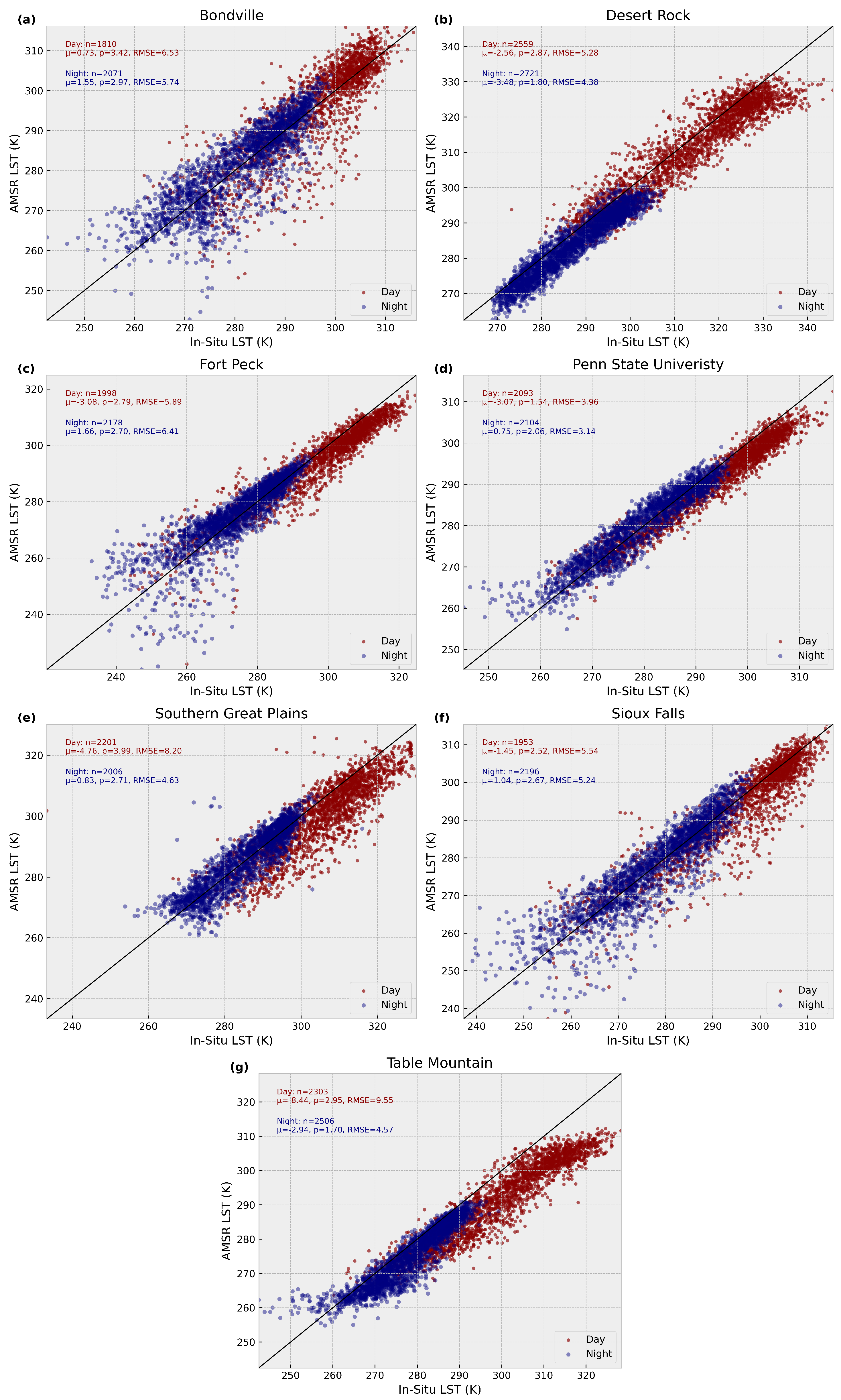
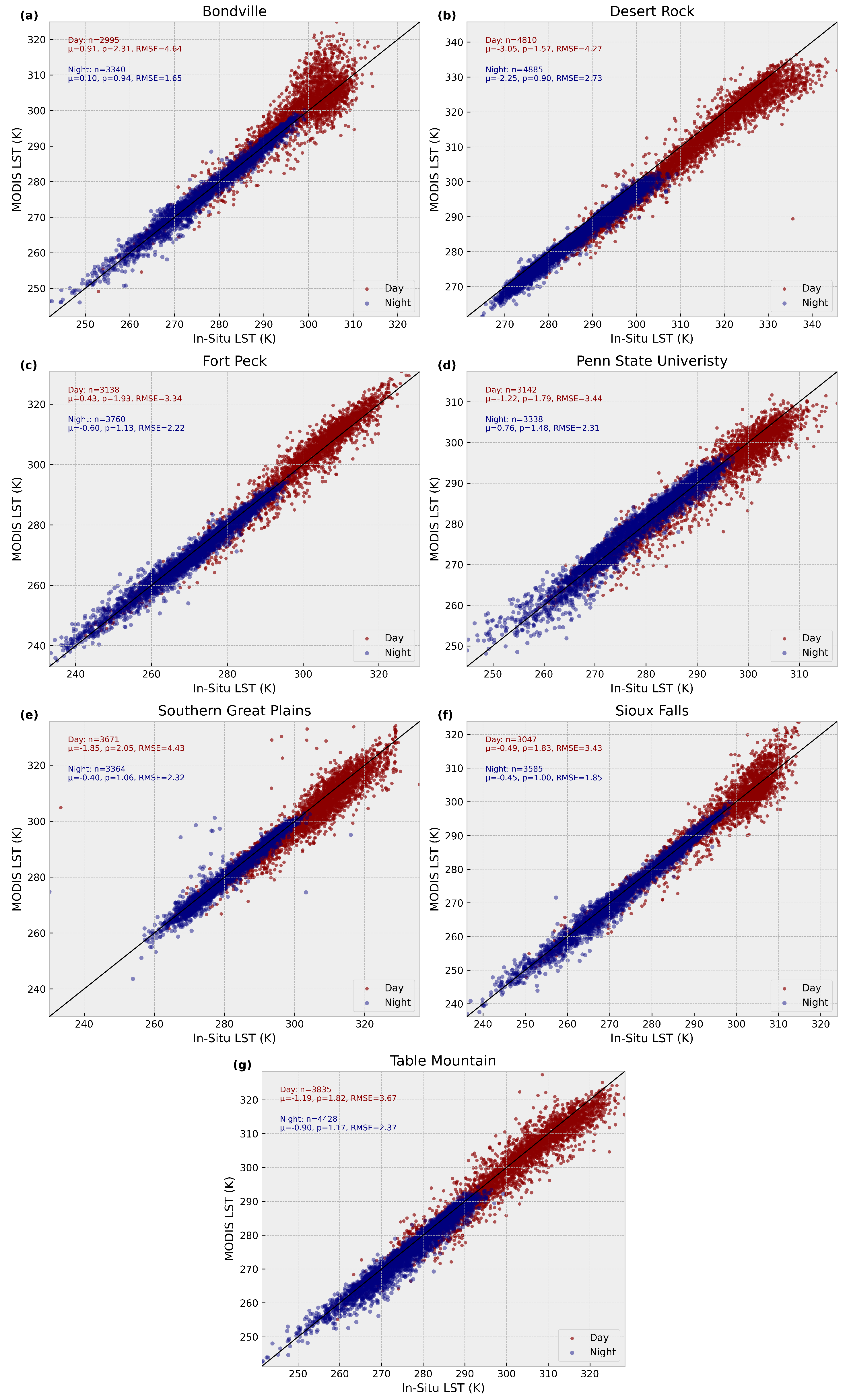
| Bondville | 0.91 | 2.31 | 4.64 | 0.73 | 3.37 | 6.53 | 2.66 | 3.23 | 6.47 |
| Desert Rock | −3.05 | 1.57 | 4.27 | −2.55 | 2.86 | 5.28 | −1.96 | 2.24 | 4.34 |
| Fort Peck | 0.43 | 1.93 | 3.34 | −4.08 | 2.76 | 5.87 | 1.40 | 2.60 | 5.41 |
| Penn State Univ. | −1.22 | 1.79 | 3.44 | −3.08 | 1.52 | 3.96 | −0.59 | 1.49 | 2.65 |
| S. Great Plains | −1.85 | 2.05 | 4.43 | −4.74 | 3.95 | 8.21 | −1.17 | 2.60 | 4.67 |
| Sioux Falls | −0.49 | 1.83 | 3.43 | −1.46 | 2.54 | 5.55 | 1.05 | 2.43 | 5.00 |
| Table Mountain | −1.19 | 1.82 | 3.67 | −8.46 | 2.93 | 9.57 | −1.47 | 2.10 | 4.39 |
| Station | MODIS | AMSR | Merged | ||||||
|---|---|---|---|---|---|---|---|---|---|
| p | RMSE | p | RMSE | p | RMSE | ||||
| Bondville | 0.10 | 2.31 | 4.64 | 0.73 | 3.37 | 6.53 | 2.66 | 3.23 | 6.47 |
| Desert Rock | −2.25 | 0.90 | 2.73 | −3.48 | 1.81 | 4.37 | −2.46 | 1.05 | 3.52 |
| Fort Peck | −0.60 | 1.13 | 2.22 | 1.68 | 2.68 | 6.38 | −0.44 | 2.07 | 4.75 |
| Penn State Univ. | 0.76 | 1.48 | 2.31 | 0.76 | 2.05 | 3.14 | −0.66 | 2.42 | 3.39 |
| S. Great Plains | −0.40 | 1.06 | 2.32 | 0.89 | 2.69 | 4.63 | −0.67 | 1.61 | 3.47 |
| Sioux Falls | −0.45 | 1.00 | 1.85 | 1.03 | 2.66 | 5.24 | −0.48 | 1.63 | 4.11 |
| Table Mountain | −0.90 | 1.17 | 2.37 | −2.94 | 1.69 | 4.57 | −1.50 | 1.76 | 4.23 |
Disclaimer/Publisher’s Note: The statements, opinions and data contained in all publications are solely those of the individual author(s) and contributor(s) and not of MDPI and/or the editor(s). MDPI and/or the editor(s) disclaim responsibility for any injury to people or property resulting from any ideas, methods, instructions or products referred to in the content. |
© 2025 by the authors. Licensee MDPI, Basel, Switzerland. This article is an open access article distributed under the terms and conditions of the Creative Commons Attribution (CC BY) license (https://creativecommons.org/licenses/by/4.0/).
Share and Cite
Waring, A.M.; Ghent, D.; Moffat, D.; Jimenez, C.; Remedios, J. A Deep Learning Approach to Downscaling Microwave Land Surface Temperatures for a Clear-Sky Merged Infrared-Microwave Product. Remote Sens. 2025, 17, 3893. https://doi.org/10.3390/rs17233893
Waring AM, Ghent D, Moffat D, Jimenez C, Remedios J. A Deep Learning Approach to Downscaling Microwave Land Surface Temperatures for a Clear-Sky Merged Infrared-Microwave Product. Remote Sensing. 2025; 17(23):3893. https://doi.org/10.3390/rs17233893
Chicago/Turabian StyleWaring, Abigail Marie, Darren Ghent, David Moffat, Carlos Jimenez, and John Remedios. 2025. "A Deep Learning Approach to Downscaling Microwave Land Surface Temperatures for a Clear-Sky Merged Infrared-Microwave Product" Remote Sensing 17, no. 23: 3893. https://doi.org/10.3390/rs17233893
APA StyleWaring, A. M., Ghent, D., Moffat, D., Jimenez, C., & Remedios, J. (2025). A Deep Learning Approach to Downscaling Microwave Land Surface Temperatures for a Clear-Sky Merged Infrared-Microwave Product. Remote Sensing, 17(23), 3893. https://doi.org/10.3390/rs17233893