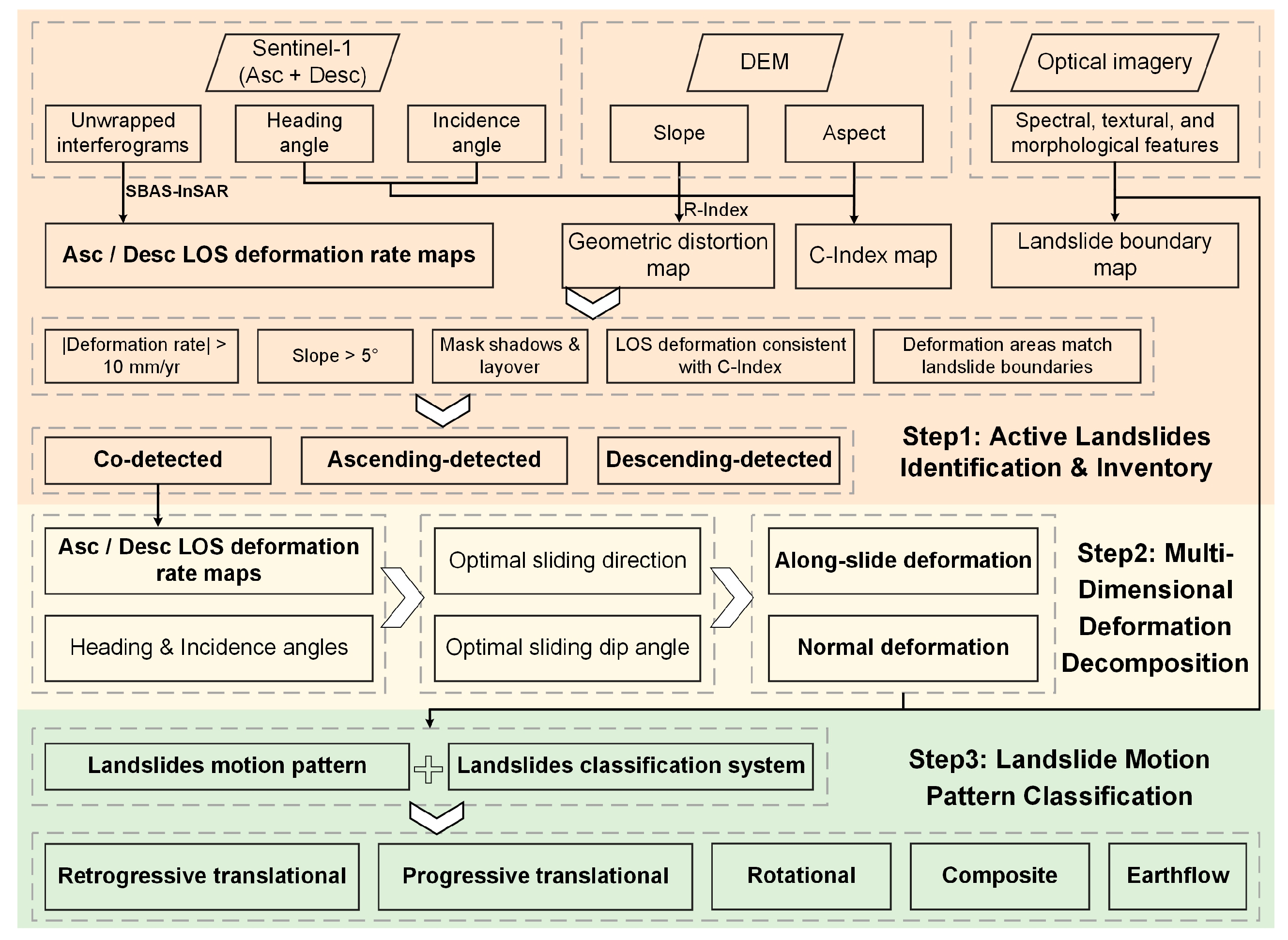
A Two-Dimensional InSAR-Based Framework for Landslide Identification and Movement Pattern Classification

 , , ,
, , , 
Highlights
- A multi-track InSAR framework identified 530 active landslides in Jishi Mountain, with reliability enhanced by geometric masking and C-Index checks.
- The application of a local parallel flow model derived 2D deformation fields for 154 landslides, enabling their classification into five movement patterns.
- The approach offers a transferable, non-contact solution for interpreting landslide mechanisms in complex and remote terrains.
- The movement pattern classification supports differentiated risk assessment and informs targeted mitigation strategies.
Abstract
1. Introduction
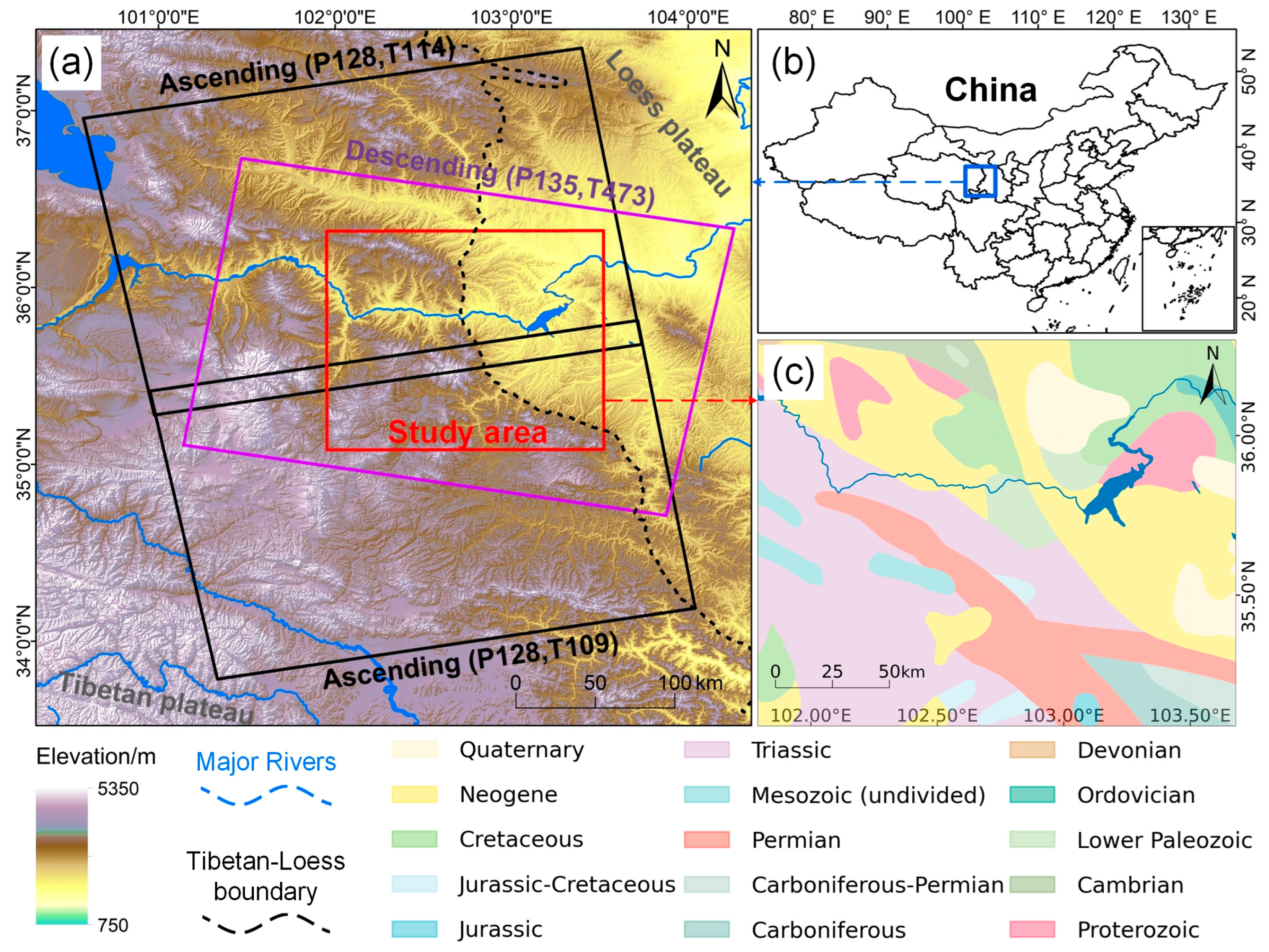
2. Study Area and Datasets
2.1. Study Area

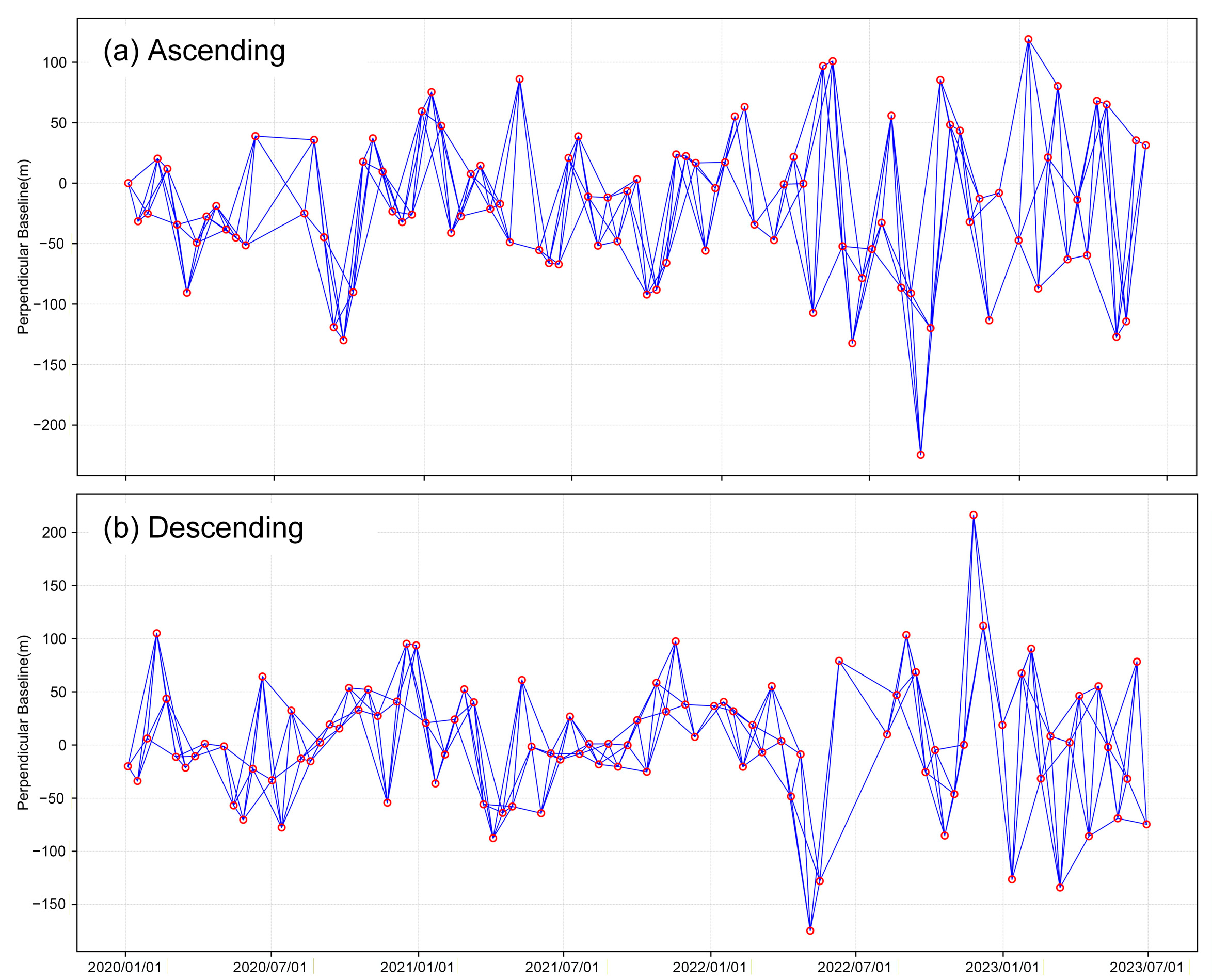
2.2. Datasets
3. Methodology
3.1. SBAS-InSAR
3.2. Geometric Distortion
3.3. C-Index
3.4. Two-Dimensional Deformation
3.5. Landslide Movement Pattern Classification
- (1)
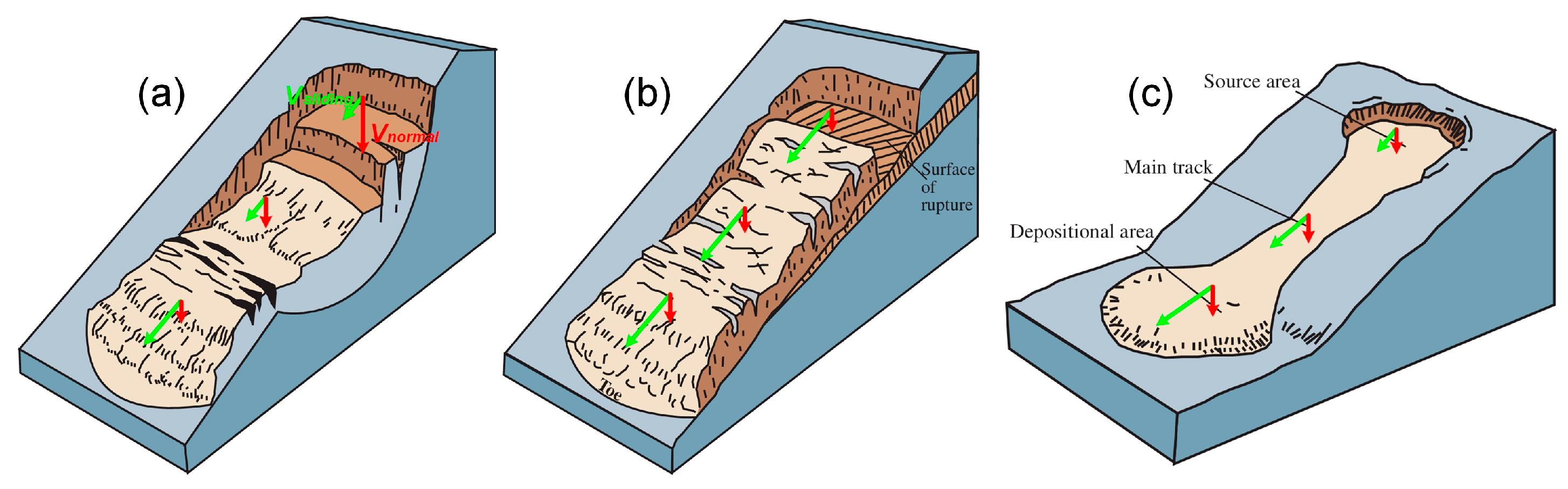
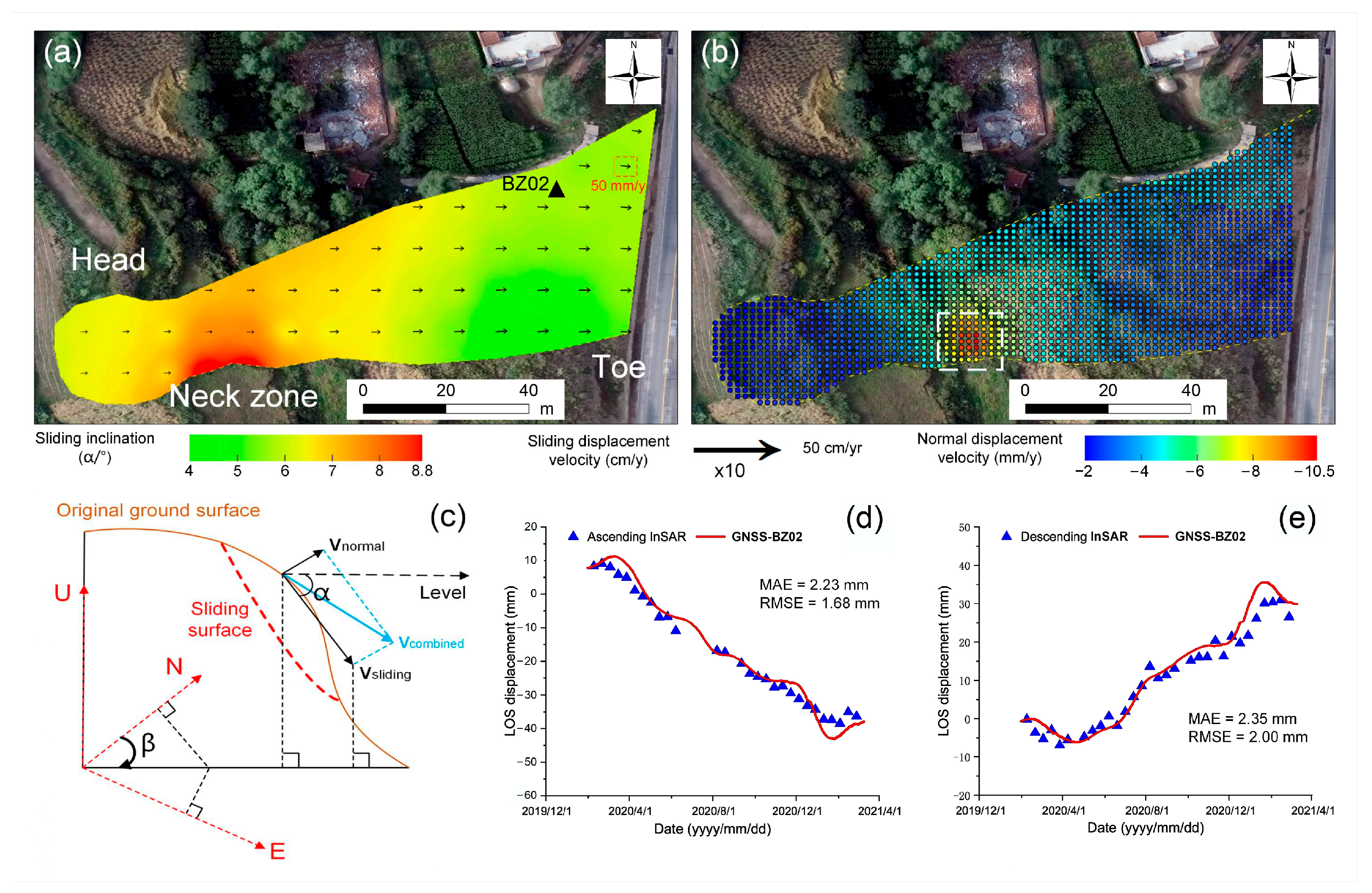
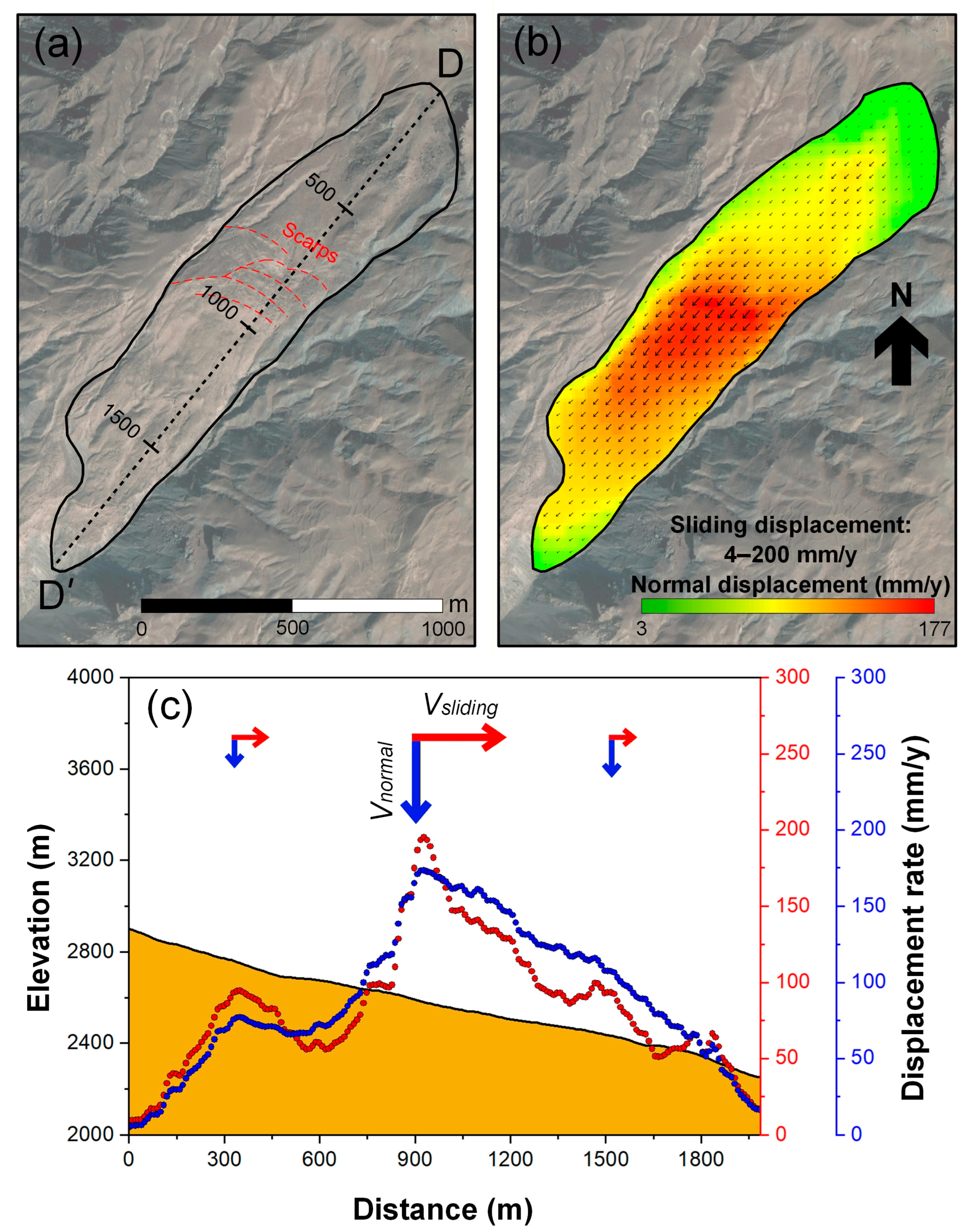
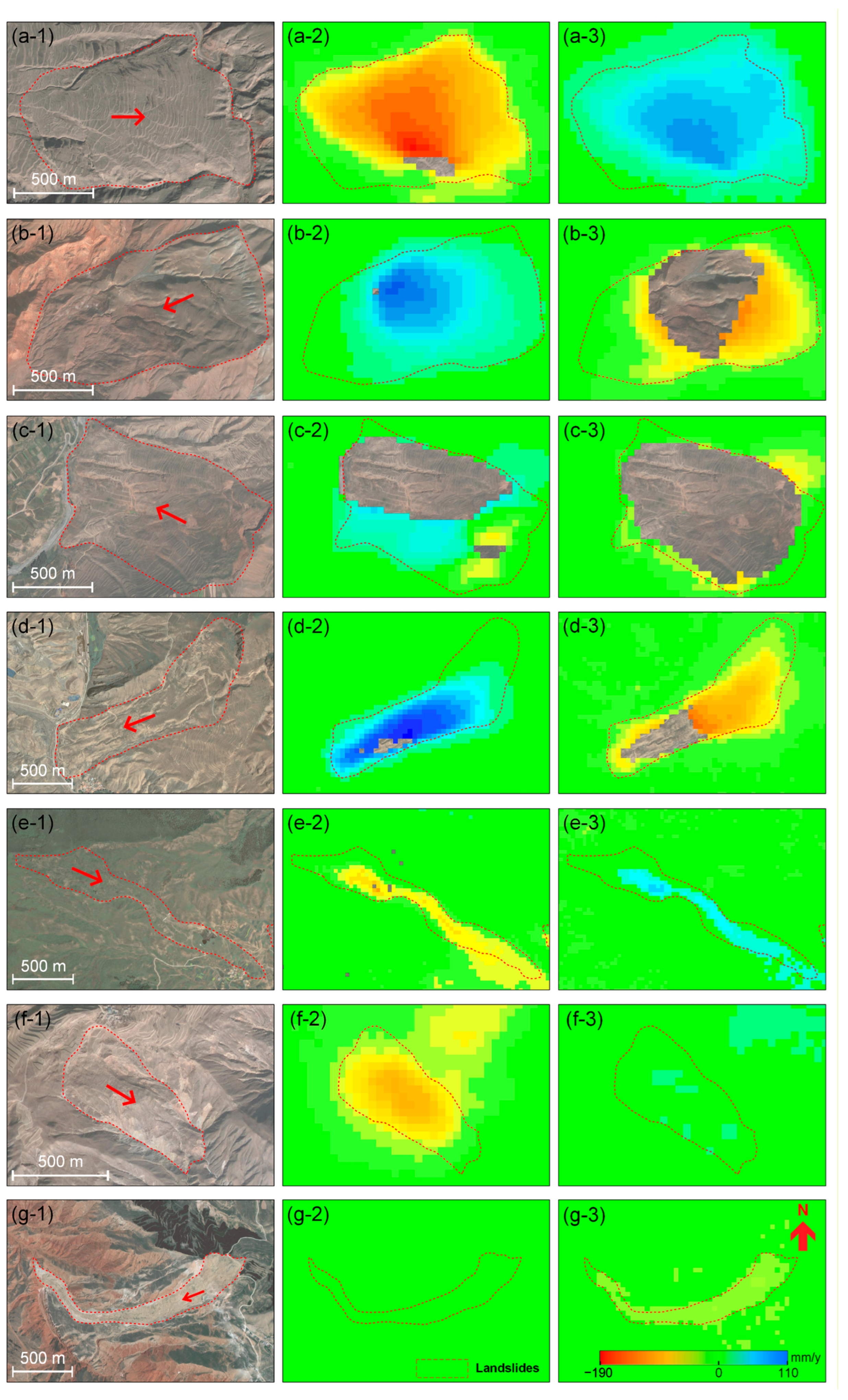
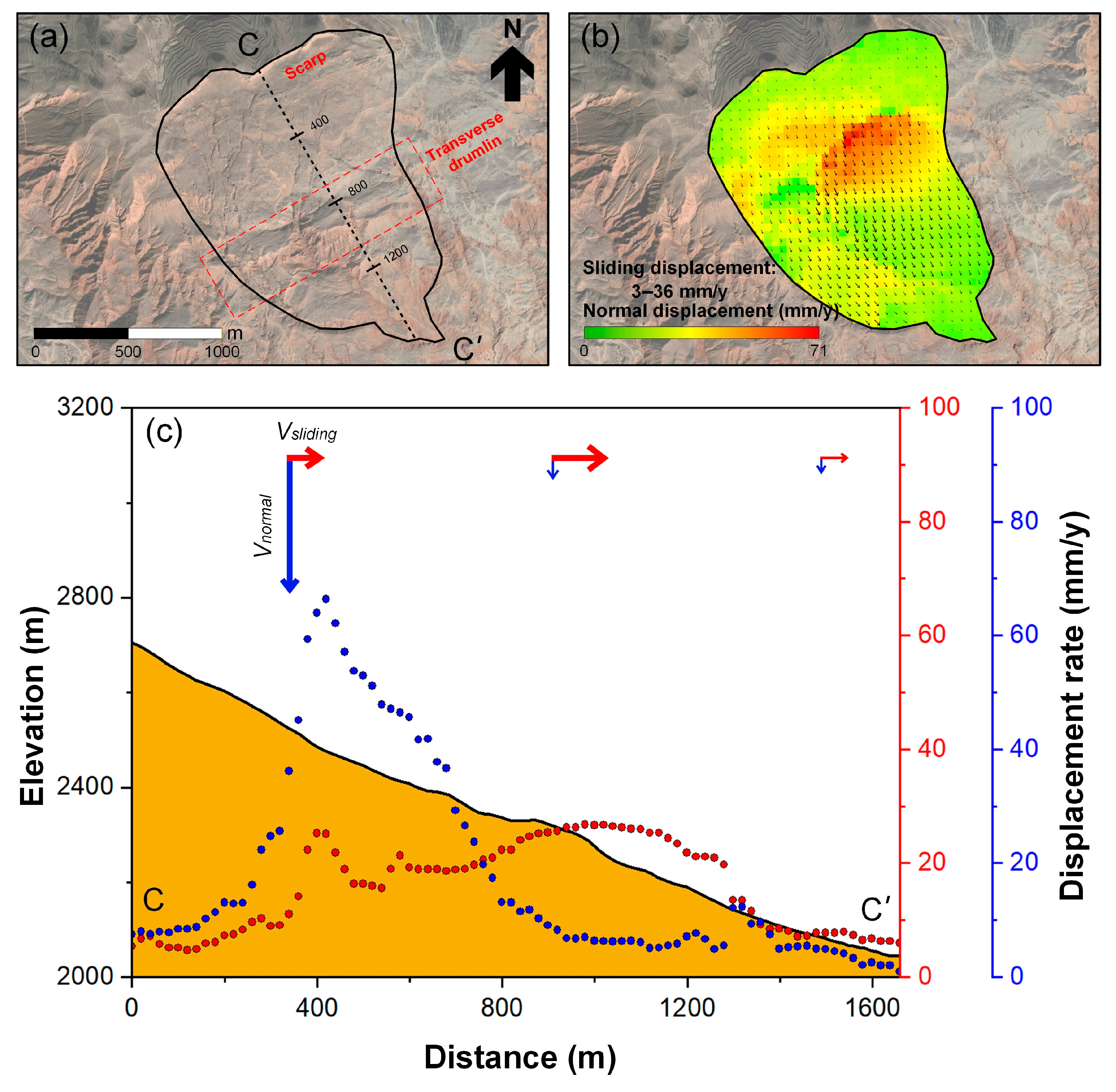
- Rotational landslides are characterized by comparable magnitudes of sliding and normal direction displacements, which exhibit distinct spatial distributions. The normal direction displacement is concentrated in the rear scarp area and decreases downslope, whereas the sliding direction displacement predominates in the frontal zone and increases downslope. These landslides typically occur on steep slopes and are marked by a distinct head scarp and a compressed, bulging toe. The toe deposits are heterogeneous and mixed. Characteristic cracking patterns include arcuate tensile cracks at the crown and radial tensile cracks at the toe (Figure 4a).
- (2)
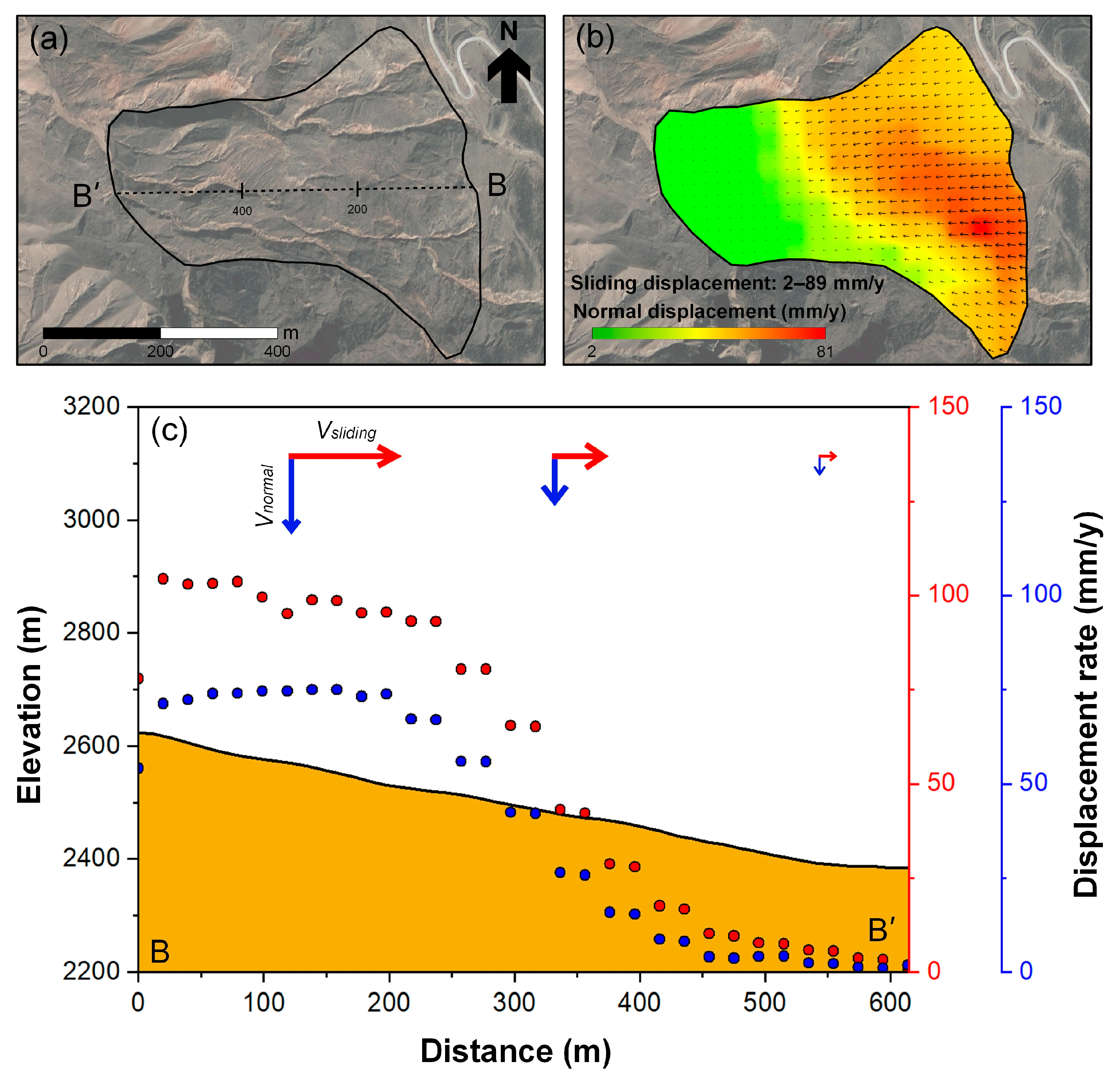
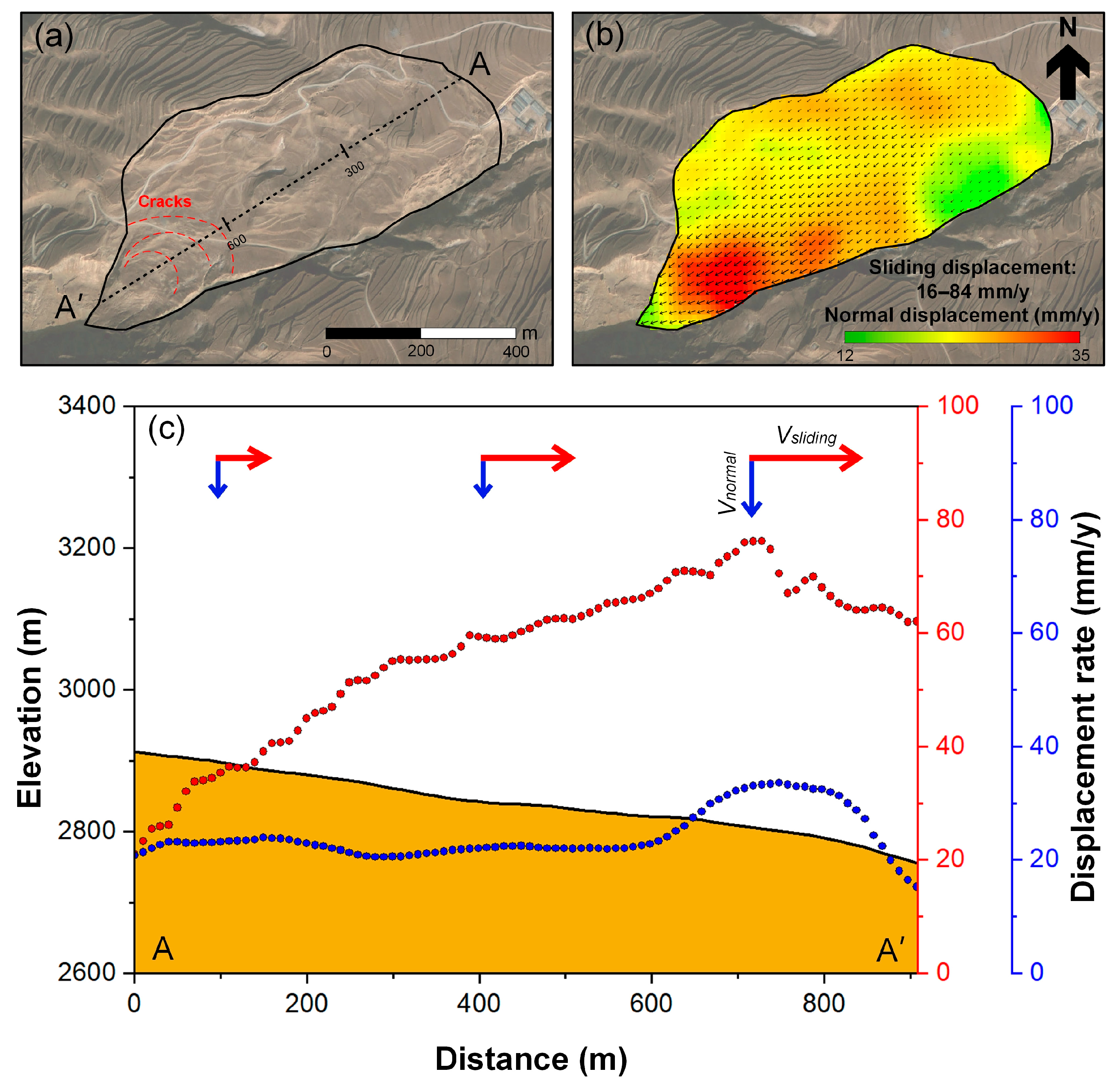
- Translational landslides are dominated by sliding direction displacement. The normal direction displacement is concentrated either at the front (retrogressive) or rear (progressive) portion, exhibiting opposing trends along the slope, whereas the sliding-direction displacement remains relatively uniform. These landslides often occur on gentler slopes. Surface cracks are typically parallel or linear and aligned with the sliding direction. The toe deposits are relatively coherent and exhibit low fragmentation (Figure 4b).
- (3)
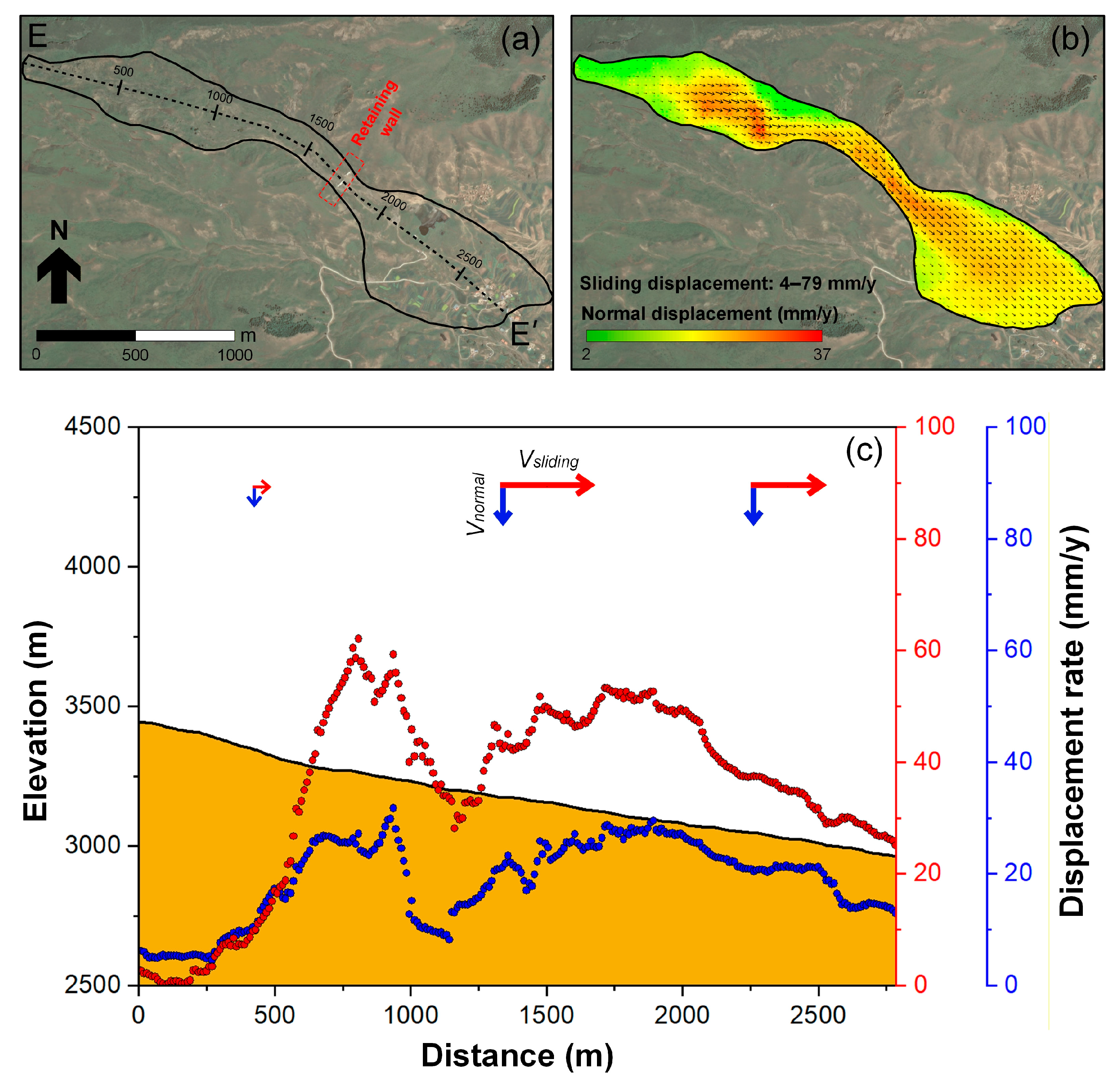
- Earthflows are overwhelmingly dominated by sliding direction displacement, with negligible spatial variation in the normal direction component. Movement is typically slow and fluid-like. The ground surface may exhibit elongated longitudinal and transverse cracks. The deposits are loose and irregularly shaped, often showing evidence of breakup and redistribution along the flow path (Figure 4c).
4. Results and Analysis
4.1. SBAS-InSAR Results
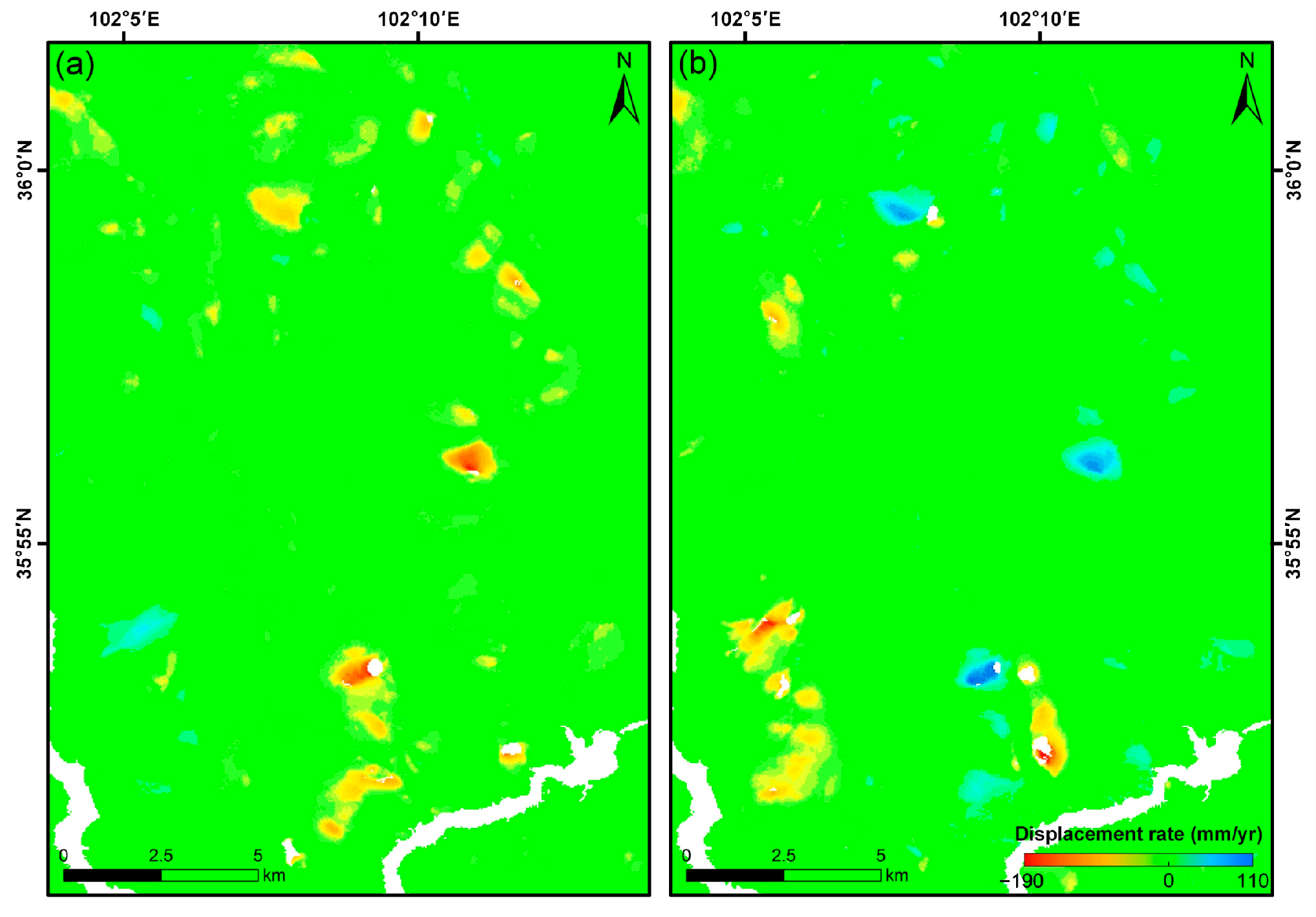
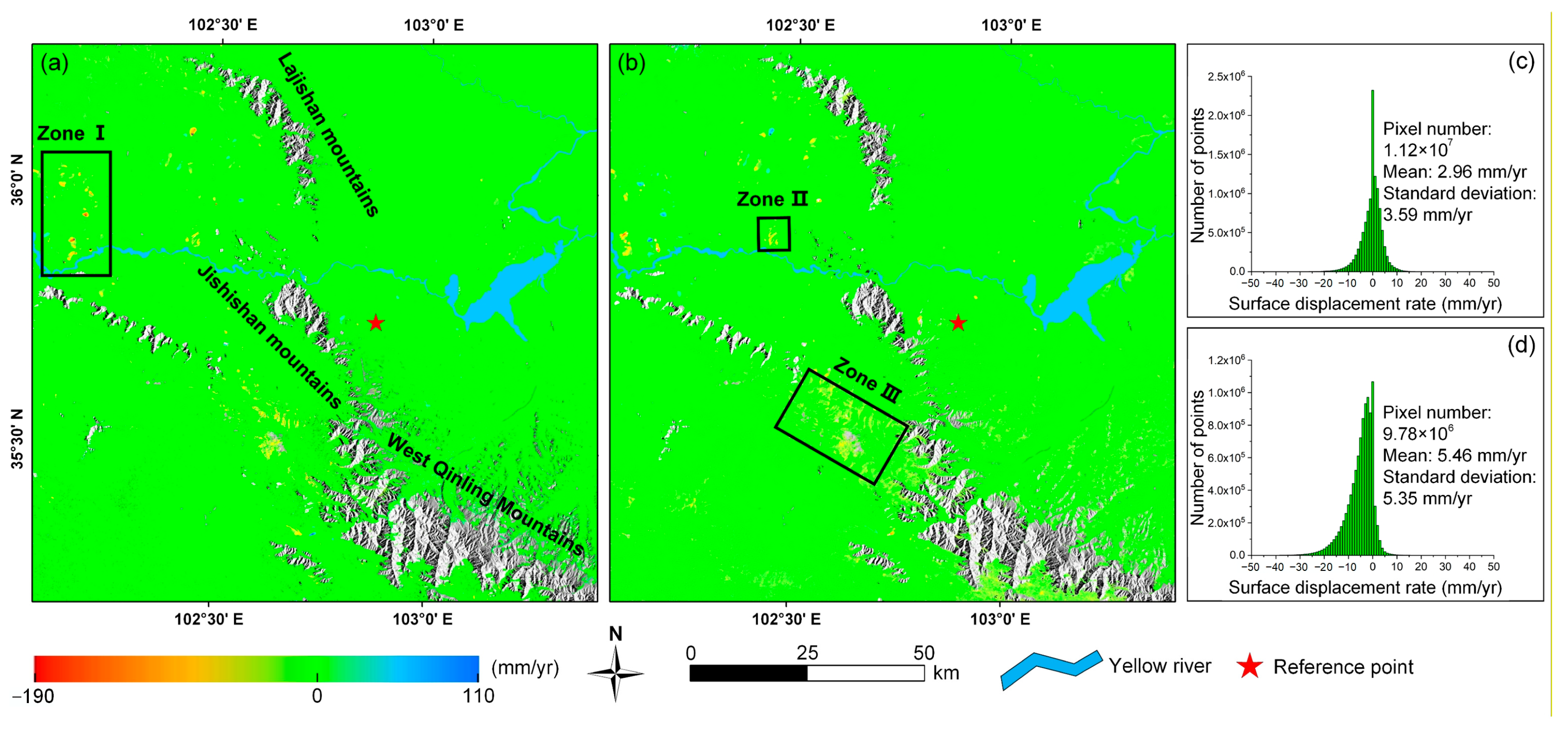
4.1.1. Deformation Velocity Maps
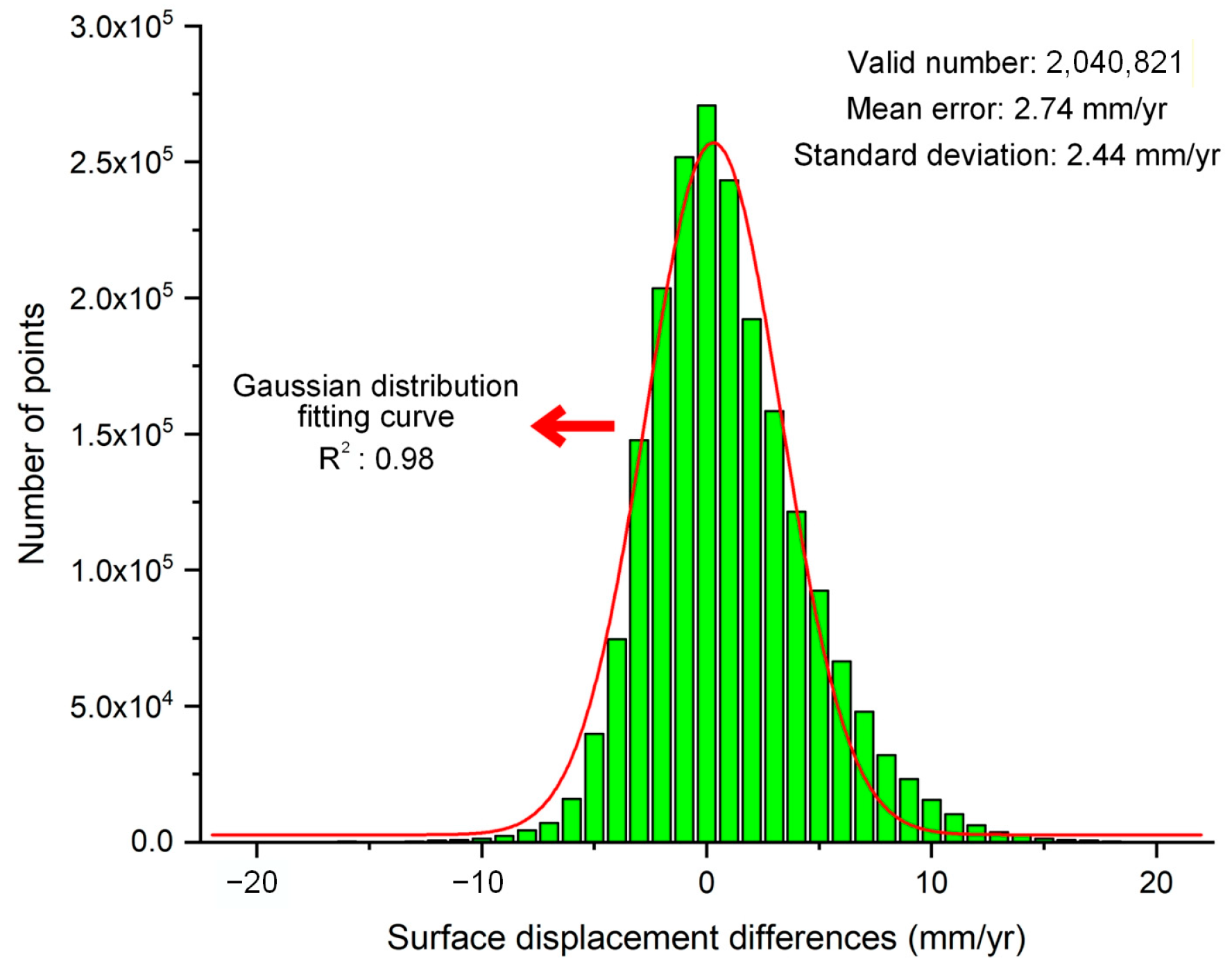
4.1.2. Accuracy Assessment
4.2. Active Landslide Inventory
4.2.1. Analysis of Active Landslide Identification Results
4.2.2. Active Landslide Distribution Inventory
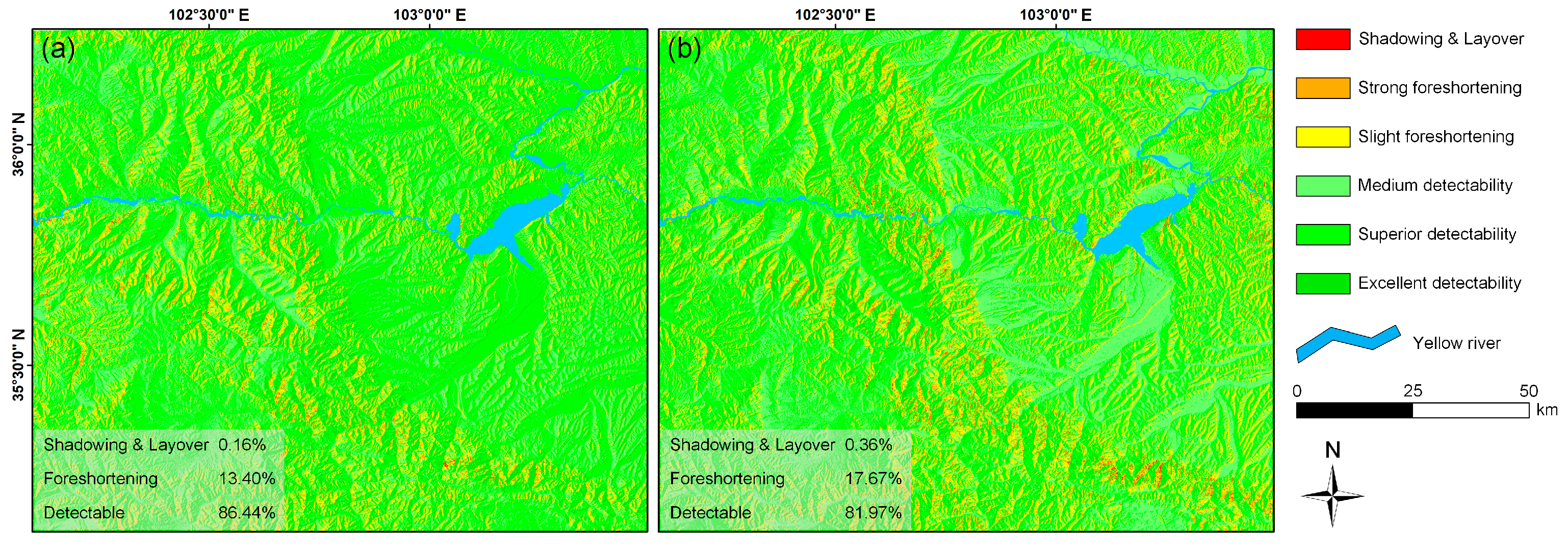
- Geometric Distortion
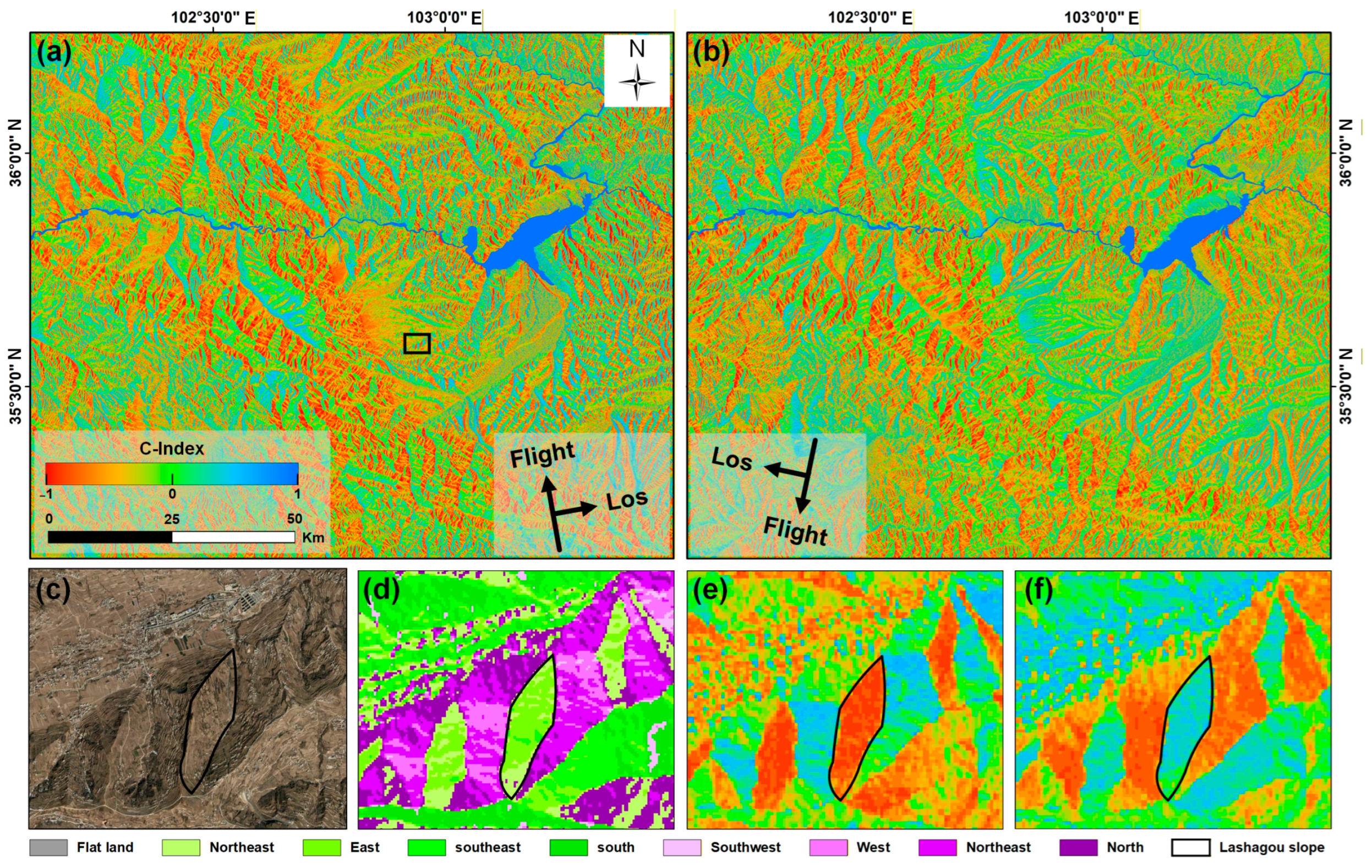
- C-Index
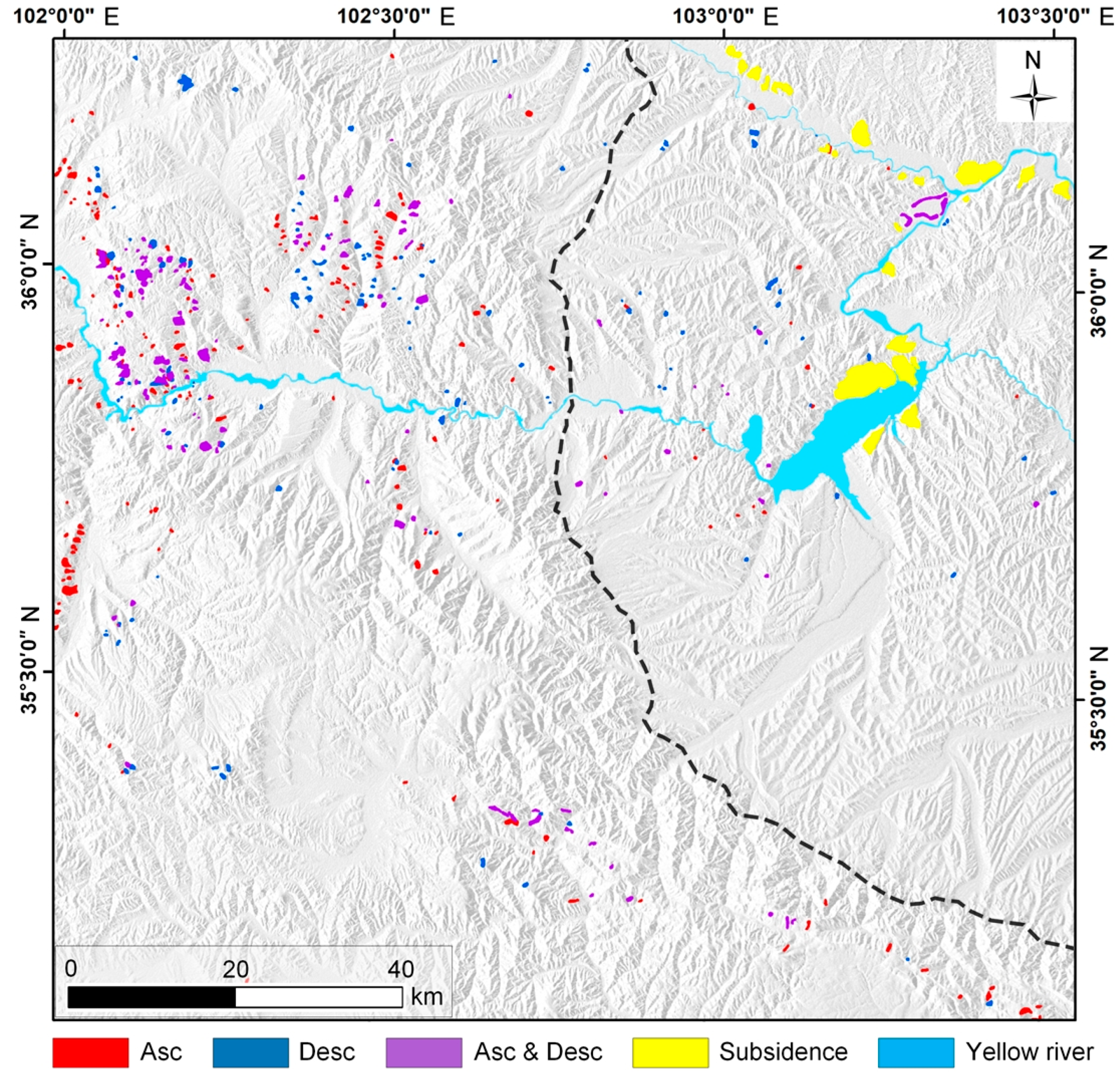
- Active Landslide Distribution Inventory
4.3. Two-Dimensional Deformation of a Typical Landslide
4.4. Landslides Classification
- Retrogressive Translational Landslides
- Progressive Translational Landslides
- Rotational Landslides
- Composite Landslides
- Earthflows
5. Discussion
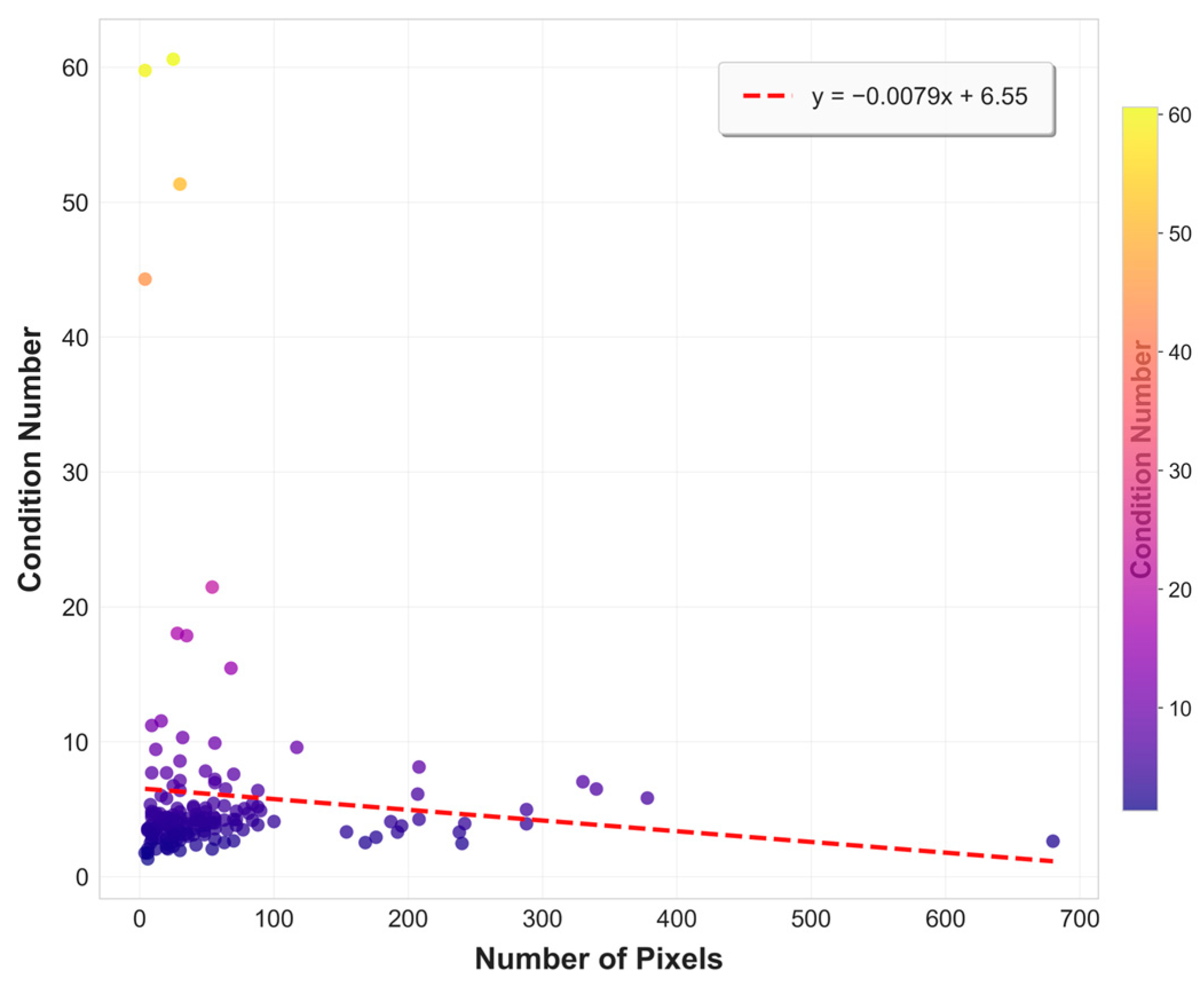
5.1. Sensitivity and Condition Number
5.2. Applicability and Limitations of the Local Parallel Flow Model
5.3. Regional Validation of Landslide Kinematics
6. Conclusions
- (1)
- The SBAS-InSAR technique proved highly capable of identifying landslides in complex mountainous terrain. Integrating ascending and descending data with geometric distortion masking and C-Index consistency checks effectively mitigated the risks of false and missed identifications. A total of 530 active landslides were identified, 154 of which were detected in both acquisition tracks, providing a robust foundation for subsequent in-depth analysis.
- (2)
- The two-dimensional deformation inversion method, based on the local parallel flow model, overcomes the reliance on DEM-derived prior assumptions. This method only requires InSAR observations from two distinct imaging geometries to successfully retrieve the sliding and normal direction components of landslide deformation, offering a novel approach for analyzing movement mechanisms in complex terrain.
- (3)
- A non-contact landslide classification system was established based on the 2D deformation fields and geomorphological characteristics. The landslides were categorized into five distinct types: retrogressive translational (31), progressive translational (66), rotational (19), composite (24), and earthflows (14). This systematic classification not only reveals the diversity of regional landslide movements but also provides a scientific basis for formulating differentiated mitigation strategies.
Author Contributions
Funding
Data Availability Statement
Conflicts of Interest
References
- Sünnetci, M.O.; Ersoy, H.; Firat, E.A. Numerical and back analysis-based methodology for support design of cut slopes at the Turkish—Georgian Border (NE Turkey). J. Mt. Sci. 2021, 18, 1678–1695. [Google Scholar] [CrossRef] [Scilit]
- Pradhan, S.; Toll, D.G.; Rosser, N.J.; Brain, M.J. An investigation of the combined effect of rainfall and road cut on landsliding. Eng. Geol. 2022, 307, 106787. [Google Scholar] [CrossRef] [Scilit]
- Zhang, J.; Lu, M.; Zhang, L.; Xue, Y. Assessing indirect economic losses of landslides along highways. Nat. Hazards 2021, 106, 2775–2796. [Google Scholar] [CrossRef] [Scilit]
- Segoni, S.; Piciullo, L.; Gariano, S.L. A review of the recent literature on rainfall thresholds for landslide occurrence. Landslides 2018, 15, 1483–1501. [Google Scholar] [CrossRef] [Scilit]
- Intrieri, E.; Raspini, F.; Fumagalli, A.; Lu, P.; Conte, S.D.; Farina, P.; Ferretti, A.; Casagli, N. The Maoxian landslide as seen from space: Detecting precursors of failure with Sentinel-1 data. Landslides 2018, 15, 123–133. [Google Scholar] [CrossRef] [Scilit]
- Fuhrmann, T.; Garthwaite, M.C. Resolving three-dimensional surface motion with InSAR: Constraints from multi-geometry data fusion. Remote Sens. 2019, 11, 241. [Google Scholar] [CrossRef] [Scilit]
- Shi, X.; Zhang, L.; Zhou, C.; Li, M.; Liao, M. Retrieval of time series three-dimensional landslide surface displacements from multi-angular SAR observations. Landslides 2018, 15, 1015–1027. [Google Scholar] [CrossRef] [Scilit]
- Delbridge, B.G.; Bürgmann, R.; Fielding, E.; Hensley, S.; Schulz, W.H. Three-dimensional surface deformation derived from airborne interferometric UAVSAR: Application to the Slumgullion Landslide. J. Geophys. Res. Solid Earth 2016, 121, 3951–3977. [Google Scholar] [CrossRef] [Scilit]
- Hu, C.; Deng, Y.; Tian, W.; Zhao, Z. Optimal geometry to resolve 3D deformation from multiple GB-DInRad. Electron. Lett. 2019, 55, 953–955. [Google Scholar] [CrossRef] [Scilit]
- Zeng, T.; Mao, C.; Hu, C.; Yang, X.; Tian, W. Multi-static MIMO-SAR three dimensional deformation measurement system. In Proceedings of the 2015 IEEE 5th Asia-Pacific Conference on Synthetic Aperture Radar (APSAR), Singapore, 1–4 September 2015; pp. 297–301. [Google Scholar] [CrossRef] [Scilit]
- Li, Y.; Jiao, Q.; Hu, X.; Li, Z.; Li, B.; Zhang, J.; Jiang, W.; Luo, Y.; Li, Q.; Ba, R. Detecting the slope movement after the 2018 Baige Landslides based on ground-based and space-borne radar observations. Int. J. Appl. Earth Obs. Geoinf. 2020, 84, 101949. [Google Scholar] [CrossRef] [Scilit]
- Handwerger, A.L.; Booth, A.M.; Huang, M.H.; Fielding, E.J. Inferring the subsurface geometry and strength of slow-moving landslides using 3-D velocity measurements from the NASA/JPL UAVSAR. J. Geophys. Res. Earth Surf. 2021, 126, e2020JF005898. [Google Scholar] [CrossRef] [Scilit]
- Raucoules, D.; Michele, M.D.; Malet, J.P.; Ulrich, P. Time-variable 3D ground displacements from high-resolution synthetic aperture radar (SAR). Application to La Valette landslide (South French Alps). Remote Sens. Environ. 2013, 139, 198–204. [Google Scholar] [CrossRef] [Scilit]
- Eriksen, H.Ø.; Lauknes, T.R.; Larsen, Y.; Corner, G.D.; Bergh, S.G.; Dehls, J.; Kierulf, H.P. Visualizing and interpreting surface displacement patterns on unstable slopes using multi-geometry satellite SAR interferometry (2D InSAR). Remote Sens. Environ. 2017, 191, 297–312. [Google Scholar] [CrossRef] [Scilit]
- Gu, X.; Li, Y.; Zuo, X.; Huang, C.; Xing, M.; Ruan, Z.; Yu, Y.; Shi, C.; Xiao, J.; Zou, Q. Analysis of geometric distortion in sentinel-1 images and multi-dimensional spatiotemporal evolution characteristics of surface deformation along the central Yyunnan water diversion project. Remote Sens. 2025, 17, 3250. [Google Scholar] [CrossRef] [Scilit]
- Frattini, P.; Crosta, G.B.; Rossini, M.; Allievi, J. Activity and kinematic behaviour of deep-seated landslides from PS-InSAR displacement rate measurements. Landslides 2018, 15, 1053–1070. [Google Scholar] [CrossRef] [Scilit]
- Liu, X.; Zhao, C.; Zhang, Q.; Yin, Y.; Lu, Z.; Samsonov, S.; Yang, C.; Wang, M.; Tomás, R. Three-dimensional and long-term landslide displacement estimation by fusing C-and L-band SAR observations: A case study in Gongjue County, Tibet, China. Remote Sens. Environ. 2021, 267, 112745. [Google Scholar] [CrossRef] [Scilit]
- Cascini, L.; Fornaro, G.; Peduto, D. Advanced low-and full-resolution DInSAR map generation for slow-moving landslide analysis at different scales. Eng. Geol. 2010, 112, 29–42. [Google Scholar] [CrossRef] [Scilit]
- Qarinur, M. Landslide runout distance prediction based on mechanism and cause of soil or rock mass movement. J. Civ. Eng. Forum 2015, 1, 29–36. [Google Scholar] [CrossRef] [Scilit]
- Xia, W.; Chen, J.; Liu, J.; Ma, C.; Liu, W. Landslide extraction from high-resolution remote sensing imagery using fully convolutional spectral–topographic fusion network. Remote Sens. 2021, 13, 5116. [Google Scholar] [CrossRef] [Scilit]
- McCann, D.M.; Forster, A. Reconnaissance geophysical methods in landslide investigations. Eng. Geol. 1990, 29, 59–78. [Google Scholar] [CrossRef] [Scilit]
- Meng, Q.; Confuorto, P.; Peng, Y.; Raspini, F.; Bianchini, S.; Han, S.; Liu, H.; Casagli, N. Regional recognition and classification of active loess landslides using two-dimensional deformation derived from Sentinel-1 interferometric radar data. Remote Sens. 2020, 12, 1541. [Google Scholar] [CrossRef] [Scilit]
- Zhu, Y.; Yao, X.; Yao, C.; Zhou, Z.; Gu, Z.; Yao, L. Integration of vertical and horizontal deformation derived by SAR observation for identifying landslide motion patterns in a basaltic weathered crust region of Guizhou, China. Remote Sens. 2022, 14, 4014. [Google Scholar] [CrossRef] [Scilit]
- Ren, J.; Yang, W.; Ma, Z.; Li, W.; Zeng, S.; Fu, H.; Wen, Y.; He, J. Remote Sensing-Based Detection and Analysis of Slow-Moving Landslides in Aba Prefecture, Southwest China. Remote Sens. 2025, 17, 1462. [Google Scholar] [CrossRef] [Scilit]
- Huang, F.; Yan, J.; Fan, X.; Yao, C.; Huang, J.; Chen, W.; Hong, H. Uncertainty pattern in landslide susceptibility prediction modelling: Effects of different landslide boundaries and spatial shape expressions. Geosci. Front. 2022, 13, 101317. [Google Scholar] [CrossRef] [Scilit]
- Wang, K.; Han, L.; Liao, J. A study of high-resolution remote sensing image landslide detection with optimized anchor boxes and edge enhancement. Eur. J. Remote Sens. 2024, 57, 2289616. [Google Scholar] [CrossRef] [Scilit]
- Zhang, C.; Luo, J.; Li, Z. An Automatic Detection Method of Slow-Moving Landslides Using an Improved Faster R-CNN Model Based on InSAR Deformation Rates. Remote Sens. 2025, 17, 3243. [Google Scholar] [CrossRef] [Scilit]
- Zhang, Z.; Chen, S.; Tao, L. 1983 Sale Mountain landslide, Gansu Province, China. In Catastrophic Landslides: Effects, Occurrence, and Mechanisms; Geological Society of America: Boulder, CO, USA, 2002. [Google Scholar] [CrossRef] [Scilit]
- Yang, D.; Qiu, H.; Zhu, Y.; Liu, Z.; Pei, Y.; Ma, S.; Du, C.; Sun, H.; Liu, Y.; Cao, M. Landslide characteristics and evolution: What we can learn from three adjacent landslides. Remote Sens. 2021, 13, 4579. [Google Scholar] [CrossRef] [Scilit]
- Xu, H.; Shu, B.; Zhang, Q.; Xiong, G.; Wang, L. Combining InSAR and Time-Series clustering to reveal deformation patterns of the Heifangtai loess terrace. Remote Sens. 2025, 17, 429. [Google Scholar] [CrossRef] [Scilit]
- Zhang, F.; Wang, G. Effect of irrigation-induced densification on the post-failure behavior of loess flowslides occurring on the Heifangtai area, Gansu, China. Eng. Geol. 2018, 236, 111–118. [Google Scholar] [CrossRef] [Scilit]
- Shi, P.; Liu, F.; Meng, X.; Zhou, Q.; Yu, D.; Chen, Q.; Liu, L.; Fang, W.; Xiao, C.; He, C.; et al. Recent Jishishan earthquake ripple hazard provides a new explanation for the destruction of the prehistoric Lajia Settlement 4000a BP. Sci. Rep. 2024, 14, 11630. [Google Scholar] [CrossRef] [Scilit] [PubMed]
- Huang, Y.; Xu, C.; He, X.; Cheng, J.; Xu, X.; Tian, Y. Landslides induced by the 2023 Jishishan Ms6. 2 earthquake (NW China): Spatial distribution characteristics and implication for the seismogenic fault. npj Nat. Hazards 2025, 2, 14. [Google Scholar] [CrossRef] [Scilit]
- Ma, K.; Liu, Y.; Hu, Q.; Yang, J.; Wang, L. Fault geometry and slip distribution of the 2023 Jishishan earthquake based on sentinel-1A and ALOS-2 data. Remote Sens. 2025, 17, 2310. [Google Scholar] [CrossRef] [Scilit]
- Wang, Y.; Wang, P.; Chang, W.; Wang, H.; Xu, S.; Xu, S.; Yu, H. Hazard assessment of seismic-collapsed loess landslides on the Loess Plateau as exemplified by the M6. 2 earthquake in Jishishan County, China. Front. Earth Sci. 2024, 12, 1402922. [Google Scholar] [CrossRef] [Scilit]
- Saylor, J.E.; Jordan, J.C.; Sundell, K.E.; Wang, X.; Wang, S.; Deng, T. Topographic growth of the Jishi Shan and its impact on basin and hydrology evolution, NE Tibetan Plateau. Basin Res. 2018, 30, 544–563. [Google Scholar] [CrossRef] [Scilit]
- Steinshouer, D.W.; Qiang, J.; McCabe, P.J.; Ryder, R.T. Maps Showing Geology, Oil and Gas Fields, and Geologic Provinces of the Asia Pacific Region; US Geological Survey: Reston, VA, USA, 1999; 16p. [CrossRef] [Scilit]
- Zhang, Y.; Fattahi, H.; Amelung, F. Small baseline InSAR time series analysis: Unwrapping error correction and noise reduction. Comput. Geosci. 2019, 133, 104331. [Google Scholar] [CrossRef] [Scilit]
- Notti, D.; Meisina, C.; Zucca, F.; Colombo, A. Models to predict Persistent Scatterers data distribution and their capacity to register movement along the slope. In Proceedings of the Fringe 2011 Workshop, Frascati, Italy, 19–23 September 2011. [Google Scholar]
- Cigna, F.; Bateson, L.B.; Jordan, C.J.; Dashwood, C. Simulating SAR geometric distortions and predicting Persistent Scatterer densities for ERS-1/2 and ENVISAT C-band SAR and InSAR applications: Nationwide feasibility assessment to monitor the landmass of Great Britain with SAR imagery. Remote Sens. Environ. 2014, 152, 441–466. [Google Scholar] [CrossRef] [Scilit]
- van Natijne, A.L.; Bogaard, T.A.; van Leijen, F.J.; Hanssen, R.F.; Lindenbergh, R.C. World-wide InSAR sensitivity index for landslide deformation tracking. Int. J. Appl. Earth Obs. Geoinf. 2022, 111, 102829. [Google Scholar] [CrossRef] [Scilit]
- Song, C.; Yu, C.; Li, Z.; Pazzi, V.; Soldato, M.D.; Cruz, A.; Utili, S. Landslide geometry and activity in Villa de la Independencia (Bolivia) revealed by InSAR and seismic noise measurements. Landslides 2021, 18, 2721–2737. [Google Scholar] [CrossRef] [Scilit]
- Zhang, S.; Fan, Q.; Niu, Y.; Qiu, S.; Si, J.; Feng, Y.; Zhang, S.; Song, Z.; Li, Z. Two-dimensional deformation monitoring for spatiotemporal evolution and failure mode of Lashagou landslide group, Northwest China. Landslides 2023, 20, 447–459. [Google Scholar] [CrossRef] [Scilit]
- Varnes, D.J. Landslide types and processes. Landslides Eng. Pract. 1958, 24, 20–47. [Google Scholar]
- Hungr, O.; Leroueil, S.; Picarelli, L. The Varnes classification of landslide types, an update. Landslides 2014, 11, 167–194. [Google Scholar] [CrossRef] [Scilit]
- Highland, L.; Johnson, M. Landslide Types and Processes. United States Geological Survey. 2016. Available online: https://pubs.usgs.gov/fs/2004/3072/fs-2004-3072.html (accessed on 25 September 2025).
- Chen, B.; Li, Z.; Song, C.; Yu, C.; Zhu, W.; Liu, Z.; Han, B.; Du, J.; Zhang, C.; Xu, F.; et al. Automatic detection of active geohazards with millimeter-to-meter-scale deformation and quantitative analysis of factors influencing spatial distribution: A case study in the Hexi corridor, China. Int. J. Appl. Earth Obs. Geoinf. 2024, 131, 103995. [Google Scholar] [CrossRef] [Scilit]
- Liu, X.; Zhao, C.; Yin, Y.; Tomás, R.; Zhang, J.; Zhang, Q.; Wei, Y.; Wang, M.; Lopez-Sanchez, J. Refined InSAR method for mapping and classification of active landslides in a high mountain region: Deqin County, southern Tibet Plateau, China. Remote Sens. Environ. 2024, 304, 114030. [Google Scholar] [CrossRef] [Scilit]
- Ji, Y.Q.; Su, S.R.; Simoni, A.; Huang, Q. Giant paleo-landslides in the upper reaches of the Yellow River: Spatio–temporal distribution, and possible controlling factors. J. Palaeogeogr. 2025, 14, 391–412. [Google Scholar] [CrossRef] [Scilit]
- Doin, M.P.; Lasserre, C.; Peltzer, G.; Cavalié, O.; Doubre, C. Corrections of stratified tropospheric delays in SAR interferometry: Validation with global atmospheric models. J. Appl. Geophys. 2009, 69, 35–50. [Google Scholar] [CrossRef] [Scilit]
- Jolivet, R.; Grandin, R.; Lasserre, C.; Doin, M.P.; Peltzer, G. Systematic InSAR tropospheric phase delay corrections from global meteorological reanalysis data. Geophys. Res. Lett. 2011, 38, L17311. [Google Scholar] [CrossRef] [Scilit]
- Yu, C.; Li, Z.; Penna, N.T.; Crippa, P. Generic atmospheric correction model for interferometric synthetic aperture radar observations. J. Geophys. Res. Solid Earth 2018, 123, 9202–9222. [Google Scholar] [CrossRef] [Scilit]
- Du, J.; Li, Z.; Song, C.; Zhu, W.; Ji, Y.; Zhang, C.; Chen, B.; Su, S. InSAR-based active landslide detection and characterization along the upper reaches of the Yellow River. IEEE J. Sel. Top. Appl. Earth Obs. Remote Sens. 2023, 16, 3819–3830. [Google Scholar] [CrossRef] [Scilit]
- Jiang, Z.; Zhao, C.; Liu, X.; Shi, G.; Yan, M.; Zhang, Q.; Peng, J. The regional differentiation on the spatial distribution and influencing factors of potential landslides across the entire Loess Plateau, China based on InSAR and sub-region XGBoost-SHAP model. IEEE J. Sel. Top. Appl. Earth Obs. Remote Sens. 2024, 18, 2024–2041. [Google Scholar] [CrossRef] [Scilit]
- Wei, Y.; Qiu, H.; Liu, Z.; Huangfu, W.; Zhu, Y.; Liu, Y.; Yang, D.; Kamp, U. Refined and dynamic susceptibility assessment of landslides using InSAR and machine learning models. Geosci. Front. 2024, 15, 101890. [Google Scholar] [CrossRef] [Scilit]
- Reinosch, E.; Buckel, J.; Dong, J.; Gerke, M.; Baade, J.; Riedel, B. InSAR time series analysis of seasonal surface displacement dynamics on the Tibetan Plateau. Cryosphere 2020, 14, 1633–1650. [Google Scholar] [CrossRef] [Scilit]
- Li, P.; Wang, H.; Li, H.; Ni, Z.; Deng, H.; Sui, H.; Xu, G. Refined landslide susceptibility mapping considering land use changes and InSAR deformation: A case study of Yulin City, Guangxi. Remote Sens. 2024, 16, 3016. [Google Scholar] [CrossRef] [Scilit]
- Villarroya-Carpio, A.; Lopez-Sanchez, J.M.; Engdahl, M.E. Sentinel-1 interferometric coherence as a vegetation index for agriculture. Remote Sens. Environ. 2022, 280, 113208. [Google Scholar] [CrossRef] [Scilit]
- He, L.; Pei, P.; Zhang, X.; Qi, J.; Cai, J.; Cao, W.; Ding, R.; Mao, Y. Sensitivity evaluation of time series InSAR monitoring results for landslide detection. Remote Sens. 2023, 15, 3906. [Google Scholar] [CrossRef] [Scilit]
- Dai, K.; Tie, Y.; Xu, Q.; Feng, Y.; Zhuo, G.; Shi, X. Early Identification of potential landslide geohazards in alpine-canyon terrain based on SAR interferometry—A case study of the middle section of Yalong River. J. Radars 2020, 9, 554–568. [Google Scholar] [CrossRef]
- Zhuang, J.; Peng, J.; Wang, G.; Javed, I.; Wang, Y.; Li, W. Distribution and characteristics of landslide in Loess Plateau: A case study in Shaanxi province. Eng. Geol. 2018, 236, 89–96. [Google Scholar] [CrossRef] [Scilit]
- Fan, Q.; Zhang, S.; Niu, Y.; Si, J.; Li, X.; Wu, W.; Zeng, X.; Jiang, J. Formative period tracing and driving factors analysis of the Lashagou landslide group in Jishishan County, China. Remote Sens. 2024, 16, 1739. [Google Scholar] [CrossRef] [Scilit]
- Fan, Q.; Zhang, S.; Niu, Y.; Zeng, X.; Si, J.; Li, X.; Wu, W.; Jiang, J.; Qiu, S.; Kang, Y. A non-contact quantitative risk assessment framework for translational highway landslides: Integration of InSAR, geophysical inversion, and numerical simulation. Eng. Geol. 2024, 343, 107818. [Google Scholar] [CrossRef] [Scilit]










| Sensor | Sentinel-1 | |
|---|---|---|
| Flight direction | Ascending | Descending |
| Relative orbit number | 109/114 | 473 |
| Heading angle (°) | −9.76 | −169.71 |
| Incidence angle (°) | 42.12 | 37.35 |
| Resolution (m) (Rg. × Az.) | 2.3 × 13.9 | 2.3 × 13.9 |
| Temporal span | January 2020~June 2023 | January 2020~June 2023 |
| Number of images | 98 | 99 |
| Type | |
|---|---|
| well-illuminated area | |
| foreshortening | |
| layover | |
| reverse layover | |
| shadow | |
| & non-active shadow | passive shadow |
| Landslide Type | Dominant 2D Deformation Pattern | Key InSAR Diagnostics | Essential Optical Geomorphology |
|---|---|---|---|
| Retrogressive Translational | max at toe; ↑ downslope | Tensile cracks; steps at toe | |
| Progressive Translational | max at head; ↓ downslope | Sharp head scarp | |
| Rotational | dominant at head; dominant at toe | ↓ downslope ↑ downslopeClear - transition zone | Arcuate main scarp; Bulging toe |
| Composite | Combined patterns | Non-uniform ; Multiple displacement peaks | Multiple scarps; complex crack patterns |
| Earthflow | strongly dominant; Minimal variation | dominant everywhere;Low gradient | Flow-like morphology; lateral shear zones; lobate toe |
Disclaimer/Publisher’s Note: The statements, opinions and data contained in all publications are solely those of the individual author(s) and contributor(s) and not of MDPI and/or the editor(s). MDPI and/or the editor(s) disclaim responsibility for any injury to people or property resulting from any ideas, methods, instructions or products referred to in the content. |
© 2025 by the authors. Licensee MDPI, Basel, Switzerland. This article is an open access article distributed under the terms and conditions of the Creative Commons Attribution (CC BY) license (https://creativecommons.org/licenses/by/4.0/).
Share and Cite
Li, X.; Fan, Q.; Niu, Y.; Zhang, S.; Zhao, J.; Si, J.; Wang, Z.; Ju, Z.; Lu, Z. A Two-Dimensional InSAR-Based Framework for Landslide Identification and Movement Pattern Classification. Remote Sens. 2025, 17, 3889. https://doi.org/10.3390/rs17233889
Li X, Fan Q, Niu Y, Zhang S, Zhao J, Si J, Wang Z, Ju Z, Lu Z. A Two-Dimensional InSAR-Based Framework for Landslide Identification and Movement Pattern Classification. Remote Sensing. 2025; 17(23):3889. https://doi.org/10.3390/rs17233889
Chicago/Turabian StyleLi, Xuhao, Qianyou Fan, Yufen Niu, Shuangcheng Zhang, Jinqi Zhao, Jinzhao Si, Zixuan Wang, Ziheng Ju, and Zhong Lu. 2025. "A Two-Dimensional InSAR-Based Framework for Landslide Identification and Movement Pattern Classification" Remote Sensing 17, no. 23: 3889. https://doi.org/10.3390/rs17233889
APA StyleLi, X., Fan, Q., Niu, Y., Zhang, S., Zhao, J., Si, J., Wang, Z., Ju, Z., & Lu, Z. (2025). A Two-Dimensional InSAR-Based Framework for Landslide Identification and Movement Pattern Classification. Remote Sensing, 17(23), 3889. https://doi.org/10.3390/rs17233889