Abstract
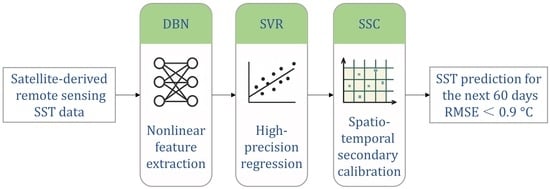
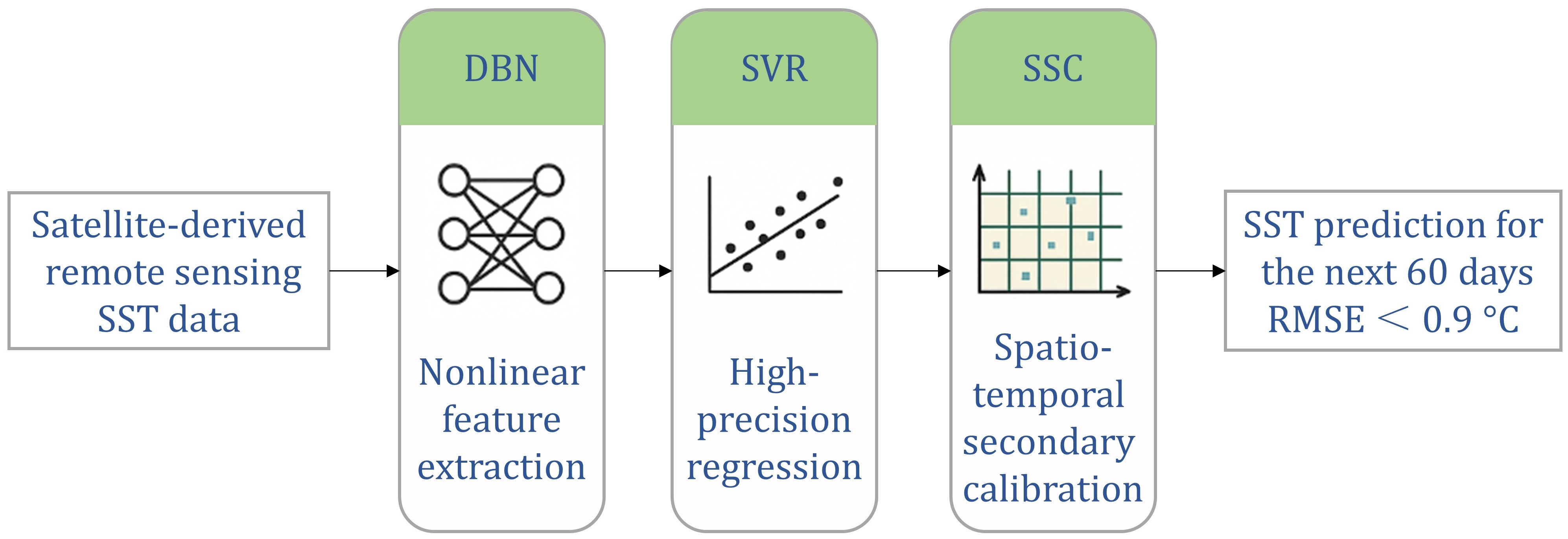
Sea surface temperature (SST) is crucial for weather forecasting, climate modeling, and environmental monitoring. This study proposes a novel prediction model that achieves a 60-day forecast with a root mean square error (RMSE) consistently below 0.9 °C. The model combines the nonlinear feature extraction of a deep belief network (DBN) with the high-precision regression of support vector regression (SVR), enhanced by spatiotemporal secondary calibration (SSC) to better capture SST variation patterns. Using satellite-derived remote sensing data, the DBN-SVR model outperforms baseline methods in both the Indian Ocean and North Pacific regions, demonstrating strong applicability across diverse marine environments. This work advances long-term SST prediction capabilities, providing a reliable foundation for extended-range marine forecasts.
1. Introduction
Sea surface temperature (SST) is a crucial indicator of ocean conditions, significantly impacting weather forecasting, climate modeling, and marine ecosystem stability [1,2]. SST influences atmospheric processes, including wind and precipitation patterns, and drives extreme events such as El Niño and La Niña, thereby affecting the global climate system [3,4]. Accurate SST predictions are essential for disaster warnings, resource management, and climate research [5,6]. However, predicting SST is challenging because its complex spatiotemporal variations are influenced by seasonal changes, ocean currents, and atmospheric circulation, which introduce significant uncertainties [7,8].
To address these challenges, various SST forecasting methods have been developed, including empirical, statistical, dynamic numerical, and machine learning approaches [9]. Empirical methods rely on historical observations and expert knowledge [10]. Statistical methods, such as regression and time series analysis, identify patterns in data but require integration with ocean dynamics for accuracy [11,12,13]. Dynamic numerical methods simulate ocean–atmosphere interactions but are prone to errors due to underlying assumptions and simplifications [14].
As remote sensing technology advances, SST data have become increasingly comprehensive, enabling breakthroughs in machine learning-based SST forecasting [15]. Back-propagation (BP) neural networks have matched manual predictions [16], while long short-term memory (LSTM) models have improved accuracy by capturing temporal dependencies [17]. Convolutional fully connected LSTM networks have reduced the root mean square error (RMSE) by 50% for 7-day and 30-day forecasts [18,19]. Recently, convolutional neural networks outperformed empirical methods [20], and bidirectional LSTM models enhanced prediction accuracy [21]. Transformer-based models have further advanced SST prediction, with Dai et al.’s TransDtSt-Part model achieving an RMSE and MAE of 0.805–1.109 °C and 0.647–0.864 °C, respectively, over 1–60 day forecasts in 5×5 grid subregions near China [22]. Similarly, a hybrid LSTM–Transformer model improved regional SST predictions near China [23], and a Transformer-based approach corrected daily SST forecast errors [24]. However, these studies focus on regional or short-term scales, limiting their applicability to broader marine environments.
Despite these advancements, few studies have focused on SST predictions extending beyond 30 days using daily data [25,26]. To address this gap and extend the prediction horizon, this study introduces an integrated model combining a deep belief network (DBN) with support vector regression (SVR). DBN effectively reduces data dimensionality while preserving essential features through layer-wise pretraining and fine-tuning [27]. Moreover, SVR excels with small datasets, providing robust nonlinear processing [28]. The integration of DBN and SVR leverages DBN’s feature extraction capabilities, whereas SVR enhances prediction accuracy by learning complex nonlinear relationships. The DBN-SVR model has demonstrated excellent performance in areas such as traffic flow forecasting and image analysis [29,30], and this study is the first to apply it to SST prediction.
Machine learning prediction results can exhibit errors that require calibration. Traditional interpolation calibration methods often fail to capture nonlinear spatiotemporal dependencies, resulting in biases under complex climatic conditions [31]. To address these limitations, this study introduces spatiotemporal secondary calibration (SSC). SSC effectively eliminates outliers and refines predictions, significantly enhancing the accuracy and stability of the DBN-SVR model, even in dynamic environments.
This study aims to develop an SST prediction model that integrates DBN and SVR, incorporating SSC to address the limitations of traditional methods in managing complex spatiotemporal dynamics. The model was evaluated in both the Indian Ocean and North Pacific regions. The subsequent sections detail the model’s construction and experimental design, present the results and analyses, and discuss the conclusions and future outlook.
2. Materials and Methods
2.1. DBN
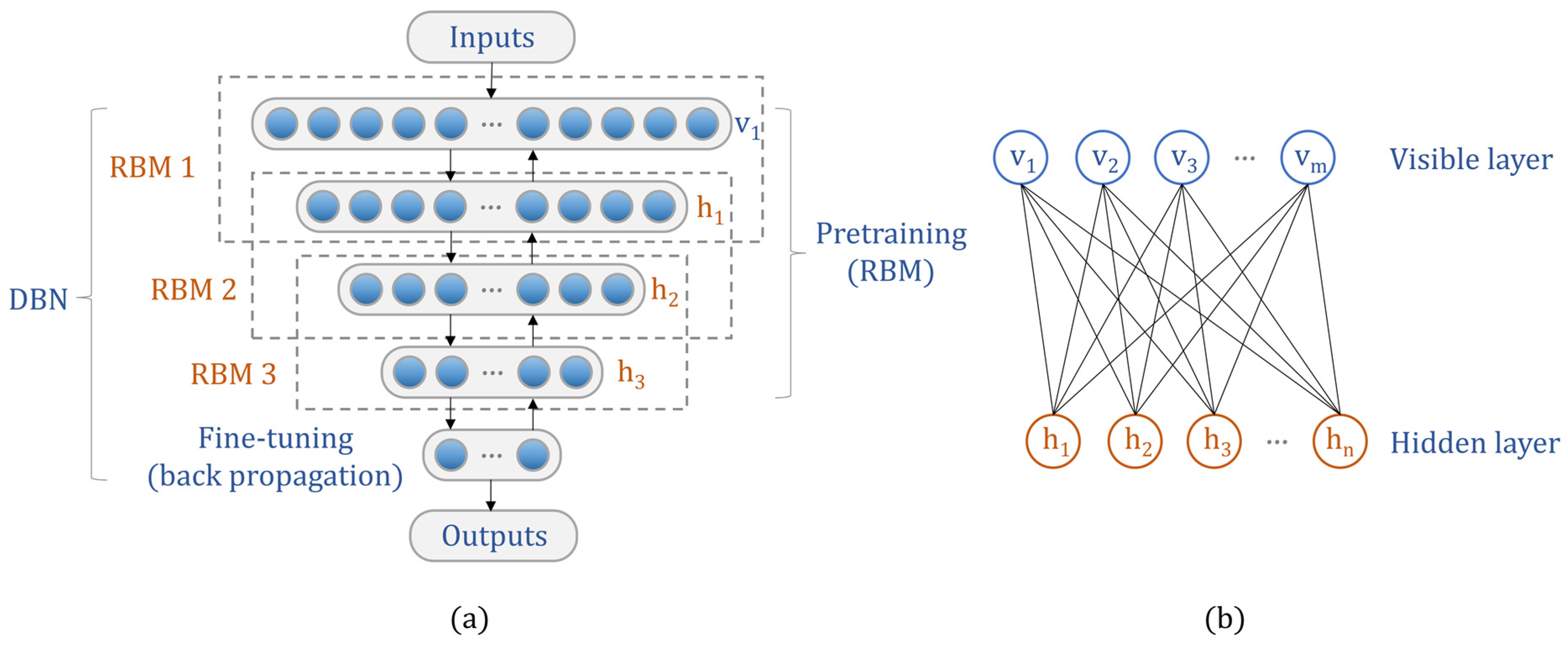
A restricted Boltzmann machine (RBM) is a two-part graphical model comprising visible and hidden layers, featuring full connectivity between layers and no intralayer connectivity. The DBN is a deep learning architecture grounded in probabilistic graphical models, comprising multiple layers of RBMs arranged in a stacked configuration. Its structural representation is illustrated in Figure 1 [32]. The ability of the DBN to automatically learn high-level abstract features from data provides a significant advantage in processing high-dimensional, nonlinear datasets [27].
Figure 1.
Flowchart of the DBN model with stacked RBMs (restricted Boltzmann machines), illustrating the deep belief network’s structure for feature extraction from sea surface temperature data. (a) DBN. (b) RBMs for unsupervised pretraining.
The RBM serves as the fundamental building block of the DBN. The nodes in the visible layer represent the input data, whereas the nodes in the hidden layer are utilized to learn the feature representations of the data. In an RBM, each node is modeled as a binary random variable, with its state dependent on the states and weights of the connected nodes. Through the contrastive divergence (CD) algorithm, the RBM is capable of learning the probability distribution of the data, facilitating both feature learning and data generation [33].
The bottom layer of the DBN model employs a multilayer RBM structure. A greedy algorithm is utilized to train the sample data layer by layer. The parameters obtained from the CD-based training of the first RBM layer serve as the input for the second RBM layer, and this process is repeated for subsequent layers. The training process is characterized as unsupervised learning. This layer-wise pretraining strategy effectively addresses the vanishing gradient issue encountered in deep network training, enhancing both training efficiency and generalizability [32]. Leveraging the feature learning capabilities of DBNs allows for a more precise and comprehensive representation of SSTs, thereby enhancing the performance of the prediction model.
In this study on SST prediction, the approach is not limited to treating it as a sequence prediction problem; rather, the concept of phase space reconstruction from mathematics and physics is employed to analyze and describe the complex behavior of dynamical systems [34]. The fundamental idea of phase space reconstruction is to transform time series data into a set of points in phase space, facilitating a more comprehensive understanding of the system’s evolution and characteristics. This process enables the conversion of the original one-dimensional time series into high-dimensional phase space vectors. These high-dimensional phase space vectors can then serve as inputs to the DBN, allowing it to further process these vectors to extract essential nonlinear features and perform dimensionality reduction.
Specifically, beginning with a univariate time series , where ranges from 1 to (with representing the length of the dataset), the phase space reconstruction transforms into a vector in -dimensional space, as follows:
where is referred to as the embedding dimension, which dictates the complexity of the phase space, and denotes the delay time, which establishes the time interval between data points. By selecting appropriate values for delay times and embedding dimensions, it is possible to capture the intrinsic structure of the time series within the phase space, thus providing a high-dimensional perspective for prediction.
This study conducted phase space reconstruction on the original three-dimensional SST time series data and input it into the DBN model to uncover its underlying dynamic characteristics. This transformation involves mapping the time series data into a high-dimensional phase space, where each data point is expanded into a vector that incorporates historical information. Specifically, the following transformation formulas are employed to construct the reconstructed features and the predicted sequence :
where denotes the -th data point in the time series, represents the delay time, and indicates the embedding dimension. This approach transforms the time series data into matrix form, where each row corresponds to the representation of a point in the phase space. Consequently, the DBN can reveal the hidden complex dynamic patterns within the time series while reducing data dimensionality, thereby enhancing the effectiveness of the prediction model.
2.2. SVR
SVR is a supervised learning model grounded in statistical learning theory that is designed to address regression analysis problems. The primary objective of SVR is to identify a function that maximizes the generalizability of the provided training data, which entails minimizing the error between the actual outputs and the predicted values generated by the model [28]. The SVR model effectively manages outliers and mitigates the risk of overfitting by incorporating a slack variable and a regularization term, all while maintaining a low level of model complexity.
In SVR, the data are mapped into a high-dimensional feature space, allowing linearly inseparable data to become separable [35]. By employing kernel functions, SVR can operate directly within the original input space without the need to explicitly compute the mapping to the high-dimensional space. Commonly used kernel functions include the linear kernel, polynomial kernel, radial basis function (RBF) kernel, and sigmoid kernel. The training process of the SVR model involves solving a convex optimization problem to identify the optimal model parameters, which include the coefficients of the regression function and the parameters of the kernel function. The solution to this optimization problem is obtained through the dual formulation within the support vector machine algorithm.
2.3. DBN-SVR
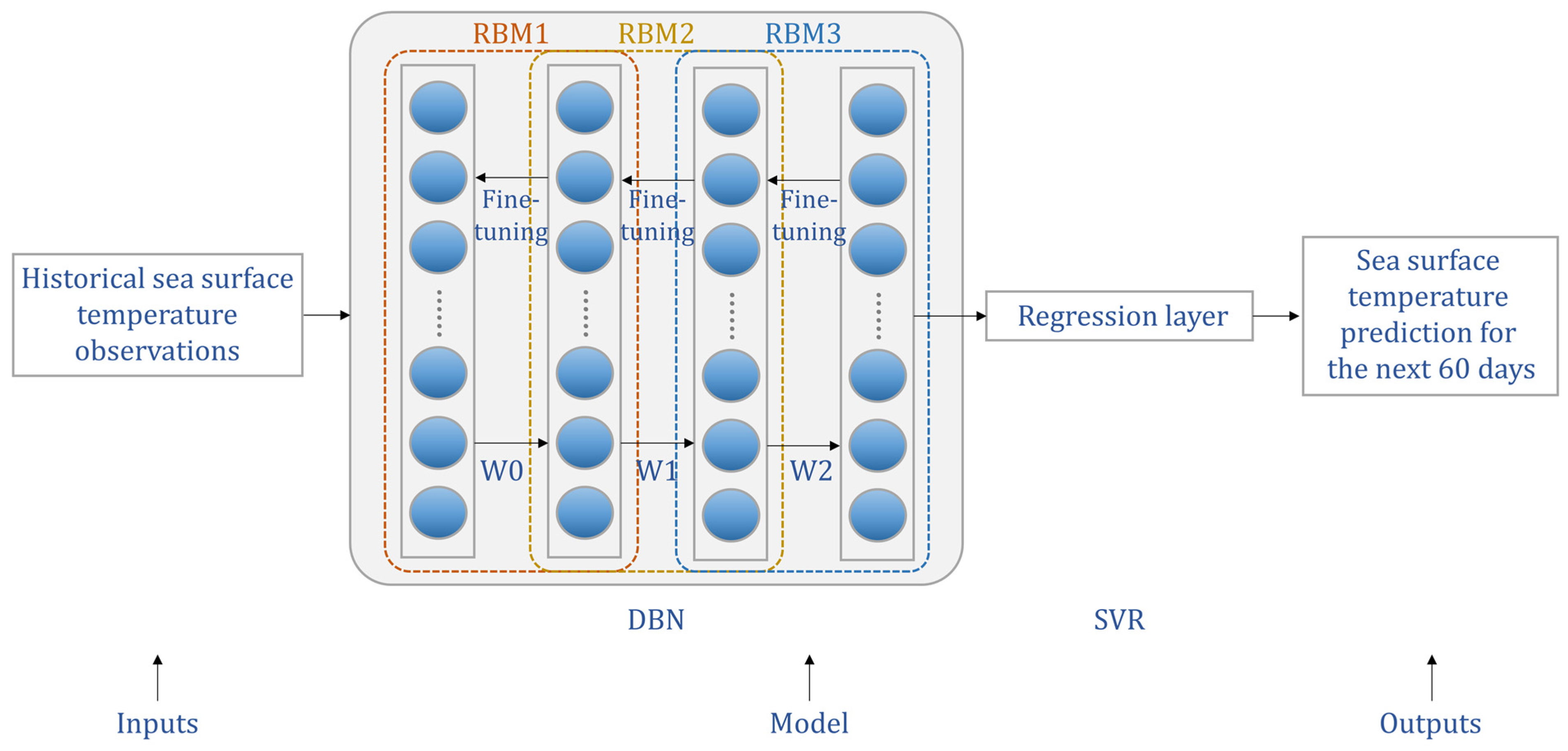
To improve the prediction performance, this study integrates the advantages of the DBN and SVR to create the DBN-SVR model. This combination demonstrates significant effectiveness in addressing complex, high-dimensional spatiotemporal data, as illustrated in Figure 2 [36].
Figure 2.
Flowchart of the DBN-SVR model, combining the DBN’s feature extraction capabilities with SVR for the regression-based prediction of sea surface temperature.
Initially, the model’s input layer feeds the phase space reconstructed data into the DBN. The DBN performs layer-by-layer feature extraction and dimensionality reduction through multiple RBMs. Each RBM comprises a visible layer and a hidden layer, represented as RBM1, RBM2, and RBM3, which are trained sequentially through unsupervised learning, capturing deep features of the data at each level. The initial weights W0 are utilized for training the first RBM (RBM1), and following feature extraction in this layer, new features are generated. The weights W1 are then employed to train the second RBM (RBM2), and this process continues accordingly. Through multiple layers of feature extraction, the model progressively refines the complex multidimensional features within the data. Upon completion of pretraining, the model undergoes supervised fine-tuning, during which the weights across the entire network are adjusted via the back-propagation algorithm to optimize the final feature representation. The low-dimensional features processed by the DBN are subsequently input into the SVR, and following regression prediction by the SVR, the model outputs the final prediction results.
This structure integrates the deep feature extraction capabilities of the DBN with the nonlinear regression capabilities of the SVR, resulting in a significant improvement in the model’s prediction accuracy and applicability [30]. The multilayer feature learning inherent in the DBN supplies abundant feature information for the SVR, thereby increasing the overall performance of the model.
2.4. SSC
This study proposes a nonparametric spatiotemporal secondary calibration method (SSC) to refine the predictions generated by the DBN-SVR model.
In the calibration of the temporal dimension, the periodicity and boundedness of the temperature sequence permit the examination of the bounded nature of the shifted difference data from a probabilistic perspective, thereby mitigating the occurrence of outliers. For the SST sequence at a specific location, the shift difference operator is defined as , where for . Given that is bounded, its differences are also bounded; thus, it can be assumed that follows a normal distribution according to the central limit theorem, facilitating the construction of interval estimates via the 3- rule. The mean can be calculated via the following formula:
The formula for calculating the standard deviation is as follows:
According to the 3-σ rule, the probability that the value falls within k standard deviations is as follows:
According to the DBN-SVR prediction results , if (where is a preset criterion parameter), then the corrected prediction is as follows:
In the calibration of the spatial dimension, convolution smoothing techniques from image processing are employed to correct regions where data mutations typically do not occur multiple times within a local area. The overall process of the SSC is illustrated in Algorithm 1.
| Algorithm 1 Spatiotemporal secondary calibration algorithm |
| Input: |
| Output: |
The combination of SSC with the DBN-SVR model significantly enhances the accuracy of the SST predictions. The DBN is responsible for automatically learning complex feature representations from historical data, whereas SVR conducts high-precision regression predictions on the basis of these features. By incorporating SSC, the model is better equipped to capture the spatiotemporal patterns of SSTs, thereby accounting for more intricate dynamic changes in the predictions.
2.5. Data
The SST data used in this study is derived from the Optimum Interpolation Sea Surface Temperature version 2.1 (OISSTv2.1) dataset, which is based on infrared satellite data from the Advanced Very High-Resolution Radiometer (AVHRR) and provided by the National Oceanic and Atmospheric Administration (NOAA). This dataset is publicly available on their official website (https://psl.noaa.gov/data/gridded/data.noaa.oisst.v2.highres.html, accessed on 7 July 2024). The OISSTv2.1 is an optimally interpolated product that integrates data from satellites, ships, buoys, and Argo floats. Biases between satellite and in situ observations are corrected, and data gaps are filled through interpolation techniques to ensure high accuracy [37]. The dataset has a spatial resolution of 0.25° and a temporal resolution of one day. The OISSTv2.1 product has been extensively used in the analysis and research of SST prediction in various ocean regions, including the Indian Ocean [38], the North Pacific Ocean [39], and the global oceans [40].
It is clear that the OISSTv2.1 dataset offers several advantages that make it well-suited for this study. The NOAA data include validated SST measurements from multiple sources, ensuring high accuracy. Spanning from September 1981 to the present, the dataset provides global coverage, allowing for comprehensive analysis. Its consistent temporal and spatial resolutions further streamline the data analysis process. Additionally, the dataset is freely accessible through NOAA, reducing data-related constraints and promoting the reproducibility of research findings.
This study utilizes a total of 20 years of SST data from 2004 to 2023, following a standard 70:10:20 training–validation–test split. Specifically, the years 2004–2017 are designated as the training dataset, 2018–2019 serve as the validation dataset for hyperparameter tuning, and 2020–2023 are used as the test dataset to evaluate the model’s generalizability to new data. In this study, min–max normalization is employed to preprocess the SST training set, and the same normalization method is applied to the validation and test datasets to ensure consistency across all datasets.
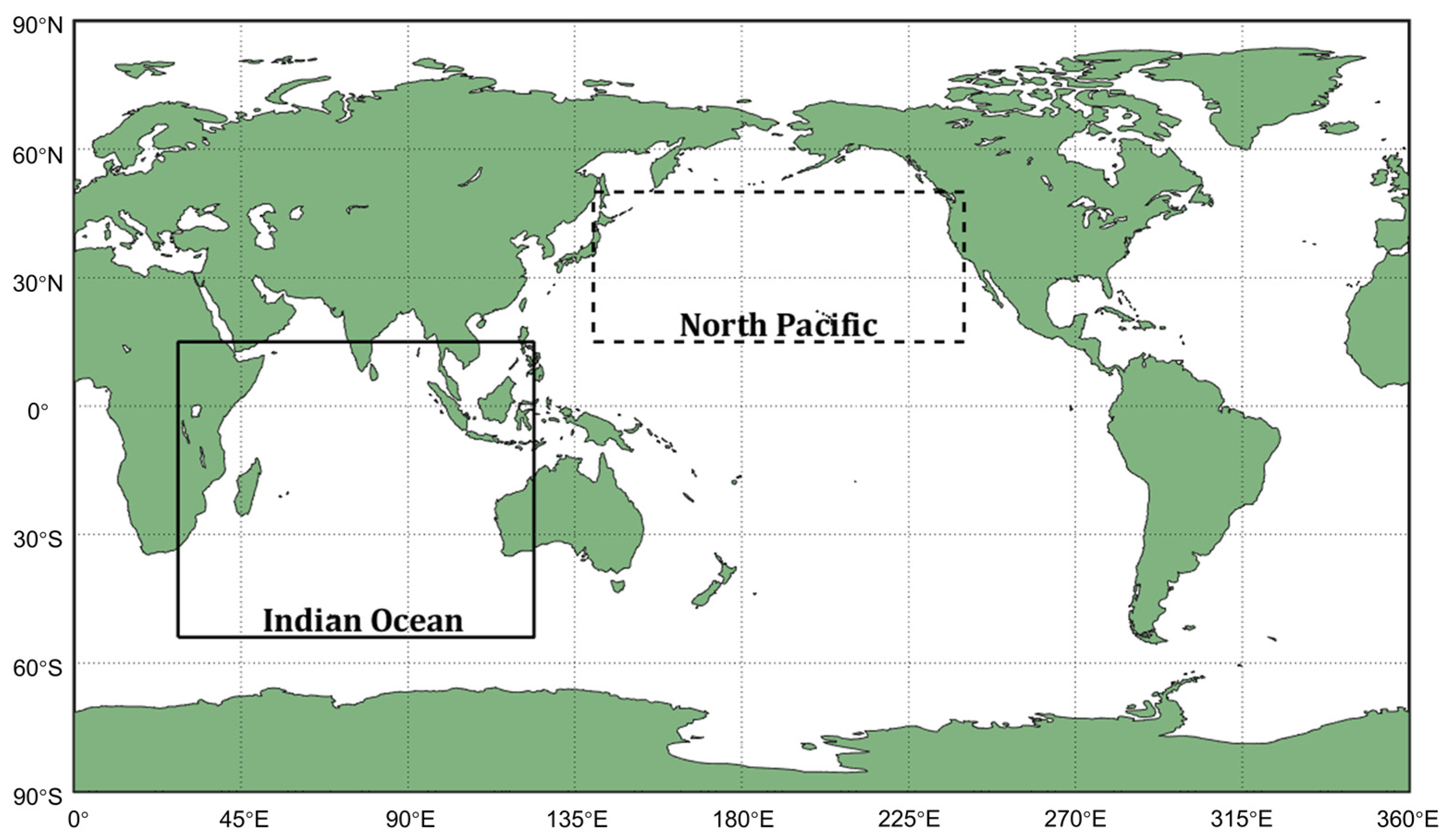
To comprehensively evaluate the applicability and robustness of the proposed DBN-SVR model in varying ocean environments, this study focuses on the Indian Ocean and the North Pacific, two regions of critical importance in the global climate system because of their significant influence on heat distribution, ocean current patterns, and extreme climatic events. The Indian Ocean, with its strategic role in monsoon dynamics and global heat exchange [41], and the North Pacific, which plays a key role in regulating weather patterns and ocean circulation [42], represent two distinct yet equally crucial areas for SST prediction. Specifically, SST prediction experiments were conducted in the Indian Ocean, encompassing 54°S–15°N and 28°E–124°E, and in the North Pacific, covering 15°N–50°N and 140°E–120°W, as illustrated in Figure 3. These regions are not only vital for understanding regional climate behavior but also for enhancing global climate prediction models.
Figure 3.
Geographical locations of the study areas. The solid black box delineates the Indian Ocean region, whereas the dashed black box indicates the North Pacific region. The green areas represent land.
2.6. Experimental Design
To address the practical challenges associated with acquiring comprehensive multifeature data and the limitations of computational resources, this study employs an efficient and innovative data processing strategy. Given that SST trends exhibit similarities within the same region, this study focuses on training the model at a representative point within the selected study area, subsequently extending the results of this refined model to the entire region for comprehensive forecasting [43]. This strategy not only mitigates the need for extensive climate data but also ensures regional consistency and high accuracy in the prediction results.
We selected four baseline models for performance comparison in prediction: LSTM, CNN, BiLSTM, and a CNN-gated recurrent unit (CNN-GRU), which were noted in the introduction for their strong performance in SST prediction, as controls. All four models utilize SSC to ensure the consistency and comparability of the experimental conditions.
In our experimental setup, we carefully designed the LSTM, CNN, CNN-GRU, and BiLSTM models to serve as baselines against our proposed DBN-SVR model. The LSTM model consists of two LSTM layers with 128 units, followed by a fully connected output layer, totaling approximately 180,000 trainable parameters. The CNN model consists of a 1D convolutional layer with 32 filters, batch normalization, ReLU activation, a flatten layer, a fully connected layer, and a regression output layer, totaling approximately 100,000 trainable parameters. The CNN-GRU model consists of an initial CNN layer with 32 filters of size 3 × 3, followed by a max-pooling layer. This is followed by a GRU layer with 64 units and a fully connected output layer, with a total of approximately 150,000 trainable parameters. The BiLSTM model comprises two BiLSTM layers, each with 128 units, followed by a fully connected output layer, resulting in approximately 200,000 trainable parameters.
The DBN-SVR model was optimized via the sparrow search algorithm (SSA). The architecture of the DBN is determined by the SSA, which optimizes hyperparameters such as the number of hidden layers, the number of neurons per layer, the learning rate, and the number of training epochs. This process resulted in a DBN with three hidden layers containing 256, 128, and 64 neurons, leading to a total of approximately 250,000 trainable parameters.
To prevent overfitting from affecting the comparative results, all the models were trained via early stopping based on validation loss, with dropout regularization applied at a rate of 0.5 where applicable. Furthermore, the same training and testing datasets were used across all the models to ensure consistency.
To evaluate model performance, this study uses the MAE and RMSE as key metrics. These indicators provide a comprehensive assessment of the discrepancies between the predicted values and the actual observed values. The specific calculation formulas are as follows:
where represents the predicted values from the model, denotes the actual observed values, and indicates the length of the predicted sequence.
All experiments were conducted in a computing environment equipped with a 12th Gen Intel® Core™ i5-12400 processor, 16 GB of RAM, and running the Windows 22H2 64-bit operating system. Model construction, training, and testing were performed via the MATLAB (R2024a) software platform.
2.7. Parameter Determination
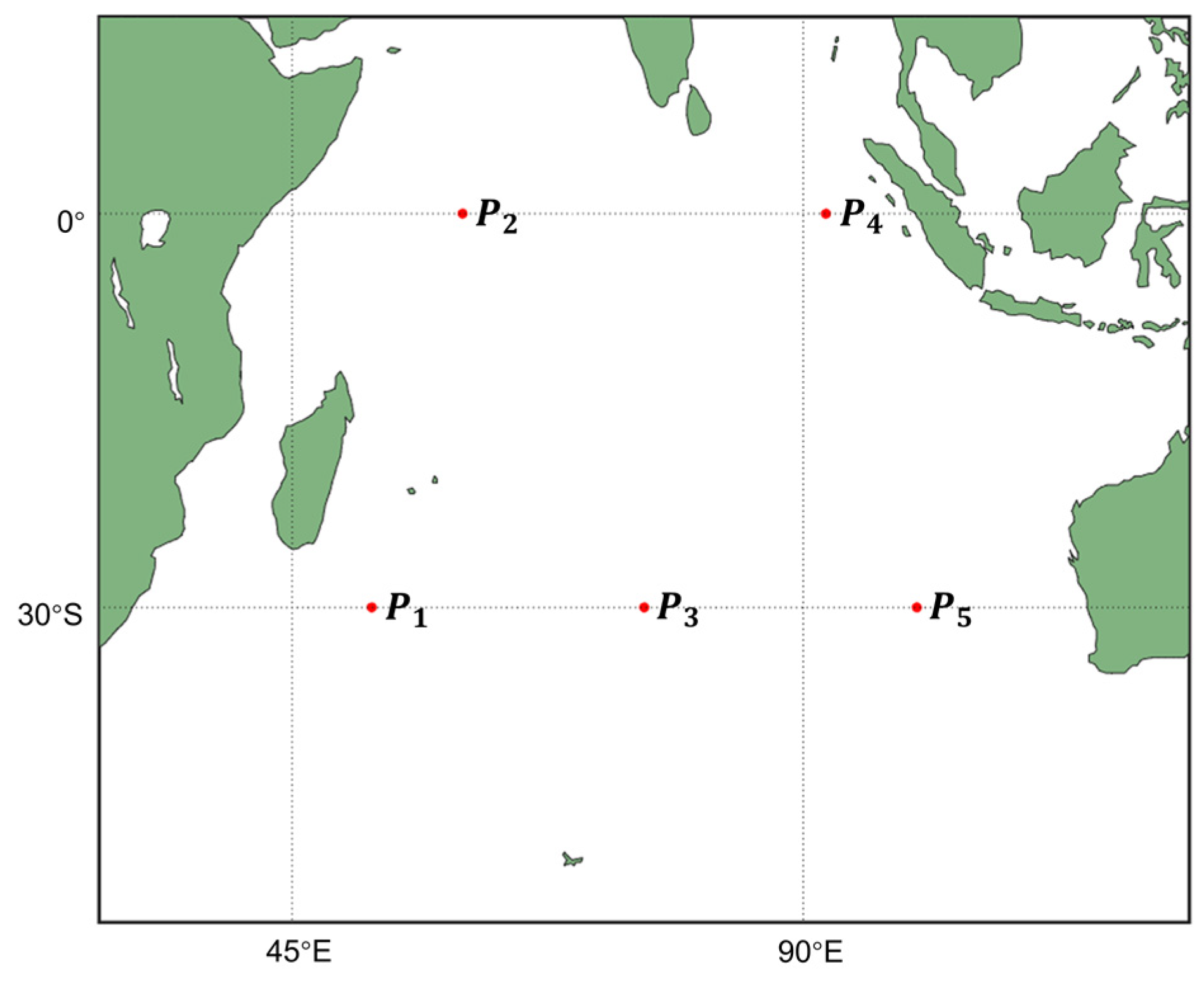
Given that different embedding dimensions and delay times in phase space reconstruction can significantly impact the performance of the SST prediction model, this section conducts parameter determination experiments to identify suitable values for and . Five locations were uniformly selected for the experiment in the Indian Ocean region, specifically at the equator and at 30°S, labeled , , , , and , as illustrated in Figure 4, to ensure the representativeness of the hyperparameter determination results.
Figure 4.
Schematic representation of the five test locations in the Indian Ocean region. and are located at the equator, whereas and and are situated at 30°S.
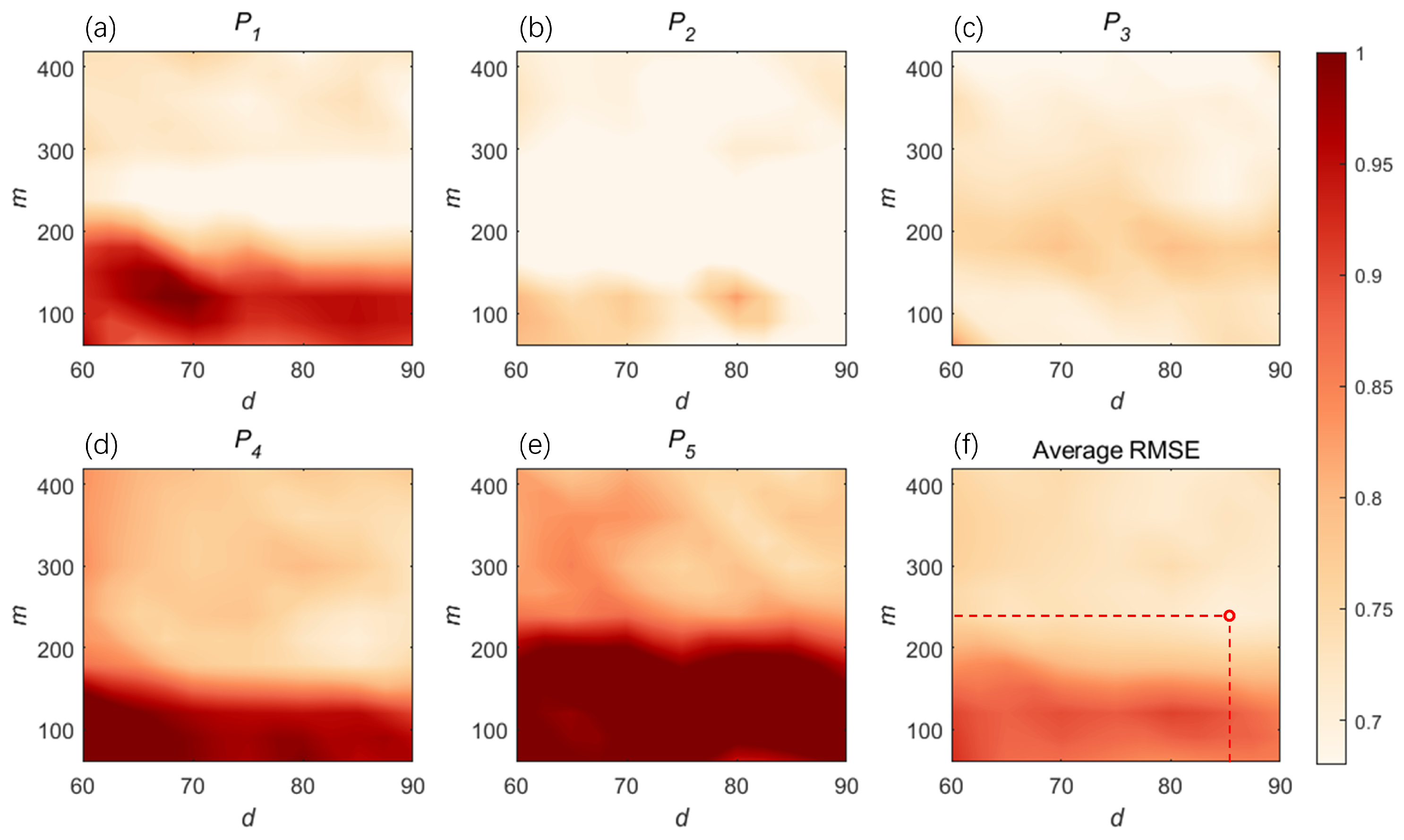
The phase space reconstruction Formula (2) requires that both and exceed the prediction duration. Therefore, for the 60-day prediction task, the values of and are set to {60, 65, 70, 75, 80, 85, 90} and {60, 120, 180, 240, 300, 360, 420}, respectively. By exploring all possible combinations of and at the five selected locations and training the model for each location, the experiment predicts the SST for the entire Indian Ocean region and calculates the corresponding RMSE, with the results presented in Figure 5.
Figure 5.
RMSE distribution map (°C) for 60-day predictions across different hyperparameters in the Indian Ocean region. Panels (a–e) illustrate the RMSE distributions for positions to under various hyperparameters, with the x-axis representing the embedding dimension and the y-axis representing the delay time . The white areas indicate lower RMSE values. Panel (f) presents the average RMSE distribution for the five positions, with the red circles highlighting the locations corresponding to the optimal hyperparameter combinations.
To comprehensively evaluate the model’s prediction performance across different locations, the experiment averages the RMSE values for various hyperparameter combinations at the five selected locations, as depicted in Figure 5f. The white areas in the RMSE distribution map represent lower RMSE values, with the positions marked by the red circles corresponding to the optimal prediction performance of the model. Specifically, when the embedding dimension is = 85 days and the delay time is = 240 days, the model achieves its best performance in the 60-day prediction task, with RMSE values of 0.64 °C, 0.61 °C, 0.68 °C, 0.72 °C, and 0.74 °C for locations to , respectively.
The overall distribution shown in Figure 5b performs well across a wide range of hyperparameters, with achieving the lowest average RMSE of 0.68 °C (compared to 0.79 °C for P1, 0.72 °C for P3, 0.84 °C for P4, and 0.90 °C for P5) and the lowest RMSE of 0.61 °C at the optimal parameters. This indicates that location effectively captures the SST variation characteristics of the Indian Ocean region, demonstrating high representativeness and applicability. Therefore, location was selected for model training. This approach not only facilitates the identification of the optimal model hyperparameter configuration but also establishes a solid experimental foundation for subsequent prediction tasks.
3. Results
3.1. Results of SSC
A comparative trial was first conducted in the Indian Ocean region to assess the performance of the DBN-SVR model with and without SSC.
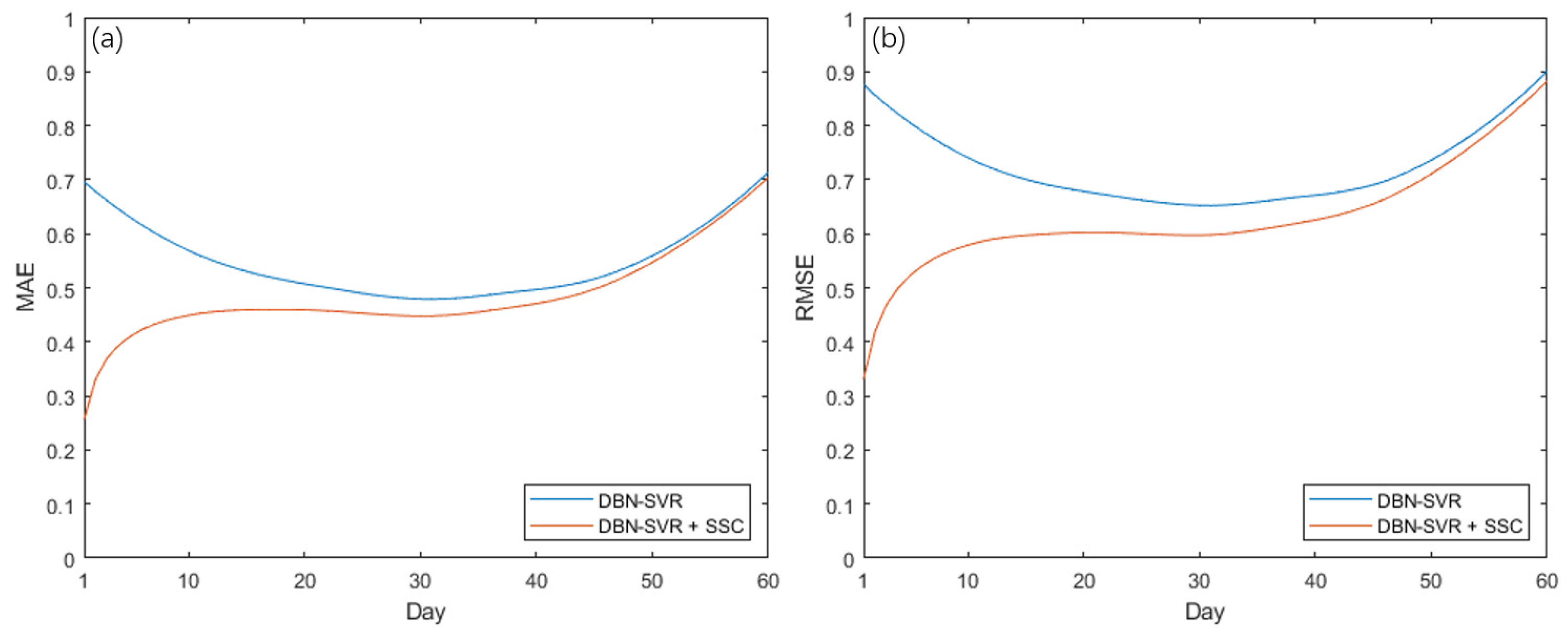
Combining the results presented in Figure 6 and Table 1, it is clear that SSC significantly enhances the prediction accuracy of the DBN-SVR model. Specifically, the calibrated model achieves MAE and RMSE values of 0.704 °C and 0.883 °C, respectively, on the 60th day. These values are lower than those of the uncalibrated model, which records MAE and RMSE values of 0.714 °C and 0.902 °C, respectively. Over the entire 60-day prediction period, the calibrated model attains average MAE and RMSE values of 0.483 °C and 0.629 °C, markedly outperforming the uncalibrated model’s averages of 0.549 °C and 0.724 °C. Notably, during the first 30 days of prediction, the calibrated model demonstrates a substantial reduction in prediction error, achieving an MAE of 0.435 °C, which represents a 20.7% decrease. The RMSE also significantly decreases to 0.567 °C, reflecting a 21.4% reduction. Overall, the calibrated DBN-SVR model exhibits higher prediction accuracy and stability, with significant improvements observed in early to medium-term forecasts.
Figure 6.
Sixty-day prediction results of the DBN-SVR model with and without spatiotemporal secondary calibration (SSC) in the Indian Ocean region. The blue line represents the DBN-SVR model without SSC, whereas the red line represents the DBN-SVR model with SSC. (a) Mean absolute error (MAE) results (°C). (b) Root mean square error (RMSE) results (°C).
Table 1.
Sixty-day prediction results of the DBN-SVR model with and without spatiotemporal secondary calibration (SSC) in the Indian Ocean region.
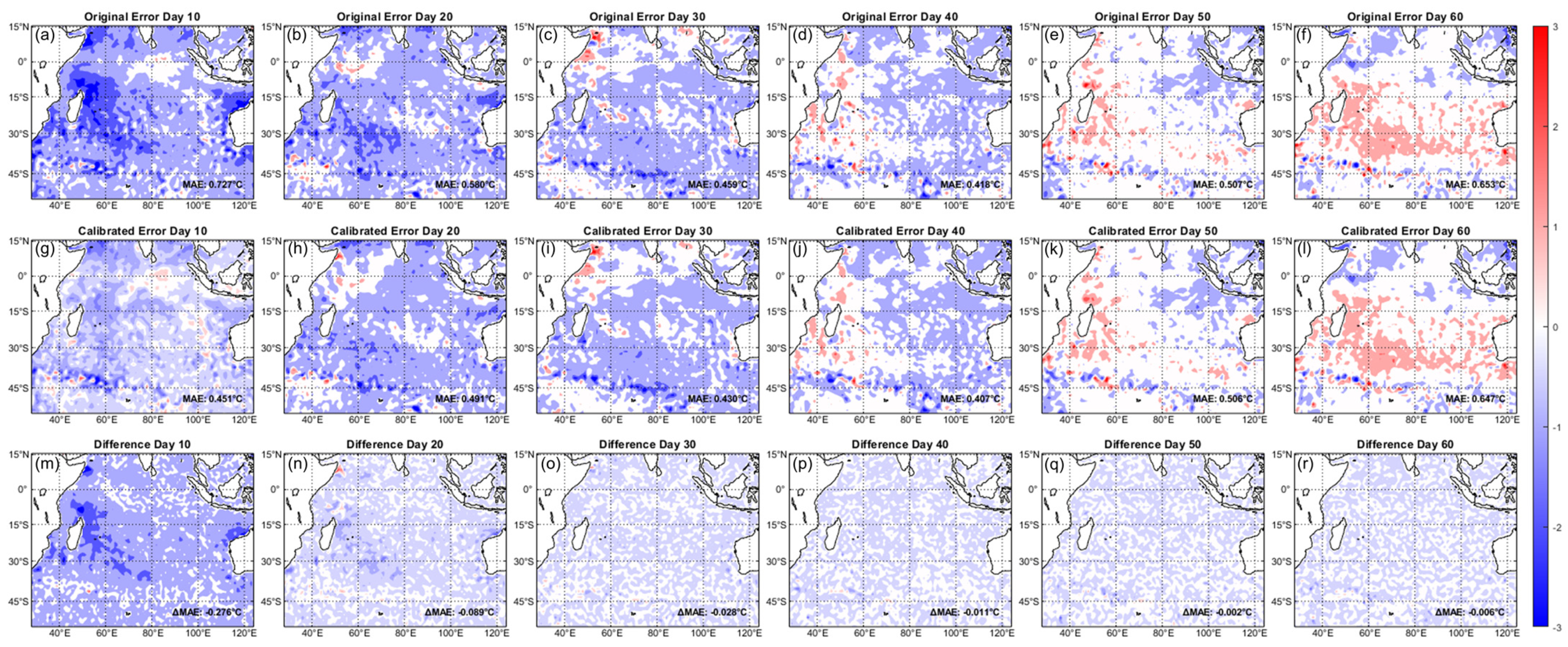
Figure 7 compares the errors of DBN-SVR predictions with and without SSC across six time points (Days 10, 20, 30, 40, 50, and 60) in the Indian Ocean region, with the first row (a–f) showing original errors, the second row (g–l) showing calibrated errors, and the third row (m–r) showing the difference (calibrated minus original). The MAE values for the original and calibrated errors and the ΔMAE for differences are displayed in the lower right corner of each subplot. The application of SSC reduces prediction errors, particularly during the first 30 days. For example, on Day 10, the difference map (Figure 7m) shows a ΔMAE of −0.276 °C, with significant error reductions (blue regions) in the western Indian Ocean. On Day 20, the ΔMAE is −0.089 °C, indicating a smaller but still notable reduction. By Day 30, the ΔMAE decreases to −0.028 °C, and beyond 30 days, the improvements become minimal, with ΔMAE values of −0.011 °C on Day 40, −0.002 °C on Day 50, and −0.006 °C on Day 60.
Figure 7.
Comparison of DBN-SVR errors with and without spatiotemporal secondary calibration (SSC) in the Indian Ocean region. The first row (a–f) shows the original errors on days 10, 20, 30, 40, 50, and 60, respectively. The second row (g–l) shows the calibrated errors for the same days. The third row (m–r) shows the error difference (calibrated error minus original error), where blue indicates an error reduction, white indicates no change, and red indicates an error increase. The MAE for each original and calibrated error plot and the ΔMAE for each difference plot are displayed in the lower right corner.
The model’s performance enhancement with SSC is most apparent during the early prediction period, but the improvements tend to stabilize as the lead time increases, likely due to the increasing uncertainty in long-term SST forecasting. Nonetheless, the application of SSC enhances DBN-SVR’s overall predictive accuracy, making it a valuable technique for improving forecasts in dynamic oceanic environments.
In summary, SSC significantly improves the prediction accuracy of the DBN-SVR model, particularly in minimizing errors during the initial prediction phase. This finding underscores the critical role of the spatiotemporal calibration mechanism in addressing the nonlinear spatiotemporal dynamics of SSTs. All subsequent experiments in this paper utilize SSC by default.
3.2. Results in the Indian Ocean Region
Building on the confirmed improvements in prediction performance attributed to SSC in the previous section, this study conducted comparative experiments to evaluate the DBN-SVR model against the LSTM, CNN, BiLSTM, and CNN-GRU models. These experiments aim to comprehensively assess the performance advantages of the DBN-SVR model in SST prediction tasks.
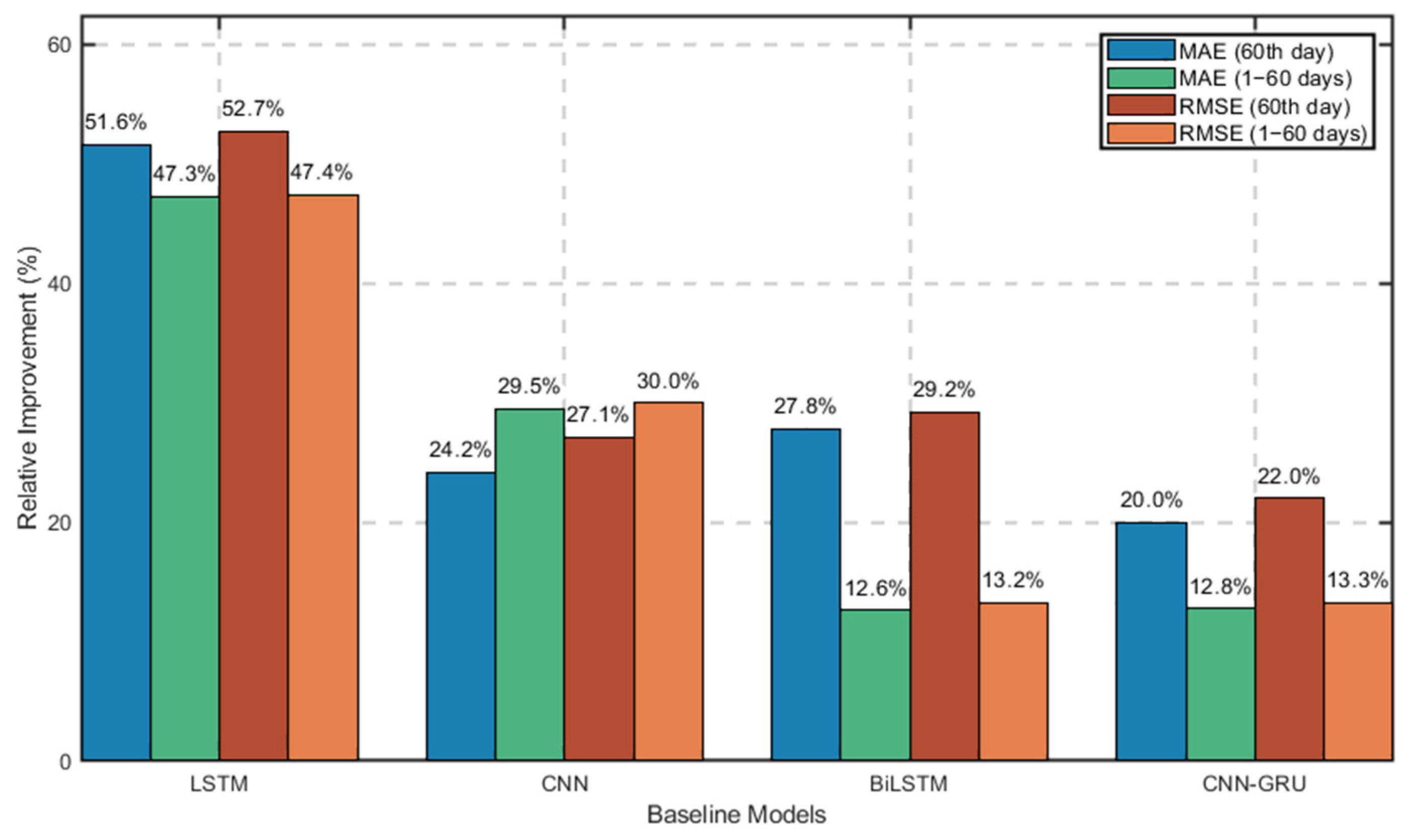
Table 2 and Figure 8 collectively present a comparative analysis of the predictive performance of DBN-SVR, LSTM, CNN, BiLSTM, and CNN-GRU in the Indian Ocean region. Table 2 clearly shows that DBN-SVR achieves markedly lower MAE and RMSE values on both the 60th day and the 1–60 days average, underscoring its superior predictive accuracy. For example, the MAE at the 60th day is 0.704 °C, which is notably lower than the 1.456 °C of LSTM and the 0.929 °C of CNN, reflecting DBN-SVR’s ability to mitigate error accumulation. This result may stem from the reliance of LSTM on autoregressive decoding, which leads to compounded errors over increasing lead times. Figure 8 further quantifies the DBN-SVR model’s relative improvement over the other models. For example, on the 60th day, DBN-SVR achieves reductions in the MAE and RMSE of 51.6% and 52.7%, respectively, compared to LSTM, and 24.2% and 27.1%, respectively, compared to CNN, highlighting its capacity to address the complexities of extended prediction horizons.
Table 2.
SST prediction results over a 60-day period in the Indian Ocean region.
Figure 8.
Relative improvement of DBN-SVR over baseline models in the Indian Ocean region.
Moreover, CNN, BiLSTM, and CNN-GRU exhibit performance levels intermediate between those of DBN-SVR and LSTM, indicating their constraints in capturing local features or extended temporal dependencies. For example, CNN’s 60th-day MAE of 0.929 °C exceeds DBN-SVR’s 0.704 °C, suggesting that CNN may be susceptible to local feature biases during longer forecasting windows. By contrast, DBN-SVR integrates DBN layers for deeper feature abstraction and employs SVR for smoother predictions, effectively reducing errors. Over the 1–60 days average, DBN-SVR strengthens its lead with an MAE of 0.483 °C, significantly below the 0.552 °C of BiLSTM and the 0.553 °C of CNN-GRU. Figure 8 likewise demonstrates that DBN-SVR outperforms BiLSTM and CNN-GRU by 29.2% and 12.8%, respectively, in terms of the average MAE and RMSE, reinforcing its enhanced ability to suppress error propagation and maintain stability over extended prediction periods.
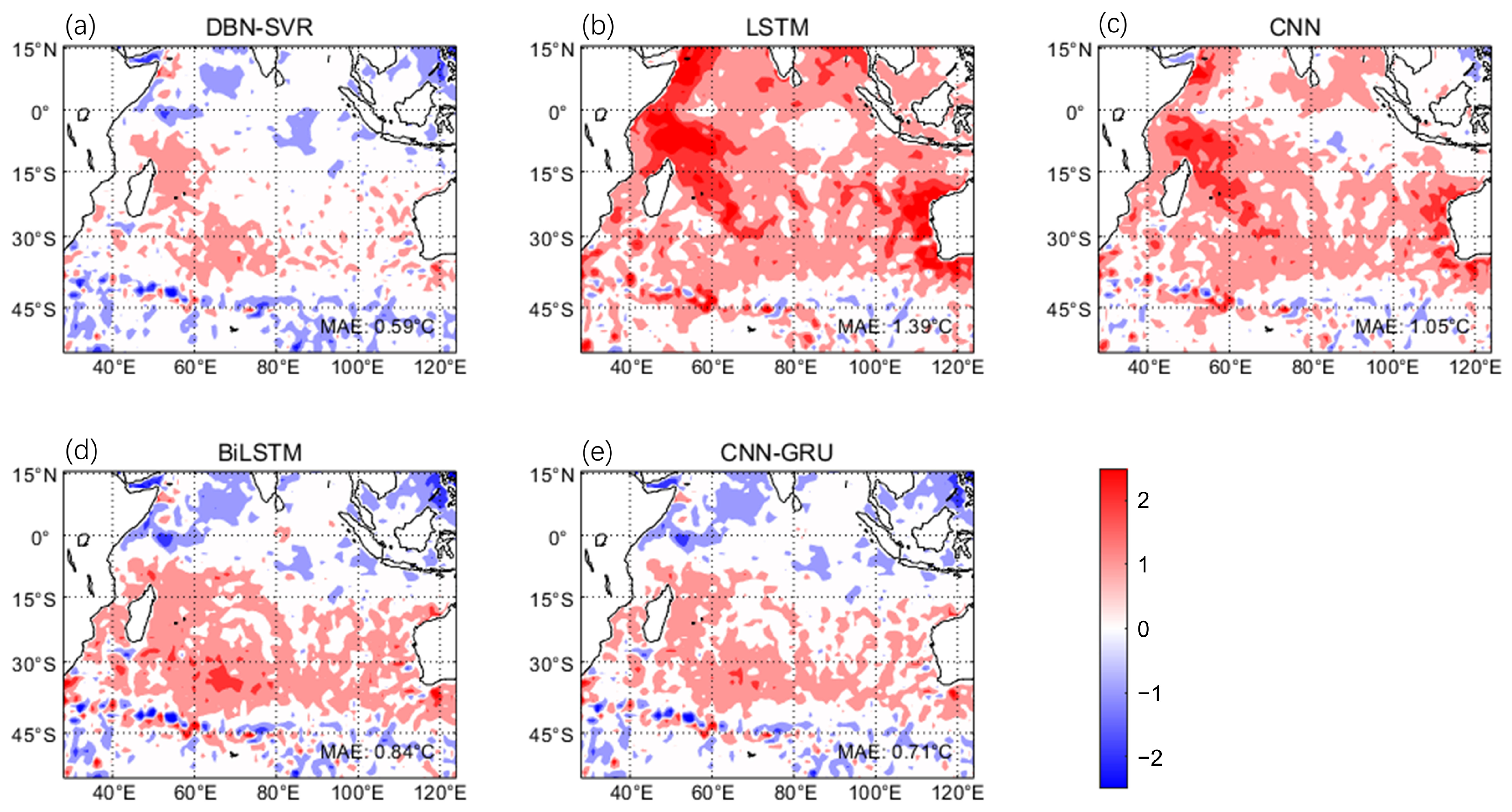
Figure 9 presents the prediction errors on Day 60 of the five models in the Indian Ocean region. Positive errors are shown in red, while negative errors are depicted in blue, with deeper shades indicating larger deviations. The results indicate that the DBN-SVR model significantly outperforms the others, achieving an MAE of just 0.59 °C and exhibiting a notably smaller error distribution range. In terms of spatial distribution, the red regions are primarily concentrated in the mid-to-low latitude waters (15°S to 45°S), suggesting that these areas experience greater prediction errors, potentially due to complex oceanic dynamic processes. Overall, the DBN-SVR model demonstrates superior performance in both error magnitude and spatial consistency.
Figure 9.
Distribution of prediction errors on Day 60 for the five models in the Indian Ocean region (°C). (a) DBN-SVR; (b) LSTM; (c) CNN; (d) BiLSTM; (e) CNN-GRU. The MAE for each error plot is shown in the lower right corner.
The observed performance disparity among the models can be attributed to their inherent characteristics. LSTM adopts autoregressive decoding, so the model prediction error accumulates as the lead time increases [22]. Although CNN effectively captures local features through convolutional operations, it struggles to account for long-range temporal dependencies, potentially hampering its performance in more complex spatiotemporal prediction tasks. While BiLSTM effectively captures temporal features, its complex structure results in higher computational costs and a tendency to overfit when dealing with small sample sizes, as highlighted by Cheng et al. [44]. Additionally, BiLSTM can exhibit limitations in flexibility when addressing nonlinear features, which can hinder its ability to model complex dynamics [45]. Conversely, although the CNN-GRU model integrates the advantages of convolutional and recurrent neural networks, its reliance on local features may lead to the loss of global information, limiting its effectiveness in handling intricate temporal data [46]. Furthermore, CNN-GRU may lack adaptability during the feature extraction process, adversely impacting its generalizability.
In contrast, the DBN-SVR model leverages the capabilities of the DBN to extract multilayered and abstract feature representations, allowing it to effectively capture the complex nonlinear relationships within the data [27]. Additionally, SVR contributes to the model by providing robust nonlinear processing capabilities, enabling it to perform well even with small datasets while mitigating issues of overfitting [47]. The efficient dimensionality reduction facilitated by the DBN significantly alleviates the computational burden, enabling DBN-SVR to achieve higher prediction accuracy and stability when dealing with complex spatiotemporal data. These advantages position DBN-SVR as a powerful tool for effective predictions in challenging environments.
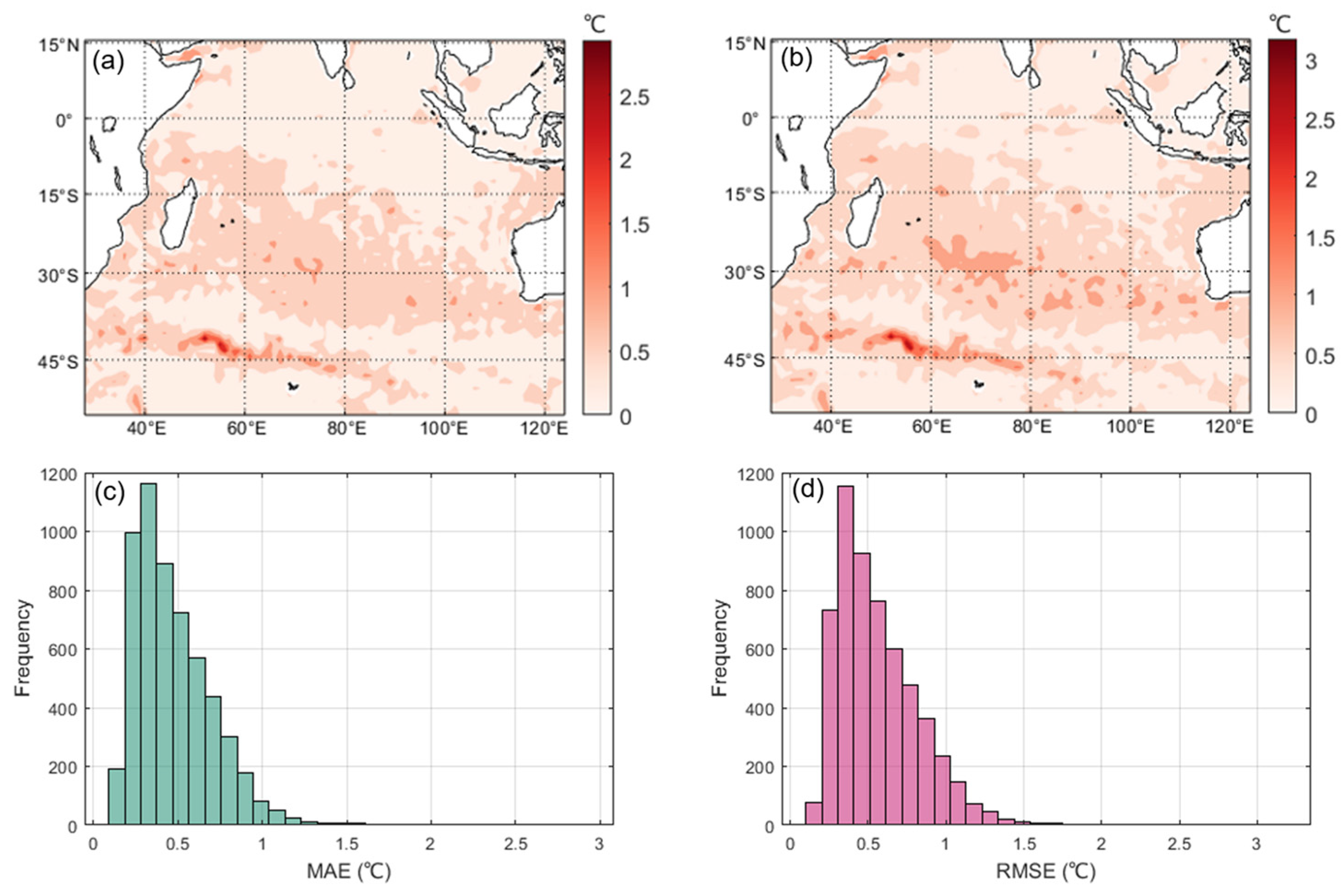
Both spatial and statistical perspectives on the 1–60 days average MAE and RMSE for the DBN-SVR model in the Indian Ocean region are provided in Figure 10. Figure 10a,b shows that the DBN-SVR model achieves a relatively low MAE and RMSE across much of the Indian Ocean, as indicated by the predominantly light-colored areas. The higher-error zones, shown in darker shades of red, are primarily concentrated at higher latitudes near 45°S, suggesting that oceanographic or atmospheric processes in these regions may introduce additional complexity to the prediction task. Nonetheless, the majority of the study domain exhibits errors below 1.0 °C, highlighting the model’s strong predictive performance over extended forecasting horizons compared to previous studies [25].
Figure 10.
Distributions and histograms of the 1–60 days average MAE and RMSE for DBN-SVR in the Indian Ocean region. (a) MAE distribution; (b) RMSE distribution; (c) MAE histogram; (d) RMSE histogram.
The histograms in Figure 10c,d further confirm this assessment by illustrating that the distributions of MAE and RMSE values skew heavily toward smaller errors. Most predictions fall below 0.5 °C, whereas only a small fraction exceeds 1.0 °C. This pattern demonstrates the DBN-SVR model’s ability to robustly capture the underlying spatiotemporal variations in SST in the Indian Ocean, thereby minimizing both mean and extreme error occurrences.
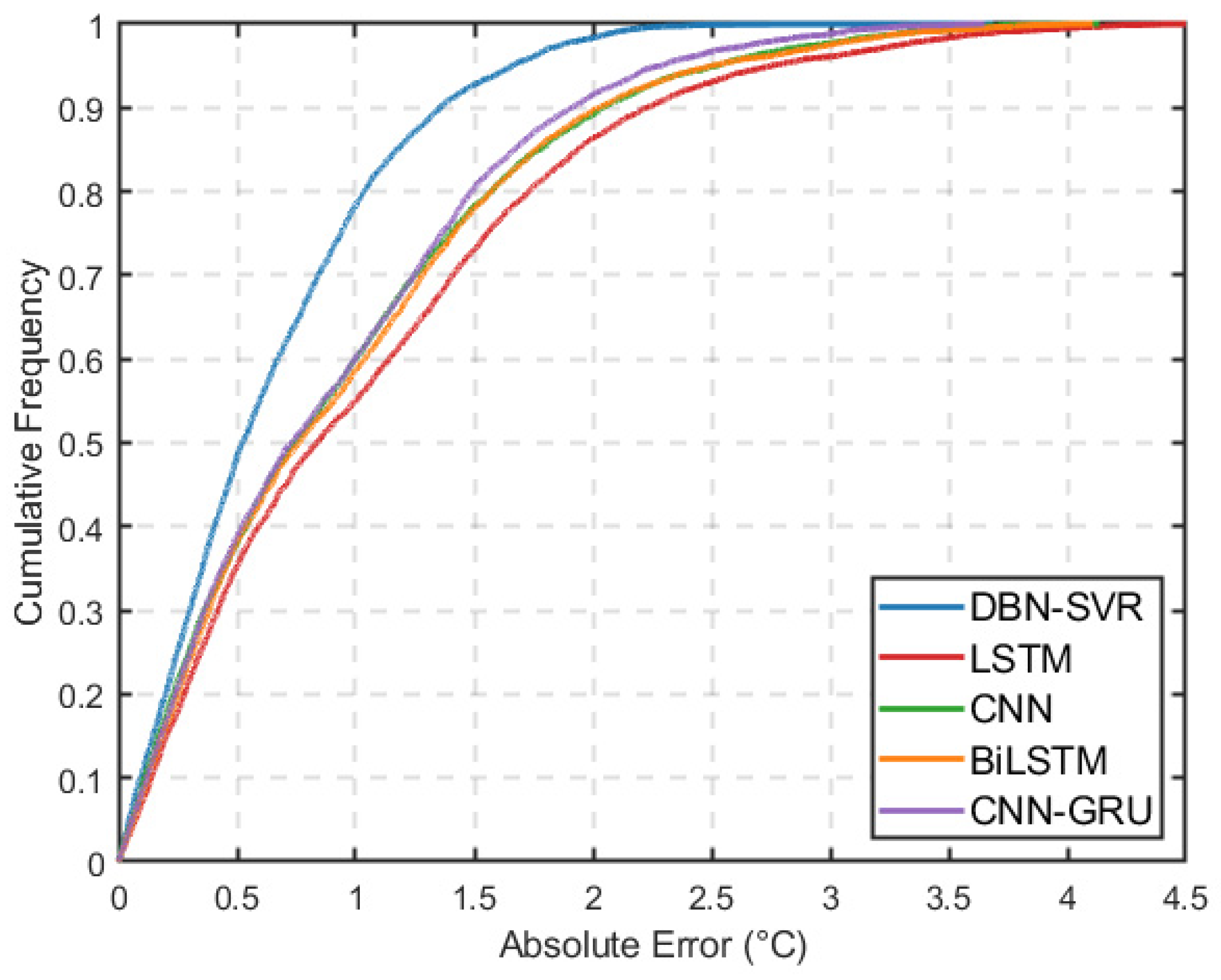
The cumulative distribution function (CDF) of the absolute errors for various models at the 60th day in the Indian Ocean region is presented in Figure 11. The figure shows that the DBN-SVR model maintains higher cumulative frequencies at lower absolute errors than the other models, indicating that a larger share of its predictions fall within smaller error ranges. At approximately 0.5 °C, the CDF of DBN-SVR clearly surpasses those of LSTM, CNN, BiLSTM, and CNN-GRU, suggesting a distinctly higher proportion of accurate predictions. In contrast, the curve for LSTM remains below that of DBN-SVR and the other models for most of the error spectrum, reflecting a tendency toward larger prediction deviations by the 60th day. Moreover, CNN, BiLSTM, and CNN-GRU occupy intermediate positions, with error distributions more closely aligned to DBN-SVR than to LSTM. Overall, this cumulative distribution function underlines DBN-SVR’s superior performance in controlling error growth over a 60-day forecasting horizon in the Indian Ocean region.
Figure 11.
Cumulative distribution function (CDF) of absolute errors for different models on the 60th day in the Indian Ocean region. The CDF curves represent the cumulative frequency of absolute errors for the following models: DBN-SVR (blue), LSTM (red), CNN (green), BiLSTM (yellow), and CNN-GRU (purple).
The superior performance of the DBN-SVR model over the LSTM, CNN, CNN-GRU, and BiLSTM models can be attributed to its ability to capture complex hierarchical representations inherent in the SST data through deep belief networks. The integration of SVR further enhanced its ability to model nonlinear relationships. Additionally, the hyperparameter optimization via the SSA resulted in a more tailored model architecture, better suited to the specific characteristics of the dataset. While CNN, LSTM, and their combined architectures like CNN-GRU and BiLSTM are powerful, in our specific application, the DBN-SVR model demonstrated enhanced predictive accuracy, likely due to its optimized structure and learning mechanisms.
In summary, the analyses of Table 2 and Figure 8, Figure 9, Figure 10 and Figure 11 collectively underscore the superior performance of DBN-SVR in 60-day SST predictions within the Indian Ocean region. By effectively capturing multiscale features and mitigating error accumulation, DBN-SVR consistently outperforms LSTM, CNN, BiLSTM, and CNN-GRU, demonstrating robust error control and enhanced generalization capabilities.
3.3. Results in the North Pacific Region
To evaluate the applicability of the DBN-SVR model, the LSTM, CNN, BiLSTM, and CNN-GRU models were used for comparison once again in the North Pacific region. The models utilized the same input data and time step settings to ensure fairness in the results. The specific outcomes are presented in Table 3.
Table 3.
SST prediction results over a 60-day period in the North Pacific region.
The experimental results demonstrate that the DBN-SVR model exhibits similar 60-day prediction performance in the North Pacific region to that observed in the Indian Ocean region, confirming its strong applicability and prediction accuracy across different oceanic environments. Specifically, the model maintains an RMSE of approximately 0.85 °C at the 60-day mark, outperforming the baseline models. Additionally, the MAE remains relatively low, staying below 0.65 °C, further highlighting the model’s ability to effectively capture the complex spatiotemporal dynamics inherent in various ocean regions.
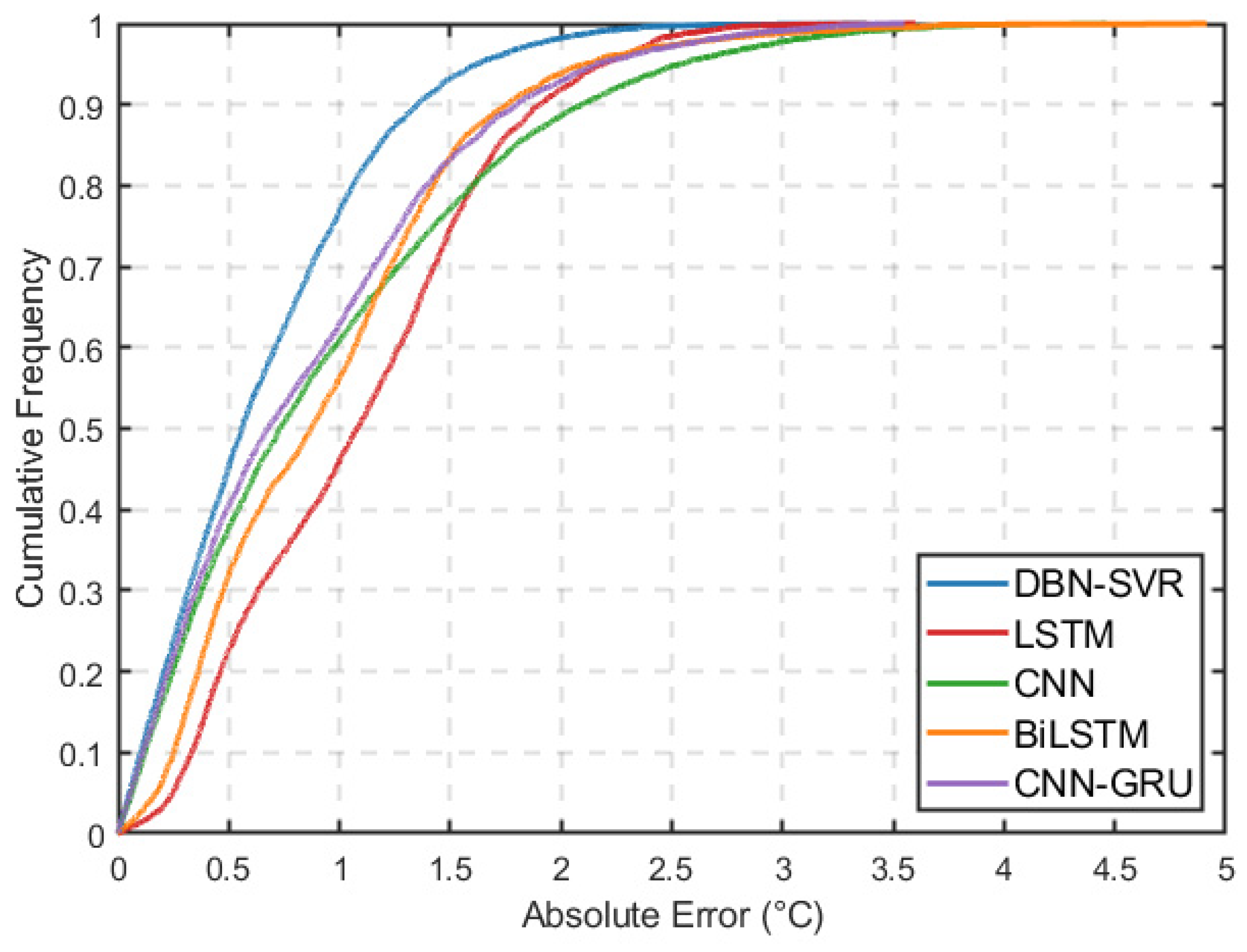
In Figure 12, the CDF in the North Pacific region clearly shows that DBN-SVR outperforms all other models, as its CDF curve lies furthest to the left, indicating a higher cumulative frequency of lower absolute errors. Specifically, DBN-SVR achieves a higher proportion of predictions with absolute errors below 0.5 °C, and its curve reaches near 1 at a lower error threshold than the other models. These findings collectively affirm the robustness and versatility of the DBN-SVR model for SST prediction in diverse oceanic settings, as also demonstrated in Table A1.
Figure 12.
Cumulative distribution function (CDF) of absolute errors for different models on the 60th day in the North Pacific region. The CDF curves represent the cumulative frequency of absolute errors for the following models: DBN-SVR (blue), LSTM (red), CNN (green), BiLSTM (yellow), and CNN-GRU (purple).
4. Discussion
Despite these promising results, the model’s current reliance on SST as the sole input variable represents a limitation. While SST is critical in oceanographic and climate processes, it only captures a portion of the complex interactions within the ocean–atmosphere system. The inclusion of additional oceanic and atmospheric variables—such as wind speed, salinity, radiation, and vertical mixing—could provide a more comprehensive understanding of these interactions, further improving prediction accuracy. We plan to incorporate these variables in future work, with the goal of evaluating the improvements they bring to model performance.
Additionally, training the model at only one geographic location may limit its ability to capture the characteristics of the entire region. In future work, we plan to focus on increasing the number of training locations to assess how location diversity impacts the model’s prediction performance and to determine the optimal number of training sites. By addressing these two critical limitations—broadening the range of input variables and increasing the number of training locations—the DBN-SVR model has the potential to evolve into a more versatile and effective tool for SST prediction and oceanographic forecasting on a global scale.
5. Conclusions
To address the challenge of short prediction lead times in previous sea surface temperature prediction methods, this study proposes a DBN-SVR model integrated with SSC. A series of experiments was conducted to verify the effectiveness and advantages of this model based on remote sensing data from NOAA’s OISSTv2.1 dataset. By combining the nonlinear feature extraction capabilities of the DBN with the predictive power of SVR, the DBN-SVR model more accurately captures the complex spatiotemporal variation patterns of SSTs. Compared with traditional models such as BiLSTM and CNN-GRU, the DBN-SVR model significantly improves the prediction accuracy, stability, and robustness.
The experimental results indicate that SSC is essential for enhancing the model’s accuracy, effectively capturing nonlinear spatiotemporal variations in ocean temperatures while reducing anomalies and prediction errors. In experiments conducted in the Indian Ocean region, the DBN-SVR model outperformed the other models in terms of the RMSE and MAE for 60-day predictions, consistently maintaining an RMSE below 0.9 °C. Furthermore, extended experiments in the North Pacific region validated the model’s applicability across different geographic and climatic conditions, confirming that the DBN-SVR model possesses strong versatility.
In conclusion, this study introduces a DBN-SVR model integrated with SSC that effectively captures complex spatiotemporal dynamics and maintains robust performance over extended prediction periods. The exceptional performance of the DBN-SVR model in the Indian Ocean and North Pacific regions underscores its strong potential for accurate SST forecasting in other areas, laying the foundation for more reliable long-term SST predictions across wider marine environments.
Author Contributions
Y.L. wrote the main manuscript draft and conducted the experiments. Z.Z. (Zichen Zhao) wrote the program code. Z.Z. (Zhe Zhang) conducted the literature research. Y.Y. acquired the project funding, supervised the work, and reviewed the manuscript. All authors have read and agreed to the published version of the manuscript.
Funding
This research was funded by the National Natural Science Foundation of China, grant numbers 42394120 and 42394124, Innovative Star of Gansu Province, grant number 2025CXZX-152, and the Fundamental Research Funds for the Central Universities, grant number lzujbky-2024-it56.
Data Availability Statement
The NOAA OISSTv2.1 High-Resolution Dataset data was provided by NOAA PSL, Boulder, Colorado, USA, and obtained from their website at https://psl.noaa.gov.
Acknowledgments
We are grateful to NOAA for supplying the OISSTv2.1 high-resolution dataset. The authors thank the Supercomputing Center of Lanzhou University for their support. Thanks very much to the editor and reviewers for their valuable recommendations and help with the article.
Conflicts of Interest
The authors declare no conflicts of interest.
Abbreviations
The following abbreviations are used in this manuscript:
| SST | Sea surface temperature |
| DBN | Deep belief network |
| SVR | Support vector regression |
| SSC | Spatiotemporal secondary calibration |
| RMSE | Root mean square error |
| MAE | Mean absolute error |
| BP | Back propagation |
| LSTM | Long short-term memory |
| CNN | Convolutional neural networks |
| BiLSTM | Bidirectional long short-term memory |
| TransDtSt-Part | Transformer with temporal embedding, attention distilling, and stacked connection in part |
| RBM | Restricted Boltzmann machine |
| CD | Contrastive divergence |
| RBF | Radial basis function |
| OISSTv2.1 | Optimum Interpolation Sea Surface Temperature version 2.1 |
| AVHRR | Advanced Very High-Resolution Radiometer |
| NOAA | National Oceanic and Atmospheric Administration |
| CNN-GRU | Convolutional neural networks and gated recurrent unit |
| SSA | Sparrow search algorithm |
| CDF | Cumulative distribution function |
Appendix A

Table A1.
Results over a 60-day period in seven regions: (1) Indian Ocean (54°S–15°N, 28°E–124°E); (2) North Pacific Ocean (15°N–50°N, 140°E–120°W); (3) South Pacific Ocean (50°S–15°S, 160°E–90°W); (4) North Atlantic Ocean (15°N–50°N, 60°W–10°W); (5) South Atlantic Ocean (50°S–15°S, 45°W–15°E); (6) Arctic Ocean (60°N–90°N, 180°W–180°E); (7) Southern Ocean (90°S–60°S, 180°W–180°E).
Table A1.
Results over a 60-day period in seven regions: (1) Indian Ocean (54°S–15°N, 28°E–124°E); (2) North Pacific Ocean (15°N–50°N, 140°E–120°W); (3) South Pacific Ocean (50°S–15°S, 160°E–90°W); (4) North Atlantic Ocean (15°N–50°N, 60°W–10°W); (5) South Atlantic Ocean (50°S–15°S, 45°W–15°E); (6) Arctic Ocean (60°N–90°N, 180°W–180°E); (7) Southern Ocean (90°S–60°S, 180°W–180°E).
| Regions | Metrics | Prediction Duration | |
|---|---|---|---|
| The 60th Day | 1–60 Days Average | ||
| Indian Ocean | MAE (°C) | 0.704 | 0.483 |
| RMSE (°C) | 0.883 | 0.629 | |
| North Pacific Ocean | MAE (°C) | 0.650 | 0.445 |
| RMSE (°C) | 0.853 | 0.608 | |
| South Pacific Ocean | MAE (°C) | 0.772 | 0.460 |
| RMSE (°C) | 0.945 | 0.576 | |
| North Atlantic Ocean | MAE (°C) | 0.870 | 0.571 |
| RMSE (°C) | 1.056 | 0.756 | |
| South Atlantic Ocean | MAE (°C) | 0.812 | 0.443 |
| RMSE (°C) | 0.959 | 0.564 | |
| Arctic Ocean | MAE (°C) | 0.404 | 0.284 |
| RMSE (°C) | 0.721 | 0.513 | |
| Southern Ocean | MAE (°C) | 0.393 | 0.260 |
| RMSE (°C) | 0.628 | 0.387 | |
References
- Bronselaer, B.; Zanna, L. Heat and Carbon Coupling Reveals Ocean Warming Due to Circulation Changes. Nature 2020, 584, 227–233. [Google Scholar] [CrossRef]
- Levitus, S.; Antonov, J.; Boyer, T. Warming of the World Ocean, 1955–2003. Geophys. Res. Lett. 2005, 32, 2004GL021592. [Google Scholar] [CrossRef]
- Chen, Z.; Wen, Z.; Wu, R.; Lin, X.; Wang, J. Relative Importance of Tropical SST Anomalies in Maintaining the Western North Pacific Anomalous Anticyclone during El Niño to La Niña Transition Years. Clim. Dyn. 2016, 46, 1027–1041. [Google Scholar] [CrossRef]
- Kerry, A.E. The Dependence of Hurricane Intensity on Climate. Nature 1987, 326, 483–485. [Google Scholar] [CrossRef]
- Emanuel, K.; Sobel, A. Response of Tropical Sea Surface Temperature, Precipitation, and Tropical Cyclone-Related Variables to Changes in Global and Local Forcing. J. Adv. Model. Earth Syst. 2013, 5, 447–458. [Google Scholar] [CrossRef]
- Vecchi, G.A.; Soden, B.J. Effect of Remote Sea Surface Temperature Change on Tropical Cyclone Potential Intensity. Nature 2007, 450, 1066–1070. [Google Scholar] [CrossRef]
- Holbrook, N.J.; Scannell, H.A.; Sen Gupta, A.; Benthuysen, J.A.; Feng, M.; Oliver, E.C.J.; Alexander, L.V.; Burrows, M.T.; Donat, M.G.; Hobday, A.J.; et al. A Global Assessment of Marine Heatwaves and Their Drivers. Nat. Commun. 2019, 10, 2624. [Google Scholar] [CrossRef]
- TAN, H.-J.; CAI, R.-S.; BAI, D.-P. Causes of 2022 Summer Marine Heatwave in the East China Seas. Adv. Clim. Change Res. 2023, 14, 633–641. [Google Scholar] [CrossRef]
- Xu, T.; Zhou, Z.; Li, Y.; Wang, C.; Liu, Y.; Rong, T. Short-Term Prediction of Global Sea Surface Temperature Using Deep Learning Networks. J. Mar. Sci. Eng. 2023, 11, 1352. [Google Scholar] [CrossRef]
- Hosoda, K. Empirical Method of Diurnal Correction for Estimating Sea Surface Temperature at Dawn and Noon. J. Oceanogr. 2013, 69, 631–646. [Google Scholar] [CrossRef]
- Goela, P.C.; Cordeiro, C.; Danchenko, S.; Icely, J.; Cristina, S.; Newton, A. Time Series Analysis of Data for Sea Surface Temperature and Upwelling Components from the Southwest Coast of Portugal. J. Mar. Syst. 2016, 163, 12–22. [Google Scholar] [CrossRef]
- Majumder, S.; Kanjilal, P.P. Application of Singular Spectrum Analysis for Investigating Chaos in Sea Surface Temperature. Pure Appl. Geophys. 2019, 176, 3769–3786. [Google Scholar] [CrossRef]
- Wei, J.; Liu, X.; Jiang, G. Parameterizing Sea Surface Temperature Cooling Induced by Tropical Cyclones Using a Multivariate Linear Regression Model. Acta Oceanol. Sin. 2018, 37, 1–10. [Google Scholar] [CrossRef]
- Chen, P.; Sun, B. Improving the Dynamical Seasonal Prediction of Western Pacific Warm Pool Sea Surface Temperatures Using a Physical–Empirical Model. Int. J. Climatol. 2020, 40, 4657–4675. [Google Scholar] [CrossRef]
- Zhang, M.; Han, G.; Wu, X.; Li, C.; Shao, Q.; Li, W.; Cao, L.; Wang, X.; Dong, W.; Ji, Z. SST Forecast Skills Based on Hybrid Deep Learning Models: With Applications to the South China Sea. Remote Sens. 2024, 16, 1034. [Google Scholar] [CrossRef]
- Kuang, X.; Wang, Z.; Zhang, M.; He, E.; Deng, X. An interpretation scheme of numerical near-shore sea-water temperature forecast based on bpnn. Oceanol. Limnol. Sin. 2016, 47, 1107–1115. [Google Scholar] [CrossRef]
- Zhang, Q.; Wang, H.; Dong, J.; Zhong, G.; Sun, X. Prediction of Sea Surface Temperature Using Long Short-Term Memory. IEEE Geosci. Remote Sens. Lett. 2017, 14, 1745–1749. [Google Scholar] [CrossRef]
- Yang, Y.; Dong, J.; Sun, X.; Lima, E.; Mu, Q.; Wang, X. A CFCC-LSTM Model for Sea Surface Temperature Prediction. IEEE Geosci. Remote Sens. Lett. 2018, 15, 207–211. [Google Scholar] [CrossRef]
- Zhang, K.; Geng, X.; Yan, X.-H. Prediction of 3-D Ocean Temperature by Multilayer Convolutional LSTM. IEEE Geosci. Remote Sens. Lett. 2020, 17, 1303–1307. [Google Scholar] [CrossRef]
- Weng, S.; Cai, J.; Peng, Y.; Luo, R. Application of convolutional neural networks in nearshore surface sea temperature forecasting. J. Trop. Oceanogr. 2024, 43, 40–47. [Google Scholar] [CrossRef]
- Zrira, N.; Kamal-Idrissi, A.; Farssi, R.; Khan, H.A. Time Series Prediction of Sea Surface Temperature Based on BiLSTM Model with Attention Mechanism. J. Sea Res. 2024, 198, 102472. [Google Scholar] [CrossRef]
- Dai, H.; He, Z.; Wei, G.; Lei, F.; Zhang, X.; Zhang, W.; Shang, S. Long-Term Prediction of Sea Surface Temperature by Temporal Embedding Transformer With Attention Distilling and Partial Stacked Connection. IEEE J. Sel. Top. Appl. Earth Obs. Remote Sens. 2024, 17, 4280–4293. [Google Scholar] [CrossRef]
- Fu, Y.; Song, J.; Guo, J.; Fu, Y.; Cai, Y. Prediction and Analysis of Sea Surface Temperature Based on LSTM-Transformer Model. Reg. Stud. Mar. Sci. 2024, 78, 103726. [Google Scholar] [CrossRef]
- Zhang, G.; Kang, X.; Luo, Y.; Wang, Q.; Song, H.; Yin, X. A Transformer-Based Method for Correcting Daily SST Numerical Forecasting Products. Front. Earth Sci. 2025, 13, 1530475. [Google Scholar] [CrossRef]
- Shi, B.; Ge, C.; Lin, H.; Xu, Y.; Tan, Q.; Peng, Y.; He, H. Sea Surface Temperature Prediction Using ConvLSTM-Based Model with Deformable Attention. Remote Sens. 2024, 16, 4126. [Google Scholar] [CrossRef]
- Ren, J.; Wang, C.; Sun, L.; Huang, B.; Zhang, D.; Mu, J.; Wu, J. Prediction of Sea Surface Temperature Using U-Net Based Model. Remote Sens. 2024, 16, 1205. [Google Scholar] [CrossRef]
- Naskath, J.; Sivakamasundari, G.; Begum, A.A.S. A Study on Different Deep Learning Algorithms Used in Deep Neural Nets: MLP SOM and DBN. Wirel. Pers. Commun. 2023, 128, 2913–2936. [Google Scholar] [CrossRef] [PubMed]
- Balabin, R.M.; Lomakina, E.I. Support Vector Machine Regression (SVR/LS-SVM)—An Alternative to Neural Networks (ANN) for Analytical Chemistry? Comparison of Nonlinear Methods on near Infrared (NIR) Spectroscopy Data. The Analyst 2011, 136, 1703. [Google Scholar] [CrossRef]
- Liu, Y.; Fan, Y.; Chen, J. Flame Images for Oxygen Content Prediction of Combustion Systems Using DBN. Energy Fuels 2017, 31, 8776–8783. [Google Scholar] [CrossRef]
- Li, Z.; Ge, X. Prediction And Analysis Of Road Traffic Efficiency Based on DBN-SVR. In Proceedings of the 2019 1st International Conference on Industrial Artificial Intelligence (IAI), Shenyang, China, 23–27 July 2019; pp. 1–6. [Google Scholar]
- Smith, T.; Reynolds, R.; Peterson, T.; Lawrimore, J. Improvements to NOAA’s Historical Merged Land–Ocean Surface Temperature Analysis (1880–2006). J. Clim. 2008, 21, 2283–2296. [Google Scholar] [CrossRef]
- Yan, J.; Gao, Y.; Yu, Y.; Xu, H.; Xu, Z. A Prediction Model Based on Deep Belief Network and Least Squares SVR Applied to Cross-Section Water Quality. Water 2020, 12, 1929. [Google Scholar] [CrossRef]
- Hinton, G.E.; Osindero, S.; Teh, Y.-W. A Fast Learning Algorithm for Deep Belief Nets. Neural Comput. 2006, 18, 1527–1554. [Google Scholar] [CrossRef] [PubMed]
- Tao, H.; Sulaiman, S.O.; Yaseen, Z.M.; Asadi, H.; Meshram, S.G.; Ghorbani, M.A. What Is the Potential of Integrating Phase Space Reconstruction with SVM-FFA Data-Intelligence Model? Application of Rainfall Forecasting over Regional Scale. Water Resour. Manag. 2018, 32, 3935–3959. [Google Scholar] [CrossRef]
- Sun, Y.; Ding, S.; Zhang, Z.; Jia, W. An Improved Grid Search Algorithm to Optimize SVR for Prediction. Soft Comput. 2021, 25, 5633–5644. [Google Scholar] [CrossRef]
- Wang, G.; Fan, H. Prediction Model of Blood Pressure during Hemodialysis Base on Deep Learning. In Proceedings of the 2021 7th International Conference on Computing and Artificial Intelligence, Tianjin, China, 23–26 April 2021; pp. 431–436. [Google Scholar] [CrossRef]
- Le Grix, N.; Zscheischler, J.; Rodgers, K.B.; Yamaguchi, R.; Frölicher, T.L. Hotspots and Drivers of Compound Marine Heatwaves and Low Net Primary Production Extremes. Biogeosciences 2022, 19, 5807–5835. [Google Scholar] [CrossRef]
- Lu, Z.; Dong, W.; Lu, B.; Yuan, N.; Ma, Z.; Bogachev, M.I.; Kurths, J. Early Warning of the Indian Ocean Dipole Using Climate Network Analysis. Proc. Natl. Acad. Sci. USA 2022, 119, e2109089119. [Google Scholar] [CrossRef]
- Gunnarson, J.L.; Stuecker, M.F.; Zhao, S. Drivers of Future Extratropical Sea Surface Temperature Variability Changes in the North Pacific. Npj Clim. Atmos. Sci. 2024, 7, 164. [Google Scholar] [CrossRef]
- Pan, X.; Jiang, T.; Sun, W.; Xie, J.; Wu, P.; Zhang, Z.; Cui, T. Effective Attention Model for Global Sea Surface Temperature Prediction. Expert Syst. Appl. 2024, 254, 124411. [Google Scholar] [CrossRef]
- Schott, F.A.; Xie, S.-P.; McCreary, J.P., Jr. Indian Ocean Circulation and Climate Variability. Rev. Geophys. 2009, 47. [Google Scholar] [CrossRef]
- Di Lorenzo, E.; Cobb, K.M.; Furtado, J.C.; Schneider, N.; Anderson, B.T.; Bracco, A.; Alexander, M.A.; Vimont, D.J. Central Pacific El Niño and Decadal Climate Change in the North Pacific Ocean. Nat. Geosci. 2010, 3, 762–765. [Google Scholar] [CrossRef]
- Irrgang, C.; Saynisch-Wagner, J.; Thomas, M. Machine Learning-Based Prediction of Spatiotemporal Uncertainties in Global Wind Velocity Reanalyses. J. Adv. Model. Earth Syst. 2020, 12, e2019MS001876. [Google Scholar] [CrossRef]
- Cheng, Q.; Chen, Y.; Xiao, Y.; Yin, H.; Liu, W. A Dual-Stage Attention-Based Bi-LSTM Network for Multivariate Time Series Prediction. J. Supercomput. 2022, 78, 16214–16235. [Google Scholar] [CrossRef]
- Alizadegan, H.; Rashidi Malki, B.; Radmehr, A.; Karimi, H.; Ilani, M.A. Comparative Study of Long Short-Term Memory (LSTM), Bidirectional LSTM, and Traditional Machine Learning Approaches for Energy Consumption Prediction. Energy Explor. Exploit. 2024, 10, 3315–3334. [Google Scholar] [CrossRef]
- Wang, J.; Wang, P.; Tian, H.; Tansey, K.; Liu, J.; Quan, W. A Deep Learning Framework Combining CNN and GRU for Improving Wheat Yield Estimates Using Time Series Remotely Sensed Multi-Variables. Comput. Electron. Agric. 2023, 206, 107705. [Google Scholar] [CrossRef]
- Chen, Y.; Xu, P.; Chu, Y.; Li, W.; Wu, Y.; Ni, L.; Bao, Y.; Wang, K. Short-Term Electrical Load Forecasting Using the Support Vector Regression (SVR) Model to Calculate the Demand Response Baseline for Office Buildings. Appl. Energy 2017, 195, 659–670. [Google Scholar] [CrossRef]
Disclaimer/Publisher’s Note: The statements, opinions and data contained in all publications are solely those of the individual author(s) and contributor(s) and not of MDPI and/or the editor(s). MDPI and/or the editor(s) disclaim responsibility for any injury to people or property resulting from any ideas, methods, instructions or products referred to in the content. |
© 2025 by the authors. Licensee MDPI, Basel, Switzerland. This article is an open access article distributed under the terms and conditions of the Creative Commons Attribution (CC BY) license (https://creativecommons.org/licenses/by/4.0/).