1. Introduction
High-frequency surface wave radar (HFSWR) operates within the frequency range of 3 to 30 MHz, utilizing vertically polarized electromagnetic waves with minimal attenuation that propagate along the sea surface to achieve beyond line-of-sight wide-range all-weather detection of targets. Depending on the radar platform’s location, HFSWR systems can be categorized as either shore-based or shipborne. Compared to shore-based HFSWR, shipborne HFSWR offers superior maneuverability and a larger detection range. However, the limited size of the shipborne platforms constrains the antenna array’s aperture, leading to reduced Direction of Arrival (DOA) estimation performance. To address these limitations, this paper reviews existing research methods focused on DOA estimation and array aperture expansion.
For DOA estimation methods in HFSWR, the most classic array-based DOA algorithm is the conventional beamforming (CBF) method [
1], which achieves spatial beam scanning by weighting the phase of the array elements. Due to the limitations of the CBF method in target resolution, the subspace-based DOA estimation method was proposed, which can surpass the Rayleigh limit and achieve super-resolution. In 1986, Schmidt proposed a multiple signal classification (MUSIC) algorithm based on noise subspace [
2], utilizing the orthogonality between the array steering vectors and noise subspaces to achieve DOA estimation. However, the performance of MUSIC decreases when the target echoes are correlated. In response to the problem of coherence in target echo, some scholars proposed dimensionality reduction algorithms such as the spatial smoothing algorithm [
3,
4] and matrix reconstruction algorithm [
5,
6], which sacrifice array aperture for decoherence processing, thereby improving DOA estimation performance. In particular, for a single-snapshot target signal, Ren proposed a single-snapshot MUSIC algorithm [
7] to enhance the target resolution of MUSIC by reconstructing the covariance matrix. However, for HFSWR systems, it is essential to first detect the target effectively before performing DOA estimation. In recent years, Cai et al. proposed a ship detection and direction-finding method based on time-frequency analysis for HFSWR [
8]. Subsequently, based on machine learning techniques, Zhang et al. designed a two-stage hierarchical one-class classification network for HFSWR, which can effectively detect ship targets with the presence of clutters [
9,
10].
For the problems of limited array aperture, some scholars have proposed the concept of virtual aperture. By processing the data received by real array elements to obtain the data of virtual array elements, the array aperture can be extended. The concept of virtual aperture originated from the Synthetic Aperture Radar (SAR) technology. In 1951, Carl Wiley first proposed a method to improve radar angular resolution through frequency analysis [
11]. Inspired by the SAR technology of airborne platforms, some scholars in the field of underwater acoustics, based on shipborne platforms, have proposed the concept of passive synthetic aperture (PSA) [
12], which utilizes the motion of array elements to convert spatial information into temporal information, thereby achieving the expansion of array aperture. Autrey was the first to propose a passive synthetic aperture method based on a moving single array element [
13] and explained that to achieve DOA estimation, the single array element must be effectively maneuvered. Yen proposed a circular passive synthetic array based on a single element [
14]. For arrays, the most researched passive synthetic aperture algorithm is the Moving Towed Array (MTA). The proposal of the Extended Towed Array Measurements (ETAM) algorithm [
15,
16] is of milestone significance. This algorithm expands the array aperture by detecting the phase difference in the received signals of overlapping array elements, also known as the “overlap correlator”. For the shipborne radar system, Xie et al. considered the sea clutter suppression issue of shipborne platforms and analyzed the feasibility of applying super-resolution algorithms to shipborne HFSWR [
17,
18,
19]. Zhang et al. established a six-degree-of-freedom motion model for shipborne HFSWR and analyzed its impact on DOA estimation [
20,
21,
22,
23]. Based on the six-degree-of-freedom motion model, Ji et al. provide the motion compensation methods for shipborne HFSWR [
24,
25,
26]. For the DOA estimation problem of shipborne HFSWR, Zhang et al. proposed a virtual aperture extension method based on stationary arrays and moving targets [
27], which requires the target to move parallel to the array, presenting certain limitations in practice. Subsequently, Zhang et al. proposed a time–domain virtual aperture extension method based on a stop-move-stop model [
28], which achieves aperture expansion and improved DOA resolution of the array.
In this paper, we think that the existing time–domain virtual aperture extension methods have the following limitations in practice. Firstly, the existing methods generally assume that the ship moves in a stop-move-stop manner, transmitting and receiving signals intermittently at discrete positions. In reality, however, the ship’s movement is generally continuous, and signals are continuously transmitted and received during the ship’s movement. Secondly, the existing methods directly perform virtual aperture processing on the time–domain target signals received by the array. However, in the HFSWR background, it is almost impossible to extract the target signal from the time domain due to the presence of clutter and interference. Thirdly, the existing methods mostly assume that the targets are stationary, neglecting the analysis of moving targets. Fourthly, the existing methods require the array to move in an overlapping manner, a process that is difficult to achieve in practice.
To address the above limitations of the traditional time–domain method, we proposed a range-Doppler domain (RD-domain) virtual aperture extension method for shipborne HFSWR. By dividing the array data in the time domain and utilizing RD-domain virtual aperture processing, the proposed method can extend the array aperture in the RD-domain, thereby enhancing the array’s DOA estimation performance. The advantages of the proposed method are as follows:
- (1)
The proposed method allows the array to move continuously while transmitting and receiving signals, instead of requiring the stop-move-stop motion, which is more consistent with reality;
- (2)
By RD-domain processing, the proposed method can separate the target from clutter, making it suitable for the shipborne HFSWR;
- (3)
In the case of a single target, the proposed method does not require the array to move in an overlapping manner, whereas the time–domain method does;
- (4)
In multiple targets with varying speeds, the proposed method can perform virtual aperture processing on them, while the time–domain method cannot.
The structure of the paper is as follows. In
Section 2, we establish a motion model for the shipborne HFSWR and moving target and present the conventional signal model and methods in HFSWR. To address the above limitations in the time–domain method,
Section 3 describes the proposed RD-domain virtual aperture extension method. Specifically, in
Section 3.1, we equivalently represent the motion model in
Section 2 to obtain a continuous motion model. To make the method applicable to shipborne HFSWR,
Section 3.2 provides a novel flowchart of the proposed method based on the conventional HFSWR processing flow.
Section 3.3 presents the signal time–domain segmentation model of the proposed method. Then, the proposed RD-domain virtual aperture extension methods are described in
Section 3.4 and
Section 3.5. In
Section 4, we analyze the performance of the proposed method. In
Section 5 and
Section 6, we verify the proposed methods through simulation experiments and experimental data. Finally, we summarize the paper and present the conclusion in
Section 7.
3. Proposed Method
In this section, we provide a detailed description of the proposed RD-domain virtual aperture extension method.
3.1. Far-Field Equivalent Motion Model
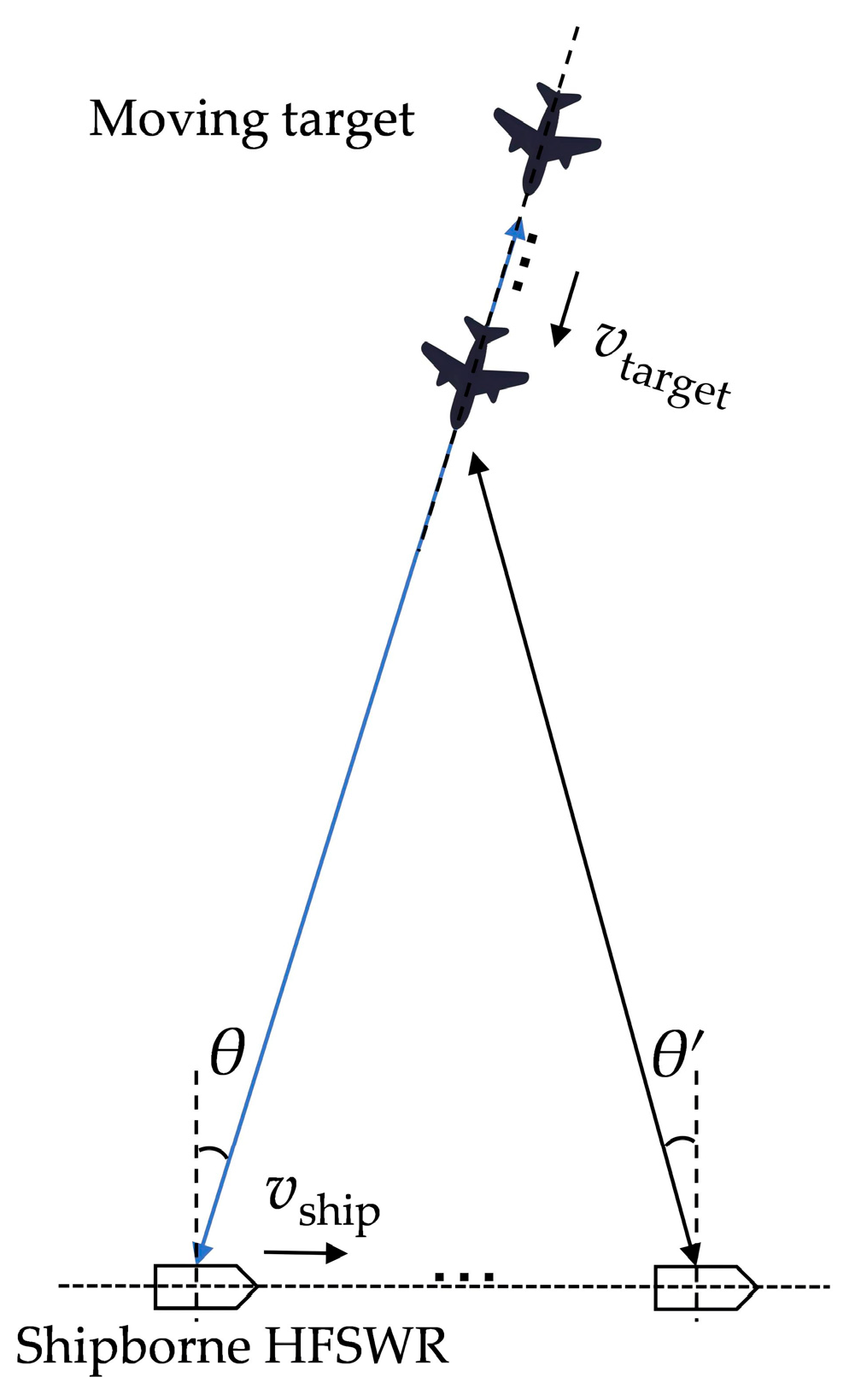
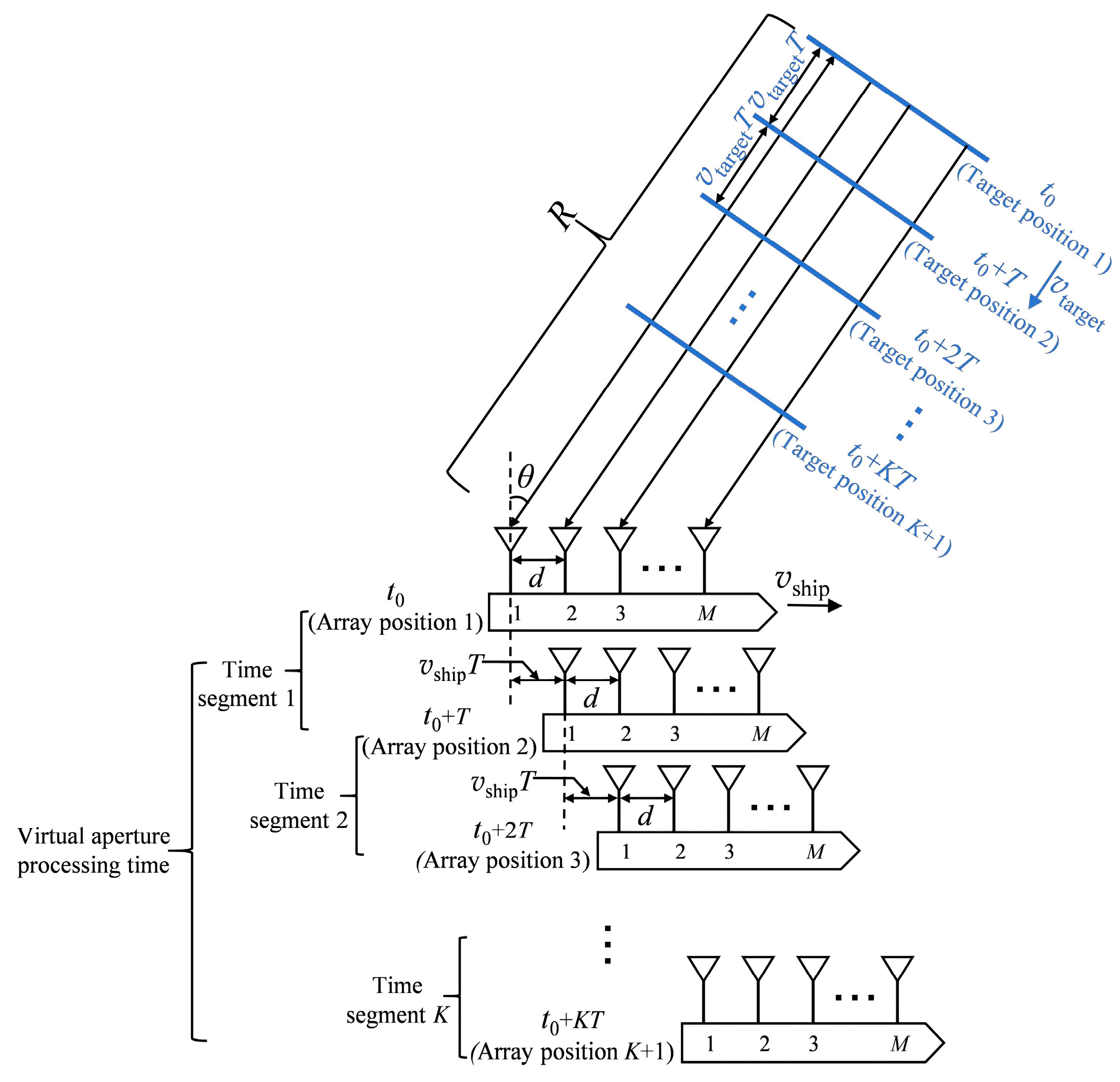
For the convenience of analyzing the proposed method, based on the far-field assumption in
Section 2.1, we represent the motion model shown in
Figure 1 equivalently to obtain the far-field equivalent motion model, as shown in
Figure 2.
In
Figure 2, the positions of the shipborne platform and target from time
to
are marked. Due to the far-field assumption, the target echo can be approximated as a plane wave. Therefore, for simplicity in analysis, we use the blue solid lines to represent the different positions of the far-field target. During the virtual aperture processing time
, for each array element, we segment the received data by intervals
to obtain
time segments.
3.2. Flowchart of the Proposed Method
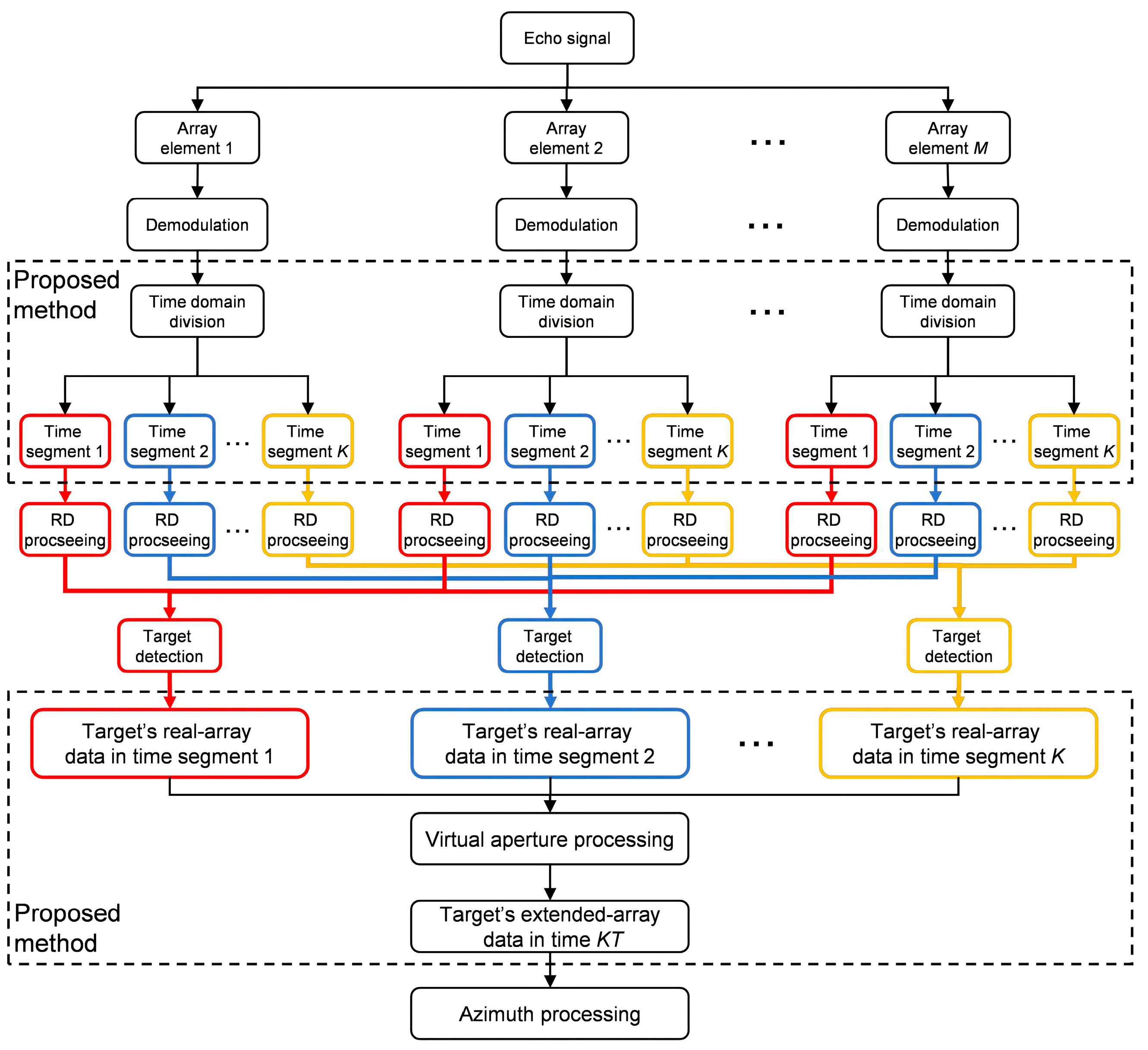
On the basis of conventional HFSWR processing flow, the flowchart of the proposed method (indicated by black dashed rectangular boxes) is shown in
Figure 3.
In conjunction with
Figure 2, a brief explanation of the proposed flowchart is provided below. During the virtual aperture processing time
KT, if the demodulated target echo signals from each array element are divided into
time segments with a time interval
(the order of demodulation and time–domain division can be interchanged),
array elements will have a total of
time segments. For each time segment, we perform RD processing and target detection to obtain target’s
snapshots of the real array (assume that targets are within a single RD unit). Then, we perform virtual aperture processing on
snapshots to obtain the target’s
snapshots of the extended array. Finally, we use
snapshots for DOA estimation to obtain target azimuth.
3.3. Signal Time–Domain Segmentation Model
This section provides the time–domain segmented representation of the array received data in the proposed method. For clarity, we provide the correspondence between the proposed flowchart and formula parameters in
Figure 4 (the order of Step 2 and Step 3 can be exchanged). The explanation for
Figure 4 is as follows.
Taking
targets as an example and ignoring noise terms, the received data of element
are represented as (8) (Step 1). Performing time domain division (Step 2) and the target echo received by element
in time segment
and
are represented as
and
, respectively, as shown in (14) and (15).
Here,
and
, given by (16), respectively, represent the relative range of target
that varies with
during time segments
and
.
and
represent the echo signal of target
during time segments
and
.
is given by (5), where
. The other parameters are the same as those in (8).
According to Equation (11), demodulation and range processing (Step 3 and Step 4) are performed on (14) and (15), respectively, to obtain (17) and (18), as follows:
where
and
represent the changes in echo delay of target
caused by the motion of ship and target
during time
, respectively, as shown in (19).
Step 5 represents for the Doppler processing and its output in time segment and are represented as and .
3.4. Proposed Method for a Single Target
This section derives the proposed RD-domain virtual aperture extension method for a single target. Before introducing the method, we first provide an RD-domain representation of the array received data. By applying the RD processing to (6) and utilizing the linear properties of the RD transformation, we obtain
Then, the RD-domain representation of array data can be obtained, as shown in (21), as follows:
where
represents the single snapshot value of range index
and the velocity index
is extracted from the RD-processed data of element
.
Based on the flowchart shown in
Figure 3, the proposed method is explained as follows.
Firstly, for the received data of each array element, we perform demodulation and time–domain division (as described in
Section 3.3) to obtain the baseband data of array element
m in time segment
k, denoted as
.
Secondly, RD processing is performed on
. According to (21), for a single target, the RD-domain form of the array data in time segment
is expressed as
where
represents the baseband target signal in time segment
k.
Thirdly, through target detection, we obtain the targets’ range and velocity indices
of the RD spectrum and extract the targets’ single-snapshot value at indices
. Similar to (21), the value of indices
ij are denoted as
,
, and
. For the convenience of formula derivation, we represent them as
,
, and
, respectively. Substituting (7) into (22) yields (23).
Similarly, the RD-domain representation of the array data for time segment
is given by (24).
Fourthly, based on the real-array elements’
M snapshots of each time segments, we perform virtual aperture processing to obtain the extended-array elements’
snapshots. If the SNR is high enough after RD processing, the noise terms in (23) and (24) can be neglected, and dividing Equation (24) by Equation (23) results in
Here, and represent the element indices in time segment and respectively, which satisfy . represents the extracted target single snapshot of element in time segment , represents the extracted target single snapshot of element in time segment , and represents the compensation value between the two single snapshots.
If the index difference
is denoted as
and satisfies
, then (25) can also be expressed as
Due to the potential data errors in a single array element, we take the average of
to obtain
in (27), which represents the average compensation value between time segment
and
.
Then, the virtual elements’ single-snapshot data
to
can be calculated from
By traversing the values of from 1 to , extended elements’ single-snapshot data can be obtained in time segment 1, that is, the number of the extended array elements is , which satisfies the condition .
Finally, based on the target’s snapshots of the extended array, we perform DOA estimation to obtain the target azimuth.
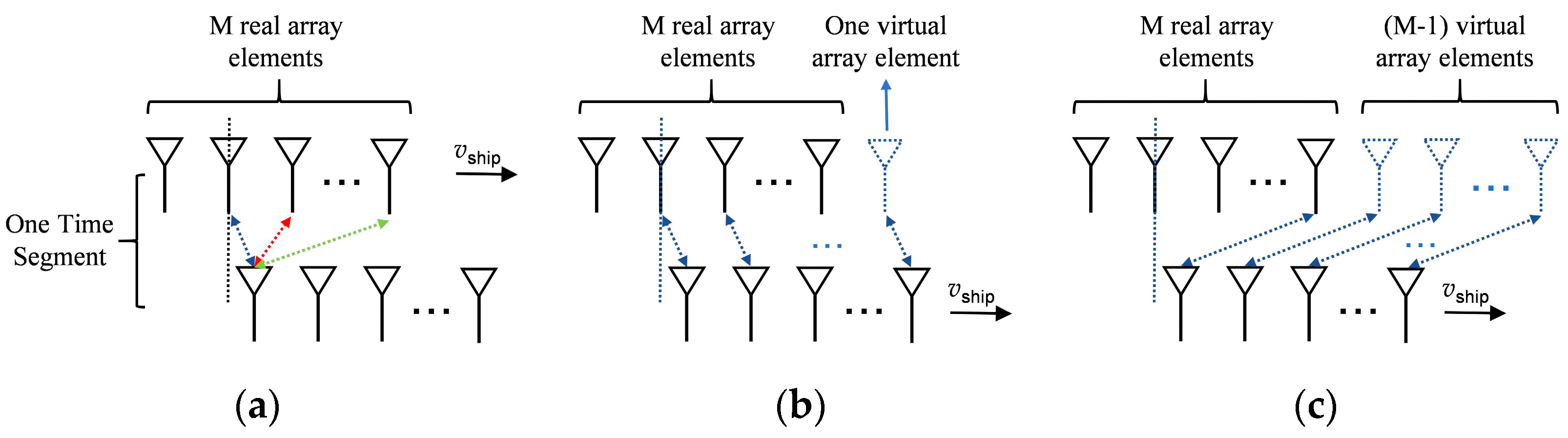
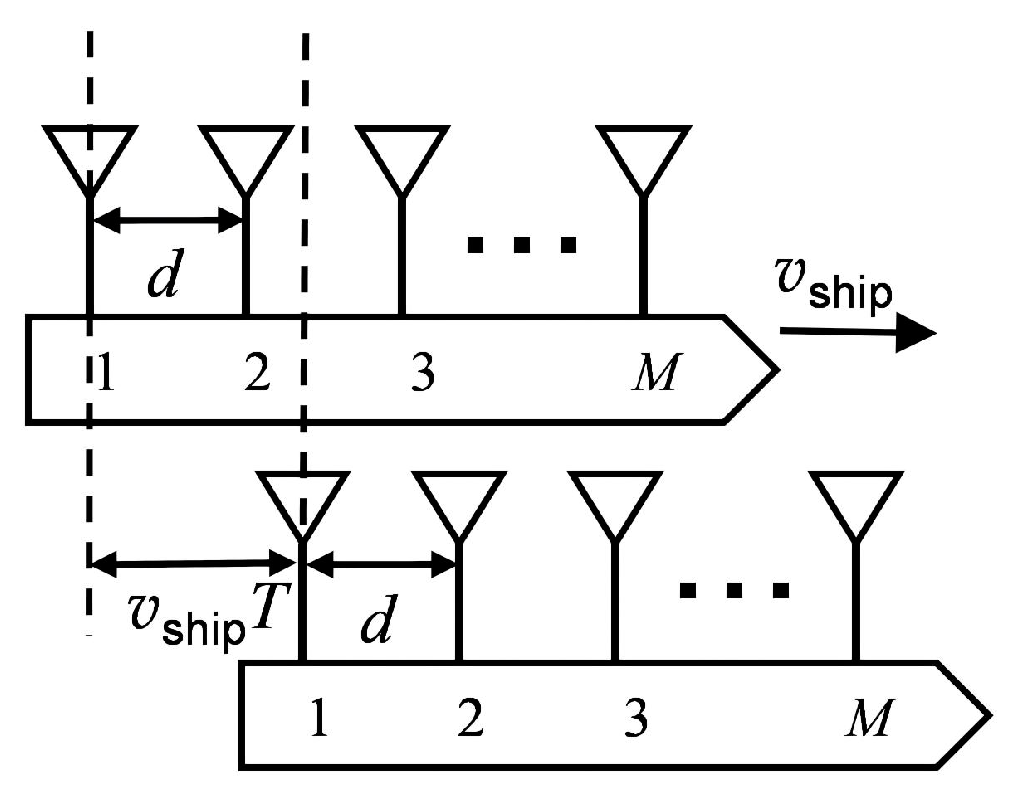
The virtual aperture processing method and aperture expansion effect of the proposed method are shown in
Figure 5.
Figure 5a shows the virtual aperture processing manners of the proposed method. The dashed arrows correspond to different
(
), where the blue dashed arrow represents
, the red dashed arrow represents
, and the green dashed arrow represents
.
Figure 5b shows the aperture expansion effect when
. In this case, only one virtual element’s single-snapshot data can be obtained after a single virtual aperture processing, representing the minimum aperture case.
Figure 5c shows the aperture expansion effect when
. In this case,
virtual elements’ single-snapshot data can be obtained after a single virtual aperture processing, which represents the maximum aperture case. However, this does not imply that a larger
is always better. For example, when
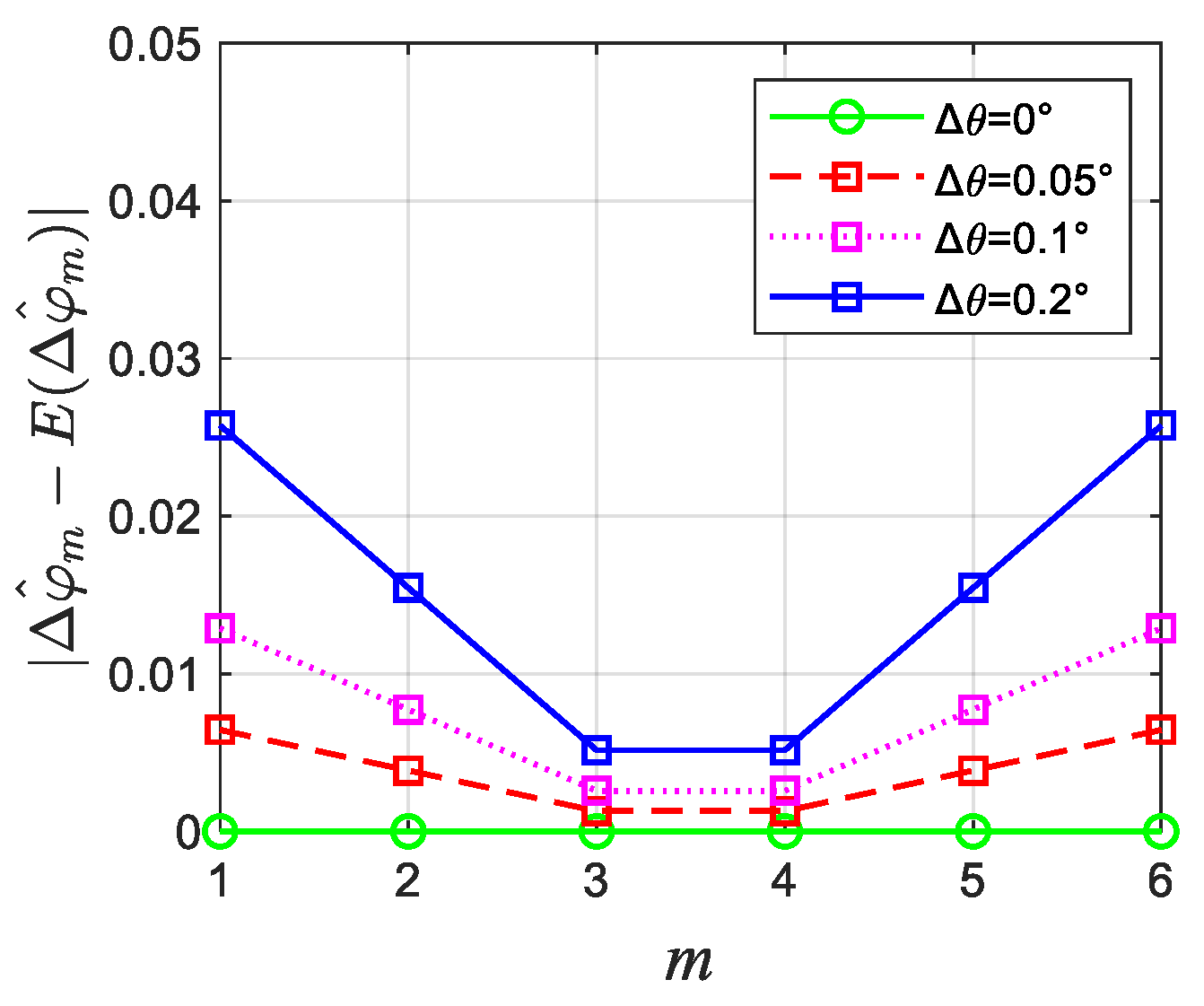
, according to (27),
is calculated from only a pair of elements’ data
and
, which means that the value of
is more susceptible to noise and may have potential errors.
Additionally, it should be noted that the derivation of the proposed method is based on a uniform linear array. For the case of non-uniform linear arrays, in equation (26) cannot be derived and the proposed method is no longer applicable.
3.5. Proposed Method for Multiple Targets
This section derives the proposed RD-domain virtual aperture extension method for multiple targets.
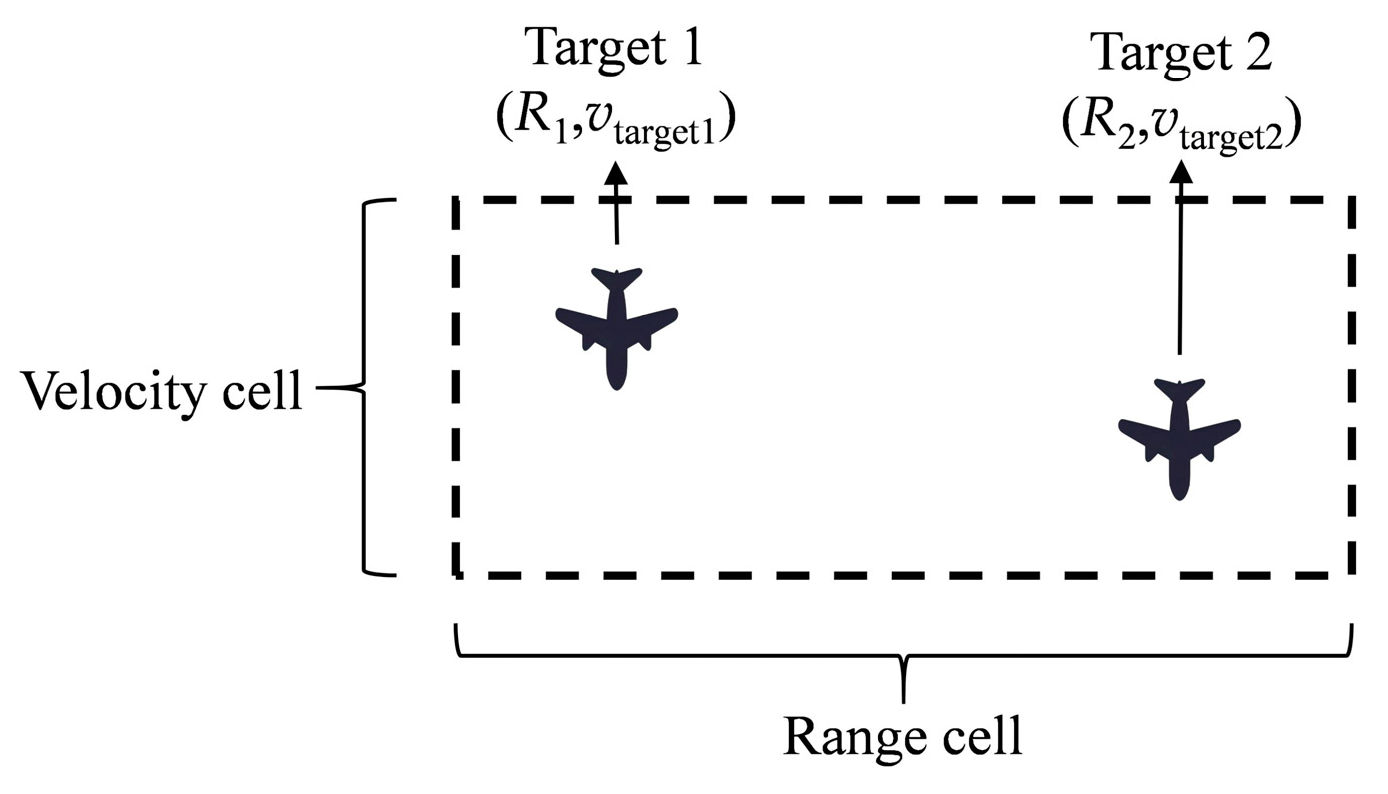
When multiple targets are present, two cases are considered: the first case is when all targets are situated in different RD units and the second case is when at least two targets are situated in the same RD unit.
For case 1, we can apply the RD-domain virtual aperture extension method described in
Section 3.4 to each individual target of different RD units, to achieve the virtual aperture extension.
For case 2, the processing flow of the method is consistent with that in
Section 3.4; however, two constraints are present: the first is that the array needs to move in an overlapping manner, which means it satisfies the condition
(where
), and the second is that
must meet the requirement
.
The explanation of the two constraints in case 2 is as follows. According to (18), when the target speed is low or the virtual aperture processing time is short, the impact of
and
on the envelope of the
function can be ignored, resulting in (29), with the parameters specified in (16) and (19).
Given that targets are in the same RD unit, we assume that their range and velocity parameters are exactly the same. We assume that the array moves in an overlapping manner, which means that constraint 1 holds. Taking
= 1 as an example, substituting
,
and
into (29) yields
where
and
.
Simultaneously perform DFT on both sides of the Equation (30) with respect to
, resulting in
Similar to
Section 3.4, extract the single-snapshot value at indices
from (31) to obtain
and
and denote them as
and
, respectively, resulting in
Compared to (26), it can be seen that can only take 2 for multiple targets, which means that constraint 2 holds.
The same as for Equations (27) and (28), the virtual array elements’ data
and
can be calculated by (33). The elements number of the extended array is
.
Therefore, only when both constraints are satisfied can the phase compensation value between two elements across two time segments be expressed as the constant . Then, the condition is satisfied and the proposed method for multiple targets in case 2 becomes effective.
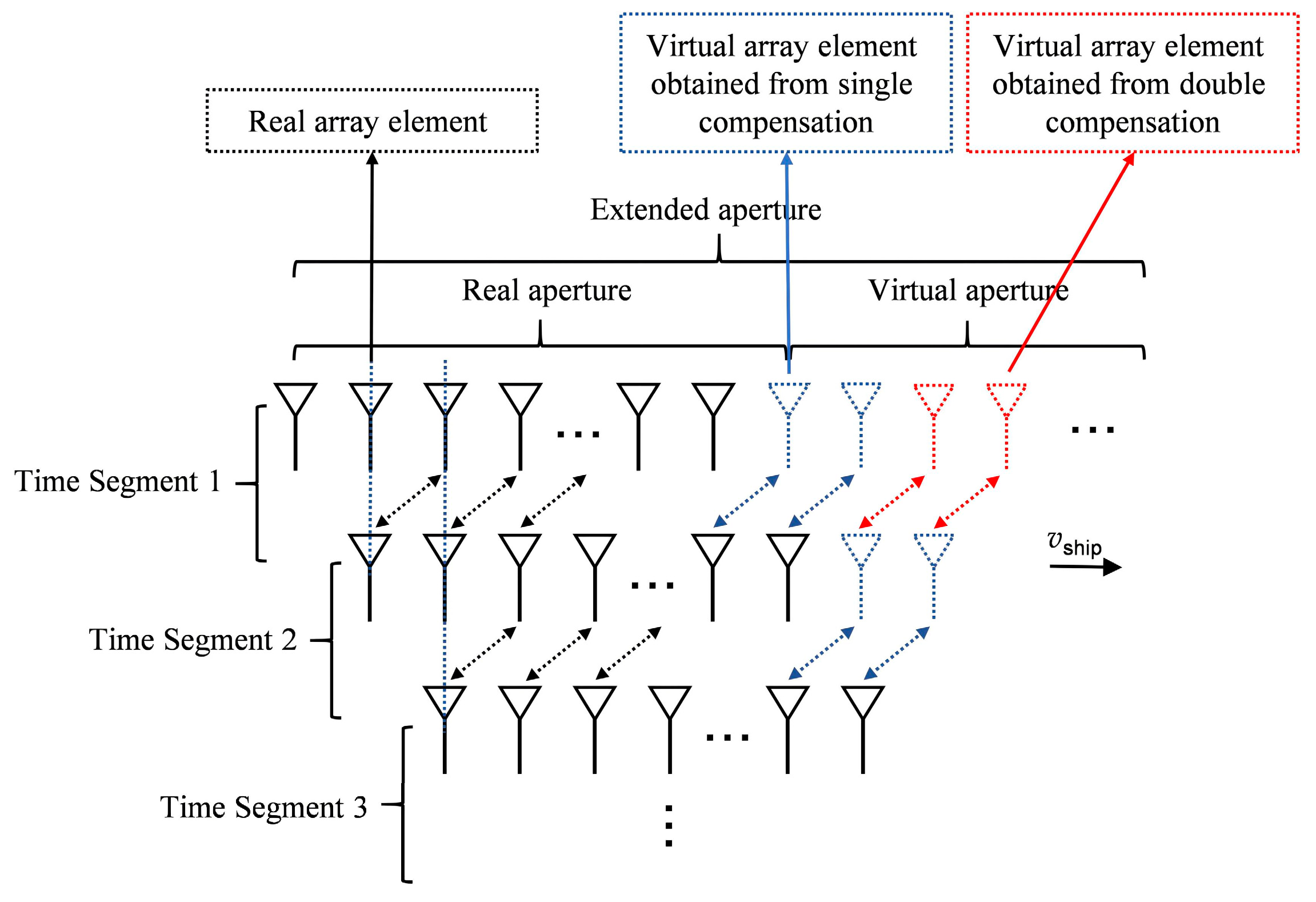
The virtual aperture processing method and aperture expansion effect of the proposed method for multiple targets when
l = 1 is shown in
Figure 6.
Here, the black solid-line element represents the element of the real array, the blue dashed-line element represents for the virtual array element obtained from a single virtual aperture processing, and the red dashed-line element represents for the virtual array element obtained from double virtual aperture processing.
It can be seen that the array element in time segment corresponds to the array element in time segment . That is, two virtual elements’ data can be obtained from each virtual aperture processing of time , indicating that the aperture extension performance is limited compared to the proposed method for a single target.
5. Simulation Results and Discussion
In this section, we verify the proposed RD-domain virtual aperture extension method through DOA estimation simulation experiments.
We analyze the DOA estimation performance of the extended array from two perspectives: DOA resolution performance and DOA estimation accuracy. For the former, we evaluate the DOA resolution performance based on the spatial spectrum distribution. The greater the number of elements in the extended array, the more concentrated the spatial spectrum distribution becomes, representing a better target resolution ability. For the latter, we evaluate the DOA estimation accuracy based on RMSE. A smaller RMSE indicates a higher DOA estimation accuracy. The definition of RMSE is given by (42), as follows:
where
represents the number of Monte Carlo iterations and
represents the estimated azimuth of the target
in the
-th Monte Carlo experiment.
The simulation parameters are set as follows:
,
,
,
, and
. The parameter values of the signal model are shown in
Table 1.
5.1. Simulation of the Proposed Method for a Single Target
For a single target, according to the analysis in
Section 3.4, the number of elements in the extended array obtained from the proposed method is
, which means that the DOA estimation effect is affected by
and
. By setting the single target parameters
, where
represents the range (km), velocity (m/s), and azimuth (°) of the target, the simulation results are presented as follows.
Firstly, we simulate the impact of on the proposed virtual aperture extension method by setting the parameters as follows: , .
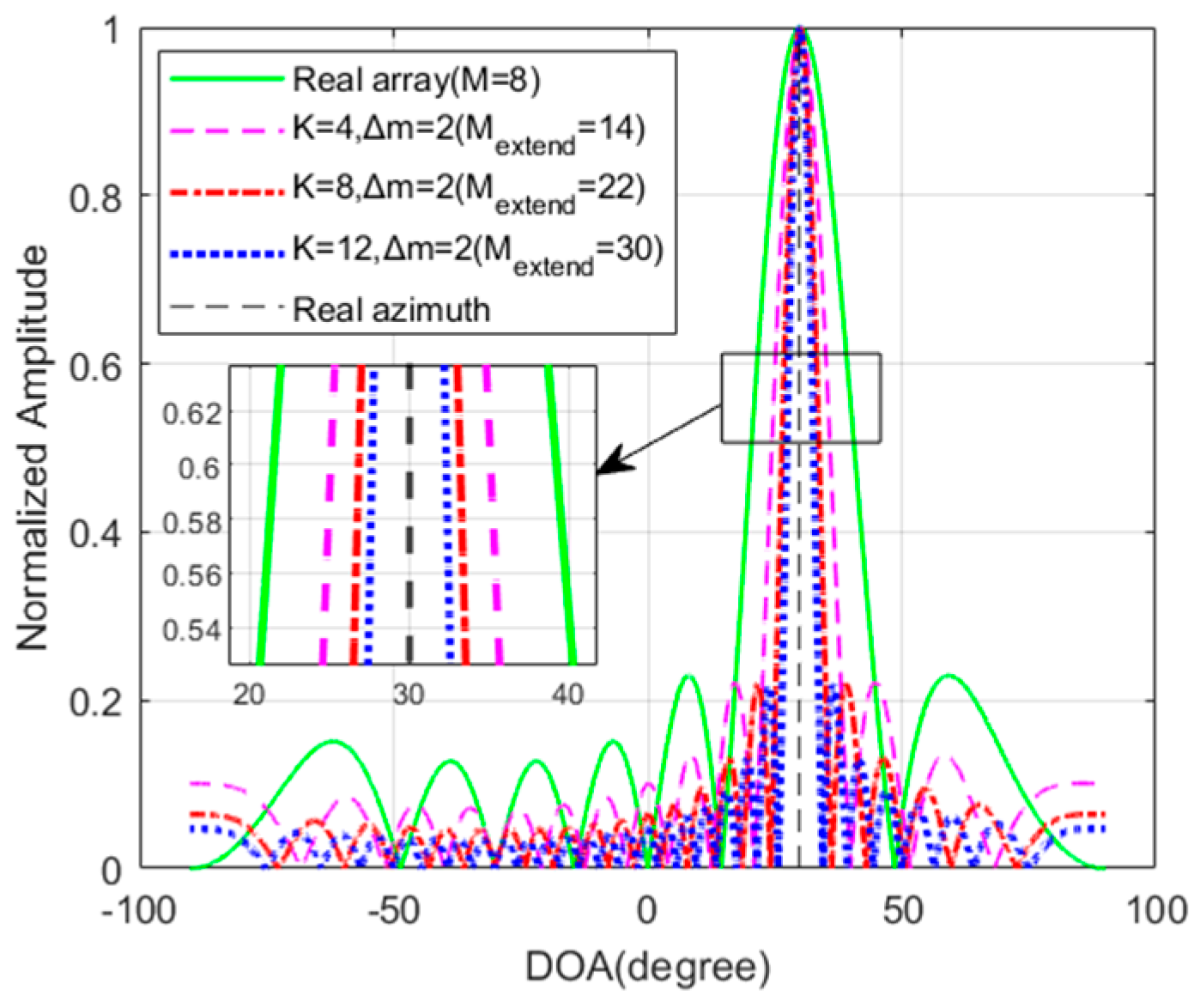
To evaluate the DOA resolution ability based on the proposed method, we present the DOA estimation results of the CBF method with different
in
Figure 13.
In
Figure 13, the green solid line represents the DOA estimation result based on the CBF method of the real array, the black dashed line represents the target real azimuth, and the other lines represent for the DOA estimation results based on CBF method of the extended array.
It can be seen that the spatial spectrum distribution of the extended array is more concentrated than the real array, which means that the proposed method for a single target can effectively extend the array aperture and enhance the target resolution ability of the DOA estimation method.
Figure 13 shows that when
remains constant, the larger the
, the larger the
, and the more concentrated the spatial spectrum distribution is, thereby resulting in a better target resolution ability.
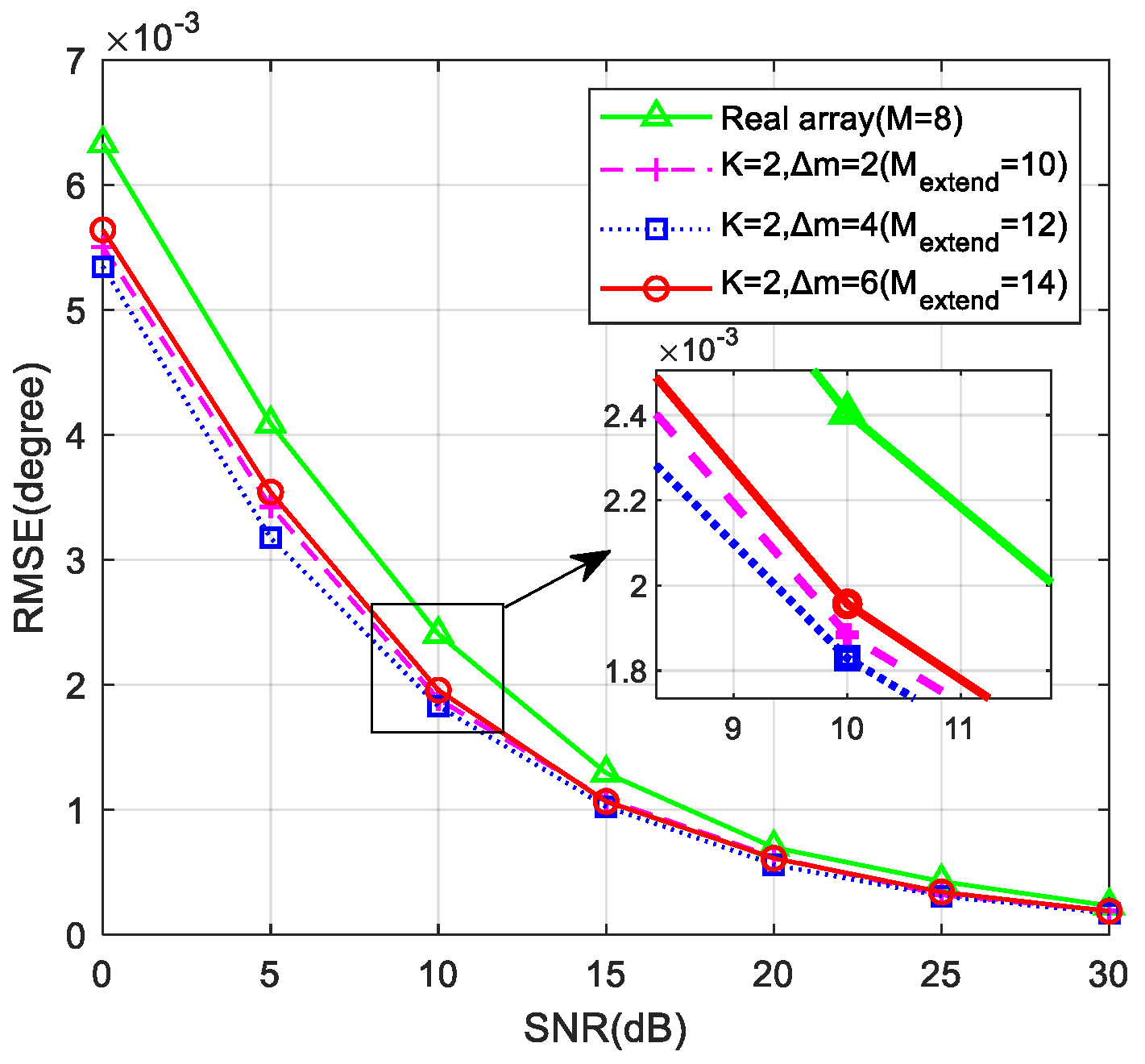
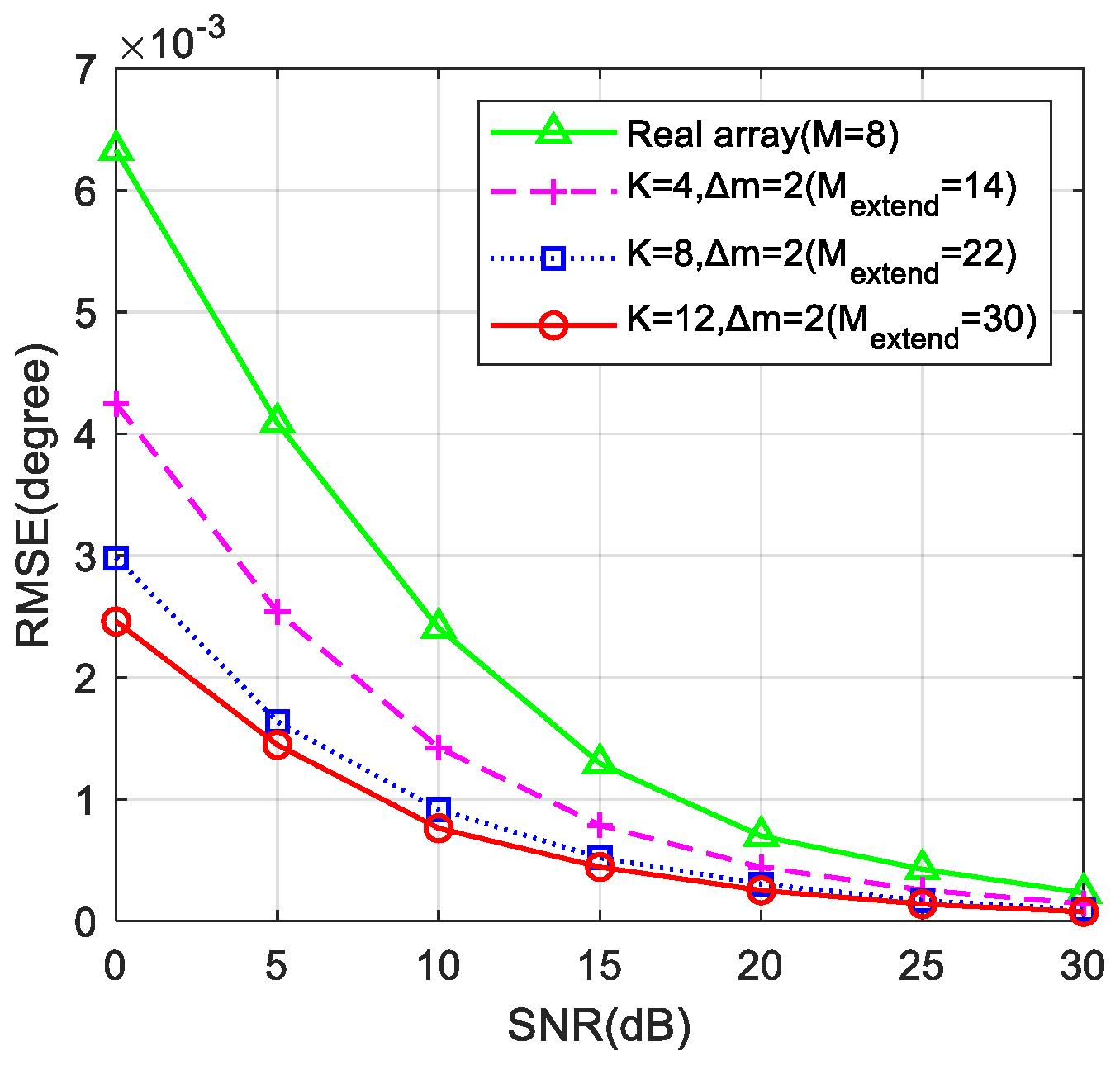
To evaluate the DOA estimation accuracy based on the proposed RD-domain virtual aperture extension, we take
and present the RMSE result in
Figure 14.
In
Figure 14, the green dotted line represents the RMSE result based on the CBF method of the real array and the other lines represent the RMSE results based on the CBF method of the extended array.
It shows that the RMSE of the proposed method is lower than that of the real array, indicating that the proposed method can effectively improve the DOA estimation accuracy. Moreover, when is constant, as increases, increases, and RMSE decreases, resulting in a higher DOA estimation accuracy. Therefore, by increasing (i.e., the virtual aperture processing time ), the DOA estimation performance for a single target can be improved effectively.
Secondly, we simulate the impact of on the proposed virtual aperture extension method by setting the parameters as follows: , .
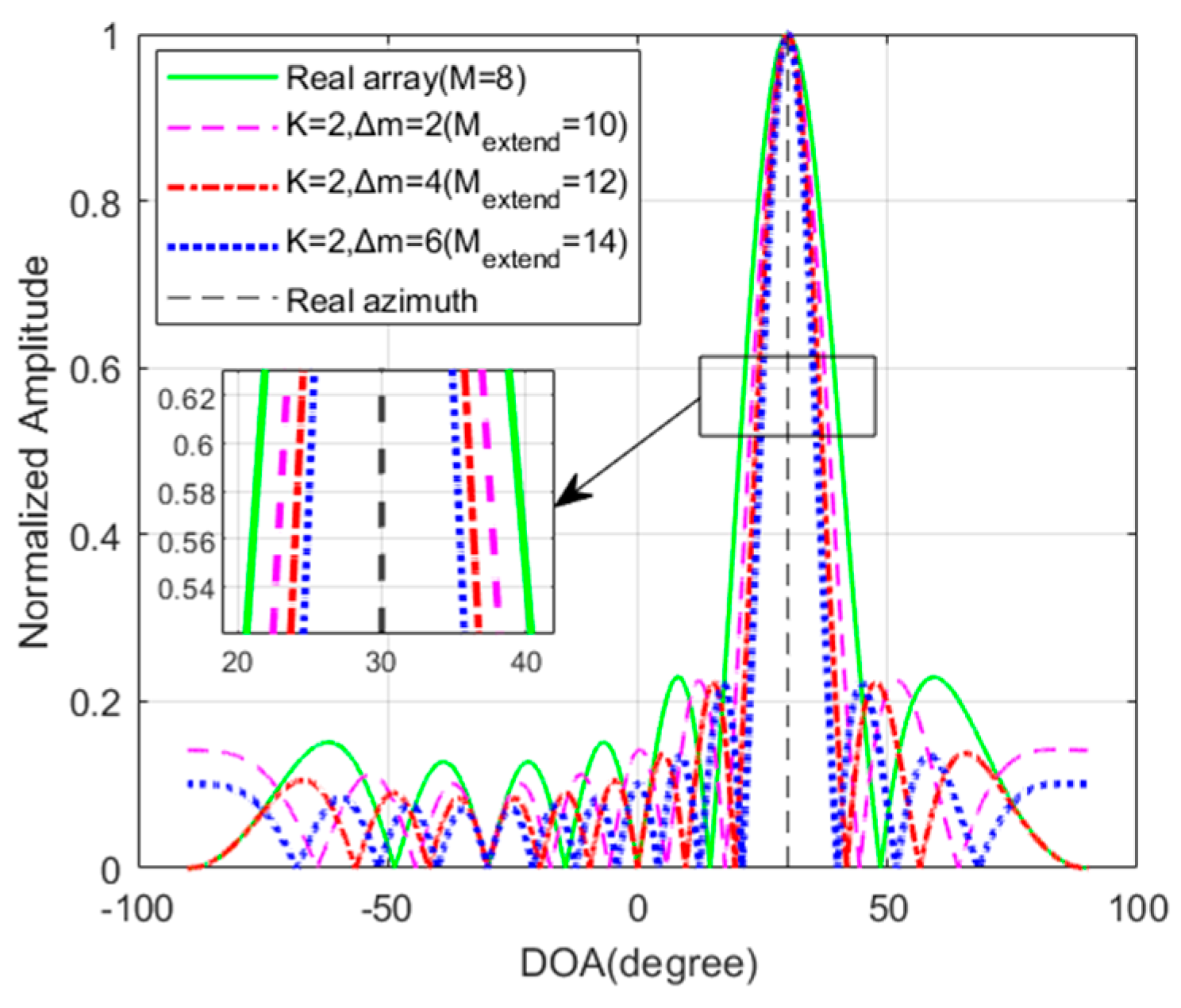
To evaluate the DOA resolution ability based on the proposed method, we present the DOA estimation results of the CBF method with different
in
Figure 15.
It can be seen that the spatial spectrum distribution of the extended array is more concentrated than that of the real array, which means that the proposed method for a single target can effectively extend the array aperture and enhance the target resolution ability of the DOA estimation method.
Figure 15 shows that when
remains constant, the larger the
, the larger the
, the more concentrated the spatial spectrum distribution is, thereby resulting in a better target resolution ability.
To evaluate the DOA estimation accuracy based on the proposed RD-domain virtual aperture extension, we take
and present the RMSE result in
Figure 16.
It shows that the RMSE result of the extended array is lower than that of the real array, indicating that the proposed method can effectively improve the DOA estimation accuracy. Moreover, when
is constant, as
increases from 2 to 4,
increases, and RMSE decreases, resulting in a higher DOA estimation accuracy. However, when
, although
increases, according to the analysis in
Section 3.4, the number of element pairs that can be used to estimate
decreases to
, which makes the calculated virtual element’s data more susceptible to noise and results in a decrease in RMSE.
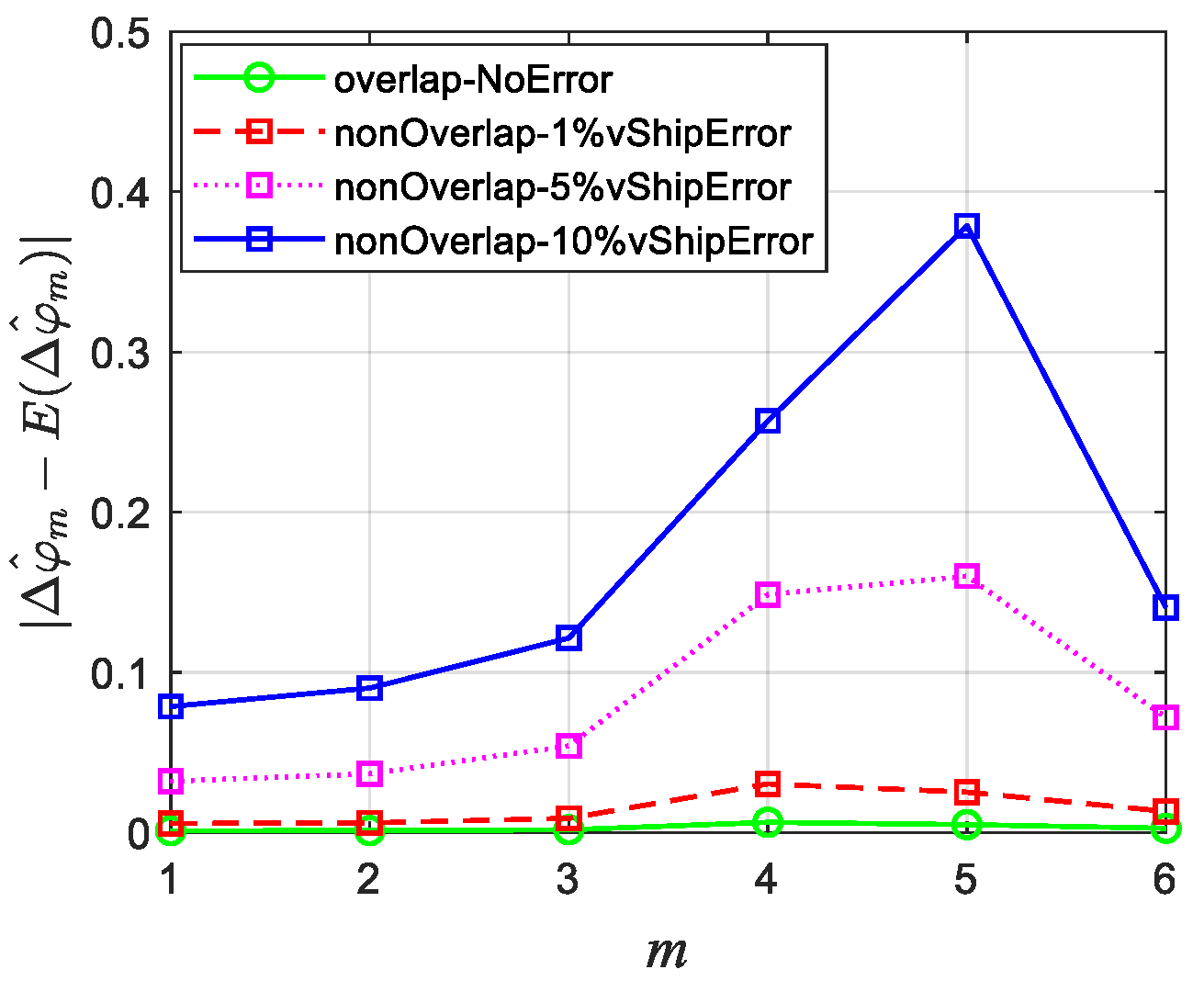
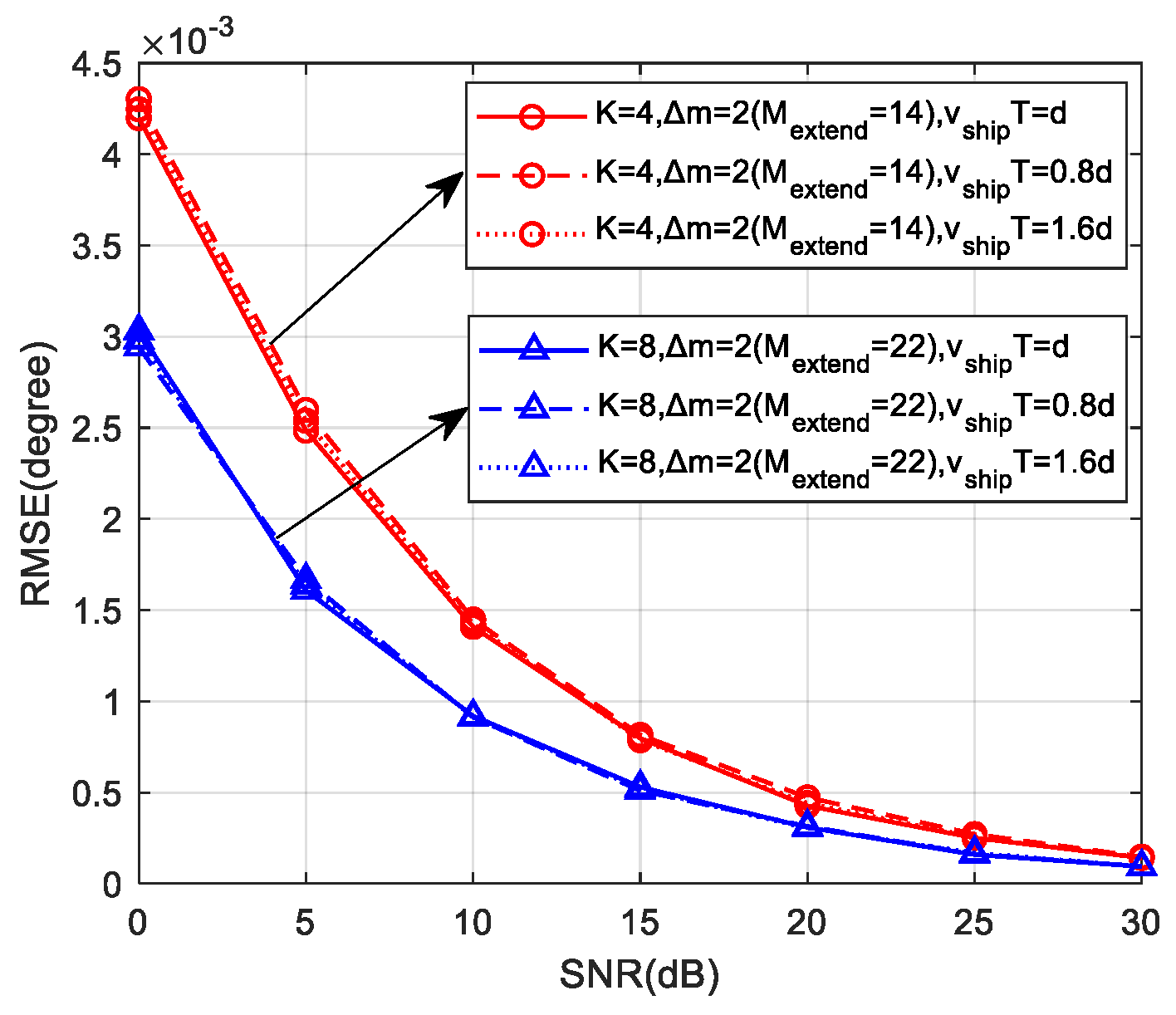
Thirdly, we verified that the proposed method for a single target in
Section 3.4 is suitable for both overlapping and non-overlapping array motion manners and is less affected by the motion manner. We take
,
, and adjust the ship speed
to achieve the ship’s non-overlapping motion. The RMSE result with
is shown in
Figure 17.
In
Figure 17, red lines represent the RMSE results based on the CBF method of the extended array when
and
and the blue lines represent the RMSE results based on CBF method of the extended array when
and
. The solid lines indicate that
(i.e., the ship moves in an overlapping manner), the dashed and dotted lines, respectively, indicate that
and
(i.e., the ship moves in a non-overlapping manner), respectively.
It shows that when and are constant (i.e., is constant), RMSE almost only changes with SNR instead of , which implies that the array of non-overlapping motion has almost no impact on the DOA estimation accuracy. That is, the proposed method for a single target is suitable for both overlapping and non-overlapping array motion manners.
5.2. Simulation of the Proposed Method for Multiple Targets
For multiple targets, according to the analysis in
Section 3.5, the number of extended array elements is
, which means that
is fixed at 2 and the size of the extended aperture is only affected by
. By setting the parameters of the two targets
and
, we simulate the impact of
on the proposed virtual aperture extension method.
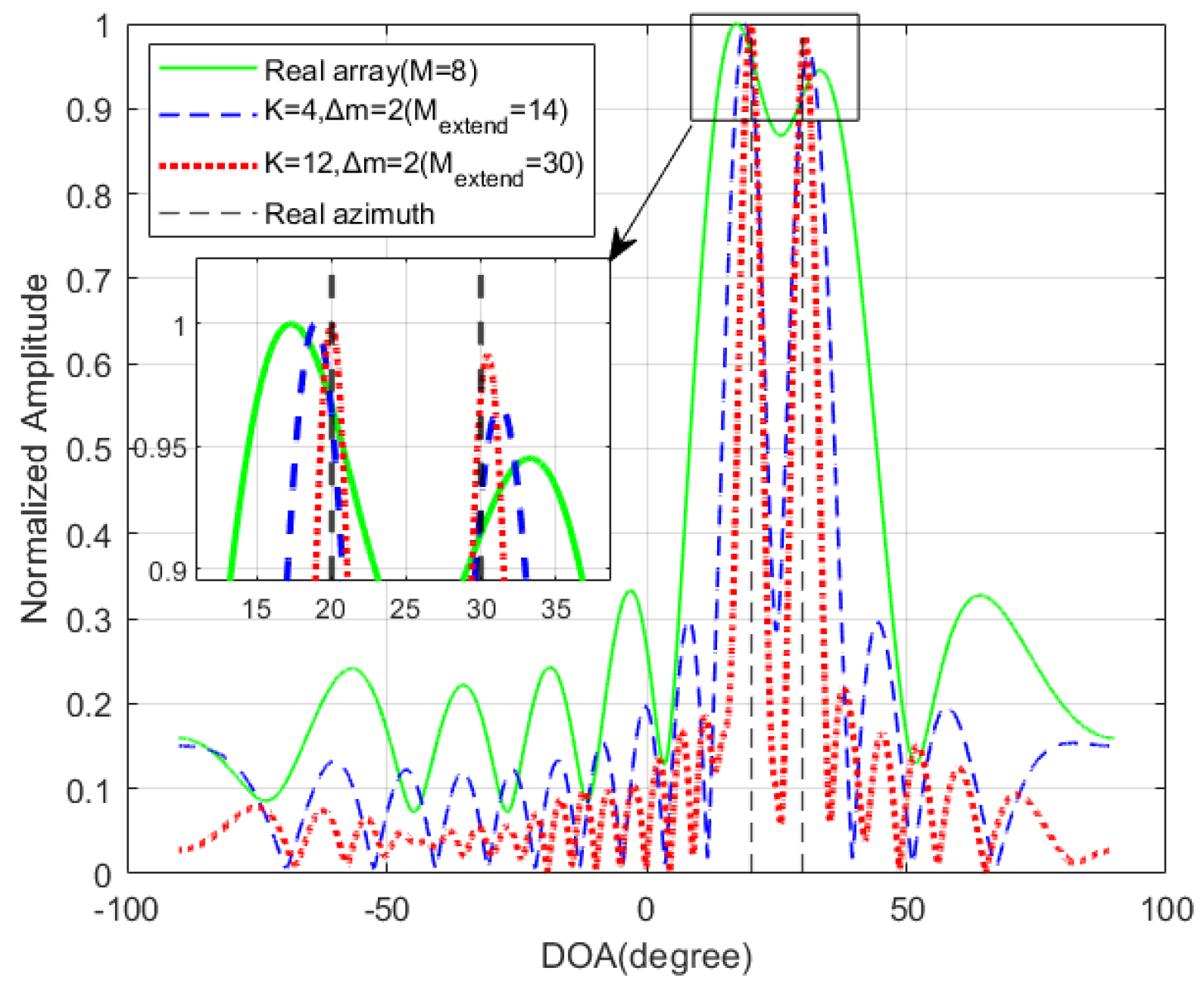
To evaluate the DOA resolution ability based on the proposed method, we set
and present the DOA estimation results of the CBF method in
Figure 18.
In
Figure 18, the green solid line represents the DOA estimation result based on the CBF method of the real array, the black dashed line represents the target real azimuth, and the other lines represents the DOA estimation results based on the CBF method of the extended array.
It can be seen that when is constant, as increases from 4 to 12, increases, the spatial spectrum of the two targets can be distinguished more easily, and the two targets’ spectral peaks are closer to the true azimuth. Therefore, the proposed method for multiple targets can effectively extend the array aperture and enhance the target resolution ability of the DOA estimation. Additionally, the larger the , the better the target resolution ability is.
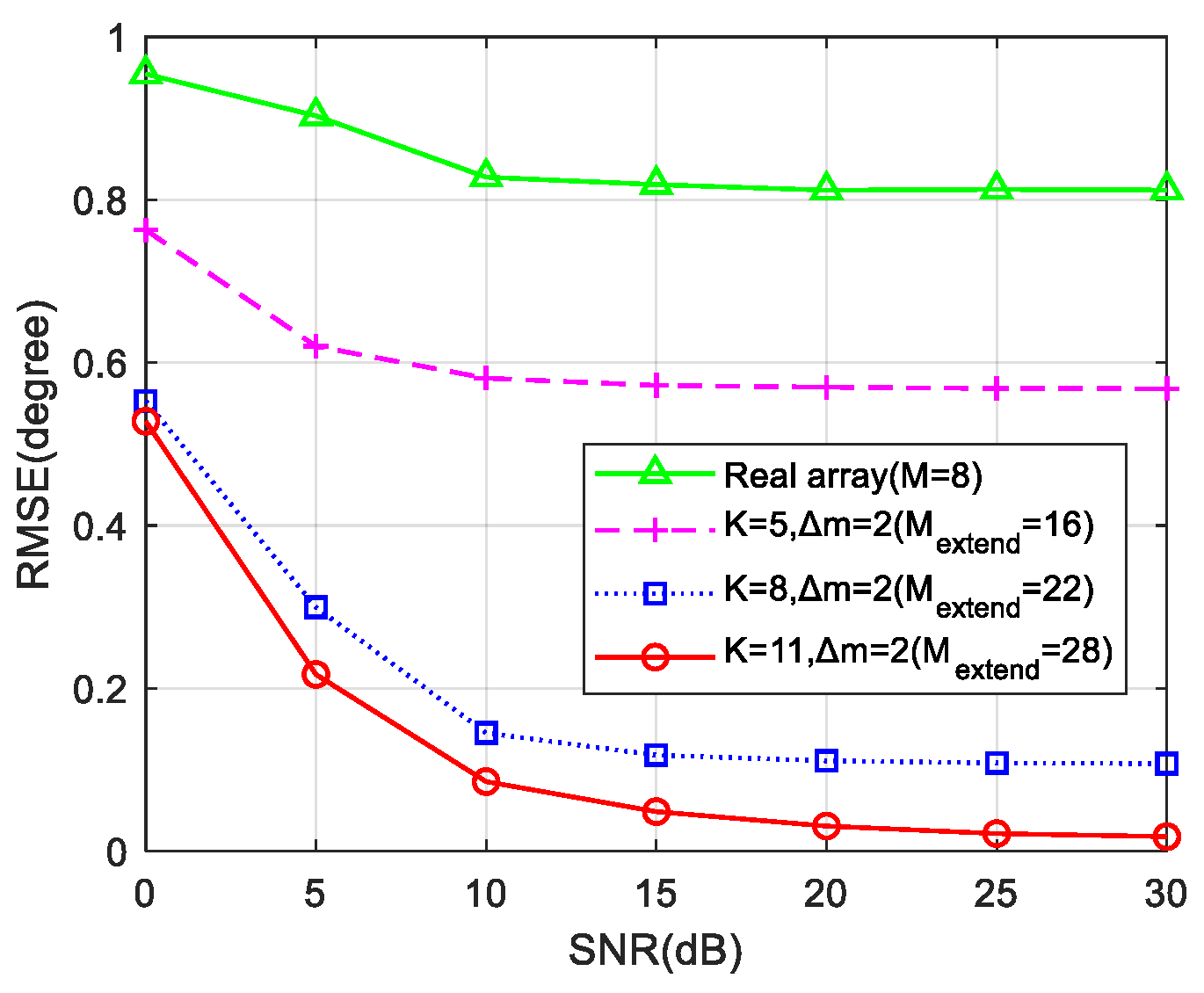
To evaluate the DOA estimation accuracy based on the proposed RD-domain virtual aperture extension, we set
,
and present the RMSE result in
Figure 19.
In
Figure 19, the green dotted line represents the RMSE result based on the CBF method of the real array, and the other lines represent for the RMSE results based on CBF method of the extended array.
It shows that the RMSE result of the extended array is lower than that of the real array, indicating that the proposed method can effectively improve the DOA estimation accuracy. Moreover, when increases, increases, and RMSE decreases, resulting in a higher DOA estimation accuracy. Therefore, by increasing , the DOA estimation performance for multiple targets can be improved effectively.
In general, as the ship moves and the virtual aperture processing time (i.e., K) increases, more virtual elements’ data can be estimated through the proposed method. Consequently, the aperture size of the extended array expands, leading to an improvement in the array’s DOA estimation performance.
6. Experimental Results and Discussion
In this section, we use experimental data to further verify the proposed RD-domain virtual aperture extension method. Due to the limitations of the current experimental conditions, we do not yet have real target echoes that meet the required conditions to validate the proposed method. Therefore, we add simulated target echoes to the experimental data to validate the proposed method.
The parameter settings are as follows: the working frequency of the radar system is about 4.7 MHz, the array is configured as an 8-element uniform linear array with an element spacing of 15 m, and the ship speed for the simulated target signals is about 7.5 m/s. Under the following two conditions, we add simulated target signals to the experimental data from various time segments.
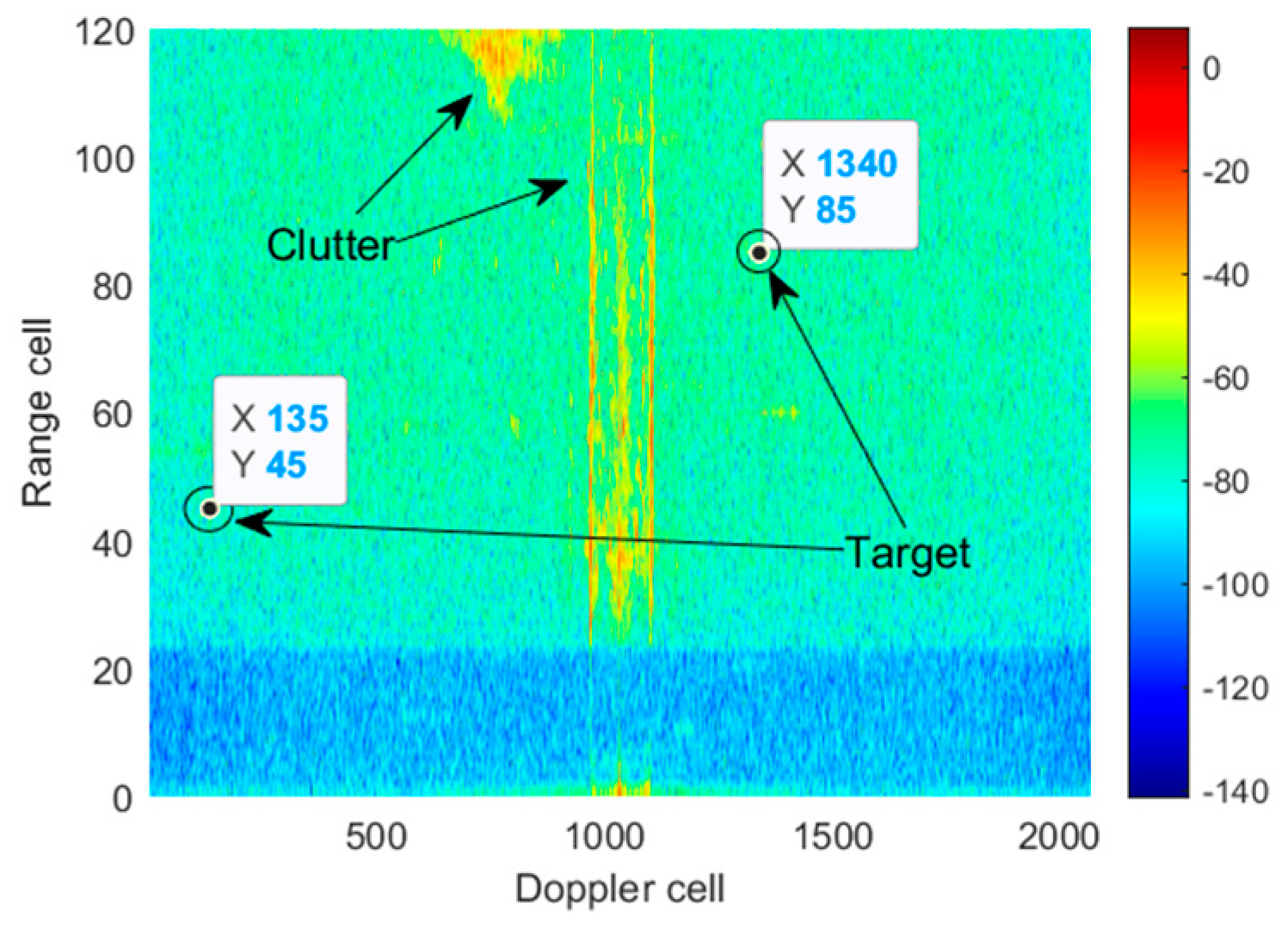
For case 1, we add simulated targets with significant differences in range or velocity parameters from clutter to the experimental data. The RD spectrum of the array element 1 in time segment 1 is shown in
Figure 20.
Here, the horizontal axis X in
Figure 20 represents the Doppler cells, while the vertical axis Y represents the range cells. The power of each RD cell is depicted using different colors according to its magnitude. We set three simulated targets in two RD cells. In a range-Doppler cell (45, 135), we set a single target with an azimuth angle of 30 degrees. In a range-Doppler cell (851, 340), we set two targets with identical range and velocity parameters, and an azimuth angles of 20 degrees and 30 degrees, respectively.
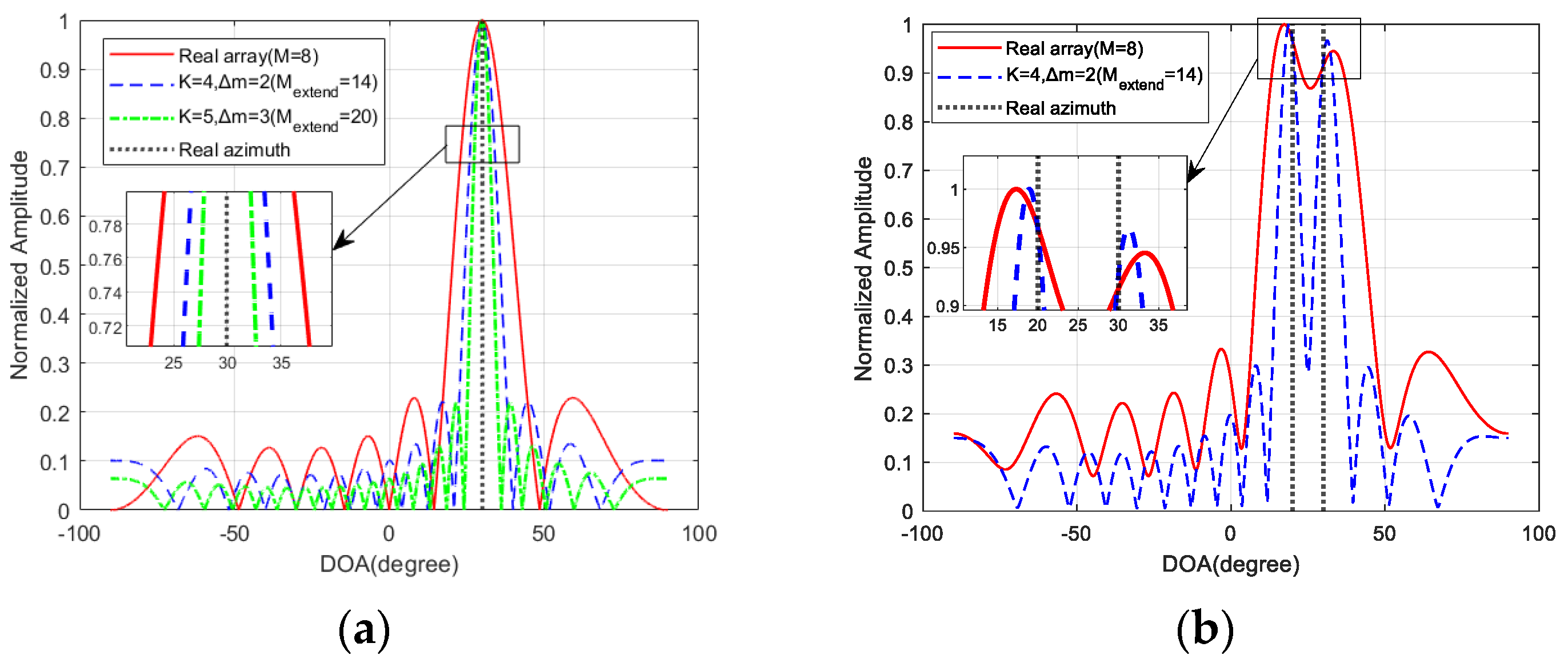
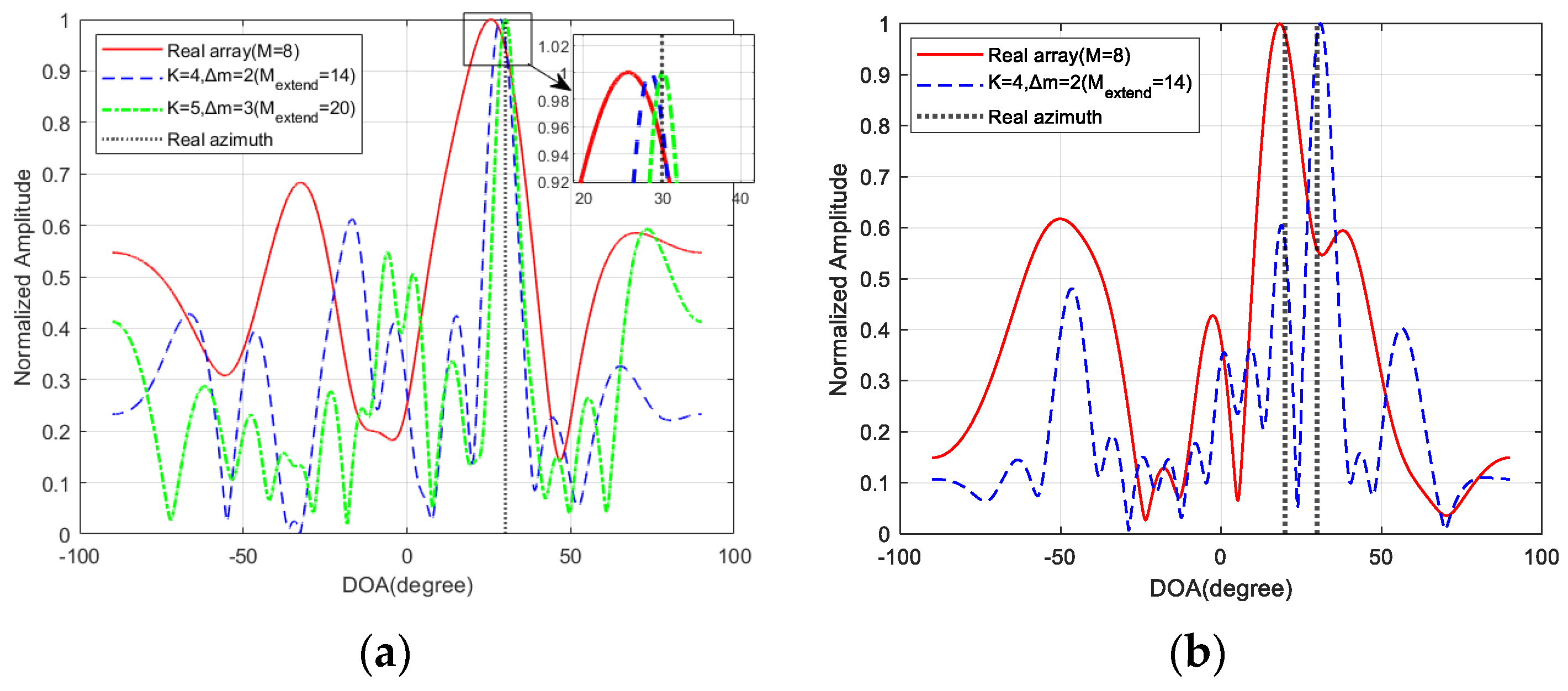
Then, using the CBF method, we perform DOA estimation on the RD cells where the simulated targets are located, as shown in
Figure 21.
Here, the red solid line represents the CBF method DOA estimation result of the real array, the blue and green dashed lines represent the results of extended array, and the black dotted lines represent the targets’ real azimuth. In
Figure 21a, it can be seen that the spatial spectrum distribution of the extended array is more concentrated than that of the real array, which means the proposed method for a single target is effective.
Figure 21b shows that the two targets’ spatial spectrum of the extended array can be distinguished more easily than that of the real array, which means the proposed method for multiple targets is effective.
Table 2 presents the numerical results of DOA estimation error for case 1; it can be seen that the DOA estimation error of the extended array is smaller than that of the real array, representing a higher DOA estimation accuracy. Moreover, as the number of virtual array elements increases, the DOA estimation accuracy improves accordingly.
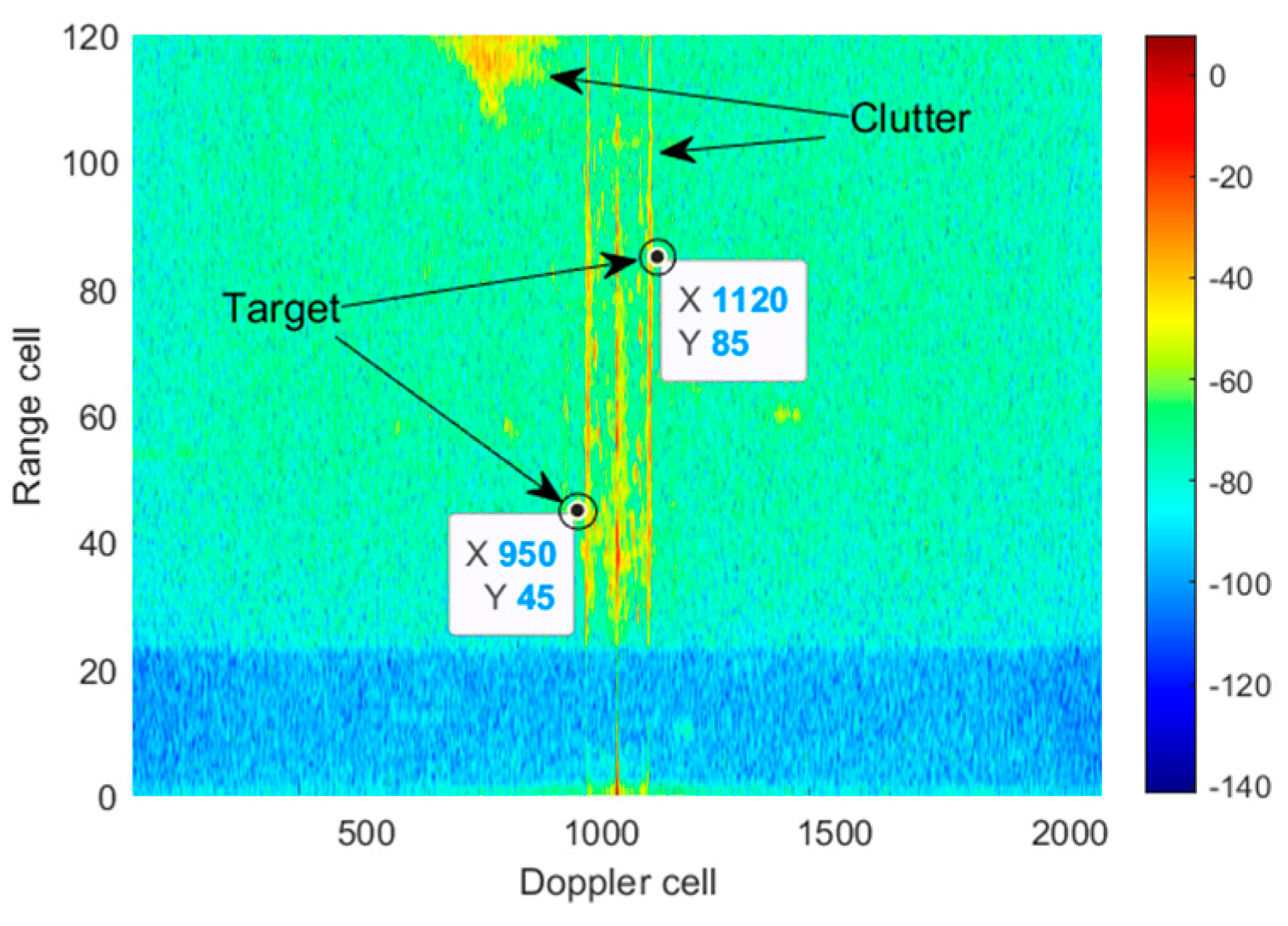
For case 2, we add simulated targets with range and velocity parameters close to the clutter into the experimental data. The RD spectrum of the array element 1 in time segment 1 is shown in
Figure 22.
In this case, we also set three simulated targets in two RD cells. In a range-Doppler cell (45, 950), we set a single target with an azimuth angle of 30 degrees. In a range-Doppler cell (851, 120), we set two targets with identical range and velocity parameters, and azimuth angles of 20 degrees and 30 degrees, respectively.
Then, using the CBF method, we perform DOA estimation on the RD cells where the simulated targets are located, as shown in
Figure 23. It can be seen that the targets’ spatial spectrum of the extended array is more concentrated and easier to distinguish than that of the real array, which means the proposed method is effective. However, due to the effect of clutter, the target data extracted from the RD unit may be inaccurate, resulting in a decrease in DOA estimation performance in case 2 compared to case 1. In this case, clutter suppression may improve the performance of DOA estimation, which may be analyzed in our future research.
Table 3 presents the numerical results of DOA estimation error for case 2. Compared to case 1, the DOA estimation accuracy in case 2 may decrease due to the effect of clutter. However, it can be seen that the DOA estimation performance of the extended array remains superior to that of the real array and continues to improve as the number of virtual array elements increases.
7. Conclusions
This paper proposes an RD-domain virtual aperture extension method to address the problem of small aperture and poor DOA estimation performance for shipborne HFSWR. Through this method, we effectively extend the array aperture and improve the DOA estimation performance of shipborne HFSWR. The summary of this paper is as follows. Firstly, we establish a continuous motion model based on the validity of far-field assumption and provide a novel flowchart for the proposed method. Secondly, based on the signal time–domain segmentation model, we derive the proposed RD-domain virtual aperture extension method for a single target and multiple targets. Thirdly, we analyze the performance of the proposed method through simulations. Finally, we verify the proposed method through simulation experiments and experimental data.
In general, this work has the following implications. (1) By extending the traditional time–domain virtual aperture extension method to the RD domain, targets in strong clutter backgrounds can be distinguished, and therefore, the target resolution capability can be improved through virtual aperture extension. (2) Based on the RD-domain processing, targets with different ranges or velocities can be separated, thereby allowing the application of the virtual aperture extension method to them. (3) In the case of a single target, it does not require the array to move in an overlapping manner.