


Abstract
The large scale of China’s photovoltaic (PV) industry and the great policy support by the Chinese government make it necessary to scientifically evaluate PV industry policy. This study designed an evaluation framework for China’s PV industry policy from four dimensions (policy measure, policy type, policy strength, and policy issuing department) to categorize and quantify China’s 307 PV industry policies from 1994 to 2016. Furthermore, the historical evolution and realistic effect of the policies on the PV industry in China were examined. The results show that, currently, grid support, operation specification, and operation supervision are the main policy measures, while a low-level notice is the main type of policy. The policy issued strength is generally low. The enforcement strength of regional policy presents descending trend from the northern to the southern provinces, and a similar trend from coastal provinces to inland provinces. The policy for grid support, operation specification, and technical specification has had the best effect. The most effective policy types are the sector-specific notices and announcements, and the best policy-issuing department is the National Energy Administration. In terms of policy strength, the policy for grid support, operation specification, and operation supervision has had a positive correlation with the development of the industry, although it did not achieve its desired effect.
1. Introduction
Solar energy is a renewable power source that is an ideal replacement for fossil fuels in the future. In recent years, the solar photovoltaic (PV) market has grown rapidly around the world. According to the data from the International Energy Agency, the average annual growth rate of PV power generation exceeded 40% from 2006 to 2016 [1]. By the end of 2016, the new PV installed capacity reached 75 GW globally, and the cumulative PV installed capacity increased to 303 GW [1]. In China, the PV industry started in 2004. The cumulative PV installed capacity grew from 850 MW in 2010 to 78,070 MW in 2016, and the newly-installed capacity in 2016 was 34,540 MW [2]; consequently, China’s cumulative and new installed capacity are ranked first in the world [2]. Since 2004, the Chinese government has paid much attention to the development of China’s PV industry, and has issued relevant industrial policy from the multiple perspectives of financial subsidies, tax incentives, technical support and grid service to encourage and support the solar PV industry.
Now, the scale of China’s PV industry is leading the world, and the government still strongly supports the further development of this industry. While many problems restrict the development of the industry, the main performance obstacles are a lack of a clear borders between the government and the market and industrial regulation failure [3,4,5]; difficulties in grid connection, coordination, and planning problems between PV power generation and power grid construction [5,6,7]; lack of independent innovation capability and core technology [5,6], and a lag in technical standards [8,9,10,11]; international environmental deterioration, financial system flaws, risk transfer mechanism deficits, and lack of innovative financial products [6,12]; and the government blindly carrying forward the PV industry, and the abuses of financial subsidy policy [5,8,9]. On the one hand, there is continuous expansion of the operation scale and the continued investment of government policy, but on the other hand there is the difficulty in breaking through the existing technology and innovation bottleneck, both of which lead to China’s PV policies being questioned. It is urgent to scientifically evaluate the implementation effect of PV industry policy in China.
Currently, some foreign studies related to the effect of the photovoltaic industry policy have been conducted. It mainly focused on specific policy measures to establish a new evaluation index of the PV market. The research mainly employed quantitative analysis methods. Dusonchet and Telaretti [13] and Sarasa-Maestro et al. [14] performed a comparative economic analysis through the main support measures (feed-in tariffs and tradable green certificates) implemented in Western EU countries, based on the calculation of the cash flow, the net present value and the internal rate of return indices, which can assess the effectiveness of PV energy policies in different Western European member states. Shrimali and Jenner [15] assessed the effectiveness of 12 state-level policies on the cost and deployment of solar photovoltaic, it showed that cash incentives and tax incentives would increase the initial cost commercial system deployment and reduce the initial cost of PV installation. The similar studies have been found in the research of Sarzynski [16] and Kwan [17]. Most Chinese studies on PV industry policy are mainly qualitative analyses and case studies. Zhang et al. [18] examined the similarities and differences between the development trajectories of wind power and solar PV power in terms of development status, development policy, and development trends. Zhi et al. [4] examined the development history of China’s PV industry policy system from the perspective of industrial policies, and conducted a comparative analysis among China, United States, Germany, and Japan from the perspective of both the supply- and demand-side policies. There are few Chinese studies on the effect of PV industry policy available. Some studies considered policy factors to analyze the economic benefits of photovoltaic industry [19,20] and some scholars have studied the effectiveness of incentive policies of PV industry [21,22,23]. However, based on the limited studies on China’s PV policies, the literature only focuses on a group of photovoltaic industry policy and the logic analysis, which cannot explain the China’s PV policies and its relation to the development of the industry. The studies consider policy to discuss China’s photovoltaic industry policy measures, policy types and policy strength, which is missing. There is also a lack of a systematic photovoltaic policy system to study the evolution and effect of China’s photovoltaic industry policy.
This paper attempts to construct an evaluation system of China’s PV industry policy based on four dimensions: the policy measures, policy types, policy strength, and policy issuing departments. Then, according to the evaluation framework, we categorize and quantify China’s PV industry policies, and analyze the historical evolution and implementation effect of these policies based on the four dimensions. Lastly, we propose some suggestions to enhance the effectiveness of China’s PV industry policy and improve future industrial policy.
The rest of this paper is organized as follows: Section 2 introduces the design theory of the evaluation system; research methods are introduced in Section 3; Section 4 analyzes the evolution of China’s PV industry policy and evaluates the effect of China’s PV industry policy; and Section 5 provides conclusions and policy implications.
2. Design Theory of Evaluation System
There is an increasing amount of research on the effects of policy, and most studies are based on the analysis of the effect of policy instruments. Rothwell and Zegveld [24] analyzed technical innovation policies from three dimensions (demand, supply, and environmental instrument), and many scholars since have enriched the three-dimensional evaluation framework and applied it to study the performance of policy instruments. For example, Amp and Francis [25] considered the influence of the types and fields of scientific and technological activities to construct a three-dimensional framework of public science and technology policy, and used it to study the science and technology policy system. Su et al. [26] built a two-dimensional analysis framework of China’s innovation policy, and studied the role of China’s innovation policy in promoting the new-energy vehicles industry by combining the three-dimensional policy instrument with the innovation value chain (i.e., research and development, industrialization and marketization). Li and Wang [7] constructed a two-dimensional analysis framework of China’s PV industry policy and analyzed the existing problems of these policy instruments by combining the three-dimensional policy instrument with life cycle theory of industrial development.
Research on the effect of policy should avoid an analysis that considers only the perspective of the policy instrument. Rather, an acceptable analysis should combine several aspects, such as policy strength, policy objective, and the policy-issuing department. Breslin [27] quantified central and local governments’ foreign direct investment policies from 1978 to 2000, and empirically studied the effectiveness of China’s foreign direct investment policies on the basis of the policy measures dimension. However, the selection of policy measures was limited and the study did not consider policy strength. Huang [28] analyzed the historical evolution of China’s 1980–2005 innovation policy on the basis of policy strength and policy type. However, the study was only a descriptive statistical analysis of innovation policy, and it did not involve a study of policy content. Peng et al. [29] quantified China’s technological innovation policy on the basis of policy strength, policy measure, and policy objective, and studied the evolution path and performance of China’s technological innovation policy. Wang et al. [30] combined policy content with policy strength in their research of China’s wind power industry policy, and considered policy departments and the form of policy formulation.
At present, there is no systematic evaluation framework for analyzing the effects of policy, but evaluations from the perspective of policy instruments or means are common. In addition, Schneider and Ingram [31] thought that the research on the effect of policy should be studied on the basis of the policy objective, policy implementer and policy measures. Peters [32] believed that, in addition to considering the policy instruments, research to analyze and evaluate government policy needs to include policy issues and policy management.
Learning from the above literature, we concluded that an evaluation framework for examining the effect of policy should cover three dimensions: policy means (or measures), policy types and policy strength. In addition, according to Wang et al. [30], an evaluation framework also should consider the policy issuing department. Thus, we constructed the framework for evaluating the effect of China’s PV industry policy based on four dimensions: the policy measure, policy type, policy strength, and policy issuing department.
3. Research Methodology
3.1. Sorting and Quantifying China’s Photovoltaic Industry Policy
Policies regarding the PV industry were collected from the Law Information Database of Peking University [33]. These were retrieved using key words, such as ‘photovoltaic’, ‘solar energy’, and ‘renewable energy’ to search the full text of policies and regulations and identify the policy text most closely related to the PV industry. Finally, to ensure the integrity and accuracy of the policy text, we supplement the PV industry policies and regulations by examining the websites of the government departments that issued the policy.
Furthermore, to ensure the representativeness of the selected policies and regulations, selection was based on the following criteria: (1) select national and regional PV industry policies issued at the provincial level and above; (2) select only policies that are closely related to the PV industry policy (thus excluding policies that refer to renewable energy); (3) consider the main types of policies to be laws, regulations, and normative documents; and (4) select policy texts that were issued before 31 December 2016.
A total of 307 PV industry policies were selected for evaluation (Appendix B). 173 regional policies are included. These were organized and quantified according to promulgation time, promulgation department, policy type, legal validity and policy measures. Since the research objective was the policy variable, the content validity of the final policy quantification can be guaranteed.
3.1.1. Policy Measure
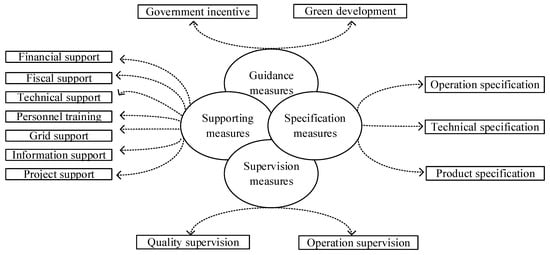
According to the difference of the Chinese government’s roles in the PV industry policy, the PV industry policy measures were divided into four types: guidance policy measures, supporting policy measures, specification policy measures, and supervision policy measures (hereinafter referred to as guidance measures, supporting measures, specification measures, and supervision measures, respectively). These four aspects encompass a total of 14 small groups as shown in Figure 1. We used the binary method to code the virtual variables for the policy measure dimension. If a policy adopted a policy measure, the value of the corresponding variable was assigned a value of 1; otherwise, it was assigned 0. Considering that a single policy may have adopted a variety of policy measures, each policy measure involved in the policy was assigned a value of 1, while other variables that were not involved were assigned a value of 0.
Figure 1.
The classification of photovoltaic (PV) industry policy measures.
3.1.2. Policy Type
Although laws and policies are different, they are interrelated. Policy and law both have an impact on the development of the photovoltaic industry, but the impact efforts and angles are different. Therefore, in this dimension, the law is incorporated into the research as a formalized and standardized policy form. We referred to Peng et al. [29] when quantifying the types of technological innovation policies. The paper adopts the five-level rating assignment method for the policy type of photovoltaic industry based on the different administrative power structure of the policy enacting department. The scoring standard is: (5) laws promulgated by the National People’s Congress and its Standing Committee (“Laws” for short); (4) regulations issued by the State Council and the orders of Ministries (“Regulations and Orders” for short); (3) interim regulations, decisions, opinions, and rules promulgated by the State Council, as well as the regulations, rules, and decisions of Ministries (“Opinions and Rules” for short); (2) opinions, outlines, planning, measures, and interim provisions (“Measures” for short); and (1) notices.
In our classification, the higher the level of the policy type, the higher its corresponding score. Considering that a policy might have been jointly issued by a number of departments, the score was calculated based on the best match between the issuing department and policy type.
3.1.3. Policy Strength
The policy strength dimension refers to the ideas of Wang et al. (2016) [30] about establishing a standard for policy strength. We scored the PV industry policies according to implementation strength. According to differences in the level of detail and implementation strength of the 14 policy measures that were examined, we used a five-grade scoring method for each policy. The more detailed policy measures and those with greater implementation strength were assigned higher scores (Appendix A). The table in Appendix A was compiled by a professor who had studied the photovoltaic industry. Each policy was evaluated by three experts who independently scored the policies according to the table in Appendix A. When scoring was completed, the experts comparison-tested the results. Finally, the results were collated by two graduate students.
Policy strength has a specific time continuity. The policy measures not only affect the PV industry in the year of promulgation, but accumulate in their effect over time until they are repealed. We drew on Peng et al. [29] and classified the strength of PV industry policy on the basis of “issued” strength (Equation (1)) and “enforcement” strength (Equation (2)). In Equation (1), represents the issued strength of the photovoltaic industry policy in year i, while in Equation (2) represents the enforcement strength of the PV industry policy in year i. In both equations, i represents the year () and j represents the PV industry policy (), represents the policy strength of the PV industry policy j issued in year i (), represents the corresponding value of the policy type of PV industry policy j which is issued in year i (, and represents the number of PV industry policies issued in year i:
3.1.4. Policy Issuing Department
Many departments are involved in the study of the PV industry policy, and there are subordinate relations and historical evolution problems between departments. These factors increase the difficulties of researching the policy departments of China’s PV industry. We considered the departments that still existed in 2016. Since the State Council (SC) and the National Development and Reform Commission (NDRC) are the authorities of PV policy, the National Energy Administration (NEA) is the sector that issued the largest number of the PV industry policies. We chose only these three representative departments for issuing of PV industry policy. The remaining departments as other departments, and it has no specific number differences in other departments (OD). As for other dimensions, we used a binary method (0 or 1) for assigning virtual variables for the policy issuing department dimension. Considering the policies may be jointly promulgated by multiple departments, each department involved in issuing a policy was assigned a value of 1, and the other departments that were not involved in the policy were assigned a value of 0.
3.2. Data Resource
In order to test the effect of PV industry policy on industrial development, we made a regression analysis to the four dimensions (policy measures, policy types, policy strength, and policy issuing department). The policy data came from the 307 PV industry policies that were quantified as described in Section 3.1. Typically, the installed capacity and generating capacity of renewable energy sources are used to evaluate the effect of renewable energy policies [34,35]. We chose the new PV installed capacity as the index of the effect of PV industry, and the original data were first processed using a logarithm so as to avoid the interference caused by the original data units and the difference of magnitude in the original data. The new PV installed capacity data were obtained from the BP Statistical Review of World Energy 2017 [2].
4. Results
4.1. Evolution of Policy Measures
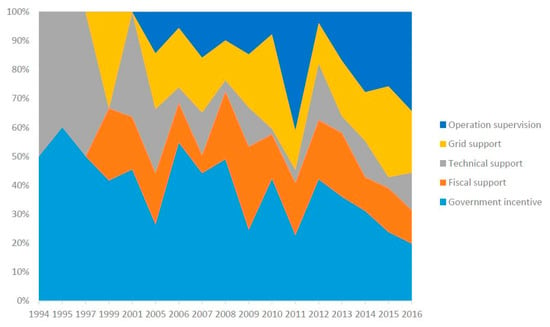
As shown in Figure 2, the five most important contributions to the enforcement strength intensity of policy measures for the national PV industry are government incentive, grid support, operation supervision, technical support, and fiscal support. In the early stage of China’s PV industry, the government mainly issued incentive policies and gave technical supports to enhance the innovation capacity and provide “soft” power for the development of the industry. The government continues to provide substantial financial and tax support for the PV industry, which are important forces to stimulate the development of the industry.
Figure 2.
The main national-level policy measures of China’s photovoltaic industry.
Since the promulgation of the ‘renewable energy law’ in 2005, the Chinese government has gradually realized the urgency of solving the grid connection problem in China’s PV industry. Then it issued a series of policy measures to solve the problem. In 2011, the NDRC issued a ‘Notice on improving the feed-in tariff policy of solar photovoltaic power generation’. The NDRC made a unified national solar photovoltaic benchmark tariff, which has had landmark significance for domestic PV applications. In 2013, the SC issued ‘Opinions on promoting the healthy development of photovoltaic industry’, which resulted in some policy measures to further support the applications of PV power generation in terms of price, tax, subsidies, grid connection and other aspects. The grid problem has been alleviated to some extent, but a complete solution to this problem is still far away.
In addition, with the rapid development of the PV industry, non-standard operation in the industry gradually emerged, such as overcapacity in the polysilicon industry, the serious phenomenon of abandoning light and power in some areas, and the disorderly operation of PV power stations. These problems still restrict the development of the PV industry. Therefore, policy measures of the Chinese government mainly focus on the operation specification and supervision of the PV industry that have developed in recent years.
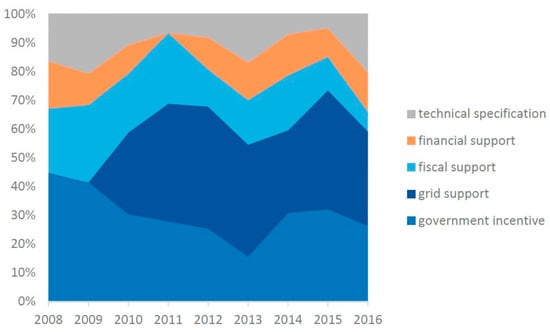
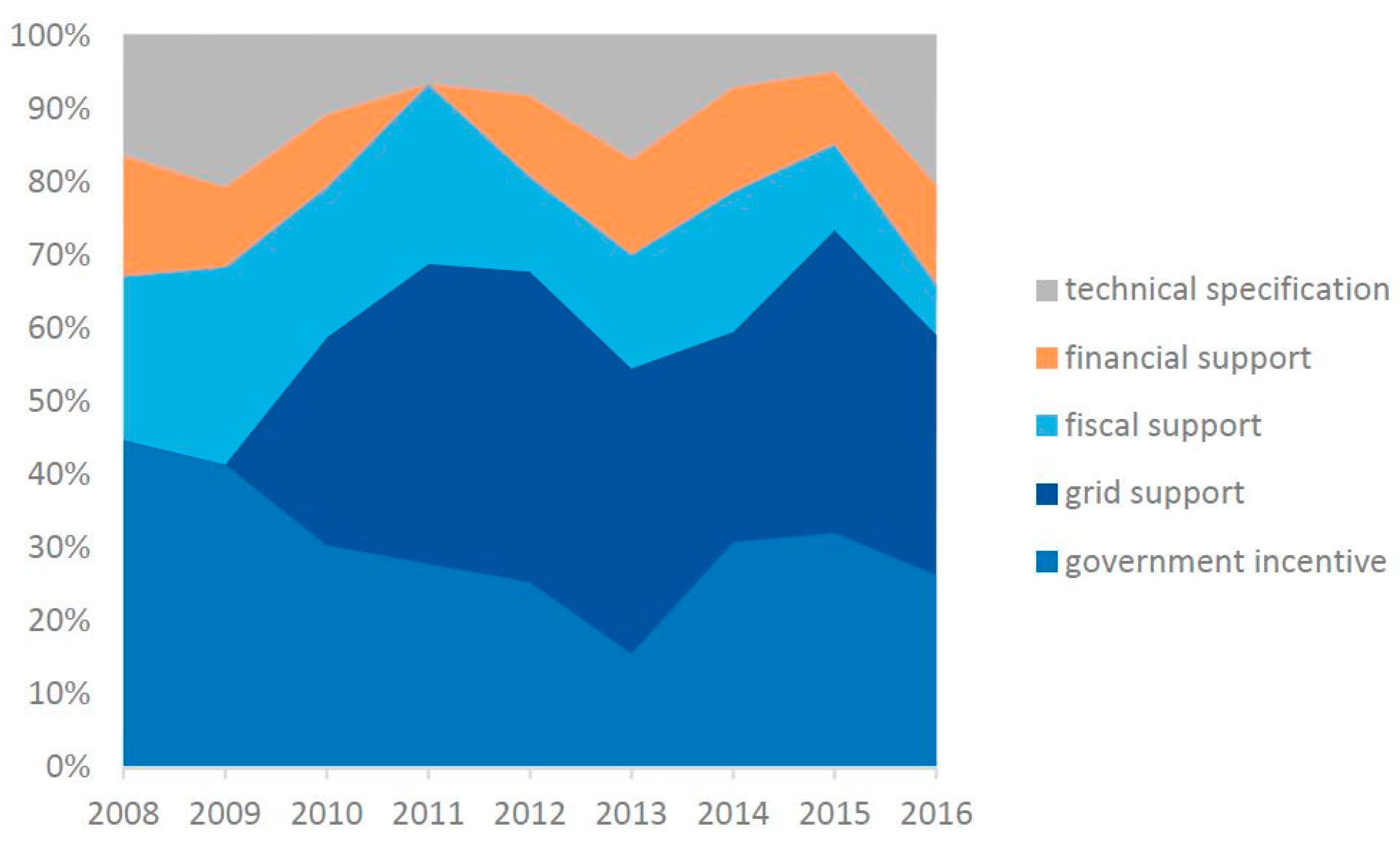
In terms of regional policy measures, the five most important contributions to the enforcement strength intensity of policy measures for the regional PV industry are government incentive, fiscal support, financial support, grid support, and technical specification (Figure 3). Regional PV policy can be promulgated later. Similar to the national-level PV policy, the regional policies put more emphasis on government incentive, fiscal support policy to promote the development of the PV industry. Regional governments pay more attention to the photovoltaic power grid problem, which provides a great deal of grid support. Currently, compared with the national-level policy, the regional policy focuses more on the establishment and improvement the industrial standard system.
Figure 3.
The main regional policy measures of China’s PV industry.
4.2. Evolution of Policy Types
As Table 1 shows, most of the 307 policies examined were promulgated in the form of low-level notices, opinions, and measures. The value assigned to these policies is 1 and the quantity is relatively large; in contrast, the quantity of higher assignment policies is relatively small. This reflects a lack of authority in China’s PV industry policies. The development of China’s PV industry is immature. The government has adopted a large number of low-level, low-strength supporting measures, while the industry lacks powerful specification and supervision measures. Thus, these policy measures have failed to achieve the desired implementation effect.
Table 1.
The main policy types of China’s PV industry.
4.3. Evolution of Policy Strength
4.3.1. Evolution of National-Level Policy Strength
The PV industry policy measures not only affect the industry in the promulgation year, but also have an accumulative effect until they are repealed. Therefore, as described in Section 3.1.3, the strength of the PV industry policies was based on the issued strength and the enforcement strength.
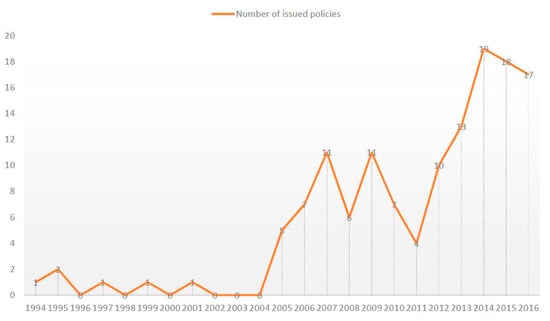
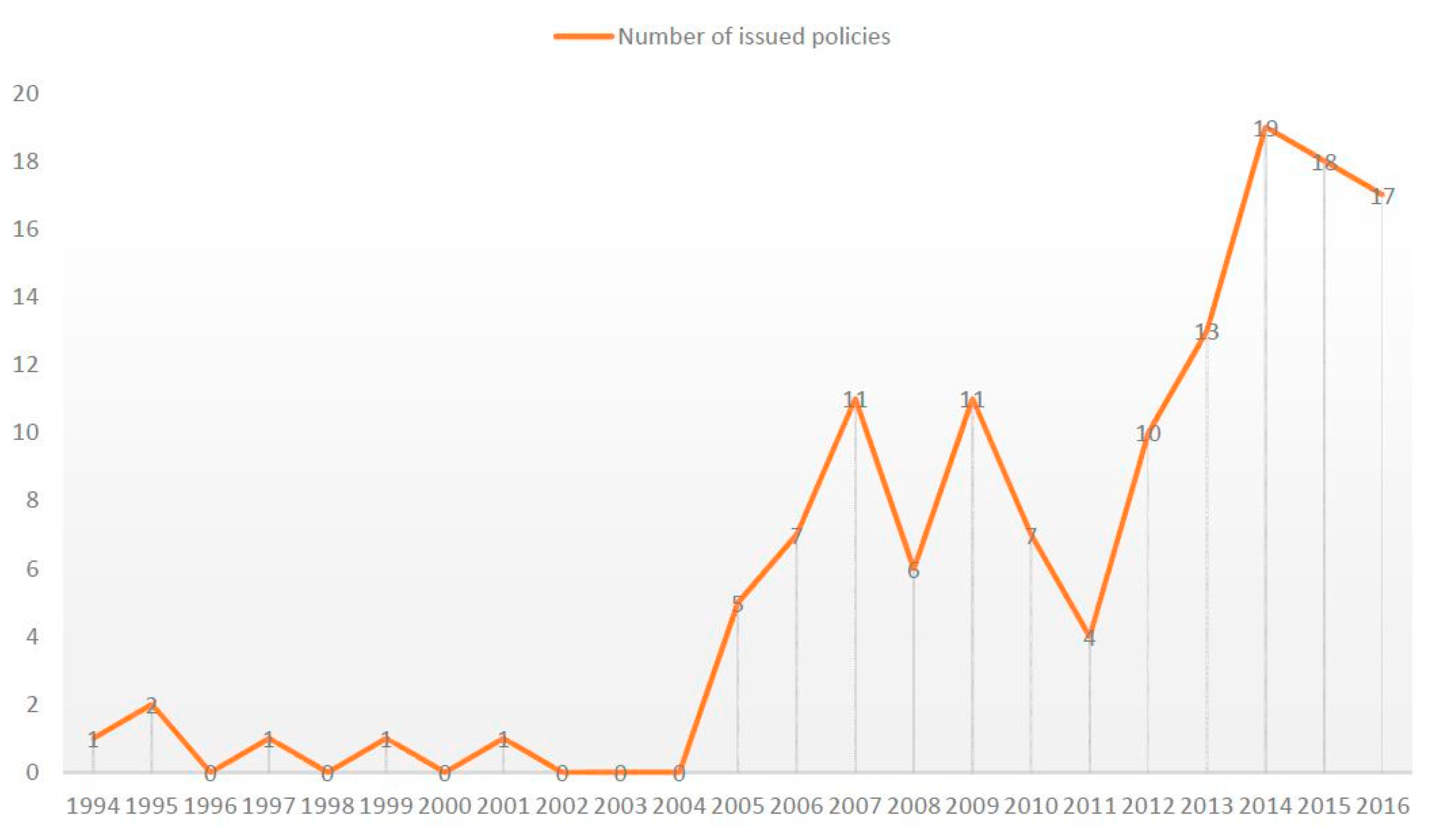
As Figure 4 shows, the average number of China’s PV industry national-level policies issued per year was 1.4 items from 1995 to 2004, but was zero in some years. It can be seen that the issuing of China’s PV industry policy lacks continuity, which is related to the background of the reform of government institutions during the study period. Since 2005, the government has gradually attached importance to the development of the PV industry, and the number of PV industry policies issued by relevant institutions has been growing rapidly, especially from 2007 to 2009 and from 2012 to 2016. In 2005, the government promulgated the ‘Renewable Energy Law of the People’s Republic of China’, which provides the relevant legal basis for the development of the PV industry in China. On this basis, the number of guidance, supporting, specification, and supervision policies has grown rapidly, and the PV industry has developed rapidly.
Figure 4.
The number of China’s photovoltaic industry national-level policies.
In 2011, China’s PV industry suffered from the anti-dumping and countervailing trade policies of Europe and the USA. To cope with the impacts of the international market, the government promulgated a series of policies, such as the feed-in tariff and distributed PV power generation policy, to stimulate the domestic PV applications market. Furthermore, in the ‘Paris Agreement’ of 2015, the Chinese government pledged that the proportion of non-fossil fuels used in China will increase to 20% in 2030, and that China will pay more attention to the utilization of renewable energy, especially solar energy. This agreement will accelerate the promulgation of PV industry policies in China.
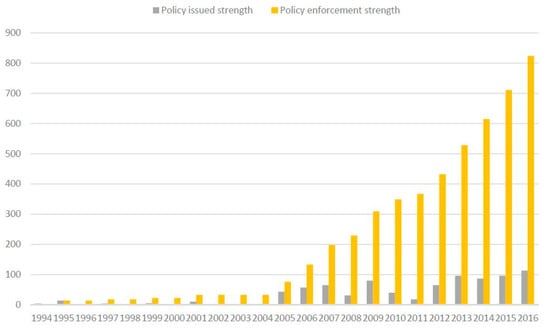
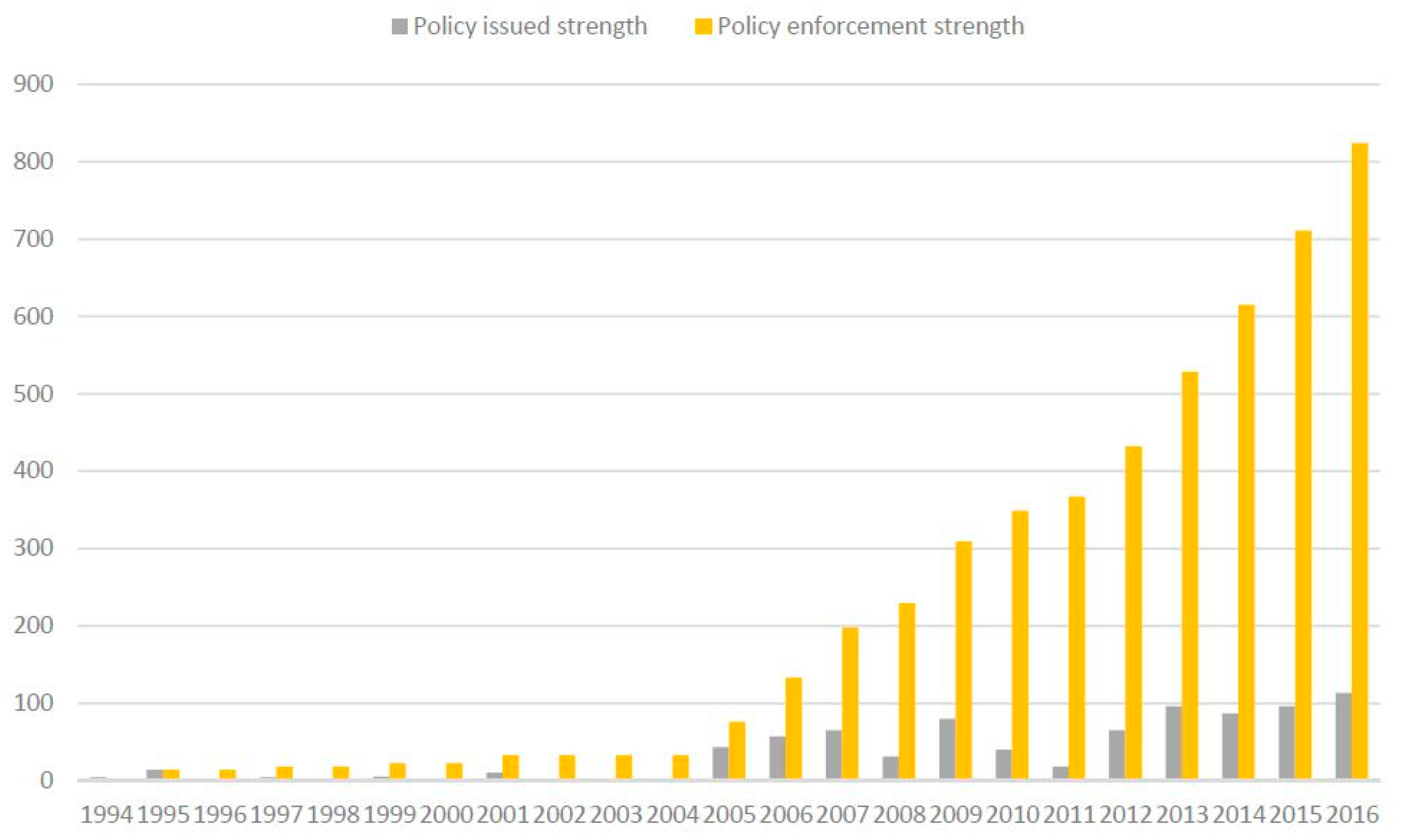
The strength of China’s PV industry national-level policy is also increasing (Figure 5). China’s PV industry only began in the ten years from 1995 to 2004. In this period, the government did not consider solar PV energy as an important strategic resource to develop and utilize. Rather, the Chinese government was just trying to learn from foreign experience, and the issued strength and enforcement strength of PV industry national-level policy were both low. Since 2005, the government has paid considerable attention to the development of the PV industry. The competent departments of the PV industry (such as the NEA and the NDRC), promulgated a series of policies to promote the development of the photovoltaic industry. The number of policies promulgated has steadily increased; meanwhile, the issued strength and enforcement strength of PV industry national-level policy has remained in a rapid uptrend.
Figure 5.
Issued strength and enforcement strength of China’s PV industry national-level policies.
4.3.2. Evolution of Regional Policy Strength
The research on the policy effectiveness in Chinese photovoltaic industry was conducted from the perspective of region distribution dimension. First, we selected the regional photovoltaic industry policy text of each province. Second, we used the method in Section 3.1.3 to quantify the regional photovoltaic industry policy. Then, we processed the policy data to obtain the issued strength of the regional photovoltaic industry policy. Finally, we obtained the enforcement strength of the regional photovoltaic industry policy.
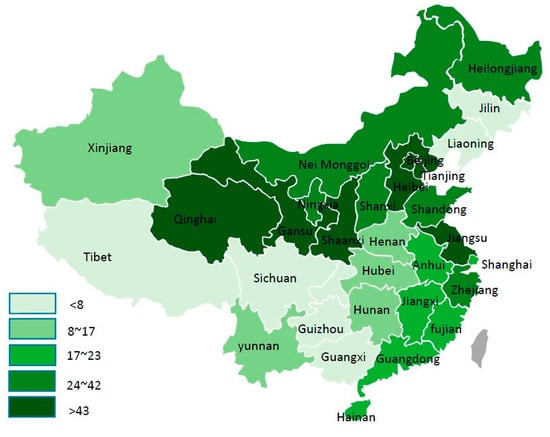
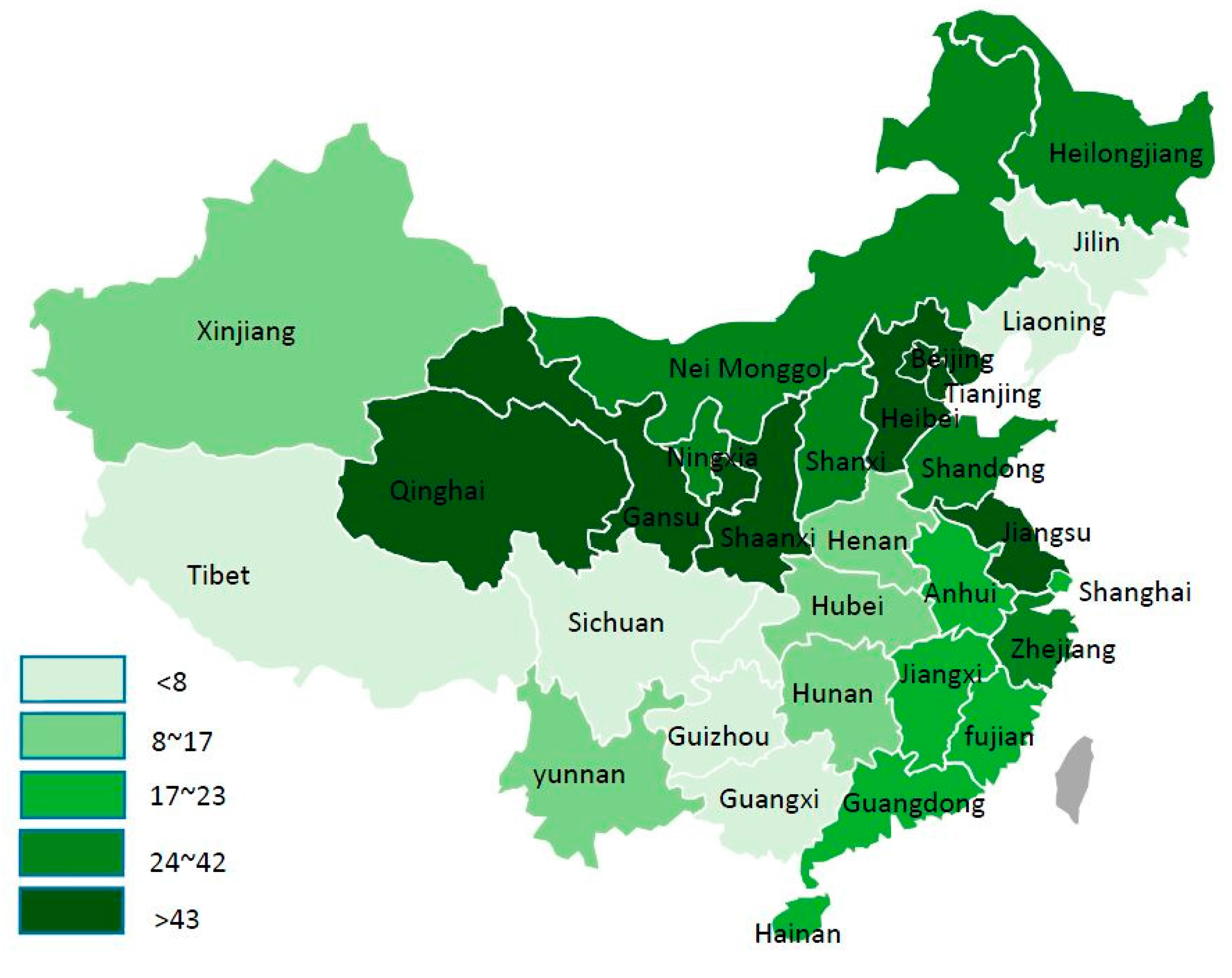
In order to study the enforcement strength of regional photovoltaic industry policy, the research presents the regional photovoltaic policy strength classification map (Figure 6). Ranking by the regional policy enforcement strength, the top three are the Beijing-Tianjin-Hebei region, Gansu Province, and Qinghai Province. According to the policy enforcement strength of the photovoltaic industry, it is broadly divided into the following five parts:
Figure 6.
The regional photovoltaic policy strength classification map.
The highest-level regions are Beijing-Tianjin-Hebei region, Gansu, Qinghai, Jiangsu and Shaanxi Province; the second-level regions are Nei Monggol, Heilongjiang, Shandong, Shanxi, Zhejiang and Ningxia Province; the third-level regions are Shanghai, Anhui, Jiangxi, Guangdong, Fujian and Hainan Province; the fourth-level regions are Yunnan, Chongqing, Xinjiang, Hubei, Hunan and Henan Province; and the lowest-level regions are Liaoning, Jilin, Guangxi, Guizhou, Sichuan, and Tibet.
According to the regional photovoltaic policy strength classification map, the enforcement strength of regional policy presents descending trend from the northern to the southern provinces, and the similar trend from coastal provinces to inland provinces can be seen.
4.4. Evolution of Policy Issuing Departments
As Table 2 shows, the number of government agencies involved in promulgating PV industry policy in China has increased since 1994. By 2016, more than 20 agencies have become involved in the promulgation of PV industry policies, such as National People’s Congress, the SC, the NDRC, the Ministry of Finance (MOF), the NEA, and the Ministry of Industry and Information Technology. Most of the PV industry policy is promulgated by the NEA, followed in order by the NDRC and the MOF. The NEA and NDRC are the planning agencies for the PV industry, and are responsible for the development planning and strategy of the industry. The MOF is the capital guarantor for industrial development, and (as a ministerial department) shows that government pays much attention to the development of PV industry from the strategic planning perspective, giving the industry rich financial support. In terms of the regional policy issued departments, the provincial Development and Reform Commission and the provincial government are the main policy-issuing departments. The Construction Committee, Finance Bureau, and Price Bureau help guide the development of the photovoltaic industry.
Table 2.
Policy-issuing departments and the number of policies issued by the department.
The Ministry of Housing and Urban-Rural Development (MOHURD) first participated in the promulgation of PV industry policy in 2005. In 2009 MOHURD, in ‘Implementation Opinions on accelerating the construction of applications of solar photovoltaic in buildings’, mentioned several actions for solving the shortage of domestic application of photoelectric products and photovoltaic grid-connecting problems. These actions included organizing a demonstration project of a photoelectric building application, implementing the ‘solar roofs plan’, and actively promoting the PV building demonstration. The combination of PV power generation and building energy conservation is the future development direction of the PV industry, and MOHURD will play an important role in its development. In 2015, the Ministry of Land and Resources issued a ‘Notice on control indicators of photovoltaic power station project land’ that compiled a standard for PV power generation project land. The Ministry also proposed that project construction should give priority to the use of advanced-technology and high-efficiency PV modules, improve land-use efficiency, and standardize the construction of PV power stations. In 2015, the State Forestry Administration issued the ‘Notice on issues of the use of forest land in the construction of photovoltaic power stations’, which stated that the construction of PV power stations should use forest land legally to avoid the destruction of ecological resources.
Over time, more agencies have become involved in promulgating PV industry policy. The agencies are not restricted to several competent authorities, because more related agencies have become involved in the construction of the PV industry. On the one hand, the diversity of policy-issuing authorities shows that the Chinese government is paying more attention and trying to promote the rapid development of China’s PV industry by various forces. On the other hand, this diversity reflects that, in the process of rapid development, problems of the PV industry are not being taken seriously and solved in a coordinated and timely way. The competent authorities are unable to solve the problems independently and need the help of related agencies for a comprehensive solution.
4.5. Evaluation of the Effect of Polices
To determine the contribution of PV industry policy on PV installed capacity, we made a regression analysis to the four dimensions (policy measures, policy types, policy strength, and policy issuing department) and ignoring the study of the constant term. The policy strength of the photovoltaic industry includes national-level policy strength and regional policy strength. The regional policy strength will be given the weight on the proportion of the regional PV installed capacity in the China’s PV installed capacity. The regression results are shown in Table 3, Table 4, Table 5 and Table 6.
Table 3.
Evaluation of the effect of policy measures on China’s photovoltaic industry.
Table 4.
Evaluation of the effect of policy types on China’s photovoltaic industry.
Table 5.
Evaluation of the effect of policy strength on China’s photovoltaic industry.
Table 6.
Evaluation of the effect of policy issuing departments on the China’s photovoltaic industry.
As shown in Table 3, four major types of PV industry policy measures and the development of the PV industry have positive correlation, but the effect of each is different. In the guidance measures, government incentive have a significant positive correlation with the development of the industry, but government incentive (4.583) with real function is more effective than green development (1.679). Among supporting measures, grid support can best promote the development of the PV industry, followed by fiscal support and information support. The effects of financial support, technical support, and project support policies are not satisfactory. The unsatisfactory effect of these policies is related to the late start of each policy; thus, the policies need to be further strengthened and improved. Among specification measures, operation specifications and technical specifications have significant positive correlation with the development of China’s PV industry. These results show that strengthening the internal specifications of the PV industry is very important, in addition to strengthening external incentive measures such as grid support. Among supervision measures, quality supervision policies and operation supervision policies (but especially the latter) have positive correlations with the development of China’s PV industry. These findings further indicate that the internal specification, supervision, and management of the PV industry are core aspects of the PV industry and crucial to its development.
Results presented in Table 4 show that the three policy types have positive correlation with the development of China’s PV industry, but their effects differ. Although the highest-level policy type is a law, it is not the most effective; rather, the most effective form of policy is the minimum-level notice. These findings could be because the government has adopted more moderate policy combinations. In addition, the policy issuing departments should promulgate the more authoritative PV industry policies (such as interim regulations, opinions, and planning of the State Council and regulations of the ministries) (1.381), and attempt to avoid issuing the less-serious industrial policies (such as opinions, outlines, planning, measures, and interim provisions) (0.245). The current status of policy types for the Chinese PV industry is related to the immaturity of the industry. The promulgation of the Renewable Energy Law and other related laws provides legal supports for the development of the PV industry in China, but did not match the rapid development of the industry; yet, this law did not have the greatest effectiveness among the policies examined. Thus, it is particularly important to accelerate the formulation of relevant laws for China’s photovoltaic industry.
The regression results of policy strength shown in Table 5 are similar to those for policy measures shown in Table 3. The similarity occurs because policy measures and policy strength are closely related, and a non-zero value for a policy measure automatically results in a non-zero value for policy strength. Among policy measures, those for fiscal support, technical specifications and operation supervision have positive correlation with the development of the PV industry in China. However, from the regression results of policy strength, the effects of grid supports and operation specifications have not reached their anticipated importance. Unilaterally increasing grid support and operation specification policies cannot achieve the desired incentive effect. In addition, the regression coefficient of operation specifications and is particularly low. These results indicate that the departments involved in issuing PV policy have no incentive to promote operation specification (0.746), especially in terms of increasing the level of government encouragement (1.972). Policies for China’s PV industry are promulgated frequently, but specification policies often are not implemented, nor do they achieve the expected goal. As a result, the implementation of gird support, specification, and supervision policies for China’s PV industry is slow.
The regression results regarding policy departments are presented in Table 6, and show that the PV industry policies promulgated by various departments have positive correlation with the development of PV industry. However, the NDRC, as the competent and supervision department of the PV industry, did not have significant correlation with the development of the PV industry; in fact, their performance was even worse than that of the MOHURD, State Forestry Administration, Ministry of Commerce, and other less important functional departments. In the future promulgation process of PV industry policies, the SC should focus on setting the tone of the policies. Furthermore, as a communication bridge between the SC and the NEA, the NDRC should strengthen its power, control the promulgation of policies, and exercise further macro-control over the development of the entire industry. The reorganized NEA should implement specific measures to promote the development of the PV industry, and be responsible for the SC and the NDRC.
5. Conclusions and Policy Implications
5.1. Conclusions
In recent years, China’s PV industry has developed rapidly, and the number of PV industry policies has increased obviously. However, relevant research on the historical evolution and effect evaluation of PV industry policy is lacking. We designed an evaluation system for China’s PV industry policy, classifying and quantifying 307 photovoltaic industry policies issued from 1994 to 2016. The policies were investigated from four dimensions: policy measures, policy types, policy strength, and policy issuing departments. Based on this evaluation framework, the historical evolution and realistic effect of the policies were examined. The research supports the following conclusions.
From an evolution perspective, China’s PV industry policy is broadly divided into three stages. Currently, grid support, operations specification and operation supervision are the main policy measures and low-level notifications are the main type of policy. The issued strength of policies is generally low. The enforcement strength of regional policy presents descending trend from the northern to the southern provinces and the similar trend from coastal provinces to inland provinces. The main policy issuing departments are the SC, the NDRC, and the NEA.
Regarding the effect of policy, of the 14 policy measures examined, only ten have positive correlations. The other policy measures are not yet mature and have no positive correlation. The policy for grid support, operations specification, and technical specification has significant positive correlation with the PV industry. All the policy departments have a positive correlation with the development of the PV industry. The most effective policy types are the sector-specific notices and announcements, and the best policy-issuing department is the NEA. In contrast, the issued effect of policies from the NDRC is not satisfactory. The issued strength of policy for grid support, operation specification, and operation supervision has a positive correlation with the development of the industry, but has not achieved the desired effect.
5.2. Policy Implications
According to the research results, the following aspects of PV industry policy should be improved.
(1) Cohesion between sectoral policies should be improved, the linkage of policies strengthened, policy-making among different departments coordinated, and complementarity of policies among different departments and levels increased. Meanwhile, the implementation of PV industry policy should have specific expectations. The authority should carry out systematic and prospective planning for the development of the PV industry from the perspective of a national strategy, then formulate feasible PV industry policies, and be effective in policy implementation and supervision.
(2) Grid support, operation specification, and operation supervision policies should be further improved. First, photovoltaic grid support should be promoted, solving the difficulties in the photovoltaic grid-connected system, and accelerating the pace with which the photovoltaic power network is developed. According to the proximity consumption principle, the implementation of renewable energy power generation should adhere to the requirements of full indemnificatory acquisition, complete PV power consumption work well, and prioritize the indemnificatory acquisition of power. Learning from foreign experiences, a mandatory market share system should be established and legislation, such as the Feed-in Tariff Law, should be enacted to ensure the utilization of renewable energy and implementation of PV power full indemnificatory acquisition. In addition, families and enterprises should be encouraged to invest in the PV power generation industry, promoting the diversified development of distributed PV applications, improving the tariff acquisition subsidy mechanism, and increasing people’s positivity for investment in PV power generation. Second, the development of a standards and specification system should be accelerated, establishing a complete standards system for the PV industry, including public service platforms for testing and certification, as well as empirical research bases for PV applications. Meanwhile, attention must be paid to the internal specification, supervision and management of the PV industry so as to prevent the related policies from becoming a formality.
(3) The amendment-of-subsidy mechanism should be strengthened. At present, China’s funding of renewable energy has a large gap, and the subsidies for PV power stations are seriously in arrears. The Chinese government should expand the sources of special subsidy funds for renewable energy, develop an innovative subsidy mechanism for PV power generation, and establish a green certificate trading mechanism. Meanwhile, to enhance the competitiveness of the PV industry, policies for scientific research (such as increasing deductions for research and development expenditure and establishing research and development funds) should be formulated to support key technology research of the PV industry.
(4) China’s financial support, information support and personnel training policy measures are not mature; the formulation and implementation of financial and information support policies should be accelerated. The PV industry generally faces a financing problem, and it is difficult for the traditional financial support model to solve the financing needs of PV industry. The industry and government need to develop an innovative financing mode to break through the financing bottleneck. In addition, the Chinese government has too few information support policies. To reduce and avoid information asymmetry in the development of the PV industry, the government must strengthen information support and establish an information-sharing mechanism to help enterprises obtain the latest information and promote the healthy development of the PV industry. In addition, the government needs to strengthen the formulation of personnel training policies on the basis of talent introduction, supporting the training of high-level professional technology and management personnel and setting up relevant research teams.
(5) The global competitive advantages of China’s PV industry should be accelerated. To cope with challenging international trade policies such as the anti-dumping and countervailing duties imposed in Europe and the USA, the Chinese government needs to increase the demand for the domestic PV market and promote the merger, reorganization and resource integration of the PV industry. The government also needs to conscientiously implement the national ‘The Belt and Road’ strategy and actively explore overseas emerging markets in South America, South Africa, and other countries, thereby promoting the diversification of China’s PV market and enhancing the global competitive advantage of China’s PV industry. At the same time, China’s PV enterprises should be guided in investing overseas, actively promoting overseas mergers and acquisitions, and encouraging the establishment of PV manufacturing industry parks and capacity demonstration bases in the major PV markets, thus achieving industrial agglomeration and resource integration.
Acknowledgments
This study was supported by the Fundamental Research Funds for the Central Universities (2017XKZD12).
Author Contributions
Ruyin Long came up with the original idea and model for this article; and Wenhua Cui and Qianwen Li designed the model, calculated the data, and wrote the paper. All authors read and approved this version.
Conflicts of Interest
The authors declare that they have no conflict of interest.
Appendix A
Table A1.
Classification of policy strength for China’s photovoltaic (PV) industry policies.
Appendix B
Table A2.
The sorting of policy text.
References
- International Energy Agency Photovoltaic Power Systems Programme. Annual Report 2016. Available online: http://www.iea-pvps.org/fileadmin/dam/public/report/statistics/IEA-PVPS_-_A_Snapshot_of_Global_PV_-_1992–2016__1_.pdf (accessed on 1 June 2017).
- BP. BP Statistical Review of World Energy 2017 Underpinning Data. Available online: http://www.bp.com/statisticalreview (accessed on 1 June 2017).
- Liu, D.; Shiroyama, H. Development of photovoltaic power generation in China: A transition perspective. Renew. Sustain. Energy Rev. 2013, 25, 782–792. [Google Scholar] [CrossRef] [Scilit]
- Zhi, Q.; Sun, H.; Li, Y.; Xu, Y.; Su, J. China’s solar photovoltaic policy: An analysis based on policy instruments. Appl. Energy 2014, 129, 308–319. [Google Scholar] [CrossRef] [Scilit]
- Tour, A.D.L.; Glachant, M.; Ménière, Y. Innovation and international technology transfer: The case of the Chinese photovoltaic industry. Energy Policy 2011, 39, 761–770. [Google Scholar] [CrossRef] [Scilit]
- Sun, H.; Qiang, Z.; Wang, Y.; Yao, Q.; Su, J. China’s solar photovoltaic industry development: The status quo, problems and approaches. Appl. Energy 2014, 118, 221–230. [Google Scholar] [CrossRef] [Scilit]
- Li, S.; Wang, J.; Liu, Q.; Li, L.; Hua, Y.; Liu, W. Analysis of Status of Photovoltaic and Wind Power Abandoned in China. J. Power Energy Eng. 2017, 5, 91–100. [Google Scholar] [CrossRef]
- Grau, T.; Huo, M.; Neuhoff, K. Survey of photovoltaic industry and policy in Germany and China. Energy Policy 2012, 51, 20–37. [Google Scholar] [CrossRef] [Scilit]
- Huo, M.L.; Zhang, D.W. Lessons from photovoltaic policies in China for future development. Energy Policy 2012, 51, 38–45. [Google Scholar] [CrossRef] [Scilit]
- Zhang, S.; He, Y. Analysis on the development and policy of solar PV power in China. Renew. Sustain. Energy Rev. 2013, 21, 393–401. [Google Scholar] [CrossRef] [Scilit]
- Zou, H.; Du, H.; Ren, J.; Sovacool, B.K.; Zhang, Y.; Mao, G. Market dynamics, innovation, and transition in China’s solar photovoltaic (PV) industry: A critical review. Renew. Sustain. Energy Rev. 2017, 69, 197–206. [Google Scholar] [CrossRef] [Scilit]
- Kayser, D. Solar photovoltaic projects in China: High investment risks and the need for institutional response. Appl. Energy 2016, 174, 144–152. [Google Scholar] [CrossRef] [Scilit]
- Dusonchet, L.; Telaretti, E. Economic analysis of different supporting policies for the production of electrical energy by solar photovoltaics in western European Union countries. Energy Policy 2010, 38, 3297–3308. [Google Scholar] [CrossRef] [Scilit]
- Sarasa-Maestro, C.J.; Dufo-López, R.; Bernal-Agustín, J.L. Photovoltaic remuneration policies in the European Union. Energy Policy 2013, 55, 317–328. [Google Scholar] [CrossRef] [Scilit]
- Shrimali, G.; Jenner, S. The impact of state policy on deployment and cost of solar photovoltaic technology in the US: A sector-specific empirical analysis. Renew. Energy 2013, 60, 679–690. [Google Scholar] [CrossRef] [Scilit]
- Sarzynski, A.; Larrieu, J.; Shrimali, G. The impact of state financial incentives on market deployment of solar technology. Energy Policy 2012, 46, 550–557. [Google Scholar] [CrossRef] [Scilit]
- Kwan, C.L. Influence of local environmental, social, economic and political variables on the spatial distribution of residential solar PV arrays across the United States. Energy Policy 2012, 47, 332–344. [Google Scholar] [CrossRef] [Scilit]
- Zhang, S.; Zhao, X.; Andrews-Speed, P.; He, Y. The development trajectories of wind power and solar PV power in China: A comparison and policy recommendations. Renew. Sustain. Energy Rev. 2013, 26, 322–331. [Google Scholar] [CrossRef] [Scilit]
- Zhang, M.; Zhou, D.; Zhou, P. A real option model for renewable energy policy evaluation with application to solar PV power generation in China. Renew. Sustain. Energy Rev. 2014, 40, 944–955. [Google Scholar] [CrossRef] [Scilit]
- Zhao, X.; Zeng, Y.; Zhao, D. Distributed solar photovoltaics in China: Policies and economic performance. Energy 2015, 88, 572–583. [Google Scholar] [CrossRef] [Scilit]
- Yuan, C.; Liu, S.; Yang, Y.; Chen, D.; Fang, Z.; Shui, L. An analysis on investment policy effect of China’s photovoltaic industry based on feedback model. Appl. Energy 2014, 135, 423–428. [Google Scholar] [CrossRef] [Scilit]
- Guo, X.; Guo, X.; Lund, H. China’s photovoltaic power development under policy incentives: A system dynamics analysis. Energy 2015, 93, 589–598. [Google Scholar] [CrossRef] [Scilit]
- Li, L.; Chi, T.; Zhang, M.; Wang, S. Multi-Layered Capital Subsidy Policy for the PV Industry in China Considering Regional Differences. Sustainability 2016, 8, 45. [Google Scholar] [CrossRef] [Scilit]
- Rothwell, R.; Zegveld, W. Industrial Innovation and Public Policy: Preparing for the 1980s and the 1990s; F. Pinter: London, UK, 1981. [Google Scholar]
- Gabriele, A. S&T Policies and Technical Progress in China’s Industry. Rev. Int. Political Econ. 2002, 9, 333–373. [Google Scholar]
- Su, Y.S.; Lin, C.J.; Li, C.Y. An assessment of innovation policy in Taiwan’s electric vehicle industry. Int. J. Technol. Manag. 2016, 72, 210–229. [Google Scholar] [CrossRef] [Scilit]
- Breslin, S. Foreign direct investment in the People’s Republic of China: Preferences, policies and performance. Policy Soc. 2006, 25, 9–38. [Google Scholar] [CrossRef] [Scilit]
- Huang, C. Organization, programme and structure: An analysis of the Chinese innovation policy framework. R&D Manag. 2010, 34, 367–387. [Google Scholar]
- Peng, J.S.; Sun, W.X.; Zhong, W.G. The evolution of Chinese technological and innovational policies and the empirical research on the performance (1978–2006). Sci. Res. Manag. 2008, 29, 134–150. [Google Scholar]
- Wang, X.Z.; Peng, Z.G.; Gao, W.; Ji, S.B. The policy evolution and effect evaluation of wind power industry in China. Stud. Sci. Sci. 2016, 34, 1817–1829. [Google Scholar]
- Schneider, A.; Ingram, H. Systematically Pinching Ideas: A Comparative Approach to Policy Design. J. Public Policy 1988, 8, 61–80. [Google Scholar] [CrossRef] [Scilit]
- Peters, B.G. Policy Instruments and Public Management: Bridging the Gaps. J. Public Adm. Res. Theory 2000, 10, 35–47. [Google Scholar] [CrossRef] [Scilit]
- The Law Information Database of Peking University. Available online: http://www.pkulaw.cn/ (accessed on 15 June 2017).
- Menz, F.C.; Vachon, S. The effectiveness of different policy regimes for promoting wind power: Experiences from the states. Energy Policy 2006, 34, 1786–1796. [Google Scholar] [CrossRef] [Scilit]
- Delmas, M.A.; Montes-Sancho, M.J. US state policies for renewable energy: Context and effectiveness. Soc. Sci. Electron. Publ. 2011, 39, 2273–2288. [Google Scholar]

© 2017 by the authors. Licensee MDPI, Basel, Switzerland. This article is an open access article distributed under the terms and conditions of the Creative Commons Attribution (CC BY) license (http://creativecommons.org/licenses/by/4.0/).