The Application of Artificial Intelligence (AI) in the Implementation of ESG-Oriented Sustainable Development Strategies in the Banking Sector: A Case Study


Abstract
1. Introduction
2. Methodology
2.1. ESG—AI Maturity Assessment Framework for Banks
2.2. Case Study Design and Scoring Procedure
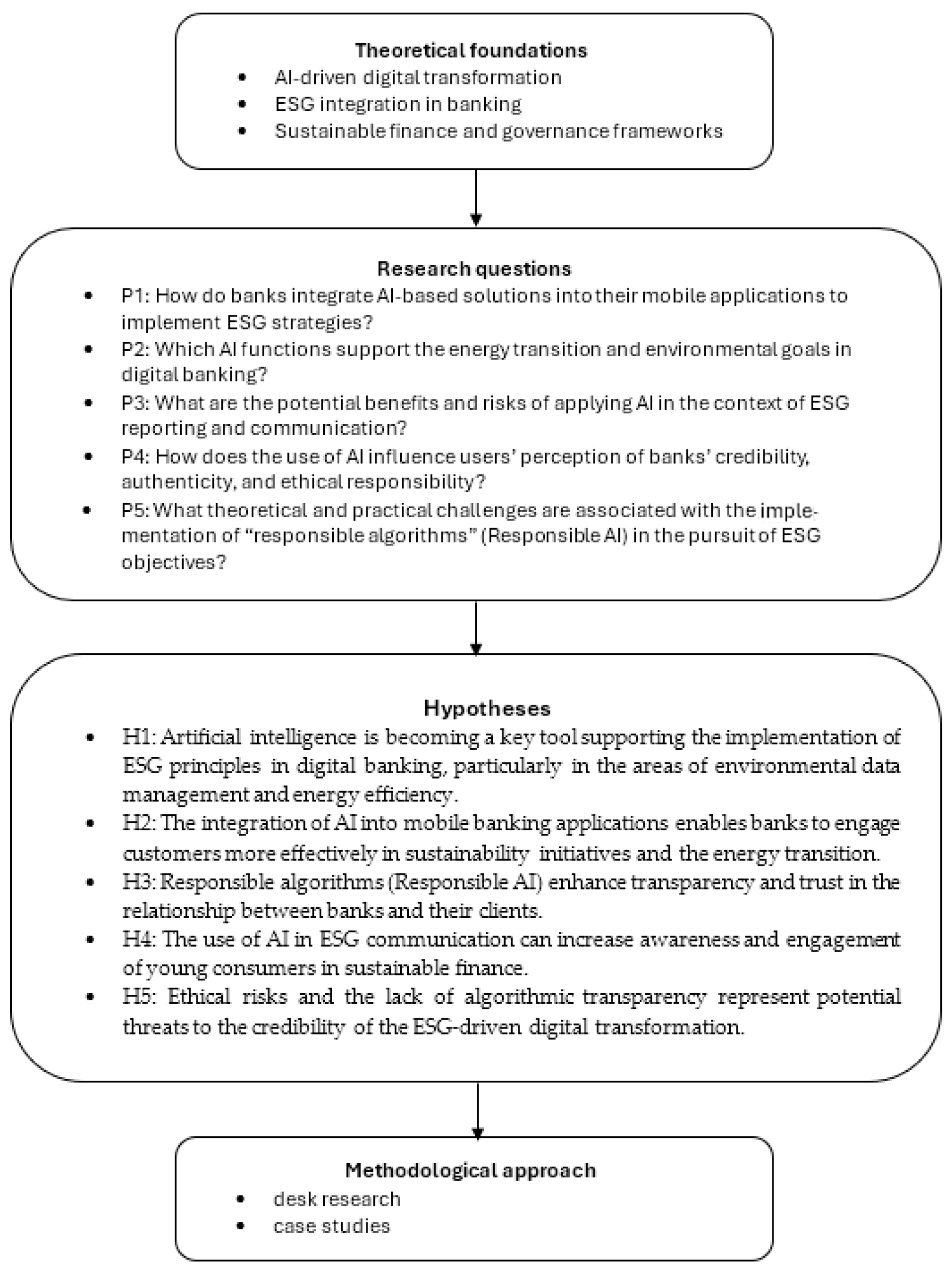
2.3. Research Scope and Conceptual Model
3. Desk Research
3.1. ESG and Sustainable Finance in the Banking Sector
3.2. Artificial Intelligence in Digital Banking
3.3. Integration of Artificial Intelligence with ESG Goal Implementation in Banking
3.4. Ethics, Trust, and Responsible Artificial Intelligence Governance in Banking
3.5. Empirical Research Gaps in the Context of AI and ESG
3.6. Models of AI and ESG Integration
- Analytical model—AI is applied as a data processing and interpretation tool, supporting climate risk measurement, portfolio analysis, stress testing, and compliance with sustainability reporting standards (ISSB/TCFD) [4,24,29]. Predictive models enable climate scenario simulations, allowing institutions to anticipate regulatory and market developments [21,53].
- Operational model—AI functions as an optimization and automation mechanism that streamlines internal processes, enhances IT system efficiency, and reduces the energy footprint of digital infrastructure, for example, through intelligent data center and cloud management [3,28]. This approach aligns with the concept of green cloud banking discussed in sectoral and consulting literature [31].
- Relational model—AI supports customer communication and interaction through chatbots, language assistants, and behavioral modules that enable ESG-related education, personalization, and the shaping of consumer behavior [2,30]. Empirical studies indicate that personalized recommendations significantly increase the effectiveness of pro-environmental actions [54,55].
3.7. Limitations and Risks of AI–ESG Integration: Standardization Gaps, Ethical Concerns, and Over-Automation
4. Applications of AI Within ESG Strategies in the Banking Sector—A Case Study
5. Results and Discussion
- AI constitutes a key component of the sustainable finance architecture, enabling the effective use of ESG data in banks’ decision-making processes.
- The integration of AI and ESG in mobile applications increases consumer engagement in sustainable finance, particularly among young digital banking users, confirming the importance of the behavioral dimension in research on sustainable transformation.
- Responsible algorithms (Responsible AI) are becoming an essential element of corporate governance and digital trust; however, they require further standardization, data interoperability, and clear ethical principles to avoid the risk of undermining the sector’s credibility.
6. Conclusions and Future Work
- The impact of AI on actual ESG performance indicators in financial institutions;
- The effectiveness of mobile and digital applications in shaping pro-environmental behavior;
- The empirical validation of AI-based climate risk models;
- The manifestation and mitigation of algorithmic bias in practice;
- Customer perceptions and trust formation in AI-enabled ESG systems.
Author Contributions
Funding
Data Availability Statement
Conflicts of Interest
References
- Xiang, S.; Deng, L.; Zhou, Z.; Zhang, Z. Digital Finance, ESG Performance, and Financial Performance in Chinese Firm Levels: The Pathway to Sustainability. Sustainability 2024, 16, 7976. [Google Scholar] [CrossRef]
- Lim, T. Environmental, Social, and Governance (ESG) and Artificial Intelligence in Finance: State-of-the-Art and Research Takeaways. Artif. Intell. Rev. 2024, 57, 76. [Google Scholar] [CrossRef]
- Kalyani, S.; Gupta, N. Is Artificial Intelligence and Machine Learning Changing the Ways of Banking: A Systematic Literature Review and Meta-Analysis. Discov. Artif. Intell. 2023, 3, 41. [Google Scholar] [CrossRef]
- Fares, O.H.; Butt, I.; Lee, S.H.M. Utilization of Artificial Intelligence in the Banking Sector: A Systematic Literature Review. J. Financ. Serv. Mark. 2023, 28, 835–852. [Google Scholar] [CrossRef]
- Zhang, C.; Yang, J. Artificial Intelligence and Corporate ESG Performance. Int. Rev. Econ. Financ. 2024, 96, 103713. [Google Scholar] [CrossRef]
- Xu, J. AI in ESG for Financial Institutions: An Industrial Survey. arXiv 2024, arXiv:2403.05541. [Google Scholar] [CrossRef]
- Batool, A.; Zowghi, D.; Bano, M. Responsible AI Governance: A Systematic Literature Review. arXiv 2023, arXiv:2401.10896. [Google Scholar] [CrossRef]
- Abdulsalam, T.A.; Tajudeen, R.B. Artificial Intelligence (AI) in the Banking Industry: A Review of Service Areas and Customer Service Journeys in Emerging Economies. Bus. Manag. Compass 2024, 68, 19–43. Available online: https://bi.ue-varna.bg/ojs/index.php/bmc/article/view/66 (accessed on 20 November 2025). [CrossRef]
- Rasheed, M.; Yuhuan, Z.; Haseeb, A.; Ahmed, Z.; Saud, S. Asymmetric relationship between competitive industrial performance, renewable energy, industrialization, and carbon footprint: Does artificial intelligence matter for environmental sustainability? Appl. Energy 2024, 367, 123346. [Google Scholar] [CrossRef]
- Dou, J.; Chen, D.; Zhang, Y. Towards energy transition: Accessing the significance of artificial intelligence in ESG performance. Energy Econ. 2025, 146, 108515. [Google Scholar] [CrossRef]
- Tissaoui, K.; Zaghdoudi, T. Against a background of energy uncertainty and climate change, is there a substitution effect between fossil fuels in OECD countries? Energy 2025, 320, 135271. [Google Scholar] [CrossRef]
- Wang, Q.; Zhang, F.; Li, R.; Sun, J. Does artificial intelligence promote energy transition and curb carbon emissions? The role of trade openness. J. Clean. Prod. 2024, 447, 141298. [Google Scholar] [CrossRef]
- Hallioui, A.; Herrou, B.; Santos, R.; Katina, P.; Egbue, O. Systems-based approach to contemporary business management: An enabler of business sustainability in a context of industry 4.0, circular economy, competitiveness and diverse stakeholders. J. Clean. Prod. 2022, 373, 133819. [Google Scholar] [CrossRef]
- Chen, Y.; Huang, X.; Liu, C. Can AI computing power promote the green transformation of energy enterprises? Evidence from the nonlinear moderating effect of public environmental awareness. J. Environ. Manag. 2025, 391, 126455. [Google Scholar] [CrossRef]
- Gupta, S.; Langhans, S.; Domisch, S.; Fuso-Nerini, F.; Felländer, A.; Battaglini, M.; Tegmark, M.; Vinuesa, R. Assessing whether artificial intelligence is an enabler or an inhibitor of sustainability at indicator level. Transp. Eng. 2021, 4, 100064. [Google Scholar] [CrossRef]
- Garcés-Marín, R.; Arias-Pérez, J.; Restrepo-Estrada, C. The interplay of data-driven insights and AI anxiety in shaping the impact of AI capabilities on circular economy capability. J. Ind. Inf. Integr. 2026, 49, 101019. [Google Scholar] [CrossRef]
- Platon, V.; Pavelescu, F.; Antonescu, D.; Constantinescu, A.; Frone, S.; Surugiu, M.; Mazilescu, R.; Popa, F. New evidence about artificial intelligence and eco-investment as boosters of the circular economy. Environ. Technol. Innov. 2024, 35, 103685. [Google Scholar] [CrossRef]
- Khan, M.; Rahman, A.; Mahmud, F.; Bishnu, K.; Ahmed, M.; Mridha, M.; Aung, Z. A systematic review of AI-driven business models for advancing Sustainable Development Goals. Array 2025, 28, 100539. [Google Scholar] [CrossRef]
- Platania, F.; Toscano Hernandez, C.; El Ouadghiri, I.; Peillex, J. Bridging AI innovation and sustainable Development: The effect of AI technological progress on SDG investment performance. Technovation 2025, 146, 103279. [Google Scholar] [CrossRef]
- Năstasă, A.; Dumitra, T.; Grigorescu, A. Artificial intelligence and sustainable development during the pandemic: An overview of the scientific debates. Heliyon 2024, 10, e30412. [Google Scholar] [CrossRef]
- OECD. Sustainable Finance and Investment Policies: Aligning Financial Flows with Climate Objectives; Organisation for Economic Co-operation and Development: Paris, France, 2023; Available online: https://www.oecd.org/content/dam/oecd/en/publications/reports/2024/12/aligning-finance-with-climate-goals_6b70b161/aa7c23b2-en.pdf (accessed on 20 November 2025).
- BCBS (Basel Committee on Banking Supervision). Principles for the Effective Management and Supervision of Climate-Related Financial Risks; Bank for International Settlements: Basel, Switzerland, 2022; Available online: https://www.bis.org/bcbs/publ/d532.pdf (accessed on 20 November 2025).
- UN PRI. Principles for Responsible Investment Annual Report 2022; United Nations: Geneva, Switzerland, 2022; Available online: https://dwtyzx6upklss.cloudfront.net/Uploads/b/f/m/pri_annual_report_2022_689047.pdf (accessed on 20 November 2025).
- ISSB (International Sustainability Standards Board). IFRS S1 and S2: General Requirements and Climate-Related Disclosures; IFRS Foundation: London, UK, 2024; Available online: https://www.ifrs.org/content/dam/ifrs/publications/pdf-standards-issb/english/2023/issued/part-a/issb-2023-a-ifrs-s1-general-requirements-for-disclosure-of-sustainability-related-financial-information.pdf?bypass=on&utm (accessed on 20 November 2025).
- UNEP FI (United Nations Environment Programme Finance Initiative). Principles for Responsible Banking: Progress Report 2023; United Nations Environment Programme: Geneva, Switzerland, 2023; Available online: https://www.mediobanca.com/static/upload_new/prb/prb_report_2023.pdf (accessed on 20 November 2025).
- World Economic Forum (WEF). 9 Ways AI is Helping Tackle Climate Change; World Economic Forum: Geneva, Switzerland, 2023; Available online: https://www.weforum.org/stories/2024/02/ai-combat-climate-change/ (accessed on 20 November 2025).
- European Banking Authority (EBA). EBA Sustainable Finance Roadmap 2022–2030; European Banking Authority: Paris, France, 2022; Available online: https://iason-onigiri-prod.s3.eu-south-1.amazonaws.com/JIT_Jan2023_EBA_Roadmap_Sustainable_Finance_24042024_251dcce74a.pdf (accessed on 20 November 2025).
- McKinsey & Company. The State of AI in 2023: Generative AI’s Breakout Year; McKinsey & Company: New York, NY, USA, 2023; Available online: https://www.mckinsey.com/~/media/mckinsey/business%20functions/quantumblack/our%20insights/the%20state%20of%20ai%20in%202023%20generative%20ais%20breakout%20year/the-state-of-ai-in-2023-generative-ais-breakout-year-v3.pdf (accessed on 20 November 2025).
- International Monetary Fund (IMF). Global Financial Stability Report. Financial and Climate Policies for a High-Interest-Rate Era; IMF: Washington, DC, USA, 2023; Available online: https://www.astrid-online.it/static/upload/imf_/0000/imf_gfsr_10-23.pdf (accessed on 20 November 2025).
- ING Group. ING Group Annual Report 2023; ING Bank N.V.: Amsterdam, The Netherlands, 2023; Available online: https://carbonaccountingfinancials.com/files/institutions_downloads/2023-ING-Groep-NV-annual-report.pdf (accessed on 20 November 2025).
- Accenture. Uniting Technology and Sustainability; Accenture: Dublin, Ireland, 2022; Available online: https://www.accenture.com/content/dam/accenture/final/a-com-migration/pdf/pdf-177/accenture-tech-sustainability-uniting-sustainability-and-technology.pdf (accessed on 20 November 2025).
- World Bank Group. Finance and Prosperity 2024; World Bank: Washington, DC, USA, 2024; Available online: https://www.worldbank.org/en/publication/finance-and-prosperity-2024 (accessed on 20 November 2025).
- European Union. Artificial Intelligence Act (EU AI Act); Official Journal of the European Union: Brussels, Belgium, 2023; Available online: https://artificialintelligenceact.eu/the-act/ (accessed on 20 November 2025).
- PricewaterhouseCoopers (PwC). Responsible AI and ESG: The Power of Trusted Collaborations; PwC: London, UK, 2023; Available online: https://www.pwc.com/us/en/tech-effect/ai-analytics/the-power-of-pairing-responsible-ai-and-esg.html (accessed on 20 November 2025).
- International Financial Reporting Standards Foundation (IFRS Foundation). IFRS Sustainability Disclosure Taxonomy 2024; IFRS Foundation: London, UK, 2024; Available online: https://www.ifrs.org/issued-standards/ifrs-sustainability-taxonomy/ifrs-sustainability-disclosure-taxonomy-2024/ (accessed on 20 November 2025).
- Deloitte. Trustworthy AI™ Services; Deloitte Insights: London, UK, 2023; Available online: https://www.deloitte.com/us/en/what-we-do/capabilities/applied-artificial-intelligence/services/ethics-of-ai-framework.html (accessed on 20 November 2025).
- Zhang, C.; Zhu, W.; Dai, J.; Wu, Y.; Chen, X. Ethical Impact of Artificial Intelligence in Managerial Accounting. Int. J. Account. Inf. Syst. 2023, 49, 100619. [Google Scholar] [CrossRef]
- IBM. Responsible AI; IBM Corporation: Armonk, NY, USA, 2025; Available online: https://www.ibm.com/trust/responsible-ai (accessed on 20 November 2025).
- Gartner. AI Ethics: Enable AI Innovation with Governance Platforms; Gartner Research: Stamford, CT, USA, 2024; Available online: https://www.gartner.com/en/articles/ai-ethics (accessed on 20 November 2025).
- Dash, A.; Mohanta, G. Drivers of Sustainable Financial Consumerism: Exploring the Impact of Artificial Intelligence, Finfluencers, Financial Literacy, and Product Quality on Sustainable Development. Clean. Responsible Consum. 2025, 18, 100306. [Google Scholar] [CrossRef]
- National Institute of Standards and Technology (NIST). AI Risk Management Framework (NIST AI RMF 1.0); U.S. Department of Commerce: Gaithersburg, MD, USA, 2023. Available online: https://www.nist.gov/itl/ai-risk-management-framework (accessed on 20 November 2025).
- Wang, J.; Qi, B.; Li, Y.; Hossain, M.I.; Tian, H. Does Institutional Commitment Affect ESG Performance of Firms? Evidence from the United Nations Principles for Responsible Investment. Energy Econ. 2024, 130, 107302. [Google Scholar] [CrossRef]
- Aguado-Correa, F.; de la Vega-Jiménez, J.; López-Jiménez, J.; Padilla-Garrido, N.; Rabadán-Martín, I. Evaluation of non-financial information and its contribution to advancing the sustainable development goals within the Spanish banking sector. Eur. Res. Manag. Bus. Econ. 2023, 29, 100211. [Google Scholar] [CrossRef]
- Du, K.; Zhao, Y.; Mao, R.; Xing, F.; Cambria, E. Natural language processing in finance: A survey. Inf. Fusion 2025, 115, 102755. [Google Scholar] [CrossRef]
- Cao, Q.; Zhu, T.; Yu, W. ESG investment and bank efficiency: Evidence from China. Energy Econ. 2024, 133, 107516. [Google Scholar] [CrossRef]
- Xie, H.; Luo, J.; Tan, X. Artificial intelligence technology application and corporate ESG performance—Evidence from national pilot zones for artificial intelligence innovation and application. Front. Artif. Intell. 2025, 8, 1643684. [Google Scholar] [CrossRef]
- Ghaemi Asl, M. An AI-optimized strategy for intelligent risk mapping of Islamic and conventional sustainable markets: Assessing the enduring dynamics of technological risk spillovers. Expert Syst. Appl. 2026, 296, 128945. [Google Scholar] [CrossRef]
- Song, M.; Pan, H.; Shen, Z.; Tamayo-Verleene, K. Assessing the influence of artificial intelligence on the energy efficiency for sustainable ecological products value. Energy Econ. 2024, 131, 107392. [Google Scholar] [CrossRef]
- Yu, Y.; Chan, H.; Cho, E. Enhancing ESG performance through digital transformation: Recent development, cases and relationships. J. Bus. Res. 2026, 202, 115763. [Google Scholar] [CrossRef]
- Nevi, G.; Montera, R.; Cucari, N.; Laviola, F. Integrating AI and ESG in digital platforms: New profiles of platform-based business models. J. Eng. Technol. Manag. 2025, 78, 101913. [Google Scholar] [CrossRef]
- Abbes, I. Strategic pathways for innovation and sustainability in digital transformation: Insights from leading global companies. Soc. Sci. Humanit. Open 2025, 12, 101906. [Google Scholar] [CrossRef]
- Alqudah, M.; Sierra-García, L.; Garcia-Benau, M. ESG and emerging technologies: A cluster-based literature review analysis. Sustain. Futures 2025, 10, 101285. [Google Scholar] [CrossRef]
- Bank for International Settlements (BIS). Artificial Intelligence and Financial Stability; BIS: Basel, Switzerland, 2023; Available online: https://www.bis.org/fsi/fsisummaries/exsum_23904.htm (accessed on 20 November 2025).
- Schrage, M.; Kiron, D.; Candelon, F.; Khodabandeh, S.; Chu, M. Improve Key Performance Indicators With AI; MIT Sloan Management Review: Cambridge, MA, USA, 2023; Available online: https://sloanreview.mit.edu/article/improve-key-performance-indicators-with-ai/ (accessed on 20 November 2025).
- Harvard Business School. AI Can Churn Out Financial Advice, But Does It Help Investors? HBS Working Paper Series: Cambridge, MA, USA, 2025; Available online: https://www.library.hbs.edu/working-knowledge/ai-can-churn-out-financial-advice-but-does-it-help-investors (accessed on 20 November 2025).
- World Economic Forum (WEF). Responsible AI and Digital Trust in Finance 2023; World Economic Forum: Geneva, Switzerland, 2023; Available online: https://reports.weforum.org/docs/WEF_Artificial_Intelligence_in_Financial_Services_2025.pdf (accessed on 20 November 2025).
- Organisation for Economic Co-operation and Development (OECD). AI in Finance; OECD: Paris, France, 2023; Available online: https://www.oecd.org/en/topics/sub-issues/digital-finance/artificial-intelligence-in-finance.html (accessed on 20 November 2025).
- Institute of Electrical and Electronics Engineers (IEEE). Ethically Aligned Design. A Vision for Prioritizing Human Well-Being with Autonomous and Intelligent Systems; IEEE: New York, NY, USA, 2021; Available online: https://standards.ieee.org/wp-content/uploads/import/documents/other/ead_v2.pdf (accessed on 20 November 2025).
- European Commission High-Level Expert Group on AI (EU AI Expert Group). Shaping Europe’s digital future. The Apply AI Strategy Sets Out How to Speed Up the Use of AI in Europe’s Key Industries and the Public Sector; European Commission: Brussels, Belgium; EU AI Expert Group, 2023; Available online: https://digital-strategy.ec.europa.eu (accessed on 20 November 2025).
- World Energy Council (WEC). The Smart Energy Era; WEC: London, UK, 2025; Available online: https://worldenergycongress.org/news-list/smart-energy-era (accessed on 20 November 2025).
- Gao, L.; Wang, J. Can Artificial Intelligence Reduce Energy Vulnerability? Evidence from an International Perspective. Energy Econ. 2025, 145, 108491. [Google Scholar] [CrossRef]
- European Union Agency for Cybersecurity (ENISA). Cybersecurity and Privacy in AI—Forecasting Demand on Electricity Grids; ENISA: Athens, Greece, 2023; Available online: https://www.enisa.europa.eu/publications/cybersecurity-and-privacy-in-ai-forecasting-demand-on-electricity-grids (accessed on 20 November 2025).
- European Union (EU). Transposition Status—Corporate Sustainability Reporting Directive (CSRD); European Comission: Brussels, Belgium, 2023; Available online: https://finance.ec.europa.eu/regulation-and-supervision/financial-services-legislation/enforcement-and-infringements-banking-and-finance-law/monitoring-banking-and-finance-directives/corporate-sustainability-reporting-directive_en (accessed on 20 November 2025).
- KPMG. Responsible AI and the Challenge of AI Risk; KPMG International: Amsterdam, The Netherlands, 2023; Available online: https://kpmg.com/kpmg-us/content/dam/kpmg/pdf/2023/ai-risk-survey.pdf (accessed on 20 November 2025).
- Santander Group. Sustainability Report 2023: Digital Banking and AI for Climate Action; Banco Santander S.A.: Madrid, Spain, 2023; Available online: https://www.santander.com/content/dam/santander-com/en/contenido-paginas/nuestro-compromiso/reports/2023/doc-informes-usa-informe-anual-integrado-2023-disponible-en-ingles.pdf (accessed on 20 November 2025).
- GreenFi. Case Study: UOB—GreenFi ESG AI for Asset Emissions; GreenFi: Singapore, 2024; Available online: https://greenfi.ai/casestudy/uob-case-study-greenfi-ai-asset-emissions/ (accessed on 20 November 2025).
- United Overseas Bank (UOB). FinLab GreenTech Accelerator 2024—GreenTech Pilots; UOB: Singapore, 2024; Available online: https://www.uobgroup.com/web-resources/uobgroup/pdf/newsroom/2024/finlab-gta2024.pdf (accessed on 20 November 2025).
- GreenFi. ESG AI Software for Sustainable Finance; GreenFi: Singapore, 2024; Available online: https://greenfi.ai/ (accessed on 20 November 2025).
- Databricks. MUFG Bank Adopts Databricks as Its Next-Generation Data and AI Platform; Databricks: Tokyo, Japan, 2025; Available online: https://www.databricks.com/company/newsroom/press-releases/mufg-bank-adopts-databricks-its-next-generation-data-and-ai (accessed on 20 November 2025).
- Mitsubishi UFJ Financial Group (MUFG). Digital Transformation and ESG Strategy Report; Mitsubishi UFJ Financial Group (MUFG): Tokyo, Japan, 2025; Available online: https://www.mufg.jp/dam/ir/report/annual_report/pdf/ir2025_all_en.pdf (accessed on 20 November 2025).
- Monetary Authority of Singapore (MAS). Principles to Promote Fairness, Ethics, Accountability and Transparency (FEAT) in the Use of AI and Data Analytics in Finance; Monetary Authority of Singapore (MAS): Singapore, 2018. Available online: https://www.mas.gov.sg/~/media/MAS/News%20and%20Publications/Monographs%20and%20Information%20Papers/FEAT%20Principles%20Final.pdf (accessed on 20 November 2025).
- Monetary Authority of Singapore (MAS). MAS-led Industry Consortium Publishes Assessment Methodologies for Responsible Use of AI by Financial Institutions; Monetary Authority of Singapore (MAS): Singapore, 2022. Available online: https://www.mas.gov.sg/news/media-releases/2022/mas-led-industry-consortium-publishes-assessment-methodologies-for-responsible-use-of-ai-by-financial-institutions (accessed on 20 November 2025).
- Monetary Authority of Singapore (MAS). Publishes Information Paper for Ethical Practices in Implementation of AI in Banking; Monetary Authority of Singapore (MAS): Singapore, 2024; Available online: https://charltonsquantum.com/wp-content/uploads/2024/12/quantum-updates-25.pdf (accessed on 20 November 2025).
- Deutsche Bank Research. Predictive Modeling of ESG Risk and Return Correlations; Deutsche Bank: Frankfurt, Germany, 2024. [Google Scholar]
- Carbonstop. China Construction Bank Carbon Digital Loan. Available online: https://www.icdp-ta.com/en/carbon-finance/china-construction-bank-carbon-digital-loan (accessed on 20 November 2025).
- KB Financial Group. Annual Sustainability Report 2024; KB Financial Group: Seoul, Republic of Korea, 2024; Available online: https://www.kbfg.com/eng/esg/report/sustainability/list.jsp (accessed on 20 November 2025).
- BNP Paribas CIB. Data and AI: Key Ingredients for Sustainable Finance. Paris, 2021. Available online: https://cib.bnpparibas/data-and-ai-key-ingredients-for-sustainable-finance/ (accessed on 20 November 2025).
- BNP Paribas Group. ESG: The Essential Reports from BNP Paribas; BNP Paribas Group: Paris, France, 2022; Available online: https://group.bnpparibas.com/en/group/publications/csr-documents (accessed on 20 November 2025).
- BNP Paribas Asset Management. Accounting for AI Risk in ESG Investing—It’s a Black Box; BNP Paribas Asset Management: Paris, France, 2023; Available online: https://viewpoint.bnpparibas-am.com/accounting-for-ai-risk-in-esg-investing-its-a-black-box/ (accessed on 20 November 2025).
- ING Group. Terra Approach—Steering Our Portfolio Towards Net Zero; ING Group: Amsterdam, The Netherlands, 2024; Available online: https://www.ing.com.tr/en/ing/sustainability/climate-and-terra-approach (accessed on 20 November 2025).
- ING Group. Assessing Climate Transition Plan Disclosures—Client Transition Plan Assessment White Paper; ING Group: Amsterdam, The Netherlands, 2025. [Google Scholar]
- ING Group. Five Takeaways from Our Climate Progress Update 2024 (ESG.X Tool Overview); ING Group: Amsterdam, The Netherlands, 2024; Available online: https://assets.ing.com/m/9f6cffb69341f648/original/ING-Climate-Progress-Update-2024-1.pdf (accessed on 20 November 2025).
- Deutsche Bank Research. Big Data Shakes Up ESG Investing. Konzept #14, Frankfurt am Main, 2018. Available online: https://www.dbresearch.com/PROD/RPS_EN-PROD/PROD0000000000478852/Big_data_shakes_up_ESG_investing.pdf?&realload=euNqjY/hdR~O1RkKaT0FEBb8fEBvP907GPYtwNIg54zwVpKk1~nw8wwPSssyTh3Y (accessed on 20 November 2025).
- Deutsche Bank. AI-Based ESG Disclosure Quality Index; Frankfurt Innovation Lab: Frankfurt am Main, Germany, 2024. [Google Scholar]
- Raiffeisen Research. Consistent ESG Scoring with One Database—Raiffeisen ESG Data Solution; Raiffeisen Bank International AG: Vienna, Austria, 2025; Available online: https://www.rbinternational.com/en/raiffeisen/blog/success-stories/esg-scoring-raiffeisen-research.html (accessed on 20 November 2025).
- Raiffeisen Research. Turning ESG Challenges into a Data-Driven Success Story—Raiffeisen ESG Cloud; Raiffeisen Bank International AG: Vienna, Austria, 2025. Available online: https://www.rbinternational.com/en/raiffeisen/blog/technology/esg-challenges-data-driven-success-story.html (accessed on 20 November 2025).
- SESAMm. Transforming Businesses with AI-Powered Analytics—Client: Raiffeisen Bank International (ESG Alerts and Monitoring); SESAMm: Paris, France, 2023; Available online: https://www.sesamm.com/blog/transforming-business-ai-analytics (accessed on 20 November 2025).
- PKO Bank Polski. PKO Bank Polski Wykorzystuje AI, by Lepiej Dopasować Ofertę do Klientów (PKO Bank Polski Uses AI to Better Tailor Its Offer to Customers); PKO Bank Polski: Warsaw, Poland, 2025; Available online: https://www.pkobp.pl/media/aktualnosci/produktowe/rozmowna-sztuczna-inteligencja-w-pko-banku-polskim-juz-70-mln-konwersacji-z-klientami (accessed on 20 November 2025).
- PKO Bank Polski. PKO Bank Polski Dzieli się Swoją AI—Dołączenie do Społeczności (PKO Bank Polski Shares Its AI—Join the Community) Hugging Face; PKO Bank Polski: Warsaw, Poland, 2025; Available online: https://www.pkobp.pl/media/aktualnosci/promocja-i-csr/pko-bank-polski-dzieli-sie-swoja-ai-jako-pierwszy-bank-w-polsce-dolacza-do-spolecznosci-hugging-face?srsltid=AfmBOoo8AKwXl5guxf02JyCtGKYFBVTqRws8mkcqZXubNgzhxiqEZKM_ (accessed on 20 November 2025).
- PKO Bank Polski. Poznaj swojego klienta (KYC/AML)(Know your customer (KYC/AML)); PKO Bank Polski: Warsaw, Poland, 2025; Available online: https://www.pkobp.pl/kyc-poznaj-swojego-klienta?srsltid=AfmBOorEfqBK1cXKKmRCXCnqmoB8noziUcvV4gkDY6b7l16LBVwt79vs (accessed on 20 November 2025).
- Bank of America. Delivering Responsible Growth; Bank of America: Charlotte, NC, USA, 2025; Available online: https://about.bankofamerica.com/en/our-company/responsible-growth (accessed on 20 November 2025).
- Bank of America. AI Adoption by BoA’s Global Workforce Improves Productivity and Client Experience; Bank of America: Charlotte, NC, USA, 2025; Available online: https://newsroom.bankofamerica.com/content/newsroom/press-releases/2025/04/ai-adoption-by-bofa-s-global-workforce-improves-productivity--cl.html (accessed on 20 November 2025).
- Bank of America. Bank of America’s AI Strategy: Dominance in Financial AI; Bank of America: Charlotte, NC, USA, 2025; Available online: https://www.klover.ai/bank-of-america-ai-strategy-dominance-financial-ai/ (accessed on 20 November 2025).
- Japan Post Bank. Sustainability Report 2024; Japan Post Bank: Tokyo, Japan, 2024; Available online: https://www.jp-bank.japanpost.jp/en/sustainability/report/pdf/sustainability-progress-report_en.pdf (accessed on 20 November 2025).
- Japan Post Bank. Environment. Available online: https://www.jp-bank.japanpost.jp/en/sustainability/environment/ (accessed on 20 November 2025).[Green Version]
- Japan Post Bank. Medium-Term Management Plan 2024–2026; Japan Post Bank: Tokyo, Japan, 2024; Available online: https://www.jp-bank.japanpost.jp/en/aboutus/company/pdf/rev_en_managementplan2021.pdf (accessed on 20 November 2025).
- Japan Post Bank. Sustainability 2025. Available online: https://www.jp-bank.japanpost.jp/en/sustainability/ (accessed on 20 November 2025).
- DBS Bank. Sustainability Report 2024—Responsible Banking and ESG Risk Management; DBS Bank: Singapore, 2024; Available online: https://www.dbs.com/annualreports/2024/i/pdf/dbs_sr2024.pdf (accessed on 20 November 2025).
- Bank of Korea. Bank of Korea Introduces AI Chatbot “Voxyli” to Improve Operational Efficiency. Seoul, 2024. Available online: https://www.mk.co.kr/en/economy/10977962 (accessed on 20 November 2025).
- Bank of Korea. BOK Mid- and Long-term Strategic Plan (BOK2030). Available online: https://www.bok.or.kr/eng/main/contents.do?menuNo=400080 (accessed on 20 November 2025).
- Han, S. Maeil Business Newspapers. Database Utilization for Existing Research ‘Search Augmentation Generation’ Technology Various Studies Including ‘BOK Economic Research’ and ‘National Account Review’ Bank of Korea “Expects to Use AI Widely”, 2024. Available online: https://www.mk.co.kr/en/economy/11060017 (accessed on 20 November 2025).
- World Bank. Global Trends in AI Governance; World Bank: Washington, DC, USA, 2025; Available online: https://documents1.worldbank.org/curated/en/099120224205026271/pdf/P1786161ad76ca0ae1ba3b1558ca4ff88ba.pdf (accessed on 20 November 2025).
- Lee, J.W. Green Finance and Sustainable Development Goals: The Case of China. J. Asian Financ. Econ. Bus. 2025, 7, 577–586. [Google Scholar] [CrossRef]
- ICDP. Carbon Finance. Available online: https://www.icdp-ta.com/en/carbon-finance (accessed on 20 November 2025).
- ICDP. Environmental, Social and Governance. 2025. Available online: https://www.icdp-ta.com/en/esg (accessed on 20 November 2025).
- The Asian Banker. China Construction Bank awarded Best AI/ML Model Management Platform Initiative in Asia Pacific for integrates and efficient AI platform; The Asian Banker: Singapore, 2025; Available online: https://www.theasianbanker.com/updates-and-articles/best-ai-ml-model-management-platform-initiative-in-asia-pacific-for-integrates-and-efficient-ai-platform-2025 (accessed on 20 November 2025).
- Ballan, B.; Czarnezki, J.J.; Morgan, M. AI & ESG. Environ. Law 2025, 55, 405–448. Available online: https://papers.ssrn.com/sol3/papers.cfm?abstract_id=5495480 (accessed on 20 November 2025).
- UNEP FI. Responsible Banking Case Study Series. Banking on Sustainability: From Principles to Practice. 2025. Available online: https://www.unepfi.org/banking/resources-for-implementation/banking-on-sustainability-from-principles-to-practice/ (accessed on 20 November 2025).
- KB Financial Group. ESG Value & Impact. Available online: https://www.unepfi.org/wordpress/wp-content/uploads/2024/09/KBFG_2022_Sustainability_Report_Eng.pdf (accessed on 20 November 2025).
- KB Kookmin Bank. KB Kookmin Bank Introduces AI Banker—Revolutionizing Customer Experience. Available online: https://www.aistudios.com/customers/kb-koomin-bank (accessed on 20 November 2025).
- Mizuho Financial Group. Mizuho Digital Transformation; Mizuho Financial Group: Tokyo, Japan, 2024; Available online: https://www.mizuhogroup.com/digital (accessed on 20 November 2025).
- Mizuho Financial Group. Environmental Social & Governance. Data Book 2025; Mizuho Financial Group: Tokyo, Japan, 2025; Available online: https://www.mizuhogroup.com/binaries/content/assets/pdf/mizuhoglobal/sustainability/overview/report/esg-data/esg_databook.pdf (accessed on 20 November 2025).
- Financial Services Agency (FSA). Sustainable Finance; Financial Services Agency (FSA): Tokyo, Japan, 2025; Available online: https://www.fsa.go.jp/en/policy/sustainable-finance/sustainable-finance.html (accessed on 20 November 2025).
- DBS Bank. Responsible and Ethical AI in Banking and Finance, 2025. Available online: https://www.dbs.com/artificial-intelligence-machine-learning/artificial-intelligence/ethical-and-responsible-ai-in-banking.html (accessed on 20 November 2025).
- The Asian Banker. DBS named World’s Best AI Bank; The Asian Banker: Singapore, 2025; Available online: https://www.theasianbanker.com/mediafeed-news/details?filter=23792&rkey=20251015AE98495&utm (accessed on 20 November 2025).
- Maybank. M25+ Sustainability Blueprint 2024; Maybank: Kuala Lumpur, Malaysia, 2024; Available online: https://www.maybank.com/iwov-resources/documents/pdf/annual-report/2024/Maybank-Sustainability-Report-2024.pdf (accessed on 20 November 2025).
- The Digital Banker. Maybank spearheads consumer sustainability with the first credit card built-in with carbon footprint tracking and offsetting. 2024. Available online: https://thedigitalbanker.com/maybank-spearheads-offsetting (accessed on 20 November 2025).
- ASEAN Taxonomy Board. Implementation of ASEAN Taxonomy for Sustainable Finance (Version 2); ASEAN Taxonomy Board: Jakarta, Indonesia, 2023; Available online: https://asean.org/wp-content/uploads/2023/03/ASEAN-Taxonomy-Version-2.pdf (accessed on 20 November 2025).
- Bank Rakyat. Sustainability Report 2024; Bank Rakyat: Jakarta, Indonesia, 2024; Available online: https://www.ir-bri.com/misc/SR/SR-2024-EN.pdf (accessed on 20 November 2025).
- GoBeyond Team. How Bank BRI Uses AI-Driven Credit Scoring to Expand Microloans to Rural Borrowers and Reduce Defaults. 2025. Available online: https://www.gobeyond.ai/ai-resources/case-studies/bank-bri-ai-credit-scoring-microloans (accessed on 20 November 2025).
- UNDP. Country Case Study: Indonesia”, January 2024; UNDP: Jakarta, Indonesia, 2024; Available online: https://sdgfinance.undp.org/sites/default/files/2024-07/Indonesia_Case%20Study.pdf (accessed on 20 November 2025).
- Royal Bank of Canada. Sustainability Report 2024; Royal Bank of Canada: Toronto, ON, Canada, 2024; Available online: https://www.rbc.com/investor-relations/_assets-custom/pdf/RBC-2024-sustainability-report.pdf (accessed on 20 November 2025).
- RBC Capital Markets. Sustainable Finance Themes for 2025; RBC Capital Markets: Toronto, ON, Canada, 2025; Available online: https://www.rbccm.com/en/insights/2024/12/sfg-themes-2025 (accessed on 20 November 2025).
- RBC. Global Asset Management Climate Report 2024; RBC: Toronto, ON, Canada, 2024; Available online: https://www.rbcgam.com/documents/en/other/2024-rbc-gam-climate-report.pdf (accessed on 20 November 2025).
- Groupe SEB. 2024 Universal Registration Document & Annual Financial Report; Groupe SEB: Stockholm, Sweden, 2024; Available online: https://www.groupeseb.com/sites/default/files/2025-04/GroupeSEB_2024_Universal_Registration_Document_and_Annual_Financial_Report.pdf (accessed on 20 November 2025).
- SEB. Sustainability Report 2024; SEB: Stockholm, Sweden, 2024; Available online: https://webapp.sebgroup.com/mb/mblib.nsf/alldocsbyunid/0C76B7571DFB23F5C1258C4900320544/$FILE/SEB_Annual_Report_2024_ENG.pdf (accessed on 20 November 2025).
- European Commission. EU Taxonomy for Sustainable Activities; European Commission: Brussels, Belgium, 2025; Available online: https://finance.ec.europa.eu/sustainable-finance/tools-and-standards/eu-taxonomy-sustainable-activities_en (accessed on 20 November 2025).
- NatWest Group. Sustainability Report 2024; NatWest Group: London, UK, 2024; Available online: https://investors.natwestgroup.com/~/media/Files/R/RBS-IR-V2/results-center/14022025/nwg-sustainability-report-2024.pdf (accessed on 20 November 2025).
- Cogo; NatWest. Carbon Tracker Partnership Overview; Cogo & NatWest: London, UK, 2024; Available online: https://www.cogo.co/case-study/natwest (accessed on 20 November 2025).
- Financial Conduct Authority (FCA). AI and the FCA: Our Approach; Financial Conduct Authority (FCA): London, UK, 2025; Available online: https://www.fca.org.uk/firms/innovation/ai-approach?utm_source=chatgpt.com (accessed on 20 November 2025).


| Dimension | Assessment Focus | Score 0 | Score 1 | Score 2 | Score 3 | Score 4 |
|---|---|---|---|---|---|---|
| Strategy | Integration of AI into ESG and sustainability strategy | No reference to AI in ESG | Declarative statements | AI supports ESG reporting | AI supports ESG decision-making | AI is a core element of ESG strategy |
| Risk Management | Use of AI in ESG and climate risk assessment | Not applied | Pilot initiatives | Limited business scope | Portfolio-level assessment | Fully integrated risk management |
| Credit and Investment | ESG–AI in credit scoring and investment decisions | Not applied | Auxiliary analyses | ESG scoring | ESG + climate risk scoring | AI-augmented decisions |
| ESG Data Scope | Coverage and granularity of ESG data | Basic environmental data | Partial E/S/G | Full E, S, G | Scope 1–2 emissions | Scope 1–3 and value chain |
| Data Integration | Integration of financial and non-financial data | Fragmented | Partially integrated | Centralized ESG datasets | ESG data platforms | Fully integrated data architecture |
| AI Techniques | Level of AI sophistication | No AI | Rule-based systems | Machine learning | ML + NLP | Generative AI + XAI |
| Explainability | Model transparency and interpretability | None | Ad hoc explanations | Model documentation | Embedded XAI | Regulatory-grade explainability |
| AI Governance | Responsible AI and model oversight | Not addressed | Informal practices | Formal policies | Model audits | Comprehensive AI governance |
| Regulatory Alignment | Alignment with ESG and AI regulations | Not addressed | Partial alignment | ESG regulations | ESG + AI regulations | Proactive alignment |
| ESG Reporting | Automation and transparency of ESG reporting | Manual | Semi-automated | Automated | Audit-ready | Near real-time |
| Value Creation | Contribution to sustainability and business outcomes | None | Indirect | Operational efficiency | New ESG products | Strategic advantage |
| Bank | Region | Strategy | Risk | Credit/Investment | Data | AI | Governance | Reporting | Value | Total | Maturity Level |
|---|---|---|---|---|---|---|---|---|---|---|---|
| UOB | Singapore/ASEAN | 4 | 3 | 3 | 4 | 4 | 3 | 3 | 3 | 27 | Operational |
| MUFG | Japan | 4 | 4 | 3 | 4 | 3 | 4 | 3 | 3 | 28 | Operational |
| BNP Paribas | France | 4 | 3 | 3 | 4 | 3 | 3 | 3 | 3 | 26 | Operational |
| ING | Netherlands | 4 | 4 | 3 | 3 | 3 | 4 | 3 | 4 | 28 | Operational |
| Deutsche Bank | Germany | 3 | 3 | 3 | 3 | 3 | 3 | 3 | 3 | 24 | Emerging |
| Raiffeisen Bank International | Austria/CEE | 3 | 3 | 3 | 3 | 3 | 3 | 3 | 3 | 24 | Emerging |
| PKO Bank Polski | Poland | 3 | 3 | 3 | 3 | 3 | 3 | 2 | 3 | 23 | Emerging |
| Bank of America | USA | 4 | 4 | 3 | 4 | 4 | 3 | 3 | 4 | 29 | Operational |
| Japan Post Bank | Japan | 3 | 3 | 2 | 3 | 4 | 3 | 3 | 3 | 24 | Emerging |
| Bank of Korea | South Korea | 3 | 2 | 2 | 2 | 4 | 3 | 3 | 2 | 21 | Emerging |
| China Construction Bank | China | 4 | 4 | 4 | 4 | 4 | 3 | 3 | 4 | 30 | Operational |
| ICBC | China | 4 | 3 | 3 | 4 | 3 | 3 | 3 | 3 | 26 | Operational |
| KB Kookmin Bank | South Korea | 4 | 3 | 3 | 3 | 3 | 3 | 3 | 3 | 25 | Operational |
| Mizuho Bank | Japan | 4 | 3 | 3 | 4 | 3 | 3 | 4 | 3 | 27 | Operational |
| DBS Bank | Singapore | 4 | 4 | 3 | 4 | 4 | 3 | 3 | 4 | 29 | Operational |
| Maybank | Malaysia | 4 | 3 | 3 | 3 | 3 | 3 | 3 | 3 | 25 | Operational |
| Bank Rakyat Indonesia (BRI) | Indonesia | 3 | 3 | 3 | 3 | 3 | 2 | 2 | 3 | 22 | Emerging |
| Royal Bank of Canada (RBC) | Canada | 4 | 4 | 3 | 4 | 4 | 3 | 3 | 4 | 29 | Operational |
| Skandinaviska Enskilda Banken (SEB) | Sweden | 4 | 4 | 3 | 3 | 3 | 4 | 4 | 4 | 29 | Operational |
| NatWest Group | United Kingdom | 4 | 3 | 3 | 3 | 3 | 3 | 3 | 3 | 25 | Operational |
| Research Gap | Description |
|---|---|
| An insufficient number of studies on the use of AI in ESG and SDG analysis and reporting in the banking sector. | The academic literature lacks studies focusing on the analysis of banks’ ESG and SDG disclosure practices using artificial intelligence, particularly in the context of comparing the quality and scope of non-financial reporting and identifying priority Sustainable Development Goals (SDGs) [43]. There is a research gap concerning the application of AI tools, such as natural language processing (NLP), for the automatic identification and assessment of the alignment of banks’ reports with the SDGs, as well as their impact on the quality and comparability of reporting [43,44]. |
| Limited research on the mechanisms through which AI influences ESG effectiveness in banks. | Most studies focus on the general benefits of AI for banking (e.g., improved operational efficiency, risk management, credit scoring), while relatively few analyze how AI directly affects ESG effectiveness and the mechanisms through which environmental, social, and governance performance is improved [5,45,46],. There is a lack of in-depth analyses of the role of AI in climate risk modeling, the automation of ESG regulatory compliance, and the optimization of ESG-aligned investment strategies [5,46,47]. |
| Insufficient understanding of ethical challenges, data quality issues, and the explainability of AI algorithms in the ESG context. | Significant challenges related to the implementation of AI in ESG-oriented banking have been identified, including the risk of algorithmic bias, issues of data integrity and quality, privacy concerns, and the explainability of algorithmic decisions (the so-called black-box problem) [28,47,48,49]. There is a lack of studies examining how these challenges affect trust in ESG reporting and the effectiveness of sustainable development strategy implementation in the banking sector [28,48,49]. |
| A research gap in studies on the integration of AI with other technologies (e.g., blockchain) to improve ESG governance. | Despite growing interest in integrating AI with blockchain technologies to enhance transparency, automation, and the efficiency of ESG reporting, there is a lack of systematic studies on the practical implementation of such solutions in the banking sector [47,50,51]. Insufficient research has been conducted on how hybrid AI–blockchain models can support risk management, compliance automation, and the assurance of ESG data quality [47,50,51]. |
| Limited research on the impact of AI on consumer and stakeholder behavior in the ESG context. | There is a knowledge gap regarding the impact of AI on the decisions of banks’ consumers and stakeholders with respect to ESG-oriented products and services, as well as on moderating mechanisms such as the level of financial awareness and education [28]. There is a lack of studies examining how AI can support the personalization of banking services in the ESG context and how it affects community engagement in ESG-related decision-making processes [28,52]. |
| Insufficient integration of AI into strategic ESG planning and management in the banking sector. | Despite the growing number of AI tools for ESG data extraction and analysis, their systematic integration into strategic ESG planning and management processes in banks remains underexplored [51]. There is a lack of theoretical frameworks and empirical analyses addressing the implementation of AI in long-term ESG strategies and assessing their impact on strategic value creation and organizational resilience [51]. |
| Bank/Region | AI Applications in ESG | Technologies/Tools | Results from an ESG Perspective | Main Challenges |
|---|---|---|---|---|
| UOB (Singapore, ASEAN) | Collaboration with GreenFi—the use of AI for analyzing asset-level emissions and ESG reporting. | GreenFi ESG AI platform, ML and XAI models for estimating GHG emissions. | Continuous emissions monitoring, improved ESG data quality, and support for green products. | Scope 3 data quality and model explainability. |
| MUFG (Japan) | Integration of AI with ESG data on a single platform; risk management and fraud detection. | Databricks Data Intelligence Platform, ML models, and integration with ESG ratings. | Scalable ESG data processing and improved integration of ESG risk into credit decision-making | Data standardization, regulatory compliance, and reputational risk. |
| BNP Paribas (France) | AI for ESG data analysis, scoring, and sustainable finance reporting. | ESG Data Platform, NLP, and ML models for ESG ratings. | Improved ESG data analysis and reporting transparency. | SME data gaps and black-box risk in models. |
| ING (The Netherlands) | Terra approach and ESG.X—AI for assessing clients’ climate transition plans. | Terra analytics, ESG.X tool, and ML-based early warning systems (EWS). | Assessment of portfolio alignment with net-zero by 2050 and the credibility of transition plans. | Model transparency and compliance with EU regulations. |
| Deutsche Bank (Germany) | AI for ESG report analysis and predictive models for ESG investments. | Big data, NLP, and ML for ESG investment signals. | Identification of greenwashing and integration of ESG into investment decisions. | Data and model quality control. |
| Raiffeisen Bank International (Austria/CEE) | ESG Data Solution—AI/NLP for ESG scoring and sentiment analysis. | Raiffeisen ESG Cloud and the SESAMm TextReveal API. | Real-time monitoring of reputational and ESG risk. | Multilingual data and source harmonization. |
| PKO Bank Polski (Poland) | AI in KYC/AML and ESG risk management. | AI models in AML/KYC, transaction analytics, and FaceID AI. | Enhanced security and integration of ESG into credit policy. | ESG data gaps and the implementation of Responsible AI. |
| Bank of America (USA) | AI for ESG analysis and monitoring, supporting the Responsible Growth strategy. | AI-ESG Data Intelligence, Climate Metrics Engine, GreenAdvisor AI. | Scaling ESG analytics, emissions prediction, and personalization of ESG investments. | Regulatory tensions surrounding ESG and the need for strong AI governance. |
| Japan Post Bank (Japan) | Integration of generative AI with ESG—value creation for stakeholders and sustainable development. | Generative AI in data analysis, client advisory services, and automation of ESG reporting. | Greater energy efficiency and decision transparency. | Ethics of generative AI, data protection, and model auditing. |
| Bank of Korea (South Korea) | The “Voxyli” chatbot and LLMs for the financial sector—AI in the service of efficiency and governance. | Voxyli chatbot, LLM-based language model, and reporting systems. | Improved transparency and efficiency of institutional processes. | Cybersecurity, model interpretability, and human oversight. |
| China Construction Bank (China) | Individual “carbon accounts” and the “Carbon Digital Loan” service—integration of carbon footprint data with green financing offerings under the “dual-carbon” policy. | Big data and AI for integrating environmental data (energy, mobility, e-commerce), ML algorithms for estimating GHG emissions and assessing supply chain sustainability, and a centralized AI/ML model management platform (LLMs, NLP, AutoML). | Shorter credit decision times, an increased number of financed low-carbon projects, improved monitoring of clients’ emissions and carbon footprints, and strengthened AI governance and decision transparency. | Data quality and integration from multiple sources (including Scope 3), personal data protection, complexity of emissions modeling, model risk management, and compliance with the “dual-carbon” policy. |
| Industrial and Commercial Bank of China—ICBC (China) | AI and big data systems for identifying greenwashing among corporate clients and in the analysis of non-financial reports. | Text classification algorithms, big data analytics tools, and solutions for comparing ESG disclosures with actual emissions indicators and environmental performance. | Improved identification of “apparently green” projects, reduced reputational risk, enhanced credibility of ESG data, and support for compliance with national and international reporting standards (CSRC, ISSB, IFRS S2). | Limited transparency of technological solutions, data availability and reliability, risk of misclassification, and the need for continuous model updates in line with regulatory changes. |
| KB Kookmin Bank (South Korea) | Integration of AI and ESG within digital transformation—the Financial AI Center, ESG reporting automation tools, and the “KB Green Wave Tool” supporting the assessment of environmental and social risks across the value chain. | Machine learning for the analysis of non-financial data, the “KB Green Wave Tool” platform with ESG classification algorithms, and AI tools for client support (AI Experience Zone, AI-Banker). | Increased operational efficiency of ESG projects, support for SMEs and suppliers in assessing ESG risks, improved management of environmental and social risks, and strengthening an ESG-oriented organizational culture. | Integration of ESG data across the entire group, ensuring methodological consistency of assessments, maintaining a balance between innovation and regulation, and measuring the impact of AI tools on ESG objectives. |
| Mizuho Bank (Japan) | Integration of AI with ESG data analysis in climate reporting, analysis of client documentation, and environmental risk assessment; support for green financing and sustainability-linked instruments. | AI tools for extracting data from ESG documents, big data systems for analyzing emissions and climate transition plans, and reporting aligned with TCFD, ISSB, and FSA guidelines. | Shortened ESG reporting cycles, improved quality of environmental data, better integration of ESG information into credit and investment decisions, and increased volumes of green financial instruments. | Availability and completeness of client data, system interoperability, ensuring compliance with multi-level regulations, and the need for continuous improvement of AI models. |
| DBS Bank (Singapur) | AI in climate risk analysis and assessment of ESG indicators for corporate clients, including the use of generative AI to analyze non-financial reports and detect greenwashing. | AI-driven analytical systems integrating environmental and financial data, ML and generative AI models for the analysis of ESG reports and emissions (including Scope 3), and tools for modeling decarbonization pathways. | Shortened ESG risk assessment timelines, improved consistency and quality of reporting data, development of the transition finance offering (green loans, ESG-linked instruments), and strengthened bank credibility in the area of sustainable finance. | Complexity of integrating data from multiple sources, risk of errors in generative AI analysis, and the need for clear ethical principles and oversight of AI model usage. |
| Maybank (Malaysia) | AI for emissions estimation (estimated carbon scoring), climate risk management, and ESG reporting within the “M25+ Sustainability Blueprint” strategy. | An AI-based analytical platform, ML algorithms for estimating emissions under limited data availability, and NLP for analyzing non-financial reports, regulatory documents, and media sources. | Increased accuracy of ESG and credit risk assessment, support for reporting aligned with ISSB and the ASEAN Taxonomy, and improved transparency and reputation of the bank as a leader in sustainable finance in an emerging economy. | Limited data quality and availability in the region, the need to calibrate models across diverse sectors, and alignment with evolving ASEAN standards and global climate regulations. |
| Bank Rakyat Indonesia—BRI (Indonesia) | AI in credit scoring integrating environmental, social, and financial data, as well as in monitoring climate risks in sensitive sectors (agriculture, logistics, food industry). | ML models for credit risk assessment incorporating ESG indicators, analytical tools for assessing portfolio vulnerability to extreme weather events, and green finance monitoring systems. | Increased availability of green financing for SMEs, enhanced resilience of the credit portfolio to climate risks, support for the transformation of the economy toward a low-carbon and just transition. | Lack of comprehensive ESG data among SMEs, infrastructural constraints in climate data collection, and challenges in measuring social and environmental impacts. |
| Royal Bank of Canada—RBC (Canada) | AI for climate risk modeling and ESG data validation, particularly in energy-intensive sectors (mining, transport, energy infrastructure). | AI models for assessing physical climate risks (floods, wildfires, extreme weather events), integration of meteorological and geospatial data, and ML systems for ESG report validation and CO2 emissions monitoring. | Improved quality and credibility of climate data, enhancement of rating models used in sustainability-linked loans, and support for the implementation of the Net Zero 2050 strategy through the integration of emissions data with risk assessment. | Complexity of physical climate risk modeling, uncertainty of climate projections, and the need for consistency with multiple reporting standards (TCFD, ISSB, CSRD). |
| Skandinaviska Enskilda Banken—SEB (Sweden) | AI within the “SEB Green Digital Finance” program—automation of project alignment assessment with the EU Taxonomy and the Net-Zero strategy, and ESG risk assessment in investment fund portfolios. | Machine learning for the analysis of ESG documents and non-financial reports, emission monitoring systems for financed projects, and AI tools for ESG risk assessment in asset management. | Automation of EU Taxonomy alignment classification, acceleration of sustainable investment assessment, increased transparency of ESG funds, and enhanced credibility of reporting. | Complexity of EU regulations, the need to harmonize data across different markets, the risk of project misclassification, and the necessity to standardize models across the entire institution. |
| NatWest Group (United Kingdom) | AI in green retail banking—the Carbon Tracker application (developed in collaboration with Cogo) for estimating the carbon footprint of customer transactions, and AI tools for analyzing corporate ESG reports. | AI-based analysis of transactional data, ML models for allocating CO2 emissions to spending categories, and NLP systems for analyzing ESG reports and identifying reputational risks. | Activation of consumers toward pro-environmental financial behaviors, improved ESG data quality and detection of reputational risks, and strengthening the bank’s position as a leader in green innovation in retail banking. | Accuracy of carbon footprint estimation from transactional data, customer data privacy, avoidance of “green guilt” in communication, and compliance with consumer protection and AI regulations. |
Disclaimer/Publisher’s Note: The statements, opinions and data contained in all publications are solely those of the individual author(s) and contributor(s) and not of MDPI and/or the editor(s). MDPI and/or the editor(s) disclaim responsibility for any injury to people or property resulting from any ideas, methods, instructions or products referred to in the content. |
© 2026 by the authors. Licensee MDPI, Basel, Switzerland. This article is an open access article distributed under the terms and conditions of the Creative Commons Attribution (CC BY) license.
Share and Cite
Pluskota, P.; Słupińska, K.; Wawrzyniak, A.; Wąsikowska, B. The Application of Artificial Intelligence (AI) in the Implementation of ESG-Oriented Sustainable Development Strategies in the Banking Sector: A Case Study. Sustainability 2026, 18, 732. https://doi.org/10.3390/su18020732
Pluskota P, Słupińska K, Wawrzyniak A, Wąsikowska B. The Application of Artificial Intelligence (AI) in the Implementation of ESG-Oriented Sustainable Development Strategies in the Banking Sector: A Case Study. Sustainability. 2026; 18(2):732. https://doi.org/10.3390/su18020732
Chicago/Turabian StylePluskota, Przemysław, Kamila Słupińska, Agata Wawrzyniak, and Barbara Wąsikowska. 2026. "The Application of Artificial Intelligence (AI) in the Implementation of ESG-Oriented Sustainable Development Strategies in the Banking Sector: A Case Study" Sustainability 18, no. 2: 732. https://doi.org/10.3390/su18020732
APA StylePluskota, P., Słupińska, K., Wawrzyniak, A., & Wąsikowska, B. (2026). The Application of Artificial Intelligence (AI) in the Implementation of ESG-Oriented Sustainable Development Strategies in the Banking Sector: A Case Study. Sustainability, 18(2), 732. https://doi.org/10.3390/su18020732