ADAPTE Process-Based Strategic Framework Development for National BIM Adoption: The Case for Sustainable Advancement in Mongolia


Abstract
1. Introduction
- RQ1: How can the ADAPTE mechanism, originally a clinical guideline methodology, be systematized to filter and transpose mature international BIM standards (the UK, Singapore, South Korea, and Germany) into the specific regulatory and economic context of a developing economy?
- RQ2: Based on the integrated SWOT and PESTLE diagnostic evidence of Mongolia’s construction sector, what specific framework architecture is required to bridge the gap between the identified potentials and the existing institutional stagnation?
- RQ3: How can maturity stages be operationalized into a phased strategic roadmap and detailed, multi-pillar action plans (industry, people, and technology) to drive sustainable digital transformation?
2. BIM Adoption and the Need for a National Policy Framework
2.1. The Policy Vacuum: Critical Synthesis of BIM Strategies in Developing Economies
2.2. Construction Sector of Mongolia
2.3. The Diagnosis: Status of Mongolia in the Context of BIM Adoption
2.4. Strategic Framework Development Approach
3. ADAPTE Process-Based Context-Specific Systematic Adaptation Approach for BIM Implementation Framework Development
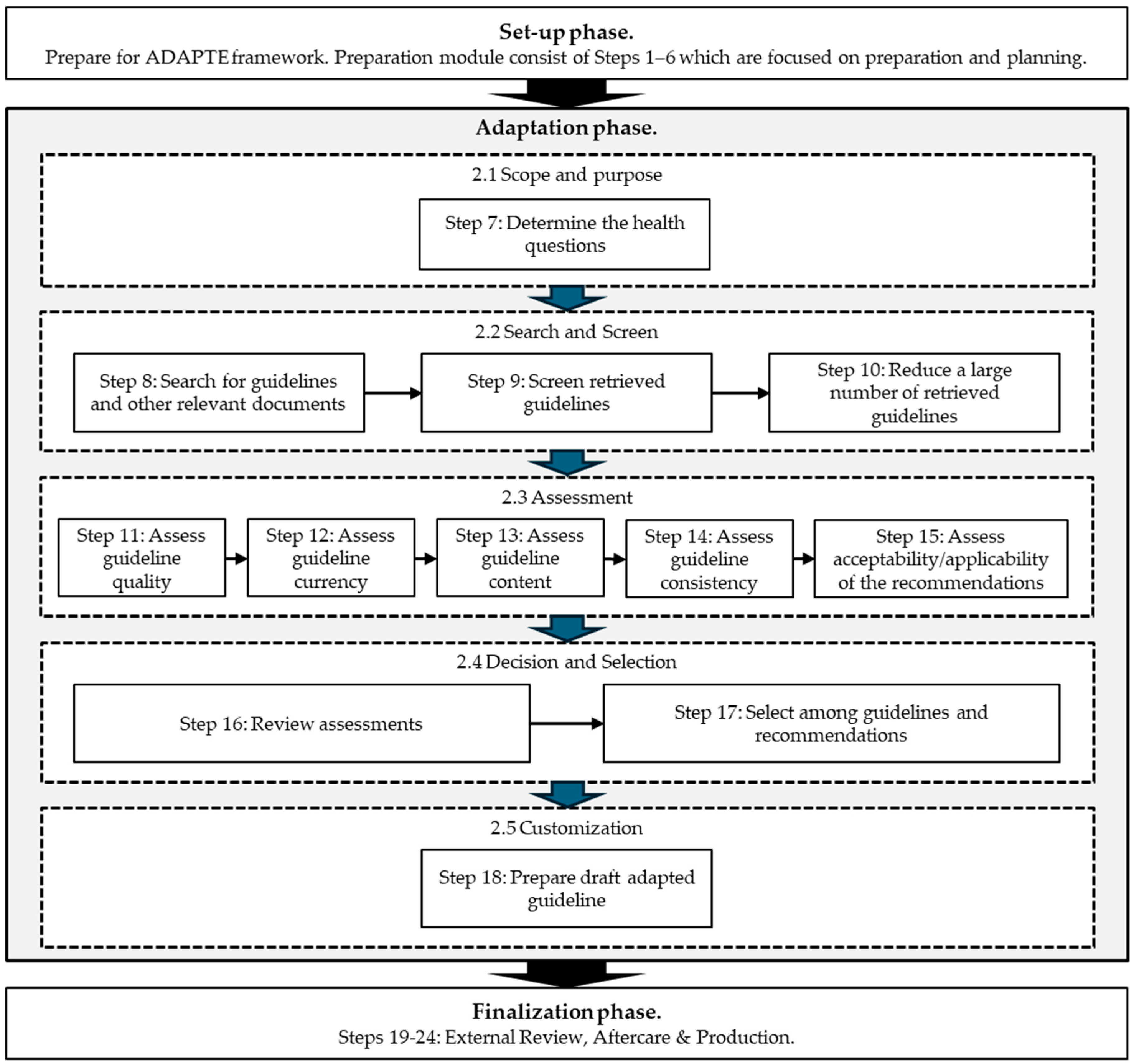
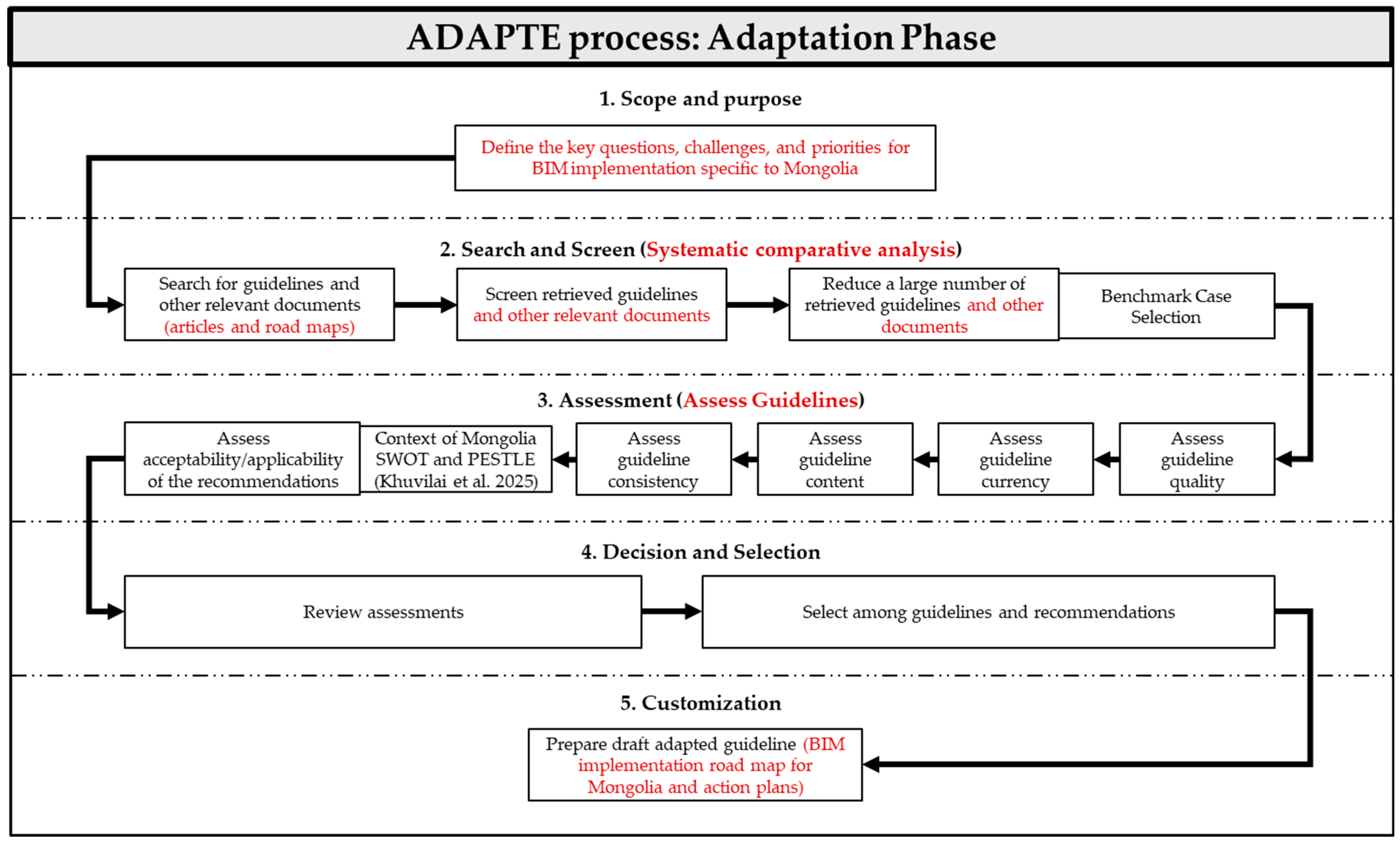
3.1. Recontextualization of the “Adaptation Phase Key Modules” from the ADAPTE Process
- Define Key Questions (Module 2.1 → 1. Scope and Purpose): This step translates to defining the key questions, challenges, and priorities for BIM implementation specific to Mongolia. Section 2 of this study extensively delves into this part of our research and defines the scope in the narrative.
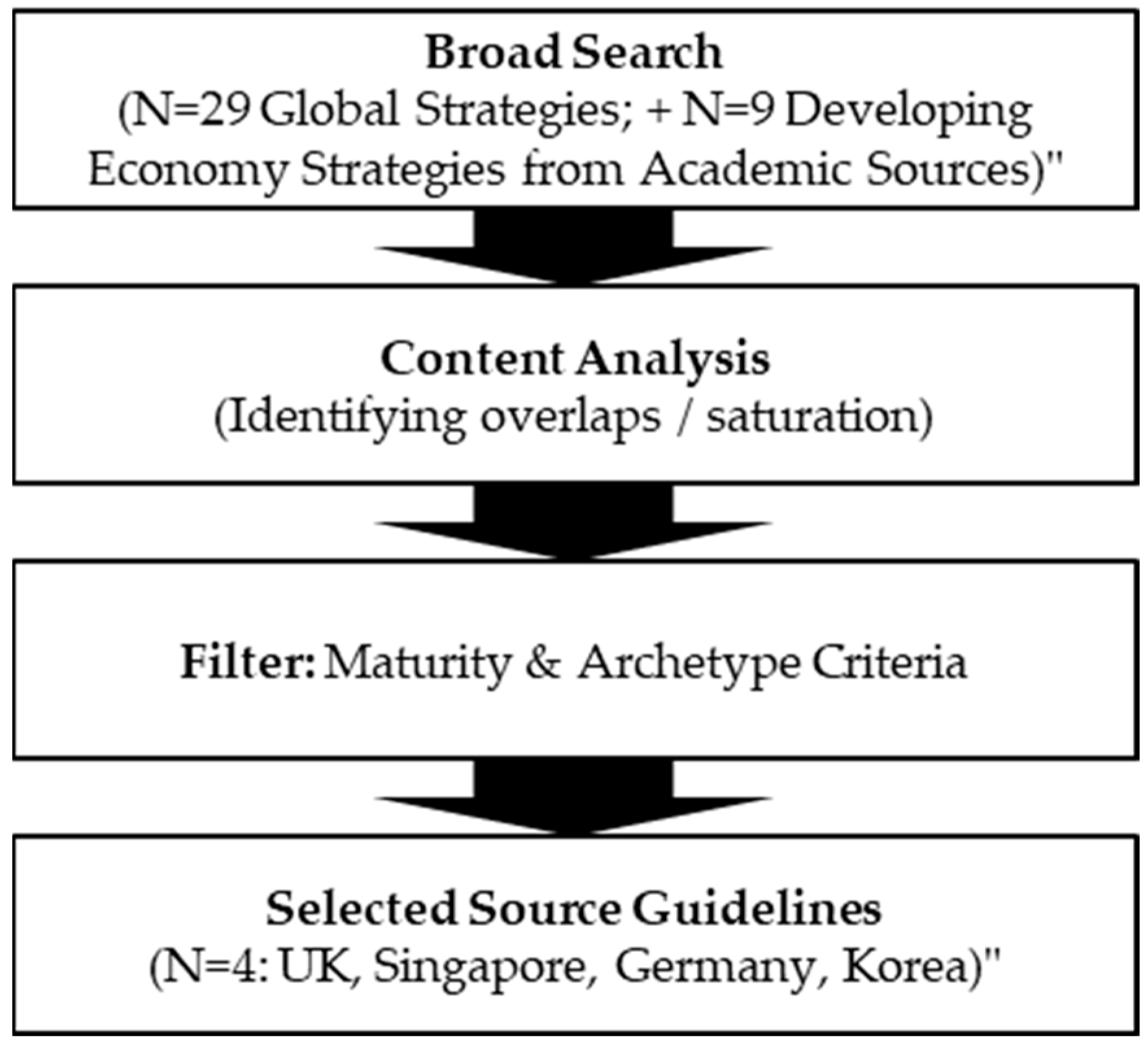
- Search and Screen Guidelines (Module 2.2 → 2. Systematic Comparative Analysis): This corresponds to the systematic comparative analysis this research conducted on the mature BIM implementation roadmaps (the UK, Germany, Singapore, and South Korea) to identify common, high-quality “source guidelines” and their core components (e.g., phased approaches, three-aspect classifications). This module follows the steps of searching, screening, and reducing redundancy. Around 29 countries’ frameworks were assessed, and 4 benchmark countries were selected during this process.
- Assess Guidelines (Module 2.3→ 3): This is the critical validation step. It involves the following:
- Step: Assess Acceptability and Applicability: This is the justifying principle of the entire methodology, where the “matching” occurs (see Section 3.2).
- Decide and Select (Module 2.4 → 4) and Customize (Module 2.5 → 5): Based on the formal assessment, a transparent process of selection (e.g., “borrowing” the phased approach), modification, and customization is undertaken to produce the draft of the adapted guideline [33].
3.2. The Systematic “Matching” and Validation Filter
- Applicability (Resources): “Are the interventions and/or equipment available in the context of use?”
- Applicability (Expertise): “Is the necessary expertise (knowledge and skills) available in the context of use?”
- Applicability (Constraints): “Are there any constraints, organizational barriers, legislation, policies, and/or resources… that would impede the implementation…?”
- Acceptability (Values): “Is the recommendation compatible with the culture and values in the setting where it is to be used?”
4. Comparative Analysis of International BIM Roadmaps
4.1. Query and Screening of International Policy and Guideline Practices for BIM Adoption

| Guidelines and Policy Document Title | Jurisdiction | Document Type | Roadmap Phases and Key Temporal Milestones | Source |
|---|---|---|---|---|
| AASHTO BIM for Bridges and Structures Roadmap | The US | Roadmap | Year 3 (2018): Project work commencement. Focus on establishing national standards for bridge semantics/geometry. | [59] |
| B/555 Roadmap (Design, Construction, and Ops Data) | The UK | Roadmap/Standards Strategy | 2007–2014: Evolution from BS 1192:2007 to BS 1192-4 (2014). Defined maturity levels (0-3) and “Capital Delivery” phase guidance. | [60] |
| Royal Decree 11400/2019 (BIM Subsidies) | Spain | Legal Decree | 2018–2019: Fiscal cycles for training grants. Execution: 3 months from grant award for training activities. | [61] |
| Roadmap for BIM Implementation | Poland | Strategic Roadmap | 2020–2025: Implementation horizon. Defines “MacroBIM” (investment programming), delivery, and operation phases using a matrix (A1-E4). | [62] |
| Roadmap Standards Final Report | Netherlands | Roadmap/Standards Review | 2022: Snapshot of the “Digital Building File.” Life-cycle phases: initiative, design, realization, and maintenance/asset management. | [63] |
| Recommendations for Using BIM (KBOB) | Switzerland | Best Practice Guide | 2018: Publication. Defines public owner roles across the planning, construction, and operation phases. | [64] |
| Decision 347/QD-BXD (Detailed BIM Instructions) | Vietnam | Technical Regulation | 2021: Issued. Phases: preliminary design, basic design, technical design, construction drawing design. Specific LOD definitions. | [65] |
| Roadmap for Creating the Ideal Digital Ecosystem | Dubai, UAE | Strategic Roadmap | 2020: Mandate (A3.1-2020). Focus on GIS/BIM integration for the building permit ecosystem. | [66] |
| Philippines Construction Industry Roadmap | Philippines | Industry Roadmap | 2020–2030: Q2 2020: CIAP reform. 2023–2025: Service export focus. “Tatag at Tapat” (Stable and Faithful) vision. | [67] |
| Catalog of Measures for the Use of BIM | Germany | Strategic Study | 2013–2014: Research duration. Proposed phased rollout: pilot projects -> legal clarification -> standardization. | [68] |
| Construction Digitalization Roadmap | Hong Kong, China | Strategic Roadmap | 2021–2026: Targets 100% adoption for >HKD 300 M projects by 2026. 6 digital application areas (smart data, planning, etc.). | [69] |
| National Roadmap for BIM Development | Indonesia | Strategic Roadmap | Phase 1: Adoption/Pilots. Phase 2: Digitalization/Infrastructure. Phase 3: Collaboration/Lean. Phase 4: Integration/CIM. | [70] |
| Roadmap for Digital Transition | Ireland | Strategic Roadmap | 2018–2021: 4-year transition. Q1 2018: Leadership set-up. 2021 Target: 20% cost reduction, 20% faster delivery. | [71] |
| Vision for the Future and Roadmap for BIM | Japan | Strategic Roadmap | 2019: Initiation. Process 1–3: Workflow dev., geometry standardization, building confirmation via BIM. | [72] |
| BIM as an Element of Digitalization | Kazakhstan | Strategic Report | 2017: Standards intro. 2018–2019: State Bank of Info models. 2021: Digitization of regulations. | [73] |
| BIM Guide | South Korea | Implementation Guide | 2010: Early adoption framework. Focus on virtual design, software selection, and data creation standards. | [74] |
| BIM Roadmap (Ceļa Karte) | Latvia | Strategic Roadmap | 2019: Launch. 2025: Public procurement mandate. 2022/2023: Educational curriculum integration. | [75] |
| JKR Strategic Plan 2021–2025 | Malaysia | Agency Plan | 2021–2025: 5-year cycle. Focus on total asset management (PAM) and technical excellence (CREATE). | [76] |
| Singapore BIM Roadmap | Singapore | Strategic Roadmap | 2010–2015: 2013: Arch e-submission (>20 k m2). 2014: Eng e-submission. 2015: All projects >5 k m2. | [77] |
| Strategic Plan for Digital Transformation | Argentina | Strategic Plan | 2019–2023: 4-year plan. Focus on transparency, efficiency (“Obras Claras”), and innovation. | [78] |
| Australian BIM Strategic Framework | Australia | Strategic Policy | 2019: National principles. Objectives: consistency, efficiency, open data standards across states/territories. | [79] |
| Digital Engineering Framework v4.0 | Australia (NSW) | Technical Framework | 2018–2022: Iterative release (v1.0 to v4.0). Life-cycle focus from context to procurement to education. | [80] |
| Victorian Digital Asset Strategy (VDAS) | Australia (VIC) | Strategic Guidance | 2019: Release. Defines 7 life-cycle stages: brief, concept, definition, design, build, handover, and operations. | [81] |
| BIM BR Strategy | Brazil | National Strategy | 2018: Launch. Phase 1 (2021): Arch/Eng Pilots. Phase 2 (2024): 4D/5D. Phase 3 (2028): Full life-cycle O&M. | [82] |
| National BIM Strategy | Costa Rica | National Strategy | 2020: Launch. 2019: Diagnostic. Future: Standardization and pilots modeled on international benchmarks. | [83] |
| BIM Implementation Strategy | Czech Republic | Strategic Concept | 2017: Approval. 2018–2020: Preparation/Pilots. 2022: Obligatory BIM in public contracts. | [84] |
| Handbook for the Introduction of BIM | EU | Strategic Handbook | 2017: Pan-European framework. Sets context for national strategies. Targets 10–20% sector savings by 2025. | [85] |
| Standardization of Information (RASTI) | Finland | National Strategy | 2018–2030: 2023: Commitment. 2025: Mandatory use. 2030: Vision of machine-readability. | [86] |
| Guide of Recommendations for Clients | France | Implementation Guide | 2016: PTNB launch. Focus on the “BIM 2022” horizon and engaging SMEs in the digital transition. | [87] |
4.2. Benchmark Case Selection (South Korea, Singapore, the UK, and Germany)
- The UK (The Standardization Archetype): It was chosen as the predecessor of the ISO 19650 standard and the most effective implementation strategy based on top-down governmental requirements. It provides the ultimate plan for policy standardization.
- Singapore (The Integration Archetype): It was chosen because its roadmap integrates with electronic submission systems (CORENET). It offers a model of the digital ecosystem that is required to achieve long-term efficiency by the government.
- South Korea (The Developmental Archetype): This country was chosen for being a successful example of a region that managed to switch between being a fast follower and a global leader. Its roadmap provides certain understandings of the Asian regulatory environment and the government-based infrastructure digitalization associated with Mongolia.
- Germany (The Industry-Led Archetype): The country was chosen due to its high emphasis on technical accuracy and industry-oriented standards (VDI), and it provides a roadmap model that fulfills the various needs of stakeholders regarding technical aspects.
4.3. Key Features of the Four Benchmark BIM Roadmaps
4.3.1. The UK
- Mandate-Driven Approach: The UK is known for its strong government-led approach to BIM adoption. It implemented a BIM mandate for public sector projects, starting with BIM Level 2, and later introduced Digital Built Britain, aiming for the full digitalization of the construction industry.
- Clear BIM Standards: The UK has developed comprehensive BIM standards and guidelines, such as PAS 1192, which provide a structured framework for BIM implementation. These standards emphasize data exchange, collaboration, and common naming conventions.
- Public–Private Collaboration: The UK emphasizes collaboration between the public and private sectors. The BIM task group, consisting of industry experts, played a key role in developing and promoting BIM adoption.
- Education and Skills Development: The UK invests significantly in BIM education and training programs. It supports the development of a skilled workforce through initiatives like BIM apprenticeships and certification programs.
4.3.2. Germany
- Regulation-Driven Approach: Germany focuses on introducing regulations and digitalization in the construction sector to improve efficiency. It introduced DIN SPEC 91400 as a guideline for BIM implementation and emphasizes digital plan review and approval.
- Standardization Efforts: Germany’s approach includes a focus on standardization and guidelines, aligning with DIN standards. DIN SPEC 91391 and DIN SPEC 91400 provide the framework for BIM processes and data exchange.
- Public and Private Collaboration: Collaboration between government and industry is a common theme. Organizations like the German Institute for Standardization (DIN) work with industry stakeholders to develop BIM standards.
- Education and Training: Germany recognizes the importance of BIM education and offers various training programs to build a skilled workforce.
4.3.3. Singapore
- Government-Led and Mandate-Driven: Singapore has a strong government-led initiative with mandatory BIM requirements for public projects. The BCA (Building and Construction Authority) introduced these mandates to drive BIM adoption.
- Smart Built Environment: Singapore places BIM within the broader context of a smart built environment. BIM is seen as integral to enhancing urban living, sustainability, and infrastructure quality.
- Comprehensive BIM Guides: Singapore provides comprehensive BIM guides and educational programs to support adoption. It emphasizes standards like the Singapore BIM Guide and collaborates with industry players.
- International Engagement: Singapore actively participates in international BIM events and collaborations, sharing its experiences and learning from others.
4.3.4. South Korea
- Government-Driven Initiatives: South Korea relies on government-driven initiatives and regulations to promote BIM adoption. The Smart Construction Promotion Act and digital plan review are examples of regulatory efforts.
- BIM Training and Research: South Korea focuses on BIM training and education for professionals. It encourages research and development in BIM-related projects and technologies.
- Industry Collaboration: Collaboration among the government, industry, and academia is a common theme in South Korea. Task forces and associations promote BIM adoption and knowledge sharing.
- Digital Transformation: South Korea’s approach emphasizes the digital transformation of the construction sector, with BIM as a central component.
4.4. Common Approaches
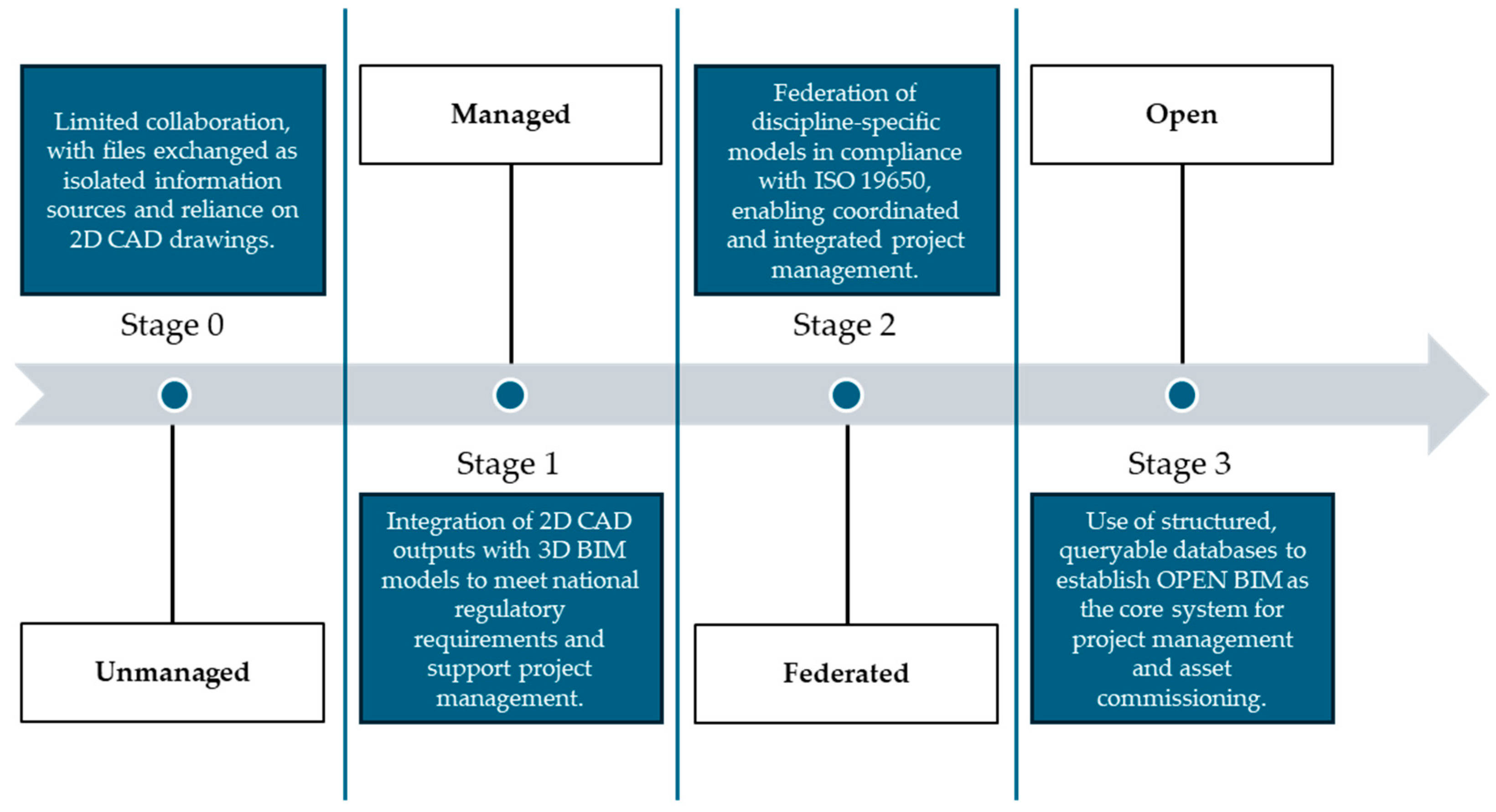
4.5. Target Maturity Stages
- Stage 0 (Unmanaged): The term ‘Unmanaged’ implies the absence of rules in managing project information shared among project participants. At this stage, national or international construction information management standards are not utilized, and project information is not managed according to any project standards. Typically, 2D drawings and traditional communication and documentation methods are employed, lacking the benefits of digital collaboration and information sharing technologies.
- Stage 1 (Managed): The term ‘Managed’ signifies a level of maturity in which there are established rules and processes for managing project information. At this stage, national or international standards for construction information management are implemented to ensure consistency. Project information is managed according to project-specific standards and a CDE (common data environment) for efficient collaboration. This includes the use of structured data formats, such as CAD, and electronic means of communication and documentation. The biggest difference between Stage 1 and Stage 2 is the utilization of integrated applications for information with federated information models. Therefore, collaboration primarily revolves around managing information within individual disciplines or organizations in Stage 1.
- Stage 2 (Federated): Stage 2 refers to a higher level of BIM maturity, where information models from different disciplines are combined, creating a federated information model that integrates data from various sources. This stage emphasizes the integration and coordination of information across disciplines to enable effective collaboration and eliminate clashes between disciplines. In Stage 2, there is typically an increased level of interoperability between different software applications and a focus on information exchange standards to facilitate efficient coordination. The federated information model allows for a more holistic view of the project, enhancing collaboration and coordination among project stakeholders. Using integrated applications and federated information models enables real-time collaboration, clash detection, and improved communication among all project participants. This stage moves beyond managing information within disciplines and emphasizes the integration of data and models to achieve better project outcomes.
- Stage 3 (Open): Stage 3 represents a future vision for BIM that has not yet been fully defined. However, the UK Government’s Strategic Plan outlines the vision and key measures for this stage. The focus is on achieving a more open and collaborative environment for data sharing and project delivery.
5. Proposed Strategic Framework for BIM Implementation in Mongolia
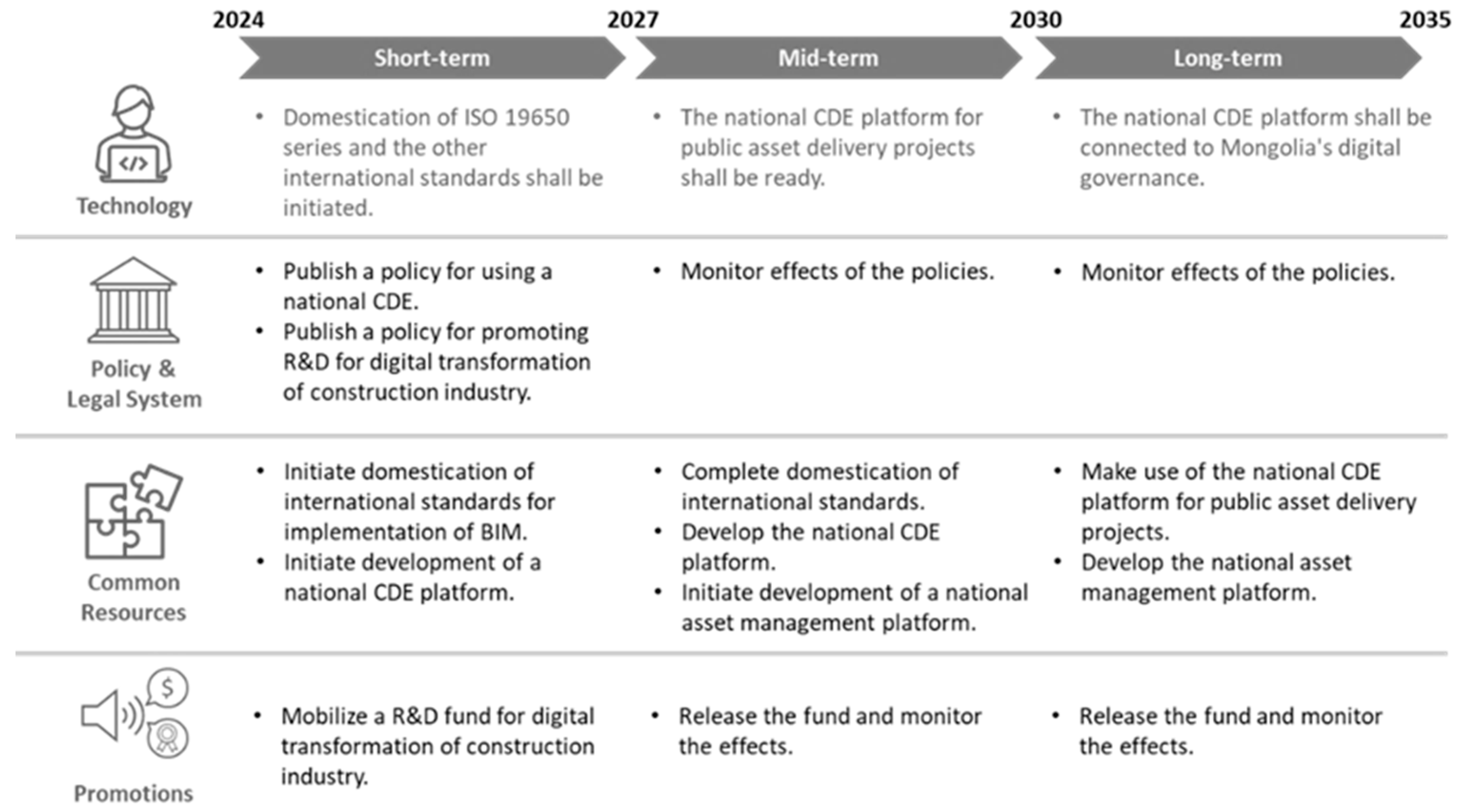
5.1. Strategic Framework Goals by Phase and Action
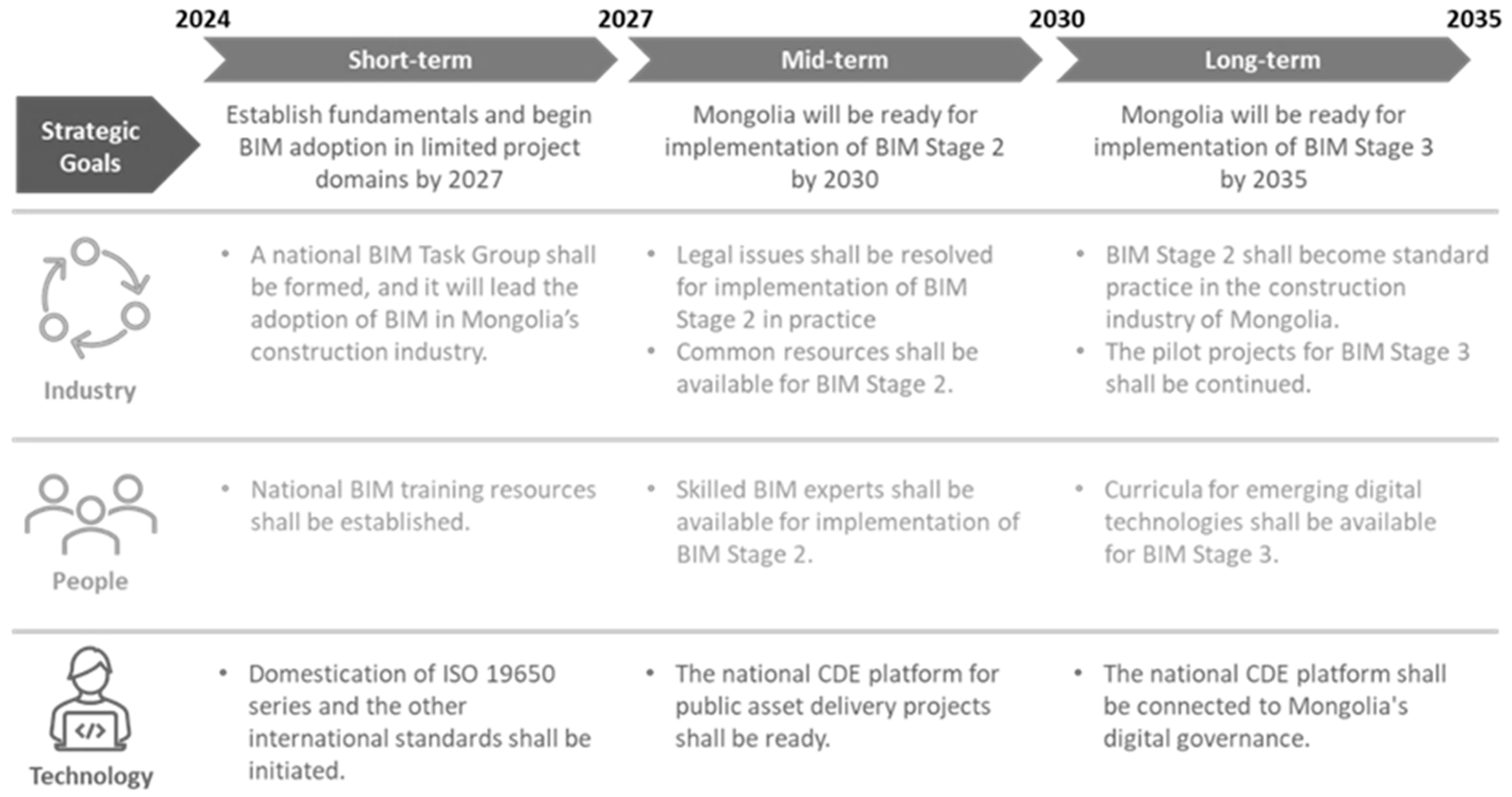
- The short-term goal is to introduce BIM into the construction sector, with an initial emphasis on applying it to three-dimensional model-driven coordination. This stage is intended to act as a practical starting platform through which the industry can observe its advantages. In doing so, BIM can be progressively incorporated into established practices and processes.
- To facilitate the uptake of BIM during this stage, it is crucial to establish the necessary groundwork, which includes the development of standardized guidelines and a supportive legal framework. These guidelines will provide a framework for implementing BIM in the most effective and efficient way possible, while the legal documents will ensure compliance with regulations and provide the necessary legal backing for BIM implementation.
- Alongside the preparation of guidelines and regulatory documents, improvements to the legal framework are required. Such reforms should help guarantee that the construction sector has access to professionals trained in BIM. A strong legal framework also plays a central role in enforcing technical standards. As a result, the effective promotion of BIM depends on the presence of a competent and well-qualified workforce.
- The primary mid-term objective is to align Mongolia’s construction sector with international standards by reaching Stage 2 BIM maturity. The stage is marked by an expansion of BIM capabilities beyond simple three-dimensional coordination, creating the basis for more sophisticated implementations.
- Reaching this target depends on construction-related public authorities being adequately prepared to use BIM in advance of regulatory enforcement. Such a proactive strategy will ensure the industry is adequately equipped to adopt the advanced BIM methodologies stipulated by international standards.
- Achieving Stage 2 maturity requires the adoption of ISO 19650 standard systems across all organizations in the construction industry of Mongolia. These standards provide a framework for managing information and collaboration throughout the construction process. By adopting these standards, Mongolia can align its practices with global best practices, allowing for seamless integration and collaboration with international partners.
- The success of this stage relies heavily on strong cooperation with the appropriate government departments. Such collaboration helps ensure that public policies and initiatives are consistent with and supportive of BIM practices. It also plays an important role in making procedures more efficient. Furthermore, this partnership helps to eliminate obstacles that could hinder the effective use of BIM in the construction sector.
- The phase is marked by the large-scale integration of digital systems, such as collaborative data platforms, digital communication networks, and the essential technological resources. These technological instruments are designed to support and streamline information exchange, coordination, and collaborative processes among the diverse stakeholders in the construction sector.
- By achieving Stage 2 maturity and implementing ISO 19650 standards, the construction industry in Mongolia can enhance its international competitiveness, improve project delivery efficiency, and foster collaborative working relationships with international partners.
- The overarching future goal involves fully modernizing Mongolia’s building sector through digitalization, marking a major step forward in incorporating advanced technologies. The concluding stage corresponds to approaches adopted in developed countries, where emphasis is placed on broadening the use of information-rich, model-driven construction processes to reach the upper tier of BIM maturity. The central elements of this pathway include digital twin systems, intelligent construction methods, the combination of artificial intelligence (AI) with big data analytics, and applications of augmented reality (AR) and mixed reality (MR). Collectively, these cutting-edge tools represent the leading edge of innovation in the sector and hold substantial promise for improving efficiency, sustainability, and collaboration in projects.
- Once BIM is firmly embedded in the construction sector, attention shifts toward using digital models to improve efficiency and safety throughout the lifespan of a project. Access to this information enables stakeholders to make better decisions and refine day-to-day processes. It also supports a more effective allocation of resources from the design stage through construction and into facility management.
- During this phase, research and development activities will be of critical importance as stakeholders aim to integrate new technologies. By examining cutting-edge technologies, carrying out pilot initiatives, and analyzing their possible outcomes, researchers will play a leading role in shaping the future of Mongolia’s construction field.
- As new digital technologies are adopted and tested during this phase, guidelines and standards will need to be expanded to accommodate these advancements and ensure compliance with the legal system. It is essential to continuously update regulatory frameworks, industry standards, and best practices to support the integration of innovative technologies and maintain a competitive edge in the global construction market.
5.2. Outline of Action Items for Each Aspect of the Roadmap Framework
6. Detailed Action Plan Items for Strategic BIM Implementation
7. Discussion: Strategic Implications for Sustainable Development
7.1. Policy, Legal Framework, and Sustainability
7.2. Socio-Economic and Technical Transformation
7.3. Towards a Digital Nation and Transformation
7.4. Construction Materials and Supply Chain Sustainability
7.5. Infrastructure Resilience and the Climate Imperative
7.6. Limitations and Future Directions
8. Conclusions
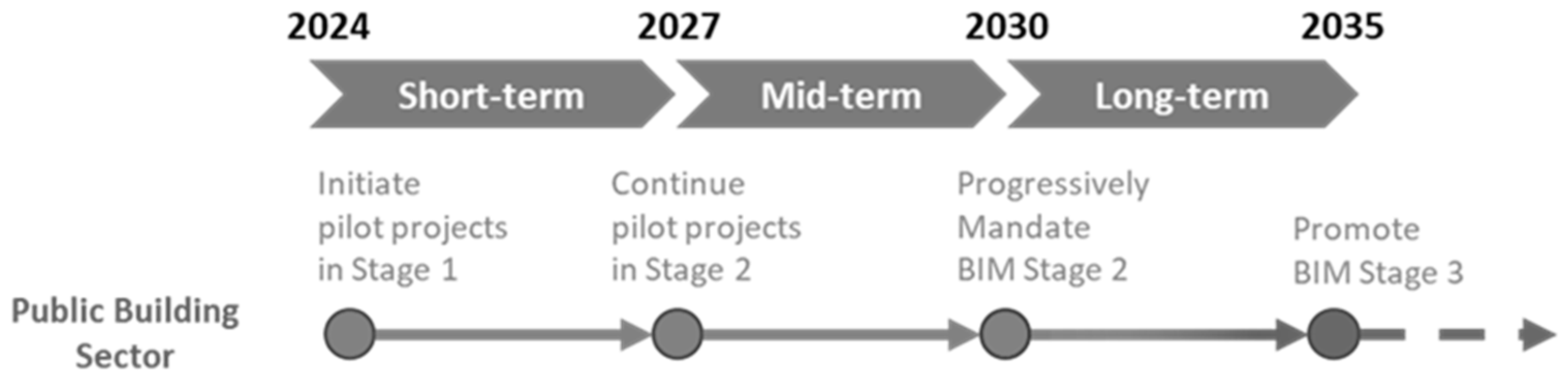
- Preparation and Pilot (2024–2027): Focusing on establishing the national BIM task group, conducting pilot projects, and developing the initial policy and legal infrastructure.
- Adoption and Standardization (2027–2030): Defined by the rollout of the National CDE, the domestication of ISO 19650, and the enforcement of mandates for public buildings to achieve “Stage 2” maturity.
- Integration and Digital Transformation (2030–2035): Aiming for “Stage 3” maturity, extending mandates to infrastructure, and integrating advanced technologies like digital twins and AI to achieve a fully “Smart Built Environment.”
Author Contributions
Funding
Institutional Review Board Statement
Informed Consent Statement
Data Availability Statement
Conflicts of Interest
Abbreviations
| MCUD | Mongolian Ministry of Construction and Urban Development |
| MASM | Mongolian Agency for Standardization and Metrology |
| BIM | Building Information Modeling |
| BTC | BIM Training Center |
| BTG | BIM Task Group |
| CDE | Common Data Environment |
| AECO | Architecture, Engineering, Construction, and Operations |
References
- Hashemkhani Zolfani, S.; Pourhossein, M.; Yazdani, M.; Zavadskas, E.K. Evaluating Construction Projects of Hotels Based on Environmental Sustainability with MCDM Framework. Alex. Eng. J. 2018, 57, 357–365. [Google Scholar] [CrossRef]
- Jing, W.; Alias, A.H. Key Factors for Building Information Modelling Implementation in the Context of Environmental, Social, and Governance and Sustainable Development Goals Integration: A Systematic Literature Review. Sustainability 2024, 16, 9504. [Google Scholar] [CrossRef]
- Kineber, A.F.; Othman, I.; Oke, A.E.; Chileshe, N.; Buniya, M.K. Identifying and Assessing Sustainable Value Management Implementation Activities in Developing Countries: The Case of Egypt. Sustainability 2020, 12, 9143. [Google Scholar] [CrossRef]
- Khahro, S.H.; Kumar, D.; Siddiqui, F.H.; Ali, T.H.; Raza, M.S.; Khoso, A.R. Optimizing Energy Use, Cost and Carbon Emission through Building Information Modelling and a Sustainability Approach: A Case-Study of a Hospital Building. Sustainability 2021, 13, 3675. [Google Scholar] [CrossRef]
- Olanrewaju, O.I.; Kineber, A.F.; Chileshe, N.; Edwards, D.J. Modelling the Impact of Building Information Modelling (Bim) Implementation Drivers and Awareness on Project Lifecycle. Sustainability 2021, 13, 8887. [Google Scholar] [CrossRef]
- Huovila, P.; Ala-Juusela, M.; Melchert, L.; Pouffary, S.; Cheng, C.-C.; Urge-Vorsatz, D.; Koeppel, S.; Graham, P. Buildings and Climate Change Summary for Decision Makers Sustainable Buildings & Climate Initiative; UNEP SBCI: Paris, France, 2009. [Google Scholar]
- UNEP SBCI. Common Carbon Metric for Measuring Energy Use & Reporting Greenhouse Gas Emissions from Building Operations; UNEP SBCI: Paris, France, 2009. [Google Scholar]
- Hamilton, I.; Kennard, H.; Rapf, O.; Amorocho, J.; Steuwer, S.; Kockat, J.; Toth, Z.; Delmastro, C.; Gordon, R.M.; Petrichenko, K.; et al. Global Status Report for Buildings and Construction: Beyond Foundations—Mainstreaming Sustainable Solutions to Cut Emissions from the Buildings Sector. Available online: https://wedocs.unep.org/20.500.11822/45095 (accessed on 24 November 2025).
- Carvalho, J.P.; Bragança, L.; Mateus, R. Sustainable Building Design: Analysing the Feasibility of BIM Platforms to Support Practical Building Sustainability Assessment. Comput. Ind. 2021, 127, 103400. [Google Scholar] [CrossRef]
- Shahria Bhuyain, M.G.; Bhuiyan, S.; Alam, S.; Mahzuz, H.M.A. Sustainability Analysis Using 6 D BIM for a Conceptual Residential Building Model. Discov. Civ. Eng. 2025, 2, 163. [Google Scholar] [CrossRef]
- Zubair, M.U.; Ali, M.; Khan, M.A.; Khan, A.; Hassan, M.U.; Tanoli, W.A. BIM- and GIS-Based Life-Cycle-Assessment Framework for Enhancing Eco Efficiency and Sustainability in the Construction Sector. Buildings 2024, 14, 360. [Google Scholar] [CrossRef]
- Waqar, A.; Othman, I.; Saad, N.; Azab, M.; Khan, A.M. BIM in Green Building: Enhancing Sustainability in the Small Construction Project. Clean. Environ. Syst. 2023, 11, 100149. [Google Scholar] [CrossRef]
- Singh, A.; Divyashree. Enhancing Green Building Performance through Integrated BIM Model Optimization Strategies. In Proceedings of the 11th International Conference on Cutting-Edge Developments in Engineering Technology and Science (ICCDETS24); 2024. Available online: https://cd69d634-fbf5-4870-9835-0d3668731238.filesusr.com/ugd/2b9d2a_8fa9b3eb710f491aa48d19757217d804.pdf (accessed on 24 November 2025).
- Ismaeel, W.S.E.; Lotfy, R.A.E.R. An Integrated Building Information Modelling-Based Environmental Impact Assessment Framework. Clean Technol. Environ. Policy 2023, 25, 1291–1307. [Google Scholar] [CrossRef]
- Abuhussain, M.; Alhamami, A.H.; Almazam, K.; Humaidan, O.; Bashir, F.M.; Dodo, Y.A. Integrating BIM, Machine Learning, and PMBOK for Green Project Management in Saudi Arabia: A Framework for Energy Efficiency and Environmental Impact Reduction. Buildings 2025, 15, 3031. [Google Scholar] [CrossRef]
- Nabawy, M.; Mohamed, A.G.; Awad, I.; Daoud, A.O. Green Building Information Modeling Framework for Sustainable Residential Development in Egypt. Buildings 2025, 15, 1035. [Google Scholar] [CrossRef]
- Akbari, S.; Sheikhkhoshkar, M.; Pour Rahimian, F.; El Haouzi, H.B.; Najafi, M.; Talebi, S. Sustainability and Building Information Modelling: Integration, Research Gaps, and Future Directions. Autom. Constr. 2024, 163, 105420. [Google Scholar] [CrossRef]
- Guo, K.; Li, Q.; Zhang, L.; Wu, X. BIM-Based Green Building Evaluation and Optimization: A Case Study. J. Clean. Prod. 2021, 320, 128824. [Google Scholar] [CrossRef]
- Tang, L. Building Information Modeling Roadmap in Developing Economies; ADB Institute Policy Brief: Tokyo, Japan, 2025; Available online: https://www.adb.org/publications/building-information-modeling-development-roadmap-in-developing-economies (accessed on 24 November 2025).
- Brucker, B.A.; Beth, M.P.; East, W.E.; Huston, B.K.; Nachtigall, S.D.; Shockley, J.C.; Spangler, S.C.; Wilson, J.T. Building Information Modeling (BIM): A Road Map for Implementation to Support MILCON Transformation and Civil Works Projects within the U. S. Army Corps of Engineers; U. S. Army Corps of Engineers: Washington, DC, USA, 2006. [Google Scholar]
- Jiang, R.; Wu, C.; Lei, X.; Shemery, A.; Hampson, K.D.; Wu, P. Government Efforts and Roadmaps for Building Information Modeling Implementation: Lessons from Singapore, the UK and the US. Eng. Constr. Archit. Manag. 2022, 29, 782–818. [Google Scholar] [CrossRef]
- Lin, E.T.A. Singapore BIM Roadmap: An Update. In Proceedings of the BIM Forum & Academic Comference 2014, Seoul, Republic of Korea, 17 April 2014. [Google Scholar]
- Edirisinghe, R.; Miang Goh, Y.; Shen, L. An Investigation of BIM Readiness of Owners and Facility Managers in Singapore: Institutional Case Study. In Proceedings of the CIB World Building Congress, Tampere, Finland, 30 May–3 June 2016. [Google Scholar]
- Agwa, T.C.; Celik, T. From Barriers to Breakthroughs: A Deep Dive into BIM Integration Challenges. Buildings 2025, 15, 1116. [Google Scholar] [CrossRef]
- Akal, A.Y.; Kineber, A.F.; Mohandes, S.R. A Phase-Based Roadmap for Proliferating BIM within the Construction Sector Using DEMATEL Technique: Perspectives from Egyptian Practitioners. Buildings 2022, 12, 1805. [Google Scholar] [CrossRef]
- Mishra, A.; Hasan, A.; Jha, K.N. A Holistic Evaluation of BIM Implementation Barriers in the Indian Construction Industry: Pre- and Post-Adoption Perspectives. Int. J. Constr. Educ. Res. 2024, 20, 358–380. [Google Scholar] [CrossRef]
- Rinchen, S.; Banihashemi, S.; Alkilani, S. Driving Digital Transformation in Construction: Strategic Insights into Building Information Modelling Adoption in Developing Countries. Proj. Leadersh. Soc. 2024, 5, 100138. [Google Scholar] [CrossRef]
- Erdene, K.; Kim, S.H.; Lee, S.-H. BIM Adoption and Implementation Challenges in Mongolia. In Proceedings of the Sixth International Conference on Civil and Building Engineering Informatics, Hong Kong, China, 8–11 January 2025; Kalpa Publications in Computing; Volume 22, pp. 42–55. [Google Scholar] [CrossRef]
- Ariono, B.; Wasesa, M.; Dhewanto, W. The Drivers, Barriers, and Enablers of Building Information Modeling (BIM) Innovation in Developing Countries: Insights from Systematic Literature Review and Comparative Analysis. Buildings 2022, 12, 1912. [Google Scholar] [CrossRef]
- Girginkaya Akdag, S.; Maqsood, U. A Roadmap for BIM Adoption and Implementation in Developing Countries: The Pakistan Case. Archnet-IJAR Int. J. Archit. Res. 2020, 14, 112–132. [Google Scholar] [CrossRef]
- Mumba, S.; Mwiya, B. Development of a Framework for BIM Implementation in the Zambian AEC Industry. Eur. Mod. Stud. J. 2024, 8, 229–245. [Google Scholar] [CrossRef]
- Fervers, B.; Burgers, J.S.; Voellinger, R.; Brouwers, M.; Browman, G.P.; Graham, I.D.; Harrison, M.B.; Latreille, J.; Mlika-Cabane, N.; Paquet, L.; et al. Guideline Adaptation: An Approach to Enhance Efficiency in Guideline Development and Improve Utilisation. BMJ Qual. Saf. 2011, 20, 228–236. [Google Scholar] [CrossRef]
- GIN ADAPTE. Resource Toolkit. Available online: www.g-i-n.net (accessed on 10 October 2024).
- Münter, M.T. Pestle-Analysis. In International Encyclopedia of Business Management; Elsevier: Amsterdam, The Netherlands, 2026; pp. 481–486. [Google Scholar]
- Helms, M.M.; Nixon, J. Exploring SWOT Analysis—Where Are We Now?: A Review of Academic Research from the Last Decade. J. Strategy Manag. 2010, 3, 215–251. [Google Scholar] [CrossRef]
- Liza, M.; Gheda, M.; Raihanee, R.; Tarmidi, M. Bridging the Gap: Strategies to Enhance Building Information Modelling (BIM) Integration in Klang Valley, Malaysia’s Construction Industry. Int. J. Latest Technol. Eng. Manag. Appl. Sci. 2024, 13, 172–178. [Google Scholar] [CrossRef]
- Seng, N.H.; Teng, N.C.; Noor, N.M.; Umar, S.; Wei, N.T.; Boon, K.H.; Ling, F.T.C. BIM Implementation in Malaysian Quantity Surveying: A Conceptual Framework for Success Aligned with the Strategic Plan 2021–2025. Diyala J. Eng. Sci. 2025, 18, 55–69. [Google Scholar] [CrossRef]
- Belay, S.; Goedert, J.; Woldesenbet, A.; Rokooei, S.; Matos, J. Building Information Modeling Implementation Strategies for Public Infrastructure Projects in Emerging Markets: The Case of Ethiopia. Cogent Eng. 2023, 10, 2220481. [Google Scholar] [CrossRef]
- Tam, V.W.; Zhou, Y.; Illankoon, C.; Le, K.N. A Critical Review on BIM and LCA Integration Using the ISO 14040 Framework. Build. Environ. 2022, 213, 108865. [Google Scholar] [CrossRef]
- Akhanova, G.; Nadeem, A.; Kim, J.R.; Azhar, S.; Khalfan, M. Building Information Modeling Based Building Sustainability Assessment Framework for Kazakhstan. Buildings 2021, 11, 384. [Google Scholar] [CrossRef]
- Mohammed, A.B. Applying BIM to Achieve Sustainability throughout a Building Life Cycle towards a Sustainable BIM Model. Int. J. Constr. Manag. 2022, 22, 148–165. [Google Scholar] [CrossRef]
- Aitbayeva, D.; Hossain, M.A. Building Information Model (BIM) Implementation in Perspective of Kazakhstan: Opportunities and Barriers. J. Eng. Res. Rep. 2020, 14, 13–24. [Google Scholar] [CrossRef]
- Ya’acob, M.R.; Mat Isa, C.M.; Abdull Rahman, S.H.; Salleh, S. Building Information Modelling Implementation Framework (BIMIF) for Government Building Construction Among Civil and Structural Engineering Consultants in Malaysia. In Green Infrastructure: Materials and Sustainable Management; Springer: Singapore, 2024; pp. 61–77. [Google Scholar] [CrossRef]
- Lembangan, M.O.; Nurdiah, E.A. A Review of BIM Implementation in Indonesia’s Smart Cities: Challenges and Opportunities. Adv. Civ. Eng. Sustain. Archit. 2025, 7, 46–59. [Google Scholar] [CrossRef]
- Kineber, A.F.; Othman, I.; Famakin, I.O.; Oke, A.E.; Hamed, M.M.; Olayemi, T.M. Challenges to the Implementation of Building Information Modeling (BIM) for Sustainable Construction Projects. Appl. Sci. 2023, 13, 3426. [Google Scholar] [CrossRef]
- Calitz, S.; Wium, J. A Proposal to Facilitate BIM Implementation across the South African Construction Industry. J. S. Afr. Inst. Civ. Eng. 2022, 64, 29–37. [Google Scholar] [CrossRef]
- Olugboyega, O. Differential Relationships in the BIM Implementation Process in a Developing Country: The Role of Essential BIM Implementation Strategies. Eng. Constr. Archit. Manag. 2024, 31, 3283–3307. [Google Scholar] [CrossRef]
- Tan, S.; Gumusburun Ayalp, G.; Tel, M.Z.; Serter, M.; Metinal, Y.B. Modeling the Critical Success Factors for BIM Implementation in Developing Countries: Sampling the Turkish AEC Industry. Sustainability 2022, 14, 9537. [Google Scholar] [CrossRef]
- Saliu, L.O.; Monko, R.; Zulu, S.; Maro, G. Barriers to the Integration of Building Information Modeling (BIM) in Modular Construction in Sub-Saharan Africa. Buildings 2024, 14, 2448. [Google Scholar] [CrossRef]
- Maher, M.A. Difficulties Facing the Implementation of Building Information Modelling (BIM) in the Egyptian AEC Industry. Man Place 2024, 583–599. [Google Scholar] [CrossRef]
- Wan Mohammad, W.N.S.; Abdullah, M.R.; Ismail, S.; Takim, R. Overview of Building Information Modelling (BIM) Adoption Factors for Construction Organisations. In IOP Conference Series: Earth and Environmental Science; IOP Publishing: Bristol, UK, 2018; Volume 140. [Google Scholar] [CrossRef]
- Elmalı, Ö.; Bayram, S. Adoption of BIM Concept in the Turkish AEC Industry. Iran. J. Sci. Technol. Trans. Civ. Eng. 2022, 46, 435–452. [Google Scholar] [CrossRef]
- Chowdhury, M.; Hosseini, M.R.; Edwards, D.J.; Martek, I.; Shuchi, S. Comprehensive Analysis of BIM Adoption: From Narrow Focus to Holistic Understanding. Autom. Constr. 2024, 160, 105301. [Google Scholar] [CrossRef]
- Saka, A.B.; Chan, D.W.M.; Siu, F.M.F. Drivers of Sustainable Adoption of Building Information Modelling (BIM) in the Nigerian Construction Small and Medium-Sized Enterprises (SMEs). Sustainability 2020, 12, 3710. [Google Scholar] [CrossRef]
- Alvanchi, A.; Amin Jafari, M.; Didehvar, N. A Novel BIM Strategic Plan Development Method for the Water Industry of Iran. Sci. Iran. 2023, 30, 1–36. [Google Scholar] [CrossRef]
- NSO of Mongolia. 2024 Mongolian Statistical Yearbook; National Statistics office of Mongolia: Ulaanbaatar, Mongolia, 2024; ISBN 9789919990756. [Google Scholar]
- Tumurbaatar, Z.; Miura, H.; Tsamba, T. Development of Building Inventory Data in Ulaanbaatar, Mongolia for Seismic Loss Estimation. ISPRS Int. J. Geoinf. 2022, 11, 26. [Google Scholar] [CrossRef]
- UK BIM Framework. ISO 19650 Guidance 1: Concepts; UK BIM Framework: London, UK, 2022. [Google Scholar]
- AASHTO. BIM for Bridges and Structures Roadmap; AASHTO: Washington, DC, USA, 2020. [Google Scholar]
- BSI. B/555 Roadmap: Design, Construction & Operational Data & Process Management; BSI: London, UK, 2014. [Google Scholar]
- Boletín Oficial del Estado. Royal Decree 11400/2019; Boletín Oficial del Estado: Madrid, Spain, 2019. [Google Scholar]
- Poland Ministry of Development. Roadmap for BIM Implementation in Poland; Poland Ministry of Development: Warsaw, Poland, 2020. [Google Scholar]
- BIM Loket. Roadmap Standaarden Eindrapportage; BIM Loket: Zoetermeer, The Netherlands, 2022. [Google Scholar]
- KBOB. Recommendations for Using BIM; KBOB: Bern, Switzerland, 2018. [Google Scholar]
- Vietnam Ministry of Construction. Decision 347/QD-BXD: Detailed Guidance on BIM Application; Ministry of Construction: Hanoi, Vietnam, 2021. [Google Scholar]
- Government of Dubai. Roadmap to Create the Ideal [Digital] Construction Ecosystem for Dubai; Government of Dubai: Dubai, United Arab Emirates, 2020. [Google Scholar]
- DTI-CIAP. Philippine Construction Industry Roadmap 2020–2030; DTI-CIAP: Makati City, Philippines, 2020. [Google Scholar]
- Federal Ministry for Digital and Transport. Catalog of Measures for the Use of BIM in Public Building Administration; Federal Ministry for Digital and Transport: Berlin, Germany, 2014. [Google Scholar]
- Construction Industry Council. Construction Digitalisation Roadmap for Hong Kong; Construction Industry Council: Hong Kong, China, 2021. [Google Scholar]
- Ministry of Public Works and Housing (PUPR). Rencana Pengembangan Nasional Roadmap BIM Di Indonesia; PUPR: South Jakarta, Indonesia, 2019. [Google Scholar]
- National BIM Council. Roadmap to Digital Transition for Ireland’s Construction Industry 2018–2021; National BIM Council: Dublin, Ireland, 2020. [Google Scholar]
- Ministry of Land, Infrastructure and Transport (MLIT). Vision for the Future and Roadmap to BIM; MLIT: Tokyo, Japan, 2019. [Google Scholar]
- KazNIISA. Information Modeling Technology for Construction Objects (BIM) as an Element of Construction Industry Digitalization; KazNIISA: Astana, Kazakhstan, 2021. [Google Scholar]
- Ministry of Land, Transportation, and Maritime Affairs (MLTM). BIM Guide; MLTM: Sejong, Republic of Korea, 2010. [Google Scholar]
- Ministry of Economics. Būvju Informācijas Modelēšanas (BIM) Ceļa Karte (BIM Roadmap); Ministry of Economics: Rīga, Latvia, 2019. [Google Scholar]
- Jabatan Kerja Raya (JKR). Pelan Strategik JKR 2021–2025; Jabatan Kerja Raya: Kuala Lumpur, Malaysia, 2021. [Google Scholar]
- Building and Construction Authority. Singapore BIM Roadmap; Building and Construction Authority: Singapore, 2010. [Google Scholar]
- Ministerio de Obras Públicas. Plan Estratégico de Transformación Digital Para la Gestión de la Obra Pública 2019–2023; Ministerio de Obras Públicas: Ciudad Autónoma de Buenos Aires, Argentina, 2019. [Google Scholar]
- Australasian BIM Advisory Board. Australian BIM Strategic Framework; Australasian BIM Advisory Board: Canberra, Australia, 2019. [Google Scholar]
- Transport for NSW. Digital Engineering Framework v4.0. New South Wales; Transport for NSW: Haymarket, Australia, 2022. [Google Scholar]
- Office of Projects Victoria. Victorian Digital Asset Strategy (VDAS) Guidance; Office of Projects Victoria: Melbourne, VIC, Australia, 2019. [Google Scholar]
- Ministério da Indústria. Comércio Exterior e Serviços. Estratégia BIM BR; Ministério da Indústria: Brasília, Brazil, 2018. [Google Scholar]
- Ministerio de Planificación Nacional y Política Económica. Estrategia Nacional BIM Costa Rica; Ministerio de Planificación Nacional y Política Económica: San José, Costa Rica, 2020. [Google Scholar]
- Ministry of Industry and Trade. BIM Implementation Strategy in the Czech Republic; Ministry of Industry and Trade: Praha, Czech Republic, 2017. [Google Scholar]
- EU BIM Task Group. Handbook for the Introduction of Building Information Modelling by the European Public Sector; European Union: Brussels, Belgium, 2017. [Google Scholar]
- RASTI. Standardisation of Information Management in the Built Environment (RASTI Strategy); RASTI: Helsinki, Finland, 2019. [Google Scholar]
- Le Plan Transition Numérique dans le Bâtiment. BIM et Maquette Numérique: Guide de Recommandations à la Maîtrise D’ouvrage; Le Plan Transition Numérique dans le Bâtiment: Paris, France, 2016. [Google Scholar]
- ISO 1965-1; Organization and Digitalization of Information about Buildings and Civil Engineering Works, Including Building Information Modeling (BIM)—Information Management Using Building Information Modeling—Part 1: Concepts and Principles. ISO: Geneva, Switzerland, 2018.
- ISO 19650-2; Organization and Digitization of Information about Buildings and Civil Engineering Works, Including Building Information Modelling (BIM)—Information Management Using Building Information Modelling—Part 2: Delivery Phase of the Assets. ISO: Geneva, Switzerland, 2018.
- King, J.L.; Gurbaxani, V.; Kraemer, K.L.; McFarlan, F.W.; Raman, K.S.; Yap, C.S. Institutional Factors in Information Technology Innovation. Inf. Syst. Res. 1994, 5, 139–169. [Google Scholar] [CrossRef]
- Government of Mongolia. Vision-2050 Introduction to Mongolia’s Long-Term Development Policy Document; Government of Mongolia: Ulaanbaatar, Mongolia, 2016. [Google Scholar]
- Surenjav, E.; Ochirdorj, A. Study of Material Supply Critical Factors Affecting the Construction Industry in Mongolia. In International Conference on Applied Sciences and Engineering (ICASE 2023); Atlantis Press: Dordrecht, The Netherlands, 2023; pp. 167–175. [Google Scholar] [CrossRef]
- Won, J.; Cheng, J.C.P.; Lee, G. Quantification of Construction Waste Prevented by BIM-Based Design Validation: Case Studies in South Korea. Waste Manag. 2016, 49, 170–180. [Google Scholar] [CrossRef] [PubMed]
- Khasnavch, S.; Tsas-Orgilmaa, M.; Sugarjav, N.; Bud, R.; Byambaa, T.; Uranchimeg, A.; Enkhtuya, D.; Ariunaa, C. Current Status and Maintenance System of Bridges in Mongolia. In Bridge Safety, Maintenance, Management, Life-Cycle, Resilience and Sustainability—Proceedings of the 11th International Conference on Bridge Maintenance, Safety and Management, IABMAS; CRC Press: Boca Raton, FL, USA, 2022; Volume 2023, pp. 601–606. [Google Scholar] [CrossRef]


| Barrier Category | Specific Barriers Identified in the Literature | Representative Sources |
|---|---|---|
| Strategic and Institutional | Lack of government support, policy, and mandates | [25,27,29,30,31,38,44,45,46,47,48,49,50,51,52] |
| Lack of awareness and client demand | [4,25,27,29,31,45,46,47,48] | |
| No clear national standards, guidelines, or roadmaps | [19,27,29,30,36,38,45,46,47,48] | |
| Lack of industry collaboration and fragmented supply chain | [19,27,47] | |
| Economic | High initial cost of software and hardware | [4,26,27,29,31,42,44,45,46,47,48] |
| High cost of training and expert personnel | [4,25,26,27,29,38,45,46,47,48] | |
| Unclear return on investment (ROI) | [26,27,29,30] | |
| Technological | Software interoperability issues | [25,27,48,53] |
| Lack of adequate IT infrastructure | [25,38,44,46,48] | |
| Knowledge and Skills | Shortage of skilled and experienced professionals | [4,25,26,27,29,30,31,38,42,45,46,47,48] |
| Lack of BIM in academic and training curricula | [26,27,29,30,38,44,45] | |
| Resistance to change and cultural barriers | [4,25,27,29,45,46,47,48] |
| Economies | Focus of the Study | Methodology/Key Findings | Source |
|---|---|---|---|
| Pakistan | Proposed a roadmap identifying key priority areas. | Used questionnaire surveys and expert interviews to identify “Government Support” as the top-priority enabler for adoption. | [30] |
| Egypt | Developed a phase-based roadmap. | Used DEMATEL to identify a ‘lack of governmental support’ and ‘lack of BIM awareness’ as the most critical causal barriers to overcome. | [25] |
| Ethiopia | Proposed implementation strategies for public projects. | Identified ‘government support’ and ‘clear guidelines’ as the top strategies. Found that adoption is in a very early, ad hoc stage. | [38] |
| Nigeria | Investigation of barriers to BIM adoption in Nigeria’s construction industry and the development of strategies to overcome these challenges for effective implementation. | The study ranked technical barriers as the most critical barrier and recommended national BIM standards, evaluation frameworks, training programs, and government support. | [24] |
| Zambia | Developed a framework for BIM implementation. | Used mixed methods to identify ‘limited awareness’ and ‘high costs’ as key barriers; proposed a roadmap emphasizing awareness and pilot projects. | [31] |
| Indonesia | A review of BIM implementation in Indonesia’s smart cities’ development. Identified key challenges and opportunities. | Explored the BIM roadmap by the Ministry of Public Works and Housing (PUPR), Indonesia. The roadmap proposes four sequential stages: adoption, digitalization, collaboration, and integration. | [44] |
| India | Evaluated pre- and post-adoption barriers. | Found ‘high costs’ and ‘low supply chain adoption’ to be key pre-adoption barriers and ‘skill shortage’ and ‘unclear benefits’ to be post-adoption barriers. | [26] |
| Kazakhstan | Identified opportunities and barriers. | Found the lack of ‘trained personnel’ and ‘government support’ to be the primary barriers. | [40,42] |
| Malaysia | Identified primary barriers for BIM adoption. | Highlights Malaysia’s Construction Industry Development Board (CIDB)’s BIM Guide 5 as a structured framework for standardization and implementation best practices. | [36,37,43] |
| South Africa | Proposed a framework to facilitate implementation. | Used semi-structured interviews to identify the ‘lack of awareness’ and ‘high costs’ as key challenges. | [46] |
| Indicators | Strengths | Weaknesses | Opportunities | Threats |
|---|---|---|---|---|
| Political | (P.S.) Government support for tech advancement. | (P.W.) Lack of clear policies; limited specific initiatives. | (P.O.) Public–private partnerships; government interest. | (P.T.) Political instability. |
| Economic | (Ec.S.) Growing economy; rising infrastructure demand. | (Ec.W.) SME financial constraints; limited funding. | (Ec.O.) Foreign investment attraction; market expansion. | (Ec.T.) Economic downturns; market fluctuations. |
| Social | (S.S.) Young, tech-savvy population; urbanization. | (S.W.) Low awareness; resistance to change; cultural barriers. | (S.O.) Knowledge inflow via FDI; demand for sustainability. | (S.T.) Limited international collaboration. |
| Technological | (T.S.) Potential for advancement. | (T.W.) Limited ICT infrastructure; skills and training gap. | (T.O.) Integration with emerging technologies. | (T.T.) Inadequate connectivity; cybersecurity risks. |
| Legal | (L.S.) N/A | (L.W.) Lack of clear standards; limited tech expertise. | (L.O.) Creation of favorable regulations; contract clarification. | (L.T.) Unclear liability issues; regulatory changes. |
| Environmental | (En.S.) Potential for sustainable practices. | (En.W.) Data security concerns; regulatory gaps. | (En.O.) Demand for green certifications. | (En.T.) Strict regulations; natural disasters/climate change. |
| Sub-Area | Code | Action Items and Major Tasks | Leadership Owner |
|---|---|---|---|
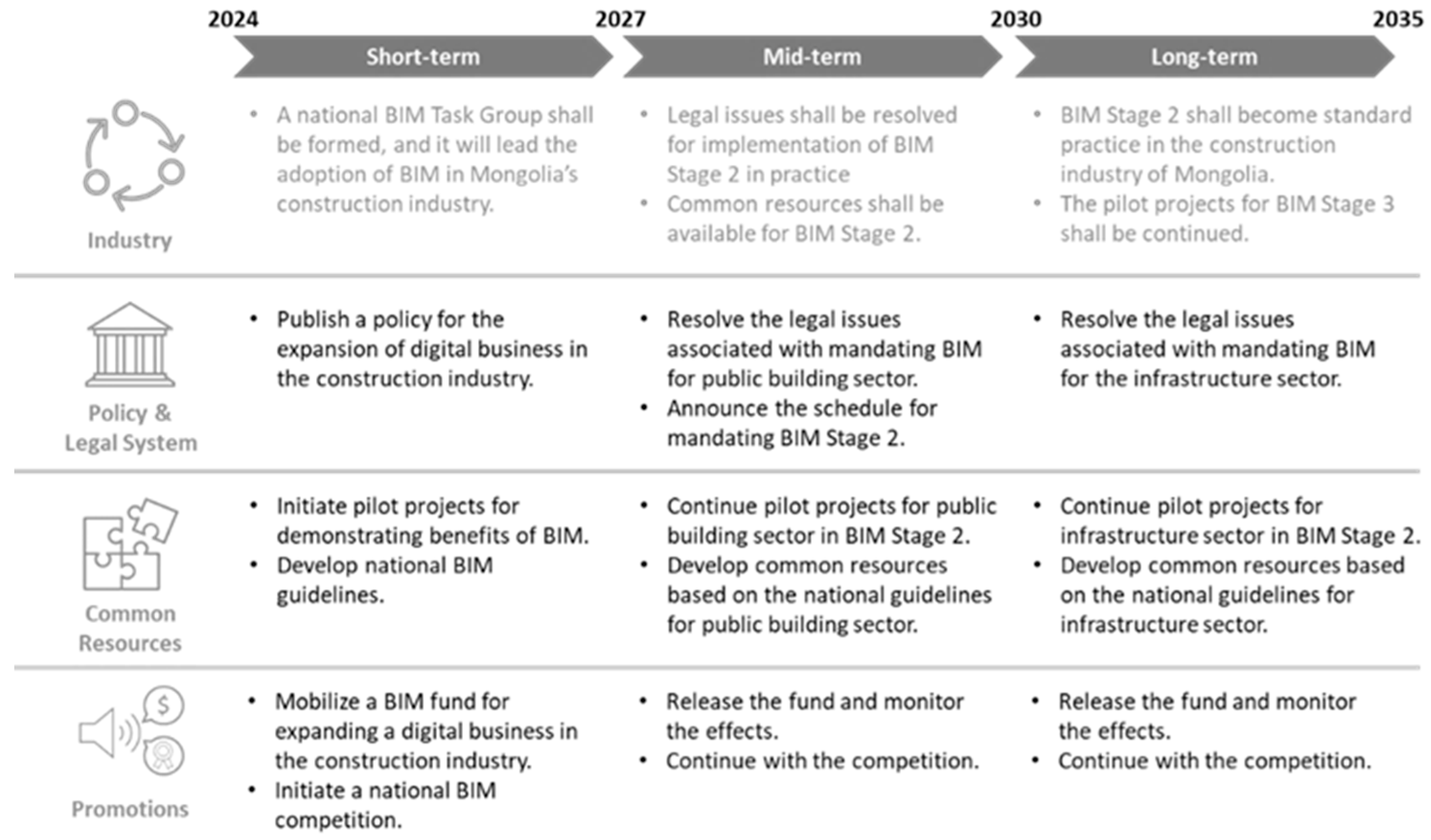
| Policy and legal systems | I1 | Establish a policy for promoting the digitalization of the construction industry | MCUD |
| |||
| I2 | Remove potential legal issues in the digital transformation of the construction industry | MCUD | |
| |||
| I3 | Establish a progressive mandating schedule | MCUD | |
| |||
| Common resource | I4 | Establish a national BIM task group (BTG) | MCUD |
| |||
| I5 | Conduct pilot projects (Phase 1 to Phase 3) | BTG | |
| |||
| I6 | Develop national guidelines for BIM implementation | MCUD/ BTG | |
| |||
| I7 | Develop common resources for BIM implementation | MCUD/ BTG | |
| |||
| Promotion | I8 | Establish a fund program for promoting digitalization | MCUD |
| |||
| I9 | Organize and operate national BIM competitions as part of an awareness campaign | MCUD/ BTG | |
|
| Code | Action Item | Phase 1 (2024–2026) | Phase 2 (2027–2029) | Phase 3 (2030–2035) |
|---|---|---|---|---|
| I1 | Establish a policy for promoting the digitalization of the construction industry | Establish the policy: 100% by 2025 | Monitor the effects and publish annual white papers | Monitor the effects and publish annual white papers |
| I2 | To remove potential legal issues in the digital transformation of the construction industry | Identify legal issues: 100% by 2026 for the public building sector | Resolve legal issues: 100% by 2029 for the public building sector | N/A: The action concludes in earlier phases |
| I3 | Establish a progressive mandating schedule | Complete by 2026 for public building sector | Complete by 2029 for the other assets | Monitoring and revision |
| I4 | Establish a national BIM task group | Complete: 100% by 2025 | N/A: The action concludes in earlier phases | N/A: The action concludes in earlier phases |
| I5 | Conduct pilot projects | Min. target use cases: 3D authoring and coordination for public building sector | Min. target use cases: CDE, 4D, and 5D for public building sector | Extend to the other assets |
| I6 | Develop national guidelines for BIM implementation | Complete the development of the guidelines by 2026 | Revise the guidelines (if required) | Revise the guidelines (if required) |
| I7 | Develop common resources for BIM implementation | N/A: No action starts |
|
|
| I8 | Establish a fund program for promoting digitalization | Develop plan: 100% by 2025 | Release fund annually | Release fund annually |
| I9 | Organize national BIM competitions for awareness campaign | Initiate by 2025 | Continue annually | Continue annually |
| Sub-Area | Code | Action Items and Major Tasks | Leadership Owner |
|---|---|---|---|
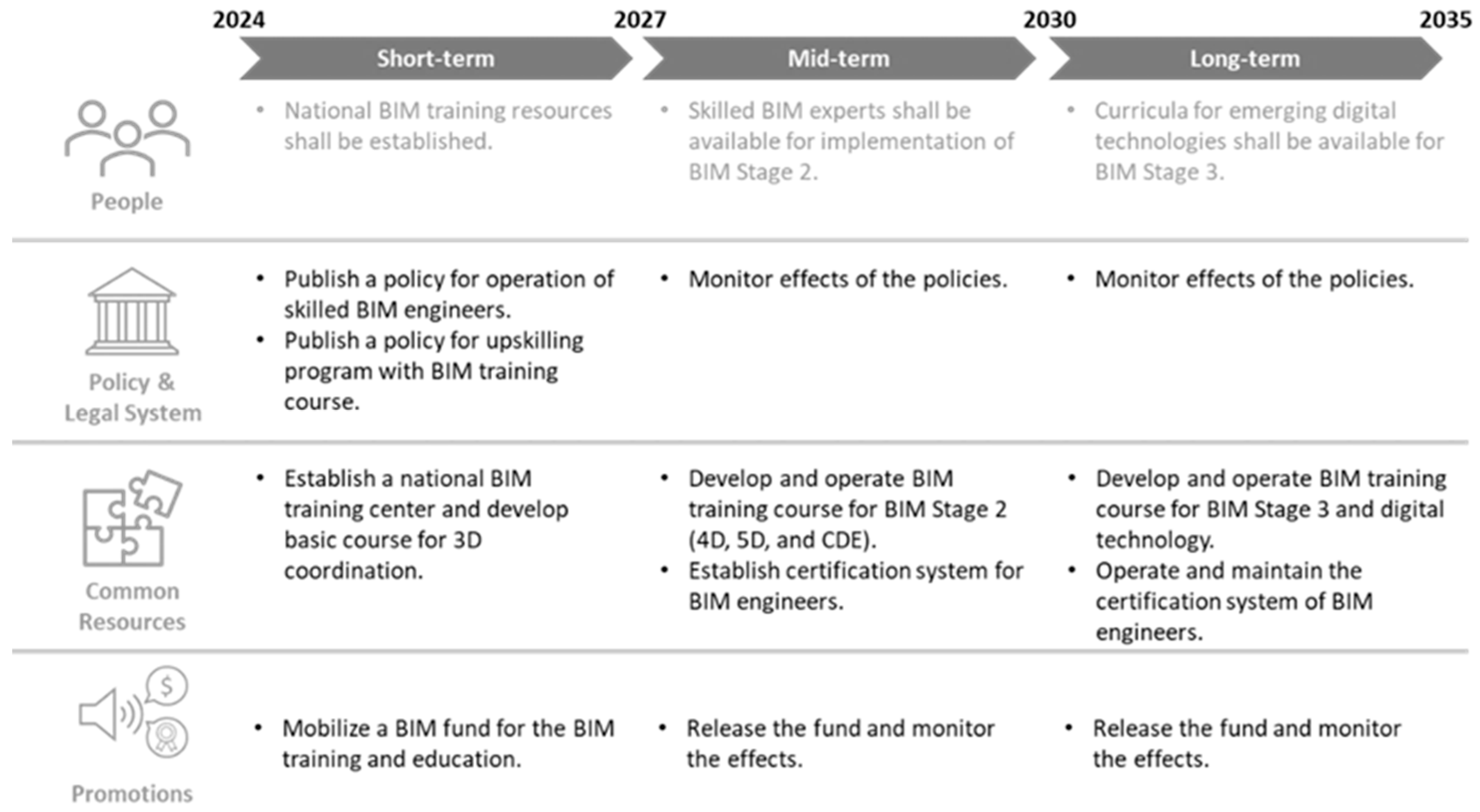
| Policy and legal systems | P1 | Establish a policy for the certification of BIM engineers | MCUD |
| |||
| P2 | Establish policy for upskilling programs with BIM training courses | MCUD | |
| |||
| Common resource | P3 | Establish a national BIM training center (BTC) and training courses | MCUD/ BTC |
| |||
| P4 | Establish a certification system for BIM engineers | BTC | |
| |||
| Promotion | P5 | Establish a fund program for the BIM training and education | MCUD |
|
| Code | Action Item | Phase 1 (2024–2026) | Phase 2 (2027–2029) | Phase 3 (2030–2035) |
|---|---|---|---|---|
| P1 | Establish a policy for the certification of BIM engineers | Establish: 100% by 2026 | Monitoring and revision | Monitoring and revision |
| P2 | Establish a policy for upskilling programs with BIM training courses | Establish: 100% by 2026 | Monitoring and revision | Monitoring and revision |
| P3 | Establish a national BIM Training Center (BTC) and training courses |
|
|
|
| P4 | Establish a certification system for BIM engineers | N/A: No action starts | Prepare system: 100% complete by 2029 | Enact the certification system |
| P5 | Establish a fund program for the BIM training and education | Develop plan: 100% complete by 2026 | Release fund annually | Release fund annually |
| Sub-Area | Code | Action Items and Major Tasks | Leadership Owner |
|---|---|---|---|
| Policy and legal systems | T1 | Establish a policy for the use of national common platforms connected to smart governance in Vision 2050 | MCUD/ Other Departments |
| |||
| T2 | Establish a policy for promoting R&D for the digital transformation of the construction industry | MCUD | |
| |||
| Common resource | T3 | The domestication of ISO 19650 and other international standards | MCUD/ MASM |
| |||
| T4 | Develop a national CDE platform for public asset delivery projects | CDE Committee | |
| |||
| T5 | Develop a national asset management platform for public-built assets | CDE Committee | |
| |||
| Promotion | T6 | Establish a R&D fund program for the digital transformation of the construction industry | MCUD |
|
| Code | Action Item | Phase 1 (2024–2026) | Phase 2 (2027–2029) | Phase 3 (2030–2035) |
|---|---|---|---|---|
| T1 | Establish a policy for the use of CDE connected to smart governance in Vision 2050 |
| Resolve legal issues: 100% by 2029 | Monitoring and revision |
| T2 | Establish a policy for promoting R&D for the digital transformation of the construction industry | Develop technology roadmap: 100% by 2025 | Monitoring and revision | Monitoring and revision |
| T3 | The domestication of ISO 19650 and other international standards |
| Publish: 100% by 2029 (Related to digital transformation in the construction industry) | Monitoring and revision |
| T4 | Develop a national CDE platform for public asset delivery projects | Develop ISP: 100% by 2026 |
|
|
| T5 | Develop a national asset management platform for public-built assets | N/A: No action starts | Develop ISP: 100% by 2029 | Develop and test: 100% by 2035 |
| T6 | Establish a R&D fund program for the digital transformation of the construction industry | Develop plan: 100% by 2026 | Release fund annually | Release fund annually |
| Category | Statistic | Implication |
|---|---|---|
| Total Bridges (National/Intl Roads) | 433 | Critical backbone of national logistics |
| Existing Bridges in the Sample | 135 | Representative dataset for analysis |
| Condition Rating | 40% in “Poor Condition” | Approaching failure/requires urgent intervention |
| Freeze–Thaw Cycles | Up to 43 Per Year | Extreme thermal stress fatigue |
| Maintenance Budget | ~2% of Road Investment | Severe underfunding relative to asset degradation |
Disclaimer/Publisher’s Note: The statements, opinions and data contained in all publications are solely those of the individual author(s) and contributor(s) and not of MDPI and/or the editor(s). MDPI and/or the editor(s) disclaim responsibility for any injury to people or property resulting from any ideas, methods, instructions or products referred to in the content. |
© 2025 by the authors. Licensee MDPI, Basel, Switzerland. This article is an open access article distributed under the terms and conditions of the Creative Commons Attribution (CC BY) license.
Share and Cite
Erdene, K.; Kim, B.-G.; Lee, S.-H. ADAPTE Process-Based Strategic Framework Development for National BIM Adoption: The Case for Sustainable Advancement in Mongolia. Sustainability 2026, 18, 71. https://doi.org/10.3390/su18010071
Erdene K, Kim B-G, Lee S-H. ADAPTE Process-Based Strategic Framework Development for National BIM Adoption: The Case for Sustainable Advancement in Mongolia. Sustainability. 2026; 18(1):71. https://doi.org/10.3390/su18010071
Chicago/Turabian StyleErdene, Khuvilai, Bong-Geun Kim, and Sang-Ho Lee. 2026. "ADAPTE Process-Based Strategic Framework Development for National BIM Adoption: The Case for Sustainable Advancement in Mongolia" Sustainability 18, no. 1: 71. https://doi.org/10.3390/su18010071
APA StyleErdene, K., Kim, B.-G., & Lee, S.-H. (2026). ADAPTE Process-Based Strategic Framework Development for National BIM Adoption: The Case for Sustainable Advancement in Mongolia. Sustainability, 18(1), 71. https://doi.org/10.3390/su18010071