Spatiotemporal Evolution and Driving Factors of Green Transition Resilience in Four Types of China’s Resource-Based Cities Based on the Geographical Detector Model


Abstract
1. Introduction
2. Methods and Data
2.1. Criteria Importance Through Intercriteria Correlation (CRITIC)–Linear Weighting Model
2.2. Kernel Density Estimation Method
2.3. Dagum–Gini Coefficient
2.4. Geographical Detector Model
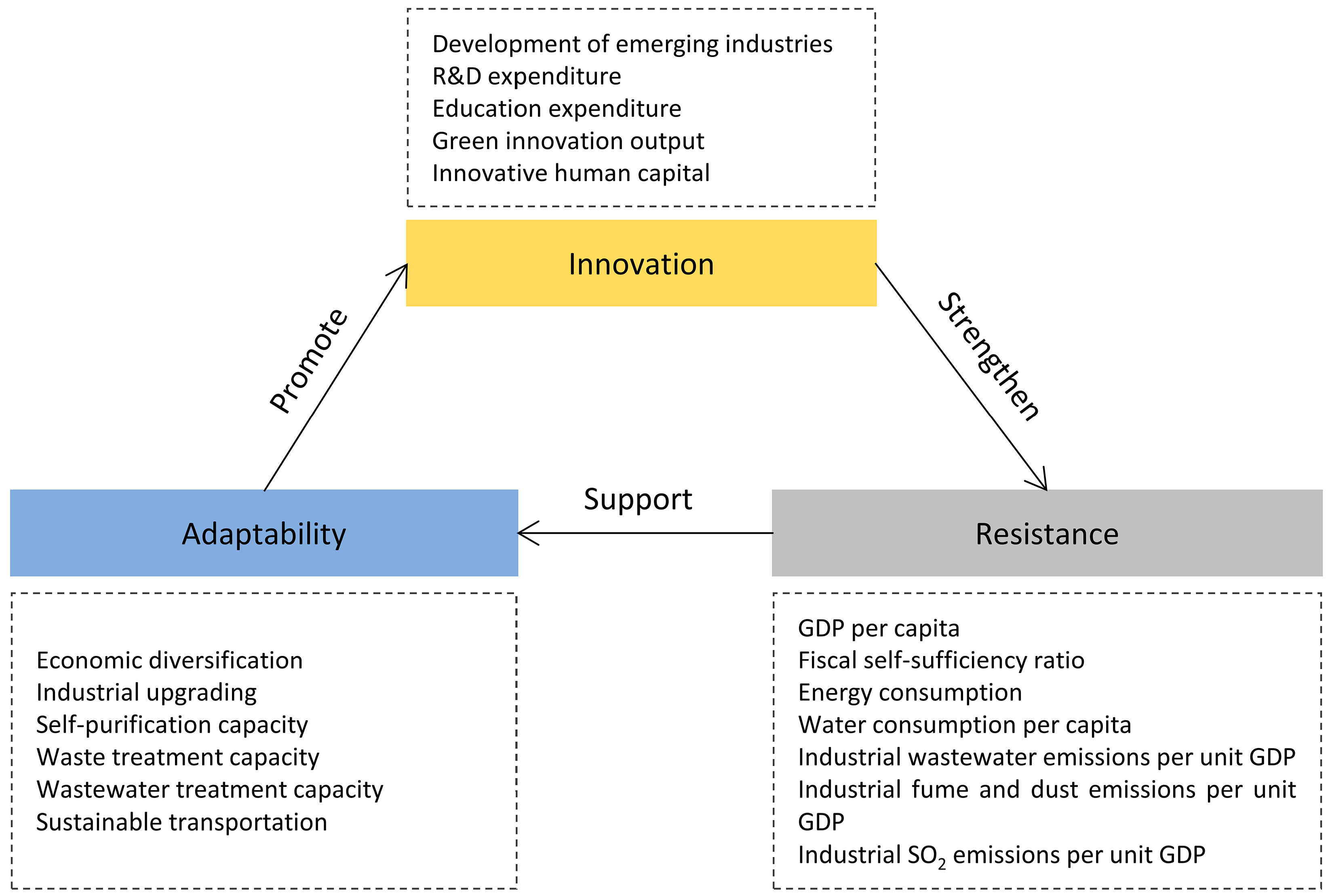
2.5. Indicator System and Data
3. Results and Discussion
3.1. Analysis of Basic Characteristics of Indices
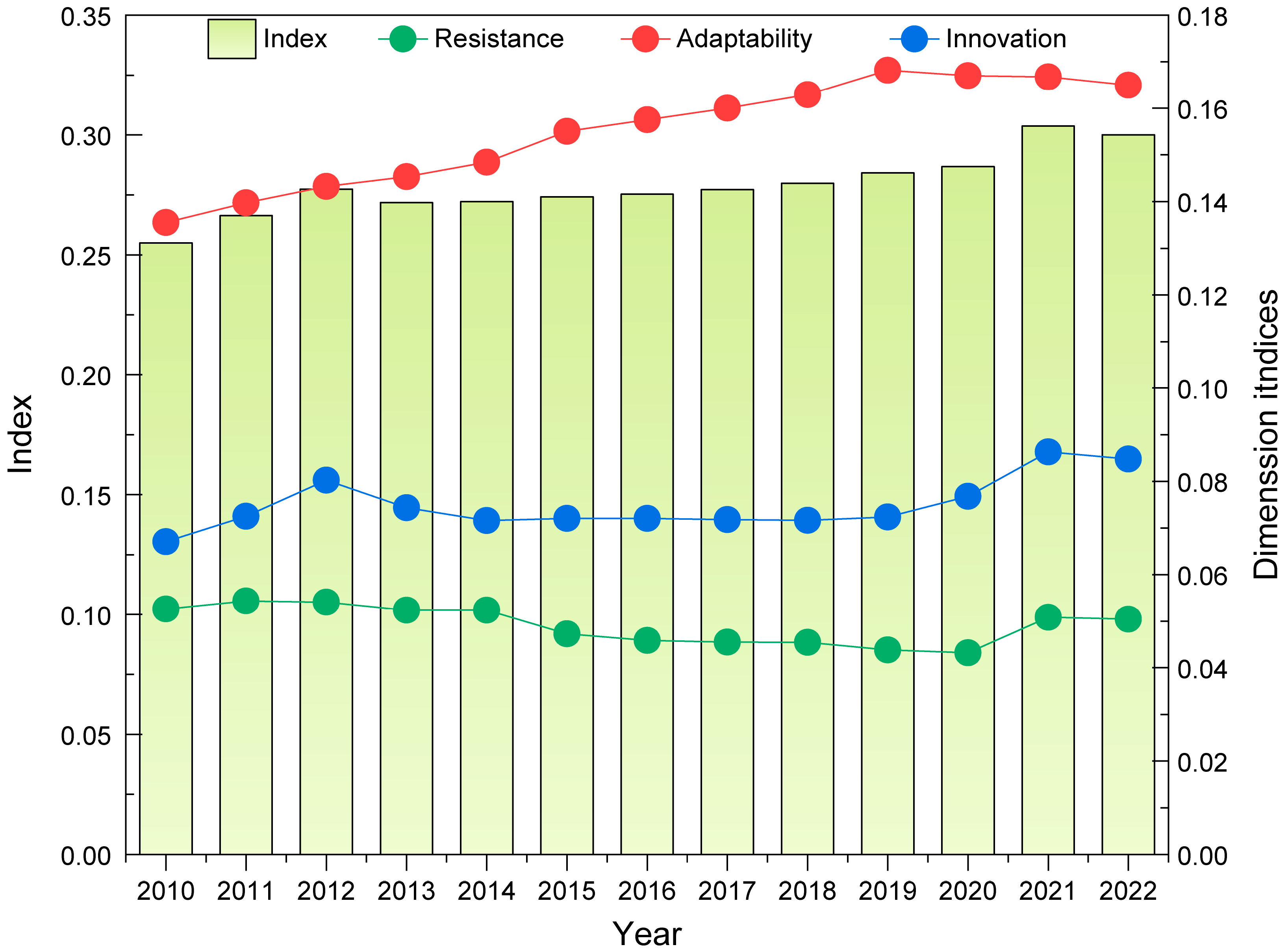
3.1.1. Temporal Evolution Characteristics
3.1.2. Spatial Evolution Characteristics
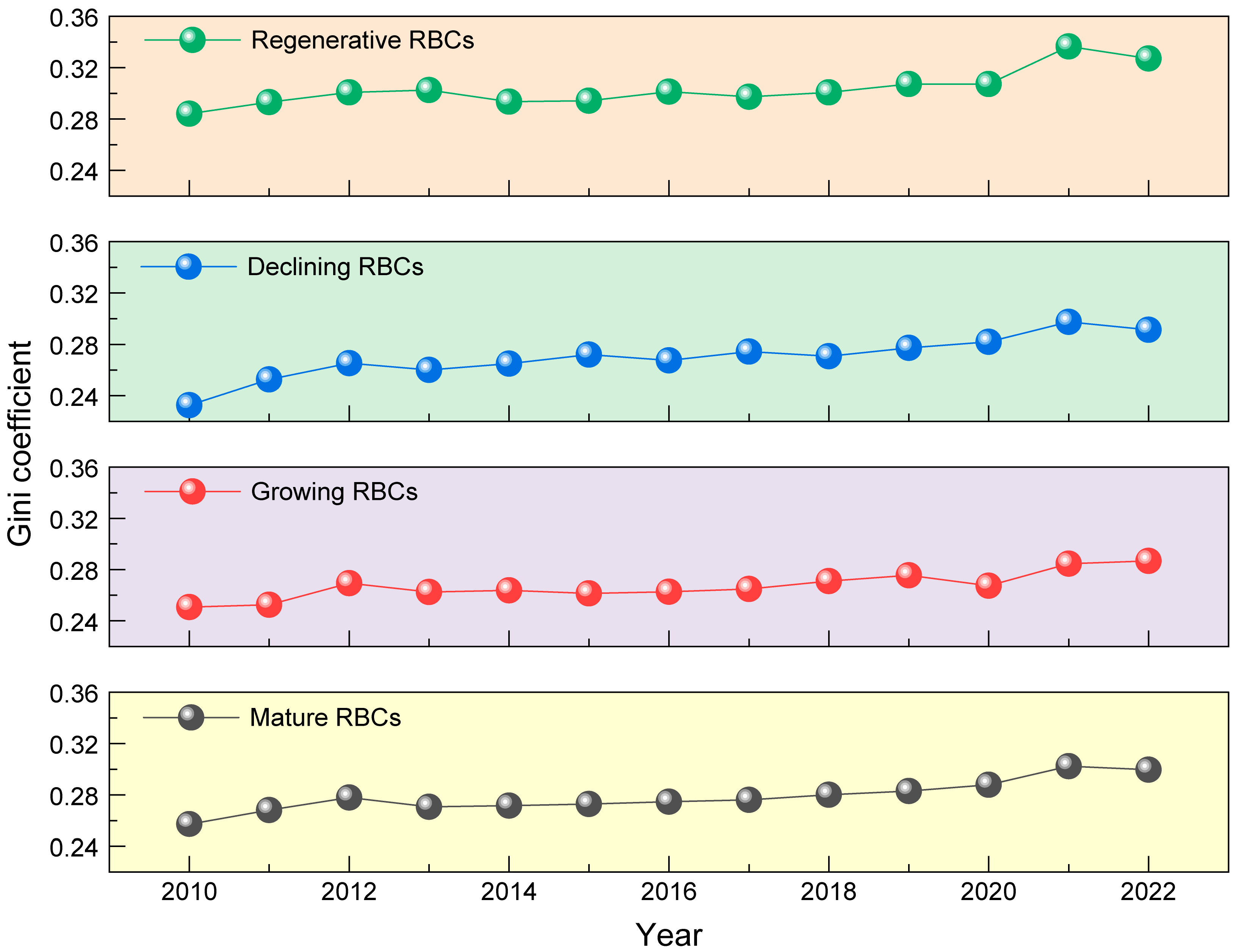
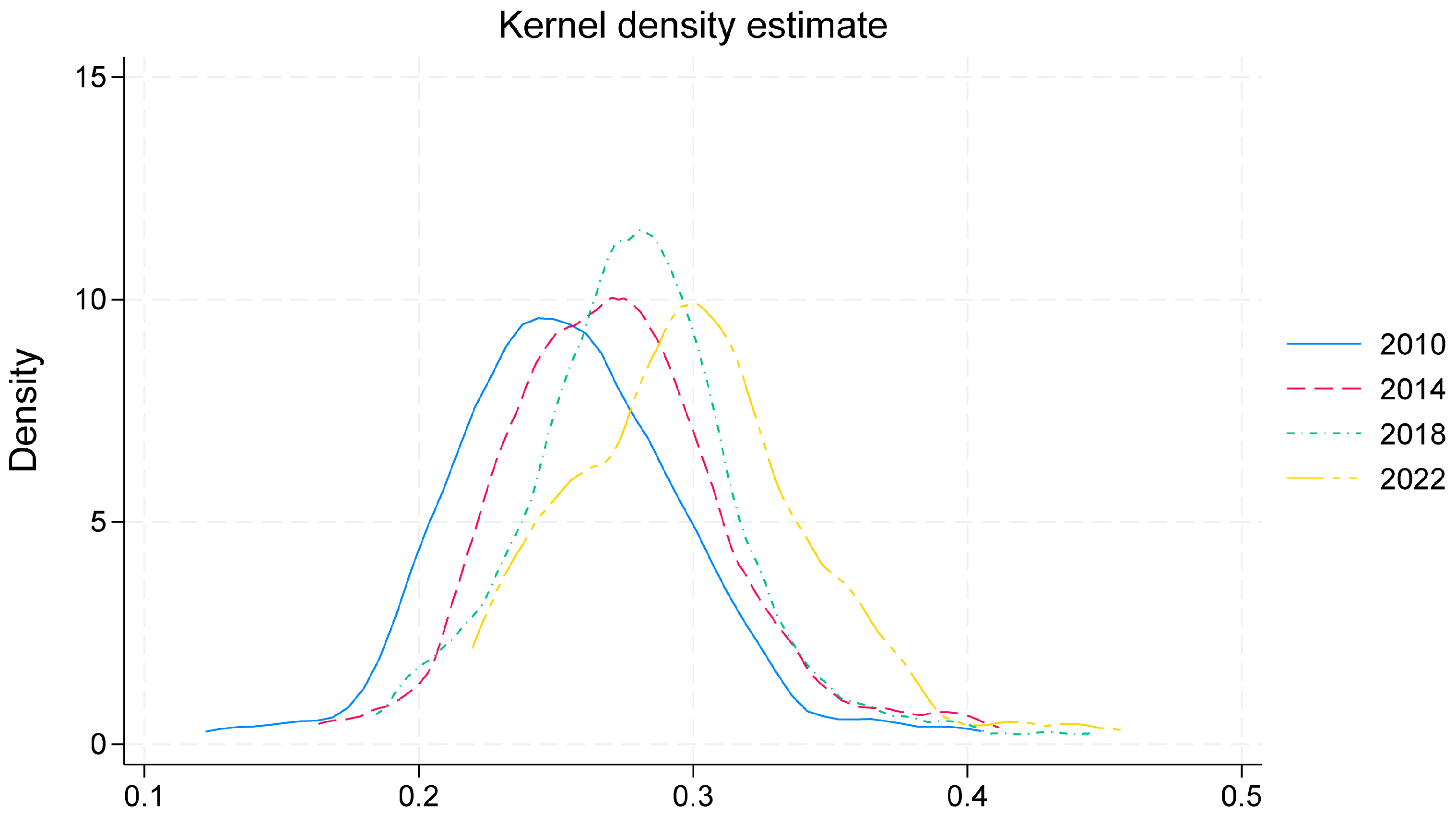
3.2. Regional Differences and Source Decomposition
3.3. Analysis of Associated Factors
3.3.1. Selection of Associated Factors
3.3.2. Factor Detection Results
3.3.3. Interaction Detection Results
3.4. Discussion
4. Conclusions, Policy Implications, and Limitations
4.1. Conclusions
4.2. Policy Implications
4.3. Limitations
Supplementary Materials
Author Contributions
Funding
Institutional Review Board Statement
Informed Consent Statement
Data Availability Statement
Conflicts of Interest
Abbreviations
| AHP | Analytic hierarchy process |
| CRITIC | Criteria Importance Through Intercriteria Correlation |
| ER | Environmental regulation |
| EV | Economic vitality |
| EWM | Entropy weight method |
| FD | Financial development |
| GI | Government intervention |
| GTR | Green transition resilience |
| GWR | Geographically weighted regression |
| HCC | Human capital cultivation |
| ICT | Information and communication technology |
| ICTI | ICT infrastructure |
| IL | Income level |
| KDE | Kernel density estimation |
| MS | Market size |
| OL | Openness level |
| PA | Population agglomeration |
| RBCs | Resource-based cities |
| SDGs | Sustainable Development Goals |
| SDM | Spatial Durbin Model |
References
- Sachs, J.D.; Warner, A.M. The curse of natural resources. Eur. Econ. Rev. 2001, 45, 827–838. [Google Scholar] [CrossRef]
- Auty, R. Sustaining Development in Mineral Economies: The Resource Curse Thesis; Routledge: London, UK, 1993. [Google Scholar]
- IPCC. Climate change 2022: Impacts, adaptation, and vulnerability. In Contribution of Working Group II to the Sixth Assessment Report of the Intergovernmental Panel on Climate Change; Pörtner, H.-O., Roberts, D.C., Tignor, M., Poloczanska, E.S., Mintenbeck, K., Alegría, A., Craig, M., Langsdorf, S., Löschke, S., Möller, V., et al., Eds.; Cambridge University Press: Cambridge, UK; New York, NY, USA, 2022. [Google Scholar]
- Chen, W.; Shen, Y.; Wang, Y. Evaluation of economic transformation and upgrading of resource-based cities in Shaanxi province based on an improved TOPSIS method. Sustain. Cities Soc. 2018, 37, 232–240. [Google Scholar] [CrossRef]
- Wang, M.-X.; Zhao, H.-H.; Cui, J.-X.; Fan, D.; Lv, B.; Wang, G.; Li, Z.-H.; Zhou, G.-J. Evaluating green development level of nine cities within the Pearl River Delta, China. J. Clean. Prod. 2018, 174, 315–323. [Google Scholar] [CrossRef]
- Yang, Y.; Huang, P. Has the level of green development in the northwestern provinces of China truly improved? A case study of Shaanxi. Sustain. Cities Soc. 2019, 51, 101779. [Google Scholar] [CrossRef]
- Xu, G.; Chang, H.; Meng, L.; Sine Marma, K.J. Green development level, resource utilization, and ecological protection across China from 2006 to 2017: Based on the national standard indicator system. Environ. Dev. 2022, 44, 100776. [Google Scholar] [CrossRef]
- Yin, Q.; Wang, Y.; Wan, K.; Wang, D. Evaluation of green transformation efficiency in Chinese mineral resource-based cities based on a three-stage DEA method. Sustainability 2020, 12, 9455. [Google Scholar] [CrossRef]
- Liu, R.; Chen, D.; Yang, S.; Chen, Y. Evaluation of green development efficiency of the major cities in Gansu province, China. Sustainability 2021, 13, 3034. [Google Scholar] [CrossRef]
- Zhang, M.; Yan, T.; Ren, Q. Does innovative development drive green economic growth in resource-based cities? Evidence from China. Front. Environ. Sci. 2022, 9, 745498. [Google Scholar] [CrossRef]
- Wang, Z.; Chen, H.; Divigalpitiya, P. How does ICT development in resource-exhausted cities promote the urban green transformation efficiency? Evidence from China. Sustain. Cities Soc. 2024, 115, 105835. [Google Scholar] [CrossRef]
- Jiang, Y.; Sun, J. Does smart city construction promote urban green development? Evidence from a double machine learning model. J. Environ. Manag. 2025, 373, 123701. [Google Scholar] [CrossRef]
- Holling, C.S. Resilience and stability of ecological systems. Annu. Rev. Ecol. Syst. 1973, 4, 1–23. [Google Scholar] [CrossRef]
- Folke, C. Resilience: The emergence of a perspective for social–ecological systems analyses. Glob. Environ. Change 2006, 16, 253–267. [Google Scholar] [CrossRef]
- Martin, R. Regional economic resilience, hysteresis and recessionary shocks. J. Econ. Geogr. 2011, 12, 1–32. [Google Scholar] [CrossRef]
- Fingleton, B.; Garretsen, H.; Martin, R. Recessionary shocks and regional employment: Evidence on the resilience of U.K. regions. J. Reg. Sci. 2012, 52, 109–133. [Google Scholar] [CrossRef]
- Davies, S. Regional resilience in the 2008–2010 downturn: Comparative evidence from European countries. Camb. J. Reg. Econ. Soc. 2011, 4, 369–382. [Google Scholar] [CrossRef]
- Brakman, S.; Garretsen, H.; van Marrewijk, C. Regional resilience across Europe: On urbanisation and the initial impact of the Great Recession. Camb. J. Reg. Econ. Soc. 2015, 8, 225–240. [Google Scholar] [CrossRef]
- Martin, R.; Gardiner, B. The resilience of cities to economic shocks: A tale of four recessions (and the challenge of Brexit). Pap. Reg. Sci. 2019, 98, 1801–1833. [Google Scholar] [CrossRef]
- Feng, Y.; Lee, C.-C.; Peng, D. Does regional integration improve economic resilience? Evidence from urban agglomerations in China. Sustain. Cities Soc. 2023, 88, 104273. [Google Scholar] [CrossRef]
- Briguglio, L.; Cordina, G.; Farrugia, N.; Vella, S. Economic vulnerability and resilience: Concepts and measurements. In Measuring Vulnerability in Developing Countries; Routledge: London, UK, 2014; pp. 47–65. [Google Scholar]
- Tan, J. Regional economic resilience of resource-based cities and influential factors during economic crises in China. In Economic Resilience in Regions and Organisations; Wink, R., Ed.; Springer Fachmedien Wiesbaden: Wiesbaden, Germany, 2021; pp. 91–115. [Google Scholar]
- Huang, J.; Li, Q.; Du, M.; Chen, X. Spatial and temporal variation of economic resilience and its drivers: Evidence from Chinese cities. Front. Environ. Sci. 2023, 11, 1109857. [Google Scholar] [CrossRef]
- Cheng, T.; Zhao, Y.; Zhao, C. Exploring the spatio-temporal evolution of economic resilience in Chinese cities during the COVID-19 crisis. Sustain. Cities Soc. 2022, 84, 103997. [Google Scholar] [CrossRef]
- Du, Z.; Zhang, H.; Ye, Y.; Jin, L.; Xu, Q. Urban shrinkage and growth: Measurement and determinants of economic resilience in the Pearl River Delta. J. Geogr. Sci. 2019, 29, 1331–1345. [Google Scholar] [CrossRef]
- Song, G.; Tang, C.; Zhong, S.; Song, L. Multiscale study on differences in regional economic resilience in China. Environ. Dev. Sustain. 2024, 26, 29021–29055. [Google Scholar] [CrossRef]
- Bristow, G.; Healy, A. Innovation and regional economic resilience: An exploratory analysis. Ann. Reg. Sci. 2018, 60, 265–284. [Google Scholar] [CrossRef]
- Wang, Z.; Wei, W. Regional economic resilience in China: Measurement and determinants. Reg. Stud. 2021, 55, 1228–1239. [Google Scholar] [CrossRef]
- Yue, Y.; Gao, J. Revaluation of rural settlement toughness based on social ecosystem perspective: Taking Tangyin County Henan Province as an example. Dev. Small Cities Towns 2019, 37, 5–14. [Google Scholar] [CrossRef]
- Feng, X.; Zeng, F.; Loo, B.P.Y.; Zhong, Y. The evolution of urban ecological resilience: An evaluation framework based on vulnerability, sensitivity and self-organization. Sustain. Cities Soc. 2024, 116, 105933. [Google Scholar] [CrossRef]
- Tong, Y.; Lei, J.; Zhang, S.; Zhang, X.; Rong, T.; Fan, L.; Duan, Z. Analysis of the spatial and temporal variability and factors influencing the ecological resilience in the urban agglomeration on the northern slope of Tianshan Mountain. Sustainability 2023, 15, 4828. [Google Scholar] [CrossRef]
- Lu, F.; Liu, Q.; Wang, P. Spatiotemporal characteristics of ecological resilience and its influencing factors in the Yellow River Basin of China. Sci. Rep. 2024, 14, 16988. [Google Scholar] [CrossRef]
- Chen, Y.; Wang, H. Industrial structure, environmental pressure and ecological resilience of resource-based cities-based on panel data of 24 prefecture-level cities in China. Front. Environ. Sci. 2022, 10, 885976. [Google Scholar] [CrossRef]
- Li, G.; Wang, L. Study of regional variations and convergence in ecological resilience of Chinese cities. Ecol. Indic. 2023, 154, 110667. [Google Scholar] [CrossRef]
- Zhang, M.; Feng, X. Comprehensive evaluation of the resilience of Chinese cities. Urban Probl. 2018, 10, 27–36. [Google Scholar] [CrossRef]
- Wang, L.; Yuan, M.; Li, H.; Chen, X. Exploring the coupling coordination of urban ecological resilience and new-type urbanization: The case of China’s Chengdu–Chongqing Economic Circle. Environ. Technol. Innov. 2023, 32, 103372. [Google Scholar] [CrossRef]
- Lee, C.-C.; Yan, J.; Li, T. Ecological resilience of city clusters in the middle reaches of Yangtze river. J. Clean. Prod. 2024, 443, 141082. [Google Scholar] [CrossRef]
- Shi, C.; Zhu, X.; Wu, H.; Li, Z. Assessment of urban ecological resilience and its influencing factors: A case study of the Beijing-Tianjin-Hebei urban agglomeration of China. Land 2022, 11, 921. [Google Scholar] [CrossRef]
- Yang, Z.; Cui, X.; Dong, Y.; Guan, J.; Wang, J.; Xi, Z.; Li, C. Spatio-temporal heterogeneity and influencing factors in the synergistic enhancement of urban ecological resilience: Evidence from the Yellow River Basin of China. Appl. Geogr. 2024, 173, 103459. [Google Scholar] [CrossRef]
- Yin, Z.; Ma, T.; Sun, Y.; Yin, Z. Spatio-temporal heterogeneity of urban ecological resilience in the middle reaches of the Yangtze River in China. Int. Rev. Econ. Financ. 2024, 94, 103384. [Google Scholar] [CrossRef]
- Wang, S.; Song, Y.; Zhang, W. A study on the impact of digital transformation on green resilience in China. Sustainability 2024, 16, 2189. [Google Scholar] [CrossRef]
- Wu, K.; Zhang, J.; Li, D. Comprehensive evaluation and influencing factors of healthy cities in China’s urban agglomerations. J. Geogr. Sci. 2025, 35, 821–845. [Google Scholar] [CrossRef]
- Sun, X.; Wang, Y. Spatio-temporal characteristics and analysis of influencing factors of inclusive green growth in China’s oil and gas resource industry. Ecol. Indic. 2025, 170, 112982. [Google Scholar] [CrossRef]
- Dagum, C. A new approach to the decomposition of the Gini income inequality ratio. Empir. Econ. 1997, 22, 515–531. [Google Scholar] [CrossRef]
- Wang, J.; Xu, C. Geodetector: Principle and prospective. Acta Geogr. Sin. 2017, 72, 116–134. [Google Scholar] [CrossRef]
- Meerow, S.; Newell, J.P.; Stults, M. Defining urban resilience: A review. Landsc. Urban Plan. 2016, 147, 38–49. [Google Scholar] [CrossRef]
- Zhu, D.; Ye, L. China’s agricultural green resilience: Level measurement and spatio-temporal evolution. Stat. Decis. 2024, 40, 118–123. [Google Scholar] [CrossRef]
- Zhao, Q.; Tian, X.; Zhang, L. Measurement and evolution trend of the green development resilience in China’s manufacturing industry—Evidence from listed manufacturing enterprises. J. Ind. Technol. Econ. 2024, 43, 71–81. [Google Scholar]
- Sun, X.; Liu, X.; Li, F.; Tao, Y.; Song, Y. Comprehensive evaluation of different scale cities’ sustainable development for economy, society, and ecological infrastructure in China. J. Clean. Prod. 2017, 163, S329–S337. [Google Scholar] [CrossRef]
- Tan, J.; Zhang, X.; Liu, L.; Zhao, H.; Qiu, F. Research on the urban transformation performance of China’s resource-based cities. Econ. Geogr. 2020, 40, 57–64. [Google Scholar] [CrossRef]
- Lin, B.; Zhou, Y. Measuring the green economic growth in China: Influencing factors and policy perspectives. Energy 2022, 241, 122518. [Google Scholar] [CrossRef]
- Pan, X.; Li, J.; Wei, J.; Yue, Y.; Liu, L. Measuring green development level at a regional scale: Framework, model, and application. Environ. Monit. Assess. 2022, 194, 343. [Google Scholar] [CrossRef] [PubMed]
- Peng, D.; Li, X. Research on the evaluation of green transformation effectiveness in resource-based cities: A case study of Yunnan Province. Urban Probl. 2023, 21–32, 52. [Google Scholar] [CrossRef]
- Ma, Y.; Yuan, X.; Chen, H.; Zhang, X.; Li, Y.; Yin, H.; Li, Z. The spatiotemporal evolution of green development in western China under the main functional planning of national land space. Ecol. Indic. 2025, 177, 113752. [Google Scholar] [CrossRef]
- State Council of the People’s Republic of China. National Resource-Based City Sustainable Development Plan (2013–2020). Available online: https://www.gov.cn/zwgk/2013-12/03/content_2540070.htm (accessed on 10 July 2025).
- Shi, D.; Li, S.-L. Emissions trading system and energy use efficiency—Measurements and empirical evidence for cities at and above the prefecture level. China Ind. Econ. 2020, 9, 5–23. [Google Scholar] [CrossRef]
- National Earth System Science Data Center. Available online: https://www.geodata.cn (accessed on 10 July 2025).
- Feng, Y.; Dong, X.; Zhao, X.; Zhu, A. Evaluation of urban green development transformation process for Chinese cities during 2005–2016. J. Clean. Prod. 2020, 266, 121707. [Google Scholar] [CrossRef]
- Huang, W.; Gao, B.; Cui, S.; Huang, Y.; Zhang, X.; Shen, Y.; Fang, X.; Wang, L.; Xu, S.; Zuo, S. Evaluating green city development in China using an integrated analytical toolbox. J. Clean. Prod. 2023, 400, 136703. [Google Scholar] [CrossRef]
- Ma, X.; Lin, Z. Evaluation and influencing factors of green transformation in three major urban agglomerations in China. Front. Environ. Sci. 2024, 12, 1392511. [Google Scholar] [CrossRef]
- Wang, Y.; Li, S.; Gu, X.; Sun, Q.; Zhang, R.; Chen, F. Spatio-temporal evolution and multi-subject influencing factors of urban green development efficiency in China: Under the carbon neutral vision constraint. Ecol. Indic. 2024, 167, 112580. [Google Scholar] [CrossRef]
- Pan, T.; Jin, G.; Zeng, S.; Wang, R. Spatial-temporal divergence characteristics and driving factors of green economic efficiency in the Yangtze River Economic Belt of China. Chin. Geogr. Sci. 2024, 34, 1158–1174. [Google Scholar] [CrossRef]
- Chen, Z.; Kahn, M.E.; Liu, Y.; Wang, Z. The consequences of spatially differentiated water pollution regulation in China. J. Environ. Econ. Manag. 2018, 88, 468–485. [Google Scholar] [CrossRef]
- Dou, R.-Y.; Jiao, B.-B.; Zhang, W.-J.; Zhang, P.-F. Research on spatiotemporal heterogeneity and driving forces of green development efficiency in resource-based cities of Western China. J. Nat. Resour. 2023, 38, 238–254. [Google Scholar] [CrossRef]
- Hobor, G. Surviving the era of deindustrialization: The new economic geography of the urban rust belt. J. Urban Aff. 2013, 35, 417–434. [Google Scholar] [CrossRef]
- Qian, L. A spatial econometric study on the measurement of urban green economic efficiency and its influencing factors in China. Inq. Econ. Issues 2018, 8, 160–170. [Google Scholar]
- Gagliardi, L.; Moretti, E.; Serafinelli, M. The World’s Rust Belts: The Heterogeneous Effects of Deindustrialization on 1993 Cities in Six Countries; Working Paper 31948; National Bureau of Economic Research: Cambridge, MA, USA, 2023. [Google Scholar] [CrossRef]





| Level 1 Indicators | Level 2 Indicators | Level 3 Indicators | Specific Meaning | Nature | Weight |
|---|---|---|---|---|---|
| Green transition resilience | Resistance | GDP per capita | GDP/Urban population (CNY/person) | + | 0.0488 |
| Fiscal self-sufficiency ratio | Local Government Revenue/Local Government Expenditure (%) | + | 0.0961 | ||
| Energy consumption | Total energy consumption estimated from nighttime light data (10,000 tons of standard coal equivalent) | − | 0.0485 | ||
| Water consumption per capita | Total urban water consumption/Urban population (m3/person) | − | 0.0399 | ||
| Industrial wastewater emissions per unit GDP | Total industrial wastewater emissions/GDP (10,000 tons/CNY) | − | 0.0404 | ||
| Industrial fume and dust emissions per unit GDP | Total industrial fume and dust emissions/GDP (tons/CNY) | − | 0.0268 | ||
| Industrial SO2 emissions per unit GDP | Total industrial SO2 emissions/GDP (tons/CNY) | − | 0.0163 | ||
| Adaptability | Economic diversification | Employment in the service sector/Total Employment (%) | + | 0.0919 | |
| Industrial upgrading | Value-added of the service sector/Value-added of the industrial sector (%) | + | 0.0729 | ||
| Self-purification capacity | Greening coverage of built-up areas (%) | + | 0.0462 | ||
| Waste treatment capacity | Innocuous treatment rate of municipal solid waste (%) | + | 0.0357 | ||
| Wastewater treatment capacity | Percentage of wastewater treated at centralized plants (%) | + | 0.0663 | ||
| Sustainable transportation | Annual passenger volume of public bus services/Urban population (passenger trips per capita per year) | + | 0.0677 | ||
| Innovation | Development of emerging industries | Number of AI enterprises (units) | + | 0.0358 | |
| R&D expenditure | Government expenditure on R&D/Local government expenditure (%) | + | 0.0669 | ||
| Education expenditure | Government expenditure on education/Local government expenditure (%) | + | 0.0908 | ||
| Green innovation output | Number of granted green patents per 10,000 population | + | 0.0512 | ||
| Innovative human capital | Number of college students per 10,000 population | + | 0.0580 |
| Dimension | Factor | Specific Meaning |
|---|---|---|
| Economy | Income level (IL) | Per capita disposable income of urban residents (CNY/person) |
| Market size (MS) | Share of total retail sales of consumer goods in GDP (%) | |
| Financial development (FD) | Share of the year-end outstanding deposits and loans of financial institutions in GDP (%) | |
| Openness level (OL) | Share of total trade in GDP (%) | |
| Economic vitality (EV) | GDP growth speed (%) | |
| Society | Population agglomeration (PA) | Population density (people per square kilometer) |
| ICT infrastructure (ICTI) | Output of postal and telecommunications services (million yuan) | |
| Human capital cultivation (HCC) | Share of teachers in higher education in total population (%) | |
| Policy | Government intervention (GI) | Share of local government expenditure in GDP (%) |
| Environmental regulation (ER) | Term frequency density of green-related terminology in local policy addresses (%) |
| Factor | 2010 | 2022 | ||
|---|---|---|---|---|
| q | Rank | q | Rank | |
| IL | 0.262 *** | 2 | 0.300 *** | 2 |
| MS | 0.046 | 8 | 0.059 | 8 |
| FD | 0.039 | 9 | 0.052 | 9 |
| OL | 0.047 | 7 | 0.139 *** | 4 |
| EV | 0.054 | 5 | 0.060 * | 7 |
| PA | 0.053 | 6 | 0.020 | 10 |
| ICTI | 0.118 *** | 4 | 0.066 * | 6 |
| HCC | 0.145 *** | 3 | 0.230 *** | 3 |
| GI | 0.340 *** | 1 | 0.402 *** | 1 |
| ER | 0.004 | 10 | 0.082 ** | 5 |
| Factor | 2010 | 2022 | ||||||
|---|---|---|---|---|---|---|---|---|
| Mature RBCs | Growing RBCs | Declining RBCs | Regenerative RBCs | Mature RBCs | Growing RBCs | Declining RBCs | Regenerative RBCs | |
| IL | 0.321 *** | 0.245 | 0.294 | 0.599 | 0.227 *** | 0.453 | 0.590 *** | 0.385 |
| MS | 0.095 | 0.659 ** | 0.049 | 0.101 | 0.030 | 0.166 | 0.384 | 0.134 |
| FD | 0.114 * | 0.069 | 0.253 | 0.325 | 0.020 | 0.278 | 0.301 | 0.625 ** |
| OL | 0.052 | 0.433 | 0.117 | 0.215 | 0.077 | 0.287 | 0.311 | 0.452 |
| EV | 0.041 | 0.056 | 0.100 | 0.272 | 0.072 | 0.290 | 0.203 | 0.073 |
| PA | 0.007 | 0.381 | 0.354 | 0.285 | 0.055 | 0.346 | 0.245 | 0.079 |
| ICTI | 0.066 | 0.178 | 0.131 | 0.122 | 0.047 | 0.127 | 0.389 | 0.652 * |
| HCC | 0.147 * | 0.126 | 0.438 * | 0.646 * | 0.147 * | 0.244 | 0.605 *** | 0.326 |
| GI | 0.299 *** | 0.423 | 0.565 *** | 0.582 * | 0.274 *** | 0.728 ** | 0.599 *** | 0.728 *** |
| ER | 0.001 | 0.275 | 0.214 | 0.301 | 0.016 | 0.324 | 0.068 | 0.573 ** |
Disclaimer/Publisher’s Note: The statements, opinions and data contained in all publications are solely those of the individual author(s) and contributor(s) and not of MDPI and/or the editor(s). MDPI and/or the editor(s) disclaim responsibility for any injury to people or property resulting from any ideas, methods, instructions or products referred to in the content. |
© 2025 by the authors. Licensee MDPI, Basel, Switzerland. This article is an open access article distributed under the terms and conditions of the Creative Commons Attribution (CC BY) license.
Share and Cite
Wang, Y.; Wang, Y.; Zhao, M. Spatiotemporal Evolution and Driving Factors of Green Transition Resilience in Four Types of China’s Resource-Based Cities Based on the Geographical Detector Model. Sustainability 2026, 18, 391. https://doi.org/10.3390/su18010391
Wang Y, Wang Y, Zhao M. Spatiotemporal Evolution and Driving Factors of Green Transition Resilience in Four Types of China’s Resource-Based Cities Based on the Geographical Detector Model. Sustainability. 2026; 18(1):391. https://doi.org/10.3390/su18010391
Chicago/Turabian StyleWang, Yu, Yanqiu Wang, and Mingming Zhao. 2026. "Spatiotemporal Evolution and Driving Factors of Green Transition Resilience in Four Types of China’s Resource-Based Cities Based on the Geographical Detector Model" Sustainability 18, no. 1: 391. https://doi.org/10.3390/su18010391
APA StyleWang, Y., Wang, Y., & Zhao, M. (2026). Spatiotemporal Evolution and Driving Factors of Green Transition Resilience in Four Types of China’s Resource-Based Cities Based on the Geographical Detector Model. Sustainability, 18(1), 391. https://doi.org/10.3390/su18010391