1. Introduction
The endogenous money creation paradigm, a cornerstone of post-Keynesian economics, fundamentally challenges the traditional view of central bank primacy over the money supply [
1,
2,
3,
4]. This framework posits that in modern economies, commercial banks create money ‘out of nothing’ through their lending activities, with deposits emerging as a derivative of loans, not the other way around [
5,
6]. Lavoie [
7] provides a comprehensive theoretical foundation for this view, characterizing banks as active creators of money rather than mere financial intermediaries. Empirical evidence robustly supports this mechanism, demonstrating that loans Granger-cause deposits and that the money multiplier is an inaccurate descriptor of reality [
6,
8]. However, the smooth operation of this endogenous mechanism is frequently disrupted during periods of significant economic uncertainty. A robust body of historical and recent evidence reveals a paradoxical decoupling in bank balance sheets, where loan growth stagnates or declines even as deposits continue to rise [
9,
10,
11,
12]. This phenomenon is well-established, e.g., Bordo et al. [
9] found that Economic Policy Uncertainty (EPU) exerts a significant negative effect on bank credit growth, with the intensity of this effect varying based on bank-specific characteristics, such as the capital-to-assets ratio. Confirming this at a micro-level, Alessandri et al. [
10] demonstrated that heightened uncertainty directly reduces banks’ propensity to approve credit applications and prolongs loan processing times. These findings are further corroborated by Beutler et al. [
11], who demonstrated that the bank lending channel also becomes muted during periods of high uncertainty. An important nuance was added by Raunig et al. [
12], who found that the liquidity and size of a bank are significant determinants of its lending responsiveness to uncertainty. This suggests a complex and heterogeneous consequence on credit markets. The recent Polish experience of 2021–2023 offers a critical case study of this phenomenon. For instance, Utzig et al. [
13] documented a parallel decoupling phenomenon in the Polish agricultural sector. Specifically, they observed an increase in farmers’ deposits despite a decline in contracted loan values during the period of the pandemic. This phenomenon was interpreted as a mismatch, attributed to economic uncertainty rather than deposit profitability. Such a pattern is consistent with several pieces of evidence showing that households and firms accumulate precautionary savings during disruptions, with possible implications for the dynamics of banking systems. The period under analysis in Poland was further marked by aggressive monetary tightening, with interest rates increased by the National Bank of Poland (NBP) up to 6.75%, and significant exogenous shocks, such as fiscal transfers and the economic fallout from the war in Ukraine. These factors created a complex landscape where, despite calls from European supervisors to maintain credit flows [
14], banks tightened lending standards [
15,
16], and monetary policy induced profound economic consequences, including a substantial increase in public debt [
17], even as the NBP exercised its discretion to manage stability [
18].
The literature firmly establishes that while loan repayments effectively annihilate money [
6] and risk-averse behavior amplifies savings during crises [
19], the specific channels of disruption in stressed economies like Poland remain underexplored [
8]. In the context of the modern financial system, the process of annihilating money refers to the accounting mechanism that occurs during debt repayment. As Chołoniewski et al. [
20] clearly demonstrate using balance sheet analysis, when a loan is repaid, the digital bank money used for the payment is extinguished. This is not a transfer to another account but a simultaneous reduction in entries on both sides of the bank’s balance sheet, i.e., the bank’s asset (the loan receivable) and its liability (the customer’s deposit) are both decreased by the value of the principal repaid. This dual reduction formally and finally removes that specific amount of money from existence in the monetary system. A key challenge to the pure endogenous money view is the significant role of exogenous, non-loan inflows, such as government transfers, foreign investments, or central bank asset purchases. These inflows can inflate bank deposits independently of domestic credit activity [
21]. As demonstrated by Darst et al. [
22], quantitative easing programs, for instance, can lead to deposit growth without a corresponding credit expansion, particularly in stressed financial conditions. This creates a critical gap in understanding the credit–deposit mismatch in economies facing a unique confluence of high inflation, high interest rates, and exogenous shocks. Our study aims to close this gap by developing an integrated analytical framework that links behavioral responses, structural decoupling mechanisms, and macroeconomic outcomes through distinct but complementary methodological approaches. The study investigates the mechanisms behind the credit–deposit paradox in Poland during the 2006–2024 period (using monthly data, with primary focus on the high-stress period of 2021–2023), viewed through the lens of endogenous money theory. We formulate five testable hypotheses H1–H5. The first three directly address channels disrupting endogenous money creation: the suppressive effect of uncertainty and high interest rates (hypothesis H1), the decoupling driven by exogenous inflows (hypothesis H2), and the aggravating role of structural and regulatory factors (hypothesis H3). Although not directly a test of endogeneity, hypothesis H4 examines the dominance of cost-push factors in recent inflation, which is critical for assessing whether the NBP’s aggressive policy response may have exacerbated disruptions in the money creation process. Finally, hypothesis H5 proposes that the endogenous mechanism operates through distinct monetary regimes, with persistent “money shortage” regimes characterizing periods of systemic stress.
Methodologically, we advance the literature through a multi-layered empirical strategy. We employ a Bayesian Vector Autoregression (BVAR) model with four core variables—credit-to-deposit (C/D) ratio, broad money supply (M3), interest rates, and Gross Domestic Product (GDP)—specifically chosen to capture the dynamic interdependencies between credit conditions, monetary aggregates, policy stance, and economic activity. This approach allows us to test hypotheses H1–H3 while accounting for the simultaneous feedback effects that characterize modern financial systems. For hypothesis H4, we utilize Ordinary Least Squares (OLS) regression with the change in Consumer Price Index (ΔCPI) as the dependent variable to isolate the drivers of inflation, employing stationarity transformations to ensure robust inference. Most innovatively, for hypothesis H5 we develop a novel Money Shortage Indicator (MSI) and apply Markov regime-switching analysis to identify and characterize distinct monetary regimes, providing a systematic operationalization of the money shortage episodes.
Consequently, this research aims to quantify the drivers of the credit–deposit imbalance and test the validity of the endogenous money creation paradigm under severe stress conditions. The study offers three key contributions: (1) it validates and challenges the applicability of endogenous theory in a stressed economy; (2) it highlights critical policy trade-offs and potential misalignments; (3) it advances methodological rigor through dynamic analysis to capture temporal interdependencies often overlooked in static models. As economies worldwide grapple with post-pandemic and geopolitical volatility, understanding such credit–deposit asymmetries becomes pivotal for effective monetary design and financial stability [
13,
23]. The following sections detail our theoretical framework (
Section 2), methodology (
Section 3), results (
Section 4), discussion (
Section 5), limitations and future research (
Section 6), and conclusions (
Section 7), thereby bridging established theory with the unique contours of Poland’s financial landscape.
3. Materials and Methods
3.1. Data and Descriptive Statistics
This study uses a comprehensive monthly dataset from January 2006 to December 2024. The data are from official, publicly available databases to ensure reliability and reproducibility. The variables include the CPI, energy and food price indices, M3 money supply, the NBP reference interest rate, the C/D ratio, industrial production, and real GDP growth. Data for the CPI and price indices were obtained from Statistics Poland (Główny Urząd Statystyczny, Warsaw, Poland), while monetary and banking variables were sourced from the NBP (Narodowy Bank Polski, Warsaw, Poland). Data processing and econometric analyses were performed using Python 3.12 (Python Software Foundation, Wilmington, DE, USA) and Jupyter 7.1.3 (Project Jupyter, Berkeley, CA, USA). The selected timeframe allows for the analysis of multiple economic cycles, including the transition period, the 2008 Global Financial Crisis, the COVID-19 pandemic, and the recent high-inflation period. Descriptive statistics for all key variables are presented in
Table 1.
The statistics presented in
Table 1 reveal the volatility of the economic environment that Poland has faced. The range of Interest Rates from 0.10% to 6.75% and GDP from −7.8% to 12.3% further reflects periods of severe economic duress and expansion. In fact, the sizeable standard deviation for Energy Prices, at 15.41, confirms them as a source of exogenous shocks. Furthermore, the continuous growth in Money Supply reflects the expanding monetary base, a central element in our analysis of the credit–deposit paradox.
The interest rate variable is defined as the NBP reference rate. It serves as the principal monetary policy instrument in Poland. It is the primary benchmark announced by the central bank, widely recognized in financial markets and media as the key indicator of the monetary policy stance. The reference rate directly anchors the Warsaw Interbank Offered Rate (WIBOR) yield curve and fundamentally influences the pricing of loans and deposits across the banking sector. While the NBP employs a system of correlated rates (e.g., lombard, deposit rates, bill discount/re-discount rates), the reference rate constitutes the core policy signal that most transparently transmits the central bank’s decisions to the real economy.
3.2. BVAR Model
The empirical strategy is designed to test the formulated hypotheses regarding the disruption of endogenous money creation mechanisms. The core of the approach relies on the application of a BVAR model. This framework is particularly suited for capturing dynamic interdependencies in multivariate time series while incorporating prior economic knowledge, which improves estimation efficiency and forecast accuracy, especially in settings with limited data [
75,
76].
The general form of the reduced-form Vector Autoregression [VAR(
)] model with
endogenous variables is given by:
where
is an
vector of endogenous variables at time
,
is an
vector of constants,
are
matrices of autoregressive coefficients,
is the lag order, and
is an
vector of serially uncorrelated error terms with mean zero and a positive-definite variance-covariance matrix
.
For this study, the appropriate lag length
p for the BVAR model will be determined empirically using the Akaike Information Criterion (AIC) applied to a corresponding unrestricted VAR model estimated on the training dataset. The variable vector comprises first differences in the standardized key macroeconomic variables:
where
denotes the first-difference operator. Standardizing the variables prior to estimation facilitates model convergence and the interpretation of coefficients. A key feature of the BVAR approach is the use of prior distributions. We employ a Minnesota prior, which centers the distribution of the coefficients around a parsimonious random walk representation and imposes shrinkage to mitigate overfitting. The prior for the vectorized coefficients
is specified as:
. The prior moments
and
are set according to the following principles:
- -
the prior mean is set to for all coefficients except for the first own lag of each variable, which is set to 1.0.
- -
the prior covariance matrix is diagonal. The standard deviations for different coefficient types are: (1) constant term: ; (2) first own lag: ; (3) cross-variable lags at lag 1: ; (4) for coefficients at higher lag orders , the standard deviation shrinks according to .
The model is estimated using a Markov Chain Monte Carlo (MCMC) algorithm, implemented in PyMC. The posterior distribution is simulated with 1000 draws following a tuning phase of 1000 iterations. Convergence of the Markov chains is assessed using the statistic, with values below 1.05 indicating successful convergence.
The dynamic responses of the variables to structural economic shocks are analyzed using Impulse Response Functions (IRFs). The IRFs are derived from the moving average representation of the BVAR. To orthogonalize the shocks, the Cholesky decomposition of the posterior variance-covariance matrix
is applied, yielding a lower-triangular matrix
such that
. The IRF for horizon
,
, is computed recursively as:
The analysis uses a horizon of H = 12 periods, with 90% credible intervals constructed from the posterior distribution of the IRFs. To formally test the hypotheses, the posterior distributions of the relevant autoregressive coefficients are examined:
Hypothesis H1 is tested by calculating the posterior probability .
Hypothesis H2 is tested by calculating the posterior probability .
Hypothesis H3 is tested by calculating the posterior probability .
A hypothesis is considered strongly supported if its posterior probability exceeds 0.90.
3.3. OLS Regression
To complement the dynamic analysis and test the hypothesis H4 regarding cost-push inflation, a multiple linear regression model is also estimated. The model is specified as follows, with all non-stationary variables transformed into first differences to ensure stationarity:
where
denotes the first-difference operator,
is the change in the CPI,
and
are changes in the respective price indices,
is the change in broad money supply,
is the real GDP growth rate (stationary in levels), and
is an error term. To ensure the validity of the regression estimates in Equation (4), the stationarity of all variables will be tested using the Augmented Dickey–Fuller (ADF) test. If non-stationarity is detected, appropriate transformations, such as using first differences, will be applied to avoid spurious regression results. Potential issues of multicollinearity are assessed using the Variance Inflation Factor (VIF).
To provide preliminary insights into the bilateral relationships between the broader set of economic variables and to informally assess potential multicollinearity prior to the regression, a correlation matrix will be examined. This analysis includes not only the variables specified in the OLS model but also additional key indicators such as interest rates and the C/D ratio, which are central to other hypotheses of this study. The matrix will be visualized as a heat map to facilitate an intuitive interpretation of the strength and direction of the linear associations. This step complements the formal OLS estimation by offering a foundational overview of the data structure and the interconnectedness of the monetary and real sectors, thereby setting the stage for the subsequent dynamic analysis.
The hypothesis H4 on the dominance of cost-push factors in recent inflation is tested by estimating the OLS model specified in Equation (5). Statistical significance of the coefficients β1 (Energy) and β2 (Food) will provide direct evidence supporting hypothesis H4, while the overall fit and diagnostic tests (e.g., VIF, ADF) will ensure the robustness of the inference.
3.4. Operational Definition of a Money Shortage Indicator
The term “money shortage” is used in this study to describe a systemic impairment of the endogenous money creation process, where the standard transmission mechanism from loans to deposits is disrupted. It is characterized not by a contraction in the absolute nominal stock of money, but by a critical decoupling between the growth of bank deposits and the growth of productive credit to the private sector. This condition is operationalized by the simultaneous occurrence of three observable phenomena:
- 1.
A sustained decline in the C/D ratio, signaling that deposit growth consistently outpaces the expansion of the loan portfolio.
- 2.
Stagnation or a significant slowdown in real credit growth to the private sector, indicating weak credit demand and/or constrained credit supply in real terms.
- 3.
Elevated real interest rates, which suppress credit demand and reflect the monetary policy stance, thereby impairing the standard transmission from new loans to new deposits.
The selection and combination of these three dimensions are grounded in the financial stability literature and directly operationalize the theoretical concept of endogenous money disruption:
The C/D ratio is a standard liquidity and intermediation indicator. Its sustained decline signals an increasing imbalance between deposit funding and loan creation—a primary symptom of decoupling in endogenous money systems—and is commonly monitored in banking stress assessments [
69,
70,
77,
78,
79,
80].
Real credit growth captures the core engine of endogenous money creation, where loans precede deposits [
6]. Its stagnation or decline signifies a breakdown in this fundamental mechanism.
Real interest rates are a fundamental determinant of credit demand and reflect monetary policy. Elevated real rates can suppress borrowing and exacerbate deposit–credit decoupling [
81,
82].
In terms of methodology, the MSI follows the logic of composite financial condition indices [
83,
84], which aggregate multiple signals to capture complex systemic phenomena. Its novelty, however, lies in its specific focus on the credit–deposit nexus—the core transmission channel of endogenous money—rather than on broad financial stress.
To formally identify periods consistent with a money shortage, we define the composite Money Shortage Indicator (MSI). This measure aggregates the three core components of the definition into a single, quantifiable metric:
where
- -
is the year-on-year change in the log of the aggregate C/D ratio;
- -
is the year-on-year growth of real credit to the private sector, defined as ;
- -
is the real interest rate.
Here,
denotes the standardized value (z-score) of variable
at time
, calculated over the full sample period to ensure comparability. In the absence of strong theoretical or empirical evidence favoring one dimension over another, the weights are set to 1/3 each, reflecting a parsimonious and transparent baseline. This equal-weighting scheme follows the OECD handbook on composite indicators [
85], which recommends such an approach when there is no strong theoretical or empirical basis for differential weighting. This approach provides a clear benchmark for future sensitivity analyses.
A negative value of the MSI indicates conditions consistent with a money shortage, with more negative values signaling greater severity. The minus sign before the real interest rate component ensures that higher real rates, which contribute to a money shortage, lower the index value, maintaining consistent directional interpretation across all components. This operational definition moves beyond a purely rhetorical use of the term, providing a concrete, multi-indicator framework for testing the prevalence of money shortages, particularly during high-stress periods such as 2021–2023, which is a primary focus of this study. The results from the MSI framework will be presented alongside the dynamic analysis from the BVAR model to offer a comprehensive assessment.
3.5. Markov Regime-Switching Model
The core analytical framework employs a Markov regime-switching model to identify distinct monetary regimes, specified as:
With
, where
represents the latent regime state at time t. The model incorporates state-dependent parameters with transition probabilities defined by:
where
governs the Markovian switching process between regimes. Estimation proceeds via maximum likelihood methods that generate smoothed regime probabilities
and regime classifications
.
The two identified regimes are economically interpreted as Regime 0 (normal monetary conditions), characterized by a positive mean growth rate of the MSI (), indicating an expanding credit environment, and Regime 1 (money shortage conditions), characterized by a negative mean growth rate (), signaling a contraction or severe impairment of the endogenous money creation process. The model allows both the mean and variance parameters to switch between these states. The duration of regime is calculated as , which measures the total number of periods the system spends in each state, while regime persistence is analyzed by counting consecutive regime periods.
Statistical validation begins with stationarity testing using the Augmented Dickey–Fuller specification to ensure the time series properties support regime modeling. The methodology explicitly tests for significant differences between regime means through the hypothesis versus to verify the statistical distinctness of identified regimes.
For the specific examination of high-stress periods particularly 2021–2023, the methodology calculates regime persistence metrics during this interval, compares MSI dynamics and regime durations against historical patterns, and analyzes transition patterns between regimes to identify whether money shortage regimes during this period exhibited unique persistence or dynamic properties. Hypothesis H5 on the existence of distinct “money shortage” regimes is tested using the Markov regime-switching model specified in Equations (7) and (8), which define the state-dependent mean and transition probabilities. The identification of two statistically distinct regimes, i.e., regime 0 (normal monetary conditions) and regime 1 (money shortage conditions), and the significance of the difference between their means (μ0 ≠ μ1) will be used to evaluate hypothesis H5. Smoothed probabilities and regime durations will further characterize the prevalence and persistence of money shortage episodes.
This comprehensive approach provides the empirical foundation for testing whether money shortage regimes represent persistent systemic impairments with distinct dynamics during high-stress economic periods.
4. Results
This section presents the study’s empirical findings, which are structured to address the research hypotheses. First, there is a descriptive analysis of the key variable—the C/D ratio, followed by the BVAR results for verifying hypotheses H1–H3. Next, OLS regression is used to test the hypothesis H4. Finally, MSI plus Markov regime-switching analysis is employed to identify and characterize distinct monetary regimes (for testing hypothesis H5).
4.1. Dynamics of the C/D Ratio
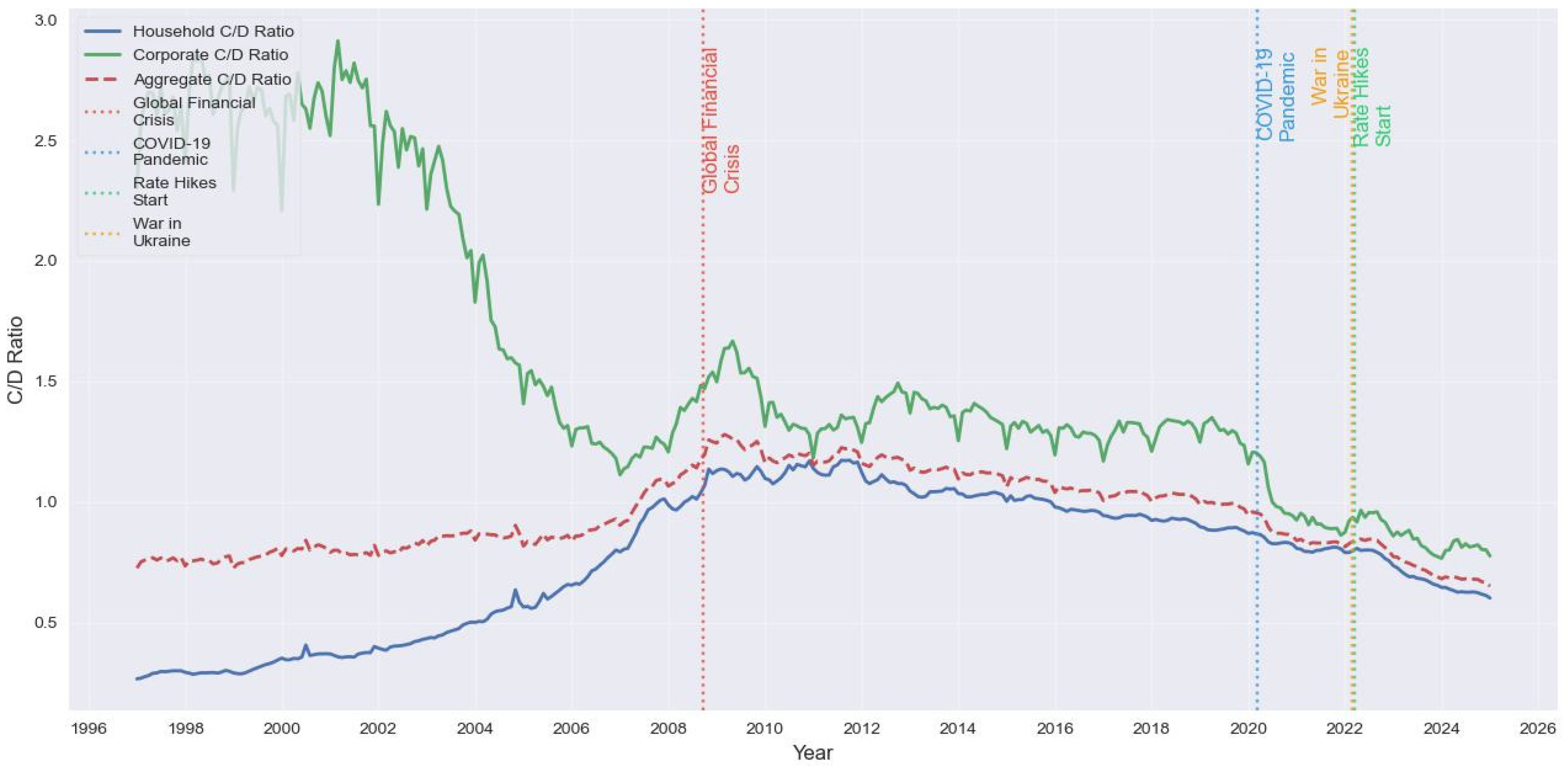
To investigate the changing patterns of money creation in Poland’s banking sector,
Figure 1 displays the monthly C/D ratio for households, corporations, and their total from 1996 to 2024. This figure illustrates key trends in the behavior of endogenous money creation mechanisms across different economic contexts, especially during episodes of financial instability. The extended temporal scope enables detection of structural breaks and nonlinearities in the interplay between credit and deposit changes, thus underpinning the evaluation of central theoretical claims regarding money creation dynamics in advanced transforming economies such as Poland. By encompassing nearly thirty years of financial data,
Figure 1 constitutes the empirical foundation of our analysis concerning the disruption of conventional money creation processes amid economic uncertainty.
The aggregate C/D ratio in Poland exhibited considerable volatility from 1996 to 2024, marked by distinct phases. A prolonged period of growth, averaging 4.1% annually, peaked at 1.257 in October 2008, before being sharply reversed during the Global Financial Crisis, which saw a contraction of 9.1% within one year. The most significant decline occurred during the COVID-19 pandemic (2020–2022), when the aggregate ratio dropped by a record 18.6%, with the corporate sector reaching a historical low of 0.7659 in December 2023. Sector-specific analysis indicates a pronounced downward trend from 2015 to 2024, with the corporate sector ratio declining by 38.5% and the household ratio by 34.2%. Additionally, the correlation between these sectoral ratios weakened substantially post-2010, decreasing from 0.52 to 0.29. The C/D ratio data, as depicted in
Figure 1, elucidates critical aspects of endogenous money creation processes, especially during episodes of economic instability. These observations support the foundational post-Keynesian thesis of the primacy of bank lending in money creation [
1,
5], while also revealing significant deviations from this framework during crises. Between 1996 and 2008, the data reflect a conventional endogenous money creation pattern, with steady ratio growth culminating in the 2008 peak. However, the global financial crisis abruptly interrupted this pattern, followed by pronounced disruption during the COVID-19 pandemic, which produced the sharpest ratio decline on record and an unprecedented low for corporate lending.
The analysis identifies three main mechanisms disrupting traditional money creation under conditions of uncertainty. First, the crowding-out effect of loans due to rising deposits under elevated interest rates [
32] was prominent during 2022–2023 when the NBP’s policy rates reached 6.75%. During this period, deposits increased by an average of 7.2% year over year, while the C/D ratio declined [
40]. Second, government transfers significantly contributed, constituting 23% of deposit growth in 2022 [
40], thereby substantiating the argument for exogenous deposit inflows independent of lending activity [
21]. Third, there was notable sectoral divergence in sensitivity to macroeconomic conditions; while the corporate sector ratio declined by 38.5% over 2015–2024, the household ratio fell by 34.2%, indicating heterogeneous responses across sectors [
29].
These empirical results have important implications for monetary policy design in advanced transforming economies. The results indicate the necessity of developing countercyclical instruments tailored to specific economic environments; the need to improve the coordination between fiscal and monetary policies; and the consideration of sectoral heterogeneity in the transmission models. It shows that mechanisms of endogenous money creation become restricted during periods of high uncertainty and traditional monetarist frameworks should be revised to accommodate more accurately contemporary macroeconomic realities. Furthermore,
Figure 1 illustrates very how money creation channels are distorted during crises and how nuances in policy measures are required to achieve financial stability.
4.2. Bayesian Analysis of Dynamic Interdependencies in the Monetary System
The BVAR model was employed to examine the dynamic interplay among the C/D ratio, broad money supply M3, the policy interest rate, and real GDP growth, providing a robust framework for testing the hypotheses on endogenous money disruption (hypotheses H1–H3). The model, estimated with Minnesota-type priors, effectively mitigates over-parameterization and delivers reliable posterior inference. The estimation utilized MCMC sampling with 1000 draws following a tuning phase of 1000 iterations. All variables were transformed to stationarity via first differencing and standardized to facilitate convergence and interpretation.
Table 2 presents the key convergence diagnostics for the BVAR model, confirming its statistical reliability and stability for subsequent inference.
The model exhibits excellent convergence, as evidenced by the
statistic of approximately 1.0, zero divergent transitions, and high ESS for all parameters. This confirms that the posterior distributions are reliable for inference and provides a solid foundation for hypothesis testing. The estimated coefficients of the BVAR(2) model, detailed in
Table 3, reveal the structure of dynamic interdependencies among the variables. The posterior means indicate the direction and magnitude of influence, while the Highest Density Intervals (HDIs) provide the range of credible values for each coefficient.
Key insights from the coefficient estimates in
Table 3 provide initial evidence for testing hypotheses H1–H3. The analysis focuses on the first-lag coefficients (
), which capture the immediate short-term dynamics most relevant to the hypothesized channels of disruption. For hypothesis H1, which posits that higher interest rates suppress credit demand, the coefficient of
on the
is negative (
), consistent with the theoretical expectation. However, the 94% HDI for this coefficient
is wide and contains zero, indicating substantial estimation uncertainty regarding the strength and statistical reliability of this effect.
For hypothesis H2, which suggests that exogenous deposit inflows decouple money supply growth from lending, the coefficient of on the is notably small (). Its 94% HDI is narrow and centered near zero, with all credible values falling within a minimal range. This provides preliminary visual evidence of a “decoupling”, i.e., money supply growth has a very limited immediate effect on the credit–deposit nexus.
For hypothesis H3, which proposes that structural and behavioral factors create a feedback loop where credit impairment further constrains money creation, the coefficient of the on is negative (). This direction is contrary to the positive relationship postulated under a pure endogenous money view. The 94% HDI is wide and straddles zero, suggesting the estimated negative effect is not precisely estimated but offers no support for a positive, reinforcing link.
Other dynamics are also noteworthy. The C/D ratio exhibits a positive autoregressive pattern at both lags (L1 = 0.015, L2 = 0.032), indicating persistence. Conversely, the positive effect of the
on
(0.069) suggests a more complex, delayed interaction that warrants further investigation with impulse response analysis. While these point estimates and intervals offer initial insights, a formal assessment of hypotheses H1–H3 requires calculating the posterior probabilities defined in our methodology.
Table 4 presents these results, providing a direct probabilistic measure of the evidence for each hypothesis.
The formal hypothesis testing results in
Table 4 provide a direct probabilistic assessment of the dynamic relationships underlying the credit–deposit paradox. The posterior probabilities reveal distinct levels of empirical support for each mechanism. Hypothesis H1 receives only marginal support, with a posterior probability of 0.735 for a negative effect of interest rates on the C/D ratio. While this suggests a tendency for higher rates to suppress credit demand, the 95% credible interval spanning both negative and positive values indicates substantial uncertainty about both the magnitude and reliability of this relationship. By contrast, hypothesis H2 finds robust confirmation. The posterior probability of 1.000 for a near-zero relationship between money supply and the C/D ratio provides strong evidence of decoupling. This suggests that exogenous liquidity inflows, rather than stimulating credit creation, accumulate as idle deposits within the banking system, consistent with the core mechanism of the credit–deposit paradox. The results do not support hypothesis H3, with a posterior probability of just 0.365 for a positive effect of the C/D ratio on subsequent money supply. This indicates the absence of a systematic short-run feedback mechanism whereby credit conditions directly influence broader money creation through behavioral or regulatory channels. For complete transparency,
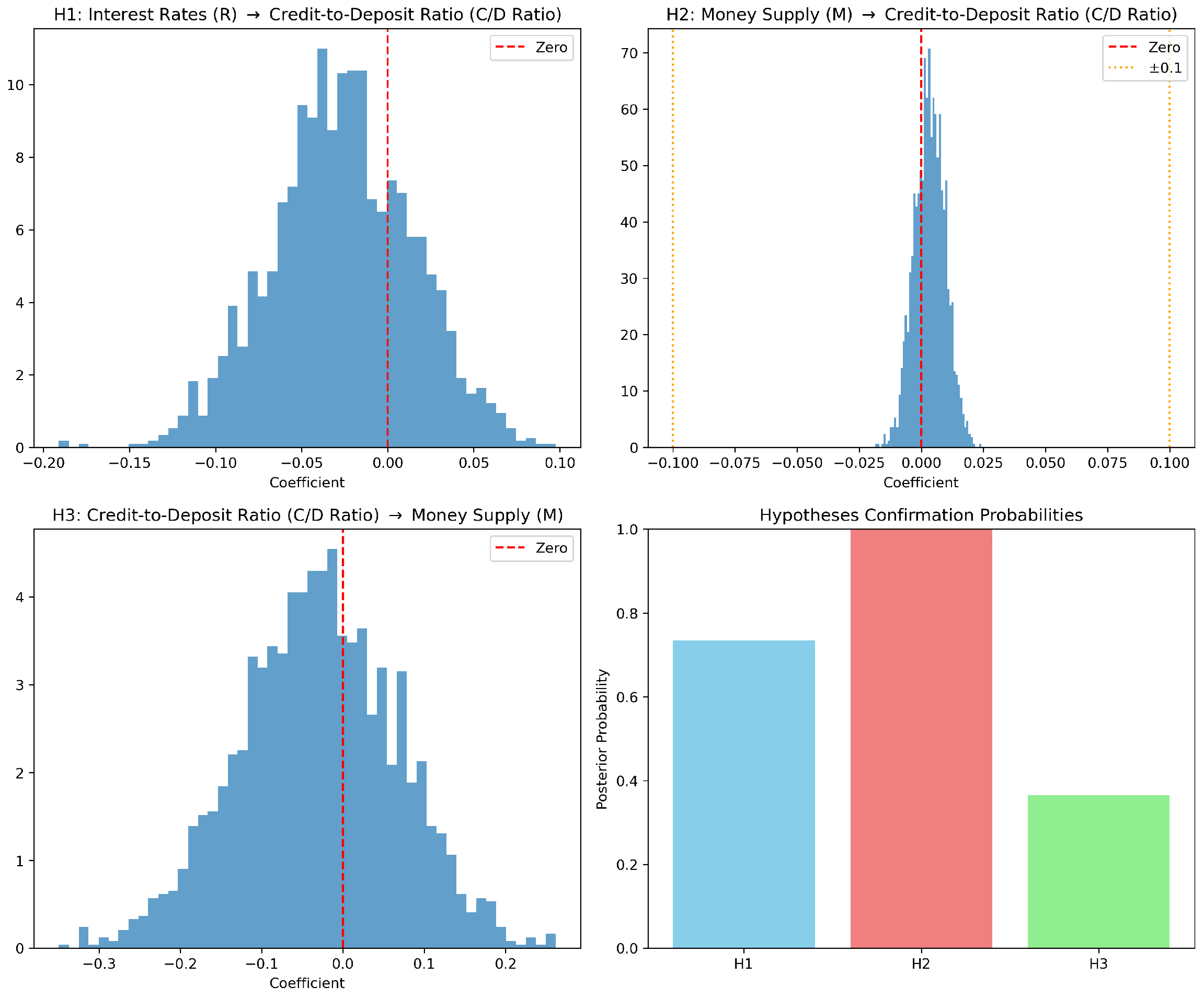
Figure 2 visualizes the full posterior distributions underlying these probability statements, offering additional insight into the evidence weight for each hypothesis.
Figure 2 illustrates the posterior distributions for the three critical coefficients tested in hypotheses H1–H3. Each distribution is centered on its posterior mean, with the red dashed vertical line marking the null value of zero for reference. For hypothesis H1, the distribution of
is centered near −0.027 but is wide and asymmetrical, with a substantial portion of its mass falling to the right of zero. This visualizes the statistical uncertainty captured by the 73.5% posterior probability, showing that while a negative effect is more plausible, a null or even slightly positive effect cannot be ruled out. For hypothesis H2, the distribution of
is exceptionally sharp and tightly concentrated around zero, visually confirming the near-certainty of a negligible relationship (posterior probability of 1.0). For hypothesis H3, the distribution of
is centered to the left of zero, with the bulk of its probability mass lying in negative territory. This clearly shows why the probability of a positive effect is low (36.5%), as only a smaller tail of the distribution extends into positive values.
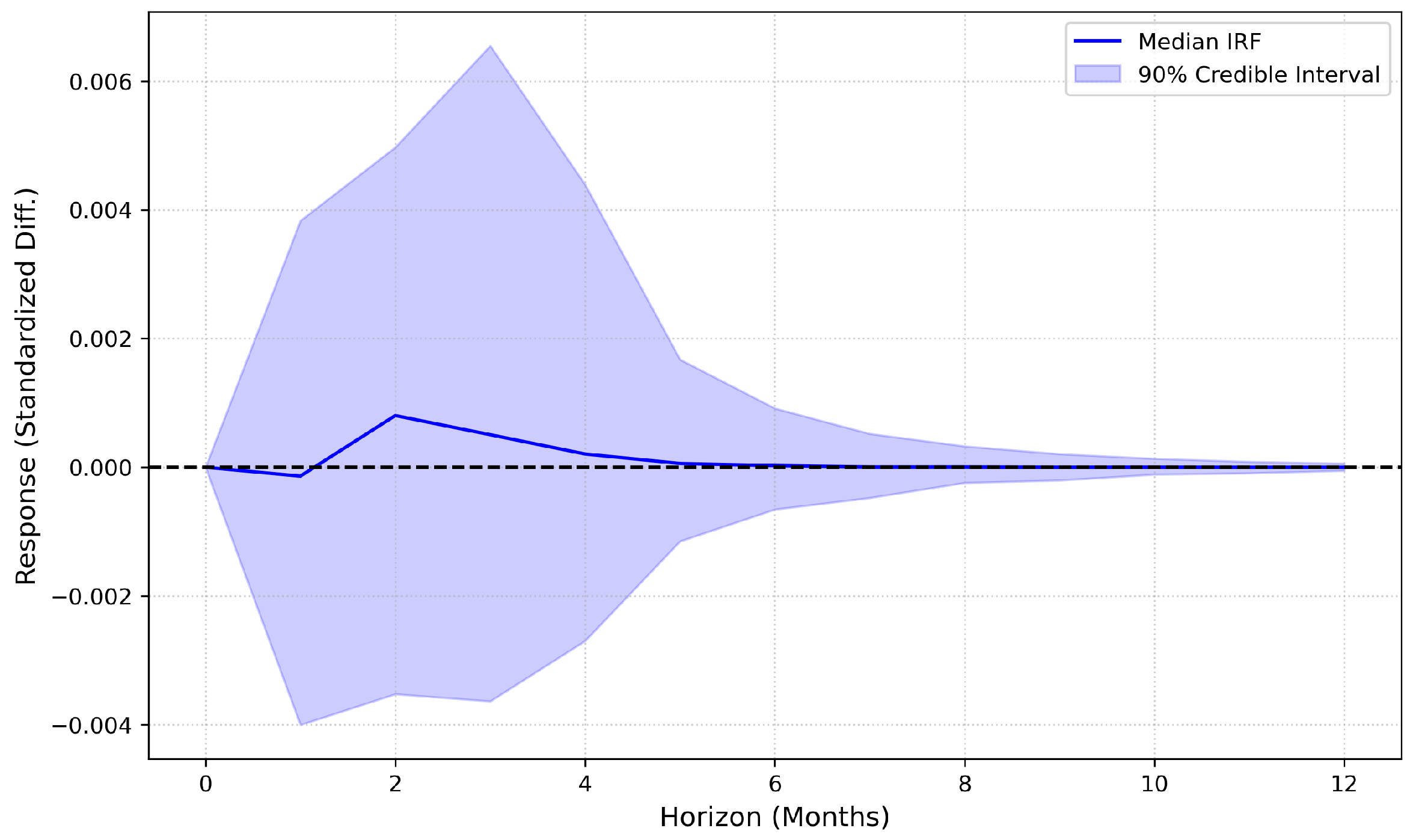
To analyze the temporal evolution of shocks, we examine the IRFs. These functions trace the dynamic response of each variable to a one-standard-deviation shock in another, providing insight into the transmission mechanisms and persistence of effects over a 12-month horizon.
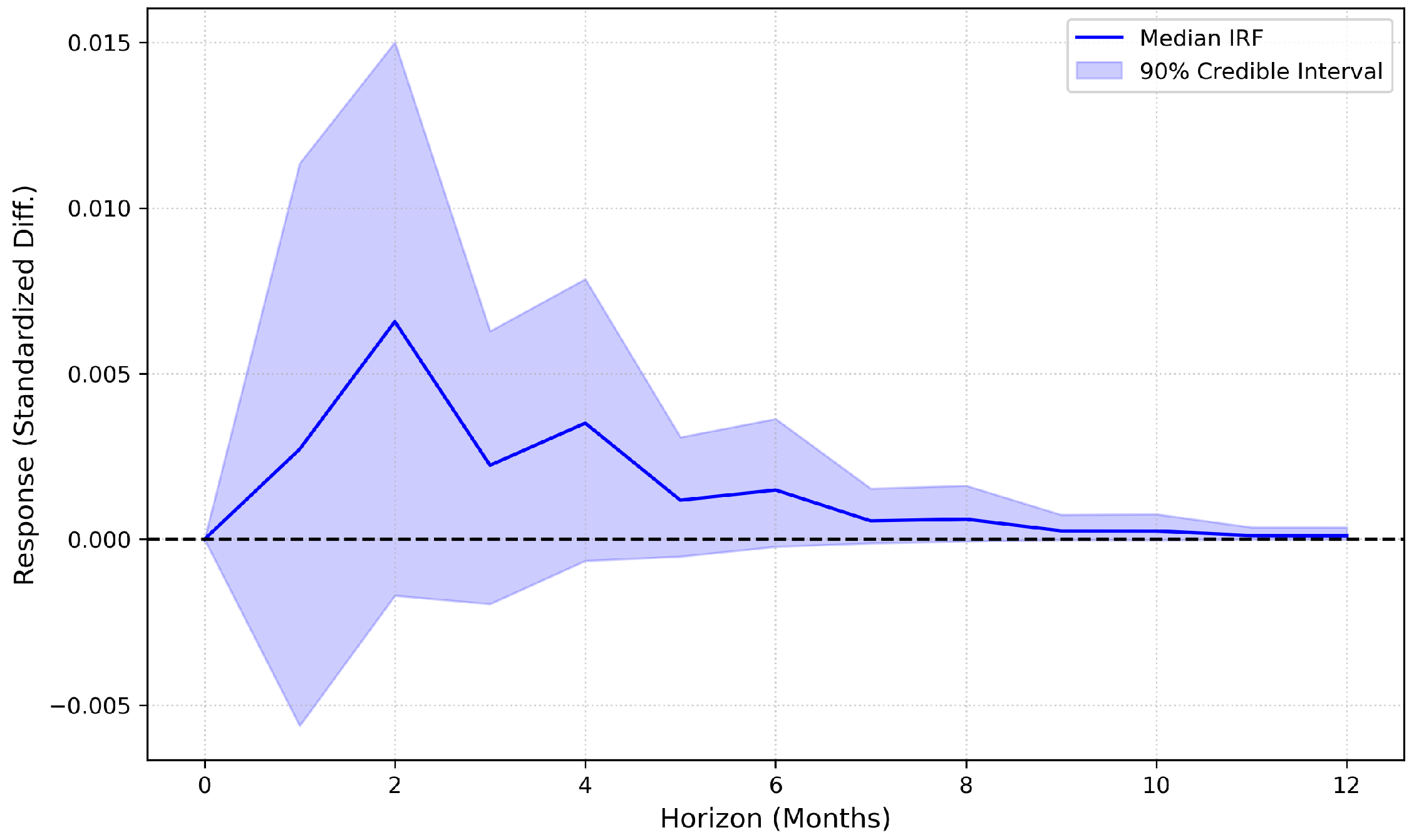
Figure 3 illustrates the response of the C/D ratio to a one-standard-deviation shock in interest rates.
The median IRF shows an initial positive response in the C/D ratio, which peaks around the second month before gradually decaying and returning to zero over the subsequent months. This dynamic pattern is complex and does not align with the straightforward, immediate suppression of credit demand posited in hypothesis H1. Crucially, the 90% credible interval is exceptionally wide and encompasses zero for the entire horizon, indicating that neither the initial positive deviation nor the subsequent decay are statistically distinguishable from a null effect. This profound uncertainty, visually evident in the plot, means the data cannot reliably characterize the dynamic effect of an interest rate shock on the C/D ratio. This lack of precision in the IRF aligns with and reinforces the ambiguous evidence for hypothesis H1 found in the posterior probability (0.735) and the wide credible intervals of the coefficient estimates.
Figure 4 powerfully visualizes the decoupling effect central to hypothesis H2.
The response of the C/D ratio to a money supply shock is negligible across all time horizons. The median IRF hovers around zero, and the 90% credible interval remains exceptionally narrow and centered on zero throughout the response period. This dynamic evidence confirms that shocks to broad money have no economically or statistically significant effect on the credit–deposit nexus, reinforcing the conclusion of a structural decoupling.
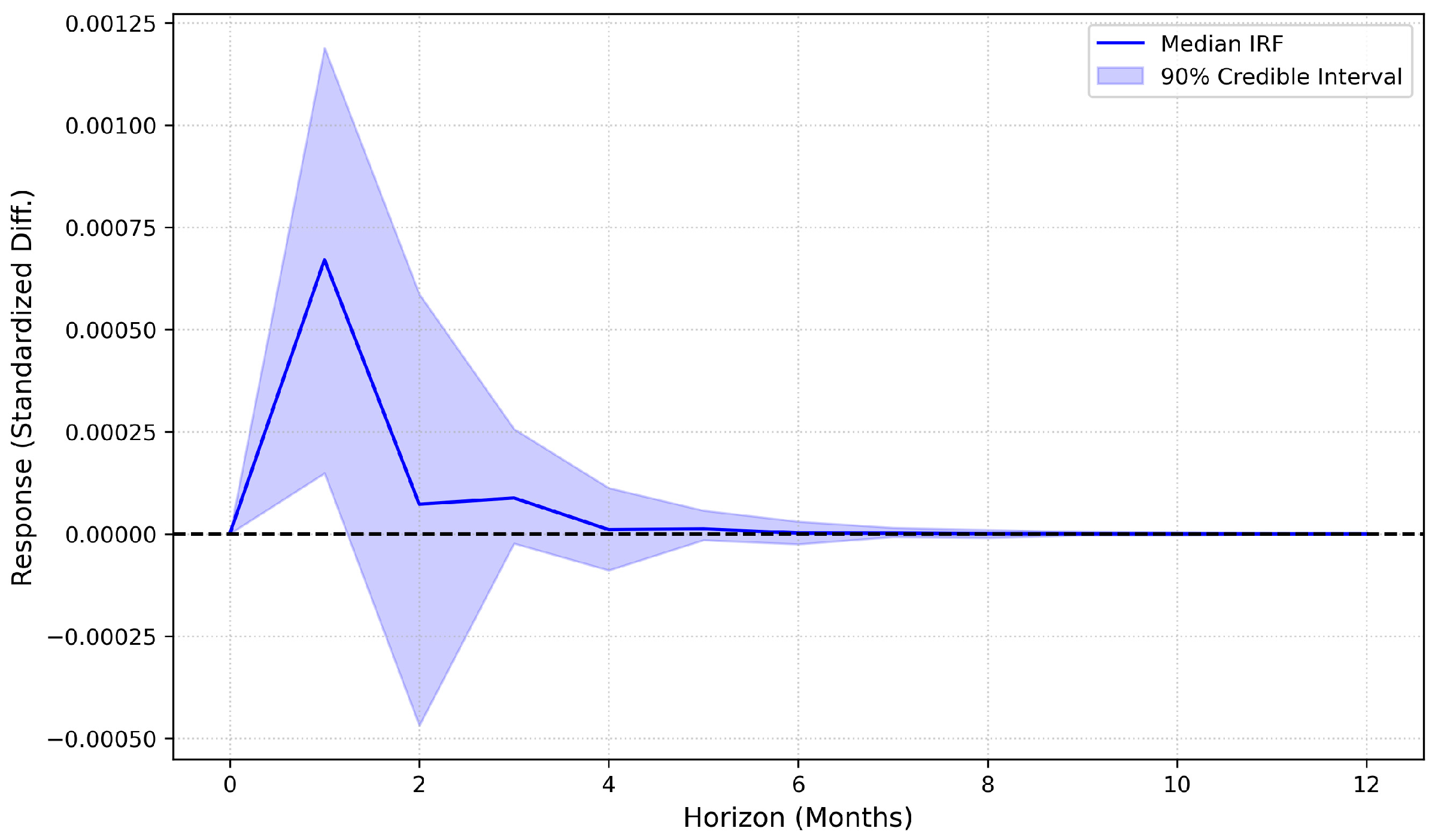
Figure 5 depicts the response of money supply to a shock in the C/D ratio.
The median response shows a slight positive deviation on impact. Although the 90% credible interval briefly excludes zero, indicating a moment of statistical significance, this effect is transient and the interval quickly widens to encompass zero for the vast majority of the horizon. This pattern provides no robust evidence for a sustained feedback loop from credit conditions to money creation. This dynamic pattern, therefore, provides no evidence for a short- to medium-term feedback loop from credit conditions to money creation, thereby offering no support for hypothesis H3.
The stable and reliable BVAR model portrays a monetary system characterized by significant autopersistence in the C/D ratio and a key structural decoupling. The evidence strongly confirms that exogenous money inflows (hypothesis H2) do not translate into proportional credit growth, breaking the traditional link between deposits and lending. While there is weak evidence that higher interest rates suppress credit demand (hypothesis H1), this relationship is not estimated with high precision. Conversely, the model finds no support for the notion that credit-to-deposit imbalances feedback positively into the money supply via behavioral or regulatory channels (hypothesis H3). The combined evidence from posterior probabilities, coefficient estimates, and impulse responses points towards a financial ecosystem where credit dynamics are largely autonomous from short-term monetary shocks, highlighting the limitations of conventional policy transmission channels in influencing bank lending behavior during the period under study.
4.3. Drivers of Inflation [Testing the Cost-Push]
To evaluate the nature of inflation between 2006 and 2024 and test the cost-push hypothesis H4, we conducted a multiple linear regression using the change in CPI as the dependent variable, as specified in Equation (5). The model incorporates changes in cost-related variables (energy and food prices) and changes in money supply, while including GDP growth in levels as a control for demand-side factors. This specification in first differences—with GDP in levels due to its stationarity—was adopted after diagnostic testing. Standard unit root tests confirmed the non-stationarity of the price and monetary variables, while cointegration testing did not identify a stable long-run relationship. The regression thus provides a robust framework for quantifying the contributions of cost-push versus demand-pull and monetary factors to inflation. This approach aligns with the well-established research paradigm of analyzing the contribution of specific supply-side shocks to headline inflation, exemplified by seminal work on oil price shocks [
86] and contemporary inflation decomposition practices [
87]. Importantly, although energy and food prices are components within the CPI basket, the model does not constitute a mere accounting identity for three key reasons: (1) the analysis uses growth rates rather than levels, which breaks the exact arithmetic relationship; (2) control variables outside the CPI basket (GDP, M3) are included; (3) statistical relationships are estimated from the data rather than imposing fixed CPI weights. Consequently, the model meaningfully quantifies how exogenous shocks to these specific components propagate to overall inflation dynamics.
Table 5 presents the outcomes of this analysis.
The results provide compelling evidence for the cost-push inflation hypothesis. The model demonstrates strong explanatory power with an R-squared of 0.556, indicating that the specified variables explain approximately 56% of the variation in consumer prices. The overall statistical significance is confirmed by an F-statistic of 69.46 (p < 0.001). Consistent with hypothesis H4, food and energy prices are significant drivers. Food prices emerge as the most powerful factor, with a highly significant coefficient of 0.356. Energy prices also show a statistically significant positive relationship, though with a more modest coefficient of 0.029. The economic output variable (GDP) exhibits a small but statistically significant positive coefficient of 0.032, indicating some demand-pull elements alongside the dominant cost-push factors.
In contrast, the change in money supply is statistically insignificant (p-value = 0.419). This result was further investigated through Granger causality tests, which consistently failed to reject the null hypothesis of no causality. This pattern suggests that during the sample period, monetary factors played a limited role in driving inflationary pressures compared to the strong cost-push elements.
The model specification and variable transformation were guided by comprehensive pre-estimation diagnostics. The stationarity analysis revealed that CPI, energy, and food prices are integrated of order one, while money supply exhibited more complex integration properties. GDP was stationary in levels. Therefore, first differences were applied to all non-stationary variables while keeping GDP in levels, ensuring the avoidance of spurious regression. Post-estimation diagnostic tests confirm the model’s adequacy and robustness (see
Table 6).
The stationarity of regression residuals is confirmed (through ADF testing), eliminating concerns about spurious regression. Multicollinearity assessment based on VIF values reveals no severe issues, and the Durbin–Watson statistic indicates no significant autocorrelation. The Jarque–Bera test rejects the null hypothesis of normally distributed residuals, suggesting some departure from ideal distributional properties. The large condition number warrants caution regarding potential multicollinearity, though the low VIF values provide contradictory evidence on this front.
Potential endogeneity of money supply was addressed. Its consistent statistical insignificance across specifications and the absence of Granger causality justify treating it as exogenous in this context. A primary limitation is the complex integration (potentially I(2)) of the money supply variable, warranting further investigation.
In summary, the evidence strongly supports the dominance of cost-push factors in driving inflation during the sample period. The significant coefficients on food and energy prices, combined with the insignificant money supply relationship, indicate that inflation was driven primarily by supply-side shocks. This implies that conventional monetary policy tools may have limited effectiveness against such inflation, while targeted interventions in specific markets could be more impactful.
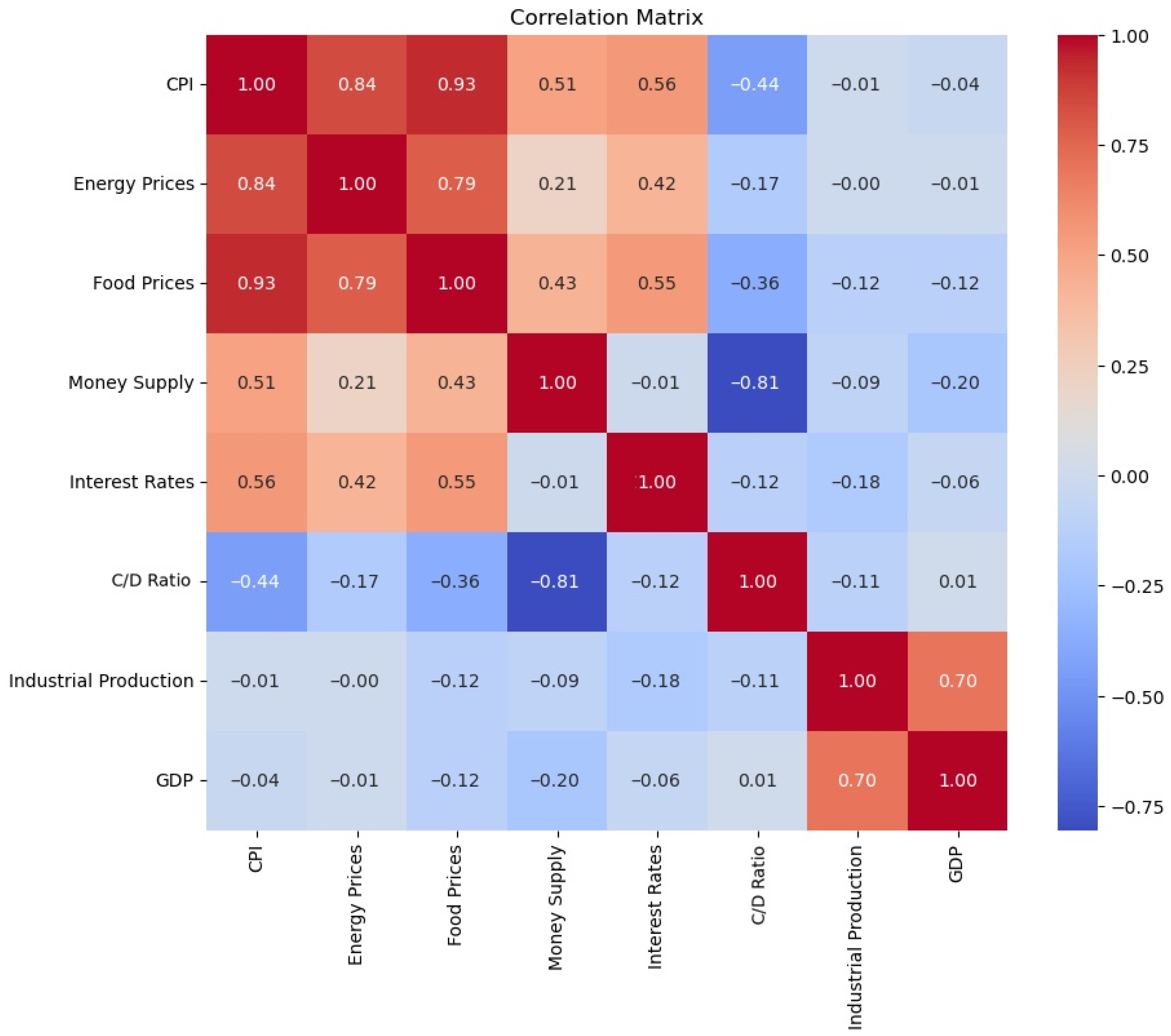
To further contextualize these relationships,
Figure 6 shows a heat map of correlations among key macroeconomic variables, including CPI, energy and food prices, money supply, interest rates, the C/D ratio, industrial production, and GDP.
The heat map reinforces the regression findings, showing strong positive correlations among CPI, energy, and food prices. It also reveals a negative correlation between money supply and the C/D ratio, and weak linkages between financial variables and real output, highlighting structural frictions. This visual analysis complements the regression by illustrating the broader interconnected dynamics shaping inflationary pressures.
4.4. Money Shortage Indicator and Regime Identification
To systematically quantify the money shortage phenomenon, we employ two complementary but methodologically distinct approaches, i.e., the composite MSI and Markov regime-switching analysis. While the MSI provides a continuous, theory-based measure of current stress conditions by aggregating three key dimensions (Equation (6)), the Markov model identifies latent regimes based on the stochastic properties of the entire time series, including persistence, volatility, and transition probabilities rather than direct MSI values. This fundamental difference means the two approaches may sometimes yield divergent classifications, particularly during periods of structural economic transformation.
Table 7 presents the results of the Markov regime-switching analysis, revealing two statistically distinct monetary regimes with contrasting characteristics.
The regime classification reveals that the economy spent 118 months in money shortage conditions (Regime 1) versus 98 months in normal conditions (Regime 0). The statistical characteristics of each regime are economically meaningful, i.e., Regime 0 exhibits higher but more volatile MSI values, while Regime 1 shows consistently negative MSI with remarkably low volatility. This pattern suggests that money shortage periods represent stable but impaired monetary conditions, whereas normal periods are characterized by greater fluctuation around more positive values. However, the regime classification during the severe 2023–2024 stress period requires careful interpretation. Despite MSI reaching historically low values below −1.5 during this interval, the Markov model classified much of this period under Regime 0. This apparent paradox underscores the methodological distinction between the approaches. While the MSI directly reflects current stress levels, the Markov model identifies regimes based on the persistence and dynamics of the entire series. This classification suggests that the extreme 2023–2024 values, while historically low, exhibited stochastic properties that aligned more closely with the “normal” regime pattern identified over the full sample. To complement the regime-switching analysis and provide a comprehensive overview of the MSI’s relationships with key macroeconomic variables, the correlation matrix for the full sample period is presented in
Table 8.
The correlation matrix reveals several key patterns that validate our analytical framework. Most importantly, the strong positive correlation between MSI and the C/D ratio (0.470) confirms that our composite indicator effectively captures the core phenomenon of credit–deposit decoupling. The negative correlation with interest rates (−0.227) supports the mechanism whereby monetary tightening exacerbates money shortage conditions, while the positive relationship with GDP (0.418) suggests that economic growth provides some mitigation. These correlation patterns align with and reinforce the findings from the BVAR and regime-switching analyses, offering a coherent picture of Poland’s endogenous money creation process under stress.
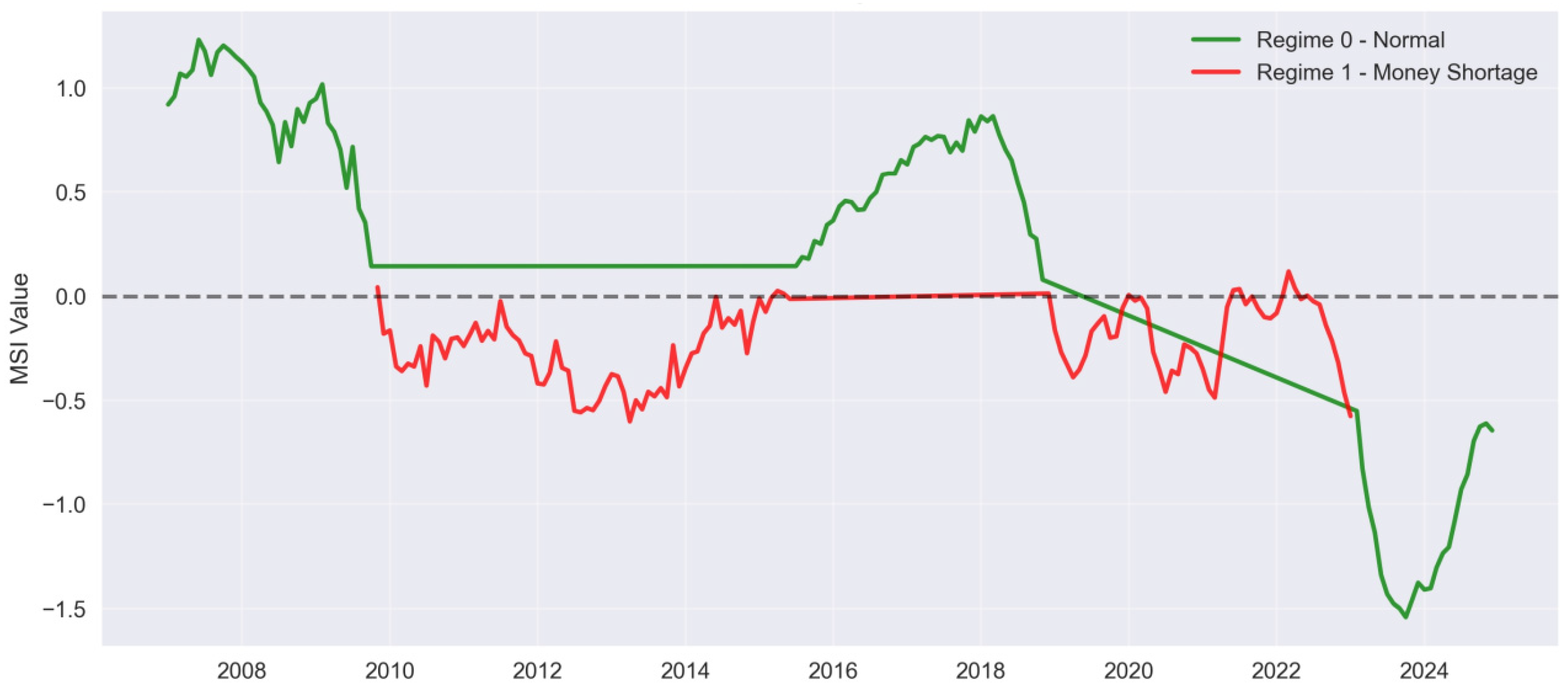
While the correlation matrix offers a comprehensive, full-sample view of relationships, the analysis remains focused on the time-varying nature of monetary stress. To reconcile the persistent historical patterns identified by the Markov model with the extreme MSI realizations in recent years, the visual synthesis in
Figure 7 plots the MSI path against the inferred regime probabilities, delineating periods of normal monetary conditions (Regime 0) from periods of money shortage (Regime 1).
The MSI fluctuates around zero, with pronounced negative episodes corresponding to the money shortage regime. A critical observation is the sustained and deep negative spike in the MSI beginning in 2021 and intensifying through 2023–2024, where the indicator reaches its historical lows below −1.5. This visually identifies the 2021–2023 period as one of severe and persistent systemic impairments, providing direct graphical evidence supporting hypothesis H5, which posits the existence of distinct and persistent “money shortage” regimes. The high frequency of regime switches in earlier periods contrasts with the prolonged stay in Regime 1 during the recent high-stress era. However, the regime classification from early 2023 onward requires particular attention. Namely, despite MSI values reaching historically low levels, the Markov model identifies this period as Regime 0 (normal conditions). This apparent paradox may reflect a structural break in the monetary system, where persistently negative MSI values become the “new normal” rather than a temporary disruption. Economically, this could indicate a fundamental transformation in the credit–deposit transmission mechanism, where the traditional relationship between monetary variables has decoupled, rendering historical regime patterns less applicable. Moreover, this specific classification during a period of deeply negative MSI could be explained by a shift in the driving factors behind the monetary stress. The initiation of a monetary policy loosening cycle by the NBP, involving a series of interest rate cuts, likely introduced a new, dominant dynamic that altered the persistence properties of the series. While the level of the MSI indicated severe money shortage, the dynamic behavior of the series during this policy-driven loosening phase was statistically identified by the model as being more characteristic of the higher-volatility Regime 0, rather than the stable, impaired conditions of Regime 1. This finding underscores the severity of the recent stress period and suggests that conventional regime-switching models may require adaptation to capture truly unprecedented monetary conditions.
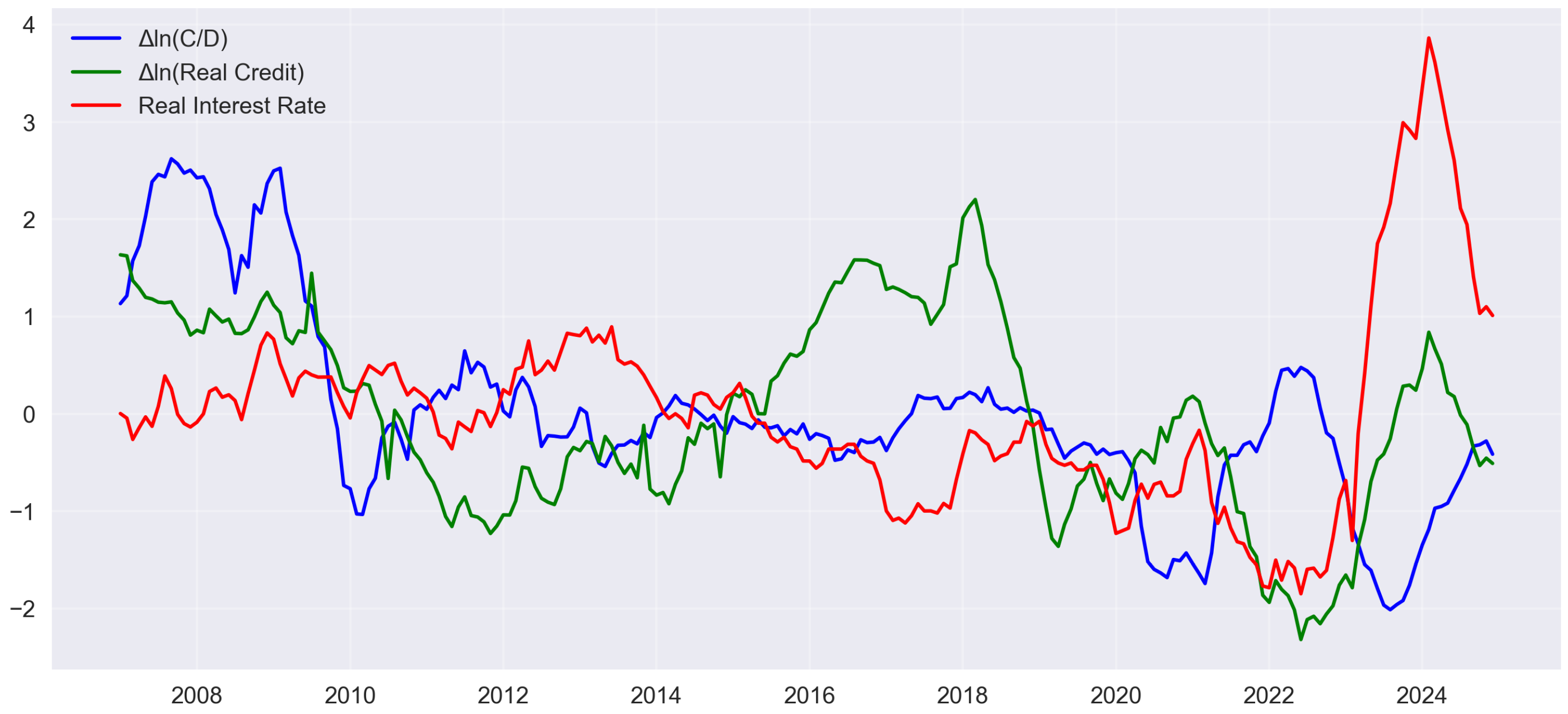
Figure 8 decomposes the MSI by illustrating the dynamics of its three standardized components.
Figure 8 shows how the C/D ratio growth, real credit growth, and the real interest rate contribute to the composite MSI. During the money shortage episode from 2021 to 2023, all three components moved in a direction consistent with the theory. The growth rate of the C/D ratio was negative and sharply declined following the outbreak of the war in Ukraine, indicating that deposits were growing faster than loans. Real credit growth was also negative and declining. The real interest rate first declined and then rose sharply following the outbreak of the war in Ukraine and the change in the NBP interest rate policy (i.e., tightening). The synchronized deterioration of these fundamental dimensions during the high-stress period visually validates the operational definition of a money shortage and underscores the multifaceted nature of endogenous money creation disruption.
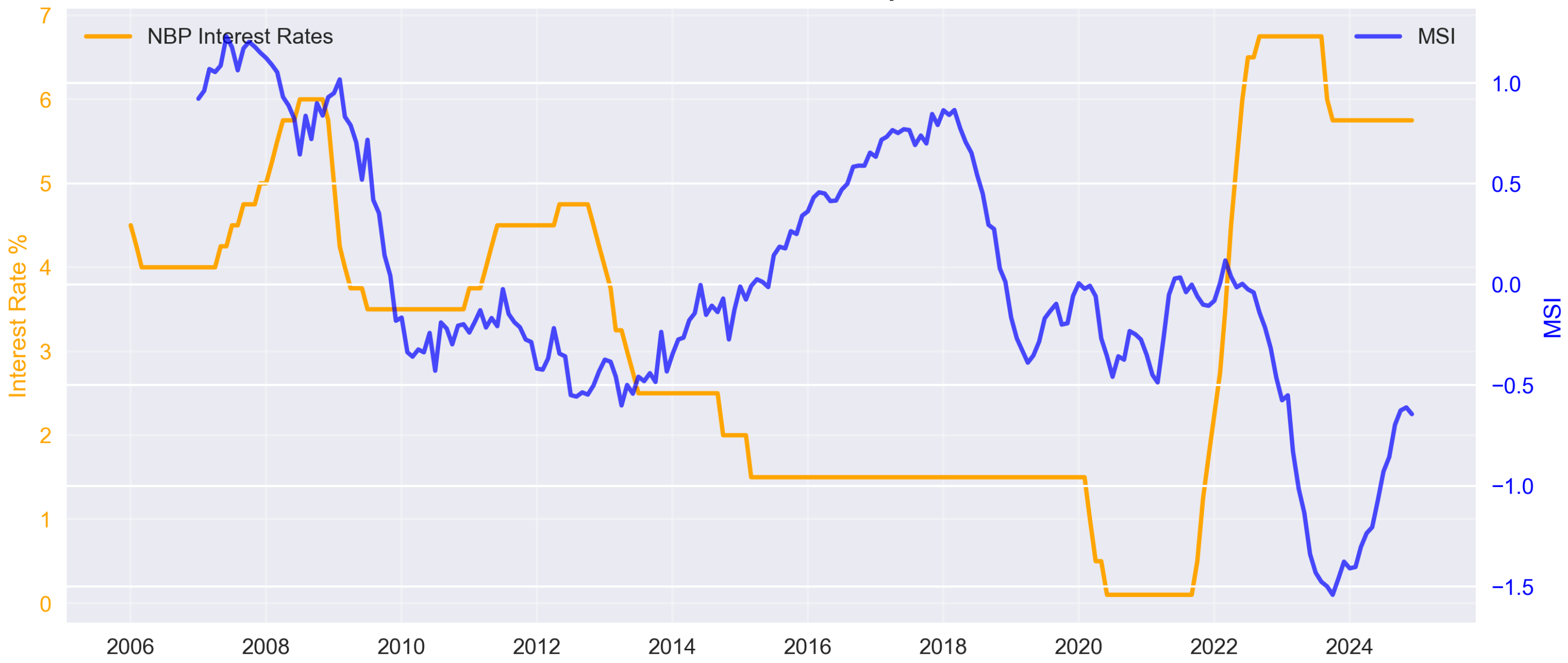
Figure 9 provides a direct comparison between the evolution of the MSI and the level of interest rates.
Figure 9 clearly shows an inverse relationship between the two series, which was particularly evident during the recent period of monetary tightening. As interest rates rose sharply from 2022 onward, the MSI plunged deeply into negative territory. This visual evidence aligns with the mechanism described in hypothesis H1, wherein high interest rates suppress credit demand and contribute to money shortage conditions. The strong co-movement reinforces the correlation analysis, highlighting the interest rate channel as a significant factor in the dynamics of the credit–deposit paradox.
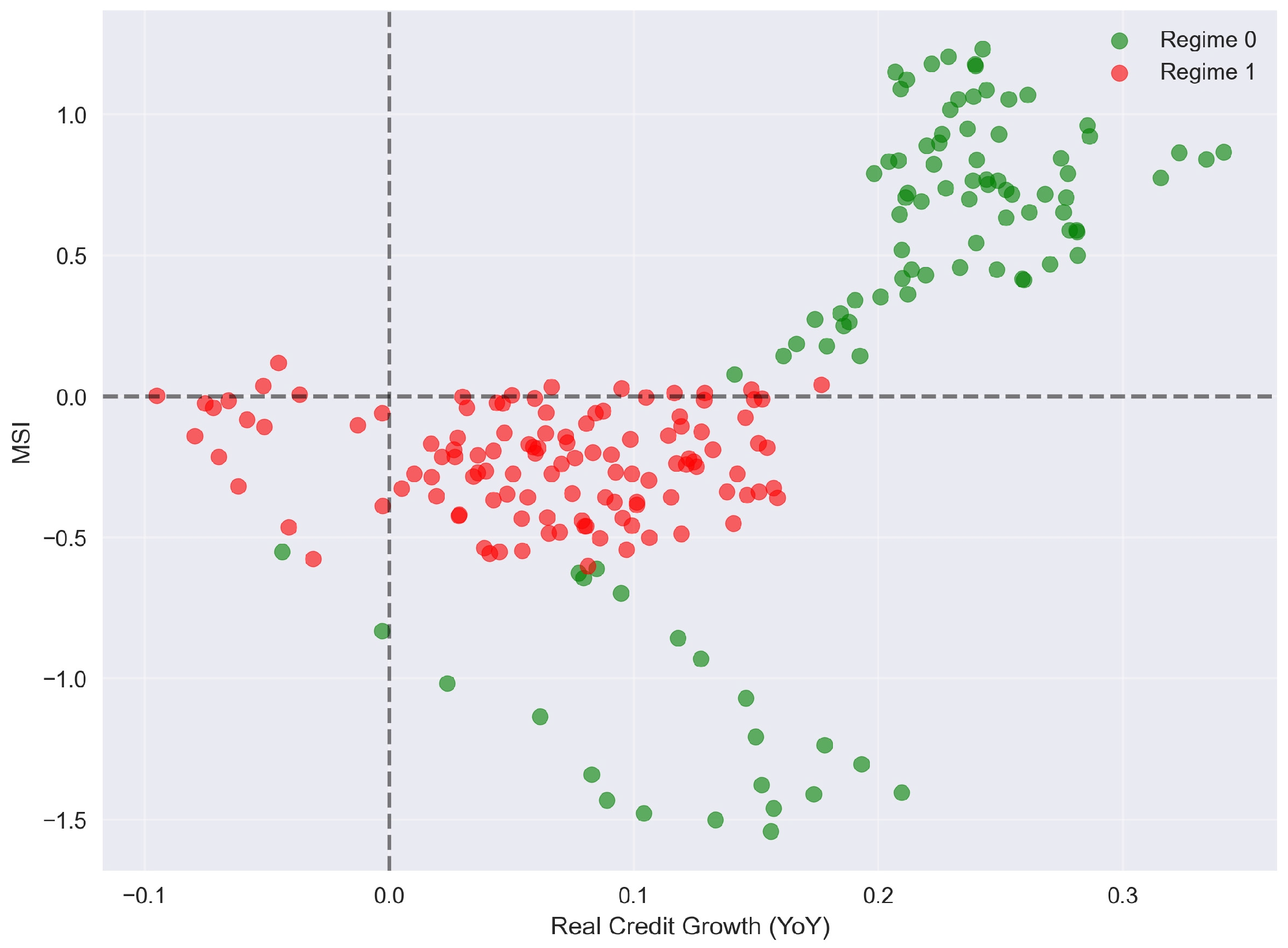
Figure 10 offers a cross-sectional view of the relationship between real credit growth and the MSI, differentiated by monetary regime.
Figure 10’s scatter plot starkly illustrates the regime-dependent relationship. In Regime 0 (normal conditions, represented by the color green), observations cluster in the region of positive MSI and positive real credit growth. However, a distinct and economically significant cluster of observations with highly negative MSI values also appears within this regime (and as we know form earlier analysis it is associated with the 2023–2024 period). This pattern aligns with the earlier Markov model results and suggests that during this specific episode, the stochastic properties of the series, likely influenced by the shift in the NBP’s monetary policy towards a loosening cycle or a fundamental change in market expectations, differed from the persistent, stable impairment typical of Regime 1. Consequently, the model classified this volatile stress period as part of the higher-variance “normal” regime. In contrast, in Regime 1 (money shortage, red), observations are consistently associated with negative MSI values and predominantly low or negative real credit growth. This provides compelling visual evidence that the canonical “money shortage” regime is characterized by a systematic slowdown in productive credit growth to the private sector. Overall, the plot validates the MSI’s construction by illustrating a clear association between money shortage conditions and impaired credit creation.
5. Discussion
This study investigates the paradoxical decoupling of loan and deposit growth in Poland during the period of high inflation and rising interest rates, a phenomenon that poses a significant challenge to a strict interpretation of the endogenous money creation paradigm. This challenge is further amplified in an era of unconventional monetary policies, such as quantitative easing, which blur the traditional lines between endogenous and exogenous money creation by allowing central banks to directly influence credit market conditions [
88,
89]. Our multi-methodological approach—employing BVAR, OLS regression, and the Markov regime-switching model—has yielded robust evidence that both confirms and critically extends the post-Keynesian understanding of money creation under stress. A summary of the hypotheses testing is presented in
Table 9.
Our findings, derived from BVAR modelling, confirm the foundational post-Keynesian tenet that loans precede deposits under normal conditions [
1,
2,
3,
4,
5]. However, our results robustly demonstrate that this mechanism is severely disrupted under stress. The period of economic uncertainty in Poland triggered a behavioral shift similar to that observed during the 2008 global financial crisis. During this time, households prioritized debt repayment, effectively “annihilating” money [
6], and increased their precautionary savings [
8,
19,
90,
91]. This led to a credit contraction even as deposits increased. A decoupling was further exacerbated by substantial exogenous inflows. Strong evidence for hypothesis H2 from the BVAR model—a posterior probability of 1.000 for a near-zero relationship between the money supply and the C/D ratio—provides compelling evidence that deposits can increase independently of domestic credit activity [
21,
46]. The decomposition of deposit growth for the 2021–2023 period, presented in
Table 10, quantitatively substantiates this finding.
The quantitative divergence is stark. In 2022, new credit accounted for only 3.7% of total deposit growth. The residual growth of 75.9 billion PLN (96.3%) is attributed to exogenous sources, which aligns with the study by Górnik [
40], who highlighted the dominant role of non-loan inflows, such as foreign investments, government debt issuance, and fiscal transfers. More specifically, Górnik [
40] provides a detailed breakdown of the exogenous channels that flooded the Polish economy with liquidity during our sample period. His estimates powerfully corroborate our decomposition. First, he shows that foreign investments amounted to approximately 230 billion PLN between 2020 and 2022. Second, the government issued approximately 130 billion PLN in debt over the same period, which was purchased by banks. Third, direct central bank financing of government deficits contributed approximately 100 billion PLN.
The robust evidence for a structural decoupling between deposit growth and domestic credit (hypothesis H2) finds strong parallels in other economies experiencing large-scale exogenous liquidity injections. Similar dynamics have been documented in the euro area during quantitative easing, where central bank asset purchases led to significant growth in bank reserves and deposits without a corresponding expansion in credit to the private sector, pointing to a broken monetary transmission mechanism [
92,
93]. Specifically, Altavilla et al. [
92] rigorously analyze how the bank lending channel broke down during the euro area crisis, linking central bank policies to loan supply, and Boeckx et al. [
93] directly analyzes the transmission of the European Central Bank (ECB) balance sheet policies. Furthermore, the phenomenon of ‘precautionary savings’ swelling deposits amidst credit contraction—a key behavioral driver of the decoupling—has been observed in various economies during crises, from the United States post-2008 [
94] to emerging markets during the COVID-19 pandemic [
95,
96]. More specifically, Chronopoulos et al. [
95] provides clear, empirical evidence of a massive, crisis-induced buildup of household deposits (“precautionary savings”) in the UK. Andersen et al. [
96] offers a broader European perspective using high-frequency transaction data, showing similar forced savings behaviors. Our results for Poland thus confirm that the endogenous money creation process is highly vulnerable to disruption from both behavioral shifts and exogenous liquidity shocks, a vulnerability that appears to be a common feature across different financial systems under stress.
The MSI framework and Markov regime-switching model provide complementary evidence for the credit–deposit decoupling and validate hypothesis H5. The identification of two monetary regimes, normal and money shortage, with the latter prevailing for 118 of 216 months, underscores the structural vulnerability of Poland’s endogenous money creation process. The 2021–2024 episode represents the most severe manifestation of this vulnerability, with MSI values reaching unprecedented negative territory. The correlation patterns (presented in
Table 8 in
Section 4.4) further illuminate the disruption mechanisms, i.e., the negative MSI-interest rate relationship confirms that monetary tightening exacerbates money shortage conditions, while the positive MSI-GDP relationship suggests that economic growth provides some mitigation. Most importantly, the strong positive correlation with the C/D ratio validates that our composite indicator effectively captures the core phenomenon of credit–deposit decoupling.
The identification of distinct and persistent “money shortage” regimes adds to the growing body of literature on nonlinear financial states and the limits of endogenous money. While composite stress indices are common (e.g., Financial Stress Index (FSI), aggregating a number of market variables to measure financial stress [
84], Composite Indicator of Systemic Stress (CISS), which takes into account the interdependencies between market segments [
97], Credit-to-GDP Gap [
98,
99], used in macroprudential supervision as a measure of excessive credit growth, etc.), the MSI is novel in its specific focus on the credit–deposit nexus—the core of the endogenous money theory. The finding that Poland spent the majority of the observed period in a ‘shortage’ regime suggests a structural fragility that may be more acute than in core Eurozone economies, where such disruptions are typically associated with acute crisis episodes (e.g., the 2011–2012 sovereign debt crisis). The prolonged nature of the 2021–2023 shortage episode bears resemblance to the experience of some Southern European economies during the last decade, where impaired bank balance sheets led to a persistent credit crunch [
100]. A cornerstone study by Acharya et al. [
101] on the Eurozone sovereign debt crisis directly documents this mechanism, showing how impaired bank balance sheets in periphery countries led to a severe and persistent credit crunch for firms, which was only alleviated by the ECB’s unconventional policies. The lack of support for hypothesis H3—which tested whether a positive feedback loop from credit conditions to money supply exists (posterior probability = 0.365, negative coefficient)—further underscores that in such impaired regimes, the self-reinforcing, positive cycle of credit creation breaks down, a phenomenon also noted in studies of ‘secular stagnation’ and persistent liquidity traps in advanced economies [
101].
Together, these findings on the fragility of endogenous money creation raise critical questions about the policy environment in which it operates. While analyzing inflation does not directly test the endogenous money mechanism, it is essential for assessing the appropriateness of the subsequent policy measures that affected credit conditions. Specifically, a monetary policy designed to combat demand-pull inflation may be misaligned when facing a cost-push shock, potentially exacerbating credit-supply disruptions within the endogenous money framework [
60,
61,
62]. Consequently, these dynamics necessitate a critical re-evaluation of the monetary policy stance adopted by the NBP. Our OLS regression results unequivocally identify the inflation of 2021–2023 as predominantly cost-push, driven by energy (β = 0.0287) and food prices (β = 0.3563), a finding that aligns with heterodox critiques of Poland’s recent inflation [
40,
102,
103]. This aligns with heterodox critiques [
40,
60] and suggests that interest rate hikes in response to cost-push inflation may exacerbate credit constraints, as argued by Hopkins [
61] and Gnos [
62]. In this context, the NBP’s aggressive monetary tightening, which raised interest rates to 6.75%, appears profoundly misaligned with the nature of the inflationary shock. This policy stance can be further contextualized by comparing it to the response of the ECB to the contemporaneous inflationary shock in the Eurozone. Although Eurozone inflation—measured by the Harmonised Index of Consumer Prices (HICP)—peaked at 10.6% in October 2022 (its highest level since the introduction of the euro), it remained substantially lower than the peak of approximately 18% witnessed in Poland in early 2023 (see
Table 11).
The inflation surge in both Poland and the Eurozone was predominantly driven by similar cost-push factors, i.e., the energy shock following Russia’s invasion of Ukraine, rising food prices, and post-pandemic supply chain disruptions. However, the ECB’s monetary tightening cycle, while historically significant for the bloc, was less aggressive in its initial pace and terminal rate compared to the NBP’s. The ECB commenced its hiking cycle in July 2022, raising the deposit facility rate from −0.5% to 2% by the end of that year, a cumulative increase of 250 basis points. This contrasts with the NBP’s rapid tightening, which lifted the reference rate from 0.1% to 6.75% within a similar timeframe. The ECB’s more measured approach likely reflected the heterogeneous nature of the Eurozone economies and a greater emphasis on avoiding a deep recession, yet it ultimately succeeded in guiding inflation back towards its 2% target by 2025. This comparison underscores that the NBP’s exceptionally aggressive tightening was not the only possible response to a cost-push shock, reinforcing the conclusion that its policy was disproportionately contractionary relative to the inflationary driver. The confirmation that recent inflation was predominantly cost-push aligns Poland’s experience with that of numerous other small open and emerging market economies in the post-pandemic period. Studies on inflation dynamics in Central and Eastern Europe [
104,
105] and Latin America [
105] have similarly identified global commodity prices (energy, food) and supply chain disruptions as the primary drivers, rather than domestic demand-pull or purely monetary factors. In this context, also the World Bank [
104] report extensively analyzes the predominantly cost-push nature of post-pandemic inflation in Emerging Markets and Developing Economies (EMDEs), including Central and Eastern Europe (CEE). This shared characteristic underscores a global policy dilemma: the limited effectiveness of conventional interest rate tools against externally driven, supply-side inflation. The aggressive tightening by the NBP, while more pronounced, reflects a broader trend among inflation-targeting central banks facing eroded credibility and fear of de-anchored expectations. However, the significant economic cost of such a policy, as suggested by our weak evidence for hypothesis H1 (the interest rate credit channel), echoes findings in other contexts where monetary policy transmission is weak, such as in the euro area periphery post-2010 [
106].
The empirical evidence from Poland corroborates this assessment of a potent, yet potentially misaligned, policy stance. The weak and uncertain relationship from interest rates to the C/D ratio in the BVAR model (posterior probability of 0.735 for hypothesis H1), where the Impulse Response Function in
Figure 3 shows a wide credible interval encompassing zero—indicates that the policy transmission to credit was statistically indistinct from no effect. Furthermore, the contractionary effect of this policy on the real economy is supported by the negative marginal effect of interest rates on GDP growth observed in the BVAR coefficient estimates (e.g., Interest Rates (L1) on GDP: −0.19) and the broader context of cyclical declines in GDP during the tightening period. The IRFs derived from our BVAR model, such as those in
Figure 3,
Figure 4 and
Figure 5, are widely used in macroeconomics, including DSGE models, to analyze the dynamic responses of variables to structural shocks [
107]. The Bayesian approach employed here offers significant advantages over traditional VAR models, such as better handling of limited data via prior distributions, more robust estimation under uncertainty, and the ability to directly quantify probabilistic evidence for hypotheses—features that are critical when analyzing complex monetary transmission mechanisms.
However, these statistical findings represent only one dimension of the policy dilemma. Interpreting the appropriate policy response requires considering a broader context. While the initial drivers of inflation were predominantly cost-push, central banks must also guard against the risk of these shocks de-anchoring inflation expectations. Although a pure cost-push narrative might suggest a different course of action, a decisive monetary response was likely deemed necessary to mitigate severe risks for the entire economy. In Poland, there was significant public and media pressure on the NBP, which was initially criticized for delayed action as inflation approached 18%, and later for the economic burden of rate hikes as mortgage payments rose sharply. The interest rate hikes thus represent a double-edged sword. One crucial function of the NBP’s cycle of increases, which brought the reference rate to 6.75%, was likely to manage exchange rate pressures. A significant depreciation of the Polish złoty, as underscored by its brief breach of the 5.00 level against the USD in late 2022, acts as a potent cost-push inflationary factor in its own right. By raising rates, the NBP aimed to stabilize the currency and prevent a further imported inflation spiral, even as this policy also placed a heavy burden on households, particularly young borrowers struggling with soaring housing prices [
108,
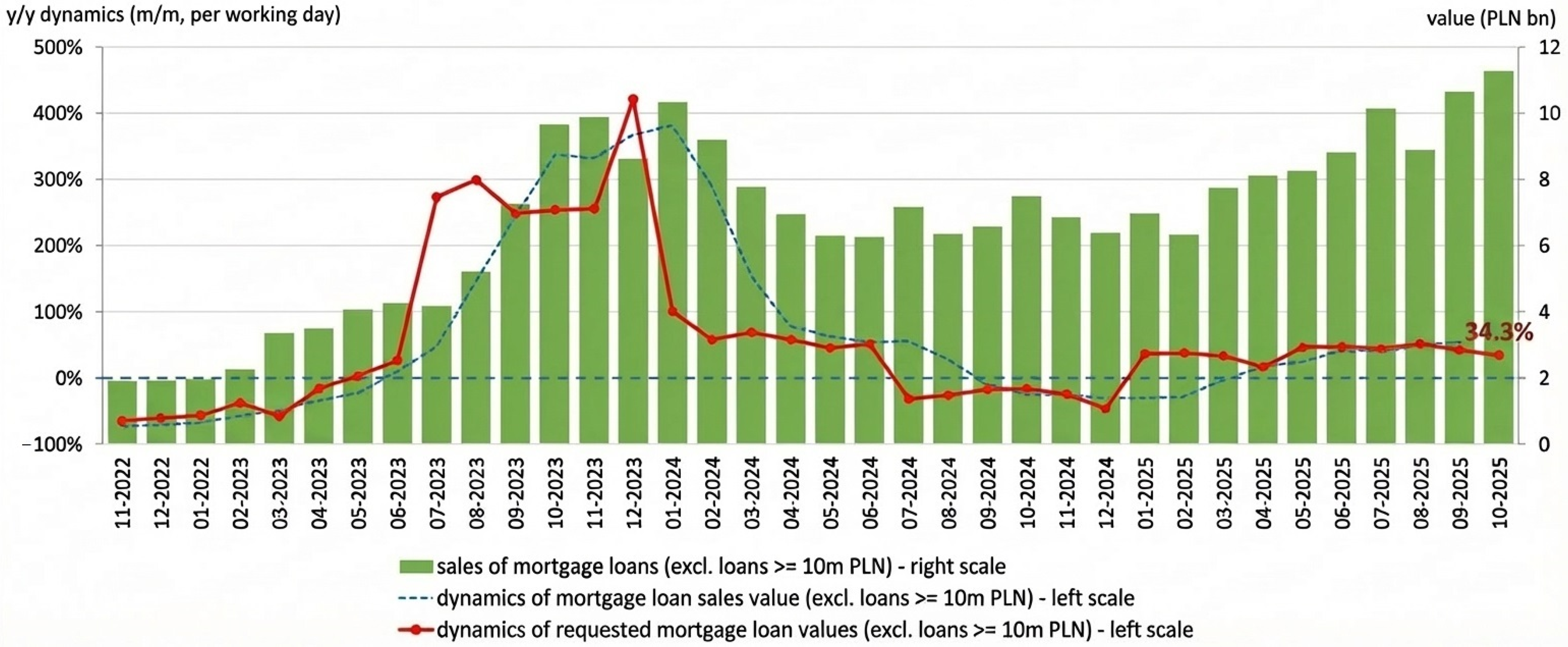
109]. Furthermore, it is noteworthy that the NBP complemented its interest rate policy with a strategy of diversifying reserves through aggressive gold purchases, a decision that appears prudent in retrospect. Furthermore, the sensitivity of credit demand to interest rates is starkly highlighted by the recent surge in mortgage lending following the initiation of rate cuts; October 2025, after five interest rates reductions, was the best month for new mortgage loans in Polish history since the transition in 1989, with 11 billion PLN in new contracts recorded by the Credit Information Bureau (Biuro Informacji Kredytowej, BIK) (see
Figure 11) [
110].
Consequently, while our study’s empirical scope is restricted to identifying the cost-push nature of the inflation surge, we refrain from a normative critique of the interest rate policy itself. The policy dilemma was complex. It required balancing the direct causes of inflation with the need to manage expectations and maintain macroeconomic stability in the context of an advanced, transforming economy (i.e., Poland) that was distinct from the Eurozone.
Beyond this complex macroeconomic policy dilemma, our findings point to deeper, structural frictions within the Polish financial system that impair monetary transmission. The high profitability of the banking sector during a credit stagnation, coupled with banks’ marked preference for holding risk-free government bonds over extending corporate loans—as reflected in the BVAR results where money supply shocks explain very little of the C/D ratio’s variance—points to a severely impaired transmission mechanism. This behavior is consistent with the banking sector SBC paradigm [
27,
28], where banks can retreat to safe assets [
111] and maintain profitability through wide margins on loans tied to interbank benchmarks like WIBOR, rather than seeking out productive but riskier lending opportunities. This creates a perverse incentive structure where monetary tightening boosts bank profitability without corresponding benefits for real economic liquidity, a decoupling that critically weakens the economy [
57,
58]. This phenomenon is exacerbated by market concentration and firms’ price power [
73], as well as regulatory arbitrage [
111,
112].
The profound inertia within the system, evidenced by the high autoregressive component of the C/D ratio, reveals a self-perpetuating feedback loop that standard monetary tools are ill-equipped to break; this underscores the critical necessity for an integrated policy approach that moves beyond reliance on the interest rate channel. Our findings strongly advocate for enhanced fiscal–monetary coordination. The exogenous deposit growth from fiscal transfers and government debt issuance could be channeled toward fostering productive credit through targeted counter-cyclical liquidity facilities and public investment in supply-constrained sectors [
60,
113,
114]. In this context, Bigio et al. [
113] demonstrate that the effectiveness of fiscal transfers versus credit subsidies is contingent on private debt limits, advocating for credit policy as a superior tool for stabilizing demand when financial constraints are slack. Complementarily, Aghion and Kharroubi [
114] provide empirical evidence that counter-cyclical macroeconomic policies disproportionately boost growth in financially constrained sectors, underscoring the growth benefits of channeling liquidity towards them. These theoretical and empirical insights reinforce the relevance of ongoing policy discussions in Poland. The NBP itself has acknowledged the need for such measures, including modifying the asset tax that currently incentivizes holdings of treasury bonds over private sector lending [
115]. Structural reforms, such as decoupling loan rates from the WIBOR benchmark—a transition already initiated by the NBP [
115] are also essential to reduce artificial profit inflation derived from monetary policy settings and realign bank incentives with the financing needs of the real economy [
40].
In synthesis, the Polish case offers a critical lesson. While endogenous money creation is a fundamental mechanism [
8], it provides an insufficient framework for understanding credit dynamics during periods of acute economic stress [
116]. The convergence of exogenous deposit inflows, a monetary policy misaligned with the cost-push nature of inflation, and a regulatory-financial framework that inadvertently prioritizes bank profitability and balance-sheet stability over productive lending, collectively exacerbated the credit shortage. However, this is consistent with and extends the post-Keynesian approach by emphasizing that monetary transactions are complex and deeply intertwined with institutional and structural issues [
117]. Therefore, resilience in advanced transforming economies like Poland, aside from improved cyclical policies, is dependent on deep and fundamental changes that can rebalance the financial sector’s motivational structures towards structures and goals that are more supportive of funding for the non-financial sector, especially under external shocks. Policymakers must look beyond traditional monetary aggregates and develop integrated monitoring frameworks that can capture the complex interactions of financial institutions, regulatory environments, and economic dynamics.
7. Conclusions
This study investigated the paradoxical decoupling of loan and deposit growth in Poland using monthly data from 2006 to 2024, with particular emphasis on the high-stress period of 2021–2023 characterized by elevated inflation and interest rates, thereby challenging a strict interpretation of the endogenous money creation paradigm. Using a mixed-methods approach, including BVAR modeling, OLS regression, and a Markov regime-switching model, we tested five core hypotheses regarding the disruption of money creation mechanisms under economic stress. Our key findings confirm that while the endogenous money mechanism holds under normal conditions, with loans preceding deposits, the mechanism becomes significantly disrupted during periods of high uncertainty. Specifically, we found: (1) a strong cost-push inflation dynamic, driven primarily by energy (β = 0.0287, p < 0.001) and food prices (β = 0.3563, p < 0.001), whose predominantly non-monetary origin, when contrasted with the more aggressive tightening path of the NBP compared to the ECB’s measured approach, raises questions about the appropriateness and economic cost of such a rapid and pronounced interest rate hike cycle; (2) robust evidence of exogenous deposit inflows evidenced decoupling deposit growth from domestic credit activity, as shown by a posterior probability of 1.000 for a near-zero relationship between money supply and the C/D ratio in the BVAR model; (3) only marginal support for the direct suppressive effect of interest rates on credit demand (posterior probability of 0.735) and no support for a structural feedback loop from credit conditions to money creation; (4) the identification of two distinct monetary regimes, with money shortage conditions prevailing for 118 of 216 months, and the 2020–2023 episode representing the most severe manifestation of this vulnerability. The self-perpetuating nature of C/D ratio and the profound inertia within the system, as evidenced by the BVAR model, further highlight the structural constraints on money creation during stress.
The results of this study have theoretical and practical implications. Theoretically, it reiterates the importance of integrating exogenous factors and institutional settings within the endogenous money framework. Practically, it reflects the inefficiency of one-size-fits-all monetary policy, especially interest rate hikes in fighting cost-push inflation. Policymakers should instead focus on countercyclical liquidity tools, increase fiscal–monetary coordination, work toward developing an integrated monitoring system to account for deposit inflows other than loans, and introduce structural reforms that align bank incentives with real economy financing needs.
The introduction and analysis of the MSI and the Markov regime-switching model provide a novel methodological contribution to the endogenous money literature. Our composite index successfully operationalizes the money shortage concept, and the regime classification reveals that Poland experienced money shortage conditions for the majority of the observed period. The 2022–2024 episode was historically unique in its severity (MSI < −1.5). These findings underscore the necessity of moving beyond single-indicator approaches and adopting composite measures that capture the multidimensional nature of money creation disruptions in stressed economies.
To conclude, this study has addressed the less-explored area of the mechanisms of money creation in stressed economies and the implications that this has for the formulation of robust monetary and financial policy during times of overlapping crises. The application of Bayesian methods, such as BVAR model, offers a more robust framework for analyzing monetary transmission under uncertainty, providing probabilistic evidence that traditional tools like interest rates have limited and uncertain effects when the endogenous money creation process is impaired by exogenous shocks and structural frictions.