Integration of GIS, Big Data, and Artificial Intelligence in Modern Waste Management Systems—A Comprehensive Review

 ,
,  , ,
, ,  , ,
, ,  ,
,  and
and 
Abstract
1. Introduction
2. Systems and Criteria for Waste Classification in National and International Contexts
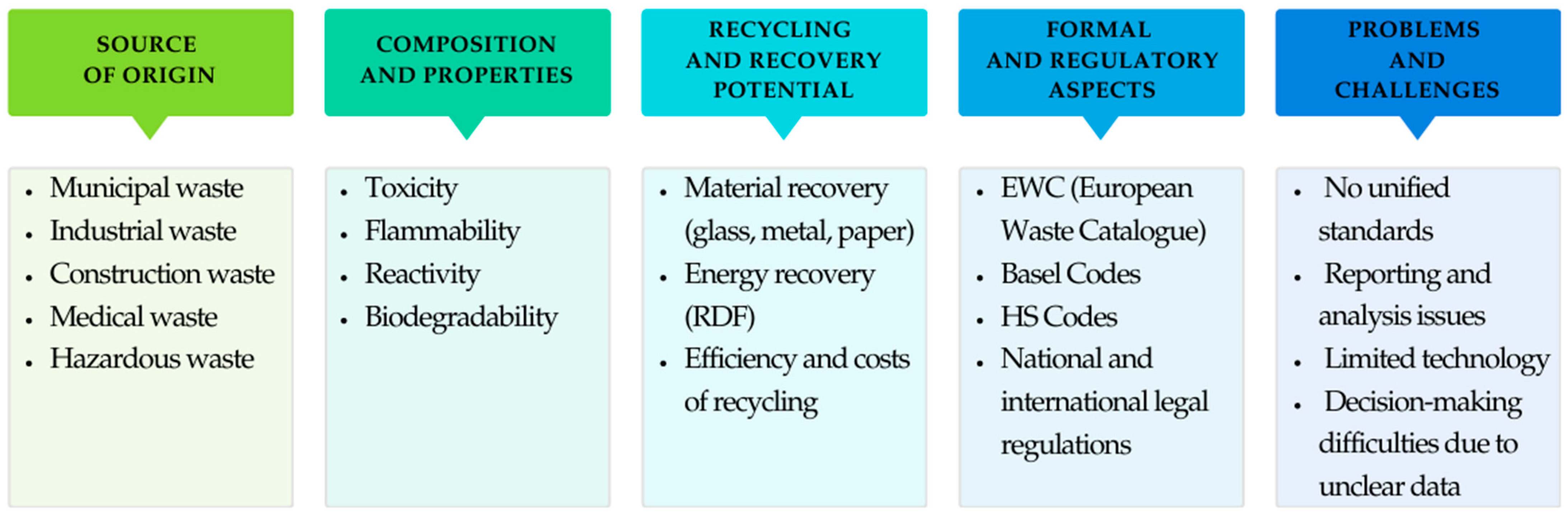
2.1. Criteria for Waste Classification and the Challenges of Standardization

2.2. Waste Classification Systems in European, International, and National Contexts
2.3. Global Trends in the Digitization and Harmonization of Waste Classification
2.4. The Importance of Proper Waste Classification for Technology Costs and Reporting
3. Structure and Functioning of Waste Management System
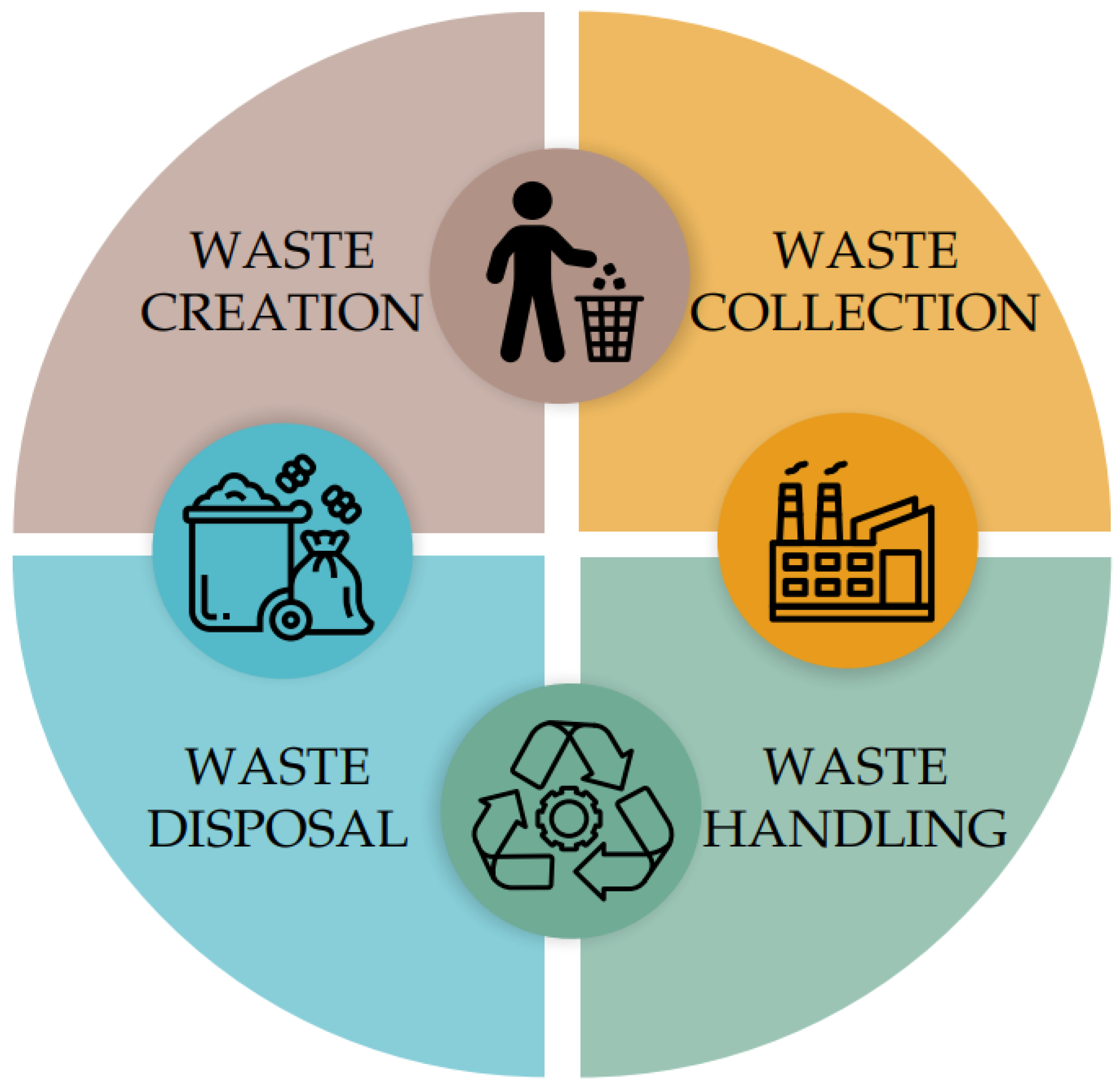
3.1. Life Cycle of Waste and Its Significance for Management Systems
3.2. Models of the 3R, 4R, and 5R Action Hierarchies
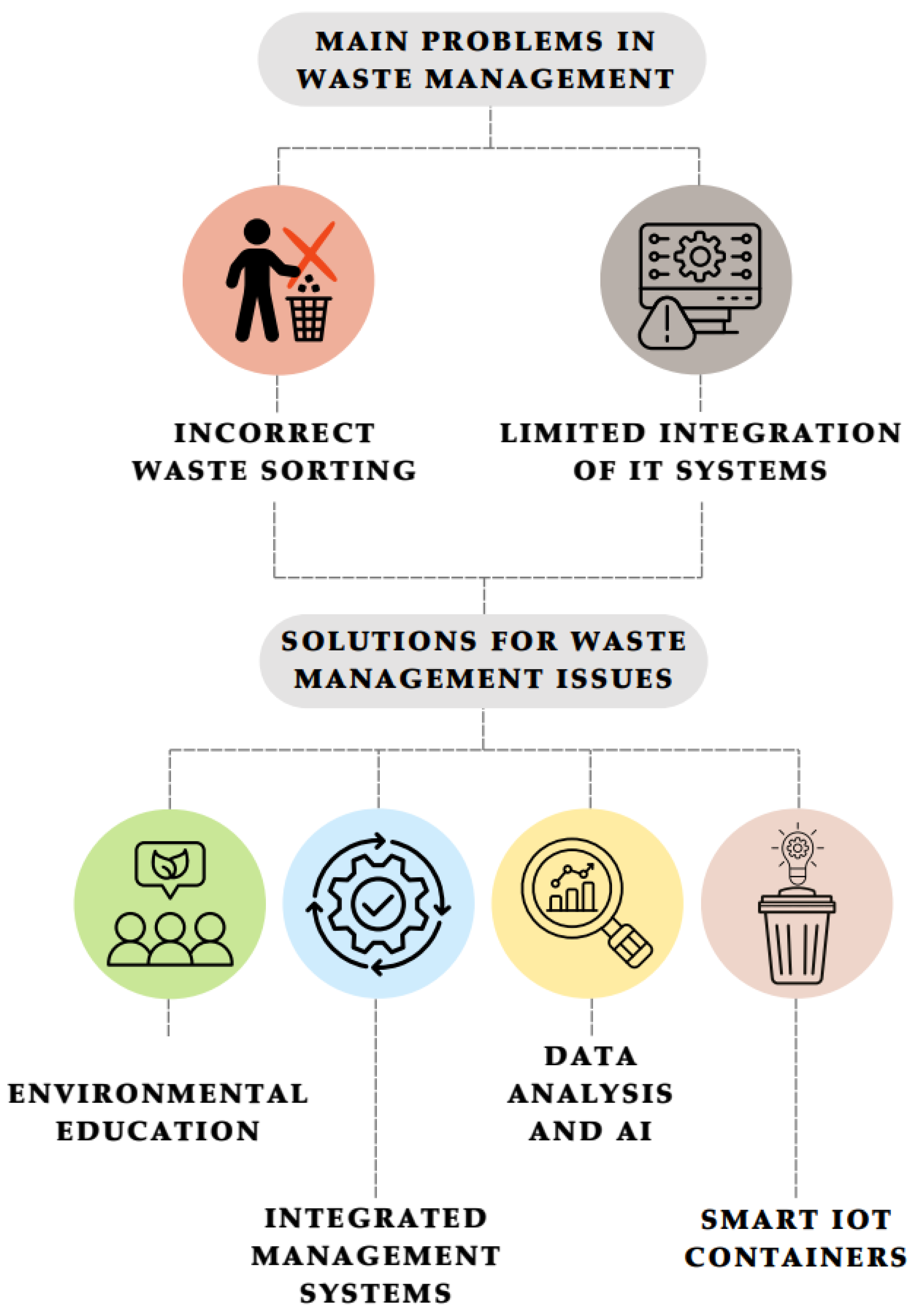
3.3. Main Challenges in Waste Management Systems
3.3.1. Inefficient Waste Segregation Practices
3.3.2. Limitations in Data Quality Within Waste Management Systems
3.3.3. Barriers to Digital System Integration
3.4. The Significance of Technological Integration for Effective Waste Management
4. Review of Digital Technologies in Waste Management
4.1. Application of Geographic Information Systems in Waste Management
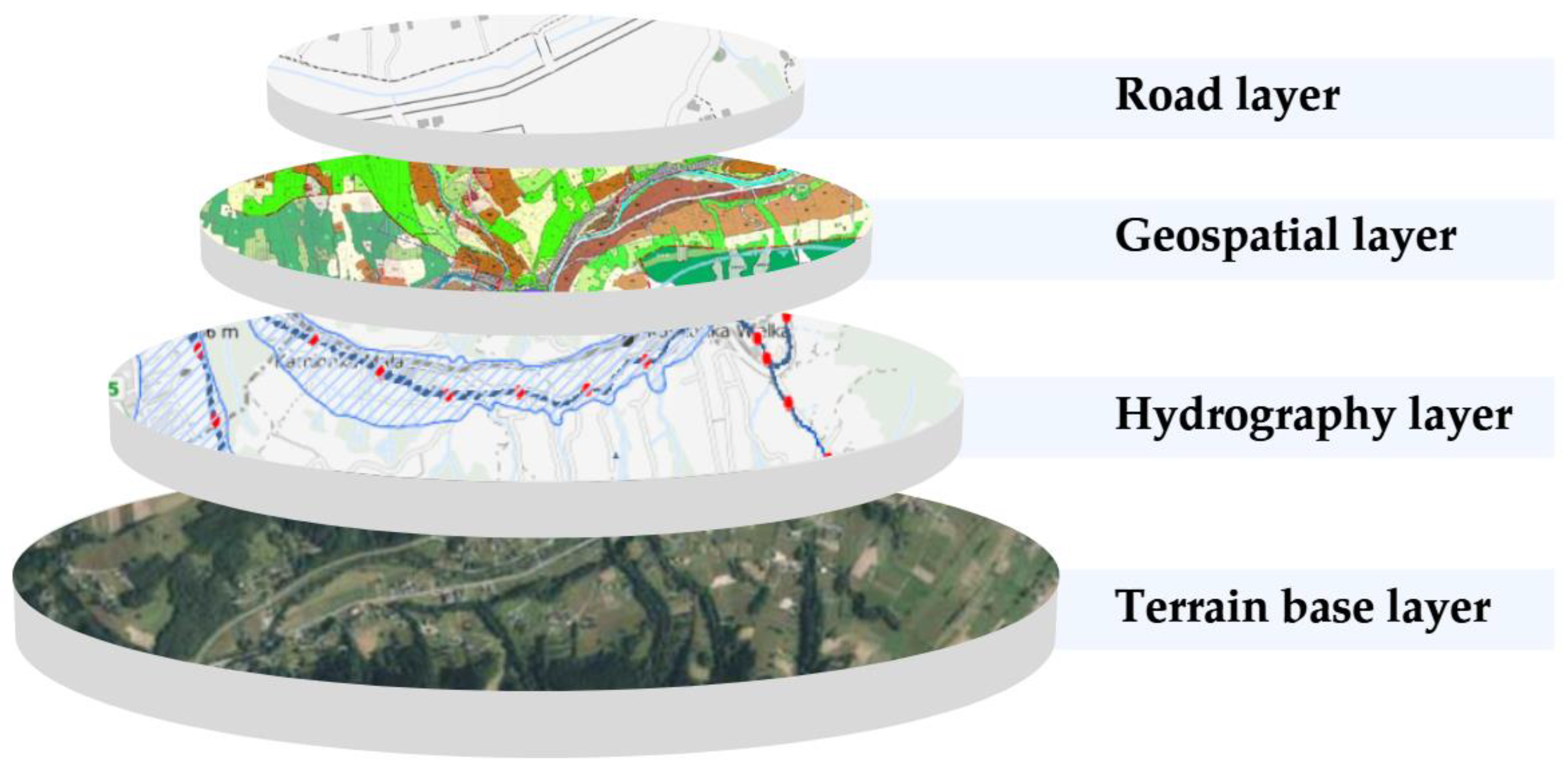
4.1.1. The Significance of GIS in Waste Planning and Management
4.1.2. Optimization of Routes and Facility Locations Using GIS
4.2. Big Data Analysis
4.2.1. The Role of Big Data Analysis in Waste Management
4.2.2. Predictive Modeling and Limitations of BDA
4.3. Artificial Intelligence in Automated Waste Management Systems
4.3.1. Data Analysis and Decision Support in Waste Management
4.3.2. Classification Deep Learning and Limitations of AI
5. Integration of GIS, Big Data, and AI in Waste Management
5.1. Instruments and Tools Supporting the Digitalization of Waste Management
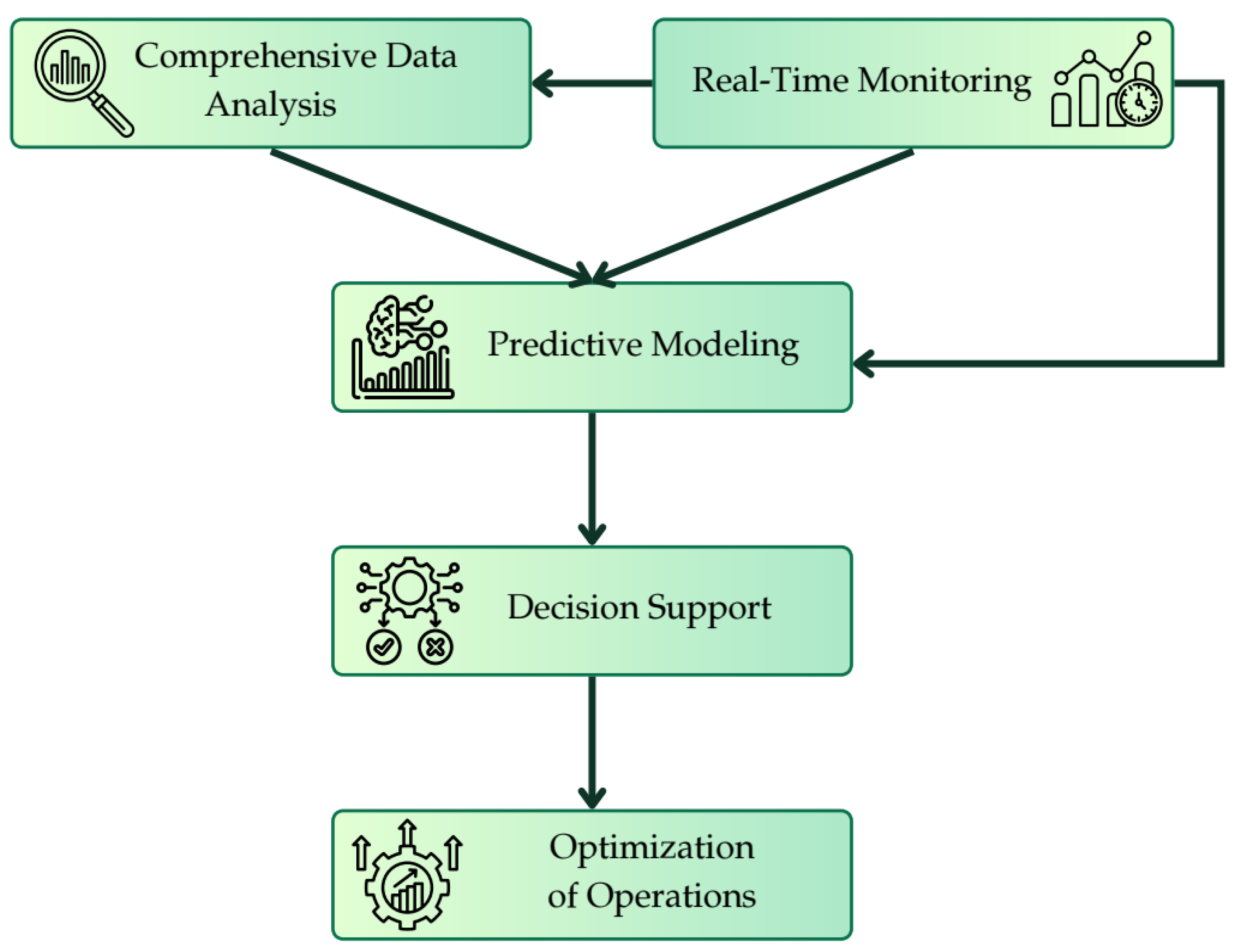
5.2. Modeling Integrated Waste Management Systems
5.3. Key Integration Technologies: SWMS, AI–GIS DSS, IoT
5.4. Benefits, Efficiency, and Significance of Technological Integration
5.5. Barriers, Challenges, and Conditions for Effective Digitalization
6. Conclusions and Future Research
- Build an integrated SWMS architecture;
- Increase interoperability and data integration among municipalities, operators, and facilities;
- Create registries and improve information flows;
- Enhance digital competencies and establish data-driven organizational cultures.
- Continuous monitoring of processes and key operational performance indicators;
- Detection of deviations thanks to GIS–Big Data–AI integration; the leading function benefits from increased stakeholder trust, greater acceptance of decisions, and the promotion of an organization-wide data culture and irregularities;
- Verification of outcomes.
- Develop unified data standards, including formats and protocols for information exchange among municipalities, companies, and institutions in the waste management system;
- Create regional or national GIS/Big Data repositories to ensure interoperability;
- Improve and automate data collection and reporting through IoT sensors, RFID systems, and online registries;
- Provide financial support for modernizing digital infrastructure and system security;
- Support research and pilot projects on GIS–Big Data–AI integration and benchmarking of existing implementations.
- Ensure stable and predictable regulations;
- Develop and adopt legal guidelines for digital technologies (IoT, blockchain) in waste management;
- Strengthen data cybersecurity;
- Ensure compliance with GDPR and other privacy regulations to protect residents’ rights.
Author Contributions
Funding
Institutional Review Board Statement
Informed Consent Statement
Data Availability Statement
Conflicts of Interest
Abbreviations
| ABM | Agent-Based Modeling |
| AI | Artificial Intelligence |
| AIGISDSS | AI-assisted GIS Decision Support System |
| AHP | Analytic Hierarchy Process |
| AWCS | Australian Waste Classification System |
| Big Data | Big Data Analytics |
| CE | Circular Economy |
| CNN | Convolutional Neural Network |
| DSS | Decision Support System |
| EPA | Environmental Protection Agency |
| EPR | Extended Producer Responsibility |
| EWC | European Waste Catalogue |
| GIS | Geographic Information System |
| GPS | Global Positioning System |
| HS Codes | Harmonized System Codes |
| IoT | Internet of Things |
| LCA | Life Cycle Assessment |
| MCDA | Multi-Criteria Decision Analysis |
| ML | Machine Learning |
| MSW | Municipal Solid Waste |
| NWD-RS | National Waste Data Reporting System |
| OECD | Organization for Economic Co-operation and Development |
| RFID | Radio Frequency Identification |
| RCRA | Resource Conservation and Recovery Act |
| RS | Remote Sensing |
| SAWIS | South African Waste Information System |
| SDGs | Sustainable Development Goals |
| SWMS | Smart Waste Management System |
References
- Kafle, S.; Karki, B.K.; Sakhakarmy, M.; Adhikari, S. A Review of Global Municipal Solid Waste Management and Valorization Pathways. Recycling 2025, 10, 113. [Google Scholar] [CrossRef]
- Barbusiński, K.; Kwaśnicki, P.; Gronba-Chyła, A.; Generowicz, A.; Ciuła, J.; Szeląg, B.; Fatone, F.; Makara, A.; Kowalski, Z. Influence of Environmental Conditions on the Electrical Parameters of Side Connectors in Glass–Glass Photovoltaic Modules. Energies 2024, 17, 680. [Google Scholar] [CrossRef]
- Rajca, P.; Skibiński, A.; Biniek-Poskart, A.; Zajemska, M. Review of Selected Determinants Affecting Use of Municipal Waste for Energy Purposes. Energies 2022, 15, 9057. [Google Scholar] [CrossRef]
- Namoun, A.; Tufail, A.; Khan, M.Y.; Alrehaili, A.; Syed, T.A.; BenRhouma, O. Solid Waste Generation and Disposal Using Machine Learning Approaches: A Survey of Solutions and Challenges. Sustainability 2022, 14, 13578. [Google Scholar] [CrossRef]
- Khan, I.; Chowdhury, S.; Techato, K. Waste to Energy in Developing Countries—A Rapid Review: Opportunities, Challenges, and Policies in Selected Countries of Sub-Saharan Africa and South Asia towards Sustainability. Sustainability 2022, 14, 3740. [Google Scholar] [CrossRef]
- Abubakar, I.R.; Maniruzzaman, K.M.; Dano, U.L.; AlShihri, F.S.; AlShammari, M.S.; Ahmed, S.M.S.; Al-Gehlani, W.A.G.; Alrawaf, T.I. Environmental Sustainability Impacts of Solid Waste Management Practices in the Global South. Int. J. Environ. Res. Public Health 2022, 19, 12717. [Google Scholar] [CrossRef]
- Wang, L.; Wang, H.; Huang, Q.; Yang, C.; Wang, L.; Lou, Z.; Zhou, Q.; Wang, T.; Ning, C. Microplastics in Landfill Leachate: A Comprehensive Review on Characteristics, Detection, and Their Fates during Advanced Oxidation Processes. Water 2023, 15, 252. [Google Scholar] [CrossRef]
- Kochanek, A.; Grąz, K.; Potok, H.; Gronba-Chyła, A.; Kwaśny, J.; Wiewiórska, I.; Ciuła, J.; Basta, E.; Łapiński, J. Micro- and Nanoplastics in the Environment: Current State of Research, Sources of Origin, Health Risks, and Regulations—A Comprehensive Review. Toxics 2025, 13, 564. [Google Scholar] [CrossRef]
- Ciuła, J.; Generowicz, A.; Gronba-Chyła, A.; Kwaśnicki, P.; Makara, A.; Kowalski, Z.; Wiewiórska, I. Energy Production from Landfill Gas, Emissions and Pollution Indicators—Opportunities and Barriers to Implementing Circular Economy. Energy 2024, 290, 132951. [Google Scholar] [CrossRef]
- Jakhar, R.; Samek, L.; Styszko, K. A Comprehensive Study of the Impact of Waste Fires on the Environment and Health. Sustainability 2023, 15, 14241. [Google Scholar] [CrossRef]
- Lin, Y.; Lu, S.; Yin, G.; Yuan, B. Policy Tools, Policy Perception, and Compliance with Urban Waste Sorting Policies: Evidence from 34 Cities in China. Sustainability 2025, 17, 6787. [Google Scholar] [CrossRef]
- Chang, Y.-C.; Saqib, M. Impacts of the Global Plastic Treaty on the Marine Environmental Protection Law of China. Water 2025, 17, 1633. [Google Scholar] [CrossRef]
- Tan, J.; Tan, F.J.; Ramakrishna, S. Transitioning to a Circular Economy: A Systematic Review of Its Drivers and Barriers. Sustainability 2022, 14, 1757. [Google Scholar] [CrossRef]
- Chiang, P.F.; Zhang, T.; Claire, M.J.; Maurice, N.J.; Ahmed, J.; Giwa, A.S. Assessment of Solid Waste Management and Decarbonization Strategies. Processes 2024, 12, 1473. [Google Scholar] [CrossRef]
- Ciuła, J.; Sobiecka, E.; Zacłona, T.; Rydwańska, P.; Oleksy-Gębczyk, A.; Olejnik, T.P.; Jurkowski, S. Management of the Municipal Waste Stream: Waste into Energy in the Context of a Circular Economy—Economic and Technological Aspects for a Selected Region in Poland. Sustainability 2024, 16, 6493. [Google Scholar] [CrossRef]
- United Nations. Sustainable Development Goals (SDGs). Available online: https://sdgs.un.org/goals (accessed on 6 November 2025).
- Beccarello, M.; Di Foggia, G. Sustainable Development Goals Data-Driven Local Policy: Focus on SDG 11 and SDG 12. Adm. Sci. 2022, 12, 167. [Google Scholar] [CrossRef]
- Vinti, G.; Bauza, V.; Clasen, T.; Medlicott, K.; Tudor, T.; Zurbrügg, C.; Vaccari, M. Municipal Solid Waste Management and Adverse Health Outcomes: A Systematic Review. Int. J. Environ. Res. Public Health 2021, 18, 4331. [Google Scholar] [CrossRef]
- Un, C. A Sustainable Approach to the Conversion of Waste into Energy: Landfill Gas-to-Fuel Technology. Sustainability 2023, 15, 14782. [Google Scholar] [CrossRef]
- Rahman, M.M.; Rahman, S.M.; Rahman, M.S.; Hasan, M.A.; Shoaib, S.A.; Rushd, S. Greenhouse Gas Emissions from Solid Waste Management in Saudi Arabia—Analysis of Growth Dynamics and Mitigation Opportunities. Appl. Sci. 2021, 11, 1737. [Google Scholar] [CrossRef]
- Kluczek, A.; Woźniak, A.; Zegleń, P. National diversity in European energy policy: Analyzing dependencies of changes in energy prices, climate regulations, and technological innovations on economic implications. Energy Strategy Rev. 2025, 62, 101886. [Google Scholar] [CrossRef]
- Nesmachnow, S.; Rossit, D.; Moreno-Bernal, P. A Literature Review of Recent Advances on Innovative Computational Tools for Waste Management in Smart Cities. Urban Sci. 2025, 9, 16. [Google Scholar] [CrossRef]
- Szpilko, D.; de la Torre Gallegos, A.; Jimenez Naharro, F.; Rzepka, A.; Remiszewska, A. Waste Management in the Smart City: Current Practices and Future Directions. Resources 2023, 12, 115. [Google Scholar] [CrossRef]
- Gutierrez-Lopez, J.; McGarvey, R.G.; Costello, C.; Hall, D.M. Decision Support Frameworks in Solid Waste Management: A Systematic Review of Multi-Criteria Decision-Making with Sustainability and Social Indicators. Sustainability 2023, 15, 13316. [Google Scholar] [CrossRef]
- Kwaśnicki, P.; Gronba-Chyła, A.; Generowicz, A.; Ciula, J.; Wiewiórska, I.; Gaska, K. Alternative Method of Making Electrical Connections in the 1st and 3rd Generation Modules as an Effective Way to Improve Module Efficiency and Reduce Production Costs. Arch. Thermodyn. 2023, 44, 179–200. [Google Scholar] [CrossRef]
- Ghisellini, P.; Cialani, C.; Ulgiati, S. A review on circular economy: The expected transition to a balanced interplay of environmental and economic systems. J. Clean. Prod. 2016, 114, 11–32. [Google Scholar] [CrossRef]
- Kirchherr, J.; Reike, D.; Hekkert, M. Conceptualizing the circular economy: An analysis of 114 definitions. Resour. Conserv. Recycl. 2017, 127, 221–232. [Google Scholar] [CrossRef]
- Awino, F.B.; Apitz, S.E. Solid waste management in the context of the waste hierarchy and circular economy frameworks: An international critical review. Integr. Environ. Assess. Manag. 2024, 20, 9–35. [Google Scholar] [CrossRef]
- Cheema, S.M.; Hannan, A.; Pires, I.M. Smart Waste Management and Classification Systems Using Cutting Edge Approach. Sustainability 2022, 14, 10226. [Google Scholar] [CrossRef]
- Gondal, A.U.; Sadiq, M.I.; Ali, T.; Irfan, M.; Shaf, A.; Aamir, M.; Shoaib, M.; Glowacz, A.; Tadeusiewicz, R.; Kantoch, E. Real Time Multipurpose Smart Waste Classification Model for Efficient Recycling in Smart Cities Using Multilayer Convolutional Neural Network and Perceptron. Sensors 2021, 21, 4916. [Google Scholar] [CrossRef]
- Malik, M.; Sharma, S.; Uddin, M.; Chen, C.-L.; Wu, C.-M.; Soni, P.; Chaudhary, S. Waste Classification for Sustainable Development Using Image Recognition with Deep Learning Neural Network Models. Sustainability 2022, 14, 7222. [Google Scholar] [CrossRef]
- Islam, M.; Hasan, S.M.; Hossain, M.R.; Uddin, M.P.; Mamun, M.A. Towards sustainable solutions: Effective waste classification framework via enhanced deep convolutional neural networks. PLoS ONE 2025, 20, e0324294. [Google Scholar] [CrossRef] [PubMed]
- U.S. Environmental Protection Agency. Title 40—Protection of Environment, Part 261—Identification and Listing of Hazardous Waste; Code of Federal Regulations; U.S. Government Publishing Office: Washington, DC, USA, 2025. Available online: https://www.ecfr.gov/current/title-40/chapter-I/subchapter-I/part-261 (accessed on 9 November 2025).
- United States Environmental Protection Agency. Summary of the Resource Conservation and Recovery Act (RCRA). Available online: https://www.epa.gov/laws-regulations/summary-resource-conservation-and-recovery-act (accessed on 10 November 2025).
- Enache, M.-M.; Gavrilescu, D.; Teodosiu, C. Comparative Analysis of Plastic Waste Management Options Sustainability Profiles. Polymers 2025, 17, 2117. [Google Scholar] [CrossRef] [PubMed]
- Castro-Bello, M.; Roman-Padilla, D.B.; Morales-Morales, C.; Campos-Francisco, W.; Marmolejo-Vega, C.V.; Marmolejo-Duarte, C.; Evangelista-Alcocer, Y.; Gutiérrez-Valencia, D.E. Convolutional Neural Network Models in Municipal Solid Waste Classification: Towards Sustainable Management. Sustainability 2025, 17, 3523. [Google Scholar] [CrossRef]
- Liu, C.; Liu, C. Exploring Plastic-Management Policy in China: Status, Challenges and Policy Insights. Sustainability 2023, 15, 9087. [Google Scholar] [CrossRef]
- Guo, S.; Chen, L. Why is China struggling with waste classification? A stakeholder theory perspective. Resour. Conserv. Recycl. 2022, 183, 106312. [Google Scholar] [CrossRef]
- People’s Republic of China. Directory of National Hazardous Wastes (Version 2021). Available online: https://lawinfochina.com/display.aspx?id=34474&lib=law&EncodingName=big5 (accessed on 6 November 2025).
- GB/T 19095-2019; Signs for Classification of Municipal Solid Waste. State Administration for Market Regulation. China National Standardization Administration: Beijing, China, 2019. Available online: https://www.chinesestandard.net/PDF/English.aspx/GBT19095-2019?Redirect (accessed on 18 November 2025).
- Kabirifar, K.; Mojtahedi, M.; Wang, C.C. A Systematic Review of Construction and Demolition Waste Management in Australia: Current Practices and Challenges. Recycling 2021, 6, 34. [Google Scholar] [CrossRef]
- Zaman, A. Waste Management 4.0: An Application of a Machine Learning Model to Identify and Measure Household Waste Contamination—A Case Study in Australia. Sustainability 2022, 14, 3061. [Google Scholar] [CrossRef]
- Runsewe, T.; Damgacioglu, H.; Perez, L.; Celik, N. Machine Learning Models for Estimating Contamination across Different Curbside Collection Strategies. J. Environ. Manag. 2023, 340, 117855. [Google Scholar] [CrossRef]
- Aboginije, A.; Aigbavboa, C.; Thwala, W. Modeling and usage of a sustainametric technique for measuring the life-cycle performance of a waste management system: A case study of South Africa. Front. Sustain. 2023, 3, 943635. [Google Scholar] [CrossRef]
- Republic of Chile. Modificación del Decreto Supremo N.º 148—Reglamento de Residuos Peligrosos (Diciembre 2021). Available online: https://mma.gob.cl/wp-content/uploads/2022/02/Modificacion-D_S-N%C2%B0-148-Reglamento-Residuos-Peligrosos-Diciembre-2021.pdf (accessed on 10 November 2025).
- Ministerio del Medio Ambiente de Chile. Sistema Nacional de Declaración de Residuos (SINADER). Available online: https://portalvu.mma.gob.cl/sinader/ (accessed on 10 November 2025).
- Cayumil, R.; Khanna, R.; Konyukhov, Y.; Burmistrov, I.; Kargin, J.B.; Mukherjee, P.S. An Overview on Solid Waste Generation and Management: Current Status in Chile. Sustainability 2021, 13, 11644. [Google Scholar] [CrossRef]
- International Trade Administration. Chile—Waste management and recycling. Market Intelligence, 25 May 2023. Available online: https://www.trade.gov/market-intelligence/chile-waste-management-and-recycling (accessed on 18 November 2025).
- Kumar, A.; Singh, E.; Mishra, R.; Lo, S.L.; Kumar, S. Global trends in municipal solid waste treatment technologies through the lens of sustainable energy development opportunity. Energy 2023, 275, 127471. [Google Scholar] [CrossRef]
- Wilson, D.C.; Rodic, L.; Scheinberg, A.; Velis, C.A.; Alabaster, G. Comparative analysis of solid waste management in 20 cities. Waste Manag. Res. 2012, 30, 237–254. [Google Scholar] [CrossRef] [PubMed]
- Wilson, D.C.; Rodic, L.; Cowing, M.J.; Velis, C.A.; Whiteman, A.D.; Scheinberg, A.; Vilches, R.; Masterson, D.; Stretz, J.; Oelz, B. ‘Wasteaware’ benchmark indicators for integrated sustainable waste management in cities. Waste Manag. 2015, 35, 329–342. [Google Scholar] [CrossRef] [PubMed]
- Wilson, D.C.; Velis, C.; Cheeseman, C. Role of informal sector recycling in waste management in developing countries. Habitat Int. 2006, 30, 797–808. [Google Scholar] [CrossRef]
- Zhou, M.H.; Shen, S.L.; Xu, Y.S.; Zhou, A.N. New policy and implementation of municipal solid waste classification in Shanghai, China. Int. J. Environ. Res. Public Health 2019, 16, 3099. [Google Scholar] [CrossRef]
- Ding, Y.; Zhao, J.; Liu, J.W.; Zhou, J.; Cheng, L.; Zhao, J.; Shao, Z.; Iris, Ç.; Pan, B.; Li, X.; et al. A review of China’s municipal solid waste (MSW) and comparison with international regions: Management and technologies in treatment and resource utilization. J. Clean. Prod. 2021, 293, 126144. [Google Scholar] [CrossRef]
- Du, L.; Zhu, J.; Chang, R.; Zillante, G.; Li, L.; Carbone, A. Effectiveness of solid waste management policies in Australia: An exploratory study. Environ. Impact Assess. Rev. 2023, 98, 106966. [Google Scholar] [CrossRef]
- Castillo-Giménez, J.; Montañés, A.; Picazo-Tadeo, A.J. Performance in the treatment of municipal waste: Are European Union member states so different? Sci. Total Environ. 2019, 687, 1305–1314. [Google Scholar] [CrossRef]
- Llanquileo-Melgarejo, P.; Molinos-Senante, M.; Romano, G.; Carosi, L. Evaluation of the Impact of Separative Collection and Recycling of Municipal Solid Waste on Performance: An Empirical Application for Chile. Sustainability 2021, 13, 2022. [Google Scholar] [CrossRef]
- Wang, Y.; Ou, L.; Cai, H.; Lee, U.; Hawkins, T.; Wang, M. Business-as-Usual Municipal Solid Waste Management in the United States: Greenhouse Gas Implications. ACS Sustain. Resour. Manag. 2025, 2, 1175–1184. [Google Scholar] [CrossRef]
- European Union. Directive 2008/98/EC on Waste (Waste Framework Directive). Available online: https://eur-lex.europa.eu/legal-content/pl/TXT/?uri=CELEX:32008L0098 (accessed on 10 November 2025).
- European Commission. Commission Decision 2000/532/Ec of 3 May 2000 Replacing Decision 94/3/Ec Establishing a List of Wastes Pursuant to Article 1(A) of Directive 75/442/Eec on Waste and Decision 94/904/Ec Establishing a List of Hazardous Waste Pursuant to Article 1(4) of Directive 91/689/Eec. Available online: https://eur-lex.europa.eu/eli/dec/2000/532/oj/eng (accessed on 18 November 2025).
- People’s Republic of China. Law of the People’s Republic of China on the Prevention and Control of Environmental Pollution by Solid Wastes (2020 Revi-Sion). Available online: https://www.lawinfochina.com/display.aspx?id=32807&lib=law (accessed on 18 November 2025).
- 2018 National Waste Policy: Less Waste, More Resources. Australian Government, Department of Agriculture, Water and the Environment. Available online: https://www.dcceew.gov.au/sites/default/files/documents/national-waste-policy-2018.pdf (accessed on 18 November 2025).
- Australian Government. Environment Protection (Nurse Cells) Policy 1996 (Federal Register of Legislation, F1996B03810). Available online: https://www.legislation.gov.au/F1996B03810/2016-06-16/text (accessed on 18 November 2025).
- National Environmental Management: Waste Act 59 of 2008. Available online: https://www.gov.za/documents/national-environmental-management-waste-act (accessed on 18 November 2025).
- Waste Classification and Management Regulations, 2013 (R. 634). Government Notice R. 634 of 23 August 2013. Available online: https://media.lawlibrary.org.za/media/legislation/297647/source_file/d1c72ccf561b6028/2013-r634.pdf (accessed on 18 November 2025).
- Ley 20.920 de Chile. Marco Para la Gestión de Residuos, la Responsabilidad Extendida del Productor y Fomento al Reciclaje. Available online: https://www.bcn.cl/leychile/navegar?idNorma=1090894 (accessed on 18 November 2025).
- Servicio de Evaluación Ambiental (Chile). Guía No. 07. Available online: https://www.sea.gob.cl/sites/default/files/imce/archivos/2023/02.FEB/24/guia_07.pdf (accessed on 18 November 2025).
- European Commission. Composite Indicators and Scoreboards Explorer—Circular Economy Monitoring Framework (CEMF). Available online: https://composite-indicators.jrc.ec.europa.eu/explorer/scoreboards/cemf (accessed on 18 November 2025).
- Isarin, N.; Barteková, E.; Brown, A.; Börkey, P. Digital Technologies for Better Enforcement of Waste Regulation and Elimination of Waste Crime; OECD Environment Working Papers, No. 234; OECD Publishing: Paris, France, 2024; Available online: https://www.oecd.org/content/dam/oecd/en/publications/reports/2024/04/digital-technologies-for-better-enforcement-of-waste-regulation-and-elimination-of-waste-crime_5976ab1a/6739f625-en.pdf (accessed on 18 November 2025).
- OECD. Monitoring Progress towards a Resource-Efficient and Circular Economy; OECD Publishing: Paris, France, 2024; Available online: https://www.oecd.org/en/publications/monitoring-progress-towards-a-resource-efficient-and-circular-economy_3b644b83-en.html (accessed on 18 November 2025).
- Jiang, P.; Zhang, L.; You, S.; Fan, Y.V.; Tan, R.R.; Klemeš, J.J.; You, F. Blockchain technology applications in waste management: Overview, challenges and opportunities. J. Clean. Prod. 2023, 421, 138466. [Google Scholar] [CrossRef]
- Fan, X.; Matsumoto, T.; Fujiyama, A. Development of Bottom-Up Material Flow Estimation Model Using Administrative Report Data: For Industrial Waste Plastics in Mie Prefecture. In Proceedings of the 32nd Annual Conference of the Japan Society of Material Cycles and Waste Management, Okayama, Japan, 25–27 October 2021. [Google Scholar] [CrossRef]
- Adedara, M.L.; Taiwo, R.; Bork, H.-R. Municipal Solid Waste Collection and Coverage Rates in Sub-Saharan African Countries: A Comprehensive Systematic Review and Meta-Analysis. Waste 2023, 1, 389–413. [Google Scholar] [CrossRef]
- Zhang, Y.; Huang, W. Analysis on the Effectiveness of the Input in Household Waste Classification of Residents—Taking S City in China as an Example. Sustainability 2021, 13, 11632. [Google Scholar] [CrossRef]
- Ren, Y.; Li, Y.; Gao, X. An MRS-YOLO Model for High-Precision Waste Detection and Classification. Sensors 2024, 24, 4339. [Google Scholar] [CrossRef] [PubMed]
- Clavreul, J.; Guyonnet, D.; Christensen, T.H. Quantifying uncertainty in LCA-modelling of waste management systems. Waste Manag. 2012, 32, 2482–2495. [Google Scholar] [CrossRef]
- Onur, N.; Alan, H.; Demirel, H.; Köker, A.R. Digitalization and Digital Applications in Waste Recycling: An Integrative Review. Sustainability 2024, 16, 7379. [Google Scholar] [CrossRef]
- Mulya, K.S.; Zhou, J.; Phuang, Z.X.; Laner, D.; Woon, K.S. A systematic review of life cycle assessment of solid waste management: Methodological trends and prospects. Sci. Total Environ. 2022, 831, 154903. [Google Scholar] [CrossRef]
- Nurzhan, A.; Ruan, X.; Chen, D. A Review of Life Cycle Assessment Application in Municipal Waste Management: Recent Advances, Limitations, and Solutions. Sustainability 2025, 17, 302. [Google Scholar] [CrossRef]
- Singh, S.; Chhabra, R.; Arora, J. A systematic review of waste management solutions using machine learning, internet of things and blockchain technologies: State-of-art, methodologies, and challenges. Arch. Comput. Methods Eng. 2024, 31, 1255–1276. [Google Scholar] [CrossRef]
- Chen, J.; Wen, Z.; Tian, Y. A novel IoT-based deep learning framework for real-time waste forecasting: Optimizing multi-waste categories using AutoML. Resour. Conserv. Recycl. 2025, 220, 108378. [Google Scholar] [CrossRef]
- Siwawa, V. Assessing waste management performance in smart cities through the ‘zero waste index’: Case of African Waste Reclaimers Organisation, Johannesburg, South Africa. Front. Sustain. Cities 2025, 7, 1449868. [Google Scholar] [CrossRef]
- Komasi, H.; Karbassi Yazdi, A.; Eskandari Sani, M.; Tan, Y. Assessing the Circular Economy in Regions of Chile by Using Multiple-Criteria Decision-Making (MCDM). Sustainability 2025, 17, 23. [Google Scholar] [CrossRef]
- European Commission. Communication from the Commission to the European Parliament, the Council, the European Economic and Social Committee and the Committee of the Regions on a Monitoring Framework for the Circular Economy; COM(2018) 29 Final; European Commission: Strasbourg, France, 2018; Available online: https://eur-lex.europa.eu/legal-content/EN/TXT/PDF/?uri=CELEX%3A52018DC0029 (accessed on 18 November 2025).
- Kochanek, A.; Zacłona, T.; Pietrucha, I.; Petryk, A.; Ziemiańczyk, U.; Basak, Z.; Guzdek, P.; Akbulut, L.; Atılgan, A.; Woźniak, A.D. Renewable Energy Integration in Sustainable Transport: A Review of Emerging Propulsion Technologies and Energy Transition Mechanisms. Energies 2025, 18, 6610. [Google Scholar] [CrossRef]
- Bing, X.; Bloemhof, J.M.; Rodrigues Pereira Ramos, T.; Barbosa-Povoa, A.P.; Wong, C.Y.; van der Vorst, J.G.A.J. Research challenges in municipal solid waste logistics management. Waste Manag. 2016, 48, 584–592. [Google Scholar] [CrossRef] [PubMed]
- Wati, H.R.; Budihardjo, M.A.; Andarani, P. Waste transportation environmental impact using life cycle assessment: Bibliometric analysis and systematic review. Pol. J. Environ. Stud. 2025, 34, 563–571. [Google Scholar] [CrossRef]
- Reis, W.F.; Barreto, C.G.; Capelari, M.G.M. Circular Economy and Solid Waste Management: Connections from a Bibliometric Analysis. Sustainability 2023, 15, 15715. [Google Scholar] [CrossRef]
- Gaska, K.; Generowicz, A.; Lobur, M.; Jaworski, N.; Ciuła, J.; Vovk, M. Advanced algorithmic model for poly-optimization of biomass fuel production from separate combustible fractions of municipal wastes as a progress in improving energy efficiency of waste utilization. E3S Web Conf. 2019, 122, 01004. [Google Scholar] [CrossRef]
- Cheniti, H.; Kerboua, K.; Sekiou, O.; Aouissi, H.A.; Benselhoub, A.; Mansouri, R.; Zeriri, I.; Barbari, K.; Gilev, J.B.; Bouslama, Z. Life Cycle Assessment of Municipal Solid Waste Management within Open Dumping and Landfilling Contexts: A Strategic Analysis and Planning Responses Applicable to Algeria. Sustainability 2024, 16, 6930. [Google Scholar] [CrossRef]
- Geissdoerfer, M.; Savaget, P.; Bocken, N.M.P.; Hultink, E.J. The circular economy—A new sustainability paradigm? J. Clean. Prod. 2017, 143, 757–768. [Google Scholar] [CrossRef]
- Mohammed, M.; Shafiq, N.; Elmansoury, A.; Al-Mekhlafi, A.-B.A.; Rached, E.F.; Zawawi, N.A.; Haruna, A.; Rafindadi, A.D.; Ibrahim, M.B. Modeling of 3R (Reduce, Reuse and Recycle) for Sustainable Construction Waste Reduction: A Partial Least Squares Structural Equation Modeling (PLS-SEM). Sustainability 2021, 13, 10660. [Google Scholar] [CrossRef]
- Rotthong, M.; Takaoka, M.; Oshita, K.; Rachdawong, P.; Gheewala, S.H.; Prapaspongsa, T. Life Cycle Assessment of Integrated Municipal Organic Waste Management Systems in Thailand. Sustainability 2023, 15, 90. [Google Scholar] [CrossRef]
- Ávila-Gutiérrez, M.J.; Martín-Gómez, A.; Aguayo-González, F.; Córdoba-Roldán, A. Standardization Framework for Sustainability from Circular Economy 4.0. Sustainability 2019, 11, 6490. [Google Scholar] [CrossRef]
- Roos Lindgreen, E.; Salomone, R.; Reyes, T. A Critical Review of Academic Approaches, Methods and Tools to Assess Circular Economy at the Micro Level. Sustainability 2020, 12, 4973. [Google Scholar] [CrossRef]
- Kunz, N.; Mayers, K.; van Wassenhove, L.N. Stakeholder views on extended producer responsibility and the circular economy. Calif. Manag. Rev. 2018, 60, 45–70. [Google Scholar] [CrossRef]
- Wainaina, S.; Awasthi, M.K.; Sarsaiya, S.; Chen, H.; Singh, E.; Kumar, A.; Balasubramani, R.; Awasthi, S.K.; Liu, T.; Duan, Y.; et al. Resource recovery and circular economy from organic solid waste using aerobic and anaerobic digestion technologies. Bioresour. Technol. 2020, 301, 122778. [Google Scholar] [CrossRef]
- European Environment Agency. Waste Prevention in Europe: Policies, Status and Trends in 2017. EEA Report 2018, 4/2018. Available online: https://www.eea.europa.eu/en/analysis/publications/waste-prevention-in-europe-2017 (accessed on 18 November 2025).
- Akomoa-Frimpong, I.; Tetteh, P.A.; Ofori, J.N.A.; Tumpa, R.J.; Pariafsai, F.; Tenakwah, E.S.; Asogwa, I.E.; Vanapalli, K.R.; Adu-Gyamfi, G.; Kukah, A.S.; et al. A Bibliometric Review of Barriers to Circular Economy Implementation in Solid Waste Management. Discov. Environ. 2024, 2, 20. [Google Scholar] [CrossRef]
- Al-Salem, S.M.; Lettieri, P.; Baeyens, J. Recycling and recovery routes of plastic solid waste (PSW): A review. Waste Manag. 2009, 29, 2625–2643. [Google Scholar] [CrossRef]
- Hopewell, J.; Dvorak, R.; Kosior, E. Plastics recycling: Challenges and opportunities. Philos. Trans. R. Soc. B 2009, 364, 2115–2126. [Google Scholar] [CrossRef]
- van Ewijk, S.; Stegemann, J.A. Recognising waste use potential to achieve a circular economy. Waste Manag. 2020, 105, 1–7. [Google Scholar] [CrossRef]
- Ellen MacArthur Foundation. The New Plastics Economy: Rethinking the Future of Plastics; Ellen MacArthur Foundation & World Economic Forum (with McKinsey & Company): Cowes, UK, 2016; Available online: https://www.ellenmacarthurfoundation.org/the-new-plastics-economy-rethinking-the-future-of-plastics (accessed on 18 November 2025).
- European Commission. Communication from the Commission to the European Parliament, the Council, the European Economic and Social Committee and the Committee of the Regions—A New Circular Economy Action Plan for a Cleaner and More Competitive Europe; COM/2020/98 final; Brussels, 11 March 2020. Available online: https://eur-lex.europa.eu/legal-content/EN/TXT/?uri=CELEX:52020DC0098 (accessed on 18 November 2025).
- Eurostat. Waste Methodology. Available online: https://ec.europa.eu/eurostat/web/waste/methodology (accessed on 18 November 2025).
- Joint Research Centre. Annual Activity Report 2022. European Commission 2023. Available online: https://commission.europa.eu/system/files/2023-06/jrc_aar_2022_final_en.pdf (accessed on 18 November 2025).
- Finnveden, G.; Hauschild, M.Z.; Ekvall, T.; Guinée, J.; Heijungs, R.; Hellweg, S.; Koehler, A.; Pennington, D.; Suh, S. Recent developments in life cycle assessment. J. Environ. Manag. 2009, 91, 1–21. [Google Scholar] [CrossRef]
- Kalmykova, Y.; Sadagopan, M.; Rosado, L. Circular economy—From review of theories and practices to development of implementation tools. Resour. Conserv. Recycl. 2018, 135, 190–201. [Google Scholar] [CrossRef]
- European Investment Bank. Digitalisation in the European Union: Progress, Challenges and Future Opportunities. Available online: https://www.eib.org/en/press/all/2023-203-digitalisation-in-the-european-union-progress-challenges-and-future-opportunities (accessed on 18 November 2025).
- Bressanelli, G.; Adrodegari, F.; Pigosso, D.C.A.; Parida, V. Circular Economy in the Digital Age. Sustainability 2022, 14, 5565. [Google Scholar] [CrossRef]
- Exceed ICT. Benefits of Smart Waste Management for a Sustainable Future. Exceed Ict Blog, 20 March 2025. Available online: https://exceedict.com/benefits-of-smart-waste-management/ (accessed on 18 November 2025).
- Rittl, L.G.F.; Zaman, A.; de Oliveira, F.H. Digital Transformation in Waste Management: Disruptive Innovation and Digital Governance for Zero-Waste Cities in the Global South as Keys to Future Sustainable Development. Sustainability 2025, 17, 1608. [Google Scholar] [CrossRef]
- Fang, B.; Yu, J.; Chen, Z.; Osman, A.I.; Farghali, M.; Ihara, I.; Hamza, E.H.; Rooney, D.W.; Yap, P.-S. Artificial Intelligence for Waste Management in Smart Cities: A Review. Environ. Chem. Lett. 2023, 21, 1959–1989. [Google Scholar] [CrossRef] [PubMed]
- Ferronato, N.; Torretta, V. Waste Mismanagement in Developing Countries: A Review of Global Issues. Int. J. Environ. Res. Public Health 2019, 16, 1060. [Google Scholar] [CrossRef]
- Alhawamdeh, M.; Ferriz-Papi, J.A.; Lee, A. Examining the Drivers to Support Improved Construction and Demolition Waste Management for a Circular Economy: A Comprehensive Review Using a Systematic Approach. Sustainability 2024, 16, 6014. [Google Scholar] [CrossRef]
- Wang, H.; Cao, H.; Yang, L. Machine learning-driven multidomain nanomaterial design: From bibliometric analysis to applications. ACS Appl. Nano Mater. 2024, 7, 26579–26600. [Google Scholar] [CrossRef]
- Kochanek, A.; Zacłona, T.; Cembruch-Nowakowski, M.; Janczura, J.; Pietrucha, I.; Herbut, P.; Kotowski, T.; Oleksy-Gębczyk, A.; Guzdek, S.; Majkrzak, A. Pro-Environmental Attitudes and Behaviors Toward Energy Saving and Transportation. Energies 2025, 18, 6137. [Google Scholar] [CrossRef]
- Antikainen, M.; Uusitalo, T.; Kivikytö-Reponen, P. Digitalisation as an enabler of circular economy. Procedia CIRP 2018, 73, 45–49. [Google Scholar] [CrossRef]
- Fotovvatikhah, F.; Ahmedy, I.; Noor, R.M.; Munir, M.U. A Systematic Review of AI-Based Techniques for Automated Waste Classification. Sensors 2025, 25, 3181. [Google Scholar] [CrossRef]
- Purchase, C.K.; Al Zulayq, D.M.; O’Brien, B.T.; Kowalewski, M.J.; Berenjian, A.; Tarighaleslami, A.H.; Seifan, M. Circular Economy of Construction and Demolition Waste: A Literature Review on Lessons, Challenges, and Benefits. Materials 2022, 15, 76. [Google Scholar] [CrossRef] [PubMed]
- Zhang, C.; Hu, M.; Di Maio, F.; Sprecher, B.; Yang, X.; Tukker, A. An overview of the waste hierarchy framework for analyzing the circularity in construction and demolition waste management in Europe. Sci. Total Environ. 2022, 803, 149892. [Google Scholar] [CrossRef] [PubMed]
- Meshram, K.K. The circular economy, 5R framework, and green organic practices: Pillars of sustainable development and zero-waste living. Discov. Environ. 2024, 2, 147. [Google Scholar] [CrossRef]
- Karadimas, N.V.; Loumos, V.G. GIS-based modelling for the estimation of municipal solid waste generation and collection. Waste Manag. Res. 2008, 26, 337–346. [Google Scholar] [CrossRef]
- Mati Asefa, E.; Bayu Barasa, K.; Adare Mengistu, D. Application of geographic information system in solid waste management. In Geographic Information Systems and Applications in Coastal Studies; IntechOpen: London, UK, 2022. [Google Scholar] [CrossRef]
- Malakahmad, A.; Md Bakri, P.; Md Mokhtar, M.R.; Khalil, N. Solid waste collection routes optimization via GIS techniques in Ipoh City, Malaysia. Procedia Eng. 2014, 77, 20–27. [Google Scholar] [CrossRef]
- Shabbani, T.; Defe, R.; Mavugara, R.; Mupepi, O.; Shabani, T. Application of geographic information systems (GIS) and remote sensing (RS) in solid waste management in Southern Africa: A review. SN Soc. Sci. 2024, 4, 39. [Google Scholar] [CrossRef]
- Kochanek, A. The usefulness of public geoportal functions in planning and preliminary environmental assessment of rural areas. J. Ecol. Eng. 2025, 26, 327–340. [Google Scholar] [CrossRef]
- Melo, A.B.; Oliveira, A.M.; Silva de Souza, D.; da Cunha, M.J. Optimization of garbage collection using genetic algorithm. In Proceedings of the 2017 IEEE 14th International Conference on Mobile Ad Hoc and Sensor Systems (MASS), Orlando, FL, USA, 22–25 October 2017; pp. 672–677. [Google Scholar] [CrossRef]
- Adedotun, A.A.; Sridhar, M.K.C.; Coker, A.O. Improving Municipal Solid Waste Collection System Through a GIS-Based Mapping of Location-Specific Waste Bins in Ibadan Metropolis, Nigeria. J. Solid Waste Technol. Manag. 2020, 46, 360–371. [Google Scholar] [CrossRef]
- Chaudhary, S.; Nidhi, C.; Rawal, N.R. GIS-Based Model for Optimal Collection and Transportation System for Solid Waste in Allahabad City. In Emerging Technologies in Data Mining and Information Security; Abraham, A., Dutta, P., Mandal, J., Bhattacharya, A., Dutta, S., Eds.; Springer: Singapore, 2019; Advances in Intelligent Systems and Computing; Volume 814. [Google Scholar] [CrossRef]
- Mes, M.; Schutten, M.; Pérez Rivera, A. Inventory Routing for Dynamic Waste Collection. Waste Manag. 2014, 34, 1564–1576. [Google Scholar] [CrossRef]
- Das, S.; Bhattacharyya, B.K. Optimization of Municipal Solid Waste Collection and Transportation Routes. Waste Manag. 2015, 43, 9–18. [Google Scholar] [CrossRef]
- El Toufaili, A.; Pacheco, G.; Toneatti, L.; Pozzetto, D. Collection and Transport of Municipal Solid Waste in a Developing Country: The Case of Greater Beirut Area in Lebanon. Int. J. Environ. Waste Manag. 2024, 35, 404–421. [Google Scholar] [CrossRef]
- Cavallin, A.; Rossit, D.G.; Herrán Symonds, V.; Rossit, D.A.; Frutos, M. Application of a Methodology to Design a Municipal Waste Pre-Collection Network in Real Scenarios. Waste Manag. Res. 2020, 38, 117–129. [Google Scholar] [CrossRef]
- Vu, H.L.; Ng, K.T.W.; Bolingbroke, D. Parameter Interrelationships in a Dual Phase GIS-Based Municipal Solid Waste Collection Model. Waste Manag. 2018, 78, 258–270. [Google Scholar] [CrossRef] [PubMed]
- Viktorin, A.; Hrabec, D.; Nevrly, V.; Šomplák, R.; Šenkeřík, R. Hierarchical Clustering-Based Algorithms for Optimal Waste Collection Point Locations in Large-Scale Problems: A Framework Development and Case Study. Comput. Ind. Eng. 2023, 178, 109142. [Google Scholar] [CrossRef]
- Assaf, R.; Saleh, Y. Vehicle-routing optimization for municipal solid waste collection using genetic algorithm: The case of Southern Nablus City. Civil Environ. Eng. Rep. 2017, 26, 43–57. [Google Scholar] [CrossRef]
- Nguyen-Trong, K.; Nguyen-Thi-Ngoc, A.; Nguyen-Ngoc, D.; Dinh-Thi-Hai, V. Optimization of Municipal Solid Waste Transportation by Integrating GIS Analysis, Equation-Based, and Agent-Based Model. Waste Manag. 2017, 59, 14–22. [Google Scholar] [CrossRef]
- Chang, N.-B.; Lu, H.Y.; Wei, Y.L. GIS Technology for Vehicle Routing and Scheduling in Solid Waste Collection Systems. J. Environ. Eng. 1997, 123, 901–910. [Google Scholar] [CrossRef]
- Karadimas, N.V.; Rigopoulos, G.; Bardis, N.G. Coupling Multiagent Simulation and GIS—An Application in Waste Management. In Proceedings of the 10th WSEAS International Conference on Systems (ICS 2006), Vouliagmeni Beach, Athens, Greece, 10–12 July 2006. [Google Scholar] [CrossRef]
- Nambiar, S.K.; Idicula, S.M. A Multi-Agent Vehicle Routing System for Garbage Collection. In Proceedings of the 2013 Fifth International Conference on Advanced Computing (ICoAC), Chennai, India, 18–20 December 2013; pp. 72–76. [Google Scholar] [CrossRef]
- Huang, S.-H.; Lin, P.-C. Vehicle Routing–Scheduling for Municipal Waste Collection System under the “Keep Trash off the Ground” Policy. Omega 2015, 55, 24–37. [Google Scholar] [CrossRef]
- Chang, N.; Lin, Y.T. Optimal Siting of Transfer Station Locations in a Metropolitan Solid Waste Management System. J. Environ. Sci. Health Part A: Environ. Sci. Eng. Toxicol. 1997, 32, 2379–2401. [Google Scholar] [CrossRef]
- El-Hallaq, M.A.; Mosabeh, R. Optimization of Municipal Solid Waste Management of Bins Using GIS: A Case Study: Nuseirat City. J. Geogr. Inf. Syst. 2019, 11, 32. [Google Scholar] [CrossRef]
- Ebistu, T.A.; Minale, A.S. Solid Waste Dumping Site Suitability Analysis Using Geographic Information System (GIS) and Remote Sensing for Bahir Dar Town, North Western Ethiopia. Afr. J. Environ. Sci. Technol. 2013, 7, 976–989. [Google Scholar]
- Muttiah, R.S.; Engel, B.A.; Jones, D.D. Waste Disposal Site Selection Using GIS-Based Simulated Annealing. Comput. Geosci. 1996, 22, 1014–1017. [Google Scholar] [CrossRef]
- Kazuva, E.; Zhang, J.; Tong, Z.; Liu, X.P.; Memon, S.; Mhache, E. GIS- and MCD-Based Suitability Assessment for Optimized Location of Solid Waste Landfills in Dar es Salaam, Tanzania. Environ. Sci. Pollut. Res. 2021, 28, 11259–11278. [Google Scholar] [CrossRef]
- Abdallah, M.; Adghim, M.; Maraqa, M.; Aldahab, E. Simulation and Optimization of Dynamic Waste Collection Routes. Waste Manag. Res. 2019, 37, 793–802. [Google Scholar] [CrossRef]
- Okeyo, S.O.; Owuoche, P.O.; Mugalavai, A.K. Geographic Information System Model Design for Sustainable Municipal Solid Waste Management: A Case of Migori Municipality, Kenya. J. Afr. Interdiscip. Stud. 2024, 8, 304–320. [Google Scholar]
- Zsigraiova, Z.; Semiao, V.; Beijoco, F. Operation Costs and Pollutant Emissions Reduction by Definition of New Collection Scheduling and Optimization of MSW Collection Routes Using GIS: The Case Study of Barreiro, Portugal. Waste Manag. 2013, 33, 793–806. [Google Scholar] [CrossRef]
- Rambandara, R.D.S.S.; Prabodanie, R.A.R.; Karunarathne, E.A.C.P.; Rajapaksha, R.D.D. Improving the Efficiency of Urban Waste Collection Using Optimization: A Case Study. Process Integr. Optim. Sustain. 2022, 6, 809–818. [Google Scholar] [CrossRef]
- Sanjeevi, V.; Shahabudeen, P. Optimal Routing for Efficient Municipal Solid Waste Transportation by Using ArcGIS Application in Chennai, India. Waste Manag. Res. 2016, 34, 11–21. [Google Scholar] [CrossRef]
- Kedia, P. Big Data Analytics for Efficient Waste Management. Int. J. Res. Eng. Technol. 2016, 5, 208–211. [Google Scholar] [CrossRef]
- Adewuyi, A.Y.; Adebayo, K.B.; Adebayo, D.; Kalinzi, J.M.; Ugiagbe, U.O.; Ogunruku, O.O.; Samson, O.A.; Oladele, O.R.; Adeniyi, S.A. Application of Big Data Analytics to Forecast Future Waste Trends and Inform Sustainable Planning. World J. Adv. Res. Rev. 2024, 23, 2469–2479. [Google Scholar] [CrossRef]
- Shah, S.A.; Seker, D.Z.; Hameed, S.; Draheim, D. The Rising Role of Big Data Analytics and IoT in Disaster Management: Recent Advances, Taxonomy and Prospects. IEEE Access 2019, 7, 54595–54614. [Google Scholar] [CrossRef]
- Maheshwari, S.; Gautam, P.; Jaggi, C.K. Role of Big Data Analytics in Supply Chain Management: Current Trends and Future Perspectives. Int. J. Prod. Res. 2020, 59, 1875–1900. [Google Scholar] [CrossRef]
- Zhang, D.; Pan, S.L.; Yu, J.; Liu, W. Orchestrating Big Data Analytics Capability for Sustainability: A Study of Air Pollution Management in China. Inf. Manag. 2022, 59, 103231. [Google Scholar] [CrossRef]
- Ikegwu, A.C.; Nweke, H.F.; Mkpojiogu, E.; Anikwe, C.V.; Igwe, S.A.; Alo, U.R. Recently Emerging Trends in Big Data Analytic Methods for Modeling and Combating Climate Change Effects. Energy Inform. 2024, 7, 6. [Google Scholar] [CrossRef]
- Shahrokni, H.; van der Heijde, B.; Lazarevic, D.; Brandt, N. Big Data GIS Analytics Towards Efficient Waste Management in Stockholm. In Proceedings of the 2nd International Conference on ICT for Sustainability (ICT4S 2014), Stockholm, Sweden, 24–27 August 2014. [Google Scholar]
- Bibri, E.S.; Krogstie, J.; Kaboli, A.; Alahi, A. Smarter Eco-Cities and Their Leading-Edge Artificial Intelligence of Things Solutions for Environmental Sustainability: A Comprehensive Systematic Review. Environ. Sci. Ecotechnology 2023, 19, 100330. [Google Scholar] [CrossRef] [PubMed]
- Wang, C.; Qin, J.; Qu, C.; Ran, X.; Liu, C.; Chen, B. A Smart Municipal Waste Management System Based on Deep Learning and Internet of Things. Waste Manag. 2021, 135, 20–29. [Google Scholar] [CrossRef]
- Likotiko, E.; Petrov, D.; Mwangoka, J.; Hilleringmann, U. Real-Time Solid Waste Monitoring Using Cloud and Sensors Technologies. Online J. Sci. Technol. 2018, 8, 1–11. [Google Scholar]
- Zhao, R.; Liu, Y.; Zhang, N.; Huang, T. An Optimization Model for Green Supply Chain Management by Using a Big Data Analytic Approach. J. Clean. Prod. 2016, 142, 1085–1097. [Google Scholar] [CrossRef]
- Seyedan, M.; Mafakheri, F. Predictive Big Data Analytics for Supply Chain Demand Forecasting: Methods, Applications, and Research Opportunities. J. Big Data 2020, 7, 53. [Google Scholar] [CrossRef]
- Basha, S.M.; Rajput, D.S.; Bhushan, S.B.; Poluru, R.K.; Patan, R.; Manikandan, R.; Kumar, A.; Manikandan, R. Recent Trends in Sustainable Big Data Predictive Analytics: Past Contributions and Future Roadmap. Int. J. Emerg. Technol. 2019, 10, 50–59. [Google Scholar]
- Limba, T.; Novikovas, A.; Stankevičius, A.; Andrulevičius, A.; Tvaronavičienė, M. Big Data Manifestation in Municipal Waste Management and Cryptocurrency Sectors: Positive and Negative Implementation Factors. Sustainability 2020, 12, 2862. [Google Scholar] [CrossRef]
- Pau, M.; Kapsalis, P.; Pan, Z.; Korbakis, G.; Pellegrino, D.; Monti, A. MATRYCS—A Big Data Architecture for Advanced Services in the Building Domain. Energies 2022, 15, 2568. [Google Scholar] [CrossRef]
- Munir, M.T.; Li, B.; Naqvi, M.; Nizami, A.-S. Green Loops and Clean Skies: Optimizing Municipal Solid Waste Management Using Data Science for a Circular Economy. Environ. Res. 2024, 243, 117786. [Google Scholar] [CrossRef] [PubMed]
- Rehman, M.H.; Yaqoob, I.; Salah, K.; Imran, M.; Jayaraman, P.P.; Perera, C. The Role of Big Data Analytics in Industrial Internet of Things. Future Gener. Comput. Syst. 2019, 99, 247–259. [Google Scholar] [CrossRef]
- Kuo, T.-C.; Peng, C.-Y.; Kuo, C.-J. Smart Support System of Material Procurement for Waste Reduction Based on Big Data and Predictive Analytics. Int. J. Logist. Res. Appl. 2024, 27, 243–260. [Google Scholar] [CrossRef]
- Yang, L.; Wang, H.; Leng, D.; Fang, S.; Yang, Y.; Du, Y. Machine learning applications in nanomaterials: Recent advances and future perspectives. Chem. Eng. J. 2024, 500, 156687. [Google Scholar] [CrossRef]
- Jaber, M.M.; Ali, M.H.; Abd, S.K.; Jassim, M.M.; Alkhayyat, A.; Aziz, H.W.; Alkhuwaylidee, A.R. Predicting Climate Factors Based on Big Data Analytics Based Agricultural Disaster Management. Phys. Chem. Earth Parts A/B/C 2022, 128, 103243. [Google Scholar] [CrossRef]
- Marinakis, V. Big Data for Energy Management and Energy-Efficient Buildings. Energies 2020, 13, 1555. [Google Scholar] [CrossRef]
- Ren, S.; Zhang, Y.; Liu, Y.; Sakao, T.; Huisingh, D.; Almeida, C.M.V.B. A comprehensive review of big data analytics throughout product lifecycle to support sustainable smart manufacturing: A framework, challenges and future research directions. J. Clean. Prod. 2019, 210, 1343–1365. [Google Scholar] [CrossRef]
- Agostini, M.; Arkhipova, D.; Mio, C. Corporate Accountability and Big Data Analytics: Is Non-financial Disclosure a Missing Link? Sustain. Account. Manag. Policy J. 2023, 14, 62–89. [Google Scholar] [CrossRef]
- Bag, S.; Rahman, M.S.; Srivastava, G.; Shore, A.; Ram, P. Examining the Role of Virtue Ethics and Big Data in Enhancing Viable, Sustainable, and Digital Supply Chain Performance. Technol. Forecast. Soc. Change 2023, 186, 122154. [Google Scholar] [CrossRef]
- Tsai, F.M.; Bui, T.-D.; Tseng, M.-L.; Lim, M.K.; Hu, J. Municipal Solid Waste Management in a Circular Economy: A Data-Driven Bibliometric Analysis. J. Clean. Prod. 2020, 275, 124132. [Google Scholar] [CrossRef]
- Chew, X.; Khaw, K.W.; Alnoor, A.; Ferasso, M.; Al Halbusi, H.; Muhsen, Y.R. Circular Economy of Medical Waste: Novel Intelligent Medical Waste Management Framework Based on Extension Linear Diophantine Fuzzy FDOSM and Neural Network Approach. Environ. Sci. Pollut. Res. 2023, 30, 60473–60499. [Google Scholar] [CrossRef] [PubMed]
- Ramya, P.; Ramya, V.; Babu Rao, M. Optimized Deep Learning-Based E-Waste Management in IoT Application via Energy-Aware Routing. Cybern. Syst. 2023, 55, 2041–2070. [Google Scholar] [CrossRef]
- Abdallah, M.; Abu Talib, M.; Feroz, S.; Nasir, Q.; Abdalla, H.; Mahfood, B. Artificial Intelligence Applications in Solid Waste Management: A Systematic Research Review. Waste Manag. 2020, 109, 231–246. [Google Scholar] [CrossRef] [PubMed]
- Hu, X.; Zhou, Y.; Vanhullebusch, S.; Mestdagh, R.; Cui, Z.; Li, J. Smart Building Demolition and Waste Management Frame with Image-to-BIM. J. Build. Eng. 2022, 49, 104058. [Google Scholar] [CrossRef]
- Aniza, R.; Chen, W.-H.; Pétrissans, A.; Hoang, A.T.; Ashokkumar, V.; Pétrissans, M. A Review of Biowaste Remediation and Valorization for Environmental Sustainability: Artificial Intelligence Approach. Environ. Pollut. 2023, 324, 121363. [Google Scholar] [CrossRef]
- Olawade, D.B.; Fapohunda, O.; Wada, O.Z.; Usman, S.O.; Ige, A.O.; Ajisafe, O.; Oladapo, B.I. Smart Waste Management: A Paradigm Shift Enabled by Artificial Intelligence. Waste Manag. Bull. 2024, 2, 244–263. [Google Scholar] [CrossRef]
- Hussain, A.; Draz, U.; Ali, T.; Tariq, S.; Irfan, M.; Glowacz, A.; Antonino Daviu, J.A.; Yasin, S.; Rahman, S. Waste Management and Prediction of Air Pollutants Using IoT and Machine Learning Approach. Energies 2020, 13, 3930. [Google Scholar] [CrossRef]
- Ghahramani, M.; Zhou, M.; Molter, A.; Pilla, F. IoT-Based Route Recommendation for an Intelligent Waste Management System. IEEE Internet Things J. 2022, 9, 11883–11892. [Google Scholar] [CrossRef]
- Lin, K.; Zhao, Y.; Kuo, J.-H.; Deng, H.; Cui, F.; Zhang, Z.; Zhang, M.; Zhao, C.; Gao, X.; Zhou, T.; et al. Toward Smarter Management and Recovery of Municipal Solid Waste: A Critical Review on Deep Learning Approaches. J. Clean. Prod. 2022, 346, 130943. [Google Scholar] [CrossRef]
- Zhang, H.; Cao, H.; Zhou, Y.; Gu, C.; Li, D. Hybrid Deep Learning Model for Accurate Classification of Solid Waste in the Society. Urban Clim. 2023, 49, 101485. [Google Scholar] [CrossRef]
- Majchrowska, S.; Mikołajczyk, A.; Ferlin, M.; Klawikowska, Z.; Plantykow, M.A.; Kwasigroch, A.; Majek, K. Deep Learning-Based Waste Detection in Natural and Urban Environments. Waste Manag. 2022, 138, 274–284. [Google Scholar] [CrossRef] [PubMed]
- Sundaralingam, S.; Ramanathan, N. A Deep Learning-Based Approach to Segregate Solid Waste Generated in Residential Areas. Eng. Technol. Appl. Sci. Res. 2023, 13, 10439–10446. [Google Scholar] [CrossRef]
- Kumar, S.; Yadav, D.; Gupta, H.; Verma, O.P.; Ansari, I.A.; Ahn, C.W. A Novel YOLOv3 Algorithm-Based Deep Learning Approach for Waste Segregation: Towards Smart Waste Management. Electronics 2021, 10, 14. [Google Scholar] [CrossRef]
- Wu, T.-W.; Zhang, H.; Peng, W.; Lü, F.; He, P.-J. Applications of Convolutional Neural Networks for Intelligent Waste Identification and Recycling: A Review. Resour. Conserv. Recycl. 2023, 190, 106813. [Google Scholar] [CrossRef]
- Onoda, H. Smart Approaches to Waste Management for Post-COVID-19 Smart Cities in Japan. IET Smart Cities 2020, 2, 89–94. [Google Scholar] [CrossRef]
- Pitakaso, R.; Srichok, T.; Khonjun, S.; Golinska-Dawson, P.; Sethanan, K.; Nanthasamroeng, N.; Gonwirat, S.; Luesak, P.; Boonmee, C. Optimization-Driven Artificial Intelligence-Enhanced Municipal Waste Classification System for Disaster Waste Management. Eng. Appl. Artif. Intell. 2024, 133, 108614. [Google Scholar] [CrossRef]
- Li, N.; Chen, Y. Municipal Solid Waste Classification and Real-Time Detection Using Deep Learning Methods. Urban Clim. 2023, 49, 101462. [Google Scholar] [CrossRef]
- Khan, A.I.; Almalaise Alghamdi, A.S.; Abushark, Y.B.; Alsolami, F.; Almalawi, A.; Marish Ali, A. Recycling Waste Classification Using Emperor Penguin Optimizer with Deep Learning Model for Bioenergy Production. Chemosphere 2022, 307, 136044. [Google Scholar] [CrossRef]
- Neelakandan, S.; Prakash, M.; Geetha, B.T.; Nanda, A.K.; Metwally, A.M.; Santhamoorthy, M.; Gupta, M.S. Metaheuristics with Deep Transfer Learning Enabled Detection and Classification Model for Industrial Waste Management. Chemosphere 2022, 308, 136046. [Google Scholar] [CrossRef] [PubMed]
- Jin, S.; Yang, Z.; Królczyk, G.; Liu, X.; Gardoni, P.; Li, Z. Garbage Detection and Classification Using a New Deep Learning-Based Machine Vision System as a Tool for Sustainable Waste Recycling. Waste Manag. 2023, 162, 123–130. [Google Scholar] [CrossRef] [PubMed]
- Ba Alawi, A.E.; Saeed, A.Y.A.; Almashhor, F.; Al-Shathely, R.; Hassan, A.N. Solid Waste Classification Using Deep Learning Techniques. In Proceedings of the International Congress of Advanced Technology and Engineering (ICOTEN), London, UK, 4–6 July 2021; pp. 1–5. [Google Scholar] [CrossRef]
- Gan, B.; Zhang, C. Research on the Algorithm of Urban Waste Classification and Recycling Based on Deep Learning Technology. In Proceedings of the International Conference on Computer Vision, Image and Deep Learning (CVIDL), Chongqing, China, 19–21 June 2020; pp. 232–236. [Google Scholar] [CrossRef]
- Rahman, N.; Das, S.K. A Fusion of Three Custom-Tailored Deep Learning Architectures for Waste Classification. In Proceedings of the 4th International Conference on Sustainable Technologies for Industry 4.0 (STI), Dhaka, Bangladesh, 17–18 December 2022; pp. 1–6. [Google Scholar] [CrossRef]
- Ramsurrun, N.; Suddul, G.; Armoogum, S.; Foogooa, R. Recyclable Waste Classification Using Computer Vision and Deep Learning. In Proceedings of the Zooming Innovation in Consumer Technologies Conference (ZINC), Novi Sad, Serbia, 26–27 May 2021; pp. 11–15. [Google Scholar] [CrossRef]
- Dookhee, S. Domestic Solid Waste Classification Using Convolutional Neural Networks. In Proceedings of the IEEE 5th International Conference on Image Processing Applications and Systems (IPAS), Genova, Italy, 5–7 December 2022; pp. 1–6. [Google Scholar] [CrossRef]
- Fan, J.; Cui, L.; Fei, S. Waste Detection System Based on Data Augmentation and YOLO_EC. Sensors 2023, 23, 3646. [Google Scholar] [CrossRef] [PubMed]
- Ghanbari, F.; Kamalan, H.; Sarraf, A. Predicting Solid Waste Generation Based on Ensemble Artificial Intelligence Models Under Uncertainty Analysis. J. Mater. Cycles Waste Manag. 2023, 25, 920–930. [Google Scholar] [CrossRef]
- Lu, W.; Lou, J.; Webster, C.; Xue, F.; Bao, Z.; Chi, B. Estimating Construction Waste Generation in the Greater Bay Area, China Using Machine Learning. Waste Manag. 2021, 134, 78–88. [Google Scholar] [CrossRef]
- Jiang, Y.; Leng, B.; Xi, J. Assessing the Social Cost of Municipal Solid Waste Management in Beijing: A Systematic Life Cycle Analysis. Waste Manag. 2024, 173, 62–74. [Google Scholar] [CrossRef]
- Salman, C.A.; Thorin, E.; Yan, J. Uncertainty and Influence of Input Parameters and Assumptions on the Design and Analysis of Thermochemical Waste Conversion Processes: A Stochastic Approach. Energy Convers. Manag. 2020, 214, 112867. [Google Scholar] [CrossRef]
- Šomplák, R.; Smejkalová, V.; Rosecký, M.; Szásziová, L.; Nevrlý, V.; Hrabec, D.; Pavlas, M. Comprehensive Review on Waste Generation Modeling. Sustainability 2023, 15, 3278. [Google Scholar] [CrossRef]
- Vyas, S.; Dhakar, K.; Varjani, S.; Singhania, R.R.; Bhargava, P.C.; Sindhu, R.; Binod, P.; Wong, J.W.C.; Bui, X.-T. Solid Waste Management Techniques Powered by In-Silico Approaches with a Special Focus on Municipal Solid Waste Management: Research Trends and Challenges. Sci. Total Environ. 2023, 891, 164344. [Google Scholar] [CrossRef]
- Wereda, W.; Zacłona, T. Shaping the Image as a Management Instrument in the Contemporary Enterprise; Scientific Papers of Silesian University of Technology, Organization and Management, Ser. 145; Silesian University of Technology Publishing House: Gliwice, Poland, 2020; pp. 597–611. [Google Scholar] [CrossRef]
- Kochanek, A.; Generowicz, A.; Zacłona, T. The Role of Geographic Information Systems in Environmental Management and the Development of Renewable Energy Sources—A Review Approach. Energies 2025, 18, 4740. [Google Scholar] [CrossRef]
- Alsubaei, F.S.; Al-Wesabi, F.N.; Hilal, A.M. Deep Learning-Based Small Object Detection and Classification Model for Garbage Waste Management in Smart Cities and IoT Environment. Appl. Sci. 2022, 12, 2281. [Google Scholar] [CrossRef]
- Kochanek, A.; Zacłona, T.; Szucki, M.; Bulanda, N. Agent Systems and GIS Integration in Requirements Analysis and Selection of Optimal Locations for Energy Infrastructure Facilities. Appl. Sci. 2025, 15, 10406. [Google Scholar] [CrossRef]
- Khan, S.; Ali, B.; Alharbi, A.A.K.; Alotaibi, S.; Alkhathami, M. Efficient IoT-Assisted Waste Collection for Urban Smart Cities. Sensors 2024, 24, 3167. [Google Scholar] [CrossRef] [PubMed]
- Kochanek, A.; Ciuła, J.; Cembruch-Nowakowski, M.; Zacłona, T. Polish Farmers’ Perceptions of the Benefits and Risks of Investing in Biogas Plants and the Role of GISs in Site Selection. Energies 2025, 18, 3981. [Google Scholar] [CrossRef]
- Pardini, K.; Rodrigues, J.J.P.C.; Diallo, O.; Das, A.K.; de Albuquerque, V.H.C.; Kozlov, S.A. A Smart Waste Management Solution Geared towards Citizens. Sensors 2020, 20, 2380. [Google Scholar] [CrossRef]
- Čišić, D.; Drezgić, S.; Čegar, S. Waste and the Urban Economy: A Semantic Network Analysis of Smart, Circular, and Digital Transitions. Urban Sci. 2025, 9, 410. [Google Scholar] [CrossRef]
- Bułkowska, K.; Zielińska, M.; Bułkowski, M. Blockchain-Based Management of Recyclable Plastic Waste. Energies 2024, 17, 2937. [Google Scholar] [CrossRef]
- Cerchecci, M.; Luti, F.; Mecocci, A.; Parrino, S.; Peruzzi, G.; Pozzebon, A. A Low Power IoT Sensor Node Architecture for Waste Management Within Smart Cities Context. Sensors 2018, 18, 1282. [Google Scholar] [CrossRef]
- Burduk, A.; Łapczyńska, D.; Kochańska, J.; Musiał, K.; Więcek, D.; Kuric, I. Waste Management with the Use of Heuristic Algorithms and Internet of Things Technology. Sensors 2022, 22, 8786. [Google Scholar] [CrossRef]
- Chandrasekaran, H.; Subramani, S.E.; Partheeban, P.; Sridhar, M. IoT- and GIS-Based Environmental Impact Assessment of Construction and Demolition Waste Dump Yards. Sustainability 2023, 15, 13013. [Google Scholar] [CrossRef]
- Pan, A.; Yu, L.; Yang, Q. Characteristics and Forecasting of Municipal Solid Waste Generation in China. Sustainability 2019, 11, 1433. [Google Scholar] [CrossRef]
- Czekała, W.; Drozdowski, J.; Łabiak, P. Modern Technologies for Waste Management: A Review. Appl. Sci. 2023, 13, 8847. [Google Scholar] [CrossRef]
- Lozano, Á.; Caridad, J.; De Paz, J.F.; Villarrubia González, G.; Bajo, J. Smart Waste Collection System with Low Consumption LoRaWAN Nodes and Route Optimization. Sensors 2018, 18, 1465. [Google Scholar] [CrossRef] [PubMed]
- Stephan, T.; Hari Krishna, S.M.; Lin, C.C.; Sumesh, U.; Agarwal, S.; Kim, H. ProWaste for proactive urban waste management using IoT and machine learning. Sci. Rep. 2025, 15, 27790. [Google Scholar] [CrossRef]
- Wirani, Y.; Eitiveni, I.; Sucahyo, Y.G. Framework of Smart and Integrated Household Waste Management System: A Systematic Literature Review Using PRISMA. Sustainability 2024, 16, 4898. [Google Scholar] [CrossRef]
- Shaban, A.; Zaki, F.-E.; Afefy, I.H.; Di Gravio, G.; Falegnami, A.; Patriarca, R. An Optimization Model for the Design of a Sustainable Municipal Solid Waste Management System. Sustainability 2022, 14, 6345. [Google Scholar] [CrossRef]
- Longo, E.; Sahin, F.A.; Redondi, A.E.C.; Bolzan, P.; Bianchini, M.; Maffei, S. A 5G-Enabled Smart Waste Management System for University Campus. Sensors 2021, 21, 8278. [Google Scholar] [CrossRef]
- Guna, J.; Horvat, K.P.; Podjed, D. People-Centred Development of a Smart Waste Bin. Sensors 2022, 22, 1288. [Google Scholar] [CrossRef]
- Alnanih, R.; Elrefaei, L.; Al-Ahwal, A. Advancing Sustainability Through an IoT-Driven Smart Waste Management System with Software Engineering Integration. Sustainability 2025, 17, 9803. [Google Scholar] [CrossRef]
- Wu, H.; Tao, F.; Yang, B. Optimization of Vehicle Routing for Waste Collection and Transportation. Int. J. Environ. Res. Public Health 2020, 17, 4963. [Google Scholar] [CrossRef]
- Ranganathan, R.H.; Balusamy, S.; Partheeban, P.; Mani, C.; Sridhar, M.; Rajasekaran, V. Air Quality Monitoring and Analysis for Sustainable Development of Solid Waste Dump Yards Using Smart Drones and Geospatial Technology. Sustainability 2023, 15, 13347. [Google Scholar] [CrossRef]
- Chauhan, R.; Shighra, S.; Madkhali, H.; Nguyen, L.; Prasad, M. Efficient Future Waste Management: A Learning-Based Approach with Deep Neural Networks for Smart System (LADS). Appl. Sci. 2023, 13, 4140. [Google Scholar] [CrossRef]
- Kochanek, A.; Ciuła, J.; Generowicz, A.; Mitryasova, O.; Jasińska, A.; Jurkowski, S.; Kwaśnicki, P. The Analysis of Geospatial Factors Necessary for the Planning, Design, and Construction of Agricultural Biogas Plants in the Context of Sustainable Development. Energies 2024, 17, 5619. [Google Scholar] [CrossRef]
- Woźniak, A.; Kluczek, A.; Nycz, P.D. Approach for Identifying the Impact of Local Wind and Spatial Conditions on Wind Turbine Blade Geometry. Int. J. Energy Res. 2024, 2024, 7310206. [Google Scholar] [CrossRef]
- Şimşek, K.; Alp, S. Evaluation of Landfill Site Selection by Combining Fuzzy Tools in GIS-Based Multi-Criteria Decision Analysis: A Case Study in Diyarbakır, Turkey. Sustainability 2022, 14, 9810. [Google Scholar] [CrossRef]
- Hashemi-Amiri, O.; Ji, R.; Tian, K. An Integrated Location–Scheduling–Routing Framework for a Smart Municipal Solid Waste System. Sustainability 2023, 15, 7774. [Google Scholar] [CrossRef]
- Araiza-Aguilar, J.A.; Rojas-Valencia, M.N.; Nájera-Aguilar, H.A.; Gutiérrez-Hernández, R.F.; García-Lara, C.M. Using Spatial Analysis to Design a Solid Waste Collection System. Urban Sci. 2024, 8, 95. [Google Scholar] [CrossRef]
- Herrera-Granda, I.D.; Cadena-Echeverría, J.; León-Jácome, J.C.; Herrera-Granda, E.P.; Chavez Garcia, D.; Rosales, A. A Heuristic Procedure for Improving the Routing of Urban Waste Collection Vehicles Using ArcGIS. Sustainability 2024, 16, 5660. [Google Scholar] [CrossRef]
- Elshaboury, N.; Mohammed Abdelkader, E.; Al-Sakkaf, A.; Alfalah, G. Predictive Analysis of Municipal Solid Waste Generation Using an Optimized Neural Network Model. Processes 2021, 9, 2045. [Google Scholar] [CrossRef]
- Alhathlaul, N.; Lakhouit, A.; Abdalla, G.M.T.; Alghamdi, A.; Shaban, M.; Alshahir, A.; Alshahr, S.; Alali, I.; Mutlaq Alshammari, F. Assessing Waste Management Using Machine Learning Forecasting for Sustainable Development Goal Driven. Sustainability 2025, 17, 8654. [Google Scholar] [CrossRef]
- Li, T.; Deng, S.; Lu, C.; Wang, Y.; Liao, H. Optimization of Green Vehicle Paths Considering the Impact of Carbon Emissions: A Case Study of Municipal Solid Waste Collection and Transportation. Sustainability 2023, 15, 16128. [Google Scholar] [CrossRef]
- Pires, L.M.; Figueiredo, J.; Martins, R.; Martins, J. IoT-Enabled Real-Time Monitoring of Urban Garbage Levels Using Time-of-Flight Sensing Technology. Sensors 2025, 25, 2152. [Google Scholar] [CrossRef] [PubMed]
- Al Yarubi, K.S.; Khairy, S.O.F.; Hossain, S.M.E.; Hayder, G. Internet of Things-Driven Waste Management: Paving the Way for Sustainable Smart Cities. Processes 2025, 13, 1140. [Google Scholar] [CrossRef]
- Prata, J.; Simões, C.L.; Simoes, R. Improvements to Municipal Solid Waste Collection Systems Using Real-Time Monitoring. Sustainability 2025, 17, 1405. [Google Scholar] [CrossRef]
- Vishnu, S.; Ramson, S.R.J.; Rukmini, M.S.S.; Abu-Mahfouz, A.M. Sensor-Based Solid Waste Handling Systems: A Survey. Sensors 2022, 22, 2340. [Google Scholar] [CrossRef]
- Ahmed, S.; Mubarak, S.; Du, J.T.; Wibowo, S. Forecasting the Status of Municipal Waste in Smart Bins Using Deep Learning. Int. J. Environ. Res. Public Health 2022, 19, 16798. [Google Scholar] [CrossRef]
- Alexopoulos, K.; Catti, P.; Kanellopoulos, G.; Nikolakis, N.; Blatsiotis, A.; Christodoulopoulos, K.; Kaimenopoulos, A.; Ziata, E. Deep Learning for Estimating the Fill-Level of Industrial Waste Containers of Metal Scrap: A Case Study of a Copper Tube Plant. Appl. Sci. 2023, 13, 2575. [Google Scholar] [CrossRef]
- Gunaseelan, J.; Sundaram, S.; Mariyappan, B. A Design and Implementation Using an Innovative Deep-Learning Algorithm for Garbage Segregation. Sensors 2023, 23, 7963. [Google Scholar] [CrossRef]
- Lee, J.-S.; Shin, D.-C. Prediction of Waste Generation Using Machine Learning: A Regional Study in Korea. Urban Sci. 2025, 9, 297. [Google Scholar] [CrossRef]
- Elkhrachy, I.; Alhamami, A.; Alyami, S.H. Landfill Site Selection Using Multi-Criteria Decision Analysis, Remote Sensing Data, and Geographic Information System Tools in Najran City, Saudi Arabia. Remote Sens. 2023, 15, 3754. [Google Scholar] [CrossRef]
- Elsadig, E.H.O.; Mohammed Abdel-Magid, I.; Lakhouit, A.; Abdalla, G.M.T.; Yaseen, A.H.A. Integrated Fuzzy-GIS Approach for Optimal Landfill Site Selection in Tabuk, Saudi Arabia, Supporting Sustainable Development Goals. Sustainability 2025, 17, 7935. [Google Scholar] [CrossRef]
- Mohamed, N.A.; Asfaha, Y.G.; Wachemo, A.C. Integration of Multicriteria Decision Analysis and GIS for Evaluating the Site Suitability for the Landfill in Hargeisa City and Its Environs, Somaliland. Sustainability 2023, 15, 8192. [Google Scholar] [CrossRef]
- Gazeau, B.; Zaman, A.; Minunno, R.; Shaikh, F. Developing Traceability Systems for Effective Circular Economy of Plastic: A Systematic Review and Meta-Analysis. Sustainability 2024, 16, 9973. [Google Scholar] [CrossRef]
- Chacón-Albero, O.; Campos-Mocholí, M.; Marco-Detchart, C.; Julian, V.; Rincon, J.A.; Botti, V. AI for Sustainable Recycling: Efficient Model Optimization for Waste Classification Systems. Sensors 2025, 25, 3807. [Google Scholar] [CrossRef]
- Vishnu, S.; Ramson, S.R.J.; Senith, S.; Anagnostopoulos, T.; Abu-Mahfouz, A.M.; Fan, X.; Srinivasan, S.; Kirubaraj, A.A. IoT-Enabled Solid Waste Management in Smart Cities. Smart Cities 2021, 4, 1004–1017. [Google Scholar] [CrossRef]
- Zhang, L.; Jeong, D.; Lee, S. Data Quality Management in the Internet of Things. Sensors 2021, 21, 5834. [Google Scholar] [CrossRef]
- De Martino, M.; Martirano, G.; Quarati, A.; Varni, F.; Toscano Domínguez, M. Digital Transformation and Location Data Interoperability Skills for Small and Medium Enterprises. ISPRS Int. J. Geo-Inf 2025, 14, 51. [Google Scholar] [CrossRef]
- AlSalem, T.S.; Almaiah, M.A.; Lutfi, A. Cybersecurity Risk Analysis in the IoT: A Systematic Review. Electronics 2023, 12, 3958. [Google Scholar] [CrossRef]
- Pinto, G.P.; Donta, P.K.; Dustdar, S.; Prazeres, C. A Systematic Review on Privacy-Aware IoT Personal Data Stores. Sensors 2024, 24, 2197. [Google Scholar] [CrossRef]
- Lee, Y.; Lee, G.Y. Security Management Suitable for Lifecycle of Personal Information in Multi-User IoT Environment. Sensors 2021, 21, 7592. [Google Scholar] [CrossRef]
- Alhosani, K. Leveraging Public–Private Partnerships for a Circular Industry Economy: Advancing Economic Sustainability in Industrial Waste Management in the Emirate of Ajman, UAE. Challenges 2025, 16, 31. [Google Scholar] [CrossRef]
- Wereda, W.S.; Zacłona, T.; Wołowiec, T. Role of Public—Private Partnerships in Investment Project Management in Local Government Units. In Proceedings of the 4th International Conference on Changes in Social and Business Environment, CISABE’11, Panevezys, Lithuania, 3–4 November 2011; p. 269. Available online: https://www.researchgate.net/publication/281684388_Role_of_public_-_private_partnerships_in_investment_project_management_in_local_government_units (accessed on 18 November 2025).
- Spoann, V.; Fujiwara, T.; Seng, B.; Lay, C.; Yim, M. Assessment of Public–Private Partnership in Municipal Solid Waste Management in Phnom Penh, Cambodia. Sustainability 2019, 11, 1228. [Google Scholar] [CrossRef]
- Sidorczuk-Pietraszko, E.; Piontek, W.; Larsson, A. Are Deposit–Return Schemes an Optimal Solution for Beverage Container Collection in the European Union? An Evidence Review. Sustainability 2025, 17, 8791. [Google Scholar] [CrossRef]
- Borucka, A.; Grzelak, M. Deposit–Refund System as a Strategy to Drive Sustainable Energy Transition on the Example of Poland. Sustainability 2025, 17, 1030. [Google Scholar] [CrossRef]
- Brizga, J.; Ulme, J.; Larsson, A. Impact of the Implementation of the Deposit Refund System on Coastal Littering in Latvia. Sustainability 2024, 16, 6922. [Google Scholar] [CrossRef]
- Emmanouil, C.; Papadopoulou, K.; Papamichael, I.; Zorpas, A.A. Pay-as-You-Throw (PAYT) for Municipal Solid Waste Management in Greece: On Public Opinion and Acceptance. Sustainability 2022, 14, 15429. [Google Scholar] [CrossRef]
- Lipianina-Honcharenko, K.; Komar, M.; Osolinskyi, O.; Shymanskyi, V.; Havryliuk, M.; Semaniuk, V. Intelligent Waste-Volume Management Method in the Smart City Concept. Smart Cities 2024, 7, 78–98. [Google Scholar] [CrossRef]
- Ranatunga, S.; Ødegård, R.S.; Jetlund, K.; Onstein, E. Use of Semantic Web Technologies to Enhance the Integration and Interoperability of Environmental Geospatial Data: A Framework Based on Ontology-Based Data Access. ISPRS Int. J. Geo-Inf 2025, 14, 52. [Google Scholar] [CrossRef]



| Country Region | Legal and Institutional Basis | Classification Structure | Main Categories | Code System Example | Digital Registry Systems | Convention Alignment | Ref. |
|---|---|---|---|---|---|---|---|
| European Union | Waste Framework Directive (2008/98/EC); European Waste Catalogue (EWC) | Hierarchical 20 sections by source and type of waste | Municipal, industrial, hazardous, construction | 20 03 01—mixed municipal waste | BDO (PL) EIONET (EU) | Basel OECD UNDG | [59,60] |
| United States | Resource Conservation and Recovery Act (RCRA 1976); EPA Regulations (40 CFR 261) | Federal sector-based | Hazardous, non-hazardous, universal, medical | F001 K039 U001 | RCRA Info (EPA) | Basel (partial) UNDG | [33,34] |
| China | Solid Waste Pollution Prevention and Control Law (2020); National Catalogue of Hazardous Wastes (2021) | Two-tier (municipal/industrial) | Recyclable, hazardous, wet, dry | 18-digit code HW08 900-002-08 | National Solid Waste & Chemicals Info System | Basel UNDG | [39,61] |
| Australia | National Waste Policy (2018); Australian Waste Classification System (AWCS) | Federal state-based | General, restricted, hazardous, liquid | Category A–C state codes | NWD-RS (National Waste Data Reporting System) | Basel OECD UNDG | [62,63] |
| South Africa | National Environmental Management: Waste Act (2008); Waste Classification and Management Regulations (2013) | National typological | General, hazardous (Type 0–3) | 01-03-1 metallic waste type 1 | SAWIS (South African Waste Information System) | Basel Stockholm Rotterdam | [64,65] |
| Chile | Ley REP (No. 20.920/2016)—Extended Producer Responsibility Law Reglamento de Residuos Peligrosos (DS 148/2003) | Centralized (Ministry of the Environment) | Non-hazardous, hazardous, special, recyclable | Code per DS 148/2003 Y01–Y45 (Basel-compliant) | SINADER (Sistema Nacional de Declaración de Residuos) | Basel OECD UNDG | [66,67] |
| Aspect | Description, Significance | Technologies and Tools | Effects, Benefits | References |
|---|---|---|---|---|
| Limited integration of information systems | Lack of interoperability between logistics platforms, databases, and reporting systems hinders data exchange and process monitoring | Fragmented databases, lack of standardized data exchange protocols | Data duplication, reporting delays, limited system efficiency analysis | [109,112] |
| Automation of classification and data analysis | Use of AI and real-time data analytics to support operational decision-making | Artificial intelligence (AI), machine learning (ML), real-time analytics | Reduction of operational costs, increased recovery of secondary raw materials | [110,113,114] |
| Integrated information systems | Core element of the “smart waste management” concept; integration of data from various stages of waste handling | Internet of Things (IoT), GIS systems, cloud platforms, APIs | Optimization of waste collection, transport, and processing | [111,115] |
| IoT systems and fill-level sensors | Monitoring container fill levels and dynamically planning collection routes | IoT sensors, predictive algorithms, telematics | Reduction of fuel consumption by 20–30%, lower greenhouse gas emissions | [115] |
| Integration within the digital waste management ecosystem | Development of a unified data infrastructure enabling cooperation between authorities, operators, and recycling companies | Interoperable platforms, databases, blockchain, APIs | Transparency, data standardization, improved oversight and circular economy implementation | [118] |
| Implementation of data-driven solutions | Use of real-time data for strategic and operational decision-making | Big data analytics, AI decision systems | Enhanced efficiency and sustainability of waste management systems | [118] |
| AI Application Area | Function, Application Description | Technologies, Models Used | Benefits | Ref. |
|---|---|---|---|---|
| Waste Quantity Modeling and Forecasting | Predicting waste mass and composition based on economic and social data | Machine learning (ML) models, regression, neural networks | Effective planning of collection and recycling systems | [180,181,182] |
| Optimization of Waste Collection and Transport Systems | Real-time analysis of data from smart bins and sensors | AI + IoT, sensor networks, predictive routing models | Cost reduction, fuel savings, improved punctuality | [183,184,185,186] |
| Automatic Waste Sorting and Separation | Image recognition and classification of waste materials | Computer Vision, CNNs (e.g., DenseNet121, AlexNet, SqueezeNet) | Increased sorting efficiency, reduced human error | [187,188,189,190,191,192] |
| Waste Classification in the Recycling Process | Differentiation of waste types based on images and sensor data | Deep Learning, Graph-LSTM, MobileNetV2, MDTLDC-IWM, RWC-EPODL | Up to 97% classification accuracy, improved recycling quality | [193,194,195,196,197,198,199,200,201,202,203] |
| Integrated Systems (AI + IoT + Big Data) | Real-time management of waste generation, collection, and disposal | Hybrid AI models, predictive systems, environmental sensors | Resource allocation optimization, support for metropolitan planning | [204,205,206,207] |
| Limitations and Challenges of AI in Waste Management | High computational requirements, lack of data, model transferability issues, security and privacy concerns | Data processing tools, ETL integration, cybersecurity systems, XAI models, complexity-reduction techniques, interoperability standards | Need for standardization, better datasets, improved validation methods | [160,177,208,209,210,211,212] |
Disclaimer/Publisher’s Note: The statements, opinions and data contained in all publications are solely those of the individual author(s) and contributor(s) and not of MDPI and/or the editor(s). MDPI and/or the editor(s) disclaim responsibility for any injury to people or property resulting from any ideas, methods, instructions or products referred to in the content. |
© 2025 by the authors. Licensee MDPI, Basel, Switzerland. This article is an open access article distributed under the terms and conditions of the Creative Commons Attribution (CC BY) license.
Share and Cite
Kochanek, A.; Angrecka, S.; Pietrucha, I.; Zacłona, T.; Petryk, A.; Generowicz, A.; Akbulut, L.; Atılgan, A. Integration of GIS, Big Data, and Artificial Intelligence in Modern Waste Management Systems—A Comprehensive Review. Sustainability 2026, 18, 385. https://doi.org/10.3390/su18010385
Kochanek A, Angrecka S, Pietrucha I, Zacłona T, Petryk A, Generowicz A, Akbulut L, Atılgan A. Integration of GIS, Big Data, and Artificial Intelligence in Modern Waste Management Systems—A Comprehensive Review. Sustainability. 2026; 18(1):385. https://doi.org/10.3390/su18010385
Chicago/Turabian StyleKochanek, Anna, Sabina Angrecka, Iga Pietrucha, Tomasz Zacłona, Agnieszka Petryk, Agnieszka Generowicz, Leyla Akbulut, and Atılgan Atılgan. 2026. "Integration of GIS, Big Data, and Artificial Intelligence in Modern Waste Management Systems—A Comprehensive Review" Sustainability 18, no. 1: 385. https://doi.org/10.3390/su18010385
APA StyleKochanek, A., Angrecka, S., Pietrucha, I., Zacłona, T., Petryk, A., Generowicz, A., Akbulut, L., & Atılgan, A. (2026). Integration of GIS, Big Data, and Artificial Intelligence in Modern Waste Management Systems—A Comprehensive Review. Sustainability, 18(1), 385. https://doi.org/10.3390/su18010385