Article

Vertical Farming: A Sustainable Approach for Pleurotus spp. Cultivation

1
Department of Agronomy, Food, Natural Resources, and Environment, University of Padova, 35020 Legnaro, PD, Italy
2
DSA3-Department of Agriculture, Food and Environmental Sciences, University of Perugia, Borgo XX Giugno 74, 06121 Perugia, PG, Italy
*
Author to whom correspondence should be addressed.
Sustainability 2026, 18(1), 384; https://doi.org/10.3390/su18010384
Submission received: 27 November 2025 / Revised: 23 December 2025 / Accepted: 27 December 2025 / Published: 30 December 2025
(This article belongs to the Section Sustainable Agriculture)

Abstract

Edible mushrooms are often regarded as a sustainable source of proteins, and several studies have sought to further improve the sustainability of this production. The vertical farming (VF) system could help to reduce the environmental impact during the cultivation of this crop. This study aimed to evaluate whether a VF cultivation system could increase the production and sustainability of Pleurotus species. In this study, P. cornucopiae (PC) and P. ostreatus (PO) were cultivated in a VF system using four-layer iron shelves arranged both individually and in combined configurations in the mushrooms greenhouse; a randomized block design with three replicates for each treatment was used. The impact of shelf layers on the productive traits of these crops was also evaluated, comparing upper layers to the ground layer (Control). In addition, a Life Cycle Assessment (LCA) analysis was carried out to compare the environmental impact of VF and a conventional cultivation system for PO. The results demonstrated that the shelf layer influenced primordia formation, yield, and morphological characteristics. PC exhibited optimal growth in the upper layers, whereas PO performed better in the lower layers, reflecting their respective temperature preferences. The shelf configuration affected light exposure and primordia induction but did not significantly influence overall yield or morphology. The VF system had a lower overall environmental burden, in particular, considering the climate change impact (−27%) and fossil fuel consumption (−37%) compared to conventional cultivation. Among the phases, substrate production had the highest impact due to the higher substrate needed. In conclusion, VF for Pleurotus production enhanced both the productivity and the sustainability of this crop, but further study regarding the economic analysis of this system is needed to assess the industrial application of this system.

1. Introduction

In recent decades, the consumption of edible mushrooms has increased from 1 kg to 4 kg per capita [1]. The greater and growing interest in mushrooms is due to their remarkable nutritional values, as they have a high percentage of protein, crude fiber, vitamins, carbohydrates, and minerals, and a low content of fat [2,3]. In addition, this food category can be easily included in vegetarian or vegan diets [3], which are increasing in recent years, mostly in western regions [4]. Moreover, mushrooms contain all essential amino acids, making them a viable alternative protein source to animal products [5], meeting the increasing global demand for protein driven by a growing world population [6].
Edible mushroom products are often reported as a more sustainable source of proteins compared with other foods like red meat. Nevertheless, Goglio et al. (2024) related the environmental impact of mushrooms to the GHG emissions of the most important food crops and found that the impact of mushrooms was similar to egg and broiled meat and higher than nuts and legumes [7,8].
The sustainability of edible mushroom production has been analyzed with Life Cycle Assessment (LCA) mostly for Agaricus bisporus (J.E. Lange) Imbach, which is the most popular edible mushroom cultivated in Europe and the USA [9]. Most of the studies indicated substrate production as the phase causing the highest environmental impact [7,10,11], whereas few studies showed climatic control of the growing room as being responsible for the greatest environmental impact in A. bisporus cultivation [12].
It is necessary to highlight that A. bisporus cultivation is different from other mushroom cultivation systems; substrate preparation is more complex and time-consuming, requiring a specific facility for the different stages of production. In addition, peat is the most common material for substrate casing, and it is hard to replace with more sustainable ones [13]. On the contrary, other common species of edible mushrooms, such as Pleurotus (Fr.) P. Kumm. genus or Lentinula edodes (Berk.) Pegler, can be easily cultivated on raw materials belonging to agro-industrial wastes, which only need a few hours of pasteurization or sterilization process [14]. Only a few researchers have calculated the environmental impact of these mushroom species [15,16,17,18]. Dorr et al. (2021) highlighted that, for P. ostreatus, the cultivation stage had a greater impact on energy demand, water depletion, and eutrophication caused by the maintenance of indoor climatic conditions and sanitization of the growing room [18]. Since the preparation of Pleurotus spp. substrate already has a low environmental impact due to the use of recycled materials and the simplicity of production, the increase in energy consumption efficiency for indoor climatic conditions is an important goal to make Pleurotus spp. cultivation even more sustainable. Only El Kolaly et al. (2020) studied the use of green energy with solar panels in a mushroom facility to reduce the environmental impact, but no other studies indicate how to enhance the efficiency of indoor climatic conditions during Pleurotus spp. cultivation [19].
Vertical farming (VF) is a cultivation system where crop production is developed in a multilayer structure to increase yield per surface area. VF’s concept over time was improved, including not only the vertical crop growing but also total indoor farming, where all the climatic conditions, such as light, water, temperature, CO2, and air humidity, are controlled [20]. VF is usually described as a suitable cultivation system that could improve food safety and quality, enhancing economic benefits [21]. The application of VF principles to mushroom production could improve sustainability and productivity by reducing land use and enhancing the utilization of existing mushroom facilities. Indeed, VF can be simply applied to Pleurotus spp. Production; cultivation is usually carried out in plastic bags that can be easily arranged vertically, and several mushroom farms worldwide already use this system. Moreover, the prevailing European cultivation system sees the disposition of bags at a maximum 1.5 m height from the ground, and half of the total facility’s volume remains empty. Furthermore, scarce literature is related to the effect of VF on Pleurotus spp. production [22] and its effective sustainability.
For this study, two of the most common Pleurotus species (P. ostreatus and P. cornucopiae) were cultivated in a VF system to observe the effect of this cultivation system on mushroom production and sustainability. For this reason, a Life Cycle Assessment analysis was carried out to assess the environmental impact of VF compared with the traditional bag cultivation system for P. ostreatus cultivation. Some considerations about the different cost structures are presented as well.

2. Materials and Methods

A production cycle of Pleurotus ostreatus (PO), strain 3253 Sylvan (USA), and P. cornucopiae (PC), strain 3040 Sylvan (USA), took place in a mushroom greenhouse at the Experimental Farm ‘L. Toniolo’ of the University of Padova (Northern Italy 45°20′ N, 11°57′ E, 6 m a.s.l.). The experiment started in December 2022 and ended in March 2023.
The mushroom facility was a 25 × 8 m and 4 m height tunnel with an insulated plastic covering. The climatic conditions inside the facility were controlled with a diesel oil heating system, a cooling system, a fog system, and fans arranged inside. The size and the climatic control systems used made the building comparable to mushroom facilities at an industrial level.

2.1. Vertical Farming System

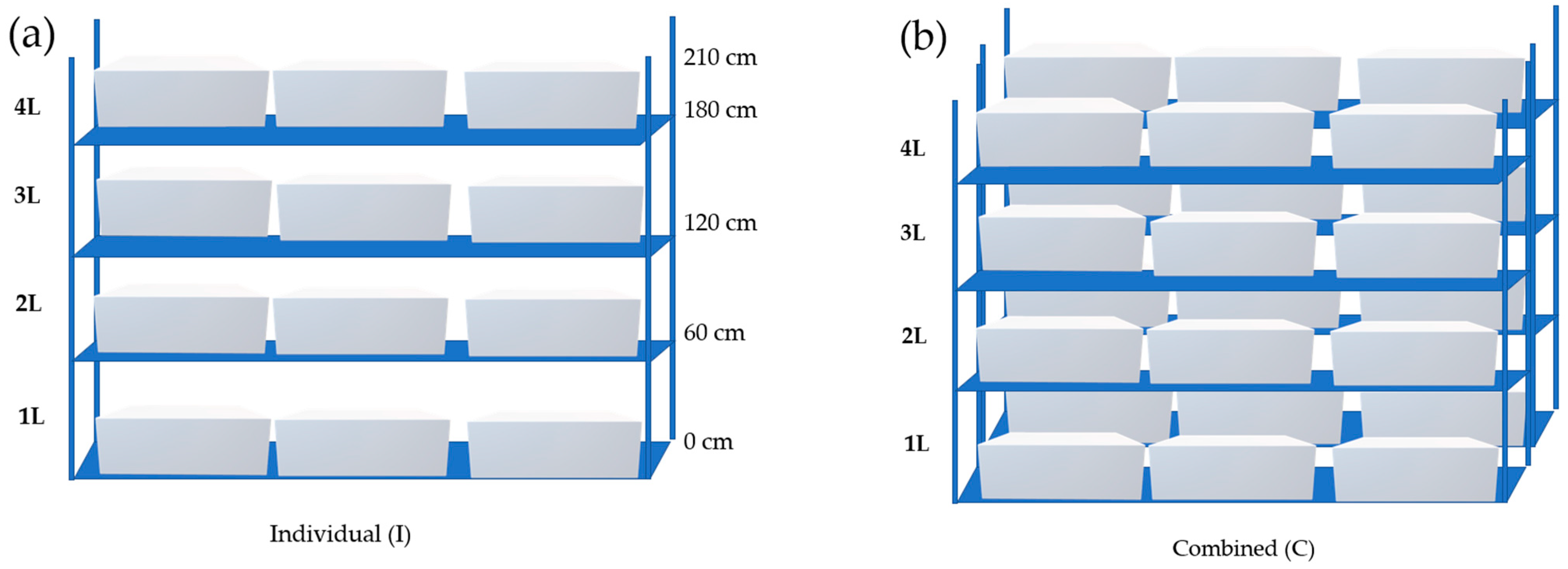
The VF system consisted of 18 steel racks (2 × 0.5 × 2.1 m) with 4 shelves each built in the mushroom greenhouse; each shelf held 3 bags to reach a total density of 12 bags m−2. Different heights of the rack, represented by each shelf, were named as follows: 1st level (1L-Control), 2nd level (2L), 3rd level (3L), and 4th level (4L) from the ground to the top (Figure 1). Photos of the shelves disposition are shown in Figure S1.
Racks were also arranged in the mushroom greenhouse individually (I) and combined (C) and positioned in a randomized block design with 3 replicates. Blocks were disposed in the greenhouse to account for the temperature and light gradient in the facility.

2.2. Climatic Conditions

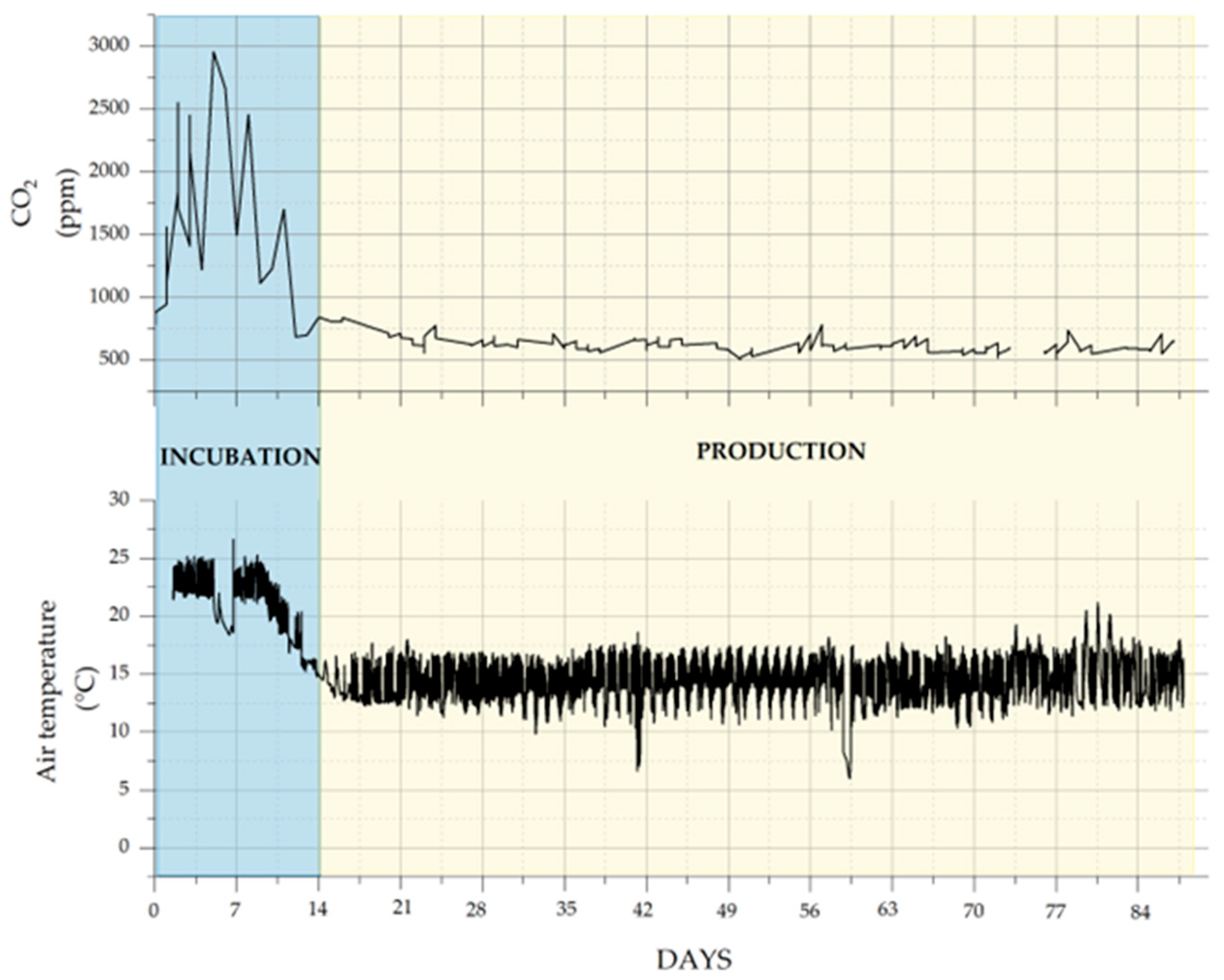
In this experiment, air temperature and CO2 were monitored inside the facility (Figure 2). The temperature gradient at different rack heights between 1L-2L and 3L-4L showed a temperature increase of +1.5 °C, with a light intensity gradient increase of +0.2 µmol m−2 s−1. During the incubation stage, the average temperature was maintained at 24 ± 2 °C with relative humidity (RH) of 100% and during both productive flushes at 15 ± 2 °C with RH of 90%.

2.3. Cultivation Substrate

The cultivation bags (25 kg each) were composed mainly of wheat straw and nitrogen supplementation (soybean residues 5% w/w). The main chemical properties of the cultivation substrate used for production are reported in Table 1.
At the beginning of the experiment, 3 samples of substrate were taken for each Pleurotus species. Substrate samples were oven-dried at 65 °C and ground for further chemical analysis. For the determination of nitrogen (N), phosphorus (P), and potassium (K) content, the ashes of the sample were suspended in concentrated HCl by dissolving 1 g of ashes in 5 mL of HCl. After 30 min, the solution was diluted with distilled water to a volume of 50 mL. The solution was then carefully filtered and analyzed for elemental content. The instrument used for this analytical phase was the ICP-AES spectrophotometer (Inductively Coupled Plasma–Atomic Emission Spectroscopy), specifically the SPECTRO CIROS (Spettro Italia S.r.l, Monza, Italy).

2.4. Productive and Qualitative Traits

After the incubation, the appearance of primordia was monitored every day, and data were calculated and normalized as follows:
%   p r i m o r d i a   =   t o t a l   p r i m o r d i a   ×   100 t o t a l   h o l e s   o f   b a g  
Then, the results were reported as a cumulative percentage of primordia produced in each flush.
During each flush, at harvest time, the daily yield of each bag was measured to obtain the total yield of each flush and normalized to kg of substrates. For each harvest and from each bag, 3 representative fruiting bodies were chosen to measure the number of caps, their diameter, and their width. In addition, the principal colorimetric parameters were recorded for three caps for each representative fruiting body with a tristimulus colorimeter (Chroma Meter CR-410, Konica Minolta, Milan, Italy). The L value represents darkness and lightness of color in a range between 0 and 100; the a* value, from −60 to +60, is a coordinate to represent greenness and redness, respectively, and the b* value, between −60 and +60, describes the color for blueness and yellowness.

2.5. LCA

The LCA methodology is a standardized procedure able to assess the environmental impacts of the proposed product system, including the specific unit processes in a cradle-to-gate approach [23]. The ISO 14040 and 14044:2006 Standards [24] were followed for performing the study.
SimaPro 9.6 software developed by Pré Consultants [25] and Ecoinvent 3.10 [26] supported the data processing for the creation of the LCA model, and the overall environmental impact was evaluated using the Environmental Footprint 3.1 method. The aim of the LCA study was to compare the environmental performance of one of the two systems cultivated in VF (PO) with the same species cultivated in a conventional farm with the traditional bag disposition. Only PO was taken into account in the LCA analysis, as the primary data related to the conventional cultivation were available only for this species. The functional unit considered to carry out the analysis was 1 kg of PO, produced within one production cycle.
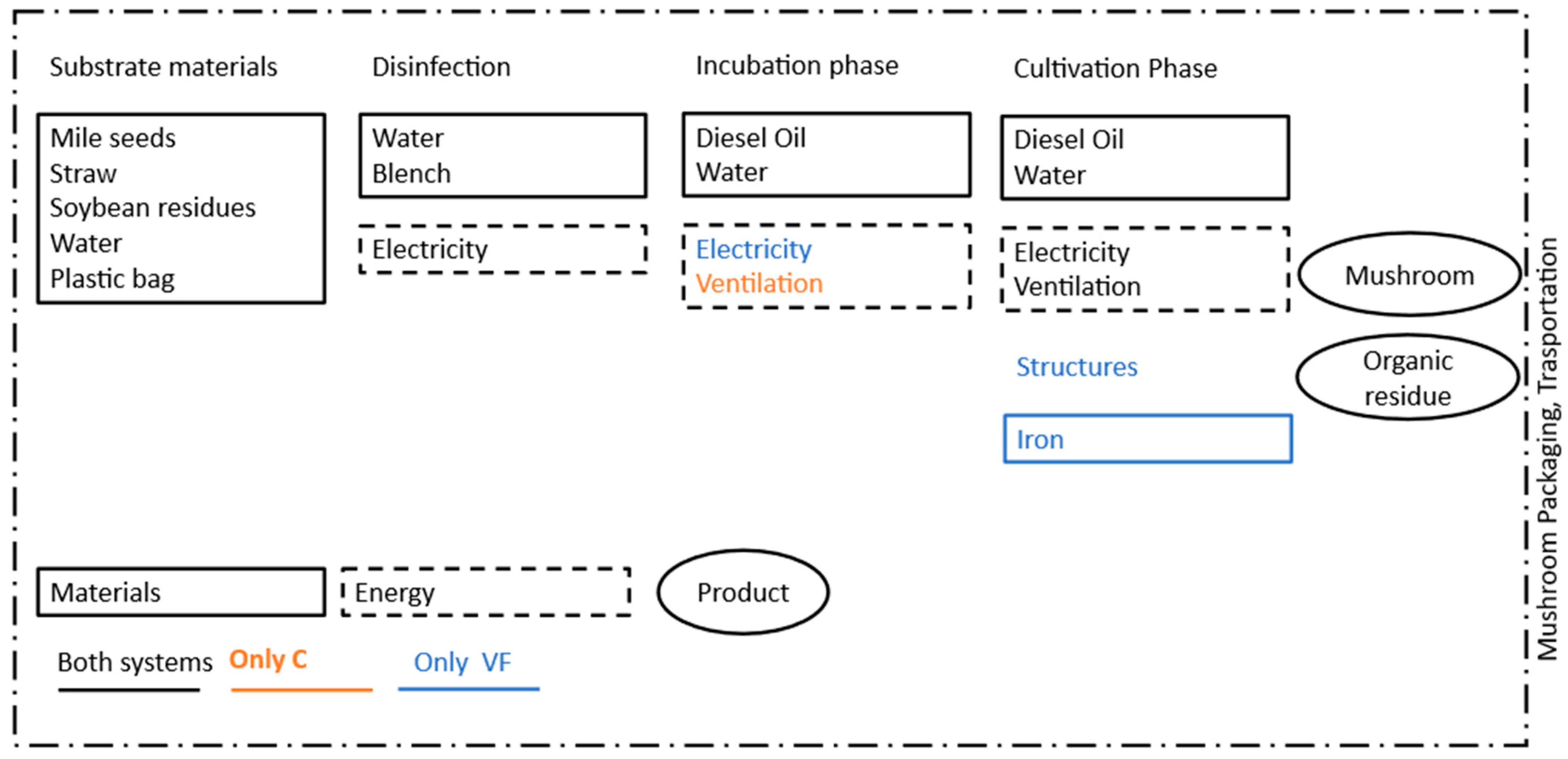
As a cradle-to-gate approach was considered, the system boundaries included the following four main stages within the life cycle: substrate production, disinfection, incubation phase, and cultivation of PO. In the case of vertical farming, the structures (iron shelves) for cultivating the product were also taken into account (Figure 3).
In reference to the typology of data, the ones concerning disinfection, incubation, and cultivation (including information about electricity consumption, fuel consumption, packaging process, and so on) were primary data (Table 2), collected by the University of Padova (for VF) and by a representative conventional farm located in the Veneto region (for the conventional system). Substrate materials can vary greatly among different countries; for this reason, we used the most common ingredients used in Europe [27]. Data on substrate production did not include the mixing and the sterilization process, as no viable information was available about it. Other secondary data were taken from the Ecoinvent database. Transportation has been excluded since the focus of the analysis was on the production system. Using transport data from two individual case studies could, in fact, have distorted the results, albeit partially.

2.6. Statistical Analysis

The statistical analysis of the productive data was conducted with a two-way ANOVA, separately for the two Pleurotus species. Means were then separated by Tukey’s HSD test at p-value ≤ 0.05. For statistical processing of data, Statgraphics 19 Centaurion software (Statgraphics Technologies, Inc., The Plains, VA, USA) was used.

3. Results

3.1. Production and Morphological Parameters of P. ostreatus and P. cornucopiae

3.1.1. Primordia Appearance and Yield

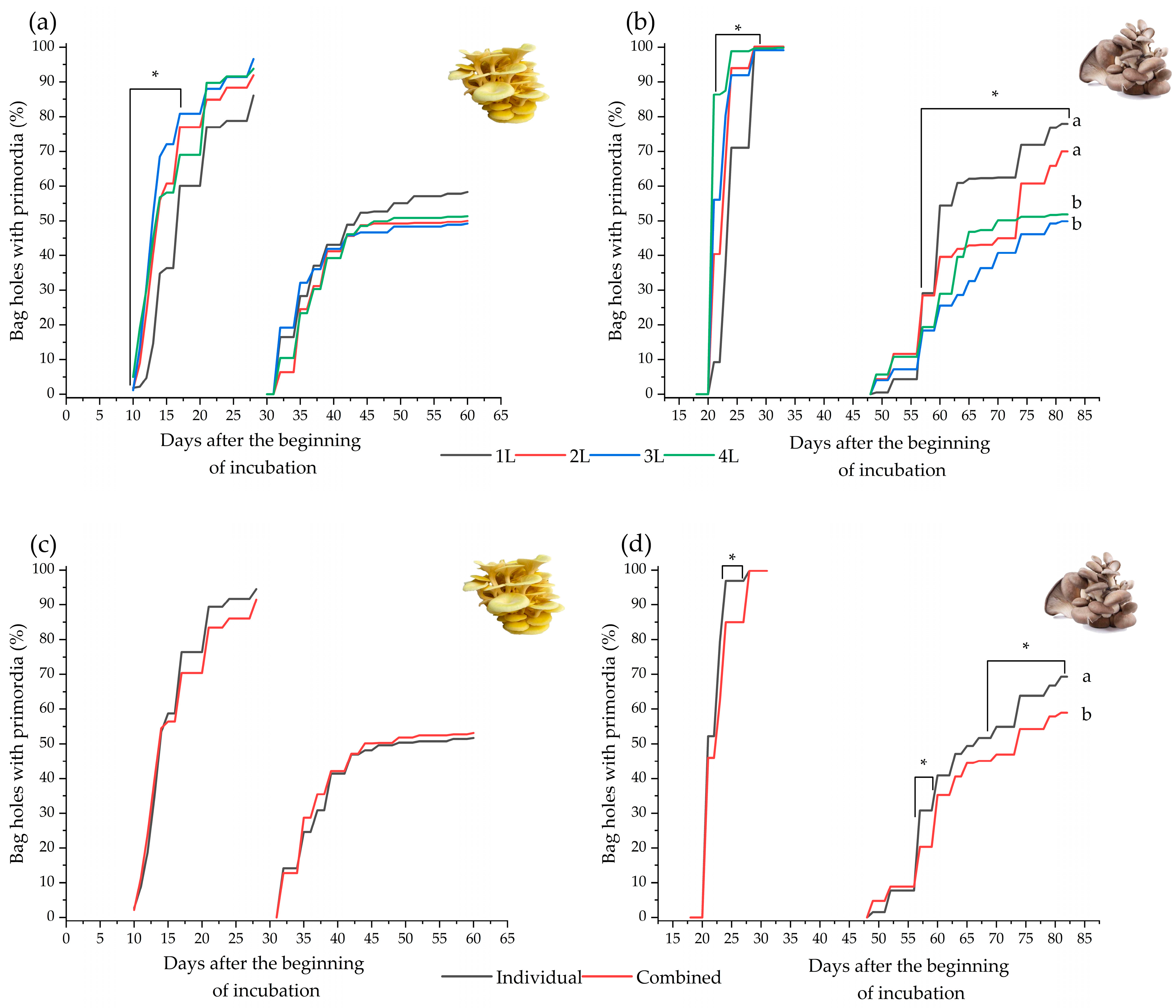
Primordia appearance is reported as a cumulative percentage of primordia per total holes. In PC (Figure 4a,c), during the first flush, the first primordia appeared 10 days after the beginning of incubation and ended at day 28. Shelf level had a significant effect during the first 6 days, where 4L, 3L, and 2L showed a higher percentage of primordia (58.0%, 72.1%, and 60.7%) compared to 1L (36.4%). However, the final primordia production at the end of the first (average 92.0%) and second flush (average 52.1%) was not statistically different. Moreover, no significant effects were noted regarding the shelf arrangement in both flushes. Regarding PO (Figure 4b,d), the primordia production began at day 21. During the first 6 days, the upper shelf layers (4L, 3L, and 2L) produced a higher percentage of primordia (from 91.8% to 98.8%) compared to 1L (71.0%). However, no significant differences were observed by the end of the first flush (100% for all layers). Differently, during the second flush, 1L and 2L had the highest percentage of primordia from day 57 to the end of the flush, with final production of 77.9% and 70.0%, respectively, compared to 49.8% and 51.8% in 3L and 4L layers. Significant differences were observed between shelf arrangements for PO. During the first flush, from day 23 to day 27, individual shelves produced more primordia (96.8%) than combined shelves (84.9%). A similar trend was observed during the second flush, from day 70 to day 82, with a significant difference in final production: 69.3% for individual shelves and 58.9% for combined ones.
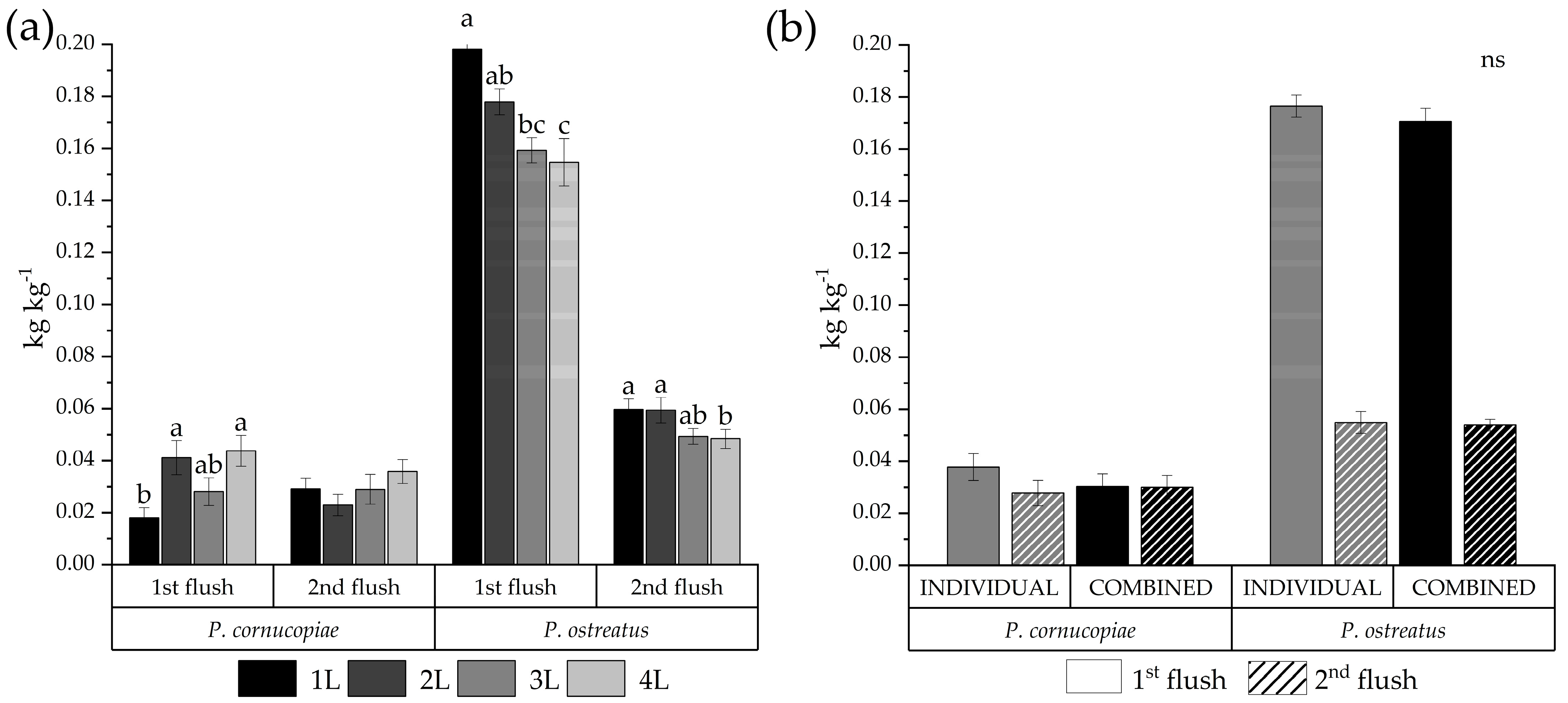
Figure 5a illustrates the effect of shelf level on the yield of both PC and PO. For PC, a significant difference in yield was observed during the first flush, where 2L and 4L had higher yields (0.04 and 0.04 kg kg−1, respectively) compared to 1L (0.018 kg kg−1), whereas no statistical difference was observed in the second flush.
For PO, significant differences were found between treatments in both flushes: 1L and 2L had higher yields (averaging 0.18 kg kg−1 in the first flush and 0.059 kg kg−1 in the second) than 4L (0.15 kg kg−1 and 0.048 kg kg−1 in the first and second flush, respectively). No significant differences were observed for the shelf arrangement in either species (Figure 5b). No significant interactions were observed between primordia appearance and yield results for both species under study.

3.1.2. Morphological Characteristics of Fruiting Bodies

Table 3 summarizes the main morphological characteristics of the fruiting bodies for both flushes and species under study.
In PC, the cap number and cap diameter were statistically significant in the first and second flushes, respectively. The cap number per fruiting body exceeded 20 in 3L and 4L, with an average of 15.1 in 2L and 1L in the second flush. Cap diameter increased with shelf layer, with 1L showing the smallest diameter (5.17 cm) compared to the other layers (5.74 cm, on average).
For PO, in different layers, a different number, diameter, and thickness of caps were observed. The cap number was higher in the upper shelf layers (4L and 3L) in both flushes (12.6 and 7.1), whereas cap diameter was larger in the lower layers G and 2L (+18.4% and +13.0%) during the second flush compared to 4L layers. Finally, cap thickness was affected by shelf level, with 4L having the thickest caps in both flushes (6.26 mm and 4.67 mm, respectively) compared to 1L (4.98 mm and 4.30 mm).
Table 4 presents the average cap color in different shelf levels and arrangement providing data about L, a*, and b* parameters. For PC, the L value in the first flush was the only parameter with significant differences, whereas in the second flush, all parameters had significant differences across shelf levels. In the second flush, L was lower in 1L and 2L layers compared to the others, whereas the a* and b* values were higher in 1L (−6.3 and 33.4, respectively). Shelf arrangement affected the L and b* parameters only in the second flush: L was higher in the combined shelves, whereas b* values were greater in the individual shelf arrangement.
For PO, significant differences in all color parameters were observed across all shelf levels in both flushes. Values of L were lower in 1L and 2L (62.8 and 66.4 in the first flush, 71.5 and 72.7 in the second flush) compared to the higher rack layers. In the first flush, color parameters were influenced primarily by rack disposition, with L and b* values being higher in combined shelves and a* values being higher in individual shelf arrangements. No significant interactions were observed among morphological parameters.

3.2. LCA Results

Table 5 reports the characterized results; thus, the result of the inventory analysis is multiplied by an appropriate characterization factor, in absolute (columns 3 and 4) and relative terms (columns 5 and 6), for the P. ostreatus cultivated conventionally (C) or vertically (VF). The comparison between the two systems in relative terms has been performed by giving 100% of the impact to the system with the higher value and calculating the other as a percentage of it. The two systems practically equal the number of categories in which one is less impactful than the other. Although, for some of the categories, the absolute difference between the two systems is minimal (e.g., ‘Acidification’, ‘Eutrophication, terrestrial’, and ‘Water use’), for other categories, there are more substantial differences. For example, in the category ‘Climate change—Biogenic’, the vertical system has 91.3% less impact than conventional, while for ‘Human toxicity, cancer—organics’, the conventional has an impact 56% lower than VF. When considering the five sub-categories, the VF system exhibits higher impact in three sub-categories, whereas system C shows higher impact in two. In particular, the VF system demonstrates significantly greater burden in Freshwater ecotoxicity—part 1 (approximately 32% higher), Freshwater ecotoxicity—inorganics (around 7% higher), and Freshwater ecotoxicity—organics—part 1 (approximately 45% higher).
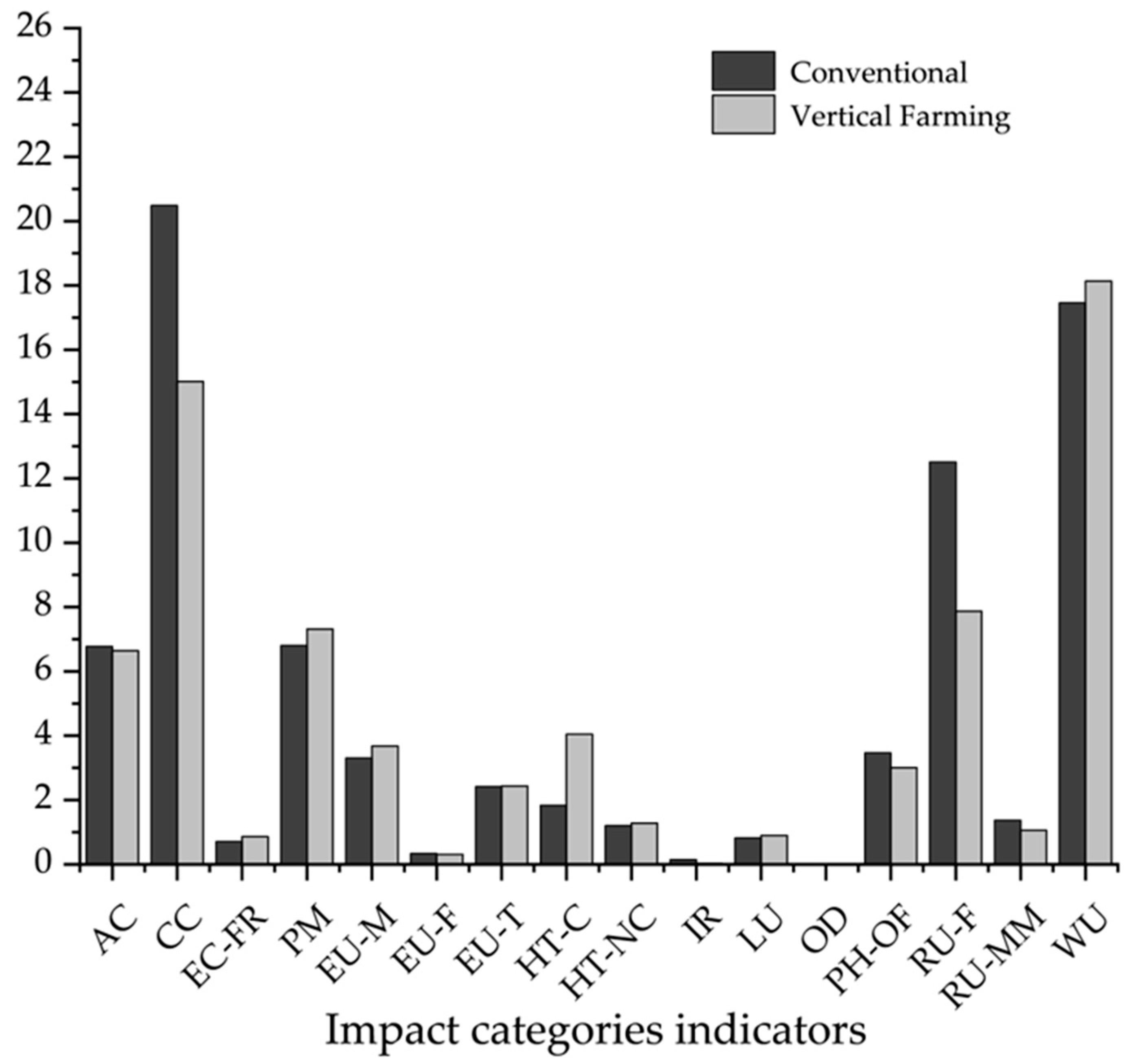
Figure 6 shows the normalized outcomes, which means that the impact category indicator results have been compared using a reference (or normal) value, to highlight the most relevant categories. Again, there is no clear prevalence of one system over the other, since the conventional one is less impactful according to five categories, while the vertical one is better according to seven. VF environmental performances are superior to conventional ones for ‘Resource use-fossil’ and ‘Climate change’, in particular, while it is outperformed for the categories ‘Human toxicity, cancer’ and ‘Eutrophication, marine’.
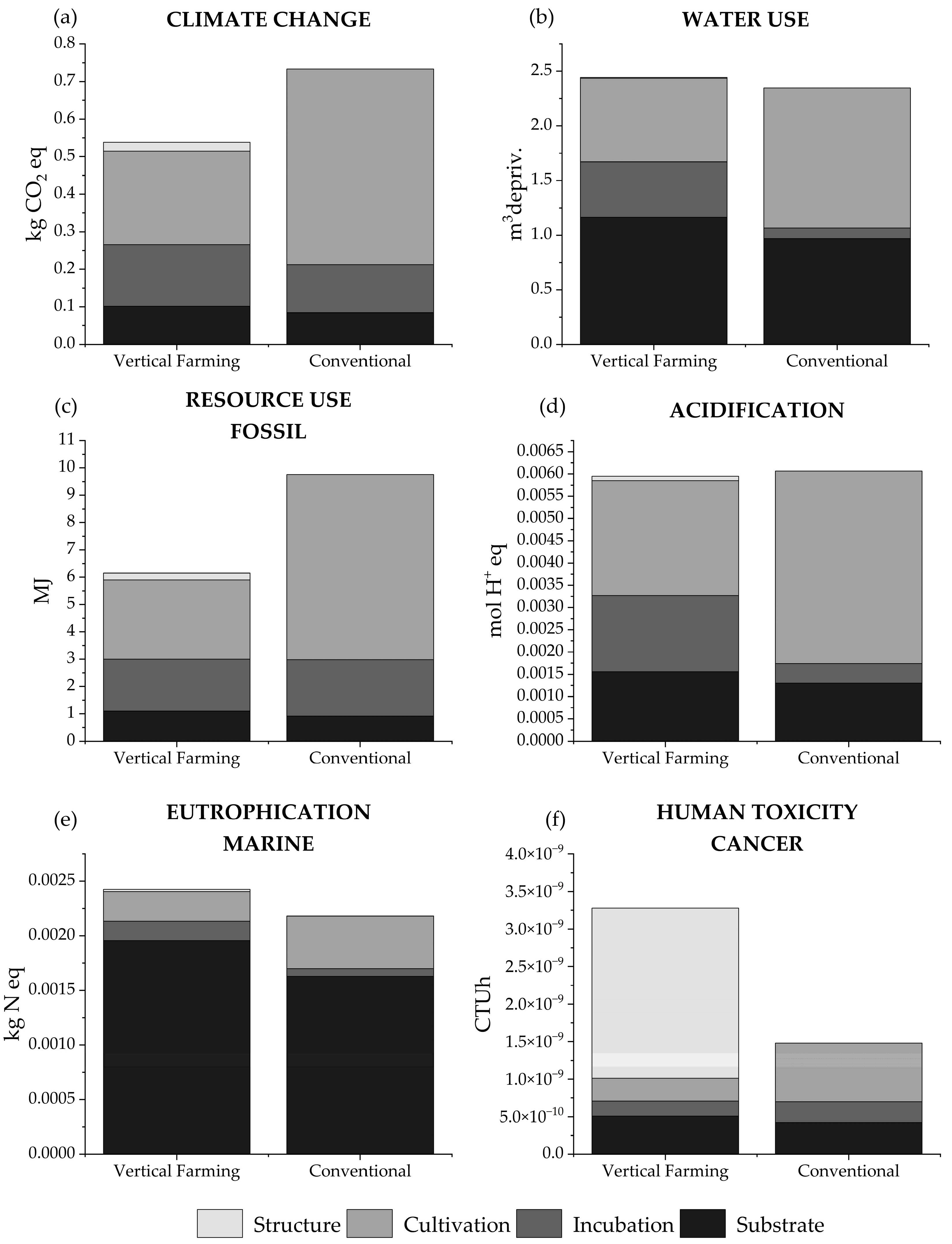
Figure 7 highlights the six most impactful categories across the two systems. Cultivation is the main contributor to the categories ‘Climate change’, ‘Water use’, ‘Resources use-fossil’, ‘Acidification’, and ‘Human toxicity, cancer’ in the C system, whereas in the VF system, it has the most impact just for ‘Climate change’ and ‘Resources use-fossil’. Substrate contributes the most to ‘Eutrophication, marine’ in both systems and to ‘Water use’ for the VF system. This is due to the presence of straw and the connected agricultural activities. Structures, which are present only in the VF system, greatly contribute to the ‘Human toxicity, cancer’ category, because the system is built using iron, which is a main contributor to such a category. It should be noted that the high impact of this category on the VF system is attributable exclusively to the structure. If this component is excluded, the overall burden for ‘Human toxicity, cancer’ becomes lower for the VF system (Figure 7f), largely due to the reduced contribution of the cultivation phase in comparison to the C system.
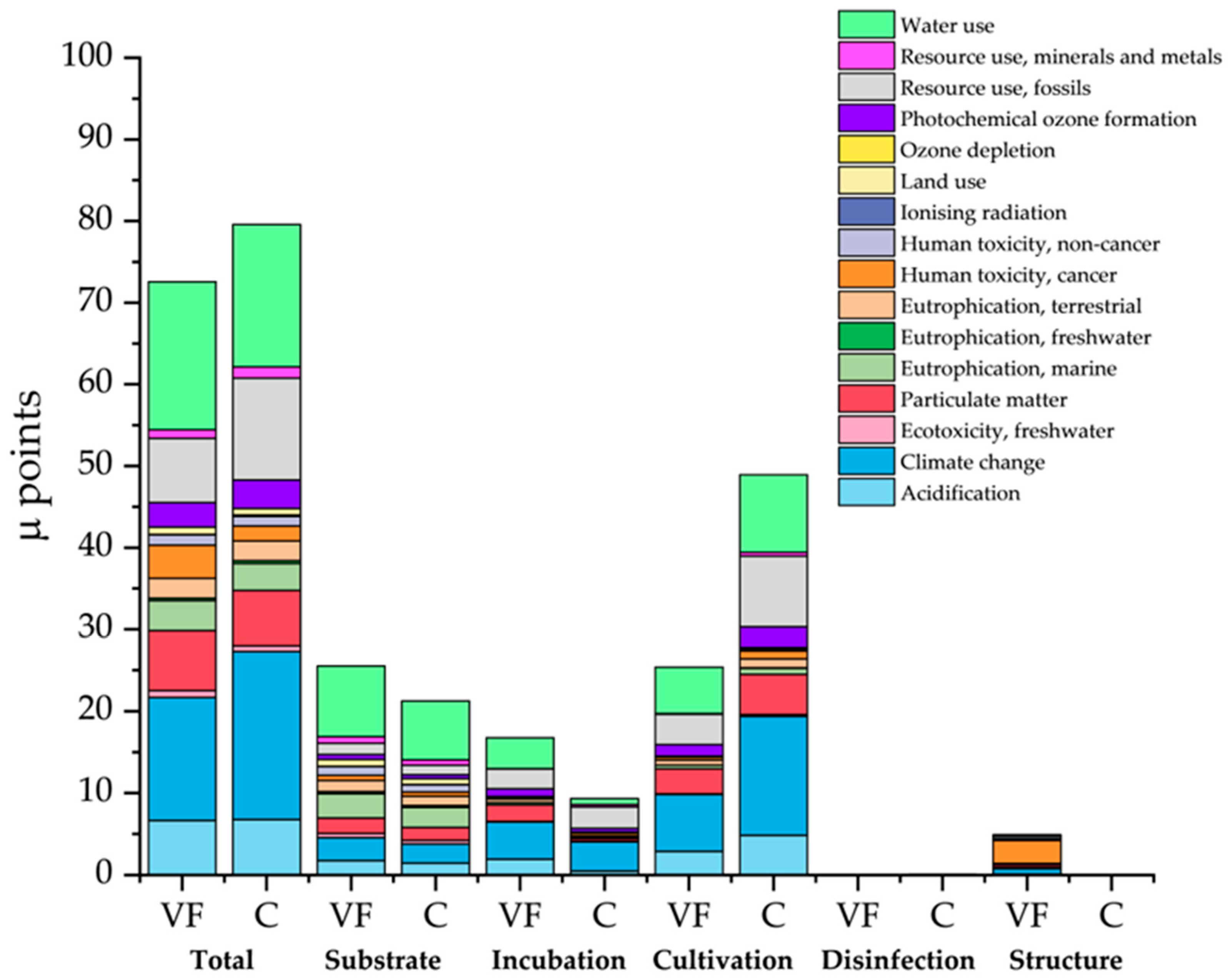
Looking at Figure 8, reporting the normalized and weighted values for each impact category, divided by the different phases considered and as a total, the overall burden of the VF system is lower than the conventional one (72.57 vs. 79.59 micropoints). In both systems, the impact of disinfection is negligible and thus is not further considered in the analysis, although it is present in the figure. In the conventional system, the most impactful phase is cultivation, which accounts for 61.5% of its total impact, mainly due to the categories ‘Climate Change’ and ‘Water use’. Substrate (26.7%) and incubation (11.7%) cover the rest of the effects. On the other hand, the vertical system has the substrate (35.2%) and the cultivation (35%) as the most impactful phases; the first one is greater than the conventional equivalent, while the latter is smaller. In the VF, incubation covers 23.1% of the impacts, while the structure accounts for less than 7% of the total environmental burden.

4. Discussion

4.1. Production and Morphological Parameters of P. ostreatus and P. cornucopiae

4.1.1. Shelf Level

The arrangement of bags on shelves at different heights significantly influenced the environmental conditions experienced by the bags at each layer. A temperature gradient of approximately 1.5 °C was observed between the lower levels (1L and 2L) and the upper ones (3L and 4L). Additionally, the lower layers (1L and 2L) received reduced light intensity, primarily due to the shading effect caused by the upper structure of the shelving system. These differences in the environmental conditions among the shelf levels affected PC and PO in every production step. During incubation time, a higher temperature reduced the spawn run period and affected primordia appearance and production [28]. For PC in the upper layers, primordia appeared in more than 50% of the holes after only 10 days, whereas PO reached the same percentage after 27 days. In fact, Pleurotus species can grow in a very large range of temperatures, but each species has an optimal temperature range for its development and growth. In general, PC and PO showed different temperature needs during cultivation phases; PC optimal temperature during incubation is between 15 and 35 °C, whereas PO can grow between 5 °C and 35 °C [29]. Moreover, the temperature gradient has probably promoted a different growth of both species in different layers, showing a higher productive result for PC in the upper shelf level and for PO in the lower ones.
Different layers also affected some morphological characteristics of PC and PO. In both species, the cap number increased in the upper layers with higher temperature, as also observed by Bellettini et al. (2019) [29]. These changes in morphological characteristics may seem minimal but are fundamental for producers and consumers. For instance, a larger diameter corresponds to a higher yield, and the Italian market usually prefers larger caps.
Different light and temperature conditions among shelf levels affected the cap color (Table 4). The L parameters were higher in both species in the upper layers, where bags received more light (not shaded by those above), and the temperature was higher. Usually, light makes the cap color darker because blue wavelengths increase melanin production [30] and, as noticed by Marino et al. (2003), temperature can affect cap color variation, which needs to be taken into account [31].
The color variability observed among shelf levels was due to the light gradient in the shelf’s system, which is usually not observed in the traditional cultivation system on the ground, where the bags are arranged at the same level. The application of integrative artificial light illumination has been shown to enhance light in the lower part of the shelf and homogenize the cap color among shelves. De Bonis et al. (2024) observed an enhancement in morphological and quality traits, and consequently, an improvement in crop value, with the application of integrative artificial light treatments in a Pleurotus spp. greenhouse [32]. The application of this technique in a VF could be useful for the enhancement of quality parameters of the crop and, at the same time, improving the production. The enhanced crop value could improve crop price and be a viable solution for mushroom producers.
Thus, it is possible that PC and PO can be cultivated together (using companion planting) at different shelf levels, taking advantage of the temperature gradient present in a VF system. Specifically, the accumulation of warm air in the upper volume of the facility can support Pleurotus species like PC, which require higher temperatures, thereby enhancing indoor heating efficiency.

4.1.2. Shelf Arrangement

From the environmental perspective, the only difference observed in shelf arrangement concerned the natural lighting of the bags, which, in the case of the combined treatment, were more shaded in the internal part of the structure. For this reason, the shelf arrangement did not significantly affect the productive traits of the Pleurotus species under study compared to the influence of shelf level.
Only the primordia formation in PO production was affected by shelf disposition, mostly in the second flush, where individual shelves produced more primordia than the combined ones due to the presence of more light in the individual arrangement, which enhanced primordia induction, as reported by Nakano et al. (2010) [33]. Also, the cap color was affected by these treatments, and the different arrangement of bags may have improved the light effect on caps during their development.
Shelf arrangement did not affect most of the morphological characteristics and yield of both species under study. Accordingly, growers could be free to select the most appropriate shelf arrangement within their growing facilities, without any significant impact on production or product morphology. It is evident that the combined arrangement is more suitable to enhance the bag density per m2 than the single arrangement. For instance, assuming a mushroom facility with a size of 25 × 8 m, it is possible to arrange 32 combined shelves, leaving 1 m of space for workers’ movements. In total, 768 bags can be placed in the mushroom facility. By contrast, under the traditional cultivation system, only 600 bags (3 bags m−2) can be arranged within the same area. The additional 168 bags would yield approximately 936.6 kg more of Pleurotus ostreatus and 252 kg more of P. cornucopiae (with an average production of 5.5 kg and 1.5 kg per bag for PO and PC, respectively). The vertical system, compared to the traditional system, with the arrangement of combined shelves, would result in a production increase of +28% for both Pleurotus spp.
A proper economic assessment of the VF system was not performed in this study. However, some considerations should be present. We need to highlight that bag movement at the beginning and at the end of the production cycle in the VF system needs more labor than in the traditional cultivation system, and consequently, labor costs will be higher for the growers. In the case study, the labor requirement of system C amounts to three full-time working days, whereas the VF needs one additional day for each cycle. Thus, considering a daily cost of EUR 90 for a skilled agricultural worker, inclusive of social security contributions and other charges, system C entails a labor cost of EUR 270 per cycle, whereas the VF amounts to EUR 360, corresponding to EUR 0.05 per kg of mushroom for the C system and EUR 0.06 for the VF one. We note that the VF also has the additional cost of the structure. The cost of the shelves for the case study is roughly EUR 3.000. However, such a cost is for a structure with a potential span of life of 10 years. It is not possible to judge these data in the light of the literature, mainly because of the paucity of works dedicated to this topic (i.e., economic viability) for the same species in comparable geographical areas (European countries). As emerged in the work of Schilla et al. (2024) [34] on a different species (Agaricus bisporus), even considering only energetic costs and the similar geo-economical areas (European countries), costs are strongly affected by the national context. According to Sanchez (2010) [35], the possibility of using pasteurization instead of proper sterilization reduces the cost of substrate for P. ostreatus, which is a positive aspect considering the greater amount of it used in vertical systems.

4.2. LCA Discussions

The existing literature on assessing the environmental impacts of mushroom production is relatively limited, with only a few studies previously published. Previous LCA analysis of the mushroom system reported results for different species, geographical areas, and climatic growing conditions, using also different methods than the one used in this study. Thus, direct comparisons are not easy, and it was possible to verify our results with a small number of articles available in the literature. Climate change impact is usually investigated. Our results (0.73 kg CO2 eq kg−1 of harvested mushroom for the conventional) are in line with the values found by Goglio et al. (2024) but lower than in other case studies [7]. The only LCA study in the literature on the same mushroom species (P. ostreatus) identified a higher impact [18]. However, the differences are mainly due to the substrate transformation, which is not considered in our elaboration, and the inclusion of transportation. The vertical system allows for a reduction of almost 30% of the impacts, showing a good advantage over the conventional one. Additional reduction may be produced by renewable energy use. A different energetic mix would also have a positive impact on aspects not considered by this work, such as the mixing and sterilization of the substrate, due to the high use of energy characterizing this phase.
According to the distribution of the impacts across the different production phases, the use of the vertical system shifts part of the impact from the cultivation to the substrate. Although for other species the substrate is the main source of impact [7,10,11], according to the study of Dorr et al. (2021), cultivation is the phase with the highest burden [18], as in our case study for the conventional system; for the VF system, cultivation and substrate account for quite the same share. In VF, the higher relative impact of the substrate is due to the larger amount of it, whereas the other factors linked to the incubation and cultivation phases did not increase. The larger impact of the cultivation phase in the conventional, compared to VF, influences the final result. Indeed, the VF system shows a lowering of the cultivation phase impacts (−48% compared to the conventional) that is not compensated by the higher impact of the substrate (+20% compared to the conventional). Is it to be noted that, due to the very simple modules and materials used, the structure does not have a very significant impact in comparison to the overall one. At the same time, however, a significant contribution of the structures is observed for a single impact category (‘Human toxicity, cancer’), primarily attributable to the type of material employed in their construction (iron). This material-specific contribution warrants careful consideration of potential substitution strategies, such as the adoption of plastic structures derived from recycling processes, which may also provide improved resistance to the high humidity characteristic of the production environment.
Considering the sub-categories Ecotoxicity, freshwater—part 1, and Ecotoxicity, freshwater—organics-p 1, which show a higher impact of the VF systems, the results are mainly linked to the structure, which represents 68% of impacts for all the sub-categories. The rest of the impact is related to the incubation and cultivation phases, with a very minor contribution of disinfection (<1%) due to the use of the bleach. It is worthy to note that, although this is one of the categories where the VF system performed worse than C, Ecotoxicity, freshwater as a whole represents less than 3% of all the impact.

5. Conclusions

Vertical farming (VF) represents a promising alternative for the efficient cultivation of edible mushrooms. By arranging cultivation bags on vertical multi-level shelves, it is possible to grow multiple Pleurotus species with differing temperature requirements simultaneously: Pleurotus cornucopiae (PC) in the upper shelf layers and Pleurotus ostreatus (PO) in the lower ones. The shelf configuration, whether arranged individually or in combination, did not significantly affect the yield of either species. These findings suggest that both configurations are suitable for implementing VF systems in existing cultivation facilities.
Life Cycle Assessment (LCA) results indicate a reduced climate change impact associated with VF compared to conventional cultivation methods. The two systems differ in their environmental impact distribution: conventional systems exhibit higher emissions during the cultivation phase, whereas VF systems show increased impact during substrate production due to the greater density of cultivation bags and higher substrate input requirements.
The simplicity and adaptability of the structural system employed in this study support the feasibility of integrating VF into existing infrastructures, improving both the sustainability and productivity of Pleurotus production.
The absence of research on mushroom production in vertical farming systems necessitates the continuation of studies on this cultivation system with other edible mushroom species. Furthermore, now that the sustainability of vertical farming compared to the conventional cultivation system has been highlighted, further analysis is required to comprehensively assess its economic implications for mushroom cultivators in the industry.
Although accurate, this work has some limitations. The main issue is related to the exclusion of some phases, namely, the production of substrate and the transportation phases. The substrate transformation process (mixing and sterilization) may be a significant contributor to climate change, primarily due to the energy consumption required for sterilization, as highlighted by Dorr et al. [18] and Vinci et al. [11]. Moreover, future studies should include other Pleurotus species to enable species-specific LCA comparisons. Moreover, a proper economic analysis, using preferably Life Cycle Costing integrated with LCA, should be one of the most needed further developments.

Supplementary Materials

The following supporting information can be downloaded at: https://www.mdpi.com/article/10.3390/su18010384/s1, Figure S1: Individual and combined shelf arrangements’ photos.

Author Contributions

M.D.B., C.N., L.P. and L.R.; Data curation: M.D.B., L.P. and L.R.; Formal analysis: M.D.B., L.P. and L.R.; Funding acquisition: C.N., P.S. and G.Z.; Investigation: M.D.B., L.P. and L.R.; Methodology: M.D.B., C.N., L.P. and L.R.; Project administration: C.N. and P.S.; Resources: C.N. and P.S.; Software: L.P. and L.R.; Supervision: C.N., L.P., L.R. and G.Z.; Validation: M.D.B., C.N., L.P. and L.R.; Visualization: M.D.B., C.N., L.P. and L.R.; Writing—original draft: M.D.B., L.P. and L.R.; Writing—review and editing: M.D.B., C.N., L.P. and L.R. All authors have read and agreed to the published version of the manuscript.

Funding

The experiment was funded by the Sustainable Vertical Farming (VFarm) project, supported by the Italian Ministry of University and Research (MUR) within the framework of the Projects of National Interest (PRIN) programme (Project code: 2020ELWM82; CUP: J33C20002350001).

Institutional Review Board Statement

Not applicable.

Informed Consent Statement

Not applicable.

Data Availability Statement

The raw data supporting the conclusions of this article will be made available by the authors on request.

Acknowledgments

The authors would like to thank Società Agricola Mancon (https://www.mancon-sa.it/, accessed 30 March 2024) for the technical support.

Conflicts of Interest

The authors declare no conflicts of interest.

References

  1. Singh, M.; Upadhyay, D.R.; Sharma, D.V.; Kumar, D.S.; Kamal, D.S.; Arora, B.; Gupta, M. A Global Perspective on the High Five: Agaricus, Pleurotus, Lentinula, Auricularia & Flammulina. In Proceedings of the 8th International Conference on Mushroom Biology and Mushroom Products (ICMBMP8), New Delhi, India, 19–22 November 2014. [Google Scholar]
  2. Pérez-Montes, A.; Rangel-Vargas, E.; Lorenzo, J.M.; Romero, L.; Santos, E.M. Edible Mushrooms as a Novel Trend in the Development of Healthier Meat Products. Curr. Opin. Food Sci. 2021, 37, 118–124. [Google Scholar] [CrossRef]
  3. Thakur, M.P. Advances in Mushroom Production: Key to Food, Nutritional and Employment Security: A Review. Indian Phytopathol. 2020, 73, 377–395. [Google Scholar] [CrossRef]
  4. Reist, M.E.; Bleidorn, W.; Milfont, T.L.; Hopwood, C.J. Meta-Analysis of Personality Trait Differences between Omnivores, Vegetarians, and Vegans. Appetite 2023, 191, 107085. [Google Scholar] [CrossRef] [PubMed]
  5. Ayimbila, F.; Keawsompong, S. Nutritional Quality and Biological Application of Mushroom Protein as a Novel Protein Alternative. Curr. Nutr. Rep. 2023, 12, 290–307. [Google Scholar] [CrossRef]
  6. De Cianni, R.; Pippinato, L.; Mancuso, T. A Systematic Review on Drivers Influencing Consumption of Edible Mushrooms and Innovative Mushroom-Containing Products. Appetite 2023, 182, 106454. [Google Scholar] [CrossRef]
  7. Goglio, P.; Ponsioen, T.; Carrasco, J.; Milenkovi, I.; Kiwala, L.; Van Mierlo, K.; Helmes, R.; Tei, F.; Oosterkamp, E.; Pérez, M. An Environmental Assessment of Agaricus bisporus ((J.E.Lange) Imbach) Mushroom Production Systems across Europe. Eur. J. Agron. 2024, 155, 127108. [Google Scholar] [CrossRef]
  8. Poore, J.; Nemecek, T. Reducing Food’s Environmental Impacts through Producers and Consumers. Science 2018, 360, 987–992. [Google Scholar] [CrossRef] [PubMed]
  9. Singh, M.; Kamal, S.; Sharma, V. Status and Trends in World Mushroom Production-III-World Production of Different Mushroom Species in 21st Century. Mushroom Res. 2021, 29, 75. [Google Scholar] [CrossRef]
  10. Gunady, M.G.A.; Biswas, W.; Solah, V.A.; James, A.P. Evaluating the Global Warming Potential of the Fresh Produce Supply Chain for Strawberries, Romaine/Cos Lettuces (Lactuca sativa), and Button Mushrooms (Agaricus bisporus) in Western Australia Using Life Cycle Assessment (LCA). J. Clean. Prod. 2012, 28, 81–87. [Google Scholar] [CrossRef]
  11. Vinci, G.; Prencipe, S.A.; Pucinischi, L.; Perrotta, F.; Ruggeri, M. Sustainability Assessment of Waste and Wastewater Recovery for Edible Mushroom Production through an Integrated Nexus. A Case Study in Lazio. Sci. Total Environ. 2023, 903, 166044. [Google Scholar] [CrossRef]
  12. Leiva, F.J.; Saenz-Díez, J.C.; Martínez, E.; Jiménez, E.; Blanco, J. Environmental Impact of Agaricus bisporus Cultivation Process. Eur. J. Agron. 2015, 71, 141–148. [Google Scholar] [CrossRef]
  13. Young, G.; Grogan, H.; Walsh, L.; Noble, R.; Tracy, S.; Schmidt, O. Peat Alternative Casing Materials for the Cultivation of Agaricus bisporus Mushrooms—A Systematic Review. Clean. Circ. Bioecon. 2024, 9, 100100. [Google Scholar] [CrossRef]
  14. Doroški, A.; Klaus, A.; Režek Jambrak, A.; Djekic, I. Food Waste Originated Material as an Alternative Substrate Used for the Cultivation of Oyster Mushroom (Pleurotus ostreatus): A Review. Sustainability 2022, 14, 12509. [Google Scholar] [CrossRef]
  15. Rungnapa Tongpool, R.; Pongpat, P. Analysis of Shiitake Environmental Performance via Life Cycle Assessment. Int. J. Environ. Sci. Dev. 2013, 552–557. [Google Scholar] [CrossRef]
  16. Ta, T.Y.; Nguyen, K.L.P.; Nguyen, T.H.T.; Le, D.T.; Nguyen, M.T.; Nguyen, Q.L.; Nguyen, H.-Q.; Bui, T.-K.L. Integrated Life Cycle Assessment with the ReSOLVE Framework for Environmental Impacts Mitigation in Mushroom Growing: The Case in Lam Dong Province, Vietnam. Environ. Dev. 2024, 51, 101024. [Google Scholar] [CrossRef]
  17. Ueawiwatsakul, S.; Mungcharoen, T.; Tongpool, R. Life Cycle Assessment of Sajor-Caju Mushroom (Pleurotus sajor-caju) from Different Sizes of Farms in Thailand. Int. J. Environ. Sci. Dev. 2014, 5, 435–439. [Google Scholar] [CrossRef]
  18. Dorr, E.; Koegler, M.; Gabrielle, B.; Aubry, C. Life Cycle Assessment of a Circular, Urban Mushroom Farm. J. Clean. Prod. 2021, 288, 125668. [Google Scholar] [CrossRef]
  19. El Kolaly, W.; Ma, W.; Li, M.; Darwesh, M. The Investigation of Energy Production and Mushroom Yield in Greenhouse Production Based on Mono Photovoltaic Cells Effect. Renew. Energy 2020, 159, 506–518. [Google Scholar] [CrossRef]
  20. Van Gerrewey, T.; Boon, N.; Geelen, D. Vertical Farming: The Only Way Is Up? Agronomy 2021, 12, 2. [Google Scholar] [CrossRef]
  21. Kalantari, F.; Tahir, O.M.; Joni, R.A.; Fatemi, E. Opportunities and Challenges in Sustainability of Vertical Farming: A Review. J. Landsc. Ecol. 2018, 11, 35–60. [Google Scholar] [CrossRef]
  22. Al Mamun, M.R.; Deb, I.; Hridoy, T.; Soeb, M.J.A.; Shammi, S. Effects of Different Lighting Conditions on Growth, Yield and Nutrient Content of White Oyster Mushroom in Vertical Farm. Eur. J. Agric. Food Sci. 2021, 3, 61–67. [Google Scholar] [CrossRef]
  23. Tortoioli, S.; Paolotti, L.; Romagnoli, F.; Boggia, A.; Rocchi, L. Environmental Assessment of Bio-Oil Transformation from Thistle in the Italian Context: An LCA Study. Environ. Clim. Technol. 2020, 24, 430–446. [Google Scholar] [CrossRef]
  24. ISO 14044; Environmental Management-Life Cycle Assessment-Requirements and Guidelines. International Organization for Standardization (ISO): Geneva, Switzerland, 2006.
  25. Goedkoop, M.; De Schryver, A.; Oele, M. Introduction to LCA with SimaPro 7; Product Ecology Consultants, Plotterweg: Utrecht, The Netherlands, 2008. [Google Scholar]
  26. Wernet, G.; Bauer, C.; Steubing, B.; Reinhard, J.; Moreno-Ruiz, E.; Weidema, B. The Ecoinvent Database Version 3 (Part I): Overview and Methodology. Int. J. Life Cycle Assess. 2016, 21, 1218–1230. [Google Scholar] [CrossRef]
  27. Sekan, A.S.; Myronycheva, O.S.; Karlsson, O.; Gryganskyi, A.P.; Blume, Y.B. Green Potential of Pleurotus Spp. in Biotechnology. PeerJ 2019, 7, e6664. [Google Scholar] [CrossRef]
  28. Kibar, B.; Peksen, A. Modelling the Effects of Temperature and Light Intensity on the Development and Yield of Different Pleurotus Species. Agric Trop Subtrop 2008, 41, 68–73. [Google Scholar]
  29. Bellettini, M.B.; Fiorda, F.A.; Maieves, H.A.; Teixeira, G.L.; Ávila, S.; Hornung, P.S.; Júnior, A.M.; Ribani, R.H. Factors Affecting Mushroom Pleurotus spp. Saudi J. Biol. Sci. 2019, 26, 633–646. [Google Scholar] [CrossRef]
  30. Du, F.; Zou, Y.; Hu, Q.; Zhang, H.; Ye, D. Comparative Transcriptomic Analysis Reveals Molecular Processes Involved in Pileus Morphogenesis in Pleurotus Eryngii under Different Light Conditions. Genomics 2020, 112, 1707–1715. [Google Scholar] [CrossRef]
  31. Marino, R.H.; Eira, A.F.D.; Kuramae, E.E.; Queiroz, E.C. Morphomolecular Characterization of Pleurotus ostreatus (Jacq. Fr.) Kummer Strains in Relation to Luminosity and Temperature of Frutification. Sci. Agric. 2003, 60, 531–535. [Google Scholar] [CrossRef]
  32. De Bonis, M.; Locatelli, S.; Sambo, P.; Zanin, G.; Pecchia, J.A.; Nicoletto, C. Effect of Different LED Light Wavelengths on Production and Quality of Pleurotus ostreatus Grown on Different Commercial Substrates. Horticulturae 2024, 10, 349. [Google Scholar] [CrossRef]
  33. Nakano, Y.; Fujii, H.; Kojima, M. Identification of Blue-Light Photoresponse Genes in Oyster Mushroom Mycelia. Biosci. Biotechnol. Biochem. 2010, 74, 2160–2165. [Google Scholar] [CrossRef]
  34. Schilla, F.; Mumladze, G.; Soukupova, J.; Smutka, L. Economic Analysis of Agaricus Bisporus Mushrooms Production and the Perspective of Sharing Economy. Front. Sustain. Food Syst. 2025, 8, 1415291. [Google Scholar] [CrossRef]
  35. Sánchez, C. Cultivation of Pleurotus ostreatus and Other Edible Mushrooms. Appl. Microbiol. Biotechnol. 2010, 85, 1321–1337. [Google Scholar] [CrossRef] [PubMed]
Figure 1. Structure and height of the shelf used in the study. Shelf level: 1st (1L), 2nd (2L), 3rd (3L), and 4th (4L). The disposition of shelves is individual (a) or combined (b).
Sustainability 18 00384 g001
Figure 2. CO2 air concentration (ppm) and air temperature (°C) during the cultivation cycle.
Sustainability 18 00384 g002
Figure 3. LCA scheme.
Sustainability 18 00384 g003
Figure 4. Main effect of shelf level (1st (1L), 2nd (2L), 3rd (3L), and 4th (4L) layer) for P. cornucopiae (a) and P. ostreatus (b) and shelf arrangement (individual and combined) for P. cornucopiae (c) and P. ostreatus (d) on cumulative presence of primordia on total number of holes. Brackets with * indicate days with statistical differences for p ≤ 0.05 according to Tukey’s HSD test. Different letters indicate significant differences among treatments with p ≤ 0.05 according to Tukey’s HSD test.
Sustainability 18 00384 g004
Figure 5. Effect of shelf level (1st (1L), 2nd (2L), 3rd (3L), and 4th (4L) layer) (a) and shelf arrangement (individual and combined) (b) on yield (kg kg−1 substrate) for P. cornucopiae and P. ostreatus. Different letters indicate significant differences at p ≤ 0.05 according to HSD Tukey’s test.
Sustainability 18 00384 g005
Figure 6. Conventional-Vertical system comparison: normalized results. AC: Acidification; CC: Climate change; EC-FR: Ecotoxicity, freshwater; PM: Particulate matter; EU-M: Eutrophication, marine; EU-F: Eutrophication, freshwater; EU-T: Eutrophication, terrestrial; HT-C: Human toxicity, cancer; HT-NC: Human toxicity, non-cancer; IR: Ionising radiation; LU: Land use; OD: Ozone depletion; PH-OF: Photochemical ozone formation; RU-F: Resource use, fossils; RU-MM: Resource use, minerals and metals; WU: Water use.
Sustainability 18 00384 g006
Figure 7. Comparison of conventional and vertical systems according to the 6 most impactful categories: climate change (a), water use (b), resource use-fossil (c), acidification (d), eutrophication, marine (e), human toxicity, cancer (f) (characterized value reported).
Sustainability 18 00384 g007
Figure 8. Conventional–vertical system comparison: normalized weighted results for each phase, expressed in μ points (μ-points (µPt) are one-millionth of an Environmental Footprint (EF) point and represent a very small aggregated environmental impact after normalization and weighting of all EF impact categories).
Sustainability 18 00384 g008
Table 1. Chemical characterization of substrates used for P. ostreatus (PO) and P. cornucopiae (PC) production. Means are followed by standard error.
Total
Carbon
Total Nitrogen (TKN)C/NPK
%% mg kg−1 dw
PO40.7±0.40.65±0.0163.0±1.9718.2±27.818,077.0±257.7
PC40.4±0.40.67±0.0260.3±2.3816.5±35.216,415.4±1352
Table 2. Main inventory data considered for the LCA study. C: conventional; VF: vertical farming.
Substrate Production CVF
InputUnitAmountAmount
Mile seedskg0.110.13
Strawkg0.951.14
Soybean residueskg0.290.35
Waterkg2.222.66
Plastickg0.020.03
OutputUnitAmountAmount
Substratekg3.574.28
Disinfection phase
InputUnitAmountAmount
WaterL0.090.01
BleachL-0.0005
Electricitykw/h0.002-
Incubation phase
InputUnitAmountAmount
Diesel OilL-0.08
Electricityw/h0.010.01
WaterL0.150.34
Ventilationw/h0.34-
Structures
InputUnitAmountAmount
Ironkg-0.01
Cultivation phase
InputUnitAmountAmount
Diesel OilL0.170.12
Electricityw/h-0.06
WaterL1.830.51
Ventilationw/h0.370.16
OutputUnitAmountAmount
P. ostreatuskg11
Organic residueskg0.020.05
Table 3. Effect of shelf level (1st (1L), 2nd (2L), 3rd (3L), and 4th (4L) layer) and shelf arrangement (individual and combined) on cap number for fruiting bodies, cap diameter, and thickness for P. cornucopiae and P. ostreatus. Means are followed by standard error. Different letters indicate significant differences at p ≤ 0.05 according to HSD Tukey’s test.
P. cornucopiae
N° CAPSCAPS’ DIAMETER (cm)CAPS’ WIDTH (mm)
1st flush2nd flush1st flush2nd flush1st flush2nd flush
Shelf level
1L20±1.515±0.8 b5.17±0.17 b4.52±0.125.3±0.153.8±0.11
2L16±0.915±0.8 b5.95±0.17 a4.33±0.115.3±0.133.7±0.09
3L17±0.921±1.2 a5.52±0.22 ab4.86±0.175.4±0.203.6±0.11
4L17±0.823±1.3 a5.76±0.10 ab4.75±0.135.5±0.413.9±0.10
Shelf arrangement
Individual17±0.819±1.05.81±0.174.48±0.115.5±0.153.6±0.08 b
Combined17±0.618±0.65.57±0.104.67±0.085.3±0.073.8±0.06 a
P. ostreatus
N° CAPSCAPS’ DIAMETER (cm)CAPS’ WIDTH (mm)
1st flush2nd flush1st flush2nd flush1st flush2nd flush
Shelf level
1L10±0.3 c5±0.3 b8.92±0.1514.1±0.32 a5.0±0.08 c4.3±0.08 b
2L10±0.3 bc5±0.3 b9.14±0.1513.0±0.27 ab5.8±0.10 b4.2±0.09 b
3L12±0.4 ab6±0.3 ab9.04±0.1412.6±0.31 b5.9±0.12 b4.9±0.10 a
4L13±0.4 a7±0.4 a8.85±0.1411.5±0.30 c6.3±0.11 a4.7±0.08 a
Shelf arrangement
Individual11±0.36±0.39.14±0.1312.6±0.255.8±0.094.4±0.08
Combined11±0.26±0.28.91±0.0913.0±0.205.7±0.074.5±0.05
Table 4. Effect of shelf level (1st (1L), 2nd (2L), 3rd (3L), and 4th (4L) layer) and shelf arrangement (individual and combined) on color of caps for P. cornucopiae and P. ostreatus. Within each colour parameter, values with “*” differ at p-value < 0.05, “**”differ at p-value < 0.01, “***”differ at p-value < 0.001.
P. cornucopiae
1st flush2nd flush
LabCorresponding
color
LabCorresponding
color
Shelf level
1L84.3−6.027.2 76.4−6.333.4
2L82.4−6.629.3 77.7−5.630.4
3L83.5−6.228.1 81.9−5.829.8
4L83.9−6.529.1 81.8−6.030.3
p-value*nsns ******
Shelf arrangement
Individual82.5−6.328.9 77.4−5.833.1
Combined83.9−6.428.4 80.3−6.030.0
p-valuensnsns ***ns***
P. ostreatus
1st flush2nd flush
LabCorresponding
colour
LabCorresponding
colour
Shelf level
1L62.82.48.9 71.51.811.9
2L66.42.110.5 72.71.712.3
3L70.41.711.2 75.51.513.4
4L70.71.610.6 73.41.412.3
p-value********* *********
Shelf arrangement
Individual66.32.09.9 72.21.712.1
Combined68.31.910.5 73.71.612.6
p-value******* nsns*
Table 5. Conventional (C)–vertical system (VF) comparison: characterized results.
Impact CategoryUnitAbsolute ValuesRelative Values
CVFCVF
Acidificationmol H+ eq0.0060680.00594810098.02
Climate changekg CO2 eq0.7346860.53841810073.29
Climate change—Biogenickg CO2 eq0.001270.0001111008.74
Climate change—Fossilkg CO2 eq0.7332960.53819610073.39
Climate change—Land use and LU changekg CO2 eq0.000120.00011110092.50
Ecotoxicity, freshwater—part 1CTUe1.3300541.93091868.88100
Ecotoxicity, freshwater—part 2CTUe0.7515250.62104610082.64
Ecotoxicity, freshwater—inorganicsCTUe1.2599341.34112693.95100
Ecotoxicity, freshwater—organics—p.1CTUe0.5181760.94453854.86100
Ecotoxicity, freshwater—organics—p.2CTUe0.3034690.266310087.75
Particulate matterdisease inc.4.52 × 10−84.86 × 10−893.00100
Eutrophication, marinekg N eq0.0021820.00242789.91100
Eutrophication, freshwaterkg P eq1.90 × 10−51.76 × 10−510092.63
Eutrophication, terrestrialmol N eq0.0114920.01159899.09100
Human toxicity, cancerCTUh1.48 × 10−93.28 × 10−945.12100
Human toxicity, cancer—inorganicsCTUh7.47 × 10−118.21 × 10−1190.99100
Human toxicity, cancer—organicsCTUh1.41 × 10−93.20 × 10−944.06100
Human toxicity, non-cancerCTUh8.37 × 10−98.95 × 10−993.52100
Human toxicity, non-cancer—inorganicsCTUh8.06 × 10−98.67 × 10−992.96100
Human toxicity, non-cancer—organicsCTUh3.08 × 10−102.76 × 10−1010089.61
Ionizing radiationkBq U-235 eq0.0114790.00259410022.60
Land usePt8.4562369.22793291.64100
Ozone depletionkg CFC11 eq1.47 × 10−89.96 × 10−910067.76
Photochemical ozone formationkg NMVOC eq0.0029610.00256810086.73
Resource use, fossilsMJ9.7699226.14614210062.91
Resource use, minerals, and metalskg Sb eq1.15 × 10−68.90 × 10−710077.39
Water usem3 depriv.2.3520722.44339996.26100
Disclaimer/Publisher’s Note: The statements, opinions and data contained in all publications are solely those of the individual author(s) and contributor(s) and not of MDPI and/or the editor(s). MDPI and/or the editor(s) disclaim responsibility for any injury to people or property resulting from any ideas, methods, instructions or products referred to in the content.