Blockchain and Data Management Security for Sustainable Digital Ecosystems: A Systematic Literature Review
 , , , , and
Abstract
1. Introduction
2. Theoretical Background
2.1. Core Blockchain Properties and Their Role in Data Security
- Immutability, achieved through cryptographic hashing (e.g., SHA-256) and chained block structures, suggests that once data are recorded, they cannot be altered without detection. This directly supports data integrity and auditability, critical for compliance with standards like ISO/IEC 27001 [32,33,34].
2.2. Blockchain Architectures and Security Trade-Offs
2.3. Smart Contracts and Cryptographic Enhancements for Data Governance
2.4. Tensions Between Blockchain Design and Data Protection Regulations
2.5. Operational Definitions of Evaluation Criteria
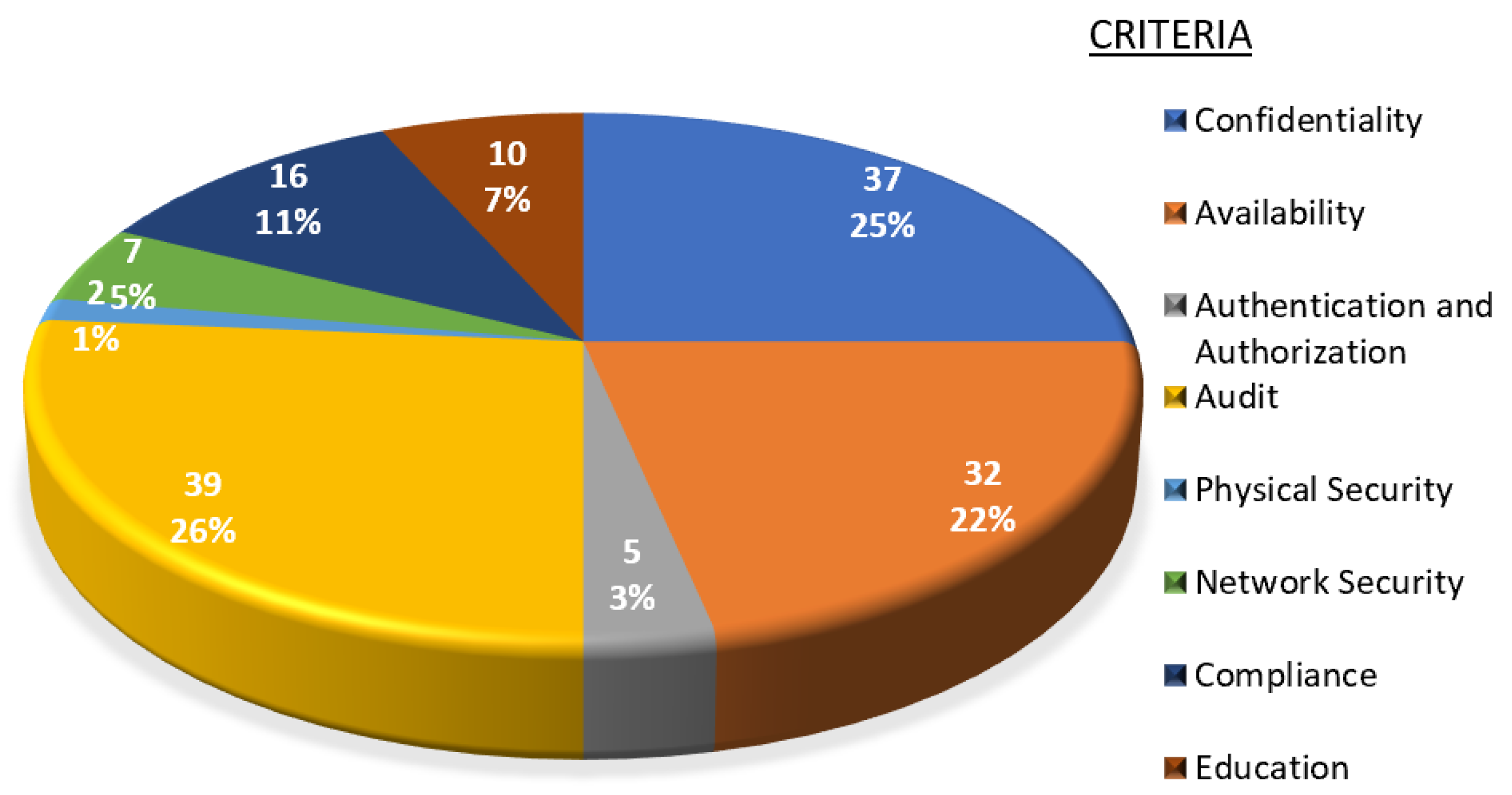
- Confidentiality: Protection of data from unauthorized access, typically enforced through encryption, access control, or zero-knowledge proofs.
- Availability: Guaranteed access to data and services under normal and adverse conditions (e.g., DDoS resilience and fault tolerance).
- Authentication and Authorization: Verification of user identity (authentication) and enforcement of access rights (authorization), often via digital signatures or role-based policies.
- Auditability: Ability to trace and verify all transactions or data modifications through an immutable, time-stamped ledger, enabling forensic analysis and accountability.
- Compliance: Adherence to legal or regulatory frameworks (e.g., GDPR and eIDAS), including data minimization, purpose limitation, and right-to-erasure mechanisms.
- Network Security: Protection of data in transit and infrastructure integrity (e.g., secure P2P communication, resistance to Sybil, or eclipse attacks).
- Physical Security: Safeguards against hardware tampering or physical access to nodes (rarely addressed in the blockchain literature).
- Education: Inclusion of training, awareness, or usability components to support secure adoption.
3. Review Method
3.1. Research Problems and Objectives
- RQ1: What criteria are used to evaluate the effectiveness of blockchain technology?
- RQ2: What types of computational supports, such as frameworks and software architectures, are available for implementing blockchain?
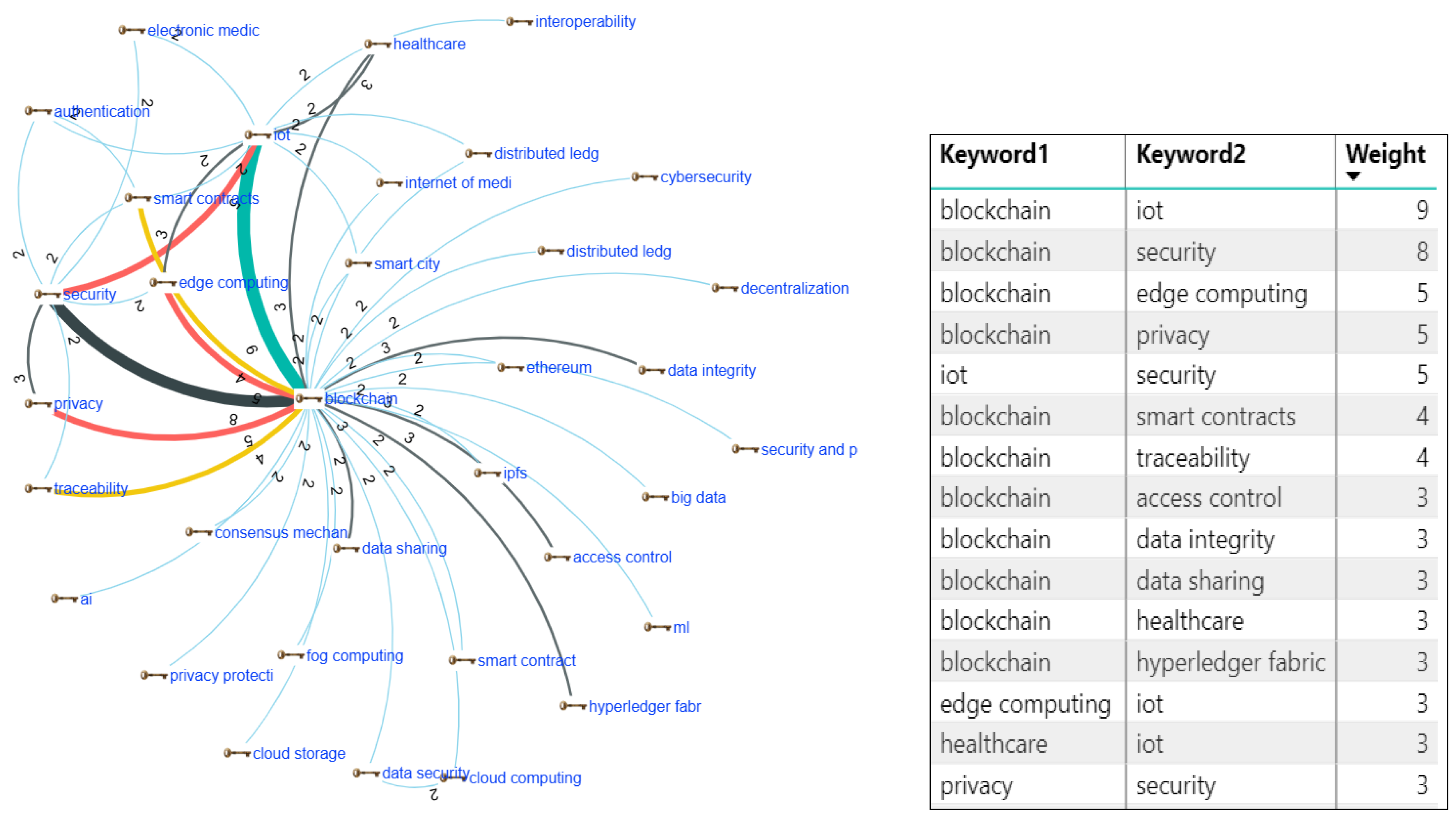
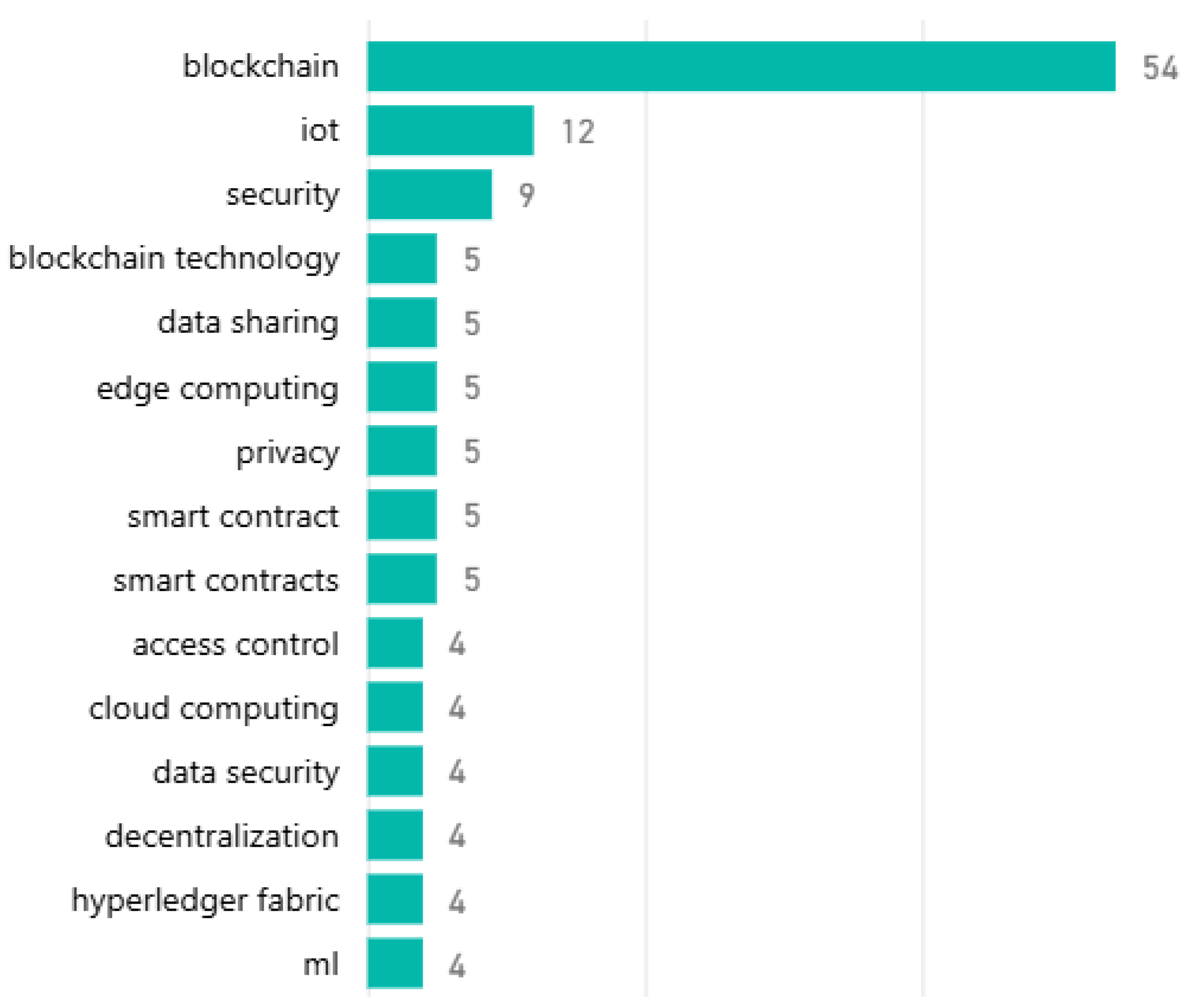
- RQ3: What keywords commonly co-occur in research on the impact of blockchain on data management security?
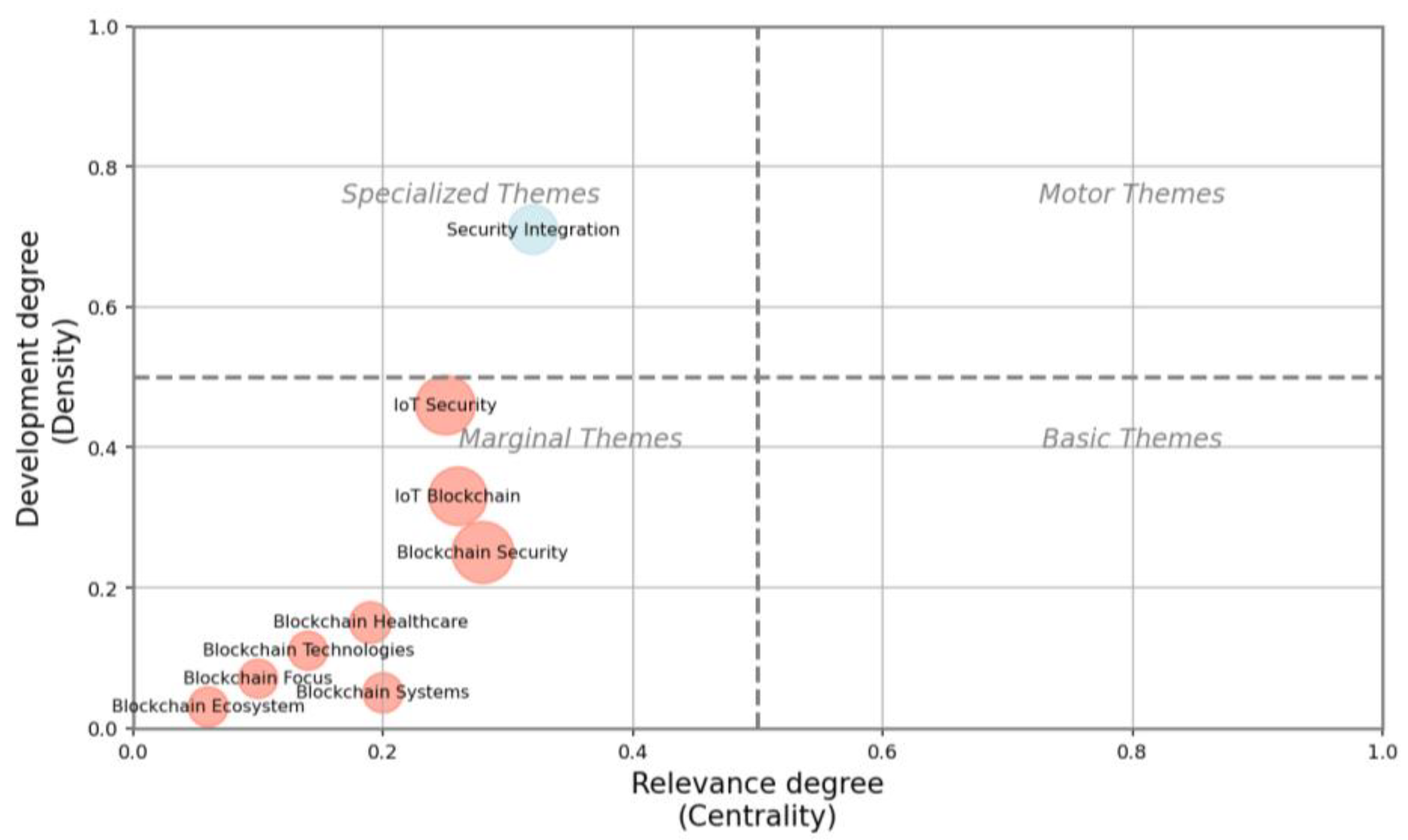
- RQ4: What are the thematic categories of blockchain and their impact on data management security in organizations?
3.2. Information Sources and Search Strategies
- Blockchain/blockchain technology.
- Data management security/data security/data protection/data administration/data management.
3.3. Study Selection
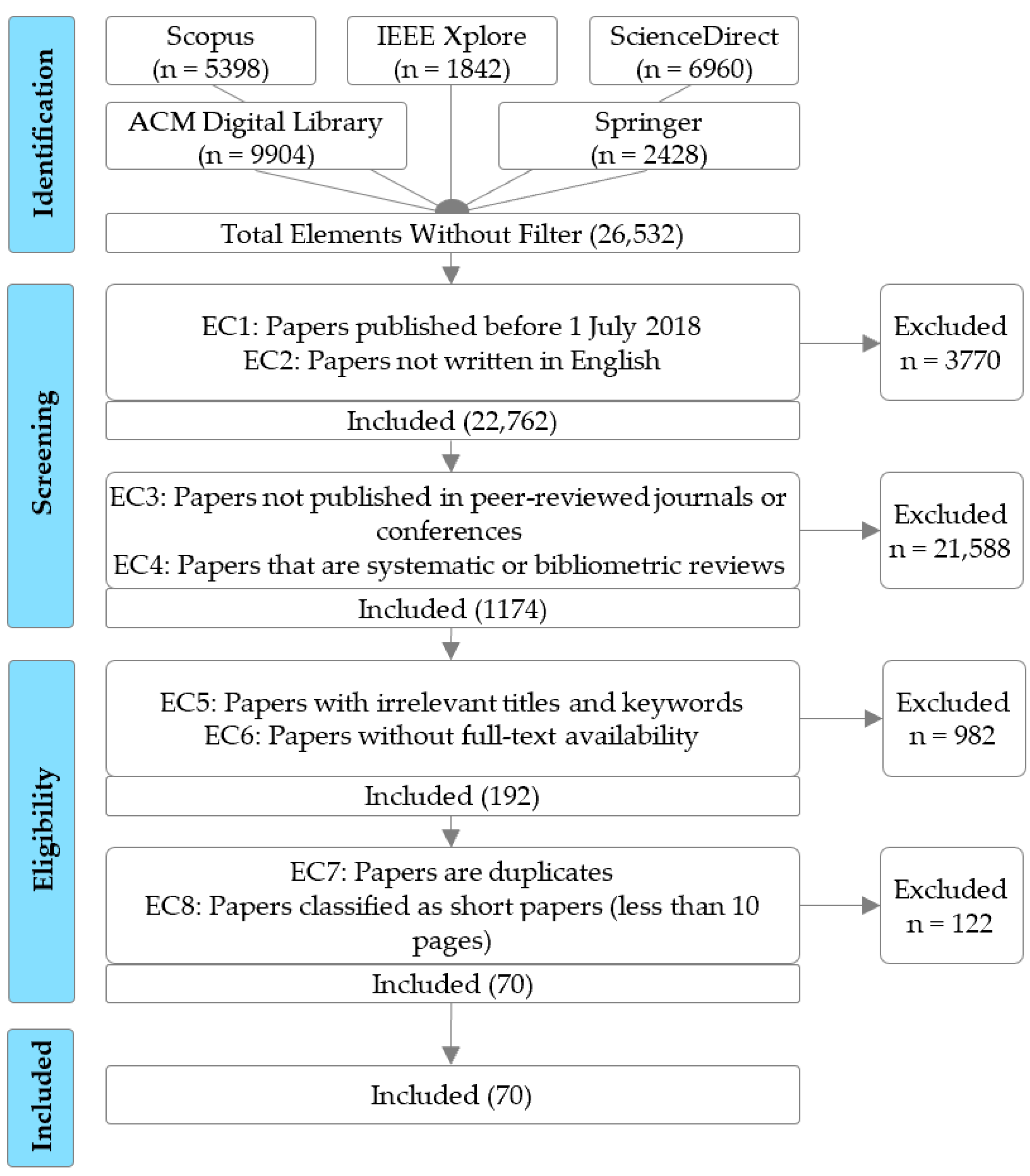
- EC1: Papers published before 1 July 2018.
- EC2: Papers not written in English.
- EC3: Papers not published in peer-reviewed journals or conferences.
- EC4: Papers that are systematic or bibliometric reviews.
- EC5: Papers with irrelevant titles and keywords.
- EC6: Papers without full-text availability.
- EC7: Papers that are not original.
- EC8: Papers classified as short papers (less than 10 pages).
3.4. Quality Assessment
- Are the research objectives clearly specified?
- Was the study designed to achieve these objectives?
- Are the techniques used clearly described, and is their selection justified?
- Are the data collection methods adequately described?
- Are the collected data adequately described?
- Are statistical techniques appropriately applied for data analysis, and are their uses justified?
- How clear are the links between the data, interpretation, and conclusions?
3.5. Data Extraction Strategies
3.6. Synthesis Approach and Heterogeneity Considerations
- Descriptive numerical summary (frequencies and percentages) to map the distribution of methods, criteria, and tools (RQ1–RQ2);
- Thematic coding and co-occurrence analysis (using Callon’s centrality–density method and cosine similarity) to identify conceptual clusters (RQ3–RQ4);
- Critical interpretive synthesis to uncover field-level patterns, such as the tension between technology-driven experimentation and governance-oriented research.
4. Results and Discussion
4.1. Overview of the Studies
4.2. Answers to the Research Questions
5. Conclusions and Future Research
Supplementary Materials
Author Contributions
Funding
Institutional Review Board Statement
Informed Consent Statement
Data Availability Statement
Conflicts of Interest
Appendix A. Data Extracted from the Reviewed Papers
| Ref. | Title | Source | Year | Summary | Citation No. | Keywords |
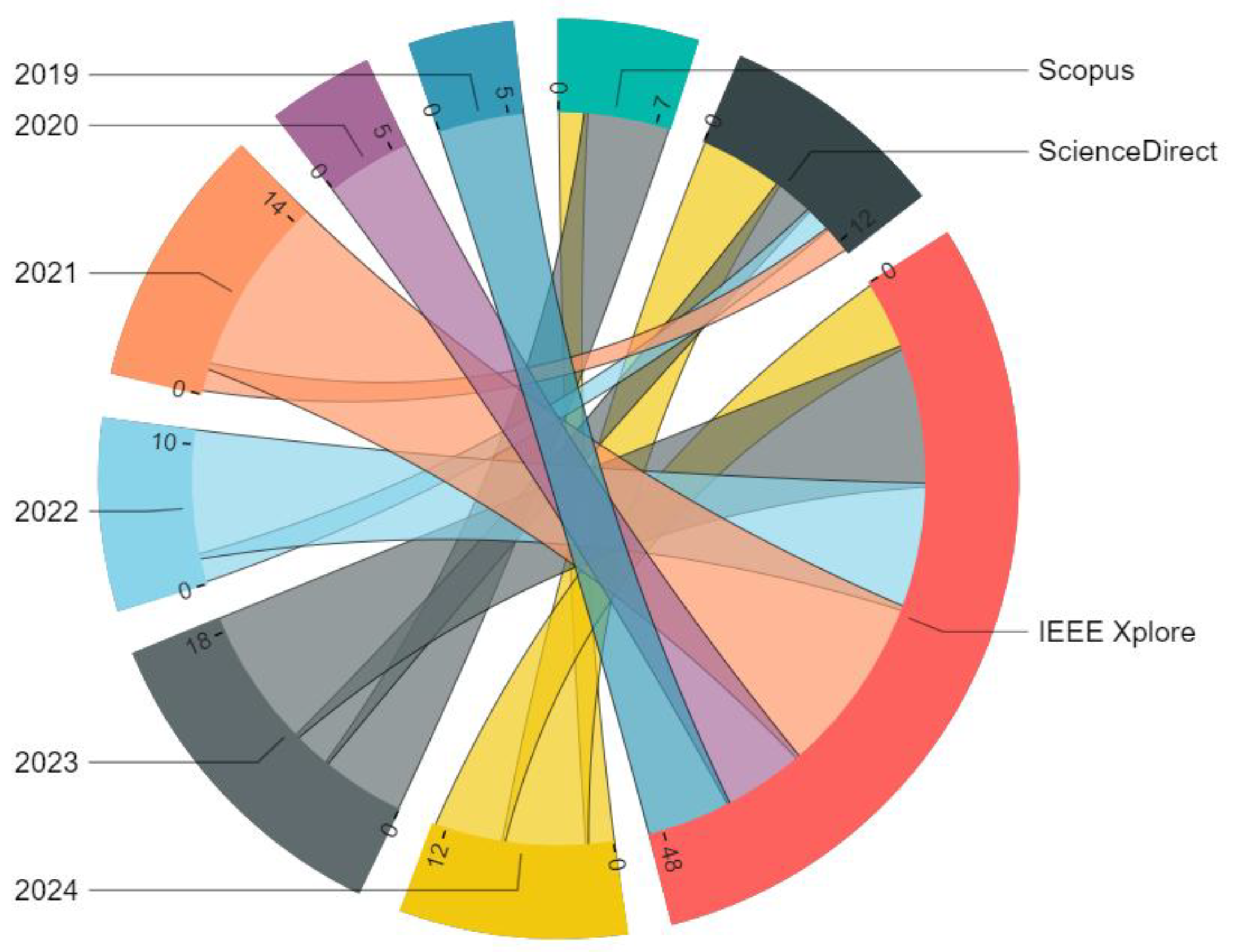
| [1] | EdgeMediChain: A Hybrid Edge Blockchain-Based Framework for Health Data Exchange | IEEE Xplore | 2020 | Recently, researchers around the world in medical institutions and pharmaceutical companies are demanding wider access to healthcare data for secondary use in order to provide enhanced and personalized medical services. For this purpose, healthcare information exchange between health authorities can be leveraged as a fundamental concept to meet these demands and enable the discovery of new insights and cures. However, health data are highly sensitive and private information requires strong authentication and authorization procedures to manage access to them. In this regard, cloud paradigms have been used in these e-healthcare solutions, but they remain inefficient due to their inability to adapt to the expanding volume of data generated from body sensors and their vulnerability against cyberattacks. Hence, collaborative and distributed data governance supported by edge computing and blockchain promises enormous potential in improving the performance and security of the whole system. In this paper, we present a secure and efficient data management framework, named ‘EdgeMediChain’, for sharing health data. The proposed architecture leverages both edge computing and blockchain to facilitate and provide the necessary requirements for a healthcare ecosystem in terms of scalability, security, as well as privacy. The Ethereum-based testbed evaluations show the effectiveness of EdgeMediChain in terms of execution time with a reduction of nearly 84.75% for 2000 concurrent transactions, higher throughput compared to a traditional blockchain, and scalable ledger storage with a linear growth rate. | 87 | blockchain, iot, data sharing, edge computing, electronic medical records, healthcare, privacy, security, smart contracts |
| [78] | Blockchain for Global Vaccinations Efforts: State of the Art, Challenges, and Future Directions | Scopus | 2023 | The emergence of the coronavirus disease 2019 (COVID-19) global crisis negatively affected all aspects of human life. One of the most important methods used worldwide to survive this global crisis is the vaccination process to circumvent the proliferation of this pandemic. Many restrictions were alleviated in many countries such as access to public facilities and events. There is a huge amount of data about vaccination campaigns that are collected and maintained worldwide. The vaccination data can be analyzed to find out how the alleviation of restrictions can be applied if the data management process requires the preservation of key aspects like trust, transparency, and availability for easy and reliable access to such data. In this regard, blockchain technology is an excellent choice for meeting the requirements and providing a secure trusted framework for global verification. In this article, the related literature on blockchain technology is surveyed and summarized for all systems that embody solutions. The pros and cons of each solution are presented and provide a comparative summary. Furthermore, a detailed analysis is given to present the current problems and provide a promising mechanism to verify the vaccinated persons anywhere in the world, in a secure manner while retaining individual privacy. | 0 | blockchain, coronavirus disease 2019, decentralization, Ethereum, immunization, Merkle proof, vaccination |
| [2] | A Blockchain-Based Consent Mechanism for Access to Fitness Data in the Healthcare Context | IEEE Xplore | 2022 | Wearable fitness devices are widely used to track an individual’s health and physical activities to improve the quality of health services. These devices sense a considerable amount of sensitive data processed by a centralized third party. While many researchers have thoroughly evaluated privacy issues surrounding wearable fitness trackers, no study has addressed privacy issues in trackers by giving control of the data to the user. Blockchain is an emerging technology with outstanding advantages in resolving consent management privacy concerns. As there are no fully transparent, legally compliant solutions for sharing personal fitness data, this study introduces an architecture for a human-centric, legally compliant, decentralized, and dynamic consent system based on blockchain and smart contracts. Algorithms and sequence diagrams of the proposed system’s activities show consent-related data flow among various agents, which are used later to prove the system’s trustworthiness by formalizing the security requirements. The security properties of the proposed system were evaluated using the formal security modeling framework SeMF, which demonstrates the feasibility of the solution at an abstract level based on formal language theory. As a result, we have shown that blockchain technology is suitable for mitigating the privacy issues of fitness providers by recording individuals’ consent using blockchain and smart contracts. | 12 | blockchain, data protection, decentralized, fitness tracker, human-centric, privacy, regulation, security requirements, trust, wearable devices |
| [5] | Applying Access Control Enabled Blockchain (ACE-BC) Framework to Manage Data Security in the CIS System | Scopus | 2023 | Cybersecurity information sharing (CIS) is important in different business processes to secure data transmission because it comprises Internet of Things (IoT) connectivity, workflow automation, collaboration, and communication. The shared information is influenced by intermediate users and alters the originality of the information. Although risk factors such as confidentiality and privacy of the data are reduced when using a cyber defense system, existing techniques rely on a centralized system that may be damaged during an accident. In addition, private information sharing faces rights issues when accessing sensitive information. The research issues influence trust, privacy, and security in a third-party environment. Therefore, this work uses the Access Control Enabled Blockchain (ACE-BC) framework to enhance overall data security in CIS. The ACE-BC framework uses attribute encryption techniques to manage data security, while the access control mechanism limits unauthorized user access. The effective utilization of blockchain techniques ensures overall data privacy and security. The efficiency of the introduced framework was evaluated using experimental results, and the experimental outcome indicated that the recommended ACE-BC framework enhanced the data confidentiality ratio (98.9%), the throughput ratio (98.2%), the efficiency ratio (97.4%), and the latency rate (10.9%) when compared to other popular models. | 5 | access control enabled blockchain (ace-bc), blockchain, cyber information sharing, privacy, security, unauthorized users |
| [16] | DHT- and Blockchain-Based Smart Identification for Video Conferencing | ScienceDirect | 2022 | Video conferencing applications help people communicate via the Internet and provide a significant and consistent basis for virtual meetings. However, integrity, security, identification, and authentication problems are still universal. Current video conference technologies typically rely on cloud systems to provide a stable and secure basis for executing tasks and processes. At the same time, video conferencing applications are being migrated from centralized to decentralized solutions for better performance without the need for third-party interactions. This article demonstrates a decentralized smart identification scheme for video conferencing applications based on biometric technology, machine learning, and a decentralized hash table combined with blockchain technology. We store users’ information on a distributed hash table and transactional events on the distributed ledger after identifying users by implementing machine learning functions. Furthermore, we leverage distributed ledger technology’s immutability and traceability properties and distributed the hash table’s unlimited storage feature to improve the system’s storage capacity and immutability by evaluating three possible architectures. The experimental results show that an architecture based on blockchain and distributed hash tables has better efficiency but needs a longer time to execute than the two other architectures using a centralized database. | 7 | blockchain, decentralized web hosting, ipfs, ml, video conferencing |
| [73] | Blockchain-Based Decentralized Storage Design for Data Confidence Over Cloud-Native Edge Infrastructure | IEEE Xplore | 2024 | As the modern computing market experiences a surge in demand for efficient data management solutions, challenges posed by centralized storage systems become more pronounced, especially with the proliferation of Internet of Things devices. Centralized storage, although cost-effective, faces issues of scalability, performance bottlenecks, and security vulnerabilities. With decentralized storage, data are distributed across nodes, offering redundancy, data availability, and enhanced security. Unfortunately, decentralized storage introduces its own challenges, such as complex data retrieval processes, potential inconsistencies in data versions, and difficulties in ensuring data privacy and integrity in a distributed setup. Effectively managing these challenges calls for innovative techniques. In response, this paper introduces a decentralized storage system that melds cloud-native concepts with blockchain technology. The proposed design delivers enhanced scalability, data security, and privacy. When operating on a containerized edge infrastructure, this storage system provides higher data-transfer speeds than the interplanetary file system. This research thus blends the advantages of cloud-native frameworks with the security mechanisms of blockchain, crafting a storage system that addresses the present-day challenges of data management in decentralized settings. | 0 | edge computing, blockchain, cloud-native orchestration, distributed storage |
| [74] | Data Sharing Network Model and Mechanism of Power Internet of Things in Virtualized Environment | IEEE Xplore | 2022 | To solve the problems of low security and low reliability in data sharing, this paper proposes a data sharing network model and mechanism of power Internet of Things in a virtualized environment. Due to the different coverage of the power Internet of Things, this paper proposes a node model based on the node network theory of blockchain technology. This model divides network nodes into data consumer nodes, data storage nodes, routing nodes, and coordination nodes according to business requirements. Through the cooperation of the four types of nodes, data sharing between multiple power Internet of Things can be realized efficiently. To solve the problem of low security in data sharing, this paper constructs a data transmission contribution analysis model of network nodes and a data access authorization model. The data transmission contribution degree model can fairly evaluate the behavior of network nodes based on the contribution degree, so as to quickly find malicious nodes. The data access authorization model calculates the entropy weight of each Internet of Things according to the trust level, thereby calculating the credibility of data sharing. To solve the problem of low transmission reliability of network nodes, a set of alternative links is constructed for data sharing routes. With load balancing as the goal, a relative cost value evaluation model is constructed for each route. The shortest route with the best relative cost value is regarded as the optimal data sharing route. In the simulation experiment, the related mechanisms are first improved based on the mechanism of this paper, which verifies that the mechanism of this paper improves the utilization and reliability of network resources in terms of data sharing routing. Secondly, it is verified that the mechanism of this paper improves the success rate and availability rate of network resources in terms of data security sharing. | 3 | Power internet of things, data sharing, network model, sharing mechanism |
| [75] | Data Security Sharing and Storage Based on a Consortium Blockchain in a Vehicular Ad hoc Network | IEEE Xplore | 2019 | A vehicular ad hoc network (VANET) can improve the flow of traffic to facilitate intelligent transportation and to provide convenient information services, where the goal is to provide self-organizing data transmission capabilities for vehicles on the road to enable applications, such as assisted vehicle driving and safety warnings. VANETs are affected by issues such as identity validity and message reliability when vehicle nodes share data with other nodes. The method used to allow the vehicle nodes to upload sensor data to a trusted center for storage is susceptible to security risks, such as malicious tampering and data leakage. To address these security challenges, we propose a data security sharing and storage system based on the consortium blockchain (DSSCB). This digital signature technique based on the nature of bilinear pairing for elliptic curves is used to ensure reliability and integrity when transmitting data to a node. The emerging consortium blockchain technology provides a decentralized, secure, and reliable database, which is maintained by the entire network node. In DSSCB, smart contracts are used to limit the triggering conditions for preselected nodes when transmitting and storing data and for allocating data coins to vehicles that participate in the contribution of data. The security analysis and performance evaluations demonstrated that our DSSCB solution is more secure and reliable in terms of data sharing and storage. Compared with the traditional blockchain system, the time required to confirm the data block was reduced by nearly six times and the transmission efficiency was improved by 83.33%. | 208 | consortium blockchain, data sharing, data storage, signature verification, vehicular ad hoc network (vanet) |
| [76] | A Blockchain-Based Efficient Data Integrity Verification Scheme in Multi-Cloud Storage | IEEE Xplore | 2022 | The cloud storage service provides the storage and access function for massive data, reducing the management cost for large amounts of data. The data integrity verification scheme in cloud storage can be employed to help users confirm the integrity of outsourced data. Although public data integrity verification schemes allow users to outsource data integrity verification to third-party auditor (TPA), there are still many problems with centralized TPA in terms of security and efficiency. In recent years, researchers have tried to apply blockchain technology to solve the centralization problem of traditional methods, but these schemes do not pay attention to the problem of efficiency degradation caused by the use of blockchain technology. This paper proposes an efficient data integrity verification scheme for multi-cloud storage services by using blockchain technology. The overall verification can verify the integrity of multiple CSPs, which solves the problems of low computational efficiency. Local verification can trace the source to the specific damaged CSP, which is more secure and reliable. In addition, this paper puts the data verification process directly in the blockchain for public execution and provides data integrity verification services without the assistance of any third-party audit platform, avoiding the security problems caused by untrusted TPA. Theoretical analysis and experiments verify the safety and effectiveness of the scheme. | 8 | cloud computing security, blockchain, data integrity, data security |
| [77] | A Blockchain Solution for Remote Sensing Data Management Model | Scopus | 2023 | A large number of raw data collected by satellites are processed by the production chain to obtain a large number of product data, of which the secure exchange and storage is of interest to researchers in the field of remote sensing information science. Authentic, secure data provide a critical foundation for data analysis and decision-making. Traditional centralized cloud computing systems are vulnerable to attack and, once the central server is successfully attacked, all data are be lost. Distributed ledger technology (DLT) is an innovative computer technology that can ensure information security and traceability, is tamper-proof, and can be applied to the field of remote sensing. Although there are many advantages to using DLT in remote sensing applications, there are some obstacles and limitations to its application. Remote sensing data have the characteristics of a large data volume, a spatiotemporal nature, global scale, and so on, and it is difficult to store and interconnect remote sensing data in the blockchain. To address these issues, this paper proposes a trustworthy and decentralized system using blockchain technology. The novelty of this paper is the proposal of a multi-level blockchain architecture in which the system collects remote sensing data and stores them in the Interplanetary File System (IPFS) network; after generating the IPFS hash, the network rehashes the value again and uploads it on the Ethereum chain for public query. The distributed data storage improves data security, supports the secure exchange of information, and improves the efficiency of data management. | 1 | blockchain, distributed ledger technology, remote sensing data management, security, trusted service |
Appendix B. Full Co-Occurrence Matrix
| Keyword1 | Keyword2 | Weight |
| blockchain | iot | 9 |
| blockchain | security | 8 |
| blockchain | edge computing | 5 |
| blockchain | privacy | 5 |
| iot | security | 5 |
| blockchain | smart contracts | 4 |
| blockchain | traceability | 4 |
| blockchain | access control | 3 |
| blockchain | data integrity | 3 |
| blockchain | data sharing | 3 |
| blockchain | healthcare | 3 |
| blockchain | hyperledger fabric | 3 |
| edge computing | iot | 3 |
| healthcare | iot | 3 |
| privacy | security | 3 |
| authentication | smart contracts | 2 |
| blockchain | ai | 2 |
| blockchain | big data | 2 |
| blockchain | cloud computing | 2 |
| blockchain | cloud storage | 2 |
| blockchain | consensus mechanism | 2 |
| blockchain | cybersecurity | 2 |
| blockchain | data security | 2 |
| blockchain | decentralization | 2 |
| blockchain | distributed ledger | 2 |
| blockchain | distributed ledger technology | 2 |
| blockchain | ethereum | 2 |
| blockchain | fog computing | 2 |
| blockchain | internet of medical things | 2 |
| blockchain | ipfs | 2 |
| blockchain | ml | 2 |
| blockchain | privacy protection | 2 |
| blockchain | security and privacy | 2 |
| blockchain | smart city | 2 |
| blockchain | smart contract | 2 |
| cloud computing | data security | 2 |
| edge computing | security | 2 |
| electronic medical records | iot | 2 |
| electronic medical records | security | 2 |
| iot | authentication | 2 |
| iot | distributed ledger technology | 2 |
| iot | internet of medical things | 2 |
| iot | interoperability | 2 |
| iot | smart city | 2 |
| iot | smart contracts | 2 |
| security | authentication | 2 |
| security | smart contracts | 2 |
| security | traceability | 2 |
References
- Akkaoui, R.; Hei, X.; Cheng, W. EdgeMediChain: A Hybrid Edge Blockchain-Based Framework for Health Data Exchange. IEEE Access 2020, 8, 113467–113486. [Google Scholar] [CrossRef]
- Alhajri, M.; Rudolph, C.; Shahraki, A.S. A Blockchain-Based Consent Mechanism for Access to Fitness Data in the Healthcare Context. IEEE Access 2022, 10, 22960–22979. [Google Scholar] [CrossRef]
- Deep, A.; Perrusquia, A.; Aljaburi, L.; Al-Rubaye, S.; Guo, W. A Novel Distributed Authentication of Blockchain Technology Integration in IoT Services. IEEE Access 2024, 12, 9550–9562. [Google Scholar] [CrossRef]
- Ezawa, Y.; Kakei, S.; Shiraishi, Y.; Mohri, M.; Morii, M. Blockchain-Based Cross-Domain Authorization System for User-Centric Resource Sharing. Blockchain Res. Appl. 2023, 4, 100126. [Google Scholar] [CrossRef]
- Alharbi, A. Applying Access Control Enabled Blockchain (ACE-BC) Framework to Manage Data Security in the CIS System. Sensors 2023, 23, 3020. [Google Scholar] [CrossRef]
- Alohali, M.A.; Aljebreen, M.; Al-Mutiri, F.; Othman, M.; Motwakel, A.; Alsaid, M.I.; Alneil, A.A.; Osman, A.E. Blockchain-Driven Image Encryption Process with Arithmetic Optimization Algorithm for Security in Emerging Virtual Environments. Sustainability 2023, 15, 5133. [Google Scholar] [CrossRef]
- Hao, K.; Xin, J.; Wang, Z.; Cao, K.; Wang, G. Blockchain-Based Outsourced Storage Schema in Untrusted Environment. IEEE Access 2019, 7, 122707–122721. [Google Scholar] [CrossRef]
- Bobde, Y.; Narayanan, G.; Jati, M.; Raj, R.S.P.; Cvitić, I.; Peraković, D. Enhancing Industrial IoT Network Security through Blockchain Integration. Electronics 2024, 13, 687. [Google Scholar] [CrossRef]
- Hanggoro, D.; Windiatmaja, J.H.; Muis, A.; Sari, R.F.; Pournaras, E. Energy-Aware Proof-of-Authority: Blockchain Consensus for Clustered Wireless Sensor Network. Blockchain Res. Appl. 2024, 5, 100211. [Google Scholar] [CrossRef]
- Kiania, K.; Jameii, S.M.; Rahmani, A.M. Blockchain-Based Privacy and Security Preserving in Electronic Health: A Systematic Review. Multimed. Tools Appl. 2023, 82, 28493–28519. [Google Scholar] [CrossRef]
- Chukwu, E.; Garg, L. A Systematic Review of Blockchain in Healthcare: Frameworks, Prototypes, and Implementations. IEEE Access 2020, 8, 21196–21214. [Google Scholar] [CrossRef]
- Popay, J.; Roberts, H.; Sowden, A.; Petticrew, M.; Arai, L.; Rodgers, M.; Britten, N.; Roen, K.; Duffy, S. Guidance on the Conduct of Narrative Synthesis in Systematic Reviews: A Product from the ESRC Methods Programme; Institute for Health Research, Lancaster University: Lancaster, UK, 2006. [Google Scholar] [CrossRef]
- El Bekkali, A.; Essaaidi, M.; Boulmalf, M. A Blockchain-Based Architecture and Framework for Cybersecure Smart Cities. IEEE Access 2023, 11, 76359–76370. [Google Scholar] [CrossRef]
- Bhattacharya, P.; Saraswat, D.; Dave, A.; Acharya, M.; Tanwar, S.; Sharma, G.; Davidson, I.E. Coalition of 6G and Blockchain in AR/VR Space: Challenges and Future Directions. IEEE Access 2021, 9, 168455–168484. [Google Scholar] [CrossRef]
- Sadri, H.; Yitmen, I.; Tagliabue, L.C.; Westphal, F.; Tezel, A.; Taheri, A.; Sibenik, G. Integration of Blockchain and Digital Twins in the Smart Built Environment Adopting Disruptive Technologies—A Systematic Review. Sustainability 2023, 15, 3713. [Google Scholar] [CrossRef]
- Alizadeh, M.; Andersson, K.; Schelén, O. DHT- and Blockchain-Based Smart Identification for Video Conferencing. Blockchain Res. Appl. 2022, 3, 100066. [Google Scholar] [CrossRef]
- Dieye, M.; Valiorgue, P.; Gelas, J.-P.; Diallo, E.-H.; Ghodous, P.; Biennier, F.; Peyrol, É. A Self-Sovereign Identity Based on Zero-Knowledge Proof and Blockchain. IEEE Access 2023, 11, 49445–49455. [Google Scholar] [CrossRef]
- Ghani, M.A.N.U.; She, K.; Rauf, M.A.; Khan, S.; Khan, J.A.; Aldakheel, E.A.; Khafaga, D.S. Enhancing Security and Privacy in Distributed Face Recognition Systems through Blockchain and GAN Technologies. Comput. Mater. Contin. 2024, 79, 2609–2623. [Google Scholar] [CrossRef]
- Cao, S.; Foth, M.; Powell, W.; Miller, T.; Li, M. A Blockchain-Based Multisignature Approach for Supply Chain Governance: A Use Case from the Australian Beef Industry. Blockchain Res. Appl. 2022, 3, 100091. [Google Scholar] [CrossRef]
- Cha, S.; Baek, S.; Kim, S. Blockchain-Based Sensitive Data Management by Using Key Escrow Encryption System from the Perspective of Supply Chain. IEEE Access 2020, 8, 154269–154280. [Google Scholar] [CrossRef]
- Faisal, M.N.; Bin Sabir, L.; Al Naimi, M.S.; Sharif, K.J.; Uddin, S.M.F. Critical Role of Coopetition Among Supply Chains for Blockchain Adoption: Review of Reviews and Mixed-Method Analysis. Glob. J. Flex. Syst. Manag. 2024, 25, 117–136. [Google Scholar] [CrossRef]
- Gottlieb, M.; Deutsch, C.; Hoops, F.; Pongratz, H.; Krcmar, H. Expedition to the Blockchain Application Potential for Higher Education Institutions. Blockchain Res. Appl. 2024, 5, 100203. [Google Scholar] [CrossRef]
- Han, S.; Park, S. A Gap Between Blockchain and General Data Protection Regulation: A Systematic Review. IEEE Access 2022, 10, 103888–103905. [Google Scholar] [CrossRef]
- Gamboa-Cruzado, J.; Mendoza-Chate, L.A.; Ventocilla-Sanchez, A.; López-Goycochea, J.; Ramirez Villacorta, J. UYAKUY-Blockchain-Based Software Application for Certificate Issuance: A Case Study in the IEEE Peru Section. J. Theor. Appl. Inf. Technol. 2023, 101, 20. [Google Scholar]
- Haugum, T.; Hoff, B.; Alsadi, M.; Li, J. Security and privacy challenges in blockchain interoperability—A multivocal literature review. In Proceedings of the 26th International Conference on Evaluation and Assessment in Software Engineering, Gothenburg, Sweden, 13–15 June 2022. [Google Scholar] [CrossRef]
- Nasir, A.; Shaukat, K.; Khan, K.I.; Hameed, I.A.; Alam, T.M.; Luo, S. What is Core and What Future Holds for Blockchain Technologies and Cryptocurrencies: A Bibliometric Analysis. IEEE Access 2021, 9, 989–1004. [Google Scholar] [CrossRef]
- Xu, M.; Chen, X.; Kou, G. A Systematic Review of Blockchain. Financ. Innov. 2019, 5, 27. [Google Scholar] [CrossRef]
- PRISMA: Preferred Reporting Items for Systematic Reviews and Meta-Analyses. Available online: https://www.prisma-statement.org/ (accessed on 18 July 2025).
- Awadallah, R.; Samsudin, A.; Sen Teh, J.; Almazrooie, M. An Integrated Architecture for Maintaining Security in Cloud Computing Based on Blockchain. IEEE Access 2021, 9, 69513–69526. [Google Scholar] [CrossRef]
- Cao, P.; Duan, G.; Tu, J.; Jiang, Q.; Yang, X.; Li, C. Blockchain-Based Process Quality Data Sharing Platform for Aviation Suppliers. IEEE Access 2023, 11, 19007–19023. [Google Scholar] [CrossRef]
- Ferro, E.; Saltarella, M.; Rotondi, D.; Giovanelli, M.; Corrias, G.; Moncada, R.; Cavallaro, A.; Favenza, A. Digital Assets Rights Management through Smart Legal Contracts and Smart Contracts. Blockchain Res. Appl. 2023, 4, 100142. [Google Scholar] [CrossRef]
- Hu, W.; Yao, W.; Hu, Y.; Li, H. Collaborative Optimization of Distributed Scheduling Based on Blockchain Consensus Mechanism Considering Battery-Swap Stations of Electric Vehicles. IEEE Access 2019, 7, 137959–137967. [Google Scholar] [CrossRef]
- Singh, S.; Hosen, A.S.M.S.; Yoon, B. Blockchain Security Attacks, Challenges, and Solutions for the Future Distributed IoT Network. IEEE Access 2021, 9, 13938–13959. [Google Scholar] [CrossRef]
- ISO/IEC 27001; Information Security, Cybersecurity and Privacy Protection—Information Security management Systems—Requirements. ISO: Geneva, Switzerland, 2022.
- Junaid, L.; Bilal, K.; Shuja, J.; Balogun, A.O.; Rodrigues, J.J.P.C. Blockchain-Enabled Framework for Transparent Land Lease and Mortgage Management. IEEE Access 2024, 12, 54005–54018. [Google Scholar] [CrossRef]
- Paik, H.Y.; Xu, X.; Bandara, H.M.N.D.; Lee, S.U.; Lo, S.K. Analysis of Data Management in Blockchain-Based Systems: From Architecture to Governance. IEEE Access 2019, 7, 186091–186107. [Google Scholar] [CrossRef]
- Mothukuri, V.; Cheerla, S.S.; Parizi, R.M.; Zhang, Q.; Choo, K.K.R. BlockHDFS: Blockchain-Integrated Hadoop Distributed File System for Secure Provenance Traceability. Blockchain Res. Appl. 2021, 2, 100032. [Google Scholar] [CrossRef]
- Kitchenham, B.; Brereton, O.P.; Budgen, D.; Turner, M.; Bailey, J.; Linkman, S. Systematic Literature Reviews in Software Engineering-A Systematic Literature Review. Inf. Softw. Technol. 2009, 51, 7–15. [Google Scholar] [CrossRef]
- Hsiao, S.J.; Sung, W.T. Employing Blockchain Technology to Strengthen Security of Wireless Sensor Networks. IEEE Access 2021, 9, 72326–72341. [Google Scholar] [CrossRef]
- Itoo, S.; Khan, A.A.; Kumar, V.; Alkhayyat, A.; Ahmad, M.; Srinivas, J. CKMIB: Construction of Key Agreement Protocol for Cloud Medical Infrastructure Using Blockchain. IEEE Access 2022, 10, 67787–67801. [Google Scholar] [CrossRef]
- Miao, Y.; Huang, Q.; Xiao, M.; Li, H. Decentralized and Privacy-Preserving Public Auditing for Cloud Storage Based on Blockchain. IEEE Access 2020, 8, 139813–139826. [Google Scholar] [CrossRef]
- Na, D.; Park, S. Blockchain-Based Dashcam Video Management Method for Data Sharing and Integrity in V2V Network. IEEE Access 2022, 10, 3307–3319. [Google Scholar] [CrossRef]
- Sasikumar, A.; Ravi, L.; Devarajan, M.; Vairavasundaram, S.; Selvalakshmi, A.; Kotecha, K.; Abraham, A. A Decentralized Resource Allocation in Edge Computing for Secure IoT Environments. IEEE Access 2023, 11, 117177–117189. [Google Scholar] [CrossRef]
- Sasikumar, A.; Ravi, L.; Kotecha, K.; Abraham, A.; Devarajan, M.; Vairavasundaram, S. A Secure Big Data Storage Framework Based on Blockchain Consensus Mechanism with Flexible Finality. IEEE Access 2023, 11, 56712–56725. [Google Scholar] [CrossRef]
- Shakor, M.Y.; Khaleel, M.I.; Safran, M.; Alfarhood, S.; Zhu, M. Dynamic AES Encryption and Blockchain Key Management: A Novel Solution for Cloud Data Security. IEEE Access 2024, 12, 26334–26343. [Google Scholar] [CrossRef]
- Wang, Y.; Zhang, A.; Zhang, P.; Wang, H. Cloud-Assisted EHR Sharing with Security and Privacy Preservation via Consortium Blockchain. IEEE Access 2019, 7, 136704–136719. [Google Scholar] [CrossRef]
- Zaidi, T.; Usman, M.; Aftab, M.U.; Aljuaid, H.; Ghadi, Y.Y. Fabrication of Flexible Role-Based Access Control Based on Blockchain for Internet of Things Use Cases. IEEE Access 2023, 11, 106315–106333. [Google Scholar] [CrossRef]
- Iqbal, N.; Jamil, F.; Ahmad, S.; Kim, D. A Novel Blockchain-Based Integrity and Reliable Veterinary Clinic Information Management System Using Predictive Analytics for Provisioning of Quality Health Services. IEEE Access 2021, 9, 8069–8098. [Google Scholar] [CrossRef]
- Umran, S.M.; Lu, S.; Abduljabbar, Z.A.; Tang, X. A Blockchain-Based Architecture for Securing Industrial IoTs Data in Electric Smart Grid. Comput. Mater. Contin. 2023, 74, 5389–5416. [Google Scholar] [CrossRef]
- Mantey, E.A.; Zhou, C.; Anajemba, J.H.; Hamid, Y.; Arthur, J.K. Blockchain-Enabled Technique for Privacy-Preserved Medical Recommender System. IEEE Access 2023, 11, 40944–40953. [Google Scholar] [CrossRef]
- Mohammad, F.; Al-Ahmadi, S.; Al-Muhtadi, J. Block-Deep: A Hybrid Secure Data Storage and Diagnosis Model for Bone Fracture Identification of Athlete from X-Ray and MRI Images. IEEE Access 2023, 11, 142360–142370. [Google Scholar] [CrossRef]
- Rathore, S.; Park, J.H.; Chang, H. Deep Learning and Blockchain-Empowered Security Framework for Intelligent 5G-Enabled IoT. IEEE Access 2021, 9, 90075–90083. [Google Scholar] [CrossRef]
- Rawlins, C.C.; Jagannathan, S. An Intelligent Distributed Ledger Construction Algorithm for IoT. IEEE Access 2022, 10, 10838–10851. [Google Scholar] [CrossRef]
- Wu, F.; Zhou, B.; Jiang, J.; Lei, T.; Song, J. Blockchain Privacy Protection Based on Post Quantum Threshold Algorithm. Comput. Mater. Contin. 2023, 76, 957–973. [Google Scholar] [CrossRef]
- Jin, L.; Liu, L.; Song, J. Delegated Computation Architecture and Implementation for Numerical Simulation of Electromagnetic Comprehensive Performance Under the Framework of Blockchain. IEEE Access 2023, 11, 61786–61799. [Google Scholar] [CrossRef]
- Kamal, R.; Hemdan, E.E.D.; El-Fishway, N. Care4U: Integrated Healthcare Systems Based on Blockchain. Blockchain Res. Appl. 2023, 4, 100151. [Google Scholar] [CrossRef]
- Khan, A.U.R.; Ahmad, R.W. A Blockchain-Based IoT-Enabled E-Waste Tracking and Tracing System for Smart Cities. IEEE Access 2022, 10, 86256–86269. [Google Scholar] [CrossRef]
- Li, H.; Pei, L.; Liao, D.; Chen, S.; Zhang, M.; Xu, D. FADB: A Fine-Grained Access Control Scheme for VANET Data Based on Blockchain. IEEE Access 2020, 8, 85190–85203. [Google Scholar] [CrossRef]
- Li, L.; Jin, D.; Zhang, T.; Li, N. A Secure, Reliable and Low-Cost Distributed Storage Scheme Based on Blockchain and IPFS for Firefighting IoT Data. IEEE Access 2023, 11, 97318–97330. [Google Scholar] [CrossRef]
- Li, X.; Huang, X.; Li, C.; Yu, R.; Shu, L. EdgeCare: Leveraging Edge Computing for Collaborative Data Management in Mobile Healthcare Systems. IEEE Access 2019, 7, 22011–22025. [Google Scholar] [CrossRef]
- Liu, Y.; Shan, G.; Liu, Y.; Alghamdi, A.; Alam, I.; Biswas, S. Blockchain Bridges Critical National Infrastructures: E-Healthcare Data Migration Perspective. IEEE Access 2022, 10, 28509–28519. [Google Scholar] [CrossRef]
- Luo, Z.; Zhang, H. Blockchain-Based Engine Data Trustworthy Swarm Learning Management Method. Blockchain Res. Appl. 2024, 5, 100185. [Google Scholar] [CrossRef]
- Padma, A.; Ramaiah, M. Blockchain-Based an Efficient and Secure Privacy Preserved Framework for Smart Cities. IEEE Access 2024, 12, 21985–22002. [Google Scholar] [CrossRef]
- Regueiro, C.; Gómez-Goiri, A.; Pedrosa, N.; Semertzidis, C.; Iturbe, E.; Mansell, J. Blockchain-Based Refurbishment Certification System for Enhancing the Circular Economy. Blockchain Res. Appl. 2024, 5, 100172. [Google Scholar] [CrossRef]
- Shynu, P.G.; Menon, V.G.; Kumar, R.L.; Kadry, S.; Nam, Y. Blockchain-Based Secure Healthcare Application for Diabetic-Cardio Disease Prediction in Fog Computing. IEEE Access 2021, 9, 45706–45720. [Google Scholar] [CrossRef]
- Stockburger, L.; Kokosioulis, G.; Mukkamala, A.; Mukkamala, R.R.; Avital, M. Blockchain-Enabled Decentralized Identity Management: The Case of Self-Sovereign Identity in Public Transportation. Blockchain Res. Appl. 2021, 2, 100014. [Google Scholar] [CrossRef]
- Tran, T.H.; Pham, H.L.; Nakashima, Y. A High-Performance Multimem SHA-256 Accelerator for Society 5.0. IEEE Access 2021, 9, 39182–39192. [Google Scholar] [CrossRef]
- Xiong, W.; Xiong, L. Data Trading Certification Based on Consortium Blockchain and Smart Contracts. IEEE Access 2021, 9, 3482–3496. [Google Scholar] [CrossRef]
- Yang, R.; Dong, G.; Xu, Z.; Ning, J.; Du, J. A Privacy-Preserving Data Aggregation System Based on Blockchain in VANET. Blockchain Res. Appl. 2024, 5, 100210. [Google Scholar] [CrossRef]
- Yang, Y.; Idris, N.B.; Yu, D.; Liu, C.; Wu, H. Decentralized Deepfake Task Management Algorithm Based on Blockchain and Edge Computing. IEEE Access 2024, 12, 86456–86469. [Google Scholar] [CrossRef]
- Yele, S.; Litoriya, R. Blockchain-Based Secure Dining: Enhancing Safety, Transparency, and Traceability in Food Consumption Environment. Blockchain Res. Appl. 2024, 5, 100187. [Google Scholar] [CrossRef]
- Yongjoh, S.; So-In, C.; Kompunt, P.; Muneesawang, P.; Morien, R.I. Development of an Internet-of-Healthcare System Using Blockchain. IEEE Access 2021, 9, 113017–113031. [Google Scholar] [CrossRef]
- Zang, H.; Kim, H.; Kim, J. Blockchain-Based Decentralized Storage Design for Data Confidence Over Cloud-Native Edge Infrastructure. IEEE Access 2024, 12, 50083–50099. [Google Scholar] [CrossRef]
- Zhang, S. Data Sharing Network Model and Mechanism of Power Internet of Things in Virtualized Environment. IEEE Access 2022, 10, 4252–4260. [Google Scholar] [CrossRef]
- Zhang, X.; Chen, X. Data Security Sharing and Storage Based on a Consortium Blockchain in a Vehicular Ad-Hoc Network. IEEE Access 2019, 7, 58241–58254. [Google Scholar] [CrossRef]
- Zhang, Y.; Geng, H.; Su, L.; Lu, L. A Blockchain-Based Efficient Data Integrity Verification Scheme in Multi-Cloud Storage. IEEE Access 2022, 10, 105920–105929. [Google Scholar] [CrossRef]
- Zou, Q.; Yu, W.; Bao, Z. A Blockchain Solution for Remote Sensing Data Management Model. Appl. Sci. 2023, 13, 9609. [Google Scholar] [CrossRef]
- Al-Muhtadi, J.; Hasan, A.; Saleem, K.; Gawanmeh, A.; Rodrigues, J.J.P.C. Blockchain for Global Vaccinations Efforts: State of the Art, Challenges, and Future Directions. Int. J. Electr. Comput. Eng. 2023, 13, 5576–5587. [Google Scholar] [CrossRef]
- Murthy, C.H.V.N.U.B.; Shri, M.L.; Kadry, S.; Lim, S. Blockchain-Based Cloud Computing: Architecture and Research Challenges. IEEE Access 2020, 8, 205190–205205. [Google Scholar] [CrossRef]
- Ramasamy, L.K.; Khan, F.K.P.; Imoize, A.L.; Ogbebor, J.O.; Kadry, S.; Rho, S. Blockchain-Based Wireless Sensor Networks for Malicious Node Detection: A Survey. IEEE Access 2021, 9, 128765–128785. [Google Scholar] [CrossRef]
- Indumathi, J.; Shankar, A.; Ghalib, M.R.; Gitanjali, J.; Hua, Q.; Wen, Z.; Qi, X. Block Chain Based Internet of Medical Things for Uninterrupted, Ubiquitous, User-Friendly, Unflappable, Unblemished, Unlimited Health Care Services (BC IoMT U6HCS). IEEE Access 2020, 8, 216856–216872. [Google Scholar] [CrossRef]
- Nicolas, K.; Wang, Y.; Giakos, G.C.; Wei, B.; Shen, H. Blockchain System Defensive Overview for Double-Spend and Selfish Mining Attacks: A Systematic Approach. IEEE Access 2021, 9, 3838–3857. [Google Scholar] [CrossRef]
- Truong, V.T.; Le, L.; Niyato, D. Blockchain Meets Metaverse and Digital Asset Management: A Comprehensive Survey. IEEE Access 2023, 11, 26258–26288. [Google Scholar] [CrossRef]
- AL-Ashmori, A.; Basri, S.B.; Dominic, P.D.D.; Capretz, L.F.; Muneer, A.; Balogun, A.O.; Gilal, A.R.; Ali, R.F. Classifications of Sustainable Factors in Blockchain Adoption: A Literature Review and Bibliometric Analysis. Sustainability 2022, 14, 5176. [Google Scholar] [CrossRef]
- Lizama, M.G.; Huesa, J.; Claudio, B.M. Use of Blockchain Technology for the Exchange and Secure Transmission of Medical Images in the Cloud: Systematic Review with Bibliometric Analysis. ASEAN J. Sci. Eng. 2024, 4, 71–92. [Google Scholar] [CrossRef]
- Yang, J.; Ma, C.; Li, D.; Liu, J. Mapping the Knowledge on Blockchain Technology in the Field of Business and Management: A Bibliometric Analysis. IEEE Access 2022, 10, 60585–60596. [Google Scholar] [CrossRef]
- Page, M.J.; McKenzie, J.E.; Bossuyt, P.M.; Boutron, I.; Hoffmann, T.C.; Mulrow, C.D.; Shamseer, L.; Tetzlaff, J.M.; Akl, E.A.; Brennan, S.E.; et al. The PRISMA 2020 statement: An updated guideline for reporting systematic reviews. BMJ 2021, 372, n71. [Google Scholar] [CrossRef] [PubMed]



| Source | Search Equation | No. of Docs. |
|---|---|---|
| Scopus | (TITLE-ABS-KEY (“blockchain” OR “blockchain technology”) AND TITLE-ABS-KEY (“data security” OR “data protection” OR “data administration” OR “data management” OR “security in data management”)) | 5398 |
| Springer | title: (blockchain OR “blockchain technology”) AND title: (security OR “data security” OR “data protection” OR “data administration” OR “data management”) | 2428 |
| IEEE Xplore | ((“Document Title”: “blockchain” OR “Document Title”: “blockchain technology” OR “Abstract”: “blockchain” OR “Abstract”: “blockchain technology” OR “Author Keywords”: “blockchain” OR “Author Keywords”: “blockchain technology”) AND (“Document Title”: “data security” OR “Document Title”: “data protection” OR “Document Title”: “data administration” OR “Document Title”: “data management” OR “Document Title”: “security in data management” OR “Abstract”: “data security” OR “Abstract”: “data protection” OR “Abstract”: “data administration” OR “Abstract”: “data management” OR “Abstract”: “security in data management” OR “Author Keywords”: “data security” OR “Author Keywords”: “data protection” OR “Author Keywords”: “data administration” OR “Author Keywords”: “data management” OR “Author Keywords”: “security in data management”)) | 1842 |
| ScienceDirect | (“blockchain” OR “blockchain technology”) AND (“data security” OR “data protection” OR “data administration” OR “data management” OR “security in data management”) | 6960 |
| ACM Digital Library | [[Title: “blockchain” OR Abstract: “blockchain” OR Keywords: “blockchain”] OR [Title: “blockchain technology” OR Abstract: “blockchain technology” OR Keywords: “blockchain technology”]] AND [[Title: “data security” OR Abstract: “data security” OR Keywords: “data security”] OR [Title: “data protection” OR Abstract: “data protection” OR Keywords: “data protection”] OR [Title: “data administration” OR Abstract: “data administration” OR Keywords: “data administration”] OR [Title: “data management” OR Abstract: “data management” OR Keywords: “data management”] OR [Title: “security in data management” OR Abstract: “security in data management” OR Keywords: “security in data management”]] | 9904 |
| Total | 26,532 | |
| Method Category | Methods Used | Performance | Limitations | References | Qty. (%) |
|---|---|---|---|---|---|
| Theoretical/Conceptual Frameworks |
|
|
| [17,36] | 2 (3.3) |
| Blockchain + Cryptographic/Security Protocols |
|
|
| [2,5,6,8,20,29,39,40,41,42,43,44,45,46,47] | 15 (24.6) |
| Blockchain + Machine Learning/Deep Learning |
|
|
| [16,18,48,49,50,51,52,53,54] | 9 (14.8) |
| Empirical Implementations (IoT, Healthcare, Smart City, Supply Chain, VANET, etc.) |
|
|
| [1,3,4,7,9,13,19,30,31,32,35,37,55,56,57,58,59,60,61,62,63,64,65,66,67,68,69,70,71,72,73,74,75,76,77] | 35 (57.4) |
| Criterion | References | Quantity (%) |
|---|---|---|
| Confidentiality | [1,3,4,5,6,8,9,13,17,18,32,33,35,36,40,41,44,45,46,49,50,51,52,54,57,58,60,62,63,64,65,69,72,77,78,79,80] | 37 (25) |
| Availability | [1,4,5,7,9,16,19,20,29,31,33,36,37,41,44,45,49,52,59,62,63,64,68,71,72,73,74,78,79,80,81,82] | 32 (21.6) |
| Authentication and Authorization | [1,9,46,47,66] | 5 (3.4) |
| Audit | [1,2,5,8,9,13,14,18,29,31,33,35,36,37,41,43,44,46,47,51,53,55,57,58,62,63,64,65,68,71,72,74,75,76,77,79,80,81,82] | 39 (26.4) |
| Physical Security | [61,79] | 2 (1.4) |
| Network Security | [13,33,35,43,56,74,80] | 7 (4.7) |
| Compliance | [2,3,5,8,13,17,19,29,33,35,57,64,66,71,75,79] | 16 (10.8) |
| Education | [6,13,14,16,22,45,48,64,79,83] | 10 (6.8) |
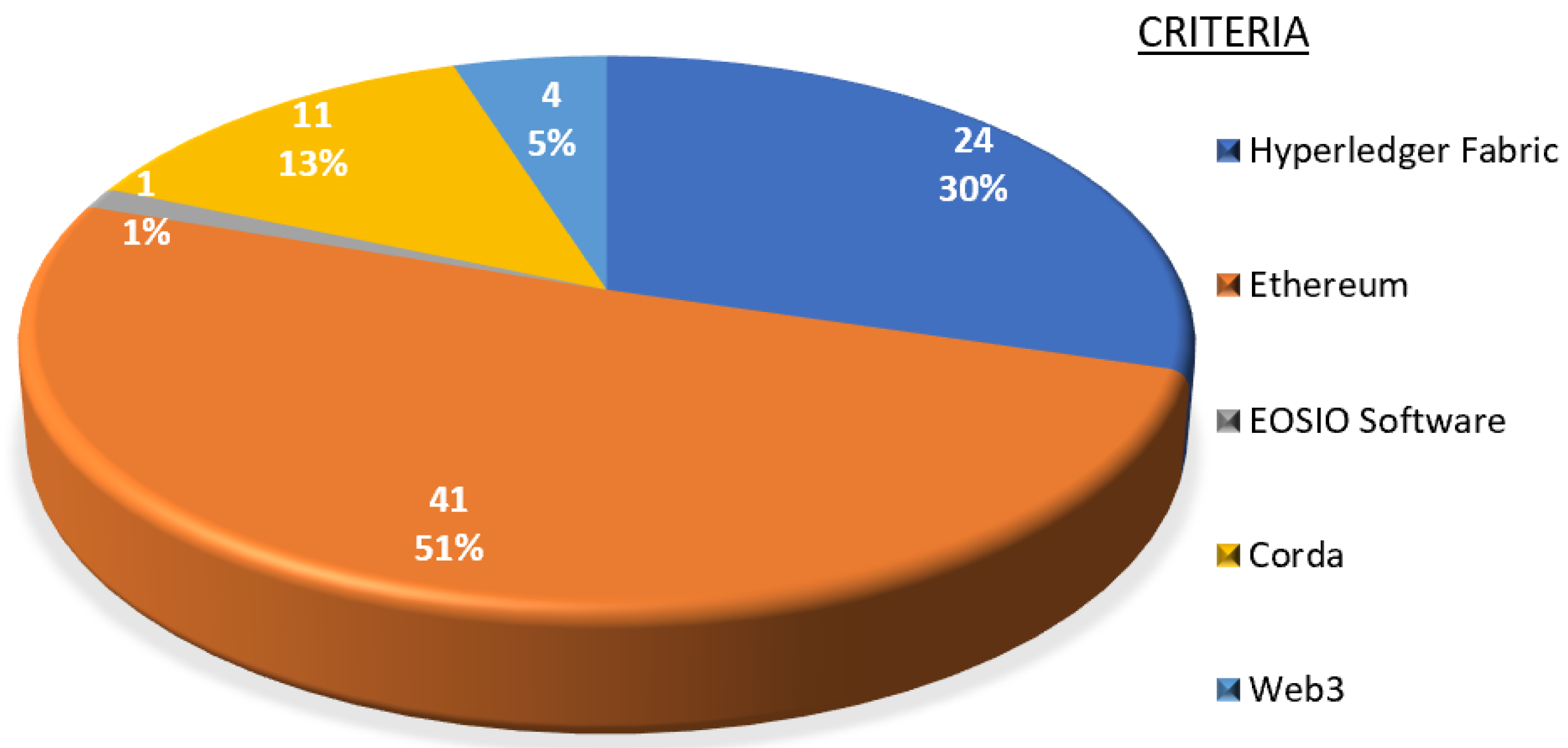
| Frameworks and Development Tools | References | Qty. (%) |
|---|---|---|
| Hyperledger Fabric | [2,4,6,8,14,20,22,29,33,35,36,37,42,46,47,48,59,61,62,63,64,71,72,79] | 24 (29.6) |
| Ethereum | [1,3,7,8,9,14,16,18,19,20,22,29,30,31,33,35,36,37,40,41,42,43,46,47,48,49,52,55,57,58,59,64,65,66,67,68,72,74,78,79,81] | 41 (50.6) |
| EOSIO Software | [58] | 1 (1.2) |
| Corda | [19,20,22,29,36,44,45,51,68,69,81] | 11 (13.6) |
| Web3 | [3,36,52,72] | 4 (4.9) |
Disclaimer/Publisher’s Note: The statements, opinions and data contained in all publications are solely those of the individual author(s) and contributor(s) and not of MDPI and/or the editor(s). MDPI and/or the editor(s) disclaim responsibility for any injury to people or property resulting from any ideas, methods, instructions or products referred to in the content. |
© 2025 by the authors. Licensee MDPI, Basel, Switzerland. This article is an open access article distributed under the terms and conditions of the Creative Commons Attribution (CC BY) license.
Share and Cite
Gamboa-Cruzado, J.; Pineda-Delacruz, V.; Salcedo-Mera, H.; Alzamora Rivero, C.; Coveñas Lalupu, J.; Narro-Andrade, M. Blockchain and Data Management Security for Sustainable Digital Ecosystems: A Systematic Literature Review. Sustainability 2026, 18, 185. https://doi.org/10.3390/su18010185
Gamboa-Cruzado J, Pineda-Delacruz V, Salcedo-Mera H, Alzamora Rivero C, Coveñas Lalupu J, Narro-Andrade M. Blockchain and Data Management Security for Sustainable Digital Ecosystems: A Systematic Literature Review. Sustainability. 2026; 18(1):185. https://doi.org/10.3390/su18010185
Chicago/Turabian StyleGamboa-Cruzado, Javier, Victor Pineda-Delacruz, Humberto Salcedo-Mera, Cristina Alzamora Rivero, José Coveñas Lalupu, and Manuel Narro-Andrade. 2026. "Blockchain and Data Management Security for Sustainable Digital Ecosystems: A Systematic Literature Review" Sustainability 18, no. 1: 185. https://doi.org/10.3390/su18010185
APA StyleGamboa-Cruzado, J., Pineda-Delacruz, V., Salcedo-Mera, H., Alzamora Rivero, C., Coveñas Lalupu, J., & Narro-Andrade, M. (2026). Blockchain and Data Management Security for Sustainable Digital Ecosystems: A Systematic Literature Review. Sustainability, 18(1), 185. https://doi.org/10.3390/su18010185