Gender Income Inequality Within and Outside the State System in China, 2003–2021: An Age–Period–Cohort Analysis

Abstract
1. Introduction
2. Literature Review
3. Theoretical Framework and Research Hypotheses
3.1. Age Effects
3.2. Period Effects
3.3. Cohort Effects
4. Materials and Methods
4.1. Data
4.2. Variables
4.2.1. Dependent Variable
4.2.2. Independent Variables
4.2.3. Conditional Variable
4.2.4. Control Variables
4.3. Analytical Approach
5. Results
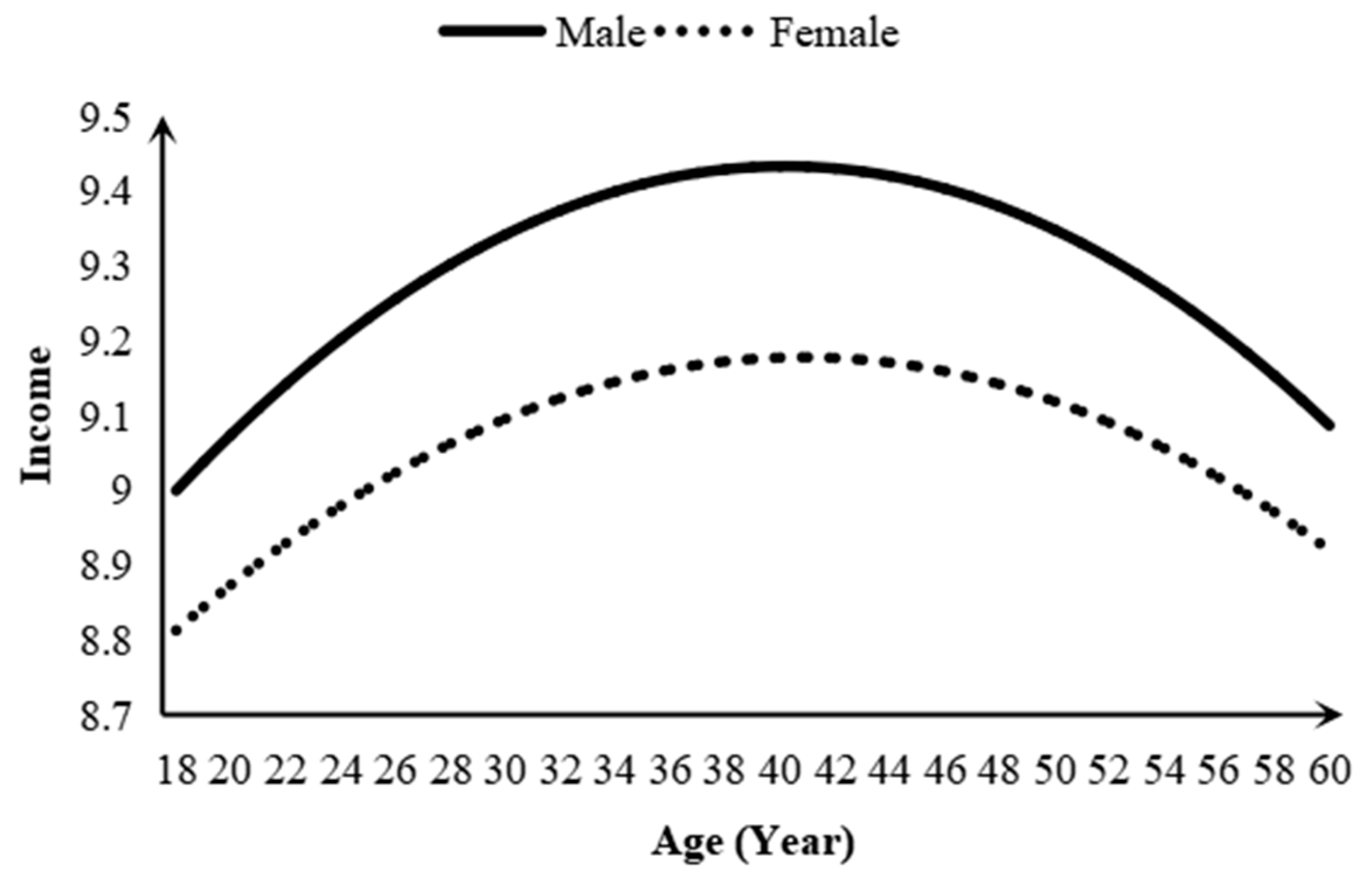
5.1. General Trajectories Analysis of Gender Income Inequality
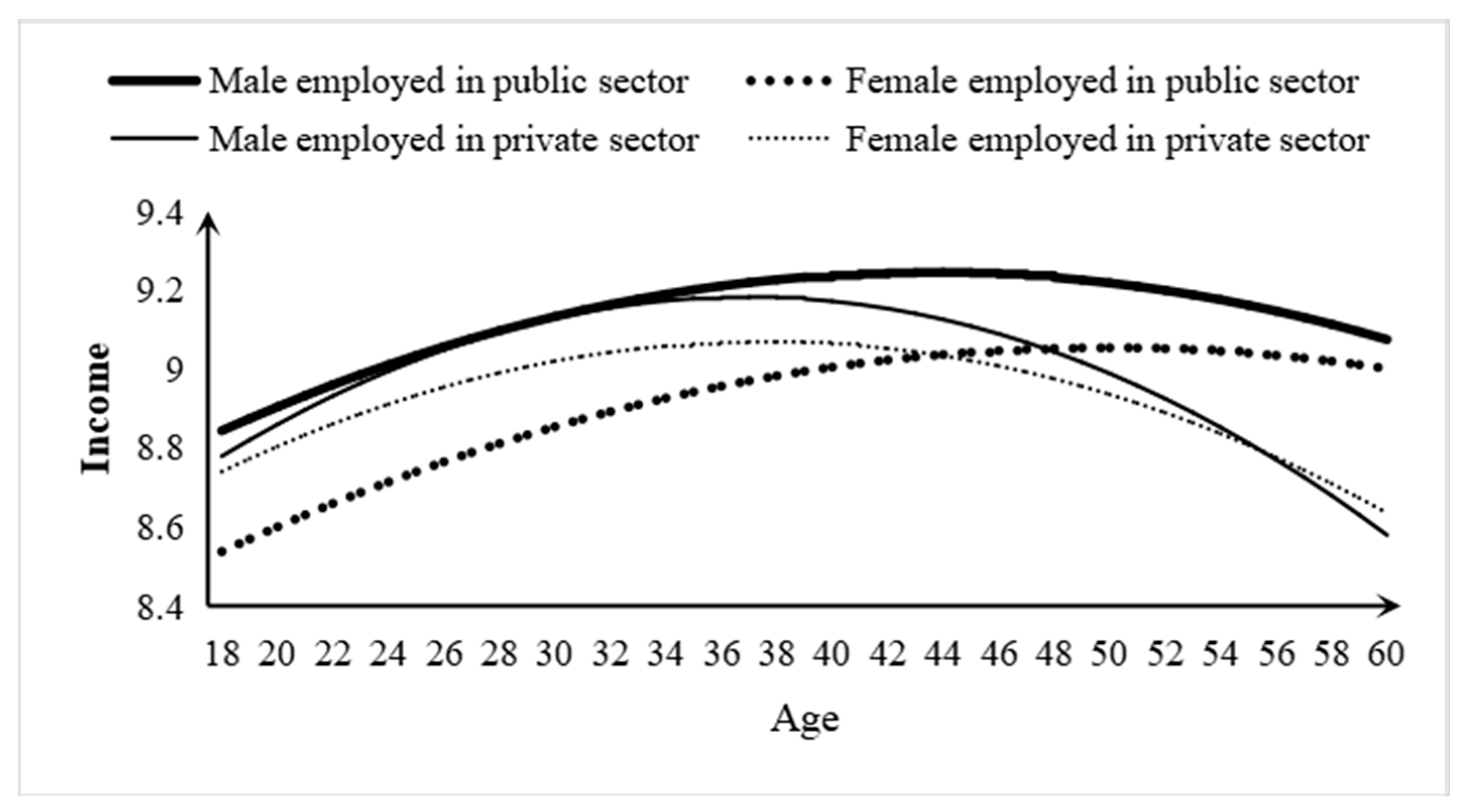
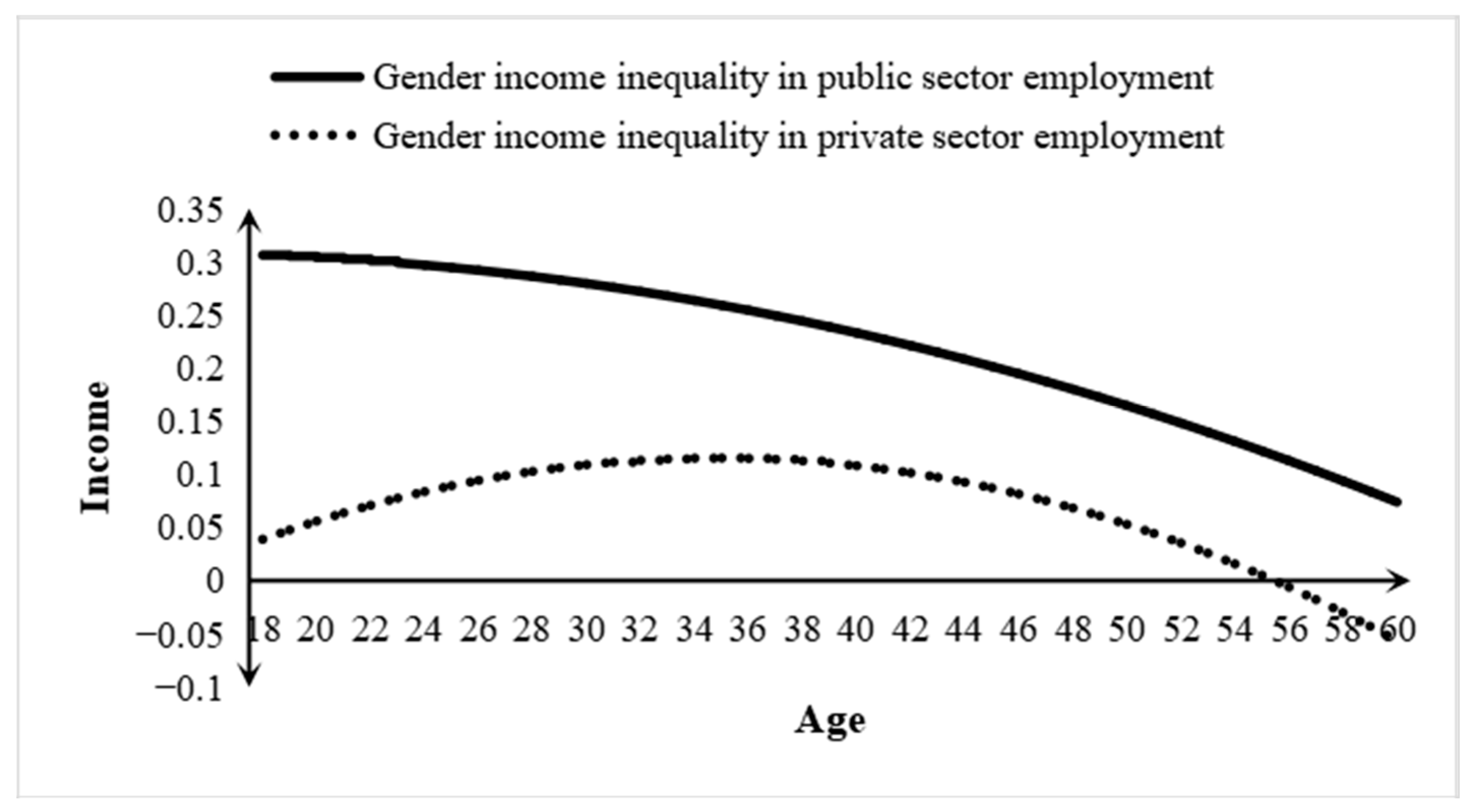
5.2. Age Effects of Gender Income Inequality Across Public and Private Sector Employment
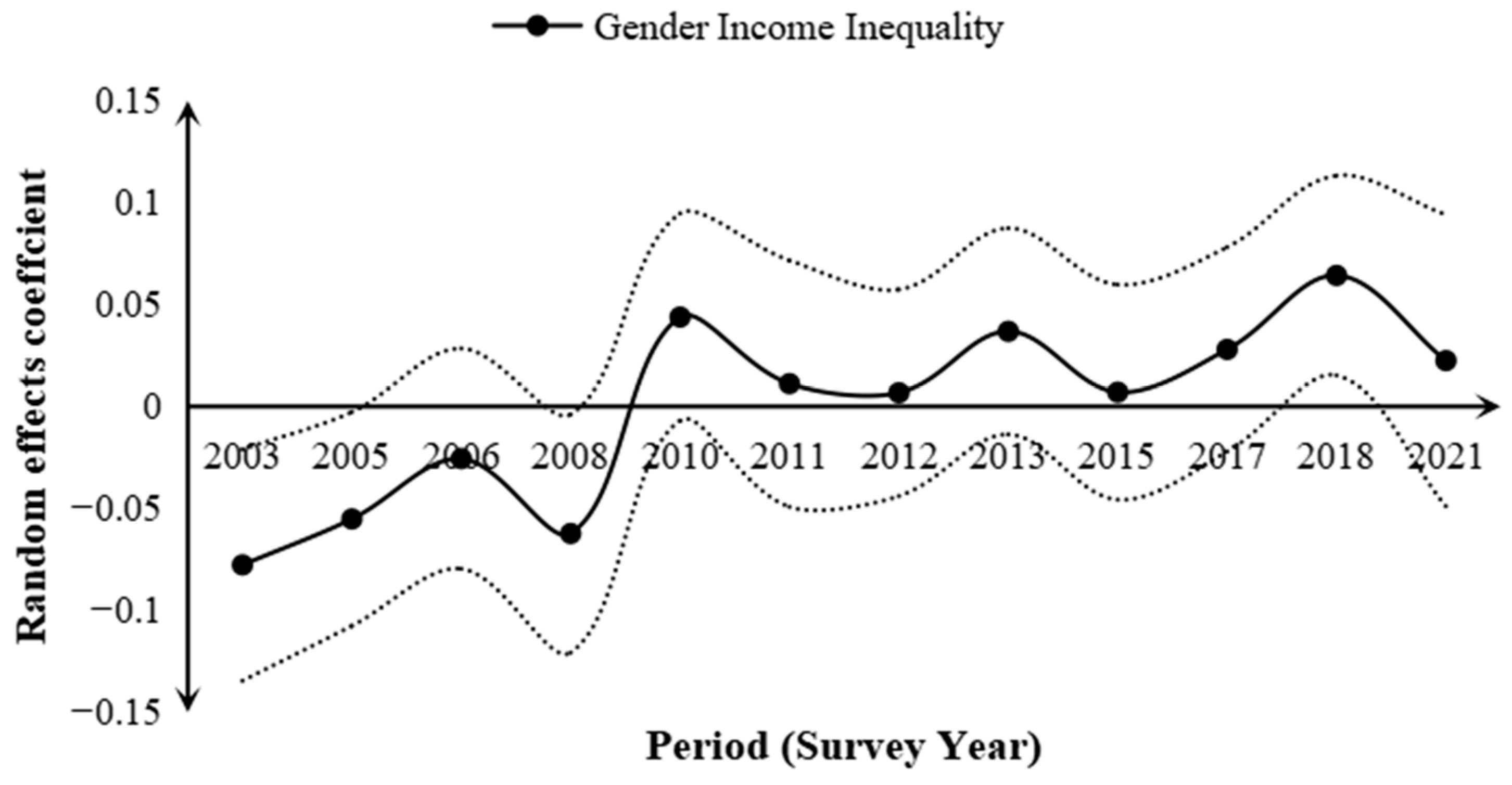
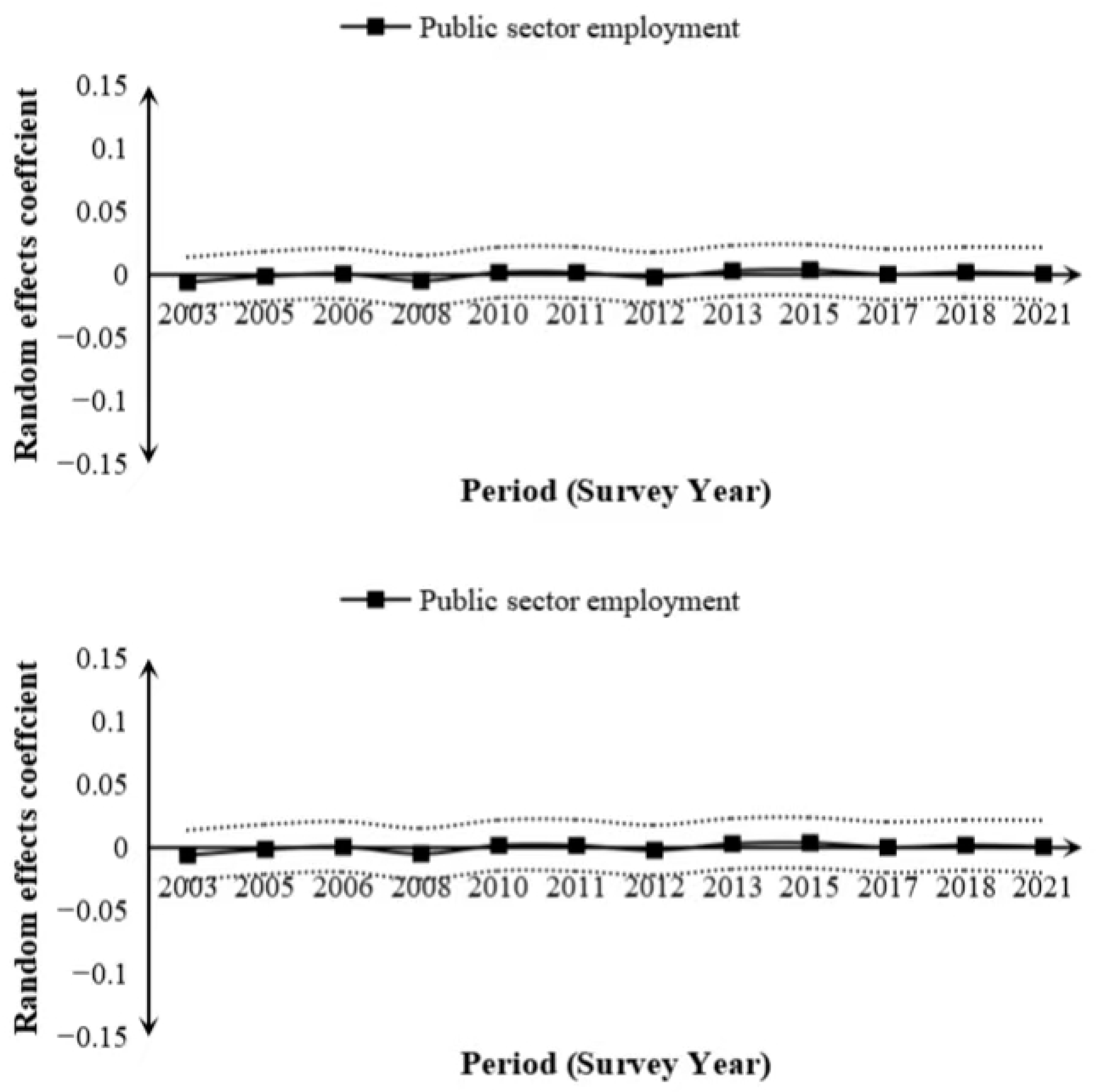
5.3. Period Effects of Gender Income Inequality in Public and Private Sector Employment
5.4. Robust Test
6. Discussion of Results
6.1. Theoretical Implications
6.1.1. From Stability to Structuration: Transcending Gendered Labor Market Segmentation Theory from a Life Course Perspective
6.1.2. From Cross-Sectional Comparisons to Process-Oriented Tracing of Empowerment Trajectories
6.1.3. Extending Ontological Commitment
6.2. Practical Implications
6.3. Limitations and Future Research
7. Conclusions and Policy Recommendations
Author Contributions
Funding
Data Availability Statement
Acknowledgments
Conflicts of Interest
References
- Ali, S.M.; Appolloni, A.; Cavallaro, F.; D Adamo, I.; Di Vaio, A.; Ferella, F.; Gastaldi, M.; Ikram, M.; Kumar, N.M.; Martin, M.A.; et al. Development goals towards sustainability. Sustainability 2023, 15, 9443. [Google Scholar] [CrossRef]
- Wang, D.; Lyu, X.; Chen, L. The social status of women in China: Analysis based on age, period, and cohort effects. Asian J. Soc. Psychol. 2024, 27, 586–599. [Google Scholar] [CrossRef]
- Li, S. The loss of subjective wellbeing and state-to-private mobility: New evidence from a longitudinal study. Sociol. Rev. China 2024, 12, 219–239. [Google Scholar]
- Savona, M.; Vertova, G. Structural change, innovation and gender gaps. Rev. Polit. Econ. 2025, 1–23. [Google Scholar] [CrossRef]
- Bermúdez-Figueroa, E.; Roca, B. Gender labor inequalities in the public sector: The interplay between policy and micro-politics. Empl. Relat. Int. J. 2022, 44, 96–112. [Google Scholar] [CrossRef]
- Xi, J. Gaoju zhongguo tese shehui zhuyi weida qizhi wei quanmian jianshe shehui zhuyi xiandaihua guojia er tuanjie fendou hold high the great banner of socialism with chinese characteristics and strive in unity to build a modern socialist country in all respects. Renmin Ribao [People’s Daily], 26 October 2022; pp. 1–20. [Google Scholar]
- Chen, P.N.; Feng, W. Market and Gender Pay Equity: Have Chinese Reforms Narrowed the Gap? In Creating Wealth and Poverty in Postsocialist China; Davis, D., Wang, F., Eds.; Standford University Press: Stanford, CA, USA, 2009; pp. 37–53. [Google Scholar]
- Wang, J. Gender income gap in urban labor market: An explanation based on occupational mobility. Chin. J. Popul. Sci. 2024, 38, 18–33. [Google Scholar]
- Zuo, J. Women’s liberation and gender obligation equality in urban China: Work/family experiences of married individuals in the 1950s. Sci. Soc. 2012, 77, 98–125. [Google Scholar] [CrossRef]
- Zhang, H.; Yuan, B. Dual binary labor market segmentation in China’s megacities: Theoretical model and empirical test. Sociol. Stud. 2024, 39, 158–181. [Google Scholar]
- Nee, V. A theory of market transition: From redistribution to markets in state socialism. Am. Sociol. Rev. 1989, 54, 663–681. [Google Scholar] [CrossRef]
- He, G.Y.; Wu, X.G. Marketization, occupational segregation, and gender earnings inequality in urban China. Soc. Sci. Res. 2017, 65, 96–111. [Google Scholar] [CrossRef]
- Cao, Y. Economic development, market transition, and work values in post-socialist China. Soc. Forces 2020, 99, 760–796. [Google Scholar] [CrossRef]
- Zhu, B.; Xu, L. The change of gender income gap under the background of market transformation. Youth Stud. 2020, 23–34. [Google Scholar]
- Ji, Y.; Wu, X. New gender dynamics in post-reform China: Family, education, and labor market. Chin. Sociol. Rev. 2018, 50, 231–239. [Google Scholar] [CrossRef]
- Yuan, R.; Li, Y.; Li, C.; Sun, X.; Li, L. The impact of state-owned capital participation on carbon emission reduction in private enterprises: Evidence from China. Sustainability 2025, 17, 7433. [Google Scholar] [CrossRef]
- Wang, S.; Chen, H. Could Chinese enterprises real benefit from embedding in global value chains? Environ. Dev. Sustain. 2025, 27, 28601–28630. [Google Scholar] [CrossRef]
- Esping-Andersen, G. Incomplete Revolution: Adapting Welfare States to Women’s New Roles; Polity Press: Cambridge, UK, 2009. [Google Scholar]
- Elder, G.H. The life course as developmental theory. Child Dev. 1998, 69, 1–12. [Google Scholar] [CrossRef]
- Zheng, J.; Qing, S. Non-cognitive skills, psychological traits, and the gender wage gap. Econ. Perspect. 2016, 135–145. [Google Scholar]
- Deng, F.; Ding, X. Human capital, labor market segmentation and gender income gap. Sociol. Stud. 2012, 27, 24–46. [Google Scholar] [CrossRef]
- Li, L.L.; Cheng, M.W.; Chen, C.Y. Gender wage gap of migrant workers and its root causes: Gender discrimination or labor endowment? J. Asian Econ. 2025, 100, 101988. [Google Scholar] [CrossRef]
- Li, H.; Chen, C.; Zhang, Z. Are gender differences related to non-cognitive abilities?—Evidence from China. J. Asia Pac. Econ. 2023, 28, 1560–1579. [Google Scholar] [CrossRef]
- Nee, V.; Cao, Y. Market transition and the firm: Institutional change and income inequality in urban China. Manag. Organ. Rev. 2005, 1, 23–56. [Google Scholar] [CrossRef]
- Qin, M.; Brown, J.J.; Padmadas, S.S.; Li, B.H.; Qi, J.A.; Falkingham, J. Gender inequalities in employment and wage-earning among internal labour migrants in Chinese cities. Demogr. Res. 2016, 34, 175–202. [Google Scholar] [CrossRef]
- Tong, Y.Y.; Chen, R.K. Rethinking gender inequality in China’s rural-to-urban migration: An intersectionality approach. Sociol. Compass 2025, 19, e70075. [Google Scholar] [CrossRef]
- Wu, X.; Zheng, B. Household registration, urban status attainment, and social stratification in China. Res. Soc. Strat. Mobil. 2018, 53, 40–49. [Google Scholar] [CrossRef]
- Bertrand, M. New Perspectives on Gender. In Handbook of Labor Economics; Card, D., Ashenfelter, O., Eds.; Elsevier: Amsterdam, The Netherlands, 2011; Volume 4, pp. 1543–1590. ISBN 1573-4463. [Google Scholar]
- Jayachandran, S. The roots of gender inequality in developing countries. Annu. Rev. Econ. 2015, 7, 63–88. [Google Scholar] [CrossRef]
- Qing, S.S. Gender role attitudes and male-female income differences in China. J. Chin. Sociol. 2020, 7, 12. [Google Scholar] [CrossRef]
- Liang, B.W. Cultural sources of gender gaps: Confucian meritocracy reduces gender inequalities in political participation. Elect. Stud. 2024, 91, 102848. [Google Scholar] [CrossRef]
- Marginson, S. Limitations of human capital theory. Stud. High. Educ. 2019, 44, 287–301. [Google Scholar] [CrossRef]
- Collins, R. The micro contribution to macro sociology. Sociol. Theory 1988, 6, 242–253. [Google Scholar] [CrossRef]
- Phillips, M.J. Towards a social constructionist, criticalist, foucauldian-informed qualitative research approach: Opportunities and challenges. SN Soc. Sci. 2023, 3, 175. [Google Scholar] [CrossRef]
- Zhao, W.; Zhou, X. From institutional segmentation to market fragmentation: Institutional transformation and the shifting stratification order in urban China. Soc. Sci. Res. 2017, 63, 19–35. [Google Scholar] [CrossRef]
- Baert, P. Time, Self, and Social Being: Temporality Within a Sociological Context; Athenaeum Press: Newcastle, UK, 1992. [Google Scholar]
- Brunnermeier, M.K.; Sockin, M.; Xiong, W. China’s gradualistic economic approach and financial markets. Am. Econ. Rev. 2017, 107, 608–613. [Google Scholar] [CrossRef]
- Strittmatter, A.; Wunsch, C. Labor market sorting and the gender pay gap revisited. J. Popul. Econ. 2025, 38, 59. [Google Scholar] [CrossRef] [PubMed]
- Blau, F.D.; Kahn, L.M. The gender wage gap: Extent, trends, and explanations. J. Econ. Lit. 2017, 55, 789–865. [Google Scholar] [CrossRef]
- Zhu, B.; Li, L. Changes of labor income distribution pattern of chinese urban residents during high-quality development stage. Soc. Sci. China 2024, 80–100. [Google Scholar]
- Toczek, L.; Bosma, H.; Peter, R. The gender pay gap: Income inequality over life course—A multilevel analysis. Front. Sociol. 2021, 6, 815376. [Google Scholar] [CrossRef]
- Alderotti, G.; Guetto, R.; Barbieri, P.; Scherer, S.; Vignoli, D. Unstable employment careers and (quasi-)completed fertility: Evidence from the labour market deregulation in italy. Eur. Sociol. Rev. 2025, 41, 299–315. [Google Scholar] [CrossRef]
- Liu, X.; Zuo, S.X. From equality to polarization: Changes in urban China’s gender earnings gap from 1988 to 2016. J. Econ. Behav. Organ. 2023, 205, 303–337. [Google Scholar] [CrossRef]
- Elder, G.H.; Johnson, M.K.; Crosnoe, R. The Emergence and Development of Life Course Theory. In Handbook of the Life Course; Mortimer, J.T., Shanahan, M.J., Eds.; Springer: Boston, MA, USA, 2003; pp. 3–19. ISBN 978-0-306-48247-2. [Google Scholar]
- Elder, G.H. Age differentiation and the life course. Annu. Rev. Sociol. 1975, 1, 165–190. [Google Scholar] [CrossRef]
- Cortina, C.; Rodríguez, J.; González, M.J. Mind the job: The role of occupational characteristics in explaining gender discrimination. Soc. Indic. Res. 2021, 156, 91–110. [Google Scholar] [CrossRef]
- Deming, D.J. Four facts about human capital. J. Econ. Perspect. 2022, 36, 75–102. [Google Scholar] [CrossRef]
- Mincer, J. Investment in human capital and personal income distribution. J. Political Econ. 1958, 66, 281–302. [Google Scholar] [CrossRef]
- Cinamon, R.G.; Rich, Y. Gender differences in the importance of work and family roles: Implications for work–family conflict. Sex Roles 2002, 47, 531–541. [Google Scholar] [CrossRef]
- Jalovaara, M.; Fasang, A.E. Family life courses, gender, and mid-life earnings. Eur. Sociol. Rev. 2020, 36, 159–178. [Google Scholar] [CrossRef]
- Pearlman, J. Occupational mobility for whom?: Education, cohorts, the life course and occupational gender composition, 1970–2010. Res. Soc. Strat. Mobil. 2019, 59, 81–93. [Google Scholar] [CrossRef]
- Duan, J.L.; Kim, S.; Su, Z.X. Gender and cross-boundary mobility preferences: The moderating effects of organisational and occupational contexts. Asia Pac. J. Hum. Resour. 2024, 62, e12397. [Google Scholar] [CrossRef]
- Wu, X.G. Redrawing the boundaries work units and social stratification in urban China. Chin. Sociol. Rev. 2013, 45, 6–28. [Google Scholar] [CrossRef]
- Feeney, M.K.; Stritch, J.M. Family-friendly policies, gender, and work–life balance in the public sector. Rev. Public Pers. Adm. 2017, 39, 422–448. [Google Scholar] [CrossRef]
- Yu, W.H.; Kuo, J. Parenthood, earnings, and the relevance of family formation sequences. Soc. Sci. Res. 2024, 121, 103027. [Google Scholar] [CrossRef] [PubMed]
- Colley, L.; Williamson, S.; Foley, M. Understanding, ownership, or resistance: Explaining persistent gender inequality in public services. Gend. Work Organ. 2021, 28, 284–300. [Google Scholar] [CrossRef]
- Duvivier, C.; Narcy, M. The motherhood wage penalty and its determinants: A public–private comparison. Labour 2015, 29, 415–443. [Google Scholar] [CrossRef]
- Elder, G.H. Time, human agency, and social change: Perspectives on the life course. Soc. Psychol. Q. 1994, 57, 4–15. [Google Scholar] [CrossRef]
- Xu, W.; Qin, X.; Li, X.; Chen, H.; Frank, M.; Rutherford, A.; Reeson, A.; Rahwan, I. Developing China’s workforce skill taxonomy reveals extent of labor market polarization. Humanit. Soc. Sci. Commun. 2021, 8, 187. [Google Scholar] [CrossRef]
- Tan, W.; Shen, G.; Zhou, G. The transfer of employment structure: Export expansion and the rise of lower-middle-skill occupations in China. World Dev. 2025, 189, 106932. [Google Scholar] [CrossRef]
- Wang, J.; Hu, Y.; Zhang, Z. Skill-biased technological change and labor market polarization in China. Econ. Model. 2021, 100, 105507. [Google Scholar] [CrossRef]
- Hu, Y.; Coulter, R. (Un)making occupational gender segregation: Intergenerational reproduction of gender-(a)typical occupational aspirations in China. Gend. Work Organ. 2024, 31, 2329–2350. [Google Scholar] [CrossRef]
- Wang, J.; Xie, Y. Feeling good about the iron rice bowl: Economic sector and happiness in post-reform urban China. Soc. Sci. Res. 2015, 53, 203–217. [Google Scholar] [CrossRef]
- Zhao, M.; Tong, Y. Beyond the paycheck: Family systems, adult children’s job sector, and parental subjective well-being in China. J. Marriage Fam. 2025, 87, 1979–1995. [Google Scholar] [CrossRef]
- Shen, C. Widening inequality: The evolution of the motherhood penalty in China (1989–2015). Chin. J. Sociol. 2022, 8, 499–533. [Google Scholar] [CrossRef]
- Li, M.Y. Does feminization always lead to declines in earnings? Evidence from China’s marketization (1988 to 2013). Sociol. Q. 2023, 64, 676–701. [Google Scholar] [CrossRef]
- Liu, Z.; Song, H. Gender discrimination in the sectors with different ownership: From the view of income. Popul. Econ. 2018, 4, 44–52. [Google Scholar]
- Iwasaki, I.; Ma, X. Gender wage gap in China: A large meta-analysis. J. Labour Mark. Res. 2020, 54, 17. [Google Scholar] [CrossRef]
- Gallagher, M.E. Authoritarian Legality in China: Law, Workers, and the State; Cambridge University Press: Cambridge, UK, 2017. [Google Scholar]
- Xu, W.; Pan, Z.; Wang, G. Market transition, labor market dynamics and reconfiguration of earning determinants structure in urban China. Cities 2018, 79, 113–123. [Google Scholar] [CrossRef]
- Shanahan, M.J.; Elder, G.H.; Miech, R.A. History and agency in men’s lives: Pathways to achievement in cohort perspective. Sociol. Educ. 1997, 70, 54–67. [Google Scholar] [CrossRef]
- Ryder, N.B. The Cohort as a Concept in the Study of Social Change. In Cohort Analysis in Social Research: Beyond the Identification Problem; Mason, W.M., Fienberg, S.E., Eds.; Springer: New York, NY, USA, 1985; pp. 9–44. ISBN 978-1-4613-8536-3. [Google Scholar]
- Mannheim, K. The Problem of Generations. In Essays on the Sociology of Knowledge; Kecskemeti, P., Ed.; Routledge: London, UK, 1952; pp. 276–321. [Google Scholar]
- Yeh, A.G.; Yang, F.F.; Wang, J. Economic transition and urban transformation of China: The interplay of the state and the market. Urban Stud. 2015, 52, 2822–2848. [Google Scholar] [CrossRef]
- Liang, Y. Decomposing the effects of modernization transition and marketing transition: Marketing transition research model with age, cohort, and period effects. Sociol. Stud. 2007, 4, 93–117. [Google Scholar]
- Zuo, J. Understanding urban women’s domestic-role orientation in post-mao China. Crit. Sociol. 2012, 40, 111–133. [Google Scholar] [CrossRef]
- Feng, X.; Cooke, F.L.; Zhao, C. The state as regulator? The ‘dual-track’ system of employment in the chinese public sector and barriers to equal pay for equal work. J. Ind. Relat. 2020, 62, 679–702. [Google Scholar] [CrossRef]
- Chi, W.; Li, B. Glass ceiling or sticky floor? Examining the gender earnings differential across the earnings distribution in urban China, 1987–2004. J. Comp. Econ. 2008, 36, 243–263. [Google Scholar] [CrossRef]
- Hanser, A. The gendered rice bowl: The sexual politics of service work in urban China. Gend. Soc. 2005, 19, 581–600. [Google Scholar] [CrossRef]
- Cai, Y.; Feng, W. The social and sociological consequences of China’s one-child policy. Annu. Rev. Sociol. 2021, 47, 587–606. [Google Scholar] [CrossRef]
- Xia, Q.; Song, L.; Li, S.; Appleton, S. The effect of the state sector on wage inequality in urban China: 1988–2007. J. Chin. Econ. Bus. Stud. 2014, 12, 29–45. [Google Scholar] [CrossRef]
- Wu, Y.; Wang, P.; Huang, C. Family patronage, institutional patronage, and work family conflict: Women’s employment status and subjective well-being in urban China. J. Chin. Sociol. 2016, 3, 21. [Google Scholar] [CrossRef]
- Booth, A.; Fan, E.; Meng, X.; Zhang, D. Gender differences in willingness to compete: The role of culture and institutions. Econ. J. 2019, 129, 734–764. [Google Scholar] [CrossRef]
- Li, M. Devaluation for whom? Feminization and wages in an economically polarized labor market, 2003–2019. Soc. Forces 2024, 103, 495–519. [Google Scholar] [CrossRef]
- Yang, Y.; Land, K.C. Age-Period-Cohort Analysis: New Models, Methods, and Empirical Applications; Chapman and Hall/CRC: New York, NY, USA, 2016. [Google Scholar]
- Yang, Y.; Land, K.C. Age–period–cohort analysis of repeated cross-section surveys: Fixed or random effects? Sociol. Methods Res. 2008, 36, 297–326. [Google Scholar] [CrossRef]
- Yang, Y.; Land, K.C. A mixed models approach to the age-period-cohort analysis of repeated cross-section surveys, with an application to data on trends in verbal test scores. Sociol. Methodol. 2006, 36, 75–97. [Google Scholar] [CrossRef]
- Manu, A.S.; McAdam, P.; Willman, A. China’s great expansion: The role of factor substitution and technical progress. Eur. Econ. Rev. 2022, 141, 103911. [Google Scholar] [CrossRef]
- Merouani, Y.; Perrin, F. Gender and the long-run development process. A survey of the literature. Eur. Rev. Econ. Hist. 2022, 26, 612–641. [Google Scholar] [CrossRef]
- He, G.Y.; Wu, X.G. Dynamics of the gender earnings inequality in reform-era urban China. Work. Employ. Soc. 2018, 32, 726–746. [Google Scholar] [CrossRef]
- Medina-Hernández, E.J.; Fernández-Gómez, M.J. Multi-way analysis of the gender dimension of the sustainable development goals. Soc. Indic. Res. 2024, 172, 517–541. [Google Scholar] [CrossRef]
- Valduga, I.B.; Lima, M.A.; Castro, B.C.; Fuchs, P.G.; Amorim, W.S.; Guerra, J.B. A balanced scorecard proposal for gender equality and sustainable development. Sustainability 2023, 15, 14384. [Google Scholar] [CrossRef]
- Blau, F.D. Gender inequality in the labor market: Continuing progress? Ind. Labor. Relat. Rev. 2025, 78, 275–303. [Google Scholar] [CrossRef]
- Carlsen, L.; Bruggemann, R. Gender equality in Europe: The development of the sustainable development goal no. 5 illustrated by exemplary cases. Soc. Indic. Res. 2021, 158, 1127–1151. [Google Scholar] [CrossRef]
- Horie, N.; Iwasaki, I.; Kupets, O.; Ma, X.; Mizobata, S.; Satogami, M. Wage–experience profiles in China and eastern Europe: A large meta-analysis. J. Econ. Surv. 2025, 39, 172–200. [Google Scholar] [CrossRef]
- Nyangchak, N. Gendered industry and feminization of the labor force: A social reproduction analysis from China. Gend. Work Organ. 2025, 32, 1169–1191. [Google Scholar] [CrossRef]
- Matysiak, A.; Hardy, W.; van der Velde, L. Structural labour market change and gender inequality in earnings. Work Employ. Soc. 2024, 39, 426–448. [Google Scholar] [CrossRef]
- Yang, Y.; Wen, B.; Tao, L. Unequal gender-based attraction toward public sector employment in China: The role of perceived discrimination and public service motivation. Public Adm. Dev. 2025, 45, 3–15. [Google Scholar] [CrossRef]
- Li, H.; Tong, X. When does a female leadership advantage exist? Evidence from Soes in China. Corp. Gov. Int. Rev. 2023, 31, 945–970. [Google Scholar] [CrossRef]
- Wang, F.; Wang, H.; Mao, Q. State-owned enterprises fail to drive regional technological diversification: Evidence from China. Empir. Econ. 2025, 69, 915–949. [Google Scholar] [CrossRef]
- Fu, H.; Tiwari, S.; Kazemzadeh, E.; Cobbold, E.Y.; Ghosh, S.; Doğan, B. Green growth and gender equality: The role of political empowerment and renewable energy in sustainable development. Sustain. Dev. 2025, 33. [Google Scholar] [CrossRef]
- Sheng, D.; Montgomery, H.A. Generation inequality in an aging society: The demographic welfare dilemma. Soc. Policy Adm. 2025. [Google Scholar] [CrossRef]
- Shen, M.; Jiang, X.; Sun, Y.; Tang, L. The rise in female consciousness contributes to advancing household energy transition: Evidence from chinese households. Energy 2024, 308, 132954. [Google Scholar] [CrossRef]
- Guo, L.; Liu, Y.; Jiang, Z.; Yuan, X.; Jing, Q. Impact of land prices on corporate carbon emission intensity. Sci. Rep. 2025, 15, 3632. [Google Scholar] [CrossRef]
- Sumran, A.; Muhammad, G.; Jawaria, A.; Peng, X.; Liu, Z. The role of public and private interventions on the evolution of green innovation in China. IEEE Trans. Eng. Manag. 2024, 71, 6272–6290. [Google Scholar] [CrossRef]
- Khan, Z.; Ali, M.; Kirikkaleli, D.; Wahab, S.; Jiao, Z. The impact of technological innovation and public-private partnership investment on sustainable environment in China: Consumption-based carbon emissions analysis. Sustain. Dev. 2020, 28, 1317–1330. [Google Scholar] [CrossRef]
- Di Vaio, A.; Mastellone, L. Ghg accounting and gendered carbon accountability in a shipping agency: A single-case study with ethnographic elements. Sustainability 2025, 17, 10479. [Google Scholar] [CrossRef]
- Di Vaio, A.; Hassan, R.; Palladino, R. Blockchain technology and gender equality: A systematic literature review. Int. J. Inf. Manag. 2023, 68, 102517. [Google Scholar] [CrossRef]



| Variables | Variables Description | Mean | Std. | Min | Max |
|---|---|---|---|---|---|
| Dependent Variable | |||||
| Income | Continuous; log-transformed individual annual income | 10.140 | 0.957 | 6.908 | 13.468 |
| Independent Variable | |||||
| Gender | 0 = Female, 1 = male | 0.565 | 0.496 | 0 | 1 |
| APC Variables | |||||
| Age | Continuous, 18–60 | 38.720 | 9.924 | 18 | 60 |
| Period | Survey year | - | - | 2003 | 2021 |
| Cohort | Ten-year birth cohorts | 3.845 | 1.102 | 1 | 7 |
| Conditional Variable | |||||
| Employment Sector | 0 = Private sector employment, 1 = public sector employment | 0.446 | 0.497 | 0 | 1 |
| Control Variables | |||||
| Education | 0 = Primary or below, 1 = secondary, 2 = tertiary or above | 1.264 | 0.608 | 0 | 2 |
| Political Affiliation | 0 = Non-Communist Party member, 1 = Communist Party member | 0.157 | 0.364 | 0 | 1 |
| Marital Status | 0 = Not married, 1 = married | 0.802 | 0.398 | 0 | 1 |
| Hukou Type | 0 = Rural, 1 = non-agricultural | 0.692 | 0.462 | 0 | 1 |
| Region Type | 0 = Non-eastern region, 1 = eastern region | 0.488 | 0.500 | 0 | 1 |
| Class Identity | 1–5, low to high | 2.494 | 0.851 | 1 | 5 |
| Variables | Model 1 | Model 2 | Model 3 | Model 4 | Model 5 |
|---|---|---|---|---|---|
| Intercept | 7.8451 *** (0.1786) | 7.8265 *** (0.1741) | 7.8260 *** (0.1742) | 7.9591 *** (0.1756) | 7.8152 *** (0.1778) |
| Individual-level fixed effects | |||||
| Age | 0.0648 *** (0.0041) | 0.0661 *** (0.0041) | 0.0662 *** (0.0041) | 0.0619 *** (0.0041) | 0.0651 *** (0.0041) |
| Age-squared | −0.0008 *** (0.0000) | −0.0008 *** (0.0000) | −0.0008 *** (0.0001) | −0.0008 *** (0.0000) | −0.0008 *** (0.0000) |
| Male | 0.3025 *** (0.0078) | 0.2916 *** (0.0197) | 0.2894 *** (0.0353) | 0.3470 *** (0.0151) | 0.3483 *** (0.0103) |
| Public sector employment | 0.0214 ** (0.0108) | 0.0219 ** (0.0108) | 0.0334 ** (0.0108) | −0.3368 *** (0.0464) | 0.0804 *** (0.0140) |
| Male × age | 0.0002 *** (0.0008) | ||||
| Public sector employment × age | 0.0104 *** (0.0011) | ||||
| Public sector employment × male | −0.1294 * (0.0516) | −0.1021 ** (0.0186) | |||
| Public sector employment × age × male | 0.0004 ** (0.0012) | ||||
| Control variables | Controlled | Controlled | Controlled | Controlled | Controlled |
| Random effect covariance parameters | |||||
| Period effects | |||||
| Intercept | 0.2935 ** (0.1254) | 0.2713 ** (0.1162) | 0.2715 ** (0.1162) | 0.2808 ** (0.1201) | 0.2885 ** (0.1233) |
| Male | 0.0027 * (0.0015) | 0.0027 * (0.0015) | 0.0013 * (0.0009) | ||
| Public sector employment × male | 0.0012 * (0.0009) | ||||
| Cohort effects | |||||
| Intercept | 0.0041 + (0.0032) | 0.0050 (0.0039) | 0.0047 + (0.0036) | 0.0037 + (0.0029) | 0.0045 + (0.0035) |
| Male | 0.0004 (0.0007) | ||||
| Public sector employment × male | |||||
| Individuals | 0.4213 *** (0.0035) | 0.4206 *** (0.0035) | 0.4207 *** (0.0035) | 0.4180 *** (0.0035) | 0.4204 *** (0.0035) |
| Fit statistics | |||||
| AIC | 58,152.00 | 58,130.95 | 58,142.37 | 57,961.35 | 58,109.45 |
| BIC | 58,153.46 | 58,120.95 | 58,134.37 | 57,953.35 | 58,101.45 |
| Variables | Model 1 | Model 2 | Model 3 | Model 4 | Model 5 |
|---|---|---|---|---|---|
| Intercept | 7.5873 *** (0.1395) | 7.6023 *** (0.1398) | 7.6022 *** (0.1398) | 7.6941 *** (0.1412) | 7.5564 *** (0.1402) |
| Individual-level fixed effects | |||||
| Age | 0.0554 *** (0.0065) | 0.0552 *** (0.0065) | 0.0551 *** (0.0065) | 0.0567 *** (0.0065) | 0.0573 *** (0.0065) |
| Age-squared | −0.0007 *** (0.0001) | −0.0007 *** (0.0001) | −0.0007 *** (0.0001) | −0.0008 *** (0.0001) | −0.0007 *** (0.0001) |
| Male | 0.2929 *** (0.0081) | 0.2692 *** (0.0470) | 0.2692 *** (0.0470) | 0.2970 *** (0.0516) | 0.3209 *** (0.0146) |
| Public sector employment | 0.2431 *** (0.0355) | 0.2450 *** (0.0354) | 0.2450 *** (0.0354) | −0.2621 *** (0.0693) | 0.2475 *** (0.0422) |
| Male × age | 0.0003 ** (0.0012) | ||||
| Public sector employment × age | 0.0115 *** (0.0014) | ||||
| Public sector employment × male | −0.0894 * (0.0675) | −0.0930 * (0.0165) | |||
| Public sector employment × age × male | 0.0002 * (0.0017) | ||||
| Control variables | Controlled | Controlled | Controlled | Controlled | Controlled |
| Random effect covariance parameters | |||||
| Cohort-level intercept SD | 0.0000 (0.0002) | 0.0000 (0.0001) | 0.0000 (0.0002) | 0.0000 (0.0002) | 0.0485 (0.2258) |
| Cohort-level slope SD (gender) | 0.0000 (0.0004) | ||||
| Period-level intercept SD | 0.4951 *** (0.0451) | 0.4819 *** (0.0442) | 0.4819 *** (0.0028) | 0.4898 *** (0.0449) | 0.4835 *** (0.0493) |
| Period-level slope SD (gender) | 0.0723 *** (0.0133) | 0.0723 *** (0.0133) | 0.0633 *** (0.0130) | 0.0654 *** (0.0130) | |
| Period-level slope SD (public sector employment × male) | 0.0002 * (0.0009) | ||||
| Residual SD (individual level) | 0.6743 *** (0.0028) | 0.6735 *** (0.0028) | 0.6717 *** (0.0028) | 0.6713 *** (0.0028) | 0.6714 *** (0.0028) |
| AIC | 61,813.92 | 60,512.73 | 60,358.86 | 60,491.44 | 60,329.66 |
| BIC | 61,929.95 | 60,653.62 | 60,499.75 | 60,632.33 | 60,495.41 |
| Individuals | 0.4213 *** (0.0035) | 0.4206 *** (0.0035) | 0.4207 *** (0.0035) | 0.4180 *** (0.0035) | 0.4204 *** (0.0035) |
| AIC | 58,152.00 | 58,130.95 | 58,142.37 | 57,961.35 | 58,109.45 |
| BIC | 58,153.46 | 58,120.95 | 58,134.37 | 57,953.35 | 58,101.45 |
Disclaimer/Publisher’s Note: The statements, opinions and data contained in all publications are solely those of the individual author(s) and contributor(s) and not of MDPI and/or the editor(s). MDPI and/or the editor(s) disclaim responsibility for any injury to people or property resulting from any ideas, methods, instructions or products referred to in the content. |
© 2025 by the authors. Licensee MDPI, Basel, Switzerland. This article is an open access article distributed under the terms and conditions of the Creative Commons Attribution (CC BY) license.
Share and Cite
Tan, Z.; Wu, C.; Hong, L.; Huang, Y. Gender Income Inequality Within and Outside the State System in China, 2003–2021: An Age–Period–Cohort Analysis. Sustainability 2026, 18, 130. https://doi.org/10.3390/su18010130
Tan Z, Wu C, Hong L, Huang Y. Gender Income Inequality Within and Outside the State System in China, 2003–2021: An Age–Period–Cohort Analysis. Sustainability. 2026; 18(1):130. https://doi.org/10.3390/su18010130
Chicago/Turabian StyleTan, Ziyang, Cal Wu, Liu Hong, and Yan Huang. 2026. "Gender Income Inequality Within and Outside the State System in China, 2003–2021: An Age–Period–Cohort Analysis" Sustainability 18, no. 1: 130. https://doi.org/10.3390/su18010130
APA StyleTan, Z., Wu, C., Hong, L., & Huang, Y. (2026). Gender Income Inequality Within and Outside the State System in China, 2003–2021: An Age–Period–Cohort Analysis. Sustainability, 18(1), 130. https://doi.org/10.3390/su18010130