A Systematic Framework for Evaluating Sustainability in the Textile and Apparel Industry


Abstract
1. Introduction
2. Conceptual Background and Review of Sustainability Transitions in the Textile and Apparel Industry
2.1. Technological Innovation as a Structural Driver of Sustainability Transition
2.2. Prior Review Studies and the Need for an Integrated Perspective
3. Methods
3.1. Protocol and Registration
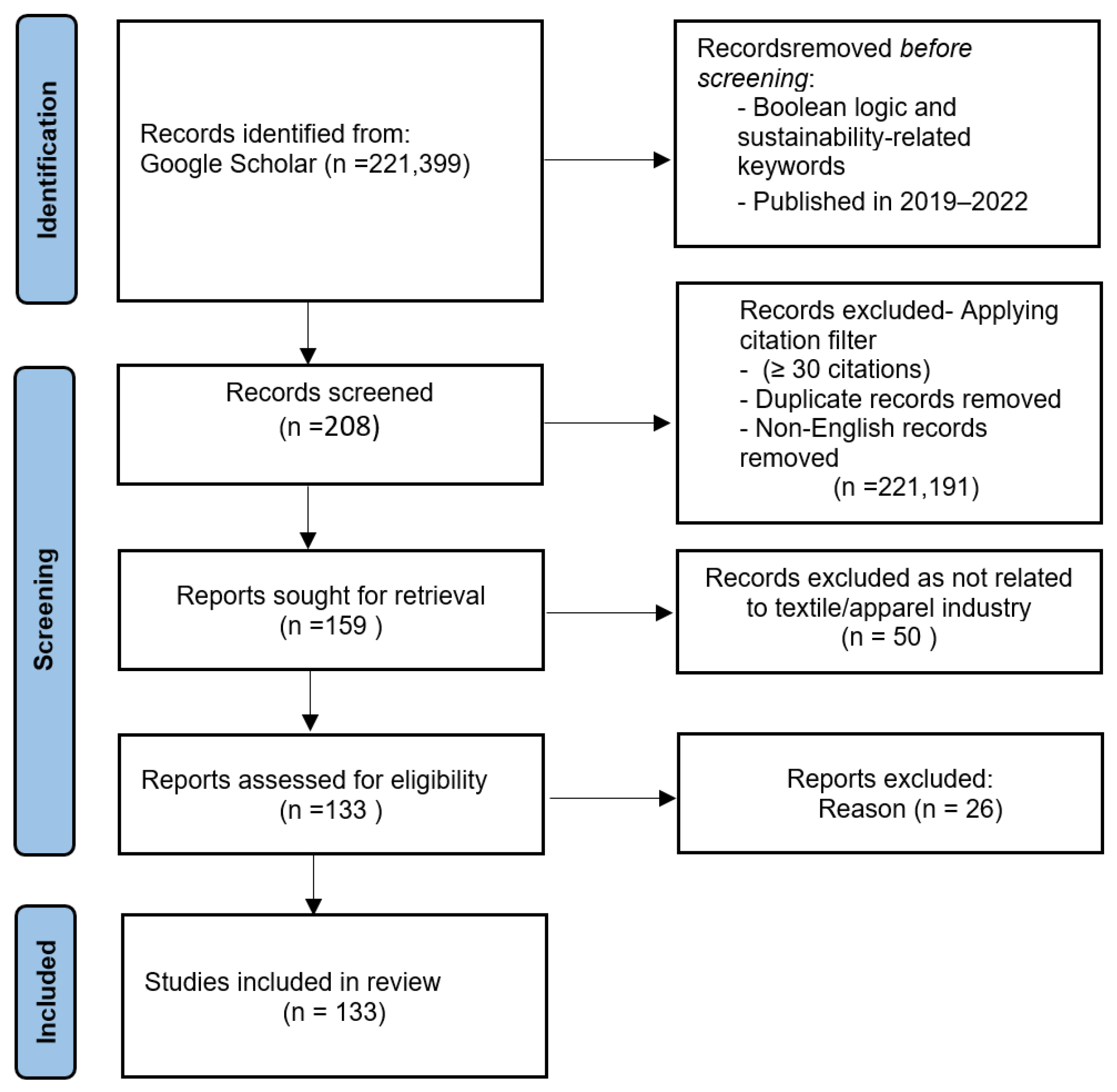
3.2. Literature Search and Selection Criteria
3.3. Literature Classification and Coding Procedures
- Initial classification based on titles and keywords: Each article was provisionally assigned to one of four potential thematic dimensions based on its primary research focus as indicated by titles and keywords.
- Final category confirmation through conclusion review: For studies addressing multiple themes or exhibiting ambiguous focal points, conclusions and key findings were examined to determine the study’s core contribution.
- Inductive thematic coding and category refinement: Recurrent concepts, analytical targets, and sustainability discourses were compared across studies, allowing thematic categories to be inductively refined.
- Frequency and distribution analysis: The finalized classification was used to analyze thematic frequency and distribution patterns, thereby mapping areas of research concentration and underrepresentation.
- Relational analysis of technological innovation: Studies addressing technological innovation were further examined to assess how they intersect with environmental assessment, ethical and social dimensions, and circular strategies, supporting the positioning of technological innovation as an independent analytical axis.
- Acknowledgment of single-coder limitation: All classification and coding procedures were conducted by a single researcher. While this ensured interpretive consistency, the absence of intercoder reliability assessment constitutes a methodological limitation, as noted in prior scoping review discussions [26]. Future studies may address this limitation through multi-coder validation.
3.4. Framework Development and Analytical Strategy
- Technology-driven sustainability, focusing on the role of technological advancements in materials, processes, supply chains, and sustainability performance;
- Environmental impact and performance assessment, emphasizing life-cycle-based quantitative evaluation of environmental outcomes;
- Ethical, social, and governance dimensions, addressing institutional conditions, stakeholder mechanisms, and social responsibility;
- Circular strategies and resource recovery, encompassing reuse, recycling, upcycling, and circular economy-oriented approaches.
4. Results and Discussions
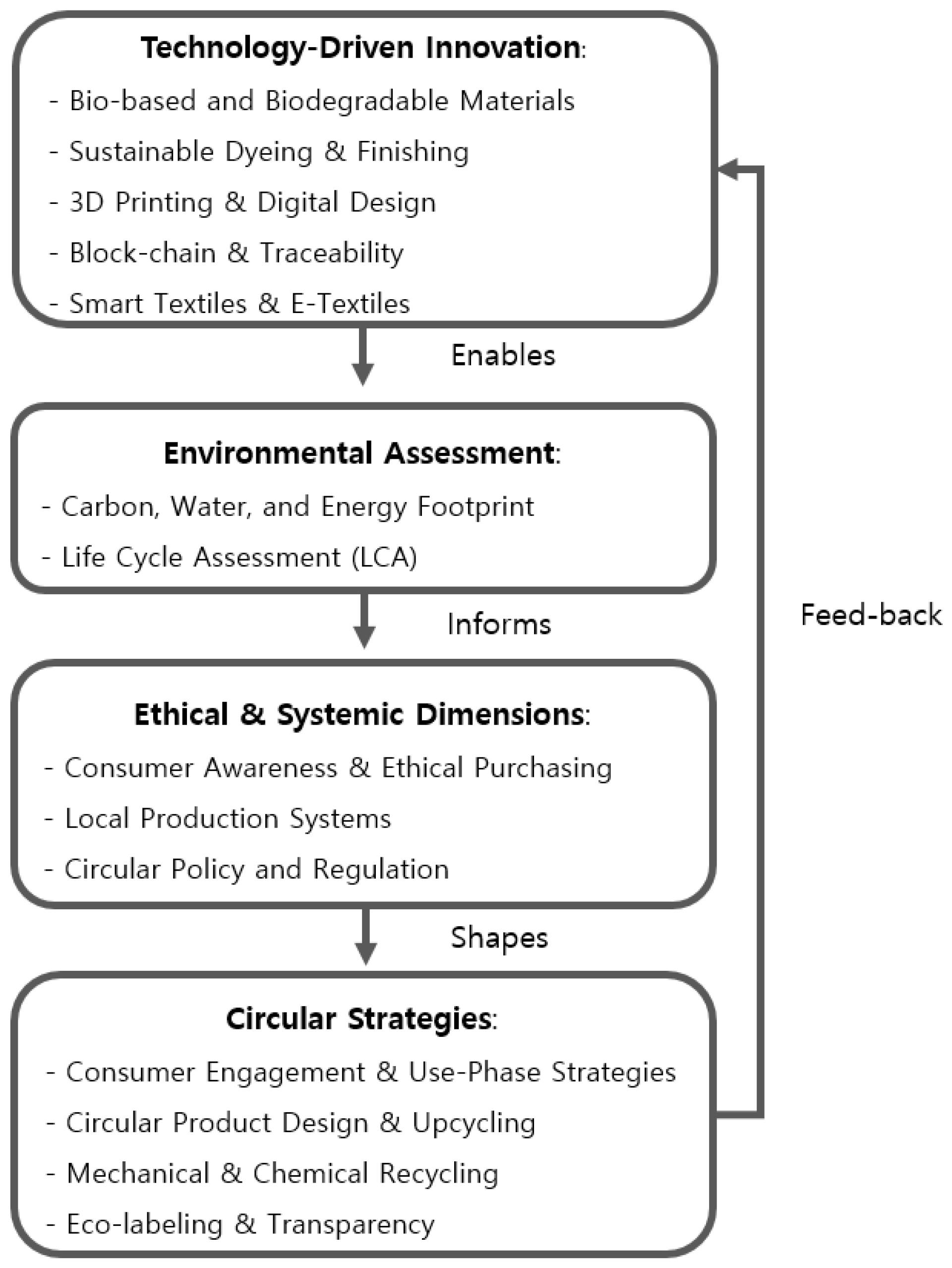
4.1. A Multi-Dimensional Framework for Evaluating Sustainability
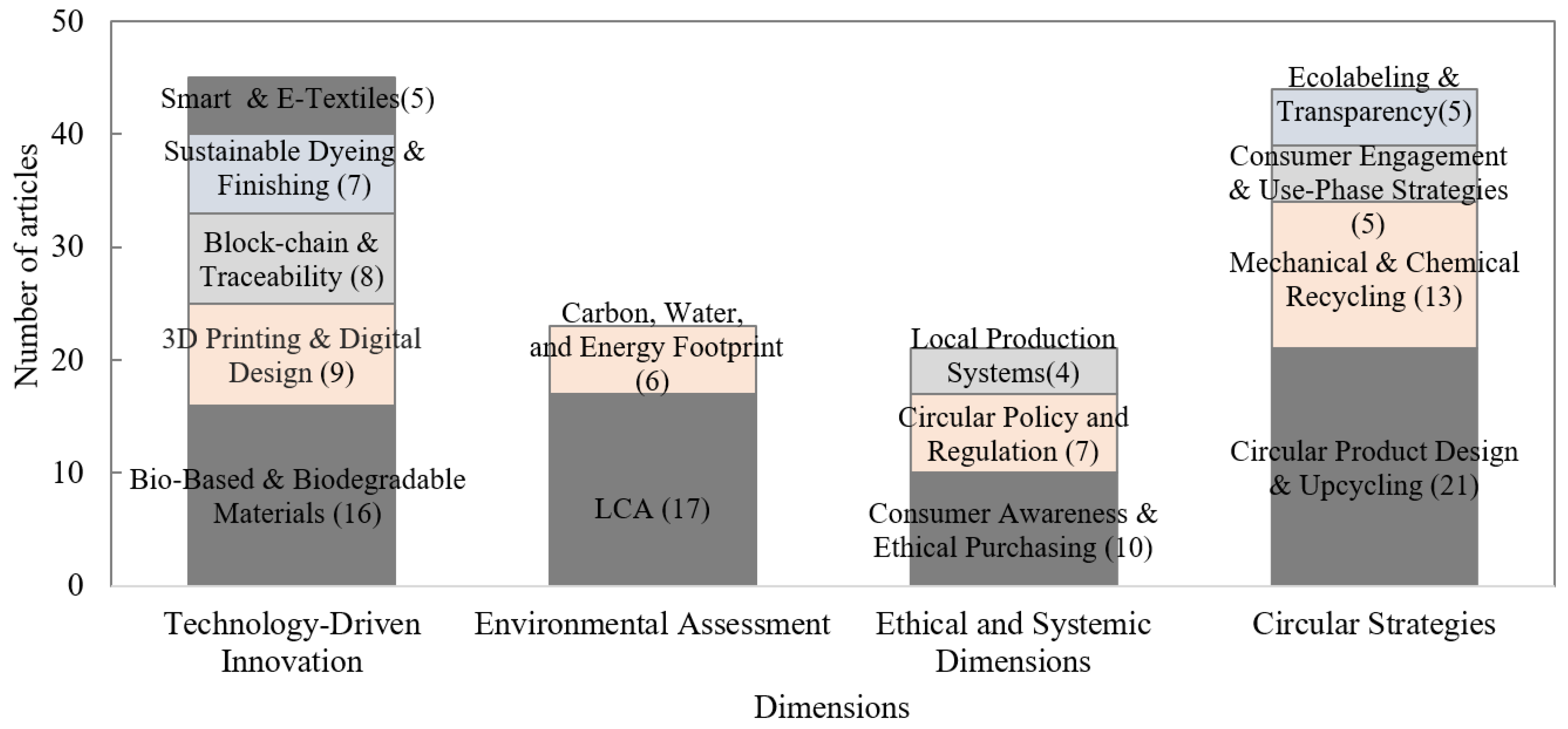
4.2. Frequency Analysis of Thematic Dimensions
4.3. Technology-Driven Innovation

| Subtopic | References | Freq.(%) | Core Sustainability Metrics | Recurrent Research Gaps | |
|---|---|---|---|---|---|
| Bio-Based & Biodegradable Materials | Ribul et al., 2021 [21] D’Itria & Colombi, 2022 [43] Colasante & D’Adamo, 2021 [44] Hildebrandt et al., 2021 [45] Mazotto et al., 2021 [46] Mehrizi et al., 2023 [47] Panda et al., 2021 [48] Patti & Acierno, 2022 [49] Perin et al., 2021 [50] | Provin et al., 2021 [51] Provin & de Aguiar Dutra, 2021 [52] Rognoli et al., 2022 [53] Santos et al., 2021 [54] Todor et al., 2021 [55] Vinod et al., 2020 [56] Wojnowska-Baryła et al., 2022 [57] | 16 (35.6) | Biodegradability, renewability, mechanical performance, toxicity | Inconsistent assumptions regarding end-of-life (EoL) conditions and biodegradation infrastructure, along with limited LCA-based comparative assessments |
| Sustainable dyeing & Finishing | Azanaw et al., 2022 [58] Ismail & Sakai, 2022 [59] Jahan et al., 2022 [60] Lara et al., 2022 [61] | Patel et al., 2022 [62] Powar et al., 2020 [63] Periyasamy & Periyasami, 2023 [64] | 7 (15.6) | Water use, energy consumption, chemical load, color fastness | Insufficient validation of industrial scalability and lack of standardized process benchmarking |
| 3D Printing & Digital Design | Akram et al., 2022 [28] Chakraborty & Biswas, 2020 [30] Biswas et al., 2021 [65] Choi, 2022 [66] Dip et al., 2020 [67] | Ikram, 2022 [68] Jeong et al., 2021 [69] McQuillan, 2020 [70] Spahiu et al., 2021 [71] | 9 (20.0) | Material efficiency, waste reduction, design flexibility | Limited integration of environmental performance metrics (e.g., LCA) and inadequate validation at production scale |
| Smart Textiles & E-Textiles | Dulal, 2022 [29] Júnior et al., 2022 [72] Rese et al., 2022 [73] | Wu & Devendorf, 2020 [74] Zhang et al., 2023 [75] | 5 (11.1) | Durability, energy use, functional lifespan | Insufficient consideration of recyclability and biodegradability, and weak integration with circular strategies |
| Blockchain & Traceability | Agrawal et al., 2021 [31] Ahmed & MacCarthy, 2021 [76] Casciani et al., 2022 [77] Garcia-Torres et al., 2022 [78] | Fung et al., 2021 [79] Guo et al., 2020 [80] Hader et al., 2022 [81] Lee, 2021 [82] | 8 (17.8) | Transparency, data integrity, traceability coverage | Absence of accredited verification bodies and standardized data protocols, limiting integration with regulatory and certification frameworks |
4.3.1. Material Transformation: Bio-Based and Biodegradable Shifts
4.3.2. Process Innovation: Enhancing Resource and Energy Efficiency
4.3.3. Digital and Data-Driven Innovation: Linking Design, Production, and Governance
4.4. Environmental Assessment
| Subtopic | References | Freq.(%) | Core Sustainability Metrics | Recurrent Research Gaps | |
|---|---|---|---|---|---|
| Carbon, Water & Energy Footprint | Farhana et al., 2022 [83] Luo et al., 2022 [86] Payet, 2021 [87] | Amicarelli et al., 2022 [88] Munasinghe et al., 2021 [91] Wiedemann et al., 2020 [92] | 6 (26.1) | Carbon emissions, water consumption, energy use, renewable energy integration | Limited comparability due to inconsistent system boundaries and data assumptions; partial coverage of life-cycle stages |
| LCA & Standardization | Moazzem et al., 2021a [1] Gonçalves & Silva, 2021 [84] Islam et al., 2022 [85] Gbolarumi et al., 2021 [89] Chen et al., 2021 [90] Fidan et al., 2021 [93] Gonzalez et al., 2023 [94] Herrera Almanza & Corona, 2020 [95] | Kazan et al., 2020 [96] Klepp et al., 2020 [97] Peters et al., 2021 [98] Uddin et al., 2022 [99] Liu et al., 2021 [100] Pérez et al., 2022 [101] Saleem & Zaidi, 2020 [102] Zhang et al., 2021 [103] Moazzem et al., 2021b [104] | 17 (73.9) | Multi-impact LCA indicators (GHG, water, energy, toxicity), regionalized impact factors, standardization frameworks | High methodological heterogeneity across LCA studies; limited alignment with policy-oriented standards (e.g., PEF); insufficient integration with circularity indicators |
4.4.1. Carbon, Water and Energy Footprint Assessments
4.4.2. Standardization and Circularity Integration in LCA of Textile Products
4.5. Ethical and Systemic Dimensions
| Subtopic | References | Freq. | Core Sustainability Metrics | Subtopic | |
|---|---|---|---|---|---|
| Consumer Awareness & Ethical Purchasing | Busalim et al., 2022 [37] Bianchi & Gonzalez, 2021 [109] Sinha et al., 2023 [111] Ray & Nayak, 2023 [112] Aakko & Niinimäki, 2022 [113] | Gomes et al., 2022 [114] Mandarić et al., 2021 [115] Mohr et al., 2022 [116] Paço et al., 2021 [117] Wagner & Heinzel, 2020 [110] | 10 (47.6) | Consumer awareness, ethical purchasing intention, willingness to pay, behavioral change | Persistent attitude–behavior gap; limited consideration of contextual and institutional constraints on ethical consumption |
| Local Production Systems | Brown & Vacca, 2022 [118] Sandhu, 2020 [119] | Väänänen & Pöllänen, 2020 [120] Wanniarachchi et al., 2020 [121] | 4 (19.0) | Cultural sustainability, craftsmanship, local value creation, social embeddedness | Limited scalability and economic viability; insufficient integration with global supply chains |
| Circular Policy & Regulation | Abreu et al., 2021 [122] Cai & Choi, 2020 [123] Heinze, 2020 [124] Karaosman et al., 2020 [125] | Niessen, 2020 [126] Peleg Mizrachi & Tal, 2022 [127] Thorisdottir & Johannsdottir, 2020 [128] | 7 (33.3) | CSR implementation, fair trade practices, governance mechanisms, regulatory alignment | Fragmented regulatory frameworks; limited enforcement mechanisms and weak integration with supply-chain transparency tools |
4.5.1. Consumer Awareness and Ethical Purchasing
4.5.2. Local Production Systems
4.5.3. Circular Policy and Regulation
4.6. Circular Strategies
| Subtopic | References | Freq. | Core Sustainability Metrics | Recurrent Research Gaps | |
|---|---|---|---|---|---|
| Consumer Engagement & Use-Phase Strategies | Cooper & Claxton, 2022 [131] Goworek et al., 2020 [132] | Saccani et al., 2023 [133] Rotimi et al., 2021 [134] Conlon, 2020 [135] | 5 (11.4) | Consumer participation, product longevity, use-phase behavior, repair and reuse | Limited empirical evidence on long-term behavioral change; weak linkage between consumer engagement and quantified environmental outcomes |
| Circular Product Design & Upcycling | Abbate et al., 2024 [9] Brydges, 2021 [10] Coscieme et al., 2022 [11] Keßler et al., 2021 [20] Okafor et al., 2021 [22] Dissanayake & Weerasinghe, 2021 [32] Aus et al., 2021 [34] Claxton & Kent, 2020 [136] Colucci & Vecchi, 2021 [137] Atalay Onur, 2020 [138] Dan & Østergaard, 2021 [139] | De Ponte, 2023 [140] Dragomir & Dumitru, 2022 [141] ElShishtawy et al., 2022 [142] Karell & Niinimäki, 2020 [143] Levänen et al., 2021 [144] Murzyn-Kupisz & Hołuj, 2021 [145] Palm et al., 2021 [146] Piller, 2022 [147] Schmutz & Som, 2022 [148] Xie et al., 2021 [149] | 21 (47.7) | Design for circularity, material reuse, waste reduction, product lifespan extension | Predominantly conceptual or case-based studies; limited scalability assessment and insufficient integration with end-of-life recycling systems |
| Mechanical & Chemical Recycling | De Oliveira et al., 2021 [12] Eppinger, 2022 [13] Harmsen et al., 2021 [15] Baloyi et al., 2024 [16] Damayanti et al., 2021 [17] Jönsson et al., 2021 [18] Subramanian et al., 2020 [19] | Wang & Salmon, 2022 [105] Niinimäki et al.,2020 [129] Juanga-Labayen et al., 2022 [130] Hussain, 2021 [150] Kahoush& Kadi, 2022 [151] Yousef, 2020 [152] | 13 (29.5) | Recycling efficiency, material recovery rate, energy demand, fiber quality retention | Technical feasibility demonstrated, but economic viability and fiber-to-fiber recycling performance remain insufficiently validated at scale |
| Ecolabeling & Transparency | Byrd & Su, 2021 [153] Feuß et al., 2022 [154] Hayat et al., 2020 [155] | Plakantonaki et al., 2023 [156] Ranasinghe & Jayasooriya, 2021 [157] | 5 (11.4) | Certification credibility, transparency, consumer trust, information disclosure | Proliferation of heterogeneous labels; limited consumer understanding and lack of standardized verification mechanisms |
4.6.1. Consumer Engagement and Use-Phase Strategies
4.6.2. Circular Product Design and Upcycling Approaches
- Technological constraints: The heterogeneity of post-consumer textiles—mixed fibers, contamination, and degradation—reduces recyclability and quality consistency [136,143]. Zero-waste pattern design and digital optimization have achieved 20–30% improvements in fabric efficiency [144], yet the lack of fiber composition standardization and incomplete DPP-based material traceability inhibit large-scale diffusion [132].
- Economic constraints: Upcycling often depends on labor-intensive processes, increasing production costs. Consumers may also perceive upcycled products as lacking trend relevance or quality assurance [137].
4.6.3. Mechanical and Chemical Recycling
- Economic: high capital investment and unstable waste supply
- Technological: difficulties in process integration and handling mixed waste streams
- Policy-related: inconsistent recycling standards, subsidies, and certifications across countries
4.6.4. Ecolabeling and Transparency
5. Conclusions
6. Practical Implications
Supplementary Materials
Funding
Institutional Review Board Statement
Informed Consent Statement
Data Availability Statement
Acknowledgments
Conflicts of Interest
References
- Moazzem, S.; Crossin, E.; Daver, F.; Wang, L. Assessing environmental impact reduction opportunities through life cycle assessment of apparel products. Sustain. Prod. Consum. 2021a, 28, 663–674. [Google Scholar] [CrossRef]
- Sandin, G.; Peters, G.M. Environmental impact of textile reuse and recycling—A review. J. Clean. Prod. 2018, 184, 353–365. [Google Scholar] [CrossRef]
- Roos, S.; Sandin, G.; Zamani, B.; Peters, G.M. Environmental Assessment of Swedish Fashion Consumption; Mistra Future Fashion: Stockholm, Sweden, 2015. [Google Scholar]
- European Commission. EU Strategy for Sustainable and Circular Textiles—Digital Product Passport; European Commission: Brussels, Belgium, 2024; Available online: https://environment.ec.europa.eu/strategy/textiles-strategy_en (accessed on 15 August 2025).
- OECD. Extended Producer Responsibility: Basic Facts and Key Principles; OECD Publishing: Paris, France, 2024. [Google Scholar] [CrossRef]
- Brundtland, G.H. Our Common Future; Oxford University Press: Oxford, UK, 1987. [Google Scholar]
- Elkington, J. Cannibals with Forks: The Triple Bottom Line of 21st Century Business; Capstone: Oxford, UK, 1997. [Google Scholar]
- United Nations. Transforming Our World: The 2030 Agenda for Sustainable Development; United Nations: New York, NY, USA, 2015; Available online: https://sdgs.un.org/2030agenda (accessed on 15 August 2025).
- Abbate, S.; Centobelli, P.; Cerchione, R.; Nadeem, S.P.; Riccio, E. Sustainability trends and gaps in the textile, apparel and fashion industries. Environ. Dev. Sustain. 2024, 26, 2837–2864. [Google Scholar] [CrossRef]
- Brydges, T. Closing the loop on take, make, waste: Investigating circular economy practices in the Swedish fashion industry. J. Clean. Prod. 2021, 293, 126245. [Google Scholar] [CrossRef]
- Coscieme, L.; Manshoven, S.; Gillabel, J.; Grossi, F.; Mortensen, L.F. A framework of circular business models for fashion and textiles: The role of business-model, technical and social innovation. Sustain. Sci. Pract. Policy 2022, 18, 451–462. [Google Scholar] [CrossRef]
- De Oliveira, C.R.S.; da Silva Júnior, A.H.; Mulinari, J.; Immich, A.P.S. Textile re-engineering: Eco-responsible solutions for a more sustainable industry. Sustain. Prod. Consum. 2021, 28, 1232–1248. [Google Scholar] [CrossRef]
- Eppinger, E. Recycling technologies for enabling sustainability transitions of the fashion industry: Status quo and avenues for increasing post-consumer waste recycling. Sustain. Sci. Pract. Policy 2022, 18, 114–128. [Google Scholar] [CrossRef]
- Aakko, M.; Koskennurmi-Sivonen, R. Designing sustainable fashion: Possibilities and challenges. Res. J. Text. Apparel 2013, 17, 13–22. [Google Scholar] [CrossRef]
- Harmsen, P.; Scheffer, M.; Bos, H. Textiles for circular fashion: The logic behind recycling options. Sustainability 2021, 13, 9714. [Google Scholar] [CrossRef]
- Baloyi, R.B.; Gbadeyan, O.J.; Sithole, B.; Chunilall, V. Recent advances in recycling technologies for waste textile fabrics: A review. Text. Res. J. 2024, 94, 508–529. [Google Scholar] [CrossRef]
- Damayanti, D.; Wulandari, L.A.; Bagaskoro, A.; Rianjanu, A.; Wu, H.S. Possibility routes for textile recycling technology. Polymers 2021, 13, 3834. [Google Scholar] [CrossRef]
- Jönsson, C.; Wei, R.; Biundo, A.; Landberg, J.; Schwarz Bour, L.; Pezzotti, F.; Toca, A.; MJacques, L.; Bornscheuer, U.T.; Syrén, P.O.; et al. Biocatalysis in the recycling landscape for synthetic polymers and plastics towards circular textiles. ChemSusChem 2021, 14, 4028–4040. [Google Scholar] [CrossRef]
- Subramanian, K.; Chopra, S.S.; Cakin, E.; Li, X.; Lin, C.S.K. Environmental life cycle assessment of textile bio-recycling—Valorizing cotton–polyester textile waste to PET fiber and glucose syrup. Resour. Conserv. Recycl. 2020, 161, 104989. [Google Scholar] [CrossRef]
- Keßler, L.; Matlin, S.A.; Kümmerer, K. The contribution of material circularity to sustainability—Recycling and reuse of textiles. Curr. Opin. Green Sustain. Chem. 2021, 32, 100535. [Google Scholar] [CrossRef]
- Ribul, M.; Lanot, A.; Pisapia, C.T.; Purnell, P.; McQueen-Mason, S.J.; Baurley, S. Mechanical, chemical, biological: Moving towards closed-loop bio-based recycling in a circular economy of sustainable textiles. J. Clean. Prod. 2021, 326, 129325. [Google Scholar] [CrossRef]
- Okafor, C.C.; Madu, C.N.; Ajaero, C.C.; Ibekwe, J.C.; Nzekwe, C.A.; Okafor, C.; Madu, C.; Ajaero, C.; Ibekwe, J.; Nzekwe, C.; et al. Sustainable management of textile and clothing. Clean Technol. Recycl. 2021, 1, 70–87. [Google Scholar] [CrossRef]
- Abagnato, S.; Rigamonti, L.; Grosso, M. Life cycle assessment applications to reuse, recycling and circular practices for textiles: A review. Waste Manag. 2024, 182, 74–90. [Google Scholar] [CrossRef]
- Tricco, A.C.; Lillie, E.; Zarin, W.; O’Brien, K.K.; Colquhoun, H.; Levac, D.; Moher, D.; Peters, M.D.J.; Horsley, T.; Weeks, L.; et al. PRISMA extension for scoping reviews (PRISMA-ScR): Checklist and explanation. Ann. Intern. Med. 2018, 169, 467–473. [Google Scholar] [CrossRef] [PubMed]
- Arksey, H.; O’Malley, L. Scoping studies: Towards a methodological framework. Int. J. Soc. Res. Methodol. 2005, 8, 19–32. [Google Scholar] [CrossRef]
- Levac, D.; Colquhoun, H.; O’Brien, K.K. Scoping studies: Advancing the methodology. Implement. Sci. 2010, 5, 69. [Google Scholar] [CrossRef] [PubMed]
- Munn, Z.; Peters, M.D.J.; Stern, C.; Tufanaru, C.; McArthur, A.; Aromataris, E. Systematic review or scoping review? Guidance for authors when choosing between a systematic or scoping review approach. BMC Med. Res. Methodol. 2018, 18, 143. [Google Scholar] [CrossRef]
- Akram, S.V.; Malik, P.K.; Singh, R.; Gehlot, A.; Juyal, A.; Ghafoor, K.Z.; Shrestha, S. Implementation of digitalized technologies for fashion industry 4.0: Opportunities and challenges. Sci. Program. 2022, 2022, 7523246. [Google Scholar] [CrossRef]
- Dulal, M.; Afroj, S.; Ahn, J.; Cho, Y.; Carr, C.; Kim, I.D.; Karim, N. Toward sustainable wearable electronic textiles. ACS Nano 2022, 16, 19755–19788. [Google Scholar] [CrossRef]
- Chakraborty, S.; Biswas, M.C. 3D printing technology of polymer–fiber composites in textile and fashion industry: A potential roadmap of concept to consumer. Compos. Struct. 2020, 248, 112562. [Google Scholar] [CrossRef]
- Agrawal, T.K.; Kumar, V.; Pal, R.; Wang, L.; Chen, Y. Blockchain-based framework for supply chain traceability: A case example of textile and clothing industry. Comput. Ind. Eng. 2021, 154, 107130. [Google Scholar] [CrossRef]
- Dissanayake, D.G.K.; Weerasinghe, D. Towards circular economy in fashion: Review of strategies, barriers and enablers. Circ. Econ. Sustain. 2022, 2, 25–45. [Google Scholar] [CrossRef]
- Ellen MacArthur Foundation. Completing the Picture: How the Circular Economy Tackles Climate Change; Ellen MacArthur Foundation: Cowes, UK, 2019. Available online: https://content.ellenmacarthurfoundation.org/m/3eac8667edd240cc/original/Completing-the-picture-How-the-circular-economy-tackles-climate-change.pdf (accessed on 15 August 2025).
- Aus, R.; Moora, H.; Vihma, M.; Unt, R.; Kiisa, M.; Kapur, S. Designing for circular fashion: Integrating upcycling into conventional garment manufacturing processes. Fash. Text. 2021, 8, 34. [Google Scholar] [CrossRef]
- Henninger, C.E.; Alevizou, P.J.; Oates, C.J. What is sustainable fashion? J. Fash. Mark. Manag. 2016, 20, 400–416. [Google Scholar] [CrossRef]
- Lundblad, L.; Davies, I.A. The values and motivations behind sustainable fashion consumption. J. Consum. Behav. 2016, 15, 149–162. [Google Scholar] [CrossRef]
- Busalim, A.; Fox, G.; Lynn, T. Consumer behavior in sustainable fashion: A systematic literature review and future research agenda. Int. J. Consum. Stud. 2022, 46, 1804–1828. [Google Scholar] [CrossRef]
- Harsanto, B.; Primiana, I.; Sarasi, V.; Satyakti, Y. Sustainability innovation in the textile industry: A systematic review. Sustainability 2023, 15, 1549. [Google Scholar] [CrossRef]
- Page, M.J.; McKenzie, J.E.; Bossuyt, P.M.; Boutron, I.; Hoffmann, T.C.; Mulrow, C.D.; Shamseer, L.; Tetzlaff, J.M.; Akl, E.A.; Brennan, S.E.; et al. The PRISMA 2020 statement: An updated guideline for reporting systematic reviews. BMJ 2021, 372, n71. [Google Scholar] [CrossRef]
- Haddaway, N.R.; Collins, A.M.; Coughlin, D.; Kirk, S. The role of Google Scholar in evidence reviews and its applicability to grey literature searching. PLoS ONE 2015, 10, e0138237. [Google Scholar] [CrossRef]
- Martín-Martín, A.; Orduna-Malea, E.; Thelwall, M.; López-Cózar, E.D. Google Scholar, Web of Science and Scopus: A systematic comparison of citations in 252 subject categories. J. Informetr. 2018, 12, 1160–1177. [Google Scholar] [CrossRef]
- Belter, C.W. Bibliometric indicators: Opportunities and limits. J. Med. Libr. Assoc. 2015, 103, 219–221. [Google Scholar] [CrossRef]
- D’Itria, E.; Colombi, C. Biobased Innovation as a Fashion and Textile Design Must: A European Perspective. Sustainability 2022, 14, 570. [Google Scholar] [CrossRef]
- Colasante, A.; D’Adamo, I. The circular economy and bioeconomy in the fashion sector: Emergence of a “sustainability bias”. J. Clean. Prod. 2021, 329, 129774. [Google Scholar] [CrossRef]
- Hildebrandt, J.; Thrän, D.; Bezama, A. The circularity of potential bio-textile production routes: Comparing life cycle impacts of bio-based materials used within the manufacturing of selected leather substitutes. J. Clean. Prod. 2021, 287, 125470. [Google Scholar] [CrossRef]
- Mazotto, A.M.; de Ramos Silva, J.; de Brito, L.A.A.; Rocha, N.U.; de Souza Soares, A. How can microbiology help to improve sustainability in the fashion industry? Environ. Technol. Innov. 2021, 23, 101760. [Google Scholar] [CrossRef]
- Mehrizi, A.A.; Karimi-Maleh, H.; Naddafi, M.; Karimi, F. Application of bio-based phase change materials for effective heat management. J. Energy Storage 2023, 61, 106859. [Google Scholar] [CrossRef]
- Panda, S.K.B.C.; Sen, K.; Mukhopadhyay, S. Sustainable pretreatments in textile wet processing. J. Clean. Prod. 2021, 329, 129725. [Google Scholar] [CrossRef]
- Patti, A.; Acierno, D. Towards the sustainability of the plastic industry through biopolymers: Properties and potential applications to the textiles world. Polymers 2022, 14, 692. [Google Scholar] [CrossRef]
- Perin, D.; Rigotti, D.; Fredi, G.; Papageorgiou, G.Z.; Bikiaris, D.N.; Dorigato, A. Innovative bio-based poly(lactic acid)/poly(alkylene furanoate)s fiber blends for sustainable textile applications. J. Polym. Environ. 2021, 29, 3948–3963. [Google Scholar] [CrossRef]
- Provin, A.P.; Cubas, A.L.V.; Dutra, A.R.D.A.; Schulte, N.K. Textile industry and environment: Can the use of bacterial cellulose in the manufacture of biotextiles contribute to the sector? Clean Technol. Environ. Policy 2021, 23, 2813–2825. [Google Scholar] [CrossRef]
- Provin, A.P.; de Aguiar Dutra, A.R. Circular economy for fashion industry: Use of waste from the food industry for the production of biotextiles. Technol. Forecast. Soc. Change 2021, 169, 120858. [Google Scholar] [CrossRef]
- Rognoli, V.; Petreca, B.; Pollini, B.; Saito, C. Materials biography as a tool for designers’ exploration of bio-based and bio-fabricated materials for the sustainable fashion industry. Sustain. Sci. Pract. Policy 2022, 18, 749–772. [Google Scholar] [CrossRef]
- Santos, A.S.; Ferreira, P.J.T.; Maloney, T. Bio-based materials for nonwovens. Cellulose 2021, 28, 8939–8969. [Google Scholar] [CrossRef]
- Todor, M.P.; Kiss, I.; Cioata, V.G. Development of fabric-reinforced polymer matrix composites using bio-based components from post-consumer textile waste. Mater. Today Proc. 2021, 45, 4150–4156. [Google Scholar] [CrossRef]
- Vinod, A.; Sanjay, M.R.; Suchart, S.; Jyotishkumar, P. Renewable and sustainable biobased materials: An assessment on biofibers, biofilms, biopolymers and biocomposites. J. Clean. Prod. 2020, 258, 120978. [Google Scholar] [CrossRef]
- Wojnowska-Baryła, I.; Bernat, K.; Zaborowska, M. Strategies of recovery and organic recycling used in textile waste management. Int. J. Environ. Res. Public Health 2022, 19, 5859. [Google Scholar] [CrossRef] [PubMed]
- Azanaw, A.; Birlie, B.; Teshome, B.; Jemberie, M. Textile effluent treatment methods and eco-friendly resolution of textile wastewater. Case Stud. Chem. Environ. Eng. 2022, 6, 100230. [Google Scholar] [CrossRef]
- Ismail, G.A.; Sakai, H. Review on effect of different type of dyes on advanced oxidation processes (AOPs) for textile color removal. Chemosphere 2022, 291, 132906. [Google Scholar] [CrossRef] [PubMed]
- Jahan, N.; Tahmid, M.; Shoronika, A.Z.; Fariha, A.; Roy, H.; Pervez, M.N.; Islam, M.S. A comprehensive review on the sustainable treatment of textile wastewater: Zero liquid discharge and resource recovery perspectives. Sustainability 2022, 14, 15398. [Google Scholar] [CrossRef]
- Lara, L.; Cabral, I.; Cunha, J. Ecological approaches to textile dyeing: A review. Sustainability 2022, 14, 8353. [Google Scholar] [CrossRef]
- Patel, H.; Yadav, V.K.; Yadav, K.K.; Choudhary, N.; Kalasariya, H.; Alam, M.M.; Jeon, B.H. A recent and systemic approach towards microbial biodegradation of dyes from textile industries. Water 2022, 14, 3163. [Google Scholar] [CrossRef]
- Powar, A.S.; Perwuelz, A.; Behary, N.; Hoang, L.; Aussenac, T. Application of ozone treatment for the decolorization of the reactive-dyed fabrics in a pilot-scale process—Optimization through response surface methodology. Sustainability 2020, 12, 471. [Google Scholar] [CrossRef]
- Periyasamy, A.P.; Periyasami, S. Critical review on sustainability in denim: A step toward sustainable production and consumption of denim. ACS Omega 2023, 8, 4472–4490. [Google Scholar] [CrossRef]
- Biswas, M.C.; Chakraborty, S.; Bhattacharjee, A.; Mohammed, Z. 4D printing of shape memory materials for textiles: Mechanism, mathematical modeling, and challenges. Adv. Funct. Mater. 2021, 31, 2100257. [Google Scholar] [CrossRef]
- Choi, K.H. 3D dynamic fashion design development using digital technology and its potential in online platforms. Fash. Text. 2022, 9, 9. [Google Scholar] [CrossRef]
- Dip, T.M.; Emu, A.S.; Nafiz, M.N.H.; Kundu, P.; Rakhi, H.R.; Sayam, A.; Sayem, A.S.M. 3D printing technology for textiles and fashion. Text. Prog. 2020, 52, 167–260. [Google Scholar] [CrossRef]
- Ikram, M. Transition toward green economy: Technological innovation’s role in the fashion industry. Curr. Opin. Green Sustain. Chem. 2022, 37, 100657. [Google Scholar] [CrossRef]
- Jeong, J.; Park, H.; Lee, Y.; Kang, J.; Chun, J. Developing parametric design fashion products using 3D printing technology. Fash. Text. 2021, 8, 22. [Google Scholar] [CrossRef]
- McQuillan, H. Digital 3D design as a tool for augmenting zero-waste fashion design practice. Int. J. Fash. Des. Technol. Educ. 2020, 13, 89–100. [Google Scholar] [CrossRef]
- Spahiu, T.; Manavis, A.; Kazlacheva, Z.; Almeida, H.; Kyratsis, P. Industry 4.0 for fashion products—Case studies using 3D technology. IOP Conf. Ser. Mater. Sci. Eng. 2021, 1031, 012039. [Google Scholar] [CrossRef]
- Júnior, H.L.O.; Neves, R.M.; Monticeli, F.M.; Dall Agnol, L. Smart fabric textiles: Recent advances and challenges. Textiles 2022, 2, 582–605. [Google Scholar] [CrossRef]
- Rese, A.; Baier, D.; Rausch, T.M. Success factors in sustainable textile product innovation: An empirical investigation. J. Clean. Prod. 2022, 331, 129829. [Google Scholar] [CrossRef]
- Wu, S.; Devendorf, L. Unfabricate: Designing smart textiles for disassembly. In Proceedings of the 2020 CHI Conference on Human Factors in Computing Systems, Honolulu, HI, USA, 25–30 April 2020; ACM: New York, NY, USA; pp. 1–14. [Google Scholar]
- Zhang, Y.; Xia, X.; Ma, K.; Xia, G.; Wu, M.; Cheung, Y.H.; Yu, H.; Zou, B.; Zhang, X.; Farha, O.K.; et al. Functional textiles with smart properties: Their fabrications and sustainable applications. Adv. Funct. Mater. 2023, 33, 2301607. [Google Scholar] [CrossRef]
- Ahmed, W.A.; MacCarthy, B.L. Blockchain-enabled supply chain traceability in the textile and apparel supply chain: A case study of the fiber producer, Lenzing. Sustainability 2021, 13, 10496. [Google Scholar] [CrossRef]
- Casciani, D.; Chkanikova, O.; Pal, R. Exploring the nature of digital transformation in the fashion industry: Opportunities for supply chains, business models, and sustainability-oriented innovations. Sustain. Sci. Pract. Policy 2022, 18, 773–795. [Google Scholar] [CrossRef]
- Garcia-Torres, S.; Rey-Garcia, M.; Sáenz, J.; Seuring, S. Traceability and transparency for sustainable fashion-apparel supply chains. J. Fash. Mark. Manag. 2022, 26, 344–364. [Google Scholar] [CrossRef]
- Fung, Y.N.; Chan, H.L.; Choi, T.M.; Liu, R. Sustainable product development processes in fashion: Supply chains structures and classifications. Int. J. Prod. Econ. 2021, 231, 107911. [Google Scholar] [CrossRef]
- Guo, S.; Sun, X.; Lam, H.K. Applications of blockchain technology in sustainable fashion supply chains: Operational transparency and environmental efforts. IEEE Trans. Eng. Manag. 2020, 70, 1312–1328. [Google Scholar] [CrossRef]
- Hader, M.; Tchoffa, D.; El Mhamedi, A.; Ghodous, P.; Dolgui, A.; Abouabdellah, A. Applying integrated blockchain and big data technologies to improve supply chain traceability and information sharing in the textile sector. J. Ind. Inf. Integr. 2022, 28, 100345. [Google Scholar] [CrossRef]
- Lee, Y.K. Transformation of the innovative and sustainable supply chain with upcoming real-time fashion systems. Sustainability 2021, 13, 1081. [Google Scholar] [CrossRef]
- Farhana, K.; Kadirgama, K.; Mahamude, A.S.F.; Mica, M.T. Energy consumption, environmental impact, and implementation of renewable energy resources in global textile industries: An overview towards circularity and sustainability. Mater. Circ. Econ. 2022, 4, 15. [Google Scholar] [CrossRef]
- Gonçalves, A.; Silva, C. Looking for sustainability scoring in apparel: A review on environmental footprint, social impacts and transparency. Energies 2021, 14, 3032. [Google Scholar] [CrossRef]
- Islam, M.M.; Perry, P.; Gill, S. Mapping environmentally sustainable practices in textiles, apparel and fashion industries: A systematic literature review. J. Fash. Mark. Manag. 2021, 25, 331–353. [Google Scholar] [CrossRef]
- Luo, Y.; Wu, X.; Ding, X. Carbon and water footprints assessment of cotton jeans using the method based on modularity: A full life cycle perspective. J. Clean. Prod. 2022, 332, 130042. [Google Scholar] [CrossRef]
- Payet, J. Assessment of carbon footprint for the textile sector in France. Sustainability 2021, 13, 2422. [Google Scholar] [CrossRef]
- Amicarelli, V.; Bux, C.; Spinelli, M.P.; Lagioia, G. Life cycle assessment to tackle the take–make–waste paradigm in the textiles production. Waste Manag. 2022, 151, 10–27. [Google Scholar] [CrossRef]
- Gbolarumi, F.T.; Wong, K.Y.; Olohunde, S.T. Sustainability assessment in the textile and apparel industry: A review of recent studies. IOP Conf. Ser. Mater. Sci. Eng. 2021, 1051, 012099. [Google Scholar] [CrossRef]
- Chen, F.; Ji, X.; Chu, J.; Xu, P.; Wang, L. A review: Life cycle assessment of cotton textiles. Ind. Textila 2021, 72, 19–27. [Google Scholar] [CrossRef]
- Munasinghe, P.; Druckman, A.; Dissanayake, D.G.K. A systematic review of the life cycle inventory of clothing. J. Clean. Prod. 2021, 320, 128852. [Google Scholar] [CrossRef]
- Wiedemann, S.G.; Biggs, L.; Nebel, B.; Bauch, K.; Laitala, K.; Klepp, I.G.; Swan, P.G.; Watson, K. Environmental impacts associated with the production, use, and end-of-life of a woollen garment. Int. J. Life Cycle Assess. 2020, 25, 1486–1499. [Google Scholar] [CrossRef]
- Fidan, F.Ş.; Aydoğan, E.K.; Uzal, N.İ. An integrated life cycle assessment approach for denim fabric production using recycled cotton fibers and combined heat and power plant. J. Clean. Prod. 2021, 287, 125439. [Google Scholar] [CrossRef]
- Gonzalez, V.; Lou, X.; Chi, T. Evaluating environmental impact of natural and synthetic fibers: A life cycle assessment approach. Sustainability 2023, 15, 7670. [Google Scholar] [CrossRef]
- Herrera Almanza, A.M.; Corona, B. Using social life cycle assessment to analyze the contribution of products to the sustainable development goals: A case study in the textile sector. Int. J. Life Cycle Assess. 2020, 25, 1833–1845. [Google Scholar] [CrossRef]
- Kazan, H.; Akgul, D.; Kerc, A. Life cycle assessment of cotton woven shirts and alternative manufacturing techniques. Clean Technol. Environ. Policy 2020, 22, 849–864. [Google Scholar] [CrossRef]
- Klepp, I.G.; Laitala, K.; Wiedemann, S. Clothing lifespans: What should be measured and how. Sustainability 2020, 12, 6219. [Google Scholar] [CrossRef]
- Peters, G.; Li, M.; Lenzen, M. The need to decelerate fast fashion in a hot climate—A global sustainability perspective on the garment industry. J. Clean. Prod. 2021, 295, 126390. [Google Scholar] [CrossRef]
- Uddin, M.A.; Afroj, S.; Hasan, T.; Carr, C.; Novoselov, K.S.; Karim, N. Environmental impacts of personal protective clothing used to combat COVID-19. Adv. Sustain. Syst. 2022, 6, 2100176. [Google Scholar] [CrossRef]
- Liu, Y.; Zhu, L.; Zhang, C.; Ren, F.; Huang, H.; Liu, Z. Life cycle assessment of melange yarns from the manufacturer perspective. Int. J. Life Cycle Assess. 2020, 25, 588–599. [Google Scholar] [CrossRef]
- Pérez, L.A.E.; Pérez, A.T.E.; Vásquez, Ó.C. Exploring an alternative to the Chilean textile waste: A carbon footprint assessment of a textile recycling process. Sci. Total Environ. 2022, 830, 154542. [Google Scholar] [CrossRef]
- Saleem, H.; Zaidi, S.J. Sustainable use of nanomaterials in textiles and their environmental impact. Materials 2020, 13, 5134. [Google Scholar] [CrossRef]
- Zhang, T.; Zhai, Y.; Ma, X.; Shen, X.; Bai, Y.; Zhang, R.; Ji, C.; Hong, J. Towards environmental sustainability: Life cycle assessment-based water footprint analysis on China’s cotton production. J. Clean. Prod. 2021, 313, 127925. [Google Scholar] [CrossRef]
- Moazzem, S.; Crossin, E.; Daver, F.; Wang, L. Environmental impact of apparel supply chain and textile products. Environ. Dev. Sustain. 2021b, 1–19. [Google Scholar] [CrossRef]
- Wang, S.; Salmon, S. Progress toward circularity of polyester and cotton textiles. Sustain. Chem. 2022, 3, 376–403. [Google Scholar] [CrossRef]
- Fazio, S.; Biganzoli, F.; De, L.V.; Zampori, L.; Sala, S.; Diaconu, E. Supporting Information to the Characterisation Factors of Recommended EF Life Cycle Impact Assessment Methods; European Commission, Joint Research Centre (JRC): Ispra, Italy, 2018. [Google Scholar]
- Malek, K.; Dreger, M.; Tang, Z.; Tu, Q. Novel Data Models for Inter-operable LCA Frameworks. arXiv 2024, arXiv:2405.10235. Available online: https://arxiv.org/abs/2405.10235 (accessed on 17 October 2025).
- Hammar, T.; Peñaloza, D.; Hanning, A.C. Life cycle assessment of a circular textile value chain: The case of a garment made from chemically recycled cotton. Int. J. Life Cycle Assess. 2024, 29, 1880–1898. [Google Scholar] [CrossRef]
- Bianchi, C.; Gonzalez, M. Exploring sustainable fashion consumption among eco-conscious women in Chile. Int. Rev. Retail. Distrib. Consum. Res. 2021, 31, 375–392. [Google Scholar] [CrossRef]
- Wagner, M.M.; Heinzel, T. Human perceptions of recycled textiles and circular fashion: A systematic literature review. Sustainability 2020, 12, 10599. [Google Scholar] [CrossRef]
- Sinha, P.; Sharma, M.; Agrawal, R. A systematic review and future research agenda for sustainable fashion in the apparel industry. Benchmarking 2023, 30, 3482–3507. [Google Scholar] [CrossRef]
- Ray, S.; Nayak, L. Marketing sustainable fashion: Trends and future directions. Sustainability 2023, 15, 6202. [Google Scholar] [CrossRef]
- Aakko, M.; Niinimäki, K. Quality matters: Reviewing the connections between perceived quality and clothing use time. J. Fash. Mark. Manag. 2022, 26, 107–125. [Google Scholar] [CrossRef]
- Gomes, G.M.; Moreira, N.; Bouman, T.; Ometto, A.R.; Van der Werff, E. Towards circular economy for more sustainable apparel consumption: Testing the value–belief–norm theory in Brazil and in the Netherlands. Sustainability 2022, 14, 618. [Google Scholar] [CrossRef]
- Mandarić, D.; Hunjet, A.; Kozina, G. Perception of consumers’ awareness about sustainability of fashion brands. J. Risk Financ. Manag. 2021, 14, 594. [Google Scholar] [CrossRef]
- Mohr, I.; Fuxman, L.; Mahmoud, A.B. A triple–trickle theory for sustainable fashion adoption: The rise of a luxury trend. J. Fash. Mark. Manag. 2022, 26, 640–660. [Google Scholar] [CrossRef]
- Paço, A.; Leal Filho, W.; Ávila, L.V.; Dennis, K. Fostering sustainable consumer behavior regarding clothing: Assessing trends on purchases, recycling and disposal. Text. Res. J. 2021, 91, 373–384. [Google Scholar] [CrossRef]
- Brown, S.; Vacca, F. Cultural sustainability in fashion: Reflections on craft and sustainable development models. Sustain. Sci. Pract. Policy 2022, 18, 590–600. [Google Scholar] [CrossRef]
- Sandhu, A. Fashioning wellbeing through craft: A case study of Aneeth Arora’s strategies for sustainable fashion and decolonizing design. Fash. Pract. 2020, 12, 172–192. [Google Scholar] [CrossRef]
- Väänänen, N.; Pöllänen, S. Conceptualizing sustainable craft: Concept analysis of literature. Des. J. 2020, 23, 263–285. [Google Scholar] [CrossRef]
- Wanniarachchi, T.; Dissanayake, K.; Downs, C. Improving sustainability and encouraging innovation in traditional craft sectors: The case of the Sri Lankan handloom industry. Res. J. Text. Apparel 2020, 24, 111–130. [Google Scholar] [CrossRef]
- Abreu, M.C.S.D.; Ferreira, F.N.H.; Proenca, J.F.; Ceglia, D. Collaboration in achieving sustainable solutions in the textile industry. J. Bus. Ind. Mark. 2021, 36, 1614–1626. [Google Scholar] [CrossRef]
- Cai, Y.J.; Choi, T.M. A United Nations’ Sustainable Development Goals perspective for sustainable textile and apparel supply chain management. Transp. Res. Part E Logist. Transp. Rev. 2020, 141, 102010. [Google Scholar] [CrossRef]
- Heinze, L. Fashion with heart: Sustainable fashion entrepreneurs, emotional labour and implications for a sustainable fashion system. Sustain. Dev. 2020, 28, 1554–1563. [Google Scholar] [CrossRef]
- Karaosman, H.; Perry, P.; Brun, A.; Morales-Alonso, G. Behind the runway: Extending sustainability in luxury fashion supply chains. J. Bus. Res. 2020, 117, 652–663. [Google Scholar] [CrossRef]
- Niessen, S. Fashion, its sacrifice zone, and sustainability. Fash. Theory 2020, 24, 859–877. [Google Scholar] [CrossRef]
- Peleg Mizrachi, M.; Tal, A. Regulation for promoting sustainable, fair and circular fashion. Sustainability 2022, 14, 502. [Google Scholar] [CrossRef]
- Thorisdottir, T.S.; Johannsdottir, L. Corporate social responsibility influencing sustainability within the fashion industry: A systematic review. Sustainability 2020, 12, 9167. [Google Scholar] [CrossRef]
- Niinimäki, K.; Peters, G.; Dahlbo, H.; Perry, P.; Rissanen, T.; Gwilt, A. The environmental price of fast fashion. Nat. Rev. Earth Environ. 2020, 1, 189–200. [Google Scholar] [CrossRef]
- Juanga-Labayen, J.P.; Labayen, I.V.; Yuan, Q. A review on textile recycling practices and challenges. Textiles 2022, 2, 174–188. [Google Scholar] [CrossRef]
- Cooper, T.; Claxton, S. Garment failure causes and solutions: Slowing the cycles for circular fashion. J. Clean. Prod. 2022, 351, 131394. [Google Scholar] [CrossRef]
- Goworek, H.; Oxborrow, L.; Claxton, S.; McLaren, A.; Cooper, T.; Hill, H. Managing sustainability in the fashion business: Challenges in product development for clothing longevity in the UK. J. Bus. Res. 2020, 117, 629–641. [Google Scholar] [CrossRef]
- Saccani, N.; Bressanelli, G.; Visintin, F. Circular supply chain orchestration to overcome circular economy challenges: An empirical investigation in the textile and fashion industries. Sustain. Prod. Consum. 2023, 35, 469–482. [Google Scholar] [CrossRef]
- Rotimi, E.O.O.; Topple, C.; Hopkins, J. Towards a conceptual framework of sustainable practices of post-consumer textile waste at garment end of lifecycle: A systematic literature review approach. Sustainability 2021, 13, 2965. [Google Scholar] [CrossRef]
- Conlon, J. From PLM 1.0 to PLM 2.0: The evolving role of product lifecycle management (PLM) in the textile and apparel industries. J. Fash. Mark. Manag. 2020, 24, 533–553. [Google Scholar] [CrossRef]
- Claxton, S.; Kent, A. The management of sustainable fashion design strategies: An analysis of the designer’s role. J. Clean. Prod. 2020, 268, 122112. [Google Scholar] [CrossRef]
- Colucci, M.; Vecchi, A. Close the loop: Evidence on the implementation of the circular economy from the Italian fashion industry. Bus. Strategy Environ. 2021, 30, 856–873. [Google Scholar] [CrossRef]
- Atalay Onur, D. Integrating circular economy, collaboration and craft practice in fashion design education in developing countries: A case from Turkey. Fash. Pract. 2020, 12, 55–77. [Google Scholar] [CrossRef]
- Dan, M.C.; Østergaard, T. Circular fashion: The new roles of designers in organizations transitioning to a circular economy. Des. J. 2021, 24, 1001–1021. [Google Scholar] [CrossRef]
- De Ponte, C.; Liscio, M.C.; Sospiro, P. State of the art on the nexus between sustainability, fashion industry and sustainable business model. Sustain. Chem. Pharm. 2023, 32, 100968. [Google Scholar] [CrossRef]
- Dragomir, V.D.; Dumitru, M. Practical solutions for circular business models in the fashion industry. Clean Logist. Supply Chain 2022, 4, 100040. [Google Scholar] [CrossRef]
- ElShishtawy, N.; Sinha, P.; Bennell, J.A. A comparative review of zero-waste fashion design thinking and operational research on cutting and packing optimisation. Int. J. Fash. Des. Technol. Educ. 2022, 15, 187–199. [Google Scholar] [CrossRef]
- Karell, E.; Niinimäki, K. A mixed-method study of design practices and designers’ roles in sustainable-minded clothing companies. Sustainability 2020, 12, 4680. [Google Scholar] [CrossRef]
- Levänen, J.; Uusitalo, V.; Härri, A.; Kareinen, E.; Linnanen, L. Innovative recycling or extended use? Comparing the global warming potential of different ownership and end-of-life scenarios for textiles. Environ. Res. Lett. 2021, 16, 054069. [Google Scholar] [CrossRef]
- Murzyn-Kupisz, M.; Hołuj, D. Fashion design education and sustainability: Towards an equilibrium between craftsmanship and artistic and business skills? Educ. Sci. 2021, 11, 531. [Google Scholar] [CrossRef]
- Palm, C.; Cornell, S.E.; Häyhä, T. Making resilient decisions for sustainable circularity of fashion. Circ. Econ. Sustain. 2021, 1, 651–670. [Google Scholar] [CrossRef]
- Piller, L.W. Designing for circularity: Sustainable pathways for Australian fashion small to medium enterprises. J. Fash. Mark. Manag. 2022, 27, 287–310. [Google Scholar] [CrossRef]
- Schmutz, M.; Som, C. Identifying the potential for circularity of industrial textile waste generated within Swiss companies. Resour. Conserv. Recycl. 2022, 182, 106132. [Google Scholar] [CrossRef]
- Xie, X.; Hong, Y.; Zeng, X.; Dai, X.; Wagner, M. A systematic literature review for the recycling and reuse of wasted clothing. Sustainability 2021, 13, 13732. [Google Scholar] [CrossRef]
- Hussain, A.; Kamboj, N.; Podgurski, V.; Antonov, M.; Goliandin, D. Circular economy approach to recycling technologies of postconsumer textile waste in Estonia: A review. Proc. Est. Acad. Sci. 2021, 70, 80–90. [Google Scholar] [CrossRef]
- Kahoush, M.; Kadi, N. Towards sustainable textile sector: Fractionation and separation of cotton/polyester fibers from blended textile waste. Sustain. Mater. Technol. 2022, 34, e00513. [Google Scholar] [CrossRef]
- Yousef, S.; Tatariants, M.; Tichonovas, M.; Kliucininkas, L.; Lukošiūtė, S.I.; Yan, L. Sustainable green technology for recovery of cotton fibers and polyester from textile waste. J. Clean. Prod. 2020, 254, 120078. [Google Scholar] [CrossRef]
- Byrd, K.; Su, J. Investigating consumer behaviour for environmental, sustainable and social apparel. Int. J. Cloth. Sci. Technol. 2021, 33, 336–352. [Google Scholar] [CrossRef]
- Feuß, S.; Fischer-Kreer, D.; Majer, J.; Kemper, J.; Brettel, M. The interplay of eco-labels and price cues: Empirical evidence from a large-scale field experiment in an online fashion store. J. Clean. Prod. 2022, 373, 133707. [Google Scholar] [CrossRef]
- Hayat, N.; Hussain, A.; Lohano, H.D. Eco-labeling and sustainability: A case of textile industry in Pakistan. J. Clean. Prod. 2020, 252, 119807. [Google Scholar] [CrossRef]
- Plakantonaki, S.; Kiskira, K.; Zacharopoulos, N.; Chronis, I.; Coelho, F.; Togiani, A.; Priniotakis, G. A review of sustainability standards and ecolabeling in the textile industry. Sustainability 2023, 15, 11589. [Google Scholar] [CrossRef]
- Ranasinghe, L.; Jayasooriya, V.M. Ecolabelling in textile industry: A review. Resour. Environ. Sustain. 2021, 6, 100037. [Google Scholar] [CrossRef]


Disclaimer/Publisher’s Note: The statements, opinions and data contained in all publications are solely those of the individual author(s) and contributor(s) and not of MDPI and/or the editor(s). MDPI and/or the editor(s) disclaim responsibility for any injury to people or property resulting from any ideas, methods, instructions or products referred to in the content. |
© 2025 by the author. Licensee MDPI, Basel, Switzerland. This article is an open access article distributed under the terms and conditions of the Creative Commons Attribution (CC BY) license.
Share and Cite
Roh, E.K. A Systematic Framework for Evaluating Sustainability in the Textile and Apparel Industry. Sustainability 2026, 18, 131. https://doi.org/10.3390/su18010131
Roh EK. A Systematic Framework for Evaluating Sustainability in the Textile and Apparel Industry. Sustainability. 2026; 18(1):131. https://doi.org/10.3390/su18010131
Chicago/Turabian StyleRoh, Eui Kyung. 2026. "A Systematic Framework for Evaluating Sustainability in the Textile and Apparel Industry" Sustainability 18, no. 1: 131. https://doi.org/10.3390/su18010131
APA StyleRoh, E. K. (2026). A Systematic Framework for Evaluating Sustainability in the Textile and Apparel Industry. Sustainability, 18(1), 131. https://doi.org/10.3390/su18010131