Asthma Is Associated with Overweight, Obesity and Residential Grey Space in an Italian General Population Sample

 , ,
, ,  , , and
Abstract
1. Introduction
2. Methods
2.1. Study Population and Design
2.2. Health Outcome
2.3. Exposure
2.4. Confounding Factors
2.5. Statistical Analysis
3. Results
4. Discussion
5. Conclusions
Supplementary Materials
Author Contributions
Funding
Institutional Review Board Statement
Informed Consent Statement
Data Availability Statement
Conflicts of Interest
References
- Global Initiative for Asthma. Global Strategy for Asthma Management and Prevention. 2024. Available online: https://ginasthma.org/2024-report/ (accessed on 15 September 2025).
- Global Initiative for Asthma—GINA. World Asthma Day. 2024. Available online: https://ginasthma.org/world-asthma-day-2024/ (accessed on 15 September 2025).
- Asher, M.I.; García-Marcos, L.; Pearce, N.E.; Strachan, D.P. Trends in Worldwide Asthma Prevalence. Eur. Respir. J. 2020, 56, 2002094. [Google Scholar] [CrossRef] [PubMed]
- Baldacci, S.; Maio, S.; Cerrai, S.; Sarno, G.; Baïz, N.; Simoni, M.; Annesi-Maesano, I.; Viegi, G. Allergy and Asthma: Effects of the Exposure to Particulate Matter and Biological Allergens. Respir. Med. 2015, 109, 1089–1104. [Google Scholar] [CrossRef] [PubMed]
- Le Moual, N.; Jacquemin, B.; Varraso, R.; Dumas, O.; Kauffmann, F.; Nadif, R. Environment and Asthma in Adults. Presse Med. 2013, 42, e317–e333. [Google Scholar] [CrossRef] [PubMed]
- Trepka, M.J.; Heinrich, J.; Wichmann, H.E. The Epidemiology of Atopic Diseases in Germany: An East-West Comparison. Rev. Environ. Health 1996, 11, 119–131. [Google Scholar] [CrossRef]
- Murrison, L.B.; Brandt, E.B.; Myers, J.B.; Hershey, G.K.K. Environmental Exposures and Mechanisms in Allergy and Asthma Development. J. Clin. Investig. 2019, 129, 1504–1515. [Google Scholar] [CrossRef]
- Kuder, M.M.; Nyenhuis, S.M. Optimizing Lifestyle Interventions in Adult Patients with Comorbid Asthma and Obesity. Ther. Adv. Respir. Dis. 2020, 14, 1753466620906323. [Google Scholar] [CrossRef]
- Arvaniti, F.; Priftis, K.N.; Papadimitriou, A.; Yiallouros, P.; Kapsokefalou, M.; Anthracopoulos, M.B.; Panagiotakos, D.B. Salty-Snack Eating, Television or Video-Game Viewing, and Asthma Symptoms among 10- to 12-Year-Old Children: The PANACEA Study. J. Am. Diet. Assoc. 2011, 111, 251–257. [Google Scholar] [CrossRef]
- Kamga, A.; Rochefort-Morel, C.; Guen, Y.L.; Ouksel, H.; Pipet, A.; Leroyer, C. Asthma and Smoking: A Review. Respir. Med. Res. 2022, 82, 100916. [Google Scholar] [CrossRef]
- Institute For Health Metrics and Evaluation. Global Burden of Disease Study 2021 (GBD 2021) Socio-Demographic Index (SDI) 1950–2021. 2024. Available online: https://ghdx.healthdata.org/record/global-burden-disease-study-2021-gbd-2021-socio-demographic-index-sdi-1950%E2%80%932021 (accessed on 15 September 2025). [CrossRef]
- Yuan, L.; Tao, J.; Wang, J.; She, W.; Zou, Y.; Li, R.; Ma, Y.; Sun, C.; Bi, S.; Wei, S.; et al. Global, Regional, National Burden of Asthma from 1990 to 2021, with Projections of Incidence to 2050: A Systematic Analysis of the Global Burden of Disease Study 2021. EClinicalMedicine 2025, 80, 103051. [Google Scholar] [CrossRef]
- Peters, U.; Dixon, A.E.; Forno, E. Obesity and Asthma. J. Allergy Clin. Immunol. 2018, 141, 1169–1179. [Google Scholar] [CrossRef]
- Beuther, D.A.; Sutherland, E.R. Overweight, Obesity, and Incident Asthma: A Meta-Analysis of Prospective Epidemiologic Studies. Am. J. Respir. Crit. Care Med. 2007, 175, 661–666. [Google Scholar] [CrossRef] [PubMed]
- Garcia-Rio, F.; Alvarez-Puebla, M.J.; Esteban-Gorgojo, I.; Barranco, P.; Olaguibel, J.M. Obesity and Asthma: Key Clinical Questions. J. Investig. Allergol. Clin. Immunol. 2019, 29, 262–271. [Google Scholar] [CrossRef] [PubMed]
- Bacon, S.L.; Lemiere, C.; Moullec, G.; Ninot, G.; Pepin, V.; Lavoie, K.L. Association between Patterns of Leisure Time Physical Activity and Asthma Control in Adult Patients. BMJ Open Respir. Res. 2015, 2, e000083. [Google Scholar] [CrossRef] [PubMed]
- Pistelli, F.; Bottai, M.; Carrozzi, L.; Pede, F.D.; Baldacci, S.; Maio, S.; Brusasco, V.; Pellegrino, R.; Viegi, G. Changes in Obesity Status and Lung Function Decline in a General Population Sample. Respir. Med. 2008, 102, 674–680. [Google Scholar] [CrossRef]
- World Health Organisation (WHO). 7 Million Premature Deaths Annually Linked to Air Pollution. Available online: https://www.who.int/news/item/25-03-2014-7-million-premature-deaths-annually-linked-to-air-pollution (accessed on 18 June 2025).
- World Health Organisation (WHO). Health Effects of Particulate Matter. 2013. Available online: https://unece.org/DAM/env/documents/2013/air/Health-effects-of-particulate-matter-final-Eng.pdf (accessed on 15 September 2025).
- State of Global Air State of Global Air Report. 2024. Available online: https://www.stateofglobalair.org/resources/report/state-global-air-report-2024 (accessed on 2 October 2025).
- Li, Z.; Xu, X.; Thompson, L.A.; Gross, H.E.; Shenkman, E.A.; DeWalt, D.A.; Huang, I.-C. Longitudinal Effect of Ambient Air Pollution and Pollen Exposure on Asthma Control: The Patient-Reported Outcomes Measurement Information System (PROMIS) Pediatric Asthma Study. Acad. Pediatr. 2019, 19, 615–623. [Google Scholar] [CrossRef]
- Mentz, G.; Robins, T.G.; Batterman, S.; Naidoo, R.N. Effect Modifiers of Lung Function and Daily Air Pollutant Variability in a Panel of Schoolchildren. Thorax 2019, 74, 1055. [Google Scholar] [CrossRef]
- Williams, A.M.; Phaneuf, D.J.; Barrett, M.A.; Su, J.G. Short-Term Impact of PM2.5 on Contemporaneous Asthma Medication Use: Behavior and the Value of Pollution Reductions. Proc. Natl. Acad. Sci. USA 2019, 116, 5246–5253. [Google Scholar] [CrossRef]
- Zuo, B.; Liu, C.; Chen, R.; Kan, H.; Sun, J.; Zhao, J.; Wang, C.; Sun, Q.; Bai, H. Associations between Short-Term Exposure to Fine Particulate Matter and Acute Exacerbation of Asthma in Yancheng, China. Chemosphere 2019, 237, 124497. [Google Scholar] [CrossRef]
- Alcala, E.; Brown, P.; Capitman, J.A.; Gonzalez, M.; Cisneros, R. Cumulative Impact of Environmental Pollution and Population Vulnerability on Pediatric Asthma Hospitalizations: A Multilevel Analysis of CalEnviroScreen. Int. J. Environ. Res. Public Health 2019, 16, 2683. [Google Scholar] [CrossRef]
- Liu, Y.; Pan, J.; Zhang, H.; Shi, C.; Li, G.; Peng, Z.; Ma, J.; Zhou, Y.; Zhang, L. Short-Term Exposure to Ambient Air Pollution and Asthma Mortality. Am. J. Respir. Crit. Care Med. 2019, 200, 24–32. [Google Scholar] [CrossRef]
- Sompornrattanaphan, M.; Thongngarm, T.; Ratanawatkul, P.; Wongsa, C.; Swigris, J.J. The Contribution of Particulate Matter to Respiratory Allergy. Asian Pac. J. Allergy Immunol. 2020, 38, 19–28. [Google Scholar] [CrossRef]
- Manisalidis, I.; Stavropoulou, E.; Stavropoulos, A.; Bezirtzoglou, E. Environmental and Health Impacts of Air Pollution: A Review. Front. Public. Health 2020, 8, 14. [Google Scholar] [CrossRef] [PubMed]
- GINA Reports. Global Initiative for Asthma-GINA. Available online: https://ginasthma.org/reports/ (accessed on 1 November 2025).
- Copernicus CORINE Land Cover. Available online: https://land.copernicus.eu/en/products/corine-land-cover (accessed on 1 December 2025).
- European Environment Agency (EEA). Cos’è la Copertura del Suolo CORINE? Available online: https://www.eea.europa.eu/it/help/domande-frequenti/cos2019e-la-copertura-del-suolo-corine (accessed on 1 December 2025).
- Parmes, E.; Pesce, G.; Sabel, C.E.; Baldacci, S.; Bono, R.; Brescianini, S.; D’Ippolito, C.; Hanke, W.; Horvat, M.; Liedes, H.; et al. Influence of Residential Land Cover on Childhood Allergic and Respiratory Symptoms and Diseases: Evidence from 9 European Cohorts. Environ. Res. 2020, 183, 108953. [Google Scholar] [CrossRef] [PubMed]
- Kosztra, B.; Büttner, G.; Hazeu, G.; Arnold, S. Updated CLC Illustrated Nomenclature Guidelines. 2019. Available online: https://land.copernicus.eu/content/corine-land-cover-nomenclature-guidelines/docs/pdf/CLC2018_Nomenclature_illustrated_guide_20190510.pdf (accessed on 15 September 2025).
- Lin, L.; Li, T.; Sun, M.; Liang, Q.; Ma, Y.; Wang, F.; Duan, J.; Sun, Z. Global Association between Atmospheric Particulate Matter and Obesity: A Systematic Review and Meta-Analysis. Environ. Res. 2022, 209, 112785. [Google Scholar] [CrossRef]
- Maio, S.; Baldacci, S.; Carrozzi, L.; Pistelli, F.; Simoni, M.; Angino, A.; La Grutta, S.; Muggeo, V.; Viegi, G. 18-Yr Cumulative Incidence of Respiratory/Allergic Symptoms/Diseases and Risk Factors in the Pisa Epidemiological Study. Respir. Med. 2019, 158, 33–41. [Google Scholar] [CrossRef]
- Viegi, G.; Pedreschi, M.; Baldacci, S.; Chiaffi, L.; Pistelli, F.; Modena, P.; Vellutini, M.; Di Pede, F.; Carrozzi, L. Prevalence Rates of Respiratory Symptoms and Diseases in General Population Samples of North and Central Italy. Int. J. Tuberc. Lung Dis. 1999, 3, 1034–1042. [Google Scholar]
- Simoni, M.; Biavati, P.; Carrozzi, L.; Viegi, G.; Paoletti, P.; Matteucci, G.; Ziliani, G.L.; Ioannilli, E.; Sapigni, T. The Po River Delta (North Italy) Indoor Epidemiological Study: Home Characteristics, Indoor Pollutants, and Subjects’ Daily Activity Pattern. Indoor Air 1998, 8, 70–79. [Google Scholar] [CrossRef]
- Skaaby, T.; Taylor, A.E.; Thuesen, B.H.; Jacobsen, R.K.; Friedrich, N.; Møllehave, L.T.; Hansen, S.; Larsen, S.C.; Völker, U.; Nauck, M.; et al. Estimating the Causal Effect of Body Mass Index on Hay Fever, Asthma and Lung Function Using Mendelian Randomization. Allergy 2018, 73, 153–164. [Google Scholar] [CrossRef]
- Jensen, M.E.; Wood, L.G.; Gibson, P.G. Obesity and Childhood Asthma–Mechanisms and Manifestations. Curr. Opin. Allergy Clin. Immunol. 2012, 12, 186–192. [Google Scholar] [CrossRef]
- De Soomer, K.; Vaerenberg, H.; Weyler, J.; Pauwels, E.; Cuypers, H.; Verbraecken, J.; Oostveen, E. Effects of Weight Change and Weight Cycling on Lung Function in Overweight and Obese Adults. Ann. Am. Thorac. Soc. 2024, 21, 47–55. [Google Scholar] [CrossRef]
- Tooba, R.; Wu, T.D. Obesity and Asthma: A Focused Review. Respir. Med. 2022, 204, 107012. [Google Scholar] [CrossRef]
- Taylor, B.; Mannino, D.; Brown, C.; Crocker, D.; Twum-Baah, N.; Holguin, F. Body Mass Index and Asthma Severity in the National Asthma Survey. Thorax 2008, 63, 14–20. [Google Scholar] [CrossRef] [PubMed]
- Sutherland, E.R.; Goleva, E.; Strand, M.; Beuther, D.A.; Leung, D.Y.M. Body Mass and Glucocorticoid Response in Asthma. Am. J. Respir. Crit. Care Med. 2008, 178, 682–687. [Google Scholar] [CrossRef] [PubMed]
- Stanescu, S.; Kirby, S.E.; Thomas, M.; Yardley, L.; Ainsworth, B. A Systematic Review of Psychological, Physical Health Factors, and Quality of Life in Adult Asthma. NPJ Prim. Care Respir. Med. 2019, 29, 37. [Google Scholar] [CrossRef] [PubMed]
- Klepaker, G.; Svendsen, M.V.; Hertel, J.K.; Holla, Ø.L.; Henneberger, P.K.; Kongerud, J.; Fell, A.K.M. Influence of Obesity on Work Ability, Respiratory Symptoms, and Lung Function in Adults with Asthma. Respiration 2019, 98, 473–481. [Google Scholar] [CrossRef]
- Luthe, S.K.; Hirayama, A.; Goto, T.; Faridi, M.K.; Camargo, C.A.J.; Hasegawa, K. Association Between Obesity and Acute Severity Among Patients Hospitalized for Asthma Exacerbation. J. Allergy Clin. Immunol. Pract. 2018, 6, 1936–1941.e4. [Google Scholar] [CrossRef]
- Pate, C.A.; Zahran, H.S.; Bailey, C.M. Impaired Health-Related Quality of Life and Related Risk Factors among US Adults with Asthma. J. Asthma 2019, 56, 431–439. [Google Scholar] [CrossRef]
- Sharma, V.; Cowan, D.C. Obesity, Inflammation, and Severe Asthma: An Update. Curr. Allergy Asthma Rep. 2021, 21, 46. [Google Scholar] [CrossRef]
- Michalovich, D.; Rodriguez-Perez, N.; Smolinska, S.; Pirozynski, M.; Mayhew, D.; Uddin, S.; Van Horn, S.; Sokolowska, M.; Altunbulakli, C.; Eljaszewicz, A.; et al. Obesity and Disease Severity Magnify Disturbed Microbiome-Immune Interactions in Asthma Patients. Nat. Commun. 2019, 10, 5711. [Google Scholar] [CrossRef]
- Sunadome, H.; Matsumoto, H.; Izuhara, Y.; Nagasaki, T.; Kanemitsu, Y.; Ishiyama, Y.; Morimoto, C.; Oguma, T.; Ito, I.; Murase, K.; et al. Correlation between Eosinophil Count, Its Genetic Background and Body Mass Index: The Nagahama Study. Allergol. Int. 2020, 69, 46–52. [Google Scholar] [CrossRef]
- Hanson, C.; LeVan, T. Obesity and Chronic Obstructive Pulmonary Disease: Recent Knowledge and Future Directions. Curr. Opin. Pulm. Med. 2017, 23, 149–153. [Google Scholar] [CrossRef]
- Pampuch, A.; Milewski, R.; Rogowska, A.; Kowal, K. Predictors of Airway Hyperreactivity in House Dust Mite Allergic Patients. Adv. Respir. Med. 2019, 87, 152–158. [Google Scholar] [CrossRef] [PubMed]
- Orfanos, S.; Jude, J.; Deeney, B.T.; Cao, G.; Rastogi, D.; van Zee, M.; Pushkarsky, I.; Munoz, H.E.; Damoiseaux, R.; Di Carlo, D.; et al. Obesity Increases Airway Smooth Muscle Responses to Contractile Agonists. Am. J. Physiol. Lung Cell Mol. Physiol. 2018, 315, L673–L681. [Google Scholar] [CrossRef] [PubMed]
- Esposito, K.; Pontillo, A.; Di Palo, C.; Giugliano, G.; Masella, M.; Marfella, R.; Giugliano, D. Effect of Weight Loss and Lifestyle Changes on Vascular Inflammatory Markers in Obese Women: A Randomized Trial. JAMA 2003, 289, 1799–1804. [Google Scholar] [CrossRef] [PubMed]
- Farias, T.D.S.M.D.; Paixao, R.I.D.; Cruz, M.M.; de Sa, R.D.C.D.C.; Simão, J.D.J.; Antraco, V.J.; Alonso-Vale, M.I.C. Melatonin Supplementation Attenuates the Pro-Inflammatory Adipokines Expression in Visceral Fat from Obese Mice Induced by A High-Fat Diet. Cells 2019, 8, 1041. [Google Scholar] [CrossRef]
- Gonzalez-Gay, M.A.; De Matias, J.M.; Gonzalez-Juanatey, C.; Garcia-Porrua, C.; Sanchez-Andrade, A.; Martin, J.; Llorca, J. Anti-Tumor Necrosis Factor-Alpha Blockade Improves Insulin Resistance in Patients with Rheumatoid Arthritis. Clin. Exp. Rheumatol. 2006, 24, 83–86. [Google Scholar]
- Nitta, H.; Sato, T.; Nakai, S.; Maeda, K.; Aoki, S.; Ono, M. Respiratory Health Associated with Exposure to Automobile Exhaust. I. Results of Cross-Sectional Studies in 1979, 1982, and 1983. Arch. Environ. Health 1993, 48, 53–58. [Google Scholar] [CrossRef]
- Zemp, E.; Elsasser, S.; Schindler, C.; Künzli, N.; Perruchoud, A.P.; Domenighetti, G.; Medici, T.; Ackermann-Liebrich, U.; Leuenberger, P.; Monn, C.; et al. Long-Term Ambient Air Pollution and Respiratory Symptoms in Adults (SAPALDIA Study). The SAPALDIA Team. Am. J. Respir. Crit. Care Med. 1999, 159, 1257–1266. [Google Scholar] [CrossRef]
- Buckeridge, D.L.; Glazier, R.; Harvey, B.J.; Escobar, M.; Amrhein, C.; Frank, J. Effect of Motor Vehicle Emissions on Respiratory Health in an Urban Area. Environ. Health Perspect. 2002, 110, 293–300. [Google Scholar] [CrossRef]
- Cheng, J.; Liu, Z.; Li, D.; Zhu, Y.; Luo, J.; Zhang, Y. Associations among Air Pollution, Asthma and Lung Function: A Cross-Sectional Study. Sci. Rep. 2025, 15, 11347. [Google Scholar] [CrossRef]
- Modig, L.; Torén, K.; Janson, C.; Jarvholm, B.; Forsberg, B. Vehicle Exhaust Outside the Home and Onset of Asthma among Adults. Eur. Respir. J. 2009, 33, 1261–1267. [Google Scholar] [CrossRef] [PubMed]
- Esposito, S.; Galeone, C.; Lelii, M.; Longhi, B.; Ascolese, B.; Senatore, L.; Prada, E.; Montinaro, V.; Malerba, S.; Patria, M.F.; et al. Impact of Air Pollution on Respiratory Diseases in Children with Recurrent Wheezing or Asthma. BMC Pulm. Med. 2014, 14, 130. [Google Scholar] [CrossRef]
- Kirwa, K.; Eckert, C.M.; Vedal, S.; Hajat, A.; Kaufman, J.D. Ambient Air Pollution and Risk of Respiratory Infection among Adults: Evidence from the Multiethnic Study of Atherosclerosis (MESA). BMJ Open Respir. Res. 2021, 8, e000866. [Google Scholar] [CrossRef] [PubMed]
- Bontinck, A.; Maes, T.; Joos, G. Asthma and Air Pollution: Recent Insights in Pathogenesis and Clinical Implications. Curr. Opin. Pulm. Med. 2020, 26, 10–19. [Google Scholar] [CrossRef] [PubMed]
- Tiotiu, A.I.; Novakova, P.; Nedeva, D.; Chong-Neto, H.J.; Novakova, S.; Steiropoulos, P.; Kowal, K. Impact of Air Pollution on Asthma Outcomes. Int. J. Environ. Res. Public. Health 2020, 17, 6212. [Google Scholar] [CrossRef]
- Wu, T.D.; Brigham, E.P.; Peng, R.; Koehler, K.; Rand, C.; Matsui, E.C.; Diette, G.B.; Hansel, N.N.; McCormack, M.C. Overweight/Obesity Enhances Associations between Secondhand Smoke Exposure and Asthma Morbidity in Children. J. Allergy Clin. Immunol. Pract. 2018, 6, 2157–2159.e5. [Google Scholar] [CrossRef]
- Lu, K.D.; Breysse, P.N.; Diette, G.B.; Curtin-Brosnan, J.; Aloe, C.; Williams, D.L.; Peng, R.D.; McCormack, M.C.; Matsui, E.C. Being Overweight Increases Susceptibility to Indoor Pollutants among Urban Children with Asthma. J. Allergy Clin. Immunol. 2013, 131, 1017–1023, 1023.e1–1023.e3. [Google Scholar] [CrossRef]
- El Kouche, S.; Halvick, S.; Morel, C.; Duca, R.-C.; van Nieuwenhuyse, A.; Turner, J.D.; Grova, N.; Meyre, D. Pollution, Stress Response, and Obesity: A Systematic Review. Obes. Rev. 2025, 26, e13895. [Google Scholar] [CrossRef]
- Stern, J.; Pier, J.; Litonjua, A.A. Asthma Epidemiology and Risk Factors. Semin. Immunopathol. 2020, 42, 5–15. [Google Scholar] [CrossRef]
- Hoek, G. Methods for Assessing Long-Term Exposures to Outdoor Air Pollutants. Curr. Environ. Health Rep. 2017, 4, 450–462. [Google Scholar] [CrossRef]
- Fasola, S.; Maio, S.; Baldacci, S.; La Grutta, S.; Ferrante, G.; Forastiere, F.; Stafoggia, M.; Gariazzo, C.; Viegi, G.; Group, O.B.O.T.B.C. Effects of Particulate Matter on the Incidence of Respiratory Diseases in the Pisan Longitudinal Study. Int. J. Environ. Res. Public. Health 2020, 17, 2540. [Google Scholar] [CrossRef]
- Downs, S.H.; Schindler, C.; Liu, L.-J.S.; Keidel, D.; Bayer-Oglesby, L.; Brutsche, M.H.; Gerbase, M.W.; Keller, R.; Künzli, N.; Leuenberger, P.; et al. Reduced Exposure to PM10 and Attenuated Age-Related Decline in Lung Function. N. Engl. J. Med. 2007, 357, 2338–2347. [Google Scholar] [CrossRef]
- Schikowski, T.; Adam, M.; Marcon, A.; Cai, Y.; Vierkötter, A.; Carsin, A.E.; Jacquemin, B.; Al Kanani, Z.; Beelen, R.; Birk, M.; et al. Association of Ambient Air Pollution with the Prevalence and Incidence of COPD. Eur. Respir. J. 2014, 44, 614–626. [Google Scholar] [CrossRef]
- Bakke, P.S.; Rönmark, E.; Eagan, T.; Pistelli, F.; Annesi-Maesano, I.; Maly, M.; Meren, M.; Vermeire Dagger, P.; Vestbo, J.; Viegi, G.; et al. Recommendations for Epidemiological Studies on COPD. Eur. Respir. J. 2011, 38, 1261–1277. [Google Scholar] [CrossRef]
- Breiteneder, H.; Peng, Y.-Q.; Agache, I.; Diamant, Z.; Eiwegger, T.; Fokkens, W.J.; Traidl-Hoffmann, C.; Nadeau, K.; O’Hehir, R.E.; O’Mahony, L.; et al. Biomarkers for Diagnosis and Prediction of Therapy Responses in Allergic Diseases and Asthma. Allergy 2020, 75, 3039–3068. [Google Scholar] [CrossRef] [PubMed]


| Age n (%): | |
| ≤18 | 266 (9.4) |
| >18 and ≤59 | 1637 (57.6) |
| >59 | 938 (33.0) |
| Age (mean ± SD) Age range (yrs) | 48.0 ± 20.6 8–97 |
| Sex n (%): | |
| Female Male | 1553 (54.7) 1288 (45.3) |
| Level of education n (%): | |
| ≤8 years | 2147 (75.6) |
| 9–13 years | 589 (20.7) |
| >13 years | 105 (3.7) |
| BMI n (%): | |
| Normal weight and underweight | 1460 (51.4) |
| Overweight | 1017 (35.8) |
| Obese | 364 (12.8) |
| BMI kg/m2 (mean ± SD) | 25.2 ± 4.4 |
| Smoking habits n (%): | |
| Non-smokers | 1397 (49.2) |
| Ex-smokers | 786 (27.7) |
| Smokers | 658 (23.1) |
| Hours outdoors n (%): | |
| <2 h a day | 1235 (43.6) |
| ≥2 h a day | 1599 (56.4) |
| Grey space exposure n (%): | |
| Low (<63%) | 1921 (67.6) |
| High (≥63%) | 920 (32.4) |
| Asthma n (%): | |
| Symptoms without diagnosis | 325 (11.4) |
| Diagnosis ± symptoms | 206 (7.3) |
| No diagnosis/symptoms | 2310 (81.3) |
| Variables | Symptoms Without Diagnosis n = 325 | Diagnosis ± Symptoms n = 206 | No Symptoms/Diagnosis n = 2310 | p-Value |
|---|---|---|---|---|
| Age | ||||
| ≤18 | 121 (37.2%) | 28 (13.6%) | 737 (31.9%) | <0.001 |
| >18 and ≤59 | 193 (59.4%) | 98 (47.6%) | 1346 (58.3%) | |
| >59 | 11 (3.4%) | 80 (38.8%) | 227 (9.8%) | |
| Sex | ||||
| Male | 215 (66.2%) | 94 (45.6%) | 979 (42.4%) | <0.001 |
| Female | 110 (33.8%) | 112 (54.4%) | 1331 (57.6%) | |
| Level of education | ||||
| ≤8 years | 263 (80.9%) | 167 (81.1%) | 1717 (74.3%) | 0.017 |
| >8 and ≤13 years | 54 (16.6%) | 36 (17.5%) | 499 (21.6%) | |
| >13 years | 8 (2.5%) | 3 (1.5%) | 94 (4.1%) | |
| BMI | ||||
| Underweight-Normal weight | 124 (38.2%) | 108 (52.4%) | 1228 (53.2%) | <0.001 |
| Overweight | 144 (44.3%) | 67 (32.5%) | 806 (34.9%) | |
| Obese | 57 (17.5%) | 31 (15.0%) | 276 (11.9%) | |
| Smoking habits | ||||
| Smokers | 144 (44.3%) | 40 (19.4%) | 474 (20.5%) | <0.001 |
| Ex-smokers | 110 (33.8%) | 64 (31.1%) | 612 (26.5%) | |
| Non-smokers | 71 (21.8%) | 102 (49.5%) | 1224 (53.0%) | |
| Hours outdoors | ||||
| <2 h a day | 161 (49.5%) | 100 (48.5%) | 974 (42.3%) | 0.016 |
| ≥2 h a day | 164 (50.5%) | 106 (51.5%) | 1329 (57.7%) | |
| Grey space exposure | ||||
| Low (<63%) | 202 (62.2%) | 139 (67.5%) | 1580 (68.4%) | 0.079 |
| High (≥63%) | 123 (37.8%) | 67 (32.5%) | 730 (31.6%) | |
| % Grey space | ||||
| Mean ± SD | 56.5 ± 22.4 | 55.1 ± 22.3 | 54.2 ± 22.1 | 0.195 |
| Variables | Symptoms Without Diagnosis | Diagnosis ± Symptoms |
|---|---|---|
| Risk factors | OR (95% CI) | OR (95% CI) |
| BMI: | ||
| Underweight-Normal weight | 1 | 1 |
| Overweight | 1.43 (1.08–1.88) | 0.91 (0.65–1.28) |
| Obese | 1.99 (1.38–2.88) | 1.21 (0.78–1.89) |
| % Grey space exposure | 1.06 (1.01–1.13) | 1.03 (0.97–1.10) |
| Age: | ||
| ≤18 | 1 | 1 |
| >18 and ≤59 | 1.58 (0.81–3.11) | 0.54 (0.32–0.90) |
| >59 | 1.89 (0.96–3.71) | 0.75 (0.45–1.25) |
| Sex: | ||
| Female | 1 | 1 |
| Male | 2.09 (1.59–2.75) | 1.10 (0.80–1.51) |
| Level of education: | ||
| >13 years | 1 | 1 |
| >8 and ≤13 years | 1.33 (0.60–2.95) | 2.34 (0.70–7.77) |
| ≤8 years | 1.99 (0.93–4.27) | 2.65 (0.82–8.59) |
| Smoking habits: | ||
| Non-smokers | 1 | 1 |
| Smokers | 4.34 (3.11–6.06) | 1.18 (0.78–1.78) |
| Ex-smokers | 2.13 (1.50–3.01) | 1.40 (0.97–2.03) |
| Hours outdoors: | ||
| ≥2 h a day | 1 | 1 |
| <2 h a day | 1.42 (1.10–1.83) | 1.37 (1.02–1.85) |
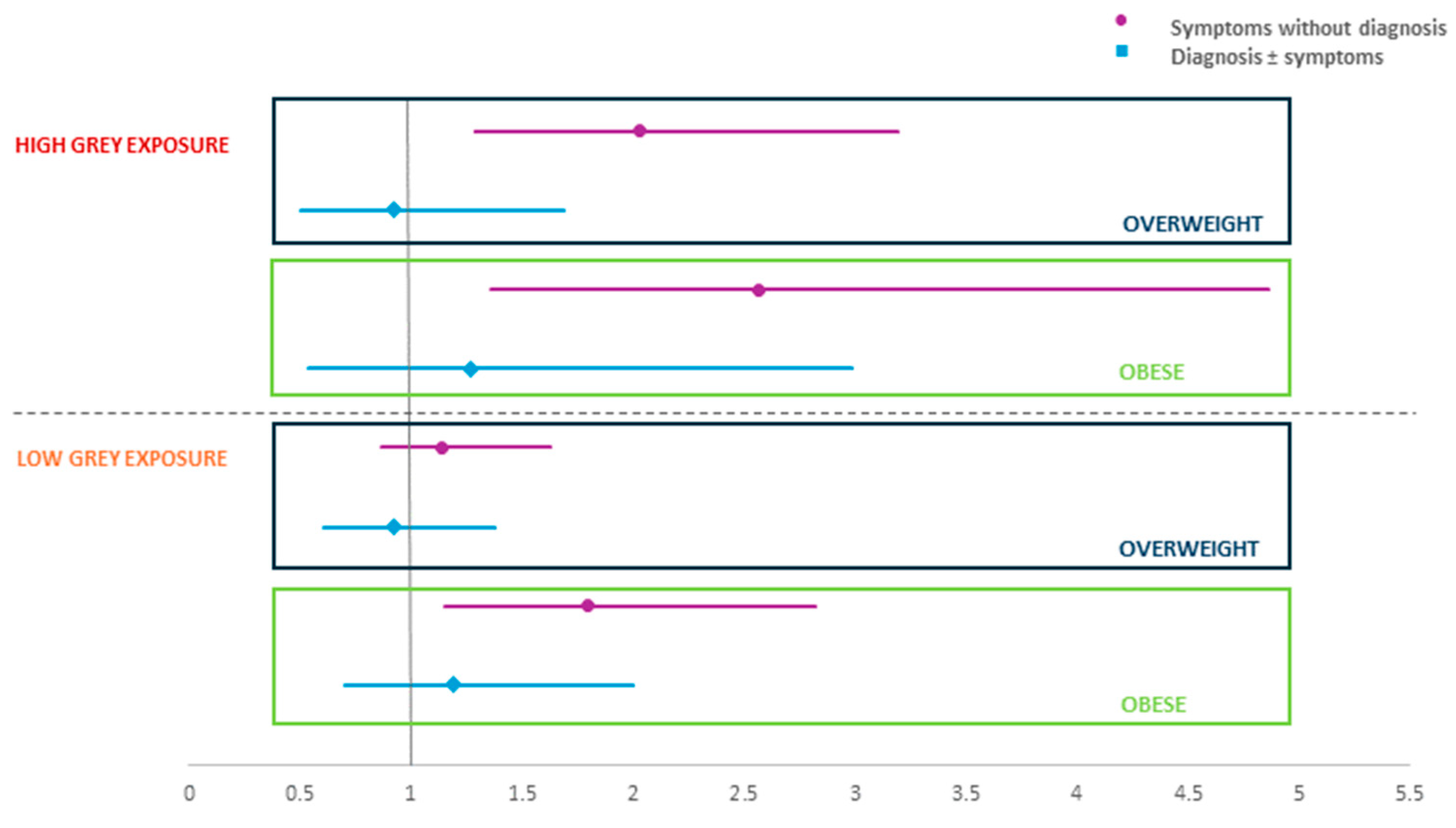
| Variables | Symptoms Without Diagnosis | Diagnosis ± Symptoms |
|---|---|---|
| Risk factors | OR (95% CI) | OR (95% CI) |
| BMI–grey space exposure: | ||
| Underweight-normal weight + low grey exposure | 1 | 1 |
| Underweight-normal weight + high grey exposure | 1.33 (0.69–2.55) | 1.06 (0.52–2.16) |
| Overweight-obese + low grey exposure | 1.37 (0.99–1.88) | 1.08 (0.75–1.56) |
| Overweight-obese + high grey exposure | 2.53 (1.36–4.71) | 0.86 (0.41–1.83) |
| Age: | ||
| ≤18 | 1 | 1 |
| >18 and ≤59 | 1.61 (0.82–3.17) | 0.54 (0.32–0.89) |
| >59 | 1.93 (0.98–3.79) | 0.76 (0.46–1.26) |
| Sex: | ||
| Female | 1 | 1 |
| Male | 2.05 (1.56–2.69) | 1.07 (0.78–1.46) |
| Level of education: | ||
| >13 years | 1 | 1 |
| >8 and ≤13 years | 1.34 (0.61–2.98) | 2.38 (0.72–7.89) |
| ≤8 years | 2.05 (0.96–4.39) | 2.72 (0.84–8.82) |
| Smoking habits: | ||
| Non-smokers | 1 | 1 |
| Smokers | 4.28 (3.07–5.97) | 1.18 (0.78–1.79) |
| Ex-smokers | 2.09 (1.48–2.96) | 1.41 (0.97–2.04) |
| Hours outdoors: | ||
| ≥2 h a day | 1 | 1 |
| <2 h a day | 1.44 (1.12–1.85) | 1.37 (1.02–1.85) |
| % Grey space exposure | 0.96 (0.86–1.09) | 1.04 (0.91–1.20) |
| Variables | RERI (95% CI) | AP (95% CI) | S (95% CI) |
|---|---|---|---|
| Symptoms without diagnosis | 0.84 (−0.24–1.91) | 0.32 (0.03–0.61) | 1.47 (0.84–2.11) |
Disclaimer/Publisher’s Note: The statements, opinions and data contained in all publications are solely those of the individual author(s) and contributor(s) and not of MDPI and/or the editor(s). MDPI and/or the editor(s) disclaim responsibility for any injury to people or property resulting from any ideas, methods, instructions or products referred to in the content. |
© 2025 by the authors. Licensee MDPI, Basel, Switzerland. This article is an open access article distributed under the terms and conditions of the Creative Commons Attribution (CC BY) license (https://creativecommons.org/licenses/by/4.0/).
Share and Cite
Stanisci, I.; Angino, A.A.; Maio, S.; Sarno, G.; Silvi, P.; Tagliaferro, S.; Viegi, G.; Baldacci, S. Asthma Is Associated with Overweight, Obesity and Residential Grey Space in an Italian General Population Sample. Sustainability 2025, 17, 11300. https://doi.org/10.3390/su172411300
Stanisci I, Angino AA, Maio S, Sarno G, Silvi P, Tagliaferro S, Viegi G, Baldacci S. Asthma Is Associated with Overweight, Obesity and Residential Grey Space in an Italian General Population Sample. Sustainability. 2025; 17(24):11300. https://doi.org/10.3390/su172411300
Chicago/Turabian StyleStanisci, Ilaria, Anna Antonietta Angino, Sara Maio, Giuseppe Sarno, Patrizia Silvi, Sofia Tagliaferro, Giovanni Viegi, and Sandra Baldacci. 2025. "Asthma Is Associated with Overweight, Obesity and Residential Grey Space in an Italian General Population Sample" Sustainability 17, no. 24: 11300. https://doi.org/10.3390/su172411300
APA StyleStanisci, I., Angino, A. A., Maio, S., Sarno, G., Silvi, P., Tagliaferro, S., Viegi, G., & Baldacci, S. (2025). Asthma Is Associated with Overweight, Obesity and Residential Grey Space in an Italian General Population Sample. Sustainability, 17(24), 11300. https://doi.org/10.3390/su172411300