Leadership, Human-Centered Management and Organizational Culture: Pathways to Well-Being and Innovative Work Based on a Systematic Review


Abstract
1. Introduction
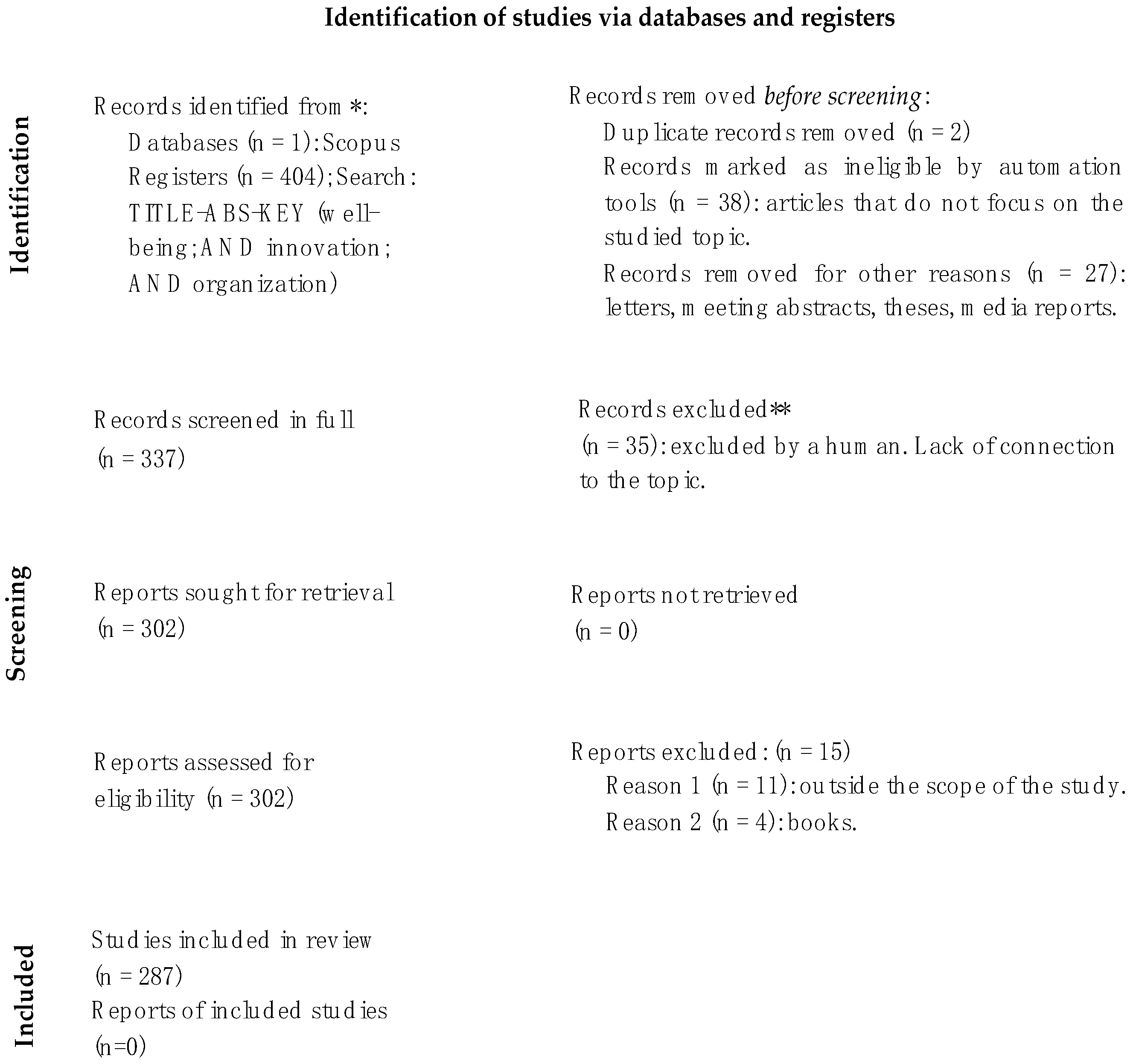
2. Materials and Methods
3. Results
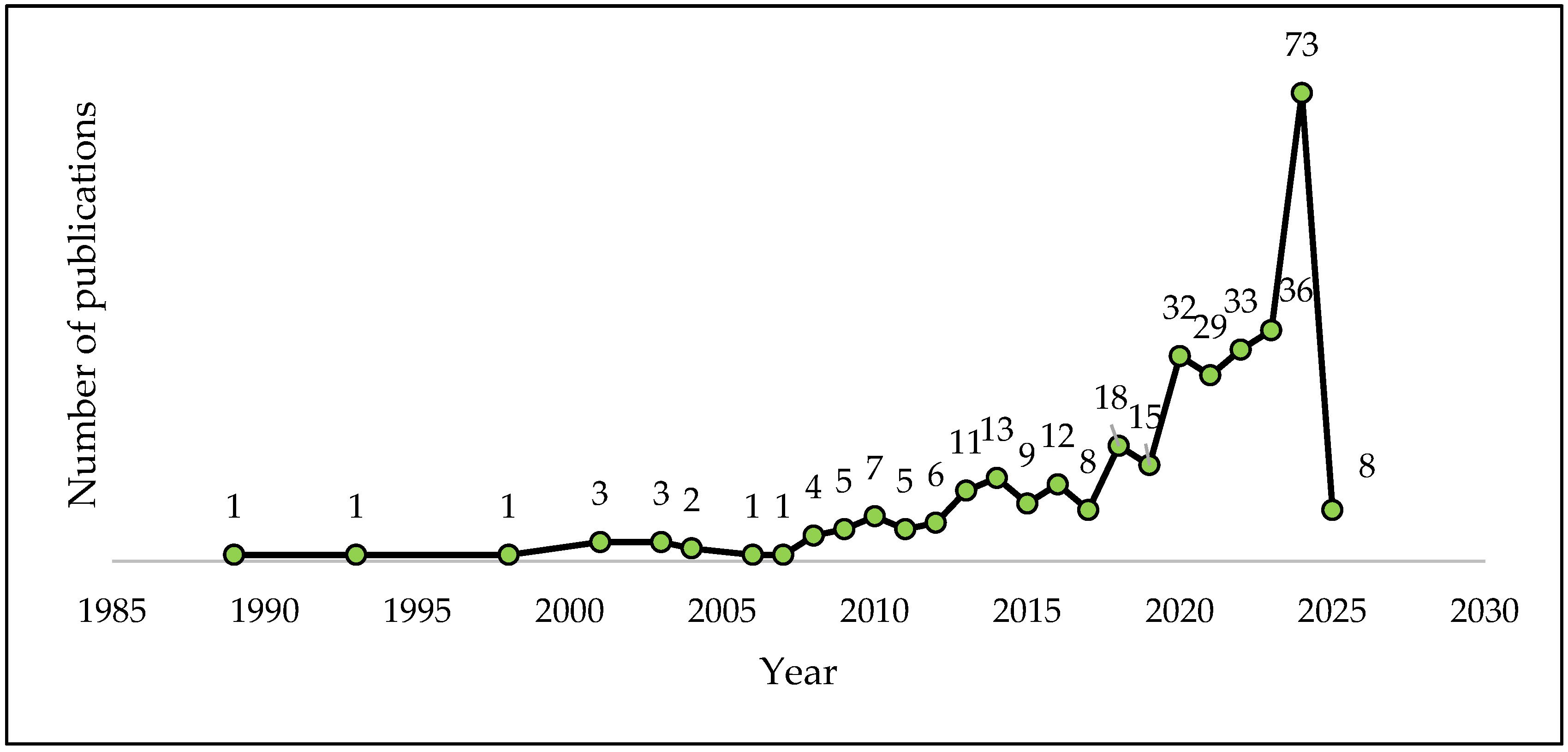
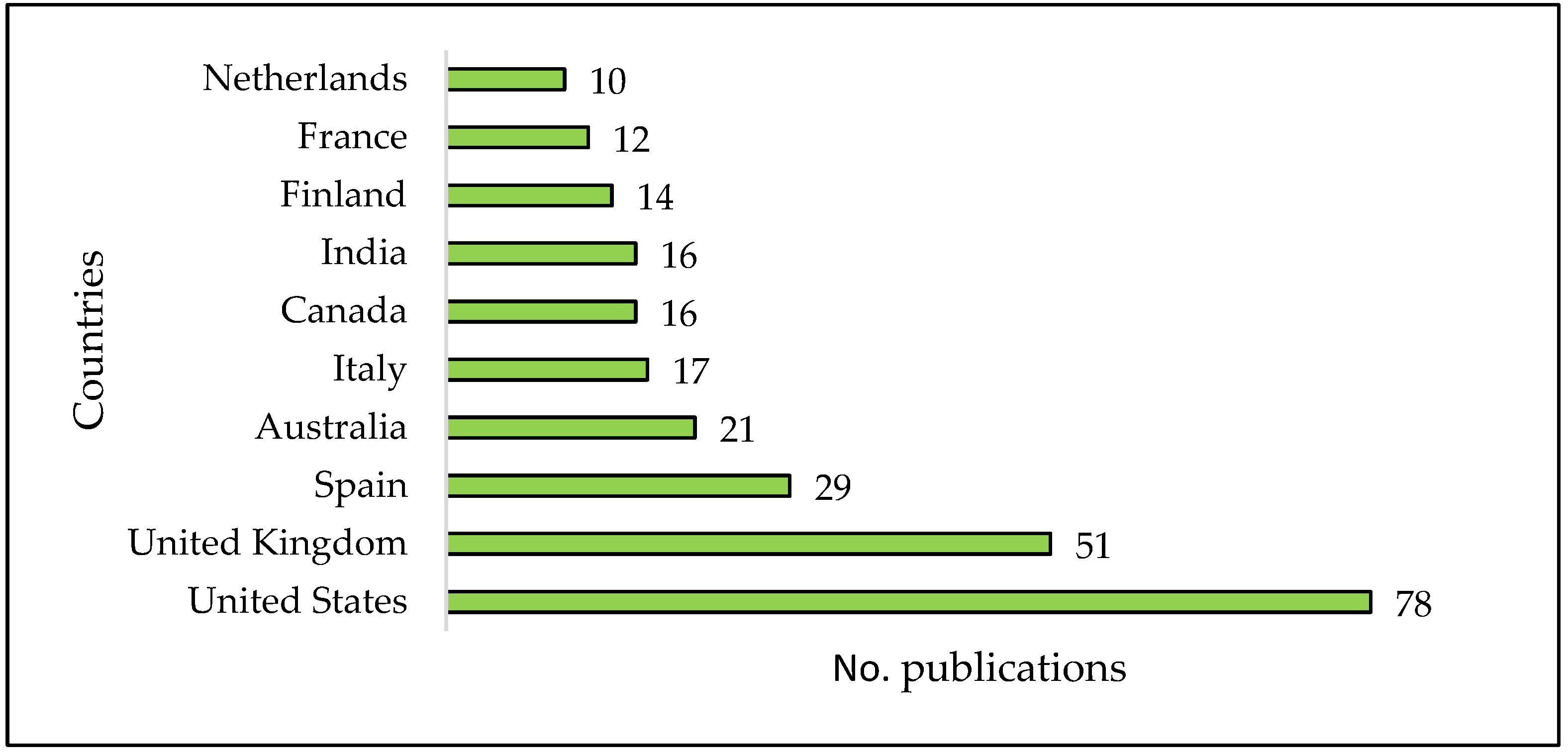
3.1. Descriptive Overview
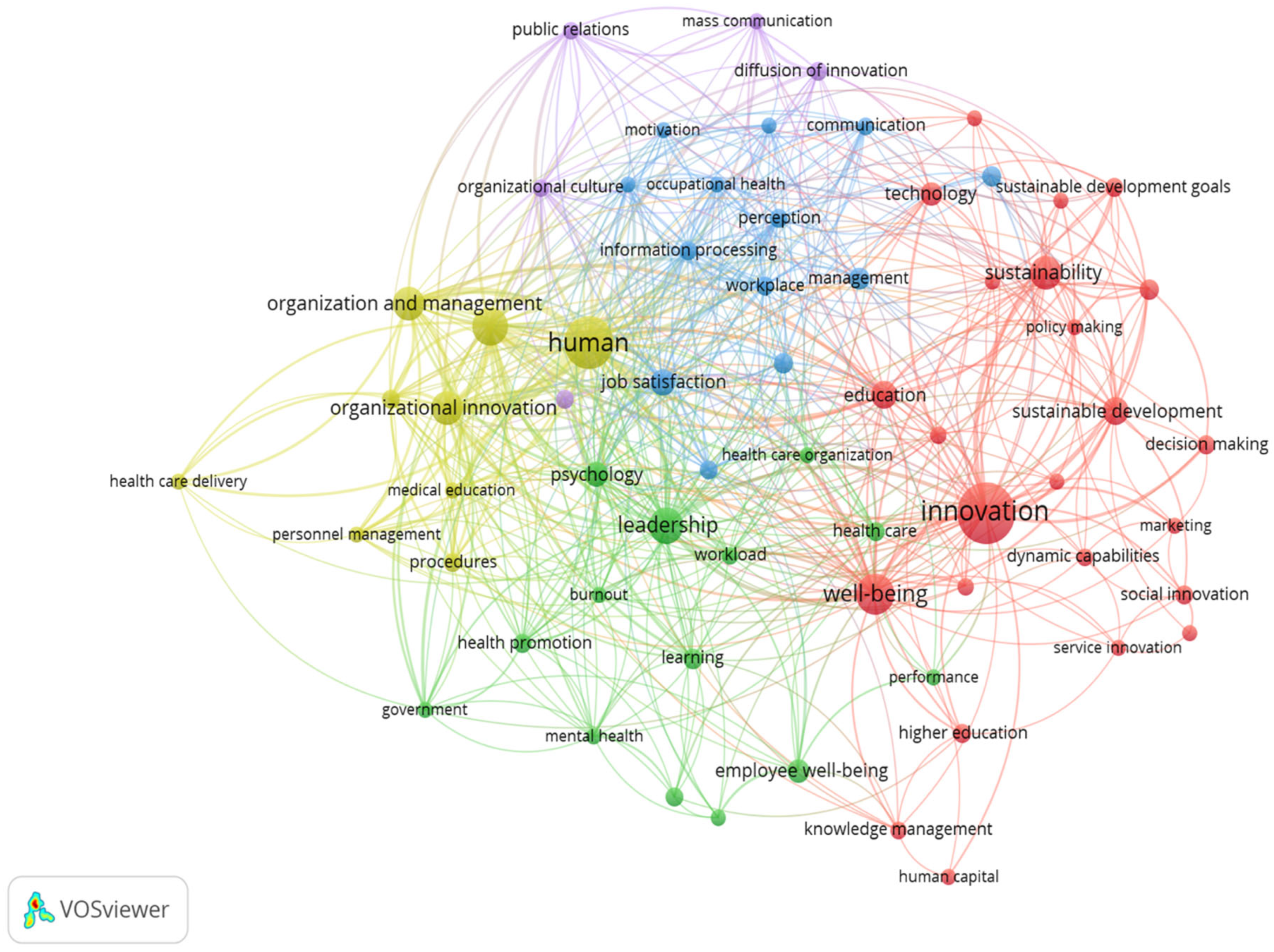
3.2. Analysis of Keyword Co-Occurrence and Formation of Thematic Groups
3.2.1. Innovation and Well-Being (Cluster 1, Red)
3.2.2. Leadership Pathways to Workplace Well-Being (Cluster 2, Green)
3.2.3. Work Motivation and Job Satisfaction (Cluster 3, Blue)
3.2.4. Human-Centered Management in Technological Progress (Cluster 4, Yellow)
3.2.5. Organizational Culture (Cluster 5, Purple)
4. Discussion
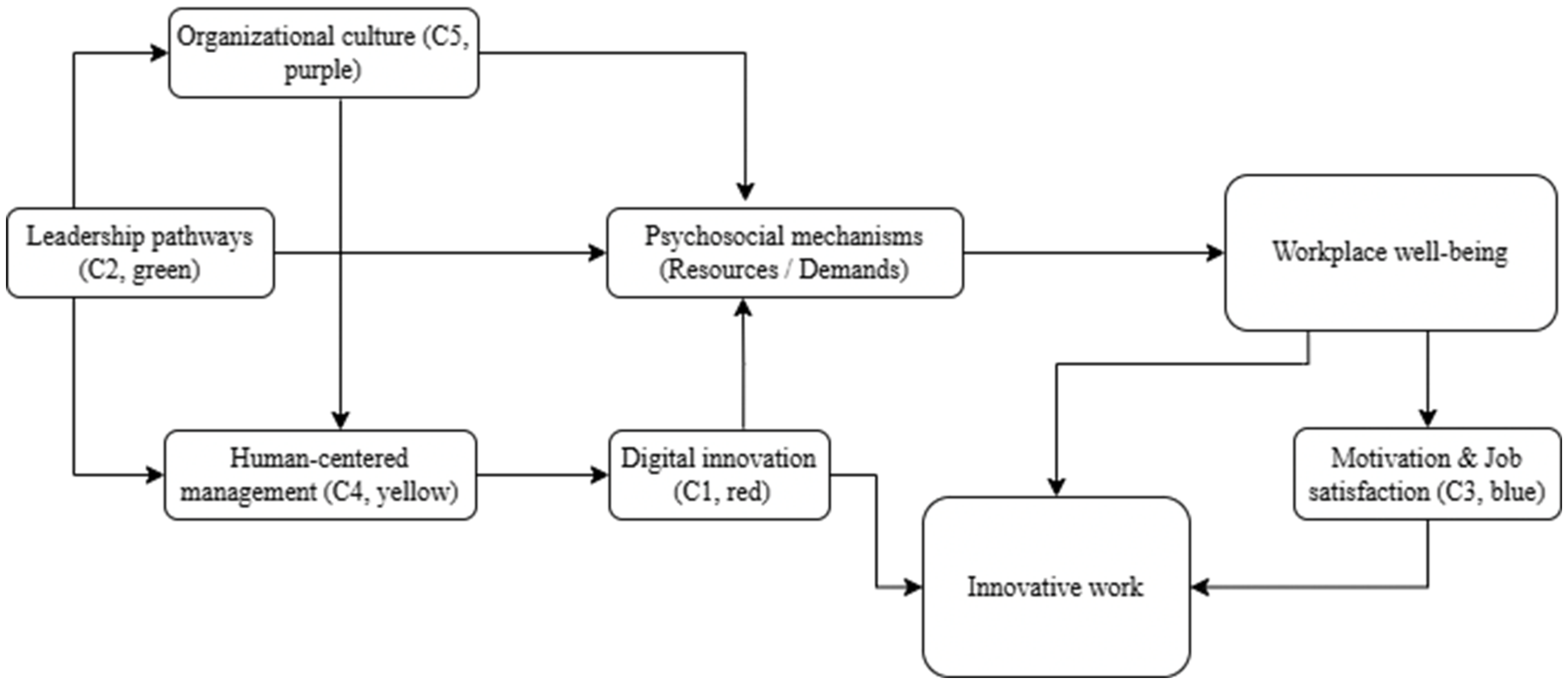
4.1. Leadership and Culture as Upstream Drivers of Human-Centered Management
4.2. Human-Centered Management Governs Change to Enhance Resources and Contain Demands
4.3. Leadership and Culture Directly Shape Psychosocial Mechanisms (More Resources, Fewer Demands)
4.4. The Resources–Demands Balance Mediates Effects on Workplace Well-Being
4.5. Workplace Well-Being Promotes Innovative Work Directly and via Motivation/Satisfaction
4.6. How Leadership and Culture Cascade to Innovation via Human-Centered Management and Well-Being
5. Study Limitations and Suggestions for Future Research
6. Conclusions
Supplementary Materials
Author Contributions
Funding
Institutional Review Board Statement
Informed Consent Statement
Data Availability Statement
Acknowledgments
Conflicts of Interest
Abbreviations
| AI | Artificial intelligence |
| HCM | human-centered management |
| HPWS | High-performance work systems |
| HR | Human resource |
| JD-R | Job demands-resources model |
| SDG | Sustainable development goal |
| SLR | systematic literature review |
References
- Mojica, M.; Palos-Sanchez, P.R.; Cabanas, E. Is there innovation management of emotions or just the commodification of happiness? A sentiment analysis of happiness apps. Eur. J. Innov. Manag. 2024, 28, 3238–3261. [Google Scholar] [CrossRef]
- Sierra-Casanova, C.; Lechuga Sancho, M.P.; Ramos-Rodríguez, A.R. What science says about entrepreneurs’ well-being: A conceptual structure review. Acad. Rev. Latinoam. Adm. 2024, 37, 355–382. [Google Scholar] [CrossRef]
- Robina-Ramírez, R.; Ortiz-de-Urbina-Criado, M.; Ravina-Ripoll, R. How can tourism managers’ happiness be generated through personal and innovative tourism services? Eur. J. Innov. Manag. 2023, 26, 751–774. [Google Scholar] [CrossRef]
- Avolio, B.J. Authentic leadership & PsyCap’s role in tackling events that impact well-being and environmental sustainability. Organ. Dyn. 2024, 53, 101088. [Google Scholar] [CrossRef]
- Al Koliby, I.S.; Al-Hakimi, M.A.; Zaid, M.A.K.; Khan, M.F.; Hasan, M.B.; Alshadadi, M.A. Green entrepreneurial orientation and technological green innovation: Does resources orchestration capability matter? Bottom Line 2024, 37, 45–70. [Google Scholar] [CrossRef]
- Brunetto, Y.; Kominis, G.; Ashton-Sayers, J. Authentic leadership, psychological capital, acceptance of change, and innovative work behaviour in non-profit organisations. Aust. J. Public Adm. 2024, 83, 69–87. [Google Scholar] [CrossRef]
- Sehgal, A.; Saxena, N. A study of motivations, practices, and innovations of intrapreneurs: Handling crisis situations. Financ. India 2023, 37, 747–772. [Google Scholar]
- Kim, B.-J.; Kim, M.-J.; Lee, J. Code green: Ethical leadership’s role in reconciling AI-induced job insecurity with pro-environmental behavior in the digital workplace. Humanit. Soc. Sci. Commun. 2024, 11, 1627. [Google Scholar] [CrossRef]
- Munawir, A.; Suseno, B.D. Employee performance: Exploring the nexus of nonstandard services, psychological contracts, and knowledge sharing. Hum. Behav. Emerg. Technol. 2024, 2024, 6746963. [Google Scholar] [CrossRef]
- Palakshappa, N.; Dodds, S.; Stangl, L.M. Understanding sustainable service ecosystems: A meso-level perspective. J. Serv. Mark. 2024, 38, 288–300. [Google Scholar] [CrossRef]
- Rouhana, R.; Van Caillie, D. How do performance monitoring systems support sustainability in healthcare? Soc. Bus. Rev. 2025, 20, 437–454. [Google Scholar] [CrossRef]
- Newell, S.; Cutrona, S.L.; Lafferty, M.; Lerner, B.; Vashi, A.A.; Jackson, G.L.; Amrhein, A.; Cole, B.; Tuepker, A. This has reinvigorated me”: Perceived impacts of an innovation training program on employee experience and innovation support. J. Health Organ. Manag. 2024, 39, 114–129. [Google Scholar] [CrossRef] [PubMed]
- Roberts, A.P.J.; Parnell, C.J.; Patel, M. We have to go back, back to the future! Reflecting on 75 years of human factors in the UK to shape a future of responsible artificial intelligence innovation. Ergonomics 2025, 68, 968–986. [Google Scholar] [CrossRef]
- Álvarez-Torres, F.J.; Schiuma, G. Measuring the impact of remote working adaptation on employees’ well-being during COVID-19: Insights for innovation management environments. Eur. J. Innov. Manag. 2024, 27, 608–627. [Google Scholar] [CrossRef]
- Lima, M. Smarter organizations: Insights from a smart city hybrid framework. Int. Entrep. Manag. J. 2020, 16, 1281–1300. [Google Scholar] [CrossRef]
- Ameer, F.; Khan, M.R.; Khan, I.; Khan, N.R.; Keoy, K.H. Organizational resilience and green innovation for environmental performance: Evidence from manufacturing organizations. Vis. J. Bus. Perspect. 2024. [Google Scholar] [CrossRef]
- Ravina-Ripoll, R.; Balderas-Cejudo, A.; Núñez-Barriopedro, E.; Galván-Vela, E. Are chefs happiness providers? Exploring the impact of organisational support, intrapreneurship and interactional justice from the perspective of happiness management. Int. J. Gastron. Food Sci. 2023, 34, 100818. [Google Scholar] [CrossRef]
- Al-Hadrawi, B.K.; Al-Hadrawi, K.K.; Ezzerouali, S.; Al-Hadraawy, S.K.; Aldhalmi, H.K.; Muhta, M.H. Mind intruders: Psychological, legal, and social effects of human parasites in the age of technological progress. Pak. J. Life Soc. Sci. 2024, 22, 5564–5581. [Google Scholar] [CrossRef]
- Pieper, D.; Rombey, T. Where to Prospectively Register a Systematic Review. Syst. Rev. 2022, 11, 8. [Google Scholar] [CrossRef]
- Phoobane, P.; Masinde, M.; Mabhaudhi, T. Predicting Infectious Diseases: A Bibliometric Review on Africa. Int. J. Environ. Res. Public Health 2022, 19, 1893. [Google Scholar] [CrossRef] [PubMed]
- Bramer, W.M.; Rethlefsen, M.L.; Kleijnen, J.; Franco, O.H. Optimal database combinations for literature searches in systematic reviews: A prospective exploratory study. Syst. Rev. 2017, 6, 245. [Google Scholar] [CrossRef] [PubMed]
- Stevinson, C.; Lawlor, D.A. Searching multiple databases for systematic reviews: Added value or diminishing returns? Complement. Ther. Med. 2004, 12, 228–232. [Google Scholar] [CrossRef] [PubMed]
- Frandsen, T.F.; Gildberg, F.A.; Tingleff, E.B. Searching for qualitative health research required several databases and alternative search strategies: A study of coverage in bibliographic databases. J. Clin. Epidemiol. 2019, 114, 118–124. [Google Scholar] [CrossRef]
- King, V.J.; Stevens, A.; Nussbaumer-Streit, B.; Kamel, C.; Garritty, C. Paper 2: Performing rapid reviews. Syst. Rev. 2022, 11, 151. [Google Scholar] [CrossRef]
- Haddaway, N.R.; Grainger, M.J.; Gray, C.T. Citationchaser: A tool for transparent and efficient forward and backward citation chasing in systematic searching. J. Res. Synth. Methodol. 2022, 13, 533–545. [Google Scholar] [CrossRef]
- Letts, L.; Wilkins, S.; Law, M.; Stewart, D.; Bosch, J.; Westmorland, M. Critical Review Form—Qualitative Studies, Version 2.0; McMaster University: Hamilton, ON, Canada, 2007. [Google Scholar]
- Sterne, J.A.C.; Hernán, M.A.; Reeves, B.C.; Savović, J.; Berkman, N.D.; Viswanathan, M.; Henry, D.; Altman, D.G.; Ansari, M.T.; Boutron, I.; et al. ROBINS-I: A tool for assessing risk of bias in non-randomised studies of interventions. BMJ 2016, 355, i4919. [Google Scholar] [CrossRef]
- Shea, B.J.; Reeves, B.C.; Wells, G.; Thuku, M.; Hamel, C.; Moran, J.; Moher, D.; Tugwell, P.; Welch, V.; Kristjansson, E.; et al. AMSTAR 2: A Critical Appraisal Tool for Systematic Reviews That Include Randomised or Non-Randomised Studies of Healthcare Interventions, or Both. BMJ 2017, 358, j4008. [Google Scholar] [CrossRef]
- Van Eck, N.J.; Waltman, L. Citation-based clustering of publications using CitNetExplorer and VOSviewer. Scientometrics 2017, 111, 1053–1070. [Google Scholar] [CrossRef]
- Iansiti, M.; Levien, R. Strategy as ecology. Harv. Bus. Rev. 2004, 82, 68–78. [Google Scholar]
- Ostrom, A.L.; Bitner, M.J.; Brown, S.W.; Burkhard, K.A.; Goul, M.; Smith-Daniels, V.; Demirkan, H.; Rabinovich, E. Moving forward and making a difference: Research priorities for the science of service. J. Serv. Res. 2010, 13, 4–36. [Google Scholar] [CrossRef]
- Ostrom, A.L.; Parasuraman, A.; Bowen, D.E.; Patrício, L.; Voss, C.A. Service research priorities in a rapidly changing context. J. Serv. Res. 2015, 18, 127–159. [Google Scholar] [CrossRef]
- Gilson, L.L.; Maynard, M.T.; Jones Young, N.C.; Vartiainen, M.; Hakonen, M. Virtual teams research: 10 years, 10 themes, and 10 opportunities. J. Manag. 2015, 41, 1313–1337. [Google Scholar] [CrossRef]
- Lee, H.L.; Tang, C.S. Socially and environmentally responsible value chain innovations: New operations management research opportunities. Manag. Sci. 2018, 64, 983–996. [Google Scholar] [CrossRef]
- Lopez-Fernandez, M.C.; Serrano-Bedia, A.M.; Perez-Perez, M. Research in Entrepreneurship and Family Business: A Bibliometric Analysis of an Emerging Field. J. Small Bus. Manag. 2016, 54, 622–639. [Google Scholar] [CrossRef]
- Dias, C.S.; Rodrigues, R.G.; Ferreira, J.J. What’s New in Research on Agricultural Entrepreneurship? J. Rural. Stud. 2019, 65, 99–115. [Google Scholar] [CrossRef]
- Nagy, N. “Humanity’s new frontier”: Human rights implications of artificial intelligence and new technologies. Hung. J. Leg. Stud. 2023, 64, 236–267. [Google Scholar] [CrossRef]
- Subramony, M.; Rosenbaum, M.S. SDG commentary: Economic services for work and growth for all humans. J. Serv. Mark. 2024, 38, 190–216. [Google Scholar] [CrossRef]
- Tairov, I.; Stefanova, N.; Aleksandrova, A. Artificial intelligence application in human resources management. Bus. Manag. 2024, 2024, 72–88. [Google Scholar] [CrossRef]
- Ammupriya, A.; Subrahmanyan, P. Enhancement of work engagement through HRIS adoption mediated by workplace well-being. Braz. J. Oper. Prod. Manag. 2023, 20, e20231499. [Google Scholar] [CrossRef]
- Olivera, E.L.; Booth, C.; Agyekum, K.; Al-Tarazi, D.; Pittri, H. A phenomenological inquiry of Building Information Modelling macro-adoption in Uruguay. Proc. Inst. Civ. Eng. Manag. Procure. Law 2024, 177, 137–149. [Google Scholar] [CrossRef]
- Rolfö, L.; Eklund, J.; Jahncke, H. Perceptions of performance and satisfaction after relocation to an activity-based office. Ergonomics 2018, 61, 644–657. [Google Scholar] [CrossRef]
- Khakurel, J.; Melkas, H.; Porras, J. Tapping into the wearable device revolution in the work environment: A systematic review. Inf. Technol. People 2018, 31, 791–818. [Google Scholar] [CrossRef]
- Doargajudhur, M.S.; Dell, P. Impact of BYOD on organizational commitment: An empirical investigation. Inf. Technol. People 2019, 32, 246–268. [Google Scholar] [CrossRef]
- Walsh, C.; Knott, P.; Collins, J. The driving mindsets of innovation: Curiosity, creativity and clarity. J. Bus. Strategy 2022, 43, 71–78. [Google Scholar] [CrossRef]
- Honkaniemi, L.; Lehtonen, M.H.; Hasu, M. Well-being and innovativeness: Motivational trigger points for mutual enhancement. Eur. J. Train. Dev. 2015, 39, 393–408. [Google Scholar] [CrossRef]
- Gupta, P.; Lakhera, G.; Sharma, M. Examining the impact of artificial intelligence on employee performance in the digital era: An analysis and future research direction. J. High Technol. Manag. Res. 2024, 35, 100520. [Google Scholar] [CrossRef]
- Asad, M.M.; Erum, D.; Churi, P.; Moreno Guerrero, A.J. Effect of technostress on psychological well-being of post-graduate students: A perspective and correlational study of higher education management. Int. J. Inf. Manag. Data Insights 2023, 3, 100149. [Google Scholar] [CrossRef]
- Hu, Y.; Nie, J.; Gu, X. From equity of opportunity to equity of development: A comparative analysis of large-scale online education in urban and rural K-12 schools in China during COVID-19. Chin. Educ. Soc. 2023, 55, 419–437. [Google Scholar] [CrossRef]
- Cheung, K.; Chau, A.K.C.; Woo, J.; Lai, E.T. The age-based digital divide in an increasingly digital world: A focus group investigation during the COVID-19 pandemic. Arch. Gerontol. Geriatr. 2023, 115, 105225. [Google Scholar] [CrossRef] [PubMed]
- Chowdhury, F. Blended learning: How to flip the classroom at HEIs in Bangladesh? J. Res. Innov. Teach. Learn. 2020, 13, 228–242. [Google Scholar] [CrossRef]
- Linkov, I.; Trump, B.; Poinsatte-Jones, K.; Florin, M.-V. Governance strategies for a sustainable digital world. Sustainability 2018, 10, 440. [Google Scholar] [CrossRef]
- Selimović, J.; Pilav-Velić, A.; Krndžija, L. Digital workplace transformation in the financial service sector: Investigating the relationship between employees’ expectations and intentions. Technol. Soc. 2021, 66, 101640. [Google Scholar] [CrossRef]
- Zahoor, N.; Donbesuur, F.; Christofi, M.; Miri, D. Technological innovation and employee psychological well-being: The moderating role of employee learning orientation and perceived organizational support. Technol. Forecast. Soc. Change 2022, 179, 121610. [Google Scholar] [CrossRef]
- Androniceanu, A.-M.; Kinnunen, J.; Georgescu, I.; Androniceanu, A. A multidimensional approach to competitiveness, innovation and well-being in the EU using canonical correlation analysis. J. Compet. 2020, 12, 5–21. [Google Scholar] [CrossRef]
- Glasgow, M.E.S.; Dunphy, L.M.; Mainous, R.O. Innovative nursing educational curriculum for the 21st century. Nurs. Educ. Perspect. 2010, 31, 355–357. [Google Scholar]
- Sukkird, V.; Shirahada, K. Technology challenges to healthcare service innovation in aging Asia: Case of value co-creation in emergency medical support system. Technol. Soc. 2015, 43, 122–128. [Google Scholar] [CrossRef]
- Tsekouropoulos, G.; Vatis, S.-E.; Andreopoulou, Z.; Katsonis, N.; Papaioannou, E. The aspects of internet-based management, marketing, consumer’s purchasing behavior and social media towards food sustainability. Riv. Studi Sulla Sostenibilità 2014, 2014, 207–222. [Google Scholar] [CrossRef]
- Gopinath, N.; Mitra, J. Entrepreneurship and well-being: Towards developing a novel conceptual framework for entrepreneurial sustainability in organisations. J. Entrep. Innov. Emerg. Econ. 2017, 3, 62–70. [Google Scholar] [CrossRef]
- Cañibano, A. Implementing innovative HRM: Trade-off effects on employee well-being. Manag. Decis. 2013, 51, 643–660. [Google Scholar] [CrossRef]
- Bentley, T.; Green, N.; Tappin, D.; Haslam, R. State of science: The future of work—Ergonomics and human factors contributions to the field. Ergonomics 2021, 64, 427–439. [Google Scholar] [CrossRef]
- Hennala, L.; Parjanen, S.; Uotila, T. Challenges of multi-actor involvement in the public sector front-end innovation processes: Constructing an open innovation model for developing well-being services. Eur. J. Innov. Manag. 2011, 14, 364–387. [Google Scholar] [CrossRef]
- McAvinchey, C. Coming of age: Arts practice with older people in private and domestic spaces. J. Appl. Theatre Perform. 2013, 18, 359–373. [Google Scholar] [CrossRef]
- Khurana, R. Breakthrough ideas for 2004. IEEE Eng. Manag. Rev. 2004, 32, 3–19. [Google Scholar] [CrossRef]
- Pap, J.; Makó, C.; Illéssy, M.; Kis, N.; Mosavi, A. Modeling organizational performance with machine learning. J. Open Innov. Technol. Mark. Complex. 2022, 8, 177. [Google Scholar] [CrossRef]
- Augner, T.; Schermuly, C.C. Beyond a buzzword: The agile mindset as a new research construct in organizational psychology. J. Manag. Psychol. 2025, 40, 274–288. [Google Scholar] [CrossRef]
- Saxena, P.K.; Seetharaman, A.; Shawarikar, G. Factors that influence sustainable innovation in organizations: A systematic literature review. Sustainability 2024, 16, 4978. [Google Scholar] [CrossRef]
- Wang, Y.; Hanif, N.; Arshed, N.; Hussain, M.; Arshad, Z.; Usman, M. Synergizing social sustainability and technological innovation for carbon neutrality in OECD economies. Sustain. Dev. 2024, 32, 6614–6628. [Google Scholar] [CrossRef]
- Anis, M.Z.A.; Hadi, S.; Rajiani, I.; Abbas, E.W. The managerial effects of leadership, knowledge sharing and innovation in higher education. Pol. J. Manag. Stud. 2021, 23, 59–73. [Google Scholar] [CrossRef]
- Nawaz, N.; Arunachalam, H.; Pathi, B.K.; Gajenderan, V. The adoption of artificial intelligence in human resources management practices. Int. J. Inf. Manag. Data Insights 2024, 4, 100208. [Google Scholar] [CrossRef]
- Parahoo, S.K.K.; Mumtaz, S.; Soltani, E.; Alnuaimi, L. Leading with care: How health-promoting leadership drives innovation in the Middle East. Int. J. Product. Perform. Manag. 2024, 74, 1081–1100. [Google Scholar] [CrossRef]
- Desrumaux, P.; Pohl, S.; Dose, E.; Bobillier Chaumon, M.-E. When leader–member exchanges make workers happy and innovative: Do efforts and rewards act as mediators? J. Technol. Manag. Innov. 2022, 17, 27–37. [Google Scholar] [CrossRef]
- Eisenberger, R.; Shanock, L.R.; Wen, X. Perceived organizational support: Why caring about employees counts. Annu. Rev. Organ. Psychol. Organ. Behav. 2020, 7, 101–124. [Google Scholar] [CrossRef]
- Kohnen, D.; De Witte, H.; Schaufeli, W.B.; Dello, S.; Bruyneel, L.; Sermeus, W. Engaging leadership and nurse well-being: The role of the work environment and work motivation—A cross-sectional study. Hum. Resour. Health 2024, 22, 8. [Google Scholar] [CrossRef]
- Whelehan, D.F.; Algeo, N.; Brown, D.A. Leadership through crisis: Fighting the fatigue pandemic in healthcare during COVID-19. BMJ Lead. 2021, 5, 108–112. [Google Scholar] [CrossRef]
- Lee, H.I.; Lu, H. Promoting knowledge sharing with effective leadership—A case study from a socio-organisational perspective. Knowl. Manag. Res. Pract. 2022, 20, 528–541. [Google Scholar] [CrossRef]
- Gudmundsdottir, S.; Sigurjonsson, T.O.; Hlynsdottir, E.M.; Fridriksdottir, S.D.; Ingibjargardottir, I.S. Sustainable digital change: The case of a municipality. Sustainability 2024, 16, 1319. [Google Scholar] [CrossRef]
- Gibson, C.B.; Gilson, L.L.; Griffith, T.L.; O’Neill, T.A. Should employees be required to return to the office? Organ. Dyn. 2023, 52, 100981. [Google Scholar] [CrossRef]
- Counts, J.; Gillam, R.; Garstka, T.A.; Urbach, E. How the Center for Public Partnerships and Research navigates complex social problems to make a collective difference. J. Evid. Inf. Soc. Work. 2018, 15, 313–323. [Google Scholar] [CrossRef] [PubMed]
- Hecht, A.D.; Fiksel, J.; Fulton, S.C.; Yosie, T.F.; Hawkins, N.C.; Leuenberger, H.; Golden, J.S.; Lovejoy, T.E. Creating the future we want. Sustain. Sci. Pract. Policy 2012, 8, 62–75. [Google Scholar] [CrossRef]
- Lee, S.M.; Trimi, S. Innovation for creating a smart future. J. Innov. Knowl. 2018, 3, 1–8. [Google Scholar] [CrossRef]
- Schraub, E.M.; Michel, A.; Shemla, M.; Sonntag, K. The roles of leader emotion management and team conflict for team members’ personal initiative: A multilevel perspective. Eur. J. Work. Organ. Psychol. 2014, 23, 263–276. [Google Scholar] [CrossRef]
- Espinoza, P.; Peduzzi, M.; Agreli, H.F.; Sutherland, M.A. Interprofessional team member’s satisfaction: A mixed methods study of a Chilean hospital. Hum. Resour. Health 2018, 16, 30. [Google Scholar] [CrossRef]
- Siswanto; Masyhuri; Pardiman. Investigate the link between innovation and teaching in the millennial generation. Qual. Access Success 2022, 23, 125–130. [Google Scholar] [CrossRef]
- Zacher, H.; Rosing, K. Ambidextrous leadership and team innovation. Leadersh. Organ. Dev. J. 2015, 36, 54–68. [Google Scholar] [CrossRef]
- Eide, A.E.; Moen, Ø.; Madsen, T.K.; Azari, M.J. Growth aspirations in SMEs: Managerial determinants and organizational outcomes. J. Small Bus. Enterp. Dev. 2021, 28, 640–665. [Google Scholar] [CrossRef]
- Kiefer, T.; Hartley, J.; Conway, N.; Briner, R.B. Feeling the squeeze: Public employees’ experiences of cutback- and innovation-related organizational changes following a national announcement of budget reductions. J. Public Adm. Res. Theory 2015, 25, 1279–1305. [Google Scholar] [CrossRef]
- Prince, M.; Forr, J.; Wardlaw, J.; Plummer, J. CEO archetype identity drives organization culture. J. Leadersh. Stud. 2019, 13, 62–67. [Google Scholar] [CrossRef]
- Malbon, E.; Alexander, D.; Carey, G.; Reeders, D.; Green, C.; Dickinson, H.; Kavanagh, A. Adapting to a marketised system: Network analysis of a personalisation scheme in early implementation. Health Soc. Care Community 2019, 27, 191–198. [Google Scholar] [CrossRef] [PubMed]
- O’Connor, P.; Carvalho, T.; White, K. The experiences of senior positional leaders in Australian, Irish and Portuguese universities: Universal or contingent? High. Educ. Res. Dev. 2014, 33, 5–18. [Google Scholar] [CrossRef]
- Toufaily, E.; Zalan, T. Ecosystem well-being and resilience: Lessons from crisis management in service organizations. J. Bus. Bus. Mark. 2023, 30, 349–370. [Google Scholar] [CrossRef]
- Shanafelt, T.; Trockel, M.; Rodriguez, A.; Logan, D. Wellness-centered leadership: Equipping health care leaders to cultivate physician well-being and professional fulfillment. Acad. Med. 2021, 96, 641–651. [Google Scholar] [CrossRef] [PubMed]
- Phuangprayong, K.; Noonin, S. Key characteristics of social innovation towards sustainable development: A case study of social innovation projects in Central Thailand. Kasetsart J. Soc. Sci. 2024, 45, 1359–1372. [Google Scholar] [CrossRef]
- Eniola, A.A.; Kenzhin, Z.; Chimwai, L.; Kairliyeva, G.; Adeyeye, M.M.; Chidoko, C.; Mutsikiwa, M. High-performance work system on sustainable organizations performance in SMEs. Bus. Theory Pract. 2023, 24, 447–458. [Google Scholar] [CrossRef]
- Chang, E.; Lee, J.W.; Chin, H. Employees striving for innovation in social enterprises: The roles of social mission and commitment-based human resource management. Bus. Ethics Environ. Responsib. 2022, 31, 702–717. [Google Scholar] [CrossRef]
- Huang, L.-C.; Ahlstrom, D.; Lee, A.Y.-P.; Chen, S.-Y.; Hsieh, M.-J. High performance work systems, employee well-being, and job involvement: An empirical study. Pers. Rev. 2016, 45, 296–314. [Google Scholar] [CrossRef]
- Malik, T. Positive effects of opinion-count on job satisfaction of team members in business enterprises. J. Commun. Manag. 2013, 17, 56–74. [Google Scholar] [CrossRef]
- Galabova, L.; McKie, L. “The five fingers of my hand”: Human capital and well-being in SMEs. Pers. Rev. 2013, 42, 662–683. [Google Scholar] [CrossRef]
- Warr, P.; Inceoglu, I. Work orientations, well-being and job content of self-employed and employed professionals. Work Employ. Soc. 2018, 32, 292–311. [Google Scholar] [CrossRef]
- Durmuş, İ. Organizational overview of Maslow and management research. Türk. Psikolojik Danışma Rehb. Derg. 2024, 14, 137–152. [Google Scholar] [CrossRef]
- Sunar Bukulmez, P.; Girginkaya Akdag, S.; Ekin, G. Aligning the new work environment with OECD Goal 8: A design case of a global automobile brand from Turkey. Soc. Bus. Rev. 2025, 20, 407–436. [Google Scholar] [CrossRef]
- Araujo, C.M.B.D.; Alves, J.L. How to unlock BIM capabilities in the design phase to project success for long-term organization development? Eng. Constr. Archit. Manag. 2024; ahead of print. [Google Scholar] [CrossRef]
- Rosevear, E.; Trebilcock, M.; Mota Prado, M. The new progressivism and its implications for institutional theories of development. Dev. Policy Rev. 2021, 39, 644–664. [Google Scholar] [CrossRef]
- Yuriev, A.; Boiral, O.; Talbot, D. Is there a place for employee-driven pro-environmental innovations? The case of public organizations. Public Manag. Rev. 2022, 24, 1383–1410. [Google Scholar] [CrossRef]
- Ridzi, F.; Cyrus, C. Performance management: Learning community, capacity building, and innovation incubator. Local Dev. Soc. 2024, 5, 85–103. [Google Scholar] [CrossRef]
- Kaufman, C.E.; Keane, E.M.; Shangreau, C.; Arthur-Asmah, R.; Morse, B.; Whitesell, N.R. Dissemination and uptake of HIV/STD preventive interventions in American Indian and Alaska Native communities: A case study. Ethn. Health 2021, 26, 352–363. [Google Scholar] [CrossRef]
- Zengul, F.D.; Oner, N.; O’Connor, S.J.; Borkowski, N. A text mining study of topics and trends in health care management journals: 1998–2018. Health Care Manag. Rev. 2022, 47, 144–154. [Google Scholar] [CrossRef]
- Cifuentes, J.H.; Méndez, E.L.; Valenzuela, S.M. Determining factors of innovation in the subsector of human healthcare related activities in Colombia for the 2014–2015 period. Int. J. Entrep. Innov. Manag. 2021, 25, 110–131. [Google Scholar] [CrossRef]
- Bubenko, P.; Dymchenko, O.; Rudachenko, O.; Haidenko, S.; Diegtiar, O. Territorial organization of innovative development: Entrepreneurial aspect of sustainability. Riv. Studi Sulla Sostenibilità 2021, 2021, 171–185. [Google Scholar] [CrossRef]
- Singh, A. Problem mapping: Implications for social work education and practice. Hum. Serv. Organ. Manag. Leadersh. Gov. 2024, 49, 572–585. [Google Scholar] [CrossRef]
- Sharif, R. A model of creativity in organizations: John Holland’s theory of vocational choice (1973) at multiple levels of analysis. J. Creat. Behav. 2017, 51, 140–152. [Google Scholar] [CrossRef]
- Lähteenoja, V.; Karhu, K. The virtuous smart city: Bridging the gap between ethical principles and practices of data-driven innovation. Data Policy 2023, 5, e15. [Google Scholar] [CrossRef]
- Adegboye, M. Impact of artificial intelligence on health information literacy: Guidance for healthcare professionals. Libr. Hi Tech News 2024, 41, 1–4. [Google Scholar] [CrossRef]
- Chui, C.H. Opportunities for organizational learning and innovation: A nonprofit case study during COVID-19 in Hong Kong. Nonprofit Manag. Leadersh. 2022, 33, 441–452. [Google Scholar] [CrossRef]
- Bellis, P.; Trabucchi, D.; Buganza, T.; Verganti, R. How do human relationships change in the digital environment after COVID-19 pandemic? The road towards agility. Eur. J. Innov. Manag. 2022, 25, 821–849. [Google Scholar] [CrossRef]
- Peshko, A. The need for direct and indirect state regulation for the sustainable development of the agro-industrial complex of Ukraine. Riv. Studi Sulla Sostenibilità 2022, 2022, 205–223. [Google Scholar] [CrossRef]
- Sarbat, I.; Ozmehmet Tasan, S. Ergonomics indicators: A proposal for sustainable process performance measurement in ergonomics. Ergonomics 2022, 65, 3–38. [Google Scholar] [CrossRef] [PubMed]
- van den Bosch, R.; Taris, T.W. The authentic worker’s well-being and performance: The relationship between authenticity at work, well-being, and work outcomes. J. Psychol. 2014, 148, 659–681. [Google Scholar] [CrossRef]
- Bonacci, I.; Mazzitelli, A.; Morea, D. Evaluating climate between working excellence and organizational innovation: What comes first? Sustainability 2020, 12, 3340. [Google Scholar] [CrossRef]
- Albertini, G. Informational Digest Bulletin from San Raffaele Foundation and Tosinvest Sanità (No. 19): A brief report on research activities at the Scientific Research Institute. J. Policy Pract. Intellect. Disabil. 2009, 6, 236–237. [Google Scholar] [CrossRef]
- Alasoini, T. A new model for workplace development in Finland: Rethinking employee participation and the quality of working life in the context of broad-based innovation policy. Int. J. Action Res. 2012, 8, 245–265. [Google Scholar]
- Delladio, S.; Caputo, A. When the tank is empty: Reviewing burnout in entrepreneurship. J. Small Bus. Manag. 2024, 63, 2320–2356. [Google Scholar] [CrossRef]
- Abd Alla, B.A.; Mannan, A.; Aswan, A.; Sabbar, S.D.; Nohong, M. Performance of public service employees in Makassar: Hard & soft analysis of human resource management approach. J. Infrastruct. Policy Dev. 2024, 8, 5910. [Google Scholar] [CrossRef]
- Steinert, Y.; O’Sullivan, P.S.; Irby, D.M. The role of faculty development in advancing change at the organizational level. Acad. Med. 2024, 99, 716–723. [Google Scholar] [CrossRef]
- Guo, M.; Khassawneh, O.; Mohammad, T.; Pei, X. When leadership goes awry: The nexus between tyrannical leadership and knowledge hiding. J. Knowl. Manag. 2024, 28, 1096–1115. [Google Scholar] [CrossRef]
- Kashdan, T.; Harrison, S.H.; Polman, E.; Kark, R. Curiosity in organizations: Addressing adverse reactions, trade-offs, and multi-level dynamics. Organ. Behav. Hum. Decis. Process. 2023, 179, 104274. [Google Scholar] [CrossRef]
- Kang, J.Y.; Lee, M.; Fairchild, E.M.; Caubet, S.L.; Peters, D.E.; Matti, L.; Howell, T.G., Jr. Do organizational values and leadership impact staff engagement, wellbeing, and patient satisfaction? J. Healthc. Leadersh. 2023, 15, 209–219. [Google Scholar] [CrossRef]
- Abrini, Z.B.; Gómez, R.C.; Reinders, J.G. Maximizing economic benefits or being conscious? A comparative analysis of organizational learning capability, innovation and well-being. UCJC Bus. Soc. Rev. 2024, 21, 178–211. [Google Scholar] [CrossRef]
- Galanti, T.; Fantinelli, S.; Giffi, V.; Cortini, M. Colleagues’ support and techno-complexity: The importance of a positive aging climate. Informing Sci. Int. J. Emerg. Transdiscipl. 2024, 27, 11. [Google Scholar] [CrossRef]
- Maj, J.; Hamza-Orlińska, A. Exploring inclusion in the remote startup landscape: A case study analysis. Cent. Eur. Bus. Rev. 2024, 13, 1–19. [Google Scholar] [CrossRef]
- Lima, L.; De Oliveira Martins, A.; Estrela, E.; Duarte, R.S. Challenges posed to leadership: Systematic review based on the relationships between curricular autonomy and teachers’ well-being. Front. Educ. 2024, 9, 1520947. [Google Scholar] [CrossRef]
- Muñoz, R.M.; Andrade, S.M.; Peña, I.; Donate, M.J. Wellness programs in times of COVID-19, perceived organizational support and affective commitment: Effects on employee innovative behavior. Eur. J. Innov. Manag. 2023, 26, 23–44. [Google Scholar] [CrossRef]
- Trujillo Araujo, A.; Tuesta Panduro, J.A.; Viena Pezo, M.H.; Coronado Chang, L.V. Endomarketing: Strategy to reduce the turnover of millennial personnel in Mexican organizations [Endomarketing: Estrategia para la reducción de la rotación de personal millennial en organizaciones mexicanas]. Rev. Cienc. Soc. 2021, 27, 267–282. [Google Scholar]
- Nv, S.; Chhabra, B.; Mishra, M. Fun at work: Need or fad? Understanding the effect of social connectedness in job search with social media. Glob. Bus. Rev. 2023. [Google Scholar] [CrossRef]
- Della Torre, E. High performance work systems and workers’ well-being: A sceptical view. Int. J. Work. Innov. 2012, 1, 7–23. [Google Scholar] [CrossRef]
- López-Núñez, M.I.; Rubio-Valdehita, S.; Diaz-Ramiro, E.M.; Aparicio-García, M.E. Psychological capital, workload, and burnout: What’s new? The impact of personal accomplishment to promote sustainable working conditions. Sustainability 2020, 12, 8124. [Google Scholar] [CrossRef]
- Guillaume, Y.R.F.; Dawson, J.F.; Priola, V.; Sacramento, C.A.; Woods, S.A.; Higson, H.E.; Budhwar, P.S.; West, M.A. Managing diversity in organizations: An integrative model and agenda for future research. Eur. J. Work. Organ. Psychol. 2014, 23, 783–802. [Google Scholar] [CrossRef]
- Žižek, S.Š.; Mulej, M.; Treven, S.; Vaner, M. Well-being of all stakeholders in higher education—From knowledge management to knowledge-cum-values management. Int. J. Manag. Educ. 2014, 8, 225–243. [Google Scholar] [CrossRef]
- Benevene, P.; Callea, A. Organizational health among public sector and nonprofit employees: A comparison. Knowl. Manag. Int. J. 2014, 13, 1–13. [Google Scholar] [CrossRef]
- Kerr, S.; Penney, L.; Moewaka Barnes, H.; McCreanor, T. Kaupapa Māori action research to improve heart disease services in Aotearoa, New Zealand. Ethn. Health 2010, 15, 15–31. [Google Scholar] [CrossRef]
- Baril, R.; Clarke, J.; Friesen, M.; Stock, S.; Cole, D. Management of return-to-work programs for workers with musculoskeletal disorders: A qualitative study in three Canadian provinces. Soc. Sci. Med. 2003, 57, 2101–2114. [Google Scholar] [CrossRef]
- Genn, J.M. AMEE Medical Education Guide No. 23 (Part 2): Curriculum, environment, climate, quality and change in medical education—A unifying perspective. Med. Teach. 2001, 23, 445–454. [Google Scholar] [CrossRef]
- Rai, S.; Megyeri, E.; Kazár, K. The impact of equity sensitivity on mental health, innovation orientation, and turnover intention in the Hungarian and Indian contexts. Int. J. Organ. Anal. 2021, 29, 1044–1062. [Google Scholar] [CrossRef]
- Müller, R.; Zhai, L.; Wang, A.; Shao, J. A framework for governance of projects: Governmentality, governance structure and projectification. Int. J. Proj. Manag. 2016, 34, 957–969. [Google Scholar] [CrossRef]
- Demerouti, E.; Bakker, A.B.; Nachreiner, F.; Schaufeli, W.B. The job demands–resources model of burnout. J. Appl. Psychol. 2001, 86, 499–512. [Google Scholar] [CrossRef]
- Bakker, A.B.; Demerouti, E. Job demands–resources theory: Taking stock and looking forward. J. Occup. Health Psychol. 2017, 22, 273–285. [Google Scholar] [CrossRef] [PubMed]
- Hobfoll, S.E. Conservation of resources: A new attempt at conceptualizing stress. Am. Psychol. 1989, 44, 513–524. [Google Scholar] [CrossRef] [PubMed]
- Edmondson, A. Psychological safety and learning behavior in work teams. Adm. Sci. Q. 1999, 44, 350–383. [Google Scholar] [CrossRef]
- Schein, E.H. Organizational culture. Am. Psychol. 1990, 45, 109–119. [Google Scholar] [CrossRef]
- Ehrhart, M.G.; Schneider, B.; Macey, W.H. Organizational Climate and Culture: An Introduction to Theory, Research, and Practice; Routledge: New York, NY, USA, 2013. [Google Scholar] [CrossRef]
- Janssen, O. Job demands, perceptions of effort–reward fairness and innovative work behaviour. J. Occup. Organ. Psychol. 2000, 73, 287–302. [Google Scholar] [CrossRef]
- Amabile, T.M. Creativity in Context: Update to “The Social Psychology of Creativity”, 1st ed.; Routledge: New York, NY, USA, 1996. [Google Scholar] [CrossRef]
- Page, M.J.; McKenzie, J.E.; Bossuyt, P.M.; Boutron, I.; Hoffmann, T.C.; Mulrow, C.D.; Shamseer, L.; Tetzlaff, J.M.; Akl, E.A.; Brennan, S.E.; et al. The PRISMA 2020 statement: An updated guideline for reporting systematic reviews. BMJ 2021, 372, n71. [Google Scholar] [CrossRef]



| Journals | No. of Publications |
|---|---|
| Sustainability (Switzerland) | 12 |
| European Journal of Innovation Management | 6 |
| Academic Medicine | 4 |
| Ergonomics | 4 |
| Strategic Direction | 4 |
| Most Cited Articles | Authors | No. of Citations |
|---|---|---|
| Strategy as Ecology | Iansiti & Levien [30] | 1288 |
| Moving forward and making a difference: Research priorities for the science of service | Ostrom et al. [31] | 1141 |
| Service Research Priorities in a Rapidly Changing Context | Ostrom et al. [32] | 1132 |
| Virtual Teams Research: 10 Years, 10 Themes, and 10 Opportunities | Gilson et al. [33] | 626 |
| Socially and environmentally responsible value chain innovations: New operations management research opportunities | Lee & Tang [34] | 241 |
| Topics Covered | Cluster | Suggestions for Future Research |
|---|---|---|
| Innovation and well-being | 1 |
|
| Leadership pathways to workplace well-being | 2 |
|
| Work motivation and job satisfaction | 3 |
|
| Human-centered management in technological progress | 4 |
|
| Organizational culture | 5 |
|
Disclaimer/Publisher’s Note: The statements, opinions and data contained in all publications are solely those of the individual author(s) and contributor(s) and not of MDPI and/or the editor(s). MDPI and/or the editor(s) disclaim responsibility for any injury to people or property resulting from any ideas, methods, instructions or products referred to in the content. |
© 2025 by the authors. Licensee MDPI, Basel, Switzerland. This article is an open access article distributed under the terms and conditions of the Creative Commons Attribution (CC BY) license (https://creativecommons.org/licenses/by/4.0/).
Share and Cite
Diniz, P.; Marques, I.C.P.; Pereira, Â.M. Leadership, Human-Centered Management and Organizational Culture: Pathways to Well-Being and Innovative Work Based on a Systematic Review. Sustainability 2025, 17, 11181. https://doi.org/10.3390/su172411181
Diniz P, Marques ICP, Pereira ÂM. Leadership, Human-Centered Management and Organizational Culture: Pathways to Well-Being and Innovative Work Based on a Systematic Review. Sustainability. 2025; 17(24):11181. https://doi.org/10.3390/su172411181
Chicago/Turabian StyleDiniz, Paulo, Isabel Cristina Panziera Marques, and Ângela Maria Pereira. 2025. "Leadership, Human-Centered Management and Organizational Culture: Pathways to Well-Being and Innovative Work Based on a Systematic Review" Sustainability 17, no. 24: 11181. https://doi.org/10.3390/su172411181
APA StyleDiniz, P., Marques, I. C. P., & Pereira, Â. M. (2025). Leadership, Human-Centered Management and Organizational Culture: Pathways to Well-Being and Innovative Work Based on a Systematic Review. Sustainability, 17(24), 11181. https://doi.org/10.3390/su172411181