Abstract
While livestock production is a significant source of greenhouse gas emissions, it remains vital for fulfilling the growing global demand for animal protein. Including by-products in ruminant diets can enhance food circularity and reduce competition for human food, while also increasing the likelihood of reducing methane (CH4) emissions. This study aimed to evaluate the impact of fully replacing corn grain and urea in the control diet with local by-products, specifically corn distillers’ grains combined with either barley brewed grains or with wheat middlings, on enteric CH4 emissions and performance of sheep. Diets were balanced to be isoproteic and isoenergetic with 2.6 Mcal ME/kg of dry matter (DM) and 160 g crude protein/kg DM, respectively. Corn silage is the only source of forage in the diet, and the forage-to-concentrate ratio was maintained to 60:40 on a DM basis. Twelve Highlander female sheep of 35.9 ± 3.12 kg initial body weight (BW, mean ± standard deviation), were used in a Completely Randomized Block design, with four sheep per treatment and two measurement periods under the same treatment. Experiment lasted 60 d, 30 d acclimatization and 30 d measurements. Dry matter intake (DMI) was restricted to 2.5% of BW. Enteric CH4 emissions of individual sheep were quantified in respiration chambers over a 48 h period. Dietary treatments did not have a significant effect either on DMI or BW gain. The diet containing barley brewed grains significantly reduced total daily CH4 production by 22.3%, CH4 emissions per kg of DMI by 34% and energy loss as CH4 by 38% compared to the control diet. In conclusion, the agro-industrial by-products combinations evaluated in this study effectively replaced corn grain and urea without compromising feed intake or animal performance. Additionally, the diet containing barley brewed grains significantly reduced CH4 yield, and energy loss compared to the control diet.
1. Introduction
Reducing agricultural greenhouse gas (GHG) emissions is a global priority, underscored by international commitments to limit global warming to 1.5–2 °C above pre-industrial levels, which demands reaching net-zero GHG emissions by 2050 [1]. Within this context, the agricultural sector faces the dual challenge of ensuring global food security amid rising hunger [2] while simultaneously decreasing its GHG footprint [3]. This challenge is particularly acute as food systems are responsible for 35% of global GHGs, accounting for 13% of all anthropogenic emissions [4]. In Argentina, agriculture contributes up to 39% (143 MtCO2e) of national emissions, with enteric fermentation alone representing 40% of this share [5], demanding urgent need for effective mitigation strategies.
Argentina’s role as a major global food producer intensifies this challenge. As the world’s fourth-largest meat producer, with an annual carcass production of 3178 Mt and exports of 935 Mt [6,7], its livestock and crop sectors are vital to the economy, accounting for 58% of national exports in 2024 [8]. However, this production level has a significant resource cost, with livestock consuming approximately 20.4 Mt of human-edible biomass annually [9]. Simultaneously, the crop sector, dominated by soybean, corn, wheat and sunflower over 41.9 million ha generates substantial volumes of agro-industrial by-products (10–20 Mt annually) from grain processing [8,10]. This combination of challenges and resources presents a critical opportunity.
A promising strategy involves the valorization of these agro-industrial by-products within livestock systems. Historically used in Argentina livestock feeds [11], these by-products are well-suited to replace conventional sources of protein (e.g., oleaginous expellers, DDGS), highly digestible fiber (e.g., brewers’ grains), and energy [12,13,14,15]. Moreover, they offer a potential pathway for CH4 mitigation, as many contain bioactive compounds that can modulate rumen fermentation [16,17,18]. Enteric CH4 produced during ruminal anaerobic fermentation is not only a potent GHG but also represents a significant loss of dietary energy for the animal. While its production is influenced by feed intake and diet composition [19], strategic dietary manipulation emerges as a viable method to mitigate emissions while potentially improving animal performance [20].
Despite the historical use of by-products, a critical research gap persists regarding their optimized application for CH4 mitigation. Recent reviews note that research on agricultural GHG mitigation is often fragmented, calling for more coordinated and applied studies to develop effective, region-specific strategies [9,21,22]. A specific and under-explored avenue is the systematic evaluation of combinations of local by-products, designed not merely as supplements but as integrated, circular solutions that displace human-edible ingredients like corn grain. Therefore, a clear need exists to quantify the enteric CH4 mitigation potential of such by-product combinations that enhance food circularity.
To address this gap, the present study contributes to quantifying sustainable livestock production by defining practical dietary strategies aligned with circular economy principles. We hypothesized that a combination of agro-industrial by-products could fully replace corn grain and urea in backgrounding diets, a productive phase before animals enter intensive finishing systems, decreasing enteric CH4 emissions. This study specifically evaluated the enteric CH4 mitigation potential of two alternatives diets: one combining corn dried distillers’ grains (DDGS) with barley brewers’ grains, and the second combining DDGS with wheat middlings, while maintaining sunflower expeller across diets.
2. Materials and Methods
2.1. Animal Ethics Statement
The experiment was approved by the Institutional Committee for the Care and Use of Experimental Animals at INTA (Instituto Nacional de Tecnologia Agropecuaria—Argentina) under protocol 219/2021.
2.2. Experimental Setting
This study was carried out from November to December 2022, in a research facility located at Balcarce Experimental Station of the National Institute of Agricultural Technology (INTA) in Buenos Aires Province, Argentina (37°45′37″ S, 58°18′02″ W). Twelve yearling Highlander female sheep, with an average initial body weight (BW) of 35.9 ± 3.12 kg (mean ± standard deviation), were randomly allocated to one of three dietary treatments. All sheep were allocated in a well-ventilated shed in individual pens 2.35 m long and 1.25 m wide, provided with their own feeder and water trough, and protected from rain and direct sunlight.
2.3. Treatments and Experimental Design
The study lasted 60 days, a 30 day acclimatization period followed by two consecutive 15 d measurement periods. The adaptation period was extended to 30 days to minimize diet selectivity, a known behavior in sheep. Animals were gradually adapted to experimental routines, diets, and to the respiration chambers (RCs) environment. During the acclimatization phase, animals were initially fed corn silage (100:0 forage-to-concentrate ratio on DM basis) and were gradually introduced to the concentrate feeds until achieving the aimed proportion of the last in the diets (60:40). For RCs adaptation, pairs of sheep were brought into the RCs in the morning, fed, and allowed to stay inside with the door open for a short time, while the others remained in their pens. This was repeated until all individual animals had undergone it. On the first day, each sheep stayed inside the RCs for 1 h. The duration of this procedure gradually increased daily until all animals were able to remain inside the chambers for a full 24 h period without any significant reduction in DMI. The following 30 day measurement phase was conducted within the RCs, with sheep maintaining their assigned dietary treatments throughout. Sheep were placed in the RCs for at least 48 h following the planned allocation of experimental blocks. Sheep were fed once daily following the same schedule as in the pens, and the time taken to open and close the RCs doors for feeding and cleaning routines did not exceed 10 min on average. The RCs were calibrated before the experiment and between measurement periods using a standard gas mix and a known flow rate to ensure the accuracy of CH4 and CO2 readings.
Sheep were fed once a day between 07:30 and 8:30 h. Feed allowance was restricted to 2.5% BW, which was sufficient to meet the estimated nutritional requirements for an average daily gain (ADG) of 100 g/d, as recommended by NRC [23]. Orts were weighed daily before morning feeding to calculate precise daily dry matter intake (DMI).
The dietary treatments were formulated as complete rations to be isoproteic and isoenergetic with 2.6 Mcal of metabolizable energy (ME)/kg of dry matter (DM) and 160 g crude protein (CP)/kg DM, respectively (Table 1). The ME value was achieved by balancing the proportions of sunflower expeller (SFE) and the by-products within the concentrate portion. The diets consisted of total mixed rations (TMRs) with a 60:40 forage to concentrate ratio on a DM basis. The single forage component of the diets was whole-plant corn silage. The concentrate part of the traditional meat backgrounding diet for the ‘Pampeana’ region, thereafter referred to as control (CON) diet, comprised SFE, corn grain, and urea. On the two alternative diets, both corn grain and urea were fully replaced, with either a mix of SFE, DDGS, and barley brewed grains (referred to as BAR diet) or by a mix of SFE, DDGS, and wheat middlings (referred to as WHE diet; Table 2). Feed ingredients were stored properly with standardized conditions (e.g., temperature, humidity) at the research facility and TMRs were mixed daily. Composite samples (≈250 g) of all individual feeds were collected every time a new batch was delivered to the experimental unit. Silage samples (≈500 g on a fresh weight basis) were collected once per week and subsequently stored at −20 °C in plastic bags for later determinations of DM content and chemical composition.
Table 1.
Chemical composition of the ingredients (g/kg DM, except where shown) included in the total mixed rations.
Table 2.
Ingredients proportions and nutrient composition (g/kg DM, except where shown) of experimental diets without (CON) and including (BAR and WHE) agro-industrial by-products.
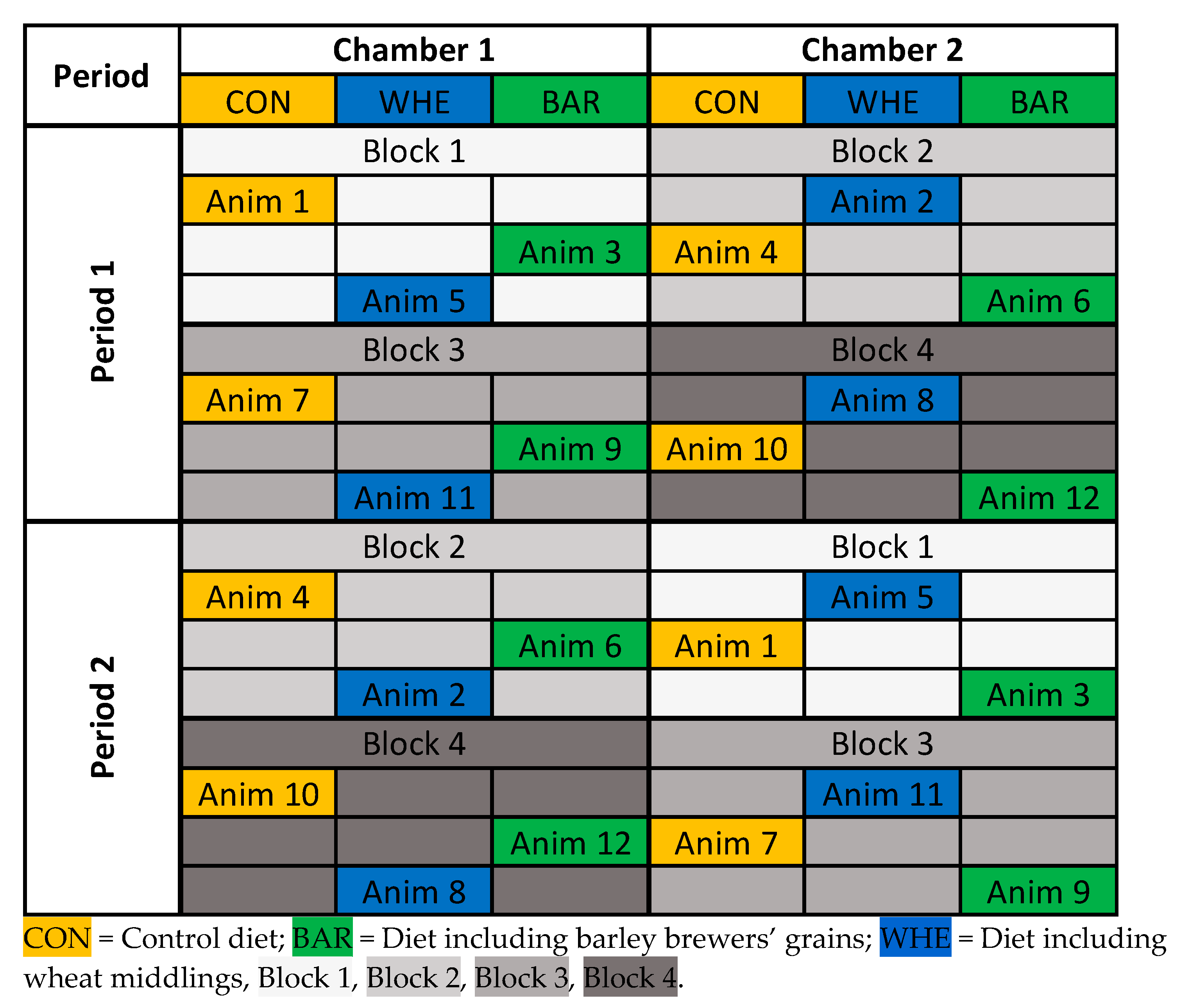
This study used a completely randomized block design with two measurement periods. Due to the availability of only two respiration chambers and the inclusion of three dietary treatments, it was not feasible to equalize the number of animals per treatment within each measurement batch. Consequently, animals were allocated into four blocks balanced by initial BW, with each block comprising three sheep assigned to the three dietary treatments. Gas emissions were measured using RCs in two sampling periods. The design ensured that each dietary treatment was tested against the others while maintaining the original diet for each animal. A schematic of the experimental design, including block assignment within the RC, is provided in Appendix A (Figure A1).
2.4. Body Weight, Dry Matter Intake, Nutrients Intake
Sheep BWs were recorded using an electronic scale (Hook AT 457, Santa Fe, Argentina). Weighing was performed fortnightly prior to morning feeding. Recorded weights were used to adjust the amounts of experimental diets to be offered. Body weight gain was calculated subtracting the final BW from the initial. Average daily gain (ADG) was computed by the difference between final minus initial BW divided by the number of days under study.
Dry matter intake (DMI) was recorded daily during the experiment by the difference between the amounts of feed offered and refused, expressed on a DM basis. For statistical analyses, only the intake recorded inside the chambers was considered. Feed offered and leftovers inside the RCs were sampled daily. Feed refusal samples were collected over three days prior to morning feeding, beginning one day before the animals entered the RCs and throughout the entire 48 h chamber measurement period. Refusal samples from individual sheep were thoroughly mixed to create a composite sample per treatment (≈250 g fresh basis). Intake of each nutrient was calculated as the difference between the amounts of each nutrient offered and refused.
2.5. Enteric Methane and Carbon Dioxide
Enteric CH4 and CO2 emissions were quantified using two open-circuit RCs. Specific details on design and operation can be found elsewhere [24]. Briefly, each RC has a volume of 23 m3, equipped with an individual air conditioning unit for continuous temperature and relative humidity recording and control between 15 and 18 °C and 60% RH, respectively. Air is extracted outside each RC by a regenerative turbine (2RB 420-7HA31, Greenco Industry Co., Ltd., Wenling, China) maintaining a slight negative pressure (−26 Pa). Airflow is continuously measured as the differential pressure at two points on a straight section of PVC duct of 25 mm i.d. and 1 m length on each RC. The air is sampled at the inlet from a common tube to both the RC and the outlet independently from each RC after each airflow measurement section. These sample lines are connected to a continuous sampling diaphragm vacuum pump (Bühler-Technologies, Ratingen, Germany). The sampling pump brings air from both the RC and fresh air to a sample switching device (Adox, Buenos Aires, Argentina) that sends the sample from each RC outlet and the fresh inlet air sequentially to a gas analyzer with oxygen(paramagnetic), carbon dioxide (CO2, infrared IR 1520), and CH4 (infrared GFX) detectors (Servopro 4100, Ser-vomex, East Sussex, UK). To calculate the gases emission (g per day), a protocol proposed by Pinares-Patiño et al. (2014) [25] was followed. Briefly, the gas concentration multiplied by the airflow rate is corrected by the standard temperature and pressure and then corrected by the gas recovery rate of each chamber. Gas recovery rates are performed with ultrapure (99.99%) CO2, with a mean value (±standard deviation; n = 7) of 99.3 ± 6.68 and 104.6 ± 6.20% for RC1 and RC2, respectively.
Individual CH4 and CO2 emissions from each sheep were continuously recorded at 3 min intervals within each RC. Following each 48 h measurement period, the pair of sheep exiting the RCs were returned to their individual pens, and a new pair was introduced for the subsequent 48 h measurement period. This sequence continued consecutively until the completion of the second measurement period. During the second period of measurements, each animal was transferred to the alternate RC. Effects on CH4 emissions were expressed on absolute basis (g/d), per unit of feed intake (g/kg DMI) or CH4 yield, per unit of digestible NDF (g/kg dNDF) calculated as absolute basis over NDFI × DM digestibility, and Ym (CH4 as % of GEI) or CH4 intensity. Carbon dioxide emission was expressed on an absolute basis (g/d) and CH4:CO2 ratio.
2.6. Rumen Contents
Upon completion of RC measurements, sheep were returned to their pens, and ruminal fluid samples were collected in accordance with the protocol described by Della Rosa et al. [26]. Rumen fluid was collected by esophageal probe made from flexible PVC tubing with a wall thickness of 2 mm and an internal diameter of 4 mm. One end of the probe had approximately 10 holes, each with a 2 mm diameter. A 60 mL syringe was connected to the other end for sample collection. Samples were previously checked for saliva contamination by observation of color and consistency, discarding the first portion if necessary (between 20 and 30 mL) [27,28]. Rumen fluid was then filtered through a double layer of cheese cloth. The pH of the ruminal fluid was measured immediately after sample collection using an UltraBasic pH Benchtop Meter (Denver Instrument, Bohemia, NY, USA). Two subsamples with 2 replicates each were prepared for the analysis of volatile fatty acids (VFA) and ammonia nitrogen (NH3-N) and stored at −20 °C until further analyses. For VFA analysis, 9.9 mL of rumen fluid were acidified with 100 μL of 99% sulfuric acid (H2SO4), whereas for NH3-N determination, 4.0 mL was mixed with an equal volume of 0.1 N hydrochloric acid (HCl).
2.7. Chemical Analyses
Samples of feed ingredients and refusals were oven-dried at 60 °C for 48 h or until constant weight was achieved, then ground with a Wiley mill at a 1 mm particle size (Arthur H. Thomas Co., Philadelphia, PA, USA). Dried samples were analyzed for DM content at 105 °C and ash in a muffle furnace according to AOAC [29] no. 930.15 and 942.05, respectively. The neutral detergent fiber (NDF) and acid detergent fiber (ADF) analyses were performed following the procedures of Komarek et al. [30,31], respectively, using an ANKOM200 Fiber Analyzer (ANKOM Technology Corp., Fairport, NY, USA). Crude protein was determined through combustion in a furnace (LECO Corp., St. Joseph, MI, USA) according to Horneck and Miller [32]. Total content of ether extract (EE) was assessed using the ANKOM XT10 lipid extractor (ANKOM Technology Corp., Fairport, NY, USA) in accordance with AOAC [33] guidelines. Starch content was measured by gelatinization with sodium hydroxide and subsequent hydrolysis to glucose using an enzymatic method [34]. In vitro digestibility was determined using the Daisy II incubator (ANKOM Technology Corp., Fairport, NY, USA) with samples incubated for 48 h. After the anaerobic incubation, residues were subjected to the NDF procedure to calculate in vitro true digestibility. A correction factor of 11.9 was subtracted to obtain apparent digestibility values, and metabolizable energy (ME) was estimated as 3.608 × DMD, as suggested by Van Soest [35]. Gross energy (GE) of feeds and refusals was determined using a bomb calorimeter (Parr, model 1261).
Ammonia-N (NH3-N) concentration was determined using the phenol-hypochlorite colorimetric technique as described by Broderick and Kang [36]. The determination of VFA was performed following the methodology suggested by Erwin et al. [37]. For this, a Hewlett Packard HP-6890 gas chromatograph, equipped with a flame ionization detector (HP-3398) and a NUKOL capillary column (Supelco, 30 m × 0.25 mm ID, 0.25 μL phase) was used. The concentration of individual and total VFA were expressed in mmol units and as molar proportion of the total VFA (mmol/100 mmol).
2.8. Statistical Analysis
All statistical tests were performed using linear mixed-effects model fitted with the lme function from the nlme package (V3.1-152) [38] in R software [39] following a completely randomized block design.
where yijkl = response variable (BW, DMI, nutrient intake, or enteric CH4 and CO2 production metrics), μ = overall mean, βi = fixed effect of the i-th block, τj = fixed effect of the j-th dietary treatment, γ = fixed coefficient for the covariate, dijk = days consuming experimental diet (covariate value), ck = random effect of the k-th chamber ∼ N(0, σ2c), al(k) = random effect of the l-th sheep nested within k-th chamber ∼ N(0,σ2a), πm(l) = random effect of the m-th period for sheep l ∼ N(0,σ2π) and εijkl = residual error ∼ N(0,σ2ε).
Model assumptions were evaluated using the Anderson–Darling test for normality and graphically assessment of homoscedasticity. When assumptions were violated, data were transformed to meet the model requirements. For datasets where normality could not be achieved by transformation, a robust mixed model analysis was conducted using the rlmer function from the robustlmm R package 4.4.2 [40], with treatment effects assessed via the Wald test. Statistical significance was declared at p ≤ 0.05, while trends were discussed at 0.05 < p ≤ 0.10. Due to limited sample size and to mitigate risk of Type II errors, the interpretation of results focused on effect sizes with their 95% confidence intervals in addition to p-values. Where significant main effects were detected, post hoc pairwise comparisons were conducted using Tukey’s Honestly Significant Difference test. All data are expressed as least square means (LSM) and standard error of the means (SEM), unless otherwise stated.
3. Results
One sheep in the CON treatment group exhibited a substantial drop in DMI, resulting in its withdrawal from the study. Consequently, all data collected from this animal before its removal were omitted from the analysis.
3.1. Average Daily Gains and Feed Intake
Average daily gain and feed intake responses are presented in Table 3. All animals gained body weight during the experiment, with no significant differences either in total BW gain or ADG among treatments. On average, sheep gained ~100 g/d.
Table 3.
Average daily gain and nutrient intakes from sheep fed diets without (CON) and including (BAR and WHE) agro-industrial by-products.
Except for both CP (p = 0.005, 95% CIs: CON [69.1, 196.2], BAR [177.1, 304.2]) and NDF intakes (p = 0.003, 95% CIs: CON [218, 333], BAR [320, 436]), dietary treatment did not influence the intakes of other nutrients. Crude protein intake was significantly greater in the BAR diet (155 g/d) than in the CON diet (113 g/d), with the WHE diet (147 g/d) being intermediate. Conversely, sheep fed BAR displayed a greater NDF intake (378 g/d) compared to the CON (275 g/d), respectively. Starch intake, analyzed using a robust linear mixed model (robustlmm), tended to be 24% greater in the CON than in the BAR treatment (p = 0.060). Average DMI and GE intake (GEI) across treatments was 954 g/d and 4.02 Mcal/d, respectively.
3.2. Enteric Methane and Carbon Dioxide Emission
Enteric CH4 emissions metrics are presented in Table 4.
Table 4.
Methane (CH4) and carbon dioxide (CO2) production from sheep fed diets without (CON) and including (BAR and WHE) agro-industrial by-products.
While total CH4 emissions were low on average (10.81 g/d), daily emission was 22.3% lower for BAR treatment compared to CON (p = 0.006, 95% CIs: CON [10.74, 14.0], BAR [7.95, 11.3]). Substantial reductions were also observed in emission intensity metrics. Methane yield (CH4/DMI) was 34% lower in the BAR treatment than in CON (p = 0.002, 95% CIs: CON [10.67, 15.6], BAR [6.13, 11.2]). Similarly, CH4 emissions per unit of NDF digested were 46% and 39% lower for the BAR and WHE treatments, respectively, compared to CON. The Ym was 38% lower for the BAR diet than for the CON diet (p = 0.017, 95% Cis: CON [3.58, 6.04], BAR [1.76, 4.24]). The minimal overlap in the 95% confidence intervals for these variables further supports the treatment effect.
Total CO2 production differed among treatments (p = 0.044). The CON diet produced 17% less CO2 on average than the BAR and WHE diets. However, only the CH4:CO2 ratio was significantly lower for BAR compared to CON (p = 0.016, 95% CIs: CON [0.011, 0.019], BAR [0.005, 0.013]).
3.3. Rumen Fermentation Parameters
No differences associated with the effect of dietary treatments were found in pH, ammonia, or VFA concentrations/proportions (Table 5).
Table 5.
Ruminal parameters and molar proportions (mmol/100 mmol) of volatile fatty acids (VFA) from sheep fed diets without (CON) and including (BAR and WHE) agro-industrial by-products.
4. Discussion
The aim of this study was to evaluate two agro-industrial by-product combinations as alternatives to corn grain and urea while maintaining SFE and DDGS to provide nutritionally adequate backgrounding diets without increasing enteric CH4 emissions.
4.1. Feed Intake and Body Weight Responses
A key finding of our study was that sheep exhibited significant diet selectivity despite being offered as TMR. To minimize this behavior, the acclimatization phase was extended to 30 days. During this time frame, the forage-to-concentrate proportion gradually decreased until achieving dietary treatment target. The observed intake values in our study aligned with nutritional recommendations for sheep in the US feeding system of NRC [23]. Similar levels of DMI have been observed in previous studies involving sheep of comparable BW. Cosgrove et al. [41] reported comparable feed intakes in sheep offered ryegrass ad libitum, with oil infusions that increased the total lipid intake to over 5% of DMI. Similarly, Takahashi et al. [42] found consistent intake values in sheep supplemented with varying levels of macadamia cake in a grass hay-based diet.
In this study, ether extract intake did not exceed the recommended upper limit of 6–7% DMI [43]. As anticipated, starch intake tended to exhibit a treatment effect, reflecting the shift in dietary energy sources between the CON and the experimental diets (BAR and WHE). This adjustment involved replacing corn grain with by-products containing greater crude fat levels and more digestible fiber fractions. Neutral detergent fiber intake differed significantly between the CON and BAR groups, mainly due to the elevated fiber content associated with the inclusion of barley brewers’ grains in the BAR diet. Crude protein intake differed among treatments, which may be attributable to minor, although statistically non-significant differences in DMI.
4.2. Enteric Methane Emissions
The BAR (2.60 Mcal/kg DM) diet had a marginally lower ME concentration compared to CON and WHE diets (2.63 Mcal/kg DM). While this small difference in energy density may have contributed minimally to the observed effects, the substantial reductions in total CH4 production and CH4 yield are far greater than what would be expected from this factor alone. This indicates that the primary mechanism is not the diet’s slight energy dilution, but rather the direct anti-methanogenic activity of the bioactive compounds within the brewers’ grains and DDGS blend. Despite elevated dietary EE levels (average 49.3 g/kg DM), no difference in daily CH4 production was observed among treatments. However, the mean total CH4 production in this study (10.81 g/d) was itself considerably lower than values reported in previous studies with sheep offered 60:40 forage-to-concentrate ratio diets [44,45] and with comparable BW [46], suggesting that other factors beyond total fat content were influencing methanogenesis.
The effectiveness of lipids in mitigating CH4 emissions depends on their quantity, source, fatty acid profile, and the interaction with chemical composition of the basal diet. Given the similar total lipid content across experimental diets, the reductions in CH4 yield, CH4 intensity, and Ym observed for the BAR diet may be attributed to differences in the total dietary lipid profile (which was not analyzed), interactions with animal-related factors, and the specific properties of its ingredients. For instance, the lipid profiles of brewers’ grains and corn-based DDGS indicate that over 50% of their total lipids consist of unsaturated fatty acid, predominantly oleic and linoleic acid [47,48,49]. In addition, the potential synergistic effect of sulfates in diets containing DDGS may promote their role as electron acceptors in the rumen, favoring alternative metabolic pathways over methanogenesis [50,51]. Brewers’ grains are also known to contain phenolic compounds and flavonoids [52,53,54], some of which exhibit antimethanogenic properties [55,56,57].
The reduction in CH4 yield observed in the BAR diet, achieved with a modest level (~5%), resulted in yields comparable to those reported in studies using high-dose lipids supplements, such as coconut oil at 7% of [58]. The comparison is not meant to equate lipid levels but provides a mechanistic context, where high-fat supplements like coconut oil demonstrate a potent anti-methanogenic effect. Our study shows that a similar direction of effect can be achieved with ~5% EE from integrated by-products. This suggests that the strategic use of lipid-rich by-products can be an effective and practical intervention to reduce CH4 intensity, strengthen similar anti-methanogenic mechanisms without the need for high levels of pure fat supplementation. However, the absence of the expected increase in propionate and decrease in the acetate-to-propionate ratio is evidence that the CH4 reduction in our study worked through a mechanism distinct from the common lipid effect described in the literature. This reinforces that the mitigation mechanism was not mediated by a change in fermentation patterns but was likely due to a direct inhibitory effect on methanogenic archaea, preventing the standard hydrogen-sink relationship between propionate and methane.
This inference is supported by previous research. Studies in late-lactation sheep fed soybean meal, and whole cottonseed or its by-products [59], and in beef steers fed high and low-tannins sorghum silages [60], have reported similar mitigation effects. Other studies have documented a decreased CH4 yield when grass silage was replaced with brewers’ grains in beef cattle [61], or when DDG replaced forage and grain in lamb diets [62], both replacing higher and lower quality fiber source.
Contrary to the well-documented positive relationship between dietary fiber concentration and enteric CH4 production [63,64], the BAR treatment showed a decrease in CH4 yield and Ym despite greater NDF intake compared to the CON diet. This apparent contradiction can be attributed to the intrinsic physicochemical properties of fiber sources, and likely a combination of bioactive compounds in the by-product blend effectively suppressing methanogenesis. Despite the greater NDF intake with the BAR diet, no significant differences were detected in ruminal pH or acetate production among treatments. All diets showed similar VFA profiles and an acetate-to-propionate ratio. Notably, 45% of the total NDF in the BAR diet came from highly digestible by-product (brewers’ grains), likely due to its lower ADF content [65,66,67]. The high fiber digestibility of barley brewers’ grains is a well-documented characteristic in animal nutrition. There are citations to published studies that specifically report the high in vitro NDF of this ingredient. Also, the overall high IVDM digestibility of the complete BAR diet (713 g/kg DM, as shown in Table 2) provides supportive, indirect evidence that the fibrous components within the diet are indeed readily digestible. Additionally, the small particle size of these ingredients probably limited chewing activity, exerting minimal influence on ruminal pH and reducing acetogenesis compared to fiber derived from the corn silage (forage source). The acetate proportion in the rumen contents of sheep was around 65%, aligning with findings from Wang et al. [68] in gossypol-supplemented sheep and from Jonker et al. [69] in low CH4-emitting sheep.
The ability of fiber to promote rumination or acetic acid production is not only a function of quantity but is highly dependent on the quality of the NDF fraction. Factors such as particle size, retention time, and lignification largely determine its effectiveness in stimulating these methanogenic processes [70,71].
The most significant evidence for a direct inhibitory mechanism in the BAR and WHE diets comes from the significantly lower CH4:CO2 ratio, despite the reduced total CO2 production of BAR and WHE compared to CON. This indicates a selective inhibition of the methanogenesis pathway without a broad disruption of fermentative activity, a pattern also observed with certain feed additives like monensin and soybean oil [72]. Also, the lower ratio shows that a smaller proportion of the fermentation gases was CH4. The absence of significant changes in the ruminal VFA profile or pH further supports the assumption that the mitigation mechanism was not a redirection of H2 towards propionate, but rather a direct suppression of methanogens [73,74].
Consequently, the most likely explanation is that the combined bioactive compounds in the by-products, unsaturated fats, sulfates and phenolic compounds, induced direct inhibition of methanogens or a shift in the microbial community that specifically reduced methane-producing population. This direct inhibition is consistent with the lower total VFA concentration observed, which could also be attributed to secondary factors such as a faster passage rate [75,76] or enhanced absorption [77]. The dietary treatments BAR and WHE contained significant amounts of finely ground, highly digestible fiber from brewers’ grains and wheat middlings. The lower total VFA concentration observed, despite similar dry matter intake, could be attributed to dietary factors that increase the fractional passage rate of the liquid phase of the rumen content [78]. A faster passage rate reduces the rumen retention time of fermented substrates, leading to a more rapid clearance of VFAs from the rumen. This results in a lower steady-state concentration of VFAs without necessarily reducing total VFA production flux across the entire digestive tract [79]. This mechanism provides a reasonable, diet-driven explanation for our VFA results, consistent with the understanding that VFA concentration alone is a poor indicator of VFA supply, as it is confounded by fluid dynamics and passage rates [79,80].
4.3. Implications for Sustainable Livestock Systens and Food Security in Argentina
The findings of this study extend beyond production parameters, offering a practical option for enhancing the sustainability and circularity of ruminant production systems in Argentina. Argentina is a global driving force in both crop production (soybean, corn, wheat) and ruminant livestock, creating a unique opportunity to integrate these sectors [81]. Our strategy of replacing human-edible corn-grain with locally available agro-industrial by-products directly addresses critical challenges, resource competition, and environmental impact [82].
This approach strengthens regional nutrient circularity by utilizing brewers’ grains, wheat middlings, and DDGS; all co-products from established regional industries. This strategy captures ingredients that would otherwise be treated as waste or low-value commodities, channeling them back into the food production chain and reducing dependency on imported or human-grade concentrates and enhancing the resilience of local feed supply chains [83].
The implementation of such a system provides a direct economic incentive for the local agricultural industry. It creates a new, value-added market for agro-industrial by-products, improving the profitability and sustainability of both the livestock and the processing sectors [84]. By providing a scientifically validated, practical feeding strategy, this study contributes a tangible solution for aligning Argentina’s livestock sector with the global principles of a circular bio-economy and sustainable development.
5. Conclusions
This study demonstrates that blends of local agro-industrial by-products, specifically SFE and DDG combined with either barley brewers’ grains or wheat middlings, can effectively replace human-edible corn grain and synthetic urea in sheep backgrounding diets. This substitution maintains comparable animal performance and total CH4 emissions. Crucially, the BAR diet significantly reduced daily CH4 production by 22%, CH4 yield (g CH4/kg DMI) by 34% and energy loss as CH4 by 38% compared to the control diet, offering a direct enteric mitigation strategy.
To our knowledge, this is the first study in Argentina to quantitatively validate such by-product combinations, providing a measurable pathway to enhance the sustainability of livestock in the Pampeana region of Argentina. Our findings offer a scientifically grounded, circular economy model that simultaneously advances several sustainability objectives, improving resource efficiency by valorizing waste streams, reducing the climate footprint of meat production by lowering CH4 yield, and supporting food security by decreasing competition for human-edible grains. This work directly contributes to defining and quantifying sustainable livestock systems aligning with global Sustainable Development Goals (SDGs), particularly SDG 12 (Responsible Consumption and Production) and SDG 13 (Climate Action).
For the broader adoption of this strategy, further research is needed to explore the effects of these by-product inclusions on enteric CH4 emissions in other ruminant species and across various physiological stages, as well to assess their impact on quality of final products for human consumption, such as meat and milk.
Author Contributions
Conceptualization: L.G.-D., L.M.B., A.L.C., M.L.V., D.C. and P.R.; methodology, L.M.B., A.L.C., M.L.V., D.C. and P.R.; validation, L.G.-D., A.L.C. and P.R.; formal analysis, L.G.-D., L.M.B. and P.R., investigation, L.G.-D., L.M.B., A.L.C., M.L.V., D.C. and P.R.; resources, P.R.; data curation, L.G.-D., A.L.C. and P.R.; writing—original draft preparation, L.G.-D., L.M.B., A.L.C., M.L.V., D.C. and P.R.; writing—review and editing L.G.-D. and P.R.; visualization, L.G.-D. and P.R.; supervision, P.R.; project administration, P.R.; funding acquisition, P.R. All authors have read and agreed to the published version of the manuscript.
Funding
This work was supported by the partners of the Joint Call of the Cofund ERA-Nets SusCrop [Grant number 4771134], FACCE ERA-GAS [Grant number 696356], ICT-AGRI-FOOD [Grant number 862665] and SusAn [Grant number 696231]. Also funded by the New Zealand Government to support the Global Research Alliance on Agricultural Greenhouse Gases (GRA).
Institutional Review Board Statement
The study was conducted in accordance with the Institutional Committee for the Care and Use of Experimental Animals at INTA (Instituto Nacional de Tecnologia Agropecuaria—Argentina) under protocol 219/2021 approved on 30 December 2021.
Informed Consent Statement
Not applicable.
Data Availability Statement
The original contributions presented in this study are included in the article. Further inquiries can be directed to the corresponding author.
Acknowledgments
The authors are grateful to National Institute of Agricultural Technology (INTA), European Research Area Network (ERA-NET) and Ministry for Primary Industries (MPI) from New Zealand under the project “Integrated crop-ruminant livestock systems as a strategy to increase nutrient circularity and promote sustainability in the context of climate change (INTEGRITY)”. We would also like to thank Miguel Fasciglione (INTA) for his skillful assistance during the experiment, and Edward H. Cabezas-García (ILRI) for the support of writing—original draft and formal analysis of data obtained from the study.
Conflicts of Interest
The authors declare no conflicts of interest.
Abbreviations
The following abbreviations are used in this manuscript:
| CH4 | methane |
| DDGS | corn distillers’ grains |
| SFE | sunflower expeller |
| CON | control diet |
| BAR | diet containing DDGS, SFE and barley brewed grains |
| WHE | diet containing DDGS, SFE and wheat middlings |
| BW | body weight |
| DM | dry matter |
| DMI | dry matter intake |
| GE | gross energy |
| GEI | gross energy intake |
| ME | metabolizable energy |
| GHG | greenhouse gas |
| RC | respiration chamber |
| CP | crude protein |
| NDF | neutral detergent fiber |
| ADF | acid detergent fiber |
| EE | ether extract |
| ADG | average daily gain |
| VFA | volatile fatty acids |
| NH3-N | ammonia nitrogen |
| Ym | methane emission factor |
Appendix A
Figure A1.
Scheme of the experimental design, and blocks and animals’ assignment to the respiration chambers on each measurement period.
References
- Kalra, N.; Molina-Pérez, E.; Syme, J.; Esteves, F.; Cortés, H.; Rodríguez-Cervantes, M.T.; Espinoza-Juárez, V.M.; Jaramillo, M.; Baron, R.; Alatorre, C.; et al. The Benefits and Costs of Reaching Net Zero Emissions in Latin America and the Caribbean; Inter American Development Bank (IDB): Washington, DC, USA, 2024. [Google Scholar]
- FAO. Contribution of Terrestrial Animal Source Food to Healthy Diets for Improved Nutrition and Health Outcomes Key Messages; FAO: Rome, Italy, 2022. [Google Scholar]
- United Nations (UN). The Paris Agreement; United Nations: Paris, France, 2015. [Google Scholar]
- Crippa, M.; Solazzo, E.; Guizzardi, D.; Monforti-Ferrario, F.; Tubiello, F.N.; Leip, A. Food Systems Are Responsible for a Third of Global Anthropogenic GHG Emissions. Nat. Food 2021, 2, 198–209. [Google Scholar] [CrossRef] [PubMed]
- MAyDS. Inventario Nacional de Gases de Efecto Invernadero: Argentina 2021; Ministerio de Ambiente y Desarrollo Sostenible: Buenos Aires, Argentina, 2022.
- Ramseyer, F.; Bergero, P. Radiografía Del Complejo Cárnico Argentino: Entre Récords y Cambios de Hábitos. Available online: https://www.bcr.com.ar/es/print/pdf/node/110512 (accessed on 21 October 2025).
- FAOSTAT. Statistical Databases. Food and Agriculture Organization of the United Nations. Available online: https://www.fao.org/faostat/en/#rankings/countries_by_commodity (accessed on 21 October 2024).
- Marín, N.; Terré, E.; Calzada, J. Exportaciones Argentinas 2024: Las Cadenas Agroindustriales al Frente, Con El Sector Energético En Ascenso. Available online: https://www.bcr.com.ar/es/print/pdf/node/108435 (accessed on 19 October 2025).
- Arrieta, E.M.; Aguiar, S.; González Fischer, C.; Cuchietti, A.; Cabrol, D.A.; González, A.D.; Jobbágy, E.G. Environmental Footprints of Meat, Milk and Egg Production in Argentina. J. Clean. Prod. 2022, 347, 131325. [Google Scholar] [CrossRef]
- Subsecretaría de Mercados Agropecuarios Evolución de La Molienda Mensual de Cereales. Available online: https://www.magyp.gob.ar/sitio/areas/ss_mercados_agropecuarios/areas/granos/_archivos/000058_Estad%C3%ADsticas/000032_Evolucion%20de%20la%20Molienda%20(Cereales%20y%20Oleaginosas)/000001_Evoluci%C3%B3n%20de%20la%20Molienda%20Mensual%20de%20Cereales%20-%20En%20Ton./000001_Evoluci%C3%B3n%20de%20la%20Molienda%20Mensual%20de%20Cereales%20-%20En%20Ton.php (accessed on 5 December 2024).
- Bragachini, M.; Ustarroz, F.; Bragachini, M.; Mathier, D.; Méndez, J. Hacia Sistemas Ganaderos de Precisión Con Valor Agregado. In Proceedings of the 5ta Jornada Nacional de forrajes conservados. Hacia sistemas ganaderos de precisión con valor agregado, Buenos Aires, Argentina, 9 April 2014; Ediciones INTA: Buenos Aires, Argentina, 2014; pp. 1–18. [Google Scholar]
- Miresa, A.; Mulegeta, M. Review on Utilization of Brewery By-Products as Protein-Rich Feed Source for Efficient Livestock Production. Glob. J. Anim. Sci. Res. 2020, 8, 1–13. [Google Scholar]
- Negash, D. Use of Brewery By-Products as Animal Feeds. J. Nutr. Food Sci. 2021, 4, 100027. [Google Scholar]
- Vastolo, A.; Calabrò, S.; Cutrignelli, M.I. A Review on the Use of Agro-Industrial CO-Products in Animals’ Diets. Ital. J. Anim. Sci. 2022, 21, 577–594. [Google Scholar] [CrossRef]
- Ministerio de Economía. Campaña Girasol 2023/24. Resultados Del Ciclo; Ministerio de Economía: Buenos Aires, Argentina, 2024.
- Beauchemin, K.A.; McGinn, S.M.; Benchaar, C.; Holtshausen, L. Crushed Sunflower, Flax, or Canola Seeds.Pdf. J. Dairy. Sci. 2009, 92, 2118–2127. [Google Scholar] [CrossRef]
- Navarro Marcos, C.; de Evan, T.; Jiménez, C.; Carro, M.D. Potential of Agroindustrial By-Products to Modulate Ruminal Fermentation and Reduce Methane Production: In Vitro Studies. Animals 2022, 12, 3540. [Google Scholar] [CrossRef]
- Smith, P.E.; Kelly, A.K.; Kenny, D.A.; Waters, S.M. Enteric Methane Research and Mitigation Strategies for Pastoral-Based Beef Cattle Production Systems. Front. Vet. Sci. 2022, 9, 958340. [Google Scholar] [CrossRef]
- Niu, M.; Kebreab, E.; Hristov, A.N.; Oh, J.; Arndt, C.; Bannink, A.; Bayat, A.R.; Brito, A.F.; Boland, T.; Casper, D.; et al. Prediction of Enteric Methane Production, Yield, and Intensity in Dairy Cattle Using an Intercontinental Database. Glob. Chang. Biol. 2018, 24, 3368–3389. [Google Scholar] [CrossRef]
- Beauchemin, K.A.; Ungerfeld, E.M.; Eckard, R.J.; Wang, M. Review: Fifty Years of Research on Rumen Methanogenesis: Lessons Learned and Future Challenges for Mitigation. Animal 2020, 14, S2–S16. [Google Scholar] [CrossRef]
- Pophiwa, P.; Mwape, A.; Hassen, A.; du Toit, C.J.L.; van Marle-Koster, E.; Sibanda, L.M. Insights on Agricultural Greenhouse Gas Research and Collaboration in Southern Africa. Reg. Environ. Chang. 2025, 25, 1–12. [Google Scholar] [CrossRef]
- Sokal, K.; Kachel, M. Impact of Agriculture on Greenhouse Gas Emissions—A Review. Energies 2025, 18, 2272. [Google Scholar] [CrossRef]
- NRC (National Research Council). Nutrient Requirements of Small Ruminants: Sheep, Goats, Cervids, and New World Camelids; The National Academies Press: Washington, DC, USA, 2007. [Google Scholar]
- Buraschi, L.; Micoli, F.; Palladino, R.A.; Cuatrín, A.; Calamante, C.; Guerrero, L.; Wehrendt, D.; Gualdrón-Duarte, L.; Tieri, M.P.; Williams, R.; et al. Enteric Methane Emission and Nitrogen Excretion of Lactating Cows Fed Soybean-Hulls as Partial Replacement of Corn Grain. Animals 2025, in press. [Google Scholar]
- Pinares-Patiño, C.; Hunt, C.; Martin, R.; West, J.; Lovejoy, P.; Waghorn, G. New Zealand Ruminant Methane Measurement Centre, AgResearch, Palmerston North. In Technical Manual on Respiration Chamber Designs; Pinares, C., Waghorn, C., Eds.; Ministry of Agriculture and Forestry: Wellington, New Zealand, 2014; pp. 9–28. ISBN 6463518336. [Google Scholar]
- Della Rosa, M.; Janssen, P.; Reid, P.; Sandoval, E.; Luo, D.; Pacheco, D.; Jonker, A. Volatile Fatty Acids (VFA) in Rumen Samples Collected Pre-Feeding Had a Stronger Relationship with Methane Emissions in Lambs Fed Graded Levels of Forage Rape than VFAs in Post-Feeding Samples. New Zealand J. Anim. Sci. Prod. 2021, 81, 168–172. [Google Scholar]
- Ramos-Morales, E.; Arco-Pérez, A.; Martín-García, A.I.; Yáñez-Ruiz, D.R.; Frutos, P.; Hervás, G. Use of Stomach Tubing as an Alternative to Rumen Cannulation to Study Ruminal Fermentation and Microbiota in Sheep and Goats. Anim. Feed. Sci. Technol. 2014, 198, 57–66. [Google Scholar] [CrossRef]
- Muizelaar, W.; Bani, P.; Larsen, M.; Tapio, I.; Yáñez-Ruiz, D.; Gastelen, S. Van Rumen Fluid Sampling via Oral Stomach Tubing Method. In Methods in Cattle Physiology and Behaviour—Recommendations from the SmartCow Consortium; PUBLISSO: Cologne, Germany, 2020; pp. 1–6. [Google Scholar]
- AOAC. Official Methods of Analysis; AOAC International: Arlington, VA, USA, 1990. [Google Scholar]
- Komarek, A.R.; Robertson, J.B.; Van Soest, P.J. Comparison of the Filter Bag Technique to Conventional Filtration in the Van Soest NDF Analysis of 21 Feeds. In Proceedings of the National Conference on Forage Quality, Evaluation and Utilization, Lincoln, NE, USA, 13–15 April 1994; Fahey, G.C., Ed.; Nebraska University: Lincoln, NE, USA, 1994. [Google Scholar]
- Komarek, A.R.; Robertson, J.B.; Van Soest, P.J. A Comparison of Methods for Determining ADF Using the Filter Bag Technique versus Conventional Filtration. J. Dairy. Sci. 1994, 77, 114. [Google Scholar]
- Horneck, D.A.; Miller, R.O. Determination of Total Nitrogen in Plant Tissue. In Handbook of Reference Methods for Plant Analysis; Kalra, Y.P., Ed.; CRC Press: Boca Raton, FL, USA, 1998; pp. 75–83. [Google Scholar]
- AOAC. Official Methods of Analysis, 18th ed.; AOAC International: Gaithersburg, MD, USA, 2005. [Google Scholar]
- Karkalas, J. An Improved Enzymic Method for the Determination of Native and Modified Starch. J. Sci. Food Agric. 1985, 36, 1019–1027. [Google Scholar] [CrossRef]
- Van Soest, P.J. Nutritional Ecology of the Ruminant, 2nd ed.; O & B Books: Ithaca, NY, USA, 1994. [Google Scholar]
- Broderick, G.A.; Kang, J.H. Automated Simultaneous Determination of Ammonia and Total Amino Acids in Ruminal Fluid and in Vitro Media. J. Dairy. Sci. 1980, 63, 64–75. [Google Scholar] [CrossRef] [PubMed]
- Erwin, E.S.; Marco, G.J.; Emery, E.M. Volatile Fatty Acid Analyses of Blood and Rumen Fluid by Gas Chromatography. J. Dairy. Sci. 1961, 44, 1768–1771. [Google Scholar] [CrossRef]
- Pinheiro, J.; Bates, D.; DebRoy, S.; Sarkar, D.; R Core Team. Nlme: Linear and Nonlinear Mixed Effects Models. 2021. Available online: https://cran.r-project.org/web/packages/nlme/index.html (accessed on 21 October 2025).
- R Core Team. R: A Language and Environment for Statistical Computing; R Foundation for Statistical Computing: Viena, Austria, 2024. [Google Scholar]
- Koller, M. Robustlmm: An R Package for Robust Estimation of Linear Mixed-Effects Models. J. Stat. Softw. 2016, 75, 1–24. [Google Scholar] [CrossRef]
- Cosgrove, G.P.; Waghorn, G.C.; Anderson, C.B.; Peters, J.S.; Smith, A.; Molano, G.; Deighton, M. The Effect of Oils Fed to Sheep on Methane Production and Digestion of Ryegrass Pasture. Aust. J. Exp. Agric. 2008, 48, 189–192. [Google Scholar] [CrossRef]
- Takahashi, L.S.; Sanches, T.P.; Issakowicz, J.; Bueno, M.S.; Bompadre, T.F.V.; Paro de Paz, C.C.; Abdalla, A.L.; Dias da Costa, R.L. Lipid Supplementation with Macadamia By-Product Reduces Methane Emissions by Sheep. Small Rumin. Res. 2024, 231, 107174. [Google Scholar] [CrossRef]
- NRC (National Research Council). Nutrient Requirements of Dairy Cattle, 7th ed.; National Academy Press: Washington, DC, USA, 2001. [Google Scholar]
- Bhatt, R.S.; Soni, L.; Sahoo, A. Methane Production and Microbial Protein Synthesis in Adult Sheep Fed Total Mixed Ration as Mash and as Complete Feed Block. Carbon. Manag. 2019, 10, 241–253. [Google Scholar] [CrossRef]
- Gere, J.I.; Feksa Frasson, M.; Wawrzkiewicz, M.; Fernández Pepi, M.G.; Ramos, M.L.; Bualó, R.; Cerón-Cucchi, M.E.; Jaurena, G. Enteric Methane Emission from Sheep Fed with Rhodes Grass Hay (Chloris Gayana) Alone or Supplemented with Dried Distillers’ Grains with Solubles. Methane 2022, 1, 210–217. [Google Scholar] [CrossRef]
- Pinares-Patiño, C.S.; McEwan, J.C.; Dodds, K.G.; Cárdenas, E.A.; Hegarty, R.S.; Koolaard, J.P.; Clark, H. Repeatability of Methane Emissions from Sheep. Anim. Feed. Sci. Technol. 2011, 166–167, 210–218. [Google Scholar] [CrossRef]
- Kerr, B.J.; Dozier, W.A.; Shurson, G.C. Effects of Reduced-Oil Corn Distillers Dried Grains with Solubles Composition on Digestible and Metabolizable Energy Value and Prediction in Growing Pigs. J. Anim. Sci. 2013, 91, 3231–3243. [Google Scholar] [CrossRef]
- Wysocka, O.; Pecka, E.; Zawadzki, W. The Potential of Using Corn Dried Distillers Grains with Solubles (DDGS) in Order to Improve the Fermentation Profile in Sheep. Univ. Technol. Stetin. Agric. Aliment. Pisc 2015, 320, 109–120. [Google Scholar]
- Pecka-Kielb, E.; Zachwieja, A.; Mista, D.; Zawadzki, W.; Zielak-Steciwko, A. Use of Corn Dried Distillers Grains (DDGS) in Feeding of Ruminants. In Frontiers in Bioenergy and Biofuels; Jacob-Lopes, E., Zepka, L.Q., Eds.; InTech: Rijeka, Croatia, 2017; ISBN 78-953-51-2892-2. [Google Scholar]
- Ali, M.A.; Lee, C.H.; Kim, S.Y.; Kim, P.J. Effect of Industrial By-Products Containing Electron Acceptors on Mitigating Methane Emission during Rice Cultivation. Waste Manag. 2009, 29, 2759–2764. [Google Scholar] [CrossRef] [PubMed]
- Beauchemin, K.A.; Ungerfeld, E.M.; Abdalla, A.L.; Alvarez, C.; Arndt, C.; Becquet, P.; Benchaar, C.; Berndt, A.; Mauricio, R.M.; McAllister, T.A.; et al. Invited Review: Current Enteric Methane Mitigation Options. J. Dairy. Sci. 2022, 105, 9297–9326. [Google Scholar] [CrossRef] [PubMed]
- Fărcaş, A.C.; Socaci, S.A.; Dulf, F.V.; Tofană, M.; Mudura, E.; Diaconeasa, Z. Volatile Profile, Fatty Acids Composition and Total Phenolics Content of Brewers’ Spent Grain by-Product with Potential Use in the Development of New Functional Foods. J. Cereal Sci. 2015, 64, 34–42. [Google Scholar] [CrossRef]
- Rahman, M.J.; Malunga, L.N.; Eskin, M.; Eck, P.; Thandapilly, S.J.; Thiyam-Hollander, U. Valorization of Heat-Treated Brewers’ Spent Grain through the Identification of Bioactive Phenolics by UPLC-PDA and Evaluation of Their Antioxidant Activities. Front. Nutr. 2021, 8, 634519. [Google Scholar] [CrossRef]
- Kobelev, K.V.; Gribkova, I.N.; Kharlamova, L.N.; Danilyan, A.V.; Zakharov, M.A.; Lazareva, I.V.; Kozlov, V.I.; Borisenko, O.A. Study of Brewer’s Spent Grain Environmentally Friendly Processing Ways. Molecules 2023, 28, 4553. [Google Scholar] [CrossRef]
- Oskoueian, E.; Abdullah, N.; Oskoueian, A. Effects of Flavonoids on Rumen Fermentation Activity, Methane Production, and Microbial Population. Biomed. Res. Int. 2013, 2013, 349129. [Google Scholar] [CrossRef]
- Sinz, S.; Kunz, C.; Liesegang, A.; Braun, U.; Marquardt, S.; Soliva, C.R.; Kreuzer, M. In Vitro Bioactivity of Various Pure Flavonoids in Ruminal Fermentation, with Special Reference to Methane Formation. Czech J. Anim. Sci. 2018, 63, 293–304. [Google Scholar] [CrossRef]
- Nørskov, N.P.; Battelli, M.; Curtasu, M.V.; Olijhoek, D.W.; Chassé, É.; Nielsen, M.O. Methane Reduction by Quercetin, Tannic and Salicylic Acids: Influence of Molecular Structures on Methane Formation and Fermentation in Vitro. Sci. Rep. 2023, 13, 16023. [Google Scholar] [CrossRef] [PubMed]
- Machmüller, A.; Kreuzer, M. Methane Suppression by Coconut Oil and Associated Effects on Nutrient and Energy Balance in Sheep. Can. J. Anim. Sci. 1999, 79, 65–72. [Google Scholar] [CrossRef]
- Lima, P. de M.T.; Oliveira, P.B.; Campeche, A.; Moreira, G.D.; Paim, T. do P.; McManus, C.; Abdalla, A.L.; Dantas, A.M.M.; de Souza, J.R.; Louvandini, H. Methane Emission of Santa Inês Sheep Fed Cottonseed By-Products Containing Different Levels of Gossypol. Trop. Anim. Health Prod. 2014, 46, 285–288. [Google Scholar] [CrossRef]
- de Oliveira, S.G.; Berchielli, T.T.; Pedreira, M. dos S.; Primavesi, O.; Frighetto, R.; Lima, M.A. Effect of Tannin Levels in Sorghum Silage and Concentrate Supplementation on Apparent Digestibility and Methane Emission in Beef Cattle. Anim. Feed. Sci. Technol. 2007, 135, 236–248. [Google Scholar] [CrossRef]
- Duthie, C.A.; Rooke, J.A.; Hyslop, J.J.; Waterhouse, A. Methane Emissions from Two Breeds of Beef Cows Offered Diets Containing Barley Straw with Either Grass Silage or Brewers’ Grains. Animal 2015, 9, 1680–1687. [Google Scholar] [CrossRef]
- Behlke, E.J.; Sanderson, T.; Klopfenstein, T.J.; Miner, J.L. Replacement of Forage with Dried Distillers Grains Reduces Ruminal Methane Production. Neb. Beef Cattle Rep. 2007, 62, 19–21. [Google Scholar]
- Johnson, K.A.; Johnson, D.E. Methane Emissions from Cattle. J. Anim. Sci. 1995, 73, 2483–2492. [Google Scholar] [CrossRef]
- Hristov, A.N.; Oh, J.; Lee, C.; Meinen, R.; Montes, F.; Ott, T.; Firkins, J.; Rotz, A.; Dell, C.; Adesogan, A.; et al. Mitigation of Greenhouse Gas Emissions in Livestock Production. A Review of Technical Options for Non-CO2 Emissions; Gerber, P., Henderson, B., Makkar, H.P.S., Eds.; FAO Animal Production and Health Paper No. 177; FAO: Rome, Italy, 2013; ISBN 8497401735. [Google Scholar]
- Ikram, S.; Huang, L.Y.; Zhang, H.; Wang, J.; Yin, M. Composition and Nutrient Value Proposition of Brewers Spent Grain. J. Food Sci. 2017, 82, 2232–2242. [Google Scholar] [CrossRef] [PubMed]
- Faccenda, A.; Zambom, M.A.; Castagnara, D.D.; de Avila, A.S.; Fernandes, T.; Eckstein, E.I.; Anschau, F.A.; Schneider, C.R. Use of Dried Brewers’ Grains Instead of Soybean Meal to Feed Lactating Cows. Rev. Bras. De Zootec. 2017, 46, 39–46. [Google Scholar] [CrossRef]
- Mekonen, T.; Alemayehu, L.; Eshete, M.; Kebede, A.; Abebe, A.; Bisrat, A.; Teferra, B.; Tsegahun, A.; Getachew, T. Substitution of Concentrate Mixture with Dried Brewery Spent Grains Improved Biological and Economical Performance of 50% Dorper × Menz Crossbred Sheep. Trop. Anim. Health Prod. 2024, 56, 1–8. [Google Scholar] [CrossRef]
- Wang, C.D.; Li, Y.Q.; MaiTiSaiYiDi, T.N.S.; Yang, H.J.; Yang, K.L. Effect of Dietary Gossypol Supplement on Fermentation Characteristics and Bacterial Diversity in the Rumen of Sheep. PLoS ONE 2020, 15, e0234378. [Google Scholar] [CrossRef]
- Jonker, A.; Molano, G.; Antwi, C.; Waghorn, G.C. Enteric Methane and Carbon Dioxide Emissions Measured Using Respiration Chambers, the Sulfur Hexafluoride Tracer Techique, and a GreenFeed Head-Chamber System from Beef Heifers Fed Alfalfa Silage at Three Allowances and Four Feeding Frequencies. J. Anim. Sci. 2016, 94, 4326–4337. [Google Scholar] [CrossRef] [PubMed]
- Clark, P.; Armentano, L. Effectiveness of Neutral Detergent Fiber in Whole Cottonseed and Dry Distillers Grains Compared with Alfalfa Haylage. J. Dairy. Sci. 1993, 76, 2644–2650. [Google Scholar] [CrossRef] [PubMed]
- Mooney, C.S.; Allen, M.S. Physical Effectiveness of the Neutral Detergent Fiber of Whole Linted Cottonseed Relative to That of Alfalfa Silage at Two Lengths of Cut. J. Dairy. Sci. 1997, 80, 2052–2061. [Google Scholar] [CrossRef]
- Sauer, F.D.; Fellner, V.; Kinsman, R.; Kramer, J.K.G.; Jackson, H.A.; Lee, A.J.; Chen, S. Methane Output and Lactation Response in Holstein Cattle with Monensin or Unsaturated Fat Added to the Diet. J. Anim. Sci. 1997, 76, 906–914. [Google Scholar] [CrossRef]
- Aguerre, M.J.; Wattiaux, M.A.; Powell, J.M.; Broderick, G.A.; Arndt, C. Effect of Forage-to-Concentrate Ratio in Dairy Cow Diets on Emission of Methane, Carbon Dioxide, and Ammonia, Lactation Performance, and Manure Excretion. J. Dairy. Sci. 2011, 94, 3081–3093. [Google Scholar] [CrossRef]
- Aubry, A.; Yan, T. Meta-Analysis of Calorimeter Data to Establish Relationships between Methane and Carbon Dioxide Emissions or Oxygen Consumption for Dairy Cattle. Anim. Nutr. 2015, 1, 128–134. [Google Scholar] [CrossRef] [PubMed]
- Hammond, K.J.; Pacheco, D.; Burke, J.L.; Koolaard, J.P.; Muetzel, S.; Waghorn, G.C. The Effects of Fresh Forages and Feed Intake Level on Digesta Kinetics and Enteric Methane Emissions from Sheep. Anim. Feed. Sci. Technol. 2014, 193, 32–43. [Google Scholar] [CrossRef]
- Hall, M.B.; Nennich, T.D.; Doane, P.H.; Brink, G.E. Total Volatile Fatty Acid Concentrations Are Unreliable Estimators of Treatment Effects on Ruminal Fermentation in Vivo. J. Dairy. Sci. 2015, 98, 3988–3999. [Google Scholar] [CrossRef]
- Xiang, R.; McNally, J.; Rowe, S.; Jonker, A.; Pinares-Patino, C.S.; Oddy, V.H.; Vercoe, P.E.; McEwan, J.C.; Dalrymple, B.P. Gene Network Analysis Identifies Rumen Epithelial Cell Proliferation, Differentiation and Metabolic Pathways Perturbed by Diet and Correlated with Methane Production. Sci. Rep. 2016, 6, 39022. [Google Scholar] [CrossRef]
- Seo, S.; Lanzas, C.; Tedeschi, L.O.; Fox, D.G. Development of a Mechanistic Model to Represent the Dynamics of Liquid Flow out of the Rumen and to Predict the Rate of Passage of Liquid in Dairy Cattle. J. Dairy. Sci. 2007, 90, 840–855. [Google Scholar] [CrossRef]
- Sujani, S.; Gleason, C.B.; dos Reis, B.R.; White, R.R. Rumen Fermentation of Meal-Fed Sheep in Response to Diets Formulated to Vary in Fiber and Protein Degradability. J. Anim. Sci. 2024, 102, skad406. [Google Scholar] [CrossRef]
- Bannink, A.; van Lingen, H.J.; Ellis, J.L.; France, J.; Dijkstra, J. The Contribution of Mathematical Modeling to Understanding Dynamic Aspects of Rumen Metabolism. Front. Microbiol. 2016, 7, 1820. [Google Scholar] [CrossRef]
- Rotolo, G.C.; Vassillo, C.; Rodriguez, A.A.; Magnano, L.; Milo Vaccaro, M.; Civit, B.M.; Covacevich, M.S.; Arena, A.P.; Ulgiati, S. Perception and Awareness of Circular Economy Options within Sectors Related to Agriculture in Argentina. J. Clean. Prod. 2022, 373, 133805. [Google Scholar] [CrossRef]
- Areti, H.A.; Muleta, M.D.; Abo, L.D.; Hamda, A.S.; Adugna, A.A.; Edae, I.T.; Daba, B.J.; Gudeta, R.L. Innovative Uses of Agricultural By-Products in the Food and Beverage Sector: A Review. Food Chem. Adv. 2024, 5, 100838. [Google Scholar] [CrossRef]
- World Bank. Towards a More Competitive, Inclusive, and Resilient Agrifood Sector; World Bank: Washington, DC, USA, 2023. [Google Scholar]
- United Nations PAGE in Argentina. Available online: https://www.un-page.org/countries/argentina/ (accessed on 19 October 2025).

Disclaimer/Publisher’s Note: The statements, opinions and data contained in all publications are solely those of the individual author(s) and contributor(s) and not of MDPI and/or the editor(s). MDPI and/or the editor(s) disclaim responsibility for any injury to people or property resulting from any ideas, methods, instructions or products referred to in the content. |
© 2025 by the authors. Licensee MDPI, Basel, Switzerland. This article is an open access article distributed under the terms and conditions of the Creative Commons Attribution (CC BY) license (https://creativecommons.org/licenses/by/4.0/).