

Review

Sustainability in the Built Environment Reflected in Serious Games: A Systematic Narrative Literature Review


1
School of Design, Université de Montréal, 2900 Edouard Montpetit Blvd, Montreal, QC H3T 1J4, Canada
2
School of Graduate Studies, Concordia University, 1455 Blvd. De Maisonneuve Ouest, Montreal, QC H3G 1M8, Canada
*
Author to whom correspondence should be addressed.
Sustainability 2025, 17(24), 11148; https://doi.org/10.3390/su172411148
Submission received: 10 November 2025 / Revised: 6 December 2025 / Accepted: 9 December 2025 / Published: 12 December 2025

Abstract

The increasing complexity of the built environment—encompassing three-dimensional spatial dynamics, environmental footprints, and socio-cultural dimensions—necessitates innovative educational tools. Serious games have emerged as immersive platforms bridging theoretical knowledge and practical application in this domain. This narrative literature review examines the extent to which serious games effectively integrate and reflect sustainability principles within the context of the built environment, as well as their strategies for engaging learners. A comprehensive search was conducted across multiple databases using keywords such as “serious games,” “built environment,” and “sustainability.” The review identifies that while many games address tangible challenges like retrofitting simulations and resource management, their incorporation of sustainability concepts is often superficial. Critical aspects such as inclusivity, stakeholder engagement, and alignment with SDGs are frequently underrepresented. Furthermore, a lack of a common language among stakeholders and the tendency to focus on isolated aspects of sustainability, rather than adopting a holistic approach, were noted. Despite these limitations, the engaging nature of these games that are based on real scenarios offers potential for impactful learning experiences. However, challenges persist, including technical constraints, pedagogical limitations, and deeper epistemological and ethical tensions in game design. The findings underscore the need for a more integrated and comprehensive approach to embedding sustainability in serious games, along with more effective engagement strategies to ensure they function as impactful tools for education and learning in the built environment domain.

1. Introduction

The imperative to embed sustainability within the built environment has grown more urgent, manifesting not only in physical spaces but also across nonphysical platforms that shape how the built environment is understood, communicated, and designed. In response, educators and practitioners are increasingly adopting innovative pedagogical tools to convey the multifaceted nature of sustainability. Among these tools, serious games have gained prominence as powerful mediums that combine educational content with interactive and immersive engagement, enabling users to grapple with complex sustainability challenges in dynamic and experiential ways [1,2].
Serious games are broadly understood as games designed with a primary purpose beyond entertainment, integrating playful elements with explicit educational, training, or communicative intentions [3]. While the term has been applied across diverse sectors including health, defense ecology, and education, contemporary definitions converge on the idea that serious games deliberately combine utilitarian functions (such as teaching, informing, or supporting decision-making) with the motivational and interactive affordances of game-based environments [4].
Extant literature underscores the efficacy of serious games in enhancing educational outcomes across various domains [5,6,7,8]. Specifically, their application in addressing timely and critical topics such as sustainability [9,10,11], resilience [12,13], and decarbonization has been documented. However, there remains a paucity of research exploring the role of serious games in educating for sustainability within the built environment context.
This systematic narrative literature review aims to theorize and conceptualize the role of serious games in promoting sustainability within the built environment. Specifically, the review seeks to: (a) Examine how serious games reflect and integrate sustainability principles, identifying strengths and limitations in their educational design; (b) Investigate the challenges of developing serious games that balance engagement with educational rigor while addressing the complexities of sustainability; and (c) Theorize the potential of serious games as transformative educational tools, advancing both learner engagement and systems thinking skills critical for addressing sustainability challenges.
Grounded in experiential learning theory [14] and systems thinking [15], this review positions serious games as sophisticated platforms for experiential and systems-based learning. Experiential learning emphasizes learning through experience, aligning with the interactive and simulative nature of serious games. Systems thinking provides a framework for understanding the interconnectedness of sustainability challenges within the built environment.
By integrating these theoretical perspectives, this review evaluates the effectiveness of serious games in reflecting sustainability principles and fostering meaningful learning outcomes. The following research questions guide this inquiry:
  • What are the challenges and limitations of incorporating sustainability in the built environment in serious games?
  • Which types of games are more successful in raising awareness of sustainability in education on the built environment?
  • What aspects of sustainability have been included in games, and what topics are missing?
  • How do games related to sustainability in the built environment address educational barriers?
  • What engagement strategies have been applied in these games?
Despite the growing scholarly interest in using games to teach sustainability, existing review studies remain fragmented in scope and do not sufficiently address the built environment as a distinct educational domain. Although several existing reviews have examined serious games for sustainability more broadly, including work on general sustainability education [10], the impact of gamification and game-based learning in higher education [16], social learning outcomes in sustainability-oriented games [17], and game-based learning in engineering and building-services education [18], none of these studies focus specifically on how serious games address sustainability within the built environment. These prior reviews either analyze games across highly diverse domains, emphasize behavioral or social-learning dimensions, or focus on engineering education without systematically examining how sustainability principles, SDG alignment, inclusivity, and built-environment scales (building, neighborhood, urban) are represented through game mechanics and structures. As a result, there remains no consolidated synthesis that maps how serious games integrate sustainability concepts uniquely relevant to the built environment such as life cycle thinking, resource flows, urban systems, or design decision trade-offs, or how these games operationalize engagement strategies tailored to built environment learning contexts. A targeted literature review is therefore needed to clarify what sustainability dimensions are currently being represented, where major thematic gaps persist, and how game structures support or hinder learner engagement in this domain. This review responds to that need by examining 35 studies situated explicitly at the intersection of sustainability, serious games, and the built environment.
Within this scope, this review makes three main contributions to the literature on sustainability and the built environment. First, it consolidates to evidence from 35 publications on serious games that explicitly address sustainability in built environment contexts, documenting not only their thematic focus but also their reported educational effects, such as gains in sustainability-related knowledge, heightened awareness, and, in a smaller subset of studies, changes in attitudes or intentions toward sustainable practices. Second, it provides a structured, data-informed profile of game characteristics and structures, including game type (analog, digital, hybrid), participation format (solo vs. group play), gameplay style (competitive vs. collaborative), time constraints, scoring systems, and the spatial scale of the built environment (e.g., building, neighborhood, urban). This quantitative overview highlights dominant design choices, such as the prevalence of fully digital games and building-focused scenarios, as well as underexplored areas. Third, the review synthesizes recurring challenges in integrating sustainability and sustaining engagement into a set of actionable design recommendations, thereby translating disparate findings into a coherent roadmap for researchers, educators, and practitioners seeking to develop more rigorous and impactful serious games for the built environment.

2. Methods

This study initially aimed to conduct a systematic literature review; however, due to the interpretive nature of the topic, the qualitative assessment required, and the limited volume of research in this field, a systematic narrative review approach was adopted. This allowed for greater flexibility in exploring the topic and critically synthesizing the state of our knowledge on the intersection of sustainability, the built environment, and serious games.
The literature search was carried out across four major databases—Web of Science, Scopus, PubMed, and Google Scholar—between April and October 2024. To capture the interdisciplinary breadth of the topic, a wide range of publication types were considered, including peer-reviewed journal articles, conference proceedings, book chapters, and review articles. Inclusion criteria required studies to explicitly address all three focal areas: sustainability, the built environment, and gamification or serious games. Only English-language publications from 2008 to 2024 were included to ensure coverage of contemporary developments.
A comprehensive search strategy was developed by constructing Boolean search strings that paired terms relating to serious games with terms relating to sustainability and the built environment. Pairing was selected as a deliberate strategy to ensure conceptual precision, as the intersection of these three domains is both narrow and inconsistently described across disciplines. Using broad, multi-clause strings led to excessively large initial result sets during piloting, often dominated by unrelated fields such as ecology, psychology, or entertainment-focused gaming. Therefore, targeted pairings were used to constrain the search to publication explicitly addressing both sustainability and built environment contexts. These keyword combinations included: “Educational Games” AND “Sustainability”, “Green Buildings” AND “Games”, “Serious Games” AND “Sustainability”, “Games” AND “SDGs”, “Urban Games” AND “Sustainability”, “Gamification” AND “Sustainability”, “Game-based Learning” AND “Built Environment”, “Public Space” AND “Serious Games”, “Educational Game” AND “Sustainability” AND “Built Environment”, “Game” AND “Virtual Reality”, “Game-based Learning” AND “Urban”, “Gamification” AND “Building”. To ensure replicability, each paired term was implemented as a formal Boolean search string in all four databases, using consistent syntax (AND/OR operators, quotation marks for exact phrases) and uniform inclusion filters (peer-reviewed, English Language, 2008–2024). The initial search results were screened by titles and abstracts were reviewed to remove duplicates and papers that were non–peer-reviewed, not in English, or unrelated to serious games and the built environment. This process resulted in 35 articles, which were thematically categorized into five groups: (1) game proposals, (2) game frameworks, (3) game evaluations, (4) sustainability assessments in games, and (5) review studies (See Table 1).
Each study was assessed using a structured framework that examined: (1) sustainability integration, (2) engagement strategies, and (3) game characteristics and structures (See Table 2). The target audiences of the games ranged from university and high school students to professionals and the general public, highlighting the diverse educational intentions across studies. To ensure consistency and transparency in the classification of the 35 reviewed studies, criteria were established for each category. As seen in Table 1, game evaluation refers to studies that empirically assess an existing serious game, focusing on outcomes such as engagement [30,31,32,33], usability, learning effectiveness, or behavioral impact. The game proposal category includes studies that introduce a newly designed serious game and describe its intended mechanics, learning goals, or pedagogical rationale. Studies in the game frameworks category differ from those in the proposal category in that they do not introduce a single game; instead, they present conceptual or methodological models for structuring game-based learning in sustainability (e.g., theoretical frameworks, instructional models, or design guidelines). Studies categorized as sustainability assessment through games employ serious games as analytical tools to evaluate a specific sustainability aspect, such as stakeholder attitudes, environmental trade-offs, or decision-making patterns, rather than focusing on the game itself. Finally, review studies synthesize existing literature on serious games and sustainability. These refined definitions ensure clarity in how each study type contributes to the broader landscape of sustainability-focused serious games.

3. Results Analysis

The results and discussion are organized into three main sections. In the first section, the integration of sustainability principles into serious games within the built environment domain is examined, along with the pedagogical strategies used to support learning. The clarity of messages conveyed, and the challenges faced in incorporating sustainability are also assessed. In the second section, user engagement is explored, and the difficulties associated with maintaining the engagement are identified. Finally, the game structures employed in relation to sustainability themes are categorized.

3.1. Integration of Sustainability in Serious Games

Serious games in the sustainable built environment domain act as critical tools for fostering dialogue, strategic thinking, and interdisciplinary learning [21,36]. They integrate ecological, economic, and social dimensions, encouraging players to navigate trade-offs, such as economic growth versus environmental stewardship. They challenge reductionist views and advance a systems-based understanding of sustainability [38]. These games promote both procedural and declarative knowledge, support conceptual change, and encourage cognitive shifts from individual concerns to collective responsibility [21,22,26,40]. The following pedagogical approaches shape how sustainability is taught and experienced in serious games related to the built environment.

3.1.1. Pedagogical Approaches in Sustainability Games

Several pedagogical approaches have been identified in the assessed games, including: (1) systems thinking and holistic learning, (2) experiential, interactive, collaborative and reflective learning, (3) simulation-based learning and the use of visualizations, and (4) collaborative learning.
  • Systems thinking and holistic learning emerges as a central pedagogical approach, enabling students to grasp the complex interdependencies among product life cycles, economic and legislative frameworks, and their broader social and environmental impacts [41]. By situating sustainability within both local and global contexts, across time scales and under conditions of uncertainty, games foster a deeper, more integrated understanding of sustainability challenges. They encourage learners to link individual decisions with systemic outcomes, reinforcing how sustainability is shaped by dynamic interactions across political, economic, and regulatory systems [35].
  • Experiential, interactive, and reflective learning represents a key pedagogical strategy in sustainability games. Reviewed games create problem-based environments where players actively engage with sustainability challenges through decision-making and real-time feedback [10]. For instance, games that incorporate LEED principles exemplify this approach by offering interactive, metric-based scenarios that require students to make design decisions while reflecting on the sustainability implications of their choices [29]. Other games place learners in dynamic virtual environments, where they must adapt and apply sustainable design solutions under changing conditions, further enhancing interactivity and experiential depth [21]. These simulated environments provide safe spaces for experimentation, enabling players to explore complex sustainability challenges and develop practical decision-making skills [33,37]. Reflective learning is encouraged through feedback systems, such as badges and leaderboards, that reinforce understanding of trade-offs among environmental, social, and economic factors [38].
  • Simulation-based learning and the use of visualizations represent another key pedagogical approach, where simulation tools enable players to assess the consequences of their decisions, such as ecological footprints, and evaluate the long-term impacts of material and design choices on profitability, sustainability, and performance [31,32]. Paired with simulation, visualizations support cognitive engagement by translating complex environmental processes—like land use and resource management—into accessible, interactive formats, making sustainability challenges more tangible and compelling [38].
  • Collaborative learning has been effectively integrated into several games, engaging students in both synchronous and asynchronous activities such as quests and collective problem-solving [25]. These platforms often empower students to design their own scenarios, fostering deeper engagement and personalized, learner-driven experiences. Moreover, by simulating multi-stakeholder interactions and incorporating diverse perspectives, these games emphasize the value of openness, negotiation, and shared responsibility [41], highlighting that achieving sustainability in the built environment requires collective, interdisciplinary collaboration. Whether digital or non-digital, serious games immerse players in the complexities of sustainability and promote cognitive shifts from individual concerns to collective responsibility [23,27], reinforcing the need for holistic, globally coordinated action.
Across reviewed studies, these pedagogical approaches function as interdependent rather than discrete strategies. Systems thinking provides an overarching cognitive framework that shapes how learners interpret learning supply the concrete contexts through which systemic relationships are observed, while simulation and visualization tools make feedback loops, trade-offs, and long-term impacts more visible. Collaborative learning, in turn, reinforces systems thinking by requiring players to negotiate perspectives and coordinate decisions across interconnected sustainability domains. Together, these approaches operate as a mutually reinforcing pedagogical ecosystem, enabling learners to grasp the complexity of sustainability challenges in the built environment.

3.1.2. Communicating Sustainability Through Game Mechanics

As serious games, particularly those focused on the built environment, aim to convey complex sustainability concepts, clarity of message becomes essential. These games frequently rely on interactive scenarios and real-time feedback to reinforce learning objectives and make abstract sustainability principles more tangible [21]. Core game elements such as visualization and feedback loops enhance user engagement and guide informed decision-making [38]. Visual cues, cost comparisons, and graphical prompts help clarify the outcomes of player actions and support comprehension of sustainability-related trade-offs [37]. By visualizing both short- and long-term consequences, games allow players to assess the systemic impacts of their choices [32,36].
To simplify the complexity of sustainability in the built environment, games often deconstruct interconnected concepts into discrete, relatable parameters, such as energy savings, leisure time, or financial benefits, and use narrative strategies like storytelling to enhance accessibility [27,40]. Mechanics that reward pro-environmental behavior further reinforce the message [39]. For example, Tsai et al. describe a game that includes teacher-led evaluation sessions and structured reflection, allowing players to assess the sustainability of their decisions [28]. Similarly, Ayer et al. highlight how brief instructional segments paired with feedback help learners identify and improve sustainable design strategies [20]. Additional methods that support message clarity include organizing content around life cycle analysis phases [30], using interactive elements for immediate feedback [29], and structuring decision-making scenarios around real-world impact categories such as mobility, food, and housing [31]. Games also integrate steps for data collection and demographic considerations, enhancing contextual relevance and ultimately contributing to the clarity of the game’s message.
This review explores serious games in the built environment primarily aiming to either raise awareness or provide concrete solutions. The findings indicate that both approaches are present. For example, Lameras et al. present a game where players collaborate with park visitors to propose alternatives for demolishing a skating wall [26]. Dib & Adamo-Villani emphasize enhancing both declarative knowledge (facts and concepts) and procedural knowledge (practical application) [21]. Other examples include teaching life cycle analysis [30], applying sustainable design principles [29], promoting water conservation [33], and exploring the long-term consequences of sustainability decisions [32].

3.2. Engagement in Serious Games

In recent years, the use of game-based learning has emerged as an innovative and impactful approach to teaching sustainability concepts in the built environment. By merging entertainment with education, such games offer an interactive platform that not only enhances knowledge acquisition but also fosters critical thinking, collaboration, and problem-solving skills. This study examined 24 serious games designed for sustainability education, revealing notable diversity in formats, interaction styles, and engagement strategies. Among the analyzed serious games through this study, 15 were fully digital with advanced interactions, 6 were hybrid, combining board and digital game elements, and 3 were traditional board or card games. Half of the games featured team-based play, simulating the real-world work environment. Only 2 games were designed primarily for solo play, while the rest supported both solo and team-based participation. They incorporated either competitive or collaborative gameplay. 11 games enforced strict time limits to simulate real-world pressures, while 4 had no time constraints. The remaining games offered a mix of time-restricted and open-ended gameplay. Half of the games used structured, point-based scoring. Among the rest, 7 employed qualitative feedback systems, and the remainder had no formal scoring system. 15 games centered on building-focused sustainability decisions. 6 addressed urban and city planning, while 3 focused on product-level decision-making. Following the analysis through engagement criteria (playability, re-playability, aesthetic appeal, context application, engagement strategies, guidance) 5 key elements that drive engagement in sustainability-themed games were identified: (1) Balanced playability, (2) re-playability and scenario variability, (3) real-life application and decision-making, (4) aesthetic appeal and immersive design, (5) social interaction and collaboration.
Balance Playability: Since sustainability in the built environment is a complex subject, a shared emphasis on balanced playability was observed across the studies, enabling meaningful decision-making while avoiding overly technical details that could overwhelm players. Most of the games were designed to have moderate difficulty levels and accessible interfaces [19,20,23]. Games with incremental complexity promoted a sustained interest by offering achievable challenges while encouraging deeper learning and strategic thinking [20,23]. Gradually increasing difficulty, such as in “S-City VT” [21] can be a solution to overcomplexity. While the balance between accessibility and challenge appears to be a design priority, measuring how this balance translates to actual learning outcomes or sustain motivation is limited. There’s also a lack of discussion on how to adjust difficulty levels dynamically for diverse user groups.
Re-Playability and Scenario Variability: Although re-playability and scenario variability were identified among the key elements that enhances engagement, they are not necessarily a critical concern in sustainability-themed games. Most sustainability-focused serious games evaluated in this study are primarily designed for classroom use as supplementary instructional materials rather than for commercial distribution. This is because students are typically not expected to engage with the game on a weekly basis or even more than once or twice throughout the term. However, if a game is explicitly designed for repeated use over multiple sessions, re-playability and scenario variability become more significant factors in their effectiveness. Serious games that offered varied environmental challenges, customizable topics, and multiple decision-making paths were more likely to retain user interest across multiple sessions [20,23,25,26]. This flexibility allowed players to explore different sustainability outcomes, enhancing long-term engagement. The following are the identified game mechanisms that enhanced the re-playability: Adaptation to real-life, allowing having almost limitless scenarios tied to real-life events; role-playing, allowing players to take various roles and approach the same topic from a different perspective; topic modification and expansion options, allowing further exploration in the topic; and randomized elements, mechanics such as random card distribution leading to different scenarios. It can be said that role of re-playability is highly contextual. Further research is needed on the exploration of whether limited re-playability compromises deeper learning or systems thinking. The implementation quality and influence on learning of the mechanisms supporting re-playability are underexplored in many of the reviewed studies.
Real-Life Application and Decision-Making: By bridging the gap between the classroom and real-world contexts, the integration of authentic applications and meaningful decision-making enables players to connect more deeply with the game. This connection enhances its relevance, amplifies its educational impact, and sustains learner engagement. Real-world applications, such as urban planning [26,28], retrofitting [23], and resource management [19], foster meaningful decision-making with environmental, economic, and social implications, reinforcing the practical value of their learning experiences [29]. Real-world relevance is a well-supported strength of many of these games, but the studies often overlook whether the decisions made in-game successfully translate to real-world behaviors. Further research should assess not just in-game decision-making but also post-game application.
Aesthetic Appeal and Immersive Design: In order to simplify sustainability’s complex nature, a few studies considered aesthetic appeal and immersive design. In some studies, visual engagement significantly contributed to player immersion and motivation. High-quality graphics, AR features, and intuitive design interfaces enhanced user experience and sustained engagement, particularly games like “ecoCampus” [20] and “GB Game” [24]. However, most of them agreed on designing simplified visuals ensure clarity and usability to simplify multifaceted structures of sustainability topics. They achieved this with techniques such as color-coding, using symbols, and minimalistic graphic design [30,32]. While this approach can help with information processing, it may reduce engagement for players who are drawn to visually rich and interactive experiences. Nevertheless, future research is needed to explore how aesthetic elements influence user engagement and learning outcomes. The current body of literature shows a trade-off between visual clarity and engagement. However, there is limited empirical evidence directly linking visual richness to improved educational outcomes. Aesthetic design choices are often assumed rather than tested, indicating a need for experimental research on the cognitive and motivational effects of visual elements in sustainability games.
Social Interaction and Collaboration: Considering the many stakeholders in sustainability related applications in real-life, social interaction and collaboration were among the most prominent engagement strategies, as many games were designed to foster team-work and group discussions [30,32]. Team-based gameplay, whether structured around competitive or collaborative mechanics, consistently emerged as a key factor in promoting engagement, particularly through collaborative decision-making and peer-to-peer learning. Studies highlighted that group dynamics fostered communication and reflective thinking, thereby enhancing overall engagement [22,24,30,32]. Role-play was frequently employed to promote social interaction allowing players to take on specific roles and navigate sustainability challenges within realistic settings [30,32]. While the value of collaboration is well-supported, some studies [25,28] also indicate that poorly designed group mechanics can hinder learning due to conflict or misalignment of goals. Few studies address how to scaffold effective collaboration or mitigate issues in competitive team-based formats. Future designs should consider differentiated roles, communication protocols, and facilitation support to optimize group dynamics.

Engagement Strategies

The reviewed literature indicates that while a variety of engagement mechanisms are used in sustainability-themed serious games, several strategies consistently demonstrate the greatest effectiveness in promoting active participation, sustained motivation, and deeper learning. These strategies (collaboration and team play, role-playing, critical thinking/problem-solving/decision-making, and challenges derived from real-life contexts) were found to be particularly relevant within the built environment domain (see Table 3). Each offers distinct advantages in aligning gameplay with the complex, interdisciplinary nature of sustainability.
I. Collaboration and Team Play
Collaboration emerged as one of the most powerful engagement drivers in sustainability-focused games, mirroring the interdisciplinary teamwork required in real-world built environment projects [30,32]. By requiring players to coordinate strategies, share expertise, and align objectives, collaborative gameplay fosters communication, negotiation, and conflict resolution skills. In games where players worked together to design sustainable solutions, the group dynamic was shown to enhance reflective thinking and deepen conceptual understanding [22,24]. This is particularly effective in the built environment context, where sustainability decisions typically involve multiple stakeholders. However, the efficiency of collaboration depends heavily on well-structured cooperative mechanics, clear role allocation, and functional communication channels [25,28].
II. Role-Playing
Role-playing strengthens engagement by immersing players in specific stakeholder perspectives, such as urban planners, policy makers, or building occupants [30,32]. This experiential approach not only increases emotional investment in the gameplay but also enhances empathy and systems thinking, as players are required to balance competing priorities and evaluate trade-offs. Role-based scenarios often simulate realistic tensions between environmental, economic, and social considerations, thereby fostering a richer understanding of sustainability’s complexity. In addition, role-playing encourages learners to explore alternative strategies by “replaying” the same scenario from different viewpoints, effectively supporting both engagement and knowledge retention.
III. Critical Thinking, Problem-Solving, and Decision-Making
Active learning strategies that require players to think critically, solve complex problems, and make impactful decisions are especially effective for sustainability education [20,23]. These tasks replicate the multi-criteria decision-making processes used in real-world sustainability planning, compelling learners to weigh trade-offs between environmental performance, cost, and social equity. Games that incorporated branching decision trees or dynamic simulation feedback [19,29] successfully kept players engaged by making them accountable for the outcomes of their choices. The integration of meaningful decision-making not only promotes engagement but also strengthens the transfer of learning as players see the tangible consequences of their strategies within the simulated environment.
IV. Challenges from Real-Life Contexts
Games grounded in real-life sustainability challenges, such as retrofitting existing buildings [23], designing low-carbon neighborhoods [26], or managing urban resources [19], achieve high engagement by offering authentic problem scenarios. This alignment with actual industry issues helps players perceive the relevance of their learning, which in turn increases motivation and investment in gameplay. Furthermore, real-world contexts provide a natural foundation for integrating other engagement strategies, including collaboration and critical thinking. Adaptation to real life also supports re-playability, as scenarios can be updated to reflect current environmental data, policy changes, or local case studies.
Additional Notable Strategies
While the four strategies above stood out, other mechanisms also contribute significantly when implemented effectively:
  • Immediate Feedback enhances decision-making by allowing players to quickly evaluate the impact of their choices and adjust strategies accordingly.
  • Story-Driven Gameplay increases immersion and emotional connection, particularly when narratives are rooted in sustainability themes relevant to the target audience.
  • Scaffolding for Challenging Concepts ensures that players remain engaged even when faced with complex sustainability scenarios, preventing frustration while supporting deeper learning.
The most efficient engagement strategies in sustainability-themed serious games share a common thread: they align closely with the collaborative, interdisciplinary, and context-driven nature of real-world sustainability in the built environment practice. Collaboration, role-playing, critical thinking/decision-making, and real-life challenges consistently provide learners with both the cognitive and social experiences needed to translate in-game lessons to practical understanding. Integrating these strategies, while supporting them with effective feedback systems, narrative framing, and scaffolding, offers greatest potential for designing serious games that are both educationally impactful and deeply engaging in the built environment domain.

3.3. Game Characteristics and Structures

Analysis of the 35 reviewed games reveals clear patters in game type, participation, gameplay, time limits, scoring systems, and the scale of build environment (See Table 4). Digital games dominate the field, with 15 studies featuring fully digital environments, followed by hybrid games (n = 6) and a smaller number of traditional analog or card games (n = 3). Participation formats varied: while only 2 games were designed exclusively for solo play, 12 required team-based interaction, and 10 supported both modes. Competitive gameplay was the most common format (n = 14), though 7 games combined both competition and collaboration, and only 3 were purely collaborative. Time constraints were frequently used to simulate real-world pressures, with 11 games implementing strict time limits and 9 offering mixed time and open-ended scenarios, while only 4 removed time pressure entirely. Scoring systems also varied: 12 games used structured point-based scoring, 7 relied on qualitative feedback, 5 employed unstructured assessment methods. Regarding the built environment scale, most games focused on building-level sustainability decisions (n = 15), followed by urban/city-scale challenges (n = 6) and product-level sustainability considerations (n = 3). Collectively, these characteristics illustrate the diversity of sustainability-themed games and highlight dominant design tendencies that shape how learners engage with built environment topics.
The structures of sustainability-oriented serious games represent variability in three categories: (1) Time Sensitivity, (2) Sustainability Themes, and (3) Real-Life Adaptation (See Figure 1).
(1)
The first category represents a temporal aspect of the game. Sustainable Development Goals often target long-term challenges, such as reducing greenhouse gas (GHG) emissions. Consequently, it is expected that sustainability-oriented games will align closely with this long-term perspective. Indeed, many reviewed games specifically address long-term sustainability issues. For example, [37] address market and systemic inertia in adopting energy-efficient technologies in the built environment over time. However, effectively engaging users and illustrating abstract, long-term challenges within a game setting poses difficulties. As a result, some of the game designers opt to demonstrate an integration of time-sensitive and long-term topics. These games are mainly focused on sustainability challenges such as early-stage design decisions [32], urban development considering environmental impact [31], and behaviors that have lasting effects on product life cycles, costs, and sustainability [32].
(2)
The second difference in game structures is based on the game themes. As depicted in Figure 1, games address various issues within the built environment. Some games incorporate multi sustainability topics; for example, Tilvawala et al. [33] addresses key sustainability aspects: energy efficiency, waste management, water conservation, sustainable materials, and indoor environmental quality. On the other hand, Hayhow et al. [30] focuses on life cycle analysis for residential development. Five primary categories of themes have been recognized: (2.1) sustainable urban development, (2.2) resource management & efficiency, (2.3) environmental & ecological sustainability, (2.4) sustainable transportation & mobility, and (2.5) socioeconomic & health considerations. Sub-categories for each theme are represented in Figure 1.
(3)
The Third category in the game structure reflects the contextual framing of the subject. The subcategories include: (3.1) games based on realistic context, (3.2) hypothetical location, and (3.3) a mix of the two mentioned items. All three categories involve players in real-life challenges and missions; however, they are different in terms of the game’s location. The subcategories represent games in (3.1) real-world locations, (3.2) hypothetical locations, and (3.3) those that are not location dependent. The games in the first subcategory engage players in addressing a sustainability challenge in a defined location. For example, Tsai et al. [28] simulates Taiwan’s economic development process through teaching the balance between biological conservation and economic development. In Mohammed & Pruyt [37], the Dutch residential sector’s transition to sustainable energy technologies is explored. In another example [31], the environmental impact of the decisions is measured and reported to inform about the CO2 emission for the production and consumption of goods and services needed to sustain the lifestyles of the community settled in Milan, Italy. The second subcategory (3.2) focuses on addressing challenges rather than recreating a real location. For example, [19] deploys realistic scenarios to reflect real urban management challenges. Games in the third subcategory (3.3) address sustainability challenges independently of any specific geographic context. Games in this subcategory range from a small-scale problem, for example, addressing building design challenges [20], to large-scale issues, for instance, achieving multiple sustainable development goals [25].

4. Challenges and Optimization Paths

Sustainability-focused serious games in the built environment hold significant potential for advancing systems thinking, stakeholder awareness, and informed decision-making. However, across the reviewed studies, recurring challenges reveal gaps that limit the educational and practical impact of these tools. These challenges span conceptual, pedagogical, technical, and design-related dimensions, shaping how effectively games integrate sustainability principles and engage learners. This chapter synthesizes these issues into a coherent set of obstacles that currently constrain the field and proposes actionable optimization paths to address them. By outlining both the barriers and the opportunities for improvement, this section aims to guide researchers, educators, and designers in developing next-generation sustainability-themed games that are more inclusive, pedagogically rigorous, and aligned with real-world built-environment complexity.
This chapter is organized into two main sections. The first section focuses on the challenges related to the integration of sustainability principles within game design, highlighting issues such as inclusivity, SDG alignment, cognitive complexity, and real-world applicability. The second section examines engagement-related challenges that affect players’ interactions, including rule clarity, collaboration barriers, pacing guidance, and scenario variety. For each category of challenge, corresponding optimization strategies and potential barriers to implementation are provided, offering a structured roadmap for improving the educational value and real-world relevance of sustainability-oriented serious games.

4.1. Challenges and Recommendations for Integration of Sustainability in Serious Games

Eight recurring and interrelated challenges that hinder the effective integration of sustainability into the built environment games were identified: (1) lack of inclusivity, (2) limited integration of the SDGs and weak learning outcomes, (3) complexity and decision-making difficulties, (4) absence of a common language among stakeholders, (5) poor real-world applicability and limited impact, (6) cognitive barriers to sustainability learning, (7) aesthetic limitations in game design, and (8) unintended consequences of game mechanics (see Table 5).
A key concern is the lack of inclusivity in many analyzed sustainability games. While some efforts have been made to include gender and ethnicity options [21,25,27], most games neglect deeper considerations such as disability, Indigenous perspectives, and culturally diverse narratives. This shortcoming points to a persistent neglect of the social pillar of sustainability, which is often overshadowed by environmental and economic dimensions. Closely linked to this issue is the insufficient integration of the SDGs. Surprisingly, most games reviewed do not reference the SDGs directly. This weakens their educational capacity to raise awareness of global sustainability goals in relation to the built environment. While some studies incorporate specific goals, such as SDG 6 “Ensure availability and sustainable management of water and sanitation for all” [33], or promote sustainability-oriented decision-making [32], these efforts remain fragmented. Furthermore, the SDGs are often treated as supplementary, rather than central, learning objectives, limiting their pedagogical effectiveness in conveying complex environmental systems [40].
Navigating complexity in game design presents another persistent challenge. Games must find a delicate balance between realistic urban scenarios, resource constraints, and decision-making without overwhelming players. Simplifying sustainability into manageable steps [21] or employing black-box systems with clear inputs, outputs, and modifiable elements [40] are strategies aimed at reducing game complexity and enhancing player engagement, though they risk diminishing the depth of sustainability learning. Mohammed & Pruyt emphasize that engaging players while communicating the intricacies of sustainability dynamics remains an unresolved tension [37]. Moreover, the lack of a shared language among designers, educators, and sustainability experts further complicates effective communication and game development. Decision Support Tools (DSTs), often embedded within games, require specialized knowledge and can alienate users who do not fully understand or trust the underlying processes [36].
Another challenge lies in the limited real-world applicability and impact of many sustainability games. While many games effectively simulate complex urban systems, they frequently fall short in guiding players to translate in-game choices into meaningful real-life action or in demonstrating the long-term effects of early design decisions [29,32]. Compounding this, certain game mechanics, especially under conditions of scarcity or competition, can unintentionally encourage environmentally harmful or consumerist strategies [39]. These challenges call for game designs that better link mechanics and narratives to sustainability goals, enabling meaningful reflection and real-world application [40].
Cognitive barriers also emerge as games attempt to accommodate diverse learning styles. For sustainability learning to be meaningful, games must offer mechanisms that allow users to experiment with ideas and receive feedback that mirrors real-world consequences. This demands a design approach that supports exploration and reflection without sacrificing clarity or relevance [20]. Closely linked to these cognitive challenges are aesthetic limitations, which can further constrain the impact of sustainability games. Often, the most “sustainable” or “efficient” designs result in visually unappealing environments, diminishing user satisfaction and engagement. Ayer et al. note that this trade-off between visual appeal and performance undermines both the experiential quality of the game and its pedagogical intent [20].
Taken together, these challenges reveal not only technical and pedagogical limitations, but also deeper epistemological and ethical tensions in the design of games for sustainability in the built environment. Addressing them requires a multidimensional approach that incorporates inclusive content, systems thinking, interdisciplinary collaboration, and a critical awareness of the sociocultural implications of game-based learning.
A further critical gap identified across the reviewed literature is the near absence of decarbonization-focused learning frameworks despite their central importance in contemporary built-environment practice. None of the surveyed games meaningfully engaged with core industry metrics such as operational and embodied carbon, life cycle assessment (LCA), or Net-Zero transition pathways. Given that buildings and urban systems account for a substantial share of global greenhouse gas emissions, the omission of carbon-accounting tools and LCA-based decision-making processes represents a significant limitation. Without these mechanisms, players are unable to explore trade-offs across material choices, energy systems, or long-term emissions trajectories, components that are fundamental to sustainability decision-making in architecture and engineering. This gap highlights a broader misalignment between real-world decarbonization imperatives, and the pedagogical models embedded in existing serious games, suggesting a substantial opportunity for future game design to incorporate carbon literacy and LCA-based scenario exploration more explicitly.

4.2. Challenges and Recommendations for Engagement in Serious Games

The following section outlines the engagement-related challenges identified in the evaluated studies. Eight distinct challenges were recognized and potential recommendations to address them are provided in Table 6.
I. Complex or Unclear Rules: Difficulty in understanding game mechanics and rules, due to complexity of the topics, was a recurring issue across the studies, suggesting that overly complex or overly simplified rule structures negatively impacted the gameplay experience. Isaacs et al. [36] and Yiannoutsou et al. [40] noted that some players struggled with unclear game mechanics, particularly when ending conditions and win criteria were not well defined. This challenge suggests the importance of providing structured guidance or scaffolding to support players in learning the rules effectively. The type of game, whether digital or analog, emerged as a significant factor influencing the clarity of game rules. In the “Sustainability Challenge” [21], players using the non-digital version encountered difficulties in manually tracking rules and calculating scores. In contrast, the digital version automated these processes, improving usability but reducing opportunities for player interaction.
II. Collaboration Difficulties: Studies highlighted that collaboration is often encouraged in sustainability games, but it presents engagement challenges when players struggle to communicate, coordinate, or align their goals. Tsai et al. [28] highlighted disagreements in collaborative gameplay, while Kilanioti [25] found that groups forced into competition were less effective at working together and had to dynamically adjust their strategies. Additionally, players of digital versions of sustainability games [21] faced difficulties in engaging with peers due to the lack of real-time discussion opportunities, further complicating collaboration.
III. Fast-Paced or Poorly Timed Gameplay: Games with overly rapid decision-making requirements overwhelmed some players, making it difficult to make informed decisions, while others found slow-paced or excessively easy games disengaging [21]. On the other hand, some of the games were overly complex, requiring additional time to understand its mechanics.
IV. Lack of Guidance and Feedback: The absence of structured guidance was identified as a major engagement barrier. Studies [20,21] reported that players who lacked feedback or clear guidance struggled to understand game mechanics and decision-making processes. Additionally, Isaacs et al. [36] and Mohammed & Pruyt [37] highlighted the “black box effect,” where players had difficulty trusting the game’s outputs due to insufficient explanations. These challenges suggest that providing tutorials, in-game hints, and structured onboarding experiences is essential to improving player engagement and comprehension.
V. Resistance to Nontraditional Learning Methods: Some learners, especially in professional or adult contexts, were skeptical of using serious games as a learning tool, preferring traditional instructional methods [27]. Tsai et al. [28] found that some players initially felt uncomfortable engaging in collaborative sustainability challenges, though this hesitation decreased as they became more familiar with the game.
VI. Limited Interactivity: Games with repetitive content or minimal interactivity failed to sustain engagement. Players expressed a desire for evolving challenges and meaningful decisions that reflect real-world complexity (GE3, GE4, GE6, Review-5).
VII. Monotony or Lack of Variety in Scenarios: Game evaluations (GE-3, GE-6) highlighted the need for diverse and evolving scenarios to maintain player interest. GE-3 specifically emphasized that repetitive gameplay without variation could lead to disengagement. Additionally, literature review studies (Review-5) suggested that real-life sustainability issues significantly enhance engagement.
VIII. Technical Issues: While technical issues were not widely discussed among the studies, some studies (1 aspect-2) noted that players with less experience in digital gaming faced more difficulties than those familiar with the technology.

5. Conclusions

This systematic narrative review aimed to examine how serious games reflect sustainability in the built environment and how they engage learners. Across the studies, clear momentum is evident in the increasing use of serious games to enhance sustainability learning in the built environment, yet their depth and sophistication vary considerably. Most games simulate recognizable challenges (e.g., retrofitting, resource management, neighborhood planning) and can catalyze conceptual change through interaction, feedback, and collaborative problem-solving. However, the treatment of sustainability is frequently fragmented, characterized by limited attention to social equity and diversity, minimal alignment with the SDGs, and only partial incorporation of systems thinking.
Across 35 studies, serious games were consistently reported to enhance learners’ understanding of sustainability concepts, increase engagement with complex built environment scenarios, and, in several cases, foster more reflective or sustainability-oriented decision-making, even though only a minority of studies evaluated longer-term behavioral or decarbonization-related outcomes.
Regarding implementing sustainability, two gaps are especially significant within the examined studies: First, inclusivity is underdeveloped. Beyond binary gender options, representations of disability, Indigenous knowledge, and ethnocultural diversity are rare, despite their centrality to sustainability’s social pillar. Second, the SDGs are notably absent or treated only peripherally.
Regarding engagement strategies, the review identifies the ones that reliably support engagement and learning: collaboration and social interaction that mirror multi-stakeholder decision-making; role-play to reveal competing priorities and build empathy; authentic, real-life scenarios to strengthen transfer from the academia to the industry; and active learning through critical thinking and consequential choices. The analysis shows that immediate feedback and well-paced, progressively increasing challenges sustain motivation. However, designers must deliberately balance visual simplification for clarity with richer aesthetics for immersion, and recognize that re-playability is contextual; in other words, it is less crucial in single-use classroom deployments but valuable when scenario variability and perspective shifts are pedagogical goals.

5.1. Research Innovations

This review introduces several innovations that distinguish it from prior studies on sustainability-focused serious games in the built environment. First, it offers the first systematic categorization of serious games structures using a three-dimensional analytical lens: Time-sensitivity, sustainability-themes, and real-life contextual framing. This framework enables a more nuanced understanding of how games model the temporal, thematic, and spatial complexities of sustainability challenges in the built environment.
Second, the review provides a comprehensive mapping of gaps in SDG integration, revealing that most existing serious games targeted to be used in education inadequately engage with global sustainability targets, especially those related to social equity, inclusivity, and long-term environmental performance.
Third, by synthesizing game characteristics, engagement strategies, and sustainability incorporation within a unified evaluation framework, this study contributes a holistic, multi-criteria analytical model that supports both researchers and practitioners in assessing or designing serious games.
Finally, this review advances the field by bridging theoretical foundations, systems thinking and experiential learning, with practical design insights, thus offering a conceptual and methodological foundations for developing next-generation sustainability games that are pedagogically rigorous, inclusive, and aligned with global sustainability agendas.
Collectively, these innovations position the review as a methodological and conceptual contribution both serious games research and sustainability education.

5.2. Practical Implications for Designers, Planners, and Educators

Building on these insights, this review proposes five interlocking design recommendations for next-generation sustainability-themed serious games in the built environment:
  • Inclusive by design: Diverse stakeholders should be engaged in the co-creation process, with disability access, Indigenous and local knowledge systems, and culturally varied narratives systematically incorporated.
  • SDG-anchored and systems-oriented: Game mechanics and outcomes should be explicitly mapped to relevant SDG targets and indicators, with cross-scale feedback and trade-offs represented rather than isolated metrics.
  • Transparent and explainable: Model assumptions, data provenance, and scoring logic should be made explicit, and simulations should be paired with structured debriefs to address uncertainty and unintended effects.
  • Scaffolded engagement: Role-based collaboration, authentic decision tasks, immediate feedback, and adaptive difficulty should be integrated, supported by facilitation guides and post-game reflection activities.
  • Transfer to action: In-game decisions should be explicitly linked to real-world pathways, such as checklists, policy instruments, design heuristics, or campus/community projects, and accompanied by opportunities for reflection on long-term impacts.
By translating insights from 35 studies into five actionable design recommendations, the review offers practitioners concrete pathways to enhance next-generation serious games. The framework is therefore positioned not only as an analytical tool, but as a practical roadmap for advancing sustainability education and improving the real-world relevance of gameplay experiences in the built environment domain.

5.3. Final Remarks

This review is subject to certain limitations. As a systematic narrative synthesis of English language publications from 2008 to 2024, drawing on a modest corpus and employing heterogeneous methodological approaches, it does not claim to be extensive nor to provide a basis for meta-analytic inference. Nevertheless, the convergent patterns identified are evident: Serious games presently offer promising entry points for advancing the education of sustainability in the built environment.
In conclusion, the findings of this review highlight several gaps and underexplored areas in the design and application of serious games for sustainability education in the built environment. While these games offer engaging opportunities to explore sustainable futures, their potential could be further examined by addressing recurring limitations, such as limited inclusivity, partial integration of systems thinking, and minimal alignment with the SDGs, and by considering how engagement strategies might better support the transfer of learning to real-world contexts. This review provides a foundation for future research and practice to explore new approaches that could enhance the educational impact of serious games or discover new areas in this domain.

Author Contributions

Conceptualization: B.O., M.H., N.R. and H.R.; methodology: B.O., M.H., N.R. and H.R.; validation: B.O., M.H., N.R. and H.R.; formal analysis: B.O., M.H., N.R. and H.R.; data curation: B.O., M.H., N.R. and H.R.; original draft preparation: B.O., M.H., N.R. and H.R.; writing: B.O.; writing, review, and editing: B.O., M.H., N.R. and H.R.; visualization, B.O., M.H., N.R. and H.R.; supervision and review: C.C.; publication funding: C.C. All authors have read and agreed to the published version of the manuscript.

Funding

This research was funded by The Social Sciences and Humanities Research Council of Canada, grant number 435-2018-1161.

Institutional Review Board Statement

Not applicable.

Informed Consent Statement

Not applicable.

Data Availability Statement

No new data were created or analyzed in this study. Data sharing is not applicable to this article.

Conflicts of Interest

The authors report there are no competing interests to declare, and all authors have read and agreed to the published version of the manuscript.

References

  1. Abt, C.C. Serious Games; University Press of America: Lanham, MD, USA, 1987; Available online: https://books.google.ca/books?hl=en&lr=&id=axUs9HA-hF8C&oi=fnd&pg=PR13&dq=Serious+Games+Book+by+Clark+C.+Abt&ots=d0U4blvauQ&sig=aewDGfGToF7QqR0nIVfXgP7y5tI (accessed on 26 May 2025).
  2. Deterding, S.; Dixon, D.; Khaled, R.; Nacke, L. From game design elements to gamefulness: Defining “gamification”. In Proceedings of the 15th International Academic MindTrek Conference: Envisioning Future Media Environments, Tampere, Finland, 28–30 September 2011; pp. 9–15. [Google Scholar] [CrossRef]
  3. Alvarez, J.; Djaouti, D. An Introduction to Serious Game Definitions and Concepts. Serious Games & Simulation for Risks Management. December 2011. Available online: https://hal.science/hal-04675725 (accessed on 6 December 2025).
  4. Susi, T.; Johannesson, M.; Backlund, P. Serious Games: An Overview. Institutionen för Kommunikation Och Information. 2007. Available online: https://urn.kb.se/resolve?urn=urn:nbn:se:his:diva-1279 (accessed on 6 December 2025).
  5. De Gloria, A.; Bellotti, F.; Berta, R. Serious Games for Education and Training. vol. 1, no. 1. 2014. Available online: https://journal.seriousgamessociety.org/~serious/index.php/IJSG/article/view/11 (accessed on 26 May 2025).
  6. Stege, L.; Van Lankveld, G.; Spronck, P. Serious games in education. Int. J. Comput. Sci. Sport 2011, 10. [Google Scholar]
  7. Young, M.F.; Slota, S.; Cutter, A.B.; Jalette, G.; Mullin, G.; Lai, B.; Simeoni, Z.; Tran, M.; Yukhymenko, M. Our Princess Is in Another Castle: A Review of Trends in Serious Gaming for Education. Rev. Educ. Res. 2012, 82, 61–89. [Google Scholar] [CrossRef]
  8. Zhonggen, Y. A Meta-Analysis of Use of Serious Games in Education over a Decade. Int. J. Comput. Games Technol. 2019, 2019, 4797032. [Google Scholar] [CrossRef]
  9. Hallinger, P.; Wang, R.; Chatpinyakoop, C.; Nguyen, V.-T.; Nguyen, U.-P. A bibliometric review of research on simulations and serious games used in educating for sustainability, 1997–2019. J. Clean. Prod. 2020, 256, 120358. [Google Scholar] [CrossRef]
  10. Ouariachi, T.; Olvera-Lobo, M.D.; Gutiérrez-Pérez, J. Serious Games and Sustainability. In Encyclopedia of Sustainability in Higher Education; Leal Filho, W., Ed.; Springer International Publishing: Cham, Switzerland, 2019; pp. 1450–1458. [Google Scholar] [CrossRef]
  11. Stanitsas, M.; Kirytopoulos, K.; Vareilles, E. Facilitating sustainability transition through serious games: A systematic literature review. J. Clean. Prod. 2019, 208, 924–936. [Google Scholar] [CrossRef]
  12. Olivares-Rodríguez, C.; Villagra, P.; Mardones, R.E.; Cárcamo-Ulloa, L.; Jaramillo, N. Costa Resiliente: A Serious Game Co-Designed to Foster Resilience Thinking. Sustainability 2022, 14, 16760. [Google Scholar] [CrossRef]
  13. Villagra, P.; y Lillo, O.P.; Ariccio, S.; Bonaiuto, M.; Olivares-Rodríguez, C. Effect of the Costa Resiliente serious game on community disaster resilience. Int. J. Disaster Risk Reduct. 2023, 91, 103686. [Google Scholar] [CrossRef]
  14. Kolb, D.A.; Boyatzis, R.E.; Mainemelis, C. Experiential learning theory: Previous research and new directions. In Perspectives on Thinking, Learning, and Cognitive Styles; Routledge: London, UK, 2014; pp. 227–247. Available online: https://api.taylorfrancis.com/content/chapters/edit/download?identifierName=doi&identifierValue=10.4324/9781410605986-9&type=chapterpdf (accessed on 26 May 2025).
  15. Meadows, D.H. Thinking in Systems: A Primer; Chelsea Green Publishing: White River Junction, VT, USA, 2008; Available online: https://books.google.ca/books?hl=en&lr=&id=CpbLAgAAQBAJ&oi=fnd&pg=PR9&dq=systems+thinking+(Meadows,+2008)&ots=LBngmbqFTZ&sig=jIBVETmIeFTGNznG_156v7dWjIg (accessed on 26 May 2025).
  16. Pineda-Martínez, M.; Llanos-Ruiz, D.; Puente-Torre, P.; García-Delgado, M.Á. Impact of Video Games, Gamification, and Game-Based Learning on Sustainability Education in Higher Education. Sustainability 2023, 15, 13032. [Google Scholar] [CrossRef]
  17. Den Haan, R.-J.; Van der Voort, M.C. On Evaluating Social Learning Outcomes of Serious Games to Collaboratively Address Sustainability Problems: A Literature Review. Sustainability 2018, 10, 4529. [Google Scholar] [CrossRef]
  18. Alanne, K. An overview of game-based learning in building services engineering education. Eur. J. Eng. Educ. 2016, 41, 204–219. [Google Scholar] [CrossRef]
  19. Armenia, S.; Barnabè, F.; Pompei, A. Game-Based Learning and Decision-Making for Urban Sustainability: A Case of System Dynamics Simulations. In EURO Working Group on DSS: A Tour of the DSS Developments over the Last 30 Years; Papathanasiou, J., Zaraté, P., Freire de Sousa, J., Eds.; Springer International Publishing: Cham, Switzerland, 2021; pp. 325–344. [Google Scholar] [CrossRef]
  20. Ayer, S.K.; Messner, J.I.; Anumba, C.J. Augmented Reality Gaming in Sustainable Design Education. J. Archit. Eng. 2016, 22, 04015012. [Google Scholar] [CrossRef]
  21. Dib, H.; Adamo-Villani, N. Serious Sustainability Challenge Game to Promote Teaching and Learning of Building Sustainability. J. Comput. Civ. Eng. 2014, 28, A4014007. [Google Scholar] [CrossRef]
  22. Ehiyazaryan, E. Game-based Learning in Design and Technology-an Evaluation of a Multimedia Learning Environment. In Proceedings of the International Design and Technology Association Conference-Designing the Future DATA, Beijing, China, 23–25 October 2006; Available online: https://repository.lboro.ac.uk/articles/online_resource/Game-based_learning_in_Design_and_Technology_an_evaluation_of_a_multi-media_environment/9344933 (accessed on 5 March 2025).
  23. Ho, S.-J.; Hsu, Y.-S.; Lai, C.-H.; Chen, F.-H.; Yang, M.-H. Applying game-based experiential learning to comprehensive sustainable development-based education. Sustainability 2022, 14, 1172. [Google Scholar] [CrossRef]
  24. Juan, Y.-K.; Chao, T.-W. Game-Based Learning for Green Building Education. Sustainability 2015, 7, 5592–5608. [Google Scholar] [CrossRef]
  25. Kilanioti, I. Teaching a serious game for the sustainable development goals in the scratch programming tool. Eur. J. Eng. Technol. Res. 2022. [Google Scholar] [CrossRef]
  26. Lameras, P.; Petridis, P.; Dunwell, I.; Hendrix, M.; Arnab, S.; de Freitas, S.; Stewart, C. A game-based approach for raising awareness on sustainability issues in public spaces. In Proceedings of the Spring Servitization Conference: Servitization in the Multi-Organisation Enterprise, Birmingham, UK, 20–21 May 2013; pp. 20–21. Available online: https://pure.coventry.ac.uk/ws/files/3939006/A%20game-based%20approach.pdf (accessed on 5 March 2025).
  27. Lupini, S.; Bertella, G.; Font, X. Reflexive monitoring for sustainable transformations: A game-based workshop methodology for participatory learning. Ann. Tour. Res. Empir. Insights 2024, 5, 100149. [Google Scholar] [CrossRef]
  28. Tsai, J.-C.; Liu, S.-Y.; Chang, C.-Y.; Chen, S.-Y. Using a Board Game to Teach about Sustainable Development. Sustainability 2021, 13, 4942. [Google Scholar] [CrossRef]
  29. Dib, H.; Adamo-Villani, N.; Niforooshan, R. A Serious Game for Learning Sustainable Design and LEED Concepts. In Proceedings of the Computing in Civil Engineering, Clearwater Beach, FL, USA, 17–20 June 2012; pp. 137–144. [Google Scholar] [CrossRef]
  30. Hayhow, S.; Parn, E.A.; Edwards, D.J.; Hosseini, M.R.; Aigbavboa, C. Construct-it: A board game to enhance built environment students’ understanding of the property life cycle. Ind. High. Educ. 2019, 33, 186–197. [Google Scholar] [CrossRef]
  31. Romano, M.; Rogora, A. A Serious Game Proposal for Exploring and Designing Urban Sustainability. In Technological Imagination in the Green and Digital Transition; Arbizzani, E., Cangelli, E., Clemente, C., Cumo, F., Giofrè, F., Giovenale, A.M., Palme, M., Paris, S., Eds.; The Urban Book Series; Springer International Publishing: Cham, Switzerland, 2023; pp. 811–820. [Google Scholar] [CrossRef]
  32. Scurati, G.W.; Nylander, J.W.; Ferrise, F.; Bertoni, M. Sustainability awareness in engineering design through serious gaming. Des. Sci. 2022, 8, e12. [Google Scholar] [CrossRef]
  33. Tilvawala, K.; Myers, M.D.; Sundaram, D. Designing Serious Games for a Sustainable World. 2019. Available online: https://aisel.aisnet.org/confirm2019/25/ (accessed on 5 March 2025).
  34. Mostafa, S.; Salim, H.; Stewart, R.; Bertone, E.; Liu, T.; Gratchev, I. A Framework for Game-based Learning on Sustainability for Construction and Engineering Students. In Proceedings of the REES AAEE 2021 conference: Engineering Education Research Capability Development, Perth, Western Australia, 5–8 December 2021. [Google Scholar] [CrossRef]
  35. Armenia, S.; Ciobanu, N.; Kulakowska, M.; Myrovali, G.; Papathanasiou, J.; Pompei, A.; Tsaples, G.; Tsironis, L. An innovative game-based approach for teaching urban sustainability. In Proceedings of the 2019 Balkan Region Conference on Engineering and Business Education, Sibiu, Romania, 16–19 October 2019; pp. 338–343. Available online: https://iris.uniroma1.it/handle/11573/1454111 (accessed on 5 March 2025).
  36. Isaacs, J.; Falconer, R.; Blackwood, D. A unique approach to visualising sustainability in the built environment. In Proceedings of the 2008 International Conference Visualisation, London, UK, 8–11 July 2008; pp. 3–10. Available online: https://ieeexplore.ieee.org/abstract/document/4568665/ (accessed on 5 March 2025).
  37. Mohammed, I.; Pruyt, E. Speeding Up Energy Transitions: Gaming Towards Sustainability in the Dutch Built Environment. In Infranomics; Gheorghe, A.V., Masera, M., Katina, P.F., Eds.; Topics in Safety, Risk, Reliability and Quality; Springer International Publishing: Cham, Switzerland, 2014; Volume 24, pp. 223–237. [Google Scholar] [CrossRef]
  38. Muenz, T.S.; Schaal, S.; Groß, J.; Paul, J. How a Digital Educational Game Can Promote Learning about Sustainability. Sci. Educ. Int. 2023, 34, 293–302. [Google Scholar] [CrossRef]
  39. Tlili, A.; Agyemang Adarkwah, M.; Salha, S.; Huang, R. How environmental perception affects players’ in-game behaviors? Towards developing games in compliance with sustainable development goals. Entertain. Comput. 2024, 50, 100678. [Google Scholar] [CrossRef]
  40. Yiannoutsou, N.; Kynigos, C.; Daskolia, M. Constructionist designs in game modding: The case of learning about sustainability. Proc. Constr. 2014, 19–23. [Google Scholar] [CrossRef]
  41. Scurati, G.W.; Kwok, S.Y.; Ferrise, F.; Bertoni, M. A study on the potential of game based learning for sustainability education. Proc. Des. Soc. 2023, 3, 415–424. [Google Scholar] [CrossRef]
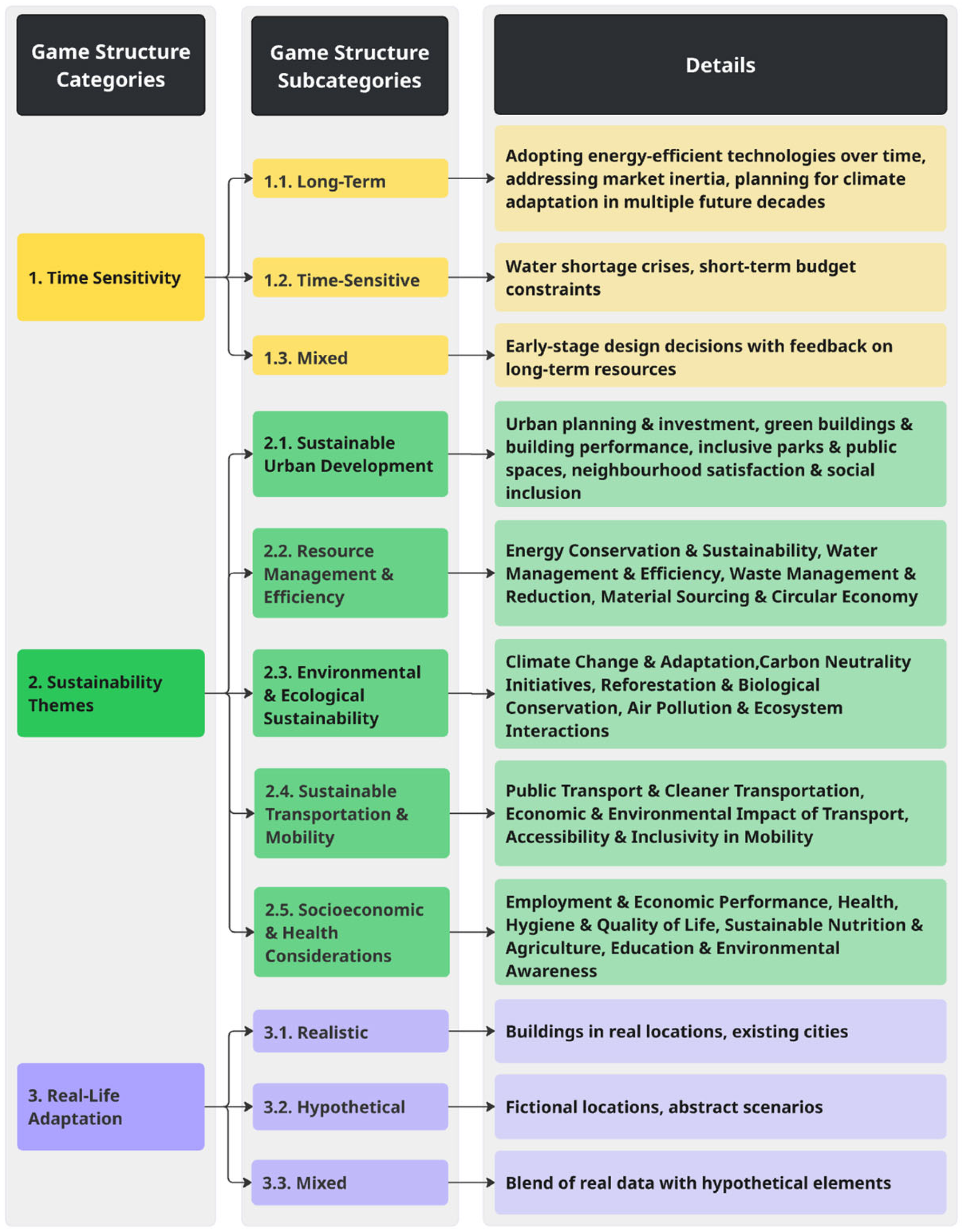
Figure 1. Game structure categories.
Sustainability 17 11148 g001
Table 1. Evaluated paper categories and game types.
Paper CategorizationNumber of PapersCitationsGame Type
Analog GamesDigital Games
Game evaluation11[19,20,21,22,23,24,25,26,27,28]44
Game proposal5[29,30,31,32,33]23
Game framework1[34]01
Assessment of sustainability aspect(s) through games3[21,35,36,37,38,39]12
Game review papers5[10,11,16,17,18]--
Table 2. Criteria and sub-criteria for evaluation.
CriteriaSub-Criteria
Sustainability IncorporationOverall Approach; SDG Inclusion; Themes; Character Inclusivity; Real-Life Context; Problem Timeframe; Awareness vs. Solutions; Teaching and Learning; Sustainability Integration; Sustainability Message Clarity; Challenges in Incorporating Sustainability
Engagement StrategiesPlayability; Re-playability; Aesthetic Appeal; Context Application; Engagement Strategies; Guidance; Engagement Challenges
Game Characteristics and StructuresGame Name; Game Type; Participation Type; Gameplay; Time Limit; Scoring Systems; Target Audience; Built Environment Scale; Time Sensitivity; Sustainability Themes; Real-Life Framing
Table 3. Engagement strategies.
Cat.CriteriaSource(s)
Learning MechanicsRole-play [21,23]
Randomized elements [25]
Topic expansion or modification options [25]
Adaptation to real life [19,20,23]
Immediate feedback [19,20]
Self-directed learning[23]
Collaborative decision-making[20,30,32]
Competitive elements[24,28]
Story-driven gameplay [30]
Rewards and advancement systems[24,21]
Active learning (problem-solving, critical thinking)[19,20,23]
Time pressure[21,23]
Progressively increasing difficulty[21,25]
AestheticsMultimedia or Immersive[20,23]
Digital Effects[20]
Simplified Design[30,32]
Real-Life App.Practical Solutions[19,20,23]
Decision-Making[19,23]
Subject-Specified[23,26]
Theoretical[25]
GuidanceFully teacher-guided[20]
Tutorials provided[20,23]
Scaffolding provided for challenging concepts[20,23]
Guided scenarios[20]
In-game hints & feedback[19,20]
Peer-based guidance[23]
Post-game debriefing[23]
No Guidance[25]
Table 4. Game characteristics.
Game CharacteristicCategoryCountPercentage
Game Type Traditional board/card game38.60%
Hybrid game (mix of board and digital elements)617.10%
Fully digital game with advanced interactions1542.90%
Participation Type Solo Play25.70%
Supports Both Solo and Team-Based Play1028.60%
Team-Based1234.30%
Game PlayCollaborative (Individual Progression)38.60%
Mix of competition and collaboration720%
Competition1440%
Time LimitNo Time Constraints411.40%
Mix of Limited Time Scenarios925.70%
Strict time constraints to simulate real-world pressure1131.40%
Scoring SystemUnstructured Scoring System514.30%
Qualitative Feedback System720%
Structured Point-Based System1234.30%
Target AudienceGeneral Public (Informal Learners)38.60%
Pre-University Students925.70%
Higher education/professionals1234.30%
Built Environment ScaleProduct-level decision-making38.60%
City/urban planning level617.10%
Building-focused sustainability decisions1542.90%
Table 5. Summary of observed challenges in games related to sustainability, recommendations to address these challenges, and potential barriers.
ChallengeRecommendations to Address These Challenges Potential Barriers and Challenges
Lack of Inclusivity in Sustainability GamesIncorporating disability, Indigenous perspectives, and diverse ethnic representation in games.Some aspects of inclusivity and accessibility are not purely physical, making it difficult to integrate qualitative aspects into games.
Insufficient Integration of the SDGsSince the SDGs are clearly organized by targets and indicators, they can be integrated into games based on relevant topics.Some game scenarios address multiple topics, making it difficult to categorize them under specific SDGs as they may span several goals.
Complexity and Decision-Making ChallengesStreamline complex scenarios into smaller, more manageable ones.This might lead to oversimplifying complex sustainability challenges, reducing their educational value.
Lack of a Common Language Among StakeholdersUse clearer scenarios and language that can be understood by a wider audience, including those outside the built environment field.Oversimplification might make it difficult to convey nuanced sustainability challenges accurately.
Challenges in Real-World Applicability and ImpactIncorporate long-term impact considerations into game scenarios.Accounting for long-term real-world scenarios might not be fully feasible due to the complexity and variety of influencing factors.
Cognitive Barriers to Sustainability LearningDesign games that accommodate diverse cognitive patterns, allowing players to explore sustainability concepts through different approaches (e.g., visual, experiential, or interactive learning).Adapting to different cognitive styles may require extensive testing and customization, increasing development time and costs.
Aesthetic Limitations in Sustainable Design Games Not all game elements need high realism; a balance can be struck where key parts have strong aesthetics to enhance learning.Inconsistencies in design aesthetics may disrupt player immersion and engagement.
Consequences of Game MechanicsAssess the long-term effects of gameplay on players and modify mechanics accordingly to reinforce sustainable behaviors.Long-term player behavior is difficult to track and measure, making it challenging to determine the exact impact of game mechanics.
Table 6. Summary of engagement strategies, challenges, and potential recommendations.
Engagement StrategyChallengesPotential Recommendation
Immediate feedbackPlayers struggled without real-time responses to their actions, making it hard to adjust strategies or understand consequences.Incorporate dynamic, real-time feedback systems to guide decision-making and reinforce learning outcomes
Self-directed learningSome players felt lost or overwhelmed when games lacked structure; others didn’t know how to explore effectively without prompts.Balance open-ended exploration with optional guidance or learning checkpoints to maintain autonomy and prevent confusion
Collaboration (group work)Disagreements and coordination issues reduced engagement; lack of real-time communication in digital formats further complicated collaboration.Design well-structured collaborative mechanics and provide communication tools to support teamwork and goal alignment
Competitive elementsExcessive competition reduced cooperation and led to aggressive strategies that undermined educational goals.Balance competitive and cooperative mechanics to maintain motivation while supporting shared learning
Story-driven gameplayWhen not well-integrated, stories failed to engage or lacked connection to educational content.Develop meaningful, context-rich narratives that tie directly to learning objectives and decision outcomes
Rewards and advancement systemsPlayers focused more on points than understanding concepts; extrinsic rewards sometimes overshadowed intrinsic motivation.Use rewards to reinforce learning milestones, but ensure gameplay centers on meaningful sustainability decision-making
Active learningSome games were too complex or fast-paced, limiting players’ ability to apply critical thinking effectively.Incorporate scaffolding and pacing tools that allow deeper exploration and reflection on complex decisions
Time pressureFast-paced gameplay caused stress and impaired decision-making, especially for complex tasks.Offer adjustable timing options or buffers to allow thoughtful decision-making while preserving challenge
Progressively increasing difficultyGames that were too easy led to boredom, and those that were too hard caused frustration. Some lacked proper progression curves.Implement adaptive difficulty systems to ensure players are consistently challenged at appropriate levels
Disclaimer/Publisher’s Note: The statements, opinions and data contained in all publications are solely those of the individual author(s) and contributor(s) and not of MDPI and/or the editor(s). MDPI and/or the editor(s) disclaim responsibility for any injury to people or property resulting from any ideas, methods, instructions or products referred to in the content.



